Cambridge IGCSE Design and Technology 0445 — 2011 May/June Paper 4 · Variant 2
0445/42/M/J/11 · 50 marks · ≈56 min
The question paper and its mark scheme, free to read here and free to download. This is Cambridge’s own paper, exactly as it was sat.
Question paper16 pages




Mark scheme9 pages
Answers below. Sit the paper first if you are practising.
Paper as text
Question paper, page 1
[Turn over *0511196716* READ THESE INSTRUCTIONS FIRST Write your Centre number, candidate number and name on all the work you hand in. Write in dark blue or black pen. You may use a soft pencil for any diagrams or graphs. Do not use staples, paper clips, highlighters, glue or correction fl uid. DO NOT WRITE IN ANY BARCODES. You may use a calculator. Section A Answer all questions. Section B Answer one question. At the end of the examination, fasten all your work securely together. The number of marks is given in brackets [ ] at the end of each question or part question. For Examiner’s Use Section A Section B Total DESIGN AND TECHNOLOGY 0445/42 Paper 4 Systems and Control May/June 2011 1 hour Candidates answer on the Question Paper. No Additional Materials are required. To be taken together with Paper 1 in one session of 2 hours and 15 minutes. UNIVERSITY OF CAMBRIDGE INTERNATIONAL EXAMINATIONS International General Certifi cate of Secondary Education This document consists of 15 printed pages and 1 blank page. [Turn over IB11 06_0445_42/FP © UCLES 2011 www.XtremePapers.com
Question paper, page 2
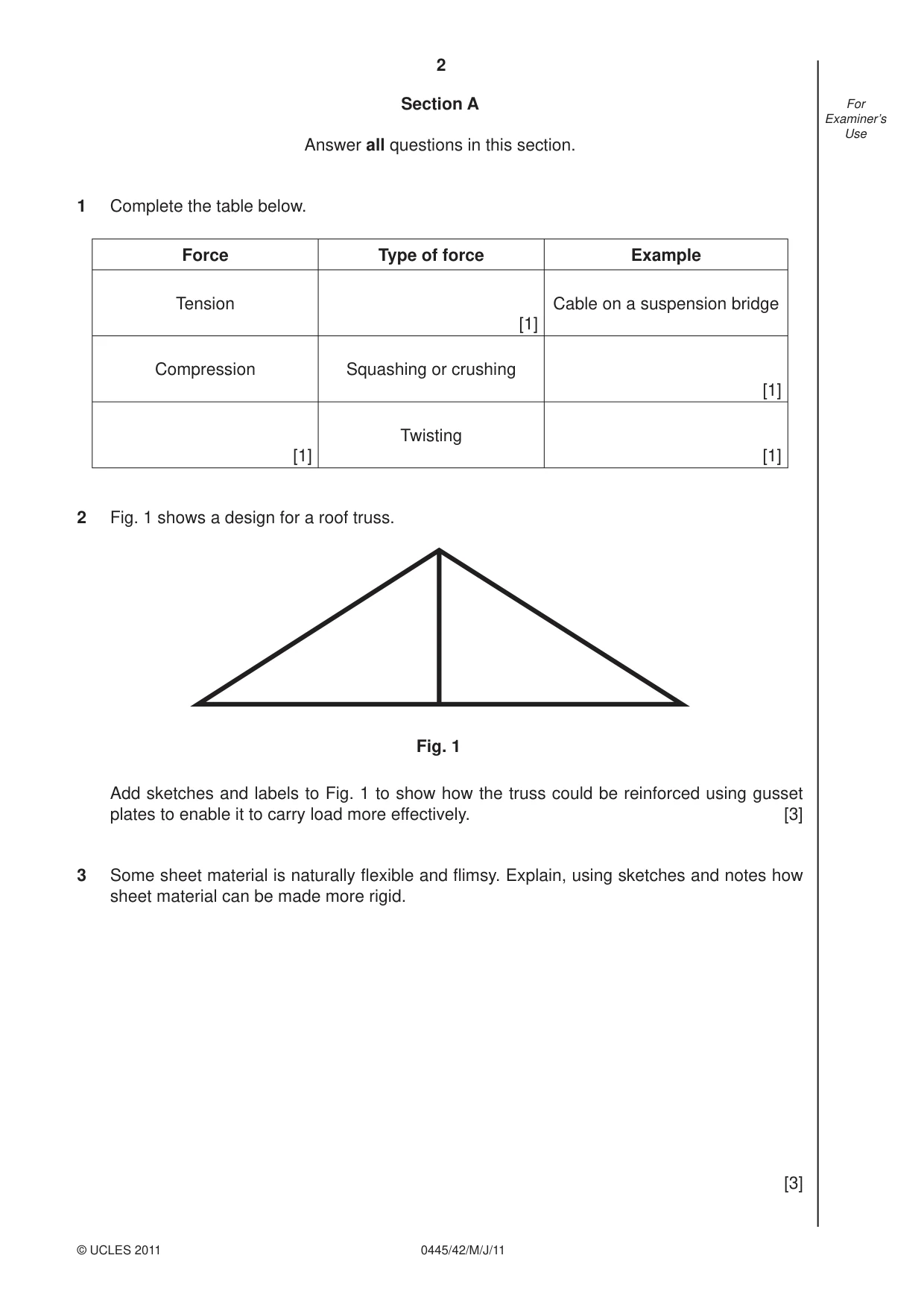
2 0445/42/M/J/11 © UCLES 2011 For Examiner’s Use Section A Answer all questions in this section. 1 Complete the table below. Force Type of force Example Tension [1] Cable on a suspension bridge Compression Squashing or crushing [1] [1] Twisting [1] 2 Fig. 1 shows a design for a roof truss. Fig. 1 Add sketches and labels to Fig. 1 to show how the truss could be reinforced using gusset plates to enable it to carry load more effectively. [3] 3 Some sheet material is naturally fl exible and fl imsy. Explain, using sketches and notes how sheet material can be made more rigid. [3]
Question paper, page 3
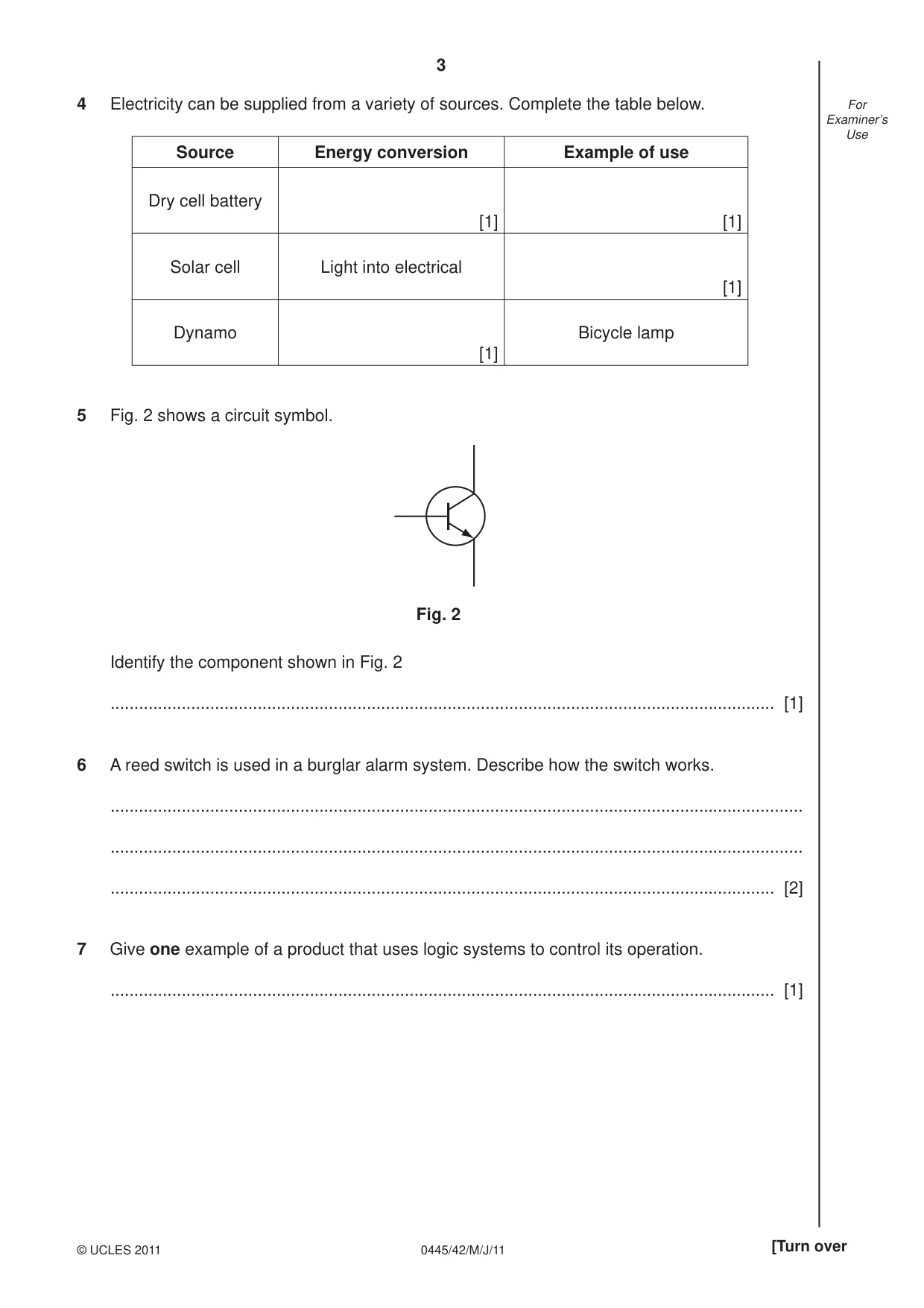
3 0445/42/M/J/11 © UCLES 2011 [Turn over For Examiner’s Use 4 Electricity can be supplied from a variety of sources. Complete the table below. Source Energy conversion Example of use Dry cell battery [1] [1] Solar cell Light into electrical [1] Dynamo [1] Bicycle lamp 5 Fig. 2 shows a circuit symbol. Fig. 2 Identify the component shown in Fig. 2 … [1] 6 A reed switch is used in a burglar alarm system. Describe how the switch works. … … … [2] 7 Give one example of a product that uses logic systems to control its operation. … [1]
Question paper, page 4
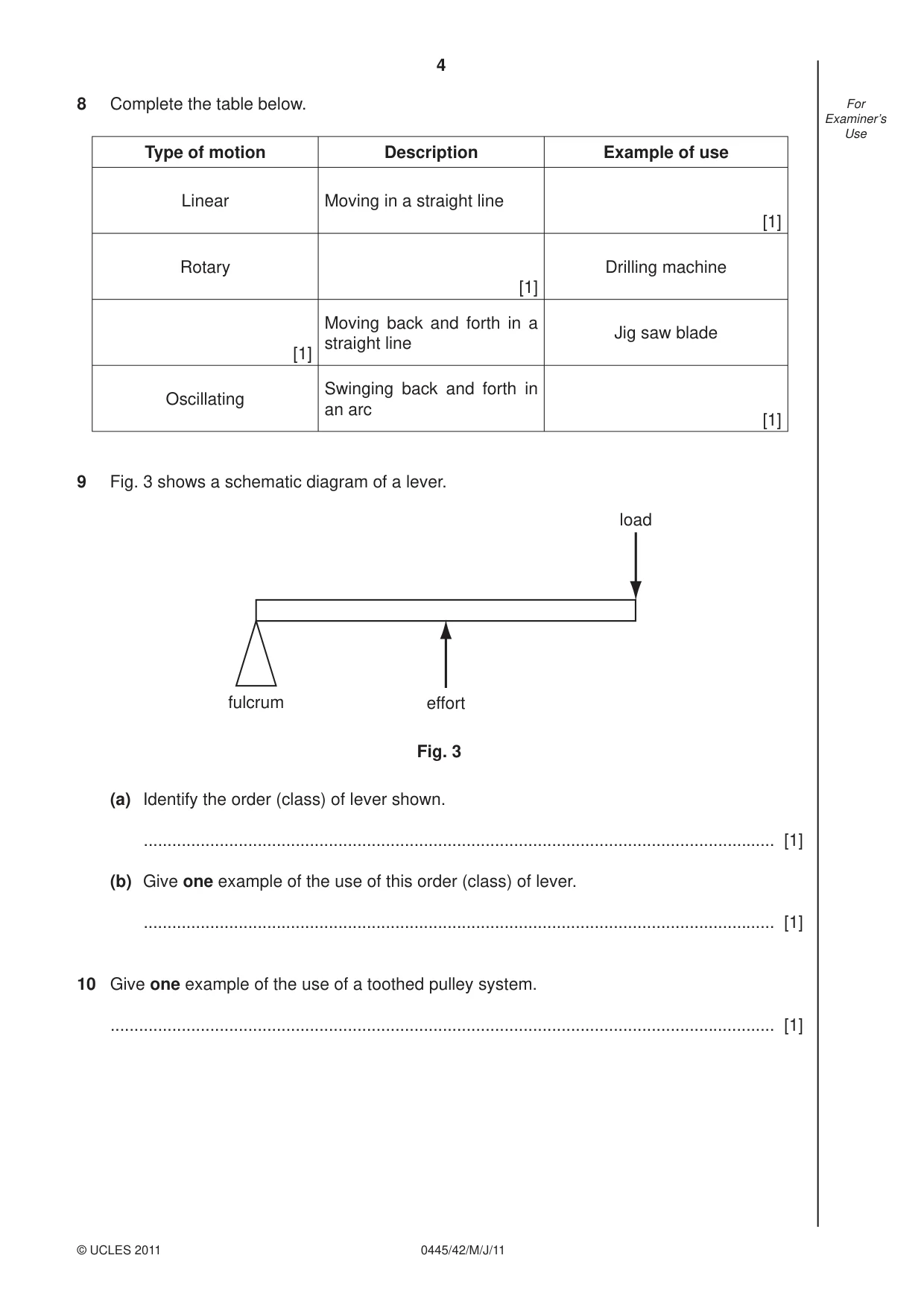
4 0445/42/M/J/11 © UCLES 2011 For Examiner’s Use 8 Complete the table below. Type of motion Description Example of use Linear Moving in a straight line [1] Rotary [1] Drilling machine [1] Moving back and forth in a straight line Jig saw blade Oscillating Swinging back and forth in an arc [1] 9 Fig. 3 shows a schematic diagram of a lever. effort fulcrum load Fig. 3 (a) Identify the order (class) of lever shown. … [1] (b) Give one example of the use of this order (class) of lever. … [1] 10 Give one example of the use of a toothed pulley system. … [1]
Question paper, page 5
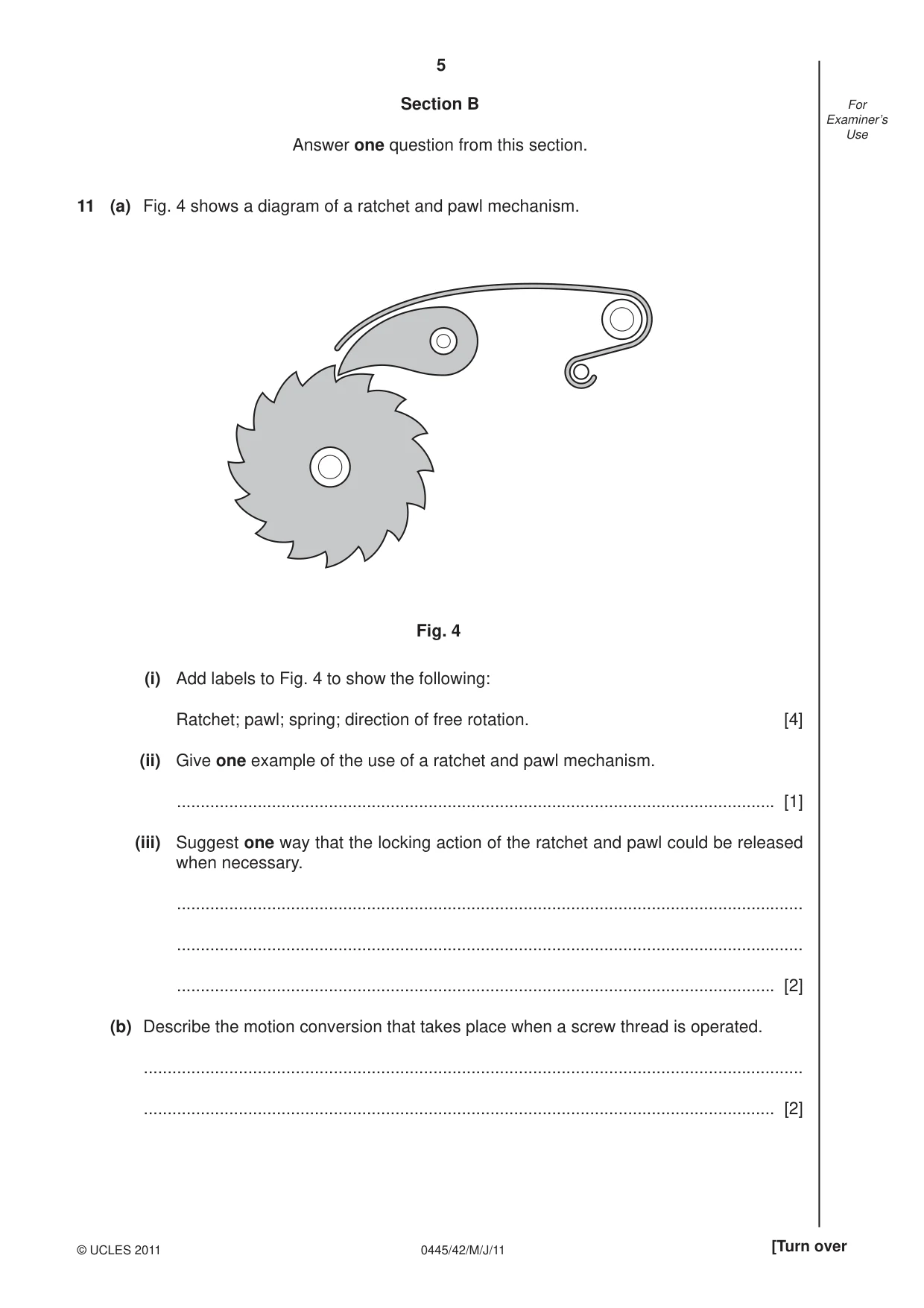
5 0445/42/M/J/11 © UCLES 2011 [Turn over For Examiner’s Use Section B Answer one question from this section. 11 (a) Fig. 4 shows a diagram of a ratchet and pawl mechanism. Fig. 4 (i) Add labels to Fig. 4 to show the following: Ratchet; pawl; spring; direction of free rotation. [4] (ii) Give one example of the use of a ratchet and pawl mechanism. … [1] (iii) Suggest one way that the locking action of the ratchet and pawl could be released when necessary. … … … [2] (b) Describe the motion conversion that takes place when a screw thread is operated. … … [2]
Question paper, page 6
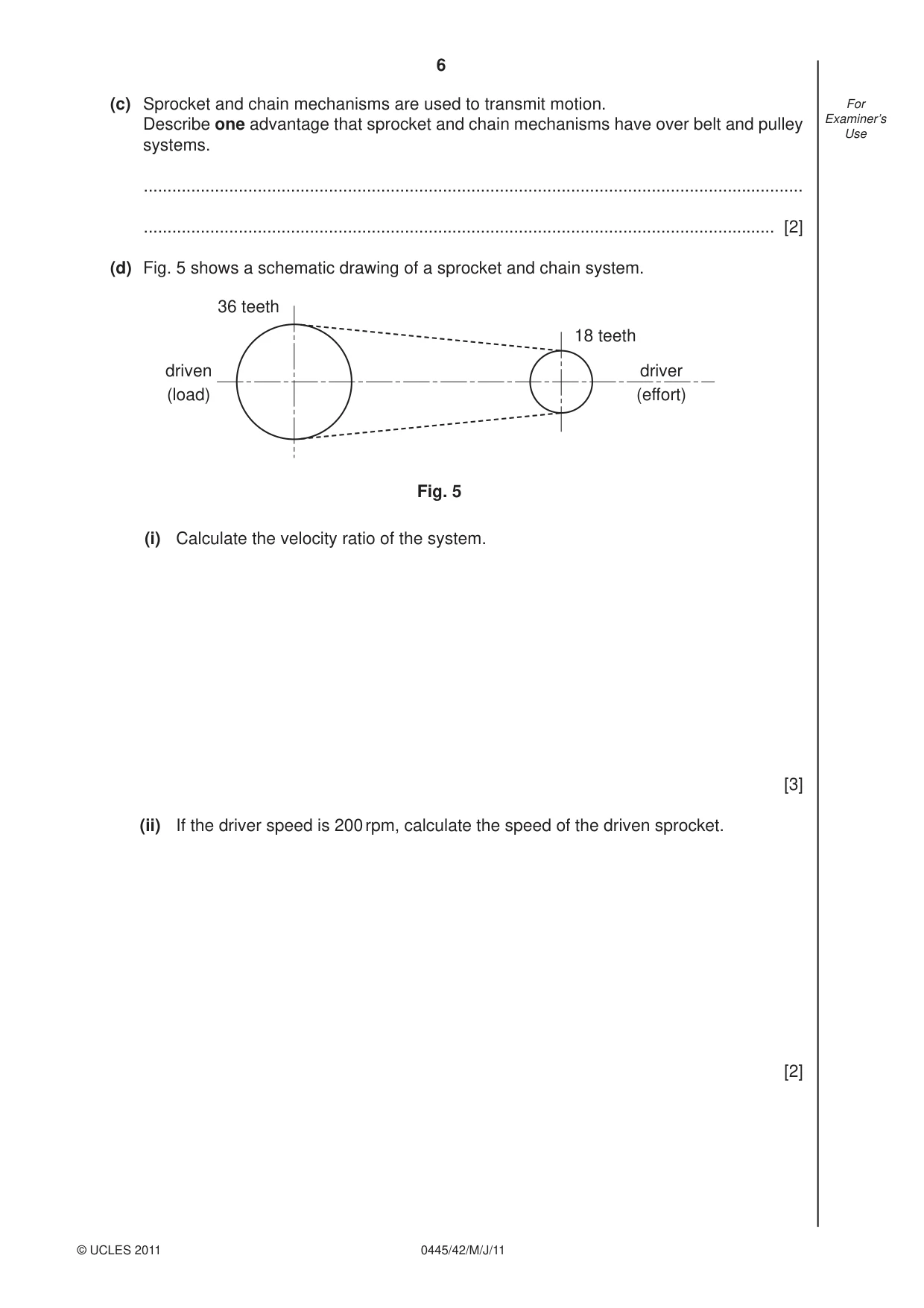
6 0445/42/M/J/11 © UCLES 2011 For Examiner’s Use (c) Sprocket and chain mechanisms are used to transmit motion. Describe one advantage that sprocket and chain mechanisms have over belt and pulley systems. … … [2] (d) Fig. 5 shows a schematic drawing of a sprocket and chain system. 36 teeth 18 teeth driver (effort) driven (load) Fig. 5 (i) Calculate the velocity ratio of the system. [3] (ii) If the driver speed is 200 rpm, calculate the speed of the driven sprocket. [2]
Question paper, page 7
7 0445/42/M/J/11 © UCLES 2011 [Turn over For Examiner’s Use (iii) Calculate the mechanical advantage of the system, if the effi ciency of the system is 60 %. [3] (e) The effi ciency of a mechanical system is determined by a number of factors. (i) Bearings may be used to reduce friction. Use sketches and notes to describe a plain bearing. [3] (ii) Give one example of the use of a ball bearing. … [1] (iii) Apart from the use of bearings explain how friction between two surfaces can be reduced. … … … [2]
Question paper, page 8
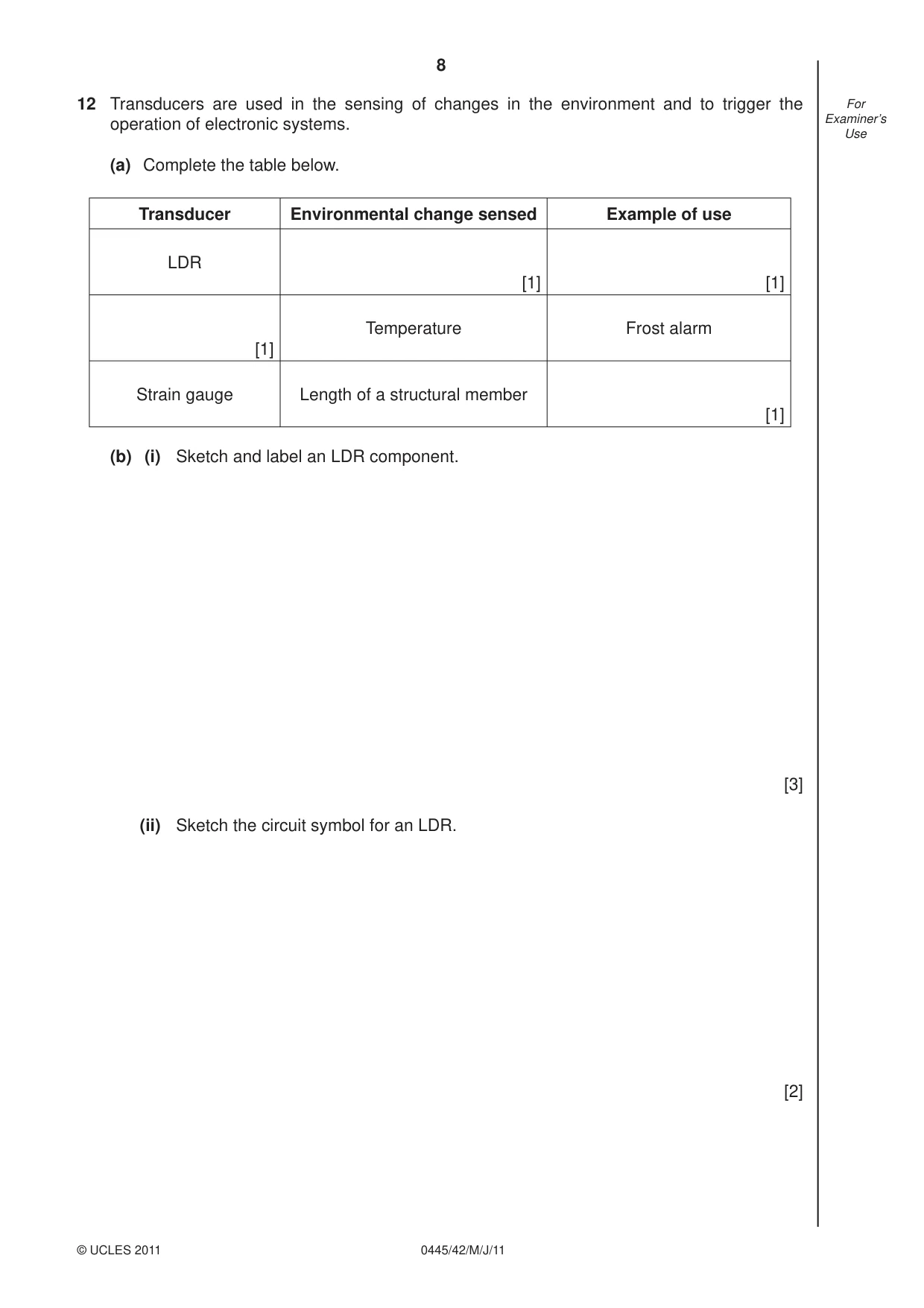
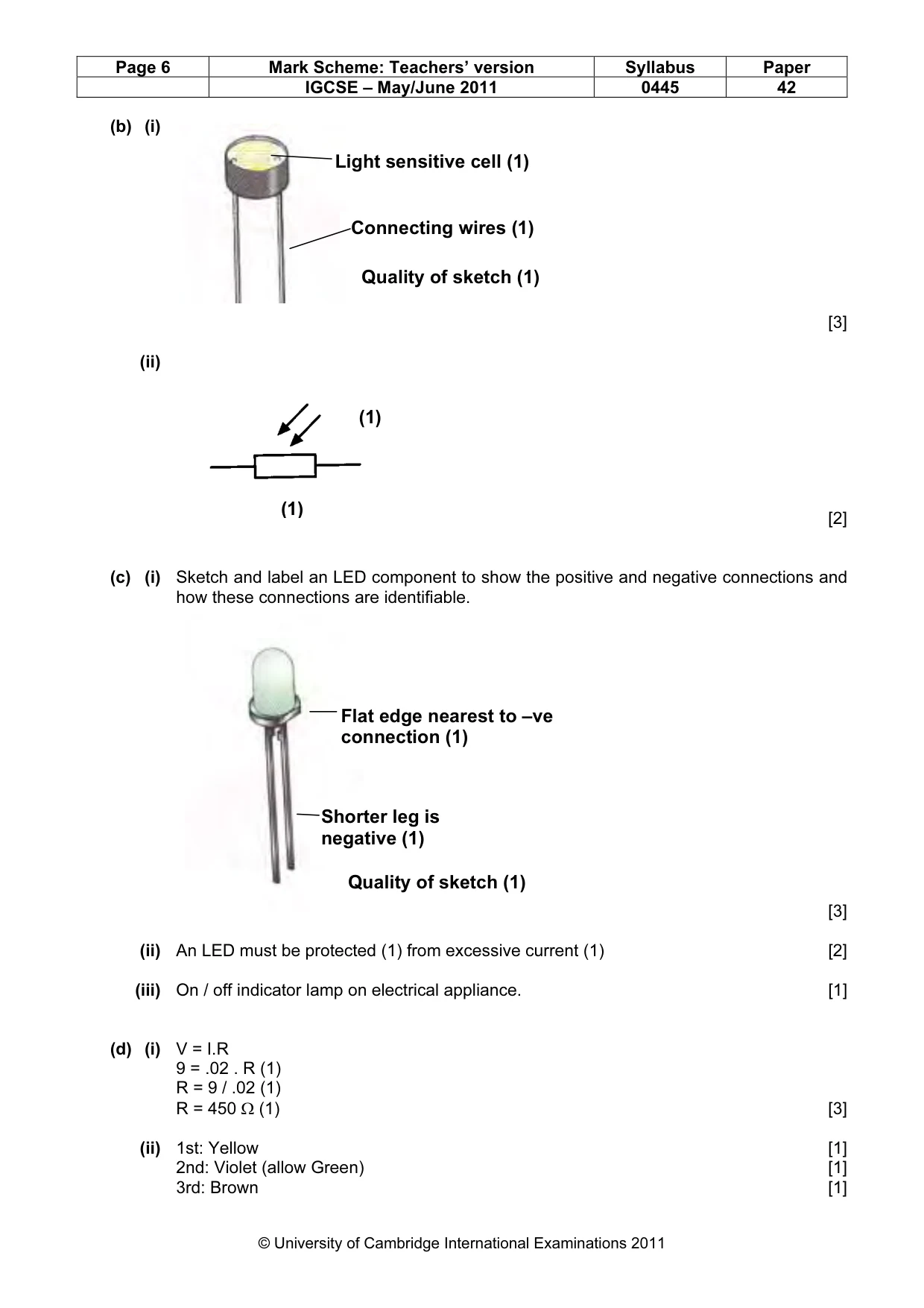
8 0445/42/M/J/11 © UCLES 2011 For Examiner’s Use 12 Transducers are used in the sensing of changes in the environment and to trigger the operation of electronic systems. (a) Complete the table below. Transducer Environmental change sensed Example of use LDR [1] [1] [1] Temperature Frost alarm Strain gauge Length of a structural member [1] (b) (i) Sketch and label an LDR component. [3] (ii) Sketch the circuit symbol for an LDR. [2]
Question paper, page 9
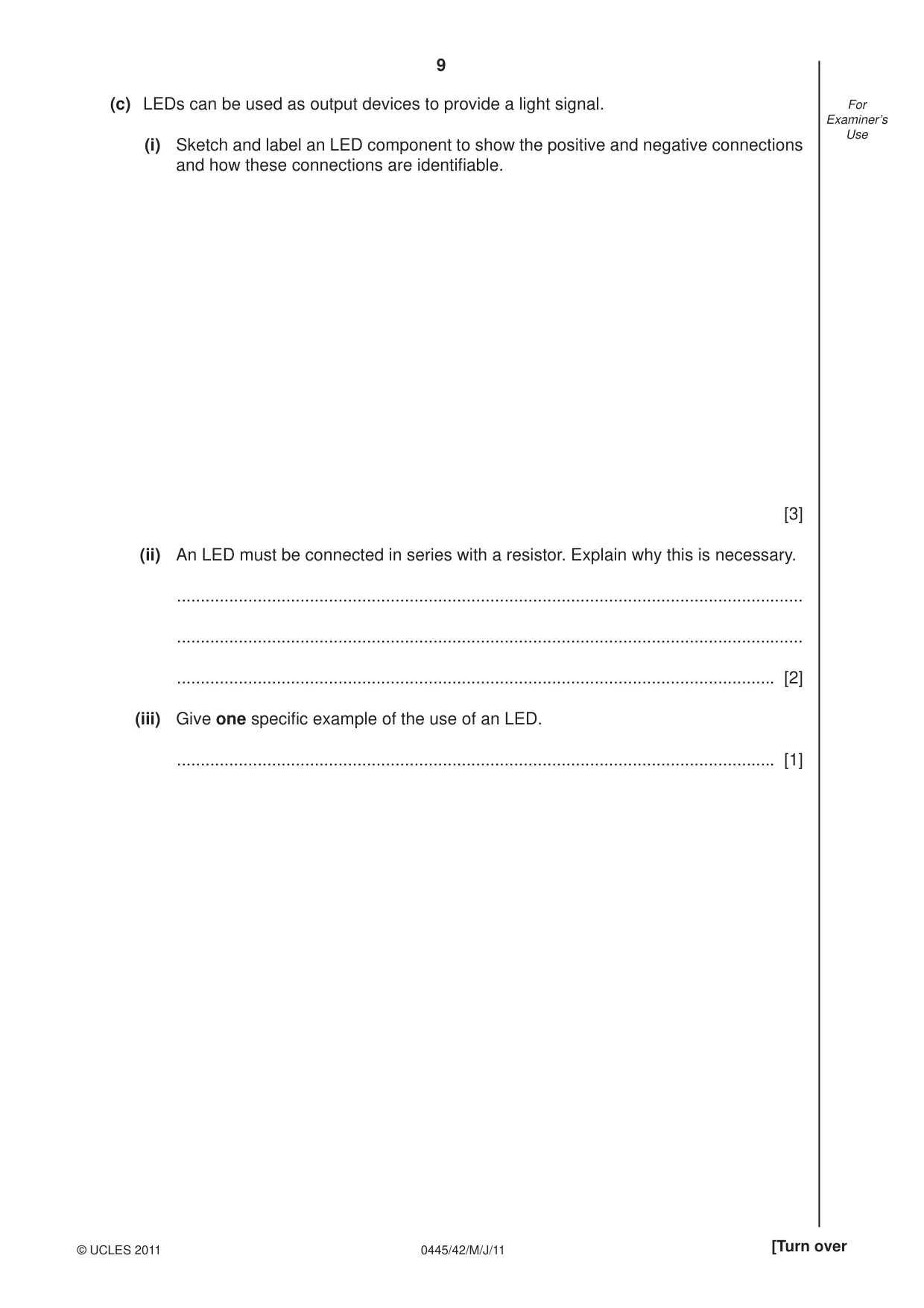
9 0445/42/M/J/11 © UCLES 2011 [Turn over For Examiner’s Use (c) LEDs can be used as output devices to provide a light signal. (i) Sketch and label an LED component to show the positive and negative connections and how these connections are identifi able. [3] (ii) An LED must be connected in series with a resistor. Explain why this is necessary. … … … [2] (iii) Give one specifi c example of the use of an LED. … [1]
Question paper, page 10
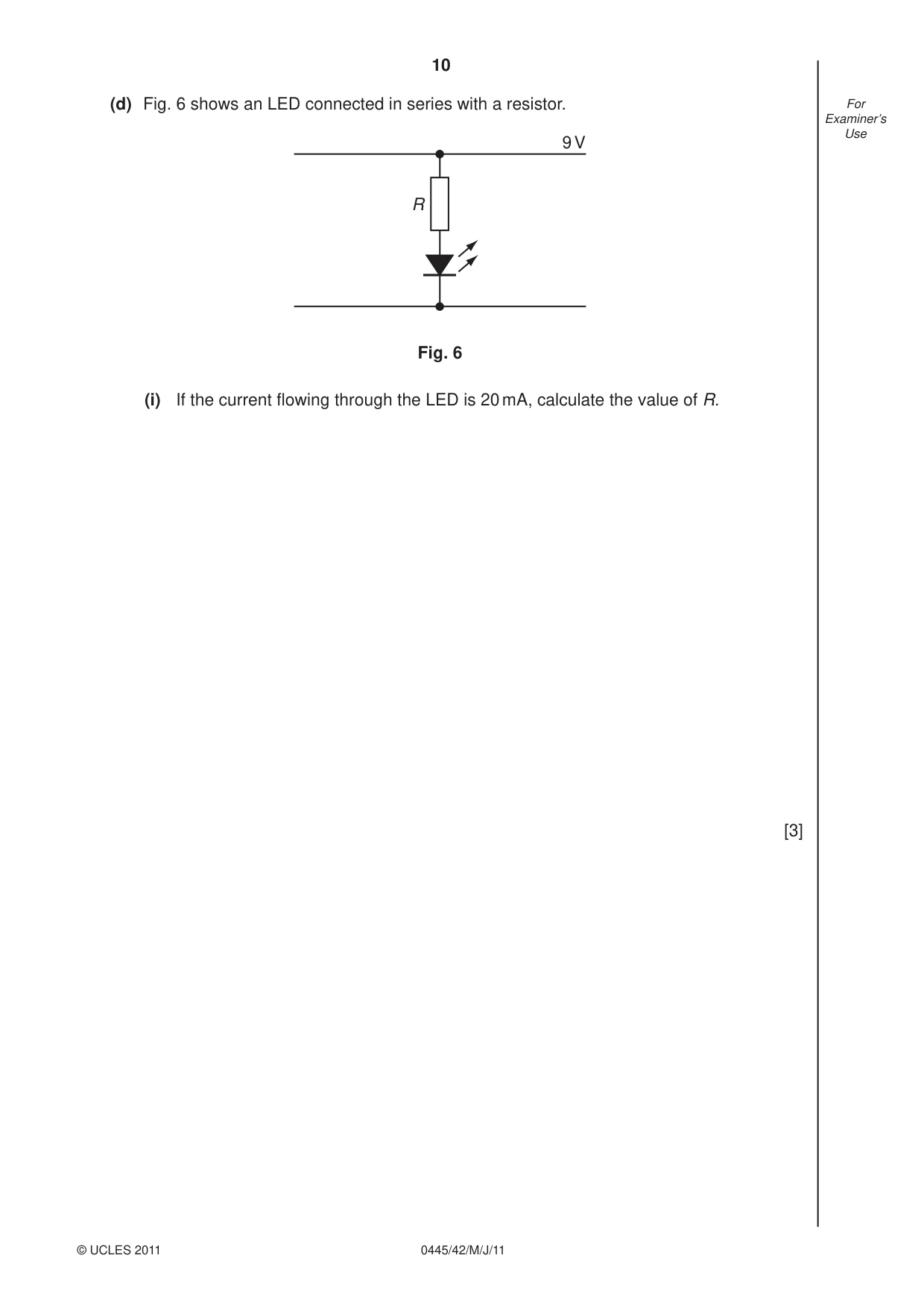
10 0445/42/M/J/11 © UCLES 2011 For Examiner’s Use (d) Fig. 6 shows an LED connected in series with a resistor. 9 V R Fig. 6 (i) If the current fl owing through the LED is 20 mA, calculate the value of R. [3]
Question paper, page 11
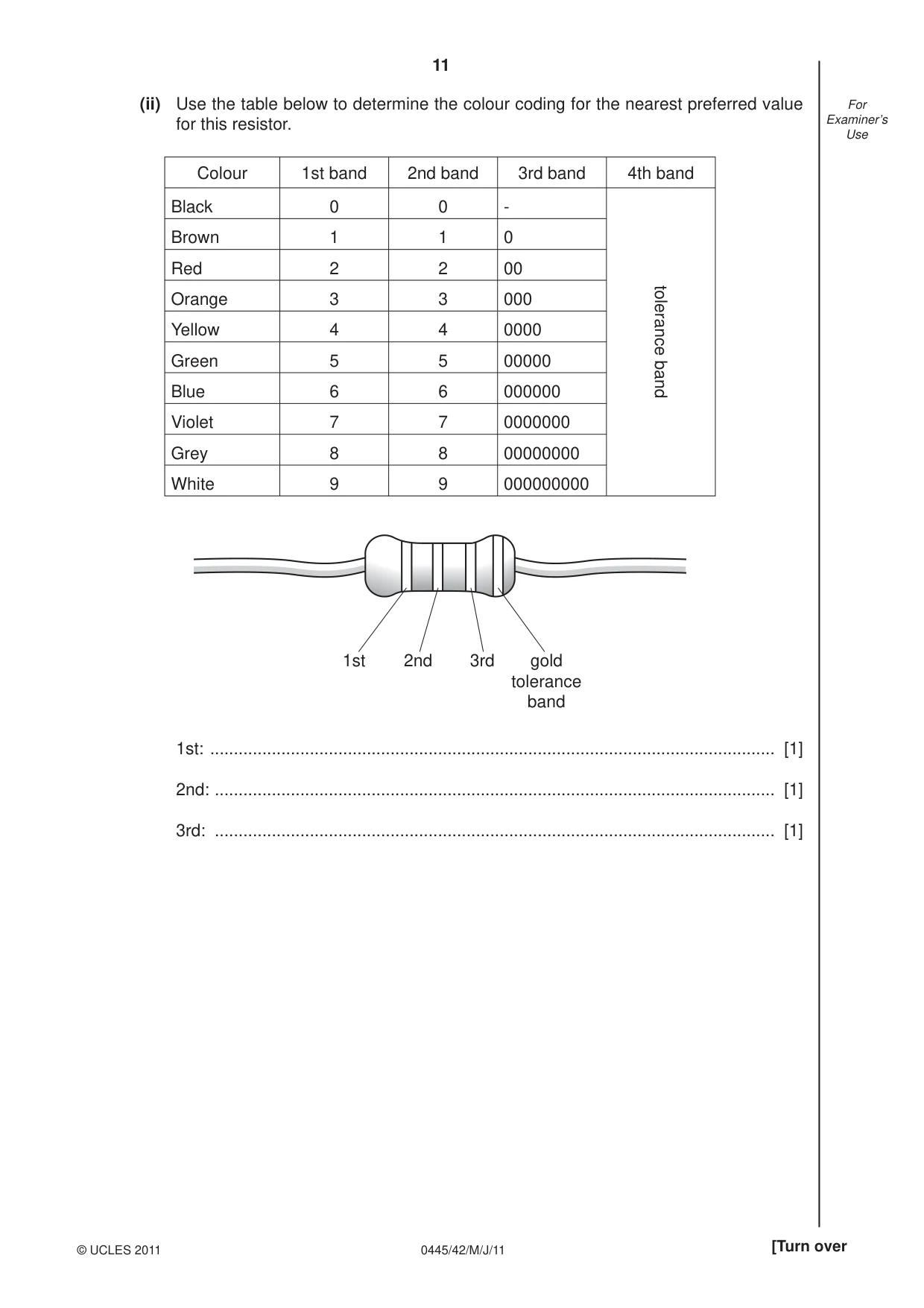
11 0445/42/M/J/11 © UCLES 2011 [Turn over For Examiner’s Use (ii) Use the table below to determine the colour coding for the nearest preferred value for this resistor. Colour 1st band 2nd band 3rd band 4th band Black 0 0 - tolerance band Brown 1 1 0 Red 2 2 00 Orange 3 3 000 Yellow 4 4 0000 Green 5 5 00000 Blue 6 6 000000 Violet 7 7 0000000 Grey 8 8 00000000 White 9 9 000000000 1st 2nd 3rd gold tolerance band 1st: … [1] 2nd: … [1] 3rd: … [1]
Question paper, page 12
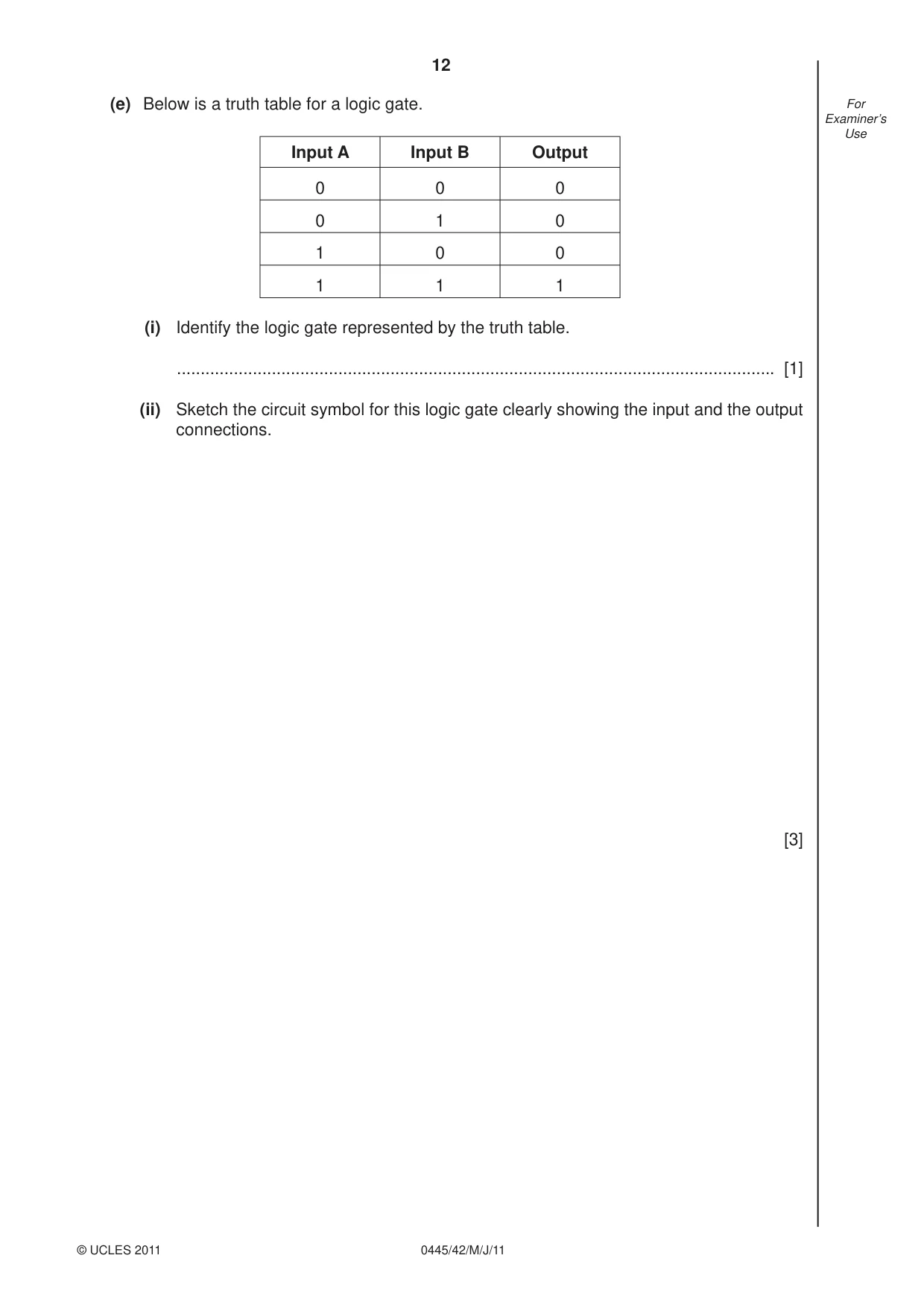
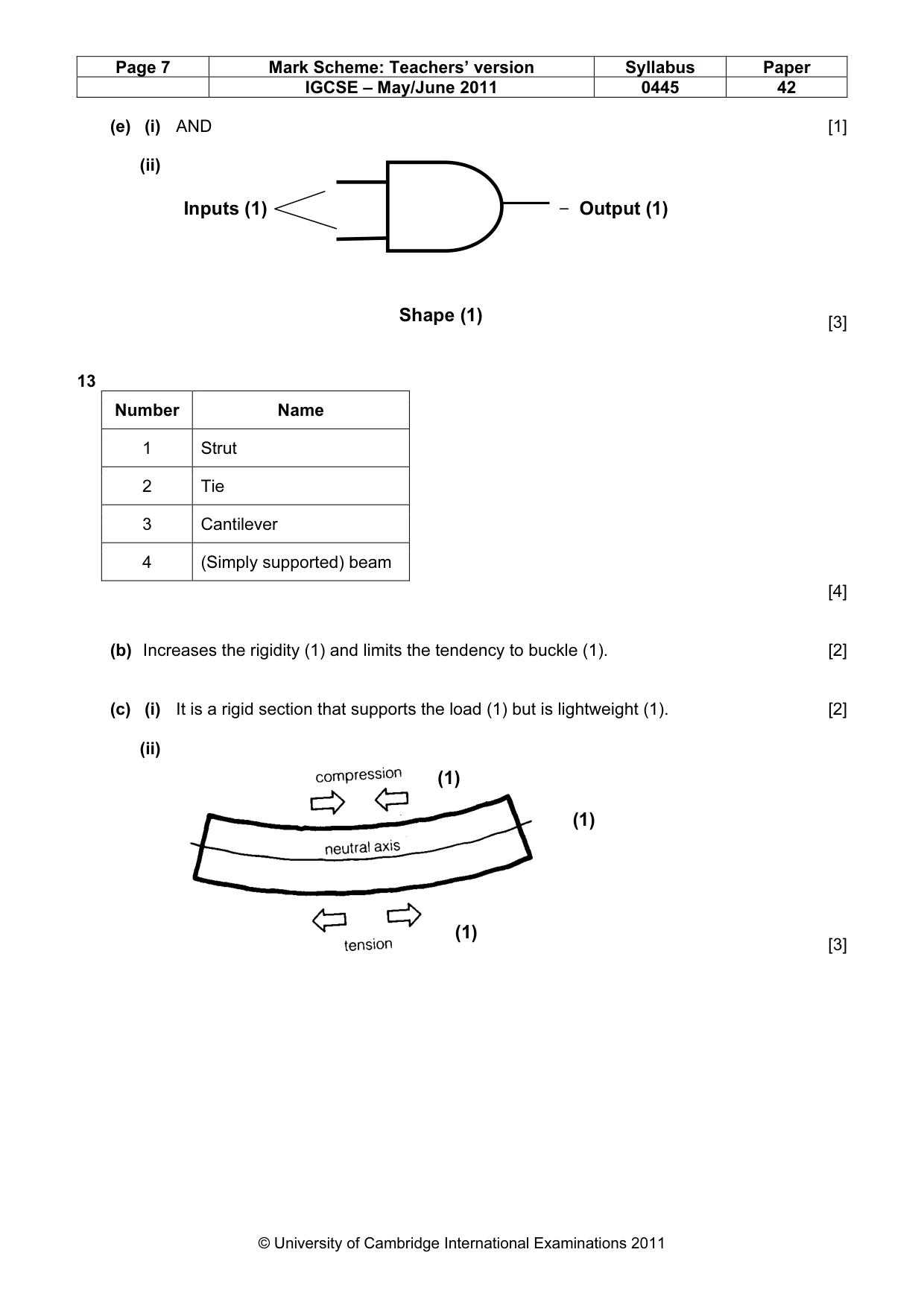
12 0445/42/M/J/11 © UCLES 2011 For Examiner’s Use (e) Below is a truth table for a logic gate. Input A Input B Output 0 0 0 0 1 0 1 0 0 1 1 1 (i) Identify the logic gate represented by the truth table. … [1] (ii) Sketch the circuit symbol for this logic gate clearly showing the input and the output connections. [3]
Question paper, page 13
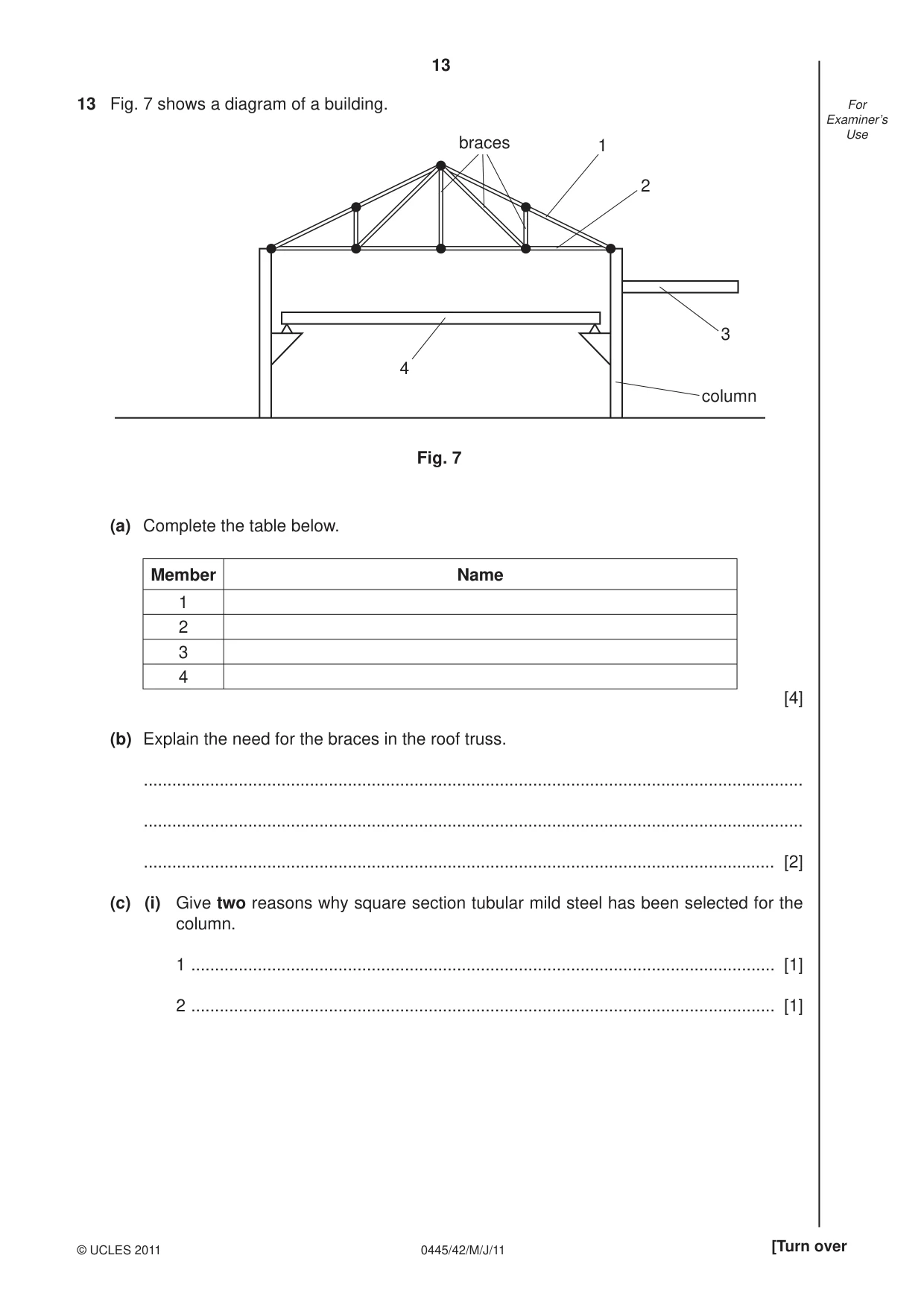
13 0445/42/M/J/11 © UCLES 2011 [Turn over For Examiner’s Use 13 Fig. 7 shows a diagram of a building. braces 1 2 3 column 4 Fig. 7 (a) Complete the table below. Member Name 1 2 3 4 [4] (b) Explain the need for the braces in the roof truss. … … … [2] (c) (i) Give two reasons why square section tubular mild steel has been selected for the column. 1 … [1] 2 … [1]
Question paper, page 14
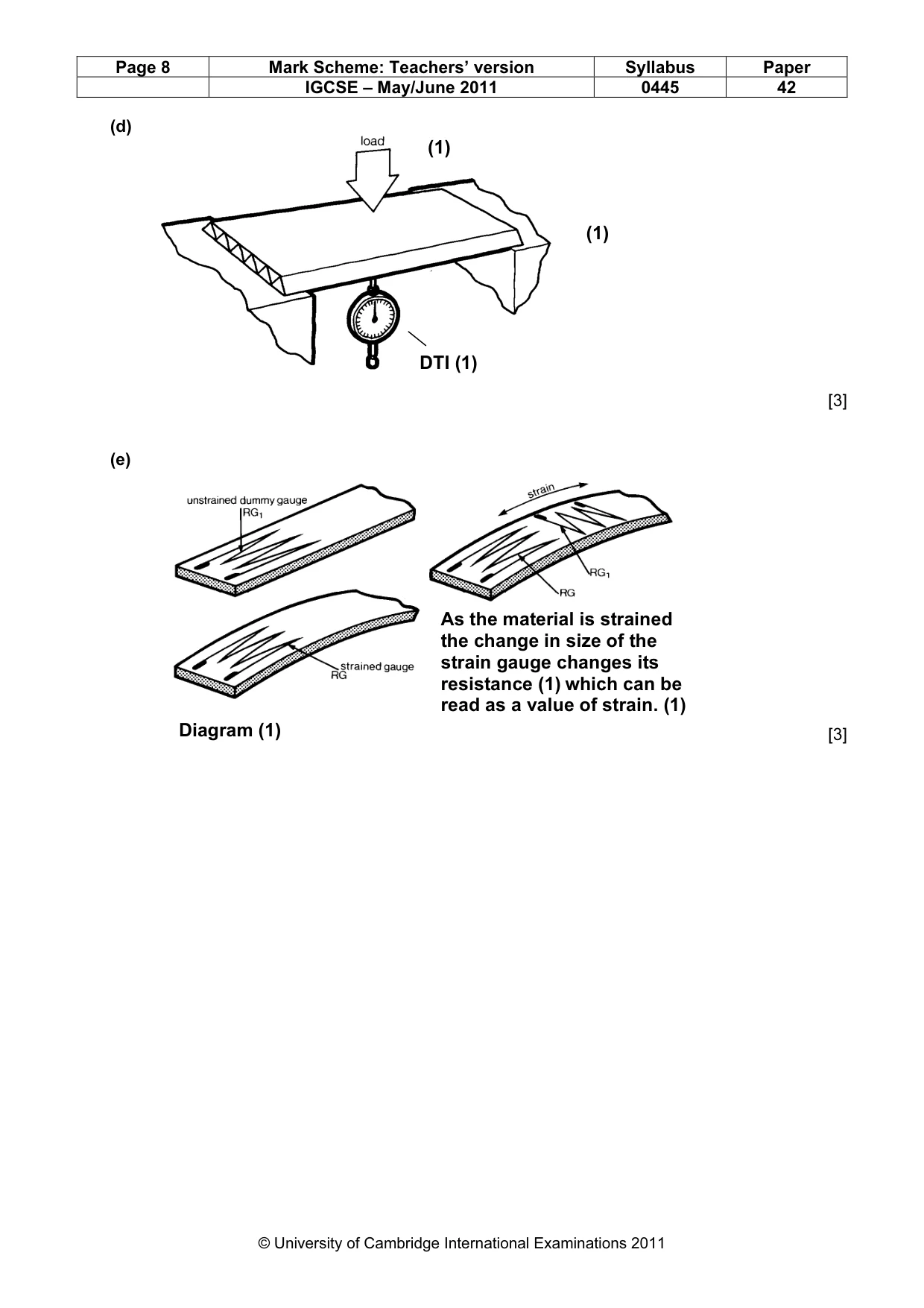
14 0445/42/M/J/11 © UCLES 2011 For Examiner’s Use (ii) Use sketches and notes to show the forces acting on member 4. [3] (d) Structures under load will defl ect. Use sketches and notes to explain how a simple dial gauge can be used to measure defl ection. [3] (e) Use sketches and notes to explain how a strain gauge works. [3]
Question paper, page 15
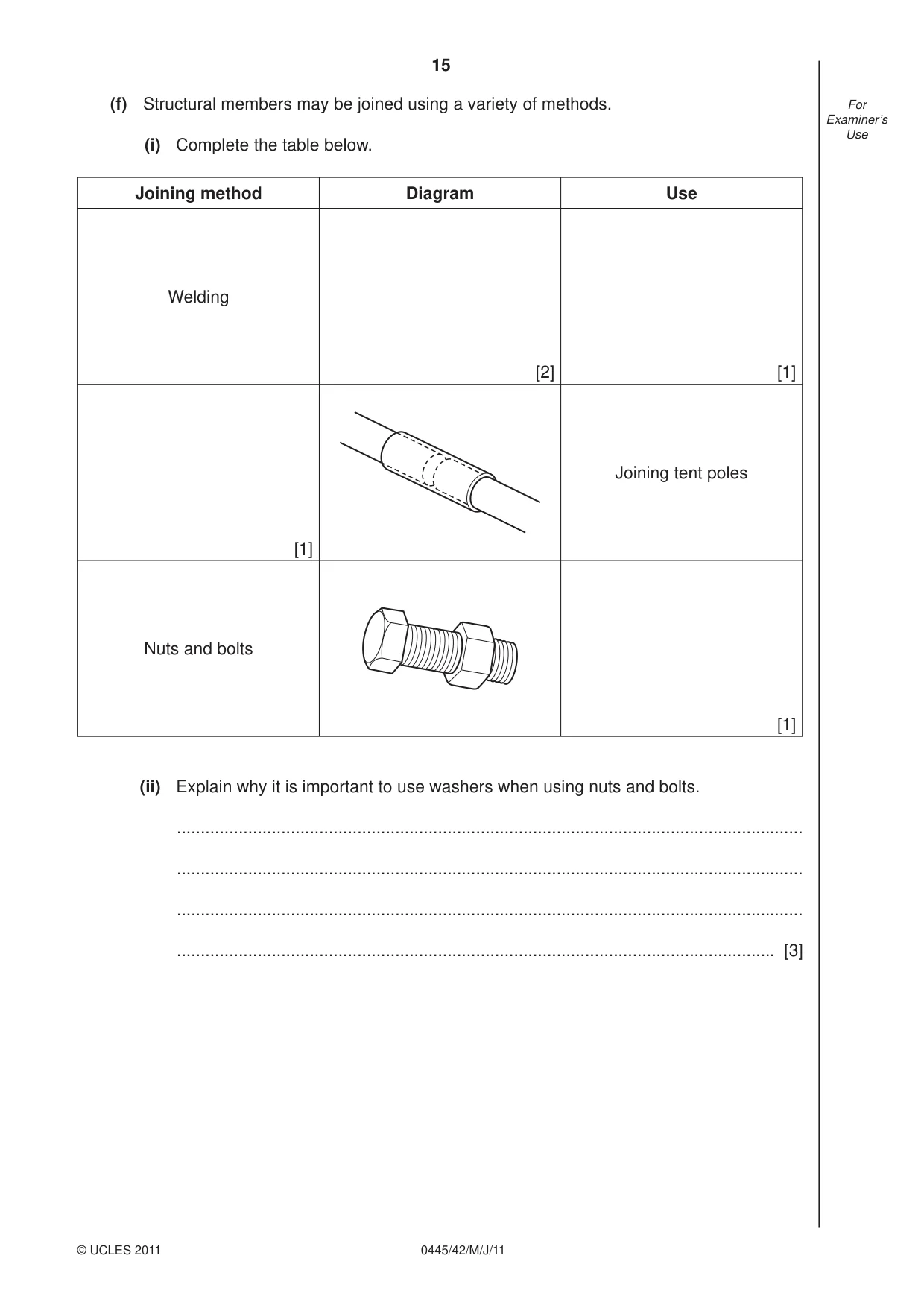
15 0445/42/M/J/11 © UCLES 2011 [Turn over For Examiner’s Use (f) Structural members may be joined using a variety of methods. (i) Complete the table below. Joining method Diagram Use Welding [2] [1] [1] Joining tent poles Nuts and bolts [1] (ii) Explain why it is important to use washers when using nuts and bolts. … … … … [3]
Question paper, page 16
16 0445/42/M/J/11 Permission to reproduce items where third-party owned material protected by copyright is included has been sought and cleared where possible. Every reasonable effort has been made by the publisher (UCLES) to trace copyright holders, but if any items requiring clearance have unwittingly been included the publisher will be pleased to make amends at the earliest possible opportunity. University of Cambridge International Examinations is part of the Cambridge Assessment Group. Cambridge Assessment is the brand name of University of Cambridge Local Examinations Syndicate (UCLES), which is itself a department of the University of Cambridge. BLANK PAGE © UCLES 2011
Mark scheme, page 1
UNIVERSITY OF CAMBRIDGE INTERNATIONAL EXAMINATIONS International General Certificate of Secondary Education MARK SCHEME for the May/June 2011 question paper for the guidance of teachers 0445 DESIGN AND TECHNOLOGY 0445/42 Paper 4 (Systems and Control), maximum raw mark 50 This mark scheme is published as an aid to teachers and candidates, to indicate the requirements of the examination. It shows the basis on which Examiners were instructed to award marks. It does not indicate the details of the discussions that took place at an Examiners’ meeting before marking began, which would have considered the acceptability of alternative answers. Mark schemes must be read in conjunction with the question papers and the report on the examination. • Cambridge will not enter into discussions or correspondence in connection with these mark schemes. Cambridge is publishing the mark schemes for the May/June 2011 question papers for most IGCSE, GCE Advanced Level and Advanced Subsidiary Level syllabuses and some Ordinary Level syllabuses. www.XtremePapers.com
Mark scheme, page 2
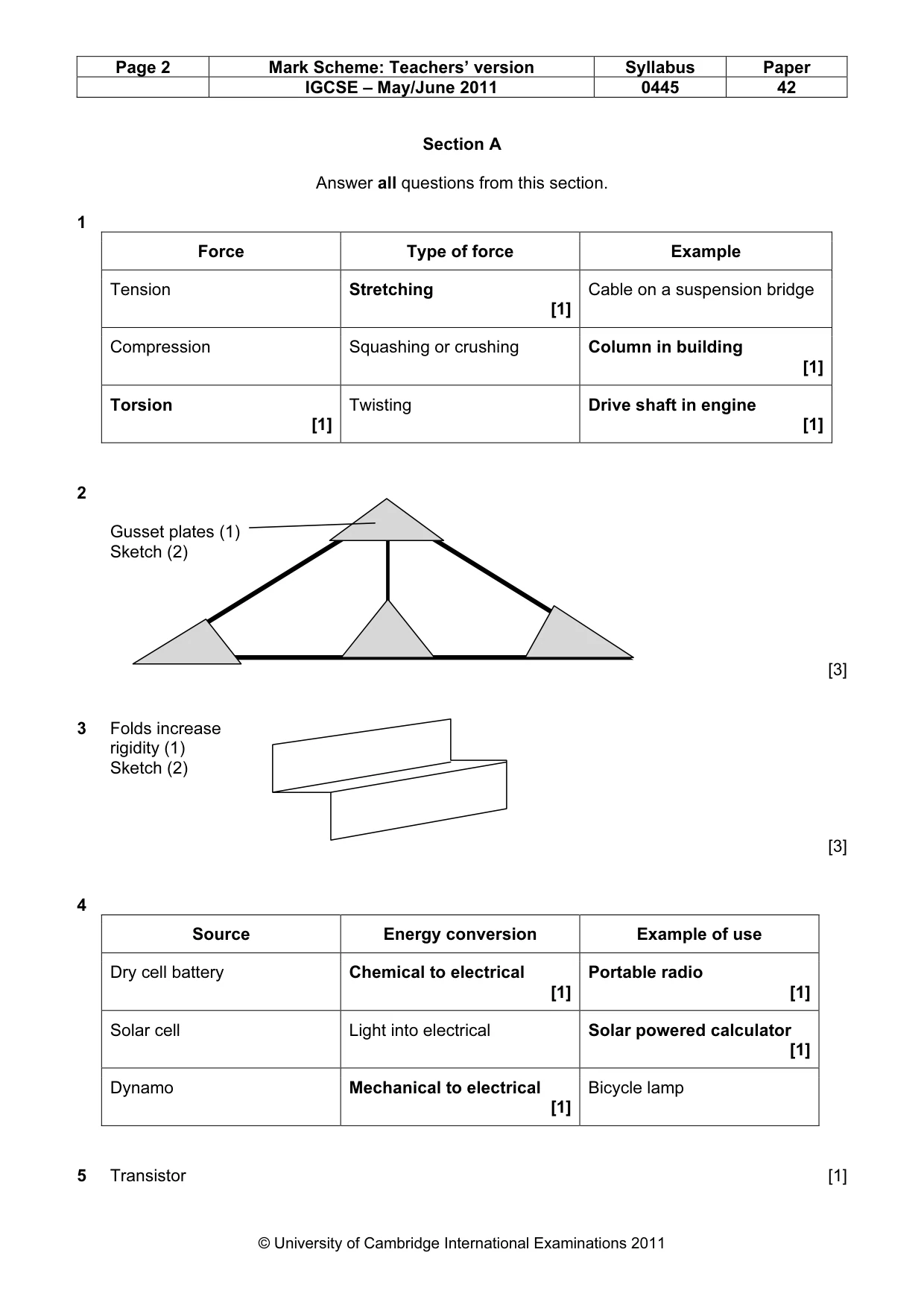
Page 2 Mark Scheme: Teachers’ version Syllabus Paper IGCSE – May/June 2011 0445 42 © University of Cambridge International Examinations 2011 Section A Answer all questions from this section. 1 Force Type of force Example Tension Stretching [1] Cable on a suspension bridge Compression Squashing or crushing Column in building [1] Torsion [1] Twisting Drive shaft in engine [1] 2 Gusset plates (1) Sketch (2) [3] 3 Folds increase rigidity (1) Sketch (2) [3] 4 Source Energy conversion Example of use Dry cell battery Chemical to electrical [1] Portable radio [1] Solar cell Light into electrical Solar powered calculator [1] Dynamo Mechanical to electrical [1] Bicycle lamp 5 Transistor [1]
Mark scheme, page 3
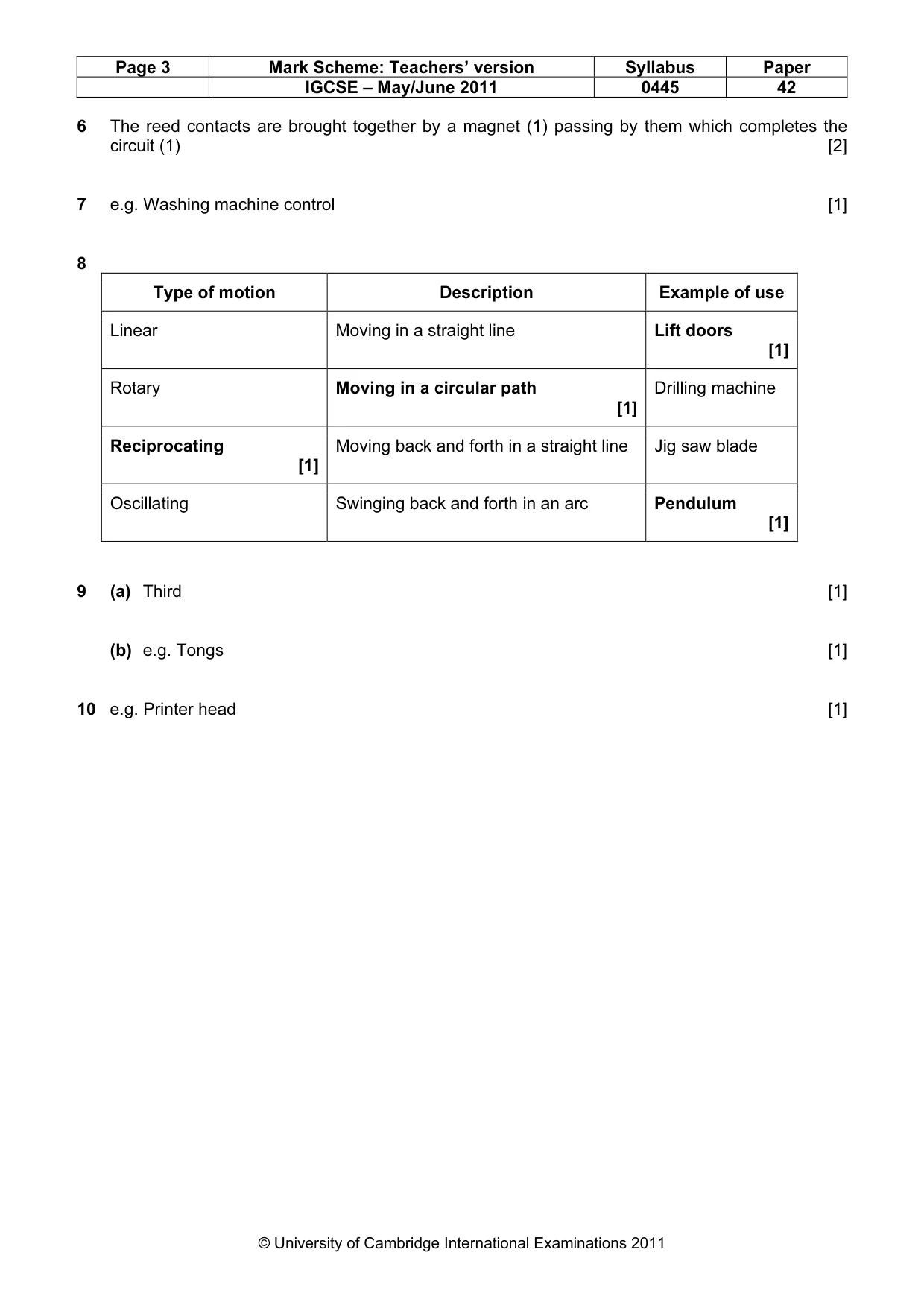
Page 3 Mark Scheme: Teachers’ version Syllabus Paper IGCSE – May/June 2011 0445 42 © University of Cambridge International Examinations 2011 6 The reed contacts are brought together by a magnet (1) passing by them which completes the circuit (1) [2] 7 e.g. Washing machine control [1] 8 Type of motion Description Example of use Linear Moving in a straight line Lift doors [1] Rotary Moving in a circular path [1] Drilling machine Reciprocating [1] Moving back and forth in a straight line Jig saw blade Oscillating Swinging back and forth in an arc Pendulum [1] 9 (a) Third [1] (b) e.g. Tongs [1] 10 e.g. Printer head [1]
Mark scheme, page 4
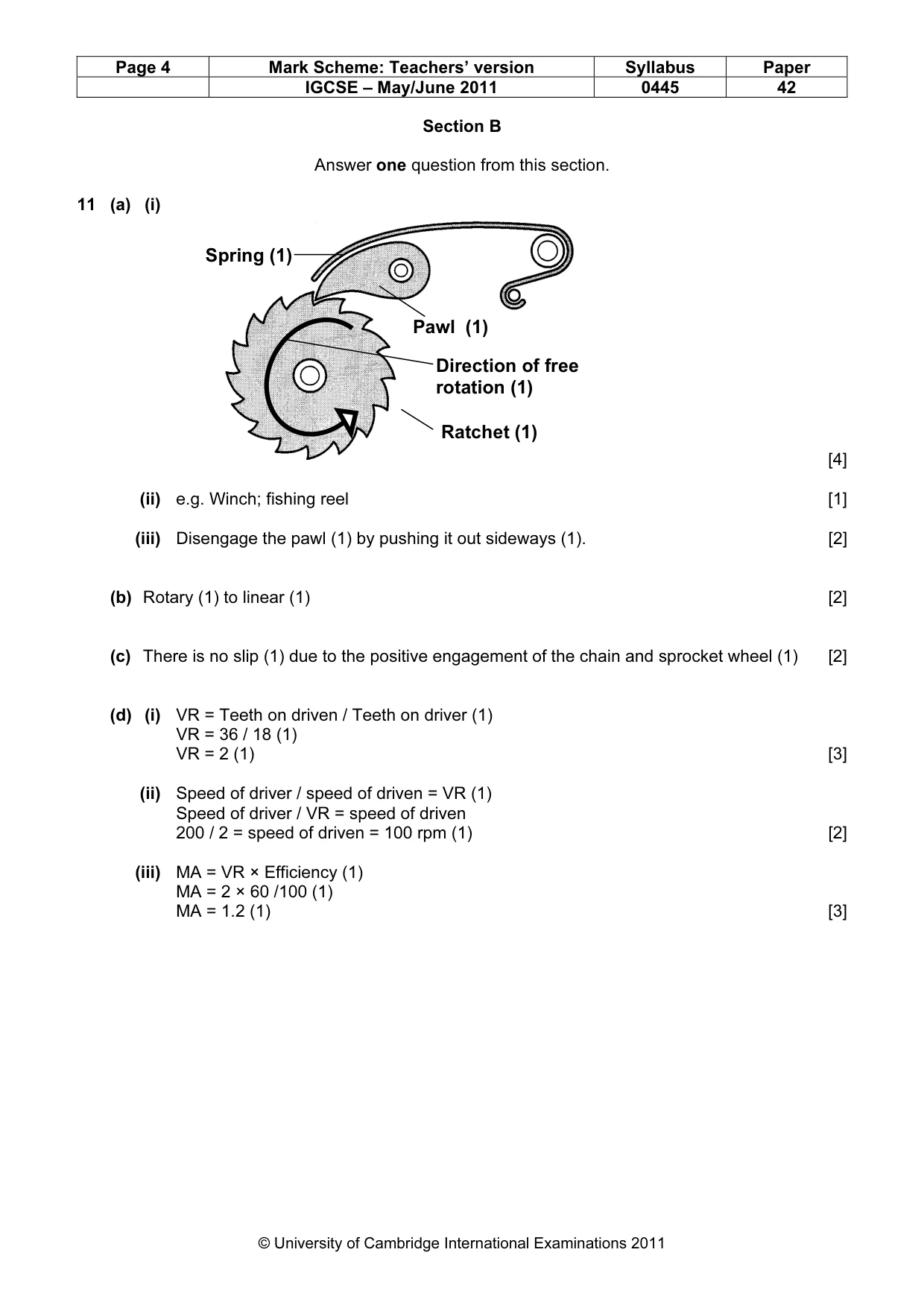
Page 4 Mark Scheme: Teachers’ version Syllabus Paper IGCSE – May/June 2011 0445 42 © University of Cambridge International Examinations 2011 Section B Answer one question from this section. 11 (a) (i) [4] (ii) e.g. Winch; fishing reel [1] (iii) Disengage the pawl (1) by pushing it out sideways (1). [2] (b) Rotary (1) to linear (1) [2] (c) There is no slip (1) due to the positive engagement of the chain and sprocket wheel (1) [2] (d) (i) VR = Teeth on driven / Teeth on driver (1) VR = 36 / 18 (1) VR = 2 (1) [3] (ii) Speed of driver / speed of driven = VR (1) Speed of driver / VR = speed of driven 200 / 2 = speed of driven = 100 rpm (1) [2] (iii) MA = VR × Efficiency (1) MA = 2 × 60 /100 (1) MA = 1.2 (1) [3] Pawl (1) Spring (1) Ratchet (1) Direction of free rotation (1)
Mark scheme, page 5
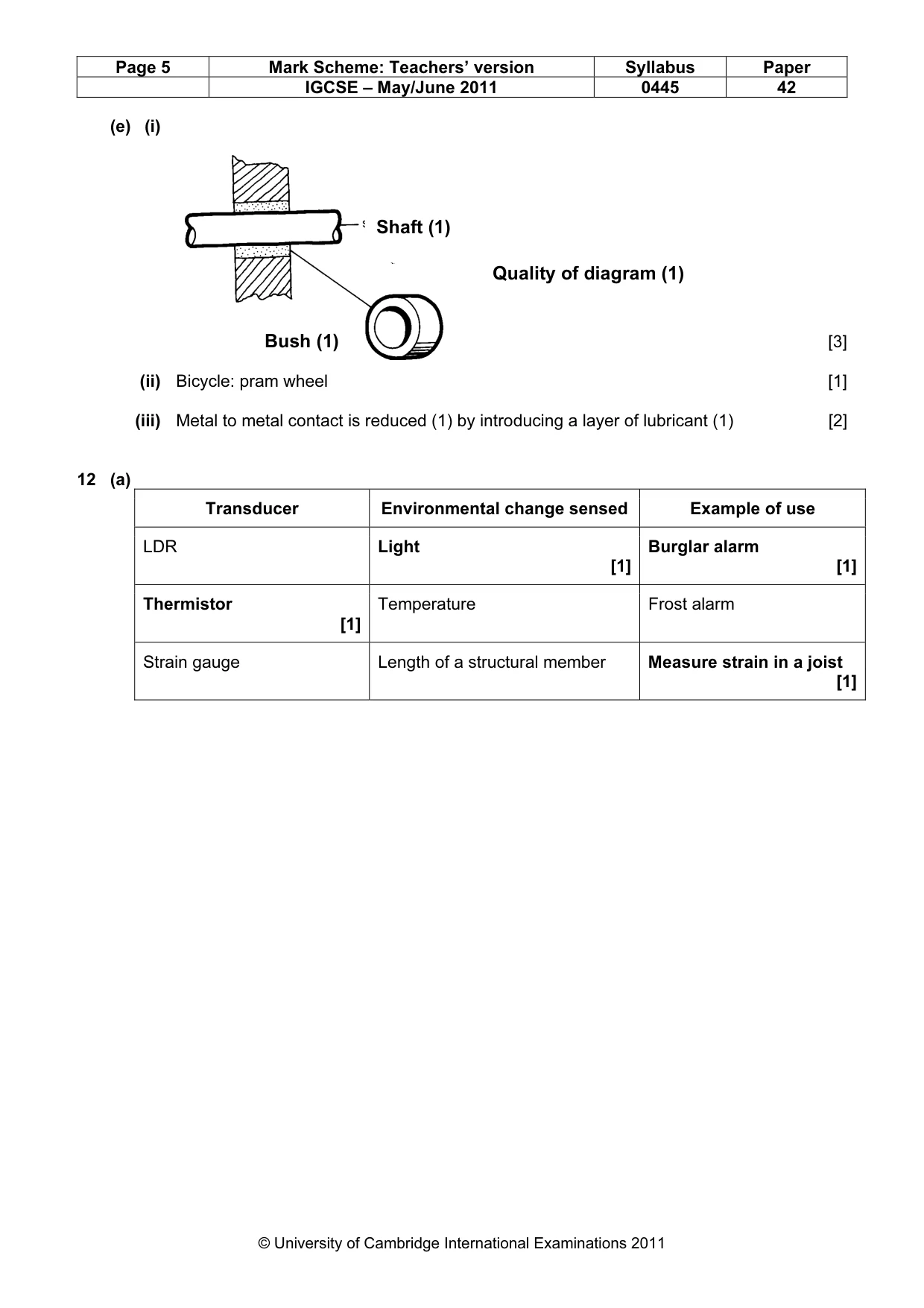
Page 5 Mark Scheme: Teachers’ version Syllabus Paper IGCSE – May/June 2011 0445 42 © University of Cambridge International Examinations 2011 (e) (i) [3] (ii) Bicycle: pram wheel [1] (iii) Metal to metal contact is reduced (1) by introducing a layer of lubricant (1) [2] 12 (a) Transducer Environmental change sensed Example of use LDR Light [1] Burglar alarm [1] Thermistor [1] Temperature Frost alarm Strain gauge Length of a structural member Measure strain in a joist [1] Shaft (1) Bush (1) Quality of diagram (1)
Mark scheme, page 6
Page 6 Mark Scheme: Teachers’ version Syllabus Paper IGCSE – May/June 2011 0445 42 © University of Cambridge International Examinations 2011 (b) (i) [3] (ii) [2] (c) (i) Sketch and label an LED component to show the positive and negative connections and how these connections are identifiable. [3] (ii) An LED must be protected (1) from excessive current (1) [2] (iii) On / off indicator lamp on electrical appliance. [1] (d) (i) V = I.R 9 = .02 . R (1) R = 9 / .02 (1) R = 450 Ω (1) [3] (ii) 1st: Yellow [1] 2nd: Violet (allow Green) [1] 3rd: Brown [1] Light sensitive cell (1) Connecting wires (1) Quality of sketch (1) (1) (1) Flat edge nearest to –ve connection (1) Shorter leg is negative (1) Quality of sketch (1)
Mark scheme, page 7
Page 7 Mark Scheme: Teachers’ version Syllabus Paper IGCSE – May/June 2011 0445 42 © University of Cambridge International Examinations 2011 (e) (i) AND [1] (ii) [3] 13 Number Name 1 Strut 2 Tie 3 Cantilever 4 (Simply supported) beam [4] (b) Increases the rigidity (1) and limits the tendency to buckle (1). [2] (c) (i) It is a rigid section that supports the load (1) but is lightweight (1). [2] (ii) [3] Shape (1) Inputs (1) Output (1) (1) (1) (1)
Mark scheme, page 8
Page 8 Mark Scheme: Teachers’ version Syllabus Paper IGCSE – May/June 2011 0445 42 © University of Cambridge International Examinations 2011 (d) [3] (e) [3] DTI (1) (1) (1) As the material is strained the change in size of the strain gauge changes its resistance (1) which can be read as a value of strain. (1) Diagram (1)
Mark scheme, page 9
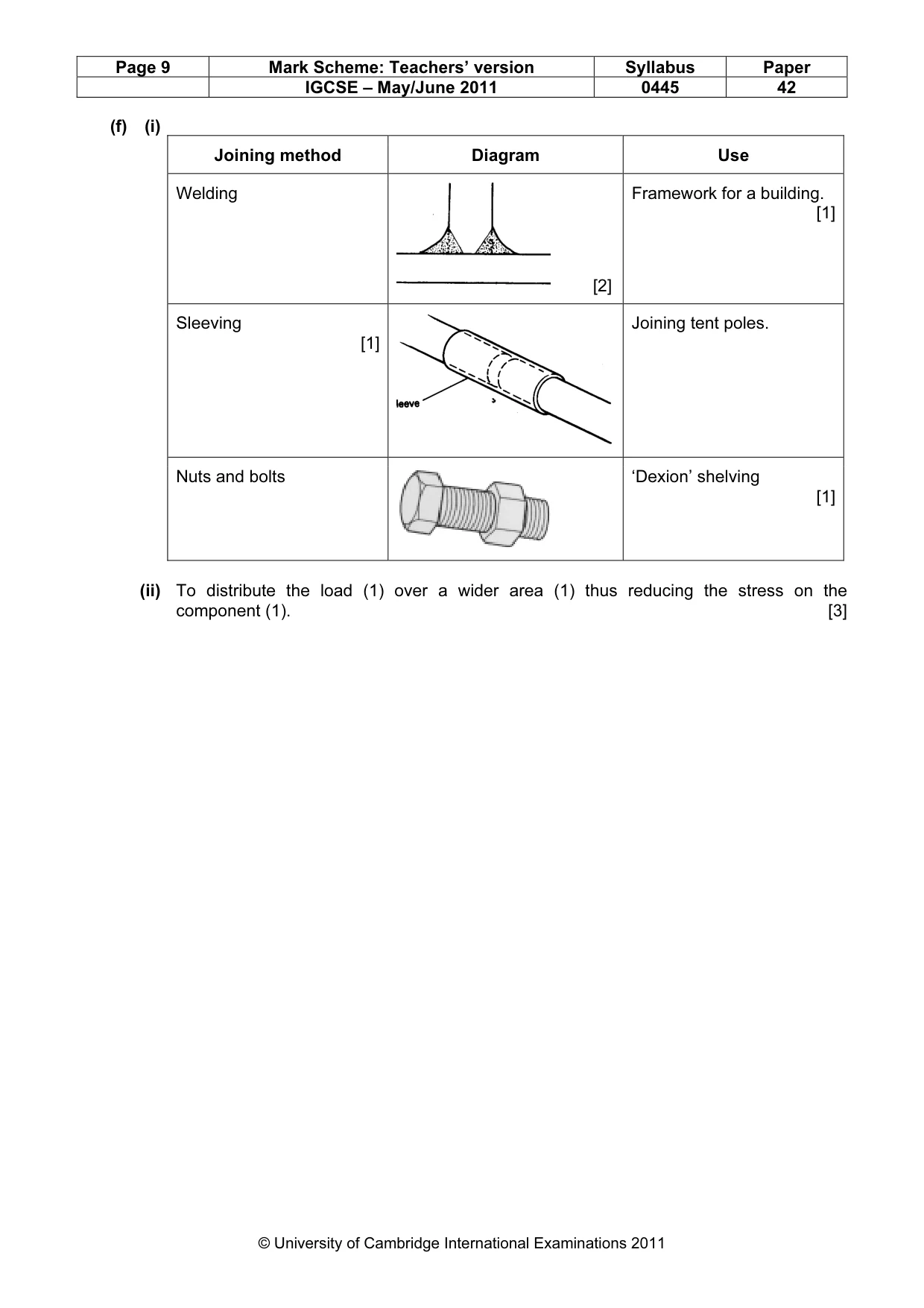
Page 9 Mark Scheme: Teachers’ version Syllabus Paper IGCSE – May/June 2011 0445 42 © University of Cambridge International Examinations 2011 (f) (i) Joining method Diagram Use Welding [2] Framework for a building. [1] Sleeving [1] Joining tent poles. Nuts and bolts ‘Dexion’ shelving [1] (ii) To distribute the load (1) over a wider area (1) thus reducing the stress on the component (1). [3]
What you needed in this session
Cambridge’s own grade thresholds for 2011 May/June, Paper 4 · Variant 2. A higher threshold means an easier paper — the bar moves with how the cohort did.