Cambridge IGCSE Design and Technology 0445 — 2009 May/June Paper 4 · Variant 1
0445/41/M/J/09 · 50 marks · ≈56 min
The question paper and its mark scheme, free to read here and free to download. This is Cambridge’s own paper, exactly as it was sat.
Question paper16 pages
Mark scheme6 pages
Answers below. Sit the paper first if you are practising.
Paper as text
Question paper, page 1
[Turn over *4816562726* READ THESE INSTRUCTIONS FIRST Write your Centre number, candidate number and name on all the work you hand in. Write in dark blue or black pen. You may use a soft pencil for any diagrams or graphs. Do not use staples, paper clips, highlighters, glue or correction fl uid. DO NOT WRITE IN ANY BARCODES. You may use a calculator. Section A Answer all questions. Section B Answer one question. At the end of the examination, fasten all your work securely together. The number of marks is given in brackets [ ] at the end of each question or part question. For Examiner’s Use Section A Section B Total DESIGN AND TECHNOLOGY 0445/04 Paper 4 Systems and Control May/June 2009 1 hour Candidates answer on the Question Paper. No Additional Materials are required. To be taken together with Paper 1 in one session of 2 hours and 15 minutes. UNIVERSITY OF CAMBRIDGE INTERNATIONAL EXAMINATIONS International General Certifi cate of Secondary Education This document consists of 16 printed pages. [Turn over IB09 06_0445_04/2RP © UCLES 2009 www.XtremePapers.com
Question paper, page 2
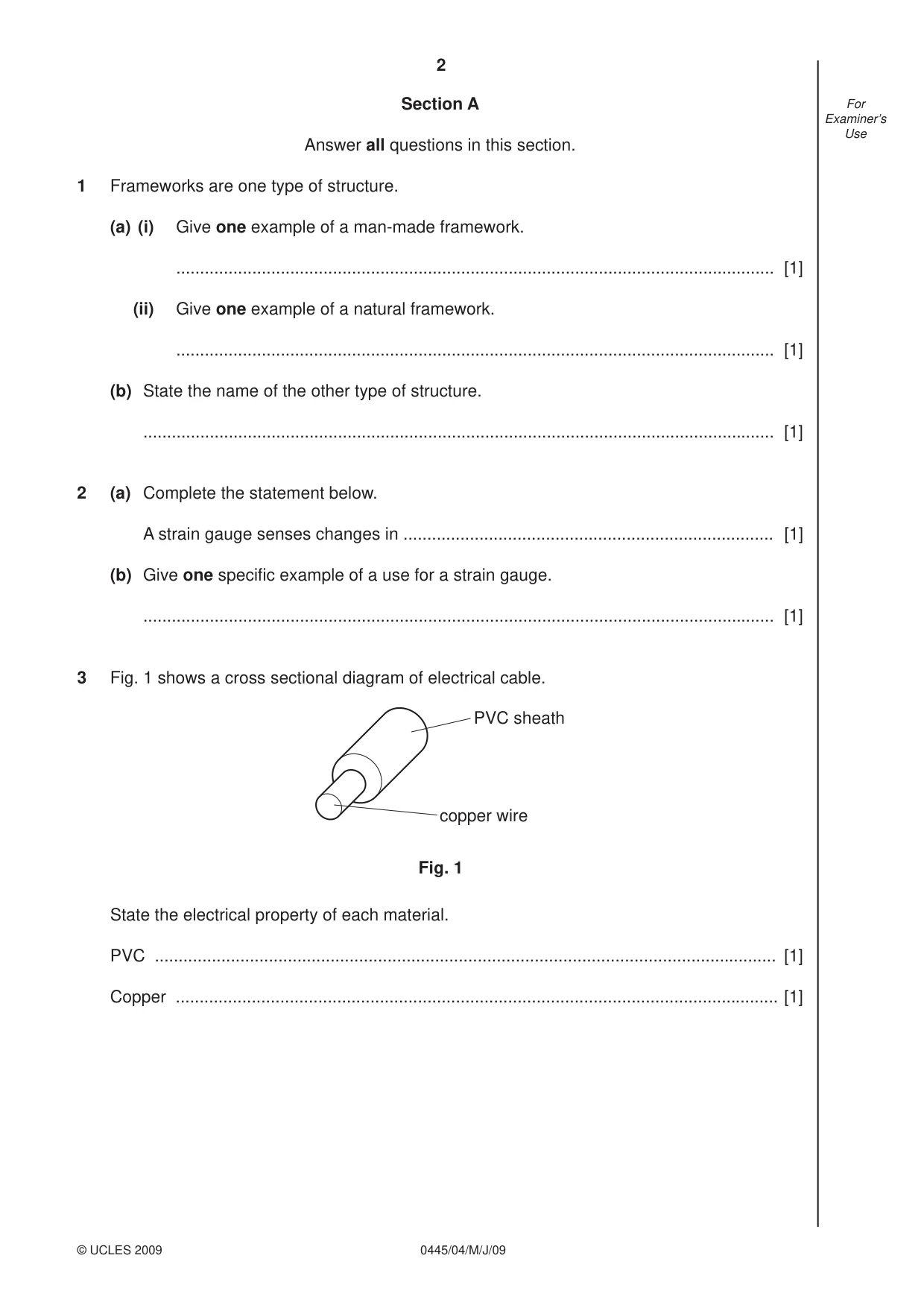
2 0445/04/M/J/09 © UCLES 2009 For Examiner’s Use Section A Answer all questions in this section. 1 Frameworks are one type of structure. (a) (i) Give one example of a man-made framework. … [1] (ii) Give one example of a natural framework. … [1] (b) State the name of the other type of structure. … [1] 2 (a) Complete the statement below. A strain gauge senses changes in … [1] (b) Give one specifi c example of a use for a strain gauge. … [1] 3 Fig. 1 shows a cross sectional diagram of electrical cable. PVC sheath copper wire Fig. 1 State the electrical property of each material. PVC … [1] Copper … [1]
Question paper, page 3
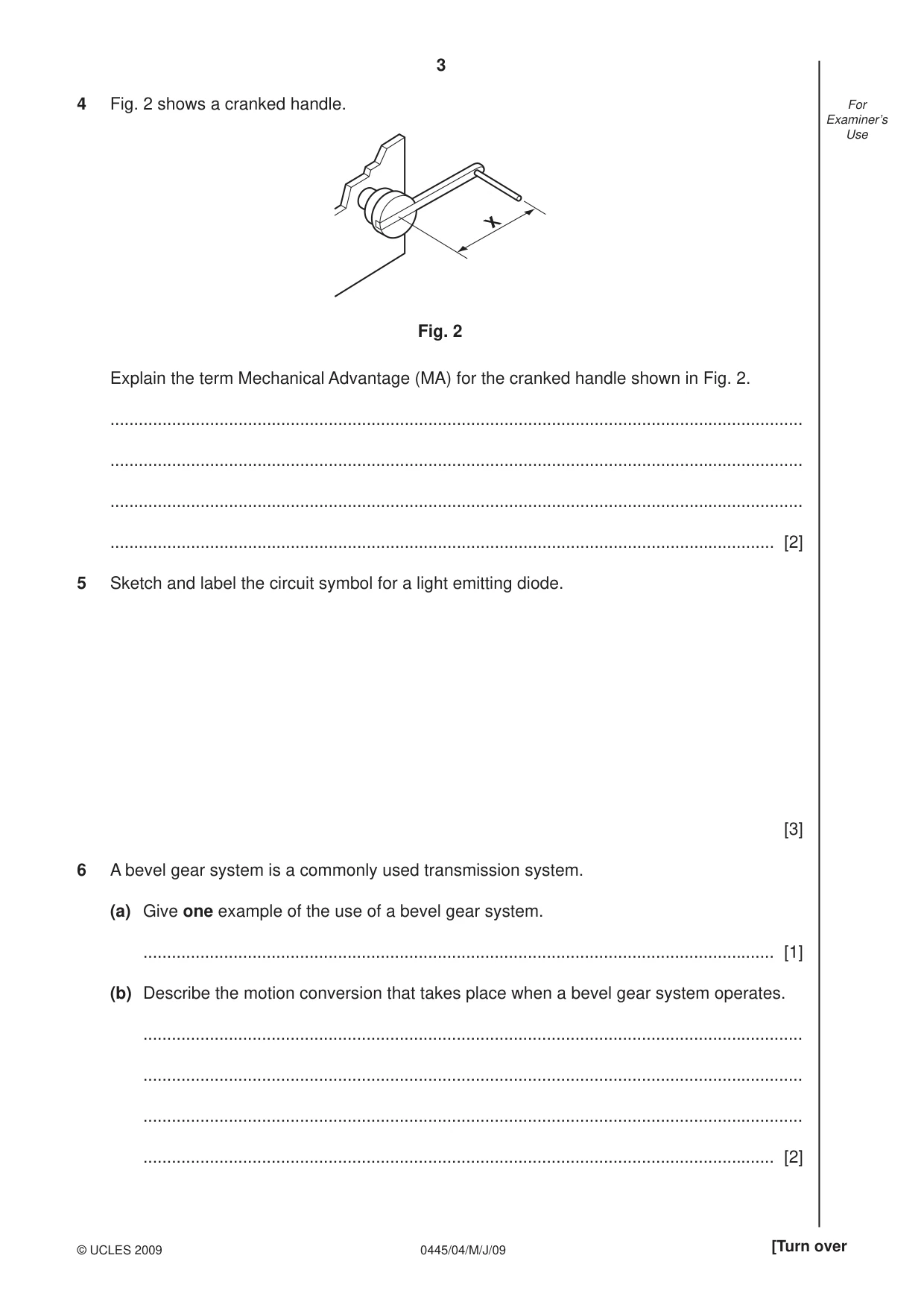
3 0445/04/M/J/09 © UCLES 2009 [Turn over For Examiner’s Use 4 Fig. 2 shows a cranked handle. X Fig. 2 Explain the term Mechanical Advantage (MA) for the cranked handle shown in Fig. 2. … … … … [2] 5 Sketch and label the circuit symbol for a light emitting diode. [3] 6 A bevel gear system is a commonly used transmission system. (a) Give one example of the use of a bevel gear system. … [1] (b) Describe the motion conversion that takes place when a bevel gear system operates. … … … … [2]
Question paper, page 4
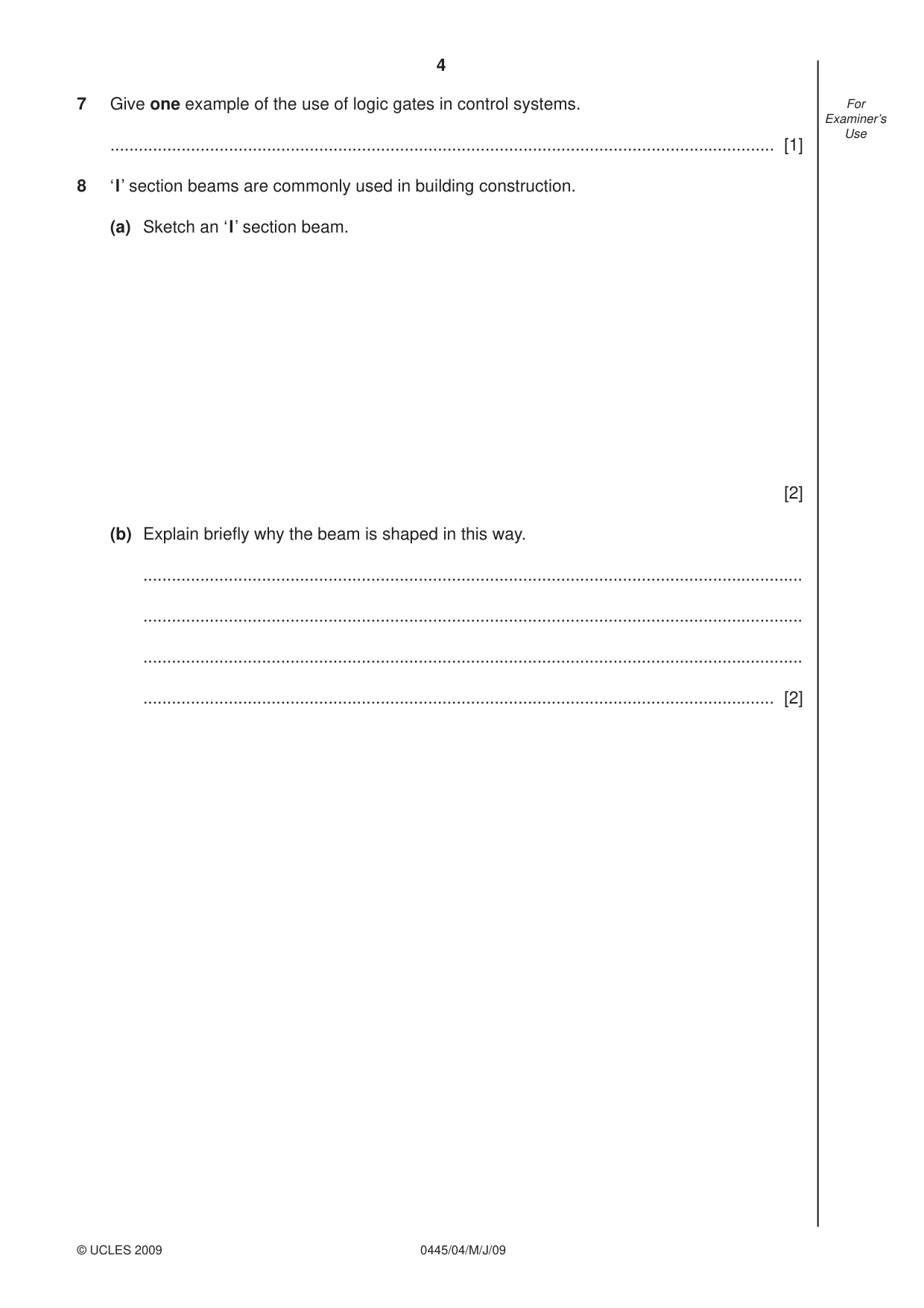
4 0445/04/M/J/09 © UCLES 2009 For Examiner’s Use 7 Give one example of the use of logic gates in control systems. … [1] 8 ‘I’ section beams are commonly used in building construction. (a) Sketch an ‘I’ section beam. [2] (b) Explain briefl y why the beam is shaped in this way. … … … … [2]
Question paper, page 5
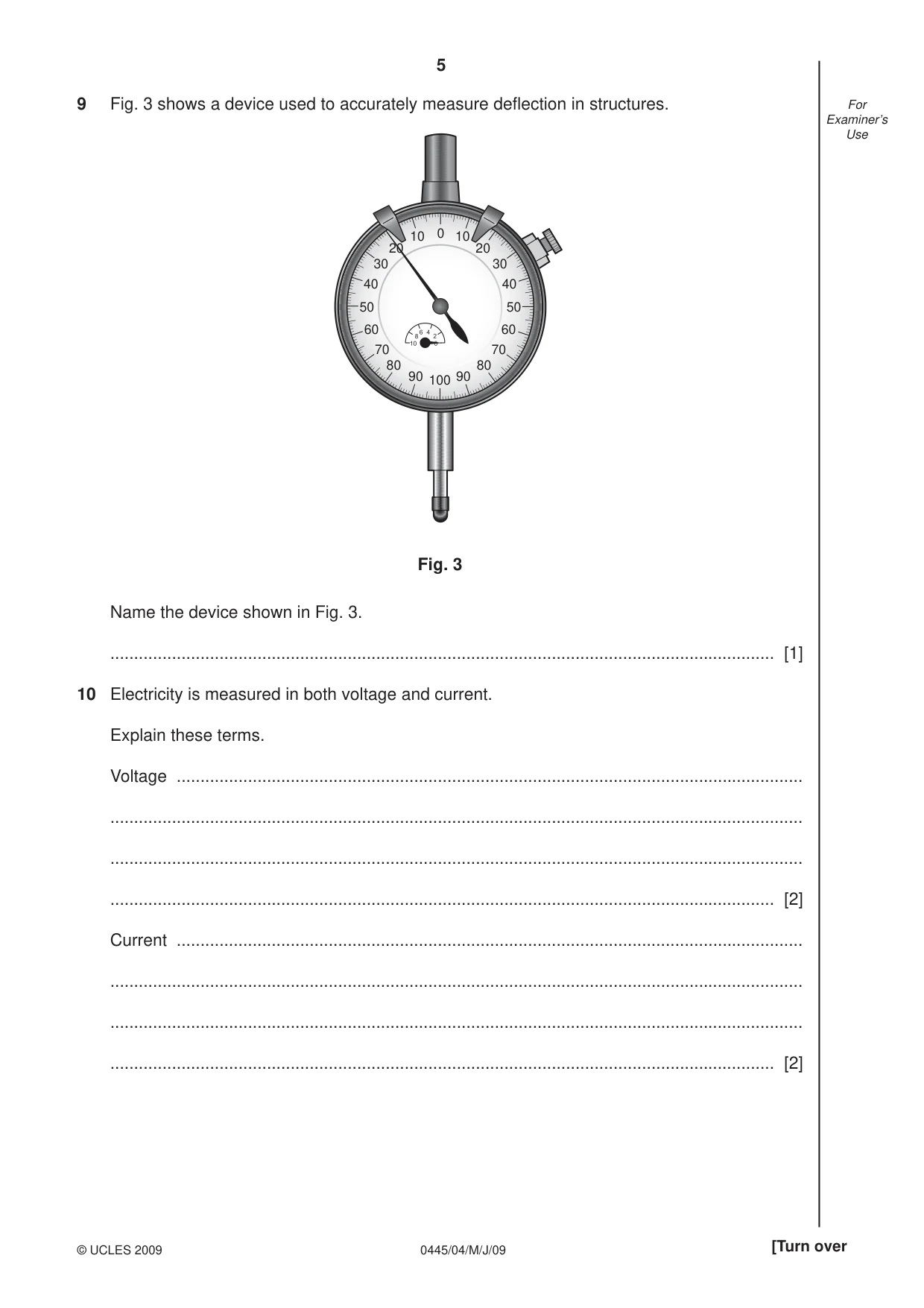
5 0445/04/M/J/09 © UCLES 2009 [Turn over For Examiner’s Use 9 Fig. 3 shows a device used to accurately measure defl ection in structures. 0 10 10 20 20 30 30 40 40 50 50 60 60 70 70 80 80 90 90 100 Fig. 3 Name the device shown in Fig. 3. … [1] 10 Electricity is measured in both voltage and current. Explain these terms. Voltage … … … … [2] Current … … … … [2]
Question paper, page 6
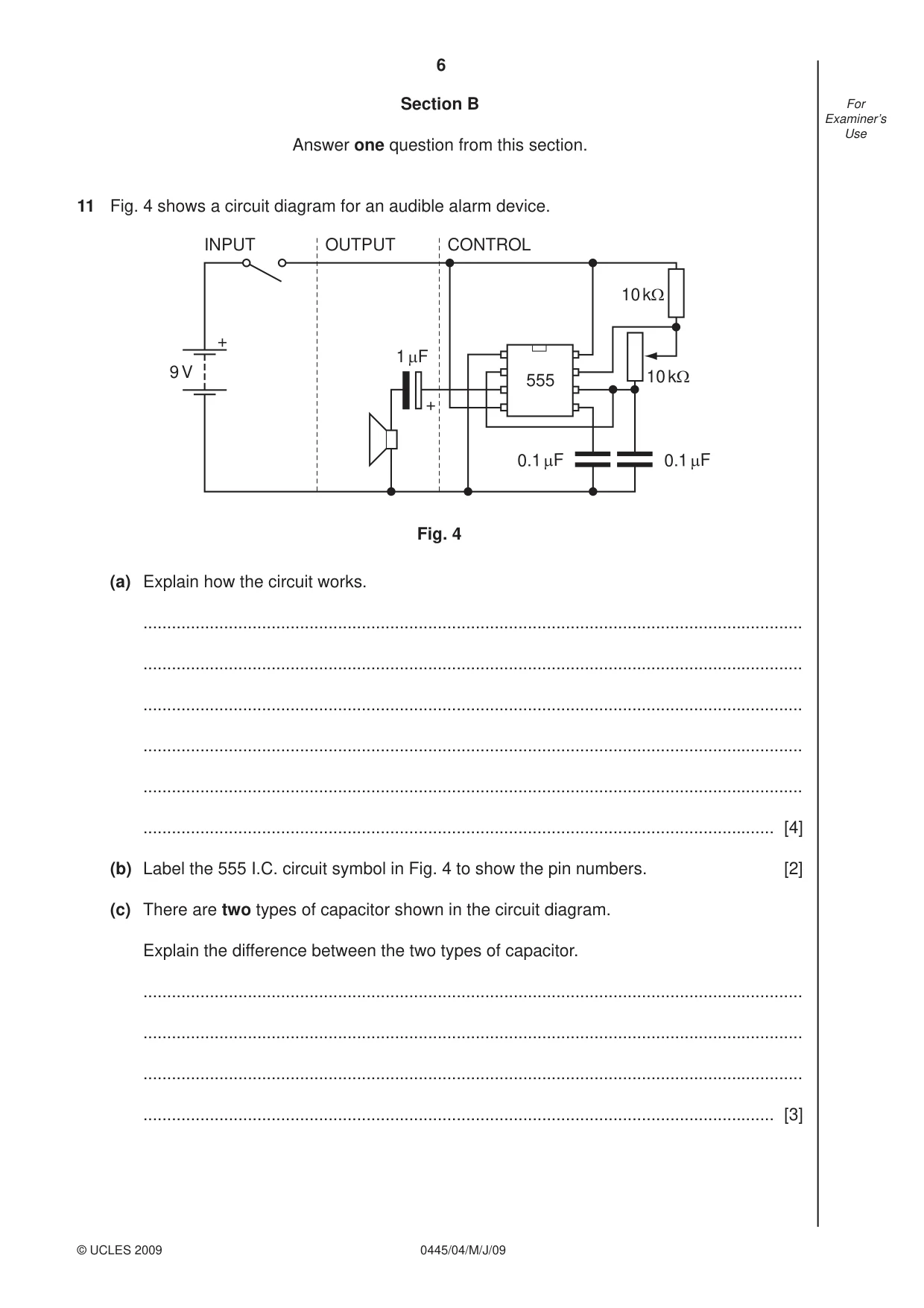
6 0445/04/M/J/09 © UCLES 2009 For Examiner’s Use Section B Answer one question from this section. 11 Fig. 4 shows a circuit diagram for an audible alarm device. 555 INPUT OUTPUT CONTROL + 9 V 1 µF 0.1 µF 0.1 µF 10 kΩ 10 kΩ + Fig. 4 (a) Explain how the circuit works. … … … … … … [4] (b) Label the 555 I.C. circuit symbol in Fig. 4 to show the pin numbers. [2] (c) There are two types of capacitor shown in the circuit diagram. Explain the difference between the two types of capacitor. … … … … [3]
Question paper, page 7
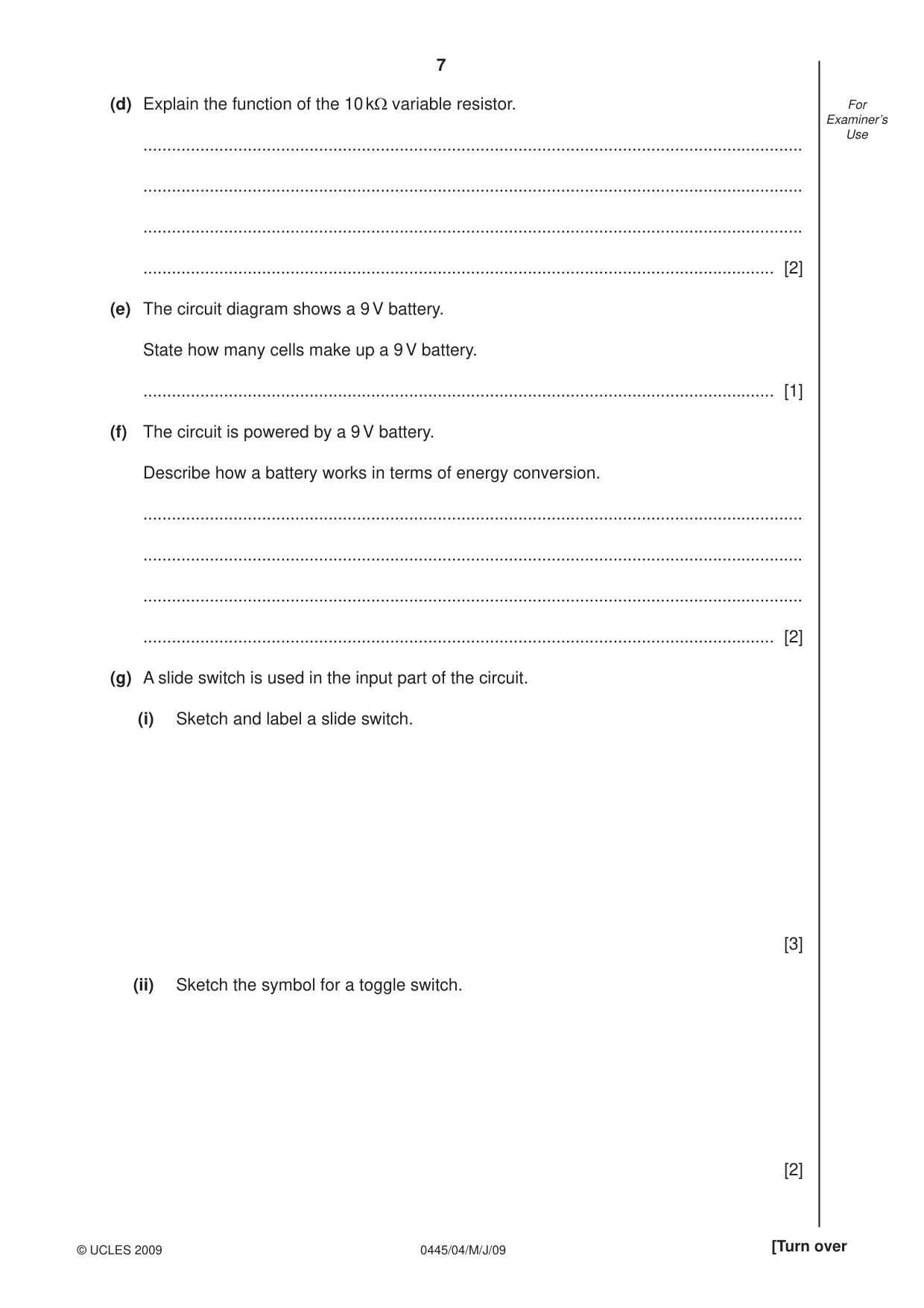
7 0445/04/M/J/09 © UCLES 2009 [Turn over For Examiner’s Use (d) Explain the function of the 10 kΩ variable resistor. … … … … [2] (e) The circuit diagram shows a 9 V battery. State how many cells make up a 9 V battery. … [1] (f) The circuit is powered by a 9 V battery. Describe how a battery works in terms of energy conversion. … … … … [2] (g) A slide switch is used in the input part of the circuit. (i) Sketch and label a slide switch. [3] (ii) Sketch the symbol for a toggle switch. [2]
Question paper, page 8
8 0445/04/M/J/09 © UCLES 2009 For Examiner’s Use (iii) Explain how, by changing the type of input switch, the circuit could be used to sense someone entering a room. … … … … [3] (h) Logic gates could be used to control the audible alarm. Sketch and label a simple logic circuit that would activate the alarm when the input switch is ‘on’ and a light dependent resistor is ‘off’. [3]
Question paper, page 9
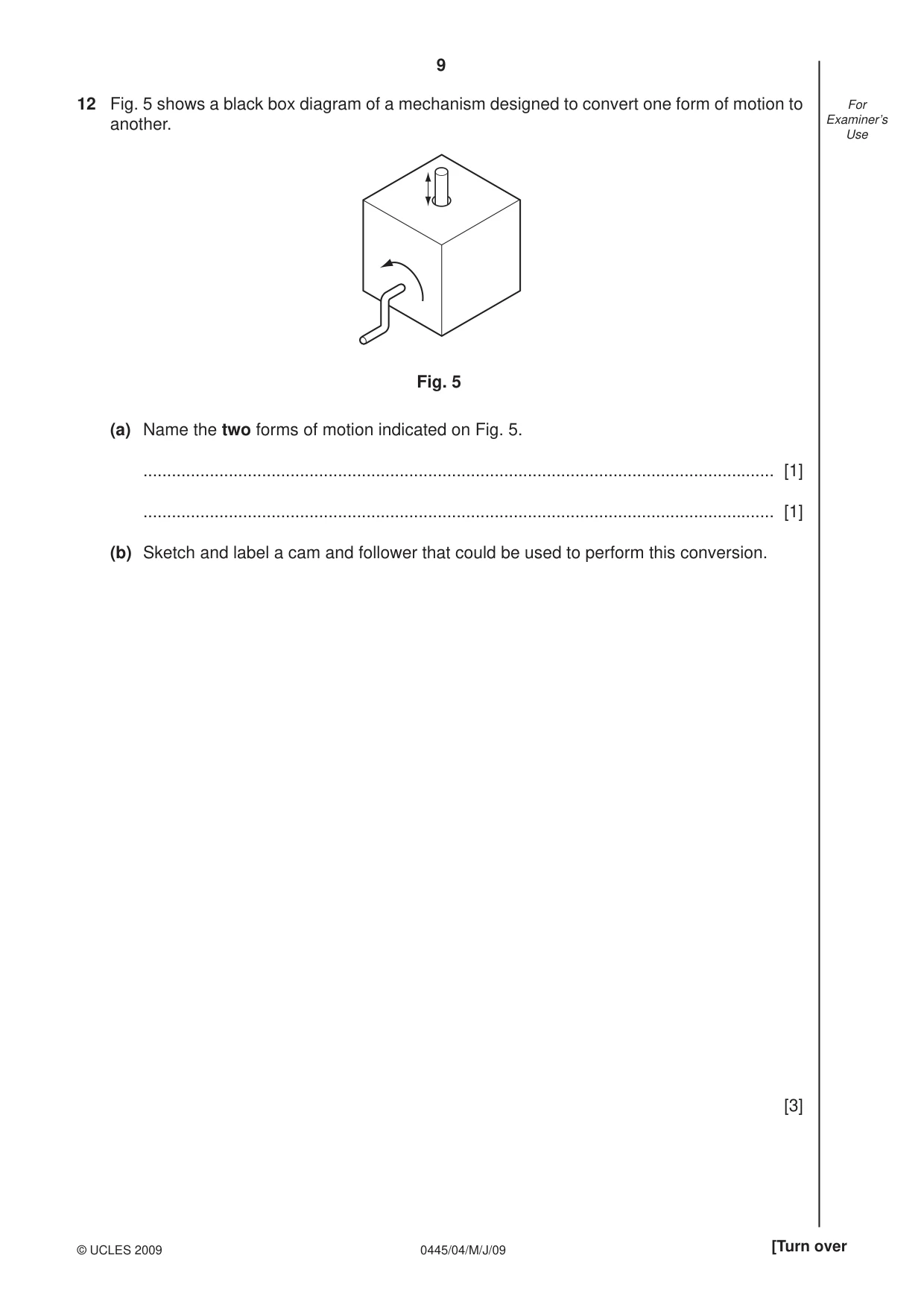
9 0445/04/M/J/09 © UCLES 2009 [Turn over For Examiner’s Use 12 Fig. 5 shows a black box diagram of a mechanism designed to convert one form of motion to another. Fig. 5 (a) Name the two forms of motion indicated on Fig. 5. … [1] … [1] (b) Sketch and label a cam and follower that could be used to perform this conversion. [3]
Question paper, page 10
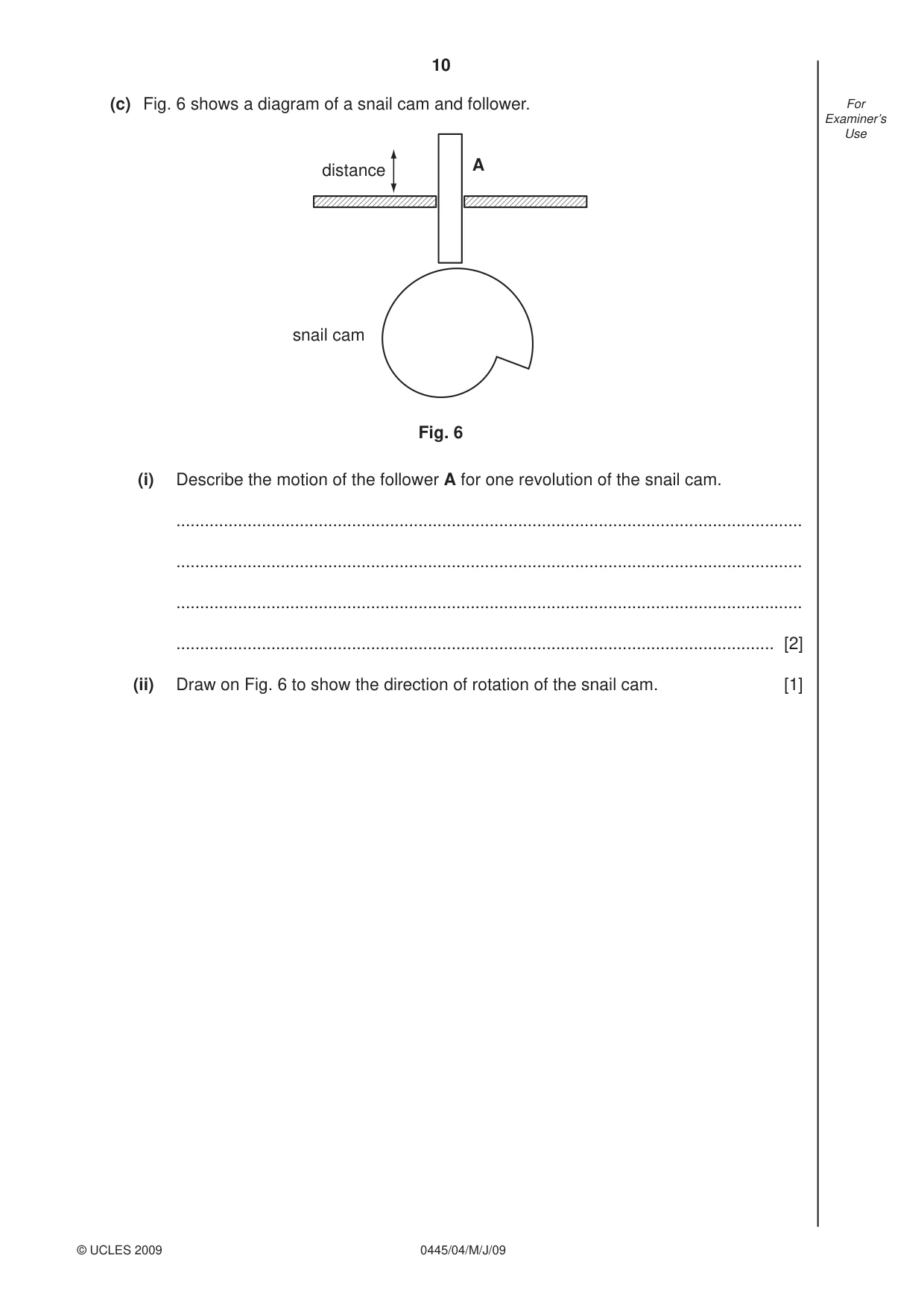
10 0445/04/M/J/09 © UCLES 2009 For Examiner’s Use (c) Fig. 6 shows a diagram of a snail cam and follower. distance A snail cam Fig. 6 (i) Describe the motion of the follower A for one revolution of the snail cam. … … … … [2] (ii) Draw on Fig. 6 to show the direction of rotation of the snail cam. [1]
Question paper, page 11
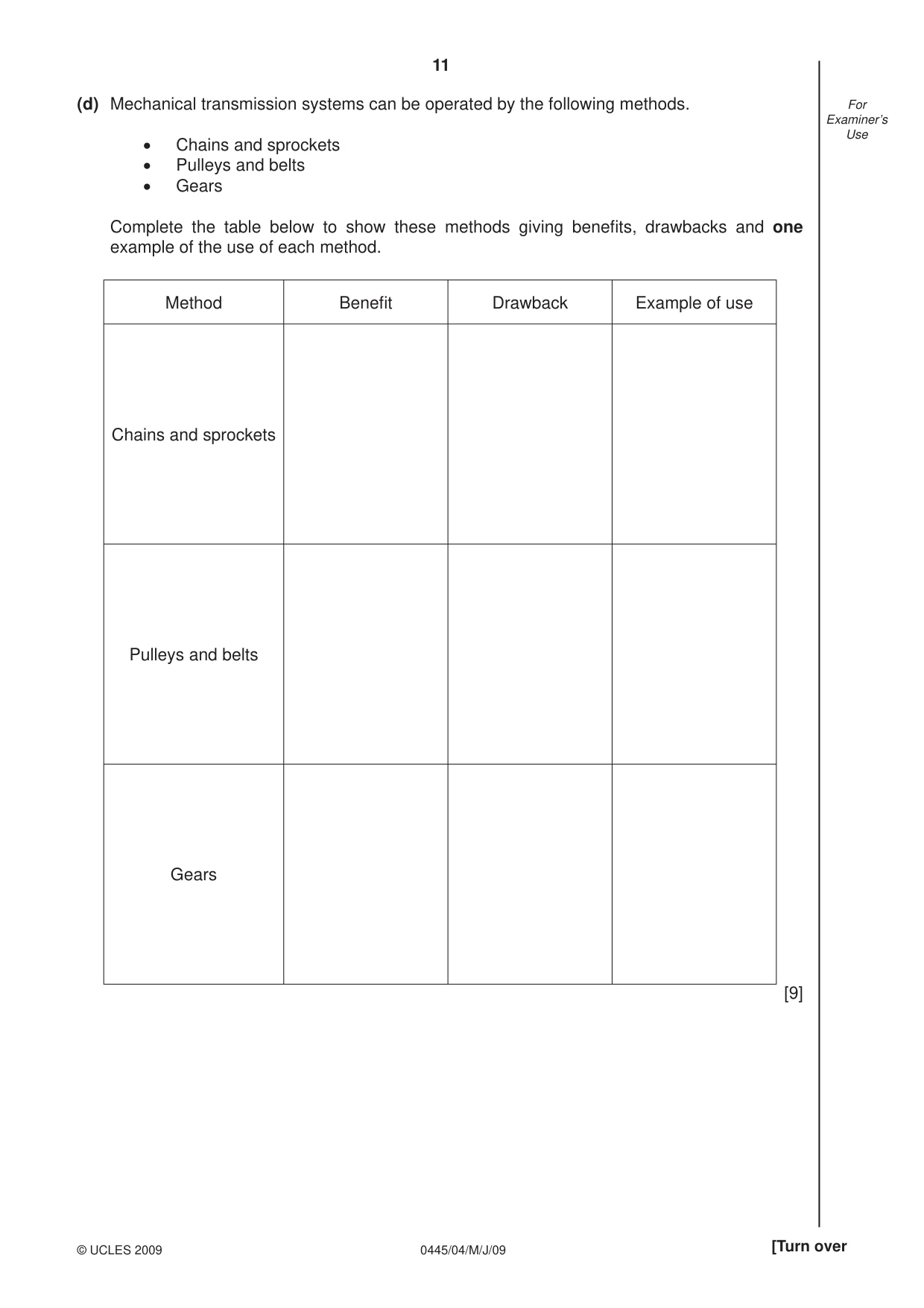
11 0445/04/M/J/09 © UCLES 2009 [Turn over For Examiner’s Use (d) Mechanical transmission systems can be operated by the following methods. • Chains and sprockets • Pulleys and belts • Gears Complete the table below to show these methods giving benefi ts, drawbacks and one example of the use of each method. Method Benefi t Drawback Example of use Chains and sprockets Pulleys and belts Gears [9]
Question paper, page 12
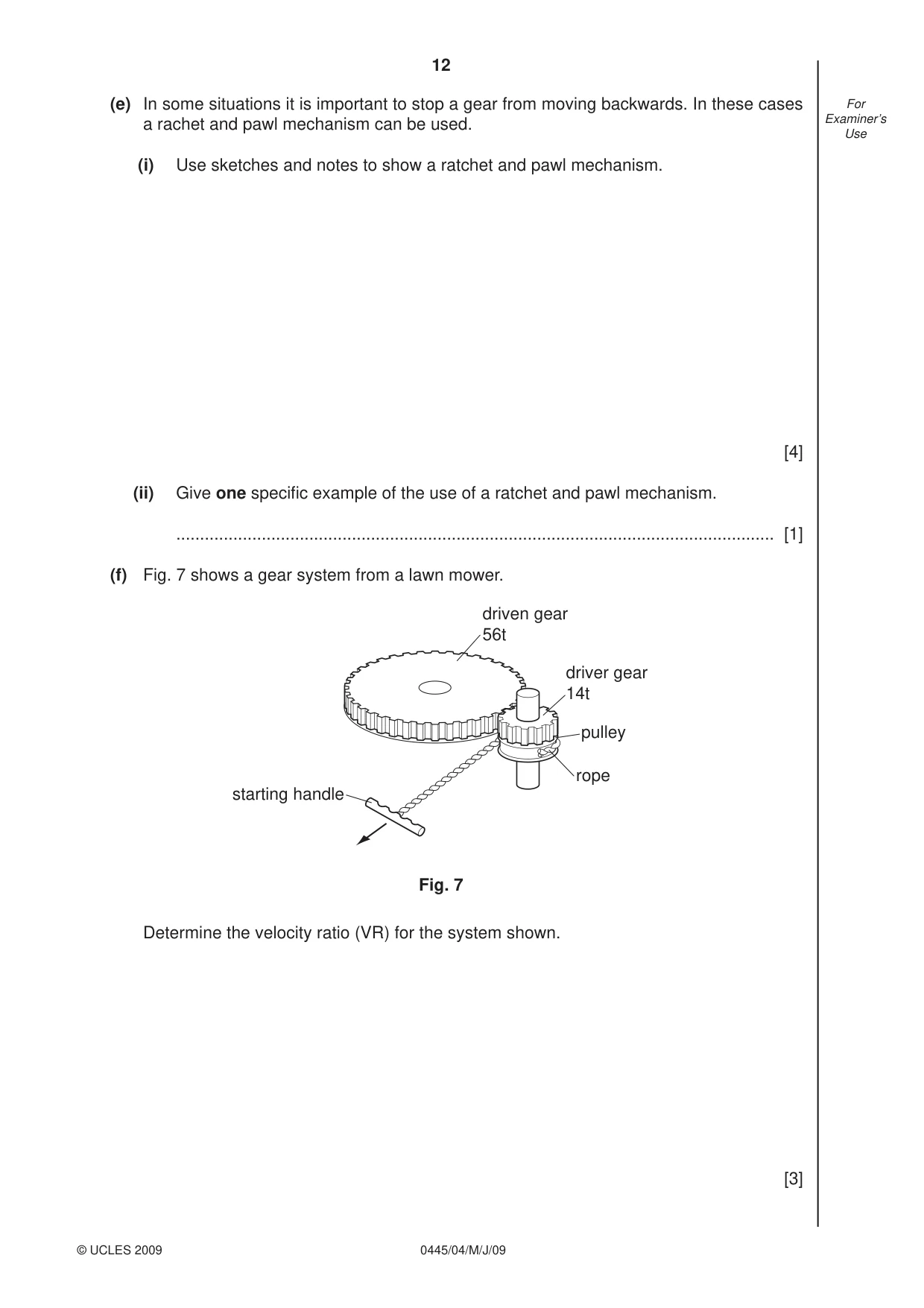
12 0445/04/M/J/09 © UCLES 2009 For Examiner’s Use (e) In some situations it is important to stop a gear from moving backwards. In these cases a rachet and pawl mechanism can be used. (i) Use sketches and notes to show a ratchet and pawl mechanism. [4] (ii) Give one specifi c example of the use of a ratchet and pawl mechanism. … [1] (f) Fig. 7 shows a gear system from a lawn mower. driven gear 56t driver gear 14t pulley rope starting handle Fig. 7 Determine the velocity ratio (VR) for the system shown. [3]
Question paper, page 13
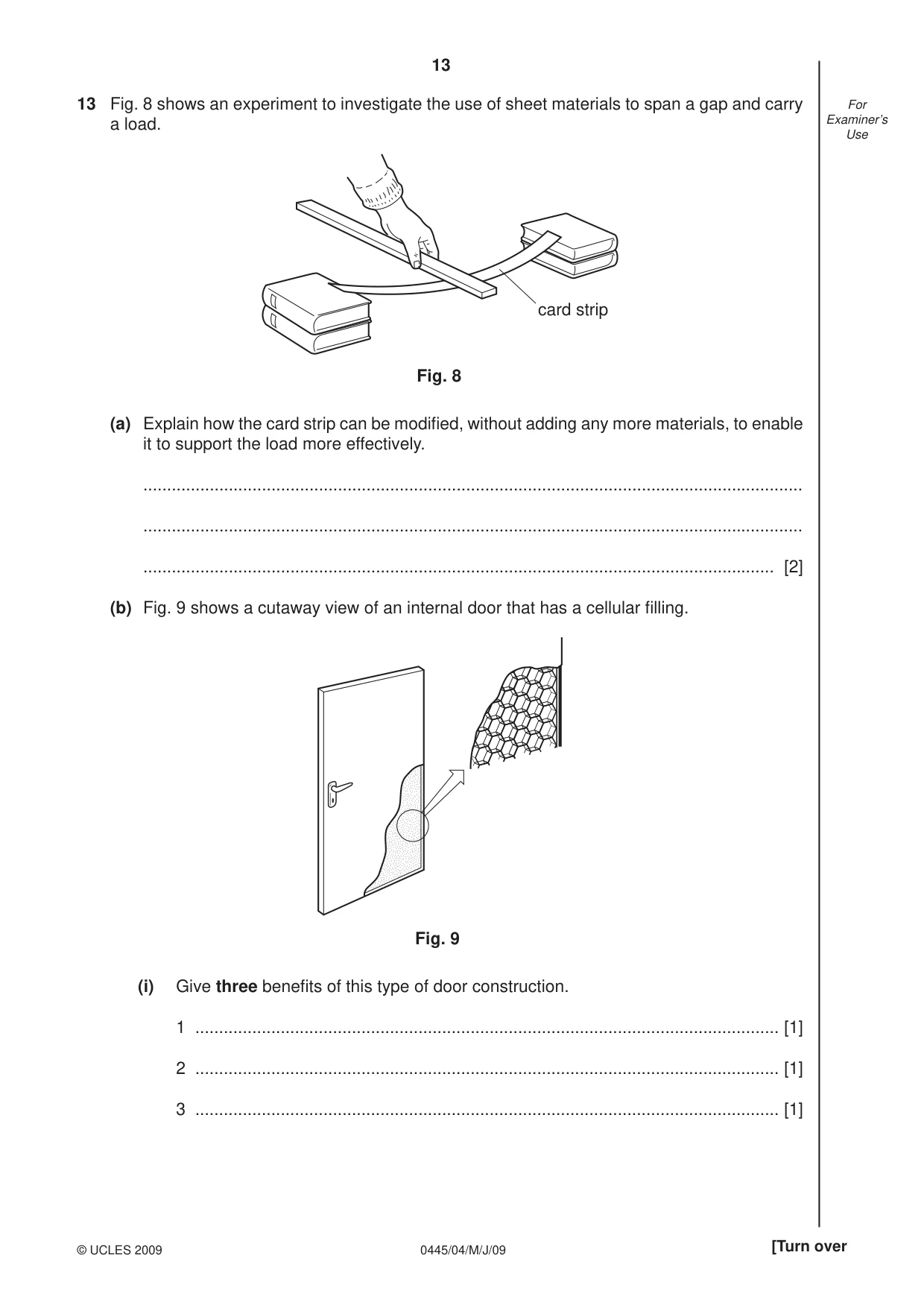
13 0445/04/M/J/09 © UCLES 2009 [Turn over For Examiner’s Use 13 Fig. 8 shows an experiment to investigate the use of sheet materials to span a gap and carry a load. card strip Fig. 8 (a) Explain how the card strip can be modifi ed, without adding any more materials, to enable it to support the load more effectively. … … … [2] (b) Fig. 9 shows a cutaway view of an internal door that has a cellular fi lling. Fig. 9 (i) Give three benefi ts of this type of door construction. 1 … [1] 2 … [1] 3 … [1]
Question paper, page 14
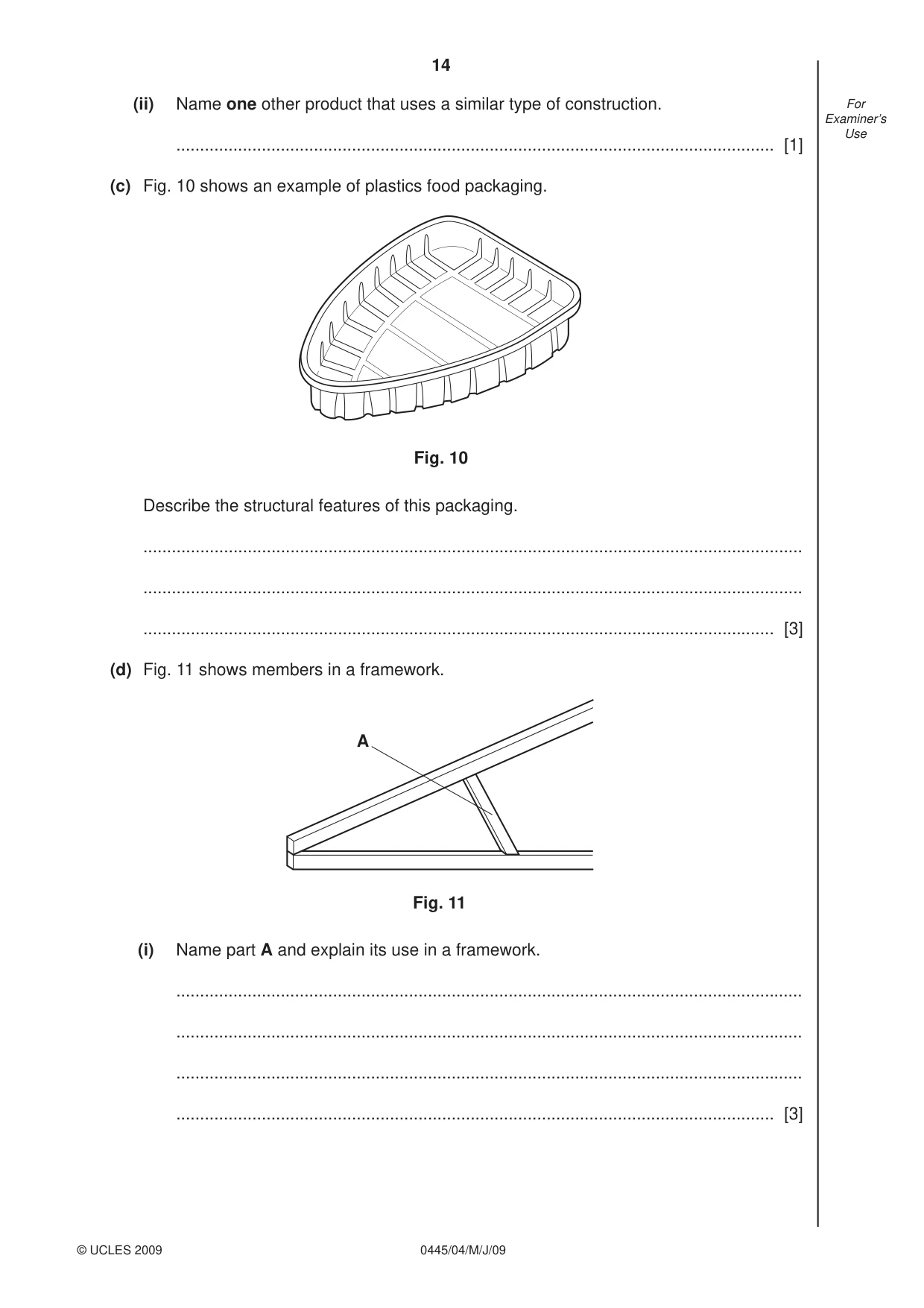
14 0445/04/M/J/09 © UCLES 2009 For Examiner’s Use (ii) Name one other product that uses a similar type of construction. … [1] (c) Fig. 10 shows an example of plastics food packaging. Fig. 10 Describe the structural features of this packaging. … … … [3] (d) Fig. 11 shows members in a framework. A Fig. 11 (i) Name part A and explain its use in a framework. … … … … [3]
Question paper, page 15
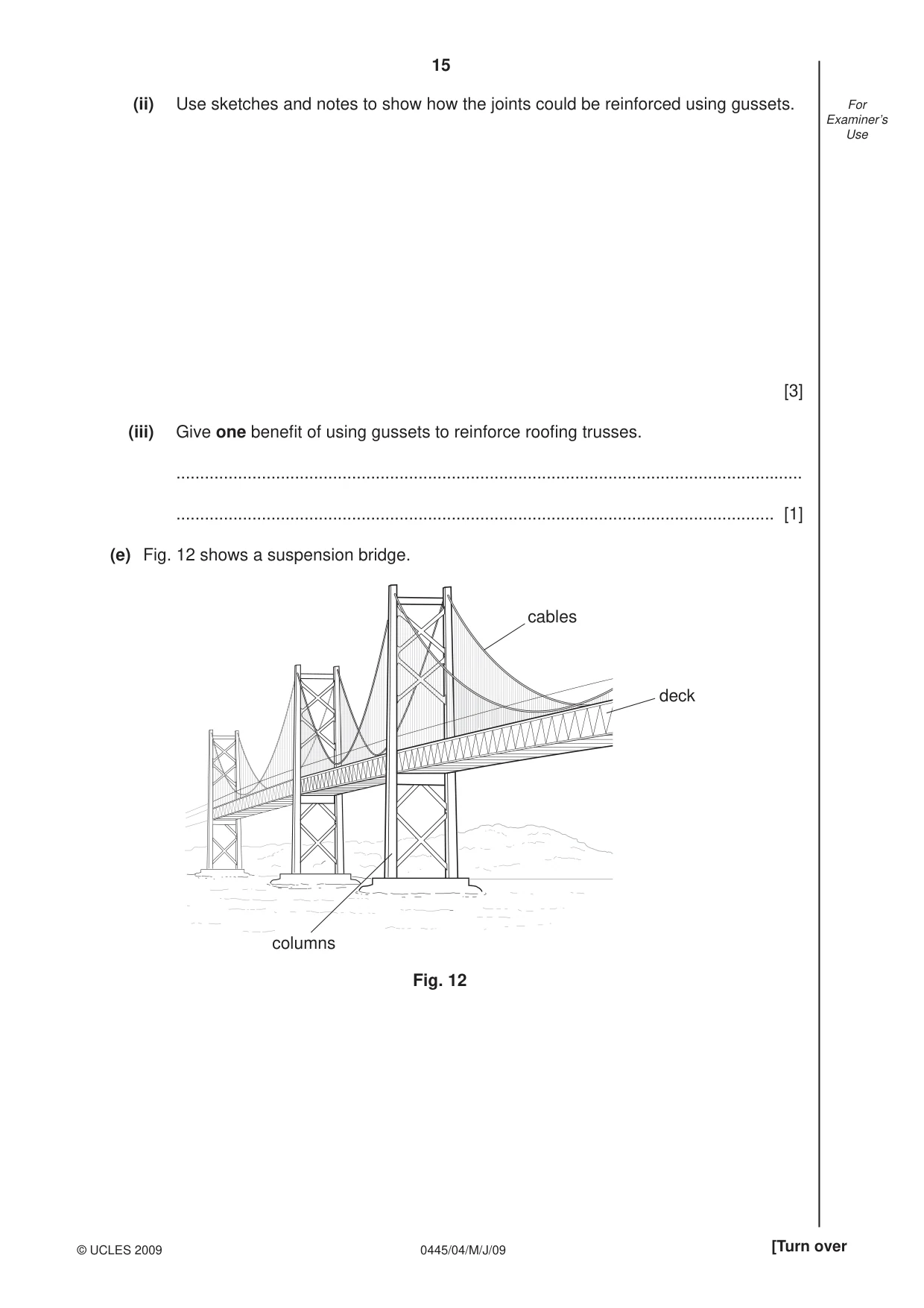
15 0445/04/M/J/09 © UCLES 2009 [Turn over For Examiner’s Use (ii) Use sketches and notes to show how the joints could be reinforced using gussets. [3] (iii) Give one benefi t of using gussets to reinforce roofi ng trusses. … … [1] (e) Fig. 12 shows a suspension bridge. columns cables deck Fig. 12
Question paper, page 16
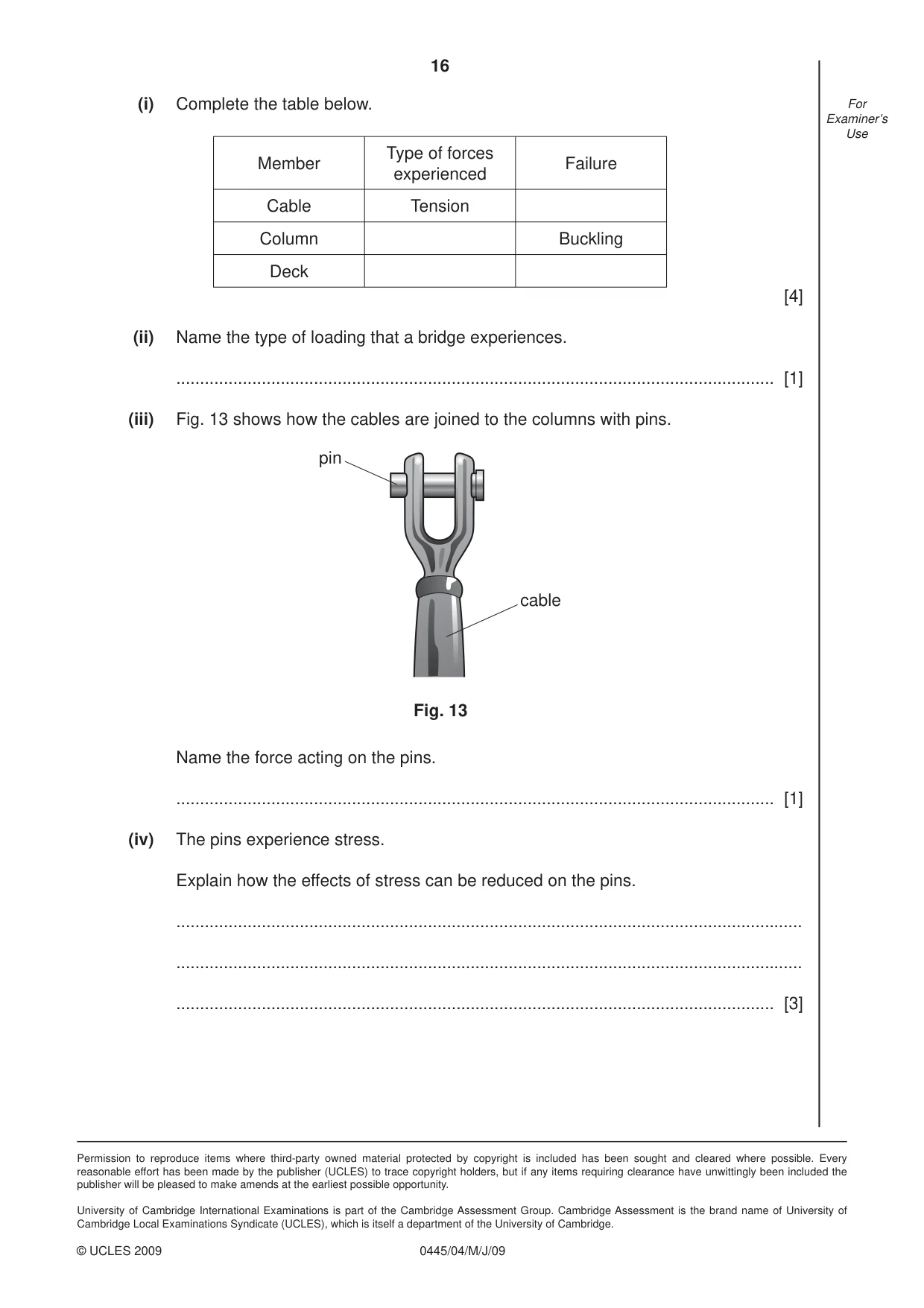
16 Permission to reproduce items where third-party owned material protected by copyright is included has been sought and cleared where possible. Every reasonable effort has been made by the publisher (UCLES) to trace copyright holders, but if any items requiring clearance have unwittingly been included the publisher will be pleased to make amends at the earliest possible opportunity. University of Cambridge International Examinations is part of the Cambridge Assessment Group. Cambridge Assessment is the brand name of University of Cambridge Local Examinations Syndicate (UCLES), which is itself a department of the University of Cambridge. 0445/04/M/J/09 © UCLES 2009 For Examiner’s Use (i) Complete the table below. Member Type of forces experienced Failure Cable Tension Column Buckling Deck [4] (ii) Name the type of loading that a bridge experiences. … [1] (iii) Fig. 13 shows how the cables are joined to the columns with pins. cable pin Fig. 13 Name the force acting on the pins. … [1] (iv) The pins experience stress. Explain how the effects of stress can be reduced on the pins. … … … [3]
Mark scheme, page 1
UNIVERSITY OF CAMBRIDGE INTERNATIONAL EXAMINATIONS International General Certificate of Secondary Education MARK SCHEME for the May/June 2009 question paper for the guidance of teachers 0445 DESIGN AND TECHNOLOGY 0445/04 Paper 4 (Systems and Control), maximum raw mark 50 This mark scheme is published as an aid to teachers and candidates, to indicate the requirements of the examination. It shows the basis on which Examiners were instructed to award marks. It does not indicate the details of the discussions that took place at an Examiners’ meeting before marking began, which would have considered the acceptability of alternative answers. Mark schemes must be read in conjunction with the question papers and the report on the examination. • CIE will not enter into discussions or correspondence in connection with these mark schemes. CIE is publishing the mark schemes for the May/June 2009 question papers for most IGCSE, GCE Advanced Level and Advanced Subsidiary Level syllabuses and some Ordinary Level syllabuses. www.XtremePapers.com
Mark scheme, page 2
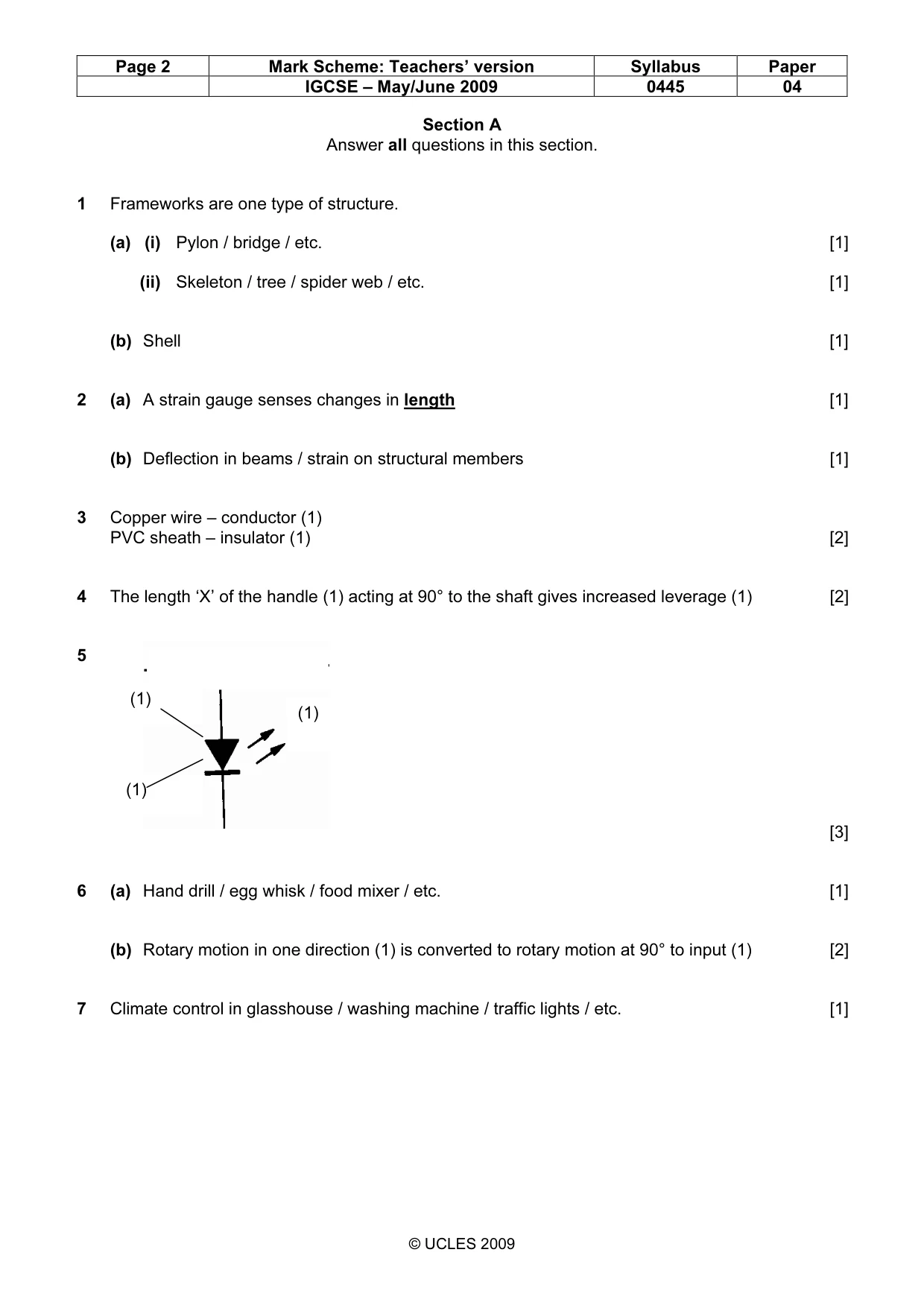
Page 2 Mark Scheme: Teachers’ version Syllabus Paper IGCSE – May/June 2009 0445 04 © UCLES 2009 Section A Answer all questions in this section. 1 Frameworks are one type of structure. (a) (i) Pylon / bridge / etc. [1] (ii) Skeleton / tree / spider web / etc. [1] (b) Shell [1] 2 (a) A strain gauge senses changes in length [1] (b) Deflection in beams / strain on structural members [1] 3 Copper wire – conductor (1) PVC sheath – insulator (1) [2] 4 The length ‘X’ of the handle (1) acting at 90° to the shaft gives increased leverage (1) [2] 5 [3] 6 (a) Hand drill / egg whisk / food mixer / etc. [1] (b) Rotary motion in one direction (1) is converted to rotary motion at 90° to input (1) [2] 7 Climate control in glasshouse / washing machine / traffic lights / etc. [1] (1) (1) (1)
Mark scheme, page 3
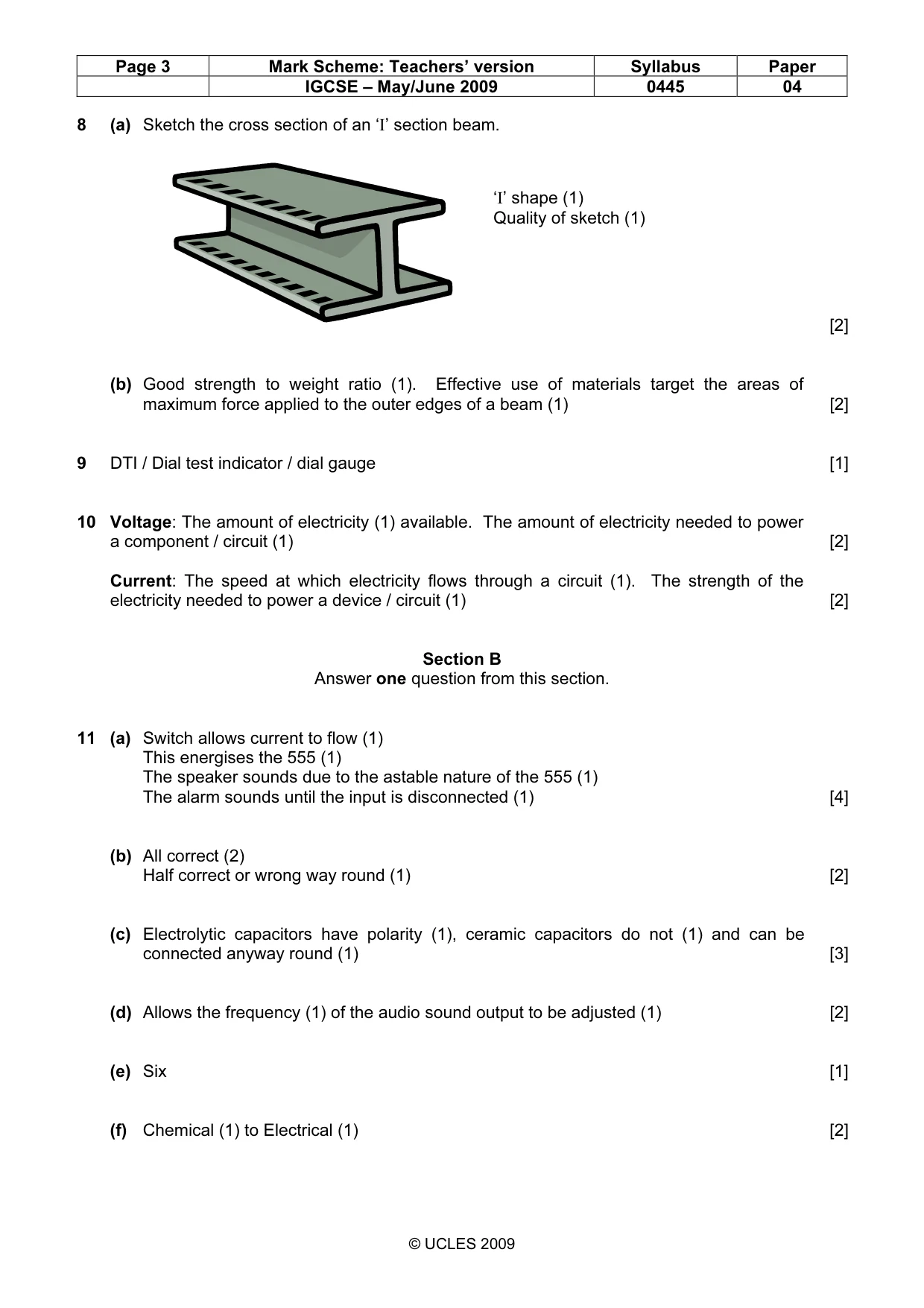
Page 3 Mark Scheme: Teachers’ version Syllabus Paper IGCSE – May/June 2009 0445 04 © UCLES 2009 8 (a) Sketch the cross section of an ‘I’ section beam. [2] (b) Good strength to weight ratio (1). Effective use of materials target the areas of maximum force applied to the outer edges of a beam (1) [2] 9 DTI / Dial test indicator / dial gauge [1] 10 Voltage: The amount of electricity (1) available. The amount of electricity needed to power a component / circuit (1) [2] Current: The speed at which electricity flows through a circuit (1). The strength of the electricity needed to power a device / circuit (1) [2] Section B Answer one question from this section. 11 (a) Switch allows current to flow (1) This energises the 555 (1) The speaker sounds due to the astable nature of the 555 (1) The alarm sounds until the input is disconnected (1) [4] (b) All correct (2) Half correct or wrong way round (1) [2] (c) Electrolytic capacitors have polarity (1), ceramic capacitors do not (1) and can be connected anyway round (1) [3] (d) Allows the frequency (1) of the audio sound output to be adjusted (1) [2] (e) Six [1] (f) Chemical (1) to Electrical (1) [2] ‘I’ shape (1) Quality of sketch (1)
Mark scheme, page 4
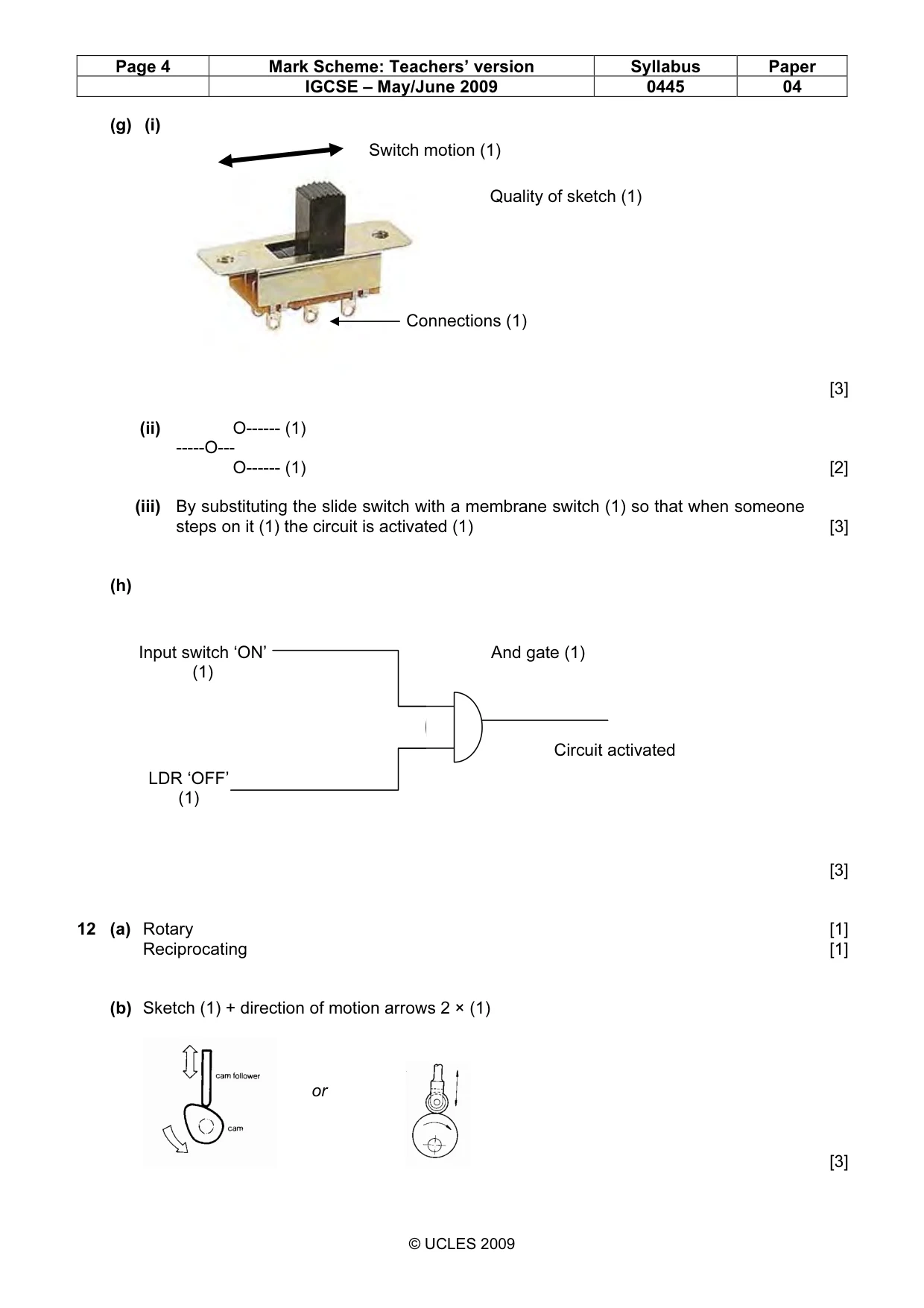
Page 4 Mark Scheme: Teachers’ version Syllabus Paper IGCSE – May/June 2009 0445 04 © UCLES 2009 (g) (i) [3] (ii) O------ (1) -----O--- O------ (1) [2] (iii) By substituting the slide switch with a membrane switch (1) so that when someone steps on it (1) the circuit is activated (1) [3] (h) [3] 12 (a) Rotary [1] Reciprocating [1] (b) Sketch (1) + direction of motion arrows 2 × (1) [3] Connections (1) Switch motion (1) Quality of sketch (1) Input switch ‘ON’ (1) LDR ‘OFF’ (1) And gate (1) Circuit activated or
Mark scheme, page 5
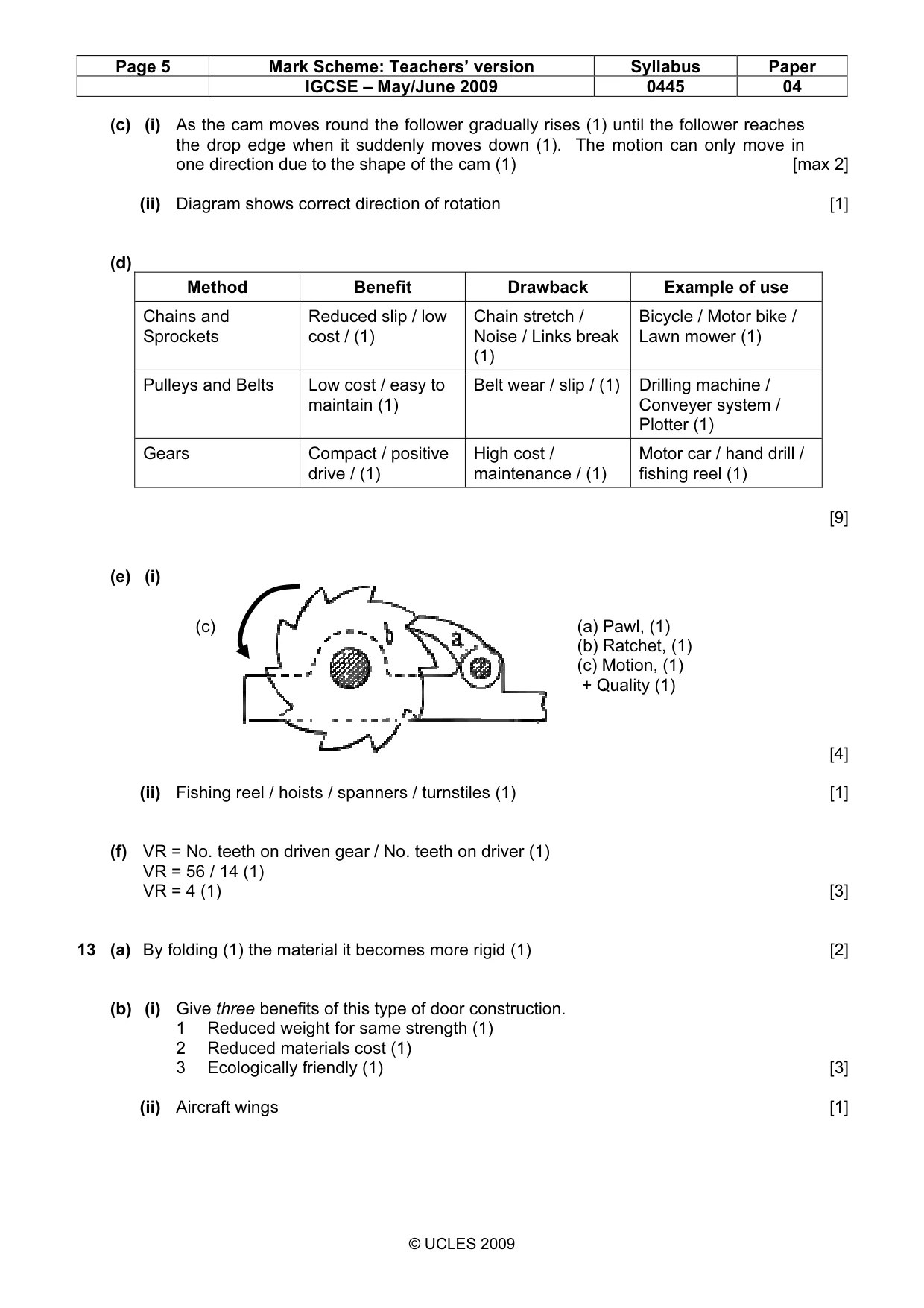
Page 5 Mark Scheme: Teachers’ version Syllabus Paper IGCSE – May/June 2009 0445 04 © UCLES 2009 (c) (i) As the cam moves round the follower gradually rises (1) until the follower reaches the drop edge when it suddenly moves down (1). The motion can only move in one direction due to the shape of the cam (1) [max 2] (ii) Diagram shows correct direction of rotation [1] (d) Method Benefit Drawback Example of use Chains and Sprockets Reduced slip / low cost / (1) Chain stretch / Noise / Links break (1) Bicycle / Motor bike / Lawn mower (1) Pulleys and Belts Low cost / easy to maintain (1) Belt wear / slip / (1) Drilling machine / Conveyer system / Plotter (1) Gears Compact / positive drive / (1) High cost / maintenance / (1) Motor car / hand drill / fishing reel (1) [9] (e) (i) [4] (ii) Fishing reel / hoists / spanners / turnstiles (1) [1] (f) VR = No. teeth on driven gear / No. teeth on driver (1) VR = 56 / 14 (1) VR = 4 (1) [3] 13 (a) By folding (1) the material it becomes more rigid (1) [2] (b) (i) Give three benefits of this type of door construction. 1 Reduced weight for same strength (1) 2 Reduced materials cost (1) 3 Ecologically friendly (1) [3] (ii) Aircraft wings [1] (a) Pawl, (1) (b) Ratchet, (1) (c) Motion, (1) + Quality (1) (c)
Mark scheme, page 6
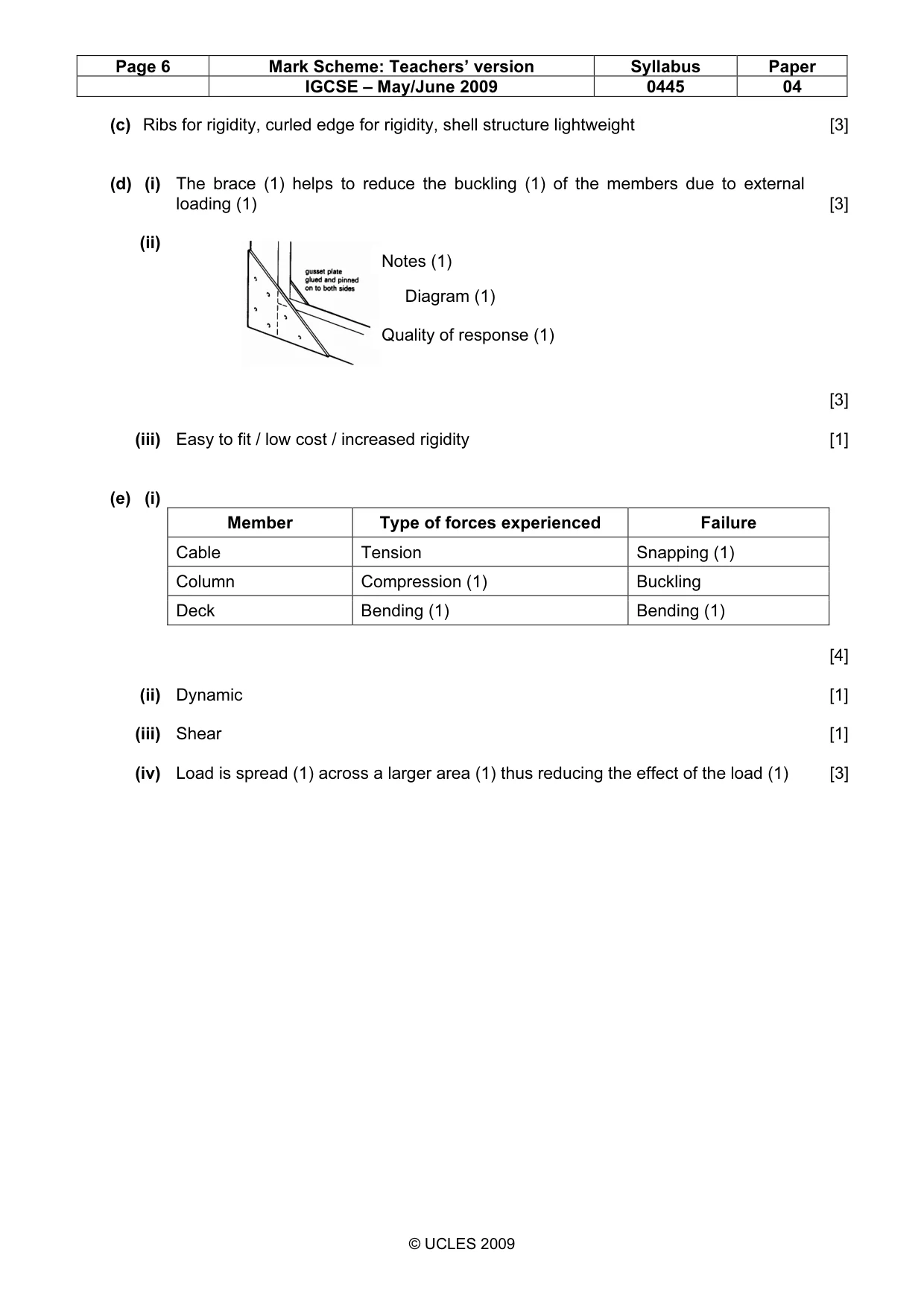
Page 6 Mark Scheme: Teachers’ version Syllabus Paper IGCSE – May/June 2009 0445 04 © UCLES 2009 (c) Ribs for rigidity, curled edge for rigidity, shell structure lightweight [3] (d) (i) The brace (1) helps to reduce the buckling (1) of the members due to external loading (1) [3] (ii) . [3] (iii) Easy to fit / low cost / increased rigidity [1] (e) (i) Member Type of forces experienced Failure Cable Tension Snapping (1) Column Compression (1) Buckling Deck Bending (1) Bending (1) [4] (ii) Dynamic [1] (iii) Shear [1] (iv) Load is spread (1) across a larger area (1) thus reducing the effect of the load (1) [3] Notes (1) Diagram (1) Quality of response (1)
What you needed in this session
Cambridge’s own grade thresholds for 2009 May/June, Paper 4 · Variant 1. A higher threshold means an easier paper — the bar moves with how the cohort did.