Cambridge IGCSE Design and Technology 0445 — 2008 May/June Paper 4 · Variant 1
0445/41/M/J/08 · 50 marks · ≈56 min
The question paper and its mark scheme, free to read here and free to download. This is Cambridge’s own paper, exactly as it was sat.
Question paper16 pages

Mark scheme7 pages
Answers below. Sit the paper first if you are practising.
Paper as text
Question paper, page 1
[Turn over *3114380435* READ THESE INSTRUCTIONS FIRST Write your Centre number, candidate number and name on all the work you hand in. Write in dark blue or black pen. You may use a soft pencil for any diagrams or graphs. Do not use staples, paper clips, highlighters, glue or correction fl uid. DO NOT WRITE IN ANY BARCODES. You may use a calculator. Section A Answer all questions. Section B Answer one question. At the end of the examination, fasten all your work securely together. The number of marks is given in brackets [ ] at the end of each question or part question. For Examiner’s Use Section A Section B Total DESIGN AND TECHNOLOGY 0445/04 Paper 4 Systems and Control May/June 2008 1 hour Candidates answer on the Question Paper. No Additional Materials are required. To be taken together with Paper 1 in one session of 2 hours and 15 minutes. UNIVERSITY OF CAMBRIDGE INTERNATIONAL EXAMINATIONS International General Certifi cate of Secondary Education This document consists of an 14 printed pages and 2 blank pages. [Turn over IB08 06_0445_04/2RP © UCLES 2008 www.XtremePapers.com
Question paper, page 2
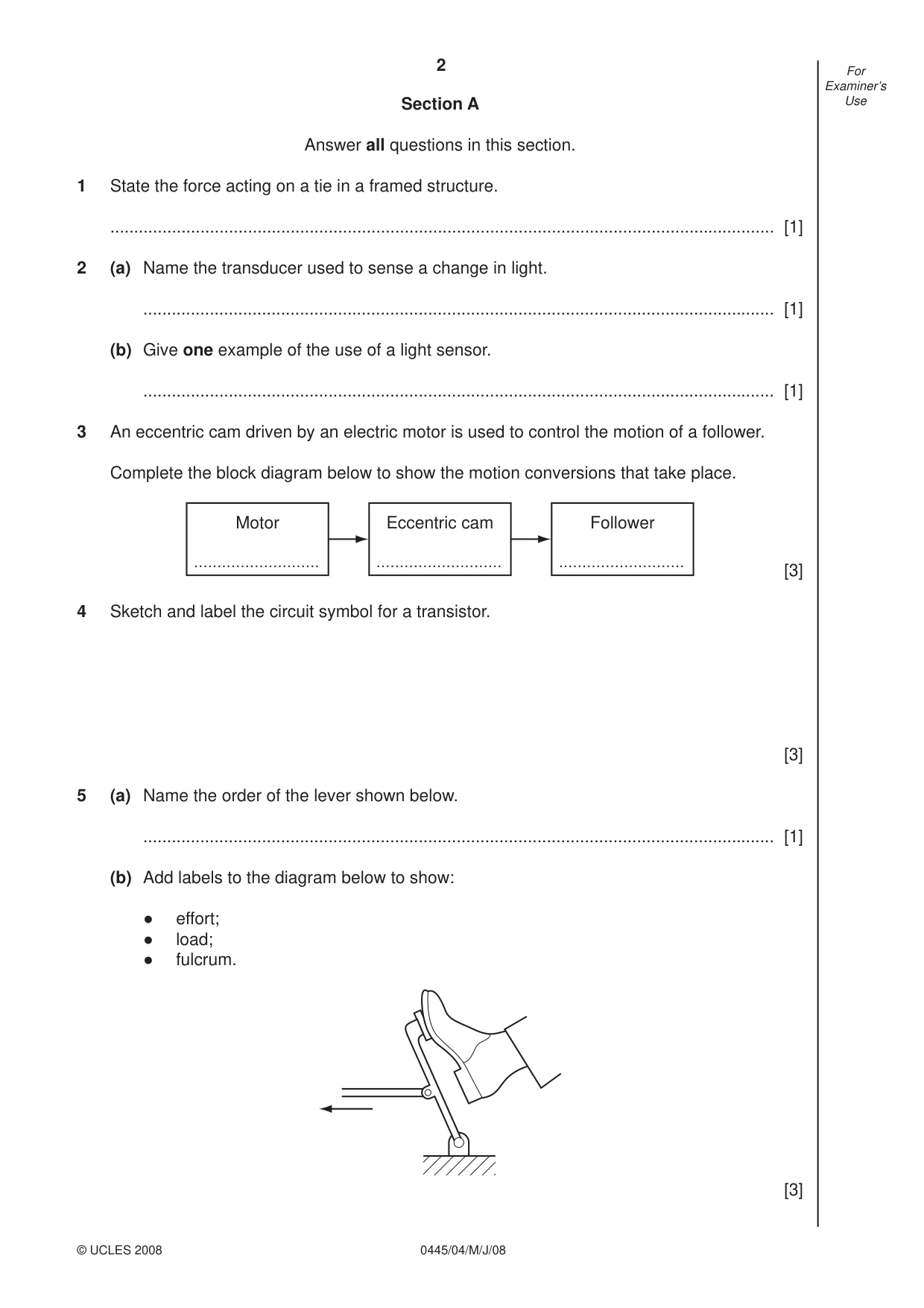
2 0445/04/M/J/08 © UCLES 2008 For Examiner’s Use Section A Answer all questions in this section. 1 State the force acting on a tie in a framed structure. … [1] 2 (a) Name the transducer used to sense a change in light. … [1] (b) Give one example of the use of a light sensor. … [1] 3 An eccentric cam driven by an electric motor is used to control the motion of a follower. Complete the block diagram below to show the motion conversions that take place. Motor Eccentric cam Follower [3] 4 Sketch and label the circuit symbol for a transistor. [3] 5 (a) Name the order of the lever shown below. … [1] (b) Add labels to the diagram below to show: ● effort; ● load; ● fulcrum. [3]
Question paper, page 3
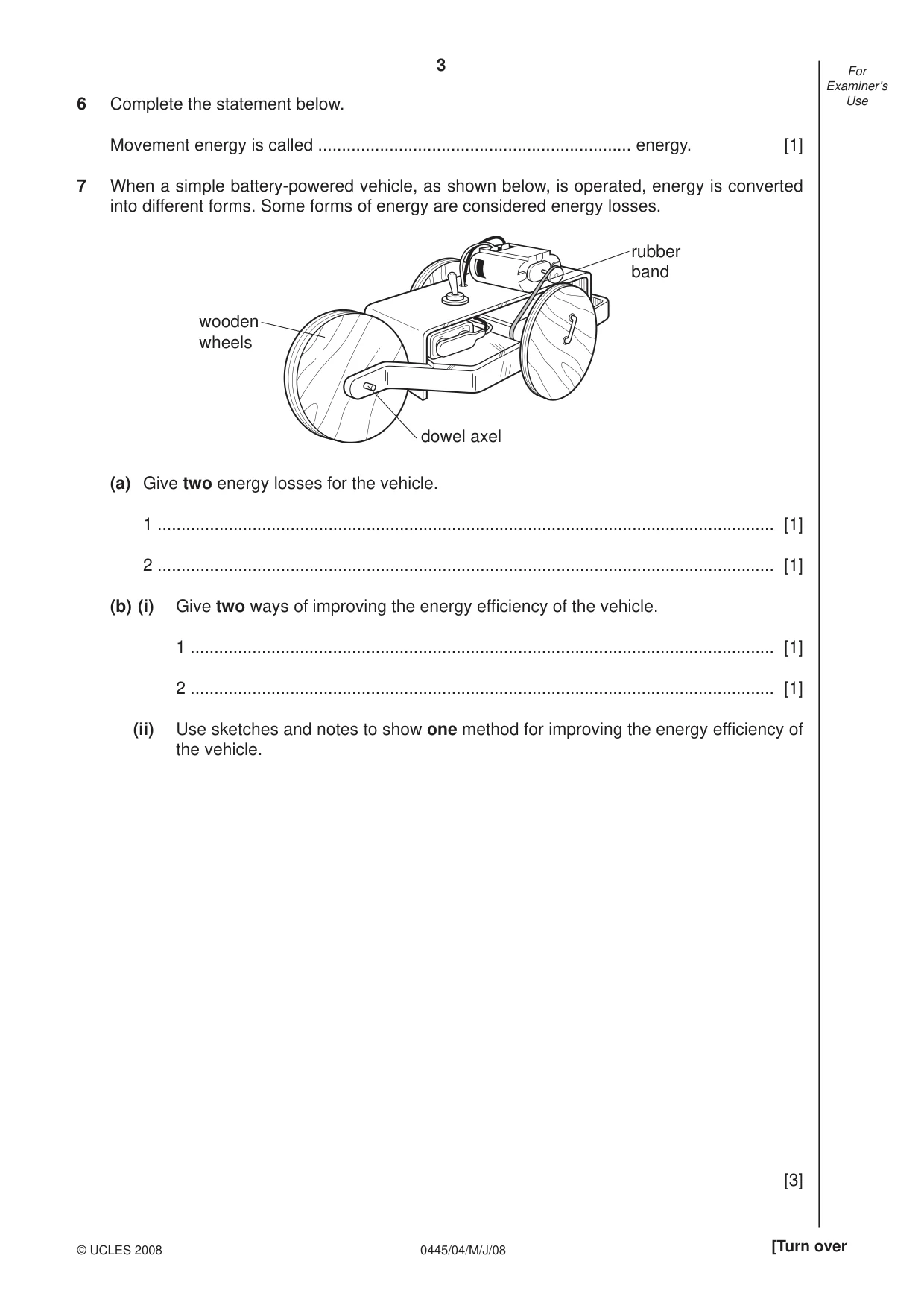
3 0445/04/M/J/08 © UCLES 2008 [Turn over For Examiner’s Use 6 Complete the statement below. Movement energy is called … energy. [1] 7 When a simple battery-powered vehicle, as shown below, is operated, energy is converted into different forms. Some forms of energy are considered energy losses. dowel axel wooden wheels rubber band (a) Give two energy losses for the vehicle. 1 … [1] 2 … [1] (b) (i) Give two ways of improving the energy effi ciency of the vehicle. 1 … [1] 2 … [1] (ii) Use sketches and notes to show one method for improving the energy effi ciency of the vehicle. [3]
Question paper, page 4
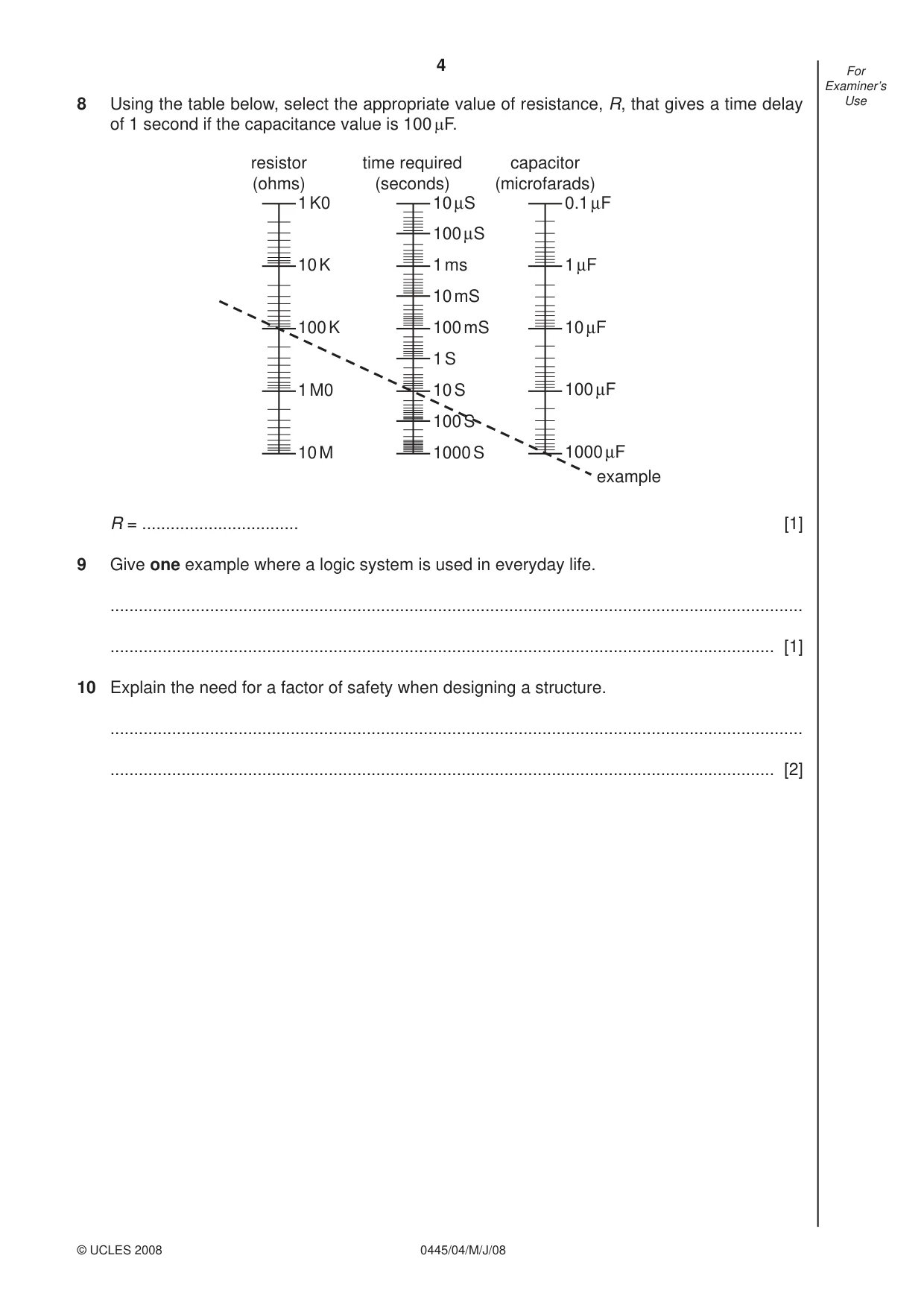
4 0445/04/M/J/08 © UCLES 2008 For Examiner’s Use 8 Using the table below, select the appropriate value of resistance, R, that gives a time delay of 1 second if the capacitance value is 100 µF. resistor (ohms) time required (seconds) capacitor (microfarads) 1 K0 10 K 100 K 1 M0 10 M 0.1 µF 1 µF 10 µF 100 µF 1000 µF 10 µS 100 µS 1 ms 100 mS 10 S 1000 S 10 mS 1 S 100 S example R = … [1] 9 Give one example where a logic system is used in everyday life. … … [1] 10 Explain the need for a factor of safety when designing a structure. … … [2]
Question paper, page 5
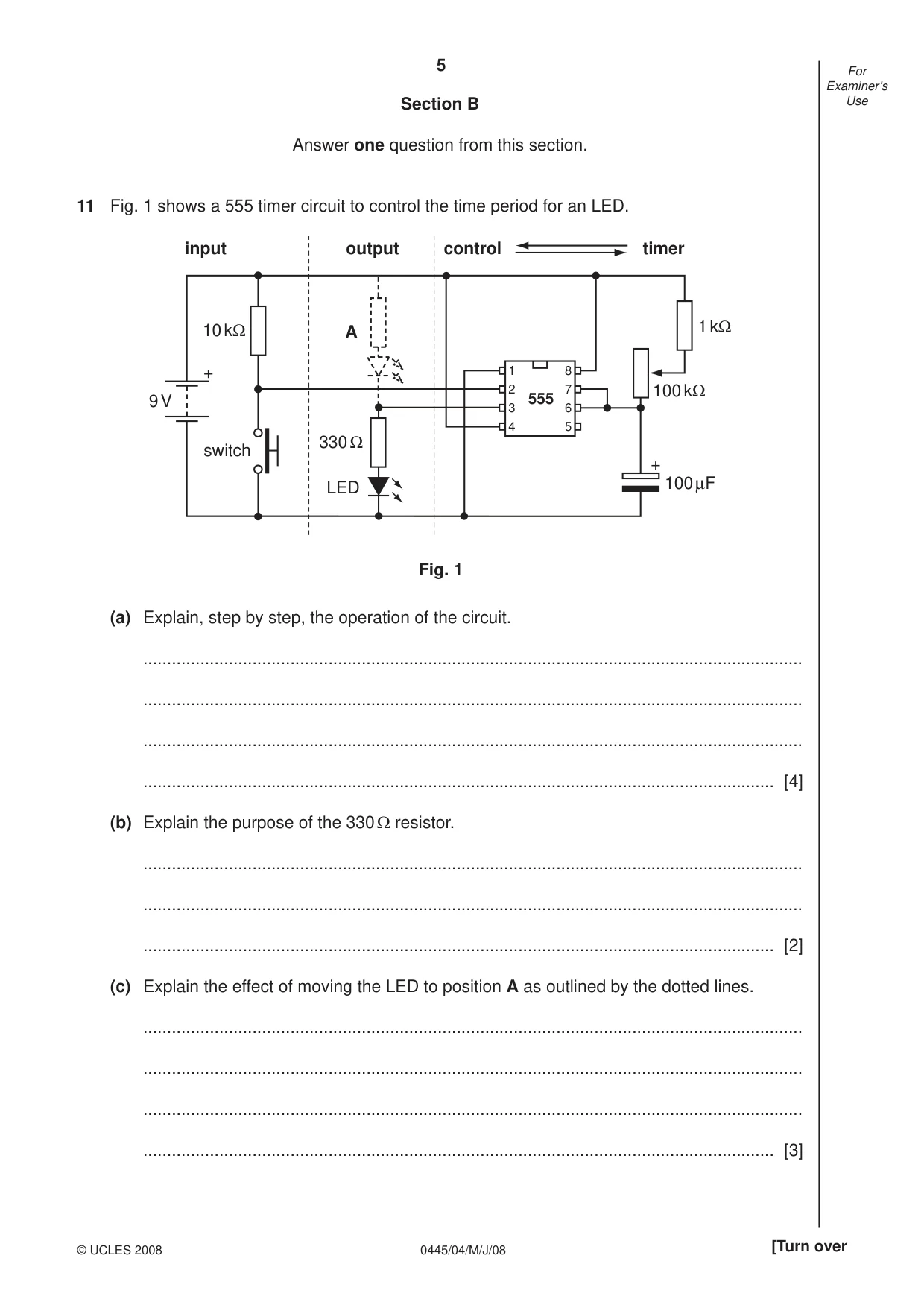
5 0445/04/M/J/08 © UCLES 2008 [Turn over For Examiner’s Use Section B Answer one question from this section. 11 Fig. 1 shows a 555 timer circuit to control the time period for an LED. + + 9 V 1 kΩ 100 kΩ 10 kΩ 330 Ω 555 100 µF 1 2 3 4 8 7 6 5 A LED control output input timer switch Fig. 1 (a) Explain, step by step, the operation of the circuit. … … … … [4] (b) Explain the purpose of the 330 Ω resistor. … … … [2] (c) Explain the effect of moving the LED to position A as outlined by the dotted lines. … … … … [3]
Question paper, page 6
6 0445/04/M/J/08 © UCLES 2008 For Examiner’s Use (d) The 100 µF capacitor is an electrolytic capacitor. State why it should be connected according to its polarity. … … [1] (e) The value of the timing capacitor is 100 µF and the value of the timing resistor is 100 kΩ. Calculate the time delay in seconds. [4] (f) Identify the type of switch used in the circuit shown in Fig. 1. … [1] (g) The circuit is powered by a 9 V battery. Explain the difference between a battery and a cell. … … [2]
Question paper, page 7
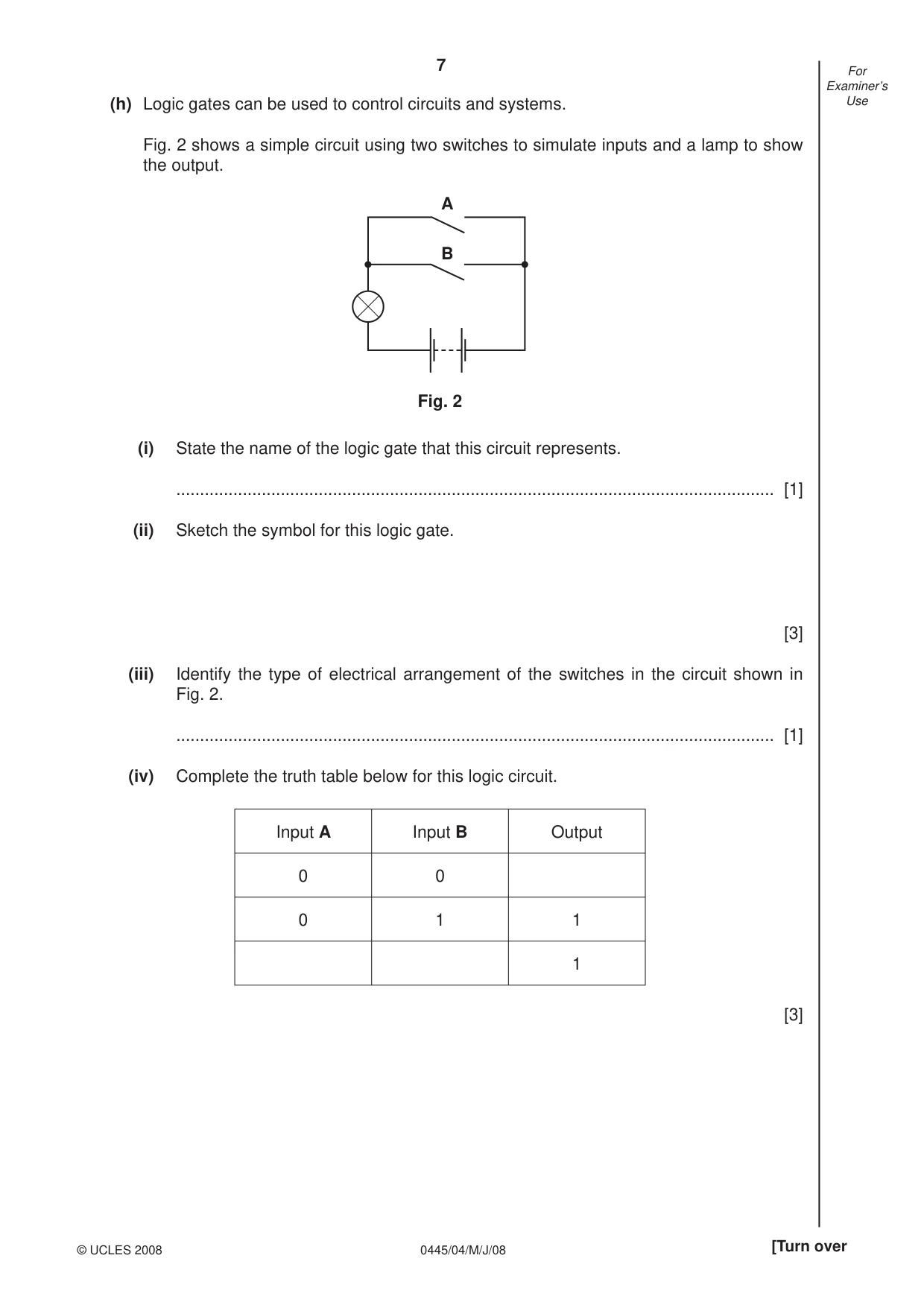
7 0445/04/M/J/08 © UCLES 2008 [Turn over For Examiner’s Use (h) Logic gates can be used to control circuits and systems. Fig. 2 shows a simple circuit using two switches to simulate inputs and a lamp to show the output. A B Fig. 2 (i) State the name of the logic gate that this circuit represents. … [1] (ii) Sketch the symbol for this logic gate. [3] (iii) Identify the type of electrical arrangement of the switches in the circuit shown in Fig. 2. … [1] (iv) Complete the truth table below for this logic circuit. Input A Input B Output 0 0 0 1 1 1 [3]
Question paper, page 8
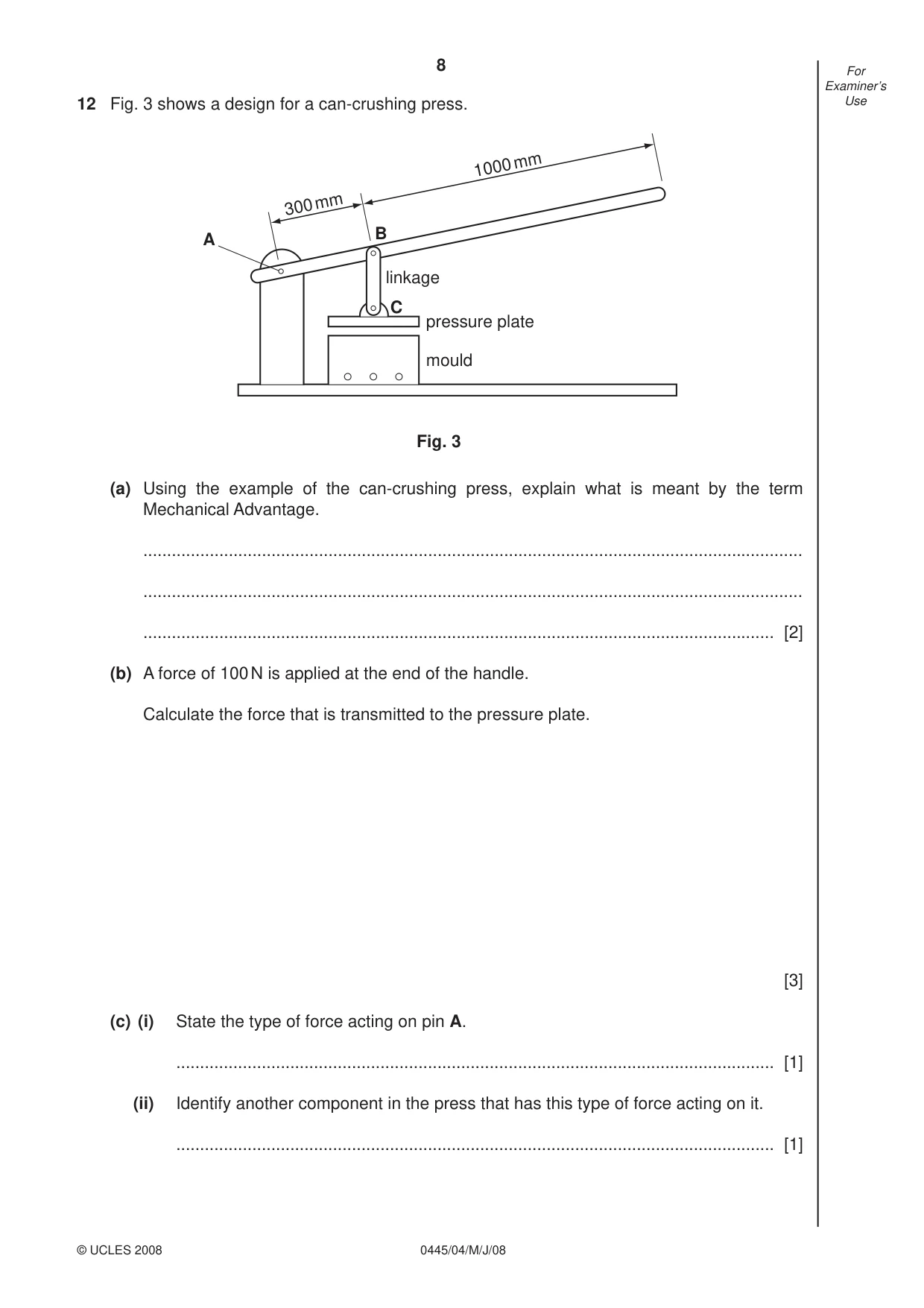
8 0445/04/M/J/08 © UCLES 2008 For Examiner’s Use 12 Fig. 3 shows a design for a can-crushing press. 1000 mm 300 mm linkage pressure plate mould A B C Fig. 3 (a) Using the example of the can-crushing press, explain what is meant by the term Mechanical Advantage. … … … [2] (b) A force of 100 N is applied at the end of the handle. Calculate the force that is transmitted to the pressure plate. [3] (c) (i) State the type of force acting on pin A. … [1] (ii) Identify another component in the press that has this type of force acting on it. … [1]
Question paper, page 9
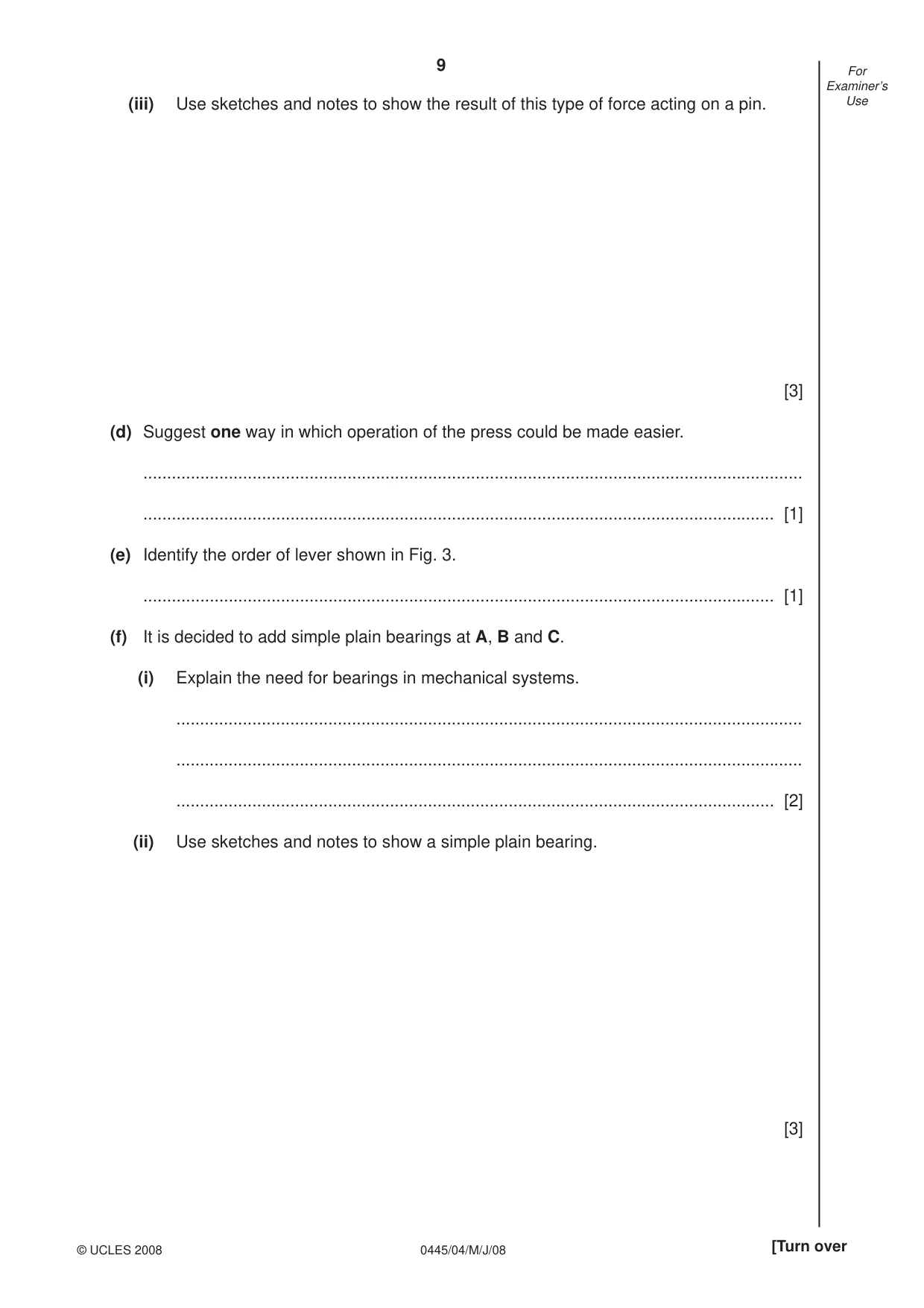
9 0445/04/M/J/08 © UCLES 2008 [Turn over For Examiner’s Use (iii) Use sketches and notes to show the result of this type of force acting on a pin. [3] (d) Suggest one way in which operation of the press could be made easier. … … [1] (e) Identify the order of lever shown in Fig. 3. … [1] (f) It is decided to add simple plain bearings at A, B and C. (i) Explain the need for bearings in mechanical systems. … … … [2] (ii) Use sketches and notes to show a simple plain bearing. [3]
Question paper, page 10
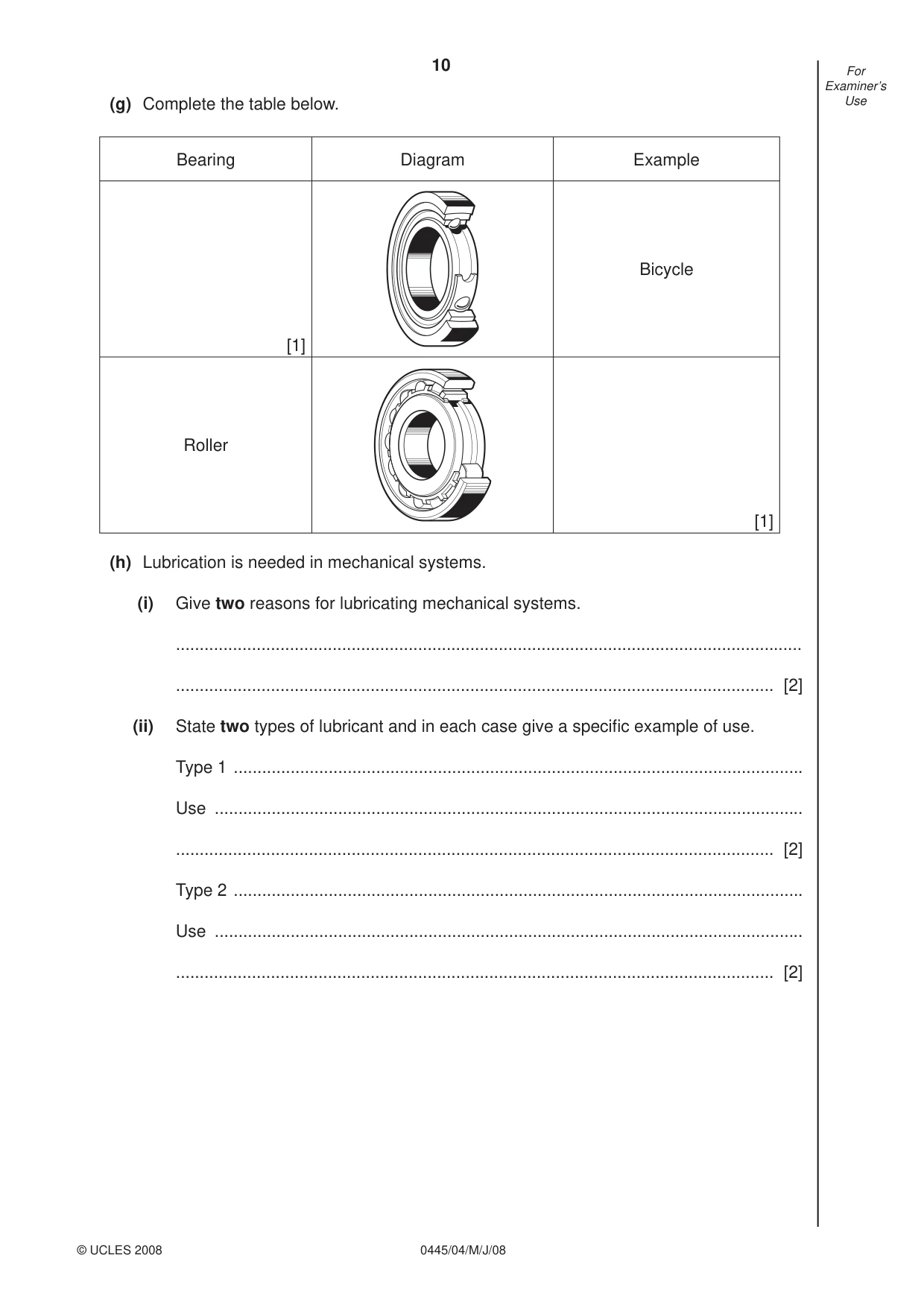
10 0445/04/M/J/08 © UCLES 2008 For Examiner’s Use (g) Complete the table below. Bearing Diagram Example [1] Bicycle Roller [1] (h) Lubrication is needed in mechanical systems. (i) Give two reasons for lubricating mechanical systems. … … [2] (ii) State two types of lubricant and in each case give a specifi c example of use. Type 1 … Use … … [2] Type 2 … Use … … [2]
Question paper, page 11
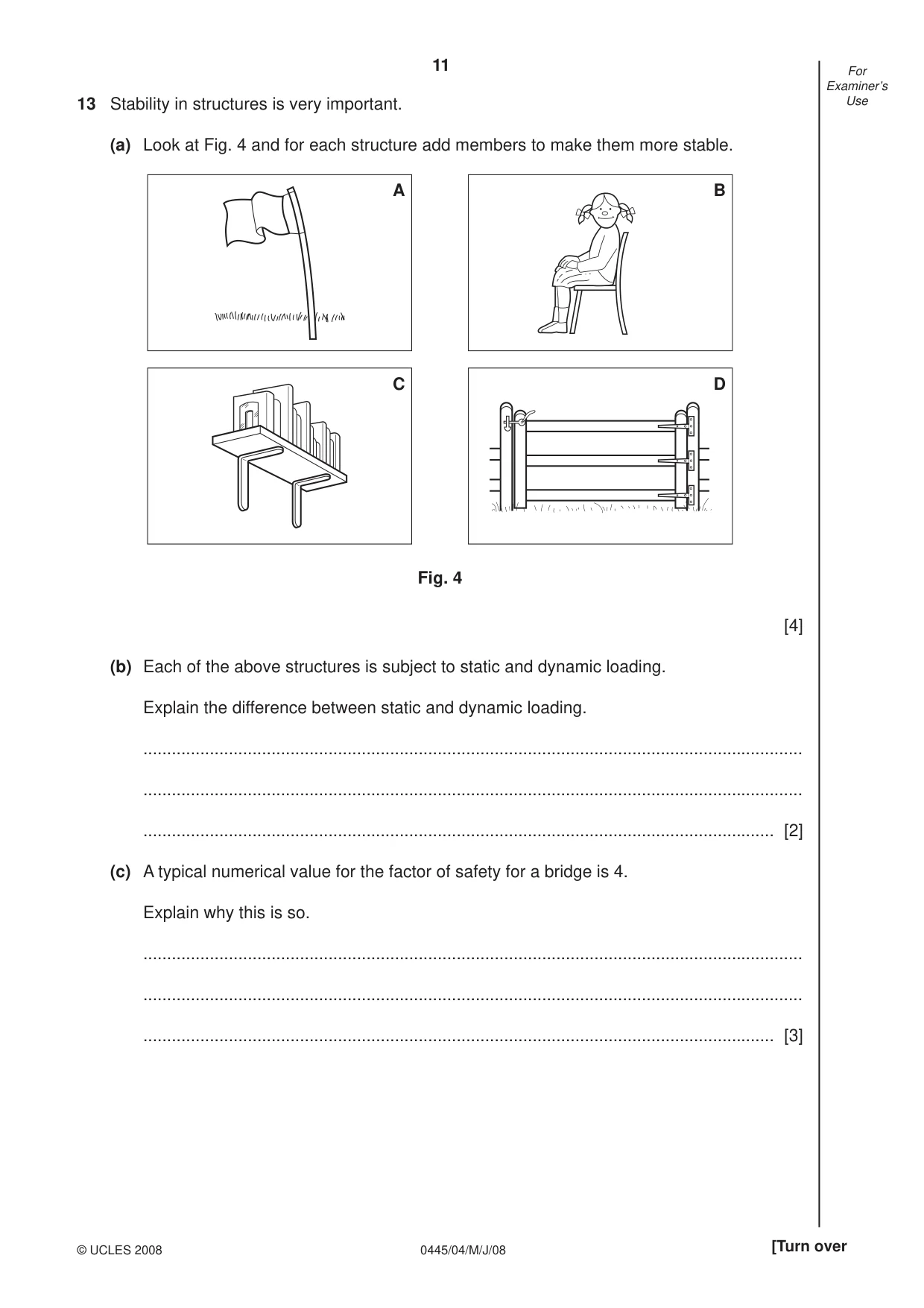
11 0445/04/M/J/08 © UCLES 2008 [Turn over For Examiner’s Use 13 Stability in structures is very important. (a) Look at Fig. 4 and for each structure add members to make them more stable. A C B D Fig. 4 [4] (b) Each of the above structures is subject to static and dynamic loading. Explain the difference between static and dynamic loading. … … … [2] (c) A typical numerical value for the factor of safety for a bridge is 4. Explain why this is so. … … … [3]
Question paper, page 12
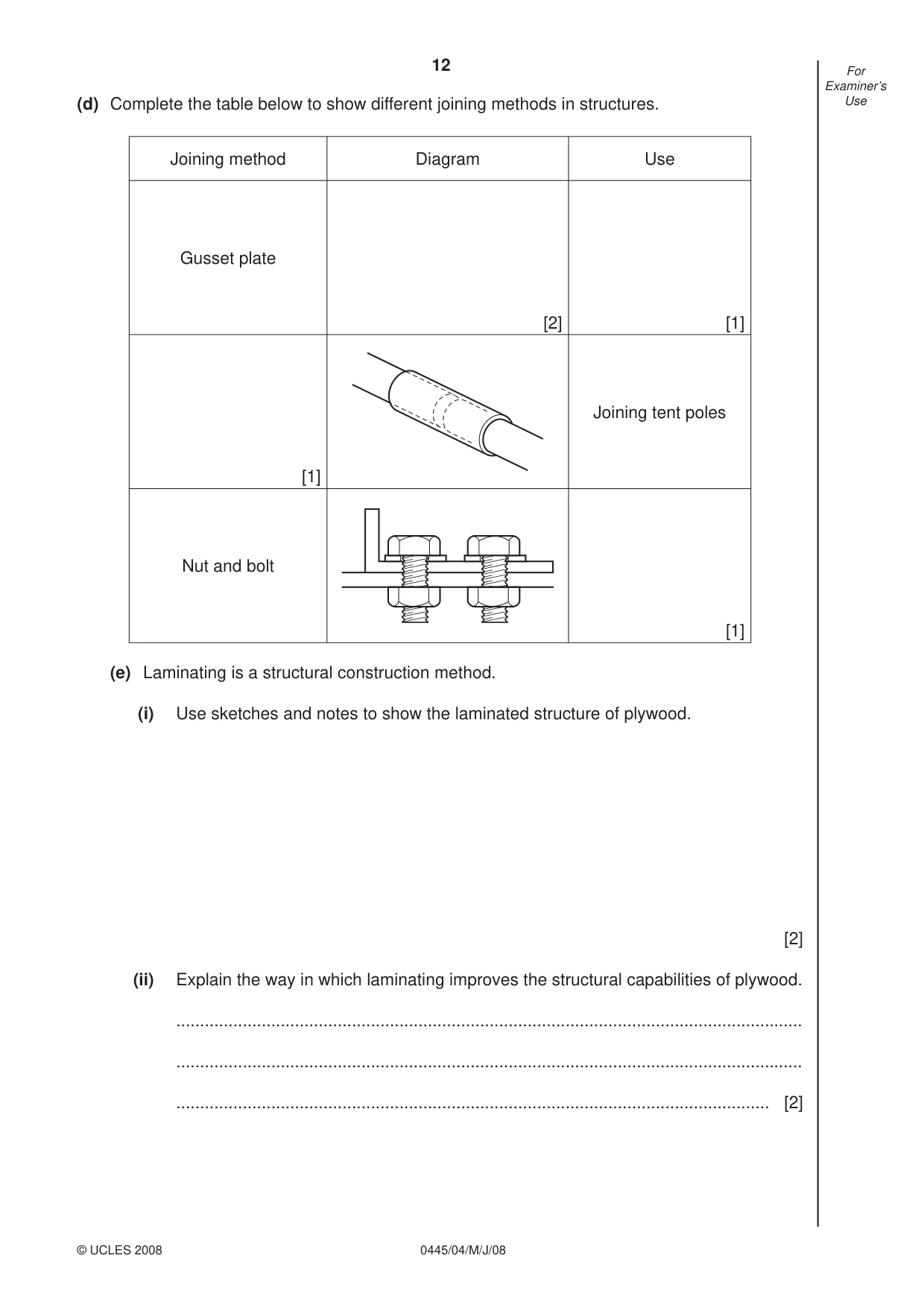
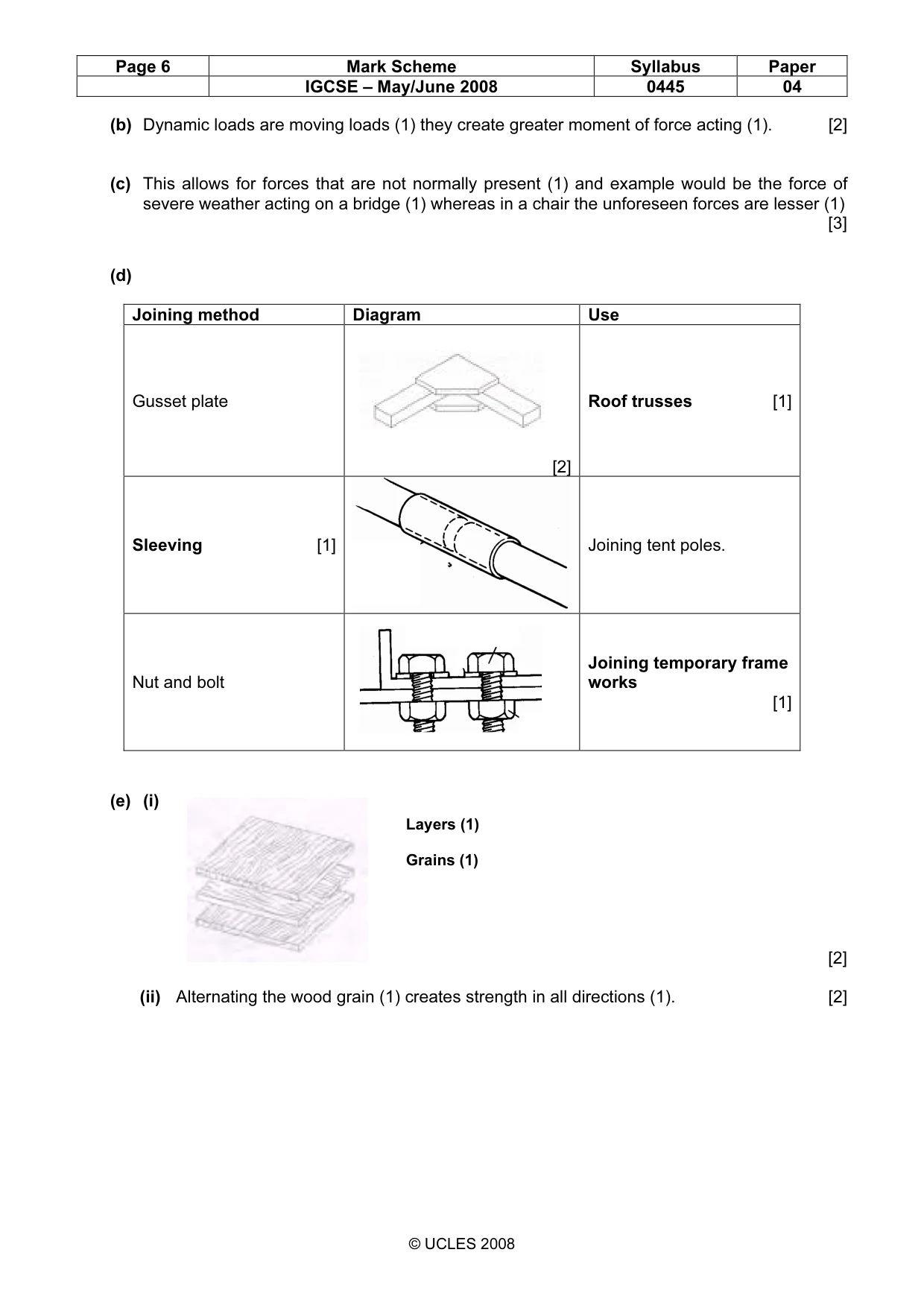
12 0445/04/M/J/08 © UCLES 2008 For Examiner’s Use (d) Complete the table below to show different joining methods in structures. Joining method Diagram Use Gusset plate [2] [1] [1] Joining tent poles Nut and bolt [1] (e) Laminating is a structural construction method. (i) Use sketches and notes to show the laminated structure of plywood. [2] (ii) Explain the way in which laminating improves the structural capabilities of plywood. … … … [2]
Question paper, page 13
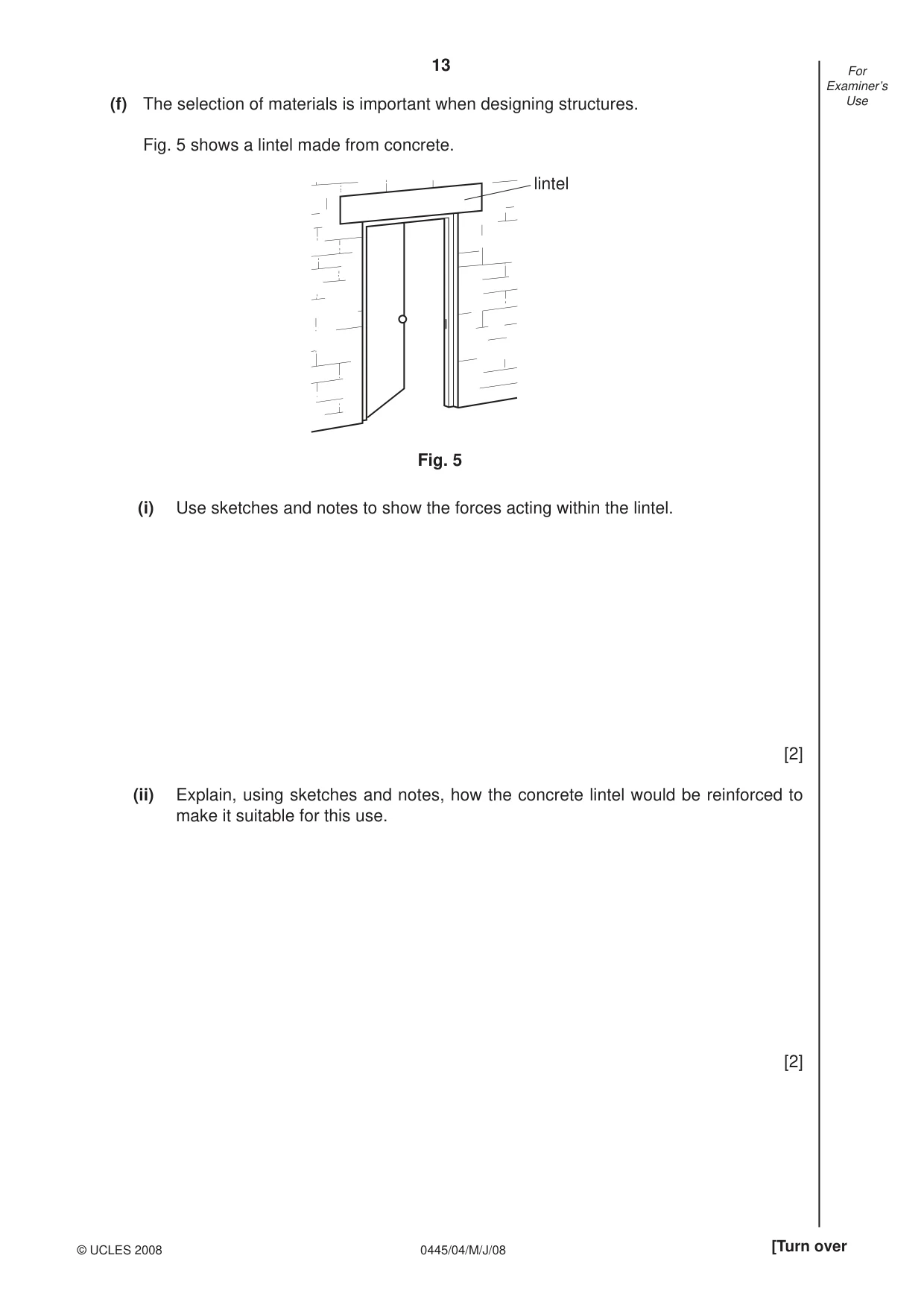
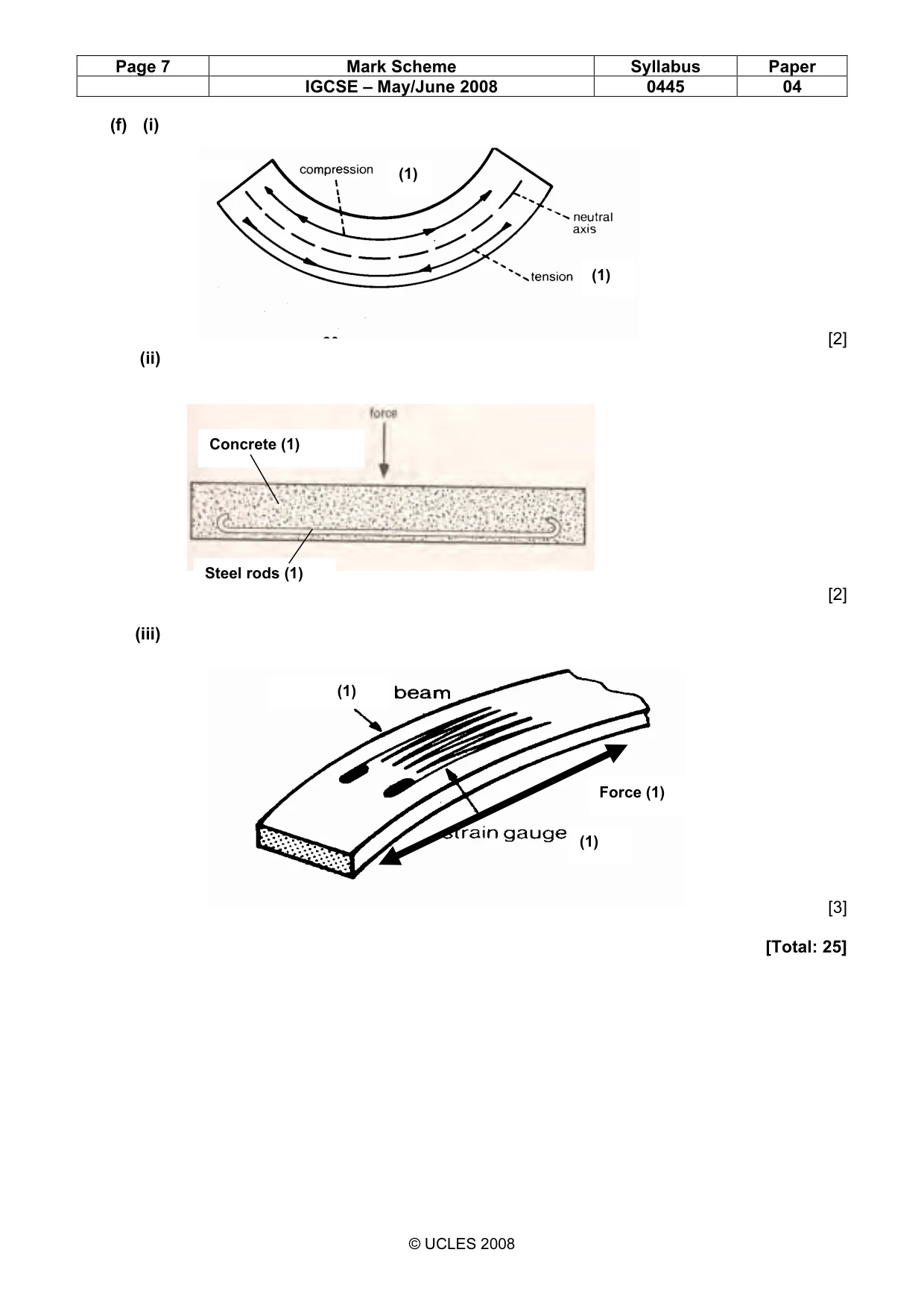
13 0445/04/M/J/08 © UCLES 2008 [Turn over For Examiner’s Use (f) The selection of materials is important when designing structures. Fig. 5 shows a lintel made from concrete. lintel Fig. 5 (i) Use sketches and notes to show the forces acting within the lintel. [2] (ii) Explain, using sketches and notes, how the concrete lintel would be reinforced to make it suitable for this use. [2]
Question paper, page 14
14 0445/04/M/J/08 © UCLES 2008 For Examiner’s Use (iii) Show, using sketches and notes, how a strain gauge is used to measure the defl ection of the lintel. [3]
Question paper, page 16
16 0445/04/M/J/08 Permission to reproduce items where third-party owned material protected by copyright is included has been sought and cleared where possible. Every reasonable effort has been made by the publisher (UCLES) to trace copyright holders, but if any items requiring clearance have unwittingly been included the publisher will be pleased to make amends at the earliest possible opportunity. University of Cambridge International Examinations is part of the Cambridge Assessment Group. Cambridge Assessment is the brand name of University of Cambridge Local Examinations Syndicate (UCLES), which is itself a department of the University of Cambridge. BLANK PAGE
Mark scheme, page 1
UNIVERSITY OF CAMBRIDGE INTERNATIONAL EXAMINATIONS International General Certificate of Secondary Education MARK SCHEME for the May/June 2008 question paper 0445 DESIGN AND TECHNOLOGY 0445/04 Paper 4 (Systems and Control), maximum raw mark 50 This mark scheme is published as an aid to teachers and candidates, to indicate the requirements of the examination. It shows the basis on which Examiners were instructed to award marks. It does not indicate the details of the discussions that took place at an Examiners’ meeting before marking began. All Examiners are instructed that alternative correct answers and unexpected approaches in candidates’ scripts must be given marks that fairly reflect the relevant knowledge and skills demonstrated. Mark schemes must be read in conjunction with the question papers and the report on the examination. • CIE will not enter into discussions or correspondence in connection with these mark schemes. CIE is publishing the mark schemes for the May/June 2008 question papers for most IGCSE, GCE Advanced Level and Advanced Subsidiary Level syllabuses and some Ordinary Level syllabuses. www.XtremePapers.com
Mark scheme, page 2
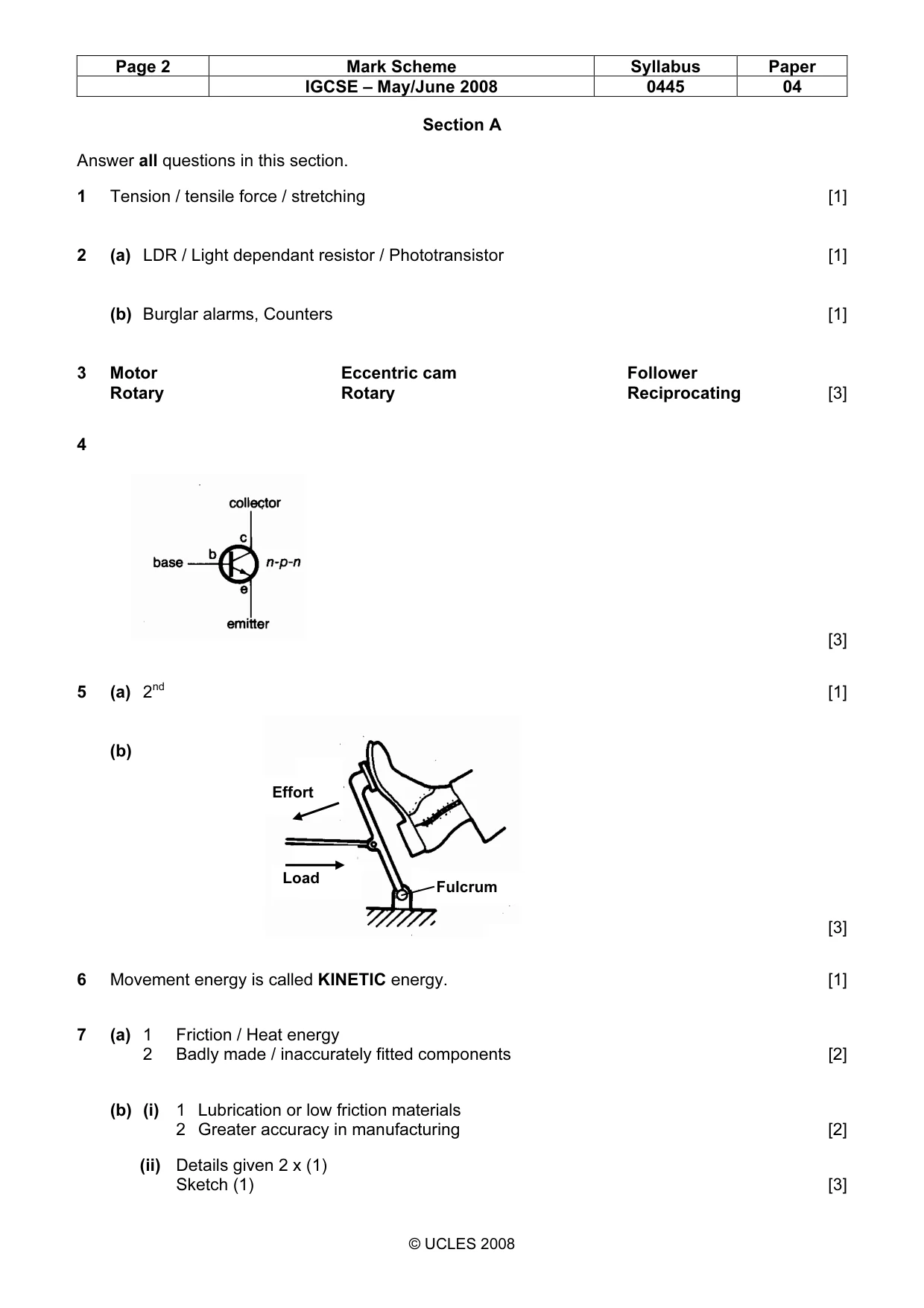
Page 2 Mark Scheme Syllabus Paper IGCSE – May/June 2008 0445 04 © UCLES 2008 Section A Answer all questions in this section. 1 Tension / tensile force / stretching [1] 2 (a) LDR / Light dependant resistor / Phototransistor [1] (b) Burglar alarms, Counters [1] 3 Motor Eccentric cam Follower Rotary Rotary Reciprocating [3] 4 [3] 5 (a) 2nd [1] (b) [3] 6 Movement energy is called KINETIC energy. [1] 7 (a) 1 Friction / Heat energy 2 Badly made / inaccurately fitted components [2] (b) (i) 1 Lubrication or low friction materials 2 Greater accuracy in manufacturing [2] (ii) Details given 2 x (1) Sketch (1) [3] Effort Load Fulcrum
Mark scheme, page 3
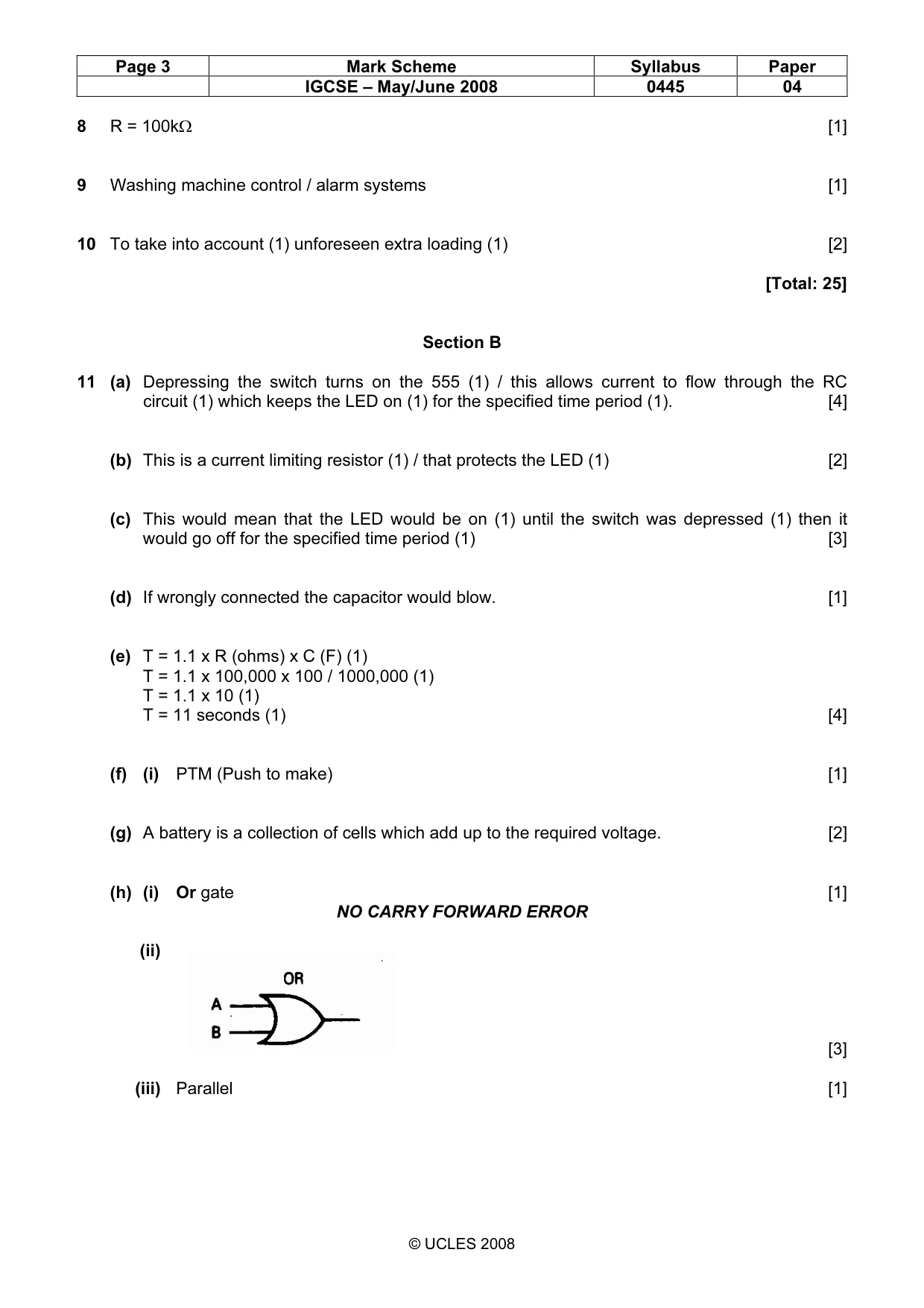
Page 3 Mark Scheme Syllabus Paper IGCSE – May/June 2008 0445 04 © UCLES 2008 8 R = 100kΩ [1] 9 Washing machine control / alarm systems [1] 10 To take into account (1) unforeseen extra loading (1) [2] [Total: 25] Section B 11 (a) Depressing the switch turns on the 555 (1) / this allows current to flow through the RC circuit (1) which keeps the LED on (1) for the specified time period (1). [4] (b) This is a current limiting resistor (1) / that protects the LED (1) [2] (c) This would mean that the LED would be on (1) until the switch was depressed (1) then it would go off for the specified time period (1) [3] (d) If wrongly connected the capacitor would blow. [1] (e) T = 1.1 x R (ohms) x C (F) (1) T = 1.1 x 100,000 x 100 / 1000,000 (1) T = 1.1 x 10 (1) T = 11 seconds (1) [4] (f) (i) PTM (Push to make) [1] (g) A battery is a collection of cells which add up to the required voltage. [2] (h) (i) Or gate [1] NO CARRY FORWARD ERROR (ii) . [3] (iii) Parallel [1]
Mark scheme, page 4
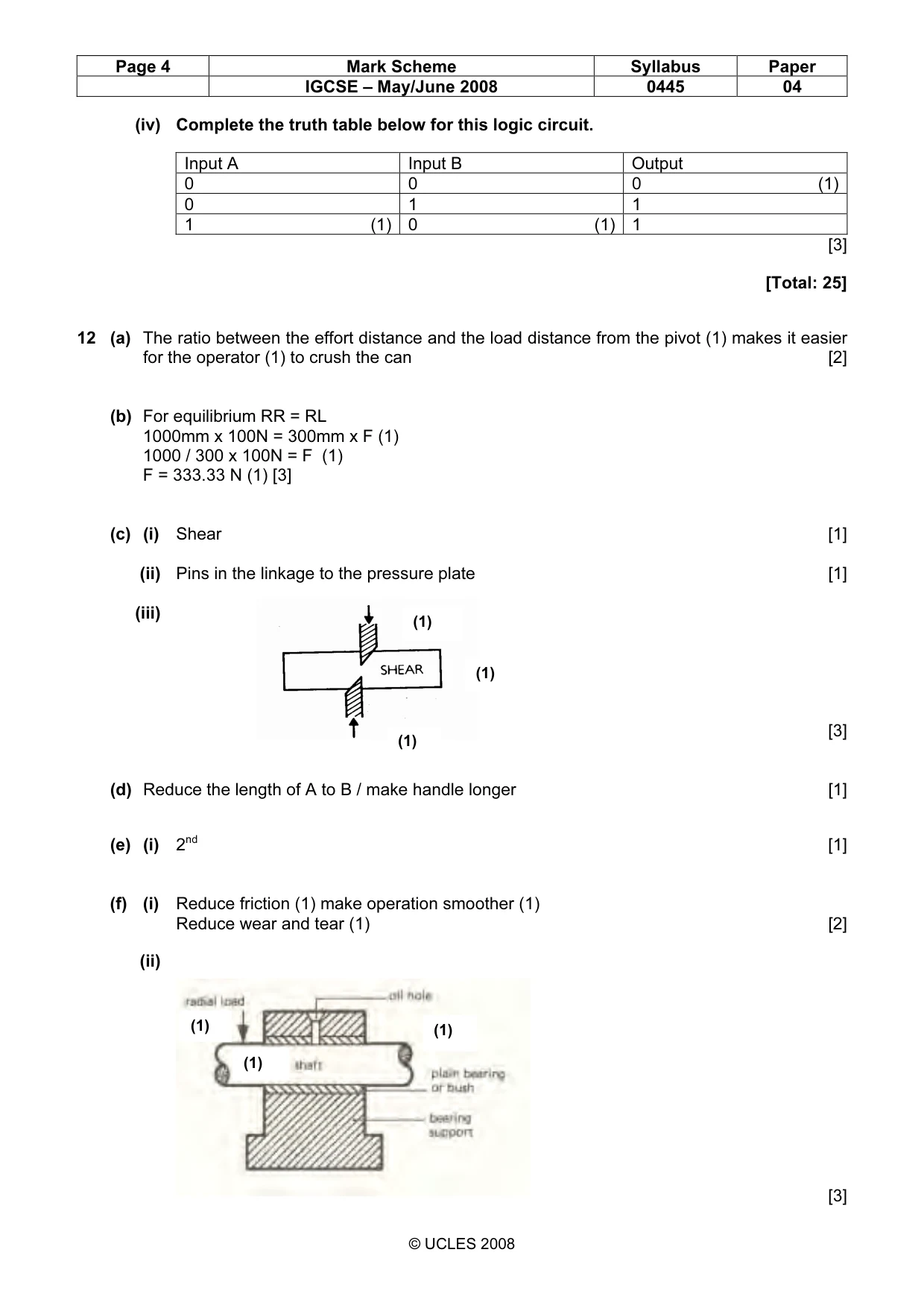
Page 4 Mark Scheme Syllabus Paper IGCSE – May/June 2008 0445 04 © UCLES 2008 (iv) Complete the truth table below for this logic circuit. Input A Input B Output 0 0 0 (1) 0 1 1 1 (1) 0 (1) 1 [3] [Total: 25] 12 (a) The ratio between the effort distance and the load distance from the pivot (1) makes it easier for the operator (1) to crush the can [2] (b) For equilibrium RR = RL 1000mm x 100N = 300mm x F (1) 1000 / 300 x 100N = F (1) F = 333.33 N (1) [3] (c) (i) Shear [1] (ii) Pins in the linkage to the pressure plate [1] (iii) [3] (d) Reduce the length of A to B / make handle longer [1] (e) (i) 2nd [1] (f) (i) Reduce friction (1) make operation smoother (1) Reduce wear and tear (1) [2] (ii) [3] (1) (1) (1) (1) (1) (1)
Mark scheme, page 5
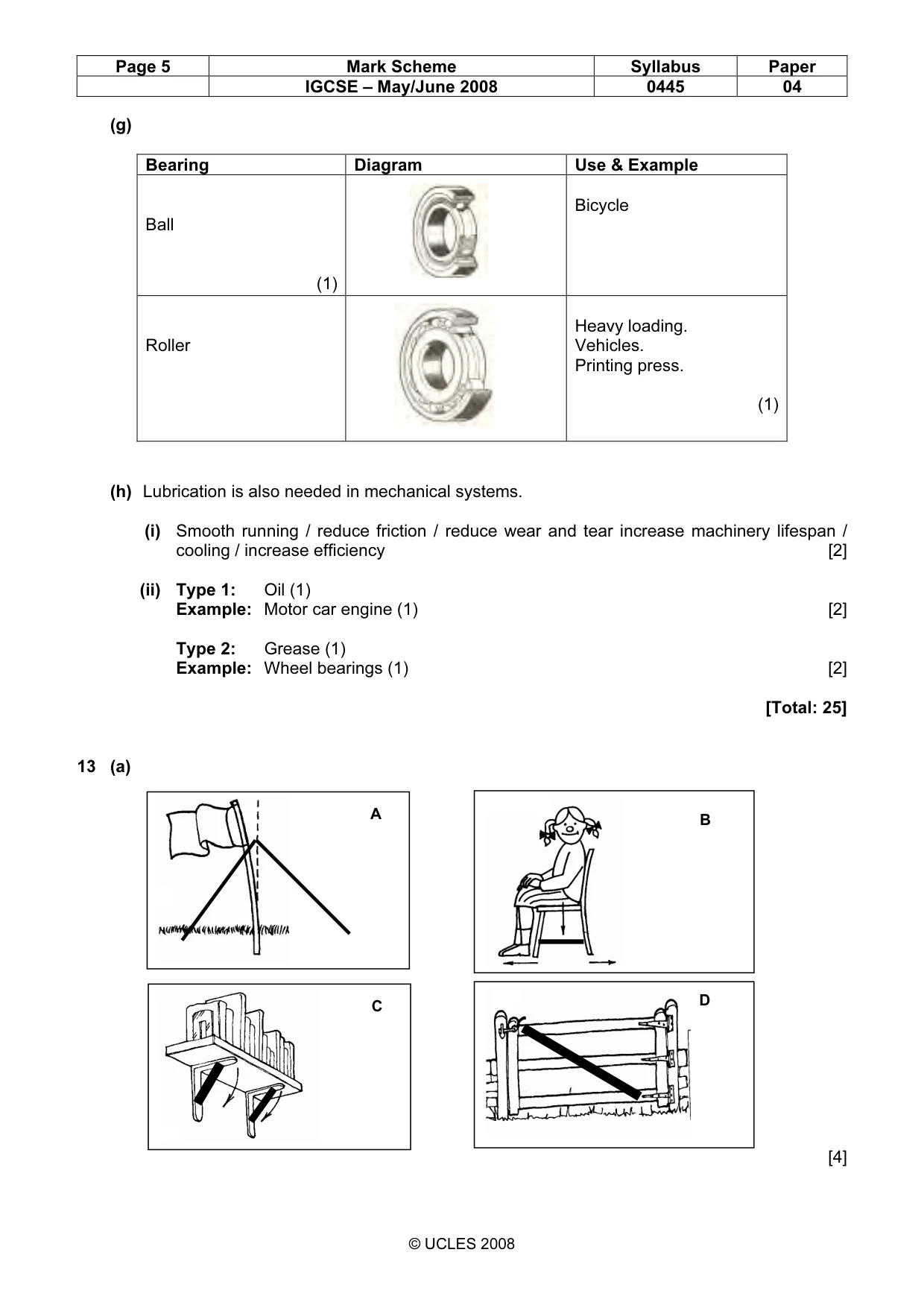
Page 5 Mark Scheme Syllabus Paper IGCSE – May/June 2008 0445 04 © UCLES 2008 (g) Bearing Diagram Use & Example Ball (1) Bicycle Roller Heavy loading. Vehicles. Printing press. (1) (h) Lubrication is also needed in mechanical systems. (i) Smooth running / reduce friction / reduce wear and tear increase machinery lifespan / cooling / increase efficiency [2] (ii) Type 1: Oil (1) Example: Motor car engine (1) [2] Type 2: Grease (1) Example: Wheel bearings (1) [2] [Total: 25] 13 (a) [4] A B C D
Mark scheme, page 6
Page 6 Mark Scheme Syllabus Paper IGCSE – May/June 2008 0445 04 © UCLES 2008 (b) Dynamic loads are moving loads (1) they create greater moment of force acting (1). [2] (c) This allows for forces that are not normally present (1) and example would be the force of severe weather acting on a bridge (1) whereas in a chair the unforeseen forces are lesser (1) [3] (d) Joining method Diagram Use Gusset plate [2] Roof trusses [1] Sleeving [1] Joining tent poles. Nut and bolt Joining temporary frame works [1] (e) (i) [2] (ii) Alternating the wood grain (1) creates strength in all directions (1). [2] Layers (1) Grains (1)
Mark scheme, page 7
Page 7 Mark Scheme Syllabus Paper IGCSE – May/June 2008 0445 04 © UCLES 2008 (f) (i) [2] (ii) [2] (iii) [3] [Total: 25] (1) (1) Steel rods (1) Concrete (1) (1) (1) Force (1)
What you needed in this session
Cambridge’s own grade thresholds for 2008 May/June, Paper 4 · Variant 1. A higher threshold means an easier paper — the bar moves with how the cohort did.