Cambridge IGCSE Chinese - First Language 0509 — 2017 May/June Paper 1 · Variant 3
0509/13/M/J/17 · 50 marks · ≈56 min
The question paper and its mark scheme, free to read here and free to download. This is Cambridge’s own paper, exactly as it was sat.
Question paper12 pages
Mark scheme6 pages
Answers below. Sit the paper first if you are practising.
Paper as text
Question paper, page 1
This document consists of 9 printed pages, 3 blank pages and 1 Insert. NL 132828/4 © UCLES 2017 [Turn over FIRST LANGUAGE CHINESE 0509/13 Paper 1 Reading May/June 2017 2 hours Candidates answer on the Question Paper. No Additional Materials are required. READ THESE INSTRUCTIONS FIRST Write your Centre number, candidate number and name in the spaces at the top of this page. Write in dark blue or black pen. Do not use staples, paper clips, glue or correction fluid. DO NOT WRITE IN ANY BARCODES. Answer all questions in the spaces provided. The questions on this question paper are printed twice, once in traditional and once in simplified characters. If you wish to read them in traditional characters, turn to page 2; if you wish to read them in simplified characters, turn to page 6. You may write your answers in either traditional or simplified characters. Dictionaries are not permitted. The Insert contains the reading passages. The Insert is not assessed by the Examiner. The number of marks is given in brackets [ ] at the end of each question or part question. 請先閱讀以下說明 請把考試中心編號、考生號和姓名寫在本頁上方的空格中。 請用深藍色或者黑色筆答卷。 請不要用訂書釘、曲別針、膠水或者塗改液。 請不要在任何條形碼上塗寫字跡。 試卷上的問題,有繁體和簡體兩種版本。若要繁體字版,請翻到第二頁。 请先阅读以下说明 请把考试中心编号、考生号和姓名写在本页上方的空格中。 请用深蓝色或者黑色笔答卷。 请不要用订书钉、曲别针、胶水或者涂改液。 请不要在任何条形码上涂写字迹。 试卷上的问题,有繁体和简体两种版本。若要简体字版,请翻到第六页。 Cambridge International Examinations Cambridge International General Certificate of Secondary Education * 4 1 7 6 8 5 3 1 7 5 *
Question paper, page 2
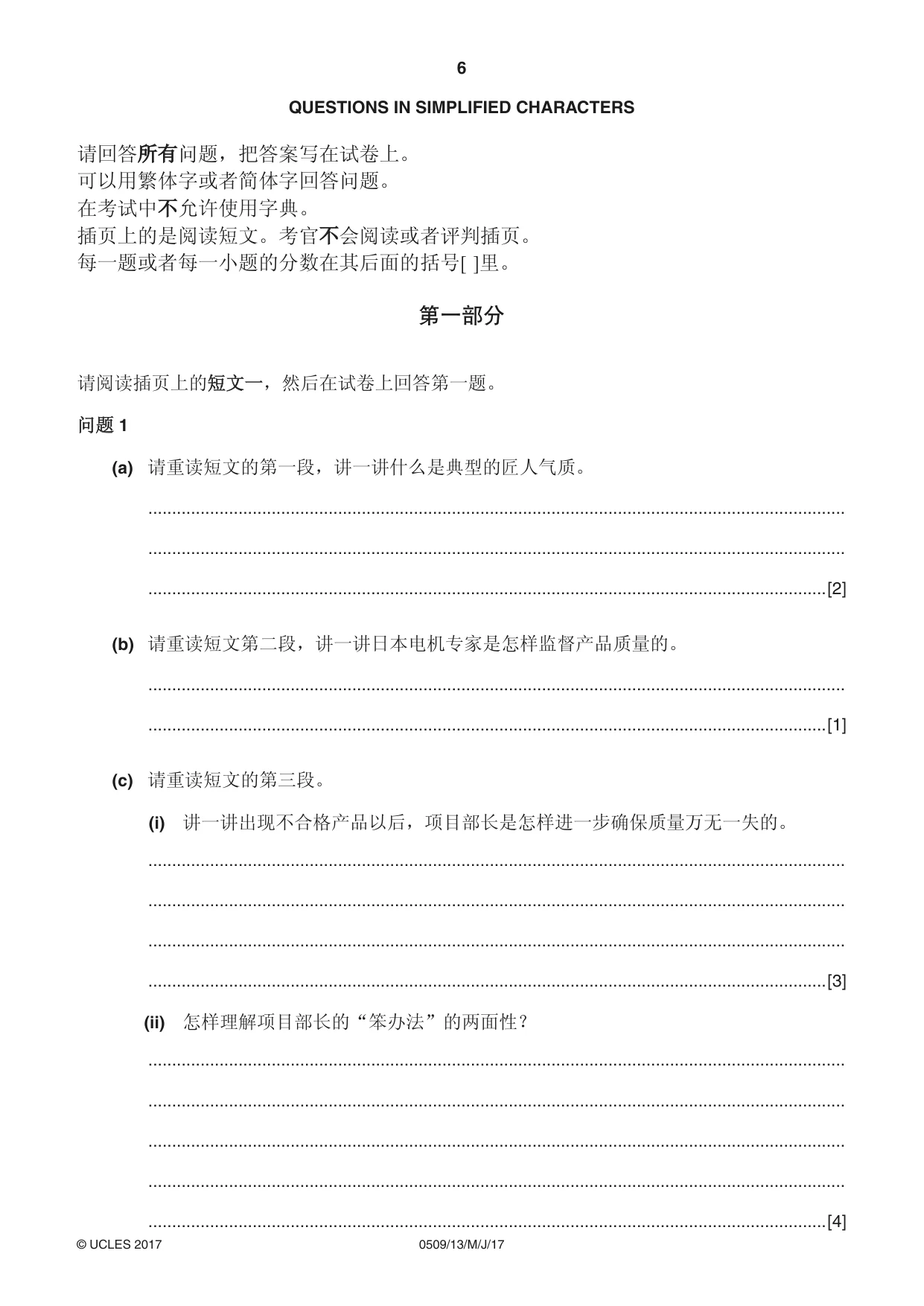
2 0509/13/M/J/17 © UCLES 2017 QUESTIONS IN TRADITIONAL CHARACTERS 請回答所有問題,把答案寫在試卷上。 可以用繁體字或者簡體字回答問題。 在考試中不允許使用字典。 插頁上的是閱讀短文。考官不會閱讀或者評判插頁。 每一題或者每一小題的分數在其後面的括號[ ]裏。 第一部分 請閱讀插頁上的短文一,然後在試卷上回答第一題。 問題 1 (a) 請重讀短文第一段,講一講什麼是典型的匠人氣質。 … … … [2] (b) 請重讀短文第二段,講一講日本電機專家是怎樣監督產品質量的。 … … [1] (c) 請重讀短文第三段, (i) 講一講出現不合格產品以後,項目部長是怎樣進一步確保質量萬無一失的。 … … … … [3] (ii) 怎樣理解項目部長的“笨辦法”的兩面性? … … … … … [4]
Question paper, page 3
3 0509/13/M/J/17 © UCLES 2017 [Turn over (d) 請重讀短文的第四段。 (i) 從原文中找出三個描寫拉麵店師傅認真工作的詞或者短語。 … … … … [3] (ii) 用自己的話總結一下作者從哪些方面表現了拉麵店師傅的匠人精神。 … … … … … [4] (e) 分析全文,為什麼說“一個‘匠’字,簡直深入了日本人的骨髓”? … … … … [3] [語言的精確:5] [總分:25]
Question paper, page 4
4 0509/13/M/J/17 © UCLES 2017 第二部分 請閱讀插頁上的短文二,然後在試卷上回答第二題。 問題 2 根據插頁上兩篇文章,用自己的話就以下兩點進行總結,寫一篇短文: – 對待工作的良好態度; – 如何讓你的工作更有意義。 (字數250字左右) [內容:15] [語言的質量:10] 15 30 45 60 75 90 105 120 135 150 165 180 195 210 請把標點符號標在兩個方格之間。
Question paper, page 5
5 0509/13/M/J/17 © UCLES 2017 [Turn over [總分:25] PLEASE TURN OVER TO FIND QUESTIONS IN SIMPLIFIED CHARACTERS 225 240 255 270 285 300 315 330 345 360 375 390 405 420 435 450
Question paper, page 6
6 0509/13/M/J/17 © UCLES 2017 QUESTIONS IN SIMPLIFIED CHARACTERS 请回答所有问题,把答案写在试卷上。 可以用繁体字或者简体字回答问题。 在考试中不允许使用字典。 插页上的是阅读短文。考官不会阅读或者评判插页。 每一题或者每一小题的分数在其后面的括号[ ]里。 第一部分 请阅读插页上的短文一,然后在试卷上回答第一题。 问题 1 (a) 请重读短文的第一段,讲一讲什么是典型的匠人气质。 … … …[2] (b) 请重读短文第二段,讲一讲日本电机专家是怎样监督产品质量的。 … …[1] (c) 请重读短文的第三段。 (i) 讲一讲出现不合格产品以后,项目部长是怎样进一步确保质量万无一失的。 … … … …[3] (ii) 怎样理解项目部长的“笨办法”的两面性? … … … … …[4]
Question paper, page 7
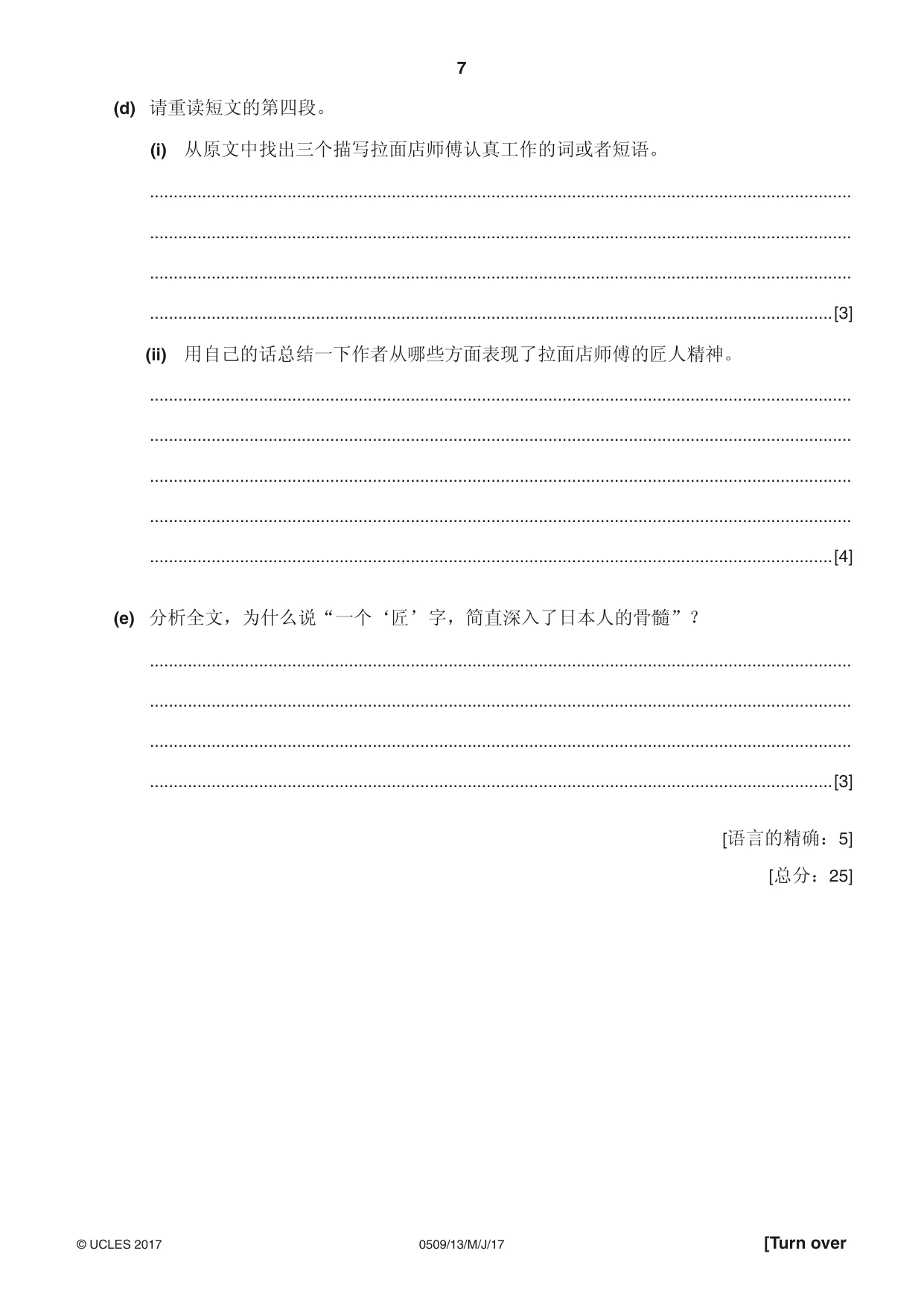
7 0509/13/M/J/17 © UCLES 2017 (d) 请重读短文的第四段。 (i) 从原文中找出三个描写拉面店师傅认真工作的词或者短语。 … … … …[3] (ii) 用自己的话总结一下作者从哪些方面表现了拉面店师傅的匠人精神。 … … … … …[4] (e) 分析全文,为什么说“一个‘匠’字,简直深入了日本人的骨髓”? … … … …[3] [语言的精确:5] [总分:25] [Turn over
Question paper, page 8
8 0509/13/M/J/17 © UCLES 2017 第二部分 请阅读插页上的短文二,然后在试卷上回答第二题。 问题 2 根据插页上两篇文章,用自己的话就以下两点进行总结,写一篇短文: – 对待工作的良好态度; – 如何让你的工作更有意义。 (字数250字左右) [内容:15] [语言的质量:10] 15 30 45 60 75 90 105 120 135 150 165 180 195 210 请把标点符号标在两个方格之间。
Question paper, page 9
9 0509/13/M/J/17 © UCLES 2017 [总分:25] 225 240 255 270 285 300 315 330 345 360 375 390 405 420 435 450
Question paper, page 10
10 0509/13/M/J/17 © UCLES 2017 BLANK PAGE
Question paper, page 11
11 0509/13/M/J/17 © UCLES 2017 BLANK PAGE
Question paper, page 12
12 0509/13/M/J/17 © UCLES 2017 BLANK PAGE Permission to reproduce items where third-party owned material protected by copyright is included has been sought and cleared where possible. Every reasonable effort has been made by the publisher (UCLES) to trace copyright holders, but if any items requiring clearance have unwittingly been included, the publisher will be pleased to make amends at the earliest possible opportunity. To avoid the issue of disclosure of answer-related information to candidates, all copyright acknowledgements are reproduced online in the Cambridge International Examinations Copyright Acknowledgements Booklet. This is produced for each series of examinations and is freely available to download at www.cie.org.uk after the live examination series. Cambridge International Examinations is part of the Cambridge Assessment Group. Cambridge Assessment is the brand name of University of Cambridge Local Examinations Syndicate (UCLES), which is itself a department of the University of Cambridge.
Mark scheme, page 1
® IGCSE is a registered trademark. This document consists of 6 printed pages. © UCLES 2017 [Turn over Cambridge International Examinations Cambridge International General Certificate of Secondary Education FIRST LANGUAGE CHINESE 0509/13 Paper 1 Reading May/June 2017 MARK SCHEME Maximum Mark: 50 Published This mark scheme is published as an aid to teachers and candidates, to indicate the requirements of the examination. It shows the basis on which Examiners were instructed to award marks. It does not indicate the details of the discussions that took place at an Examiners’ meeting before marking began, which would have considered the acceptability of alternative answers. Mark schemes should be read in conjunction with the question paper and the Principal Examiner Report for Teachers. Cambridge will not enter into discussions about these mark schemes. Cambridge is publishing the mark schemes for the May/June 2017 series for most Cambridge IGCSE®, Cambridge International A and AS Level and Cambridge Pre-U components, and some Cambridge O Level components.
Mark scheme, page 2
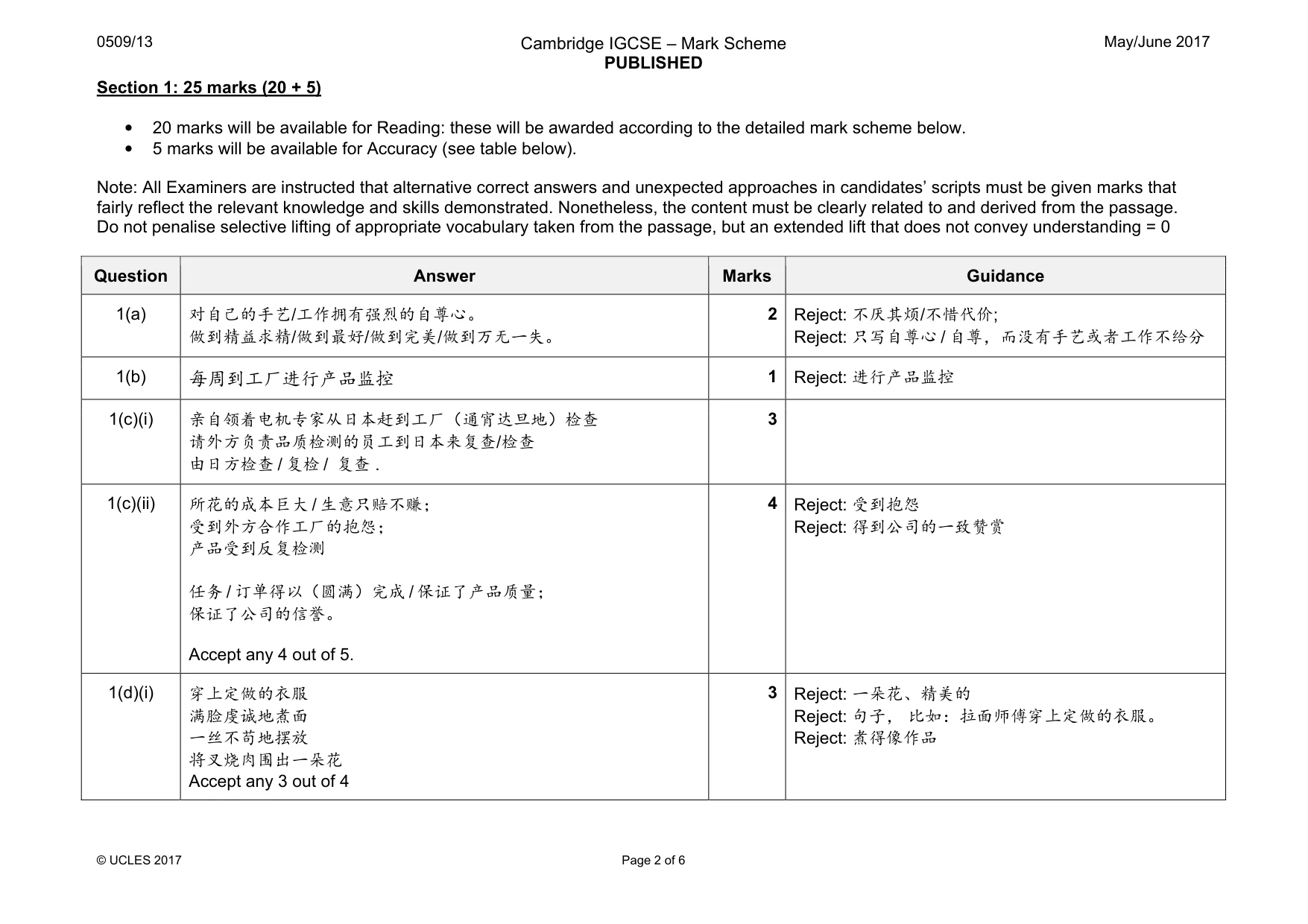
0509/13 Cambridge IGCSE – Mark Scheme PUBLISHED May/June 2017 © UCLES 2017 Page 2 of 6 Section 1: 25 marks (20 + 5) • 20 marks will be available for Reading: these will be awarded according to the detailed mark scheme below. • 5 marks will be available for Accuracy (see table below). Note: All Examiners are instructed that alternative correct answers and unexpected approaches in candidates’ scripts must be given marks that fairly reflect the relevant knowledge and skills demonstrated. Nonetheless, the content must be clearly related to and derived from the passage. Do not penalise selective lifting of appropriate vocabulary taken from the passage, but an extended lift that does not convey understanding = 0 Question Answer Marks Guidance 1(a) 对自己的手艺/工作拥有强烈的自尊心。 做到精益求精/做到最好/做到完美/做到万无一失。 2 Reject: 不厌其烦/不惜代价; Reject: 只写自尊心 / 自尊,而没有手艺或者工作不给分 1(b) 每周到工厂进行产品监控 1 Reject: 进行产品监控 1(c)(i) 亲自领着电机专家从日本赶到工厂(通宵达旦地)检查 请外方负责品质检测的员工到日本来复查/检查 由日方检查 / 复检 / 复查 . 3 1(c)(ii) 所花的成本巨大 / 生意只赔不赚; 受到外方合作工厂的抱怨; 产品受到反复检测 任务 / 订单得以(圆满)完成 / 保证了产品质量; 保证了公司的信誉。 Accept any 4 out of 5. 4 Reject: 受到抱怨 Reject: 得到公司的一致赞赏 1(d)(i) 穿上定做的衣服 满脸虔诚地煮面 一丝不苟地摆放 将叉烧肉围出一朵花 Accept any 3 out of 4 3 Reject: 一朵花、精美的 Reject: 句子, 比如:拉面师傅穿上定做的衣服。 Reject: 煮得像作品
Mark scheme, page 3
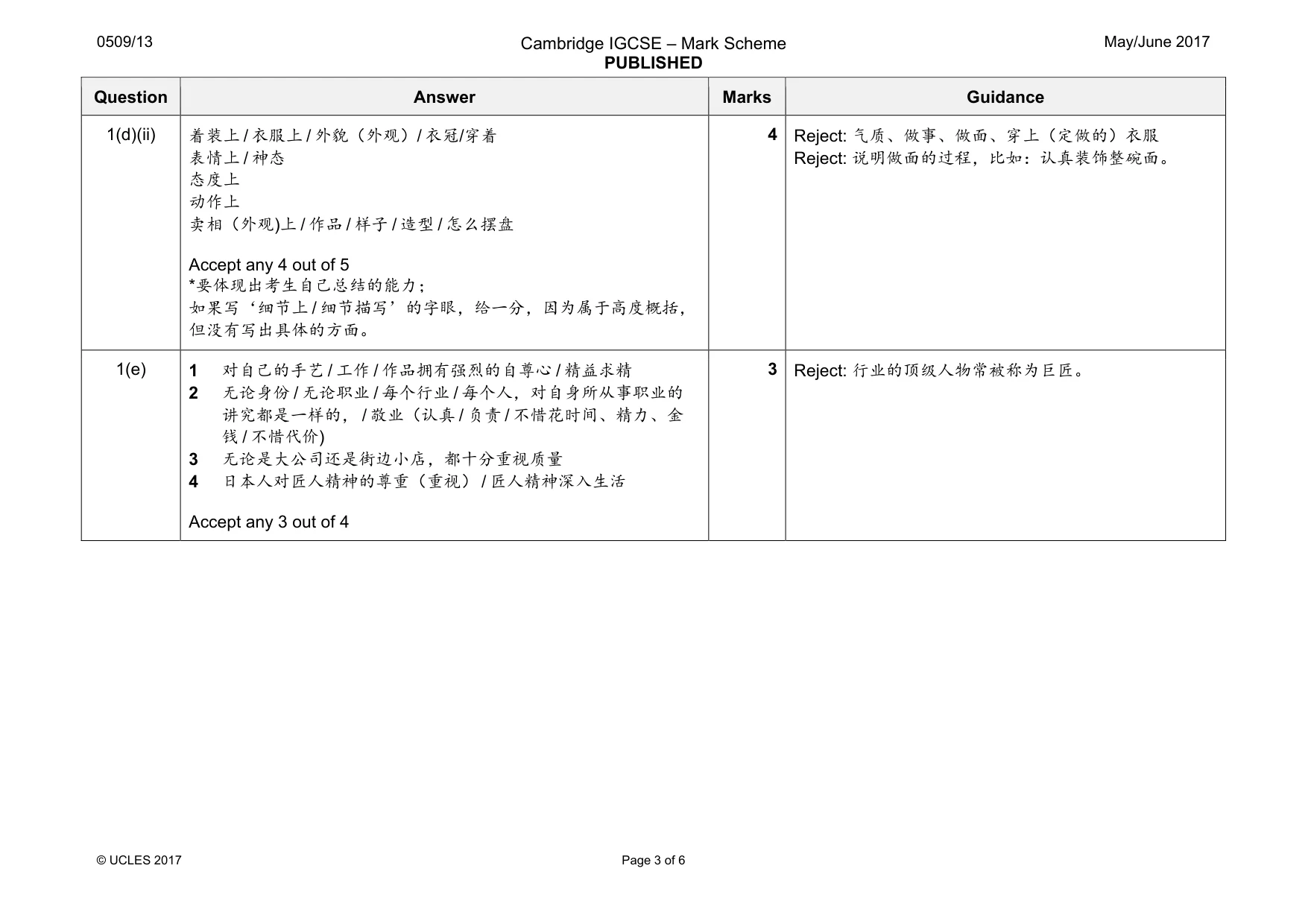
0509/13 Cambridge IGCSE – Mark Scheme PUBLISHED May/June 2017 © UCLES 2017 Page 3 of 6 Question Answer Marks Guidance 1(d)(ii) 着装上 / 衣服上 / 外貌(外观)/ 衣冠/穿着 表情上 / 神态 态度上 动作上 卖相(外观)上 / 作品 / 样子 / 造型 / 怎么摆盘 Accept any 4 out of 5 *要体现出考生自己总结的能力; 如果写‘细节上 / 细节描写’的字眼,给一分,因为属于高度概括, 但没有写出具体的方面。 4 Reject: 气质、做事、做面、穿上(定做的)衣服 Reject: 说明做面的过程,比如:认真装饰整碗面。 1(e) 1 对自己的手艺 / 工作 / 作品拥有强烈的自尊心 / 精益求精 2 无论身份 / 无论职业 / 每个行业 / 每个人,对自身所从事职业的 讲究都是一样的, / 敬业(认真 / 负责 / 不惜花时间、精力、金 钱 / 不惜代价) 3 无论是大公司还是街边小店,都十分重视质量 4 日本人对匠人精神的尊重(重视) / 匠人精神深入生活 Accept any 3 out of 4 3 Reject: 行业的顶级人物常被称为巨匠。
Mark scheme, page 4
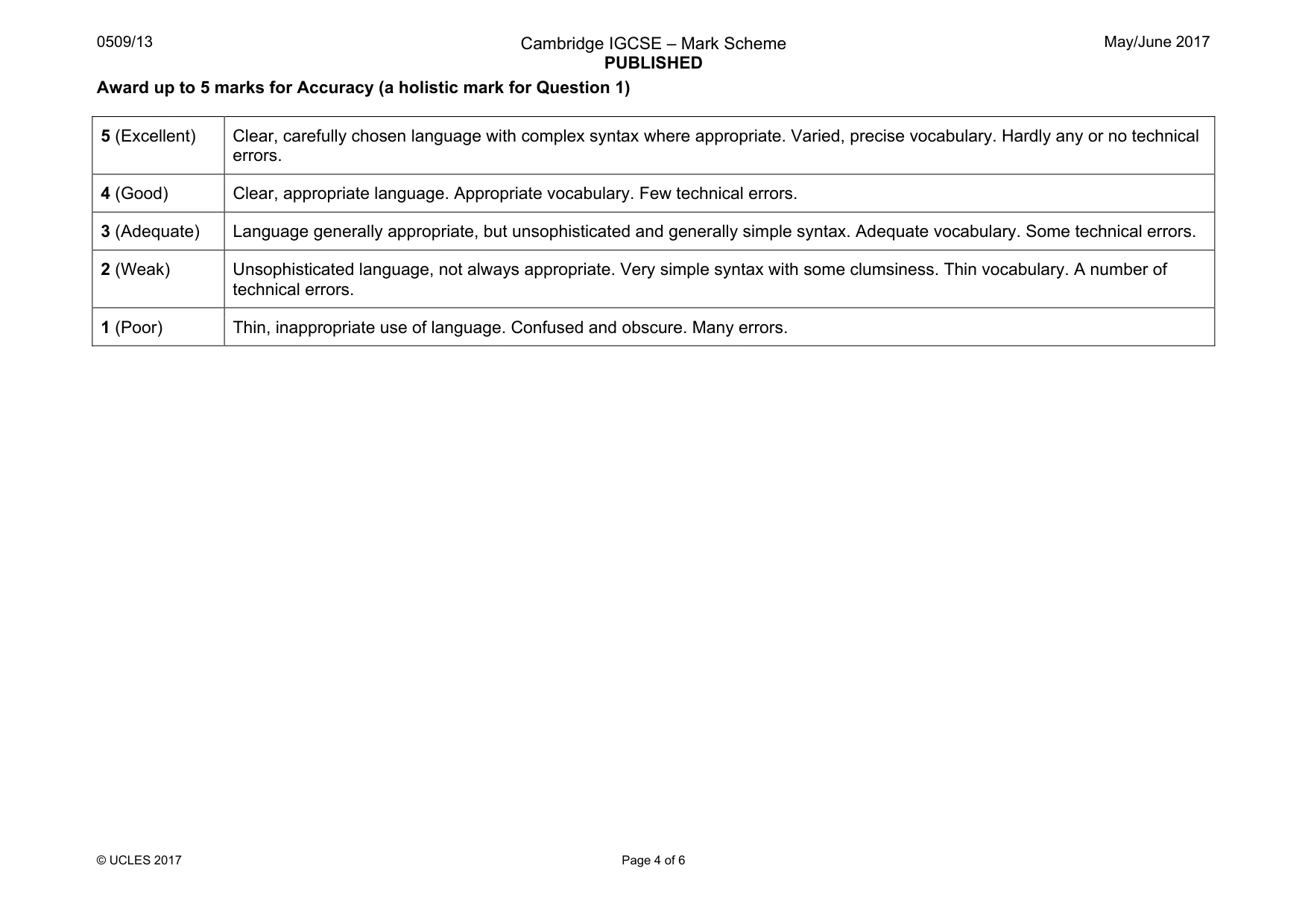
0509/13 Cambridge IGCSE – Mark Scheme PUBLISHED May/June 2017 © UCLES 2017 Page 4 of 6 Award up to 5 marks for Accuracy (a holistic mark for Question 1) 5 (Excellent) Clear, carefully chosen language with complex syntax where appropriate. Varied, precise vocabulary. Hardly any or no technical errors. 4 (Good) Clear, appropriate language. Appropriate vocabulary. Few technical errors. 3 (Adequate) Language generally appropriate, but unsophisticated and generally simple syntax. Adequate vocabulary. Some technical errors. 2 (Weak) Unsophisticated language, not always appropriate. Very simple syntax with some clumsiness. Thin vocabulary. A number of technical errors. 1 (Poor) Thin, inappropriate use of language. Confused and obscure. Many errors.
Mark scheme, page 5
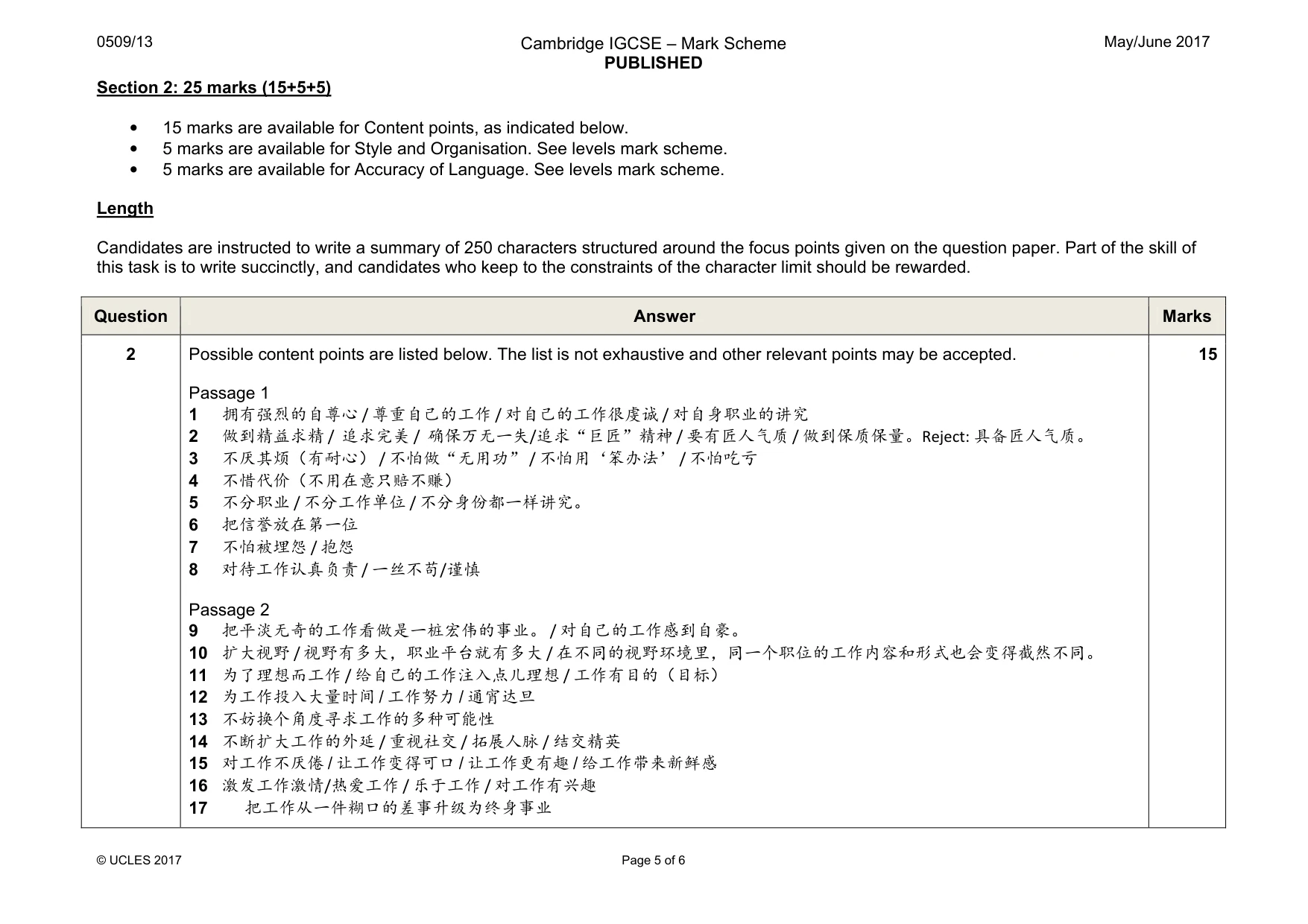
0509/13 Cambridge IGCSE – Mark Scheme PUBLISHED May/June 2017 © UCLES 2017 Page 5 of 6 Section 2: 25 marks (15+5+5) • 15 marks are available for Content points, as indicated below. • 5 marks are available for Style and Organisation. See levels mark scheme. • 5 marks are available for Accuracy of Language. See levels mark scheme. Length Candidates are instructed to write a summary of 250 characters structured around the focus points given on the question paper. Part of the skill of this task is to write succinctly, and candidates who keep to the constraints of the character limit should be rewarded. Question Answer Marks 2 Possible content points are listed below. The list is not exhaustive and other relevant points may be accepted. Passage 1 1 拥有强烈的自尊心 / 尊重自己的工作 / 对自己的工作很虔诚 / 对自身职业的讲究 2 做到精益求精 / 追求完美 / 确保万无一失/追求“巨匠”精神 / 要有匠人气质 / 做到保质保量。Reject: 具备匠人气质。 3 不厌其烦(有耐心) / 不怕做“无用功” / 不怕用‘笨办法’ / 不怕吃亏 4 不惜代价(不用在意只赔不赚) 5 不分职业 / 不分工作单位 / 不分身份都一样讲究。 6 把信誉放在第一位 7 不怕被埋怨 / 抱怨 8 对待工作认真负责 / 一丝不苟/谨慎 Passage 2 9 把平淡无奇的工作看做是一桩宏伟的事业。 / 对自己的工作感到自豪。 10 扩大视野 / 视野有多大,职业平台就有多大 / 在不同的视野环境里,同一个职位的工作内容和形式也会变得截然不同。 11 为了理想而工作 / 给自己的工作注入点儿理想 / 工作有目的(目标) 12 为工作投入大量时间 / 工作努力 / 通宵达旦 13 不妨换个角度寻求工作的多种可能性 14 不断扩大工作的外延 / 重视社交 / 拓展人脉 / 结交精英 15 对工作不厌倦 / 让工作变得可口 / 让工作更有趣 / 给工作带来新鲜感 16 激发工作激情/热爱工作 / 乐于工作 / 对工作有兴趣 17 把工作从一件糊口的差事升级为终身事业 15
Mark scheme, page 6
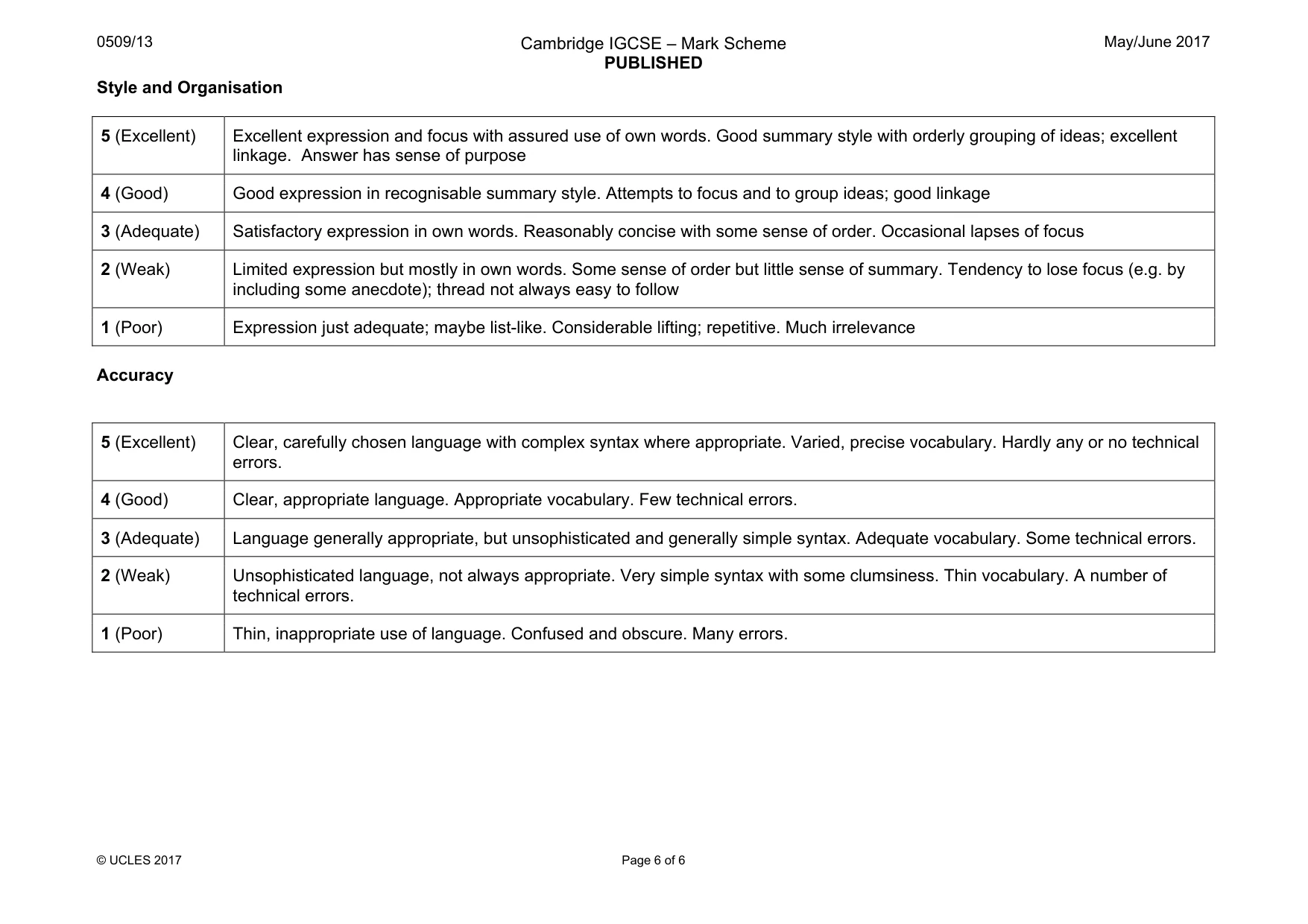
0509/13 Cambridge IGCSE – Mark Scheme PUBLISHED May/June 2017 © UCLES 2017 Page 6 of 6 Style and Organisation 5 (Excellent) Excellent expression and focus with assured use of own words. Good summary style with orderly grouping of ideas; excellent linkage. Answer has sense of purpose 4 (Good) Good expression in recognisable summary style. Attempts to focus and to group ideas; good linkage 3 (Adequate) Satisfactory expression in own words. Reasonably concise with some sense of order. Occasional lapses of focus 2 (Weak) Limited expression but mostly in own words. Some sense of order but little sense of summary. Tendency to lose focus (e.g. by including some anecdote); thread not always easy to follow 1 (Poor) Expression just adequate; maybe list-like. Considerable lifting; repetitive. Much irrelevance Accuracy 5 (Excellent) Clear, carefully chosen language with complex syntax where appropriate. Varied, precise vocabulary. Hardly any or no technical errors. 4 (Good) Clear, appropriate language. Appropriate vocabulary. Few technical errors. 3 (Adequate) Language generally appropriate, but unsophisticated and generally simple syntax. Adequate vocabulary. Some technical errors. 2 (Weak) Unsophisticated language, not always appropriate. Very simple syntax with some clumsiness. Thin vocabulary. A number of technical errors. 1 (Poor) Thin, inappropriate use of language. Confused and obscure. Many errors.
What you needed in this session
Cambridge’s own grade thresholds for 2017 May/June, Paper 1 · Variant 3. A higher threshold means an easier paper — the bar moves with how the cohort did.