Cambridge IGCSE Chinese - First Language 0509 — 2021 May/June Paper 1 · Variant 3
0509/13/M/J/21 · 60 marks · ≈68 min
The question paper and its mark scheme, free to read here and free to download. This is Cambridge’s own paper, exactly as it was sat.
Question paper16 pages
Mark scheme10 pages
Answers below. Sit the paper first if you are practising.
Paper as text
Question paper, page 1
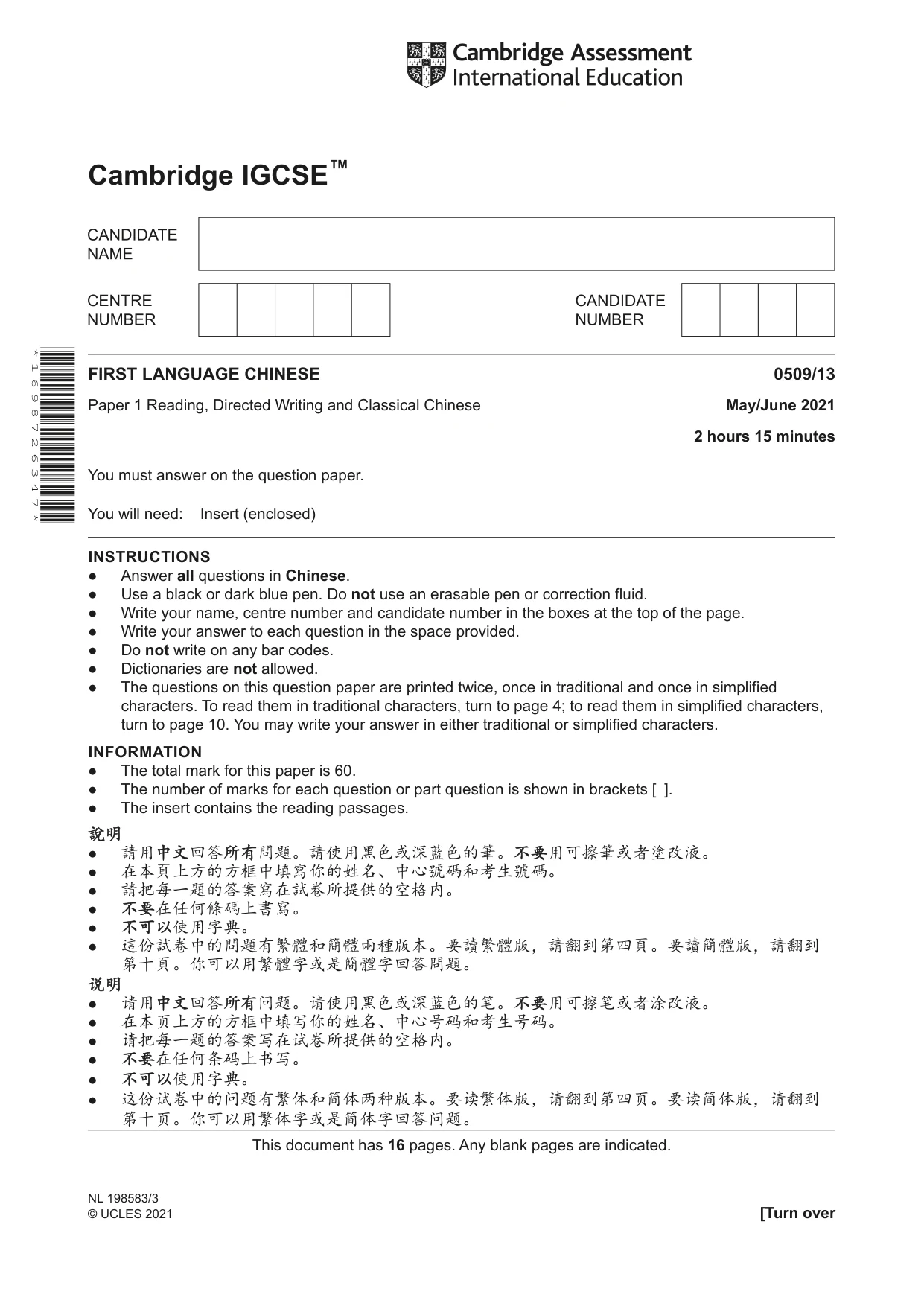
This document has 16 pages. Any blank pages are indicated. NL 198583/3 © UCLES 2021 [Turn over Cambridge IGCSE™ FIRST LANGUAGE CHINESE 0509/13 Paper 1 Reading, Directed Writing and Classical Chinese May/June 2021 2 hours 15 minutes You must answer on the question paper. You will need: Insert (enclosed) INSTRUCTIONS ● Answer all questions in Chinese. ● Use a black or dark blue pen. Do not use an erasable pen or correction fluid. ● Write your name, centre number and candidate number in the boxes at the top of the page. ● Write your answer to each question in the space provided. ● Do not write on any bar codes. ● Dictionaries are not allowed. ● The questions on this question paper are printed twice, once in traditional and once in simplified characters. To read them in traditional characters, turn to page 4; to read them in simplified characters, turn to page 10. You may write your answer in either traditional or simplified characters. INFORMATION ● The total mark for this paper is 60. ● The number of marks for each question or part question is shown in brackets [ ]. ● The insert contains the reading passages. 說明 ● 請用中文回答所有問題。請使用黑色或深藍色的筆。不要用可擦筆或者塗改液。 ● 在本頁上方的方框中填寫你的姓名、中心號碼和考生號碼。 ● 請把每一題的答案寫在試卷所提供的空格内。 ● 不要在任何條碼上書寫。 ● 不可以使用字典。 ● 這份試卷中的問題有繁體和簡體兩種版本。要讀繁體版,請翻到第四頁。要讀簡體版,請翻到 第十頁。你可以用繁體字或是簡體字回答問題。 说明 ● 请用中文回答所有问题。请使用黑色或深蓝色的笔。不要用可擦笔或者涂改液。 ● 在本页上方的方框中填写你的姓名、中心号码和考生号码。 ● 请把每一题的答案写在试卷所提供的空格内。 ● 不要在任何条码上书写。 ● 不可以使用字典。 ● 这份试卷中的问题有繁体和简体两种版本。要读繁体版,请翻到第四页。要读简体版,请翻到 第十页。你可以用繁体字或是简体字回答问题。 * 1 6 9 8 7 2 6 3 4 7 *
Question paper, page 2
2 0509/13/M/J/21 © UCLES 2021 信息 ● 這份試卷的總分是六十分。 ● 每一題或者每一小題的分數顯示在各題後面的括號 [ ] 裡。 ● 這份插頁有考生需要閱讀的短文。 信息 ● 这份试卷的总分是六十分。 ● 每一题或者每一小题的分数显示在各题后面的括号 [ ] 里。 ● 这份插页有考生需要阅读的短文。
Question paper, page 3
3 0509/13/M/J/21 © UCLES 2021 [Turn over BLANK PAGE
Question paper, page 4
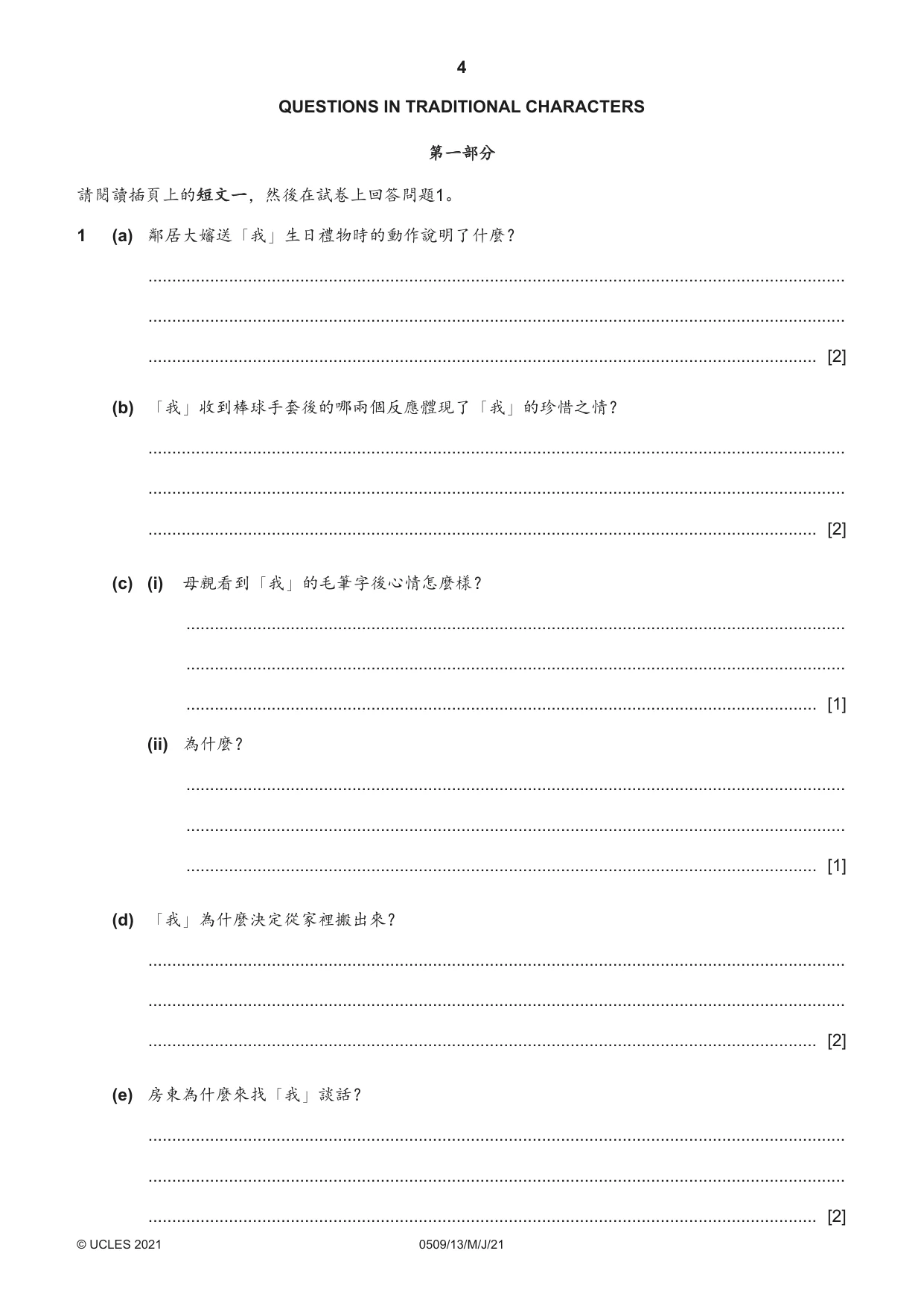
4 0509/13/M/J/21 © UCLES 2021 QUESTIONS IN TRADITIONAL CHARACTERS 第一部分 請閱讀插頁上的短文一,然後在試卷上回答問題1。 1 (a) 鄰居大嬸送「我」生日禮物時的動作說明了什麼? … … … [2] (b) 「我」收到棒球手套後的哪兩個反應體現了「我」的珍惜之情? … … … [2] (c) (i) 母親看到「我」的毛筆字後心情怎麼樣? … … … [1] (ii) 為什麼? … … … [1] (d) 「我」為什麼決定從家裡搬出來? … … … [2] (e) 房東為什麼來找「我」談話? … … … [2]
Question paper, page 5
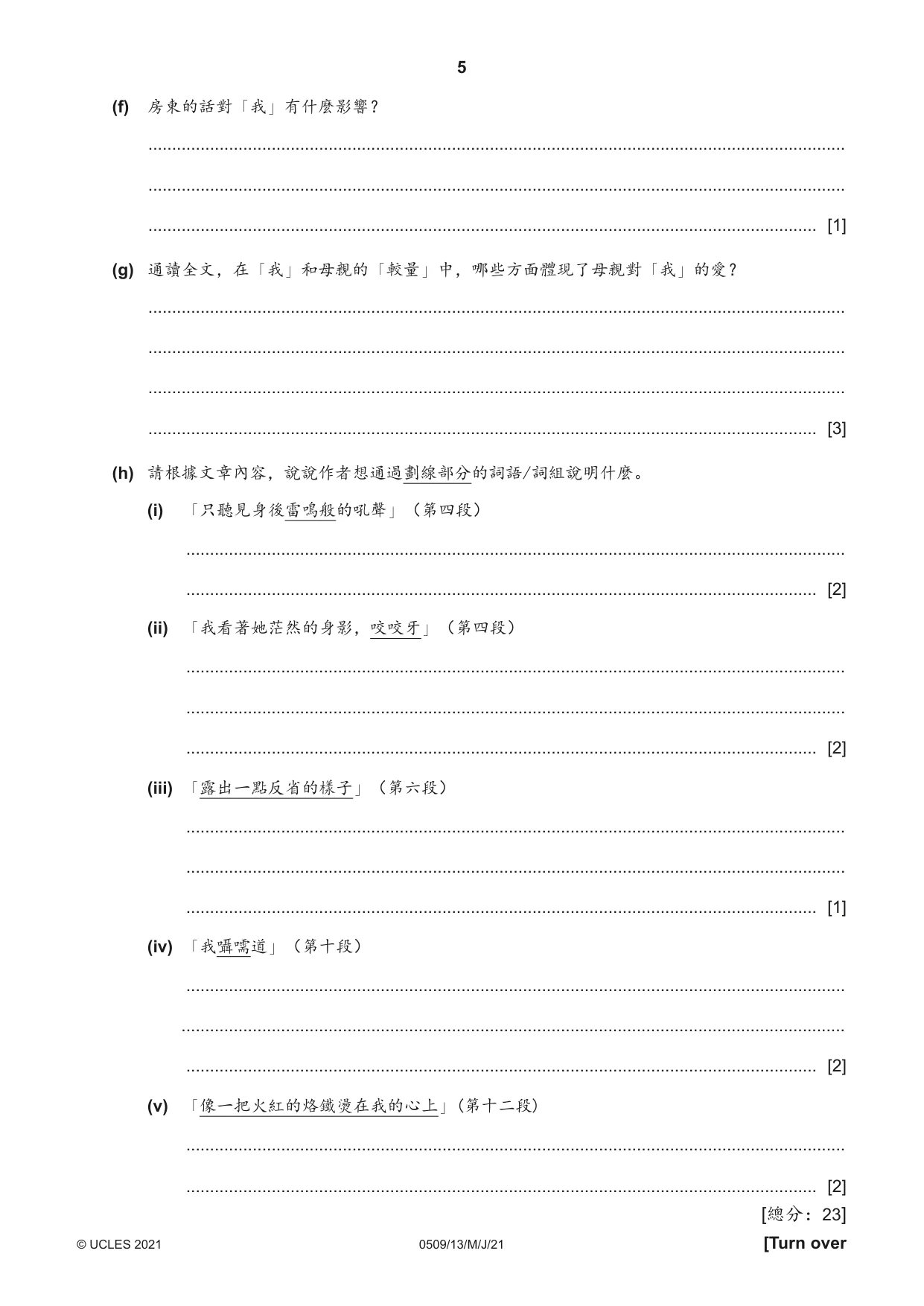
5 0509/13/M/J/21 © UCLES 2021 [Turn over (f) 房東的話對「我」有什麼影響? … … … [1] (g) 通讀全文,在「我」和母親的「較量」中,哪些方面體現了母親對「我」的愛? … … … … [3] (h) 請根據文章內容,說說作者想通過劃線部分的詞語/詞組說明什麼。 (i) 「只聽見身後雷鳴般的吼聲」(第四段) … … [2] (ii) 「我看著她茫然的身影,咬咬牙」(第四段) … … … [2] (iii) 「露出一點反省的樣子」(第六段) … … … [1] (iv) 「我囁嚅道」(第十段) … … … [2] (v) 「像一把火紅的烙鐵燙在我的心上」(第十二段) … … [2] [總分:23]
Question paper, page 6
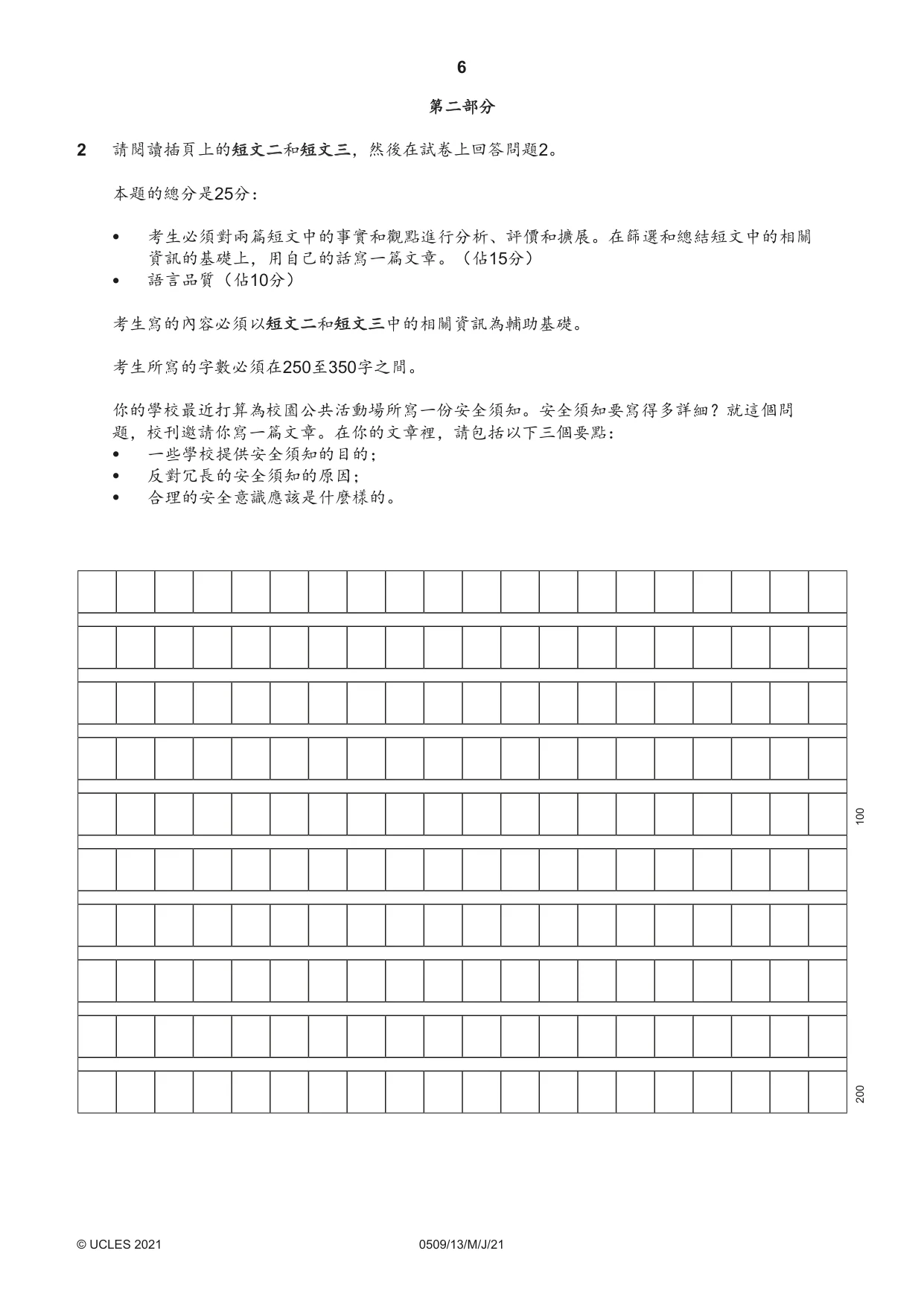
6 0509/13/M/J/21 © UCLES 2021 第二部分 2 請閱讀插頁上的短文二和短文三,然後在試卷上回答問題2。 本題的總分是25分: • 考生必須對兩篇短文中的事實和觀點進行分析、評價和擴展。在篩選和總結短文中的相關 資訊的基礎上,用自己的話寫一篇文章。(佔15分) • 語言品質(佔10分) 考生寫的內容必須以短文二和短文三中的相關資訊為輔助基礎。 考生所寫的字數必須在250至350字之間。 你的學校最近打算為校園公共活動場所寫一份安全須知。安全須知要寫得多詳細?就這個問 題,校刊邀請你寫一篇文章。在你的文章裡,請包括以下三個要點: • 一些學校提供安全須知的目的; • 反對冗長的安全須知的原因; • 合理的安全意識應該是什麼樣的。 100 200
Question paper, page 7
7 0509/13/M/J/21 © UCLES 2021 [Turn over 300 400 500 600 [總分:25]
Question paper, page 8
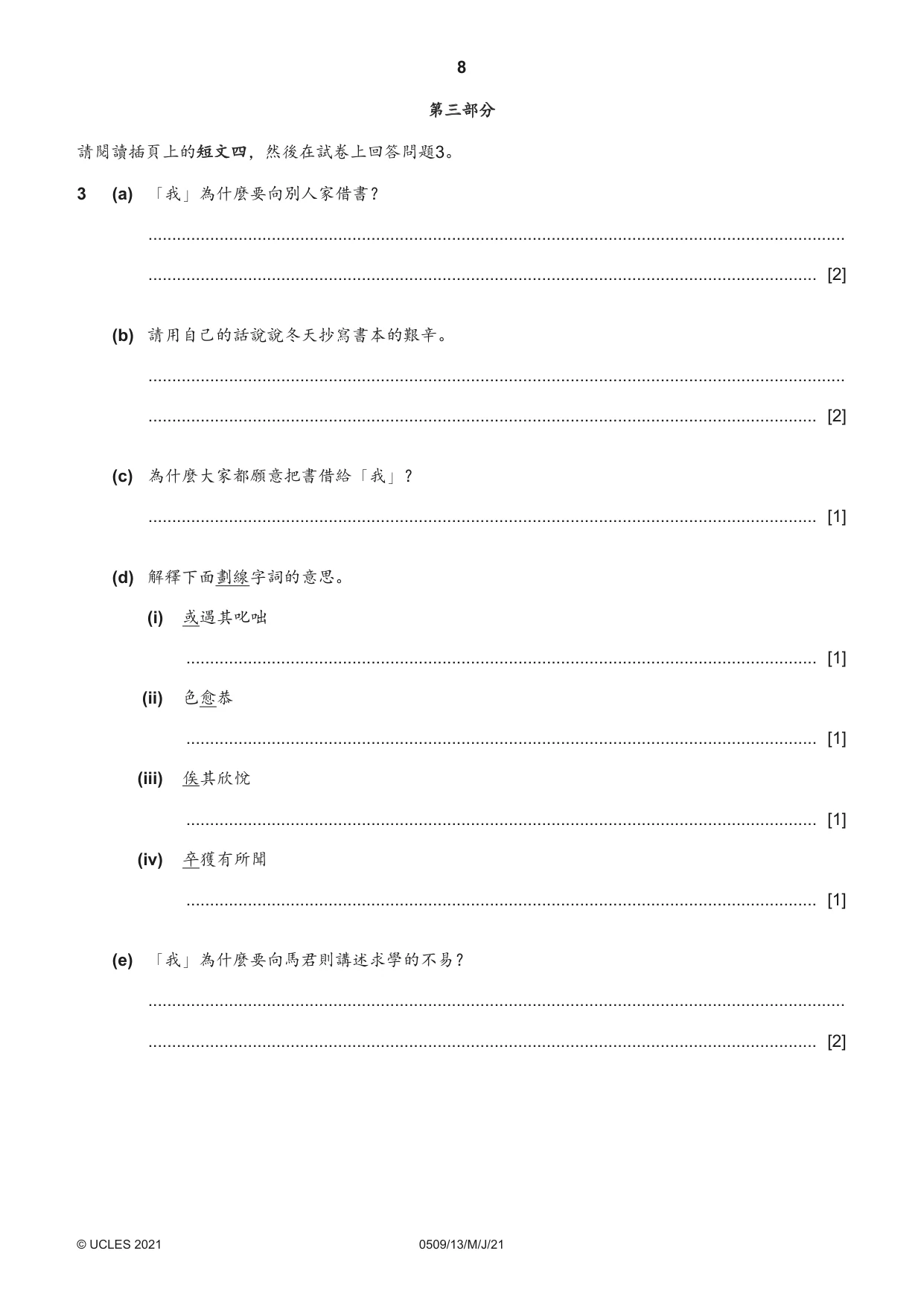
8 0509/13/M/J/21 © UCLES 2021 第三部分 請閱讀插頁上的短文四,然後在試卷上回答問題3。 3 (a) 「我」為什麼要向別人家借書? … … [2] (b) 請用自己的話說說冬天抄寫書本的艱辛。 … … [2] (c) 為什麼大家都願意把書借給「我」? … [1] (d) 解釋下面劃線字詞的意思。 (i) 或遇其叱咄 … [1] (ii) 色愈恭 … [1] (iii) 俟其欣悅 … [1] (iv) 卒獲有所聞 … [1] (e) 「我」為什麼要向馬君則講述求學的不易? … … [2]
Question paper, page 9
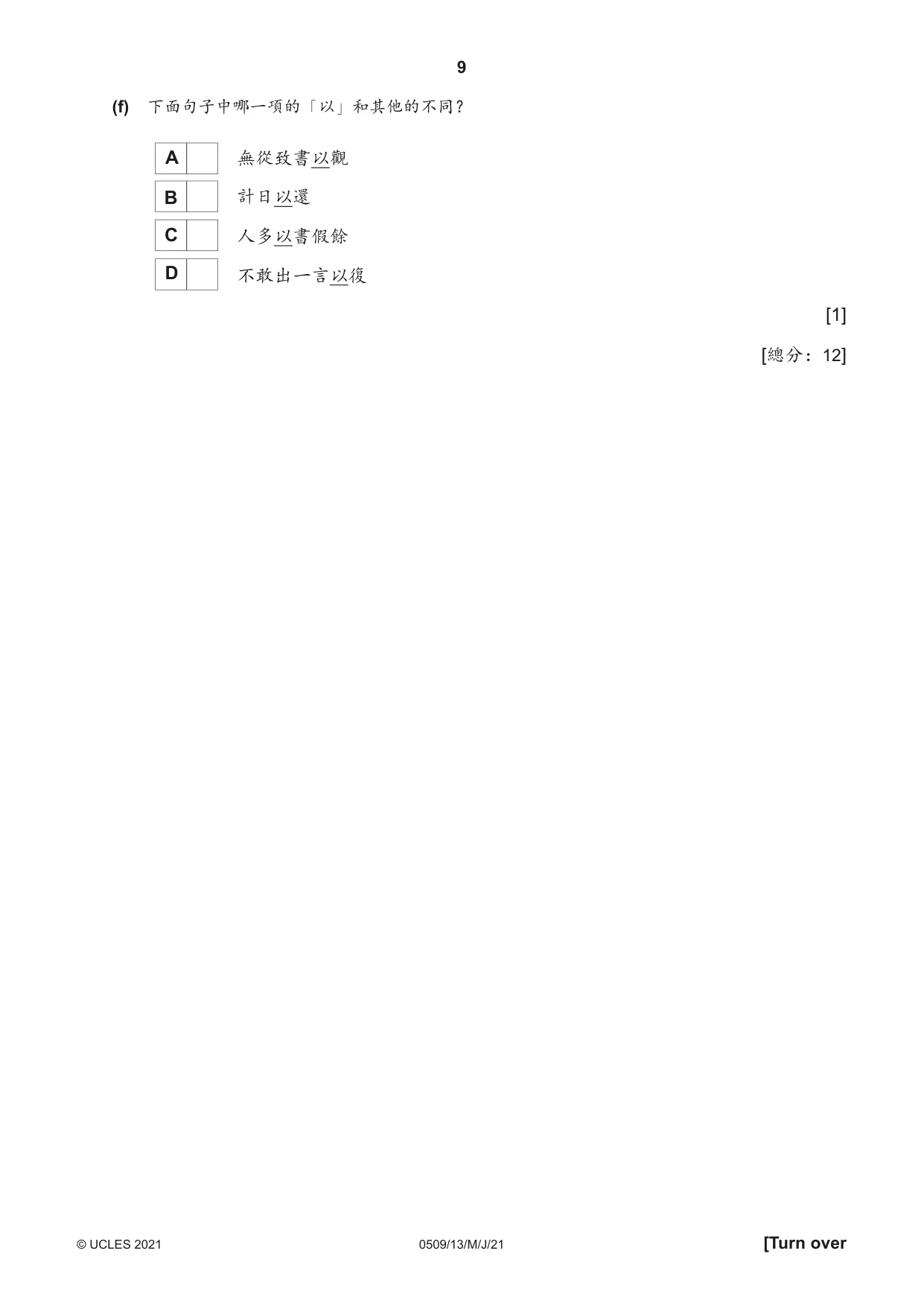
9 0509/13/M/J/21 © UCLES 2021 [Turn over (f) 下面句子中哪一項的「以」和其他的不同? 無從致書以觀 計日以還 人多以書假餘 不敢出一言以復 [1] [總分:12] C A B C D
Question paper, page 10
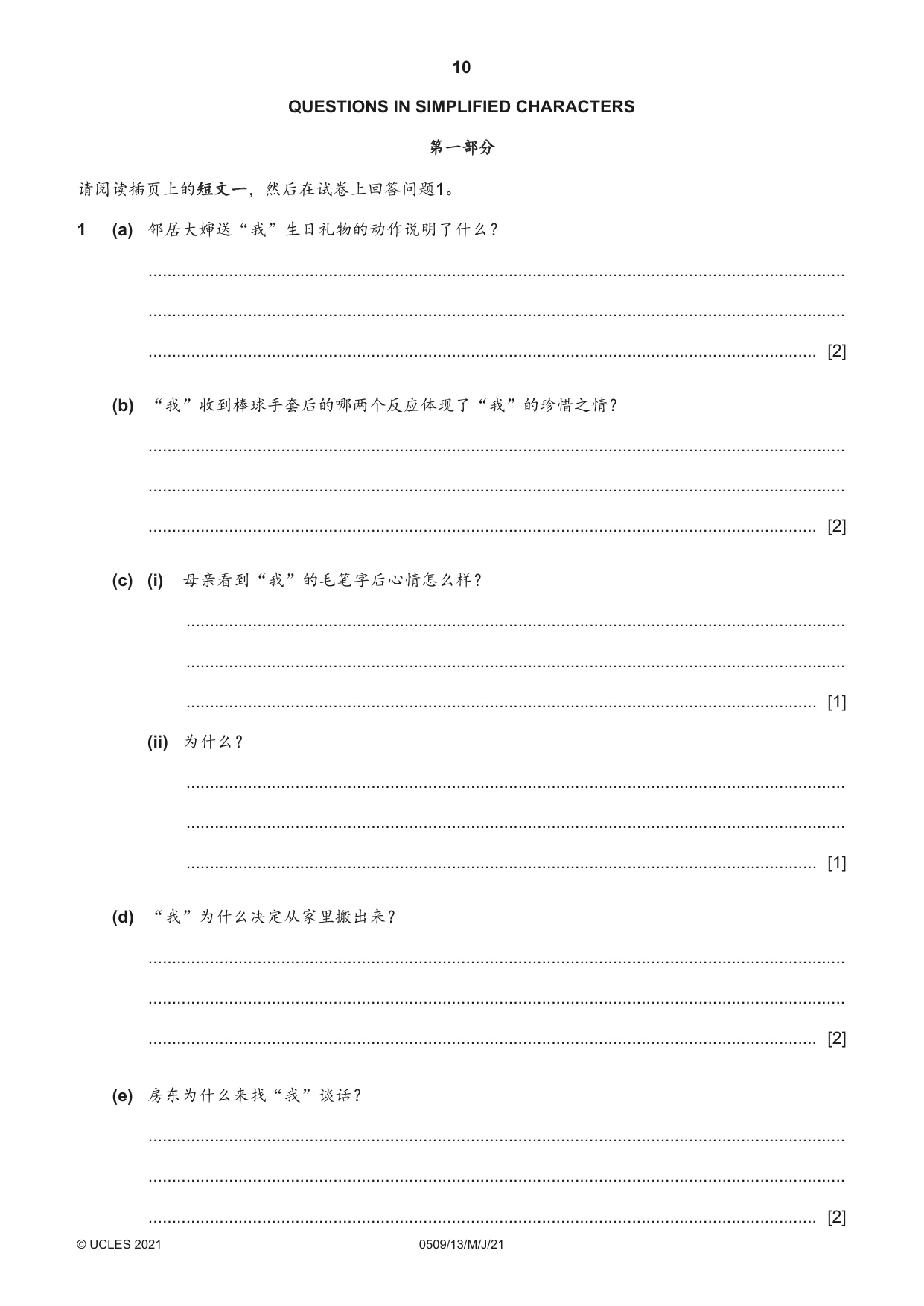
10 0509/13/M/J/21 © UCLES 2021 QUESTIONS IN SIMPLIFIED CHARACTERS 第一部分 请阅读插页上的短文一,然后在试卷上回答问题1。 1 (a) 邻居大婶送“我”生日礼物的动作说明了什么? … … … [2] (b) “我”收到棒球手套后的哪两个反应体现了“我”的珍惜之情? … … … [2] (c) (i) 母亲看到“我”的毛笔字后心情怎么样? … … … [1] (ii) 为什么? … … … [1] (d) “我”为什么决定从家里搬出来? … … … [2] (e) 房东为什么来找“我”谈话? … … … [2]
Question paper, page 11
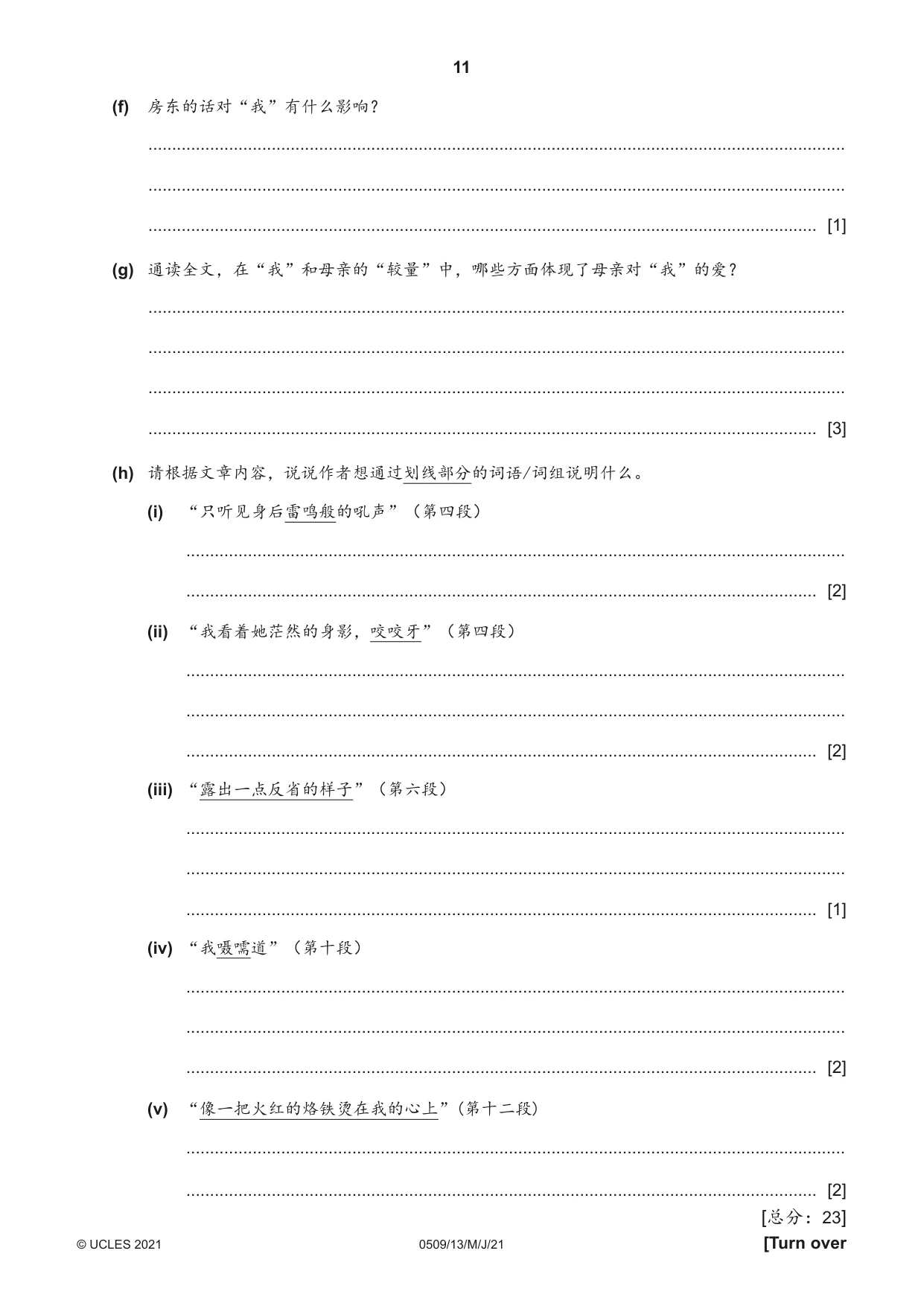
11 0509/13/M/J/21 © UCLES 2021 [Turn over (f) 房东的话对“我”有什么影响? … … … [1] (g) 通读全文,在“我”和母亲的“较量”中,哪些方面体现了母亲对“我”的爱? … … … … [3] (h) 请根据文章内容,说说作者想通过划线部分的词语/词组说明什么。 (i) “只听见身后雷鸣般的吼声”(第四段) … … [2] (ii) “我看着她茫然的身影,咬咬牙”(第四段) … … … [2] (iii) “露出一点反省的样子”(第六段) … … … [1] (iv) “我嗫嚅道”(第十段) … … … [2] (v) “像一把火红的烙铁烫在我的心上”(第十二段) … … [2] [总分:23]
Question paper, page 12
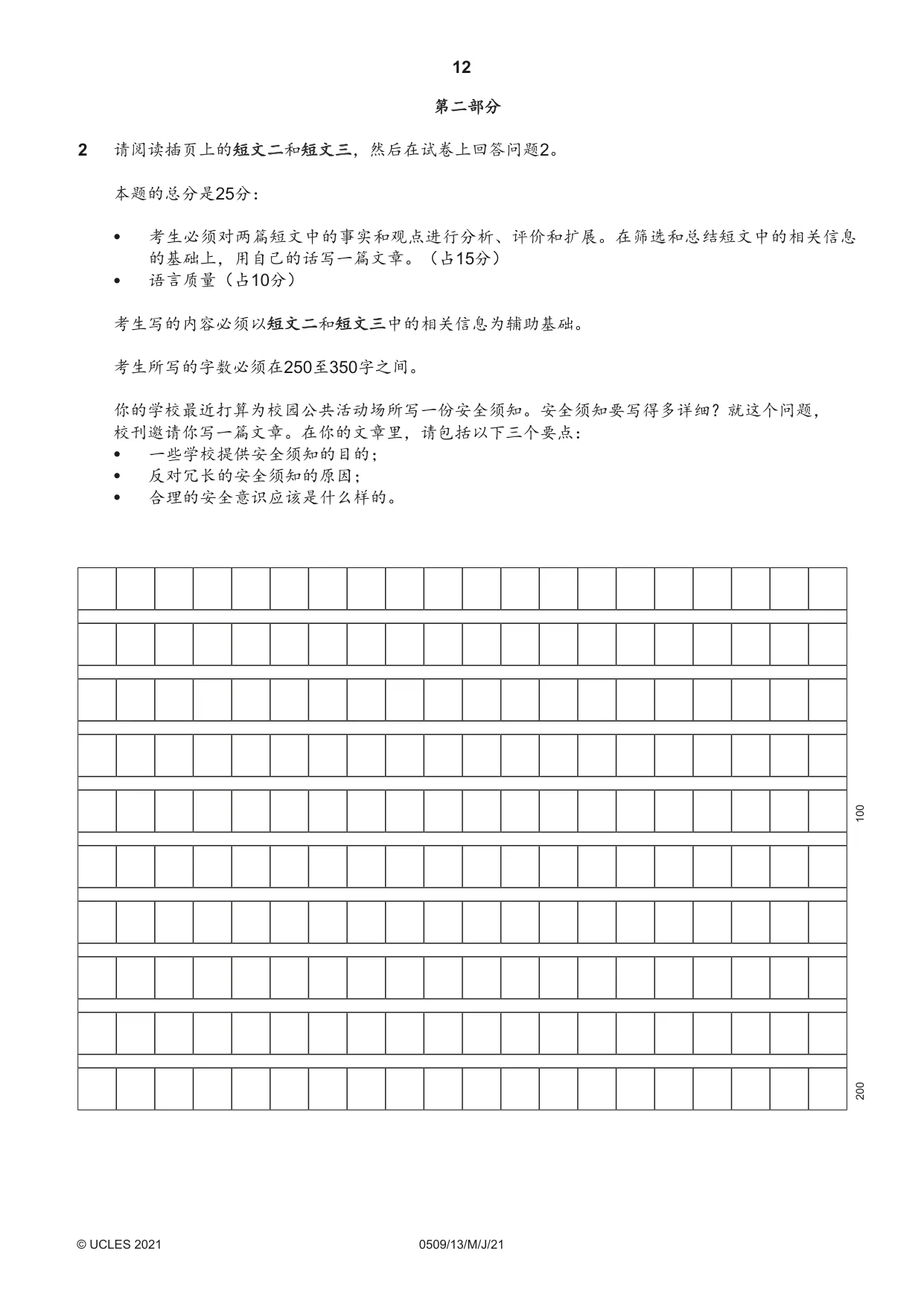
12 0509/13/M/J/21 © UCLES 2021 第二部分 2 请阅读插页上的短文二和短文三,然后在试卷上回答问题2。 本题的总分是25分: • 考生必须对两篇短文中的事实和观点进行分析、评价和扩展。在筛选和总结短文中的相关信息 的基础上,用自己的话写一篇文章。(占15分) • 语言质量(占10分) 考生写的内容必须以短文二和短文三中的相关信息为辅助基础。 考生所写的字数必须在250至350字之间。 你的学校最近打算为校园公共活动场所写一份安全须知。安全须知要写得多详细?就这个问题, 校刊邀请你写一篇文章。在你的文章里,请包括以下三个要点: • 一些学校提供安全须知的目的; • 反对冗长的安全须知的原因; • 合理的安全意识应该是什么样的。 100 200
Question paper, page 13
13 0509/13/M/J/21 © UCLES 2021 [Turn over 300 400 500 600 [总分:25]
Question paper, page 14
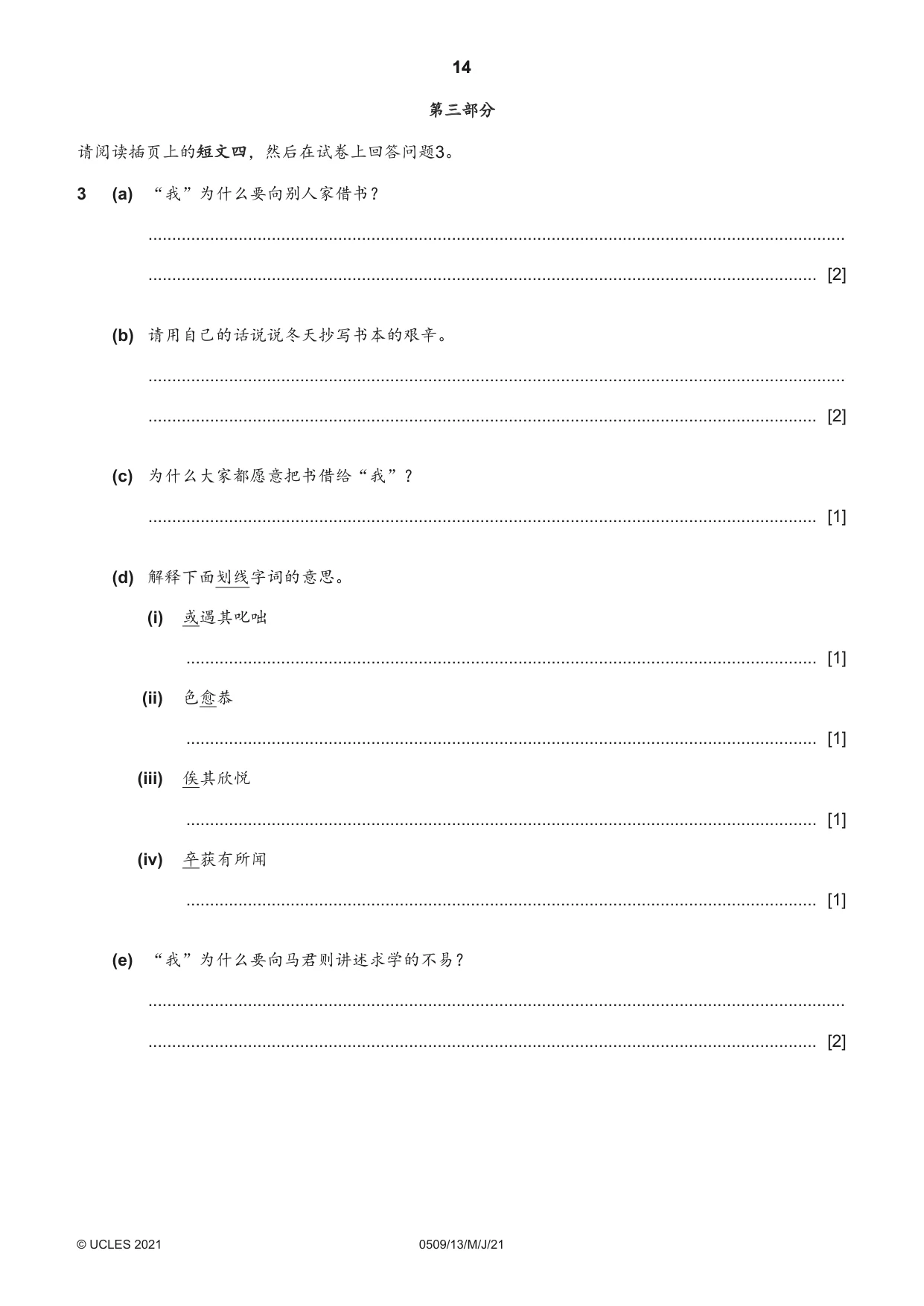
14 0509/13/M/J/21 © UCLES 2021 14 第三部分 请阅读插页上的短文四,然后在试卷上回答问题3。 3 (a) “我”为什么要向别人家借书? … … [2] (b) 请用自己的话说说冬天抄写书本的艰辛。 … … [2] (c) 为什么大家都愿意把书借给“我”? … [1] (d) 解释下面划线字词的意思。 (i) 或遇其叱咄 … [1] (ii) 色愈恭 … [1] (iii) 俟其欣悦 … [1] (iv) 卒获有所闻 … [1] (e) “我”为什么要向马君则讲述求学的不易? … … [2]
Question paper, page 15
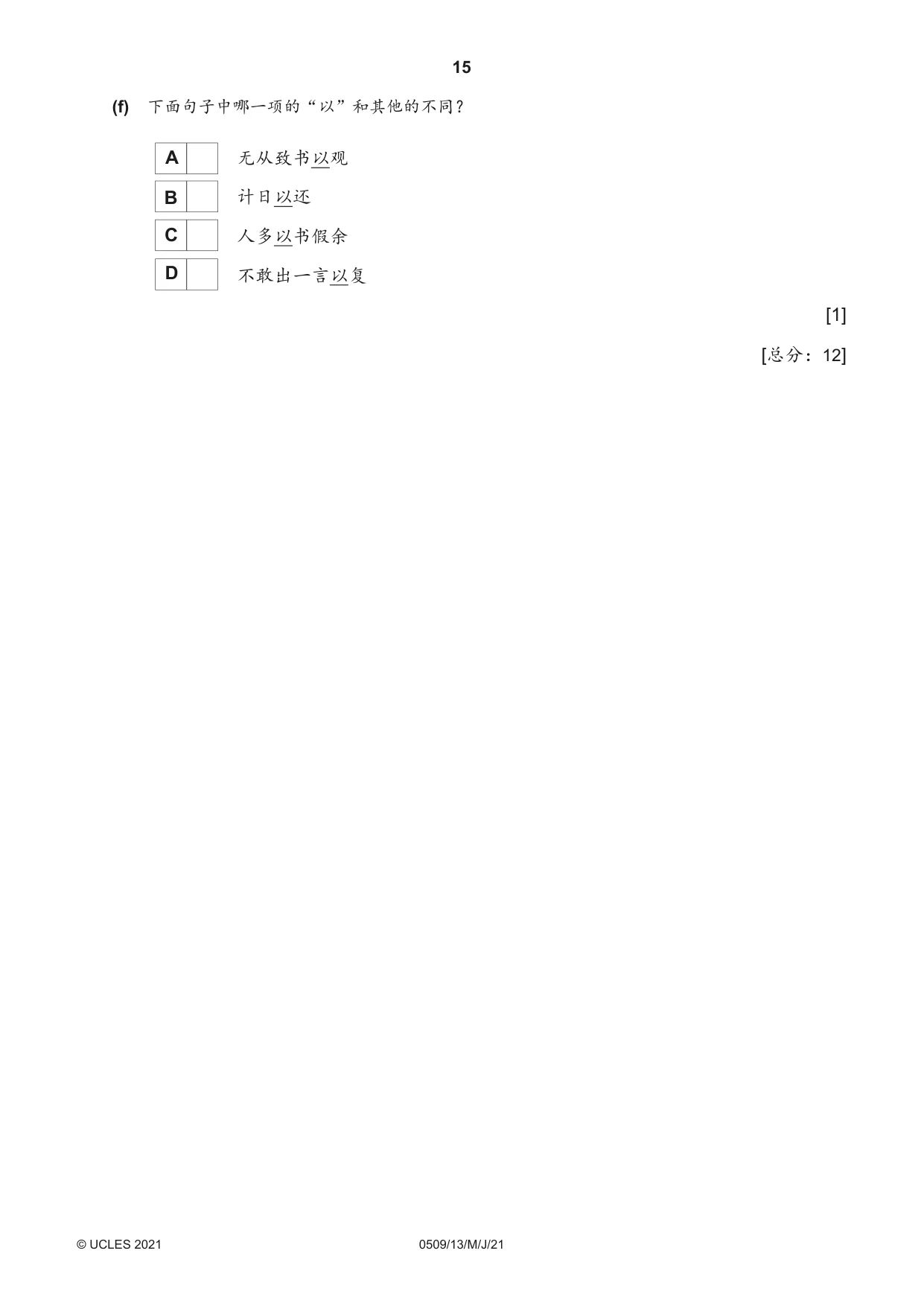
15 0509/13/M/J/21 © UCLES 2021 (f) 下面句子中哪一项的“以”和其他的不同? 无从致书以观 计日以还 人多以书假余 不敢出一言以复 [1] [总分:12] C A B C D
Question paper, page 16
16 0509/13/M/J/21 © UCLES 2021 Permission to reproduce items where third-party owned material protected by copyright is included has been sought and cleared where possible. Every reasonable effort has been made by the publisher (UCLES) to trace copyright holders, but if any items requiring clearance have unwittingly been included, the publisher will be pleased to make amends at the earliest possible opportunity. To avoid the issue of disclosure of answer-related information to candidates, all copyright acknowledgements are reproduced online in the Cambridge Assessment International Education Copyright Acknowledgements Booklet. This is produced for each series of examinations and is freely available to download at www.cambridgeinternational.org after the live examination series. Cambridge Assessment International Education is part of the Cambridge Assessment Group. Cambridge Assessment is the brand name of the University of Cambridge Local Examinations Syndicate (UCLES), which itself is a department of the University of Cambridge. BLANK PAGE
Mark scheme, page 1
This document consists of 10 printed pages. © UCLES 2021 [Turn over Cambridge IGCSE™ FIRST LANGUAGE CHINESE 0509/13 Paper 1 Reading, Directed Writing and Classical Chinese May/June 2021 MARK SCHEME Maximum Mark: 60 Published This mark scheme is published as an aid to teachers and candidates, to indicate the requirements of the examination. It shows the basis on which Examiners were instructed to award marks. It does not indicate the details of the discussions that took place at an Examiners’ meeting before marking began, which would have considered the acceptability of alternative answers. Mark schemes should be read in conjunction with the question paper and the Principal Examiner Report for Teachers. Cambridge International will not enter into discussions about these mark schemes. Cambridge International is publishing the mark schemes for the May/June 2021 series for most Cambridge IGCSE™, Cambridge International A and AS Level components and some Cambridge O Level components.
Mark scheme, page 2
0509/13 Cambridge IGCSE – Mark Scheme PUBLISHED May/June 2021 © UCLES 2021 Page 2 of 10 Generic Marking Principles These general marking principles must be applied by all examiners when marking candidate answers. They should be applied alongside the specific content of the mark scheme or generic level descriptors for a question. Each question paper and mark scheme will also comply with these marking principles. GENERIC MARKING PRINCIPLE 1: Marks must be awarded in line with: • the specific content of the mark scheme or the generic level descriptors for the question • the specific skills defined in the mark scheme or in the generic level descriptors for the question • the standard of response required by a candidate as exemplified by the standardisation scripts. GENERIC MARKING PRINCIPLE 2: Marks awarded are always whole marks (not half marks, or other fractions). GENERIC MARKING PRINCIPLE 3: Marks must be awarded positively: • marks are awarded for correct/valid answers, as defined in the mark scheme. However, credit is given for valid answers which go beyond the scope of the syllabus and mark scheme, referring to your Team Leader as appropriate • marks are awarded when candidates clearly demonstrate what they know and can do • marks are not deducted for errors • marks are not deducted for omissions • answers should only be judged on the quality of spelling, punctuation and grammar when these features are specifically assessed by the question as indicated by the mark scheme. The meaning, however, should be unambiguous. GENERIC MARKING PRINCIPLE 4: Rules must be applied consistently, e.g. in situations where candidates have not followed instructions or in the application of generic level descriptors. GENERIC MARKING PRINCIPLE 5: Marks should be awarded using the full range of marks defined in the mark scheme for the question (however; the use of the full mark range may be limited according to the quality of the candidate responses seen). GENERIC MARKING PRINCIPLE 6: Marks awarded are based solely on the requirements as defined in the mark scheme. Marks should not be awarded with grade thresholds or grade descriptors in mind.
Mark scheme, page 3
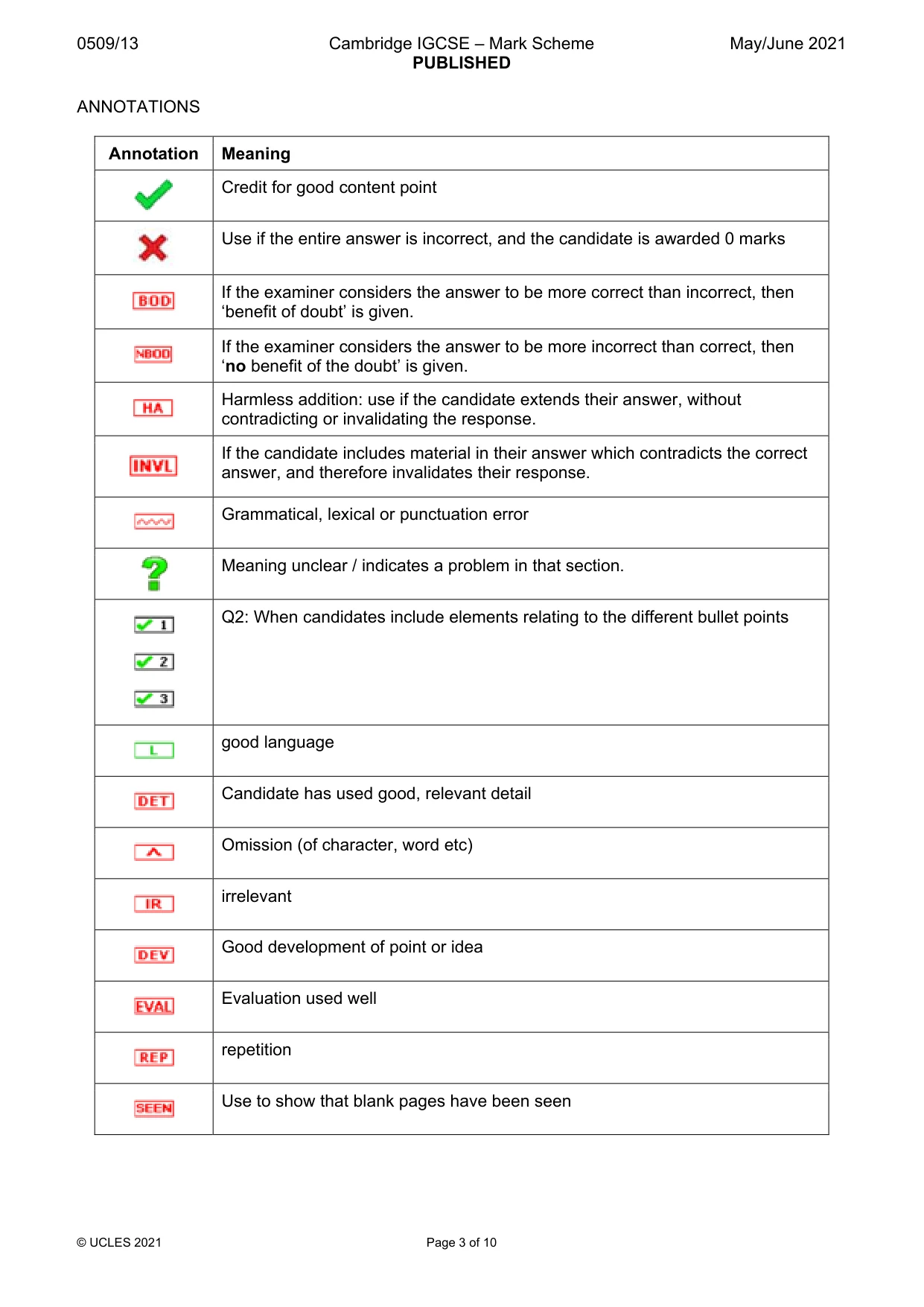
0509/13 Cambridge IGCSE – Mark Scheme PUBLISHED May/June 2021 © UCLES 2021 Page 3 of 10 ANNOTATIONS Annotation Meaning Credit for good content point Use if the entire answer is incorrect, and the candidate is awarded 0 marks If the examiner considers the answer to be more correct than incorrect, then ‘benefit of doubt’ is given. If the examiner considers the answer to be more incorrect than correct, then ‘no benefit of the doubt’ is given. Harmless addition: use if the candidate extends their answer, without contradicting or invalidating the response. If the candidate includes material in their answer which contradicts the correct answer, and therefore invalidates their response. Grammatical, lexical or punctuation error Meaning unclear / indicates a problem in that section. Q2: When candidates include elements relating to the different bullet points good language Candidate has used good, relevant detail Omission (of character, word etc) irrelevant Good development of point or idea Evaluation used well repetition Use to show that blank pages have been seen
Mark scheme, page 4
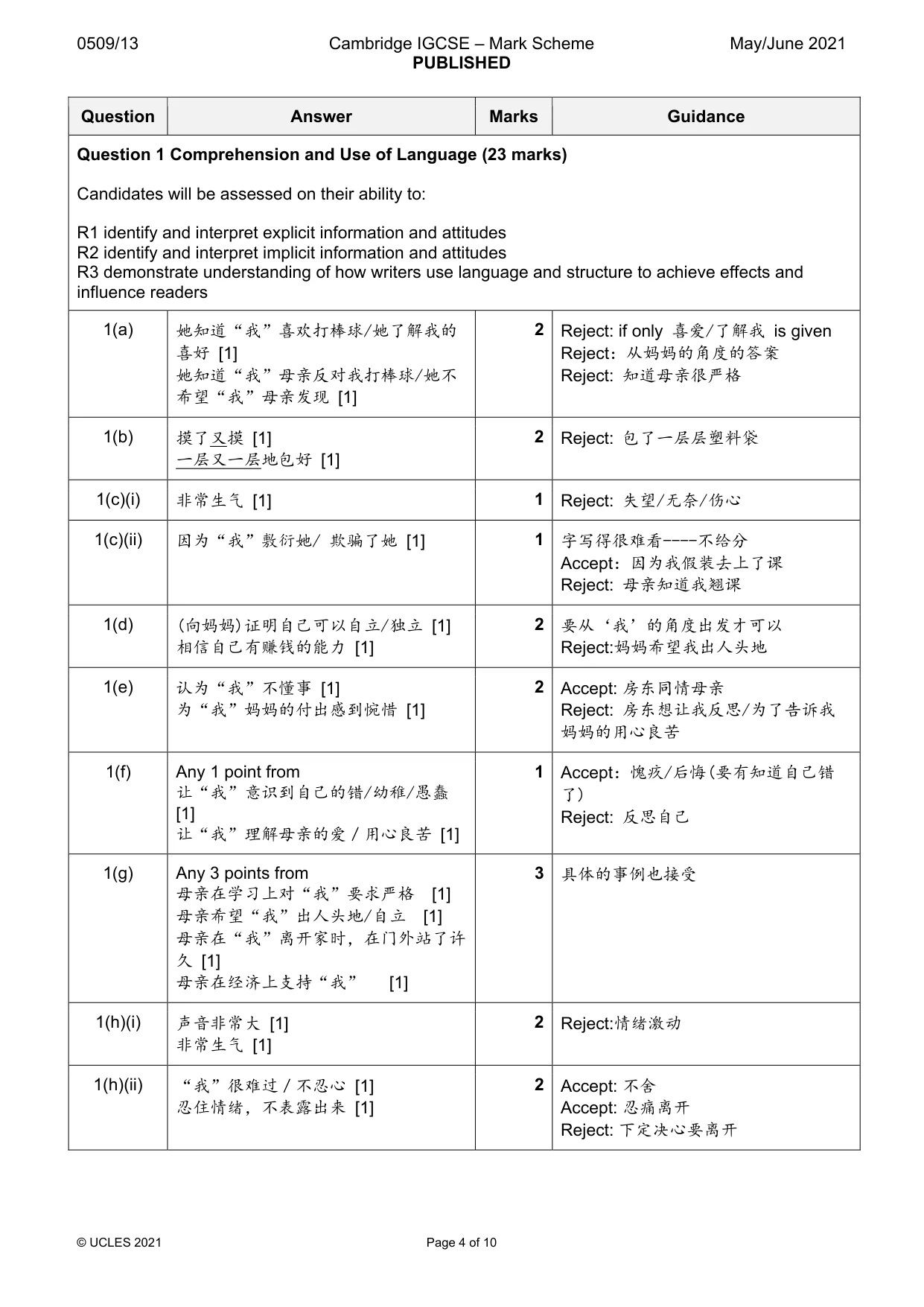
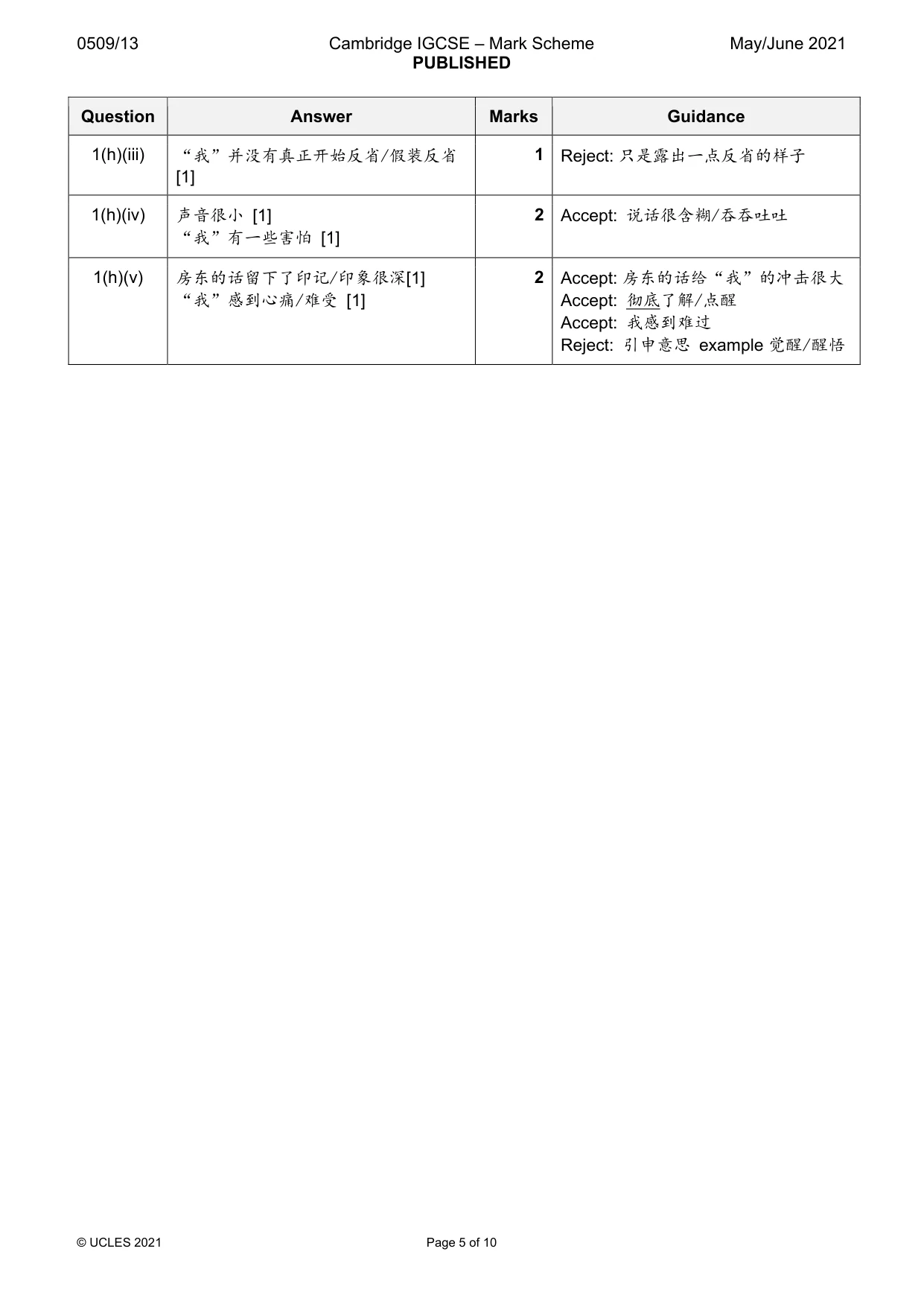
0509/13 Cambridge IGCSE – Mark Scheme PUBLISHED May/June 2021 © UCLES 2021 Page 4 of 10 Question Answer Marks Guidance Question 1 Comprehension and Use of Language (23 marks) Candidates will be assessed on their ability to: R1 identify and interpret explicit information and attitudes R2 identify and interpret implicit information and attitudes R3 demonstrate understanding of how writers use language and structure to achieve effects and influence readers 1(a) 她知道“我”喜欢打棒球/她了解我的 喜好 [1] 她知道“我”母亲反对我打棒球/她不 希望“我”母亲发现 [1] 2 Reject: if only 喜爱/了解我 is given Reject:从妈妈的角度的答案 Reject: 知道母亲很严格 1(b) 摸了又摸 [1] 一层又一层地包好 [1] 2 Reject: 包了一层层塑料袋 1(c)(i) 非常生气 [1] 1 Reject: 失望/无奈/伤心 1(c)(ii) 因为“我”敷衍她/ 欺骗了她 [1] 1 字写得很难看----不给分 Accept:因为我假装去上了课 Reject: 母亲知道我翘课 1(d) (向妈妈)证明自己可以自立/独立 [1] 相信自己有赚钱的能力 [1] 2 要从‘我’的角度出发才可以 Reject:妈妈希望我出人头地 1(e) 认为“我”不懂事 [1] 为“我”妈妈的付出感到惋惜 [1] 2 Accept: 房东同情母亲 Reject: 房东想让我反思/为了告诉我 妈妈的用心良苦 1(f) Any 1 point from 让“我”意识到自己的错/幼稚/愚蠢 [1] 让“我”理解母亲的爱/用心良苦 [1] 1 Accept:愧疚/后悔(要有知道自己错 了) Reject: 反思自己 1(g) Any 3 points from 母亲在学习上对“我”要求严格 [1] 母亲希望“我”出人头地/自立 [1] 母亲在“我”离开家时,在门外站了许 久 [1] 母亲在经济上支持“我” [1] 3 具体的事例也接受 1(h)(i) 声音非常大 [1] 非常生气 [1] 2 Reject:情绪激动 1(h)(ii) “我”很难过/不忍心 [1] 忍住情绪,不表露出来 [1] 2 Accept: 不舍 Accept: 忍痛离开 Reject: 下定决心要离开
Mark scheme, page 5
0509/13 Cambridge IGCSE – Mark Scheme PUBLISHED May/June 2021 © UCLES 2021 Page 5 of 10 Question Answer Marks Guidance 1(h)(iii) “我”并没有真正开始反省/假装反省 [1] 1 Reject: 只是露出一点反省的样子 1(h)(iv) 声音很小 [1] “我”有一些害怕 [1] 2 Accept: 说话很含糊/吞吞吐吐 1(h)(v) 房东的话留下了印记/印象很深[1] “我”感到心痛/难受 [1] 2 Accept: 房东的话给“我”的冲击很大 Accept: 彻底了解/点醒 Accept: 我感到难过 Reject: 引申意思 example 觉醒/醒悟
Mark scheme, page 6
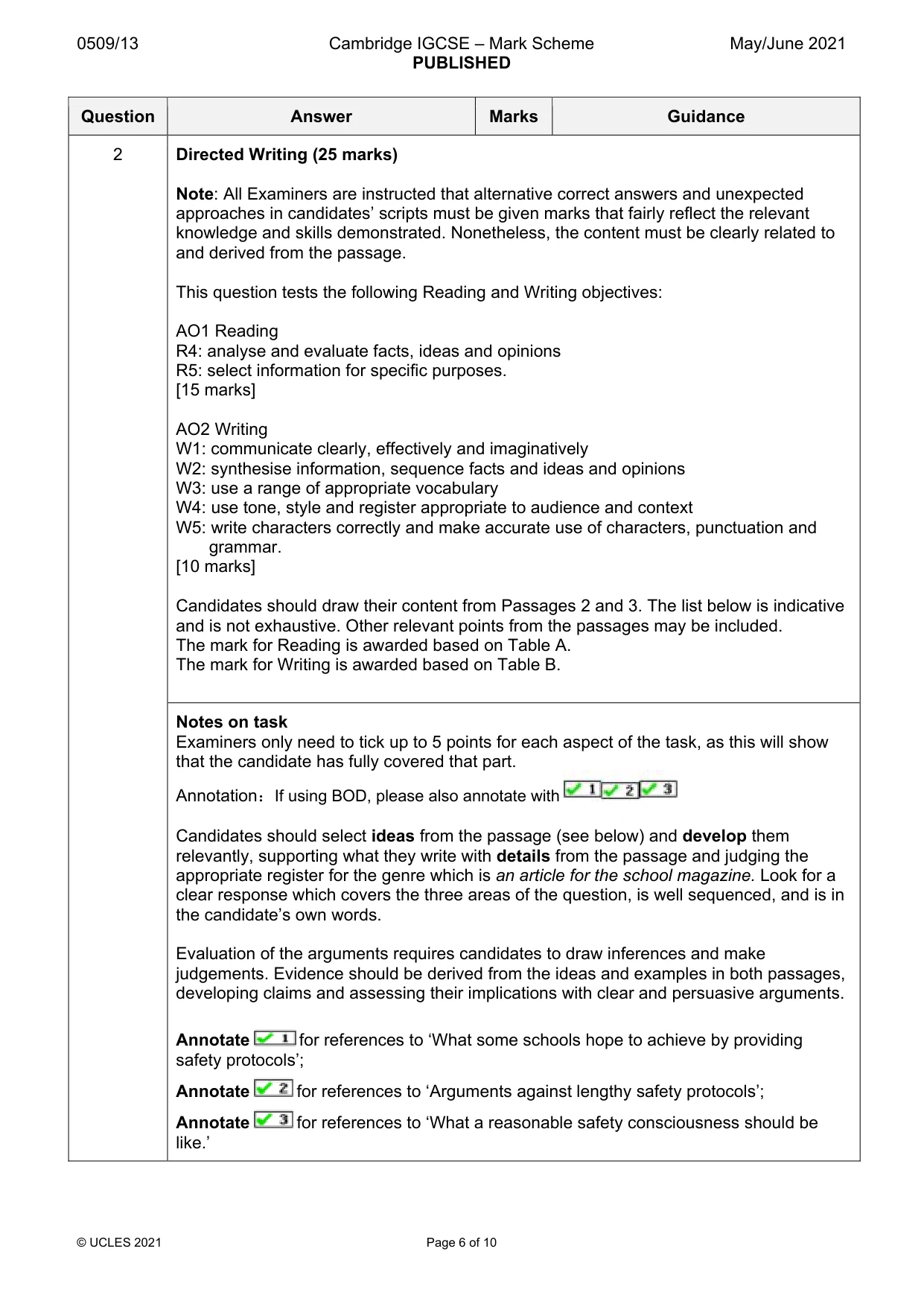
0509/13 Cambridge IGCSE – Mark Scheme PUBLISHED May/June 2021 © UCLES 2021 Page 6 of 10 Question Answer Marks Guidance 2 Directed Writing (25 marks) Note: All Examiners are instructed that alternative correct answers and unexpected approaches in candidates’ scripts must be given marks that fairly reflect the relevant knowledge and skills demonstrated. Nonetheless, the content must be clearly related to and derived from the passage. This question tests the following Reading and Writing objectives: AO1 Reading R4: analyse and evaluate facts, ideas and opinions R5: select information for specific purposes. [15 marks] AO2 Writing W1: communicate clearly, effectively and imaginatively W2: synthesise information, sequence facts and ideas and opinions W3: use a range of appropriate vocabulary W4: use tone, style and register appropriate to audience and context W5: write characters correctly and make accurate use of characters, punctuation and grammar. [10 marks] Candidates should draw their content from Passages 2 and 3. The list below is indicative and is not exhaustive. Other relevant points from the passages may be included. The mark for Reading is awarded based on Table A. The mark for Writing is awarded based on Table B. Notes on task Examiners only need to tick up to 5 points for each aspect of the task, as this will show that the candidate has fully covered that part. Annotation:If using BOD, please also annotate with Candidates should select ideas from the passage (see below) and develop them relevantly, supporting what they write with details from the passage and judging the appropriate register for the genre which is an article for the school magazine. Look for a clear response which covers the three areas of the question, is well sequenced, and is in the candidate’s own words. Evaluation of the arguments requires candidates to draw inferences and make judgements. Evidence should be derived from the ideas and examples in both passages, developing claims and assessing their implications with clear and persuasive arguments. Annotate for references to ‘What some schools hope to achieve by providing safety protocols’; Annotate for references to ‘Arguments against lengthy safety protocols’; Annotate for references to ‘What a reasonable safety consciousness should be like.’
Mark scheme, page 7
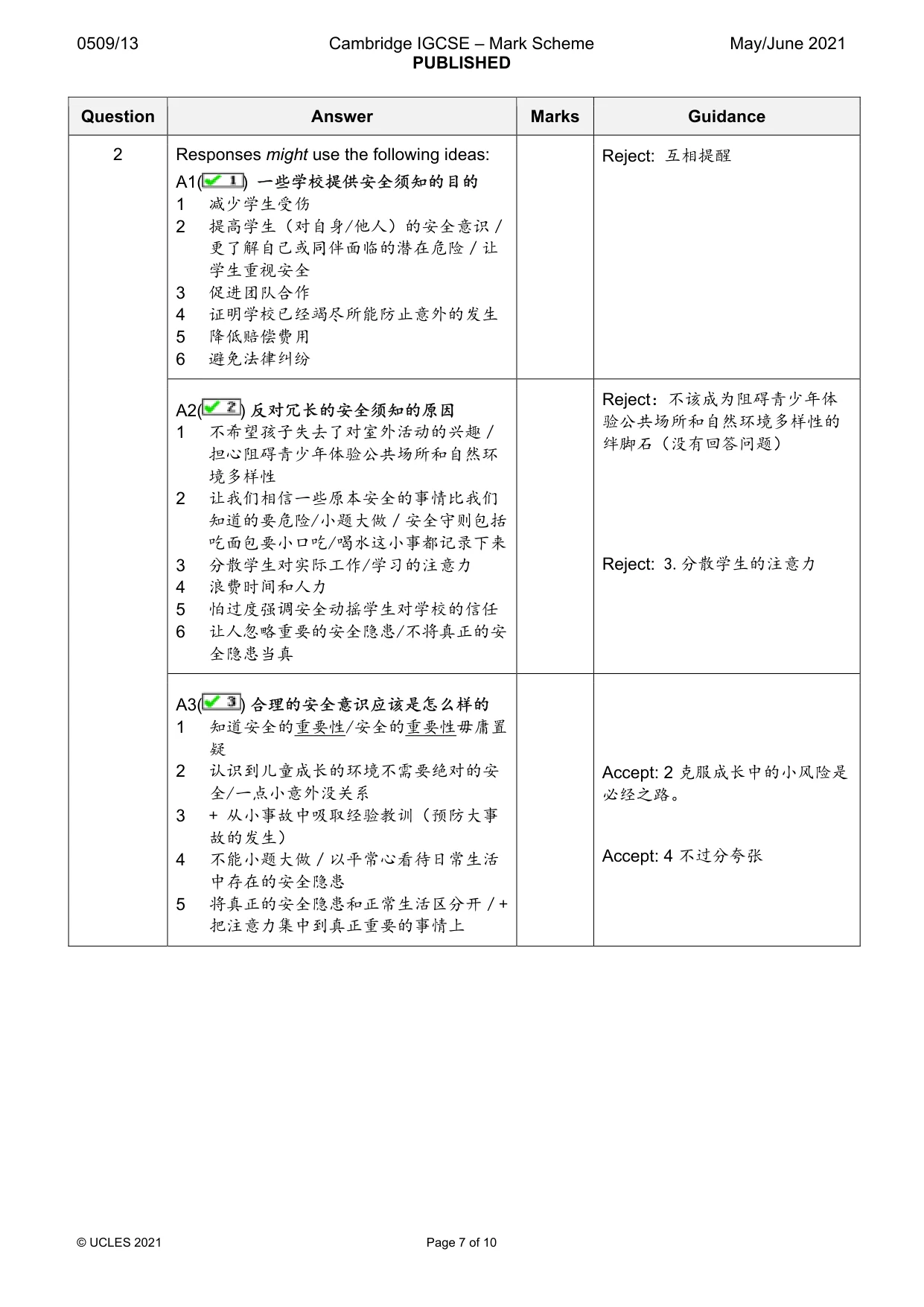
0509/13 Cambridge IGCSE – Mark Scheme PUBLISHED May/June 2021 © UCLES 2021 Page 7 of 10 Question Answer Marks Guidance 2 Responses might use the following ideas: A1( ) 一些学校提供安全须知的目的 1 减少学生受伤 2 提高学生(对自身/他人)的安全意识/ 更了解自己或同伴面临的潜在危险/让 学生重视安全 3 促进团队合作 4 证明学校已经竭尽所能防止意外的发生 5 降低赔偿费用 6 避免法律纠纷 Reject: 互相提醒 A2( ) 反对冗长的安全须知的原因 1 不希望孩子失去了对室外活动的兴趣/ 担心阻碍青少年体验公共场所和自然环 境多样性 2 让我们相信一些原本安全的事情比我们 知道的要危险/小题大做/安全守则包括 吃面包要小口吃/喝水这小事都记录下来 3 分散学生对实际工作/学习的注意力 4 浪费时间和人力 5 怕过度强调安全动摇学生对学校的信任 6 让人忽略重要的安全隐患/不将真正的安 全隐患当真 Reject:不该成为阻碍青少年体 验公共场所和自然环境多样性的 绊脚石(没有回答问题) Reject: 3.分散学生的注意力 A3( ) 合理的安全意识应该是怎么样的 1 知道安全的重要性/安全的重要性毋庸置 疑 2 认识到儿童成长的环境不需要绝对的安 全/一点小意外没关系 3 + 从小事故中吸取经验教训(预防大事 故的发生) 4 不能小题大做/以平常心看待日常生活 中存在的安全隐患 5 将真正的安全隐患和正常生活区分开/+ 把注意力集中到真正重要的事情上 Accept: 2 克服成长中的小风险是 必经之路。 Accept: 4 不过分夸张
Mark scheme, page 8
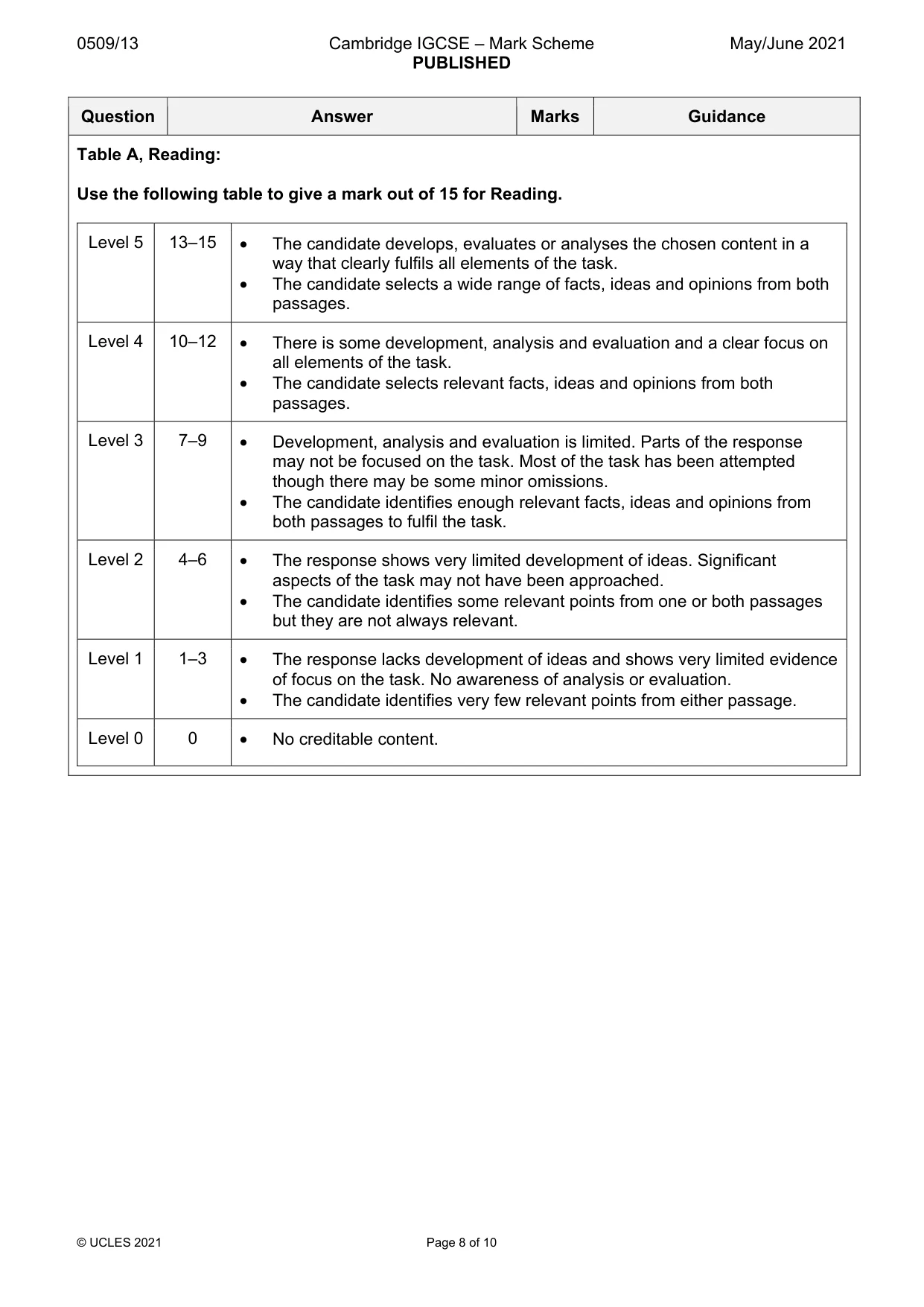
0509/13 Cambridge IGCSE – Mark Scheme PUBLISHED May/June 2021 © UCLES 2021 Page 8 of 10 Question Answer Marks Guidance Table A, Reading: Use the following table to give a mark out of 15 for Reading. Level 5 13–15 • The candidate develops, evaluates or analyses the chosen content in a way that clearly fulfils all elements of the task. • The candidate selects a wide range of facts, ideas and opinions from both passages. Level 4 10–12 • There is some development, analysis and evaluation and a clear focus on all elements of the task. • The candidate selects relevant facts, ideas and opinions from both passages. Level 3 7–9 • Development, analysis and evaluation is limited. Parts of the response may not be focused on the task. Most of the task has been attempted though there may be some minor omissions. • The candidate identifies enough relevant facts, ideas and opinions from both passages to fulfil the task. Level 2 4–6 • The response shows very limited development of ideas. Significant aspects of the task may not have been approached. • The candidate identifies some relevant points from one or both passages but they are not always relevant. Level 1 1–3 • The response lacks development of ideas and shows very limited evidence of focus on the task. No awareness of analysis or evaluation. • The candidate identifies very few relevant points from either passage. Level 0 0 • No creditable content.
Mark scheme, page 9
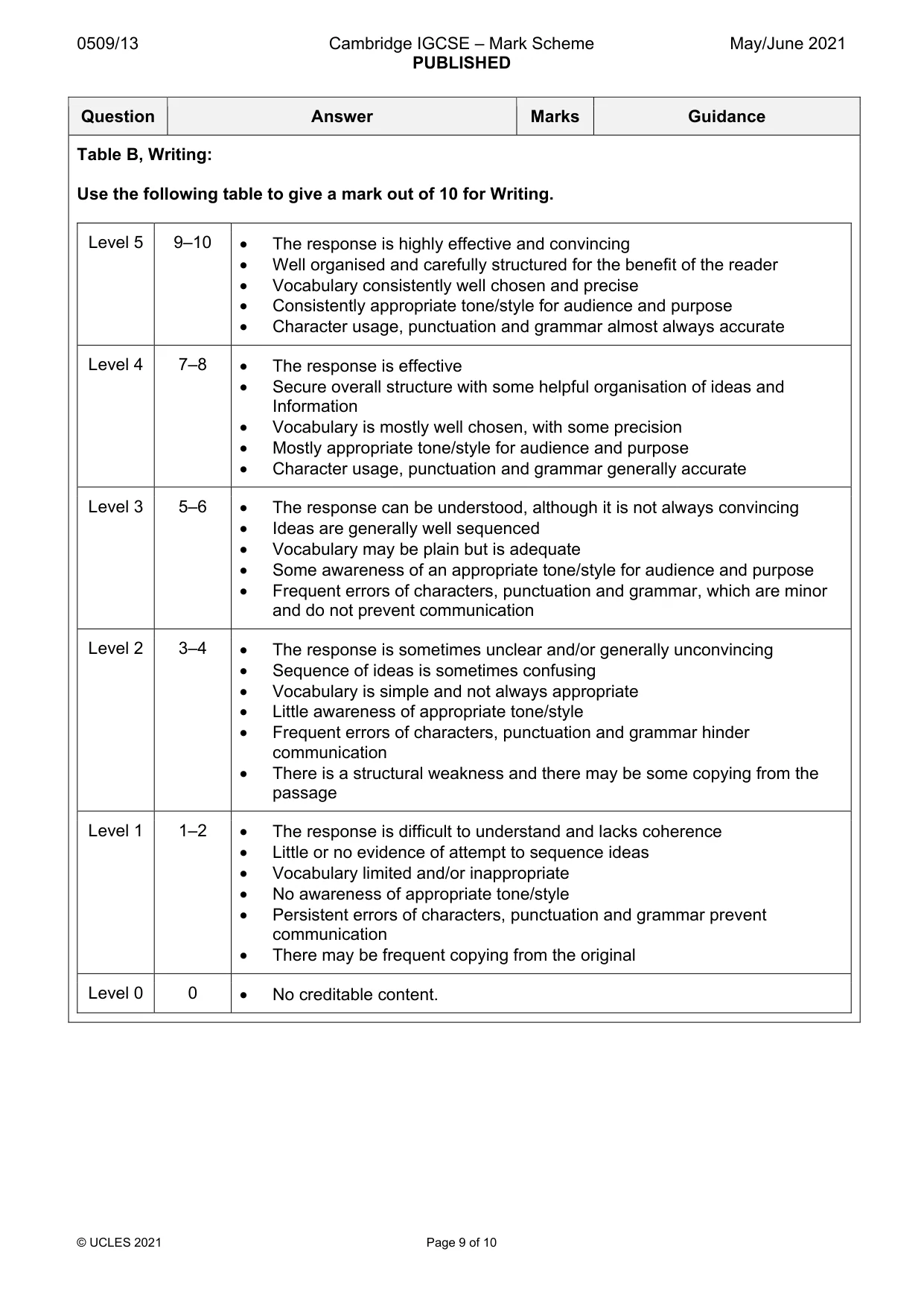
0509/13 Cambridge IGCSE – Mark Scheme PUBLISHED May/June 2021 © UCLES 2021 Page 9 of 10 Question Answer Marks Guidance Table B, Writing: Use the following table to give a mark out of 10 for Writing. Level 5 9–10 • The response is highly effective and convincing • Well organised and carefully structured for the benefit of the reader • Vocabulary consistently well chosen and precise • Consistently appropriate tone/style for audience and purpose • Character usage, punctuation and grammar almost always accurate Level 4 7–8 • The response is effective • Secure overall structure with some helpful organisation of ideas and Information • Vocabulary is mostly well chosen, with some precision • Mostly appropriate tone/style for audience and purpose • Character usage, punctuation and grammar generally accurate Level 3 5–6 • The response can be understood, although it is not always convincing • Ideas are generally well sequenced • Vocabulary may be plain but is adequate • Some awareness of an appropriate tone/style for audience and purpose • Frequent errors of characters, punctuation and grammar, which are minor and do not prevent communication Level 2 3–4 • The response is sometimes unclear and/or generally unconvincing • Sequence of ideas is sometimes confusing • Vocabulary is simple and not always appropriate • Little awareness of appropriate tone/style • Frequent errors of characters, punctuation and grammar hinder communication • There is a structural weakness and there may be some copying from the passage Level 1 1–2 • The response is difficult to understand and lacks coherence • Little or no evidence of attempt to sequence ideas • Vocabulary limited and/or inappropriate • No awareness of appropriate tone/style • Persistent errors of characters, punctuation and grammar prevent communication • There may be frequent copying from the original Level 0 0 • No creditable content.
Mark scheme, page 10
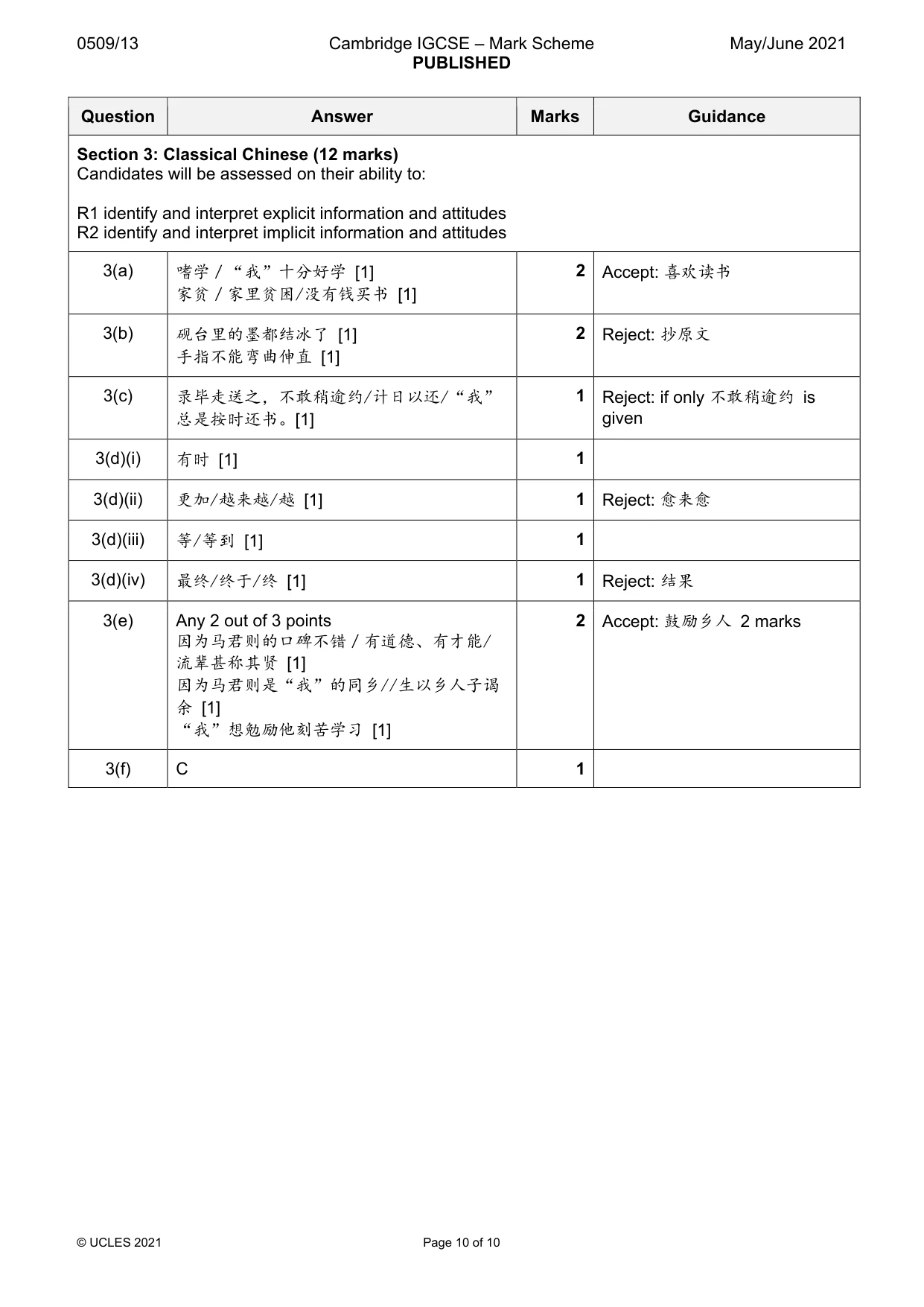
0509/13 Cambridge IGCSE – Mark Scheme PUBLISHED May/June 2021 © UCLES 2021 Page 10 of 10 Question Answer Marks Guidance Section 3: Classical Chinese (12 marks) Candidates will be assessed on their ability to: R1 identify and interpret explicit information and attitudes R2 identify and interpret implicit information and attitudes 3(a) 嗜学/“我”十分好学 [1] 家贫/家里贫困/没有钱买书 [1] 2 Accept: 喜欢读书 3(b) 砚台里的墨都结冰了 [1] 手指不能弯曲伸直 [1] 2 Reject: 抄原文 3(c) 录毕走送之,不敢稍逾约/计日以还/“我” 总是按时还书。[1] 1 Reject: if only 不敢稍逾约 is given 3(d)(i) 有时 [1] 1 3(d)(ii) 更加/越来越/越 [1] 1 Reject: 愈来愈 3(d)(iii) 等/等到 [1] 1 3(d)(iv) 最终/终于/终 [1] 1 Reject: 结果 3(e) Any 2 out of 3 points 因为马君则的口碑不错/有道德、有才能/ 流辈甚称其贤 [1] 因为马君则是“我”的同乡//生以乡人子谒 余 [1] “我”想勉励他刻苦学习 [1] 2 Accept: 鼓励乡人 2 marks 3(f) C 1
What you needed in this session
Cambridge’s own grade thresholds for 2021 May/June, Paper 1 · Variant 3. A higher threshold means an easier paper — the bar moves with how the cohort did.