Cambridge IGCSE Child Development 0637 — 2019 Oct/Nov Paper 1 · Variant 1
0637/11/O/N/19 · 100 marks · ≈113 min
The question paper and its mark scheme, free to read here and free to download. This is Cambridge’s own paper, exactly as it was sat.
Question paper12 pages



Mark scheme10 pages
Answers below. Sit the paper first if you are practising.
Paper as text
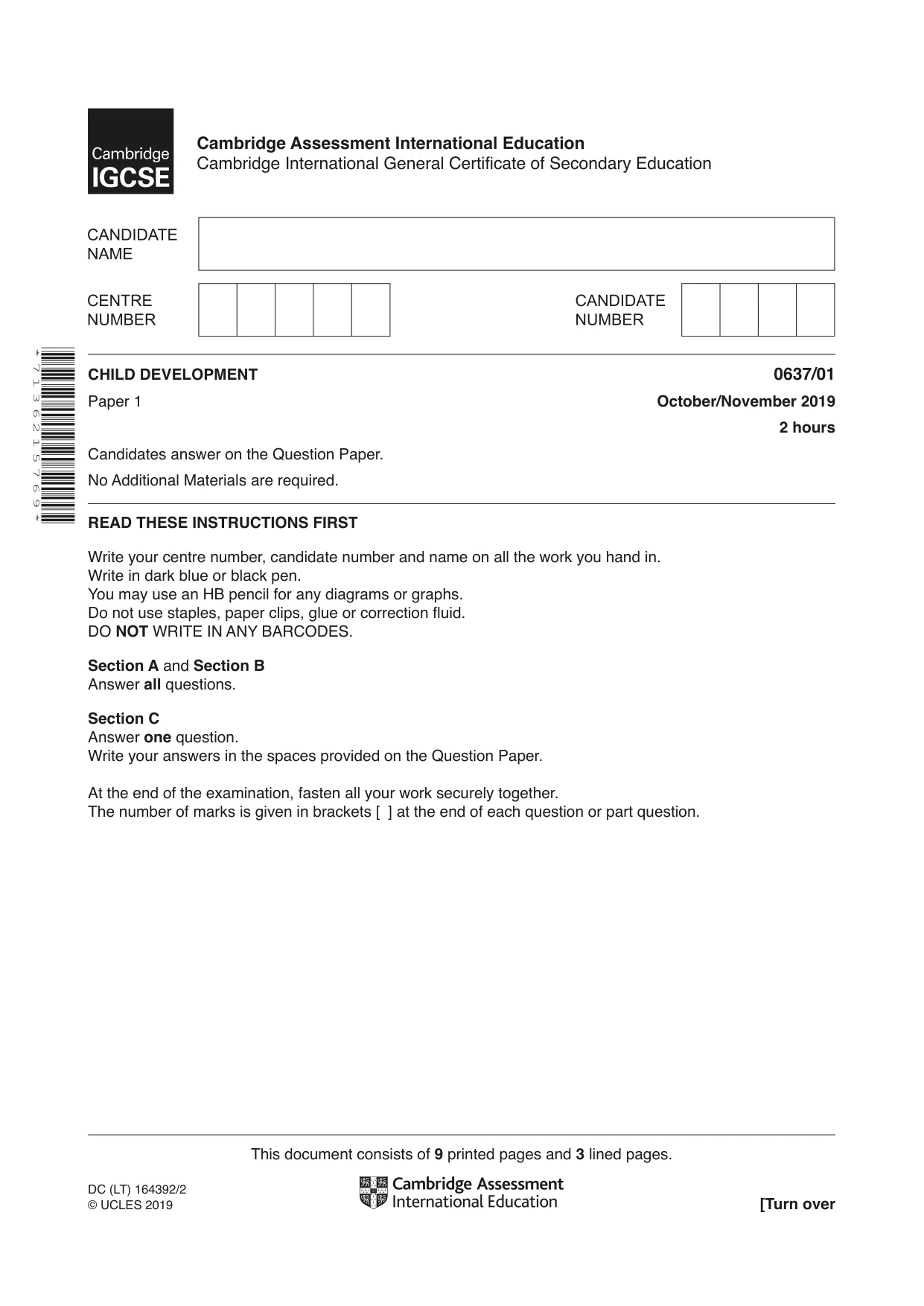
Question paper, page 1
This document consists of 9 printed pages and 3 lined pages. DC (LT) 164392/2 © UCLES 2019 [Turn over Cambridge Assessment International Education Cambridge International General Certificate of Secondary Education * 7 1 3 6 2 1 5 7 6 9 * CHILD DEVELOPMENT 0637/01 Paper 1 October/November 2019 2 hours Candidates answer on the Question Paper. No Additional Materials are required. READ THESE INSTRUCTIONS FIRST Write your centre number, candidate number and name on all the work you hand in. Write in dark blue or black pen. You may use an HB pencil for any diagrams or graphs. Do not use staples, paper clips, glue or correction fluid. DO NOT WRITE IN ANY BARCODES. Section A and Section B Answer all questions. Section C Answer one question. Write your answers in the spaces provided on the Question Paper. At the end of the examination, fasten all your work securely together. The number of marks is given in brackets [ ] at the end of each question or part question.
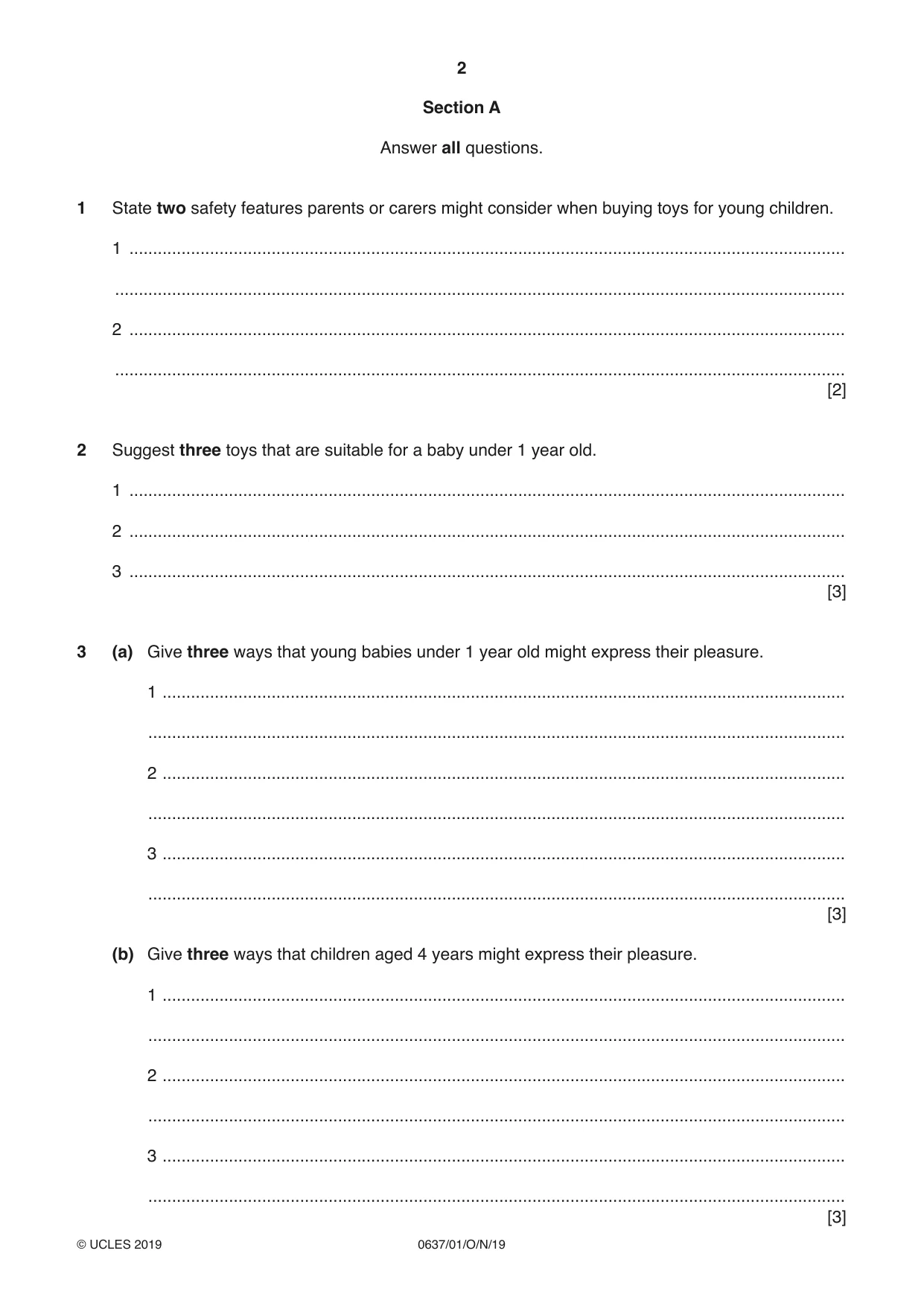
Question paper, page 2
2 0637/01/O/N/19 © UCLES 2019 Section A Answer all questions. 1 State two safety features parents or carers might consider when buying toys for young children. 1 … … 2 … … [2] 2 Suggest three toys that are suitable for a baby under 1 year old. 1 … 2 … 3 … [3] 3 (a) Give three ways that young babies under 1 year old might express their pleasure. 1 … … 2 … … 3 … … [3] (b) Give three ways that children aged 4 years might express their pleasure. 1 … … 2 … … 3 … … [3]
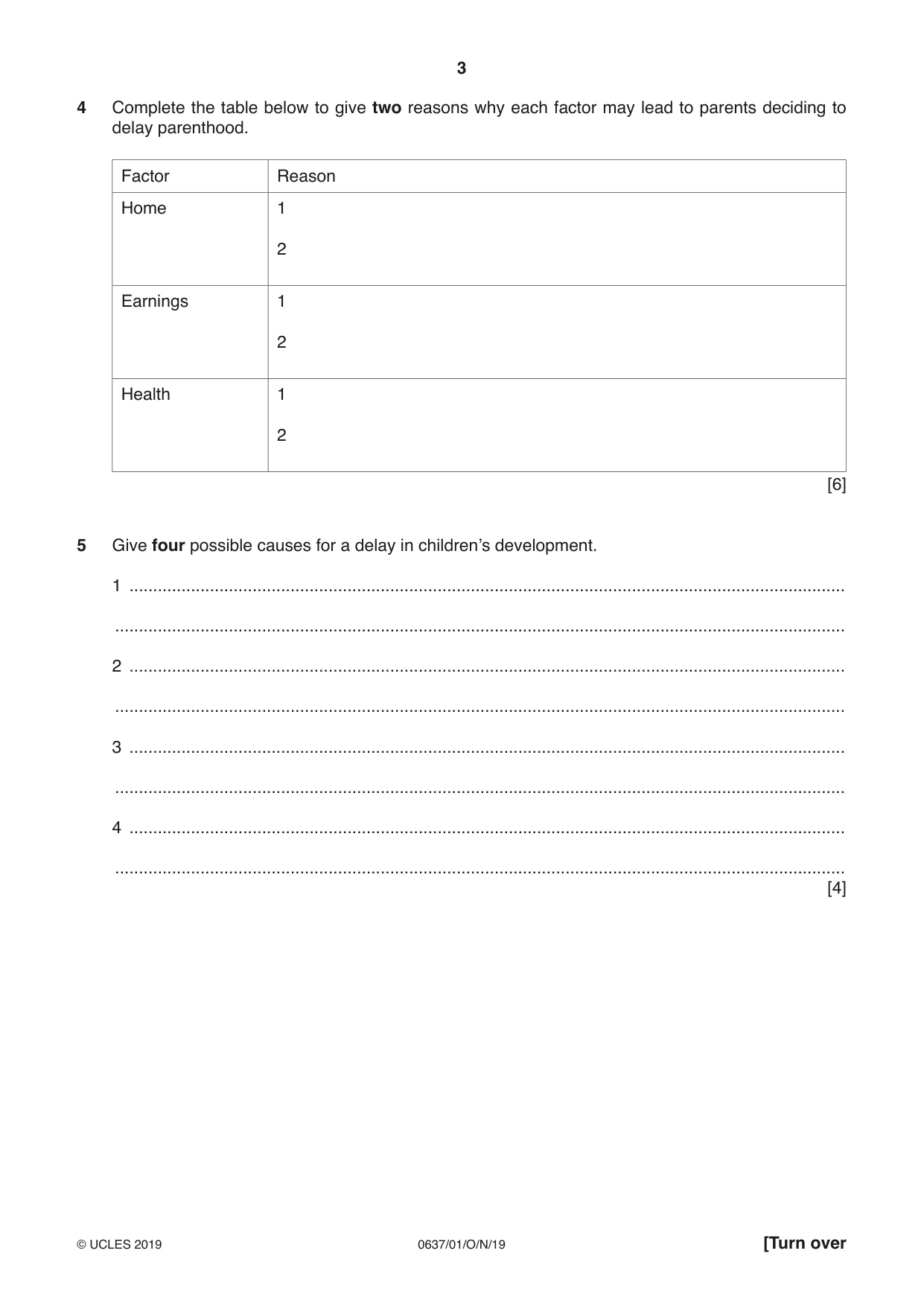
Question paper, page 3
3 0637/01/O/N/19 © UCLES 2019 [Turn over 4 Complete the table below to give two reasons why each factor may lead to parents deciding to delay parenthood. Factor Reason Home 1 2 Earnings 1 2 Health 1 2 [6] 5 Give four possible causes for a delay in children’s development. 1 … … 2 … … 3 … … 4 … … [4]
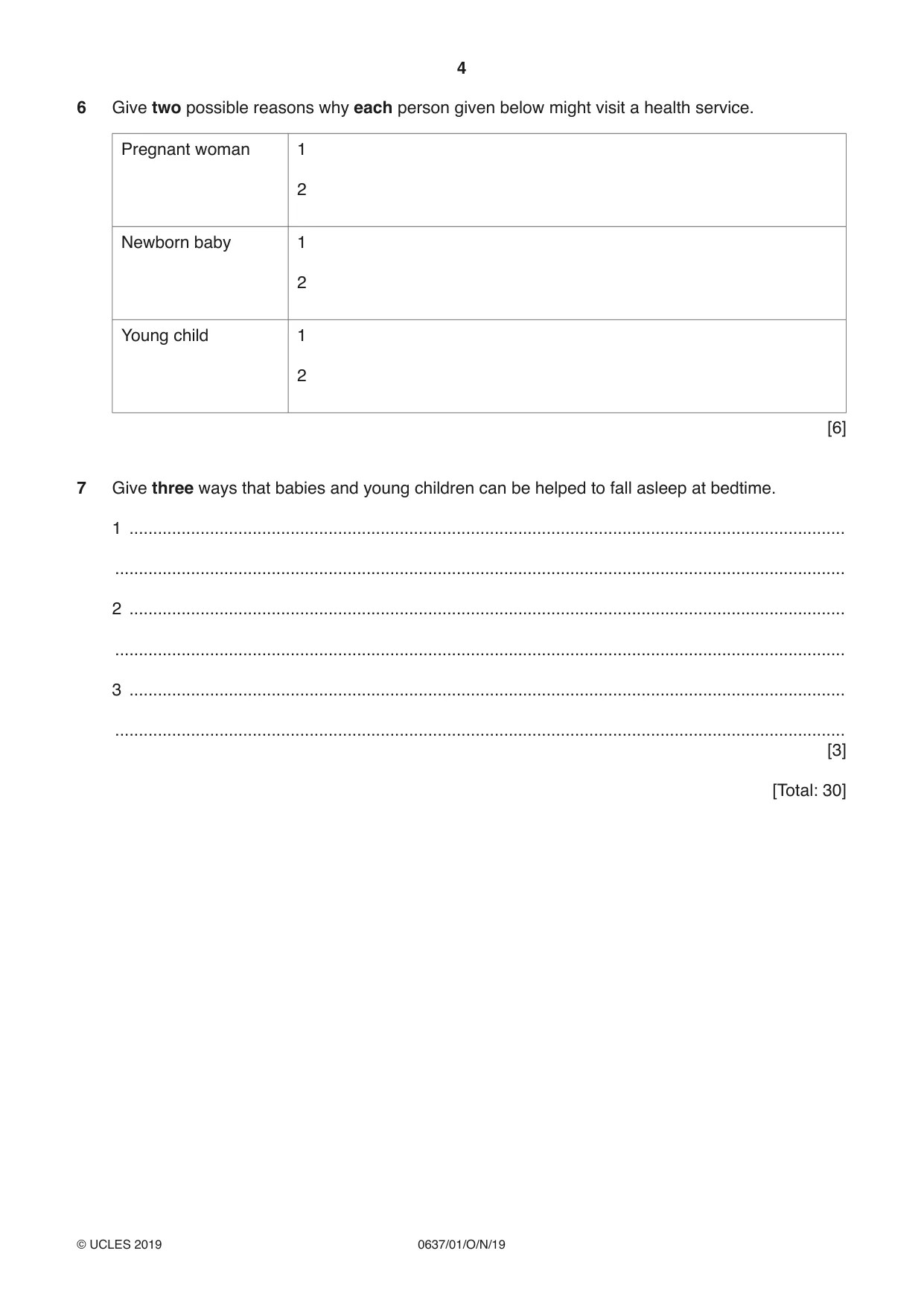
Question paper, page 4
4 0637/01/O/N/19 © UCLES 2019 6 Give two possible reasons why each person given below might visit a health service. Pregnant woman 1 2 Newborn baby 1 2 Young child 1 2 [6] 7 Give three ways that babies and young children can be helped to fall asleep at bedtime. 1 … … 2 … … 3 … … [3] [Total: 30]
Question paper, page 5
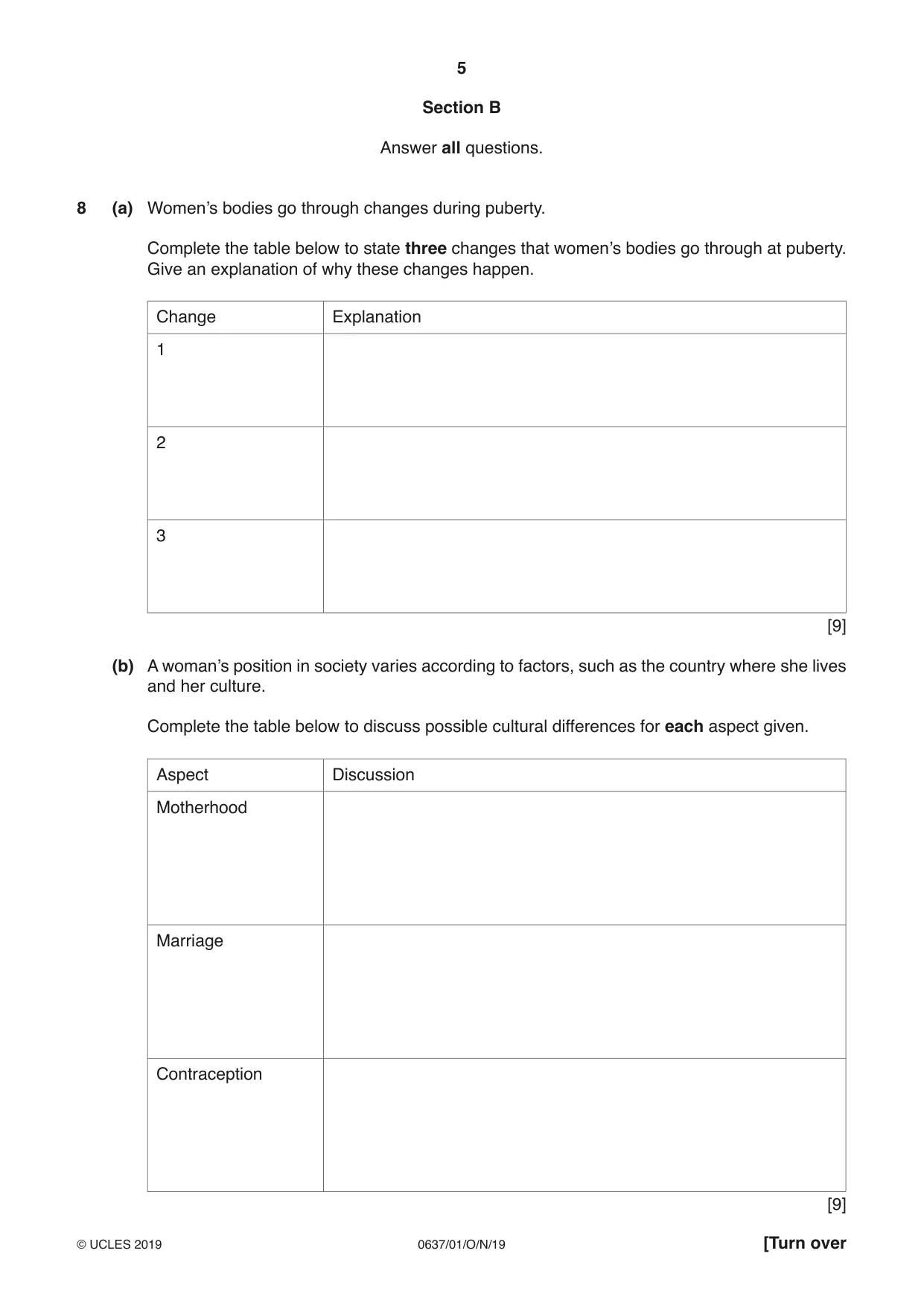
5 0637/01/O/N/19 © UCLES 2019 [Turn over Section B Answer all questions. 8 (a) Women’s bodies go through changes during puberty. Complete the table below to state three changes that women’s bodies go through at puberty. Give an explanation of why these changes happen. Change Explanation 1 2 3 [9] (b) A woman’s position in society varies according to factors, such as the country where she lives and her culture. Complete the table below to discuss possible cultural differences for each aspect given. Aspect Discussion Motherhood Marriage Contraception [9]
Question paper, page 6
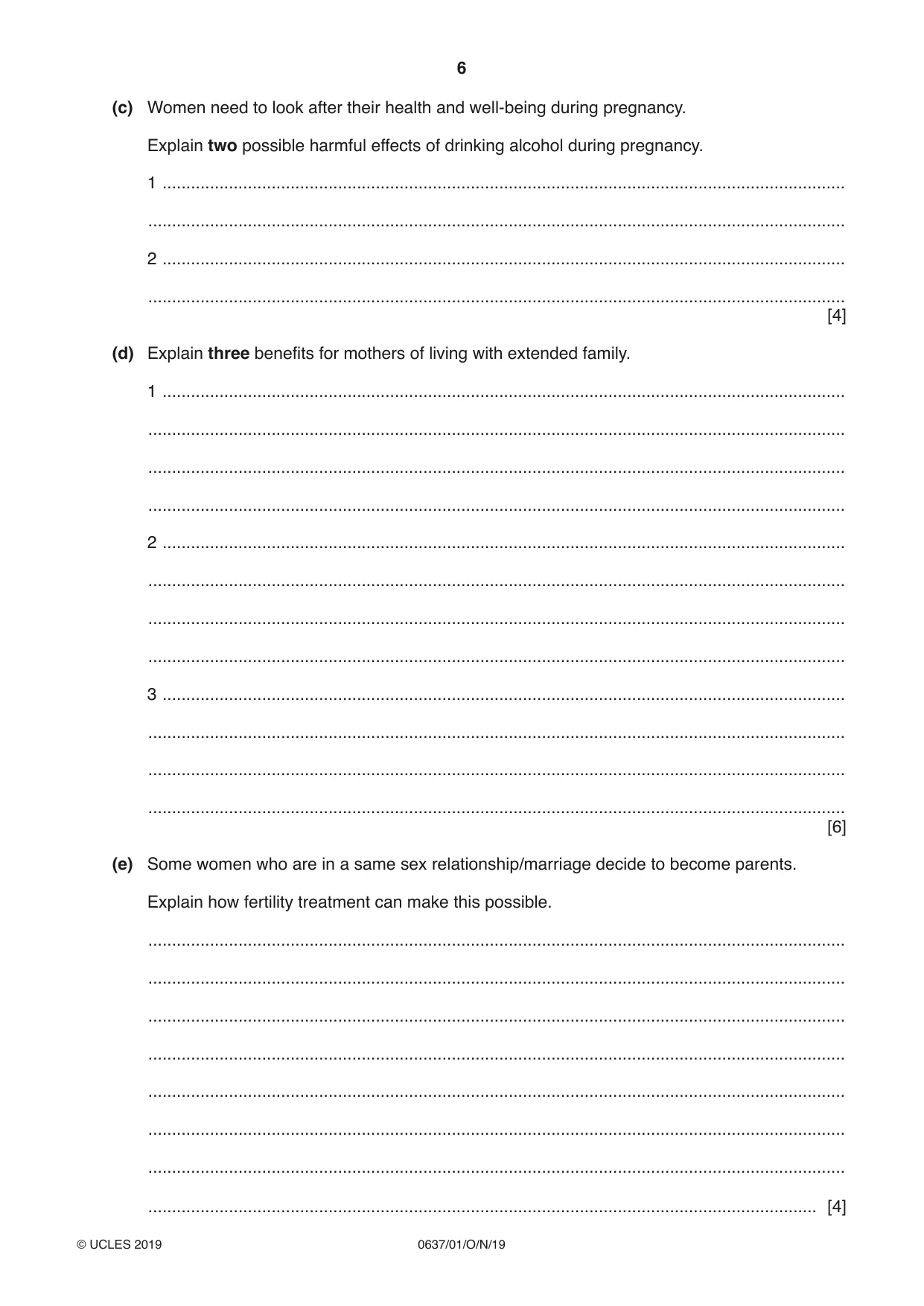
6 0637/01/O/N/19 © UCLES 2019 (c) Women need to look after their health and well-being during pregnancy. Explain two possible harmful effects of drinking alcohol during pregnancy. 1 … … 2 … … [4] (d) Explain three benefits for mothers of living with extended family. 1 … … … … 2 … … … … 3 … … … … [6] (e) Some women who are in a same sex relationship/marriage decide to become parents. Explain how fertility treatment can make this possible. … … … … … … … … [4]
Question paper, page 7
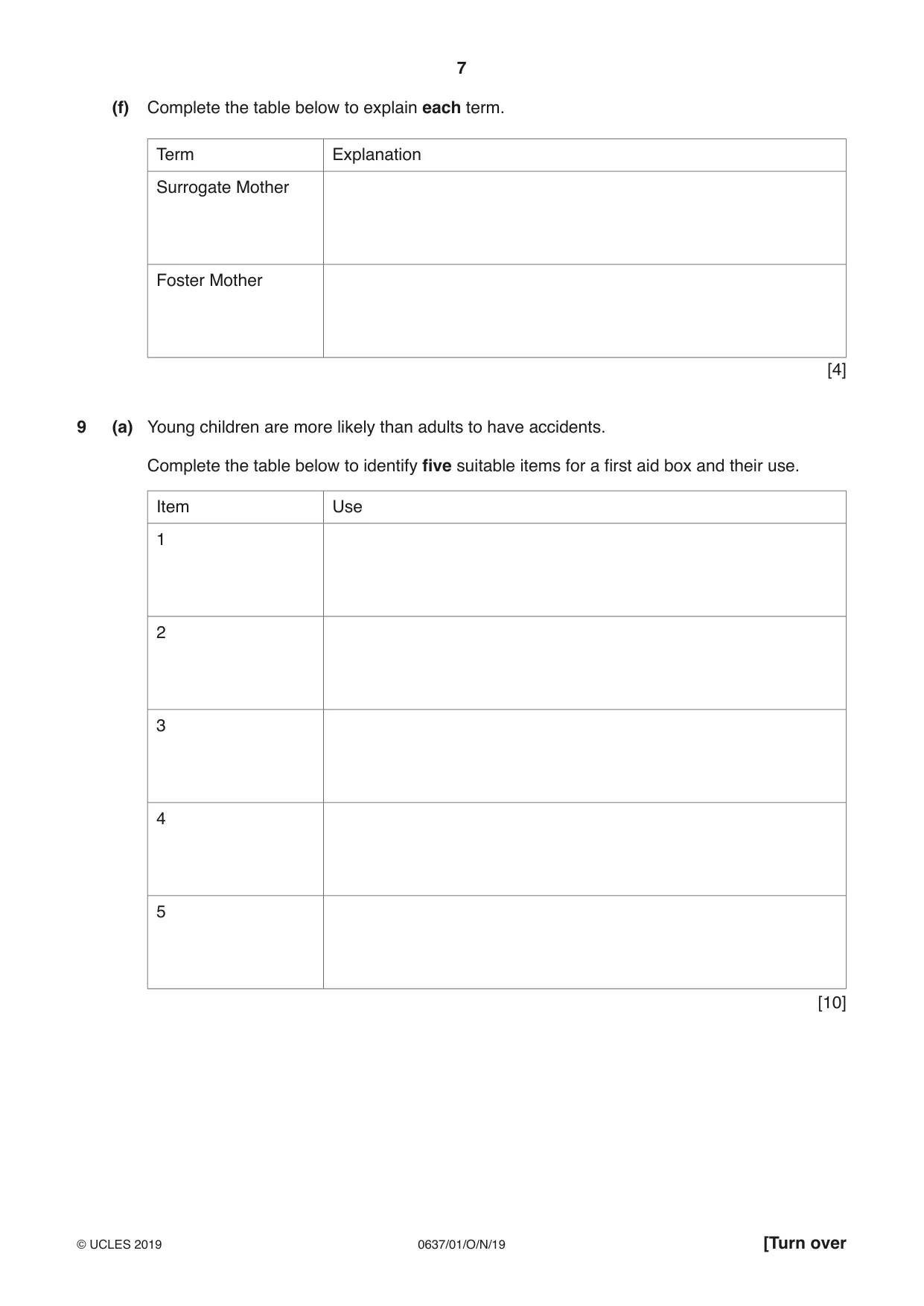
7 0637/01/O/N/19 © UCLES 2019 [Turn over (f) Complete the table below to explain each term. Term Explanation Surrogate Mother Foster Mother [4] 9 (a) Young children are more likely than adults to have accidents. Complete the table below to identify five suitable items for a first aid box and their use. Item Use 1 2 3 4 5 [10]
Question paper, page 8
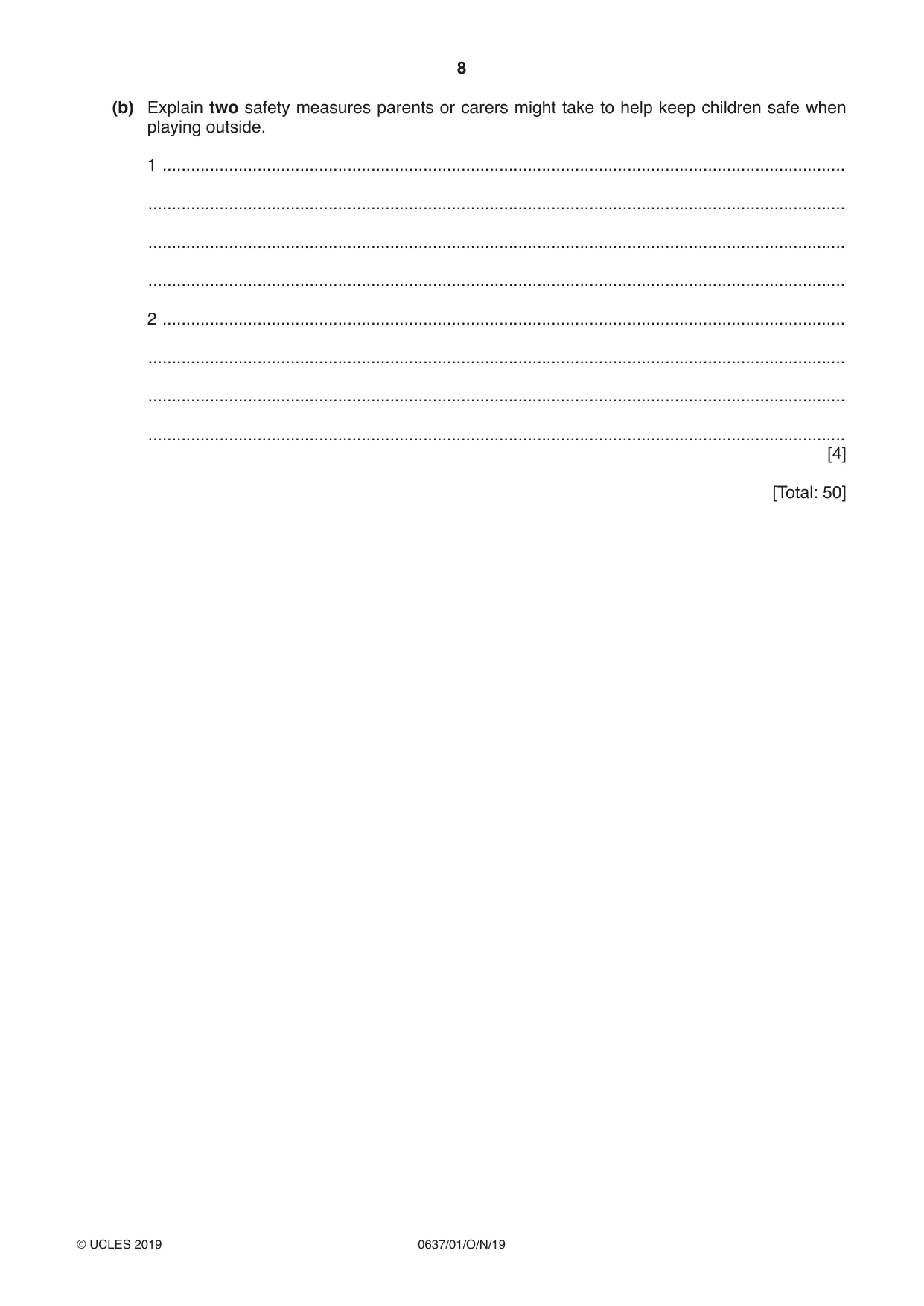
8 0637/01/O/N/19 © UCLES 2019 (b) Explain two safety measures parents or carers might take to help keep children safe when playing outside. 1 … … … … 2 … … … … [4] [Total: 50]
Question paper, page 9
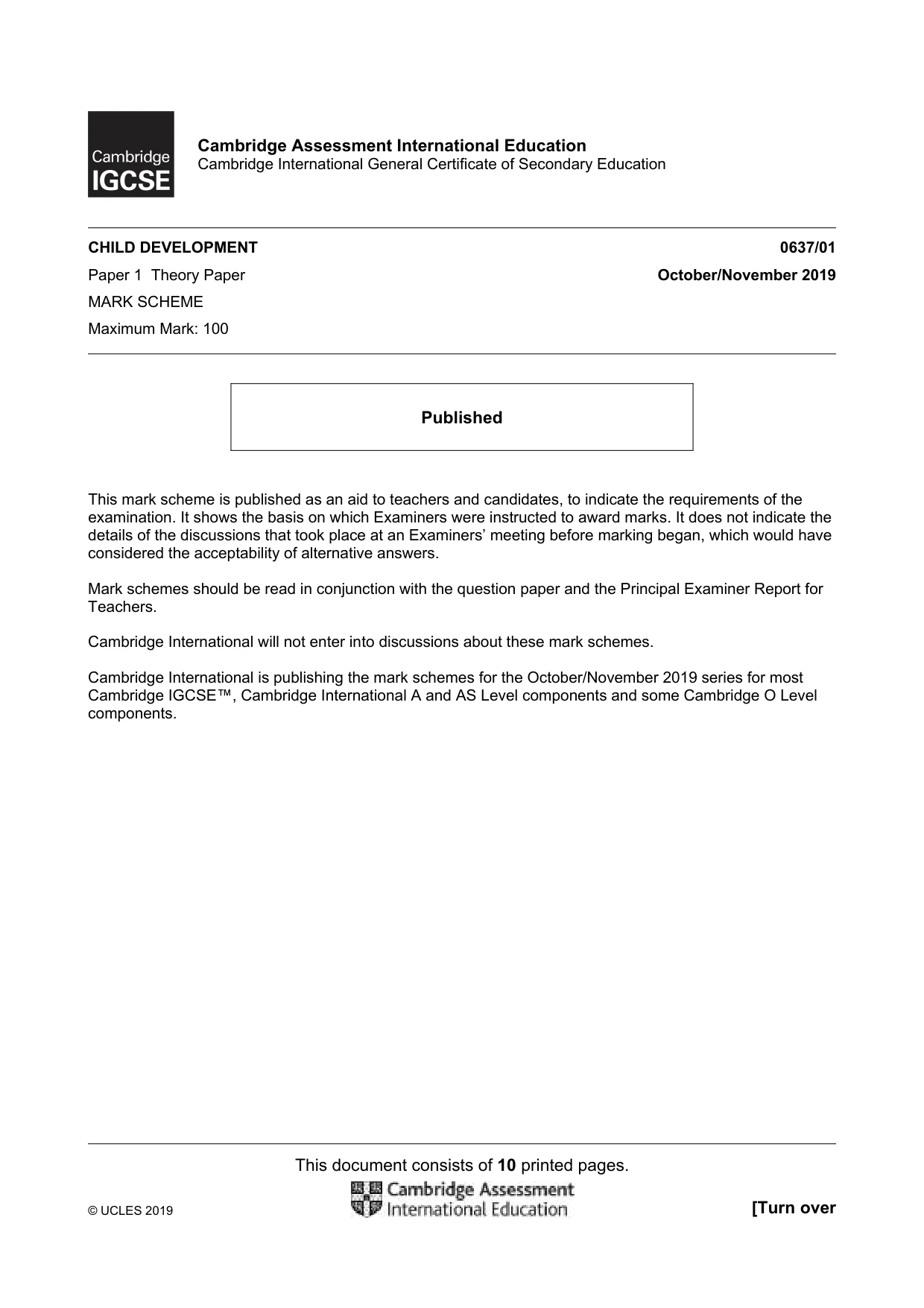
9 0637/01/O/N/19 © UCLES 2019 [Turn over Section C Answer one question. 10 (a) Newborn babies need lots of care. Explain the options available for parents when feeding their newborn babies. Outline the possible disadvantages of each method. Discuss why parents might choose each method of feeding. [20] Or (b) Males experience a period of physical changes during puberty. Explain what these physical changes are. Discuss how hormones can affect a male’s emotions during puberty. Give examples of how some cultures may view a young male’s progression into adulthood. [20] [Total: 20]
Question paper, page 10
10 0637/01/O/N/19 © UCLES 2019 … … … … … … … … … … … … … … … … … … … … … … … … … … … …
Question paper, page 11
11 0637/01/O/N/19 © UCLES 2019 [Turn over … … … … … … … … … … … … … … … … … … … … … … … … … … … …
Question paper, page 12
12 0637/01/O/N/19 © UCLES 2019 … … … … … … … … … … … … … … … … … … … … … … … … Permission to reproduce items where third-party owned material protected by copyright is included has been sought and cleared where possible. Every reasonable effort has been made by the publisher (UCLES) to trace copyright holders, but if any items requiring clearance have unwittingly been included, the publisher will be pleased to make amends at the earliest possible opportunity. To avoid the issue of disclosure of answer-related information to candidates, all copyright acknowledgements are reproduced online in the Cambridge Assessment International Education Copyright Acknowledgements Booklet. This is produced for each series of examinations and is freely available to download at www.cambridgeinternational.org after the live examination series. Cambridge Assessment International Education is part of the Cambridge Assessment Group. Cambridge Assessment is the brand name of the University of Cambridge Local Examinations Syndicate (UCLES), which itself is a department of the University of Cambridge.
Mark scheme, page 1
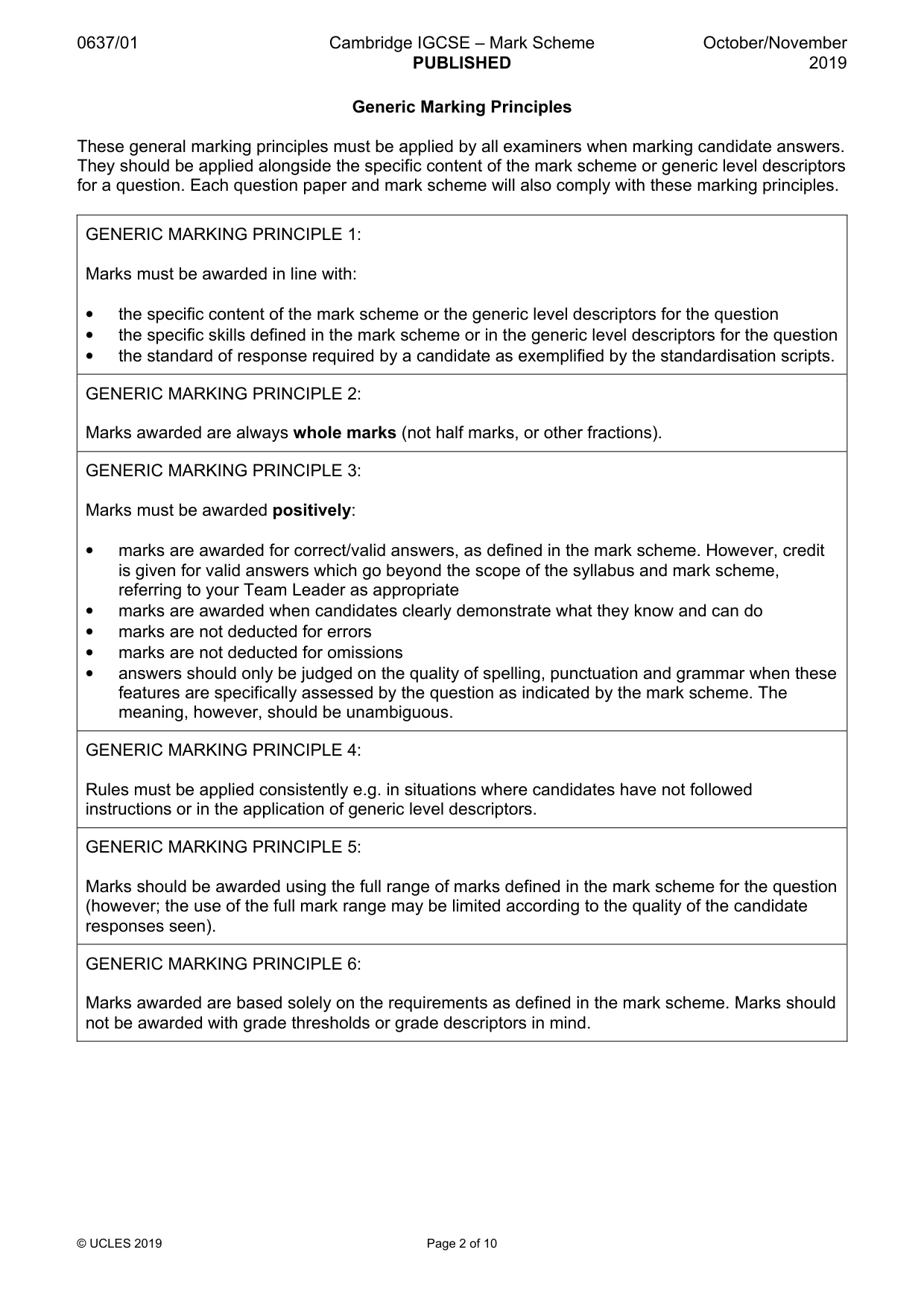
This document consists of 10 printed pages. © UCLES 2019 [Turn over Cambridge Assessment International Education Cambridge International General Certificate of Secondary Education CHILD DEVELOPMENT 0637/01 Paper 1 Theory Paper October/November 2019 MARK SCHEME Maximum Mark: 100 Published This mark scheme is published as an aid to teachers and candidates, to indicate the requirements of the examination. It shows the basis on which Examiners were instructed to award marks. It does not indicate the details of the discussions that took place at an Examiners’ meeting before marking began, which would have considered the acceptability of alternative answers. Mark schemes should be read in conjunction with the question paper and the Principal Examiner Report for Teachers. Cambridge International will not enter into discussions about these mark schemes. Cambridge International is publishing the mark schemes for the October/November 2019 series for most Cambridge IGCSE™, Cambridge International A and AS Level components and some Cambridge O Level components.
Mark scheme, page 2
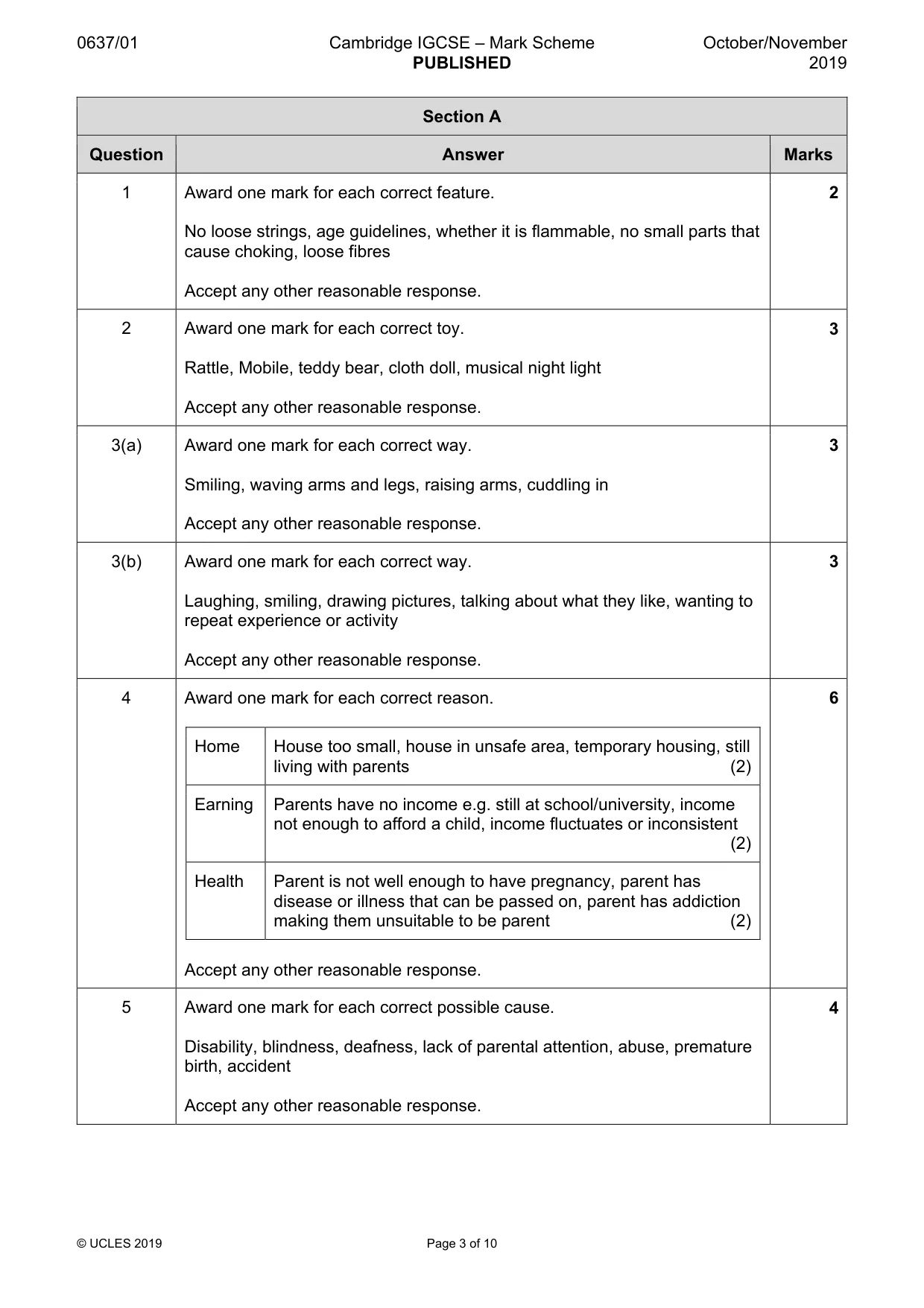
0637/01 Cambridge IGCSE – Mark Scheme PUBLISHED October/November 2019 © UCLES 2019 Page 2 of 10 Generic Marking Principles These general marking principles must be applied by all examiners when marking candidate answers. They should be applied alongside the specific content of the mark scheme or generic level descriptors for a question. Each question paper and mark scheme will also comply with these marking principles. GENERIC MARKING PRINCIPLE 1: Marks must be awarded in line with: • the specific content of the mark scheme or the generic level descriptors for the question • the specific skills defined in the mark scheme or in the generic level descriptors for the question • the standard of response required by a candidate as exemplified by the standardisation scripts. GENERIC MARKING PRINCIPLE 2: Marks awarded are always whole marks (not half marks, or other fractions). GENERIC MARKING PRINCIPLE 3: Marks must be awarded positively: • marks are awarded for correct/valid answers, as defined in the mark scheme. However, credit is given for valid answers which go beyond the scope of the syllabus and mark scheme, referring to your Team Leader as appropriate • marks are awarded when candidates clearly demonstrate what they know and can do • marks are not deducted for errors • marks are not deducted for omissions • answers should only be judged on the quality of spelling, punctuation and grammar when these features are specifically assessed by the question as indicated by the mark scheme. The meaning, however, should be unambiguous. GENERIC MARKING PRINCIPLE 4: Rules must be applied consistently e.g. in situations where candidates have not followed instructions or in the application of generic level descriptors. GENERIC MARKING PRINCIPLE 5: Marks should be awarded using the full range of marks defined in the mark scheme for the question (however; the use of the full mark range may be limited according to the quality of the candidate responses seen). GENERIC MARKING PRINCIPLE 6: Marks awarded are based solely on the requirements as defined in the mark scheme. Marks should not be awarded with grade thresholds or grade descriptors in mind.
Mark scheme, page 3
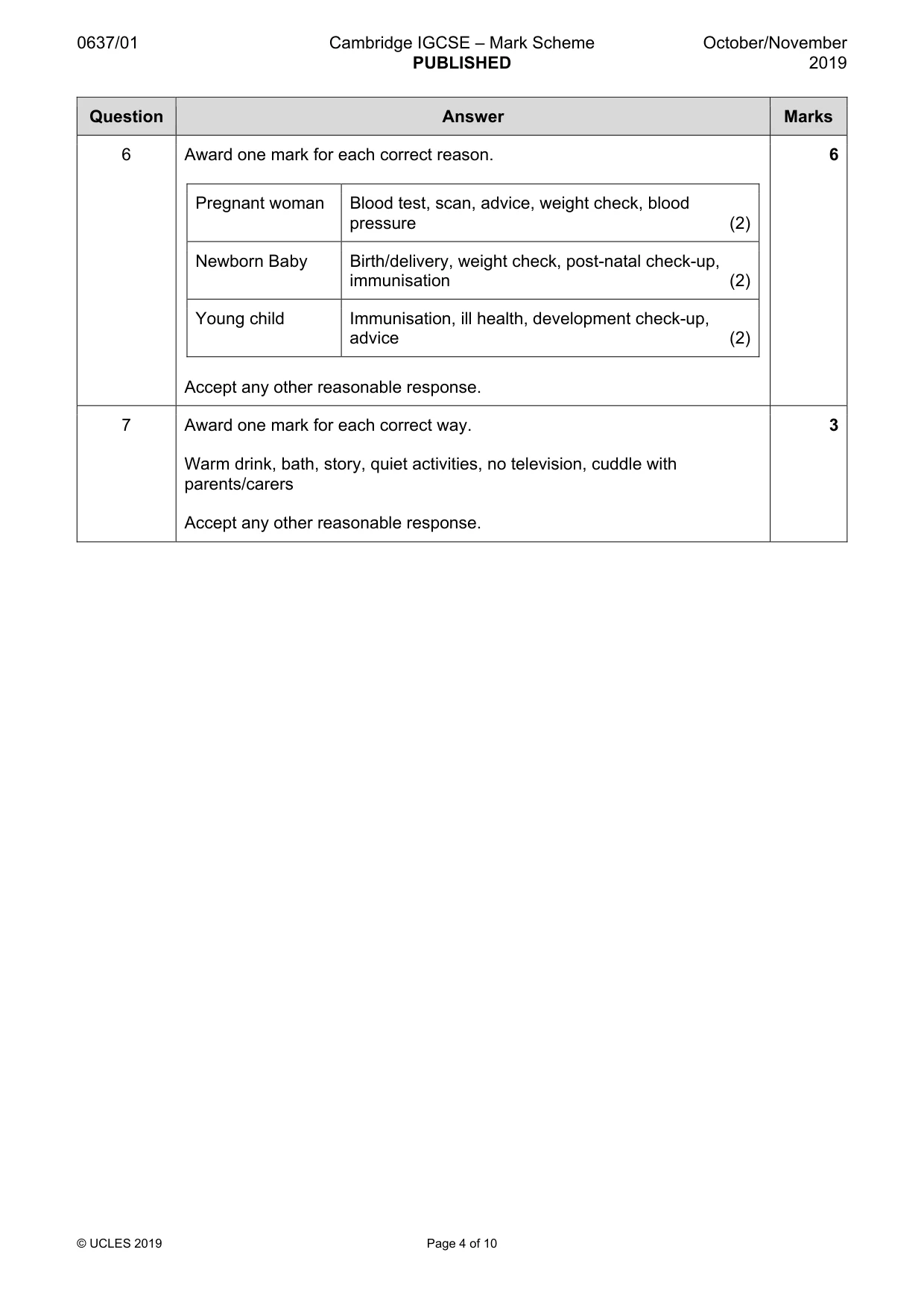
0637/01 Cambridge IGCSE – Mark Scheme PUBLISHED October/November 2019 © UCLES 2019 Page 3 of 10 Section A Question Answer Marks 1 Award one mark for each correct feature. No loose strings, age guidelines, whether it is flammable, no small parts that cause choking, loose fibres Accept any other reasonable response. 2 2 Award one mark for each correct toy. Rattle, Mobile, teddy bear, cloth doll, musical night light Accept any other reasonable response. 3 3(a) Award one mark for each correct way. Smiling, waving arms and legs, raising arms, cuddling in Accept any other reasonable response. 3 3(b) Award one mark for each correct way. Laughing, smiling, drawing pictures, talking about what they like, wanting to repeat experience or activity Accept any other reasonable response. 3 4 Award one mark for each correct reason. Home House too small, house in unsafe area, temporary housing, still living with parents (2) Earning Parents have no income e.g. still at school/university, income not enough to afford a child, income fluctuates or inconsistent (2) Health Parent is not well enough to have pregnancy, parent has disease or illness that can be passed on, parent has addiction making them unsuitable to be parent (2) Accept any other reasonable response. 6 5 Award one mark for each correct possible cause. Disability, blindness, deafness, lack of parental attention, abuse, premature birth, accident Accept any other reasonable response. 4
Mark scheme, page 4
0637/01 Cambridge IGCSE – Mark Scheme PUBLISHED October/November 2019 © UCLES 2019 Page 4 of 10 Question Answer Marks 6 Award one mark for each correct reason. Pregnant woman Blood test, scan, advice, weight check, blood pressure (2) Newborn Baby Birth/delivery, weight check, post-natal check-up, immunisation (2) Young child Immunisation, ill health, development check-up, advice (2) Accept any other reasonable response. 6 7 Award one mark for each correct way. Warm drink, bath, story, quiet activities, no television, cuddle with parents/carers Accept any other reasonable response. 3
Mark scheme, page 5
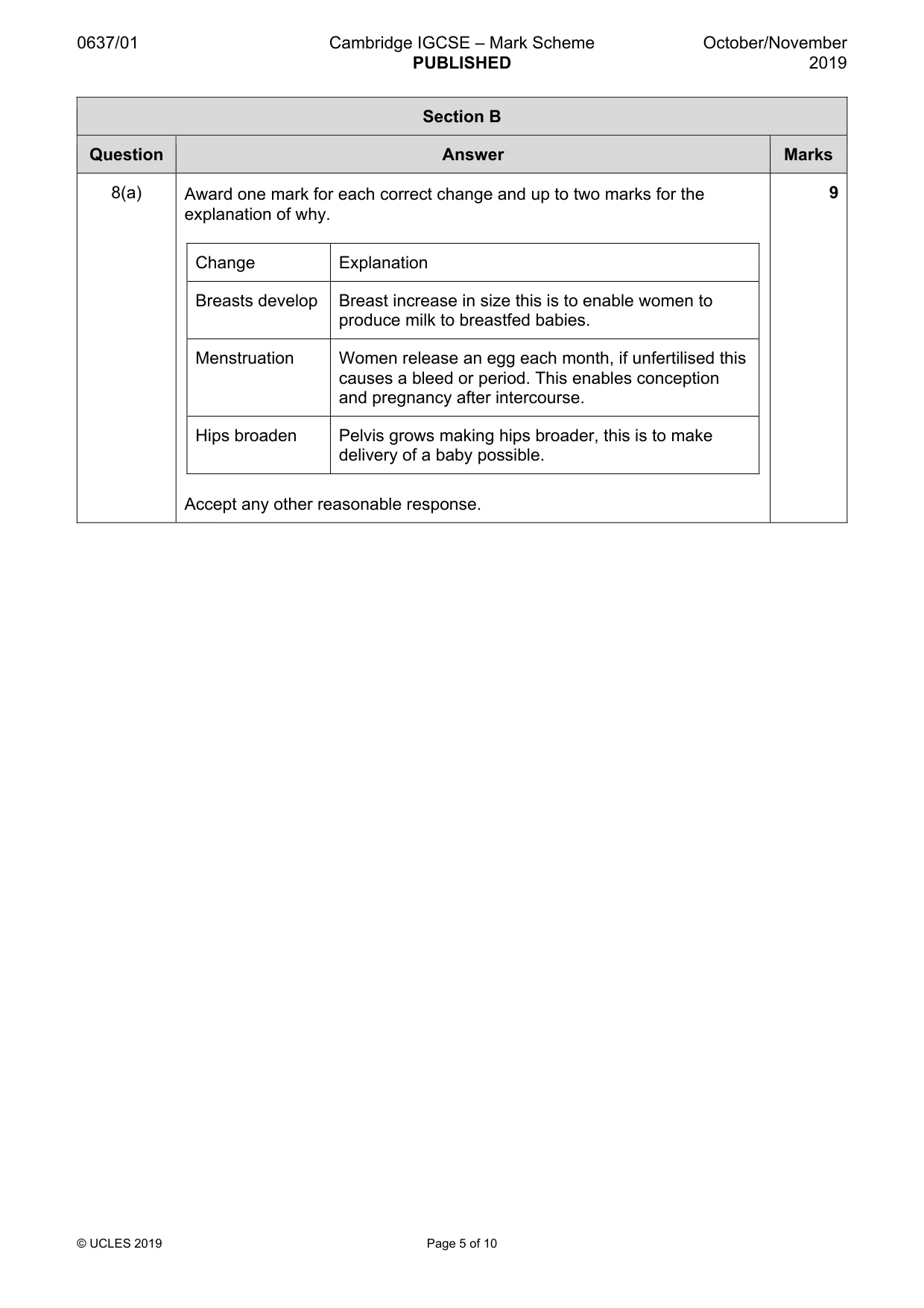
0637/01 Cambridge IGCSE – Mark Scheme PUBLISHED October/November 2019 © UCLES 2019 Page 5 of 10 Section B Question Answer Marks 8(a) Award one mark for each correct change and up to two marks for the explanation of why. Change Explanation Breasts develop Breast increase in size this is to enable women to produce milk to breastfed babies. Menstruation Women release an egg each month, if unfertilised this causes a bleed or period. This enables conception and pregnancy after intercourse. Hips broaden Pelvis grows making hips broader, this is to make delivery of a baby possible. Accept any other reasonable response. 9
Mark scheme, page 6
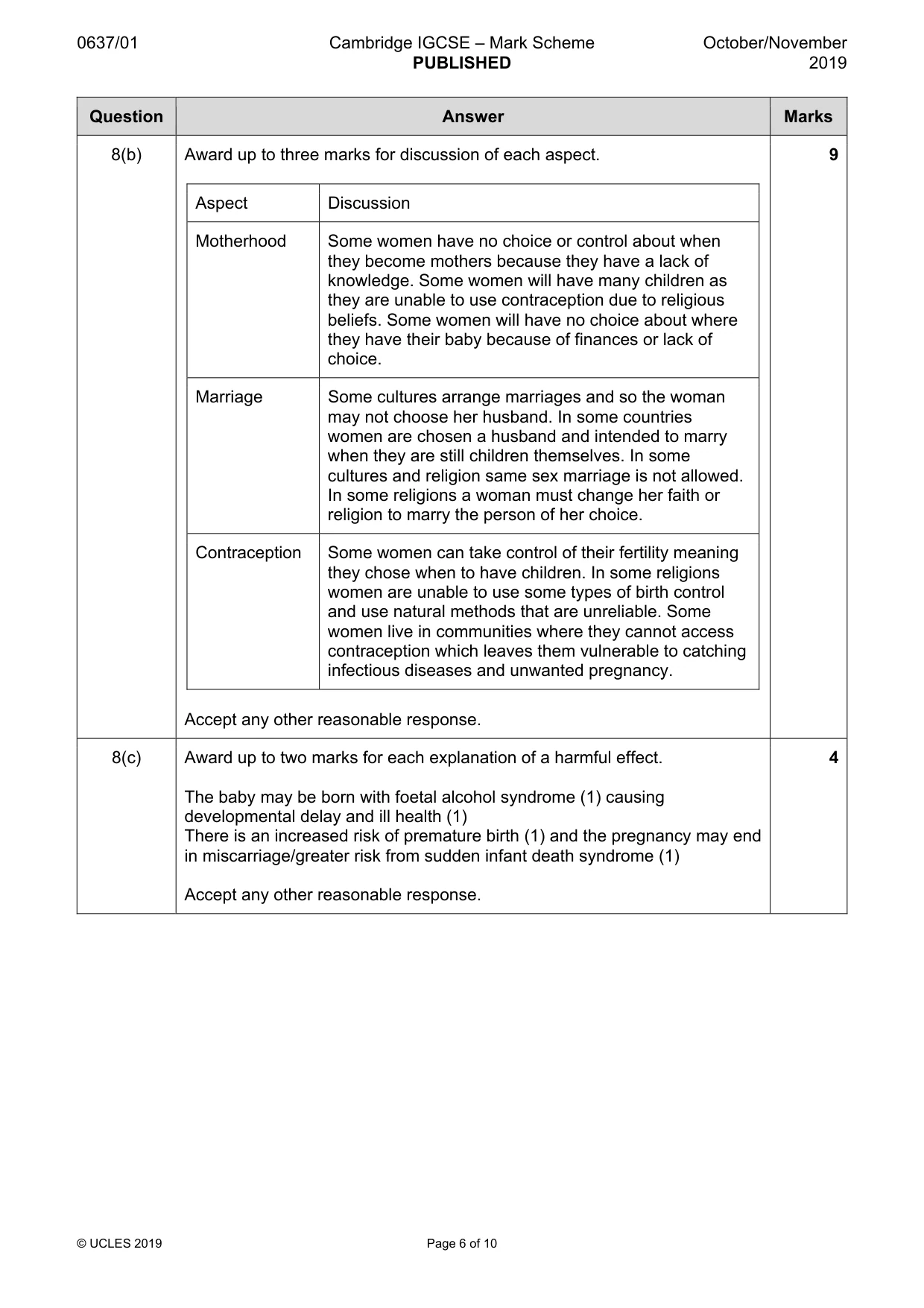
0637/01 Cambridge IGCSE – Mark Scheme PUBLISHED October/November 2019 © UCLES 2019 Page 6 of 10 Question Answer Marks 8(b) Award up to three marks for discussion of each aspect. Aspect Discussion Motherhood Some women have no choice or control about when they become mothers because they have a lack of knowledge. Some women will have many children as they are unable to use contraception due to religious beliefs. Some women will have no choice about where they have their baby because of finances or lack of choice. Marriage Some cultures arrange marriages and so the woman may not choose her husband. In some countries women are chosen a husband and intended to marry when they are still children themselves. In some cultures and religion same sex marriage is not allowed. In some religions a woman must change her faith or religion to marry the person of her choice. Contraception Some women can take control of their fertility meaning they chose when to have children. In some religions women are unable to use some types of birth control and use natural methods that are unreliable. Some women live in communities where they cannot access contraception which leaves them vulnerable to catching infectious diseases and unwanted pregnancy. Accept any other reasonable response. 9 8(c) Award up to two marks for each explanation of a harmful effect. The baby may be born with foetal alcohol syndrome (1) causing developmental delay and ill health (1) There is an increased risk of premature birth (1) and the pregnancy may end in miscarriage/greater risk from sudden infant death syndrome (1) Accept any other reasonable response. 4
Mark scheme, page 7
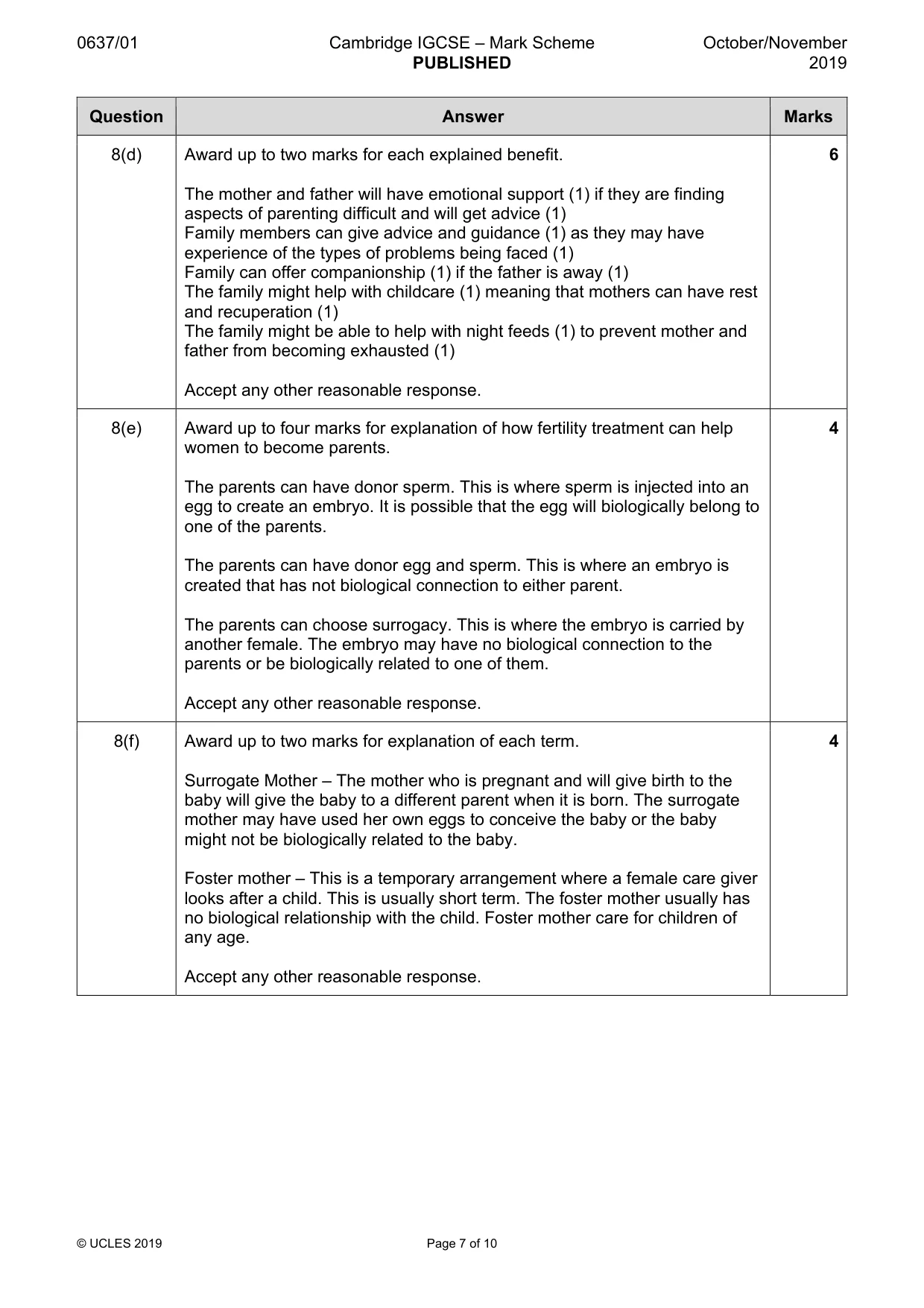
0637/01 Cambridge IGCSE – Mark Scheme PUBLISHED October/November 2019 © UCLES 2019 Page 7 of 10 Question Answer Marks 8(d) Award up to two marks for each explained benefit. The mother and father will have emotional support (1) if they are finding aspects of parenting difficult and will get advice (1) Family members can give advice and guidance (1) as they may have experience of the types of problems being faced (1) Family can offer companionship (1) if the father is away (1) The family might help with childcare (1) meaning that mothers can have rest and recuperation (1) The family might be able to help with night feeds (1) to prevent mother and father from becoming exhausted (1) Accept any other reasonable response. 6 8(e) Award up to four marks for explanation of how fertility treatment can help women to become parents. The parents can have donor sperm. This is where sperm is injected into an egg to create an embryo. It is possible that the egg will biologically belong to one of the parents. The parents can have donor egg and sperm. This is where an embryo is created that has not biological connection to either parent. The parents can choose surrogacy. This is where the embryo is carried by another female. The embryo may have no biological connection to the parents or be biologically related to one of them. Accept any other reasonable response. 4 8(f) Award up to two marks for explanation of each term. Surrogate Mother – The mother who is pregnant and will give birth to the baby will give the baby to a different parent when it is born. The surrogate mother may have used her own eggs to conceive the baby or the baby might not be biologically related to the baby. Foster mother – This is a temporary arrangement where a female care giver looks after a child. This is usually short term. The foster mother usually has no biological relationship with the child. Foster mother care for children of any age. Accept any other reasonable response. 4
Mark scheme, page 8
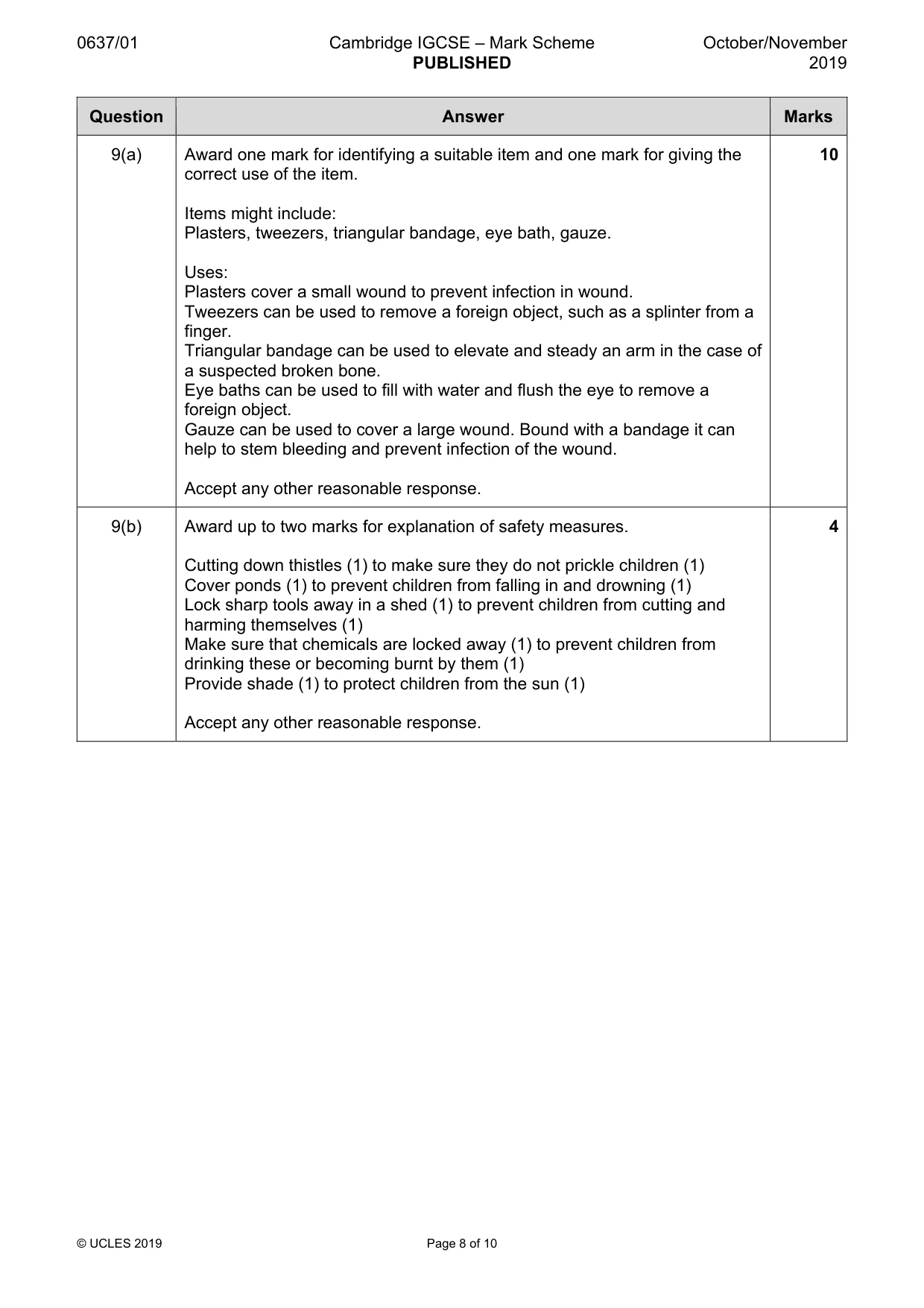
0637/01 Cambridge IGCSE – Mark Scheme PUBLISHED October/November 2019 © UCLES 2019 Page 8 of 10 Question Answer Marks 9(a) Award one mark for identifying a suitable item and one mark for giving the correct use of the item. Items might include: Plasters, tweezers, triangular bandage, eye bath, gauze. Uses: Plasters cover a small wound to prevent infection in wound. Tweezers can be used to remove a foreign object, such as a splinter from a finger. Triangular bandage can be used to elevate and steady an arm in the case of a suspected broken bone. Eye baths can be used to fill with water and flush the eye to remove a foreign object. Gauze can be used to cover a large wound. Bound with a bandage it can help to stem bleeding and prevent infection of the wound. Accept any other reasonable response. 10 9(b) Award up to two marks for explanation of safety measures. Cutting down thistles (1) to make sure they do not prickle children (1) Cover ponds (1) to prevent children from falling in and drowning (1) Lock sharp tools away in a shed (1) to prevent children from cutting and harming themselves (1) Make sure that chemicals are locked away (1) to prevent children from drinking these or becoming burnt by them (1) Provide shade (1) to protect children from the sun (1) Accept any other reasonable response. 4
Mark scheme, page 9
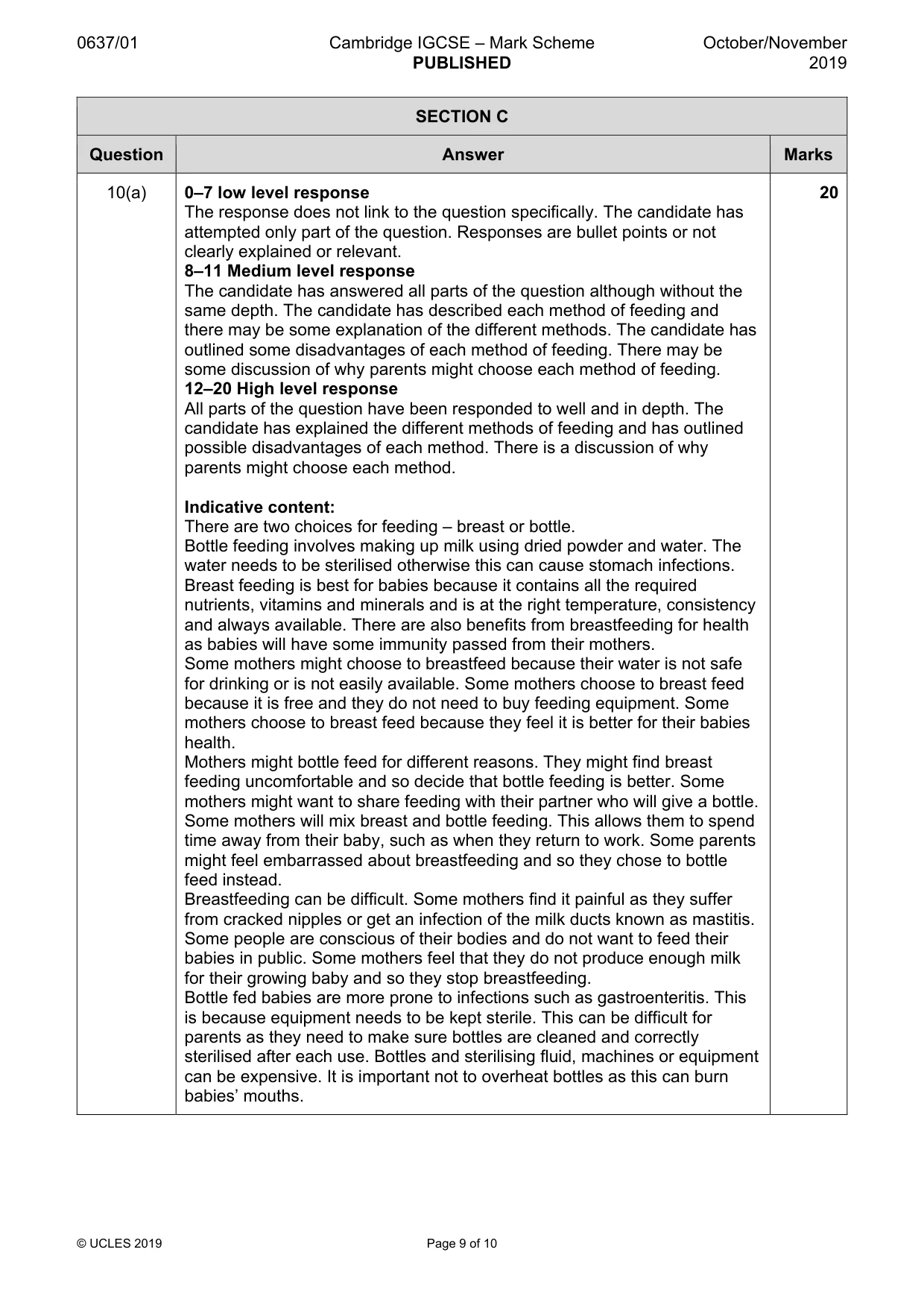
0637/01 Cambridge IGCSE – Mark Scheme PUBLISHED October/November 2019 © UCLES 2019 Page 9 of 10 SECTION C Question Answer Marks 10(a) 0–7 low level response The response does not link to the question specifically. The candidate has attempted only part of the question. Responses are bullet points or not clearly explained or relevant. 8–11 Medium level response The candidate has answered all parts of the question although without the same depth. The candidate has described each method of feeding and there may be some explanation of the different methods. The candidate has outlined some disadvantages of each method of feeding. There may be some discussion of why parents might choose each method of feeding. 12–20 High level response All parts of the question have been responded to well and in depth. The candidate has explained the different methods of feeding and has outlined possible disadvantages of each method. There is a discussion of why parents might choose each method. Indicative content: There are two choices for feeding – breast or bottle. Bottle feeding involves making up milk using dried powder and water. The water needs to be sterilised otherwise this can cause stomach infections. Breast feeding is best for babies because it contains all the required nutrients, vitamins and minerals and is at the right temperature, consistency and always available. There are also benefits from breastfeeding for health as babies will have some immunity passed from their mothers. Some mothers might choose to breastfeed because their water is not safe for drinking or is not easily available. Some mothers choose to breast feed because it is free and they do not need to buy feeding equipment. Some mothers choose to breast feed because they feel it is better for their babies health. Mothers might bottle feed for different reasons. They might find breast feeding uncomfortable and so decide that bottle feeding is better. Some mothers might want to share feeding with their partner who will give a bottle. Some mothers will mix breast and bottle feeding. This allows them to spend time away from their baby, such as when they return to work. Some parents might feel embarrassed about breastfeeding and so they chose to bottle feed instead. Breastfeeding can be difficult. Some mothers find it painful as they suffer from cracked nipples or get an infection of the milk ducts known as mastitis. Some people are conscious of their bodies and do not want to feed their babies in public. Some mothers feel that they do not produce enough milk for their growing baby and so they stop breastfeeding. Bottle fed babies are more prone to infections such as gastroenteritis. This is because equipment needs to be kept sterile. This can be difficult for parents as they need to make sure bottles are cleaned and correctly sterilised after each use. Bottles and sterilising fluid, machines or equipment can be expensive. It is important not to overheat bottles as this can burn babies’ mouths. 20
Mark scheme, page 10
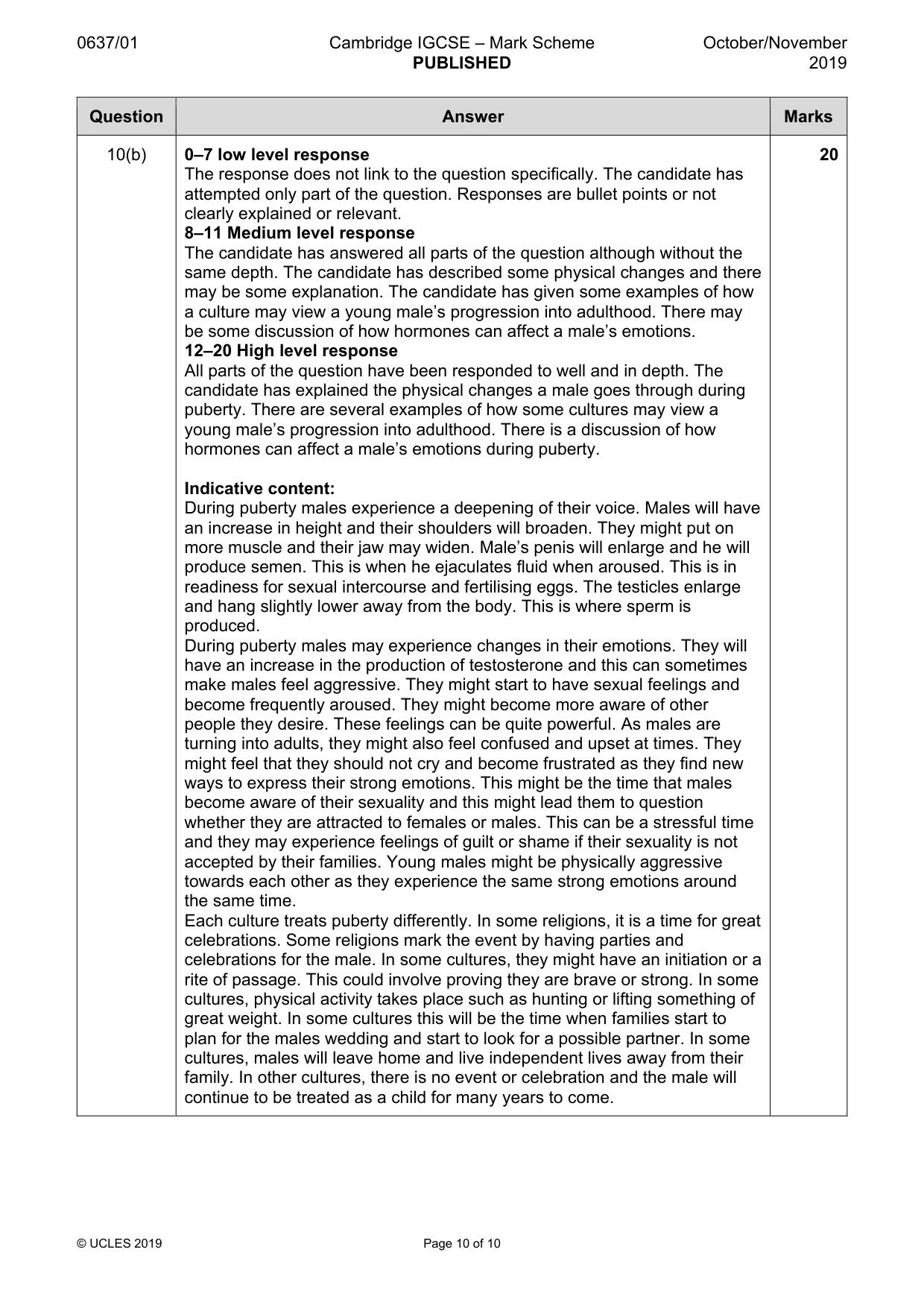
0637/01 Cambridge IGCSE – Mark Scheme PUBLISHED October/November 2019 © UCLES 2019 Page 10 of 10 Question Answer Marks 10(b) 0–7 low level response The response does not link to the question specifically. The candidate has attempted only part of the question. Responses are bullet points or not clearly explained or relevant. 8–11 Medium level response The candidate has answered all parts of the question although without the same depth. The candidate has described some physical changes and there may be some explanation. The candidate has given some examples of how a culture may view a young male’s progression into adulthood. There may be some discussion of how hormones can affect a male’s emotions. 12–20 High level response All parts of the question have been responded to well and in depth. The candidate has explained the physical changes a male goes through during puberty. There are several examples of how some cultures may view a young male’s progression into adulthood. There is a discussion of how hormones can affect a male’s emotions during puberty. Indicative content: During puberty males experience a deepening of their voice. Males will have an increase in height and their shoulders will broaden. They might put on more muscle and their jaw may widen. Male’s penis will enlarge and he will produce semen. This is when he ejaculates fluid when aroused. This is in readiness for sexual intercourse and fertilising eggs. The testicles enlarge and hang slightly lower away from the body. This is where sperm is produced. During puberty males may experience changes in their emotions. They will have an increase in the production of testosterone and this can sometimes make males feel aggressive. They might start to have sexual feelings and become frequently aroused. They might become more aware of other people they desire. These feelings can be quite powerful. As males are turning into adults, they might also feel confused and upset at times. They might feel that they should not cry and become frustrated as they find new ways to express their strong emotions. This might be the time that males become aware of their sexuality and this might lead them to question whether they are attracted to females or males. This can be a stressful time and they may experience feelings of guilt or shame if their sexuality is not accepted by their families. Young males might be physically aggressive towards each other as they experience the same strong emotions around the same time. Each culture treats puberty differently. In some religions, it is a time for great celebrations. Some religions mark the event by having parties and celebrations for the male. In some cultures, they might have an initiation or a rite of passage. This could involve proving they are brave or strong. In some cultures, physical activity takes place such as hunting or lifting something of great weight. In some cultures this will be the time when families start to plan for the males wedding and start to look for a possible partner. In some cultures, males will leave home and live independent lives away from their family. In other cultures, there is no event or celebration and the male will continue to be treated as a child for many years to come. 20
What you needed in this session
Cambridge’s own grade thresholds for 2019 Oct/Nov, Paper 1 · Variant 1. A higher threshold means an easier paper — the bar moves with how the cohort did.