Cambridge IGCSE Child Development 0637 — 2016 Oct/Nov Paper 1 · Variant 1
0637/11/O/N/16 · 100 marks · ≈113 min
The question paper and its mark scheme, free to read here and free to download. This is Cambridge’s own paper, exactly as it was sat.
Question paper16 pages




Mark scheme8 pages
Answers below. Sit the paper first if you are practising.
Paper as text
Question paper, page 1
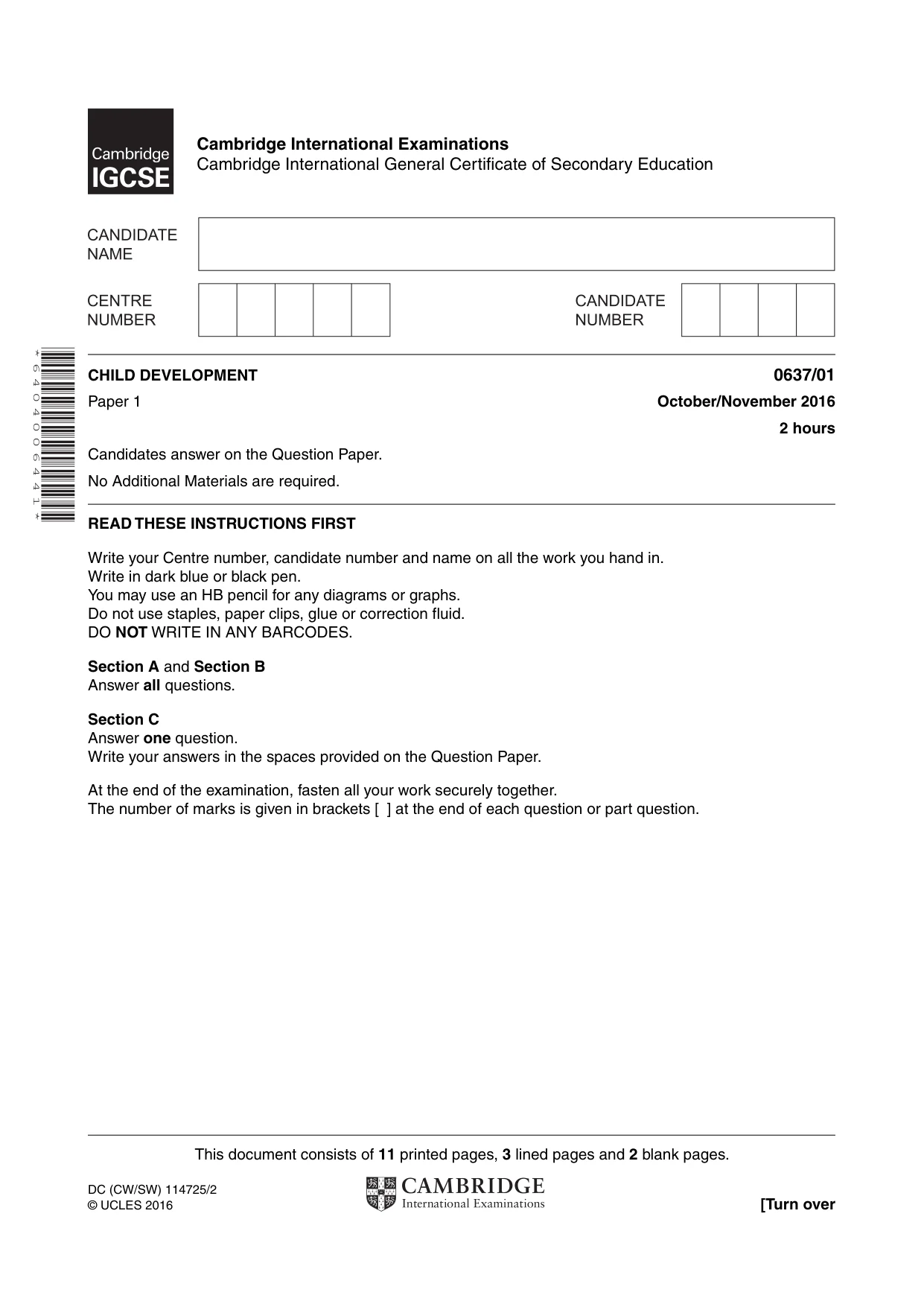
This document consists of 11 printed pages, 3 lined pages and 2 blank pages. DC (CW/SW) 114725/2 © UCLES 2016 [Turn over Cambridge International Examinations Cambridge International General Certificate of Secondary Education * 6 4 0 4 0 0 6 4 4 1 * CHILD DEVELOPMENT 0637/01 Paper 1 October/November 2016 2 hours Candidates answer on the Question Paper. No Additional Materials are required. READ THESE INSTRUCTIONS FIRST Write your Centre number, candidate number and name on all the work you hand in. Write in dark blue or black pen. You may use an HB pencil for any diagrams or graphs. Do not use staples, paper clips, glue or correction fluid. DO NOT WRITE IN ANY BARCODES. Section A and Section B Answer all questions. Section C Answer one question. Write your answers in the spaces provided on the Question Paper. At the end of the examination, fasten all your work securely together. The number of marks is given in brackets [ ] at the end of each question or part question.
Question paper, page 2
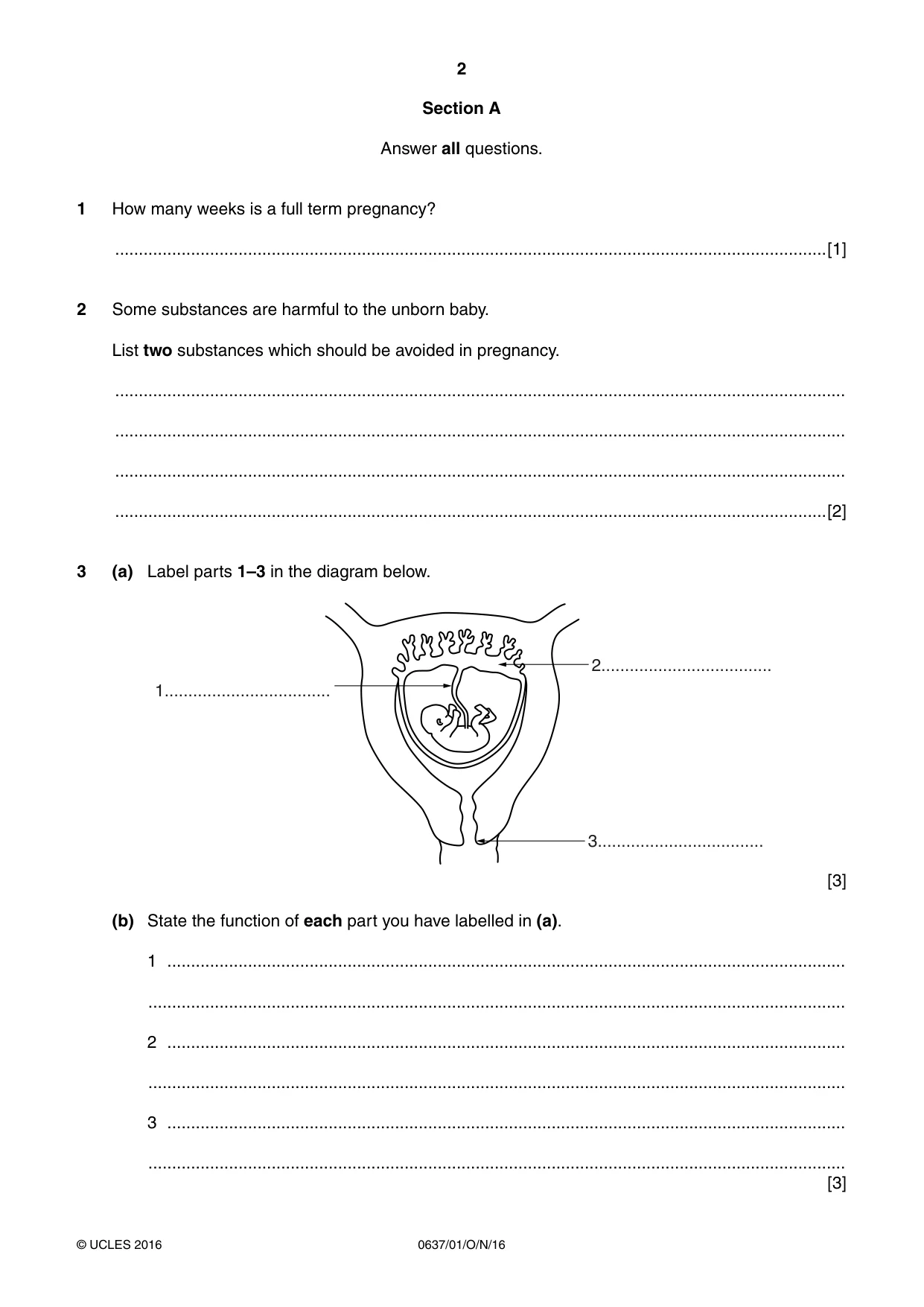
2 0637/01/O/N/16 © UCLES 2016 Section A Answer all questions. 1 How many weeks is a full term pregnancy? …[1] 2 Some substances are harmful to the unborn baby. List two substances which should be avoided in pregnancy. … … … …[2] 3 (a) Label parts 1–3 in the diagram below. 2… 1… 3… [3] (b) State the function of each part you have labelled in (a). 1 … … 2 … … 3 … … [3]
Question paper, page 3
3 0637/01/O/N/16 © UCLES 2016 [Turn over 4 (a) Give four possible pieces of equipment parents might choose to buy in preparation for the arrival of their baby and state its purpose. Item … Purpose … … Item … Purpose … … Item … Purpose … … Item … Purpose … … [8]
Question paper, page 4
4 0637/01/O/N/16 © UCLES 2016 (b) Describe five suitable clothing items for babies and young children in hot weather. Give reasons for your choices. Clothing … Reason … … Clothing … Reason … … Clothing … Reason … … Clothing … Reason … … Clothing … Reason … … [10]
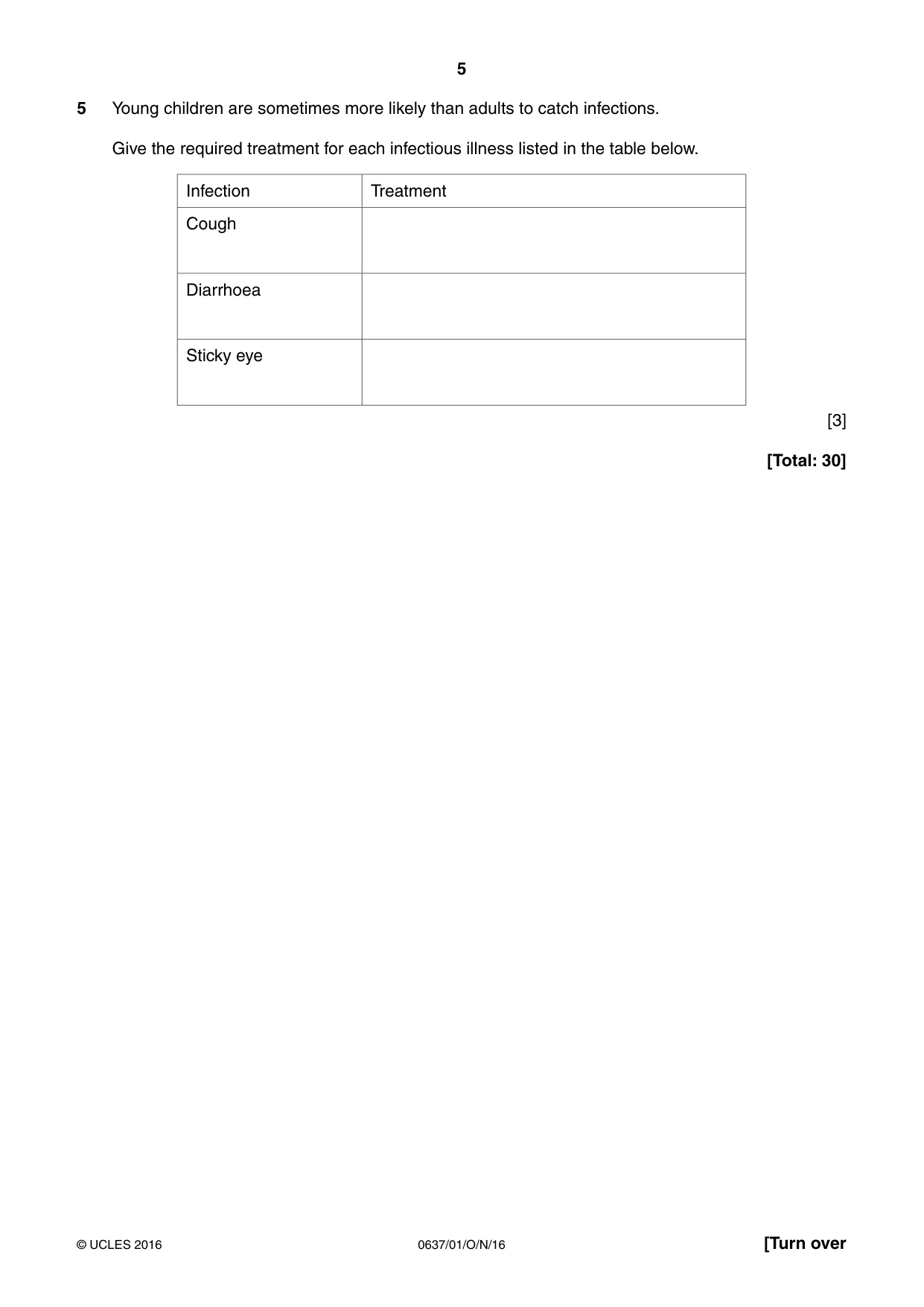
Question paper, page 5
5 0637/01/O/N/16 © UCLES 2016 [Turn over 5 Young children are sometimes more likely than adults to catch infections. Give the required treatment for each infectious illness listed in the table below. Infection Treatment Cough Diarrhoea Sticky eye [3] [Total: 30]
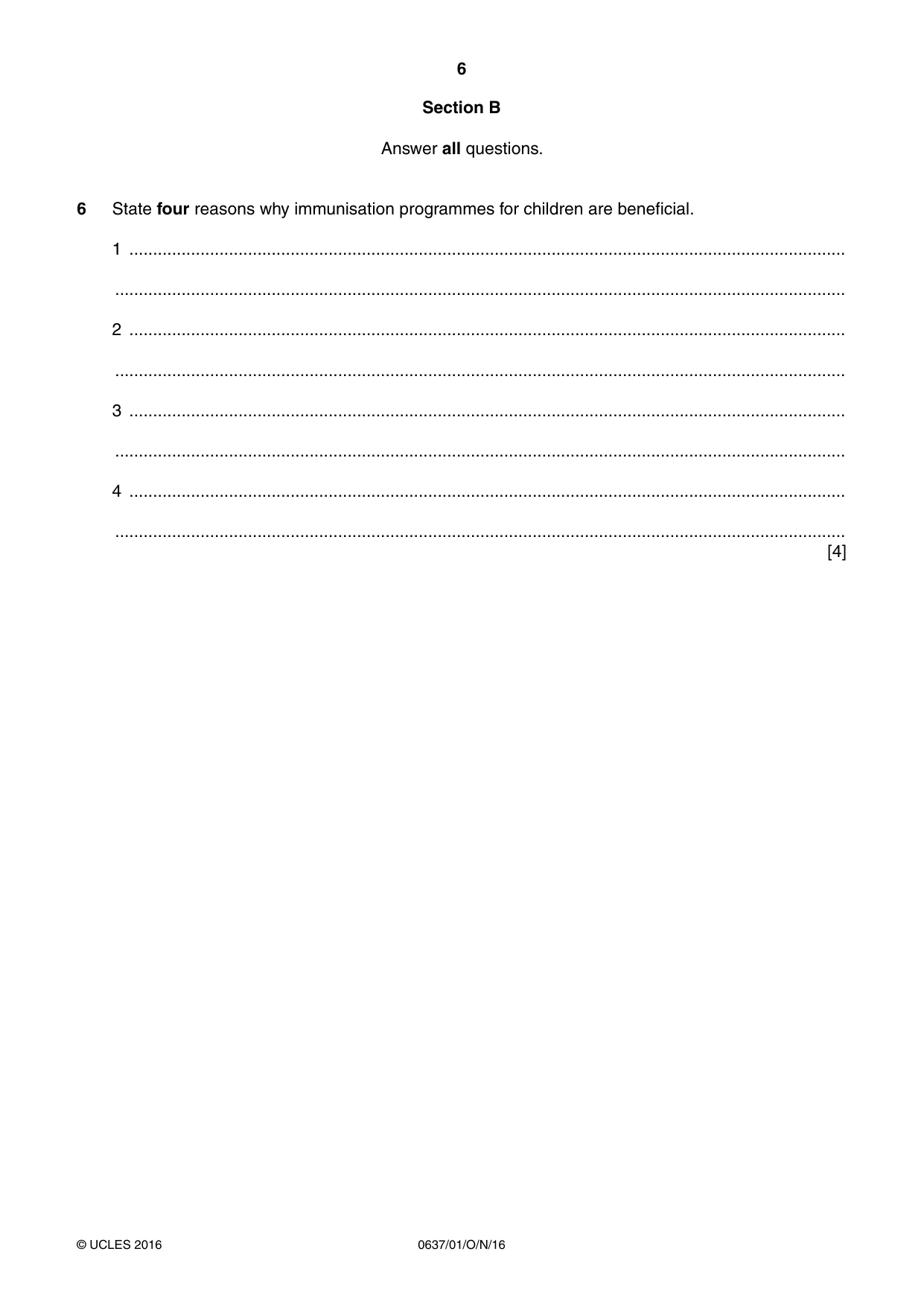
Question paper, page 6
6 0637/01/O/N/16 © UCLES 2016 Section B Answer all questions. 6 State four reasons why immunisation programmes for children are beneficial. 1 … … 2 … … 3 … … 4 … … [4]
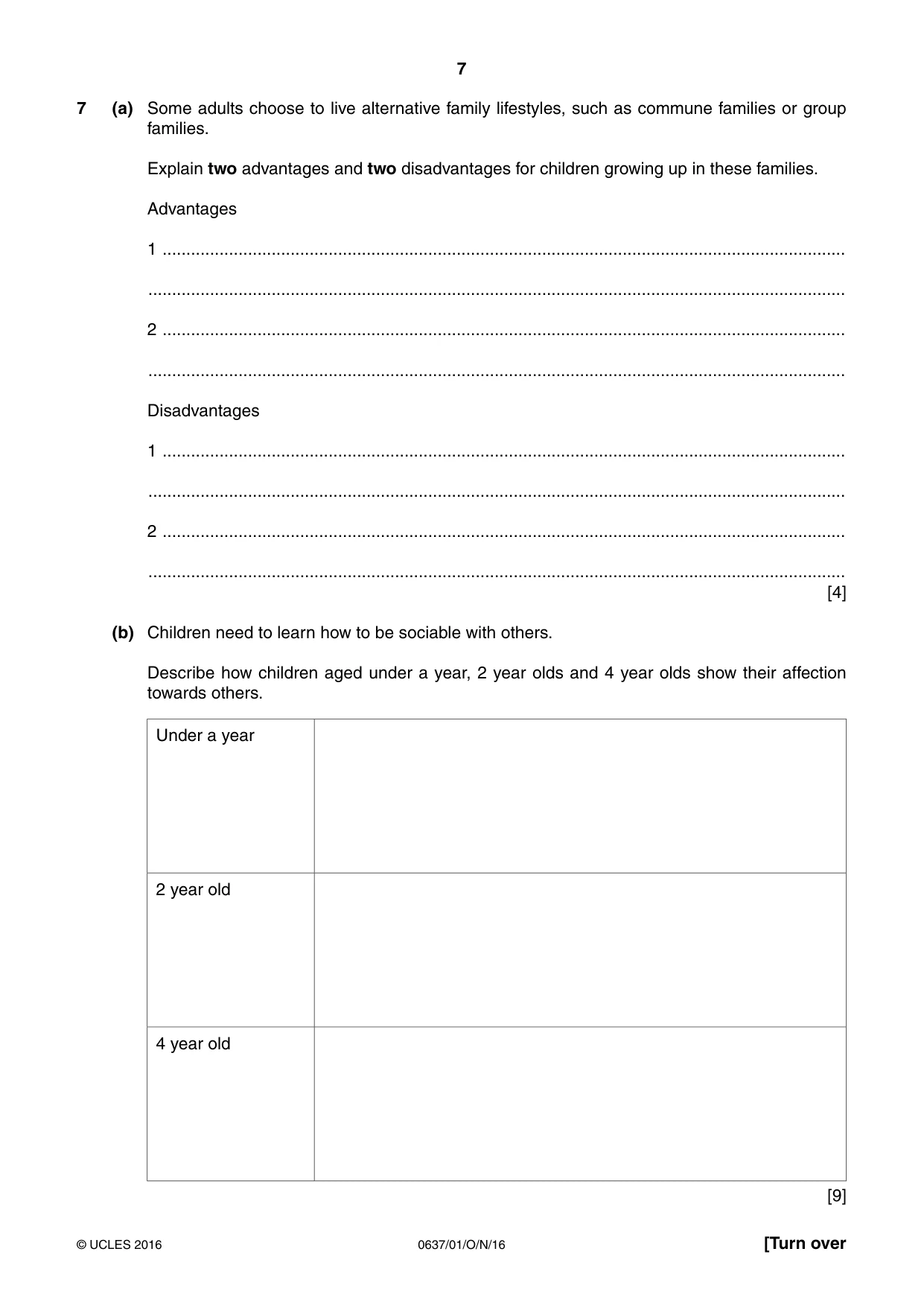
Question paper, page 7
7 0637/01/O/N/16 © UCLES 2016 [Turn over 7 (a) Some adults choose to live alternative family lifestyles, such as commune families or group families. Explain two advantages and two disadvantages for children growing up in these families. Advantages 1 … … 2 … … Disadvantages 1 … … 2 … … [4] (b) Children need to learn how to be sociable with others. Describe how children aged under a year, 2 year olds and 4 year olds show their affection towards others. Under a year 2 year old 4 year old [9]
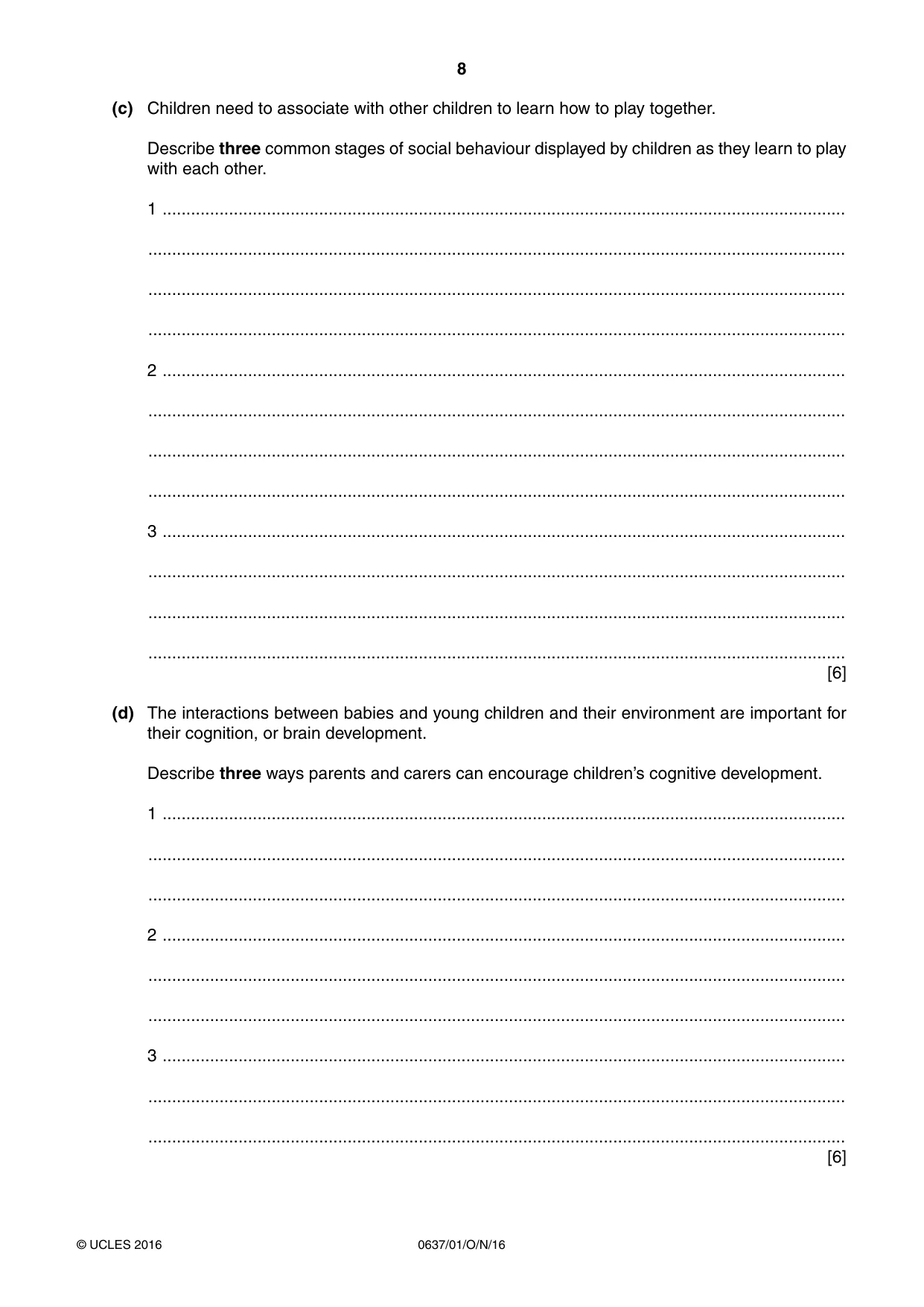
Question paper, page 8
8 0637/01/O/N/16 © UCLES 2016 (c) Children need to associate with other children to learn how to play together. Describe three common stages of social behaviour displayed by children as they learn to play with each other. 1 … … … … 2 … … … … 3 … … … … [6] (d) The interactions between babies and young children and their environment are important for their cognition, or brain development. Describe three ways parents and carers can encourage children’s cognitive development. 1 … … … 2 … … … 3 … … … [6]
Question paper, page 9
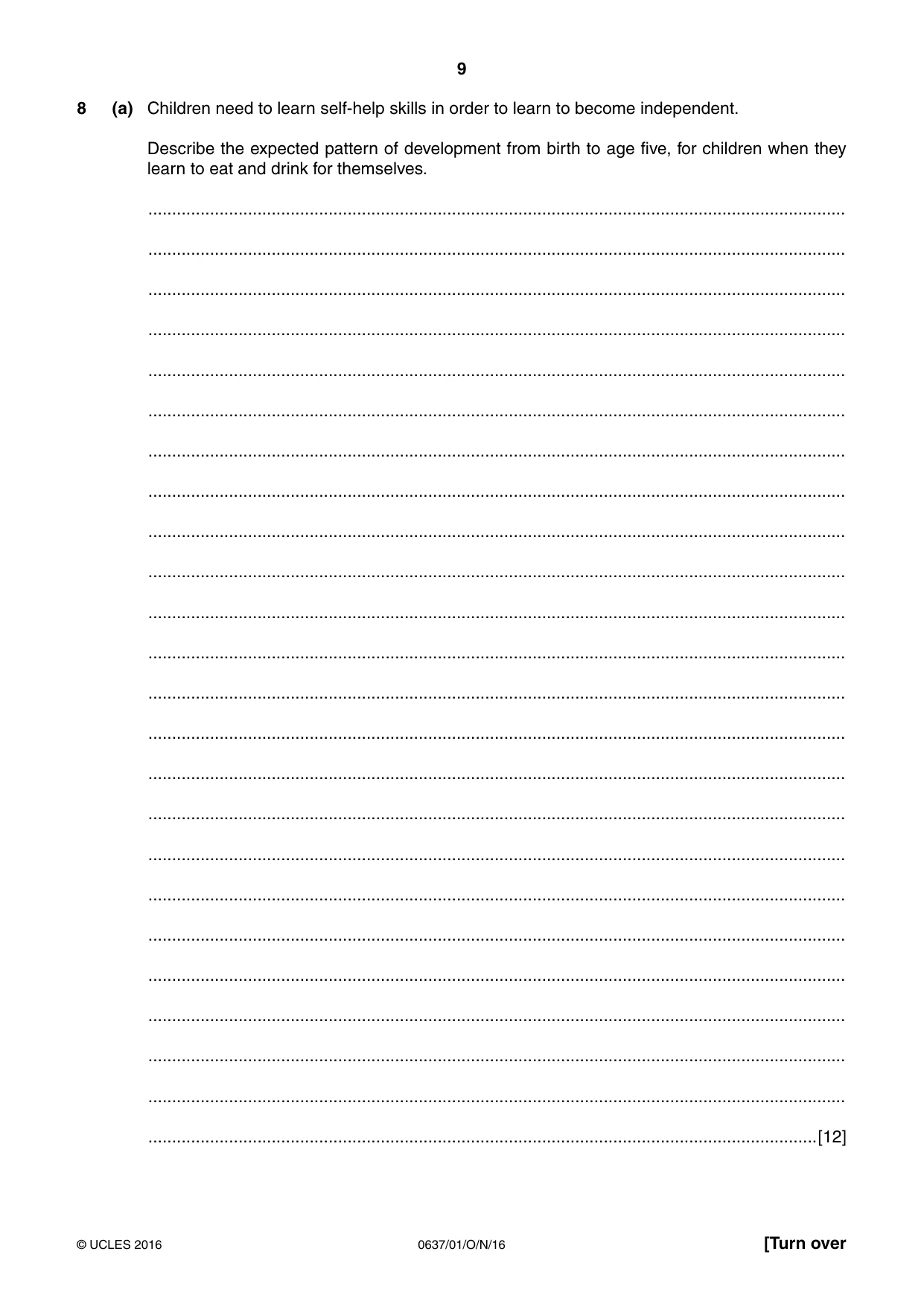
9 0637/01/O/N/16 © UCLES 2016 [Turn over 8 (a) Children need to learn self-help skills in order to learn to become independent. Describe the expected pattern of development from birth to age five, for children when they learn to eat and drink for themselves. … … … … … … … … … … … … … … … … … … … … … … … …[12]
Question paper, page 10
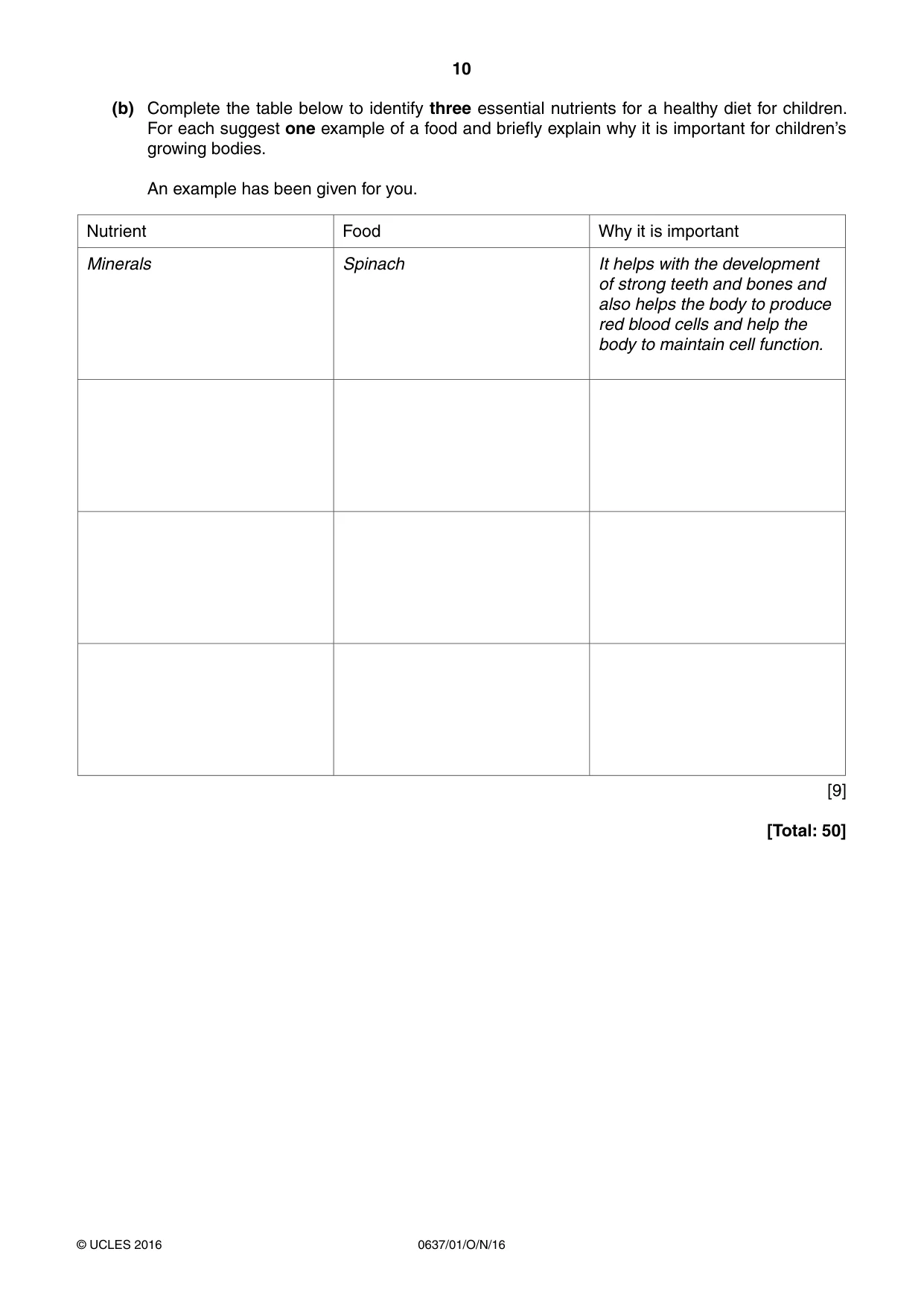
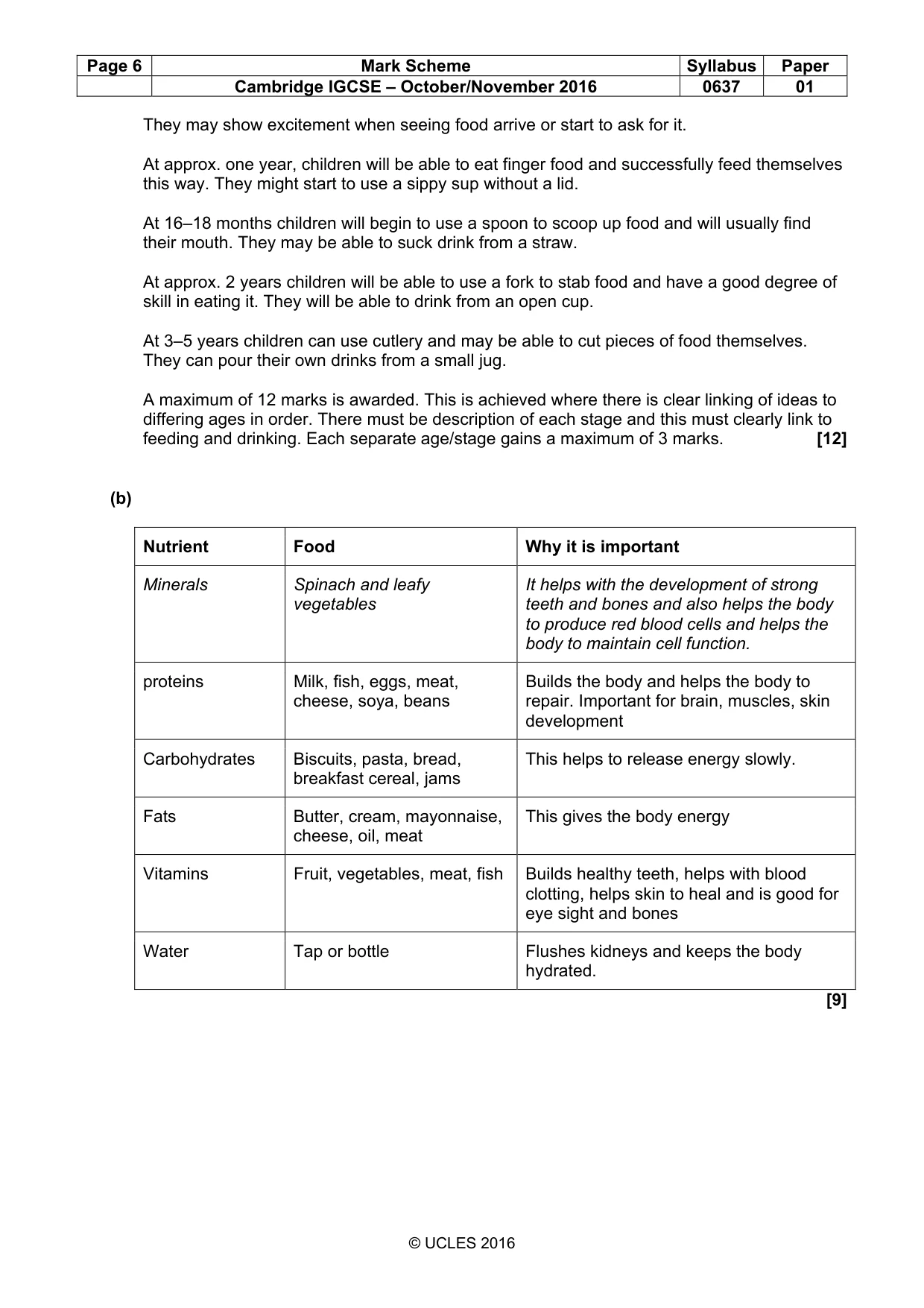
10 0637/01/O/N/16 © UCLES 2016 (b) Complete the table below to identify three essential nutrients for a healthy diet for children. For each suggest one example of a food and briefly explain why it is important for children’s growing bodies. An example has been given for you. Nutrient Food Why it is important Minerals Spinach It helps with the development of strong teeth and bones and also helps the body to produce red blood cells and help the body to maintain cell function. [9] [Total: 50]
Question paper, page 11
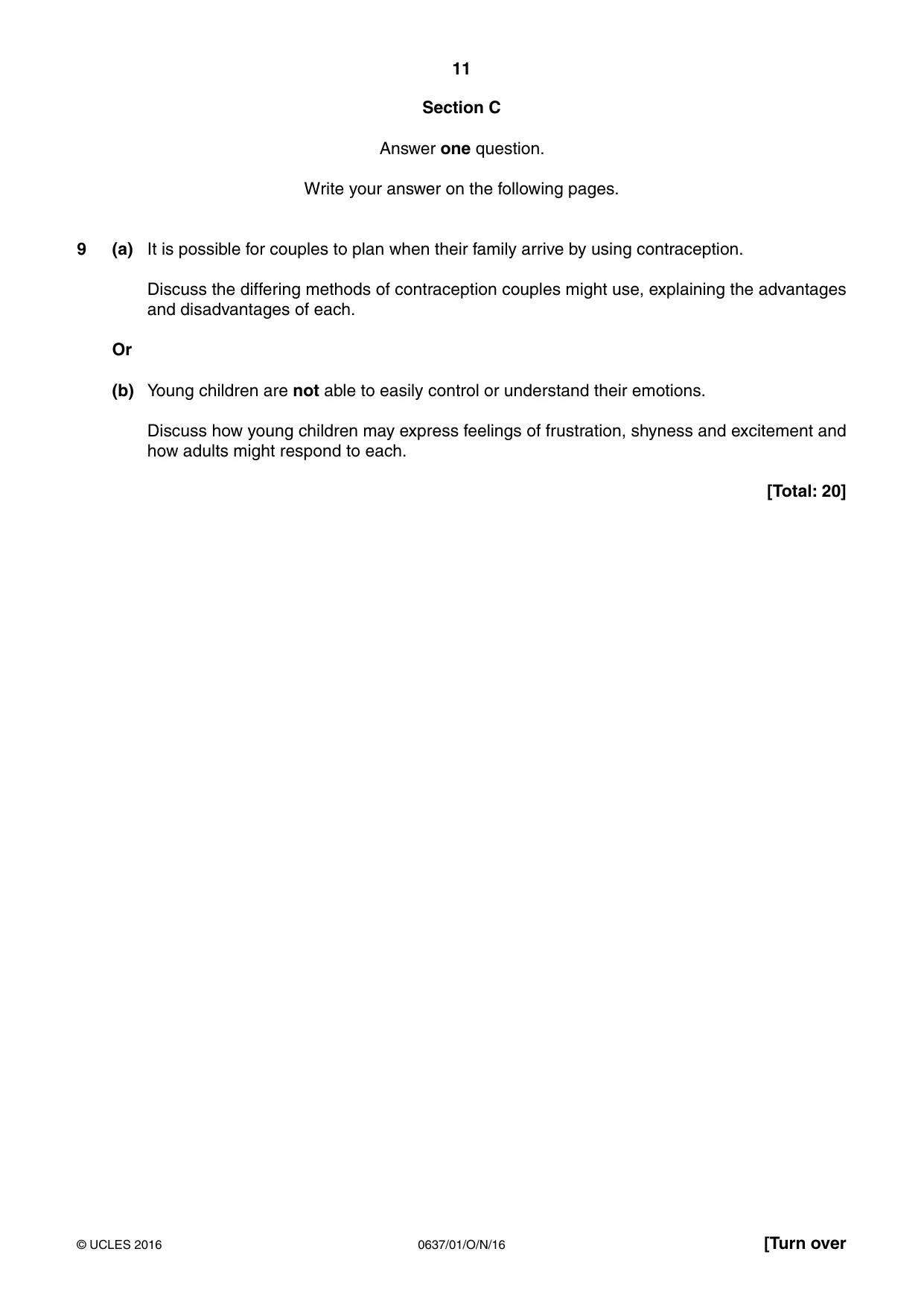
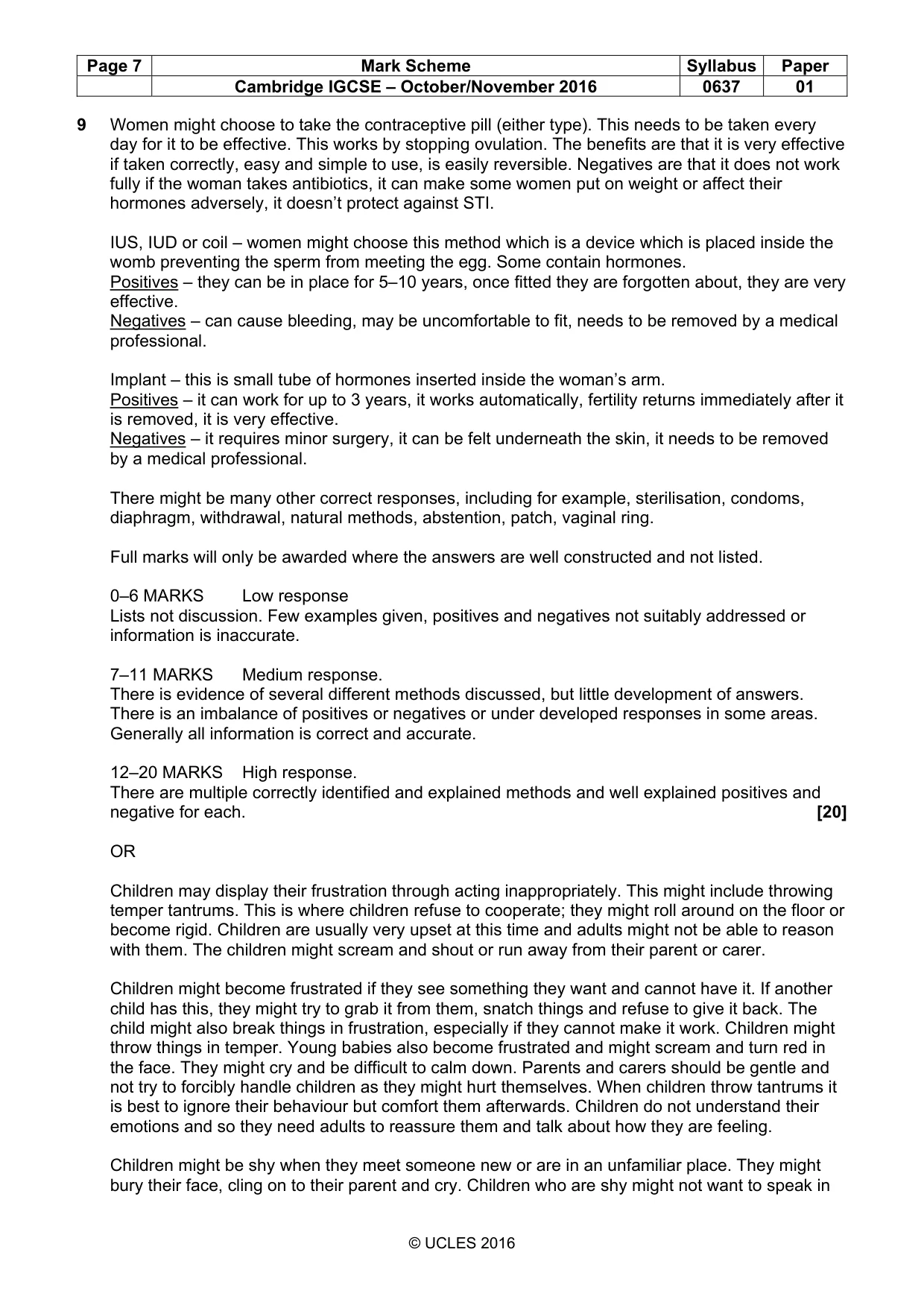
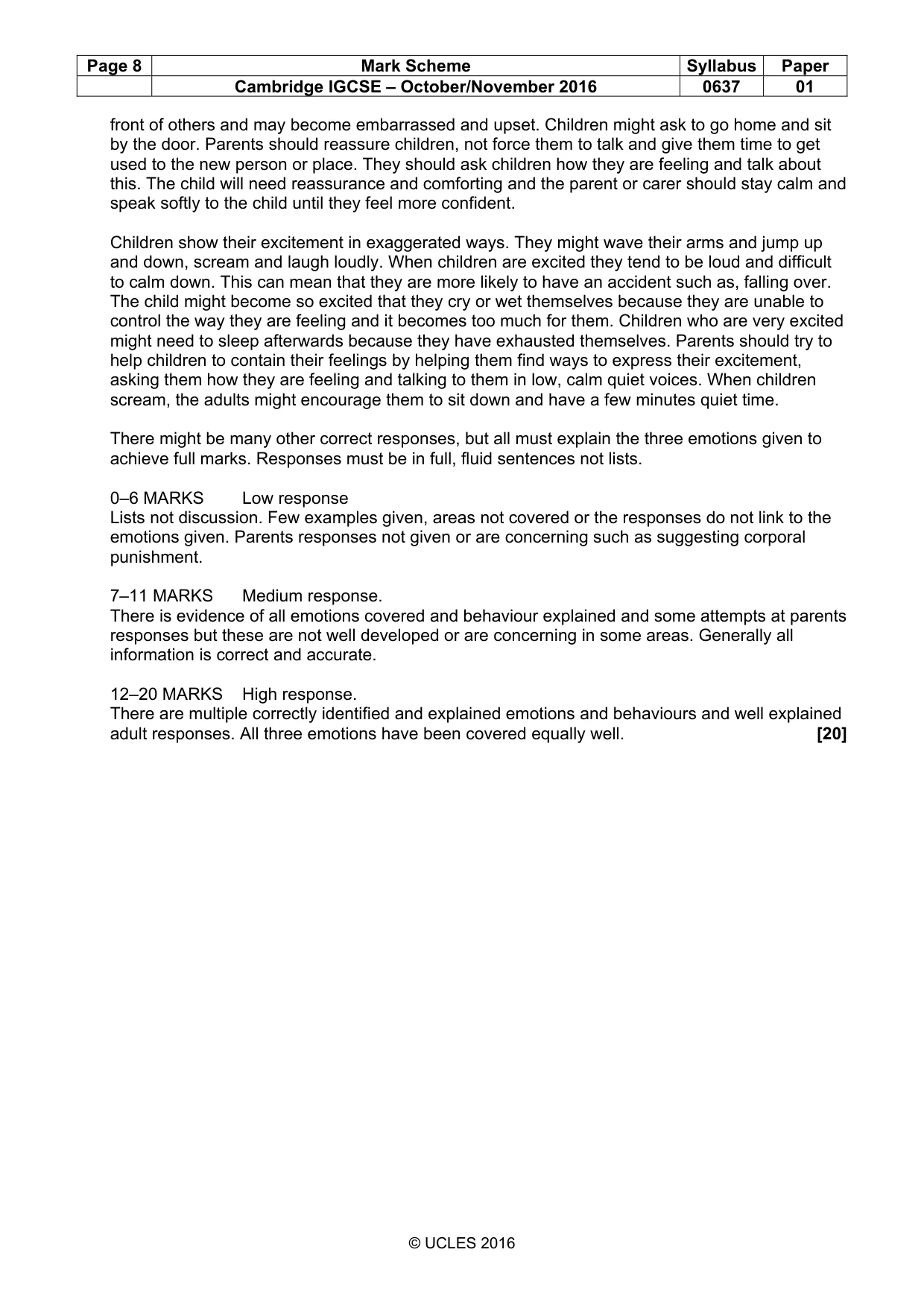
11 0637/01/O/N/16 © UCLES 2016 [Turn over Section C Answer one question. Write your answer on the following pages. 9 (a) It is possible for couples to plan when their family arrive by using contraception. Discuss the differing methods of contraception couples might use, explaining the advantages and disadvantages of each. Or (b) Young children are not able to easily control or understand their emotions. Discuss how young children may express feelings of frustration, shyness and excitement and how adults might respond to each. [Total: 20]
Question paper, page 12
12 0637/01/O/N/16 © UCLES 2016 … … … … … … … … … … … … … … … … … … … … … … … … … … … …
Question paper, page 13
13 0637/01/O/N/16 © UCLES 2016 [Turn over … … … … … … … … … … … … … … … … … … … … … … … … … … … …
Question paper, page 14
14 0637/01/O/N/16 © UCLES 2016 … … … … … … … … … … … … … … … … … … … … … … … … … … … …
Question paper, page 15
15 0637/01/O/N/16 © UCLES 2016 BLANK PAGE
Question paper, page 16
16 0637/01/O/N/16 © UCLES 2016 BLANK PAGE Permission to reproduce items where third-party owned material protected by copyright is included has been sought and cleared where possible. Every reasonable effort has been made by the publisher (UCLES) to trace copyright holders, but if any items requiring clearance have unwittingly been included, the publisher will be pleased to make amends at the earliest possible opportunity. To avoid the issue of disclosure of answer-related information to candidates, all copyright acknowledgements are reproduced online in the Cambridge International Examinations Copyright Acknowledgements Booklet. This is produced for each series of examinations and is freely available to download at www.cie.org.uk after the live examination series. Cambridge International Examinations is part of the Cambridge Assessment Group. Cambridge Assessment is the brand name of University of Cambridge Local Examinations Syndicate (UCLES), which is itself a department of the University of Cambridge.
Mark scheme, page 1
® IGCSE is the registered trademark of Cambridge International Examinations. This document consists of 8 printed pages. © UCLES 2016 [Turn over Cambridge International Examinations Cambridge International General Certificate of Secondary Education CHILD DEVELOPMENT 0637/01 Paper 1 Theory Paper October/November 2016 MARK SCHEME Maximum Mark: 100 Published This mark scheme is published as an aid to teachers and candidates, to indicate the requirements of the examination. It shows the basis on which Examiners were instructed to award marks. It does not indicate the details of the discussions that took place at an Examiners’ meeting before marking began, which would have considered the acceptability of alternative answers. Mark schemes should be read in conjunction with the question paper and the Principal Examiner Report for Teachers. Cambridge will not enter into discussions about these mark schemes. Cambridge is publishing the mark schemes for the October/November 2016 series for most Cambridge IGCSE®, Cambridge International A and AS Level components and some Cambridge O Level components.
Mark scheme, page 2
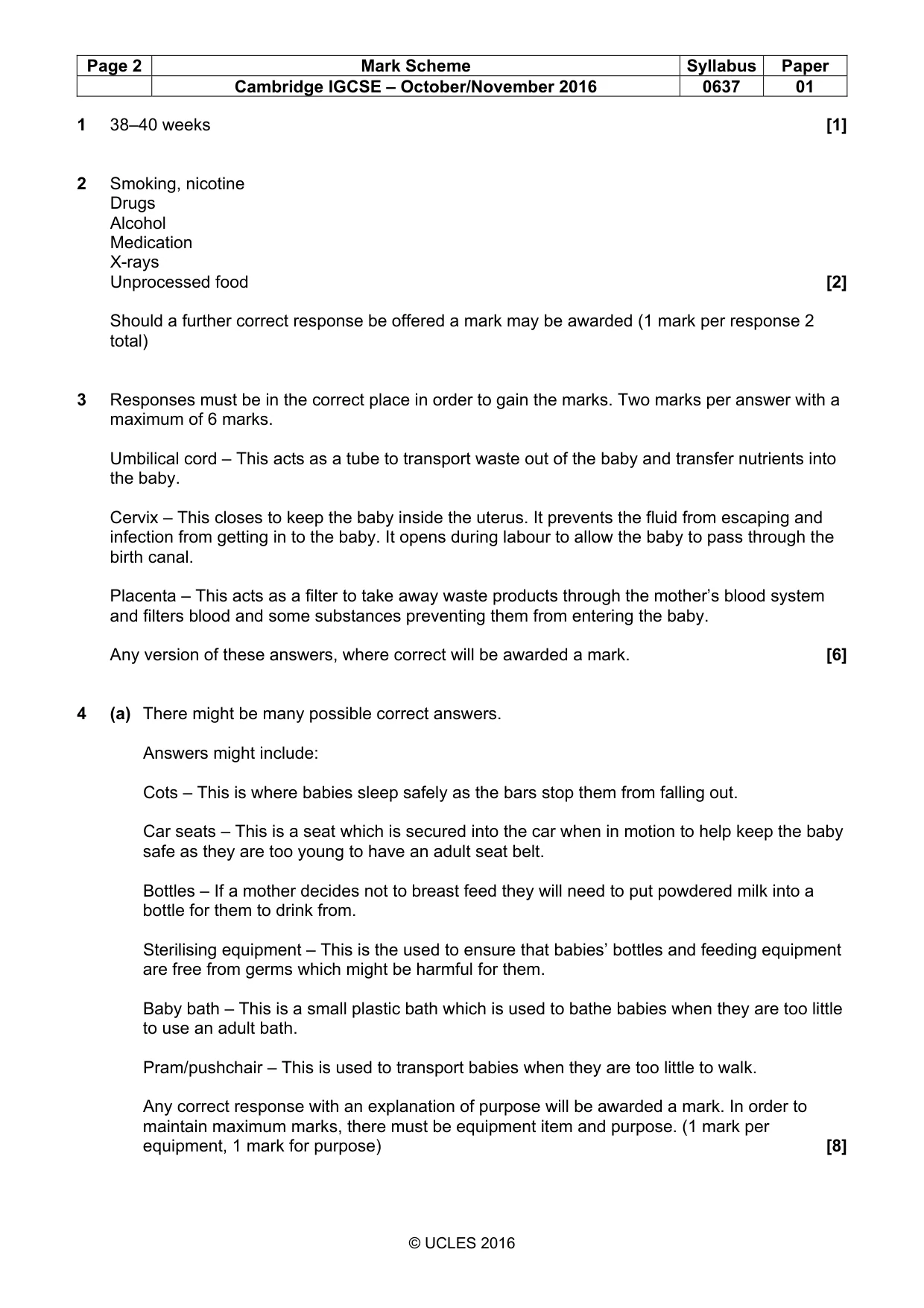
Page 2 Mark Scheme Syllabus Paper Cambridge IGCSE – October/November 2016 0637 01 © UCLES 2016 1 38–40 weeks [1] 2 Smoking, nicotine Drugs Alcohol Medication X-rays Unprocessed food [2] Should a further correct response be offered a mark may be awarded (1 mark per response 2 total) 3 Responses must be in the correct place in order to gain the marks. Two marks per answer with a maximum of 6 marks. Umbilical cord – This acts as a tube to transport waste out of the baby and transfer nutrients into the baby. Cervix – This closes to keep the baby inside the uterus. It prevents the fluid from escaping and infection from getting in to the baby. It opens during labour to allow the baby to pass through the birth canal. Placenta – This acts as a filter to take away waste products through the mother’s blood system and filters blood and some substances preventing them from entering the baby. Any version of these answers, where correct will be awarded a mark. [6] 4 (a) There might be many possible correct answers. Answers might include: Cots – This is where babies sleep safely as the bars stop them from falling out. Car seats – This is a seat which is secured into the car when in motion to help keep the baby safe as they are too young to have an adult seat belt. Bottles – If a mother decides not to breast feed they will need to put powdered milk into a bottle for them to drink from. Sterilising equipment – This is the used to ensure that babies’ bottles and feeding equipment are free from germs which might be harmful for them. Baby bath – This is a small plastic bath which is used to bathe babies when they are too little to use an adult bath. Pram/pushchair – This is used to transport babies when they are too little to walk. Any correct response with an explanation of purpose will be awarded a mark. In order to maintain maximum marks, there must be equipment item and purpose. (1 mark per equipment, 1 mark for purpose) [8]
Mark scheme, page 3
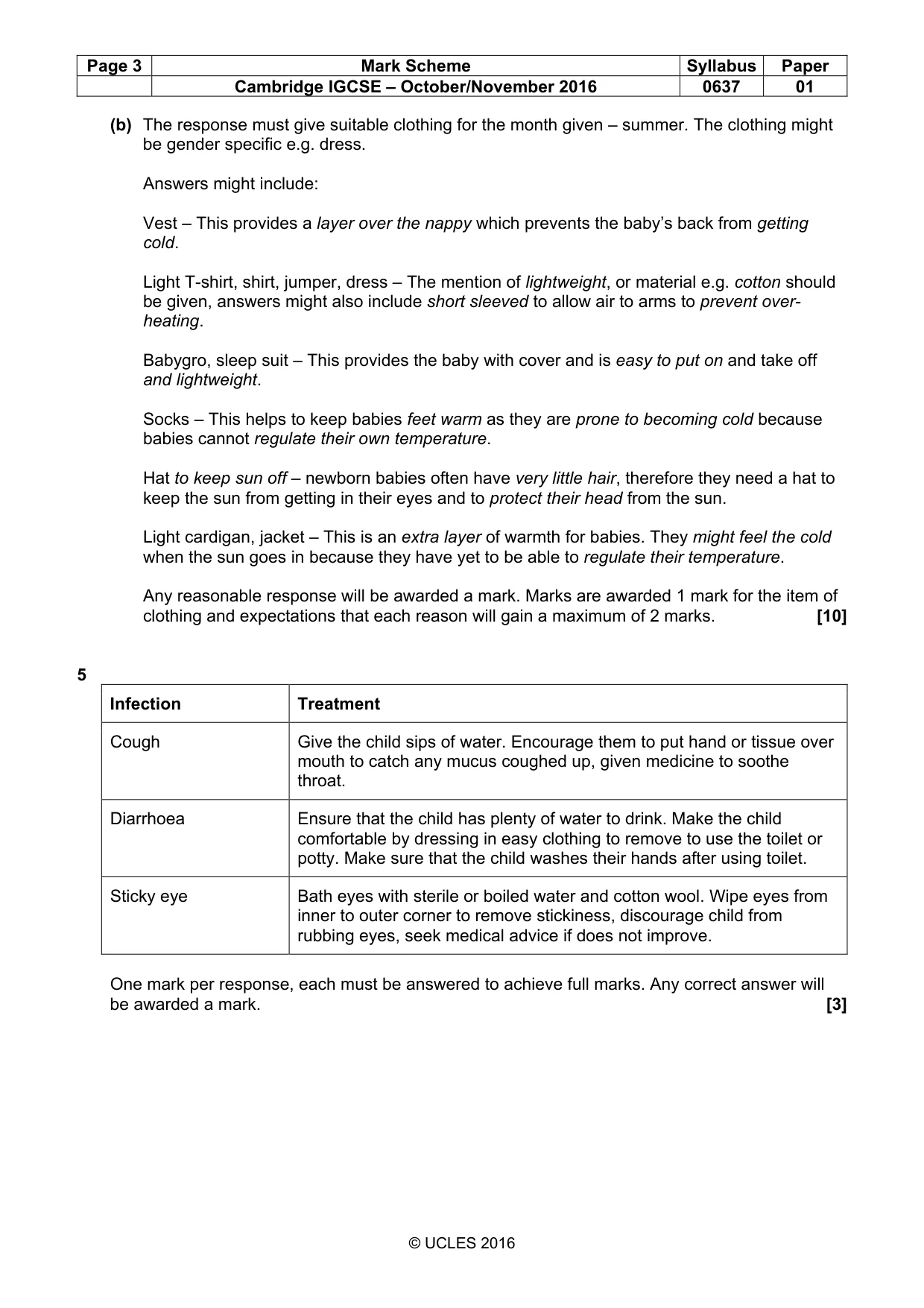
Page 3 Mark Scheme Syllabus Paper Cambridge IGCSE – October/November 2016 0637 01 © UCLES 2016 (b) The response must give suitable clothing for the month given – summer. The clothing might be gender specific e.g. dress. Answers might include: Vest – This provides a layer over the nappy which prevents the baby’s back from getting cold. Light T-shirt, shirt, jumper, dress – The mention of lightweight, or material e.g. cotton should be given, answers might also include short sleeved to allow air to arms to prevent over- heating. Babygro, sleep suit – This provides the baby with cover and is easy to put on and take off and lightweight. Socks – This helps to keep babies feet warm as they are prone to becoming cold because babies cannot regulate their own temperature. Hat to keep sun off – newborn babies often have very little hair, therefore they need a hat to keep the sun from getting in their eyes and to protect their head from the sun. Light cardigan, jacket – This is an extra layer of warmth for babies. They might feel the cold when the sun goes in because they have yet to be able to regulate their temperature. Any reasonable response will be awarded a mark. Marks are awarded 1 mark for the item of clothing and expectations that each reason will gain a maximum of 2 marks. [10] 5 Infection Treatment Cough Give the child sips of water. Encourage them to put hand or tissue over mouth to catch any mucus coughed up, given medicine to soothe throat. Diarrhoea Ensure that the child has plenty of water to drink. Make the child comfortable by dressing in easy clothing to remove to use the toilet or potty. Make sure that the child washes their hands after using toilet. Sticky eye Bath eyes with sterile or boiled water and cotton wool. Wipe eyes from inner to outer corner to remove stickiness, discourage child from rubbing eyes, seek medical advice if does not improve. One mark per response, each must be answered to achieve full marks. Any correct answer will be awarded a mark. [3]
Mark scheme, page 4
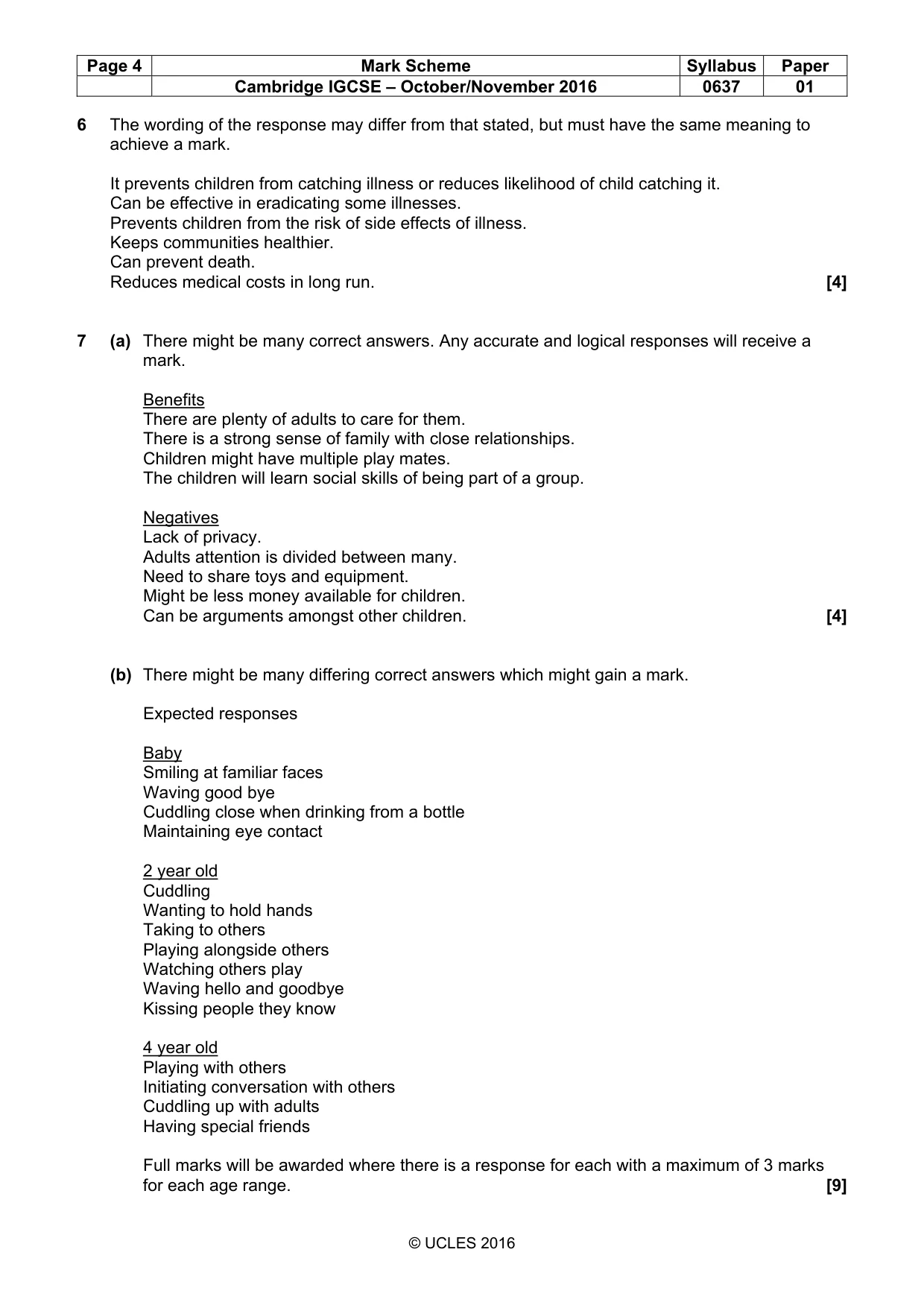
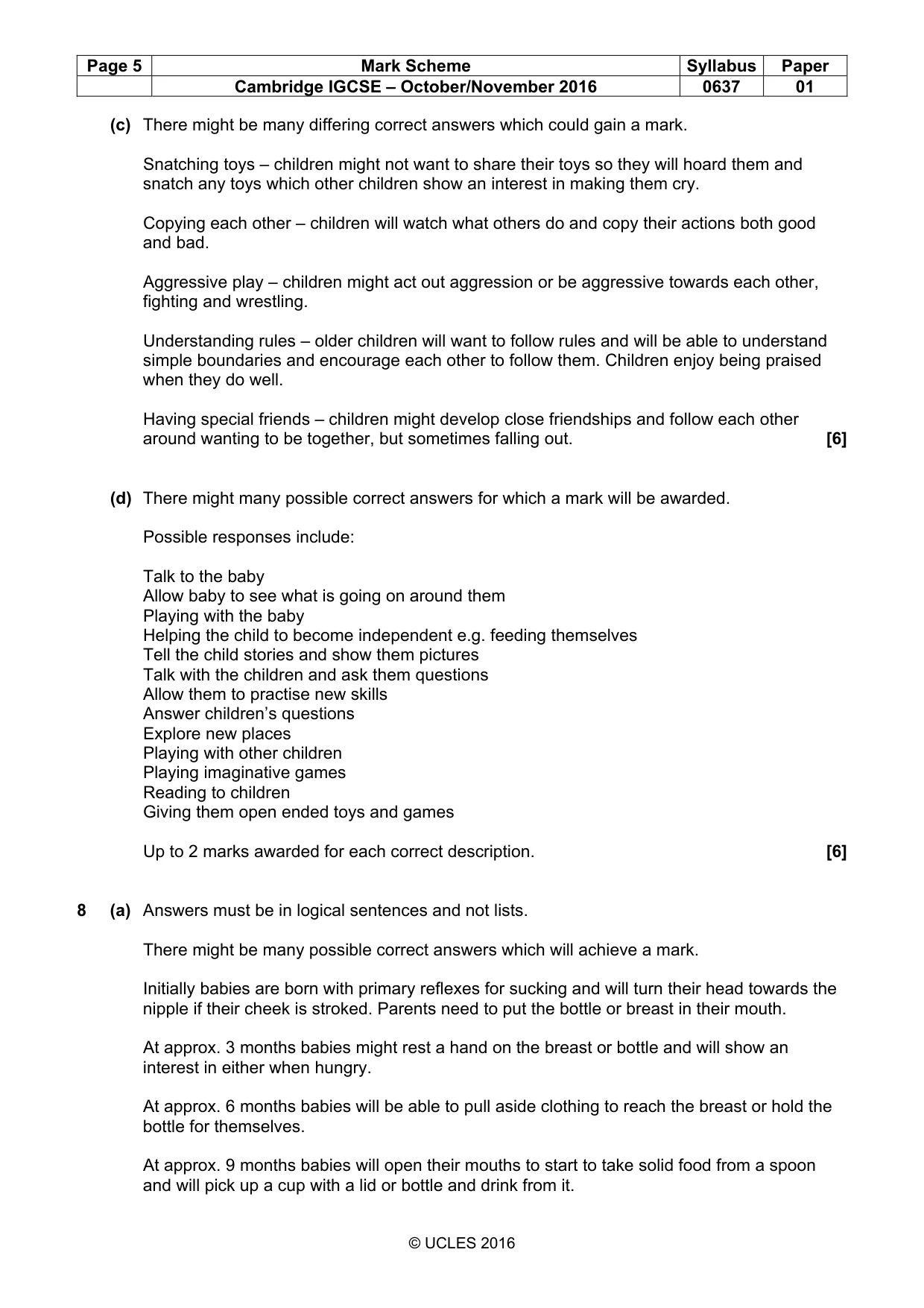
Page 4 Mark Scheme Syllabus Paper Cambridge IGCSE – October/November 2016 0637 01 © UCLES 2016 6 The wording of the response may differ from that stated, but must have the same meaning to achieve a mark. It prevents children from catching illness or reduces likelihood of child catching it. Can be effective in eradicating some illnesses. Prevents children from the risk of side effects of illness. Keeps communities healthier. Can prevent death. Reduces medical costs in long run. [4] 7 (a) There might be many correct answers. Any accurate and logical responses will receive a mark. Benefits There are plenty of adults to care for them. There is a strong sense of family with close relationships. Children might have multiple play mates. The children will learn social skills of being part of a group. Negatives Lack of privacy. Adults attention is divided between many. Need to share toys and equipment. Might be less money available for children. Can be arguments amongst other children. [4] (b) There might be many differing correct answers which might gain a mark. Expected responses Baby Smiling at familiar faces Waving good bye Cuddling close when drinking from a bottle Maintaining eye contact 2 year old Cuddling Wanting to hold hands Taking to others Playing alongside others Watching others play Waving hello and goodbye Kissing people they know 4 year old Playing with others Initiating conversation with others Cuddling up with adults Having special friends Full marks will be awarded where there is a response for each with a maximum of 3 marks for each age range. [9]
Mark scheme, page 5
Page 5 Mark Scheme Syllabus Paper Cambridge IGCSE – October/November 2016 0637 01 © UCLES 2016 (c) There might be many differing correct answers which could gain a mark. Snatching toys – children might not want to share their toys so they will hoard them and snatch any toys which other children show an interest in making them cry. Copying each other – children will watch what others do and copy their actions both good and bad. Aggressive play – children might act out aggression or be aggressive towards each other, fighting and wrestling. Understanding rules – older children will want to follow rules and will be able to understand simple boundaries and encourage each other to follow them. Children enjoy being praised when they do well. Having special friends – children might develop close friendships and follow each other around wanting to be together, but sometimes falling out. [6] (d) There might many possible correct answers for which a mark will be awarded. Possible responses include: Talk to the baby Allow baby to see what is going on around them Playing with the baby Helping the child to become independent e.g. feeding themselves Tell the child stories and show them pictures Talk with the children and ask them questions Allow them to practise new skills Answer children’s questions Explore new places Playing with other children Playing imaginative games Reading to children Giving them open ended toys and games Up to 2 marks awarded for each correct description. [6] 8 (a) Answers must be in logical sentences and not lists. There might be many possible correct answers which will achieve a mark. Initially babies are born with primary reflexes for sucking and will turn their head towards the nipple if their cheek is stroked. Parents need to put the bottle or breast in their mouth. At approx. 3 months babies might rest a hand on the breast or bottle and will show an interest in either when hungry. At approx. 6 months babies will be able to pull aside clothing to reach the breast or hold the bottle for themselves. At approx. 9 months babies will open their mouths to start to take solid food from a spoon and will pick up a cup with a lid or bottle and drink from it.
Mark scheme, page 6
Page 6 Mark Scheme Syllabus Paper Cambridge IGCSE – October/November 2016 0637 01 © UCLES 2016 They may show excitement when seeing food arrive or start to ask for it. At approx. one year, children will be able to eat finger food and successfully feed themselves this way. They might start to use a sippy sup without a lid. At 16–18 months children will begin to use a spoon to scoop up food and will usually find their mouth. They may be able to suck drink from a straw. At approx. 2 years children will be able to use a fork to stab food and have a good degree of skill in eating it. They will be able to drink from an open cup. At 3–5 years children can use cutlery and may be able to cut pieces of food themselves. They can pour their own drinks from a small jug. A maximum of 12 marks is awarded. This is achieved where there is clear linking of ideas to differing ages in order. There must be description of each stage and this must clearly link to feeding and drinking. Each separate age/stage gains a maximum of 3 marks. [12] (b) Nutrient Food Why it is important Minerals Spinach and leafy vegetables It helps with the development of strong teeth and bones and also helps the body to produce red blood cells and helps the body to maintain cell function. proteins Milk, fish, eggs, meat, cheese, soya, beans Builds the body and helps the body to repair. Important for brain, muscles, skin development Carbohydrates Biscuits, pasta, bread, breakfast cereal, jams This helps to release energy slowly. Fats Butter, cream, mayonnaise, cheese, oil, meat This gives the body energy Vitamins Fruit, vegetables, meat, fish Builds healthy teeth, helps with blood clotting, helps skin to heal and is good for eye sight and bones Water Tap or bottle Flushes kidneys and keeps the body hydrated. [9]
Mark scheme, page 7
Page 7 Mark Scheme Syllabus Paper Cambridge IGCSE – October/November 2016 0637 01 © UCLES 2016 9 Women might choose to take the contraceptive pill (either type). This needs to be taken every day for it to be effective. This works by stopping ovulation. The benefits are that it is very effective if taken correctly, easy and simple to use, is easily reversible. Negatives are that it does not work fully if the woman takes antibiotics, it can make some women put on weight or affect their hormones adversely, it doesn’t protect against STI. IUS, IUD or coil – women might choose this method which is a device which is placed inside the womb preventing the sperm from meeting the egg. Some contain hormones. Positives – they can be in place for 5–10 years, once fitted they are forgotten about, they are very effective. Negatives – can cause bleeding, may be uncomfortable to fit, needs to be removed by a medical professional. Implant – this is small tube of hormones inserted inside the woman’s arm. Positives – it can work for up to 3 years, it works automatically, fertility returns immediately after it is removed, it is very effective. Negatives – it requires minor surgery, it can be felt underneath the skin, it needs to be removed by a medical professional. There might be many other correct responses, including for example, sterilisation, condoms, diaphragm, withdrawal, natural methods, abstention, patch, vaginal ring. Full marks will only be awarded where the answers are well constructed and not listed. 0–6 MARKS Low response Lists not discussion. Few examples given, positives and negatives not suitably addressed or information is inaccurate. 7–11 MARKS Medium response. There is evidence of several different methods discussed, but little development of answers. There is an imbalance of positives or negatives or under developed responses in some areas. Generally all information is correct and accurate. 12–20 MARKS High response. There are multiple correctly identified and explained methods and well explained positives and negative for each. [20] OR Children may display their frustration through acting inappropriately. This might include throwing temper tantrums. This is where children refuse to cooperate; they might roll around on the floor or become rigid. Children are usually very upset at this time and adults might not be able to reason with them. The children might scream and shout or run away from their parent or carer. Children might become frustrated if they see something they want and cannot have it. If another child has this, they might try to grab it from them, snatch things and refuse to give it back. The child might also break things in frustration, especially if they cannot make it work. Children might throw things in temper. Young babies also become frustrated and might scream and turn red in the face. They might cry and be difficult to calm down. Parents and carers should be gentle and not try to forcibly handle children as they might hurt themselves. When children throw tantrums it is best to ignore their behaviour but comfort them afterwards. Children do not understand their emotions and so they need adults to reassure them and talk about how they are feeling. Children might be shy when they meet someone new or are in an unfamiliar place. They might bury their face, cling on to their parent and cry. Children who are shy might not want to speak in
Mark scheme, page 8
Page 8 Mark Scheme Syllabus Paper Cambridge IGCSE – October/November 2016 0637 01 © UCLES 2016 front of others and may become embarrassed and upset. Children might ask to go home and sit by the door. Parents should reassure children, not force them to talk and give them time to get used to the new person or place. They should ask children how they are feeling and talk about this. The child will need reassurance and comforting and the parent or carer should stay calm and speak softly to the child until they feel more confident. Children show their excitement in exaggerated ways. They might wave their arms and jump up and down, scream and laugh loudly. When children are excited they tend to be loud and difficult to calm down. This can mean that they are more likely to have an accident such as, falling over. The child might become so excited that they cry or wet themselves because they are unable to control the way they are feeling and it becomes too much for them. Children who are very excited might need to sleep afterwards because they have exhausted themselves. Parents should try to help children to contain their feelings by helping them find ways to express their excitement, asking them how they are feeling and talking to them in low, calm quiet voices. When children scream, the adults might encourage them to sit down and have a few minutes quiet time. There might be many other correct responses, but all must explain the three emotions given to achieve full marks. Responses must be in full, fluid sentences not lists. 0–6 MARKS Low response Lists not discussion. Few examples given, areas not covered or the responses do not link to the emotions given. Parents responses not given or are concerning such as suggesting corporal punishment. 7–11 MARKS Medium response. There is evidence of all emotions covered and behaviour explained and some attempts at parents responses but these are not well developed or are concerning in some areas. Generally all information is correct and accurate. 12–20 MARKS High response. There are multiple correctly identified and explained emotions and behaviours and well explained adult responses. All three emotions have been covered equally well. [20]
What you needed in this session
Cambridge’s own grade thresholds for 2016 Oct/Nov, Paper 1 · Variant 1. A higher threshold means an easier paper — the bar moves with how the cohort did.