Cambridge IGCSE Child Development 0637 — 2013 Oct/Nov Paper 1 · Variant 1
0637/11/O/N/13 · 100 marks · ≈113 min
The question paper and its mark scheme, free to read here and free to download. This is Cambridge’s own paper, exactly as it was sat.
Question paper12 pages
Mark scheme6 pages
Answers below. Sit the paper first if you are practising.
Paper as text
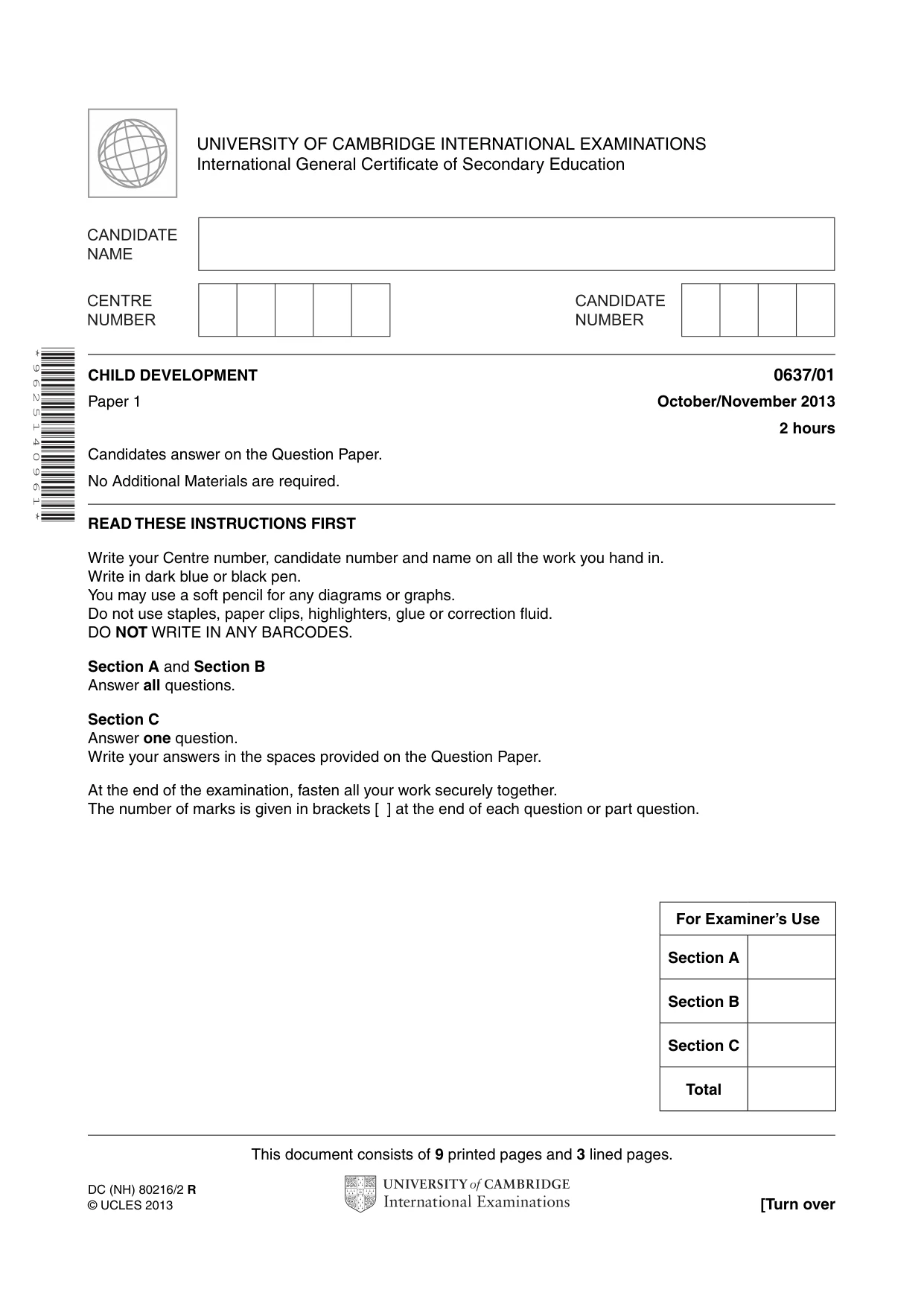
Question paper, page 1
This document consists of 9 printed pages and 3 lined pages. DC (NH) 80216/2 R © UCLES 2013 [Turn over UNIVERSITY OF CAMBRIDGE INTERNATIONAL EXAMINATIONS International General Certificate of Secondary Education * 9 6 2 5 1 4 0 9 6 1 * CHILD DEVELOPMENT 0637/01 Paper 1 October/November 2013 2 hours Candidates answer on the Question Paper. No Additional Materials are required. READ THESE INSTRUCTIONS FIRST Write your Centre number, candidate number and name on all the work you hand in. Write in dark blue or black pen. You may use a soft pencil for any diagrams or graphs. Do not use staples, paper clips, highlighters, glue or correction fluid. DO NOT WRITE IN ANY BARCODES. Section A and Section B Answer all questions. Section C Answer one question. Write your answers in the spaces provided on the Question Paper. At the end of the examination, fasten all your work securely together. The number of marks is given in brackets [ ] at the end of each question or part question. For Examiner’s Use Section A Section B Section C Total
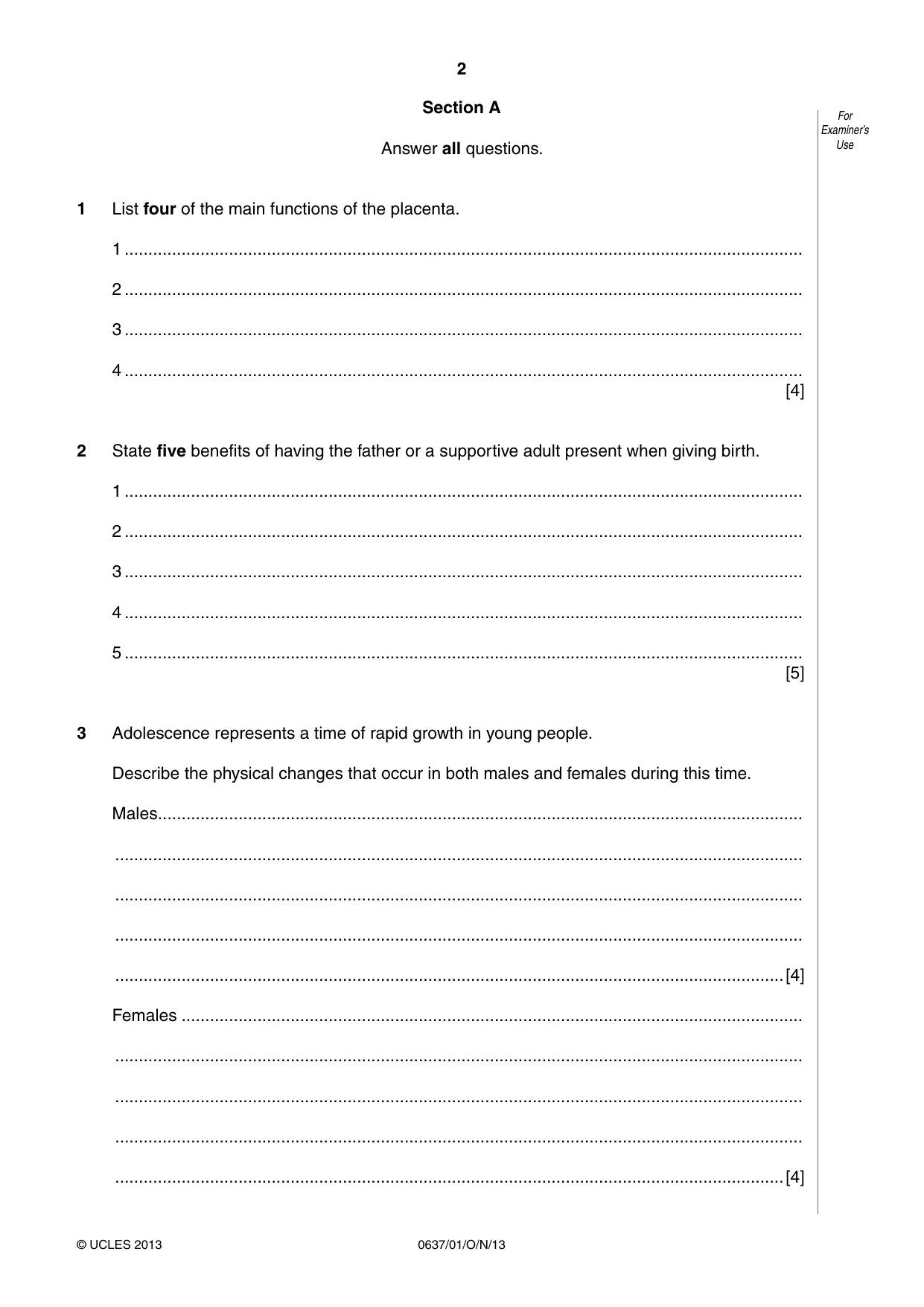
Question paper, page 2
2 0637/01/O/N/13 © UCLES 2013 For Examiner’s Use Section A Answer all questions. 1 List four of the main functions of the placenta. 1 … 2 … 3 … 4 … [4] 2 State five benefits of having the father or a supportive adult present when giving birth. 1 … 2 … 3 … 4 … 5 … [5] 3 Adolescence represents a time of rapid growth in young people. Describe the physical changes that occur in both males and females during this time. Males… … … … …[4] Females … … … … …[4]
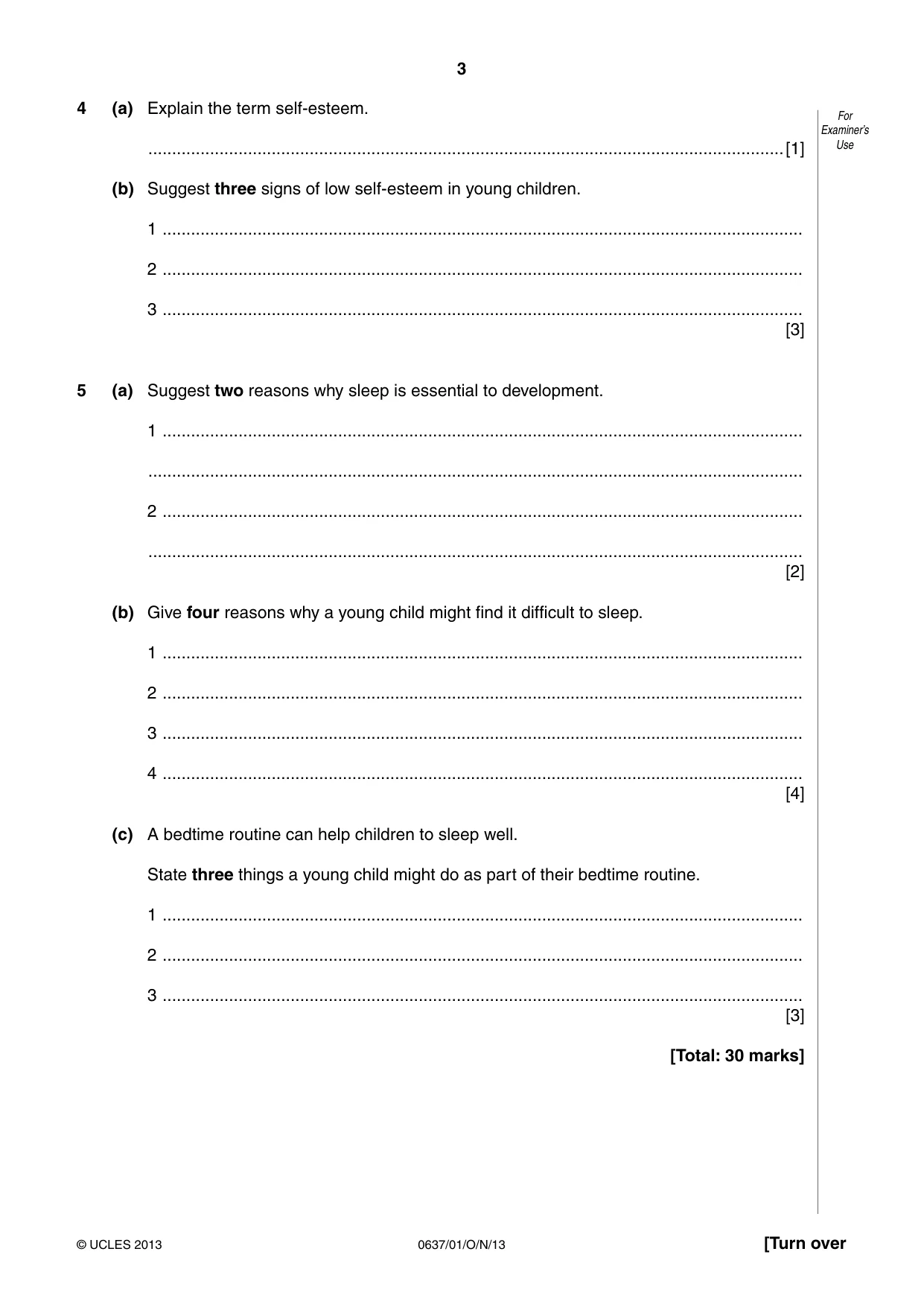
Question paper, page 3
3 0637/01/O/N/13 © UCLES 2013 [Turn over For Examiner’s Use 4 (a) Explain the term self-esteem. …[1] (b) Suggest three signs of low self-esteem in young children. 1 … 2 … 3 … [3] 5 (a) Suggest two reasons why sleep is essential to development. 1 … … 2 … … [2] (b) Give four reasons why a young child might find it difficult to sleep. 1 … 2 … 3 … 4 … [4] (c) A bedtime routine can help children to sleep well. State three things a young child might do as part of their bedtime routine. 1 … 2 … 3 … [3] [Total: 30 marks]
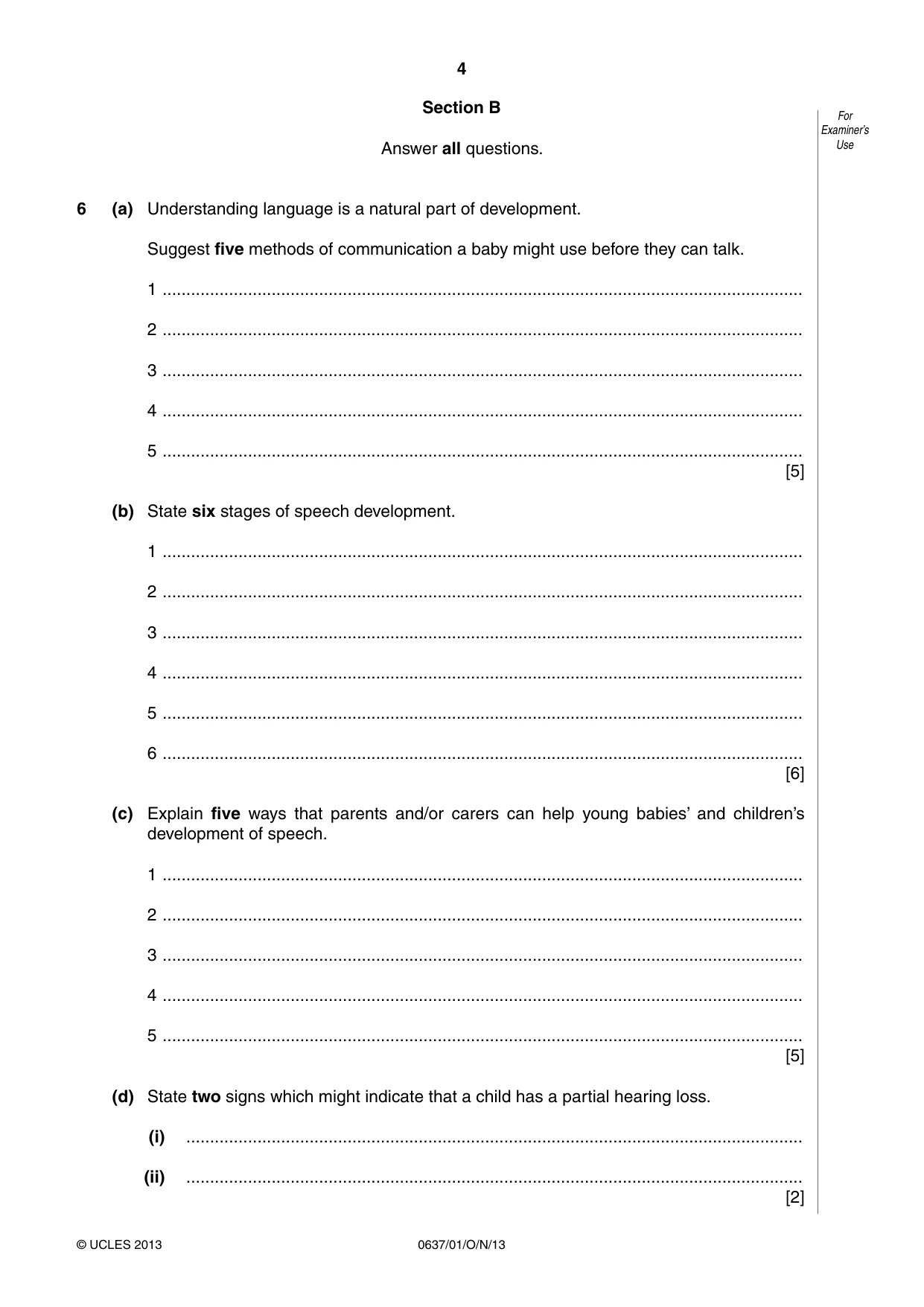
Question paper, page 4
4 0637/01/O/N/13 © UCLES 2013 For Examiner’s Use Section B Answer all questions. 6 (a) Understanding language is a natural part of development. Suggest five methods of communication a baby might use before they can talk. 1 … 2 … 3 … 4 … 5 … [5] (b) State six stages of speech development. 1 … 2 … 3 … 4 … 5 … 6 … [6] (c) Explain five ways that parents and/or carers can help young babies’ and children’s development of speech. 1 … 2 … 3 … 4 … 5 … [5] (d) State two signs which might indicate that a child has a partial hearing loss. (i) … (ii) … [2]
Question paper, page 5
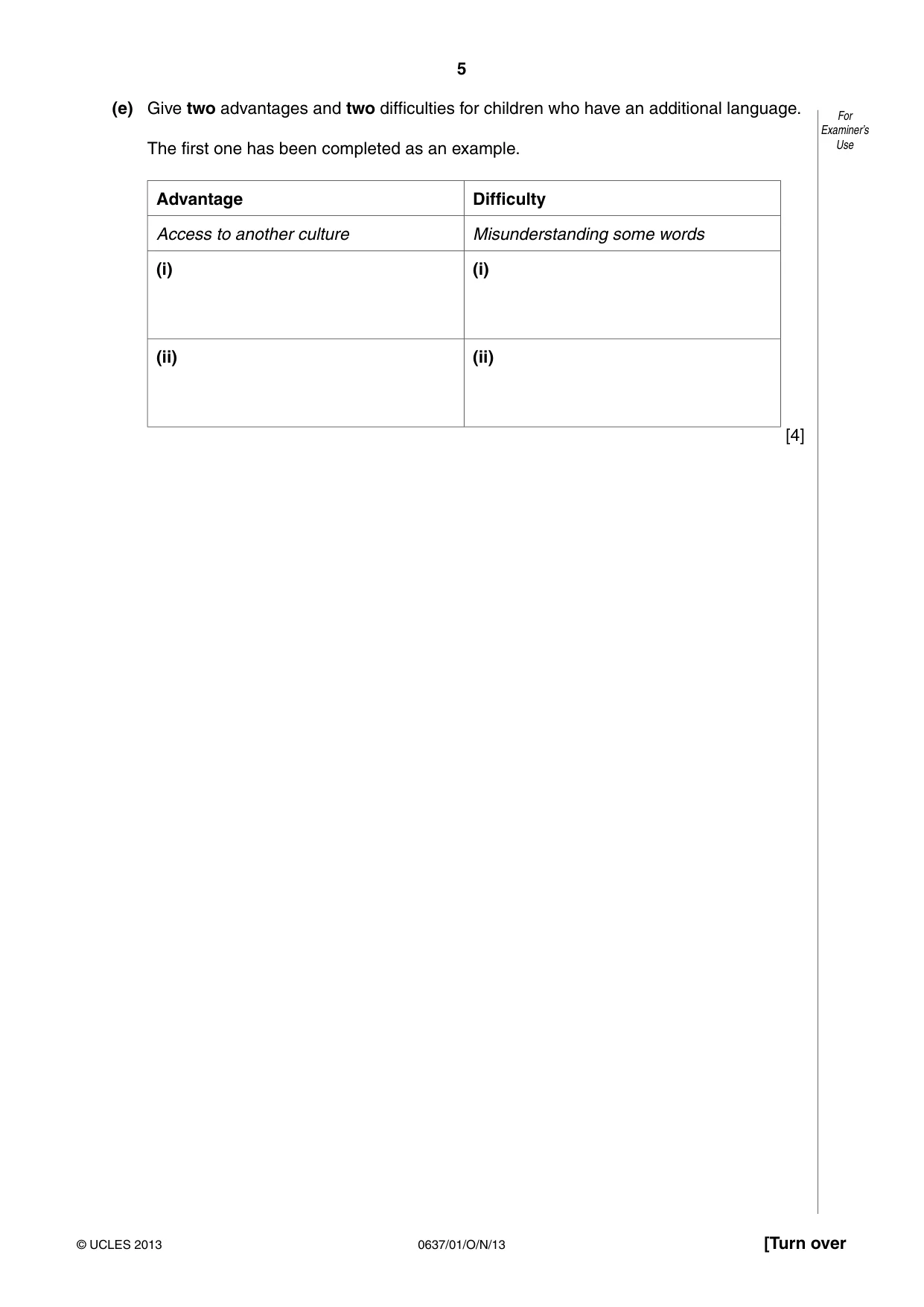
5 0637/01/O/N/13 © UCLES 2013 [Turn over For Examiner’s Use (e) Give two advantages and two difficulties for children who have an additional language. The first one has been completed as an example. Advantage Difficulty Access to another culture Misunderstanding some words (i) (i) (ii) (ii) [4]
Question paper, page 6
6 0637/01/O/N/13 © UCLES 2013 For Examiner’s Use 7 Attachment is important to babies’ and children’s well being. (a) Briefly explain the notion of attachment. … …[2] (b) Suggest four ways attachment can be promoted between mother and baby during birth, and four ways attachment can be promoted after the birth. … … … … … … … …[8] (c) Give five reasons why attachment might be disrupted during birth or afterwards. 1 … … 2 … … 3 … … 4 … … 5 … … [5]
Question paper, page 7
7 0637/01/O/N/13 © UCLES 2013 [Turn over For Examiner’s Use (d) State five causes of emotional disturbance to children and five ways parents/carers may support their children at this time. (i) Cause … … Support … … (ii) Cause … … Support … … (iii) Cause … … Support … … (iv) Cause … … Support … … (v) Cause … … Support … … [10]
Question paper, page 8
8 0637/01/O/N/13 © UCLES 2013 For Examiner’s Use (e) Describe three behaviours children might display when they experience emotional problems. 1 … … 2 … … 3 … … [3] [Total: 50 marks]
Question paper, page 9
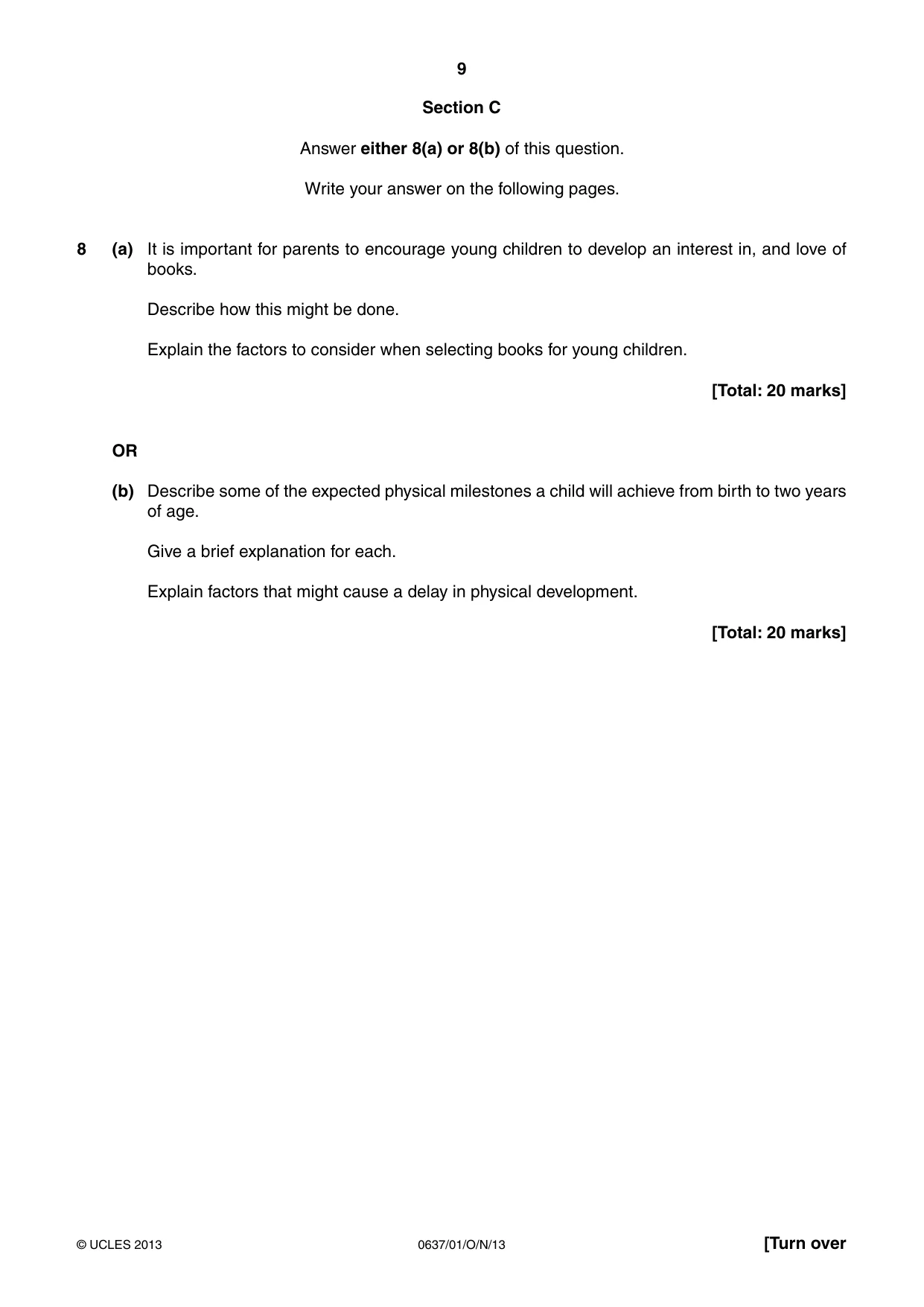
9 0637/01/O/N/13 © UCLES 2013 [Turn over Section C Answer either 8(a) or 8(b) of this question. Write your answer on the following pages. 8 (a) It is important for parents to encourage young children to develop an interest in, and love of books. Describe how this might be done. Explain the factors to consider when selecting books for young children. [Total: 20 marks] OR (b) Describe some of the expected physical milestones a child will achieve from birth to two years of age. Give a brief explanation for each. Explain factors that might cause a delay in physical development. [Total: 20 marks]
Question paper, page 10
10 0637/01/O/N/13 © UCLES 2013 For Examiner’s Use … … … … … … … … … … … … … … … … … … … … … … … … … … … …
Question paper, page 11
11 0637/01/O/N/13 © UCLES 2013 For Examiner’s Use … … … … … … … … … … … … … … … … … … … … … … … … … … … …
Question paper, page 12
12 0637/01/O/N/13 © UCLES 2013 For Examiner’s Use … … … … … … … … … … … … … … … … … … … … … … … … Permission to reproduce items where third-party owned material protected by copyright is included has been sought and cleared where possible. Every reasonable effort has been made by the publisher (UCLES) to trace copyright holders, but if any items requiring clearance have unwittingly been included, the publisher will be pleased to make amends at the earliest possible opportunity. University of Cambridge International Examinations is part of the Cambridge Assessment Group. Cambridge Assessment is the brand name of University of Cambridge Local Examinations Syndicate (UCLES), which is itself a department of the University of Cambridge.
Mark scheme, page 1
CAMBRIDGE INTERNATIONAL EXAMINATIONS International General Certificate of Secondary Education MARK SCHEME for the October/November 2013 series 0637 CHILD DEVELOPMENT 0637/01 Paper 1 (Theory Paper), maximum raw mark 100 This mark scheme is published as an aid to teachers and candidates, to indicate the requirements of the examination. It shows the basis on which Examiners were instructed to award marks. It does not indicate the details of the discussions that took place at an Examiners’ meeting before marking began, which would have considered the acceptability of alternative answers. Mark schemes should be read in conjunction with the question paper and the Principal Examiner Report for Teachers. Cambridge will not enter into discussions about these mark schemes. Cambridge is publishing the mark schemes for the October/November 2013 series for most IGCSE, GCE Advanced Level and Advanced Subsidiary Level components and some Ordinary Level components.
Mark scheme, page 2
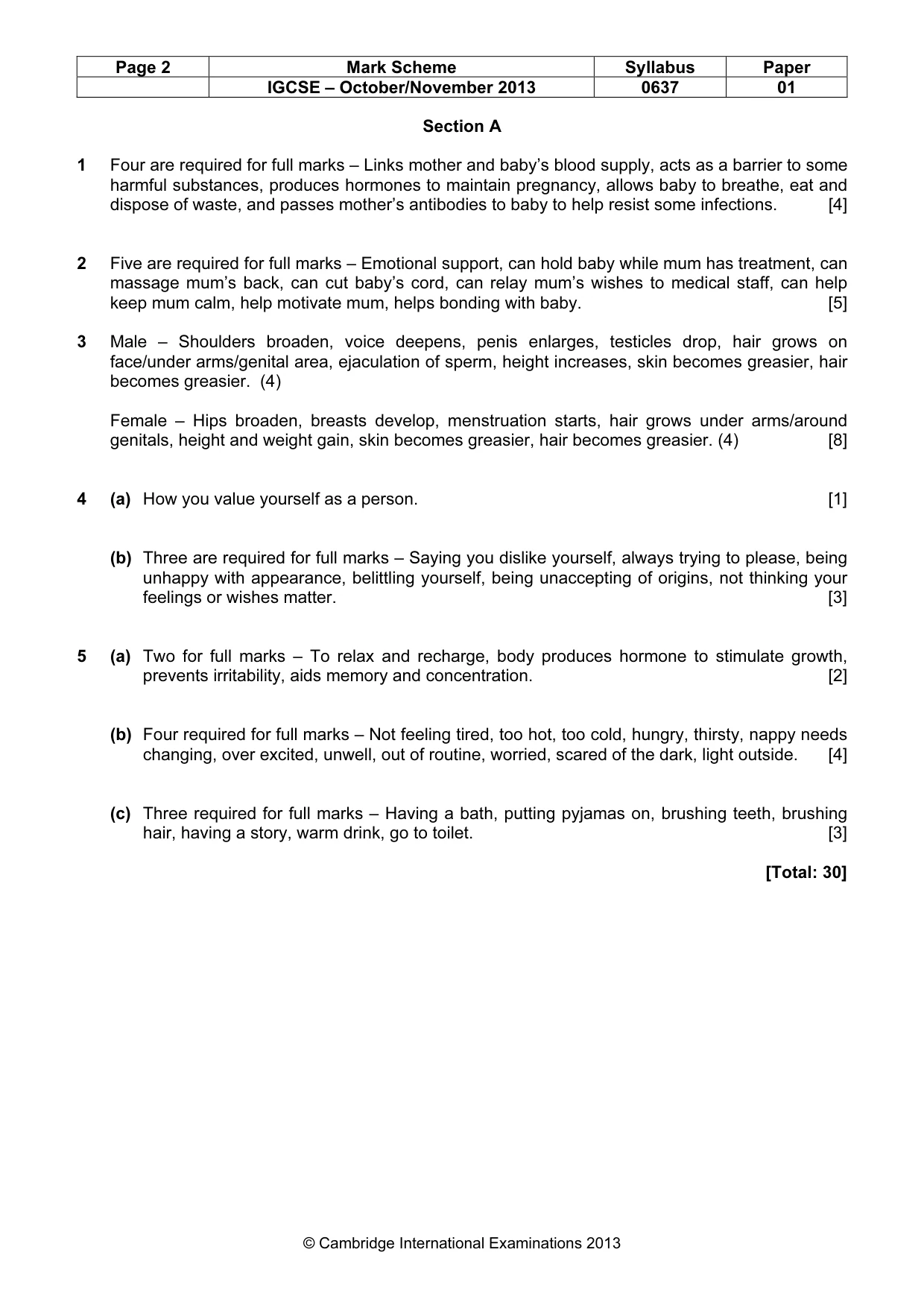
Page 2 Mark Scheme Syllabus Paper IGCSE – October/November 2013 0637 01 © Cambridge International Examinations 2013 Section A 1 Four are required for full marks – Links mother and baby’s blood supply, acts as a barrier to some harmful substances, produces hormones to maintain pregnancy, allows baby to breathe, eat and dispose of waste, and passes mother’s antibodies to baby to help resist some infections. [4] 2 Five are required for full marks – Emotional support, can hold baby while mum has treatment, can massage mum’s back, can cut baby’s cord, can relay mum’s wishes to medical staff, can help keep mum calm, help motivate mum, helps bonding with baby. [5] 3 Male – Shoulders broaden, voice deepens, penis enlarges, testicles drop, hair grows on face/under arms/genital area, ejaculation of sperm, height increases, skin becomes greasier, hair becomes greasier. (4) Female – Hips broaden, breasts develop, menstruation starts, hair grows under arms/around genitals, height and weight gain, skin becomes greasier, hair becomes greasier. (4) [8] 4 (a) How you value yourself as a person. [1] (b) Three are required for full marks – Saying you dislike yourself, always trying to please, being unhappy with appearance, belittling yourself, being unaccepting of origins, not thinking your feelings or wishes matter. [3] 5 (a) Two for full marks – To relax and recharge, body produces hormone to stimulate growth, prevents irritability, aids memory and concentration. [2] (b) Four required for full marks – Not feeling tired, too hot, too cold, hungry, thirsty, nappy needs changing, over excited, unwell, out of routine, worried, scared of the dark, light outside. [4] (c) Three required for full marks – Having a bath, putting pyjamas on, brushing teeth, brushing hair, having a story, warm drink, go to toilet. [3] [Total: 30]
Mark scheme, page 3
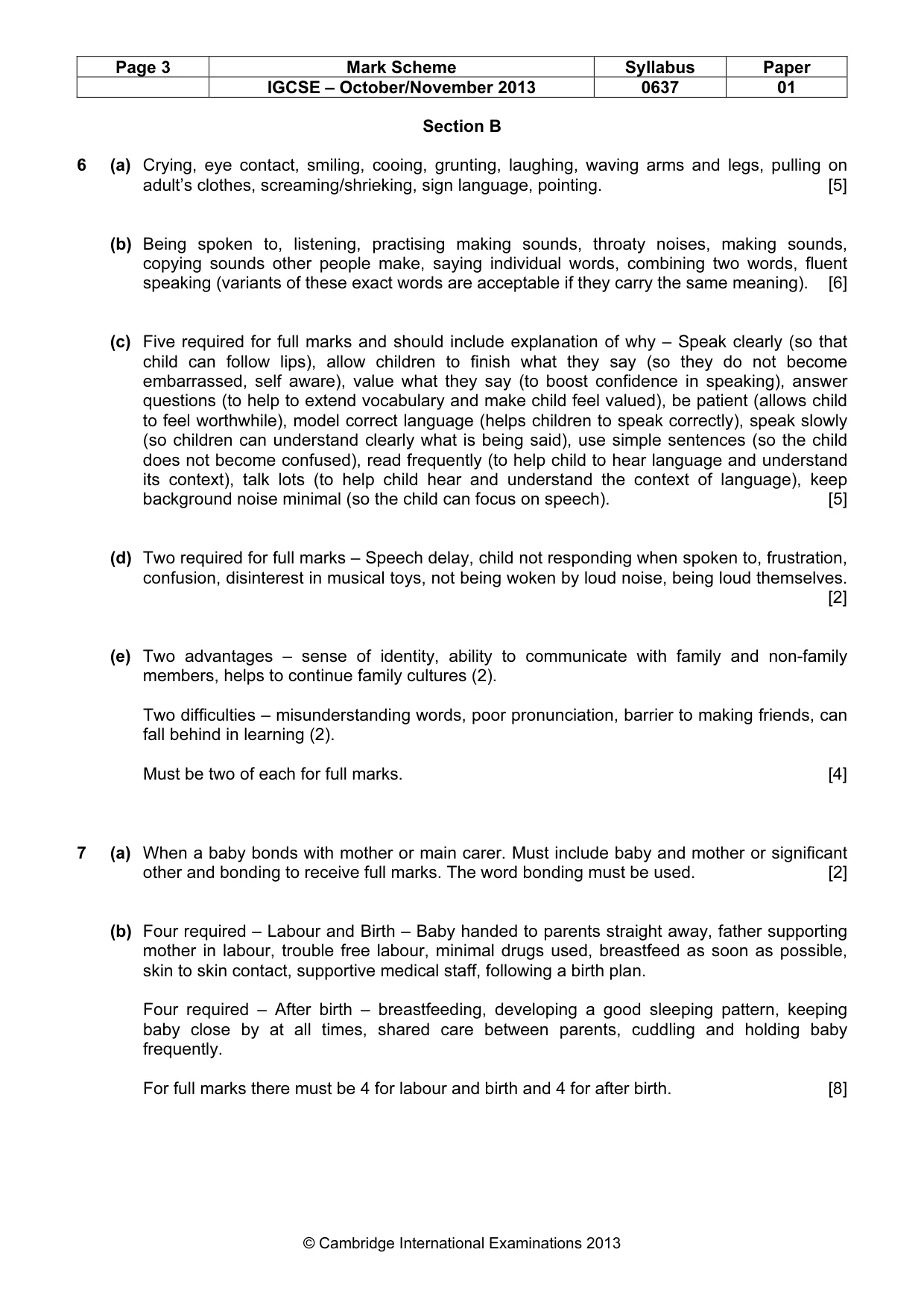
Page 3 Mark Scheme Syllabus Paper IGCSE – October/November 2013 0637 01 © Cambridge International Examinations 2013 Section B 6 (a) Crying, eye contact, smiling, cooing, grunting, laughing, waving arms and legs, pulling on adult’s clothes, screaming/shrieking, sign language, pointing. [5] (b) Being spoken to, listening, practising making sounds, throaty noises, making sounds, copying sounds other people make, saying individual words, combining two words, fluent speaking (variants of these exact words are acceptable if they carry the same meaning). [6] (c) Five required for full marks and should include explanation of why – Speak clearly (so that child can follow lips), allow children to finish what they say (so they do not become embarrassed, self aware), value what they say (to boost confidence in speaking), answer questions (to help to extend vocabulary and make child feel valued), be patient (allows child to feel worthwhile), model correct language (helps children to speak correctly), speak slowly (so children can understand clearly what is being said), use simple sentences (so the child does not become confused), read frequently (to help child to hear language and understand its context), talk lots (to help child hear and understand the context of language), keep background noise minimal (so the child can focus on speech). [5] (d) Two required for full marks – Speech delay, child not responding when spoken to, frustration, confusion, disinterest in musical toys, not being woken by loud noise, being loud themselves. [2] (e) Two advantages – sense of identity, ability to communicate with family and non-family members, helps to continue family cultures (2). Two difficulties – misunderstanding words, poor pronunciation, barrier to making friends, can fall behind in learning (2). Must be two of each for full marks. [4] 7 (a) When a baby bonds with mother or main carer. Must include baby and mother or significant other and bonding to receive full marks. The word bonding must be used. [2] (b) Four required – Labour and Birth – Baby handed to parents straight away, father supporting mother in labour, trouble free labour, minimal drugs used, breastfeed as soon as possible, skin to skin contact, supportive medical staff, following a birth plan. Four required – After birth – breastfeeding, developing a good sleeping pattern, keeping baby close by at all times, shared care between parents, cuddling and holding baby frequently. For full marks there must be 4 for labour and birth and 4 for after birth. [8]
Mark scheme, page 4
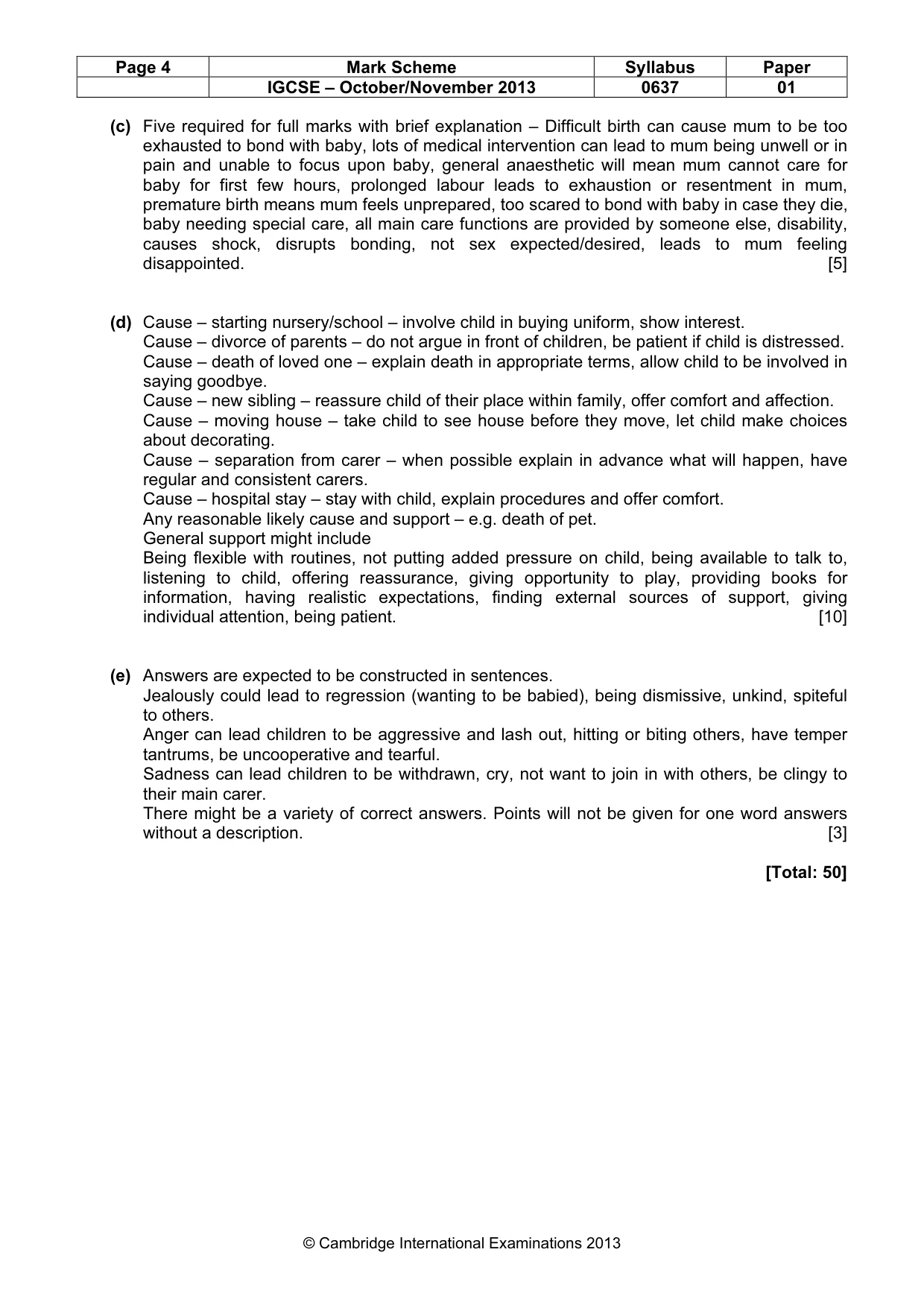
Page 4 Mark Scheme Syllabus Paper IGCSE – October/November 2013 0637 01 © Cambridge International Examinations 2013 (c) Five required for full marks with brief explanation – Difficult birth can cause mum to be too exhausted to bond with baby, lots of medical intervention can lead to mum being unwell or in pain and unable to focus upon baby, general anaesthetic will mean mum cannot care for baby for first few hours, prolonged labour leads to exhaustion or resentment in mum, premature birth means mum feels unprepared, too scared to bond with baby in case they die, baby needing special care, all main care functions are provided by someone else, disability, causes shock, disrupts bonding, not sex expected/desired, leads to mum feeling disappointed. [5] (d) Cause – starting nursery/school – involve child in buying uniform, show interest. Cause – divorce of parents – do not argue in front of children, be patient if child is distressed. Cause – death of loved one – explain death in appropriate terms, allow child to be involved in saying goodbye. Cause – new sibling – reassure child of their place within family, offer comfort and affection. Cause – moving house – take child to see house before they move, let child make choices about decorating. Cause – separation from carer – when possible explain in advance what will happen, have regular and consistent carers. Cause – hospital stay – stay with child, explain procedures and offer comfort. Any reasonable likely cause and support – e.g. death of pet. General support might include Being flexible with routines, not putting added pressure on child, being available to talk to, listening to child, offering reassurance, giving opportunity to play, providing books for information, having realistic expectations, finding external sources of support, giving individual attention, being patient. [10] (e) Answers are expected to be constructed in sentences. Jealously could lead to regression (wanting to be babied), being dismissive, unkind, spiteful to others. Anger can lead children to be aggressive and lash out, hitting or biting others, have temper tantrums, be uncooperative and tearful. Sadness can lead children to be withdrawn, cry, not want to join in with others, be clingy to their main carer. There might be a variety of correct answers. Points will not be given for one word answers without a description. [3] [Total: 50]
Mark scheme, page 5
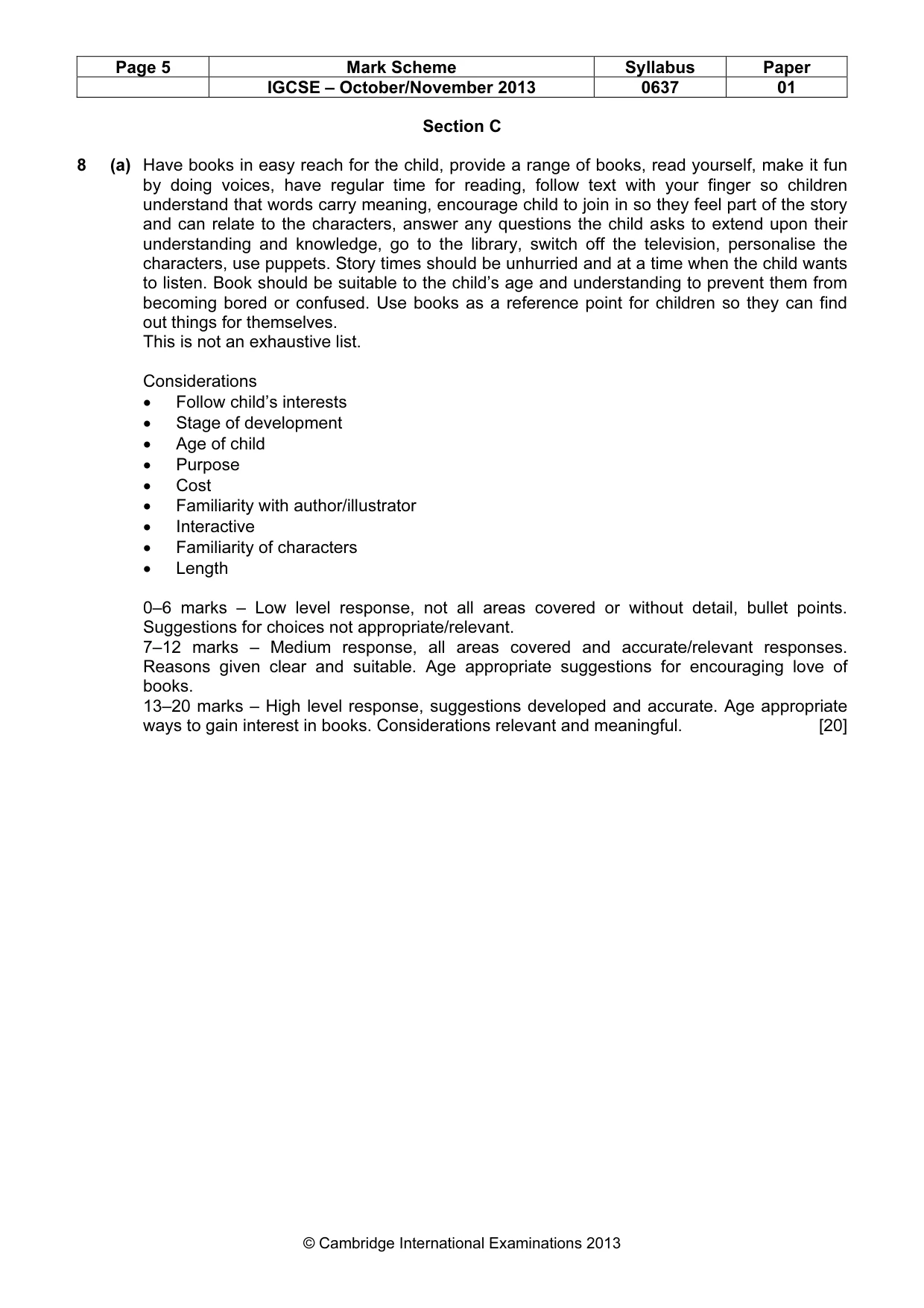
Page 5 Mark Scheme Syllabus Paper IGCSE – October/November 2013 0637 01 © Cambridge International Examinations 2013 Section C 8 (a) Have books in easy reach for the child, provide a range of books, read yourself, make it fun by doing voices, have regular time for reading, follow text with your finger so children understand that words carry meaning, encourage child to join in so they feel part of the story and can relate to the characters, answer any questions the child asks to extend upon their understanding and knowledge, go to the library, switch off the television, personalise the characters, use puppets. Story times should be unhurried and at a time when the child wants to listen. Book should be suitable to the child’s age and understanding to prevent them from becoming bored or confused. Use books as a reference point for children so they can find out things for themselves. This is not an exhaustive list. Considerations • Follow child’s interests • Stage of development • Age of child • Purpose • Cost • Familiarity with author/illustrator • Interactive • Familiarity of characters • Length 0–6 marks – Low level response, not all areas covered or without detail, bullet points. Suggestions for choices not appropriate/relevant. 7–12 marks – Medium response, all areas covered and accurate/relevant responses. Reasons given clear and suitable. Age appropriate suggestions for encouraging love of books. 13–20 marks – High level response, suggestions developed and accurate. Age appropriate ways to gain interest in books. Considerations relevant and meaningful. [20]
Mark scheme, page 6
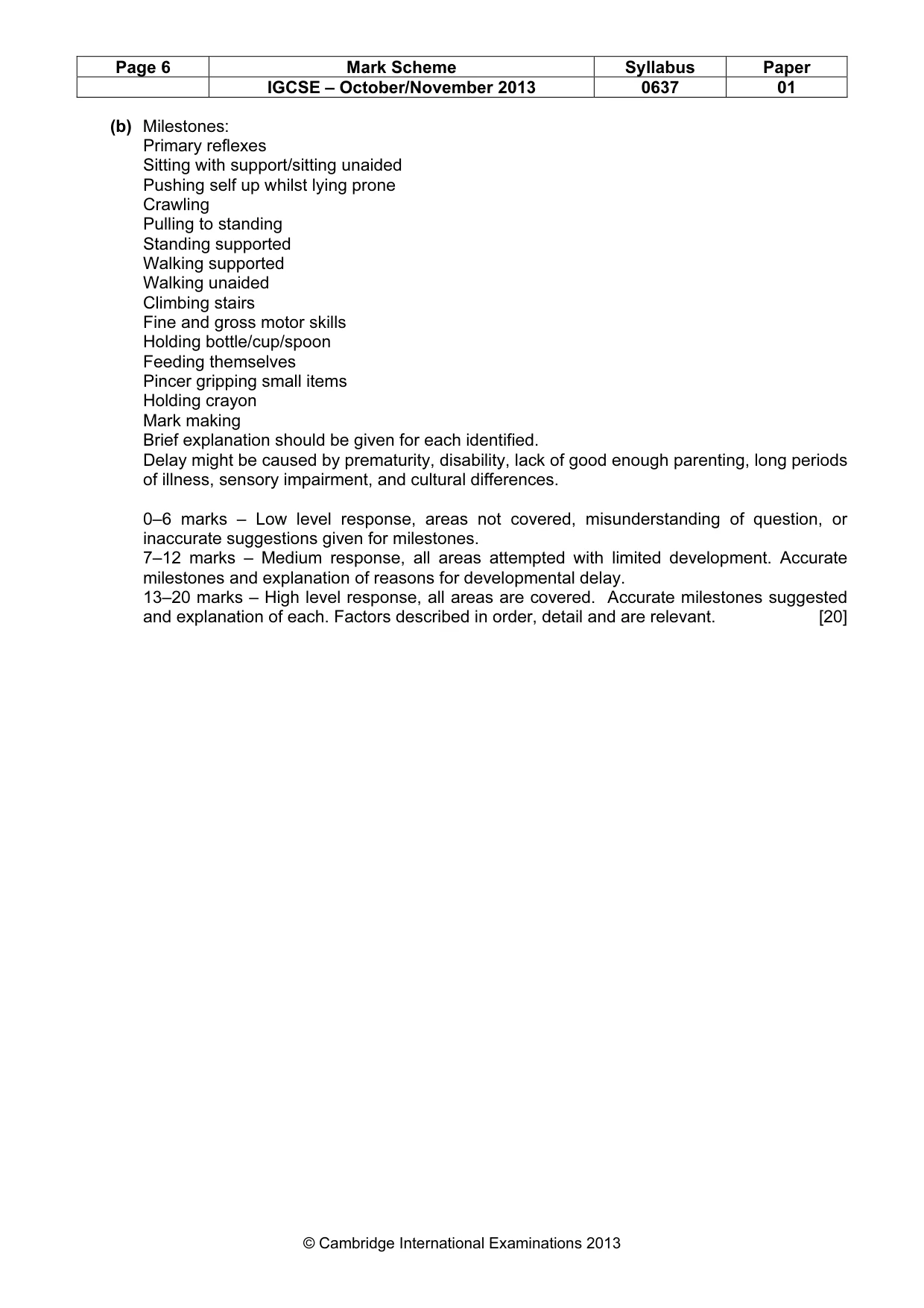
Page 6 Mark Scheme Syllabus Paper IGCSE – October/November 2013 0637 01 © Cambridge International Examinations 2013 (b) Milestones: Primary reflexes Sitting with support/sitting unaided Pushing self up whilst lying prone Crawling Pulling to standing Standing supported Walking supported Walking unaided Climbing stairs Fine and gross motor skills Holding bottle/cup/spoon Feeding themselves Pincer gripping small items Holding crayon Mark making Brief explanation should be given for each identified. Delay might be caused by prematurity, disability, lack of good enough parenting, long periods of illness, sensory impairment, and cultural differences. 0–6 marks – Low level response, areas not covered, misunderstanding of question, or inaccurate suggestions given for milestones. 7–12 marks – Medium response, all areas attempted with limited development. Accurate milestones and explanation of reasons for developmental delay. 13–20 marks – High level response, all areas are covered. Accurate milestones suggested and explanation of each. Factors described in order, detail and are relevant. [20]
What you needed in this session
Cambridge’s own grade thresholds for 2013 Oct/Nov, Paper 1 · Variant 1. A higher threshold means an easier paper — the bar moves with how the cohort did.