Cambridge IGCSE Child Development 0637 — 2010 Oct/Nov Paper 1 · Variant 1
0637/11/O/N/10 · 100 marks · ≈113 min
The question paper and its mark scheme, free to read here and free to download. This is Cambridge’s own paper, exactly as it was sat.
Question paper12 pages

Mark scheme7 pages
Answers below. Sit the paper first if you are practising.
Paper as text
Question paper, page 1
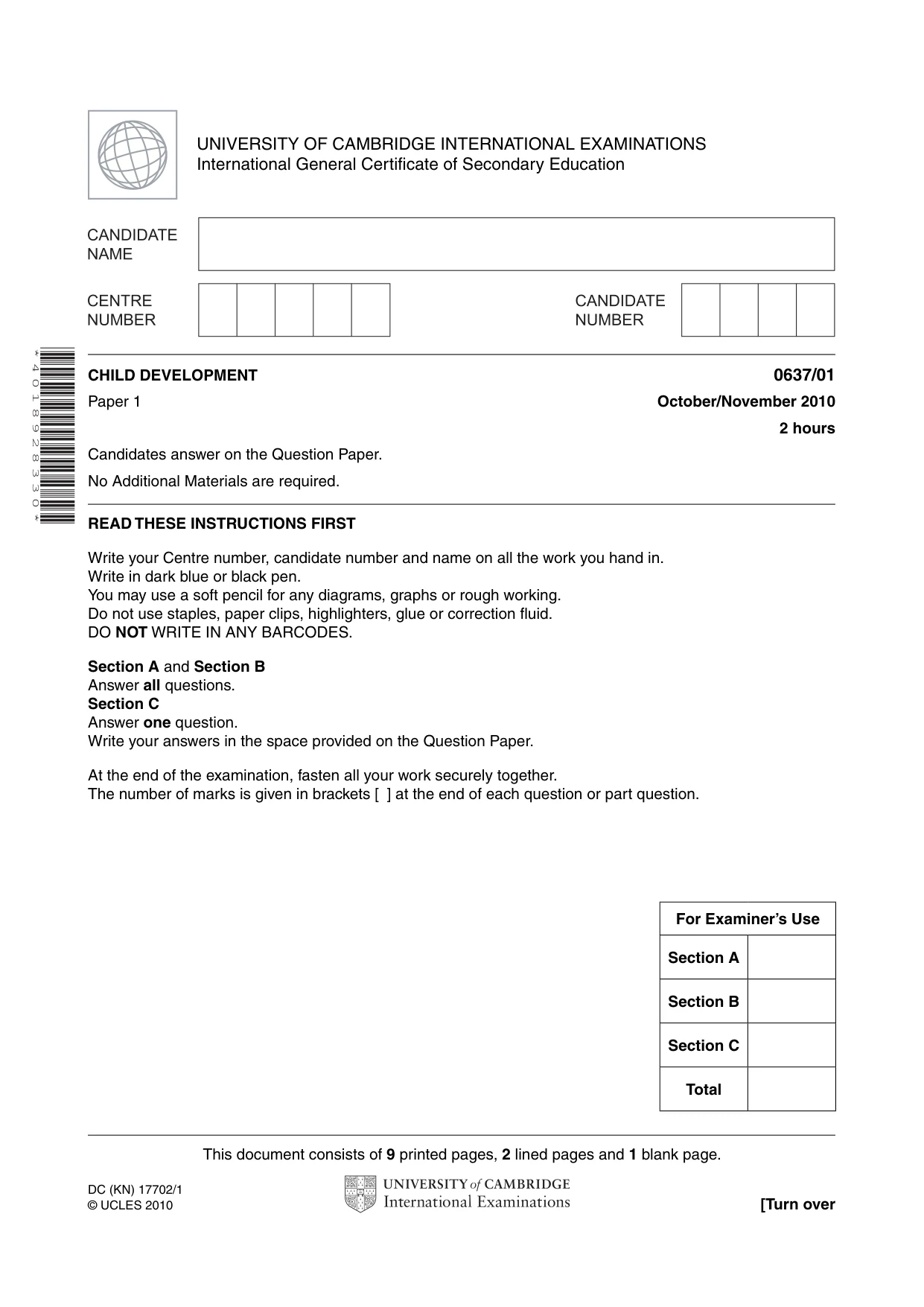
This document consists of 9 printed pages, 2 lined pages and 1 blank page. DC (KN) 17702/1 © UCLES 2010 [Turn over UNIVERSITY OF CAMBRIDGE INTERNATIONAL EXAMINATIONS International General Certificate of Secondary Education * 4 0 1 8 9 2 8 3 3 0 * CHILD DEVELOPMENT 0637/01 Paper 1 October/November 2010 2 hours Candidates answer on the Question Paper. No Additional Materials are required. READ THESE INSTRUCTIONS FIRST Write your Centre number, candidate number and name on all the work you hand in. Write in dark blue or black pen. You may use a soft pencil for any diagrams, graphs or rough working. Do not use staples, paper clips, highlighters, glue or correction fluid. DO NOT WRITE IN ANY BARCODES. Section A and Section B Answer all questions. Section C Answer one question. Write your answers in the space provided on the Question Paper. At the end of the examination, fasten all your work securely together. The number of marks is given in brackets [ ] at the end of each question or part question. For Examiner’s Use Section A Section B Section C Total
Question paper, page 2
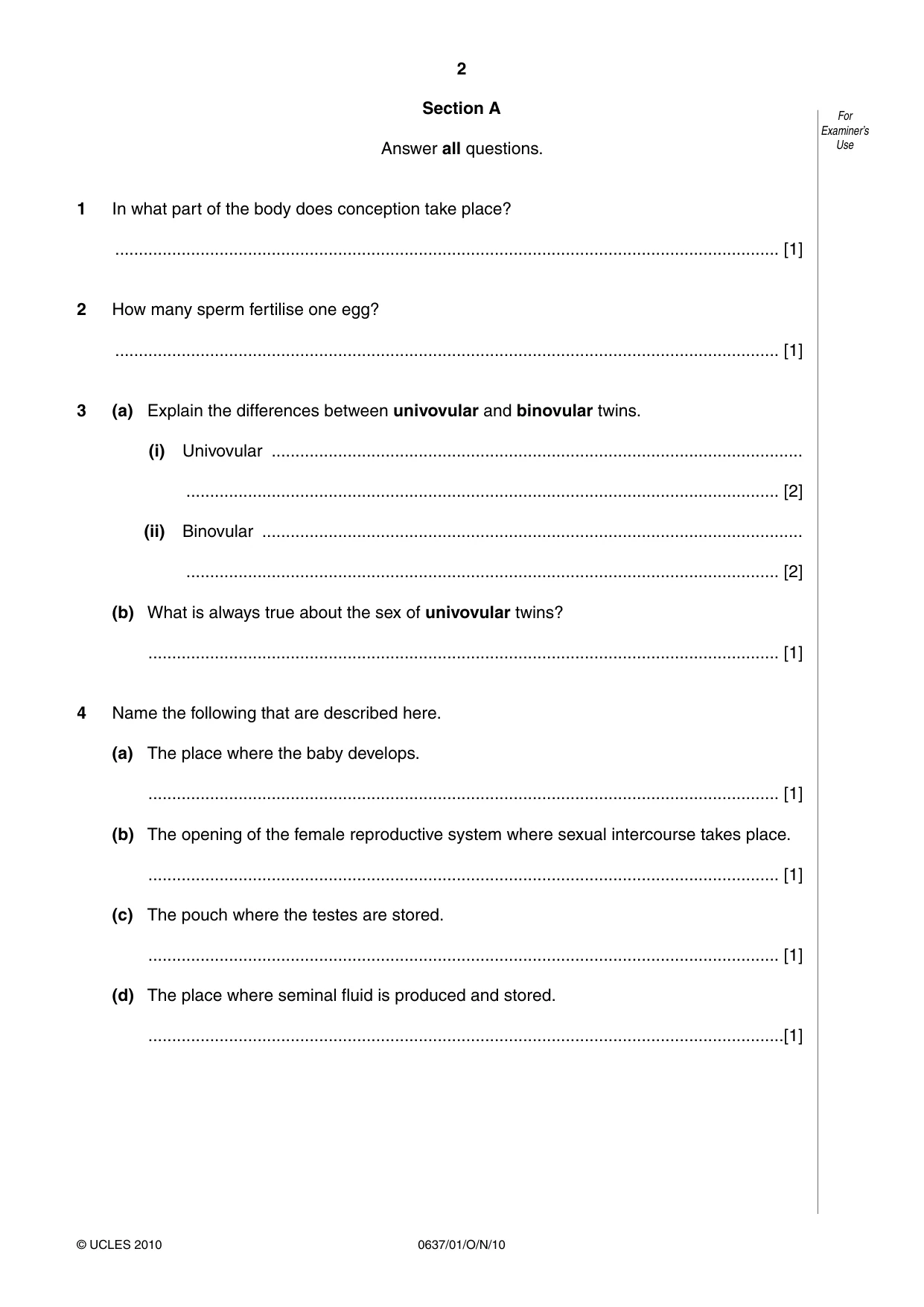
2 © UCLES 2010 0637/01/O/N/10 For Examiner’s Use Section A Answer all questions. 1 In what part of the body does conception take place? … [1] 2 How many sperm fertilise one egg? … [1] 3 (a) Explain the differences between univovular and binovular twins. (i) Univovular … … [2] (ii) Binovular … … [2] (b) What is always true about the sex of univovular twins? … [1] 4 Name the following that are described here. (a) The place where the baby develops. … [1] (b) The opening of the female reproductive system where sexual intercourse takes place. … [1] (c) The pouch where the testes are stored. … [1] (d) The place where seminal fluid is produced and stored. …[1]
Question paper, page 3
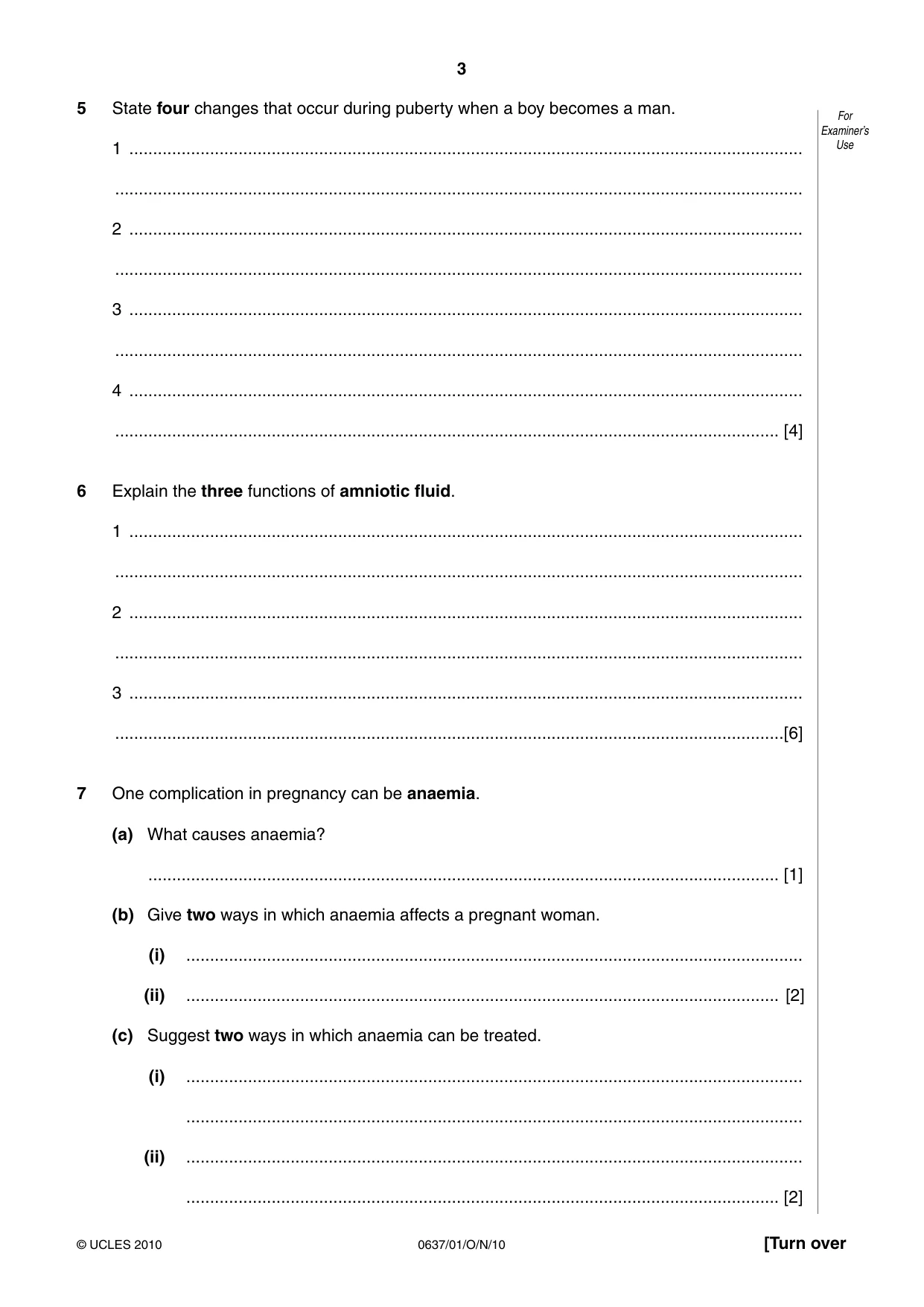
3 © UCLES 2010 [Turn over 0637/01/O/N/10 For Examiner’s Use 5 State four changes that occur during puberty when a boy becomes a man. 1 … … 2 … … 3 … … 4 … … [4] 6 Explain the three functions of amniotic fluid. 1 … … 2 … … 3 … …[6] 7 One complication in pregnancy can be anaemia. (a) What causes anaemia? … [1] (b) Give two ways in which anaemia affects a pregnant woman. (i) … (ii) … [2] (c) Suggest two ways in which anaemia can be treated. (i) … … (ii) … … [2]
Question paper, page 4
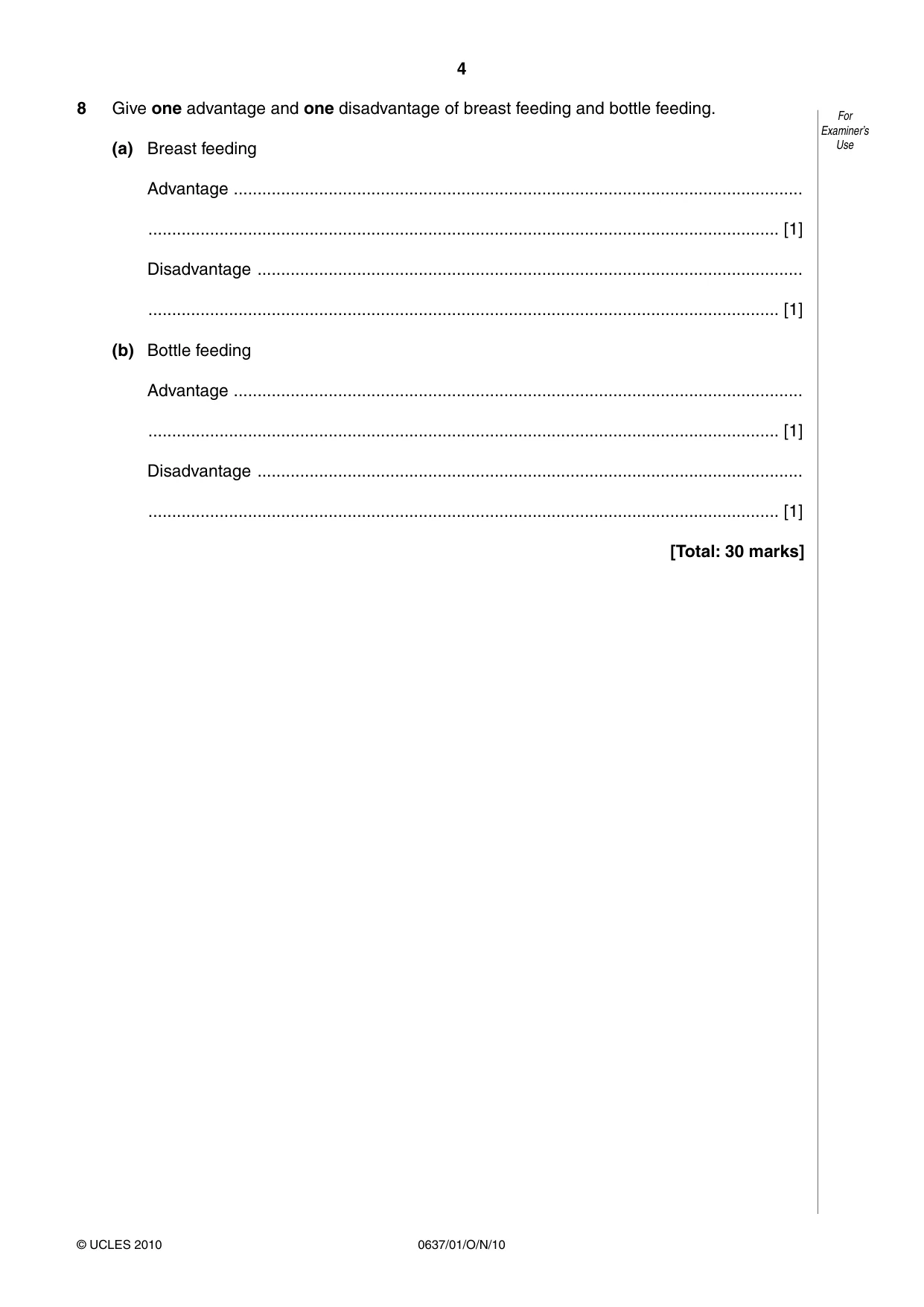
4 © UCLES 2010 0637/01/O/N/10 For Examiner’s Use 8 Give one advantage and one disadvantage of breast feeding and bottle feeding. (a) Breast feeding Advantage … … [1] Disadvantage … … [1] (b) Bottle feeding Advantage … … [1] Disadvantage … … [1] [Total: 30 marks]
Question paper, page 5
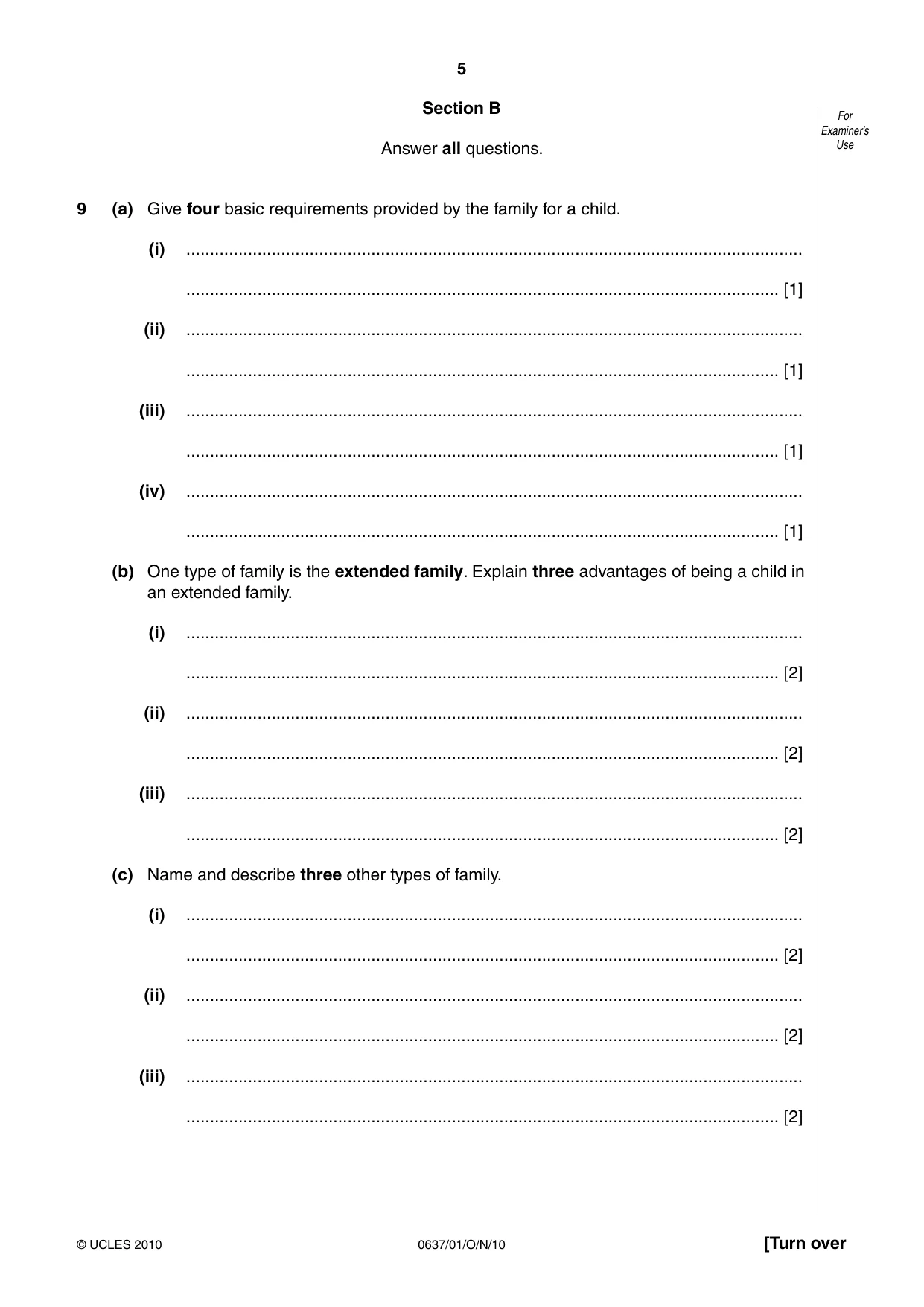
5 © UCLES 2010 [Turn over 0637/01/O/N/10 For Examiner’s Use Section B Answer all questions. 9 (a) Give four basic requirements provided by the family for a child. (i) … … [1] (ii) … … [1] (iii) … … [1] (iv) … … [1] (b) One type of family is the extended family. Explain three advantages of being a child in an extended family. (i) … … [2] (ii) … … [2] (iii) … … [2] (c) Name and describe three other types of family. (i) … … [2] (ii) … … [2] (iii) … … [2]
Question paper, page 6
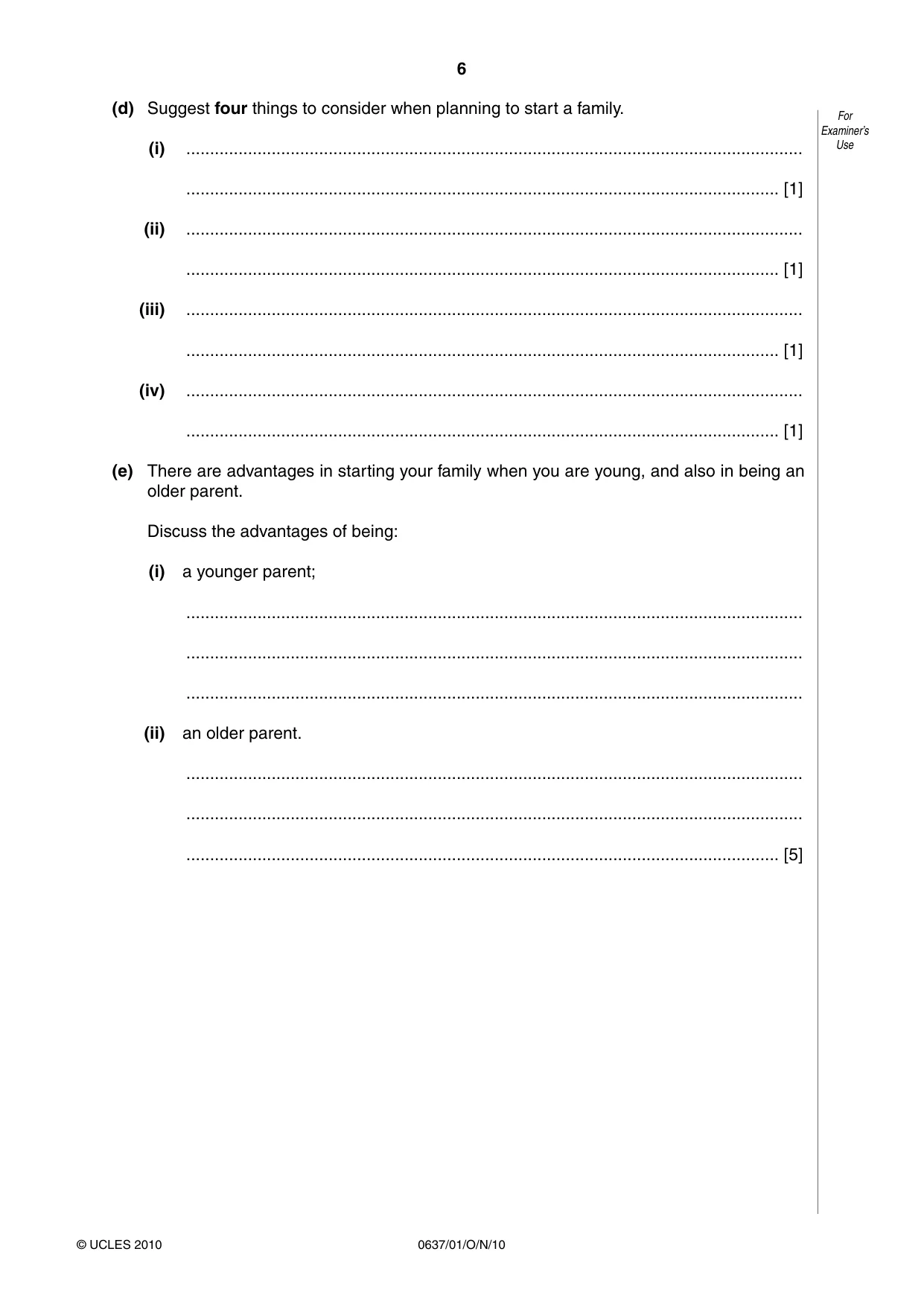
6 © UCLES 2010 0637/01/O/N/10 For Examiner’s Use (d) Suggest four things to consider when planning to start a family. (i) … … [1] (ii) … … [1] (iii) … … [1] (iv) … … [1] (e) There are advantages in starting your family when you are young, and also in being an older parent. Discuss the advantages of being: (i) a younger parent; … … … (ii) an older parent. … … … [5]
Question paper, page 7
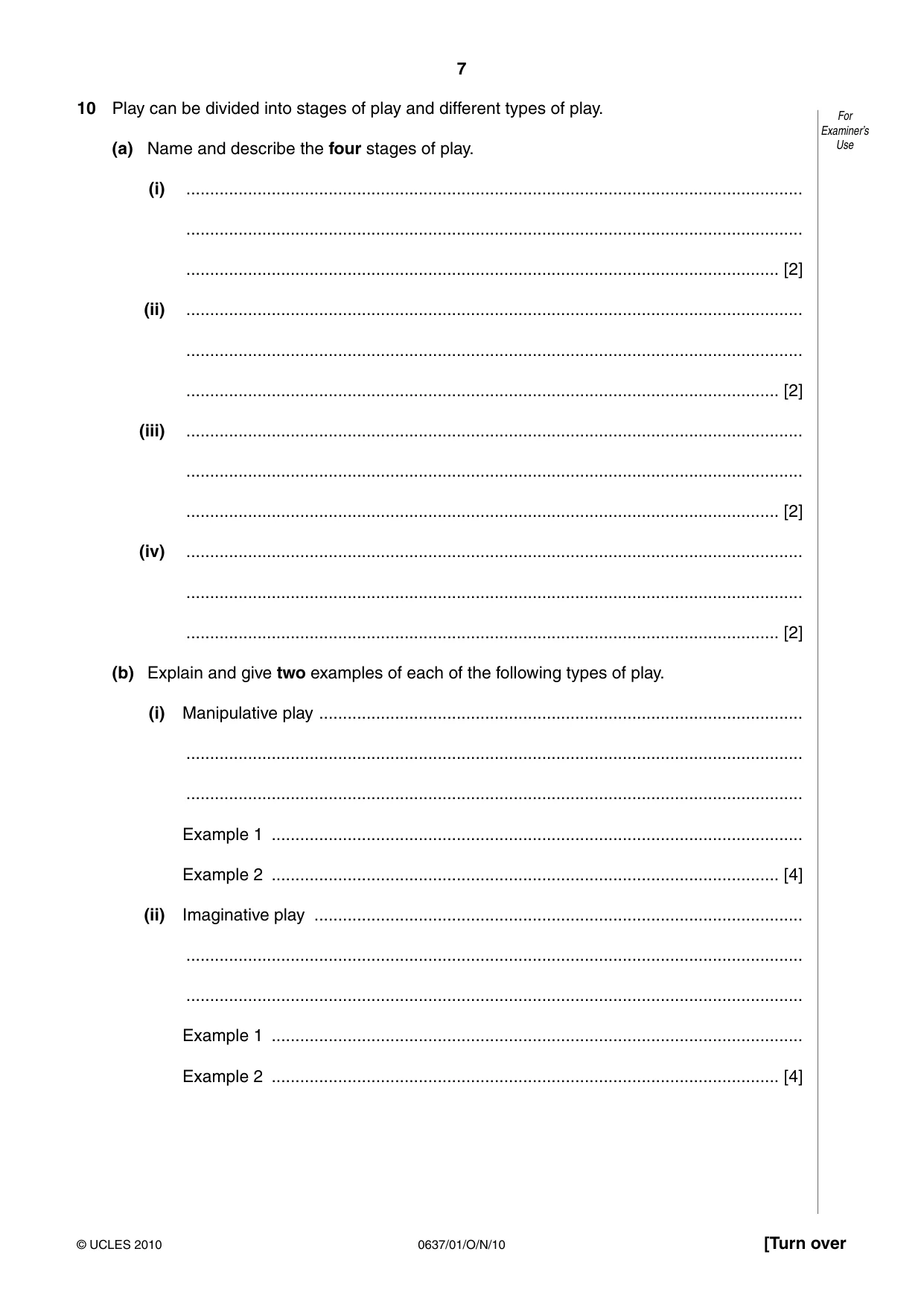
7 © UCLES 2010 [Turn over 0637/01/O/N/10 For Examiner’s Use 10 Play can be divided into stages of play and different types of play. (a) Name and describe the four stages of play. (i) … … … [2] (ii) … … … [2] (iii) … … … [2] (iv) … … … [2] (b) Explain and give two examples of each of the following types of play. (i) Manipulative play … … … Example 1 … Example 2 … [4] (ii) Imaginative play … … … Example 1 … Example 2 … [4]
Question paper, page 8
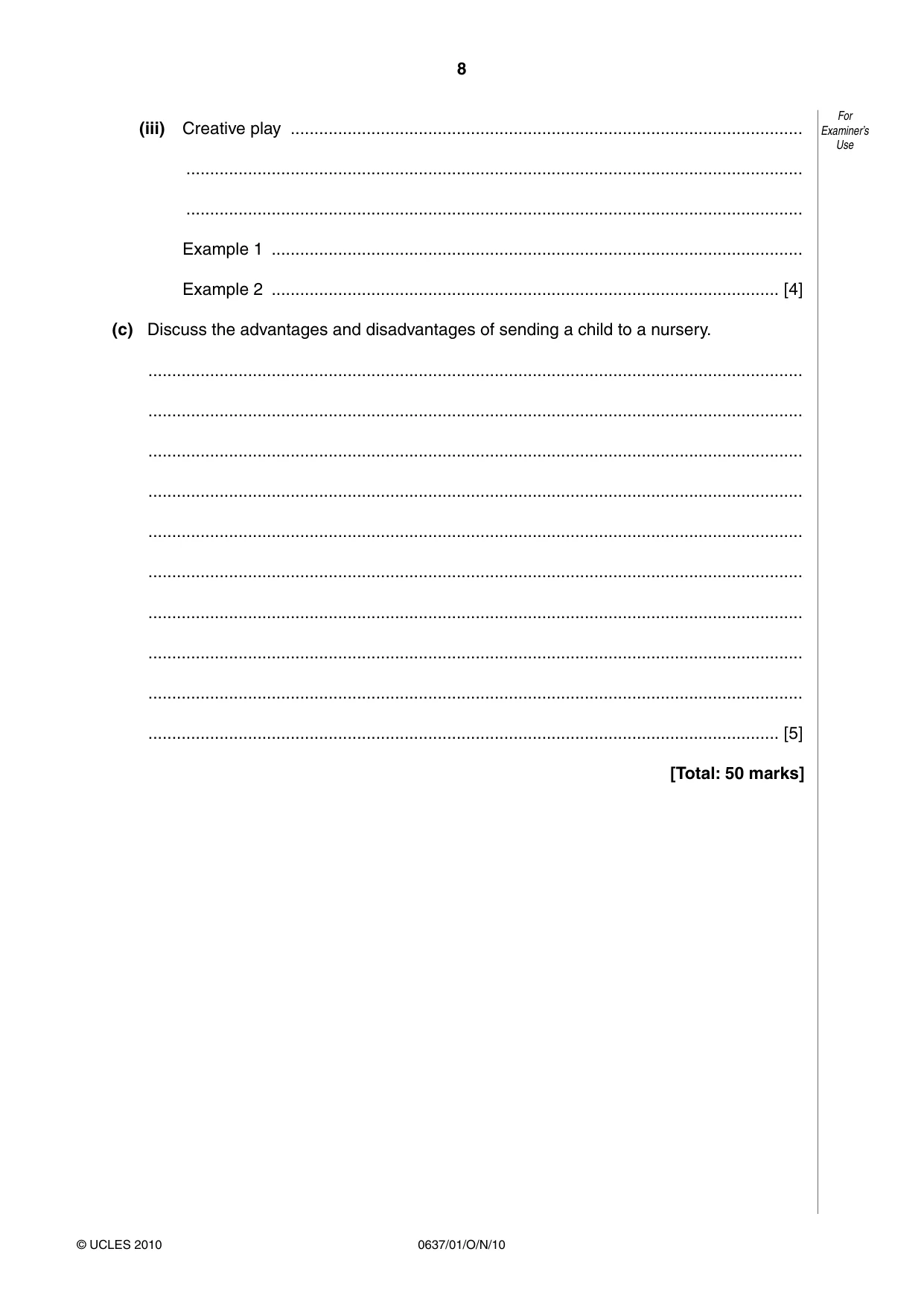
8 © UCLES 2010 0637/01/O/N/10 For Examiner’s Use (iii) Creative play … … … Example 1 … Example 2 … [4] (c) Discuss the advantages and disadvantages of sending a child to a nursery. … … … … … … … … … … [5] [Total: 50 marks]
Question paper, page 9
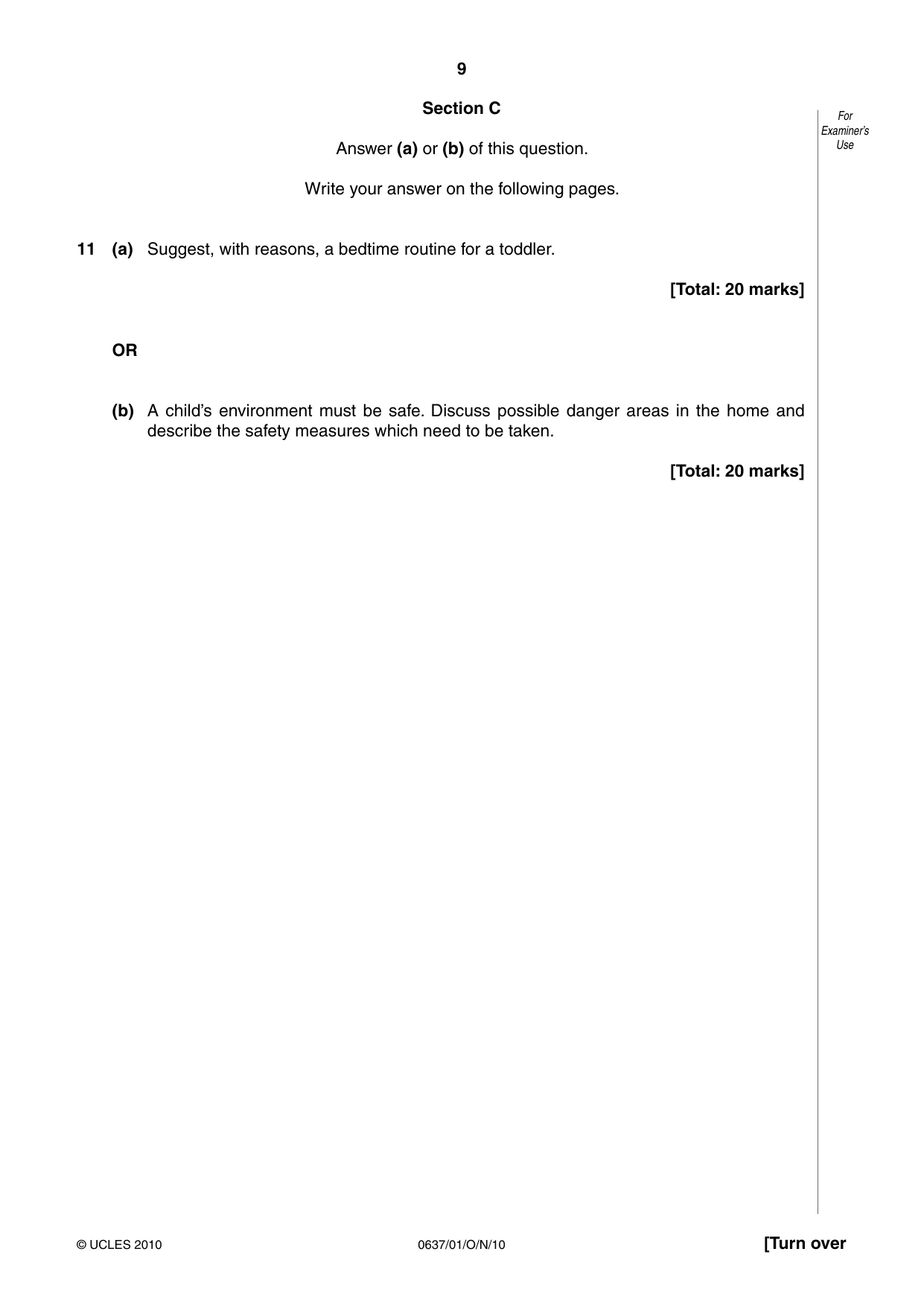
9 © UCLES 2010 [Turn over 0637/01/O/N/10 For Examiner’s Use Section C Answer (a) or (b) of this question. Write your answer on the following pages. 11 (a) Suggest, with reasons, a bedtime routine for a toddler. [Total: 20 marks] OR (b) A child’s environment must be safe. Discuss possible danger areas in the home and describe the safety measures which need to be taken. [Total: 20 marks]
Question paper, page 10
10 © UCLES 2010 0637/01/O/N/10 For Examiner’s Use … … … … … … … … … … … … … … … … … … … … … … … … … … …
Question paper, page 11
11 © UCLES 2010 0637/01/O/N/10 For Examiner’s Use … … … … … … … … … … … … … … … … … … … … … … … … … … …
Question paper, page 12
12 0637/01/O/N/10 Permission to reproduce items where third-party owned material protected by copyright is included has been sought and cleared where possible. Every reasonable effort has been made by the publisher (UCLES) to trace copyright holders, but if any items requiring clearance have unwittingly been included, the publisher will be pleased to make amends at the earliest possible opportunity. University of Cambridge International Examinations is part of the Cambridge Assessment Group. Cambridge Assessment is the brand name of University of Cambridge Local Examinations Syndicate (UCLES), which is itself a department of the University of Cambridge. BLANK PAGE
Mark scheme, page 1
UNIVERSITY OF CAMBRIDGE INTERNATIONAL EXAMINATIONS International General Certificate of Secondary Education MARK SCHEME for the October/November 2010 question paper for the guidance of teachers 0637 CHILD DEVELOPMENT 0637/01 Paper 1, maximum raw mark 100 This mark scheme is published as an aid to teachers and candidates, to indicate the requirements of the examination. It shows the basis on which Examiners were instructed to award marks. It does not indicate the details of the discussions that took place at an Examiners’ meeting before marking began, which would have considered the acceptability of alternative answers. Mark schemes must be read in conjunction with the question papers and the report on the examination. • CIE will not enter into discussions or correspondence in connection with these mark schemes. CIE is publishing the mark schemes for the October/November 2010 question papers for most IGCSE, GCE Advanced Level and Advanced Subsidiary Level syllabuses and some Ordinary Level syllabuses.
Mark scheme, page 2
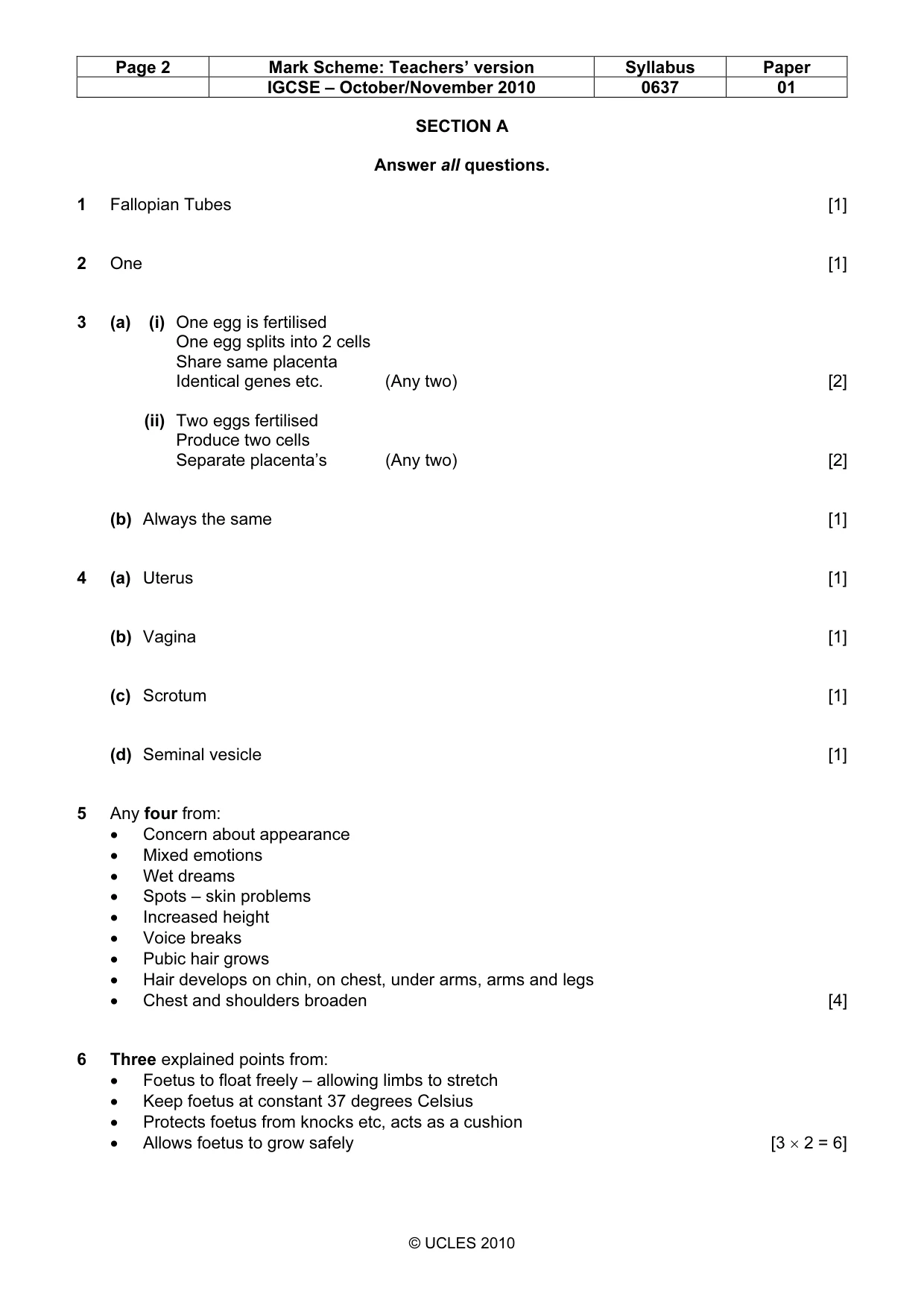
Page 2 Mark Scheme: Teachers’ version Syllabus Paper IGCSE – October/November 2010 0637 01 © UCLES 2010 SECTION A Answer all questions. 1 Fallopian Tubes [1] 2 One [1] 3 (a) (i) One egg is fertilised One egg splits into 2 cells Share same placenta Identical genes etc. (Any two) [2] (ii) Two eggs fertilised Produce two cells Separate placenta’s (Any two) [2] (b) Always the same [1] 4 (a) Uterus [1] (b) Vagina [1] (c) Scrotum [1] (d) Seminal vesicle [1] 5 Any four from: • Concern about appearance • Mixed emotions • Wet dreams • Spots – skin problems • Increased height • Voice breaks • Pubic hair grows • Hair develops on chin, on chest, under arms, arms and legs • Chest and shoulders broaden [4] 6 Three explained points from: • Foetus to float freely – allowing limbs to stretch • Keep foetus at constant 37 degrees Celsius • Protects foetus from knocks etc, acts as a cushion • Allows foetus to grow safely [3 × 2 = 6]
Mark scheme, page 3
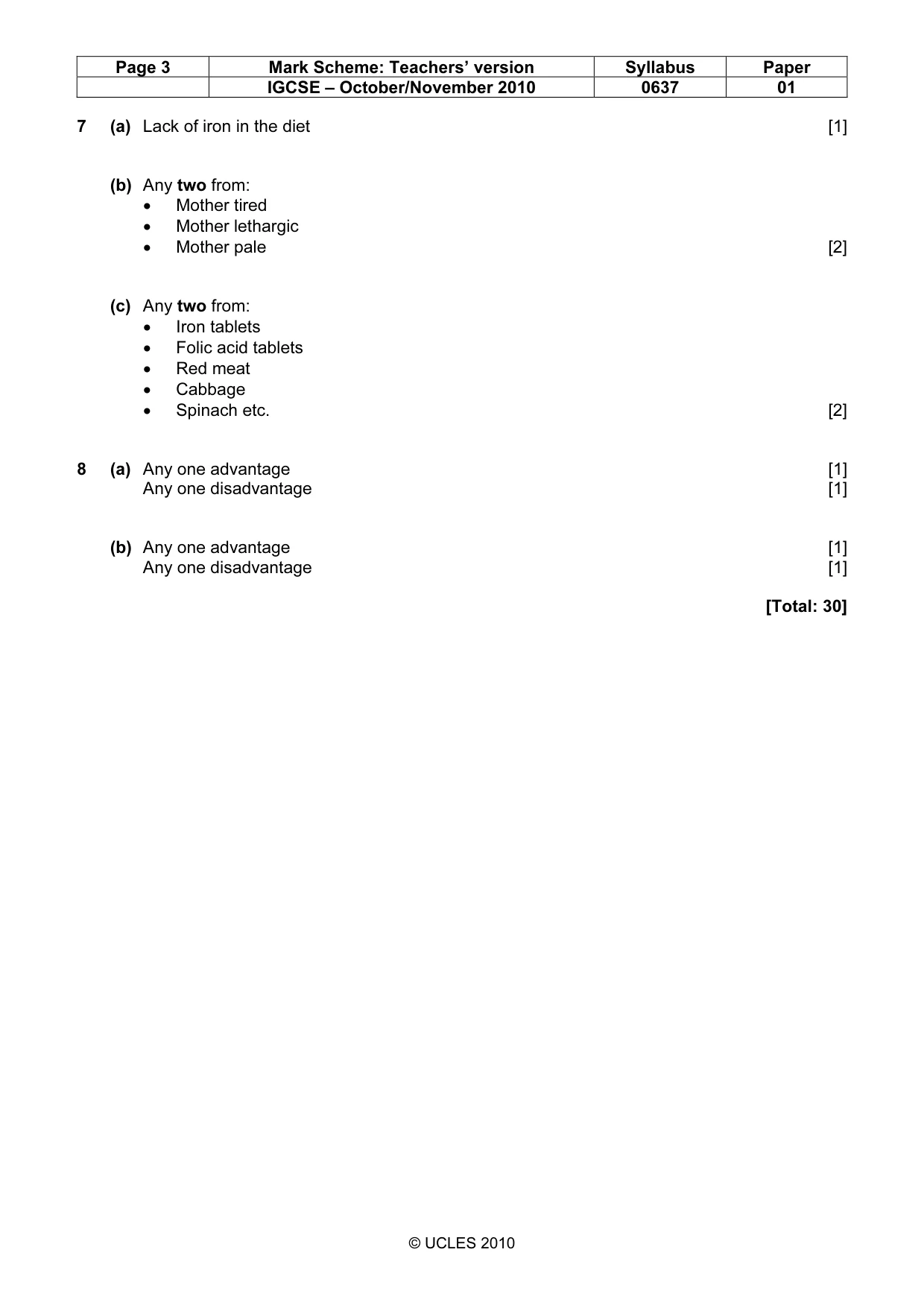
Page 3 Mark Scheme: Teachers’ version Syllabus Paper IGCSE – October/November 2010 0637 01 © UCLES 2010 7 (a) Lack of iron in the diet [1] (b) Any two from: • Mother tired • Mother lethargic • Mother pale [2] (c) Any two from: • Iron tablets • Folic acid tablets • Red meat • Cabbage • Spinach etc. [2] 8 (a) Any one advantage [1] Any one disadvantage [1] (b) Any one advantage [1] Any one disadvantage [1] [Total: 30]
Mark scheme, page 4
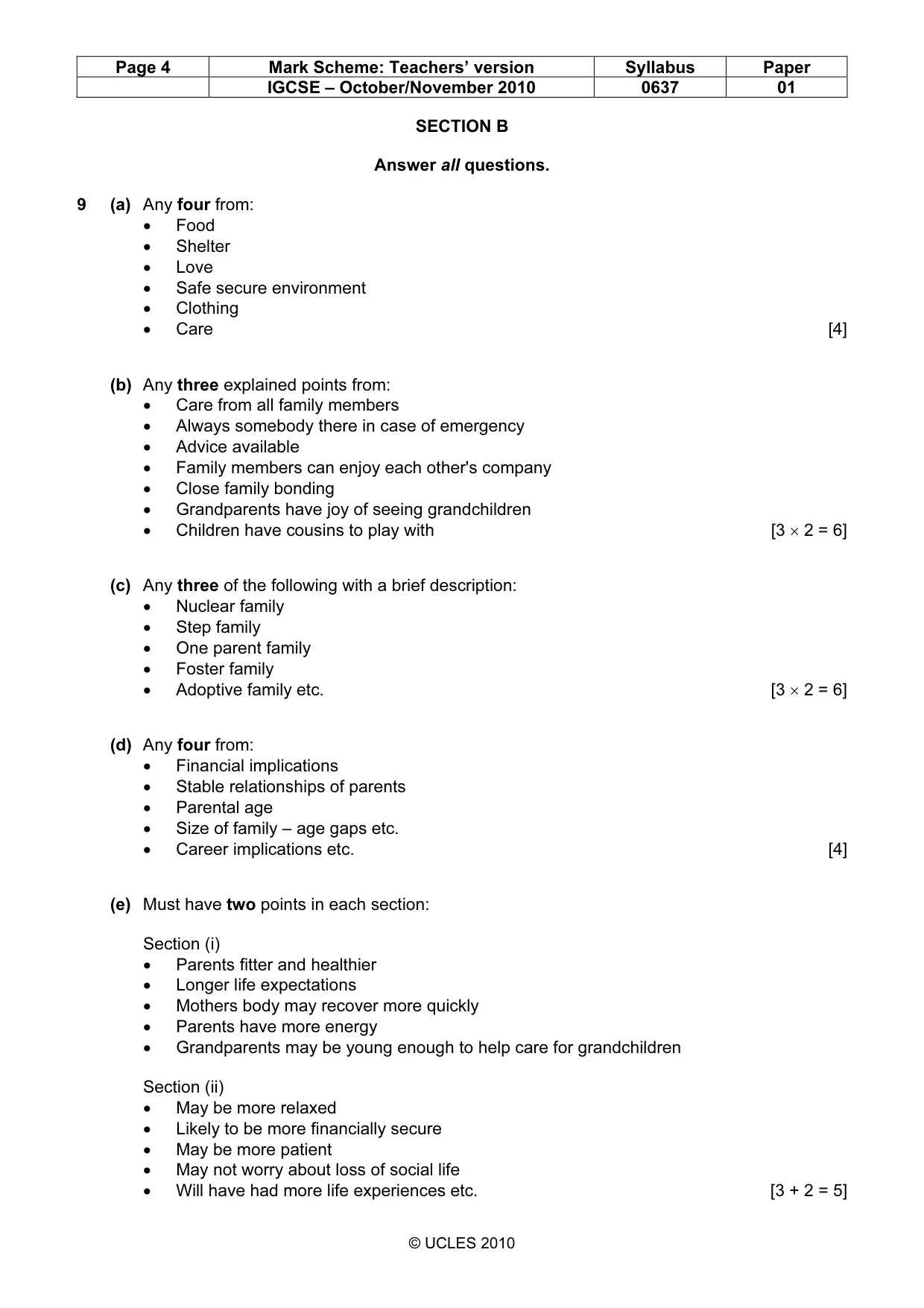
Page 4 Mark Scheme: Teachers’ version Syllabus Paper IGCSE – October/November 2010 0637 01 © UCLES 2010 SECTION B Answer all questions. 9 (a) Any four from: • Food • Shelter • Love • Safe secure environment • Clothing • Care [4] (b) Any three explained points from: • Care from all family members • Always somebody there in case of emergency • Advice available • Family members can enjoy each other's company • Close family bonding • Grandparents have joy of seeing grandchildren • Children have cousins to play with [3 × 2 = 6] (c) Any three of the following with a brief description: • Nuclear family • Step family • One parent family • Foster family • Adoptive family etc. [3 × 2 = 6] (d) Any four from: • Financial implications • Stable relationships of parents • Parental age • Size of family – age gaps etc. • Career implications etc. [4] (e) Must have two points in each section: Section (i) • Parents fitter and healthier • Longer life expectations • Mothers body may recover more quickly • Parents have more energy • Grandparents may be young enough to help care for grandchildren Section (ii) • May be more relaxed • Likely to be more financially secure • May be more patient • May not worry about loss of social life • Will have had more life experiences etc. [3 + 2 = 5]
Mark scheme, page 5
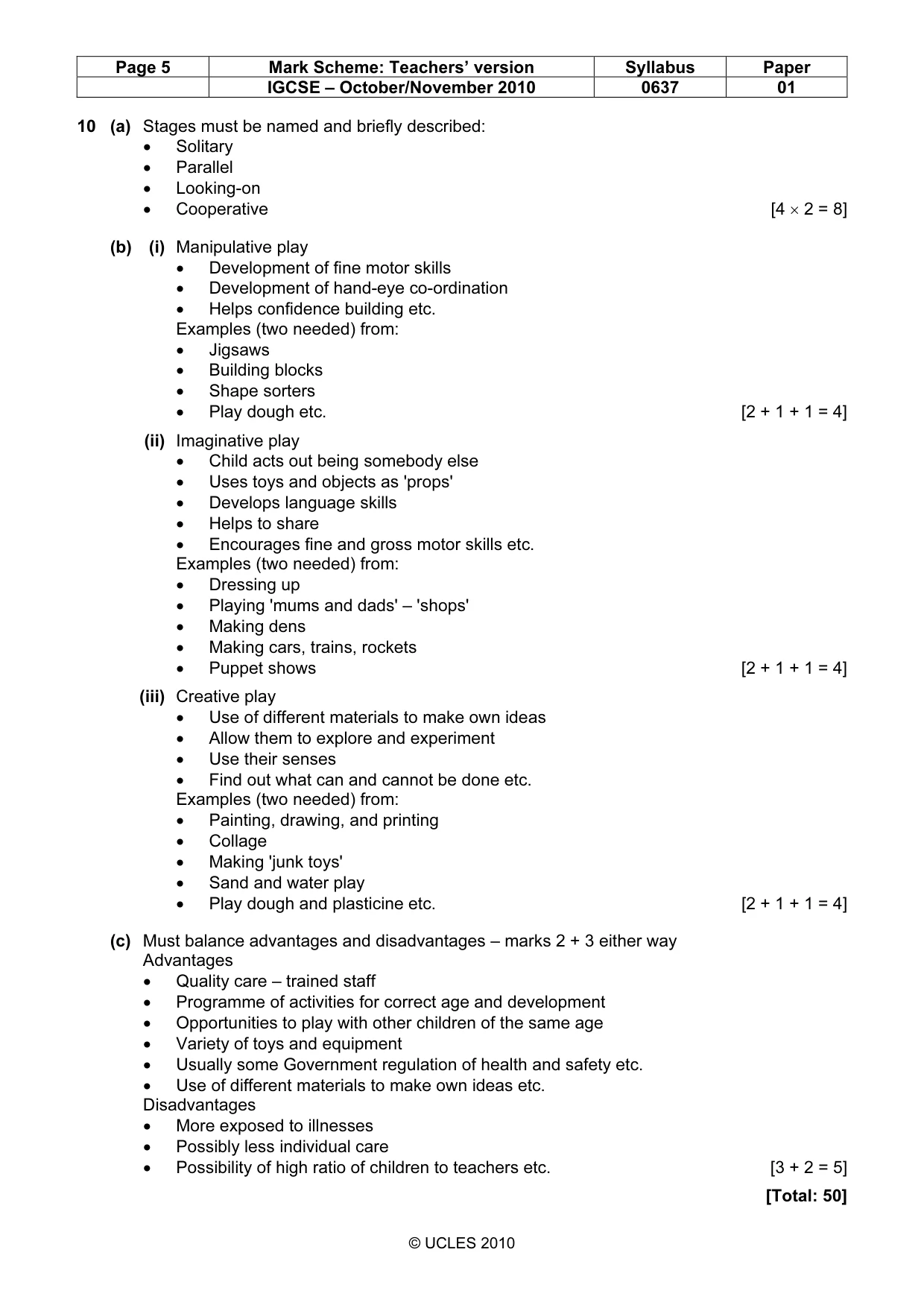
Page 5 Mark Scheme: Teachers’ version Syllabus Paper IGCSE – October/November 2010 0637 01 © UCLES 2010 10 (a) Stages must be named and briefly described: • Solitary • Parallel • Looking-on • Cooperative [4 × 2 = 8] (b) (i) Manipulative play • Development of fine motor skills • Development of hand-eye co-ordination • Helps confidence building etc. Examples (two needed) from: • Jigsaws • Building blocks • Shape sorters • Play dough etc. [2 + 1 + 1 = 4] (ii) Imaginative play • Child acts out being somebody else • Uses toys and objects as 'props' • Develops language skills • Helps to share • Encourages fine and gross motor skills etc. Examples (two needed) from: • Dressing up • Playing 'mums and dads' – 'shops' • Making dens • Making cars, trains, rockets • Puppet shows [2 + 1 + 1 = 4] (iii) Creative play • Use of different materials to make own ideas • Allow them to explore and experiment • Use their senses • Find out what can and cannot be done etc. Examples (two needed) from: • Painting, drawing, and printing • Collage • Making 'junk toys' • Sand and water play • Play dough and plasticine etc. [2 + 1 + 1 = 4] (c) Must balance advantages and disadvantages – marks 2 + 3 either way Advantages • Quality care – trained staff • Programme of activities for correct age and development • Opportunities to play with other children of the same age • Variety of toys and equipment • Usually some Government regulation of health and safety etc. • Use of different materials to make own ideas etc. Disadvantages • More exposed to illnesses • Possibly less individual care • Possibility of high ratio of children to teachers etc. [3 + 2 = 5] [Total: 50]
Mark scheme, page 6
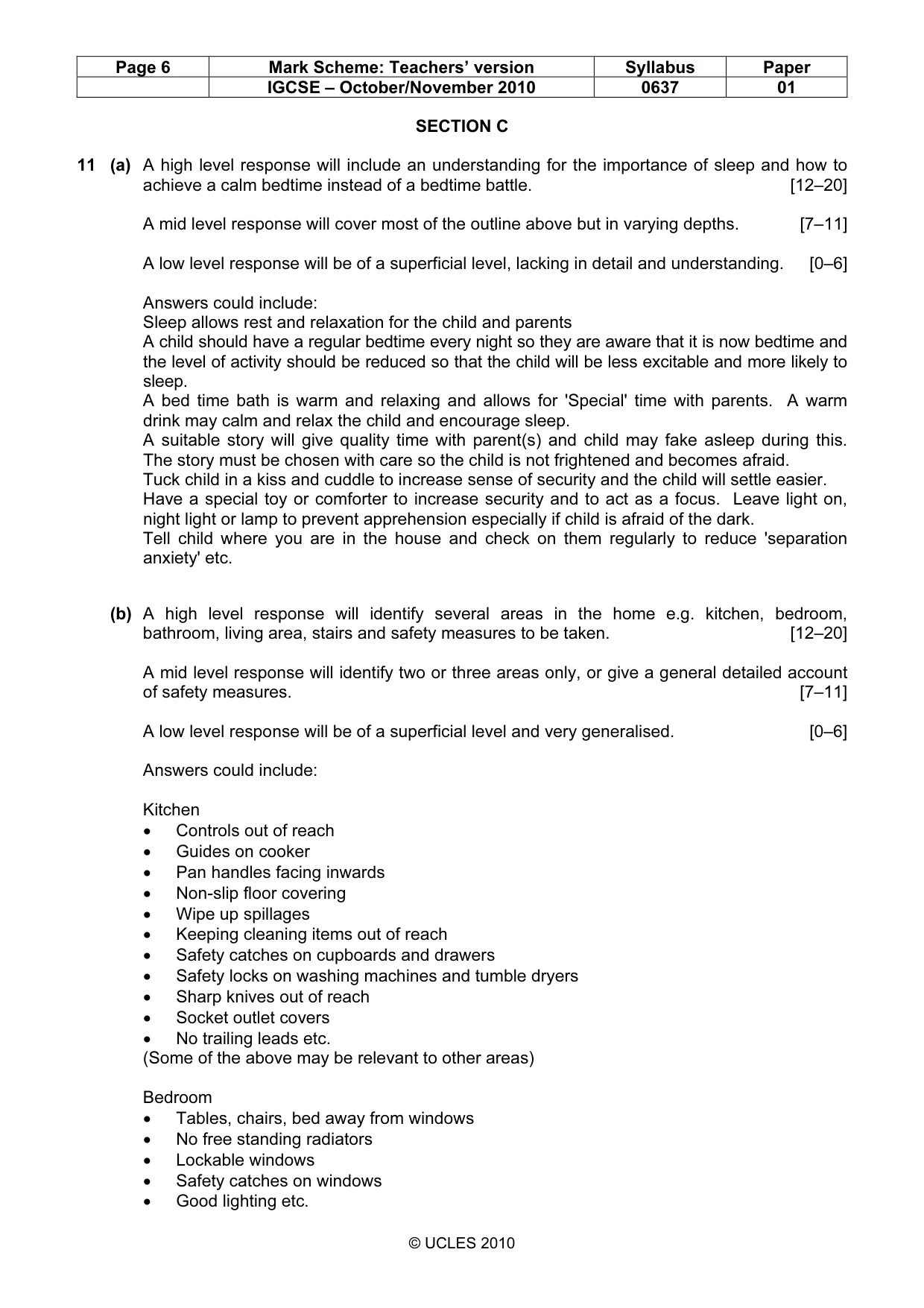
Page 6 Mark Scheme: Teachers’ version Syllabus Paper IGCSE – October/November 2010 0637 01 © UCLES 2010 SECTION C 11 (a) A high level response will include an understanding for the importance of sleep and how to achieve a calm bedtime instead of a bedtime battle. [12–20] A mid level response will cover most of the outline above but in varying depths. [7–11] A low level response will be of a superficial level, lacking in detail and understanding. [0–6] Answers could include: Sleep allows rest and relaxation for the child and parents A child should have a regular bedtime every night so they are aware that it is now bedtime and the level of activity should be reduced so that the child will be less excitable and more likely to sleep. A bed time bath is warm and relaxing and allows for 'Special' time with parents. A warm drink may calm and relax the child and encourage sleep. A suitable story will give quality time with parent(s) and child may fake asleep during this. The story must be chosen with care so the child is not frightened and becomes afraid. Tuck child in a kiss and cuddle to increase sense of security and the child will settle easier. Have a special toy or comforter to increase security and to act as a focus. Leave light on, night light or lamp to prevent apprehension especially if child is afraid of the dark. Tell child where you are in the house and check on them regularly to reduce 'separation anxiety' etc. (b) A high level response will identify several areas in the home e.g. kitchen, bedroom, bathroom, living area, stairs and safety measures to be taken. [12–20] A mid level response will identify two or three areas only, or give a general detailed account of safety measures. [7–11] A low level response will be of a superficial level and very generalised. [0–6] Answers could include: Kitchen • Controls out of reach • Guides on cooker • Pan handles facing inwards • Non-slip floor covering • Wipe up spillages • Keeping cleaning items out of reach • Safety catches on cupboards and drawers • Safety locks on washing machines and tumble dryers • Sharp knives out of reach • Socket outlet covers • No trailing leads etc. (Some of the above may be relevant to other areas) Bedroom • Tables, chairs, bed away from windows • No free standing radiators • Lockable windows • Safety catches on windows • Good lighting etc.
Mark scheme, page 7
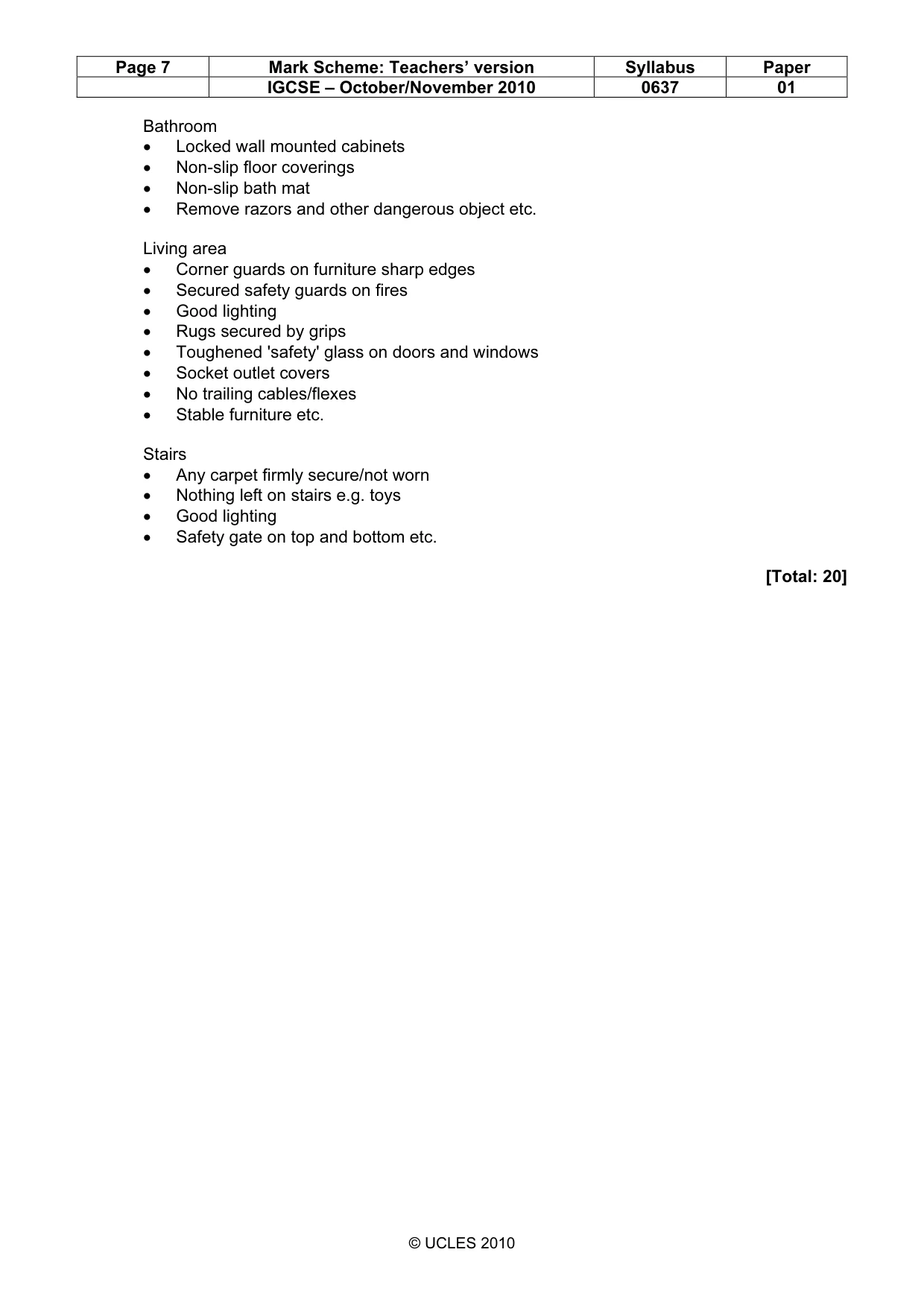
Page 7 Mark Scheme: Teachers’ version Syllabus Paper IGCSE – October/November 2010 0637 01 © UCLES 2010 Bathroom • Locked wall mounted cabinets • Non-slip floor coverings • Non-slip bath mat • Remove razors and other dangerous object etc. Living area • Corner guards on furniture sharp edges • Secured safety guards on fires • Good lighting • Rugs secured by grips • Toughened 'safety' glass on doors and windows • Socket outlet covers • No trailing cables/flexes • Stable furniture etc. Stairs • Any carpet firmly secure/not worn • Nothing left on stairs e.g. toys • Good lighting • Safety gate on top and bottom etc. [Total: 20]
What you needed in this session
Cambridge’s own grade thresholds for 2010 Oct/Nov, Paper 1 · Variant 1. A higher threshold means an easier paper — the bar moves with how the cohort did.