Cambridge IGCSE Child Development 0637 — 2010 May/June Paper 1 · Variant 1
0637/11/M/J/10 · 100 marks · ≈113 min
The question paper and its mark scheme, free to read here and free to download. This is Cambridge’s own paper, exactly as it was sat.
Question paper12 pages
Mark scheme8 pages
Answers below. Sit the paper first if you are practising.
Paper as text
Question paper, page 1
This document consists of 8 printed pages, 3 lined pages and 1 blank page. DC (LEO) 18725/1 © UCLES 2010 [Turn over UNIVERSITY OF CAMBRIDGE INTERNATIONAL EXAMINATIONS International General Certificate of Secondary Education READ THESE INSTRUCTIONS FIRST Write your Centre number, candidate number and name on all the work you hand in. Write in dark blue or black pen. You may use a soft pencil for any diagrams or graphs. Do not use staples, paper clips, highlighters, glue or correction fluid. DO NOT WRITE IN ANY BARCODES. Section A and Section B Answer all questions. Section C Answer one question. Write your answers in the spaces provided on the Question Paper. At the end of the examination, fasten all your work securely together. The number of marks is given in brackets [ ] at the end of each question or part question. * 2 3 5 5 4 5 2 4 4 7 * CHILD DEVELOPMENT 0637/01 Paper 1 May/June 2010 2 hours Candidates answer on the Question Paper. No Additional Materials are required. For Examiner’s Use Section A Section B Section C Total
Question paper, page 2
2 0637/01/M/J/10 © UCLES 2010 For Examiner’s Use Section A Answer all questions. 1 How long does a normal pregnancy last? … [1] 2 Give four early signs and symptoms of pregnancy. 1 … 2 … 3 … 4 … [4] 3 Name the following described below. (i) The place where eggs are produced … (ii) Neck of the uterus … (iii) The place where sperm are produced … (iv) Milky white nourishing fluid containing sperm … [4] 4 Give three signs and symptoms of a miscarriage. 1 … … 2 … … 3 … … [3]
Question paper, page 3
3 0637/01/M/J/10 © UCLES 2010 [Turn over For Examiner’s Use 5 Give four reasons why some couples may have only one child. 1 … … 2 … … 3 … … 4 … … [4] 6 State four changes which occur during puberty when a girl becomes a woman. 1 … … 2 … … 3 … … 4 … … [4] 7 Describe four ways a child’s interest and development in drawing and writing can be encouraged. 1 … … 2 … … 3 … … 4 … … [4]
Question paper, page 4
4 0637/01/M/J/10 © UCLES 2010 For Examiner’s Use 8 A baby is born with reflex actions. Name and describe three of these. 1 Reflex action … Description … … 2 Reflex action … Description … … 3 Reflex action … Description … … [6] [Total: 30 marks]
Question paper, page 5
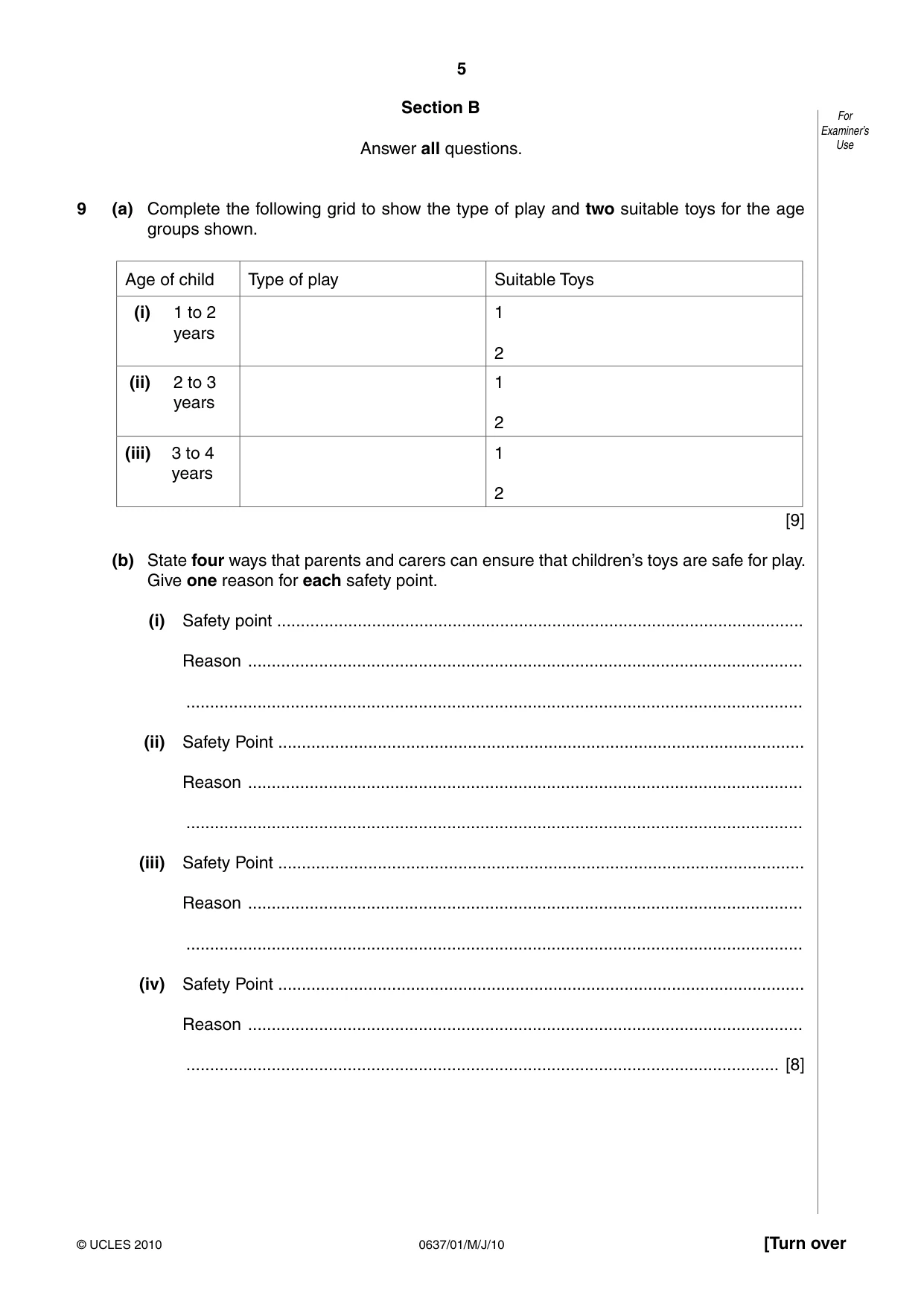
5 0637/01/M/J/10 © UCLES 2010 [Turn over For Examiner’s Use Section B Answer all questions. 9 (a) Complete the following grid to show the type of play and two suitable toys for the age groups shown. Age of child Type of play Suitable Toys (i) 1 to 2 years 1 2 (ii) 2 to 3 years 1 2 (iii) 3 to 4 years 1 2 [9] (b) State four ways that parents and carers can ensure that children’s toys are safe for play. Give one reason for each safety point. (i) Safety point … Reason … … (ii) Safety Point … Reason … … (iii) Safety Point … Reason … … (iv) Safety Point … Reason … … [8]
Question paper, page 6
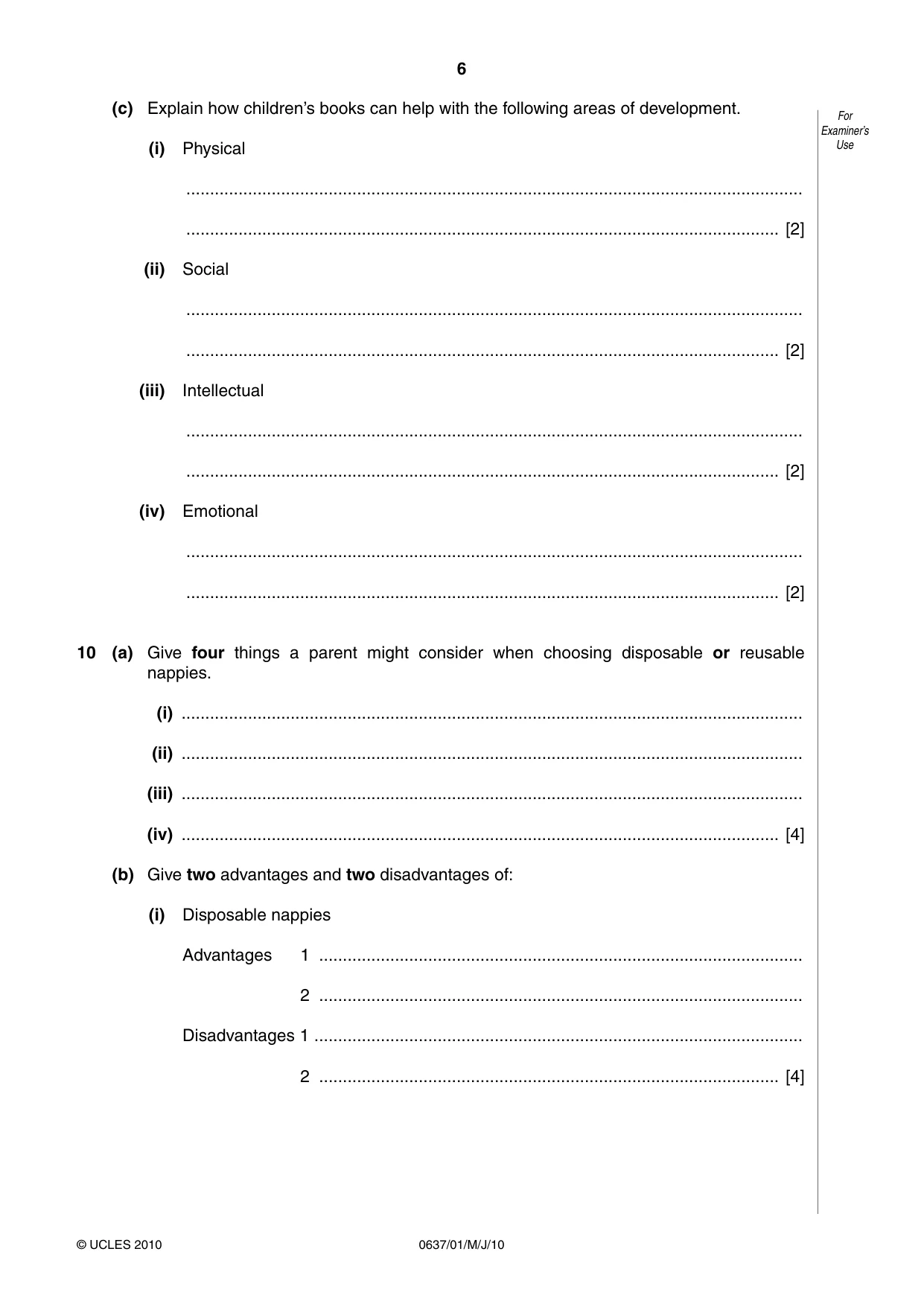
6 0637/01/M/J/10 © UCLES 2010 For Examiner’s Use (c) Explain how children’s books can help with the following areas of development. (i) Physical … … [2] (ii) Social … … [2] (iii) Intellectual … … [2] (iv) Emotional … … [2] 10 (a) Give four things a parent might consider when choosing disposable or reusable nappies. (i) … (ii) … (iii) … (iv) … [4] (b) Give two advantages and two disadvantages of: (i) Disposable nappies Advantages 1 … 2 … Disadvantages 1 … 2 … [4]
Question paper, page 7
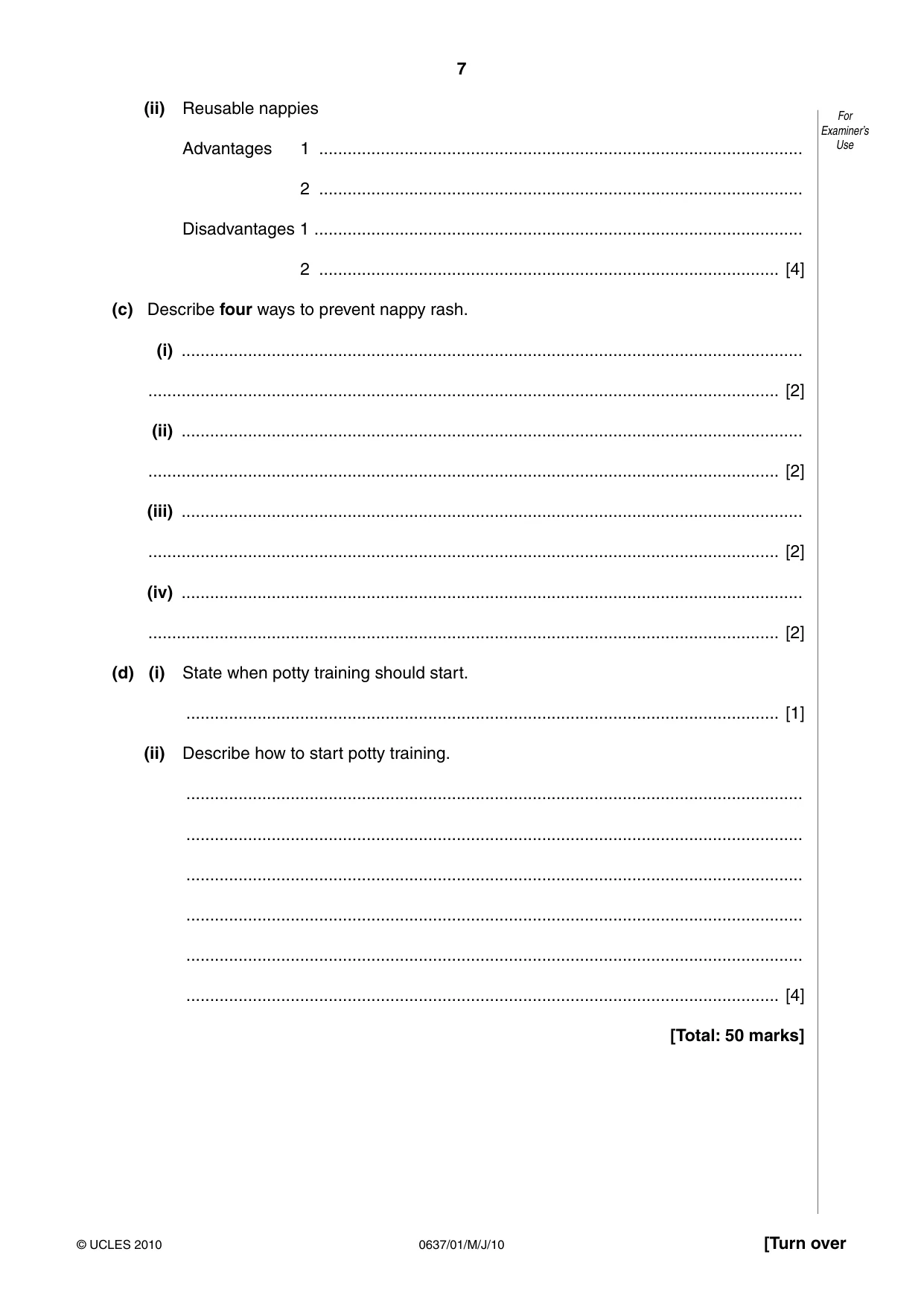
7 0637/01/M/J/10 © UCLES 2010 [Turn over For Examiner’s Use (ii) Reusable nappies Advantages 1 … 2 … Disadvantages 1 … 2 … [4] (c) Describe four ways to prevent nappy rash. (i) … … [2] (ii) … … [2] (iii) … … [2] (iv) … … [2] (d) (i) State when potty training should start. … [1] (ii) Describe how to start potty training. … … … … … … [4] [Total: 50 marks]
Question paper, page 8
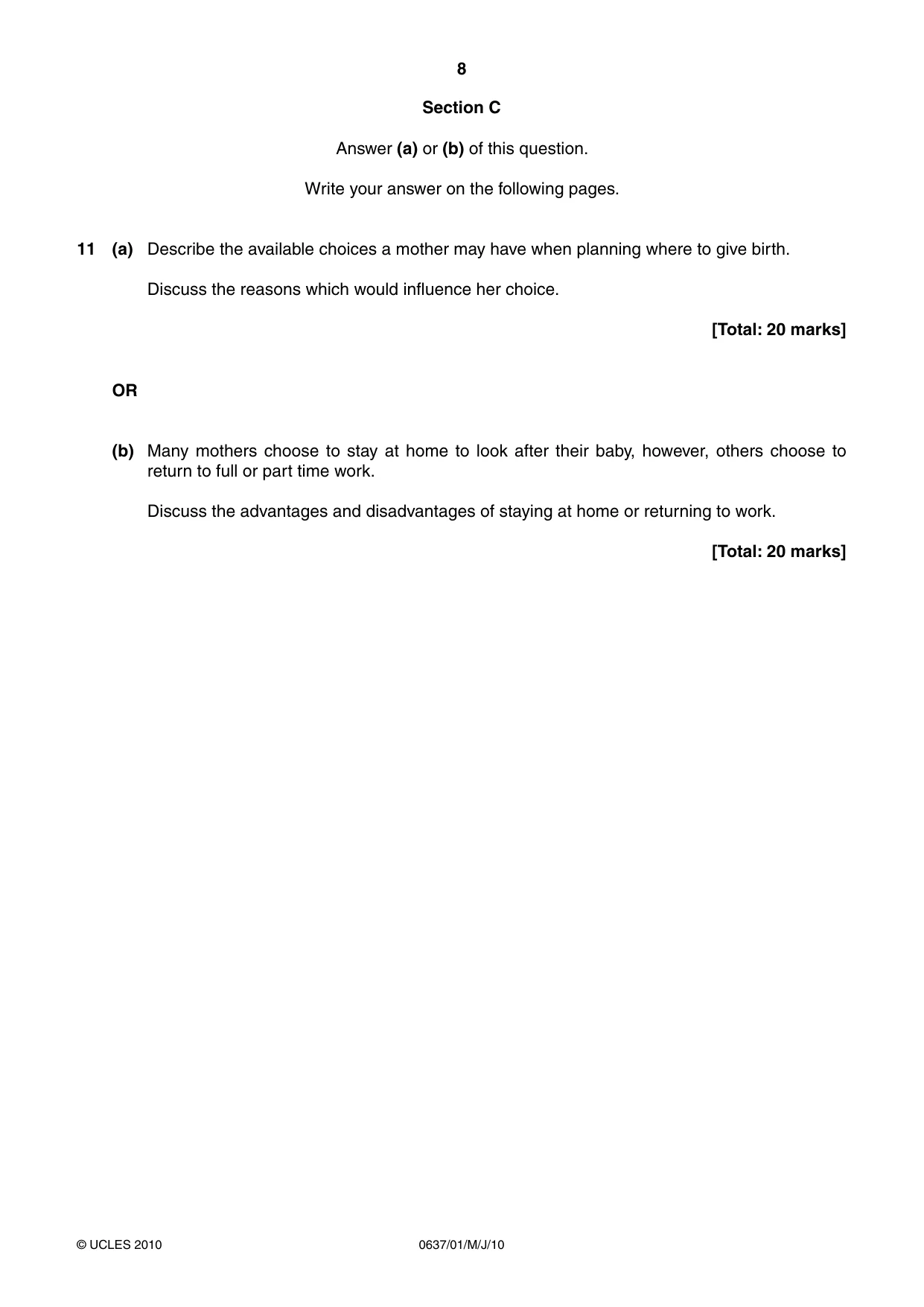
8 0637/01/M/J/10 © UCLES 2010 Section C Answer (a) or (b) of this question. Write your answer on the following pages. 11 (a) Describe the available choices a mother may have when planning where to give birth. Discuss the reasons which would influence her choice. [Total: 20 marks] OR (b) Many mothers choose to stay at home to look after their baby, however, others choose to return to full or part time work. Discuss the advantages and disadvantages of staying at home or returning to work. [Total: 20 marks]
Question paper, page 9
9 0637/01/M/J/10 © UCLES 2010 [Turn over For Examiner’s Use … … … … … … … … … … … … … … … … … … … … … … … … … … … …
Question paper, page 10
10 0637/01/M/J/10 © UCLES 2010 For Examiner’s Use … … … … … … … … … … … … … … … … … … … … … … … … … … … …
Question paper, page 11
11 0637/01/M/J/10 © UCLES 2010 For Examiner’s Use … … … … … … … … … … … … … … … … … … … … … … … … … … … …
Question paper, page 12
12 0637/01/M/J/10 © UCLES 2010 Permission to reproduce items where third-party owned material protected by copyright is included has been sought and cleared where possible. Every reasonable effort has been made by the publisher (UCLES) to trace copyright holders, but if any items requiring clearance have unwittingly been included, the publisher will be pleased to make amends at the earliest possible opportunity. University of Cambridge International Examinations is part of the Cambridge Assessment Group. Cambridge Assessment is the brand name of University of Cambridge Local Examinations Syndicate (UCLES), which is itself a department of the University of Cambridge. BLANK PAGE
Mark scheme, page 1
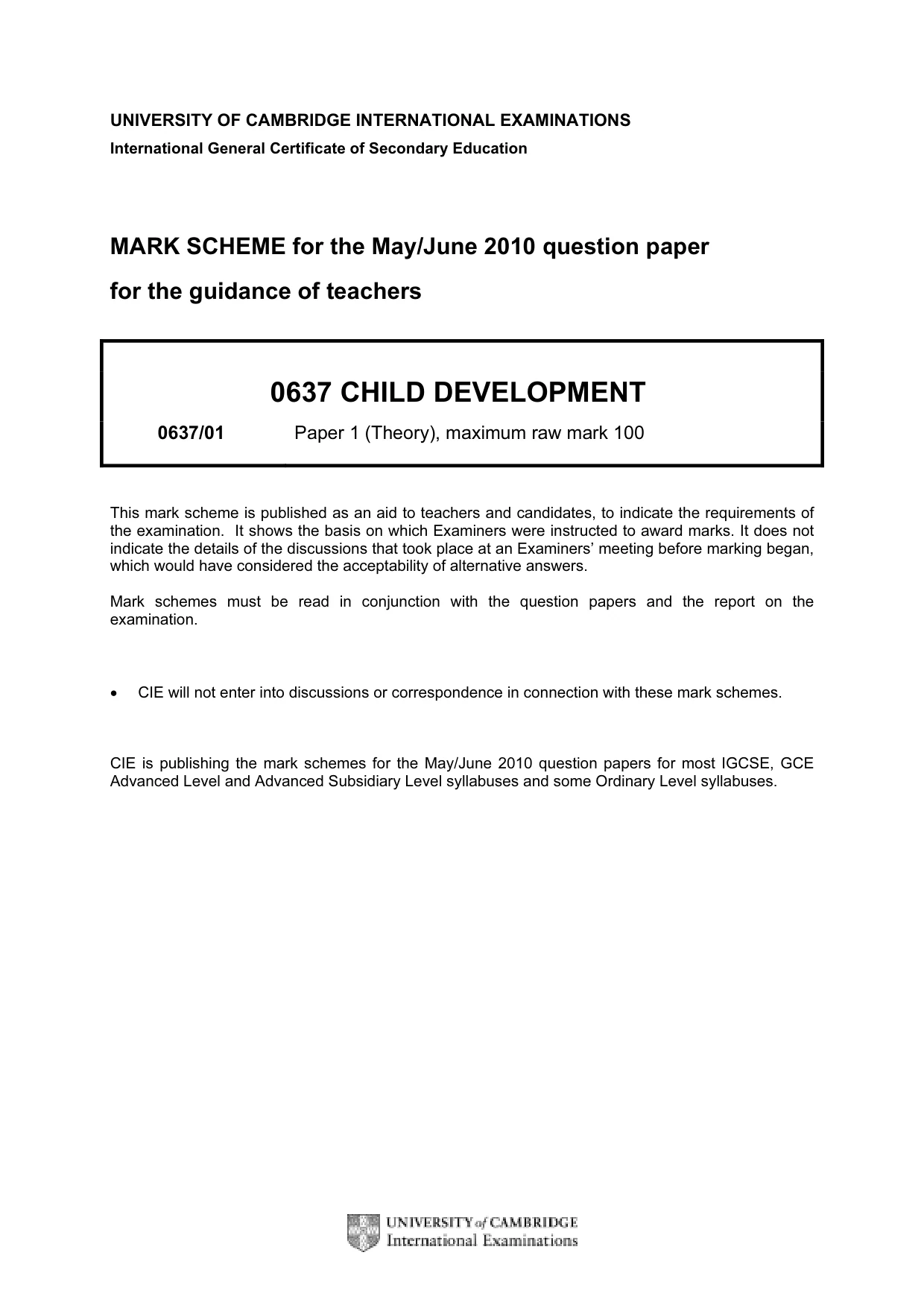
UNIVERSITY OF CAMBRIDGE INTERNATIONAL EXAMINATIONS International General Certificate of Secondary Education MARK SCHEME for the May/June 2010 question paper for the guidance of teachers 0637 CHILD DEVELOPMENT 0637/01 Paper 1 (Theory), maximum raw mark 100 This mark scheme is published as an aid to teachers and candidates, to indicate the requirements of the examination. It shows the basis on which Examiners were instructed to award marks. It does not indicate the details of the discussions that took place at an Examiners’ meeting before marking began, which would have considered the acceptability of alternative answers. Mark schemes must be read in conjunction with the question papers and the report on the examination. • CIE will not enter into discussions or correspondence in connection with these mark schemes. CIE is publishing the mark schemes for the May/June 2010 question papers for most IGCSE, GCE Advanced Level and Advanced Subsidiary Level syllabuses and some Ordinary Level syllabuses.
Mark scheme, page 2
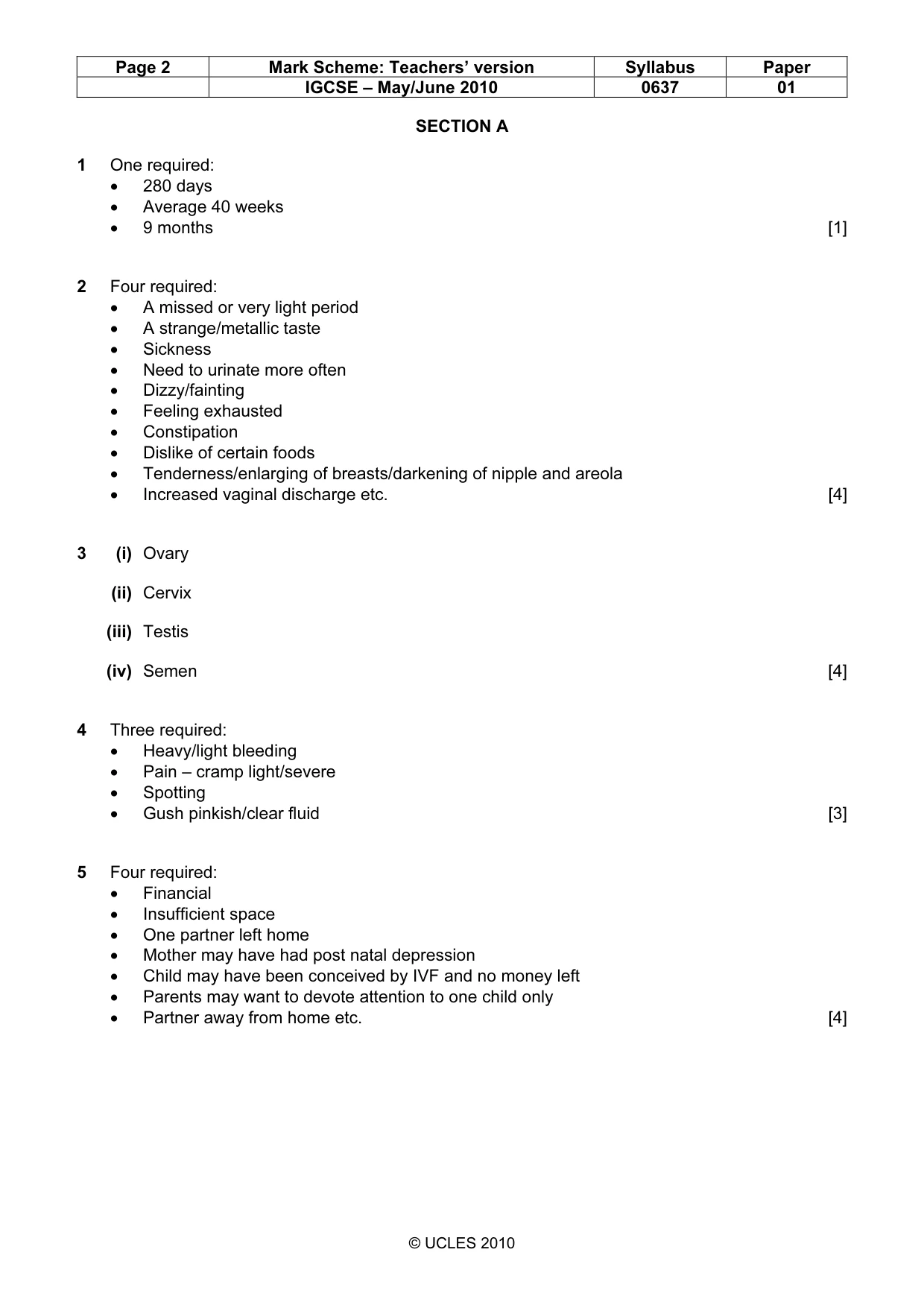
Page 2 Mark Scheme: Teachers’ version Syllabus Paper IGCSE – May/June 2010 0637 01 © UCLES 2010 SECTION A 1 One required: • 280 days • Average 40 weeks • 9 months [1] 2 Four required: • A missed or very light period • A strange/metallic taste • Sickness • Need to urinate more often • Dizzy/fainting • Feeling exhausted • Constipation • Dislike of certain foods • Tenderness/enlarging of breasts/darkening of nipple and areola • Increased vaginal discharge etc. [4] 3 (i) Ovary (ii) Cervix (iii) Testis (iv) Semen [4] 4 Three required: • Heavy/light bleeding • Pain – cramp light/severe • Spotting • Gush pinkish/clear fluid [3] 5 Four required: • Financial • Insufficient space • One partner left home • Mother may have had post natal depression • Child may have been conceived by IVF and no money left • Parents may want to devote attention to one child only • Partner away from home etc. [4]
Mark scheme, page 3
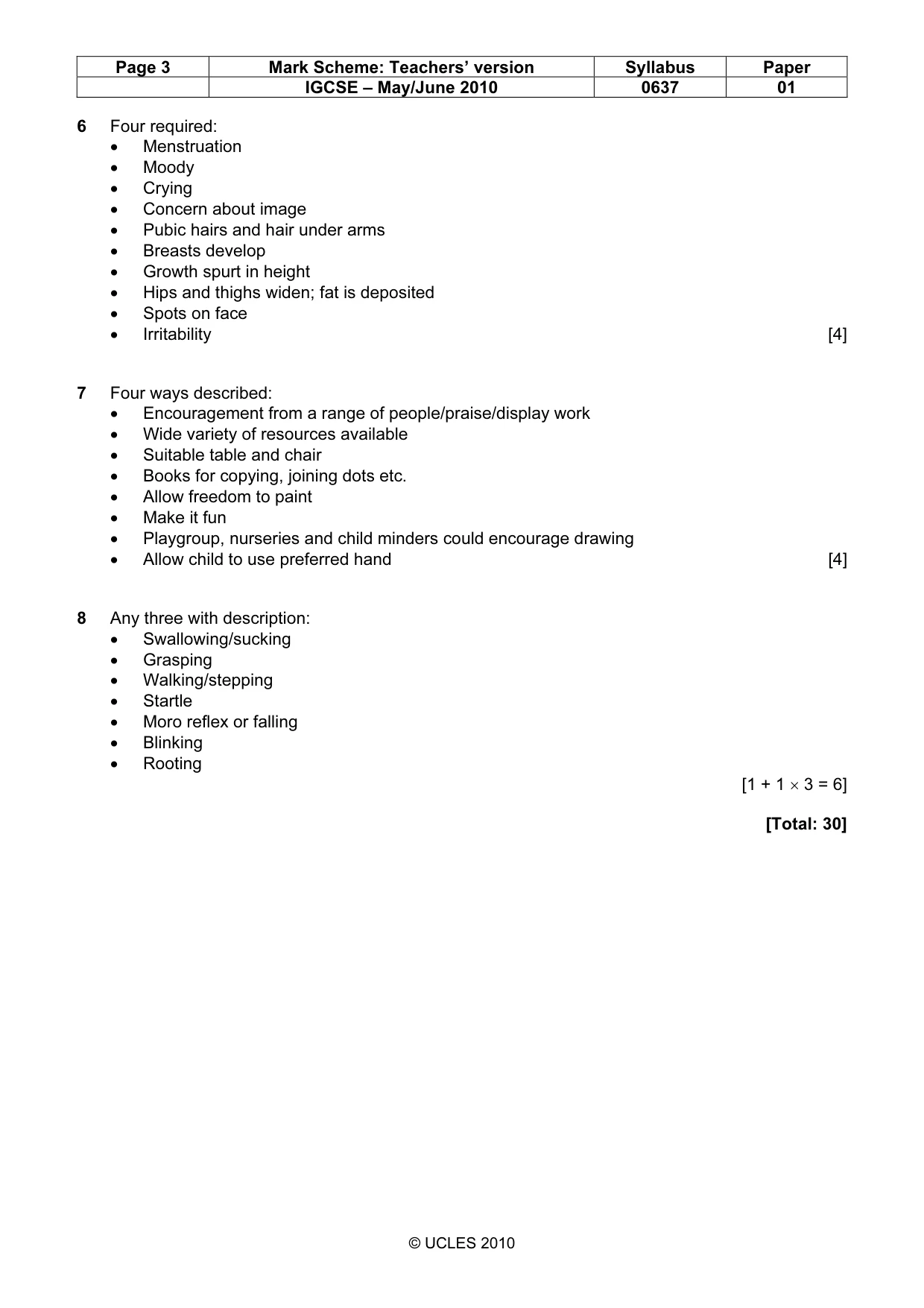
Page 3 Mark Scheme: Teachers’ version Syllabus Paper IGCSE – May/June 2010 0637 01 © UCLES 2010 6 Four required: • Menstruation • Moody • Crying • Concern about image • Pubic hairs and hair under arms • Breasts develop • Growth spurt in height • Hips and thighs widen; fat is deposited • Spots on face • Irritability [4] 7 Four ways described: • Encouragement from a range of people/praise/display work • Wide variety of resources available • Suitable table and chair • Books for copying, joining dots etc. • Allow freedom to paint • Make it fun • Playgroup, nurseries and child minders could encourage drawing • Allow child to use preferred hand [4] 8 Any three with description: • Swallowing/sucking • Grasping • Walking/stepping • Startle • Moro reflex or falling • Blinking • Rooting [1 + 1 × 3 = 6] [Total: 30]
Mark scheme, page 4
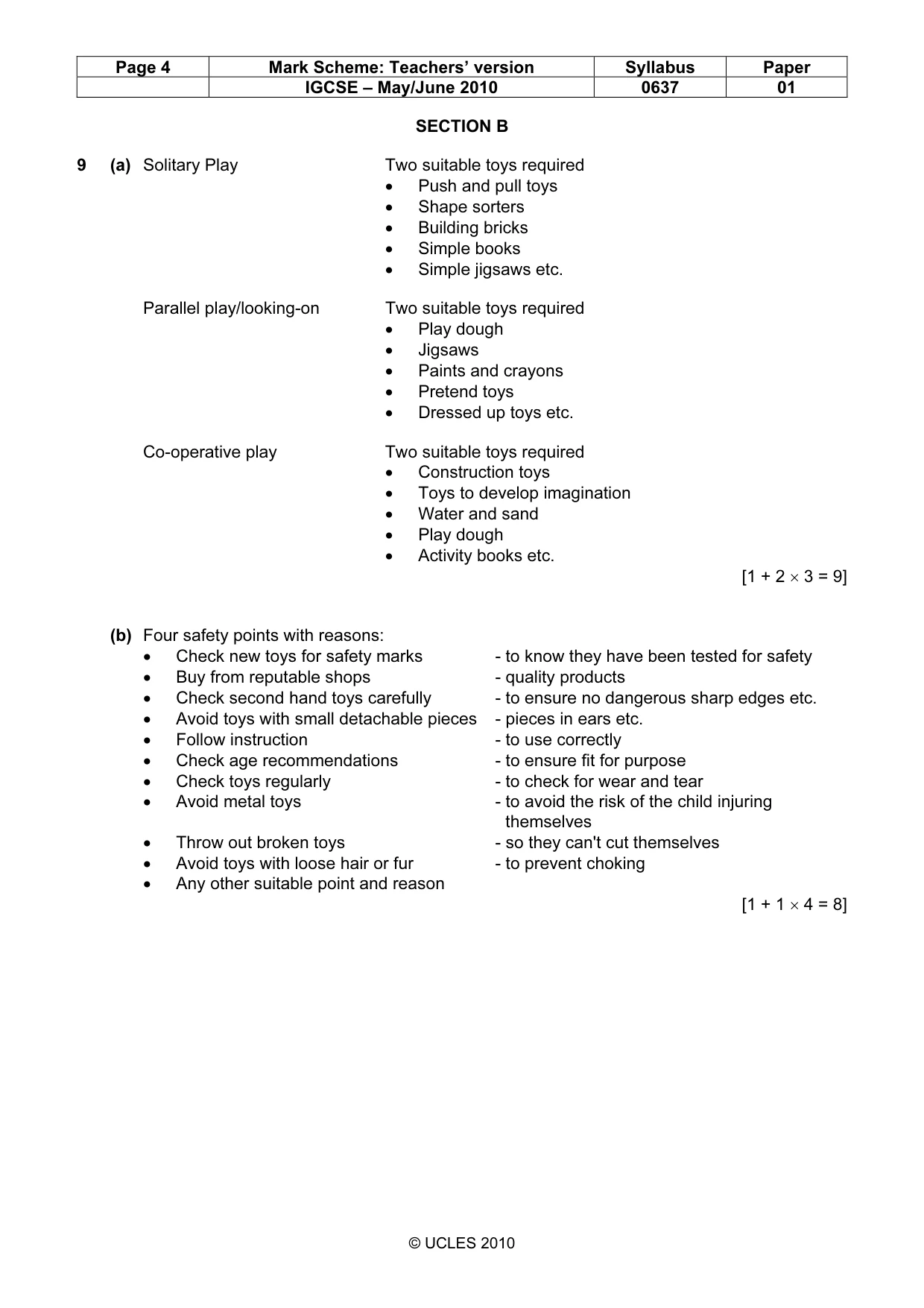
Page 4 Mark Scheme: Teachers’ version Syllabus Paper IGCSE – May/June 2010 0637 01 © UCLES 2010 SECTION B 9 (a) Solitary Play Two suitable toys required • Push and pull toys • Shape sorters • Building bricks • Simple books • Simple jigsaws etc. Parallel play/looking-on Two suitable toys required • Play dough • Jigsaws • Paints and crayons • Pretend toys • Dressed up toys etc. Co-operative play Two suitable toys required • Construction toys • Toys to develop imagination • Water and sand • Play dough • Activity books etc. [1 + 2 × 3 = 9] (b) Four safety points with reasons: • Check new toys for safety marks - to know they have been tested for safety • Buy from reputable shops - quality products • Check second hand toys carefully - to ensure no dangerous sharp edges etc. • Avoid toys with small detachable pieces - pieces in ears etc. • Follow instruction - to use correctly • Check age recommendations - to ensure fit for purpose • Check toys regularly - to check for wear and tear • Avoid metal toys - to avoid the risk of the child injuring themselves • Throw out broken toys - so they can't cut themselves • Avoid toys with loose hair or fur - to prevent choking • Any other suitable point and reason [1 + 1 × 4 = 8]
Mark scheme, page 5
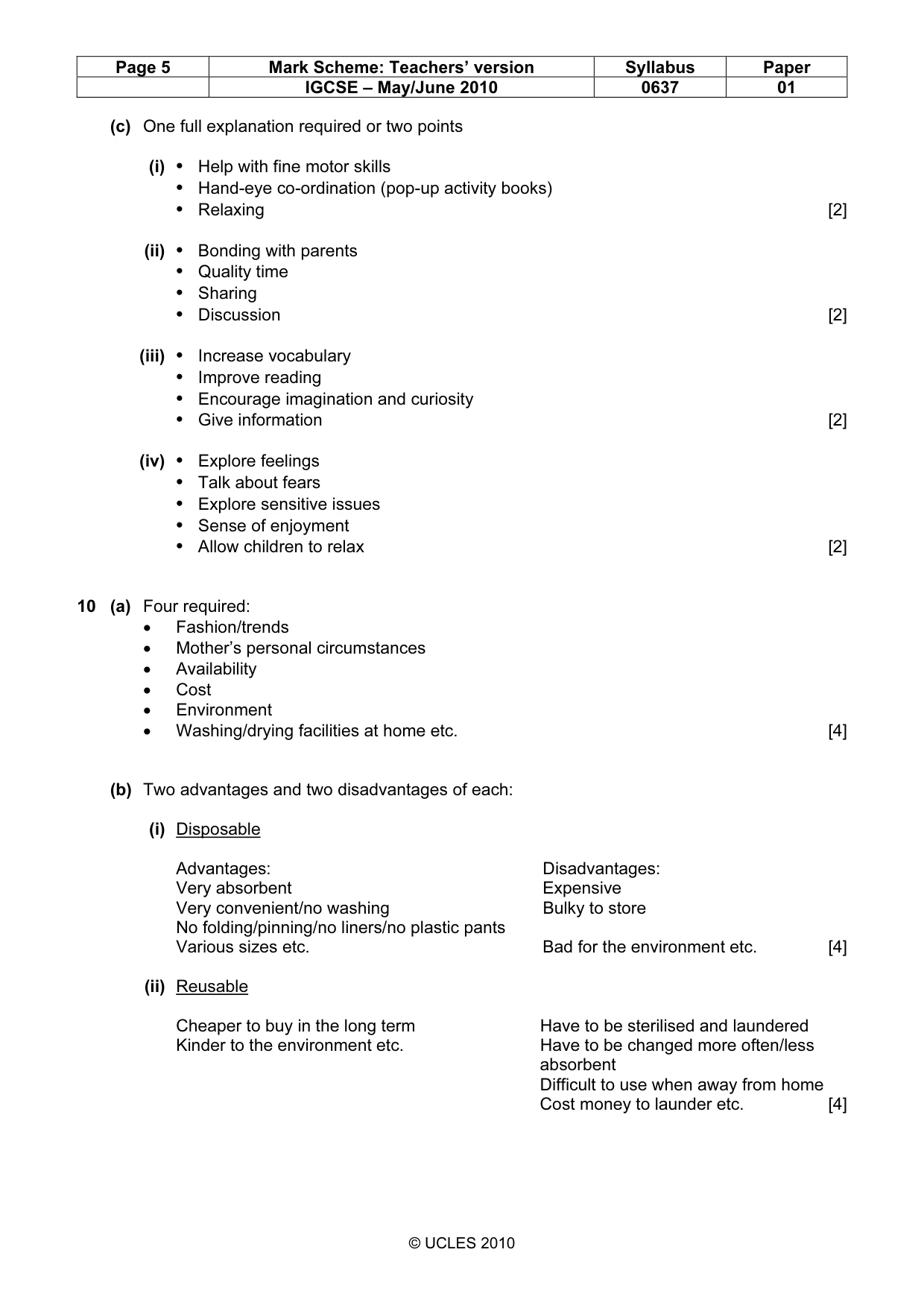
Page 5 Mark Scheme: Teachers’ version Syllabus Paper IGCSE – May/June 2010 0637 01 © UCLES 2010 (c) One full explanation required or two points (i) • Help with fine motor skills • Hand-eye co-ordination (pop-up activity books) • Relaxing [2] (ii) • Bonding with parents • Quality time • Sharing • Discussion [2] (iii) • Increase vocabulary • Improve reading • Encourage imagination and curiosity • Give information [2] (iv) • Explore feelings • Talk about fears • Explore sensitive issues • Sense of enjoyment • Allow children to relax [2] 10 (a) Four required: • Fashion/trends • Mother’s personal circumstances • Availability • Cost • Environment • Washing/drying facilities at home etc. [4] (b) Two advantages and two disadvantages of each: (i) Disposable Advantages: Disadvantages: Very absorbent Expensive Very convenient/no washing Bulky to store No folding/pinning/no liners/no plastic pants Various sizes etc. Bad for the environment etc. [4] (ii) Reusable Cheaper to buy in the long term Have to be sterilised and laundered Kinder to the environment etc. Have to be changed more often/less absorbent Difficult to use when away from home Cost money to launder etc. [4]
Mark scheme, page 6
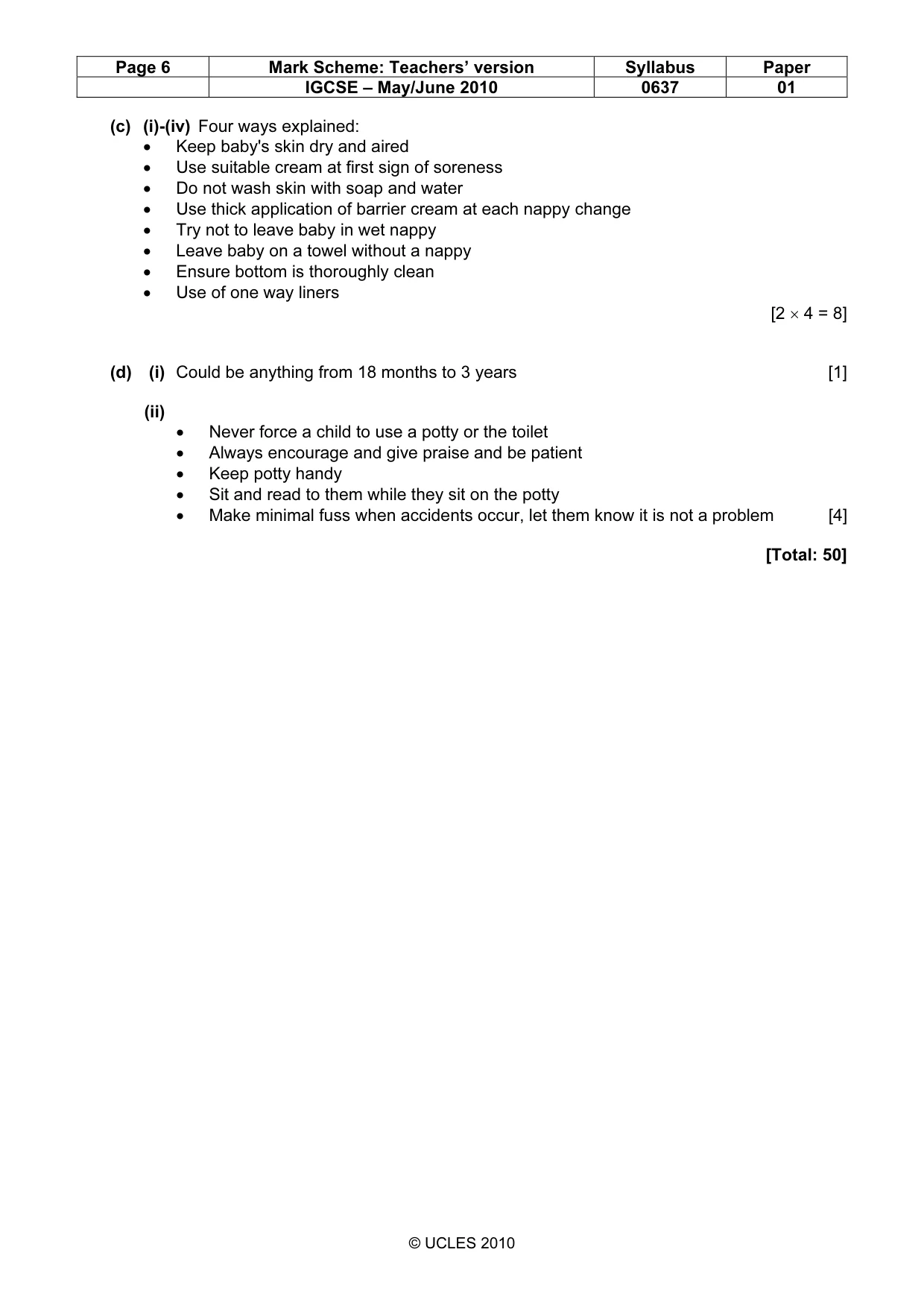
Page 6 Mark Scheme: Teachers’ version Syllabus Paper IGCSE – May/June 2010 0637 01 © UCLES 2010 (c) (i)-(iv) Four ways explained: • Keep baby's skin dry and aired • Use suitable cream at first sign of soreness • Do not wash skin with soap and water • Use thick application of barrier cream at each nappy change • Try not to leave baby in wet nappy • Leave baby on a towel without a nappy • Ensure bottom is thoroughly clean • Use of one way liners [2 × 4 = 8] (d) (i) Could be anything from 18 months to 3 years [1] (ii) • Never force a child to use a potty or the toilet • Always encourage and give praise and be patient • Keep potty handy • Sit and read to them while they sit on the potty • Make minimal fuss when accidents occur, let them know it is not a problem [4] [Total: 50]
Mark scheme, page 7
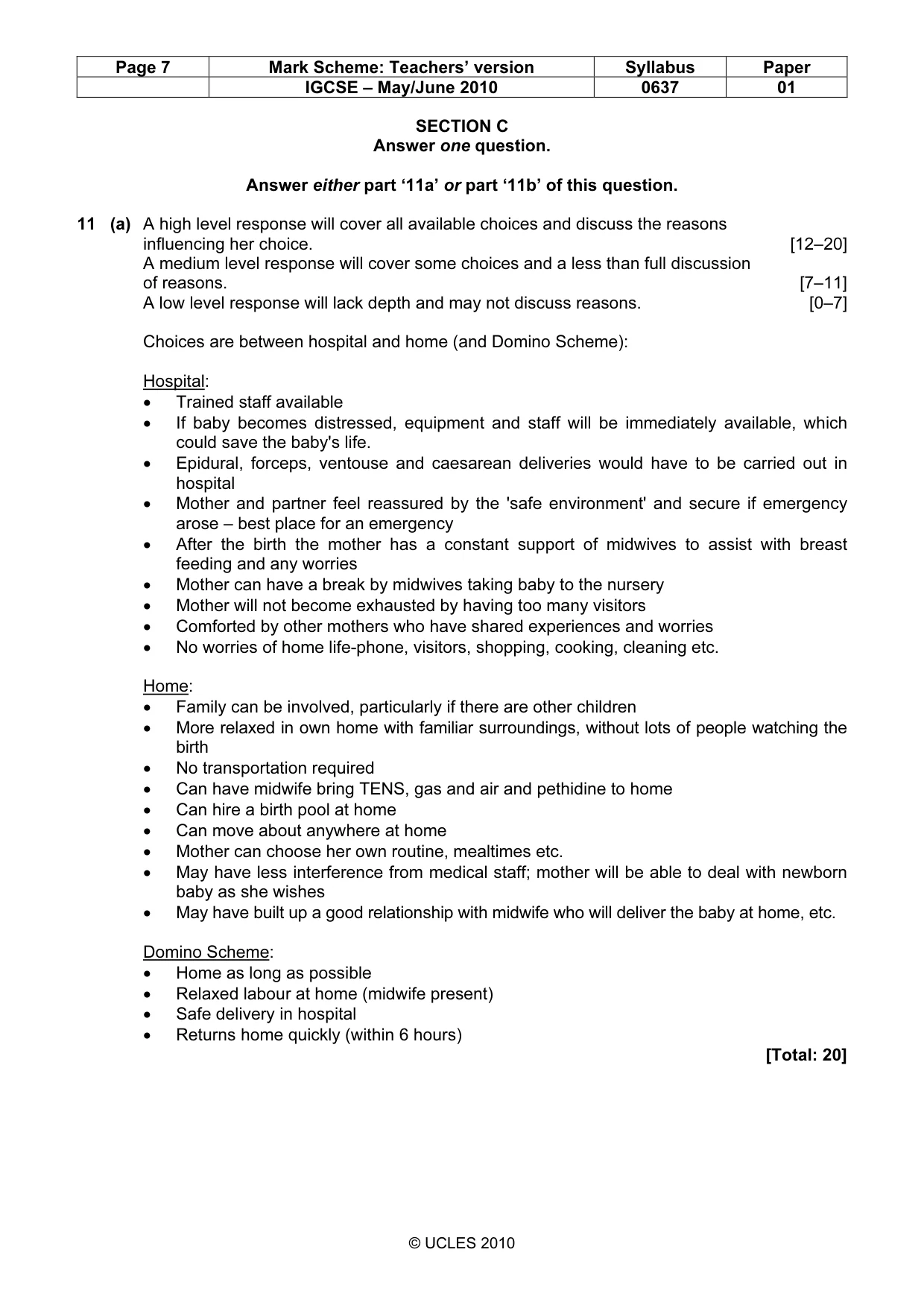
Page 7 Mark Scheme: Teachers’ version Syllabus Paper IGCSE – May/June 2010 0637 01 © UCLES 2010 SECTION C Answer one question. Answer either part ‘11a’ or part ‘11b’ of this question. 11 (a) A high level response will cover all available choices and discuss the reasons influencing her choice. [12–20] A medium level response will cover some choices and a less than full discussion of reasons. [7–11] A low level response will lack depth and may not discuss reasons. [0–7] Choices are between hospital and home (and Domino Scheme): Hospital: • Trained staff available • If baby becomes distressed, equipment and staff will be immediately available, which could save the baby's life. • Epidural, forceps, ventouse and caesarean deliveries would have to be carried out in hospital • Mother and partner feel reassured by the 'safe environment' and secure if emergency arose – best place for an emergency • After the birth the mother has a constant support of midwives to assist with breast feeding and any worries • Mother can have a break by midwives taking baby to the nursery • Mother will not become exhausted by having too many visitors • Comforted by other mothers who have shared experiences and worries • No worries of home life-phone, visitors, shopping, cooking, cleaning etc. Home: • Family can be involved, particularly if there are other children • More relaxed in own home with familiar surroundings, without lots of people watching the birth • No transportation required • Can have midwife bring TENS, gas and air and pethidine to home • Can hire a birth pool at home • Can move about anywhere at home • Mother can choose her own routine, mealtimes etc. • May have less interference from medical staff; mother will be able to deal with newborn baby as she wishes • May have built up a good relationship with midwife who will deliver the baby at home, etc. Domino Scheme: • Home as long as possible • Relaxed labour at home (midwife present) • Safe delivery in hospital • Returns home quickly (within 6 hours) [Total: 20]
Mark scheme, page 8
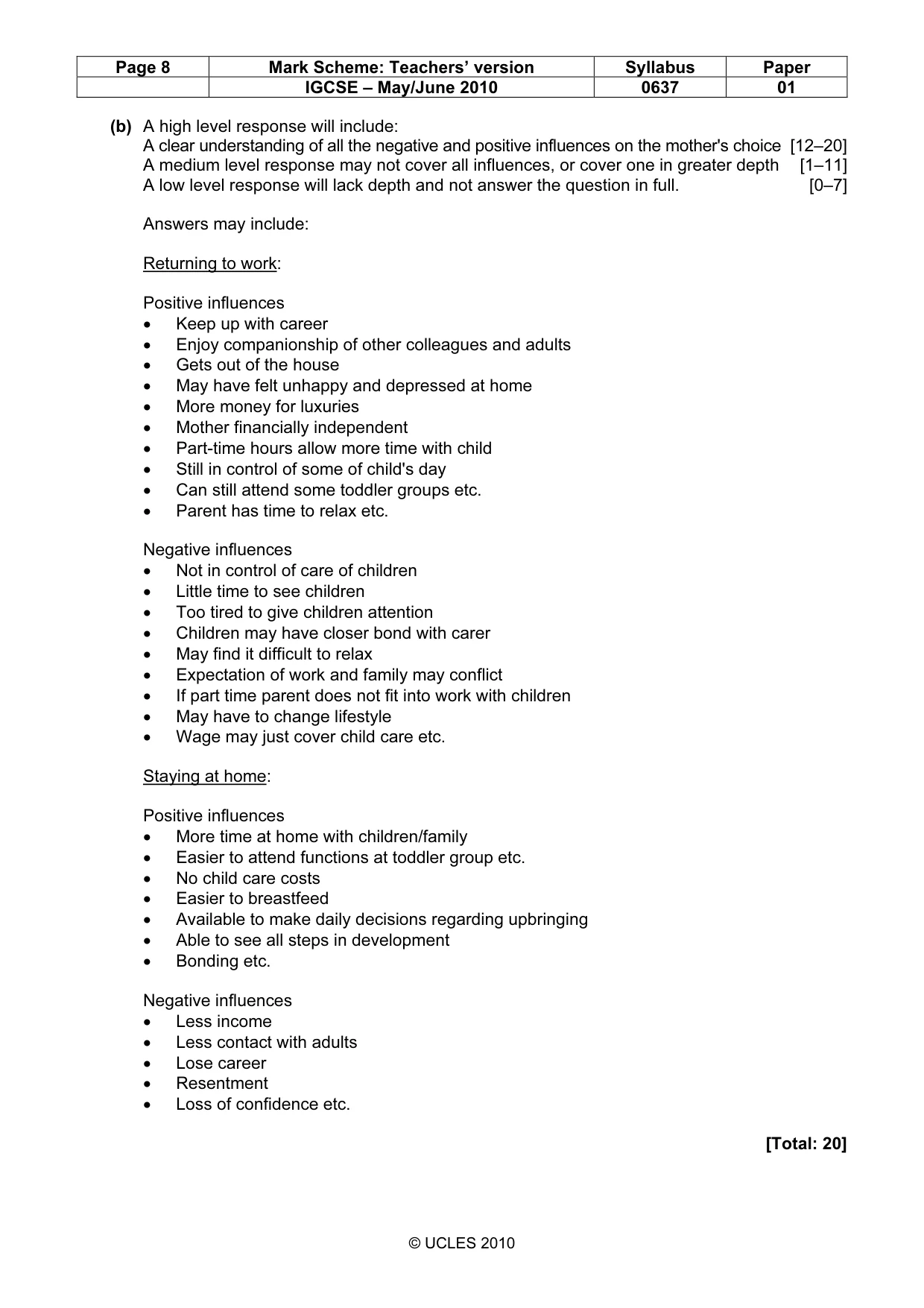
Page 8 Mark Scheme: Teachers’ version Syllabus Paper IGCSE – May/June 2010 0637 01 © UCLES 2010 (b) A high level response will include: A clear understanding of all the negative and positive influences on the mother's choice [12–20] A medium level response may not cover all influences, or cover one in greater depth [1–11] A low level response will lack depth and not answer the question in full. [0–7] Answers may include: Returning to work: Positive influences • Keep up with career • Enjoy companionship of other colleagues and adults • Gets out of the house • May have felt unhappy and depressed at home • More money for luxuries • Mother financially independent • Part-time hours allow more time with child • Still in control of some of child's day • Can still attend some toddler groups etc. • Parent has time to relax etc. Negative influences • Not in control of care of children • Little time to see children • Too tired to give children attention • Children may have closer bond with carer • May find it difficult to relax • Expectation of work and family may conflict • If part time parent does not fit into work with children • May have to change lifestyle • Wage may just cover child care etc. Staying at home: Positive influences • More time at home with children/family • Easier to attend functions at toddler group etc. • No child care costs • Easier to breastfeed • Available to make daily decisions regarding upbringing • Able to see all steps in development • Bonding etc. Negative influences • Less income • Less contact with adults • Lose career • Resentment • Loss of confidence etc. [Total: 20]
What you needed in this session
Cambridge’s own grade thresholds for 2010 May/June, Paper 1 · Variant 1. A higher threshold means an easier paper — the bar moves with how the cohort did.