Cambridge IGCSE Child Development 0637 — 2009 Oct/Nov Paper 1 · Variant 1
0637/11/O/N/09 · 100 marks · ≈113 min
The question paper and its mark scheme, free to read here and free to download. This is Cambridge’s own paper, exactly as it was sat.
Question paper12 pages
Mark scheme6 pages
Answers below. Sit the paper first if you are practising.
Paper as text
Question paper, page 1
This document consists of 8 printed pages, 3 lined pages and 1 blank page. SP (CW/SW) 16029/4 © UCLES 2009 [Turn over UNIVERSITY OF CAMBRIDGE INTERNATIONAL EXAMINATIONS International General Certificate of Secondary Education READ THESE INSTRUCTIONS FIRST Write your Centre number, candidate number and name on all the work you hand in. Write in dark blue or black pen. You may use a soft pencil for any diagrams, graphs or rough working. Do not use staples, paper clips, highlighters, glue or correction fluid. DO NOT WRITE IN ANY BARCODES. Section A and Section B Answer all questions. Section C Answer one question. Write your answers in the space provided on the Question Paper. At the end of the examination, fasten all your work securely together. The number of marks is given in brackets [ ] at the end of each question or part question. CHILD DEVELOPMENT 0637/01 Paper 1 October/November 2009 2 hours Candidates answer on the Question Paper. No Additional Materials are required. For Examiner’s Use Section A Section B Section C Total * 9 9 7 7 3 6 8 8 2 0 * www.XtremePapers.com
Question paper, page 2
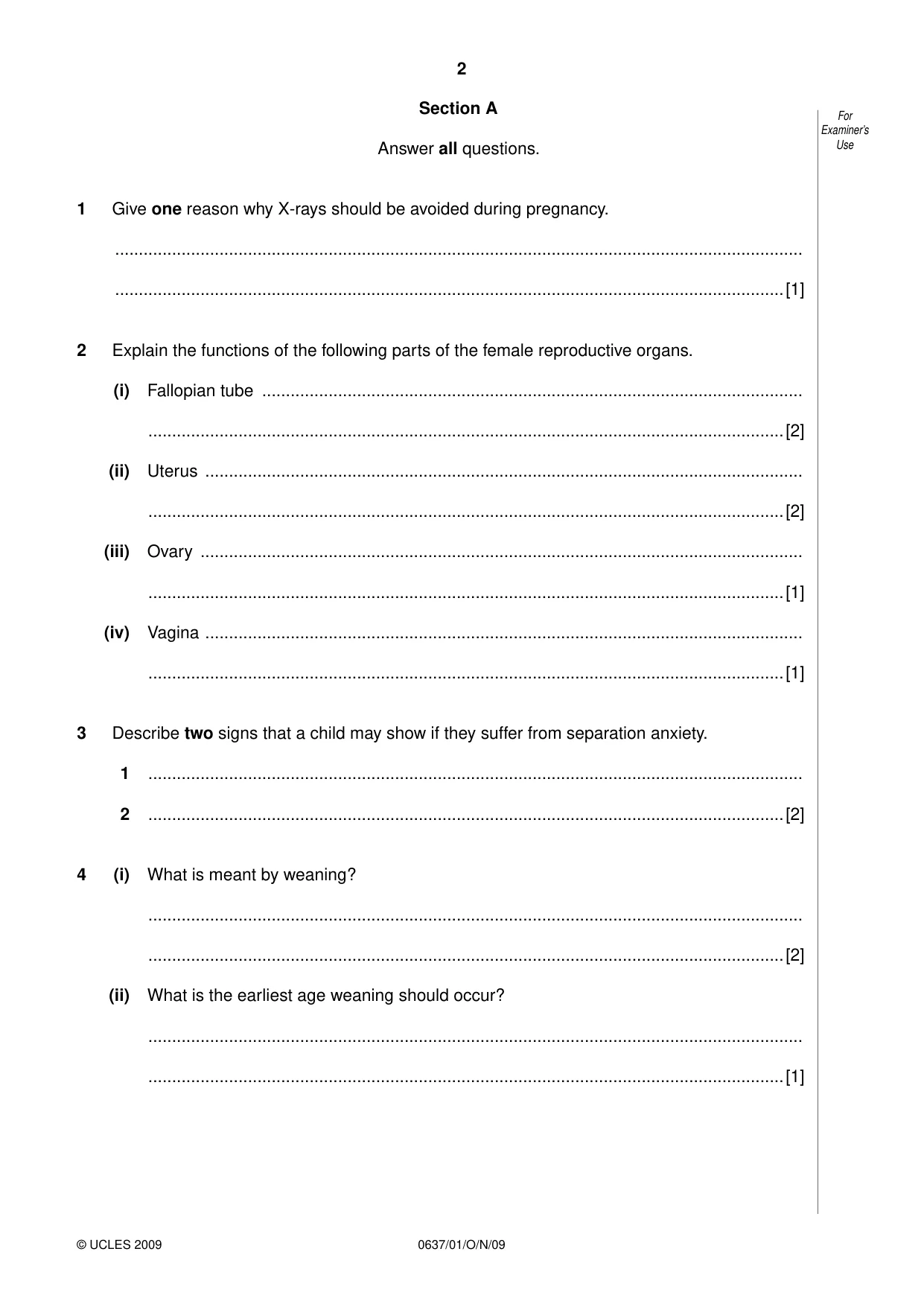
2 For Examiner’s Use 0637/01/O/N/09 © UCLES 2009 Section A Answer all questions. 1 Give one reason why X-rays should be avoided during pregnancy. … …[1] 2 Explain the functions of the following parts of the female reproductive organs. (i) Fallopian tube … …[2] (ii) Uterus … …[2] (iii) Ovary … …[1] (iv) Vagina … …[1] 3 Describe two signs that a child may show if they suffer from separation anxiety. 1 … 2 …[2] 4 (i) What is meant by weaning? … …[2] (ii) What is the earliest age weaning should occur? … …[1]
Question paper, page 3
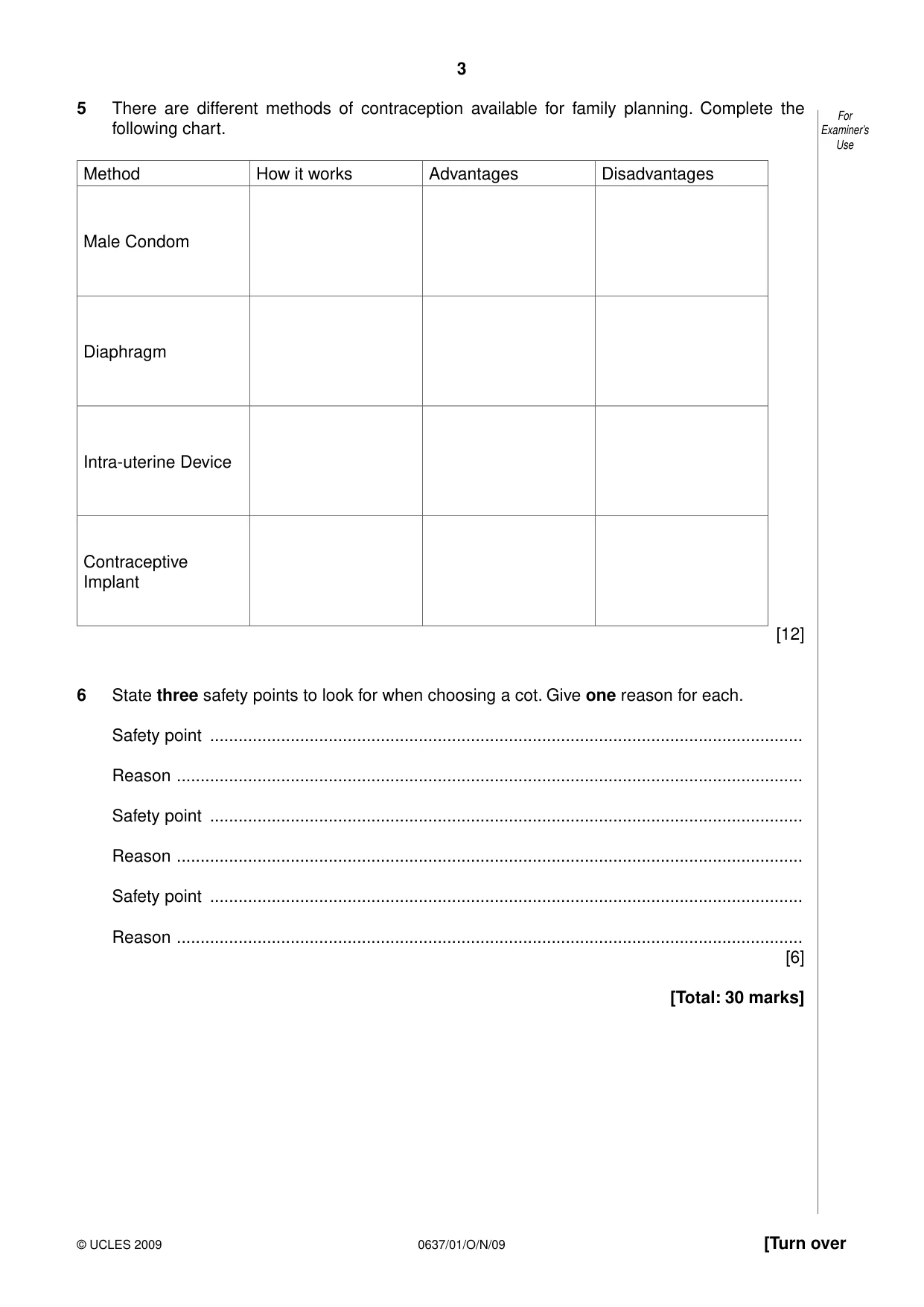
3 [Turn over For Examiner’s Use 0637/01/O/N/09 © UCLES 2009 5 There are different methods of contraception available for family planning. Complete the following chart. Method How it works Advantages Disadvantages Male Condom Diaphragm Intra-uterine Device Contraceptive Implant [12] 6 State three safety points to look for when choosing a cot. Give one reason for each. Safety point … Reason … Safety point … Reason … Safety point … Reason … [6] [Total: 30 marks]
Question paper, page 4
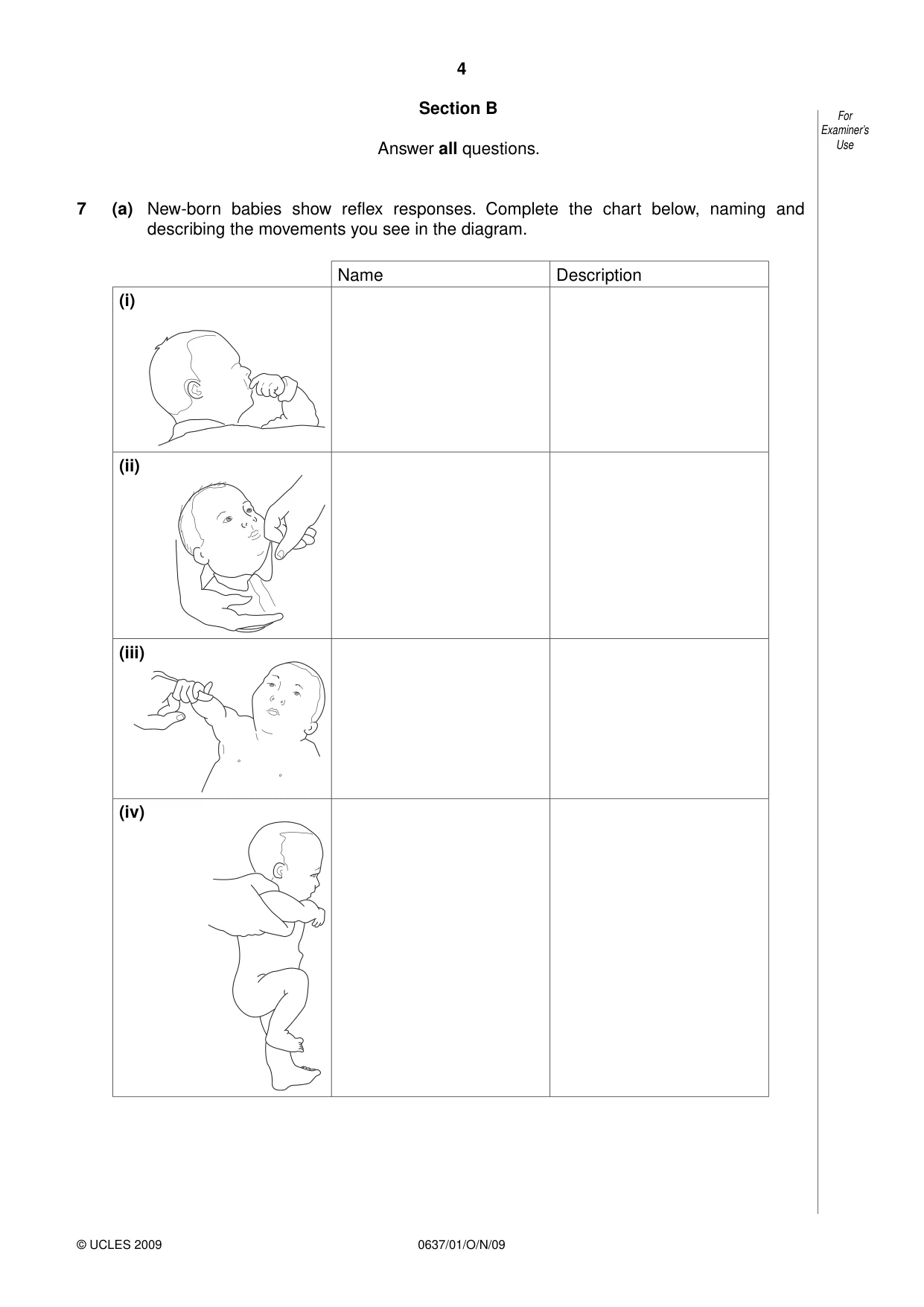
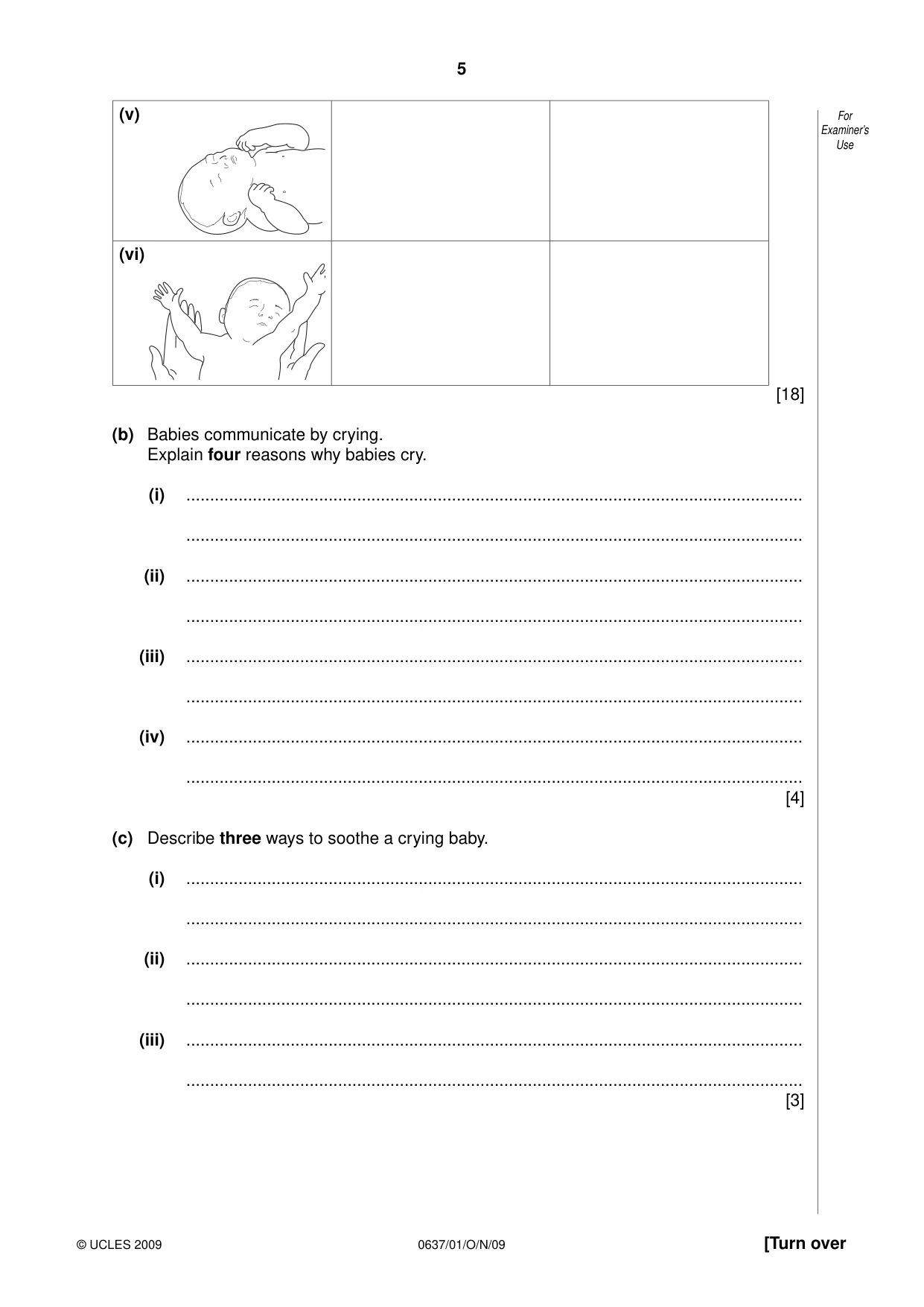
4 For Examiner’s Use 0637/01/O/N/09 © UCLES 2009 Section B Answer all questions. 7 (a) New-born babies show reflex responses. Complete the chart below, naming and describing the movements you see in the diagram. Name Description (i) (ii) (iii) (iv)
Question paper, page 5
5 [Turn over For Examiner’s Use 0637/01/O/N/09 © UCLES 2009 (v) (vi) [18] (b) Babies communicate by crying. Explain four reasons why babies cry. (i) … … (ii) … … (iii) … … (iv) … … [4] (c) Describe three ways to soothe a crying baby. (i) … … (ii) … … (iii) … … [3]
Question paper, page 6
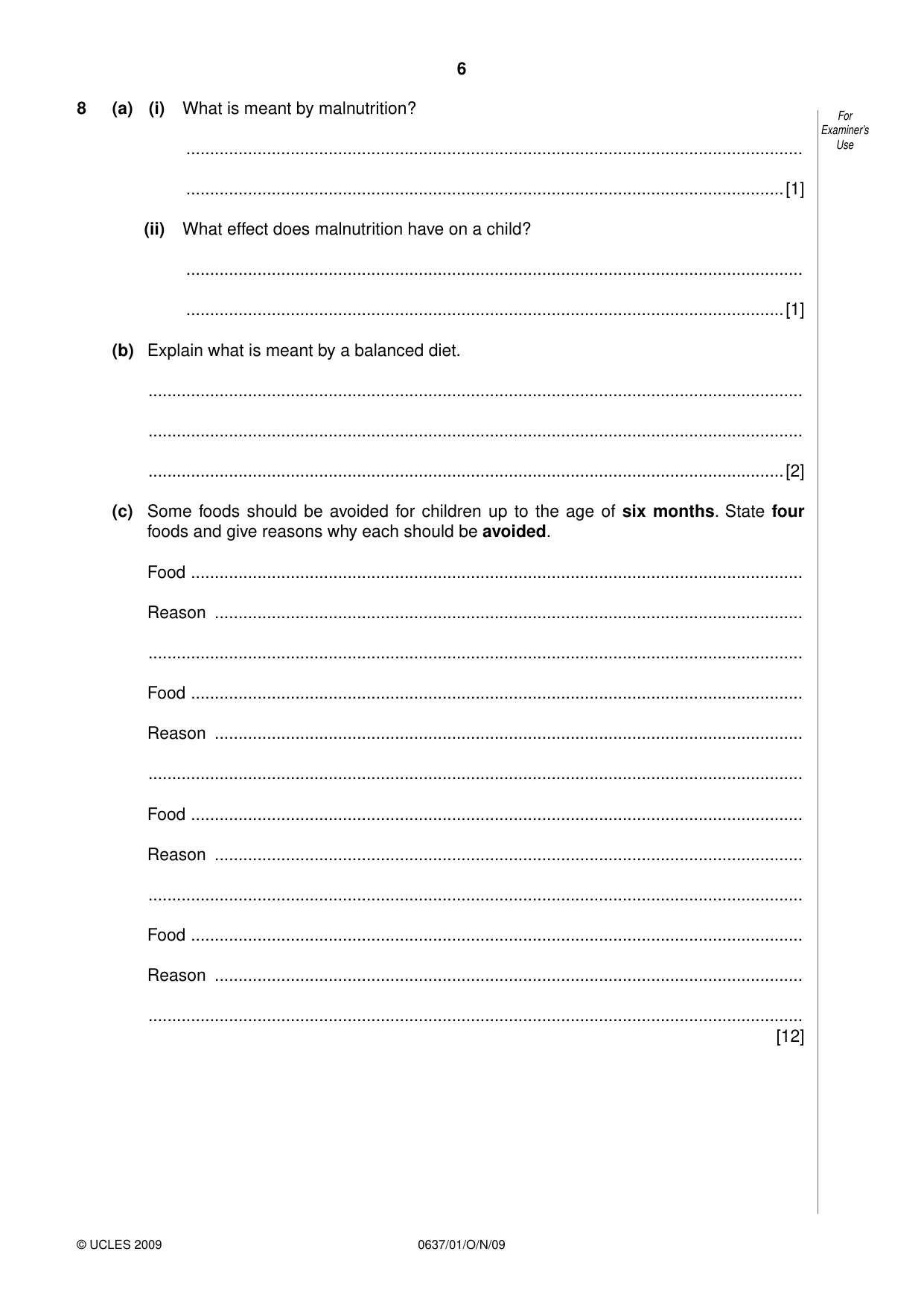
6 For Examiner’s Use 0637/01/O/N/09 © UCLES 2009 8 (a) (i) What is meant by malnutrition? … …[1] (ii) What effect does malnutrition have on a child? … …[1] (b) Explain what is meant by a balanced diet. … … …[2] (c) Some foods should be avoided for children up to the age of six months. State four foods and give reasons why each should be avoided. Food … Reason … … Food … Reason … … Food … Reason … … Food … Reason … … [12]
Question paper, page 7
7 [Turn over For Examiner’s Use 0637/01/O/N/09 © UCLES 2009 (d) Why do children need the following nutrients in their diet? Vitamin D … … Calcium … … [2] (e) Explain the two reasons why whole milk is given to children under five years of age. (i) … (ii) … [2] (f) (i) Explain why ‘Junk Food’ is attractive to children. … …[2] (ii) State three reasons why junk food should be avoided whenever possible. Reason 1 … … Reason 2 … … Reason 3 … … [3] [Total: 50 marks]
Question paper, page 8
8 0637/01/O/N/09 © UCLES 2009 Section C Answer (a) or (b) of this question. Write your answer on the following pages. 9 (a) Discuss the reasons for infertility in both men and women. Describe the available treatments for infertility. [Total: 20 marks] OR (b) Routine tests are carried out during antenatal care. Blood testing is one of these. Explain the importance of this test for the pregnant woman. Name three other routine tests and give the reasons for each. [Total: 20 marks]
Question paper, page 9
9 [Turn over For Examiner’s Use 0637/01/O/N/09 © UCLES 2009 … … … … … … … … … … … … … … … … … … … … … … … … … … … …
Question paper, page 10
10 For Examiner’s Use 0637/01/O/N/09 © UCLES 2009 … … … … … … … … … … … … … … … … … … … … … … … … … … … …
Question paper, page 11
11 For Examiner’s Use 0637/01/O/N/09 © UCLES 2009 … … … … … … … … … … … … … … … … … … … … … … … … … … … …
Question paper, page 12
12 0637/01/O/N/09 BLANK PAGE Copyright Acknowledgements: Question 7a © Pamela Minett; Child Care and Development; p.72; 5th Edition; Hodder Arnold; 2005. Permission to reproduce items where third-party owned material protected by copyright is included has been sought and cleared where possible. Every reasonable effort has been made by the publisher (UCLES) to trace copyright holders, but if any items requiring clearance have unwittingly been included, the publisher will be pleased to make amends at the earliest possible opportunity. University of Cambridge International Examinations is part of the Cambridge Assessment Group. Cambridge Assessment is the brand name of University of Cambridge Local Examinations Syndicate (UCLES), which is itself a department of the University of Cambridge.
Mark scheme, page 1
UNIVERSITY OF CAMBRIDGE INTERNATIONAL EXAMINATIONS International General Certificate of Secondary Education MARK SCHEME for the October/November 2009 question paper for the guidance of teachers 0637 CHILD DEVELOPMENT 0637/01 Paper 1 (Theory Paper), maximum raw mark 100 This mark scheme is published as an aid to teachers and candidates, to indicate the requirements of the examination. It shows the basis on which Examiners were instructed to award marks. It does not indicate the details of the discussions that took place at an Examiners’ meeting before marking began, which would have considered the acceptability of alternative answers. Mark schemes must be read in conjunction with the question papers and the report on the examination. • CIE will not enter into discussions or correspondence in connection with these mark schemes. CIE is publishing the mark schemes for the October/November 2009 question papers for most IGCSE, GCE Advanced Level and Advanced Subsidiary Level syllabuses and some Ordinary Level syllabuses. www.XtremePapers.com
Mark scheme, page 2
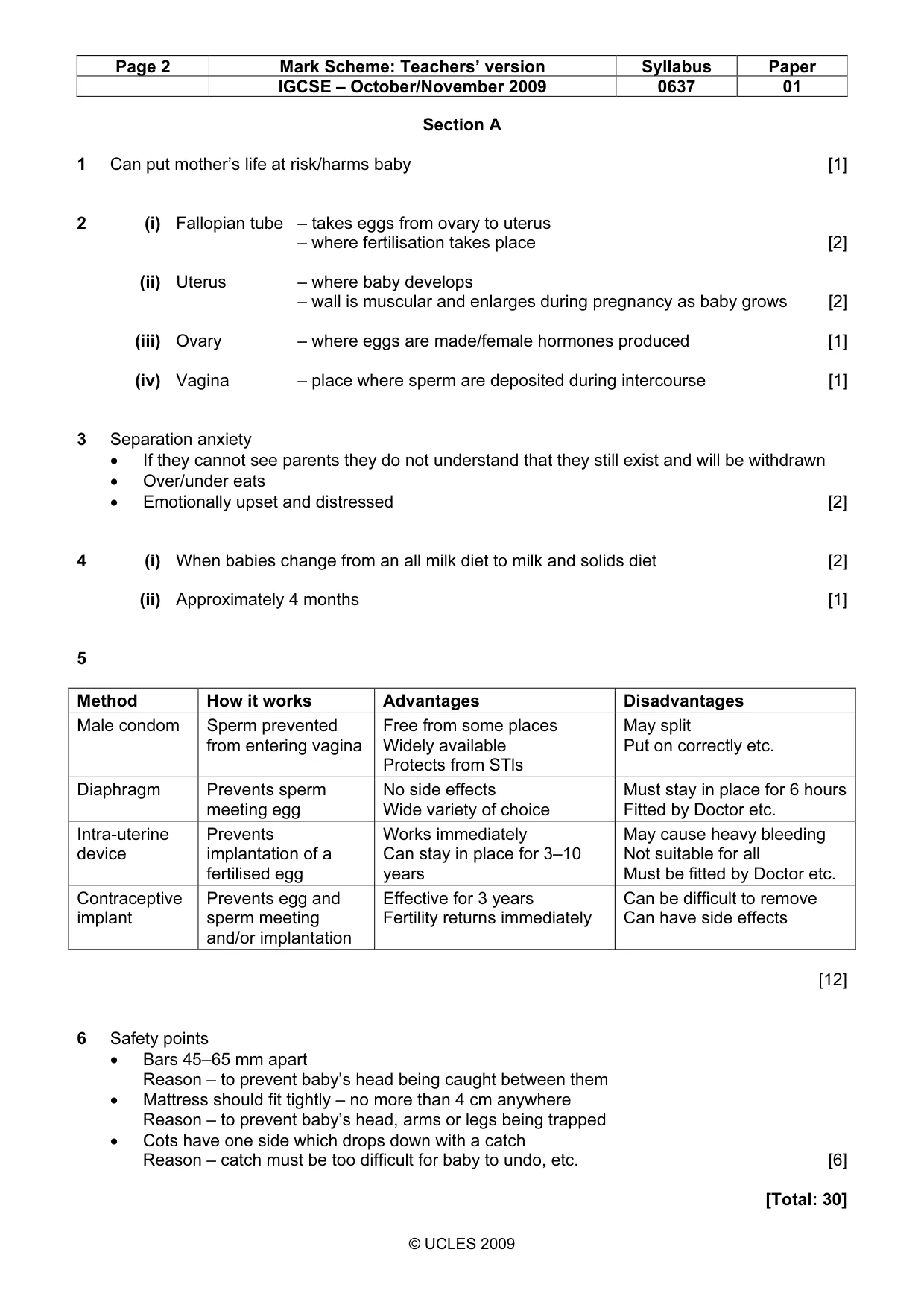
Page 2 Mark Scheme: Teachers’ version Syllabus Paper IGCSE – October/November 2009 0637 01 © UCLES 2009 Section A 1 Can put mother’s life at risk/harms baby [1] 2 (i) Fallopian tube – takes eggs from ovary to uterus – where fertilisation takes place [2] (ii) Uterus – where baby develops – wall is muscular and enlarges during pregnancy as baby grows [2] (iii) Ovary – where eggs are made/female hormones produced [1] (iv) Vagina – place where sperm are deposited during intercourse [1] 3 Separation anxiety • If they cannot see parents they do not understand that they still exist and will be withdrawn • Over/under eats • Emotionally upset and distressed [2] 4 (i) When babies change from an all milk diet to milk and solids diet [2] (ii) Approximately 4 months [1] 5 Method How it works Advantages Disadvantages Male condom Sperm prevented from entering vagina Free from some places Widely available Protects from STls May split Put on correctly etc. Diaphragm Prevents sperm meeting egg No side effects Wide variety of choice Must stay in place for 6 hours Fitted by Doctor etc. Intra-uterine device Prevents implantation of a fertilised egg Works immediately Can stay in place for 3–10 years May cause heavy bleeding Not suitable for all Must be fitted by Doctor etc. Contraceptive implant Prevents egg and sperm meeting and/or implantation Effective for 3 years Fertility returns immediately Can be difficult to remove Can have side effects [12] 6 Safety points • Bars 45–65 mm apart Reason – to prevent baby’s head being caught between them • Mattress should fit tightly – no more than 4 cm anywhere Reason – to prevent baby’s head, arms or legs being trapped • Cots have one side which drops down with a catch Reason – catch must be too difficult for baby to undo, etc. [6] [Total: 30]
Mark scheme, page 3
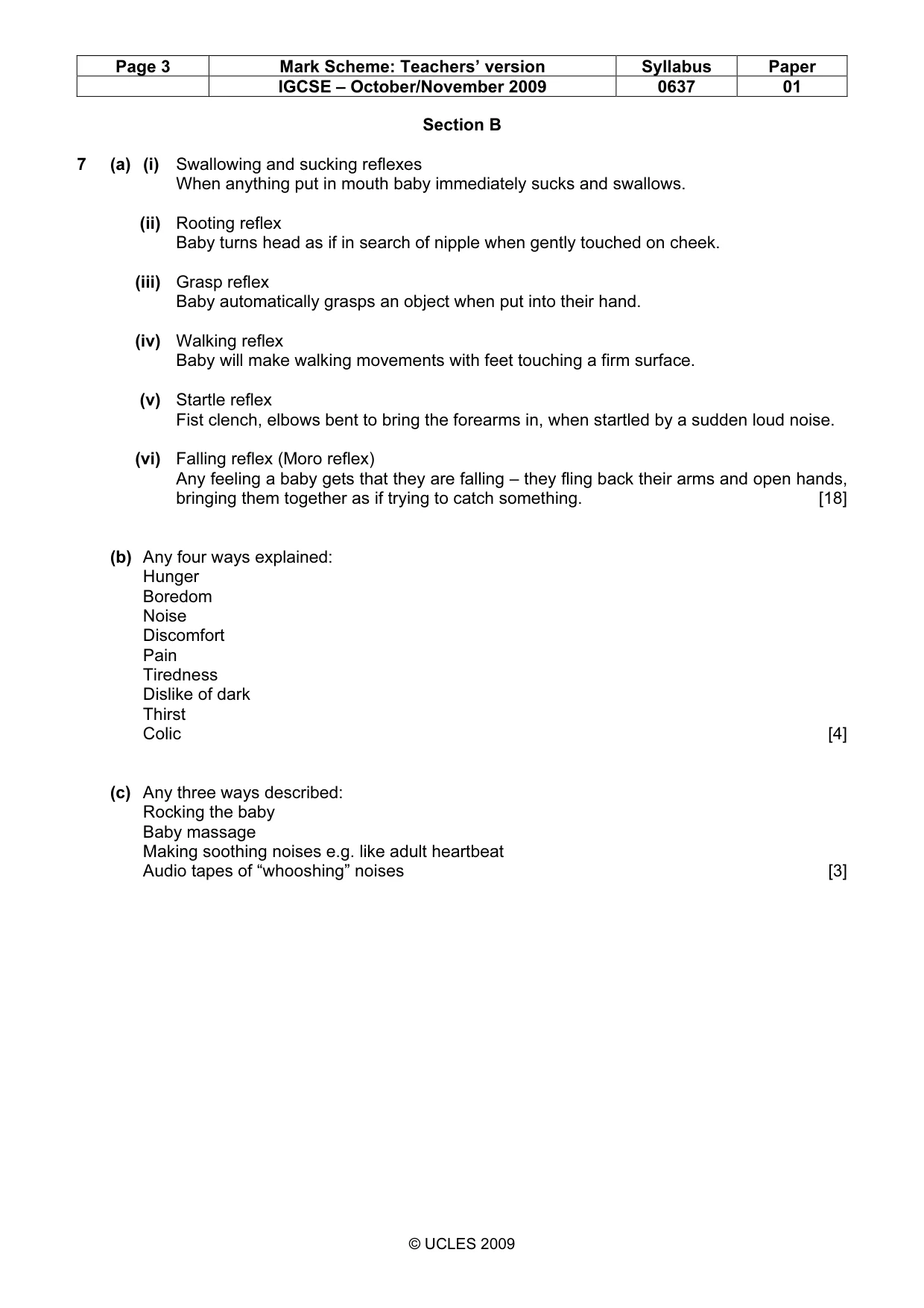
Page 3 Mark Scheme: Teachers’ version Syllabus Paper IGCSE – October/November 2009 0637 01 © UCLES 2009 Section B 7 (a) (i) Swallowing and sucking reflexes When anything put in mouth baby immediately sucks and swallows. (ii) Rooting reflex Baby turns head as if in search of nipple when gently touched on cheek. (iii) Grasp reflex Baby automatically grasps an object when put into their hand. (iv) Walking reflex Baby will make walking movements with feet touching a firm surface. (v) Startle reflex Fist clench, elbows bent to bring the forearms in, when startled by a sudden loud noise. (vi) Falling reflex (Moro reflex) Any feeling a baby gets that they are falling – they fling back their arms and open hands, bringing them together as if trying to catch something. [18] (b) Any four ways explained: Hunger Boredom Noise Discomfort Pain Tiredness Dislike of dark Thirst Colic [4] (c) Any three ways described: Rocking the baby Baby massage Making soothing noises e.g. like adult heartbeat Audio tapes of “whooshing” noises [3]
Mark scheme, page 4
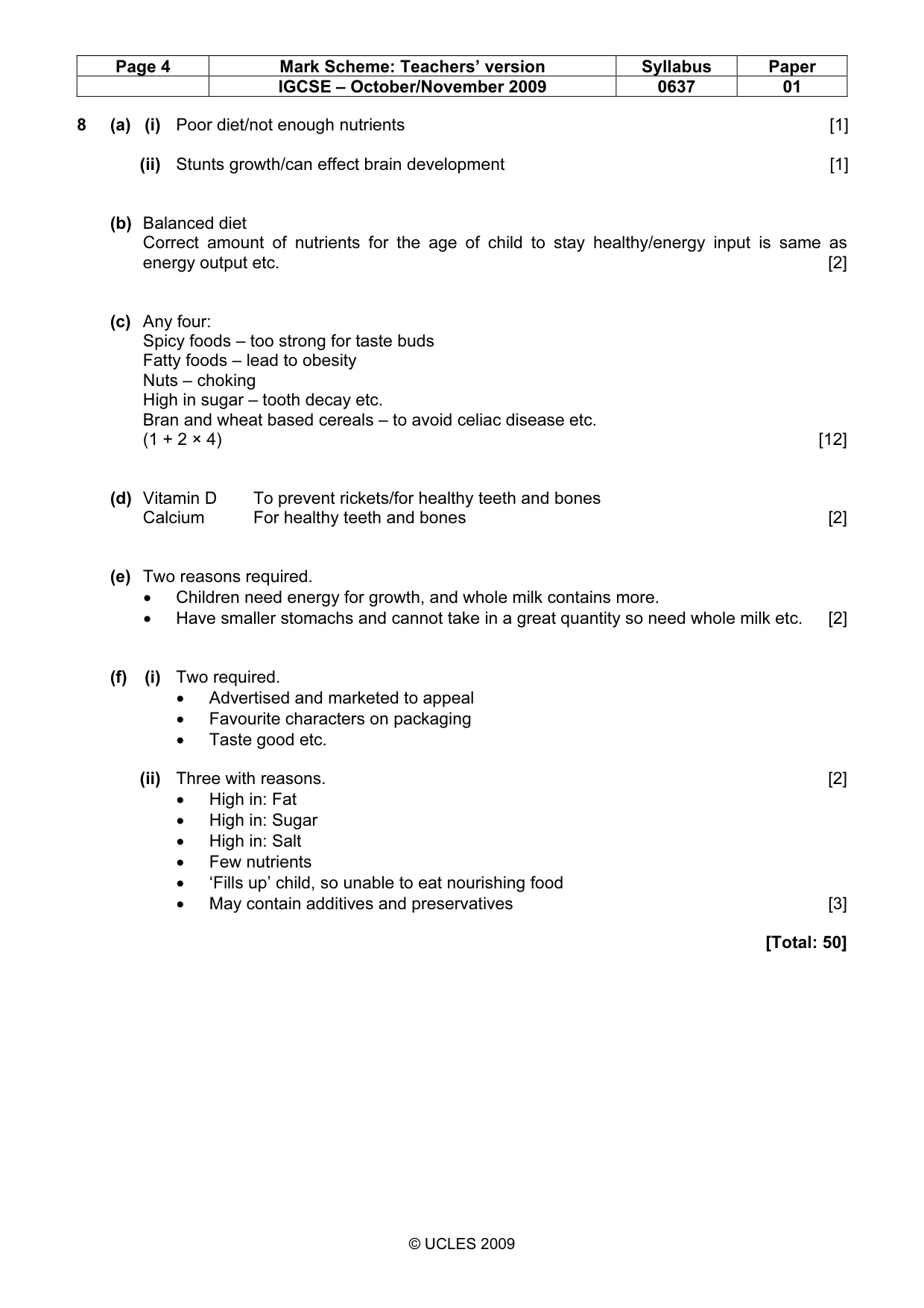
Page 4 Mark Scheme: Teachers’ version Syllabus Paper IGCSE – October/November 2009 0637 01 © UCLES 2009 8 (a) (i) Poor diet/not enough nutrients [1] (ii) Stunts growth/can effect brain development [1] (b) Balanced diet Correct amount of nutrients for the age of child to stay healthy/energy input is same as energy output etc. [2] (c) Any four: Spicy foods – too strong for taste buds Fatty foods – lead to obesity Nuts – choking High in sugar – tooth decay etc. Bran and wheat based cereals – to avoid celiac disease etc. (1 + 2 × 4) [12] (d) Vitamin D To prevent rickets/for healthy teeth and bones Calcium For healthy teeth and bones [2] (e) Two reasons required. • Children need energy for growth, and whole milk contains more. • Have smaller stomachs and cannot take in a great quantity so need whole milk etc. [2] (f) (i) Two required. • Advertised and marketed to appeal • Favourite characters on packaging • Taste good etc. (ii) Three with reasons. [2] • High in: Fat • High in: Sugar • High in: Salt • Few nutrients • ‘Fills up’ child, so unable to eat nourishing food • May contain additives and preservatives [3] [Total: 50]
Mark scheme, page 5
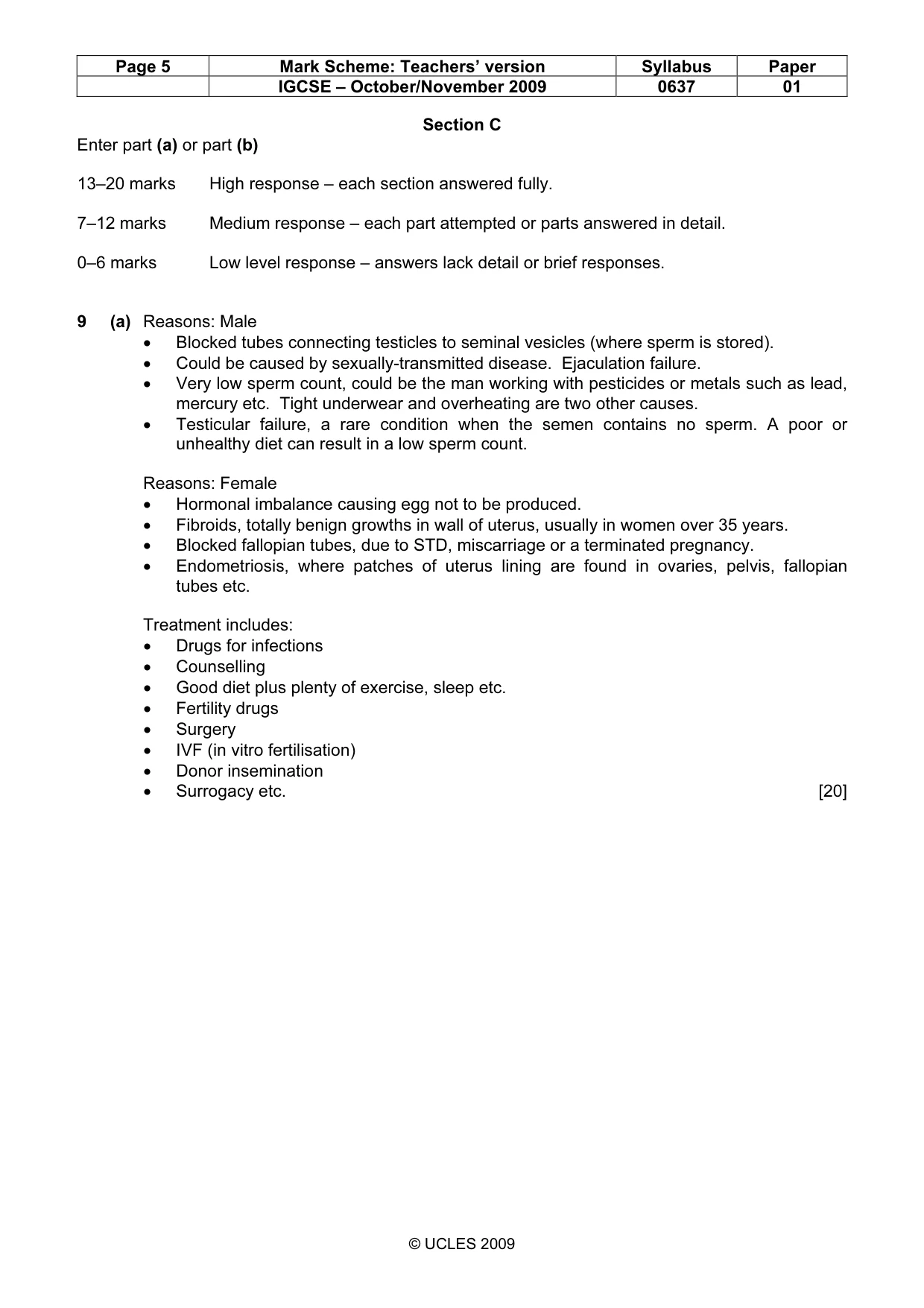
Page 5 Mark Scheme: Teachers’ version Syllabus Paper IGCSE – October/November 2009 0637 01 © UCLES 2009 Section C Enter part (a) or part (b) 13–20 marks High response – each section answered fully. 7–12 marks Medium response – each part attempted or parts answered in detail. 0–6 marks Low level response – answers lack detail or brief responses. 9 (a) Reasons: Male • Blocked tubes connecting testicles to seminal vesicles (where sperm is stored). • Could be caused by sexually-transmitted disease. Ejaculation failure. • Very low sperm count, could be the man working with pesticides or metals such as lead, mercury etc. Tight underwear and overheating are two other causes. • Testicular failure, a rare condition when the semen contains no sperm. A poor or unhealthy diet can result in a low sperm count. Reasons: Female • Hormonal imbalance causing egg not to be produced. • Fibroids, totally benign growths in wall of uterus, usually in women over 35 years. • Blocked fallopian tubes, due to STD, miscarriage or a terminated pregnancy. • Endometriosis, where patches of uterus lining are found in ovaries, pelvis, fallopian tubes etc. Treatment includes: • Drugs for infections • Counselling • Good diet plus plenty of exercise, sleep etc. • Fertility drugs • Surgery • IVF (in vitro fertilisation) • Donor insemination • Surrogacy etc. [20]
Mark scheme, page 6
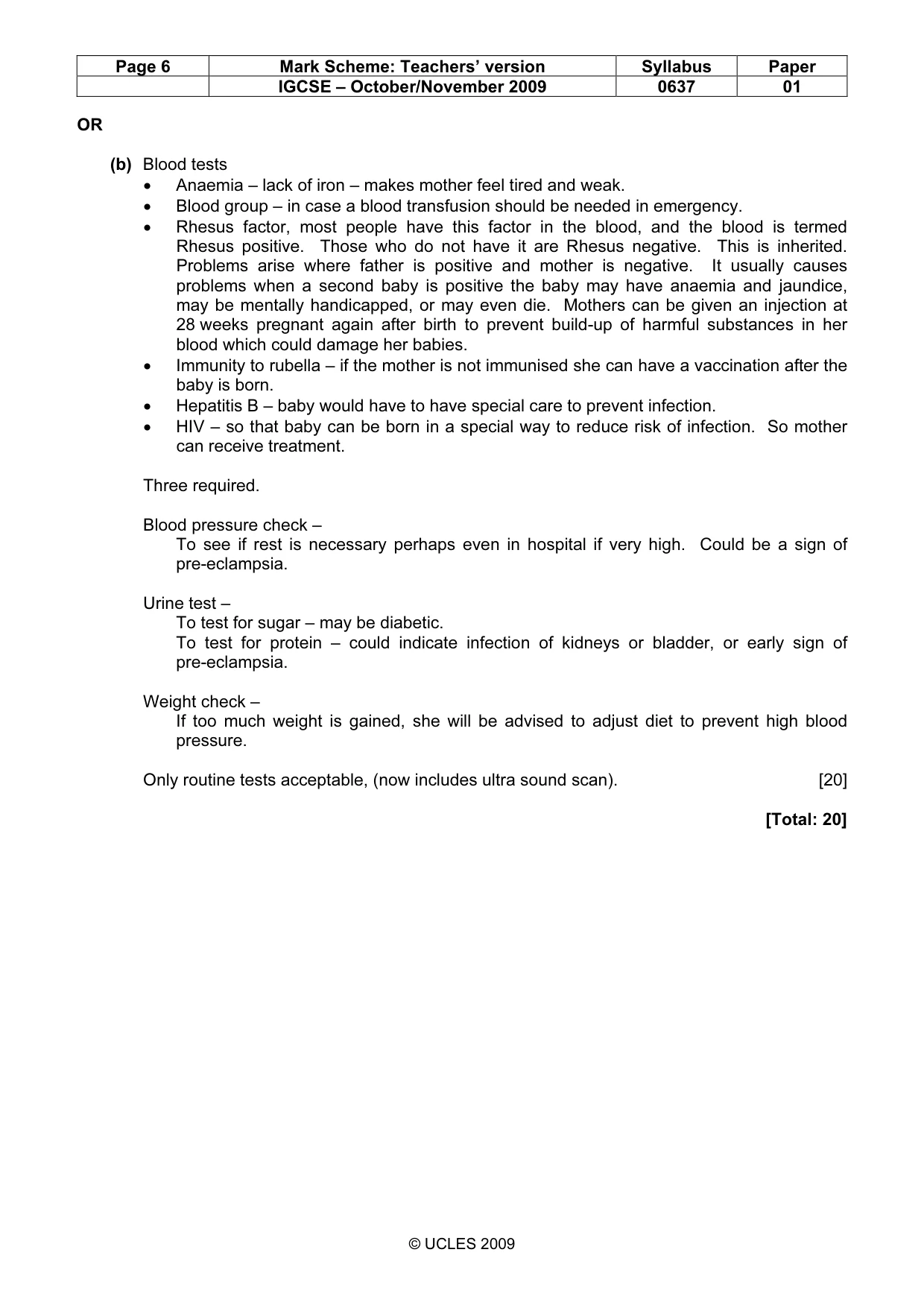
Page 6 Mark Scheme: Teachers’ version Syllabus Paper IGCSE – October/November 2009 0637 01 © UCLES 2009 OR (b) Blood tests • Anaemia – lack of iron – makes mother feel tired and weak. • Blood group – in case а blood transfusion should be needed in emergency. • Rhesus factor, most people have this factor in the blood, and the blood is termed Rhesus positive. Those who do not have it are Rhesus negative. This is inherited. Problems arise where father is positive and mother is negative. It usually causes problems when а second baby is positive the baby may have anaemia and jaundice, may be mentally handicapped, or may even die. Mothers can be given an injection at 28 weeks pregnant again after birth to prevent build-up of harmful substances in her blood which could damage her babies. • Immunity to rubella – if the mother is not immunised she can have а vaccination after the baby is born. • Hepatitis В – baby would have to have special care to prevent infection. • HIV – so that baby can be born in а special way to reduce risk of infection. So mother can receive treatment. Three required. Blood pressure check – To see if rest is necessary perhaps even in hospital if very high. Could be a sign of pre-eclampsia. Urine test – To test for sugar – may be diabetic. To test for protein – could indicate infection of kidneys or bladder, or early sign of pre-eclampsia. Weight check – If too much weight is gained, she will be advised to adjust diet to prevent high blood pressure. Only routine tests acceptable, (now includes ultra sound scan). [20] [Total: 20]
What you needed in this session
Cambridge’s own grade thresholds for 2009 Oct/Nov, Paper 1 · Variant 1. A higher threshold means an easier paper — the bar moves with how the cohort did.