Cambridge IGCSE Child Development 0637 — 2006 Oct/Nov Paper 1 · Variant 1
0637/11/O/N/06 · 100 marks · ≈113 min
The question paper and its mark scheme, free to read here and free to download. This is Cambridge’s own paper, exactly as it was sat.
Question paper12 pages
Mark scheme8 pages
Answers below. Sit the paper first if you are practising.
Paper as text
Question paper, page 1
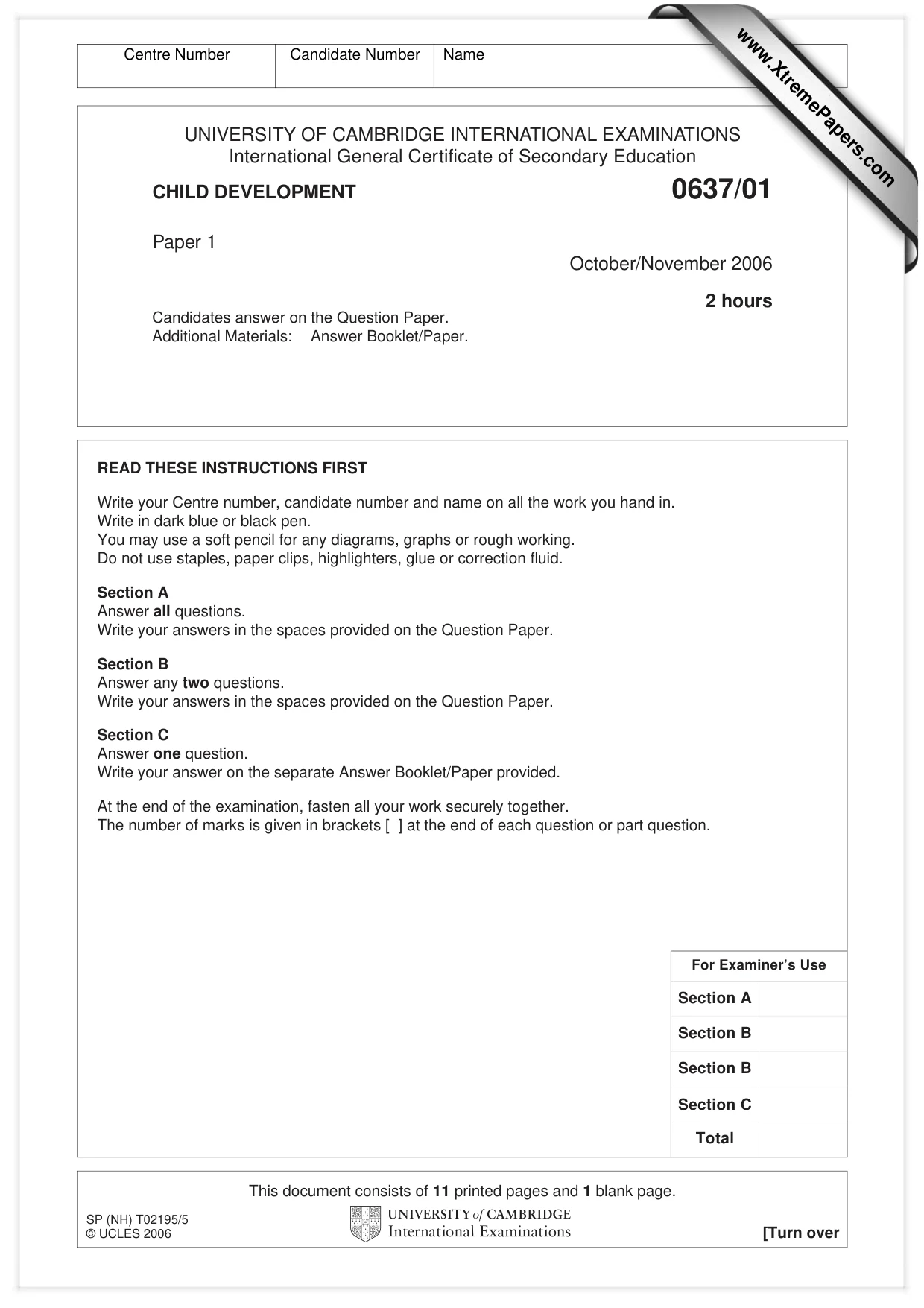
This document consists of 11 printed pages and 1 blank page. SP (NH) T02195/5 © UCLES 2006 [Turn over UNIVERSITY OF CAMBRIDGE INTERNATIONAL EXAMINATIONS International General Certificate of Secondary Education CHILD DEVELOPMENT 0637/01 Paper 1 October/November 2006 2 hours Candidates answer on the Question Paper. Additional Materials: Answer Booklet/Paper. READ THESE INSTRUCTIONS FIRST Write your Centre number, candidate number and name on all the work you hand in. Write in dark blue or black pen. You may use a soft pencil for any diagrams, graphs or rough working. Do not use staples, paper clips, highlighters, glue or correction fluid. Section A Answer all questions. Write your answers in the spaces provided on the Question Paper. Section B Answer any two questions. Write your answers in the spaces provided on the Question Paper. Section C Answer one question. Write your answer on the separate Answer Booklet/Paper provided. At the end of the examination, fasten all your work securely together. The number of marks is given in brackets [ ] at the end of each question or part question. Centre Number Candidate Number Name For Examiner’s Use Section A Section B Section B Section C Total www.XtremePapers.com
Question paper, page 2
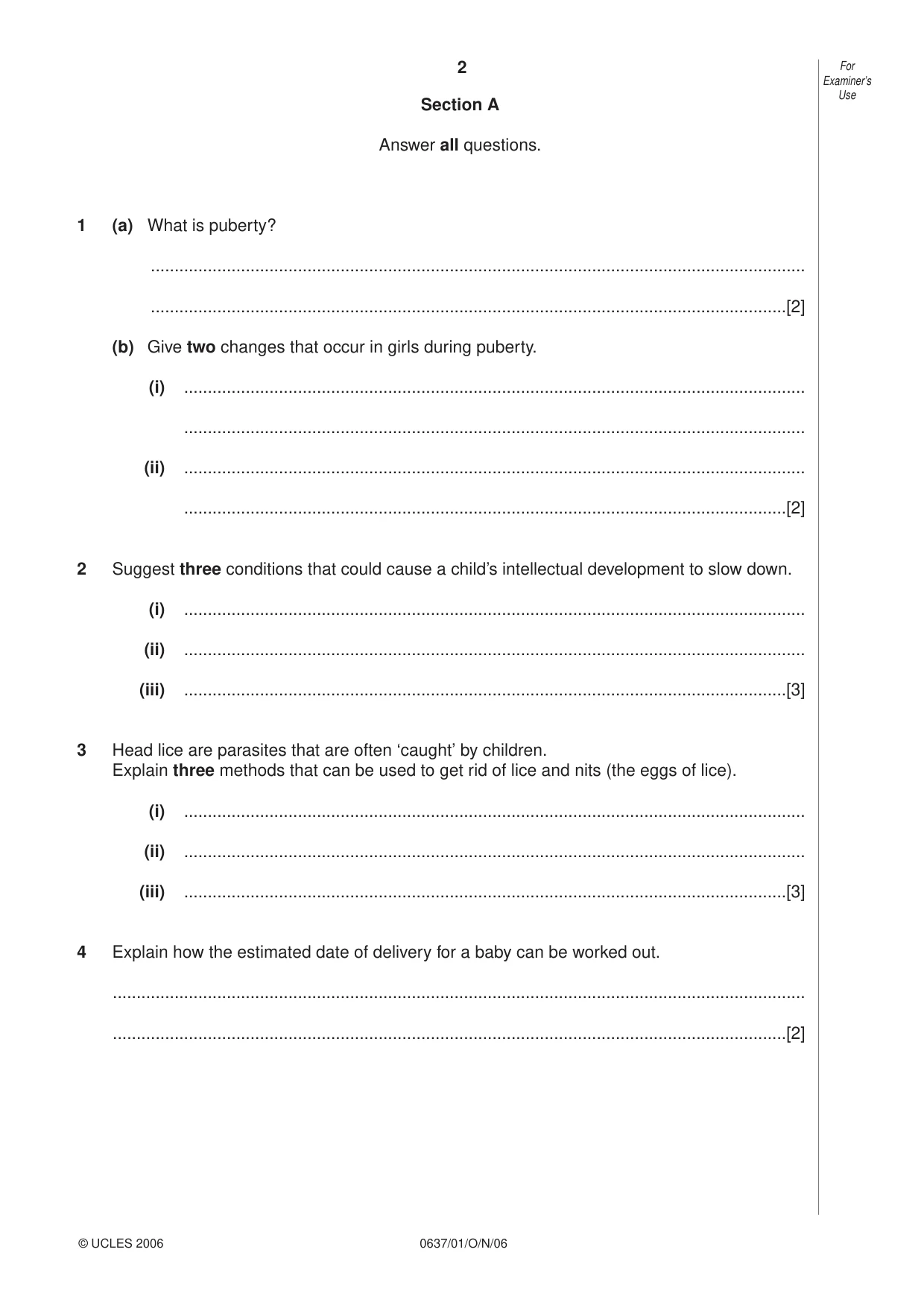
2 © UCLES 2006 0637/01/O/N/06 Section A Answer all questions. 1 (a) What is puberty? … …[2] (b) Give two changes that occur in girls during puberty. (i) … … (ii) … …[2] 2 Suggest three conditions that could cause a child’s intellectual development to slow down. (i) … (ii) … (iii) …[3] 3 Head lice are parasites that are often ‘caught’ by children. Explain three methods that can be used to get rid of lice and nits (the eggs of lice). (i) … (ii) … (iii) …[3] 4 Explain how the estimated date of delivery for a baby can be worked out. … …[2] For Examiner’s Use
Question paper, page 3
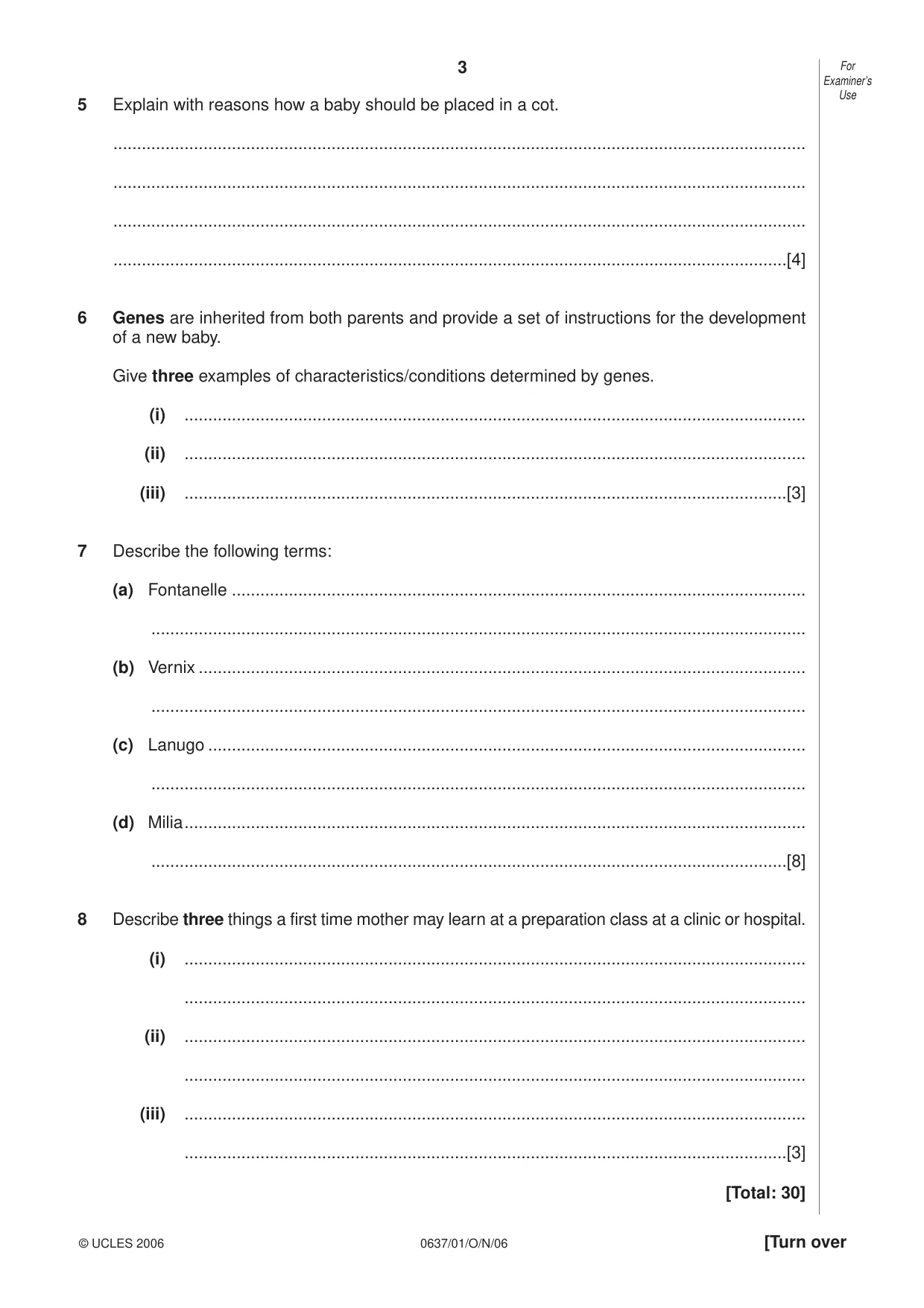
3 © UCLES 2006 0637/01/O/N/06 [Turn over 5 Explain with reasons how a baby should be placed in a cot. … … … …[4] 6 Genes are inherited from both parents and provide a set of instructions for the development of a new baby. Give three examples of characteristics/conditions determined by genes. (i) … (ii) … (iii) …[3] 7 Describe the following terms: (a) Fontanelle … … (b) Vernix … … (c) Lanugo … … (d) Milia… …[8] 8 Describe three things a first time mother may learn at a preparation class at a clinic or hospital. (i) … … (ii) … … (iii) … …[3] [Total: 30] For Examiner’s Use
Question paper, page 4
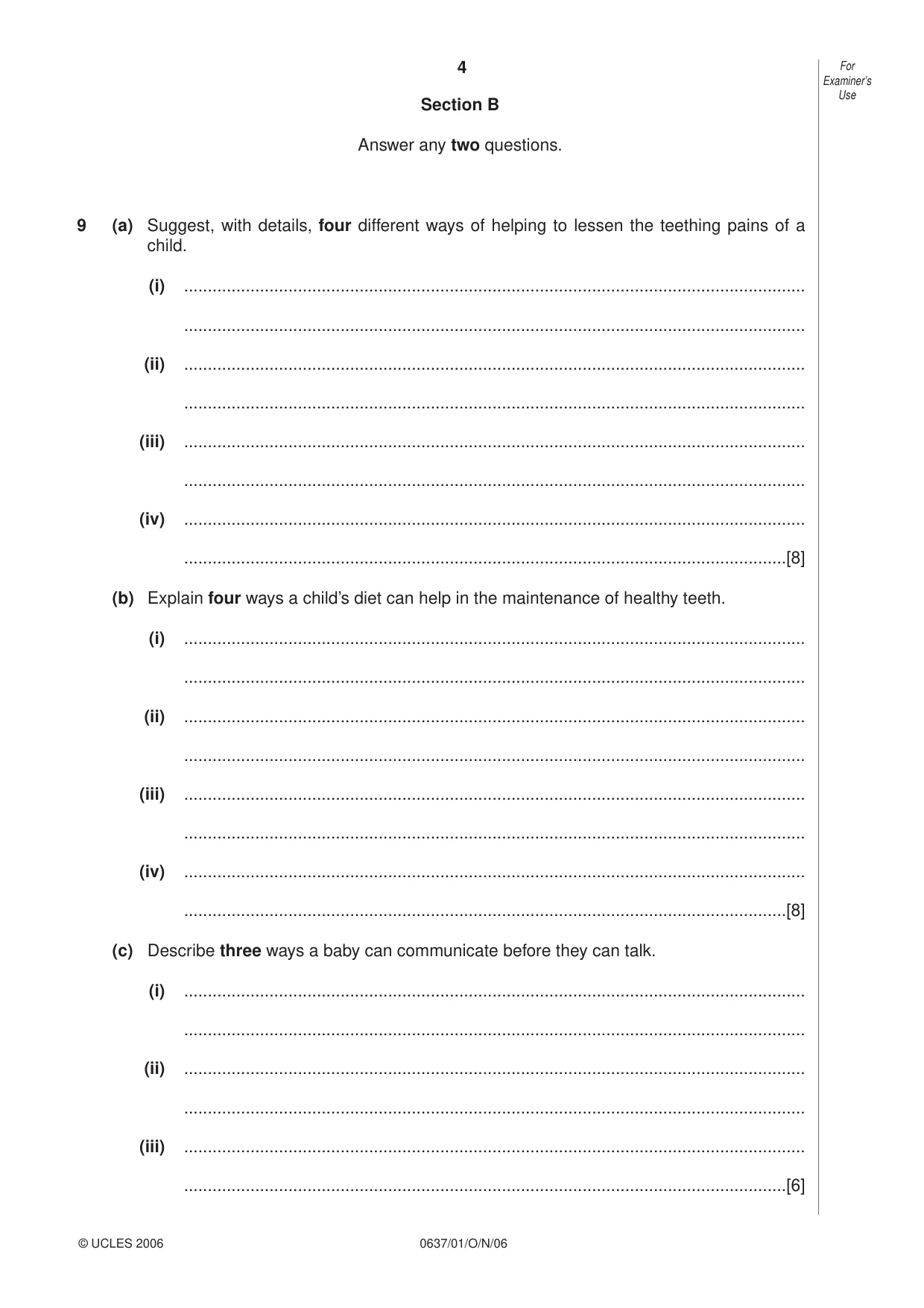
4 © UCLES 2006 0637/01/O/N/06 Section B Answer any two questions. 9 (a) Suggest, with details, four different ways of helping to lessen the teething pains of a child. (i) … … (ii) … … (iii) … … (iv) … …[8] (b) Explain four ways a child’s diet can help in the maintenance of healthy teeth. (i) … … (ii) … … (iii) … … (iv) … …[8] (c) Describe three ways a baby can communicate before they can talk. (i) … … (ii) … … (iii) … …[6] For Examiner’s Use
Question paper, page 5
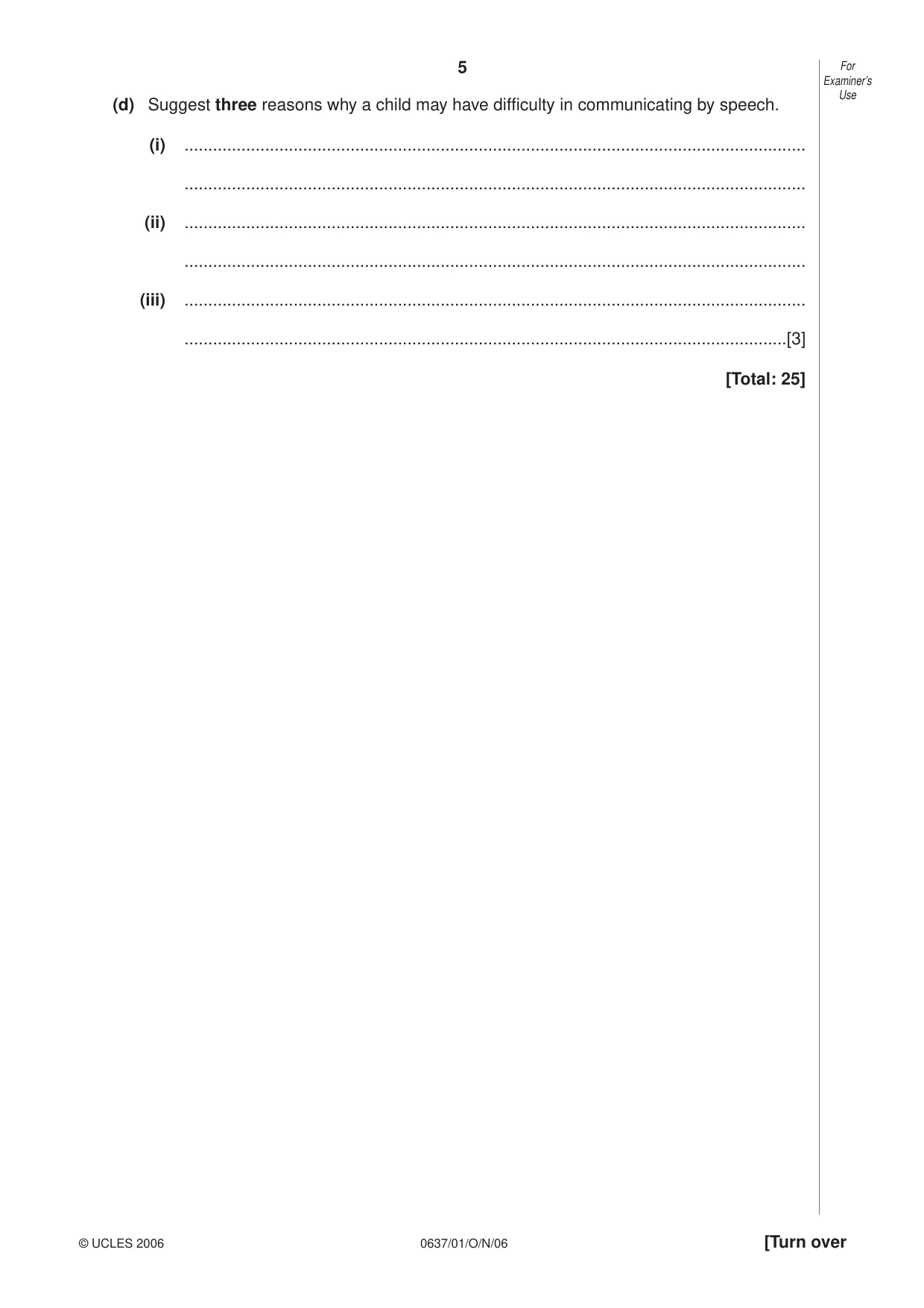
5 © UCLES 2006 0637/01/O/N/06 [Turn over (d) Suggest three reasons why a child may have difficulty in communicating by speech. (i) … … (ii) … … (iii) … …[3] [Total: 25] For Examiner’s Use
Question paper, page 6
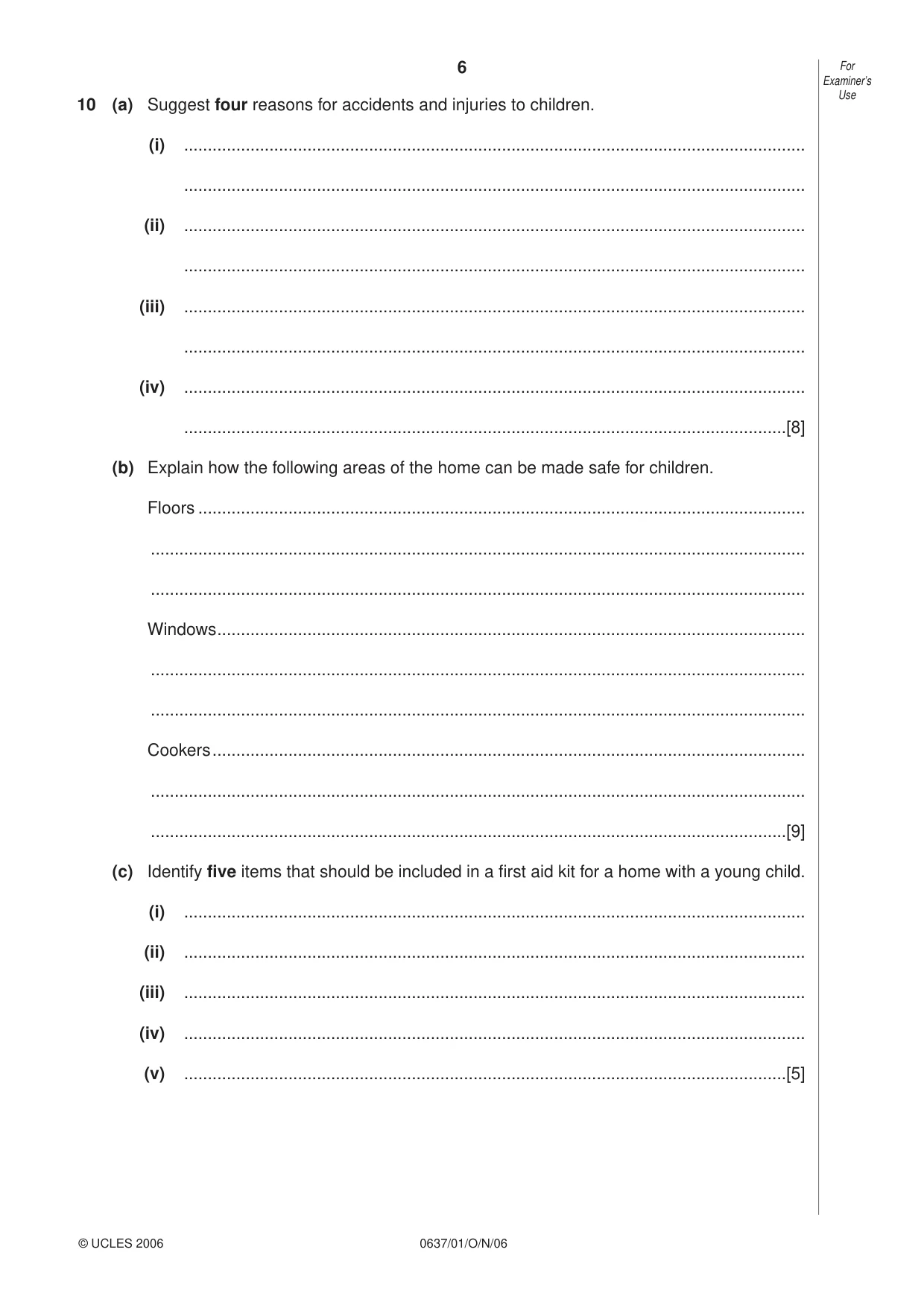
6 © UCLES 2006 0637/01/O/N/06 10 (a) Suggest four reasons for accidents and injuries to children. (i) … … (ii) … … (iii) … … (iv) … …[8] (b) Explain how the following areas of the home can be made safe for children. Floors … … … Windows… … … Cookers… … …[9] (c) Identify five items that should be included in a first aid kit for a home with a young child. (i) … (ii) … (iii) … (iv) … (v) …[5] For Examiner’s Use
Question paper, page 7
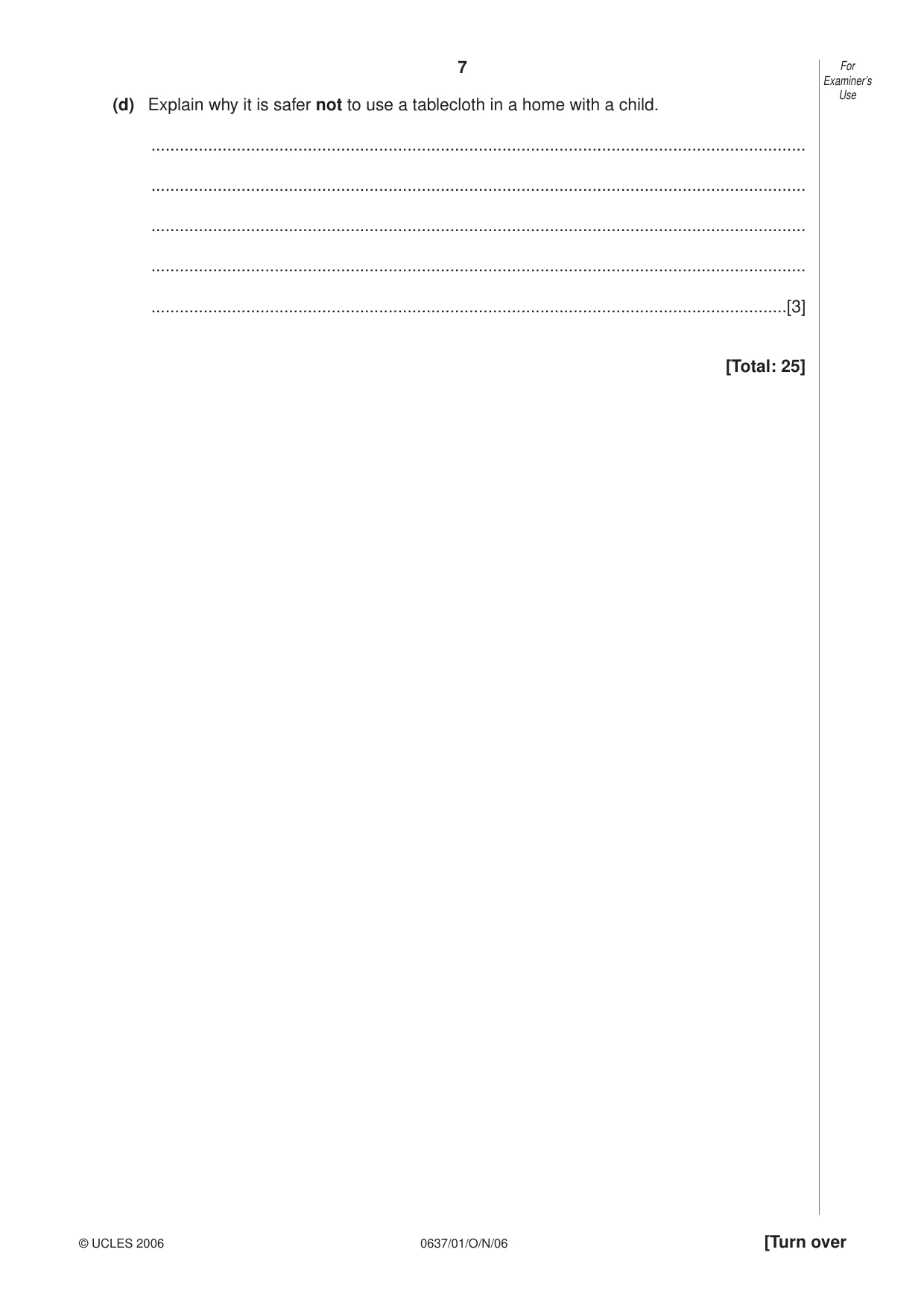
7 © UCLES 2006 0637/01/O/N/06 [Turn over (d) Explain why it is safer not to use a tablecloth in a home with a child. … … … … …[3] [Total: 25] For Examiner’s Use
Question paper, page 8
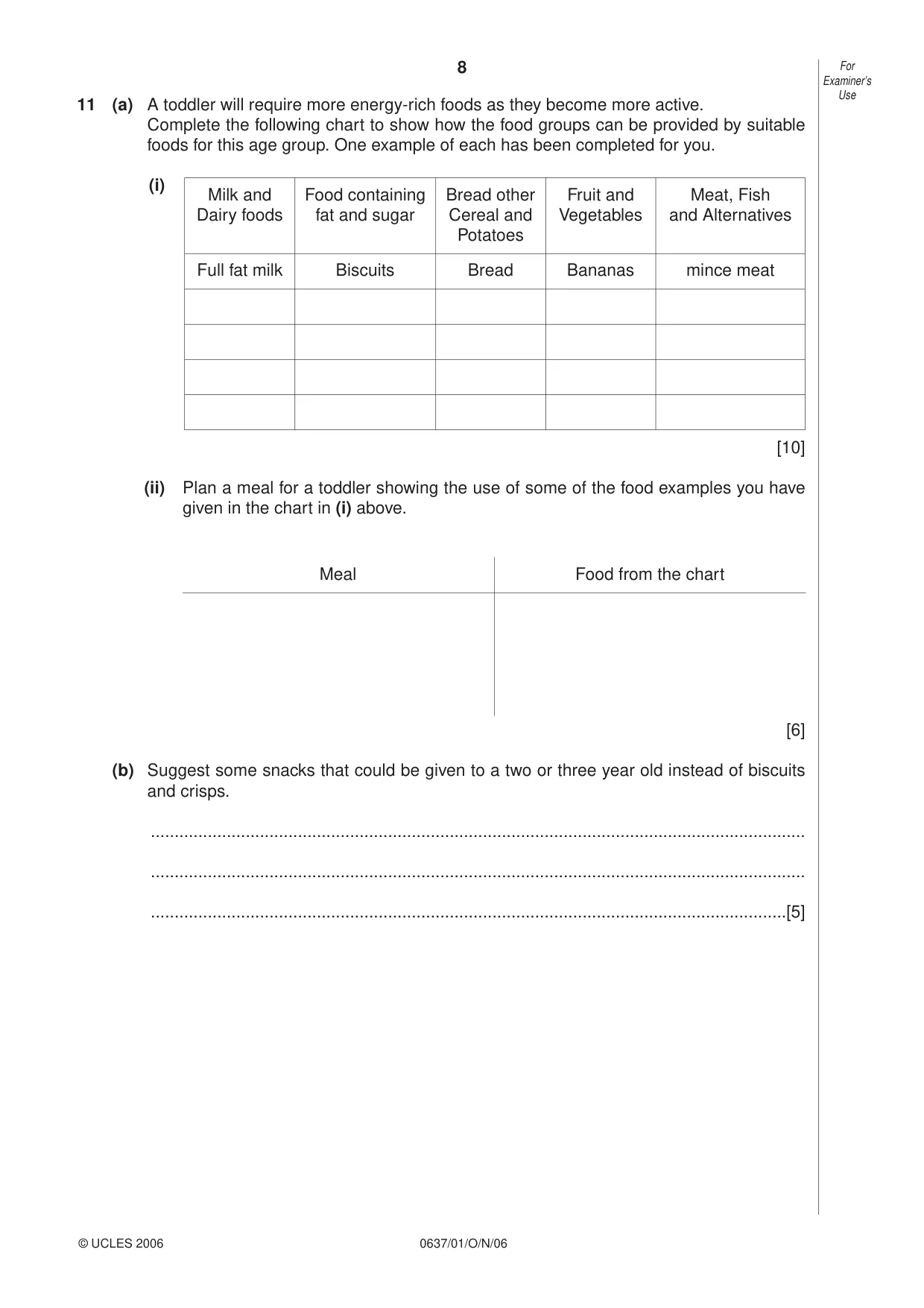
8 © UCLES 2006 0637/01/O/N/06 For Examiner’s Use 11 (a) A toddler will require more energy-rich foods as they become more active. Complete the following chart to show how the food groups can be provided by suitable foods for this age group. One example of each has been completed for you. (i) [10] (ii) Plan a meal for a toddler showing the use of some of the food examples you have given in the chart in (i) above. [6] (b) Suggest some snacks that could be given to a two or three year old instead of biscuits and crisps. … … …[5] Milk and Food containing Bread other Fruit and Meat, Fish Dairy foods fat and sugar Cereal and Vegetables and Alternatives Potatoes Full fat milk Biscuits Bread Bananas mince meat Meal Food from the chart
Question paper, page 9
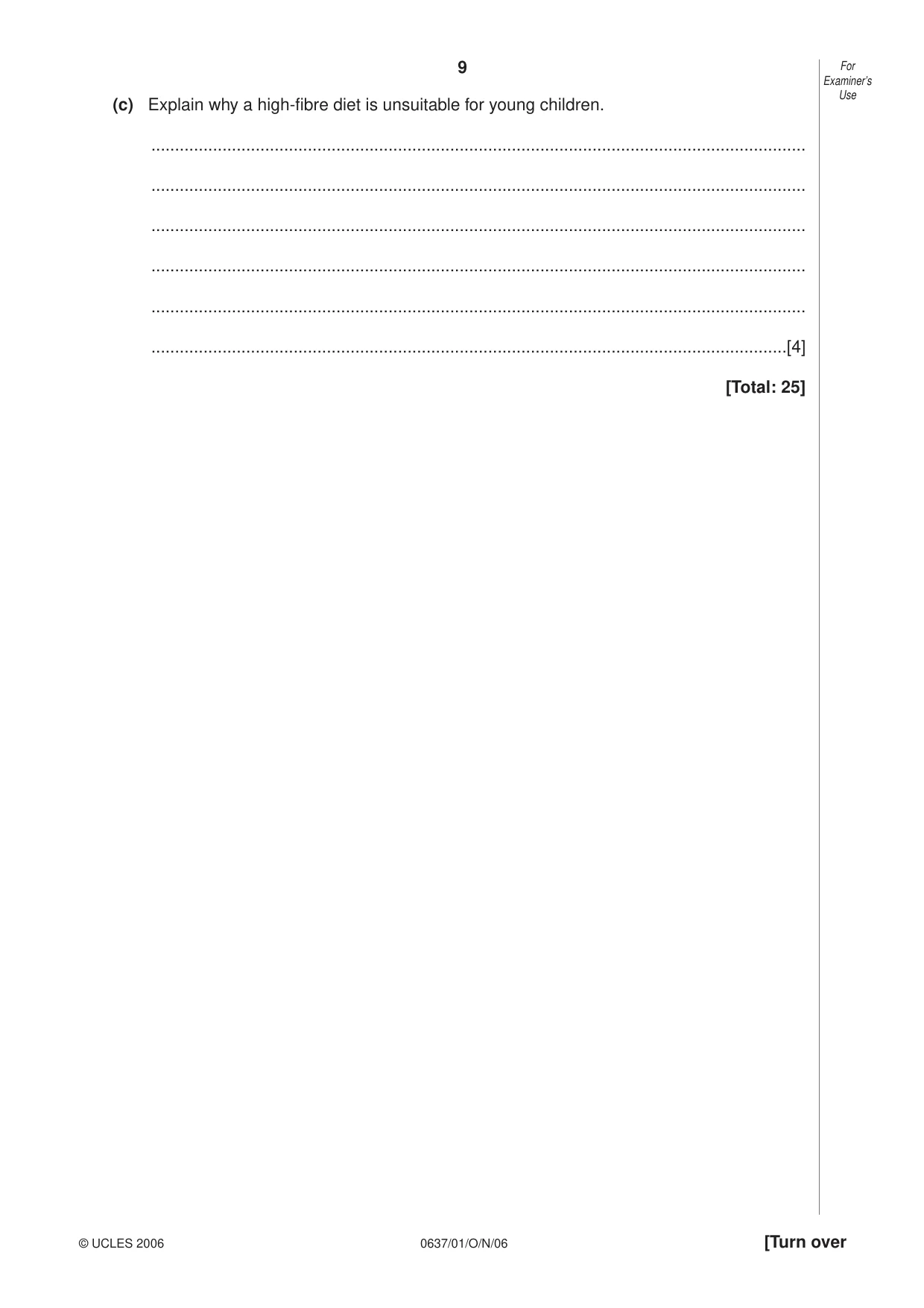
9 © UCLES 2006 0637/01/O/N/06 [Turn over (c) Explain why a high-fibre diet is unsuitable for young children. … … … … … …[4] [Total: 25] For Examiner’s Use
Question paper, page 10
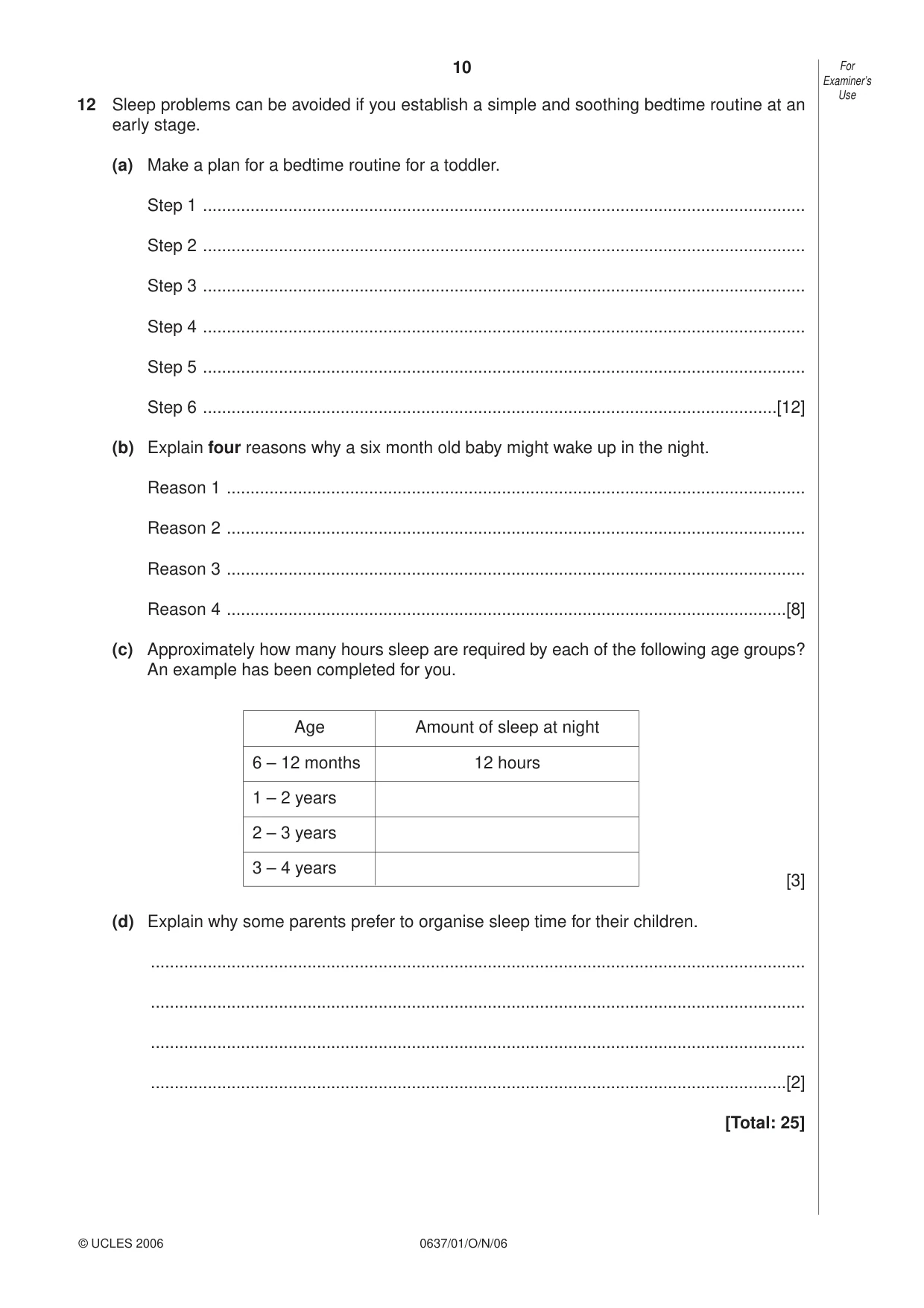
10 © UCLES 2006 0637/01/O/N/06 For Examiner’s Use 12 Sleep problems can be avoided if you establish a simple and soothing bedtime routine at an early stage. (a) Make a plan for a bedtime routine for a toddler. Step 1 … Step 2 … Step 3 … Step 4 … Step 5 … Step 6 …[12] (b) Explain four reasons why a six month old baby might wake up in the night. Reason 1 … Reason 2 … Reason 3 … Reason 4 …[8] (c) Approximately how many hours sleep are required by each of the following age groups? An example has been completed for you. [3] (d) Explain why some parents prefer to organise sleep time for their children. … … … …[2] [Total: 25] Age Amount of sleep at night 6 – 12 months 12 hours 1 – 2 years 2 – 3 years 3 – 4 years
Question paper, page 11
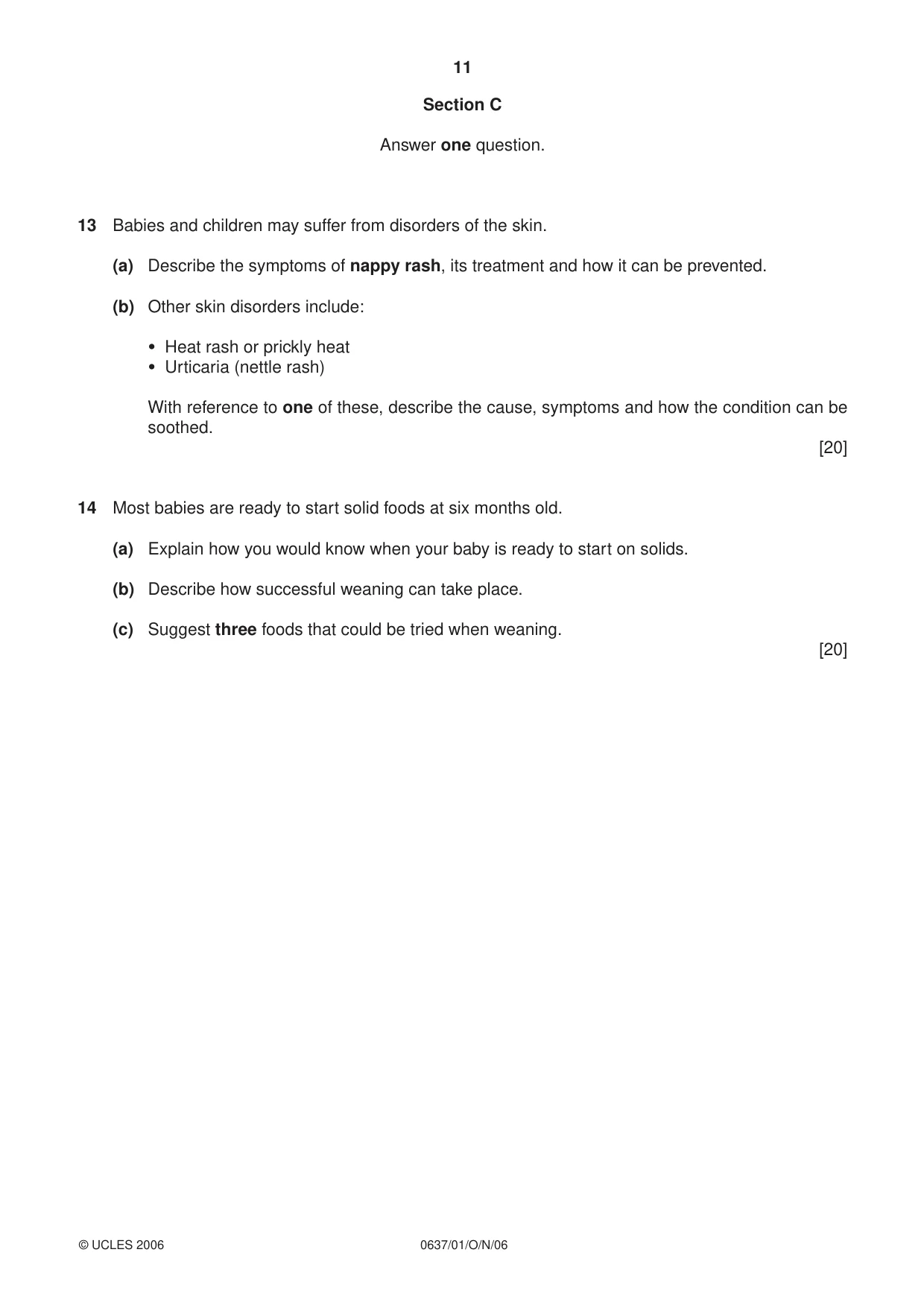
11 © UCLES 2006 0637/01/O/N/06 Section C Answer one question. 13 Babies and children may suffer from disorders of the skin. (a) Describe the symptoms of nappy rash, its treatment and how it can be prevented. (b) Other skin disorders include: • Heat rash or prickly heat • Urticaria (nettle rash) With reference to one of these, describe the cause, symptoms and how the condition can be soothed. [20] 14 Most babies are ready to start solid foods at six months old. (a) Explain how you would know when your baby is ready to start on solids. (b) Describe how successful weaning can take place. (c) Suggest three foods that could be tried when weaning. [20]
Question paper, page 12
12 0637/01/O/N/06 BLANK PAGE Permission to reproduce items where third-party owned material protected by copyright is included has been sought and cleared where possible. Every reasonable effort has been made by the publisher (UCLES) to trace copyright holders, but if any items requiring clearance have unwittingly been included, the publisher will be pleased to make amends at the earliest possible opportunity. University of Cambridge International Examinations is part of the University of Cambridge Local Examinations Syndicate (UCLES), which is itself a department of the University of Cambridge.
Mark scheme, page 1
UNIVERSITY OF CAMBRIDGE INTERNATIONAL EXAMINATIONS International General Certificate of Secondary Education MARK SCHEME for the October/November 2006 question paper 0637 CHIL DEVELOPMENT 0637/01 Paper 1 (Theory Paper), maximum raw mark 100 This mark scheme is published as an aid to teachers and students, to indicate the requirements of the examination. It shows the basis on which Examiners were instructed to award marks. It does not indicate the details of the discussions that took place at an Examiners’ meeting before marking began. All Examiners are instructed that alternative correct answers and unexpected approaches in candidates’ scripts must be given marks that fairly reflect the relevant knowledge and skills demonstrated. Mark schemes must be read in conjunction with the question papers and the report on the examination. The grade thresholds for various grades are published in the report on the examination for most IGCSE, GCE Advanced Level and Advanced Subsidiary Level syllabuses. • CIE will not enter into discussions or correspondence in connection with these mark schemes. CIE is publishing the mark schemes for the October/November 2006 question papers for most IGCSE, GCE Advanced Level and Advanced Subsidiary Level syllabuses and some Ordinary Level syllabuses. www.XtremePapers.com
Mark scheme, page 2
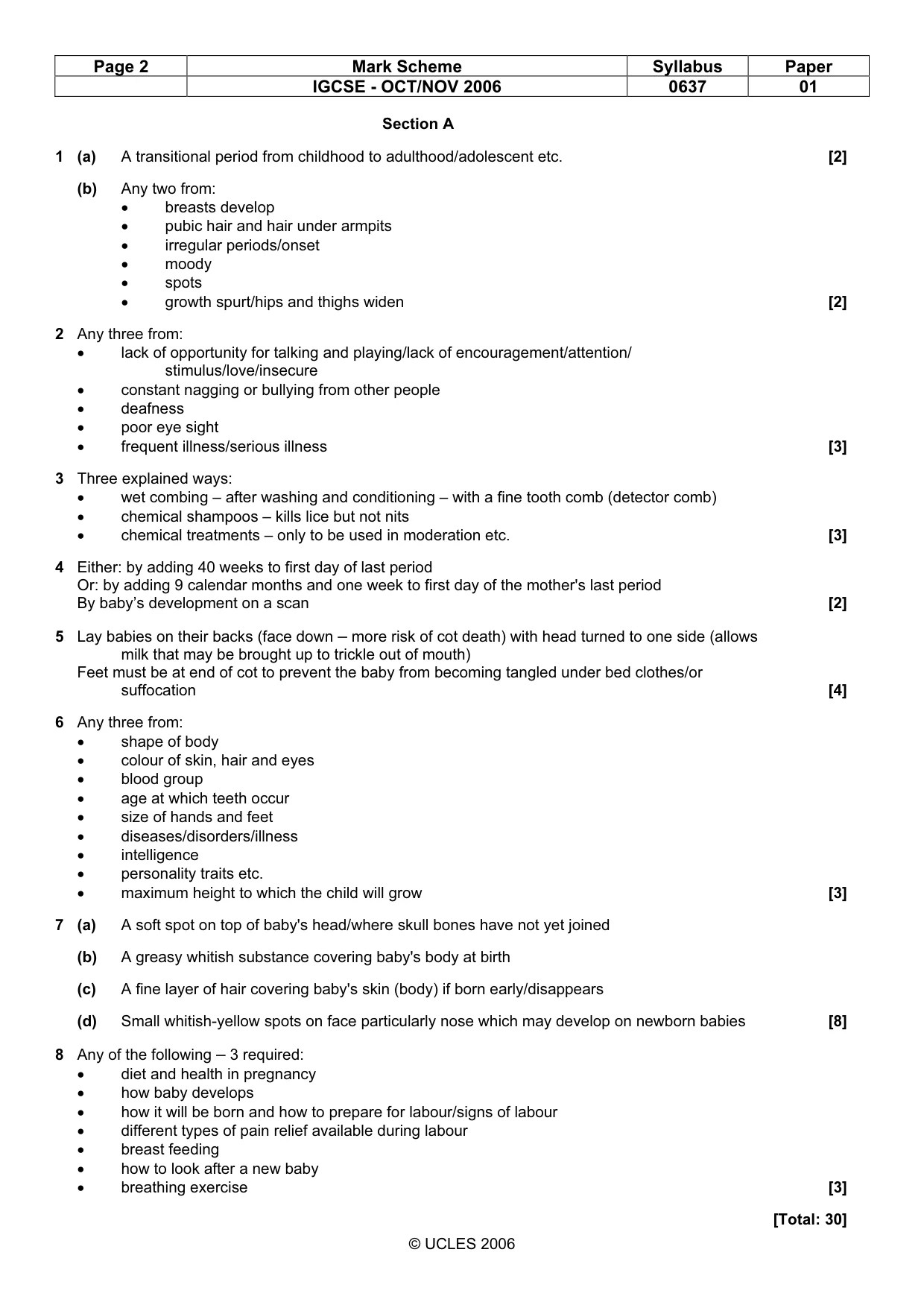
Page 2 Mark Scheme Syllabus Paper IGCSE - OCT/NOV 2006 0637 01 © UCLES 2006 Section A 1 (a) A transitional period from childhood to adulthood/adolescent etc. [2] (b) Any two from: • breasts develop • pubic hair and hair under armpits • irregular periods/onset • moody • spots • growth spurt/hips and thighs widen [2] 2 Any three from: • lack of opportunity for talking and playing/lack of encouragement/attention/ stimulus/love/insecure • constant nagging or bullying from other people • deafness • poor eye sight • frequent illness/serious illness [3] 3 Three explained ways: • wet combing – after washing and conditioning – with a fine tooth comb (detector comb) • chemical shampoos – kills lice but not nits • chemical treatments – only to be used in moderation etc. [3] 4 Either: by adding 40 weeks to first day of last period Or: by adding 9 calendar months and one week to first day of the mother's last period By baby’s development on a scan [2] 5 Lay babies on their backs (face down – more risk of cot death) with head turned to one side (allows milk that may be brought up to trickle out of mouth) Feet must be at end of cot to prevent the baby from becoming tangled under bed clothes/or suffocation [4] 6 Any three from: • shape of body • colour of skin, hair and eyes • blood group • age at which teeth occur • size of hands and feet • diseases/disorders/illness • intelligence • personality traits etc. • maximum height to which the child will grow [3] 7 (a) A soft spot on top of baby's head/where skull bones have not yet joined (b) A greasy whitish substance covering baby's body at birth (c) A fine layer of hair covering baby's skin (body) if born early/disappears (d) Small whitish-yellow spots on face particularly nose which may develop on newborn babies [8] 8 Any of the following – 3 required: • diet and health in pregnancy • how baby develops • how it will be born and how to prepare for labour/signs of labour • different types of pain relief available during labour • breast feeding • how to look after a new baby • breathing exercise [3] [Total: 30]
Mark scheme, page 3
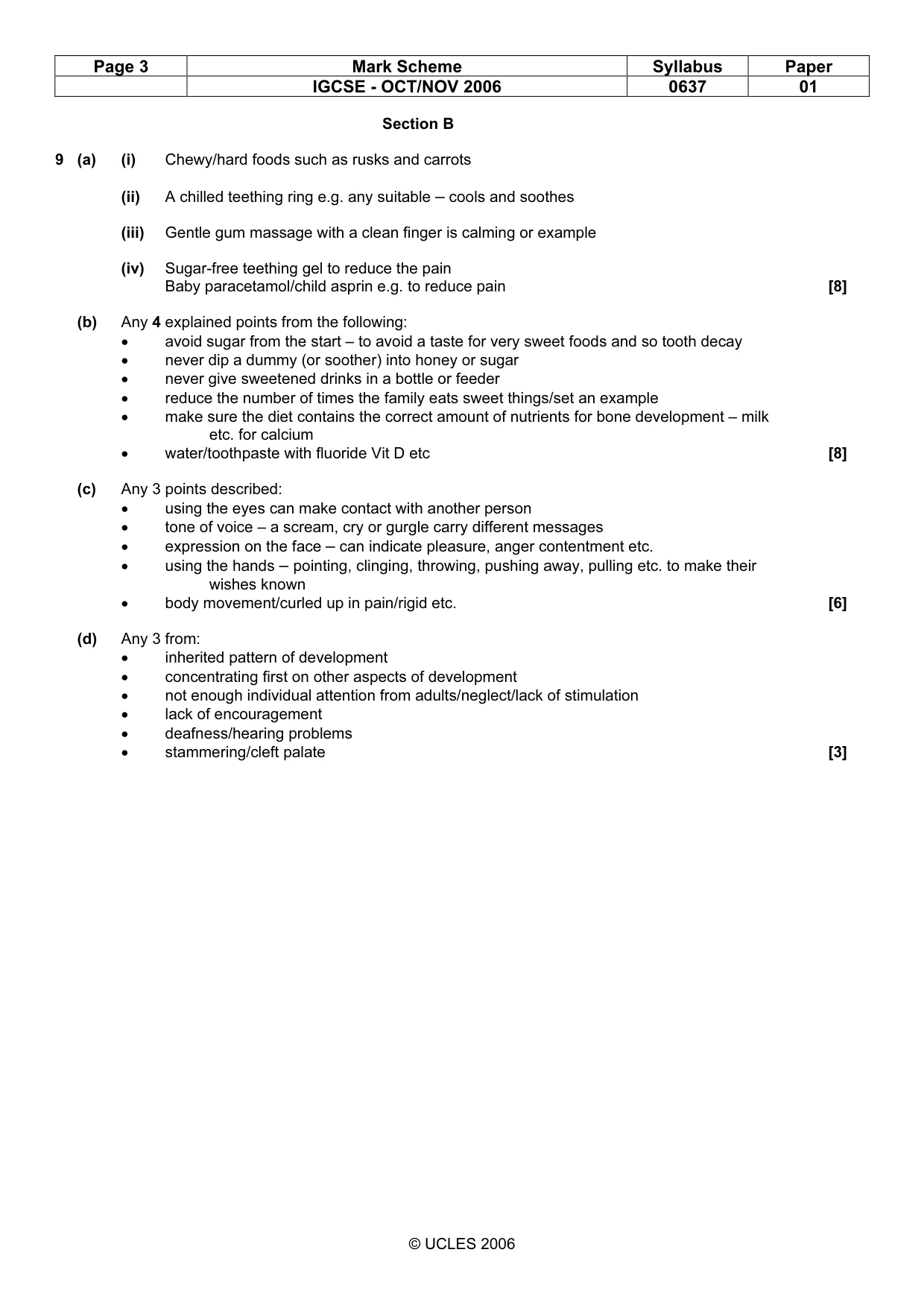
Page 3 Mark Scheme Syllabus Paper IGCSE - OCT/NOV 2006 0637 01 © UCLES 2006 Section B 9 (a) (i) Chewy/hard foods such as rusks and carrots (ii) A chilled teething ring e.g. any suitable – cools and soothes (iii) Gentle gum massage with a clean finger is calming or example (iv) Sugar-free teething gel to reduce the pain Baby paracetamol/child asprin e.g. to reduce pain [8] (b) Any 4 explained points from the following: • avoid sugar from the start – to avoid a taste for very sweet foods and so tooth decay • never dip a dummy (or soother) into honey or sugar • never give sweetened drinks in a bottle or feeder • reduce the number of times the family eats sweet things/set an example • make sure the diet contains the correct amount of nutrients for bone development – milk etc. for calcium • water/toothpaste with fluoride Vit D etc [8] (c) Any 3 points described: • using the eyes can make contact with another person • tone of voice – a scream, cry or gurgle carry different messages • expression on the face – can indicate pleasure, anger contentment etc. • using the hands – pointing, clinging, throwing, pushing away, pulling etc. to make their wishes known • body movement/curled up in pain/rigid etc. [6] (d) Any 3 from: • inherited pattern of development • concentrating first on other aspects of development • not enough individual attention from adults/neglect/lack of stimulation • lack of encouragement • deafness/hearing problems • stammering/cleft palate [3]
Mark scheme, page 4
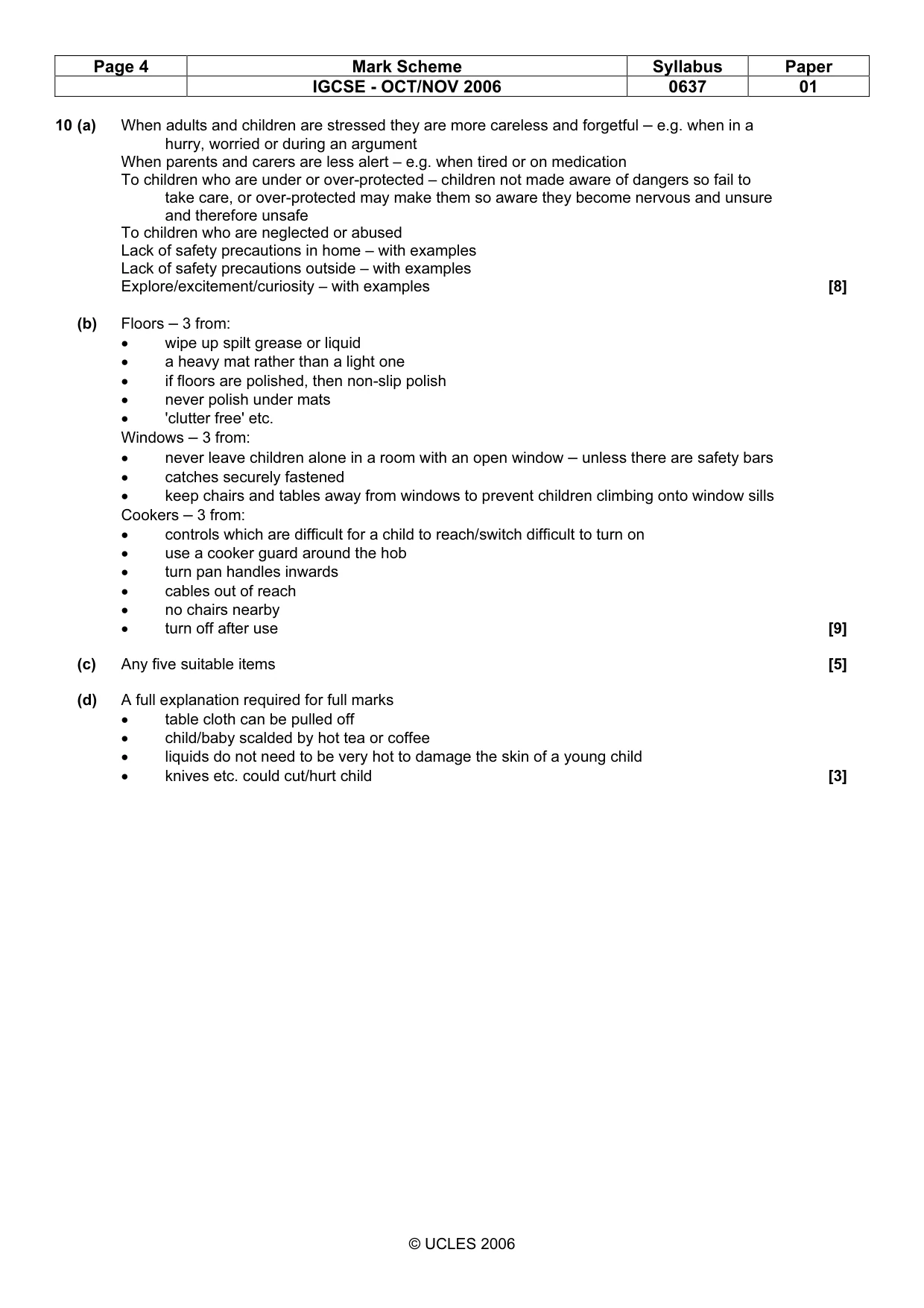
Page 4 Mark Scheme Syllabus Paper IGCSE - OCT/NOV 2006 0637 01 © UCLES 2006 10 (a) When adults and children are stressed they are more careless and forgetful – e.g. when in a hurry, worried or during an argument When parents and carers are less alert – e.g. when tired or on medication To children who are under or over-protected – children not made aware of dangers so fail to take care, or over-protected may make them so aware they become nervous and unsure and therefore unsafe To children who are neglected or abused Lack of safety precautions in home – with examples Lack of safety precautions outside – with examples Explore/excitement/curiosity – with examples [8] (b) Floors – 3 from: • wipe up spilt grease or liquid • a heavy mat rather than a light one • if floors are polished, then non-slip polish • never polish under mats • 'clutter free' etc. Windows – 3 from: • never leave children alone in a room with an open window – unless there are safety bars • catches securely fastened • keep chairs and tables away from windows to prevent children climbing onto window sills Cookers – 3 from: • controls which are difficult for a child to reach/switch difficult to turn on • use a cooker guard around the hob • turn pan handles inwards • cables out of reach • no chairs nearby • turn off after use [9] (c) Any five suitable items [5] (d) A full explanation required for full marks • table cloth can be pulled off • child/baby scalded by hot tea or coffee • liquids do not need to be very hot to damage the skin of a young child • knives etc. could cut/hurt child [3]
Mark scheme, page 5
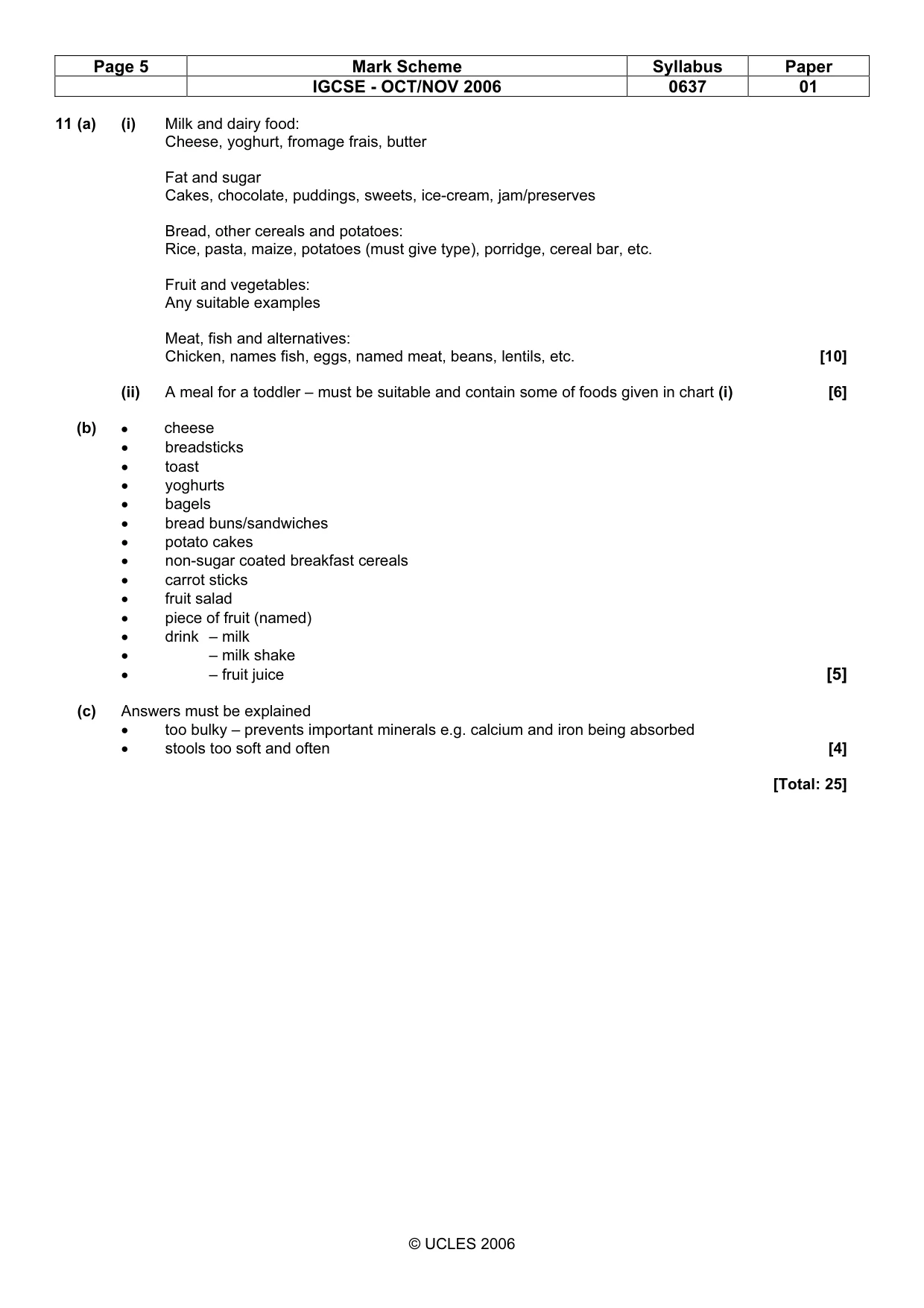
Page 5 Mark Scheme Syllabus Paper IGCSE - OCT/NOV 2006 0637 01 © UCLES 2006 11 (a) (i) Milk and dairy food: Cheese, yoghurt, fromage frais, butter Fat and sugar Cakes, chocolate, puddings, sweets, ice-cream, jam/preserves Bread, other cereals and potatoes: Rice, pasta, maize, potatoes (must give type), porridge, cereal bar, etc. Fruit and vegetables: Any suitable examples Meat, fish and alternatives: Chicken, names fish, eggs, named meat, beans, lentils, etc. [10] (ii) A meal for a toddler – must be suitable and contain some of foods given in chart (i) [6] (b) • cheese • breadsticks • toast • yoghurts • bagels • bread buns/sandwiches • potato cakes • non-sugar coated breakfast cereals • carrot sticks • fruit salad • piece of fruit (named) • drink – milk • – milk shake • – fruit juice [5] (c) Answers must be explained • too bulky – prevents important minerals e.g. calcium and iron being absorbed • stools too soft and often [4] [Total: 25]
Mark scheme, page 6
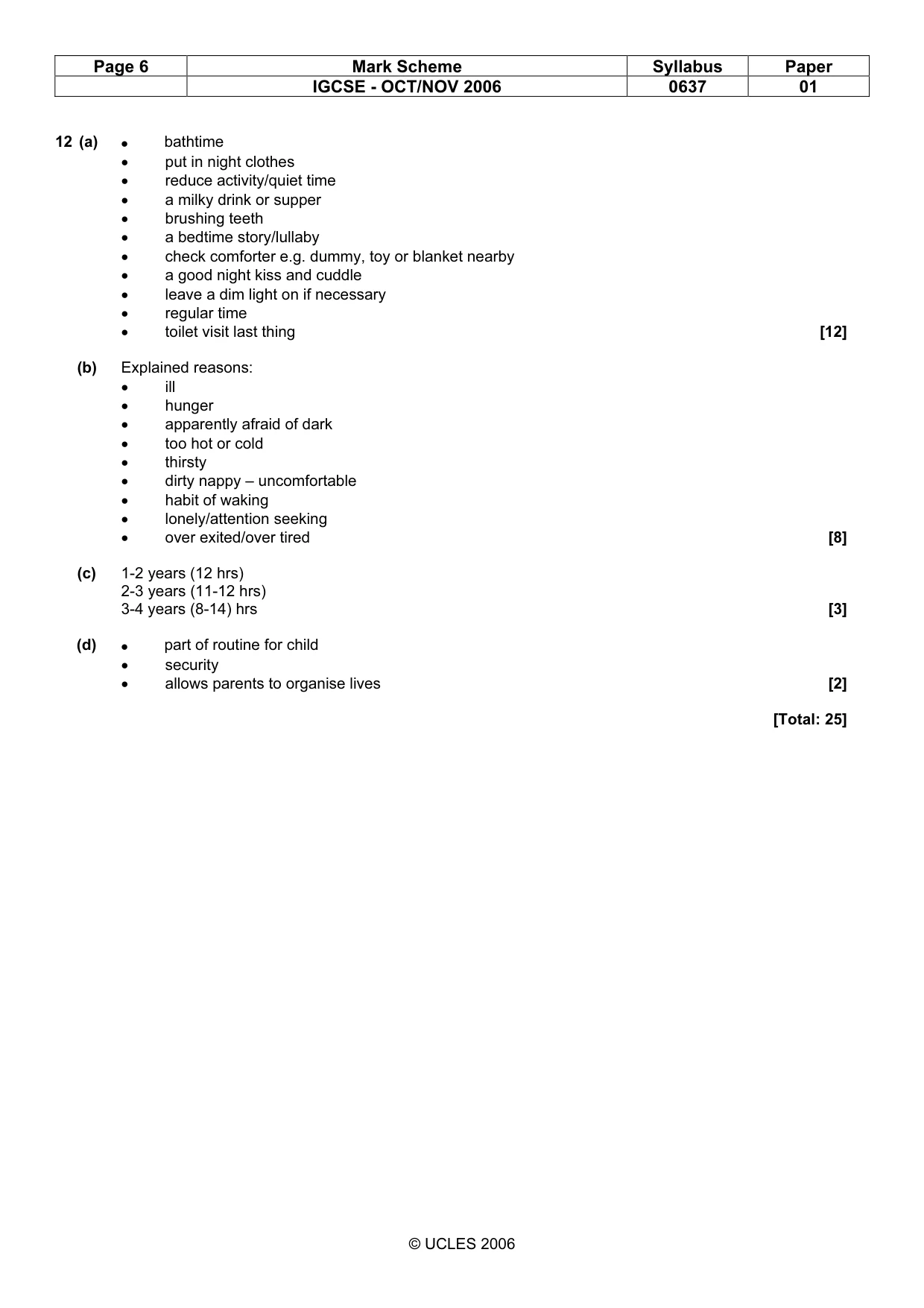
Page 6 Mark Scheme Syllabus Paper IGCSE - OCT/NOV 2006 0637 01 © UCLES 2006 12 (a) • bathtime • put in night clothes • reduce activity/quiet time • a milky drink or supper • brushing teeth • a bedtime story/lullaby • check comforter e.g. dummy, toy or blanket nearby • a good night kiss and cuddle • leave a dim light on if necessary • regular time • toilet visit last thing [12] (b) Explained reasons: • ill • hunger • apparently afraid of dark • too hot or cold • thirsty • dirty nappy – uncomfortable • habit of waking • lonely/attention seeking • over exited/over tired [8] (c) 1-2 years (12 hrs) 2-3 years (11-12 hrs) 3-4 years (8-14) hrs [3] (d) • part of routine for child • security • allows parents to organise lives [2] [Total: 25]
Mark scheme, page 7
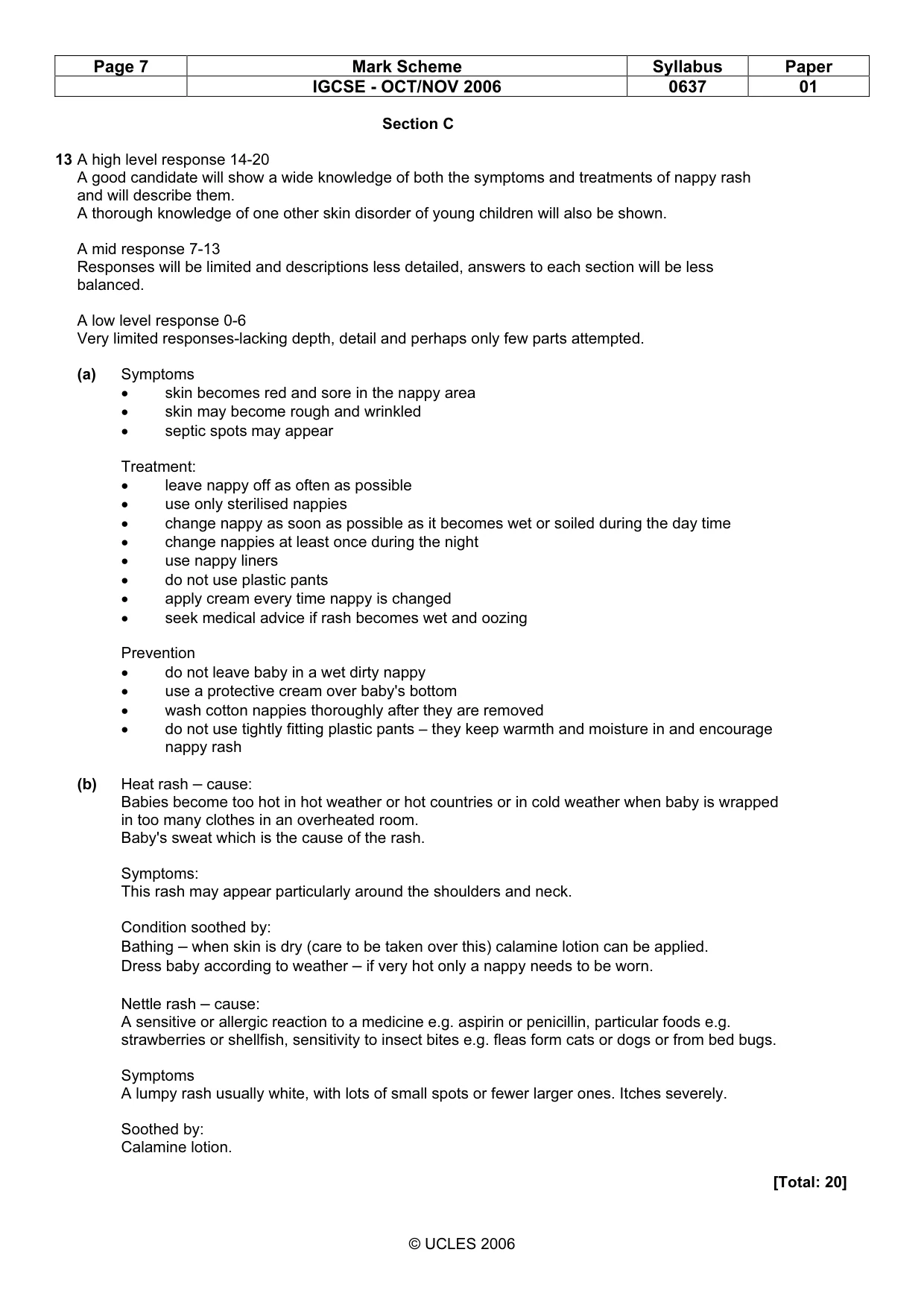
Page 7 Mark Scheme Syllabus Paper IGCSE - OCT/NOV 2006 0637 01 © UCLES 2006 Section C 13 A high level response 14-20 A good candidate will show a wide knowledge of both the symptoms and treatments of nappy rash and will describe them. A thorough knowledge of one other skin disorder of young children will also be shown. A mid response 7-13 Responses will be limited and descriptions less detailed, answers to each section will be less balanced. A low level response 0-6 Very limited responses-lacking depth, detail and perhaps only few parts attempted. (a) Symptoms • skin becomes red and sore in the nappy area • skin may become rough and wrinkled • septic spots may appear Treatment: • leave nappy off as often as possible • use only sterilised nappies • change nappy as soon as possible as it becomes wet or soiled during the day time • change nappies at least once during the night • use nappy liners • do not use plastic pants • apply cream every time nappy is changed • seek medical advice if rash becomes wet and oozing Prevention • do not leave baby in a wet dirty nappy • use a protective cream over baby's bottom • wash cotton nappies thoroughly after they are removed • do not use tightly fitting plastic pants – they keep warmth and moisture in and encourage nappy rash (b) Heat rash – cause: Babies become too hot in hot weather or hot countries or in cold weather when baby is wrapped in too many clothes in an overheated room. Baby's sweat which is the cause of the rash. Symptoms: This rash may appear particularly around the shoulders and neck. Condition soothed by: Bathing – when skin is dry (care to be taken over this) calamine lotion can be applied. Dress baby according to weather – if very hot only a nappy needs to be worn. Nettle rash – cause: A sensitive or allergic reaction to a medicine e.g. aspirin or penicillin, particular foods e.g. strawberries or shellfish, sensitivity to insect bites e.g. fleas form cats or dogs or from bed bugs. Symptoms A lumpy rash usually white, with lots of small spots or fewer larger ones. Itches severely. Soothed by: Calamine lotion. [Total: 20]
Mark scheme, page 8
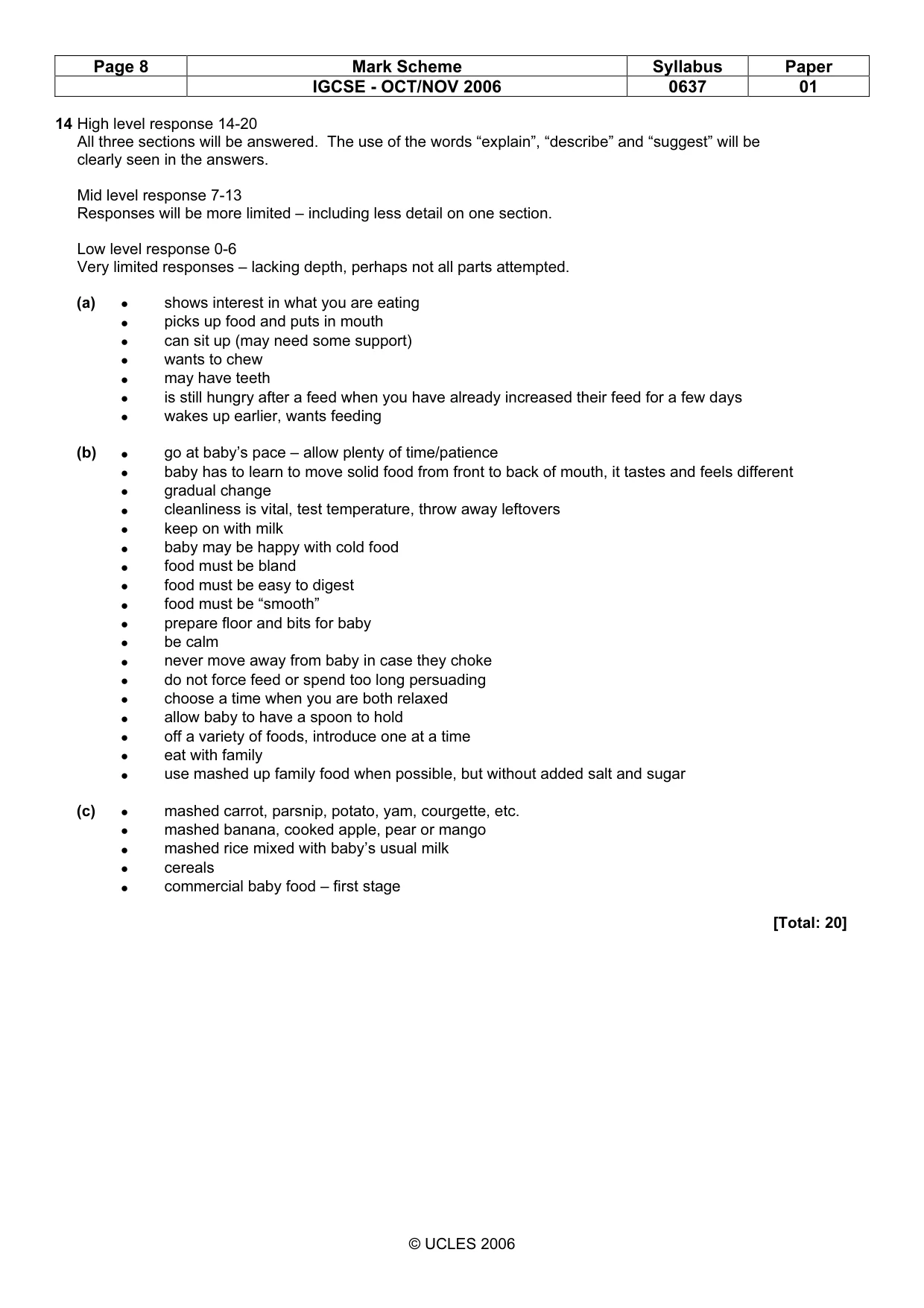
Page 8 Mark Scheme Syllabus Paper IGCSE - OCT/NOV 2006 0637 01 © UCLES 2006 14 High level response 14-20 All three sections will be answered. The use of the words “explain”, “describe” and “suggest” will be clearly seen in the answers. Mid level response 7-13 Responses will be more limited – including less detail on one section. Low level response 0-6 Very limited responses – lacking depth, perhaps not all parts attempted. (a) • shows interest in what you are eating • picks up food and puts in mouth • can sit up (may need some support) • wants to chew • may have teeth • is still hungry after a feed when you have already increased their feed for a few days • wakes up earlier, wants feeding (b) • go at baby’s pace – allow plenty of time/patience • baby has to learn to move solid food from front to back of mouth, it tastes and feels different • gradual change • cleanliness is vital, test temperature, throw away leftovers • keep on with milk • baby may be happy with cold food • food must be bland • food must be easy to digest • food must be “smooth” • prepare floor and bits for baby • be calm • never move away from baby in case they choke • do not force feed or spend too long persuading • choose a time when you are both relaxed • allow baby to have a spoon to hold • off a variety of foods, introduce one at a time • eat with family • use mashed up family food when possible, but without added salt and sugar (c) • mashed carrot, parsnip, potato, yam, courgette, etc. • mashed banana, cooked apple, pear or mango • mashed rice mixed with baby’s usual milk • cereals • commercial baby food – first stage [Total: 20]
What you needed in this session
Cambridge’s own grade thresholds for 2006 Oct/Nov, Paper 1 · Variant 1. A higher threshold means an easier paper — the bar moves with how the cohort did.