Cambridge IGCSE Chemistry (9-1) 0971 — 2022 Oct/Nov Paper 6 · Variant 2
0971/62/O/N/22 · 4 questions · 40 marks · ≈45 min
The question paper and its mark scheme, free to read here and free to download. This is Cambridge’s own paper, exactly as it was sat.
Question paper12 pages


Mark scheme8 pages
Answers below. Sit the paper first if you are practising.
Questions as text
Q1 · A mixture of three coloured compounds was separated using the apparatus shown in the…
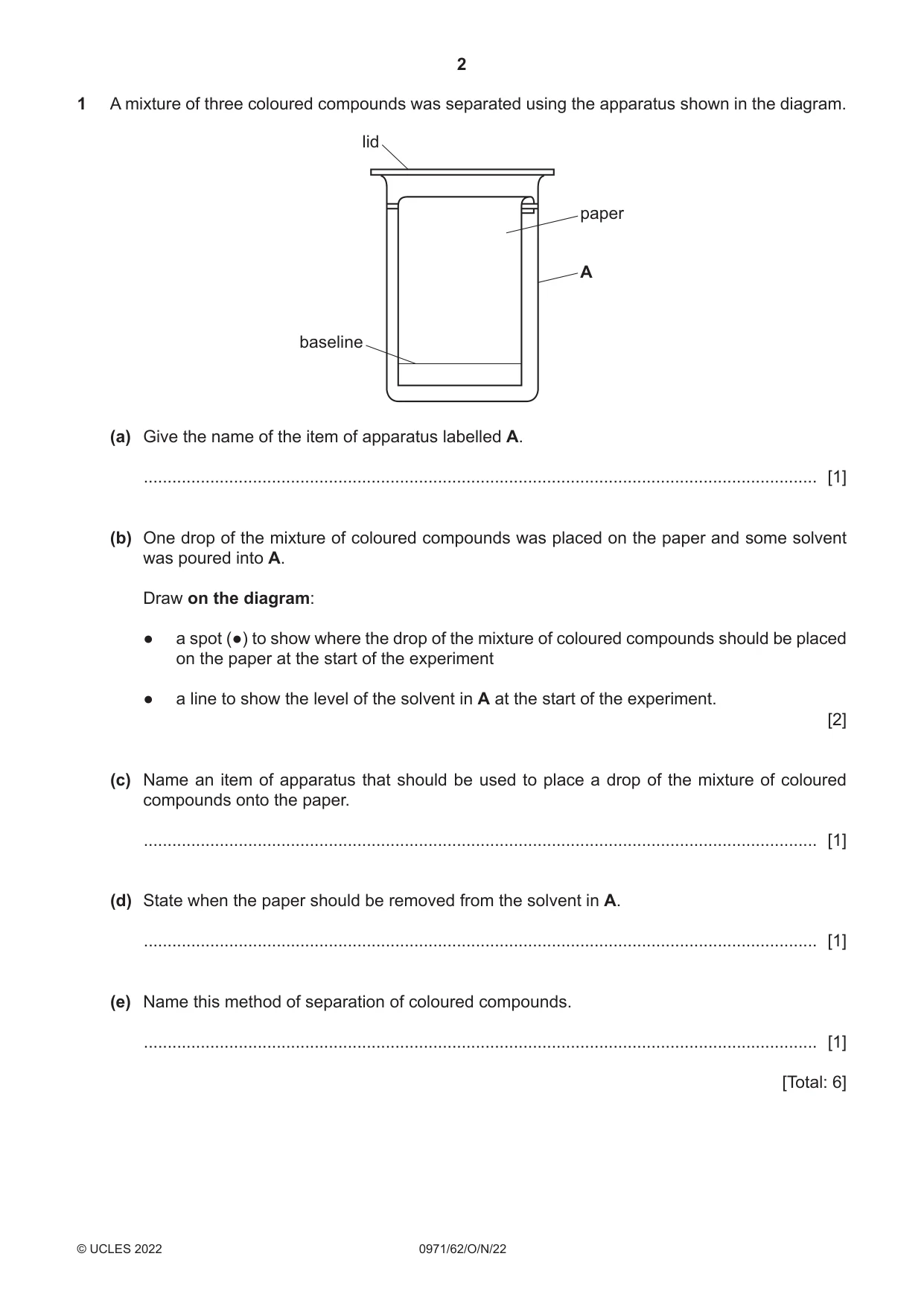
1 A mixture of three coloured compounds was separated using the apparatus shown in the diagram. lid paper A baseline (a) Give the name of the item of apparatus labelled A. .............................................................................................................................................. [1] (b) One drop of the mixture of coloured compounds was placed on the paper and some solvent was poured into A. Draw on the diagram: ● a spot (●) to show where the drop of the mixture of coloured compounds should be placed on the paper at the start of the experiment ● a line to show the level of the solvent in A at the start of the experiment. [2] (c) Name an item of apparatus that should be used to place a drop of the mixture of coloured compounds onto the paper. .............................................................................................................................................. [1] (d) State when the paper should be removed from the solvent in A. .............................................................................................................................................. [1] (e) Name this method of separation of coloured compounds. .............................................................................................................................................. [1] [Total: 6]
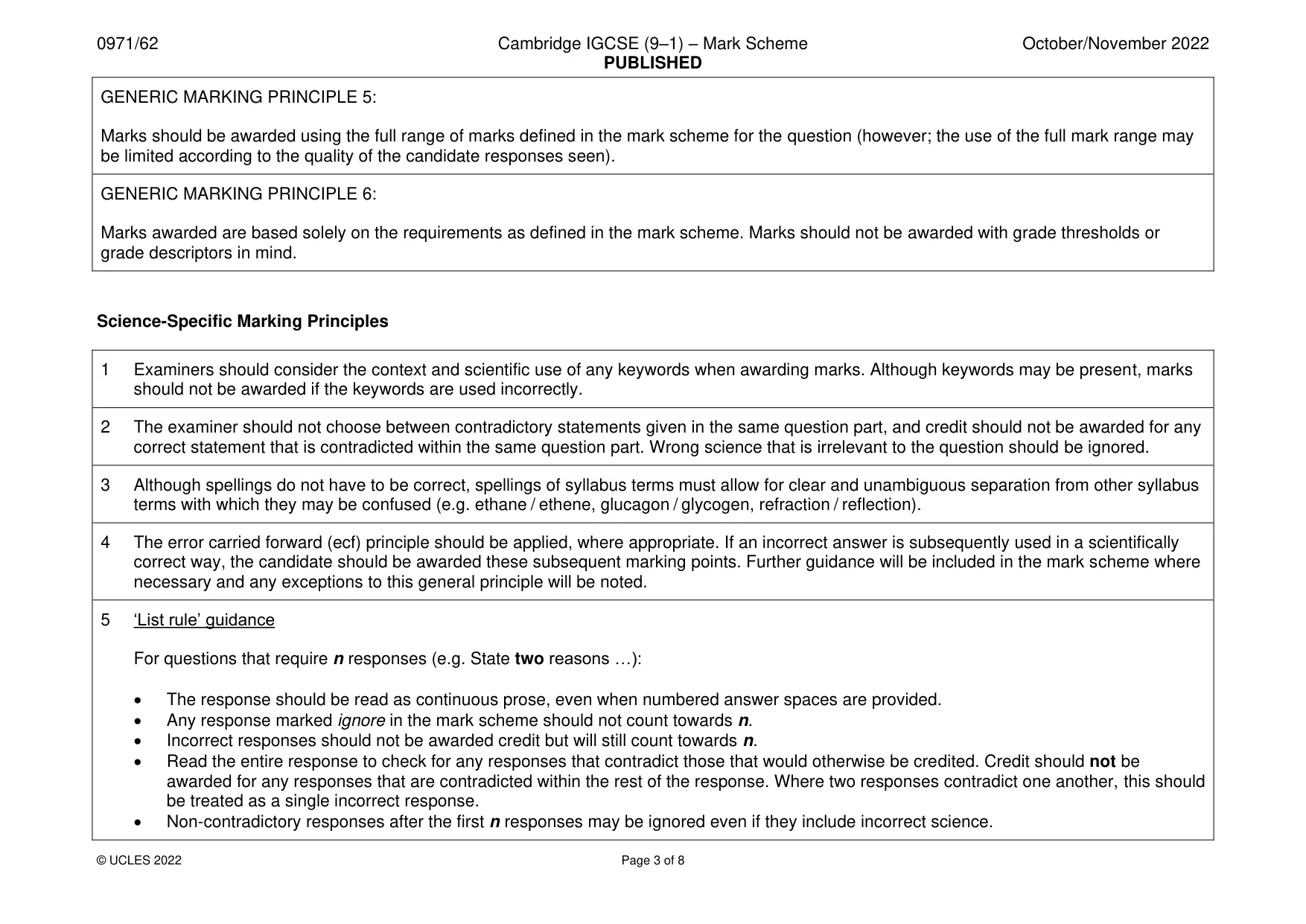
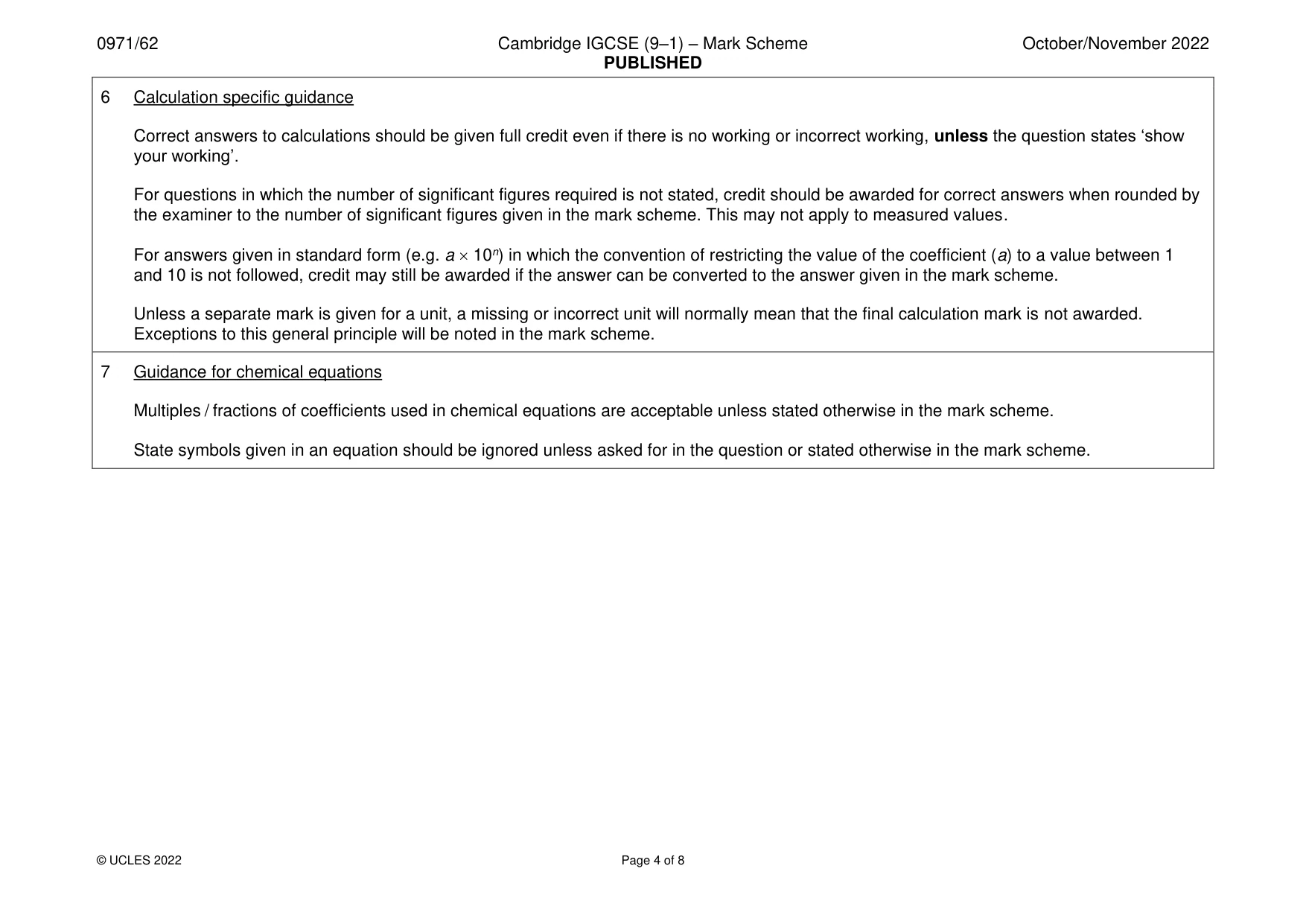
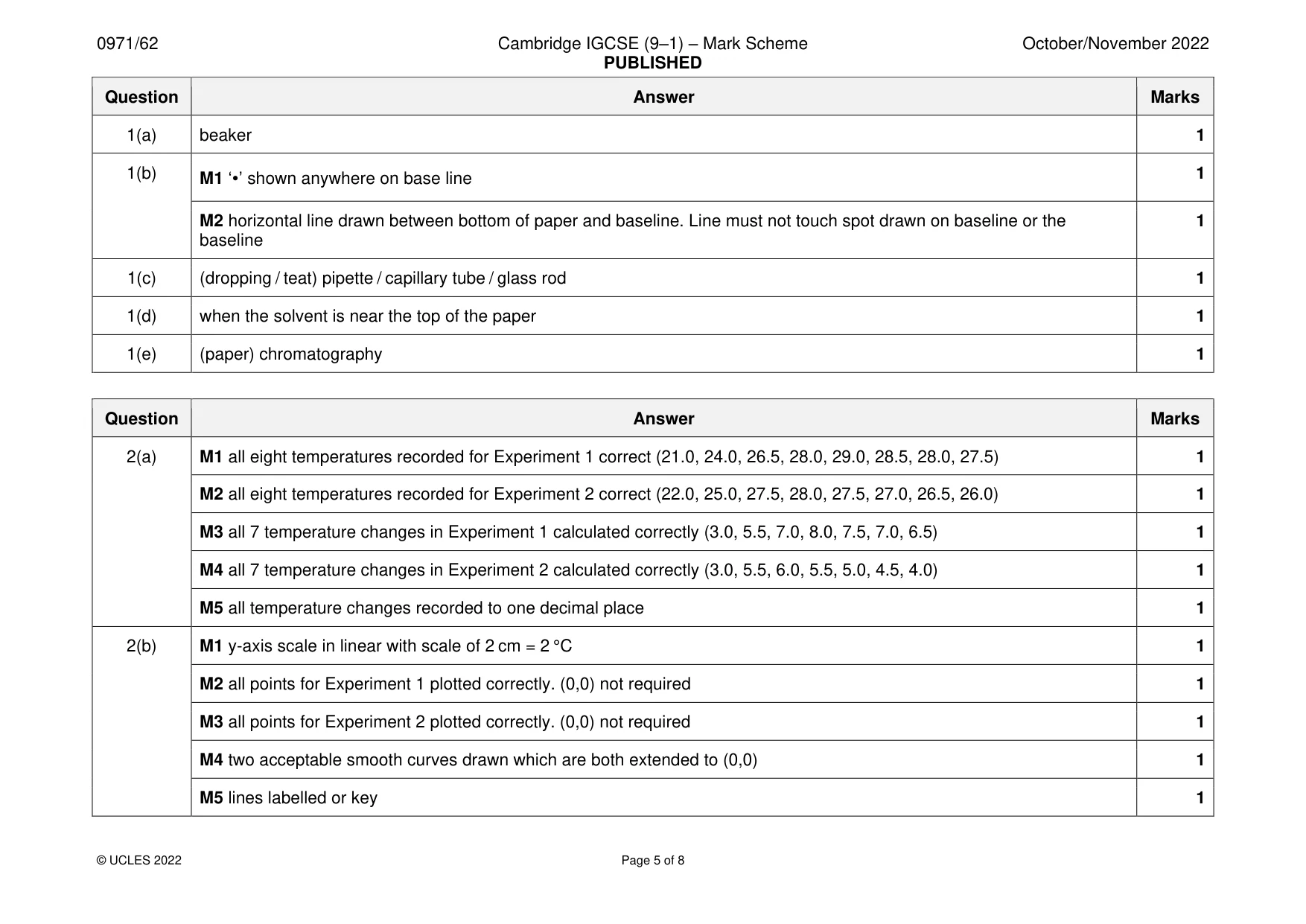
Mark scheme: Question Answer Marks 1(a) beaker 1 1(b) 1 M1 ‘∙’ shown anywhere on base line M2 horizontal line drawn between bottom of paper and baseline. Line must not touch spot drawn on baseline or the 1 baseline 1(c) (dropping / teat) pipette / capillary tube / glass rod 1 1(d) when the solvent is near the top of the paper 1 1(e) (paper) chromatography 1
Q2 · A student investigated the temperature change when two different aqueous solutions of…
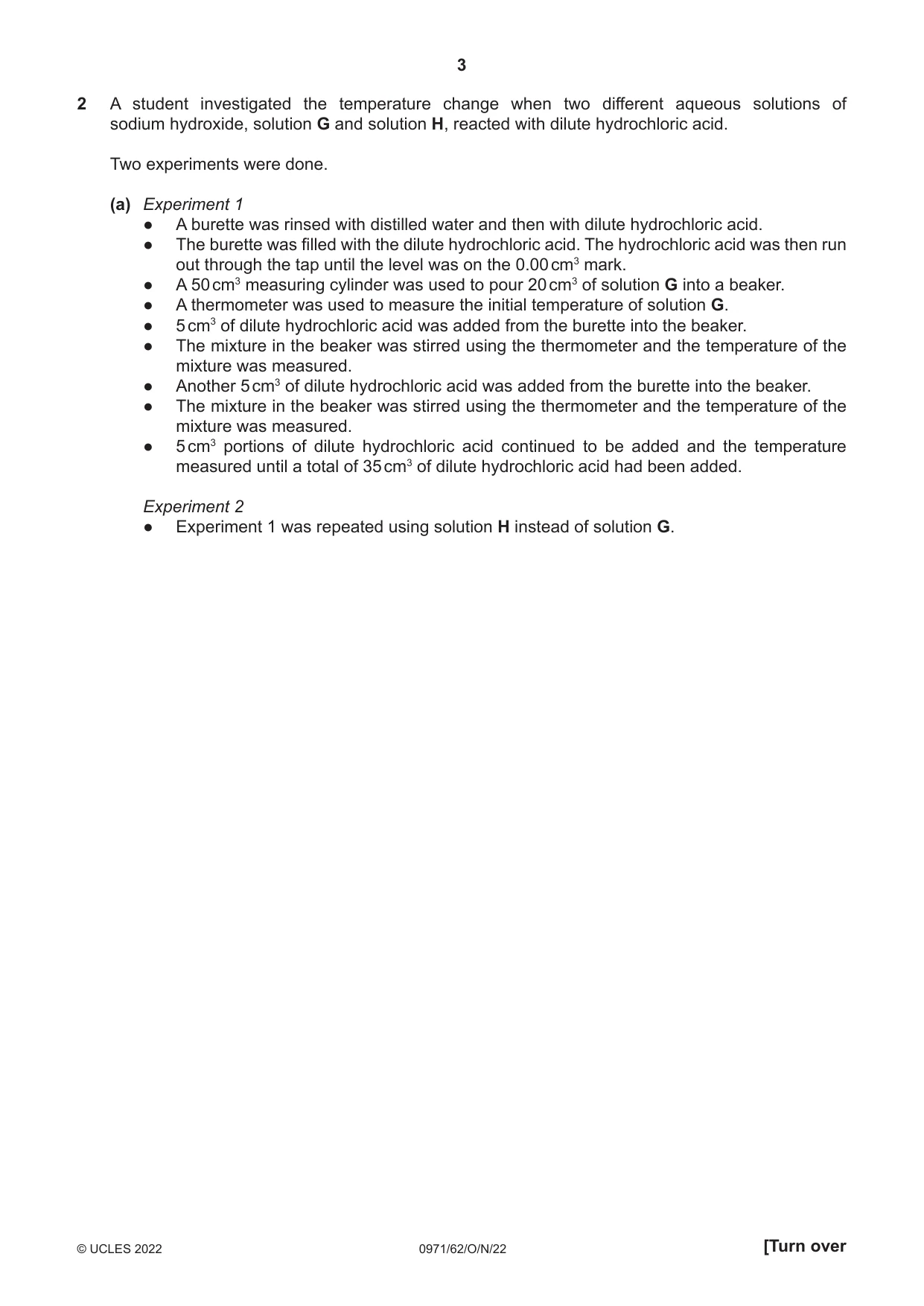
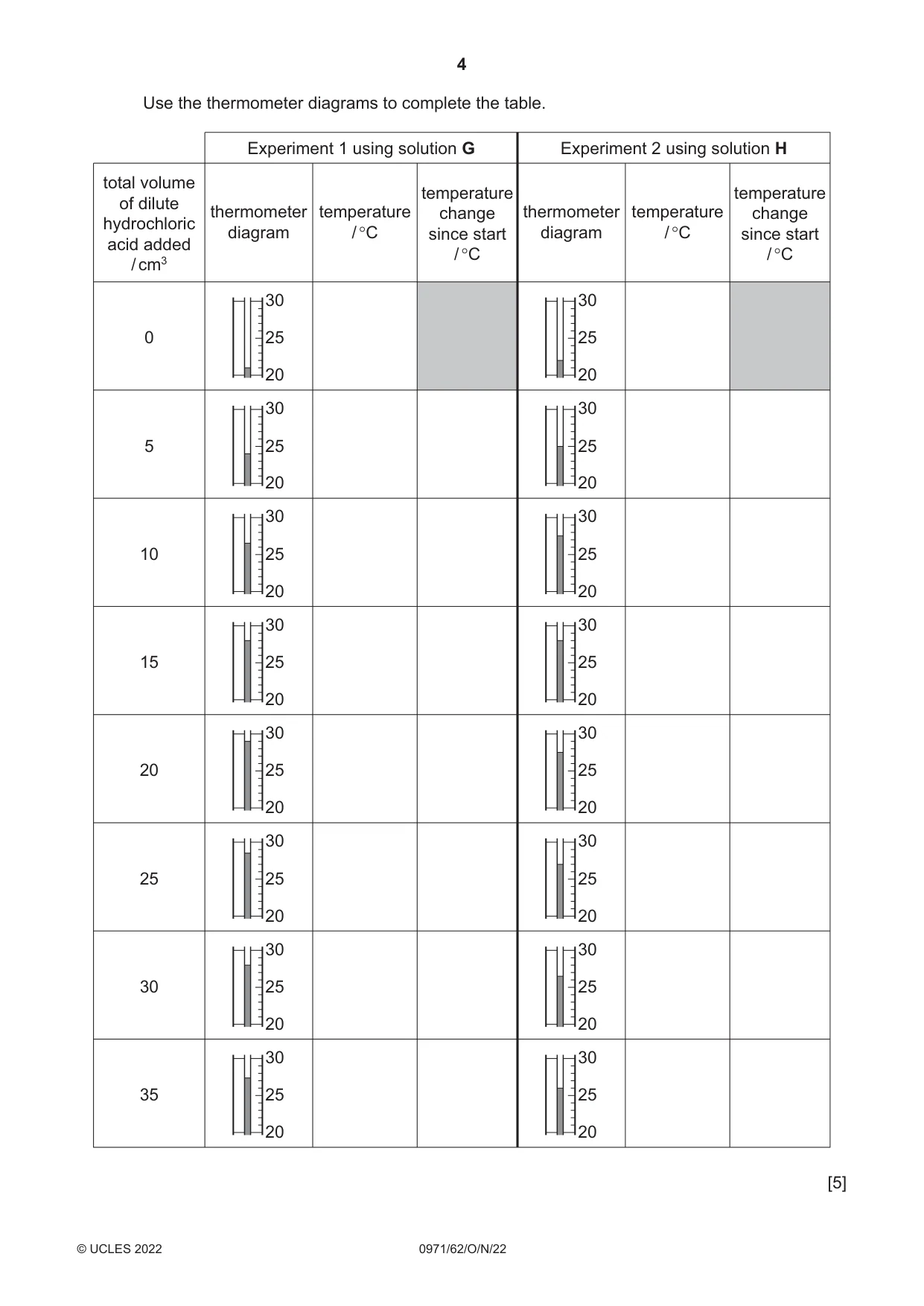
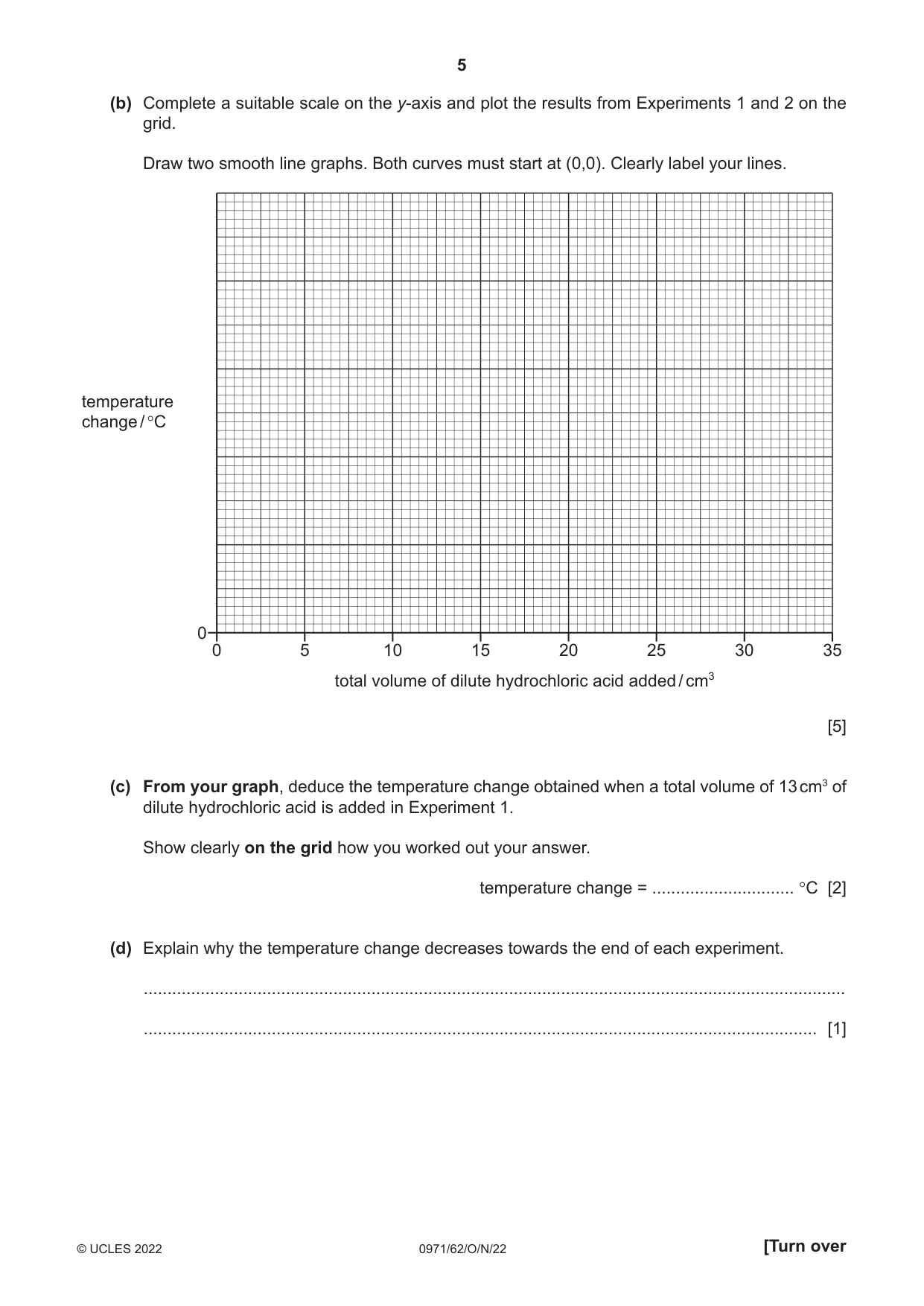
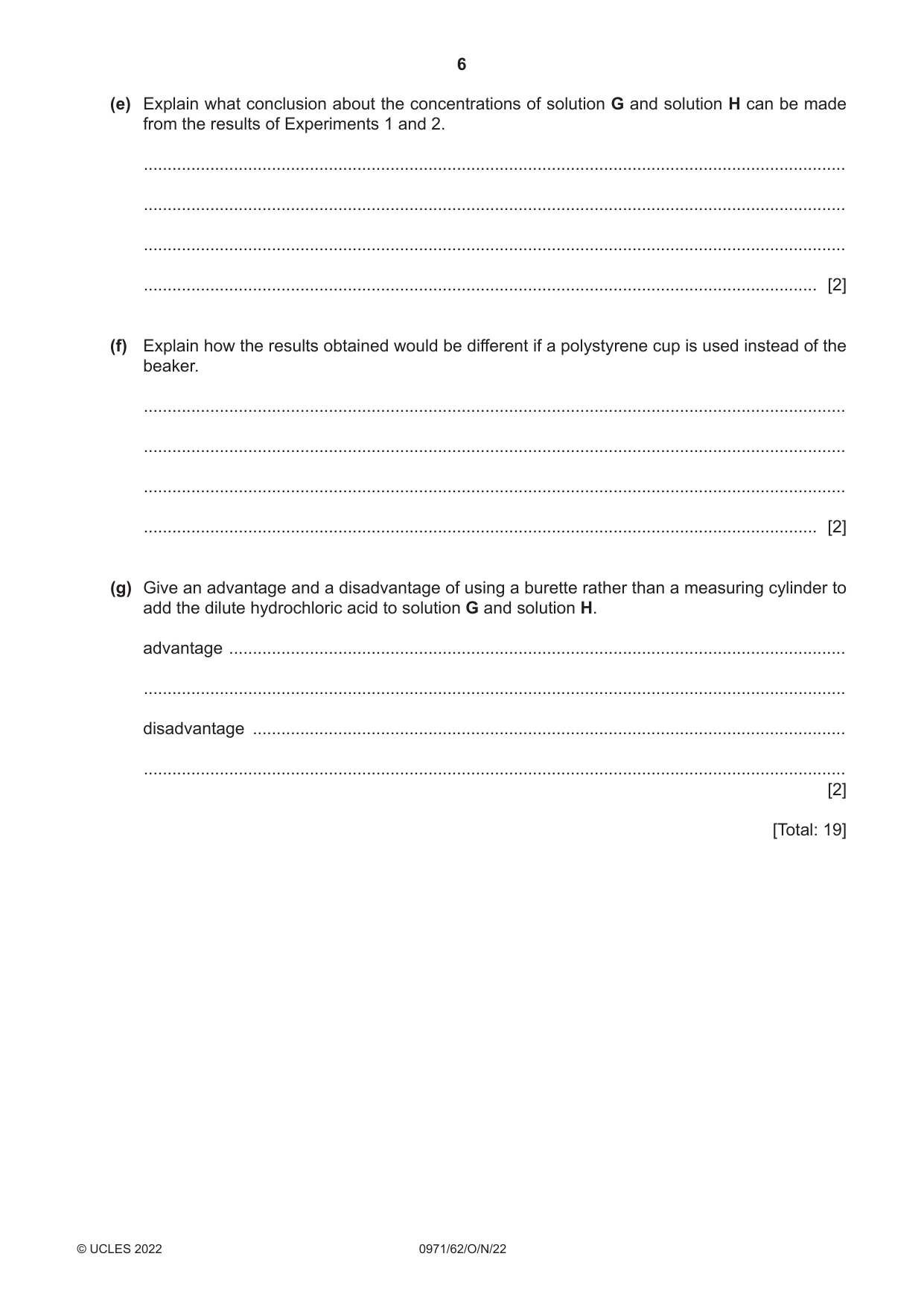
2 A student investigated the temperature change when two different aqueous solutions of sodium hydroxide, solution G and solution H, reacted with dilute hydrochloric acid. Two experiments were done. (a) Experiment 1 ● A burette was rinsed with distilled water and then with dilute hydrochloric acid. ● The burette was filled with the dilute hydrochloric acid. The hydrochloric acid was then run out through the tap until the level was on the 0.00 cm3 mark. ● A 50 cm3 measuring cylinder was used to pour 20 cm3 of solution G into a beaker. ● A thermometer was used to measure the initial temperature of solution G. ● 5 cm3 of dilute hydrochloric acid was added from the burette into the beaker. ● The mixture in the beaker was stirred using the thermometer and the temperature of the mixture was measured. ● Another 5 cm3 of dilute hydrochloric acid was added from the burette into the beaker. ● The mixture in the beaker was stirred using the thermometer and the temperature of the mixture was measured. ● 5 cm3 portions of dilute hydrochloric acid continued to be added and the temperature measured until a total of 35 cm3 of dilute hydrochloric acid had been added. Experiment 2 ● Experiment 1 was repeated using solution H instead of solution G. Use the thermometer diagrams to complete the t Experiment 1 using solution G total volume temperature of dilute thermometer temperature changehydrochloric diagram / C since start acid added / C / cm3 30 0 25 20 30 5 25 20 30 10 25 20 30 15 25 20 30 20 25 20 30 25 25 20 30 30 25 20 30 35 25 20 (b) Complete a suitable scale on the y-axis and plot the results from Experiments 1 and 2 on the grid. Draw two smooth line graphs. Both curves must start at (0,0). Clearly label your lines. temperature change / C 0 0 5 10 15 20 25 30 35 total volume of dilute hydrochloric acid added / cm3 [5] (c) From your graph, deduce the temperature change obtained when a total volume of 13 cm3 of dilute hydrochloric acid is added in Experiment 1. Show clearly on the grid how you worked out your answer. temperature change = .............................. °C [2] (d) Explain why the temperature change decreases towards the end of each experiment. .................................................................................................................................................... .............................................................................................................................................. [1] (e) Explain what conclusion about the concentrations of solution G and solution H can be made from the results of Experiments 1 and 2. .................................................................................................................................................... .................................................................................................................................................... .................................................................................................................................................... .............................................................................................................................................. [2] (f) Explain how the results obtained would be different if a polystyrene cup is used instead of the beaker. .................................................................................................................................................... .................................................................................................................................................... .................................................................................................................................................... .............................................................................................................................................. [2] (g) Give an advantage and a disadvantage of using a burette rather than a measuring cylinder to add the dilute hydrochloric acid to solution G and solution H. advantage .................................................................................................................................. .................................................................................................................................................... disadvantage .............................................................................................................................. .................................................................................................................................................... [2] [Total: 19]
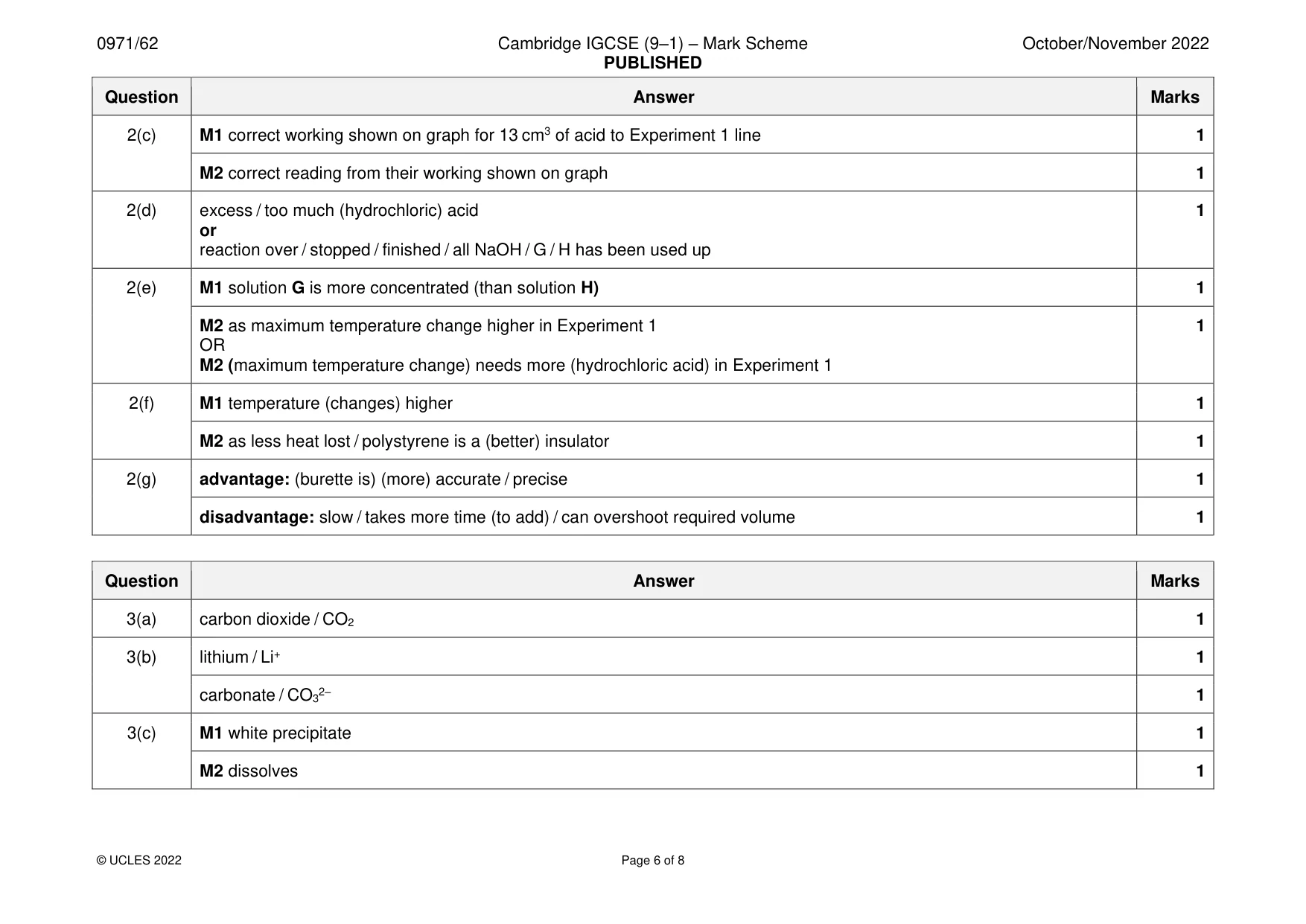
Mark scheme: 2(a) M1 all eight temperatures recorded for Experiment 1 correct (21.0, 24.0, 26.5, 28.0, 29.0, 28.5, 28.0, 27.5) 1 M2 all eight temperatures recorded for Experiment 2 correct (22.0, 25.0, 27.5, 28.0, 27.5, 27.0, 26.5, 26.0) 1 M3 all 7 temperature changes in Experiment 1 calculated correctly (3.0, 5.5, 7.0, 8.0, 7.5, 7.0, 6.5) 1 M4 all 7 temperature changes in Experiment 2 calculated correctly (3.0, 5.5, 6.0, 5.5, 5.0, 4.5, 4.0) 1 M5 all temperature changes recorded to one decimal place 1 2(b) M1 y-axis scale in linear with scale of 2 cm = 2 °C 1 M2 all points for Experiment 1 plotted correctly. (0,0) not required 1 M3 all points for Experiment 2 plotted correctly. (0,0) not required 1 M4 two acceptable smooth curves drawn which are both extended to (0,0) 1 M5 lines labelled or key 1 2(c) M1 correct working shown on graph for 13 cm3 of acid to Experiment 1 line 1 M2 correct reading from their working shown on graph 1 2(d) excess / too much (hydrochloric) acid 1 or reaction over / stopped / finished / all NaOH / G / H has been used up 2(e) M1 solution G is more concentrated (than solution H) 1 M2 as maximum temperature change higher in Experiment 1 1 OR M2 (maximum temperature change) needs more (hydrochloric acid) in Experiment 1 2(f) M1 temperature (changes) higher 1 M2 as less heat lost / polystyrene is a (better) insulator 1 2(g) advantage: (burette is) (more) accurate / precise 1 disadvantage: slow / takes more time (to add) / can overshoot required volume 1
Q3 · Solid I and solid J were analysed
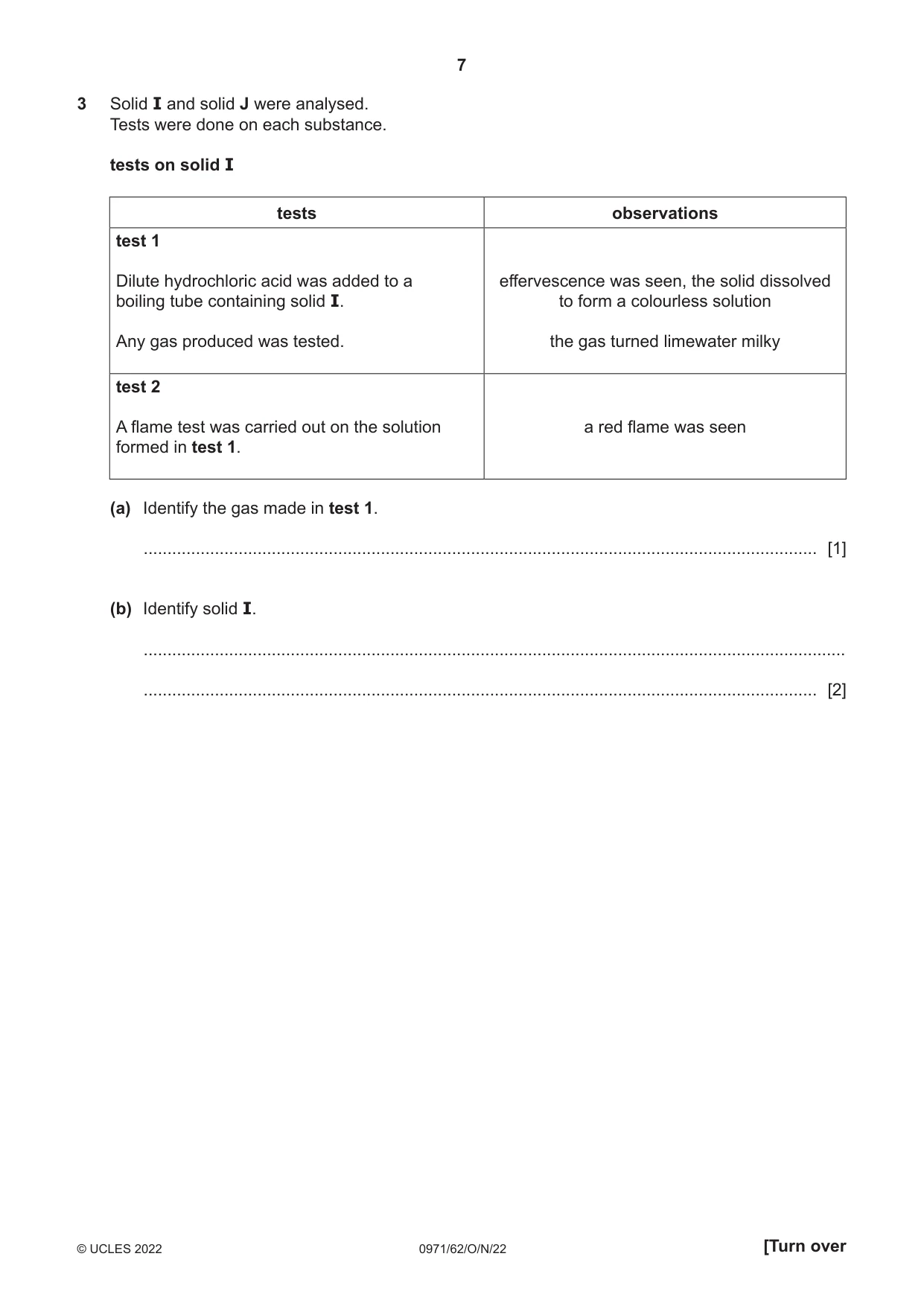
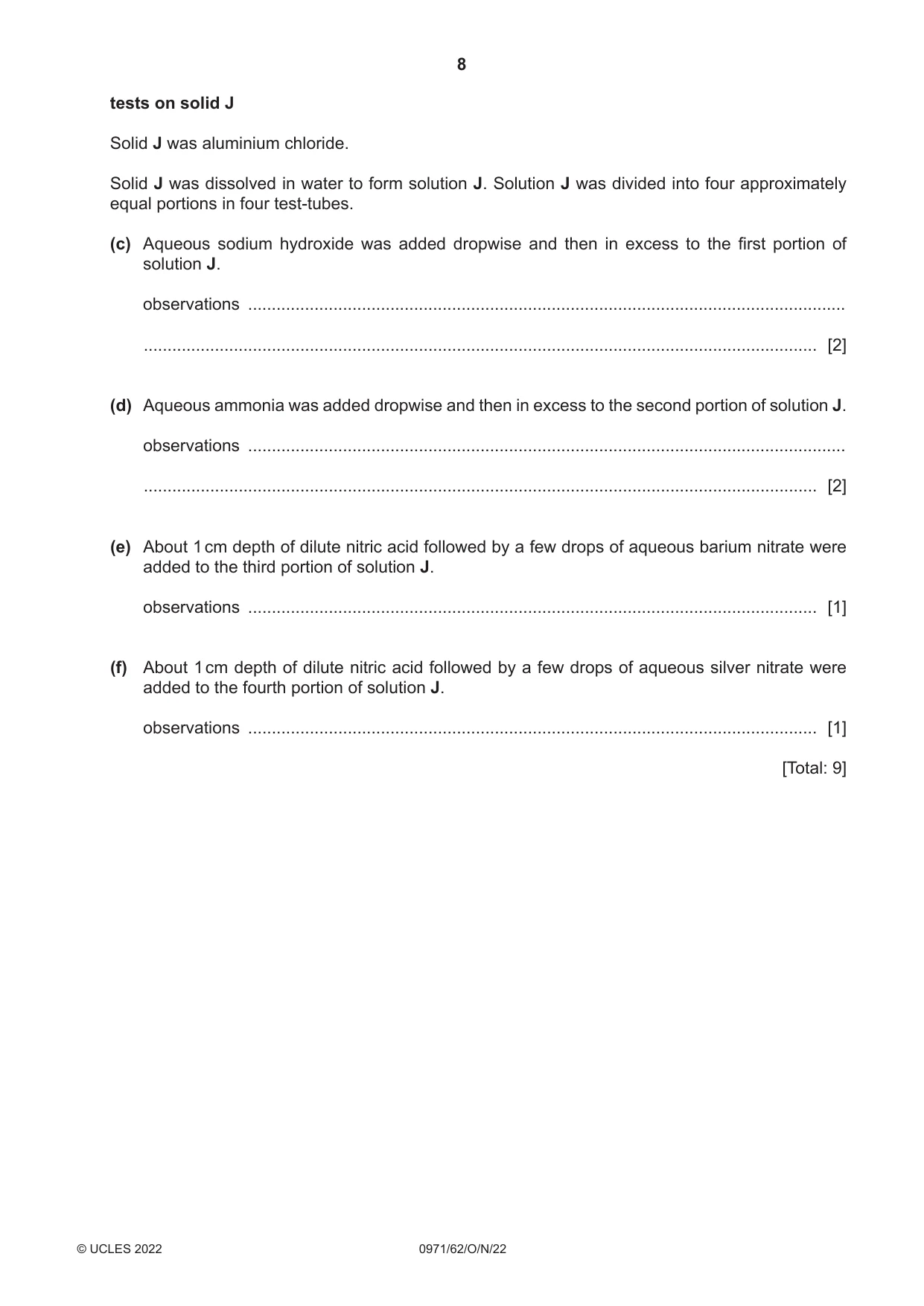
3 Solid I and solid J were analysed. Tests were done on each substance. tests on solid I tests observations test 1 Dilute hydrochloric acid was added to a effervescence was seen, the solid dissolved boiling tube containing solid I. to form a colourless solution Any gas produced was tested. the gas turned limewater milky test 2 A flame test was carried out on the solution a red flame was seen formed in test 1. (a) Identify the gas made in test 1. .............................................................................................................................................. [1] (b) Identify solid I. .................................................................................................................................................... .............................................................................................................................................. [2] tests on solid J Solid J was aluminium chloride. Solid J was dissolved in water to form solution J. Solution J was divided into four approximately equal portions in four test-tubes. (c) Aqueous sodium hydroxide was added dropwise and then in excess to the first portion of solution J. observations ............................................................................................................................... .............................................................................................................................................. [2] (d) Aqueous ammonia was added dropwise and then in excess to the second portion of solution J. observations ............................................................................................................................... .............................................................................................................................................. [2] (e) About 1 cm depth of dilute nitric acid followed by a few drops of aqueous barium nitrate were added to the third portion of solution J. observations ......................................................................................................................... [1] (f) About 1 cm depth of dilute nitric acid followed by a few drops of aqueous silver nitrate were added to the fourth portion of solution J. observations ......................................................................................................................... [1] [Total: 9]
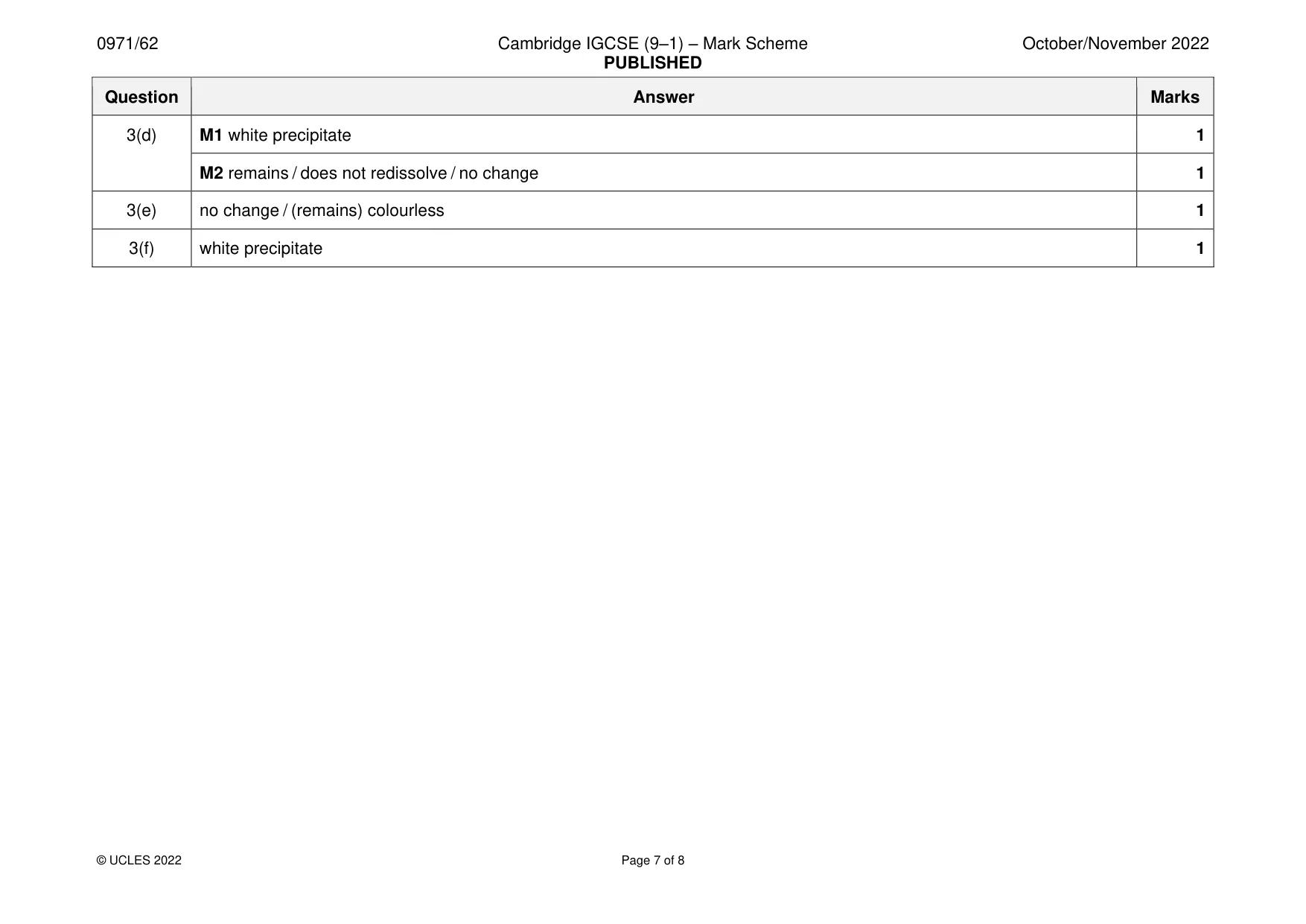
Mark scheme: 3(a) carbon dioxide / CO2 1 3(b) lithium / Li+ 1 carbonate / CO32– 1 3(c) M1 white precipitate 1 M2 dissolves 1 3(d) M1 white precipitate 1 M2 remains / does not redissolve / no change 1 3(e) no change / (remains) colourless 1 3(f) white precipitate 1
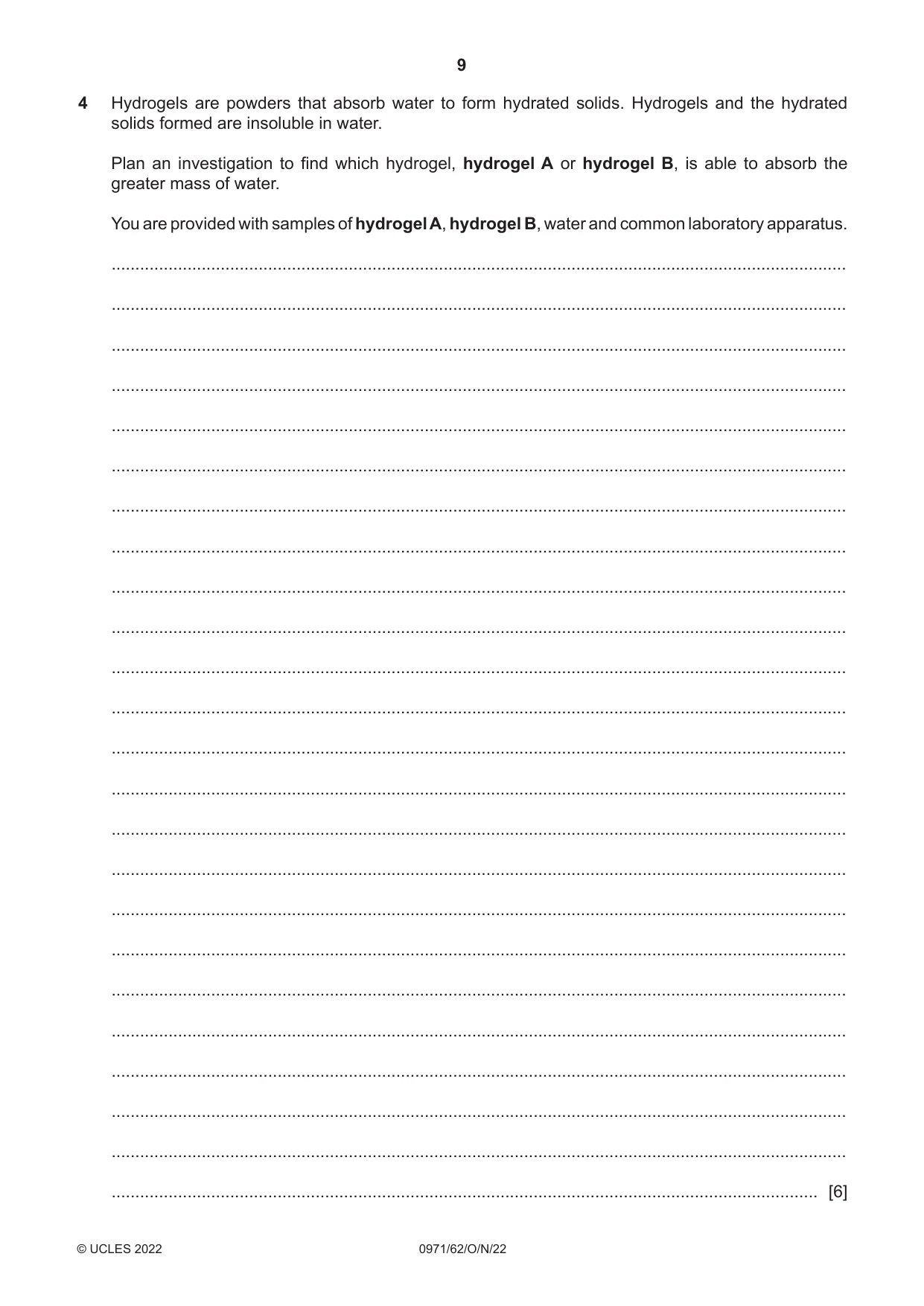
Q4 · Hydrogels are powders that absorb water to form hydrated solids
4 Hydrogels are powders that absorb water to form hydrated solids. Hydrogels and the hydrated solids formed are insoluble in water. Plan an investigation to find which hydrogel, hydrogel A or hydrogel B, is able to absorb the greater mass of water. You are provided with samples of hydrogel A, hydrogel B, water and common laboratory apparatus. ........................................................................................................................................................... ........................................................................................................................................................... ........................................................................................................................................................... ........................................................................................................................................................... ........................................................................................................................................................... ........................................................................................................................................................... ........................................................................................................................................................... ........................................................................................................................................................... ........................................................................................................................................................... ........................................................................................................................................................... ........................................................................................................................................................... ........................................................................................................................................................... ........................................................................................................................................................... ........................................................................................................................................................... ........................................................................................................................................................... ........................................................................................................................................................... ........................................................................................................................................................... ........................................................................................................................................................... ........................................................................................................................................................... ........................................................................................................................................................... ........................................................................................................................................................... ........................................................................................................................................................... ........................................................................................................................................................... ..................................................................................................................................................... [6]
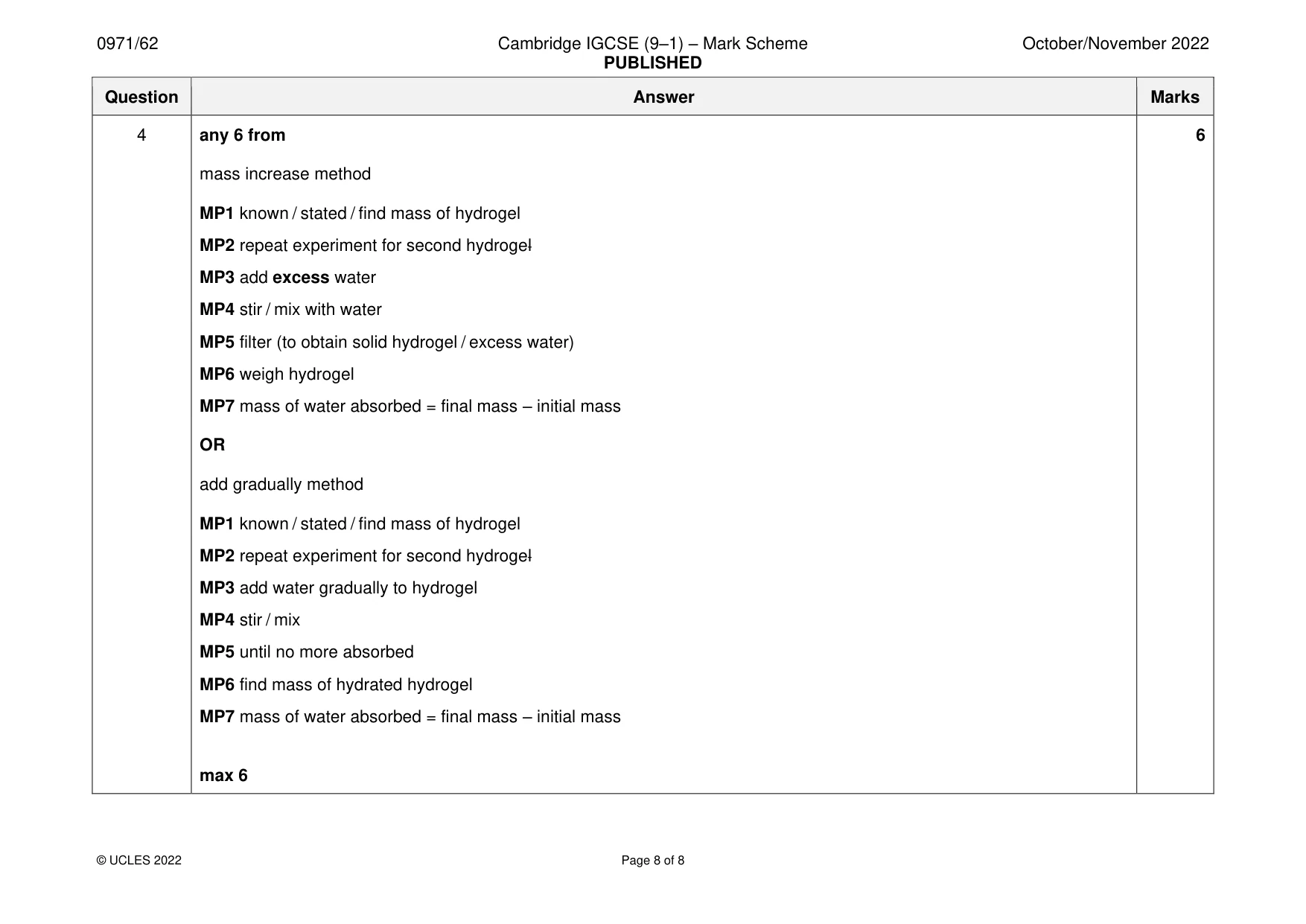
Mark scheme: 4 any 6 from 6 mass increase method MP1 known / stated / find mass of hydrogel MP2 repeat experiment for second hydrogel MP3 add excess water MP4 stir / mix with water MP5 filter (to obtain solid hydrogel / excess water) MP6 weigh hydrogel MP7 mass of water absorbed = final mass – initial mass OR add gradually method MP1 known / stated / find mass of hydrogel MP2 repeat experiment for second hydrogel MP3 add water gradually to hydrogel MP4 stir / mix MP5 until no more absorbed MP6 find mass of hydrated hydrogel MP7 mass of water absorbed = final mass – initial mass max 6
What was in this paper
The subtopics covered by these 4 questions, and how many questions each got. Open one in a new tab to see every Cambridge question on it.
What you needed in this session
Cambridge’s own grade thresholds for 2022 Oct/Nov, Paper 6 · Variant 2. A higher threshold means an easier paper — the bar moves with how the cohort did.