Cambridge IGCSE Chemistry (9-1) 0971 — 2020 May/June Paper 6 · Variant 2
0971/62/M/J/20 · 4 questions · 40 marks · ≈45 min
The question paper and its mark scheme, free to read here and free to download. This is Cambridge’s own paper, exactly as it was sat.
Question paper12 pages

Mark scheme7 pages
Answers below. Sit the paper first if you are practising.
Questions as text
Q1 · Hot copper(II) oxide reacts with hydrogen
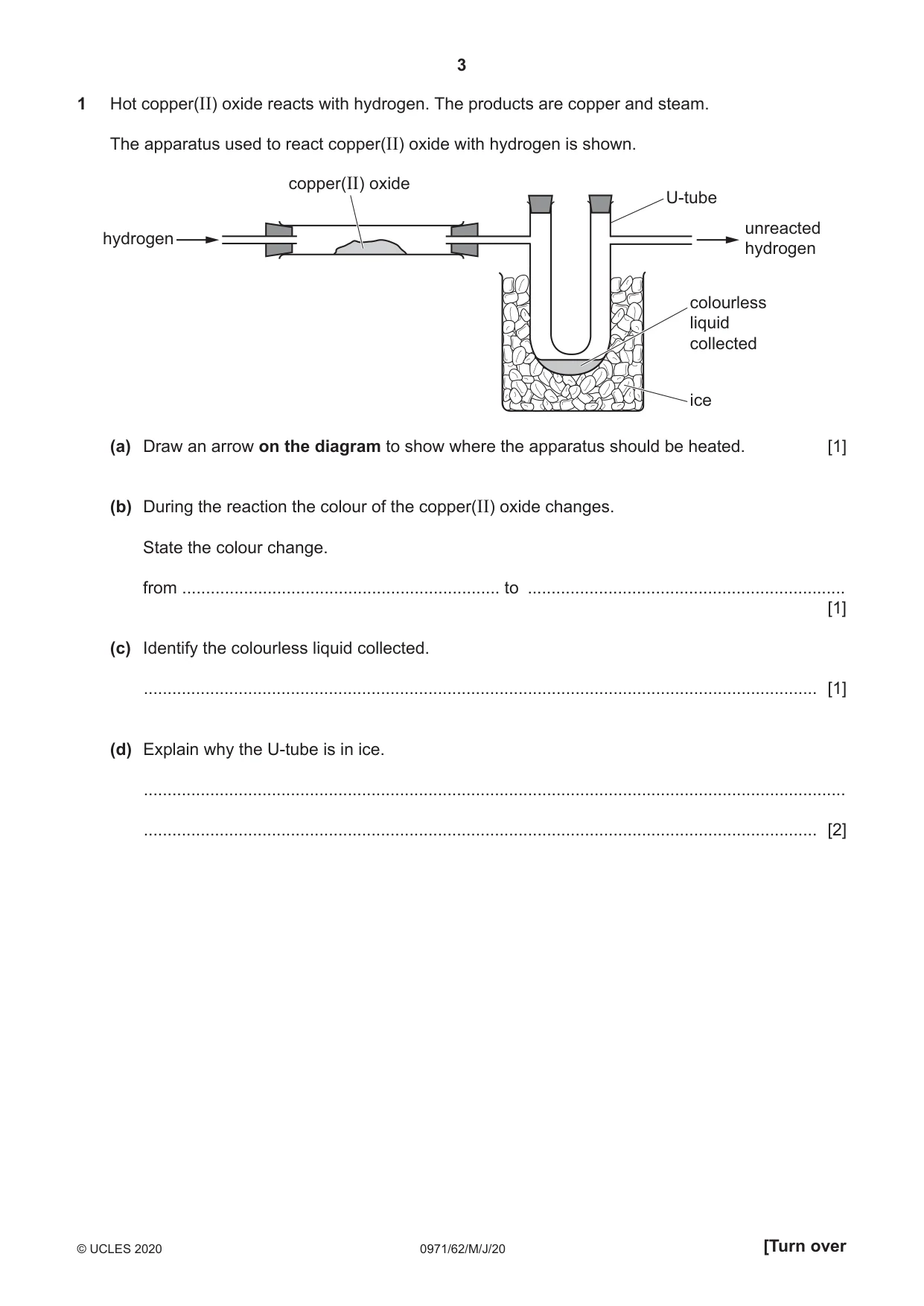
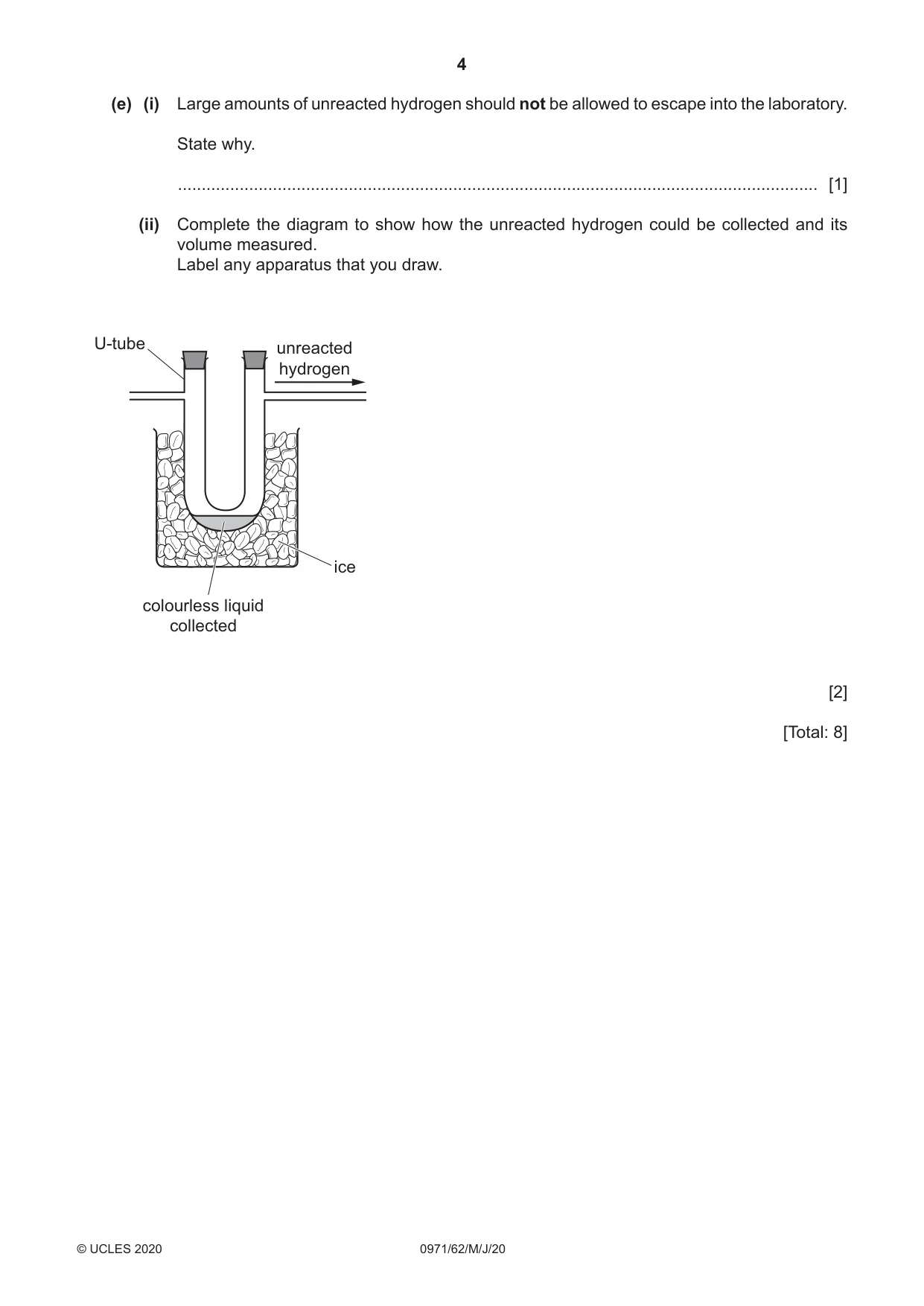
1 Hot copper(II) oxide reacts with hydrogen. The products are copper and steam. The apparatus used to react copper(II) oxide with hydrogen is shown. copper(II) oxide U-tube unreacted hydrogen hydrogen colourless liquid collected ice (a) Draw an arrow on the diagram to show where the apparatus should be heated. [1] (b) During the reaction the colour of the copper(II) oxide changes. State the colour change. from ................................................................... to .................................................................... [1] (c) Identify the colourless liquid collected. .............................................................................................................................................. [1] (d) Explain why the U-tube is in ice. .................................................................................................................................................... .............................................................................................................................................. [2] (e) (i) Large amounts of unreacted hydrogen should not be allowed to escape into the laboratory. State why. ....................................................................................................................................... [1] (ii) Complete the diagram to show how the unreacted hydrogen could be collected and its volume measured. Label any apparatus that you draw. U-tube unreacted hydrogen ice colourless liquid collected [2] [Total: 8]
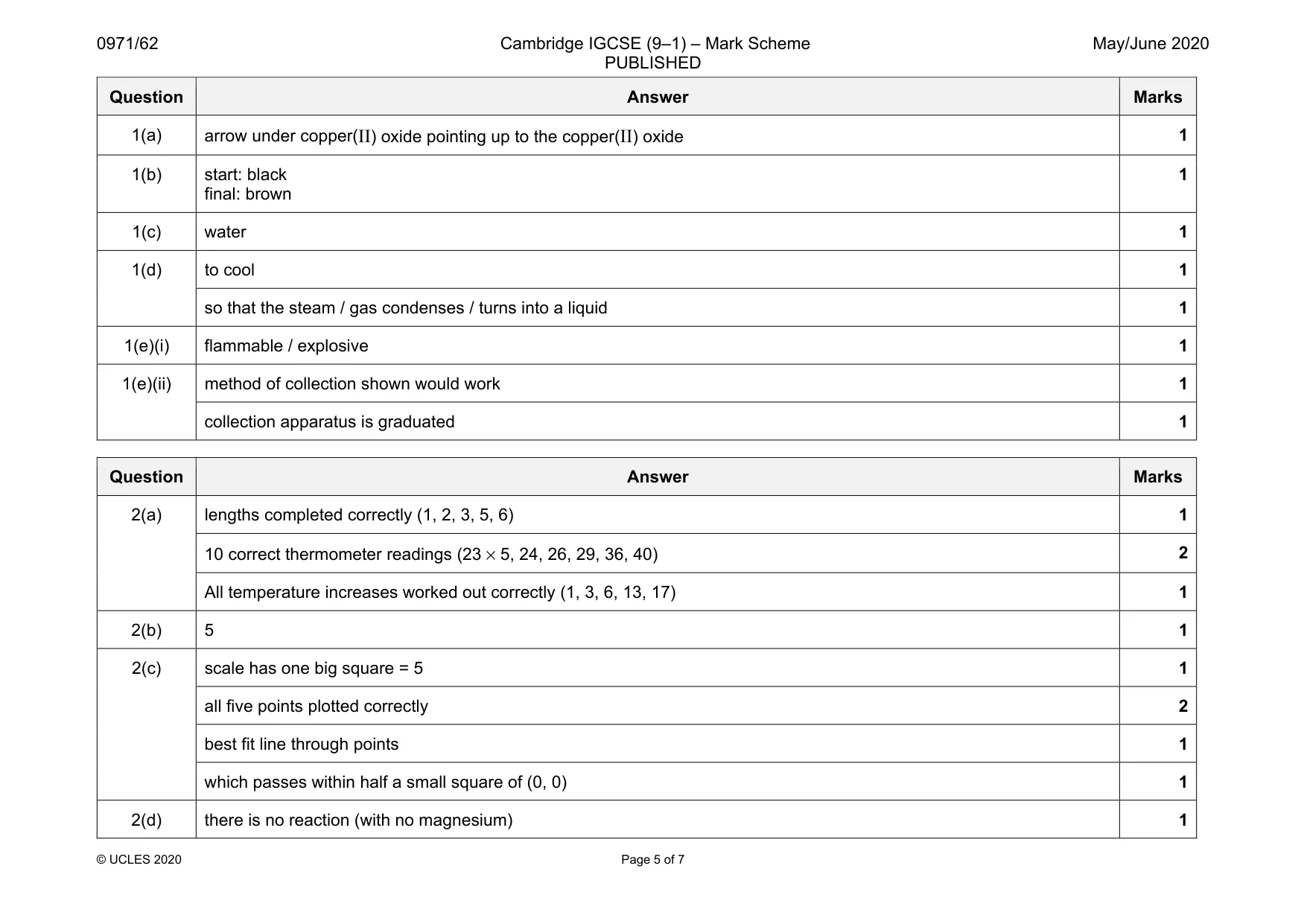
Mark scheme: 1(a) arrow under copper(II) oxide pointing up to the copper(II) oxide 1 1(b) start: black final: brown 1 1(c) water 1 1(d) to cool 1 so that the steam / gas condenses / turns into a liquid 1 1(e)(i) flammable / explosive 1 1(e)(ii) method of collection shown would work 1 collection apparatus is graduated 1
Q2 · A student investigated the temperature change when magnesium ribbon reacts with dilute…
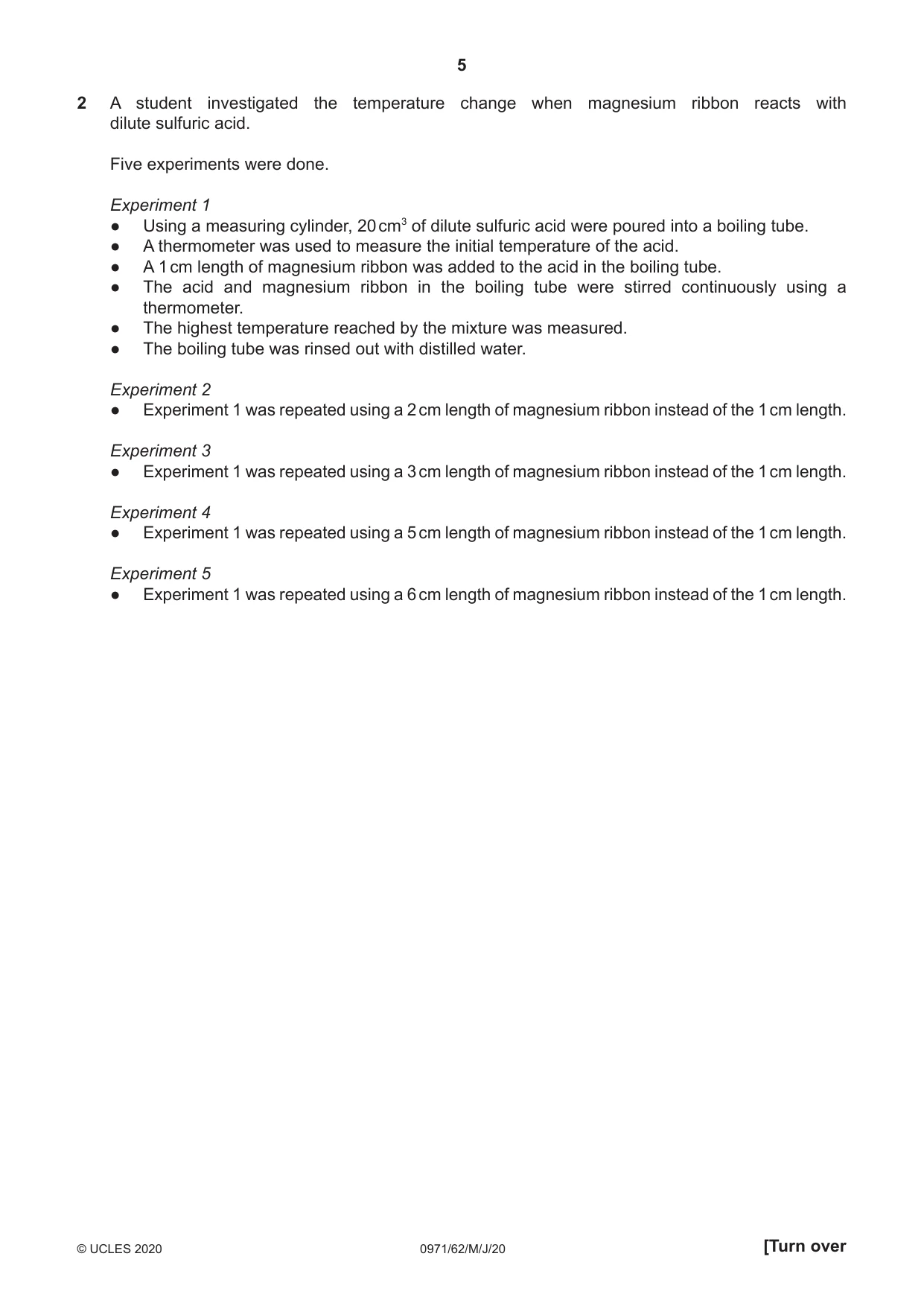
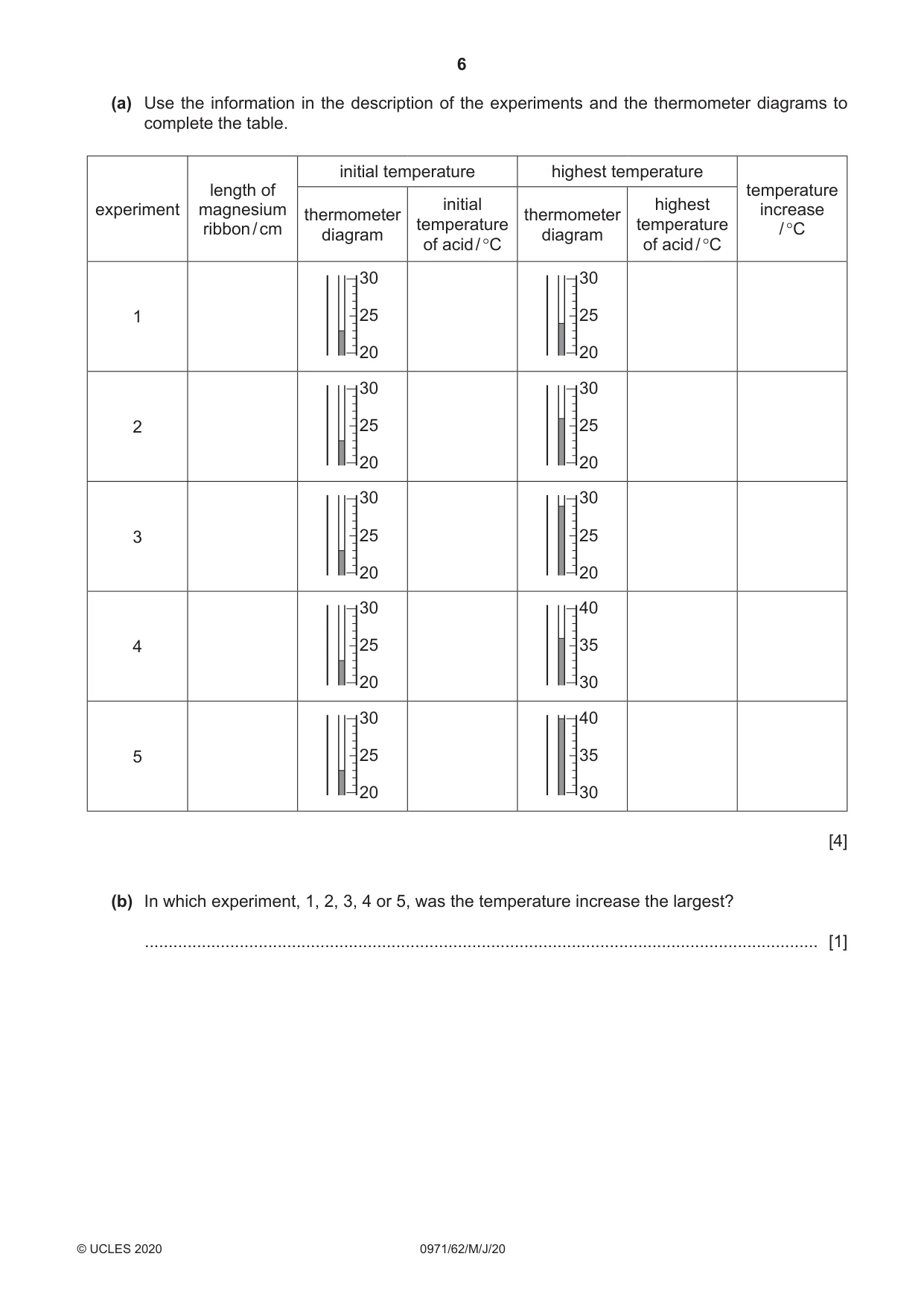
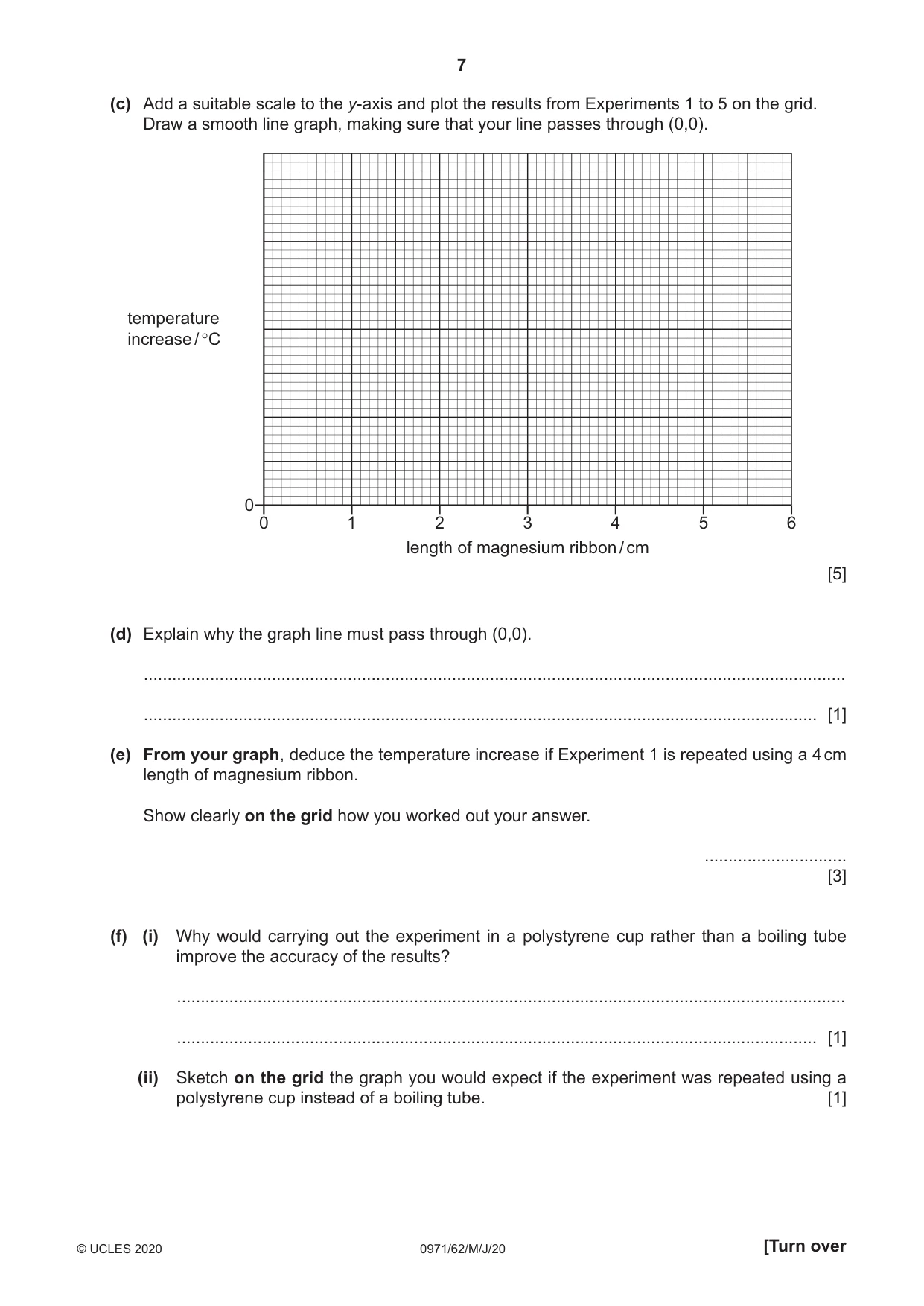
2 A student investigated the temperature change when magnesium ribbon reacts with dilute sulfuric acid. Five experiments were done. Experiment 1 ●● Using a measuring cylinder, 20 cm3 of dilute sulfuric acid were poured into a boiling tube. ●● A thermometer was used to measure the initial temperature of the acid. ●● A 1 cm length of magnesium ribbon was added to the acid in the boiling tube. ●● The acid and magnesium ribbon in the boiling tube were stirred continuously using a thermometer. ●● The highest temperature reached by the mixture was measured. ●● The boiling tube was rinsed out with distilled water. Experiment 2 ●● Experiment 1 was repeated using a 2 cm length of magnesium ribbon instead of the 1 cm length. Experiment 3 ●● Experiment 1 was repeated using a 3 cm length of magnesium ribbon instead of the 1 cm length. Experiment 4 ●● Experiment 1 was repeated using a 5 cm length of magnesium ribbon instead of the 1 cm length. Experiment 5 ●● Experiment 1 was repeated using a 6 cm length of magnesium ribbon instead of the 1 cm length. (a) Use the information in the description of the experiments and the thermometer diagrams to complete the table. initial temperature highest temperature length of temperature initial highestexperiment magnesium increase thermometer thermometer ribbon / cm temperature temperature / °C diagram diagram of acid / °C of acid / °C 30 30 1 25 25 20 20 30 30 2 25 25 20 20 30 30 3 25 25 20 20 30 40 4 25 35 20 30 30 40 5 25 35 20 30 [4] (b) In which experiment, 1, 2, 3, 4 or 5, was the temperature increase the largest? .............................................................................................................................................. [1] (c) Add a suitable scale to the y-axis and plot the results from Experiments 1 to 5 on the grid. Draw a smooth line graph, making sure that your line passes through (0,0). temperature increase / °C 0 0 1 2 3 4 5 6 length of magnesium ribbon / cm [5] (d) Explain why the graph line must pass through (0,0). .................................................................................................................................................... .............................................................................................................................................. [1] (e) From your graph, deduce the temperature increase if Experiment 1 is repeated using a 4 cm length of magnesium ribbon. Show clearly on the grid how you worked out your answer. .............................. [3] (f) (i) Why would carrying out the experiment in a polystyrene cup rather than a boiling tube improve the accuracy of the results? ............................................................................................................................................. ....................................................................................................................................... [1] (ii) Sketch on the grid the graph you would expect if the experiment was repeated using a polystyrene cup instead of a boiling tube. [1] (g) The volume of dilute sulfuric acid could be measured with a 20 cm3 pipette. (i) State one advantage of using a pipette rather than a measuring cylinder. ............................................................................................................................................. ....................................................................................................................................... [1] (ii) State one disadvantage of using a pipette rather than a measuring cylinder. ............................................................................................................................................. ....................................................................................................................................... [1] [Total: 18]
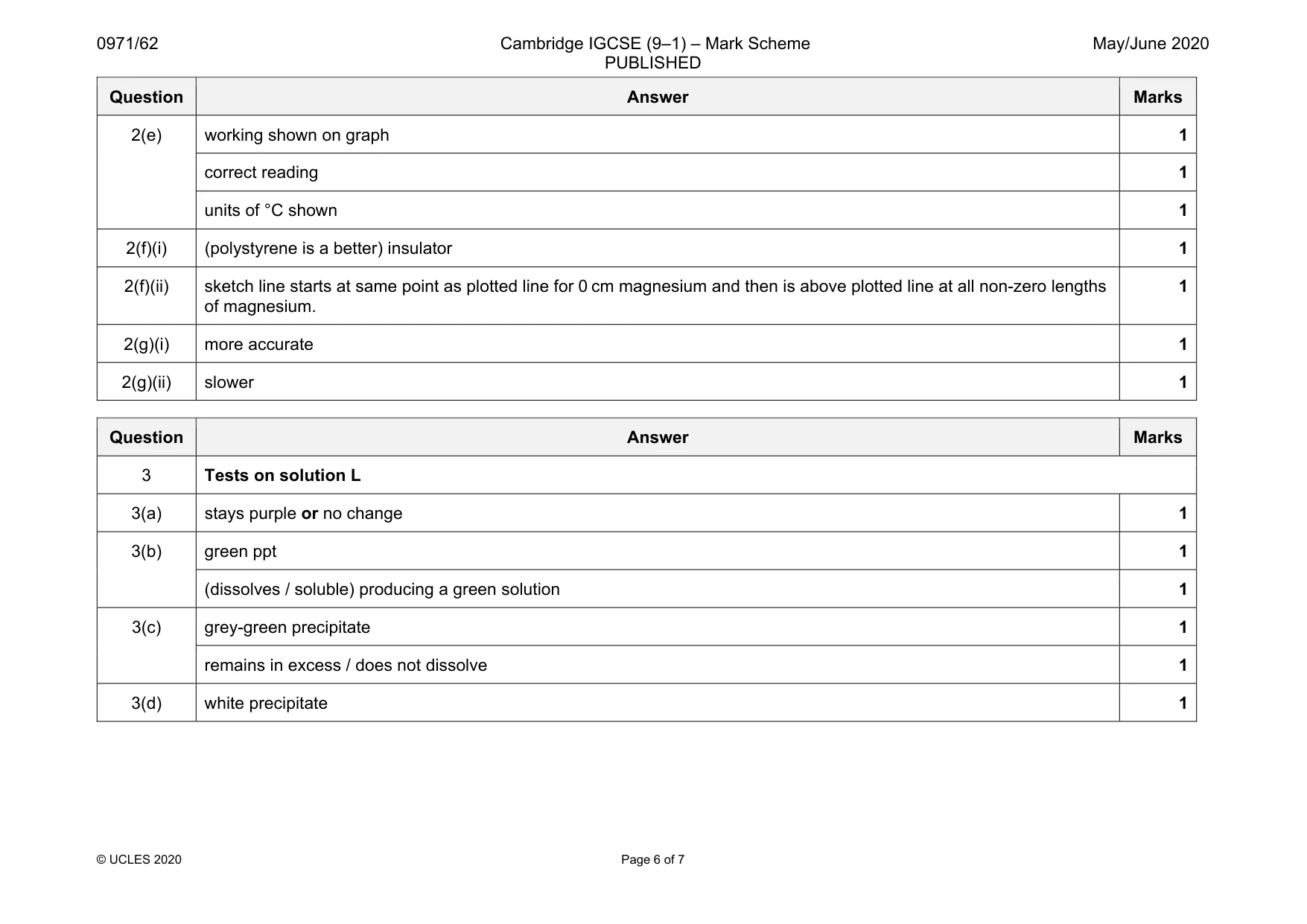
Mark scheme: 2(a) lengths completed correctly (1, 2, 3, 5, 6) 1 10 correct thermometer readings (23 × 5, 24, 26, 29, 36, 40) 2 All temperature increases worked out correctly (1, 3, 6, 13, 17) 1 2(b) 5 1 2(c) scale has one big square = 5 1 all five points plotted correctly 2 best fit line through points 1 which passes within half a small square of (0, 0) 1 2(d) there is no reaction (with no magnesium) 1 Question Answer Marks 2(e) working shown on graph 1 correct reading 1 units of °C shown 1 2(f)(i) (polystyrene is a better) insulator 1 2(f)(ii) sketch line starts at same point as plotted line for 0 cm magnesium and then is above plotted line at all non-zero lengths of magnesium. 1 2(g)(i) more accurate 1 2(g)(ii) slower 1
Q3 · Two solids, solid L and solid M, were analysed
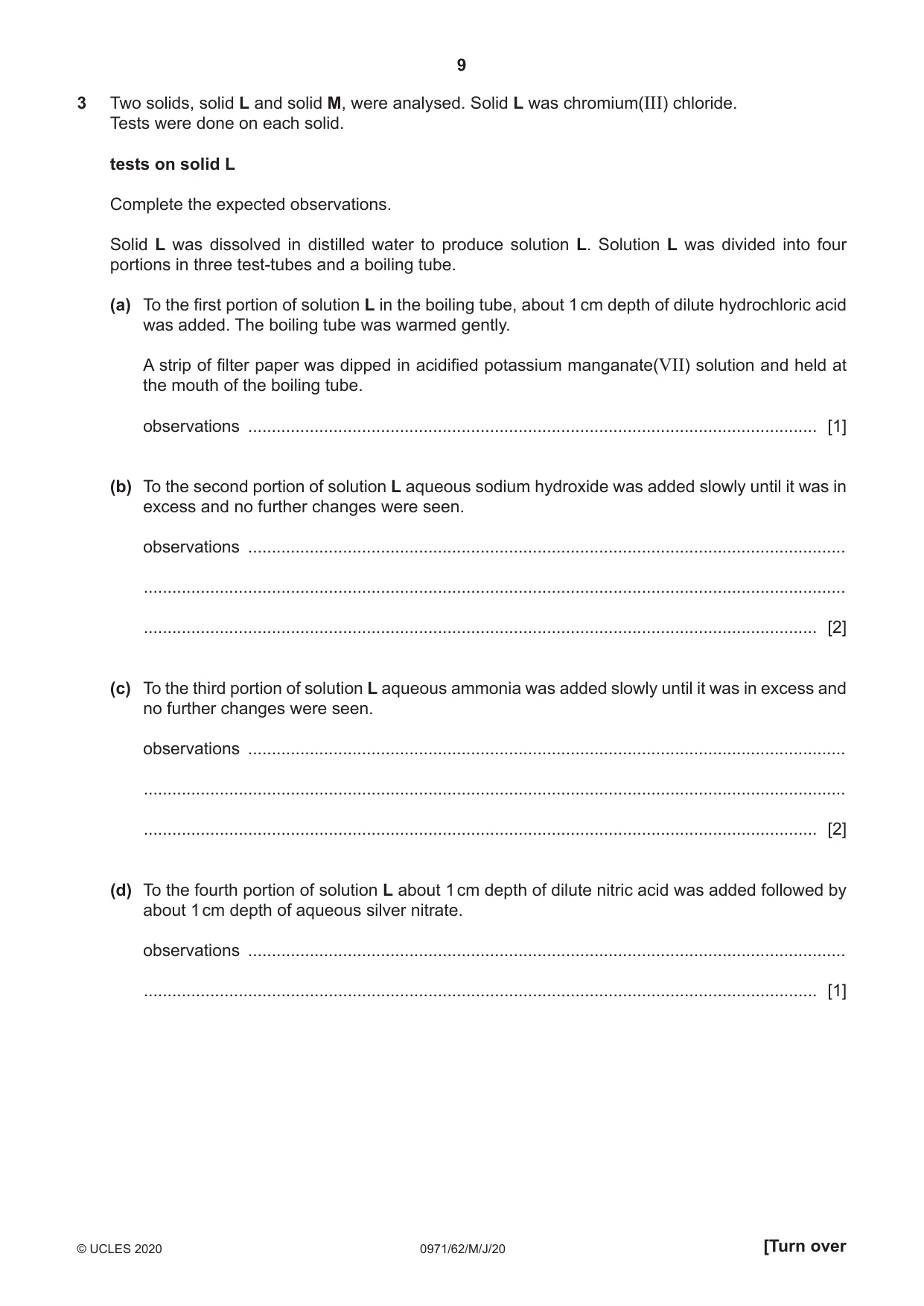
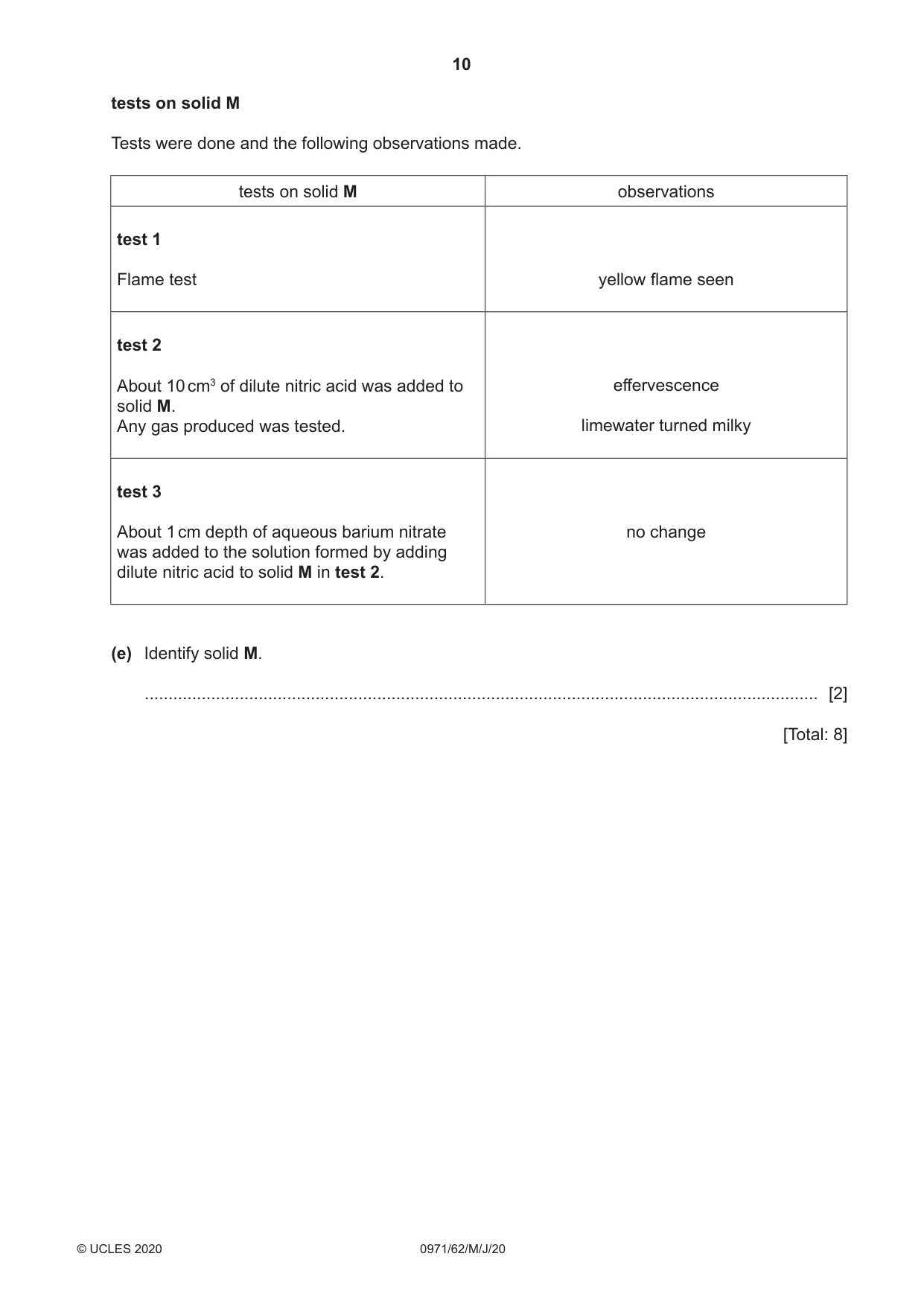
3 Two solids, solid L and solid M, were analysed. Solid L was chromium(III) chloride. Tests were done on each solid. tests on solid L Complete the expected observations. Solid L was dissolved in distilled water to produce solution L. Solution L was divided into four portions in three test-tubes and a boiling tube. (a) To the first portion of solution L in the boiling tube, about 1 cm depth of dilute hydrochloric acid was added. The boiling tube was warmed gently. A strip of filter paper was dipped in acidified potassium manganate(VII) solution and held at the mouth of the boiling tube. observations ......................................................................................................................... [1] (b) To the second portion of solution L aqueous sodium hydroxide was added slowly until it was in excess and no further changes were seen. observations ............................................................................................................................... .................................................................................................................................................... .............................................................................................................................................. [2] (c) To the third portion of solution L aqueous ammonia was added slowly until it was in excess and no further changes were seen. observations ............................................................................................................................... .................................................................................................................................................... .............................................................................................................................................. [2] (d) To the fourth portion of solution L about 1 cm depth of dilute nitric acid was added followed by about 1 cm depth of aqueous silver nitrate. observations ............................................................................................................................... .............................................................................................................................................. [1] tests on solid M Tests were done and the following observations made. tests on solid M observations test 1 Flame test yellow flame seen test 2 About 10 cm3 of dilute nitric acid was added to effervescence solid M. Any gas produced was tested. limewater turned milky test 3 About 1 cm depth of aqueous barium nitrate no change was added to the solution formed by adding dilute nitric acid to solid M in test 2. (e) Identify solid M. .............................................................................................................................................. [2] [Total: 8]
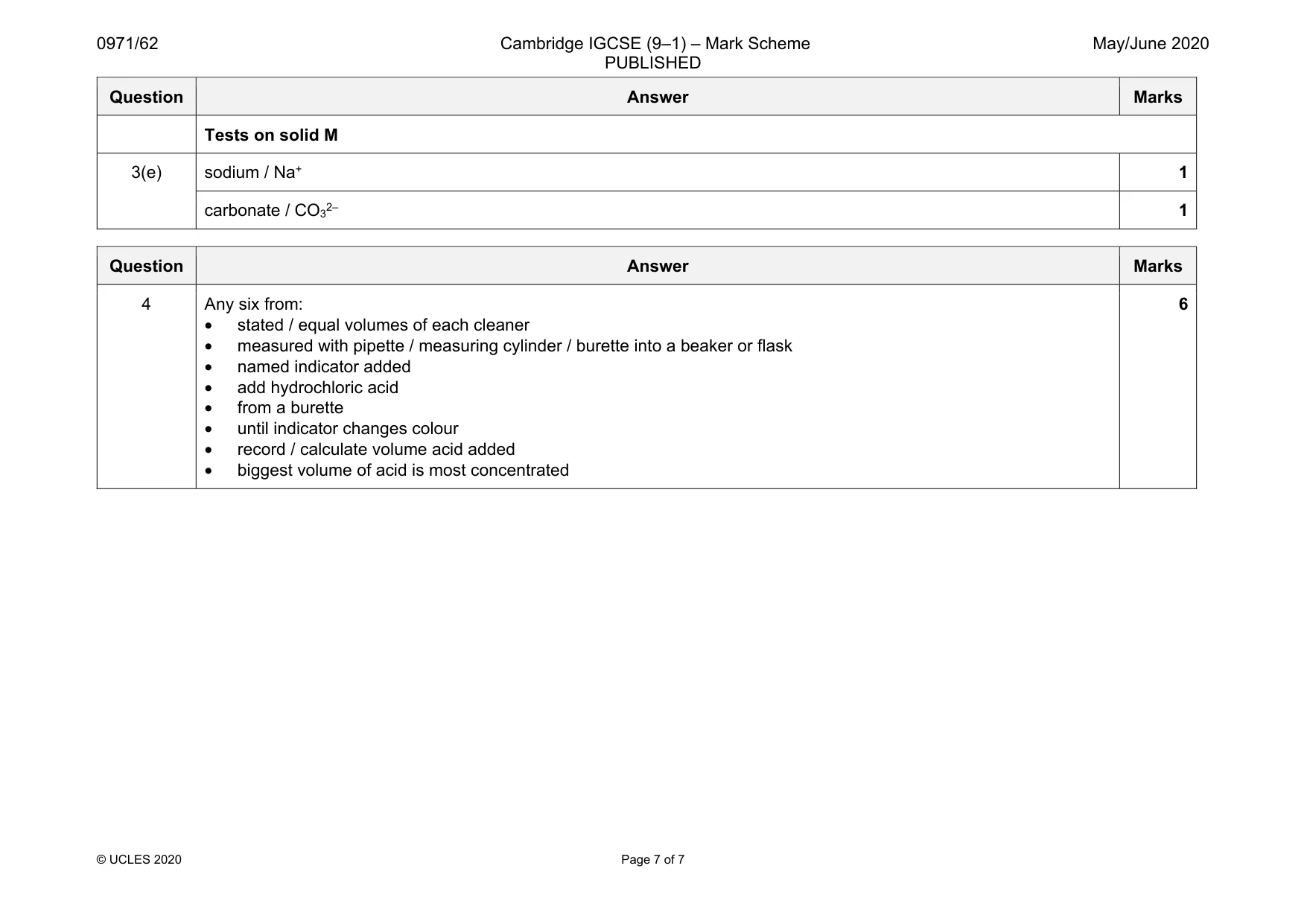
Mark scheme: 3 Tests on solution L 3(a) stays purple or no change 1 3(b) green ppt 1 (dissolves / soluble) producing a green solution 1 3(c) grey-green precipitate 1 remains in excess / does not dissolve 1 3(d) white precipitate 1 Question Answer Marks Tests on solid M 3(e) sodium / Na+ 1 carbonate / CO32– 1
Q4 · Many window-cleaning products contain aqueous ammonia
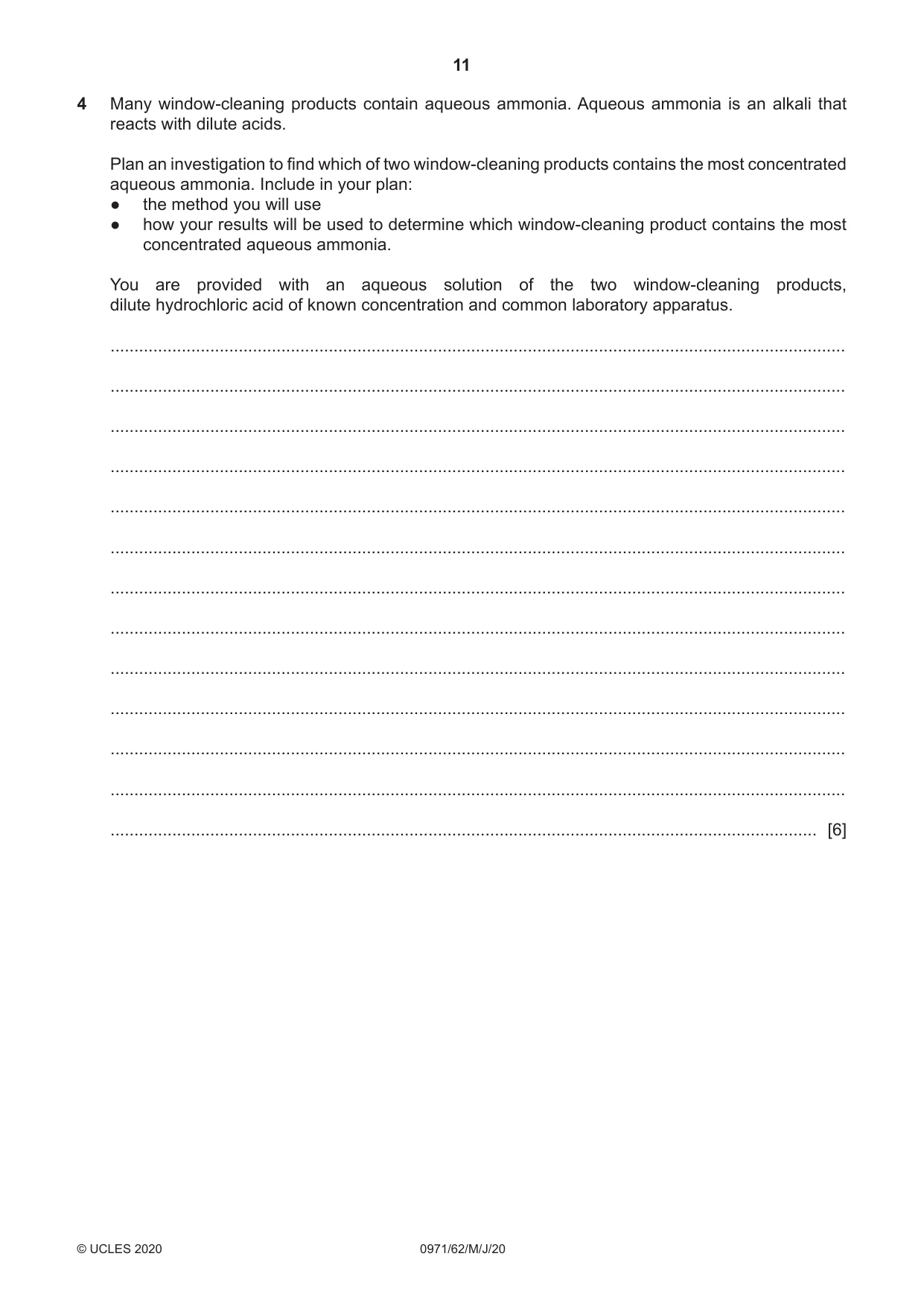
4 Many window-cleaning products contain aqueous ammonia. Aqueous ammonia is an alkali that reacts with dilute acids. Plan an investigation to find which of two window-cleaning products contains the most concentrated aqueous ammonia. Include in your plan: ●● the method you will use ●● how your results will be used to determine which window-cleaning product contains the most concentrated aqueous ammonia. You are provided with an aqueous solution of the two window‑cleaning products, dilute hydrochloric acid of known concentration and common laboratory apparatus. ........................................................................................................................................................... ........................................................................................................................................................... ........................................................................................................................................................... ........................................................................................................................................................... ........................................................................................................................................................... ........................................................................................................................................................... ........................................................................................................................................................... ........................................................................................................................................................... ........................................................................................................................................................... ........................................................................................................................................................... ........................................................................................................................................................... ........................................................................................................................................................... ..................................................................................................................................................... [6]
Mark scheme: 4 Any six from: • stated / equal volumes of each cleaner • measured with pipette / measuring cylinder / burette into a beaker or flask • named indicator added • add hydrochloric acid • from a burette • until indicator changes colour • record / calculate volume acid added • biggest volume of acid is most concentrated 6
What was in this paper
The subtopics covered by these 4 questions, and how many questions each got. Open one in a new tab to see every Cambridge question on it.