Cambridge IGCSE Business Studies 0450 — 2014 Oct/Nov Paper 1 · Variant 2
0450/12/O/N/14 · 100 marks · ≈113 min
The question paper and its mark scheme, free to read here and free to download. This is Cambridge’s own paper, exactly as it was sat.
Question paper12 pages

Mark scheme12 pages
Answers below. Sit the paper first if you are practising.
Paper as text
Question paper, page 1
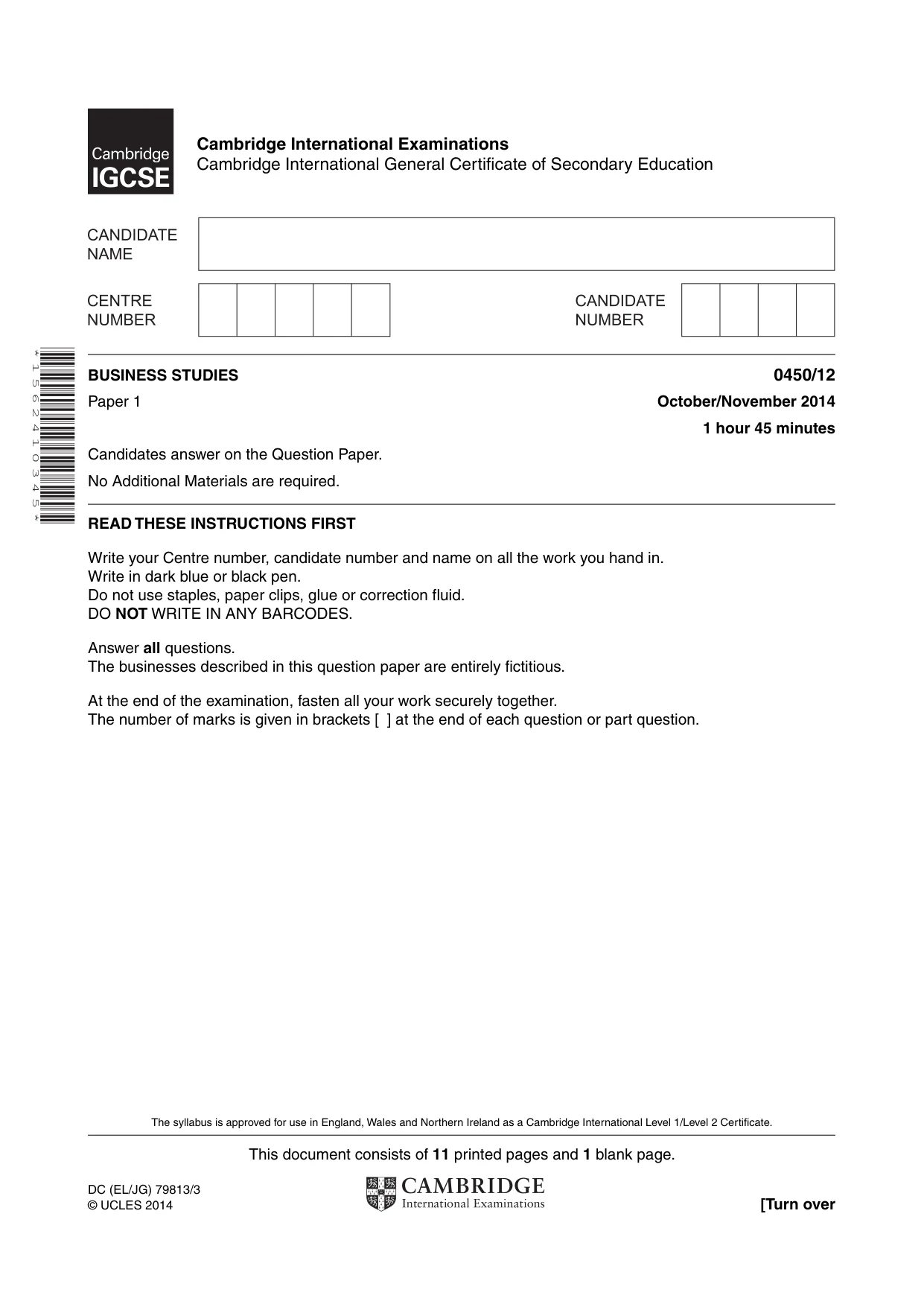
This document consists of 11 printed pages and 1 blank page. DC (EL/JG) 79813/3 © UCLES 2014 [Turn over Cambridge International Examinations Cambridge International General Certificate of Secondary Education * 1 5 6 2 4 1 0 3 4 5 * BUSINESS STUDIES 0450/12 Paper 1 October/November 2014 1 hour 45 minutes Candidates answer on the Question Paper. No Additional Materials are required. READ THESE INSTRUCTIONS FIRST Write your Centre number, candidate number and name on all the work you hand in. Write in dark blue or black pen. Do not use staples, paper clips, glue or correction fluid. DO NOT WRITE IN ANY BARCODES. Answer all questions. The businesses described in this question paper are entirely fictitious. At the end of the examination, fasten all your work securely together. The number of marks is given in brackets [ ] at the end of each question or part question. The syllabus is approved for use in England, Wales and Northern Ireland as a Cambridge International Level 1/Level 2 Certificate.
Question paper, page 2
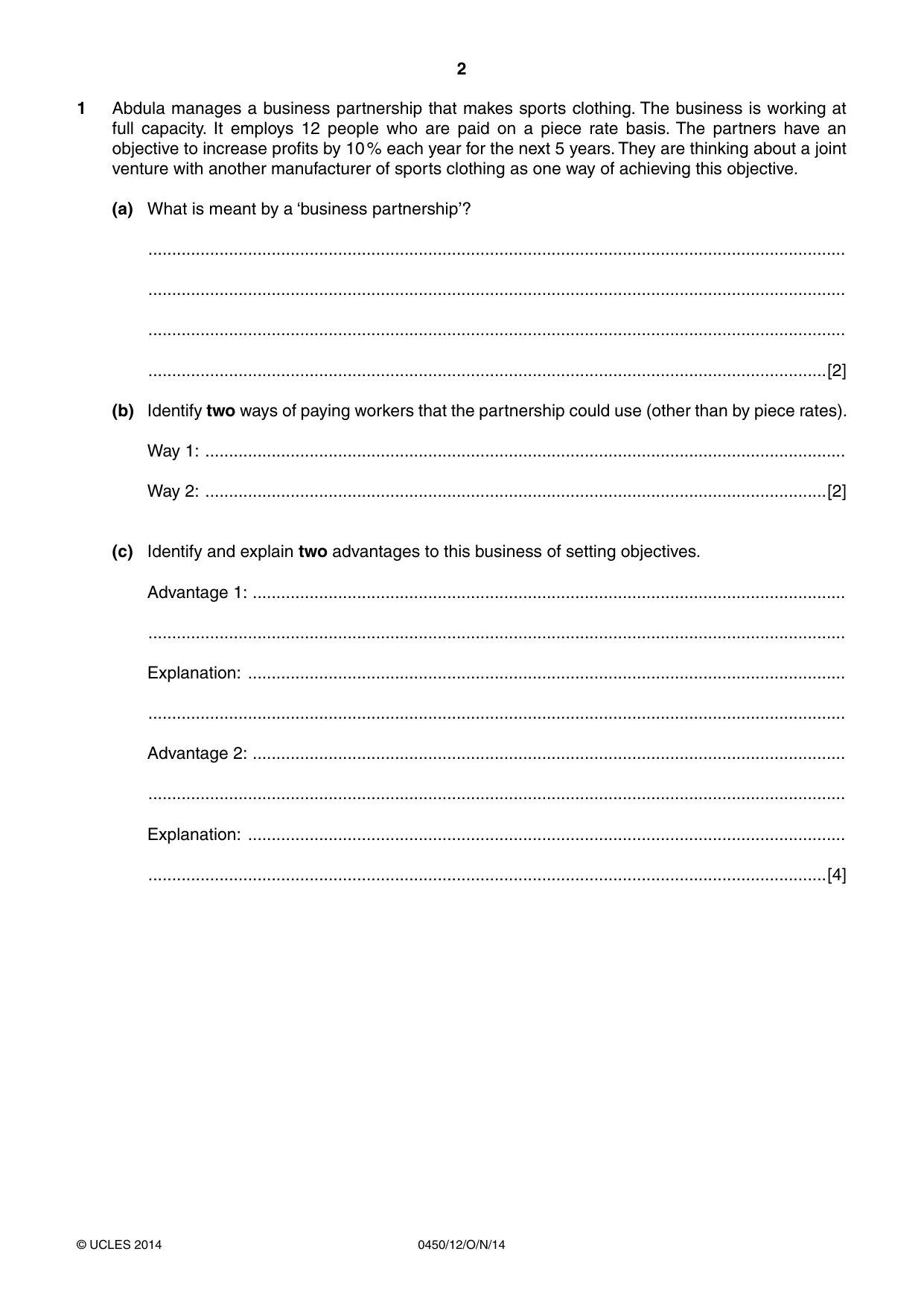
2 0450/12/O/N/14 © UCLES 2014 1 Abdula manages a business partnership that makes sports clothing. The business is working at full capacity. It employs 12 people who are paid on a piece rate basis. The partners have an objective to increase profits by 10 % each year for the next 5 years. They are thinking about a joint venture with another manufacturer of sports clothing as one way of achieving this objective. (a) What is meant by a ‘business partnership’? … … … …[2] (b) Identify two ways of paying workers that the partnership could use (other than by piece rates). Way 1: … Way 2: …[2] (c) Identify and explain two advantages to this business of setting objectives. Advantage 1: … … Explanation: … … Advantage 2: … … Explanation: … …[4]
Question paper, page 3
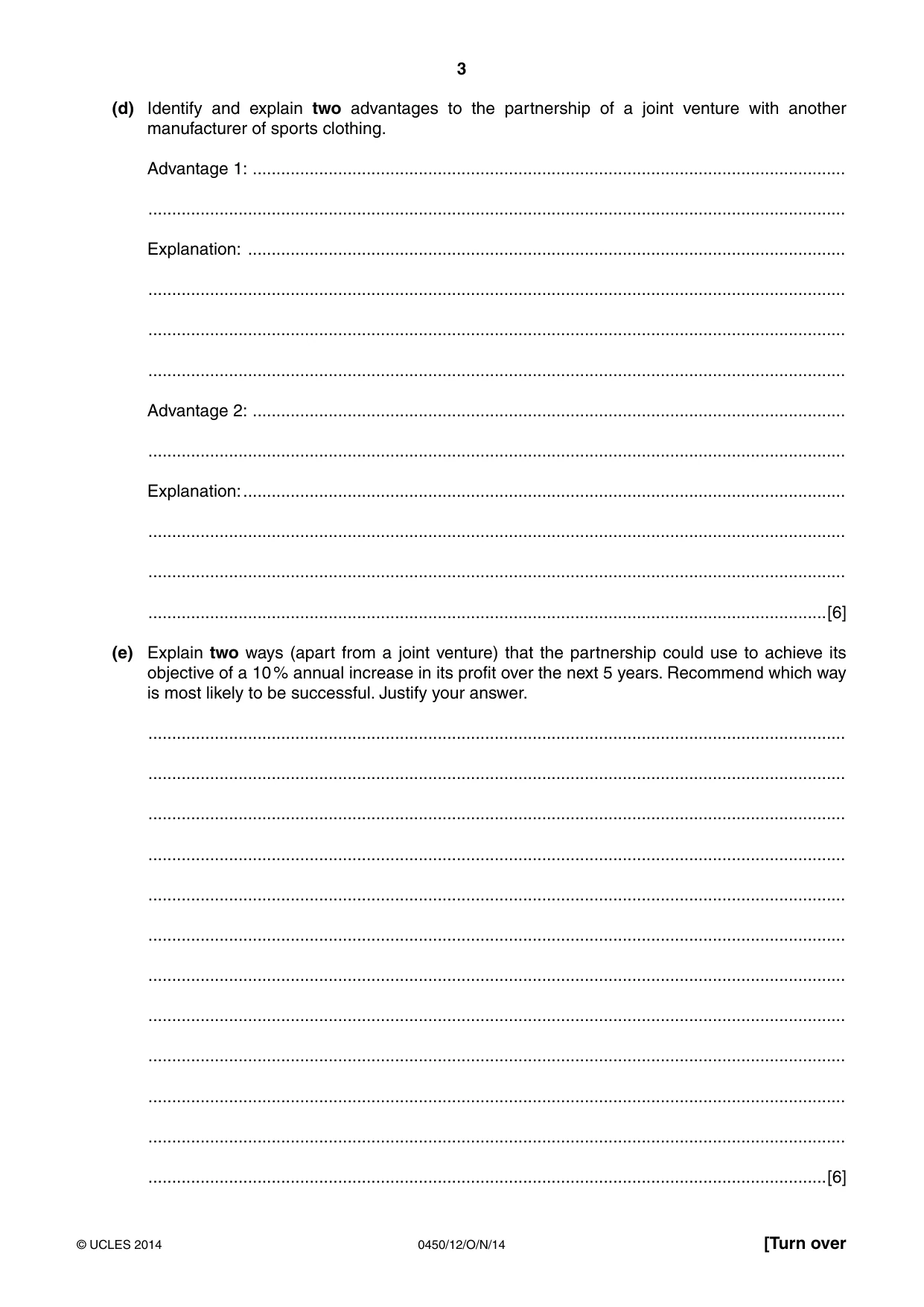
3 0450/12/O/N/14 © UCLES 2014 [Turn over (d) Identify and explain two advantages to the partnership of a joint venture with another manufacturer of sports clothing. Advantage 1: … … Explanation: … … … … Advantage 2: … … Explanation: … … … …[6] (e) Explain two ways (apart from a joint venture) that the partnership could use to achieve its objective of a 10 % annual increase in its profit over the next 5 years. Recommend which way is most likely to be successful. Justify your answer. … … … … … … … … … … … …[6]
Question paper, page 4
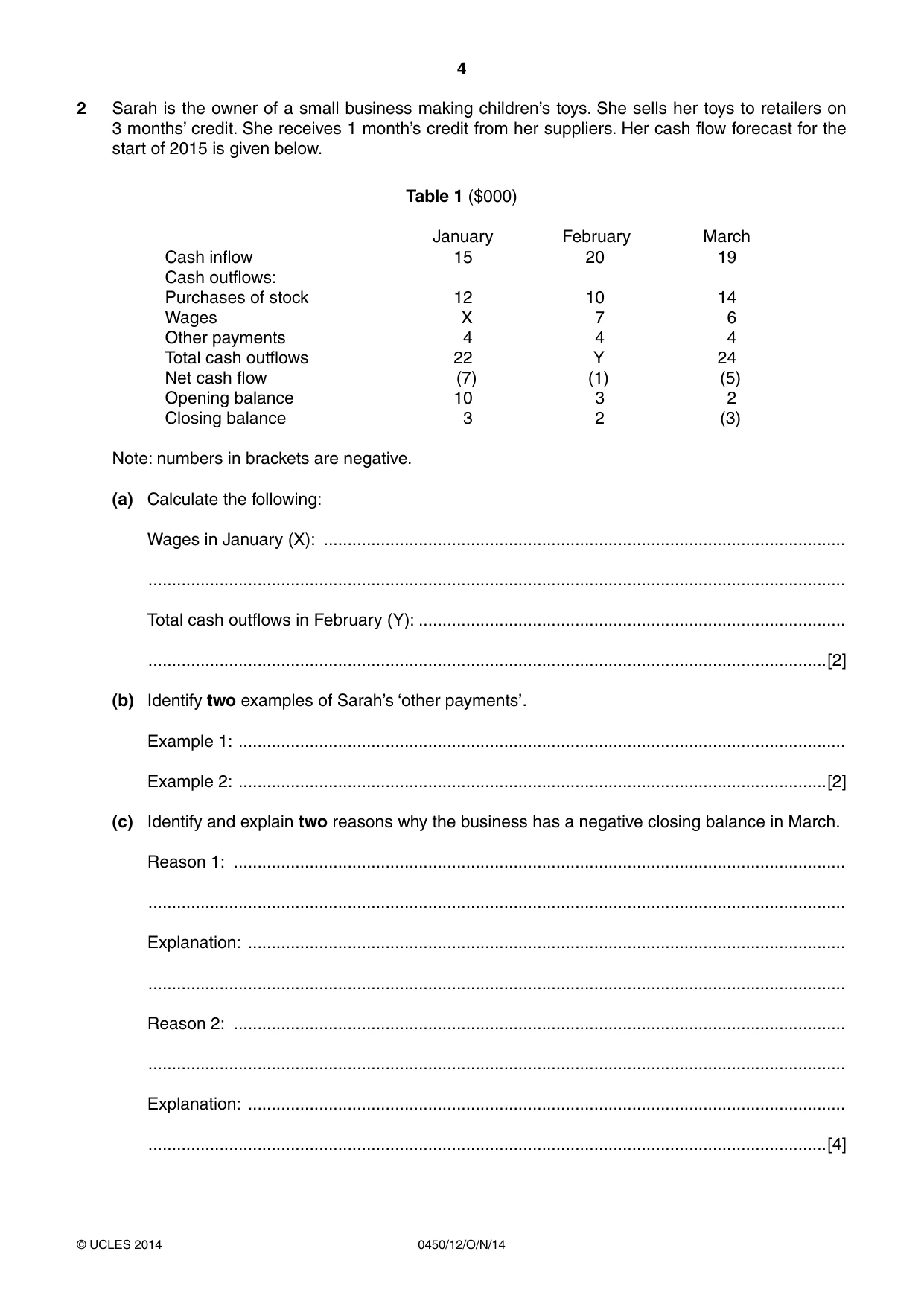
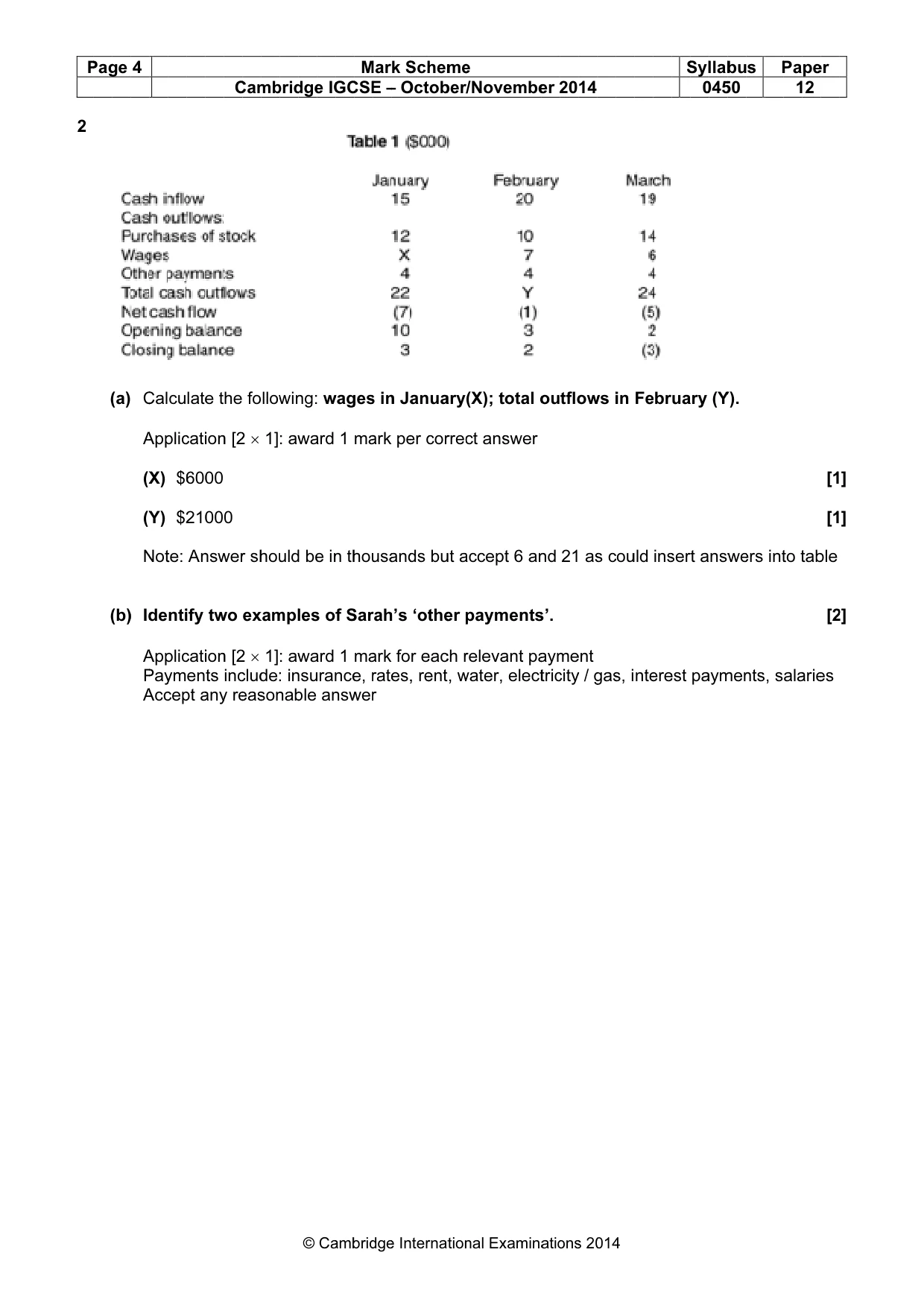
4 0450/12/O/N/14 © UCLES 2014 2 Sarah is the owner of a small business making children’s toys. She sells her toys to retailers on 3 months’ credit. She receives 1 month’s credit from her suppliers. Her cash flow forecast for the start of 2015 is given below. Table 1 ($000) January February March Cash inflow 15 20 19 Cash outflows: Purchases of stock 12 10 14 Wages X 7 6 Other payments 4 4 4 Total cash outflows 22 Y 24 Net cash flow (7) (1) (5) Opening balance 10 3 2 Closing balance 3 2 (3) Note: numbers in brackets are negative. (a) Calculate the following: Wages in January (X): … … Total cash outflows in February (Y): … …[2] (b) Identify two examples of Sarah’s ‘other payments’. Example 1: … Example 2: …[2] (c) Identify and explain two reasons why the business has a negative closing balance in March. Reason 1: … … Explanation: … … Reason 2: … … Explanation: … …[4]
Question paper, page 5
5 0450/12/O/N/14 © UCLES 2014 [Turn over (d) Identify and explain two advantages to Sarah’s business of producing a cash flow forecast. Advantage 1: … … Explanation: … … … … Advantage 2: … … Explanation: … … … …[6] (e) Sarah’s accountant told her that a positive cash flow is more important to the business than profits. Do you agree? Justify your answer. … … … … … … … … … … … …[6]
Question paper, page 6
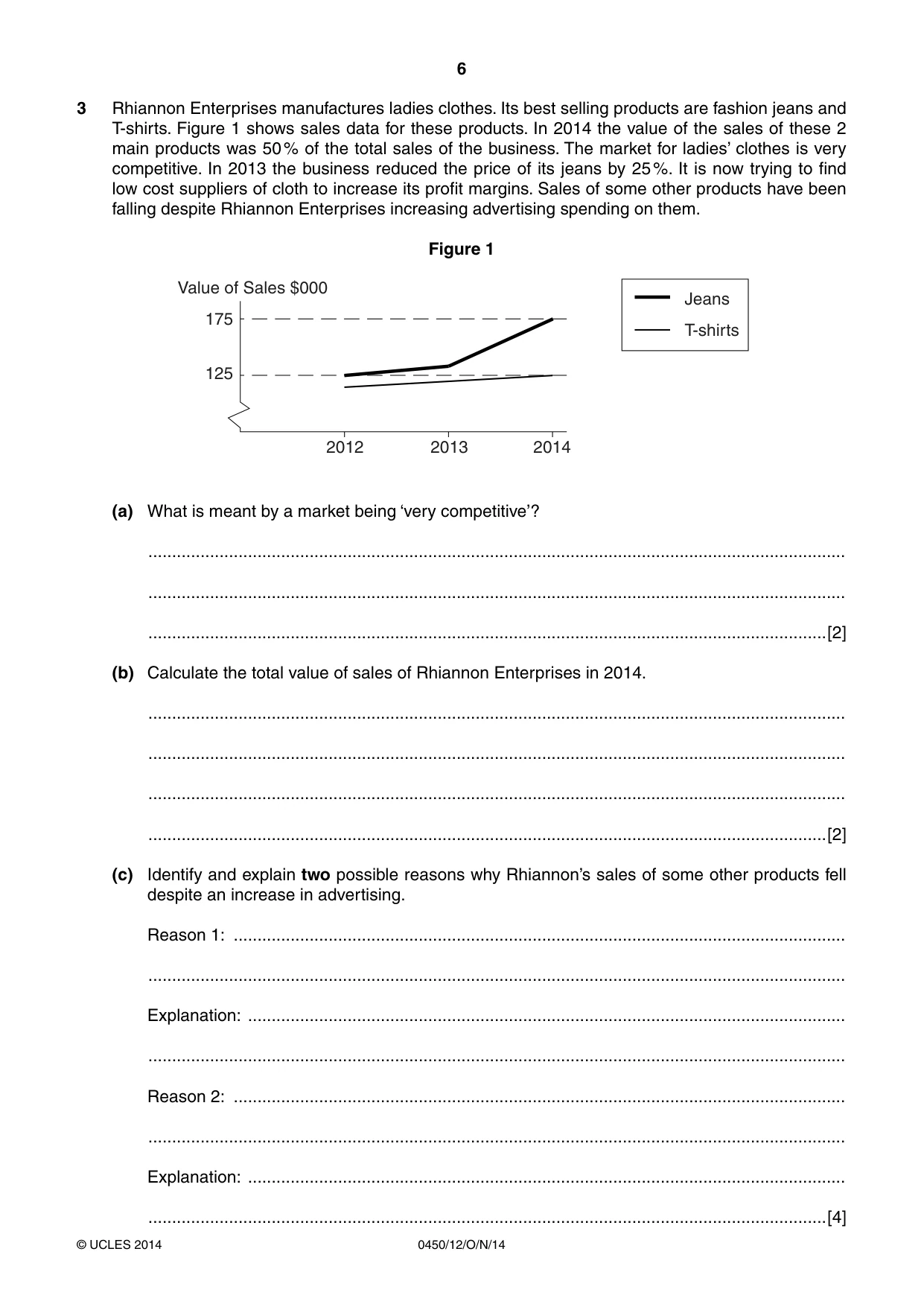
6 0450/12/O/N/14 © UCLES 2014 3 Rhiannon Enterprises manufactures ladies clothes. Its best selling products are fashion jeans and T-shirts. Figure 1 shows sales data for these products. In 2014 the value of the sales of these 2 main products was 50 % of the total sales of the business. The market for ladies’ clothes is very competitive. In 2013 the business reduced the price of its jeans by 25 %. It is now trying to find low cost suppliers of cloth to increase its profit margins. Sales of some other products have been falling despite Rhiannon Enterprises increasing advertising spending on them. Figure 1 2012 2013 2014 175 125 Jeans T-shirts Value of Sales $000 (a) What is meant by a market being ‘very competitive’? … … …[2] (b) Calculate the total value of sales of Rhiannon Enterprises in 2014. … … … …[2] (c) Identify and explain two possible reasons why Rhiannon’s sales of some other products fell despite an increase in advertising. Reason 1: … … Explanation: … … Reason 2: … … Explanation: … …[4]
Question paper, page 7
7 0450/12/O/N/14 © UCLES 2014 [Turn over (d) Identify and explain two factors that the business should consider before deciding on a new supplier of cloth. Factor 1: … … Explanation: … … … … Factor 2: … … Explanation: … … … …[6] (e) Do you think Rhiannon Enterprises should reduce the prices of all its products in 2015? Justify your answer. … … … … … … … … … … … …[6]
Question paper, page 8
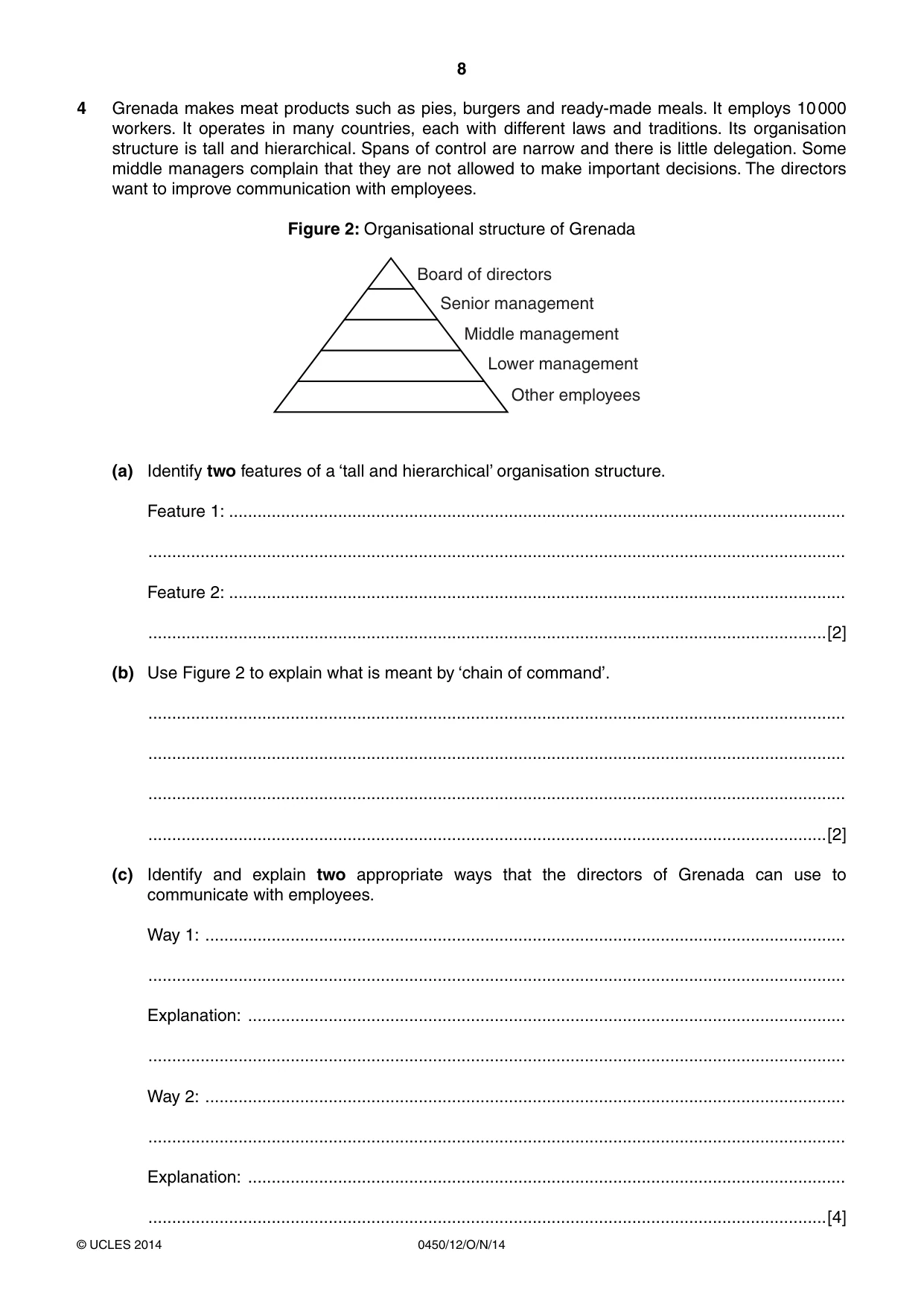
8 0450/12/O/N/14 © UCLES 2014 4 Grenada makes meat products such as pies, burgers and ready-made meals. It employs 10 000 workers. It operates in many countries, each with different laws and traditions. Its organisation structure is tall and hierarchical. Spans of control are narrow and there is little delegation. Some middle managers complain that they are not allowed to make important decisions. The directors want to improve communication with employees. Figure 2: Organisational structure of Grenada Board of directors Senior management Middle management Lower management Other employees (a) Identify two features of a ‘tall and hierarchical’ organisation structure. Feature 1: … … Feature 2: … …[2] (b) Use Figure 2 to explain what is meant by ‘chain of command’. … … … …[2] (c) Identify and explain two appropriate ways that the directors of Grenada can use to communicate with employees. Way 1: … … Explanation: … … Way 2: … … Explanation: … …[4]
Question paper, page 9
9 0450/12/O/N/14 © UCLES 2014 [Turn over (d) Identify and explain two disadvantages to Grenada of operating in a number of different countries. Disadvantage 1: … … Explanation: … … … … Disadvantage 2: … … Explanation: … … … …[6] (e) Do you think that Grenada would benefit from greater delegation in its decision making? Justify your answer. … … … … … … … … … … … …[6]
Question paper, page 10
10 0450/12/O/N/14 © UCLES 2014 5 Ali has just been appointed as Managing Director of Anypart, a large manufacturing business. He told Anypart’s Board of Directors: ‘Behaving ethically will always lead to lower profits. I want our employees to work longer hours, have fewer holidays and become more productive. This will reduce costs of each unit of output and will benefit all our stakeholders’. Not all of the directors agreed with him. (a) What is meant by a ‘Board of Directors’? … … … …[2] (b) Identify two of Anypart’s stakeholder groups (other than employees). Stakeholder group 1: … Stakeholder group 2: …[2] (c) Identify and explain two benefits to Anypart of reducing costs of each unit of output. Benefit 1: … … Explanation: … … Benefit 2: … … Explanation: … …[4]
Question paper, page 11
11 0450/12/O/N/14 © UCLES 2014 (d) Identify and explain two possible ways of improving productivity in Anypart’s business. Way 1: … … Explanation: … … … … Way 2: … … Explanation: … … … …[6] (e) Do you think that ‘behaving ethically will always lead to lower profits’? Justify your answer. … … … … … … … … … … … …[6]
Question paper, page 12
12 0450/12/O/N/14 © UCLES 2014 Permission to reproduce items where third-party owned material protected by copyright is included has been sought and cleared where possible. Every reasonable effort has been made by the publisher (UCLES) to trace copyright holders, but if any items requiring clearance have unwittingly been included, the publisher will be pleased to make amends at the earliest possible opportunity. Cambridge International Examinations is part of the Cambridge Assessment Group. Cambridge Assessment is the brand name of University of Cambridge Local Examinations Syndicate (UCLES), which is itself a department of the University of Cambridge. BLANK PAGE
Mark scheme, page 1
® IGCSE is the registered trademark of Cambridge International Examinations. CAMBRIDGE INTERNATIONAL EXAMINATIONS Cambridge International General Certificate of Secondary Education MARK SCHEME for the October/November 2014 series 0450 BUSINESS STUDIES 0450/12 Paper 1 (Short Answer/Structured Response), maximum raw mark 100 This mark scheme is published as an aid to teachers and candidates, to indicate the requirements of the examination. It shows the basis on which Examiners were instructed to award marks. It does not indicate the details of the discussions that took place at an Examiners’ meeting before marking began, which would have considered the acceptability of alternative answers. Mark schemes should be read in conjunction with the question paper and the Principal Examiner Report for Teachers. Cambridge will not enter into discussions about these mark schemes. Cambridge is publishing the mark schemes for the October/November 2014 series for most Cambridge IGCSE®, Cambridge International A and AS Level components and some Cambridge O Level components.
Mark scheme, page 2
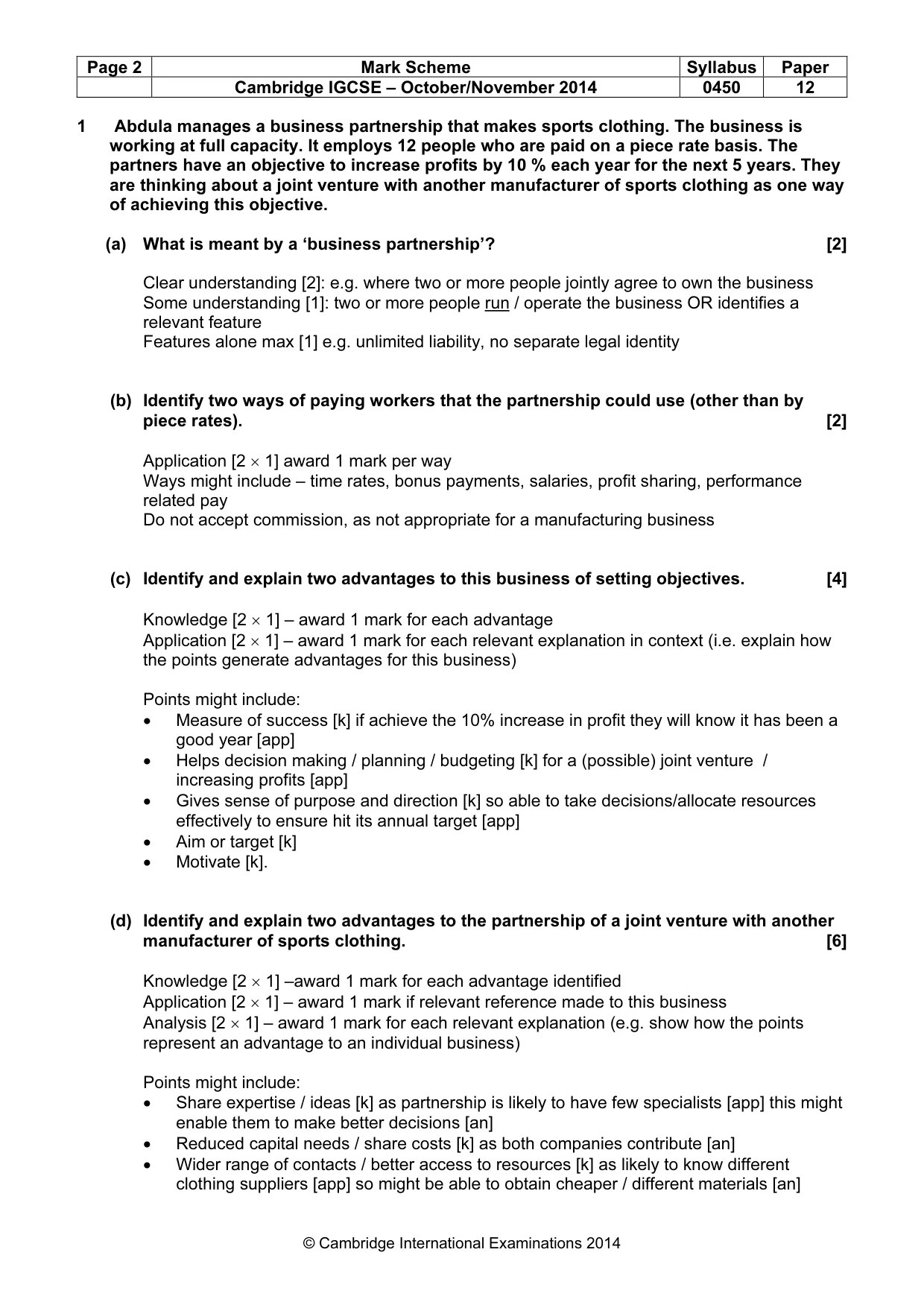
Page 2 Mark Scheme Syllabus Paper Cambridge IGCSE – October/November 2014 0450 12 © Cambridge International Examinations 2014 1 Abdula manages a business partnership that makes sports clothing. The business is working at full capacity. It employs 12 people who are paid on a piece rate basis. The partners have an objective to increase profits by 10 % each year for the next 5 years. They are thinking about a joint venture with another manufacturer of sports clothing as one way of achieving this objective. (a) What is meant by a ‘business partnership’? [2] Clear understanding [2]: e.g. where two or more people jointly agree to own the business Some understanding [1]: two or more people run / operate the business OR identifies a relevant feature Features alone max [1] e.g. unlimited liability, no separate legal identity (b) Identify two ways of paying workers that the partnership could use (other than by piece rates). [2] Application [2 × 1] award 1 mark per way Ways might include – time rates, bonus payments, salaries, profit sharing, performance related pay Do not accept commission, as not appropriate for a manufacturing business (c) Identify and explain two advantages to this business of setting objectives. [4] Knowledge [2 × 1] – award 1 mark for each advantage Application [2 × 1] – award 1 mark for each relevant explanation in context (i.e. explain how the points generate advantages for this business) Points might include: • Measure of success [k] if achieve the 10% increase in profit they will know it has been a good year [app] • Helps decision making / planning / budgeting [k] for a (possible) joint venture / increasing profits [app] • Gives sense of purpose and direction [k] so able to take decisions/allocate resources effectively to ensure hit its annual target [app] • Aim or target [k] • Motivate [k]. (d) Identify and explain two advantages to the partnership of a joint venture with another manufacturer of sports clothing. [6] Knowledge [2 × 1] –award 1 mark for each advantage identified Application [2 × 1] – award 1 mark if relevant reference made to this business Analysis [2 × 1] – award 1 mark for each relevant explanation (e.g. show how the points represent an advantage to an individual business) Points might include: • Share expertise / ideas [k] as partnership is likely to have few specialists [app] this might enable them to make better decisions [an] • Reduced capital needs / share costs [k] as both companies contribute [an] • Wider range of contacts / better access to resources [k] as likely to know different clothing suppliers [app] so might be able to obtain cheaper / different materials [an]
Mark scheme, page 3
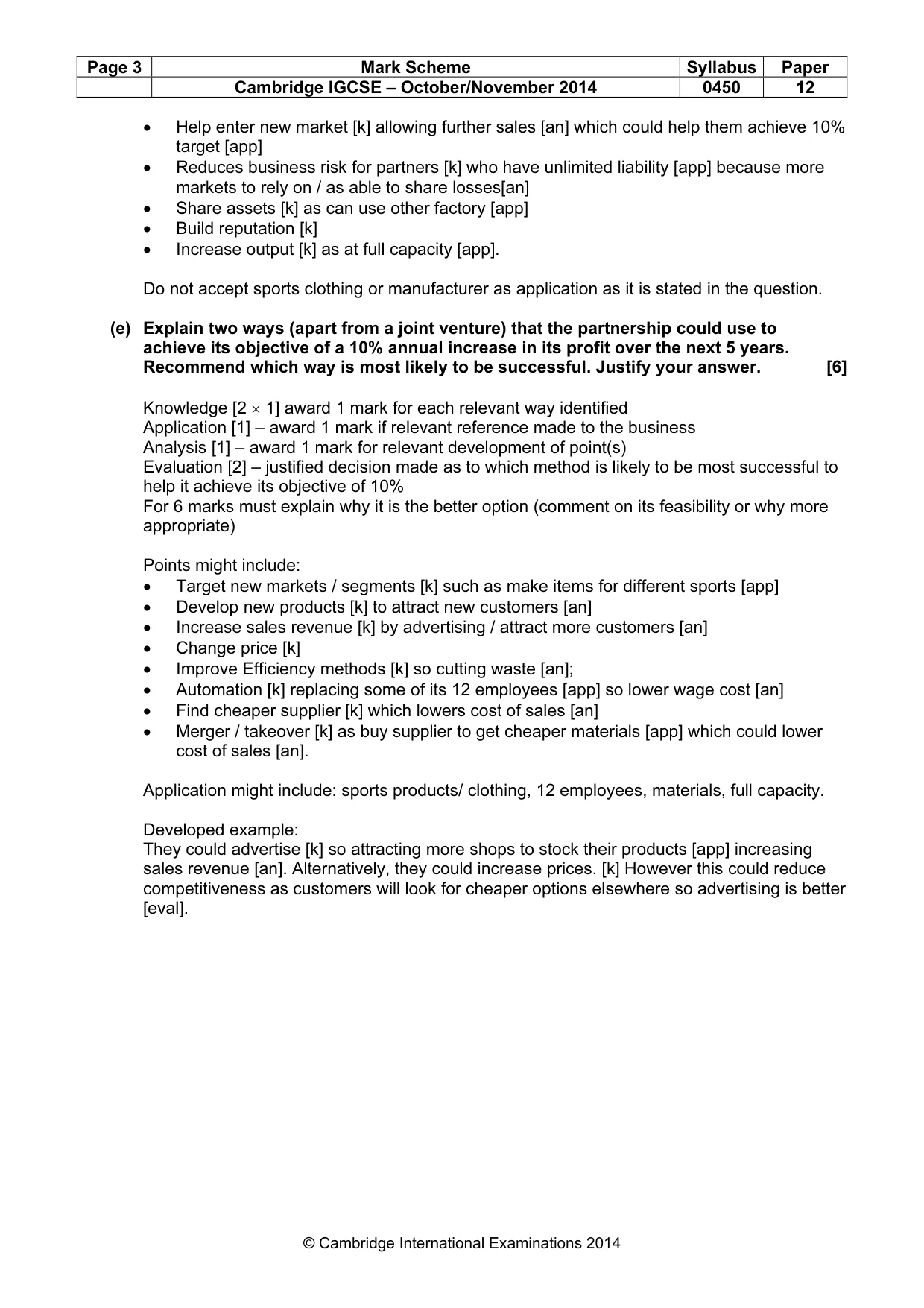
Page 3 Mark Scheme Syllabus Paper Cambridge IGCSE – October/November 2014 0450 12 © Cambridge International Examinations 2014 • Help enter new market [k] allowing further sales [an] which could help them achieve 10% target [app] • Reduces business risk for partners [k] who have unlimited liability [app] because more markets to rely on / as able to share losses[an] • Share assets [k] as can use other factory [app] • Build reputation [k] • Increase output [k] as at full capacity [app]. Do not accept sports clothing or manufacturer as application as it is stated in the question. (e) Explain two ways (apart from a joint venture) that the partnership could use to achieve its objective of a 10% annual increase in its profit over the next 5 years. Recommend which way is most likely to be successful. Justify your answer. [6] Knowledge [2 × 1] award 1 mark for each relevant way identified Application [1] – award 1 mark if relevant reference made to the business Analysis [1] – award 1 mark for relevant development of point(s) Evaluation [2] – justified decision made as to which method is likely to be most successful to help it achieve its objective of 10% For 6 marks must explain why it is the better option (comment on its feasibility or why more appropriate) Points might include: • Target new markets / segments [k] such as make items for different sports [app] • Develop new products [k] to attract new customers [an] • Increase sales revenue [k] by advertising / attract more customers [an] • Change price [k] • Improve Efficiency methods [k] so cutting waste [an]; • Automation [k] replacing some of its 12 employees [app] so lower wage cost [an] • Find cheaper supplier [k] which lowers cost of sales [an] • Merger / takeover [k] as buy supplier to get cheaper materials [app] which could lower cost of sales [an]. Application might include: sports products/ clothing, 12 employees, materials, full capacity. Developed example: They could advertise [k] so attracting more shops to stock their products [app] increasing sales revenue [an]. Alternatively, they could increase prices. [k] However this could reduce competitiveness as customers will look for cheaper options elsewhere so advertising is better [eval].
Mark scheme, page 4
P 2 Pag ( ( ge (a) (b) 4 C A (X (Y N ) Id A P A Cal App X) Y) Not de App Pay Acc cu plic $6 $2 te: nti plic ym cep late cati 600 210 An ify cati en pt a e t ion 00 00 nsw tw ion ts any C he n [2 0 wer wo n [2 inc y re Cam fo 2 × r sh ex 2 × clud eas mb llow 1] hou xam 1] de: son brid win : aw uld mpl : aw : in nab dge © ng: wa d be les wa nsu ble e IG Ca w ard e in s of ard uran an GC amb wag 1 n th f S 1 nce nsw M CSE brid ges ma hou Sar ma e, r wer Mar E – dge s in ark usa rah ark rate r k S – O e In n Ja pe and h’s fo es, Sch Oct nter an er c ds ‘ot r e , re hem ob rnat ua cor bu the eac ent me ber/ tion ary rrec ut a er p ch r , w e /No nal (X) ct a acc pay rele wate ove Ex ); t ans cep ym eva er, em xam tota sw t 6 men ant ele mbe mina al o er 6 an nts t pa ect er 2 atio ou nd s’. aym tric 20 ons tflo 21 me city 14 s 20 ow as ent y / g 014 ws i s c gas 4 in cou s, i Fe uld nte ebr ins ere S ua ser est Syl 0 ary rt a pa llab 045 (Y nsw aym bu 50 Y). we men s ers nts P int , s Pa 1 to t ala pe 2 tab arie er [1 [1 ble [2 es ] ] 2]
Mark scheme, page 5
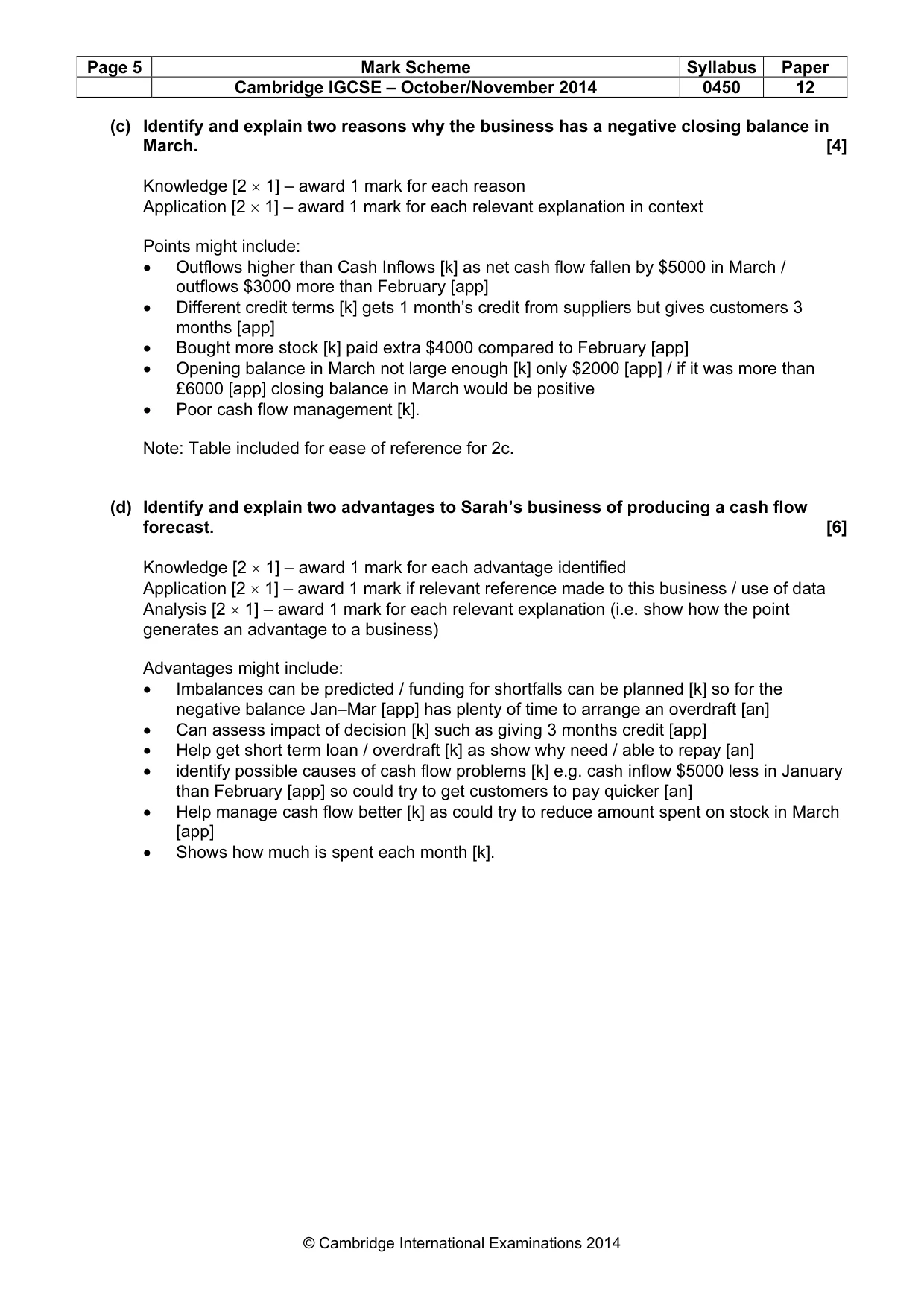
Page 5 Mark Scheme Syllabus Paper Cambridge IGCSE – October/November 2014 0450 12 © Cambridge International Examinations 2014 (c) Identify and explain two reasons why the business has a negative closing balance in March. [4] Knowledge [2 × 1] – award 1 mark for each reason Application [2 × 1] – award 1 mark for each relevant explanation in context Points might include: • Outflows higher than Cash Inflows [k] as net cash flow fallen by $5000 in March / outflows $3000 more than February [app] • Different credit terms [k] gets 1 month’s credit from suppliers but gives customers 3 months [app] • Bought more stock [k] paid extra $4000 compared to February [app] • Opening balance in March not large enough [k] only $2000 [app] / if it was more than £6000 [app] closing balance in March would be positive • Poor cash flow management [k]. Note: Table included for ease of reference for 2c. (d) Identify and explain two advantages to Sarah’s business of producing a cash flow forecast. [6] Knowledge [2 × 1] – award 1 mark for each advantage identified Application [2 × 1] – award 1 mark if relevant reference made to this business / use of data Analysis [2 × 1] – award 1 mark for each relevant explanation (i.e. show how the point generates an advantage to a business) Advantages might include: • Imbalances can be predicted / funding for shortfalls can be planned [k] so for the negative balance Jan–Mar [app] has plenty of time to arrange an overdraft [an] • Can assess impact of decision [k] such as giving 3 months credit [app] • Help get short term loan / overdraft [k] as show why need / able to repay [an] • identify possible causes of cash flow problems [k] e.g. cash inflow $5000 less in January than February [app] so could try to get customers to pay quicker [an] • Help manage cash flow better [k] as could try to reduce amount spent on stock in March [app] • Shows how much is spent each month [k].
Mark scheme, page 6
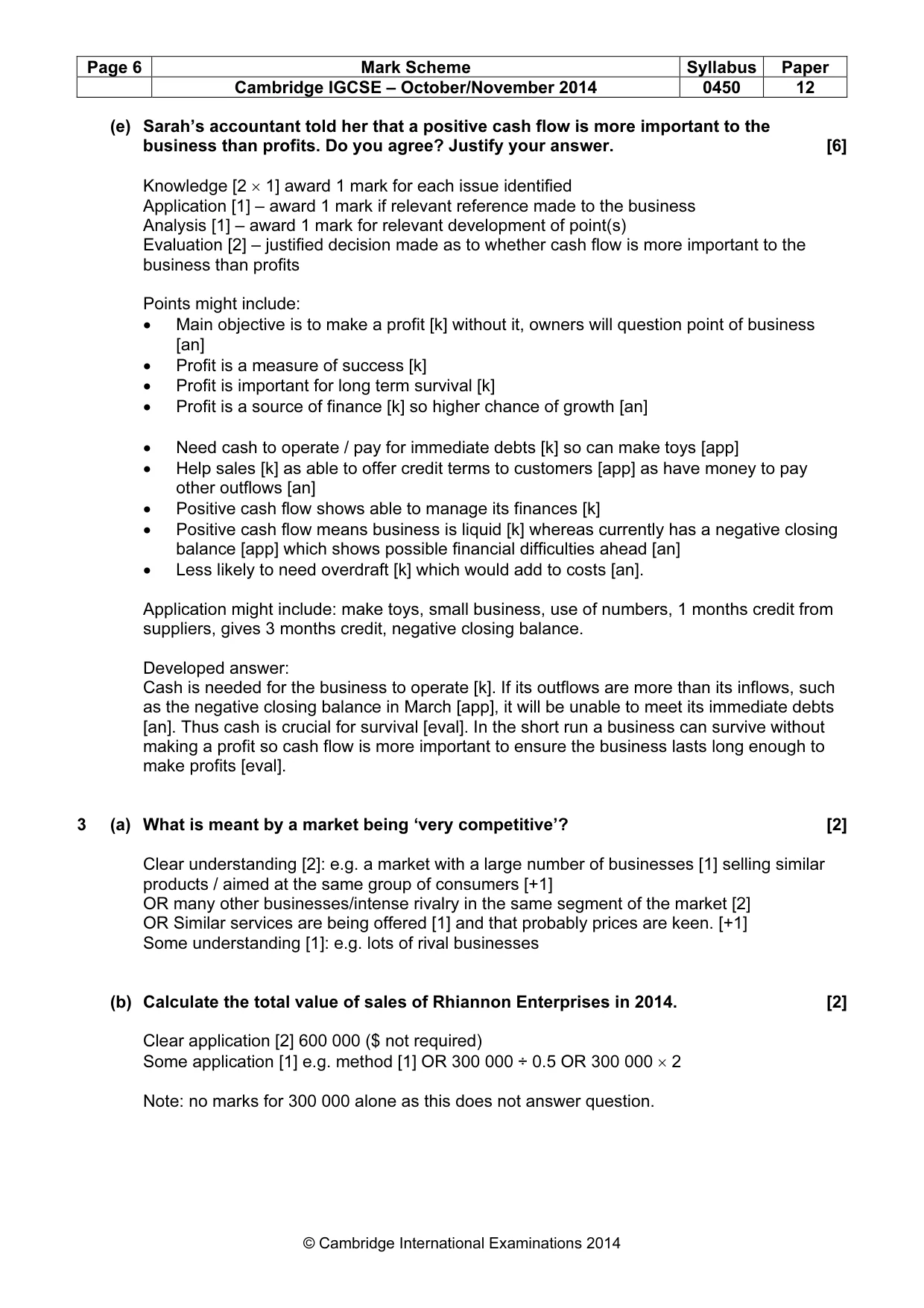
Page 6 Mark Scheme Syllabus Paper Cambridge IGCSE – October/November 2014 0450 12 © Cambridge International Examinations 2014 (e) Sarah’s accountant told her that a positive cash flow is more important to the business than profits. Do you agree? Justify your answer. [6] Knowledge [2 × 1] award 1 mark for each issue identified Application [1] – award 1 mark if relevant reference made to the business Analysis [1] – award 1 mark for relevant development of point(s) Evaluation [2] – justified decision made as to whether cash flow is more important to the business than profits Points might include: • Main objective is to make a profit [k] without it, owners will question point of business [an] • Profit is a measure of success [k] • Profit is important for long term survival [k] • Profit is a source of finance [k] so higher chance of growth [an] • Need cash to operate / pay for immediate debts [k] so can make toys [app] • Help sales [k] as able to offer credit terms to customers [app] as have money to pay other outflows [an] • Positive cash flow shows able to manage its finances [k] • Positive cash flow means business is liquid [k] whereas currently has a negative closing balance [app] which shows possible financial difficulties ahead [an] • Less likely to need overdraft [k] which would add to costs [an]. Application might include: make toys, small business, use of numbers, 1 months credit from suppliers, gives 3 months credit, negative closing balance. Developed answer: Cash is needed for the business to operate [k]. If its outflows are more than its inflows, such as the negative closing balance in March [app], it will be unable to meet its immediate debts [an]. Thus cash is crucial for survival [eval]. In the short run a business can survive without making a profit so cash flow is more important to ensure the business lasts long enough to make profits [eval]. 3 (a) What is meant by a market being ‘very competitive’? [2] Clear understanding [2]: e.g. a market with a large number of businesses [1] selling similar products / aimed at the same group of consumers [+1] OR many other businesses/intense rivalry in the same segment of the market [2] OR Similar services are being offered [1] and that probably prices are keen. [+1] Some understanding [1]: e.g. lots of rival businesses (b) Calculate the total value of sales of Rhiannon Enterprises in 2014. [2] Clear application [2] 600 000 ($ not required) Some application [1] e.g. method [1] OR 300 000 ÷ 0.5 OR 300 000 × 2 Note: no marks for 300 000 alone as this does not answer question.
Mark scheme, page 7
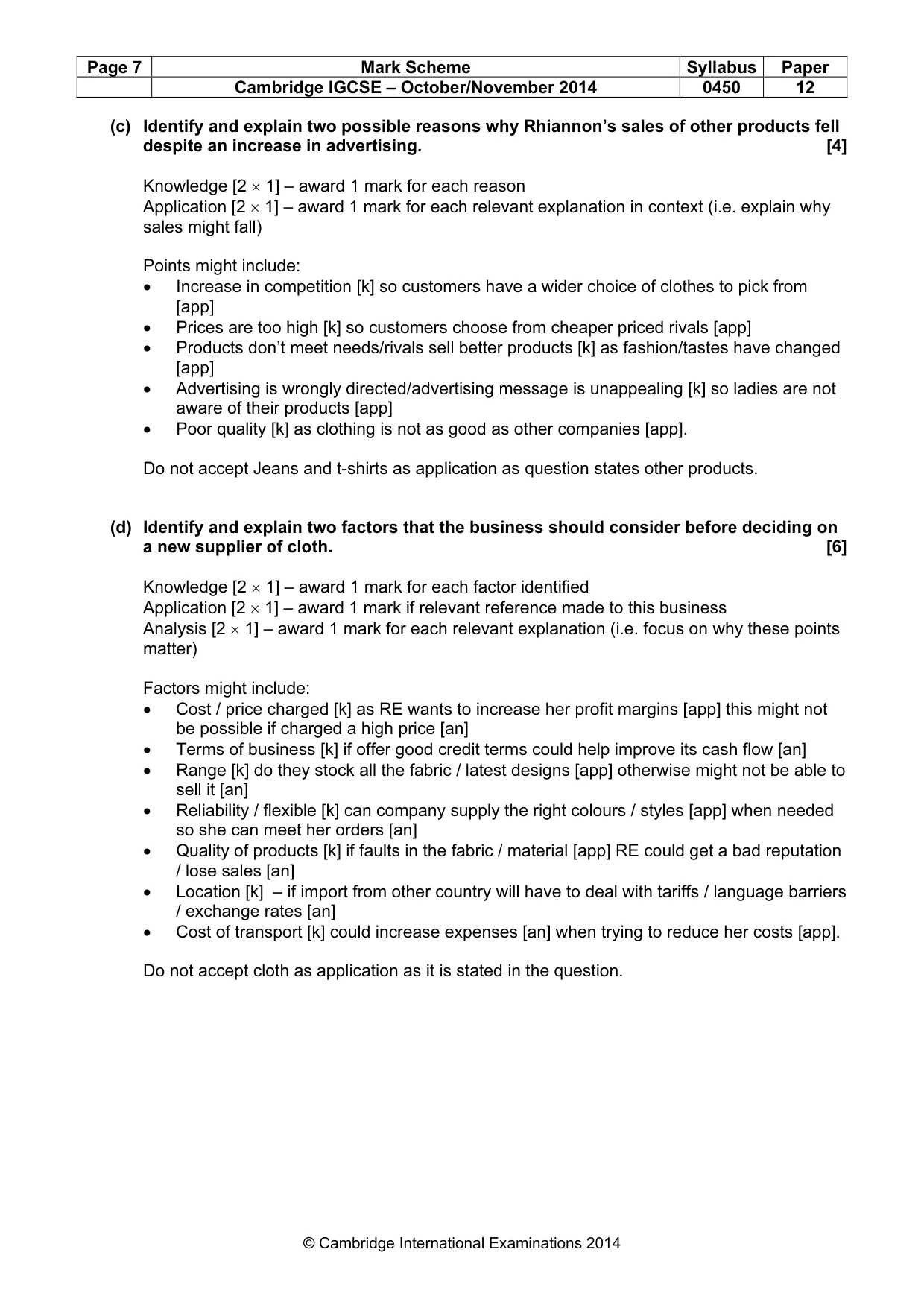
Page 7 Mark Scheme Syllabus Paper Cambridge IGCSE – October/November 2014 0450 12 © Cambridge International Examinations 2014 (c) Identify and explain two possible reasons why Rhiannon’s sales of other products fell despite an increase in advertising. [4] Knowledge [2 × 1] – award 1 mark for each reason Application [2 × 1] – award 1 mark for each relevant explanation in context (i.e. explain why sales might fall) Points might include: • Increase in competition [k] so customers have a wider choice of clothes to pick from [app] • Prices are too high [k] so customers choose from cheaper priced rivals [app] • Products don’t meet needs/rivals sell better products [k] as fashion/tastes have changed [app] • Advertising is wrongly directed/advertising message is unappealing [k] so ladies are not aware of their products [app] • Poor quality [k] as clothing is not as good as other companies [app]. Do not accept Jeans and t-shirts as application as question states other products. (d) Identify and explain two factors that the business should consider before deciding on a new supplier of cloth. [6] Knowledge [2 × 1] – award 1 mark for each factor identified Application [2 × 1] – award 1 mark if relevant reference made to this business Analysis [2 × 1] – award 1 mark for each relevant explanation (i.e. focus on why these points matter) Factors might include: • Cost / price charged [k] as RE wants to increase her profit margins [app] this might not be possible if charged a high price [an] • Terms of business [k] if offer good credit terms could help improve its cash flow [an] • Range [k] do they stock all the fabric / latest designs [app] otherwise might not be able to sell it [an] • Reliability / flexible [k] can company supply the right colours / styles [app] when needed so she can meet her orders [an] • Quality of products [k] if faults in the fabric / material [app] RE could get a bad reputation / lose sales [an] • Location [k] – if import from other country will have to deal with tariffs / language barriers / exchange rates [an] • Cost of transport [k] could increase expenses [an] when trying to reduce her costs [app]. Do not accept cloth as application as it is stated in the question.
Mark scheme, page 8
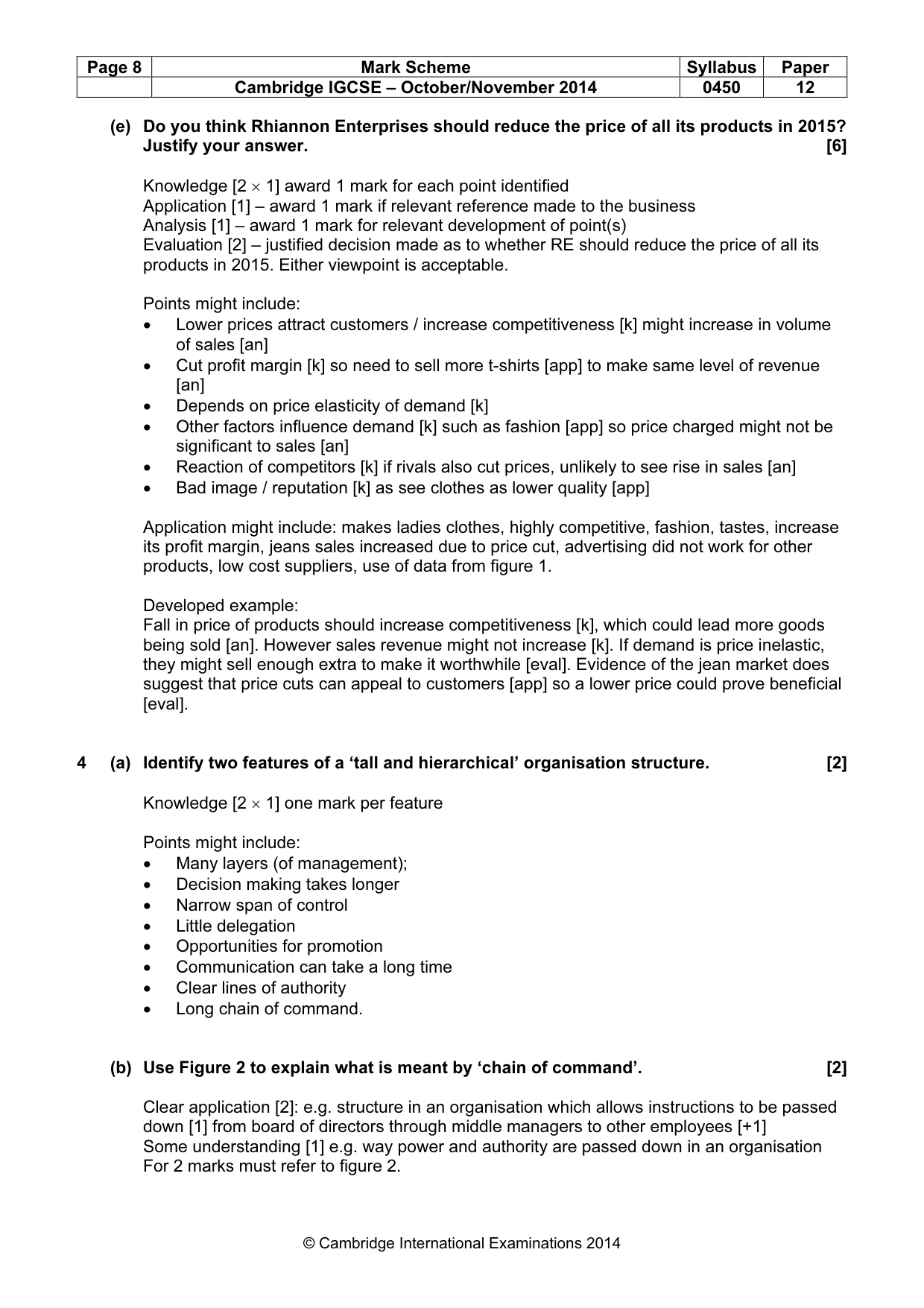
Page 8 Mark Scheme Syllabus Paper Cambridge IGCSE – October/November 2014 0450 12 © Cambridge International Examinations 2014 (e) Do you think Rhiannon Enterprises should reduce the price of all its products in 2015? Justify your answer. [6] Knowledge [2 × 1] award 1 mark for each point identified Application [1] – award 1 mark if relevant reference made to the business Analysis [1] – award 1 mark for relevant development of point(s) Evaluation [2] – justified decision made as to whether RE should reduce the price of all its products in 2015. Either viewpoint is acceptable. Points might include: • Lower prices attract customers / increase competitiveness [k] might increase in volume of sales [an] • Cut profit margin [k] so need to sell more t-shirts [app] to make same level of revenue [an] • Depends on price elasticity of demand [k] • Other factors influence demand [k] such as fashion [app] so price charged might not be significant to sales [an] • Reaction of competitors [k] if rivals also cut prices, unlikely to see rise in sales [an] • Bad image / reputation [k] as see clothes as lower quality [app] Application might include: makes ladies clothes, highly competitive, fashion, tastes, increase its profit margin, jeans sales increased due to price cut, advertising did not work for other products, low cost suppliers, use of data from figure 1. Developed example: Fall in price of products should increase competitiveness [k], which could lead more goods being sold [an]. However sales revenue might not increase [k]. If demand is price inelastic, they might sell enough extra to make it worthwhile [eval]. Evidence of the jean market does suggest that price cuts can appeal to customers [app] so a lower price could prove beneficial [eval]. 4 (a) Identify two features of a ‘tall and hierarchical’ organisation structure. [2] Knowledge [2 × 1] one mark per feature Points might include: • Many layers (of management); • Decision making takes longer • Narrow span of control • Little delegation • Opportunities for promotion • Communication can take a long time • Clear lines of authority • Long chain of command. (b) Use Figure 2 to explain what is meant by ‘chain of command’. [2] Clear application [2]: e.g. structure in an organisation which allows instructions to be passed down [1] from board of directors through middle managers to other employees [+1] Some understanding [1] e.g. way power and authority are passed down in an organisation For 2 marks must refer to figure 2.
Mark scheme, page 9
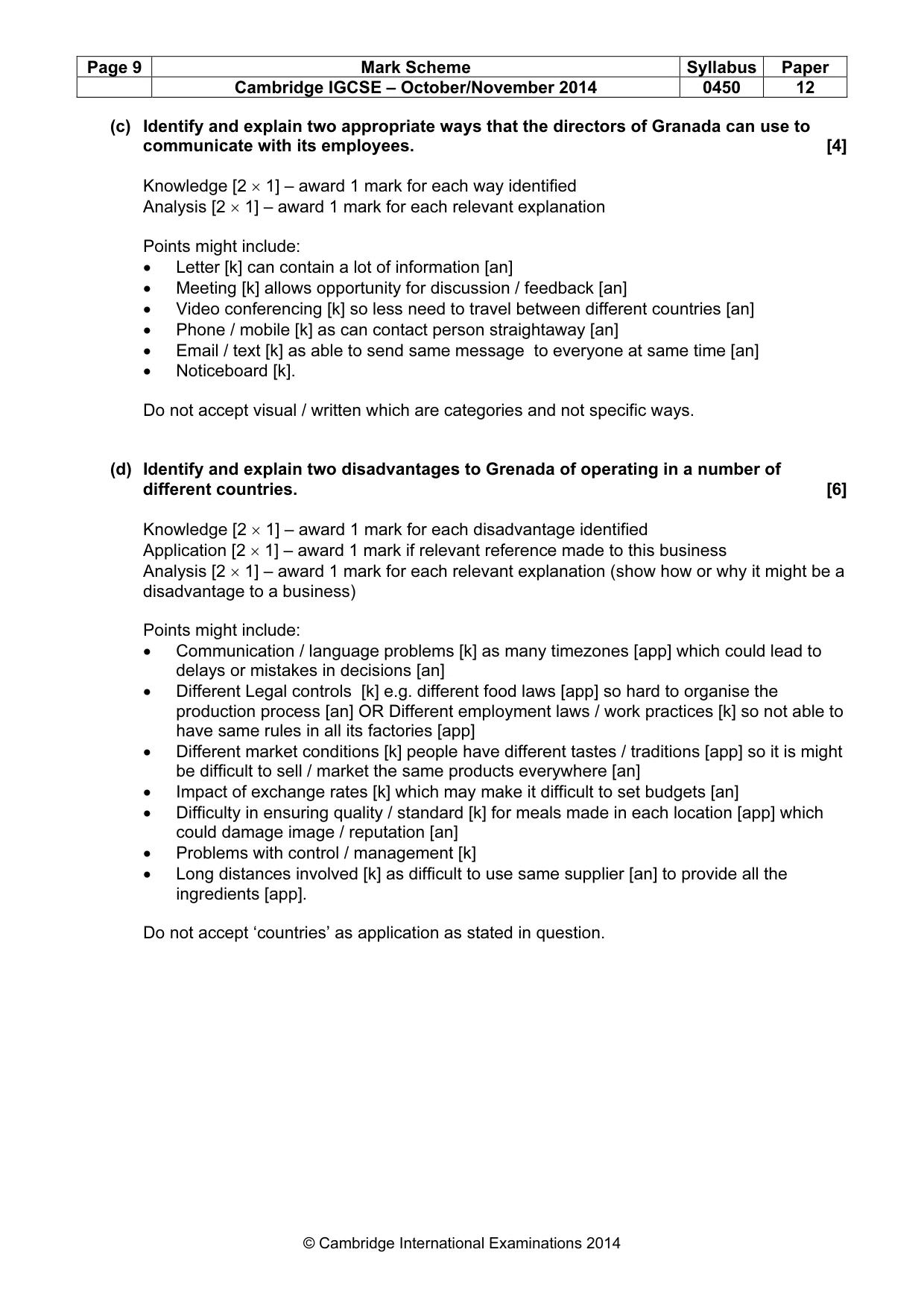
Page 9 Mark Scheme Syllabus Paper Cambridge IGCSE – October/November 2014 0450 12 © Cambridge International Examinations 2014 (c) Identify and explain two appropriate ways that the directors of Granada can use to communicate with its employees. [4] Knowledge [2 × 1] – award 1 mark for each way identified Analysis [2 × 1] – award 1 mark for each relevant explanation Points might include: • Letter [k] can contain a lot of information [an] • Meeting [k] allows opportunity for discussion / feedback [an] • Video conferencing [k] so less need to travel between different countries [an] • Phone / mobile [k] as can contact person straightaway [an] • Email / text [k] as able to send same message to everyone at same time [an] • Noticeboard [k]. Do not accept visual / written which are categories and not specific ways. (d) Identify and explain two disadvantages to Grenada of operating in a number of different countries. [6] Knowledge [2 × 1] – award 1 mark for each disadvantage identified Application [2 × 1] – award 1 mark if relevant reference made to this business Analysis [2 × 1] – award 1 mark for each relevant explanation (show how or why it might be a disadvantage to a business) Points might include: • Communication / language problems [k] as many timezones [app] which could lead to delays or mistakes in decisions [an] • Different Legal controls [k] e.g. different food laws [app] so hard to organise the production process [an] OR Different employment laws / work practices [k] so not able to have same rules in all its factories [app] • Different market conditions [k] people have different tastes / traditions [app] so it is might be difficult to sell / market the same products everywhere [an] • Impact of exchange rates [k] which may make it difficult to set budgets [an] • Difficulty in ensuring quality / standard [k] for meals made in each location [app] which could damage image / reputation [an] • Problems with control / management [k] • Long distances involved [k] as difficult to use same supplier [an] to provide all the ingredients [app]. Do not accept ‘countries’ as application as stated in question.
Mark scheme, page 10
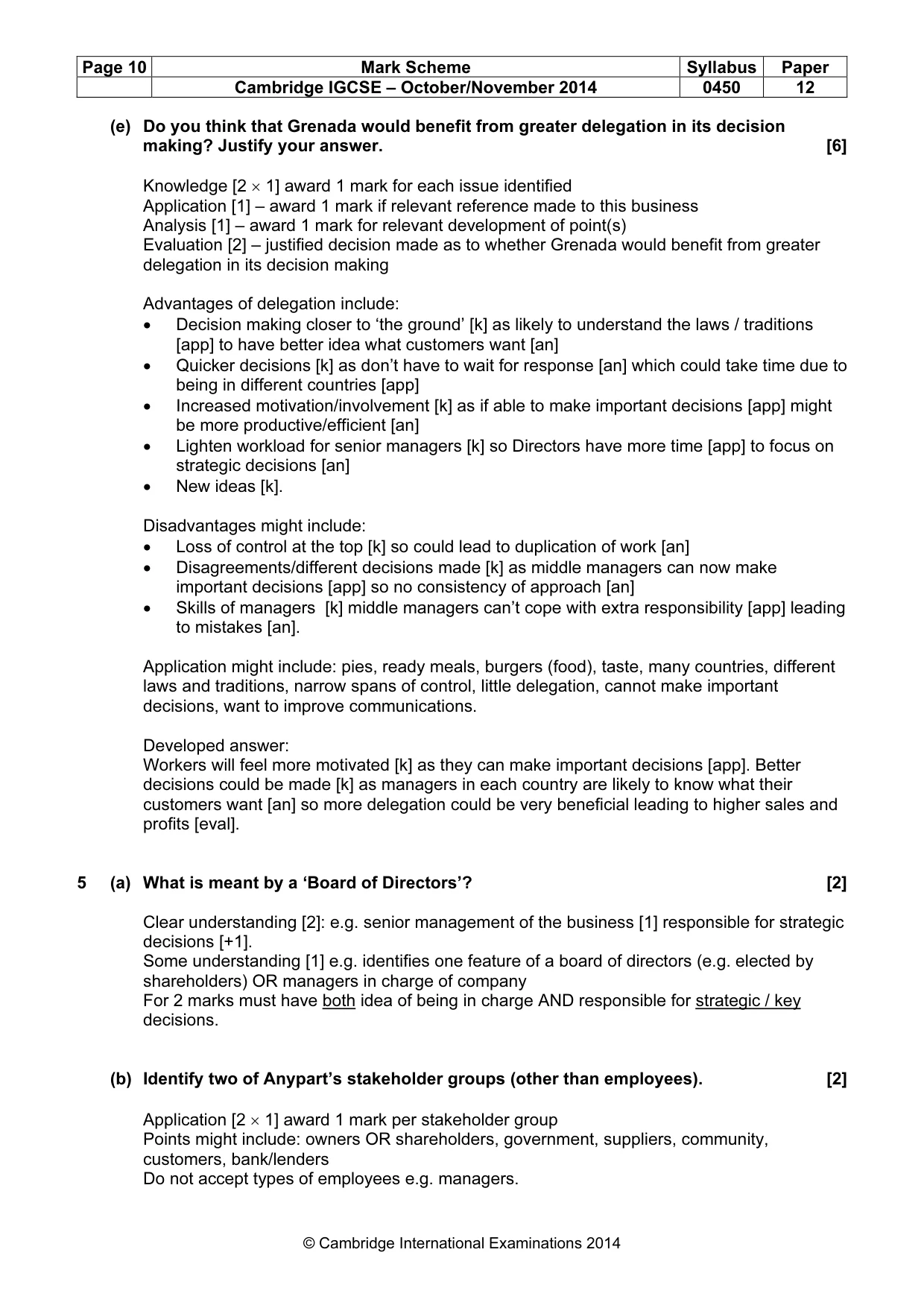
Page 10 Mark Scheme Syllabus Paper Cambridge IGCSE – October/November 2014 0450 12 © Cambridge International Examinations 2014 (e) Do you think that Grenada would benefit from greater delegation in its decision making? Justify your answer. [6] Knowledge [2 × 1] award 1 mark for each issue identified Application [1] – award 1 mark if relevant reference made to this business Analysis [1] – award 1 mark for relevant development of point(s) Evaluation [2] – justified decision made as to whether Grenada would benefit from greater delegation in its decision making Advantages of delegation include: • Decision making closer to ‘the ground’ [k] as likely to understand the laws / traditions [app] to have better idea what customers want [an] • Quicker decisions [k] as don’t have to wait for response [an] which could take time due to being in different countries [app] • Increased motivation/involvement [k] as if able to make important decisions [app] might be more productive/efficient [an] • Lighten workload for senior managers [k] so Directors have more time [app] to focus on strategic decisions [an] • New ideas [k]. Disadvantages might include: • Loss of control at the top [k] so could lead to duplication of work [an] • Disagreements/different decisions made [k] as middle managers can now make important decisions [app] so no consistency of approach [an] • Skills of managers [k] middle managers can’t cope with extra responsibility [app] leading to mistakes [an]. Application might include: pies, ready meals, burgers (food), taste, many countries, different laws and traditions, narrow spans of control, little delegation, cannot make important decisions, want to improve communications. Developed answer: Workers will feel more motivated [k] as they can make important decisions [app]. Better decisions could be made [k] as managers in each country are likely to know what their customers want [an] so more delegation could be very beneficial leading to higher sales and profits [eval]. 5 (a) What is meant by a ‘Board of Directors’? [2] Clear understanding [2]: e.g. senior management of the business [1] responsible for strategic decisions [+1]. Some understanding [1] e.g. identifies one feature of a board of directors (e.g. elected by shareholders) OR managers in charge of company For 2 marks must have both idea of being in charge AND responsible for strategic / key decisions. (b) Identify two of Anypart’s stakeholder groups (other than employees). [2] Application [2 × 1] award 1 mark per stakeholder group Points might include: owners OR shareholders, government, suppliers, community, customers, bank/lenders Do not accept types of employees e.g. managers.
Mark scheme, page 11
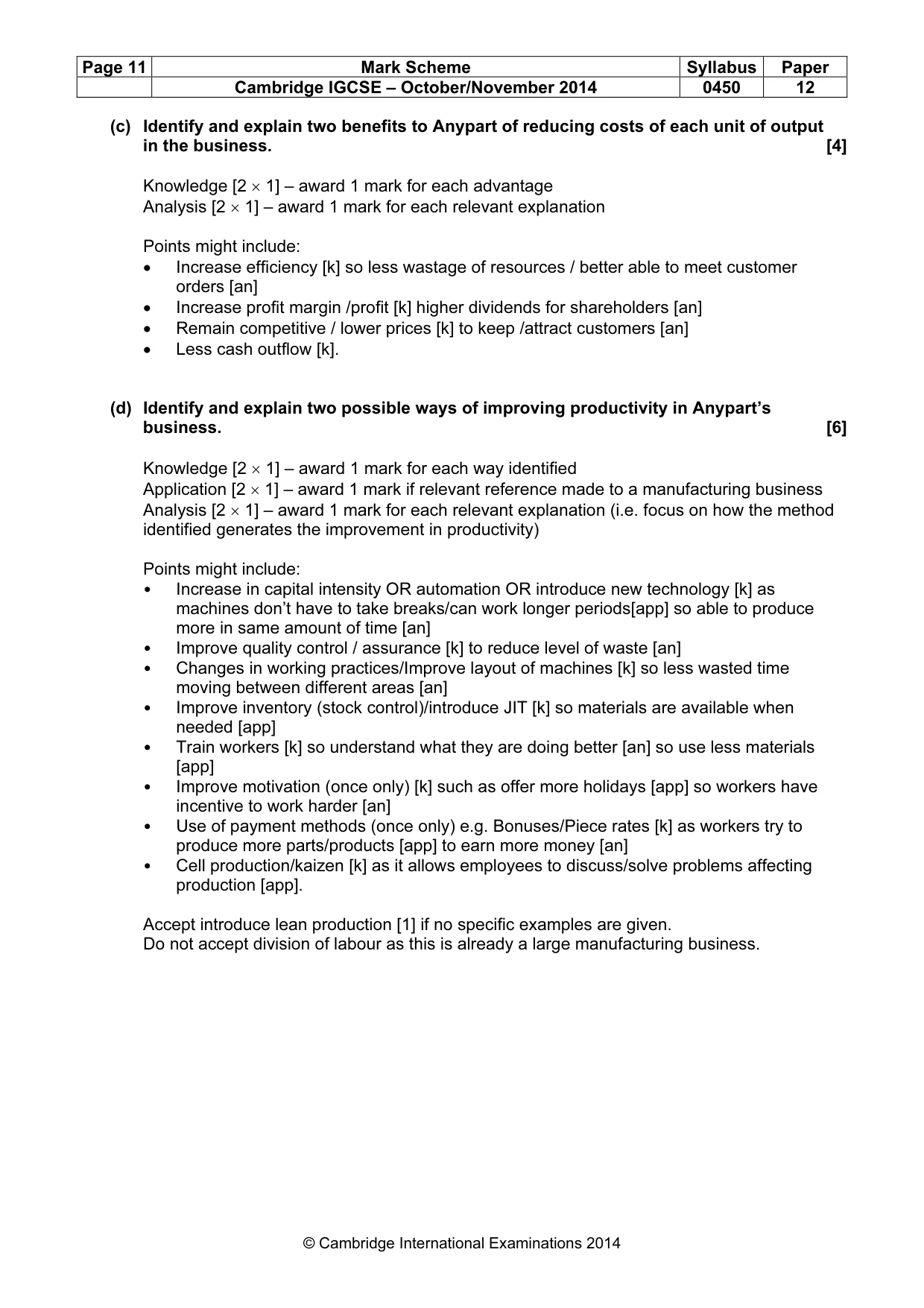
Page 11 Mark Scheme Syllabus Paper Cambridge IGCSE – October/November 2014 0450 12 © Cambridge International Examinations 2014 (c) Identify and explain two benefits to Anypart of reducing costs of each unit of output in the business. [4] Knowledge [2 × 1] – award 1 mark for each advantage Analysis [2 × 1] – award 1 mark for each relevant explanation Points might include: • Increase efficiency [k] so less wastage of resources / better able to meet customer orders [an] • Increase profit margin /profit [k] higher dividends for shareholders [an] • Remain competitive / lower prices [k] to keep /attract customers [an] • Less cash outflow [k]. (d) Identify and explain two possible ways of improving productivity in Anypart’s business. [6] Knowledge [2 × 1] – award 1 mark for each way identified Application [2 × 1] – award 1 mark if relevant reference made to a manufacturing business Analysis [2 × 1] – award 1 mark for each relevant explanation (i.e. focus on how the method identified generates the improvement in productivity) Points might include: • Increase in capital intensity OR automation OR introduce new technology [k] as machines don’t have to take breaks/can work longer periods[app] so able to produce more in same amount of time [an] • Improve quality control / assurance [k] to reduce level of waste [an] • Changes in working practices/Improve layout of machines [k] so less wasted time moving between different areas [an] • Improve inventory (stock control)/introduce JIT [k] so materials are available when needed [app] • Train workers [k] so understand what they are doing better [an] so use less materials [app] • Improve motivation (once only) [k] such as offer more holidays [app] so workers have incentive to work harder [an] • Use of payment methods (once only) e.g. Bonuses/Piece rates [k] as workers try to produce more parts/products [app] to earn more money [an] • Cell production/kaizen [k] as it allows employees to discuss/solve problems affecting production [app]. Accept introduce lean production [1] if no specific examples are given. Do not accept division of labour as this is already a large manufacturing business.
Mark scheme, page 12
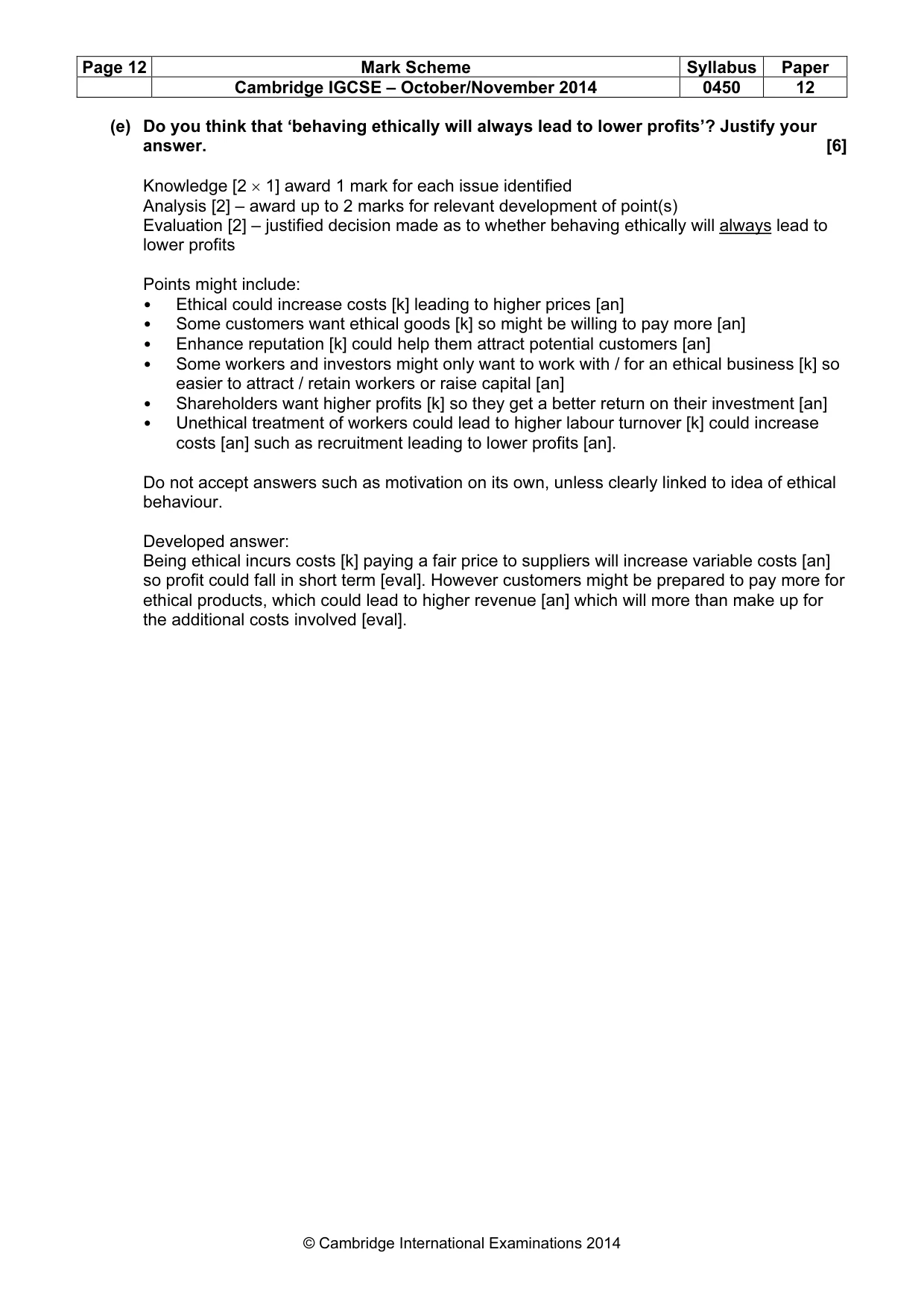
Page 12 Mark Scheme Syllabus Paper Cambridge IGCSE – October/November 2014 0450 12 © Cambridge International Examinations 2014 (e) Do you think that ‘behaving ethically will always lead to lower profits’? Justify your answer. [6] Knowledge [2 × 1] award 1 mark for each issue identified Analysis [2] – award up to 2 marks for relevant development of point(s) Evaluation [2] – justified decision made as to whether behaving ethically will always lead to lower profits Points might include: • Ethical could increase costs [k] leading to higher prices [an] • Some customers want ethical goods [k] so might be willing to pay more [an] • Enhance reputation [k] could help them attract potential customers [an] • Some workers and investors might only want to work with / for an ethical business [k] so easier to attract / retain workers or raise capital [an] • Shareholders want higher profits [k] so they get a better return on their investment [an] • Unethical treatment of workers could lead to higher labour turnover [k] could increase costs [an] such as recruitment leading to lower profits [an]. Do not accept answers such as motivation on its own, unless clearly linked to idea of ethical behaviour. Developed answer: Being ethical incurs costs [k] paying a fair price to suppliers will increase variable costs [an] so profit could fall in short term [eval]. However customers might be prepared to pay more for ethical products, which could lead to higher revenue [an] which will more than make up for the additional costs involved [eval].
What you needed in this session
Cambridge’s own grade thresholds for 2014 Oct/Nov, Paper 1 · Variant 2. A higher threshold means an easier paper — the bar moves with how the cohort did.