Cambridge IGCSE Business Studies 0450 — 2014 Oct/Nov Paper 1 · Variant 3
0450/13/O/N/14 · 100 marks · ≈113 min
The question paper and its mark scheme, free to read here and free to download. This is Cambridge’s own paper, exactly as it was sat.
Question paper12 pages

Mark scheme11 pages
Answers below. Sit the paper first if you are practising.
Paper as text
Question paper, page 1
This document consists of 11 printed pages and 1 blank page. DC (CW) 79795/2 © UCLES 2014 [Turn over Cambridge International Examinations Cambridge International General Certificate of Secondary Education * 8 5 0 9 2 6 3 9 9 5 * BUSINESS STUDIES 0450/13 Paper 1 October/November 2014 1 hour 45 minutes Candidates answer on the Question Paper. No Additional Materials are required. READ THESE INSTRUCTIONS FIRST Write your Centre number, candidate number and name on all the work you hand in. Write in dark blue or black pen. Do not use staples, paper clips, glue or correction fluid. DO NOT WRITE IN ANY BARCODES. Answer all questions. The businesses described in this question paper are entirely fictitious. At the end of the examination, fasten all your work securely together. The number of marks is given in brackets [ ] at the end of each question or part question. The syllabus is approved for use in England, Wales and Northern Ireland as a Cambridge International Level 1/Level 2 Certificate.
Question paper, page 2
2 0450/13/O/N/14 © UCLES 2014 1 Rafa is the Managing Director of Cambridge Fencing (CF), a limited company that makes fences and gates. The business employs 100 workers. They are paid a low basic wage but can earn high bonuses for good productivity. Recently a large number of employees have left to work for other companies. However CF finds it easy to recruit new workers. The business has been successful but last year its sales and profits fell. Rafa wants this to change. (a) What is meant by a ‘limited company’? … … … …[2] (b) Identity two reasons why profits are important to CF. Reason 1: … … Reason 2: … …[2] (c) Identify and explain two advantages to CF of its employee payment system. Advantage 1: … … Explanation: … … Advantage 2: … … Explanation: … …[4]
Question paper, page 3
3 0450/13/O/N/14 © UCLES 2014 [Turn over (d) Identify and explain two ways that CF could use to increase its sales. Way 1: … … Explanation: … … … … Way 2: … … Explanation: … … … …[6] (e) Do you think that it is important that CF reduces the number of employees leaving the company? Justify your answer. … … … … … … … … … … … …[6]
Question paper, page 4
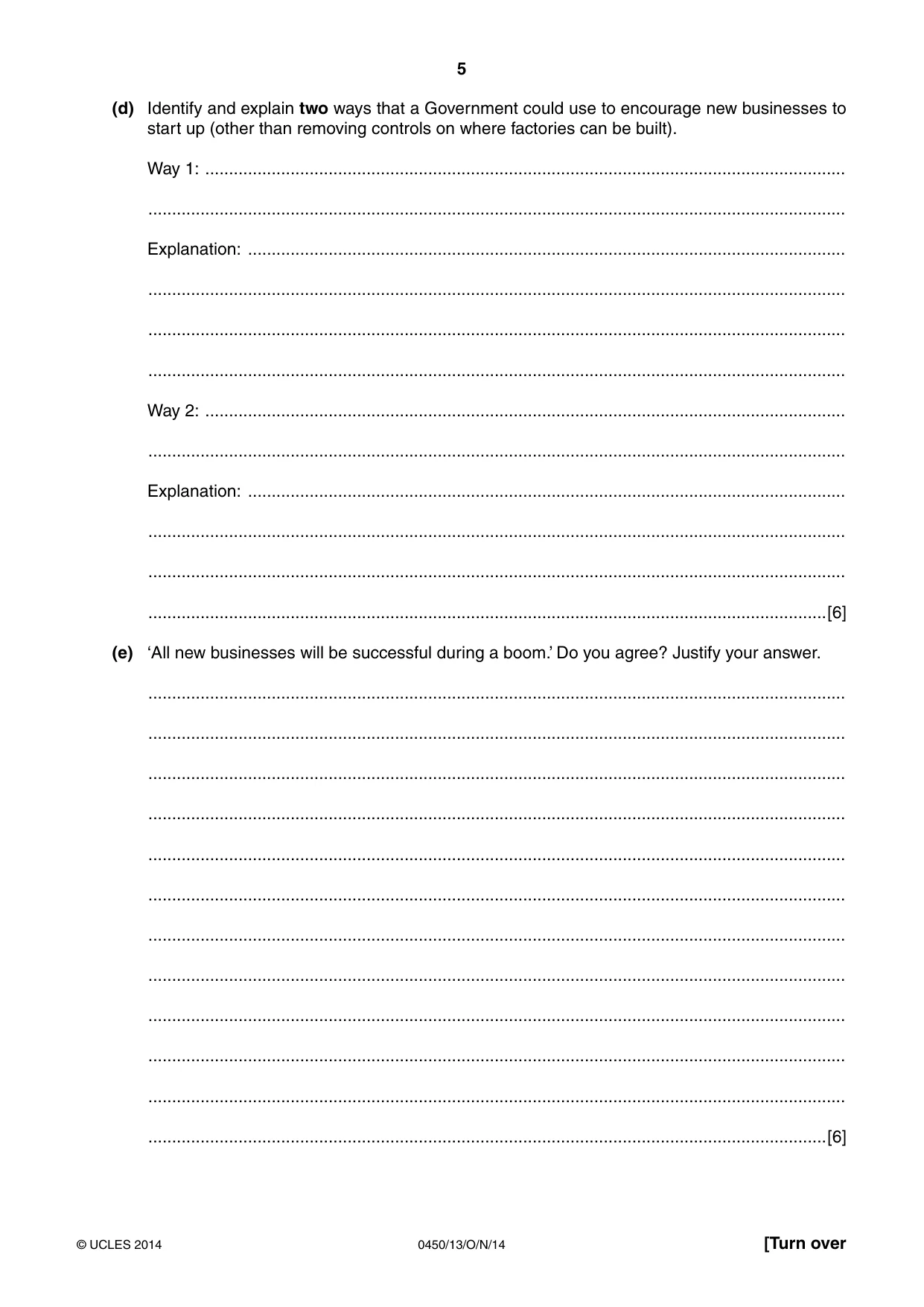
4 0450/13/O/N/14 © UCLES 2014 2 The economy of country Z is booming. Its Government wants to create more manufacturing jobs by making it easier for new businesses to start up and build new factories. Recently a Government minister said: ‘All new businesses will be successful during a boom’. Controls on where new factories can be built are to be removed. Some pressure groups are against this idea because they believe that new businesses create external (social) costs. (a) Identify two features of a ‘boom’. Feature 1: … … Feature 2: … …[2] (b) What is meant by a ‘pressure group’? … … … …[2] (c) Identify and explain two external (social) costs that might be created by building new factories. Cost 1: … … Explanation: … … Cost 2: … … Explanation: … …[4]
Question paper, page 5
5 0450/13/O/N/14 © UCLES 2014 [Turn over (d) Identify and explain two ways that a Government could use to encourage new businesses to start up (other than removing controls on where factories can be built). Way 1: … … Explanation: … … … … Way 2: … … Explanation: … … … …[6] (e) ‘All new businesses will be successful during a boom.’ Do you agree? Justify your answer. … … … … … … … … … … … …[6]
Question paper, page 6
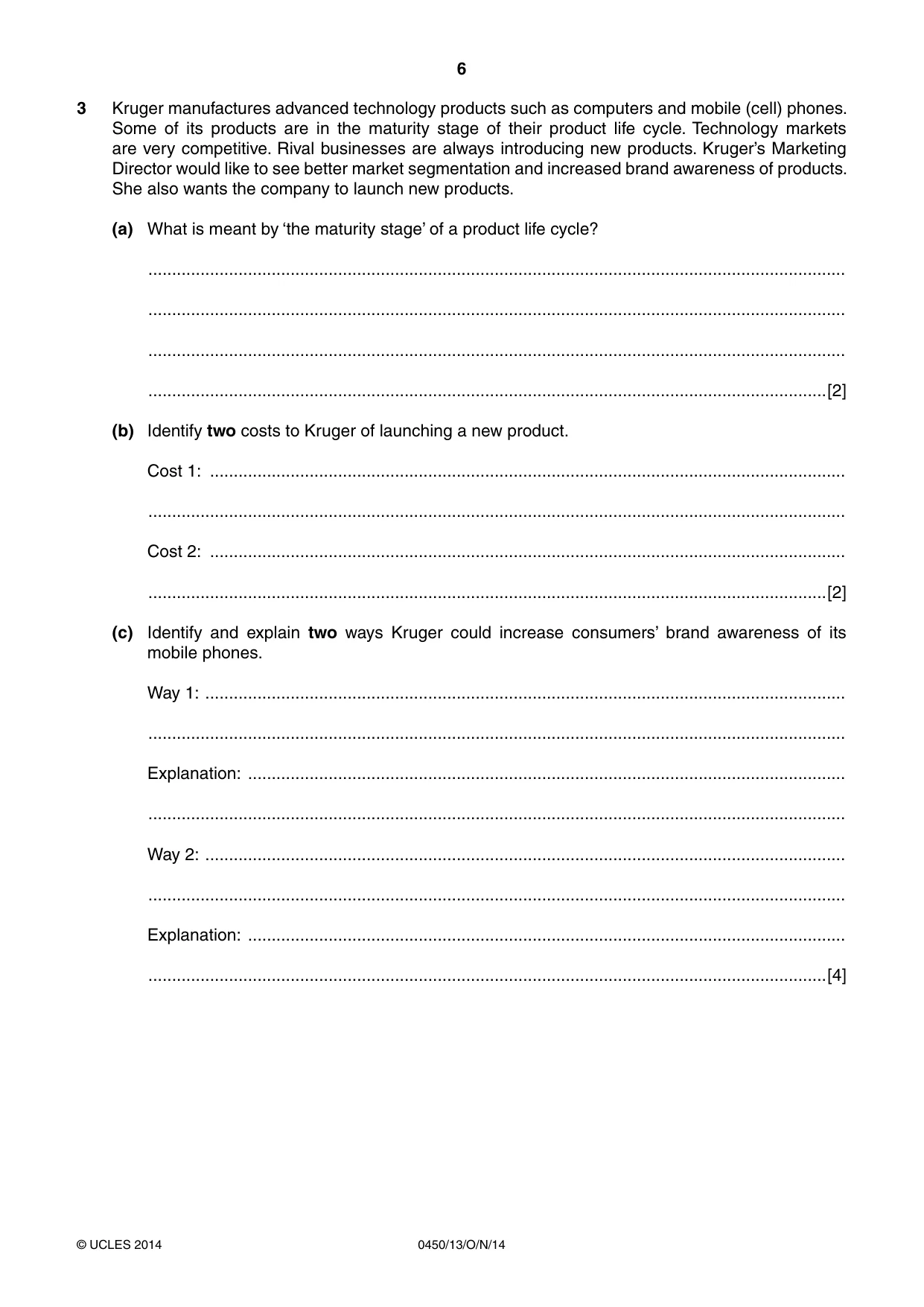
6 0450/13/O/N/14 © UCLES 2014 3 Kruger manufactures advanced technology products such as computers and mobile (cell) phones. Some of its products are in the maturity stage of their product life cycle. Technology markets are very competitive. Rival businesses are always introducing new products. Kruger’s Marketing Director would like to see better market segmentation and increased brand awareness of products. She also wants the company to launch new products. (a) What is meant by ‘the maturity stage’ of a product life cycle? … … … …[2] (b) Identify two costs to Kruger of launching a new product. Cost 1: … … Cost 2: … …[2] (c) Identify and explain two ways Kruger could increase consumers’ brand awareness of its mobile phones. Way 1: … … Explanation: … … Way 2: … … Explanation: … …[4]
Question paper, page 7
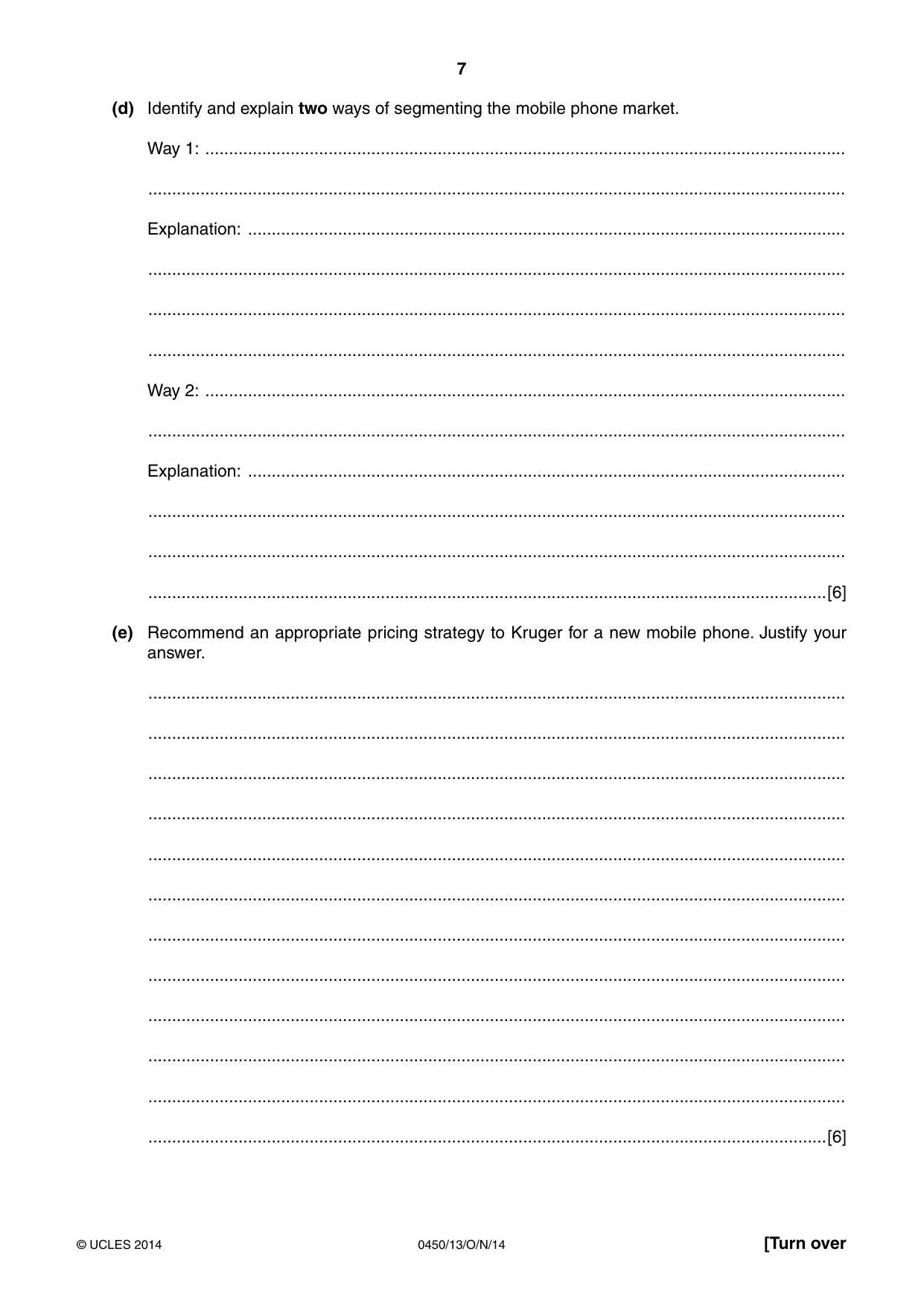
7 0450/13/O/N/14 © UCLES 2014 [Turn over (d) Identify and explain two ways of segmenting the mobile phone market. Way 1: … … Explanation: … … … … Way 2: … … Explanation: … … … …[6] (e) Recommend an appropriate pricing strategy to Kruger for a new mobile phone. Justify your answer. … … … … … … … … … … … …[6]
Question paper, page 8
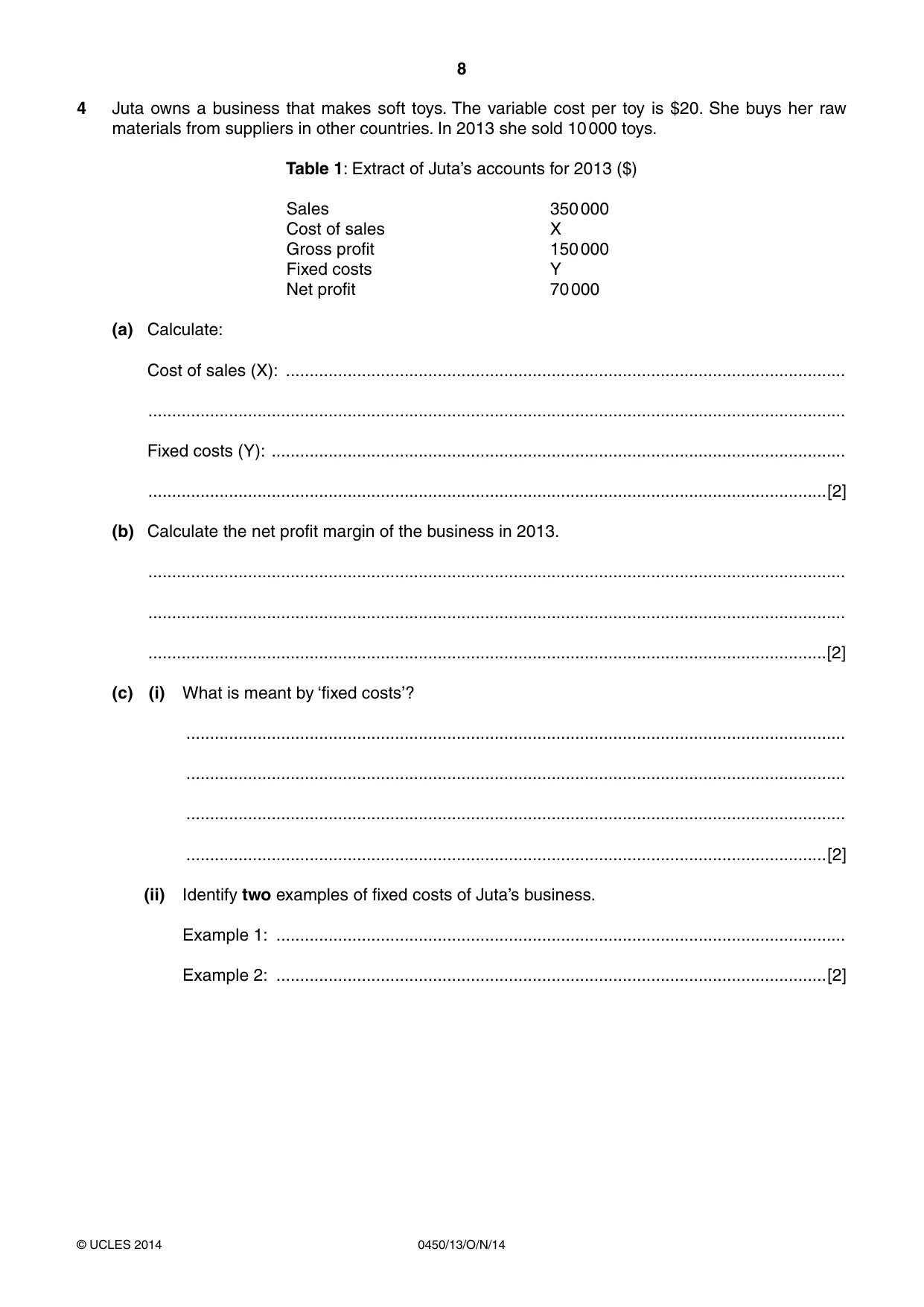
8 0450/13/O/N/14 © UCLES 2014 4 Juta owns a business that makes soft toys. The variable cost per toy is $20. She buys her raw materials from suppliers in other countries. In 2013 she sold 10 000 toys. Table 1: Extract of Juta’s accounts for 2013 ($) Sales 350 000 Cost of sales X Gross profit 150 000 Fixed costs Y Net profit 70 000 (a) Calculate: Cost of sales (X): … … Fixed costs (Y): … …[2] (b) Calculate the net profit margin of the business in 2013. … … …[2] (c) (i) What is meant by ‘fixed costs’? … … … …[2] (ii) Identify two examples of fixed costs of Juta’s business. Example 1: … Example 2: …[2]
Question paper, page 9
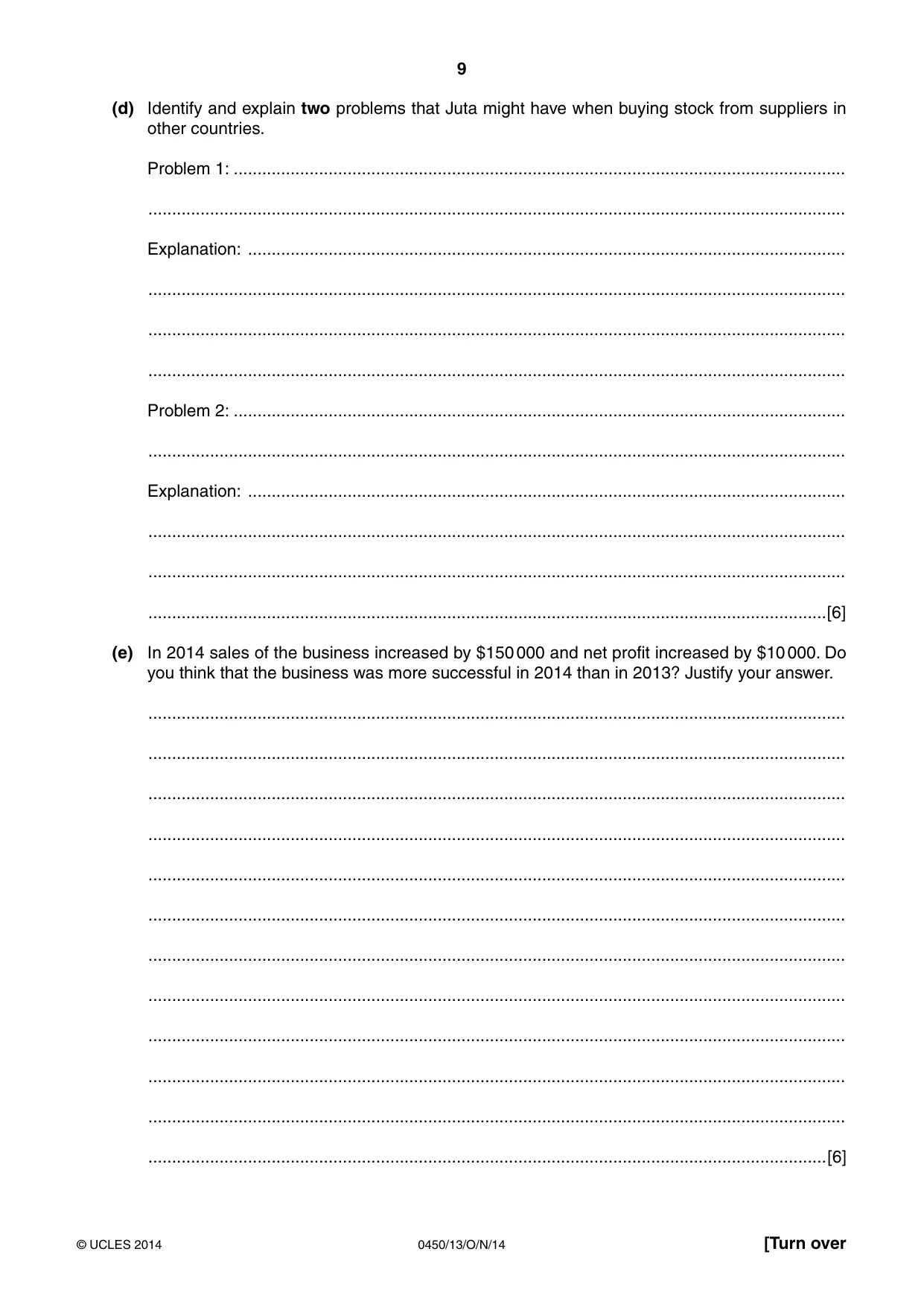
9 0450/13/O/N/14 © UCLES 2014 [Turn over (d) Identify and explain two problems that Juta might have when buying stock from suppliers in other countries. Problem 1: … … Explanation: … … … … Problem 2: … … Explanation: … … … …[6] (e) In 2014 sales of the business increased by $150 000 and net profit increased by $10 000. Do you think that the business was more successful in 2014 than in 2013? Justify your answer. … … … … … … … … … … … …[6]
Question paper, page 10
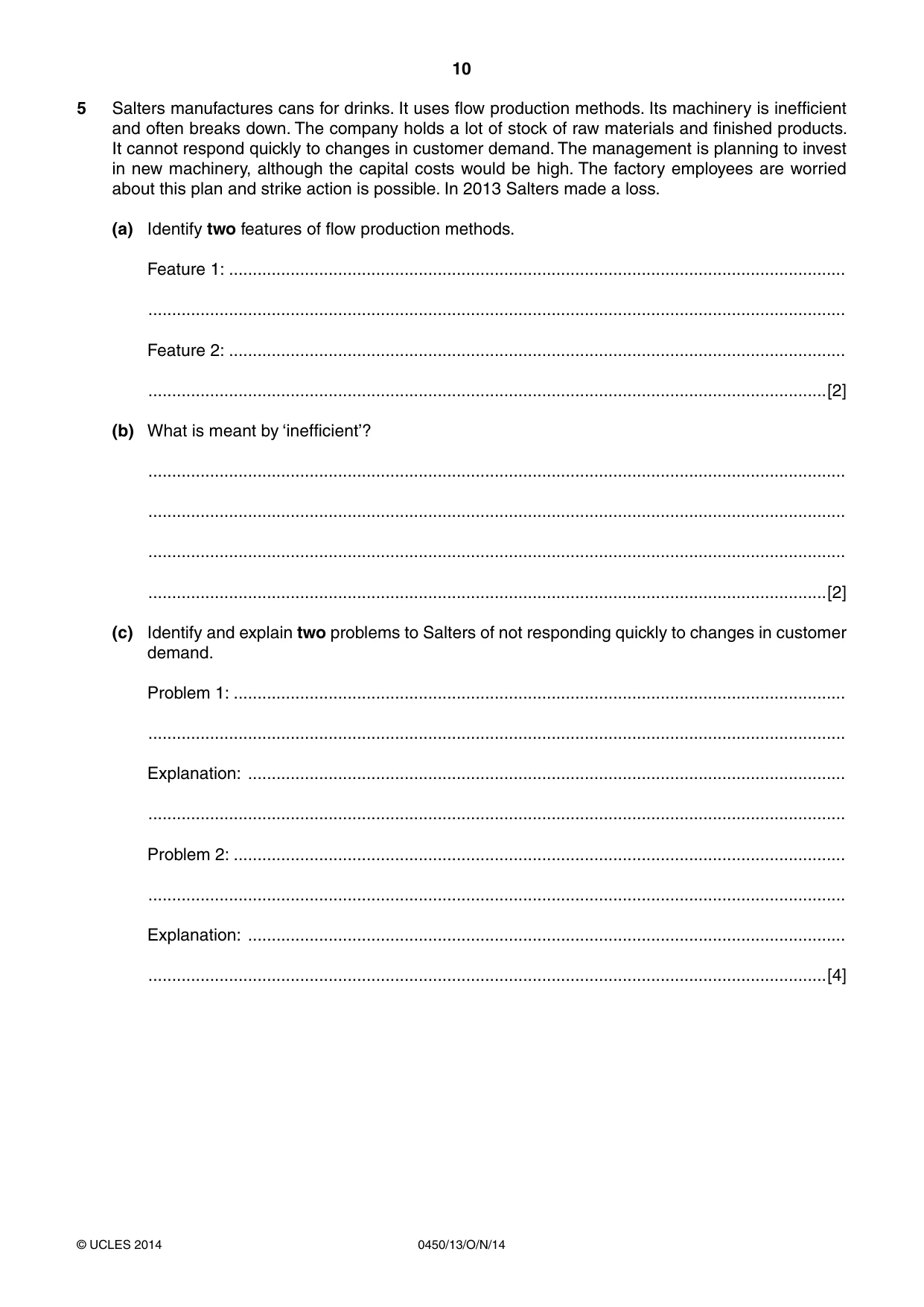
10 0450/13/O/N/14 © UCLES 2014 5 Salters manufactures cans for drinks. It uses flow production methods. Its machinery is inefficient and often breaks down. The company holds a lot of stock of raw materials and finished products. It cannot respond quickly to changes in customer demand. The management is planning to invest in new machinery, although the capital costs would be high. The factory employees are worried about this plan and strike action is possible. In 2013 Salters made a loss. (a) Identify two features of flow production methods. Feature 1: … … Feature 2: … …[2] (b) What is meant by ‘inefficient’? … … … …[2] (c) Identify and explain two problems to Salters of not responding quickly to changes in customer demand. Problem 1: … … Explanation: … … Problem 2: … … Explanation: … …[4]
Question paper, page 11
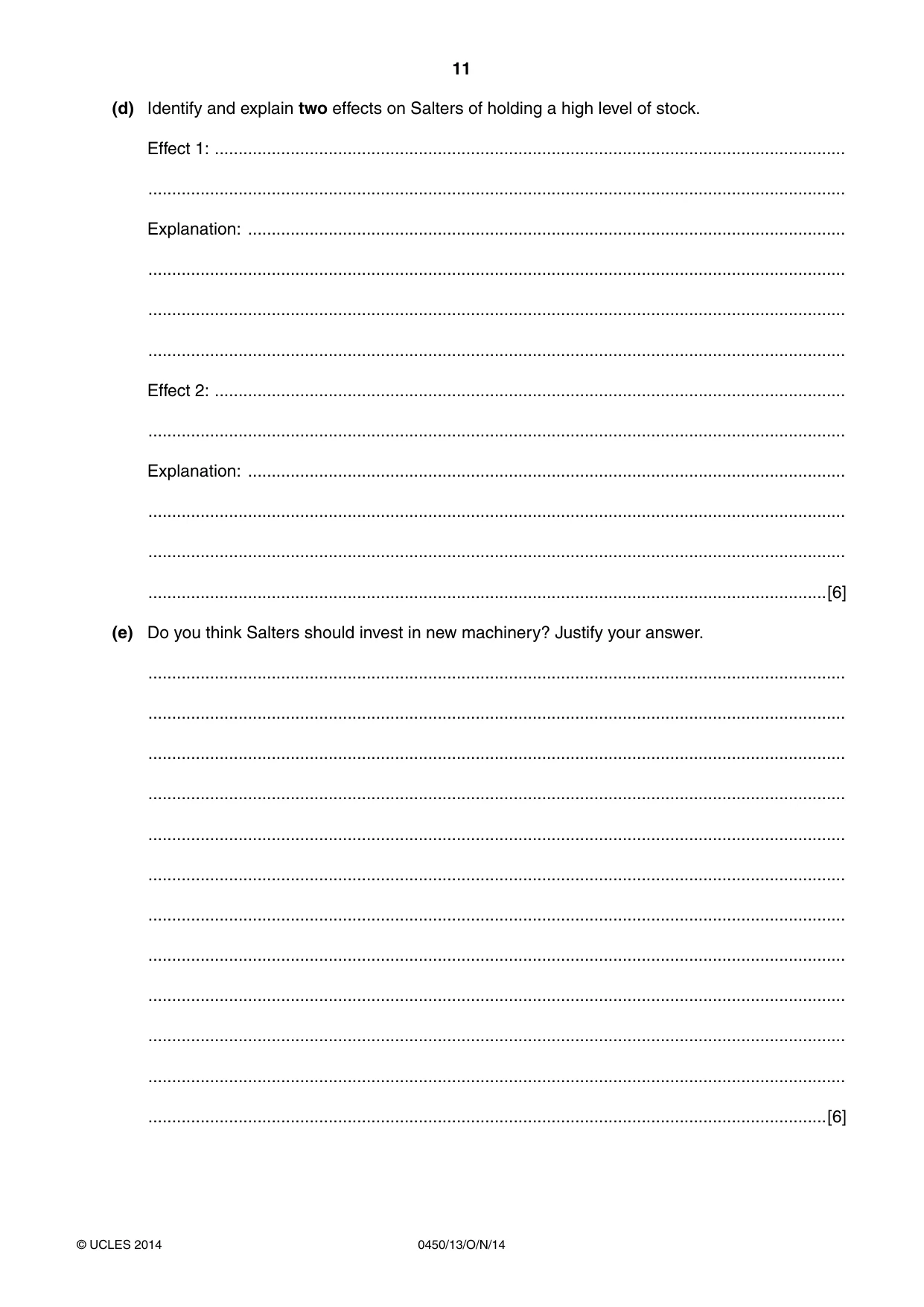
11 0450/13/O/N/14 © UCLES 2014 (d) Identify and explain two effects on Salters of holding a high level of stock. Effect 1: … … Explanation: … … … … Effect 2: … … Explanation: … … … …[6] (e) Do you think Salters should invest in new machinery? Justify your answer. … … … … … … … … … … … …[6]
Question paper, page 12
12 0450/13/O/N/14 © UCLES 2014 BLANK PAGE Permission to reproduce items where third-party owned material protected by copyright is included has been sought and cleared where possible. Every reasonable effort has been made by the publisher (UCLES) to trace copyright holders, but if any items requiring clearance have unwittingly been included, the publisher will be pleased to make amends at the earliest possible opportunity. Cambridge International Examinations is part of the Cambridge Assessment Group. Cambridge Assessment is the brand name of University of Cambridge Local Examinations Syndicate (UCLES), which is itself a department of the University of Cambridge.
Mark scheme, page 1
® IGCSE is the registered trademark of Cambridge International Examinations. CAMBRIDGE INTERNATIONAL EXAMINATIONS Cambridge International General Certificate of Secondary Education MARK SCHEME for the October/November 2014 series 0450 BUSINESS STUDIES 0450/13 Paper 1 (Short Answer/Structured Response), maximum raw mark 100 This mark scheme is published as an aid to teachers and candidates, to indicate the requirements of the examination. It shows the basis on which Examiners were instructed to award marks. It does not indicate the details of the discussions that took place at an Examiners’ meeting before marking began, which would have considered the acceptability of alternative answers. Mark schemes should be read in conjunction with the question paper and the Principal Examiner Report for Teachers. Cambridge will not enter into discussions about these mark schemes. Cambridge is publishing the mark schemes for the October/November 2014 series for most Cambridge IGCSE®, Cambridge International A and AS Level components and some Cambridge O Level components.
Mark scheme, page 2
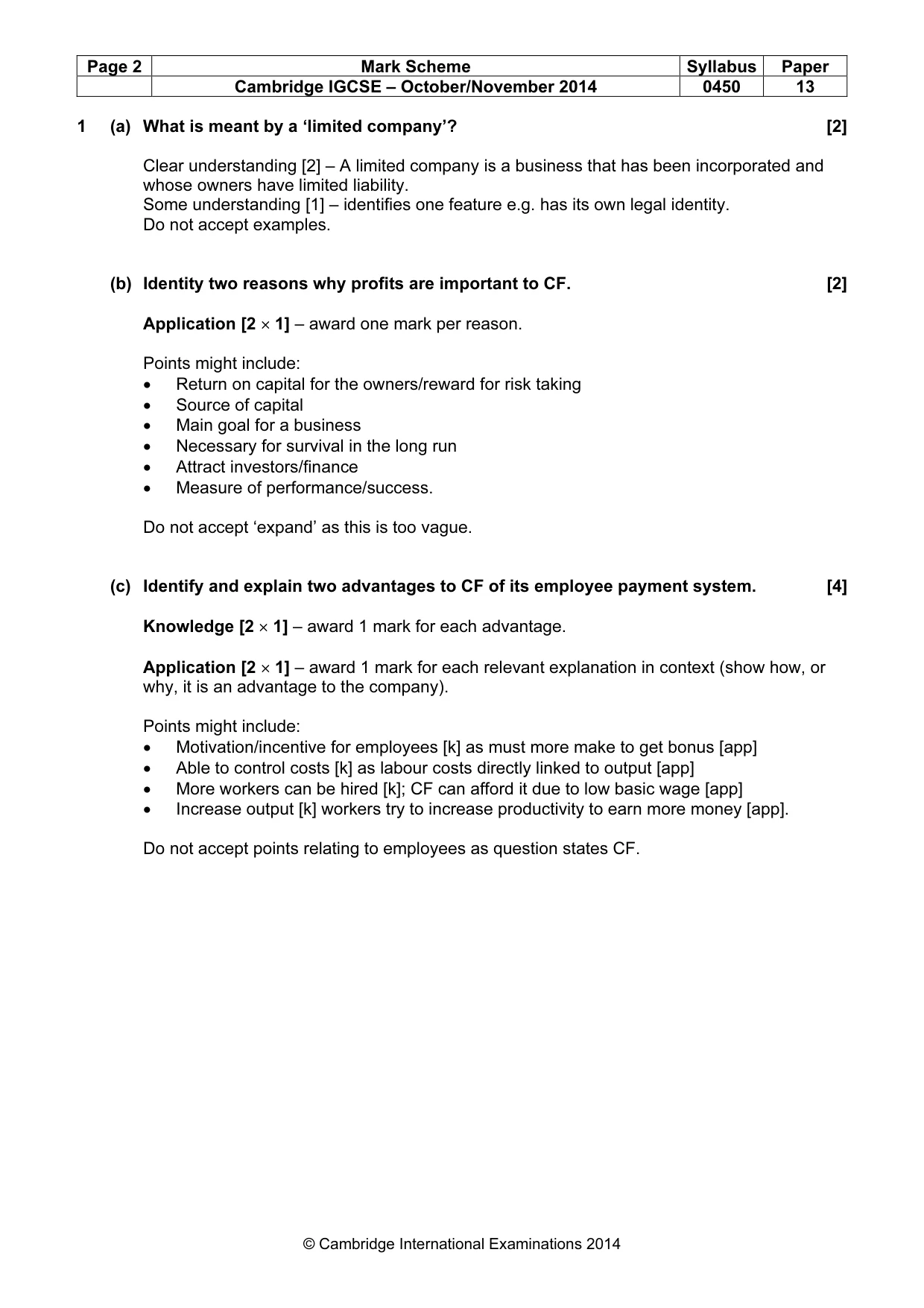
Page 2 Mark Scheme Syllabus Paper Cambridge IGCSE – October/November 2014 0450 13 © Cambridge International Examinations 2014 1 (a) What is meant by a ‘limited company’? [2] Clear understanding [2] – A limited company is a business that has been incorporated and whose owners have limited liability. Some understanding [1] – identifies one feature e.g. has its own legal identity. Do not accept examples. (b) Identity two reasons why profits are important to CF. [2] Application [2 × 1] – award one mark per reason. Points might include: • Return on capital for the owners/reward for risk taking • Source of capital • Main goal for a business • Necessary for survival in the long run • Attract investors/finance • Measure of performance/success. Do not accept ‘expand’ as this is too vague. (c) Identify and explain two advantages to CF of its employee payment system. [4] Knowledge [2 × 1] – award 1 mark for each advantage. Application [2 × 1] – award 1 mark for each relevant explanation in context (show how, or why, it is an advantage to the company). Points might include: • Motivation/incentive for employees [k] as must more make to get bonus [app] • Able to control costs [k] as labour costs directly linked to output [app] • More workers can be hired [k]; CF can afford it due to low basic wage [app] • Increase output [k] workers try to increase productivity to earn more money [app]. Do not accept points relating to employees as question states CF.
Mark scheme, page 3
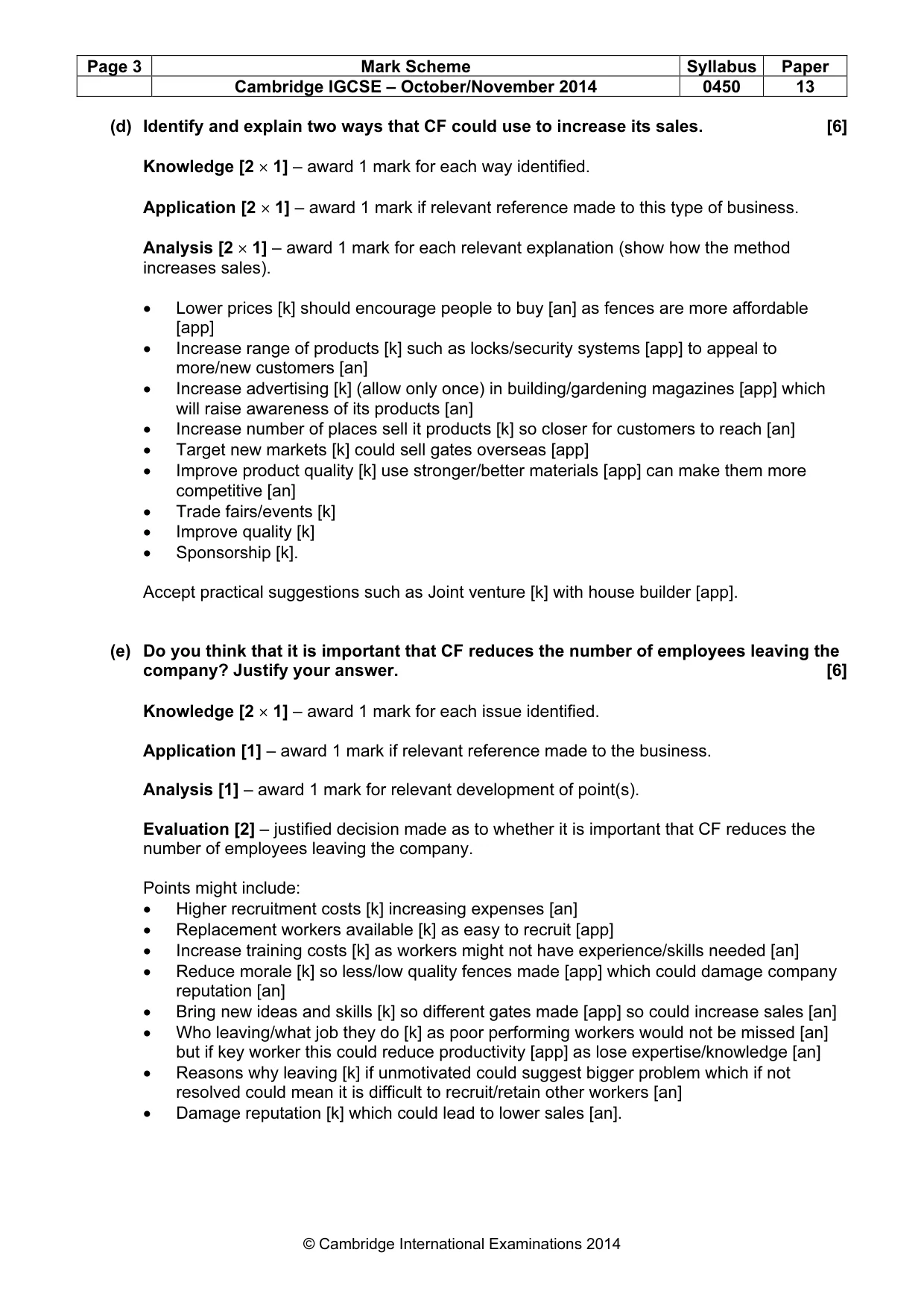
Page 3 Mark Scheme Syllabus Paper Cambridge IGCSE – October/November 2014 0450 13 © Cambridge International Examinations 2014 (d) Identify and explain two ways that CF could use to increase its sales. [6] Knowledge [2 × 1] – award 1 mark for each way identified. Application [2 × 1] – award 1 mark if relevant reference made to this type of business. Analysis [2 × 1] – award 1 mark for each relevant explanation (show how the method increases sales). • Lower prices [k] should encourage people to buy [an] as fences are more affordable [app] • Increase range of products [k] such as locks/security systems [app] to appeal to more/new customers [an] • Increase advertising [k] (allow only once) in building/gardening magazines [app] which will raise awareness of its products [an] • Increase number of places sell it products [k] so closer for customers to reach [an] • Target new markets [k] could sell gates overseas [app] • Improve product quality [k] use stronger/better materials [app] can make them more competitive [an] • Trade fairs/events [k] • Improve quality [k] • Sponsorship [k]. Accept practical suggestions such as Joint venture [k] with house builder [app]. (e) Do you think that it is important that CF reduces the number of employees leaving the company? Justify your answer. [6] Knowledge [2 × 1] – award 1 mark for each issue identified. Application [1] – award 1 mark if relevant reference made to the business. Analysis [1] – award 1 mark for relevant development of point(s). Evaluation [2] – justified decision made as to whether it is important that CF reduces the number of employees leaving the company. Points might include: • Higher recruitment costs [k] increasing expenses [an] • Replacement workers available [k] as easy to recruit [app] • Increase training costs [k] as workers might not have experience/skills needed [an] • Reduce morale [k] so less/low quality fences made [app] which could damage company reputation [an] • Bring new ideas and skills [k] so different gates made [app] so could increase sales [an] • Who leaving/what job they do [k] as poor performing workers would not be missed [an] but if key worker this could reduce productivity [app] as lose expertise/knowledge [an] • Reasons why leaving [k] if unmotivated could suggest bigger problem which if not resolved could mean it is difficult to recruit/retain other workers [an] • Damage reputation [k] which could lead to lower sales [an].
Mark scheme, page 4
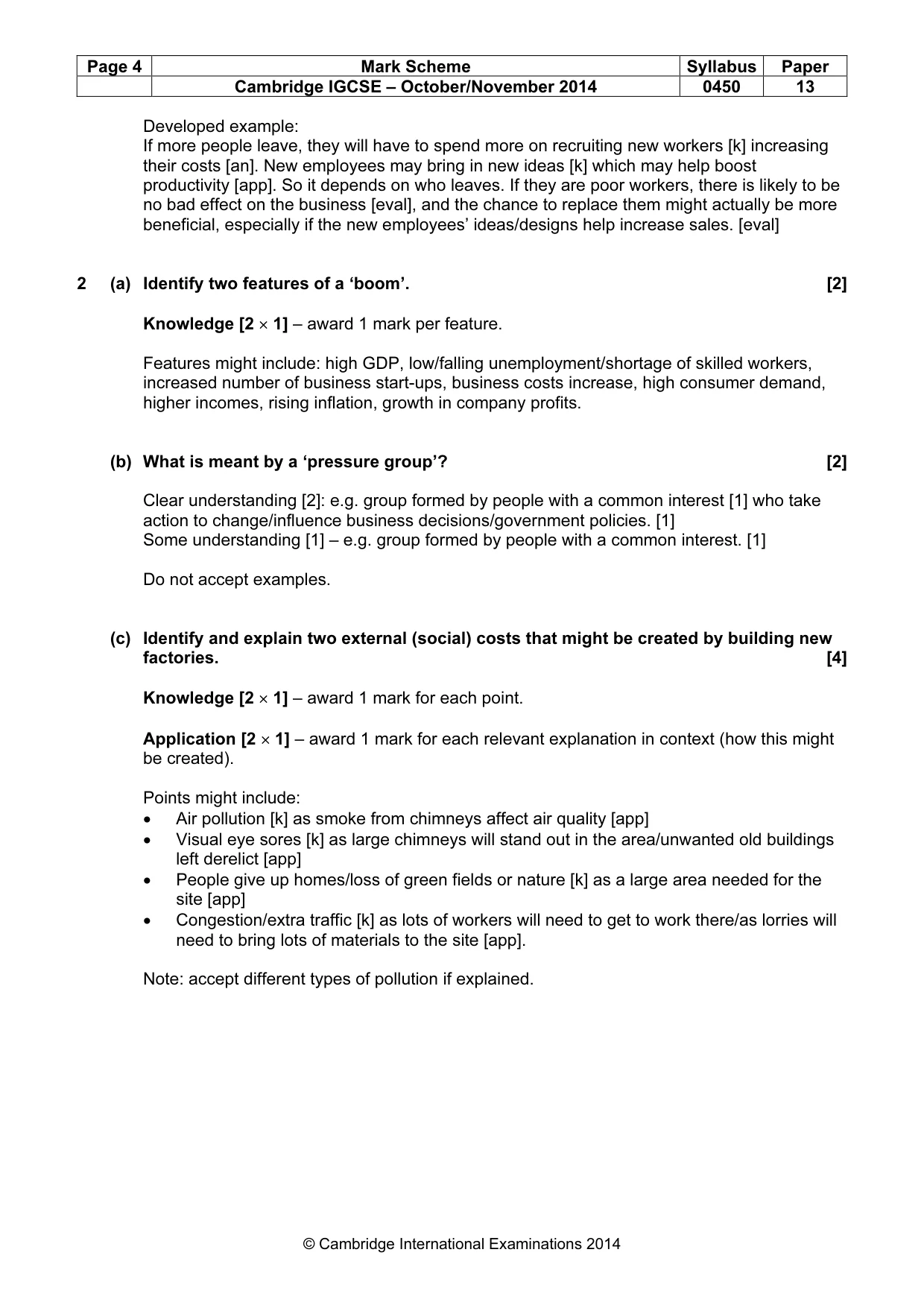
Page 4 Mark Scheme Syllabus Paper Cambridge IGCSE – October/November 2014 0450 13 © Cambridge International Examinations 2014 Developed example: If more people leave, they will have to spend more on recruiting new workers [k] increasing their costs [an]. New employees may bring in new ideas [k] which may help boost productivity [app]. So it depends on who leaves. If they are poor workers, there is likely to be no bad effect on the business [eval], and the chance to replace them might actually be more beneficial, especially if the new employees’ ideas/designs help increase sales. [eval] 2 (a) Identify two features of a ‘boom’. [2] Knowledge [2 × 1] – award 1 mark per feature. Features might include: high GDP, low/falling unemployment/shortage of skilled workers, increased number of business start-ups, business costs increase, high consumer demand, higher incomes, rising inflation, growth in company profits. (b) What is meant by a ‘pressure group’? [2] Clear understanding [2]: e.g. group formed by people with a common interest [1] who take action to change/influence business decisions/government policies. [1] Some understanding [1] – e.g. group formed by people with a common interest. [1] Do not accept examples. (c) Identify and explain two external (social) costs that might be created by building new factories. [4] Knowledge [2 × 1] – award 1 mark for each point. Application [2 × 1] – award 1 mark for each relevant explanation in context (how this might be created). Points might include: • Air pollution [k] as smoke from chimneys affect air quality [app] • Visual eye sores [k] as large chimneys will stand out in the area/unwanted old buildings left derelict [app] • People give up homes/loss of green fields or nature [k] as a large area needed for the site [app] • Congestion/extra traffic [k] as lots of workers will need to get to work there/as lorries will need to bring lots of materials to the site [app]. Note: accept different types of pollution if explained.
Mark scheme, page 5
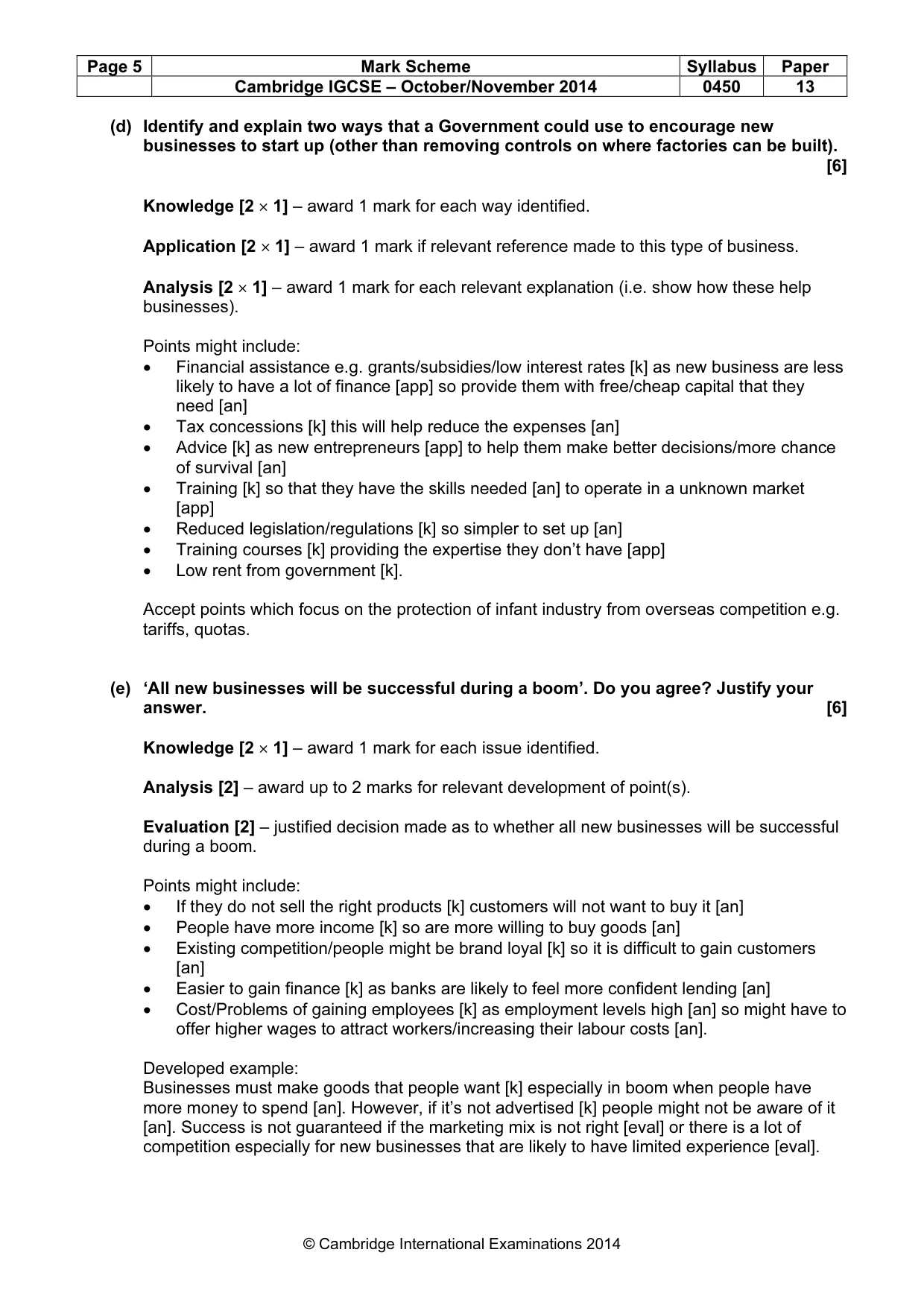
Page 5 Mark Scheme Syllabus Paper Cambridge IGCSE – October/November 2014 0450 13 © Cambridge International Examinations 2014 (d) Identify and explain two ways that a Government could use to encourage new businesses to start up (other than removing controls on where factories can be built). [6] Knowledge [2 × 1] – award 1 mark for each way identified. Application [2 × 1] – award 1 mark if relevant reference made to this type of business. Analysis [2 × 1] – award 1 mark for each relevant explanation (i.e. show how these help businesses). Points might include: • Financial assistance e.g. grants/subsidies/low interest rates [k] as new business are less likely to have a lot of finance [app] so provide them with free/cheap capital that they need [an] • Tax concessions [k] this will help reduce the expenses [an] • Advice [k] as new entrepreneurs [app] to help them make better decisions/more chance of survival [an] • Training [k] so that they have the skills needed [an] to operate in a unknown market [app] • Reduced legislation/regulations [k] so simpler to set up [an] • Training courses [k] providing the expertise they don’t have [app] • Low rent from government [k]. Accept points which focus on the protection of infant industry from overseas competition e.g. tariffs, quotas. (e) ‘All new businesses will be successful during a boom’. Do you agree? Justify your answer. [6] Knowledge [2 × 1] – award 1 mark for each issue identified. Analysis [2] – award up to 2 marks for relevant development of point(s). Evaluation [2] – justified decision made as to whether all new businesses will be successful during a boom. Points might include: • If they do not sell the right products [k] customers will not want to buy it [an] • People have more income [k] so are more willing to buy goods [an] • Existing competition/people might be brand loyal [k] so it is difficult to gain customers [an] • Easier to gain finance [k] as banks are likely to feel more confident lending [an] • Cost/Problems of gaining employees [k] as employment levels high [an] so might have to offer higher wages to attract workers/increasing their labour costs [an]. Developed example: Businesses must make goods that people want [k] especially in boom when people have more money to spend [an]. However, if it’s not advertised [k] people might not be aware of it [an]. Success is not guaranteed if the marketing mix is not right [eval] or there is a lot of competition especially for new businesses that are likely to have limited experience [eval].
Mark scheme, page 6
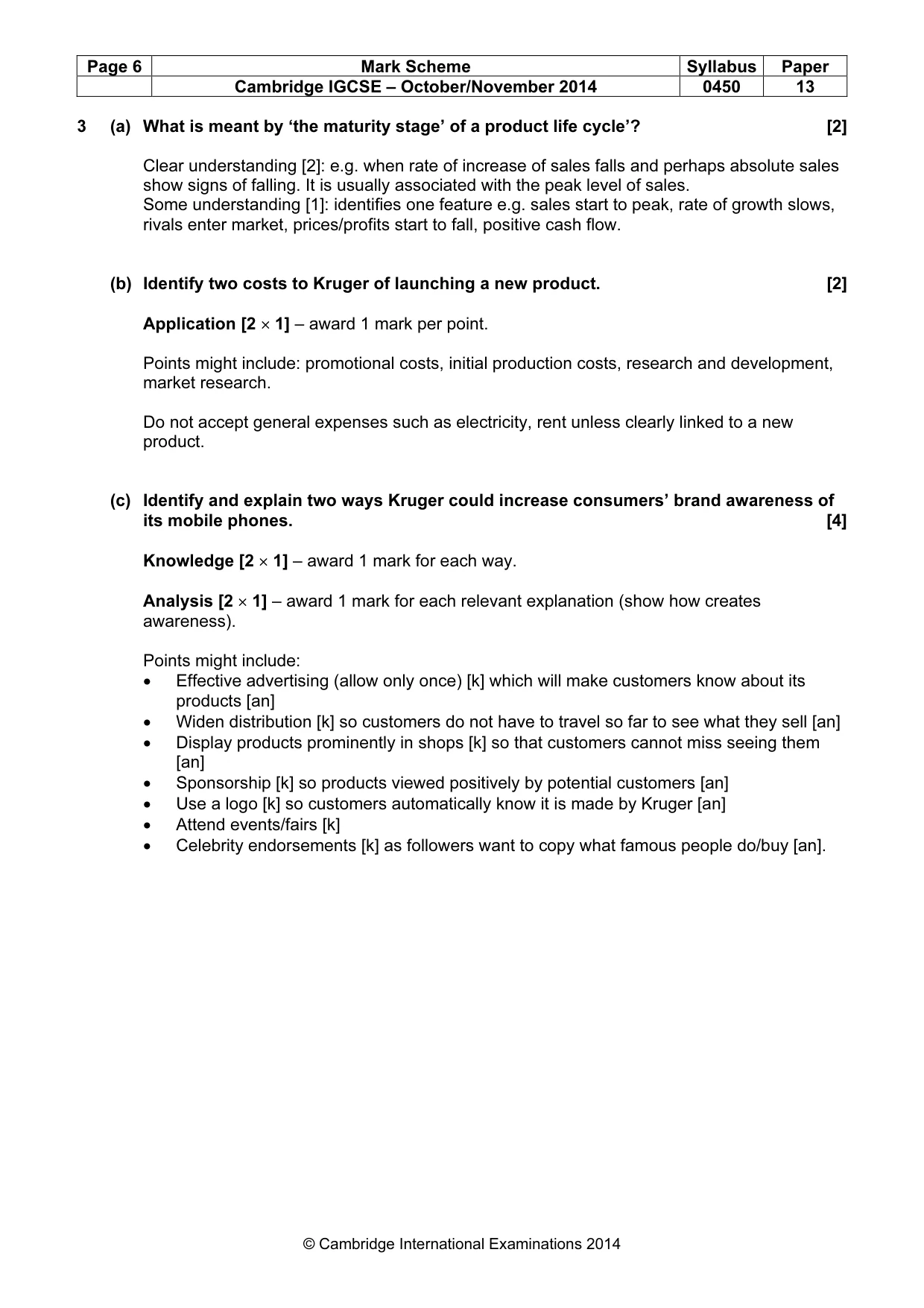
Page 6 Mark Scheme Syllabus Paper Cambridge IGCSE – October/November 2014 0450 13 © Cambridge International Examinations 2014 3 (a) What is meant by ‘the maturity stage’ of a product life cycle’? [2] Clear understanding [2]: e.g. when rate of increase of sales falls and perhaps absolute sales show signs of falling. It is usually associated with the peak level of sales. Some understanding [1]: identifies one feature e.g. sales start to peak, rate of growth slows, rivals enter market, prices/profits start to fall, positive cash flow. (b) Identify two costs to Kruger of launching a new product. [2] Application [2 × 1] – award 1 mark per point. Points might include: promotional costs, initial production costs, research and development, market research. Do not accept general expenses such as electricity, rent unless clearly linked to a new product. (c) Identify and explain two ways Kruger could increase consumers’ brand awareness of its mobile phones. [4] Knowledge [2 × 1] – award 1 mark for each way. Analysis [2 × 1] – award 1 mark for each relevant explanation (show how creates awareness). Points might include: • Effective advertising (allow only once) [k] which will make customers know about its products [an] • Widen distribution [k] so customers do not have to travel so far to see what they sell [an] • Display products prominently in shops [k] so that customers cannot miss seeing them [an] • Sponsorship [k] so products viewed positively by potential customers [an] • Use a logo [k] so customers automatically know it is made by Kruger [an] • Attend events/fairs [k] • Celebrity endorsements [k] as followers want to copy what famous people do/buy [an].
Mark scheme, page 7
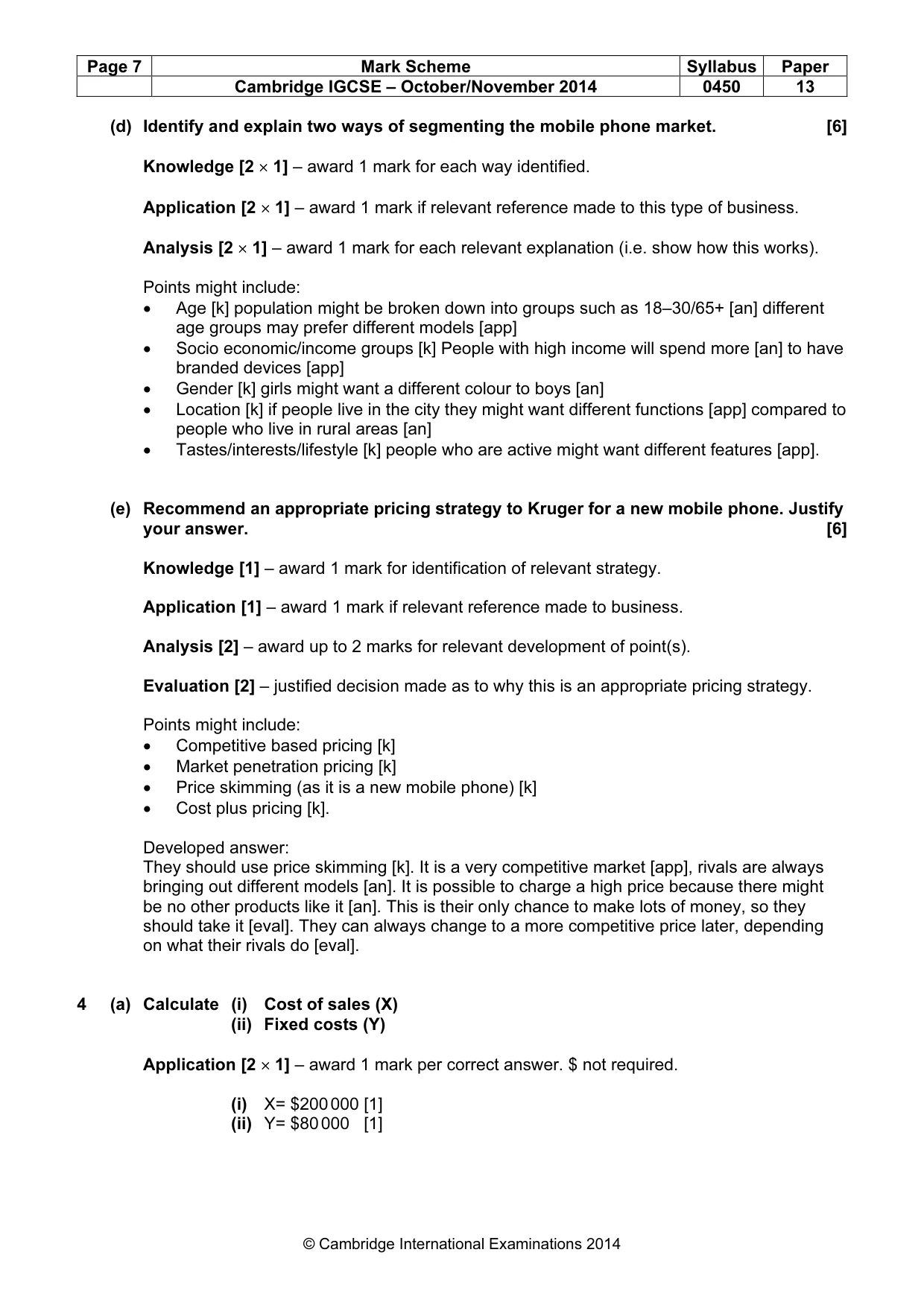
Page 7 Mark Scheme Syllabus Paper Cambridge IGCSE – October/November 2014 0450 13 © Cambridge International Examinations 2014 (d) Identify and explain two ways of segmenting the mobile phone market. [6] Knowledge [2 × 1] – award 1 mark for each way identified. Application [2 × 1] – award 1 mark if relevant reference made to this type of business. Analysis [2 × 1] – award 1 mark for each relevant explanation (i.e. show how this works). Points might include: • Age [k] population might be broken down into groups such as 18–30/65+ [an] different age groups may prefer different models [app] • Socio economic/income groups [k] People with high income will spend more [an] to have branded devices [app] • Gender [k] girls might want a different colour to boys [an] • Location [k] if people live in the city they might want different functions [app] compared to people who live in rural areas [an] • Tastes/interests/lifestyle [k] people who are active might want different features [app]. (e) Recommend an appropriate pricing strategy to Kruger for a new mobile phone. Justify your answer. [6] Knowledge [1] – award 1 mark for identification of relevant strategy. Application [1] – award 1 mark if relevant reference made to business. Analysis [2] – award up to 2 marks for relevant development of point(s). Evaluation [2] – justified decision made as to why this is an appropriate pricing strategy. Points might include: • Competitive based pricing [k] • Market penetration pricing [k] • Price skimming (as it is a new mobile phone) [k] • Cost plus pricing [k]. Developed answer: They should use price skimming [k]. It is a very competitive market [app], rivals are always bringing out different models [an]. It is possible to charge a high price because there might be no other products like it [an]. This is their only chance to make lots of money, so they should take it [eval]. They can always change to a more competitive price later, depending on what their rivals do [eval]. 4 (a) Calculate (i) Cost of sales (X) (ii) Fixed costs (Y) Application [2 × 1] – award 1 mark per correct answer. $ not required. (i) X= $200 000 [1] (ii) Y= $80 000 [1]
Mark scheme, page 8
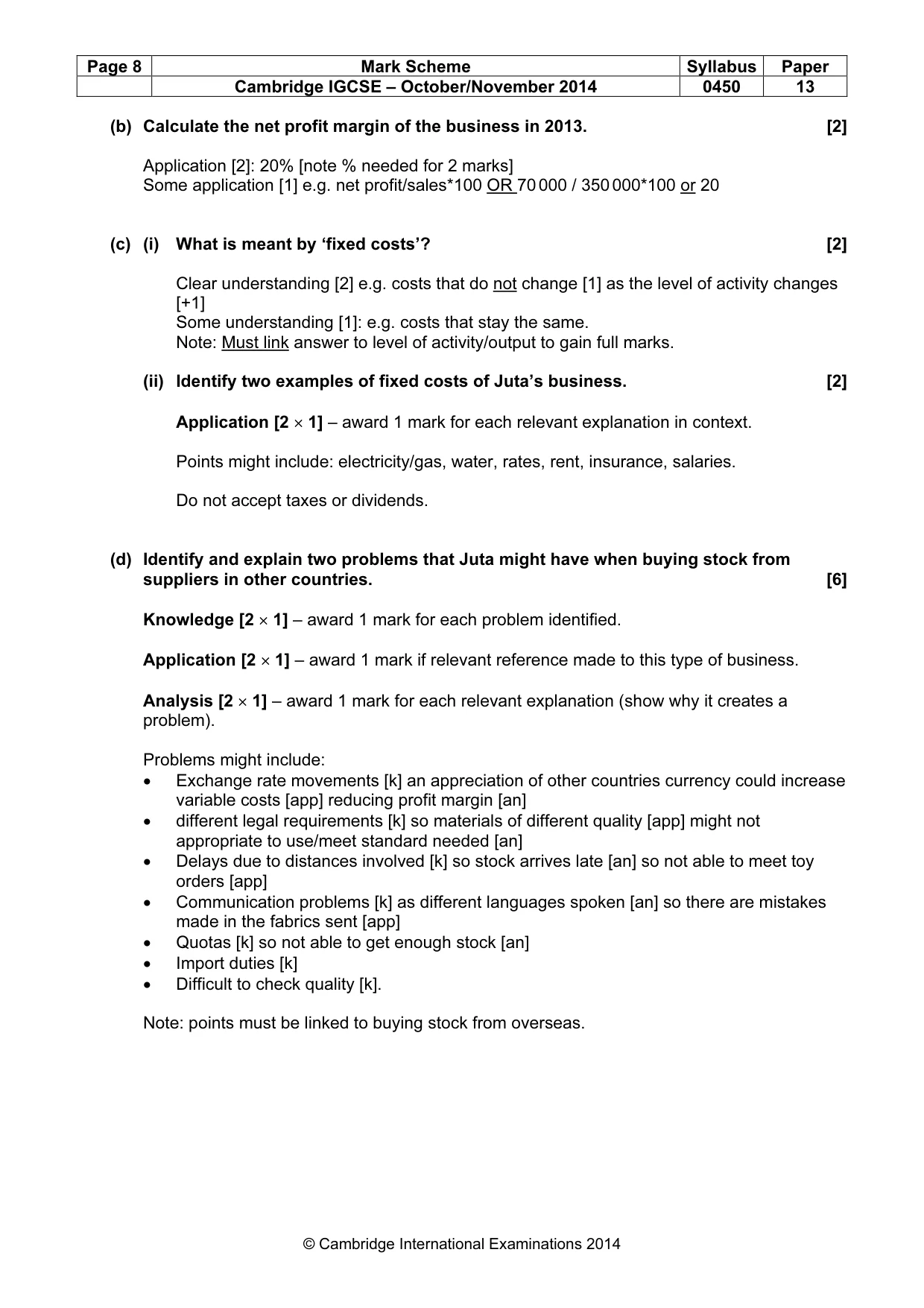
Page 8 Mark Scheme Syllabus Paper Cambridge IGCSE – October/November 2014 0450 13 © Cambridge International Examinations 2014 (b) Calculate the net profit margin of the business in 2013. [2] Application [2]: 20% [note % needed for 2 marks] Some application [1] e.g. net profit/sales*100 OR 70 000 / 350 000*100 or 20 (c) (i) What is meant by ‘fixed costs’? [2] Clear understanding [2] e.g. costs that do not change [1] as the level of activity changes [+1] Some understanding [1]: e.g. costs that stay the same. Note: Must link answer to level of activity/output to gain full marks. (ii) Identify two examples of fixed costs of Juta’s business. [2] Application [2 × 1] – award 1 mark for each relevant explanation in context. Points might include: electricity/gas, water, rates, rent, insurance, salaries. Do not accept taxes or dividends. (d) Identify and explain two problems that Juta might have when buying stock from suppliers in other countries. [6] Knowledge [2 × 1] – award 1 mark for each problem identified. Application [2 × 1] – award 1 mark if relevant reference made to this type of business. Analysis [2 × 1] – award 1 mark for each relevant explanation (show why it creates a problem). Problems might include: • Exchange rate movements [k] an appreciation of other countries currency could increase variable costs [app] reducing profit margin [an] • different legal requirements [k] so materials of different quality [app] might not appropriate to use/meet standard needed [an] • Delays due to distances involved [k] so stock arrives late [an] so not able to meet toy orders [app] • Communication problems [k] as different languages spoken [an] so there are mistakes made in the fabrics sent [app] • Quotas [k] so not able to get enough stock [an] • Import duties [k] • Difficult to check quality [k]. Note: points must be linked to buying stock from overseas.
Mark scheme, page 9
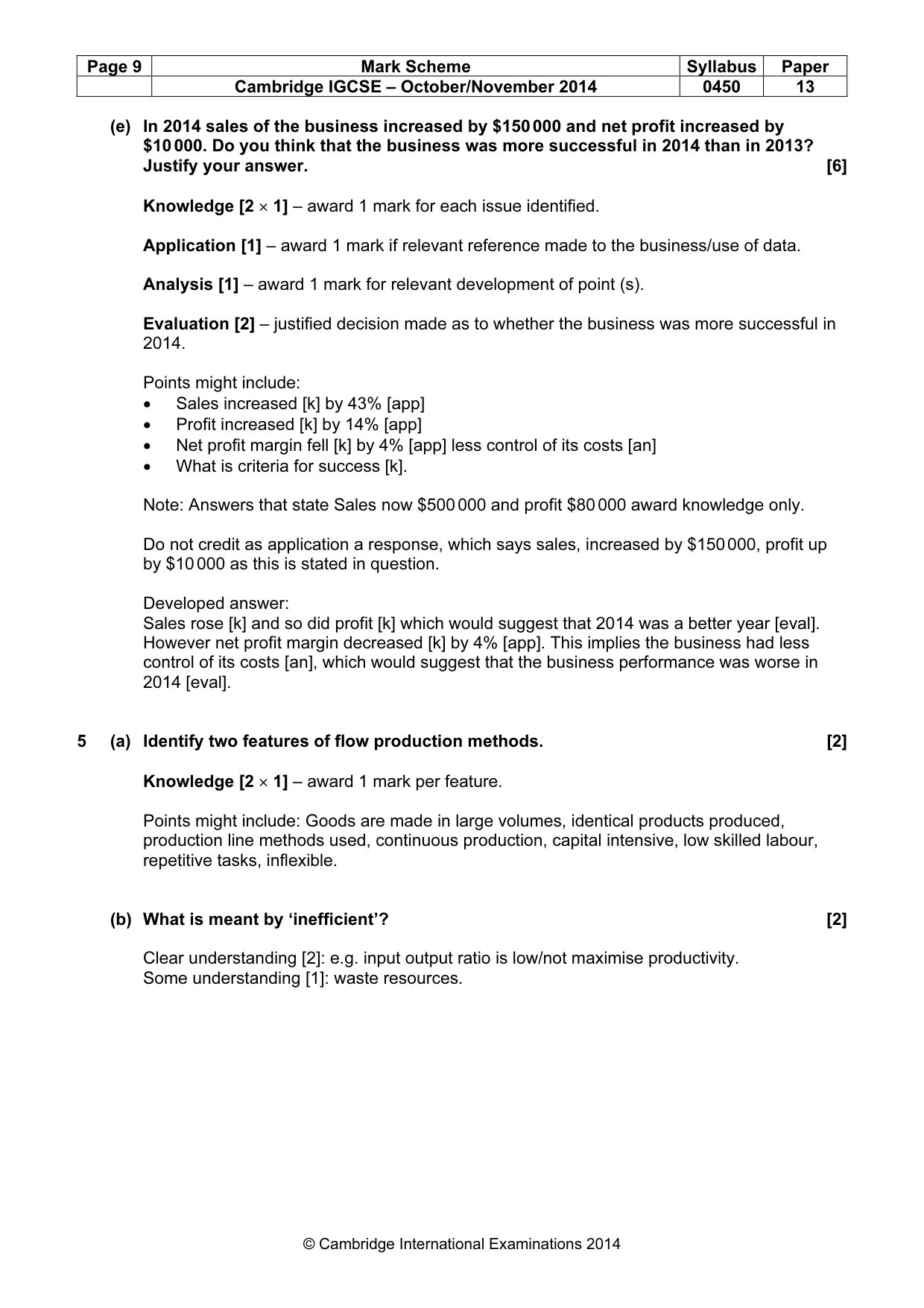
Page 9 Mark Scheme Syllabus Paper Cambridge IGCSE – October/November 2014 0450 13 © Cambridge International Examinations 2014 (e) In 2014 sales of the business increased by $150 000 and net profit increased by $10 000. Do you think that the business was more successful in 2014 than in 2013? Justify your answer. [6] Knowledge [2 × 1] – award 1 mark for each issue identified. Application [1] – award 1 mark if relevant reference made to the business/use of data. Analysis [1] – award 1 mark for relevant development of point (s). Evaluation [2] – justified decision made as to whether the business was more successful in 2014. Points might include: • Sales increased [k] by 43% [app] • Profit increased [k] by 14% [app] • Net profit margin fell [k] by 4% [app] less control of its costs [an] • What is criteria for success [k]. Note: Answers that state Sales now $500 000 and profit $80 000 award knowledge only. Do not credit as application a response, which says sales, increased by $150 000, profit up by $10 000 as this is stated in question. Developed answer: Sales rose [k] and so did profit [k] which would suggest that 2014 was a better year [eval]. However net profit margin decreased [k] by 4% [app]. This implies the business had less control of its costs [an], which would suggest that the business performance was worse in 2014 [eval]. 5 (a) Identify two features of flow production methods. [2] Knowledge [2 × 1] – award 1 mark per feature. Points might include: Goods are made in large volumes, identical products produced, production line methods used, continuous production, capital intensive, low skilled labour, repetitive tasks, inflexible. (b) What is meant by ‘inefficient’? [2] Clear understanding [2]: e.g. input output ratio is low/not maximise productivity. Some understanding [1]: waste resources.
Mark scheme, page 10
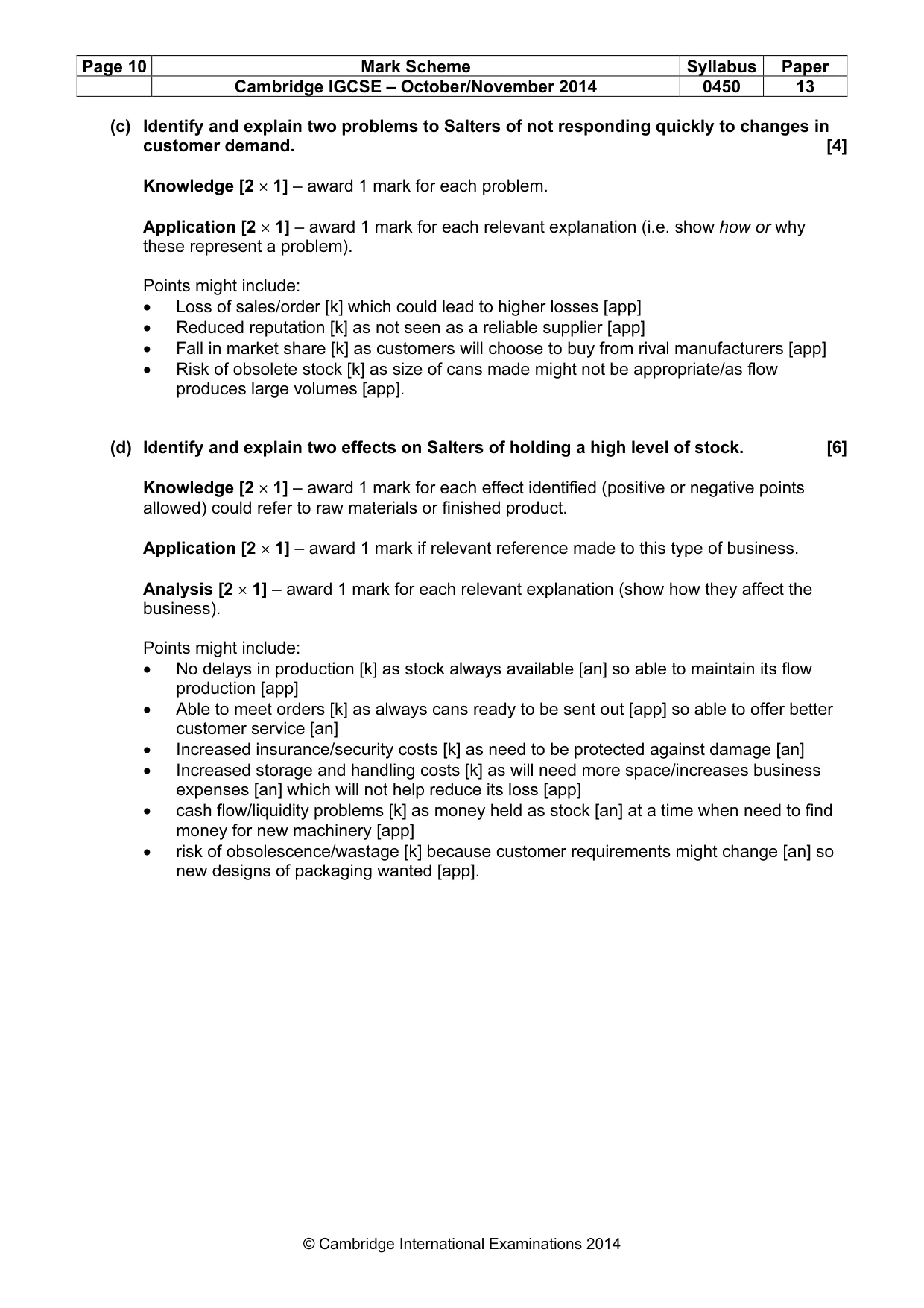
Page 10 Mark Scheme Syllabus Paper Cambridge IGCSE – October/November 2014 0450 13 © Cambridge International Examinations 2014 (c) Identify and explain two problems to Salters of not responding quickly to changes in customer demand. [4] Knowledge [2 × 1] – award 1 mark for each problem. Application [2 × 1] – award 1 mark for each relevant explanation (i.e. show how or why these represent a problem). Points might include: • Loss of sales/order [k] which could lead to higher losses [app] • Reduced reputation [k] as not seen as a reliable supplier [app] • Fall in market share [k] as customers will choose to buy from rival manufacturers [app] • Risk of obsolete stock [k] as size of cans made might not be appropriate/as flow produces large volumes [app]. (d) Identify and explain two effects on Salters of holding a high level of stock. [6] Knowledge [2 × 1] – award 1 mark for each effect identified (positive or negative points allowed) could refer to raw materials or finished product. Application [2 × 1] – award 1 mark if relevant reference made to this type of business. Analysis [2 × 1] – award 1 mark for each relevant explanation (show how they affect the business). Points might include: • No delays in production [k] as stock always available [an] so able to maintain its flow production [app] • Able to meet orders [k] as always cans ready to be sent out [app] so able to offer better customer service [an] • Increased insurance/security costs [k] as need to be protected against damage [an] • Increased storage and handling costs [k] as will need more space/increases business expenses [an] which will not help reduce its loss [app] • cash flow/liquidity problems [k] as money held as stock [an] at a time when need to find money for new machinery [app] • risk of obsolescence/wastage [k] because customer requirements might change [an] so new designs of packaging wanted [app].
Mark scheme, page 11
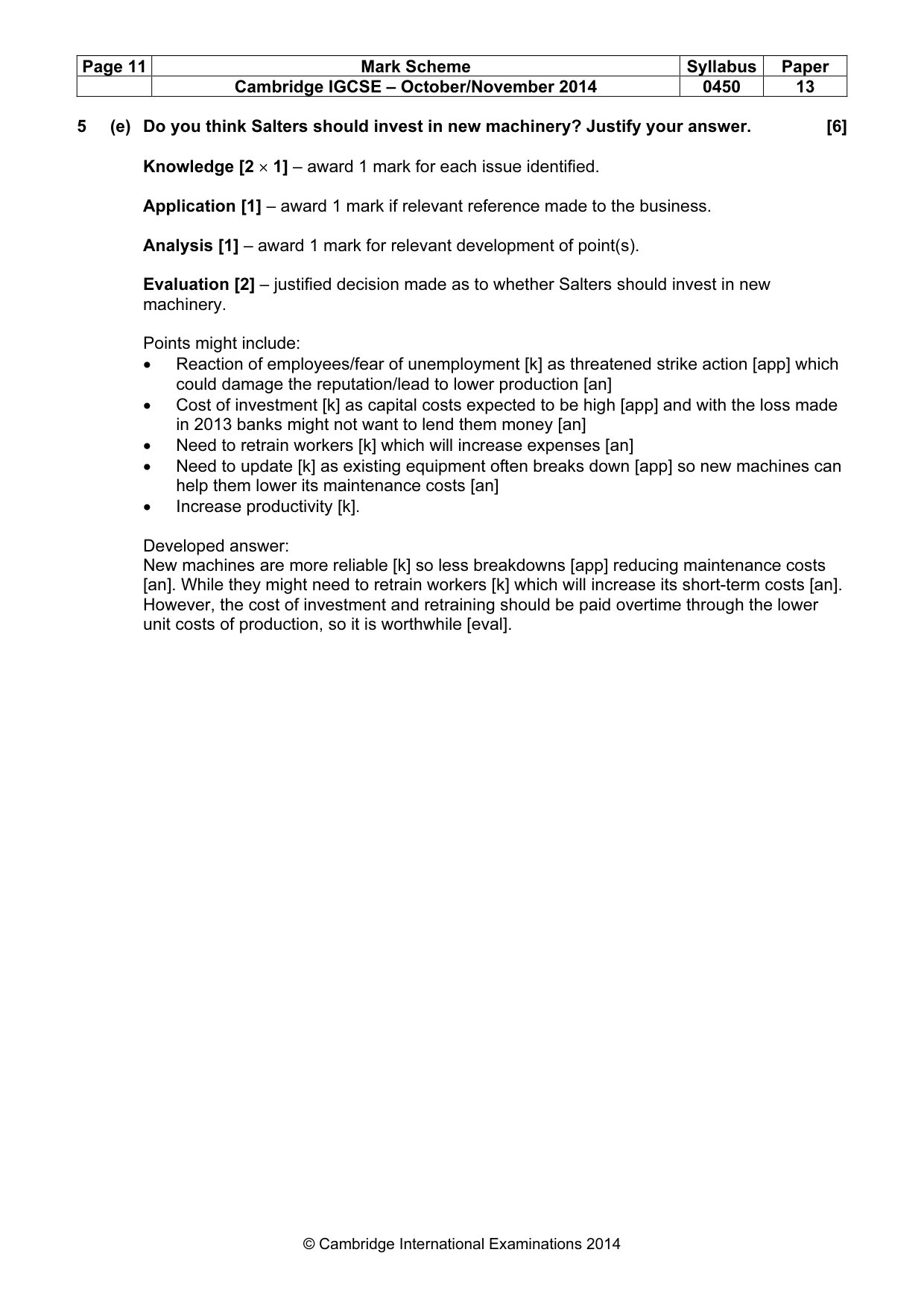
Page 11 Mark Scheme Syllabus Paper Cambridge IGCSE – October/November 2014 0450 13 © Cambridge International Examinations 2014 5 (e) Do you think Salters should invest in new machinery? Justify your answer. [6] Knowledge [2 × 1] – award 1 mark for each issue identified. Application [1] – award 1 mark if relevant reference made to the business. Analysis [1] – award 1 mark for relevant development of point(s). Evaluation [2] – justified decision made as to whether Salters should invest in new machinery. Points might include: • Reaction of employees/fear of unemployment [k] as threatened strike action [app] which could damage the reputation/lead to lower production [an] • Cost of investment [k] as capital costs expected to be high [app] and with the loss made in 2013 banks might not want to lend them money [an] • Need to retrain workers [k] which will increase expenses [an] • Need to update [k] as existing equipment often breaks down [app] so new machines can help them lower its maintenance costs [an] • Increase productivity [k]. Developed answer: New machines are more reliable [k] so less breakdowns [app] reducing maintenance costs [an]. While they might need to retrain workers [k] which will increase its short-term costs [an]. However, the cost of investment and retraining should be paid overtime through the lower unit costs of production, so it is worthwhile [eval].
What you needed in this session
Cambridge’s own grade thresholds for 2014 Oct/Nov, Paper 1 · Variant 3. A higher threshold means an easier paper — the bar moves with how the cohort did.