Cambridge IGCSE Business Studies 0450 — 2014 Oct/Nov Paper 1 · Variant 1
0450/11/O/N/14 · 100 marks · ≈113 min
The question paper and its mark scheme, free to read here and free to download. This is Cambridge’s own paper, exactly as it was sat.
Question paper12 pages

Mark scheme10 pages
Answers below. Sit the paper first if you are practising.
Paper as text
Question paper, page 1
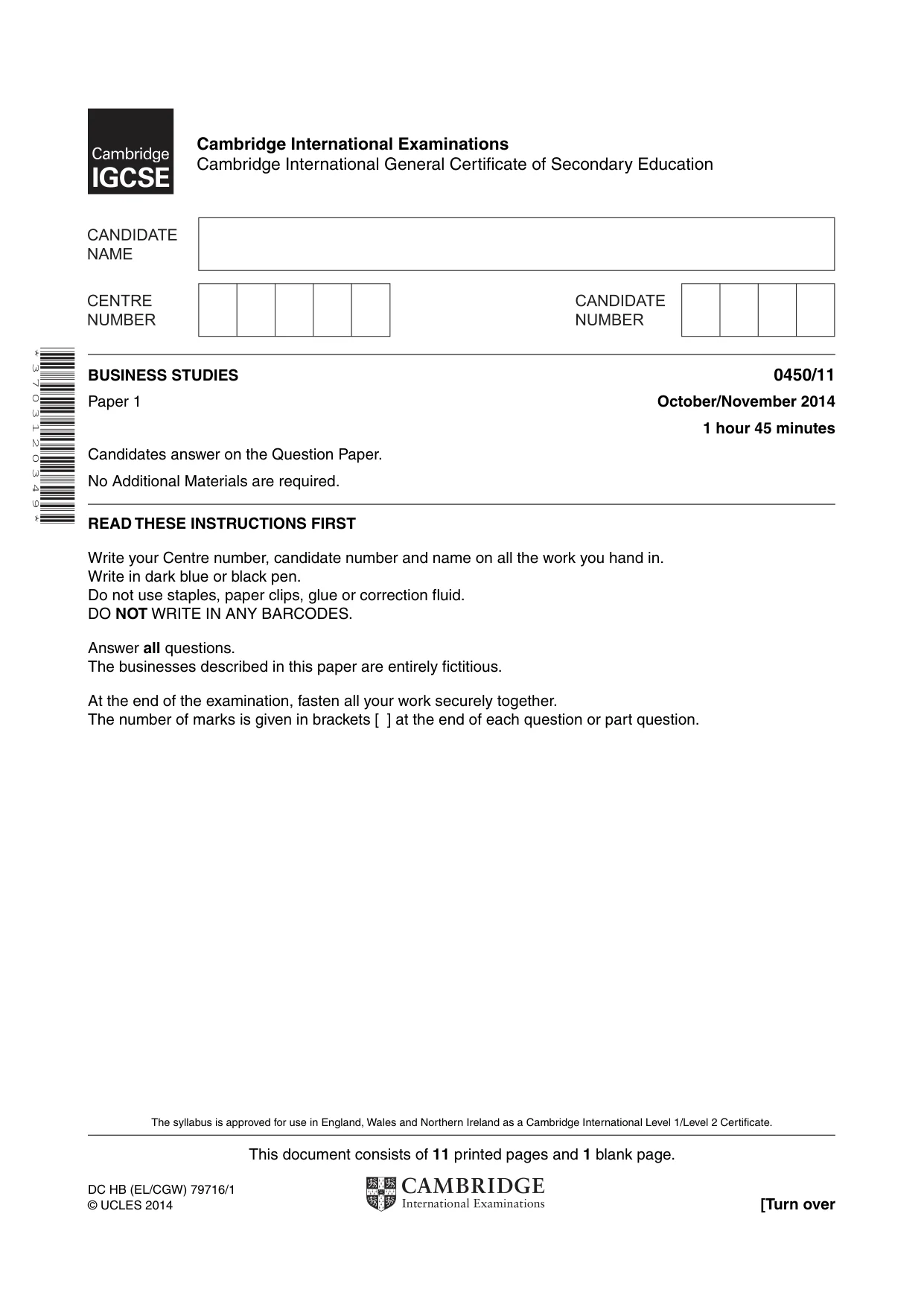
This document consists of 11 printed pages and 1 blank page. DC HB (EL/CGW) 79716/1 © UCLES 2014 [Turn over Cambridge International Examinations Cambridge International General Certificate of Secondary Education * 3 7 0 3 1 2 0 3 4 9 * BUSINESS STUDIES 0450/11 Paper 1 October/November 2014 1 hour 45 minutes Candidates answer on the Question Paper. No Additional Materials are required. READ THESE INSTRUCTIONS FIRST Write your Centre number, candidate number and name on all the work you hand in. Write in dark blue or black pen. Do not use staples, paper clips, glue or correction fluid. DO NOT WRITE IN ANY BARCODES. Answer all questions. The businesses described in this paper are entirely fictitious. At the end of the examination, fasten all your work securely together. The number of marks is given in brackets [ ] at the end of each question or part question. The syllabus is approved for use in England, Wales and Northern Ireland as a Cambridge International Level 1/Level 2 Certificate.
Question paper, page 2
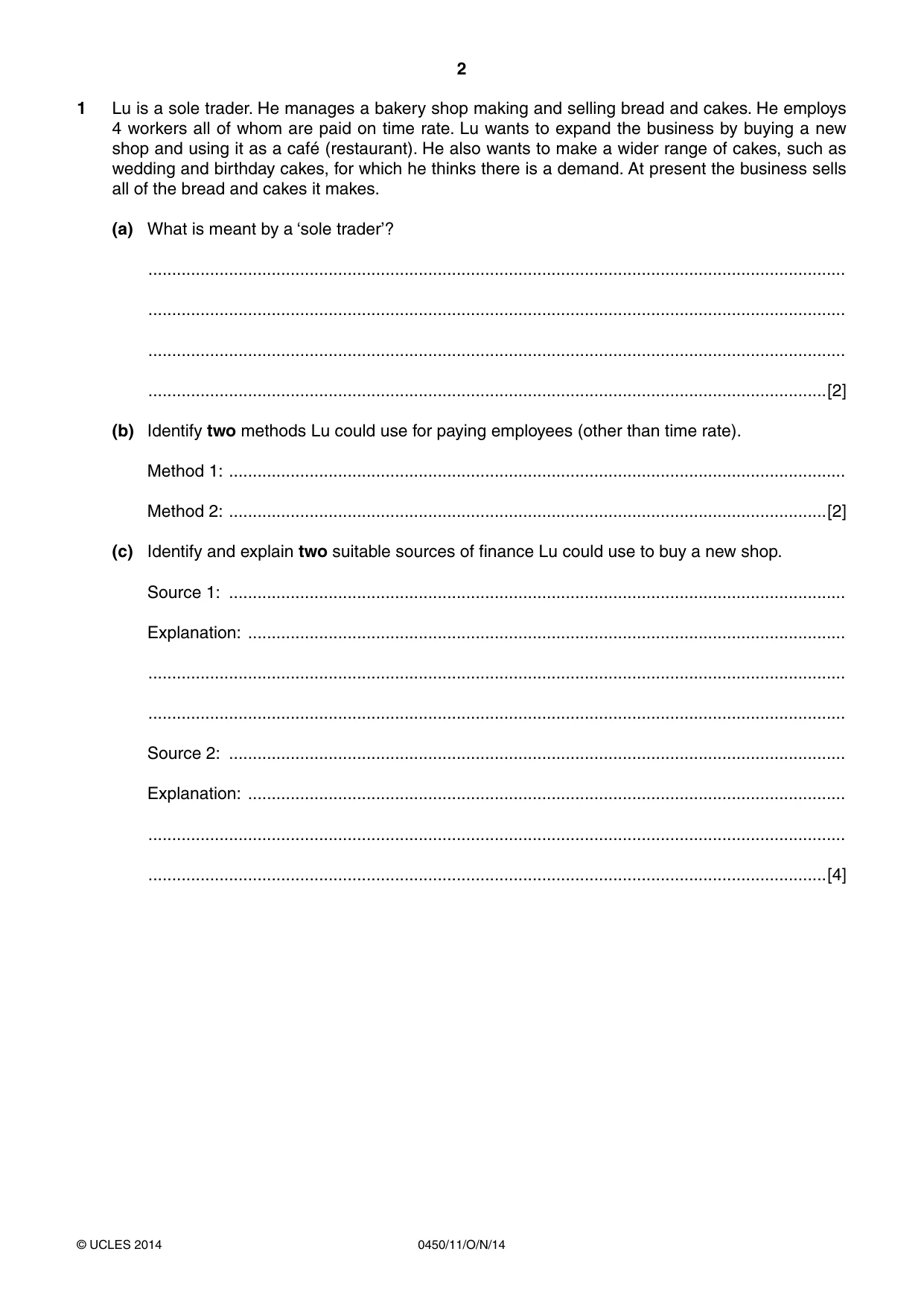
2 0450/11/O/N/14 © UCLES 2014 1 Lu is a sole trader. He manages a bakery shop making and selling bread and cakes. He employs 4 workers all of whom are paid on time rate. Lu wants to expand the business by buying a new shop and using it as a café (restaurant). He also wants to make a wider range of cakes, such as wedding and birthday cakes, for which he thinks there is a demand. At present the business sells all of the bread and cakes it makes. (a) What is meant by a ‘sole trader’? … … … …[2] (b) Identify two methods Lu could use for paying employees (other than time rate). Method 1: … Method 2: …[2] (c) Identify and explain two suitable sources of finance Lu could use to buy a new shop. Source 1: … Explanation: … … … Source 2: … Explanation: … … …[4]
Question paper, page 3
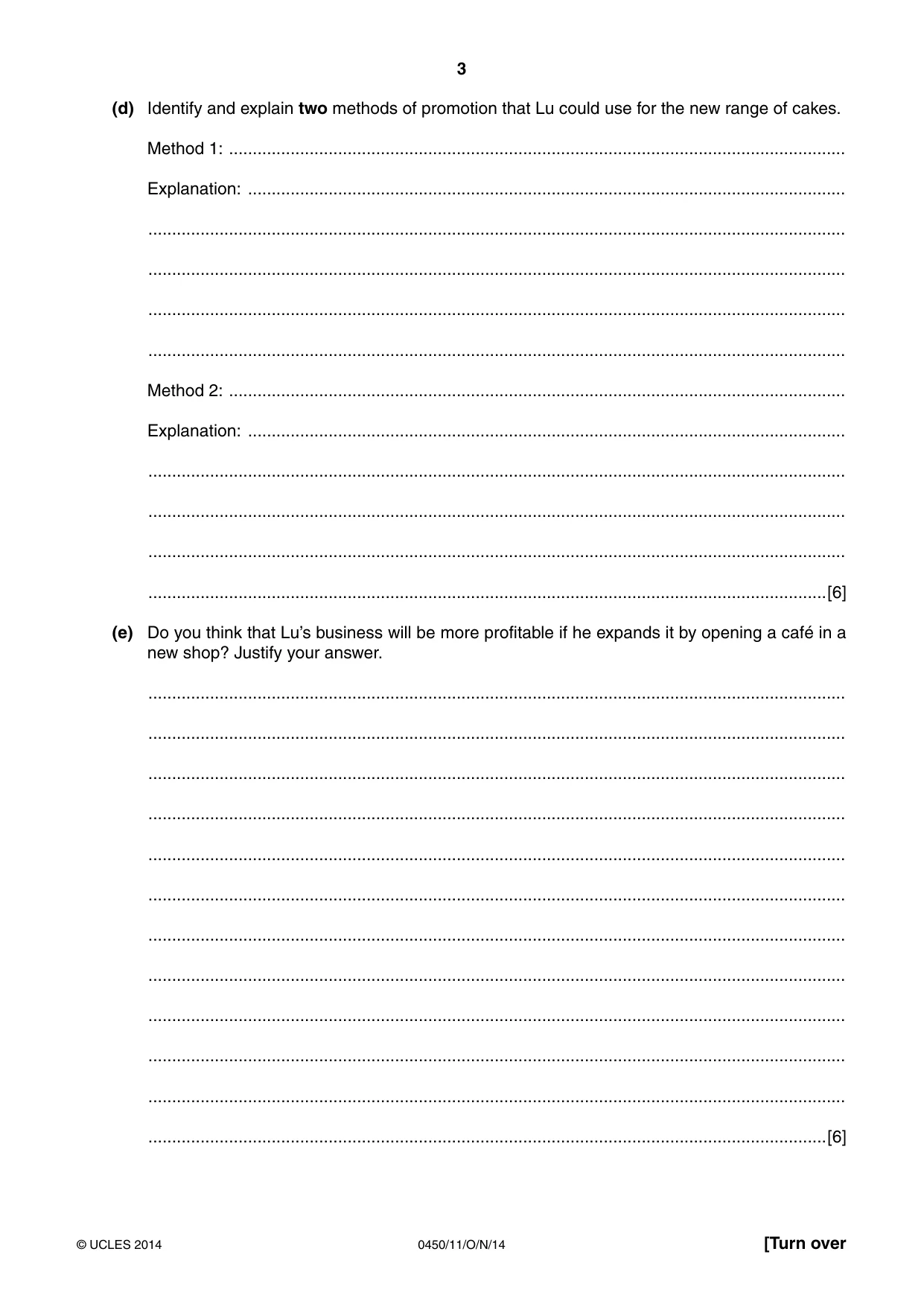
3 0450/11/O/N/14 © UCLES 2014 [Turn over (d) Identify and explain two methods of promotion that Lu could use for the new range of cakes. Method 1: … Explanation: … … … … … Method 2: … Explanation: … … … … …[6] (e) Do you think that Lu’s business will be more profitable if he expands it by opening a café in a new shop? Justify your answer. … … … … … … … … … … … …[6]
Question paper, page 4
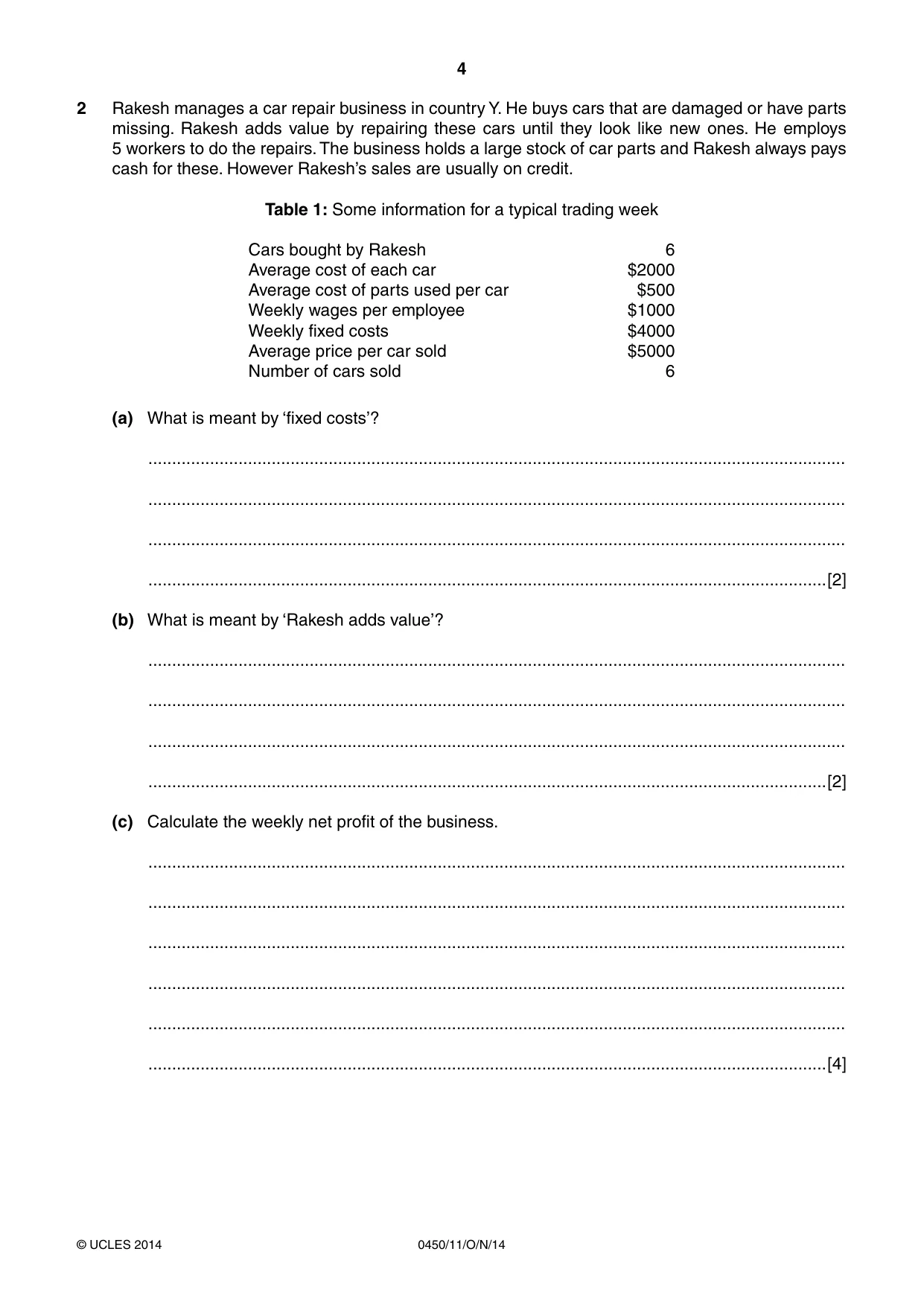
4 0450/11/O/N/14 © UCLES 2014 2 Rakesh manages a car repair business in country Y. He buys cars that are damaged or have parts missing. Rakesh adds value by repairing these cars until they look like new ones. He employs 5 workers to do the repairs. The business holds a large stock of car parts and Rakesh always pays cash for these. However Rakesh’s sales are usually on credit. Table 1: Some information for a typical trading week Cars bought by Rakesh 6 Average cost of each car $2000 Average cost of parts used per car $500 Weekly wages per employee $1000 Weekly fixed costs $4000 Average price per car sold $5000 Number of cars sold 6 (a) What is meant by ‘fixed costs’? … … … …[2] (b) What is meant by ‘Rakesh adds value’? … … … …[2] (c) Calculate the weekly net profit of the business. … … … … … …[4]
Question paper, page 5
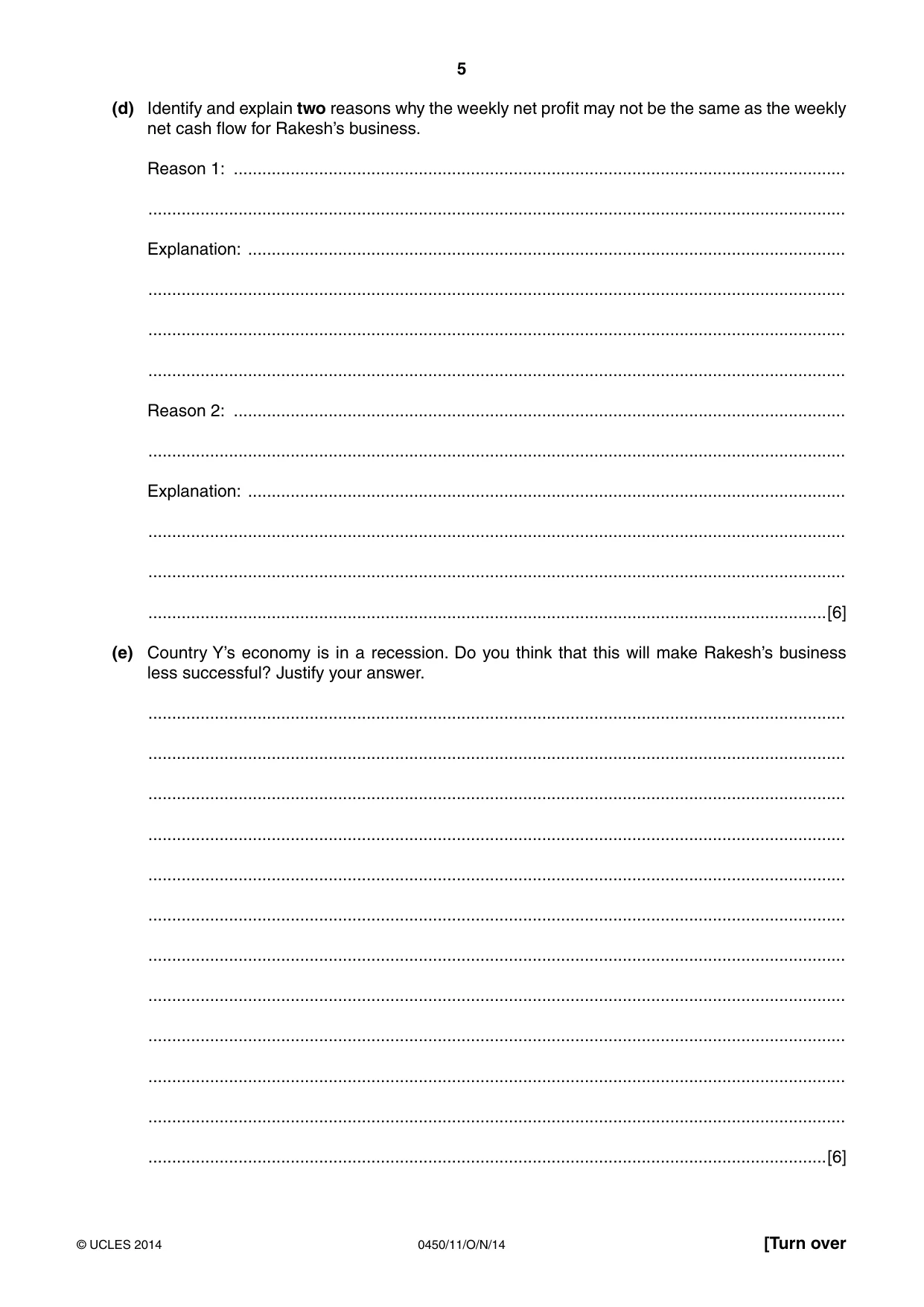
5 0450/11/O/N/14 © UCLES 2014 [Turn over (d) Identify and explain two reasons why the weekly net profit may not be the same as the weekly net cash flow for Rakesh’s business. Reason 1: … … Explanation: … … … … Reason 2: … … Explanation: … … … …[6] (e) Country Y’s economy is in a recession. Do you think that this will make Rakesh’s business less successful? Justify your answer. … … … … … … … … … … … …[6]
Question paper, page 6
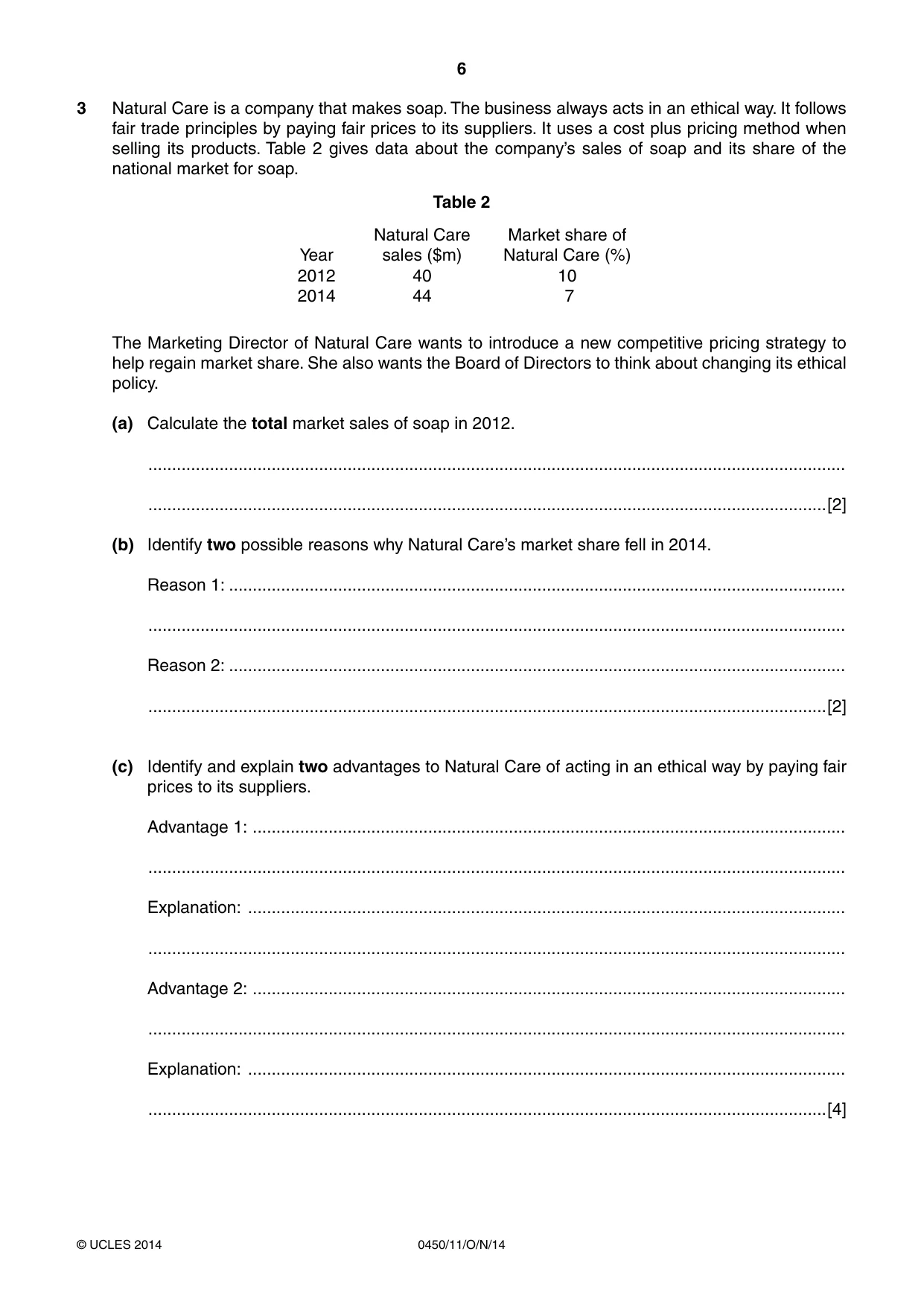
6 0450/11/O/N/14 © UCLES 2014 3 Natural Care is a company that makes soap. The business always acts in an ethical way. It follows fair trade principles by paying fair prices to its suppliers. It uses a cost plus pricing method when selling its products. Table 2 gives data about the company’s sales of soap and its share of the national market for soap. Table 2 Natural Care Market share of Year sales ($m) Natural Care (%) 2012 40 10 2014 44 7 The Marketing Director of Natural Care wants to introduce a new competitive pricing strategy to help regain market share. She also wants the Board of Directors to think about changing its ethical policy. (a) Calculate the total market sales of soap in 2012. … …[2] (b) Identify two possible reasons why Natural Care’s market share fell in 2014. Reason 1: … … Reason 2: … …[2] (c) Identify and explain two advantages to Natural Care of acting in an ethical way by paying fair prices to its suppliers. Advantage 1: … … Explanation: … … Advantage 2: … … Explanation: … …[4]
Question paper, page 7
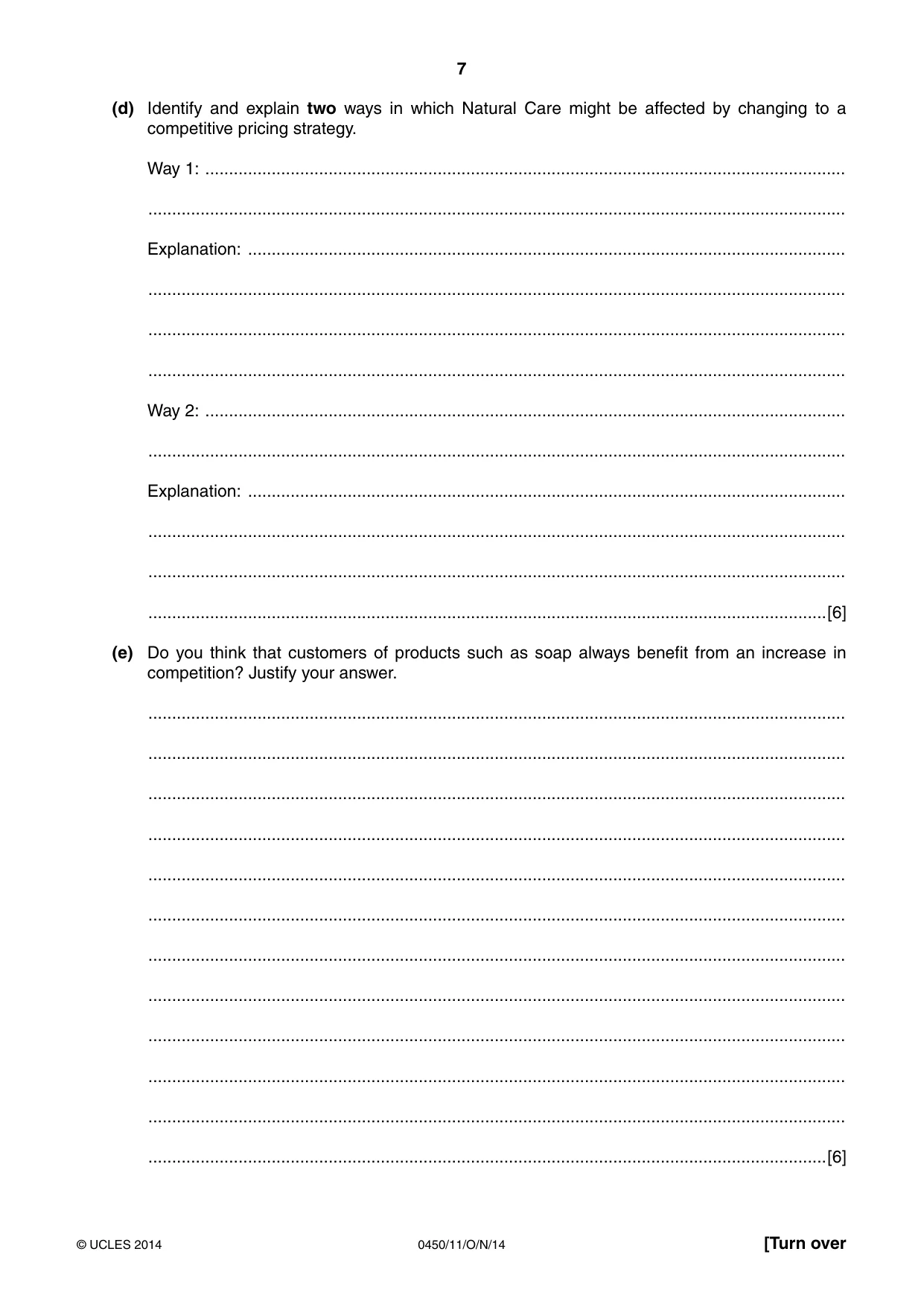
7 0450/11/O/N/14 © UCLES 2014 [Turn over (d) Identify and explain two ways in which Natural Care might be affected by changing to a competitive pricing strategy. Way 1: … … Explanation: … … … … Way 2: … … Explanation: … … … …[6] (e) Do you think that customers of products such as soap always benefit from an increase in competition? Justify your answer. … … … … … … … … … … … …[6]
Question paper, page 8
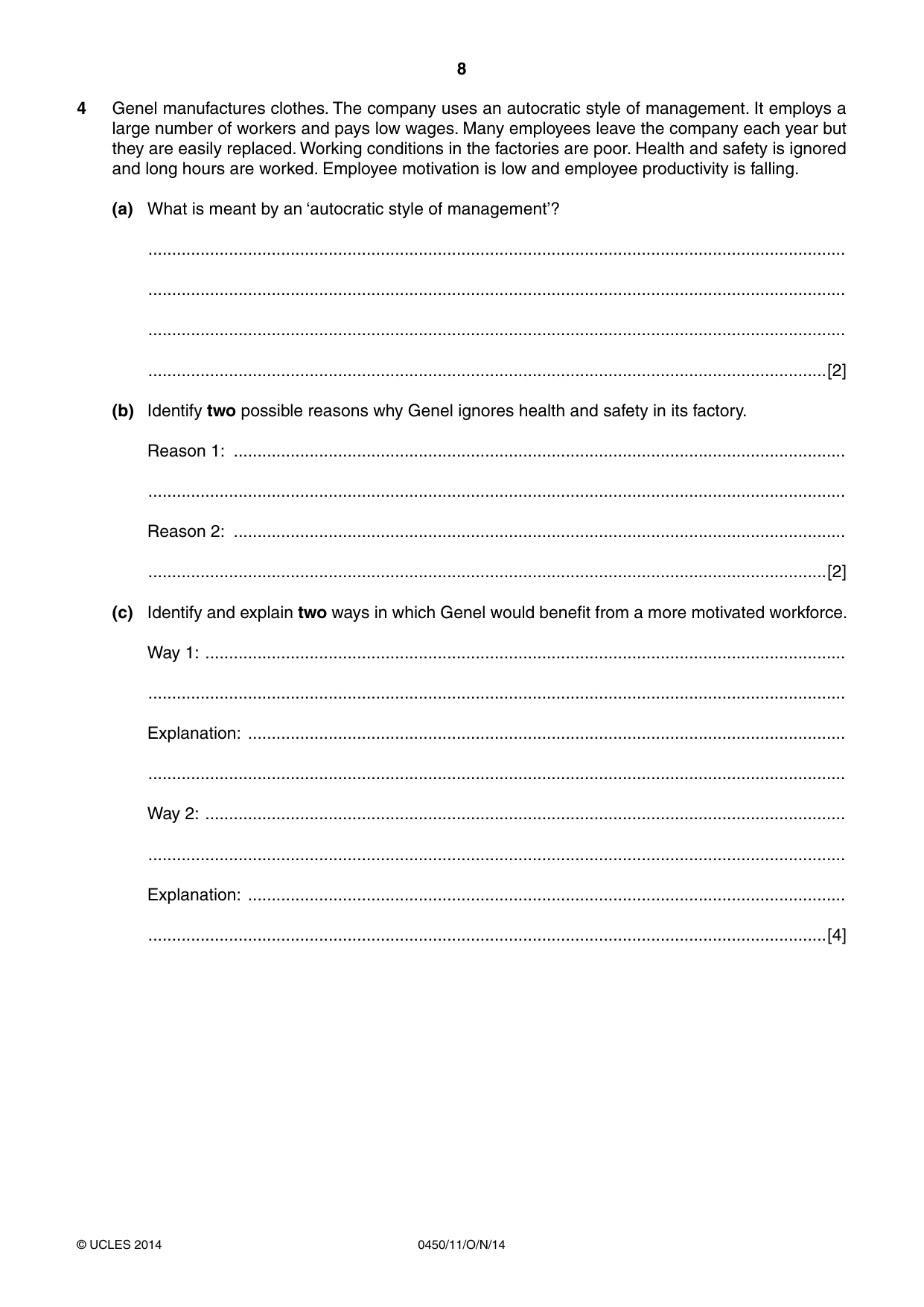
8 0450/11/O/N/14 © UCLES 2014 4 Genel manufactures clothes. The company uses an autocratic style of management. It employs a large number of workers and pays low wages. Many employees leave the company each year but they are easily replaced. Working conditions in the factories are poor. Health and safety is ignored and long hours are worked. Employee motivation is low and employee productivity is falling. (a) What is meant by an ‘autocratic style of management’? … … … …[2] (b) Identify two possible reasons why Genel ignores health and safety in its factory. Reason 1: … … Reason 2: … …[2] (c) Identify and explain two ways in which Genel would benefit from a more motivated workforce. Way 1: … … Explanation: … … Way 2: … … Explanation: … …[4]
Question paper, page 9
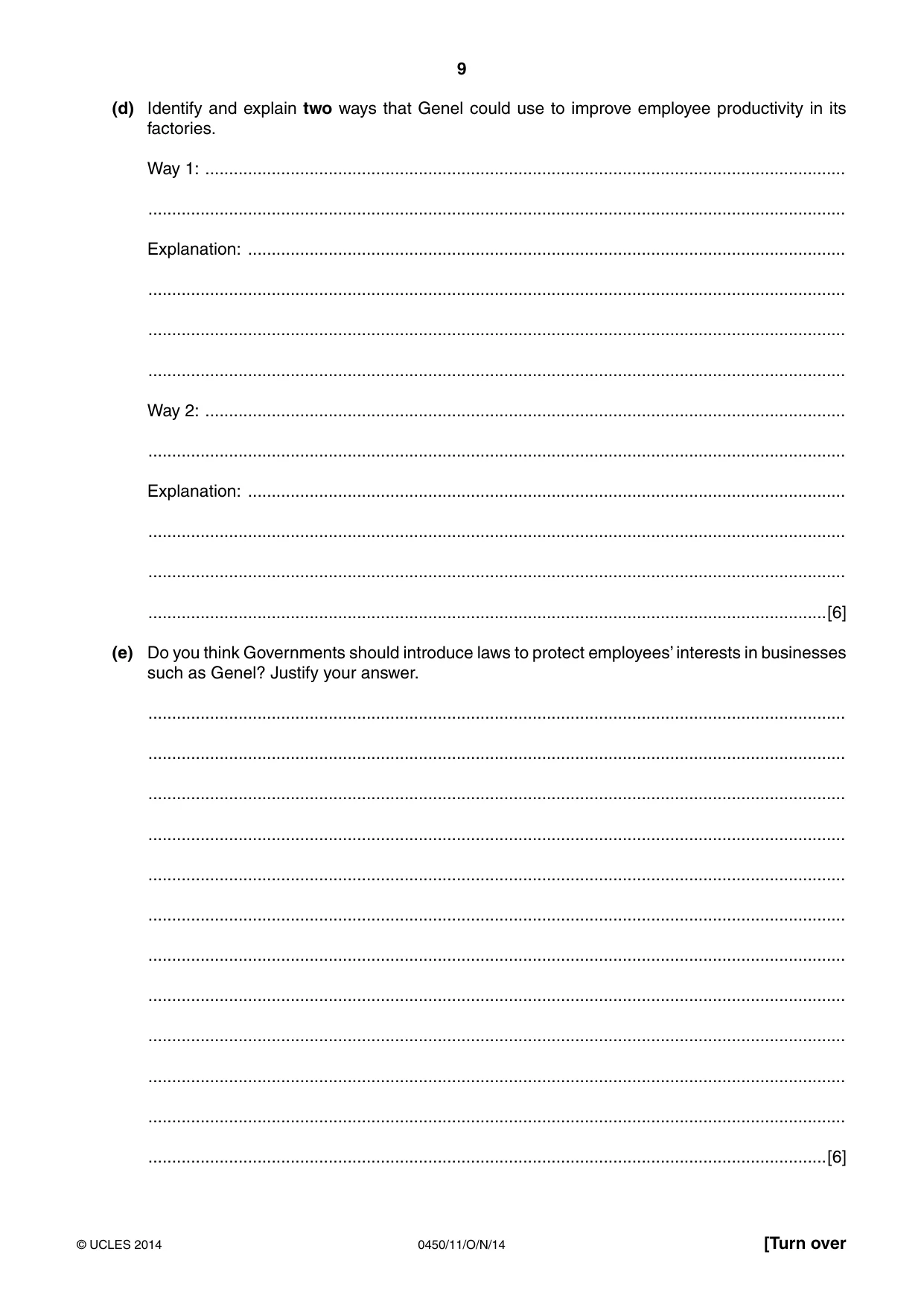
9 0450/11/O/N/14 © UCLES 2014 [Turn over (d) Identify and explain two ways that Genel could use to improve employee productivity in its factories. Way 1: … … Explanation: … … … … Way 2: … … Explanation: … … … …[6] (e) Do you think Governments should introduce laws to protect employees’ interests in businesses such as Genel? Justify your answer. … … … … … … … … … … … …[6]
Question paper, page 10
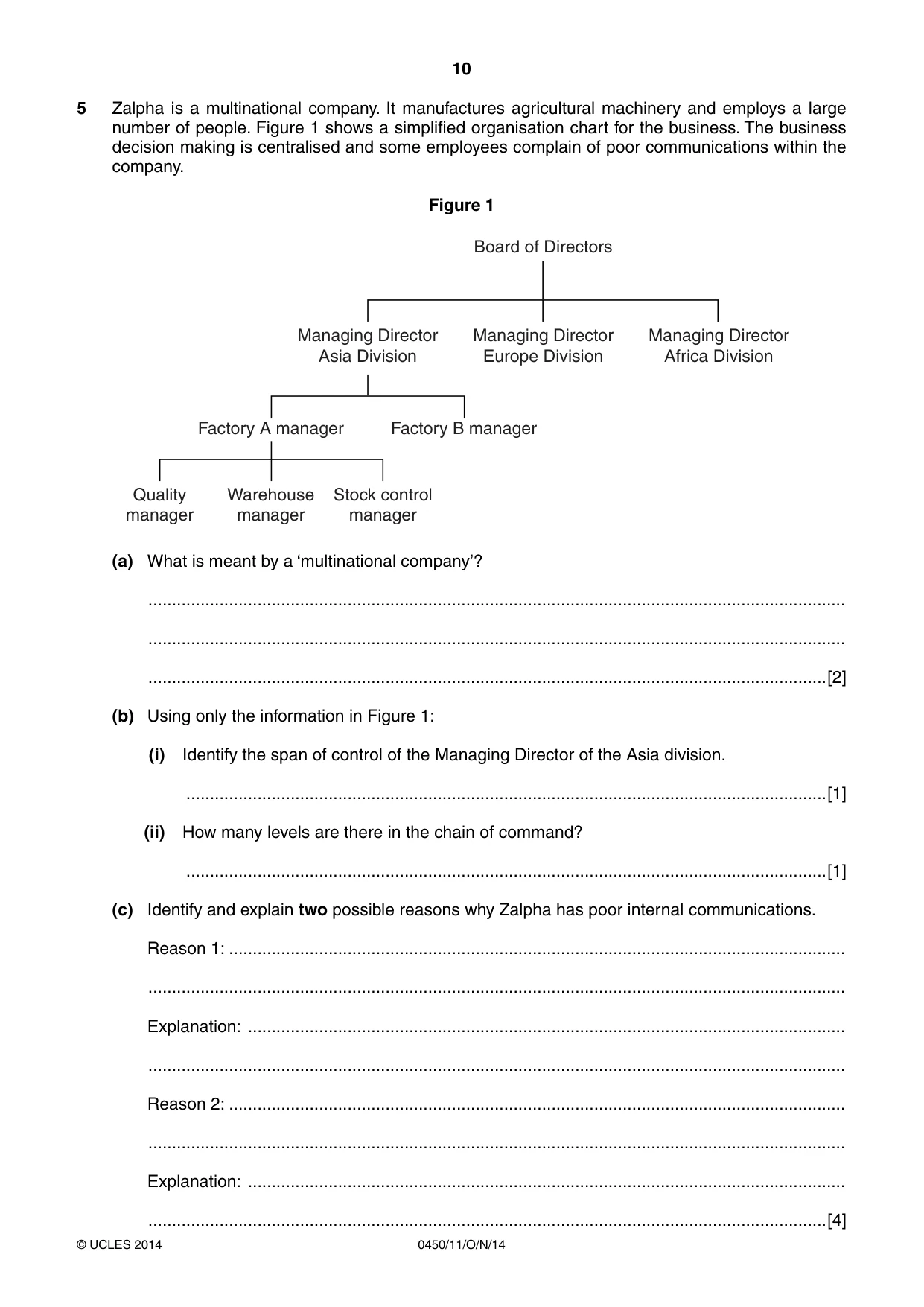
10 0450/11/O/N/14 © UCLES 2014 5 Zalpha is a multinational company. It manufactures agricultural machinery and employs a large number of people. Figure 1 shows a simplified organisation chart for the business. The business decision making is centralised and some employees complain of poor communications within the company. Figure 1 Board of Directors Managing Director Europe Division Managing Director Africa Division Managing Director Asia Division Factory A manager Warehouse manager Stock control manager Quality manager Factory B manager (a) What is meant by a ‘multinational company’? … … …[2] (b) Using only the information in Figure 1: (i) Identify the span of control of the Managing Director of the Asia division. …[1] (ii) How many levels are there in the chain of command? …[1] (c) Identify and explain two possible reasons why Zalpha has poor internal communications. Reason 1: … … Explanation: … … Reason 2: … … Explanation: … …[4]
Question paper, page 11
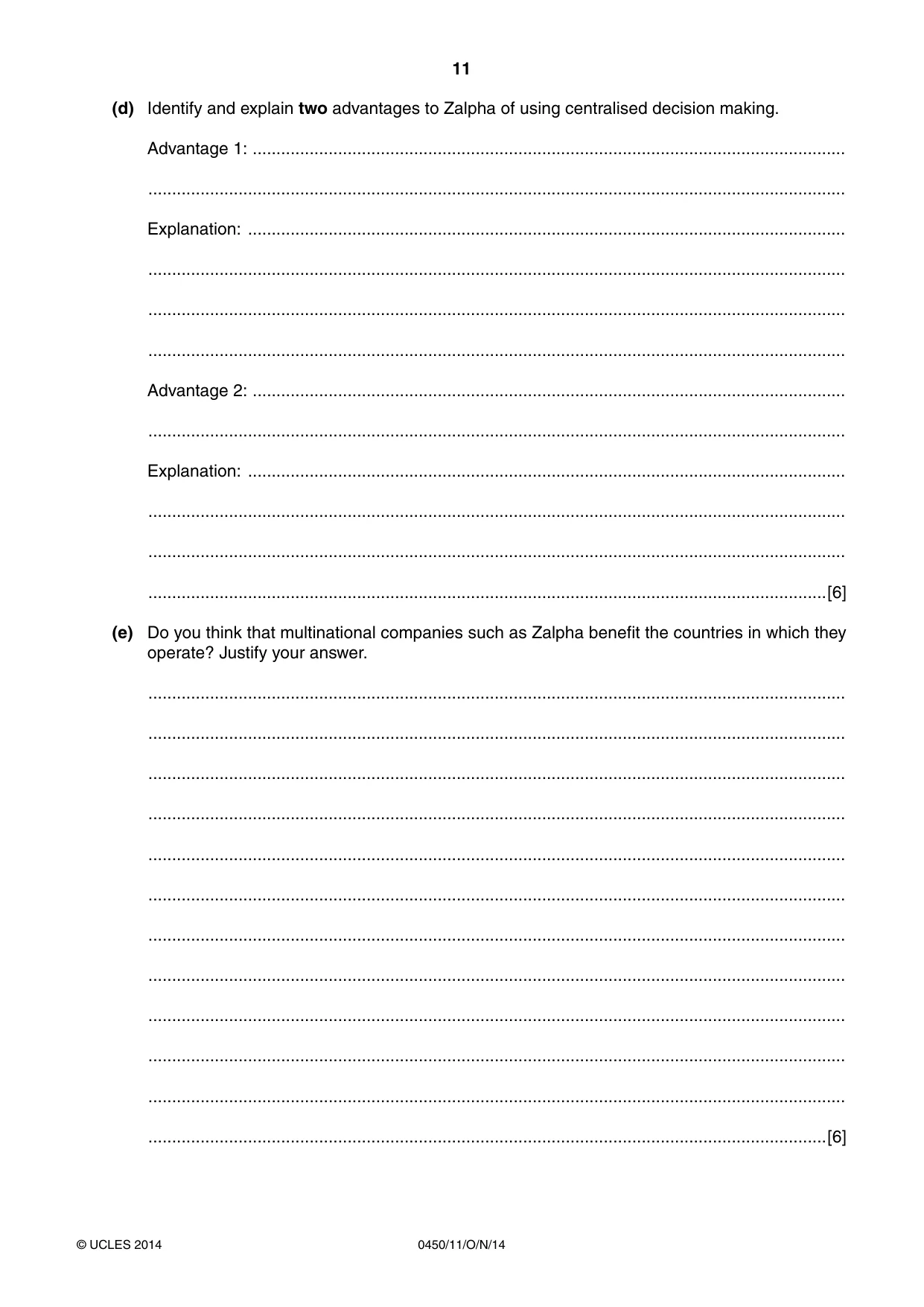
11 0450/11/O/N/14 © UCLES 2014 (d) Identify and explain two advantages to Zalpha of using centralised decision making. Advantage 1: … … Explanation: … … … … Advantage 2: … … Explanation: … … … …[6] (e) Do you think that multinational companies such as Zalpha benefit the countries in which they operate? Justify your answer. … … … … … … … … … … … …[6]
Question paper, page 12
12 0450/11/O/N/14 © UCLES 2014 Permission to reproduce items where third-party owned material protected by copyright is included has been sought and cleared where possible. Every reasonable effort has been made by the publisher (UCLES) to trace copyright holders, but if any items requiring clearance have unwittingly been included, the publisher will be pleased to make amends at the earliest possible opportunity. Cambridge International Examinations is part of the Cambridge Assessment Group. Cambridge Assessment is the brand name of University of Cambridge Local Examinations Syndicate (UCLES), which is itself a department of the University of Cambridge. BLANK PAGE
Mark scheme, page 1
® IGCSE is the registered trademark of Cambridge International Examinations. CAMBRIDGE INTERNATIONAL EXAMINATIONS Cambridge International General Certificate of Secondary Education MARK SCHEME for the October/November 2014 series 0450 BUSINESS STUDIES 0450/11 Paper 11 (Short answer/Structured Response), maximum raw mark 100 This mark scheme is published as an aid to teachers and candidates, to indicate the requirements of the examination. It shows the basis on which Examiners were instructed to award marks. It does not indicate the details of the discussions that took place at an Examiners’ meeting before marking began, which would have considered the acceptability of alternative answers. Mark schemes should be read in conjunction with the question paper and the Principal Examiner Report for Teachers. Cambridge will not enter into discussions about these mark schemes. Cambridge is publishing the mark schemes for the October/November 2014 series for most Cambridge IGCSE®, Cambridge International A and AS Level components and some Cambridge O Level components.
Mark scheme, page 2
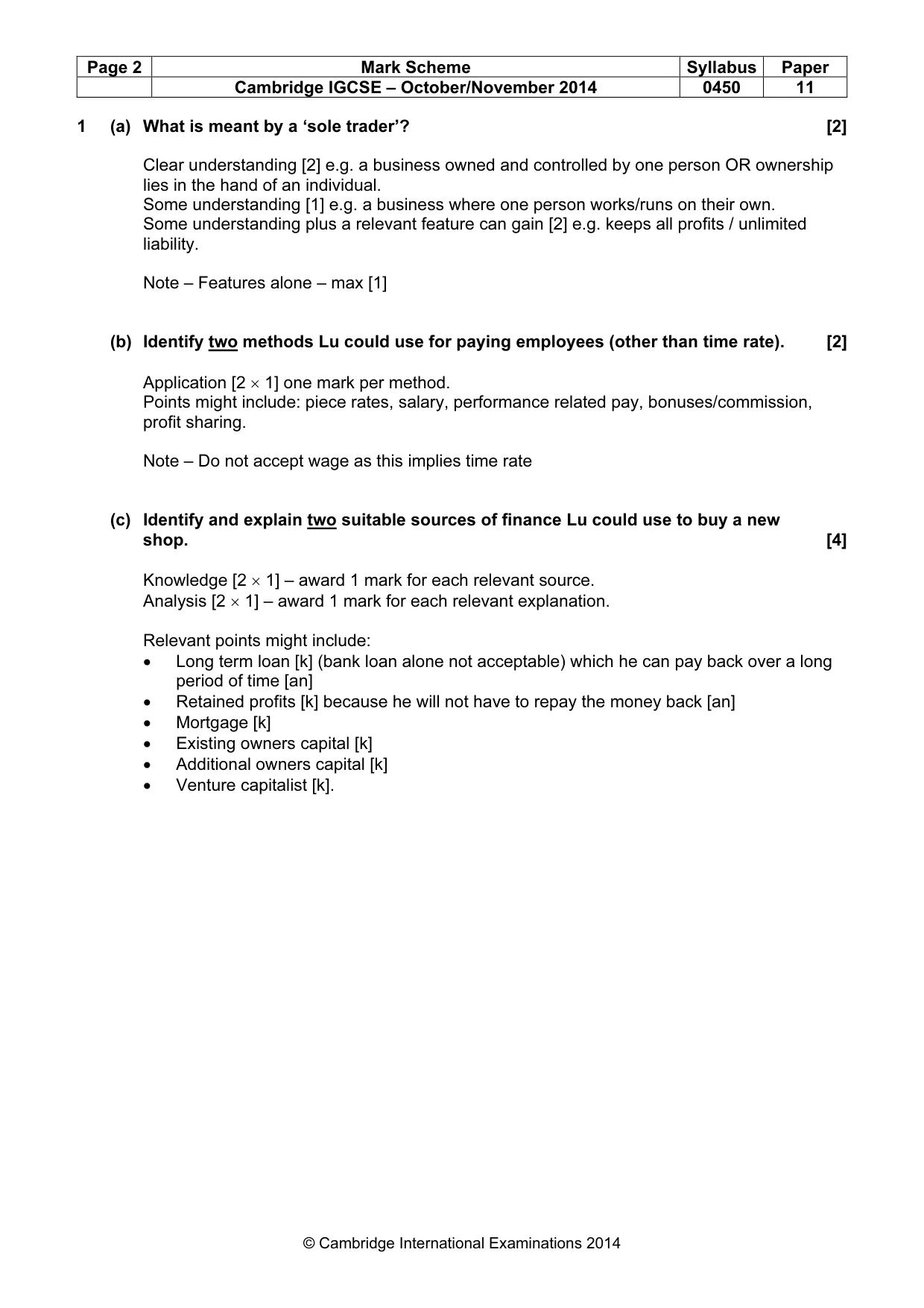
Page 2 Mark Scheme Syllabus Paper Cambridge IGCSE – October/November 2014 0450 11 © Cambridge International Examinations 2014 1 (a) What is meant by a ‘sole trader’? [2] Clear understanding [2] e.g. a business owned and controlled by one person OR ownership lies in the hand of an individual. Some understanding [1] e.g. a business where one person works/runs on their own. Some understanding plus a relevant feature can gain [2] e.g. keeps all profits / unlimited liability. Note – Features alone – max [1] (b) Identify two methods Lu could use for paying employees (other than time rate). [2] Application [2 × 1] one mark per method. Points might include: piece rates, salary, performance related pay, bonuses/commission, profit sharing. Note – Do not accept wage as this implies time rate (c) Identify and explain two suitable sources of finance Lu could use to buy a new shop. [4] Knowledge [2 × 1] – award 1 mark for each relevant source. Analysis [2 × 1] – award 1 mark for each relevant explanation. Relevant points might include: • Long term loan [k] (bank loan alone not acceptable) which he can pay back over a long period of time [an] • Retained profits [k] because he will not have to repay the money back [an] • Mortgage [k] • Existing owners capital [k] • Additional owners capital [k] • Venture capitalist [k].
Mark scheme, page 3
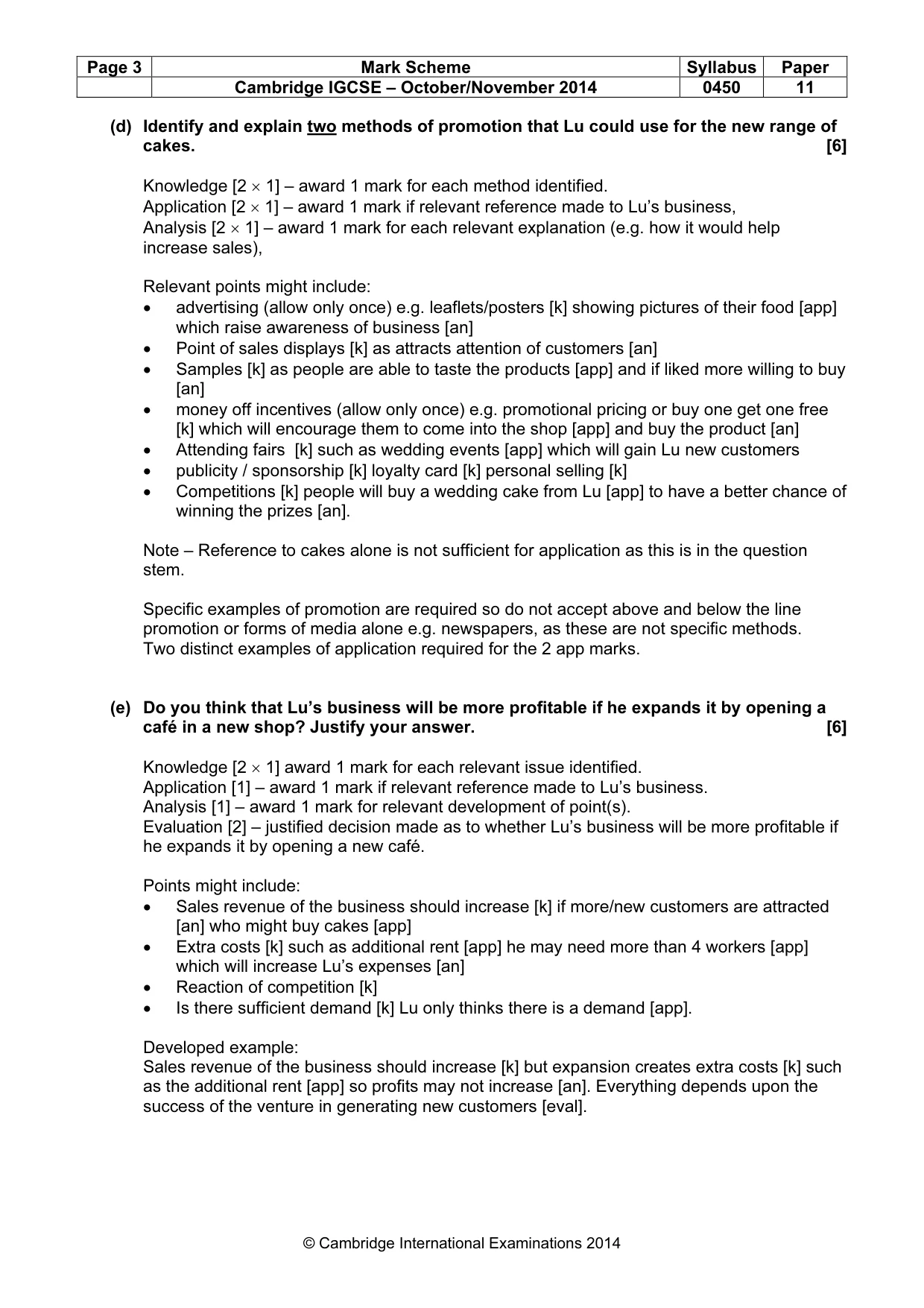
Page 3 Mark Scheme Syllabus Paper Cambridge IGCSE – October/November 2014 0450 11 © Cambridge International Examinations 2014 (d) Identify and explain two methods of promotion that Lu could use for the new range of cakes. [6] Knowledge [2 × 1] – award 1 mark for each method identified. Application [2 × 1] – award 1 mark if relevant reference made to Lu’s business, Analysis [2 × 1] – award 1 mark for each relevant explanation (e.g. how it would help increase sales), Relevant points might include: • advertising (allow only once) e.g. leaflets/posters [k] showing pictures of their food [app] which raise awareness of business [an] • Point of sales displays [k] as attracts attention of customers [an] • Samples [k] as people are able to taste the products [app] and if liked more willing to buy [an] • money off incentives (allow only once) e.g. promotional pricing or buy one get one free [k] which will encourage them to come into the shop [app] and buy the product [an] • Attending fairs [k] such as wedding events [app] which will gain Lu new customers • publicity / sponsorship [k] loyalty card [k] personal selling [k] • Competitions [k] people will buy a wedding cake from Lu [app] to have a better chance of winning the prizes [an]. Note – Reference to cakes alone is not sufficient for application as this is in the question stem. Specific examples of promotion are required so do not accept above and below the line promotion or forms of media alone e.g. newspapers, as these are not specific methods. Two distinct examples of application required for the 2 app marks. (e) Do you think that Lu’s business will be more profitable if he expands it by opening a café in a new shop? Justify your answer. [6] Knowledge [2 × 1] award 1 mark for each relevant issue identified. Application [1] – award 1 mark if relevant reference made to Lu’s business. Analysis [1] – award 1 mark for relevant development of point(s). Evaluation [2] – justified decision made as to whether Lu’s business will be more profitable if he expands it by opening a new café. Points might include: • Sales revenue of the business should increase [k] if more/new customers are attracted [an] who might buy cakes [app] • Extra costs [k] such as additional rent [app] he may need more than 4 workers [app] which will increase Lu’s expenses [an] • Reaction of competition [k] • Is there sufficient demand [k] Lu only thinks there is a demand [app]. Developed example: Sales revenue of the business should increase [k] but expansion creates extra costs [k] such as the additional rent [app] so profits may not increase [an]. Everything depends upon the success of the venture in generating new customers [eval].
Mark scheme, page 4
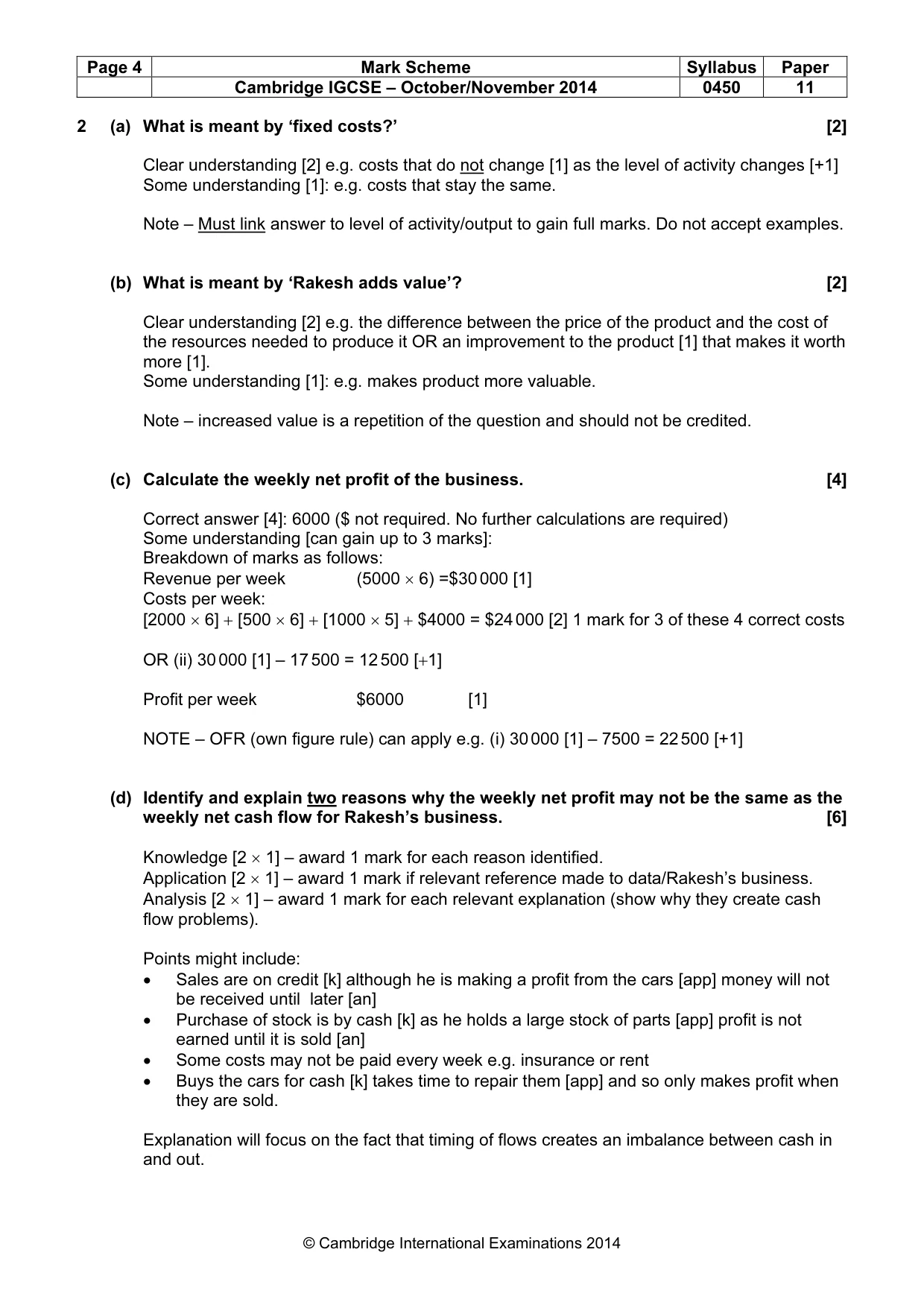
Page 4 Mark Scheme Syllabus Paper Cambridge IGCSE – October/November 2014 0450 11 © Cambridge International Examinations 2014 2 (a) What is meant by ‘fixed costs?’ [2] Clear understanding [2] e.g. costs that do not change [1] as the level of activity changes [+1] Some understanding [1]: e.g. costs that stay the same. Note – Must link answer to level of activity/output to gain full marks. Do not accept examples. (b) What is meant by ‘Rakesh adds value’? [2] Clear understanding [2] e.g. the difference between the price of the product and the cost of the resources needed to produce it OR an improvement to the product [1] that makes it worth more [1]. Some understanding [1]: e.g. makes product more valuable. Note – increased value is a repetition of the question and should not be credited. (c) Calculate the weekly net profit of the business. [4] Correct answer [4]: 6000 ($ not required. No further calculations are required) Some understanding [can gain up to 3 marks]: Breakdown of marks as follows: Revenue per week (5000 × 6) =$30 000 [1] Costs per week: [2000 × 6] + [500 × 6] + [1000 × 5] + $4000 = $24 000 [2] 1 mark for 3 of these 4 correct costs OR (ii) 30 000 [1] – 17 500 = 12 500 [+1] Profit per week $6000 [1] NOTE – OFR (own figure rule) can apply e.g. (i) 30 000 [1] – 7500 = 22 500 [+1] (d) Identify and explain two reasons why the weekly net profit may not be the same as the weekly net cash flow for Rakesh’s business. [6] Knowledge [2 × 1] – award 1 mark for each reason identified. Application [2 × 1] – award 1 mark if relevant reference made to data/Rakesh’s business. Analysis [2 × 1] – award 1 mark for each relevant explanation (show why they create cash flow problems). Points might include: • Sales are on credit [k] although he is making a profit from the cars [app] money will not be received until later [an] • Purchase of stock is by cash [k] as he holds a large stock of parts [app] profit is not earned until it is sold [an] • Some costs may not be paid every week e.g. insurance or rent • Buys the cars for cash [k] takes time to repair them [app] and so only makes profit when they are sold. Explanation will focus on the fact that timing of flows creates an imbalance between cash in and out.
Mark scheme, page 5
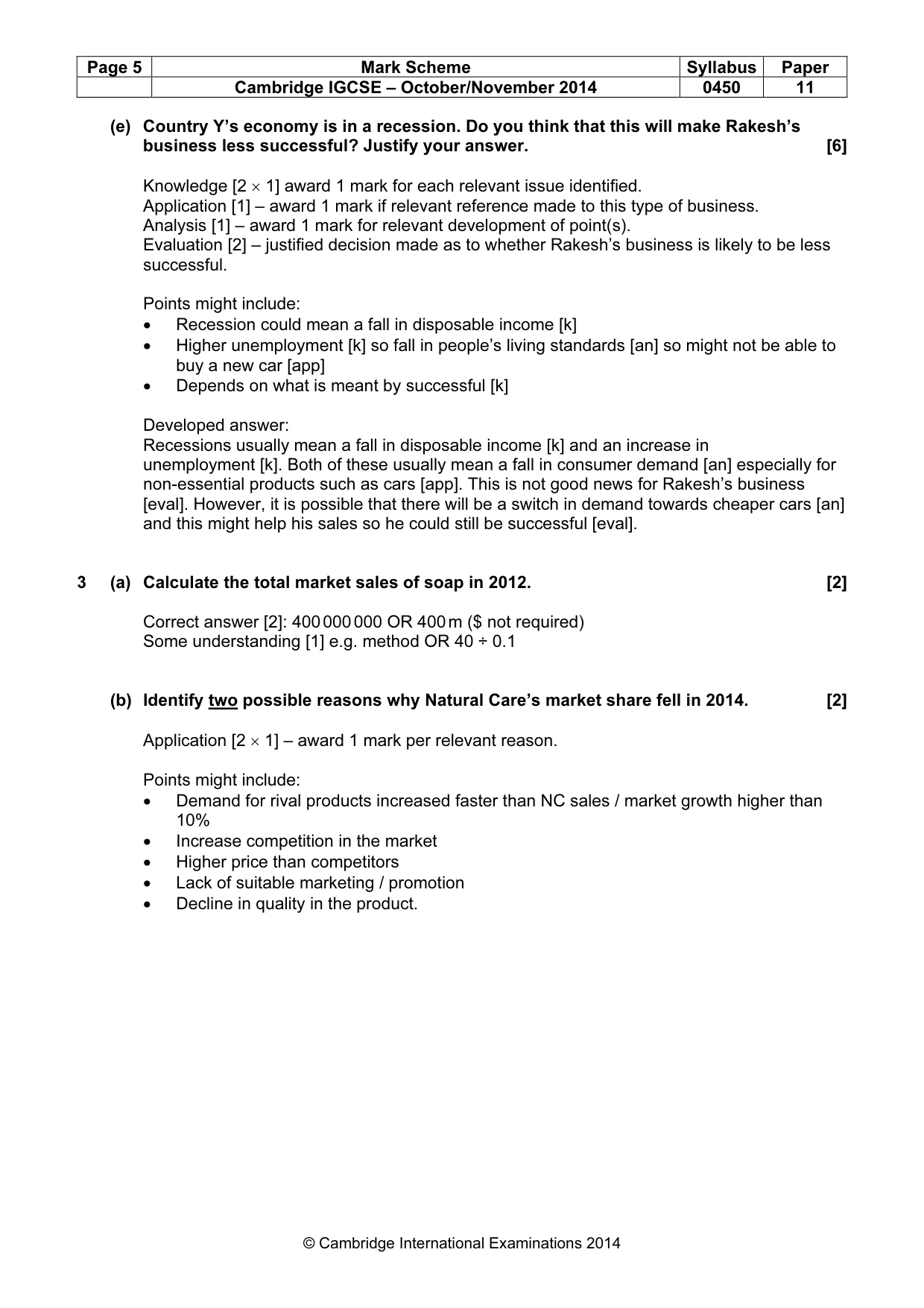
Page 5 Mark Scheme Syllabus Paper Cambridge IGCSE – October/November 2014 0450 11 © Cambridge International Examinations 2014 (e) Country Y’s economy is in a recession. Do you think that this will make Rakesh’s business less successful? Justify your answer. [6] Knowledge [2 × 1] award 1 mark for each relevant issue identified. Application [1] – award 1 mark if relevant reference made to this type of business. Analysis [1] – award 1 mark for relevant development of point(s). Evaluation [2] – justified decision made as to whether Rakesh’s business is likely to be less successful. Points might include: • Recession could mean a fall in disposable income [k] • Higher unemployment [k] so fall in people’s living standards [an] so might not be able to buy a new car [app] • Depends on what is meant by successful [k] Developed answer: Recessions usually mean a fall in disposable income [k] and an increase in unemployment [k]. Both of these usually mean a fall in consumer demand [an] especially for non-essential products such as cars [app]. This is not good news for Rakesh’s business [eval]. However, it is possible that there will be a switch in demand towards cheaper cars [an] and this might help his sales so he could still be successful [eval]. 3 (a) Calculate the total market sales of soap in 2012. [2] Correct answer [2]: 400 000 000 OR 400 m ($ not required) Some understanding [1] e.g. method OR 40 ÷ 0.1 (b) Identify two possible reasons why Natural Care’s market share fell in 2014. [2] Application [2 × 1] – award 1 mark per relevant reason. Points might include: • Demand for rival products increased faster than NC sales / market growth higher than 10% • Increase competition in the market • Higher price than competitors • Lack of suitable marketing / promotion • Decline in quality in the product.
Mark scheme, page 6
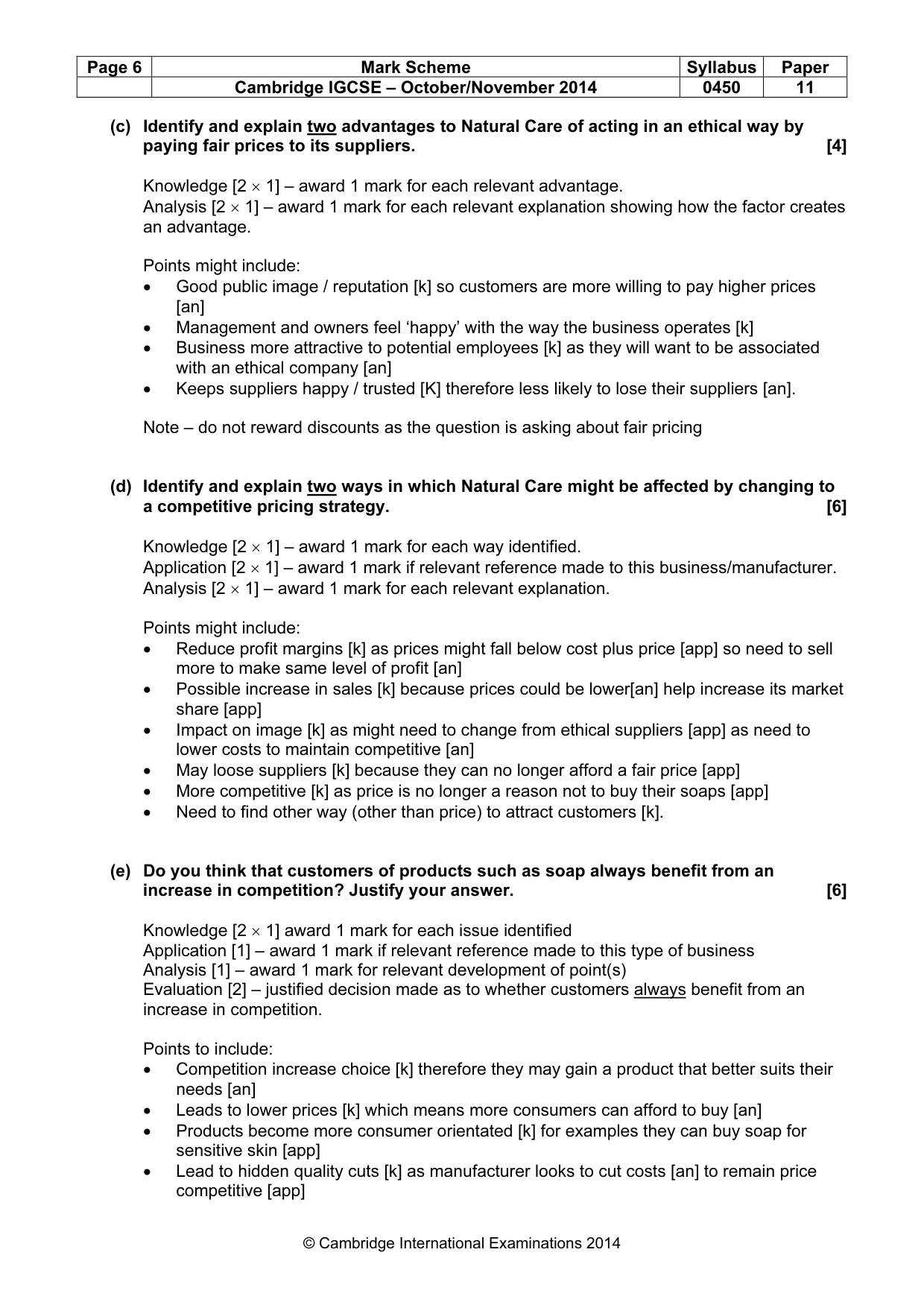
Page 6 Mark Scheme Syllabus Paper Cambridge IGCSE – October/November 2014 0450 11 © Cambridge International Examinations 2014 (c) Identify and explain two advantages to Natural Care of acting in an ethical way by paying fair prices to its suppliers. [4] Knowledge [2 × 1] – award 1 mark for each relevant advantage. Analysis [2 × 1] – award 1 mark for each relevant explanation showing how the factor creates an advantage. Points might include: • Good public image / reputation [k] so customers are more willing to pay higher prices [an] • Management and owners feel ‘happy’ with the way the business operates [k] • Business more attractive to potential employees [k] as they will want to be associated with an ethical company [an] • Keeps suppliers happy / trusted [K] therefore less likely to lose their suppliers [an]. Note – do not reward discounts as the question is asking about fair pricing (d) Identify and explain two ways in which Natural Care might be affected by changing to a competitive pricing strategy. [6] Knowledge [2 × 1] – award 1 mark for each way identified. Application [2 × 1] – award 1 mark if relevant reference made to this business/manufacturer. Analysis [2 × 1] – award 1 mark for each relevant explanation. Points might include: • Reduce profit margins [k] as prices might fall below cost plus price [app] so need to sell more to make same level of profit [an] • Possible increase in sales [k] because prices could be lower[an] help increase its market share [app] • Impact on image [k] as might need to change from ethical suppliers [app] as need to lower costs to maintain competitive [an] • May loose suppliers [k] because they can no longer afford a fair price [app] • More competitive [k] as price is no longer a reason not to buy their soaps [app] • Need to find other way (other than price) to attract customers [k]. (e) Do you think that customers of products such as soap always benefit from an increase in competition? Justify your answer. [6] Knowledge [2 × 1] award 1 mark for each issue identified Application [1] – award 1 mark if relevant reference made to this type of business Analysis [1] – award 1 mark for relevant development of point(s) Evaluation [2] – justified decision made as to whether customers always benefit from an increase in competition. Points to include: • Competition increase choice [k] therefore they may gain a product that better suits their needs [an] • Leads to lower prices [k] which means more consumers can afford to buy [an] • Products become more consumer orientated [k] for examples they can buy soap for sensitive skin [app] • Lead to hidden quality cuts [k] as manufacturer looks to cut costs [an] to remain price competitive [app]
Mark scheme, page 7
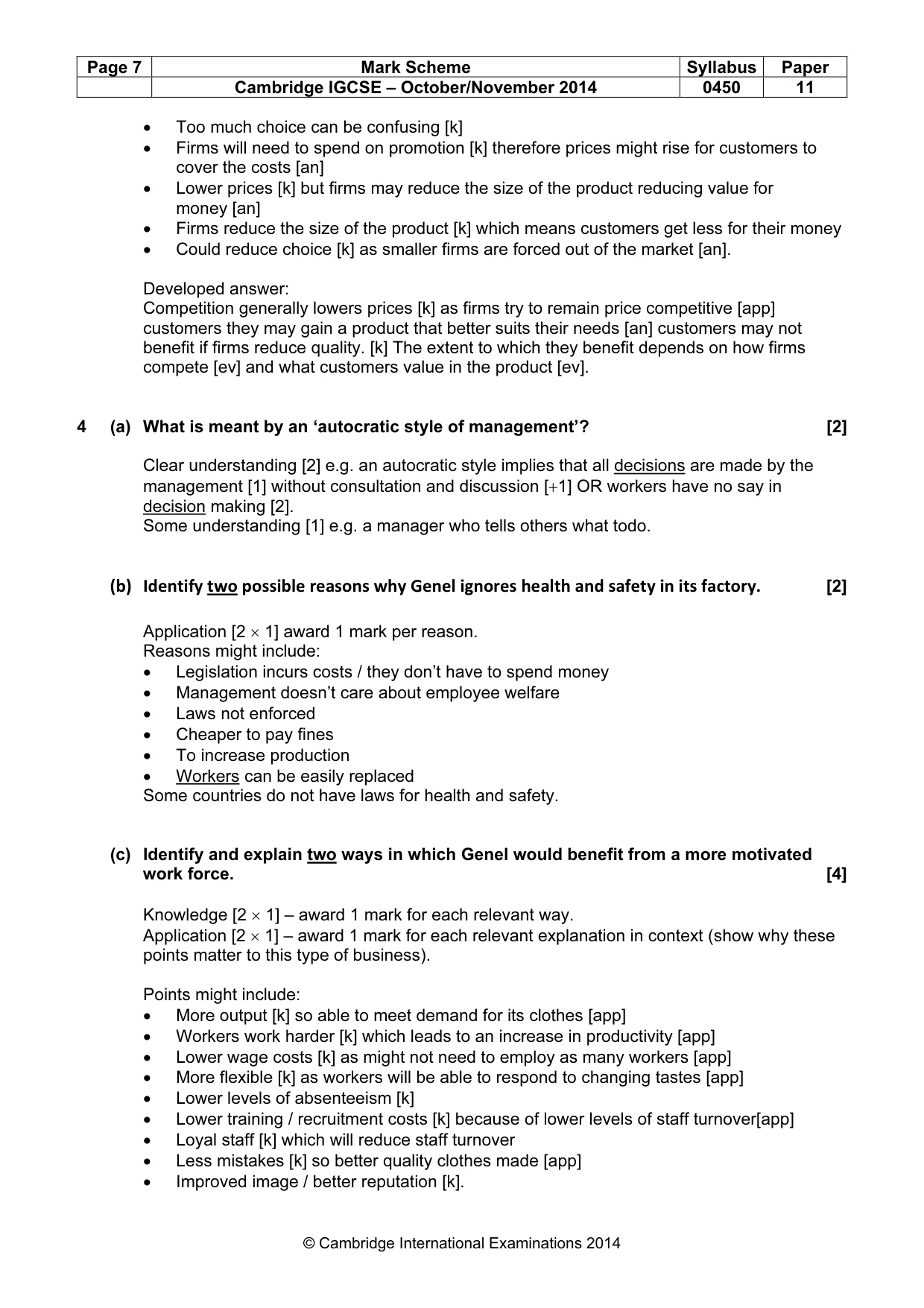
Page 7 Mark Scheme Syllabus Paper Cambridge IGCSE – October/November 2014 0450 11 © Cambridge International Examinations 2014 • Too much choice can be confusing [k] • Firms will need to spend on promotion [k] therefore prices might rise for customers to cover the costs [an] • Lower prices [k] but firms may reduce the size of the product reducing value for money [an] • Firms reduce the size of the product [k] which means customers get less for their money • Could reduce choice [k] as smaller firms are forced out of the market [an]. Developed answer: Competition generally lowers prices [k] as firms try to remain price competitive [app] customers they may gain a product that better suits their needs [an] customers may not benefit if firms reduce quality. [k] The extent to which they benefit depends on how firms compete [ev] and what customers value in the product [ev]. 4 (a) What is meant by an ‘autocratic style of management’? [2] Clear understanding [2] e.g. an autocratic style implies that all decisions are made by the management [1] without consultation and discussion [+1] OR workers have no say in decision making [2]. Some understanding [1] e.g. a manager who tells others what todo. (b) Identify two possible reasons why Genel ignores health and safety in its factory. [2] Application [2 × 1] award 1 mark per reason. Reasons might include: • Legislation incurs costs / they don’t have to spend money • Management doesn’t care about employee welfare • Laws not enforced • Cheaper to pay fines • To increase production • Workers can be easily replaced Some countries do not have laws for health and safety. (c) Identify and explain two ways in which Genel would benefit from a more motivated work force. [4] Knowledge [2 × 1] – award 1 mark for each relevant way. Application [2 × 1] – award 1 mark for each relevant explanation in context (show why these points matter to this type of business). Points might include: • More output [k] so able to meet demand for its clothes [app] • Workers work harder [k] which leads to an increase in productivity [app] • Lower wage costs [k] as might not need to employ as many workers [app] • More flexible [k] as workers will be able to respond to changing tastes [app] • Lower levels of absenteeism [k] • Lower training / recruitment costs [k] because of lower levels of staff turnover[app] • Loyal staff [k] which will reduce staff turnover • Less mistakes [k] so better quality clothes made [app] • Improved image / better reputation [k].
Mark scheme, page 8
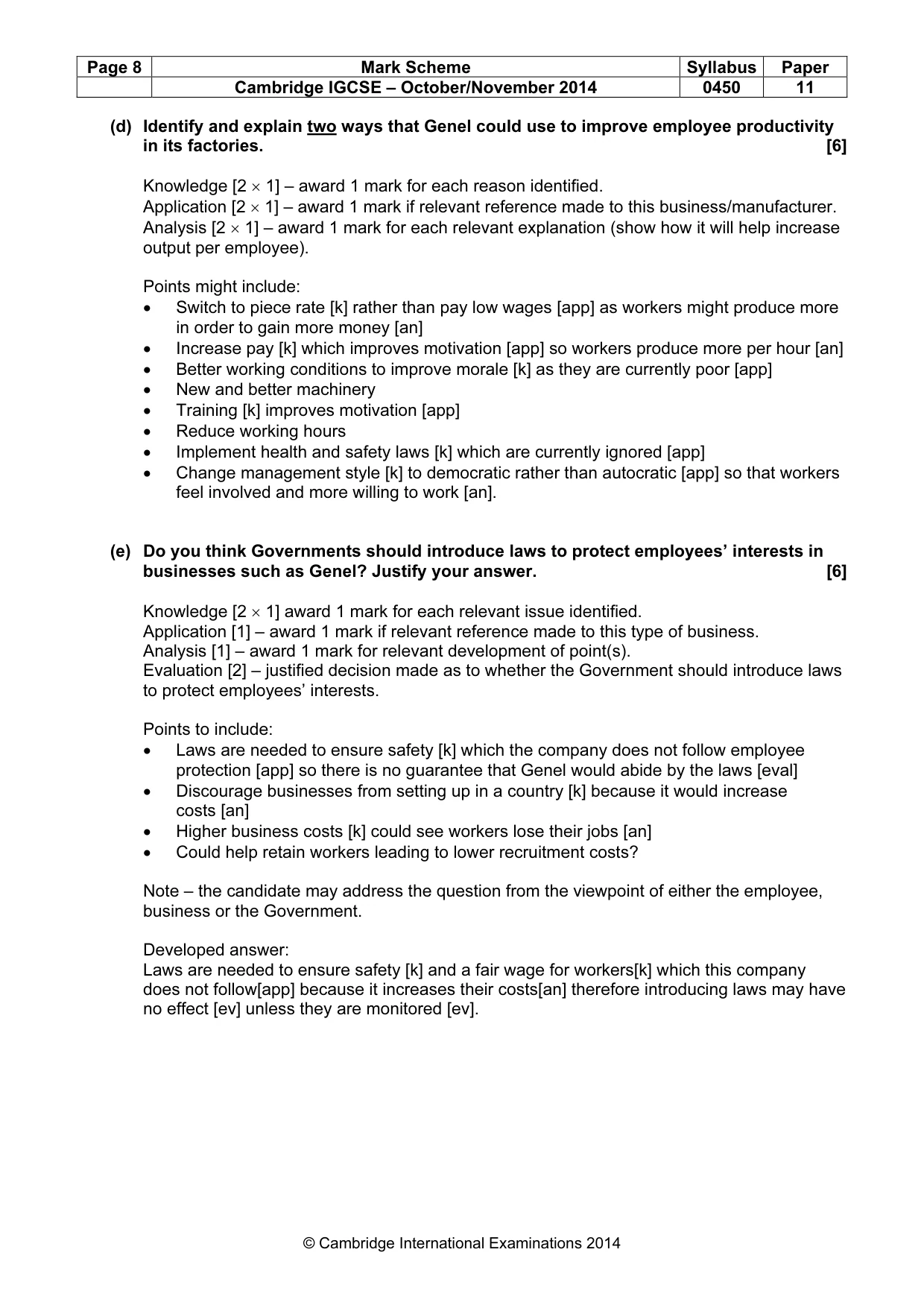
Page 8 Mark Scheme Syllabus Paper Cambridge IGCSE – October/November 2014 0450 11 © Cambridge International Examinations 2014 (d) Identify and explain two ways that Genel could use to improve employee productivity in its factories. [6] Knowledge [2 × 1] – award 1 mark for each reason identified. Application [2 × 1] – award 1 mark if relevant reference made to this business/manufacturer. Analysis [2 × 1] – award 1 mark for each relevant explanation (show how it will help increase output per employee). Points might include: • Switch to piece rate [k] rather than pay low wages [app] as workers might produce more in order to gain more money [an] • Increase pay [k] which improves motivation [app] so workers produce more per hour [an] • Better working conditions to improve morale [k] as they are currently poor [app] • New and better machinery • Training [k] improves motivation [app] • Reduce working hours • Implement health and safety laws [k] which are currently ignored [app] • Change management style [k] to democratic rather than autocratic [app] so that workers feel involved and more willing to work [an]. (e) Do you think Governments should introduce laws to protect employees’ interests in businesses such as Genel? Justify your answer. [6] Knowledge [2 × 1] award 1 mark for each relevant issue identified. Application [1] – award 1 mark if relevant reference made to this type of business. Analysis [1] – award 1 mark for relevant development of point(s). Evaluation [2] – justified decision made as to whether the Government should introduce laws to protect employees’ interests. Points to include: • Laws are needed to ensure safety [k] which the company does not follow employee protection [app] so there is no guarantee that Genel would abide by the laws [eval] • Discourage businesses from setting up in a country [k] because it would increase costs [an] • Higher business costs [k] could see workers lose their jobs [an] • Could help retain workers leading to lower recruitment costs? Note – the candidate may address the question from the viewpoint of either the employee, business or the Government. Developed answer: Laws are needed to ensure safety [k] and a fair wage for workers[k] which this company does not follow[app] because it increases their costs[an] therefore introducing laws may have no effect [ev] unless they are monitored [ev].
Mark scheme, page 9
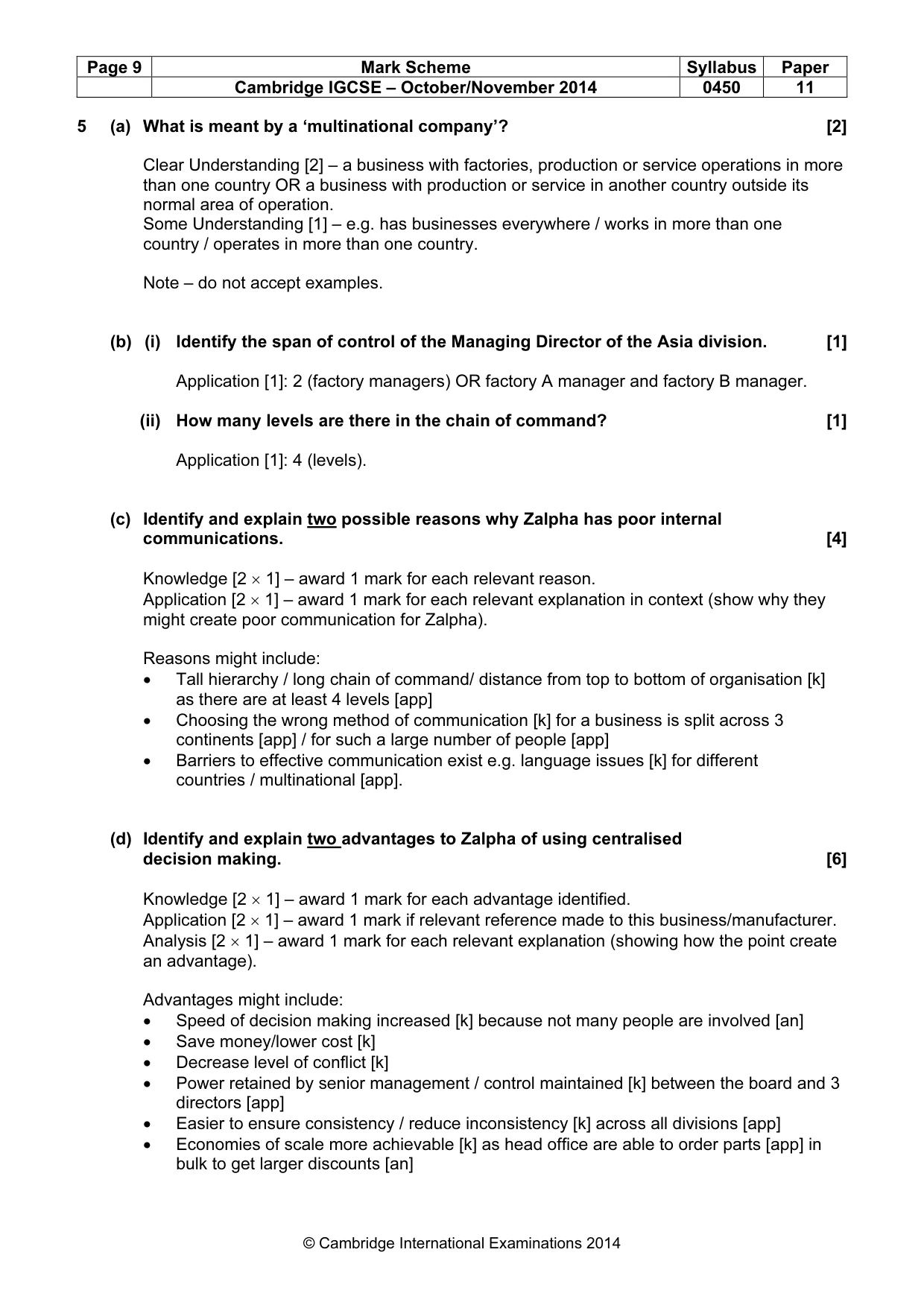
Page 9 Mark Scheme Syllabus Paper Cambridge IGCSE – October/November 2014 0450 11 © Cambridge International Examinations 2014 5 (a) What is meant by a ‘multinational company’? [2] Clear Understanding [2] – a business with factories, production or service operations in more than one country OR a business with production or service in another country outside its normal area of operation. Some Understanding [1] – e.g. has businesses everywhere / works in more than one country / operates in more than one country. Note – do not accept examples. (b) (i) Identify the span of control of the Managing Director of the Asia division. [1] Application [1]: 2 (factory managers) OR factory A manager and factory B manager. (ii) How many levels are there in the chain of command? [1] Application [1]: 4 (levels). (c) Identify and explain two possible reasons why Zalpha has poor internal communications. [4] Knowledge [2 × 1] – award 1 mark for each relevant reason. Application [2 × 1] – award 1 mark for each relevant explanation in context (show why they might create poor communication for Zalpha). Reasons might include: • Tall hierarchy / long chain of command/ distance from top to bottom of organisation [k] as there are at least 4 levels [app] • Choosing the wrong method of communication [k] for a business is split across 3 continents [app] / for such a large number of people [app] • Barriers to effective communication exist e.g. language issues [k] for different countries / multinational [app]. (d) Identify and explain two advantages to Zalpha of using centralised decision making. [6] Knowledge [2 × 1] – award 1 mark for each advantage identified. Application [2 × 1] – award 1 mark if relevant reference made to this business/manufacturer. Analysis [2 × 1] – award 1 mark for each relevant explanation (showing how the point create an advantage). Advantages might include: • Speed of decision making increased [k] because not many people are involved [an] • Save money/lower cost [k] • Decrease level of conflict [k] • Power retained by senior management / control maintained [k] between the board and 3 directors [app] • Easier to ensure consistency / reduce inconsistency [k] across all divisions [app] • Economies of scale more achievable [k] as head office are able to order parts [app] in bulk to get larger discounts [an]
Mark scheme, page 10
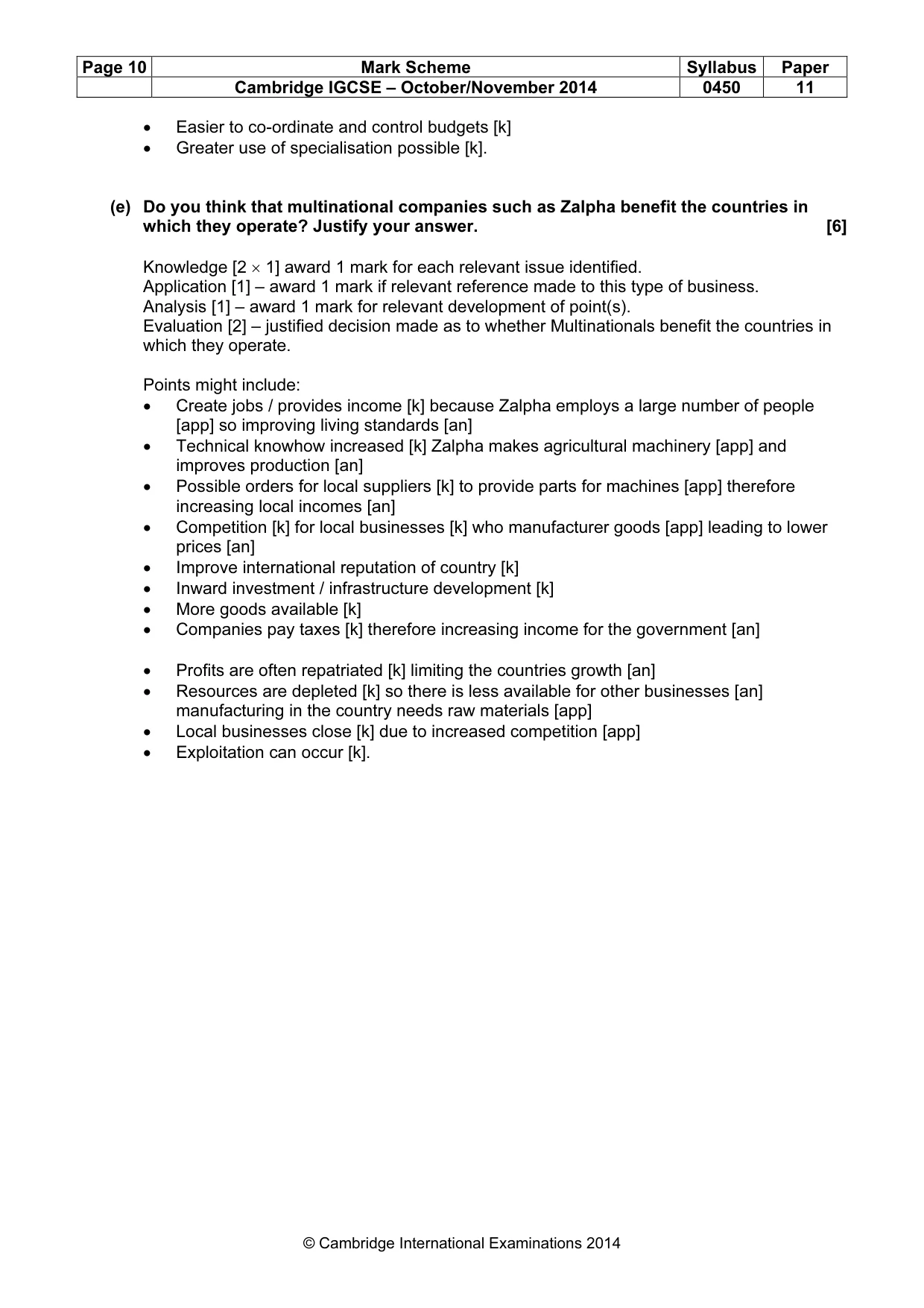
Page 10 Mark Scheme Syllabus Paper Cambridge IGCSE – October/November 2014 0450 11 © Cambridge International Examinations 2014 • Easier to co-ordinate and control budgets [k] • Greater use of specialisation possible [k]. (e) Do you think that multinational companies such as Zalpha benefit the countries in which they operate? Justify your answer. [6] Knowledge [2 × 1] award 1 mark for each relevant issue identified. Application [1] – award 1 mark if relevant reference made to this type of business. Analysis [1] – award 1 mark for relevant development of point(s). Evaluation [2] – justified decision made as to whether Multinationals benefit the countries in which they operate. Points might include: • Create jobs / provides income [k] because Zalpha employs a large number of people [app] so improving living standards [an] • Technical knowhow increased [k] Zalpha makes agricultural machinery [app] and improves production [an] • Possible orders for local suppliers [k] to provide parts for machines [app] therefore increasing local incomes [an] • Competition [k] for local businesses [k] who manufacturer goods [app] leading to lower prices [an] • Improve international reputation of country [k] • Inward investment / infrastructure development [k] • More goods available [k] • Companies pay taxes [k] therefore increasing income for the government [an] • Profits are often repatriated [k] limiting the countries growth [an] • Resources are depleted [k] so there is less available for other businesses [an] manufacturing in the country needs raw materials [app] • Local businesses close [k] due to increased competition [app] • Exploitation can occur [k].
What you needed in this session
Cambridge’s own grade thresholds for 2014 Oct/Nov, Paper 1 · Variant 1. A higher threshold means an easier paper — the bar moves with how the cohort did.