Cambridge IGCSE Business Studies 0450 — 2024 Feb/March Paper 1 · Variant 2
0450/12/F/M/24 · 80 marks · ≈90 min
The question paper and its mark scheme, free to read here and free to download. This is Cambridge’s own paper, exactly as it was sat.
Question paper12 pages



Mark scheme23 pages
Answers below. Sit the paper first if you are practising.
Paper as text
Question paper, page 1
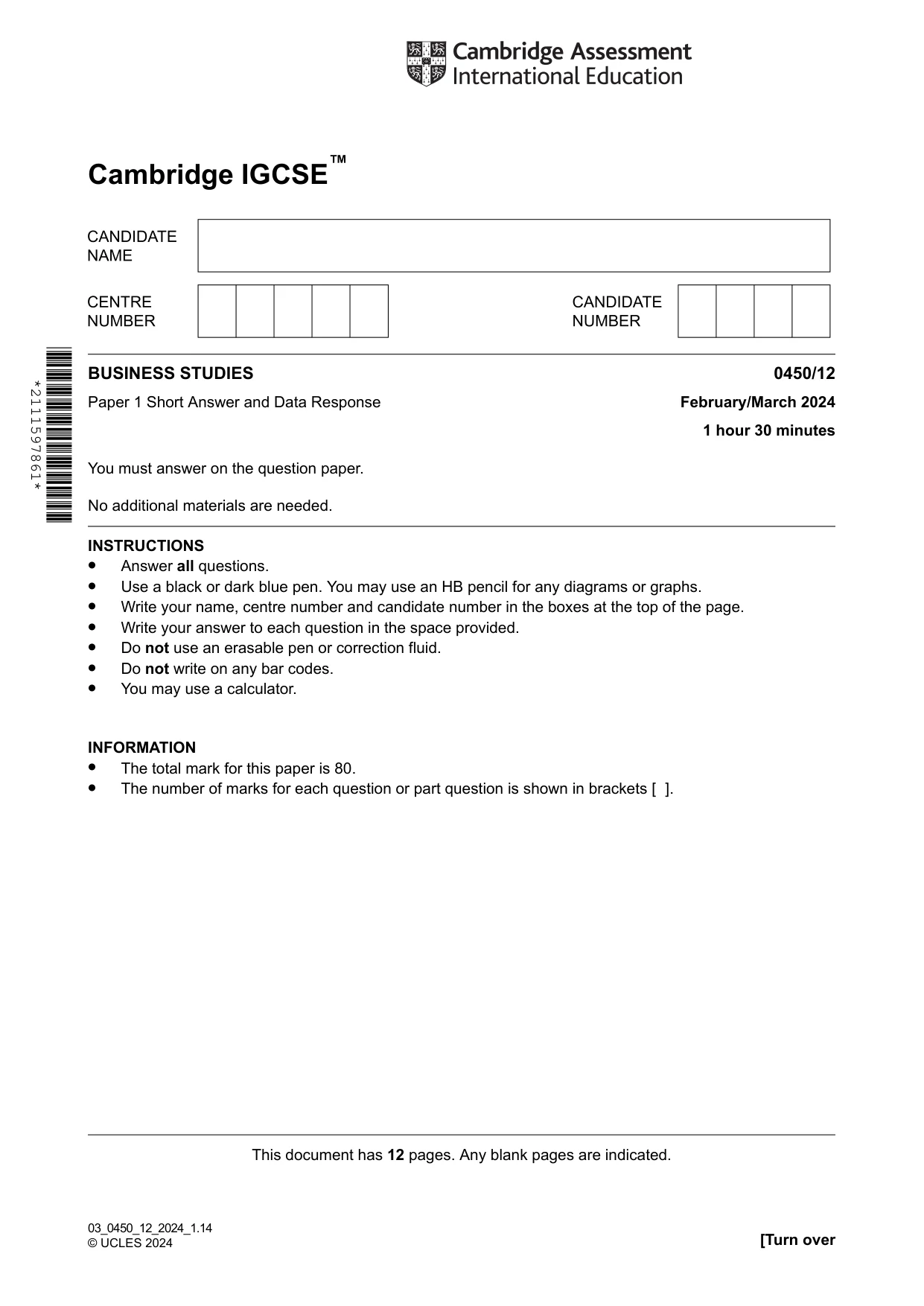
Cambridge IGCSE™ 0450/12 February/March 2024 1 hour 30 minutes BUSINESS STUDIES Paper 1 Short Answer and Data Response You must answer on the question paper. No additional materials are needed. INSTRUCTIONS • Answer all questions. • Use a black or dark blue pen. You may use an HB pencil for any diagrams or graphs. • Write your name, centre number and candidate number in the boxes at the top of the page. • Write your answer to each question in the space provided. • Do not use an erasable pen or correction fluid. • Do not write on any bar codes. • You may use a calculator. INFORMATION • The total mark for this paper is 80. • The number of marks for each question or part question is shown in brackets [ ]. This document has 12 pages. Any blank pages are indicated. [Turn over 03_0450_12_2024_1.14 © UCLES 2024 *2111597861*
Question paper, page 2
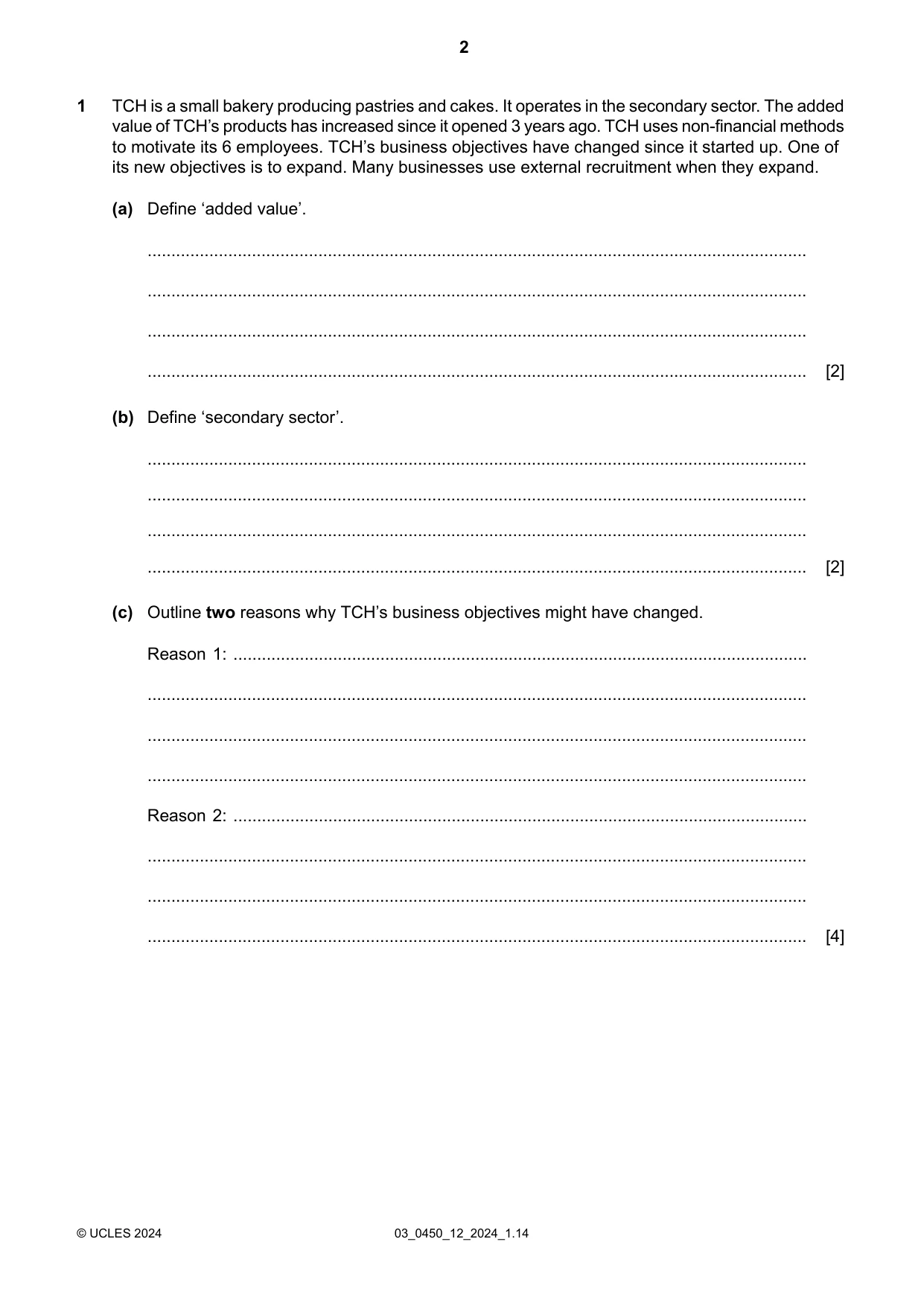
TCH is a small bakery producing pastries and cakes. It operates in the secondary sector. The added value of TCH’s products has increased since it opened 3 years ago. TCH uses non-financial methods 1 to motivate its 6 employees. TCH’s business objectives have changed since it started up. One of its new objectives is to expand. Many businesses use external recruitment when they expand. Define ‘added value’. (a) … … … … [2] Define ‘secondary sector’. (b) … … … … [2] Outline two reasons why TCH’s business objectives might have changed. (c) Reason 1: … … … … Reason 2: … … … … [4] 03_0450_12_2024_1.14 © UCLES 2024 2
Question paper, page 3
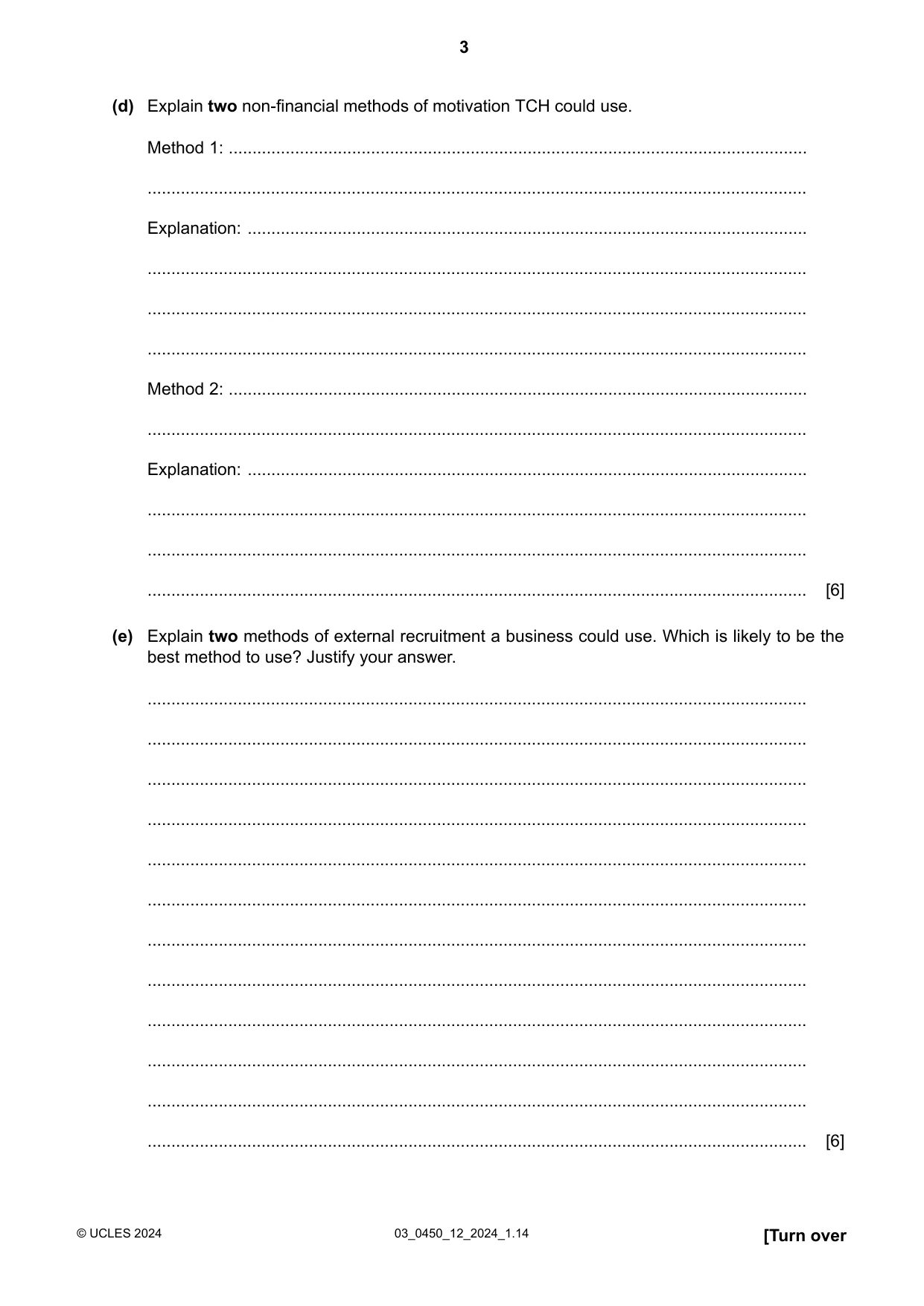
Explain two non-financial methods of motivation TCH could use. (d) Method 1: … … Explanation: … … … … Method 2: … … Explanation: … … … … [6] Explain two methods of external recruitment a business could use. Which is likely to be the best method to use? Justify your answer. (e) … … … … … … … … … … … … [6] [Turn over 03_0450_12_2024_1.14 © UCLES 2024 3
Question paper, page 4
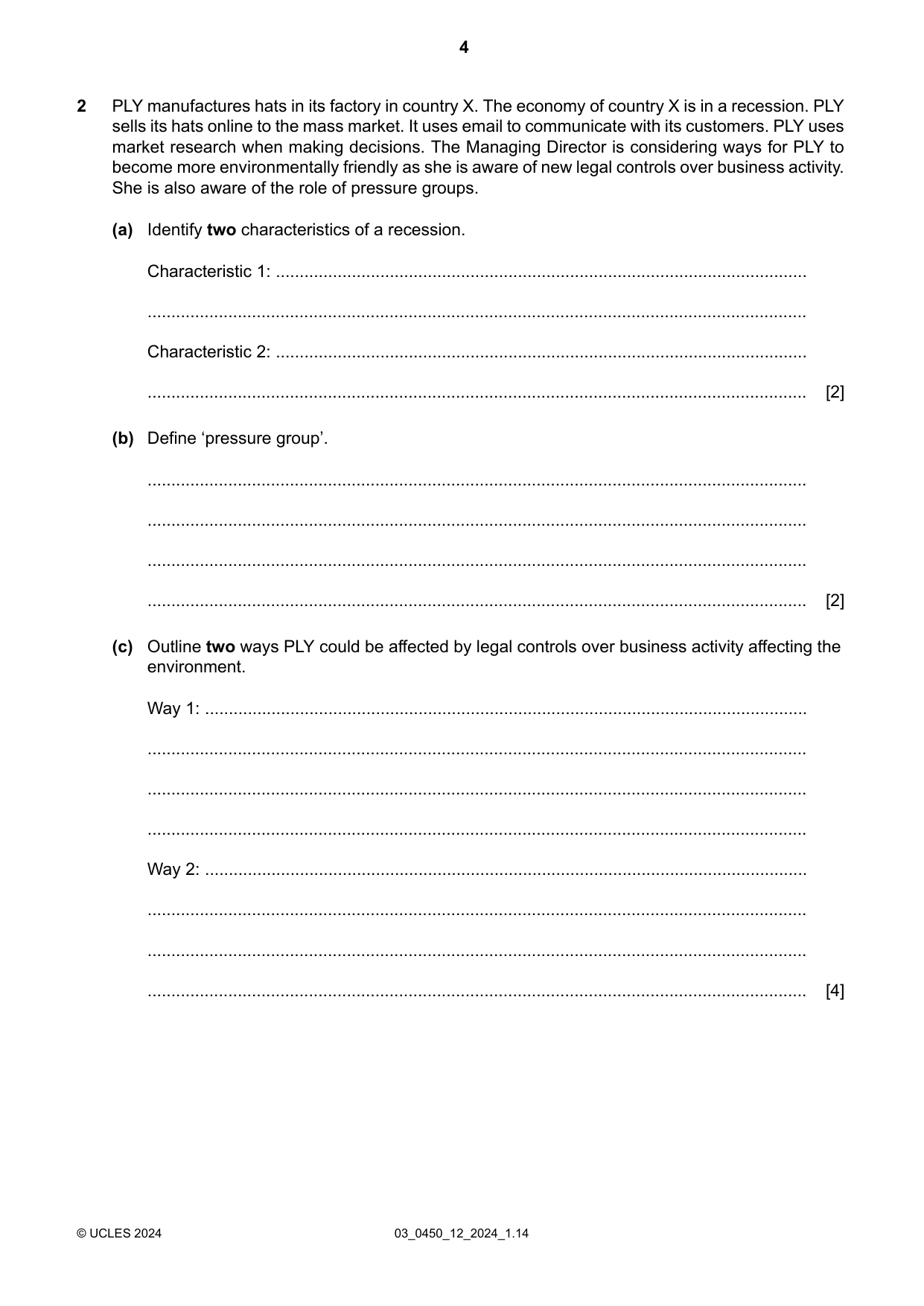
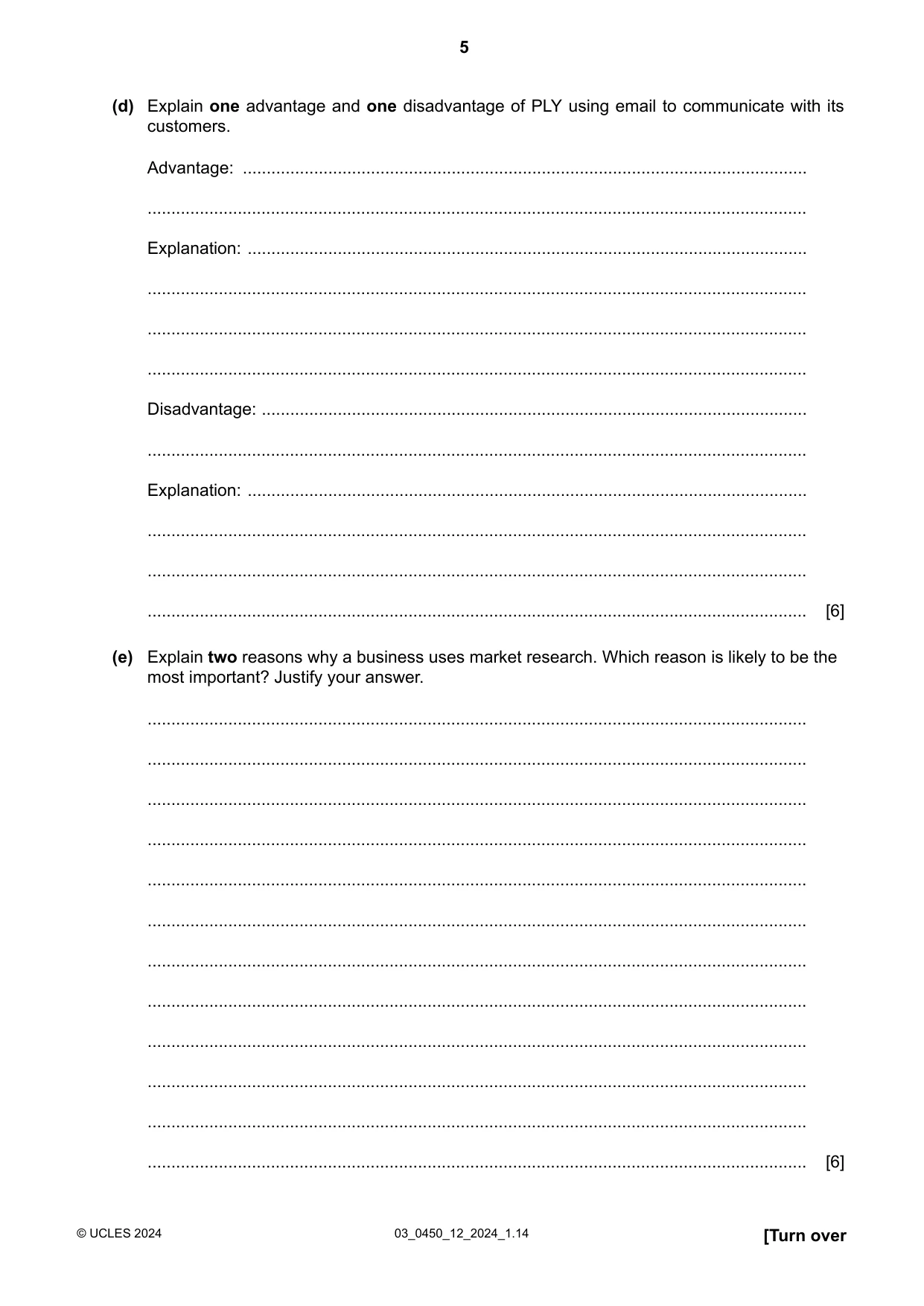
PLY manufactures hats in its factory in country X. The economy of country X is in a recession. PLY sells its hats online to the mass market. It uses email to communicate with its customers. PLY uses 2 market research when making decisions. The Managing Director is considering ways for PLY to become more environmentally friendly as she is aware of new legal controls over business activity. She is also aware of the role of pressure groups. Identify two characteristics of a recession. (a) Characteristic 1: … … Characteristic 2: … … [2] Define ‘pressure group’. (b) … … … … [2] Outline two ways PLY could be affected by legal controls over business activity affecting the environment. (c) Way 1: … … … … Way 2: … … … … [4] 03_0450_12_2024_1.14 © UCLES 2024 4
Question paper, page 5
Explain one advantage and one disadvantage of PLY using email to communicate with its customers. (d) Advantage: … … Explanation: … … … … Disadvantage: … … Explanation: … … … … [6] Explain two reasons why a business uses market research. Which reason is likely to be the most important? Justify your answer. (e) … … … … … … … … … … … … [6] [Turn over 03_0450_12_2024_1.14 © UCLES 2024 5
Question paper, page 6
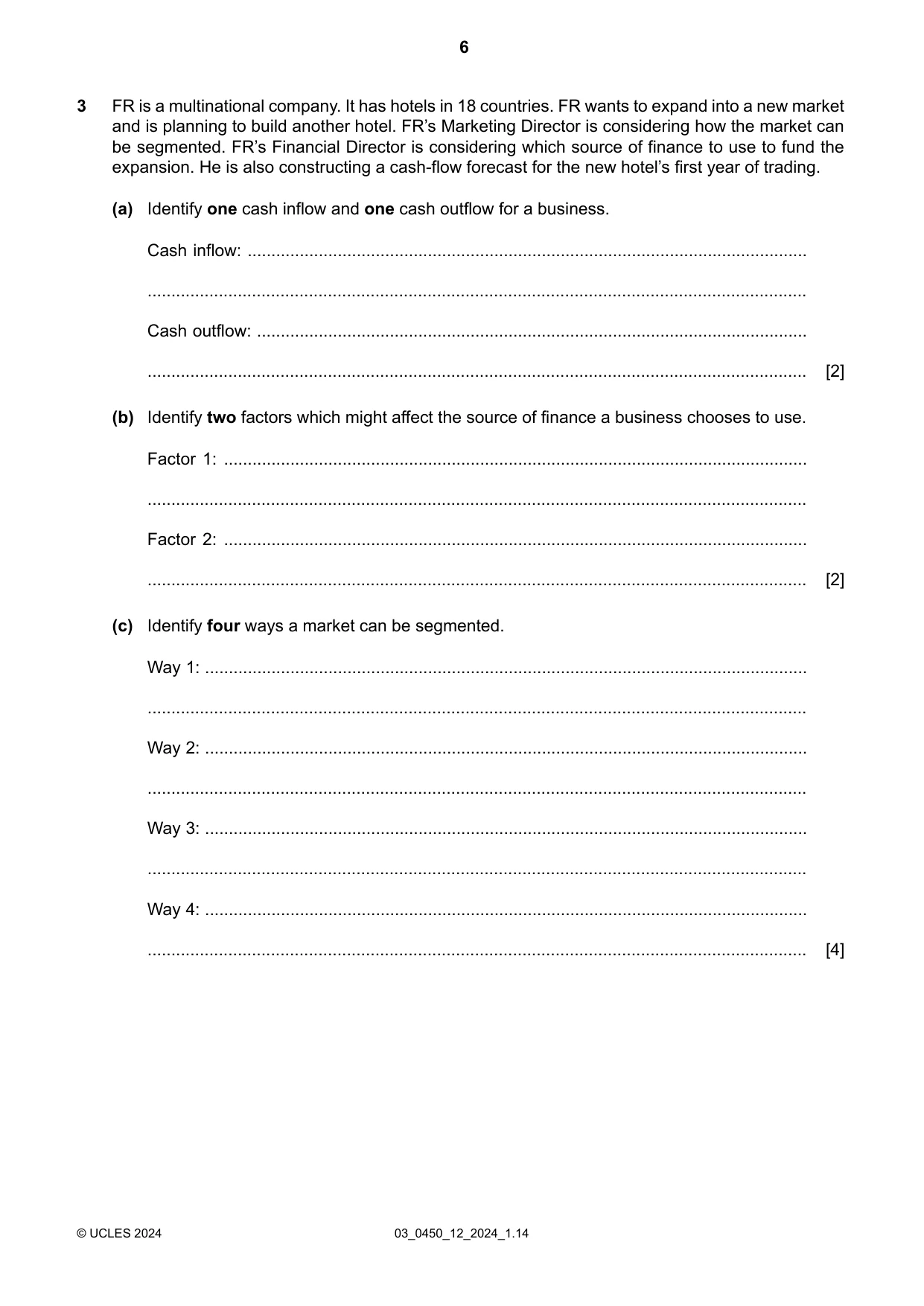
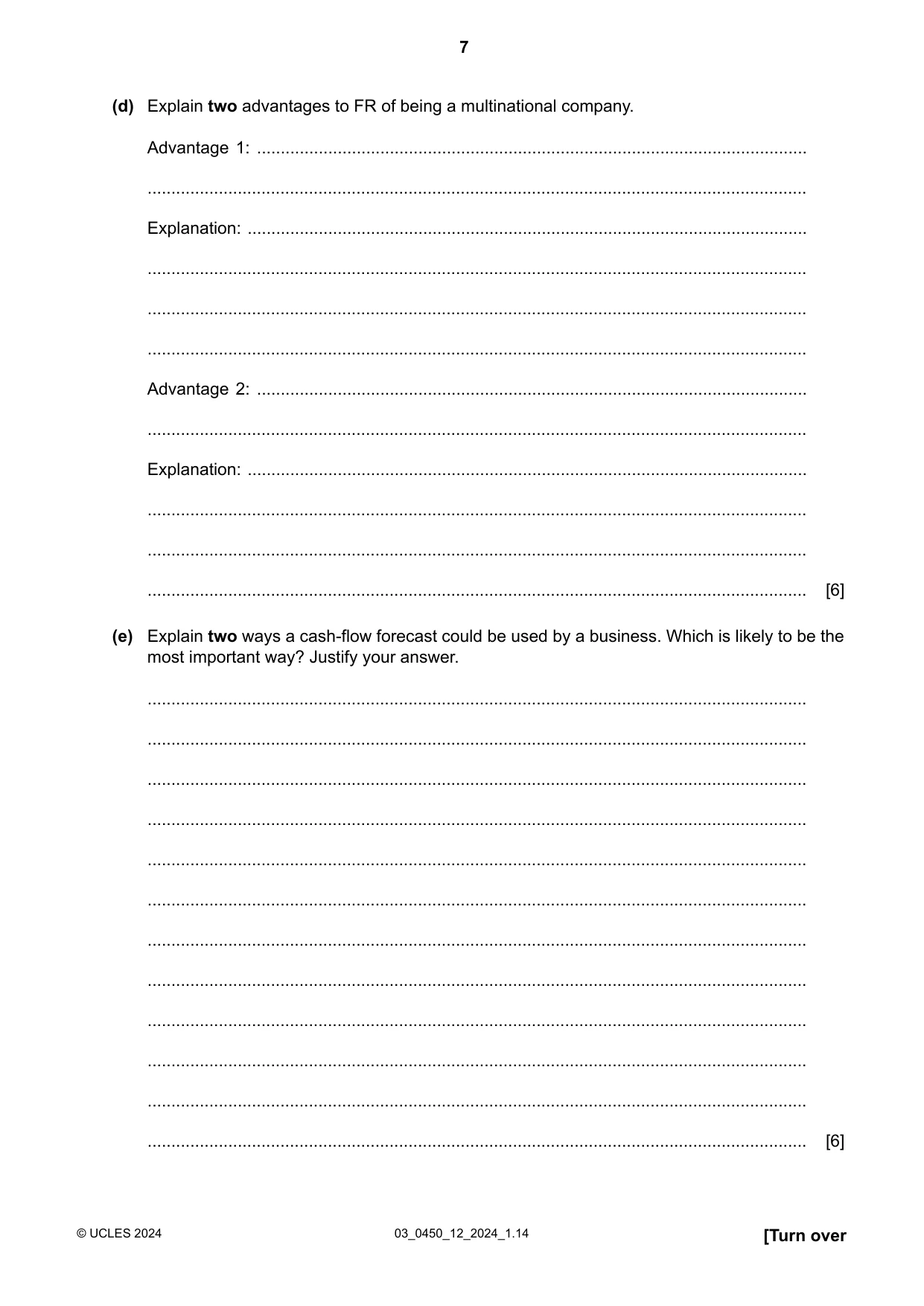
FR is a multinational company. It has hotels in 18 countries. FR wants to expand into a new market and is planning to build another hotel. FR’s Marketing Director is considering how the market can 3 be segmented. FR’s Financial Director is considering which source of finance to use to fund the expansion. He is also constructing a cash-flow forecast for the new hotel’s first year of trading. Identify one cash inflow and one cash outflow for a business. (a) Cash inflow: … … Cash outflow: … … [2] Identify two factors which might affect the source of finance a business chooses to use. (b) Factor 1: … … Factor 2: … … [2] Identify four ways a market can be segmented. (c) Way 1: … … Way 2: … … Way 3: … … Way 4: … … [4] 03_0450_12_2024_1.14 © UCLES 2024 6
Question paper, page 7
Explain two advantages to FR of being a multinational company. (d) Advantage 1: … … Explanation: … … … … Advantage 2: … … Explanation: … … … … [6] Explain two ways a cash-flow forecast could be used by a business. Which is likely to be the most important way? Justify your answer. (e) … … … … … … … … … … … … [6] [Turn over 03_0450_12_2024_1.14 © UCLES 2024 7
Question paper, page 8
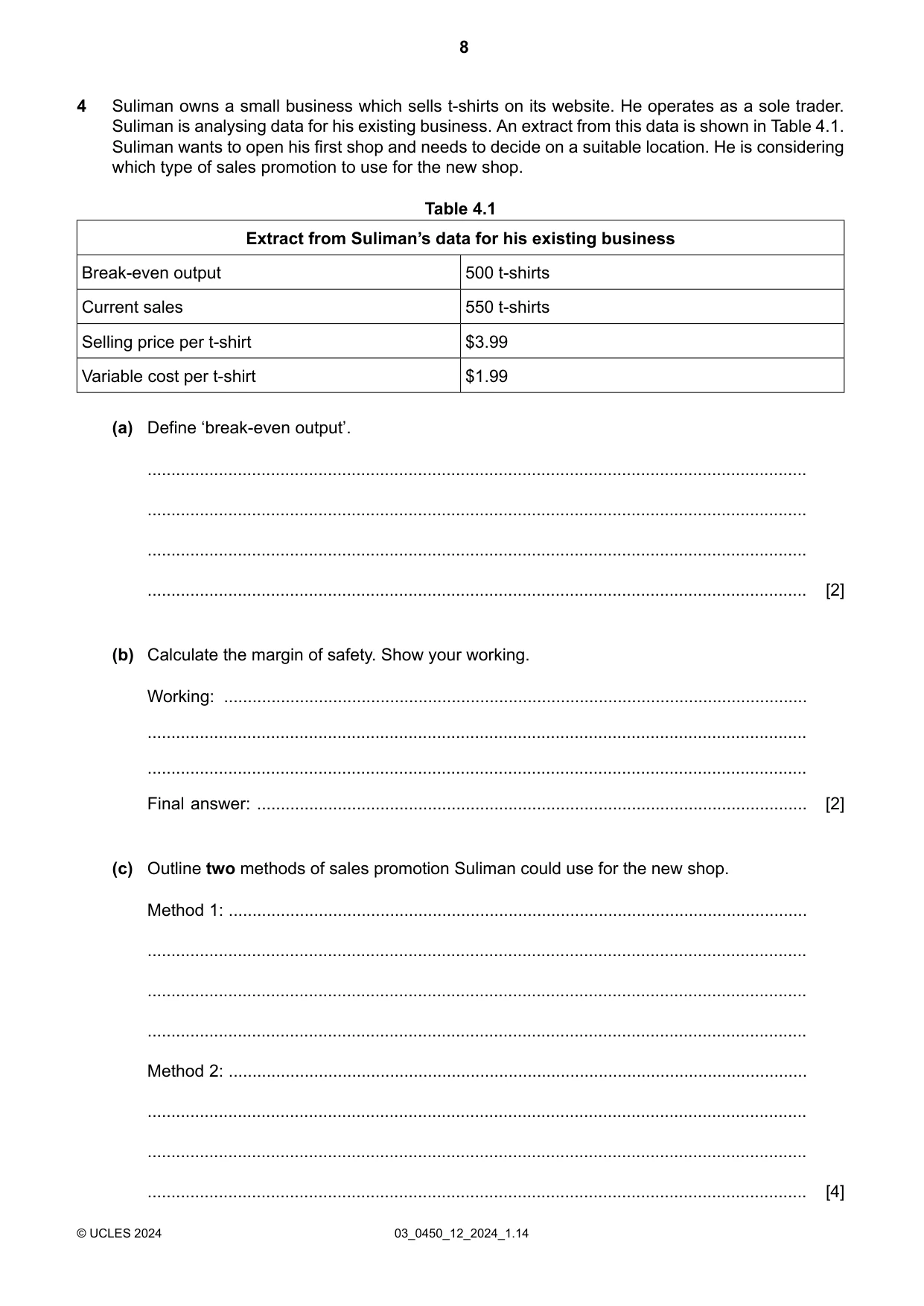
Suliman owns a small business which sells t-shirts on its website. He operates as a sole trader. Suliman is analysing data for his existing business. An extract from this data is shown in Table 4.1. 4 Suliman wants to open his first shop and needs to decide on a suitable location. He is considering which type of sales promotion to use for the new shop. Table 4.1 Extract from Suliman’s data for his existing business 500 t-shirts Break-even output 550 t-shirts Current sales $3.99 Selling price per t-shirt $1.99 Variable cost per t-shirt Define ‘break-even output’. (a) … … … … [2] Calculate the margin of safety. Show your working. (b) Working: … … … Final answer: … [2] Outline two methods of sales promotion Suliman could use for the new shop. (c) Method 1: … … … … Method 2: … … … … [4] 03_0450_12_2024_1.14 © UCLES 2024 8
Question paper, page 9
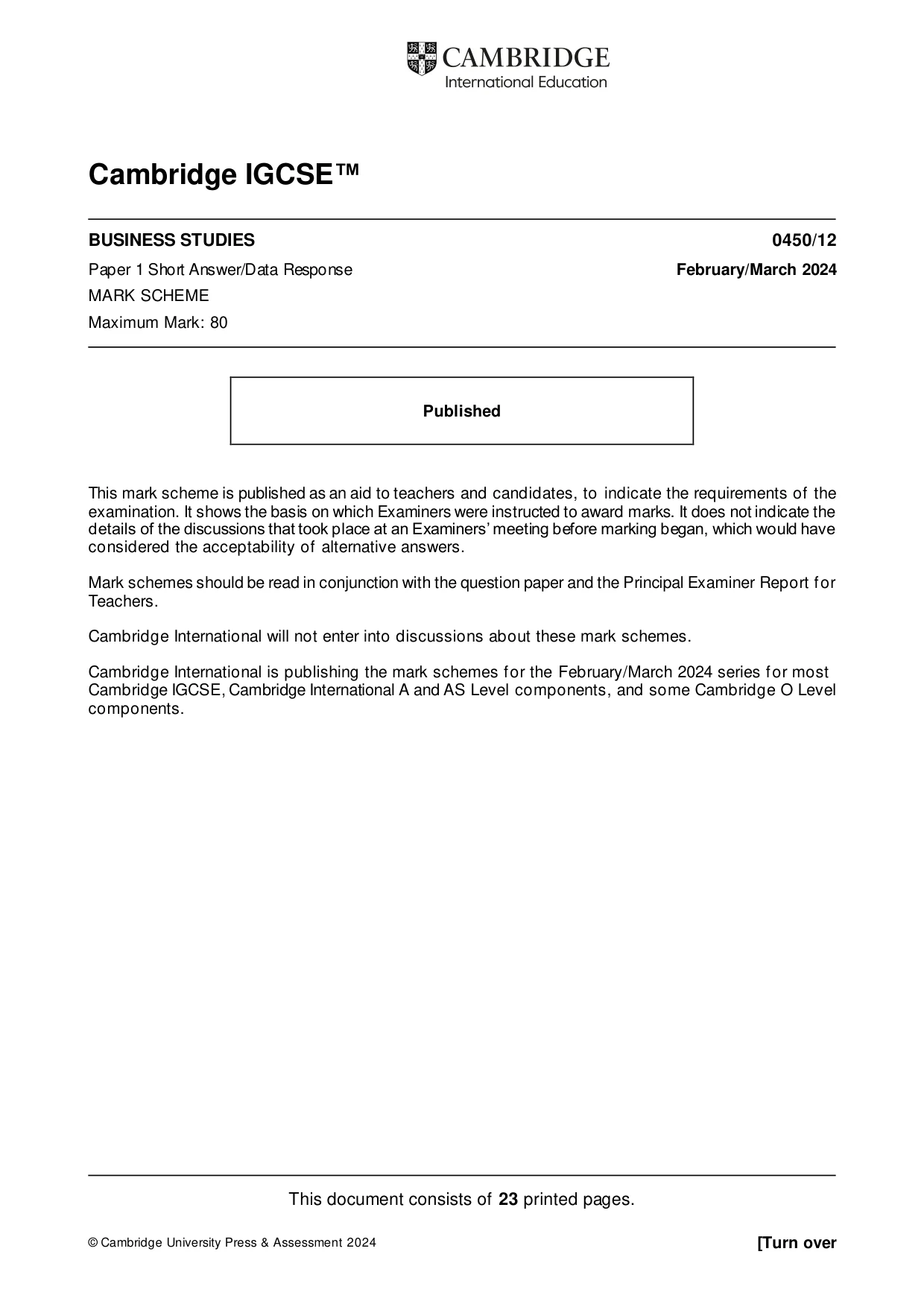
Explain two factors Suliman should consider when deciding on a suitable location for the new shop. (d) Factor 1: … … Explanation: … … … … Factor 2: … … Explanation: … … … … [6] Do you think operating as a sole trader is the best type of organisation for a small business? Justify your answer. (e) … … … … … … … … … … … … [6] 03_0450_12_2024_1.14 © UCLES 2024 9
Question paper, page 10
BLANK PAGE 03_0450_12_2024_1.14 © UCLES 2024 10
Question paper, page 11
BLANK PAGE 03_0450_12_2024_1.14 © UCLES 2024 11
Question paper, page 12
BLANK PAGE Permission to reproduce items where third-party owned material protected by copyright is included has been sought and cleared where possible. Every reasonable effort has been made by the publisher (UCLES) to trace copyright holders, but if any items requiring clearance have unwittingly been included, the publisher will be pleased to make amends at the earliest possible opportunity. To avoid the issue of disclosure of answer-related information to candidates, all copyright acknowledgements are reproduced online in the Cambridge Assessment International Education Copyright Acknowledgements Booklet. This is produced for each series of examinations and is freely available to download at www.cambridgeinternational.org after the live examination series. Cambridge Assessment International Education is part of Cambridge Assessment. Cambridge Assessment is the brand name of the University of Cambridge Local Examinations Syndicate (UCLES), which is a department of the University of Cambridge. 03_0450_12_2024_1.14 © UCLES 2024 12
Mark scheme, page 1
This document consists of 23 printed pages. © Cambridge University Press & Assessment 2024 [Turn over Cambridge IGCSE™ BUSINESS STUDIES 0450/12 Paper 1 Short Answer/Data Response February/March 2024 MARK SCHEME Maximum Mark: 80 Published This mark scheme is published as an aid to teachers and candidates, to indicate the requirements of the examination. It shows the basis on which Examiners were instructed to award marks. It does not indicate the details of the discussions that took place at an Examiners’ meeting before marking began, which would have considered the acceptability of alternative answers. Mark schemes should be read in conjunction with the question paper and the Principal Examiner Report for Teachers. Cambridge International will not enter into discussions about these mark schemes. Cambridge International is publishing the mark schemes for the February/March 2024 series for most Cambridge IGCSE, Cambridge International A and AS Level components, and some Cambridge O Level components.
Mark scheme, page 2
0450/12 Cambridge IGCSE – Mark Scheme PUBLISHED February/March 2024 © Cambridge University Press & Assessment 2024 Page 2 of 23 Generic Marking Principles These general marking principles must be applied by all examiners when marking candidate answers. They should be applied alon gside the specific content of the mark scheme or generic level descriptions for a question. Each question paper and mark scheme will also comply with these marking principles. GENERIC MARKING PRINCIPLE 1: Marks must be awarded in line with: • the specific content of the mark scheme or the generic level descriptors for the question • the specific skills defined in the mark scheme or in the generic level descriptors for the question • the standard of response required by a candidate as exemplified by the standardisation scripts. GENERIC MARKING PRINCIPLE 2: Marks awarded are always whole marks (not half marks, or other fractions). GENERIC MARKING PRINCIPLE 3: Marks must be awarded positively: • marks are awarded for correct/valid answers, as defined in the mark scheme. However, credit is given for valid answers which go beyond the scope of the syllabus and mark scheme, referring to your Team Leader as appropriate • marks are awarded when candidates clearly demonstrate what they know and can do • marks are not deducted for errors • marks are not deducted for omissions • answers should only be judged on the quality of spelling, punctuation and grammar when these features are specifically assessed by the question as indicated by the mark scheme. The meaning, however, should be unambiguous. GENERIC MARKING PRINCIPLE 4: Rules must be applied consistently, e.g. in situations where candidates have not followed instructions or in the application of generic level descriptors.
Mark scheme, page 3
0450/12 Cambridge IGCSE – Mark Scheme PUBLISHED February/March 2024 © Cambridge University Press & Assessment 2024 Page 3 of 23 GENERIC MARKING PRINCIPLE 5: Marks should be awarded using the full range of marks defined in the mark scheme for the question (however; the use of the full mark range may be limited according to the quality of the candidate responses seen). GENERIC MARKING PRINCIPLE 6: Marks awarded are based solely on the requirements as defined in the mark scheme. Marks should not be awarded with grade thresholds or grade descriptors in mind.
Mark scheme, page 4
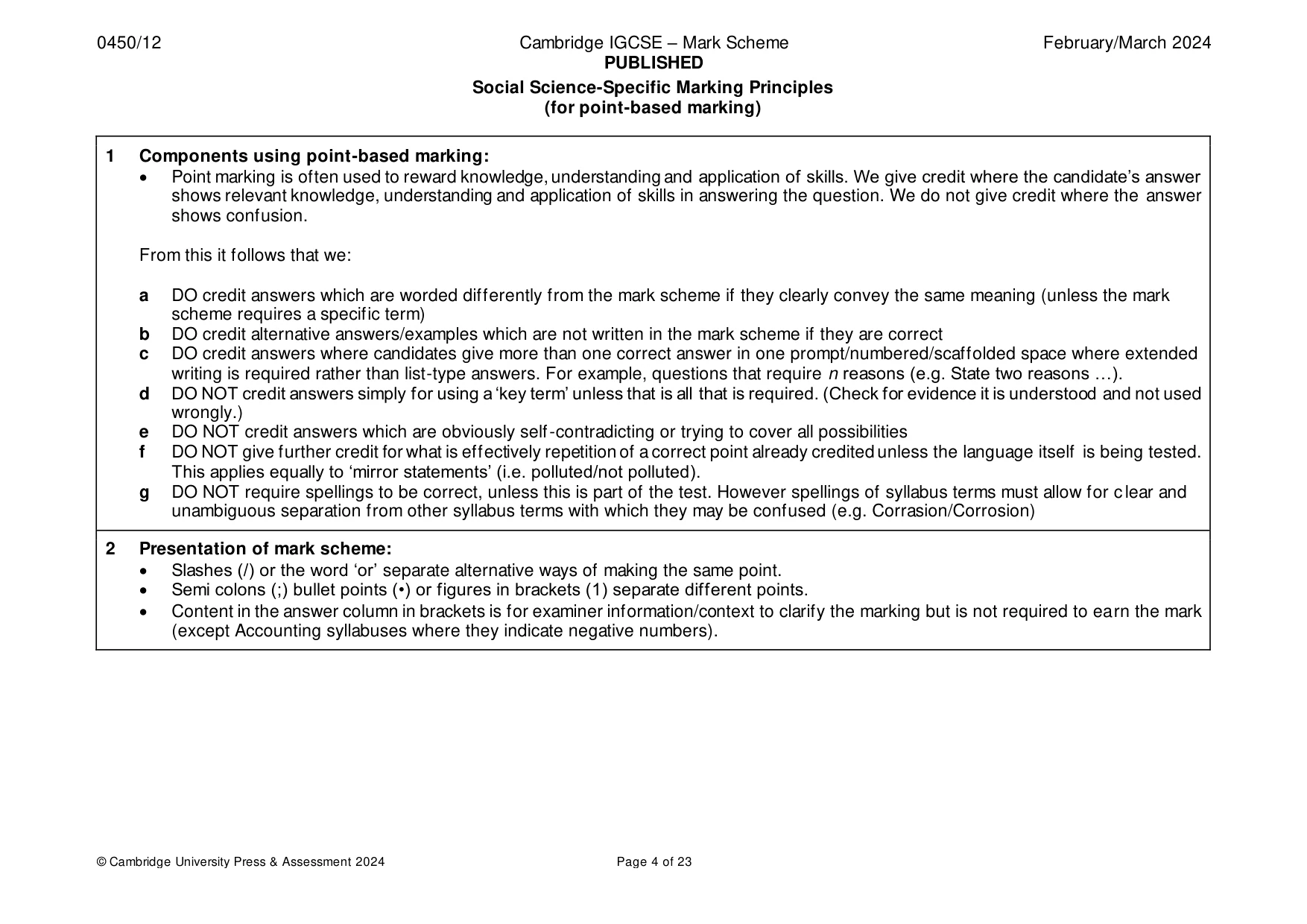
0450/12 Cambridge IGCSE – Mark Scheme PUBLISHED February/March 2024 © Cambridge University Press & Assessment 2024 Page 4 of 23 Social Science-Specific Marking Principles (for point-based marking) 1 Components using point-based marking: • Point marking is often used to reward knowledge, understanding and application of skills. We give credit where the candidate’s answer shows relevant knowledge, understanding and application of skills in answering the question. We do not give credit where the answer shows confusion. From this it follows that we: a DO credit answers which are worded differently from the mark scheme if they clearly convey the same meaning (unless the mark scheme requires a specific term) b DO credit alternative answers/examples which are not written in the mark scheme if they are correct c DO credit answers where candidates give more than one correct answer in one prompt/numbered/scaffolded space where extended writing is required rather than list-type answers. For example, questions that require n reasons (e.g. State two reasons …). d DO NOT credit answers simply for using a ‘key term’ unless that is all that is required. (Check for evidence it is understood and not used wrongly.) e DO NOT credit answers which are obviously self-contradicting or trying to cover all possibilities f DO NOT give further credit for what is effectively repetition of a correct point already credited unless the language itself is being tested. This applies equally to ‘mirror statements’ (i.e. polluted/not polluted). g DO NOT require spellings to be correct, unless this is part of the test. However spellings of syllabus terms must allow for clear and unambiguous separation from other syllabus terms with which they may be confused (e.g. Corrasion/Corrosion) 2 Presentation of mark scheme: • Slashes (/) or the word ‘or’ separate alternative ways of making the same point. • Semi colons (;) bullet points (•) or figures in brackets (1) separate different points. • Content in the answer column in brackets is for examiner information/context to clarify the marking but is not required to earn the mark (except Accounting syllabuses where they indicate negative numbers).
Mark scheme, page 5
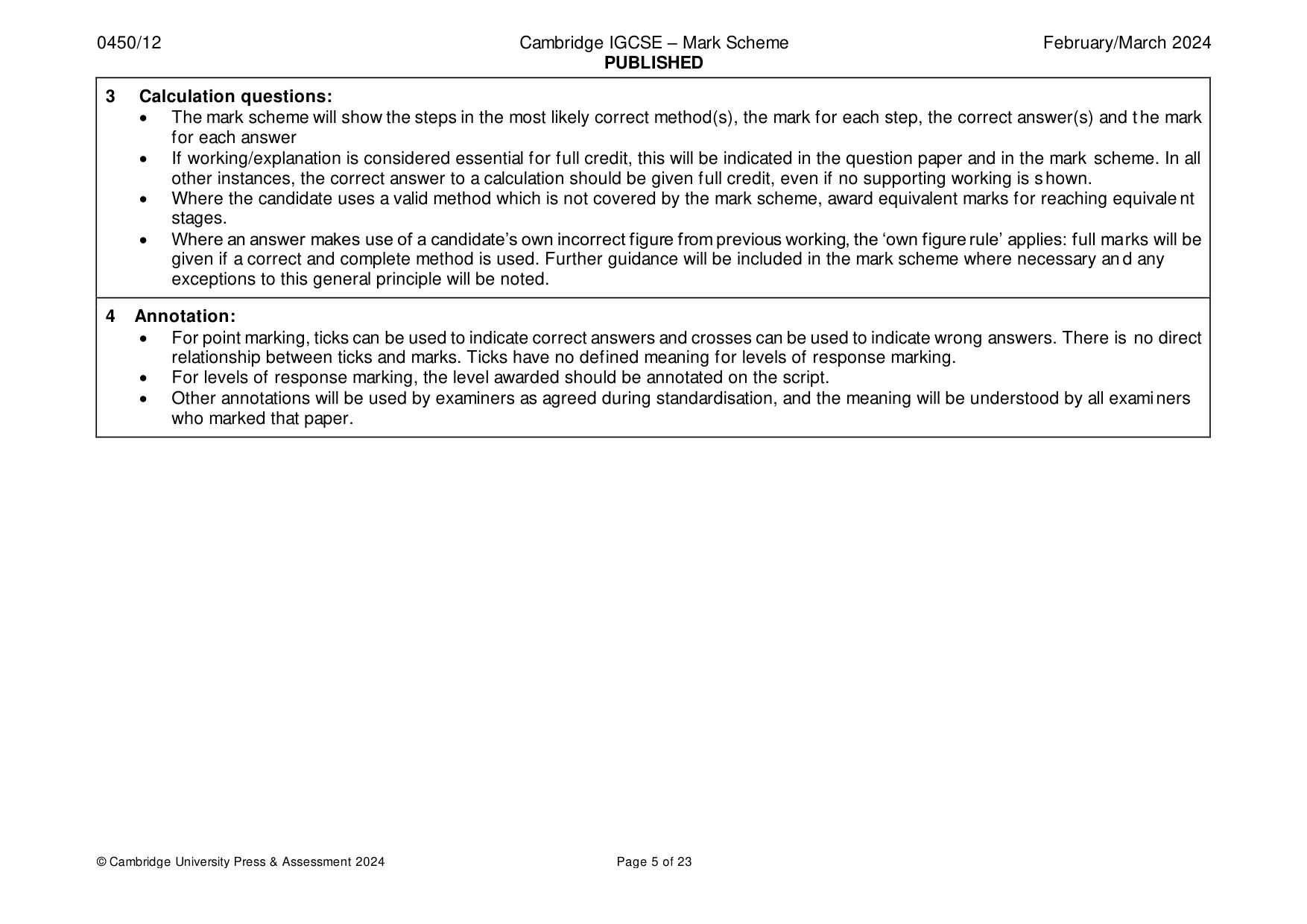
0450/12 Cambridge IGCSE – Mark Scheme PUBLISHED February/March 2024 © Cambridge University Press & Assessment 2024 Page 5 of 23 3 Calculation questions: • The mark scheme will show the steps in the most likely correct method(s), the mark for each step, the correct answer(s) and the mark for each answer • If working/explanation is considered essential for full credit, this will be indicated in the question paper and in the mark scheme. In all other instances, the correct answer to a calculation should be given full credit, even if no supporting working is shown. • Where the candidate uses a valid method which is not covered by the mark scheme, award equivalent marks for reaching equivale nt stages. • Where an answer makes use of a candidate’s own incorrect figure from previous working, the ‘own figure rule’ applies: full marks will be given if a correct and complete method is used. Further guidance will be included in the mark scheme where necessary an d any exceptions to this general principle will be noted. 4 Annotation: • For point marking, ticks can be used to indicate correct answers and crosses can be used to indicate wrong answers. There is no direct relationship between ticks and marks. Ticks have no defined meaning for levels of response marking. • For levels of response marking, the level awarded should be annotated on the script. • Other annotations will be used by examiners as agreed during standardisation, and the meaning will be understood by all examiners who marked that paper.
Mark scheme, page 6
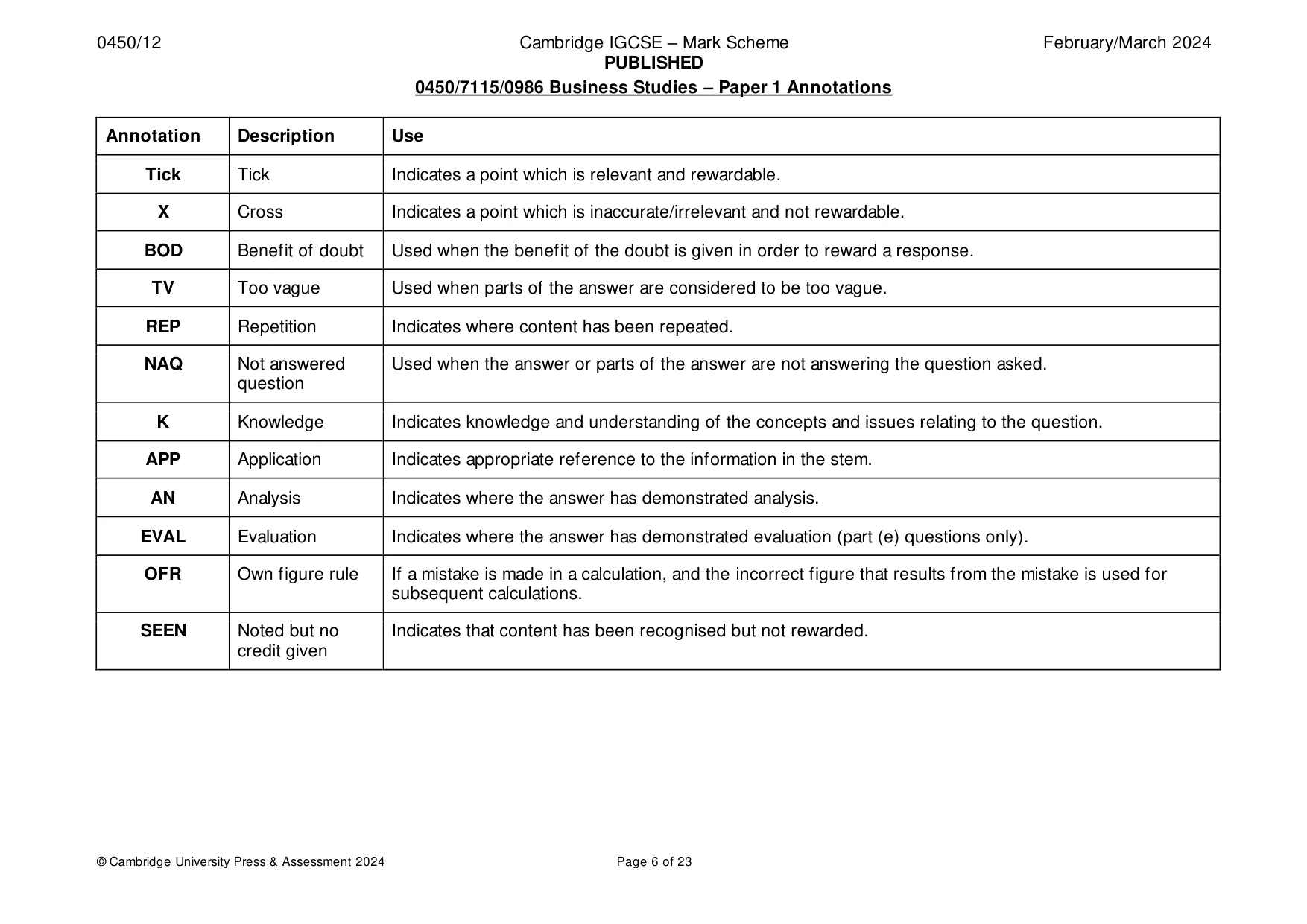
0450/12 Cambridge IGCSE – Mark Scheme PUBLISHED February/March 2024 © Cambridge University Press & Assessment 2024 Page 6 of 23 0450/7115/0986 Business Studies – Paper 1 Annotations Annotation Description Use Tick Tick Indicates a point which is relevant and rewardable. X Cross Indicates a point which is inaccurate/irrelevant and not rewardable. BOD Benefit of doubt Used when the benefit of the doubt is given in order to reward a response. TV Too vague Used when parts of the answer are considered to be too vague. REP Repetition Indicates where content has been repeated. NAQ Not answered question Used when the answer or parts of the answer are not answering the question asked. K Knowledge Indicates knowledge and understanding of the concepts and issues relating to the question. APP Application Indicates appropriate reference to the information in the stem. AN Analysis Indicates where the answer has demonstrated analysis. EVAL Evaluation Indicates where the answer has demonstrated evaluation (part (e) questions only). OFR Own figure rule If a mistake is made in a calculation, and the incorrect figure that results from the mistake is used for subsequent calculations. SEEN Noted but no credit given Indicates that content has been recognised but not rewarded.
Mark scheme, page 7
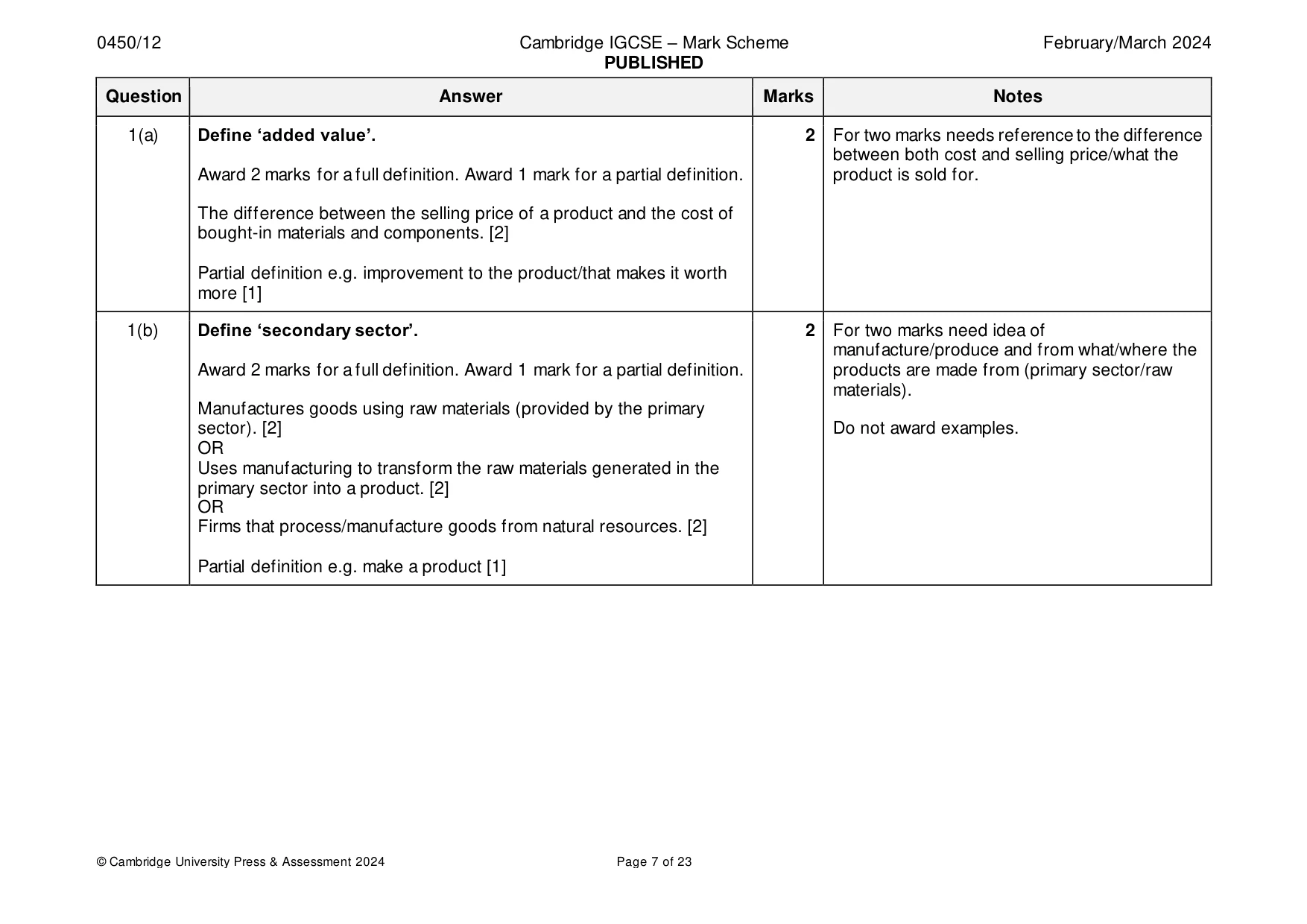
0450/12 Cambridge IGCSE – Mark Scheme PUBLISHED February/March 2024 © Cambridge University Press & Assessment 2024 Page 7 of 23 Question Answer Marks Notes 1(a) Define ‘added value’. Award 2 marks for a full definition. Award 1 mark for a partial definition. The difference between the selling price of a product and the cost of bought-in materials and components. [2] Partial definition e.g. improvement to the product/that makes it worth more [1] 2 For two marks needs reference to the difference between both cost and selling price/what the product is sold for. 1(b) Define ‘secondary sector’. Award 2 marks for a full definition. Award 1 mark for a partial definition. Manufactures goods using raw materials (provided by the primary sector). [2] OR Uses manufacturing to transform the raw materials generated in the primary sector into a product. [2] OR Firms that process/manufacture goods from natural resources. [2] Partial definition e.g. make a product [1] 2 For two marks need idea of manufacture/produce and from what/where the products are made from (primary sector/raw materials). Do not award examples.
Mark scheme, page 8
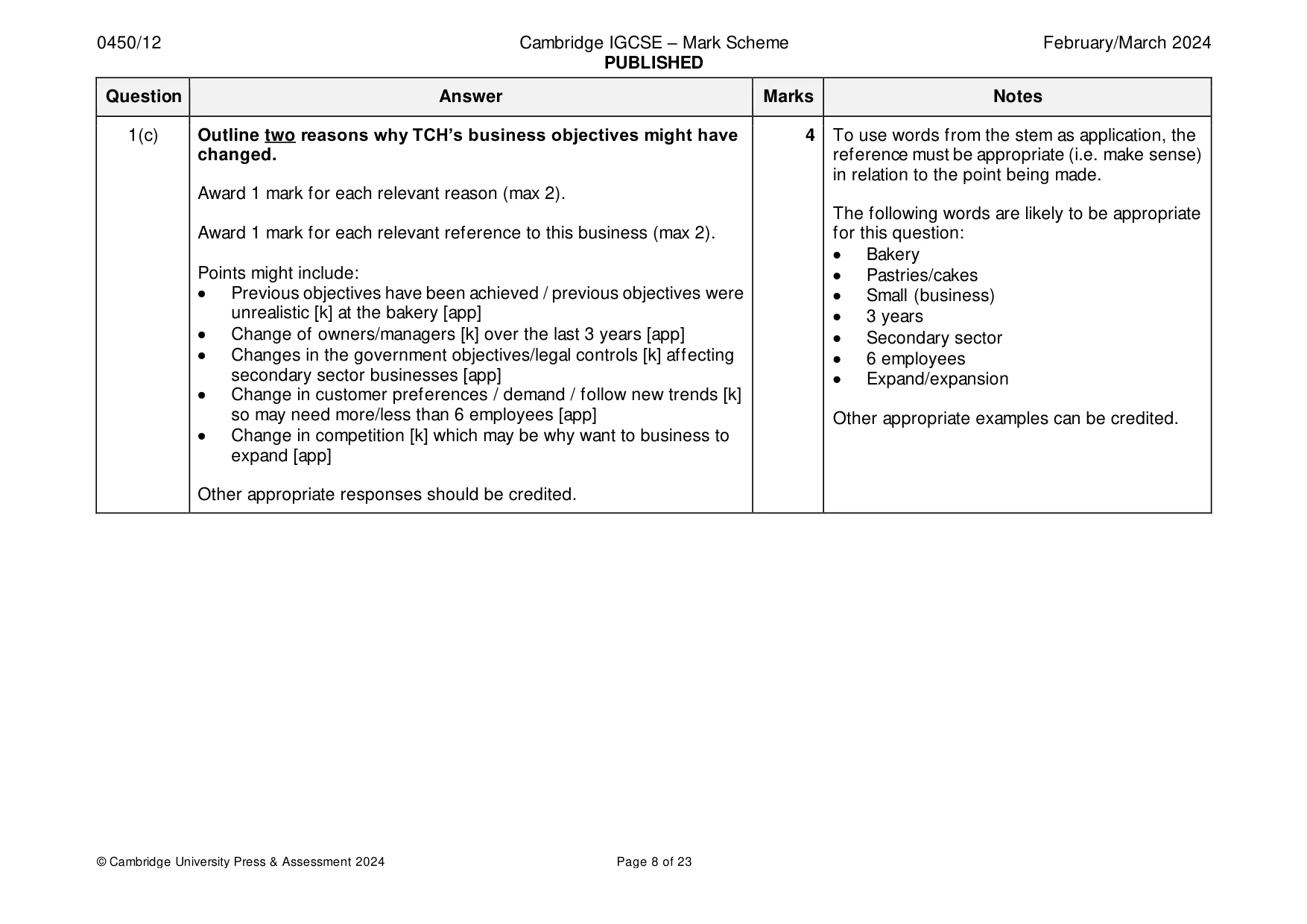
0450/12 Cambridge IGCSE – Mark Scheme PUBLISHED February/March 2024 © Cambridge University Press & Assessment 2024 Page 8 of 23 Question Answer Marks Notes 1(c) Outline two reasons why TCH’s business objectives might have changed. Award 1 mark for each relevant reason (max 2). Award 1 mark for each relevant reference to this business (max 2). Points might include: • Previous objectives have been achieved / previous objectives were unrealistic [k] at the bakery [app] • Change of owners/managers [k] over the last 3 years [app] • Changes in the government objectives/legal controls [k] affecting secondary sector businesses [app] • Change in customer preferences / demand / follow new trends [k] so may need more/less than 6 employees [app] • Change in competition [k] which may be why want to business to expand [app] Other appropriate responses should be credited. 4 To use words from the stem as application, the reference must be appropriate (i.e. make sense) in relation to the point being made. The following words are likely to be appropriate for this question: • Bakery • Pastries/cakes • Small (business) • 3 years • Secondary sector • 6 employees • Expand/expansion Other appropriate examples can be credited.
Mark scheme, page 9
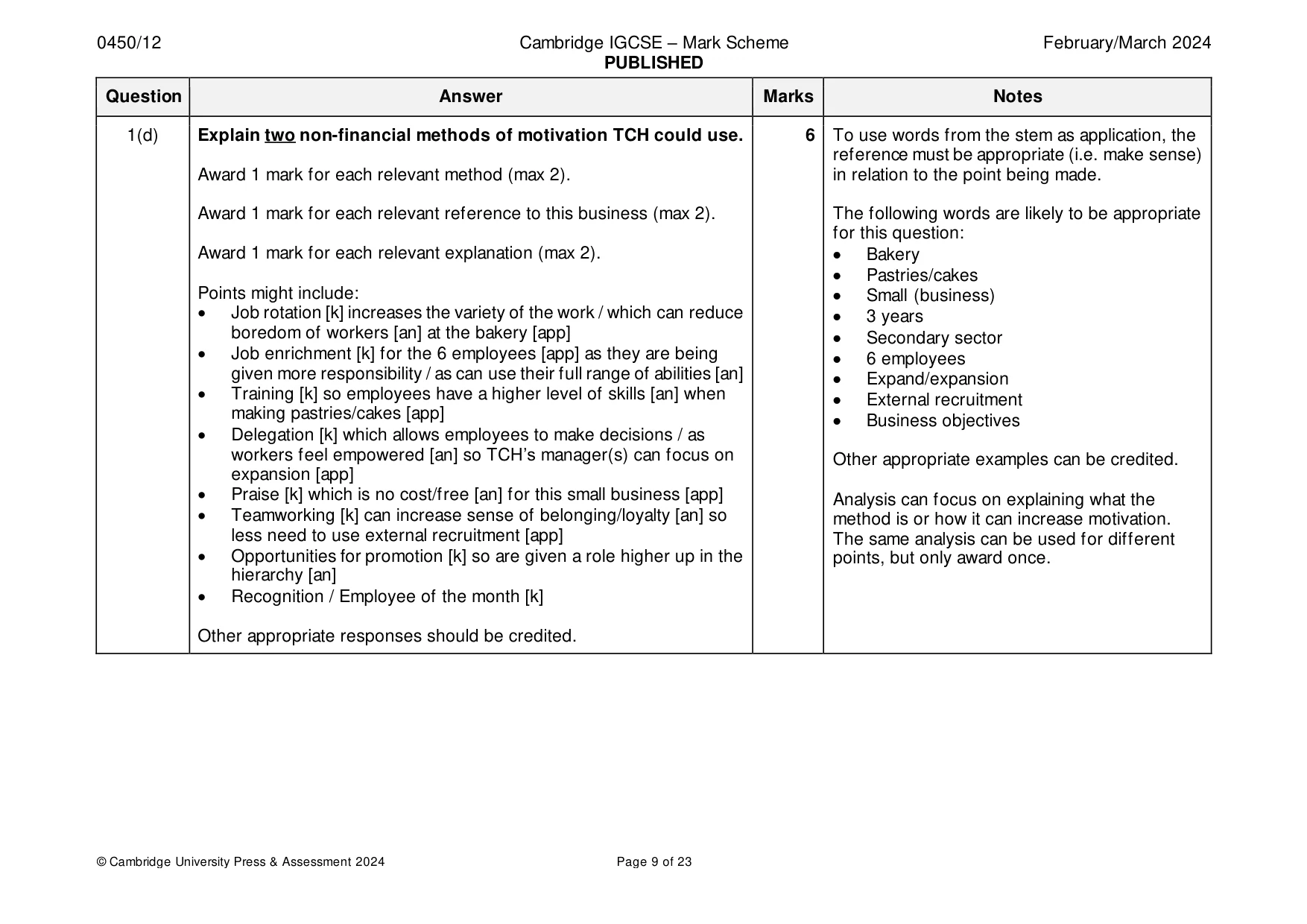
0450/12 Cambridge IGCSE – Mark Scheme PUBLISHED February/March 2024 © Cambridge University Press & Assessment 2024 Page 9 of 23 Question Answer Marks Notes 1(d) Explain two non-financial methods of motivation TCH could use. Award 1 mark for each relevant method (max 2). Award 1 mark for each relevant reference to this business (max 2). Award 1 mark for each relevant explanation (max 2). Points might include: • Job rotation [k] increases the variety of the work / which can reduce boredom of workers [an] at the bakery [app] • Job enrichment [k] for the 6 employees [app] as they are being given more responsibility / as can use their full range of abilities [an] • Training [k] so employees have a higher level of skills [an] when making pastries/cakes [app] • Delegation [k] which allows employees to make decisions / as workers feel empowered [an] so TCH’s manager(s) can focus on expansion [app] • Praise [k] which is no cost/free [an] for this small business [app] • Teamworking [k] can increase sense of belonging/loyalty [an] so less need to use external recruitment [app] • Opportunities for promotion [k] so are given a role higher up in the hierarchy [an] • Recognition / Employee of the month [k] Other appropriate responses should be credited. 6 To use words from the stem as application, the reference must be appropriate (i.e. make sense) in relation to the point being made. The following words are likely to be appropriate for this question: • Bakery • Pastries/cakes • Small (business) • 3 years • Secondary sector • 6 employees • Expand/expansion • External recruitment • Business objectives Other appropriate examples can be credited. Analysis can focus on explaining what the method is or how it can increase motivation. The same analysis can be used for different points, but only award once.
Mark scheme, page 10
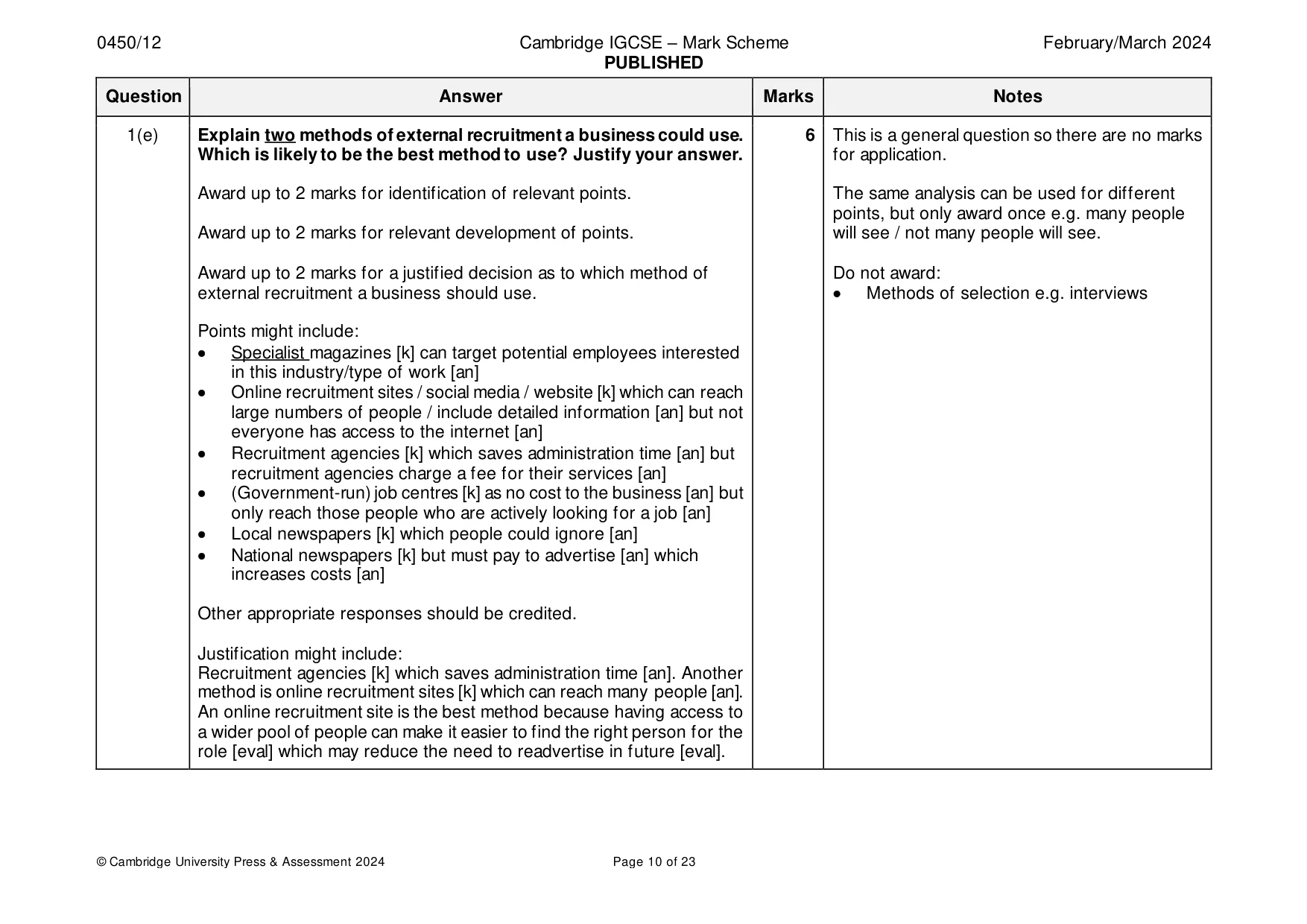
0450/12 Cambridge IGCSE – Mark Scheme PUBLISHED February/March 2024 © Cambridge University Press & Assessment 2024 Page 10 of 23 Question Answer Marks Notes 1(e) Explain two methods of external recruitment a business could use. Which is likely to be the best method to use? Justify your answer. Award up to 2 marks for identification of relevant points. Award up to 2 marks for relevant development of points. Award up to 2 marks for a justified decision as to which method of external recruitment a business should use. Points might include: • Specialist magazines [k] can target potential employees interested in this industry/type of work [an] • Online recruitment sites / social media / website [k] which can reach large numbers of people / include detailed information [an] but not everyone has access to the internet [an] • Recruitment agencies [k] which saves administration time [an] but recruitment agencies charge a fee for their services [an] • (Government-run) job centres [k] as no cost to the business [an] but only reach those people who are actively looking for a job [an] • Local newspapers [k] which people could ignore [an] • National newspapers [k] but must pay to advertise [an] which increases costs [an] Other appropriate responses should be credited. Justification might include: Recruitment agencies [k] which saves administration time [an]. Another method is online recruitment sites [k] which can reach many people [an]. An online recruitment site is the best method because having access to a wider pool of people can make it easier to find the right person for the role [eval] which may reduce the need to readvertise in future [eval]. 6 This is a general question so there are no marks for application. The same analysis can be used for different points, but only award once e.g. many people will see / not many people will see. Do not award: • Methods of selection e.g. interviews
Mark scheme, page 11
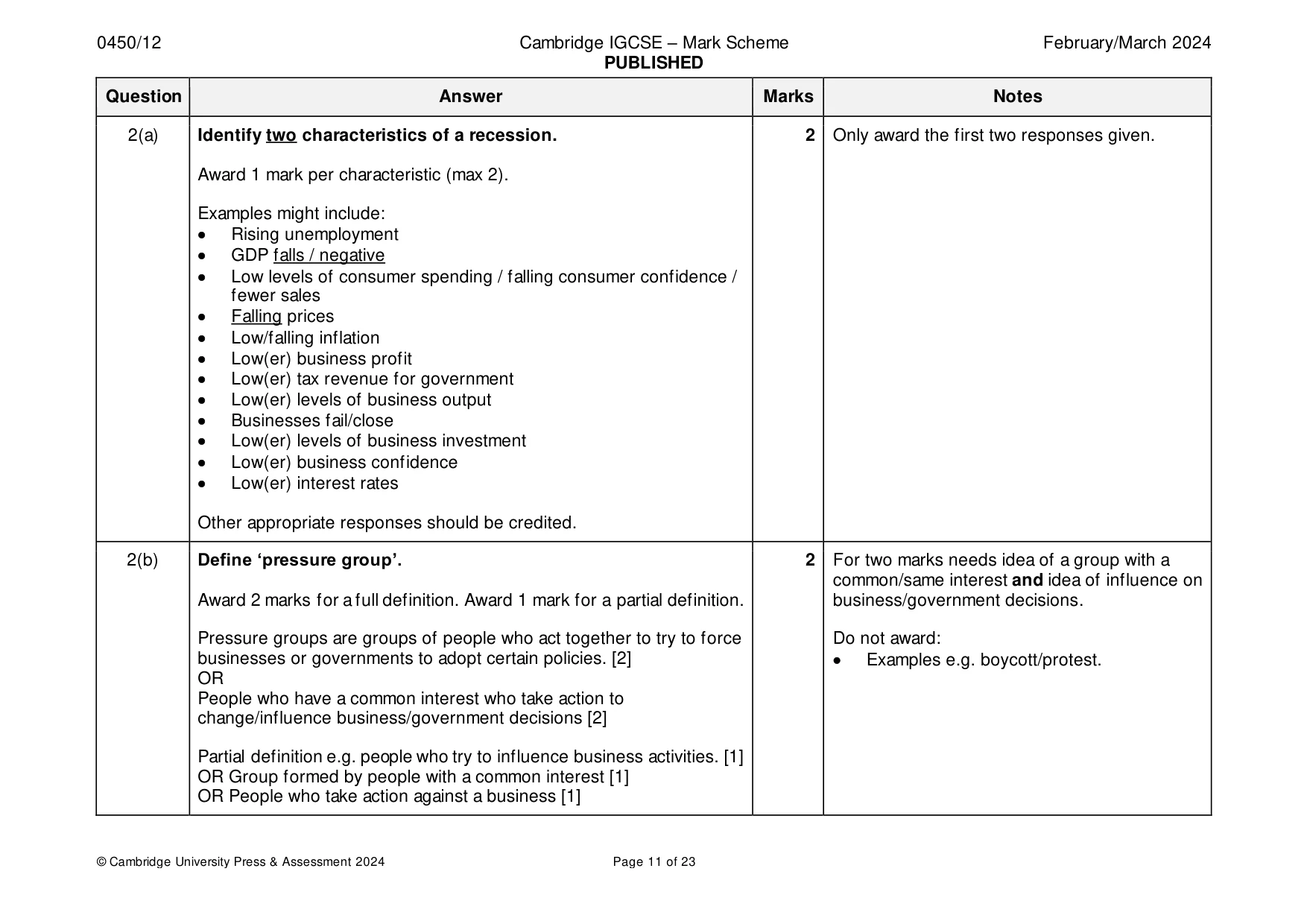
0450/12 Cambridge IGCSE – Mark Scheme PUBLISHED February/March 2024 © Cambridge University Press & Assessment 2024 Page 11 of 23 Question Answer Marks Notes 2(a) Identify two characteristics of a recession. Award 1 mark per characteristic (max 2). Examples might include: • Rising unemployment • GDP falls / negative • Low levels of consumer spending / falling consumer confidence / fewer sales • Falling prices • Low/falling inflation • Low(er) business profit • Low(er) tax revenue for government • Low(er) levels of business output • Businesses fail/close • Low(er) levels of business investment • Low(er) business confidence • Low(er) interest rates Other appropriate responses should be credited. 2 Only award the first two responses given. 2(b) Define ‘pressure group’. Award 2 marks for a full definition. Award 1 mark for a partial definition. Pressure groups are groups of people who act together to try to force businesses or governments to adopt certain policies. [2] OR People who have a common interest who take action to change/influence business/government decisions [2] Partial definition e.g. people who try to influence business activities. [1] OR Group formed by people with a common interest [1] OR People who take action against a business [1] 2 For two marks needs idea of a group with a common/same interest and idea of influence on business/government decisions. Do not award: • Examples e.g. boycott/protest.
Mark scheme, page 12
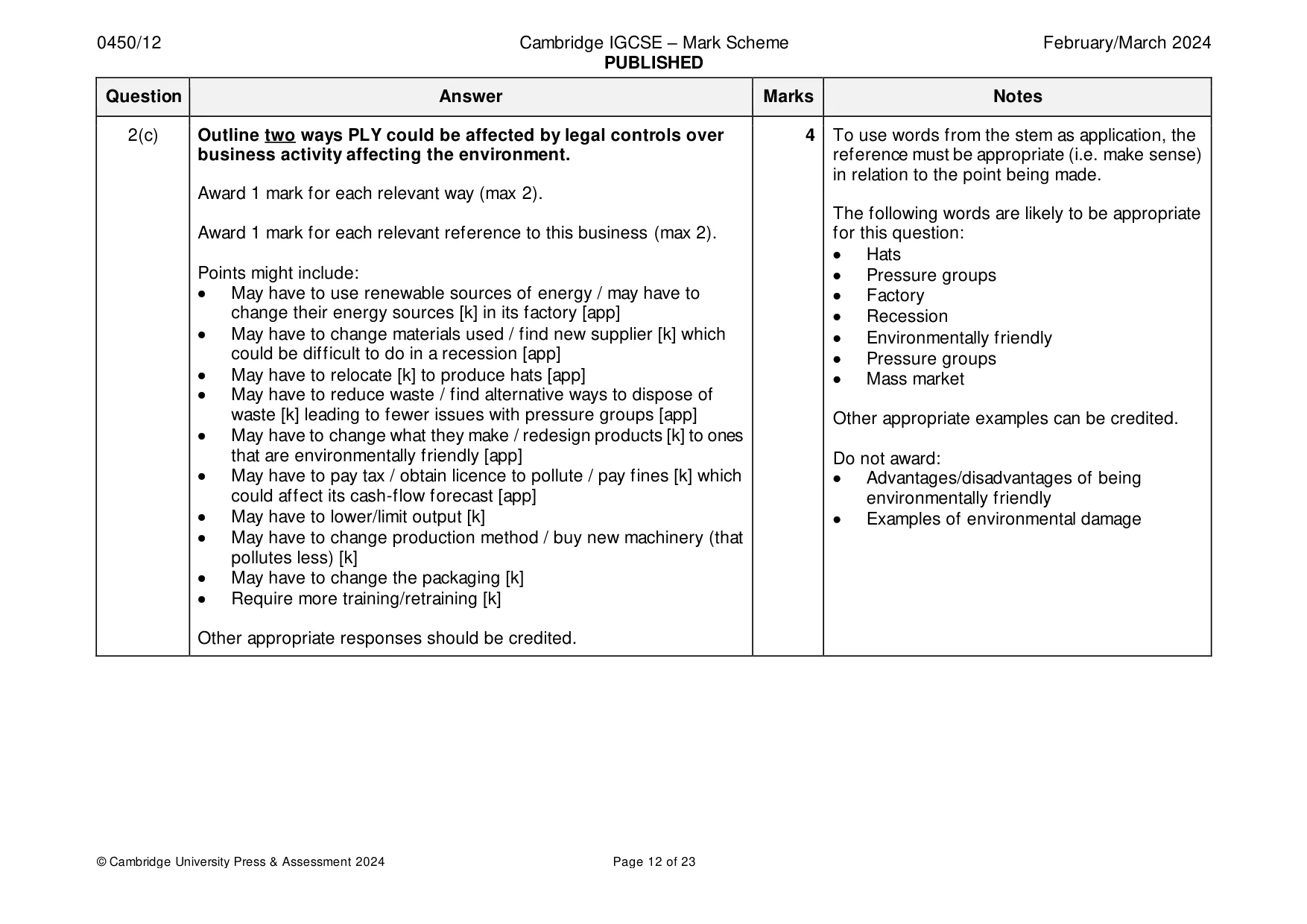
0450/12 Cambridge IGCSE – Mark Scheme PUBLISHED February/March 2024 © Cambridge University Press & Assessment 2024 Page 12 of 23 Question Answer Marks Notes 2(c) Outline two ways PLY could be affected by legal controls over business activity affecting the environment. Award 1 mark for each relevant way (max 2). Award 1 mark for each relevant reference to this business (max 2). Points might include: • May have to use renewable sources of energy / may have to change their energy sources [k] in its factory [app] • May have to change materials used / find new supplier [k] which could be difficult to do in a recession [app] • May have to relocate [k] to produce hats [app] • May have to reduce waste / find alternative ways to dispose of waste [k] leading to fewer issues with pressure groups [app] • May have to change what they make / redesign products [k] to ones that are environmentally friendly [app] • May have to pay tax / obtain licence to pollute / pay fines [k] which could affect its cash-flow forecast [app] • May have to lower/limit output [k] • May have to change production method / buy new machinery (that pollutes less) [k] • May have to change the packaging [k] • Require more training/retraining [k] Other appropriate responses should be credited. 4 To use words from the stem as application, the reference must be appropriate (i.e. make sense) in relation to the point being made. The following words are likely to be appropriate for this question: • Hats • Pressure groups • Factory • Recession • Environmentally friendly • Pressure groups • Mass market Other appropriate examples can be credited. Do not award: • Advantages/disadvantages of being environmentally friendly • Examples of environmental damage
Mark scheme, page 13
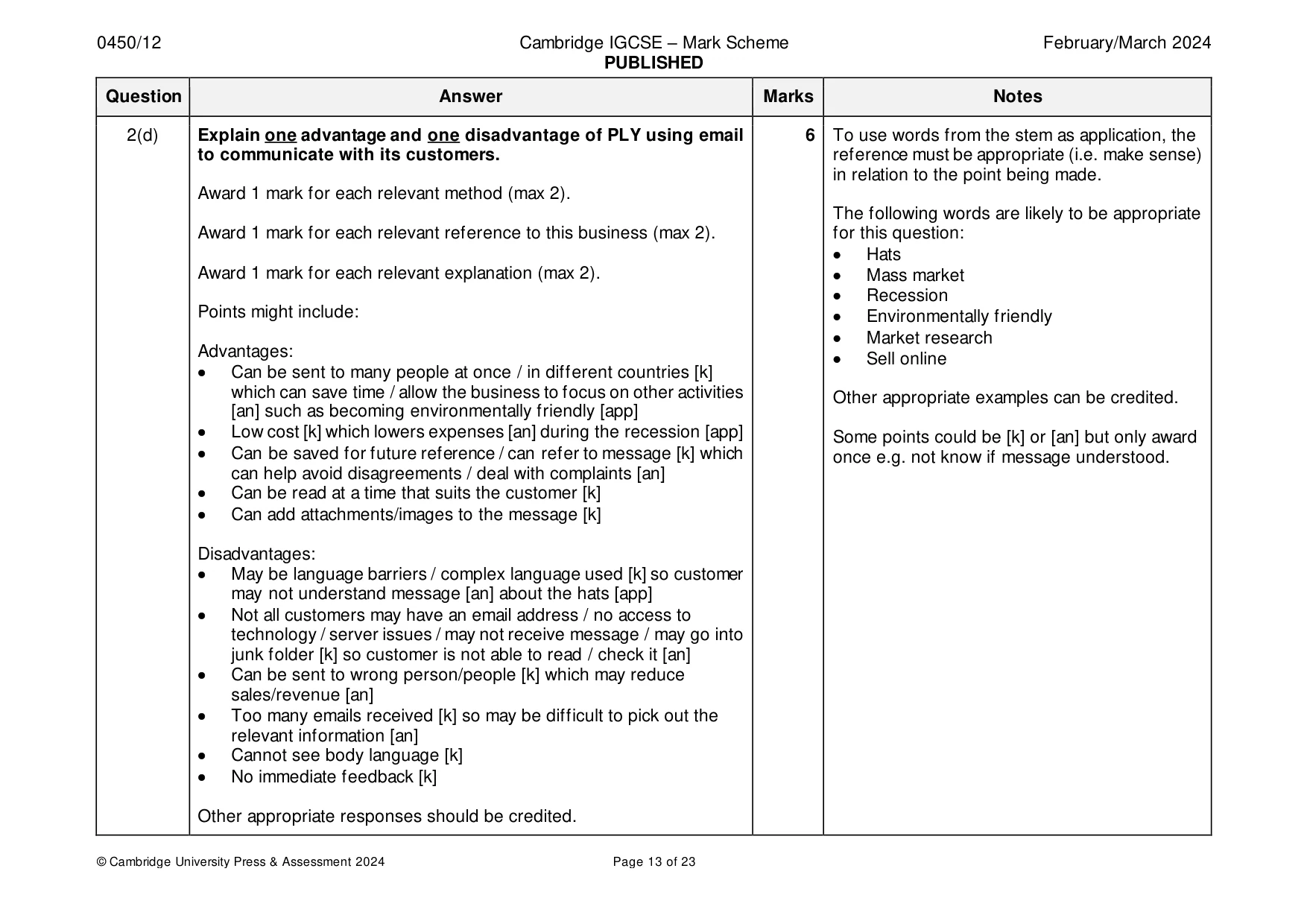
0450/12 Cambridge IGCSE – Mark Scheme PUBLISHED February/March 2024 © Cambridge University Press & Assessment 2024 Page 13 of 23 Question Answer Marks Notes 2(d) Explain one advantage and one disadvantage of PLY using email to communicate with its customers. Award 1 mark for each relevant method (max 2). Award 1 mark for each relevant reference to this business (max 2). Award 1 mark for each relevant explanation (max 2). Points might include: Advantages: • Can be sent to many people at once / in different countries [k] which can save time / allow the business to focus on other activities [an] such as becoming environmentally friendly [app] • Low cost [k] which lowers expenses [an] during the recession [app] • Can be saved for future reference / can refer to message [k] which can help avoid disagreements / deal with complaints [an] • Can be read at a time that suits the customer [k] • Can add attachments/images to the message [k] Disadvantages: • May be language barriers / complex language used [k] so customer may not understand message [an] about the hats [app] • Not all customers may have an email address / no access to technology / server issues / may not receive message / may go into junk folder [k] so customer is not able to read / check it [an] • Can be sent to wrong person/people [k] which may reduce sales/revenue [an] • Too many emails received [k] so may be difficult to pick out the relevant information [an] • Cannot see body language [k] • No immediate feedback [k] Other appropriate responses should be credited. 6 To use words from the stem as application, the reference must be appropriate (i.e. make sense) in relation to the point being made. The following words are likely to be appropriate for this question: • Hats • Mass market • Recession • Environmentally friendly • Market research • Sell online Other appropriate examples can be credited. Some points could be [k] or [an] but only award once e.g. not know if message understood.
Mark scheme, page 14
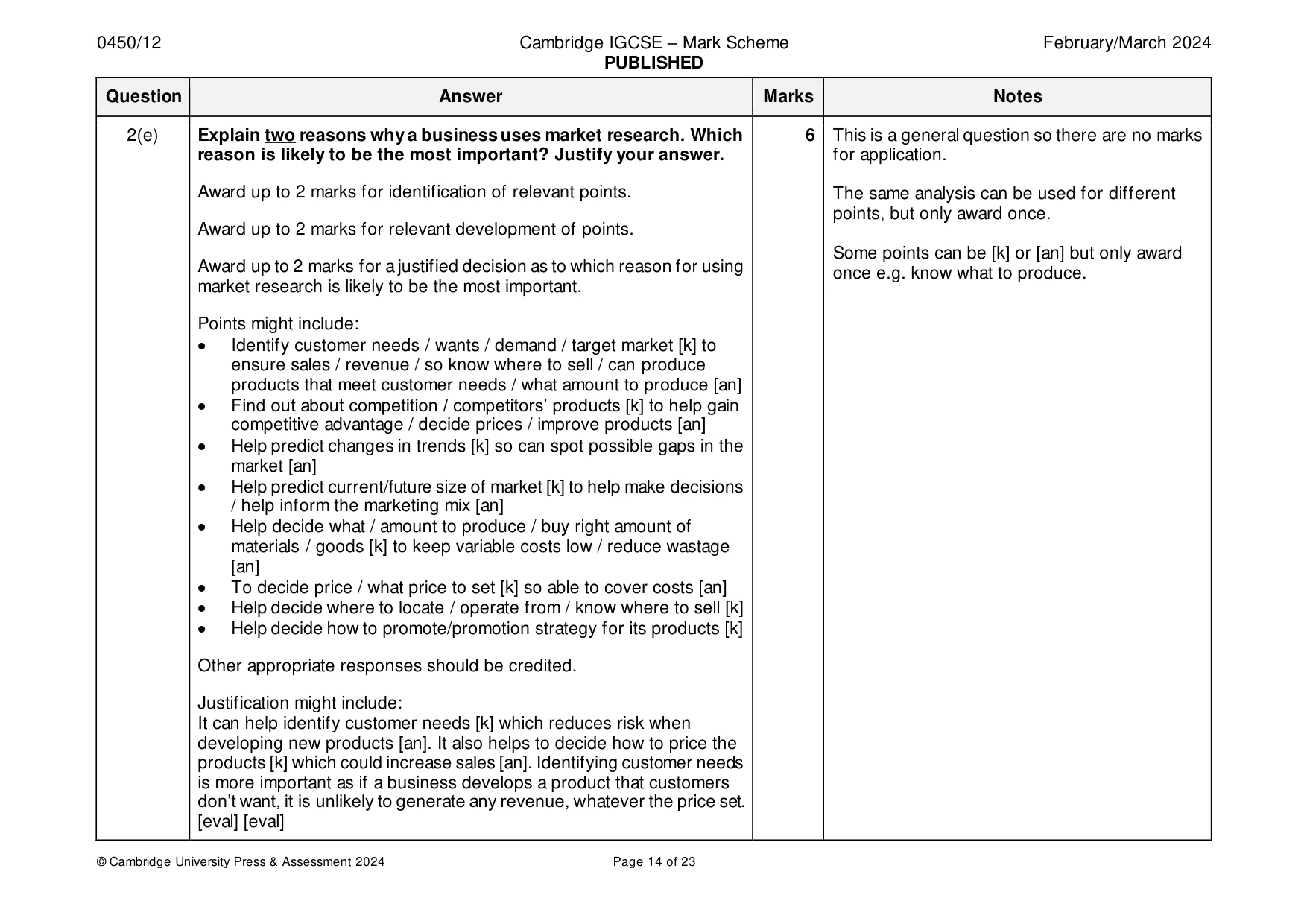
0450/12 Cambridge IGCSE – Mark Scheme PUBLISHED February/March 2024 © Cambridge University Press & Assessment 2024 Page 14 of 23 Question Answer Marks Notes 2(e) Explain two reasons why a business uses market research. Which reason is likely to be the most important? Justify your answer. Award up to 2 marks for identification of relevant points. Award up to 2 marks for relevant development of points. Award up to 2 marks for a justified decision as to which reason for using market research is likely to be the most important. Points might include: • Identify customer needs / wants / demand / target market [k] to ensure sales / revenue / so know where to sell / can produce products that meet customer needs / what amount to produce [an] • Find out about competition / competitors’ products [k] to help gain competitive advantage / decide prices / improve products [an] • Help predict changes in trends [k] so can spot possible gaps in the market [an] • Help predict current/future size of market [k] to help make decisions / help inform the marketing mix [an] • Help decide what / amount to produce / buy right amount of materials / goods [k] to keep variable costs low / reduce wastage [an] • To decide price / what price to set [k] so able to cover costs [an] • Help decide where to locate / operate from / know where to sell [k] • Help decide how to promote/promotion strategy for its products [k] Other appropriate responses should be credited. Justification might include: It can help identify customer needs [k] which reduces risk when developing new products [an]. It also helps to decide how to price the products [k] which could increase sales [an]. Identifying customer needs is more important as if a business develops a product that customers don’t want, it is unlikely to generate any revenue, whatever the price set. [eval] [eval] 6 This is a general question so there are no marks for application. The same analysis can be used for different points, but only award once. Some points can be [k] or [an] but only award once e.g. know what to produce.
Mark scheme, page 15
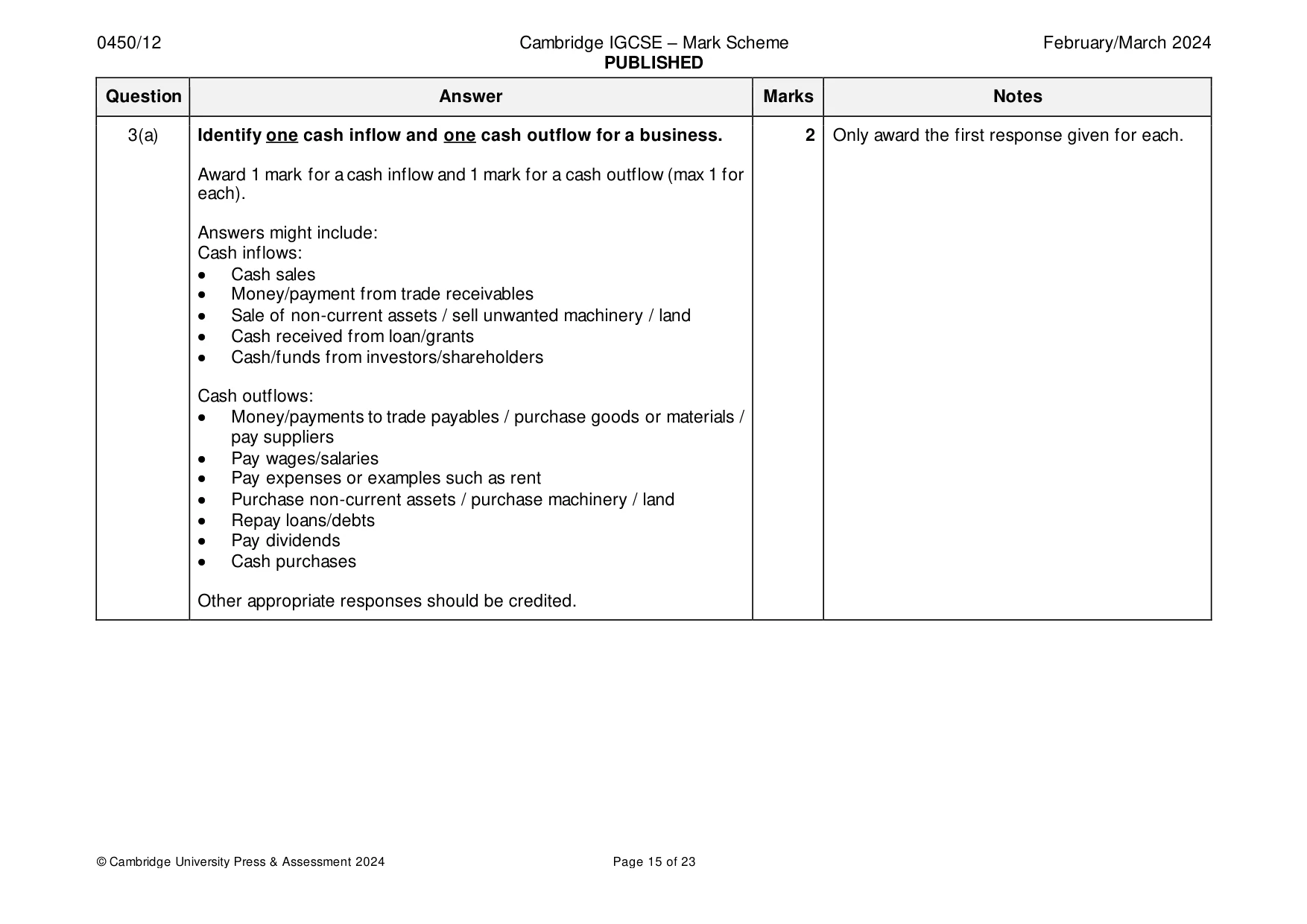
0450/12 Cambridge IGCSE – Mark Scheme PUBLISHED February/March 2024 © Cambridge University Press & Assessment 2024 Page 15 of 23 Question Answer Marks Notes 3(a) Identify one cash inflow and one cash outflow for a business. Award 1 mark for a cash inflow and 1 mark for a cash outflow (max 1 for each). Answers might include: Cash inflows: • Cash sales • Money/payment from trade receivables • Sale of non-current assets / sell unwanted machinery / land • Cash received from loan/grants • Cash/funds from investors/shareholders Cash outflows: • Money/payments to trade payables / purchase goods or materials / pay suppliers • Pay wages/salaries • Pay expenses or examples such as rent • Purchase non-current assets / purchase machinery / land • Repay loans/debts • Pay dividends • Cash purchases Other appropriate responses should be credited. 2 Only award the first response given for each.
Mark scheme, page 16
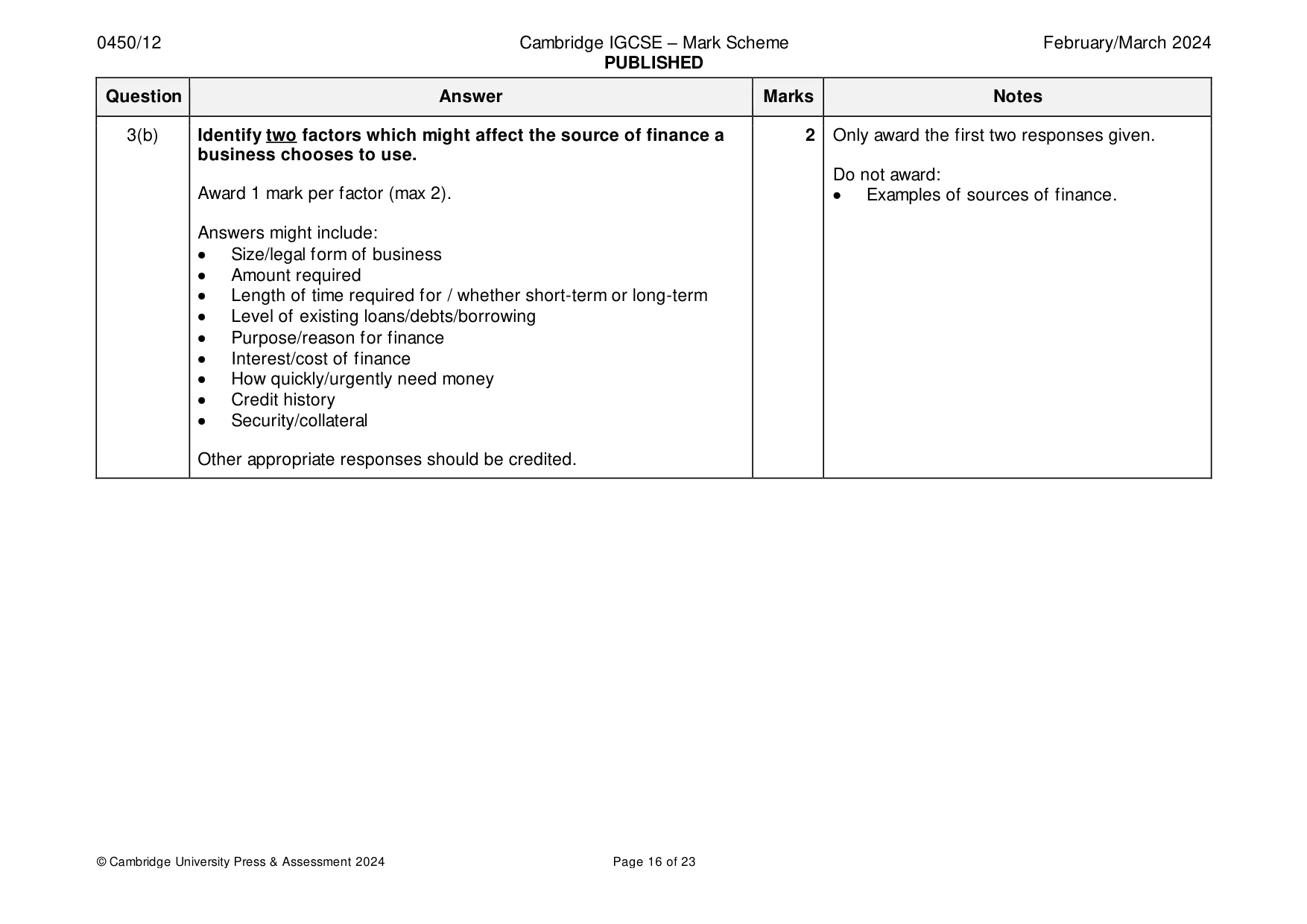
0450/12 Cambridge IGCSE – Mark Scheme PUBLISHED February/March 2024 © Cambridge University Press & Assessment 2024 Page 16 of 23 Question Answer Marks Notes 3(b) Identify two factors which might affect the source of finance a business chooses to use. Award 1 mark per factor (max 2). Answers might include: • Size/legal form of business • Amount required • Length of time required for / whether short-term or long-term • Level of existing loans/debts/borrowing • Purpose/reason for finance • Interest/cost of finance • How quickly/urgently need money • Credit history • Security/collateral Other appropriate responses should be credited. 2 Only award the first two responses given. Do not award: • Examples of sources of finance.
Mark scheme, page 17
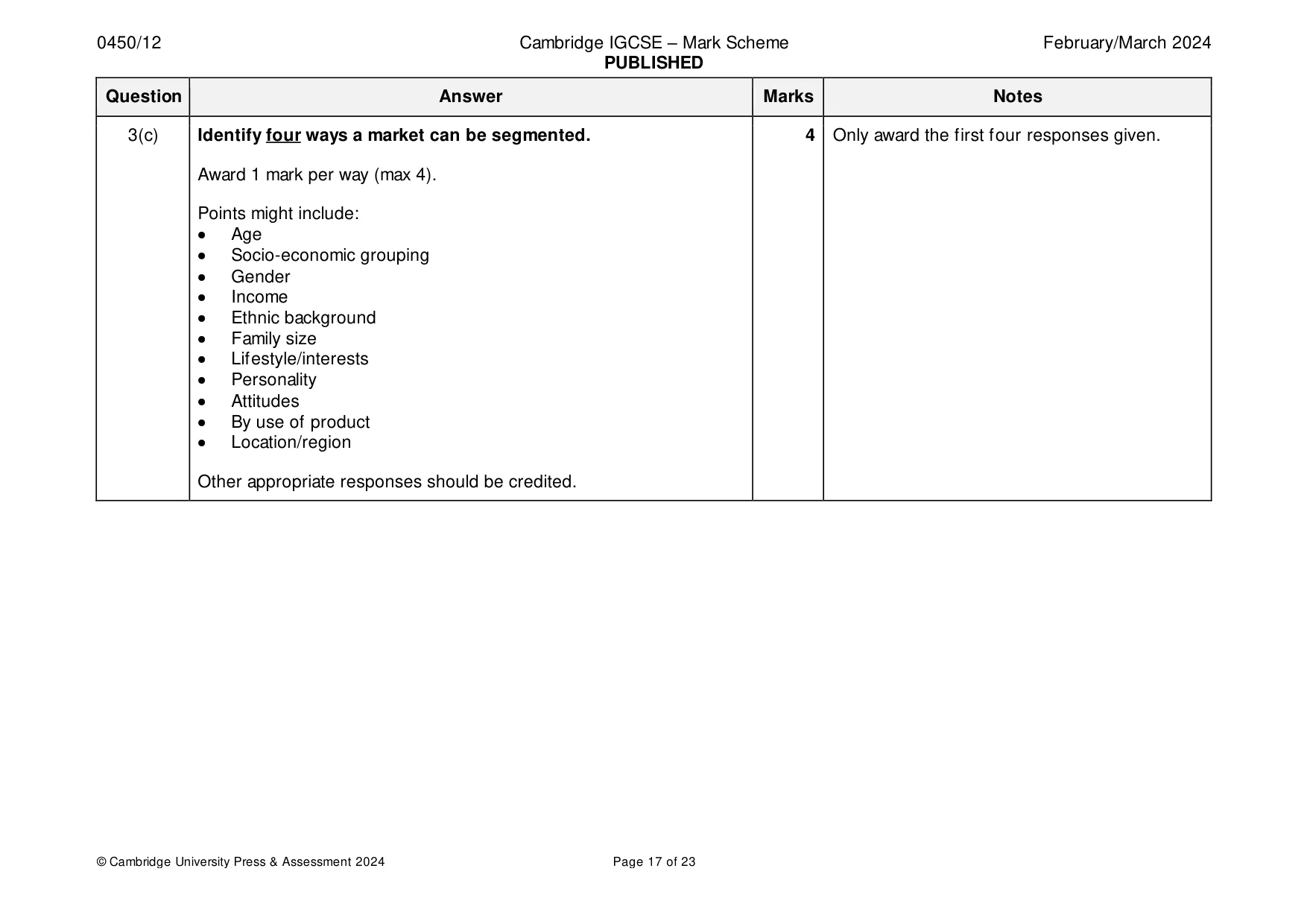
0450/12 Cambridge IGCSE – Mark Scheme PUBLISHED February/March 2024 © Cambridge University Press & Assessment 2024 Page 17 of 23 Question Answer Marks Notes 3(c) Identify four ways a market can be segmented. Award 1 mark per way (max 4). Points might include: • Age • Socio-economic grouping • Gender • Income • Ethnic background • Family size • Lifestyle/interests • Personality • Attitudes • By use of product • Location/region Other appropriate responses should be credited. 4 Only award the first four responses given.
Mark scheme, page 18
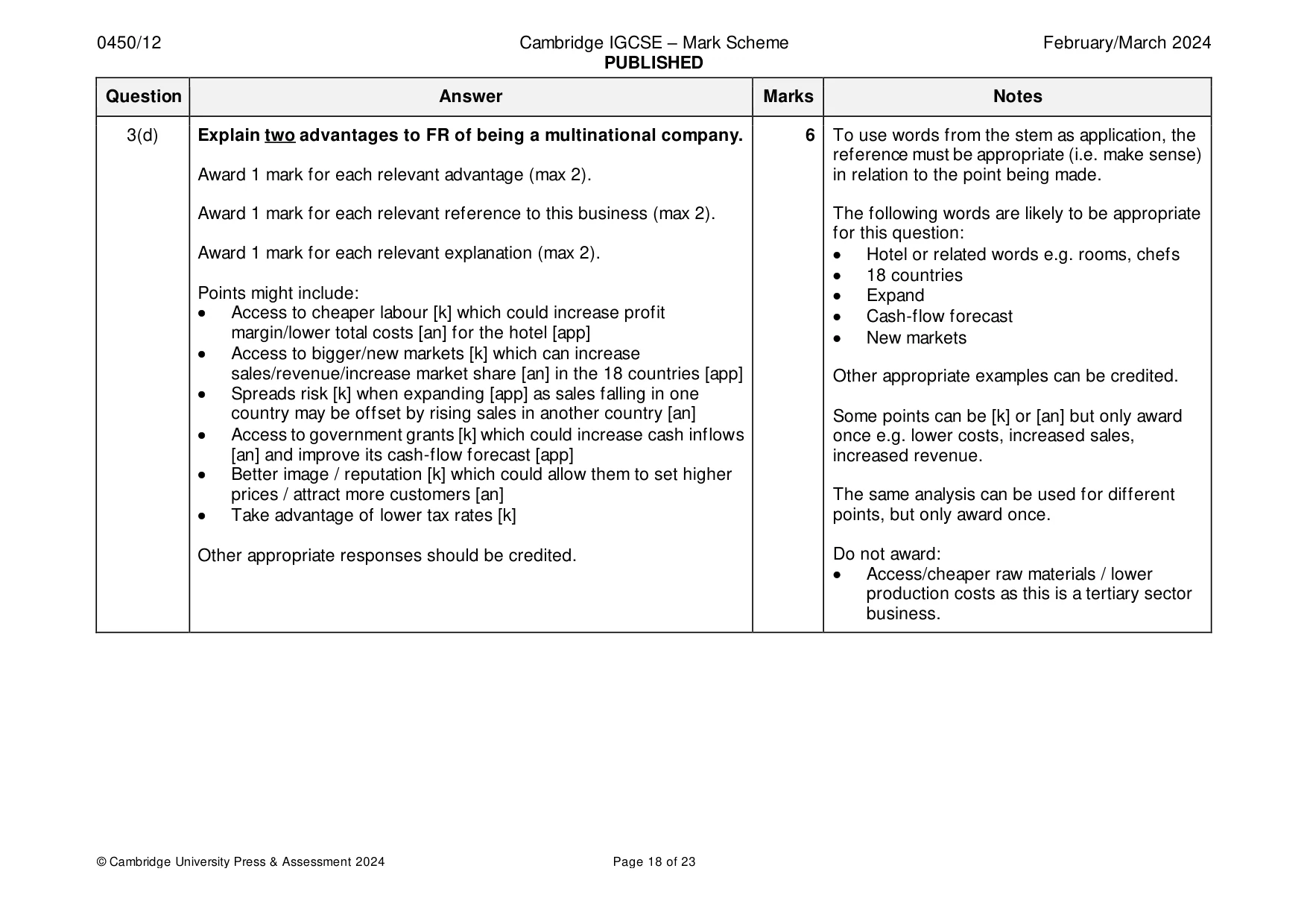
0450/12 Cambridge IGCSE – Mark Scheme PUBLISHED February/March 2024 © Cambridge University Press & Assessment 2024 Page 18 of 23 Question Answer Marks Notes 3(d) Explain two advantages to FR of being a multinational company. Award 1 mark for each relevant advantage (max 2). Award 1 mark for each relevant reference to this business (max 2). Award 1 mark for each relevant explanation (max 2). Points might include: • Access to cheaper labour [k] which could increase profit margin/lower total costs [an] for the hotel [app] • Access to bigger/new markets [k] which can increase sales/revenue/increase market share [an] in the 18 countries [app] • Spreads risk [k] when expanding [app] as sales falling in one country may be offset by rising sales in another country [an] • Access to government grants [k] which could increase cash inflows [an] and improve its cash-flow forecast [app] • Better image / reputation [k] which could allow them to set higher prices / attract more customers [an] • Take advantage of lower tax rates [k] Other appropriate responses should be credited. 6 To use words from the stem as application, the reference must be appropriate (i.e. make sense) in relation to the point being made. The following words are likely to be appropriate for this question: • Hotel or related words e.g. rooms, chefs • 18 countries • Expand • Cash-flow forecast • New markets Other appropriate examples can be credited. Some points can be [k] or [an] but only award once e.g. lower costs, increased sales, increased revenue. The same analysis can be used for different points, but only award once. Do not award: • Access/cheaper raw materials / lower production costs as this is a tertiary sector business.
Mark scheme, page 19
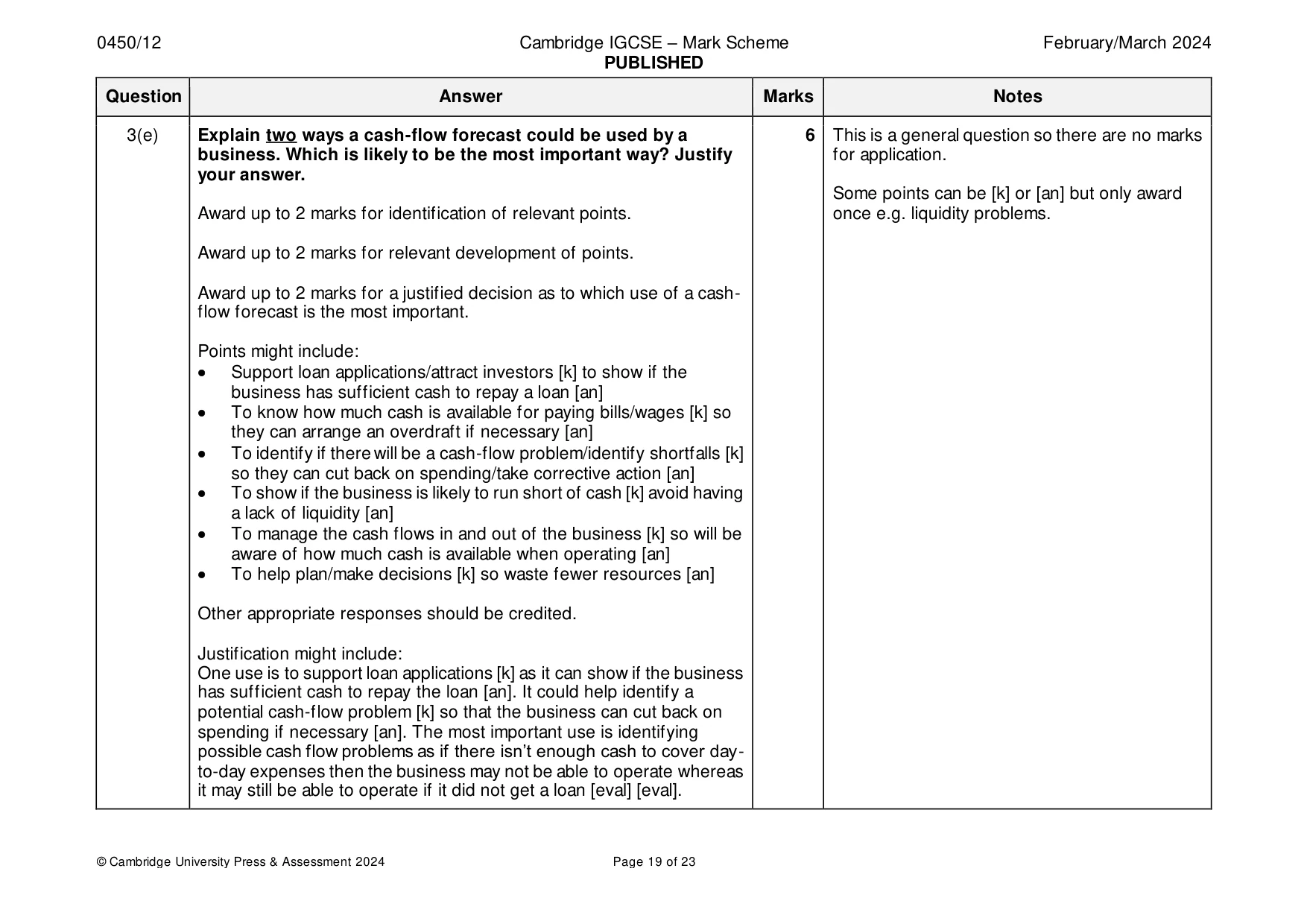
0450/12 Cambridge IGCSE – Mark Scheme PUBLISHED February/March 2024 © Cambridge University Press & Assessment 2024 Page 19 of 23 Question Answer Marks Notes 3(e) Explain two ways a cash-flow forecast could be used by a business. Which is likely to be the most important way? Justify your answer. Award up to 2 marks for identification of relevant points. Award up to 2 marks for relevant development of points. Award up to 2 marks for a justified decision as to which use of a cash- flow forecast is the most important. Points might include: • Support loan applications/attract investors [k] to show if the business has sufficient cash to repay a loan [an] • To know how much cash is available for paying bills/wages [k] so they can arrange an overdraft if necessary [an] • To identify if there will be a cash-flow problem/identify shortfalls [k] so they can cut back on spending/take corrective action [an] • To show if the business is likely to run short of cash [k] avoid having a lack of liquidity [an] • To manage the cash flows in and out of the business [k] so will be aware of how much cash is available when operating [an] • To help plan/make decisions [k] so waste fewer resources [an] Other appropriate responses should be credited. Justification might include: One use is to support loan applications [k] as it can show if the business has sufficient cash to repay the loan [an]. It could help identify a potential cash-flow problem [k] so that the business can cut back on spending if necessary [an]. The most important use is identifying possible cash flow problems as if there isn’t enough cash to cover day- to-day expenses then the business may not be able to operate whereas it may still be able to operate if it did not get a loan [eval] [eval]. 6 This is a general question so there are no marks for application. Some points can be [k] or [an] but only award once e.g. liquidity problems.
Mark scheme, page 20
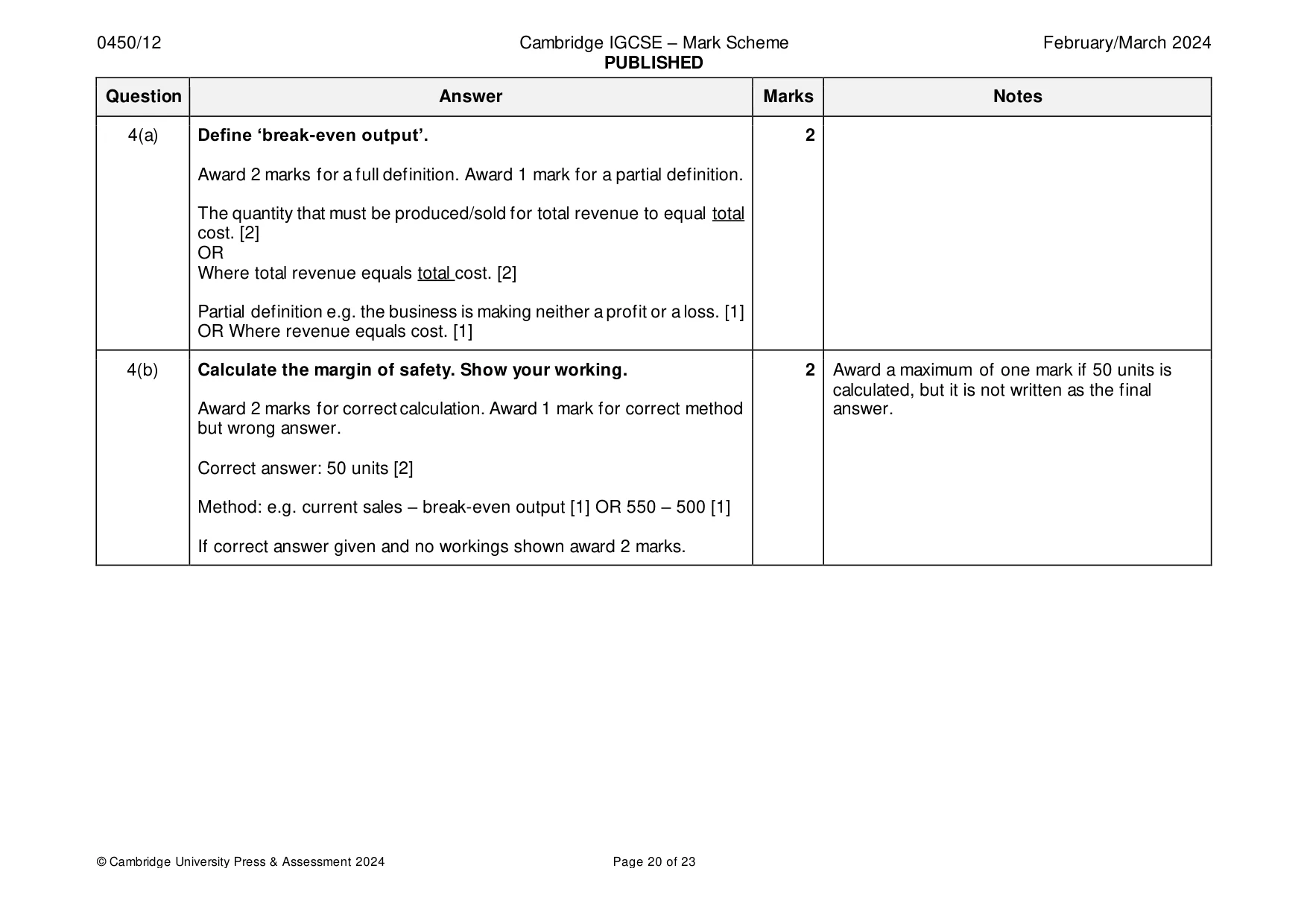
0450/12 Cambridge IGCSE – Mark Scheme PUBLISHED February/March 2024 © Cambridge University Press & Assessment 2024 Page 20 of 23 Question Answer Marks Notes 4(a) Define ‘break-even output’. Award 2 marks for a full definition. Award 1 mark for a partial definition. The quantity that must be produced/sold for total revenue to equal total cost. [2] OR Where total revenue equals total cost. [2] Partial definition e.g. the business is making neither a profit or a loss. [1] OR Where revenue equals cost. [1] 2 4(b) Calculate the margin of safety. Show your working. Award 2 marks for correct calculation. Award 1 mark for correct method but wrong answer. Correct answer: 50 units [2] Method: e.g. current sales – break-even output [1] OR 550 – 500 [1] If correct answer given and no workings shown award 2 marks. 2 Award a maximum of one mark if 50 units is calculated, but it is not written as the final answer.
Mark scheme, page 21
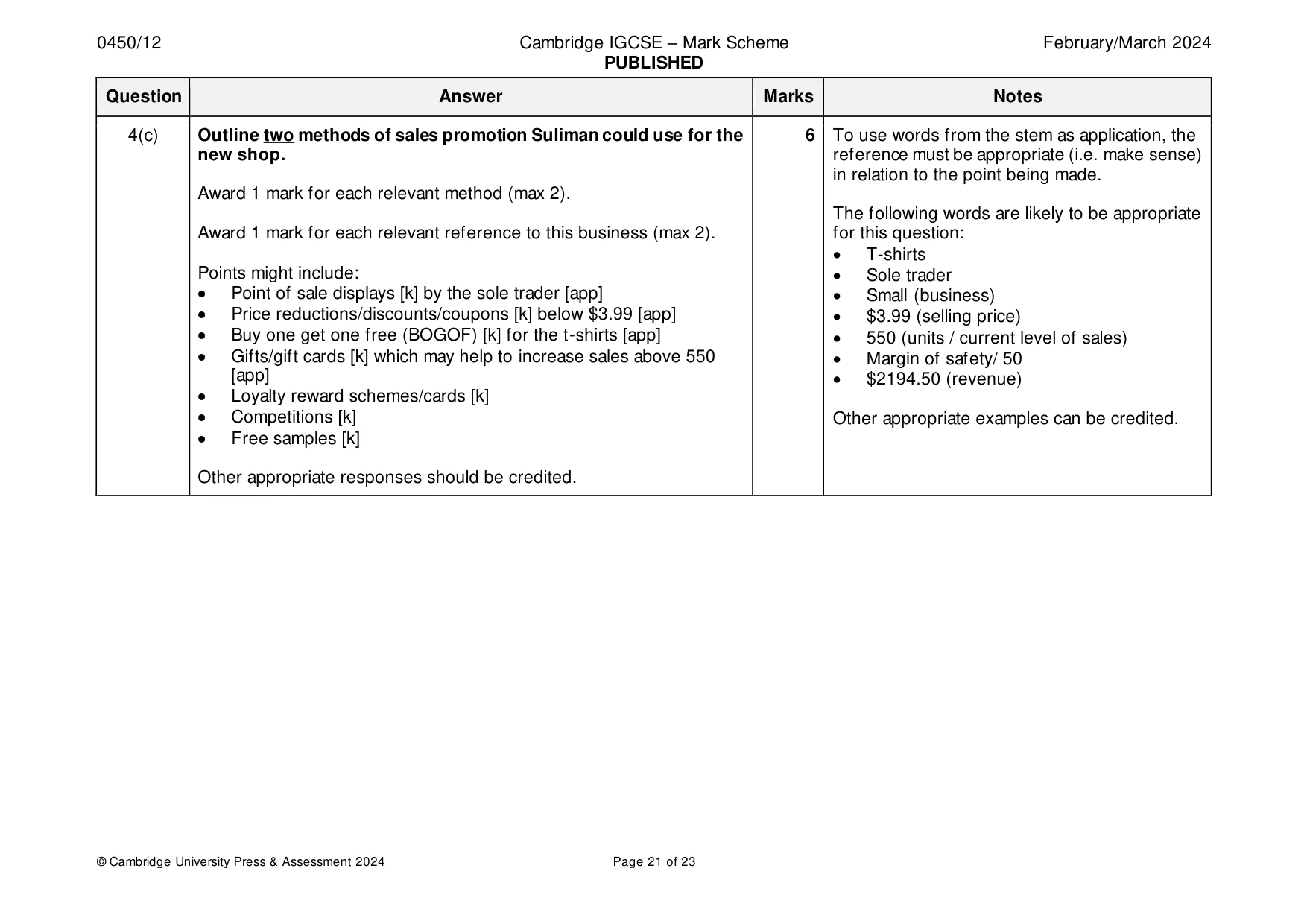
0450/12 Cambridge IGCSE – Mark Scheme PUBLISHED February/March 2024 © Cambridge University Press & Assessment 2024 Page 21 of 23 Question Answer Marks Notes 4(c) Outline two methods of sales promotion Suliman could use for the new shop. Award 1 mark for each relevant method (max 2). Award 1 mark for each relevant reference to this business (max 2). Points might include: • Point of sale displays [k] by the sole trader [app] • Price reductions/discounts/coupons [k] below $3.99 [app] • Buy one get one free (BOGOF) [k] for the t-shirts [app] • Gifts/gift cards [k] which may help to increase sales above 550 [app] • Loyalty reward schemes/cards [k] • Competitions [k] • Free samples [k] Other appropriate responses should be credited. 6 To use words from the stem as application, the reference must be appropriate (i.e. make sense) in relation to the point being made. The following words are likely to be appropriate for this question: • T-shirts • Sole trader • Small (business) • $3.99 (selling price) • 550 (units / current level of sales) • Margin of safety/ 50 • $2194.50 (revenue) Other appropriate examples can be credited.
Mark scheme, page 22
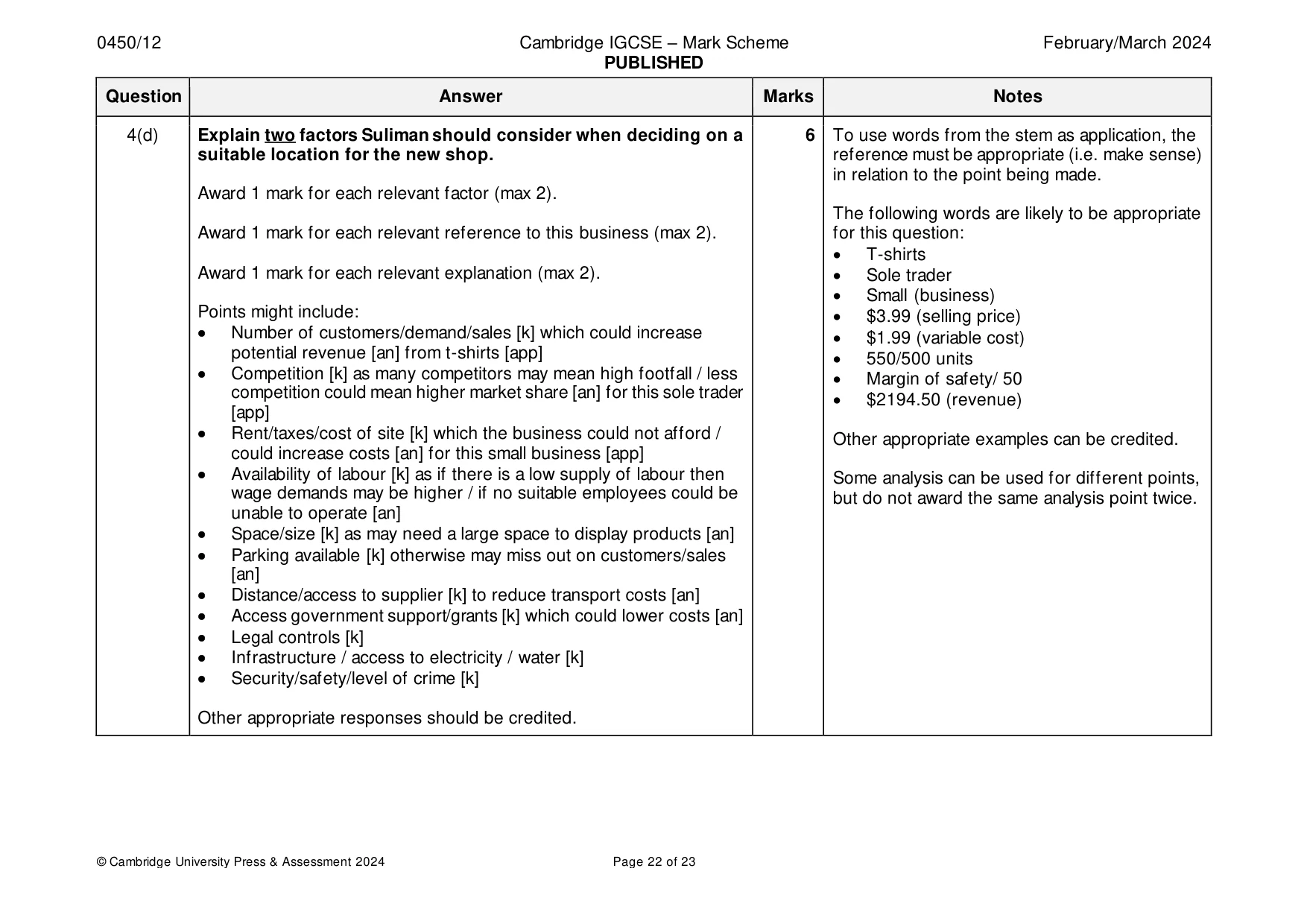
0450/12 Cambridge IGCSE – Mark Scheme PUBLISHED February/March 2024 © Cambridge University Press & Assessment 2024 Page 22 of 23 Question Answer Marks Notes 4(d) Explain two factors Suliman should consider when deciding on a suitable location for the new shop. Award 1 mark for each relevant factor (max 2). Award 1 mark for each relevant reference to this business (max 2). Award 1 mark for each relevant explanation (max 2). Points might include: • Number of customers/demand/sales [k] which could increase potential revenue [an] from t-shirts [app] • Competition [k] as many competitors may mean high footfall / less competition could mean higher market share [an] for this sole trader [app] • Rent/taxes/cost of site [k] which the business could not afford / could increase costs [an] for this small business [app] • Availability of labour [k] as if there is a low supply of labour then wage demands may be higher / if no suitable employees could be unable to operate [an] • Space/size [k] as may need a large space to display products [an] • Parking available [k] otherwise may miss out on customers/sales [an] • Distance/access to supplier [k] to reduce transport costs [an] • Access government support/grants [k] which could lower costs [an] • Legal controls [k] • Infrastructure / access to electricity / water [k] • Security/safety/level of crime [k] Other appropriate responses should be credited. 6 To use words from the stem as application, the reference must be appropriate (i.e. make sense) in relation to the point being made. The following words are likely to be appropriate for this question: • T-shirts • Sole trader • Small (business) • $3.99 (selling price) • $1.99 (variable cost) • 550/500 units • Margin of safety/ 50 • $2194.50 (revenue) Other appropriate examples can be credited. Some analysis can be used for different points, but do not award the same analysis point twice.
Mark scheme, page 23
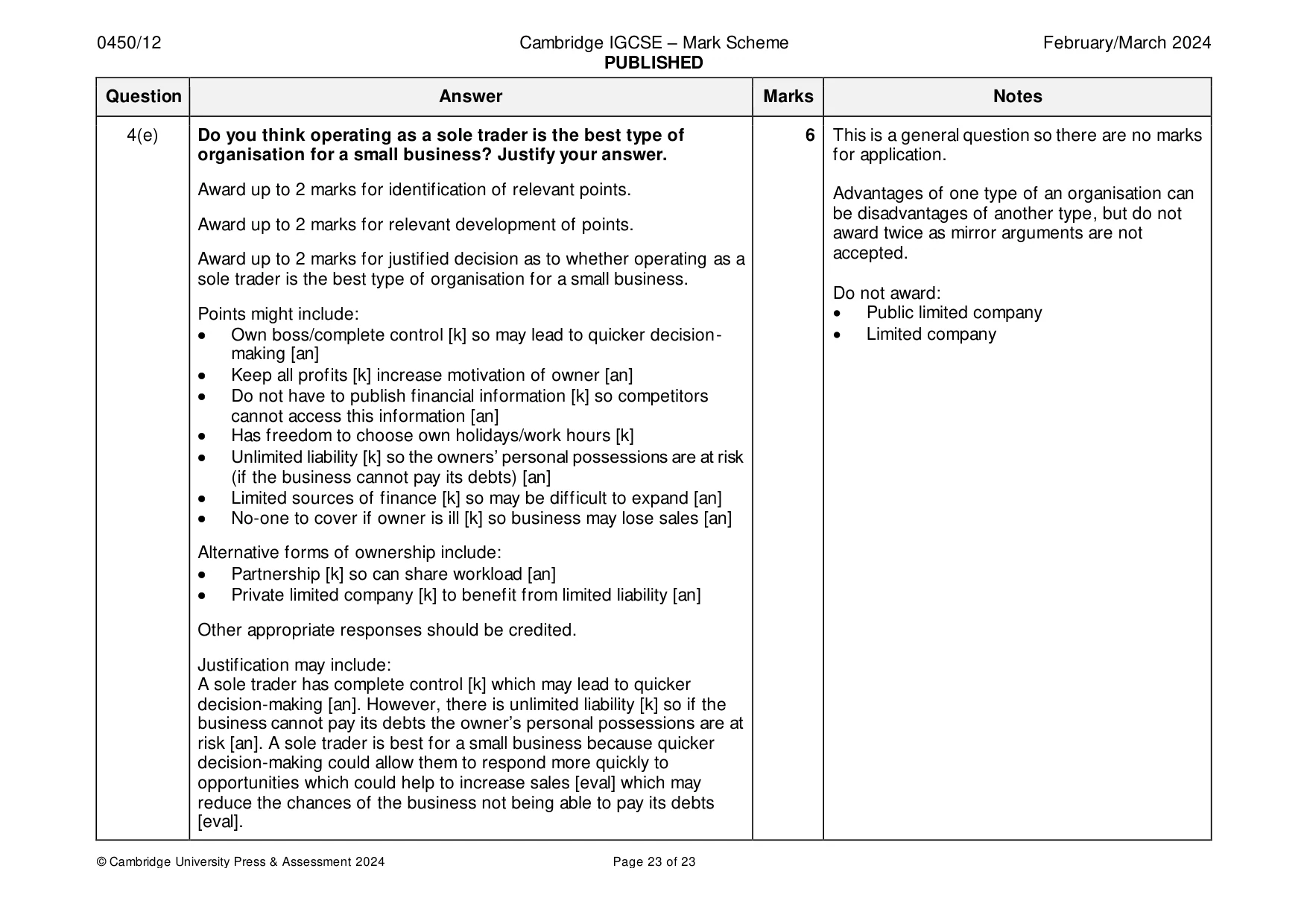
0450/12 Cambridge IGCSE – Mark Scheme PUBLISHED February/March 2024 © Cambridge University Press & Assessment 2024 Page 23 of 23 Question Answer Marks Notes 4(e) Do you think operating as a sole trader is the best type of organisation for a small business? Justify your answer. Award up to 2 marks for identification of relevant points. Award up to 2 marks for relevant development of points. Award up to 2 marks for justified decision as to whether operating as a sole trader is the best type of organisation for a small business. Points might include: • Own boss/complete control [k] so may lead to quicker decision- making [an] • Keep all profits [k] increase motivation of owner [an] • Do not have to publish financial information [k] so competitors cannot access this information [an] • Has freedom to choose own holidays/work hours [k] • Unlimited liability [k] so the owners’ personal possessions are at risk (if the business cannot pay its debts) [an] • Limited sources of finance [k] so may be difficult to expand [an] • No-one to cover if owner is ill [k] so business may lose sales [an] Alternative forms of ownership include: • Partnership [k] so can share workload [an] • Private limited company [k] to benefit from limited liability [an] Other appropriate responses should be credited. Justification may include: A sole trader has complete control [k] which may lead to quicker decision-making [an]. However, there is unlimited liability [k] so if the business cannot pay its debts the owner’s personal possessions are at risk [an]. A sole trader is best for a small business because quicker decision-making could allow them to respond more quickly to opportunities which could help to increase sales [eval] which may reduce the chances of the business not being able to pay its debts [eval]. 6 This is a general question so there are no marks for application. Advantages of one type of an organisation can be disadvantages of another type, but do not award twice as mirror arguments are not accepted. Do not award: • Public limited company • Limited company
What you needed in this session
Cambridge’s own grade thresholds for 2024 Feb/March, Paper 1 · Variant 2. A higher threshold means an easier paper — the bar moves with how the cohort did.