Cambridge IGCSE Biology (BES) 0438 — 2018 May/June Paper 3 · Variant 3
0438/33/M/J/18 · 80 marks · ≈90 min
The question paper and its mark scheme, free to read here and free to download. This is Cambridge’s own paper, exactly as it was sat.
Question paper20 pages



Mark scheme13 pages
Answers below. Sit the paper first if you are practising.
Paper as text
Question paper, page 1
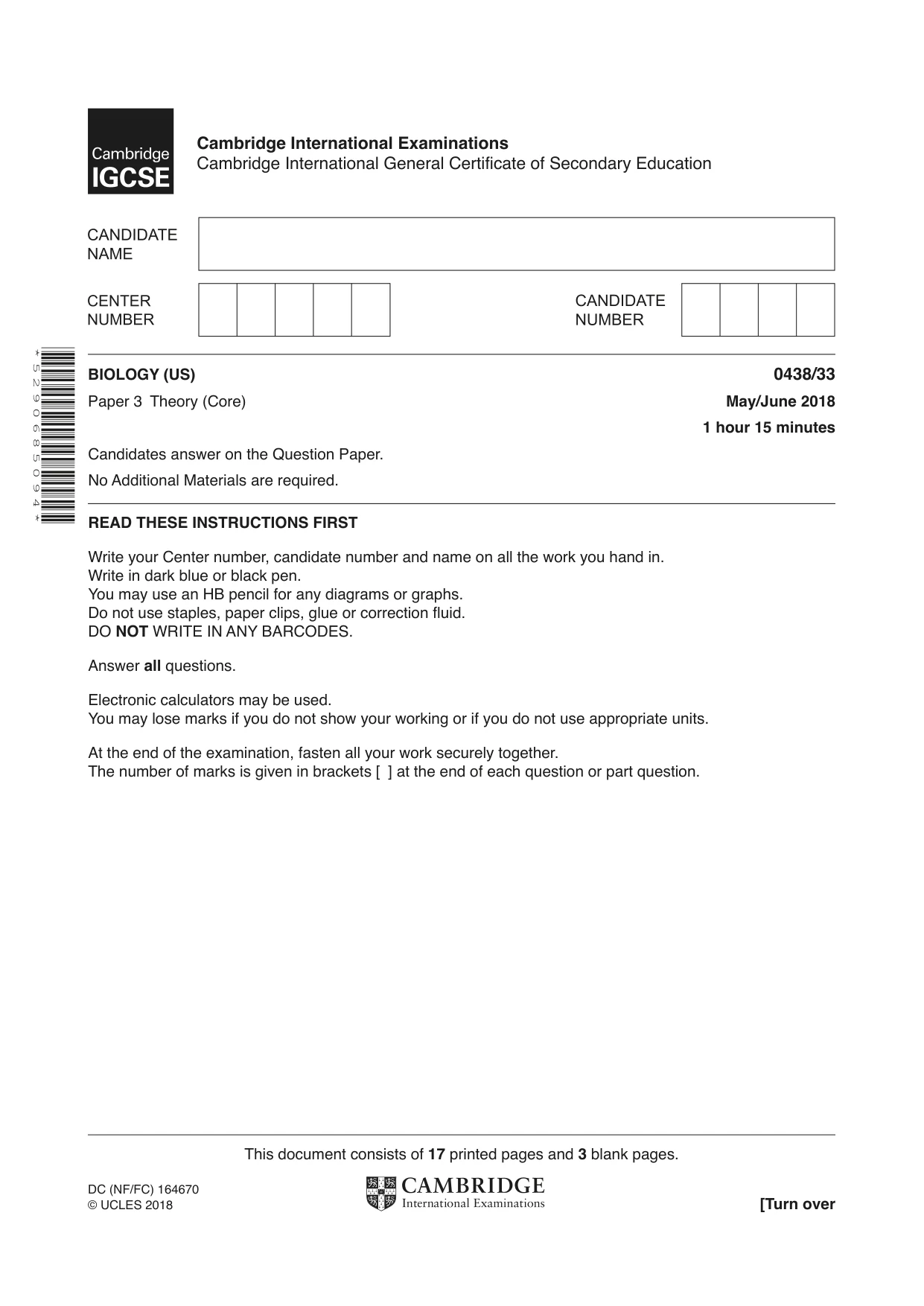
* 5 2 9 0 6 8 5 0 9 4 * This document consists of 17 printed pages and 3 blank pages. DC (NF/FC) 164670 © UCLES 2018 [Turn over Cambridge International Examinations Cambridge International General Certificate of Secondary Education BIOLOGY (US) 0438/33 Paper 3 Theory (Core) May/June 2018 1 hour 15 minutes Candidates answer on the Question Paper. No Additional Materials are required. READ THESE INSTRUCTIONS FIRST Write your Center number, candidate number and name on all the work you hand in. Write in dark blue or black pen. You may use an HB pencil for any diagrams or graphs. Do not use staples, paper clips, glue or correction fluid. DO NOT WRITE IN ANY BARCODES. Answer all questions. Electronic calculators may be used. You may lose marks if you do not show your working or if you do not use appropriate units. At the end of the examination, fasten all your work securely together. The number of marks is given in brackets [ ] at the end of each question or part question.
Question paper, page 2
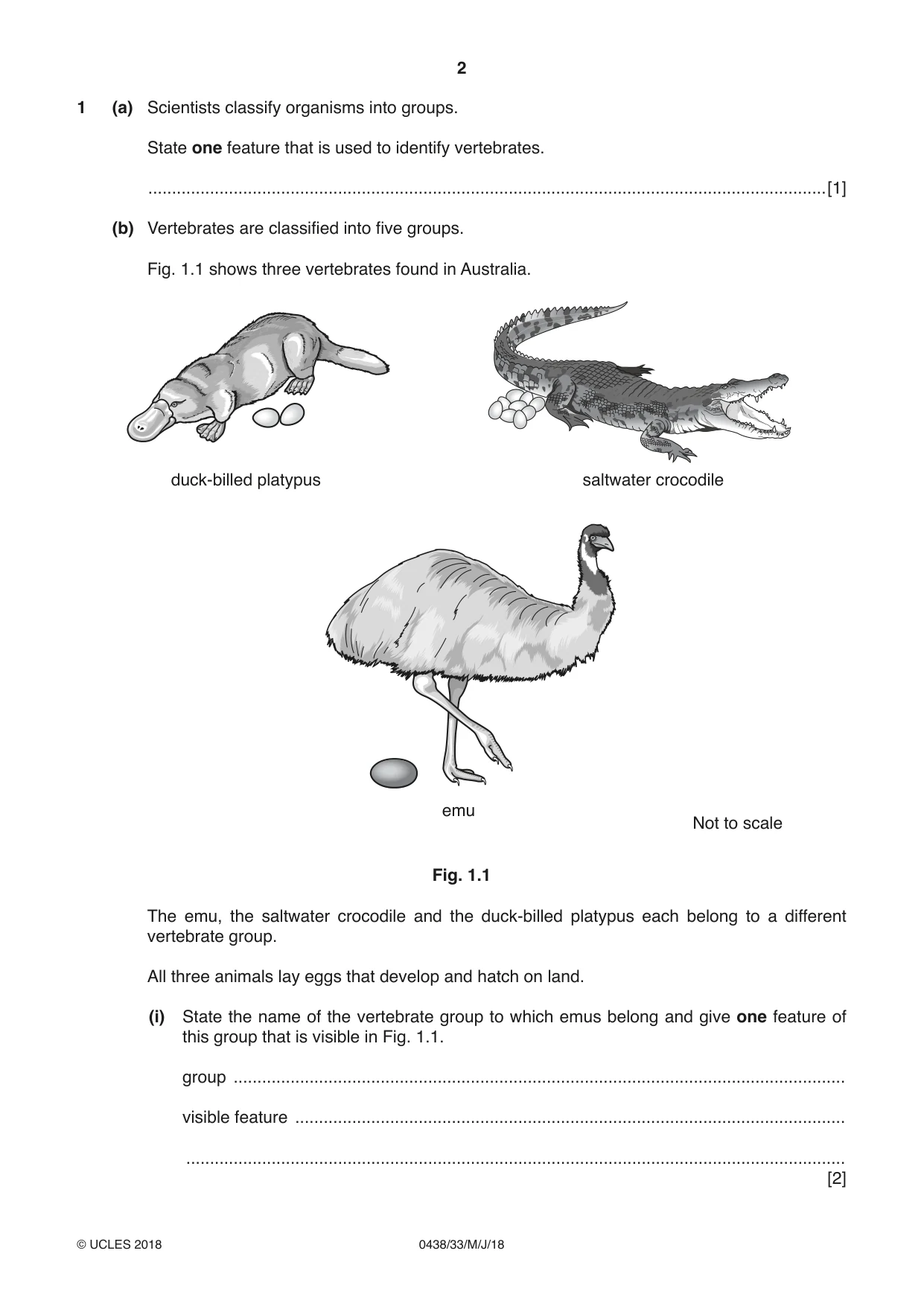
2 0438/33/M/J/18 © UCLES 2018 1 (a) Scientists classify organisms into groups. State one feature that is used to identify vertebrates. …[1] (b) Vertebrates are classified into five groups. Fig. 1.1 shows three vertebrates found in Australia. duck-billed platypus saltwater crocodile emu Not to scale Fig. 1.1 The emu, the saltwater crocodile and the duck-billed platypus each belong to a different vertebrate group. All three animals lay eggs that develop and hatch on land. (i) State the name of the vertebrate group to which emus belong and give one feature of this group that is visible in Fig. 1.1. group … visible feature … … [2]
Question paper, page 3
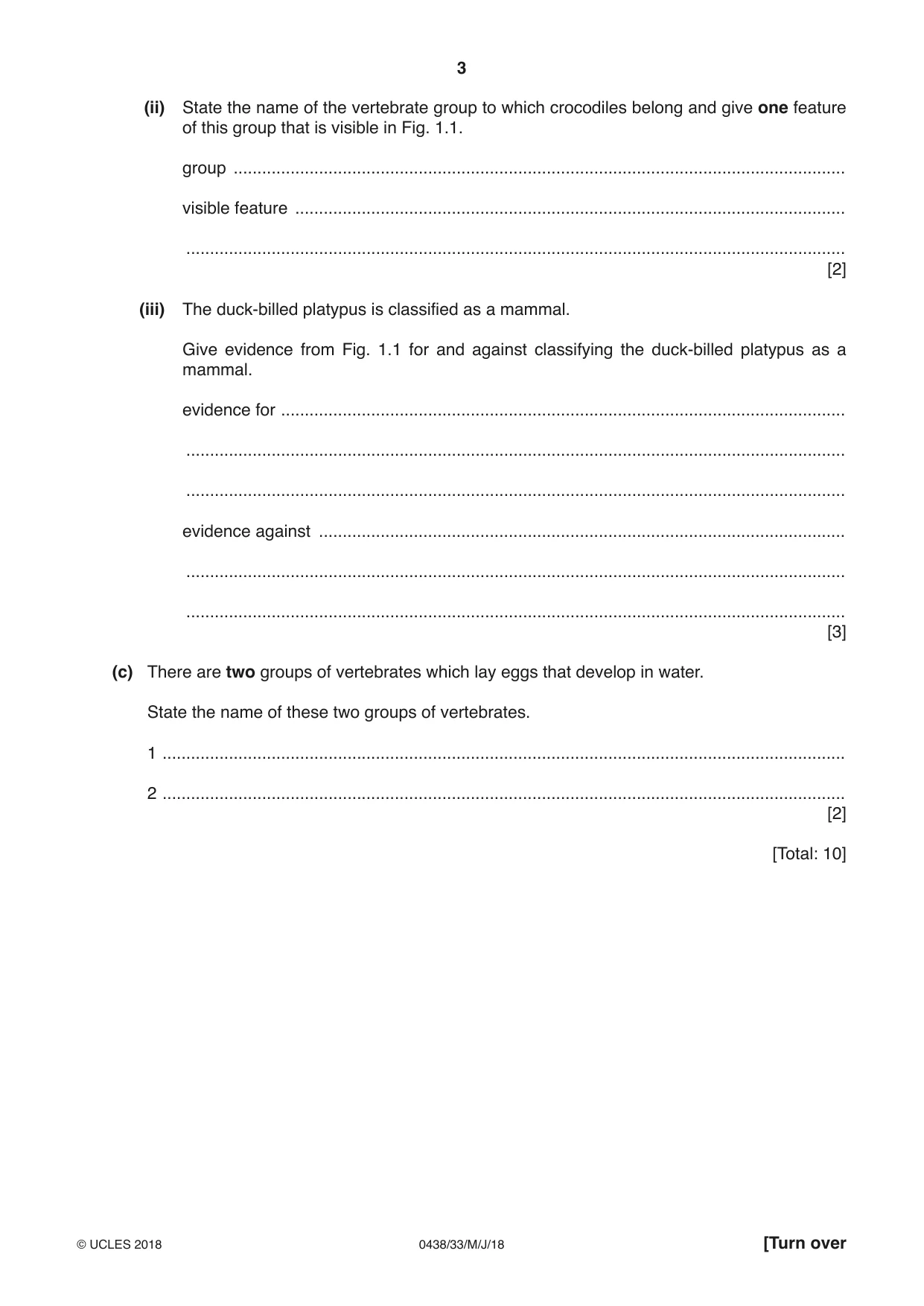
3 0438/33/M/J/18 © UCLES 2018 [Turn over (ii) State the name of the vertebrate group to which crocodiles belong and give one feature of this group that is visible in Fig. 1.1. group … visible feature … … [2] (iii) The duck-billed platypus is classified as a mammal. Give evidence from Fig. 1.1 for and against classifying the duck-billed platypus as a mammal. evidence for … … … evidence against … … … [3] (c) There are two groups of vertebrates which lay eggs that develop in water. State the name of these two groups of vertebrates. 1 … 2 … [2] [Total: 10]
Question paper, page 4
4 0438/33/M/J/18 © UCLES 2018 BLANK PAGE
Question paper, page 5
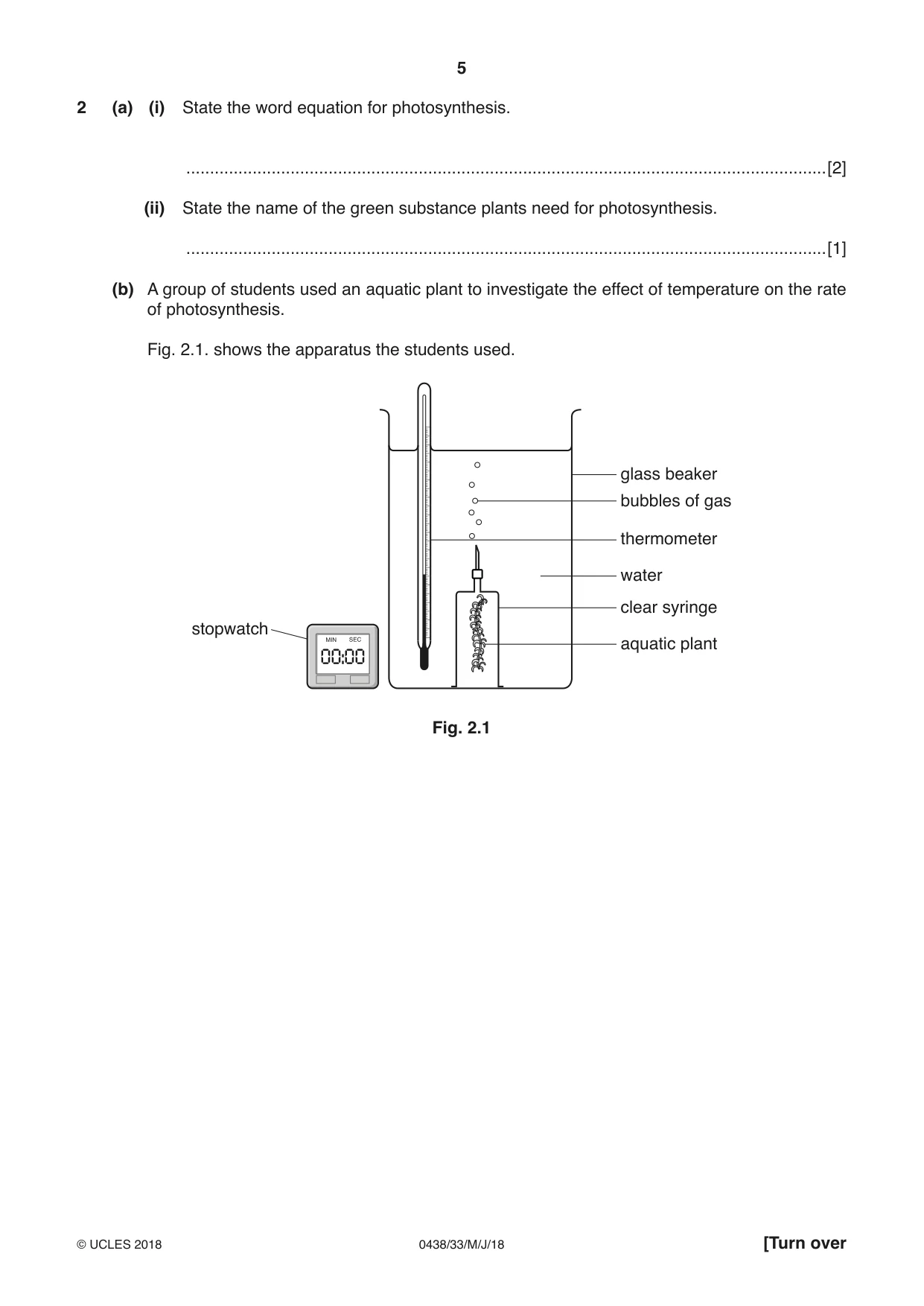
5 0438/33/M/J/18 © UCLES 2018 [Turn over 2 (a) (i) State the word equation for photosynthesis. …[2] (ii) State the name of the green substance plants need for photosynthesis. …[1] (b) A group of students used an aquatic plant to investigate the effect of temperature on the rate of photosynthesis. Fig. 2.1. shows the apparatus the students used. glass beaker bubbles of gas thermometer water clear syringe aquatic plant stopwatch Fig. 2.1
Question paper, page 6
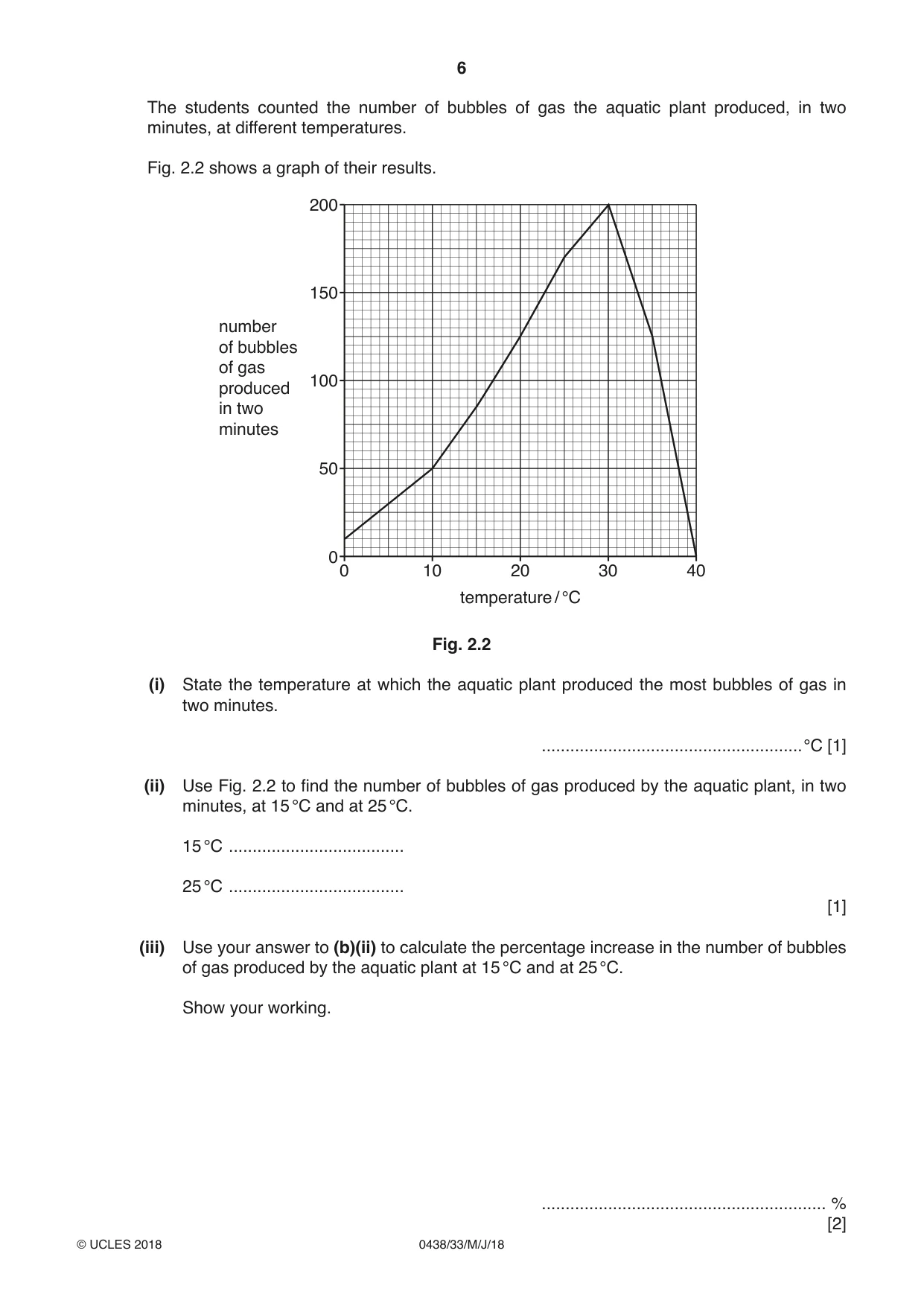
6 0438/33/M/J/18 © UCLES 2018 The students counted the number of bubbles of gas the aquatic plant produced, in two minutes, at different temperatures. Fig. 2.2 shows a graph of their results. 0 0 50 100 150 number of bubbles of gas produced in two minutes temperature / °C 200 10 20 30 40 Fig. 2.2 (i) State the temperature at which the aquatic plant produced the most bubbles of gas in two minutes. …°C [1] (ii) Use Fig. 2.2 to find the number of bubbles of gas produced by the aquatic plant, in two minutes, at 15 °C and at 25 °C. 15 °C … 25 °C … [1] (iii) Use your answer to (b)(ii) to calculate the percentage increase in the number of bubbles of gas produced by the aquatic plant at 15 °C and at 25 °C. Show your working. … % [2]
Question paper, page 7
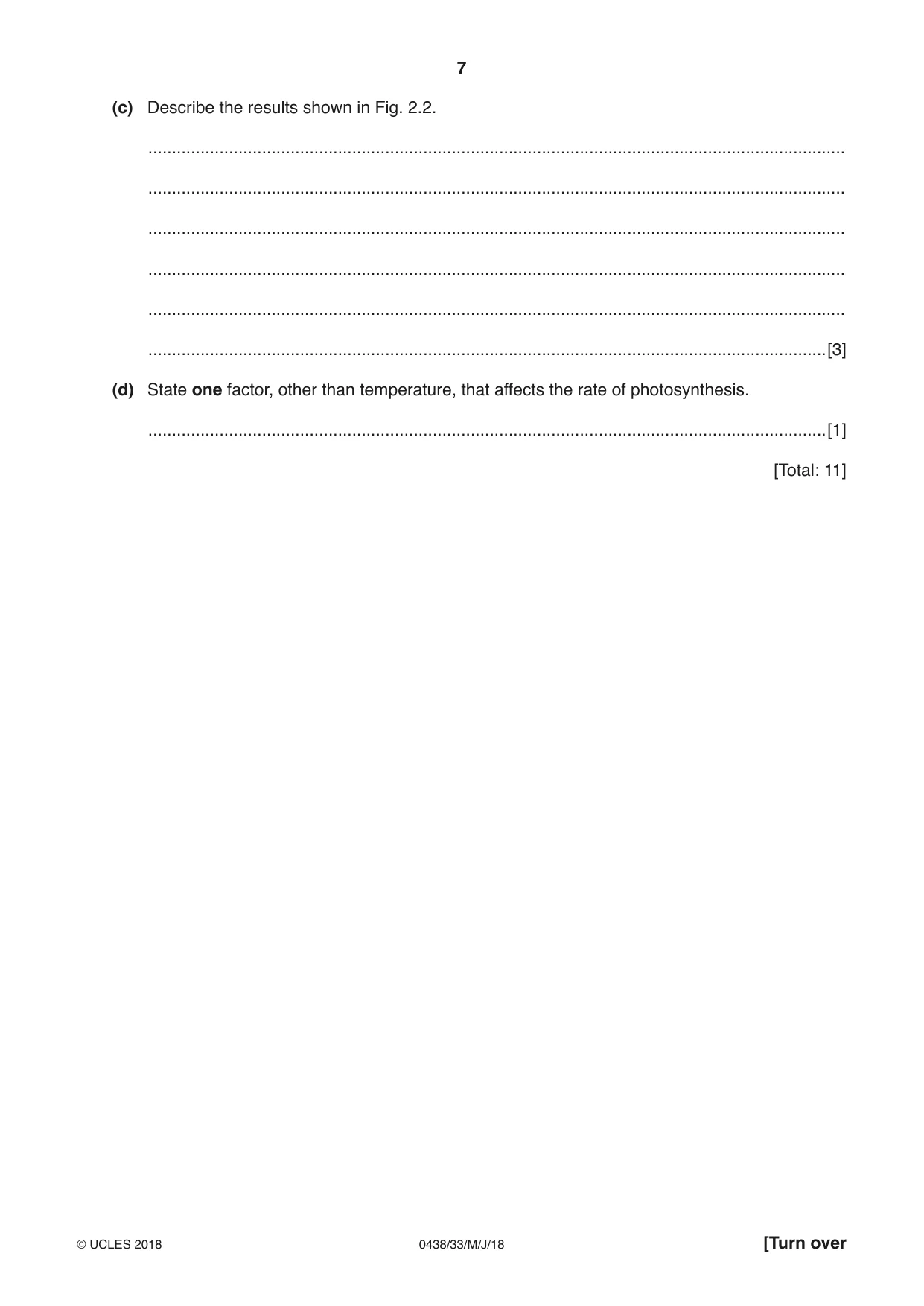
7 0438/33/M/J/18 © UCLES 2018 [Turn over (c) Describe the results shown in Fig. 2.2. … … … … … …[3] (d) State one factor, other than temperature, that affects the rate of photosynthesis. …[1] [Total: 11]
Question paper, page 8
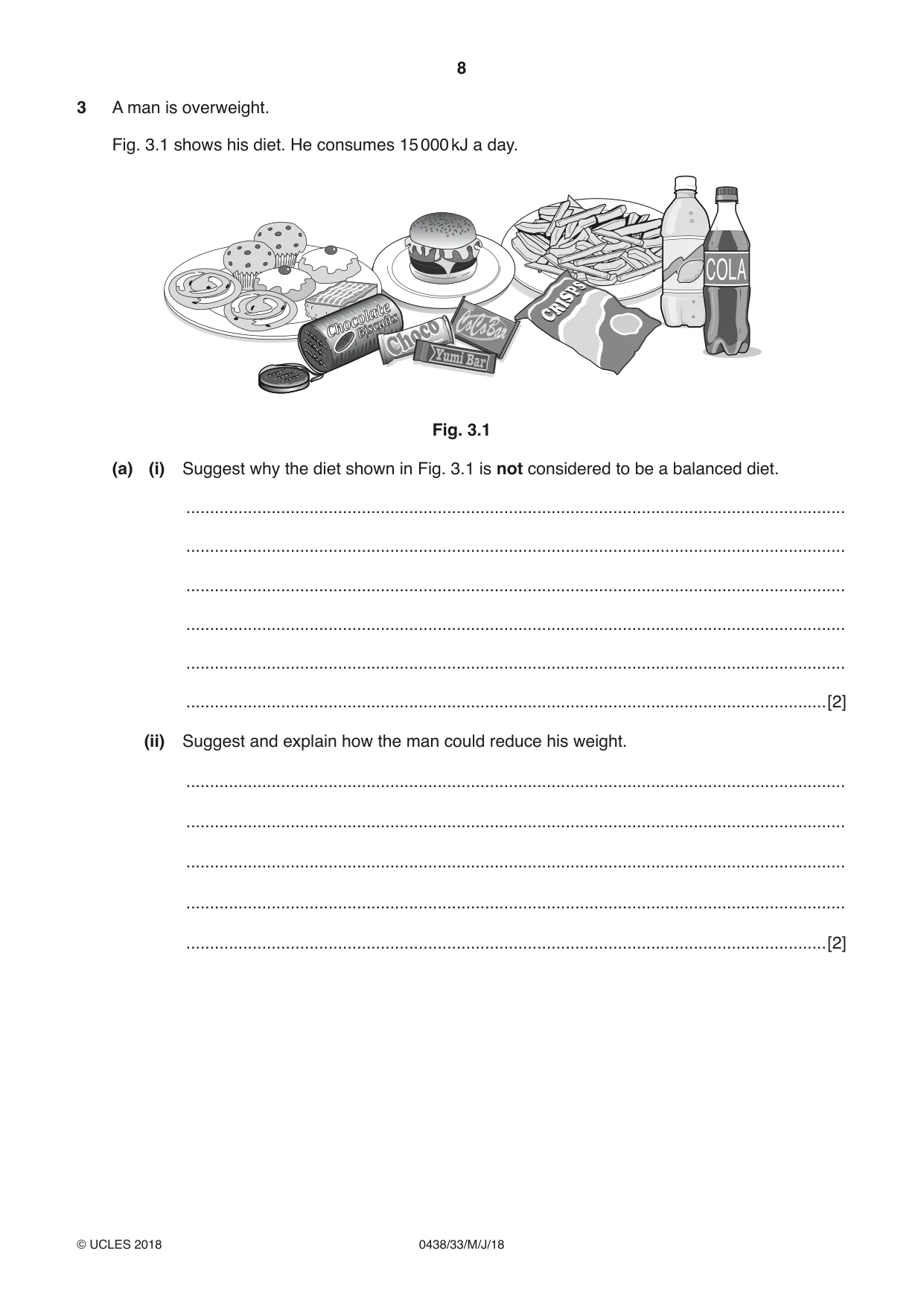
8 0438/33/M/J/18 © UCLES 2018 3 A man is overweight. Fig. 3.1 shows his diet. He consumes 15 000 kJ a day. Yumi Bar Fig. 3.1 (a) (i) Suggest why the diet shown in Fig. 3.1 is not considered to be a balanced diet. … … … … … …[2] (ii) Suggest and explain how the man could reduce his weight. … … … … …[2]
Question paper, page 9
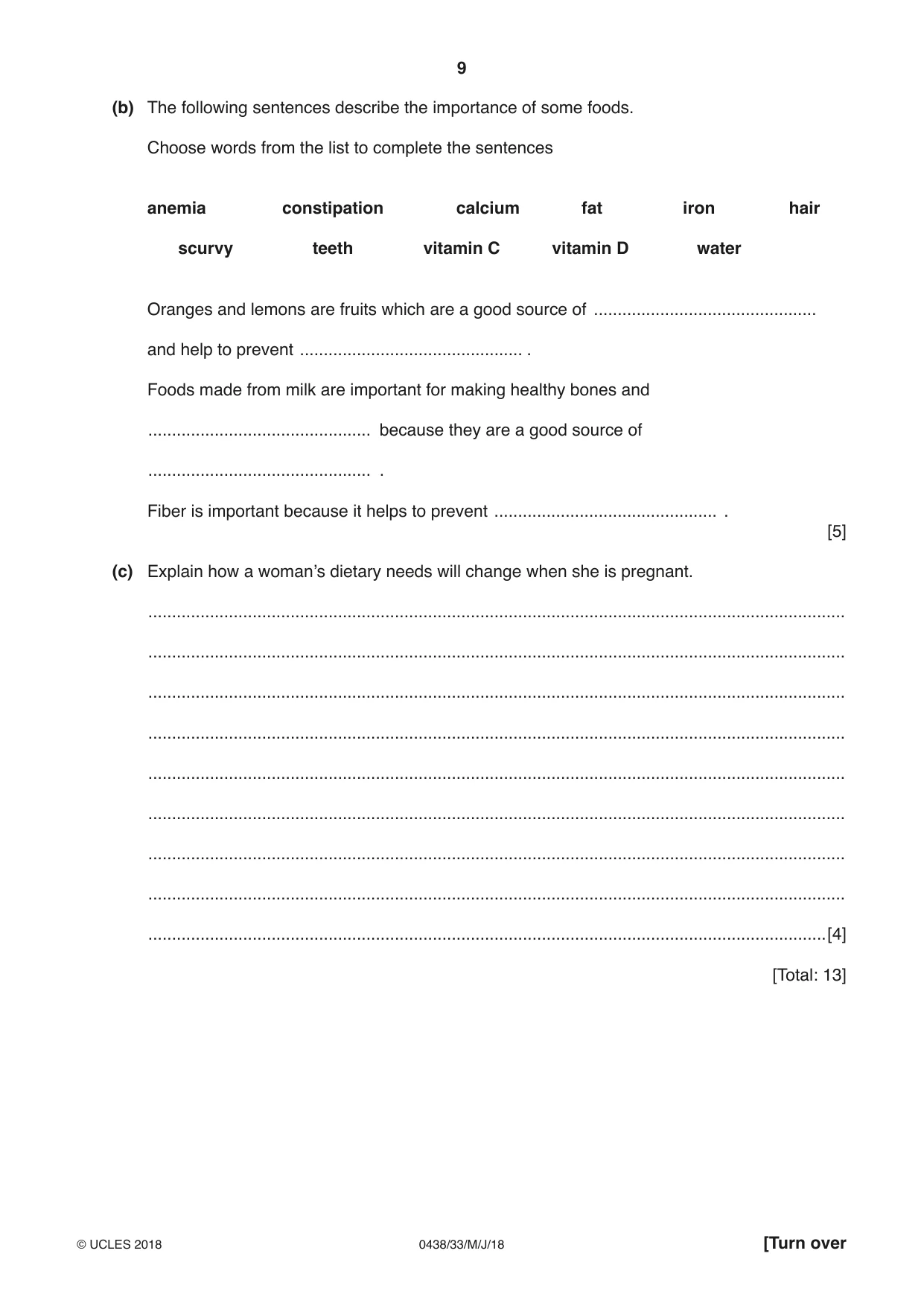
9 0438/33/M/J/18 © UCLES 2018 [Turn over (b) The following sentences describe the importance of some foods. Choose words from the list to complete the sentences anemia constipation calcium fat iron hair scurvy teeth vitamin C vitamin D water Oranges and lemons are fruits which are a good source of … and help to prevent … . Foods made from milk are important for making healthy bones and … because they are a good source of … . Fiber is important because it helps to prevent … . [5] (c) Explain how a woman’s dietary needs will change when she is pregnant. … … … … … … … … …[4] [Total: 13]
Question paper, page 10
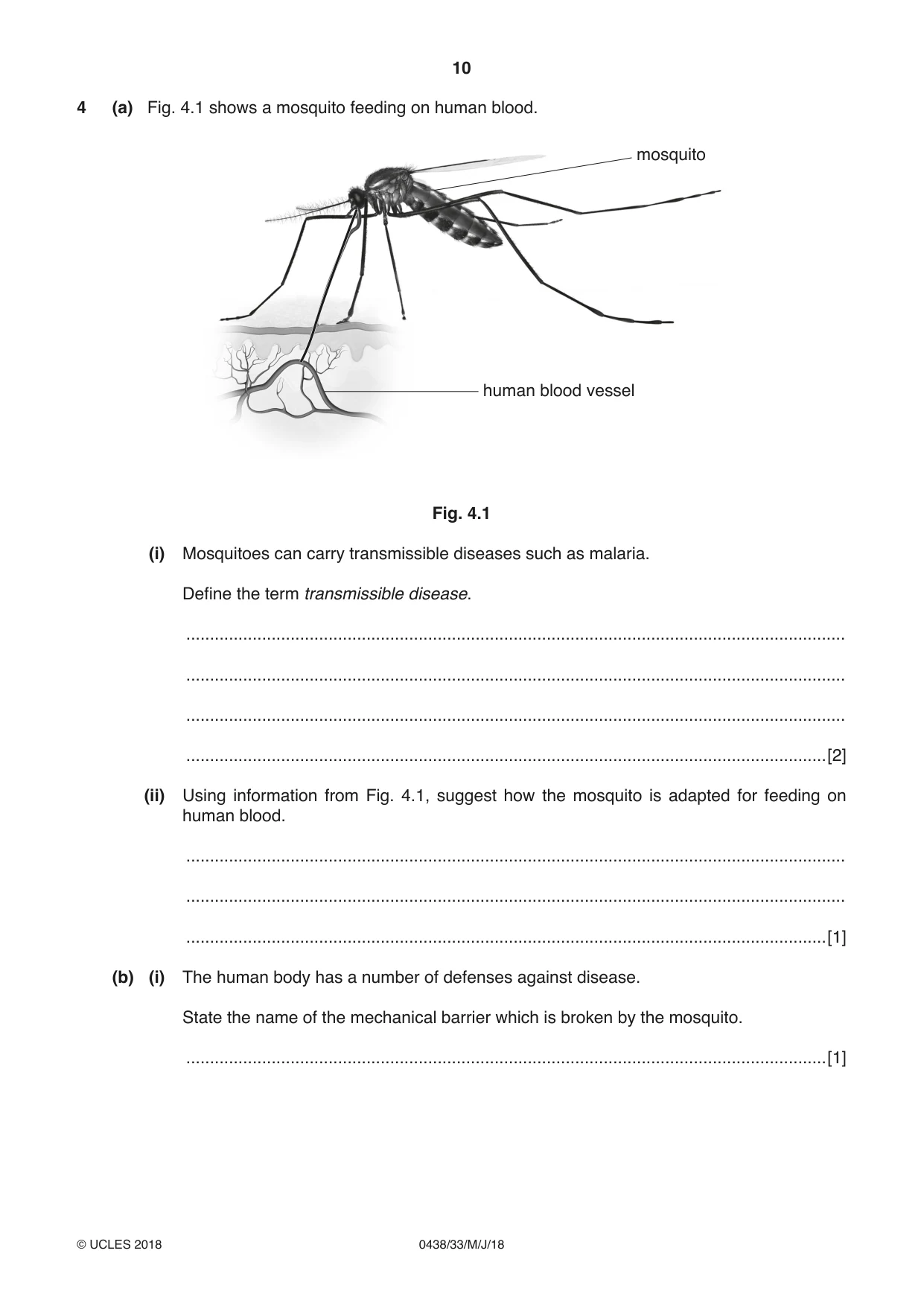
10 0438/33/M/J/18 © UCLES 2018 4 (a) Fig. 4.1 shows a mosquito feeding on human blood. mosquito human blood vessel Fig. 4.1 (i) Mosquitoes can carry transmissible diseases such as malaria. Define the term transmissible disease. … … … …[2] (ii) Using information from Fig. 4.1, suggest how the mosquito is adapted for feeding on human blood. … … …[1] (b) (i) The human body has a number of defenses against disease. State the name of the mechanical barrier which is broken by the mosquito. …[1]
Question paper, page 11
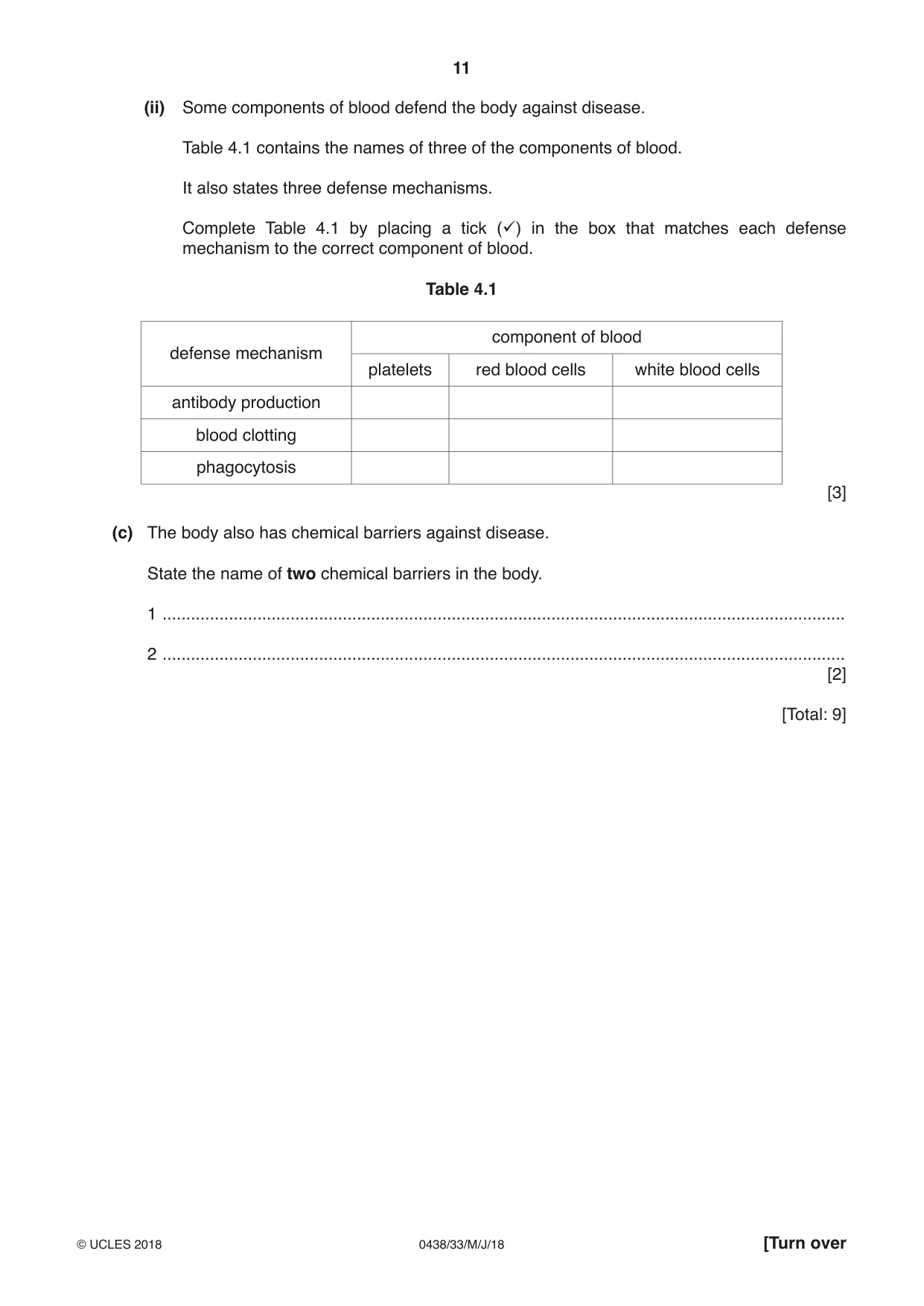
11 0438/33/M/J/18 © UCLES 2018 [Turn over (ii) Some components of blood defend the body against disease. Table 4.1 contains the names of three of the components of blood. It also states three defense mechanisms. Complete Table 4.1 by placing a tick (ü) in the box that matches each defense mechanism to the correct component of blood. Table 4.1 defense mechanism component of blood platelets red blood cells white blood cells antibody production blood clotting phagocytosis [3] (c) The body also has chemical barriers against disease. State the name of two chemical barriers in the body. 1 … 2 … [2] [Total: 9]
Question paper, page 12
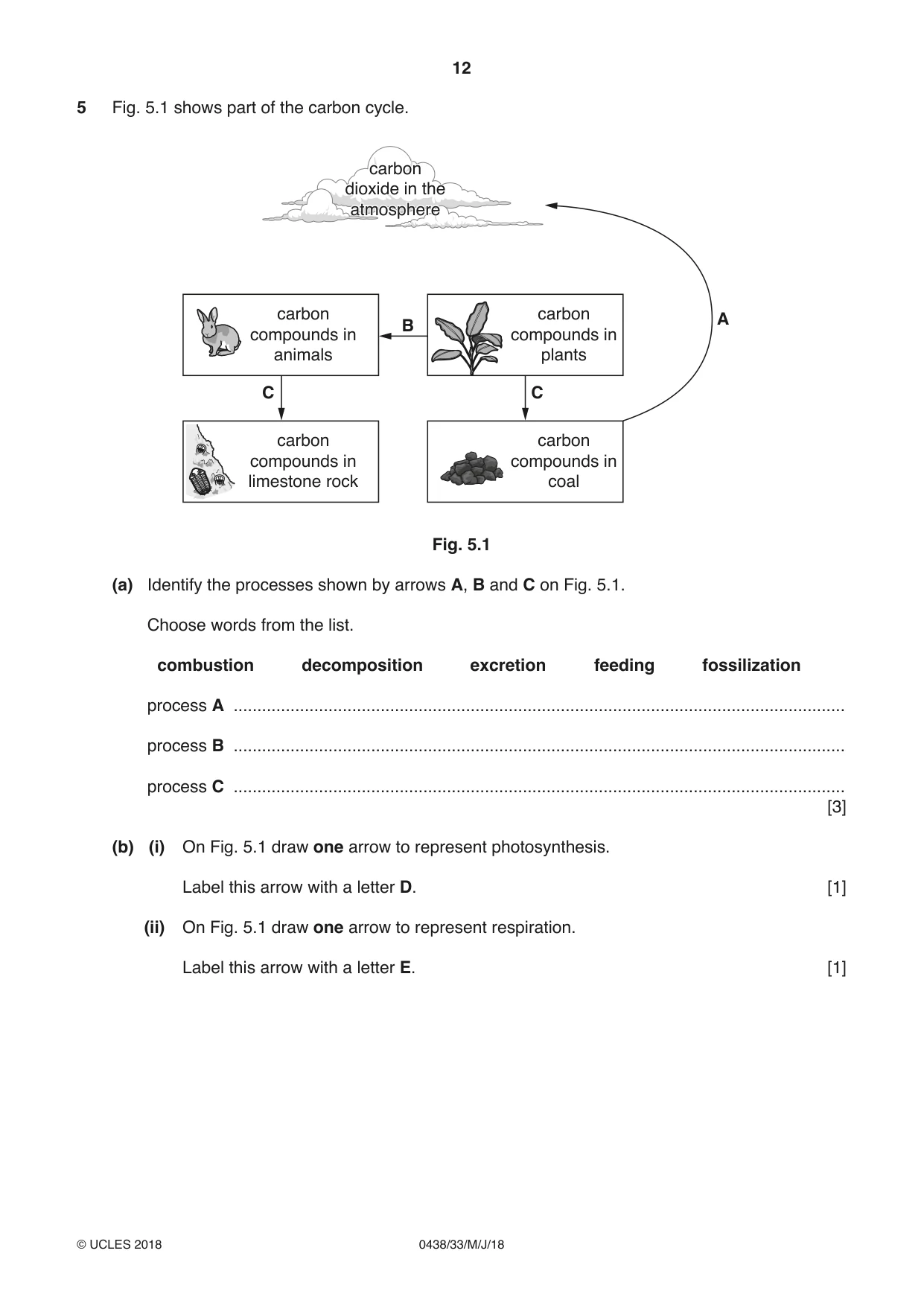
12 0438/33/M/J/18 © UCLES 2018 5 Fig. 5.1 shows part of the carbon cycle. carbon dioxide in the atmosphere carbon dioxide in the atmosphere carbon compounds in animals B C C A carbon compounds in limestone rock carbon compounds in plants carbon compounds in coal Fig. 5.1 (a) Identify the processes shown by arrows A, B and C on Fig. 5.1. Choose words from the list. combustion decomposition excretion feeding fossilization process A … process B … process C … [3] (b) (i) On Fig. 5.1 draw one arrow to represent photosynthesis. Label this arrow with a letter D. [1] (ii) On Fig. 5.1 draw one arrow to represent respiration. Label this arrow with a letter E. [1]
Question paper, page 13
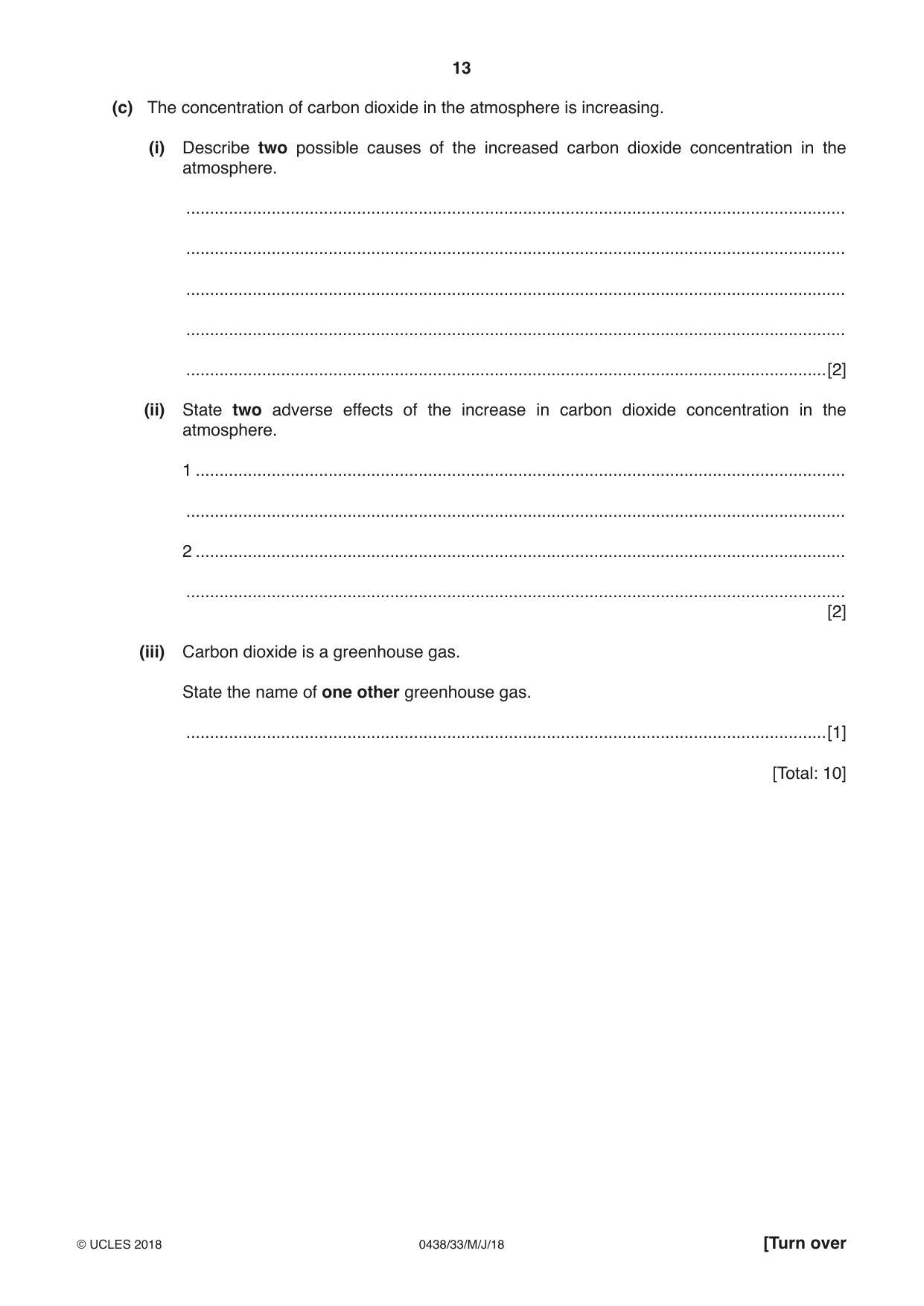
13 0438/33/M/J/18 © UCLES 2018 [Turn over (c) The concentration of carbon dioxide in the atmosphere is increasing. (i) Describe two possible causes of the increased carbon dioxide concentration in the atmosphere. … … … … …[2] (ii) State two adverse effects of the increase in carbon dioxide concentration in the atmosphere. 1 … … 2 … … [2] (iii) Carbon dioxide is a greenhouse gas. State the name of one other greenhouse gas. …[1] [Total: 10]
Question paper, page 14
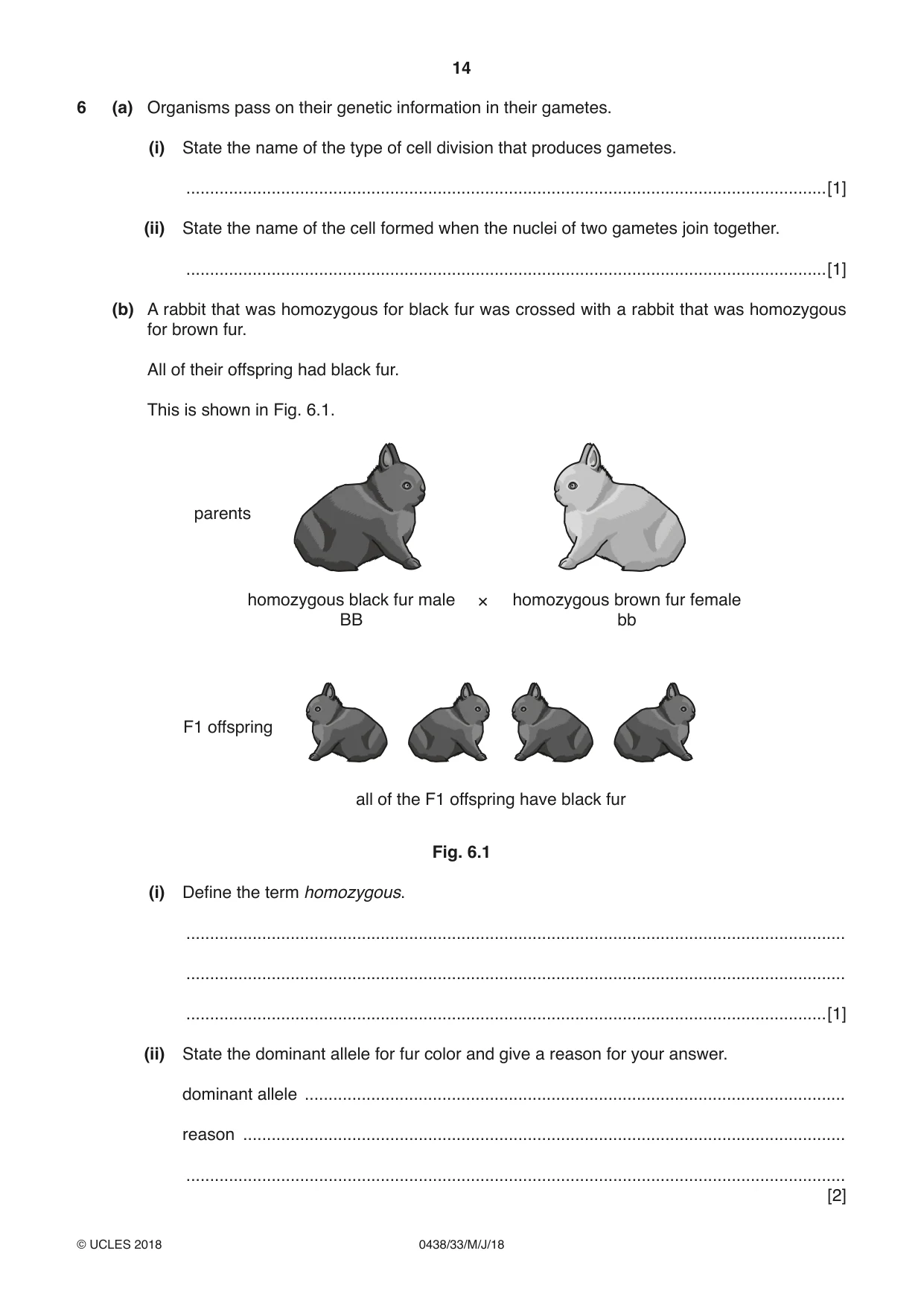
14 0438/33/M/J/18 © UCLES 2018 6 (a) Organisms pass on their genetic information in their gametes. (i) State the name of the type of cell division that produces gametes. …[1] (ii) State the name of the cell formed when the nuclei of two gametes join together. …[1] (b) A rabbit that was homozygous for black fur was crossed with a rabbit that was homozygous for brown fur. All of their offspring had black fur. This is shown in Fig. 6.1. × parents F1 offspring homozygous black fur male BB homozygous brown fur female bb all of the F1 offspring have black fur Fig. 6.1 (i) Define the term homozygous. … … …[1] (ii) State the dominant allele for fur color and give a reason for your answer. dominant allele … reason … … [2]
Question paper, page 15
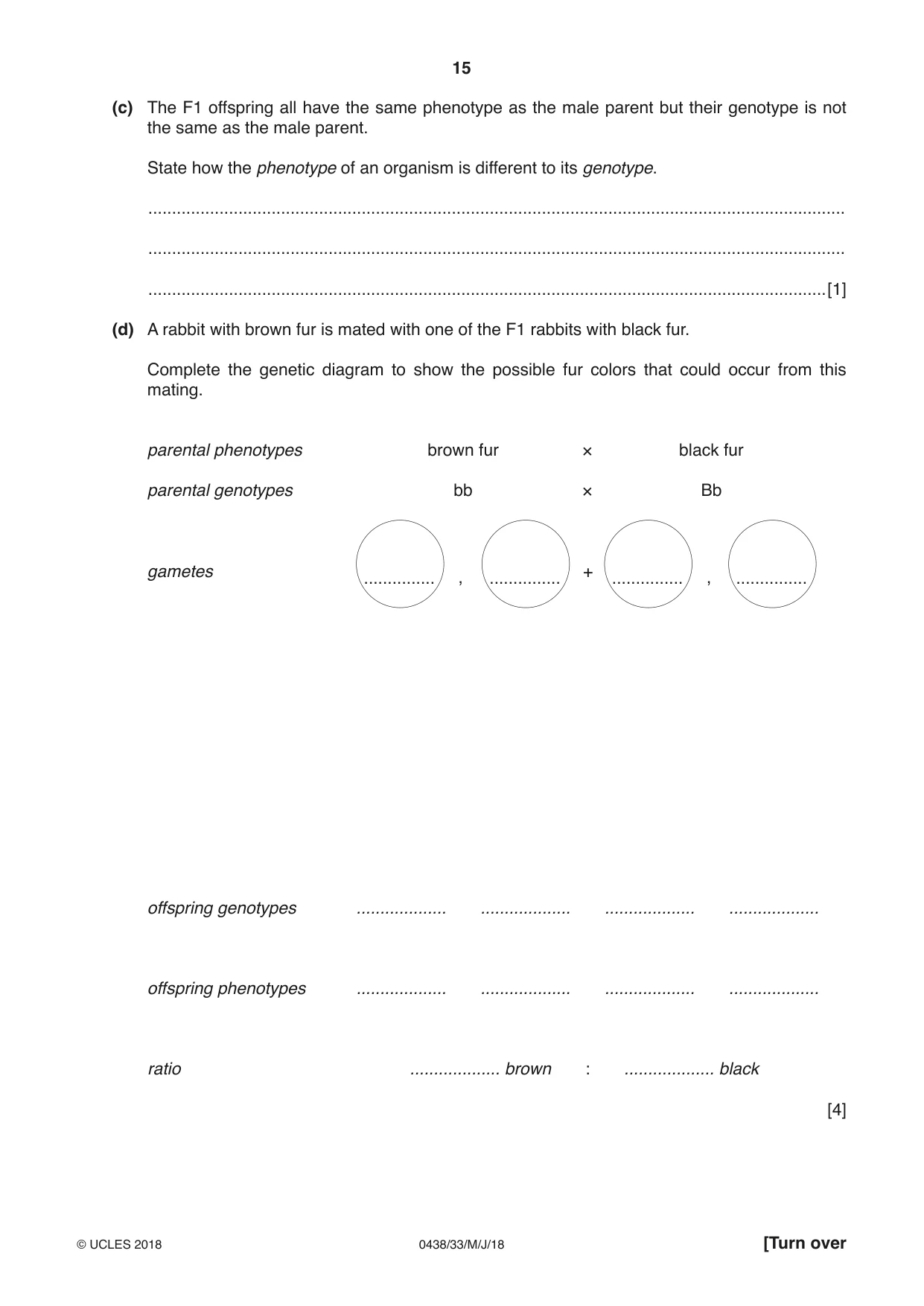
15 0438/33/M/J/18 © UCLES 2018 [Turn over (c) The F1 offspring all have the same phenotype as the male parent but their genotype is not the same as the male parent. State how the phenotype of an organism is different to its genotype. … … …[1] (d) A rabbit with brown fur is mated with one of the F1 rabbits with black fur. Complete the genetic diagram to show the possible fur colors that could occur from this mating. parental phenotypes brown fur × black fur parental genotypes bb × Bb gametes … , … + … , … offspring genotypes … … … … offspring phenotypes … … … … ratio … brown : … black [4]
Question paper, page 16
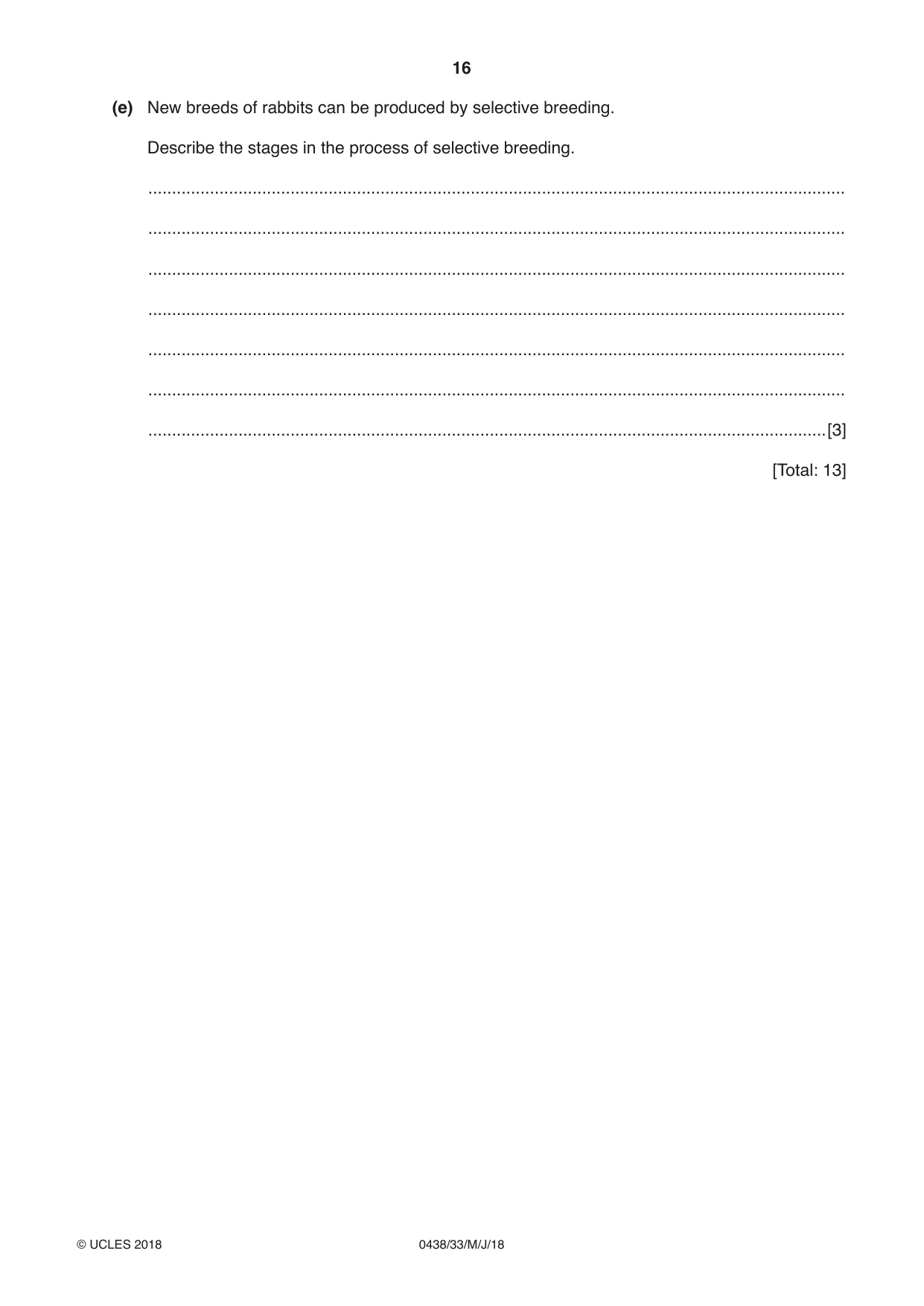
16 0438/33/M/J/18 © UCLES 2018 (e) New breeds of rabbits can be produced by selective breeding. Describe the stages in the process of selective breeding. … … … … … … …[3] [Total: 13]
Question paper, page 17
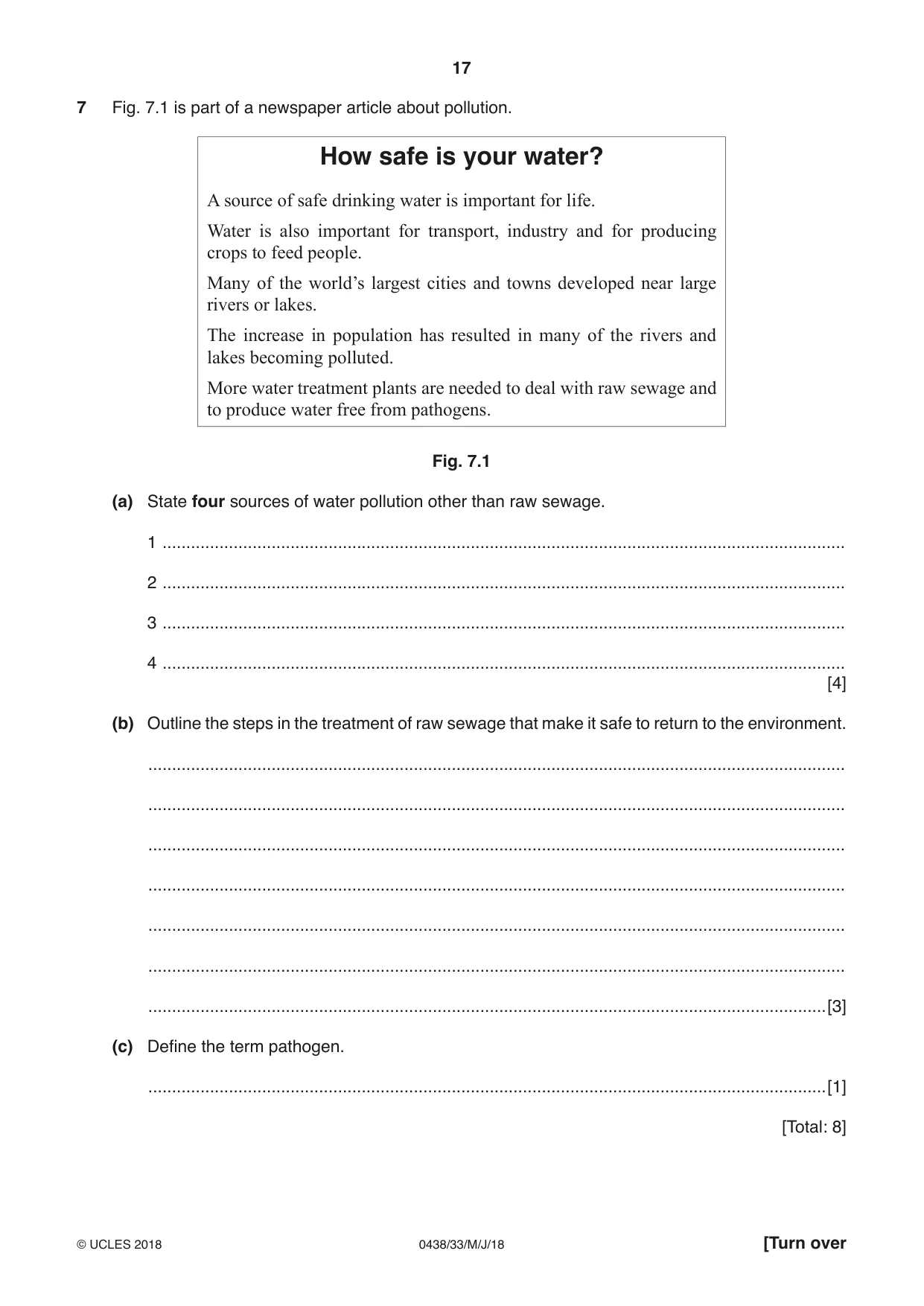
17 0438/33/M/J/18 © UCLES 2018 [Turn over 7 Fig. 7.1 is part of a newspaper article about pollution. How safe is your water? A source of safe drinking water is important for life. Water is also important for transport, industry and for producing crops to feed people. Many of the world’s largest cities and towns developed near large rivers or lakes. The increase in population has resulted in many of the rivers and lakes becoming polluted. More water treatment plants are needed to deal with raw sewage and to produce water free from pathogens. Fig. 7.1 (a) State four sources of water pollution other than raw sewage. 1 … 2 … 3 … 4 … [4] (b) Outline the steps in the treatment of raw sewage that make it safe to return to the environment. … … … … … … …[3] (c) Define the term pathogen. …[1] [Total: 8]
Question paper, page 18
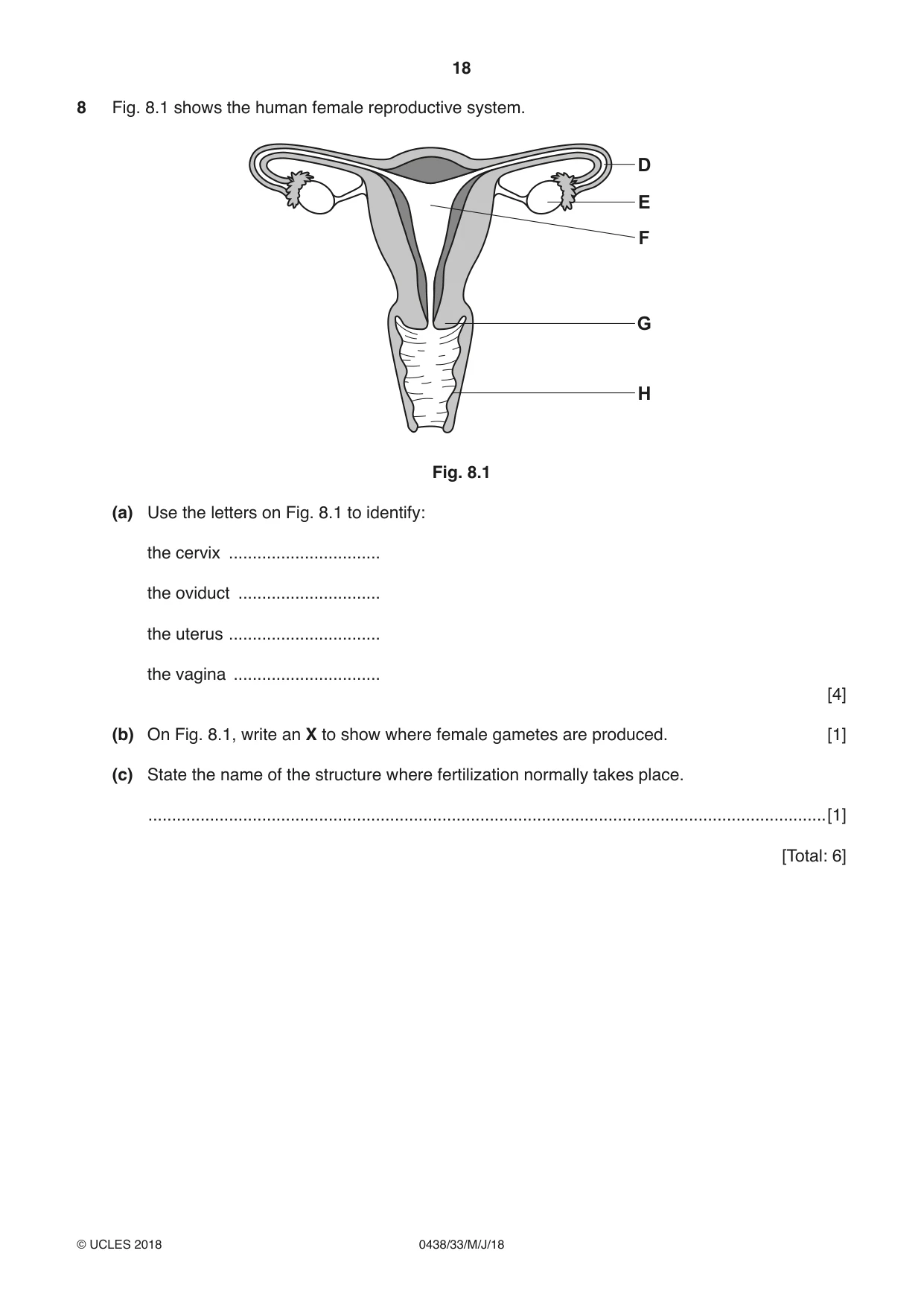
18 0438/33/M/J/18 © UCLES 2018 8 Fig. 8.1 shows the human female reproductive system. H G D E F Fig. 8.1 (a) Use the letters on Fig. 8.1 to identify: the cervix … the oviduct … the uterus … the vagina … [4] (b) On Fig. 8.1, write an X to show where female gametes are produced. [1] (c) State the name of the structure where fertilization normally takes place. …[1] [Total: 6]
Question paper, page 19
19 0438/33/M/J/18 © UCLES 2018 BLANK PAGE
Question paper, page 20
20 0438/33/M/J/18 © UCLES 2018 Permission to reproduce items where third-party owned material protected by copyright is included has been sought and cleared where possible. Every reasonable effort has been made by the publisher (UCLES) to trace copyright holders, but if any items requiring clearance have unwittingly been included, the publisher will be pleased to make amends at the earliest possible opportunity. To avoid the issue of disclosure of answer-related information to candidates, all copyright acknowledgements are reproduced online in the Cambridge International Examinations Copyright Acknowledgements Booklet. This is produced for each series of examinations and is freely available to download at www.cie.org.uk after the live examination series. Cambridge International Examinations is part of the Cambridge Assessment Group. Cambridge Assessment is the brand name of University of Cambridge Local Examinations Syndicate (UCLES), which is itself a department of the University of Cambridge. BLANK PAGE
Mark scheme, page 1
IGCSE™ is a registered trademark. This document consists of 13 printed pages. © UCLES 2018 [Turn over Cambridge Assessment International Education Cambridge International General Certificate of Secondary Education BIOLOGY (US) 0438/33 Paper 3 Theory (Core) May/June 2018 MARK SCHEME Maximum Mark: 80 Published This mark scheme is published as an aid to teachers and candidates, to indicate the requirements of the examination. It shows the basis on which Examiners were instructed to award marks. It does not indicate the details of the discussions that took place at an Examiners’ meeting before marking began, which would have considered the acceptability of alternative answers. Mark schemes should be read in conjunction with the question paper and the Principal Examiner Report for Teachers. Cambridge International will not enter into discussions about these mark schemes. Cambridge International is publishing the mark schemes for the May/June 2018 series for most Cambridge IGCSE™, Cambridge International A and AS Level and Cambridge Pre-U components, and some Cambridge O Level components.
Mark scheme, page 2
0438/33 Cambridge IGCSE – Mark Scheme PUBLISHED May/June 2018 © UCLES 2018 Page 2 of 13 Generic Marking Principles These general marking principles must be applied by all examiners when marking candidate answers. They should be applied alongside the specific content of the mark scheme or generic level descriptors for a question. Each question paper and mark scheme will also comply with these marking principles. GENERIC MARKING PRINCIPLE 1: Marks must be awarded in line with: • the specific content of the mark scheme or the generic level descriptors for the question • the specific skills defined in the mark scheme or in the generic level descriptors for the question • the standard of response required by a candidate as exemplified by the standardisation scripts. GENERIC MARKING PRINCIPLE 2: Marks awarded are always whole marks (not half marks, or other fractions). GENERIC MARKING PRINCIPLE 3: Marks must be awarded positively: • marks are awarded for correct/valid answers, as defined in the mark scheme. However, credit is given for valid answers which go beyond the scope of the syllabus and mark scheme, referring to your Team Leader as appropriate • marks are awarded when candidates clearly demonstrate what they know and can do • marks are not deducted for errors • marks are not deducted for omissions • answers should only be judged on the quality of spelling, punctuation and grammar when these features are specifically assessed by the question as indicated by the mark scheme. The meaning, however, should be unambiguous. GENERIC MARKING PRINCIPLE 4: Rules must be applied consistently e.g. in situations where candidates have not followed instructions or in the application of generic level descriptors.
Mark scheme, page 3
0438/33 Cambridge IGCSE – Mark Scheme PUBLISHED May/June 2018 © UCLES 2018 Page 3 of 13 GENERIC MARKING PRINCIPLE 5: Marks should be awarded using the full range of marks defined in the mark scheme for the question (however; the use of the full mark range may be limited according to the quality of the candidate responses seen). GENERIC MARKING PRINCIPLE 6: Marks awarded are based solely on the requirements as defined in the mark scheme. Marks should not be awarded with grade thresholds or grade descriptors in mind.
Mark scheme, page 4
0438/33 Cambridge IGCSE – Mark Scheme PUBLISHED May/June 2018 © UCLES 2018 Page 4 of 13 Mark schemes will use these abbreviations • ; separates marking points • / alternatives • I I • R reject • A A (for answers correctly cued by the question, or guidance for examiners) • AW alternative wording (where responses vary more than usual) • AVP any valid point • ecf credit a correct statement / calculation that follows a previous wrong response • ora or reverse argument • ( ) the word / phrase in brackets is not required, but sets the context • underline actual word given must be used by candidate (grammatical variants excepted) • max indicates the maximum number of marks that can be given
Mark scheme, page 5
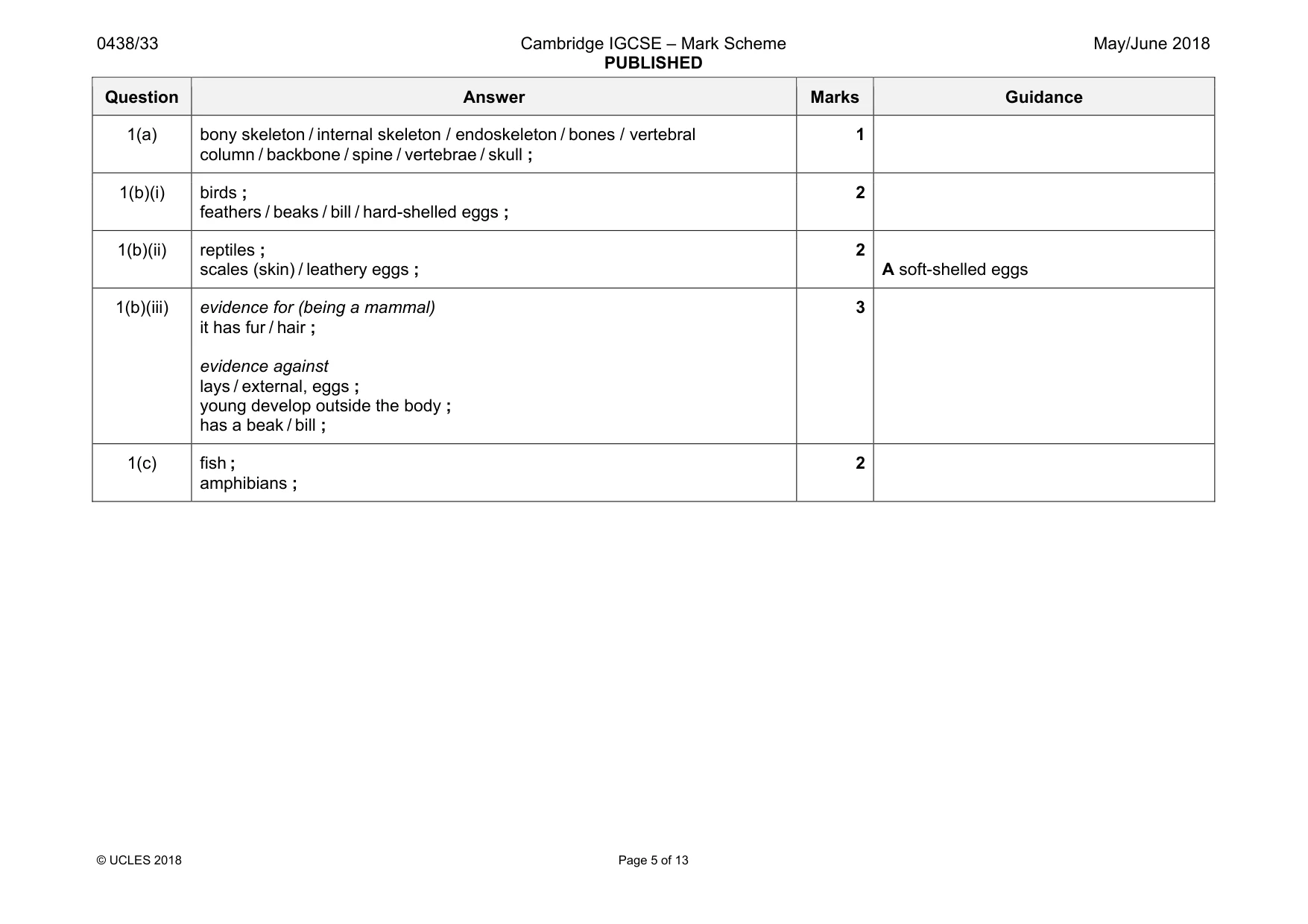
0438/33 Cambridge IGCSE – Mark Scheme PUBLISHED May/June 2018 © UCLES 2018 Page 5 of 13 Question Answer Marks Guidance 1(a) bony skeleton / internal skeleton / endoskeleton / bones / vertebral column / backbone / spine / vertebrae / skull ; 1 1(b)(i) birds ; feathers / beaks / bill / hard-shelled eggs ; 2 1(b)(ii) reptiles ; scales (skin) / leathery eggs ; 2 A soft-shelled eggs 1(b)(iii) evidence for (being a mammal) it has fur / hair ; evidence against lays / external, eggs ; young develop outside the body ; has a beak / bill ; 3 1(c) fish ; amphibians ; 2
Mark scheme, page 6
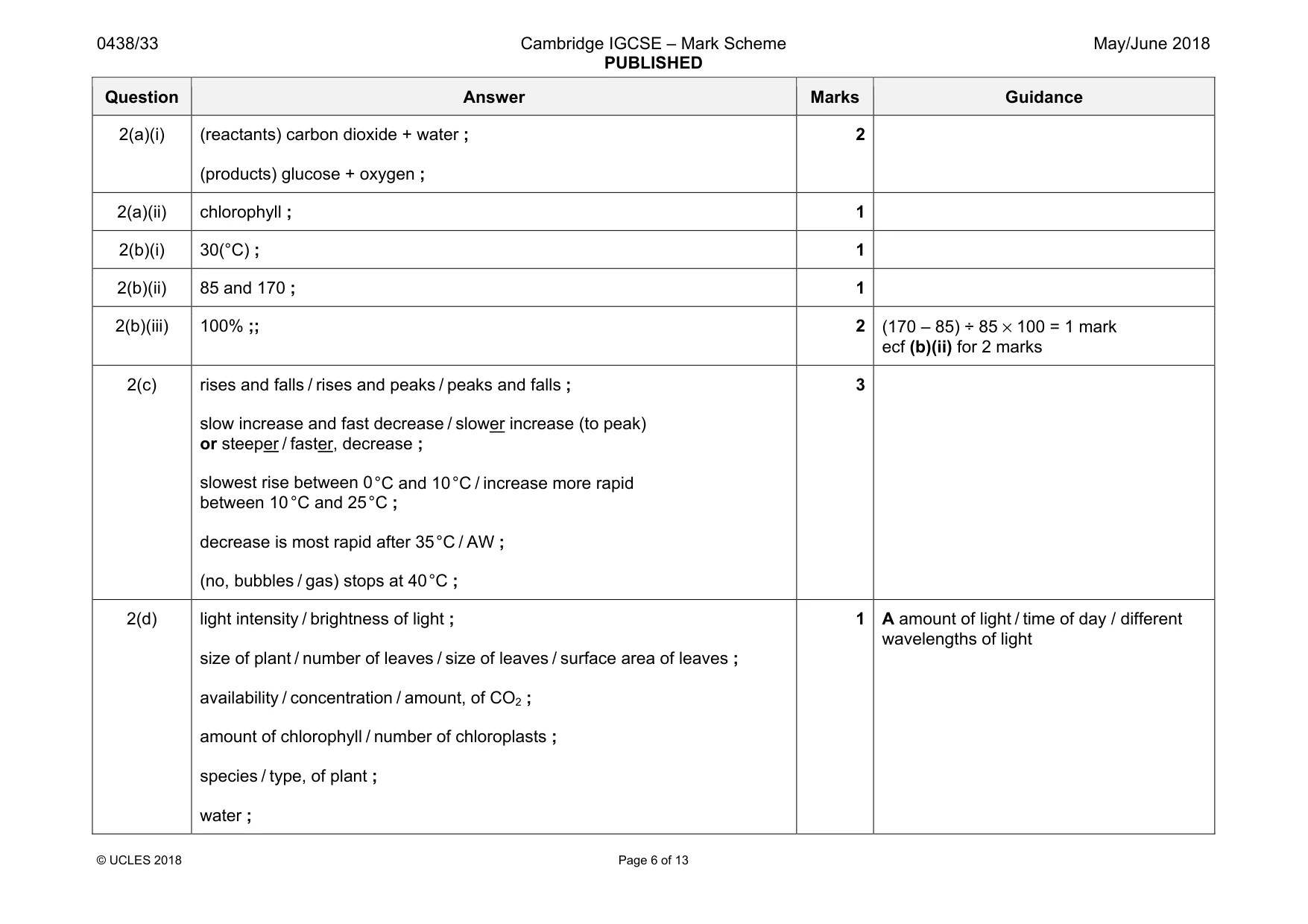
0438/33 Cambridge IGCSE – Mark Scheme PUBLISHED May/June 2018 © UCLES 2018 Page 6 of 13 Question Answer Marks Guidance 2(a)(i) (reactants) carbon dioxide + water ; (products) glucose + oxygen ; 2 2(a)(ii) chlorophyll ; 1 2(b)(i) 30(°C) ; 1 2(b)(ii) 85 and 170 ; 1 2(b)(iii) 100% ;; 2 (170 – 85) ÷ 85 × 100 = 1 mark ecf (b)(ii) for 2 marks 2(c) rises and falls / rises and peaks / peaks and falls ; slow increase and fast decrease / slower increase (to peak) or steeper / faster, decrease ; slowest rise between 0 °C and 10 °C / increase more rapid between 10 °C and 25 °C ; decrease is most rapid after 35 °C / AW ; (no, bubbles / gas) stops at 40 °C ; 3 2(d) light intensity / brightness of light ; size of plant / number of leaves / size of leaves / surface area of leaves ; availability / concentration / amount, of CO2 ; amount of chlorophyll / number of chloroplasts ; species / type, of plant ; water ; 1 A amount of light / time of day / different wavelengths of light
Mark scheme, page 7
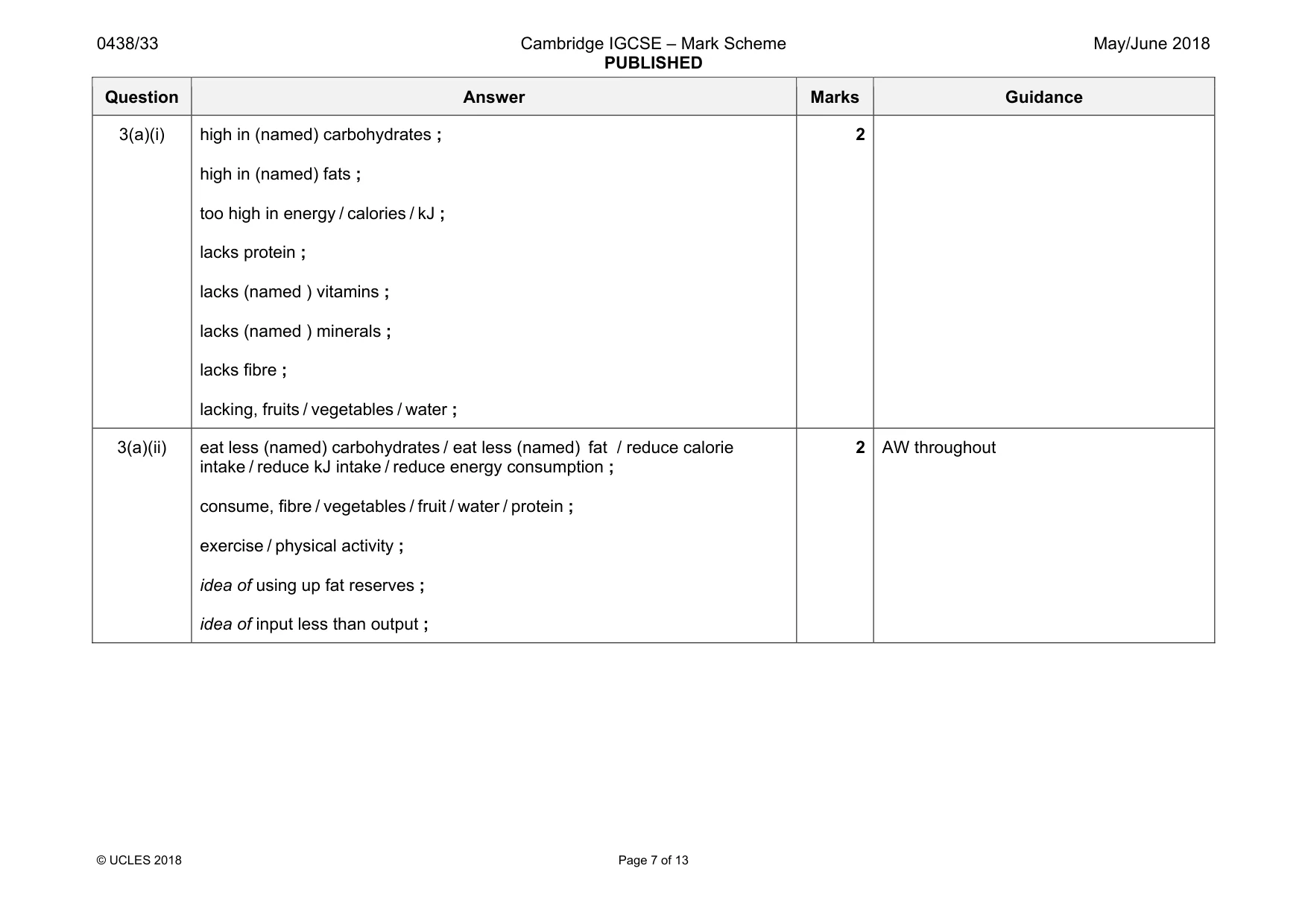
0438/33 Cambridge IGCSE – Mark Scheme PUBLISHED May/June 2018 © UCLES 2018 Page 7 of 13 Question Answer Marks Guidance 3(a)(i) high in (named) carbohydrates ; high in (named) fats ; too high in energy / calories / kJ ; lacks protein ; lacks (named ) vitamins ; lacks (named ) minerals ; lacks fibre ; lacking, fruits / vegetables / water ; 2 3(a)(ii) eat less (named) carbohydrates / eat less (named) fat / reduce calorie intake / reduce kJ intake / reduce energy consumption ; consume, fibre / vegetables / fruit / water / protein ; exercise / physical activity ; idea of using up fat reserves ; idea of input less than output ; 2 AW throughout
Mark scheme, page 8
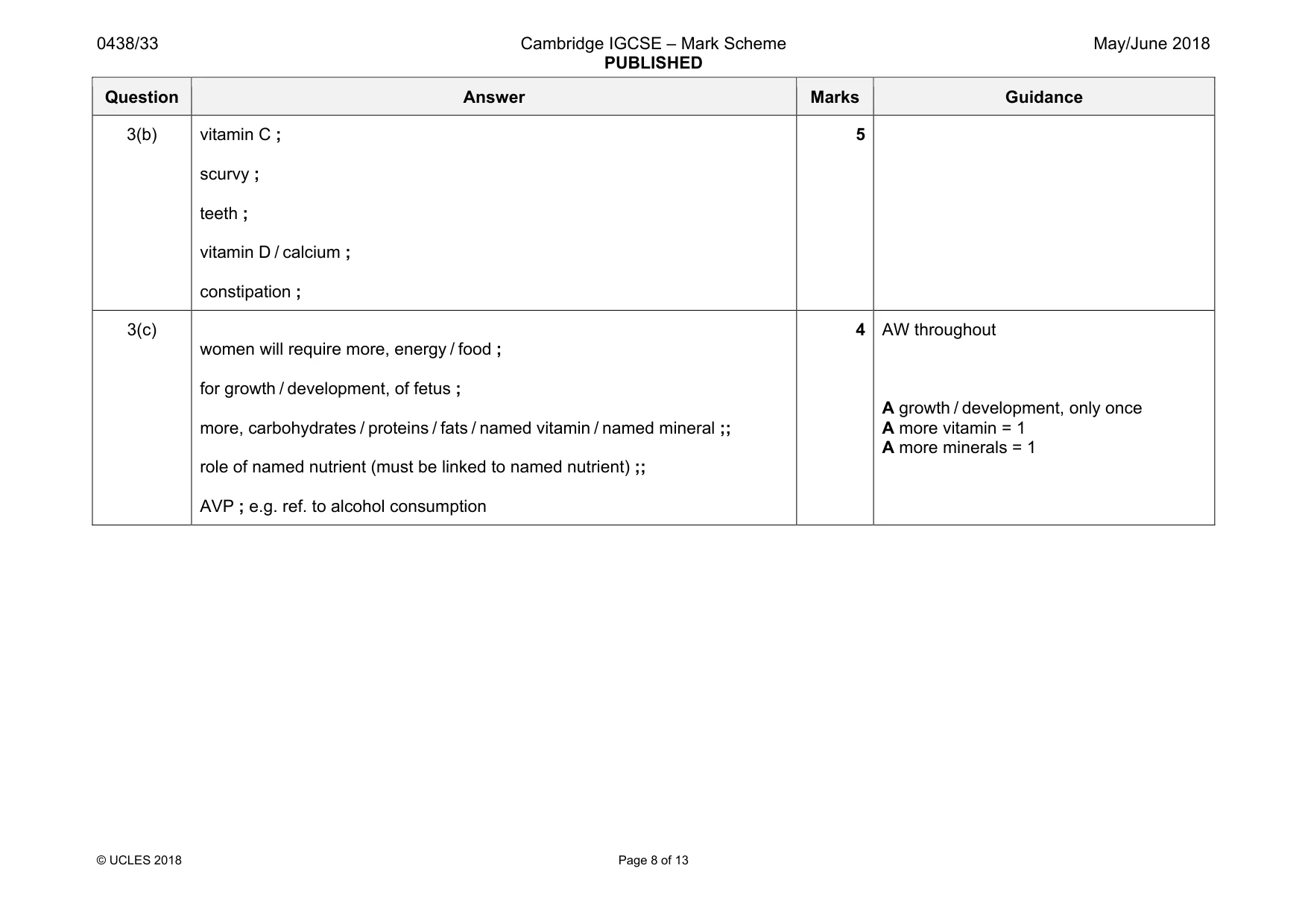
0438/33 Cambridge IGCSE – Mark Scheme PUBLISHED May/June 2018 © UCLES 2018 Page 8 of 13 Question Answer Marks Guidance 3(b) vitamin C ; scurvy ; teeth ; vitamin D / calcium ; constipation ; 5 3(c) women will require more, energy / food ; for growth / development, of fetus ; more, carbohydrates / proteins / fats / named vitamin / named mineral ;; role of named nutrient (must be linked to named nutrient) ;; AVP ; e.g. ref. to alcohol consumption 4 AW throughout A growth / development, only once A more vitamin = 1 A more minerals = 1
Mark scheme, page 9
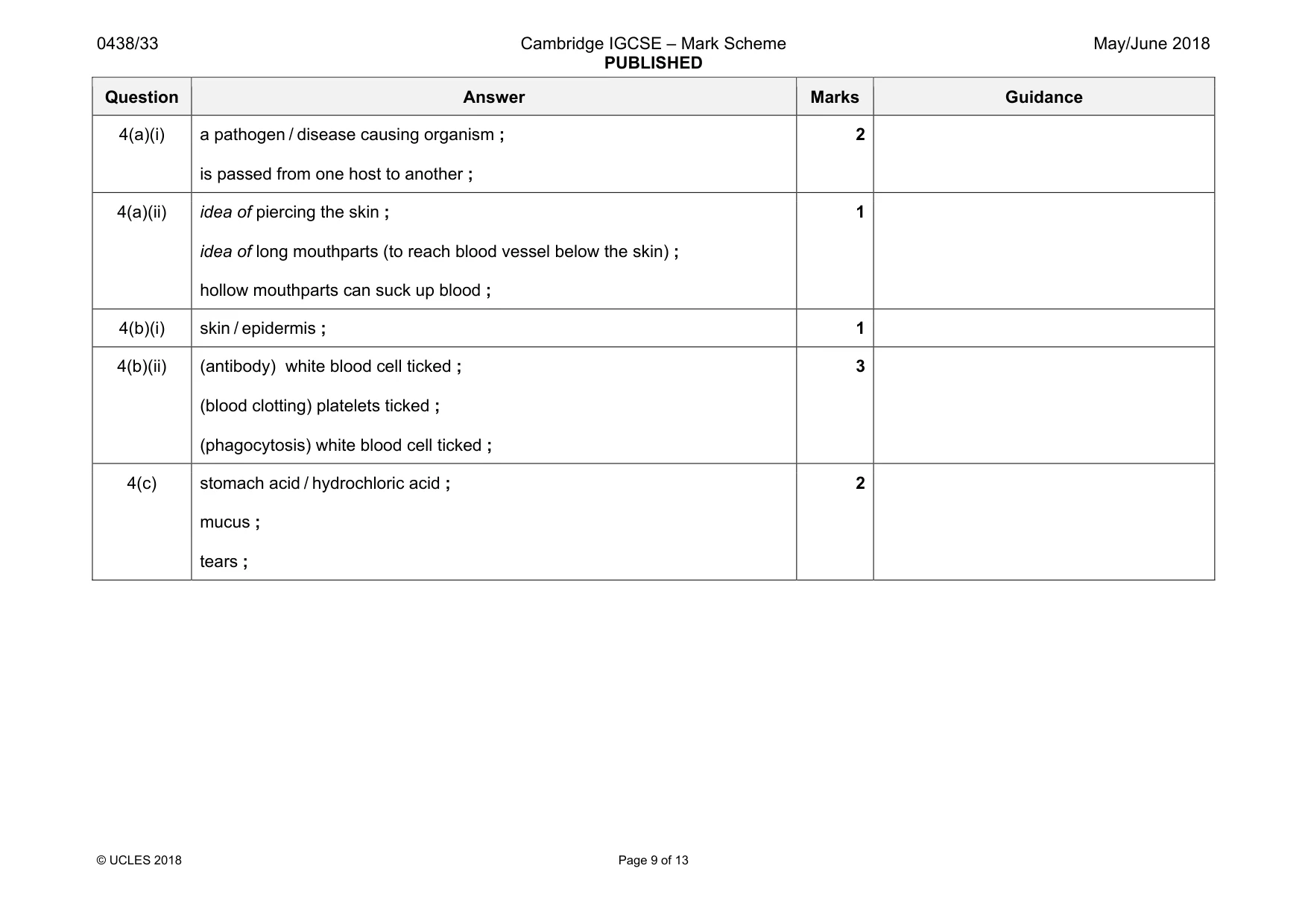
0438/33 Cambridge IGCSE – Mark Scheme PUBLISHED May/June 2018 © UCLES 2018 Page 9 of 13 Question Answer Marks Guidance 4(a)(i) a pathogen / disease causing organism ; is passed from one host to another ; 2 4(a)(ii) idea of piercing the skin ; idea of long mouthparts (to reach blood vessel below the skin) ; hollow mouthparts can suck up blood ; 1 4(b)(i) skin / epidermis ; 1 4(b)(ii) (antibody) white blood cell ticked ; (blood clotting) platelets ticked ; (phagocytosis) white blood cell ticked ; 3 4(c) stomach acid / hydrochloric acid ; mucus ; tears ; 2
Mark scheme, page 10
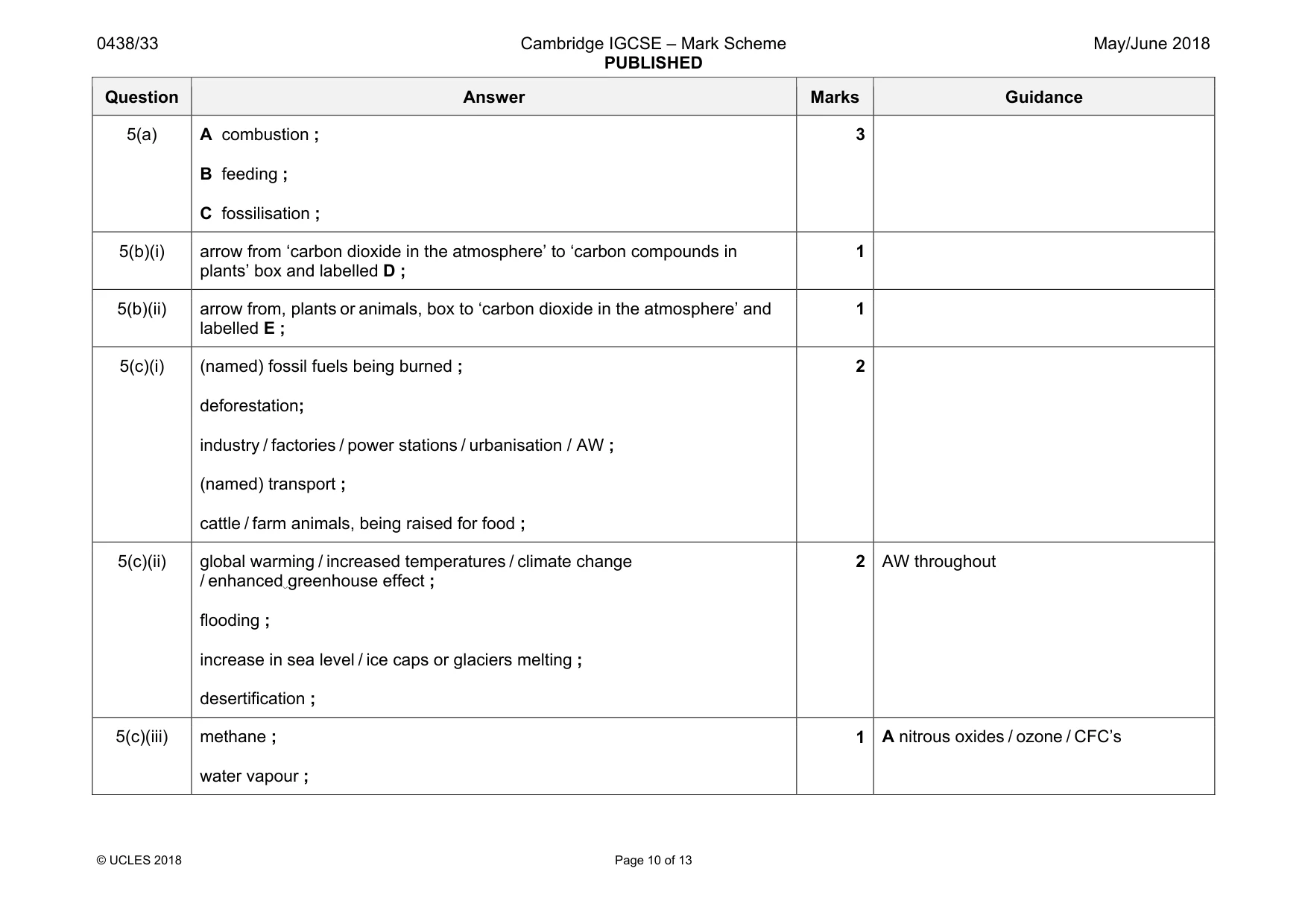
0438/33 Cambridge IGCSE – Mark Scheme PUBLISHED May/June 2018 © UCLES 2018 Page 10 of 13 Question Answer Marks Guidance 5(a) A combustion ; B feeding ; C fossilisation ; 3 5(b)(i) arrow from ‘carbon dioxide in the atmosphere’ to ‘carbon compounds in plants’ box and labelled D ; 1 5(b)(ii) arrow from, plants or animals, box to ‘carbon dioxide in the atmosphere’ and labelled E ; 1 5(c)(i) (named) fossil fuels being burned ; deforestation; industry / factories / power stations / urbanisation / AW ; (named) transport ; cattle / farm animals, being raised for food ; 2 5(c)(ii) global warming / increased temperatures / climate change / enhanced greenhouse effect ; flooding ; increase in sea level / ice caps or glaciers melting ; desertification ; 2 AW throughout 5(c)(iii) methane ; water vapour ; 1 A nitrous oxides / ozone / CFC’s
Mark scheme, page 11
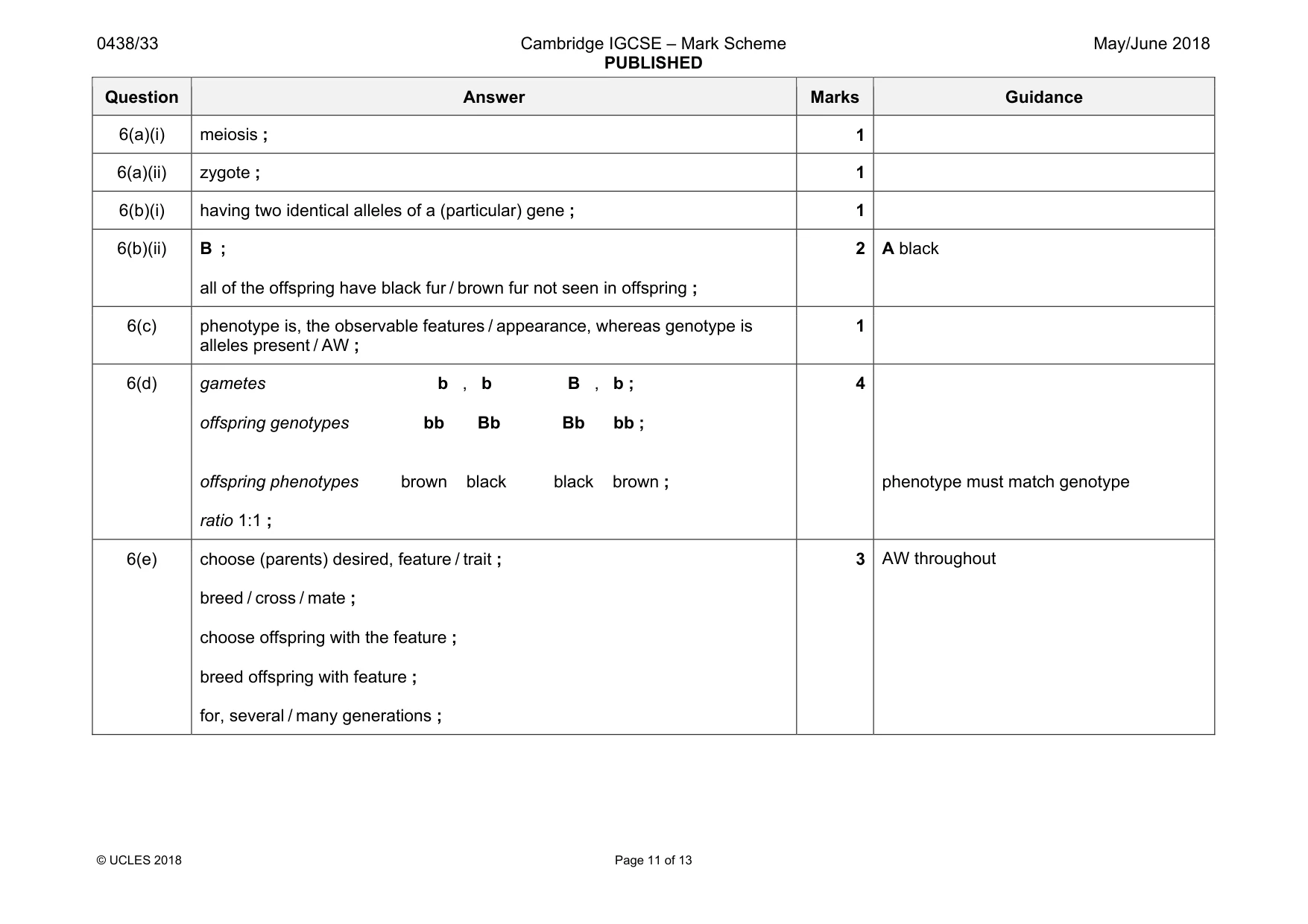
0438/33 Cambridge IGCSE – Mark Scheme PUBLISHED May/June 2018 © UCLES 2018 Page 11 of 13 Question Answer Marks Guidance 6(a)(i) meiosis ; 1 6(a)(ii) zygote ; 1 6(b)(i) having two identical alleles of a (particular) gene ; 1 6(b)(ii) B ; all of the offspring have black fur / brown fur not seen in offspring ; 2 A black 6(c) phenotype is, the observable features / appearance, whereas genotype is alleles present / AW ; 1 6(d) gametes b , b B , b ; offspring genotypes bb Bb Bb bb ; offspring phenotypes brown black black brown ; ratio 1:1 ; 4 phenotype must match genotype 6(e) choose (parents) desired, feature / trait ; breed / cross / mate ; choose offspring with the feature ; breed offspring with feature ; for, several / many generations ; 3 AW throughout
Mark scheme, page 12
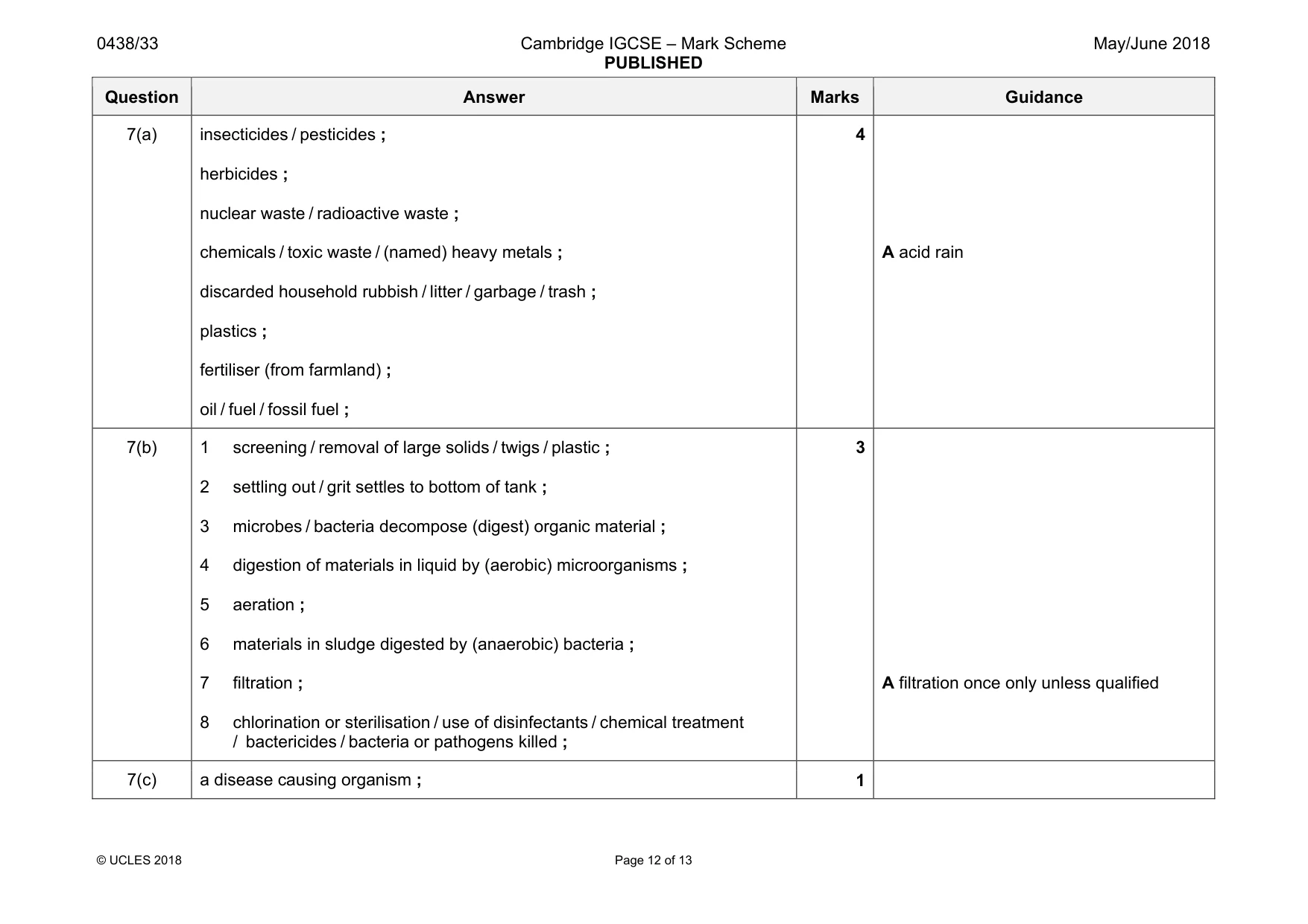
0438/33 Cambridge IGCSE – Mark Scheme PUBLISHED May/June 2018 © UCLES 2018 Page 12 of 13 Question Answer Marks Guidance 7(a) insecticides / pesticides ; herbicides ; nuclear waste / radioactive waste ; chemicals / toxic waste / (named) heavy metals ; discarded household rubbish / litter / garbage / trash ; plastics ; fertiliser (from farmland) ; oil / fuel / fossil fuel ; 4 A acid rain 7(b) 1 screening / removal of large solids / twigs / plastic ; 2 settling out / grit settles to bottom of tank ; 3 microbes / bacteria decompose (digest) organic material ; 4 digestion of materials in liquid by (aerobic) microorganisms ; 5 aeration ; 6 materials in sludge digested by (anaerobic) bacteria ; 7 filtration ; 8 chlorination or sterilisation / use of disinfectants / chemical treatment / bactericides / bacteria or pathogens killed ; 3 A filtration once only unless qualified 7(c) a disease causing organism ; 1
Mark scheme, page 13
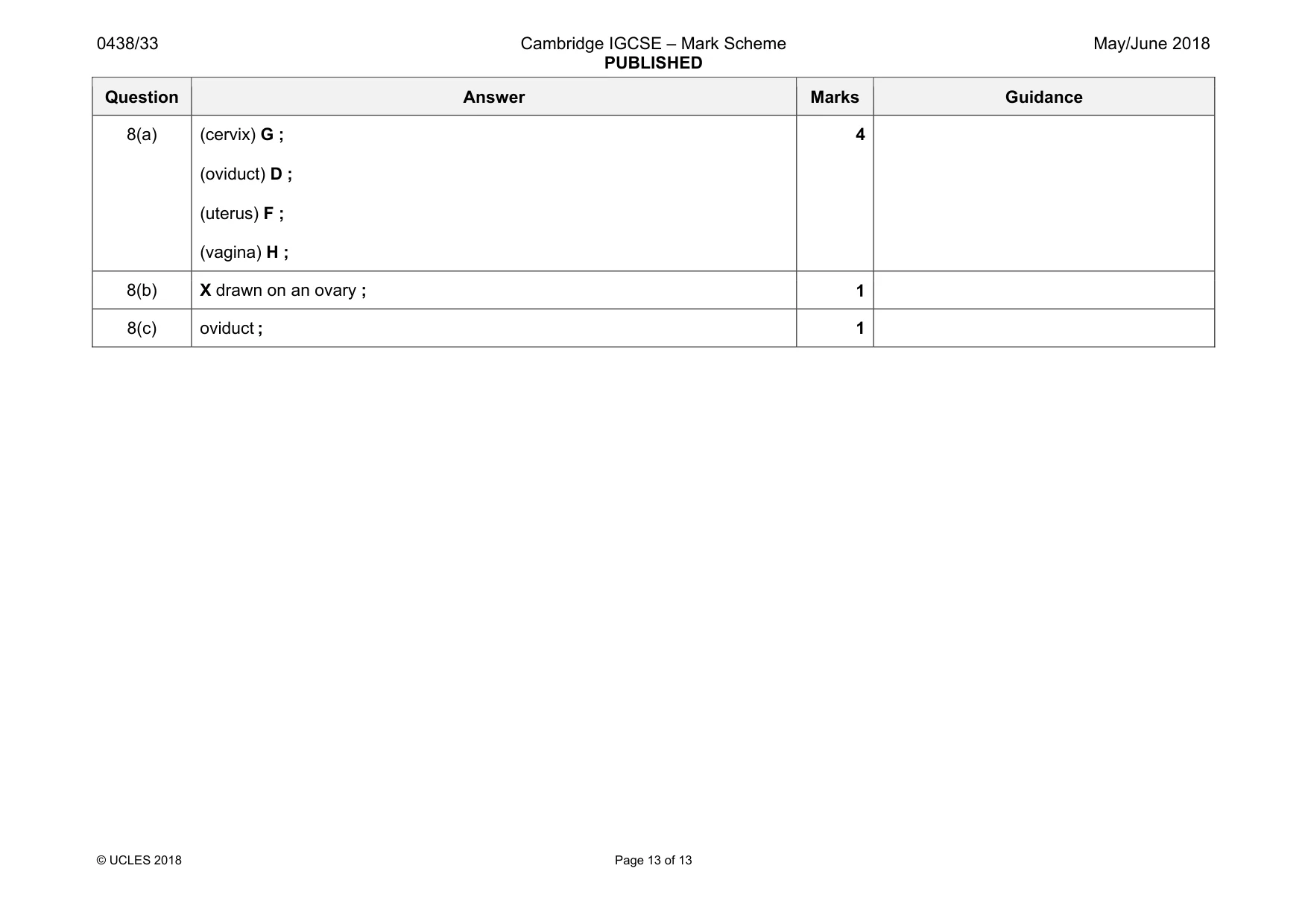
0438/33 Cambridge IGCSE – Mark Scheme PUBLISHED May/June 2018 © UCLES 2018 Page 13 of 13 Question Answer Marks Guidance 8(a) (cervix) G ; (oviduct) D ; (uterus) F ; (vagina) H ; 4 8(b) X drawn on an ovary ; 1 8(c) oviduct ; 1
What you needed in this session
Cambridge’s own grade thresholds for 2018 May/June, Paper 3 · Variant 3. A higher threshold means an easier paper — the bar moves with how the cohort did.