Cambridge IGCSE Biology (9-1) 0970 — 2024 Oct/Nov Paper 5 · Variant 2
0970/52/O/N/24 · 2 questions · 40 marks · ≈45 min
The question paper and its mark scheme, free to read here and free to download. This is Cambridge’s own paper, exactly as it was sat.
Question paper16 pages



Mark scheme8 pages
Answers below. Sit the paper first if you are practising.
Questions as text
Q1 · Photosynthesis occurs in chloroplasts
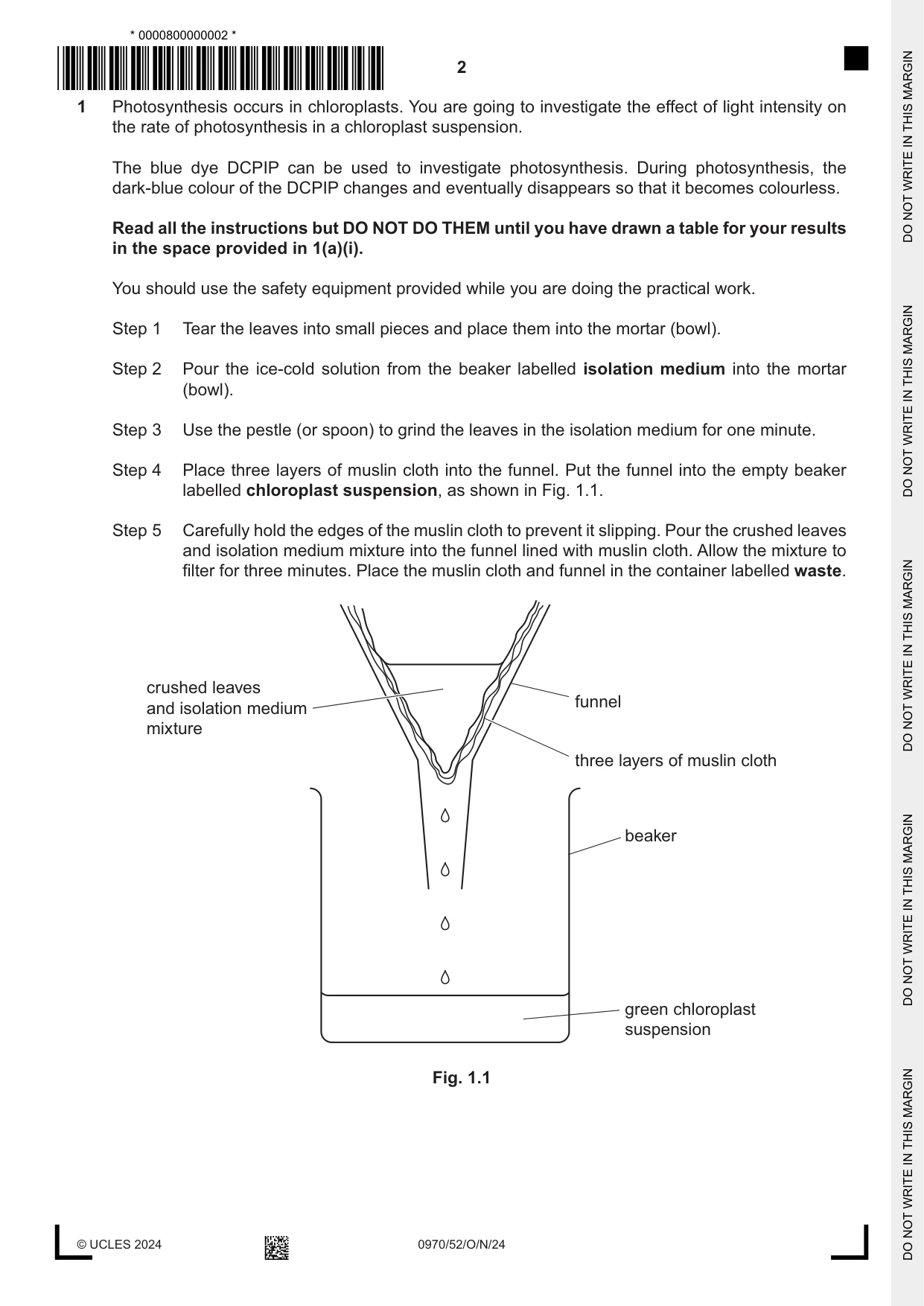
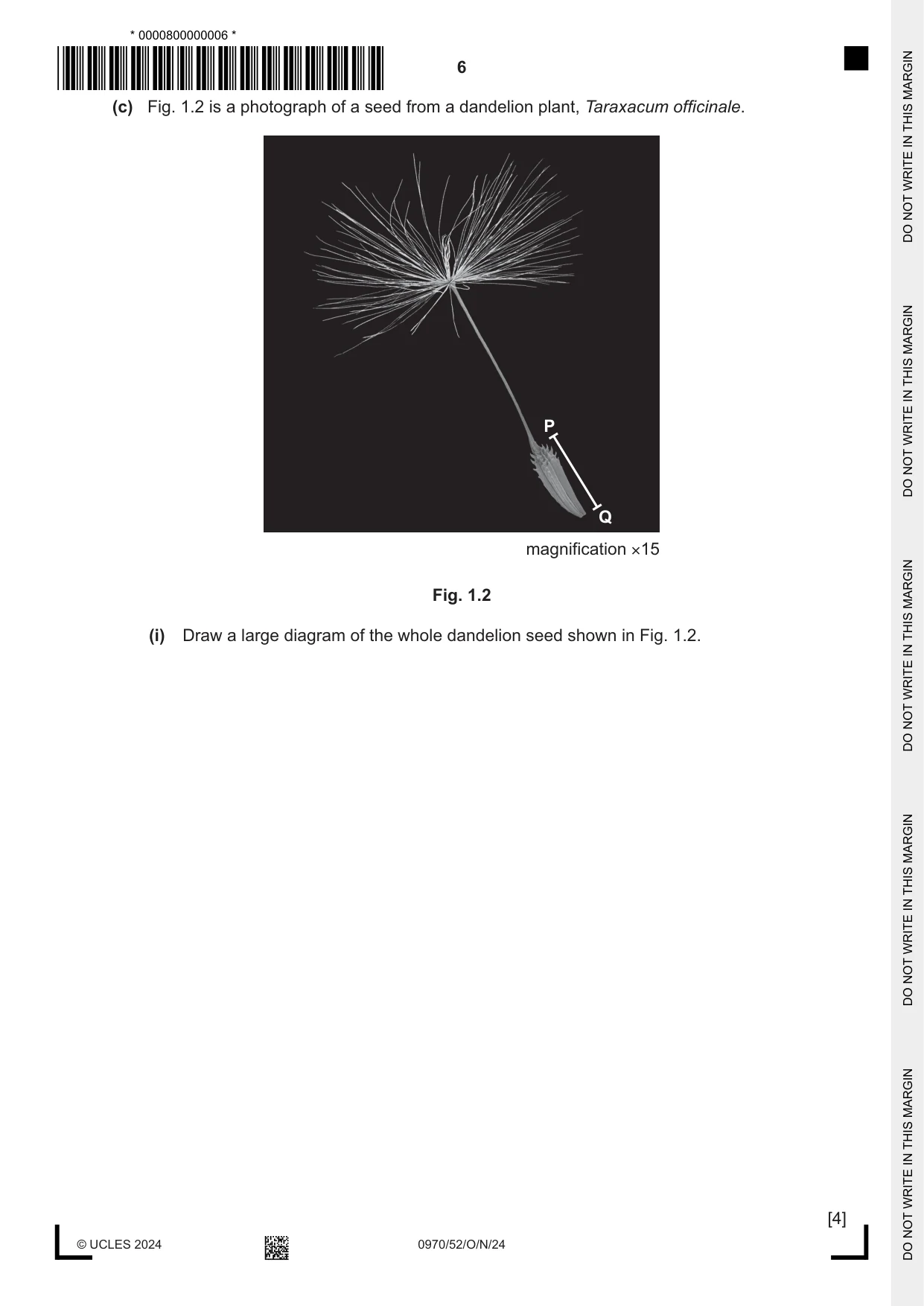
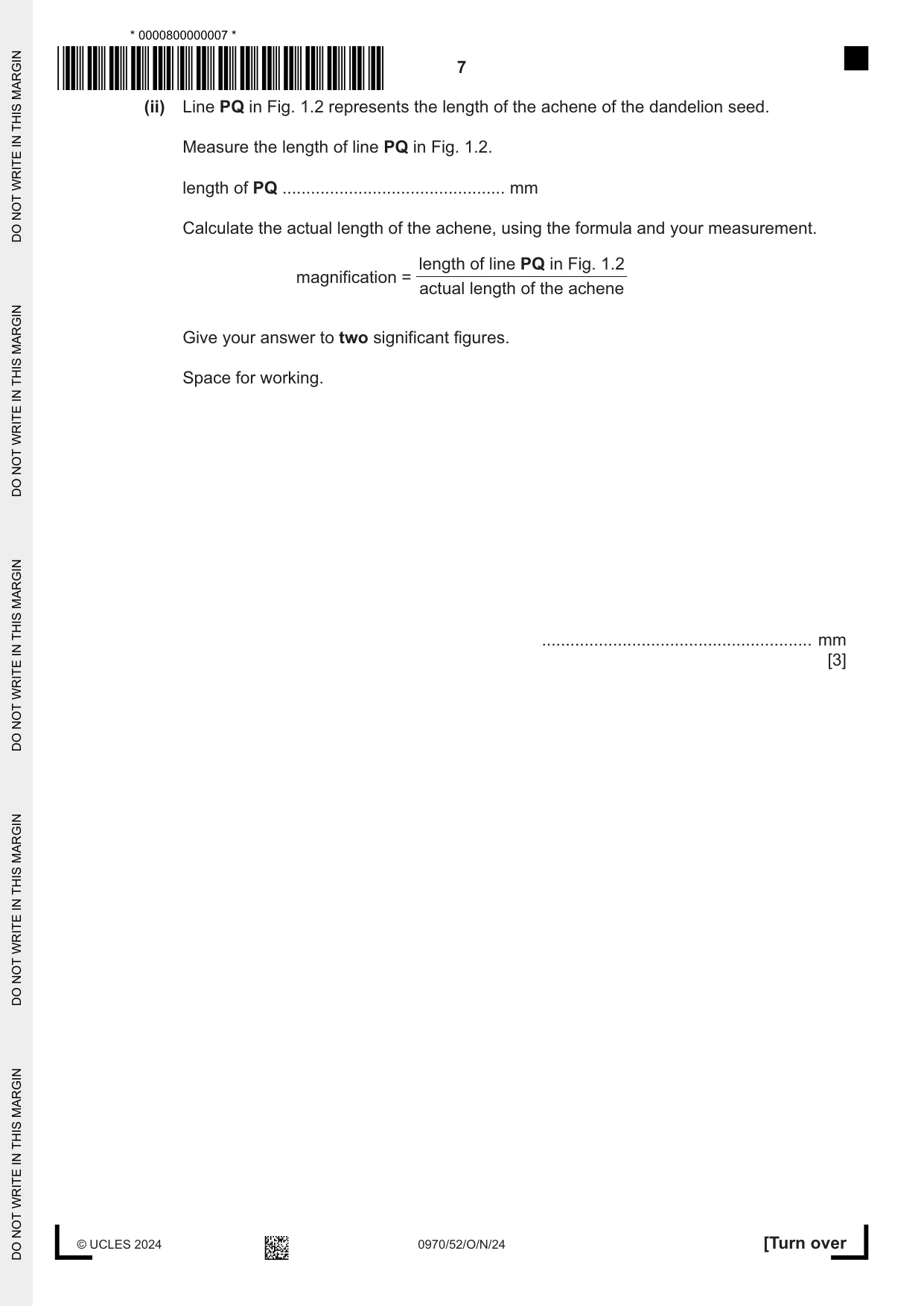
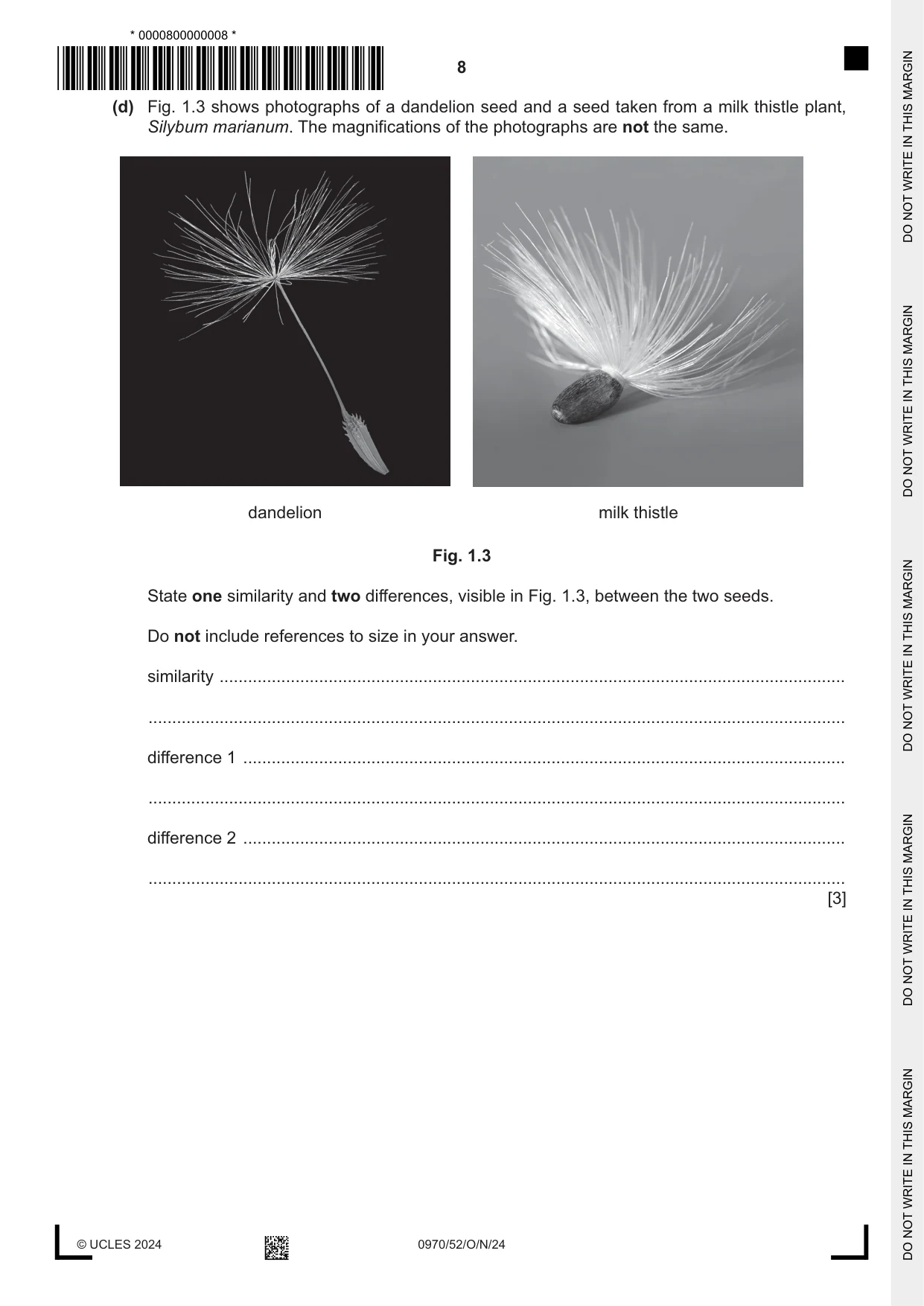
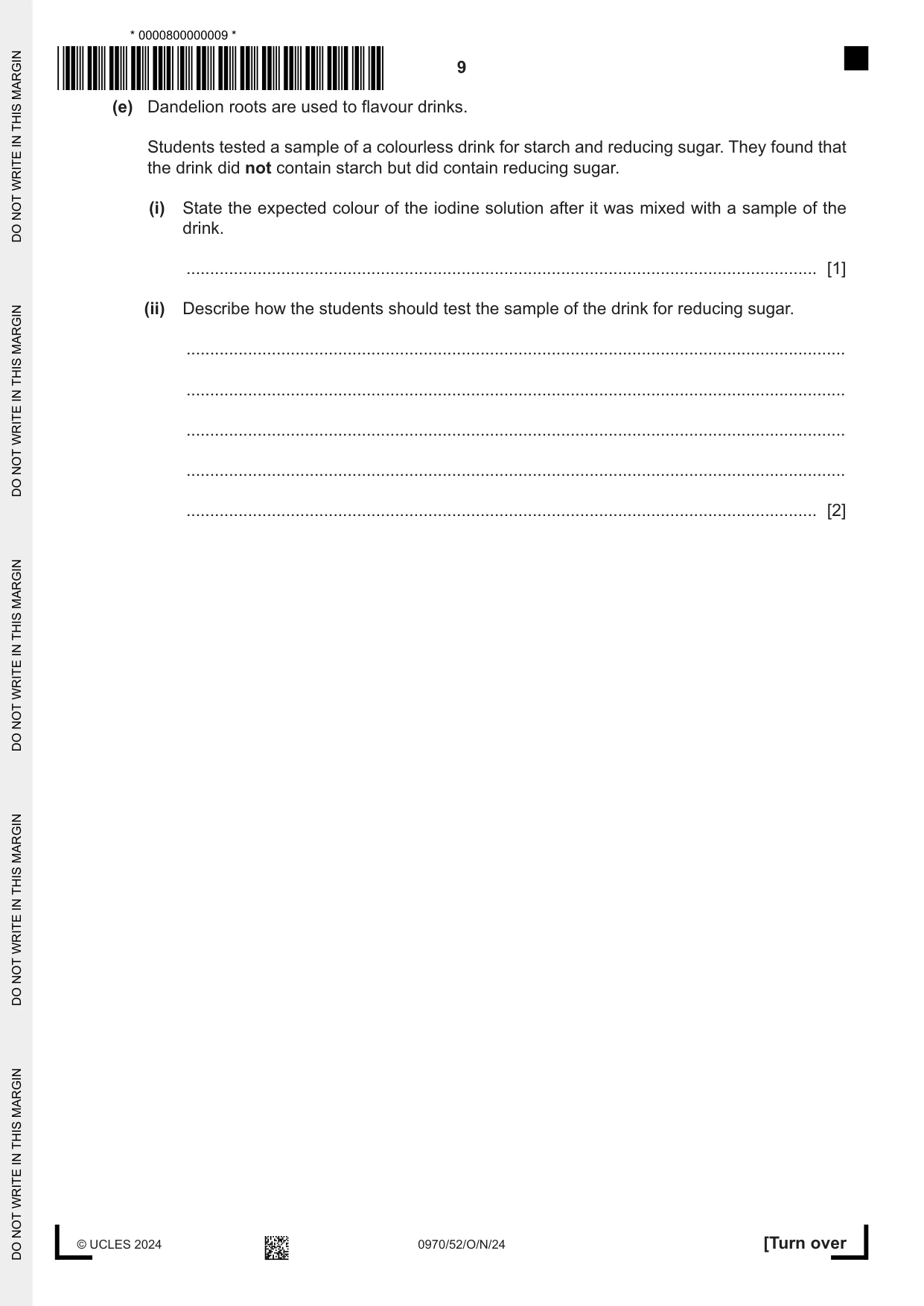
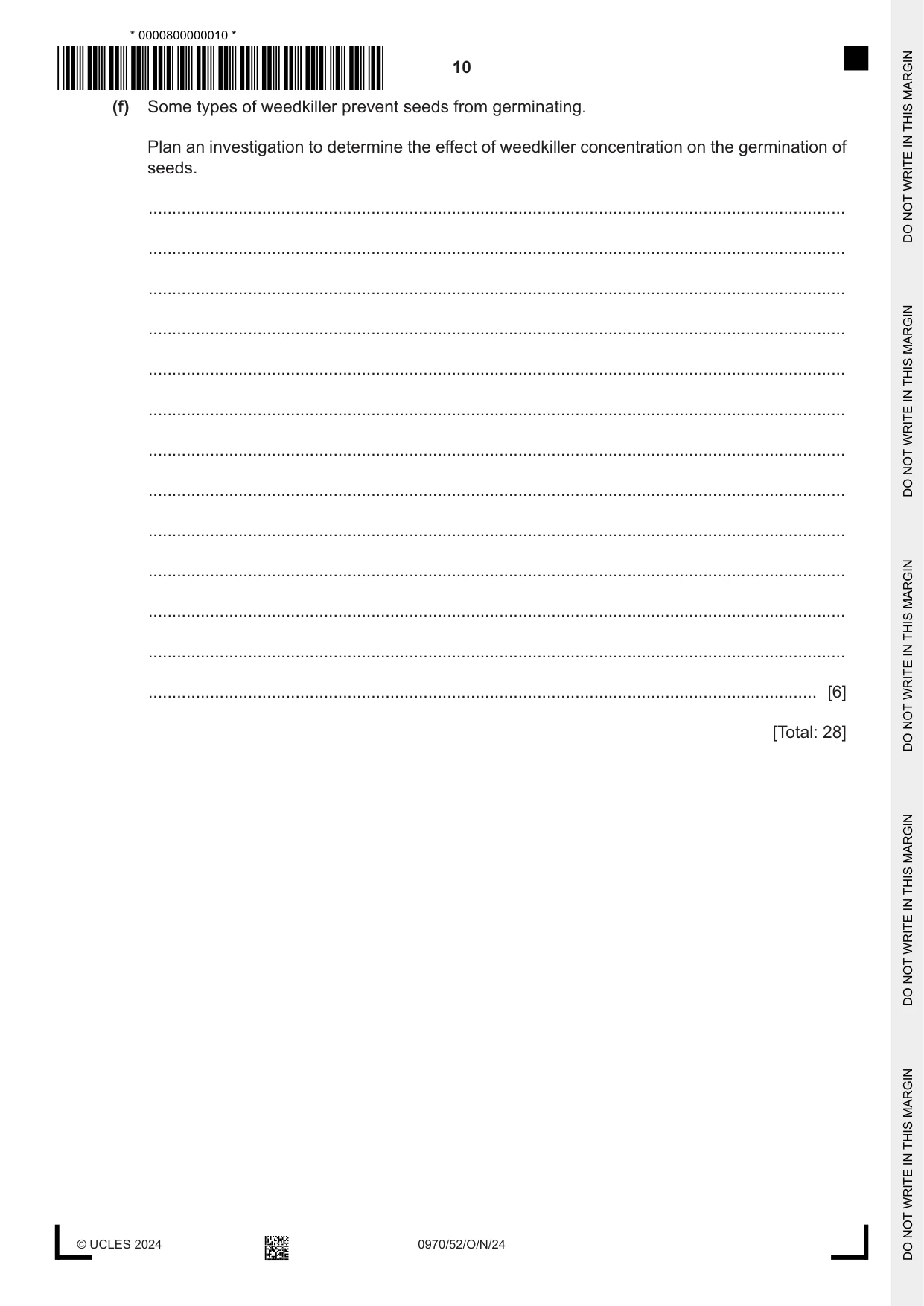
1 Photosynthesis occurs in chloroplasts. You are going to investigate the effect of light intensity on the rate of photosynthesis in a chloroplast suspension. The blue dye DCPIP can be used to investigate photosynthesis. During photosynthesis, the dark‑blue colour of the DCPIP changes and eventually disappears so that it becomes colourless. Read all the instructions but DO NOT DO THEM until you have drawn a table for your results in the space provided in 1(a)(i). You should use the safety equipment provided while you are doing the practical work. Step 1 Tear the leaves into small pieces and place them into the mortar (bowl). Step 2 Pour the ice‑cold solution from the beaker labelled isolation medium into the mortar (bowl). Step 3 Use the pestle (or spoon) to grind the leaves in the isolation medium for one minute. Step 4 Place three layers of muslin cloth into the funnel. Put the funnel into the empty beaker labelled chloroplast suspension, as shown in Fig. 1.1. Step 5 Carefully hold the edges of the muslin cloth to prevent it slipping. Pour the crushed leaves and isolation medium mixture into the funnel lined with muslin cloth. Allow the mixture to filter for three minutes. Place the muslin cloth and funnel in the container labelled waste. crushed leaves funnel and isolation medium mixture three layers of muslin cloth beaker green chloroplast suspension Fig. 1.1 Step 6 Label one test‑tube A and the other test‑tube B. Step 7 Raise your hand when you are ready for ice‑cold water to be added to the beaker labelled water-bath. Step 8 Use the small syringe to put 1 cm3 of the green chloroplast suspension into test‑tube A and into test‑tube B. Step 9 Put test‑tubes A and B into the water‑bath and wait for two minutes before starting step 10. Step 10 Use the large syringe to put 2.5 cm3 of the blue DCPIP solution into test‑tube A. Put test‑tube A into the test‑tube rack. Place the test‑tube rack 10 cm from the lamp. Position the lamp so that the light from the lamp will shine directly onto the test‑tube when you switch the lamp on. Step 11 Switch the lamp on and start the stop‑clock. Step 12 Measure the time taken for the blue liquid in test‑tube A to return to a green colour. Record the time taken in seconds in your table in 1(a)(i). If the contents of the test‑tube remain blue after 10 minutes, stop timing and record >600 in your table in 1(a)(i). Step 13 Reset the stop‑clock to zero. Step 14 Move the test‑tube rack so that it is 30 cm from the lamp. Step 15 Use the large syringe to put 2.5 cm3 of the blue DCPIP solution into test‑tube B. Put test‑tube B into the test‑tube rack and start the stop‑clock. Step 16 Measure the time taken for the blue liquid in test‑tube B to return to a green colour. Record the time taken in seconds in your table in 1(a)(i). If the contents of the test‑tube remain blue after 10 minutes, stop timing and record >600 in your table in 1(a)(i). (a) (i) Prepare a table and record your results. [4] (ii) State a conclusion for your results. ........................................................................................................................................... ........................................................................................................................................... ..................................................................................................................................... [1] (iii) State the dependent variable in this investigation. ..................................................................................................................................... [1] (iv) Identify the possible source of error present in steps 12 and 16. Suggest an improvement to the method to reduce this error. error ................................................................................................................................... ........................................................................................................................................... ........................................................................................................................................... improvement ..................................................................................................................... ........................................................................................................................................... ........................................................................................................................................... [2] (b) DCPIP can be used in food testing. State which substance present in food can be identified using DCPIP. ............................................................................................................................................. [1] (c) Fig. 1.2 is a photograph of a seed from a dandelion plant, Taraxacum officinale. P Q magnification ×15 Fig. 1.2 (i) Draw a large diagram of the whole dandelion seed shown in Fig. 1.2. [4] (ii) Line PQ in Fig. 1.2 represents the length of the achene of the dandelion seed. Measure the length of line PQ in Fig. 1.2. length of PQ ............................................... mm Calculate the actual length of the achene, using the formula and your measurement. length of line PQ in Fig. 1.2 magnification = actual length of the achene Give your answer to two significant figures. Space for working. ......................................................... mm [3] (d) Fig. 1.3 shows photographs of a dandelion seed and a seed taken from a milk thistle plant, Silybum marianum. The magnifications of the photographs are not the same. dandelion milk thistle Fig. 1.3 State one similarity and two differences, visible in Fig. 1.3, between the two seeds. Do not include references to size in your answer. similarity .................................................................................................................................... ................................................................................................................................................... difference 1 ............................................................................................................................... ................................................................................................................................................... difference 2 ............................................................................................................................... ................................................................................................................................................... [3] (e) Dandelion roots are used to flavour drinks. Students tested a sample of a colourless drink for starch and reducing sugar. They found that the drink did not contain starch but did contain reducing sugar. (i) State the expected colour of the iodine solution after it was mixed with a sample of the drink. ..................................................................................................................................... [1] (ii) Describe how the students should test the sample of the drink for reducing sugar. ........................................................................................................................................... ........................................................................................................................................... ........................................................................................................................................... ........................................................................................................................................... ..................................................................................................................................... [2] (f) Some types of weedkiller prevent seeds from germinating. Plan an investigation to determine the effect of weedkiller concentration on the germination of seeds. ................................................................................................................................................... ................................................................................................................................................... ................................................................................................................................................... ................................................................................................................................................... ................................................................................................................................................... ................................................................................................................................................... ................................................................................................................................................... ................................................................................................................................................... ................................................................................................................................................... ................................................................................................................................................... ................................................................................................................................................... ................................................................................................................................................... ............................................................................................................................................. [6] [Total: 28]
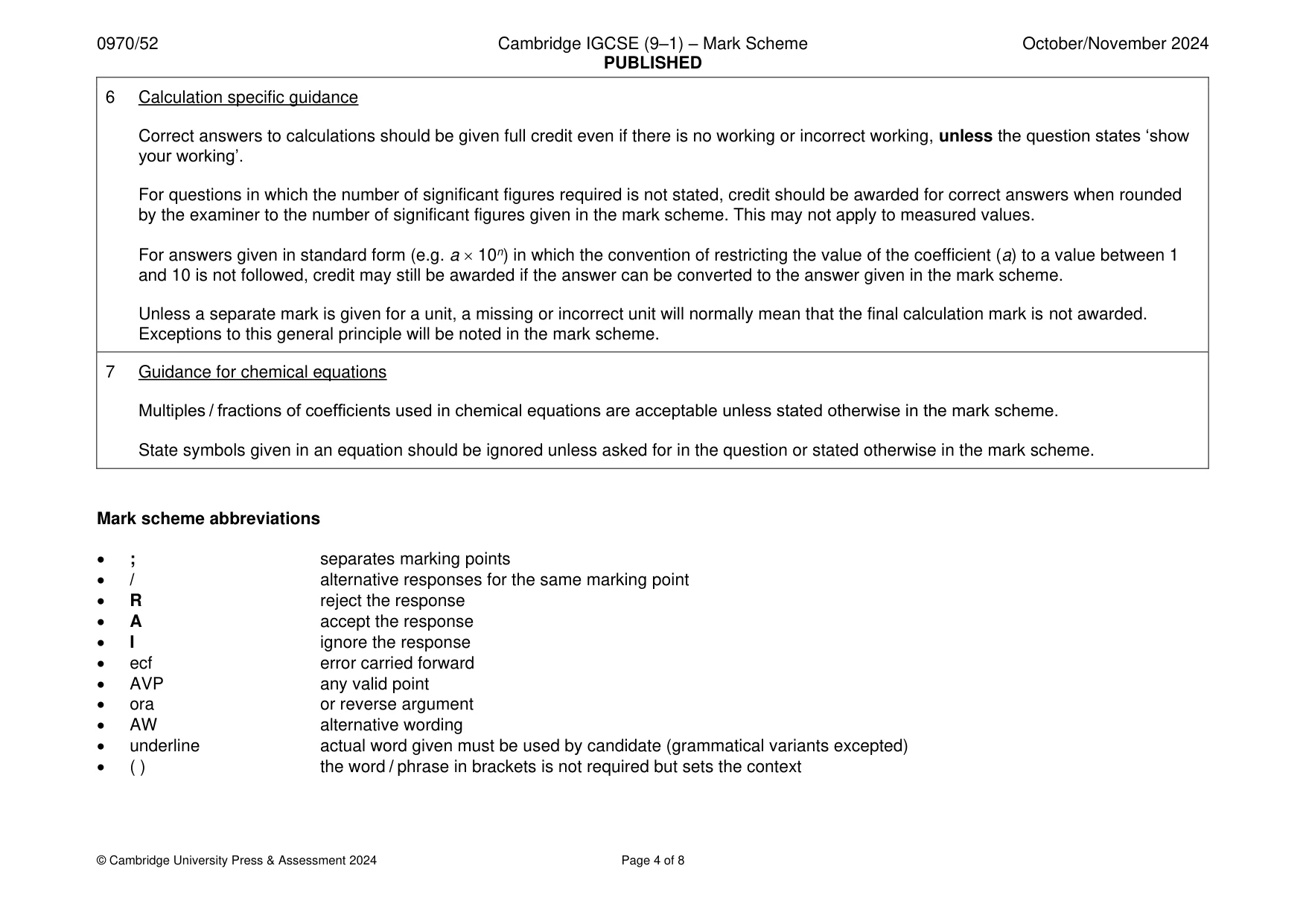
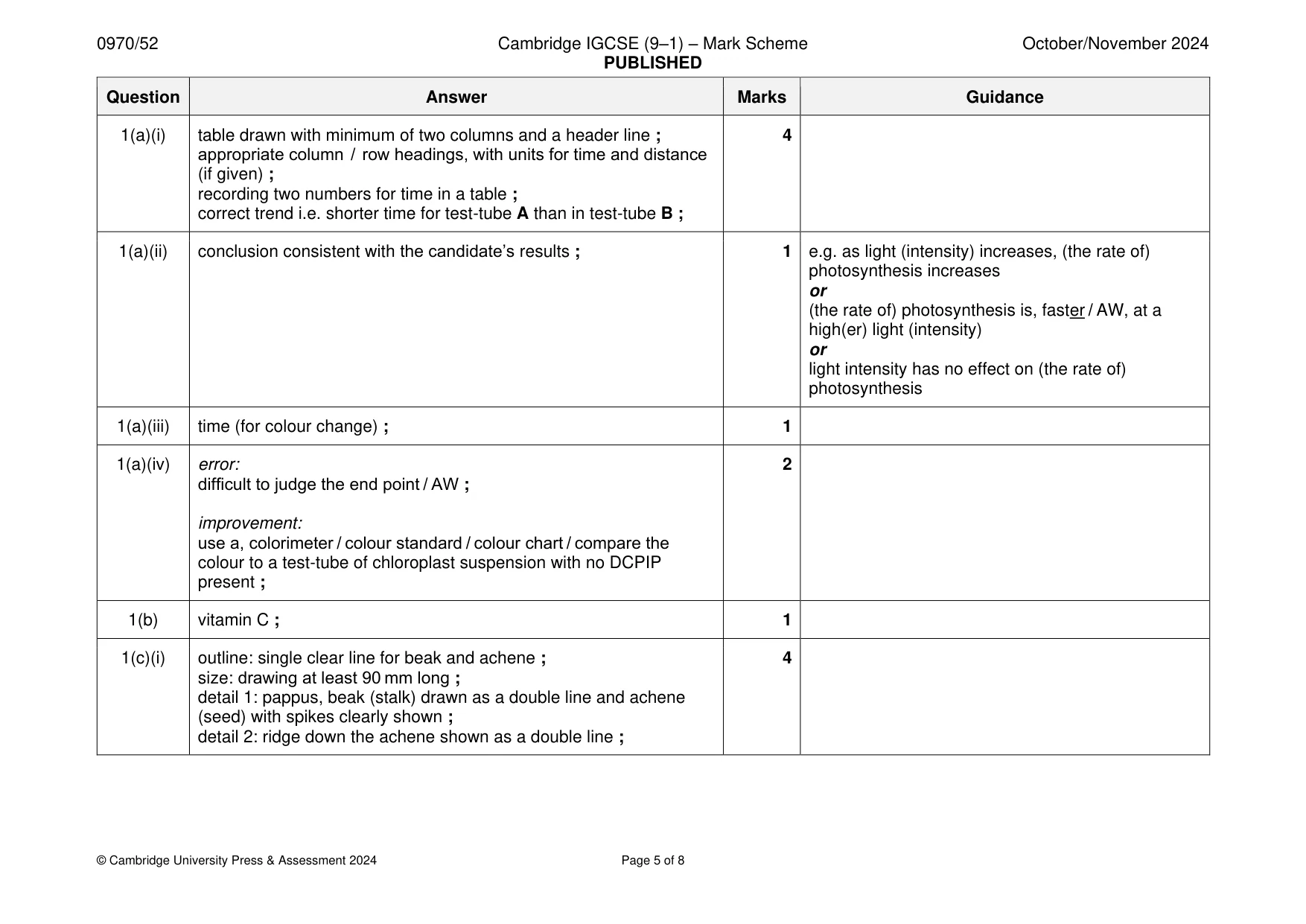
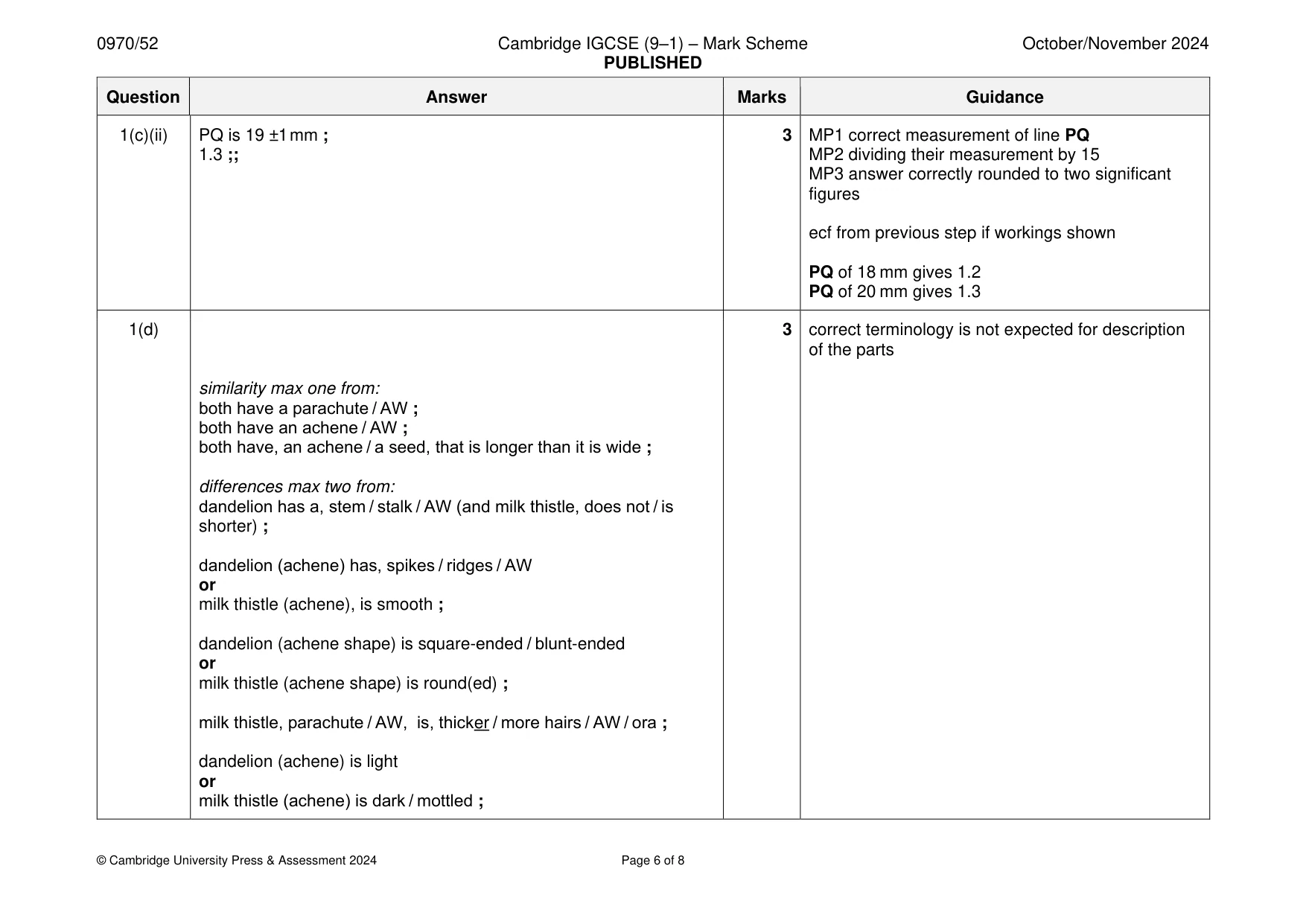
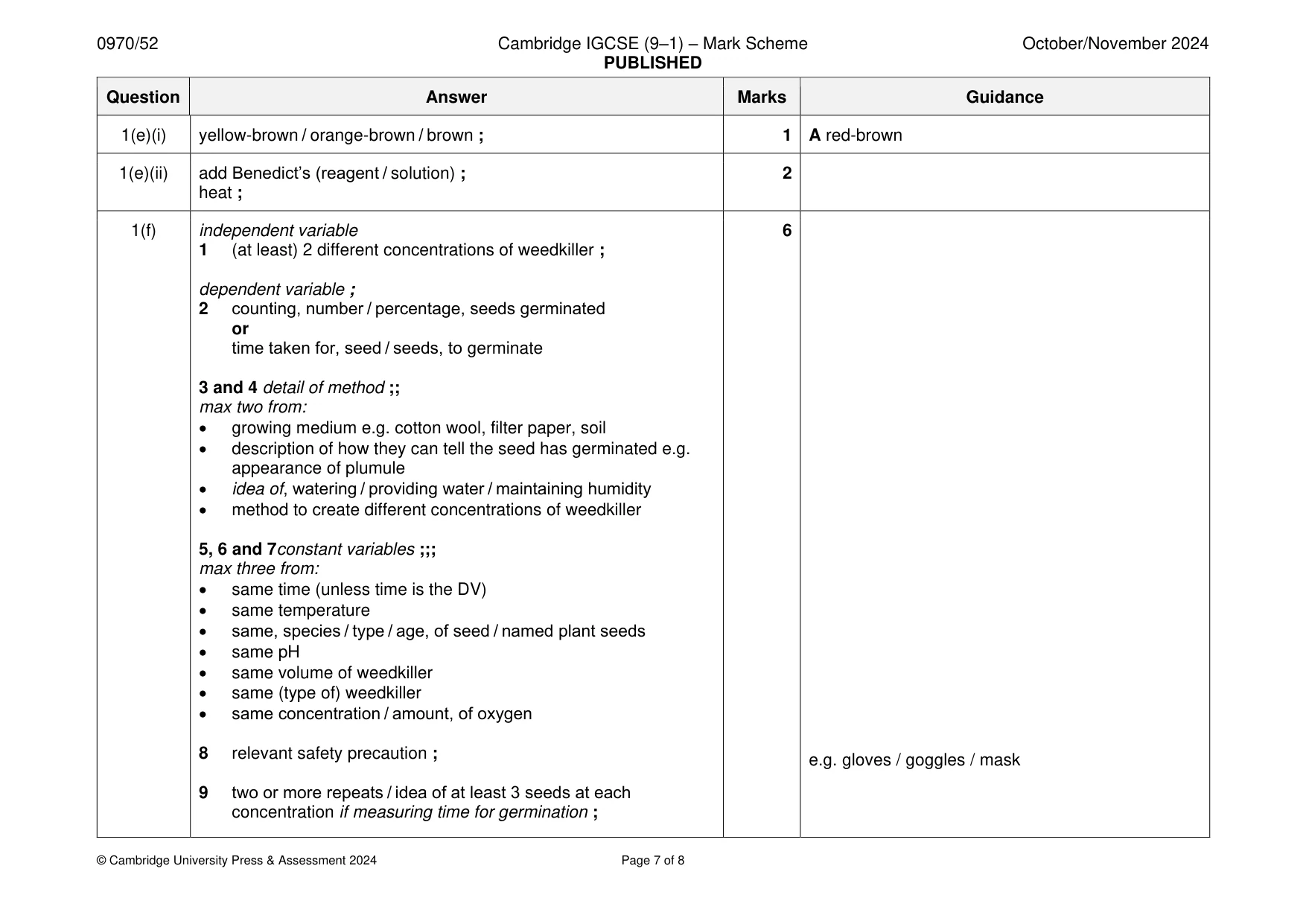
Mark scheme: Question Answer Marks Guidance 1(a)(i) table drawn with minimum of two columns and a header line ; 4 appropriate column / row headings, with units for time and distance (if given) ; recording two numbers for time in a table ; correct trend i.e. shorter time for test-tube A than in test-tube B ; 1(a)(ii) conclusion consistent with the candidate’s results ; 1 e.g. as light (intensity) increases, (the rate of) photosynthesis increases or (the rate of) photosynthesis is, faster / AW, at a high(er) light (intensity) or light intensity has no effect on (the rate of) photosynthesis 1(a)(iii) time (for colour change) ; 1 1(a)(iv) error: 2 difficult to judge the end point / AW ; improvement: use a, colorimeter / colour standard / colour chart / compare the colour to a test-tube of chloroplast suspension with no DCPIP present ; 1(b) vitamin C ; 1 1(c)(i) outline: single clear line for beak and achene ; 4 size: drawing at least 90 mm long ; detail 1: pappus, beak (stalk) drawn as a double line and achene (seed) with spikes clearly shown ; detail 2: ridge down the achene shown as a double line ; 1(c)(ii) PQ is 19 ±1 mm ; 3 MP1 correct measurement of line PQ 1.3 ;; MP2 dividing their measurement by 15 MP3 answer correctly rounded to two significant figures ecf from previous step if workings shown PQ of 18 mm gives 1.2 PQ of 20 mm gives 1.3 1(d) 3 correct terminology is not expected for description of the parts similarity max one from: both have a parachute / AW ; both have an achene / AW ; both have, an achene / a seed, that is longer than it is wide ; differences max two from: dandelion has a, stem / stalk / AW (and milk thistle, does not / is shorter) ; dandelion (achene) has, spikes / ridges / AW or milk thistle (achene), is smooth ; dandelion (achene shape) is square-ended / blunt-ended or milk thistle (achene shape) is round(ed) ; milk thistle, parachute / AW, is, thicker / more hairs / AW / ora ; dandelion (achene) is light or milk thistle (achene) is dark / mottled ; 1(e)(i) yellow-brown / orange-brown / brown ; 1 A red-brown 1(e)(ii) add Benedict’s (reagent / solution) ; 2 heat ; 1(f) independent variable 6 1 (at least) 2 different concentrations of weedkiller ; dependent variable ; 2 counting, number / percentage, seeds germinated or time taken for, seed / seeds, to germinate 3 and 4 detail of method ;; max two from: • growing medium e.g. cotton wool, filter paper, soil • description of how they can tell the seed has germinated e.g. appearance of plumule • idea of, watering / providing water / maintaining humidity • method to create different concentrations of weedkiller 5, 6 and 7constant variables ;;; max three from: • same time (unless time is the DV) • same temperature • same, species / type / age, of seed / named plant seeds • same pH • same volume of weedkiller • same (type of) weedkiller • same concentration / amount, of oxygen 8 relevant safety precaution ; e.g. gloves / goggles / mask 9 two or more repeats / idea of at least 3 seeds at each concentration if measuring time for germination ;
Q2 · A student investigated the effect of carbon dioxide concentration on the rate of…
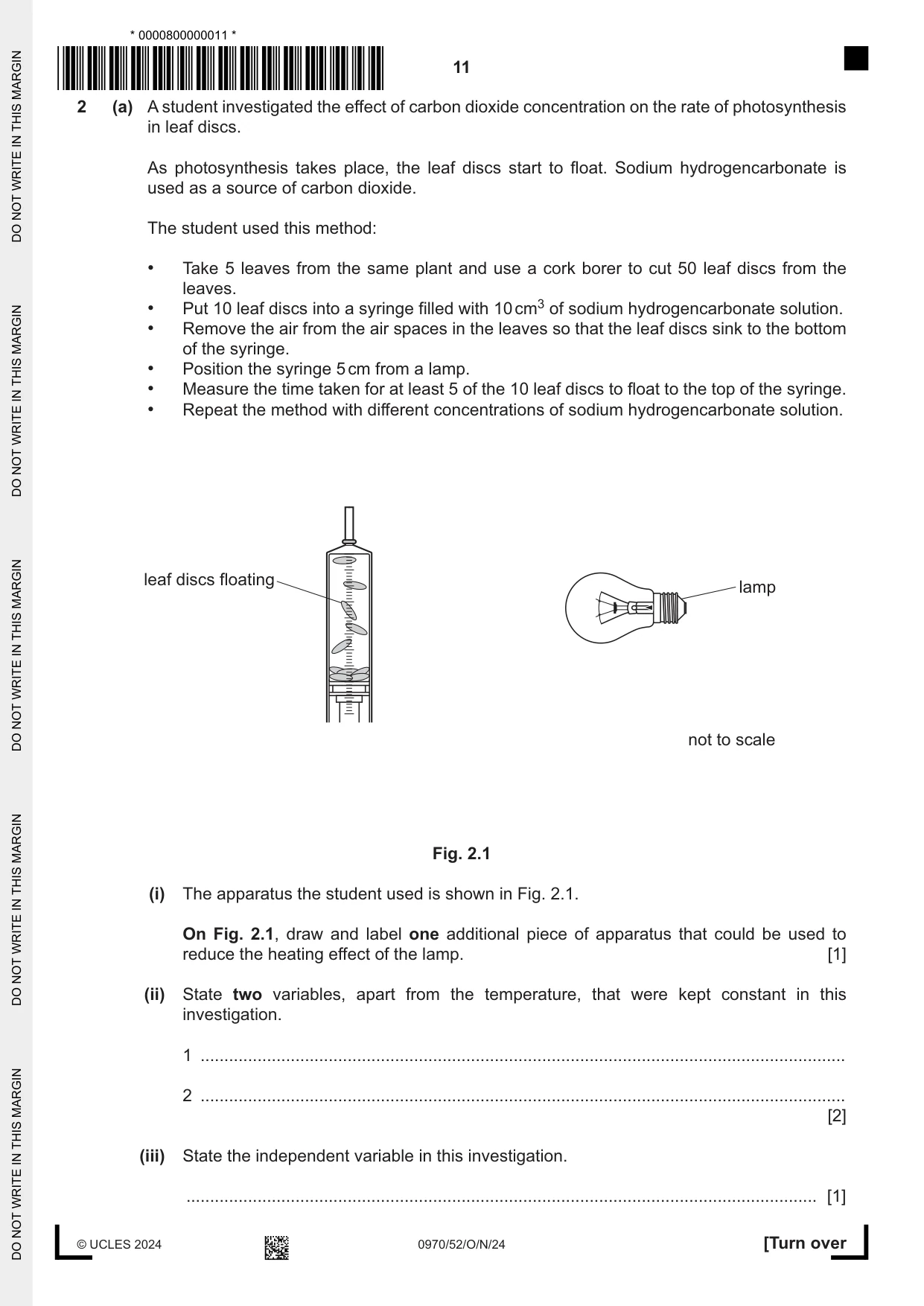
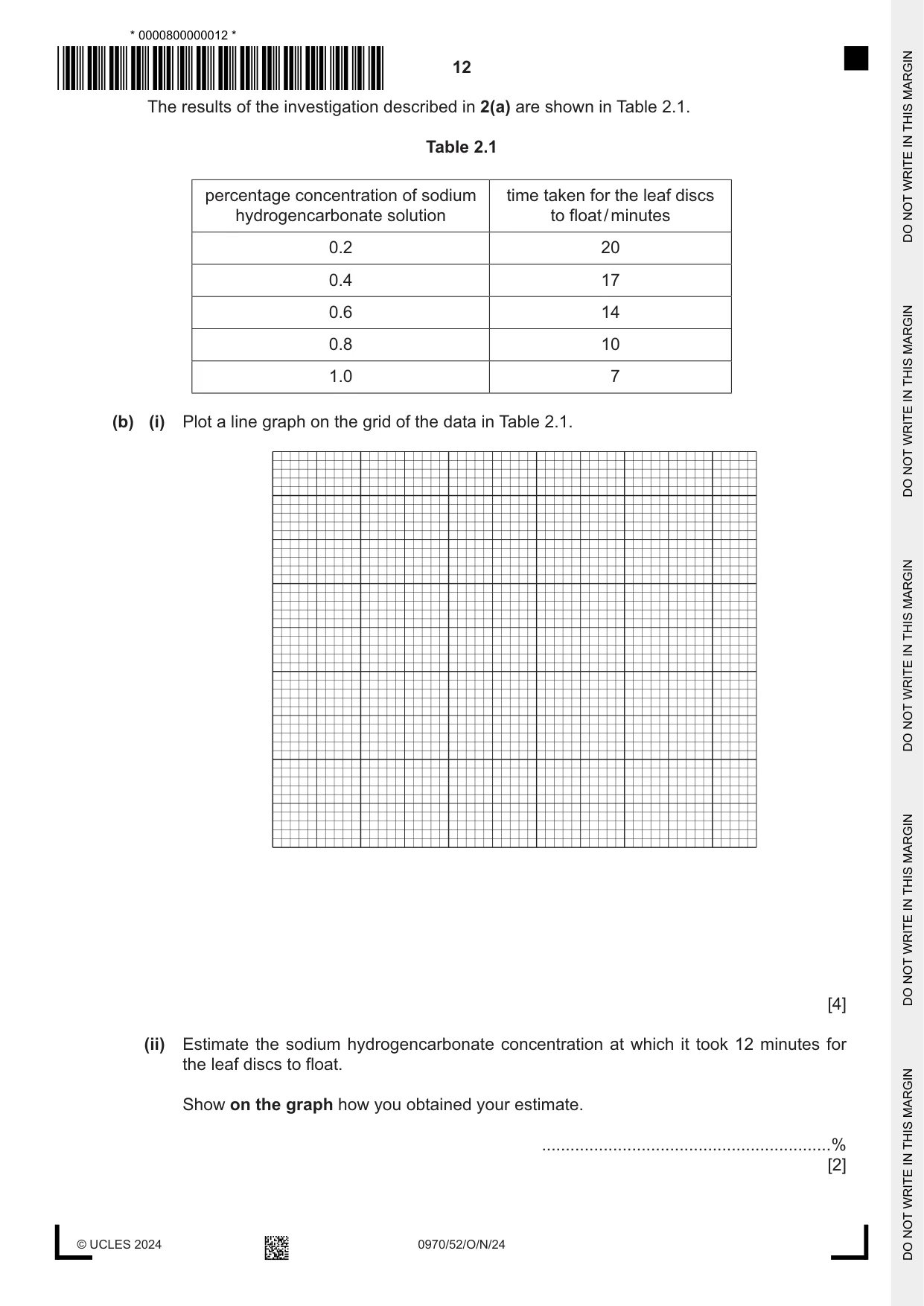
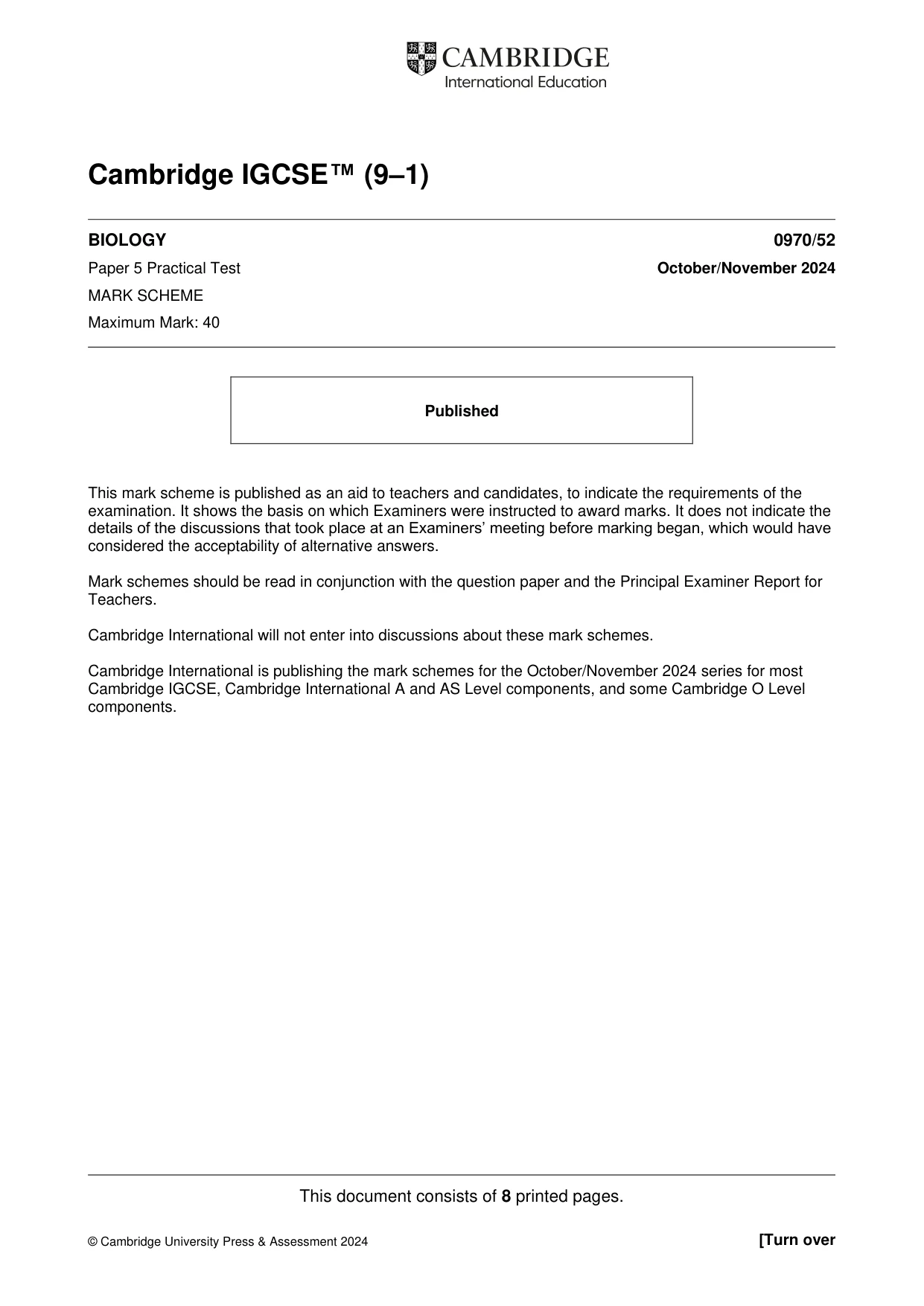
2 (a) A student investigated the effect of carbon dioxide concentration on the rate of photosynthesis in leaf discs. As photosynthesis takes place, the leaf discs start to float. Sodium hydrogencarbonate is used as a source of carbon dioxide. The student used this method: • Take 5 leaves from the same plant and use a cork borer to cut 50 leaf discs from the leaves. • Put 10 leaf discs into a syringe filled with 10 cm3 of sodium hydrogencarbonate solution. • Remove the air from the air spaces in the leaves so that the leaf discs sink to the bottom of the syringe. • Position the syringe 5 cm from a lamp. • Measure the time taken for at least 5 of the 10 leaf discs to float to the top of the syringe. • Repeat the method with different concentrations of sodium hydrogencarbonate solution. leaf discs floating lamp not to scale Fig. 2.1 (i) The apparatus the student used is shown in Fig. 2.1. On Fig. 2.1, draw and label one additional piece of apparatus that could be used to reduce the heating effect of the lamp. [1] (ii) State two variables, apart from the temperature, that were kept constant in this investigation. 1 ........................................................................................................................................ 2 ........................................................................................................................................ [2] (iii) State the independent variable in this investigation. ..................................................................................................................................... [1] The results of the investigation described in 2(a) are shown in Table 2.1. Table 2.1 percentage concentration of sodium time taken for the leaf discs hydrogencarbonate solution to float / minutes 0.2 20 0.4 17 0.6 14 0.8 10 1.0 7 (b) (i) Plot a line graph on the grid of the data in Table 2.1. [4] (ii) Estimate the sodium hydrogencarbonate concentration at which it took 12 minutes for the leaf discs to float. Show on the graph how you obtained your estimate. .............................................................% [2] (iii) Using the information in Table 2.1, calculate the percentage change in the time taken for the leaf discs to float when the sodium hydrogencarbonate concentration is increased from 0.2% to 0.4%. Space for working. .......................................................% [2] [Total: 12]
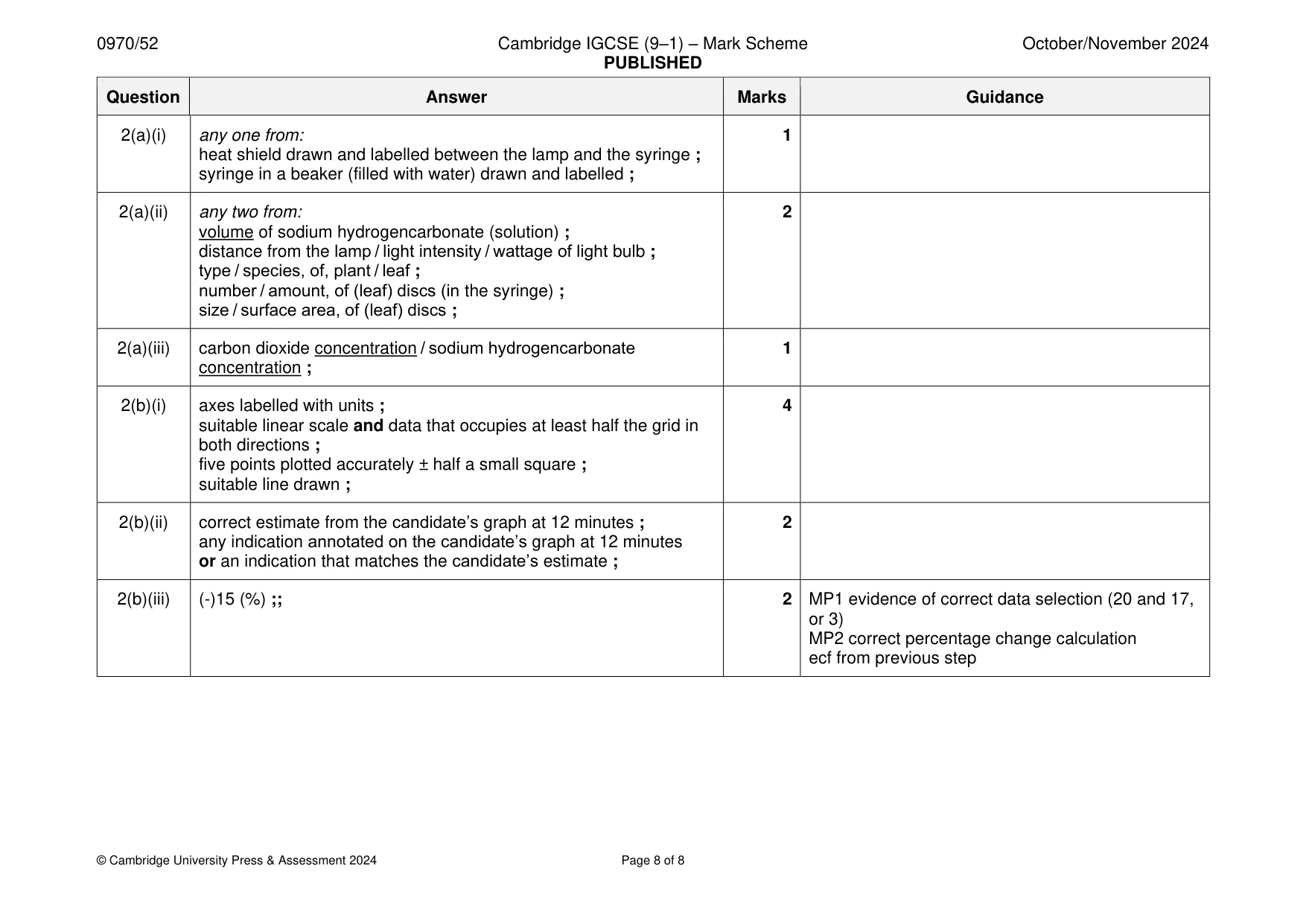
Mark scheme: 2(a)(i) any one from: 1 heat shield drawn and labelled between the lamp and the syringe ; syringe in a beaker (filled with water) drawn and labelled ; 2(a)(ii) any two from: 2 volume of sodium hydrogencarbonate (solution) ; distance from the lamp / light intensity / wattage of light bulb ; type / species, of, plant / leaf ; number / amount, of (leaf) discs (in the syringe) ; size / surface area, of (leaf) discs ; 2(a)(iii) carbon dioxide concentration / sodium hydrogencarbonate 1 concentration ; 2(b)(i) axes labelled with units ; 4 suitable linear scale and data that occupies at least half the grid in both directions ; five points plotted accurately ± half a small square ; suitable line drawn ; 2(b)(ii) correct estimate from the candidate’s graph at 12 minutes ; 2 any indication annotated on the candidate’s graph at 12 minutes or an indication that matches the candidate’s estimate ; 2(b)(iii) (-)15 (%) ;; 2 MP1 evidence of correct data selection (20 and 17, or 3) MP2 correct percentage change calculation ecf from previous step
What was in this paper
The subtopics covered by these 2 questions, and how many questions each got. Open one in a new tab to see every Cambridge question on it.
What you needed in this session
Cambridge’s own grade thresholds for 2024 Oct/Nov, Paper 5 · Variant 2. A higher threshold means an easier paper — the bar moves with how the cohort did.