Cambridge IGCSE Biology (9-1) 0970 — 2019 Oct/Nov Paper 5 · Variant 2
0970/52/O/N/19 · 2 questions · 40 marks · ≈45 min
The question paper and its mark scheme, free to read here and free to download. This is Cambridge’s own paper, exactly as it was sat.
Question paper12 pages


Mark scheme7 pages
Answers below. Sit the paper first if you are practising.
Questions as text
Q1 · You will investigate the effect of the enzyme amylase (A) on the breakdown of starch (S)
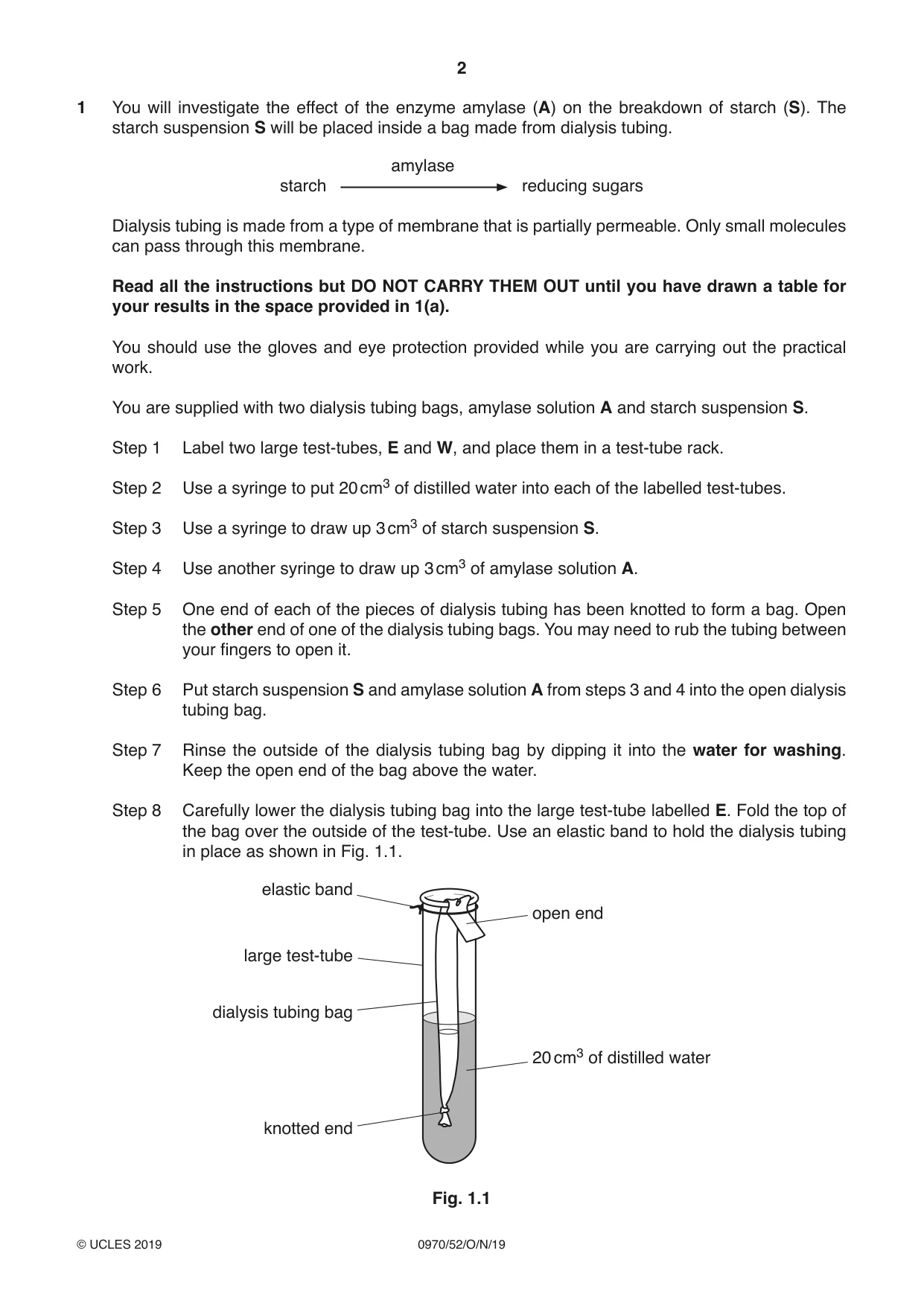
1 You will investigate the effect of the enzyme amylase (A) on the breakdown of starch (S). The starch suspension S will be placed inside a bag made from dialysis tubing. amylase starch reducing sugars Dialysis tubing is made from a type of membrane that is partially permeable. Only small molecules can pass through this membrane. Read all the instructions but DO NOT CARRY THEM OUT until you have drawn a table for your results in the space provided in 1(a). You should use the gloves and eye protection provided while you are carrying out the practical work. You are supplied with two dialysis tubing bags, amylase solution A and starch suspension S. Step 1 Label two large test-tubes, E and W, and place them in a test-tube rack. Step 2 Use a syringe to put 20 cm3 of distilled water into each of the labelled test-tubes. Step 3 Use a syringe to draw up 3 cm3 of starch suspension S. Step 4 Use another syringe to draw up 3 cm3 of amylase solution A. Step 5 One end of each of the pieces of dialysis tubing has been knotted to form a bag. Open the other end of one of the dialysis tubing bags. You may need to rub the tubing between your fingers to open it. Step 6 Put starch suspension S and amylase solution A from steps 3 and 4 into the open dialysis tubing bag. Step 7 Rinse the outside of the dialysis tubing bag by dipping it into the water for washing. Keep the open end of the bag above the water. Step 8 Carefully lower the dialysis tubing bag into the large test-tube labelled E. Fold the top of the bag over the outside of the test-tube. Use an elastic band to hold the dialysis tubing in place as shown in Fig. 1.1. elastic band open end large test-tube dialysis tubing bag 20 cm3 of distilled water knotted end Fig. 1.1 Step 9 Repeat steps 3 to 7, using 3 cm3 of distilled water instead of amylase solution A in step 4. Step 10 Carefully lower the dialysis tubing bag into the large test-tube labelled W. Fold the top of the dialysis tubing bag over the outside of the test-tube. Use an elastic band to hold the dialysis tubing in place as shown in Fig. 1.1. Step 11 Prepare a water-bath by putting approximately 100 cm3 of hot water into the beaker labelled water-bath. Raise your hand when you are ready for a supply of hot water for your water-bath. Step 12 Put both large test-tubes into the water-bath and leave them for 10 minutes. Continue with the other questions while you are waiting. Step 13 After 10 minutes carefully remove the dialysis tubing bag from large test-tube E and pour the contents of the dialysis tubing bag into the beaker labelled E2. Step 14 Carefully remove the dialysis tubing bag from large test-tube W and pour the contents of the dialysis tubing bag into the beaker labelled W2. You are going to test the contents of the two large test-tubes (E and W) and the two beakers (E2 and W2) for starch. Step 15 Use a clean pipette to place a drop of the solution from large test-tube E onto a white tile and add one drop of iodine solution. Record the colour in the table you have prepared in 1(a). Step 16 Repeat step 15 using the solution from large test-tube W. Step 17 Repeat step 15 using the solution from beaker E2. Step 18 Repeat step 15 using the solution from beaker W2. (a) Prepare a table to record the results of the tests for starch in the space provided. [4] (b) (i) Suggest why the dialysis tubing bag was rinsed in step 7. ........................................................................................................................................... ........................................................................................................................................... ..................................................................................................................................... [1] (ii) Explain why distilled water was used instead of amylase solution A in the dialysis tubing bag in test-tube W. ........................................................................................................................................... ........................................................................................................................................... ........................................................................................................................................... ........................................................................................................................................... ..................................................................................................................................... [2] (iii) State two variables that were kept constant during this investigation. 1 ........................................................................................................................................ 2 ........................................................................................................................................ [2] A student carried out the same investigation but also tested the solutions for reducing sugars. (c) Describe how the student would find out if the solutions contained reducing sugars. ................................................................................................................................................... ................................................................................................................................................... ................................................................................................................................................... ................................................................................................................................................... ................................................................................................................................................... ................................................................................................................................................... ............................................................................................................................................. [3] (d) Plan an investigation using dialysis tubing to determine the effect of temperature on the activity of the enzyme amylase. ................................................................................................................................................... ................................................................................................................................................... ................................................................................................................................................... ................................................................................................................................................... ................................................................................................................................................... ................................................................................................................................................... ................................................................................................................................................... ................................................................................................................................................... ................................................................................................................................................... ................................................................................................................................................... ................................................................................................................................................... ................................................................................................................................................... ................................................................................................................................................... ................................................................................................................................................... ................................................................................................................................................... ................................................................................................................................................... ............................................................................................................................................. [6] (e) The student wanted to find out if the amylase enzyme passed through the dialysis tubing into the large test-tube. Amylase is made of protein. Describe how the student could find out if the solution in the large test-tube contained protein. ................................................................................................................................................... ................................................................................................................................................... ................................................................................................................................................... ................................................................................................................................................... ............................................................................................................................................. [2] [Total: 20]
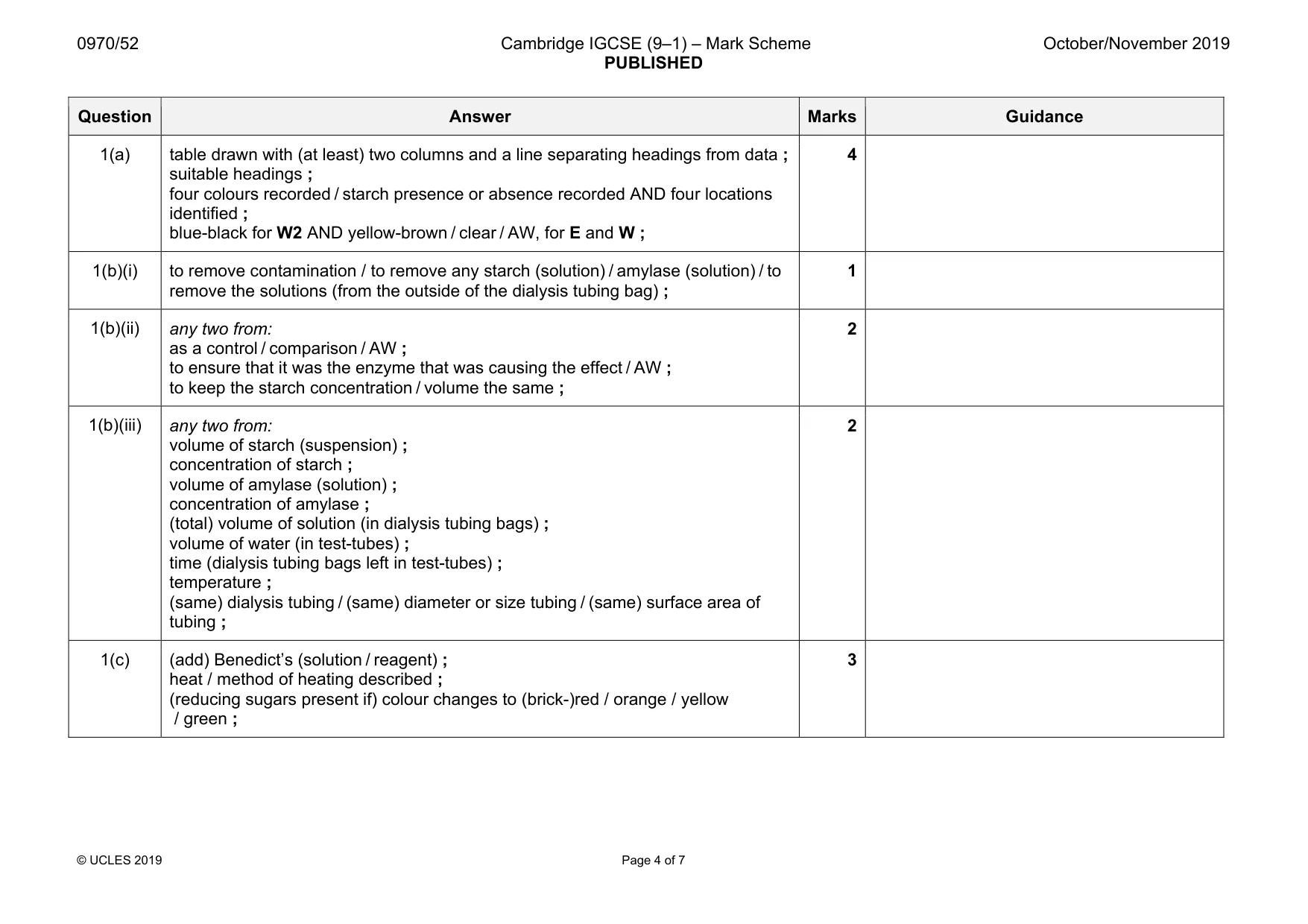
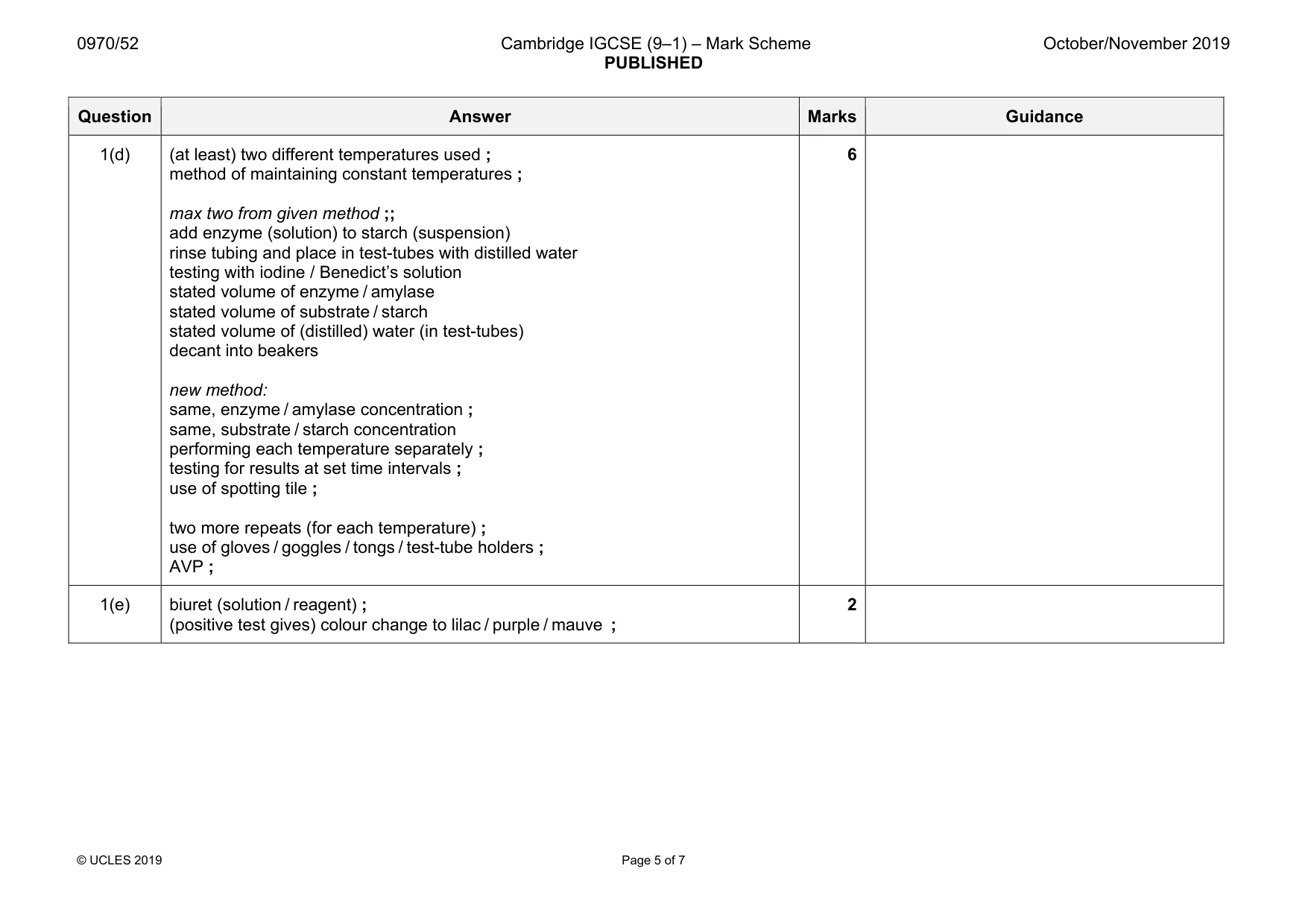
Mark scheme: 1(a) table drawn with (at least) two columns and a line separating headings from data ; suitable headings ; four colours recorded / starch presence or absence recorded AND four locations identified ; blue-black for W2 AND yellow-brown / clear / AW, for E and W ; 4 1(b)(i) to remove contamination / to remove any starch (solution) / amylase (solution) / to remove the solutions (from the outside of the dialysis tubing bag) ; 1 1(b)(ii) any two from: as a control / comparison / AW ; to ensure that it was the enzyme that was causing the effect / AW ; to keep the starch concentration / volume the same ; 2 1(b)(iii) any two from: volume of starch (suspension) ; concentration of starch ; volume of amylase (solution) ; concentration of amylase ; (total) volume of solution (in dialysis tubing bags) ; volume of water (in test-tubes) ; time (dialysis tubing bags left in test-tubes) ; temperature ; (same) dialysis tubing / (same) diameter or size tubing / (same) surface area of tubing ; 2 1(c) (add) Benedict’s (solution / reagent) ; heat / method of heating described ; (reducing sugars present if) colour changes to (brick-)red / orange / yellow / green ; 3 Question Answer Marks Guidance 1(d) (at least) two different temperatures used ; method of maintaining constant temperatures ; max two from given method ;; add enzyme (solution) to starch (suspension) rinse tubing and place in test-tubes with distilled water testing with iodine / Benedict’s solution stated volume of enzyme / amylase stated volume of substrate / starch stated volume of (distilled) water (in test-tubes) decant into beakers new method: same, enzyme / amylase concentration ; same, substrate / starch concentration performing each temperature separately ; testing for results at set time intervals ; use of spotting tile ; two more repeats (for each temperature) ; use of gloves / goggles / tongs / test-tube holders ; AVP ; 6 1(e) biuret (solution / reagent) ; (positive test gives) colour change to lilac / purple / mauve ; 2
Q2 · An investigation was performed to determine the effect of light intensity on leaf size in…
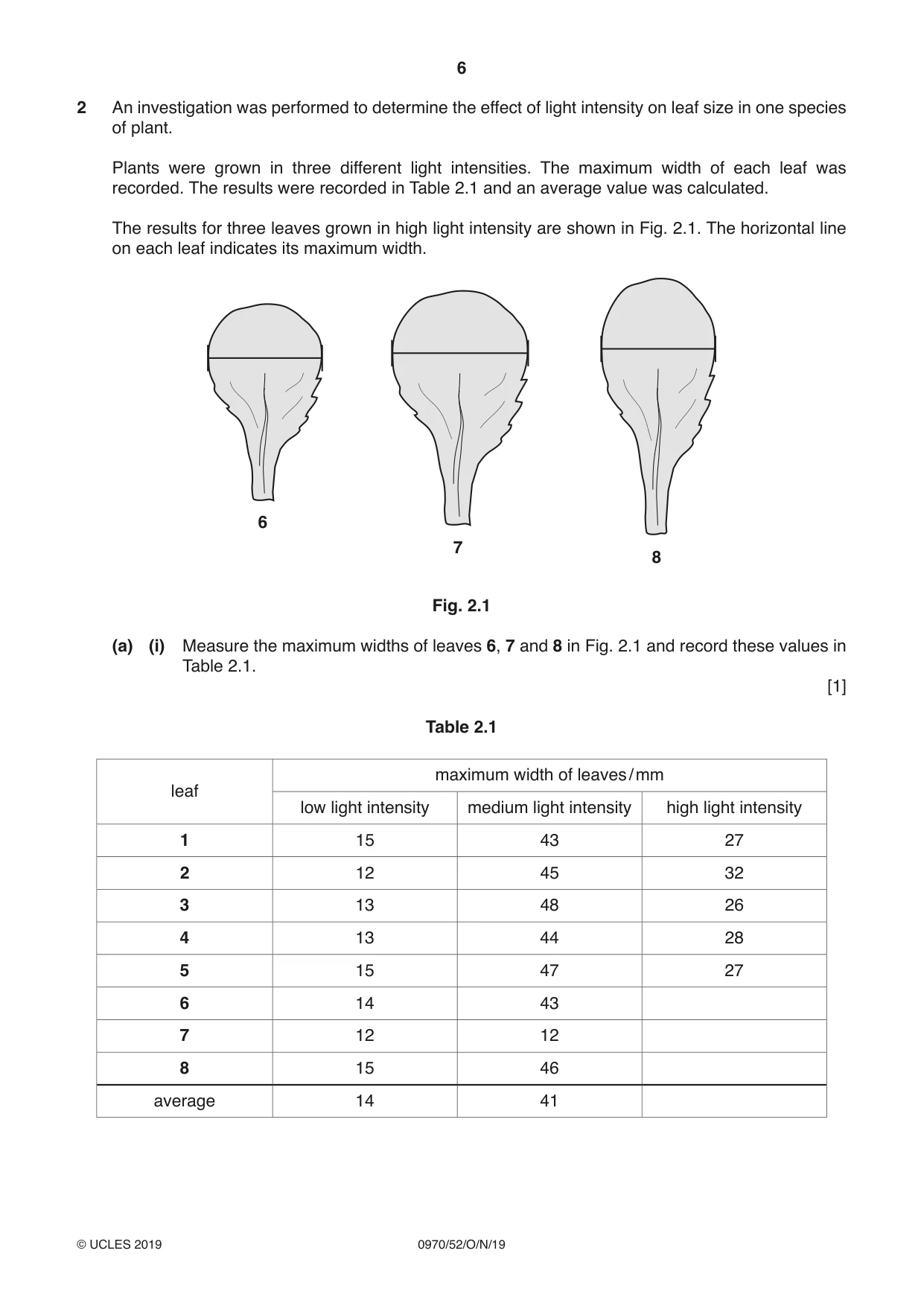
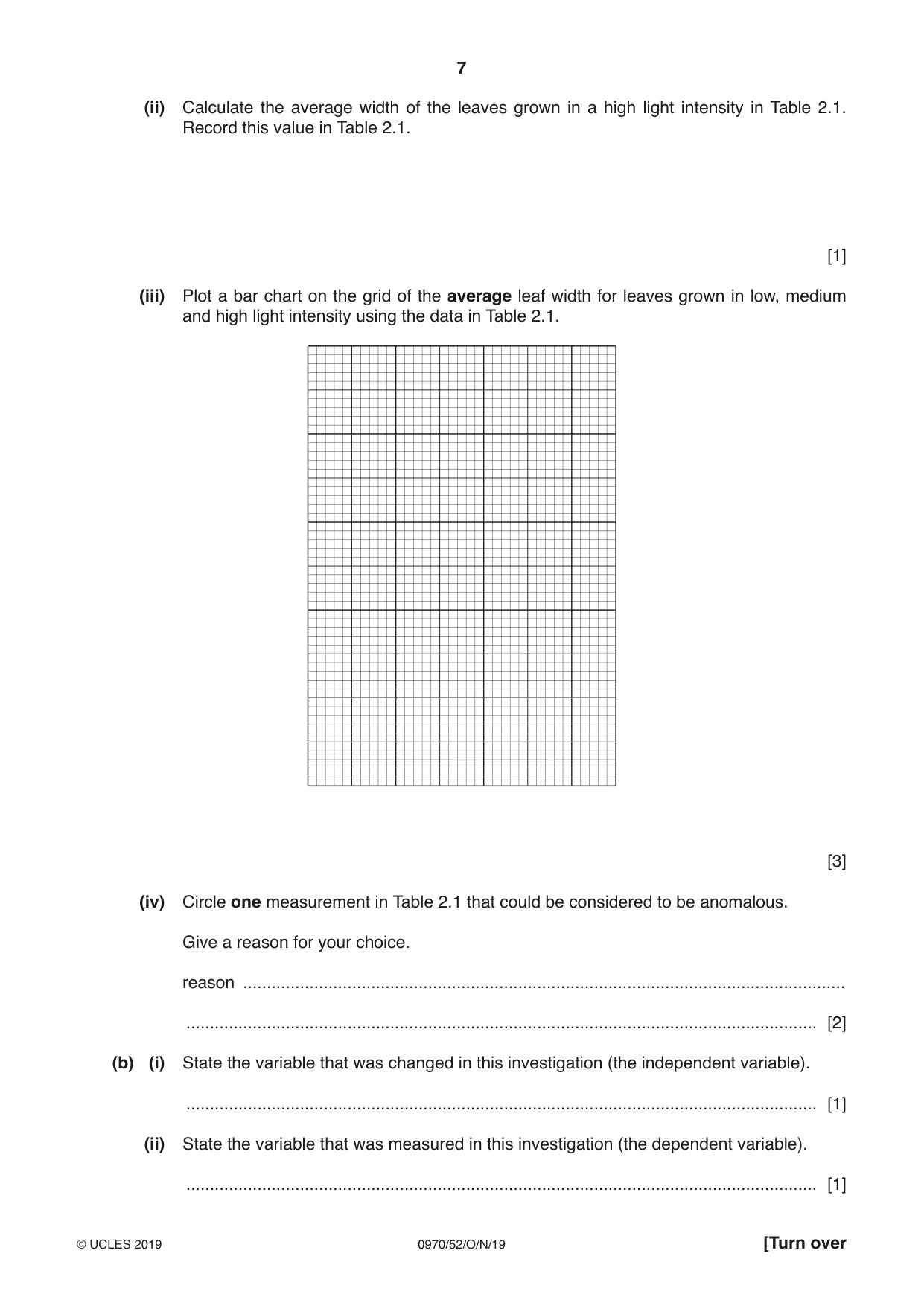
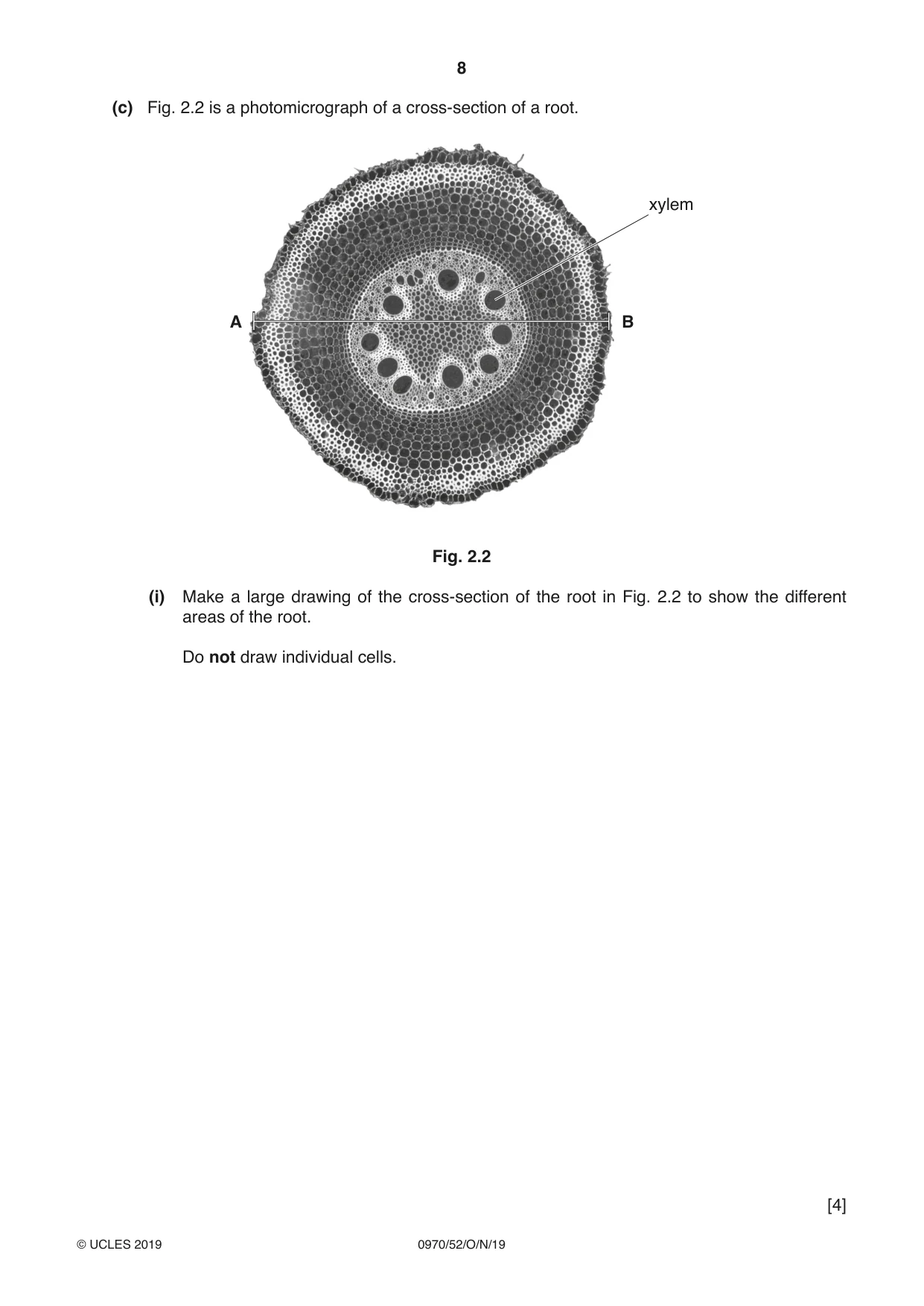
2 An investigation was performed to determine the effect of light intensity on leaf size in one species of plant. Plants were grown in three different light intensities. The maximum width of each leaf was recorded. The results were recorded in Table 2.1 and an average value was calculated. The results for three leaves grown in high light intensity are shown in Fig. 2.1. The horizontal line on each leaf indicates its maximum width. 6 7 8 Fig. 2.1 (a) (i) Measure the maximum widths of leaves 6, 7 and 8 in Fig. 2.1 and record these values in Table 2.1. [1] Table 2.1 maximum width of leaves / mm leaf low light intensity medium light intensity high light intensity 1 15 43 27 2 12 45 32 3 13 48 26 4 13 44 28 5 15 47 27 6 14 43 7 12 12 8 15 46 average 14 41 (ii) Calculate the average width of the leaves grown in a high light intensity in Table 2.1. Record this value in Table 2.1. [1] (iii) Plot a bar chart on the grid of the average leaf width for leaves grown in low, medium and high light intensity using the data in Table 2.1. [3] (iv) Circle one measurement in Table 2.1 that could be considered to be anomalous. Give a reason for your choice. reason ............................................................................................................................... ..................................................................................................................................... [2] (b) (i) State the variable that was changed in this investigation (the independent variable). ..................................................................................................................................... [1] (ii) State the variable that was measured in this investigation (the dependent variable). ..................................................................................................................................... [1] (c) Fig. 2.2 is a photomicrograph of a cross-section of a root. xylem A B Fig. 2.2 (i) Make a large drawing of the cross-section of the root in Fig. 2.2 to show the different areas of the root. Do not draw individual cells. [4]
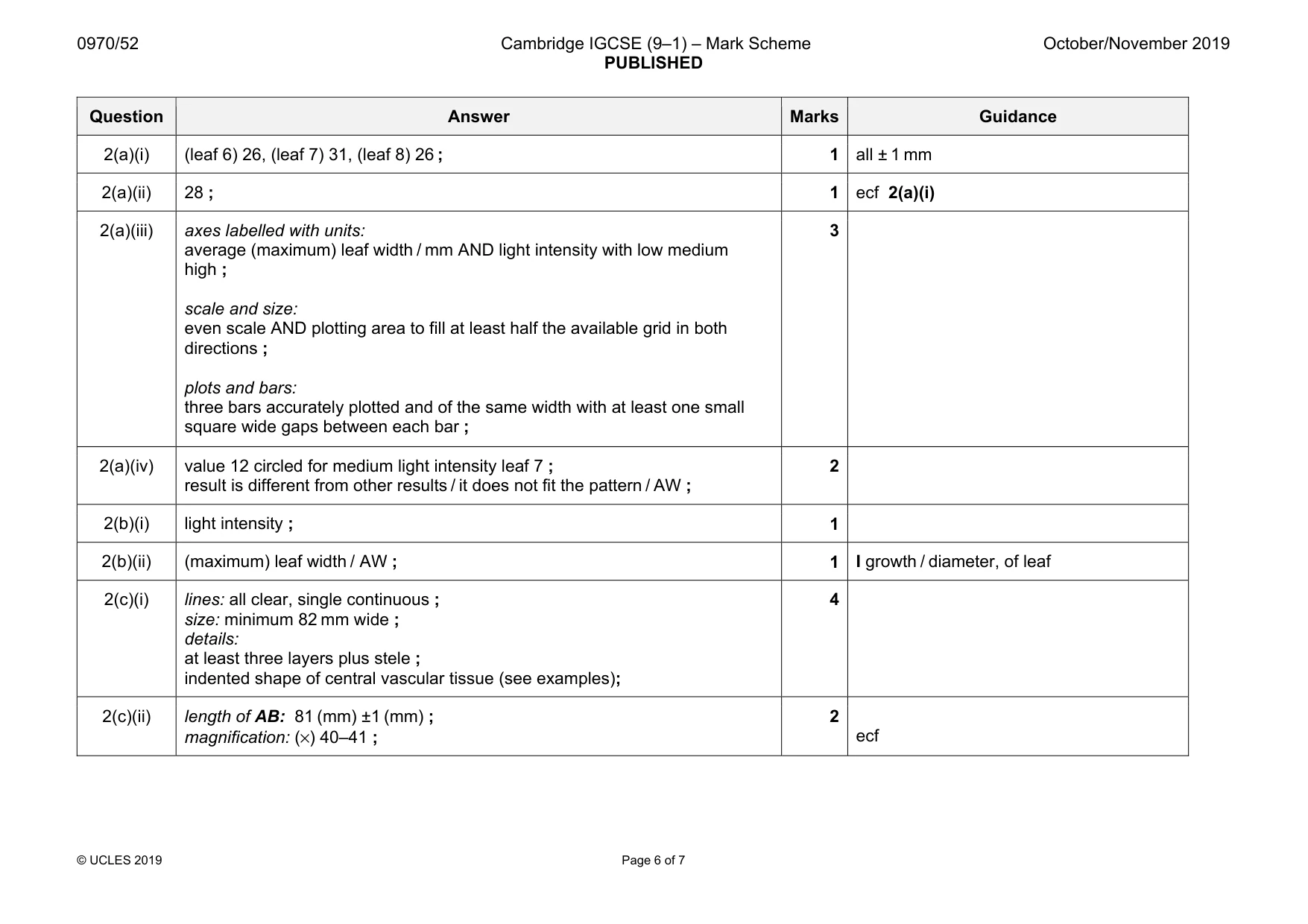
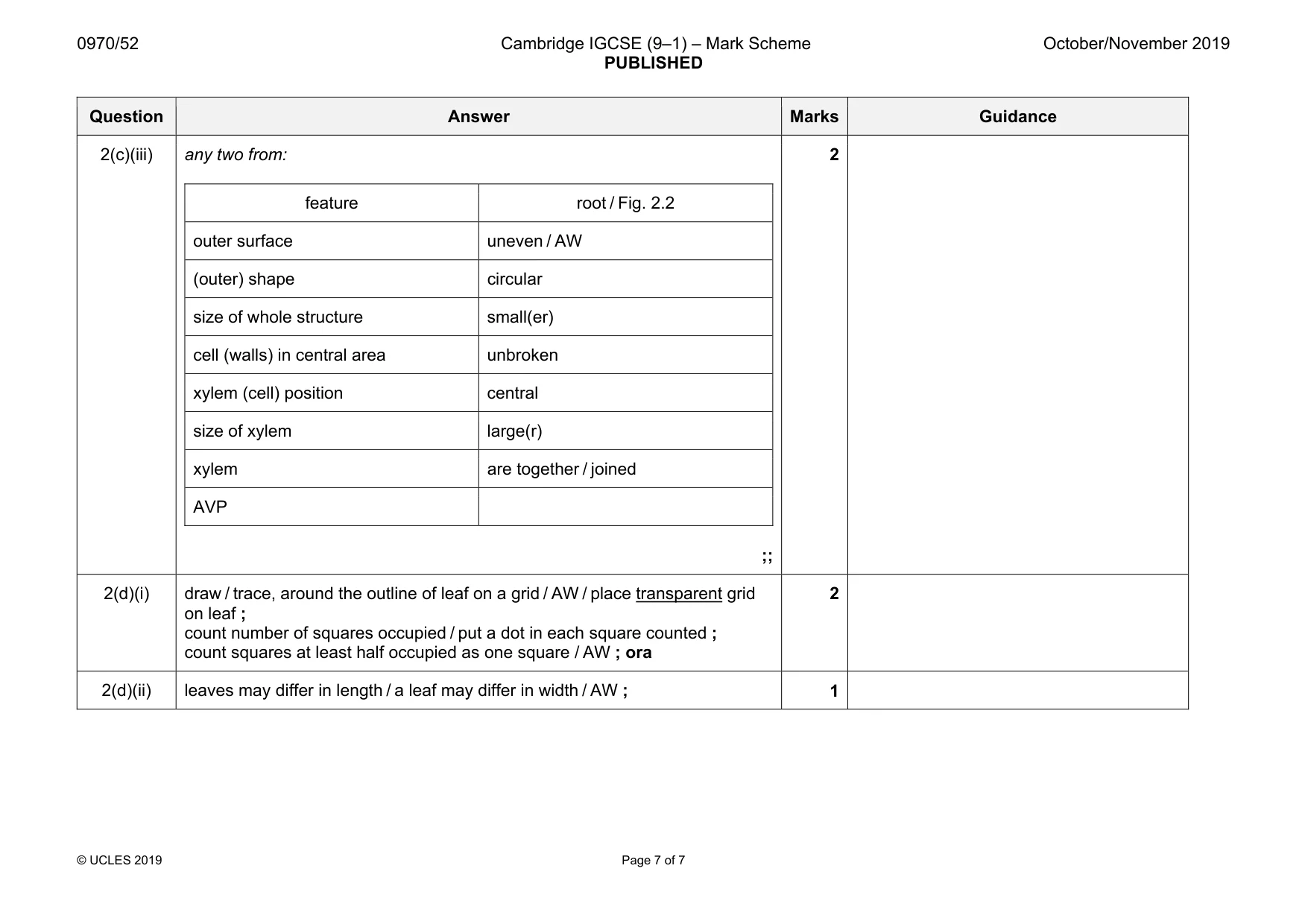
Mark scheme: 2(a)(i) (leaf 6) 26, (leaf 7) 31, (leaf 8) 26 ; 1 all ± 1 mm 2(a)(ii) 28 ; 1 ecf 2(a)(i) 2(a)(iii) axes labelled with units: average (maximum) leaf width / mm AND light intensity with low medium high ; scale and size: even scale AND plotting area to fill at least half the available grid in both directions ; plots and bars: three bars accurately plotted and of the same width with at least one small square wide gaps between each bar ; 3 2(a)(iv) value 12 circled for medium light intensity leaf 7 ; result is different from other results / it does not fit the pattern / AW ; 2 2(b)(i) light intensity ; 1 2(b)(ii) (maximum) leaf width / AW ; 1 I growth / diameter, of leaf 2(c)(i) lines: all clear, single continuous ; size: minimum 82 mm wide ; details: at least three layers plus stele ; indented shape of central vascular tissue (see examples); 4 2(c)(ii) length of AB: 81 (mm) ±1 (mm) ; magnification: (×) 40–41 ; 2 ecf Question Answer Marks Guidance 2(c)(iii) any two from: feature root / Fig. 2.2 outer surface uneven / AW (outer) shape circular size of whole structure small(er) cell (walls) in central area unbroken xylem (cell) position central size of xylem large(r) xylem are together / joined AVP ;; 2 2(d)(i) draw / trace, around the outline of leaf on a grid / AW / place transparent grid on leaf ; count number of squares occupied / put a dot in each square counted ; count squares at least half occupied as one square / AW ; ora 2 2(d)(ii) leaves may differ in length / a leaf may differ in width / AW ; 1
What was in this paper
The subtopics covered by these 2 questions, and how many questions each got. Open one in a new tab to see every Cambridge question on it.
What you needed in this session
Cambridge’s own grade thresholds for 2019 Oct/Nov, Paper 5 · Variant 2. A higher threshold means an easier paper — the bar moves with how the cohort did.