Cambridge IGCSE Agriculture 0600 — 2016 Oct/Nov Paper 1 · Variant 1
0600/11/O/N/16 · 100 marks · ≈113 min
The question paper and its mark scheme, free to read here and free to download. This is Cambridge’s own paper, exactly as it was sat.
Question paper16 pages
Mark scheme
The on-screen preview isn’t ready for this paper yet — download it above instead.
Paper as text
Question paper, page 1
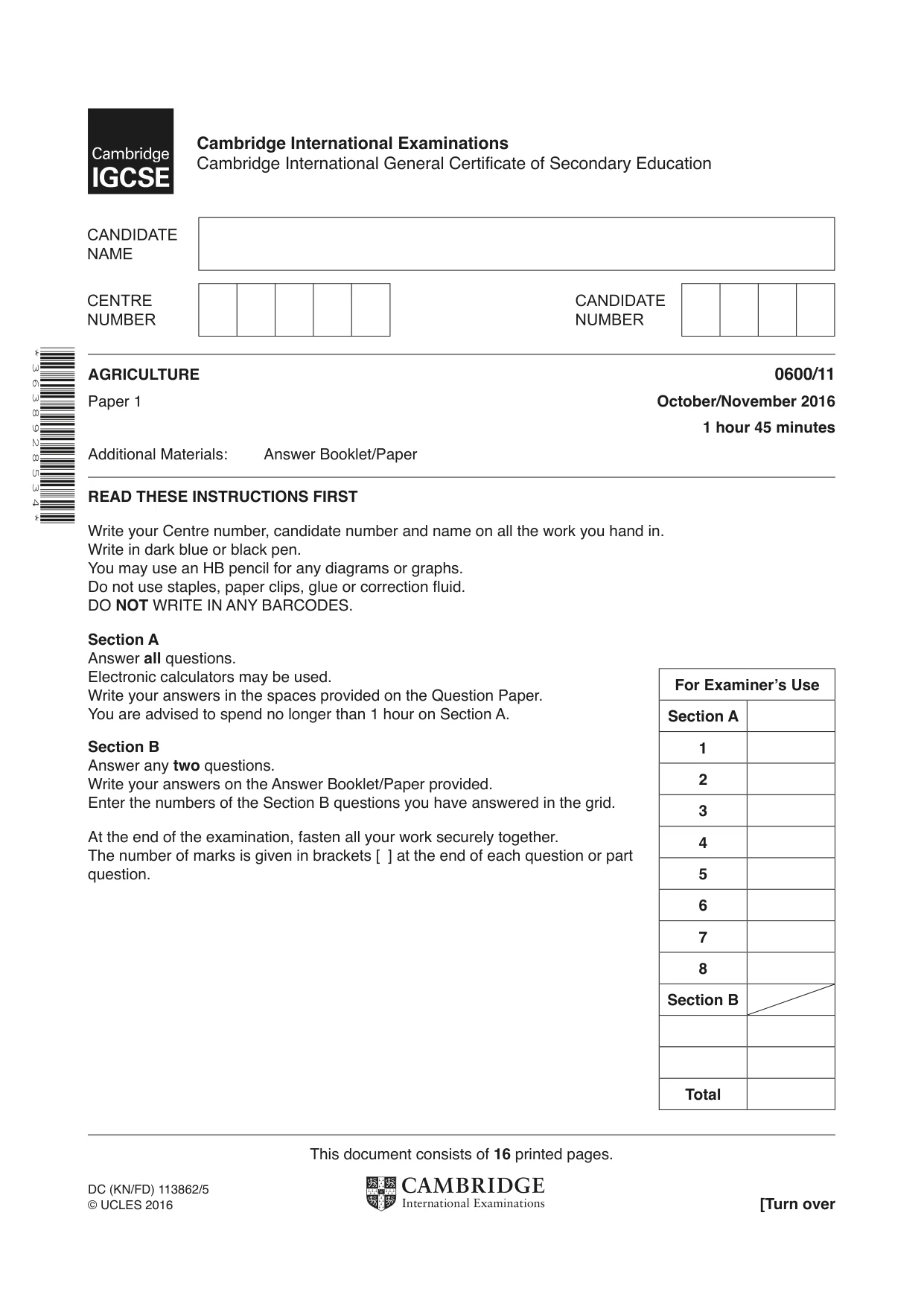
This document consists of 16 printed pages. DC (KN/FD) 113862/5 © UCLES 2016 [Turn over Cambridge International Examinations Cambridge International General Certificate of Secondary Education * 3 6 3 8 9 2 8 5 3 4 * AGRICULTURE 0600/11 Paper 1 October/November 2016 1 hour 45 minutes Additional Materials: Answer Booklet/Paper READ THESE INSTRUCTIONS FIRST Write your Centre number, candidate number and name on all the work you hand in. Write in dark blue or black pen. You may use an HB pencil for any diagrams or graphs. Do not use staples, paper clips, glue or correction fluid. DO NOT WRITE IN ANY BARCODES. Section A Answer all questions. Electronic calculators may be used. Write your answers in the spaces provided on the Question Paper. You are advised to spend no longer than 1 hour on Section A. Section B Answer any two questions. Write your answers on the Answer Booklet/Paper provided. Enter the numbers of the Section B questions you have answered in the grid. At the end of the examination, fasten all your work securely together. The number of marks is given in brackets [ ] at the end of each question or part question. For Examiner’s Use Section A 1 2 3 4 5 6 7 8 Section B Total
Question paper, page 2
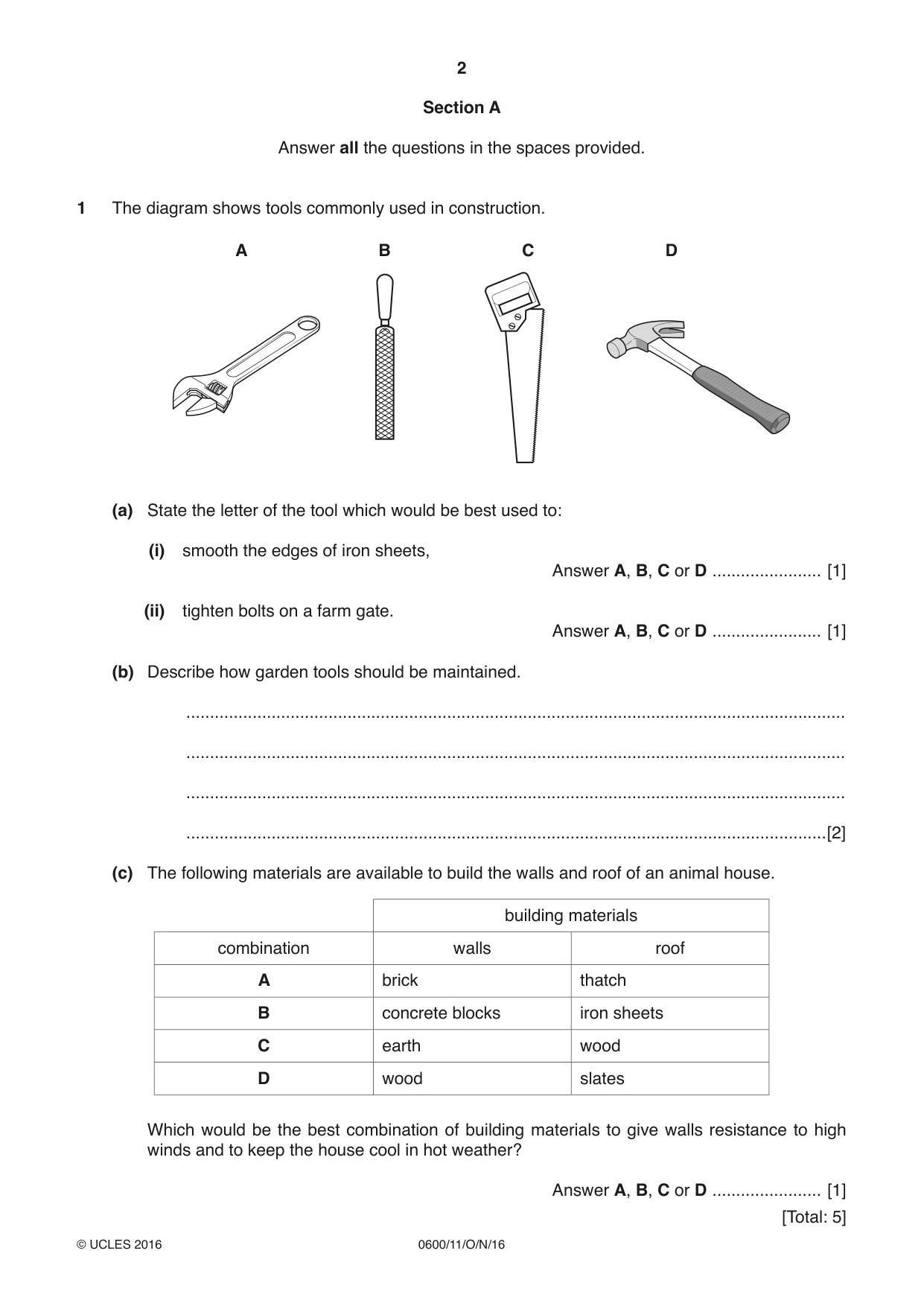
2 0600/11/O/N/16 © UCLES 2016 Section A Answer all the questions in the spaces provided. 1 The diagram shows tools commonly used in construction. A B C D (a) State the letter of the tool which would be best used to: (i) smooth the edges of iron sheets, Answer A, B, C or D … [1] (ii) tighten bolts on a farm gate. Answer A, B, C or D … [1] (b) Describe how garden tools should be maintained. … … … …[2] (c) The following materials are available to build the walls and roof of an animal house. building materials combination walls roof A brick thatch B concrete blocks iron sheets C earth wood D wood slates Which would be the best combination of building materials to give walls resistance to high winds and to keep the house cool in hot weather? Answer A, B, C or D … [1] [Total: 5]
Question paper, page 3
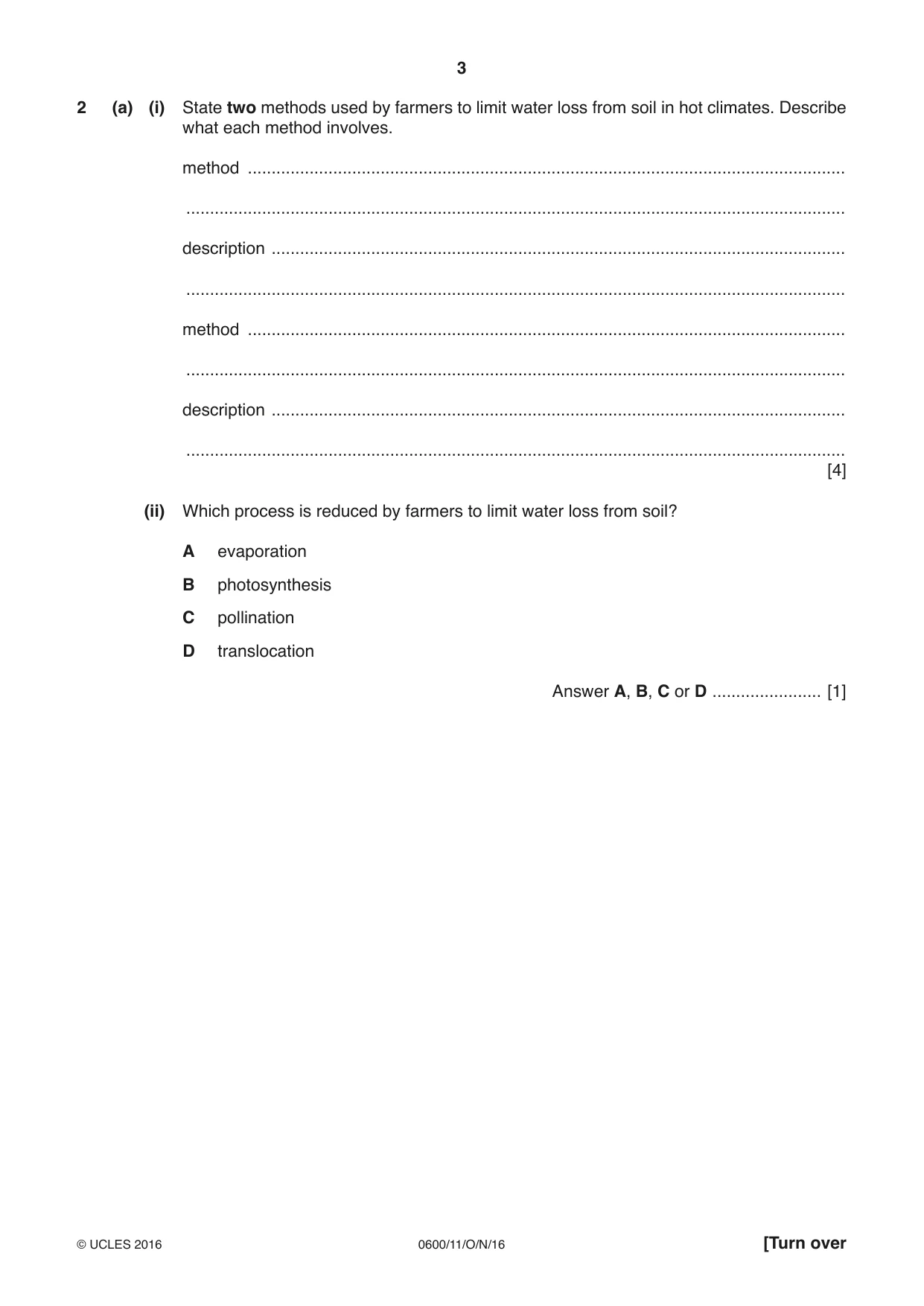
3 0600/11/O/N/16 © UCLES 2016 [Turn over 2 (a) (i) State two methods used by farmers to limit water loss from soil in hot climates. Describe what each method involves. method … … description … … method … … description … … [4] (ii) Which process is reduced by farmers to limit water loss from soil? A evaporation B photosynthesis C pollination D translocation Answer A, B, C or D … [1]
Question paper, page 4
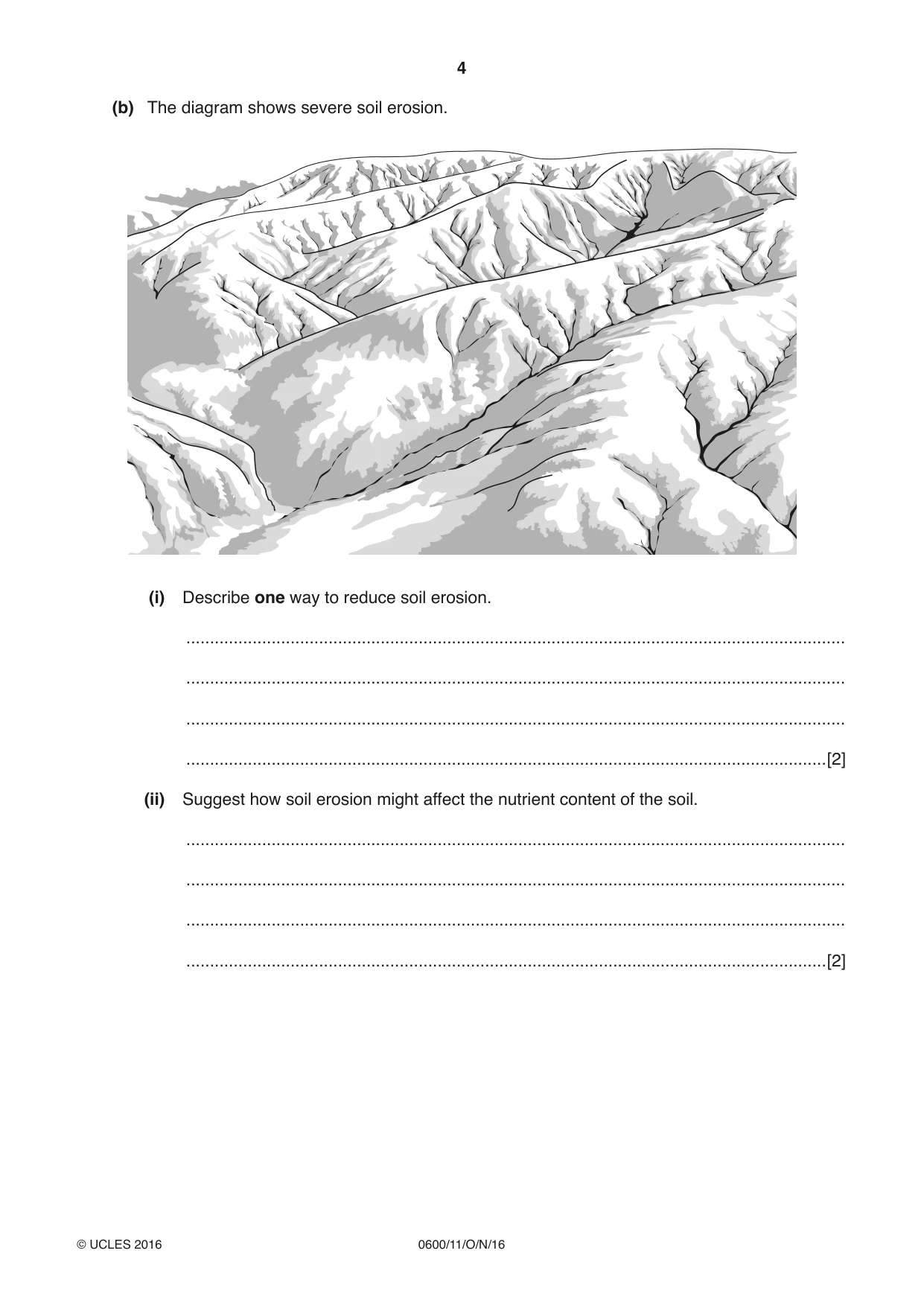
4 0600/11/O/N/16 © UCLES 2016 (b) The diagram shows severe soil erosion. (i) Describe one way to reduce soil erosion. … … … …[2] (ii) Suggest how soil erosion might affect the nutrient content of the soil. … … … …[2]
Question paper, page 5
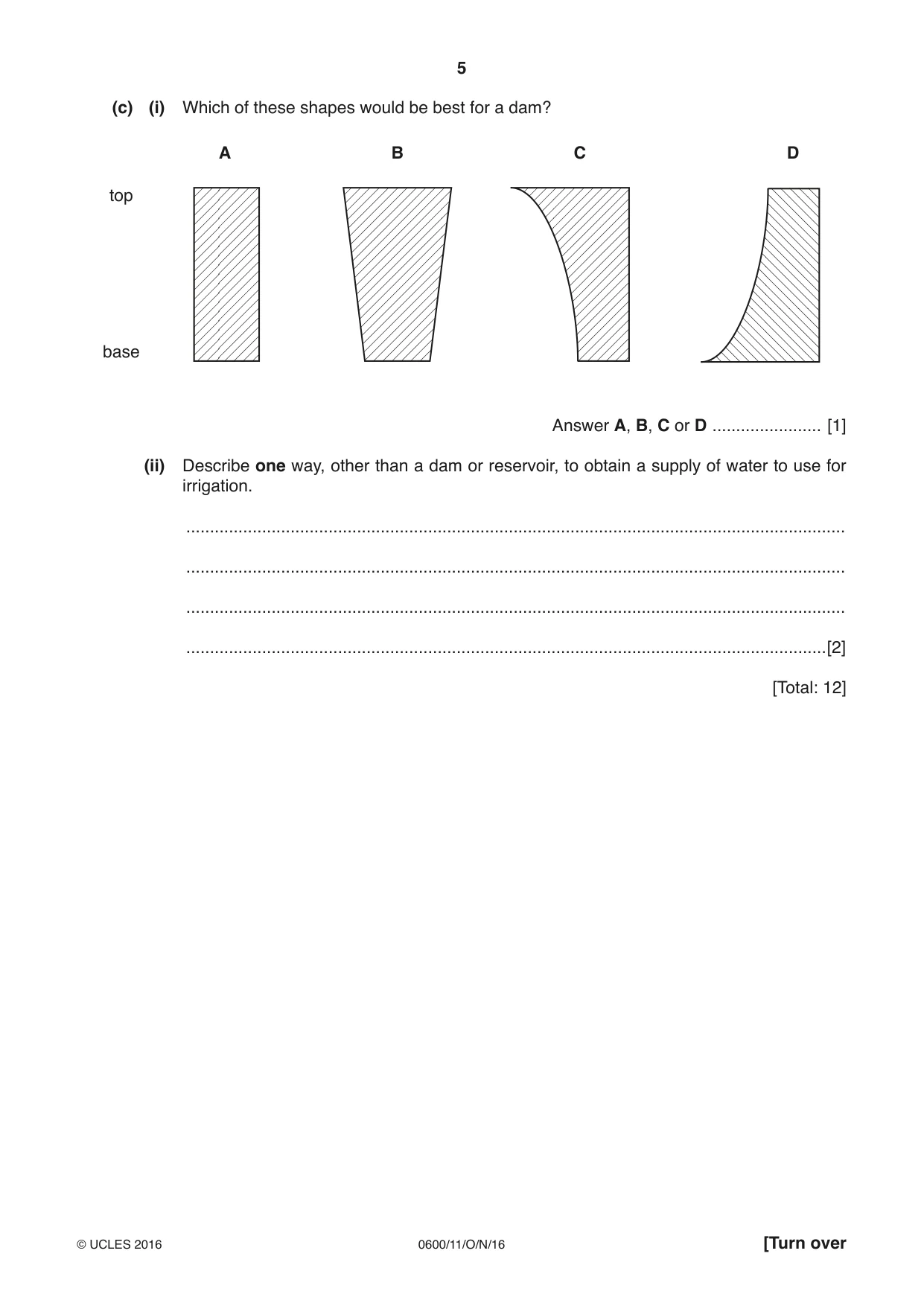
5 0600/11/O/N/16 © UCLES 2016 [Turn over (c) (i) Which of these shapes would be best for a dam? A top base B C D Answer A, B, C or D … [1] (ii) Describe one way, other than a dam or reservoir, to obtain a supply of water to use for irrigation. … … … …[2] [Total: 12]
Question paper, page 6
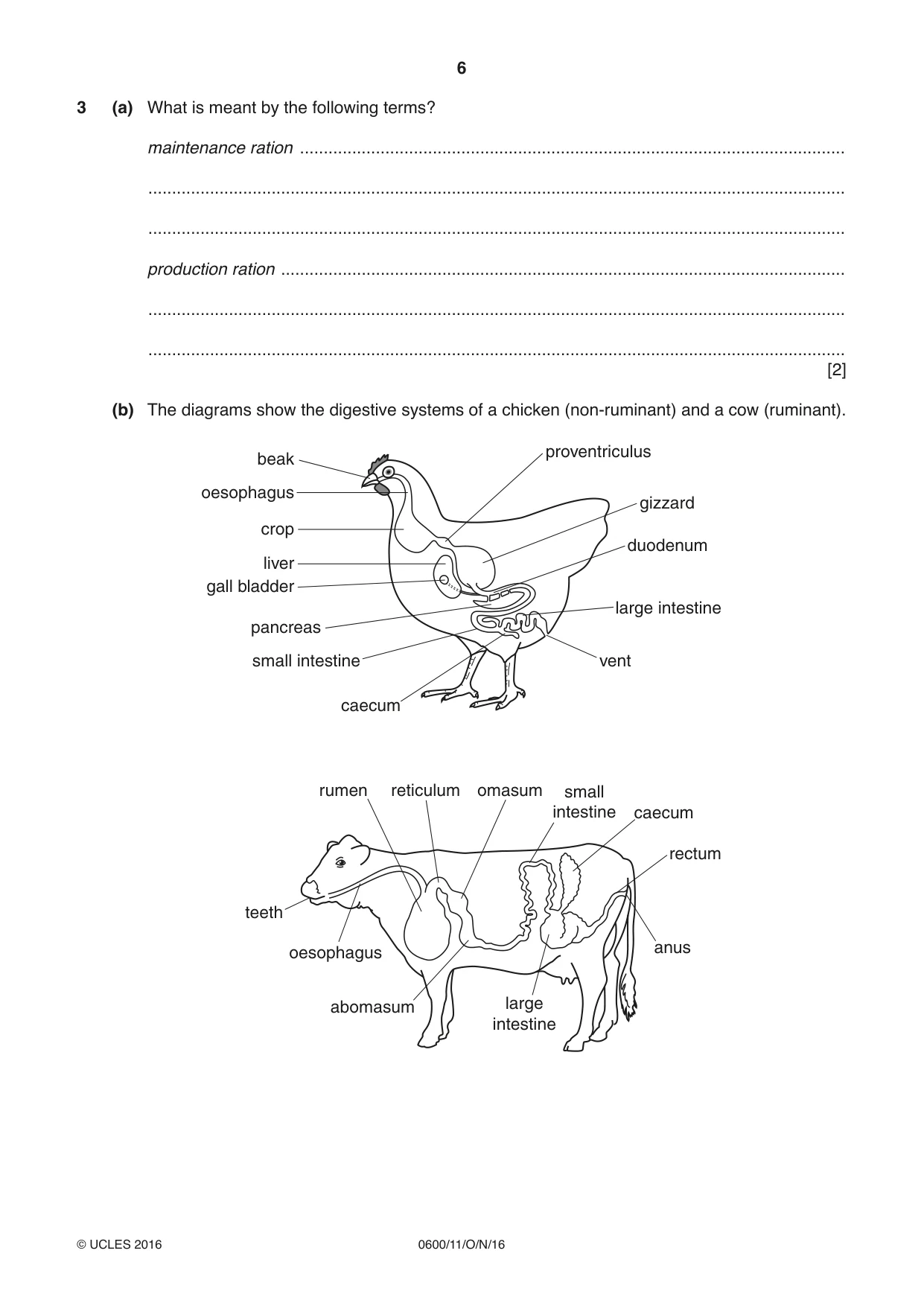
6 0600/11/O/N/16 © UCLES 2016 3 (a) What is meant by the following terms? maintenance ration … … … production ration … … … [2] (b) The diagrams show the digestive systems of a chicken (non-ruminant) and a cow (ruminant). beak oesophagus crop liver proventriculus gizzard duodenum large intestine vent gall bladder pancreas small intestine caecum rumen reticulum omasum small intestine caecum rectum anus large intestine abomasum oesophagus teeth
Question paper, page 7
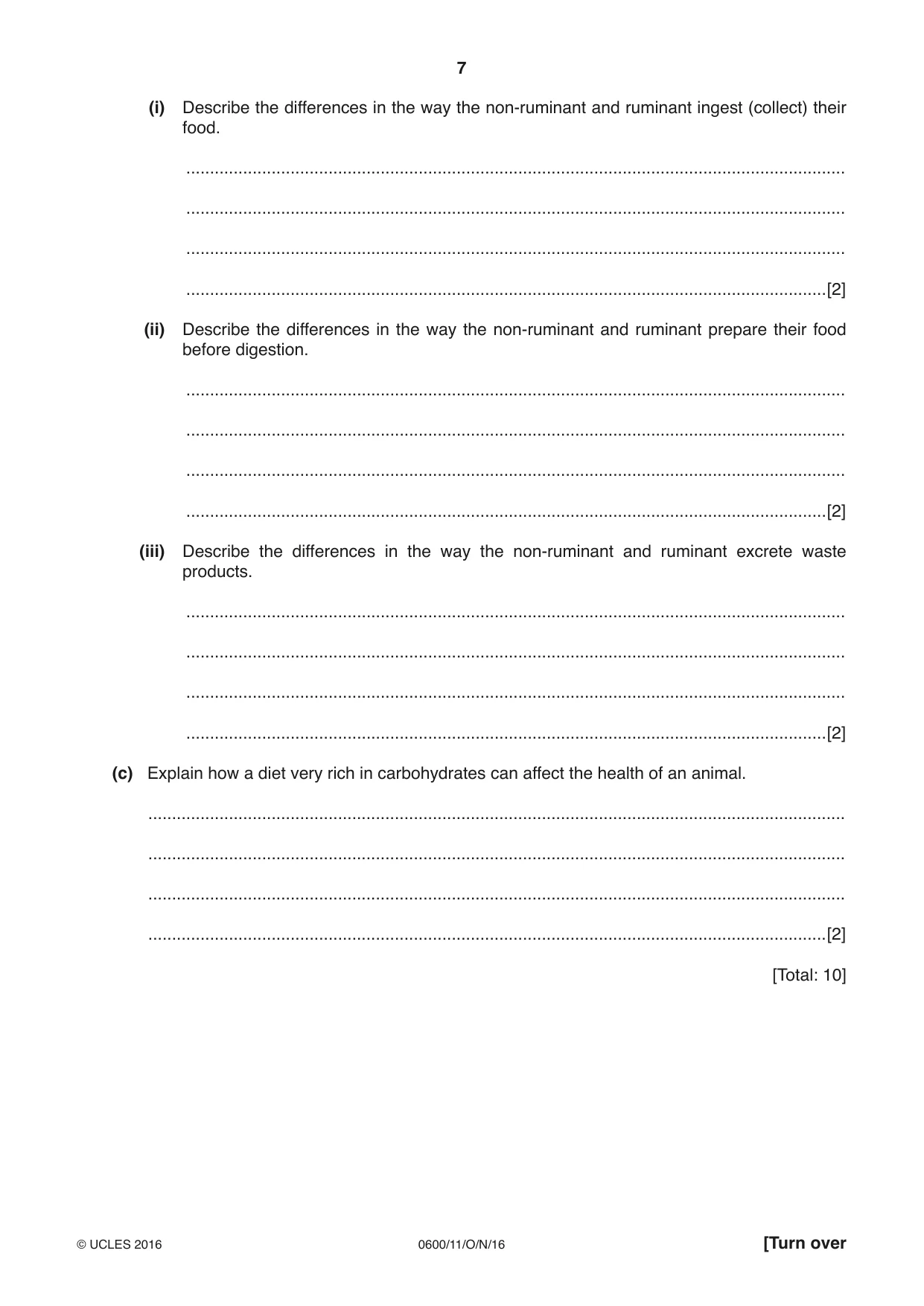
7 0600/11/O/N/16 © UCLES 2016 [Turn over (i) Describe the differences in the way the non-ruminant and ruminant ingest (collect) their food. … … … …[2] (ii) Describe the differences in the way the non-ruminant and ruminant prepare their food before digestion. … … … …[2] (iii) Describe the differences in the way the non-ruminant and ruminant excrete waste products. … … … …[2] (c) Explain how a diet very rich in carbohydrates can affect the health of an animal. … … … …[2] [Total: 10]
Question paper, page 8
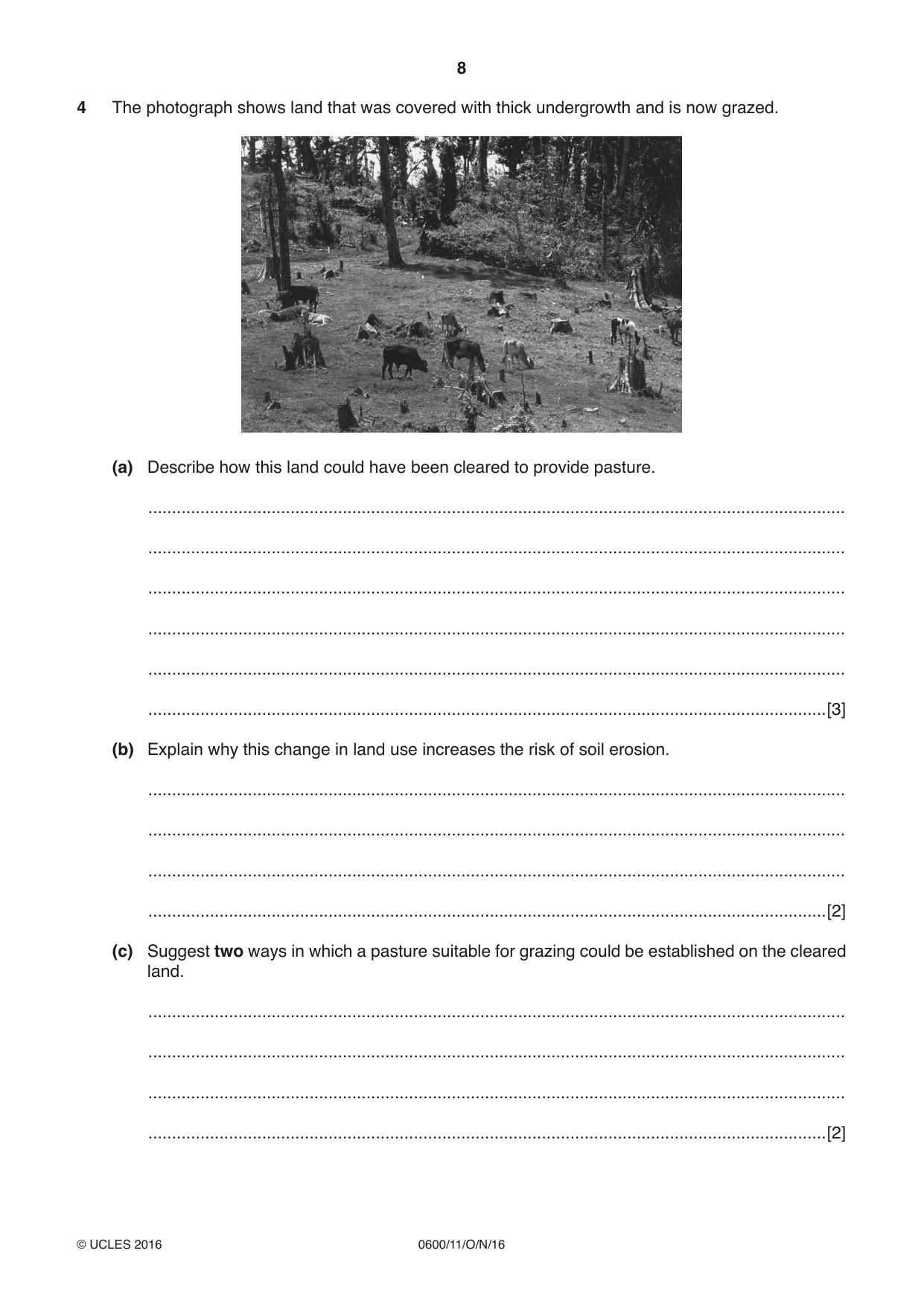
8 0600/11/O/N/16 © UCLES 2016 4 The photograph shows land that was covered with thick undergrowth and is now grazed. (a) Describe how this land could have been cleared to provide pasture. … … … … … …[3] (b) Explain why this change in land use increases the risk of soil erosion. … … … …[2] (c) Suggest two ways in which a pasture suitable for grazing could be established on the cleared land. … … … …[2]
Question paper, page 9
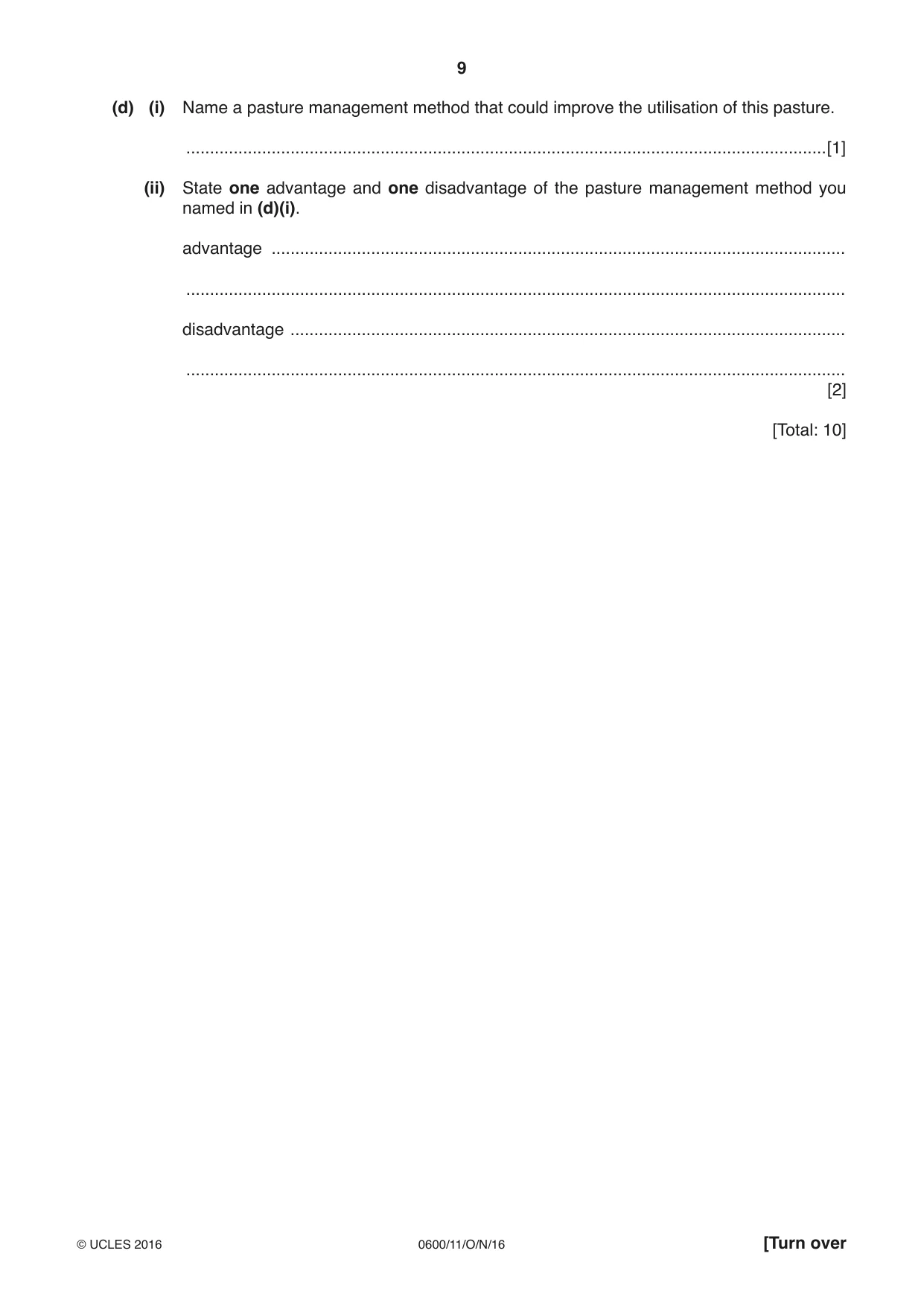
9 0600/11/O/N/16 © UCLES 2016 [Turn over (d) (i) Name a pasture management method that could improve the utilisation of this pasture. …[1] (ii) State one advantage and one disadvantage of the pasture management method you named in (d)(i). advantage … … disadvantage … … [2] [Total: 10]
Question paper, page 10
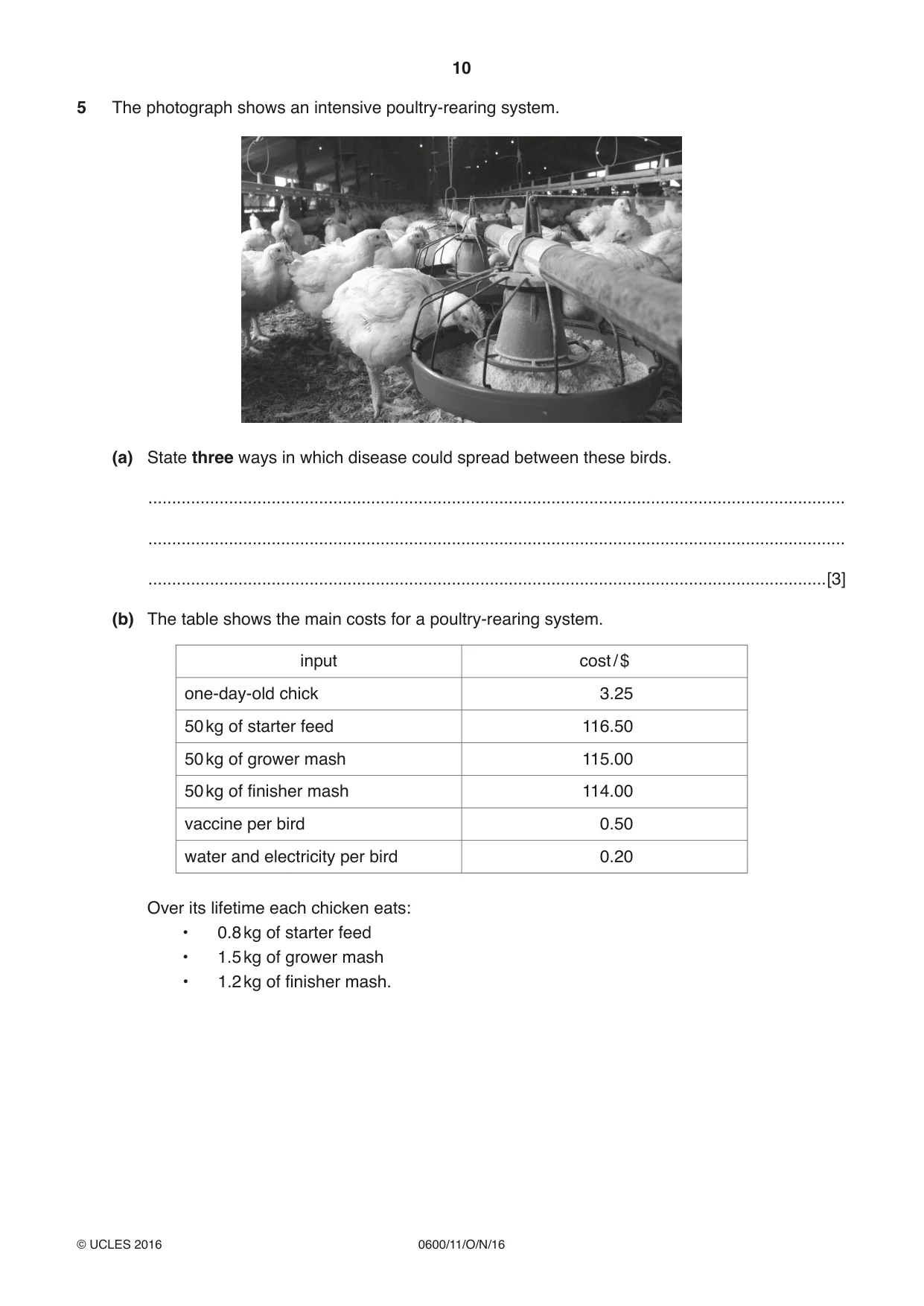
10 0600/11/O/N/16 © UCLES 2016 5 The photograph shows an intensive poultry-rearing system. (a) State three ways in which disease could spread between these birds. … … …[3] (b) The table shows the main costs for a poultry-rearing system. input cost / $ one-day-old chick 3.25 50 kg of starter feed 116.50 50 kg of grower mash 115.00 50 kg of finisher mash 114.00 vaccine per bird 0.50 water and electricity per bird 0.20 Over its lifetime each chicken eats: • 0.8 kg of starter feed • 1.5 kg of grower mash • 1.2 kg of finisher mash.
Question paper, page 11
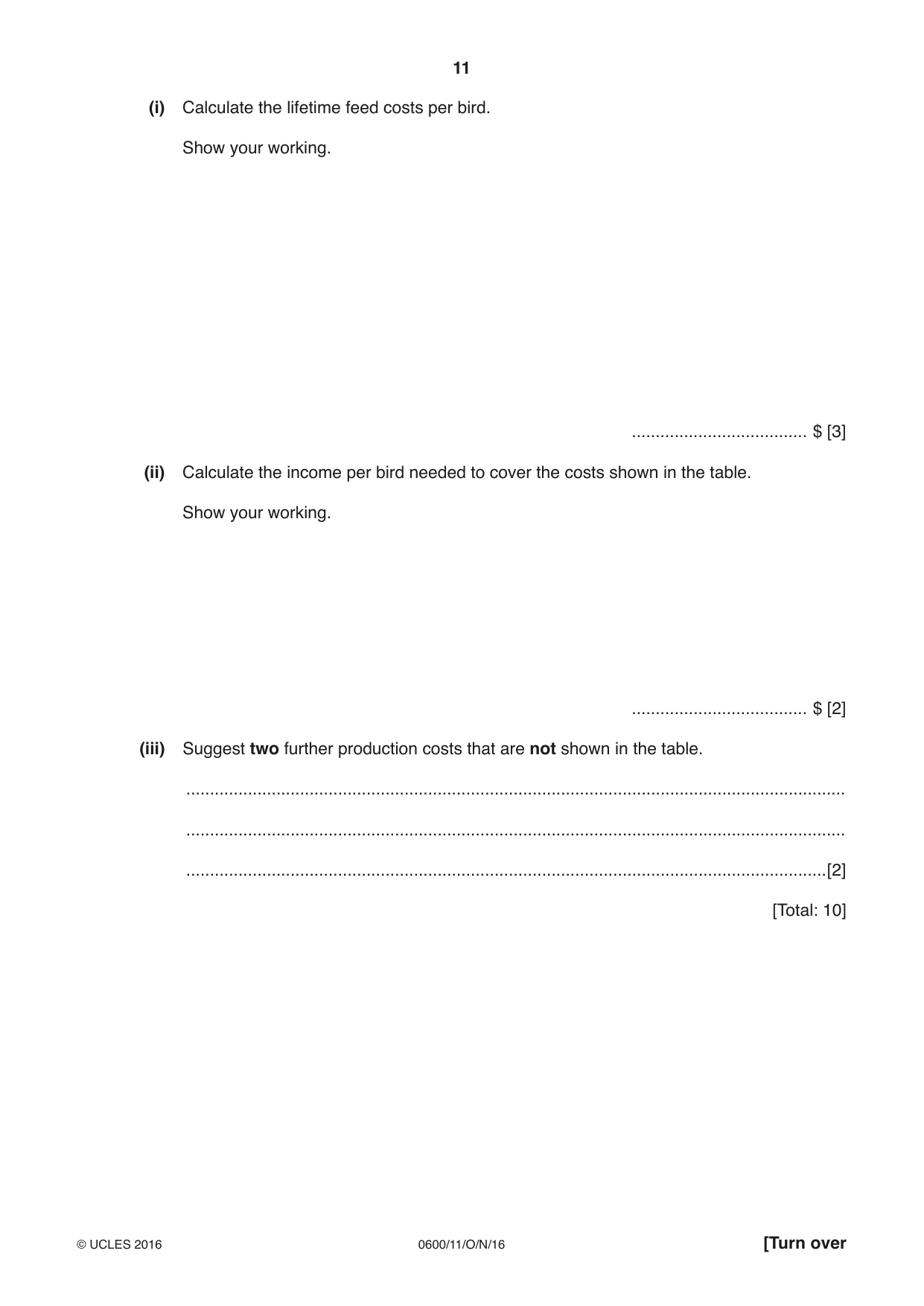
11 0600/11/O/N/16 © UCLES 2016 [Turn over (i) Calculate the lifetime feed costs per bird. Show your working. … $ [3] (ii) Calculate the income per bird needed to cover the costs shown in the table. Show your working. … $ [2] (iii) Suggest two further production costs that are not shown in the table. … … …[2] [Total: 10]
Question paper, page 12
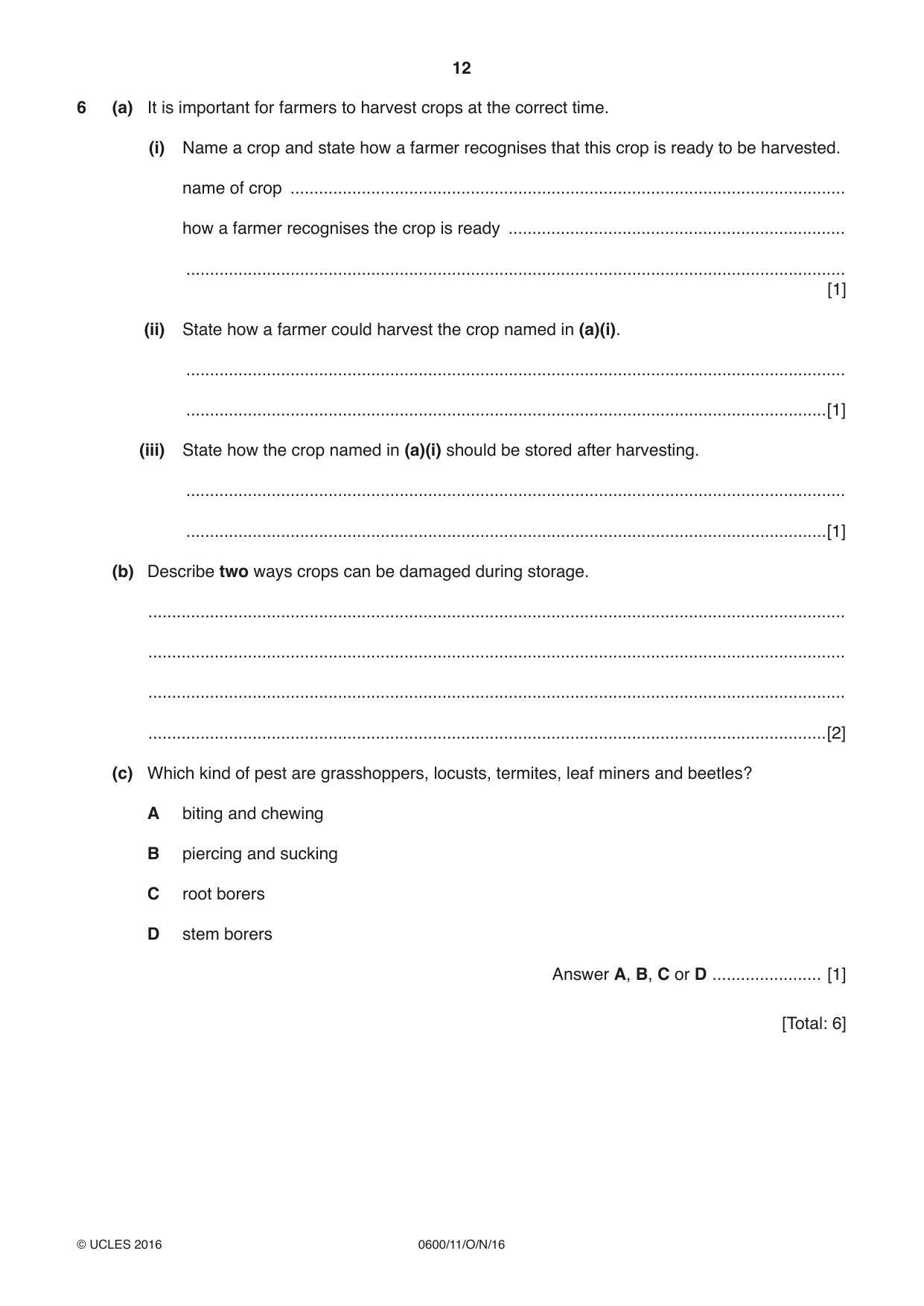
12 0600/11/O/N/16 © UCLES 2016 6 (a) It is important for farmers to harvest crops at the correct time. (i) Name a crop and state how a farmer recognises that this crop is ready to be harvested. name of crop … how a farmer recognises the crop is ready … … [1] (ii) State how a farmer could harvest the crop named in (a)(i). … …[1] (iii) State how the crop named in (a)(i) should be stored after harvesting. … …[1] (b) Describe two ways crops can be damaged during storage. … … … …[2] (c) Which kind of pest are grasshoppers, locusts, termites, leaf miners and beetles? A biting and chewing B piercing and sucking C root borers D stem borers Answer A, B, C or D … [1] [Total: 6]
Question paper, page 13
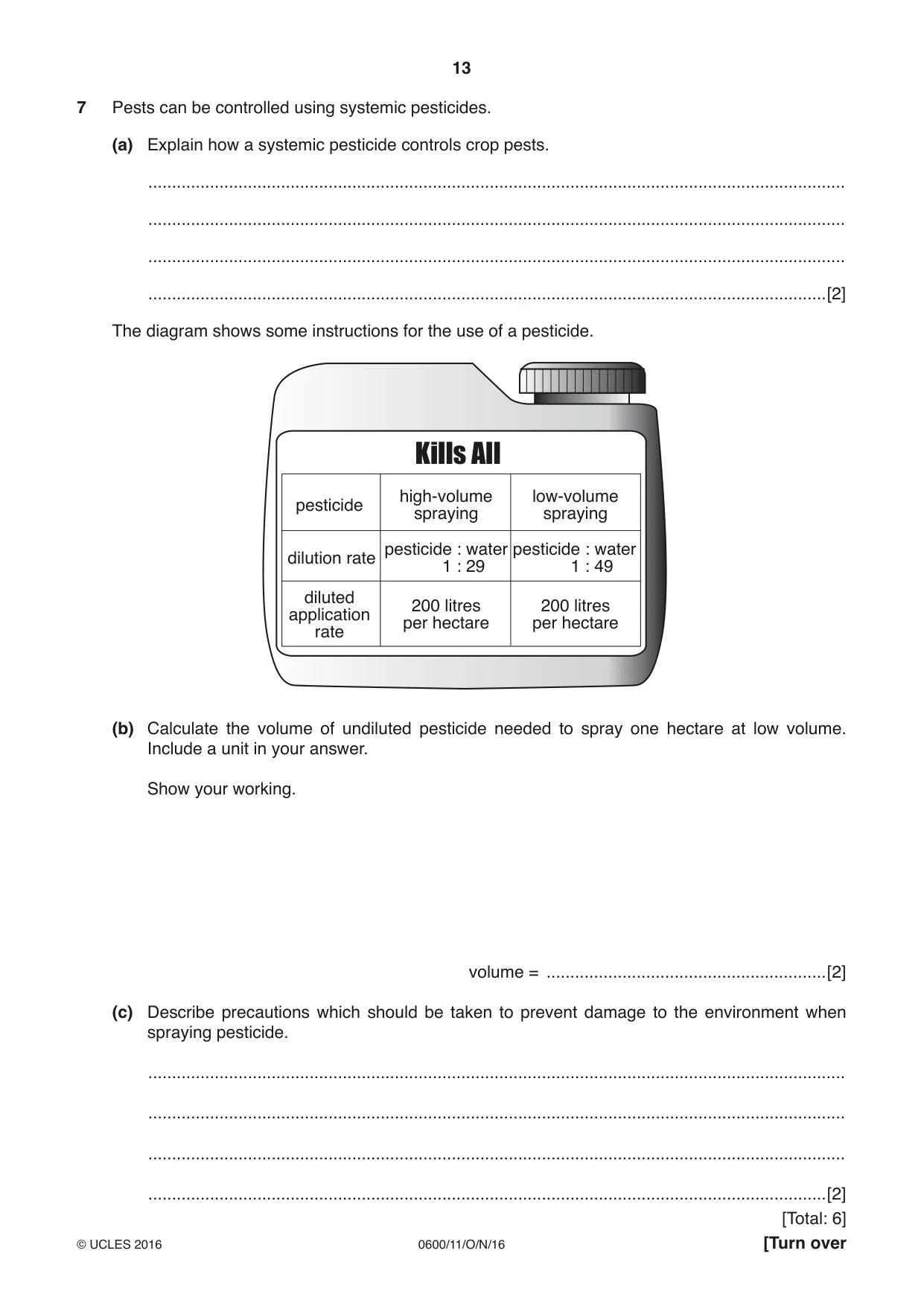
13 0600/11/O/N/16 © UCLES 2016 [Turn over 7 Pests can be controlled using systemic pesticides. (a) Explain how a systemic pesticide controls crop pests. … … … …[2] The diagram shows some instructions for the use of a pesticide. Kills All pesticide high-volume spraying low-volume spraying dilution rate diluted application rate pesticide : water 200 litres per hectare 200 litres per hectare 1 : 29 pesticide : water 1 : 49 (b) Calculate the volume of undiluted pesticide needed to spray one hectare at low volume. Include a unit in your answer. Show your working. volume = …[2] (c) Describe precautions which should be taken to prevent damage to the environment when spraying pesticide. … … … …[2] [Total: 6]
Question paper, page 14
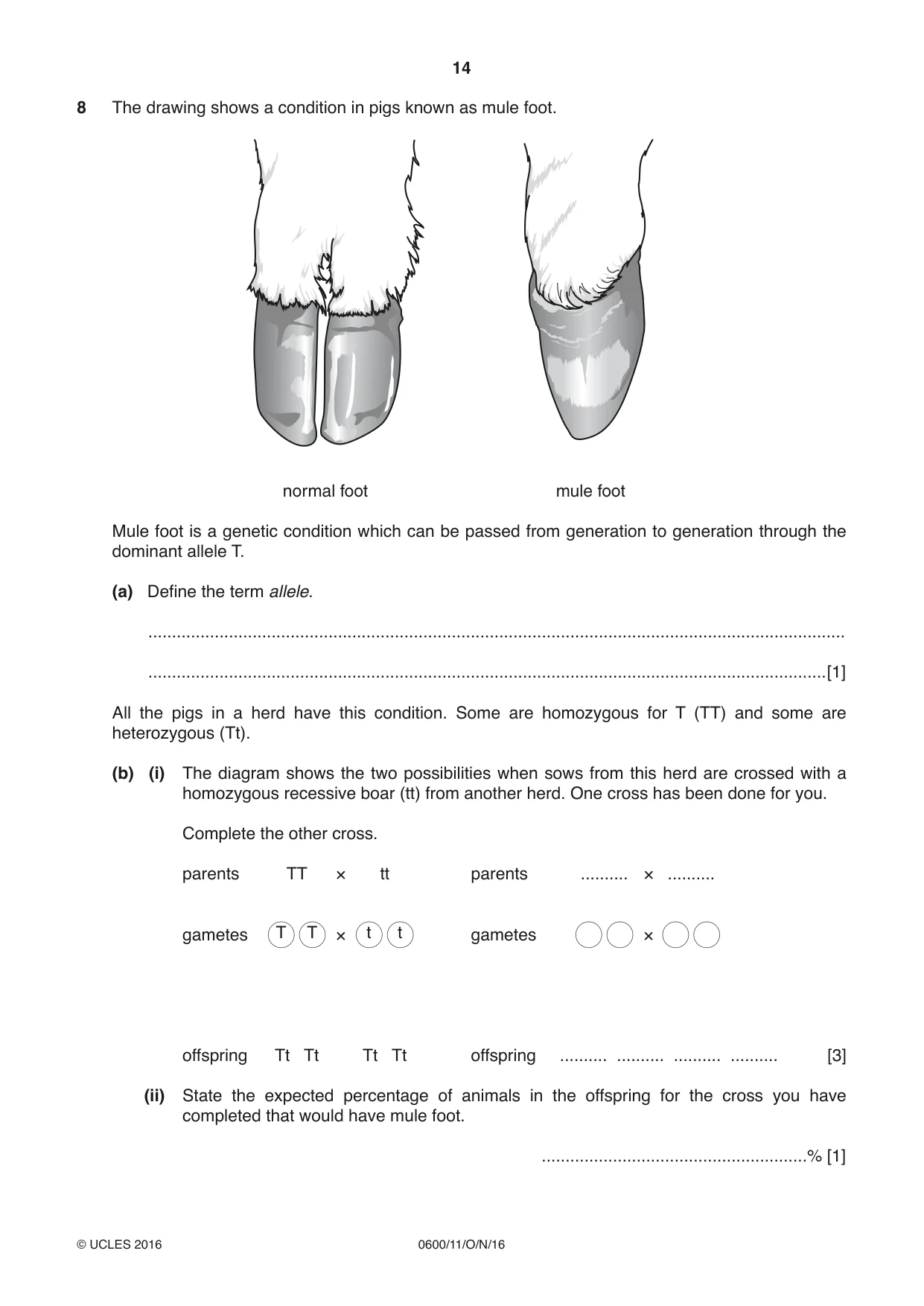
14 0600/11/O/N/16 © UCLES 2016 8 The drawing shows a condition in pigs known as mule foot. mule foot normal foot Mule foot is a genetic condition which can be passed from generation to generation through the dominant allele T. (a) Define the term allele. … …[1] All the pigs in a herd have this condition. Some are homozygous for T (TT) and some are heterozygous (Tt). (b) (i) The diagram shows the two possibilities when sows from this herd are crossed with a homozygous recessive boar (tt) from another herd. One cross has been done for you. Complete the other cross. parents TT × tt parents … × … gametes T T × t t gametes × offspring Tt Tt Tt Tt offspring … … … … [3] (ii) State the expected percentage of animals in the offspring for the cross you have completed that would have mule foot. …% [1]
Question paper, page 15
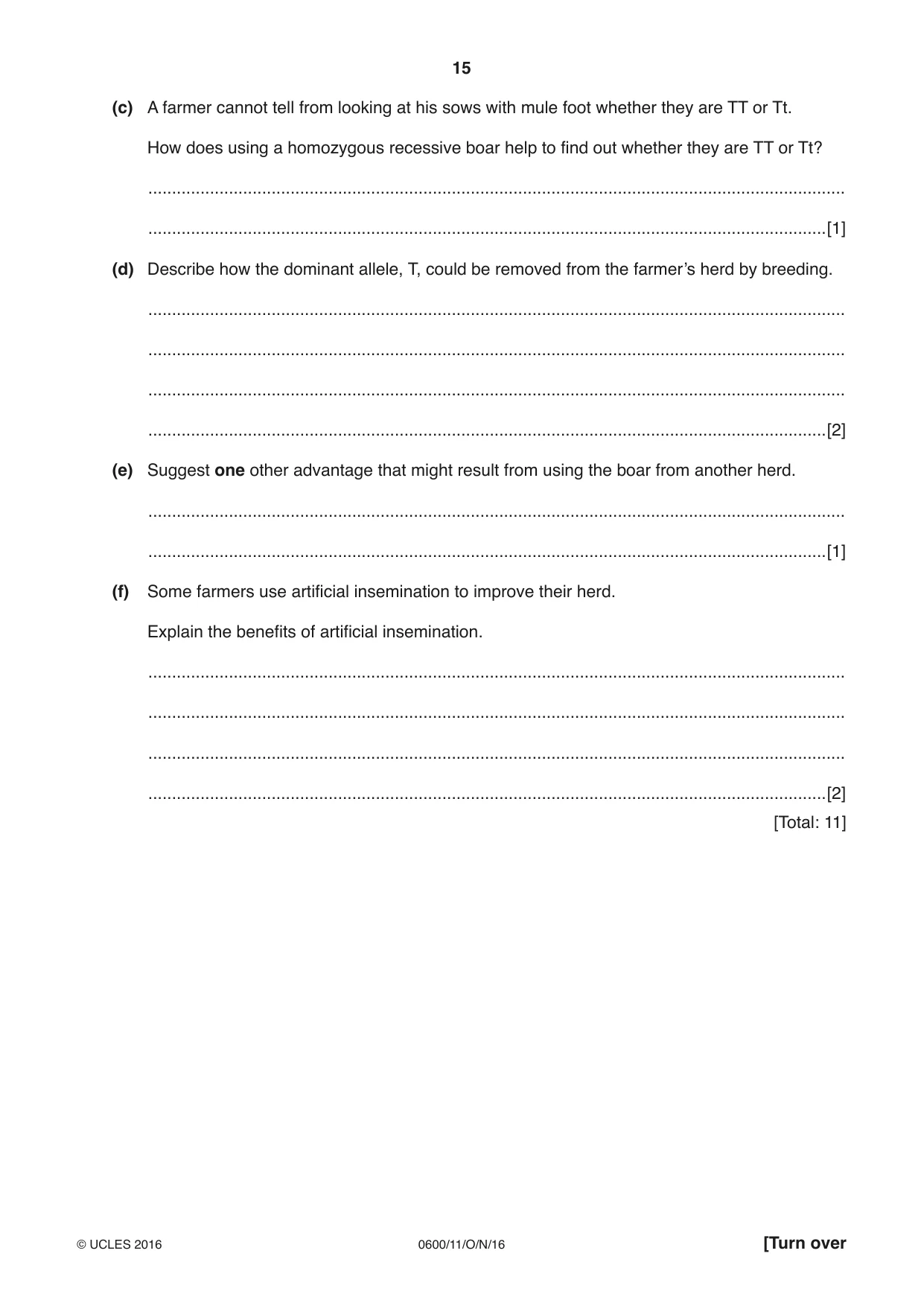
15 0600/11/O/N/16 © UCLES 2016 [Turn over (c) A farmer cannot tell from looking at his sows with mule foot whether they are TT or Tt. How does using a homozygous recessive boar help to find out whether they are TT or Tt? … …[1] (d) Describe how the dominant allele, T, could be removed from the farmer’s herd by breeding. … … … …[2] (e) Suggest one other advantage that might result from using the boar from another herd. … …[1] (f) Some farmers use artificial insemination to improve their herd. Explain the benefits of artificial insemination. … … … …[2] [Total: 11]
Question paper, page 16
16 0600/11/O/N/16 © UCLES 2016 Permission to reproduce items where third-party owned material protected by copyright is included has been sought and cleared where possible. Every reasonable effort has been made by the publisher (UCLES) to trace copyright holders, but if any items requiring clearance have unwittingly been included, the publisher will be pleased to make amends at the earliest possible opportunity. To avoid the issue of disclosure of answer-related information to candidates, all copyright acknowledgements are reproduced online in the Cambridge International Examinations Copyright Acknowledgements Booklet. This is produced for each series of examinations and is freely available to download at www.cie.org.uk after the live examination series. Cambridge International Examinations is part of the Cambridge Assessment Group. Cambridge Assessment is the brand name of University of Cambridge Local Examinations Syndicate (UCLES), which is itself a department of the University of Cambridge. Section B Answer any two questions. Write your answers on the separate paper provided. 9 (a) Describe the process of photosynthesis. [4] (b) Describe how environmental factors affect the rate of transpiration. [4] (c) Explain how water moves through a plant from soil to atmosphere. [7] 10 (a) Define the terms lactation and weaning. [4] (b) For a named mammalian farm animal, describe the care given to a mother during pregnancy and birth, and to her newborn young. [7] (c) Explain why it is important to feed newborn animals colostrum. [4] 11 (a) Describe what is meant by the term genetically modified (GM) crop. [4] (b) Describe the advantages and disadvantages of genetically modified crops. [5] (c) Explain how selective breeding can improve crop varieties. [6] 12 (a) Describe the role of legumes in crop rotations. [4] (b) Describe how the soil pH of a field should be tested. [7] (c) Explain how soil can become acidic and how this could affect soil fertility. [4] 13 (a) State what is meant by the term biological control. [3] (b) Describe how cultural methods can be used to control crop pests. [7] (c) Explain the benefits of chemical pest control. [5]
What you needed in this session
Cambridge’s own grade thresholds for 2016 Oct/Nov, Paper 1 · Variant 1. A higher threshold means an easier paper — the bar moves with how the cohort did.