Cambridge IGCSE Agriculture 0600 — 2014 Oct/Nov Paper 1 · Variant 1
0600/11/O/N/14 · 100 marks · ≈113 min
The question paper and its mark scheme, free to read here and free to download. This is Cambridge’s own paper, exactly as it was sat.
Question paper20 pages

Mark scheme9 pages
Answers below. Sit the paper first if you are practising.
Paper as text
Question paper, page 1
This document consists of 20 printed pages. DC (SJF/CGW) 74028/5 © UCLES 2014 [Turn over Cambridge International Examinations Cambridge International General Certificate of Secondary Education * 4 4 9 8 8 4 5 4 7 1 * AGRICULTURE 0600/11 Paper 1 October/November 2014 1 hour 45 minutes Candidates answer Section A on the Question Paper. Additional Materials: Answer Booklet/Paper READ THESE INSTRUCTIONS FIRST Write your Centre number, candidate number and name on all the work you hand in. Write in dark blue or black pen. You may use an HB pencil for any diagrams or graphs. Do not use staples, paper clips, glue or correction fluid. DO NOT WRITE IN ANY BARCODES. Section A Answer all questions. Write your answers in the spaces provided on the Question Paper. You are advised to spend no longer than 1 hour on Section A. Section B Answer any two questions. Write your answers on the Answer Booklet/Paper provided. Enter the numbers of the Section B questions you have answered in the grid below. At the end of the examination, fasten all your work securely together. The number of marks is given in brackets [ ] at the end of each question or part question. For Examiner’s Use Section A 1 2 3 4 5 6 7 8 9 Section B Total PAPA CAMBRIDGE
Question paper, page 2
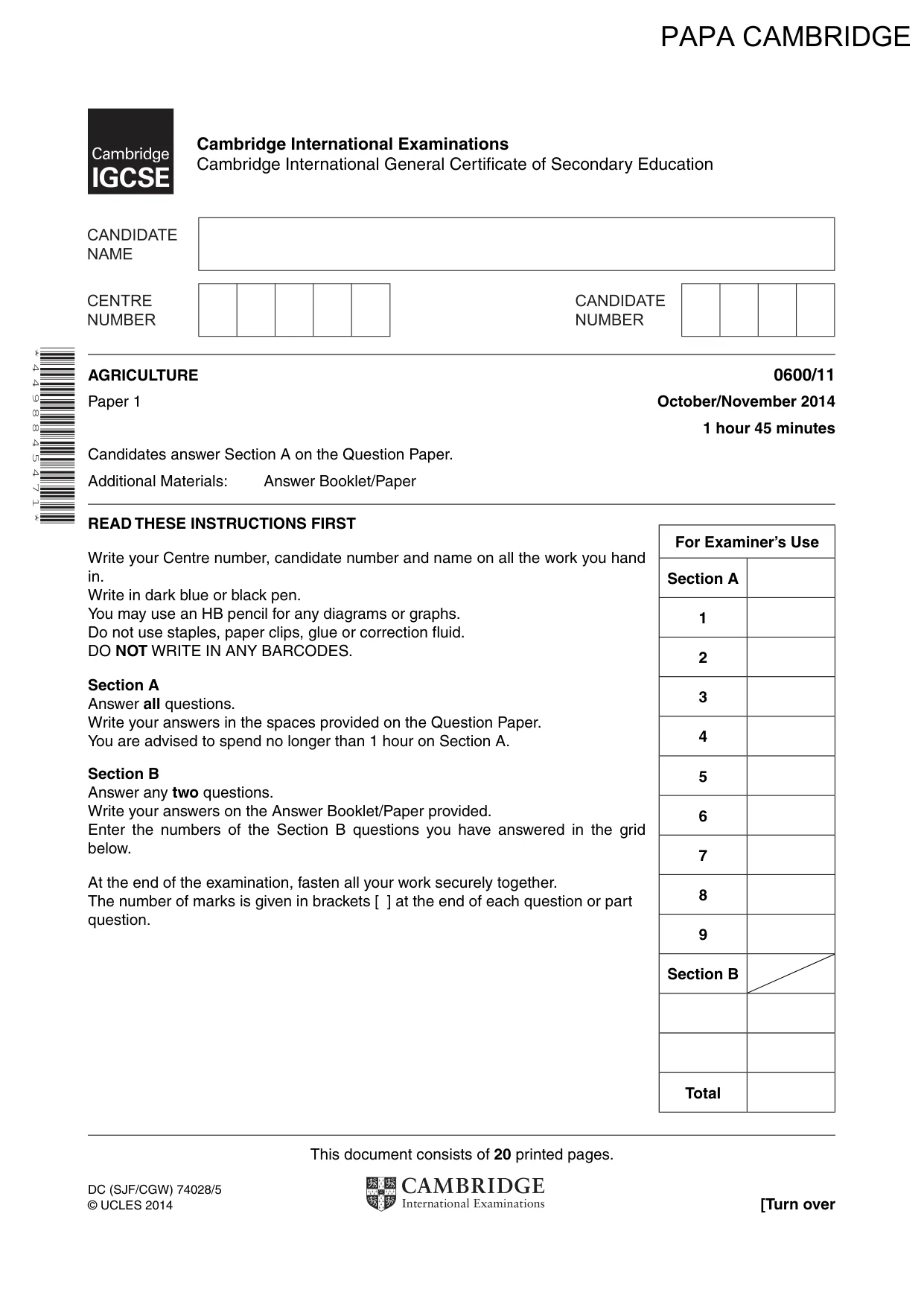
2 0600/11/O/N/14 © UCLES 2014 Section A Answer all the questions. 1 Fig. 1.1 shows some farm tools. 1 2 3 4 5 6 Fig. 1.1 (a) Which set of tools would be the most useful for making a fence with wooden posts and barbed wire? A 1, 4 & 6 B 1, 3 & 6 C 2, 3 & 5 D 2, 4 & 5 Answer A, B, C or D … [1] (b) Fig. 1.2 shows a wire mesh fence. 2.0 m ground level 0.5 m Fig. 1.2 Which type of animal could be successfully enclosed by this fence? A cattle B chickens C goats D rabbits Answer A, B, C or D … [1]
Question paper, page 3
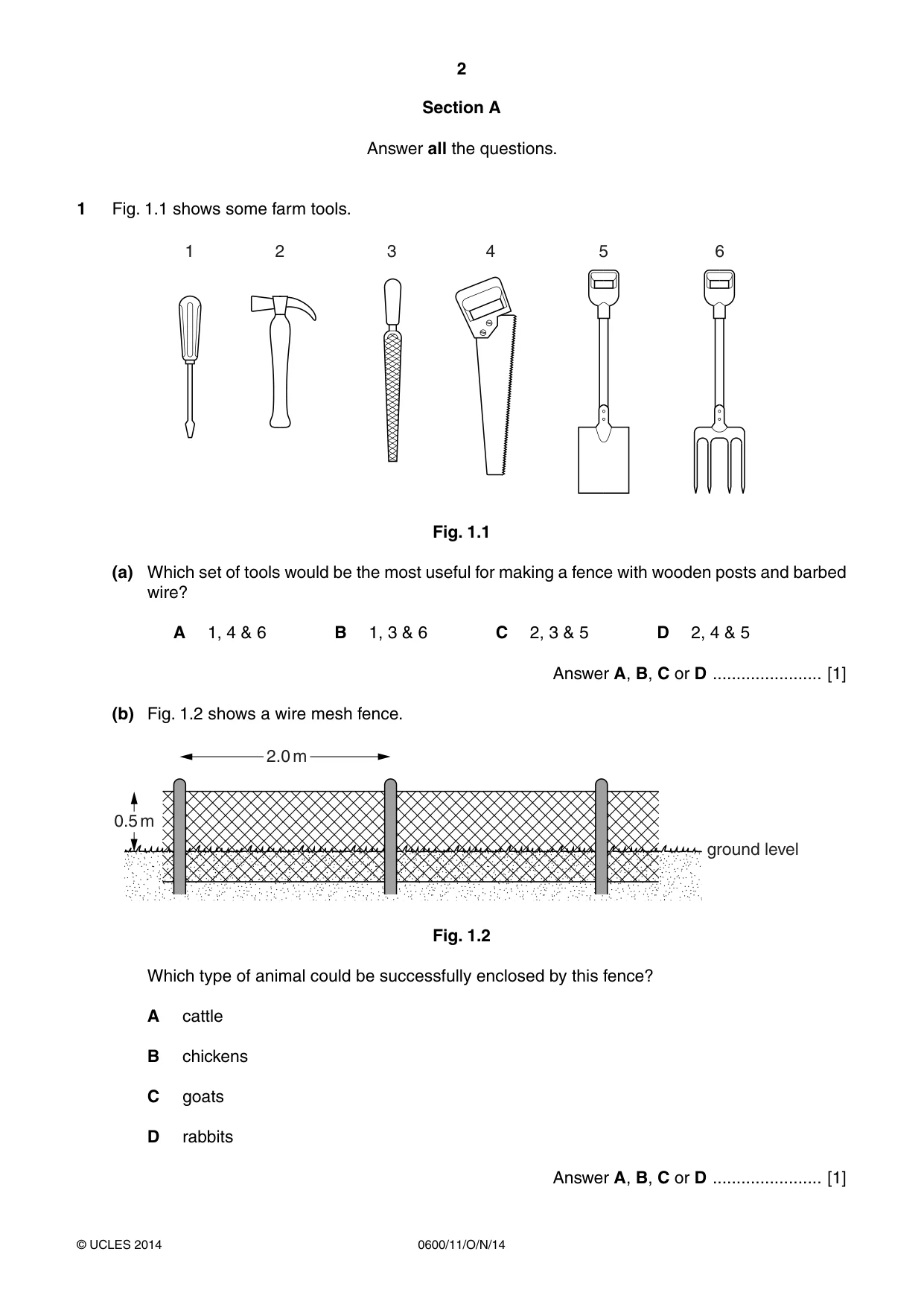
3 0600/11/O/N/14 © UCLES 2014 [Turn over (c) Fig. 1.3 shows a post and wire fence with a space for a gate. 1.5 m Fig. 1.3 Draw in the space on Fig. 1.3 a gate suitable for containing large livestock. The drawing should show • the construction of the gate, • how the gate is hung (attached to the post), • how the gate is held shut. [4] [Total: 6]
Question paper, page 4
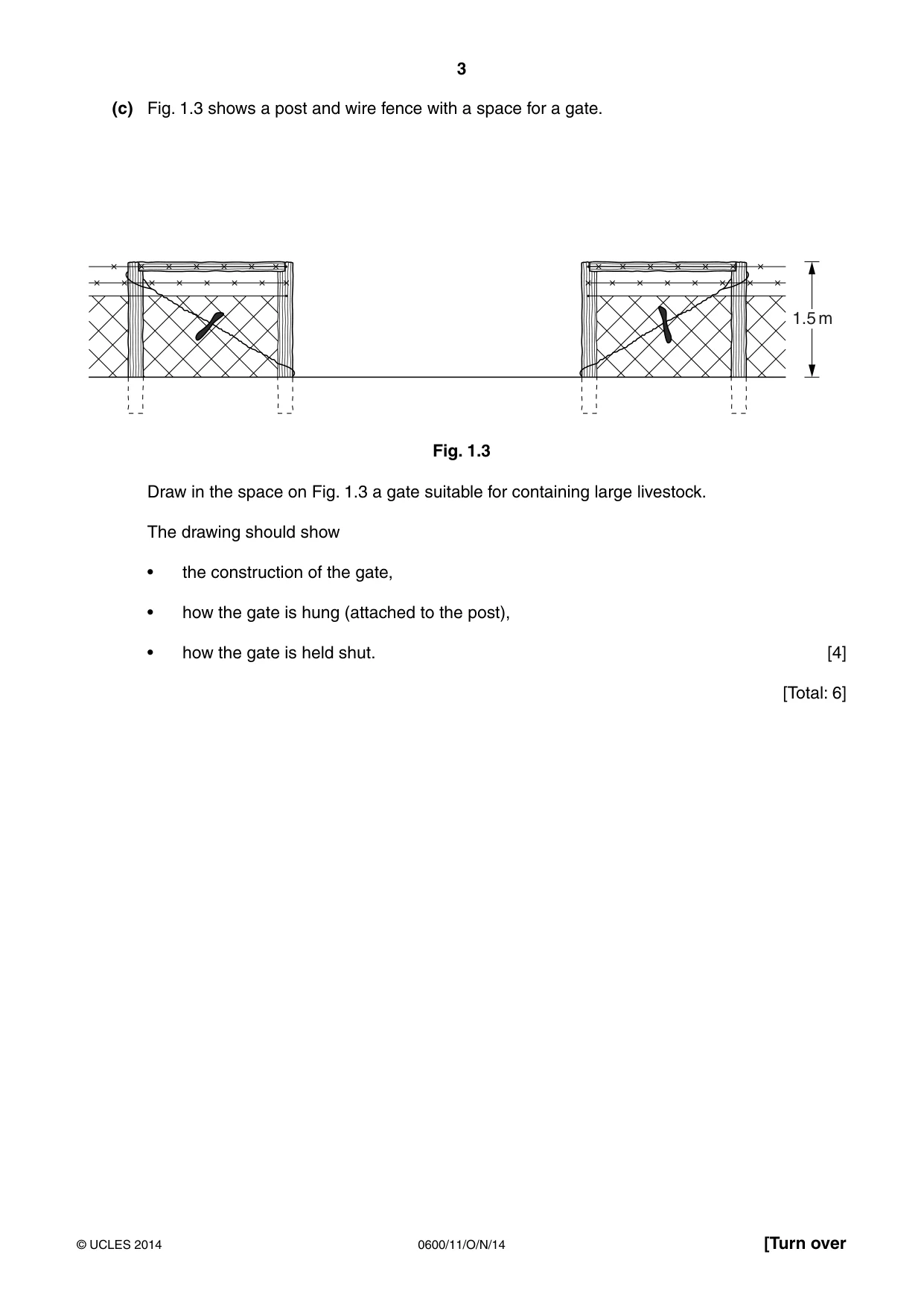
4 0600/11/O/N/14 © UCLES 2014 2 Fig. 2.1 shows Red River Farm in 2000 and 2012. The farming enterprises that are carried out on the farm are aquaculture and goat keeping. Red River Farm 2000 Red river Orange river Red River Farm 2012 township paddocks for grazing goats wood marsh wood marsh X Y flow flow flow flow homestead homestead grazing goats paddocks for township Red river Orange river Fig. 2.1 (a) Aquaculture (fish farming) is carried out in a series of ponds on the marsh. (i) Suggest why the marsh area is suitable for the ponds. … …[1] (ii) Name a fish that can be farmed. … [1] (iii) State two features of fish that make them suitable for farming. 1 … … 2 … …[2]
Question paper, page 5
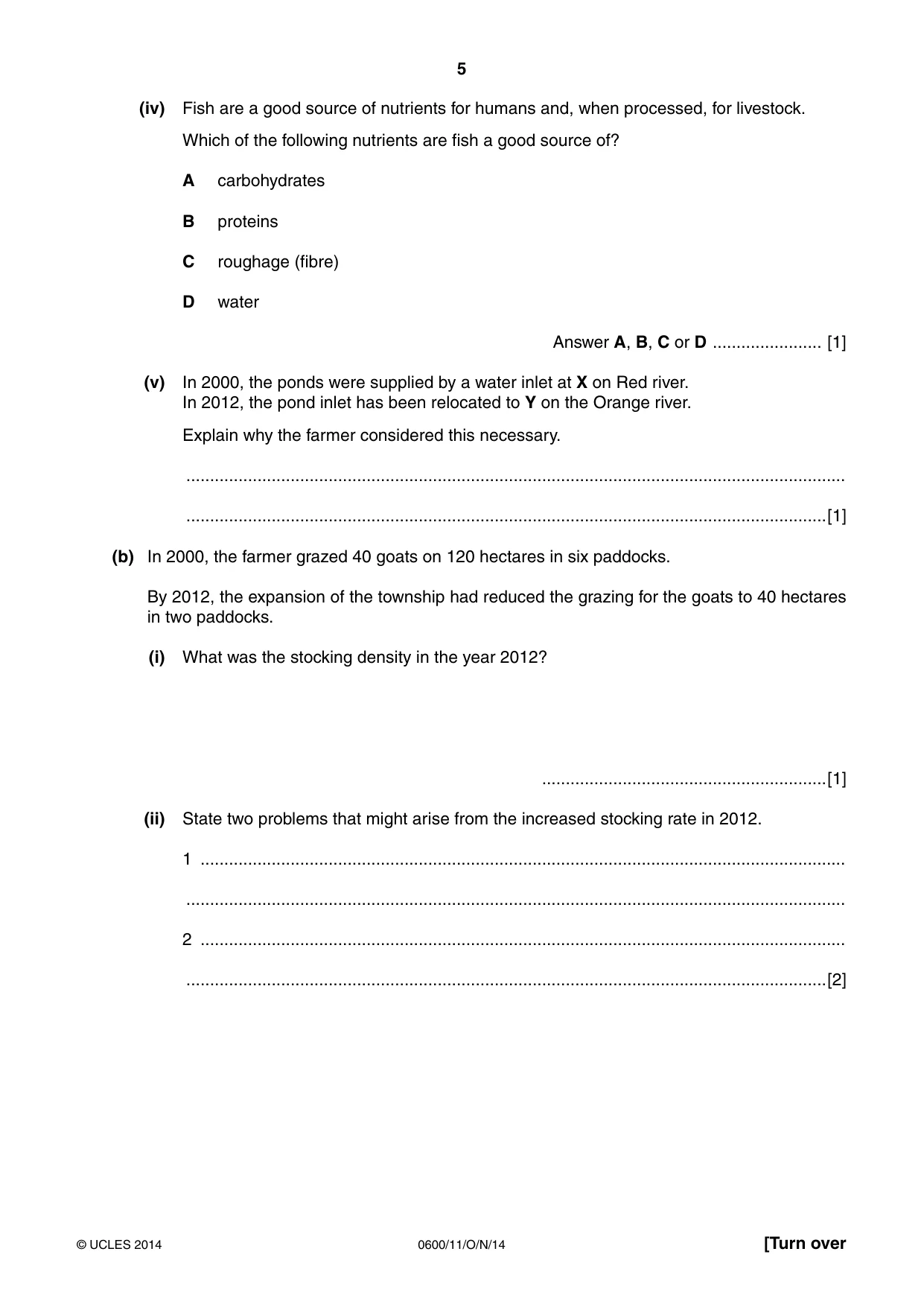
5 0600/11/O/N/14 © UCLES 2014 [Turn over (iv) Fish are a good source of nutrients for humans and, when processed, for livestock. Which of the following nutrients are fish a good source of? A carbohydrates B proteins C roughage (fibre) D water Answer A, B, C or D … [1] (v) In 2000, the ponds were supplied by a water inlet at X on Red river. In 2012, the pond inlet has been relocated to Y on the Orange river. Explain why the farmer considered this necessary. … …[1] (b) In 2000, the farmer grazed 40 goats on 120 hectares in six paddocks. By 2012, the expansion of the township had reduced the grazing for the goats to 40 hectares in two paddocks. (i) What was the stocking density in the year 2012? …[1] (ii) State two problems that might arise from the increased stocking rate in 2012. 1 … … 2 … …[2]
Question paper, page 6
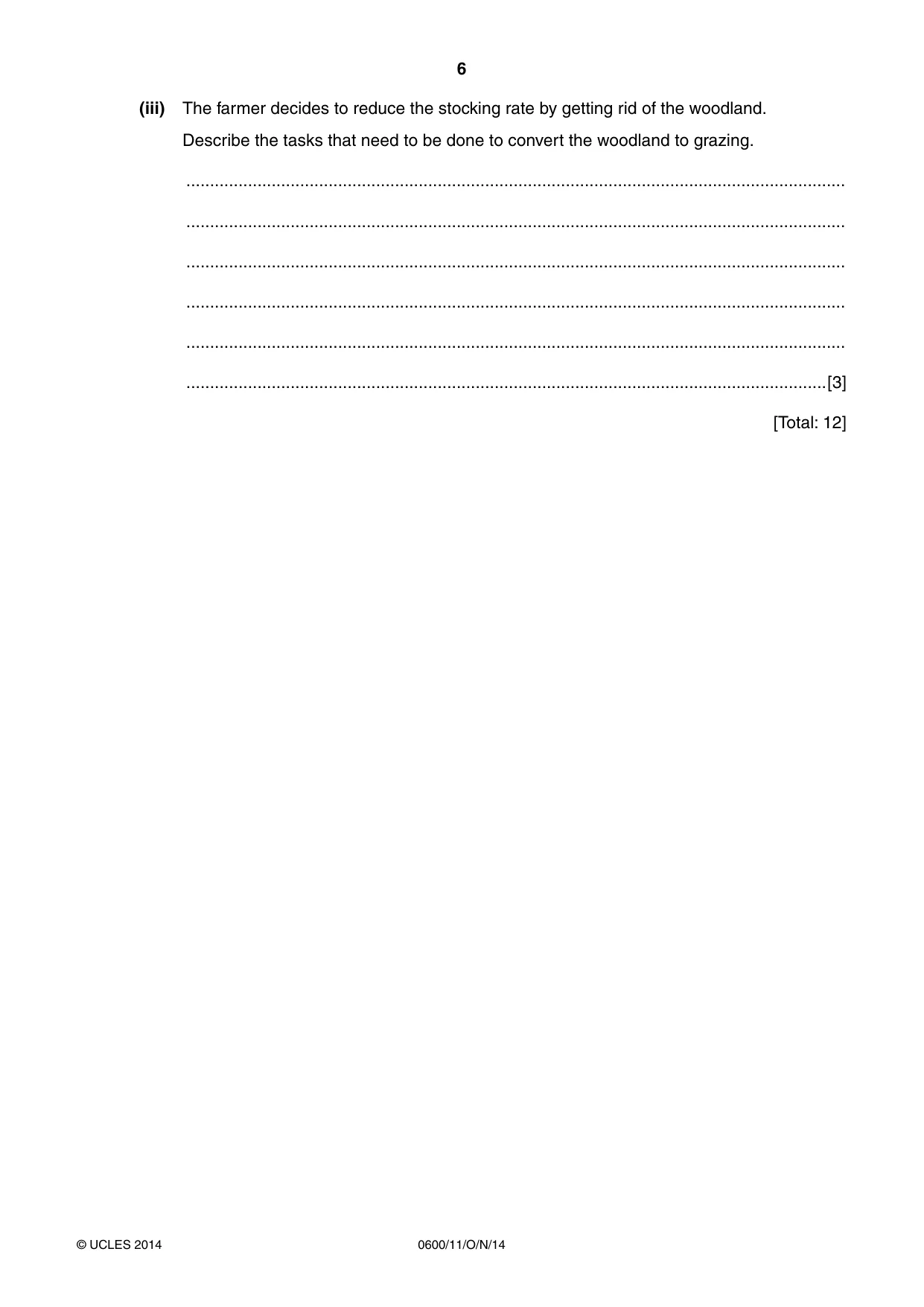
6 0600/11/O/N/14 © UCLES 2014 (iii) The farmer decides to reduce the stocking rate by getting rid of the woodland. Describe the tasks that need to be done to convert the woodland to grazing. … … … … … …[3] [Total: 12]
Question paper, page 7
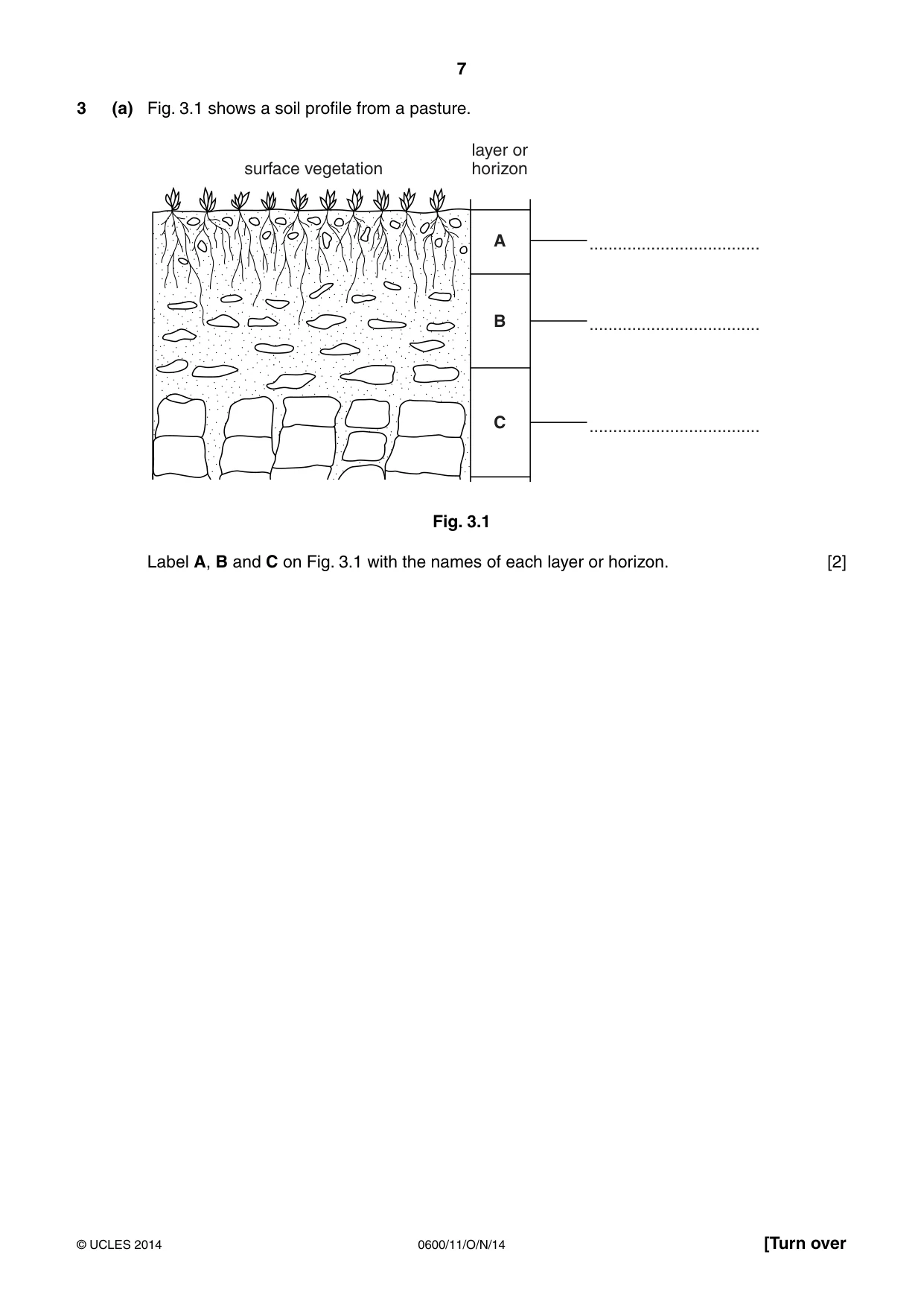
7 0600/11/O/N/14 © UCLES 2014 [Turn over 3 (a) Fig. 3.1 shows a soil profile from a pasture. A layer or horizon … … … surface vegetation B C Fig. 3.1 Label A, B and C on Fig. 3.1 with the names of each layer or horizon. [2]
Question paper, page 8
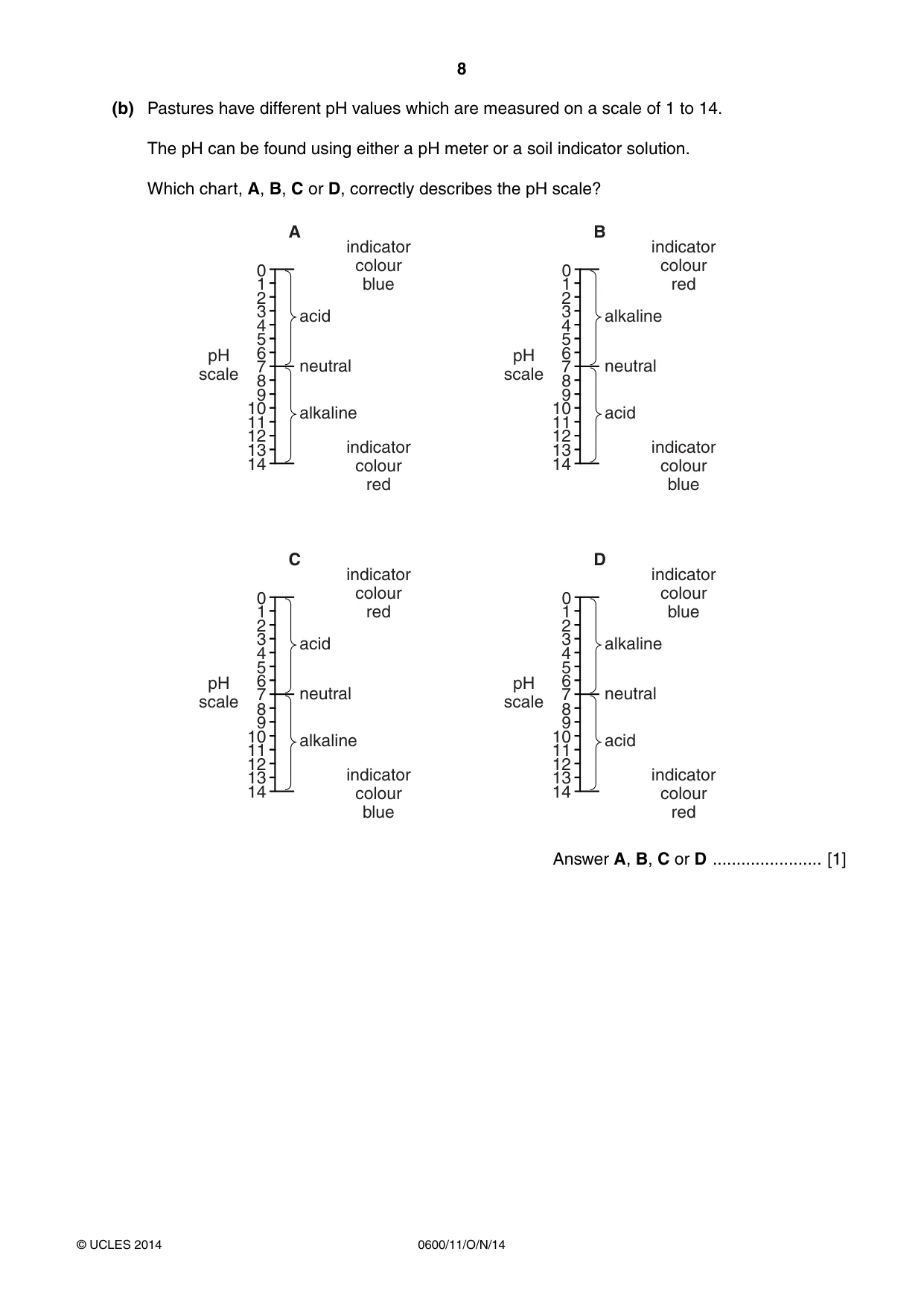
8 0600/11/O/N/14 © UCLES 2014 (b) Pastures have different pH values which are measured on a scale of 1 to 14. The pH can be found using either a pH meter or a soil indicator solution. Which chart, A, B, C or D, correctly describes the pH scale? 0 pH scale indicator colour blue indicator colour red acid A neutral alkaline 1 2 3 4 5 6 7 8 9 10 11 12 13 14 0 pH scale indicator colour red indicator colour blue alkaline B neutral acid 1 2 3 4 5 6 7 8 9 10 11 12 13 14 0 pH scale indicator colour red indicator colour blue acid C neutral alkaline 1 2 3 4 5 6 7 8 9 10 11 12 13 14 0 pH scale indicator colour blue indicator colour red alkaline D neutral acid 1 2 3 4 5 6 7 8 9 10 11 12 13 14 Answer A, B, C or D … [1]
Question paper, page 9
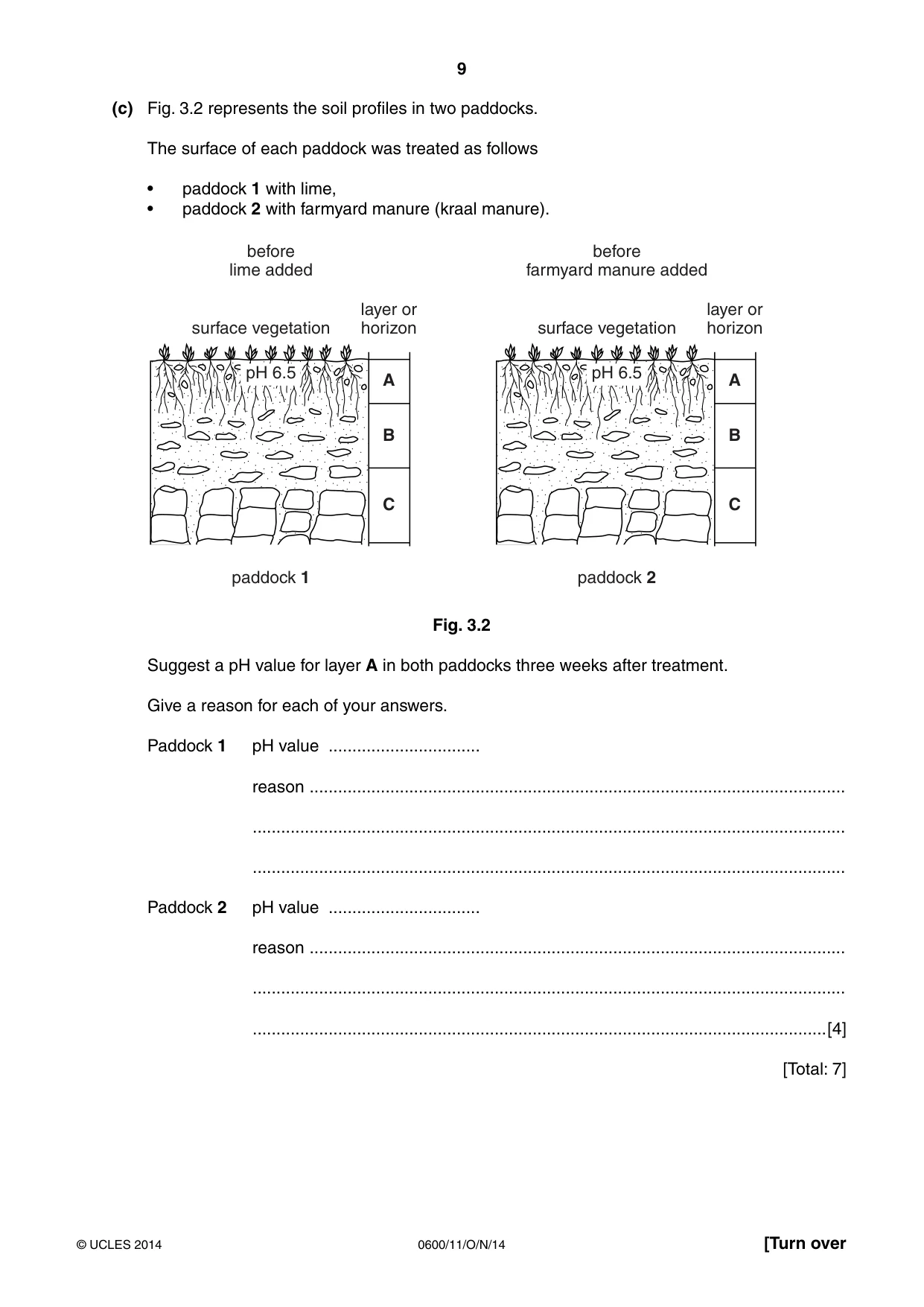
9 0600/11/O/N/14 © UCLES 2014 [Turn over (c) Fig. 3.2 represents the soil profiles in two paddocks. The surface of each paddock was treated as follows • paddock 1 with lime, • paddock 2 with farmyard manure (kraal manure). A layer or horizon surface vegetation paddock 1 B C pH 6.5 A layer or horizon surface vegetation paddock 2 B C pH 6.5 before lime added before farmyard manure added Fig. 3.2 Suggest a pH value for layer A in both paddocks three weeks after treatment. Give a reason for each of your answers. Paddock 1 pH value … reason … … … Paddock 2 pH value … reason … … …[4] [Total: 7]
Question paper, page 10
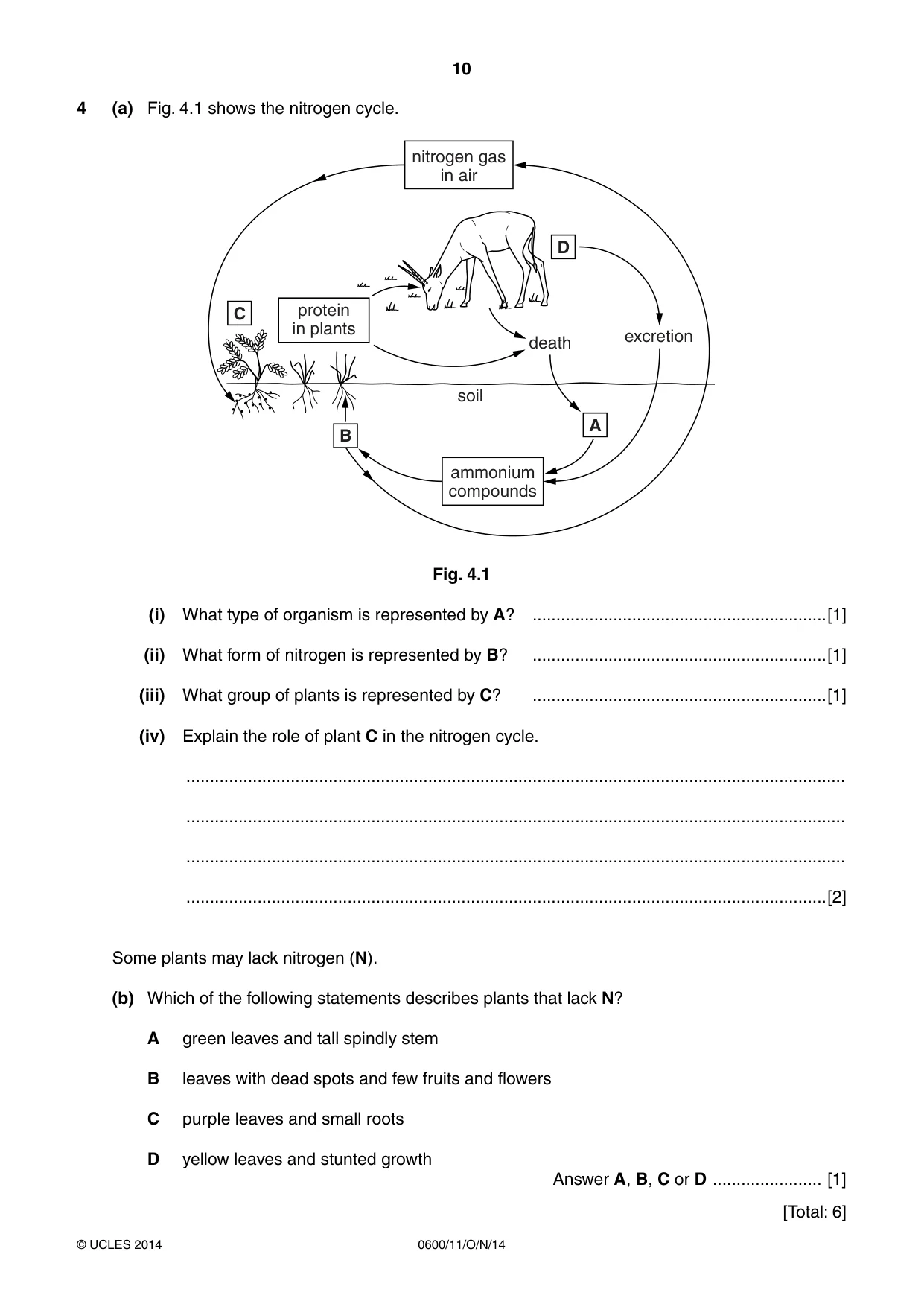
10 0600/11/O/N/14 © UCLES 2014 4 (a) Fig. 4.1 shows the nitrogen cycle. nitrogen gas in air ammonium compounds soil death excretion protein in plants B C A D Fig. 4.1 (i) What type of organism is represented by A? …[1] (ii) What form of nitrogen is represented by B? …[1] (iii) What group of plants is represented by C? …[1] (iv) Explain the role of plant C in the nitrogen cycle. … … … …[2] Some plants may lack nitrogen (N). (b) Which of the following statements describes plants that lack N? A green leaves and tall spindly stem B leaves with dead spots and few fruits and flowers C purple leaves and small roots D yellow leaves and stunted growth Answer A, B, C or D … [1] [Total: 6]
Question paper, page 11
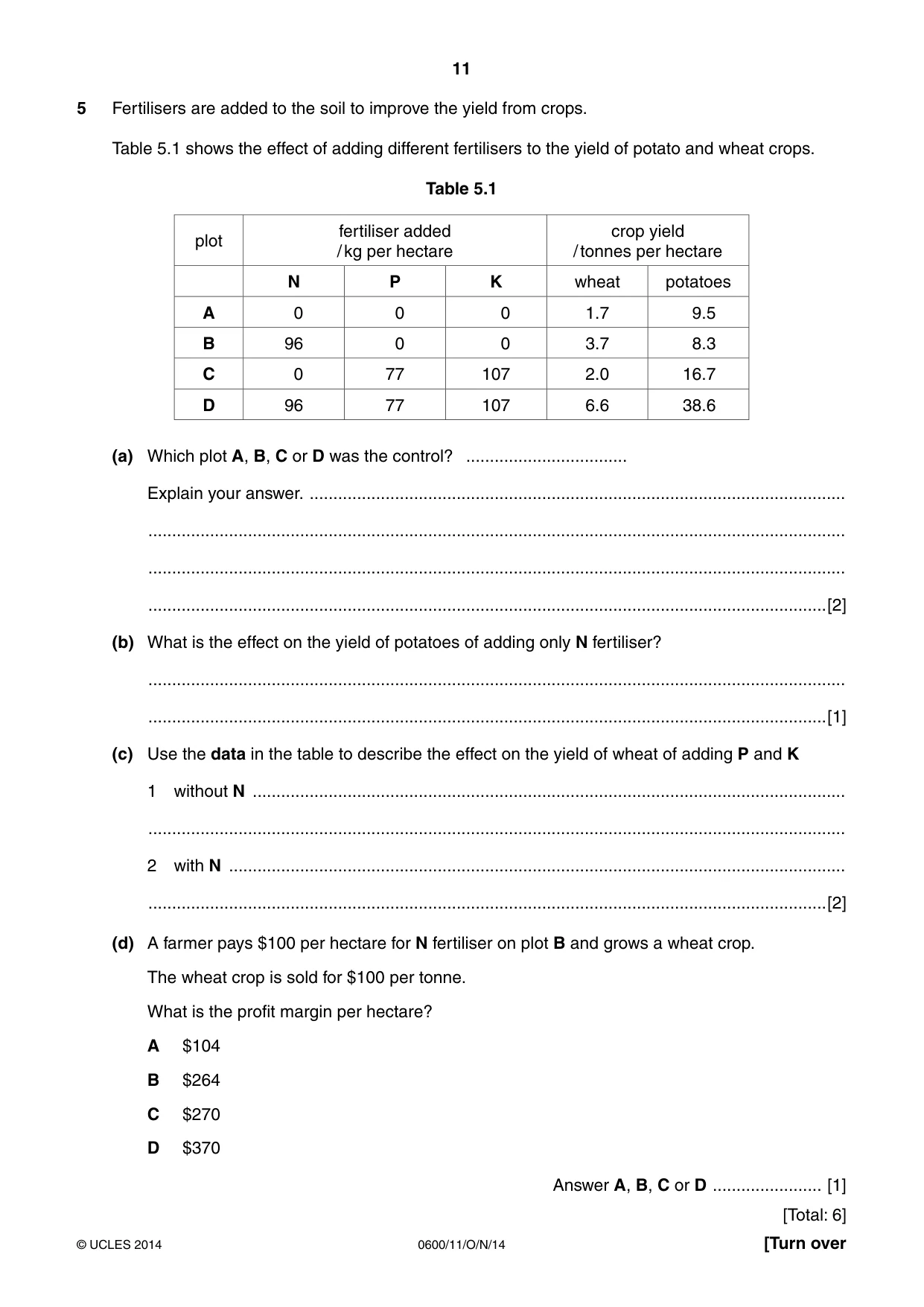
11 0600/11/O/N/14 © UCLES 2014 [Turn over 5 Fertilisers are added to the soil to improve the yield from crops. Table 5.1 shows the effect of adding different fertilisers to the yield of potato and wheat crops. Table 5.1 plot fertiliser added / kg per hectare crop yield / tonnes per hectare N P K wheat potatoes A 0 0 0 1.7 9.5 B 96 0 0 3.7 8.3 C 0 77 107 2.0 16.7 D 96 77 107 6.6 38.6 (a) Which plot A, B, C or D was the control? … Explain your answer. … … … …[2] (b) What is the effect on the yield of potatoes of adding only N fertiliser? … …[1] (c) Use the data in the table to describe the effect on the yield of wheat of adding P and K 1 without N … … 2 with N … …[2] (d) A farmer pays $100 per hectare for N fertiliser on plot B and grows a wheat crop. The wheat crop is sold for $100 per tonne. What is the profit margin per hectare? A $104 B $264 C $270 D $370 Answer A, B, C or D … [1] [Total: 6]
Question paper, page 12
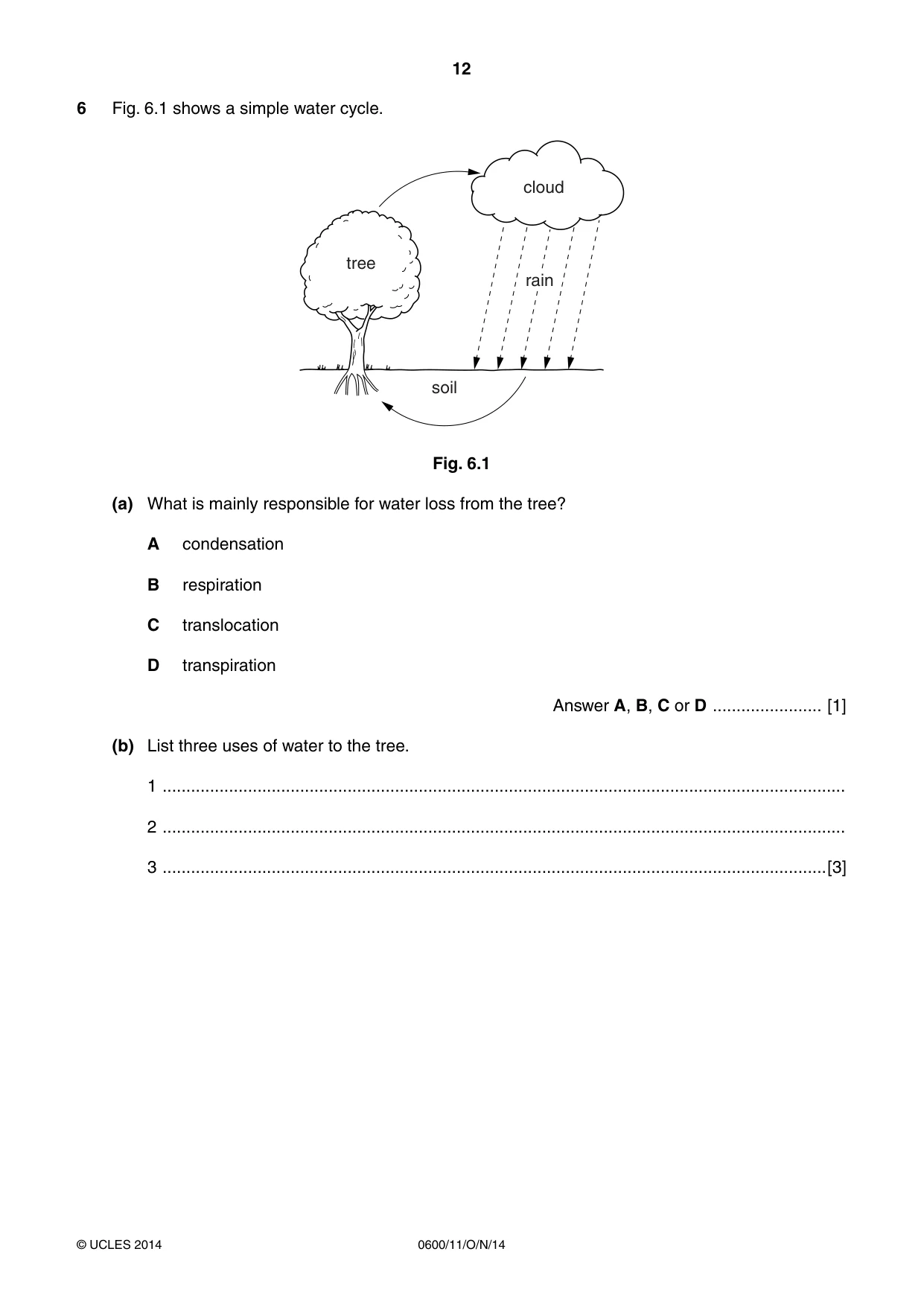
12 0600/11/O/N/14 © UCLES 2014 6 Fig. 6.1 shows a simple water cycle. tree cloud soil rain Fig. 6.1 (a) What is mainly responsible for water loss from the tree? A condensation B respiration C translocation D transpiration Answer A, B, C or D … [1] (b) List three uses of water to the tree. 1 … 2 … 3 …[3]
Question paper, page 13
13 0600/11/O/N/14 © UCLES 2014 [Turn over (c) Crops such as maize require water. However, very heavy and prolonged rain can have harmful effects. Suggest how very heavy and prolonged rain could cause poor germination, … … poor pollination, … … difficulty in harvesting. … …[3] (d) Climatic catastrophes such as tsunami destroy crops and erode soil in their immediate path. For several years after a tsunami the soil that was flooded by the sea does not grow good crops. Suggest and explain why this is so. … … … …[2] [Total: 9]
Question paper, page 14
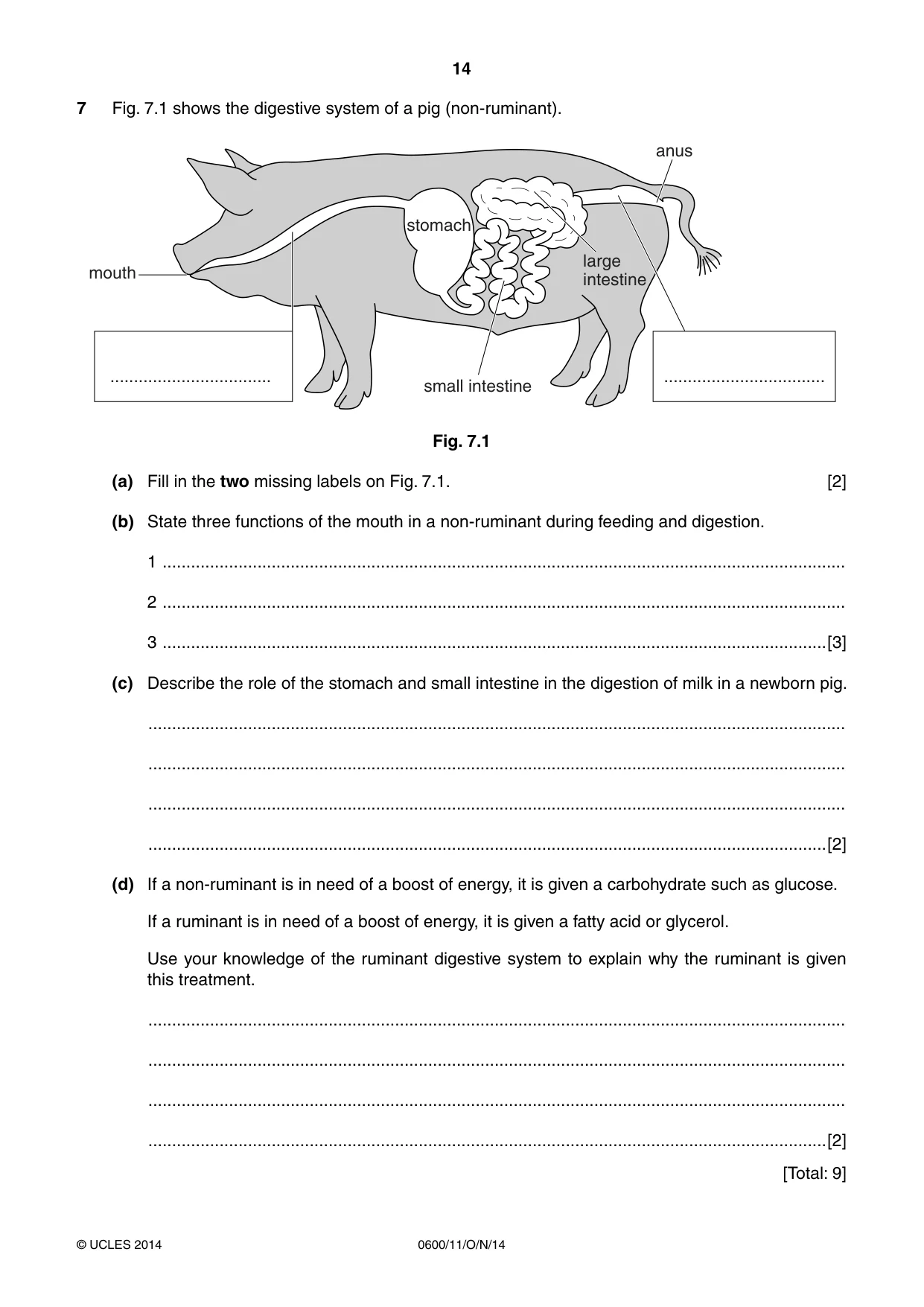
14 0600/11/O/N/14 © UCLES 2014 7 Fig. 7.1 shows the digestive system of a pig (non-ruminant). stomach small intestine large intestine anus mouth … … Fig. 7.1 (a) Fill in the two missing labels on Fig. 7.1. [2] (b) State three functions of the mouth in a non-ruminant during feeding and digestion. 1 … 2 … 3 …[3] (c) Describe the role of the stomach and small intestine in the digestion of milk in a newborn pig. … … … …[2] (d) If a non-ruminant is in need of a boost of energy, it is given a carbohydrate such as glucose. If a ruminant is in need of a boost of energy, it is given a fatty acid or glycerol. Use your knowledge of the ruminant digestive system to explain why the ruminant is given this treatment. … … … …[2] [Total: 9]
Question paper, page 15
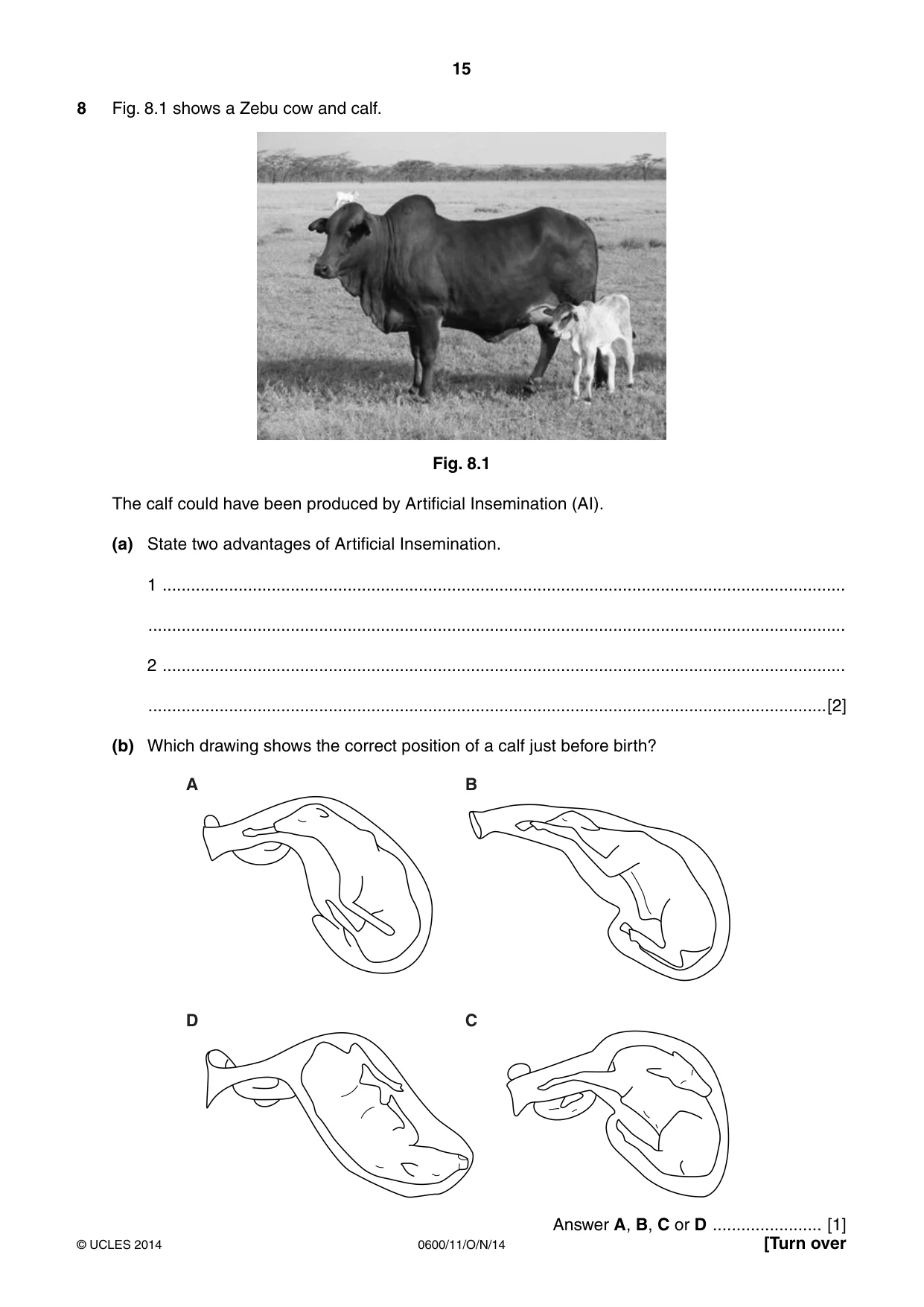
15 0600/11/O/N/14 © UCLES 2014 [Turn over 8 Fig. 8.1 shows a Zebu cow and calf. Fig. 8.1 The calf could have been produced by Artificial Insemination (AI). (a) State two advantages of Artificial Insemination. 1 … … 2 … …[2] (b) Which drawing shows the correct position of a calf just before birth? A B D C Answer A, B, C or D … [1]
Question paper, page 16
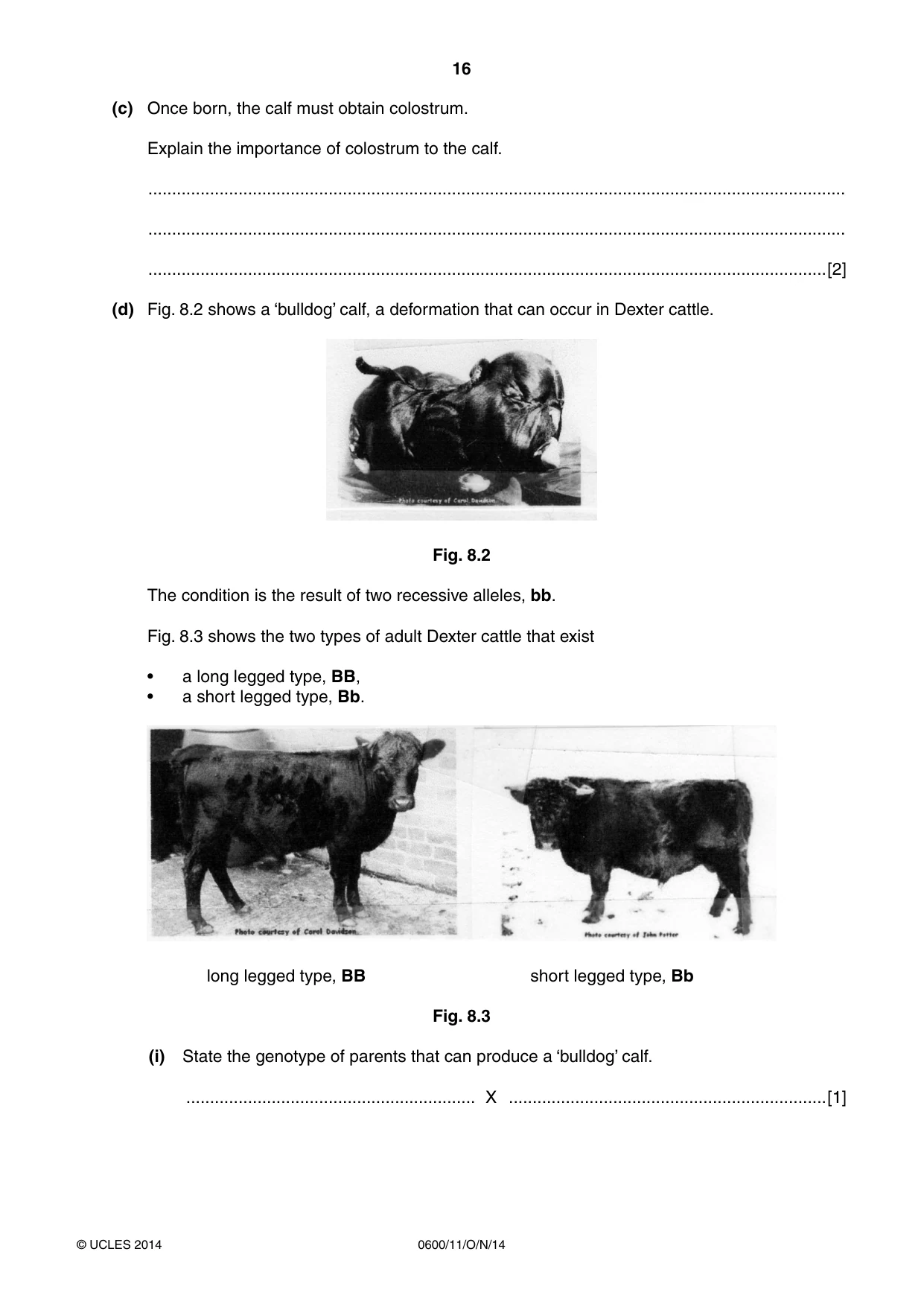
16 0600/11/O/N/14 © UCLES 2014 (c) Once born, the calf must obtain colostrum. Explain the importance of colostrum to the calf. … … …[2] (d) Fig. 8.2 shows a ‘bulldog’ calf, a deformation that can occur in Dexter cattle. Fig. 8.2 The condition is the result of two recessive alleles, bb. Fig. 8.3 shows the two types of adult Dexter cattle that exist • a long legged type, BB, • a short legged type, Bb. long legged type, BB short legged type, Bb Fig. 8.3 (i) State the genotype of parents that can produce a ‘bulldog’ calf. … X …[1]
Question paper, page 17
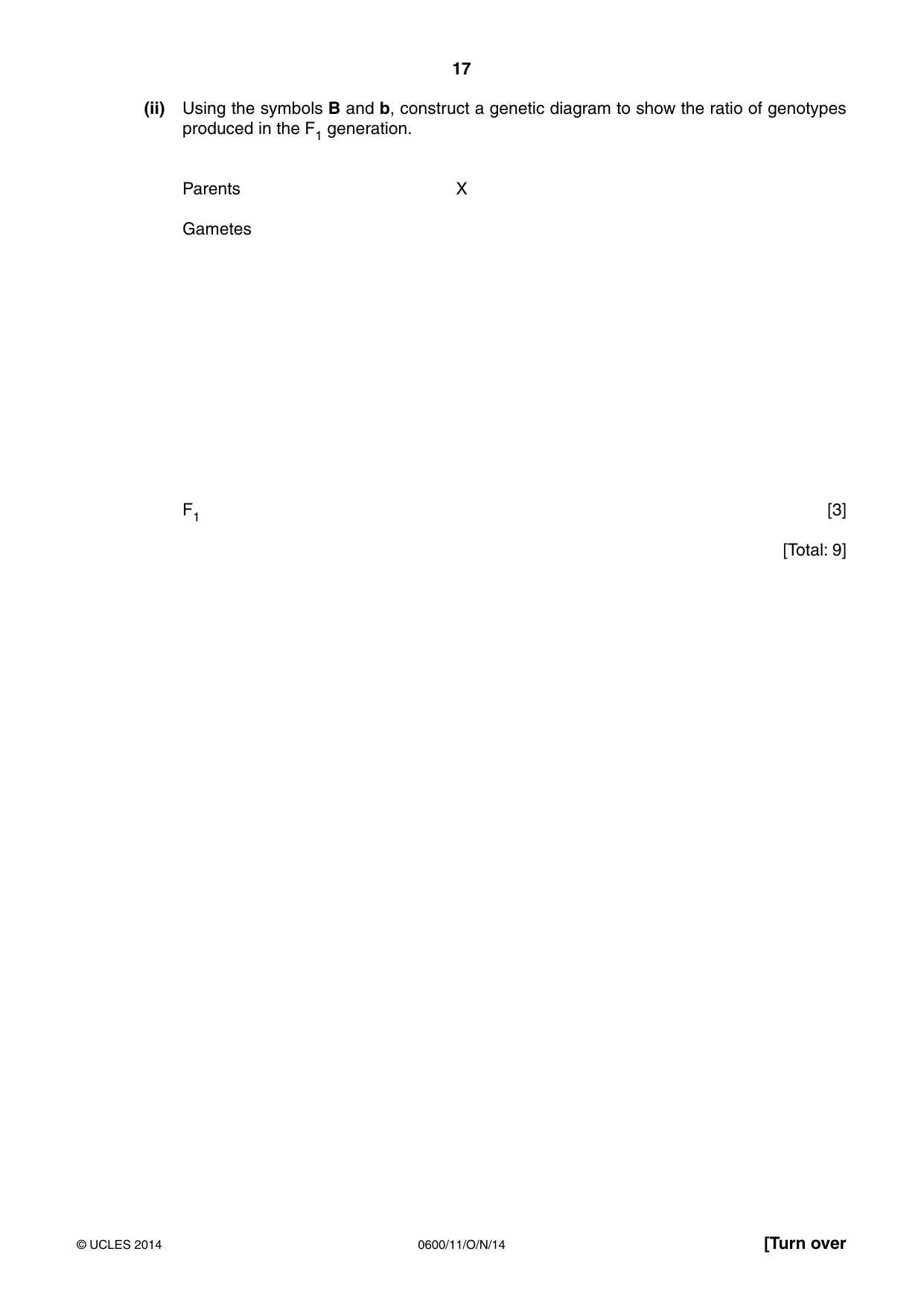
17 0600/11/O/N/14 © UCLES 2014 [Turn over (ii) Using the symbols B and b, construct a genetic diagram to show the ratio of genotypes produced in the F1 generation. Parents X Gametes F1 [3] [Total: 9]
Question paper, page 18
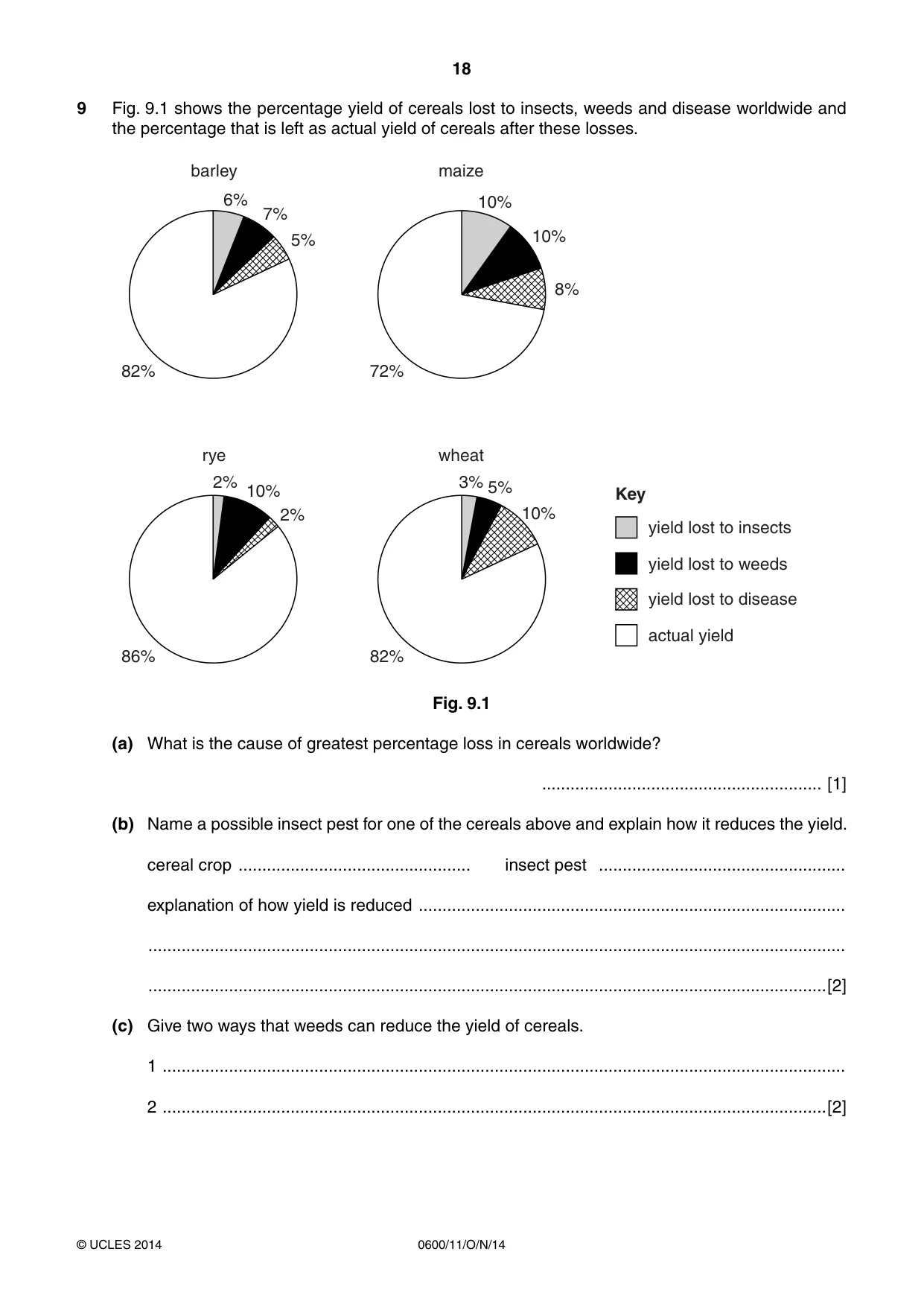
18 0600/11/O/N/14 © UCLES 2014 9 Fig. 9.1 shows the percentage yield of cereals lost to insects, weeds and disease worldwide and the percentage that is left as actual yield of cereals after these losses. yield lost to insects Key barley maize rye wheat 3% 2% 6% 10% 10% 8% 72% 82% 82% 86% 7% 5% 2% 5% 10% 10% yield lost to weeds yield lost to disease actual yield Fig. 9.1 (a) What is the cause of greatest percentage loss in cereals worldwide? … [1] (b) Name a possible insect pest for one of the cereals above and explain how it reduces the yield. cereal crop … insect pest … explanation of how yield is reduced … … …[2] (c) Give two ways that weeds can reduce the yield of cereals. 1 … 2 …[2]
Question paper, page 19
19 0600/11/O/N/14 © UCLES 2014 [Turn over (d) Suggest a reason to explain why wheat and maize lose so much more yield to disease than rye. … …[1] [Total: 6]
Question paper, page 20
20 0600/11/O/N/14 © UCLES 2014 Permission to reproduce items where third-party owned material protected by copyright is included has been sought and cleared where possible. Every reasonable effort has been made by the publisher (UCLES) to trace copyright holders, but if any items requiring clearance have unwittingly been included, the publisher will be pleased to make amends at the earliest possible opportunity. Cambridge International Examinations is part of the Cambridge Assessment Group. Cambridge Assessment is the brand name of University of Cambridge Local Examinations Syndicate (UCLES), which is itself a department of the University of Cambridge. Section B Answer two questions. Write your answers on the separate paper provided. 10 (a) Describe one crop rotation, giving reasons for the order of cropping. [5] (b) Discuss the advantages and disadvantages of shifting cultivation. [5] (c) Explain why some land may never be cultivated. [5] 11 For a named crop, describe (a) the selection of suitable cultivars, [4] (b) treatment of the crop during the growing period, [5] (c) harvesting, storage and uses of the product. [6] 12 (a) Explain what is meant by asexual reproduction. [3] (b) Describe the process of asexual reproduction in the Irish potato. [6] (c) Describe the process of sexual reproduction in bean plants. [6] 13 For a named type of livestock (a) describe the signs of ill health, [5] (b) explain how disease can spread and how it can be prevented. [10] 14 (a) Explain how temperature and wind may affect the growth of crops. [7] (b) Describe methods that can be used to collect water for agricultural use. [4] (c) Describe how water in the soil can be conserved by farmers? [4]
Mark scheme, page 1
® IGCSE is the registered trademark of Cambridge International Examinations. CAMBRIDGE INTERNATIONAL EXAMINATIONS Cambridge International General Certificate of Secondary Education MARK SCHEME for the October/November 2014 series 0600 AGRICULTURE 0600/11 Paper 1, maximum raw mark 100 This mark scheme is published as an aid to teachers and candidates, to indicate the requirements of the examination. It shows the basis on which Examiners were instructed to award marks. It does not indicate the details of the discussions that took place at an Examiners’ meeting before marking began, which would have considered the acceptability of alternative answers. Mark schemes should be read in conjunction with the question paper and the Principal Examiner Report for Teachers. Cambridge will not enter into discussions about these mark schemes. Cambridge is publishing the mark schemes for the October/November 2014 series for most Cambridge IGCSE®, Cambridge International A and AS Level components and some Cambridge O Level components. PAPA CAMBRIDGE
Mark scheme, page 2
Page 2 Mark Scheme Syllabus Paper Cambridge IGCSE – October/November 2014 0600 11 © Cambridge International Examinations 2014 Mark schemes may use these abbreviations: ; = separates marking points / = alternative and acceptable answers for the same marking point ( ) = words which are not essential to gain credit __ = underlined words must be present in answer to score a mark e.c.f. = error carried forward o.r.a. = or reverse argument
Mark scheme, page 3
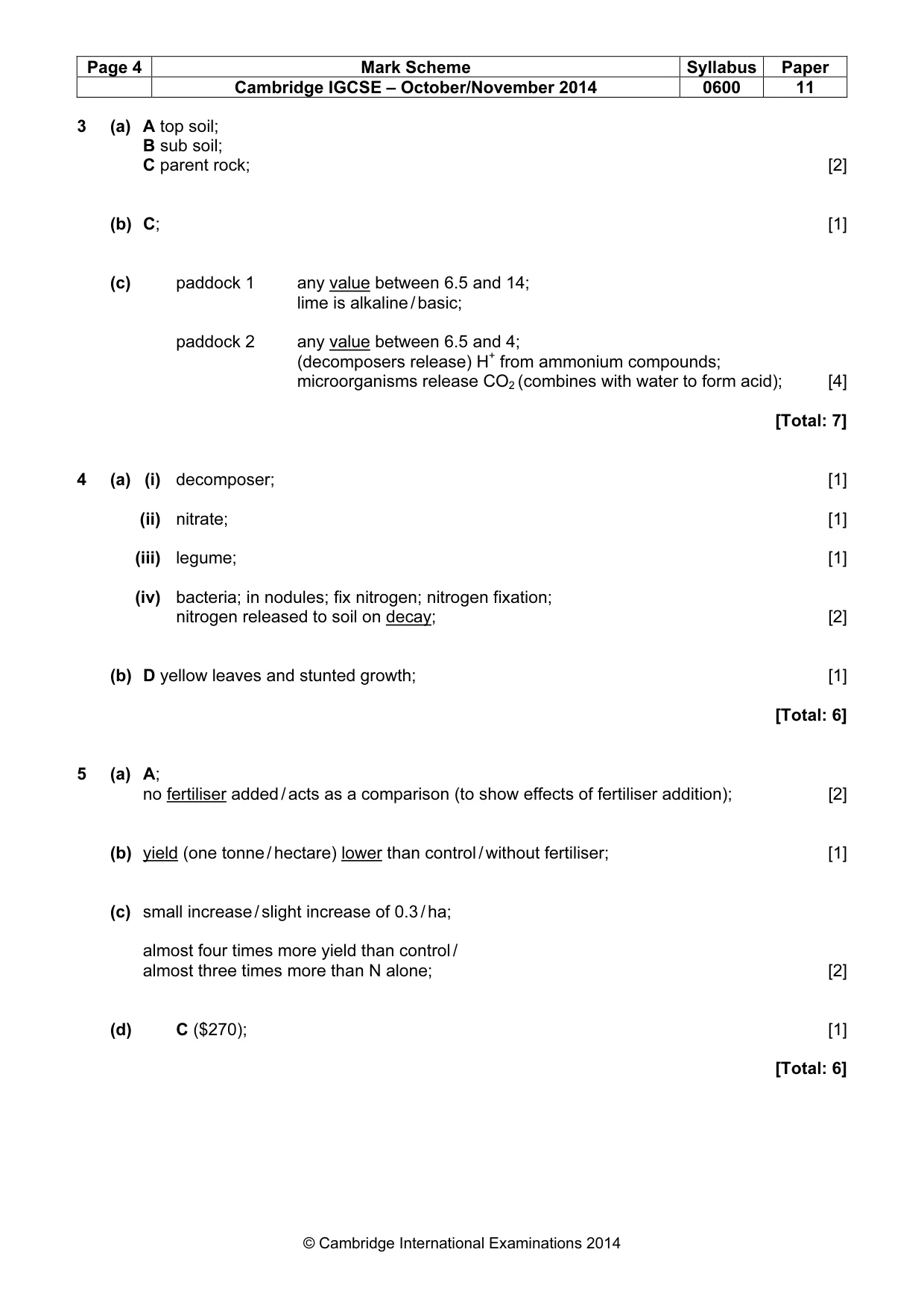
Page 3 Mark Scheme Syllabus Paper Cambridge IGCSE – October/November 2014 0600 11 © Cambridge International Examinations 2014 1 (a) D; [1] (b) D; [1] (c) drawing of valid structure; appropriate hanging – wire loop / gate pintle; (One mark for each.) appropriate fixing – wire loop / bolt; [4] [Total: 6] 2 (a) (i) marsh unlikely to dry up / is wet / supply of water readily available from river; [1] (ii) Tilapia (Cichlids) / catfish (mudfish / Clarias ) / Mullet (Mugil) / tonguefish (Hererotis) / Carp (Cyprinus); [1] (iii) quick growing; little fat; good conversion rate; minimum management / minimum (low) inputs; available all year; converter of waste / sewage; [2] (iv) B proteins; [1] (v) water quality decreases due to township; township uses more water; polluted; [1] (b) (i) one (hectare per goat); [1] (ii) disease; overgrazing; erosion; compaction; poaching, waterlogging; desertification; [2] (iii) cut down / remove trees / fell; stump / burn / fire harrow / clear / goats or pigs in; cultivation with detail / plough / disc / dig / seedbed; improve soil / sow / plant herbage / legumes / example / manure; herbicides; [3] [Total: 12]
Mark scheme, page 4
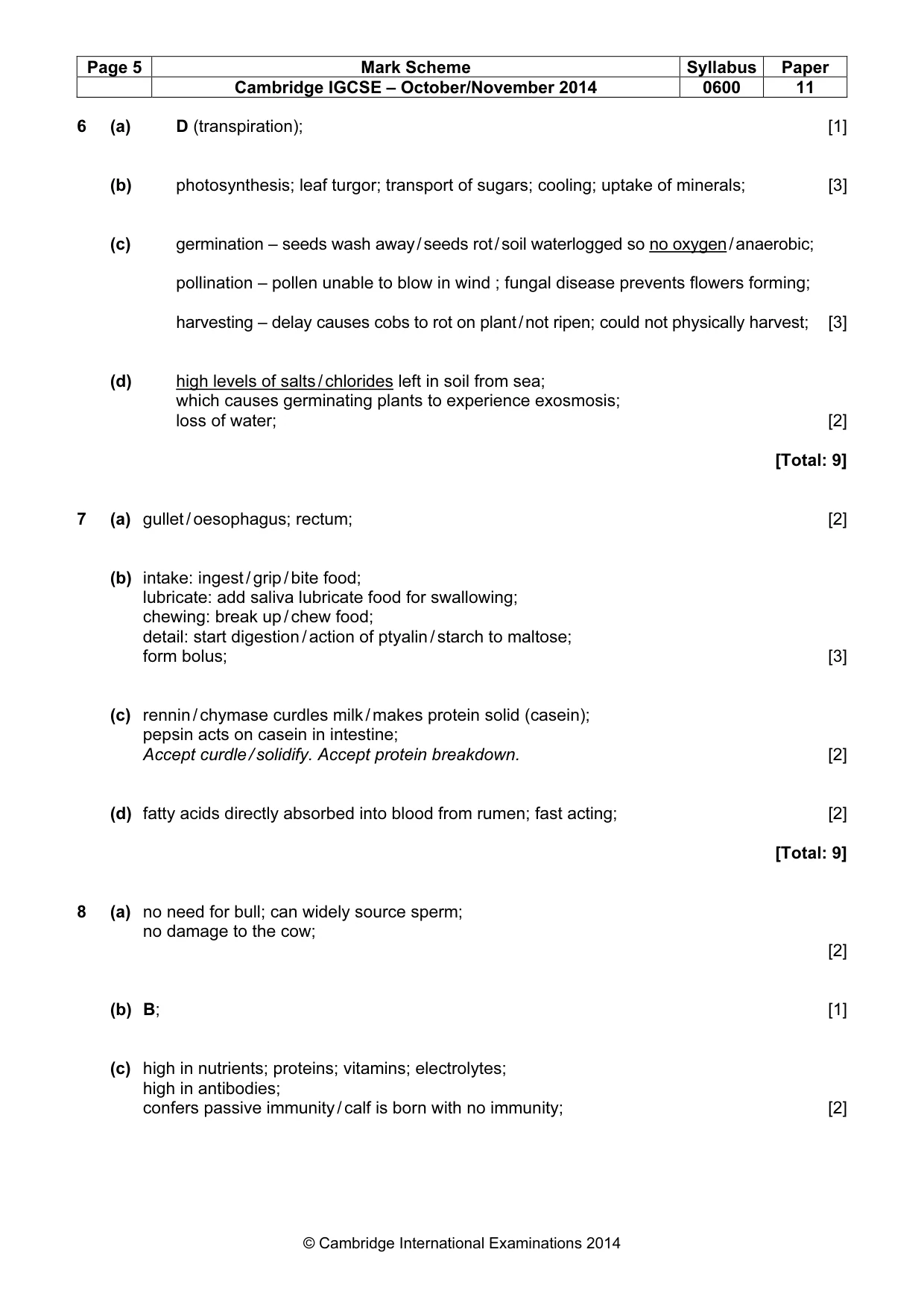
Page 4 Mark Scheme Syllabus Paper Cambridge IGCSE – October/November 2014 0600 11 © Cambridge International Examinations 2014 3 (a) A top soil; B sub soil; C parent rock; [2] (b) C; [1] (c) paddock 1 any value between 6.5 and 14; lime is alkaline / basic; paddock 2 any value between 6.5 and 4; (decomposers release) H+ from ammonium compounds; microorganisms release CO2 (combines with water to form acid); [4] [Total: 7] 4 (a) (i) decomposer; [1] (ii) nitrate; [1] (iii) legume; [1] (iv) bacteria; in nodules; fix nitrogen; nitrogen fixation; nitrogen released to soil on decay; [2] (b) D yellow leaves and stunted growth; [1] [Total: 6] 5 (a) A; no fertiliser added / acts as a comparison (to show effects of fertiliser addition); [2] (b) yield (one tonne / hectare) lower than control / without fertiliser; [1] (c) small increase / slight increase of 0.3 / ha; almost four times more yield than control / almost three times more than N alone; [2] (d) C ($270); [1] [Total: 6]
Mark scheme, page 5
Page 5 Mark Scheme Syllabus Paper Cambridge IGCSE – October/November 2014 0600 11 © Cambridge International Examinations 2014 6 (a) D (transpiration); [1] (b) photosynthesis; leaf turgor; transport of sugars; cooling; uptake of minerals; [3] (c) germination – seeds wash away / seeds rot / soil waterlogged so no oxygen / anaerobic; pollination – pollen unable to blow in wind ; fungal disease prevents flowers forming; harvesting – delay causes cobs to rot on plant / not ripen; could not physically harvest; [3] (d) high levels of salts / chlorides left in soil from sea; which causes germinating plants to experience exosmosis; loss of water; [2] [Total: 9] 7 (a) gullet / oesophagus; rectum; [2] (b) intake: ingest / grip / bite food; lubricate: add saliva lubricate food for swallowing; chewing: break up / chew food; detail: start digestion / action of ptyalin / starch to maltose; form bolus; [3] (c) rennin / chymase curdles milk / makes protein solid (casein); pepsin acts on casein in intestine; Accept curdle / solidify. Accept protein breakdown. [2] (d) fatty acids directly absorbed into blood from rumen; fast acting; [2] [Total: 9] 8 (a) no need for bull; can widely source sperm; no damage to the cow; [2] (b) B; [1] (c) high in nutrients; proteins; vitamins; electrolytes; high in antibodies; confers passive immunity / calf is born with no immunity; [2]
Mark scheme, page 6
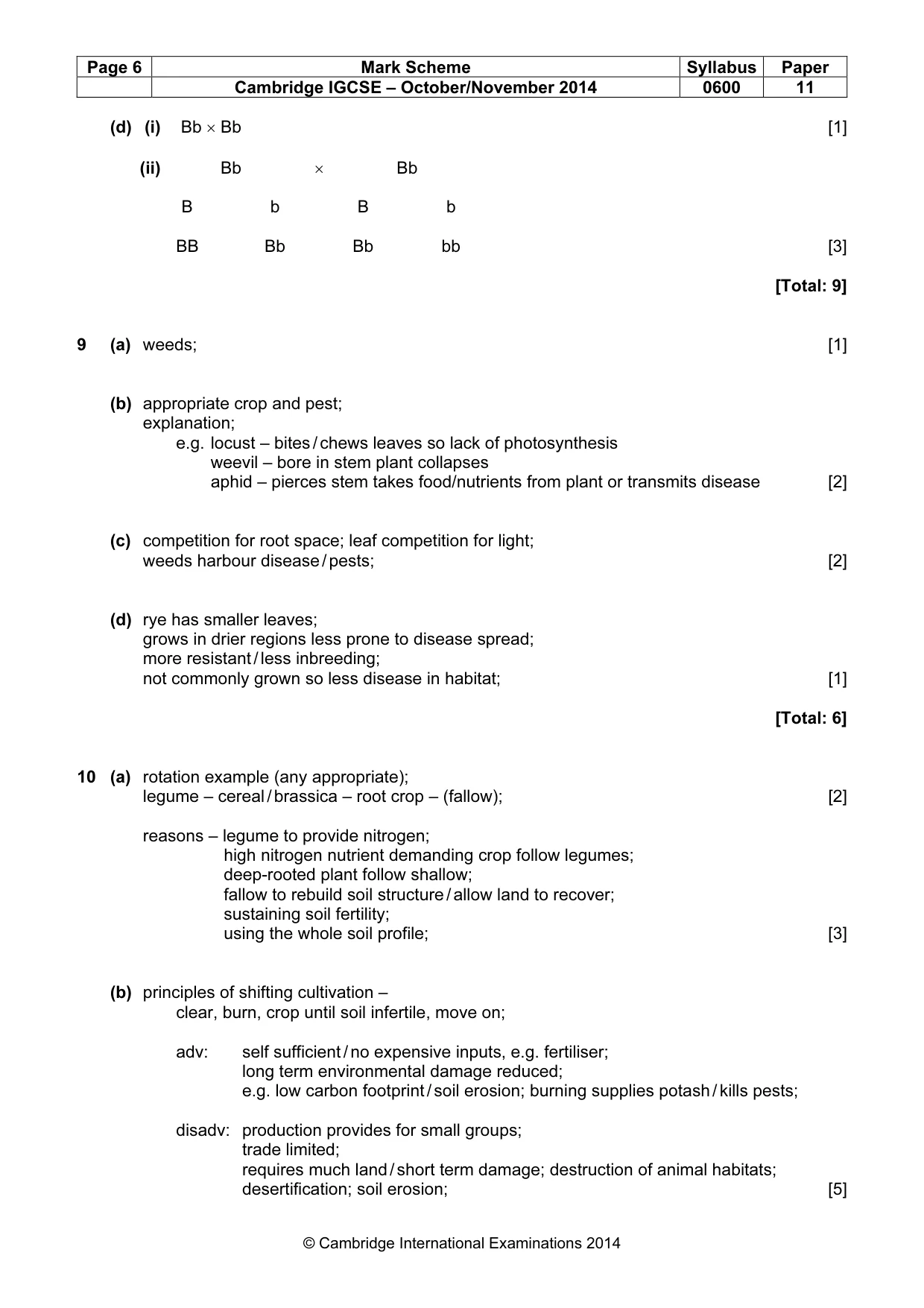
Page 6 Mark Scheme Syllabus Paper Cambridge IGCSE – October/November 2014 0600 11 © Cambridge International Examinations 2014 (d) (i) Bb × Bb [1] (ii) Bb × Bb B b B b BB Bb Bb bb [3] [Total: 9] 9 (a) weeds; [1] (b) appropriate crop and pest; explanation; e.g. locust – bites / chews leaves so lack of photosynthesis weevil – bore in stem plant collapses aphid – pierces stem takes food/nutrients from plant or transmits disease [2] (c) competition for root space; leaf competition for light; weeds harbour disease / pests; [2] (d) rye has smaller leaves; grows in drier regions less prone to disease spread; more resistant / less inbreeding; not commonly grown so less disease in habitat; [1] [Total: 6] 10 (a) rotation example (any appropriate); legume – cereal / brassica – root crop – (fallow); [2] reasons – legume to provide nitrogen; high nitrogen nutrient demanding crop follow legumes; deep-rooted plant follow shallow; fallow to rebuild soil structure / allow land to recover; sustaining soil fertility; using the whole soil profile; [3] (b) principles of shifting cultivation – clear, burn, crop until soil infertile, move on; adv: self sufficient / no expensive inputs, e.g. fertiliser; long term environmental damage reduced; e.g. low carbon footprint / soil erosion; burning supplies potash / kills pests; disadv: production provides for small groups; trade limited; requires much land / short term damage; destruction of animal habitats; desertification; soil erosion; [5]
Mark scheme, page 7
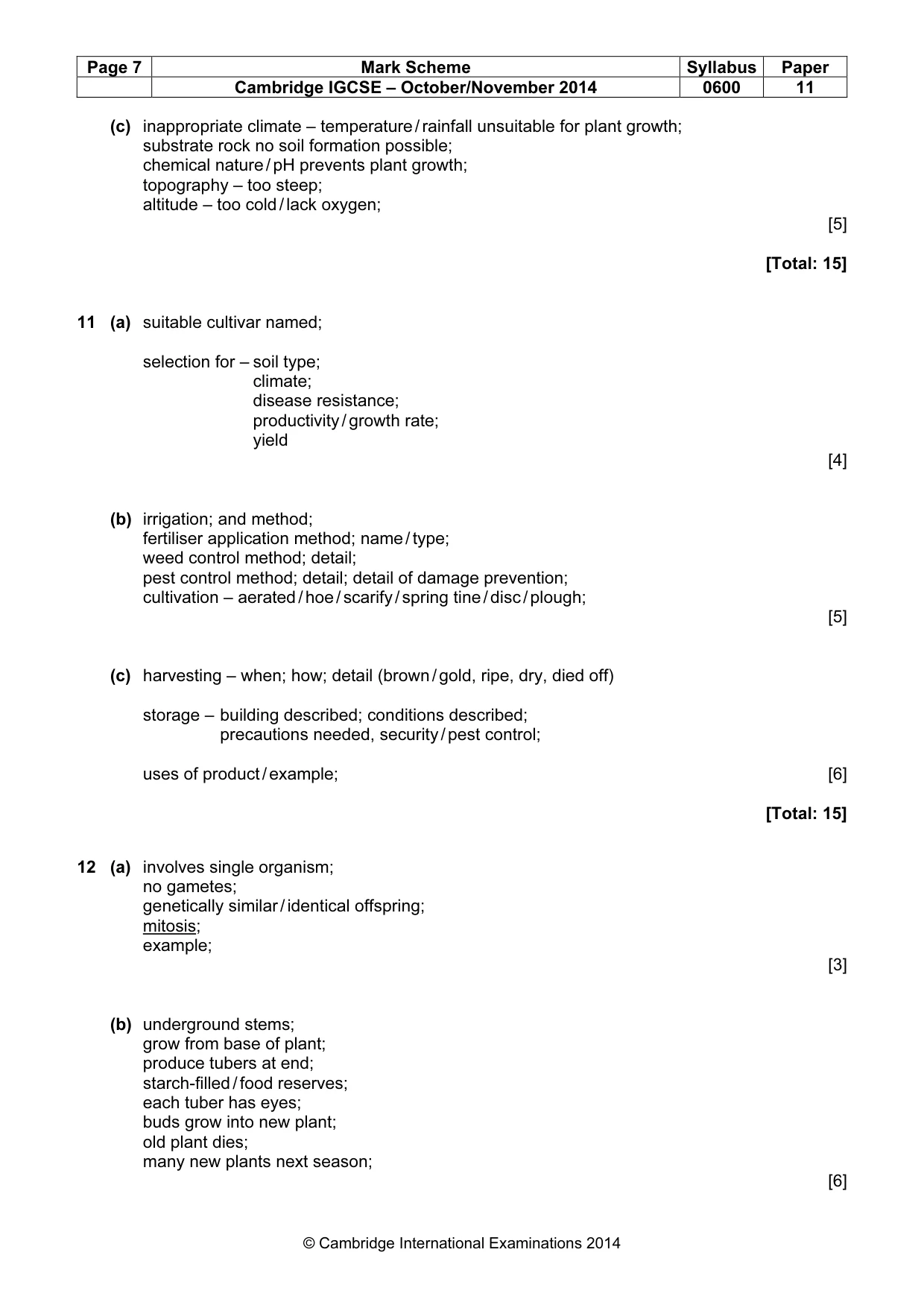
Page 7 Mark Scheme Syllabus Paper Cambridge IGCSE – October/November 2014 0600 11 © Cambridge International Examinations 2014 (c) inappropriate climate – temperature / rainfall unsuitable for plant growth; substrate rock no soil formation possible; chemical nature / pH prevents plant growth; topography – too steep; altitude – too cold / lack oxygen; [5] [Total: 15] 11 (a) suitable cultivar named; selection for – soil type; climate; disease resistance; productivity / growth rate; yield [4] (b) irrigation; and method; fertiliser application method; name / type; weed control method; detail; pest control method; detail; detail of damage prevention; cultivation – aerated / hoe / scarify / spring tine / disc / plough; [5] (c) harvesting – when; how; detail (brown / gold, ripe, dry, died off) storage – building described; conditions described; precautions needed, security / pest control; uses of product / example; [6] [Total: 15] 12 (a) involves single organism; no gametes; genetically similar / identical offspring; mitosis; example; [3] (b) underground stems; grow from base of plant; produce tubers at end; starch-filled / food reserves; each tuber has eyes; buds grow into new plant; old plant dies; many new plants next season; [6]
Mark scheme, page 8
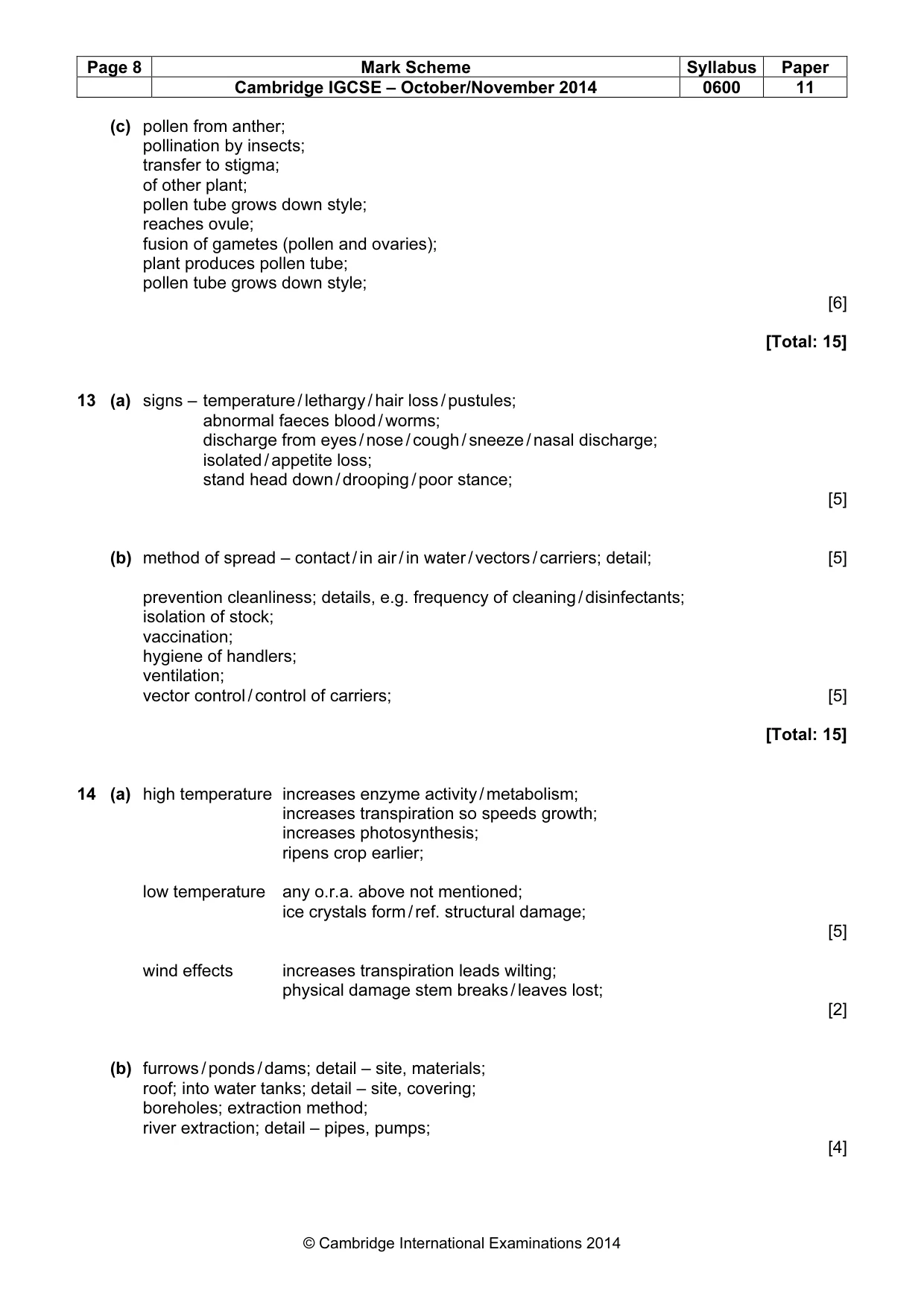
Page 8 Mark Scheme Syllabus Paper Cambridge IGCSE – October/November 2014 0600 11 © Cambridge International Examinations 2014 (c) pollen from anther; pollination by insects; transfer to stigma; of other plant; pollen tube grows down style; reaches ovule; fusion of gametes (pollen and ovaries); plant produces pollen tube; pollen tube grows down style; [6] [Total: 15] 13 (a) signs – temperature / lethargy / hair loss / pustules; abnormal faeces blood / worms; discharge from eyes / nose / cough / sneeze / nasal discharge; isolated / appetite loss; stand head down / drooping / poor stance; [5] (b) method of spread – contact / in air / in water / vectors / carriers; detail; [5] prevention cleanliness; details, e.g. frequency of cleaning / disinfectants; isolation of stock; vaccination; hygiene of handlers; ventilation; vector control / control of carriers; [5] [Total: 15] 14 (a) high temperature increases enzyme activity / metabolism; increases transpiration so speeds growth; increases photosynthesis; ripens crop earlier; low temperature any o.r.a. above not mentioned; ice crystals form / ref. structural damage; [5] wind effects increases transpiration leads wilting; physical damage stem breaks / leaves lost; [2] (b) furrows / ponds / dams; detail – site, materials; roof; into water tanks; detail – site, covering; boreholes; extraction method; river extraction; detail – pipes, pumps; [4]
Mark scheme, page 9
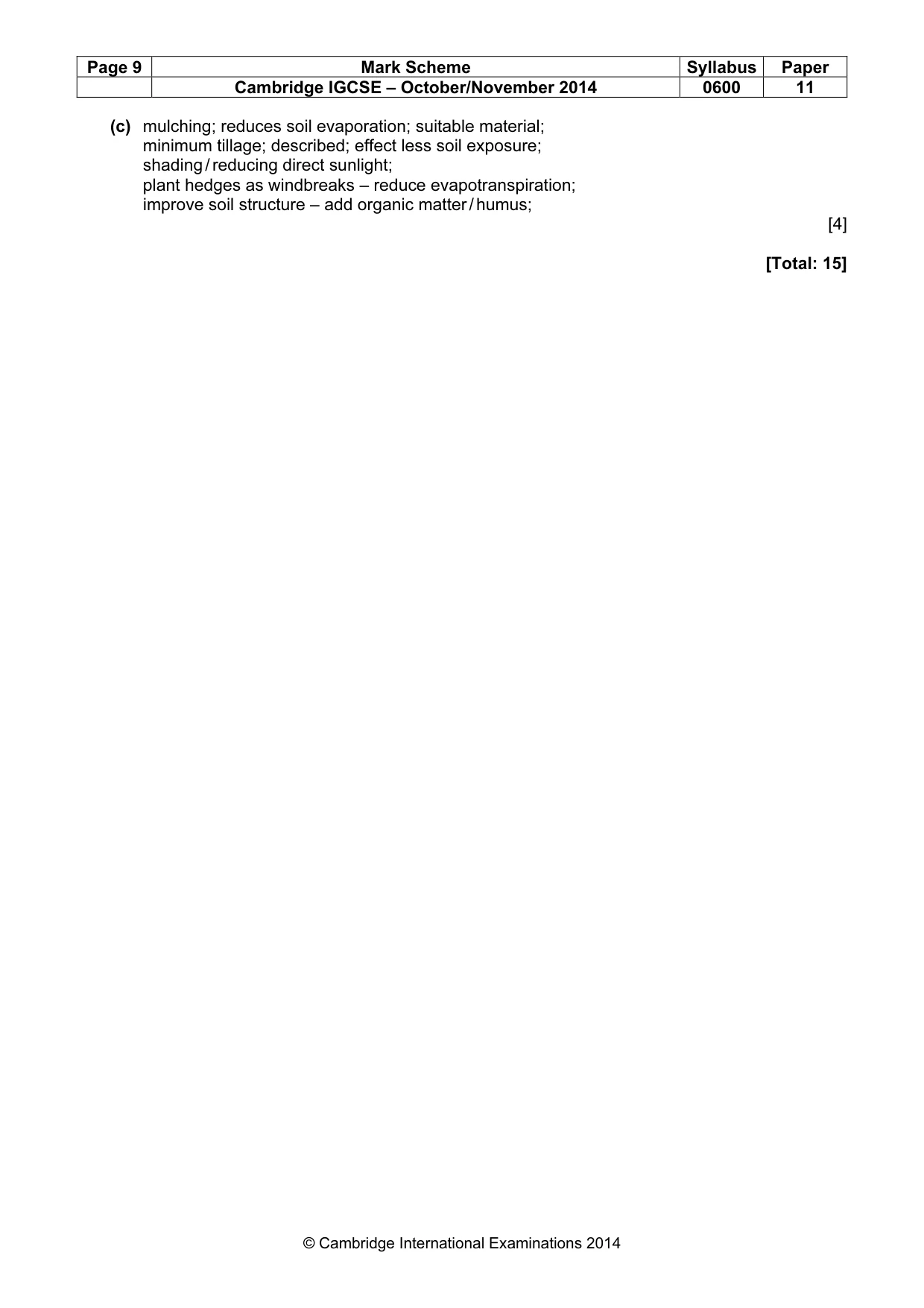
Page 9 Mark Scheme Syllabus Paper Cambridge IGCSE – October/November 2014 0600 11 © Cambridge International Examinations 2014 (c) mulching; reduces soil evaporation; suitable material; minimum tillage; described; effect less soil exposure; shading / reducing direct sunlight; plant hedges as windbreaks – reduce evapotranspiration; improve soil structure – add organic matter / humus; [4] [Total: 15]
What you needed in this session
Cambridge’s own grade thresholds for 2014 Oct/Nov, Paper 1 · Variant 1. A higher threshold means an easier paper — the bar moves with how the cohort did.