Cambridge IGCSE Agriculture 0600 — 2011 Oct/Nov Paper 1 · Variant 1
0600/11/O/N/11 · 40 marks · ≈45 min
The question paper and its mark scheme, free to read here and free to download. This is Cambridge’s own paper, exactly as it was sat.
Question paper16 pages
Mark scheme2 pages
Answers below. Sit the paper first if you are practising.
Paper as text
Question paper, page 1
This document consists of 16 printed pages. IB11 11_0600_01/3RP © UCLES 2011 [Turn over *3944496796* UNIVERSITY OF CAMBRIDGE INTERNATIONAL EXAMINATIONS International General Certificate of Secondary Education AGRICULTURE 0600/01 Paper 1 Multiple Choice October/November 2011 45 minutes Additional Materials: Multiple Choice Answer Sheet Soft clean eraser Soft pencil (type B or HB is recommended) READ THESE INSTRUCTIONS FIRST Write in soft pencil. Do not use staples, paper clips, highlighters, glue or correction fluid. Write your name, Centre number and candidate number on the Answer Sheet in the spaces provided unless this has been done for you. There are forty questions on this paper. Answer all questions. For each question there are four possible answers A, B, C and D. Choose the one you consider correct and record your choice in soft pencil on the separate Answer Sheet. Read the instructions on the Answer Sheet very carefully. Each correct answer will score one mark. A mark will not be deducted for a wrong answer. Any rough working should be done in this booklet.
Question paper, page 2
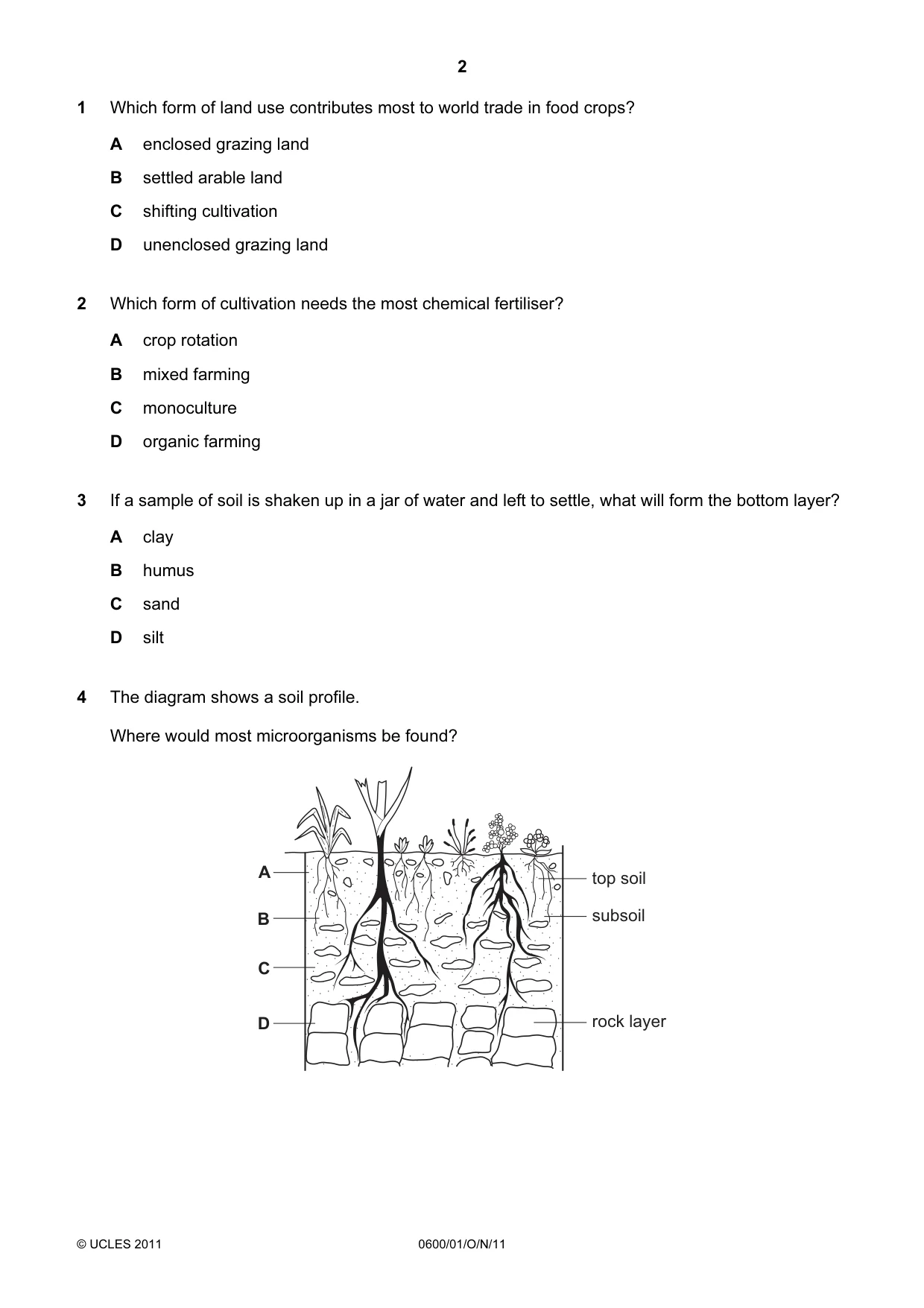
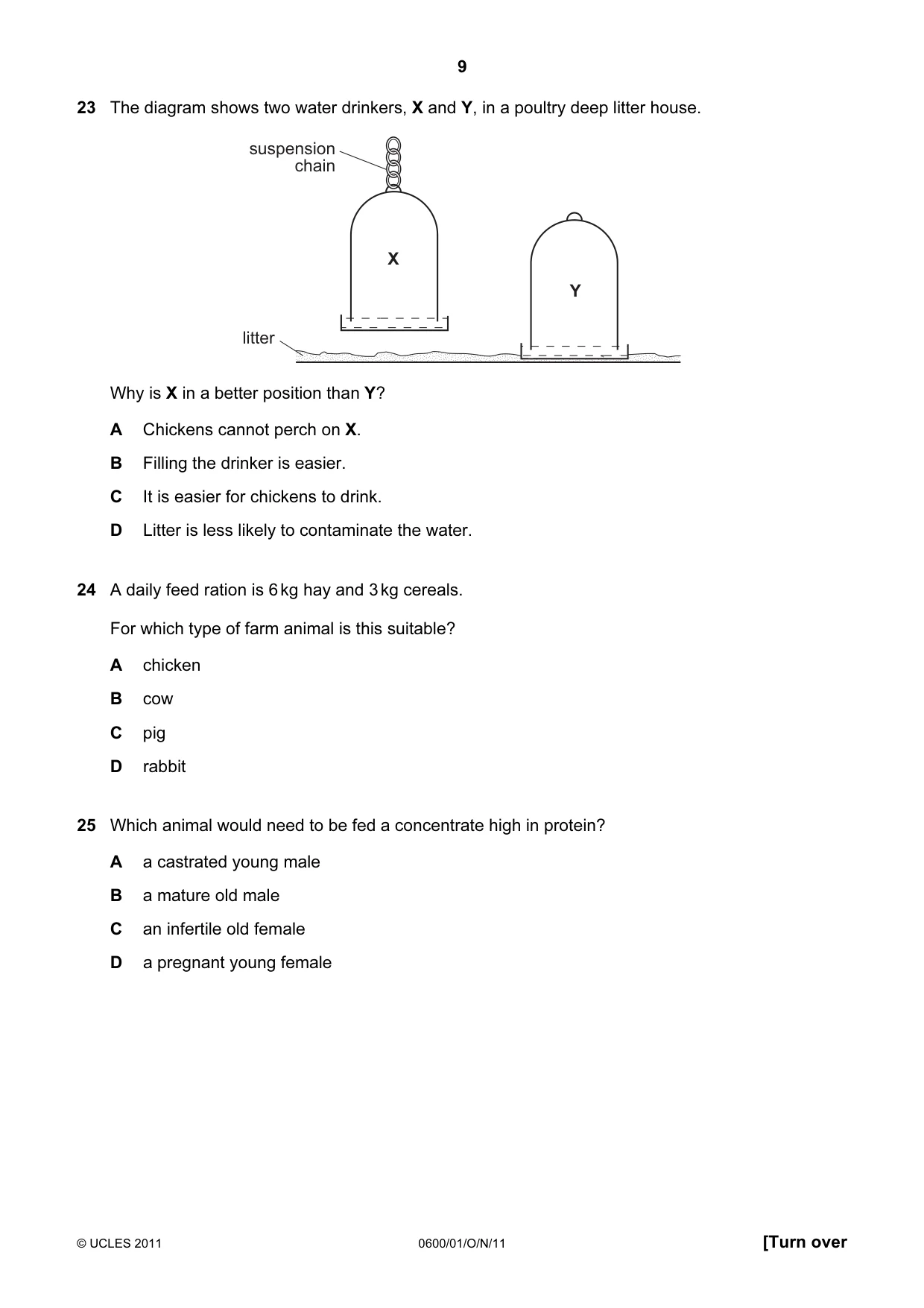
2 © UCLES 2011 0600/01/O/N/11 1 Which form of land use contributes most to world trade in food crops? A enclosed grazing land B settled arable land C shifting cultivation D unenclosed grazing land 2 Which form of cultivation needs the most chemical fertiliser? A crop rotation B mixed farming C monoculture D organic farming 3 If a sample of soil is shaken up in a jar of water and left to settle, what will form the bottom layer? A clay B humus C sand D silt 4 The diagram shows a soil profile. Where would most microorganisms be found? top soil subsoil rock layer A C D B
Question paper, page 3
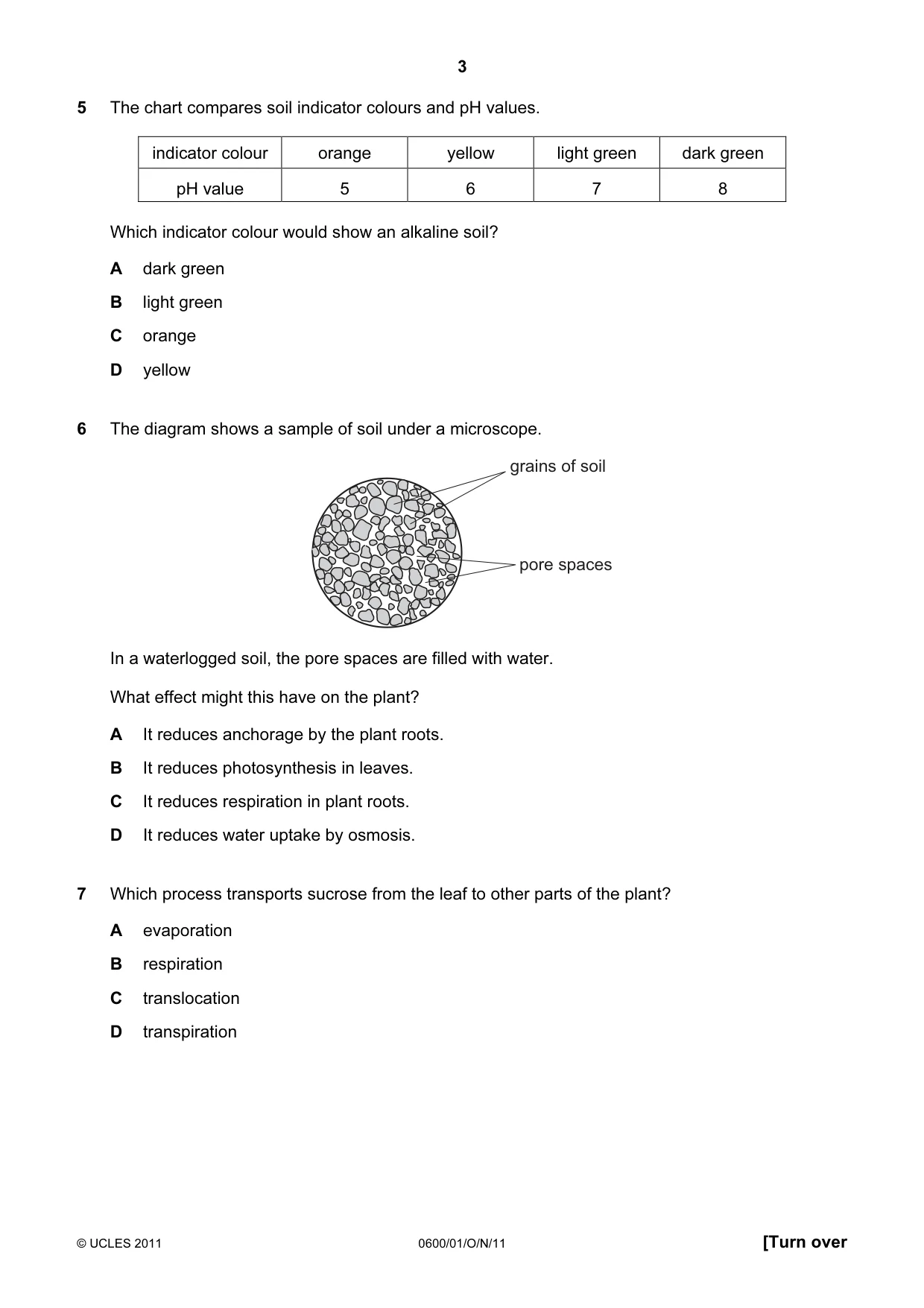
3 © UCLES 2011 0600/01/O/N/11 [Turn over 5 The chart compares soil indicator colours and pH values. indicator colour orange yellow light green dark green pH value 5 6 7 8 Which indicator colour would show an alkaline soil? A dark green B light green C orange D yellow 6 The diagram shows a sample of soil under a microscope. grains of soil pore spaces In a waterlogged soil, the pore spaces are filled with water. What effect might this have on the plant? A It reduces anchorage by the plant roots. B It reduces photosynthesis in leaves. C It reduces respiration in plant roots. D It reduces water uptake by osmosis. 7 Which process transports sucrose from the leaf to other parts of the plant? A evaporation B respiration C translocation D transpiration
Question paper, page 4
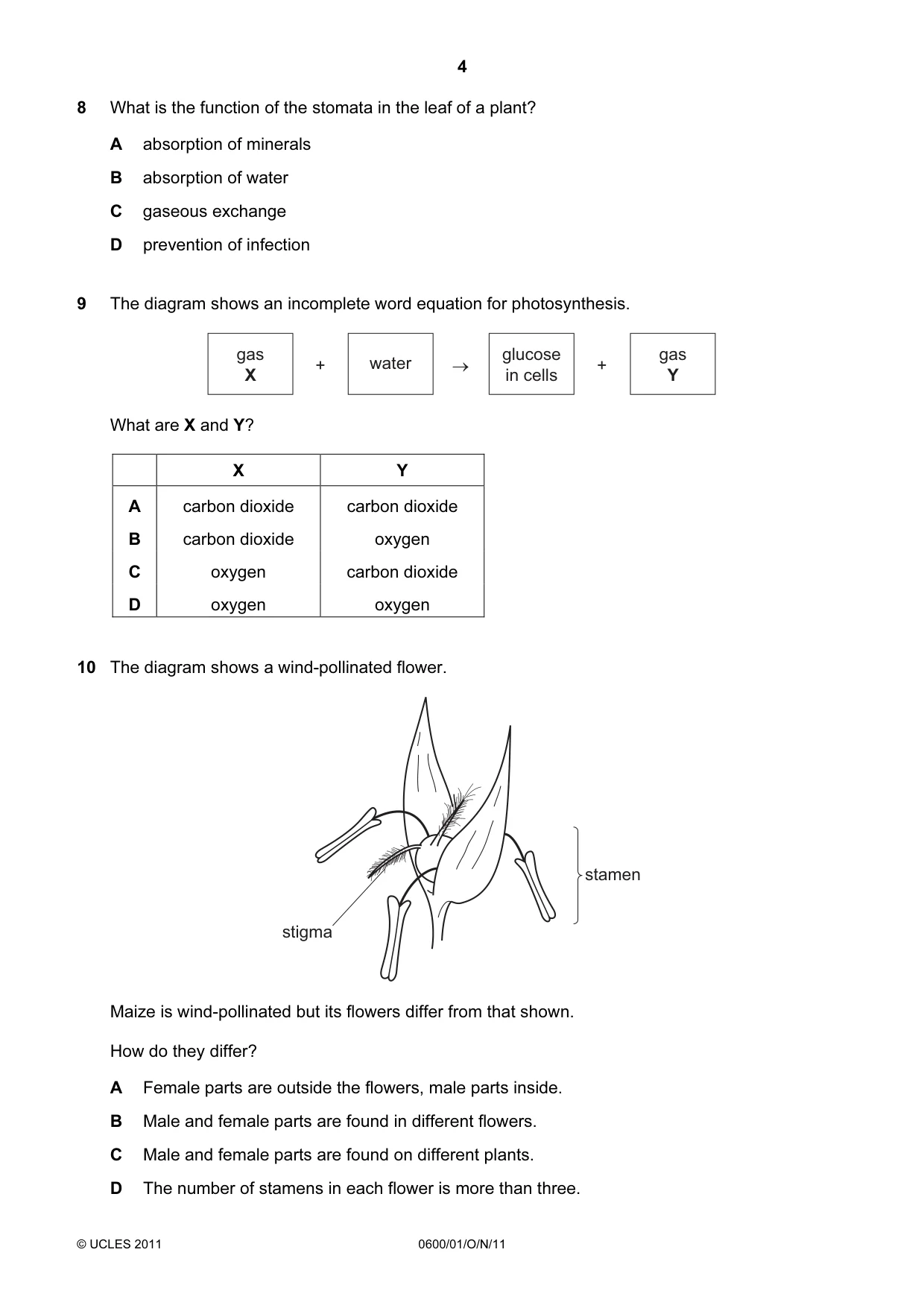
4 © UCLES 2011 0600/01/O/N/11 8 What is the function of the stomata in the leaf of a plant? A absorption of minerals B absorption of water C gaseous exchange D prevention of infection 9 The diagram shows an incomplete word equation for photosynthesis. + + → gas X water glucose in cells gas Y What are X and Y? X Y A carbon dioxide carbon dioxide B carbon dioxide oxygen C oxygen carbon dioxide D oxygen oxygen 10 The diagram shows a wind-pollinated flower. stigma stamen Maize is wind-pollinated but its flowers differ from that shown. How do they differ? A Female parts are outside the flowers, male parts inside. B Male and female parts are found in different flowers. C Male and female parts are found on different plants. D The number of stamens in each flower is more than three.
Question paper, page 5
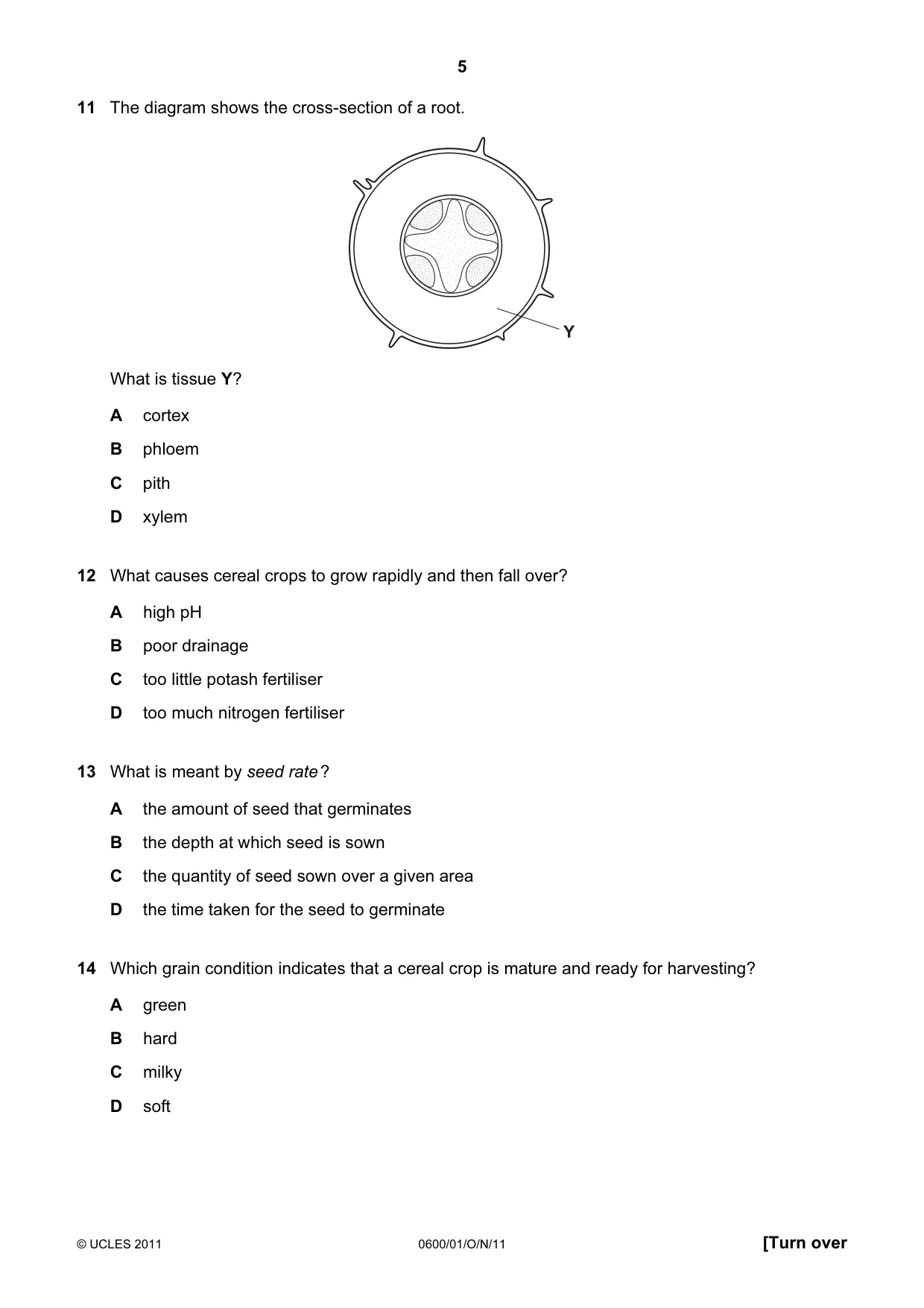
5 © UCLES 2011 0600/01/O/N/11 [Turn over 11 The diagram shows the cross-section of a root. Y What is tissue Y? A cortex B phloem C pith D xylem 12 What causes cereal crops to grow rapidly and then fall over? A high pH B poor drainage C too little potash fertiliser D too much nitrogen fertiliser 13 What is meant by seed rate ? A the amount of seed that germinates B the depth at which seed is sown C the quantity of seed sown over a given area D the time taken for the seed to germinate 14 Which grain condition indicates that a cereal crop is mature and ready for harvesting? A green B hard C milky D soft
Question paper, page 6
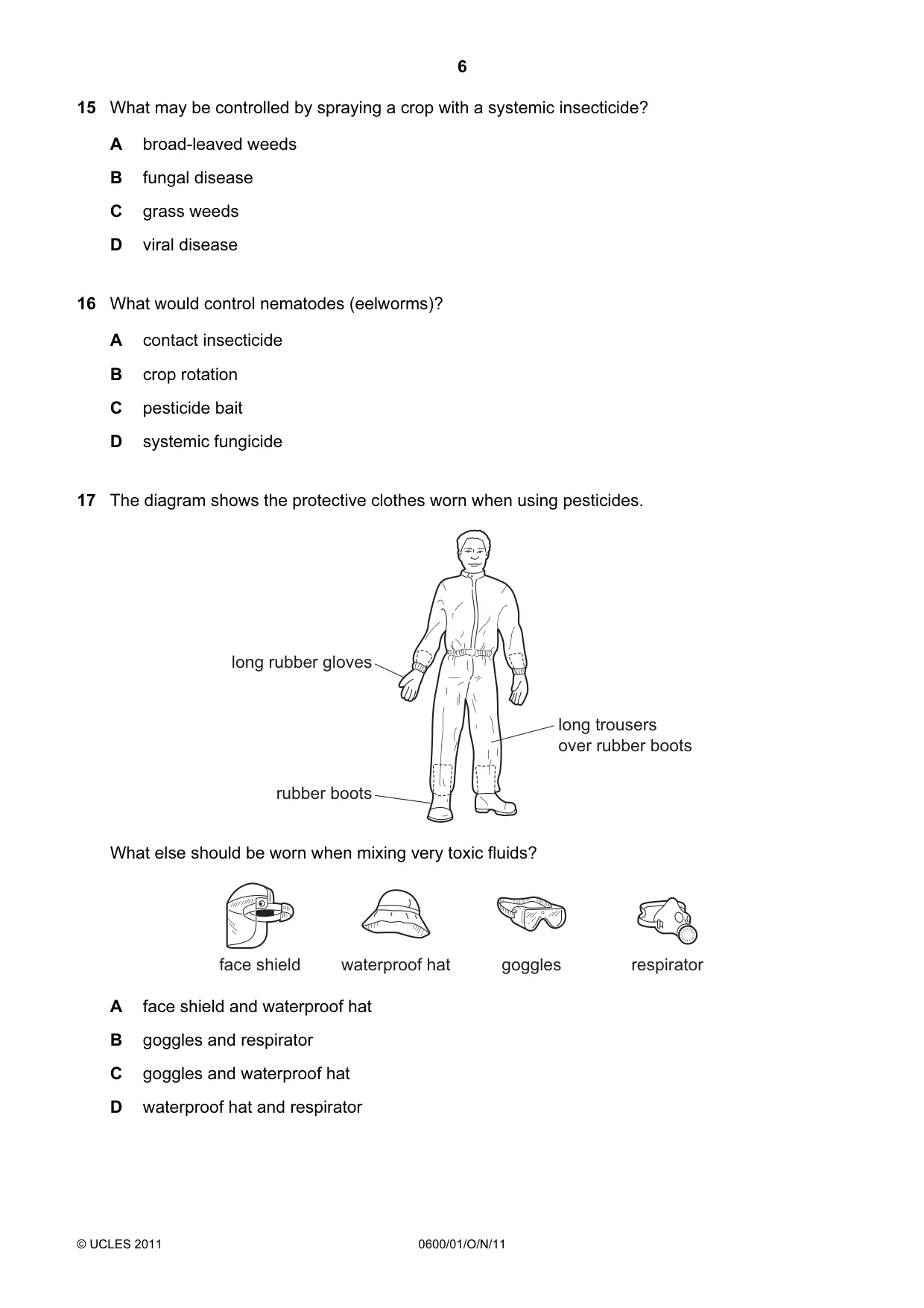
6 © UCLES 2011 0600/01/O/N/11 15 What may be controlled by spraying a crop with a systemic insecticide? A broad-leaved weeds B fungal disease C grass weeds D viral disease 16 What would control nematodes (eelworms)? A contact insecticide B crop rotation C pesticide bait D systemic fungicide 17 The diagram shows the protective clothes worn when using pesticides. long rubber gloves long trousers over rubber boots rubber boots What else should be worn when mixing very toxic fluids? face shield waterproof hat goggles respirator A face shield and waterproof hat B goggles and respirator C goggles and waterproof hat D waterproof hat and respirator
Question paper, page 7
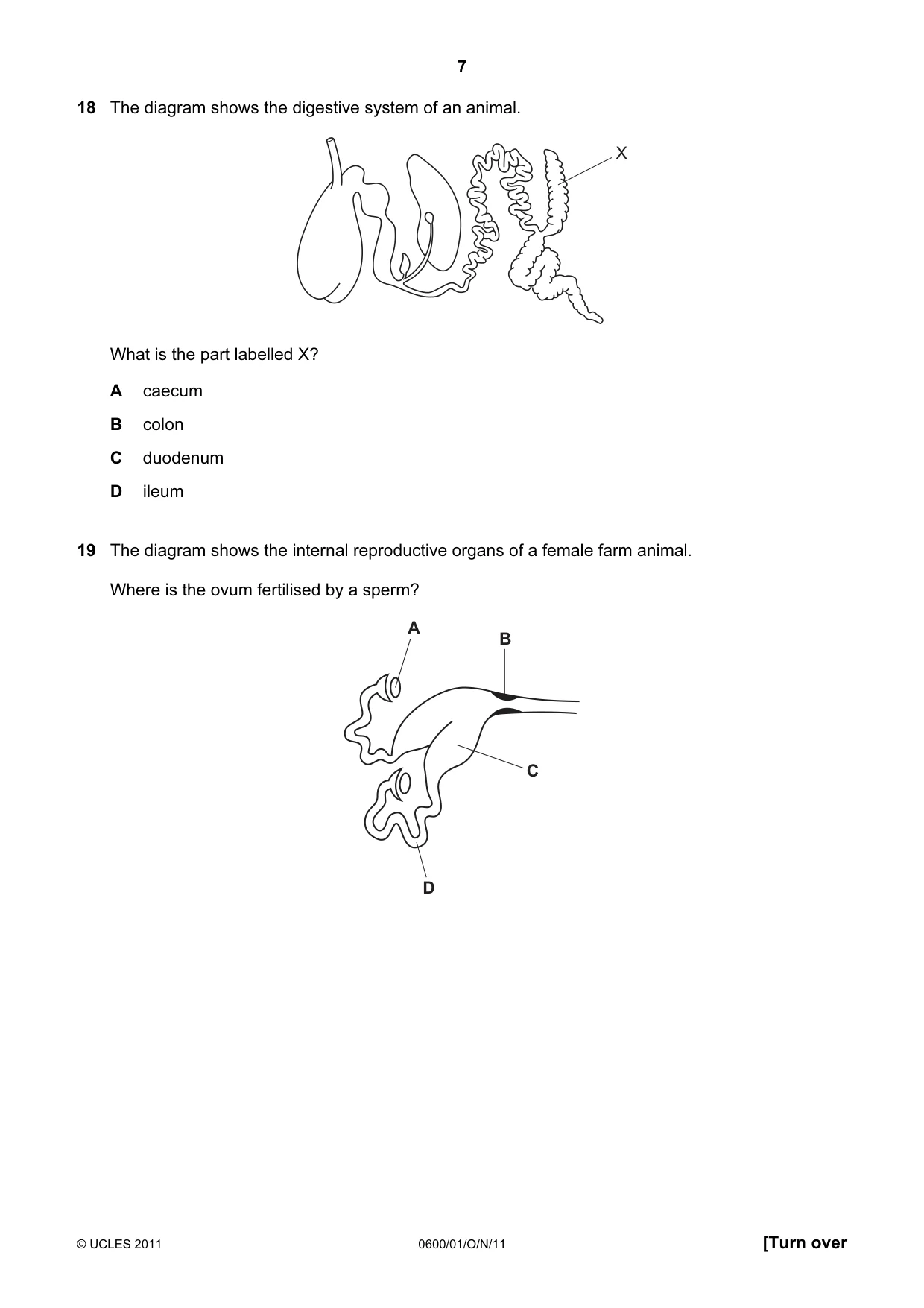
7 © UCLES 2011 0600/01/O/N/11 [Turn over 18 The diagram shows the digestive system of an animal. X What is the part labelled X? A caecum B colon C duodenum D ileum 19 The diagram shows the internal reproductive organs of a female farm animal. Where is the ovum fertilised by a sperm? C A D B
Question paper, page 8
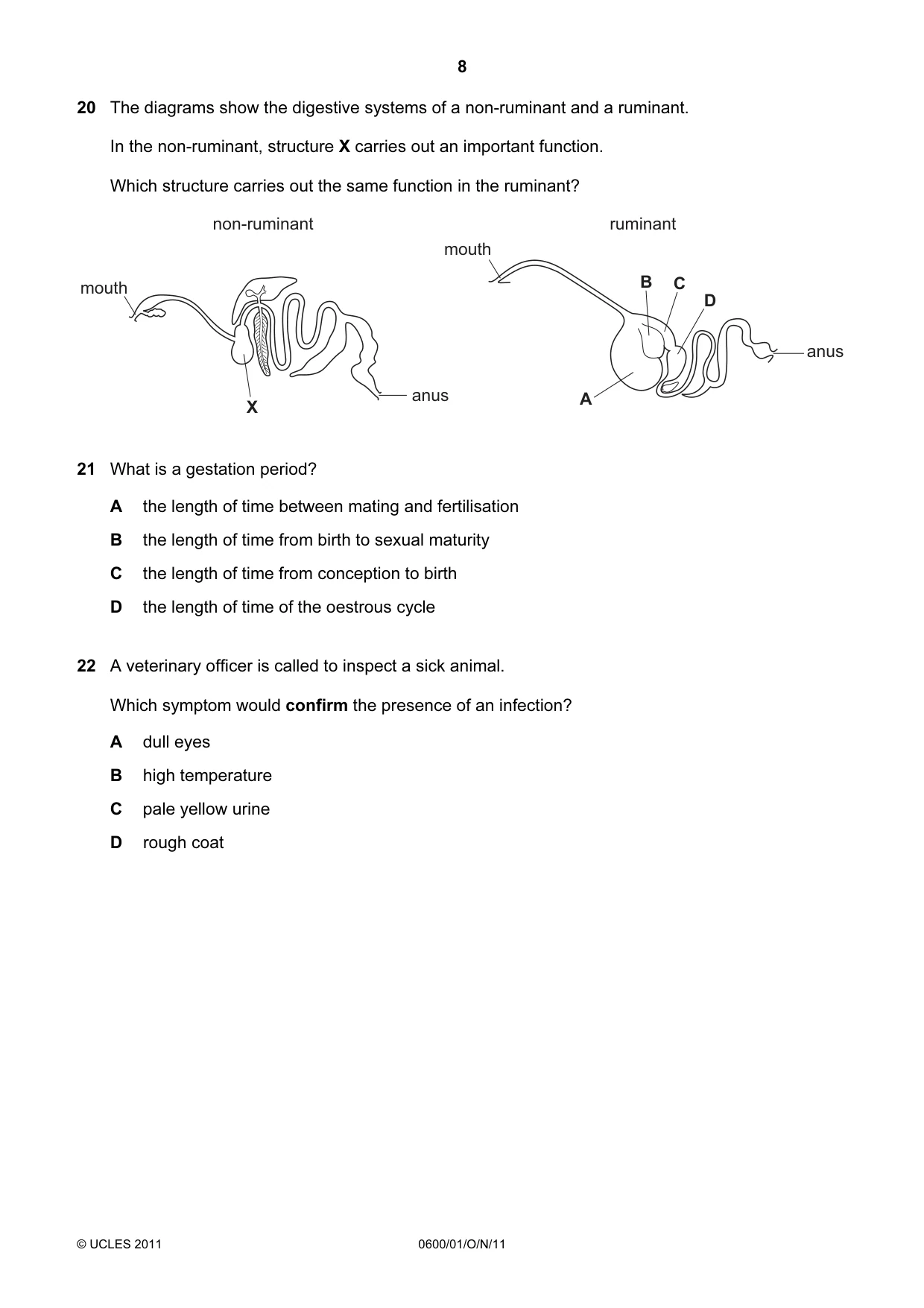
8 © UCLES 2011 0600/01/O/N/11 20 The diagrams show the digestive systems of a non-ruminant and a ruminant. In the non-ruminant, structure X carries out an important function. Which structure carries out the same function in the ruminant? A B C D mouth anus mouth anus X non-ruminant ruminant 21 What is a gestation period? A the length of time between mating and fertilisation B the length of time from birth to sexual maturity C the length of time from conception to birth D the length of time of the oestrous cycle 22 A veterinary officer is called to inspect a sick animal. Which symptom would confirm the presence of an infection? A dull eyes B high temperature C pale yellow urine D rough coat
Question paper, page 9
9 © UCLES 2011 0600/01/O/N/11 [Turn over 23 The diagram shows two water drinkers, X and Y, in a poultry deep litter house. X Y litter suspension chain Why is X in a better position than Y? A Chickens cannot perch on X. B Filling the drinker is easier. C It is easier for chickens to drink. D Litter is less likely to contaminate the water. 24 A daily feed ration is 6 kg hay and 3 kg cereals. For which type of farm animal is this suitable? A chicken B cow C pig D rabbit 25 Which animal would need to be fed a concentrate high in protein? A a castrated young male B a mature old male C an infertile old female D a pregnant young female
Question paper, page 10
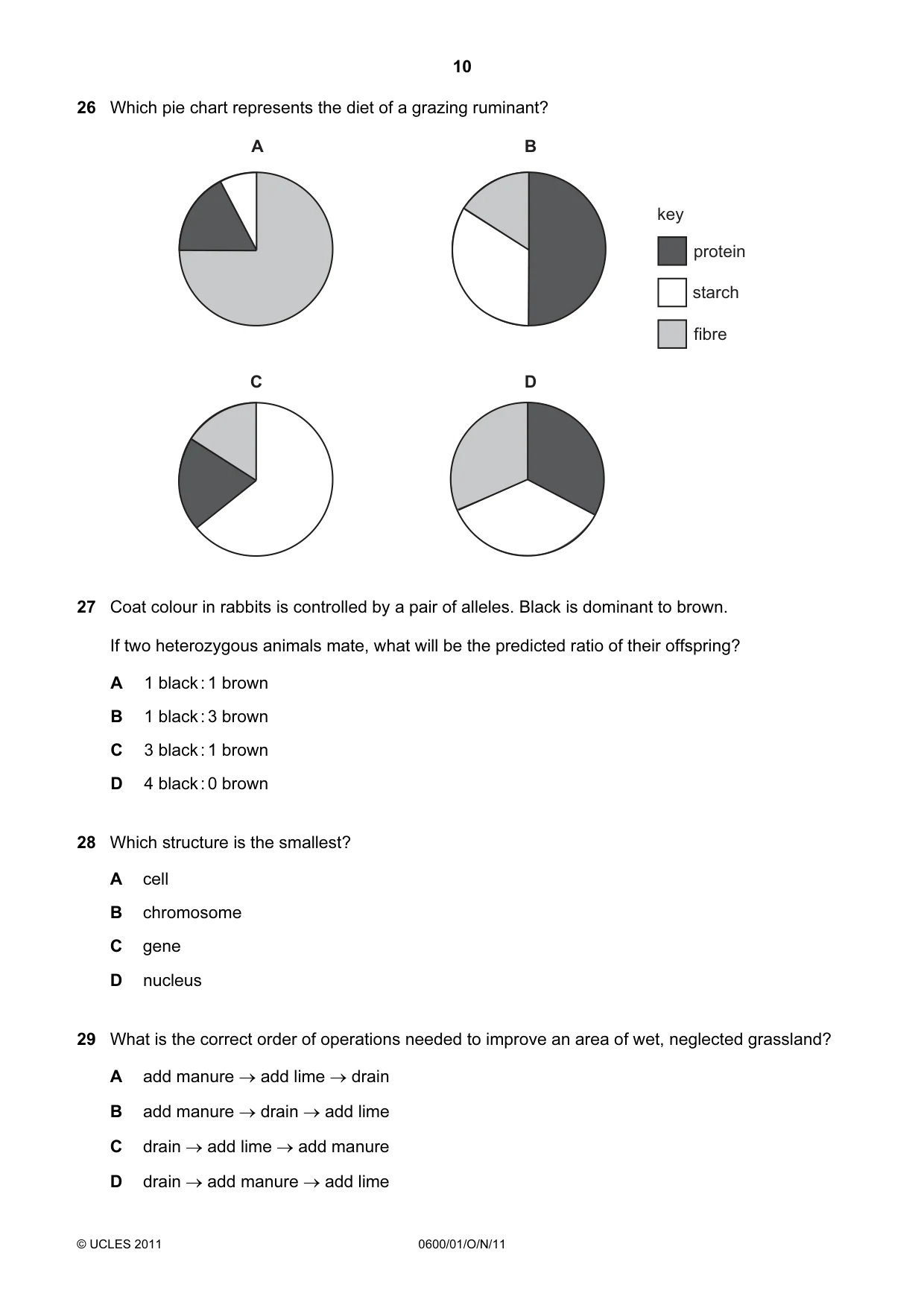
10 © UCLES 2011 0600/01/O/N/11 26 Which pie chart represents the diet of a grazing ruminant? A B C D key protein starch fibre 27 Coat colour in rabbits is controlled by a pair of alleles. Black is dominant to brown. If two heterozygous animals mate, what will be the predicted ratio of their offspring? A 1 black : 1 brown B 1 black : 3 brown C 3 black : 1 brown D 4 black : 0 brown 28 Which structure is the smallest? A cell B chromosome C gene D nucleus 29 What is the correct order of operations needed to improve an area of wet, neglected grassland? A add manure → add lime → drain B add manure → drain → add lime C drain → add lime → add manure D drain → add manure → add lime
Question paper, page 11
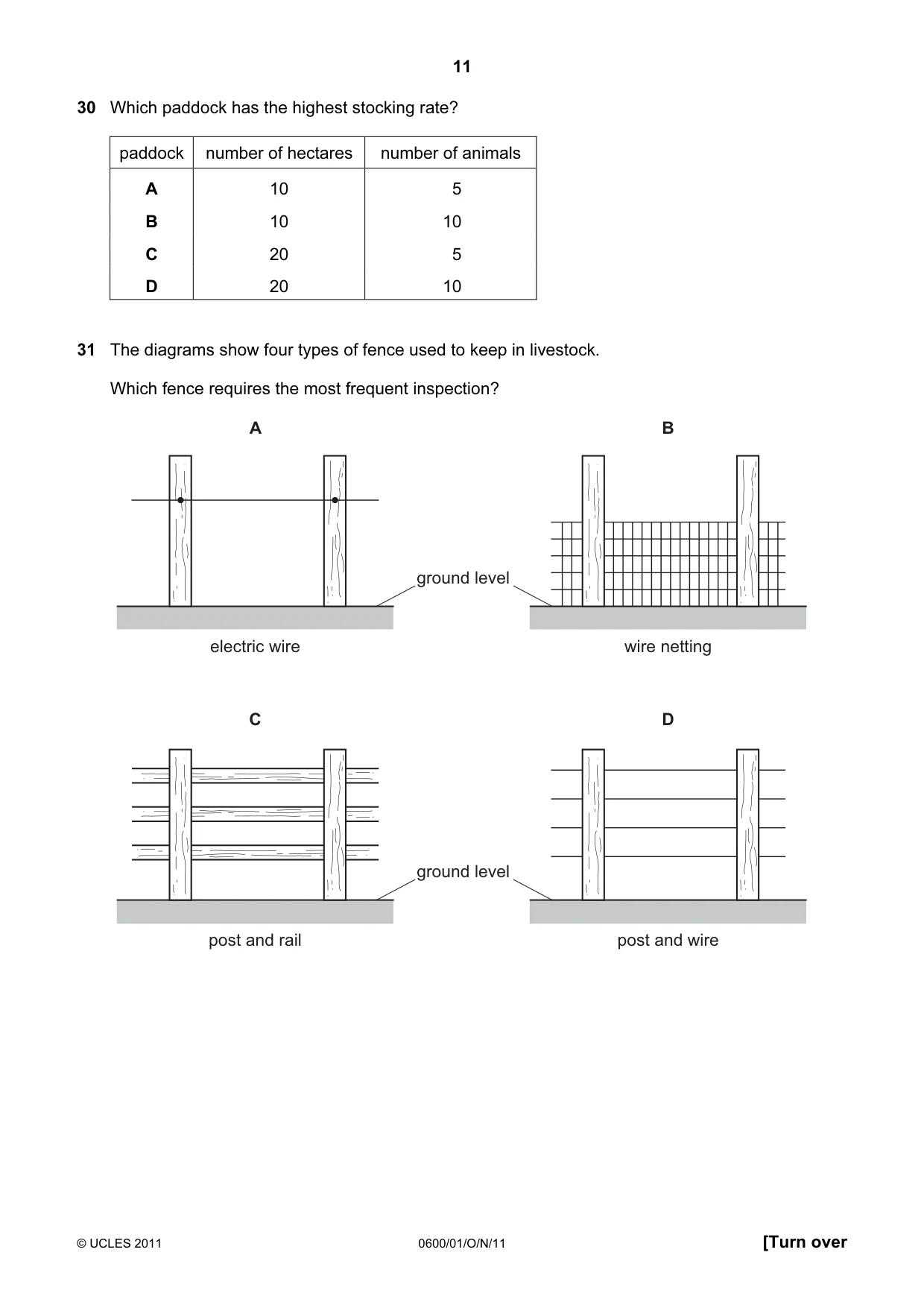
11 © UCLES 2011 0600/01/O/N/11 [Turn over 30 Which paddock has the highest stocking rate? paddock number of hectares number of animals A 10 5 B 10 10 C 20 5 D 20 10 31 The diagrams show four types of fence used to keep in livestock. Which fence requires the most frequent inspection? A post and rail B post and wire ground level C electric wire D wire netting ground level
Question paper, page 12
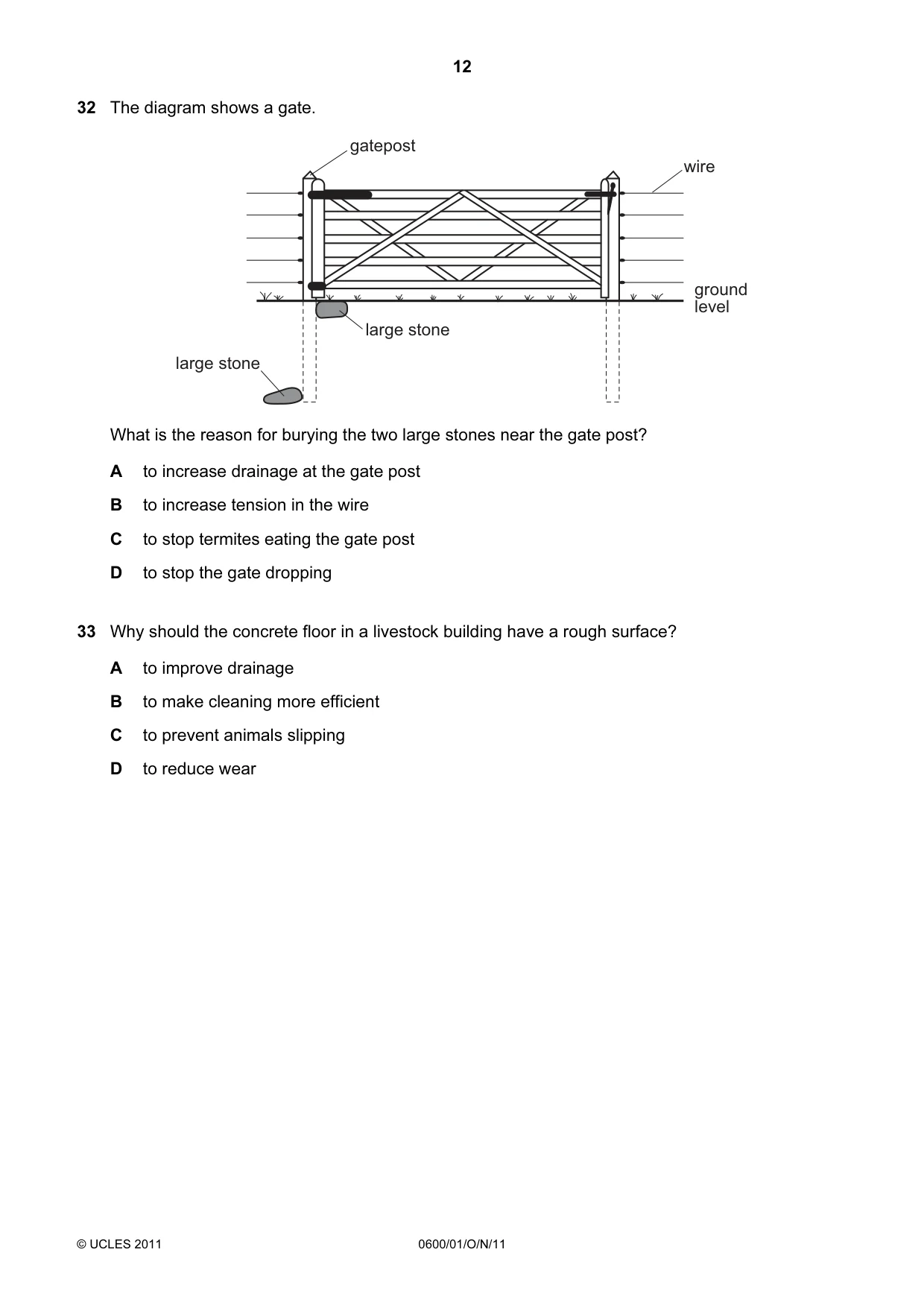
12 © UCLES 2011 0600/01/O/N/11 32 The diagram shows a gate. gatepost ground level wire large stone large stone What is the reason for burying the two large stones near the gate post? A to increase drainage at the gate post B to increase tension in the wire C to stop termites eating the gate post D to stop the gate dropping 33 Why should the concrete floor in a livestock building have a rough surface? A to improve drainage B to make cleaning more efficient C to prevent animals slipping D to reduce wear
Question paper, page 13
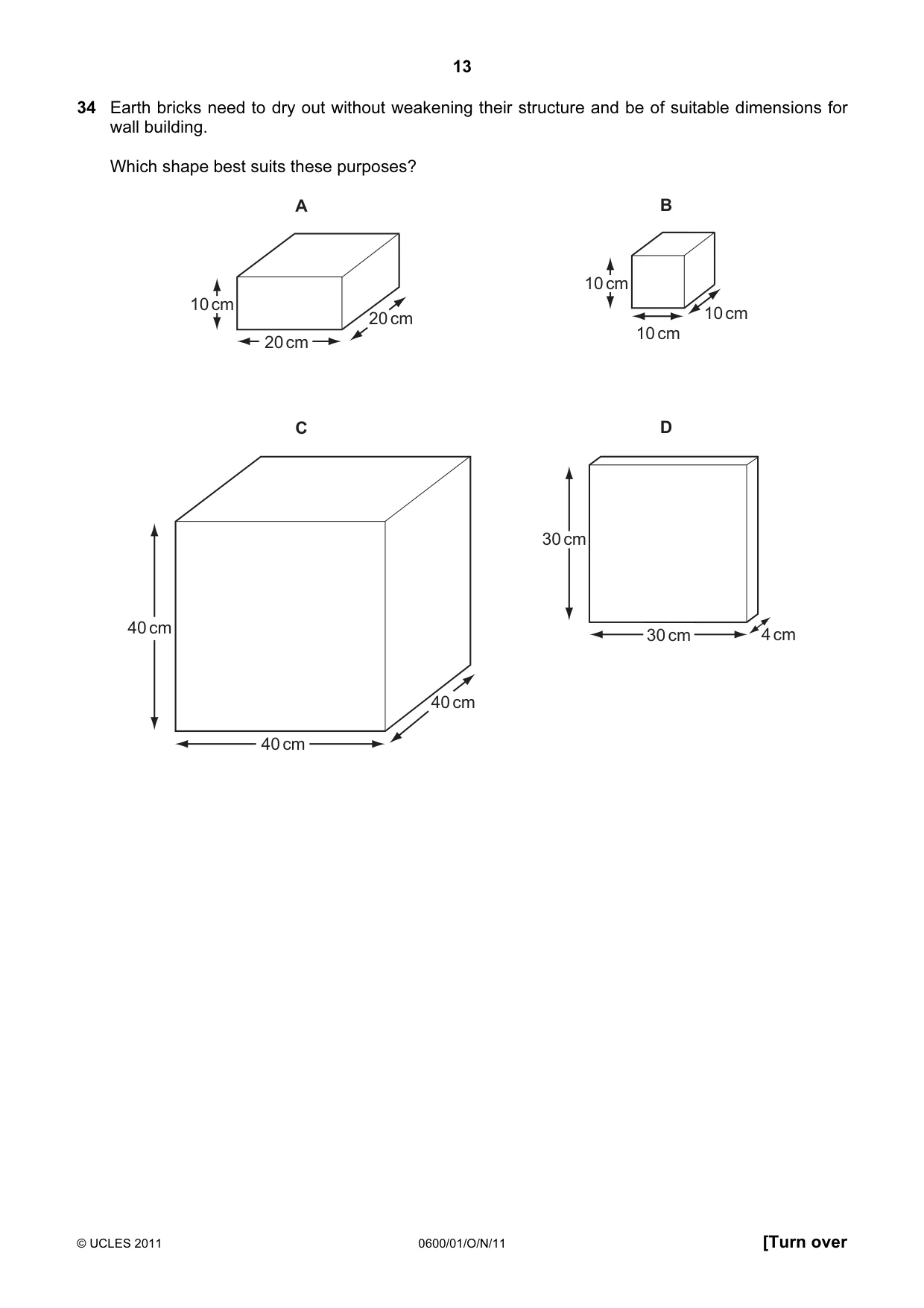
13 © UCLES 2011 0600/01/O/N/11 [Turn over 34 Earth bricks need to dry out without weakening their structure and be of suitable dimensions for wall building. Which shape best suits these purposes? 40 cm 40 cm 40 cm 10 cm 20 cm 20 cm 10 cm 10 cm 10 cm 30 cm 30 cm 4 cm C D B A
Question paper, page 14
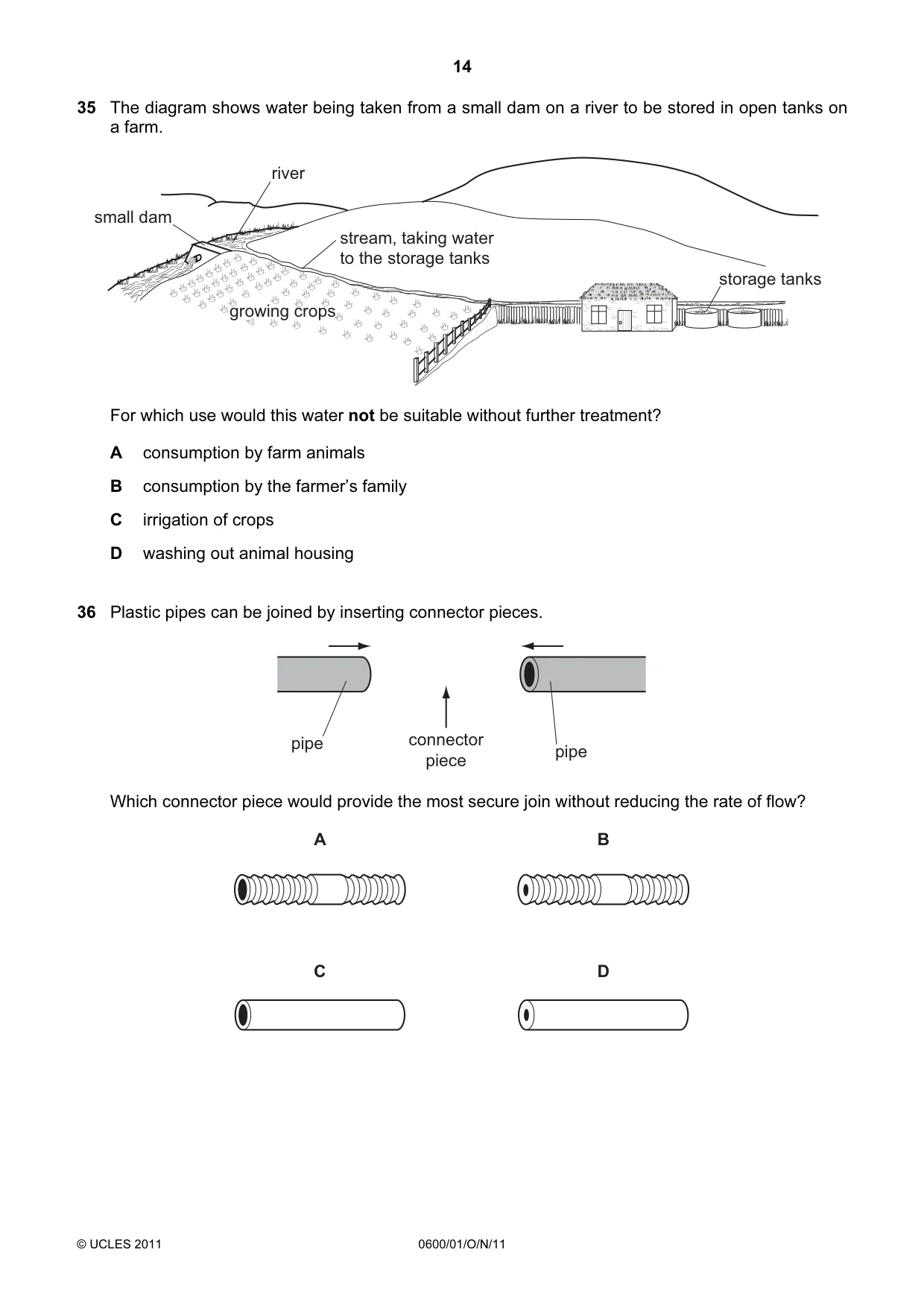
14 © UCLES 2011 0600/01/O/N/11 35 The diagram shows water being taken from a small dam on a river to be stored in open tanks on a farm. river storage tanks growing crops stream, taking water to the storage tanks small dam For which use would this water not be suitable without further treatment? A consumption by farm animals B consumption by the farmer’s family C irrigation of crops D washing out animal housing 36 Plastic pipes can be joined by inserting connector pieces. pipe pipe connector piece Which connector piece would provide the most secure join without reducing the rate of flow? A B C D
Question paper, page 15
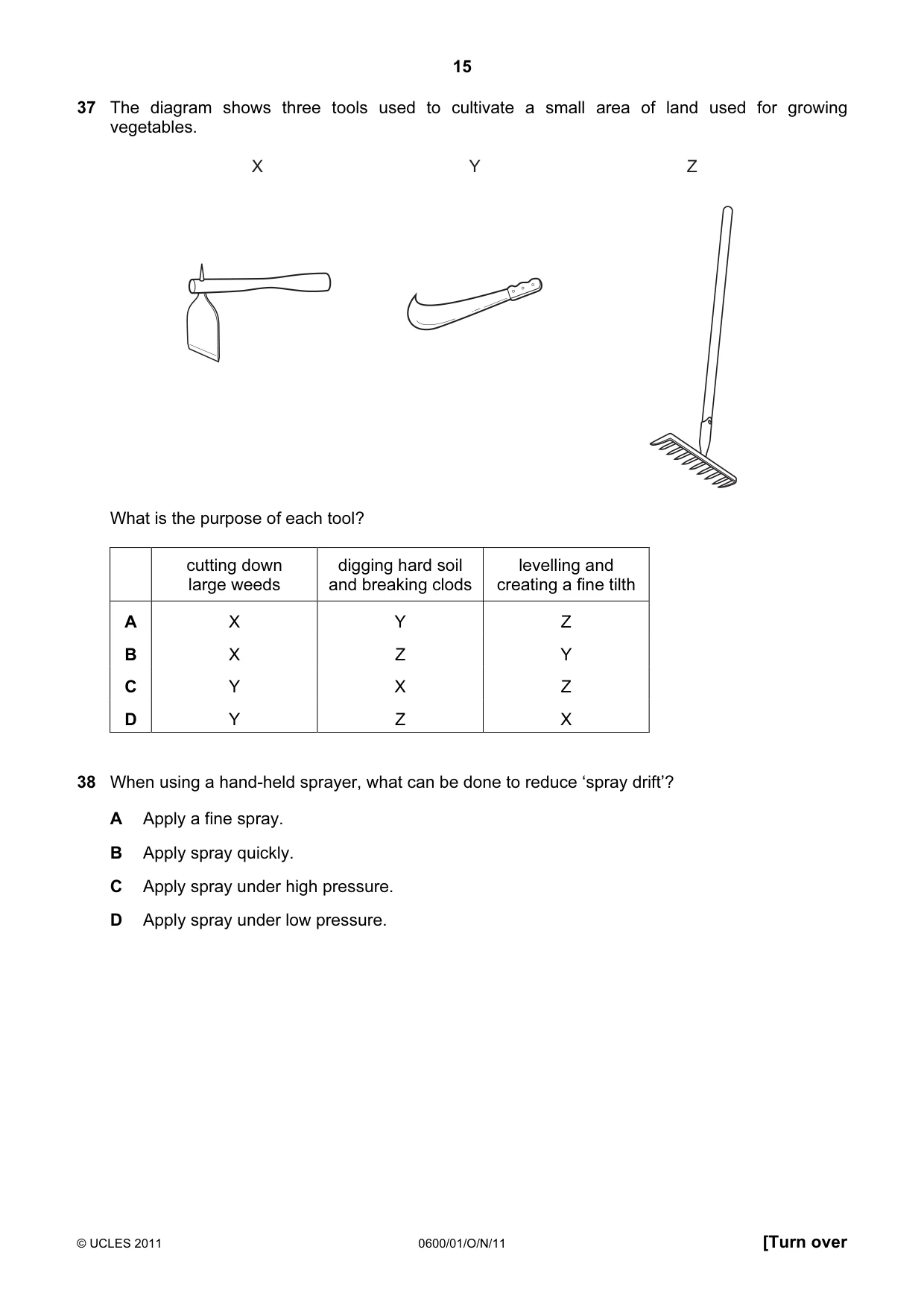
15 © UCLES 2011 0600/01/O/N/11 [Turn over 37 The diagram shows three tools used to cultivate a small area of land used for growing vegetables. X Y Z What is the purpose of each tool? cutting down large weeds digging hard soil and breaking clods levelling and creating a fine tilth A X Y Z B X Z Y C Y X Z D Y Z X 38 When using a hand-held sprayer, what can be done to reduce ‘spray drift’? A Apply a fine spray. B Apply spray quickly. C Apply spray under high pressure. D Apply spray under low pressure.
Question paper, page 16
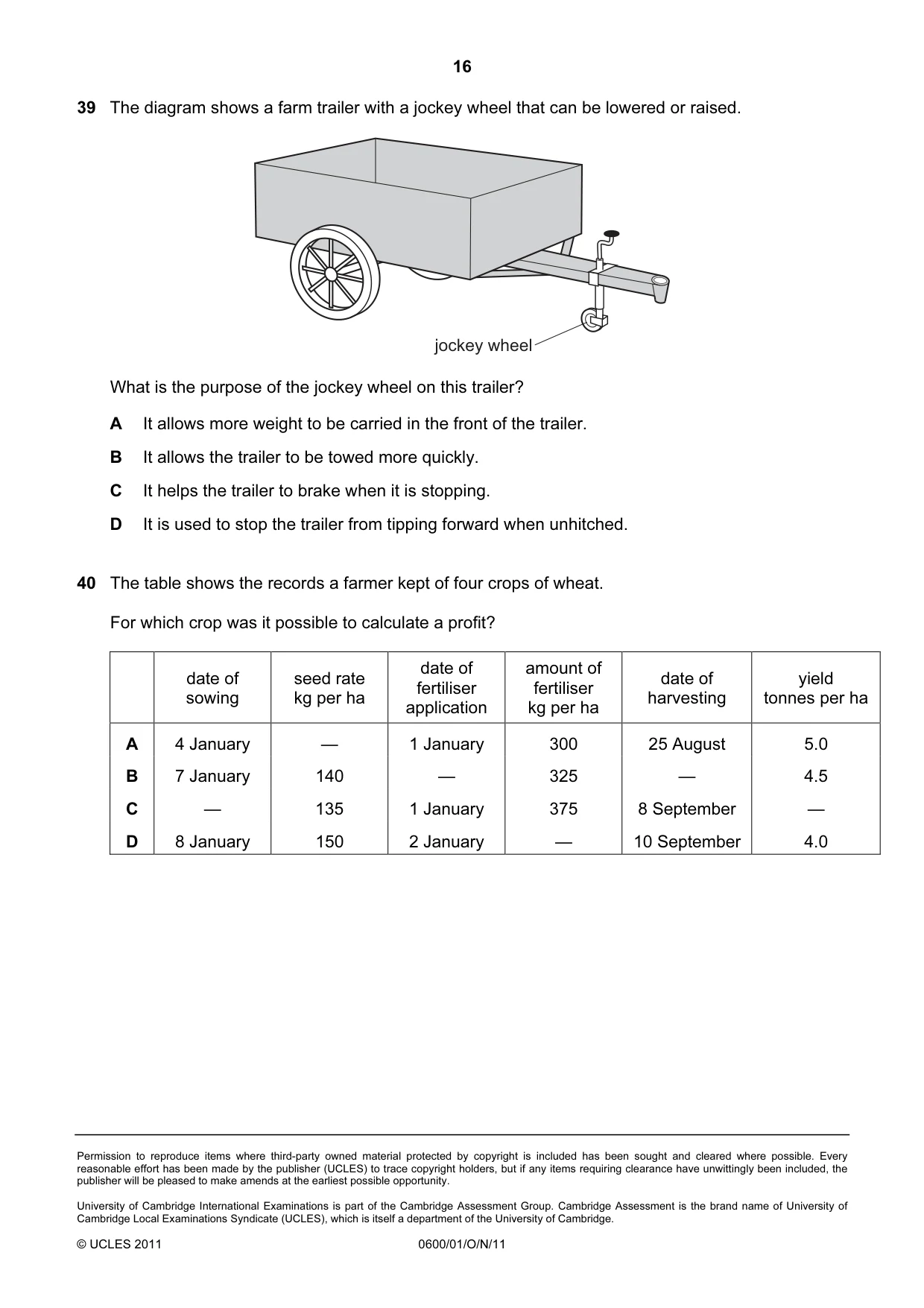
16 Permission to reproduce items where third-party owned material protected by copyright is included has been sought and cleared where possible. Every reasonable effort has been made by the publisher (UCLES) to trace copyright holders, but if any items requiring clearance have unwittingly been included, the publisher will be pleased to make amends at the earliest possible opportunity. University of Cambridge International Examinations is part of the Cambridge Assessment Group. Cambridge Assessment is the brand name of University of Cambridge Local Examinations Syndicate (UCLES), which is itself a department of the University of Cambridge. © UCLES 2011 0600/01/O/N/11 39 The diagram shows a farm trailer with a jockey wheel that can be lowered or raised. jockey wheel What is the purpose of the jockey wheel on this trailer? A It allows more weight to be carried in the front of the trailer. B It allows the trailer to be towed more quickly. C It helps the trailer to brake when it is stopping. D It is used to stop the trailer from tipping forward when unhitched. 40 The table shows the records a farmer kept of four crops of wheat. For which crop was it possible to calculate a profit? date of sowing seed rate kg per ha date of fertiliser application amount of fertiliser kg per ha date of harvesting yield tonnes per ha A 4 January — 1 January 300 25 August 5.0 B 7 January 140 — 325 — 4.5 C — 135 1 January 375 8 September — D 8 January 150 2 January — 10 September 4.0
Mark scheme, page 1
UNIVERSITY OF CAMBRIDGE INTERNATIONAL EXAMINATIONS International General Certificate of Secondary Education MARK SCHEME for the October/November 2011 question paper for the guidance of teachers 0600 AGRICULTURE 0600/01 Paper 1 (Multiple Choice), maximum raw mark 40 Mark schemes must be read in conjunction with the question papers and the report on the examination. • Cambridge will not enter into discussions or correspondence in connection with these mark schemes. Cambridge is publishing the mark schemes for the October/November 2011 question papers for most IGCSE, GCE Advanced Level and Advanced Subsidiary Level syllabuses and some Ordinary Level syllabuses.
Mark scheme, page 2
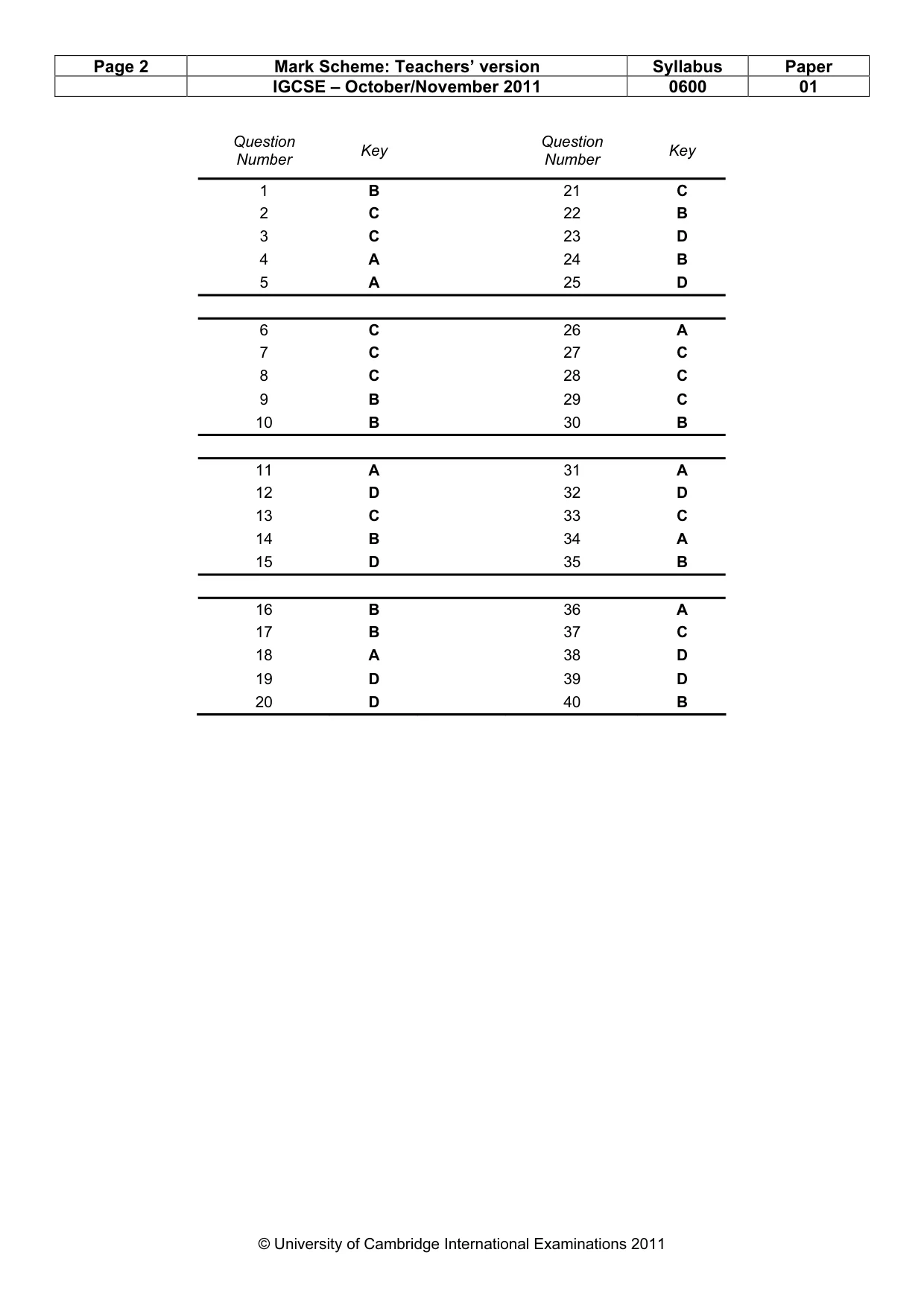
Page 2 Mark Scheme: Teachers’ version Syllabus Paper IGCSE – October/November 2011 0600 01 © University of Cambridge International Examinations 2011 Question Number Key Question Number Key 1 B 21 C 2 C 22 B 3 C 23 D 4 A 24 B 5 A 25 D 6 C 26 A 7 C 27 C 8 C 28 C 9 B 29 C 10 B 30 B 11 A 31 A 12 D 32 D 13 C 33 C 14 B 34 A 15 D 35 B 16 B 36 A 17 B 37 C 18 A 38 D 19 D 39 D 20 D 40 B
What you needed in this session
Cambridge’s own grade thresholds for 2011 Oct/Nov, Paper 1 · Variant 1. A higher threshold means an easier paper — the bar moves with how the cohort did.