Cambridge IGCSE Agriculture 0600 — 2008 Oct/Nov Paper 1 · Variant 1
0600/11/O/N/08 · 40 marks · ≈45 min
The question paper and its mark scheme, free to read here and free to download. This is Cambridge’s own paper, exactly as it was sat.
Question paper16 pages
Mark scheme2 pages
Answers below. Sit the paper first if you are practising.
Paper as text
Question paper, page 1
This document consists of 16 printed pages. IB08 11_0600_01/RP © UCLES 2008 [Turn over *3460885328* UNIVERSITY OF CAMBRIDGE INTERNATIONAL EXAMINATIONS International General Certificate of Secondary Education AGRICULTURE 0600/01 Paper 1 Multiple Choice October/November 2008 45 minutes Additional Materials: Multiple Choice Answer Sheet Soft clean eraser Soft pencil (type B or HB is recommended) READ THESE INSTRUCTIONS FIRST Write in soft pencil. Do not use staples, paper clips, highlighters, glue or correction fluid. Write your name, Centre number and candidate number on the Answer Sheet in the spaces provided unless this has been done for you. There are forty questions on this paper. Answer all questions. For each question there are four possible answers A, B, C and D. Choose the one you consider correct and record your choice in soft pencil on the separate Answer Sheet. Read the instructions on the Answer Sheet very carefully. Each correct answer will score one mark. A mark will not be deducted for a wrong answer. Any rough working should be done in this booklet. www.XtremePapers.com
Question paper, page 2
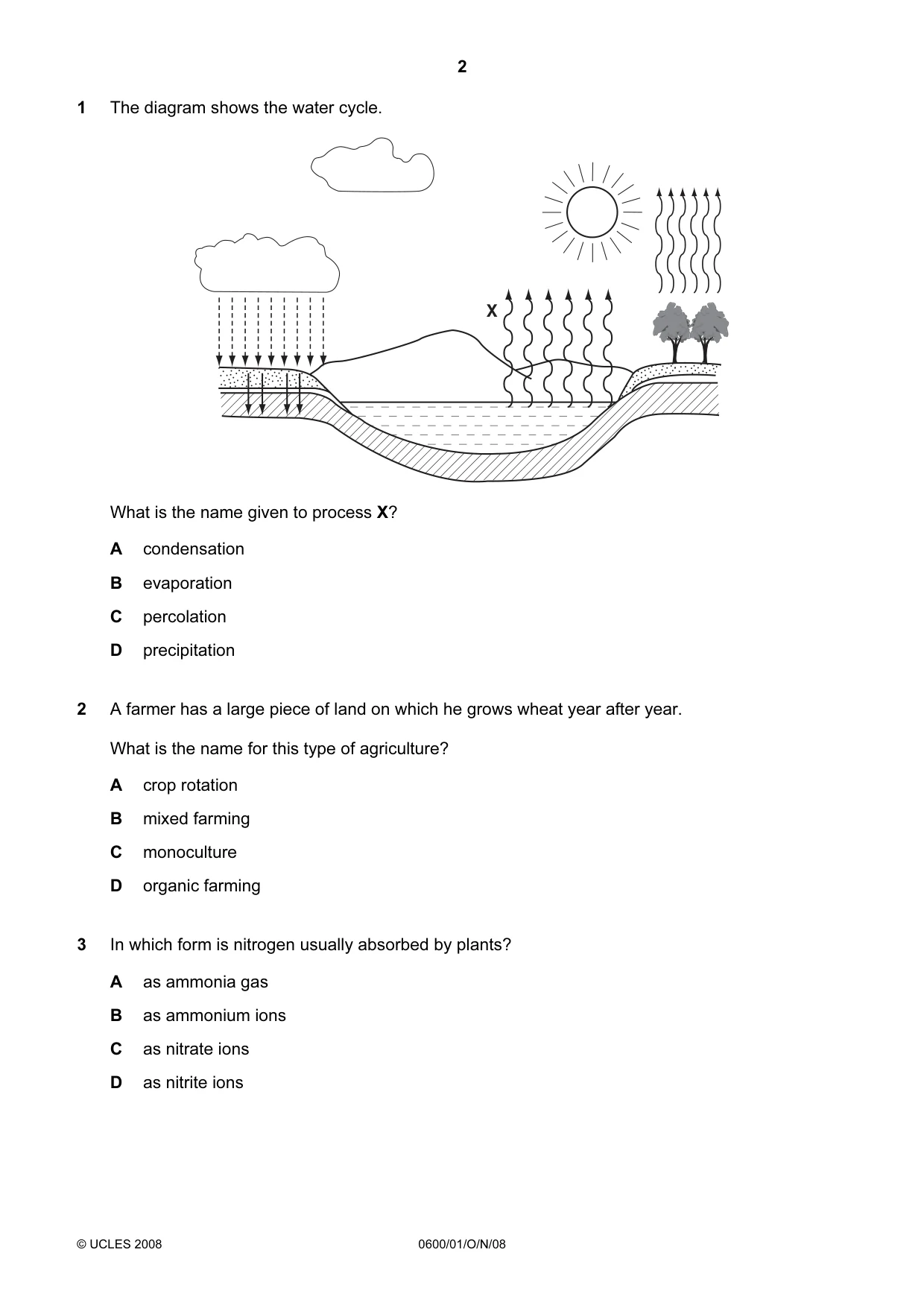
2 © UCLES 2008 0600/01/O/N/08 1 The diagram shows the water cycle. X What is the name given to process X? A condensation B evaporation C percolation D precipitation 2 A farmer has a large piece of land on which he grows wheat year after year. What is the name for this type of agriculture? A crop rotation B mixed farming C monoculture D organic farming 3 In which form is nitrogen usually absorbed by plants? A as ammonia gas B as ammonium ions C as nitrate ions D as nitrite ions
Question paper, page 3
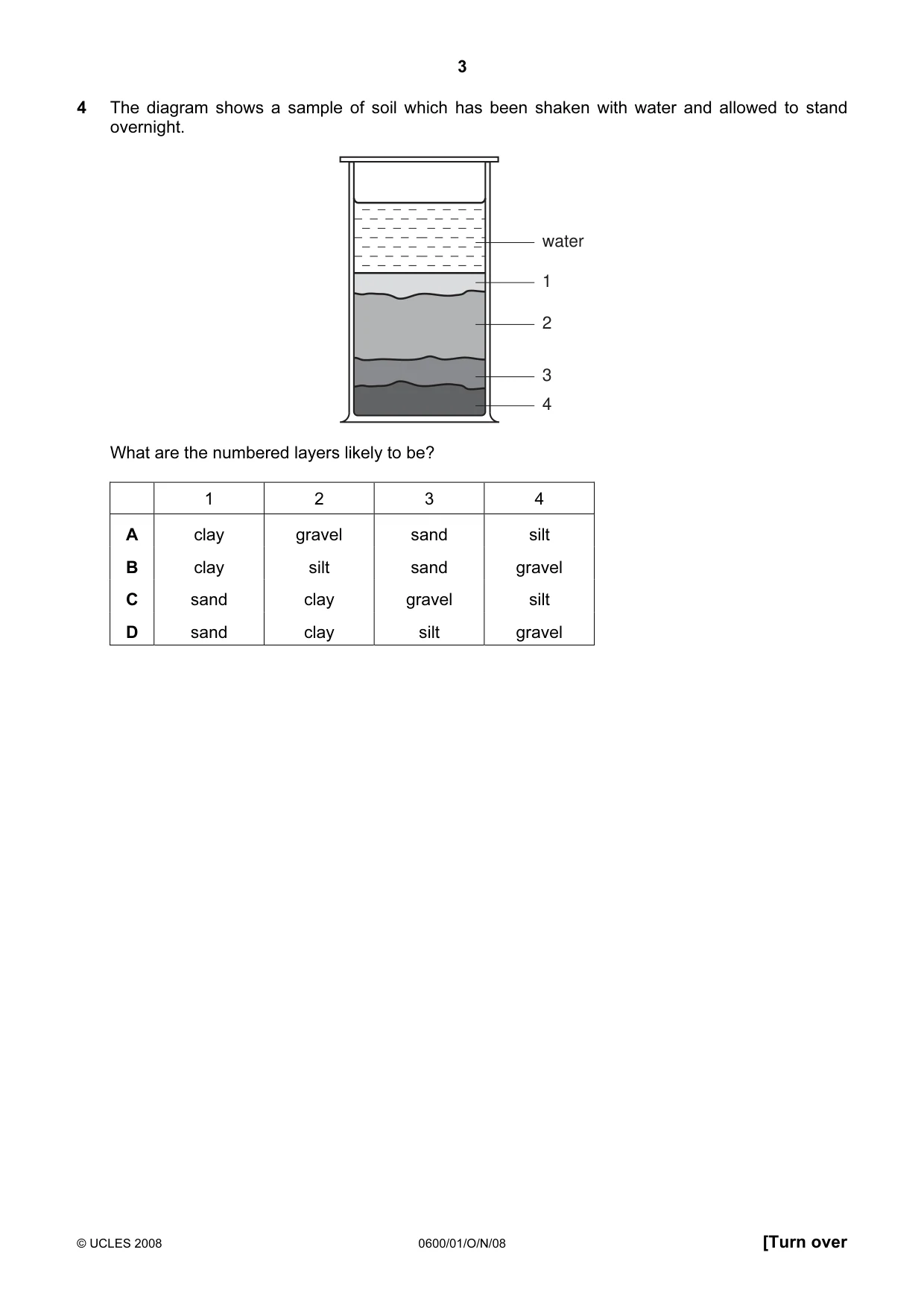
3 © UCLES 2008 0600/01/O/N/08 [Turn over 4 The diagram shows a sample of soil which has been shaken with water and allowed to stand overnight. water 1 2 3 4 What are the numbered layers likely to be? 1 2 3 4 A clay gravel sand silt B clay silt sand gravel C sand clay gravel silt D sand clay silt gravel
Question paper, page 4
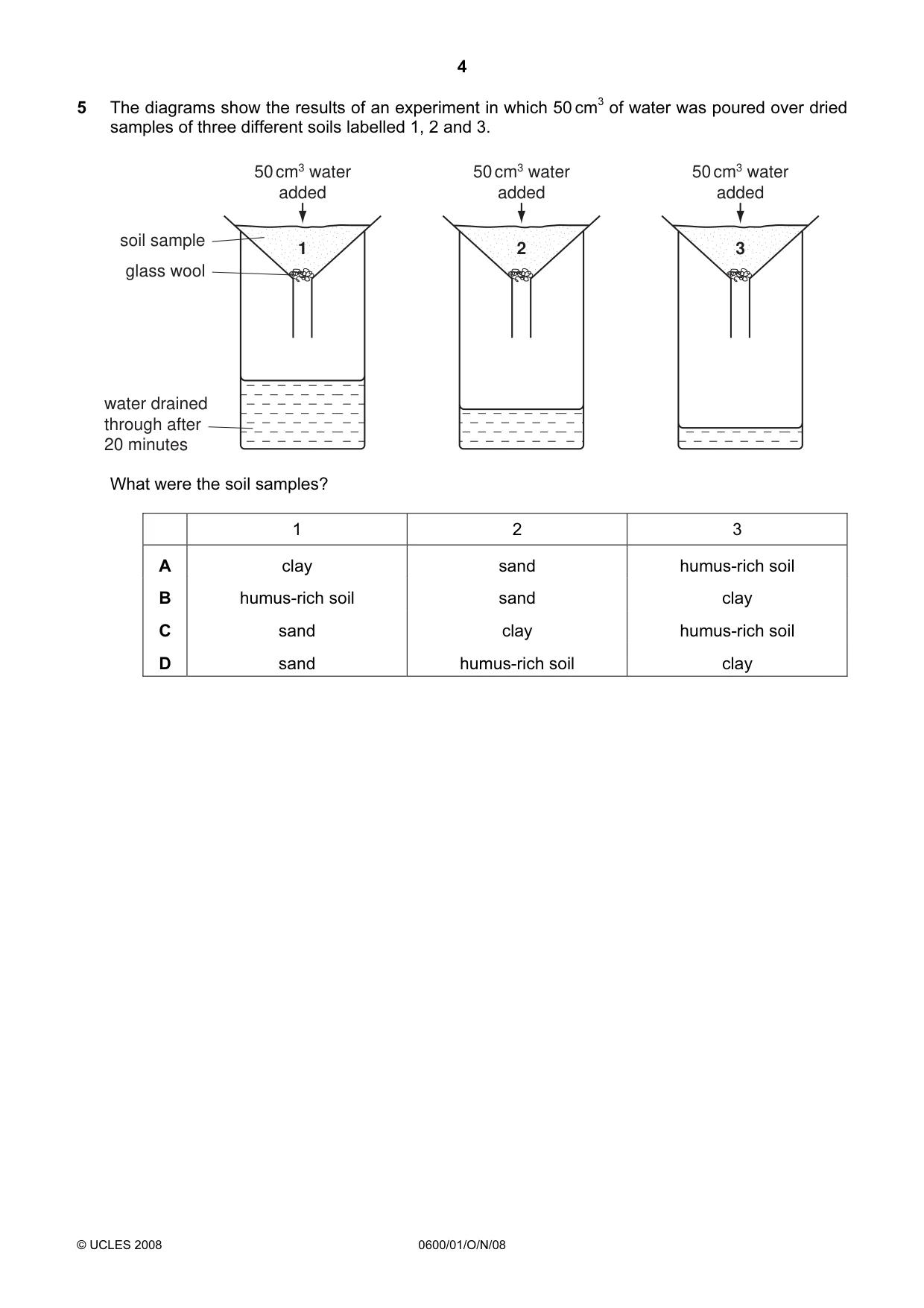
4 © UCLES 2008 0600/01/O/N/08 5 The diagrams show the results of an experiment in which 50 cm3 of water was poured over dried samples of three different soils labelled 1, 2 and 3. water drained through after 20 minutes 1 50 cm3 water added 2 50 cm3 water added 3 50 cm3 water added soil sample glass wool What were the soil samples? 1 2 3 A clay sand humus-rich soil B humus-rich soil sand clay C sand clay humus-rich soil D sand humus-rich soil clay
Question paper, page 5
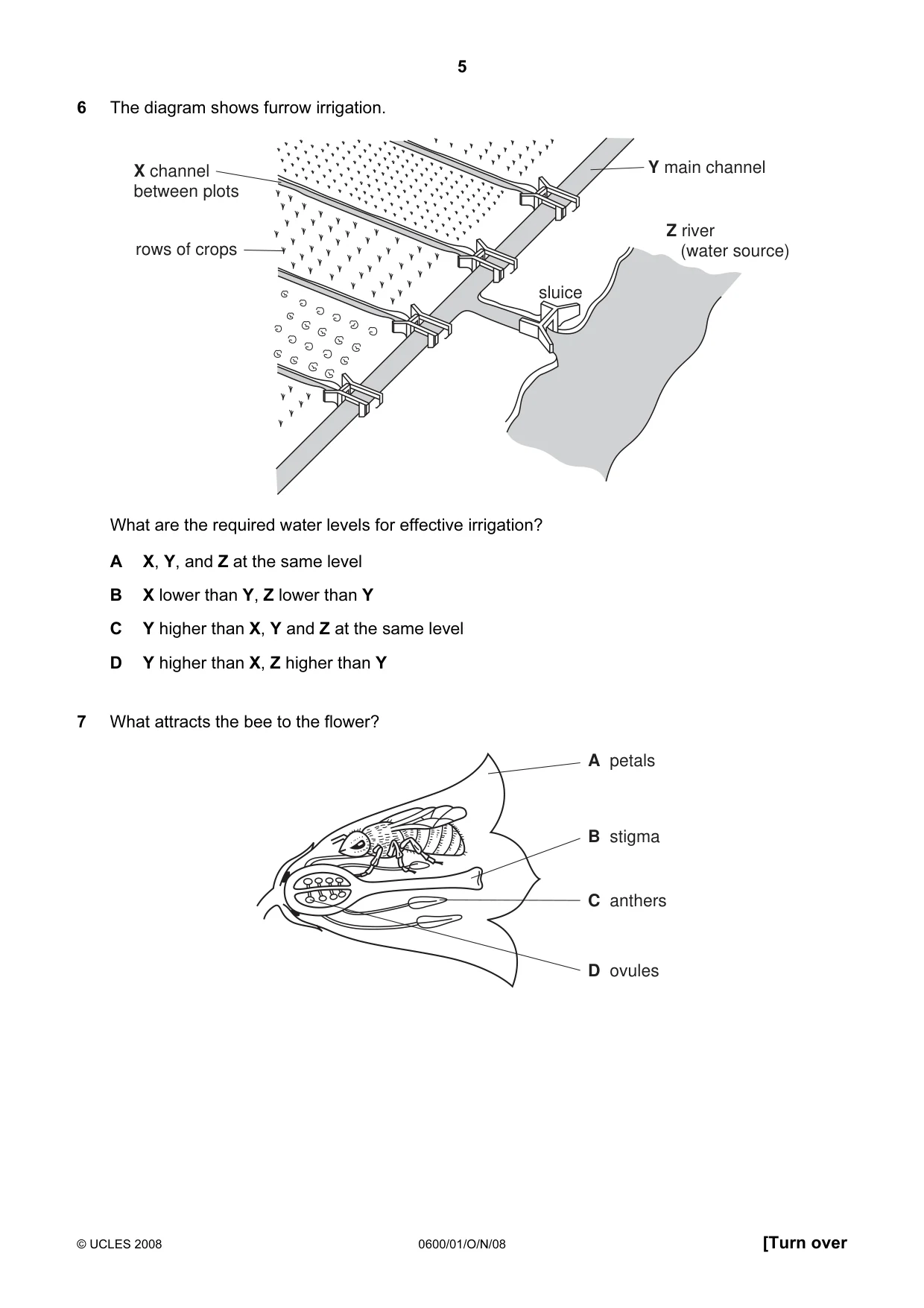
5 © UCLES 2008 0600/01/O/N/08 [Turn over 6 The diagram shows furrow irrigation. rows of crops sluice X channel between plots Y main channel Z river (water source) What are the required water levels for effective irrigation? A X, Y, and Z at the same level B X lower than Y, Z lower than Y C Y higher than X, Y and Z at the same level D Y higher than X, Z higher than Y 7 What attracts the bee to the flower? A petals B stigma C anthers D ovules
Question paper, page 6
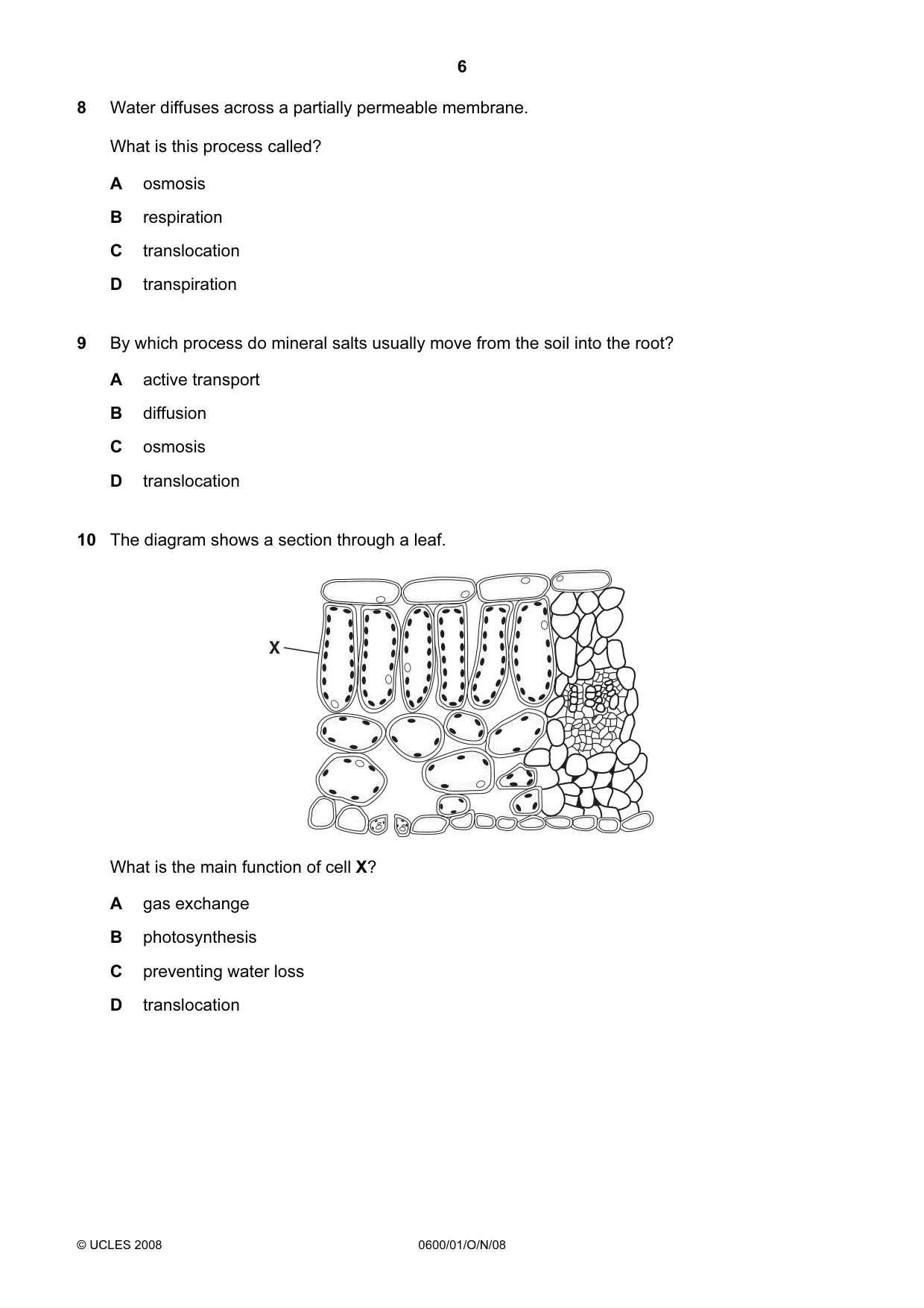
6 © UCLES 2008 0600/01/O/N/08 8 Water diffuses across a partially permeable membrane. What is this process called? A osmosis B respiration C translocation D transpiration 9 By which process do mineral salts usually move from the soil into the root? A active transport B diffusion C osmosis D translocation 10 The diagram shows a section through a leaf. X What is the main function of cell X? A gas exchange B photosynthesis C preventing water loss D translocation
Question paper, page 7
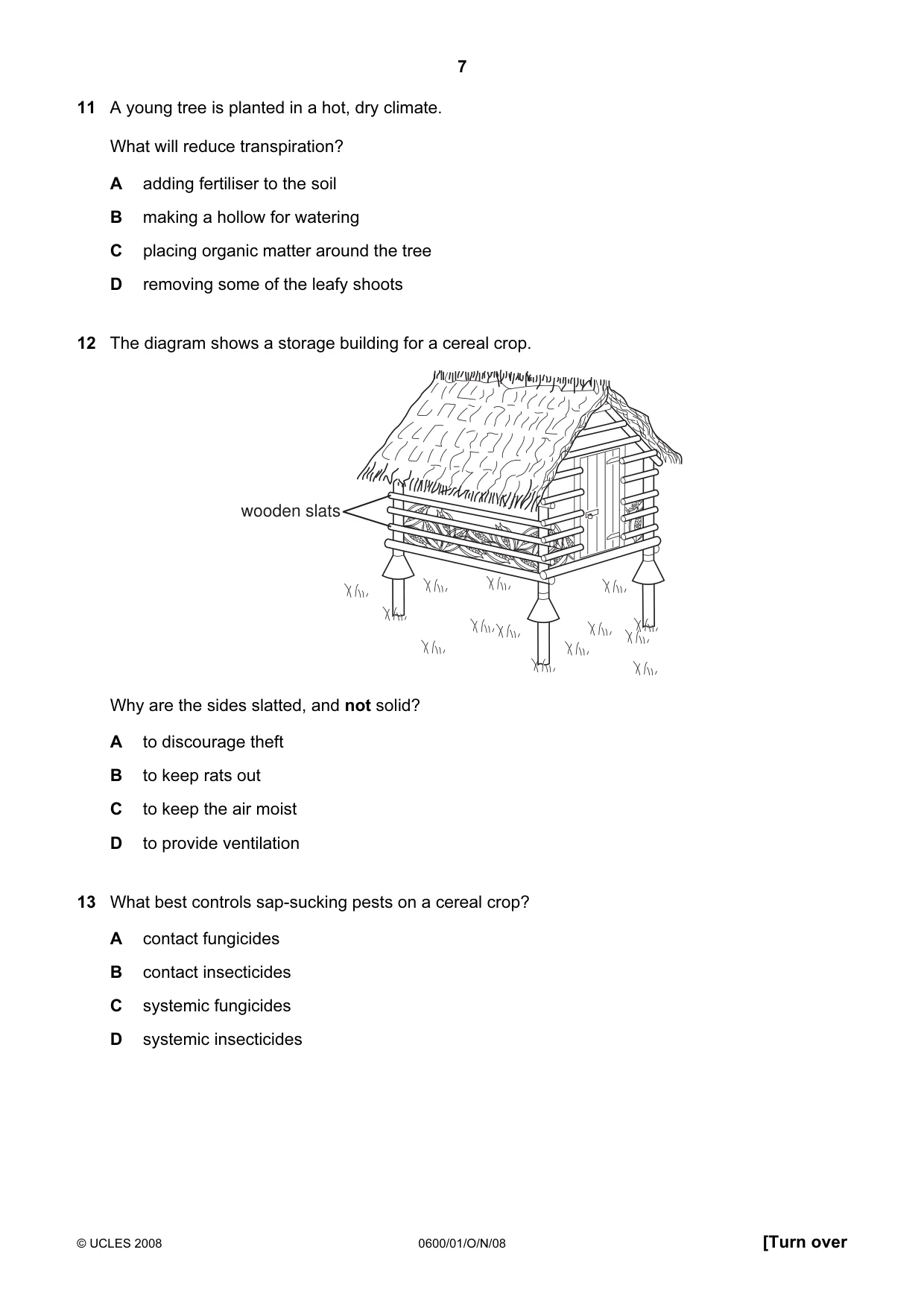
7 © UCLES 2008 0600/01/O/N/08 [Turn over 11 A young tree is planted in a hot, dry climate. What will reduce transpiration? A adding fertiliser to the soil B making a hollow for watering C placing organic matter around the tree D removing some of the leafy shoots 12 The diagram shows a storage building for a cereal crop. wooden slats Why are the sides slatted, and not solid? A to discourage theft B to keep rats out C to keep the air moist D to provide ventilation 13 What best controls sap-sucking pests on a cereal crop? A contact fungicides B contact insecticides C systemic fungicides D systemic insecticides
Question paper, page 8
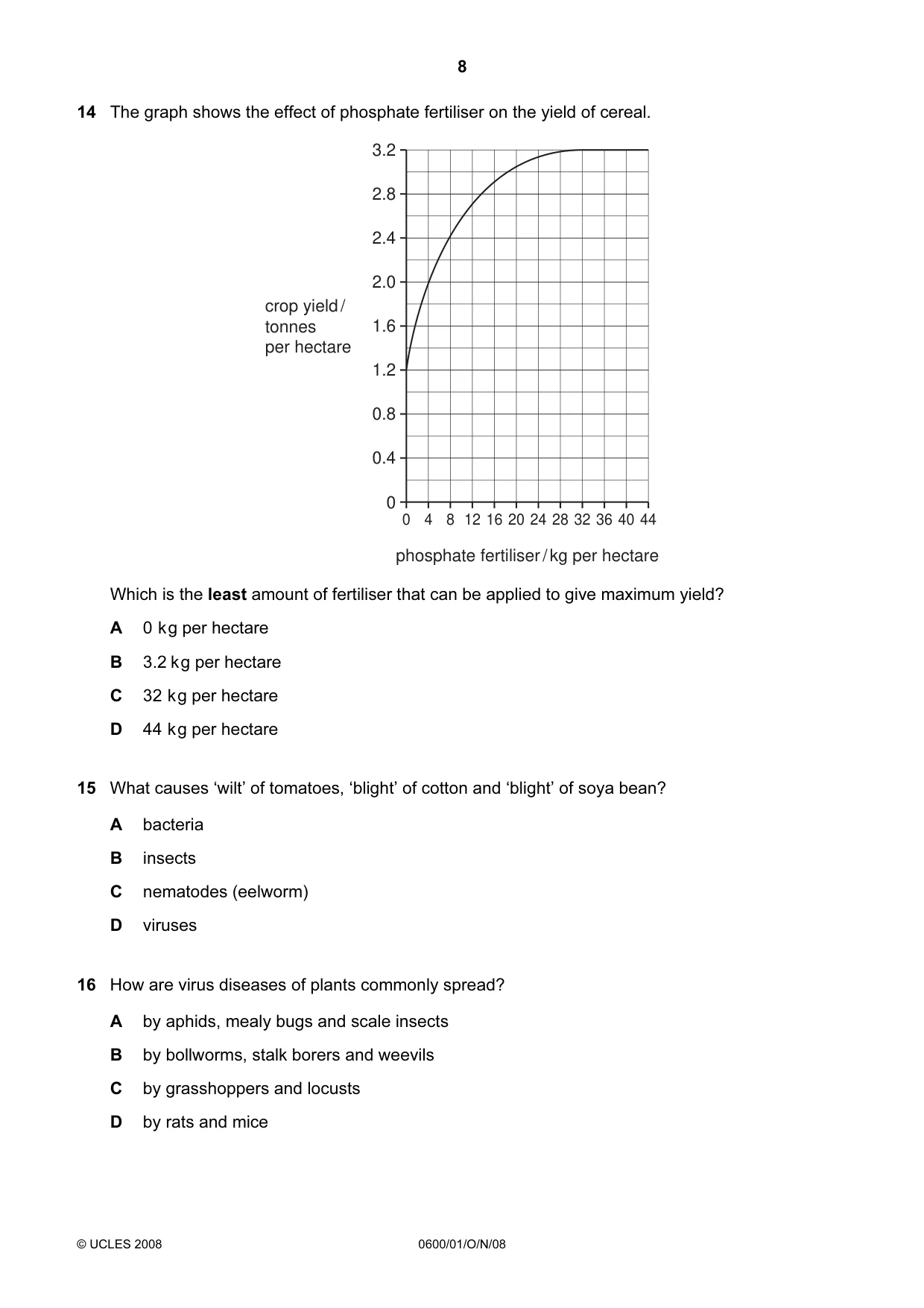
8 © UCLES 2008 0600/01/O/N/08 14 The graph shows the effect of phosphate fertiliser on the yield of cereal. 0 4 8 12 16 20 24 28 32 36 40 44 3.2 2.8 2.4 2.0 1.6 1.2 0.8 0.4 0 phosphate fertiliser / kg per hectare crop yield / tonnes per hectare Which is the least amount of fertiliser that can be applied to give maximum yield? A 0 kg per hectare B 3.2 kg per hectare C 32 kg per hectare D 44 kg per hectare 15 What causes ‘wilt’ of tomatoes, ‘blight’ of cotton and ‘blight’ of soya bean? A bacteria B insects C nematodes (eelworm) D viruses 16 How are virus diseases of plants commonly spread? A by aphids, mealy bugs and scale insects B by bollworms, stalk borers and weevils C by grasshoppers and locusts D by rats and mice
Question paper, page 9
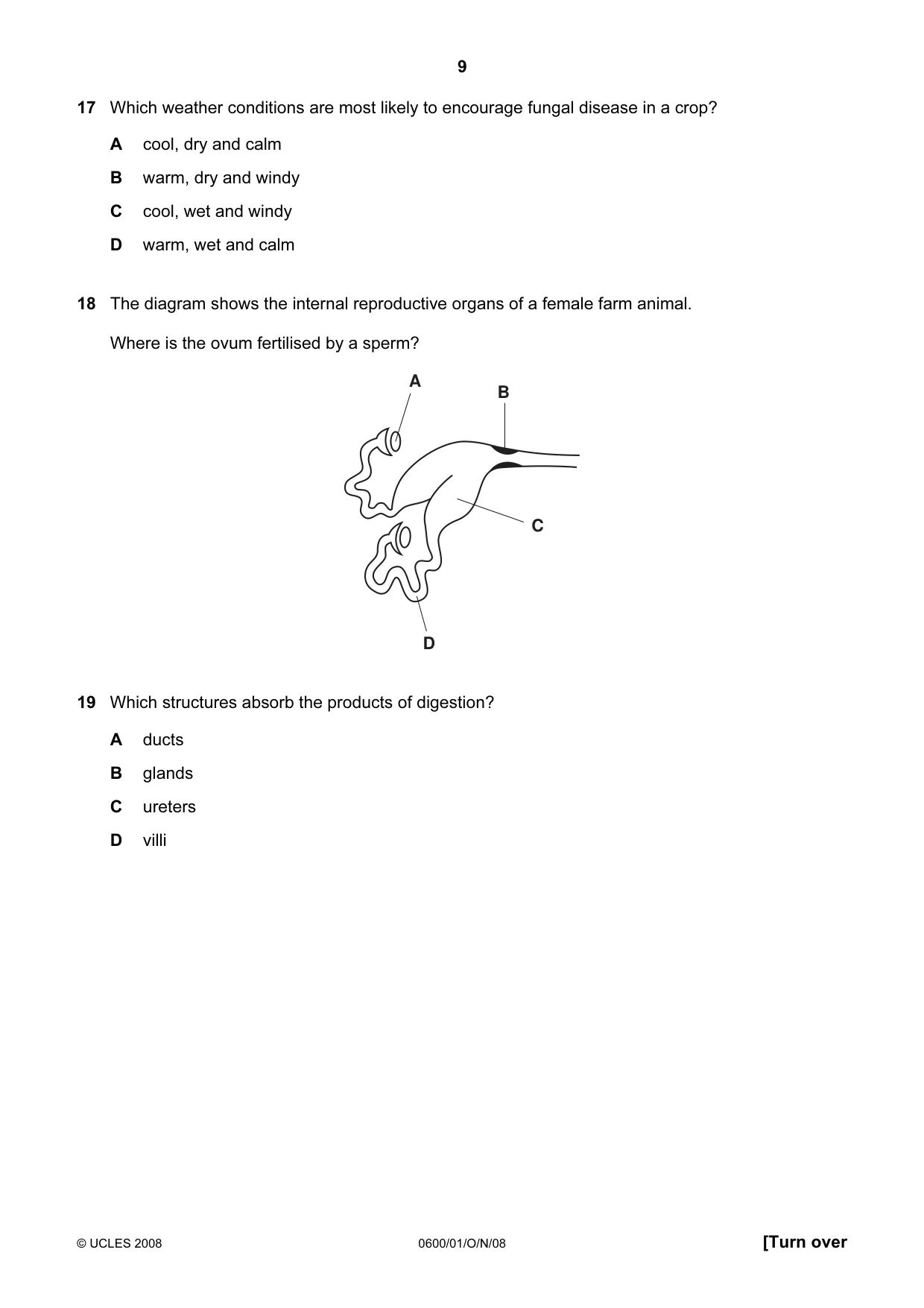
9 © UCLES 2008 0600/01/O/N/08 [Turn over 17 Which weather conditions are most likely to encourage fungal disease in a crop? A cool, dry and calm B warm, dry and windy C cool, wet and windy D warm, wet and calm 18 The diagram shows the internal reproductive organs of a female farm animal. Where is the ovum fertilised by a sperm? C A D B 19 Which structures absorb the products of digestion? A ducts B glands C ureters D villi
Question paper, page 10
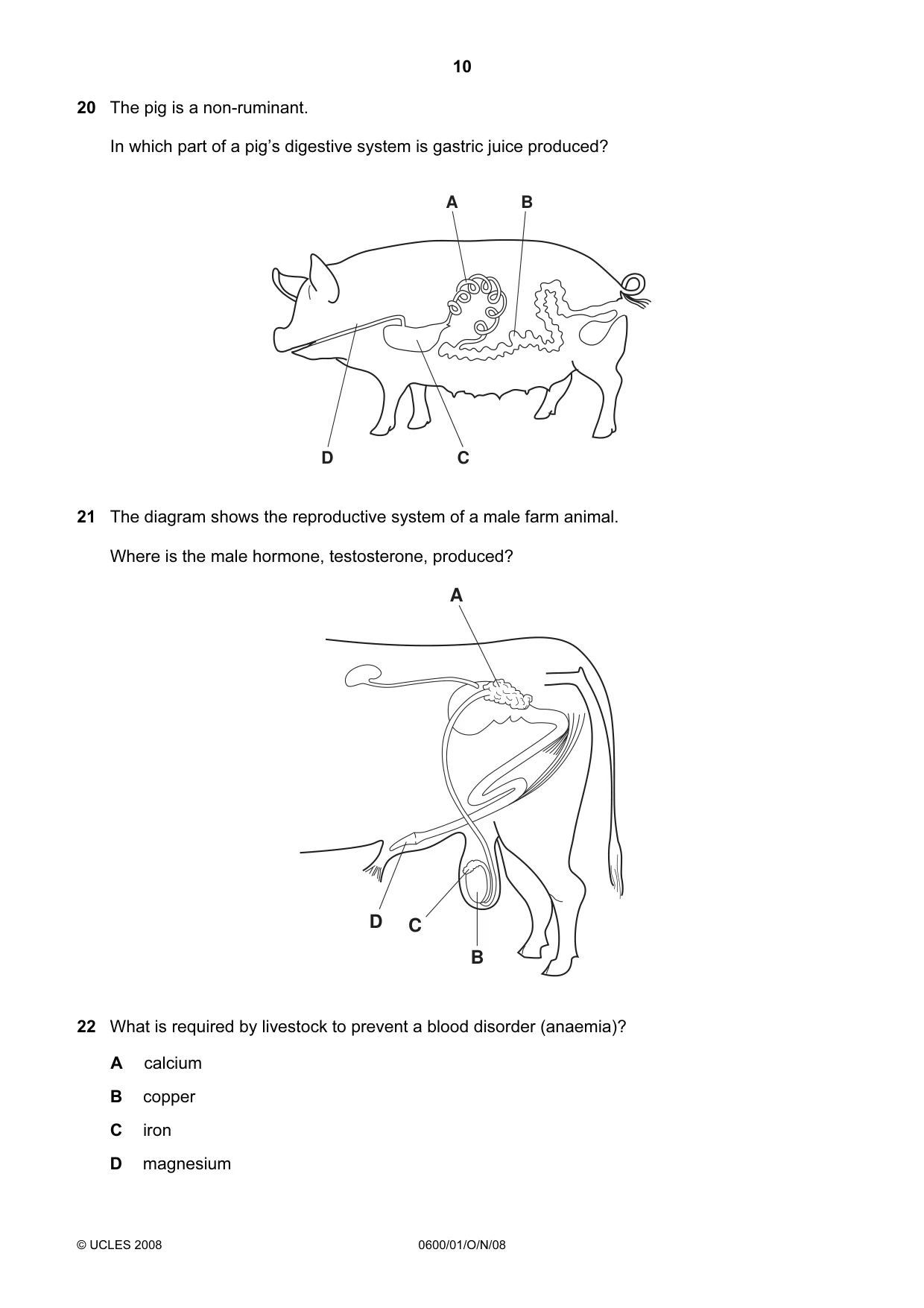
10 © UCLES 2008 0600/01/O/N/08 20 The pig is a non-ruminant. In which part of a pig’s digestive system is gastric juice produced? D C A B 21 The diagram shows the reproductive system of a male farm animal. Where is the male hormone, testosterone, produced? A D C B 22 What is required by livestock to prevent a blood disorder (anaemia)? A calcium B copper C iron D magnesium
Question paper, page 11
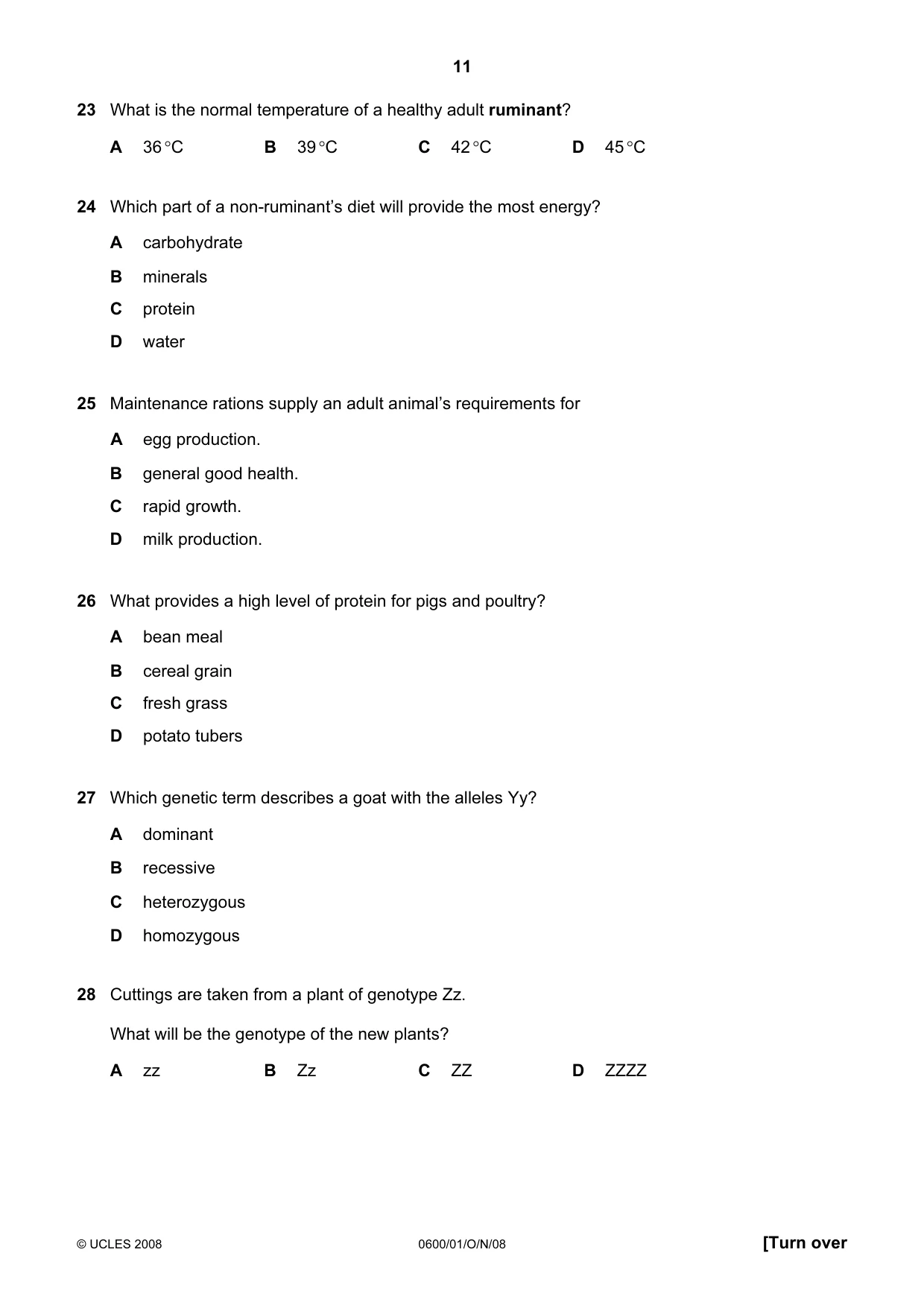
11 © UCLES 2008 0600/01/O/N/08 [Turn over 23 What is the normal temperature of a healthy adult ruminant? A 36 °C B 39 °C C 42 °C D 45 °C 24 Which part of a non-ruminant’s diet will provide the most energy? A carbohydrate B minerals C protein D water 25 Maintenance rations supply an adult animal’s requirements for A egg production. B general good health. C rapid growth. D milk production. 26 What provides a high level of protein for pigs and poultry? A bean meal B cereal grain C fresh grass D potato tubers 27 Which genetic term describes a goat with the alleles Yy? A dominant B recessive C heterozygous D homozygous 28 Cuttings are taken from a plant of genotype Zz. What will be the genotype of the new plants? A zz B Zz C ZZ D ZZZZ
Question paper, page 12
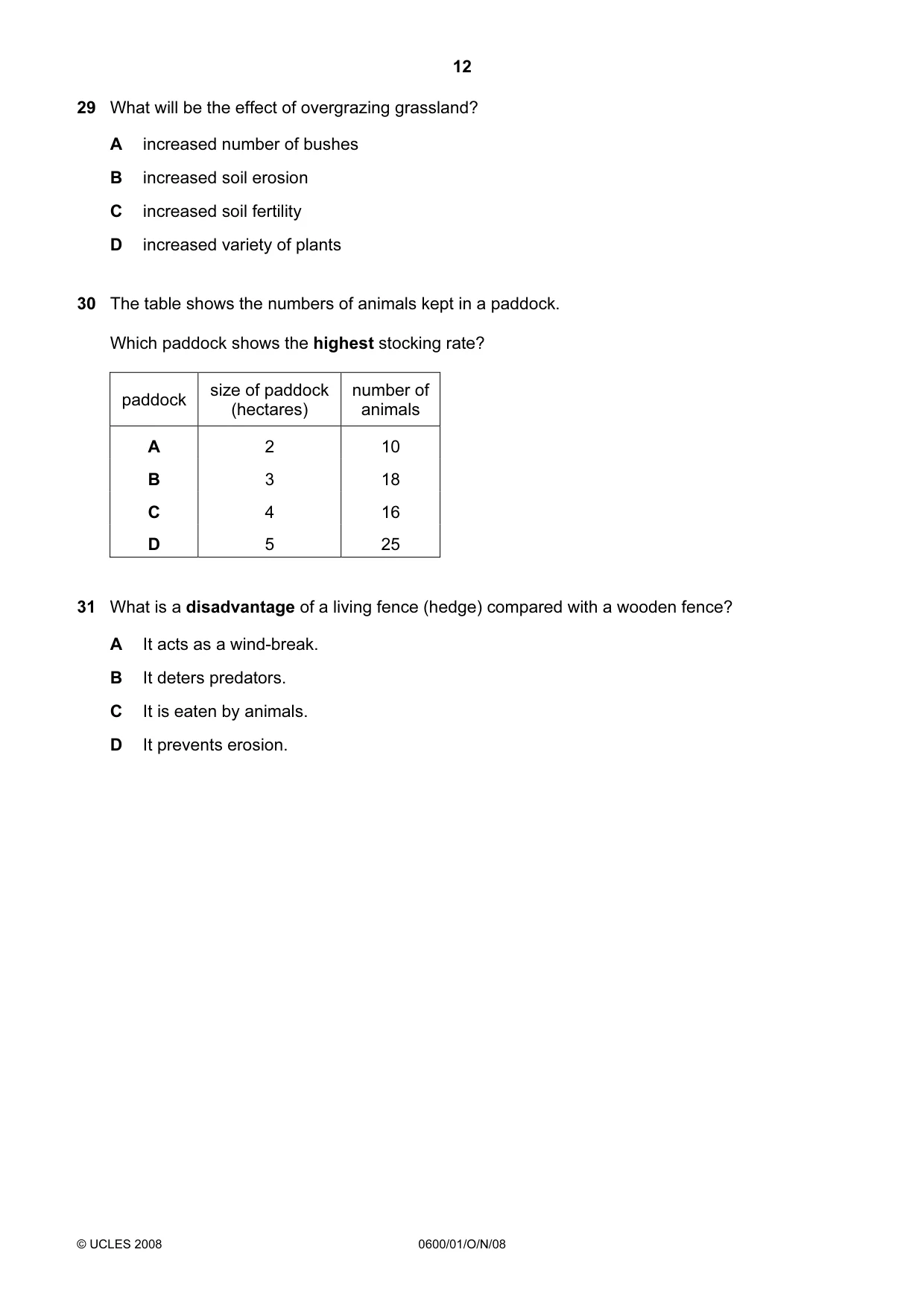
12 © UCLES 2008 0600/01/O/N/08 29 What will be the effect of overgrazing grassland? A increased number of bushes B increased soil erosion C increased soil fertility D increased variety of plants 30 The table shows the numbers of animals kept in a paddock. Which paddock shows the highest stocking rate? paddock size of paddock (hectares) number of animals A 2 10 B 3 18 C 4 16 D 5 25 31 What is a disadvantage of a living fence (hedge) compared with a wooden fence? A It acts as a wind-break. B It deters predators. C It is eaten by animals. D It prevents erosion.
Question paper, page 13
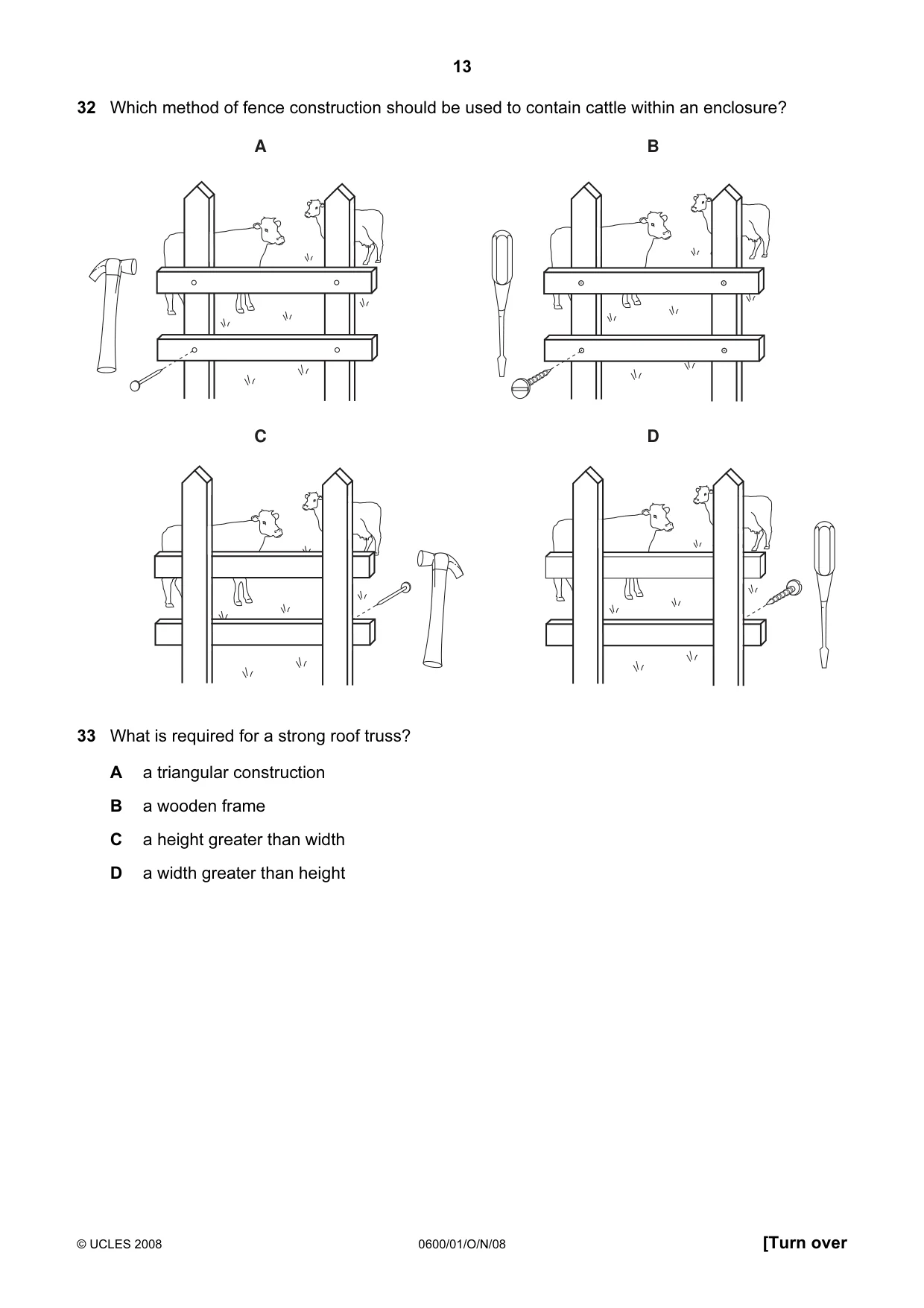
13 © UCLES 2008 0600/01/O/N/08 [Turn over 32 Which method of fence construction should be used to contain cattle within an enclosure? A B C D 33 What is required for a strong roof truss? A a triangular construction B a wooden frame C a height greater than width D a width greater than height
Question paper, page 14
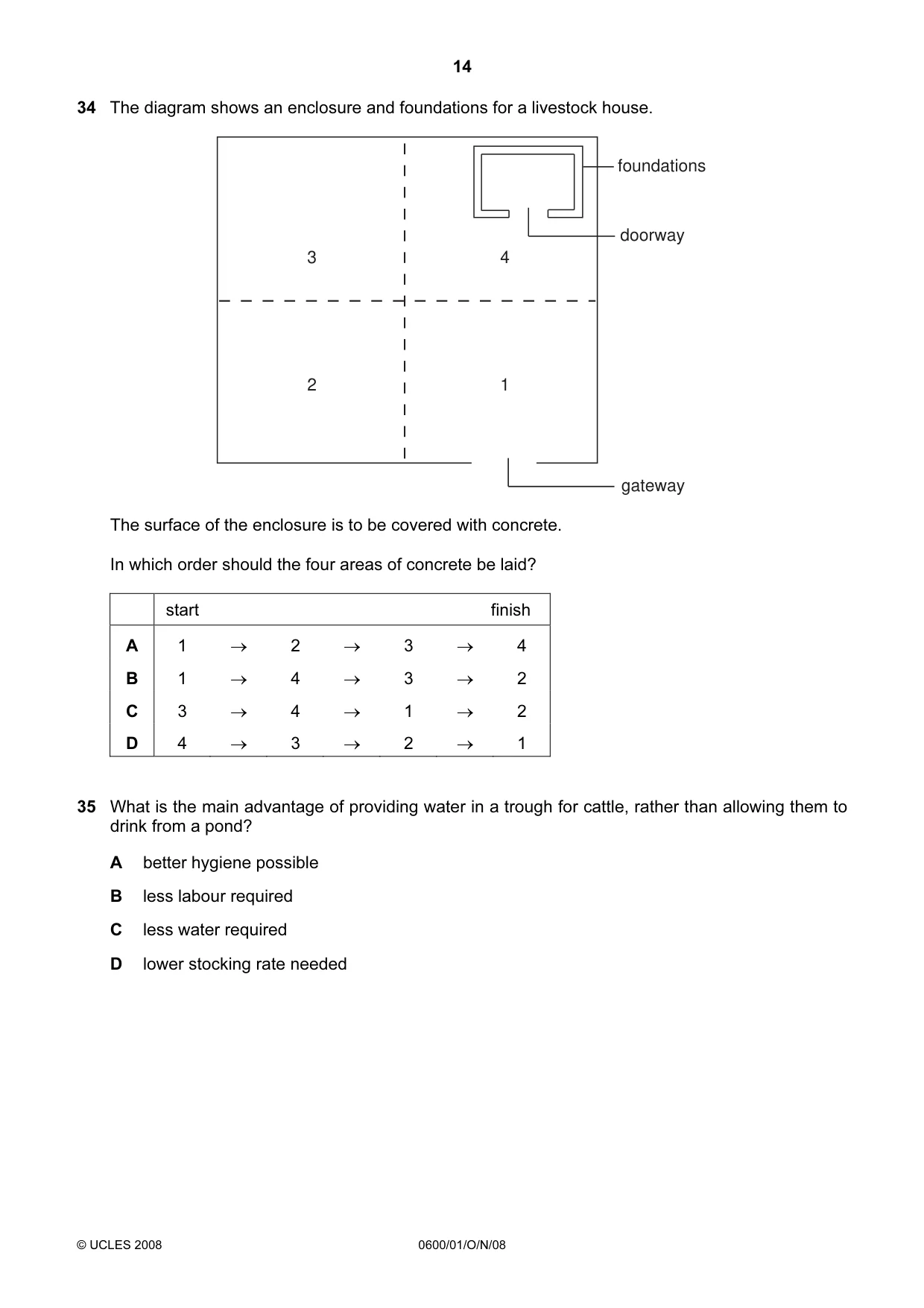
14 © UCLES 2008 0600/01/O/N/08 34 The diagram shows an enclosure and foundations for a livestock house. 1 2 3 4 foundations doorway gateway The surface of the enclosure is to be covered with concrete. In which order should the four areas of concrete be laid? start finish A 1 → 2 → 3 → 4 B 1 → 4 → 3 → 2 C 3 → 4 → 1 → 2 D 4 → 3 → 2 → 1 35 What is the main advantage of providing water in a trough for cattle, rather than allowing them to drink from a pond? A better hygiene possible B less labour required C less water required D lower stocking rate needed
Question paper, page 15
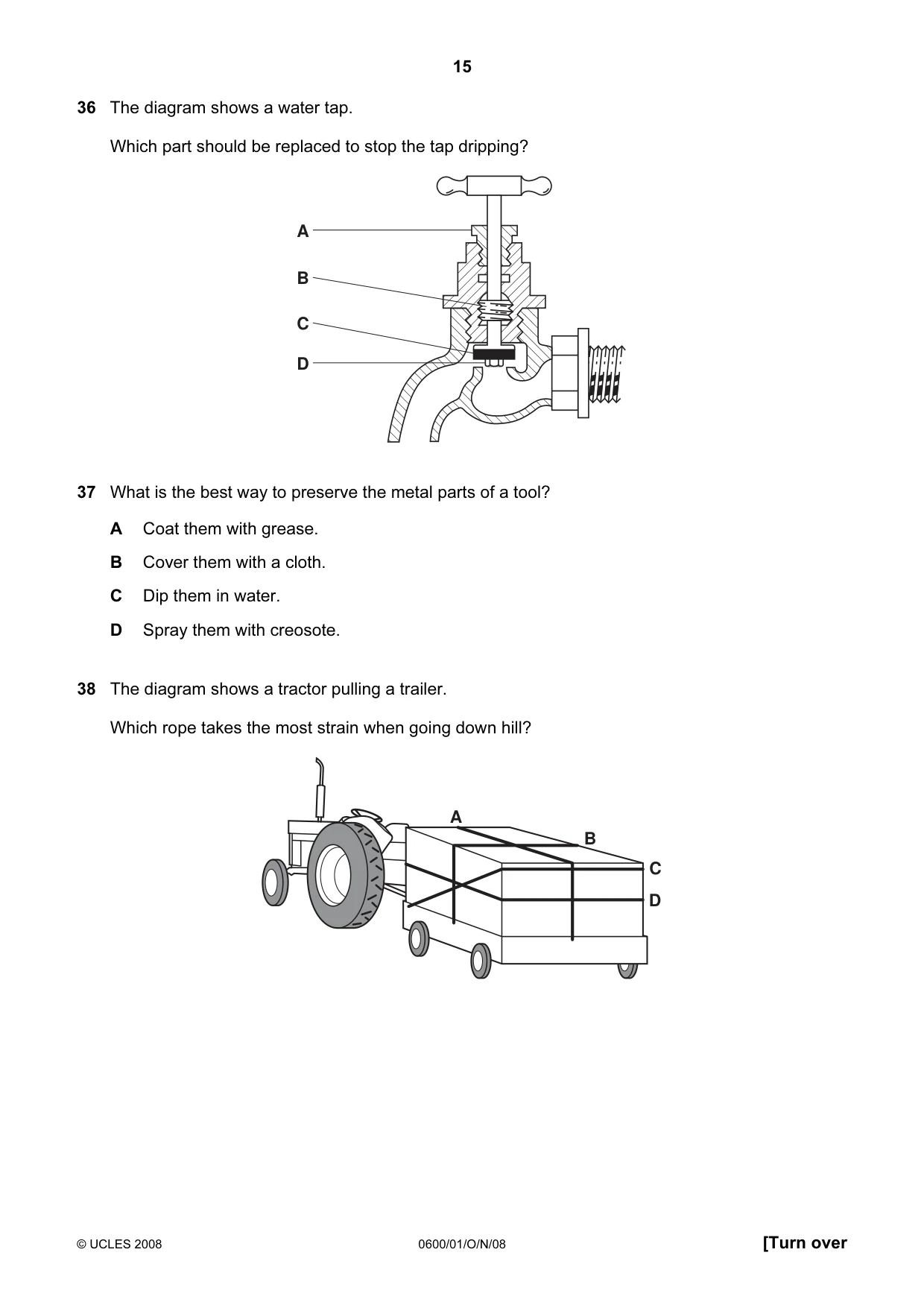
15 © UCLES 2008 0600/01/O/N/08 [Turn over 36 The diagram shows a water tap. Which part should be replaced to stop the tap dripping? A D B C 37 What is the best way to preserve the metal parts of a tool? A Coat them with grease. B Cover them with a cloth. C Dip them in water. D Spray them with creosote. 38 The diagram shows a tractor pulling a trailer. Which rope takes the most strain when going down hill? A B C D
Question paper, page 16
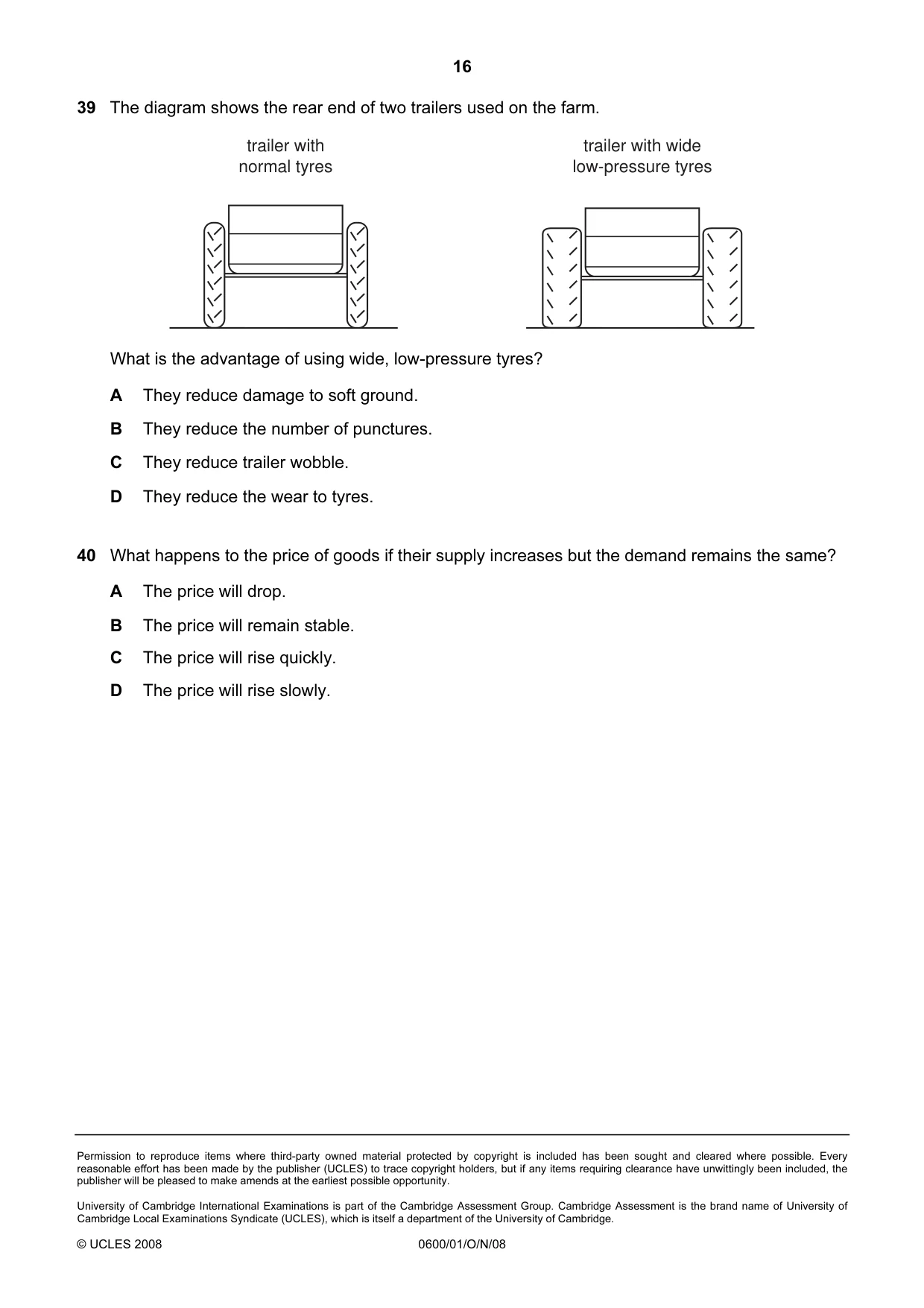
16 Permission to reproduce items where third-party owned material protected by copyright is included has been sought and cleared where possible. Every reasonable effort has been made by the publisher (UCLES) to trace copyright holders, but if any items requiring clearance have unwittingly been included, the publisher will be pleased to make amends at the earliest possible opportunity. University of Cambridge International Examinations is part of the Cambridge Assessment Group. Cambridge Assessment is the brand name of University of Cambridge Local Examinations Syndicate (UCLES), which is itself a department of the University of Cambridge. © UCLES 2008 0600/01/O/N/08 39 The diagram shows the rear end of two trailers used on the farm. trailer with normal tyres trailer with wide low-pressure tyres What is the advantage of using wide, low-pressure tyres? A They reduce damage to soft ground. B They reduce the number of punctures. C They reduce trailer wobble. D They reduce the wear to tyres. 40 What happens to the price of goods if their supply increases but the demand remains the same? A The price will drop. B The price will remain stable. C The price will rise quickly. D The price will rise slowly.
Mark scheme, page 1
UNIVERSITY OF CAMBRIDGE INTERNATIONAL EXAMINATIONS International General Certificate of Secondary Education MARK SCHEME for the October/November 2008 question paper 0600 AGRICULTURE 0600/01 Paper 1 (Multiple Choice), maximum raw mark 40 Mark schemes must be read in conjunction with the question papers and the report on the examination. • CIE will not enter into discussions or correspondence in connection with these mark schemes. CIE is publishing the mark schemes for the October/November 2008 question papers for most IGCSE, GCE Advanced Level and Advanced Subsidiary Level syllabuses and some Ordinary Level syllabuses. www.XtremePapers.com
Mark scheme, page 2
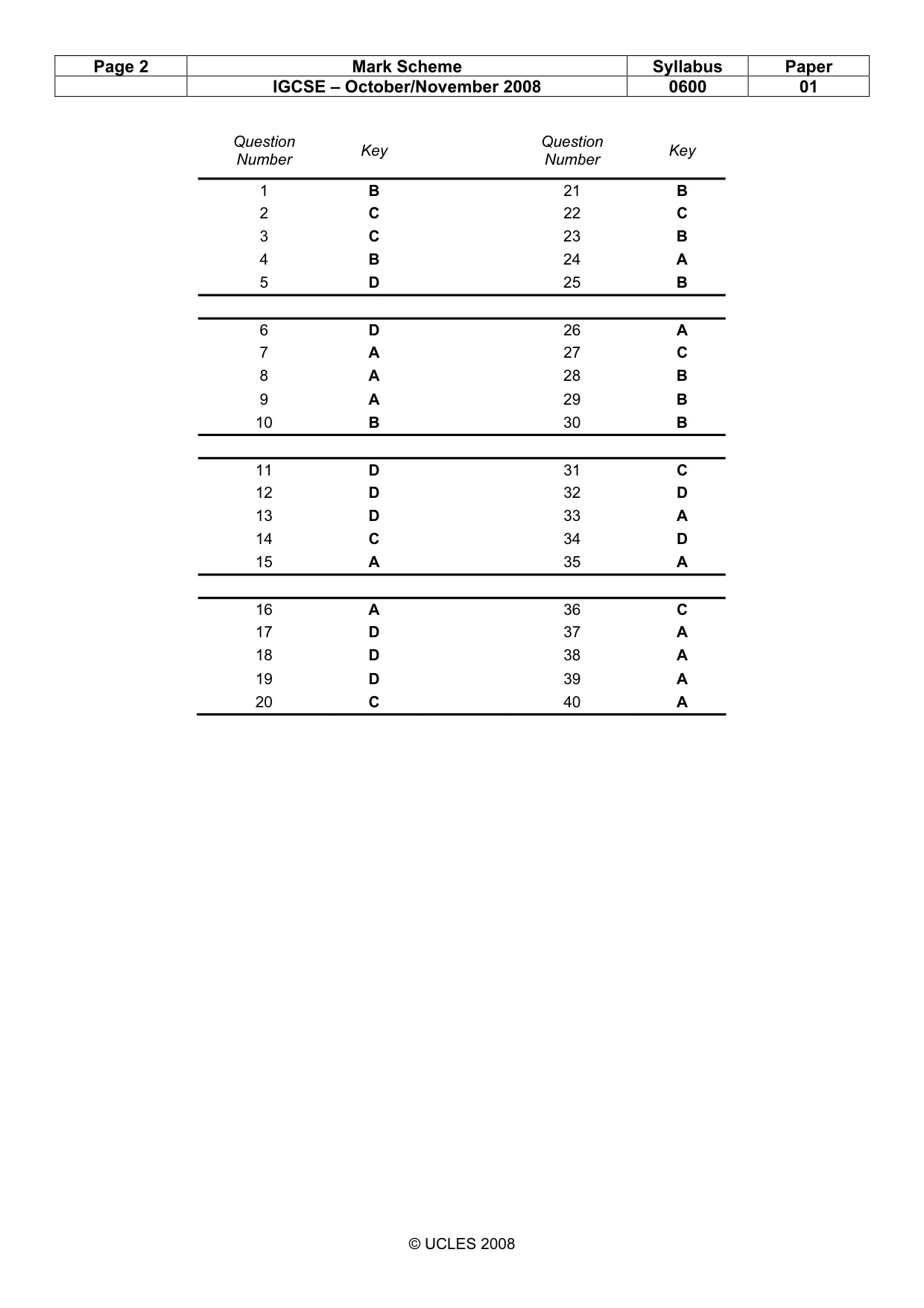
Page 2 Mark Scheme Syllabus Paper IGCSE – October/November 2008 0600 01 © UCLES 2008 Question Number Key Question Number Key 1 B 21 B 2 C 22 C 3 C 23 B 4 B 24 A 5 D 25 B 6 D 26 A 7 A 27 C 8 A 28 B 9 A 29 B 10 B 30 B 11 D 31 C 12 D 32 D 13 D 33 A 14 C 34 D 15 A 35 A 16 A 36 C 17 D 37 A 18 D 38 A 19 D 39 A 20 C 40 A
What you needed in this session
Cambridge’s own grade thresholds for 2008 Oct/Nov, Paper 1 · Variant 1. A higher threshold means an easier paper — the bar moves with how the cohort did.