Cambridge IGCSE Agriculture 0600 — 2007 Oct/Nov Paper 2 · Variant 1
0600/21/O/N/07 · 80 marks · ≈90 min
The question paper and its mark scheme, free to read here and free to download. This is Cambridge’s own paper, exactly as it was sat.
Question paper20 pages

Mark scheme5 pages
Answers below. Sit the paper first if you are practising.
Paper as text
Question paper, page 1
This document consists of 20 printed pages. IB07 11_0600_02/3RP © UCLES 2007 [Turn over *8319062707* For Examiner's Use 1 2 3 4 5 6 7 8 9 Total UNIVERSITY OF CAMBRIDGE INTERNATIONAL EXAMINATIONS International General Certificate of Secondary Education AGRICULTURE 0600/02 Paper 2 October/November 2007 1 hour 15 minutes Candidates answer on the Question Paper. No Additional Materials are required. READ THESE INSTRUCTIONS FIRST Write your Centre number, candidate number and name on all the work you hand in. Write in dark blue or black pen. You may use a soft pencil for any diagrams or graphs. Do not use staples, paper clips, highlighters, glue or correction fluid. DO NOT WRITE IN ANY BARCODES. Answer all questions. At the end of the examination, fasten all your work securely together. The number of marks is given in brackets [ ] at the end of each question or part question. www.XtremePapers.com
Question paper, page 2
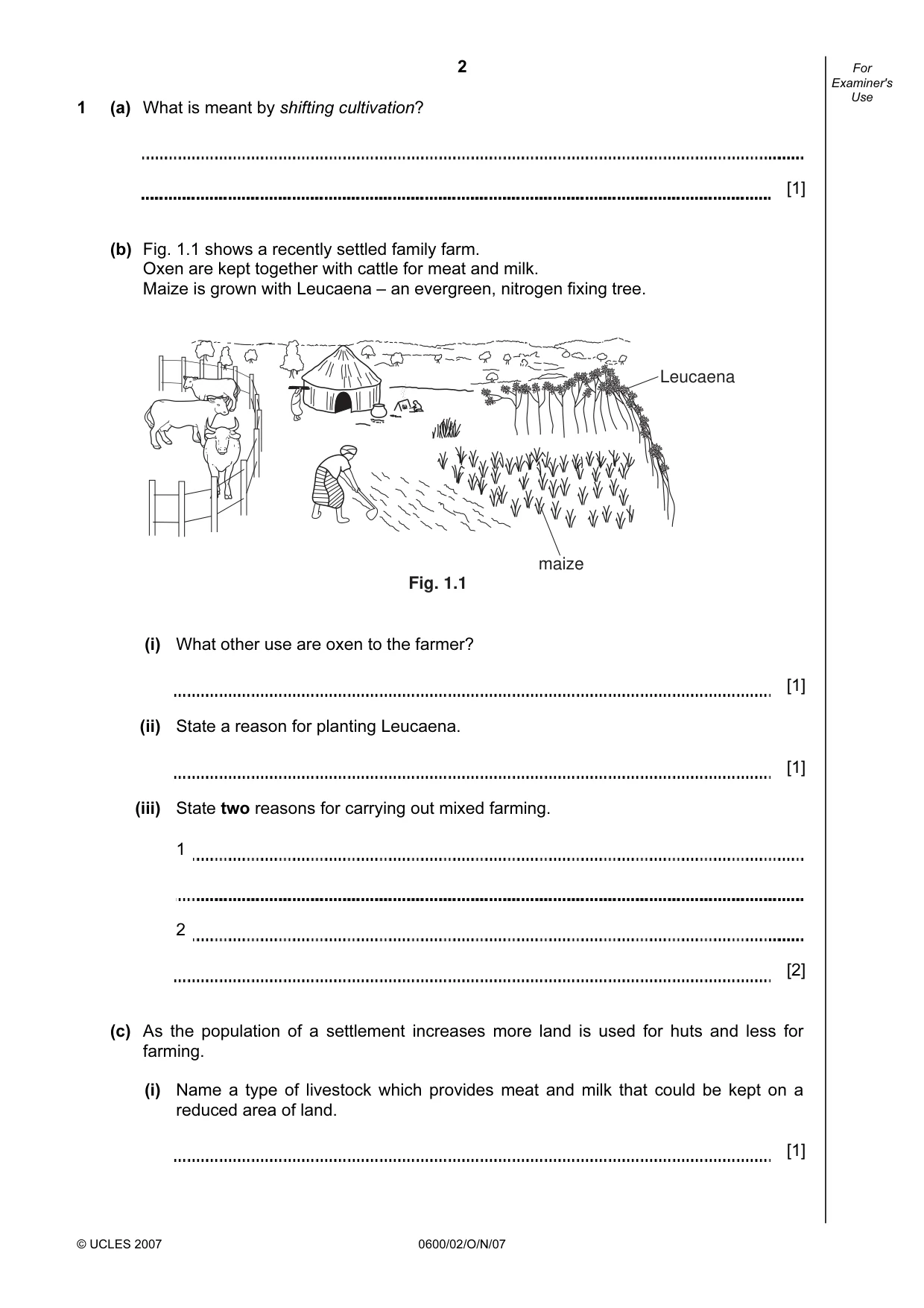
2 © UCLES 2007 0600/02/O/N/07 For Examiner's Use 1 (a) What is meant by shifting cultivation? [1] (b) Fig. 1.1 shows a recently settled family farm. Oxen are kept together with cattle for meat and milk. Maize is grown with Leucaena – an evergreen, nitrogen fixing tree. Fig. 1.1 maize Leucaena (i) What other use are oxen to the farmer? [1] (ii) State a reason for planting Leucaena. [1] (iii) State two reasons for carrying out mixed farming. 1 2 [2] (c) As the population of a settlement increases more land is used for huts and less for farming. (i) Name a type of livestock which provides meat and milk that could be kept on a reduced area of land. [1]
Question paper, page 3
3 © UCLES 2007 0600/02/O/N/07 [Turn over For Examiner's Use (ii) Suggest two ways by which the yield of crops can be maintained on less land. [2] [Total 8]
Question paper, page 4
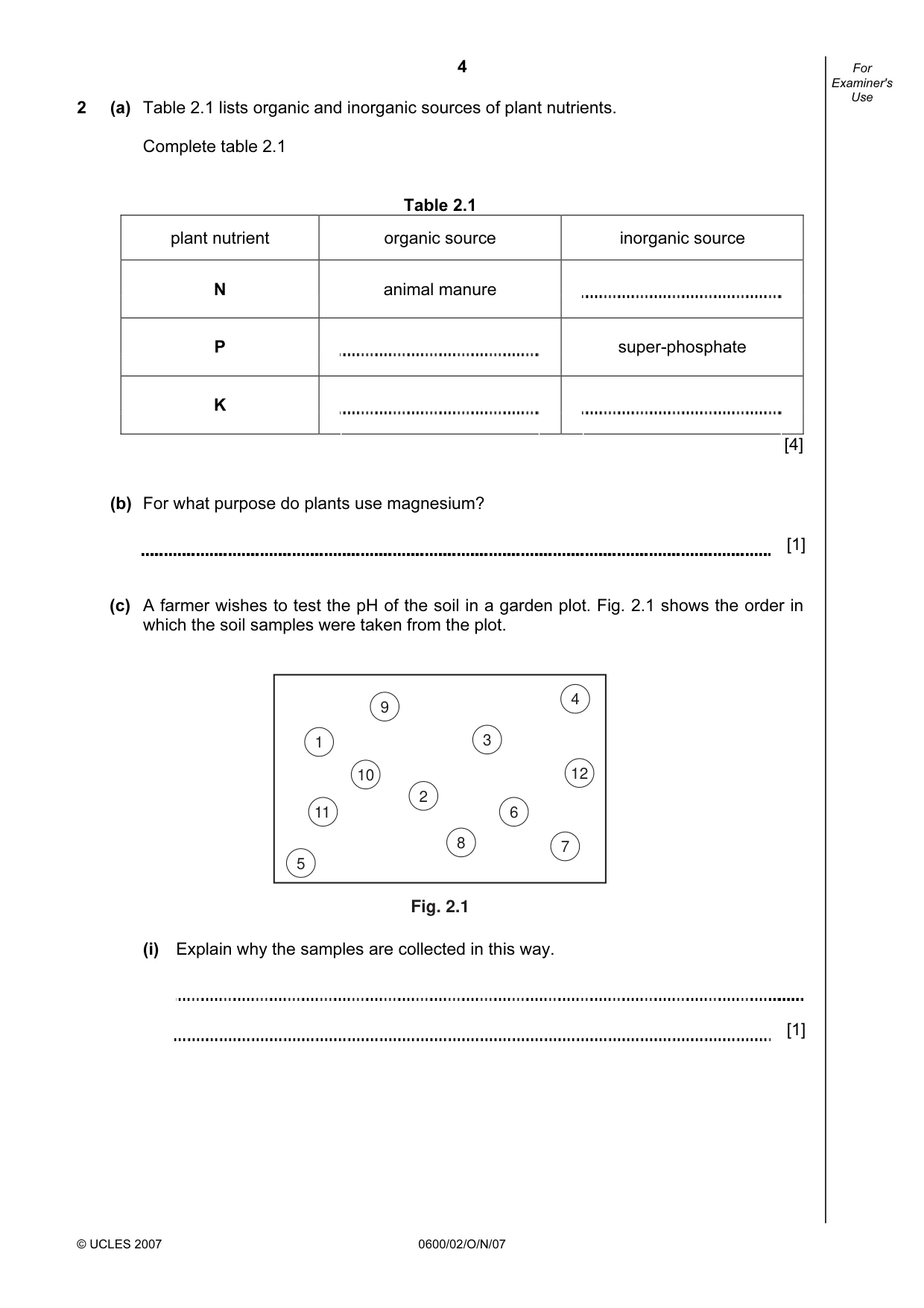
4 © UCLES 2007 0600/02/O/N/07 For Examiner's Use 2 (a) Table 2.1 lists organic and inorganic sources of plant nutrients. Complete table 2.1 Table 2.1 plant nutrient organic source inorganic source N animal manure P super-phosphate K [4] (b) For what purpose do plants use magnesium? [1] (c) A farmer wishes to test the pH of the soil in a garden plot. Fig. 2.1 shows the order in which the soil samples were taken from the plot. 5 11 1 9 10 2 8 6 3 4 12 7 Fig. 2.1 (i) Explain why the samples are collected in this way. [1]
Question paper, page 5
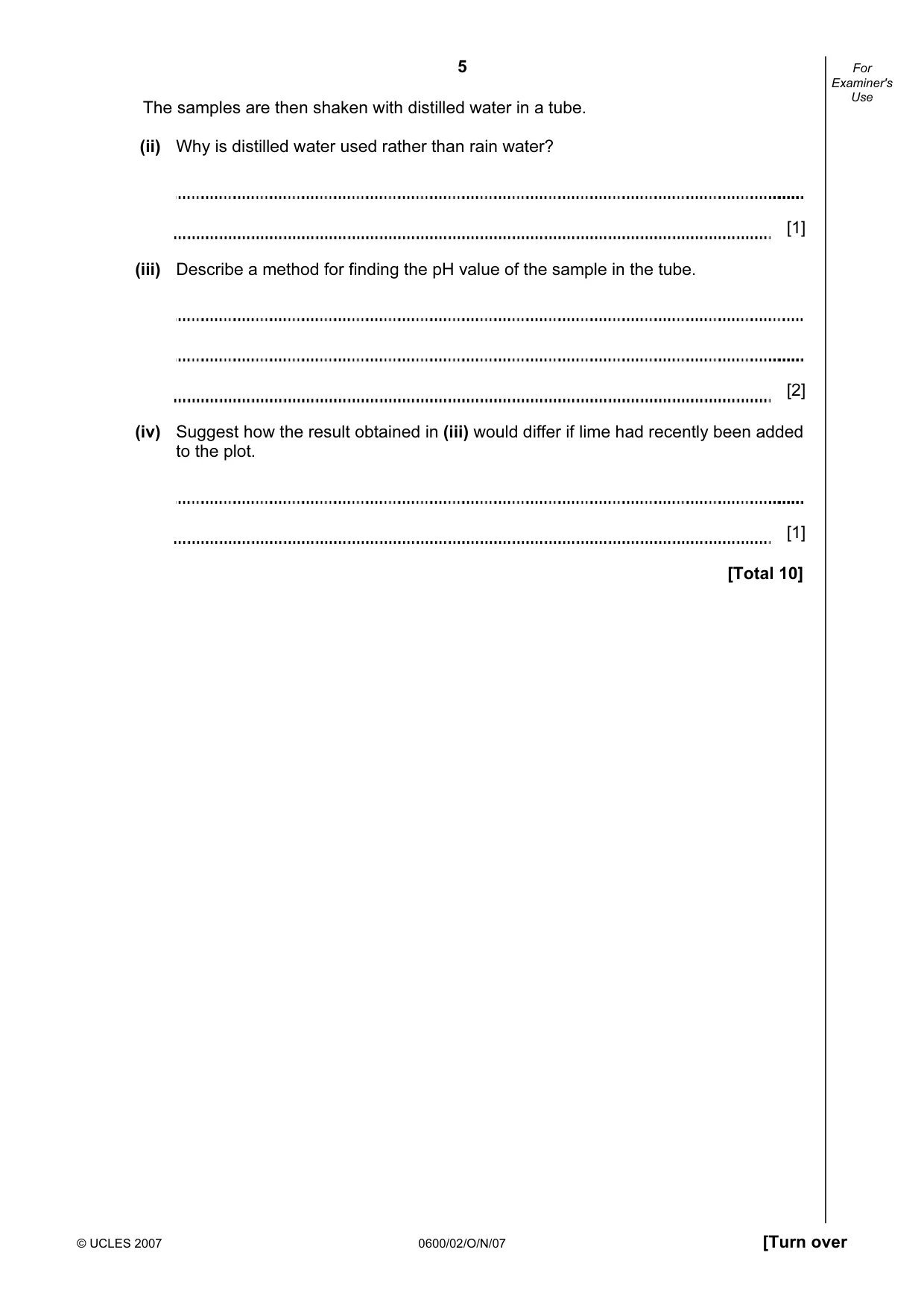
5 © UCLES 2007 0600/02/O/N/07 [Turn over For Examiner's Use The samples are then shaken with distilled water in a tube. (ii) Why is distilled water used rather than rain water? [1] (iii) Describe a method for finding the pH value of the sample in the tube. [2] (iv) Suggest how the result obtained in (iii) would differ if lime had recently been added to the plot. [1] [Total 10]
Question paper, page 6
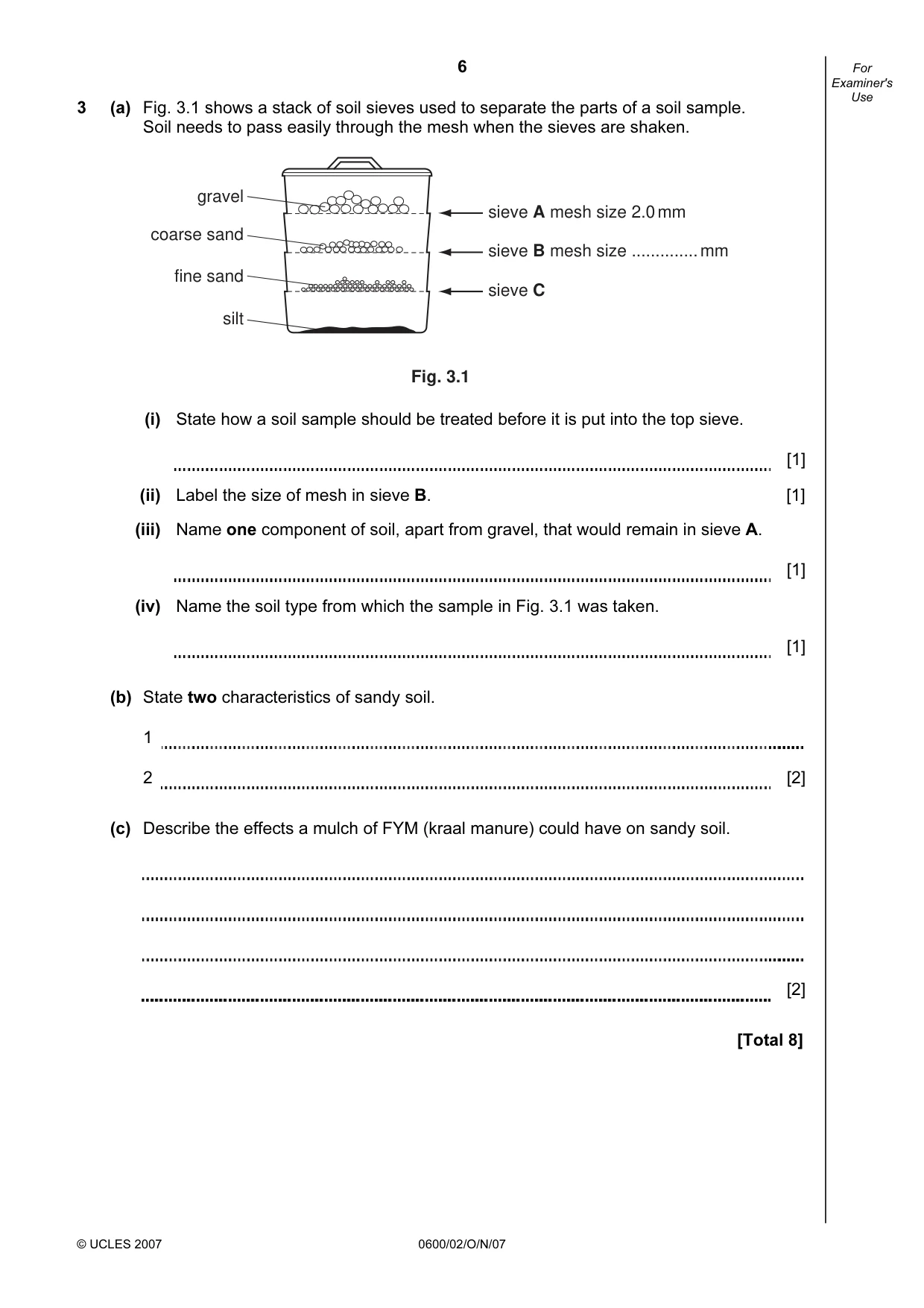
6 © UCLES 2007 0600/02/O/N/07 For Examiner's Use 3 (a) Fig. 3.1 shows a stack of soil sieves used to separate the parts of a soil sample. Soil needs to pass easily through the mesh when the sieves are shaken. gravel coarse sand fine sand silt sieve A mesh size 2.0 mm sieve B mesh size … mm sieve C Fig. 3.1 (i) State how a soil sample should be treated before it is put into the top sieve. [1] (ii) Label the size of mesh in sieve B. [1] (iii) Name one component of soil, apart from gravel, that would remain in sieve A. [1] (iv) Name the soil type from which the sample in Fig. 3.1 was taken. [1] (b) State two characteristics of sandy soil. 1 2 [2] (c) Describe the effects a mulch of FYM (kraal manure) could have on sandy soil. [2] [Total 8]
Question paper, page 7
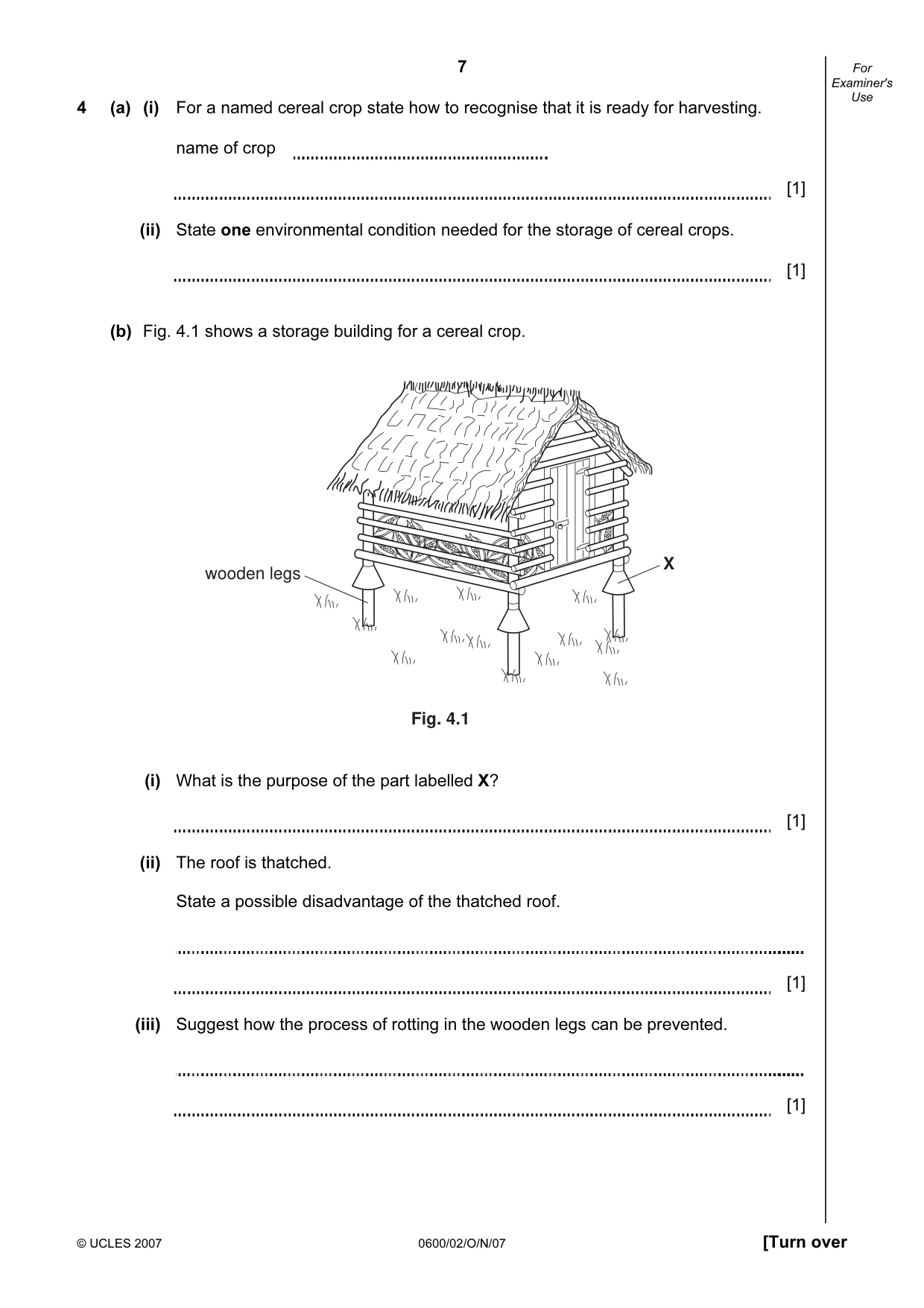
7 © UCLES 2007 0600/02/O/N/07 [Turn over For Examiner's Use 4 (a) (i) For a named cereal crop state how to recognise that it is ready for harvesting. name of crop [1] (ii) State one environmental condition needed for the storage of cereal crops. [1] (b) Fig. 4.1 shows a storage building for a cereal crop. X Fig. 4.1 wooden legs (i) What is the purpose of the part labelled X? [1] (ii) The roof is thatched. State a possible disadvantage of the thatched roof. [1] (iii) Suggest how the process of rotting in the wooden legs can be prevented. [1]
Question paper, page 8
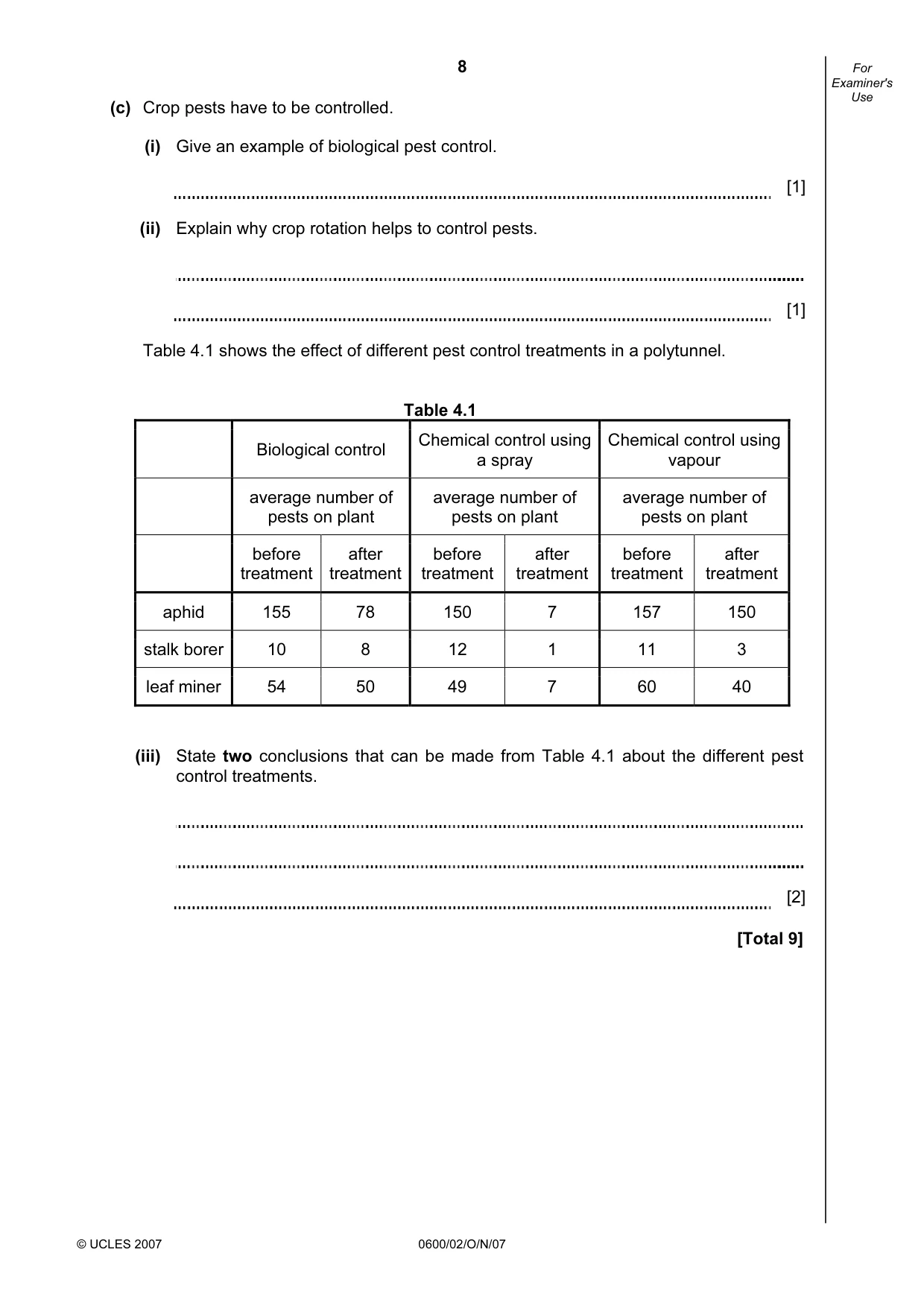
8 © UCLES 2007 0600/02/O/N/07 For Examiner's Use (c) Crop pests have to be controlled. (i) Give an example of biological pest control. [1] (ii) Explain why crop rotation helps to control pests. [1] Table 4.1 shows the effect of different pest control treatments in a polytunnel. Table 4.1 Biological control Chemical control using a spray Chemical control using vapour average number of pests on plant average number of pests on plant average number of pests on plant before treatment after treatment before treatment after treatment before treatment after treatment aphid 155 78 150 7 157 150 stalk borer 10 8 12 1 11 3 leaf miner 54 50 49 7 60 40 (iii) State two conclusions that can be made from Table 4.1 about the different pest control treatments. [2] [Total 9]
Question paper, page 9
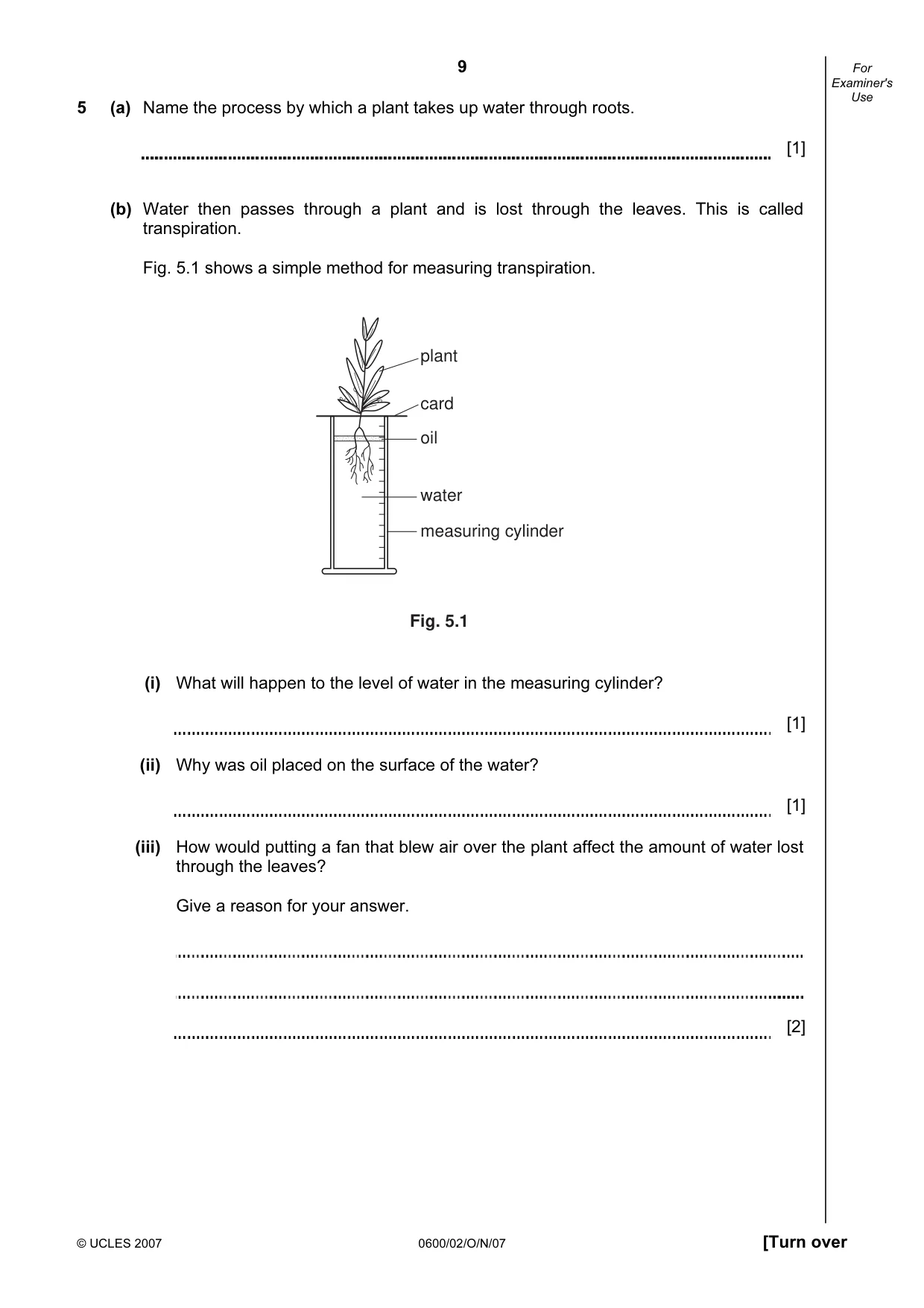
9 © UCLES 2007 0600/02/O/N/07 [Turn over For Examiner's Use 5 (a) Name the process by which a plant takes up water through roots. [1] (b) Water then passes through a plant and is lost through the leaves. This is called transpiration. Fig. 5.1 shows a simple method for measuring transpiration. plant card oil water measuring cylinder Fig. 5.1 (i) What will happen to the level of water in the measuring cylinder? [1] (ii) Why was oil placed on the surface of the water? [1] (iii) How would putting a fan that blew air over the plant affect the amount of water lost through the leaves? Give a reason for your answer. [2]
Question paper, page 10
10 © UCLES 2007 0600/02/O/N/07 For Examiner's Use (c) (i) What causes crop plants to wilt? [1] (ii) Suggest how wilting could be controlled in a field crop. [2] [Total 8]
Question paper, page 11
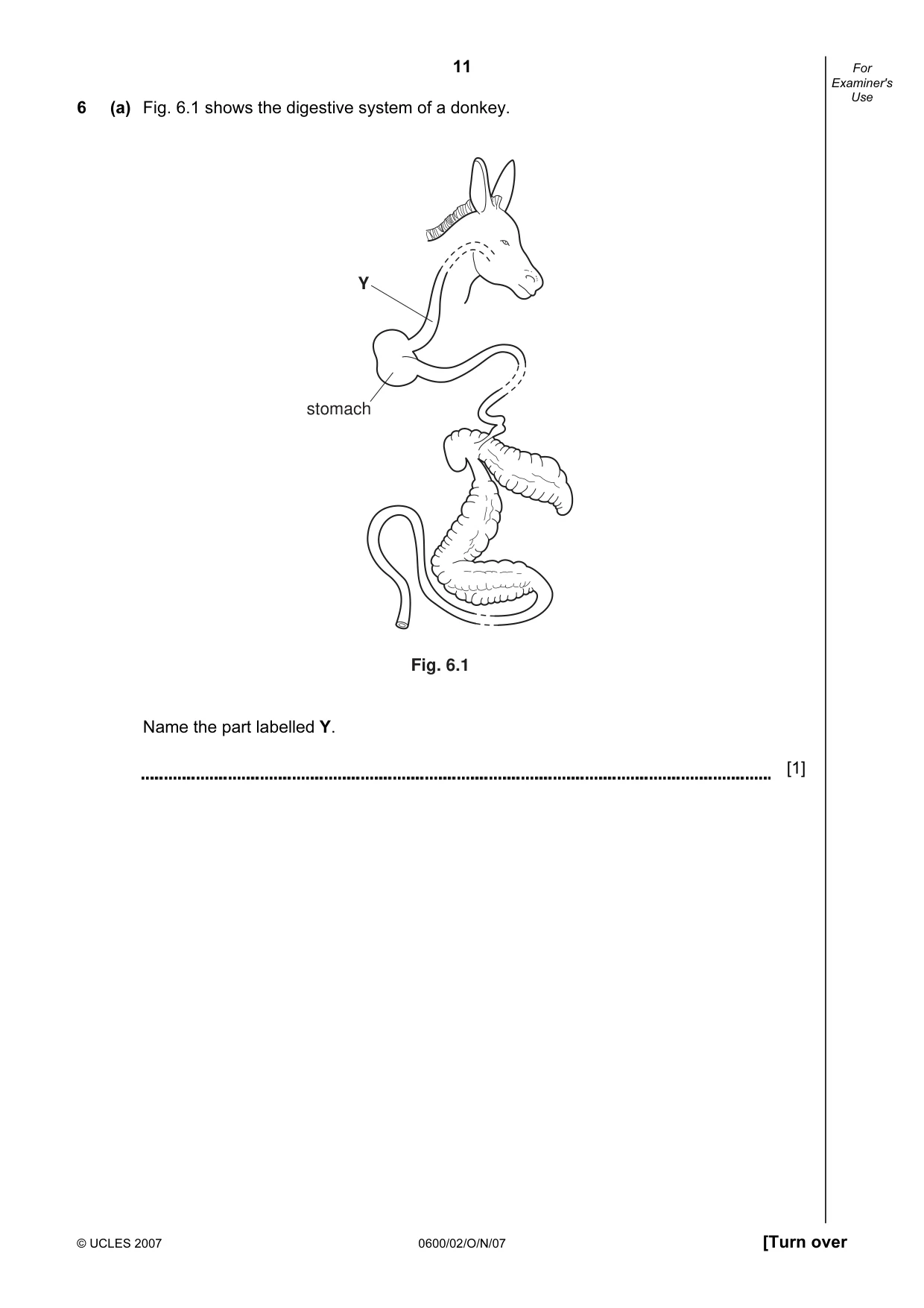
11 © UCLES 2007 0600/02/O/N/07 [Turn over For Examiner's Use 6 (a) Fig. 6.1 shows the digestive system of a donkey. Y stomach Fig. 6.1 Name the part labelled Y. [1]
Question paper, page 12
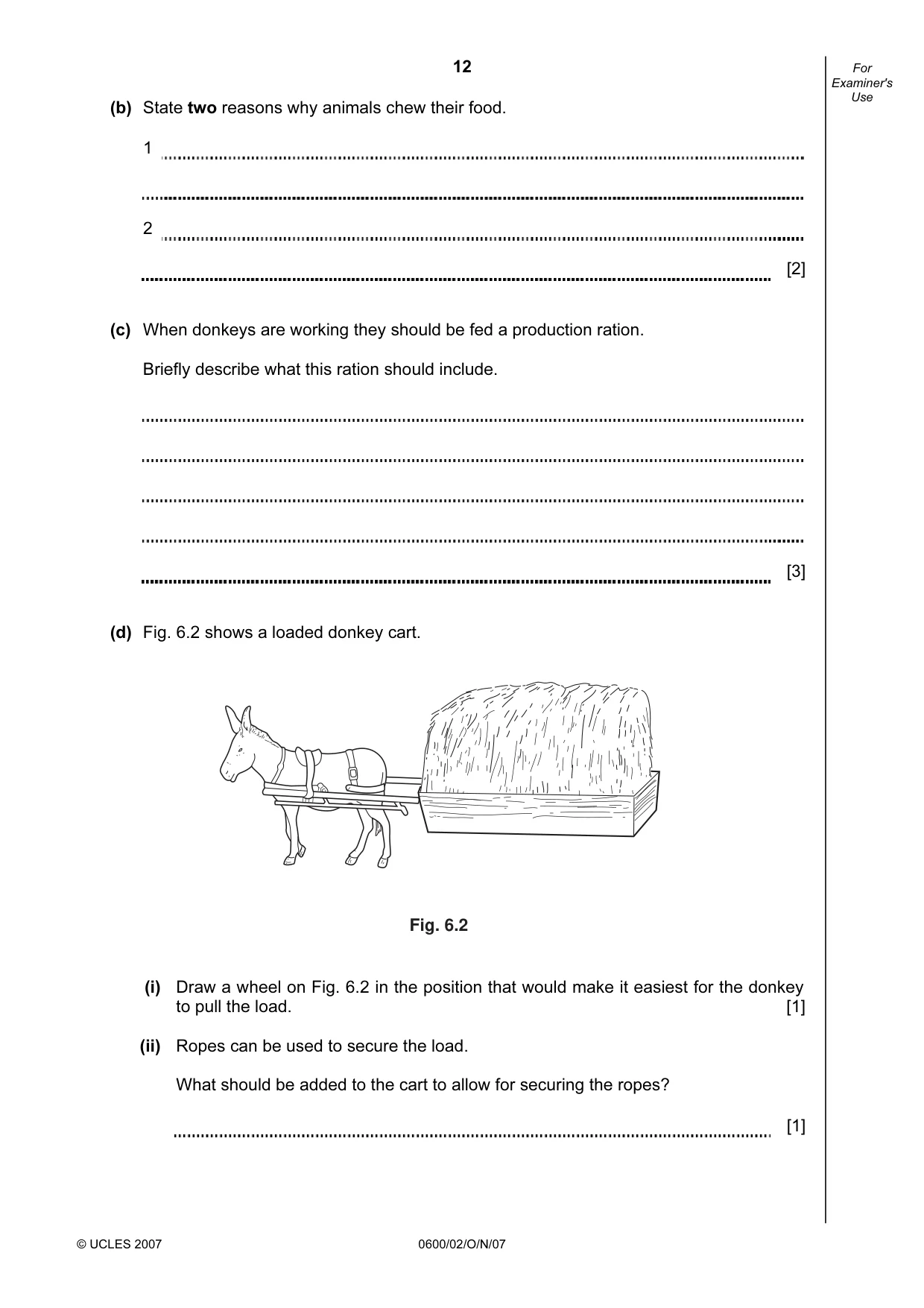
12 © UCLES 2007 0600/02/O/N/07 For Examiner's Use (b) State two reasons why animals chew their food. 1 2 [2] (c) When donkeys are working they should be fed a production ration. Briefly describe what this ration should include. [3] (d) Fig. 6.2 shows a loaded donkey cart. Fig. 6.2 (i) Draw a wheel on Fig. 6.2 in the position that would make it easiest for the donkey to pull the load. [1] (ii) Ropes can be used to secure the load. What should be added to the cart to allow for securing the ropes? [1]
Question paper, page 13
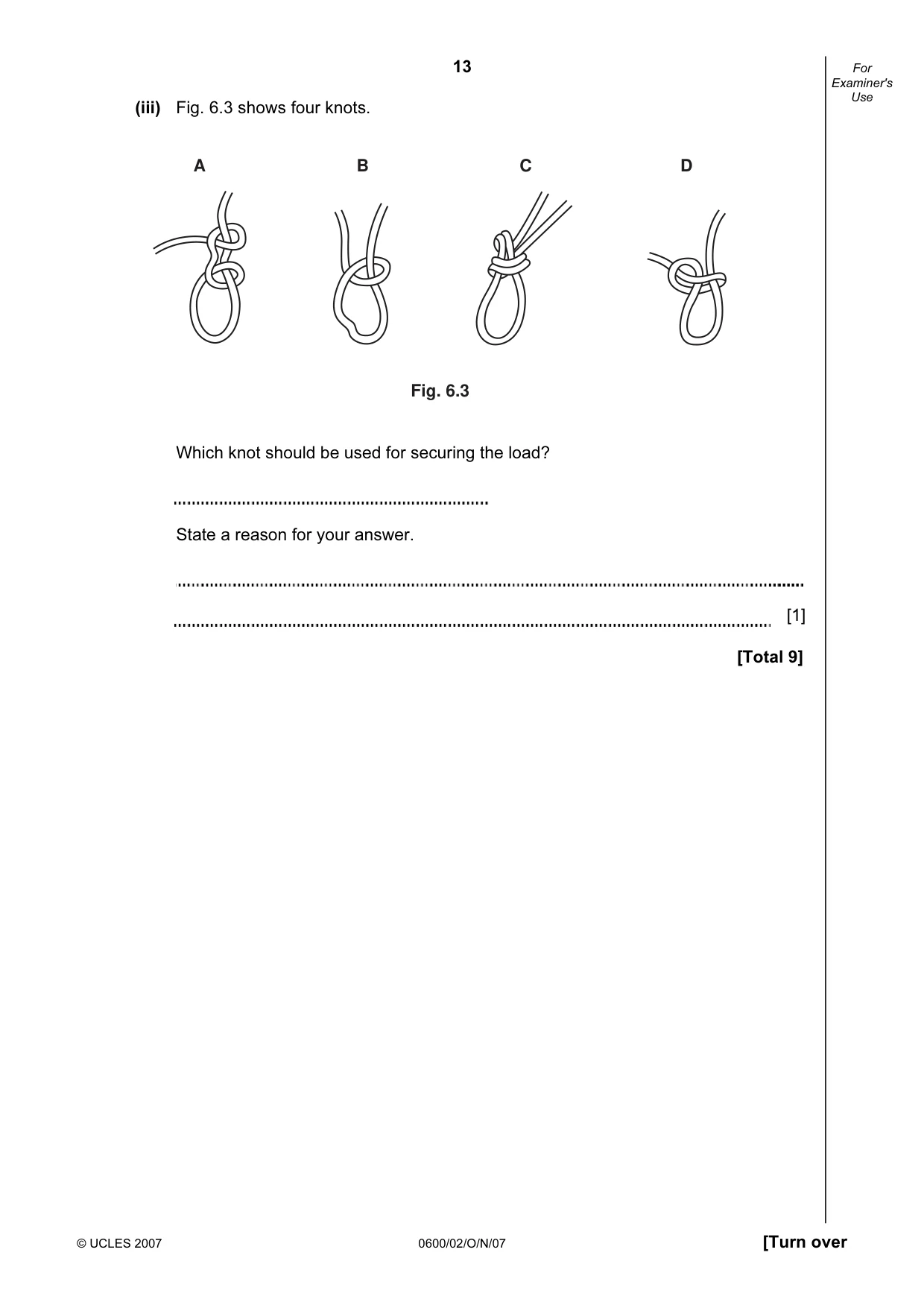
13 © UCLES 2007 0600/02/O/N/07 [Turn over For Examiner's Use (iii) Fig. 6.3 shows four knots. A B C D Fig. 6.3 Which knot should be used for securing the load? State a reason for your answer. [1] [Total 9]
Question paper, page 14
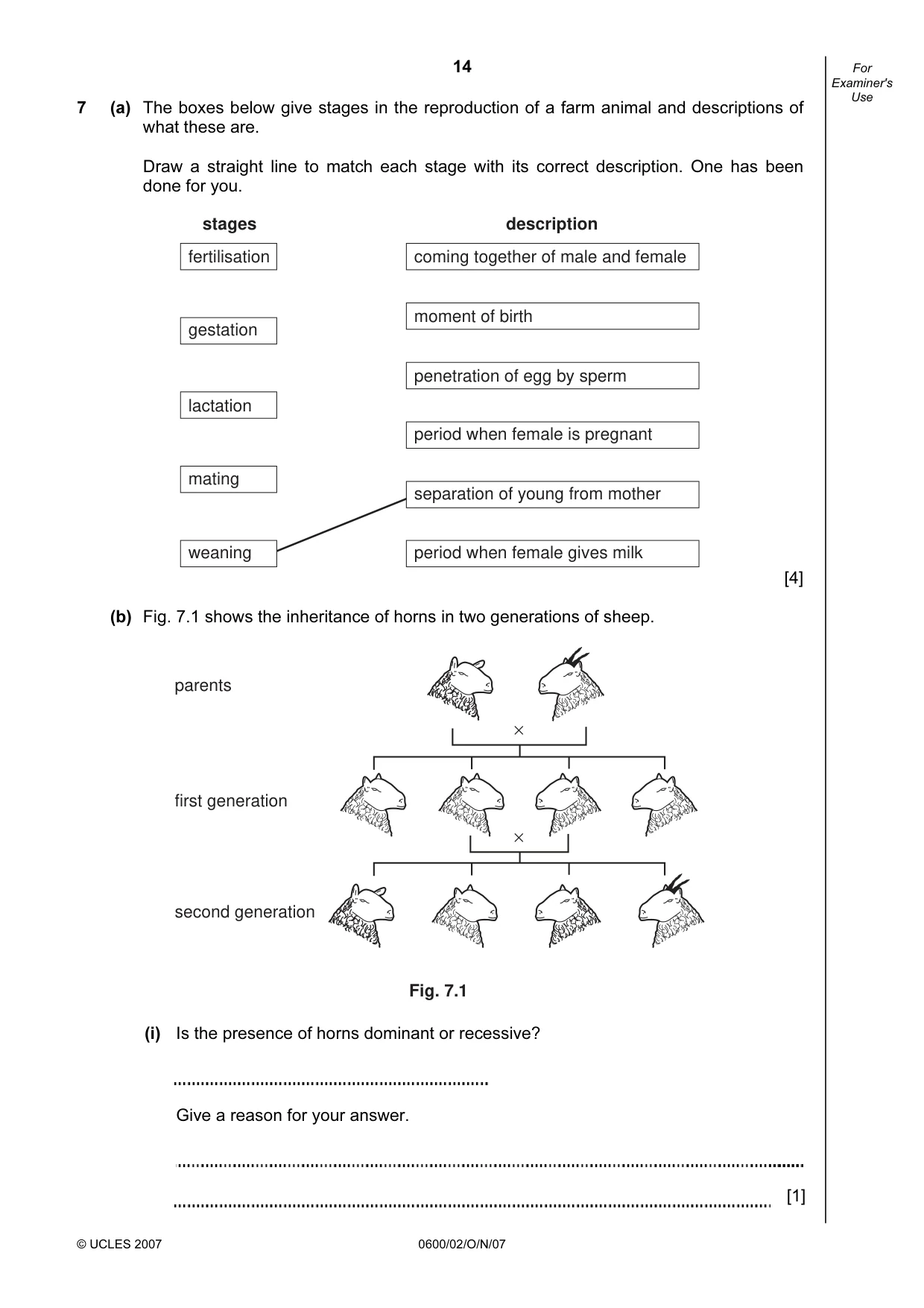
14 © UCLES 2007 0600/02/O/N/07 For Examiner's Use 7 (a) The boxes below give stages in the reproduction of a farm animal and descriptions of what these are. Draw a straight line to match each stage with its correct description. One has been done for you. fertilisation gestation lactation mating weaning coming together of male and female moment of birth penetration of egg by sperm period when female is pregnant period when female gives milk separation of young from mother stages description [4] (b) Fig. 7.1 shows the inheritance of horns in two generations of sheep. parents first generation second generation Fig. 7.1 × × (i) Is the presence of horns dominant or recessive? Give a reason for your answer. [1]
Question paper, page 15
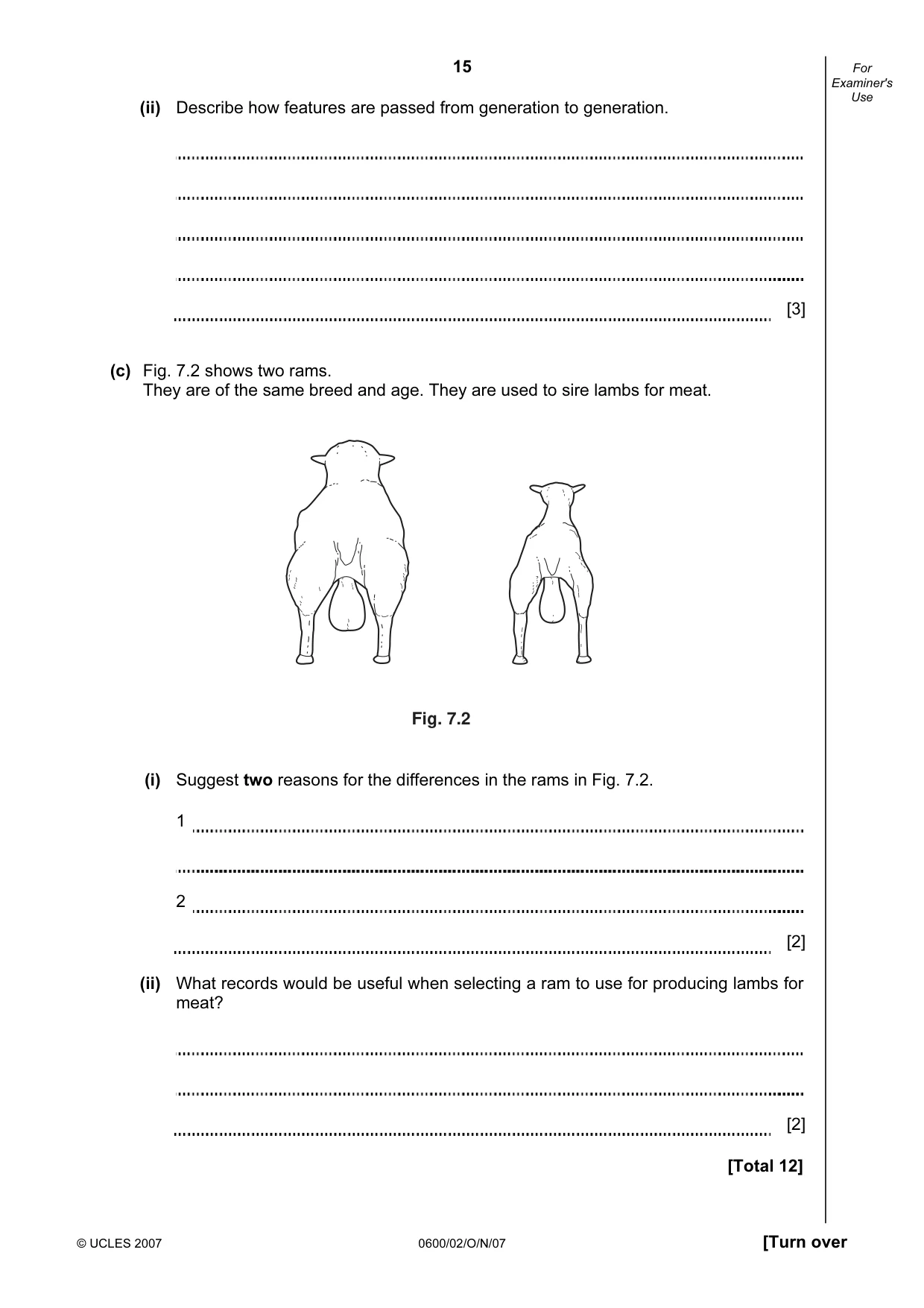
15 © UCLES 2007 0600/02/O/N/07 [Turn over For Examiner's Use (ii) Describe how features are passed from generation to generation. [3] (c) Fig. 7.2 shows two rams. They are of the same breed and age. They are used to sire lambs for meat. Fig. 7.2 (i) Suggest two reasons for the differences in the rams in Fig. 7.2. 1 2 [2] (ii) What records would be useful when selecting a ram to use for producing lambs for meat? [2] [Total 12]
Question paper, page 16
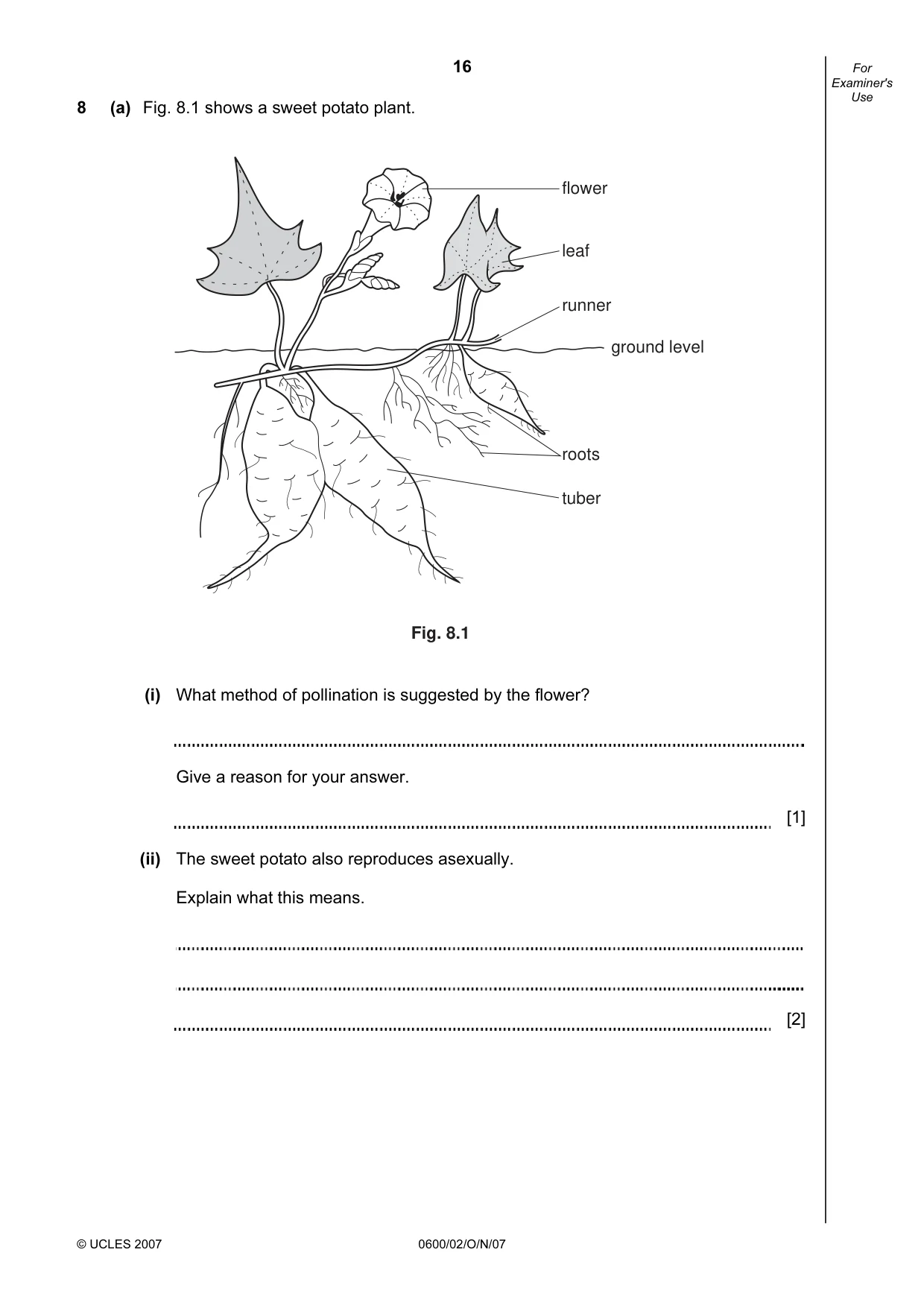
16 © UCLES 2007 0600/02/O/N/07 For Examiner's Use 8 (a) Fig. 8.1 shows a sweet potato plant. flower leaf runner roots tuber ground level Fig. 8.1 (i) What method of pollination is suggested by the flower? Give a reason for your answer. [1] (ii) The sweet potato also reproduces asexually. Explain what this means. [2]
Question paper, page 17
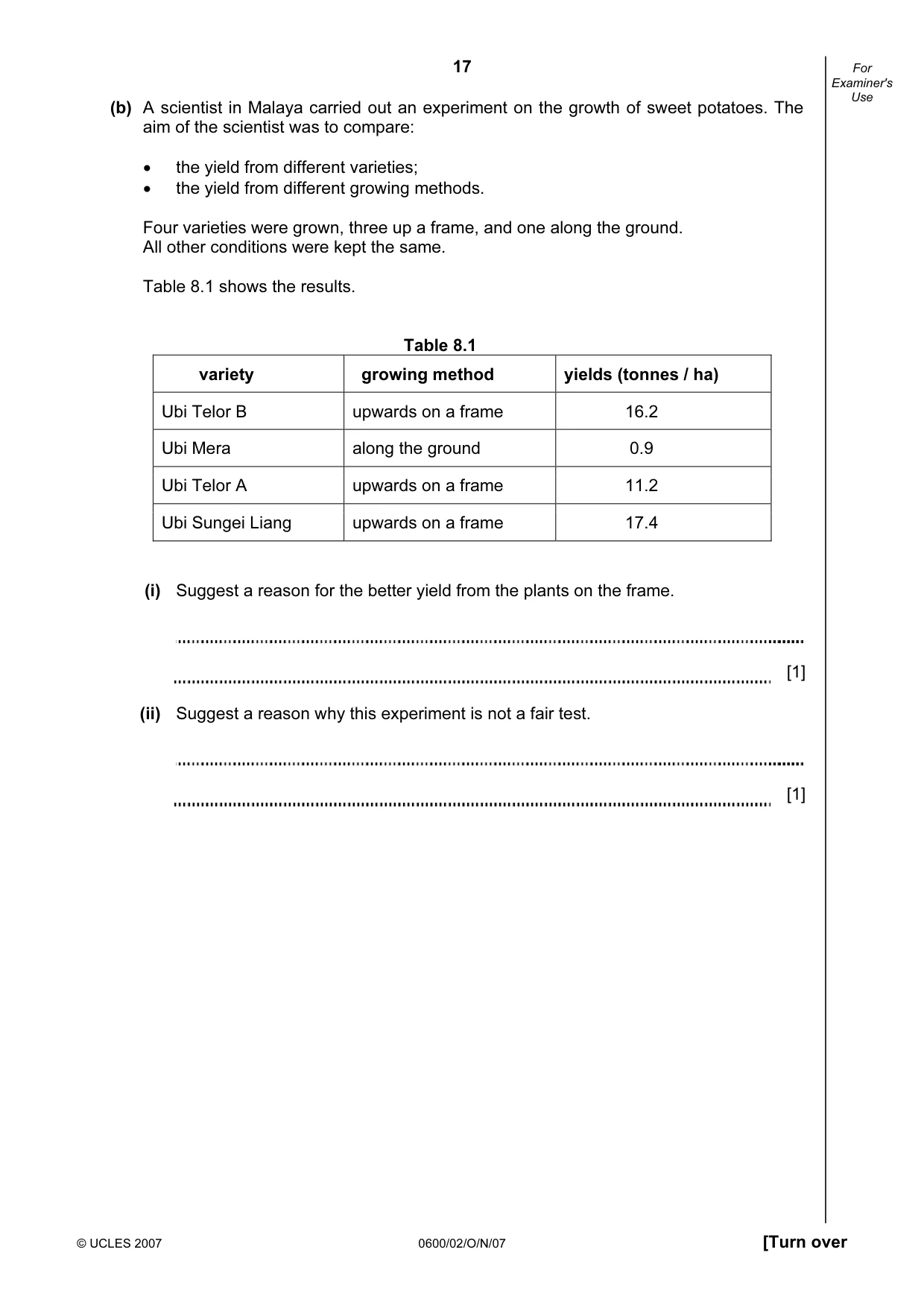
17 © UCLES 2007 0600/02/O/N/07 [Turn over For Examiner's Use (b) A scientist in Malaya carried out an experiment on the growth of sweet potatoes. The aim of the scientist was to compare: • the yield from different varieties; • the yield from different growing methods. Four varieties were grown, three up a frame, and one along the ground. All other conditions were kept the same. Table 8.1 shows the results. Table 8.1 variety growing method yields (tonnes / ha) Ubi Telor B upwards on a frame 16.2 Ubi Mera along the ground 0.9 Ubi Telor A upwards on a frame 11.2 Ubi Sungei Liang upwards on a frame 17.4 (i) Suggest a reason for the better yield from the plants on the frame. [1] (ii) Suggest a reason why this experiment is not a fair test. [1]
Question paper, page 18
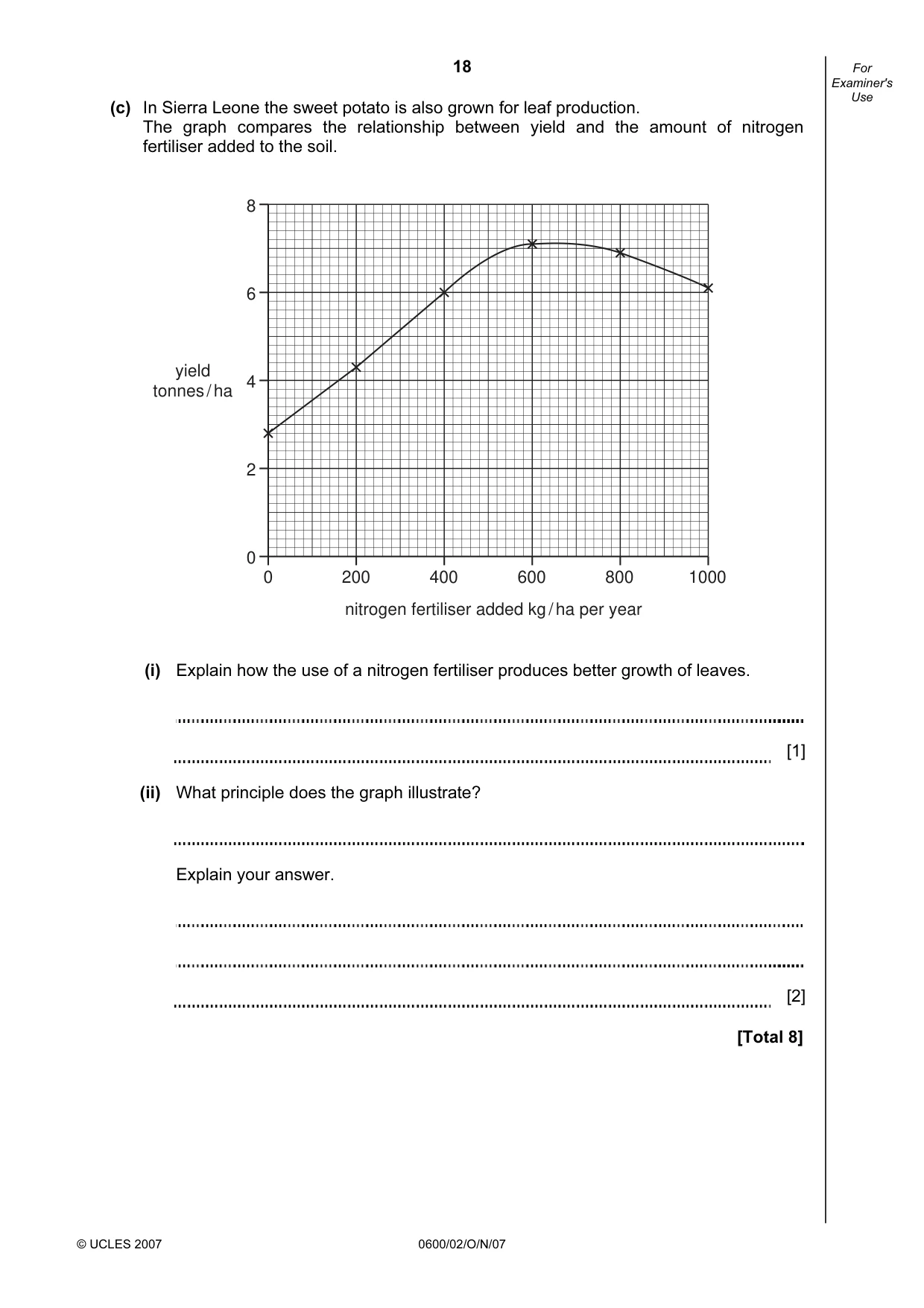
18 © UCLES 2007 0600/02/O/N/07 For Examiner's Use (c) In Sierra Leone the sweet potato is also grown for leaf production. The graph compares the relationship between yield and the amount of nitrogen fertiliser added to the soil. 8 6 4 2 0 0 200 400 600 800 1000 nitrogen fertiliser added kg / ha per year yield tonnes / ha (i) Explain how the use of a nitrogen fertiliser produces better growth of leaves. [1] (ii) What principle does the graph illustrate? Explain your answer. [2] [Total 8]
Question paper, page 19
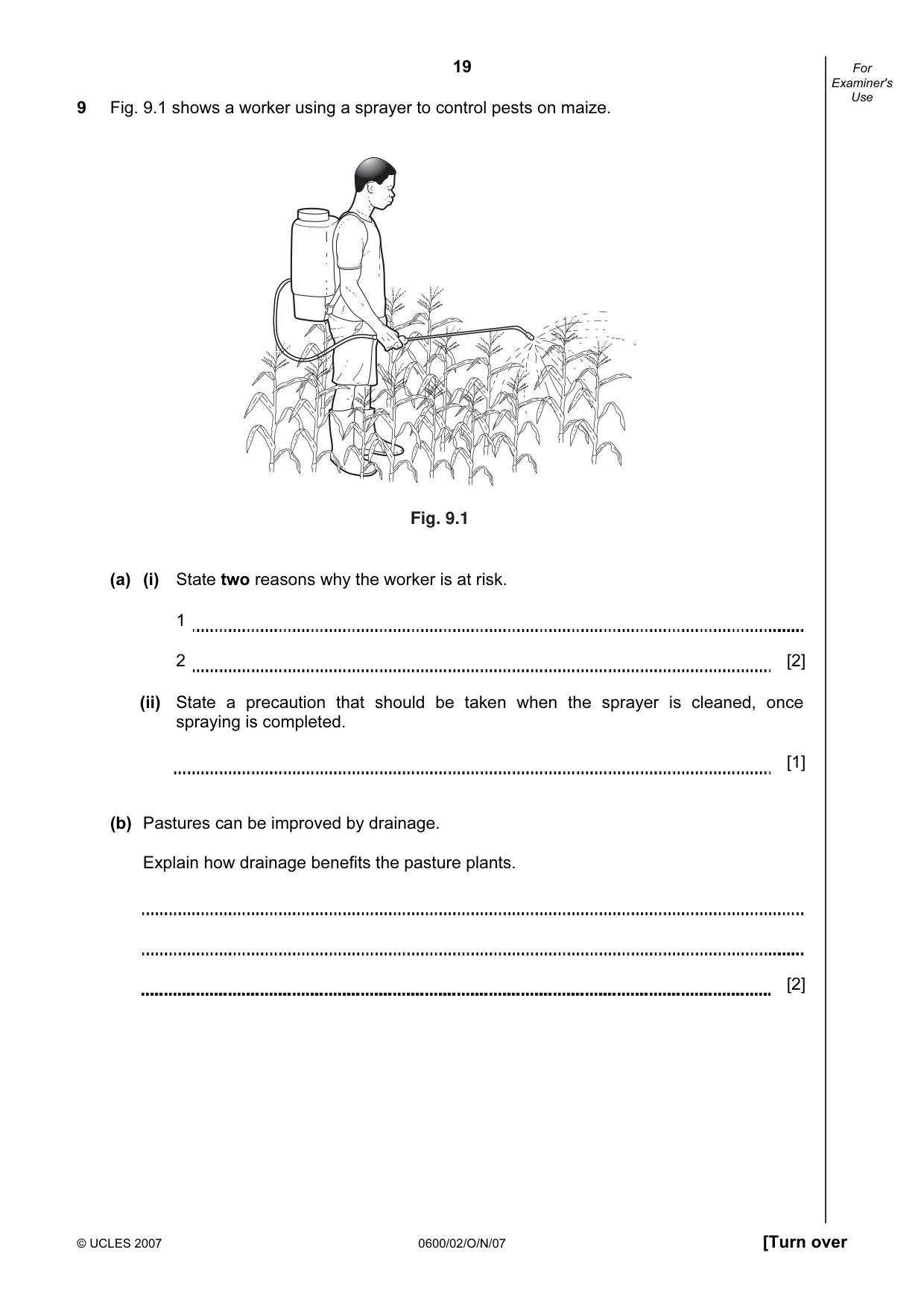
19 © UCLES 2007 0600/02/O/N/07 [Turn over For Examiner's Use 9 Fig. 9.1 shows a worker using a sprayer to control pests on maize. Fig. 9.1 (a) (i) State two reasons why the worker is at risk. 1 2 [2] (ii) State a precaution that should be taken when the sprayer is cleaned, once spraying is completed. [1] (b) Pastures can be improved by drainage. Explain how drainage benefits the pasture plants. [2]
Question paper, page 20
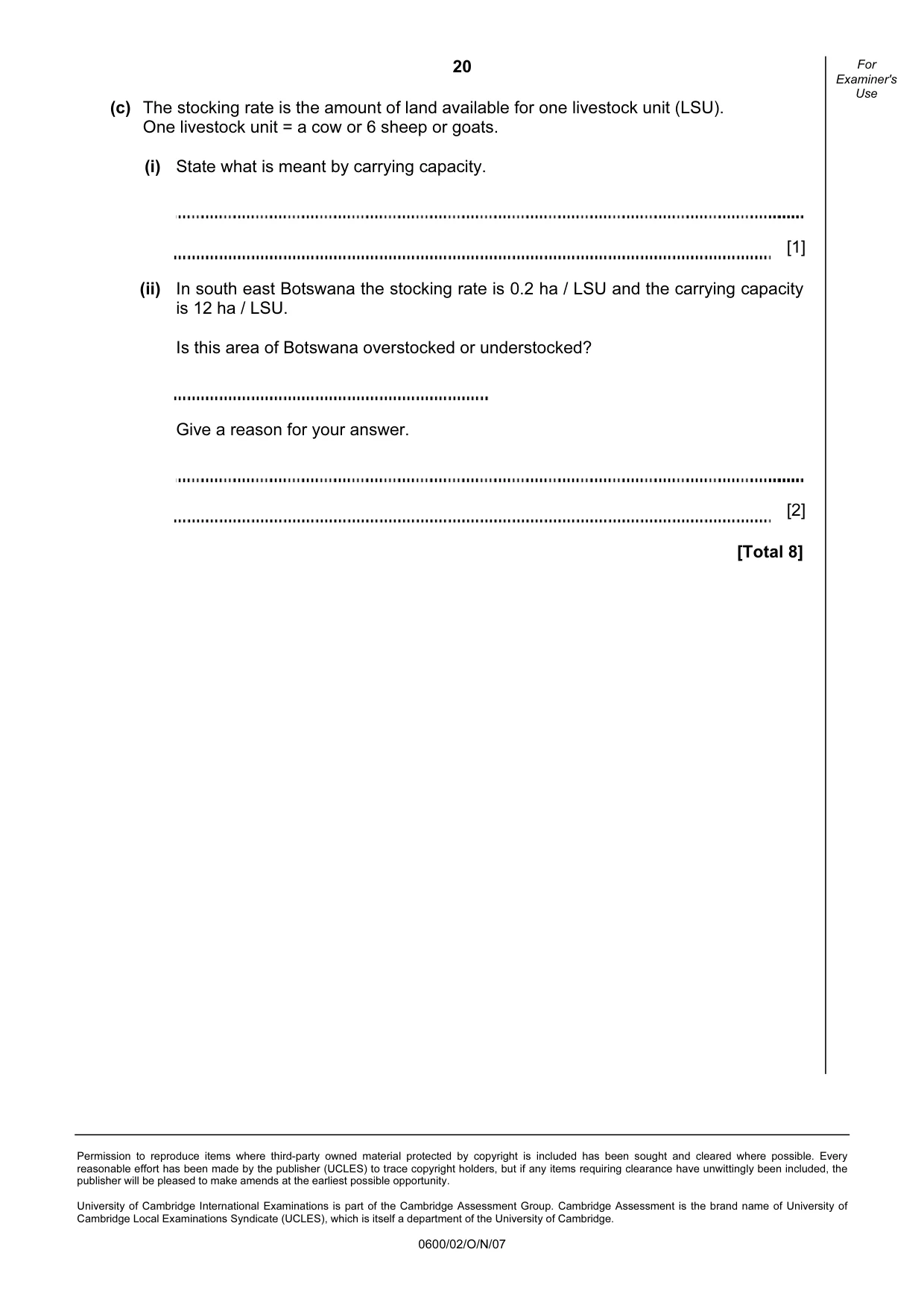
20 Permission to reproduce items where third-party owned material protected by copyright is included has been sought and cleared where possible. Every reasonable effort has been made by the publisher (UCLES) to trace copyright holders, but if any items requiring clearance have unwittingly been included, the publisher will be pleased to make amends at the earliest possible opportunity. University of Cambridge International Examinations is part of the Cambridge Assessment Group. Cambridge Assessment is the brand name of University of Cambridge Local Examinations Syndicate (UCLES), which is itself a department of the University of Cambridge. 0600/02/O/N/07 For Examiner's Use (c) The stocking rate is the amount of land available for one livestock unit (LSU). One livestock unit = a cow or 6 sheep or goats. (i) State what is meant by carrying capacity. [1] (ii) In south east Botswana the stocking rate is 0.2 ha / LSU and the carrying capacity is 12 ha / LSU. Is this area of Botswana overstocked or understocked? Give a reason for your answer. [2] [Total 8]
Mark scheme, page 1
UNIVERSITY OF CAMBRIDGE INTERNATIONAL EXAMINATIONS International General Certificate of Secondary Education MARK SCHEME for the October/November 2007 question paper 0600 AGRICULTURE 0600/02 Paper 2 (Core Theory), maximum raw mark 80 This mark scheme is published as an aid to teachers and candidates, to indicate the requirements of the examination. It shows the basis on which Examiners were instructed to award marks. It does not indicate the details of the discussions that took place at an Examiners’ meeting before marking began. All Examiners are instructed that alternative correct answers and unexpected approaches in candidates’ scripts must be given marks that fairly reflect the relevant knowledge and skills demonstrated. Mark schemes must be read in conjunction with the question papers and the report on the examination. • CIE will not enter into discussions or correspondence in connection with these mark schemes. CIE is publishing the mark schemes for the October/November 2007 question papers for most IGCSE, GCE Advanced Level and Advanced Subsidiary Level syllabuses and some Ordinary Level syllabuses. www.XtremePapers.com
Mark scheme, page 2
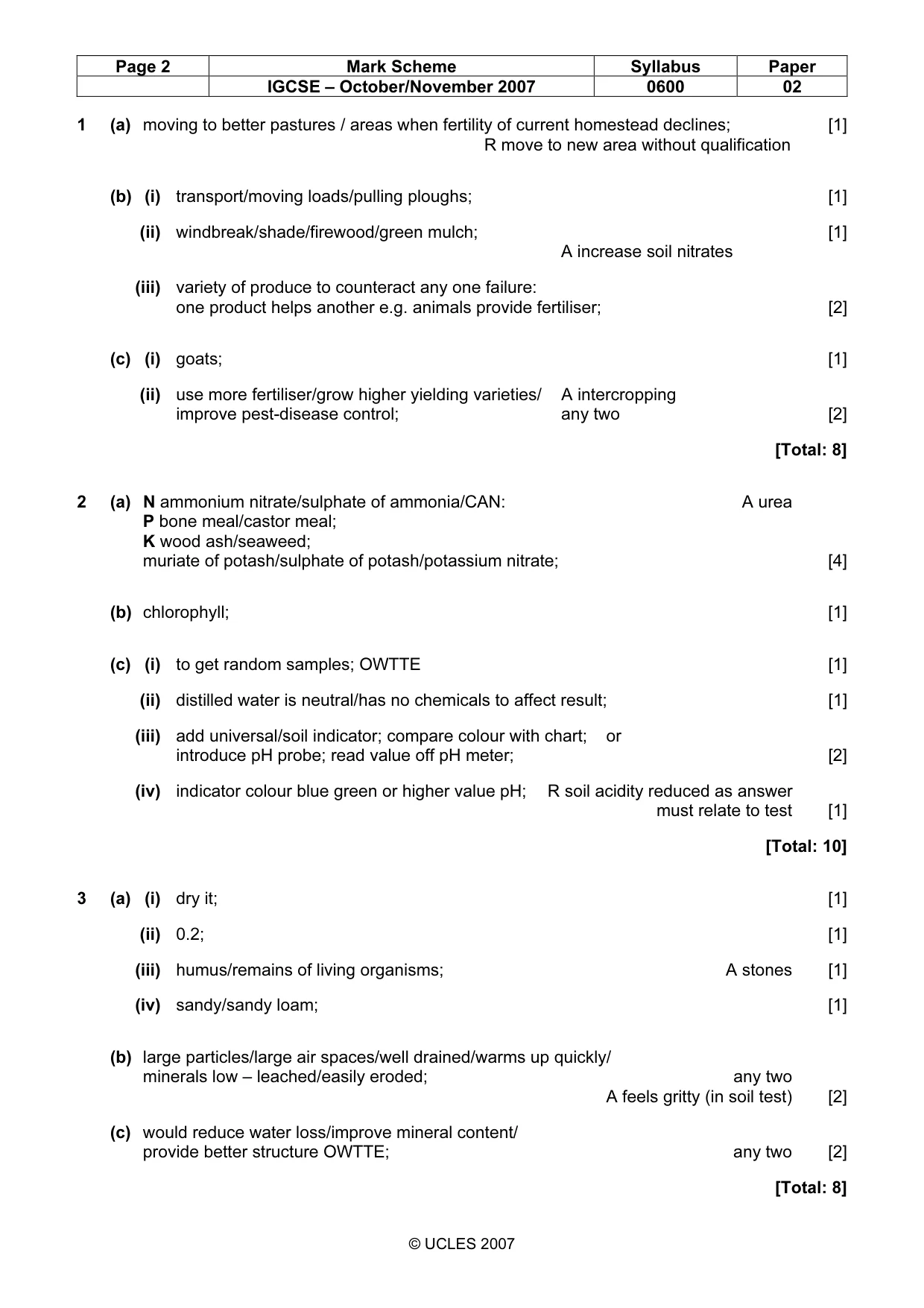
Page 2 Mark Scheme Syllabus Paper IGCSE – October/November 2007 0600 02 © UCLES 2007 1 (a) moving to better pastures / areas when fertility of current homestead declines; [1] R move to new area without qualification (b) (i) transport/moving loads/pulling ploughs; [1] (ii) windbreak/shade/firewood/green mulch; [1] A increase soil nitrates (iii) variety of produce to counteract any one failure: one product helps another e.g. animals provide fertiliser; [2] (c) (i) goats; [1] (ii) use more fertiliser/grow higher yielding varieties/ A intercropping improve pest-disease control; any two [2] [Total: 8] 2 (a) N ammonium nitrate/sulphate of ammonia/CAN: A urea P bone meal/castor meal; K wood ash/seaweed; muriate of potash/sulphate of potash/potassium nitrate; [4] (b) chlorophyll; [1] (c) (i) to get random samples; OWTTE [1] (ii) distilled water is neutral/has no chemicals to affect result; [1] (iii) add universal/soil indicator; compare colour with chart; or introduce pH probe; read value off pH meter; [2] (iv) indicator colour blue green or higher value pH; R soil acidity reduced as answer must relate to test [1] [Total: 10] 3 (a) (i) dry it; [1] (ii) 0.2; [1] (iii) humus/remains of living organisms; A stones [1] (iv) sandy/sandy loam; [1] (b) large particles/large air spaces/well drained/warms up quickly/ minerals low – leached/easily eroded; any two A feels gritty (in soil test) [2] (c) would reduce water loss/improve mineral content/ provide better structure OWTTE; any two [2] [Total: 8]
Mark scheme, page 3
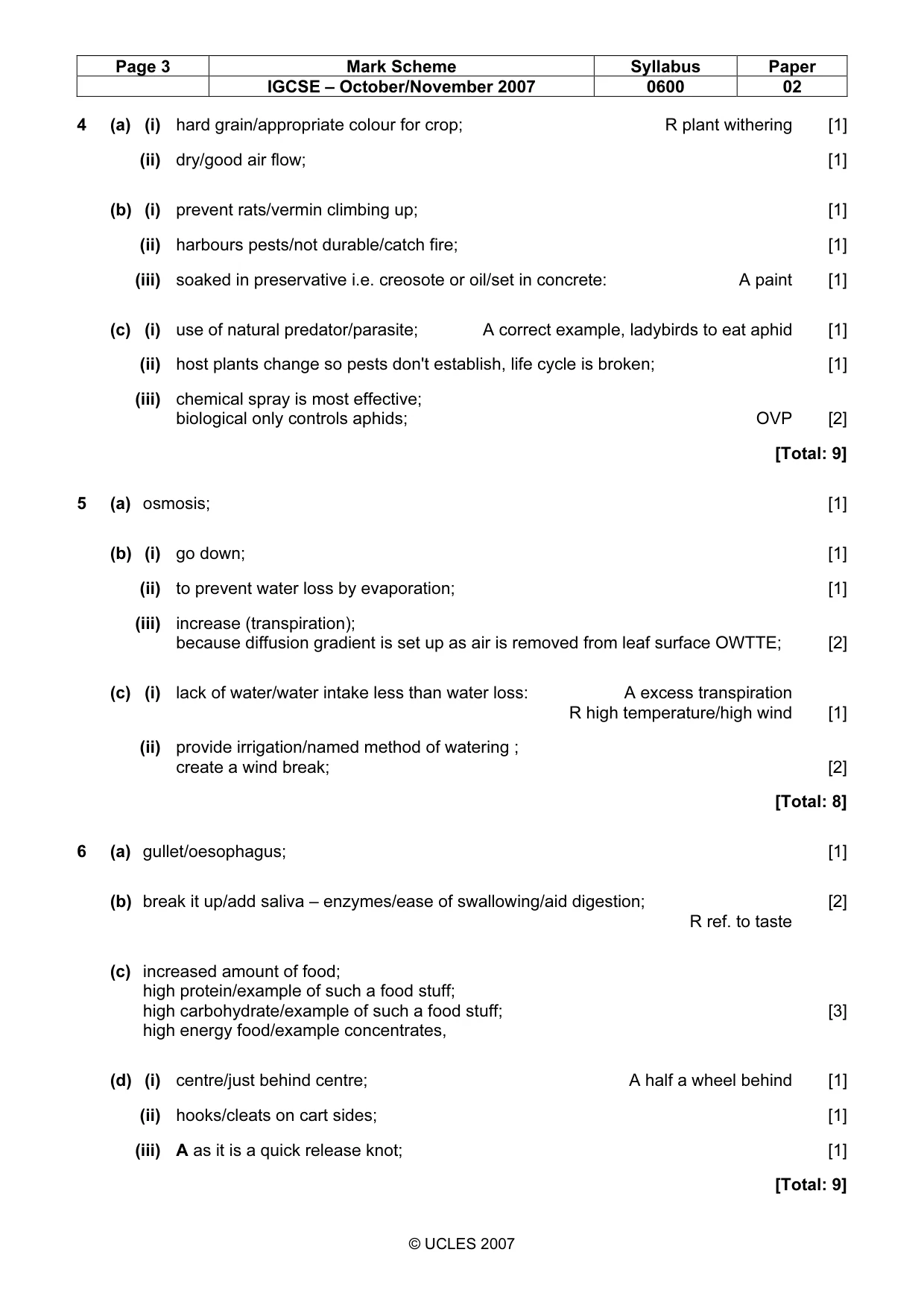
Page 3 Mark Scheme Syllabus Paper IGCSE – October/November 2007 0600 02 © UCLES 2007 4 (a) (i) hard grain/appropriate colour for crop; R plant withering [1] (ii) dry/good air flow; [1] (b) (i) prevent rats/vermin climbing up; [1] (ii) harbours pests/not durable/catch fire; [1] (iii) soaked in preservative i.e. creosote or oil/set in concrete: A paint [1] (c) (i) use of natural predator/parasite; A correct example, ladybirds to eat aphid [1] (ii) host plants change so pests don't establish, life cycle is broken; [1] (iii) chemical spray is most effective; biological only controls aphids; OVP [2] [Total: 9] 5 (a) osmosis; [1] (b) (i) go down; [1] (ii) to prevent water loss by evaporation; [1] (iii) increase (transpiration); because diffusion gradient is set up as air is removed from leaf surface OWTTE; [2] (c) (i) lack of water/water intake less than water loss: A excess transpiration R high temperature/high wind [1] (ii) provide irrigation/named method of watering ; create a wind break; [2] [Total: 8] 6 (a) gullet/oesophagus; [1] (b) break it up/add saliva – enzymes/ease of swallowing/aid digestion; [2] R ref. to taste (c) increased amount of food; high protein/example of such a food stuff; high carbohydrate/example of such a food stuff; [3] high energy food/example concentrates, (d) (i) centre/just behind centre; A half a wheel behind [1] (ii) hooks/cleats on cart sides; [1] (iii) A as it is a quick release knot; [1] [Total: 9]
Mark scheme, page 4
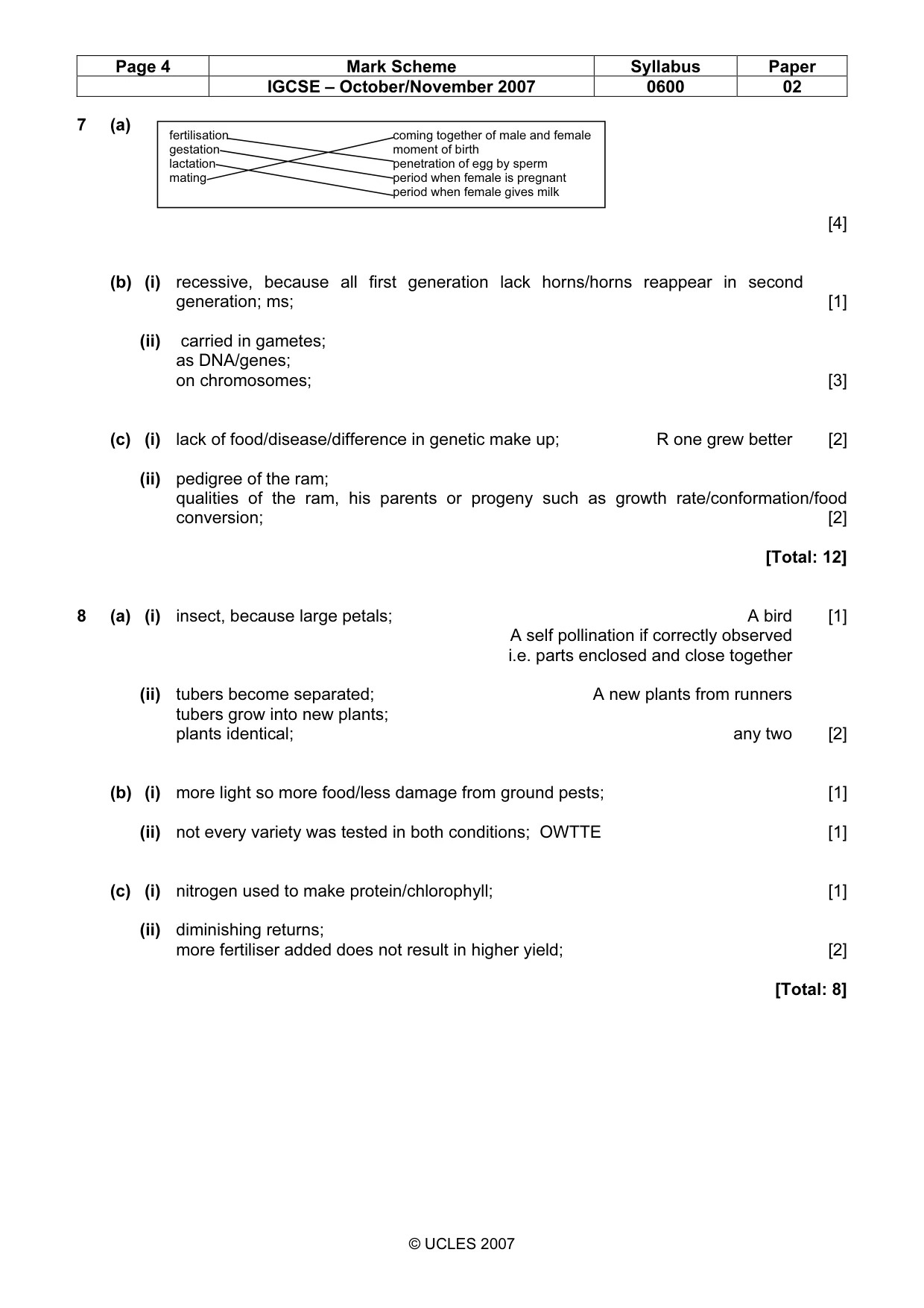
Page 4 Mark Scheme Syllabus Paper IGCSE – October/November 2007 0600 02 © UCLES 2007 7 (a) [4] (b) (i) recessive, because all first generation lack horns/horns reappear in second generation; ms; [1] (ii) carried in gametes; as DNA/genes; on chromosomes; [3] (c) (i) lack of food/disease/difference in genetic make up; R one grew better [2] (ii) pedigree of the ram; qualities of the ram, his parents or progeny such as growth rate/conformation/food conversion; [2] [Total: 12] 8 (a) (i) insect, because large petals; A bird [1] A self pollination if correctly observed i.e. parts enclosed and close together (ii) tubers become separated; A new plants from runners tubers grow into new plants; plants identical; any two [2] (b) (i) more light so more food/less damage from ground pests; [1] (ii) not every variety was tested in both conditions; OWTTE [1] (c) (i) nitrogen used to make protein/chlorophyll; [1] (ii) diminishing returns; more fertiliser added does not result in higher yield; [2] [Total: 8] fertilisation coming together of male and female gestation moment of birth lactation penetration of egg by sperm mating period when female is pregnant period when female gives milk
Mark scheme, page 5
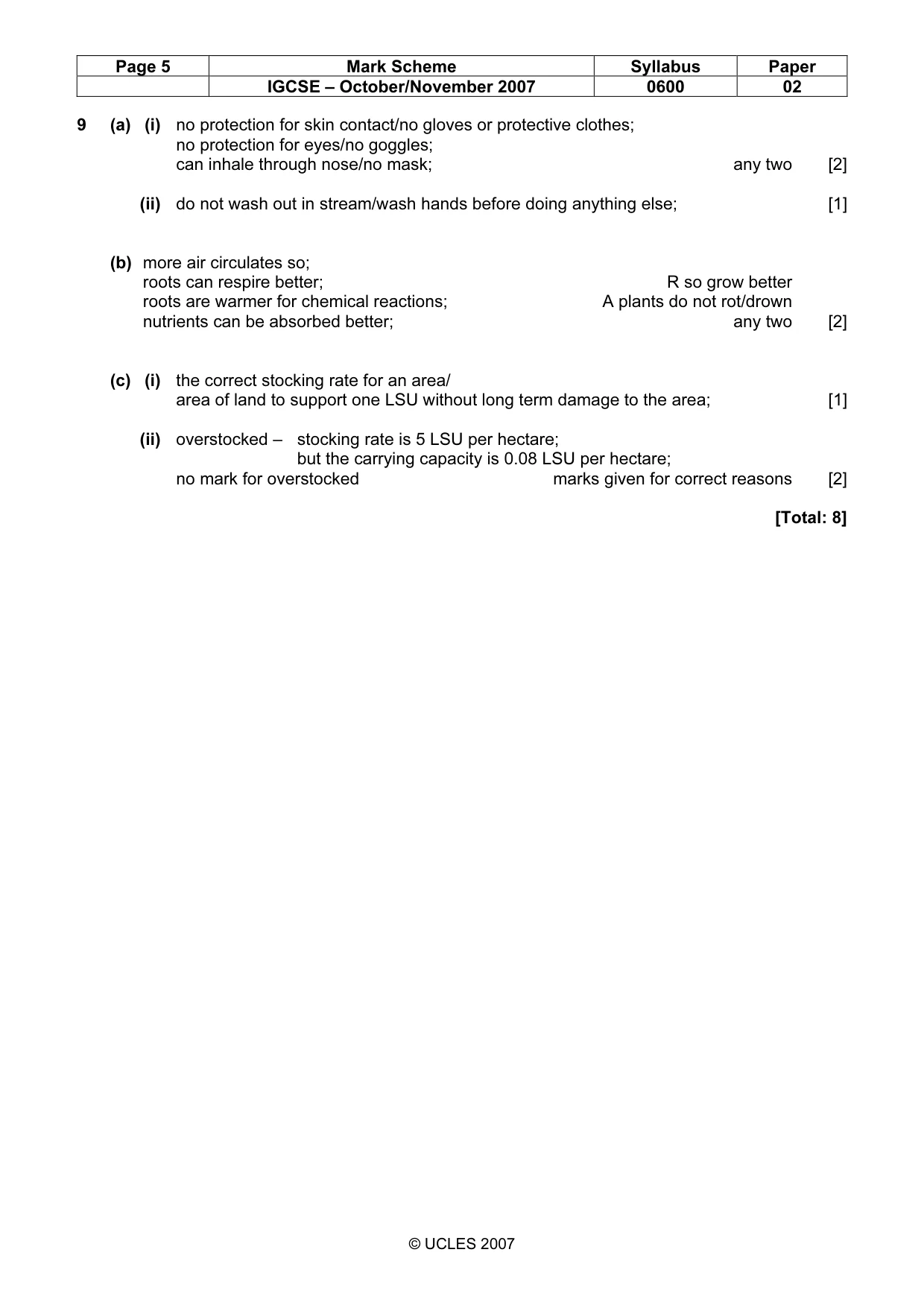
Page 5 Mark Scheme Syllabus Paper IGCSE – October/November 2007 0600 02 © UCLES 2007 9 (a) (i) no protection for skin contact/no gloves or protective clothes; no protection for eyes/no goggles; can inhale through nose/no mask; any two [2] (ii) do not wash out in stream/wash hands before doing anything else; [1] (b) more air circulates so; roots can respire better; R so grow better roots are warmer for chemical reactions; A plants do not rot/drown nutrients can be absorbed better; any two [2] (c) (i) the correct stocking rate for an area/ area of land to support one LSU without long term damage to the area; [1] (ii) overstocked – stocking rate is 5 LSU per hectare; but the carrying capacity is 0.08 LSU per hectare; no mark for overstocked marks given for correct reasons [2] [Total: 8]
What you needed in this session
Cambridge’s own grade thresholds for 2007 Oct/Nov, Paper 2 · Variant 1. A higher threshold means an easier paper — the bar moves with how the cohort did.