Cambridge IGCSE Agriculture 0600 — 2007 Oct/Nov Paper 1 · Variant 1
0600/11/O/N/07 · 40 marks · ≈45 min
The question paper and its mark scheme, free to read here and free to download. This is Cambridge’s own paper, exactly as it was sat.
Question paper20 pages




Mark scheme2 pages
Answers below. Sit the paper first if you are practising.
Paper as text
Question paper, page 1
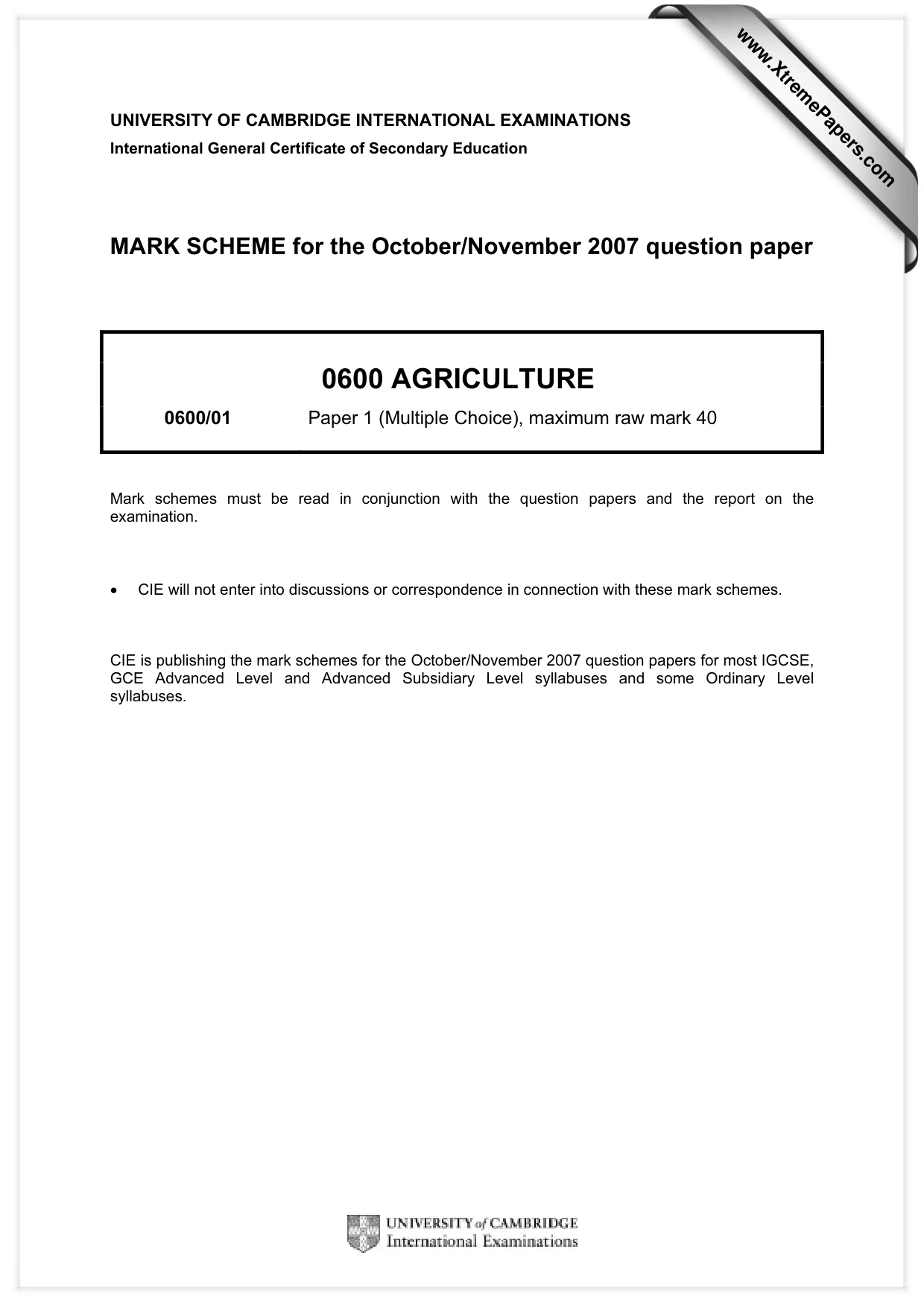
This document consists of 17 printed pages and 3 blank pages. IB07 11_0600_01/4RP © UCLES 2007 [Turn over *6006609936* UNIVERSITY OF CAMBRIDGE INTERNATIONAL EXAMINATIONS International General Certificate of Secondary Education AGRICULTURE 0600/01 Paper 1 Multiple Choice October/November 2007 45 minutes Additional Materials: Multiple Choice Answer Sheet Soft clean eraser Soft pencil (type B or HB is recommended) READ THESE INSTRUCTIONS FIRST Write in soft pencil. Do not use staples, paper clips, highlighters, glue or correction fluid. Write your name, Centre number and candidate number on the Answer Sheet in the spaces provided unless this has been done for you. There are forty questions on this paper. Answer all questions. For each question there are four possible answers A, B, C and D. Choose the one you consider correct and record your choice in soft pencil on the separate Answer Sheet. Read the instructions on the Answer Sheet very carefully. Each correct answer will score one mark. A mark will not be deducted for a wrong answer. Any rough working should be done in this booklet. www.XtremePapers.com
Question paper, page 2
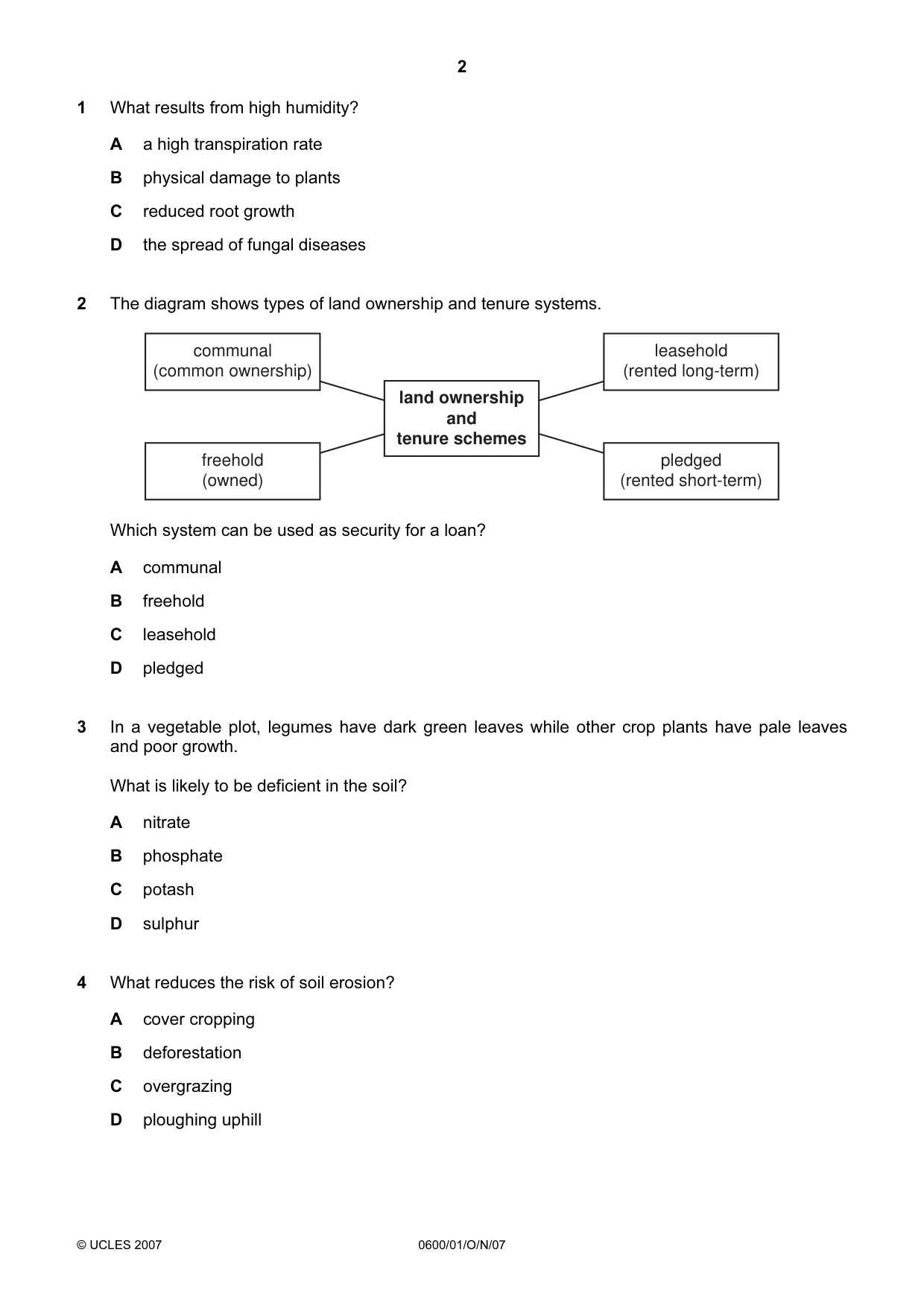
2 © UCLES 2007 0600/01/O/N/07 1 What results from high humidity? A a high transpiration rate B physical damage to plants C reduced root growth D the spread of fungal diseases 2 The diagram shows types of land ownership and tenure systems. land ownership and tenure schemes communal (common ownership) freehold (owned) leasehold (rented long-term) pledged (rented short-term) Which system can be used as security for a loan? A communal B freehold C leasehold D pledged 3 In a vegetable plot, legumes have dark green leaves while other crop plants have pale leaves and poor growth. What is likely to be deficient in the soil? A nitrate B phosphate C potash D sulphur 4 What reduces the risk of soil erosion? A cover cropping B deforestation C overgrazing D ploughing uphill
Question paper, page 3
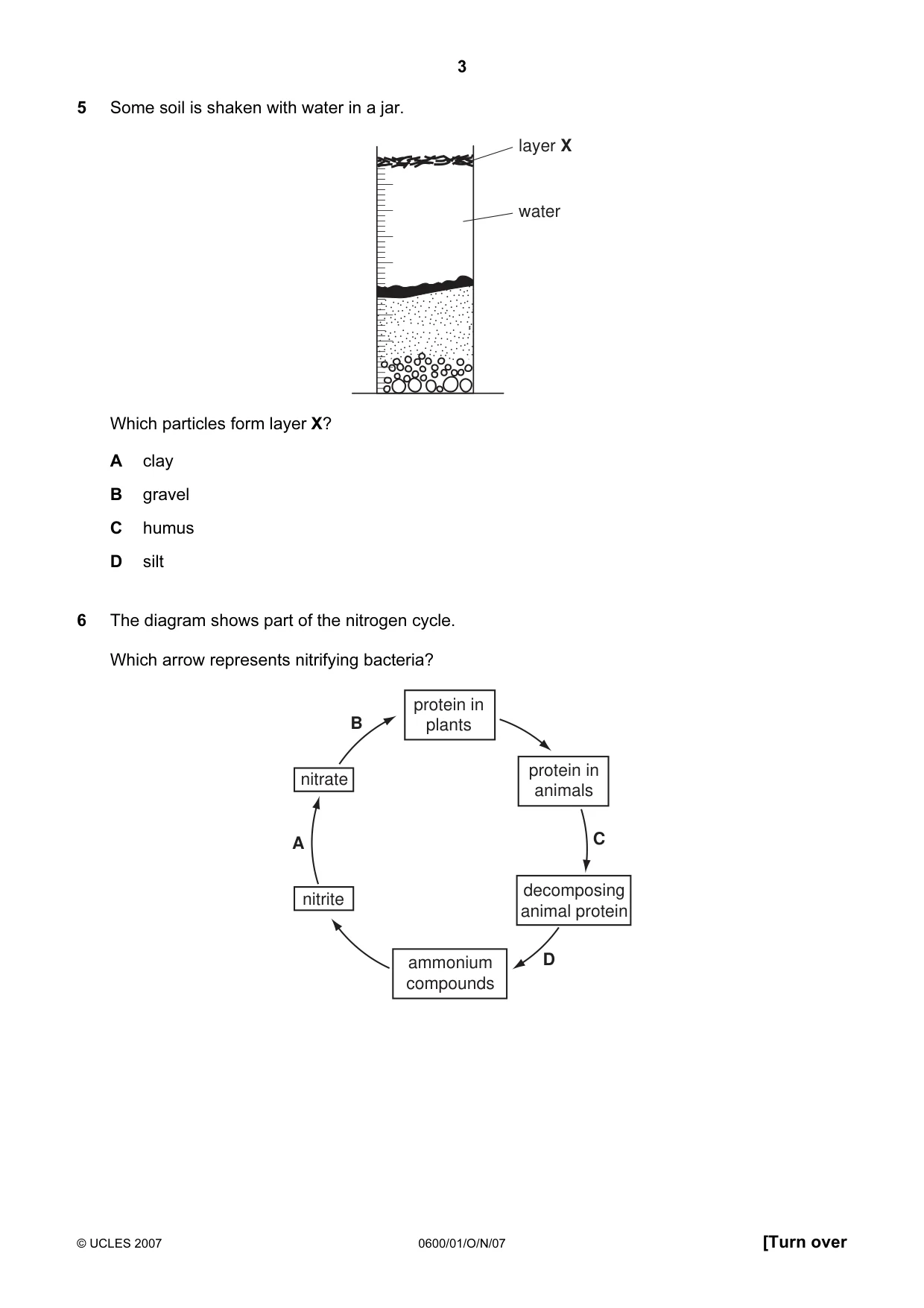
3 © UCLES 2007 0600/01/O/N/07 [Turn over 5 Some soil is shaken with water in a jar. layer X water Which particles form layer X? A clay B gravel C humus D silt 6 The diagram shows part of the nitrogen cycle. Which arrow represents nitrifying bacteria? C B D nitrate nitrite ammonium compounds decomposing animal protein protein in animals protein in plants A
Question paper, page 4
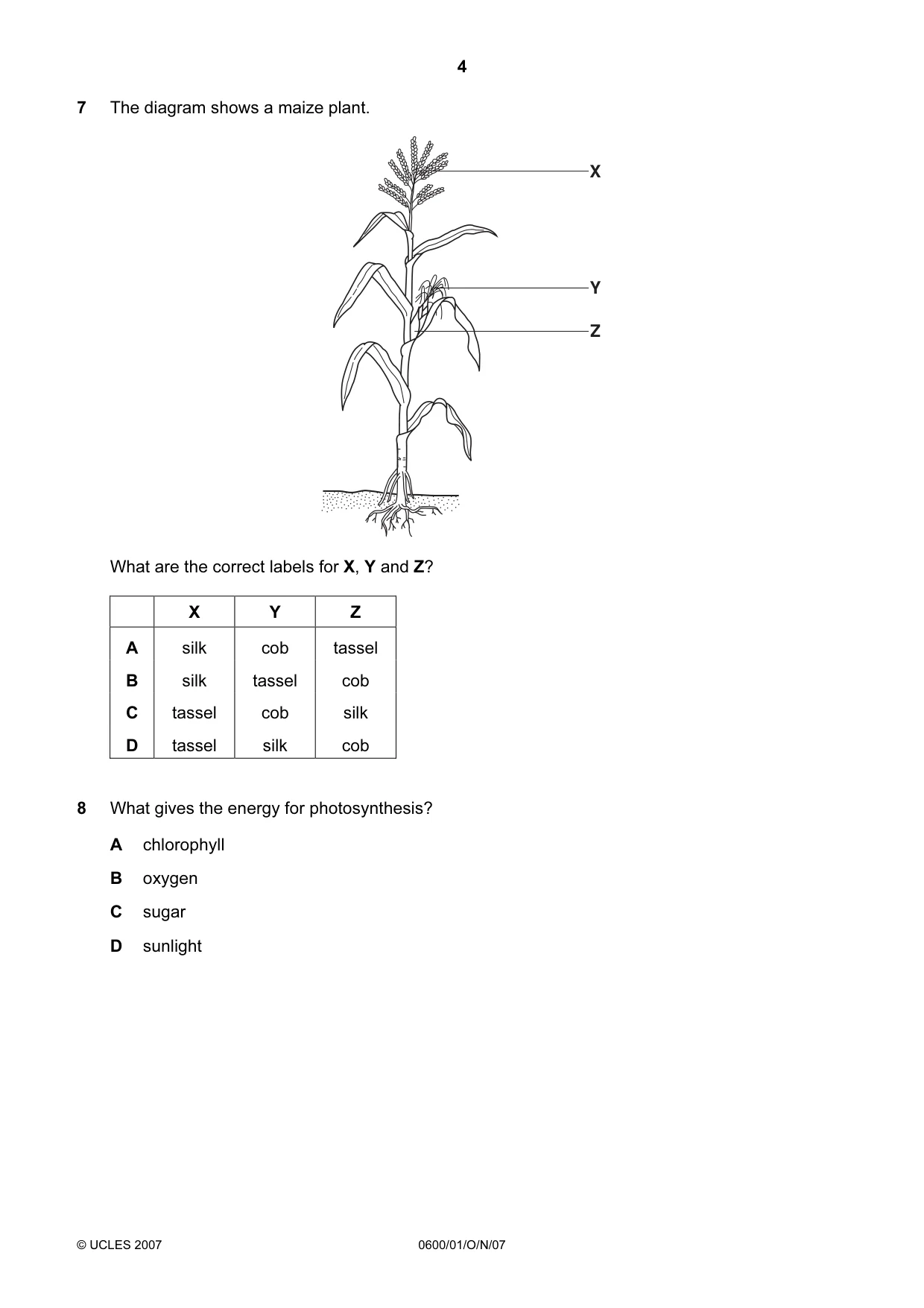
4 © UCLES 2007 0600/01/O/N/07 7 The diagram shows a maize plant. X Y Z What are the correct labels for X, Y and Z? X Y Z A silk cob tassel B silk tassel cob C tassel cob silk D tassel silk cob 8 What gives the energy for photosynthesis? A chlorophyll B oxygen C sugar D sunlight
Question paper, page 5
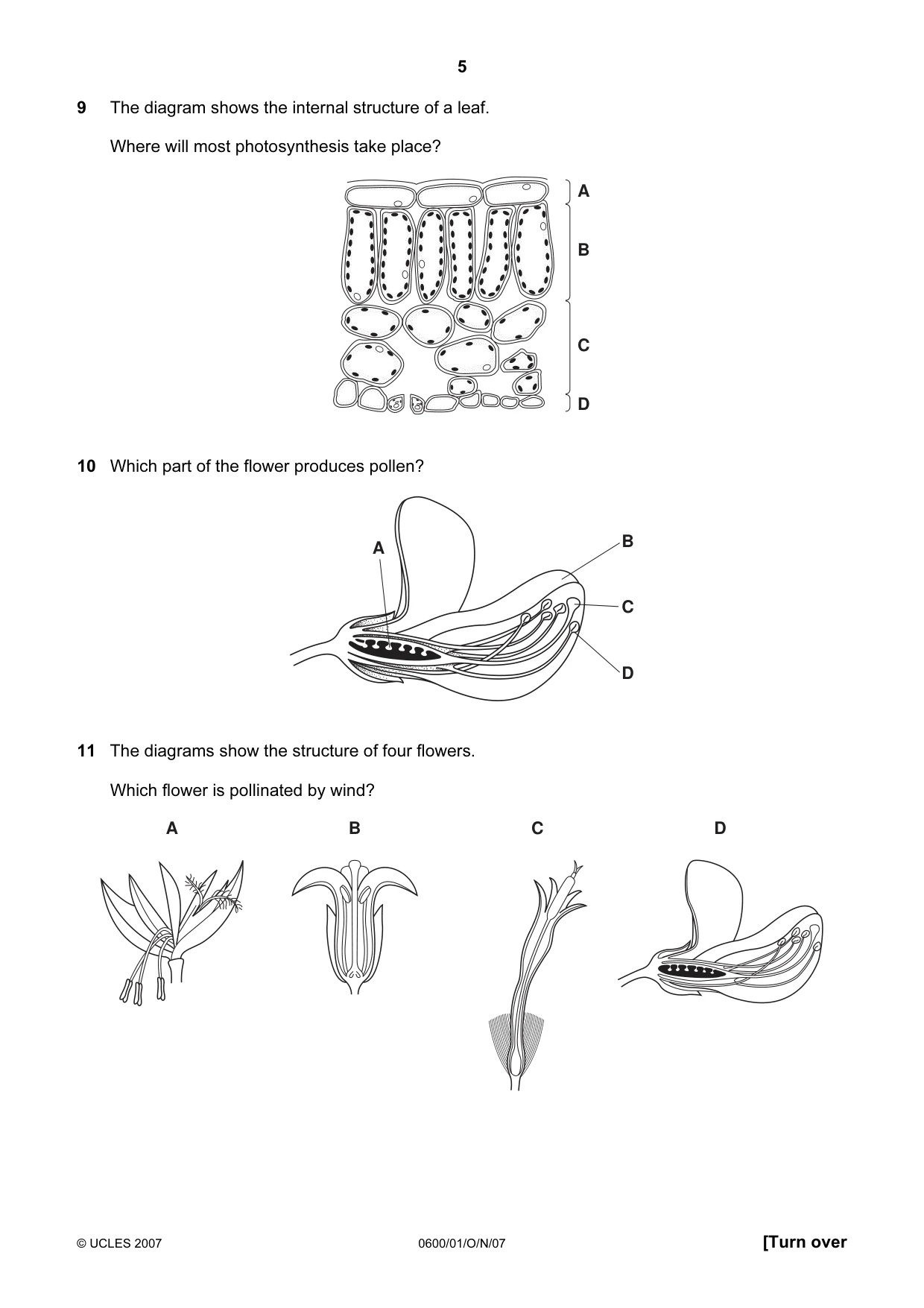
5 © UCLES 2007 0600/01/O/N/07 [Turn over 9 The diagram shows the internal structure of a leaf. Where will most photosynthesis take place? A B C D 10 Which part of the flower produces pollen? A B C D 11 The diagrams show the structure of four flowers. Which flower is pollinated by wind? A B C D
Question paper, page 6
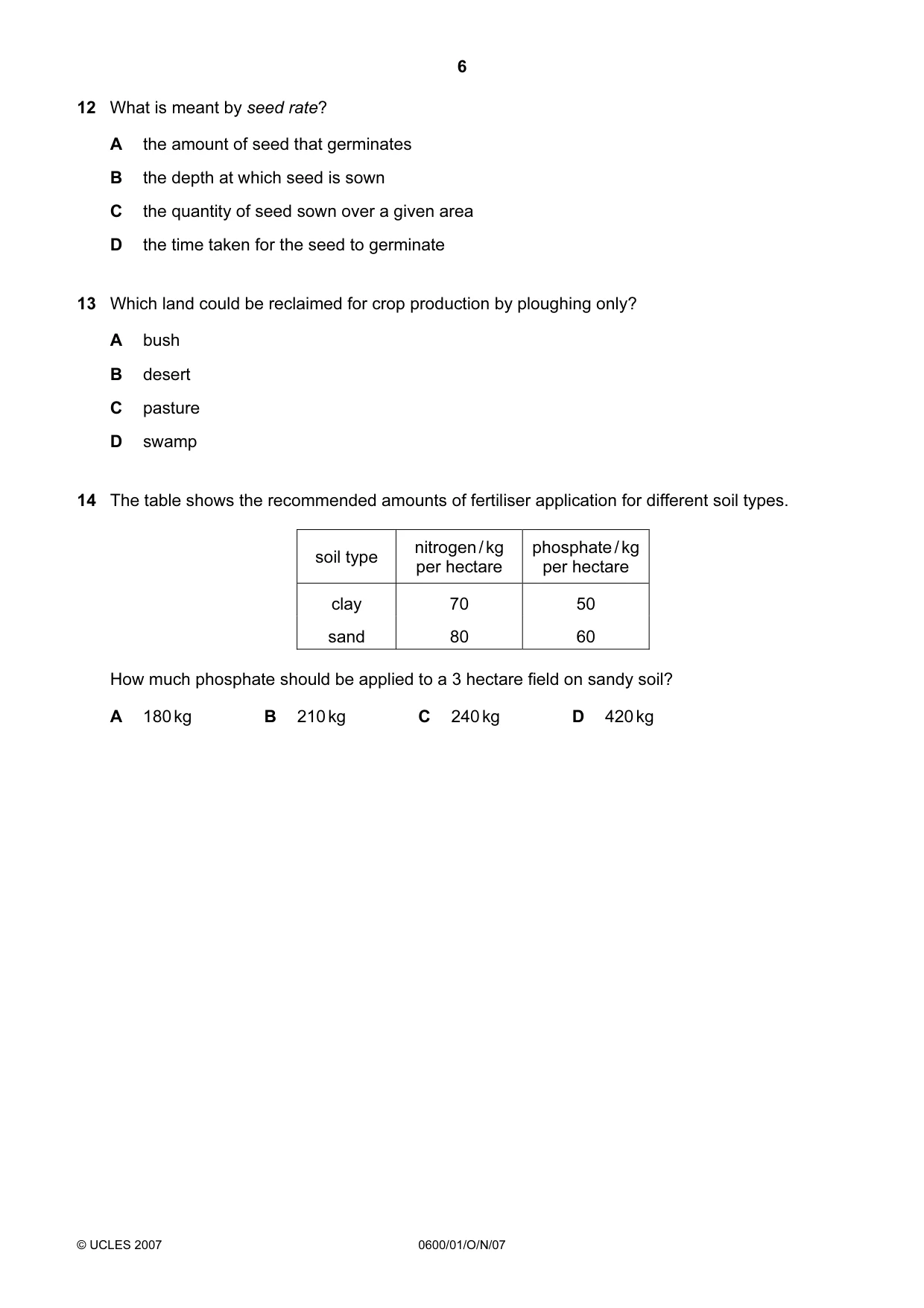
6 © UCLES 2007 0600/01/O/N/07 12 What is meant by seed rate? A the amount of seed that germinates B the depth at which seed is sown C the quantity of seed sown over a given area D the time taken for the seed to germinate 13 Which land could be reclaimed for crop production by ploughing only? A bush B desert C pasture D swamp 14 The table shows the recommended amounts of fertiliser application for different soil types. soil type nitrogen / kg per hectare phosphate / kg per hectare clay 70 50 sand 80 60 How much phosphate should be applied to a 3 hectare field on sandy soil? A 180 kg B 210 kg C 240 kg D 420 kg
Question paper, page 7
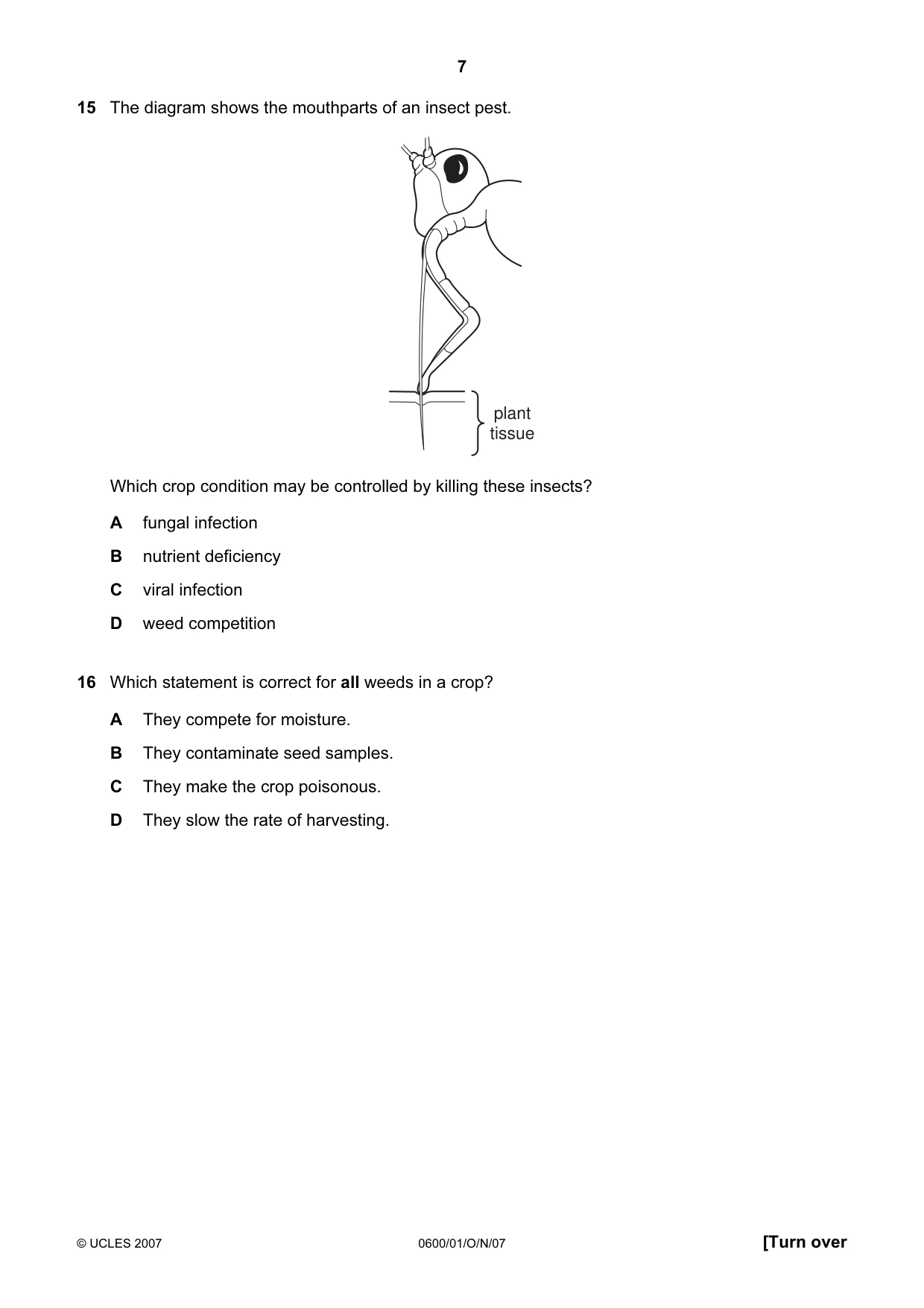
7 © UCLES 2007 0600/01/O/N/07 [Turn over 15 The diagram shows the mouthparts of an insect pest. plant tissue Which crop condition may be controlled by killing these insects? A fungal infection B nutrient deficiency C viral infection D weed competition 16 Which statement is correct for all weeds in a crop? A They compete for moisture. B They contaminate seed samples. C They make the crop poisonous. D They slow the rate of harvesting.
Question paper, page 8
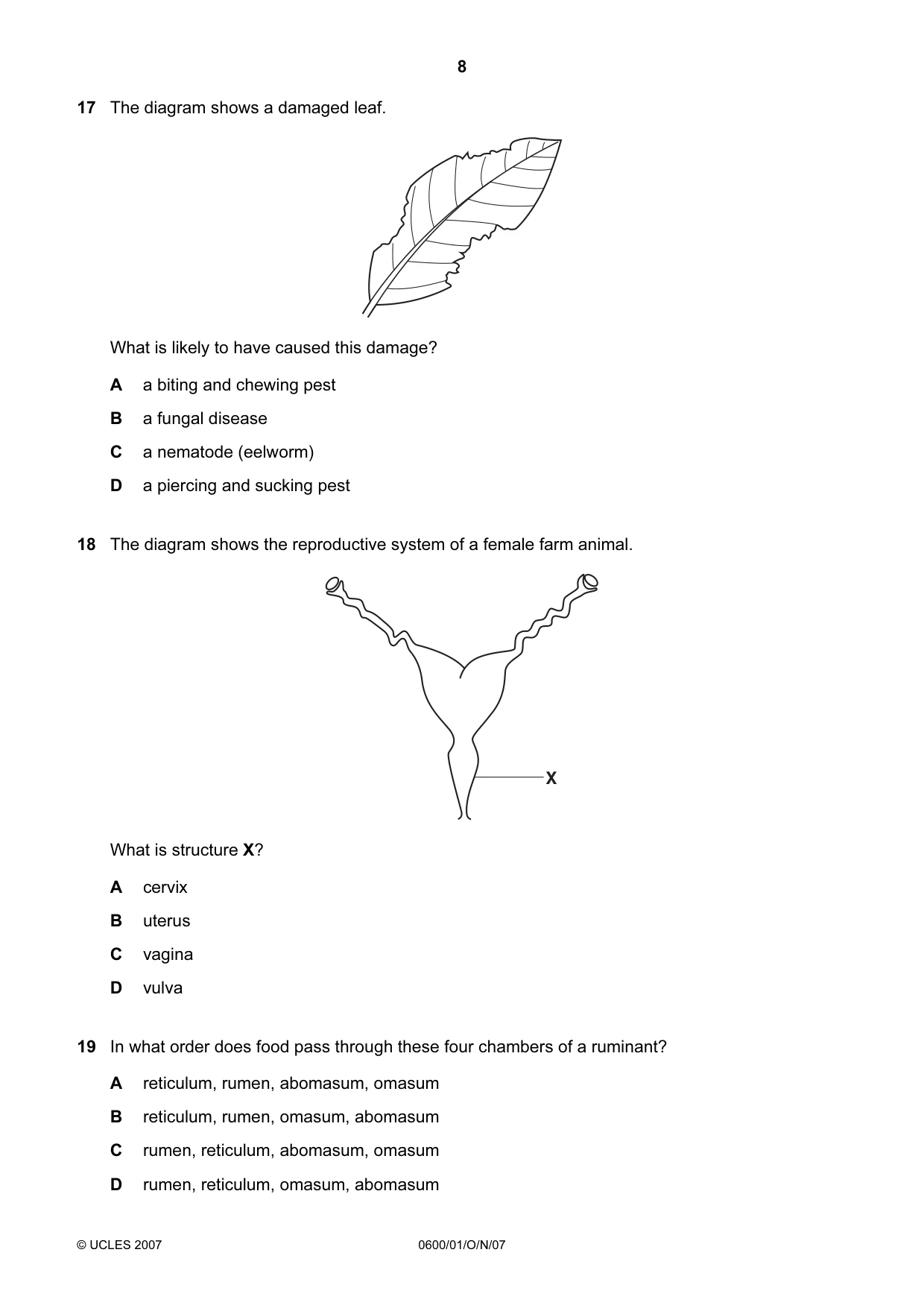
8 © UCLES 2007 0600/01/O/N/07 17 The diagram shows a damaged leaf. What is likely to have caused this damage? A a biting and chewing pest B a fungal disease C a nematode (eelworm) D a piercing and sucking pest 18 The diagram shows the reproductive system of a female farm animal. X What is structure X? A cervix B uterus C vagina D vulva 19 In what order does food pass through these four chambers of a ruminant? A reticulum, rumen, abomasum, omasum B reticulum, rumen, omasum, abomasum C rumen, reticulum, abomasum, omasum D rumen, reticulum, omasum, abomasum
Question paper, page 9
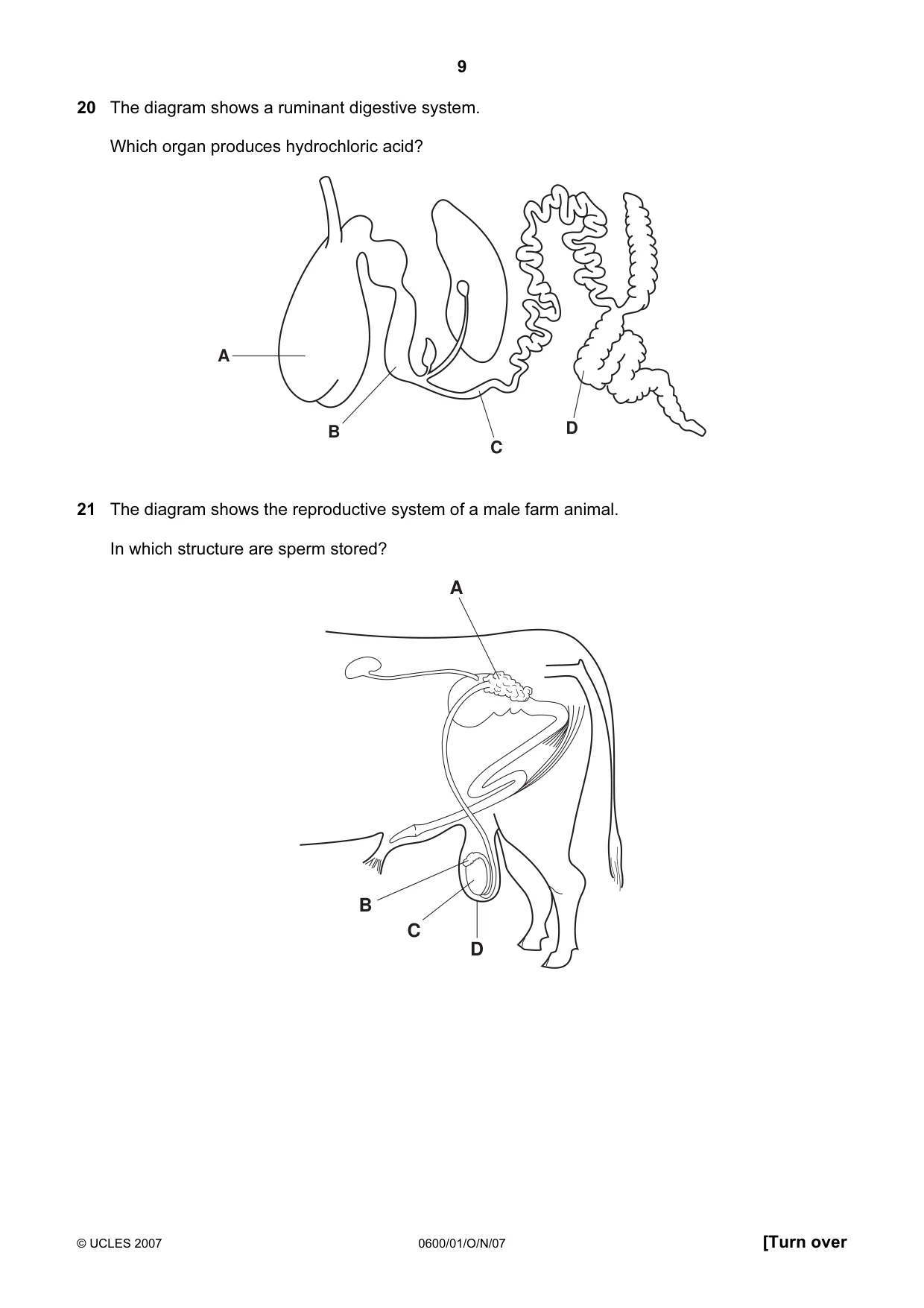
9 © UCLES 2007 0600/01/O/N/07 [Turn over 20 The diagram shows a ruminant digestive system. Which organ produces hydrochloric acid? A B C D 21 The diagram shows the reproductive system of a male farm animal. In which structure are sperm stored? A B C D
Question paper, page 10
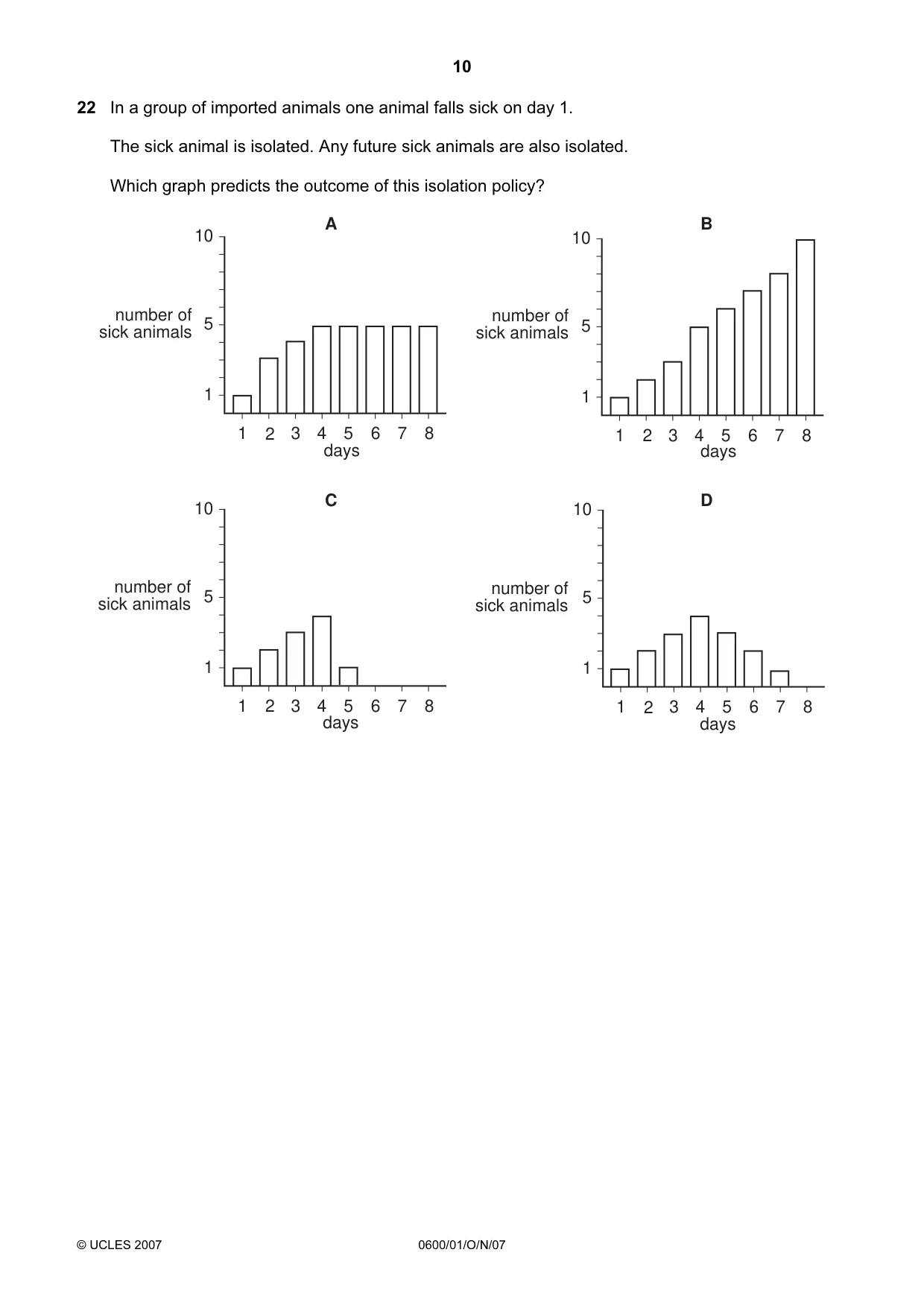
10 © UCLES 2007 0600/01/O/N/07 22 In a group of imported animals one animal falls sick on day 1. The sick animal is isolated. Any future sick animals are also isolated. Which graph predicts the outcome of this isolation policy? 10 5 1 1 2 3 4 5 6 7 8 10 5 1 1 2 3 4 5 6 7 8 10 5 1 1 2 3 4 5 6 7 8 10 5 1 1 2 3 4 5 6 7 8 number of sick animals days number of sick animals days number of sick animals days number of sick animals days A B C D
Question paper, page 11
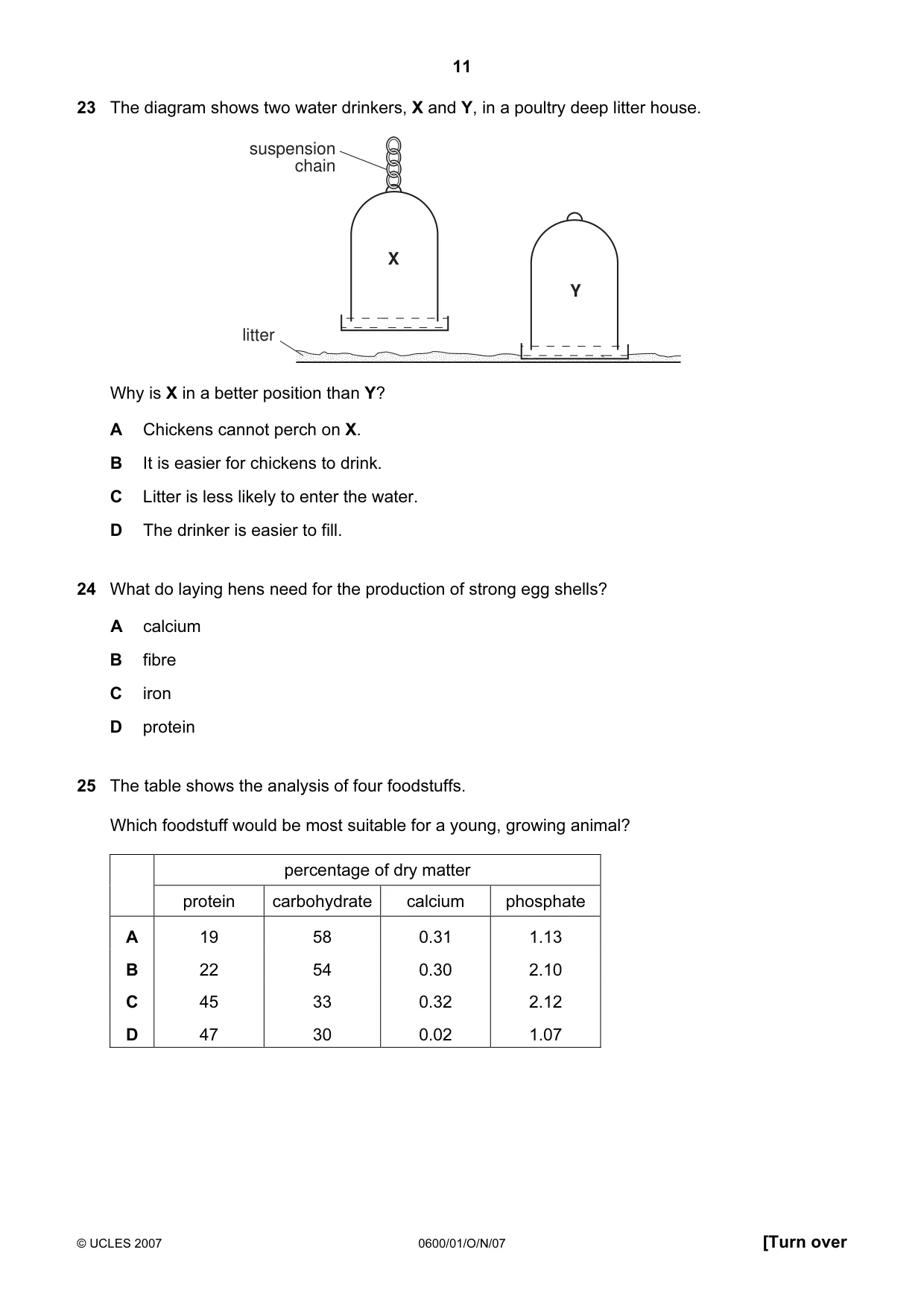
11 © UCLES 2007 0600/01/O/N/07 [Turn over 23 The diagram shows two water drinkers, X and Y, in a poultry deep litter house. X Y litter suspension chain Why is X in a better position than Y? A Chickens cannot perch on X. B It is easier for chickens to drink. C Litter is less likely to enter the water. D The drinker is easier to fill. 24 What do laying hens need for the production of strong egg shells? A calcium B fibre C iron D protein 25 The table shows the analysis of four foodstuffs. Which foodstuff would be most suitable for a young, growing animal? percentage of dry matter protein carbohydrate calcium phosphate A 19 58 0.31 1.13 B 22 54 0.30 2.10 C 45 33 0.32 2.12 D 47 30 0.02 1.07
Question paper, page 12
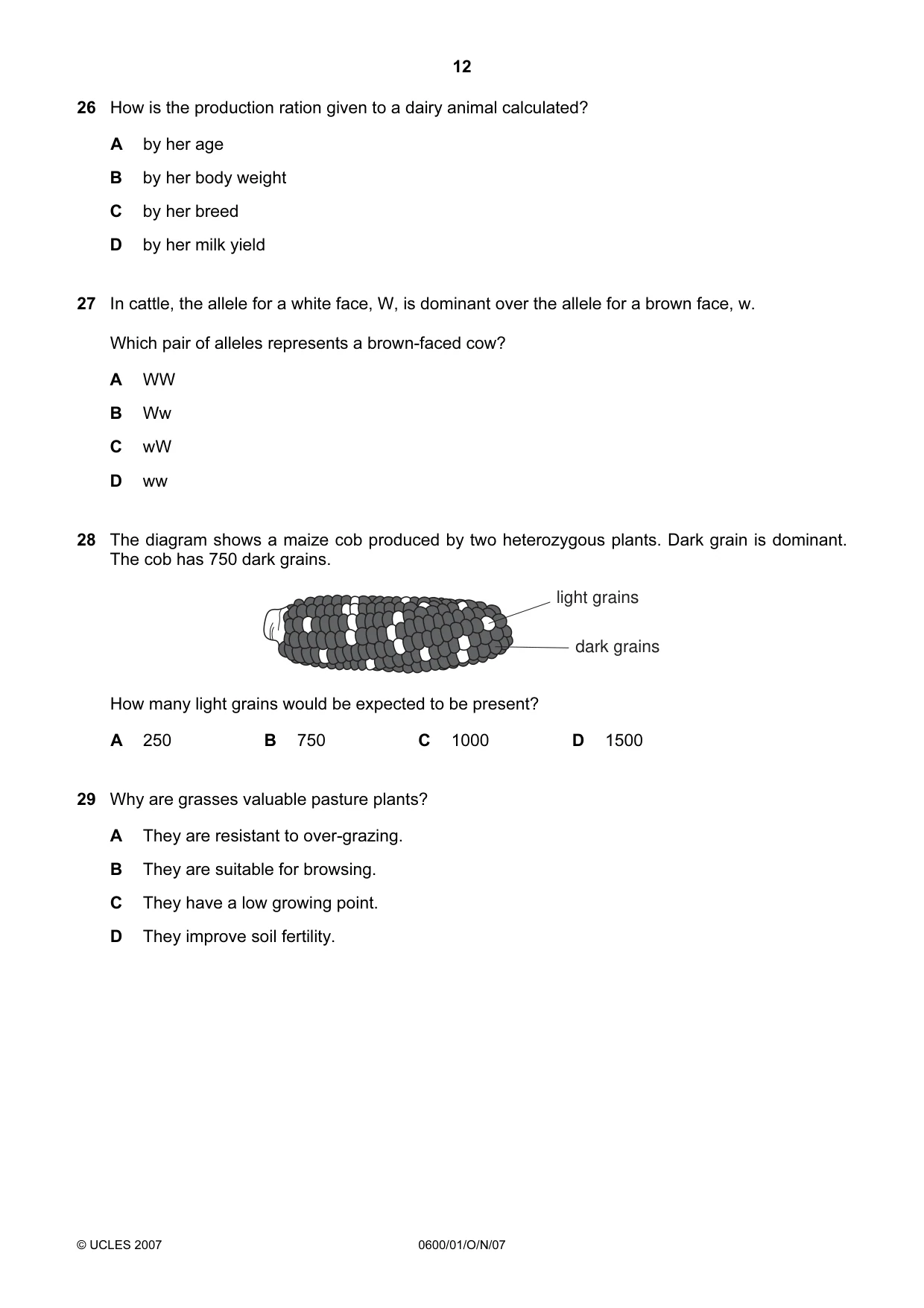
12 © UCLES 2007 0600/01/O/N/07 26 How is the production ration given to a dairy animal calculated? A by her age B by her body weight C by her breed D by her milk yield 27 In cattle, the allele for a white face, W, is dominant over the allele for a brown face, w. Which pair of alleles represents a brown-faced cow? A WW B Ww C wW D ww 28 The diagram shows a maize cob produced by two heterozygous plants. Dark grain is dominant. The cob has 750 dark grains. light grains dark grains How many light grains would be expected to be present? A 250 B 750 C 1000 D 1500 29 Why are grasses valuable pasture plants? A They are resistant to over-grazing. B They are suitable for browsing. C They have a low growing point. D They improve soil fertility.
Question paper, page 13
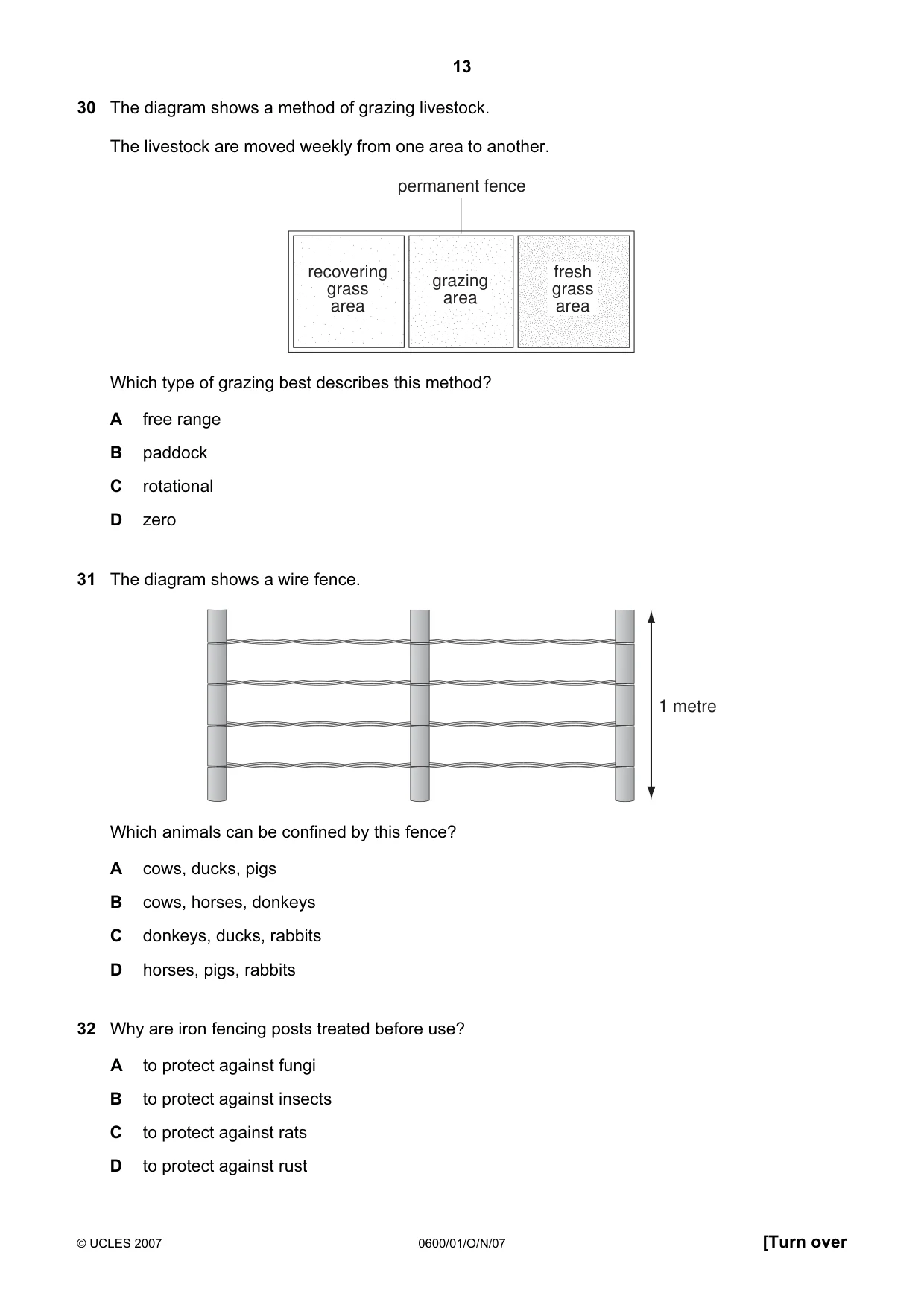
13 © UCLES 2007 0600/01/O/N/07 [Turn over 30 The diagram shows a method of grazing livestock. The livestock are moved weekly from one area to another. recovering grass area grazing area fresh grass area permanent fence Which type of grazing best describes this method? A free range B paddock C rotational D zero 31 The diagram shows a wire fence. 1 metre Which animals can be confined by this fence? A cows, ducks, pigs B cows, horses, donkeys C donkeys, ducks, rabbits D horses, pigs, rabbits 32 Why are iron fencing posts treated before use? A to protect against fungi B to protect against insects C to protect against rats D to protect against rust
Question paper, page 14
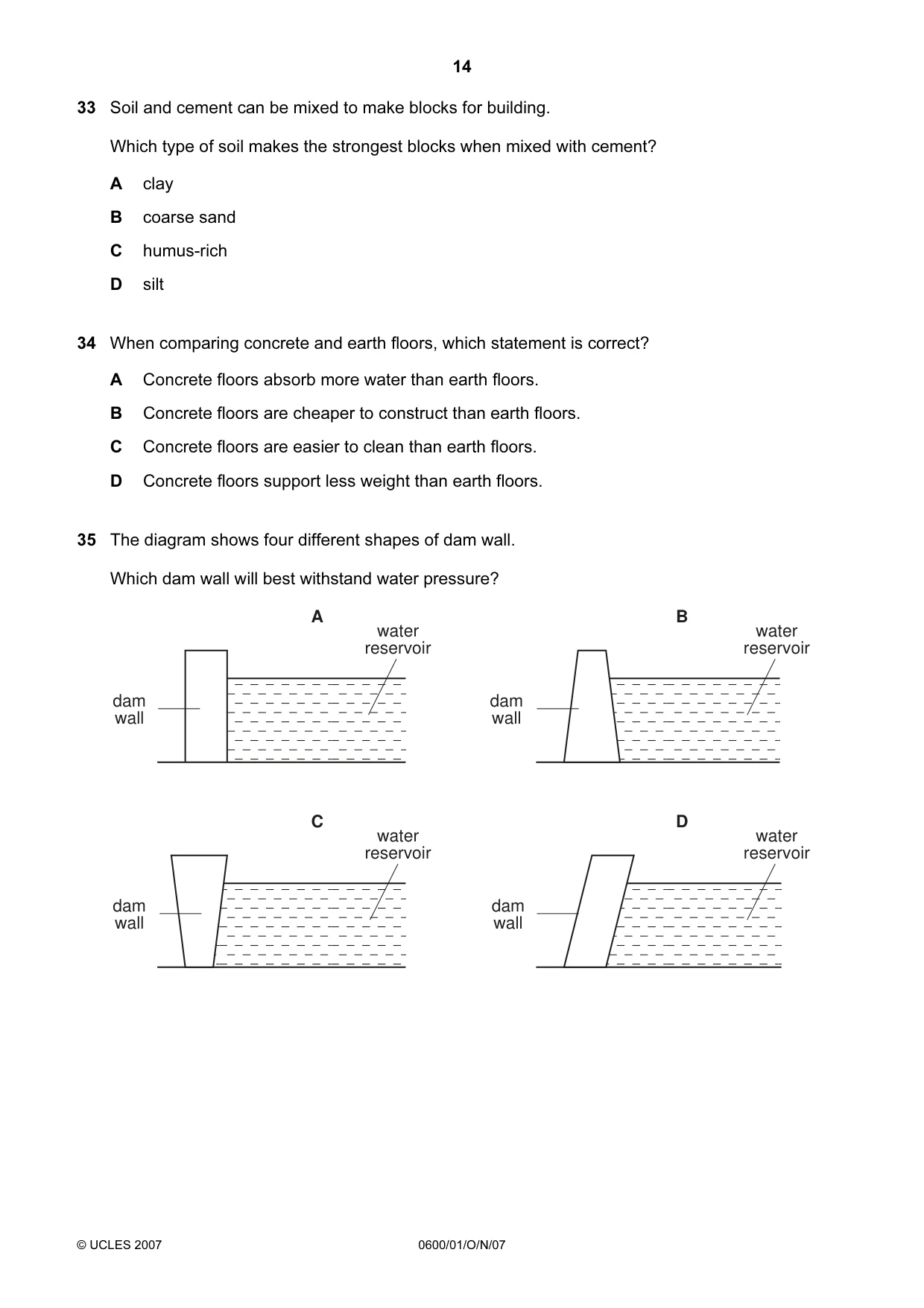
14 © UCLES 2007 0600/01/O/N/07 33 Soil and cement can be mixed to make blocks for building. Which type of soil makes the strongest blocks when mixed with cement? A clay B coarse sand C humus-rich D silt 34 When comparing concrete and earth floors, which statement is correct? A Concrete floors absorb more water than earth floors. B Concrete floors are cheaper to construct than earth floors. C Concrete floors are easier to clean than earth floors. D Concrete floors support less weight than earth floors. 35 The diagram shows four different shapes of dam wall. Which dam wall will best withstand water pressure? A B C D dam wall dam wall dam wall dam wall water reservoir water reservoir water reservoir water reservoir
Question paper, page 15
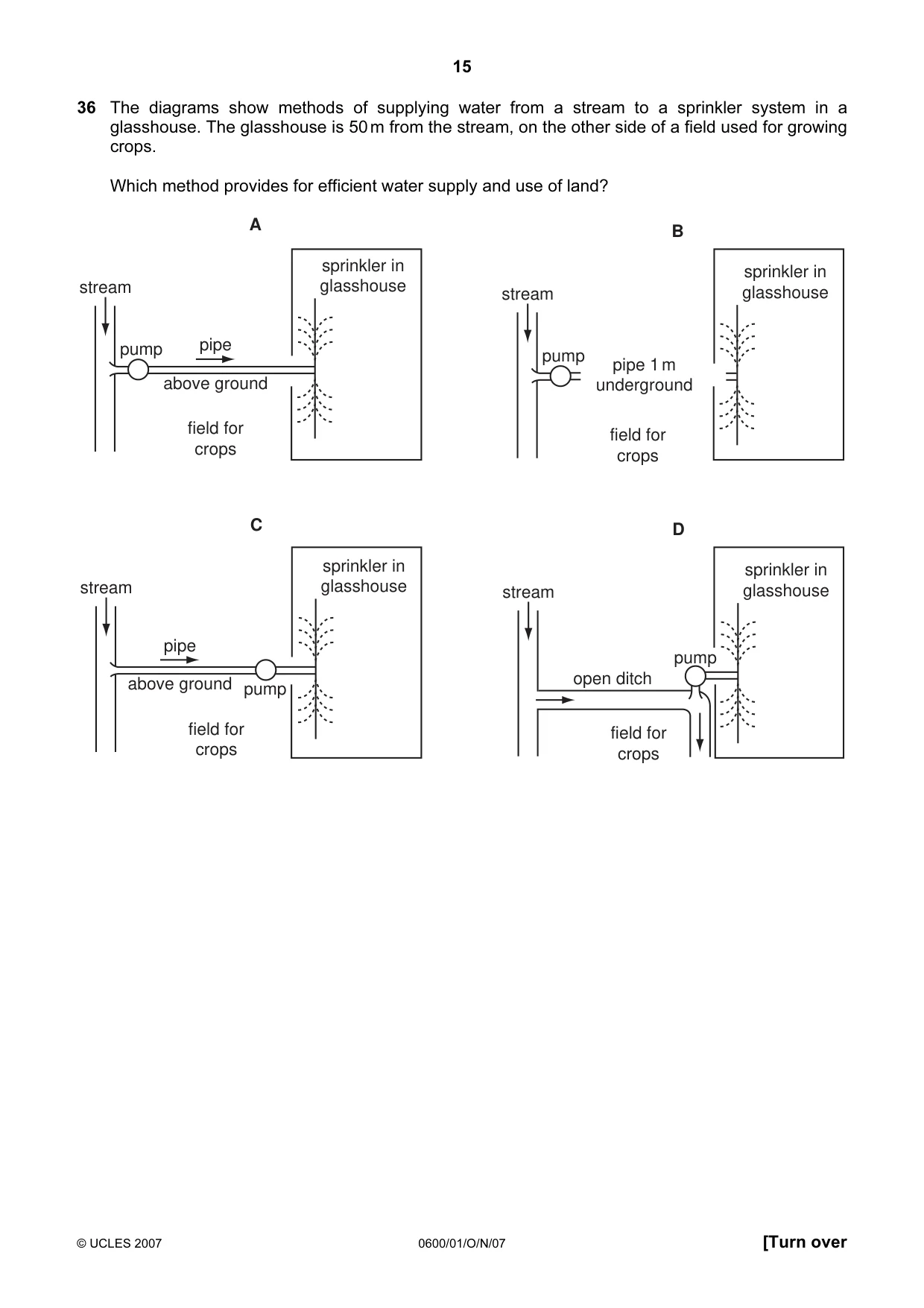
15 © UCLES 2007 0600/01/O/N/07 [Turn over 36 The diagrams show methods of supplying water from a stream to a sprinkler system in a glasshouse. The glasshouse is 50 m from the stream, on the other side of a field used for growing crops. Which method provides for efficient water supply and use of land? stream pump sprinkler in glasshouse field for crops pipe above ground A stream pump sprinkler in glasshouse field for crops D open ditch pipe 1 m underground stream pump sprinkler in glasshouse field for crops B pipe above ground stream pump sprinkler in glasshouse field for crops C
Question paper, page 16
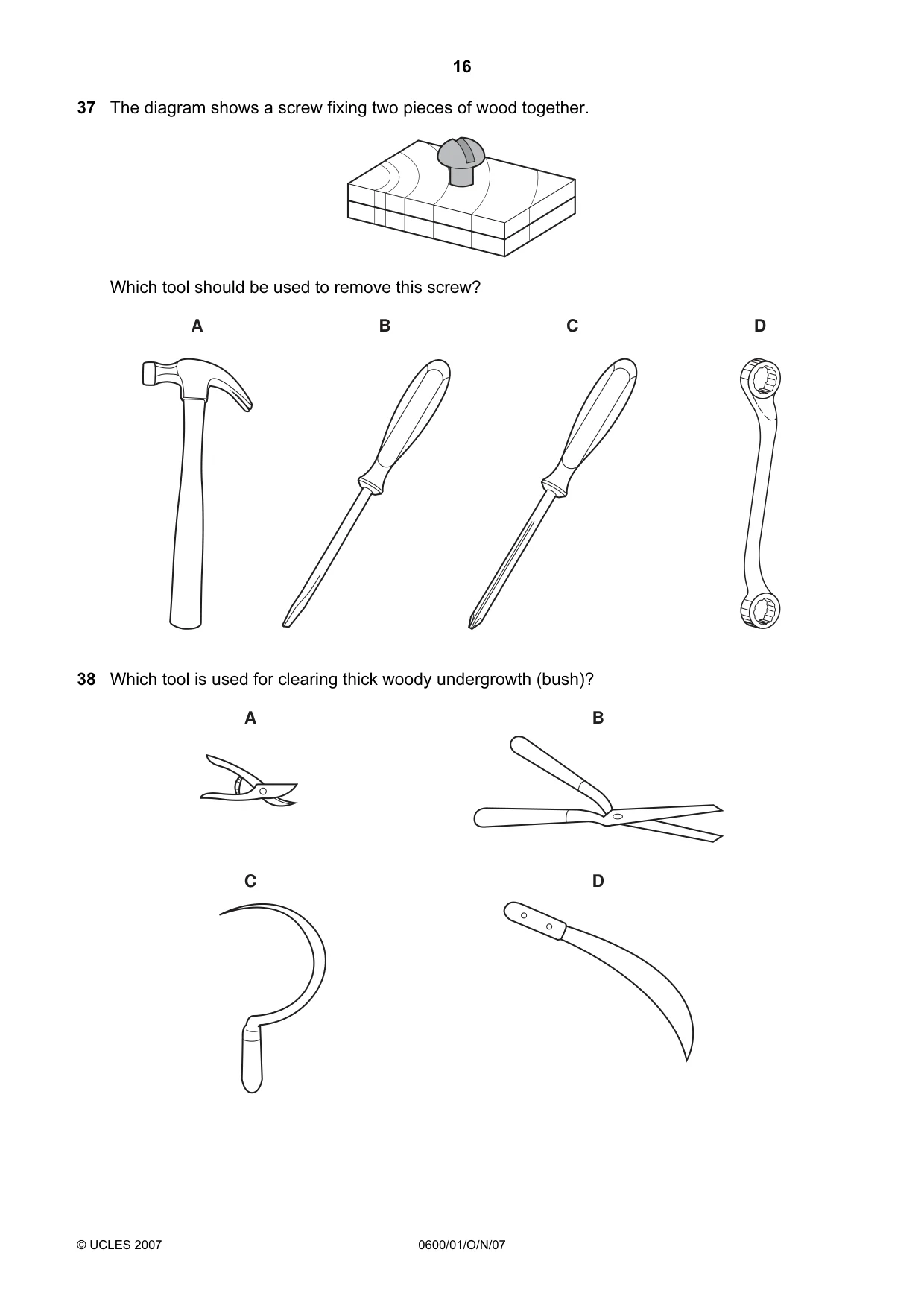
16 © UCLES 2007 0600/01/O/N/07 37 The diagram shows a screw fixing two pieces of wood together. Which tool should be used to remove this screw? A B C D 38 Which tool is used for clearing thick woody undergrowth (bush)? A B C D
Question paper, page 17
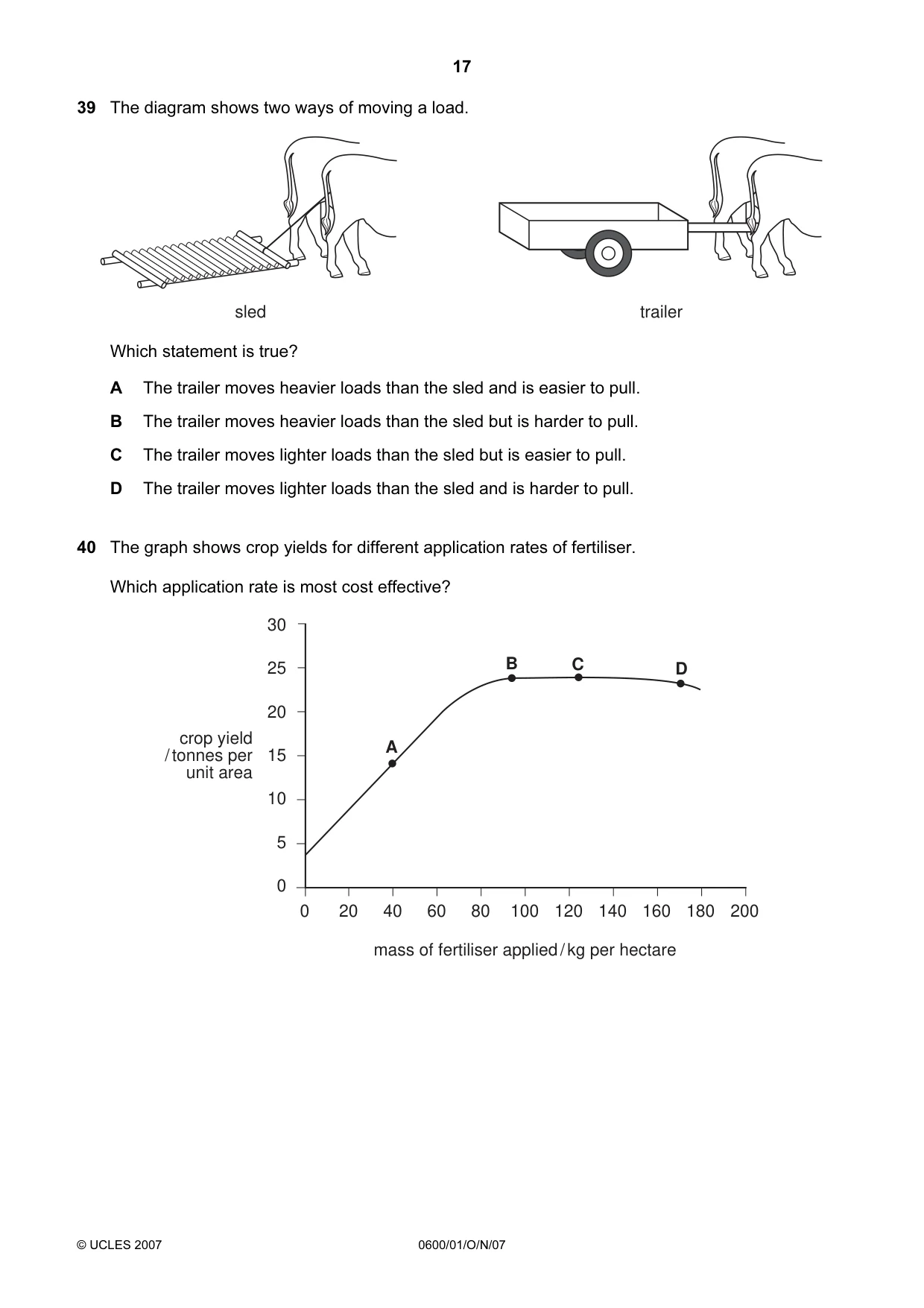
17 © UCLES 2007 0600/01/O/N/07 39 The diagram shows two ways of moving a load. sled trailer Which statement is true? A The trailer moves heavier loads than the sled and is easier to pull. B The trailer moves heavier loads than the sled but is harder to pull. C The trailer moves lighter loads than the sled but is easier to pull. D The trailer moves lighter loads than the sled and is harder to pull. 40 The graph shows crop yields for different application rates of fertiliser. Which application rate is most cost effective? 30 25 20 15 10 5 0 crop yield / tonnes per unit area 0 20 40 60 80 100 120 140 160 180 200 mass of fertiliser applied / kg per hectare A B C D
Question paper, page 20
20 Permission to reproduce items where third-party owned material protected by copyright is included has been sought and cleared where possible. Every reasonable effort has been made by the publisher (UCLES) to trace copyright holders, but if any items requiring clearance have unwittingly been included, the publisher will be pleased to make amends at the earliest possible opportunity. University of Cambridge International Examinations is part of the Cambridge Assessment Group. Cambridge Assessment is the brand name of University of Cambridge Local Examinations Syndicate (UCLES), which is itself a department of the University of Cambridge. 0600/01/O/N/07 BLANK PAGE
Mark scheme, page 1
UNIVERSITY OF CAMBRIDGE INTERNATIONAL EXAMINATIONS International General Certificate of Secondary Education MARK SCHEME for the October/November 2007 question paper 0600 AGRICULTURE 0600/01 Paper 1 (Multiple Choice), maximum raw mark 40 Mark schemes must be read in conjunction with the question papers and the report on the examination. • CIE will not enter into discussions or correspondence in connection with these mark schemes. CIE is publishing the mark schemes for the October/November 2007 question papers for most IGCSE, GCE Advanced Level and Advanced Subsidiary Level syllabuses and some Ordinary Level syllabuses. www.XtremePapers.com
Mark scheme, page 2
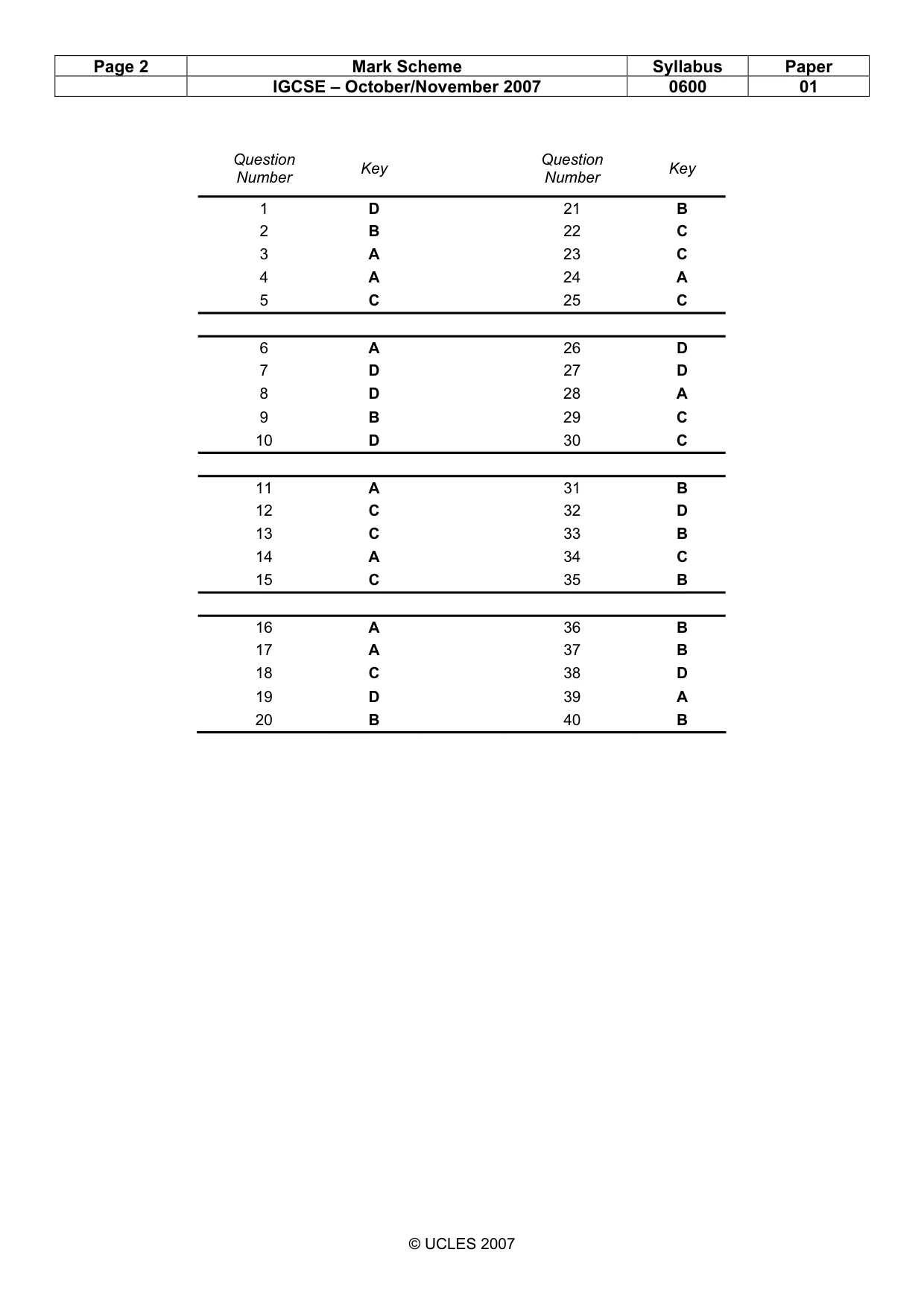
Page 2 Mark Scheme Syllabus Paper IGCSE – October/November 2007 0600 01 © UCLES 2007 Question Number Key Question Number Key 1 D 21 B 2 B 22 C 3 A 23 C 4 A 24 A 5 C 25 C 6 A 26 D 7 D 27 D 8 D 28 A 9 B 29 C 10 D 30 C 11 A 31 B 12 C 32 D 13 C 33 B 14 A 34 C 15 C 35 B 16 A 36 B 17 A 37 B 18 C 38 D 19 D 39 A 20 B 40 B
What you needed in this session
Cambridge’s own grade thresholds for 2007 Oct/Nov, Paper 1 · Variant 1. A higher threshold means an easier paper — the bar moves with how the cohort did.