Cambridge IGCSE Accounting 0452 — 2017 Feb/March Paper 2 · Variant 2
0452/22/F/M/17 · 6 questions · 120 marks · ≈135 min
The question paper and its mark scheme, free to read here and free to download. This is Cambridge’s own paper, exactly as it was sat.
Question paper24 pages


Mark scheme13 pages
Answers below. Sit the paper first if you are practising.
Questions as text
Q1 · Mandeep is a trader who maintains a full set of accounting records including a three…
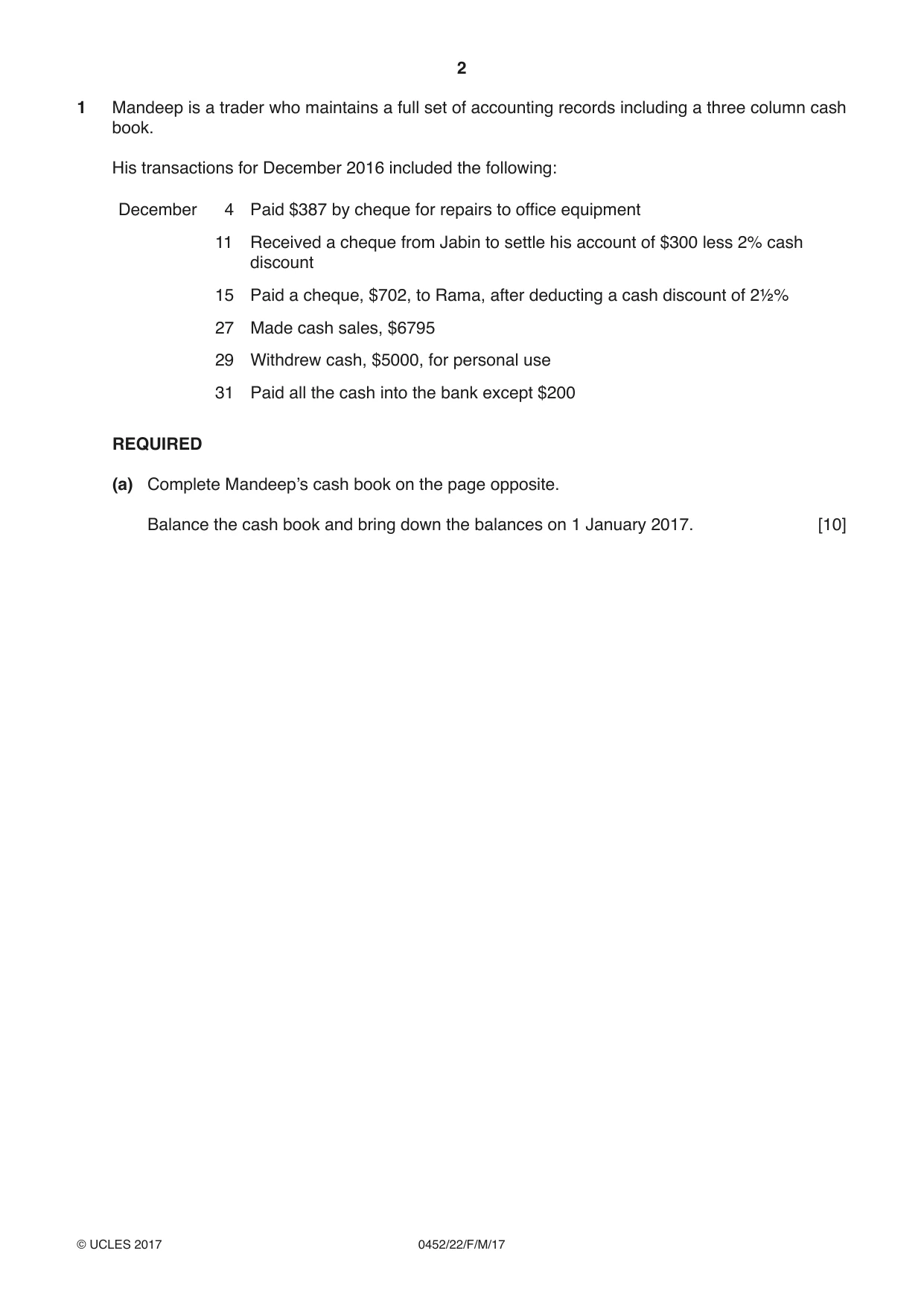
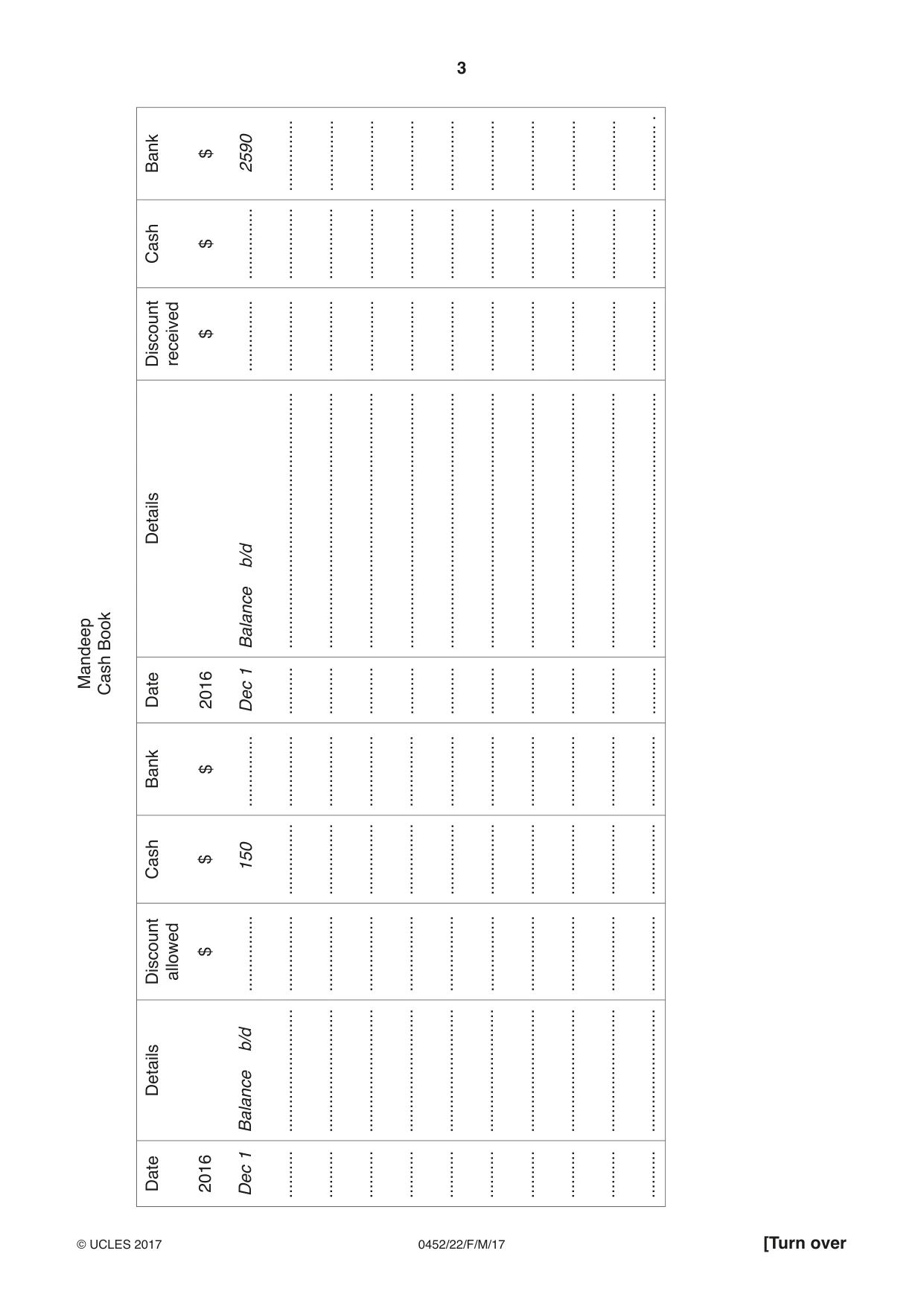
1 Mandeep is a trader who maintains a full set of accounting records including a three column cash book. His transactions for December 2016 included the following: December 4 Paid $387 by cheque for repairs to office equipment 11 Received a cheque from Jabin to settle his account of $300 less 2% cash discount 15 Paid a cheque, $702, to Rama, after deducting a cash discount of 2½% 27 Made cash sales, $6795 29 Withdrew cash, $5000, for personal use 31 Paid all the cash into the bank except $200 REQUIRED (a) Complete Mandeep’s cash book on the page opposite. Balance the cash book and bring down the balances on 1 January 2017. [10] . $ Bank 2590 ............... ............... ............... ............... ............... ............... ............... ............... ............... .............. $ Cash ............... ............... ............... ............... ............... ............... ............... ............... ............... ............... ............... $ Discountreceived ............... ............... ............... ............... ............... ............... ............... ............... ............... ............... ............... Details b/d Book Balance ...................................................... ...................................................... ...................................................... ...................................................... ...................................................... ...................................................... ...................................................... ...................................................... ...................................................... ...................................................... 1Mandeep Cash Date 2016 Dec .......... .......... .......... .......... .......... .......... .......... .......... .......... .......... $ Bank ............... ............... ............... ............... ............... ............... ............... ............... ............... ............... ............... $ Cash 150 ............... ............... ............... ............... ............... ............... ............... ............... ............... ............... $ Discountallowed ................ ................ ................ ................ ................ ................ ................ ................ ................ ................ ................ b/d Details Balance .......................... .......................... .......................... .......................... .......................... .......................... .......................... .......................... .......................... .......................... Date 2016 1Dec .......... .......... .......... .......... .......... .......... .......... .......... .......... .......... Mandeep’s financial year ends on 31 December. He prepared his draft financial statements for the year ended 31 December 2016, but did not close or balance his ledger accounts. Mandeep provided the following information at 31 December 2016. 1 At 31 December 2016 the inventory was valued at $13 420.
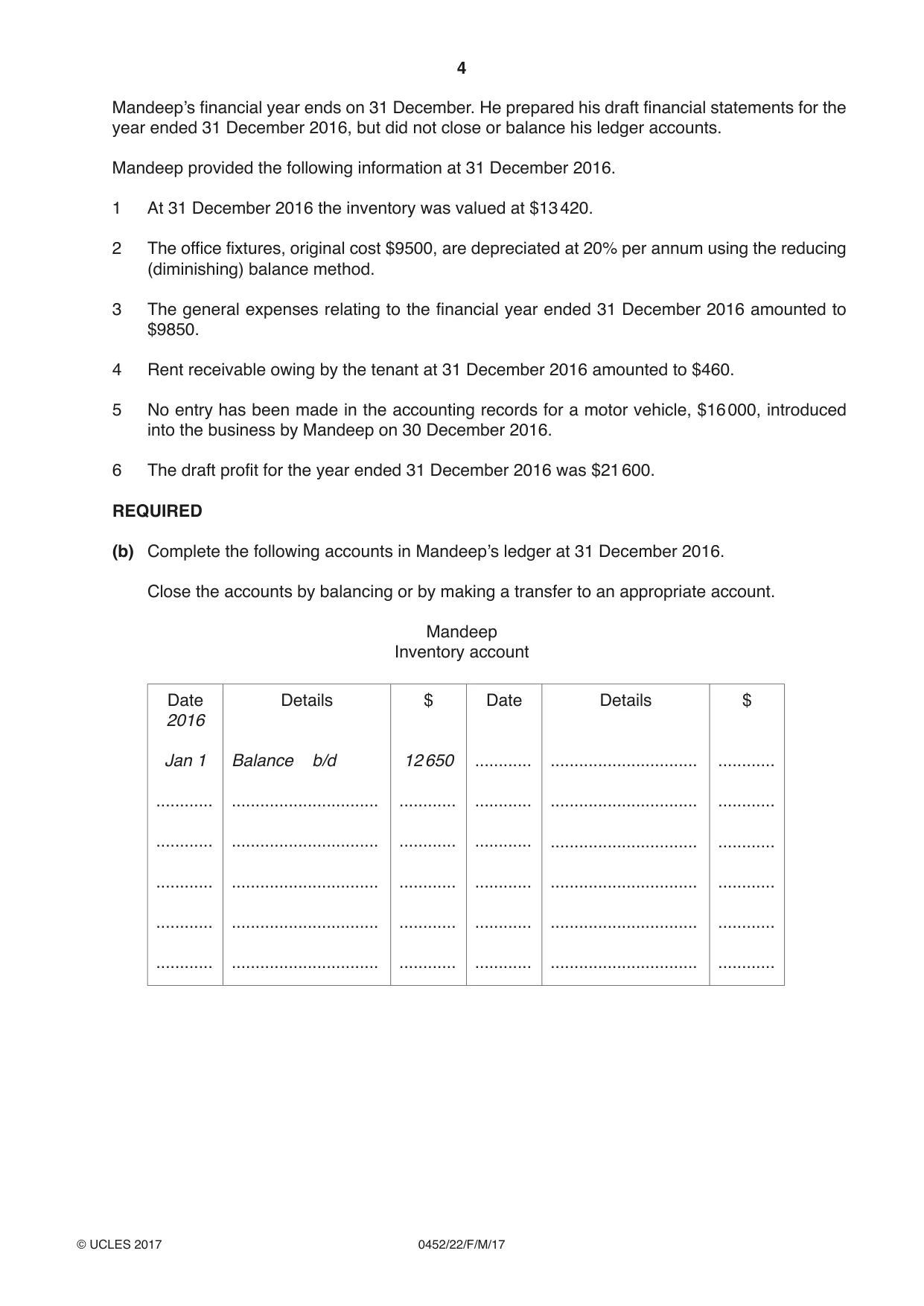
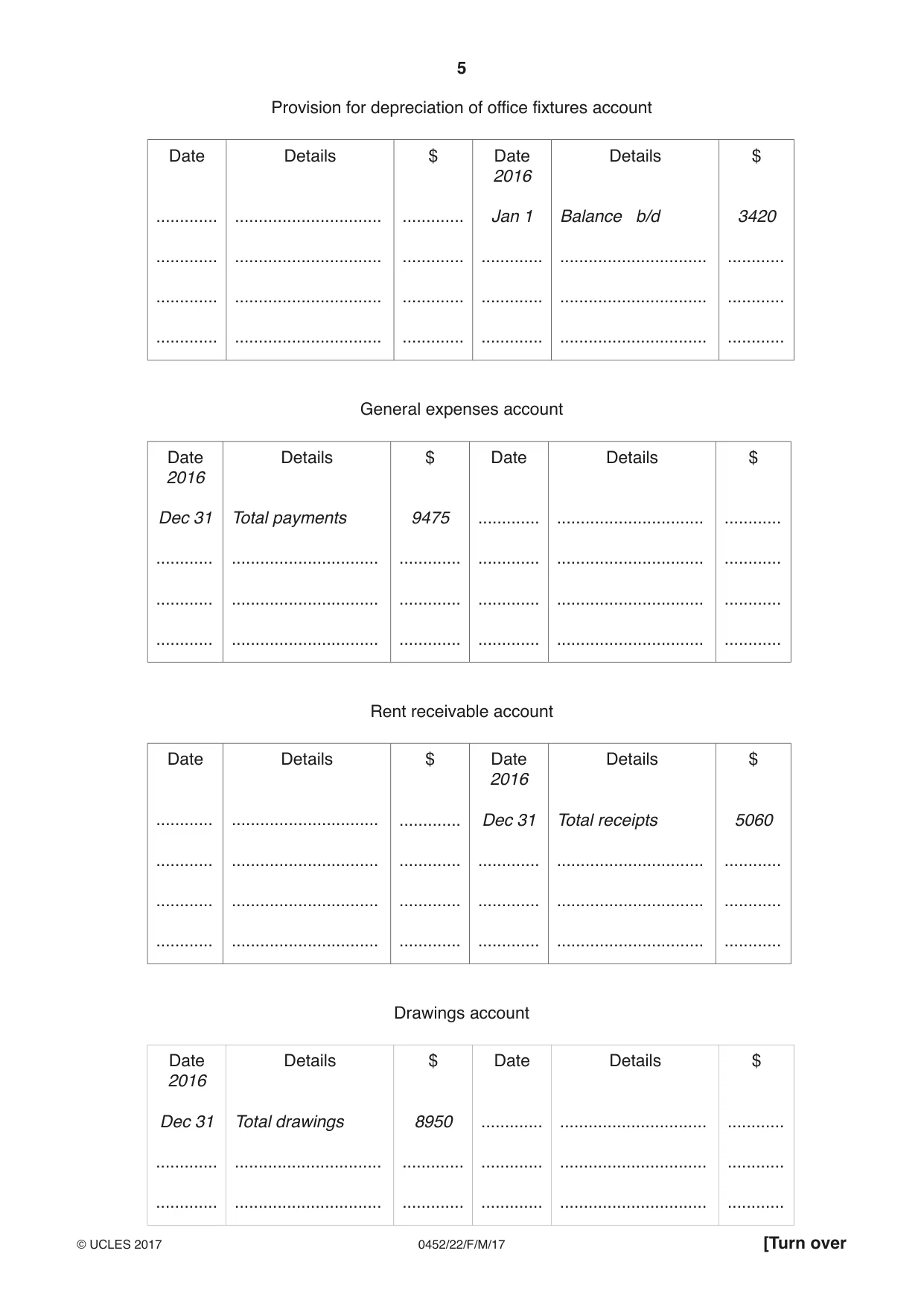
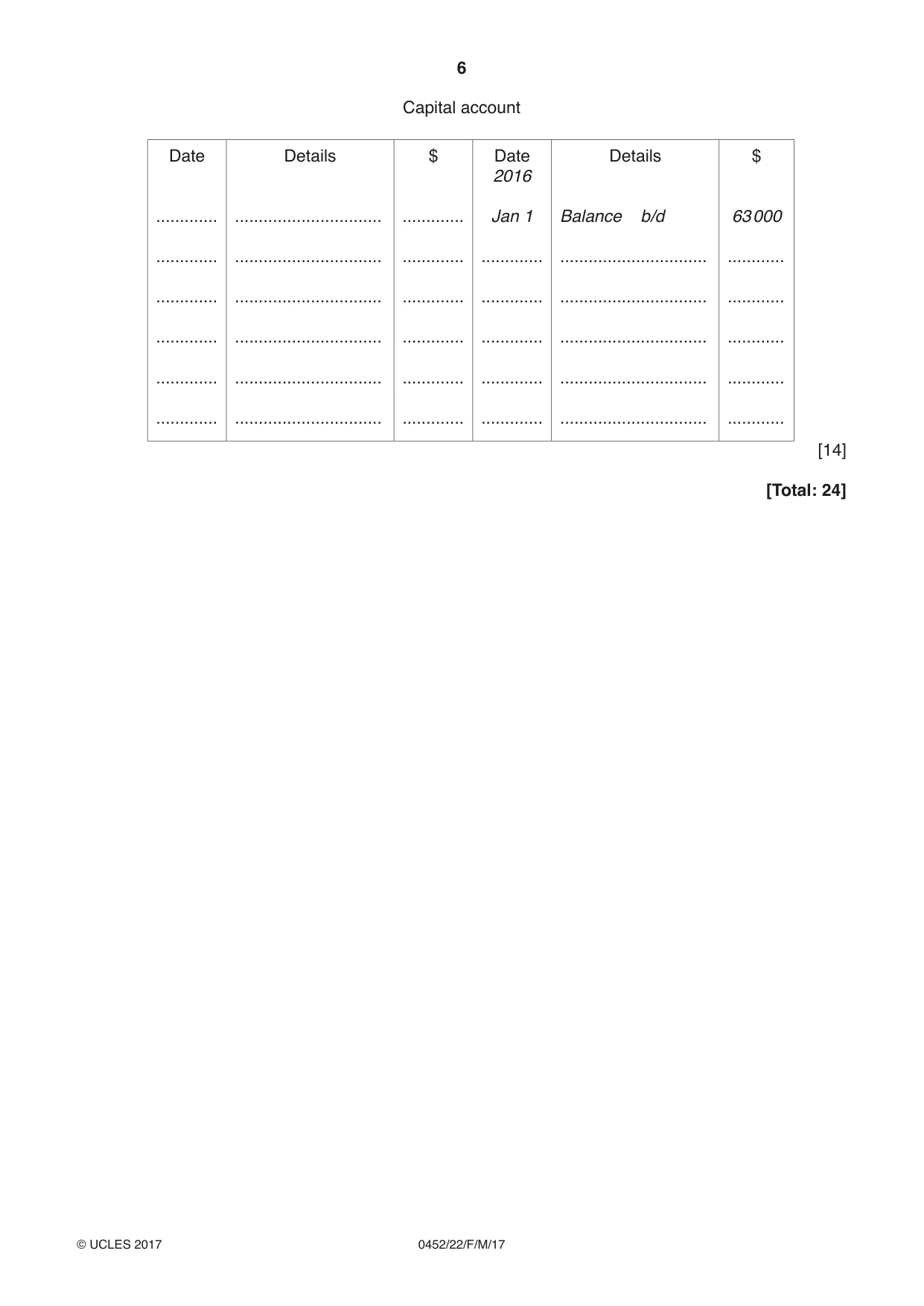
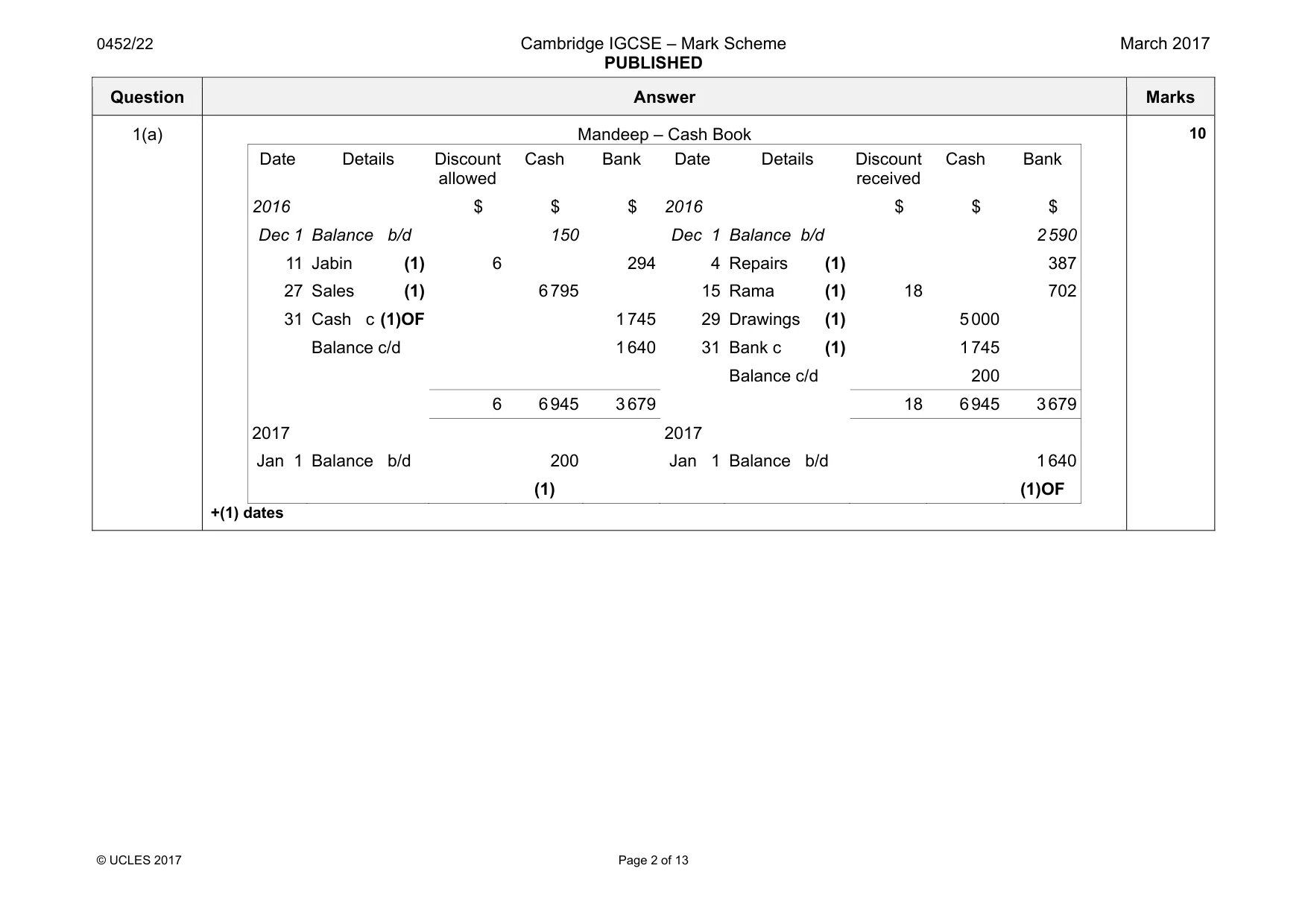
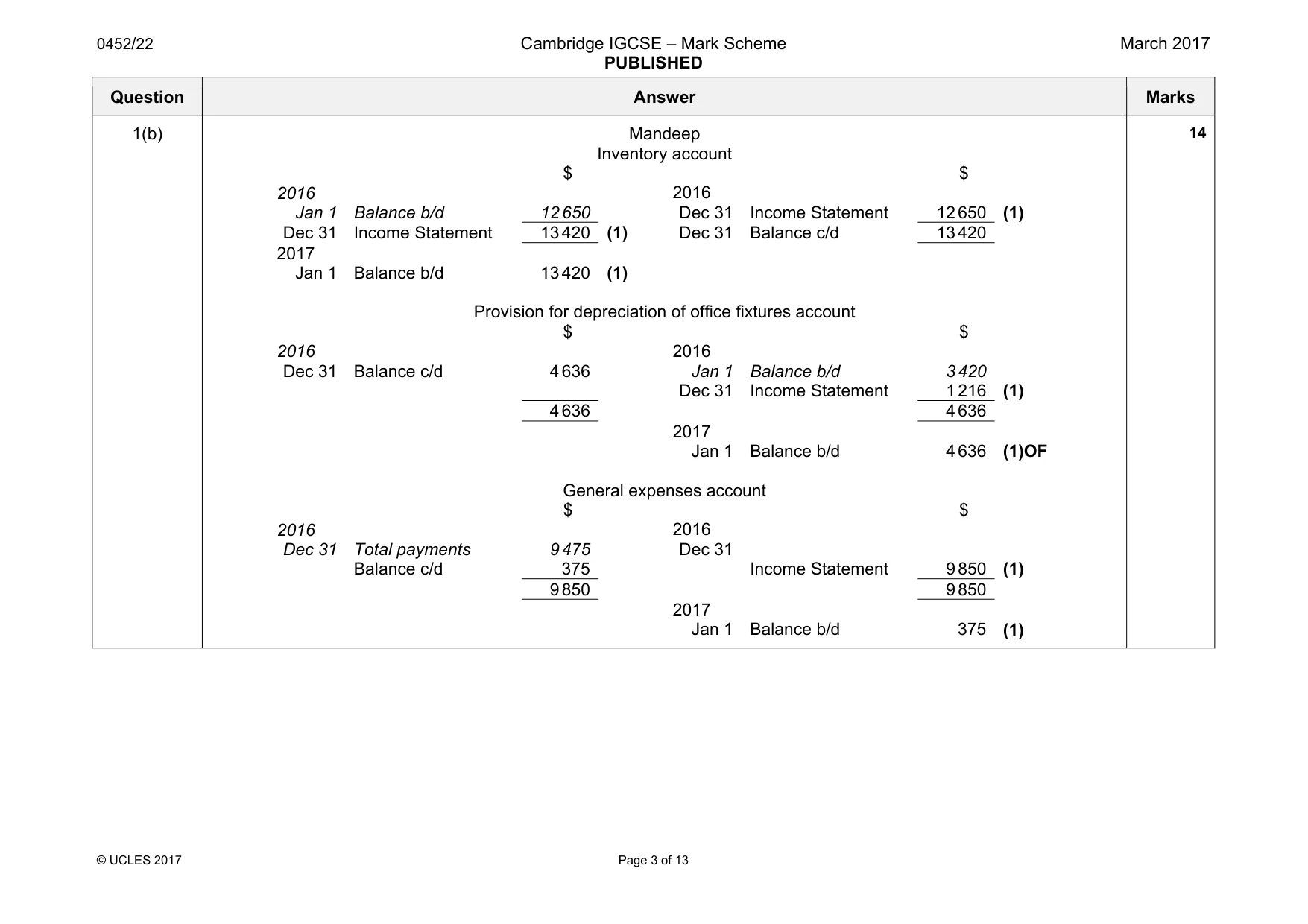
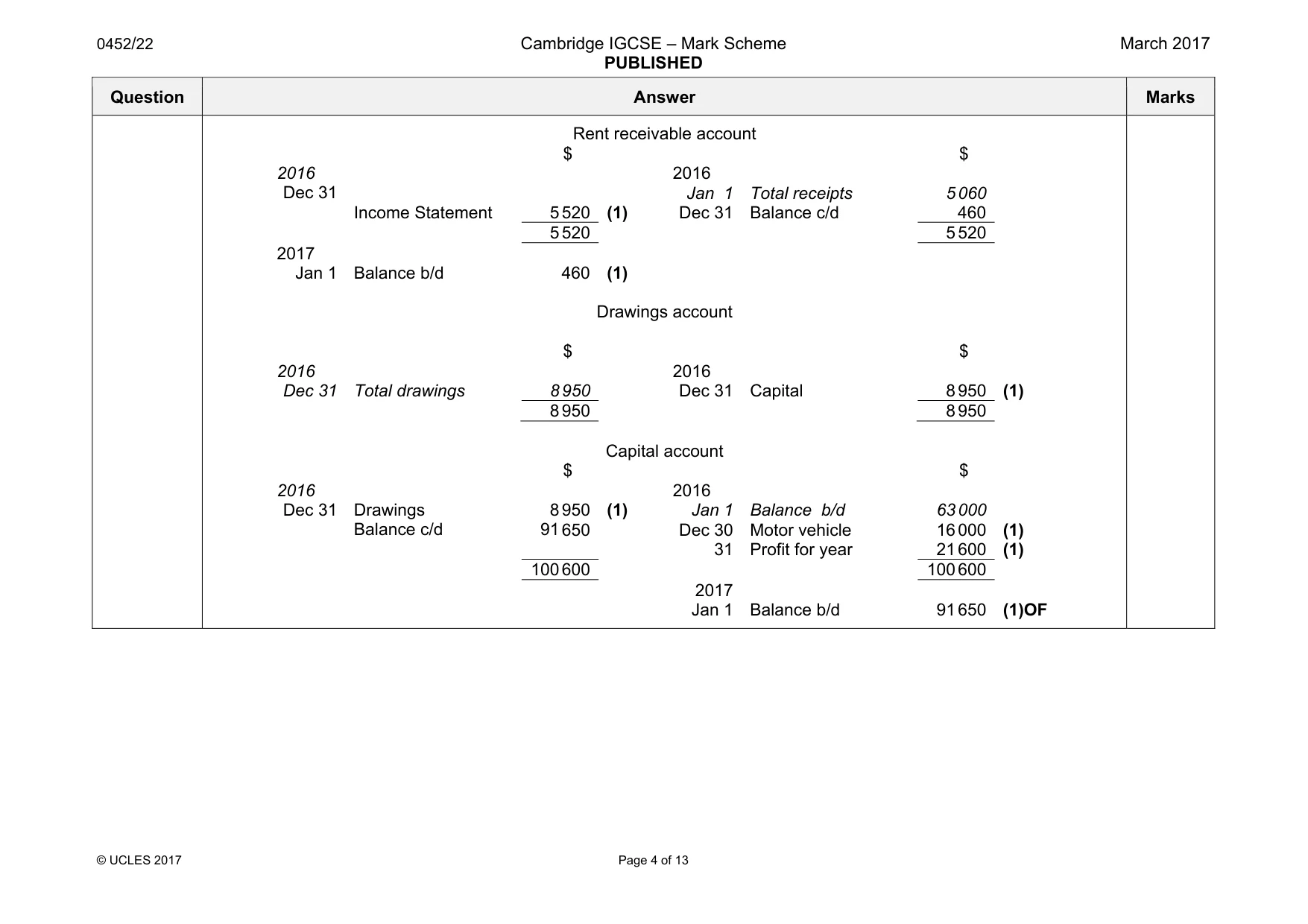
Mark scheme: 1(a) Mandeep – Cash Book Date Details Discount allowed Cash Bank Date Details Discount received Cash Bank 2016 $ $ $ 2016 $ $ $ Dec 1 Balance b/d 150 Dec 1 Balance b/d 2 590 11 Jabin (1) 6 294 4 Repairs (1) 387 27 Sales (1) 6 795 15 Rama (1) 18 702 31 Cash c (1)OF 1 745 29 Drawings (1) 5 000 Balance c/d 1 640 31 Bank c (1) 1 745 Balance c/d 200 6 6 945 3 679 18 6 945 3 679 2017 2017 Jan 1 Balance b/d 200 Jan 1 Balance b/d 1 640 (1) (1)OF +(1) dates Question Answer Marks 1(b) Mandeep Inventory account $ $ 2016 2016 Jan 1 Balance b/d 12 650 Dec 31 Income Statement 12 650 (1) Dec 31 Income Statement 13 420 (1) Dec 31 Balance c/d 13 420 2017 Jan 1 Balance b/d 13 420 (1) Provision for depreciation of office fixtures account $ $ 2016 2016 Dec 31 Balance c/d 4 636 Jan 1 Balance b/d 3 420 Dec 31 Income Statement 1 216 (1) 4 636 4 636 2017 Jan 1 Balance b/d 4 636 (1)OF General expenses account $ $ 2016 2016 Dec 31 Total payments 9 475 Dec 31 Balance c/d 375 Income Statement 9 850 (1) 9 850 9 850 2017 Jan 1 Balance b/d 375 (1) 14 Question Answer Marks Rent receivable account $ $ 2016 2016 Dec 31 Jan 1 Total receipts 5 060 Income Statement 5 520 (1) Dec 31 Balance c/d 460 5 520 5 520 2017 Jan 1 Balance b/d 460 (1) Drawings account $ $ 2016 2016 Dec 31 Total drawings 8 950 Dec 31 Capital 8 950 (1) 8 950 8 950 Capital account $ $ 2016 2016 Dec 31 Drawings 8 950 (1) Jan 1 Balance b/d 63 000 Balance c/d 91 650 Dec 30 Motor vehicle 16 000 (1) 31 Profit for year 21 600 (1) 100 600 100 600 2017 Jan 1 Balance b/d 91 650 (1)OF
Q2 · The office fixtures, original cost $9500, are depreciated at 20% per annum using the…
2 The office fixtures, original cost $9500, are depreciated at 20% per annum using the reducing (diminishing) balance method.
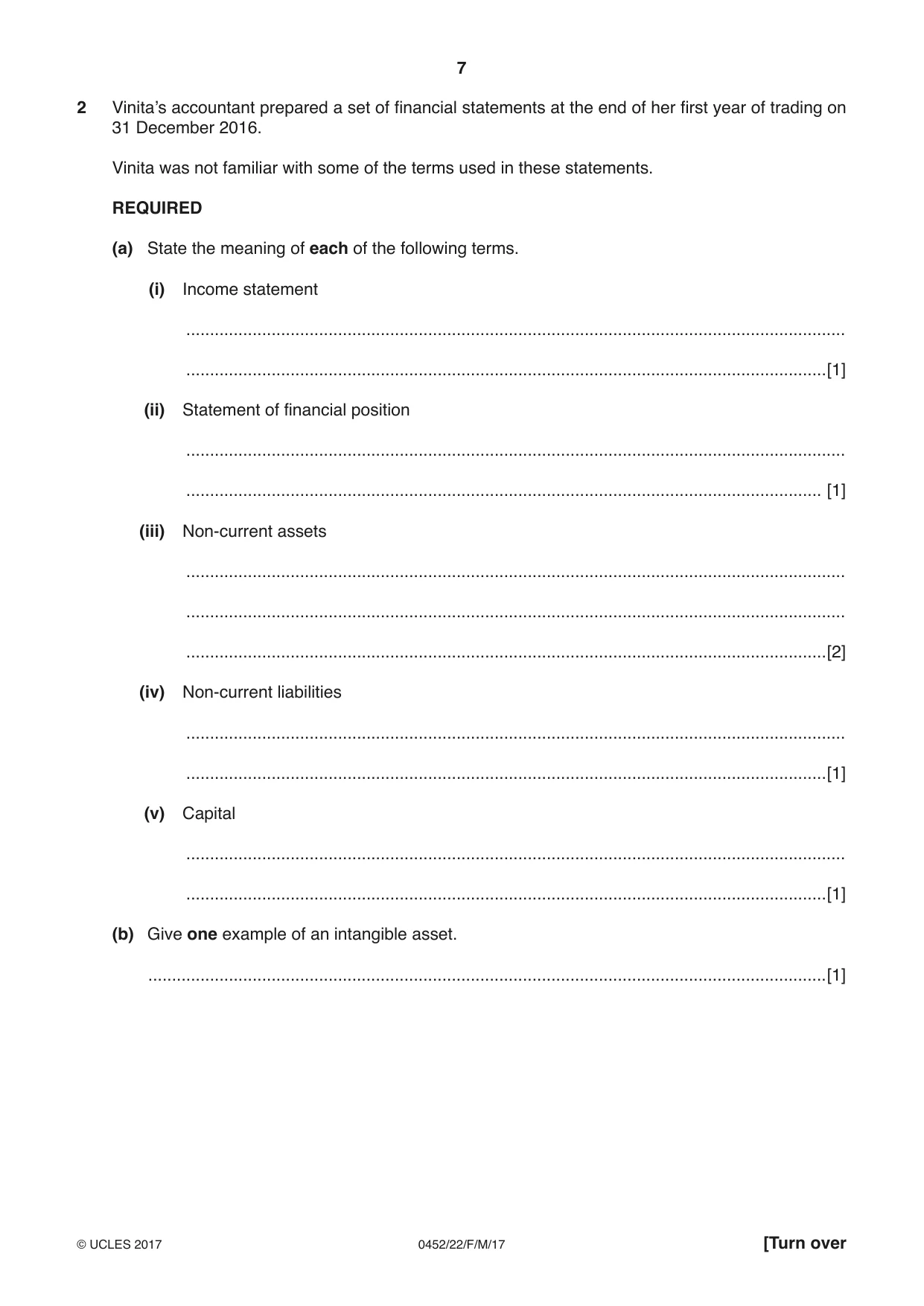
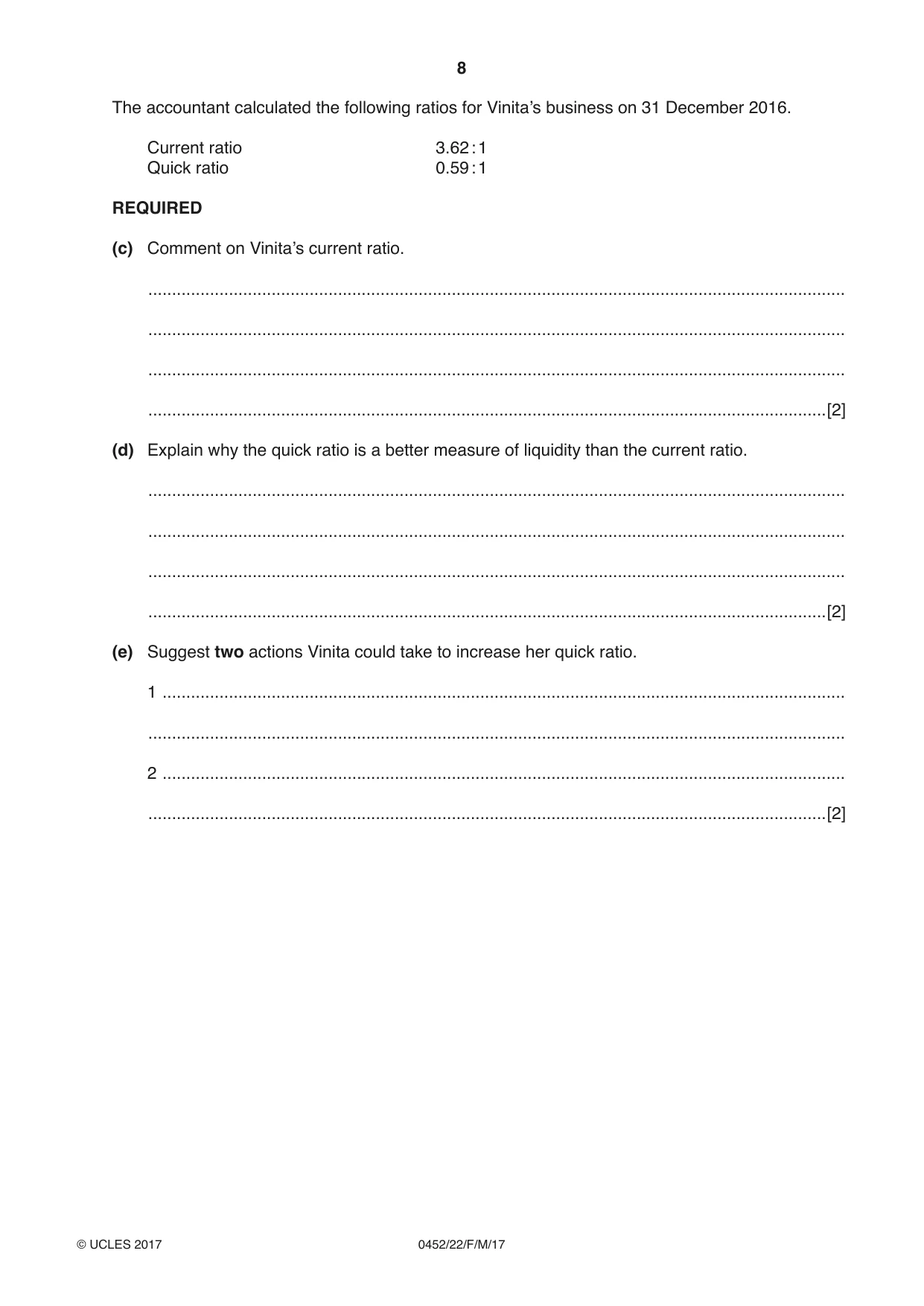
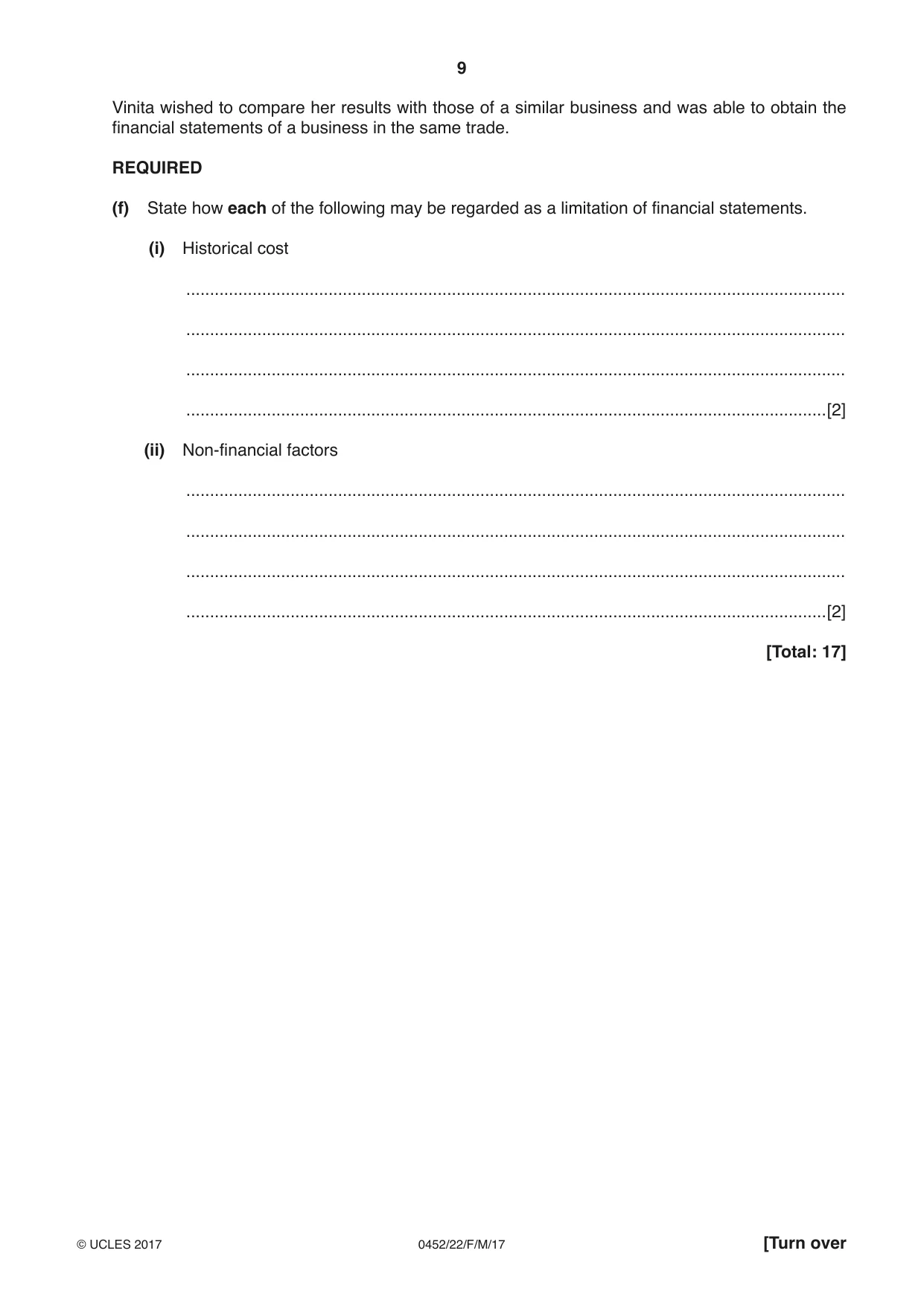
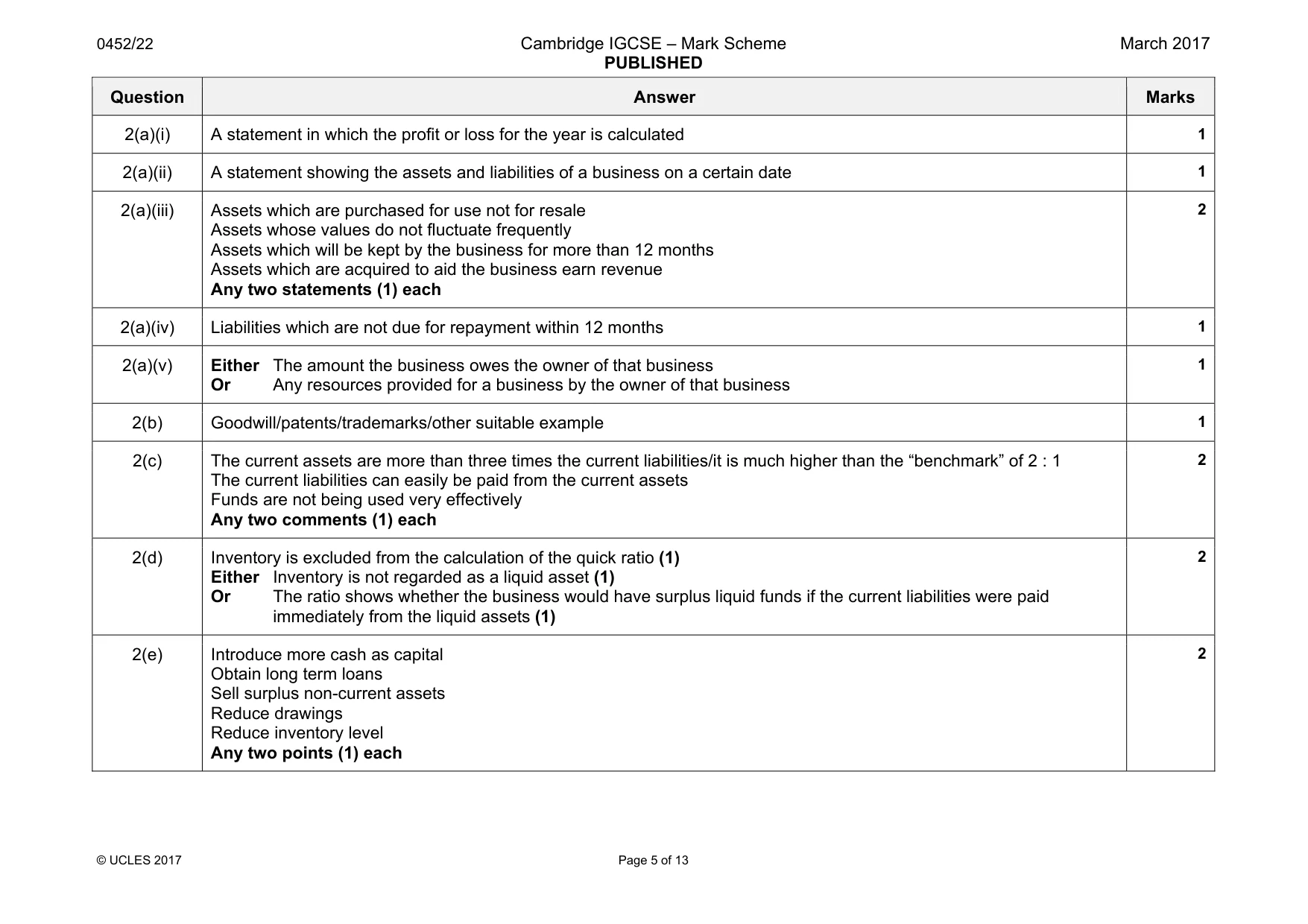
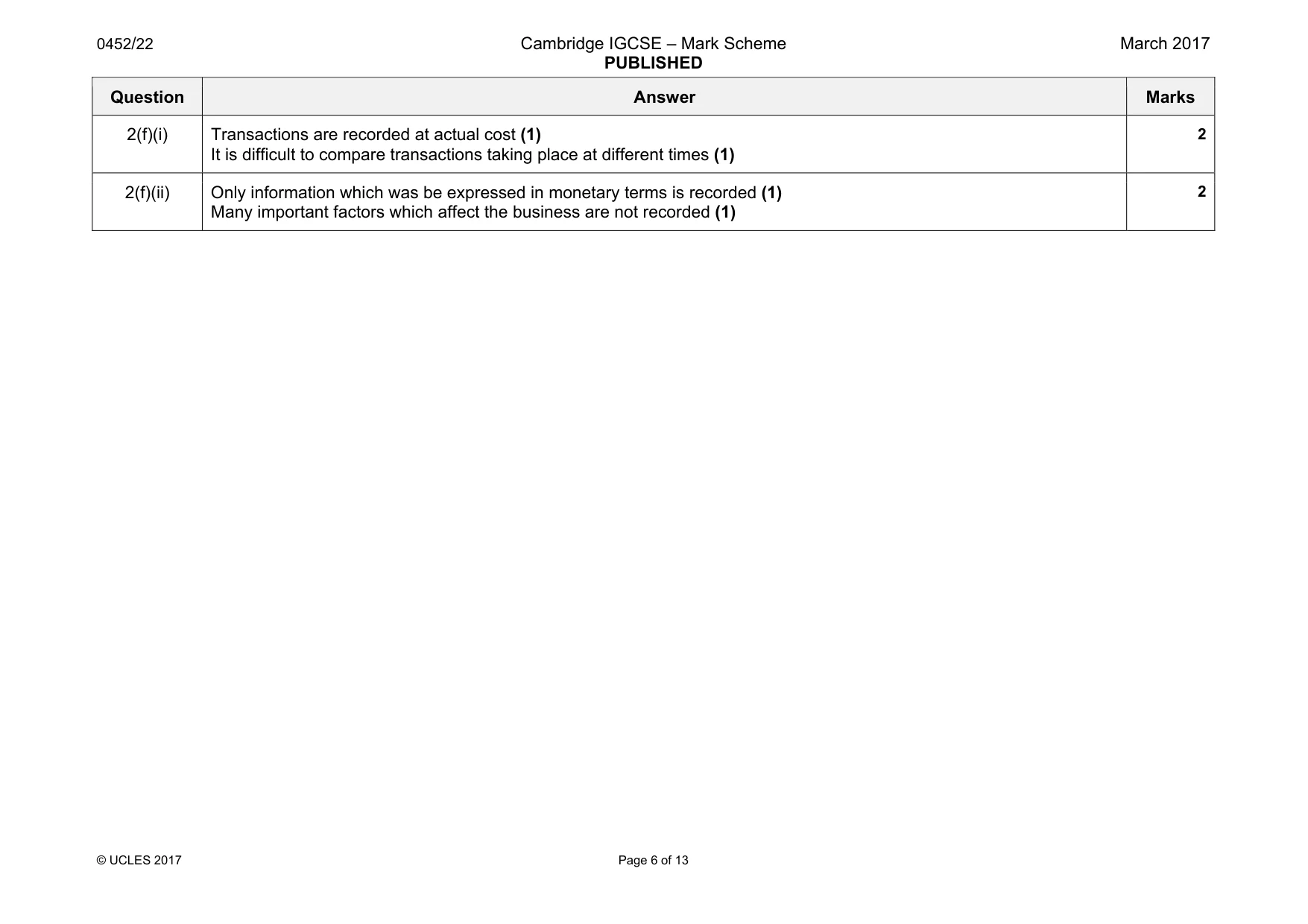
Mark scheme: 2(a)(i) A statement in which the profit or loss for the year is calculated 2(a)(ii) A statement showing the assets and liabilities of a business on a certain date 1 2(a)(iii) Assets which are purchased for use not for resale Assets whose values do not fluctuate frequently Assets which will be kept by the business for more than 12 months Assets which are acquired to aid the business earn revenue Any two statements (1) each 2 2(a)(iv) Liabilities which are not due for repayment within 12 months 1 2(a)(v) Either The amount the business owes the owner of that business Or Any resources provided for a business by the owner of that business 1 2(b) Goodwill/patents/trademarks/other suitable example 1 2(c) The current assets are more than three times the current liabilities/it is much higher than the “benchmark” of 2 : 1 The current liabilities can easily be paid from the current assets Funds are not being used very effectively Any two comments (1) each 2 2(d) Inventory is excluded from the calculation of the quick ratio (1) Either Inventory is not regarded as a liquid asset (1) Or The ratio shows whether the business would have surplus liquid funds if the current liabilities were paid immediately from the liquid assets (1) 2 2(e) Introduce more cash as capital Obtain long term loans Sell surplus non-current assets Reduce drawings Reduce inventory level Any two points (1) each 2 Question Answer Marks 2(f)(i) Transactions are recorded at actual cost (1) It is difficult to compare transactions taking place at different times (1) 2 2(f)(ii) Only information which was be expressed in monetary terms is recorded (1) Many important factors which affect the business are not recorded (1) 2
More questions on Accounting for depreciation and disposal of non-current assets
Q3 · The general expenses relating to the financial year ended 31 December 2016 amounted to…
3 The general expenses relating to the financial year ended 31 December 2016 amounted to $9850.
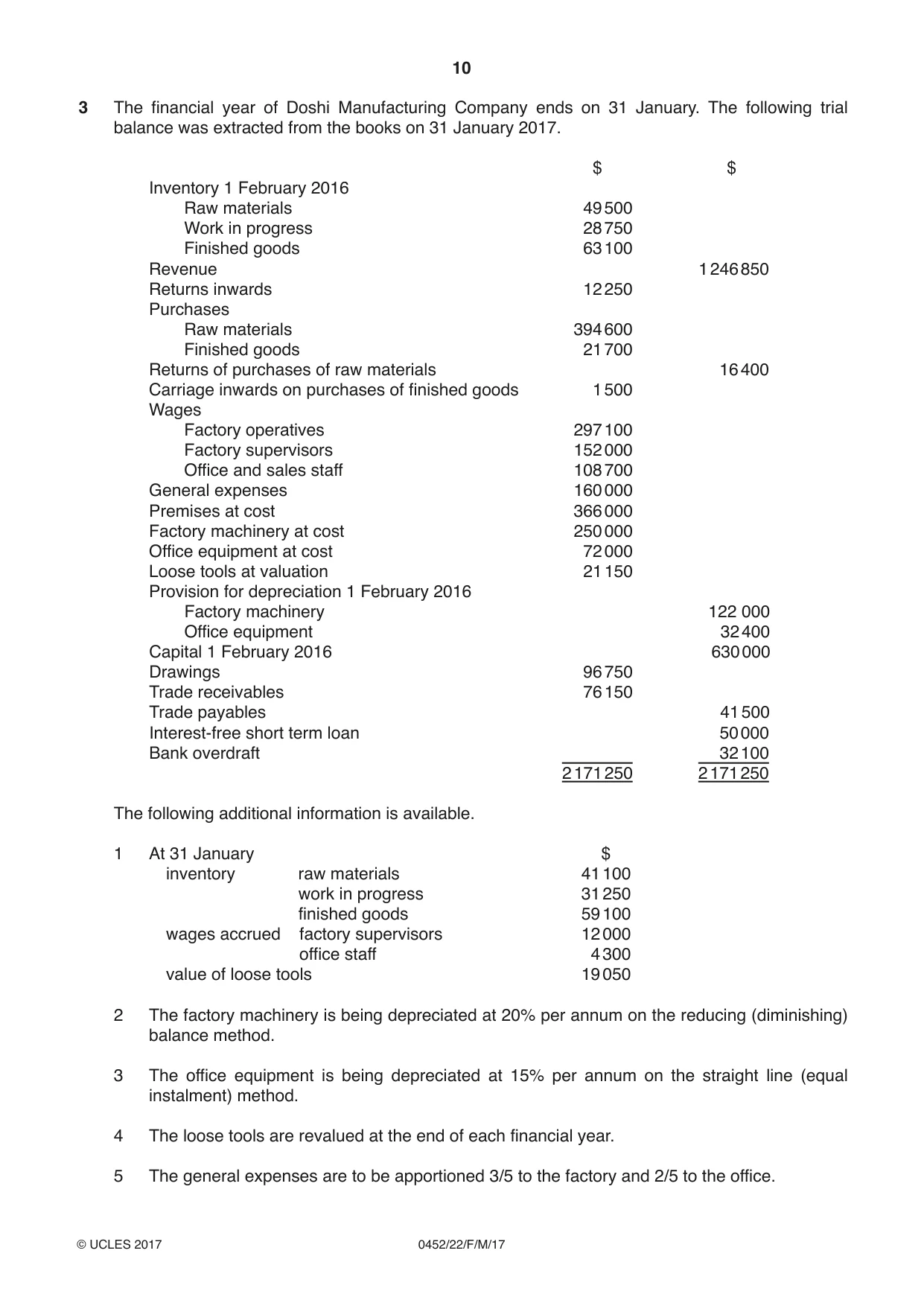
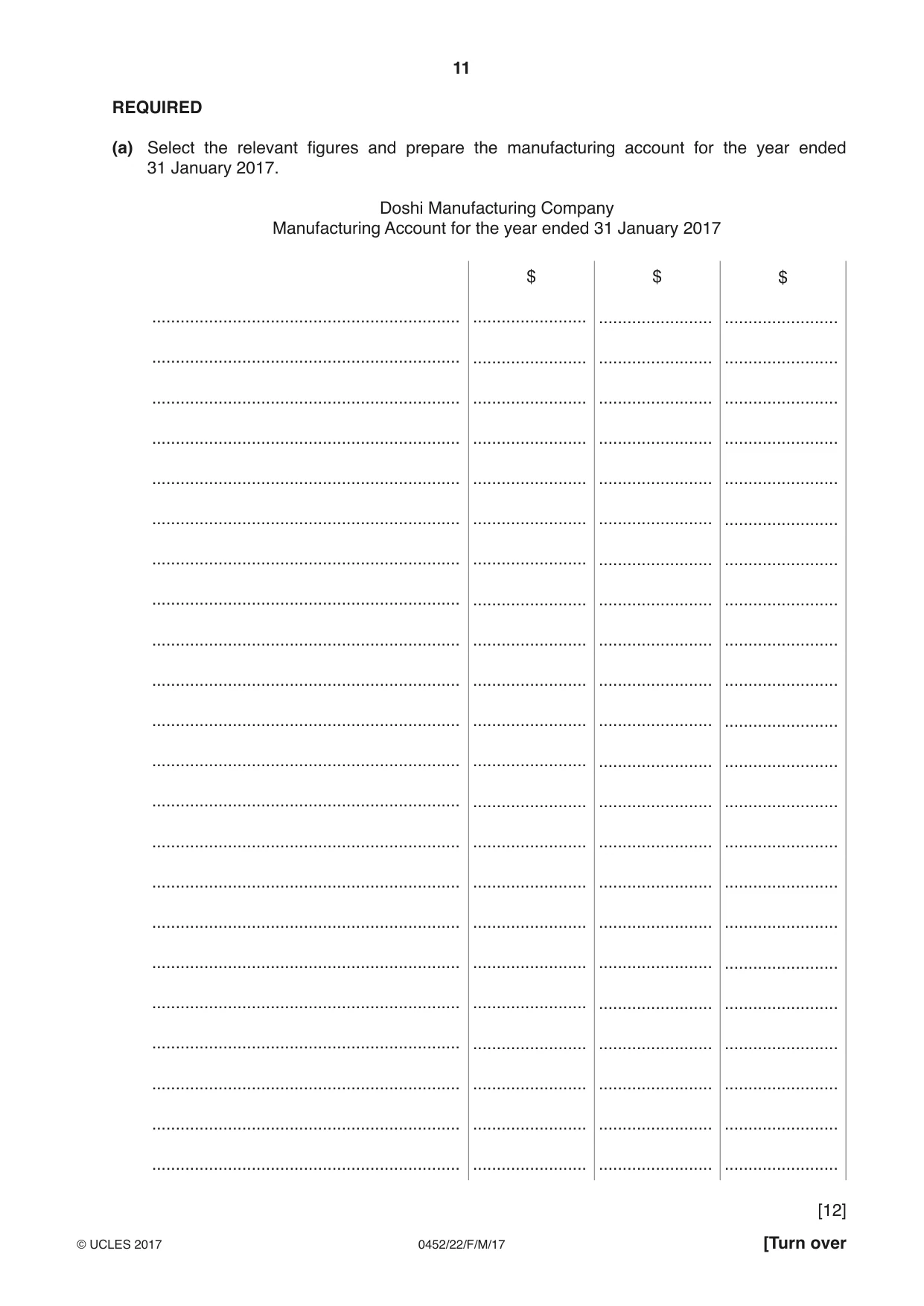
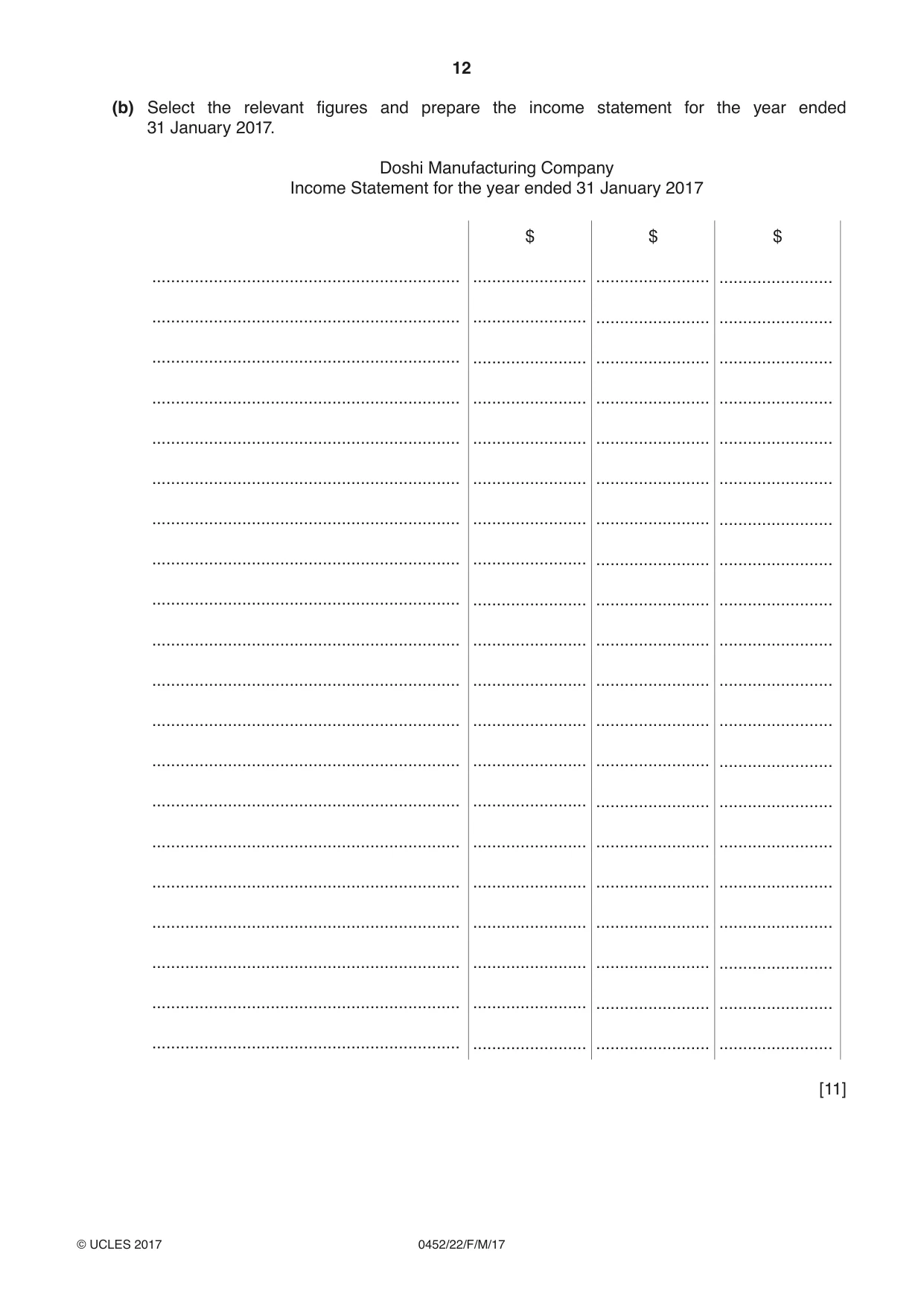
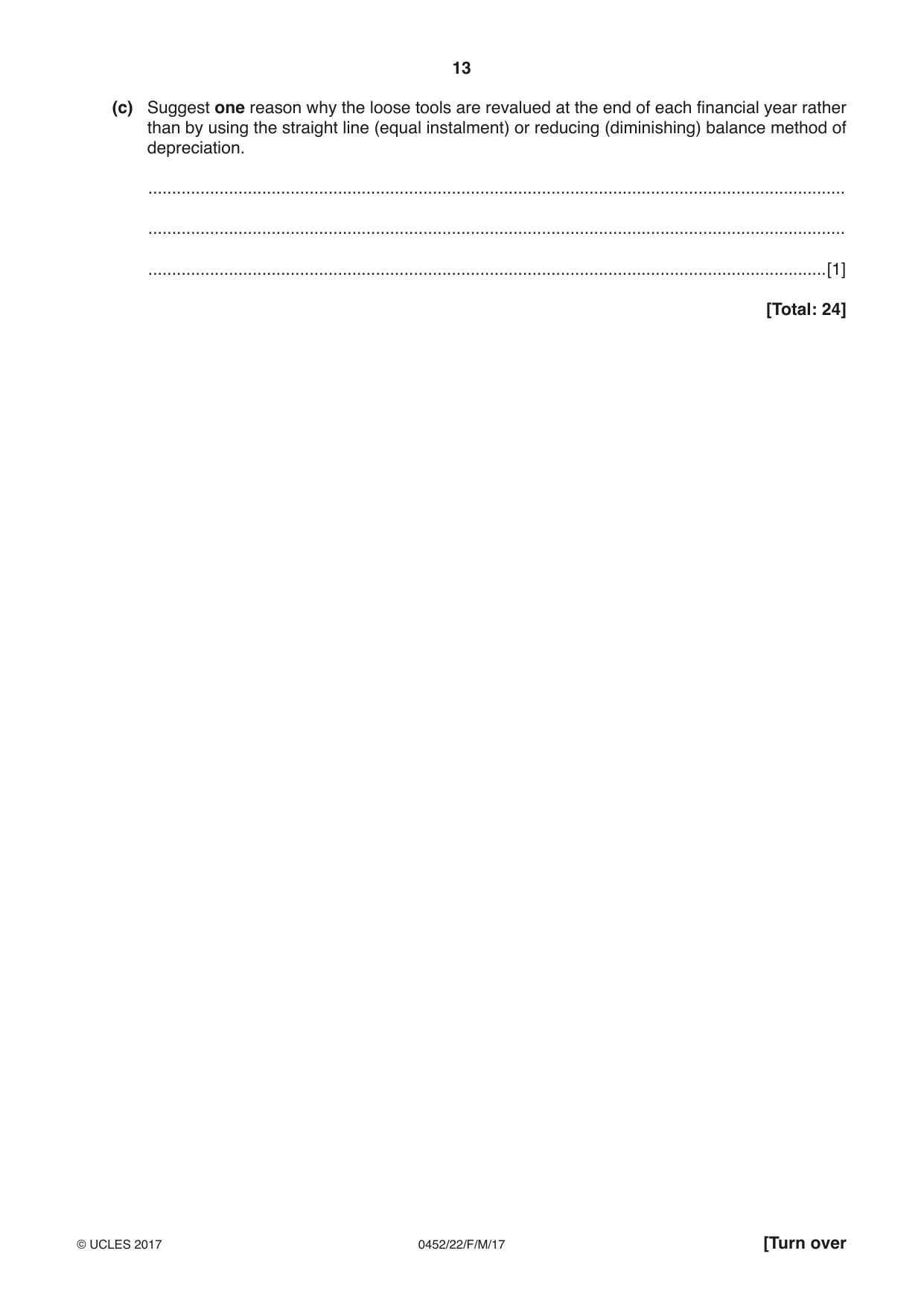
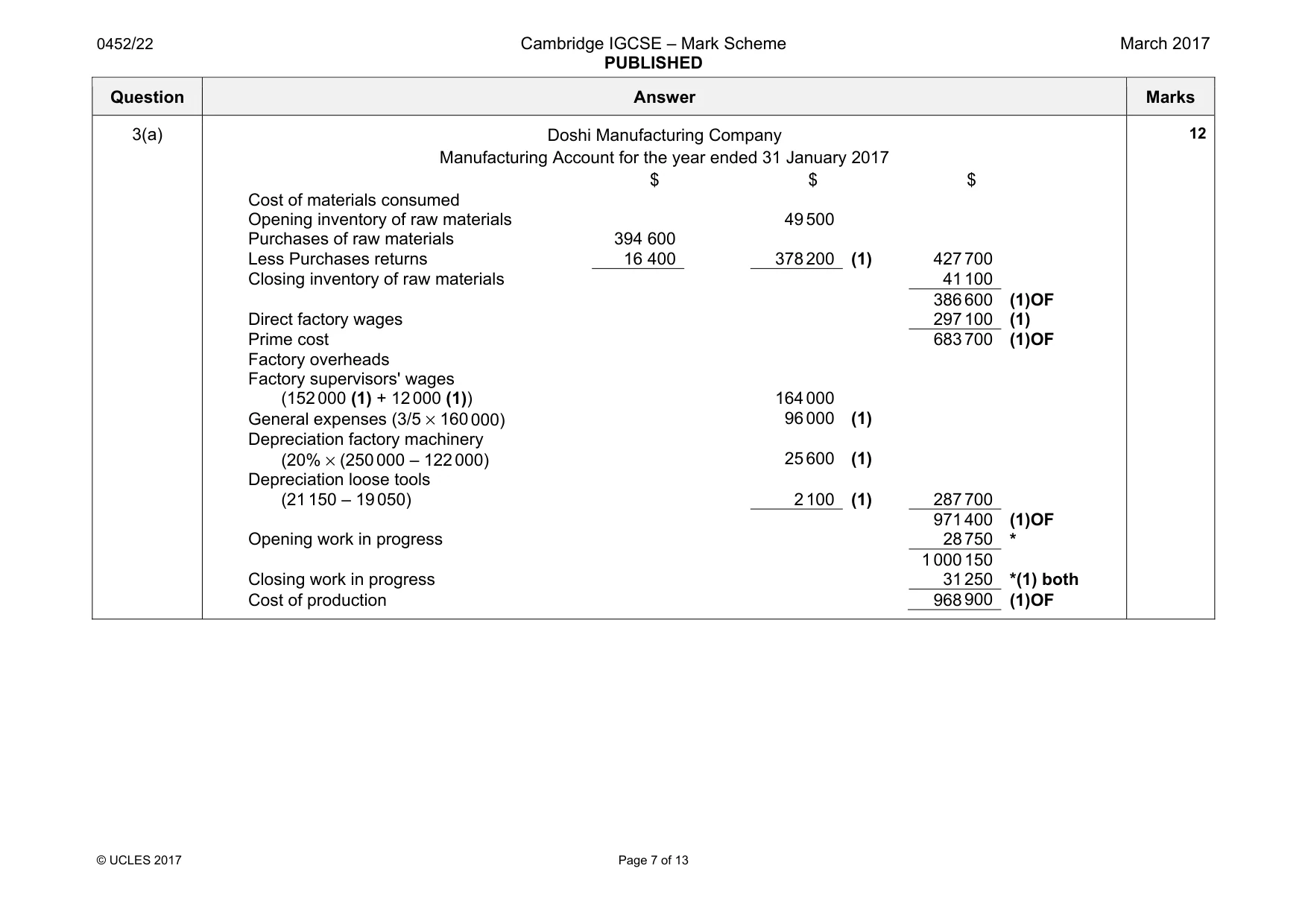
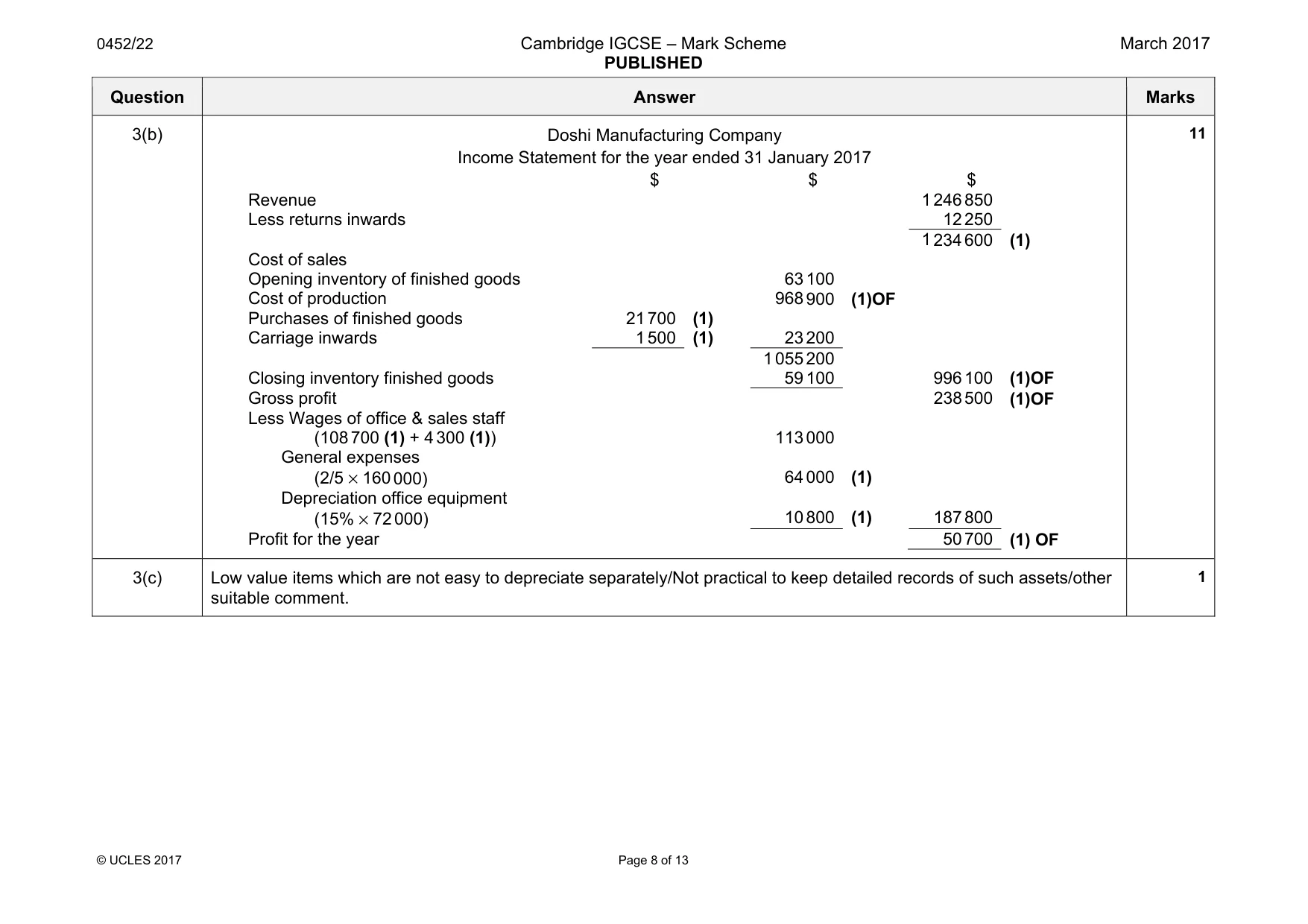
Mark scheme: 3(a) Doshi Manufacturing Company Manufacturing Account for the year ended 31 January 2017 $ $ $ Cost of materials consumed Opening inventory of raw materials 49 500 Purchases of raw materials 394 600 Less Purchases returns 16 400 378 200 (1) 427 700 Closing inventory of raw materials 41 100 386 600 (1)OF Direct factory wages 297 100 (1) Prime cost 683 700 (1)OF Factory overheads Factory supervisors' wages (152 000 (1) + 12 000 (1)) 164 000 General expenses (3/5 × 160 000) 96 000 (1) Depreciation factory machinery (20% × (250 000 – 122 000) 25 600 (1) Depreciation loose tools (21 150 – 19 050) 2 100 (1) 287 700 971 400 (1)OF Opening work in progress 28 750 * 1 000 150 Closing work in progress 31 250 *(1) both Cost of production 968 900 (1)OF Question Answer Marks 3(b) Doshi Manufacturing Company Income Statement for the year ended 31 January 2017 $ $ $ Revenue 1 246 850 Less returns inwards 12 250 1 234 600 (1) Cost of sales Opening inventory of finished goods 63 100 Cost of production 968 900 (1)OF Purchases of finished goods 21 700 (1) Carriage inwards 1 500 (1) 23 200 1 055 200 Closing inventory finished goods 59 100 996 100 (1)OF Gross profit 238 500 (1)OF Less Wages of office & sales staff (108 700 (1) + 4 300 (1)) 113 000 General expenses (2/5 × 160 000) 64 000 (1) Depreciation office equipment (15% × 72 000) 10 800 (1) 187 800 Profit for the year 50 700 (1) OF 11 3(c) Low value items which are not easy to depreciate separately/Not practical to keep detailed records of such assets/other suitable comment. 1
Q4 · Lahiru is a trader
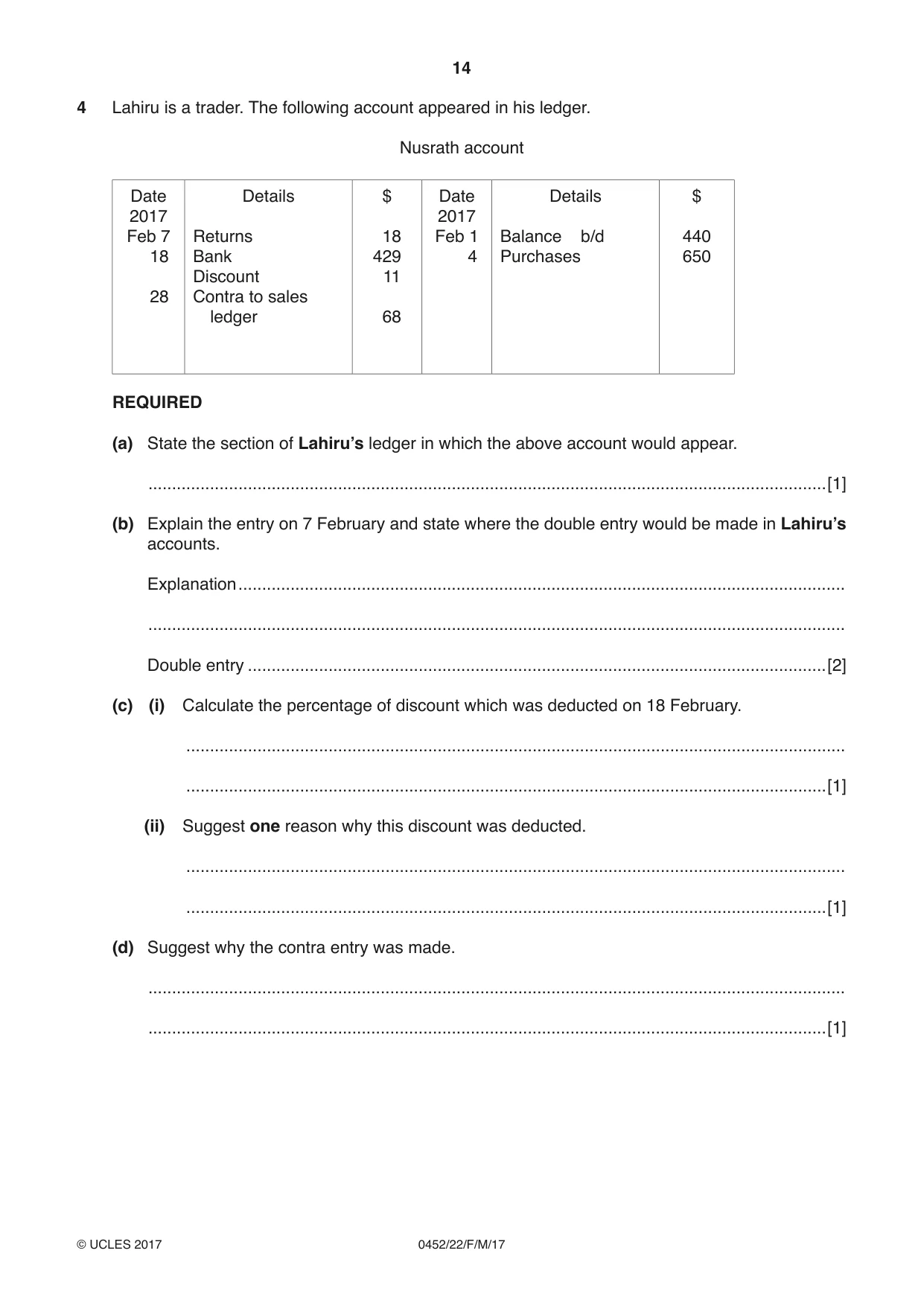
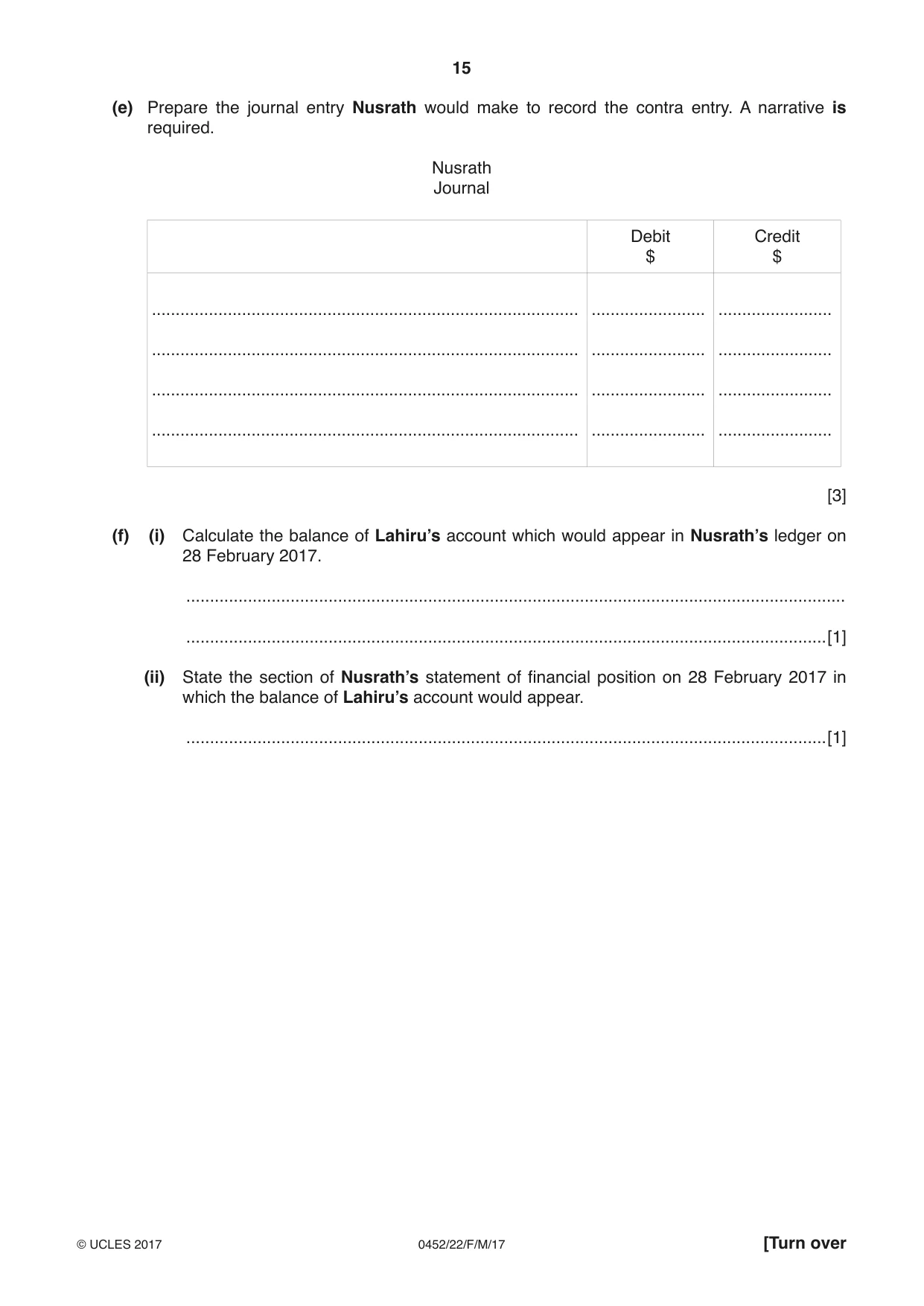
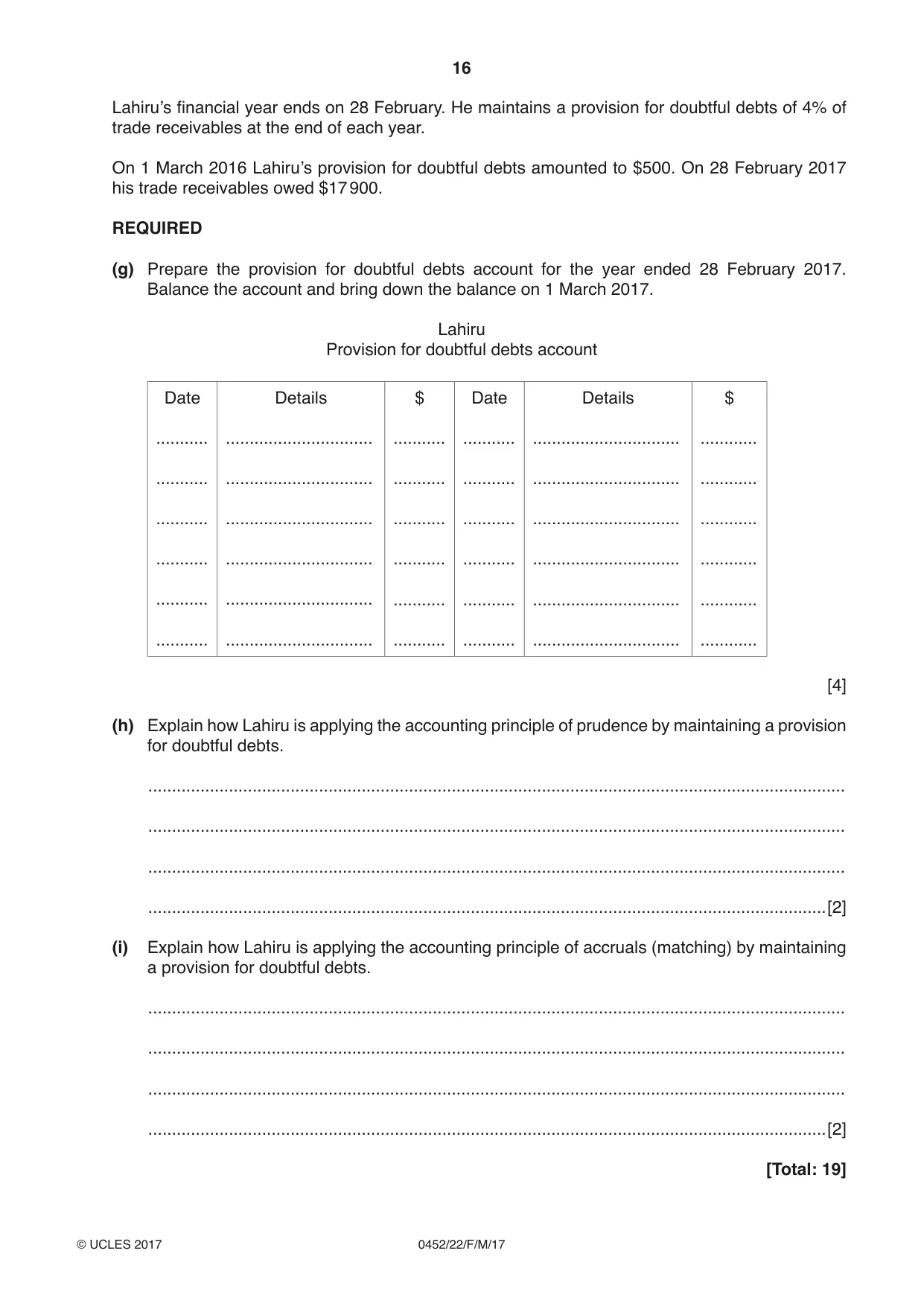
4 Lahiru is a trader. The following account appeared in his ledger. Nusrath account Date Details $ Date Details $ 2017 2017 Feb 7 Returns 18 Feb 1 Balance b/d 440 18 Bank 429 4 Purchases 650 Discount 11 28 Contra to sales ledger 68 REQUIRED (a) State the section of Lahiru’s ledger in which the above account would appear. ...............................................................................................................................................[1] (b) Explain the entry on 7 February and state where the double entry would be made in Lahiru’s accounts. Explanation ................................................................................................................................ ................................................................................................................................................... Double entry ..........................................................................................................................[2] (c) (i) Calculate the percentage of discount which was deducted on 18 February. ........................................................................................................................................... .......................................................................................................................................[1] (ii) Suggest one reason why this discount was deducted. ........................................................................................................................................... .......................................................................................................................................[1] (d) Suggest why the contra entry was made. ................................................................................................................................................... ...............................................................................................................................................[1] (e) Prepare the journal entry Nusrath would make to record the contra entry. A narrative is required. Nusrath Journal Debit Credit $ $ .......................................................................................... ........................ ........................ .......................................................................................... ........................ ........................ .......................................................................................... ........................ ........................ .......................................................................................... ........................ ........................ [3] (f) (i) Calculate the balance of Lahiru’s account which would appear in Nusrath’s ledger on 28 February 2017. ........................................................................................................................................... .......................................................................................................................................[1] (ii) State the section of Nusrath’s statement of financial position on 28 February 2017 in which the balance of Lahiru’s account would appear. .......................................................................................................................................[1] Lahiru’s financial year ends on 28 February. He maintains a provision for doubtful debts of 4% of trade receivables at the end of each year. On 1 March 2016 Lahiru’s provision for doubtful debts amounted to $500. On 28 February 2017 his trade receivables owed $17 900. REQUIRED (g) Prepare the provision for doubtful debts account for the year ended 28 February 2017. Balance the account and bring down the balance on 1 March 2017. Lahiru Provision for doubtful debts account Date Details $ Date Details $ ........... ............................... ........... ........... ............................... ............ ........... ............................... ........... ........... ............................... ............ ........... ............................... ........... ........... ............................... ............ ........... ............................... ........... ........... ............................... ............ ........... ............................... ........... ........... ............................... ............ ........... ............................... ........... ........... ............................... ............ [4] (h) Explain how Lahiru is applying the accounting principle of prudence by maintaining a provision for doubtful debts. ................................................................................................................................................... ................................................................................................................................................... ................................................................................................................................................... ...............................................................................................................................................[2] (i) Explain how Lahiru is applying the accounting principle of accruals (matching) by maintaining a provision for doubtful debts. ................................................................................................................................................... ................................................................................................................................................... ................................................................................................................................................... ...............................................................................................................................................[2] [Total: 19]
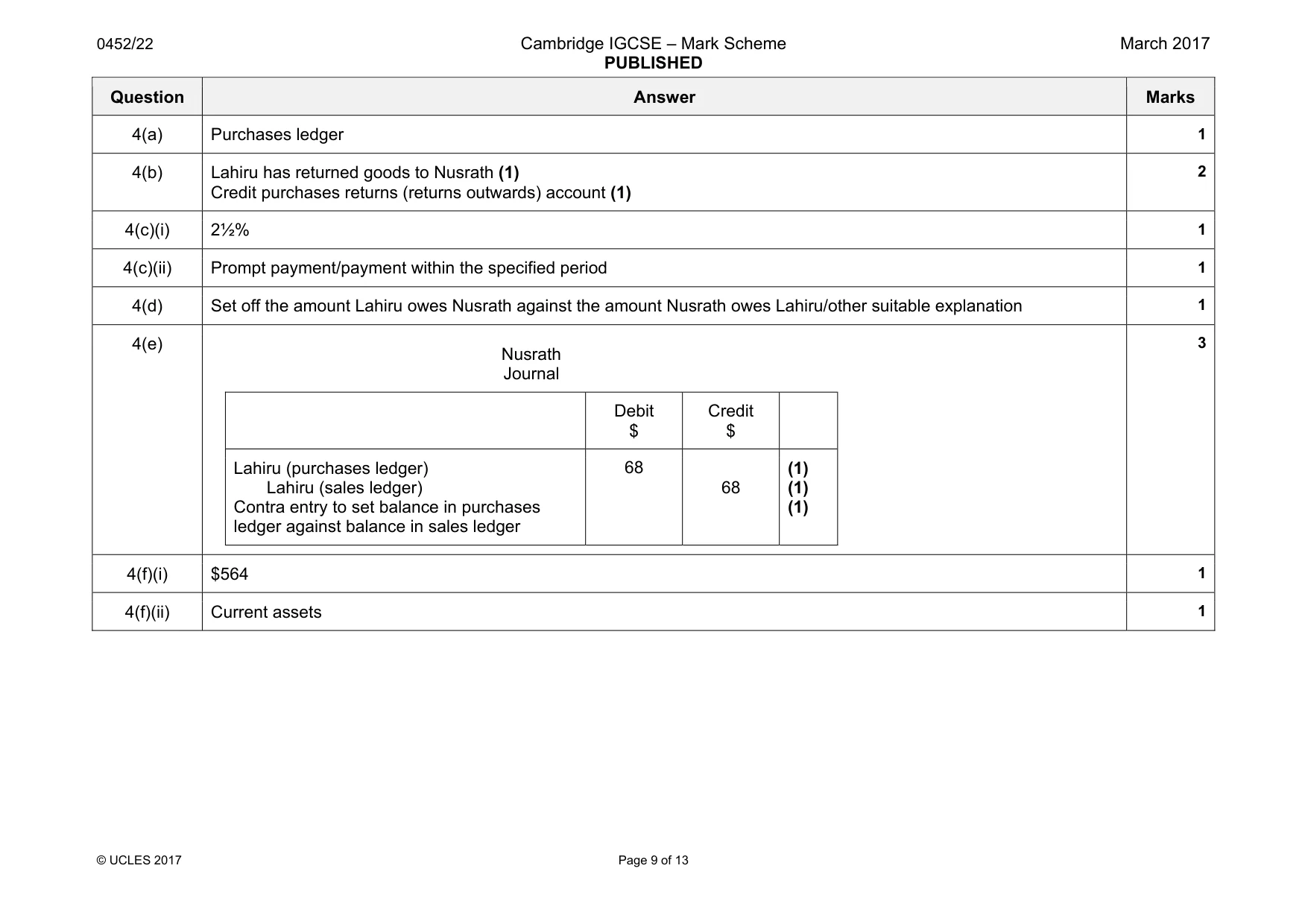
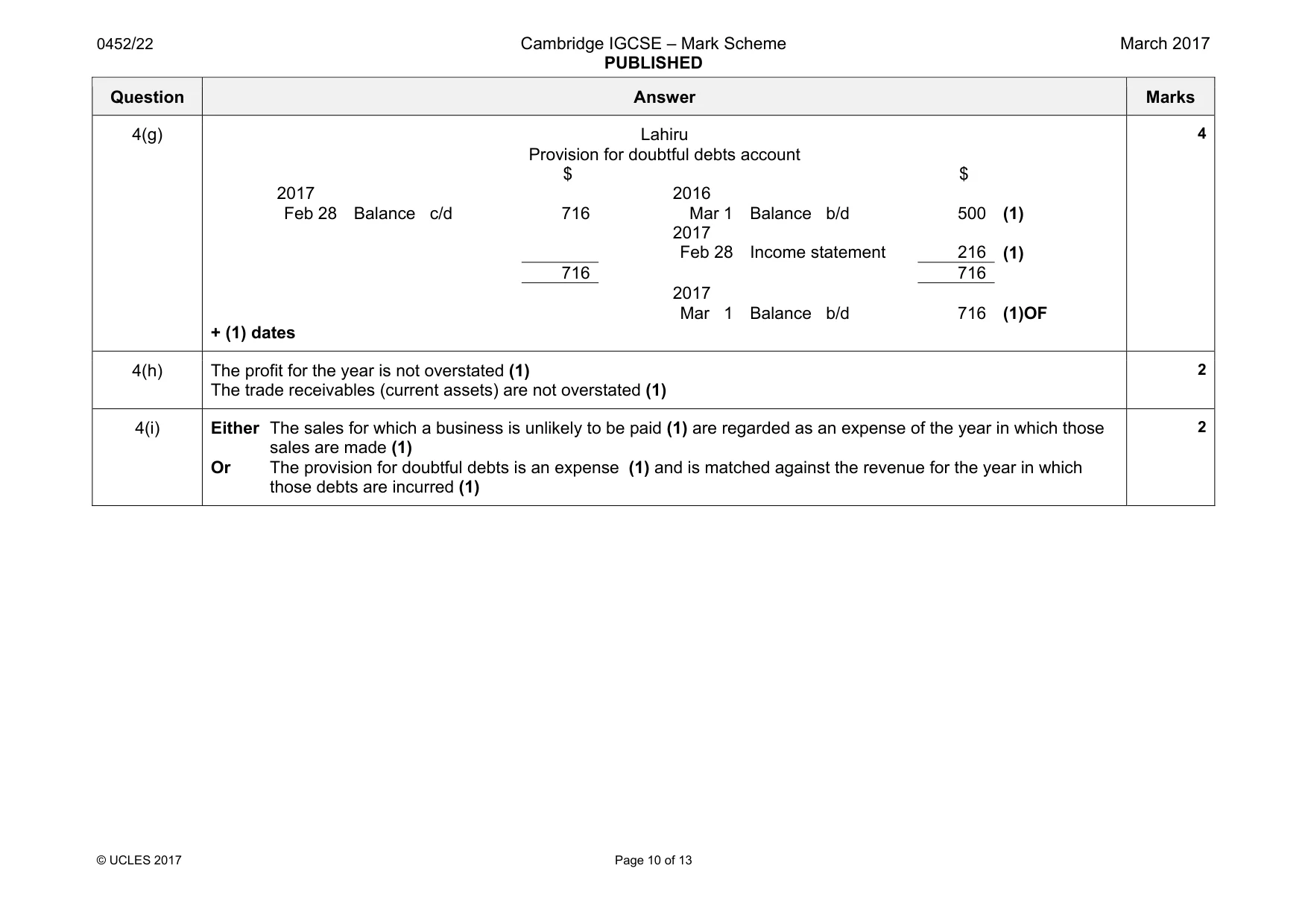
Mark scheme: 4(a) Purchases ledger 4(b) Lahiru has returned goods to Nusrath (1) Credit purchases returns (returns outwards) account (1) 2 4(c)(i) 2½% 1 4(c)(ii) Prompt payment/payment within the specified period 1 4(d) Set off the amount Lahiru owes Nusrath against the amount Nusrath owes Lahiru/other suitable explanation 1 4(e) Nusrath Journal Debit $ Credit $ Lahiru (purchases ledger) Lahiru (sales ledger) Contra entry to set balance in purchases ledger against balance in sales ledger 68 68 (1) (1) (1) 3 4(f)(i) $564 1 4(f)(ii) Current assets 1 Question Answer Marks 4(g) Lahiru Provision for doubtful debts account $ $ 2017 2016 Feb 28 Balance c/d 716 Mar 1 Balance b/d 500 (1) 2017 Feb 28 Income statement 216 (1) 716 716 2017 Mar 1 Balance b/d 716 (1)OF + (1) dates 4 4(h) The profit for the year is not overstated (1) The trade receivables (current assets) are not overstated (1) 2 4(i) Either The sales for which a business is unlikely to be paid (1) are regarded as an expense of the year in which those sales are made (1) Or The provision for doubtful debts is an expense (1) and is matched against the revenue for the year in which those debts are incurred (1) 2
Q5 · No entry has been made in the accounting records for a motor vehicle, $16 000, introduced…
5 No entry has been made in the accounting records for a motor vehicle, $16 000, introduced into the business by Mandeep on 30 December 2016.
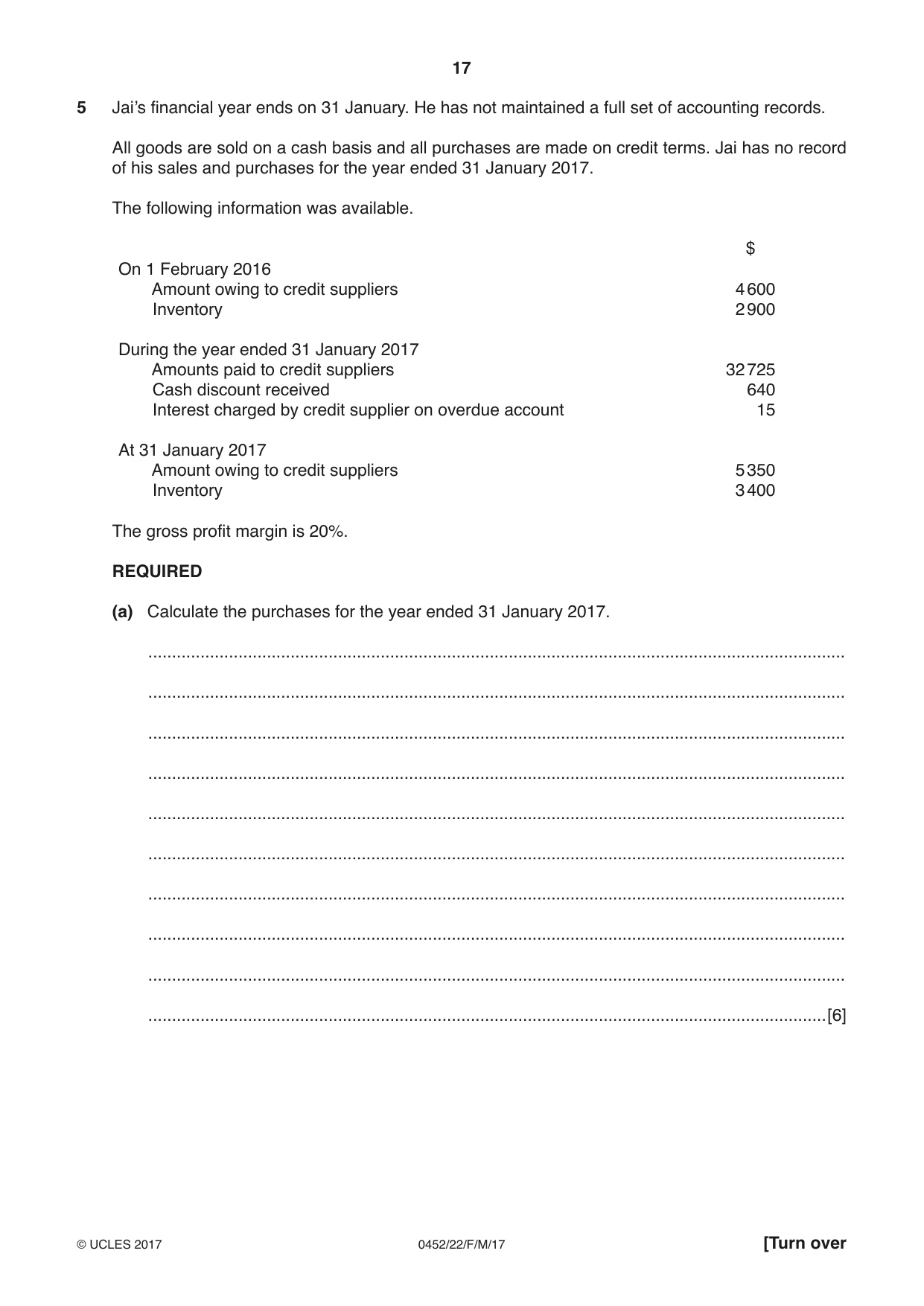
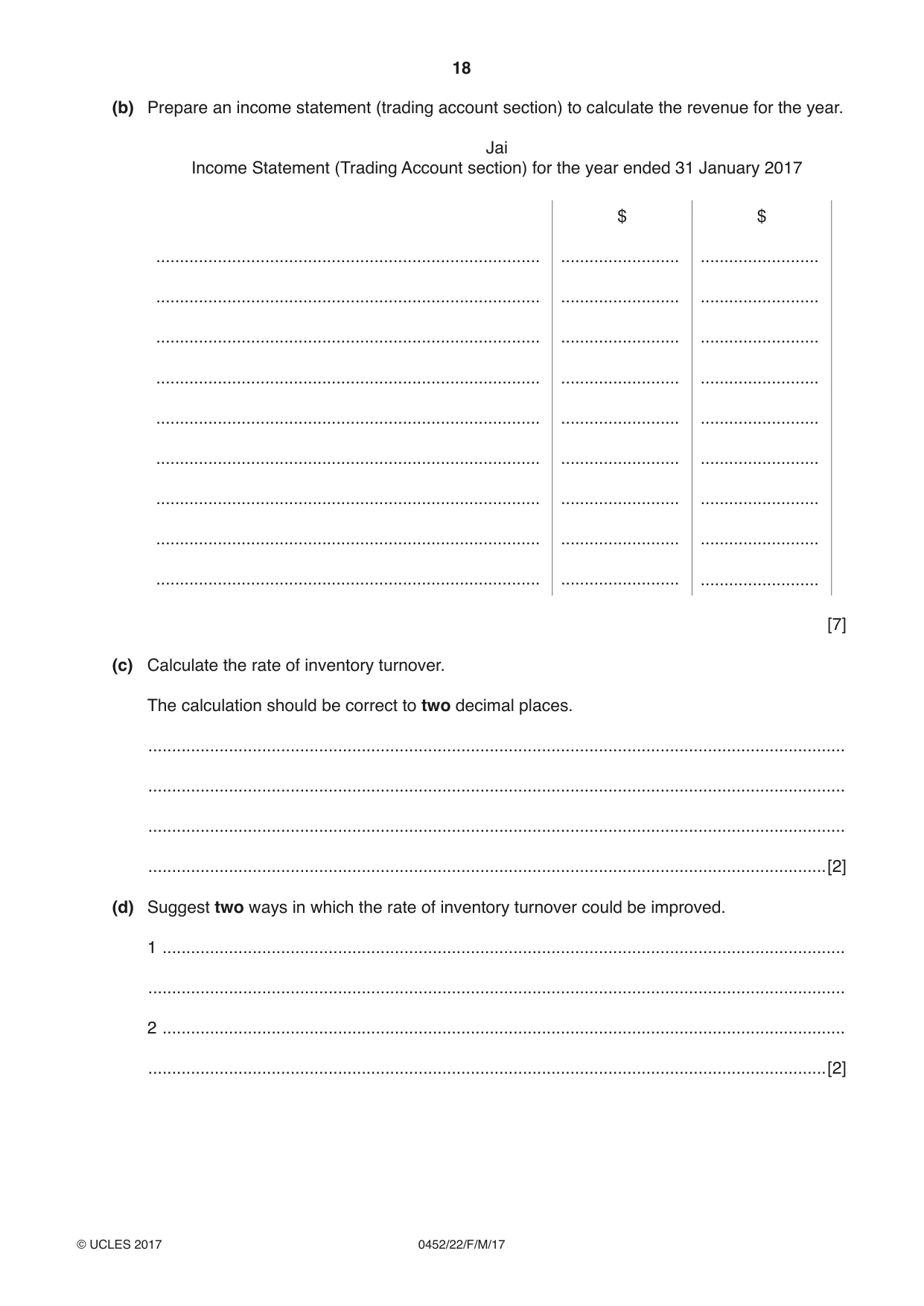
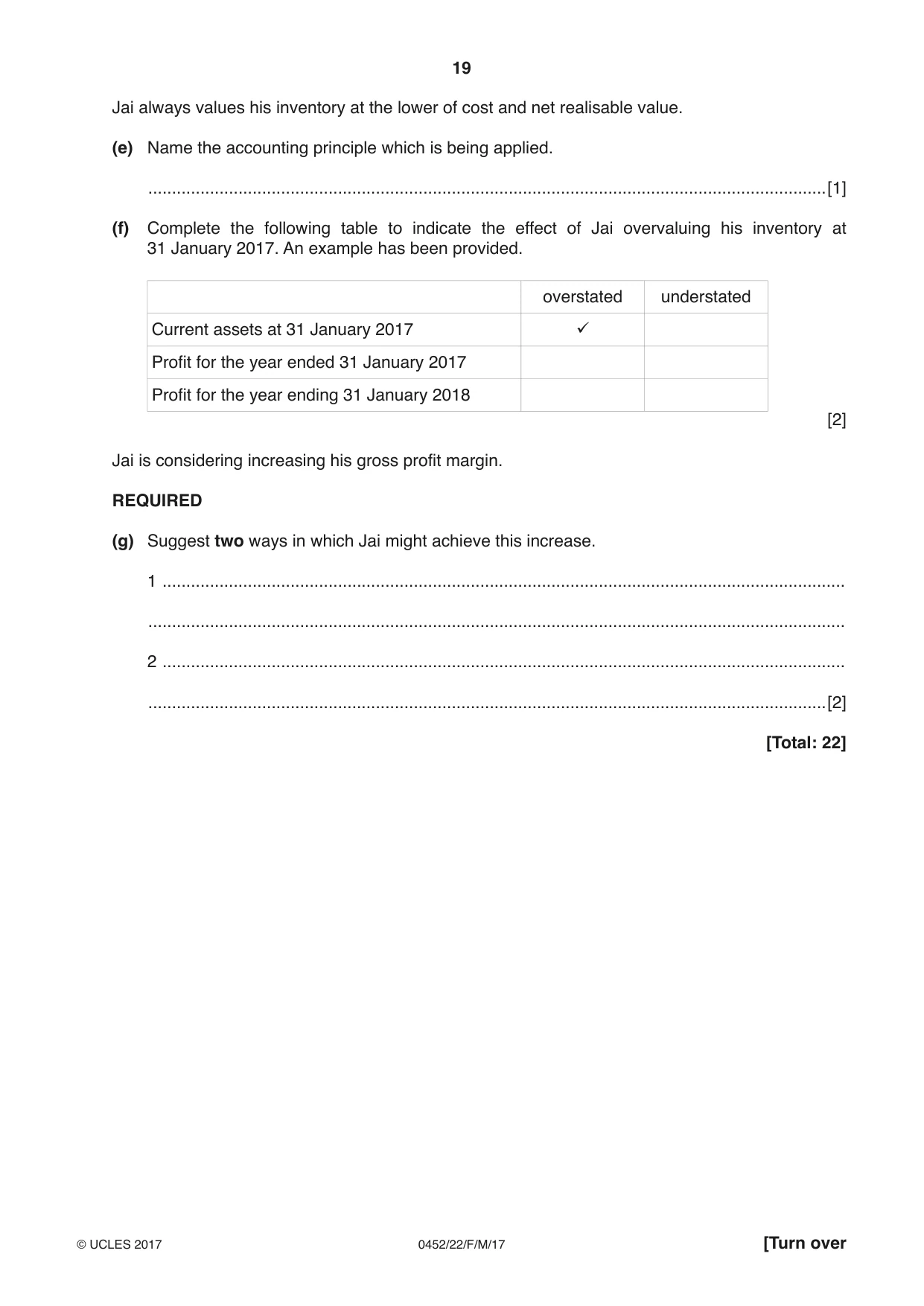
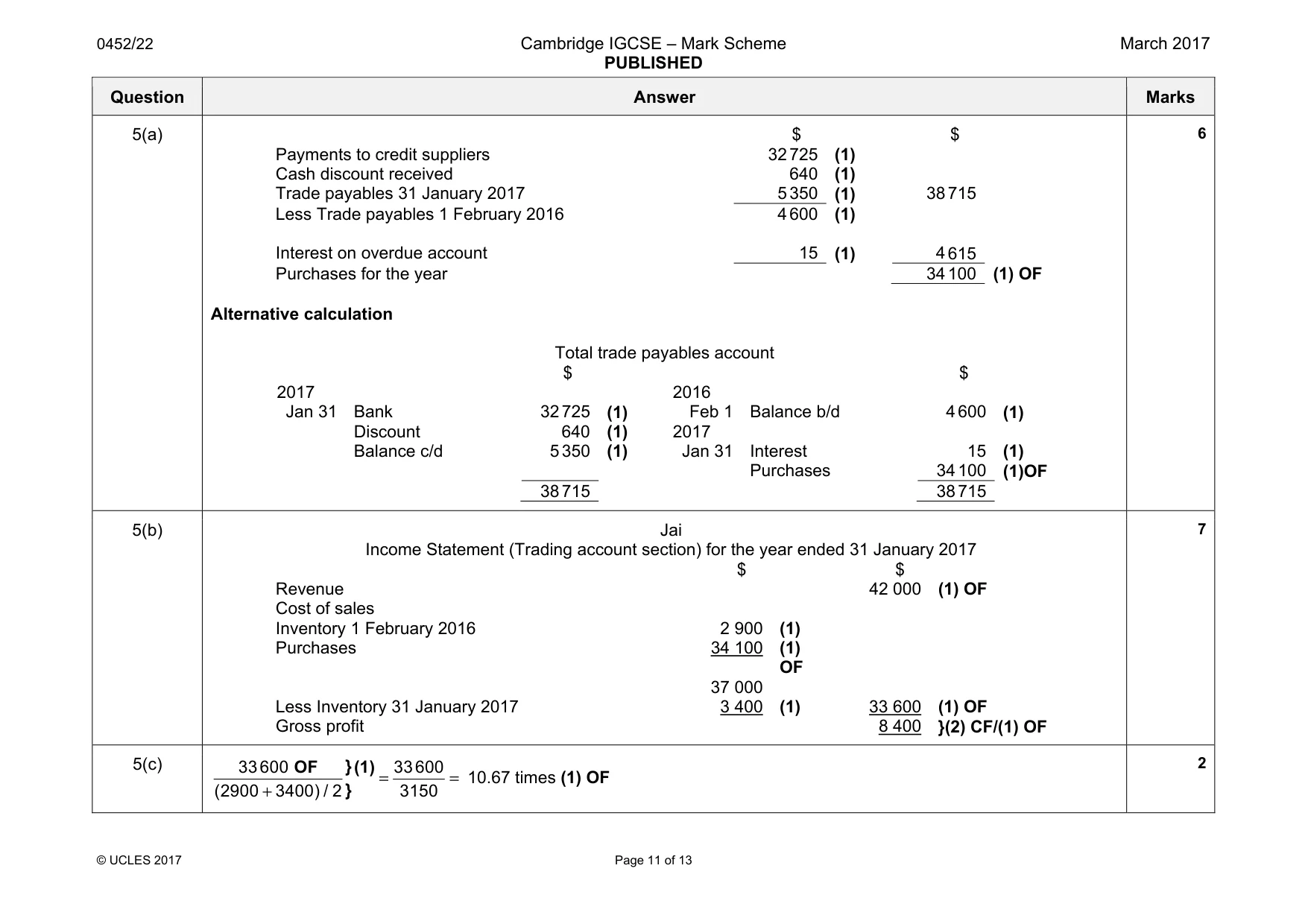
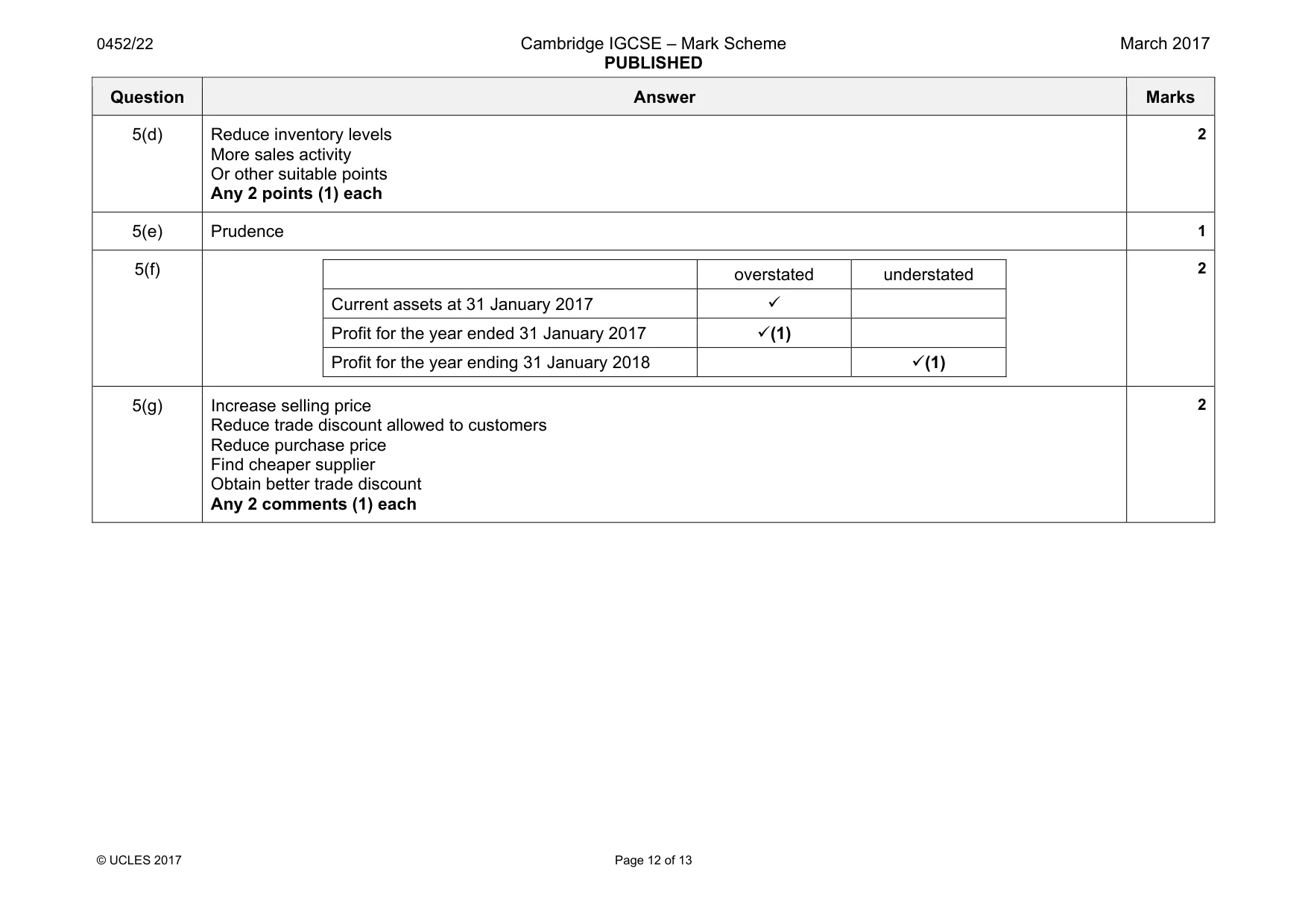
Mark scheme: 5(a) $ $ Payments to credit suppliers 32 725 (1) Cash discount received 640 (1) Trade payables 31 January 2017 5 350 (1) 38 715 Less Trade payables 1 February 2016 4 600 (1) Interest on overdue account 15 (1) 4 615 Purchases for the year 34 100 (1) OF Alternative calculation Total trade payables account $ $ 2017 2016 Jan 31 Bank 32 725 (1) Feb 1 Balance b/d 4 600 (1) Discount 640 (1) 2017 Balance c/d 5 350 (1) Jan 31 Interest 15 (1) Purchases 34 100 (1)OF 38 715 38 715 5(b) Jai Income Statement (Trading account section) for the year ended 31 January 2017 $ $ Revenue 42 000 (1) OF Cost of sales Inventory 1 February 2016 2 900 (1) Purchases 34 100 (1) OF 37 000 Less Inventory 31 January 2017 3 400 (1) 33 600 (1) OF Gross profit 8 400 }(2) CF/(1) OF 7 5(c) 33600 33600 (2900 3400) / 2 3150 = = + }(1) OF } 10.67 times (1) OF 2 Question Answer Marks 5(d) Reduce inventory levels More sales activity Or other suitable points Any 2 points (1) each 2 5(e) Prudence 1 5(f) overstated understated Current assets at 31 January 2017 9 Profit for the year ended 31 January 2017 9(1) Profit for the year ending 31 January 2018 9(1) 2 5(g) Increase selling price Reduce trade discount allowed to customers Reduce purchase price Find cheaper supplier Obtain better trade discount Any 2 comments (1) each 2
Q6 · The draft profit for the year ended 31 December 2016 was $21 600
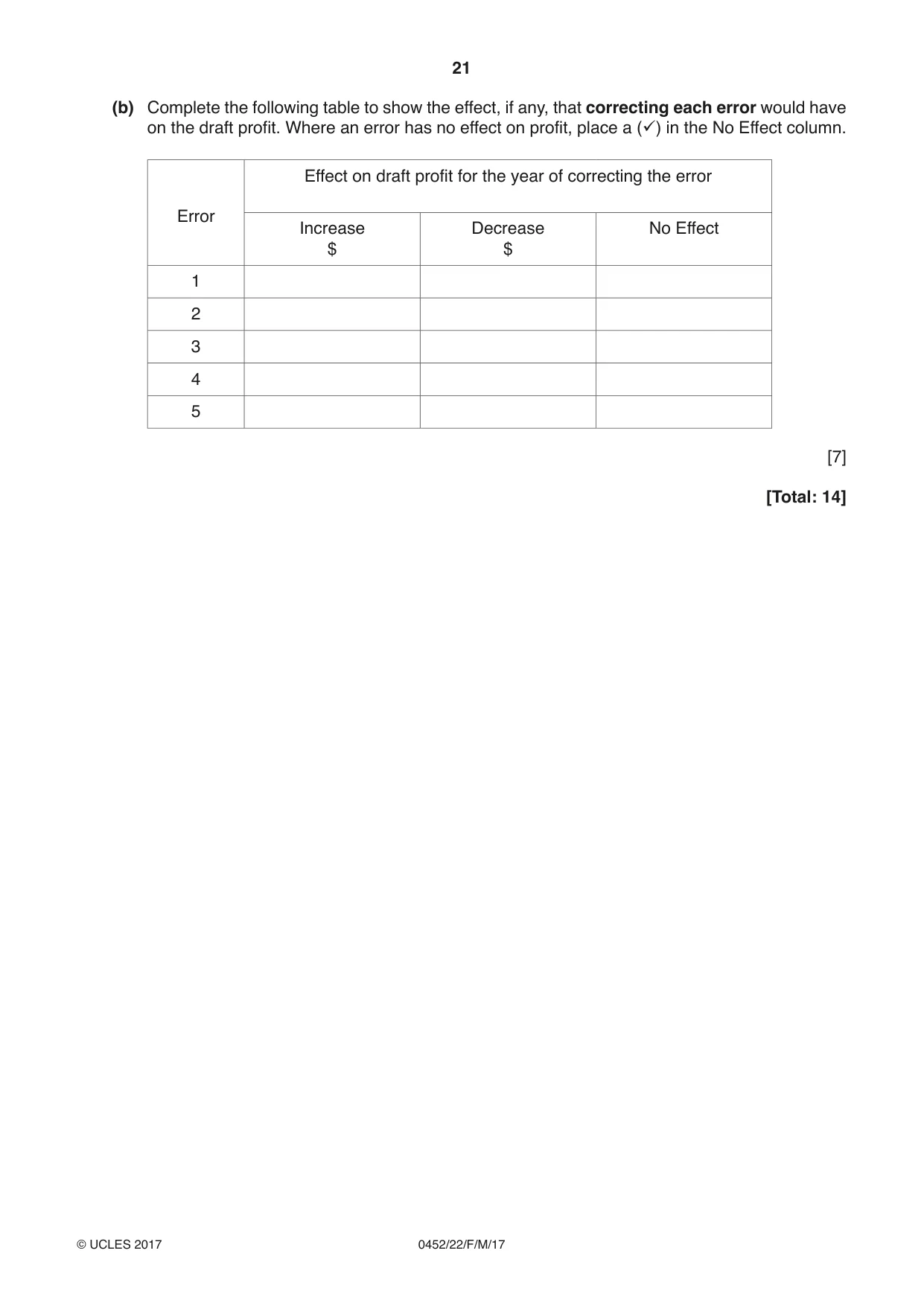
6 The draft profit for the year ended 31 December 2016 was $21 600. REQUIRED (b) Complete the following accounts in Mandeep’s ledger at 31 December 2016. Close the accounts by balancing or by making a transfer to an appropriate account. Mandeep Inventory account Date Details $ Date Details $ 2016 Jan 1 Balance b/d 12 650 ............ ............................... ............ ............ ............................... ............ ............ ............................... ............ ............ ............................... ............ ............ ............................... ............ ............ ............................... ............ ............ ............................... ............ ............ ............................... ............ ............ ............................... ............ ............ ............................... ............ ............ ............................... ............ Provision for depreciation of office fixtures account Date Details $ Date Details $ 2016 ............. ............................... ............. Jan 1 Balance b/d 3420 ............. ............................... ............. ............. ............................... ............ ............. ............................... ............. ............. ............................... ............ ............. ............................... ............. ............. ............................... ............ General expenses account Date Details $ Date Details $ 2016 Dec 31 Total payments 9475 ............. ............................... ............ ............ ............................... ............. ............. ............................... ............ ............ ............................... ............. ............. ............................... ............ ............ ............................... ............. ............. ............................... ............ Rent receivable account Date Details $ Date Details $ 2016 ............ ............................... ............. Dec 31 Total receipts 5060 ............ ............................... ............. ............. ............................... ............ ............ ............................... ............. ............. ............................... ............ ............ ............................... ............. ............. ............................... ............ Drawings account Date Details $ Date Details $ 2016 Dec 31 Total drawings 8950 ............. ............................... ............ ............. ............................... ............. ............. ............................... ............ ............. ............................... ............. ............. ............................... ............ Capital account Date Details $ Date Details $ 2016 ............. ............................... ............. Jan 1 Balance b/d 63 000 ............. ............................... ............. ............. ............................... ............ ............. ............................... ............. ............. ............................... ............ ............. ............................... ............. ............. ............................... ............ ............. ............................... ............. ............. ............................... ............ ............. ............................... ............. ............. ............................... ............ [14] [Total: 24]
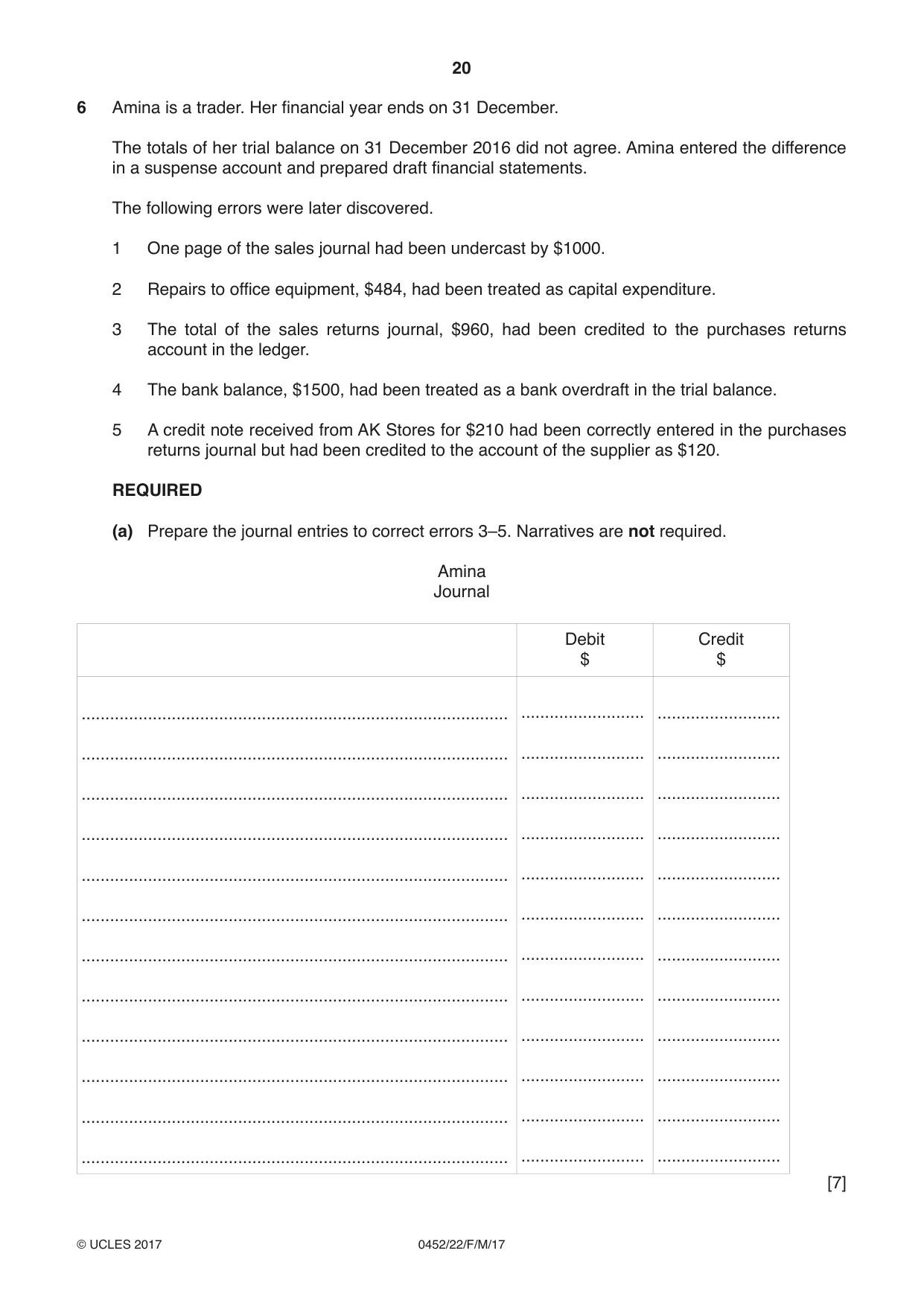
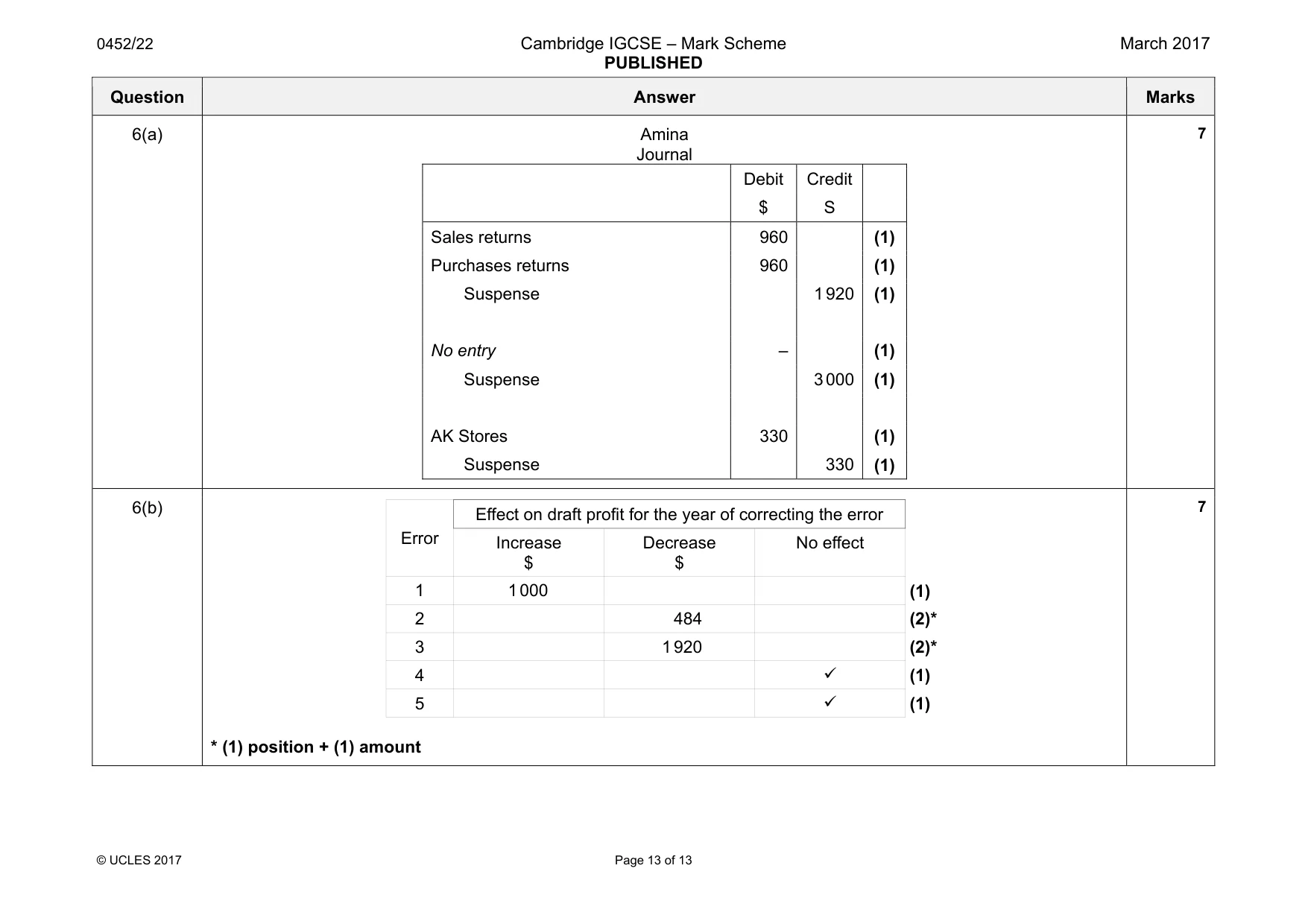
Mark scheme: 6(a) Amina Journal Debit Credit $ S Sales returns 960 (1) Purchases returns 960 (1) Suspense 1 920 (1) No entry – (1) Suspense 3 000 (1) AK Stores 330 (1) Suspense 330 (1) 6(b) Error Effect on draft profit for the year of correcting the error Increase $ Decrease $ No effect 1 1 000 (1) 2 484 (2)* 3 1 920 (2)* 4 9 (1) 5 9 (1) * (1) position + (1) amount 7
What was in this paper
The subtopics covered by these 6 questions, and how many questions each got. Open one in a new tab to see every Cambridge question on it.
What you needed in this session
Cambridge’s own grade thresholds for 2017 Feb/March, Paper 2 · Variant 2. A higher threshold means an easier paper — the bar moves with how the cohort did.