Cambridge IGCSE Accounting 0452 — 2016 May/June Paper 2 · Variant 2
0452/22/M/J/16 · 120 marks · ≈135 min
The question paper and its mark scheme, free to read here and free to download. This is Cambridge’s own paper, exactly as it was sat.
Question paper20 pages

Mark scheme11 pages
Answers below. Sit the paper first if you are practising.
Paper as text
Question paper, page 1
This document consists of 19 printed pages and 1 blank page. DC (ST) 113743/3 © UCLES 2016 [Turn over Cambridge International Examinations Cambridge International General Certificate of Secondary Education * 1 0 0 8 7 8 5 5 5 1 * ACCOUNTING 0452/22 Paper 2 May/June 2016 1 hour 45 minutes Candidates answer on the Question Paper. No Additional Materials are required. READ THESE INSTRUCTIONS FIRST Write your Centre number, candidate number and name on all the work you hand in. Write in dark blue or black pen. You may use an HB pencil for any diagrams or graphs. Do not use staples, paper clips, glue or correction fluid. DO NOT WRITE IN ANY BARCODES. Answer all questions. You may use a calculator. Where layouts are to be completed, you may not need all the lines for your answer. The businesses mentioned in this Question Paper are fictitious. At the end of the examination, fasten all your work securely together. The number of marks is given in brackets [ ] at the end of each question or part question.
Question paper, page 2
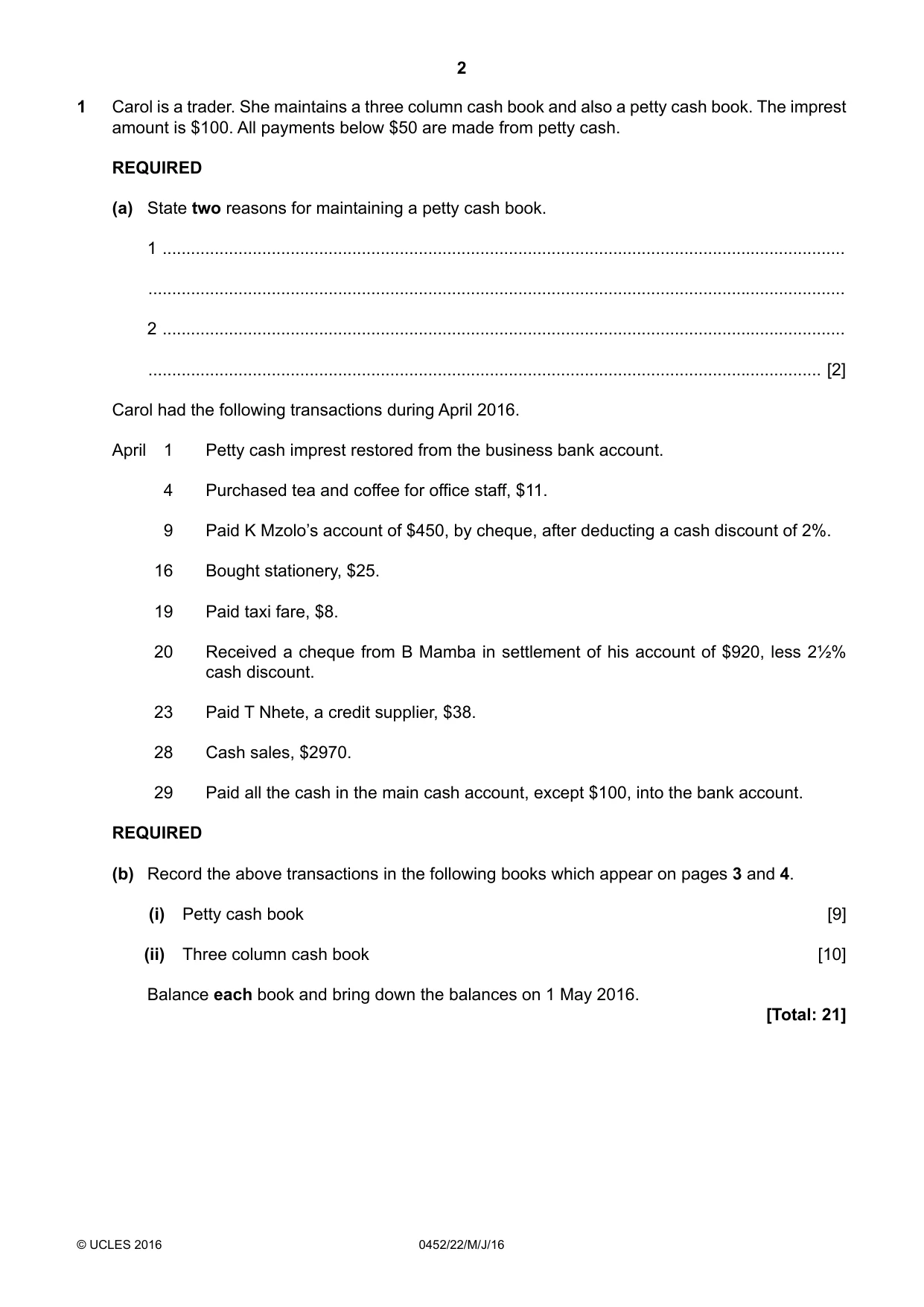
2 0452/22/M/J/16 © UCLES 2016 1 Carol is a trader. She maintains a three column cash book and also a petty cash book. The imprest amount is $100. All payments below $50 are made from petty cash. REQUIRED (a) State two reasons for maintaining a petty cash book. 1 … … 2 … … [2] Carol had the following transactions during April 2016. April 1 Petty cash imprest restored from the business bank account. 4 Purchased tea and coffee for office staff, $11. 9 Paid K Mzolo’s account of $450, by cheque, after deducting a cash discount of 2%. 16 Bought stationery, $25. 19 Paid taxi fare, $8. 20 Received a cheque from B Mamba in settlement of his account of $920, less 2½% cash discount. 23 Paid T Nhete, a credit supplier, $38. 28 Cash sales, $2970. 29 Paid all the cash in the main cash account, except $100, into the bank account. REQUIRED (b) Record the above transactions in the following books which appear on pages 3 and 4. (i) Petty cash book [9] (ii) Three column cash book [10] Balance each book and bring down the balances on 1 May 2016. [Total: 21]
Question paper, page 3
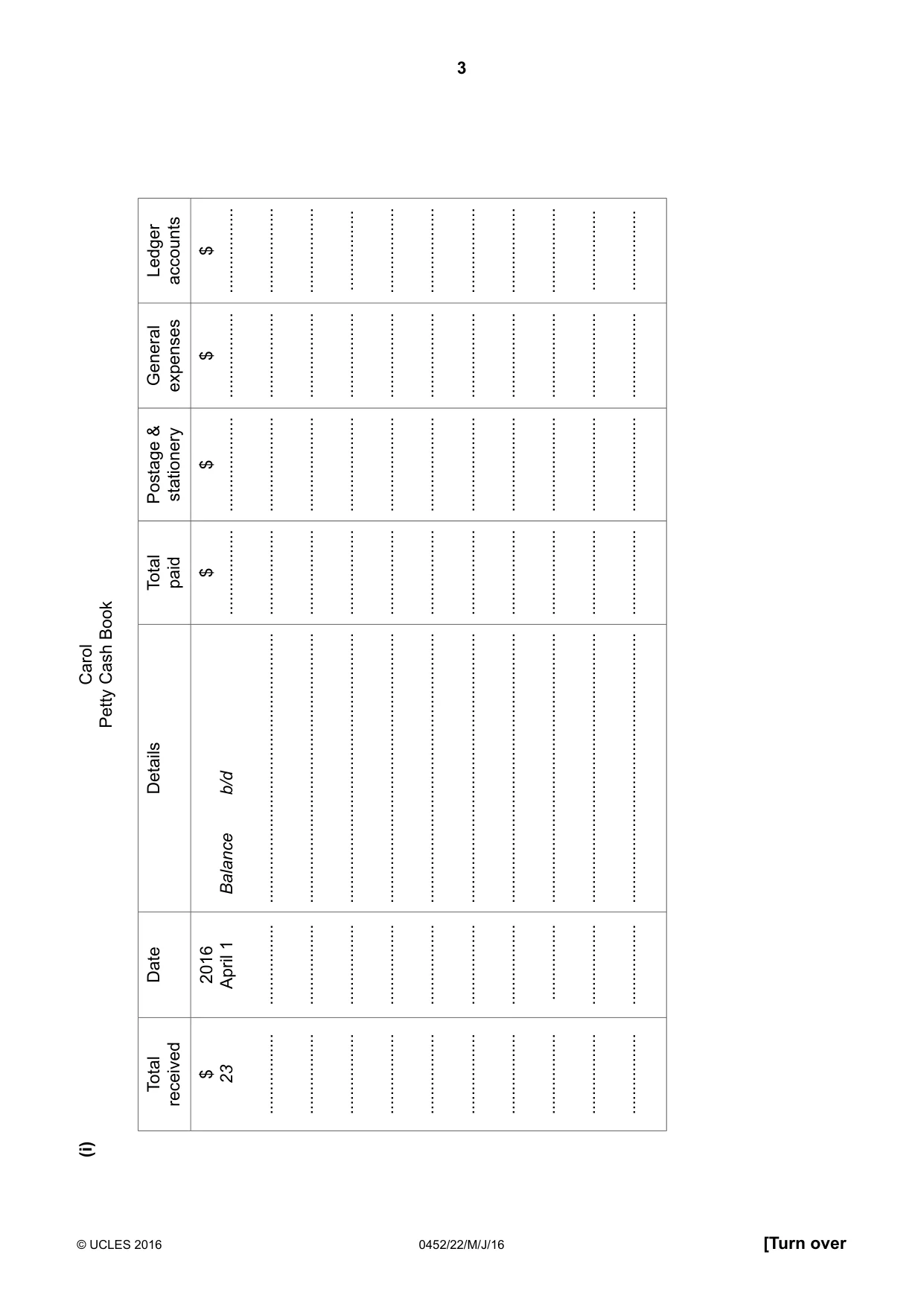
3 0452/22/M/J/16 © UCLES 2016 [Turn over (i) Carol Petty Cash Book Total received Date Details Total paid Postage & stationery General expenses Ledger accounts $ 23 … … … … … … … … … … 2016 April 1 … … … … … … … … … … Balance b/d … … … … … … … … … … $ … … … … … … … … … … … $ … … … … … … … … … … … $ … … … … … … … … … … … $ … … … … … … … … … … …
Question paper, page 4
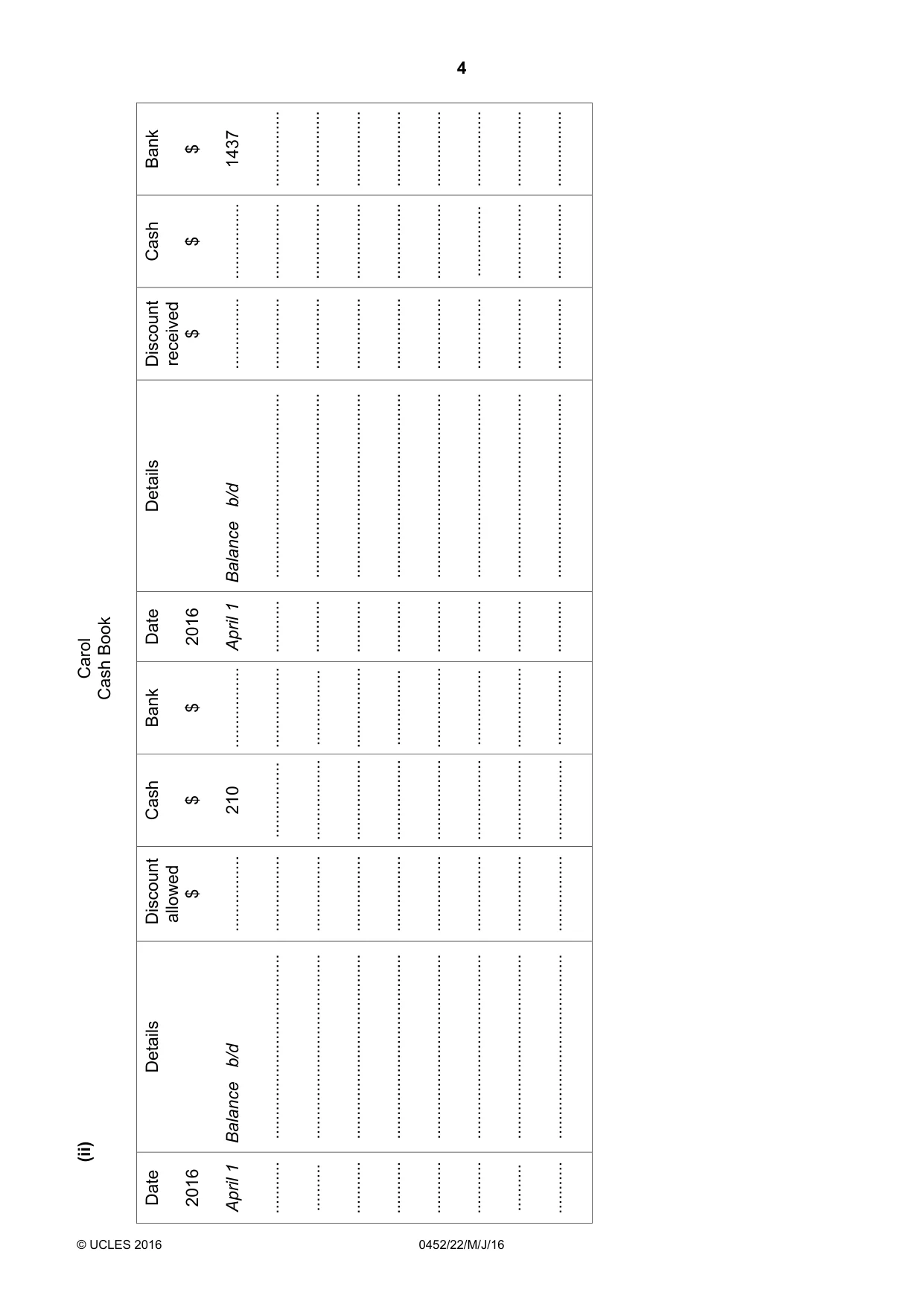
4 0452/22/M/J/16 © UCLES 2016 (ii) Carol Cash Book Date 2016 April 1 … … … … … … … … Details Balance b/d … … … … … … … … Discount allowed $ … … … … … … … … … Cash $ 210 … … … … … … … … Bank $ … … … … … … … … … Date 2016 April 1 … … … … … … … … Details Balance b/d … … … … … … … … Discount received $ … … … … … … … … … Cash $ … … … … … … … … … Bank $ 1437 … … … … … … … …
Question paper, page 5
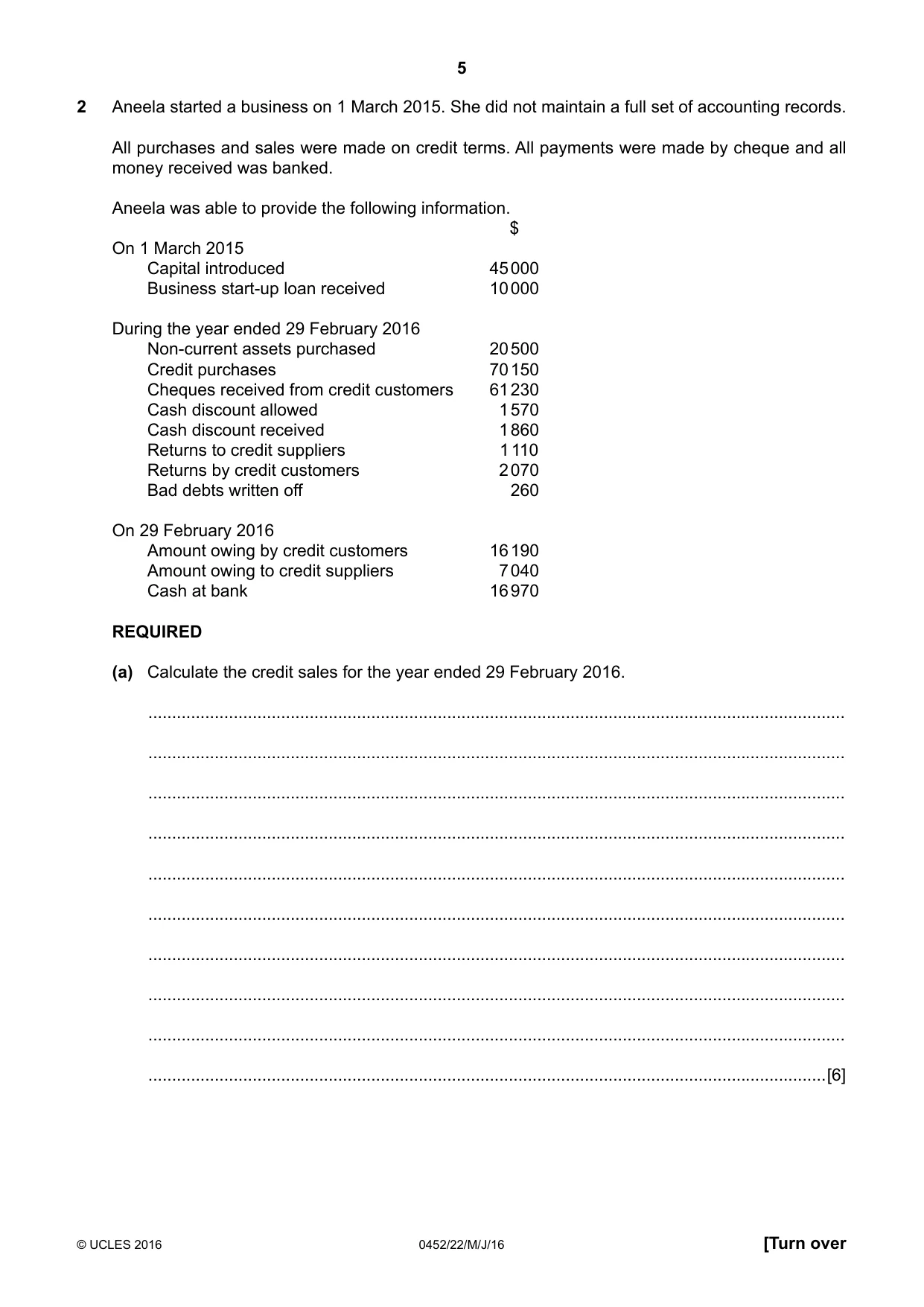
5 0452/22/M/J/16 © UCLES 2016 [Turn over 2 Aneela started a business on 1 March 2015. She did not maintain a full set of accounting records. All purchases and sales were made on credit terms. All payments were made by cheque and all money received was banked. Aneela was able to provide the following information. $ On 1 March 2015 Capital introduced 45 000 Business start-up loan received 10 000 During the year ended 29 February 2016 Non-current assets purchased 20 500 Credit purchases 70 150 Cheques received from credit customers 61 230 Cash discount allowed 1 570 Cash discount received 1 860 Returns to credit suppliers 1 110 Returns by credit customers 2 070 Bad debts written off 260 On 29 February 2016 Amount owing by credit customers 16 190 Amount owing to credit suppliers 7 040 Cash at bank 16 970 REQUIRED (a) Calculate the credit sales for the year ended 29 February 2016. … … … … … … … … … …[6]
Question paper, page 6
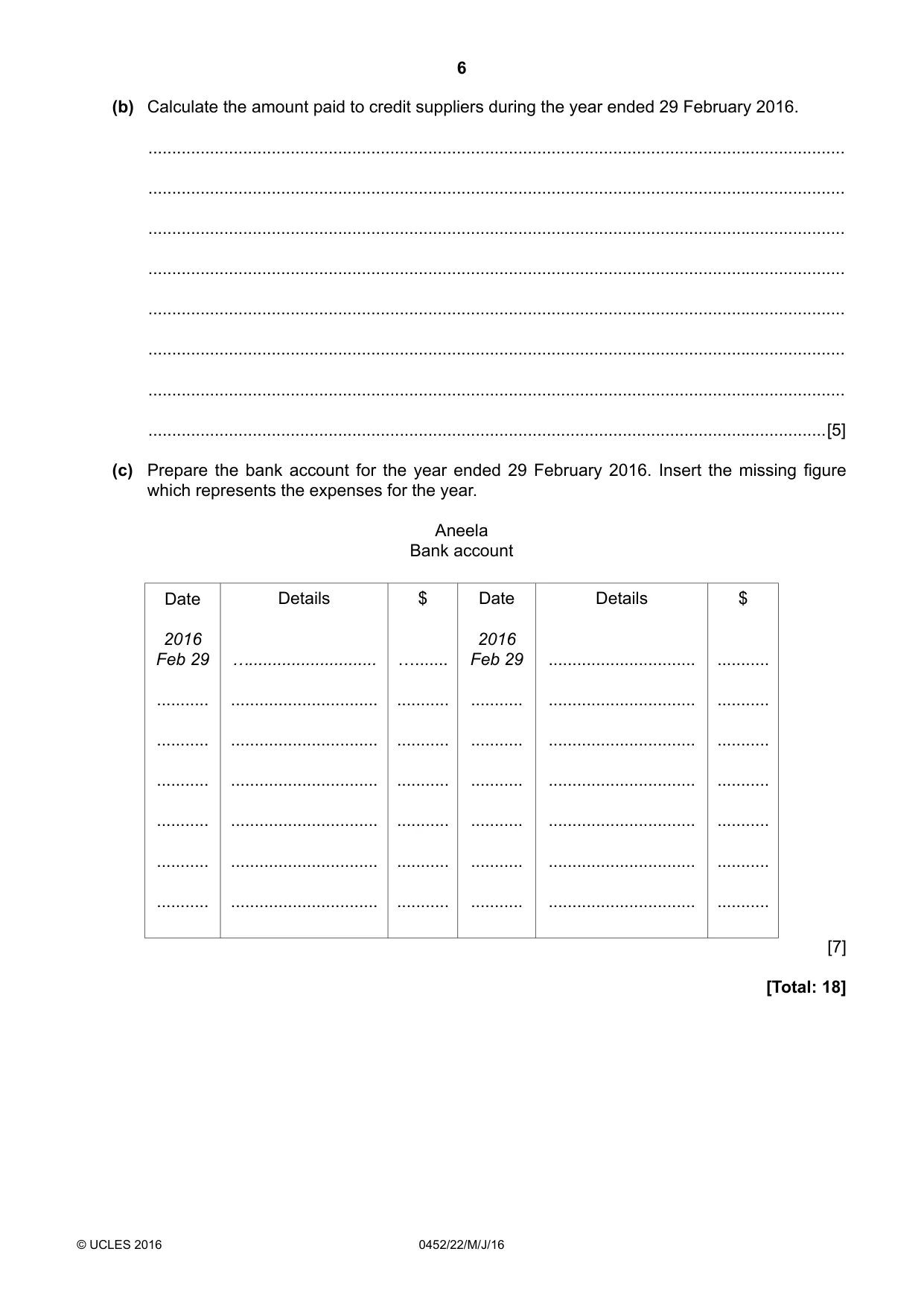
6 0452/22/M/J/16 © UCLES 2016 (b) Calculate the amount paid to credit suppliers during the year ended 29 February 2016. … … … … … … … …[5] (c) Prepare the bank account for the year ended 29 February 2016. Insert the missing figure which represents the expenses for the year. Aneela Bank account Date 2016 Feb 29 … … … … … … Details …… … … … … … … $ …… … … … … … … Date 2016 Feb 29 … … … … … … Details … … … … … … … $ … … … … … … … [7] [Total: 18]
Question paper, page 7
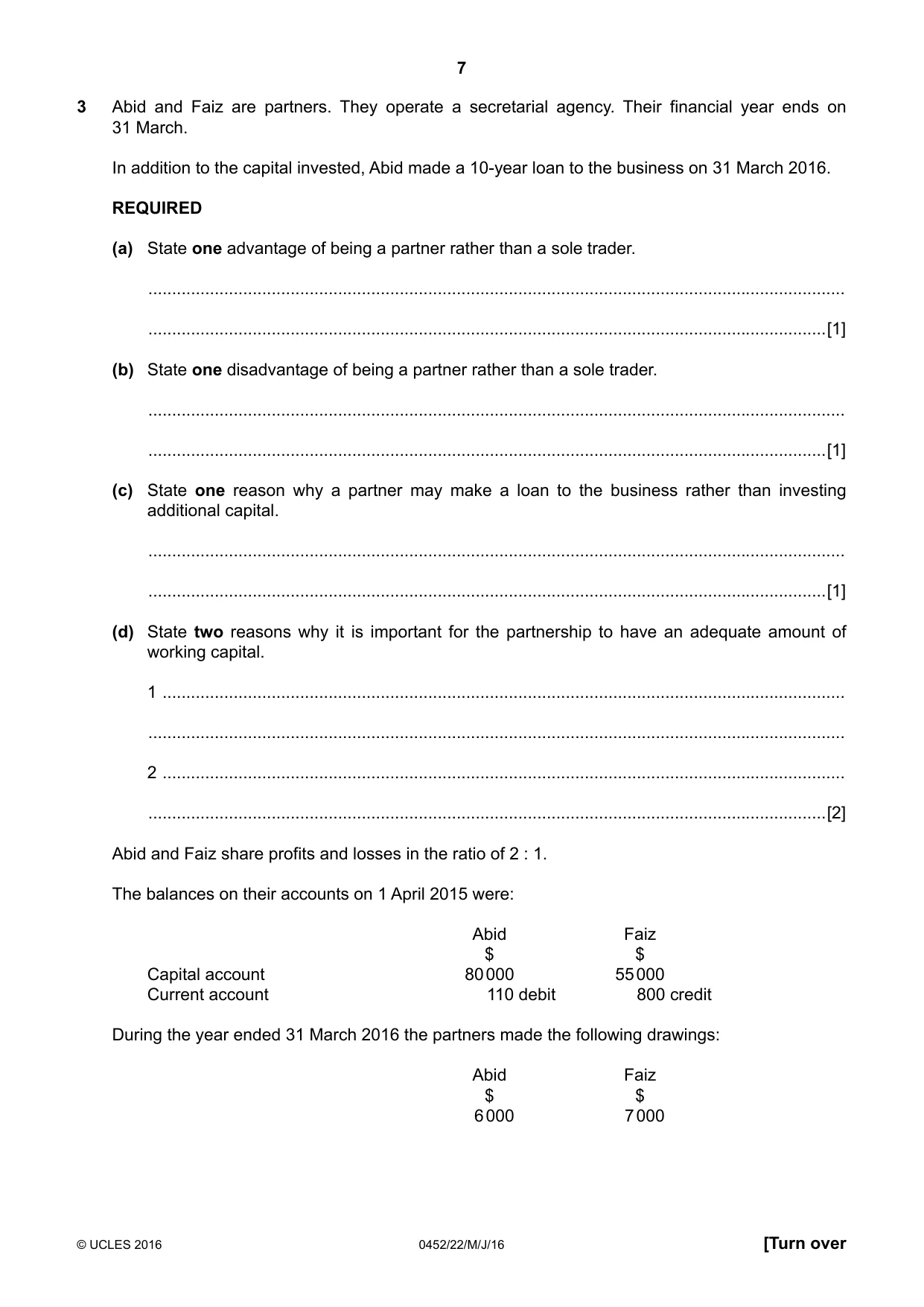
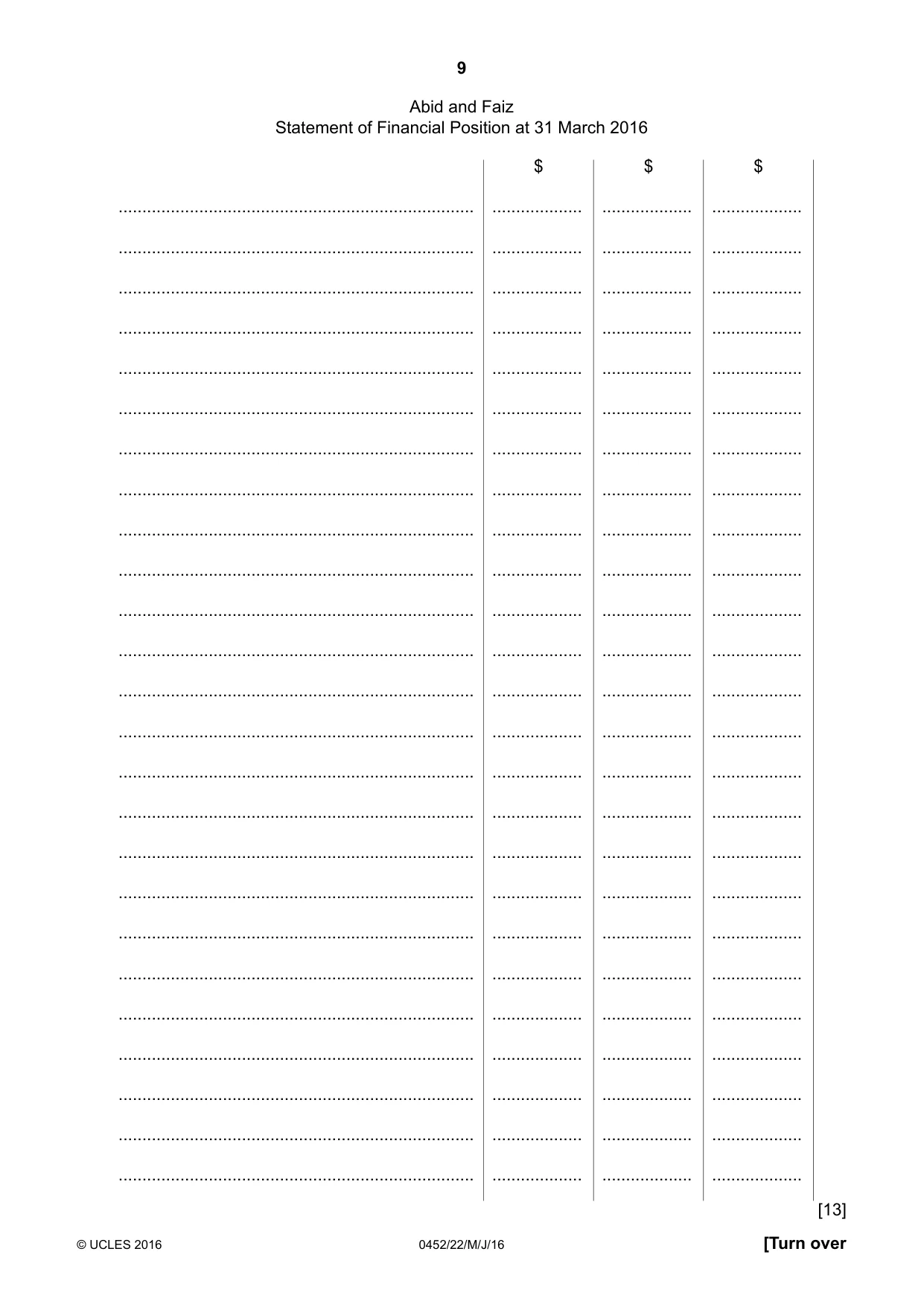
7 0452/22/M/J/16 © UCLES 2016 [Turn over 3 Abid and Faiz are partners. They operate a secretarial agency. Their financial year ends on 31 March. In addition to the capital invested, Abid made a 10-year loan to the business on 31 March 2016. REQUIRED (a) State one advantage of being a partner rather than a sole trader. … …[1] (b) State one disadvantage of being a partner rather than a sole trader. … …[1] (c) State one reason why a partner may make a loan to the business rather than investing additional capital. … …[1] (d) State two reasons why it is important for the partnership to have an adequate amount of working capital. 1 … … 2 … …[2] Abid and Faiz share profits and losses in the ratio of 2 : 1. The balances on their accounts on 1 April 2015 were: Abid Faiz $ $ Capital account 80 000 55 000 Current account 110 debit 800 credit During the year ended 31 March 2016 the partners made the following drawings: Abid Faiz $ $ 6 000 7 000
Question paper, page 8
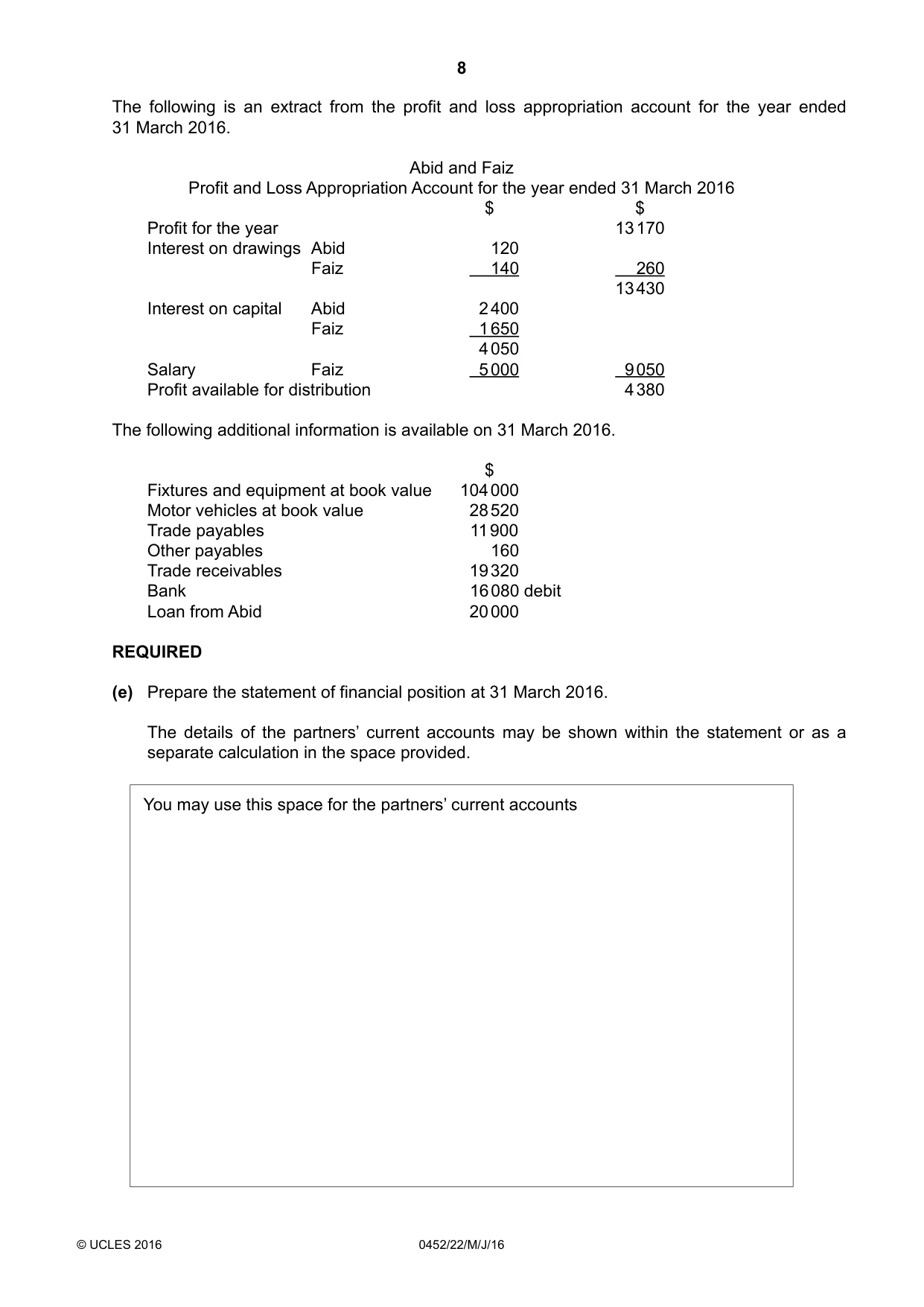
8 0452/22/M/J/16 © UCLES 2016 The following is an extract from the profit and loss appropriation account for the year ended 31 March 2016. Abid and Faiz Profit and Loss Appropriation Account for the year ended 31 March 2016 $ $ Profit for the year 13 170 Interest on drawings Abid 120 Faiz 140 260 13 430 Interest on capital Abid 2 400 Faiz 1 650 4 050 Salary Faiz 5 000 9 050 Profit available for distribution 4 380 The following additional information is available on 31 March 2016. $ Fixtures and equipment at book value 104 000 Motor vehicles at book value 28 520 Trade payables 11 900 Other payables 160 Trade receivables 19 320 Bank 16 080 debit Loan from Abid 20 000 REQUIRED (e) Prepare the statement of financial position at 31 March 2016. The details of the partners’ current accounts may be shown within the statement or as a separate calculation in the space provided. You may use this space for the partners’ current accounts
Question paper, page 9
9 0452/22/M/J/16 © UCLES 2016 [Turn over Abid and Faiz Statement of Financial Position at 31 March 2016 … … … … … … … … … … … … … … … … … … … … … … … … … $ … … … … … … … … … … … … … … … … … … … … … … … … … $ … … … … … … … … … … … … … … … … … … … … … … … … … $ … … … … … … … … … … … … … … … … … … … … … … … … … [13]
Question paper, page 10
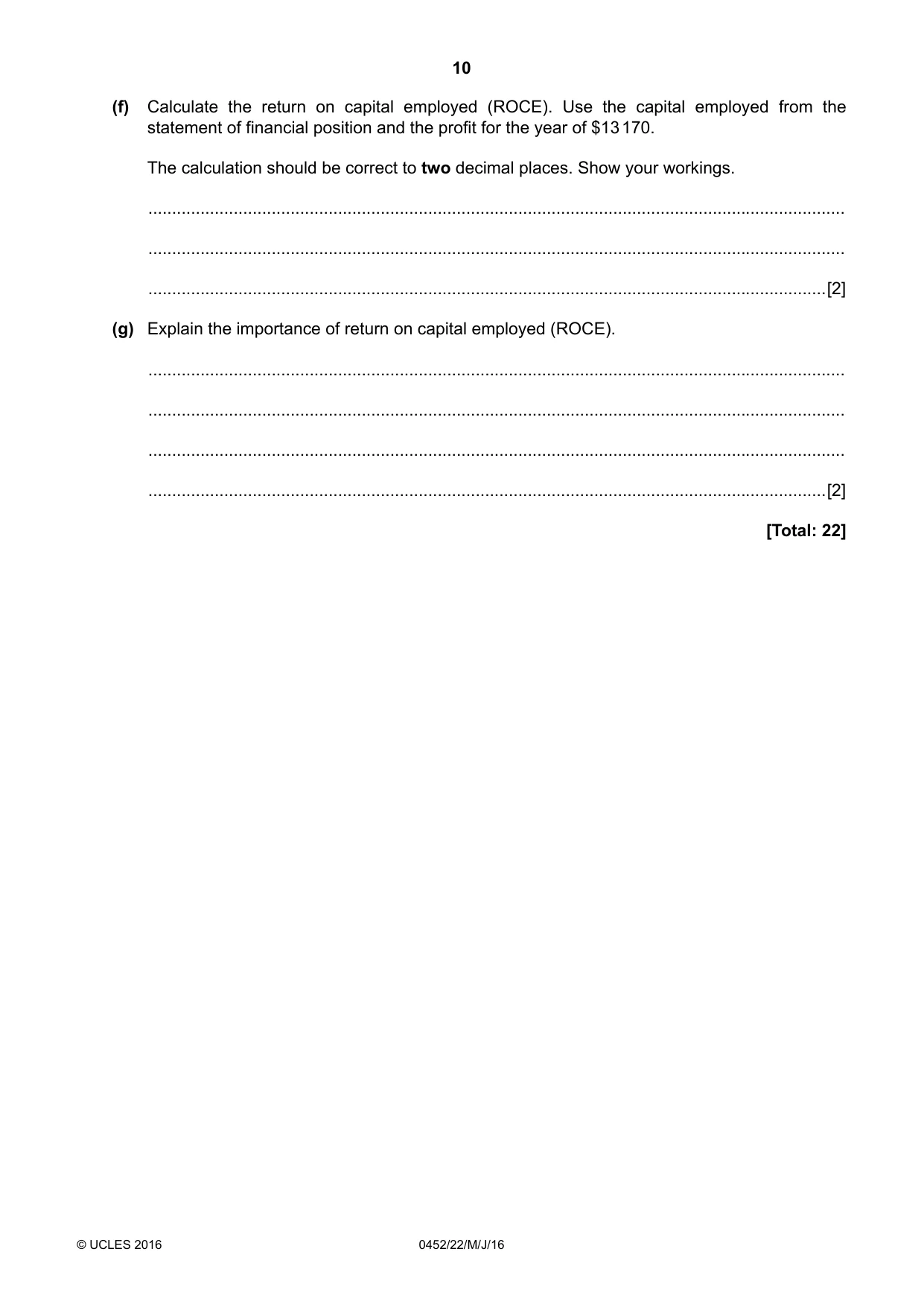
10 0452/22/M/J/16 © UCLES 2016 (f) Calculate the return on capital employed (ROCE). Use the capital employed from the statement of financial position and the profit for the year of $13 170. The calculation should be correct to two decimal places. Show your workings. … … …[2] (g) Explain the importance of return on capital employed (ROCE). … … … …[2] [Total: 22]
Question paper, page 11
11 0452/22/M/J/16 © UCLES 2016 [Turn over Question 4 is on the next page.
Question paper, page 12
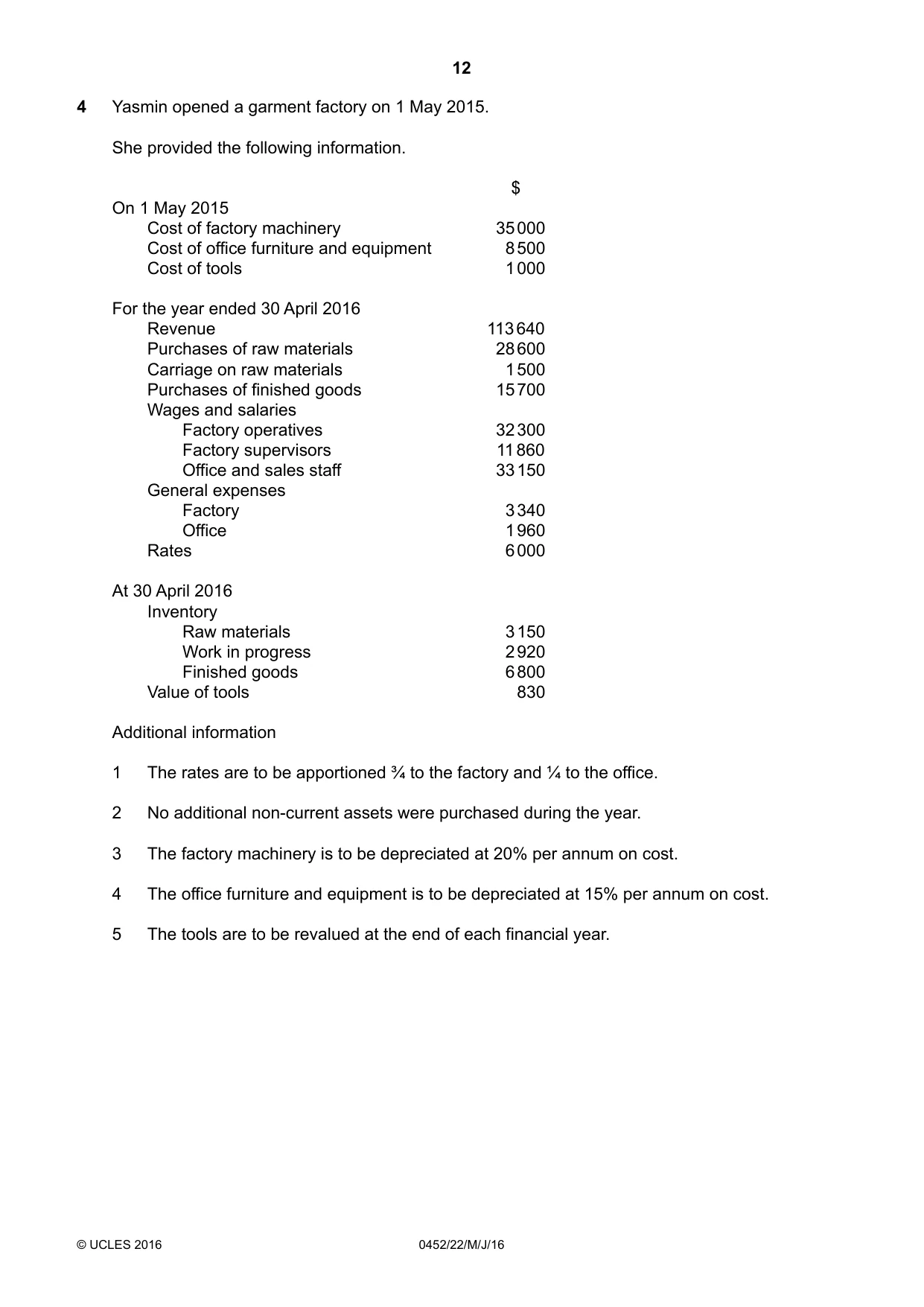
12 0452/22/M/J/16 © UCLES 2016 4 Yasmin opened a garment factory on 1 May 2015. She provided the following information. $ On 1 May 2015 Cost of factory machinery 35 000 Cost of office furniture and equipment 8 500 Cost of tools 1 000 For the year ended 30 April 2016 Revenue 113 640 Purchases of raw materials 28 600 Carriage on raw materials 1 500 Purchases of finished goods 15 700 Wages and salaries Factory operatives 32 300 Factory supervisors 11 860 Office and sales staff 33 150 General expenses Factory 3 340 Office 1 960 Rates 6 000 At 30 April 2016 Inventory Raw materials 3 150 Work in progress 2 920 Finished goods 6 800 Value of tools 830 Additional information 1 The rates are to be apportioned ¾ to the factory and ¼ to the office. 2 No additional non-current assets were purchased during the year. 3 The factory machinery is to be depreciated at 20% per annum on cost. 4 The office furniture and equipment is to be depreciated at 15% per annum on cost. 5 The tools are to be revalued at the end of each financial year.
Question paper, page 13
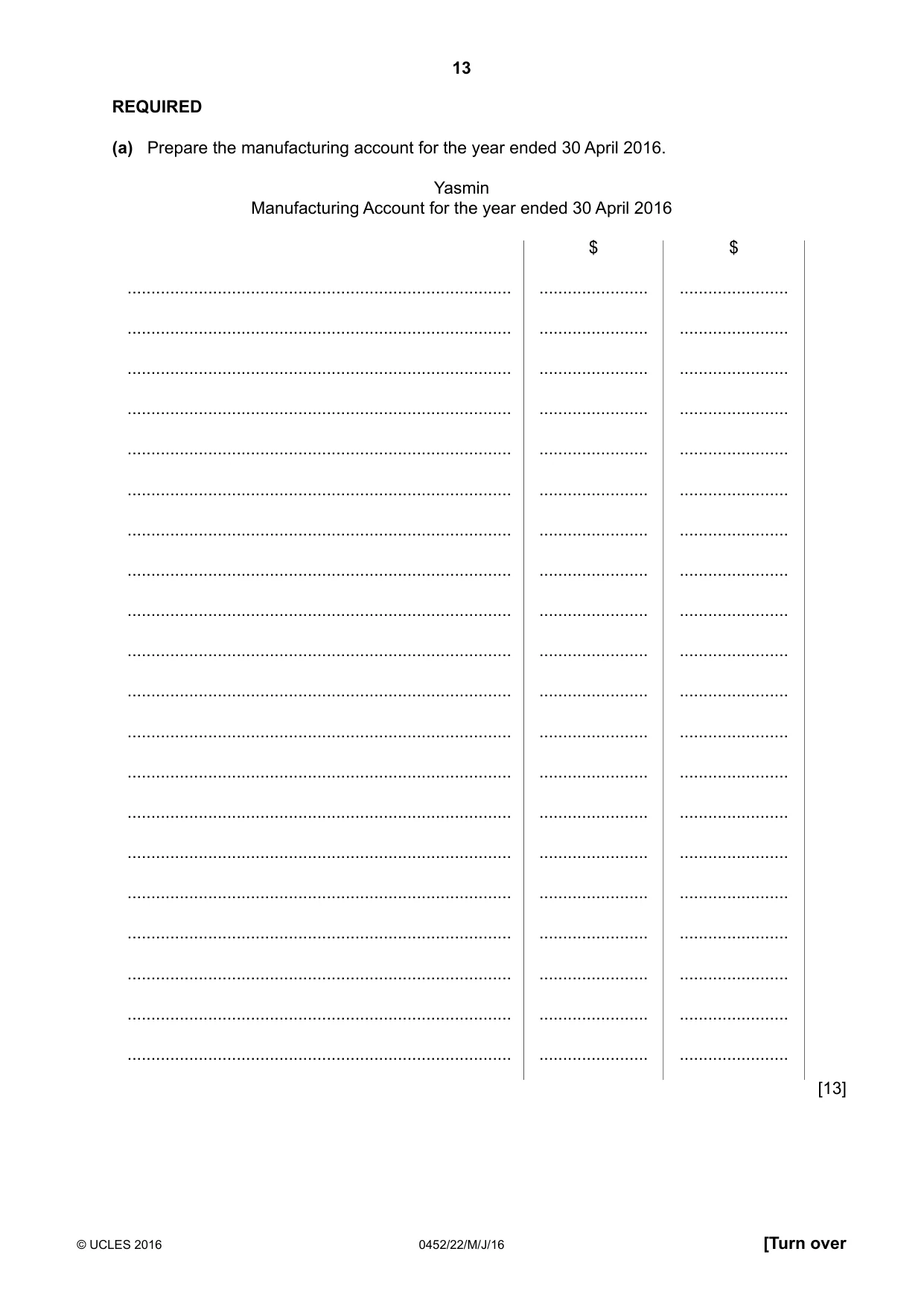
13 0452/22/M/J/16 © UCLES 2016 [Turn over REQUIRED (a) Prepare the manufacturing account for the year ended 30 April 2016. Yasmin Manufacturing Account for the year ended 30 April 2016 … … … … … … … … … … … … … … … … … … … … $ … … … … … … … … … … … … … … … … … … … … $ … … … … … … … … … … … … … … … … … … … … [13]
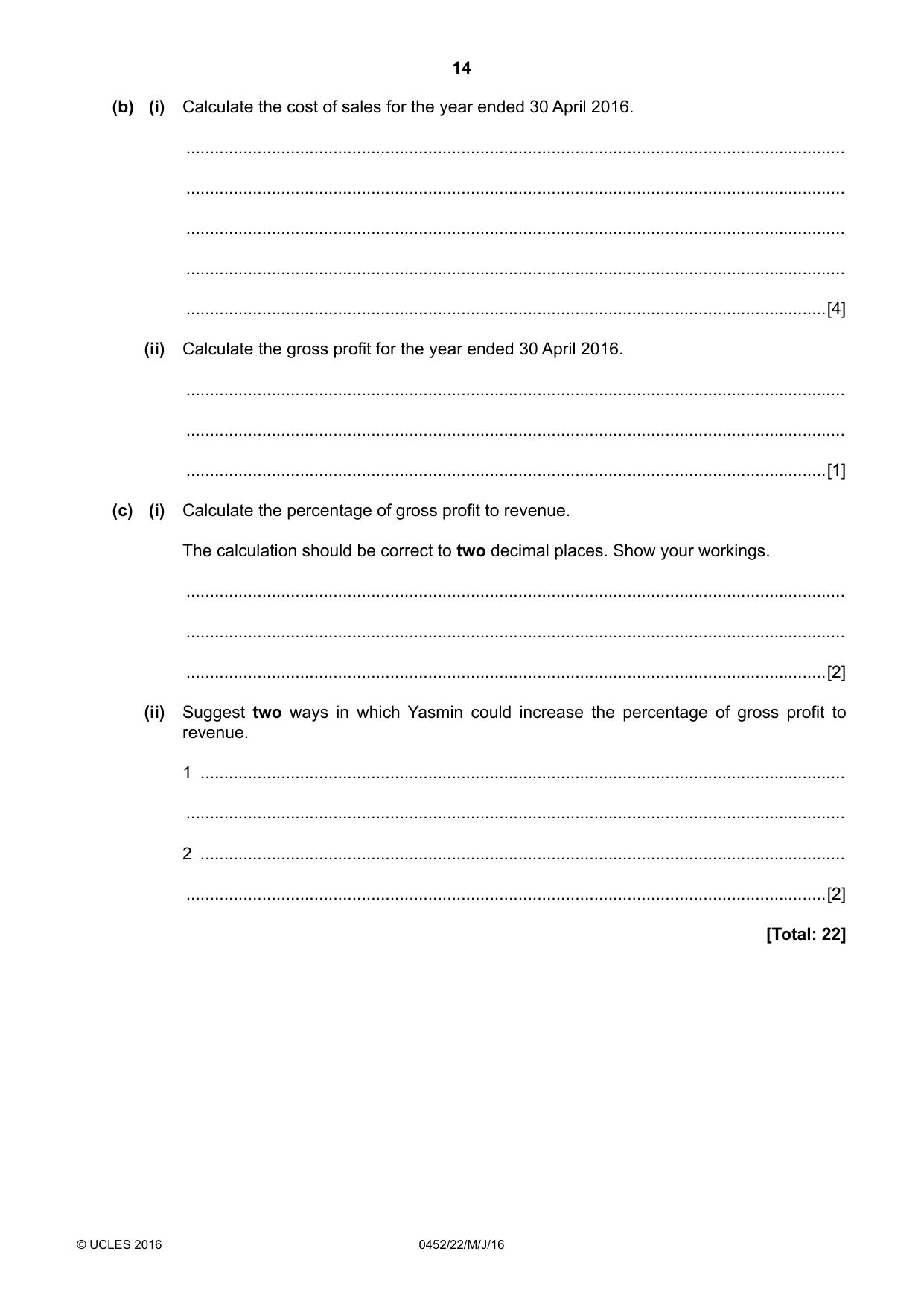
Question paper, page 14
14 0452/22/M/J/16 © UCLES 2016 (b) (i) Calculate the cost of sales for the year ended 30 April 2016. … … … … …[4] (ii) Calculate the gross profit for the year ended 30 April 2016. … … …[1] (c) (i) Calculate the percentage of gross profit to revenue. The calculation should be correct to two decimal places. Show your workings. … … …[2] (ii) Suggest two ways in which Yasmin could increase the percentage of gross profit to revenue. 1 … … 2 … …[2] [Total: 22]
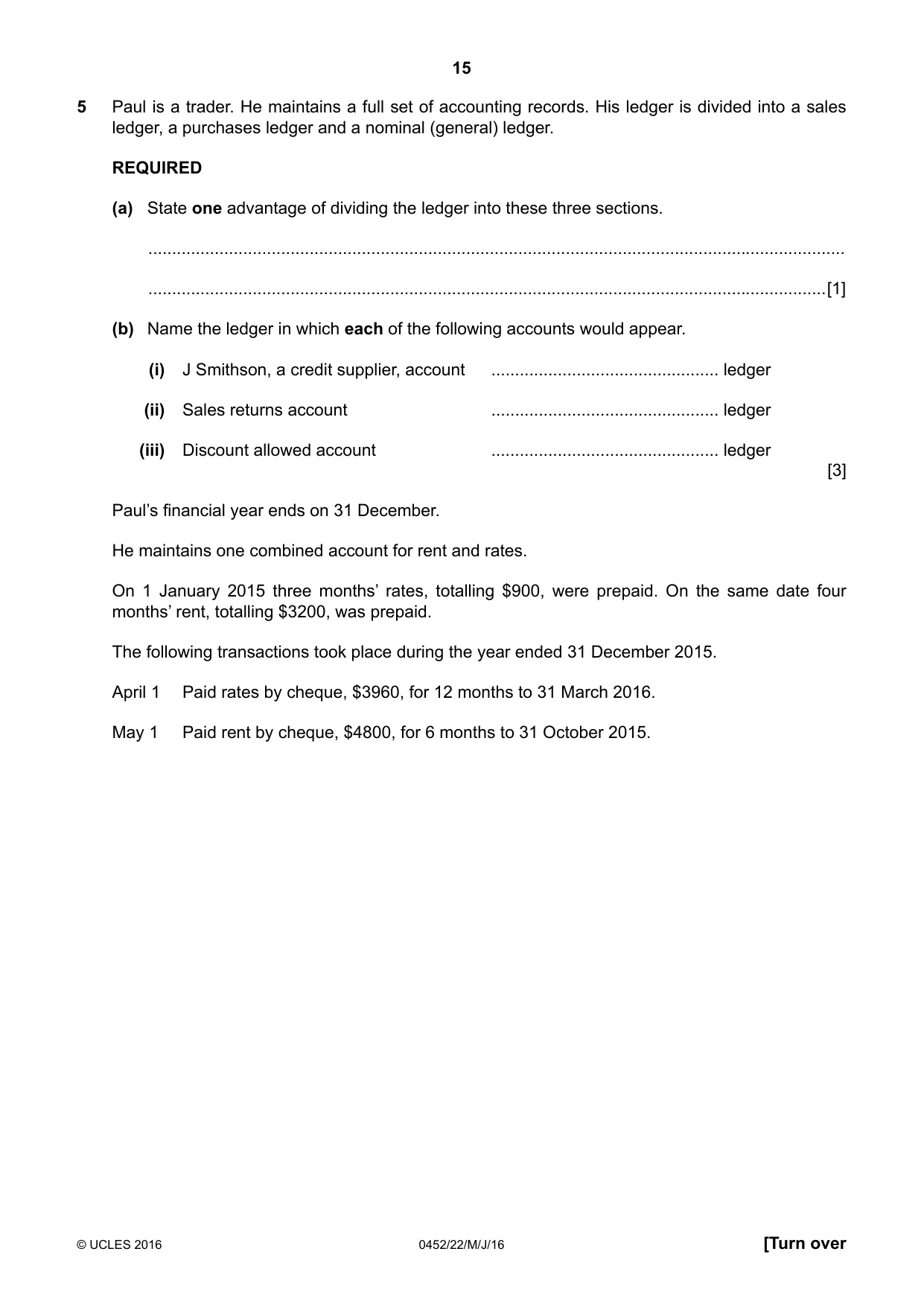
Question paper, page 15
15 0452/22/M/J/16 © UCLES 2016 [Turn over 5 Paul is a trader. He maintains a full set of accounting records. His ledger is divided into a sales ledger, a purchases ledger and a nominal (general) ledger. REQUIRED (a) State one advantage of dividing the ledger into these three sections. … …[1] (b) Name the ledger in which each of the following accounts would appear. (i) J Smithson, a credit supplier, account … ledger (ii) Sales returns account … ledger (iii) Discount allowed account … ledger [3] Paul’s financial year ends on 31 December. He maintains one combined account for rent and rates. On 1 January 2015 three months’ rates, totalling $900, were prepaid. On the same date four months’ rent, totalling $3200, was prepaid. The following transactions took place during the year ended 31 December 2015. April 1 Paid rates by cheque, $3960, for 12 months to 31 March 2016. May 1 Paid rent by cheque, $4800, for 6 months to 31 October 2015.
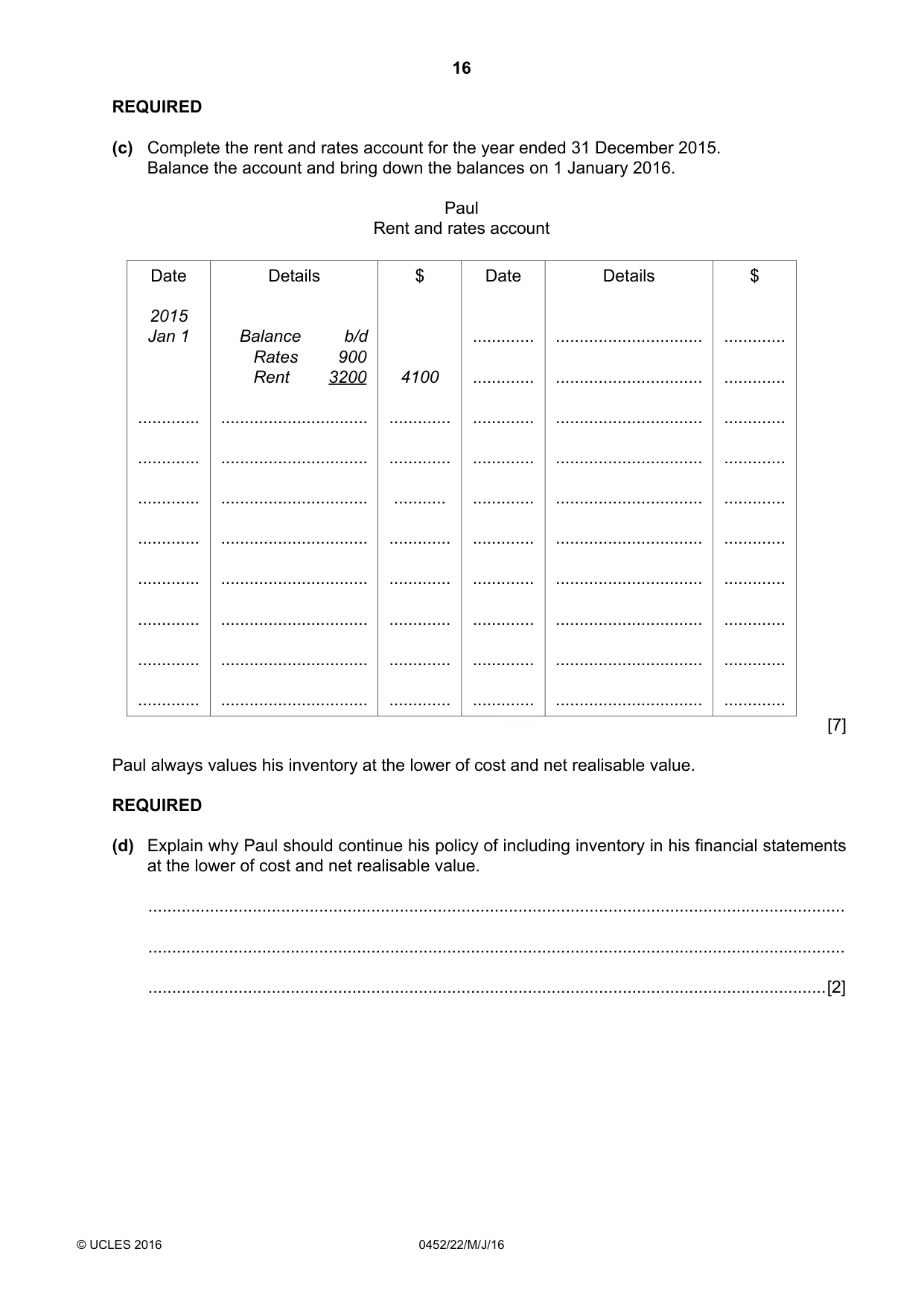
Question paper, page 16
16 0452/22/M/J/16 © UCLES 2016 REQUIRED (c) Complete the rent and rates account for the year ended 31 December 2015. Balance the account and bring down the balances on 1 January 2016. Paul Rent and rates account Date 2015 Jan 1 … … … … … … … … Details Balance b/d Rates 900 Rent 3200 … … … … … … … … $ 4100 … … … … … … … … Date … … … … … … … … … … Details … … … … … … … … … … $ … … … … … … … … … … [7] Paul always values his inventory at the lower of cost and net realisable value. REQUIRED (d) Explain why Paul should continue his policy of including inventory in his financial statements at the lower of cost and net realisable value. … … …[2]
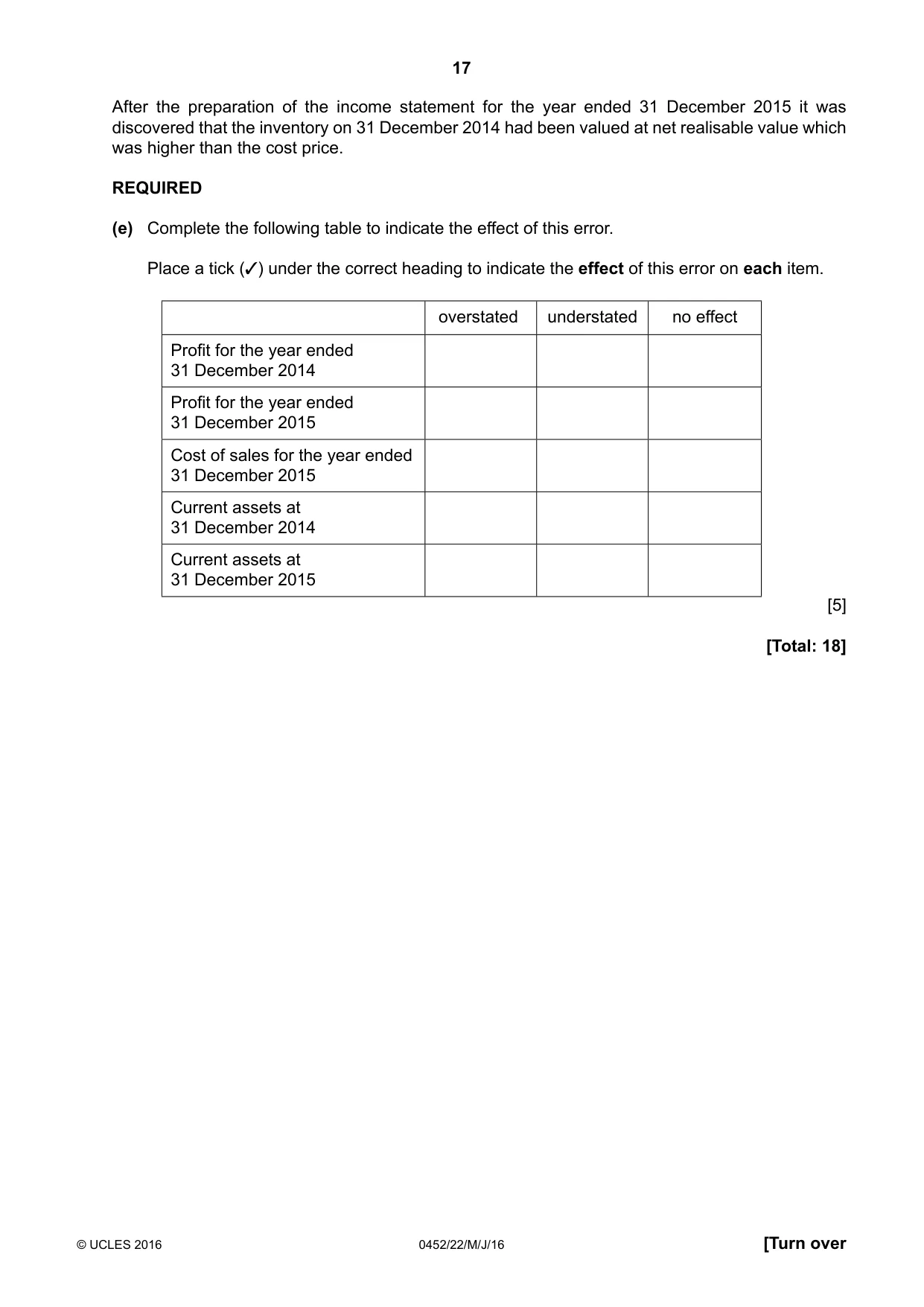
Question paper, page 17
17 0452/22/M/J/16 © UCLES 2016 [Turn over After the preparation of the income statement for the year ended 31 December 2015 it was discovered that the inventory on 31 December 2014 had been valued at net realisable value which was higher than the cost price. REQUIRED (e) Complete the following table to indicate the effect of this error. Place a tick (✓) under the correct heading to indicate the effect of this error on each item. overstated understated no effect Profit for the year ended 31 December 2014 Profit for the year ended 31 December 2015 Cost of sales for the year ended 31 December 2015 Current assets at 31 December 2014 Current assets at 31 December 2015 [5] [Total: 18]
Question paper, page 18
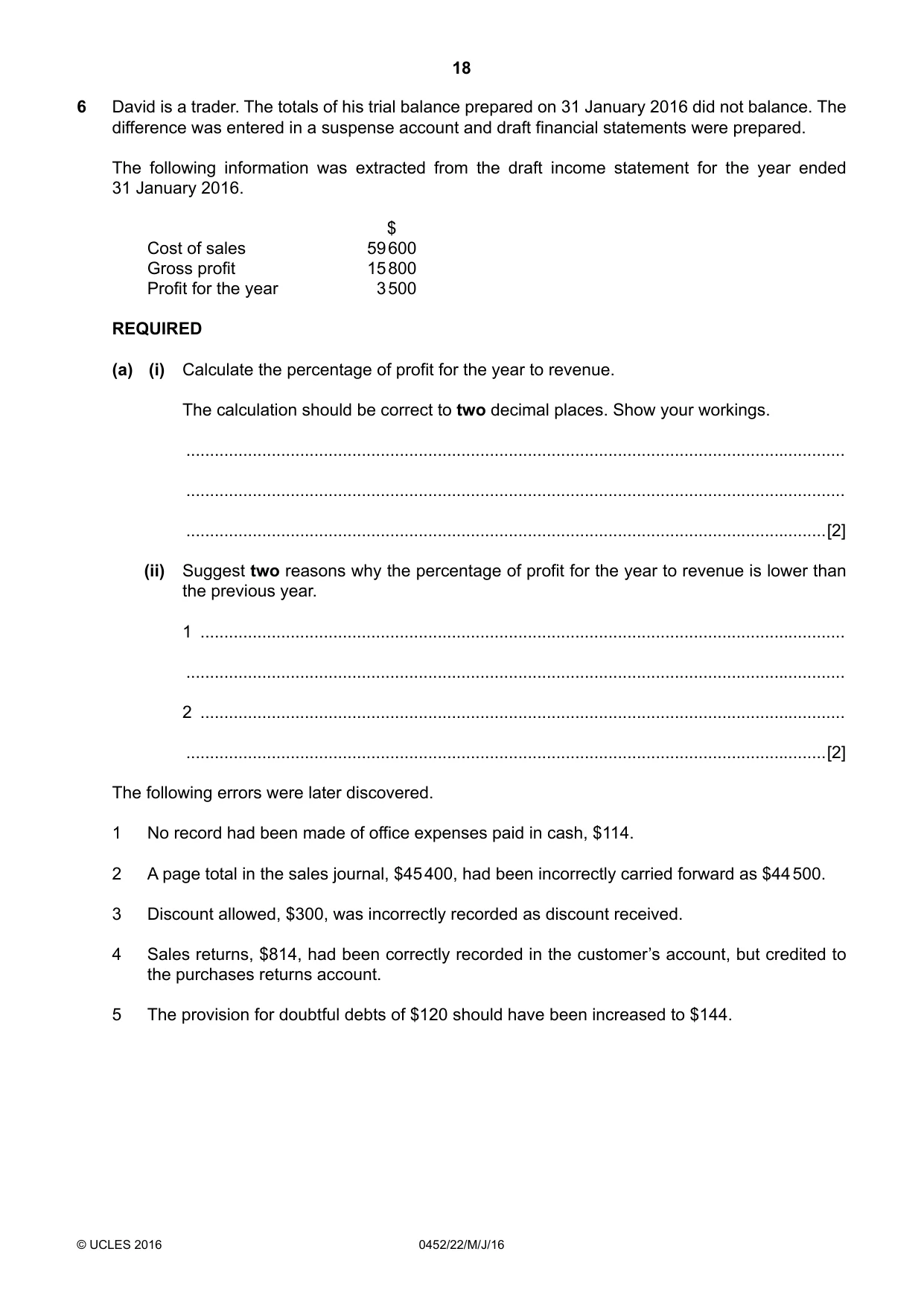
18 0452/22/M/J/16 © UCLES 2016 6 David is a trader. The totals of his trial balance prepared on 31 January 2016 did not balance. The difference was entered in a suspense account and draft financial statements were prepared. The following information was extracted from the draft income statement for the year ended 31 January 2016. $ Cost of sales 59 600 Gross profit 15 800 Profit for the year 3 500 REQUIRED (a) (i) Calculate the percentage of profit for the year to revenue. The calculation should be correct to two decimal places. Show your workings. … … …[2] (ii) Suggest two reasons why the percentage of profit for the year to revenue is lower than the previous year. 1 … … 2 … …[2] The following errors were later discovered. 1 No record had been made of office expenses paid in cash, $114. 2 A page total in the sales journal, $45 400, had been incorrectly carried forward as $44 500. 3 Discount allowed, $300, was incorrectly recorded as discount received. 4 Sales returns, $814, had been correctly recorded in the customer’s account, but credited to the purchases returns account. 5 The provision for doubtful debts of $120 should have been increased to $144.
Question paper, page 19
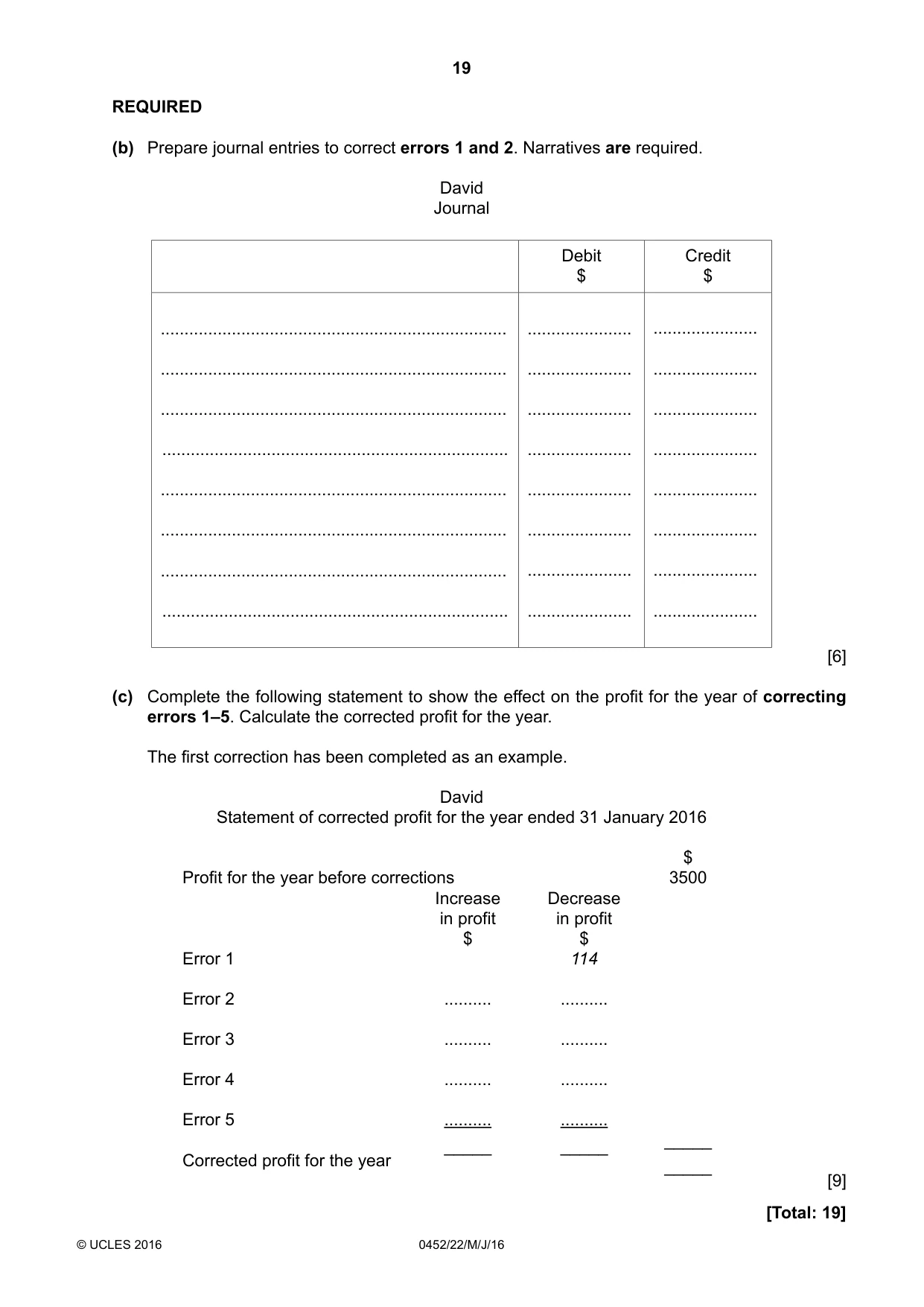
19 0452/22/M/J/16 © UCLES 2016 REQUIRED (b) Prepare journal entries to correct errors 1 and 2. Narratives are required. David Journal Debit $ Credit $ … … … … … … … … … … … … … … … … … … … … … … … … [6] (c) Complete the following statement to show the effect on the profit for the year of correcting errors 1–5. Calculate the corrected profit for the year. The first correction has been completed as an example. David Statement of corrected profit for the year ended 31 January 2016 $ Profit for the year before corrections 3500 Increase Decrease in profit in profit $ $ Error 1 114 Error 2 … … Error 3 … … Error 4 … … Error 5 … … _____ _____ _____ Corrected profit for the year _____ [9] [Total: 19]
Question paper, page 20
20 0452/22/M/J/16 © UCLES 2016 Permission to reproduce items where third-party owned material protected by copyright is included has been sought and cleared where possible. Every reasonable effort has been made by the publisher (UCLES) to trace copyright holders, but if any items requiring clearance have unwittingly been included, the publisher will be pleased to make amends at the earliest possible opportunity. To avoid the issue of disclosure of answer-related information to candidates, all copyright acknowledgements are reproduced online in the Cambridge International Examinations Copyright Acknowledgements Booklet. This is produced for each series of examinations and is freely available to download at www.cie.org.uk after the live examination series. Cambridge International Examinations is part of the Cambridge Assessment Group. Cambridge Assessment is the brand name of University of Cambridge Local Examinations Syndicate (UCLES), which is itself a department of the University of Cambridge. BLANK PAGE
Mark scheme, page 1
® IGCSE is the registered trademark of Cambridge International Examinations. This document consists of 11 printed pages. © UCLES 2016 [Turn over Cambridge International Examinations Cambridge International General Certificate of Secondary Education ACCOUNTING 0452/22 Paper 2 May/June 2016 MARK SCHEME Maximum Mark: 120 Published This mark scheme is published as an aid to teachers and candidates, to indicate the requirements of the examination. It shows the basis on which Examiners were instructed to award marks. It does not indicate the details of the discussions that took place at an Examiners’ meeting before marking began, which would have considered the acceptability of alternative answers. Mark schemes should be read in conjunction with the question paper and the Principal Examiner Report for Teachers. Cambridge will not enter into discussions about these mark schemes. Cambridge is publishing the mark schemes for the May/June 2016 series for most Cambridge IGCSE®, Cambridge International A and AS Level components and some Cambridge O Level components.
Mark scheme, page 2
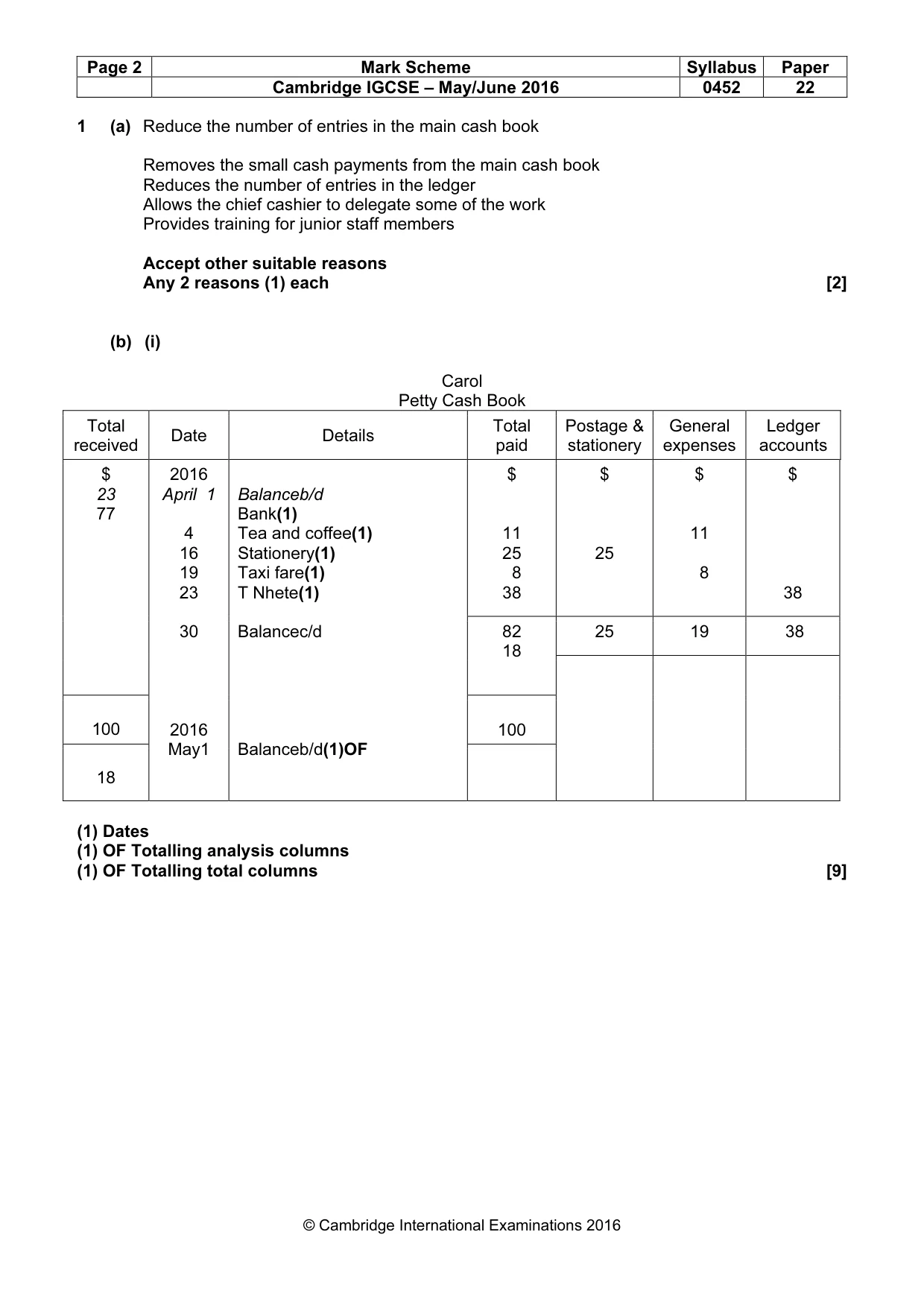
Page 2 Mark Scheme Syllabus Paper Cambridge IGCSE – May/June 2016 0452 22 © Cambridge International Examinations 2016 1 (a) Reduce the number of entries in the main cash book Removes the small cash payments from the main cash book Reduces the number of entries in the ledger Allows the chief cashier to delegate some of the work Provides training for junior staff members Accept other suitable reasons Any 2 reasons (1) each [2] (b) (i) Carol Petty Cash Book Total received Date Details Total paid Postage & stationery General expenses Ledger accounts $ 23 77 2016 April 1 4 16 19 23 30 2016 May1 Balanceb/d Bank(1) Tea and coffee(1) Stationery(1) Taxi fare(1) T Nhete(1) Balancec/d Balanceb/d(1)OF $ 11 25 8 38 $ 25 $ 11 8 $ 38 82 18 25 19 38 100 100 18 (1) Dates (1) OF Totalling analysis columns (1) OF Totalling total columns [9]
Mark scheme, page 3
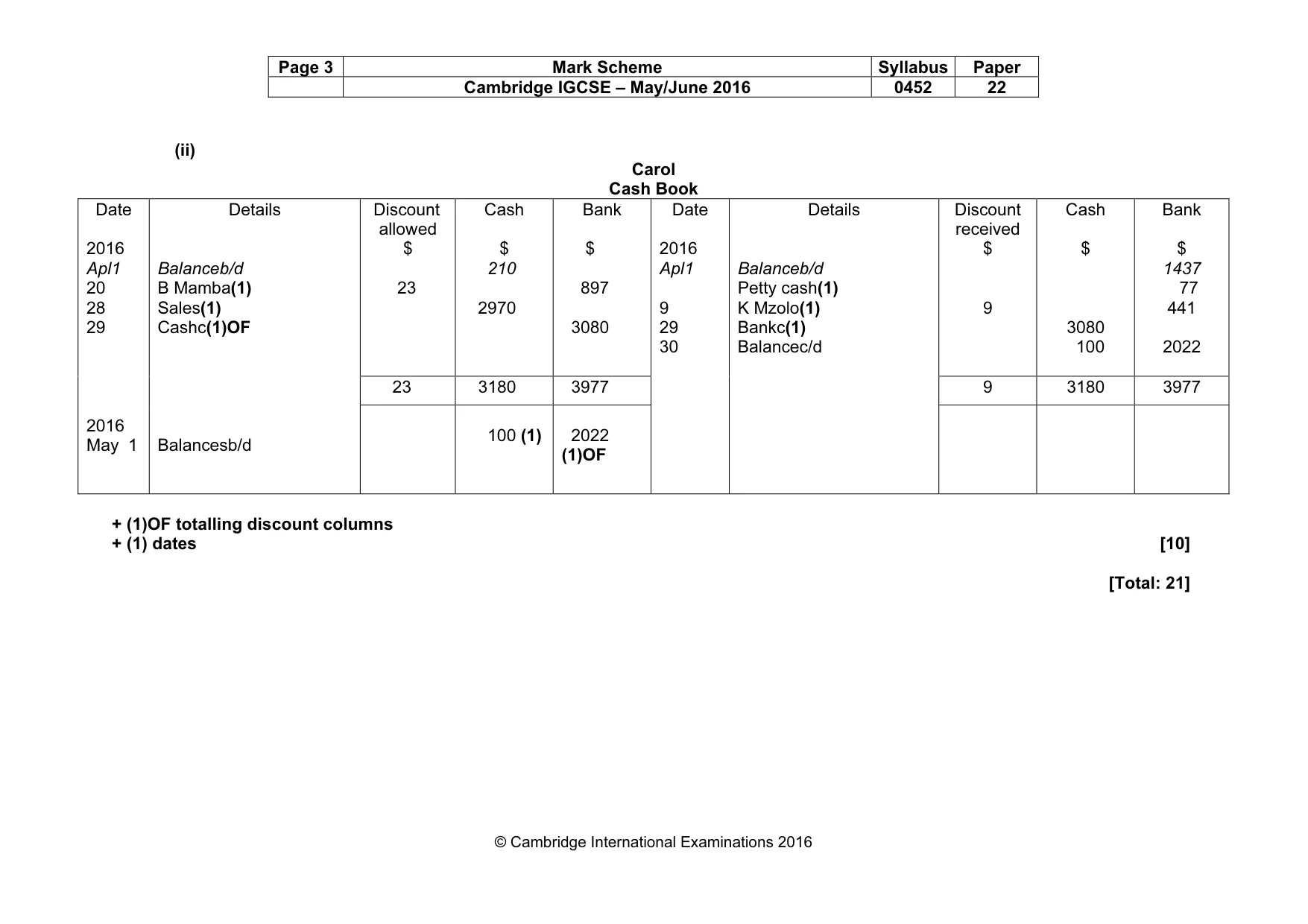
Page 3 Mark Scheme Syllabus Paper Cambridge IGCSE – May/June 2016 0452 22 © Cambridge International Examinations 2016 (ii) Carol Cash Book Date 2016 Apl1 20 28 29 2016 May 1 Details Balanceb/d B Mamba(1) Sales(1) Cashc(1)OF Balancesb/d Discount allowed $ 23 Cash $ 210 2970 Bank $ 897 3080 Date 2016 Apl1 9 29 30 Details Balanceb/d Petty cash(1) K Mzolo(1) Bankc(1) Balancec/d Discount received $ 9 Cash $ 3080 100 Bank $ 1437 77 441 2022 23 3180 3977 9 3180 3977 100 (1) 2022 (1)OF + (1)OF totalling discount columns + (1) dates [10] [Total: 21]
Mark scheme, page 4
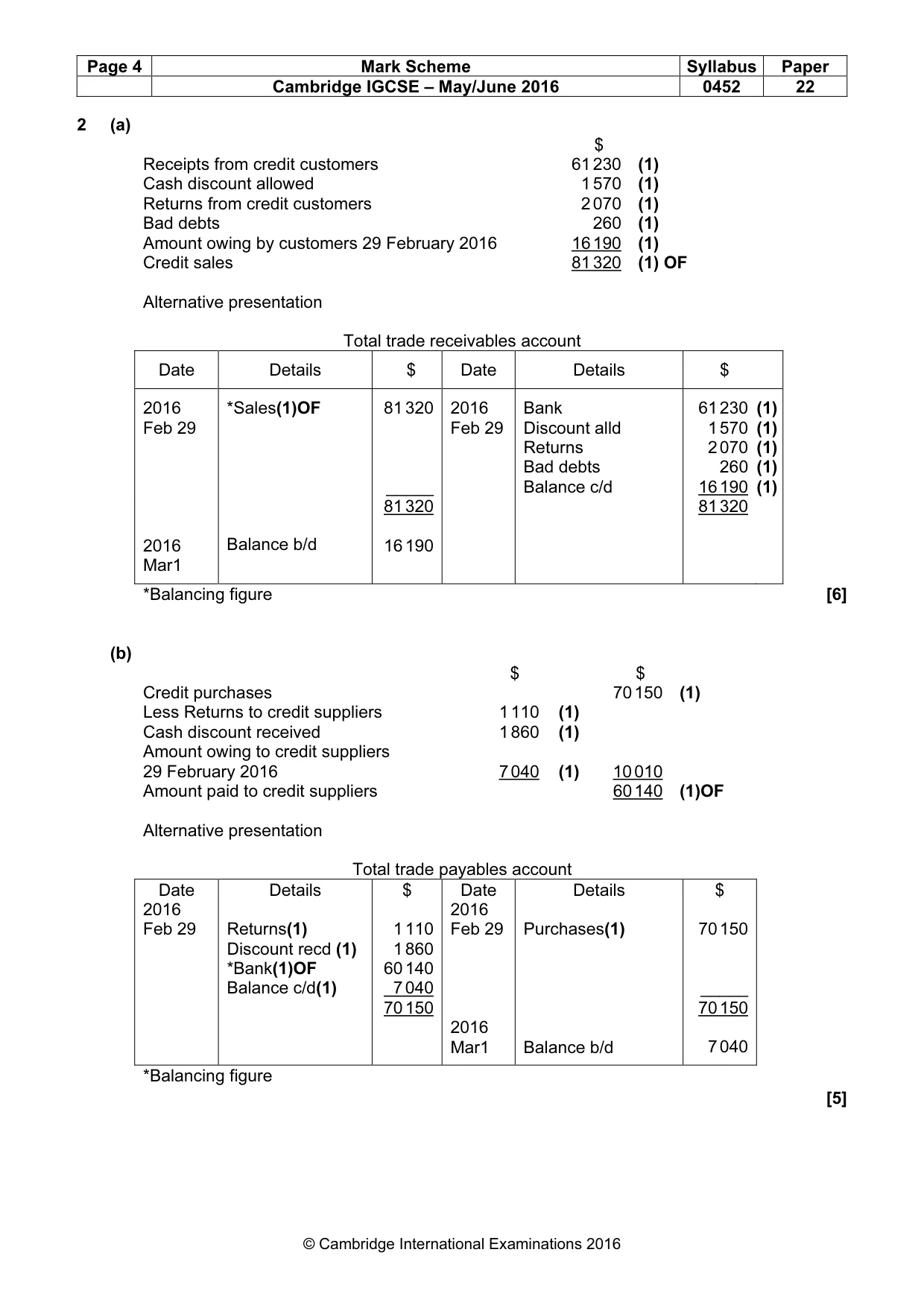
Page 4 Mark Scheme Syllabus Paper Cambridge IGCSE – May/June 2016 0452 22 © Cambridge International Examinations 2016 2 (a) $ Receipts from credit customers 61 230 (1) Cash discount allowed 1 570 (1) Returns from credit customers 2 070 (1) Bad debts 260 (1) Amount owing by customers 29 February 2016 16 190 (1) Credit sales 81 320 (1) OF Alternative presentation Total trade receivables account Date Details $ Date Details $ 2016 Feb 29 2016 Mar1 *Sales(1)OF Balance b/d 81 320 _____ 81 320 16 190 2016 Feb 29 Bank Discount alld Returns Bad debts Balance c/d 61 230 1 570 2 070 260 16 190 81 320 (1) (1) (1) (1) (1) *Balancing figure [6] (b) $ $ Credit purchases 70 150 (1) Less Returns to credit suppliers 1 110 (1) Cash discount received 1 860 (1) Amount owing to credit suppliers 29 February 2016 7 040 (1) 10 010 Amount paid to credit suppliers 60 140 (1)OF Alternative presentation Total trade payables account Date 2016 Feb 29 Details Returns(1) Discount recd (1) *Bank(1)OF Balance c/d(1) $ 1 110 1 860 60 140 7 040 70 150 Date 2016 Feb 29 2016 Mar1 Details Purchases(1) Balance b/d $ 70 150 _____ 70 150 7 040 *Balancing figure [5]
Mark scheme, page 5
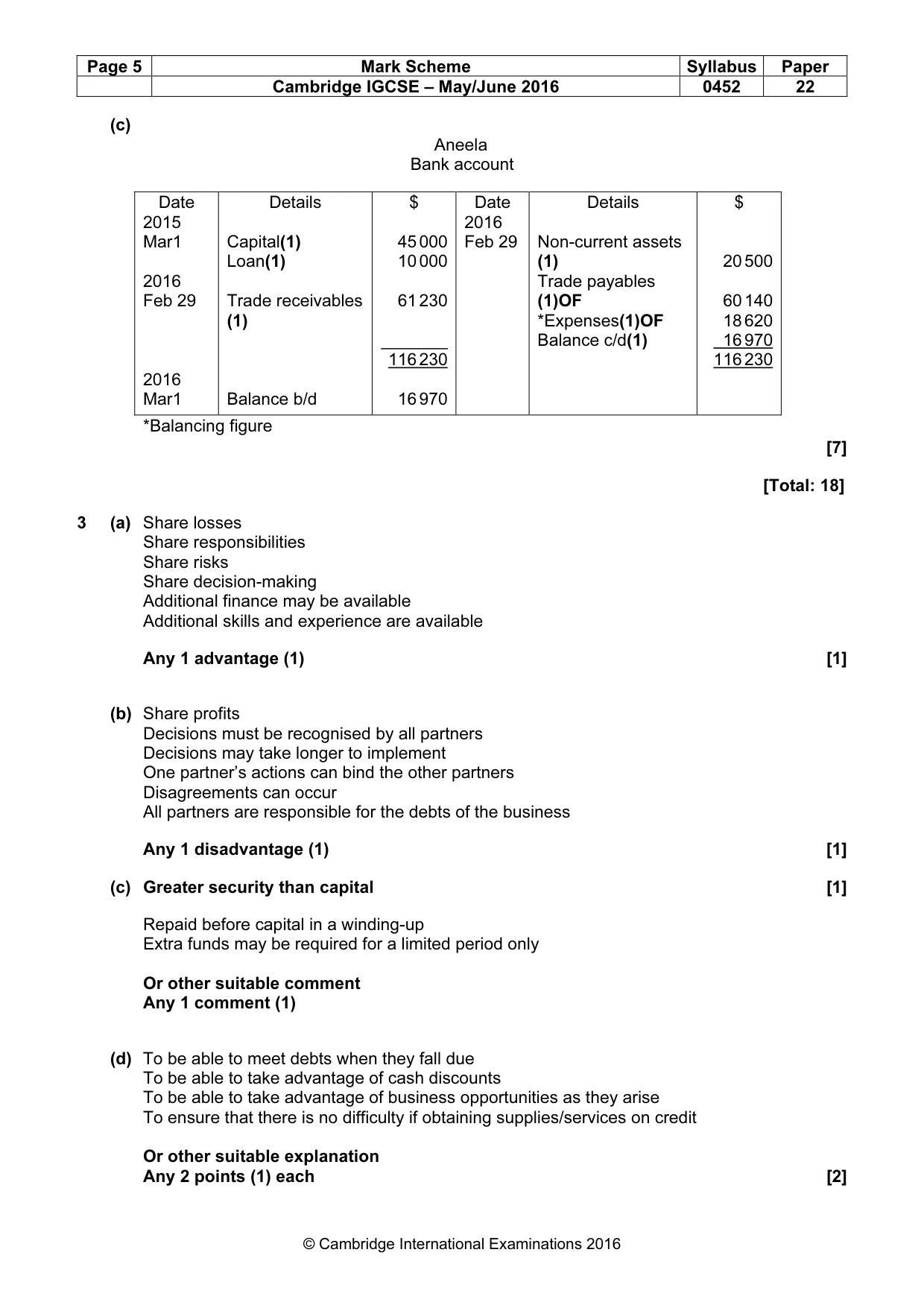
Page 5 Mark Scheme Syllabus Paper Cambridge IGCSE – May/June 2016 0452 22 © Cambridge International Examinations 2016 (c) Aneela Bank account Date 2015 Mar1 2016 Feb 29 2016 Mar1 Details Capital(1) Loan(1) Trade receivables (1) Balance b/d $ 45 000 10 000 61 230 _______ 116 230 16 970 Date 2016 Feb 29 Details Non-current assets (1) Trade payables (1)OF *Expenses(1)OF Balance c/d(1) $ 20 500 60 140 18 620 16 970 116 230 *Balancing figure [7] [Total: 18] 3 (a) Share losses Share responsibilities Share risks Share decision-making Additional finance may be available Additional skills and experience are available Any 1 advantage (1) [1] (b) Share profits Decisions must be recognised by all partners Decisions may take longer to implement One partner’s actions can bind the other partners Disagreements can occur All partners are responsible for the debts of the business Any 1 disadvantage (1) [1] (c) Greater security than capital [1] Repaid before capital in a winding-up Extra funds may be required for a limited period only Or other suitable comment Any 1 comment (1) (d) To be able to meet debts when they fall due To be able to take advantage of cash discounts To be able to take advantage of business opportunities as they arise To ensure that there is no difficulty if obtaining supplies/services on credit Or other suitable explanation Any 2 points (1) each [2]
Mark scheme, page 6
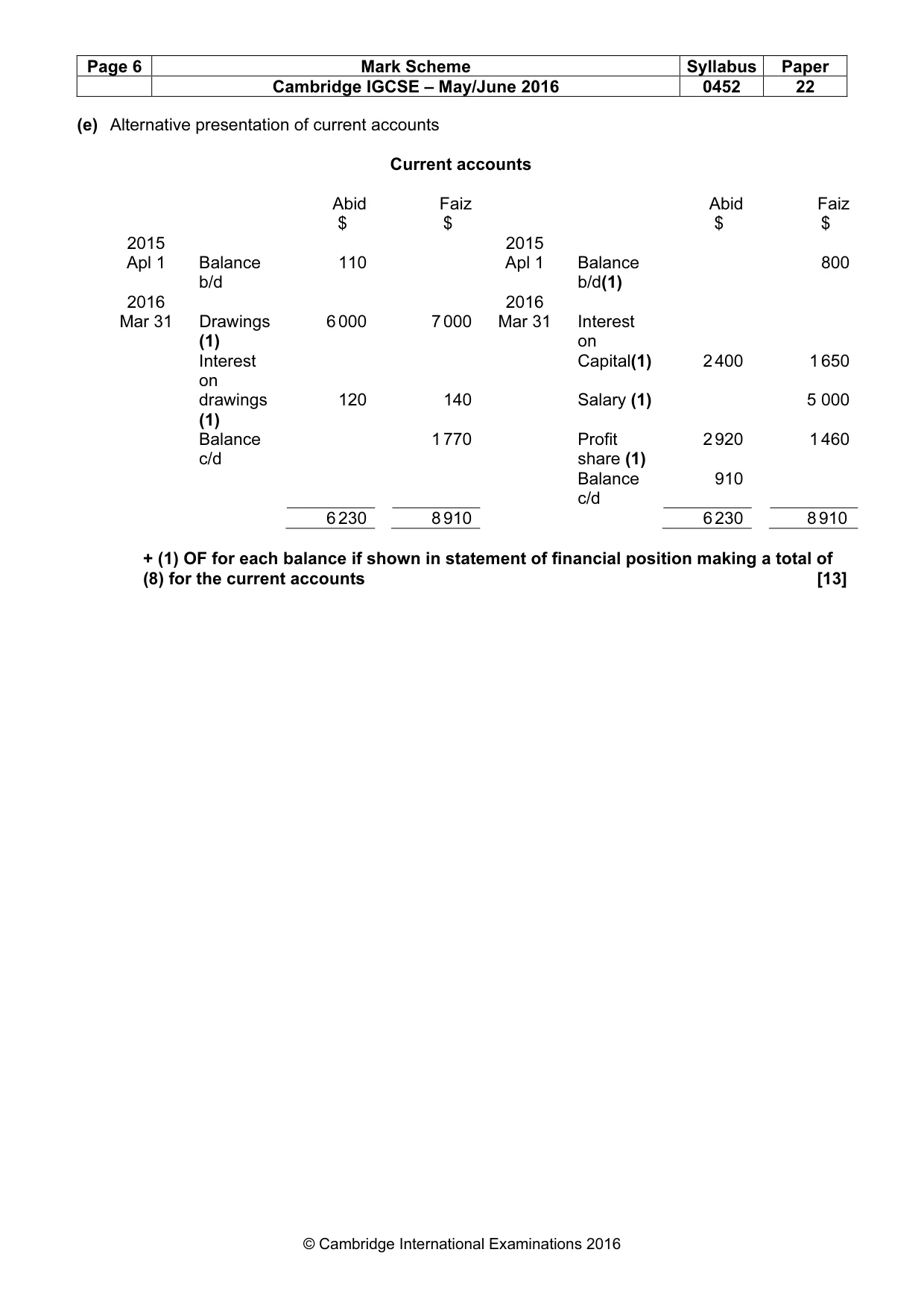
Page 6 Mark Scheme Syllabus Paper Cambridge IGCSE – May/June 2016 0452 22 © Cambridge International Examinations 2016 (e) Alternative presentation of current accounts Current accounts Abid Faiz Abid Faiz $ $ $ $ 2015 2015 Apl 1 Balance b/d 110 Apl 1 Balance b/d(1) 800 2016 2016 Mar 31 Drawings (1) 6 000 7 000 Mar 31 Interest on Interest on Capital(1) 2 400 1 650 drawings (1) 120 140 Salary (1) 5 000 Balance c/d 1 770 Profit share (1) 2 920 1 460 Balance c/d 910 6 230 8 910 6 230 8 910 + (1) OF for each balance if shown in statement of financial position making a total of (8) for the current accounts [13]
Mark scheme, page 7
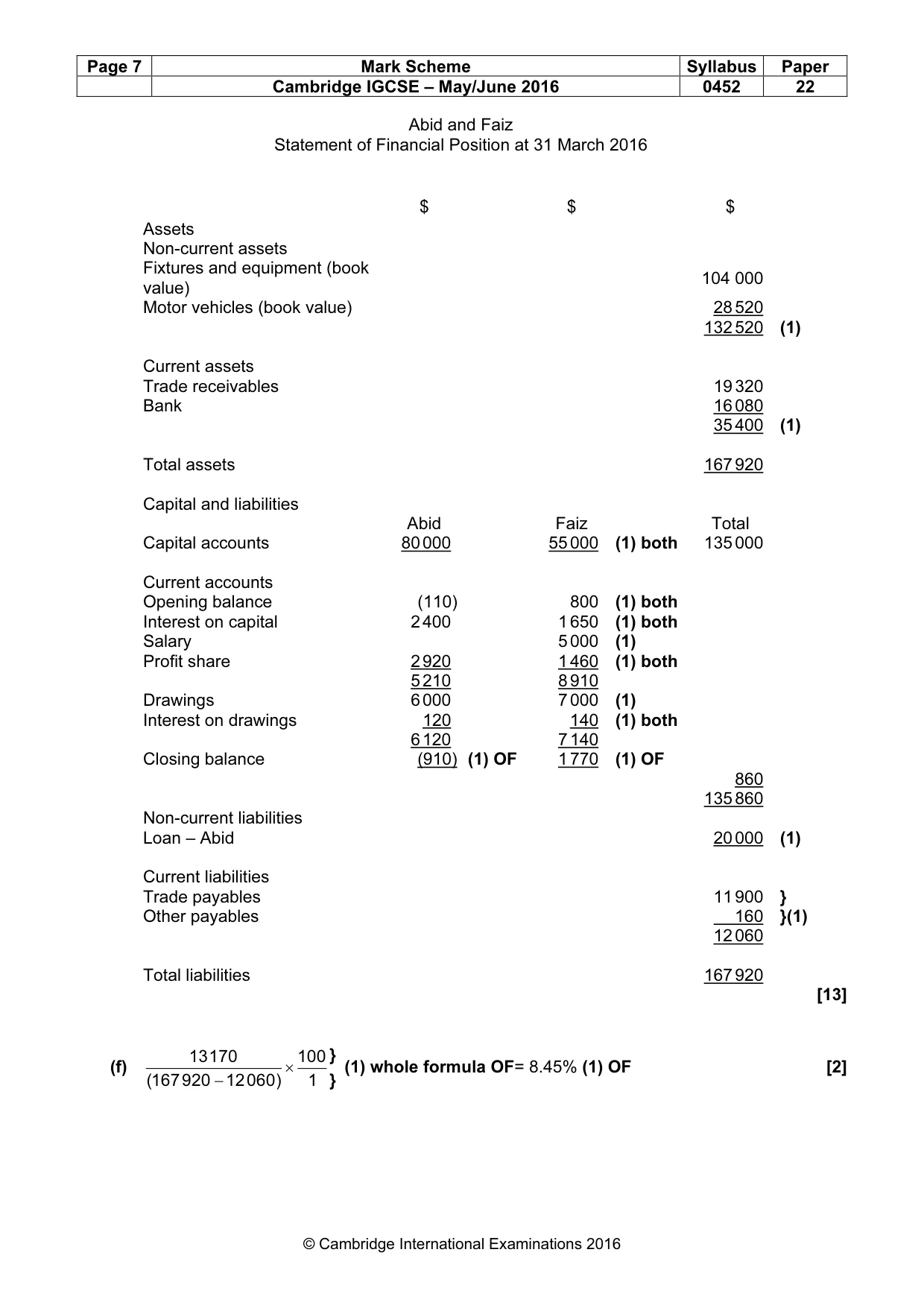
Page 7 Mark Scheme Syllabus Paper Cambridge IGCSE – May/June 2016 0452 22 © Cambridge International Examinations 2016 Abid and Faiz Statement of Financial Position at 31 March 2016 $ $ $ Assets Non-current assets Fixtures and equipment (book value) 104 000 Motor vehicles (book value) 28 520 132 520 (1) Current assets Trade receivables 19 320 Bank 16 080 35 400 (1) Total assets 167 920 Capital and liabilities Abid Faiz Total Capital accounts 80 000 55 000 (1) both 135 000 Current accounts Opening balance (110) 800 (1) both Interest on capital 2 400 1 650 (1) both Salary 5 000 (1) Profit share 2 920 1 460 (1) both 5 210 8 910 Drawings 6 000 7 000 (1) Interest on drawings 120 140 (1) both 6 120 7 140 Closing balance (910) (1) OF 1 770 (1) OF 860 135 860 Non-current liabilities Loan – Abid 20 000 (1) Current liabilities Trade payables 11 900 } Other payables 160 }(1) 12 060 Total liabilities 167 920 [13] (f) 13170 100 (167920 12060) 1 × − } } (1) whole formula OF= 8.45% (1) OF [2]
Mark scheme, page 8
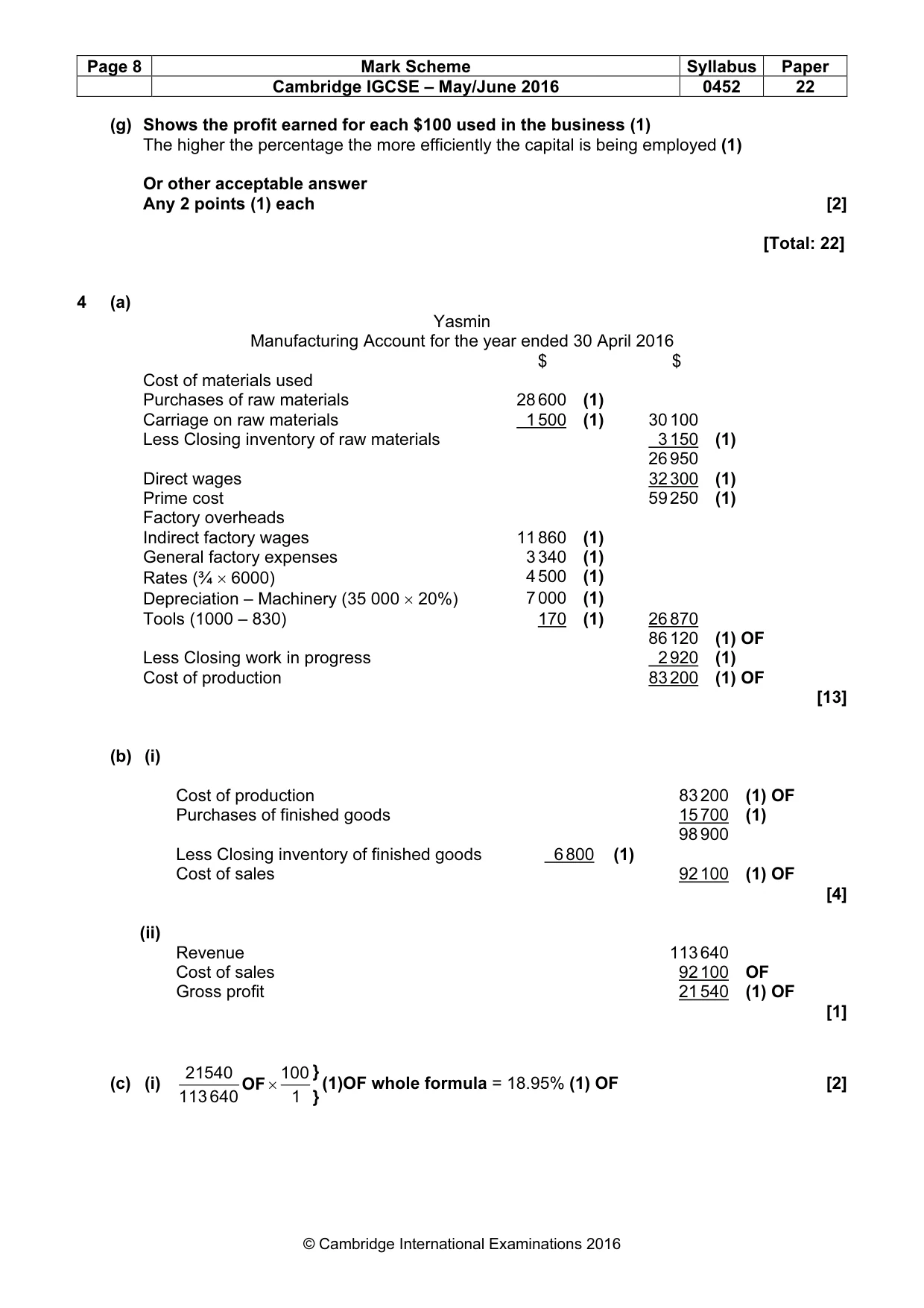
Page 8 Mark Scheme Syllabus Paper Cambridge IGCSE – May/June 2016 0452 22 © Cambridge International Examinations 2016 (g) Shows the profit earned for each $100 used in the business (1) The higher the percentage the more efficiently the capital is being employed (1) Or other acceptable answer Any 2 points (1) each [2] [Total: 22] 4 (a) Yasmin Manufacturing Account for the year ended 30 April 2016 $ $ Cost of materials used Purchases of raw materials 28 600 (1) Carriage on raw materials 1 500 (1) 30 100 Less Closing inventory of raw materials 3 150 (1) 26 950 Direct wages 32 300 (1) Prime cost 59 250 (1) Factory overheads Indirect factory wages 11 860 (1) General factory expenses 3 340 (1) Rates (¾ × 6000) 4 500 (1) Depreciation – Machinery (35 000 × 20%) 7 000 (1) Tools (1000 – 830) 170 (1) 26 870 86 120 (1) OF Less Closing work in progress 2 920 (1) Cost of production 83 200 (1) OF [13] (b) (i) Cost of production 83 200 (1) OF Purchases of finished goods 15 700 (1) 98 900 Less Closing inventory of finished goods 6 800 (1) Cost of sales 92 100 (1) OF [4] (ii) Revenue 113 640 Cost of sales 92 100 OF Gross profit 21 540 (1) OF [1] (c) (i) 21540 100 113640 1 × } OF } (1)OF whole formula = 18.95% (1) OF [2]
Mark scheme, page 9
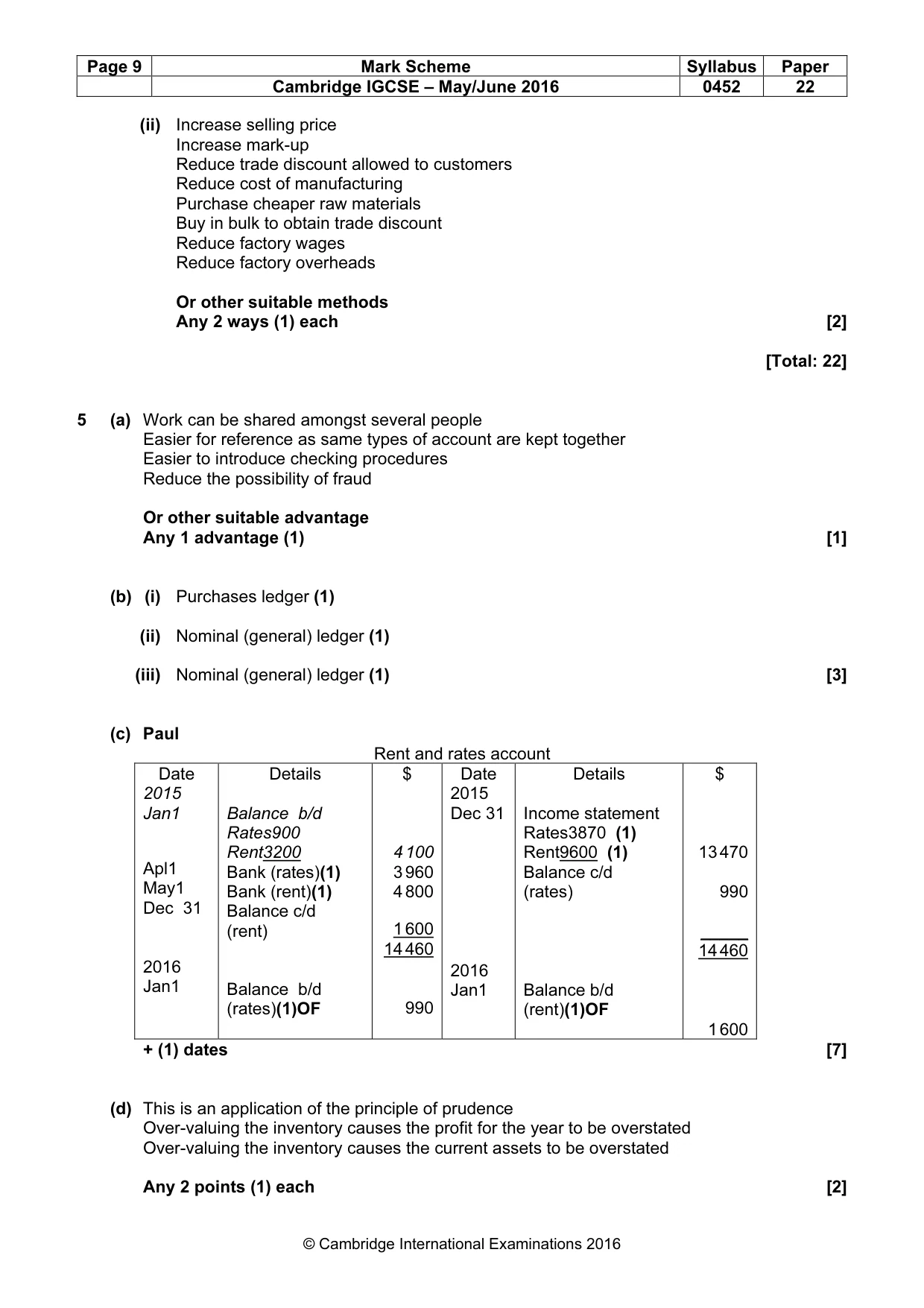
Page 9 Mark Scheme Syllabus Paper Cambridge IGCSE – May/June 2016 0452 22 © Cambridge International Examinations 2016 (ii) Increase selling price Increase mark-up Reduce trade discount allowed to customers Reduce cost of manufacturing Purchase cheaper raw materials Buy in bulk to obtain trade discount Reduce factory wages Reduce factory overheads Or other suitable methods Any 2 ways (1) each [2] [Total: 22] 5 (a) Work can be shared amongst several people Easier for reference as same types of account are kept together Easier to introduce checking procedures Reduce the possibility of fraud Or other suitable advantage Any 1 advantage (1) [1] (b) (i) Purchases ledger (1) (ii) Nominal (general) ledger (1) (iii) Nominal (general) ledger (1) [3] (c) Paul Rent and rates account Date 2015 Jan1 Apl1 May1 Dec 31 2016 Jan1 Details Balance b/d Rates900 Rent3200 Bank (rates)(1) Bank (rent)(1) Balance c/d (rent) Balance b/d (rates)(1)OF $ 4 100 3 960 4 800 1 600 14 460 990 Date 2015 Dec 31 2016 Jan1 Details Income statement Rates3870 (1) Rent9600 (1) Balance c/d (rates) Balance b/d (rent)(1)OF $ 13 470 990 _____ 14 460 1 600 + (1) dates [7] (d) This is an application of the principle of prudence Over-valuing the inventory causes the profit for the year to be overstated Over-valuing the inventory causes the current assets to be overstated Any 2 points (1) each [2]
Mark scheme, page 10
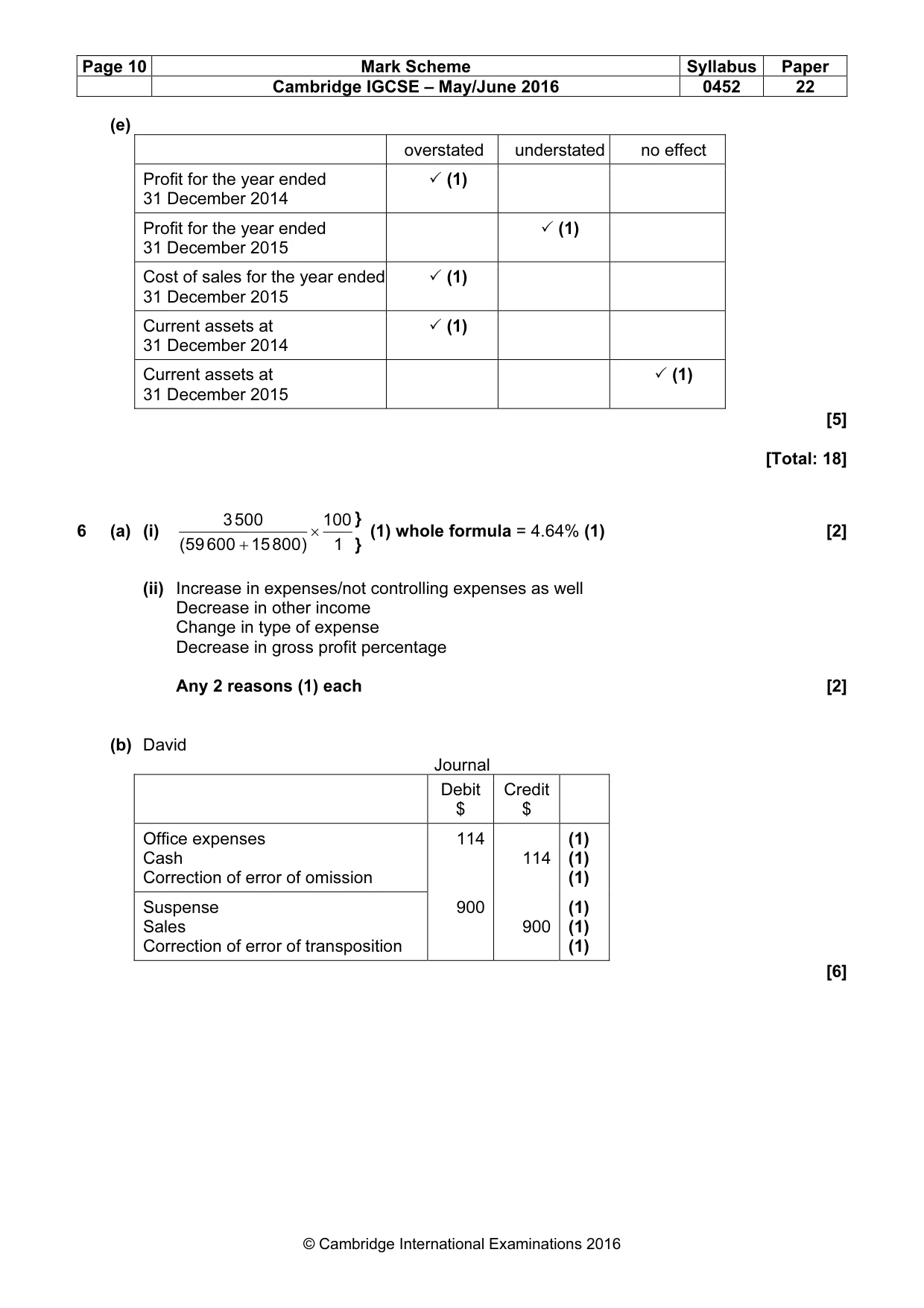
Page 10 Mark Scheme Syllabus Paper Cambridge IGCSE – May/June 2016 0452 22 © Cambridge International Examinations 2016 (e) overstated understated no effect Profit for the year ended 31 December 2014 ✓ (1) Profit for the year ended 31 December 2015 ✓ (1) Cost of sales for the year ended 31 December 2015 ✓ (1) Current assets at 31 December 2014 ✓ (1) Current assets at 31 December 2015 ✓ (1) [5] [Total: 18] 6 (a) (i) 3500 100 (59600 15800) 1 × + } } (1) whole formula = 4.64% (1) [2] (ii) Increase in expenses/not controlling expenses as well Decrease in other income Change in type of expense Decrease in gross profit percentage Any 2 reasons (1) each [2] (b) David Journal Debit $ Credit $ Office expenses Cash Correction of error of omission 114 114 (1) (1) (1) Suspense Sales Correction of error of transposition 900 900 (1) (1) (1) [6]
Mark scheme, page 11
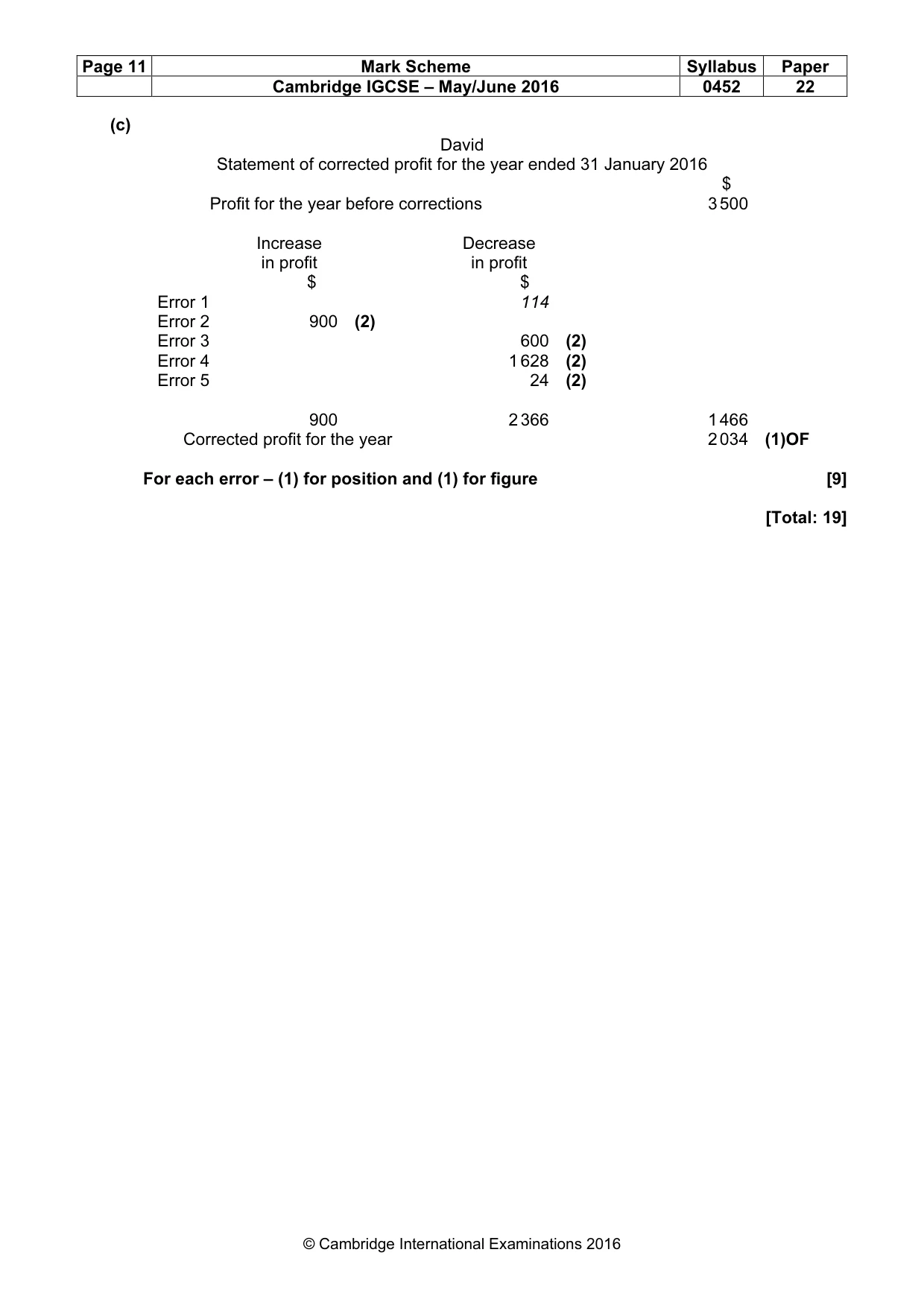
Page 11 Mark Scheme Syllabus Paper Cambridge IGCSE – May/June 2016 0452 22 © Cambridge International Examinations 2016 (c) David Statement of corrected profit for the year ended 31 January 2016 $ Profit for the year before corrections 3 500 Increase Decrease in profit in profit $ $ Error 1 114 Error 2 900 (2) Error 3 600 (2) Error 4 1 628 (2) Error 5 24 (2) 900 2 366 1 466 Corrected profit for the year 2 034 (1)OF For each error – (1) for position and (1) for figure [9] [Total: 19]
What you needed in this session
Cambridge’s own grade thresholds for 2016 May/June, Paper 2 · Variant 2. A higher threshold means an easier paper — the bar moves with how the cohort did.