Cambridge IGCSE Accounting 0452 — 2014 Oct/Nov Paper 2 · Variant 3
0452/23/O/N/14 · 120 marks · ≈135 min
The question paper and its mark scheme, free to read here and free to download. This is Cambridge’s own paper, exactly as it was sat.
Question paper20 pages
Mark scheme12 pages
Answers below. Sit the paper first if you are practising.
Paper as text
Question paper, page 1
This document consists of 20 printed pages. IB14 11_0452_23/6RP © UCLES 2014 [Turn over *9157846789* Cambridge International Examinations Cambridge International General Certificate of Secondary Education ACCOUNTING 0452/23 Paper 2 October/November 2014 1 hour 45 minutes Candidates answer on the Question Paper. No Additional Materials are required. READ THESE INSTRUCTIONS FIRST Write your Centre number, candidate number and name on all the work you hand in. Write in dark blue or black pen. You may use an HB pencil for any diagrams or graphs. Do not use staples, paper clips, glue or correction fluid. DO NOT WRITE IN ANY BARCODES. Answer all questions. You may use a calculator. Where layouts are to be completed, you may not need all the lines for your answer. The businesses mentioned in this Question Paper are fictitious. At the end of the examination, fasten all your work securely together. The number of marks is given in brackets [ ] at the end of each question or part question.
Question paper, page 2
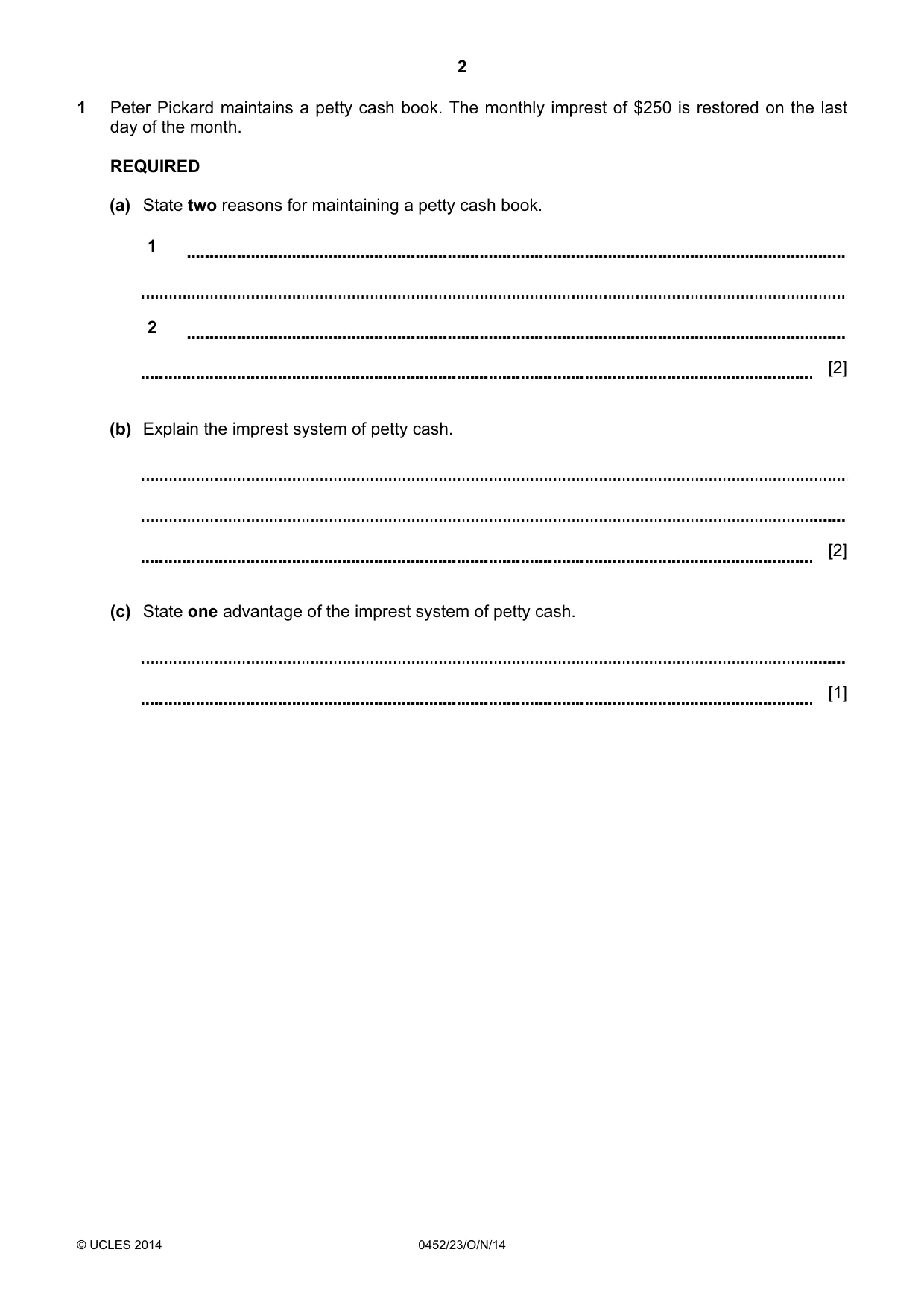
2 © UCLES 2014 0452/23/O/N/14 1 Peter Pickard maintains a petty cash book. The monthly imprest of $250 is restored on the last day of the month. REQUIRED (a) State two reasons for maintaining a petty cash book. 1 2 [2] (b) Explain the imprest system of petty cash. [2] (c) State one advantage of the imprest system of petty cash. [1]
Question paper, page 3
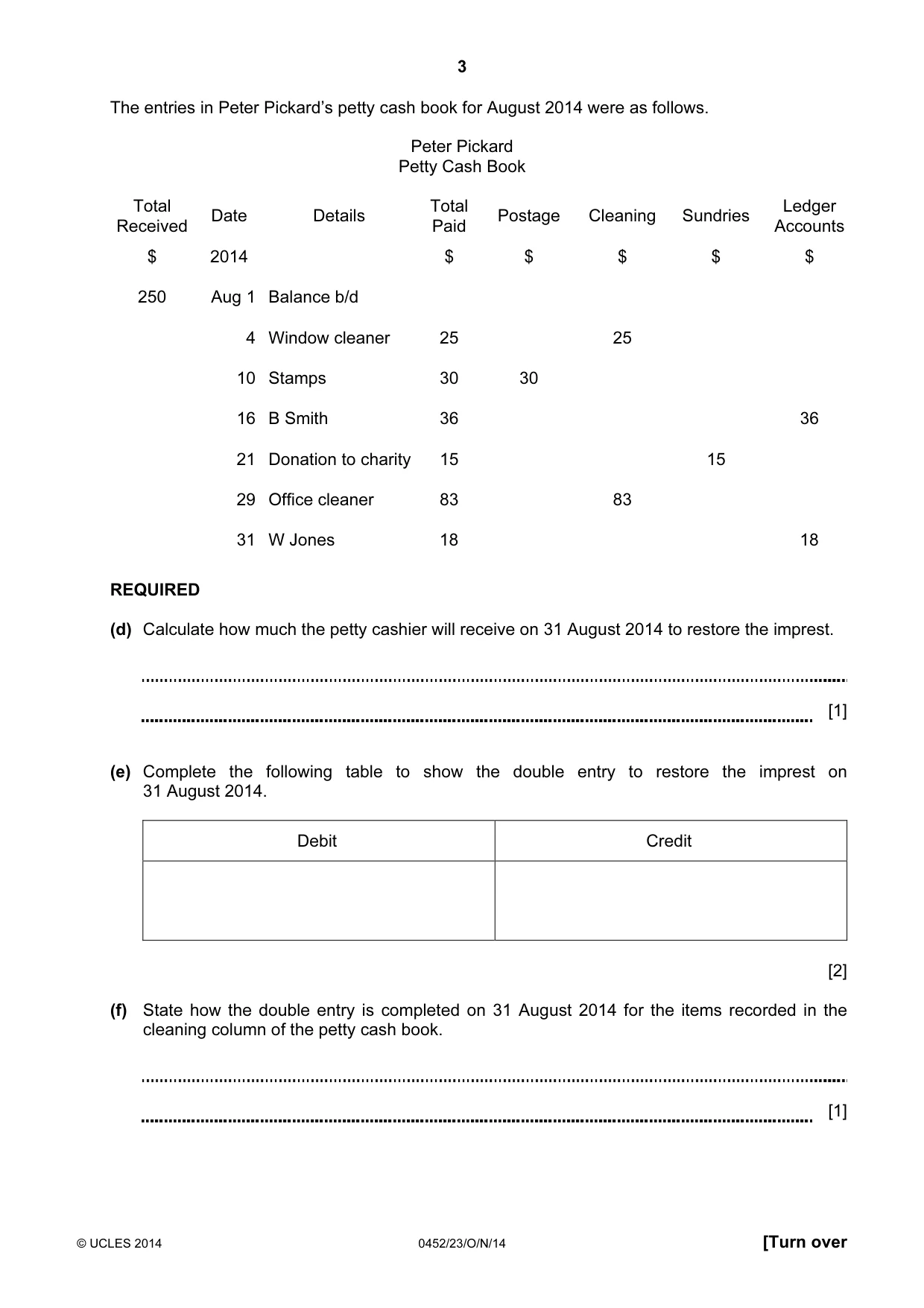
3 © UCLES 2014 0452/23/O/N/14 [Turn over The entries in Peter Pickard’s petty cash book for August 2014 were as follows. Peter Pickard Petty Cash Book Total Received Date Details Total Paid Postage Cleaning Sundries Ledger Accounts $ 2014 $ $ $ $ $ 250 Aug 1 Balance b/d 4 Window cleaner 25 25 10 Stamps 30 30 16 B Smith 36 36 21 Donation to charity 15 15 29 Office cleaner 83 83 31 W Jones 18 18 REQUIRED (d) Calculate how much the petty cashier will receive on 31 August 2014 to restore the imprest. [1] (e) Complete the following table to show the double entry to restore the imprest on 31 August 2014. Debit Credit [2] (f) State how the double entry is completed on 31 August 2014 for the items recorded in the cleaning column of the petty cash book. [1]
Question paper, page 4
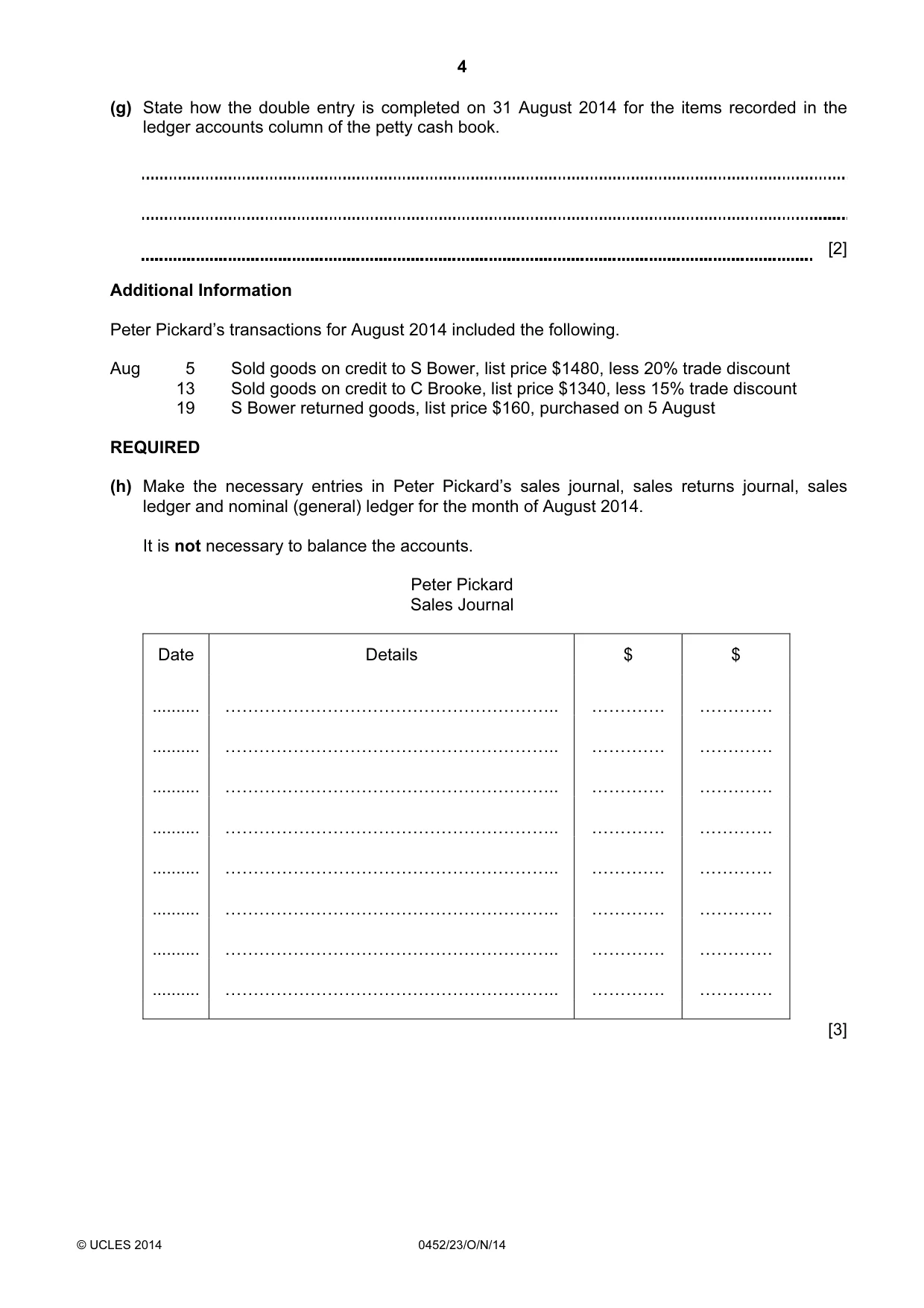
4 © UCLES 2014 0452/23/O/N/14 (g) State how the double entry is completed on 31 August 2014 for the items recorded in the ledger accounts column of the petty cash book. [2] Additional Information Peter Pickard’s transactions for August 2014 included the following. Aug 5 Sold goods on credit to S Bower, list price $1480, less 20% trade discount 13 Sold goods on credit to C Brooke, list price $1340, less 15% trade discount 19 S Bower returned goods, list price $160, purchased on 5 August REQUIRED (h) Make the necessary entries in Peter Pickard’s sales journal, sales returns journal, sales ledger and nominal (general) ledger for the month of August 2014. It is not necessary to balance the accounts. Peter Pickard Sales Journal Date Details $ $ … ………………………………………………….. …………. …………. … ………………………………………………….. …………. …………. … ………………………………………………….. …………. …………. … ………………………………………………….. …………. …………. … ………………………………………………….. …………. …………. … ………………………………………………….. …………. …………. … ………………………………………………….. …………. …………. … ………………………………………………….. …………. …………. [3]
Question paper, page 5
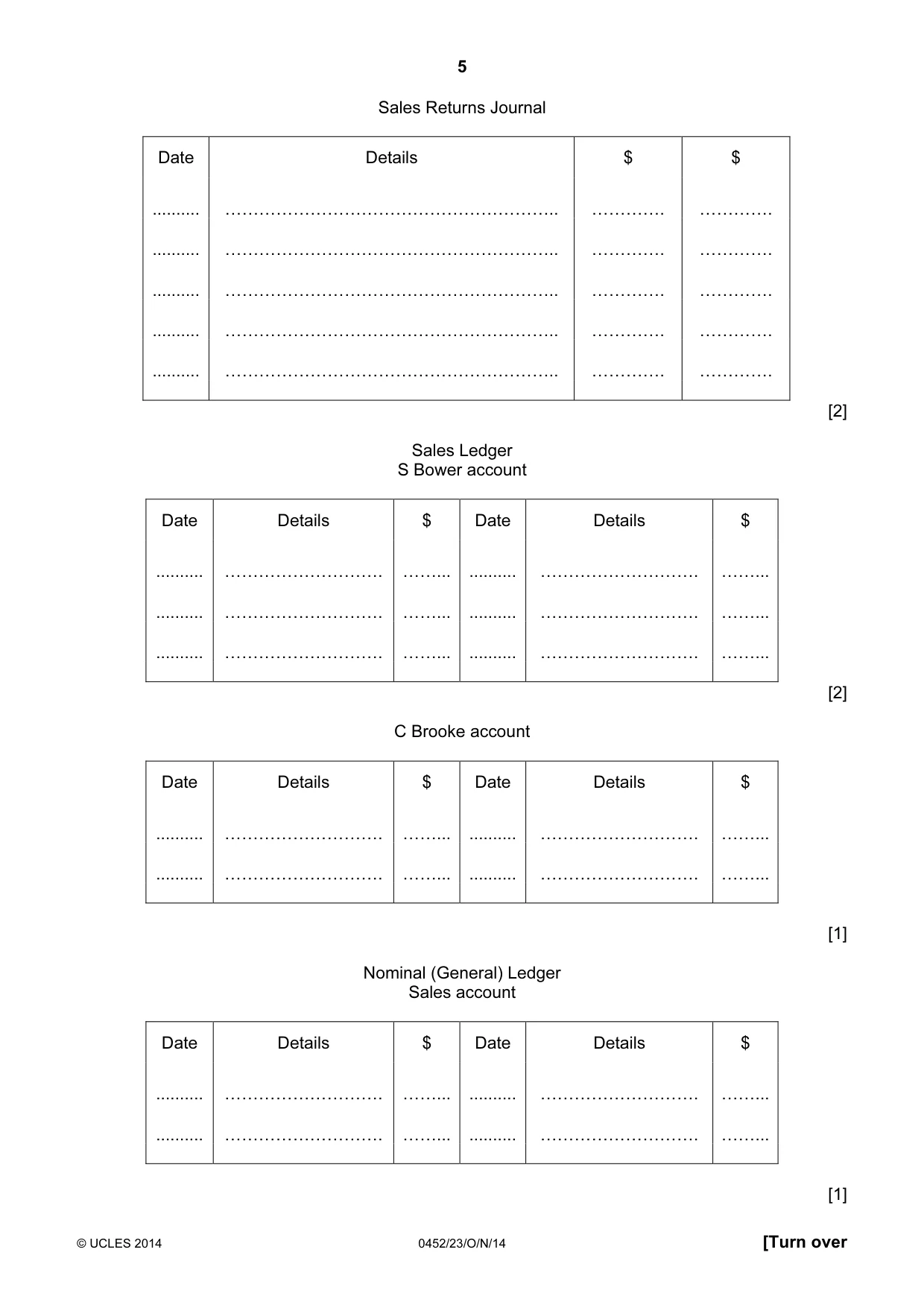
5 © UCLES 2014 0452/23/O/N/14 [Turn over Sales Returns Journal Date Details $ $ … ………………………………………………….. …………. …………. … ………………………………………………….. …………. …………. … ………………………………………………….. …………. …………. … ………………………………………………….. …………. …………. … ………………………………………………….. …………. …………. [2] Sales Ledger S Bower account Date Details $ Date Details $ … ………………………. ……... … ………………………. ……... … ………………………. ……... … ………………………. ……... … ………………………. ……... … ………………………. ……... [2] C Brooke account Date Details $ Date Details $ … ………………………. ……... … ………………………. ……... … ………………………. ……... … ………………………. ……... [1] Nominal (General) Ledger Sales account Date Details $ Date Details $ … ………………………. ……... … ………………………. ……... … ………………………. ……... … ………………………. ……... [1]
Question paper, page 6
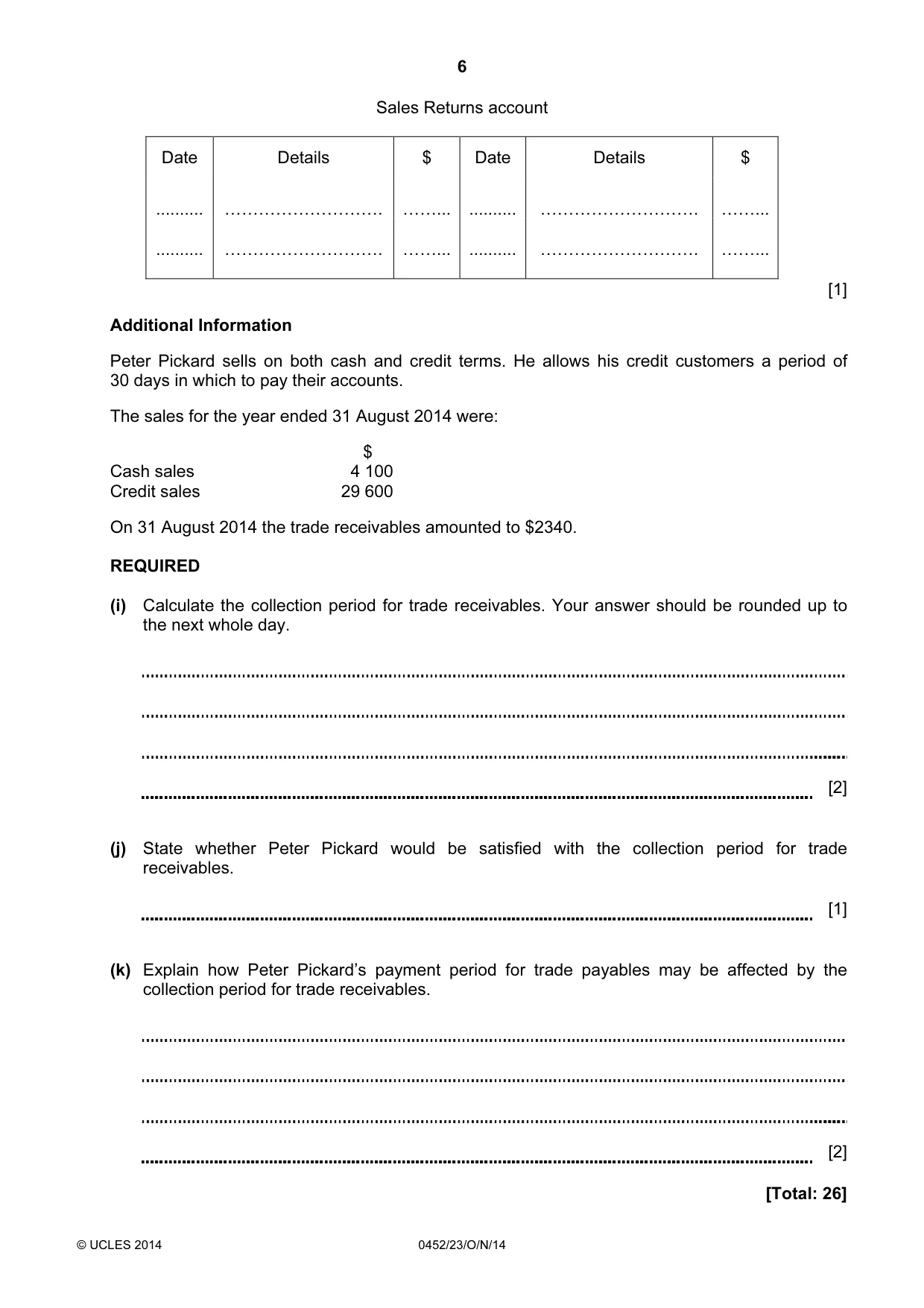
6 © UCLES 2014 0452/23/O/N/14 Sales Returns account Date Details $ Date Details $ … ………………………. ……... … ………………………. ……... … ………………………. ……... … ………………………. ……... [1] Additional Information Peter Pickard sells on both cash and credit terms. He allows his credit customers a period of 30 days in which to pay their accounts. The sales for the year ended 31 August 2014 were: $ Cash sales 4 100 Credit sales 29 600 On 31 August 2014 the trade receivables amounted to $2340. REQUIRED (i) Calculate the collection period for trade receivables. Your answer should be rounded up to the next whole day. [2] (j) State whether Peter Pickard would be satisfied with the collection period for trade receivables. [1] (k) Explain how Peter Pickard’s payment period for trade payables may be affected by the collection period for trade receivables. [2] [Total: 26]
Question paper, page 7
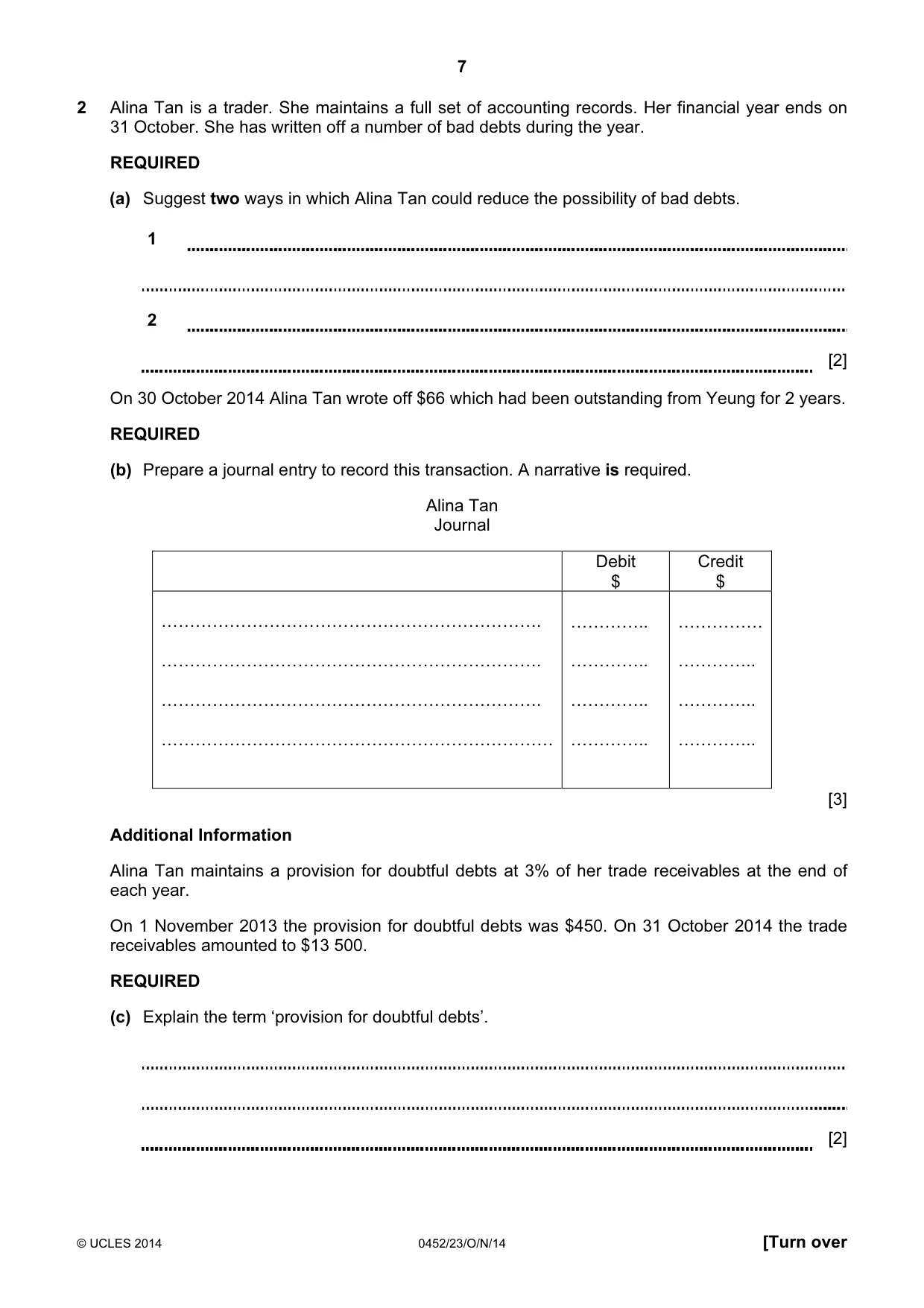
7 © UCLES 2014 0452/23/O/N/14 [Turn over 2 Alina Tan is a trader. She maintains a full set of accounting records. Her financial year ends on 31 October. She has written off a number of bad debts during the year. REQUIRED (a) Suggest two ways in which Alina Tan could reduce the possibility of bad debts. 1 2 [2] On 30 October 2014 Alina Tan wrote off $66 which had been outstanding from Yeung for 2 years. REQUIRED (b) Prepare a journal entry to record this transaction. A narrative is required. Alina Tan Journal Debit $ Credit $ …………………………………………………………. …………………………………………………………. …………………………………………………………. …………………………………………………………… ………….. ………….. ………….. ………….. …………… ………….. ………….. ………….. [3] Additional Information Alina Tan maintains a provision for doubtful debts at 3% of her trade receivables at the end of each year. On 1 November 2013 the provision for doubtful debts was $450. On 31 October 2014 the trade receivables amounted to $13 500. REQUIRED (c) Explain the term ‘provision for doubtful debts’. [2]
Question paper, page 8
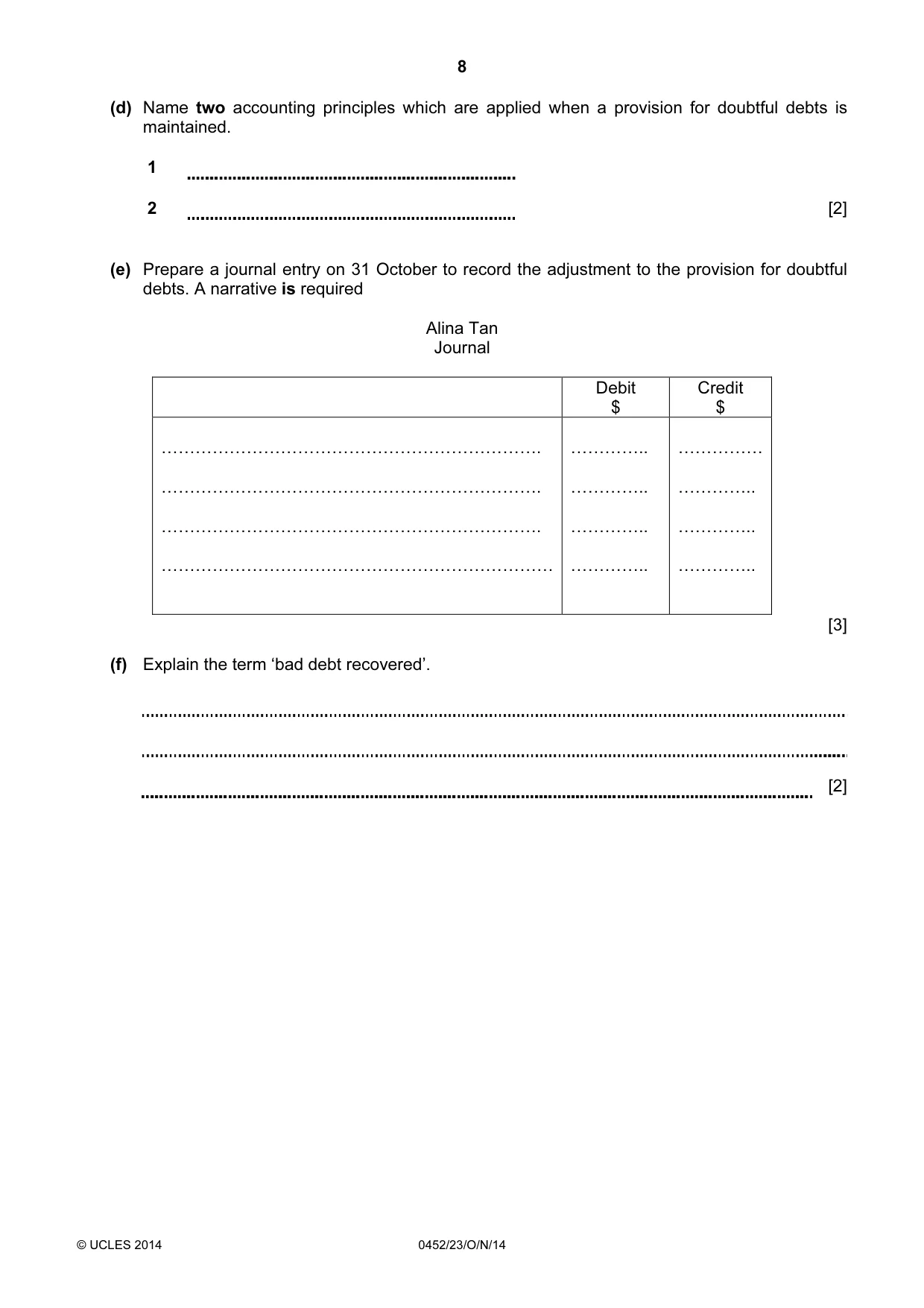
8 © UCLES 2014 0452/23/O/N/14 (d) Name two accounting principles which are applied when a provision for doubtful debts is maintained. 1 2 [2] (e) Prepare a journal entry on 31 October to record the adjustment to the provision for doubtful debts. A narrative is required Alina Tan Journal Debit $ Credit $ …………………………………………………………. …………………………………………………………. …………………………………………………………. …………………………………………………………… ………….. ………….. ………….. ………….. …………… ………….. ………….. ………….. [3] (f) Explain the term ‘bad debt recovered’. [2]
Question paper, page 9
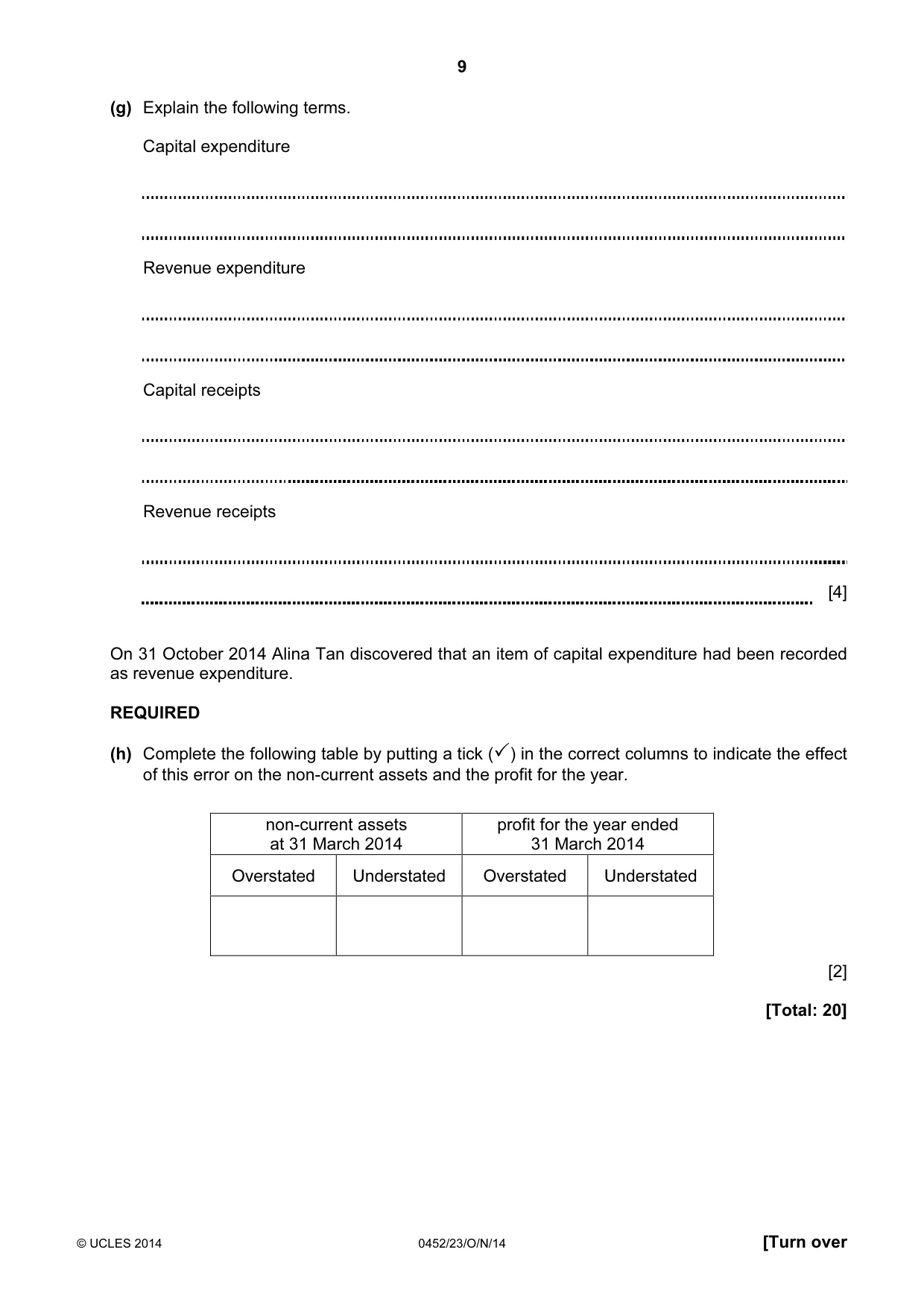
9 © UCLES 2014 0452/23/O/N/14 [Turn over (g) Explain the following terms. Capital expenditure Revenue expenditure Capital receipts Revenue receipts [4] On 31 October 2014 Alina Tan discovered that an item of capital expenditure had been recorded as revenue expenditure. REQUIRED (h) Complete the following table by putting a tick (✓) in the correct columns to indicate the effect of this error on the non-current assets and the profit for the year. [2] [Total: 20] non-current assets at 31 March 2014 profit for the year ended 31 March 2014 Overstated Understated Overstated Understated
Question paper, page 10
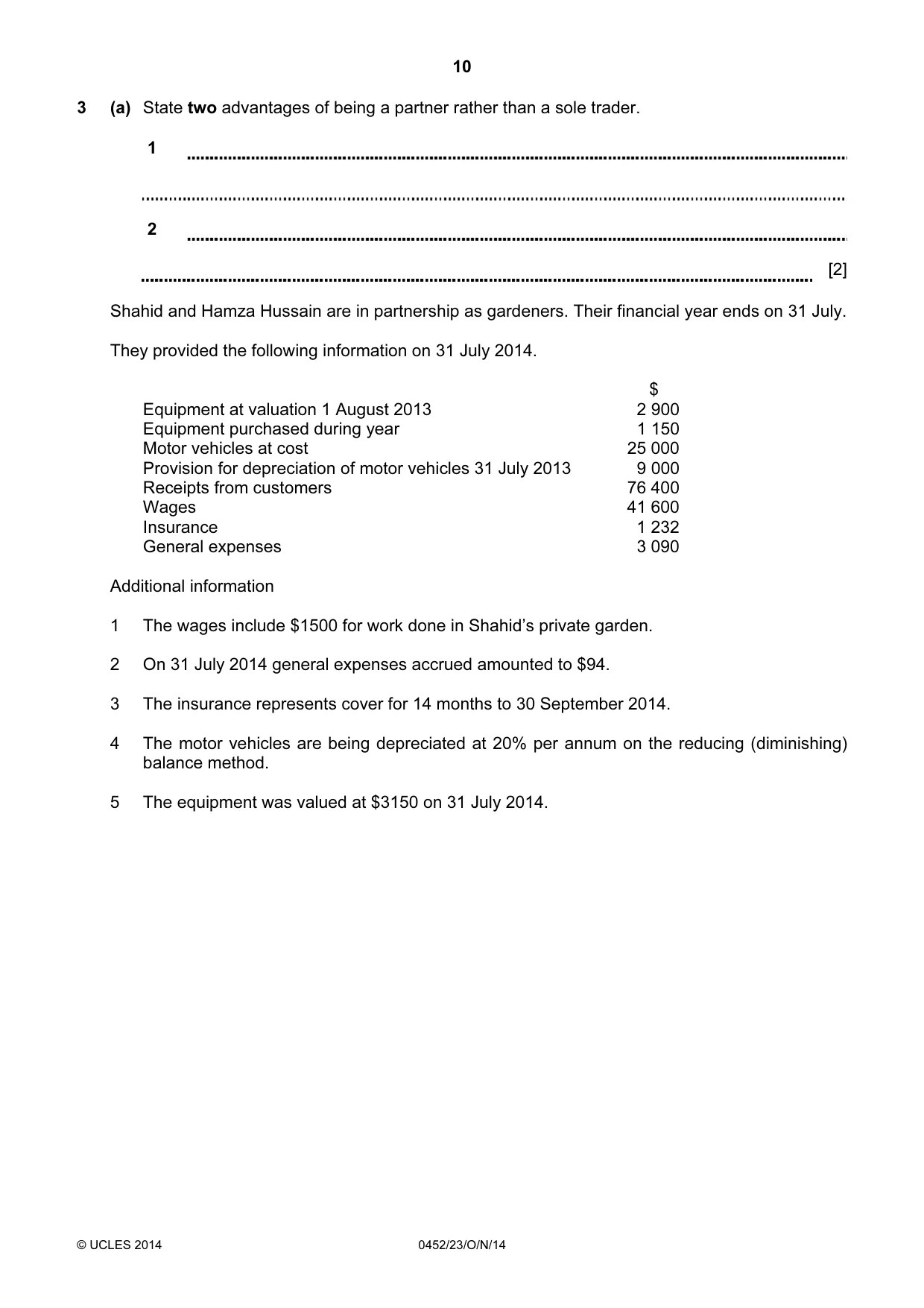
10 © UCLES 2014 0452/23/O/N/14 3 (a) State two advantages of being a partner rather than a sole trader. 1 2 [2] Shahid and Hamza Hussain are in partnership as gardeners. Their financial year ends on 31 July. They provided the following information on 31 July 2014. $ Equipment at valuation 1 August 2013 2 900 Equipment purchased during year 1 150 Motor vehicles at cost 25 000 Provision for depreciation of motor vehicles 31 July 2013 9 000 Receipts from customers 76 400 Wages 41 600 Insurance 1 232 General expenses 3 090 Additional information 1 The wages include $1500 for work done in Shahid’s private garden. 2 On 31 July 2014 general expenses accrued amounted to $94. 3 The insurance represents cover for 14 months to 30 September 2014. 4 The motor vehicles are being depreciated at 20% per annum on the reducing (diminishing) balance method. 5 The equipment was valued at $3150 on 31 July 2014.
Question paper, page 11
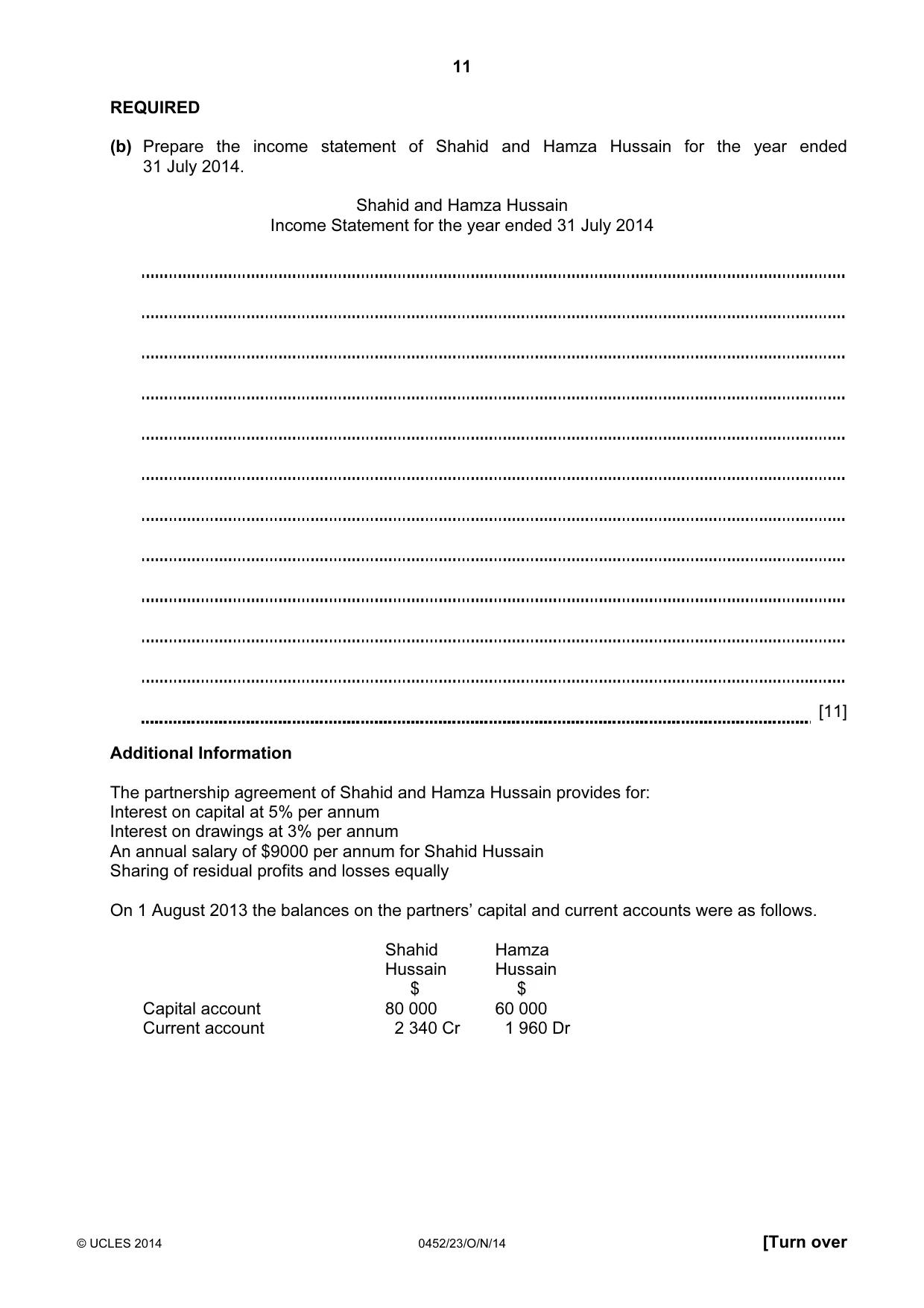
11 © UCLES 2014 0452/23/O/N/14 [Turn over REQUIRED (b) Prepare the income statement of Shahid and Hamza Hussain for the year ended 31 July 2014. Shahid and Hamza Hussain Income Statement for the year ended 31 July 2014 [11] Additional Information The partnership agreement of Shahid and Hamza Hussain provides for: Interest on capital at 5% per annum Interest on drawings at 3% per annum An annual salary of $9000 per annum for Shahid Hussain Sharing of residual profits and losses equally On 1 August 2013 the balances on the partners’ capital and current accounts were as follows. Shahid Hamza Hussain Hussain $ $ Capital account 80 000 60 000 Current account 2 340 Cr 1 960 Dr
Question paper, page 12
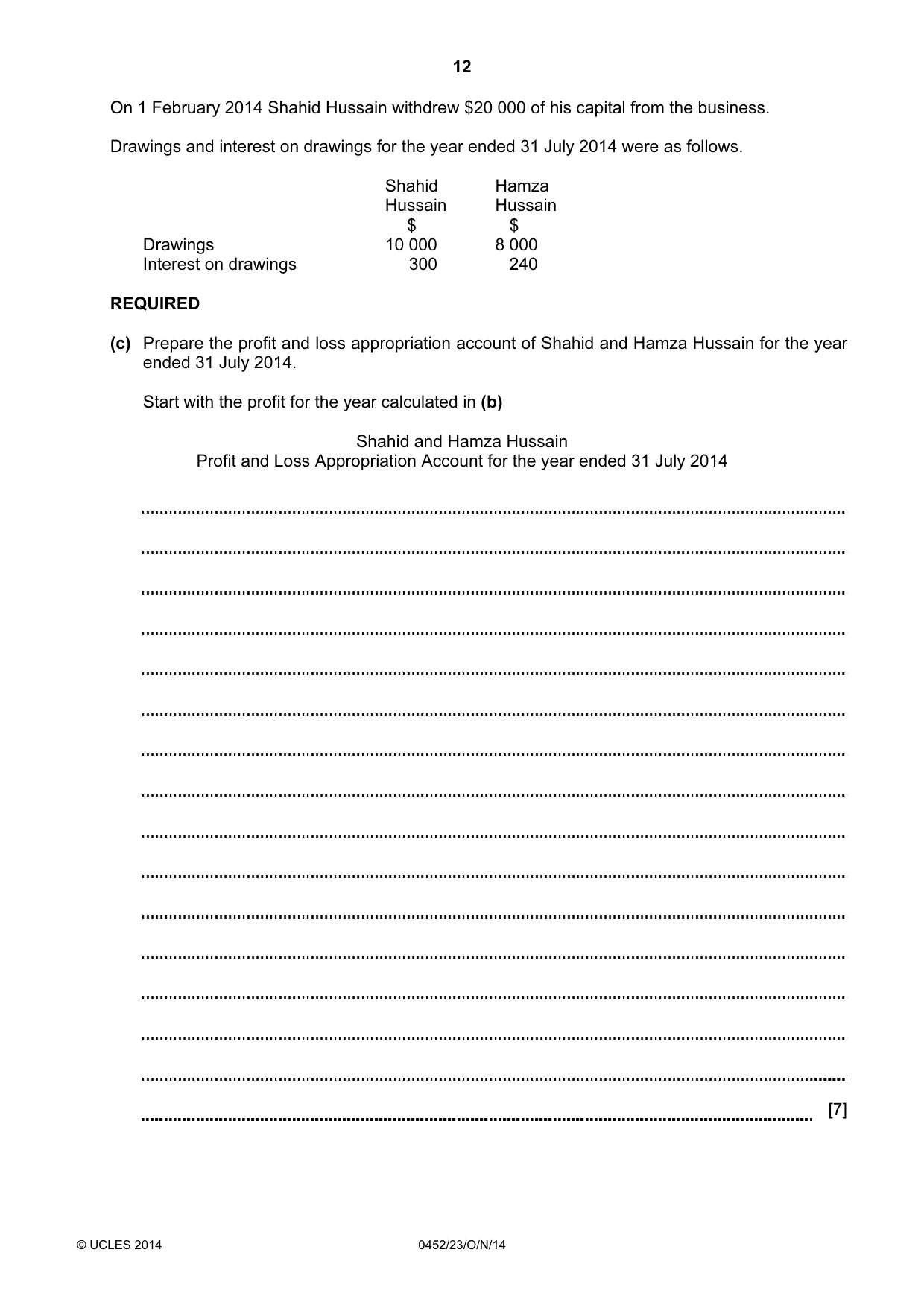
12 © UCLES 2014 0452/23/O/N/14 On 1 February 2014 Shahid Hussain withdrew $20 000 of his capital from the business. Drawings and interest on drawings for the year ended 31 July 2014 were as follows. Shahid Hamza Hussain Hussain $ $ Drawings 10 000 8 000 Interest on drawings 300 240 REQUIRED (c) Prepare the profit and loss appropriation account of Shahid and Hamza Hussain for the year ended 31 July 2014. Start with the profit for the year calculated in (b) Shahid and Hamza Hussain Profit and Loss Appropriation Account for the year ended 31 July 2014 [7]
Question paper, page 13
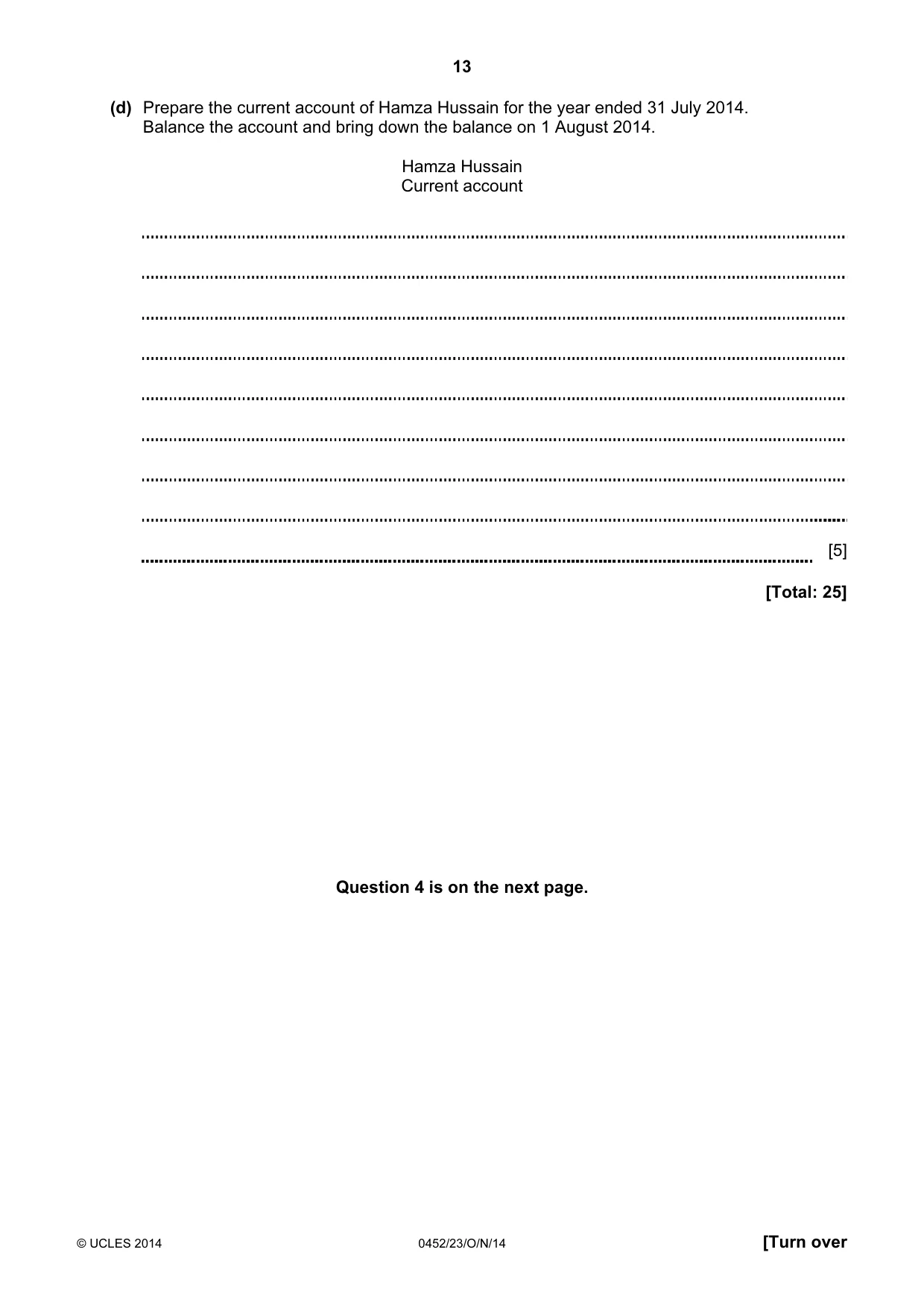
13 © UCLES 2014 0452/23/O/N/14 [Turn over (d) Prepare the current account of Hamza Hussain for the year ended 31 July 2014. Balance the account and bring down the balance on 1 August 2014. Hamza Hussain Current account [5] [Total: 25] Question 4 is on the next page.
Question paper, page 14
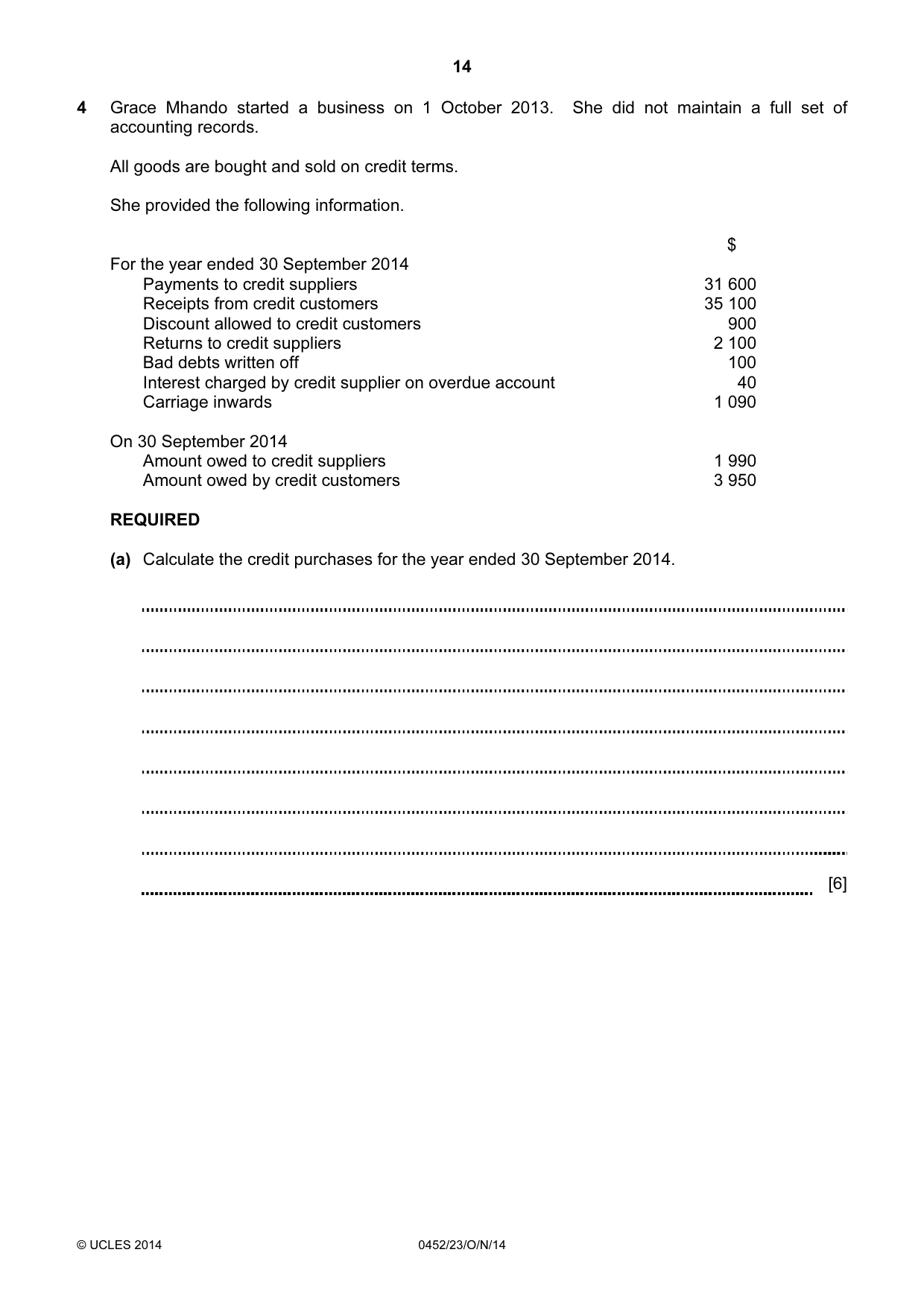
14 © UCLES 2014 0452/23/O/N/14 4 Grace Mhando started a business on 1 October 2013. She did not maintain a full set of accounting records. All goods are bought and sold on credit terms. She provided the following information. $ For the year ended 30 September 2014 Payments to credit suppliers 31 600 Receipts from credit customers 35 100 Discount allowed to credit customers 900 Returns to credit suppliers 2 100 Bad debts written off 100 Interest charged by credit supplier on overdue account 40 Carriage inwards 1 090 On 30 September 2014 Amount owed to credit suppliers 1 990 Amount owed by credit customers 3 950 REQUIRED (a) Calculate the credit purchases for the year ended 30 September 2014. [6]
Question paper, page 15
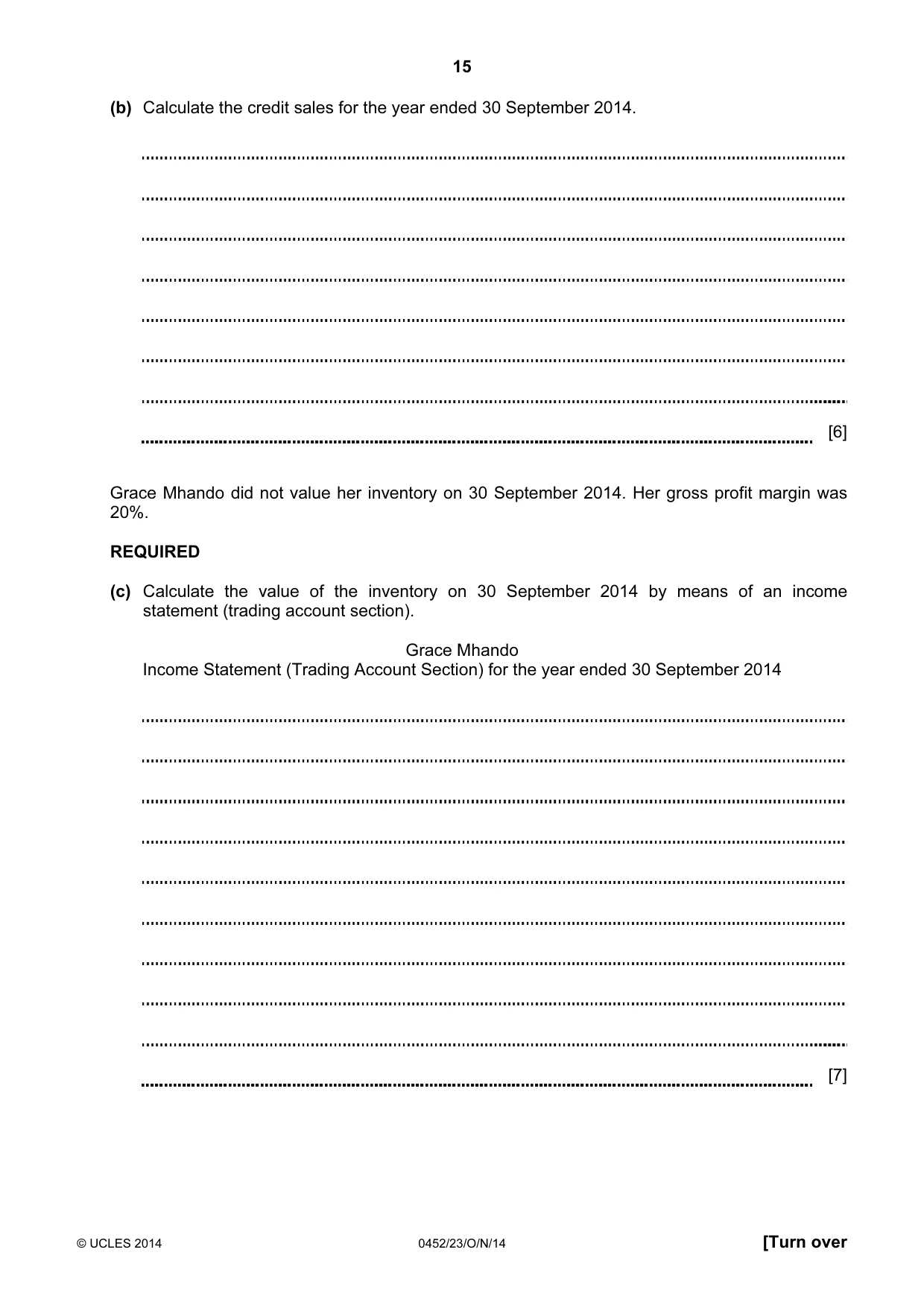
15 © UCLES 2014 0452/23/O/N/14 [Turn over (b) Calculate the credit sales for the year ended 30 September 2014. [6] Grace Mhando did not value her inventory on 30 September 2014. Her gross profit margin was 20%. REQUIRED (c) Calculate the value of the inventory on 30 September 2014 by means of an income statement (trading account section). Grace Mhando Income Statement (Trading Account Section) for the year ended 30 September 2014 [7]
Question paper, page 16
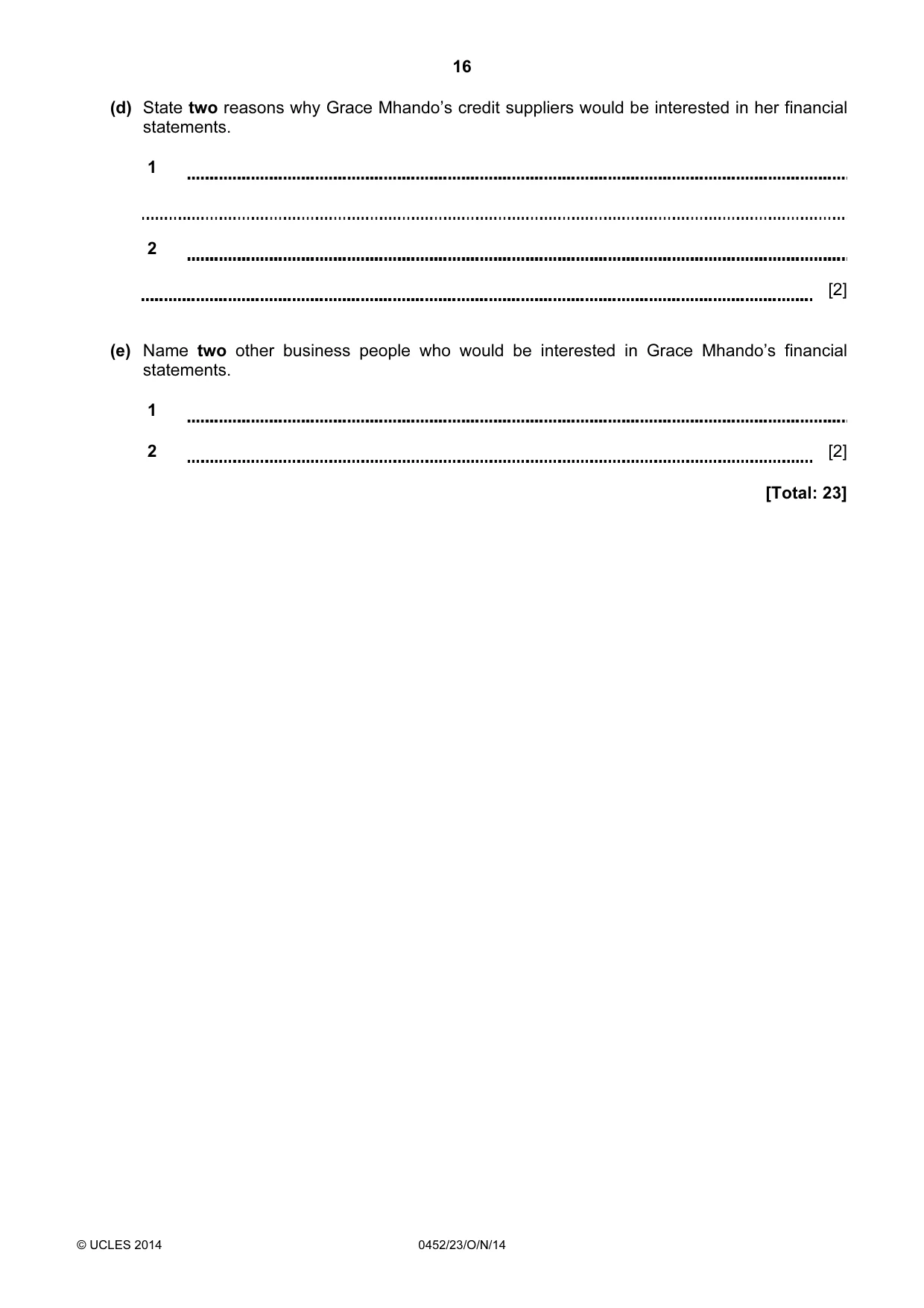
16 © UCLES 2014 0452/23/O/N/14 (d) State two reasons why Grace Mhando’s credit suppliers would be interested in her financial statements. 1 2 [2] (e) Name two other business people who would be interested in Grace Mhando’s financial statements. 1 2 [2] [Total: 23]
Question paper, page 17
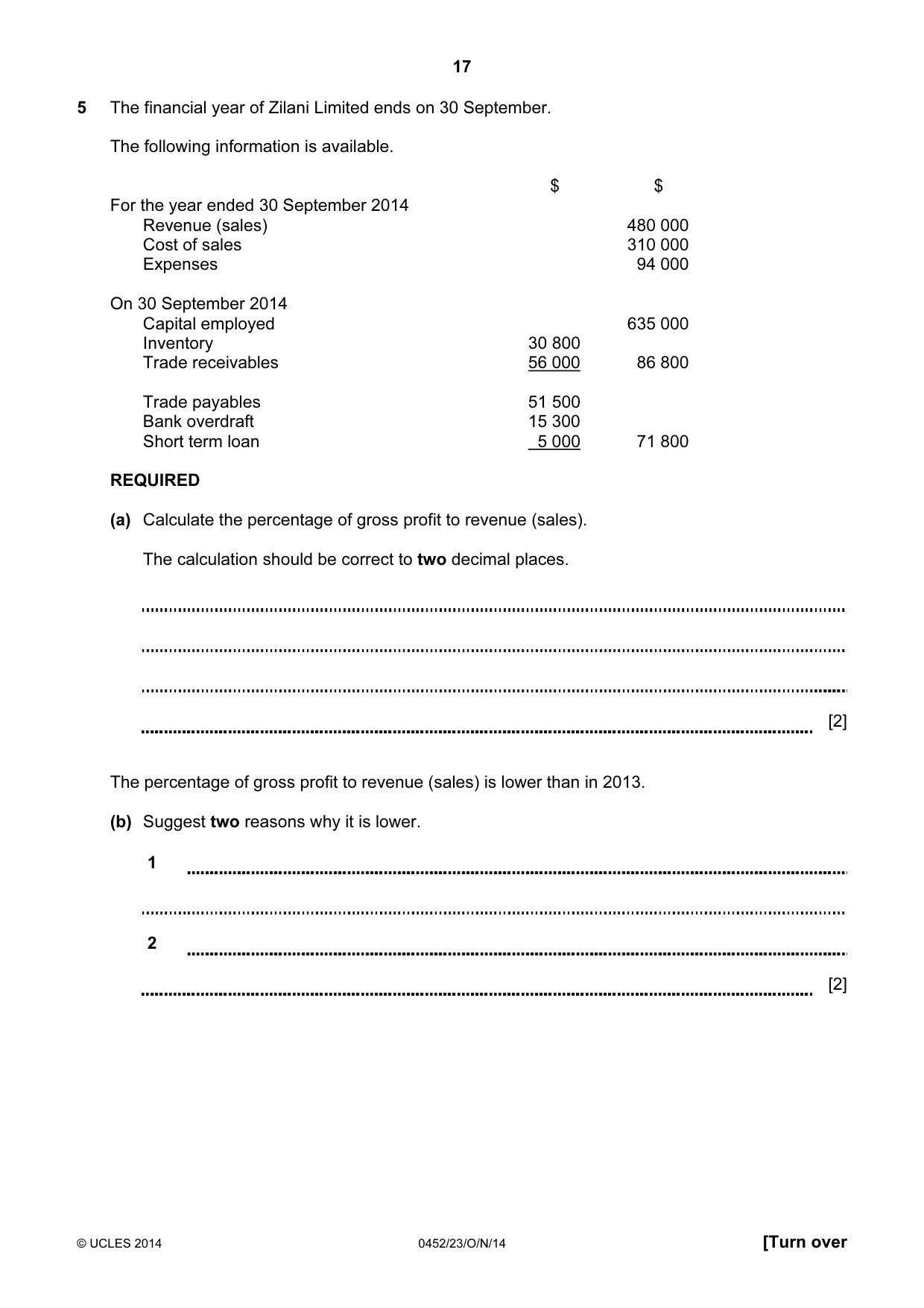
17 © UCLES 2014 0452/23/O/N/14 [Turn over 5 The financial year of Zilani Limited ends on 30 September. The following information is available. $ $ For the year ended 30 September 2014 Revenue (sales) 480 000 Cost of sales 310 000 Expenses 94 000 On 30 September 2014 Capital employed 635 000 Inventory 30 800 Trade receivables 56 000 86 800 Trade payables 51 500 Bank overdraft 15 300 Short term loan 5 000 71 800 REQUIRED (a) Calculate the percentage of gross profit to revenue (sales). The calculation should be correct to two decimal places. [2] The percentage of gross profit to revenue (sales) is lower than in 2013. (b) Suggest two reasons why it is lower. 1 2 [2]
Question paper, page 18
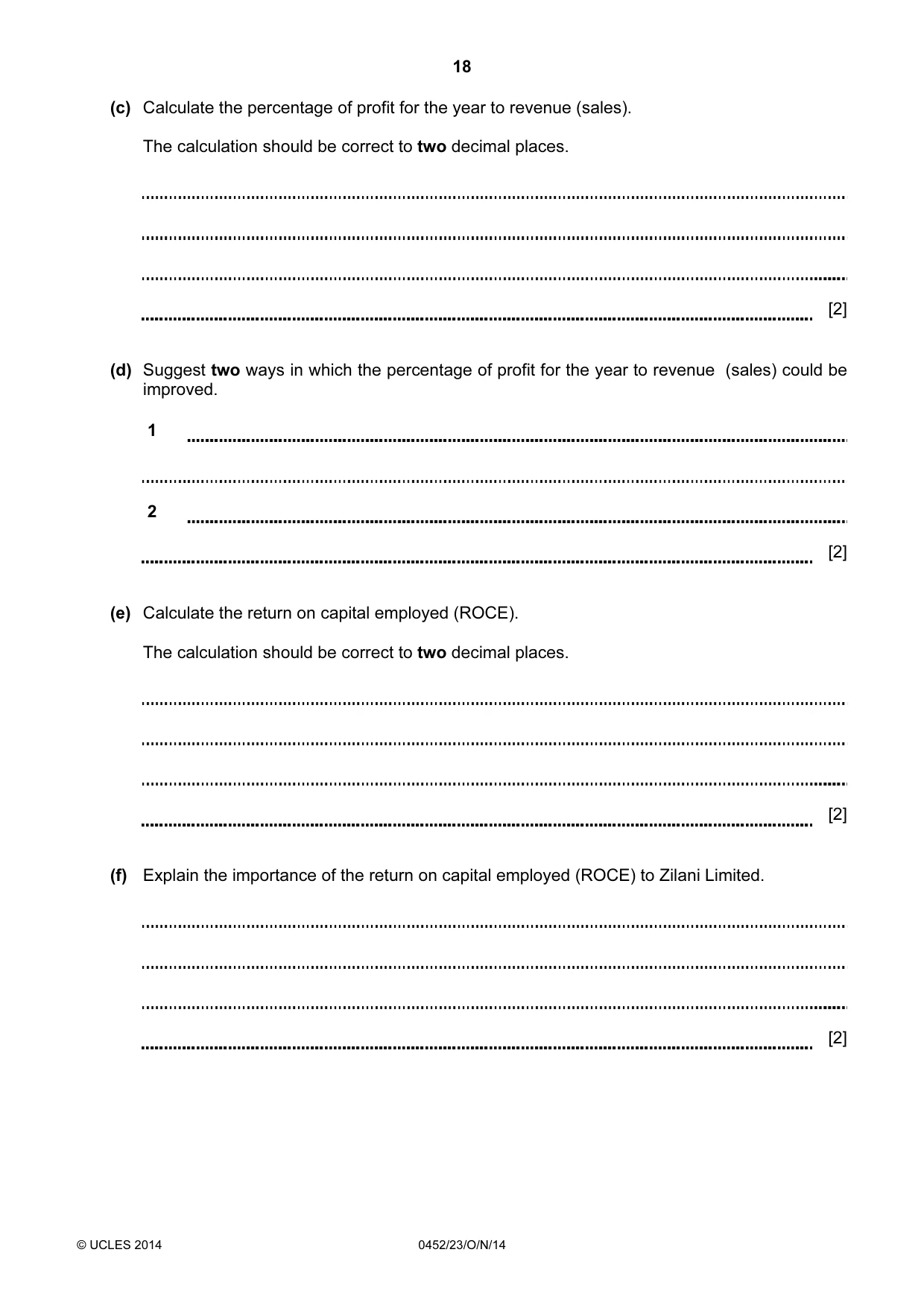
18 © UCLES 2014 0452/23/O/N/14 (c) Calculate the percentage of profit for the year to revenue (sales). The calculation should be correct to two decimal places. [2] (d) Suggest two ways in which the percentage of profit for the year to revenue (sales) could be improved. 1 2 [2] (e) Calculate the return on capital employed (ROCE). The calculation should be correct to two decimal places. [2] (f) Explain the importance of the return on capital employed (ROCE) to Zilani Limited. [2]
Question paper, page 19
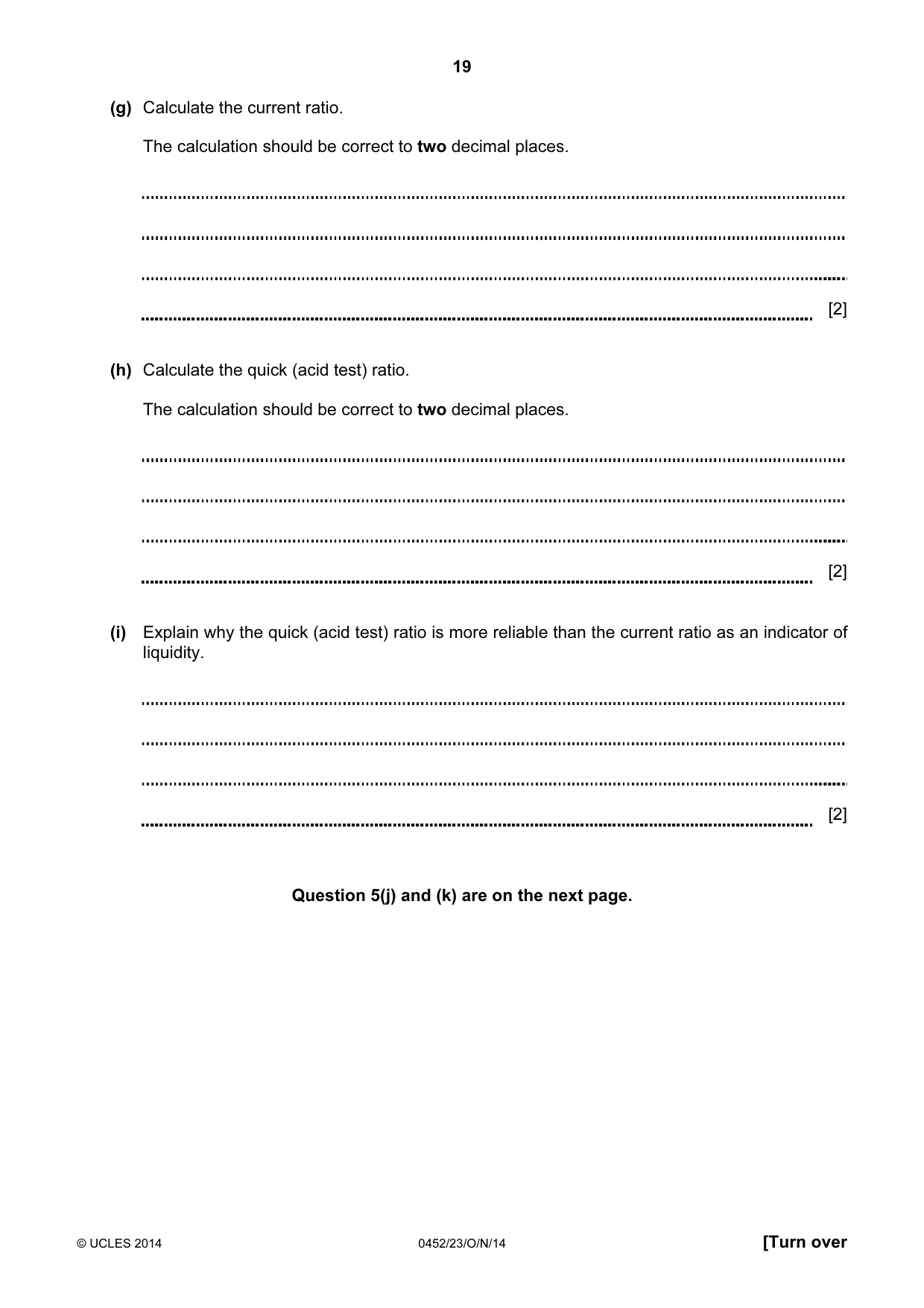
19 © UCLES 2014 0452/23/O/N/14 [Turn over (g) Calculate the current ratio. The calculation should be correct to two decimal places. [2] (h) Calculate the quick (acid test) ratio. The calculation should be correct to two decimal places. [2] (i) Explain why the quick (acid test) ratio is more reliable than the current ratio as an indicator of liquidity. [2] Question 5(j) and (k) are on the next page.
Question paper, page 20
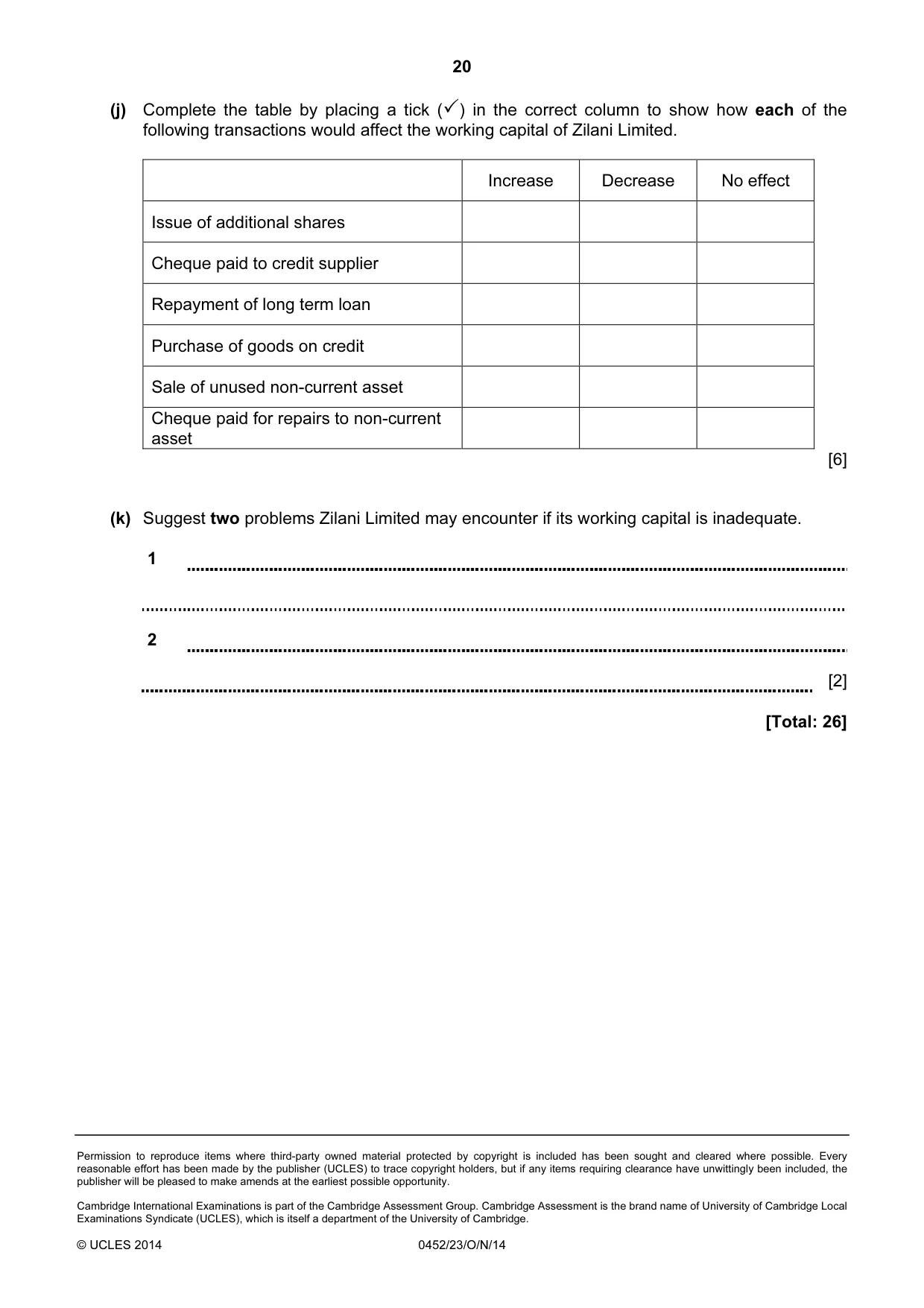
20 Permission to reproduce items where third-party owned material protected by copyright is included has been sought and cleared where possible. Every reasonable effort has been made by the publisher (UCLES) to trace copyright holders, but if any items requiring clearance have unwittingly been included, the publisher will be pleased to make amends at the earliest possible opportunity. Cambridge International Examinations is part of the Cambridge Assessment Group. Cambridge Assessment is the brand name of University of Cambridge Local Examinations Syndicate (UCLES), which is itself a department of the University of Cambridge. © UCLES 2014 0452/23/O/N/14 (j) Complete the table by placing a tick (✓) in the correct column to show how each of the following transactions would affect the working capital of Zilani Limited. Increase Decrease No effect Issue of additional shares Cheque paid to credit supplier Repayment of long term loan Purchase of goods on credit Sale of unused non-current asset Cheque paid for repairs to non-current asset [6] (k) Suggest two problems Zilani Limited may encounter if its working capital is inadequate. 1 2 [2] [Total: 26]
Mark scheme, page 1
® IGCSE is the registered trademark of Cambridge International Examinations. CAMBRIDGE INTERNATIONAL EXAMINATIONS Cambridge International General Certificate of Secondary Education MARK SCHEME for the October/November 2014 series 0452 ACCOUNTING 0452/23 Paper 2, maximum raw mark 120 This mark scheme is published as an aid to teachers and candidates, to indicate the requirements of the examination. It shows the basis on which Examiners were instructed to award marks. It does not indicate the details of the discussions that took place at an Examiners’ meeting before marking began, which would have considered the acceptability of alternative answers. Mark schemes should be read in conjunction with the question paper and the Principal Examiner Report for Teachers. Cambridge will not enter into discussions about these mark schemes. Cambridge is publishing the mark schemes for the October/November 2014 series for most Cambridge IGCSE®, Cambridge International A and AS Level components and some Cambridge O Level components.
Mark scheme, page 2
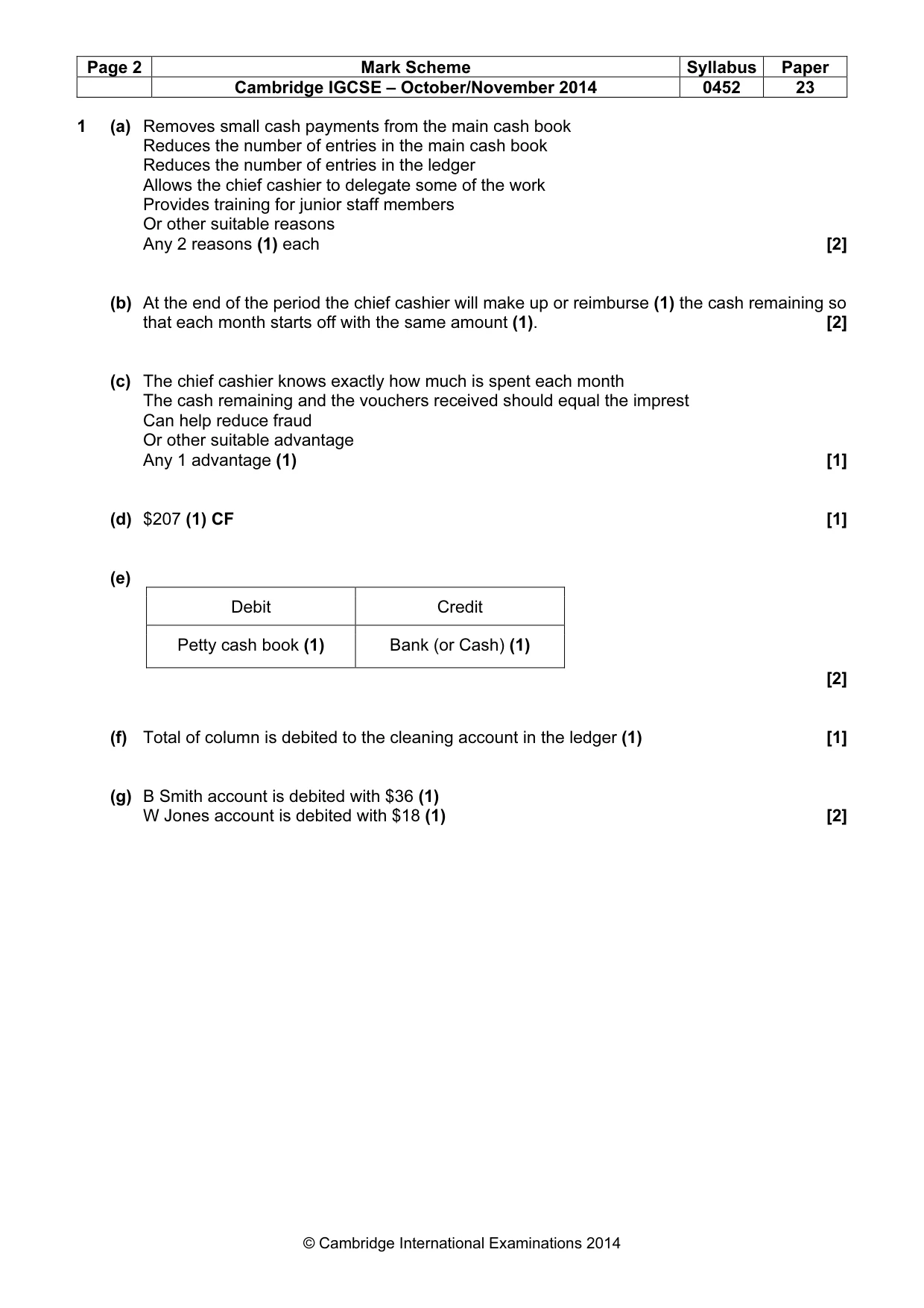
Page 2 Mark Scheme Syllabus Paper Cambridge IGCSE – October/November 2014 0452 23 © Cambridge International Examinations 2014 1 (a) Removes small cash payments from the main cash book Reduces the number of entries in the main cash book Reduces the number of entries in the ledger Allows the chief cashier to delegate some of the work Provides training for junior staff members Or other suitable reasons Any 2 reasons (1) each [2] (b) At the end of the period the chief cashier will make up or reimburse (1) the cash remaining so that each month starts off with the same amount (1). [2] (c) The chief cashier knows exactly how much is spent each month The cash remaining and the vouchers received should equal the imprest Can help reduce fraud Or other suitable advantage Any 1 advantage (1) [1] (d) $207 (1) CF [1] (e) Debit Credit Petty cash book (1) Bank (or Cash) (1) [2] (f) Total of column is debited to the cleaning account in the ledger (1) [1] (g) B Smith account is debited with $36 (1) W Jones account is debited with $18 (1) [2]
Mark scheme, page 3
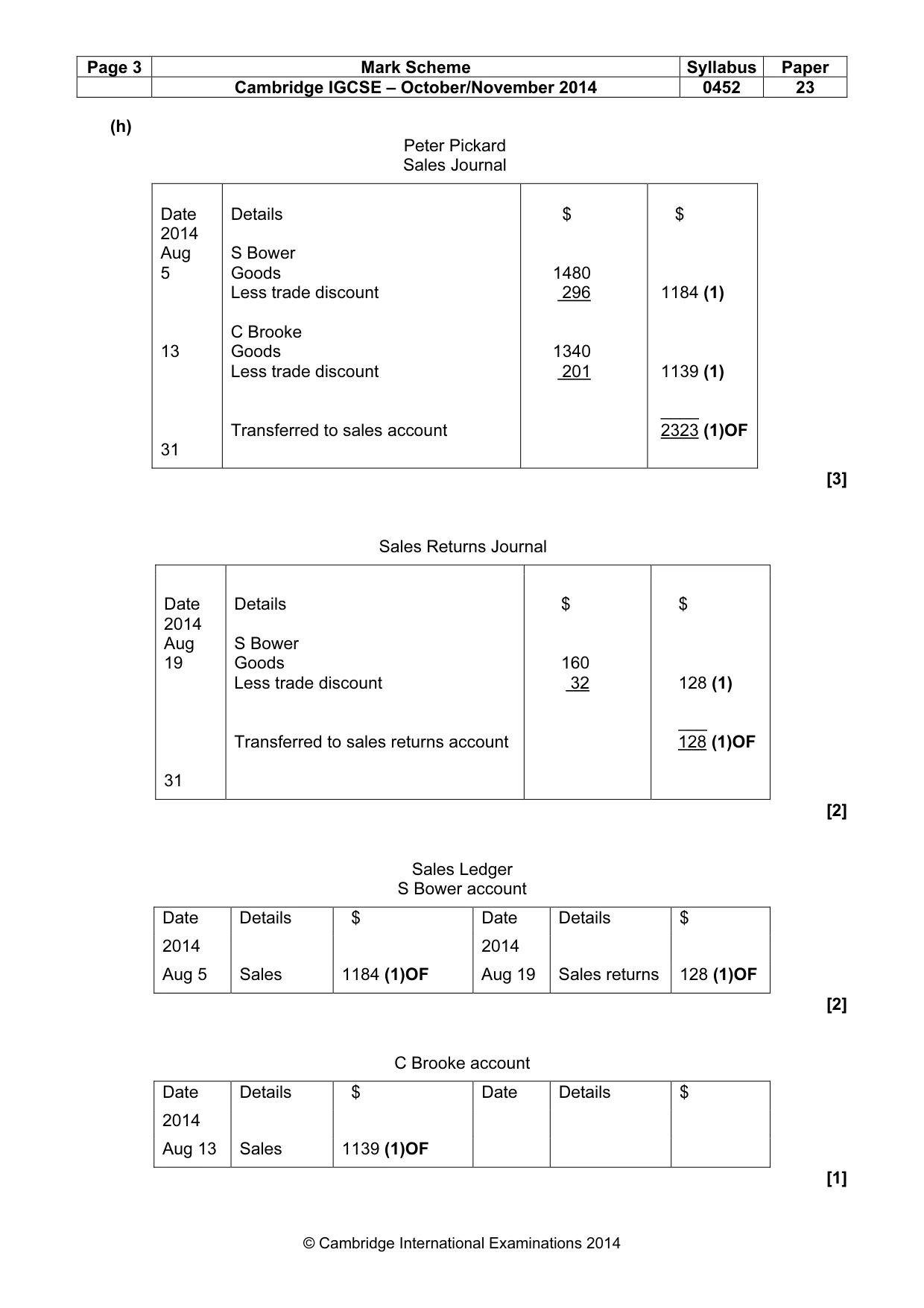
Page 3 Mark Scheme Syllabus Paper Cambridge IGCSE – October/November 2014 0452 23 © Cambridge International Examinations 2014 (h) Peter Pickard Sales Journal Date 2014 Aug 5 13 31 Details S Bower Goods Less trade discount C Brooke Goods Less trade discount Transferred to sales account $ 1480 296 1340 201 $ 1184 (1) 1139 (1) ____ 2323 (1)OF [3] Sales Returns Journal Date 2014 Aug 19 31 Details S Bower Goods Less trade discount Transferred to sales returns account $ 160 32 $ 128 (1) ___ 128 (1)OF [2] Sales Ledger S Bower account Date Details $ Date Details $ 2014 2014 Aug 5 Sales 1184 (1)OF Aug 19 Sales returns 128 (1)OF [2] C Brooke account Date Details $ Date Details $ 2014 Aug 13 Sales 1139 (1)OF [1]
Mark scheme, page 4
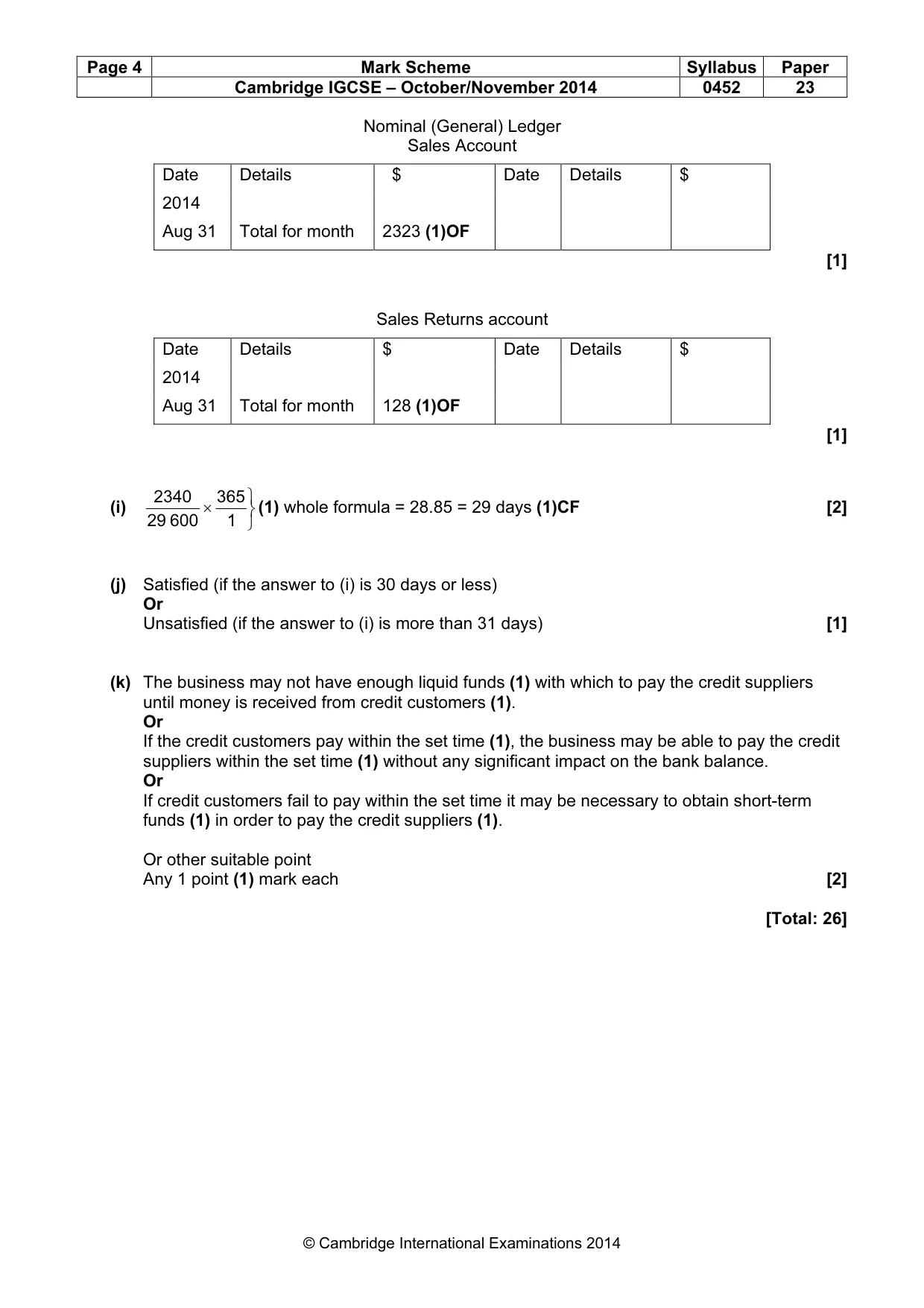
Page 4 Mark Scheme Syllabus Paper Cambridge IGCSE – October/November 2014 0452 23 © Cambridge International Examinations 2014 Nominal (General) Ledger Sales Account Date Details $ Date Details $ 2014 Aug 31 Total for month 2323 (1)OF [1] Sales Returns account Date Details $ Date Details $ 2014 Aug 31 Total for month 128 (1)OF [1] (i) × 1 365 600 29 2340 (1) whole formula = 28.85 = 29 days (1)CF [2] (j) Satisfied (if the answer to (i) is 30 days or less) Or Unsatisfied (if the answer to (i) is more than 31 days) [1] (k) The business may not have enough liquid funds (1) with which to pay the credit suppliers until money is received from credit customers (1). Or If the credit customers pay within the set time (1), the business may be able to pay the credit suppliers within the set time (1) without any significant impact on the bank balance. Or If credit customers fail to pay within the set time it may be necessary to obtain short-term funds (1) in order to pay the credit suppliers (1). Or other suitable point Any 1 point (1) mark each [2] [Total: 26]
Mark scheme, page 5
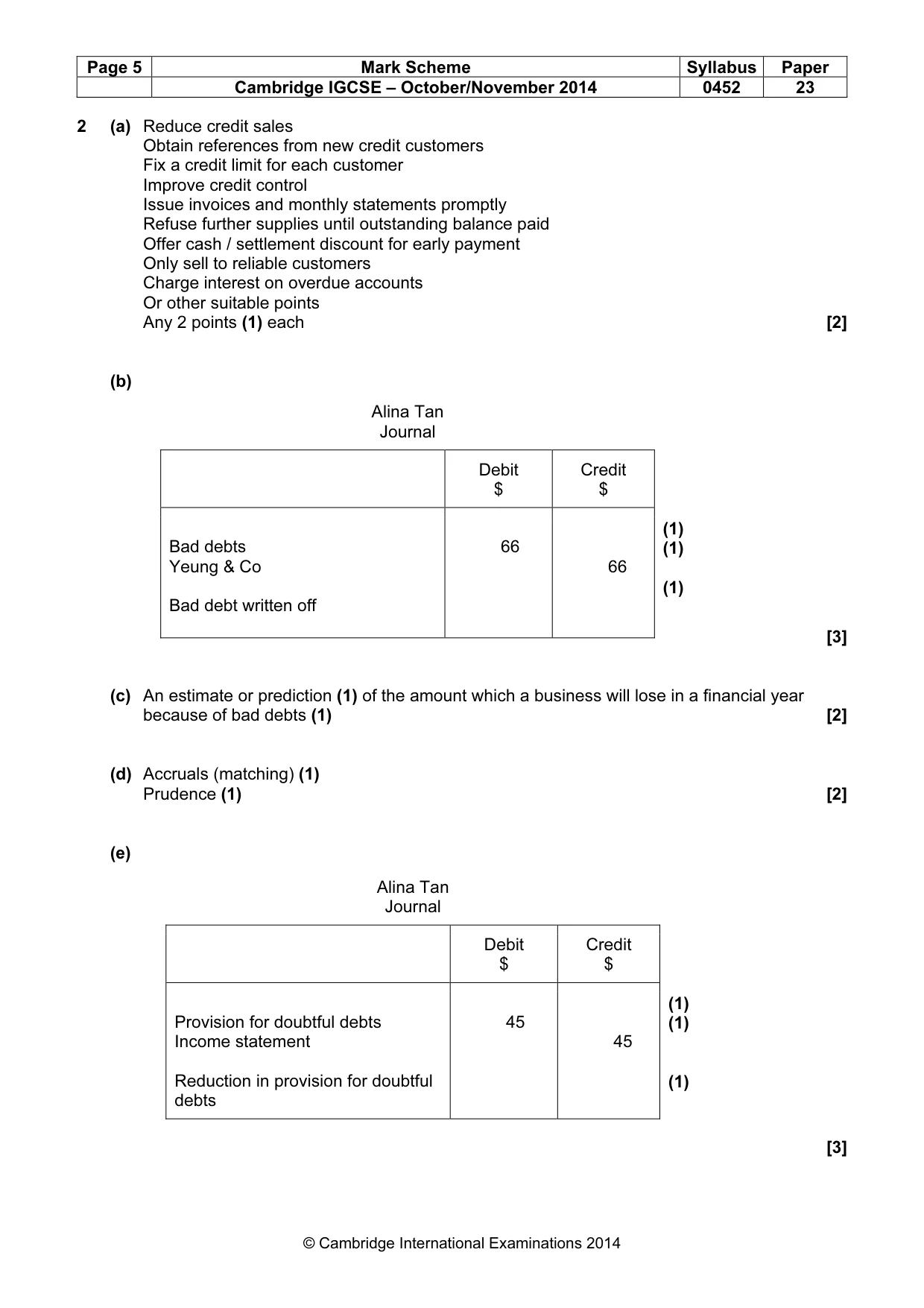
Page 5 Mark Scheme Syllabus Paper Cambridge IGCSE – October/November 2014 0452 23 © Cambridge International Examinations 2014 2 (a) Reduce credit sales Obtain references from new credit customers Fix a credit limit for each customer Improve credit control Issue invoices and monthly statements promptly Refuse further supplies until outstanding balance paid Offer cash / settlement discount for early payment Only sell to reliable customers Charge interest on overdue accounts Or other suitable points Any 2 points (1) each [2] (b) [3] (c) An estimate or prediction (1) of the amount which a business will lose in a financial year because of bad debts (1) [2] (d) Accruals (matching) (1) Prudence (1) [2] (e) [3] Alina Tan Journal Debit $ Credit $ (1) (1) (1) Bad debts Yeung & Co Bad debt written off 66 66 Alina Tan Journal Debit $ Credit $ (1) (1) (1) Provision for doubtful debts Income statement Reduction in provision for doubtful debts 45 45
Mark scheme, page 6
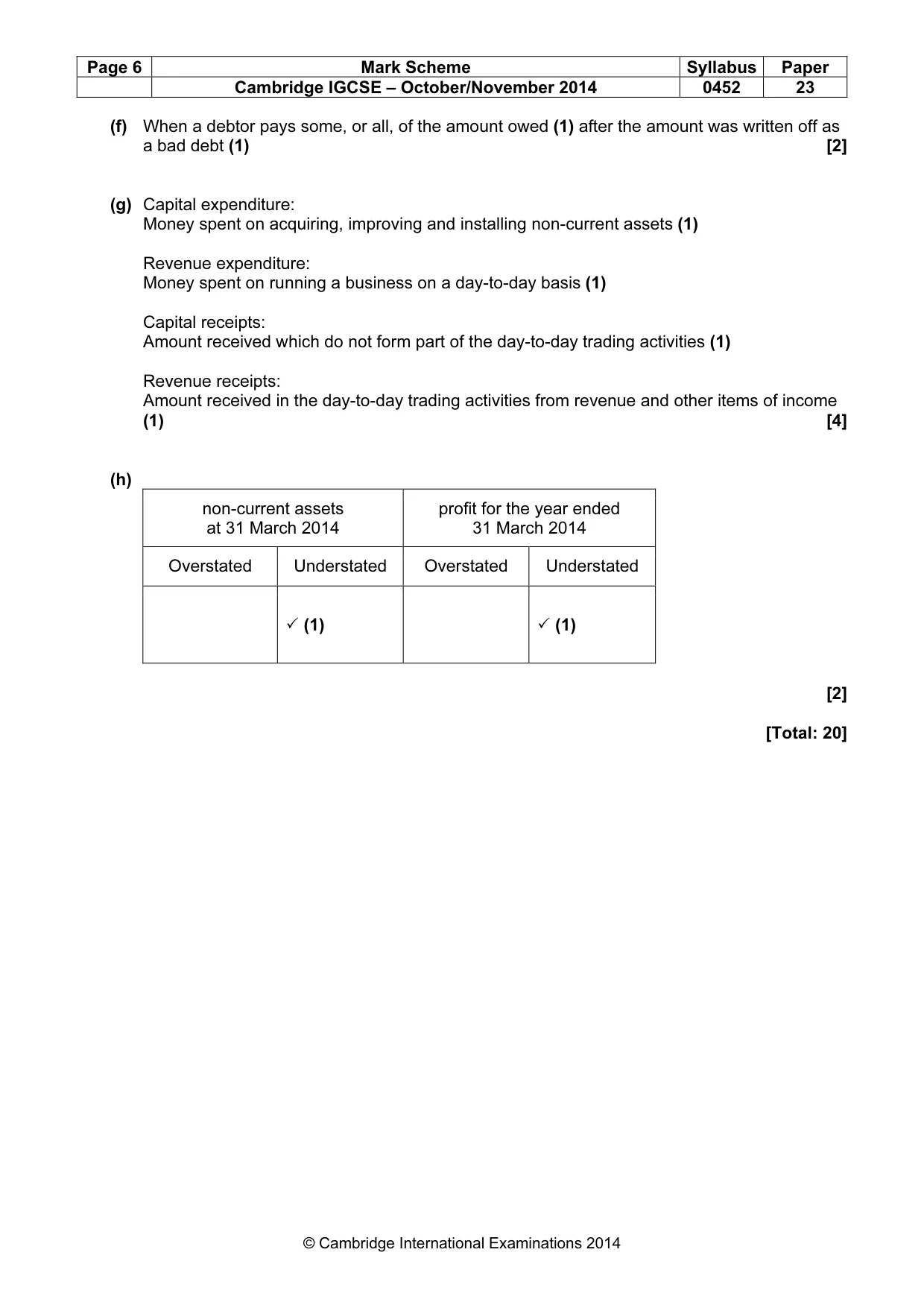
Page 6 Mark Scheme Syllabus Paper Cambridge IGCSE – October/November 2014 0452 23 © Cambridge International Examinations 2014 (f) When a debtor pays some, or all, of the amount owed (1) after the amount was written off as a bad debt (1) [2] (g) Capital expenditure: Money spent on acquiring, improving and installing non-current assets (1) Revenue expenditure: Money spent on running a business on a day-to-day basis (1) Capital receipts: Amount received which do not form part of the day-to-day trading activities (1) Revenue receipts: Amount received in the day-to-day trading activities from revenue and other items of income (1) [4] (h) non-current assets at 31 March 2014 profit for the year ended 31 March 2014 Overstated Understated Overstated Understated ✓ (1) ✓ (1) [2] [Total: 20]
Mark scheme, page 7
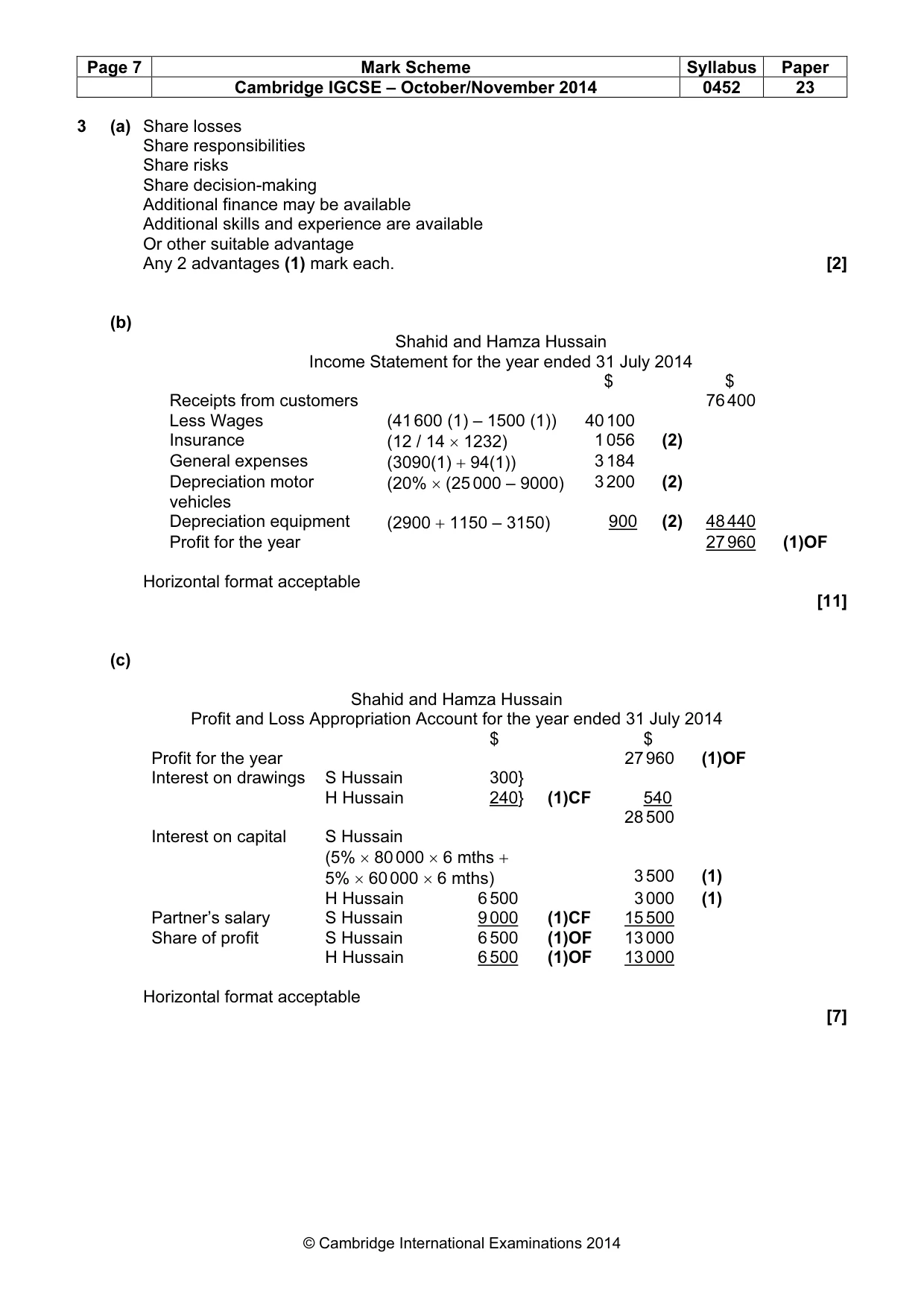
Page 7 Mark Scheme Syllabus Paper Cambridge IGCSE – October/November 2014 0452 23 © Cambridge International Examinations 2014 3 (a) Share losses Share responsibilities Share risks Share decision-making Additional finance may be available Additional skills and experience are available Or other suitable advantage Any 2 advantages (1) mark each. [2] (b) Shahid and Hamza Hussain Income Statement for the year ended 31 July 2014 $ $ Receipts from customers 76 400 Less Wages (41 600 (1) – 1500 (1)) 40 100 Insurance (12 / 14 × 1232) 1 056 (2) General expenses (3090(1) + 94(1)) 3 184 Depreciation motor vehicles (20% × (25 000 – 9000) 3 200 (2) Depreciation equipment (2900 + 1150 – 3150) 900 (2) 48 440 Profit for the year 27 960 (1)OF Horizontal format acceptable [11] (c) Shahid and Hamza Hussain Profit and Loss Appropriation Account for the year ended 31 July 2014 $ $ Profit for the year 27 960 (1)OF Interest on drawings S Hussain 300} H Hussain 240} (1)CF 540 28 500 Interest on capital S Hussain (5% × 80 000 × 6 mths + 5% × 60 000 × 6 mths) 3 500 (1) H Hussain 6 500 3 000 (1) Partner’s salary S Hussain 9 000 (1)CF 15 500 Share of profit S Hussain 6 500 (1)OF 13 000 H Hussain 6 500 (1)OF 13 000 Horizontal format acceptable [7]
Mark scheme, page 8
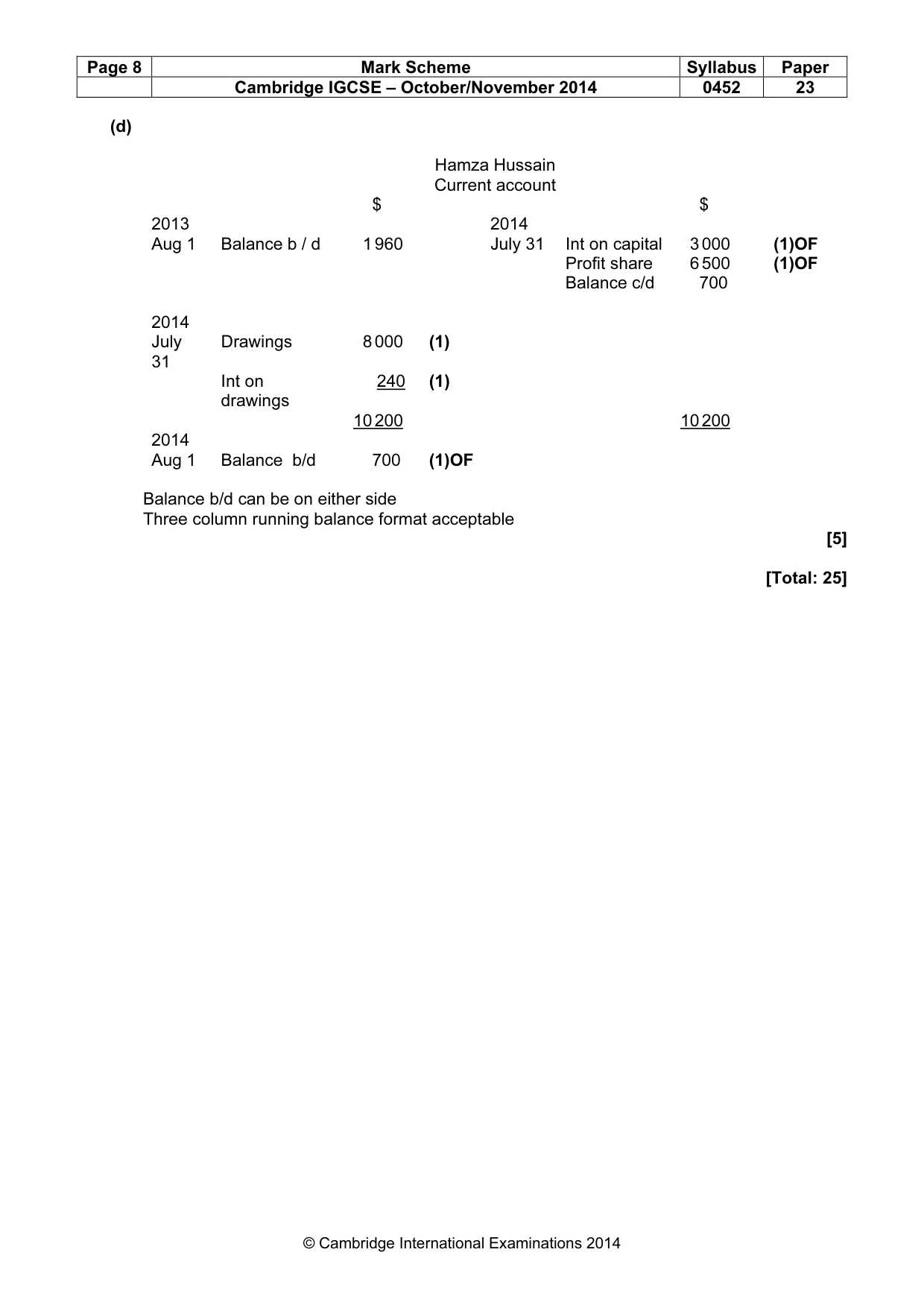
Page 8 Mark Scheme Syllabus Paper Cambridge IGCSE – October/November 2014 0452 23 © Cambridge International Examinations 2014 (d) Hamza Hussain Current account $ $ 2013 2014 Aug 1 Balance b / d 1 960 July 31 Int on capital 3 000 (1)OF Profit share 6 500 (1)OF Balance c/d 700 2014 July 31 Drawings 8 000 (1) Int on drawings 240 (1) 10 200 10 200 2014 Aug 1 Balance b/d 700 (1)OF Balance b/d can be on either side Three column running balance format acceptable [5] [Total: 25]
Mark scheme, page 9
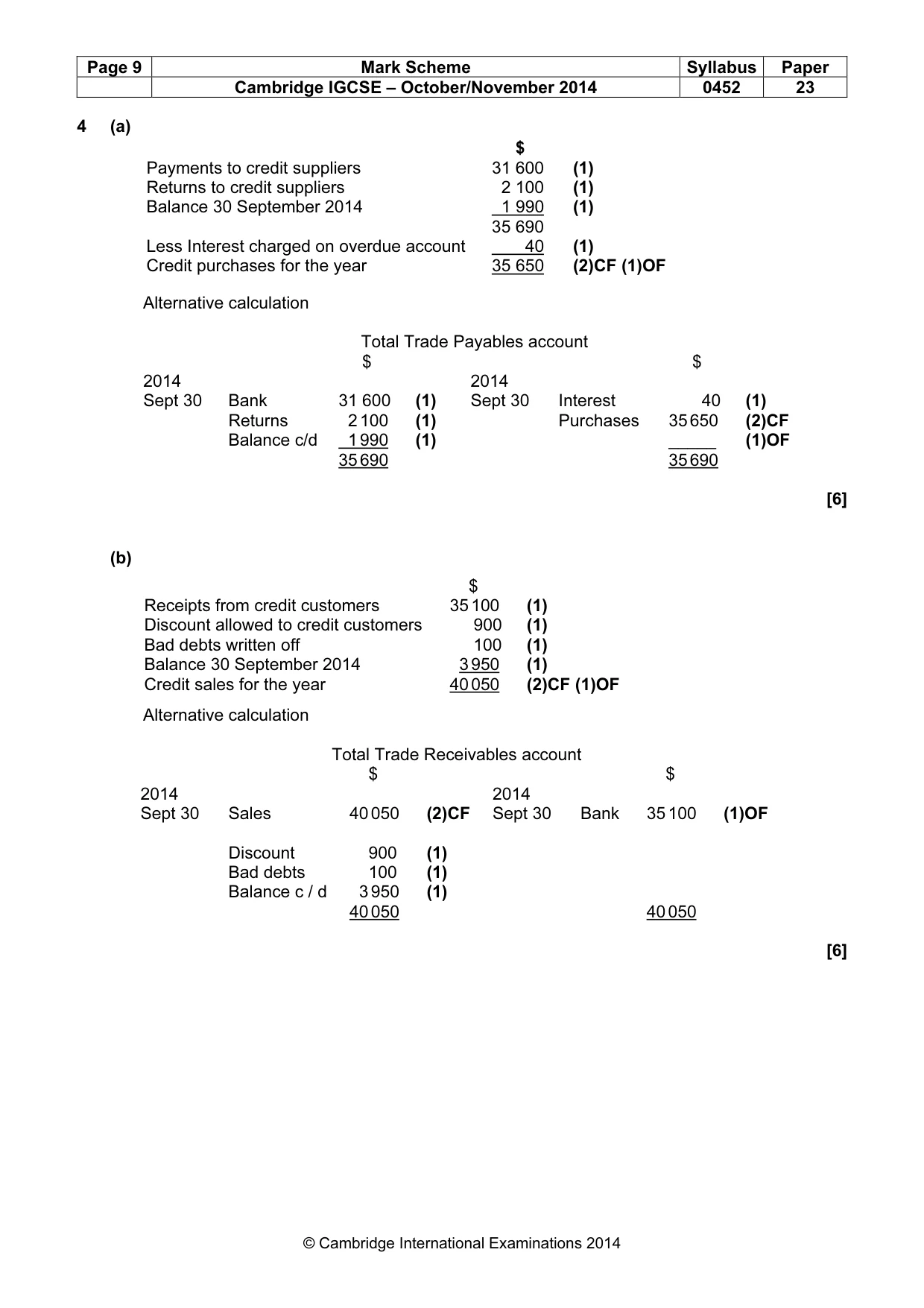
Page 9 Mark Scheme Syllabus Paper Cambridge IGCSE – October/November 2014 0452 23 © Cambridge International Examinations 2014 4 (a) Alternative calculation Total Trade Payables account $ $ 2014 2014 Sept 30 Bank 31 600 (1) Sept 30 Interest 40 (1) Returns 2 100 (1) Purchases 35 650 (2)CF Balance c/d 1 990 (1) _____ (1)OF 35 690 35 690 [6] (b) Alternative calculation Total Trade Receivables account $ $ 2014 2014 Sept 30 Sales 40 050 (2)CF Sept 30 Bank 35 100 (1)OF Discount 900 (1) Bad debts 100 (1) Balance c / d 3 950 (1) 40 050 40 050 [6] $ Payments to credit suppliers 31 600 (1) Returns to credit suppliers 2 100 (1) Balance 30 September 2014 1 990 (1) 35 690 Less Interest charged on overdue account 40 (1) Credit purchases for the year 35 650 (2)CF (1)OF $ Receipts from credit customers 35 100 (1) Discount allowed to credit customers 900 (1) Bad debts written off 100 (1) Balance 30 September 2014 3 950 (1) Credit sales for the year 40 050 (2)CF (1)OF
Mark scheme, page 10
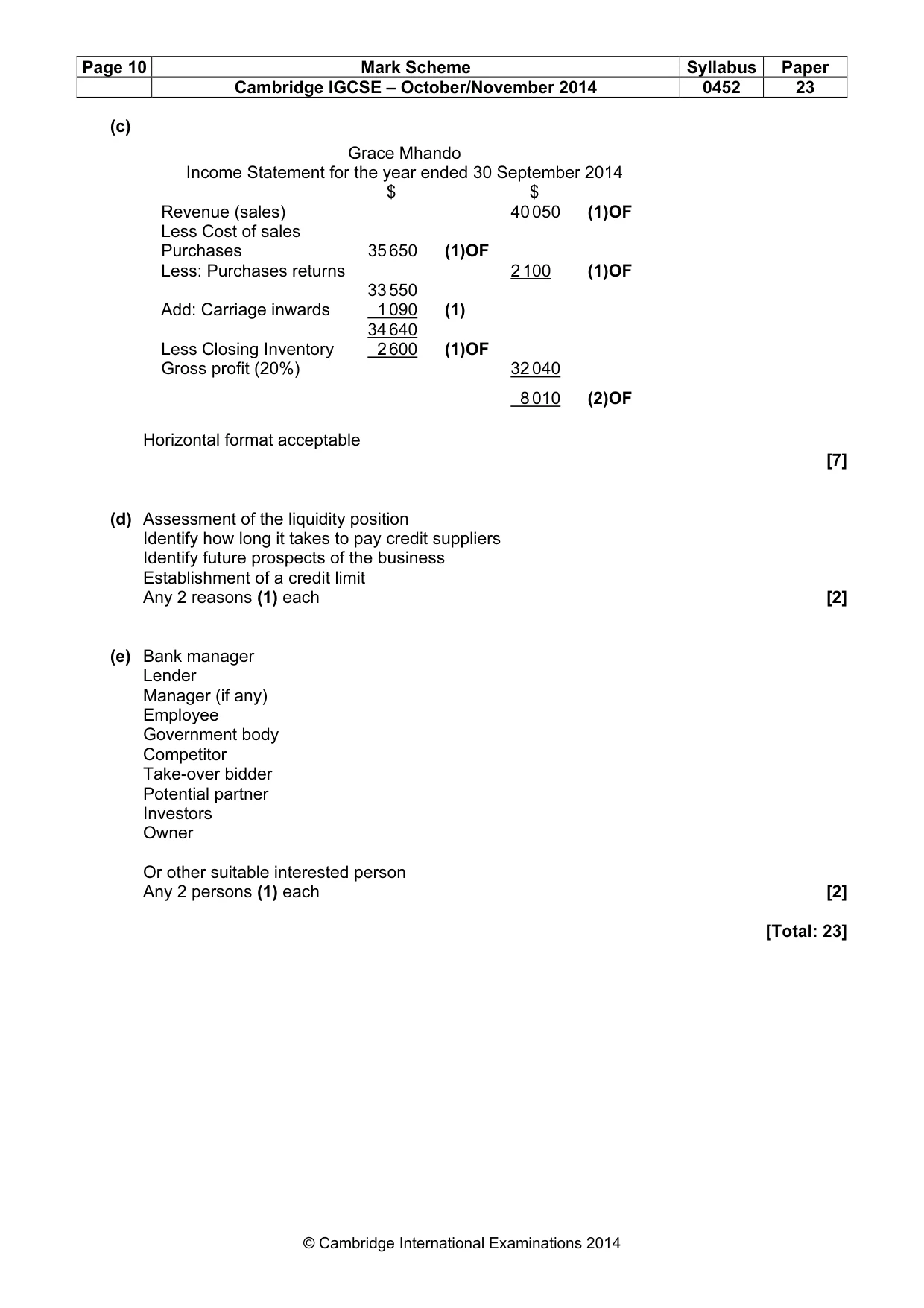
Page 10 Mark Scheme Syllabus Paper Cambridge IGCSE – October/November 2014 0452 23 © Cambridge International Examinations 2014 (c) Horizontal format acceptable [7] (d) Assessment of the liquidity position Identify how long it takes to pay credit suppliers Identify future prospects of the business Establishment of a credit limit Any 2 reasons (1) each [2] (e) Bank manager Lender Manager (if any) Employee Government body Competitor Take-over bidder Potential partner Investors Owner Or other suitable interested person Any 2 persons (1) each [2] [Total: 23] Grace Mhando Income Statement for the year ended 30 September 2014 $ $ Revenue (sales) 40 050 (1)OF Less Cost of sales Purchases 35 650 (1)OF Less: Purchases returns 2 100 (1)OF 33 550 Add: Carriage inwards 1 090 (1) 34 640 Less Closing Inventory 2 600 (1)OF Gross profit (20%) 32 040 8 010 (2)OF
Mark scheme, page 11
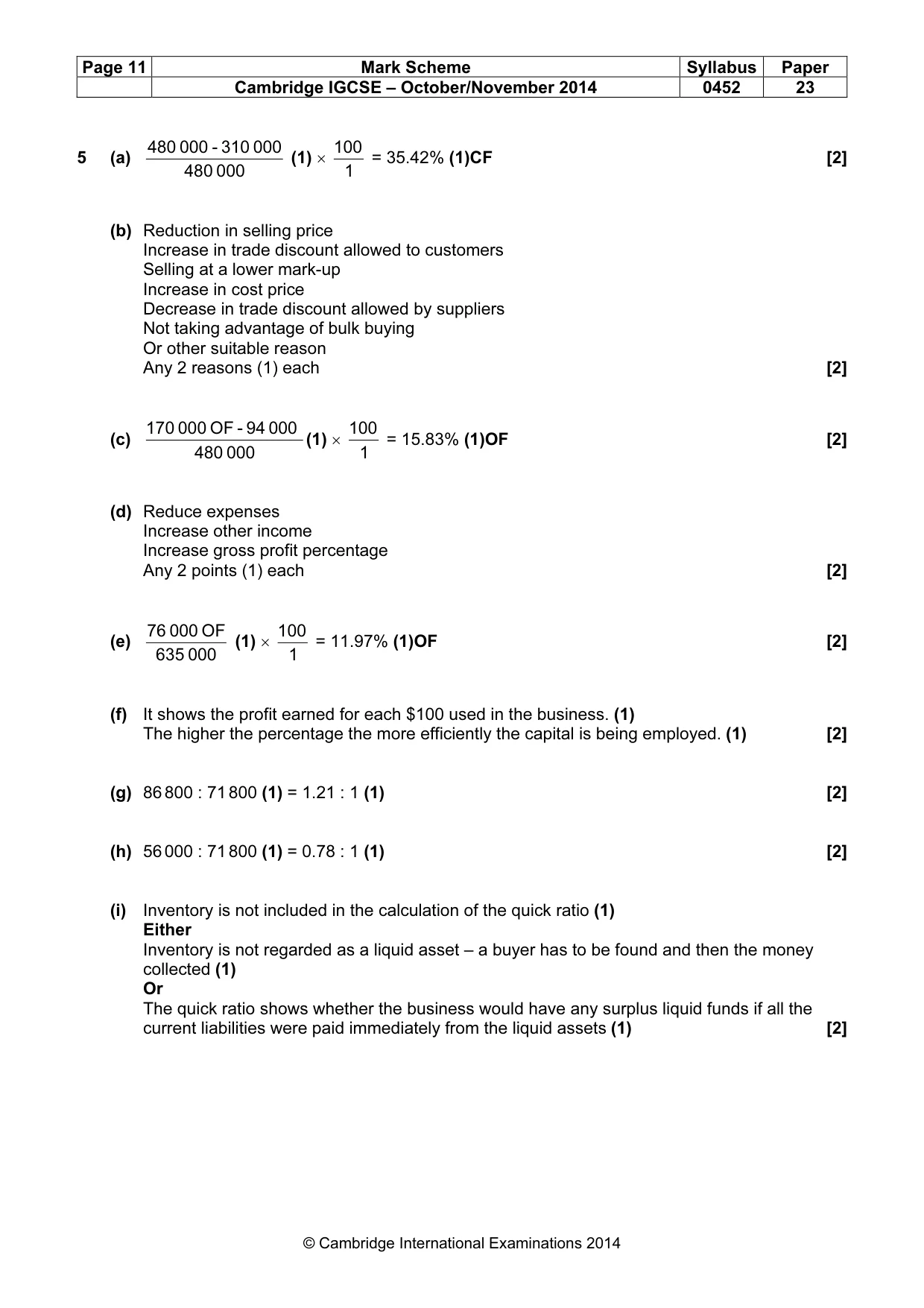
Page 11 Mark Scheme Syllabus Paper Cambridge IGCSE – October/November 2014 0452 23 © Cambridge International Examinations 2014 5 (a) 000 480 000 310 - 000 480 (1) × 1 100 = 35.42% (1)CF [2] (b) Reduction in selling price Increase in trade discount allowed to customers Selling at a lower mark-up Increase in cost price Decrease in trade discount allowed by suppliers Not taking advantage of bulk buying Or other suitable reason Any 2 reasons (1) each [2] (c) 000 480 000 94 - OF 000 170 (1) × 1 100 = 15.83% (1)OF [2] (d) Reduce expenses Increase other income Increase gross profit percentage Any 2 points (1) each [2] (e) 000 635 OF 000 76 (1) × 1 100 = 11.97% (1)OF [2] (f) It shows the profit earned for each $100 used in the business. (1) The higher the percentage the more efficiently the capital is being employed. (1) [2] (g) 86 800 : 71 800 (1) = 1.21 : 1 (1) [2] (h) 56 000 : 71 800 (1) = 0.78 : 1 (1) [2] (i) Inventory is not included in the calculation of the quick ratio (1) Either Inventory is not regarded as a liquid asset – a buyer has to be found and then the money collected (1) Or The quick ratio shows whether the business would have any surplus liquid funds if all the current liabilities were paid immediately from the liquid assets (1) [2]
Mark scheme, page 12
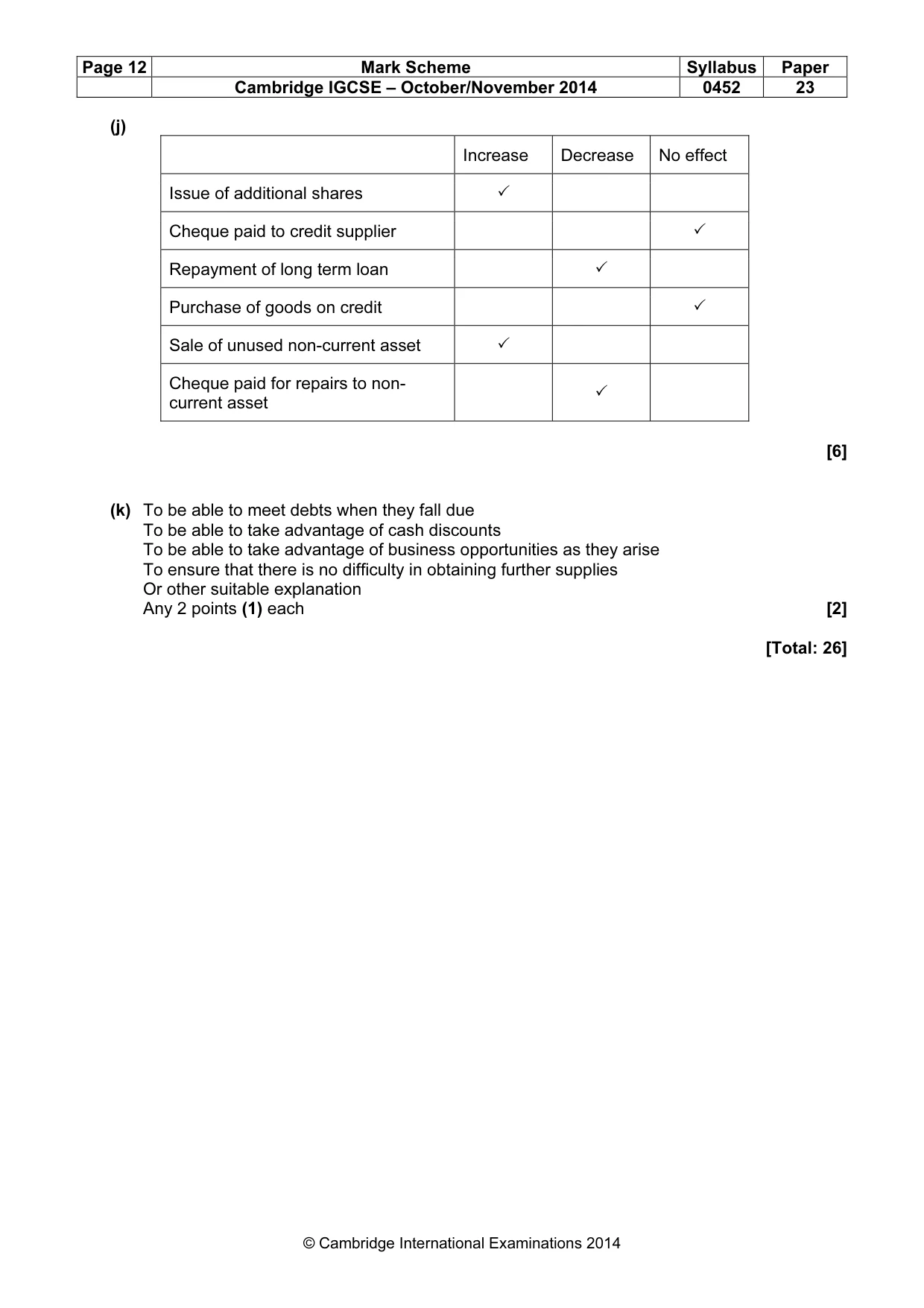
Page 12 Mark Scheme Syllabus Paper Cambridge IGCSE – October/November 2014 0452 23 © Cambridge International Examinations 2014 (j) Increase Decrease No effect Issue of additional shares ✓ Cheque paid to credit supplier ✓ Repayment of long term loan ✓ Purchase of goods on credit ✓ Sale of unused non-current asset ✓ Cheque paid for repairs to non- current asset ✓ [6] (k) To be able to meet debts when they fall due To be able to take advantage of cash discounts To be able to take advantage of business opportunities as they arise To ensure that there is no difficulty in obtaining further supplies Or other suitable explanation Any 2 points (1) each [2] [Total: 26]
What you needed in this session
Cambridge’s own grade thresholds for 2014 Oct/Nov, Paper 2 · Variant 3. A higher threshold means an easier paper — the bar moves with how the cohort did.