Cambridge IGCSE Accounting 0452 — 2013 May/June Paper 1 · Variant 1
0452/11/M/J/13 · 120 marks · ≈135 min
The question paper and its mark scheme, free to read here and free to download. This is Cambridge’s own paper, exactly as it was sat.
Question paper20 pages
Mark scheme8 pages
Answers below. Sit the paper first if you are practising.
Paper as text
Question paper, page 1
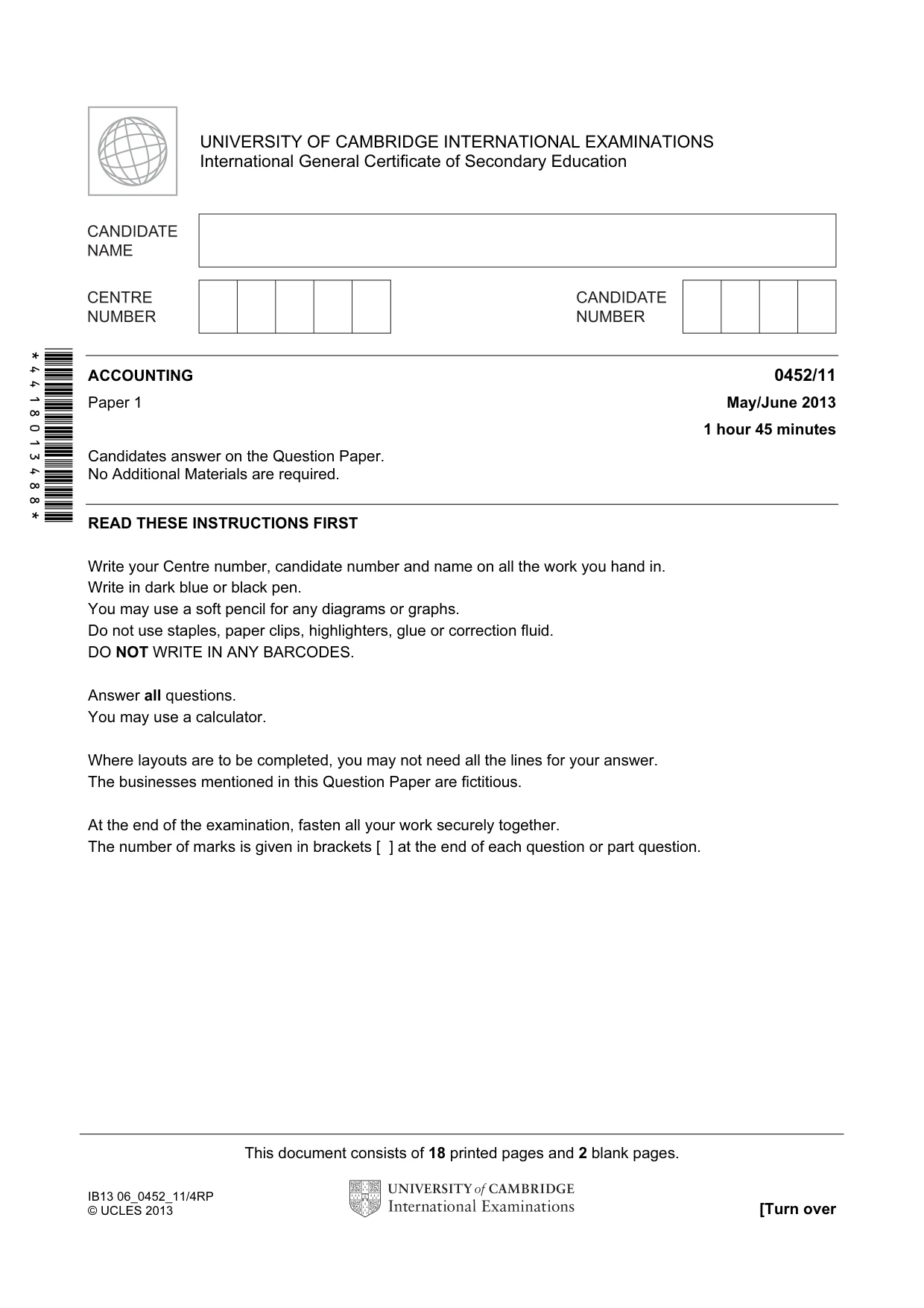
This document consists of 18 printed pages and 2 blank pages. IB13 06_0452_11/4RP © UCLES 2013 [Turn over *4418013488* UNIVERSITY OF CAMBRIDGE INTERNATIONAL EXAMINATIONS International General Certificate of Secondary Education ACCOUNTING 0452/11 Paper 1 May/June 2013 1 hour 45 minutes Candidates answer on the Question Paper. No Additional Materials are required. READ THESE INSTRUCTIONS FIRST Write your Centre number, candidate number and name on all the work you hand in. Write in dark blue or black pen. You may use a soft pencil for any diagrams or graphs. Do not use staples, paper clips, highlighters, glue or correction fluid. DO NOT WRITE IN ANY BARCODES. Answer all questions. You may use a calculator. Where layouts are to be completed, you may not need all the lines for your answer. The businesses mentioned in this Question Paper are fictitious. At the end of the examination, fasten all your work securely together. The number of marks is given in brackets [ ] at the end of each question or part question.
Question paper, page 2
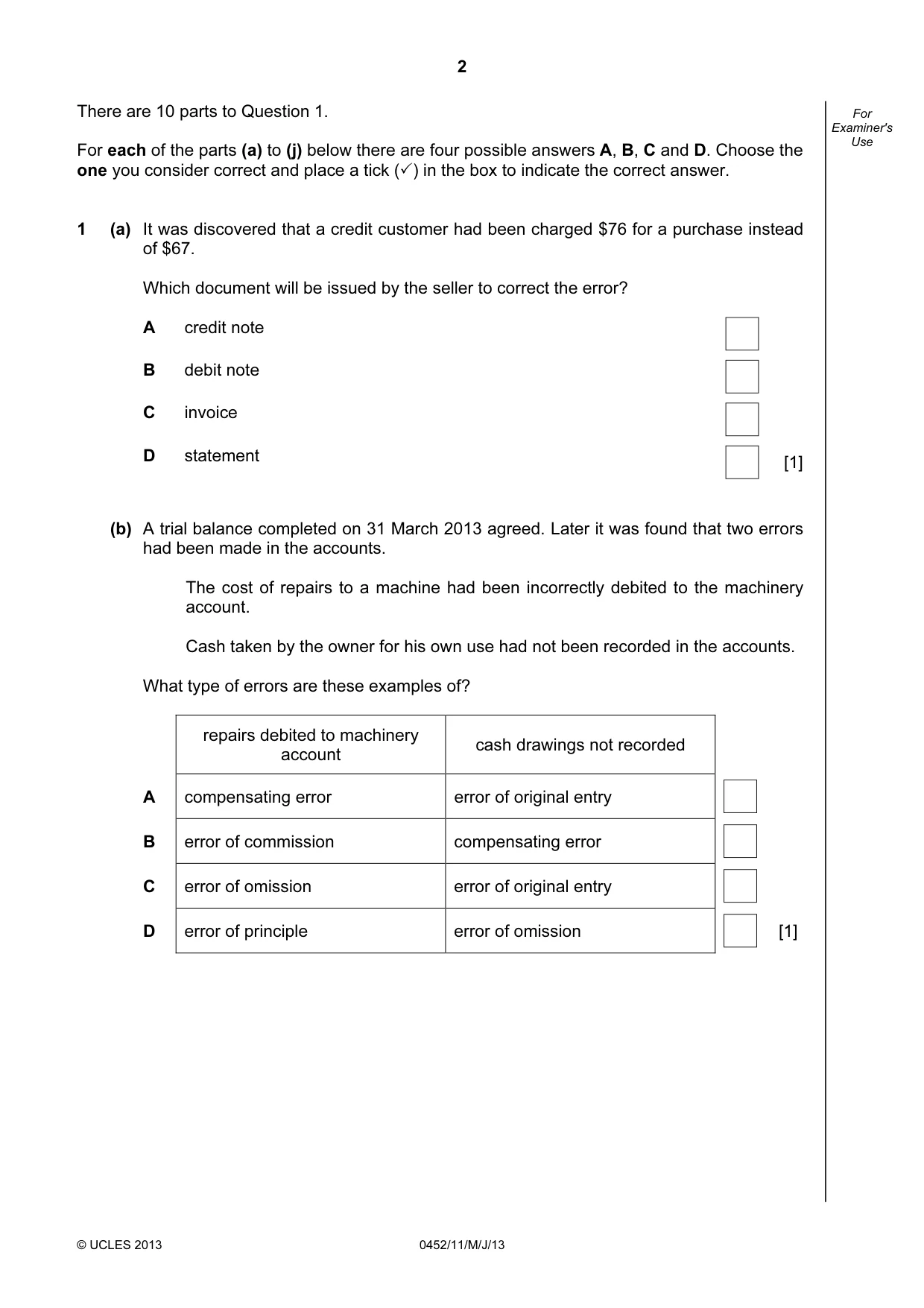
2 © UCLES 2013 0452/11/M/J/13 For Examiner's Use There are 10 parts to Question 1. For each of the parts (a) to (j) below there are four possible answers A, B, C and D. Choose the one you consider correct and place a tick (✓) in the box to indicate the correct answer. 1 (a) It was discovered that a credit customer had been charged $76 for a purchase instead of $67. Which document will be issued by the seller to correct the error? A credit note B debit note C invoice D statement [1] (b) A trial balance completed on 31 March 2013 agreed. Later it was found that two errors had been made in the accounts. The cost of repairs to a machine had been incorrectly debited to the machinery account. Cash taken by the owner for his own use had not been recorded in the accounts. What type of errors are these examples of? repairs debited to machinery account cash drawings not recorded A compensating error error of original entry B error of commission compensating error C error of omission error of original entry D error of principle error of omission [1]
Question paper, page 3
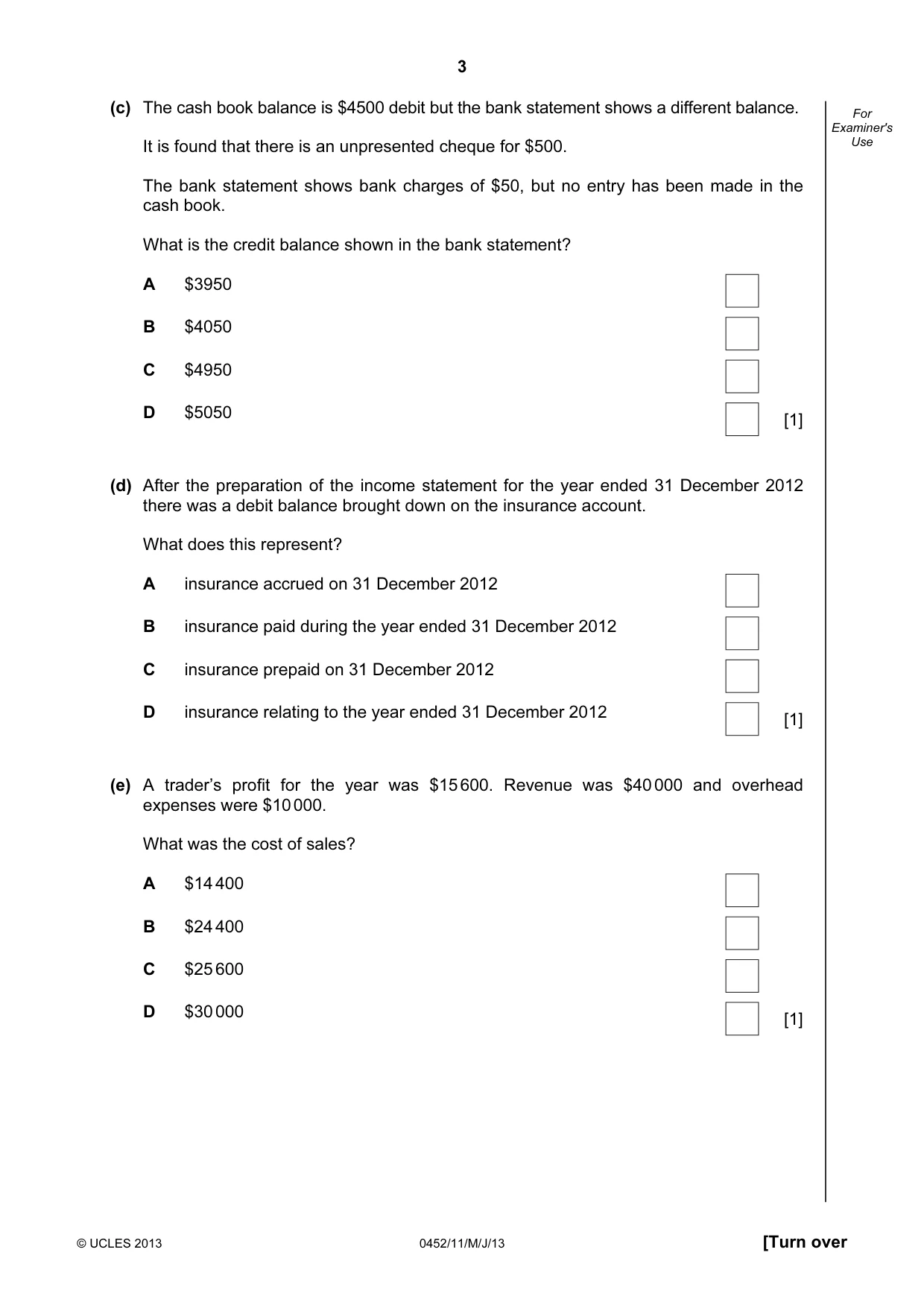
3 © UCLES 2013 0452/11/M/J/13 [Turn over For Examiner's Use (c) The cash book balance is $4500 debit but the bank statement shows a different balance. It is found that there is an unpresented cheque for $500. The bank statement shows bank charges of $50, but no entry has been made in the cash book. What is the credit balance shown in the bank statement? A $3950 B $4050 C $4950 D $5050 [1] (d) After the preparation of the income statement for the year ended 31 December 2012 there was a debit balance brought down on the insurance account. What does this represent? A insurance accrued on 31 December 2012 B insurance paid during the year ended 31 December 2012 C insurance prepaid on 31 December 2012 D insurance relating to the year ended 31 December 2012 [1] (e) A trader’s profit for the year was $15 600. Revenue was $40 000 and overhead expenses were $10 000. What was the cost of sales? A $14 400 B $24 400 C $25 600 D $30 000 [1]
Question paper, page 4
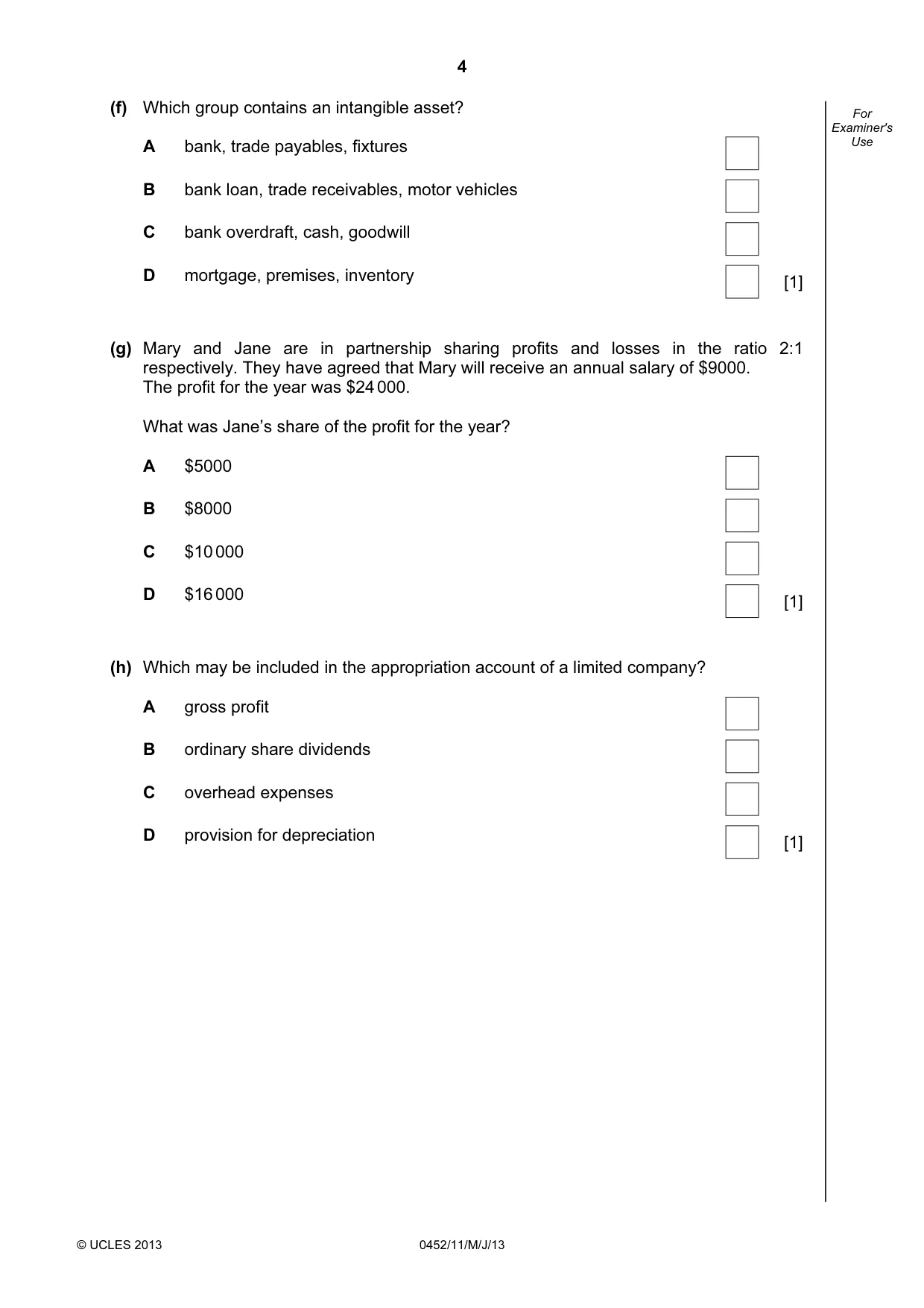
4 © UCLES 2013 0452/11/M/J/13 For Examiner's Use (f) Which group contains an intangible asset? A bank, trade payables, fixtures B bank loan, trade receivables, motor vehicles C bank overdraft, cash, goodwill D mortgage, premises, inventory [1] (g) Mary and Jane are in partnership sharing profits and losses in the ratio 2:1 respectively. They have agreed that Mary will receive an annual salary of $9000. The profit for the year was $24 000. What was Jane’s share of the profit for the year? A $5000 B $8000 C $10 000 D $16 000 [1] (h) Which may be included in the appropriation account of a limited company? A gross profit B ordinary share dividends C overhead expenses D provision for depreciation [1]
Question paper, page 5
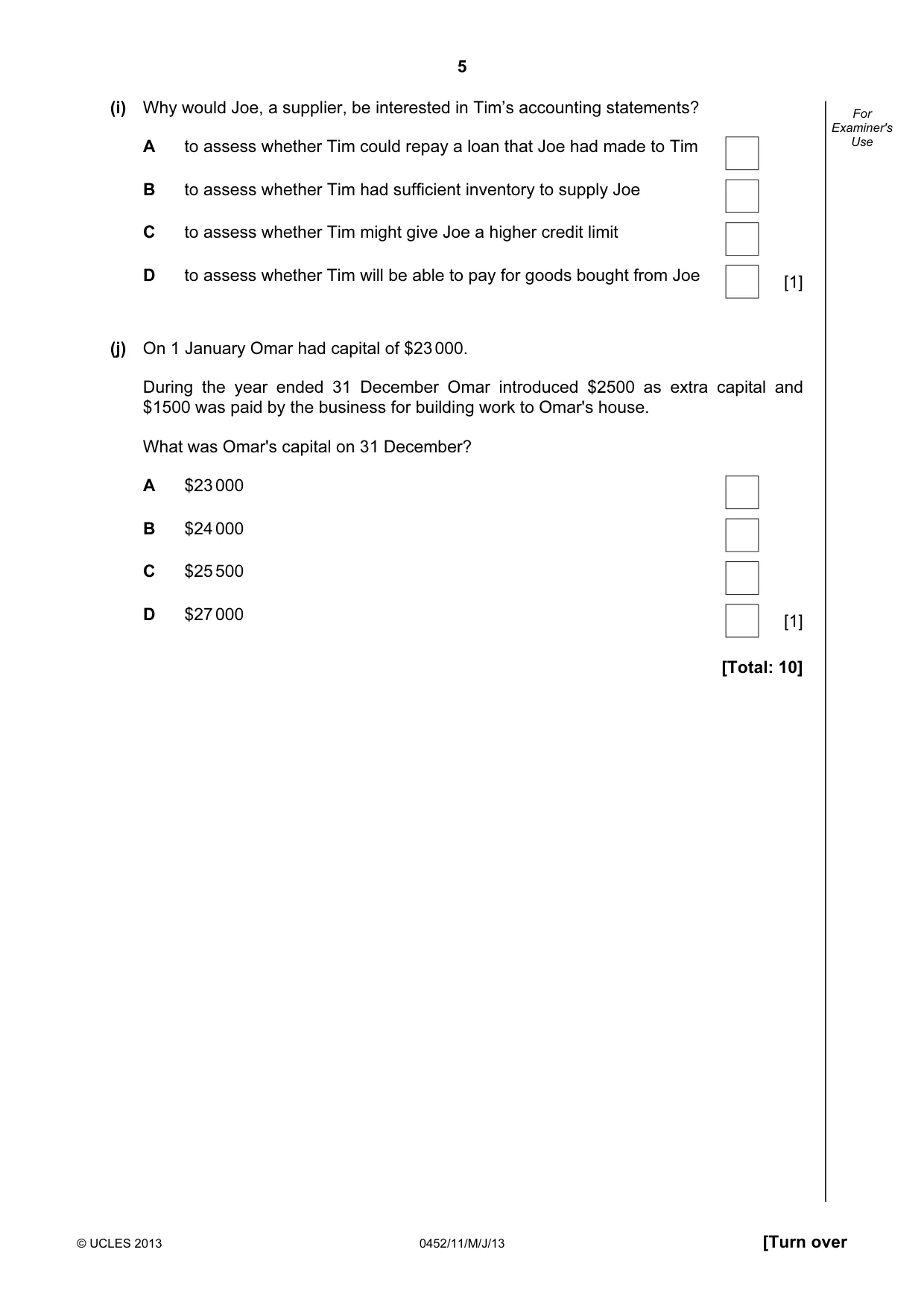
5 © UCLES 2013 0452/11/M/J/13 [Turn over For Examiner's Use (i) Why would Joe, a supplier, be interested in Tim’s accounting statements? A to assess whether Tim could repay a loan that Joe had made to Tim B to assess whether Tim had sufficient inventory to supply Joe C to assess whether Tim might give Joe a higher credit limit D to assess whether Tim will be able to pay for goods bought from Joe [1] (j) On 1 January Omar had capital of $23 000. During the year ended 31 December Omar introduced $2500 as extra capital and $1500 was paid by the business for building work to Omar's house. What was Omar's capital on 31 December? A $23 000 B $24 000 C $25 500 D $27 000 [1] [Total: 10]
Question paper, page 6
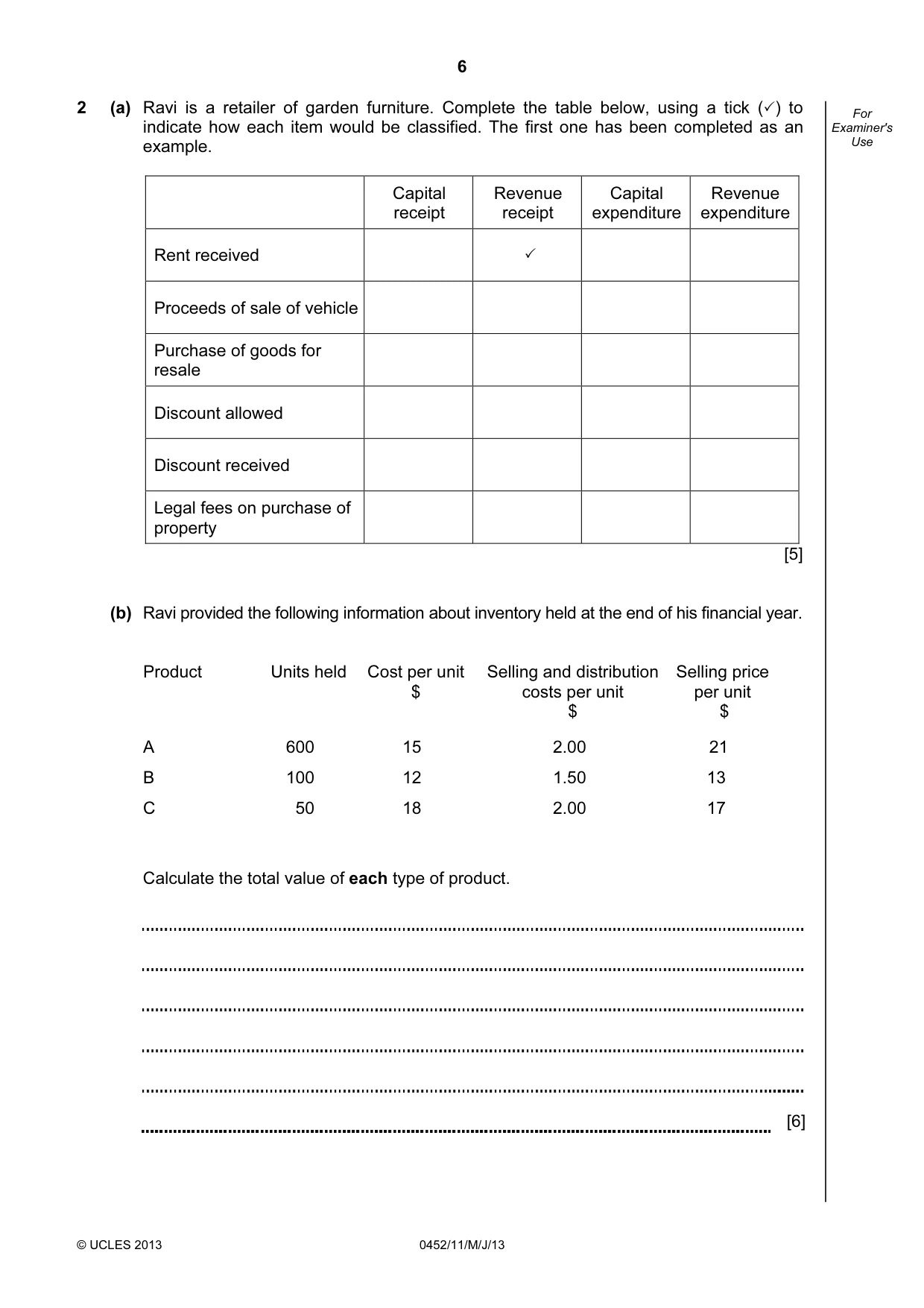
6 © UCLES 2013 0452/11/M/J/13 For Examiner's Use 2 (a) Ravi is a retailer of garden furniture. Complete the table below, using a tick (✓) to indicate how each item would be classified. The first one has been completed as an example. Capital receipt Revenue receipt Capital expenditure Revenue expenditure Rent received ✓ Proceeds of sale of vehicle Purchase of goods for resale Discount allowed Discount received Legal fees on purchase of property [5] (b) Ravi provided the following information about inventory held at the end of his financial year. Product Units held Cost per unit $ Selling and distribution costs per unit $ Selling price per unit $ A 600 15 2.00 21 B 100 12 1.50 13 C 50 18 2.00 17 Calculate the total value of each type of product. [6]
Question paper, page 7
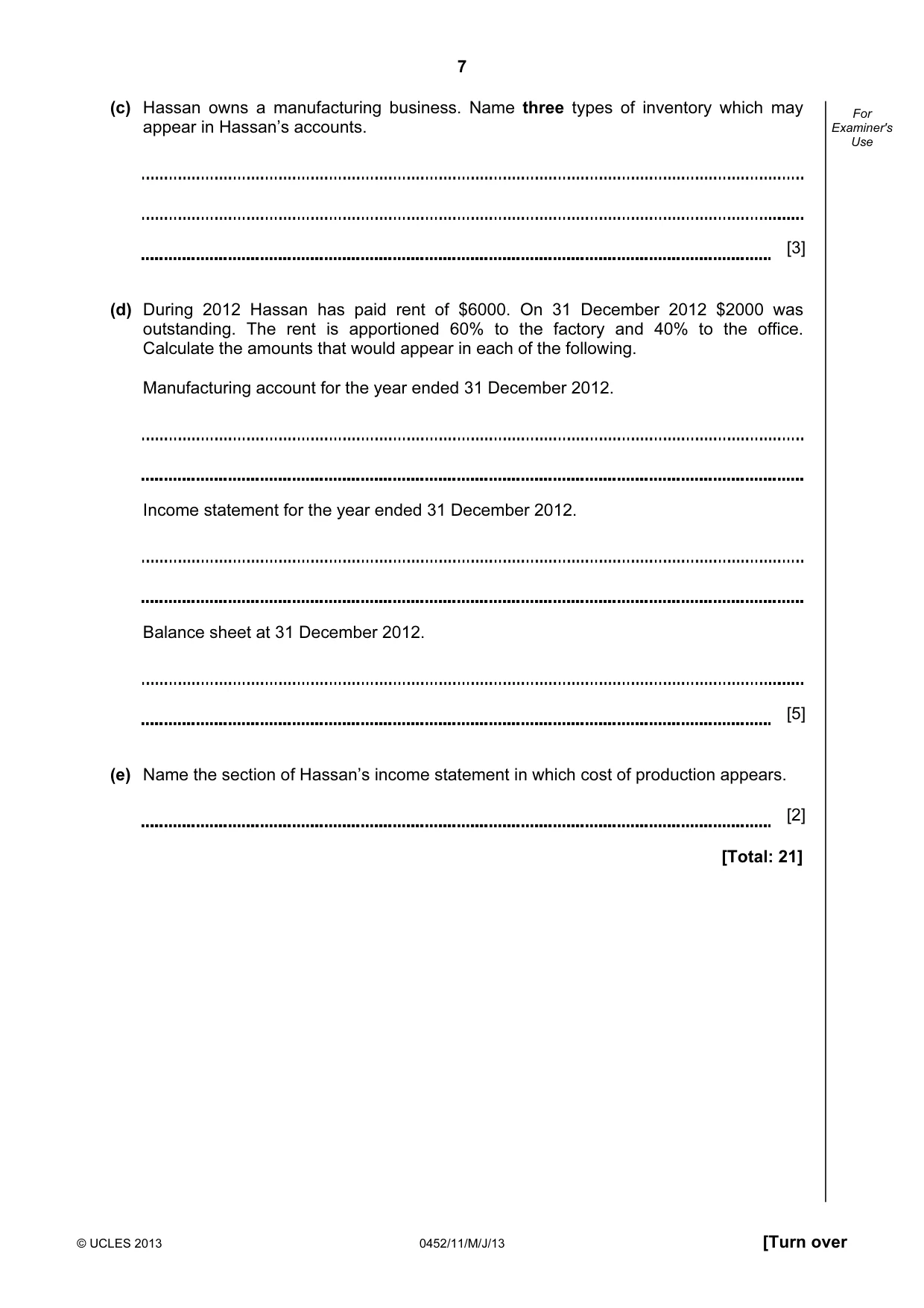
7 © UCLES 2013 0452/11/M/J/13 [Turn over For Examiner's Use (c) Hassan owns a manufacturing business. Name three types of inventory which may appear in Hassan’s accounts. [3] (d) During 2012 Hassan has paid rent of $6000. On 31 December 2012 $2000 was outstanding. The rent is apportioned 60% to the factory and 40% to the office. Calculate the amounts that would appear in each of the following. Manufacturing account for the year ended 31 December 2012. Income statement for the year ended 31 December 2012. Balance sheet at 31 December 2012. [5] (e) Name the section of Hassan’s income statement in which cost of production appears. [2] [Total: 21]
Question paper, page 8
8 © UCLES 2013 0452/11/M/J/13 Question 3 is on the next page.
Question paper, page 9
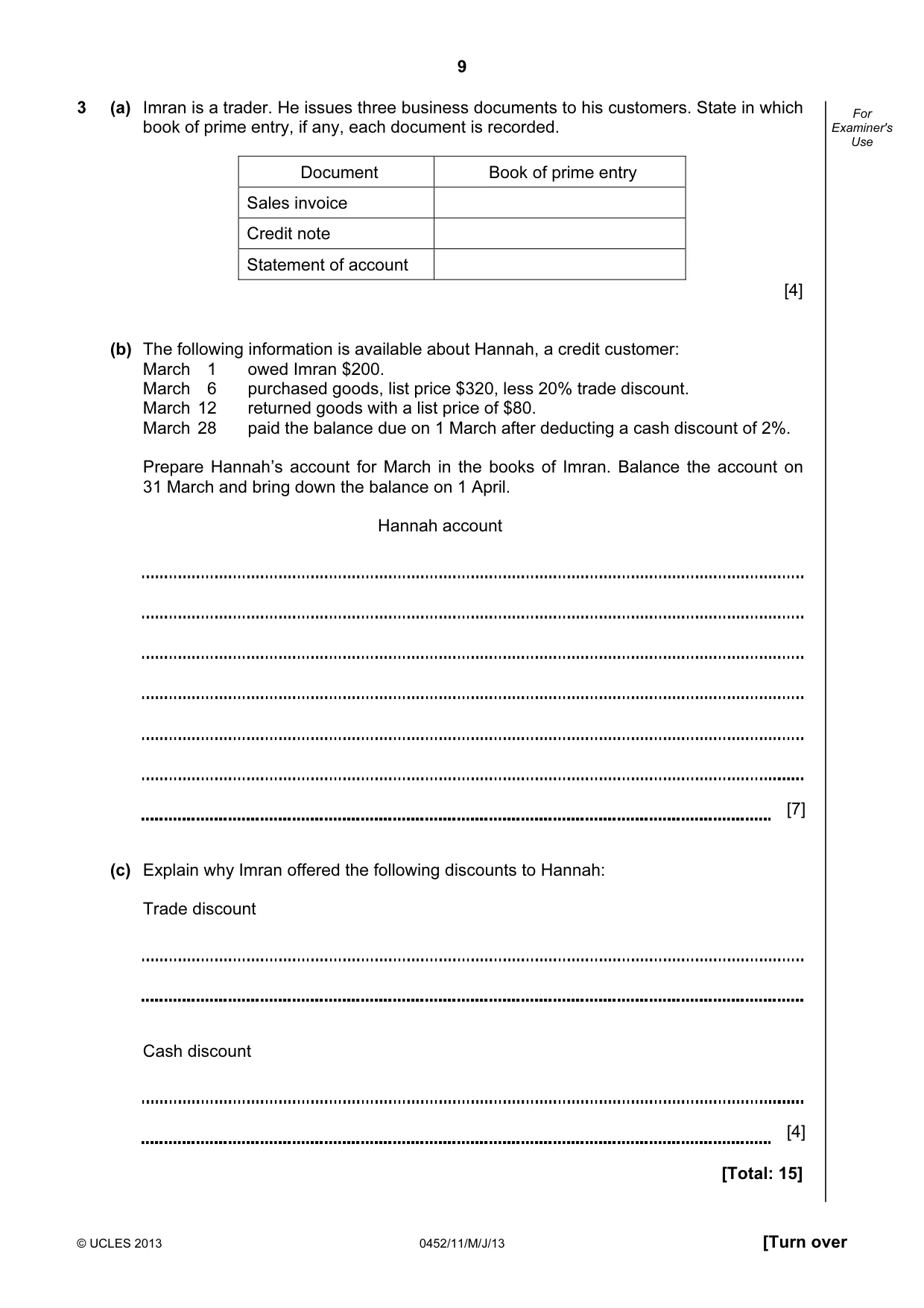
9 © UCLES 2013 0452/11/M/J/13 [Turn over For Examiner's Use 3 (a) Imran is a trader. He issues three business documents to his customers. State in which book of prime entry, if any, each document is recorded. Document Book of prime entry Sales invoice Credit note Statement of account [4] (b) The following information is available about Hannah, a credit customer: March 1 owed Imran $200. March 6 purchased goods, list price $320, less 20% trade discount. March 12 returned goods with a list price of $80. March 28 paid the balance due on 1 March after deducting a cash discount of 2%. Prepare Hannah’s account for March in the books of Imran. Balance the account on 31 March and bring down the balance on 1 April. Hannah account [7] (c) Explain why Imran offered the following discounts to Hannah: Trade discount Cash discount [4] [Total: 15]
Question paper, page 10
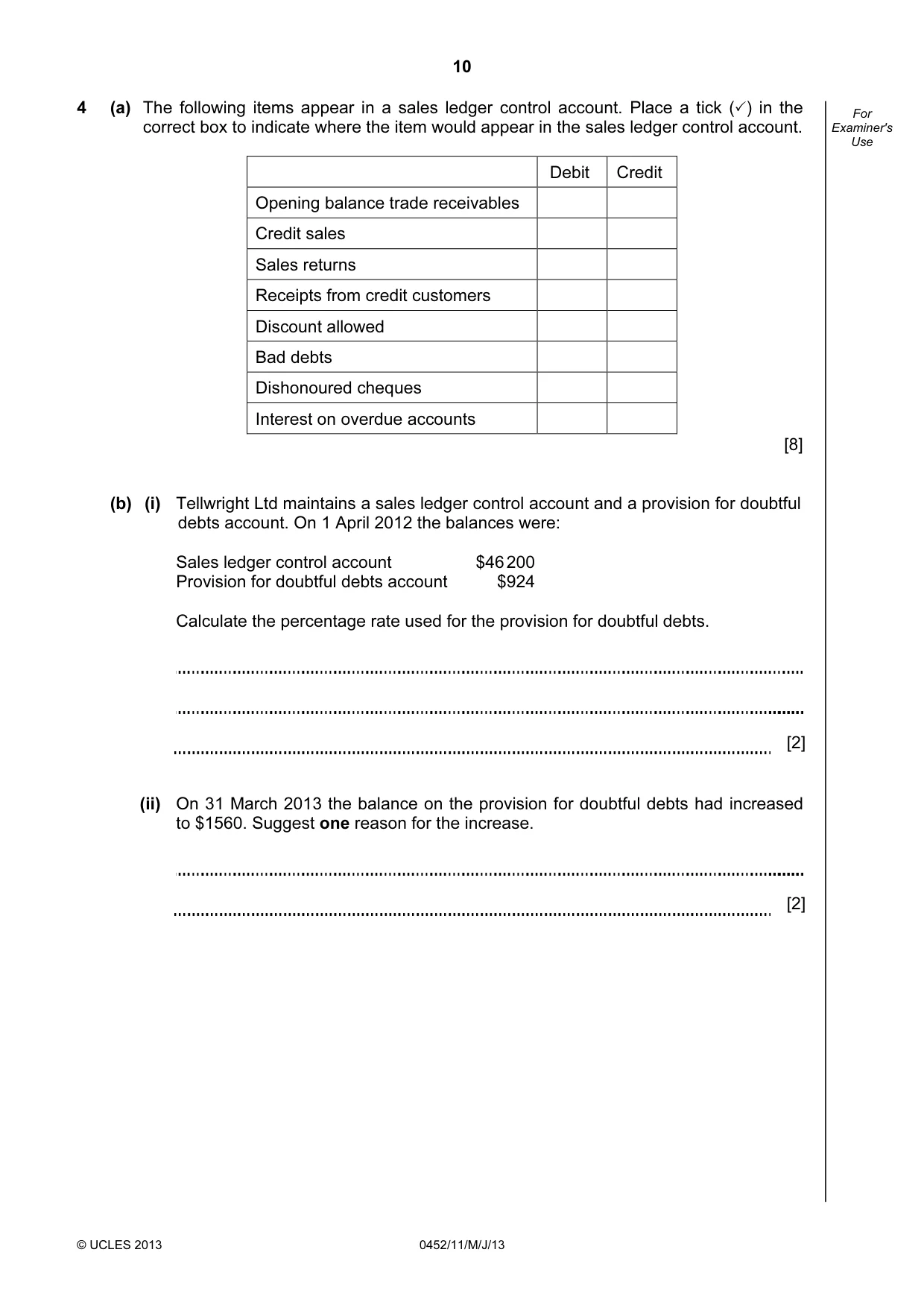
10 © UCLES 2013 0452/11/M/J/13 For Examiner's Use 4 (a) The following items appear in a sales ledger control account. Place a tick (✓) in the correct box to indicate where the item would appear in the sales ledger control account. Debit Credit Opening balance trade receivables Credit sales Sales returns Receipts from credit customers Discount allowed Bad debts Dishonoured cheques Interest on overdue accounts [8] (b) (i) Tellwright Ltd maintains a sales ledger control account and a provision for doubtful debts account. On 1 April 2012 the balances were: Sales ledger control account $46 200 Provision for doubtful debts account $924 Calculate the percentage rate used for the provision for doubtful debts. [2] (ii) On 31 March 2013 the balance on the provision for doubtful debts had increased to $1560. Suggest one reason for the increase. [2]
Question paper, page 11
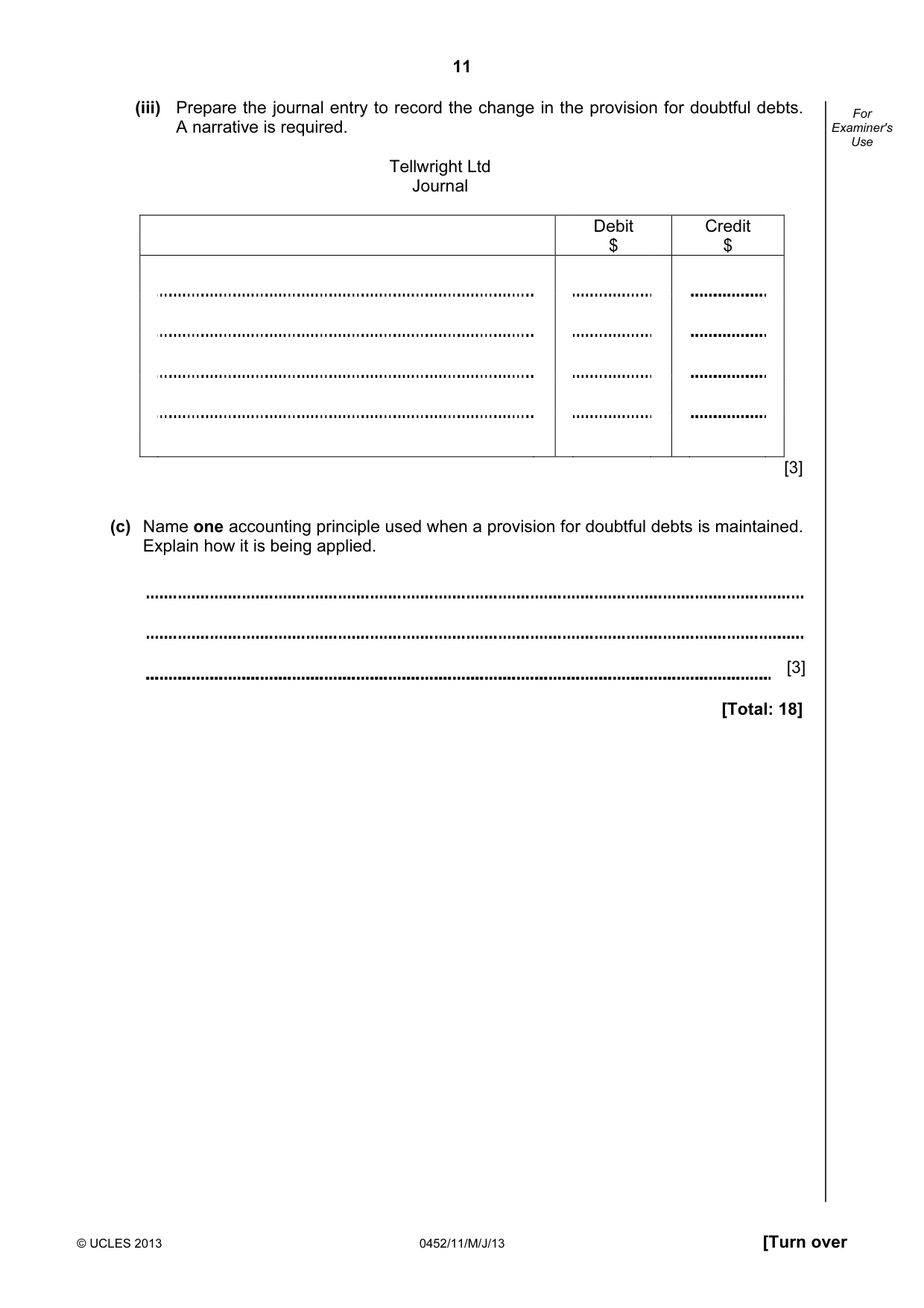
11 © UCLES 2013 0452/11/M/J/13 [Turn over For Examiner's Use (iii) Prepare the journal entry to record the change in the provision for doubtful debts. A narrative is required. Tellwright Ltd Journal Debit $ Credit $ [3] (c) Name one accounting principle used when a provision for doubtful debts is maintained. Explain how it is being applied. [3] [Total: 18]
Question paper, page 12
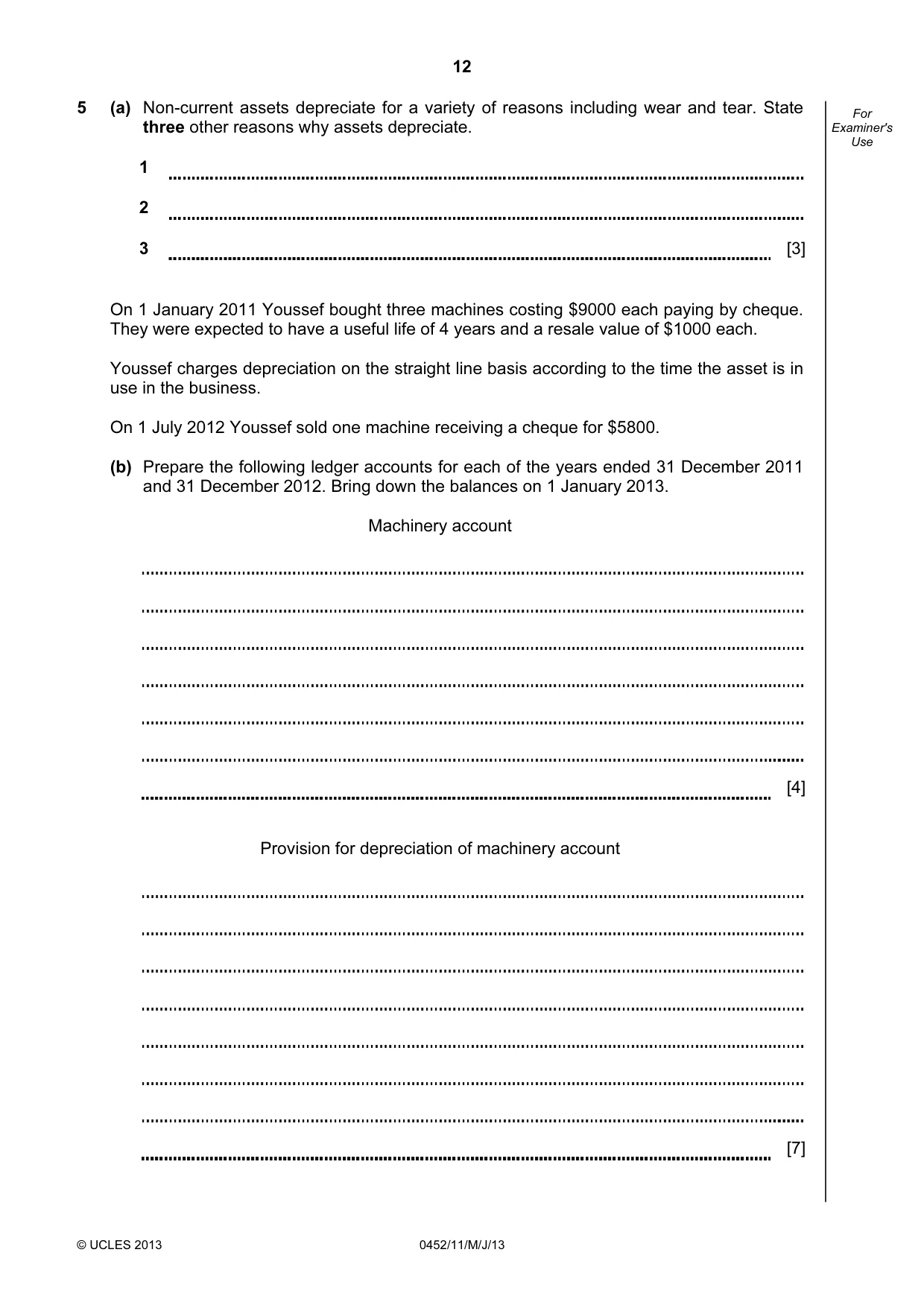
12 © UCLES 2013 0452/11/M/J/13 For Examiner's Use 5 (a) Non-current assets depreciate for a variety of reasons including wear and tear. State three other reasons why assets depreciate. 1 2 3 [3] On 1 January 2011 Youssef bought three machines costing $9000 each paying by cheque. They were expected to have a useful life of 4 years and a resale value of $1000 each. Youssef charges depreciation on the straight line basis according to the time the asset is in use in the business. On 1 July 2012 Youssef sold one machine receiving a cheque for $5800. (b) Prepare the following ledger accounts for each of the years ended 31 December 2011 and 31 December 2012. Bring down the balances on 1 January 2013. Machinery account [4] Provision for depreciation of machinery account [7]
Question paper, page 13
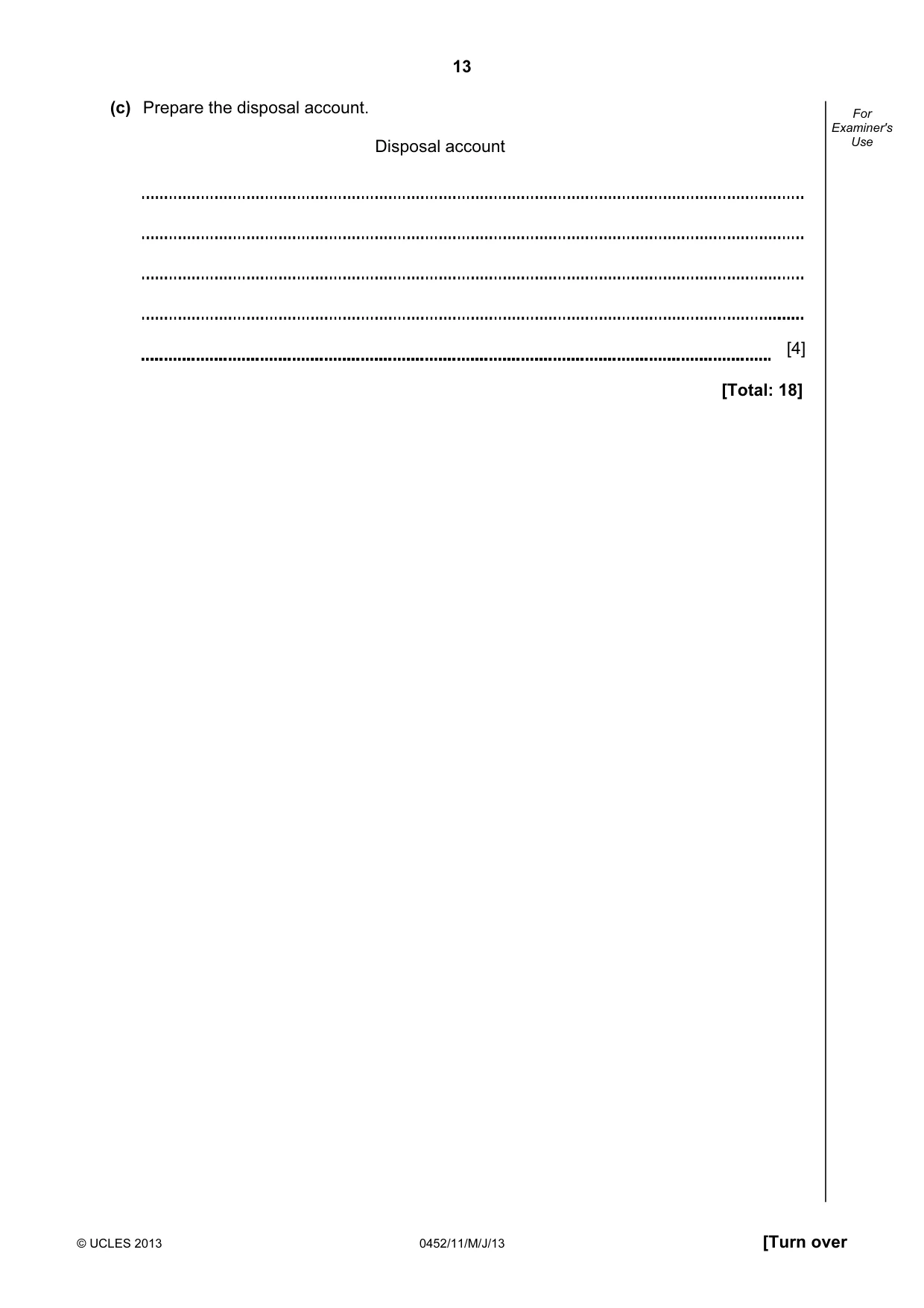
13 © UCLES 2013 0452/11/M/J/13 [Turn over For Examiner's Use (c) Prepare the disposal account. Disposal account [4] [Total: 18]
Question paper, page 14
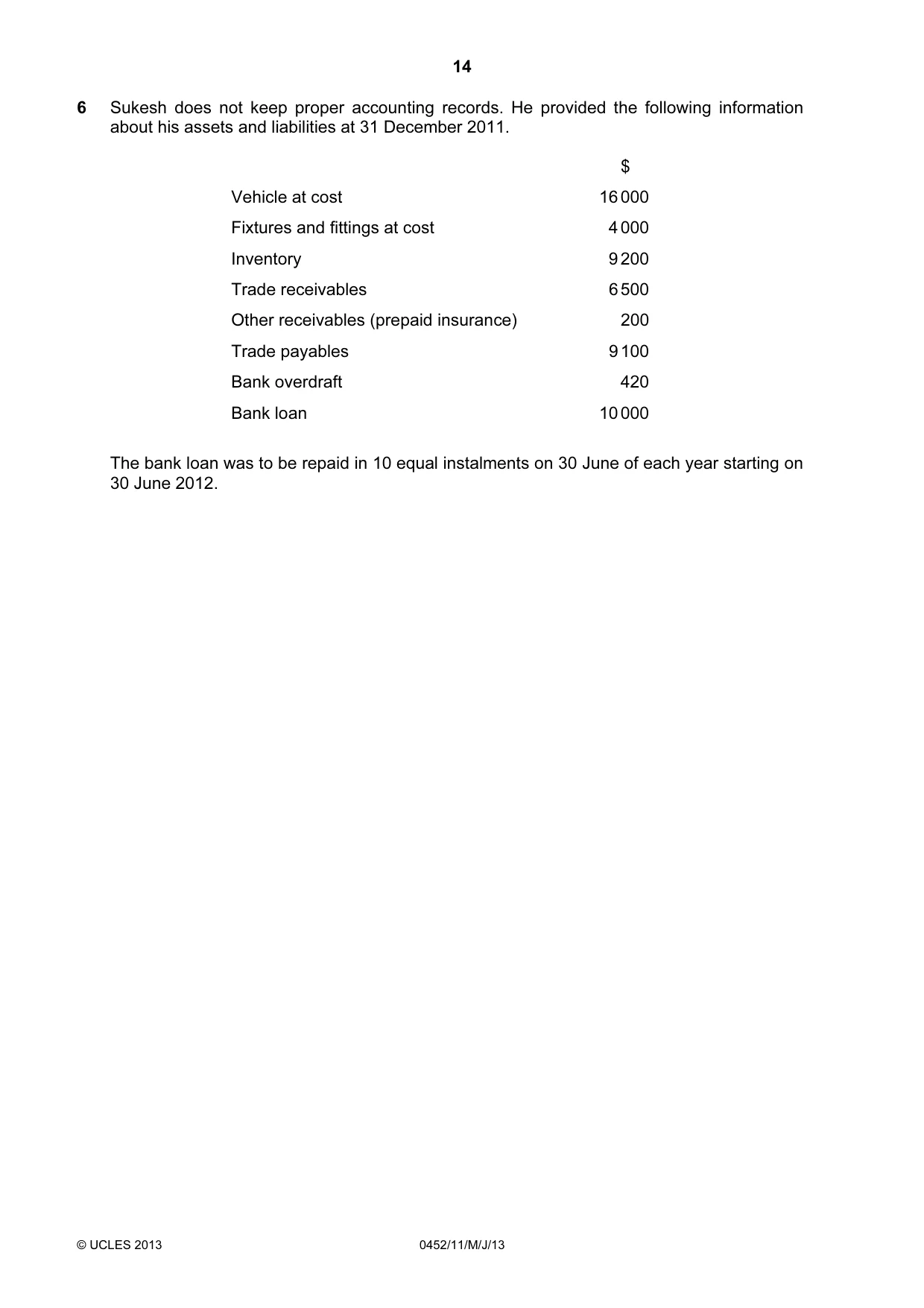
14 © UCLES 2013 0452/11/M/J/13 6 Sukesh does not keep proper accounting records. He provided the following information about his assets and liabilities at 31 December 2011. $ Vehicle at cost 16 000 Fixtures and fittings at cost 4 000 Inventory 9 200 Trade receivables 6 500 Other receivables (prepaid insurance) 200 Trade payables 9 100 Bank overdraft 420 Bank loan 10 000 The bank loan was to be repaid in 10 equal instalments on 30 June of each year starting on 30 June 2012.
Question paper, page 15
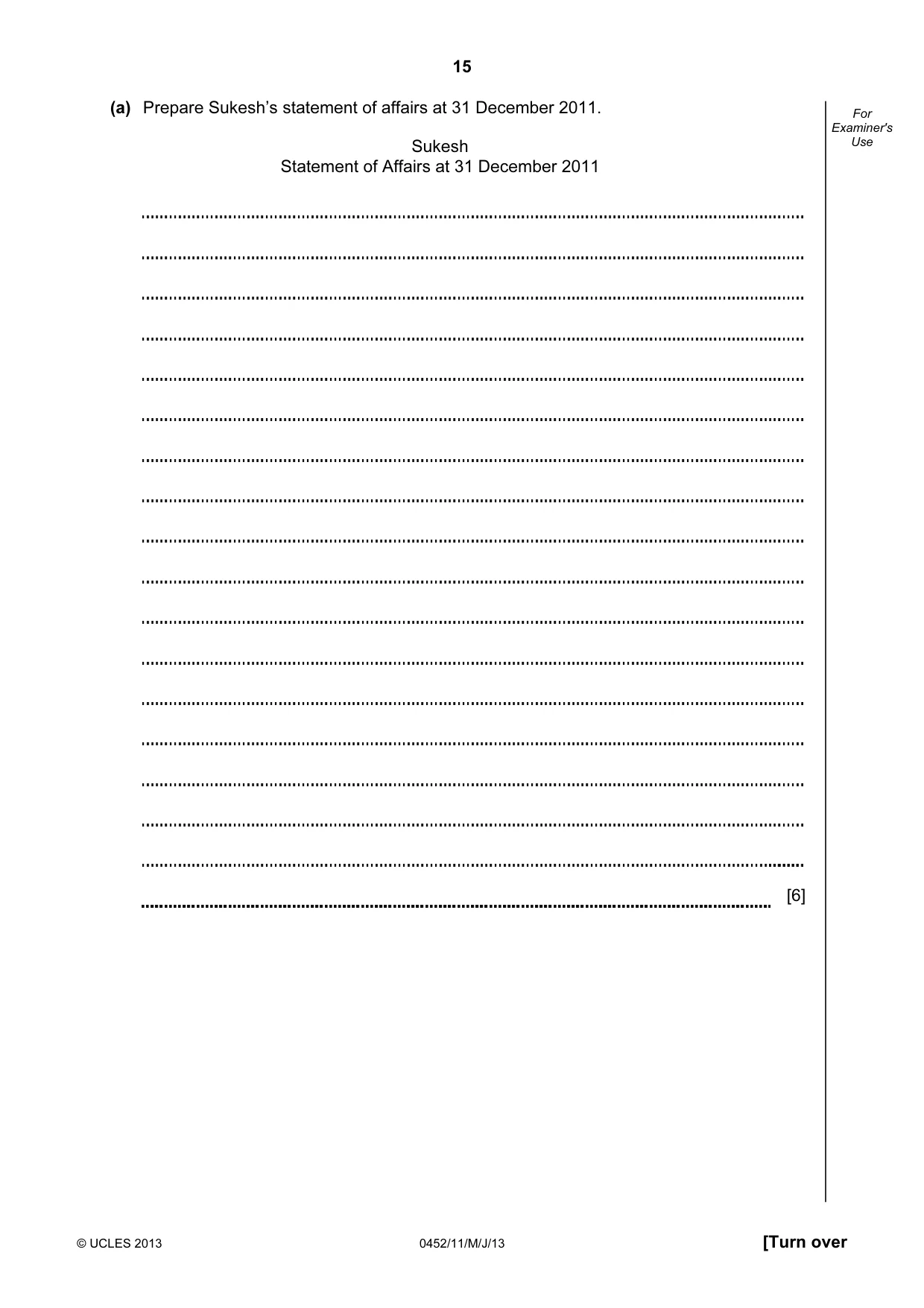
15 © UCLES 2013 0452/11/M/J/13 [Turn over For Examiner's Use (a) Prepare Sukesh’s statement of affairs at 31 December 2011. Sukesh Statement of Affairs at 31 December 2011 [6]
Question paper, page 16
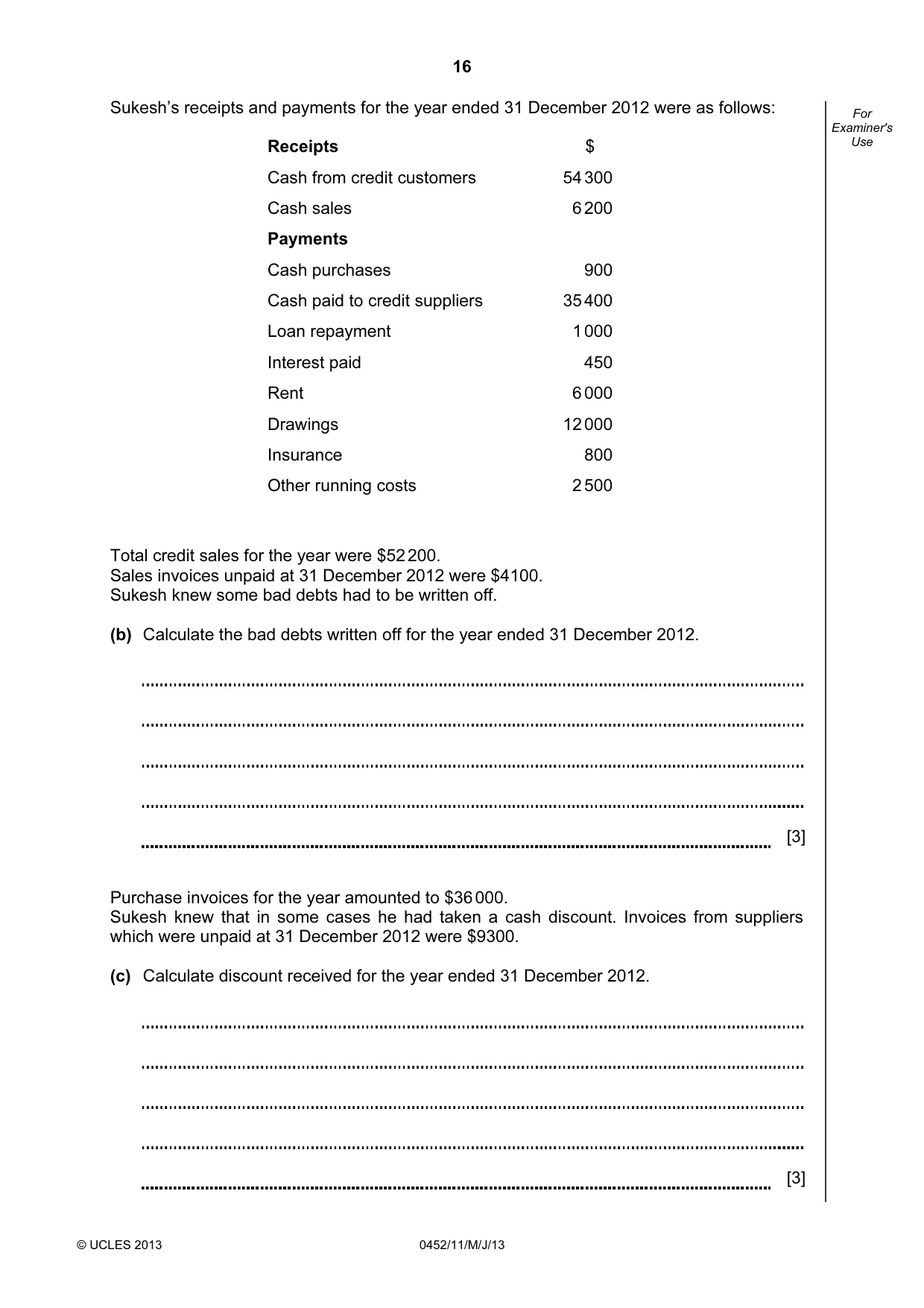
16 © UCLES 2013 0452/11/M/J/13 For Examiner's Use Sukesh’s receipts and payments for the year ended 31 December 2012 were as follows: Receipts $ Cash from credit customers 54 300 Cash sales 6 200 Payments Cash purchases 900 Cash paid to credit suppliers 35 400 Loan repayment 1 000 Interest paid 450 Rent 6 000 Drawings 12 000 Insurance 800 Other running costs 2 500 Total credit sales for the year were $52 200. Sales invoices unpaid at 31 December 2012 were $4100. Sukesh knew some bad debts had to be written off. (b) Calculate the bad debts written off for the year ended 31 December 2012. [3] Purchase invoices for the year amounted to $36 000. Sukesh knew that in some cases he had taken a cash discount. Invoices from suppliers which were unpaid at 31 December 2012 were $9300. (c) Calculate discount received for the year ended 31 December 2012. [3]
Question paper, page 17
17 © UCLES 2013 0452/11/M/J/13 [Turn over For Examiner's Use Additional information 1 Inventory at 31 December 2012 was valued at $8800. 2 Sukesh decided that his non-current assets had maintained their value during the year. 3 Prepaid insurance at 31 December 2012 was $250. (d) Prepare Sukesh’s income statement for the year ended 31 December 2012. Sukesh Income Statement for the year ended 31 December 2012 [14]
Question paper, page 18
18 © UCLES 2013 0452/11/M/J/13 For Examiner's Use (e) Explain why Sukesh should be providing for depreciation on his non-current assets. [2] (f) Name four interested parties, who might want to see Sukesh’s financial statements. 1 2 3 4 [4] (g) Calculate, to two decimal places, Sukesh’s rate of inventory turnover for the year ended 31 December 2012. Show your workings. [3] (h) Duarte runs a similar business which has a rate of inventory turnover of 7.83 times. (i) State which business has the better rate of inventory turnover. (ii) Suggest one reason for the difference. [3] [Total: 38]
Question paper, page 19
19 © UCLES 2013 0452/11/M/J/13 BLANK PAGE
Question paper, page 20
20 Permission to reproduce items where third-party owned material protected by copyright is included has been sought and cleared where possible. Every reasonable effort has been made by the publisher (UCLES) to trace copyright holders, but if any items requiring clearance have unwittingly been included, the publisher will be pleased to make amends at the earliest possible opportunity. University of Cambridge International Examinations is part of the Cambridge Assessment Group. Cambridge Assessment is the brand name of University of Cambridge Local Examinations Syndicate (UCLES), which is itself a department of the University of Cambridge. © UCLES 2013 0452/11/M/J/13 BLANK PAGE
Mark scheme, page 1
CAMBRIDGE INTERNATIONAL EXAMINATIONS International General Certificate of Secondary Education MARK SCHEME for the May/June 2013 series 0452 ACCOUNTING 0452/11 Paper 1, maximum raw mark 120 This mark scheme is published as an aid to teachers and candidates, to indicate the requirements of the examination. It shows the basis on which Examiners were instructed to award marks. It does not indicate the details of the discussions that took place at an Examiners’ meeting before marking began, which would have considered the acceptability of alternative answers. Mark schemes should be read in conjunction with the question paper and the Principal Examiner Report for Teachers. Cambridge will not enter into discussions about these mark schemes. Cambridge is publishing the mark schemes for the May/June 2013 series for most IGCSE, GCE Advanced Level and Advanced Subsidiary Level components and some Ordinary Level components.
Mark scheme, page 2
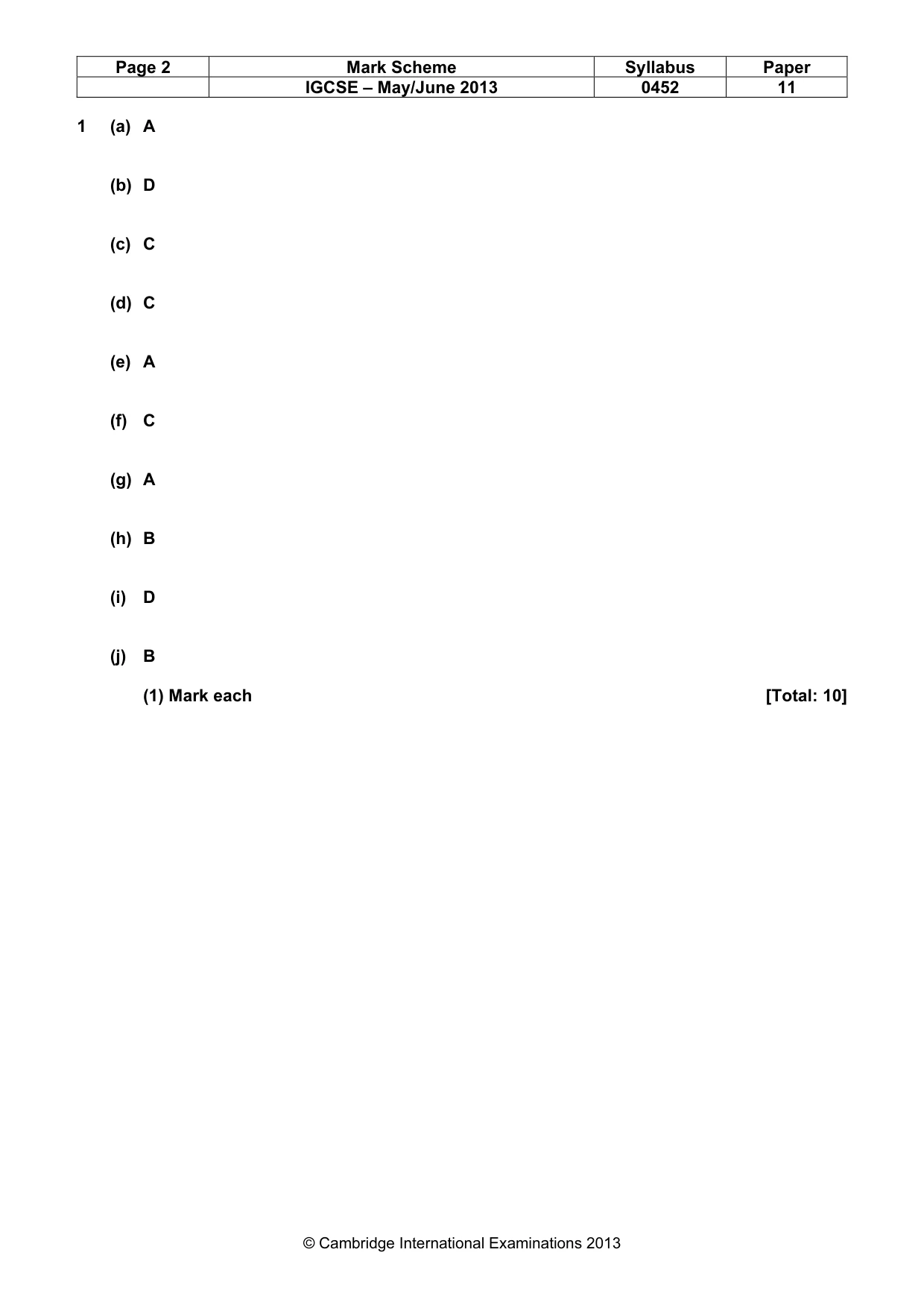
Page 2 Mark Scheme Syllabus Paper IGCSE – May/June 2013 0452 11 © Cambridge International Examinations 2013 1 (a) A (b) D (c) C (d) C (e) A (f) C (g) A (h) B (i) D (j) B (1) Mark each [Total: 10]
Mark scheme, page 3
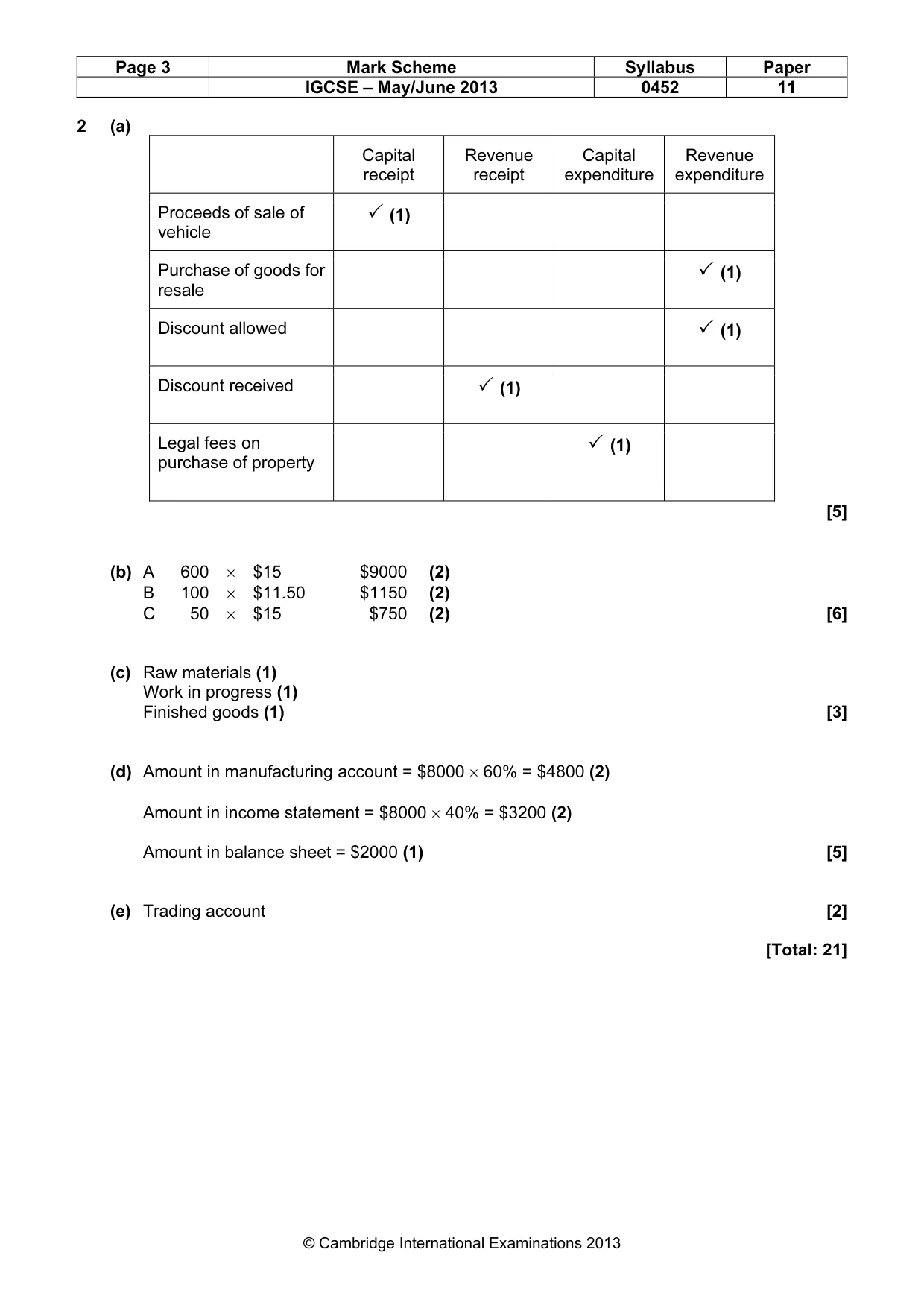
Page 3 Mark Scheme Syllabus Paper IGCSE – May/June 2013 0452 11 © Cambridge International Examinations 2013 2 (a) Capital receipt Revenue receipt Capital expenditure Revenue expenditure Proceeds of sale of vehicle ✓ (1) Purchase of goods for resale ✓ (1) Discount allowed ✓ (1) Discount received ✓ (1) Legal fees on purchase of property ✓ (1) [5] (b) A 600 × $15 $9000 (2) B 100 × $11.50 $1150 (2) C 50 × $15 $750 (2) [6] (c) Raw materials (1) Work in progress (1) Finished goods (1) [3] (d) Amount in manufacturing account = $8000 × 60% = $4800 (2) Amount in income statement = $8000 × 40% = $3200 (2) Amount in balance sheet = $2000 (1) [5] (e) Trading account [2] [Total: 21]
Mark scheme, page 4
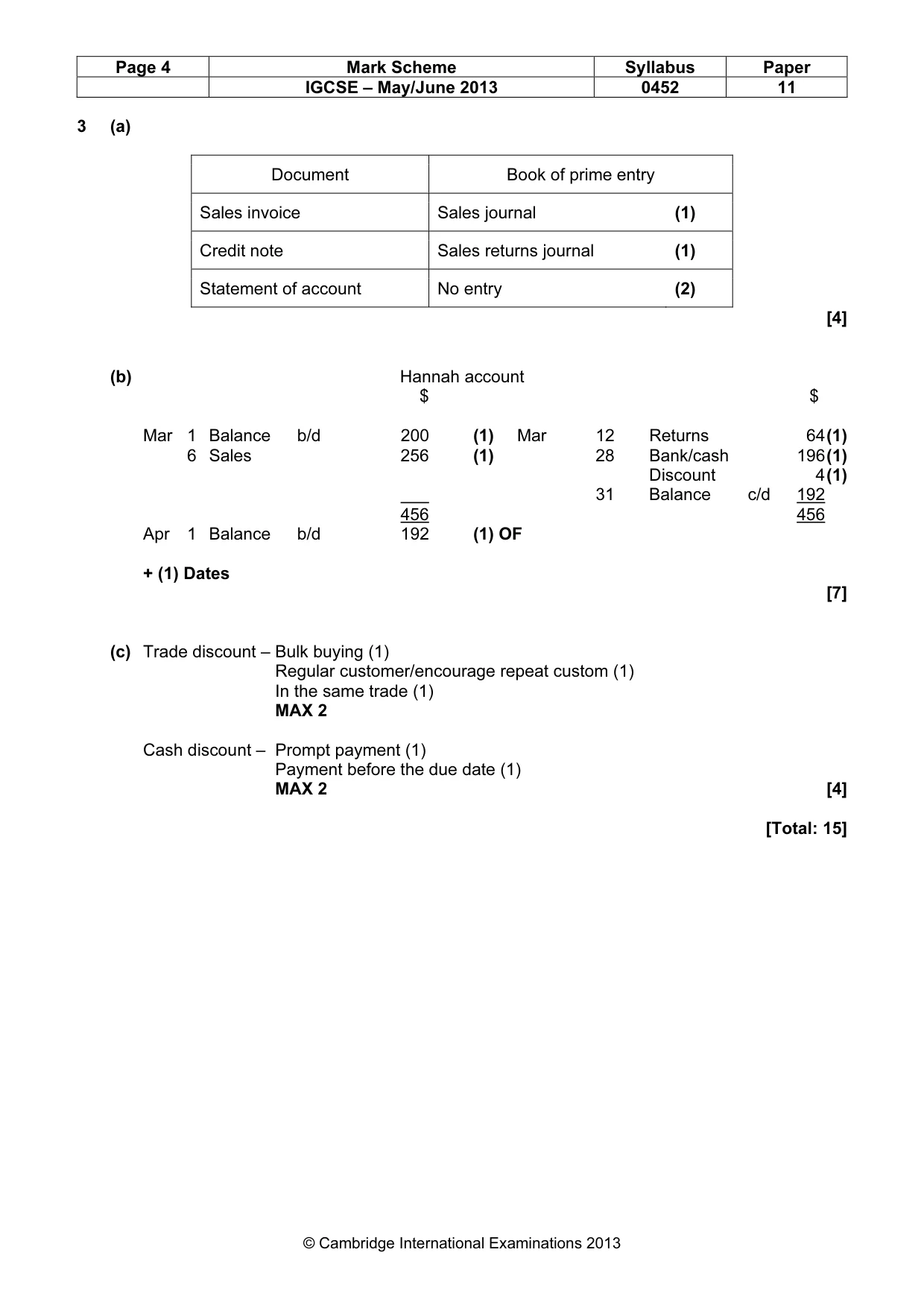
Page 4 Mark Scheme Syllabus Paper IGCSE – May/June 2013 0452 11 © Cambridge International Examinations 2013 3 (a) Document Book of prime entry Sales invoice Sales journal (1) Credit note Sales returns journal (1) Statement of account No entry (2) [4] (b) Hannah account $ $ Mar 1 Balance b/d 200 (1) Mar 12 Returns 64 (1) 6 Sales 256 (1) 28 Bank/cash 196 (1) Discount 4 (1) 31 Balance c/d 192 456 456 Apr 1 Balance b/d 192 (1) OF + (1) Dates [7] (c) Trade discount – Bulk buying (1) Regular customer/encourage repeat custom (1) In the same trade (1) MAX 2 Cash discount – Prompt payment (1) Payment before the due date (1) MAX 2 [4] [Total: 15]
Mark scheme, page 5
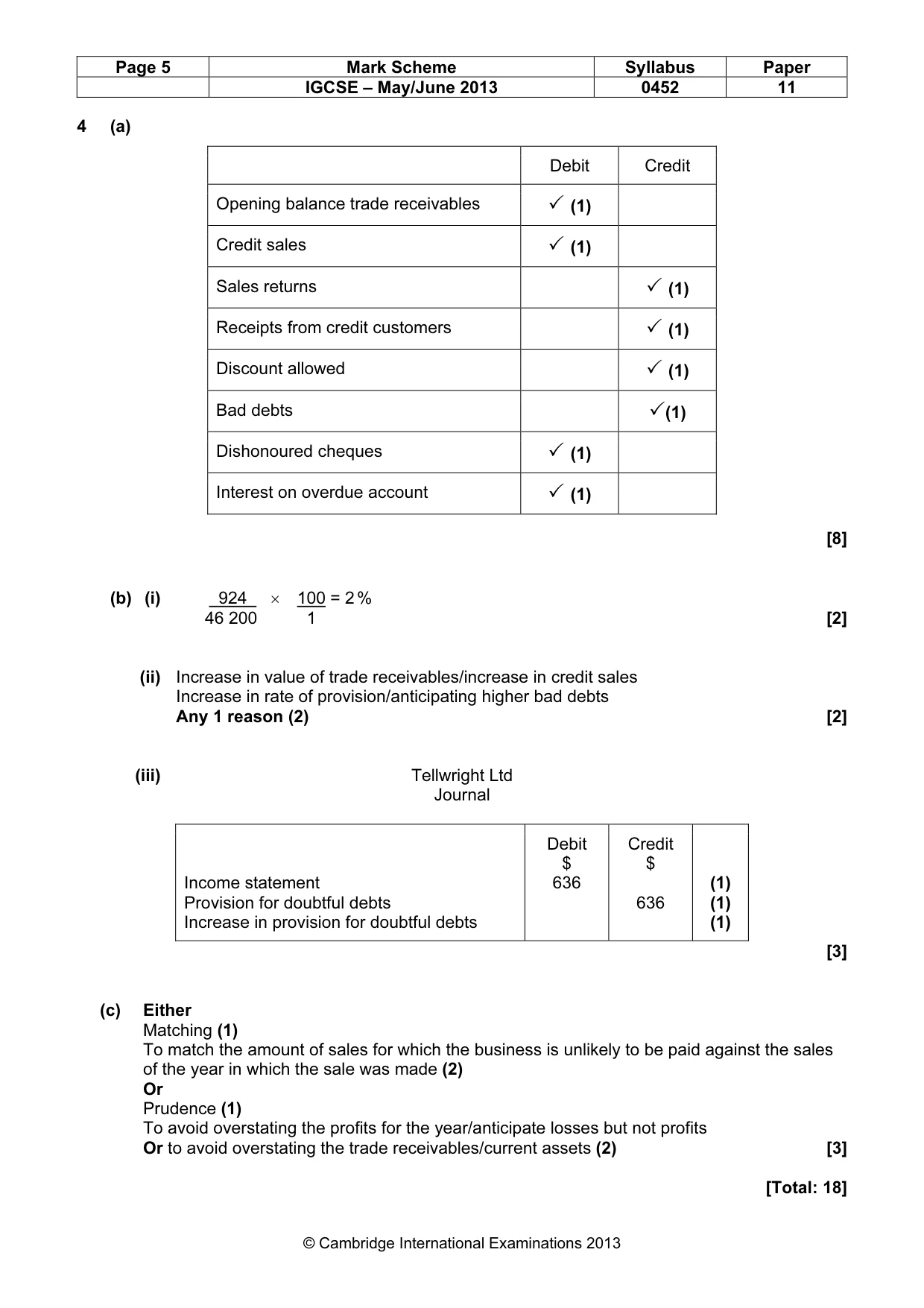
Page 5 Mark Scheme Syllabus Paper IGCSE – May/June 2013 0452 11 © Cambridge International Examinations 2013 4 (a) [8] (b) (i) 924 × 100 = 2 % 46 200 1 [2] (ii) Increase in value of trade receivables/increase in credit sales Increase in rate of provision/anticipating higher bad debts Any 1 reason (2) [2] (iii) Tellwright Ltd Journal Income statement Provision for doubtful debts Increase in provision for doubtful debts Debit $ 636 Credit $ 636 (1) (1) (1) [3] (c) Either Matching (1) To match the amount of sales for which the business is unlikely to be paid against the sales of the year in which the sale was made (2) Or Prudence (1) To avoid overstating the profits for the year/anticipate losses but not profits Or to avoid overstating the trade receivables/current assets (2) [3] [Total: 18] Debit Credit Opening balance trade receivables ✓ (1) Credit sales ✓ (1) Sales returns ✓(1) Receipts from credit customers ✓(1) Discount allowed ✓(1) Bad debts ✓(1) Dishonoured cheques ✓ (1) Interest on overdue account ✓ (1)
Mark scheme, page 6
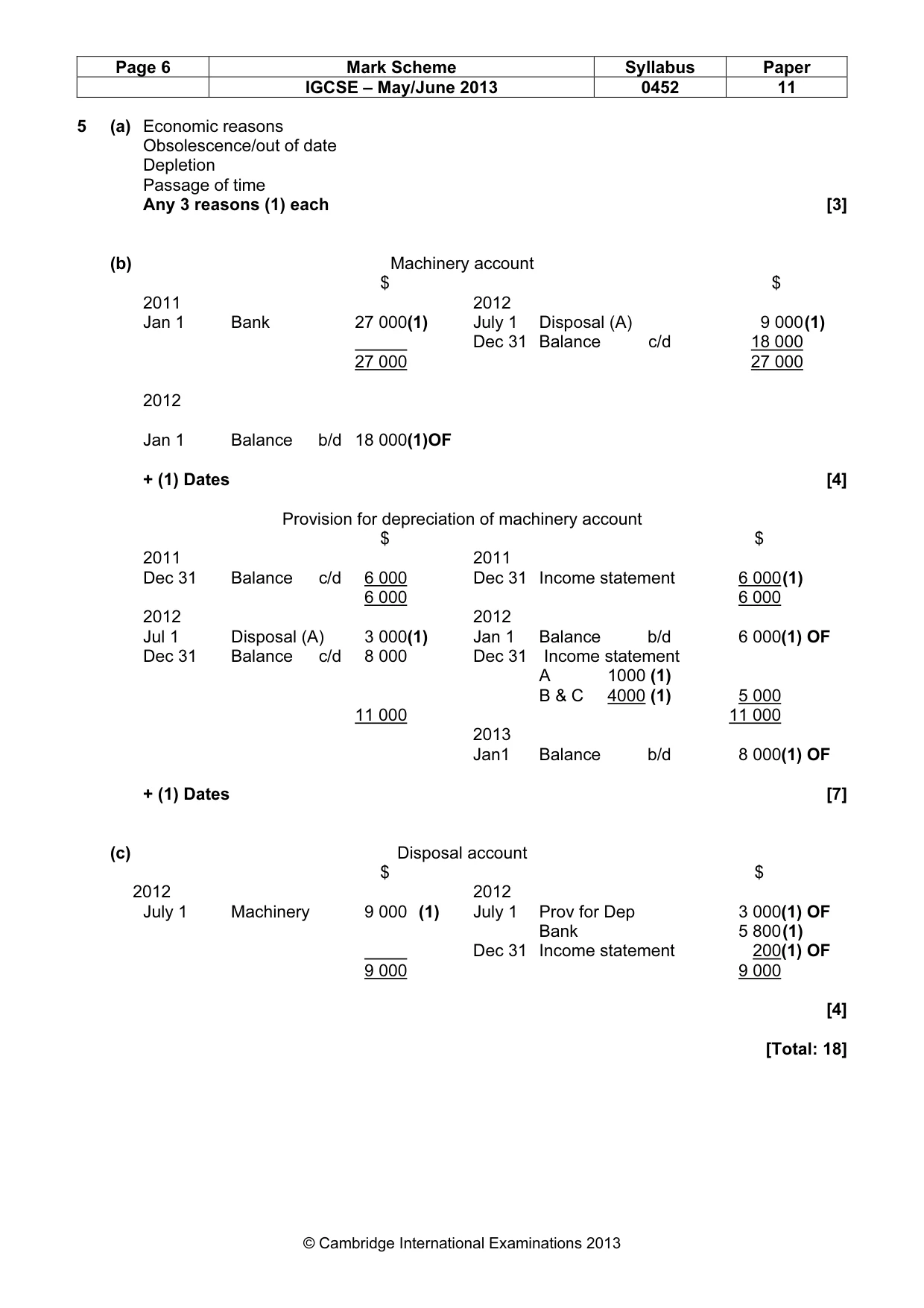
Page 6 Mark Scheme Syllabus Paper IGCSE – May/June 2013 0452 11 © Cambridge International Examinations 2013 5 (a) Economic reasons Obsolescence/out of date Depletion Passage of time Any 3 reasons (1) each [3] (b) Machinery account $ $ 2011 2012 Jan 1 Bank 27 000(1) July 1 Disposal (A) 9 000 (1) Dec 31 Balance c/d 18 000 27 000 27 000 2012 Jan 1 Balance b/d 18 000(1)OF + (1) Dates [4] Provision for depreciation of machinery account $ $ 2011 2011 Dec 31 Balance c/d 6 000 Dec 31 Income statement 6 000 (1) 6 000 6 000 2012 2012 Jul 1 Disposal (A) 3 000(1) Jan 1 Balance b/d 6 000(1) OF Dec 31 Balance c/d 8 000 Dec 31 Income statement A 1000 (1) B & C 4000 (1) 5 000 11 000 11 000 2013 Jan1 Balance b/d 8 000(1) OF + (1) Dates [7] (c) Disposal account $ $ 2012 2012 July 1 Machinery 9 000 (1) July 1 Prov for Dep 3 000(1) OF Bank 5 800 (1) Dec 31 Income statement 200(1) OF 9 000 9 000 [4] [Total: 18]
Mark scheme, page 7
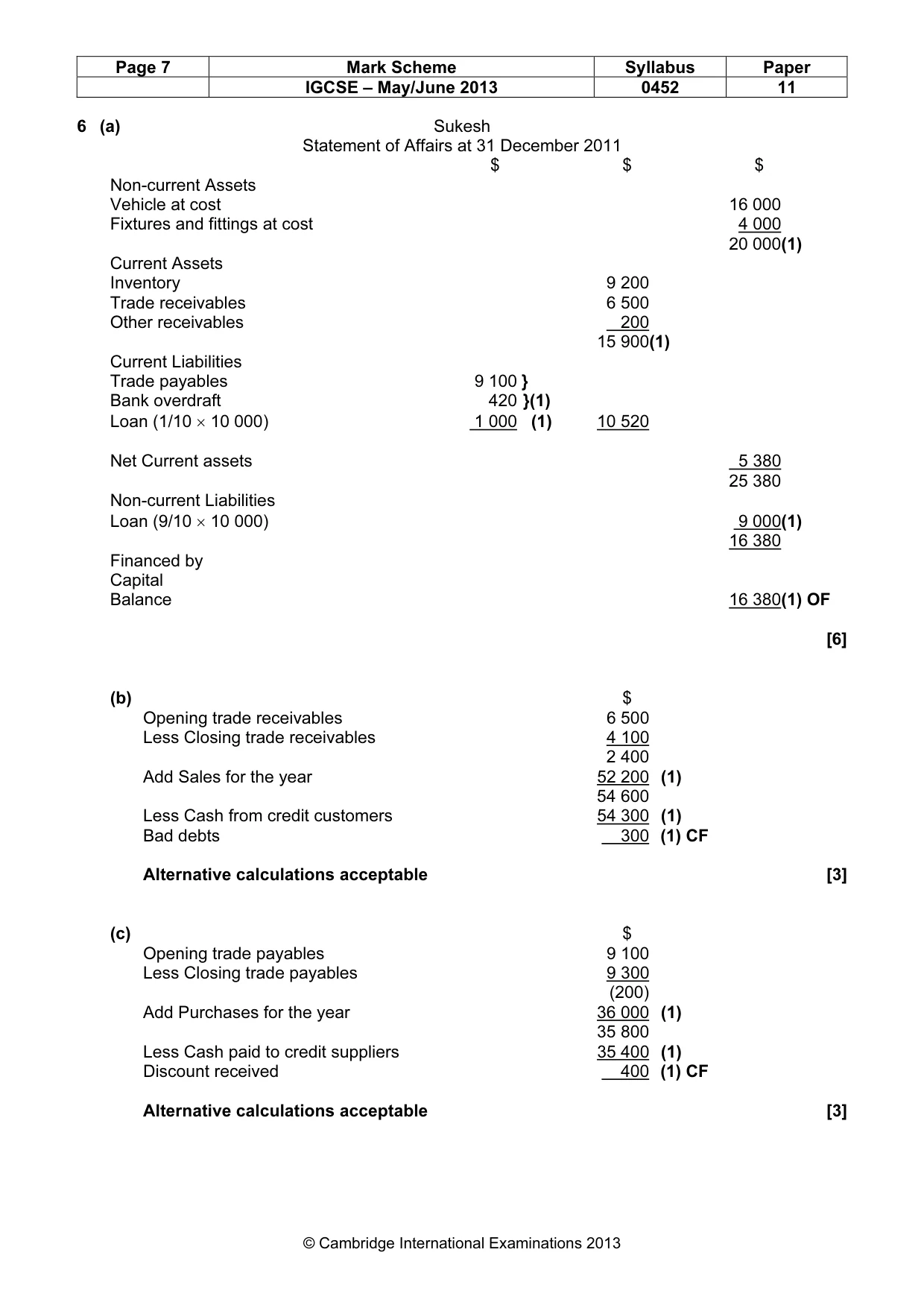
Page 7 Mark Scheme Syllabus Paper IGCSE – May/June 2013 0452 11 © Cambridge International Examinations 2013 6 (a) Sukesh Statement of Affairs at 31 December 2011 $ $ $ Non-current Assets Vehicle at cost 16 000 Fixtures and fittings at cost 4 000 20 000(1) Current Assets Inventory 9 200 Trade receivables 6 500 Other receivables 200 15 900(1) Current Liabilities Trade payables 9 100 } Bank overdraft 420 }(1) Loan (1/10 × 10 000) 1 000 (1) 10 520 Net Current assets 5 380 25 380 Non-current Liabilities Loan (9/10 × 10 000) 9 000(1) 16 380 Financed by Capital Balance 16 380(1) OF [6] (b) $ Opening trade receivables 6 500 Less Closing trade receivables 4 100 2 400 Add Sales for the year 52 200 (1) 54 600 Less Cash from credit customers 54 300 (1) Bad debts 300 (1) CF Alternative calculations acceptable [3] (c) $ Opening trade payables 9 100 Less Closing trade payables 9 300 (200) Add Purchases for the year 36 000 (1) 35 800 Less Cash paid to credit suppliers 35 400 (1) Discount received 400 (1) CF Alternative calculations acceptable [3]
Mark scheme, page 8
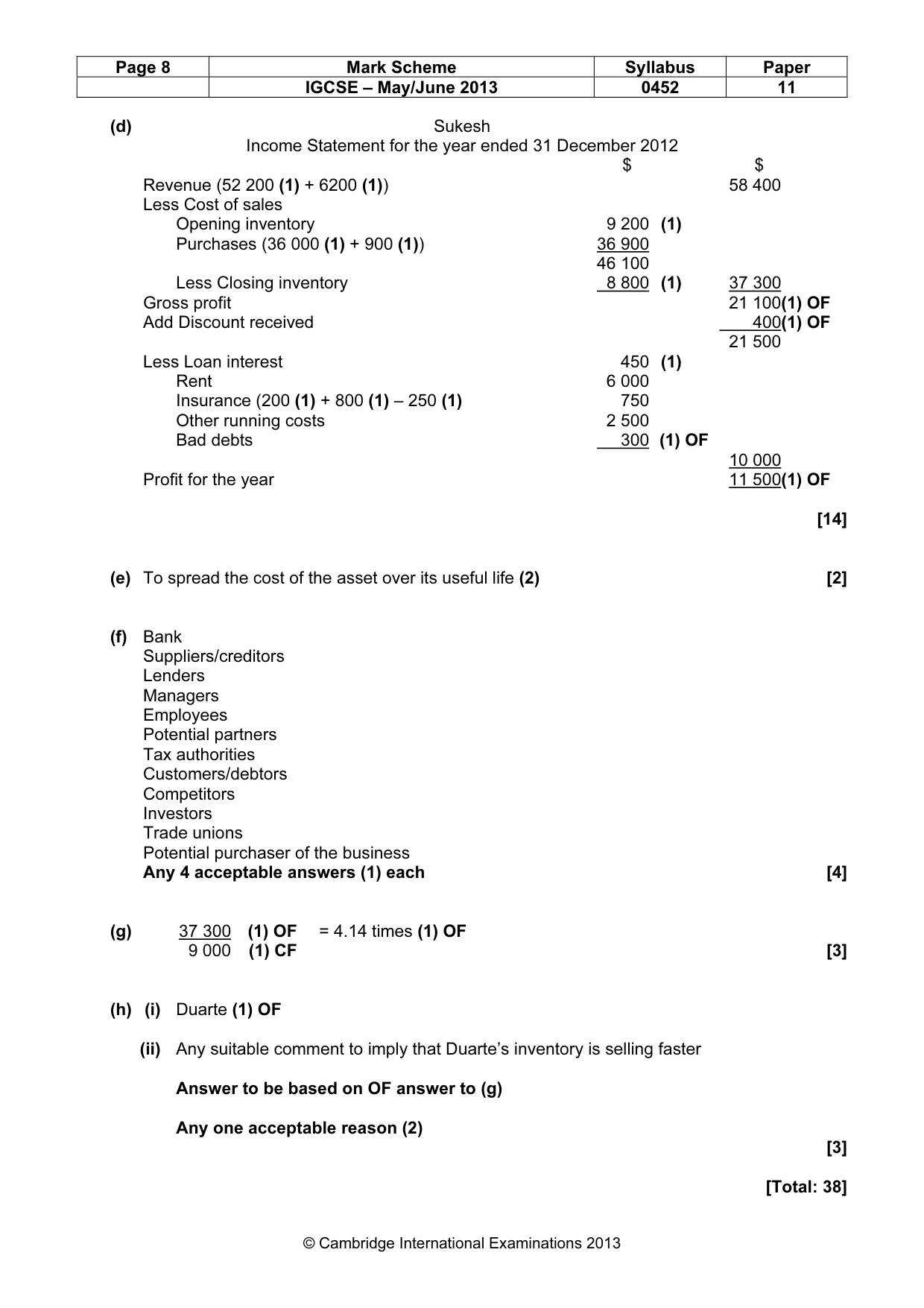
Page 8 Mark Scheme Syllabus Paper IGCSE – May/June 2013 0452 11 © Cambridge International Examinations 2013 (d) Sukesh Income Statement for the year ended 31 December 2012 $ $ Revenue (52 200 (1) + 6200 (1)) 58 400 Less Cost of sales Opening inventory 9 200 (1) Purchases (36 000 (1) + 900 (1)) 36 900 46 100 Less Closing inventory 8 800 (1) 37 300 Gross profit 21 100(1) OF Add Discount received 400(1) OF 21 500 Less Loan interest 450 (1) Rent 6 000 Insurance (200 (1) + 800 (1) – 250 (1) 750 Other running costs 2 500 Bad debts 300 (1) OF 10 000 Profit for the year 11 500(1) OF [14] (e) To spread the cost of the asset over its useful life (2) [2] (f) Bank Suppliers/creditors Lenders Managers Employees Potential partners Tax authorities Customers/debtors Competitors Investors Trade unions Potential purchaser of the business Any 4 acceptable answers (1) each [4] (g) 37 300 (1) OF = 4.14 times (1) OF 9 000 (1) CF [3] (h) (i) Duarte (1) OF (ii) Any suitable comment to imply that Duarte’s inventory is selling faster Answer to be based on OF answer to (g) Any one acceptable reason (2) [3] [Total: 38]
What you needed in this session
Cambridge’s own grade thresholds for 2013 May/June, Paper 1 · Variant 1. A higher threshold means an easier paper — the bar moves with how the cohort did.