Cambridge IGCSE Accounting 0452 — 2012 May/June Paper 2 · Variant 1
0452/21/M/J/12 · 120 marks · ≈135 min
The question paper and its mark scheme, free to read here and free to download. This is Cambridge’s own paper, exactly as it was sat.
Question paper20 pages


Mark scheme8 pages
Answers below. Sit the paper first if you are practising.
Paper as text
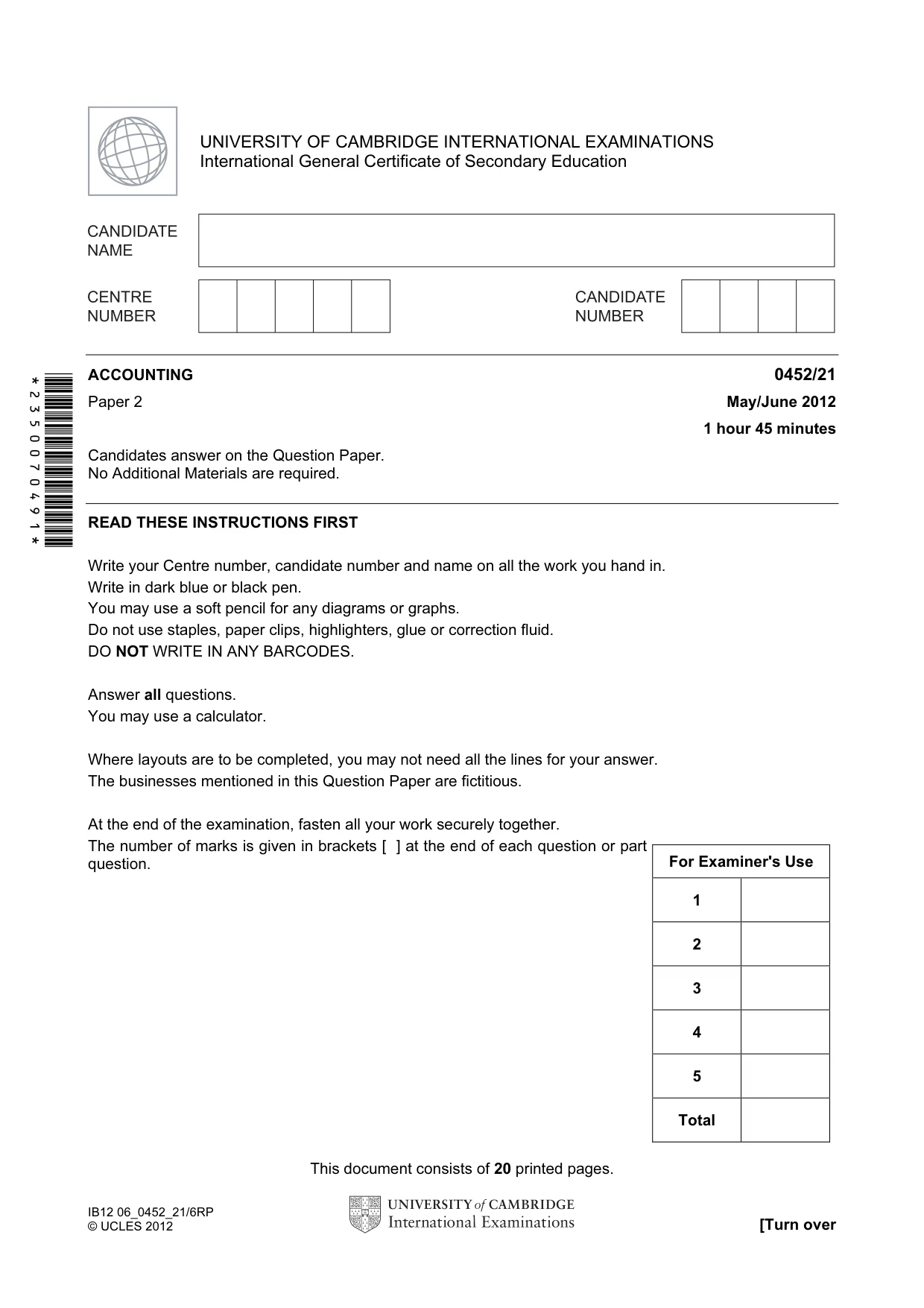
Question paper, page 1
This document consists of 20 printed pages. IB12 06_0452_21/6RP © UCLES 2012 [Turn over *2350070491* For Examiner's Use 1 2 3 4 5 Total UNIVERSITY OF CAMBRIDGE INTERNATIONAL EXAMINATIONS International General Certificate of Secondary Education ACCOUNTING 0452/21 Paper 2 May/June 2012 1 hour 45 minutes Candidates answer on the Question Paper. No Additional Materials are required. READ THESE INSTRUCTIONS FIRST Write your Centre number, candidate number and name on all the work you hand in. Write in dark blue or black pen. You may use a soft pencil for any diagrams or graphs. Do not use staples, paper clips, highlighters, glue or correction fluid. DO NOT WRITE IN ANY BARCODES. Answer all questions. You may use a calculator. Where layouts are to be completed, you may not need all the lines for your answer. The businesses mentioned in this Question Paper are fictitious. At the end of the examination, fasten all your work securely together. The number of marks is given in brackets [ ] at the end of each question or part question.
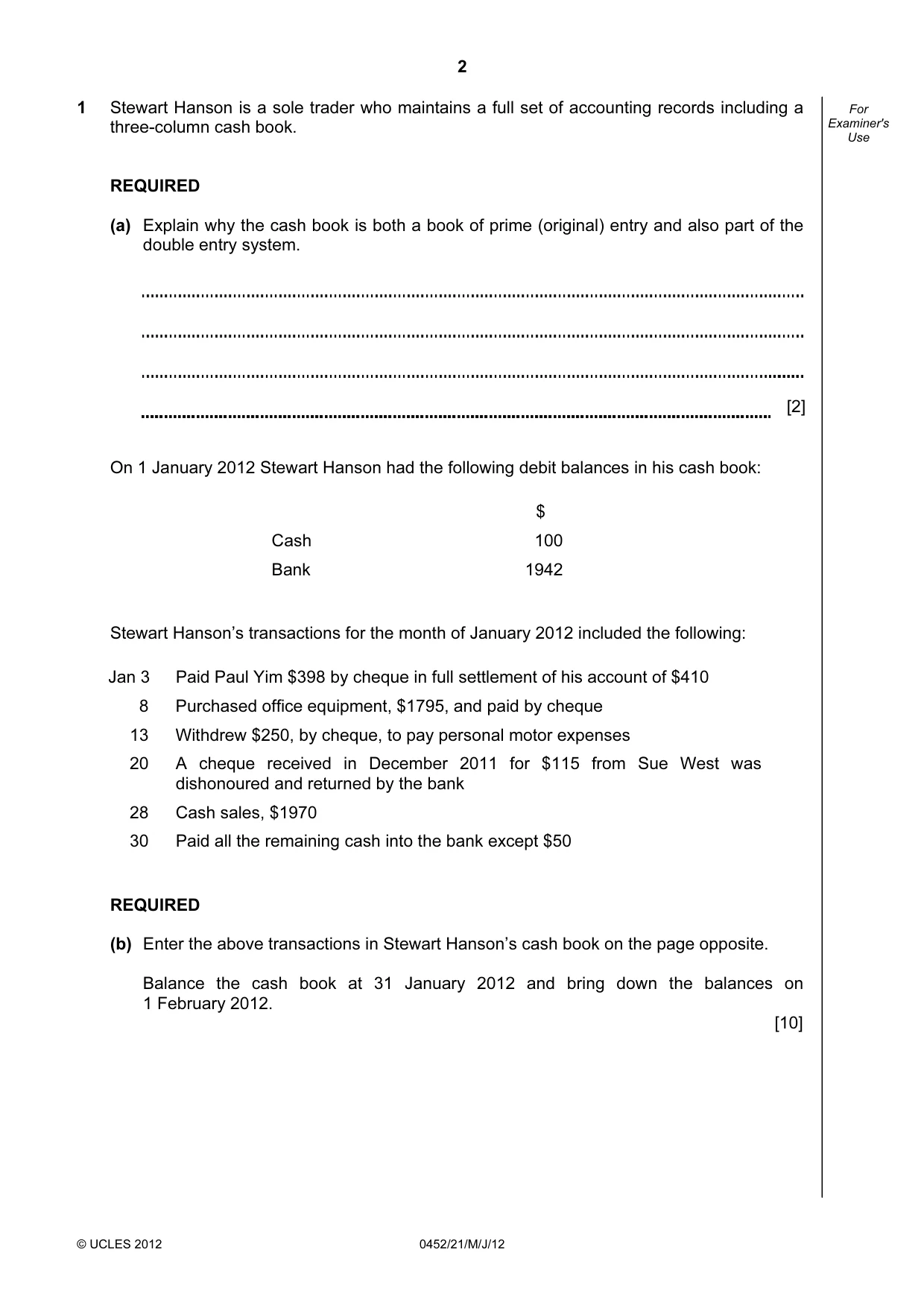
Question paper, page 2
2 © UCLES 2012 0452/21/M/J/12 For Examiner's Use 1 Stewart Hanson is a sole trader who maintains a full set of accounting records including a three-column cash book. REQUIRED (a) Explain why the cash book is both a book of prime (original) entry and also part of the double entry system. [2] On 1 January 2012 Stewart Hanson had the following debit balances in his cash book: $ Cash 100 Bank 1942 Stewart Hanson’s transactions for the month of January 2012 included the following: Jan 3 Paid Paul Yim $398 by cheque in full settlement of his account of $410 8 Purchased office equipment, $1795, and paid by cheque 13 Withdrew $250, by cheque, to pay personal motor expenses 20 A cheque received in December 2011 for $115 from Sue West was dishonoured and returned by the bank 28 Cash sales, $1970 30 Paid all the remaining cash into the bank except $50 REQUIRED (b) Enter the above transactions in Stewart Hanson’s cash book on the page opposite. Balance the cash book at 31 January 2012 and bring down the balances on 1 February 2012. [10]
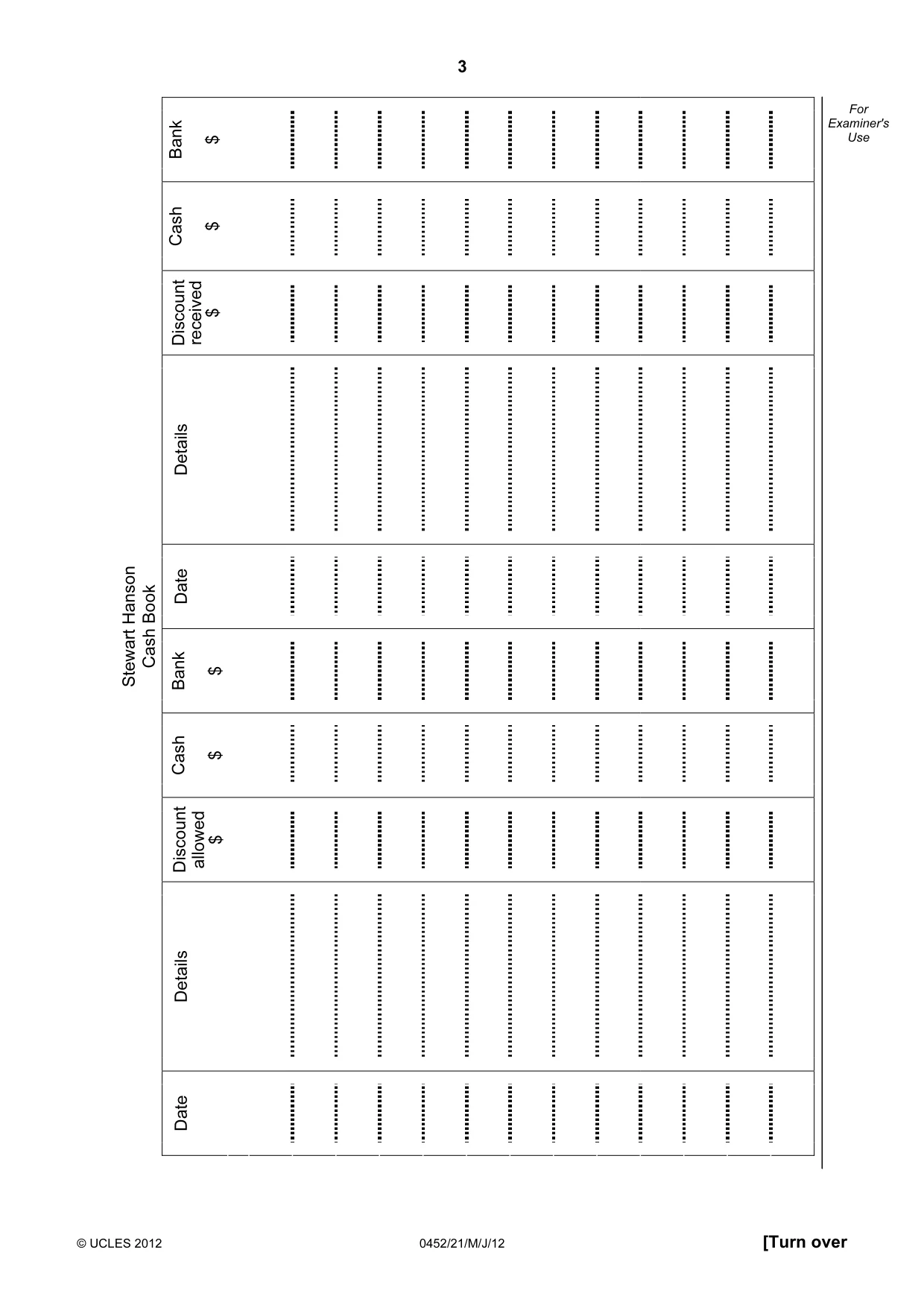
Question paper, page 3
3 © UCLES 2012 0452/21/M/J/12 [Turn over For Examiner's Use Bank $ Cash $ Discount received $ Details Date Bank $ Cash $ Discount allowed $ Details Stewart Hanson Cash Book Date
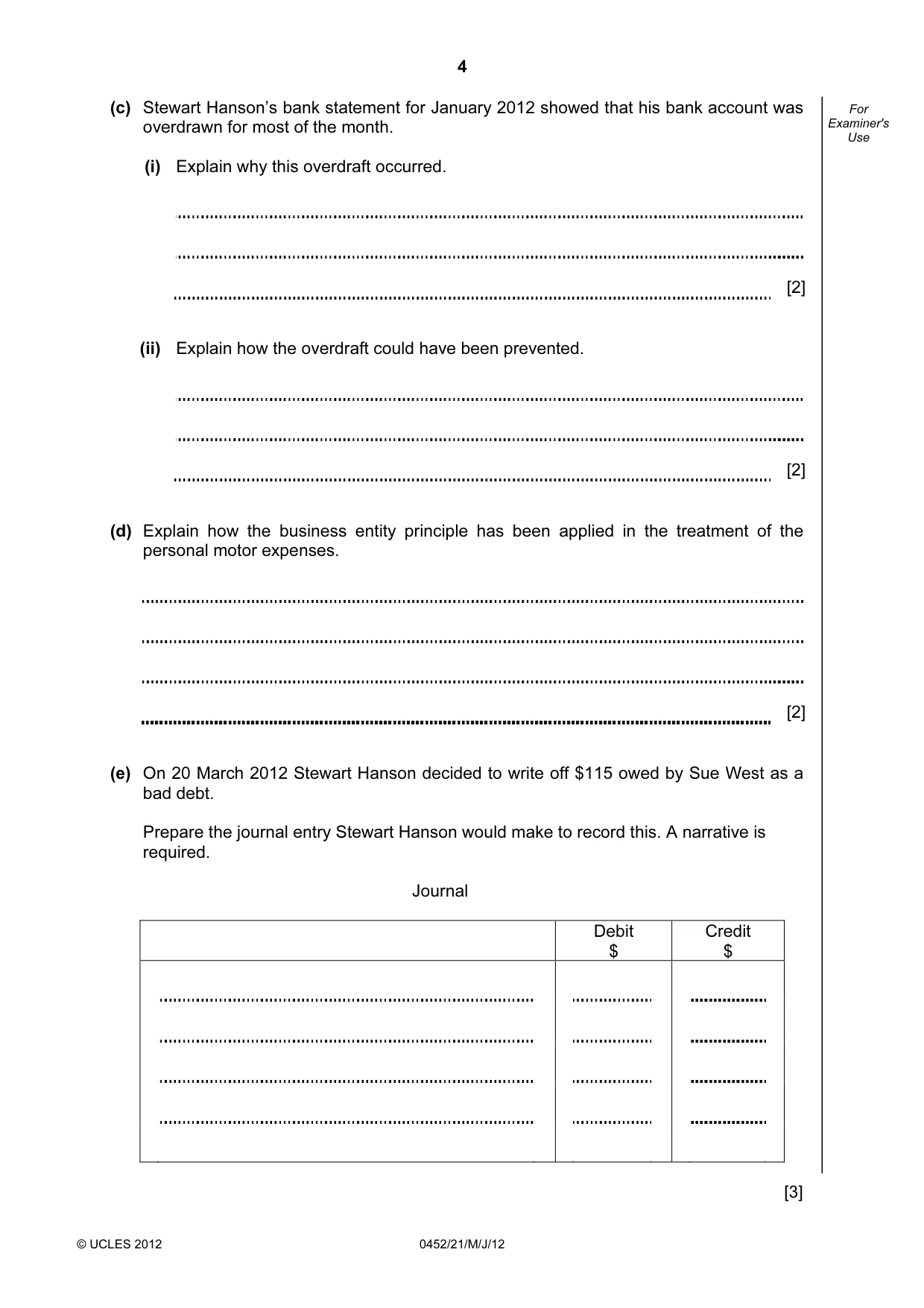
Question paper, page 4
4 © UCLES 2012 0452/21/M/J/12 For Examiner's Use (c) Stewart Hanson’s bank statement for January 2012 showed that his bank account was overdrawn for most of the month. (i) Explain why this overdraft occurred. [2] (ii) Explain how the overdraft could have been prevented. [2] (d) Explain how the business entity principle has been applied in the treatment of the personal motor expenses. [2] (e) On 20 March 2012 Stewart Hanson decided to write off $115 owed by Sue West as a bad debt. Prepare the journal entry Stewart Hanson would make to record this. A narrative is required. Journal Debit $ Credit $ [3]
Question paper, page 5
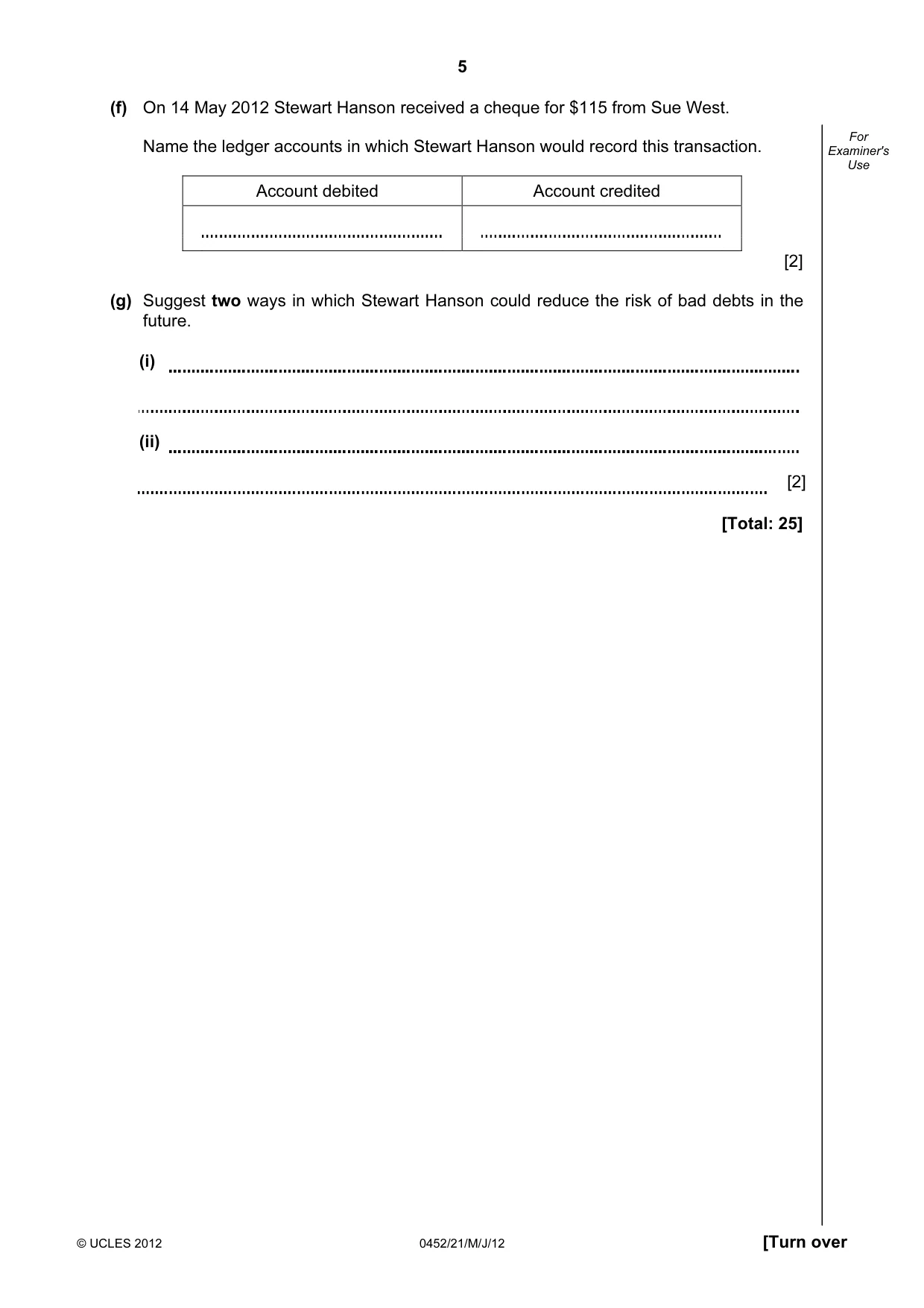
5 © UCLES 2012 0452/21/M/J/12 [Turn over For Examiner's Use (f) On 14 May 2012 Stewart Hanson received a cheque for $115 from Sue West. Name the ledger accounts in which Stewart Hanson would record this transaction. Account debited Account credited [2] (g) Suggest two ways in which Stewart Hanson could reduce the risk of bad debts in the future. (i) (ii) [2] [Total: 25]
Question paper, page 6
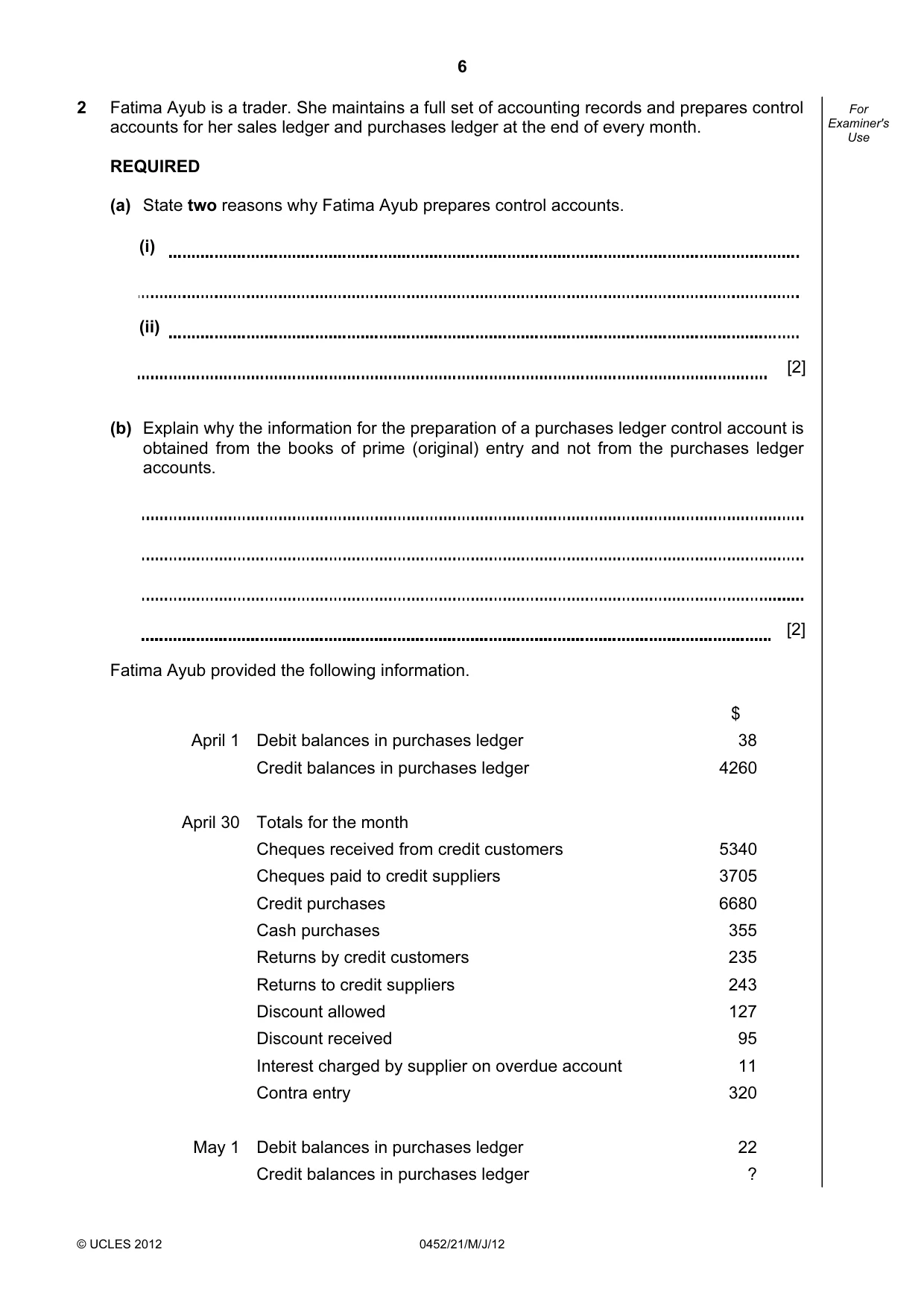
6 © UCLES 2012 0452/21/M/J/12 For Examiner's Use 2 Fatima Ayub is a trader. She maintains a full set of accounting records and prepares control accounts for her sales ledger and purchases ledger at the end of every month. REQUIRED (a) State two reasons why Fatima Ayub prepares control accounts. (i) (ii) [2] (b) Explain why the information for the preparation of a purchases ledger control account is obtained from the books of prime (original) entry and not from the purchases ledger accounts. [2] Fatima Ayub provided the following information. $ April 1 Debit balances in purchases ledger 38 Credit balances in purchases ledger 4260 April 30 Totals for the month Cheques received from credit customers 5340 Cheques paid to credit suppliers 3705 Credit purchases 6680 Cash purchases 355 Returns by credit customers 235 Returns to credit suppliers 243 Discount allowed 127 Discount received 95 Interest charged by supplier on overdue account 11 Contra entry 320 May 1 Debit balances in purchases ledger 22 Credit balances in purchases ledger ?
Question paper, page 7
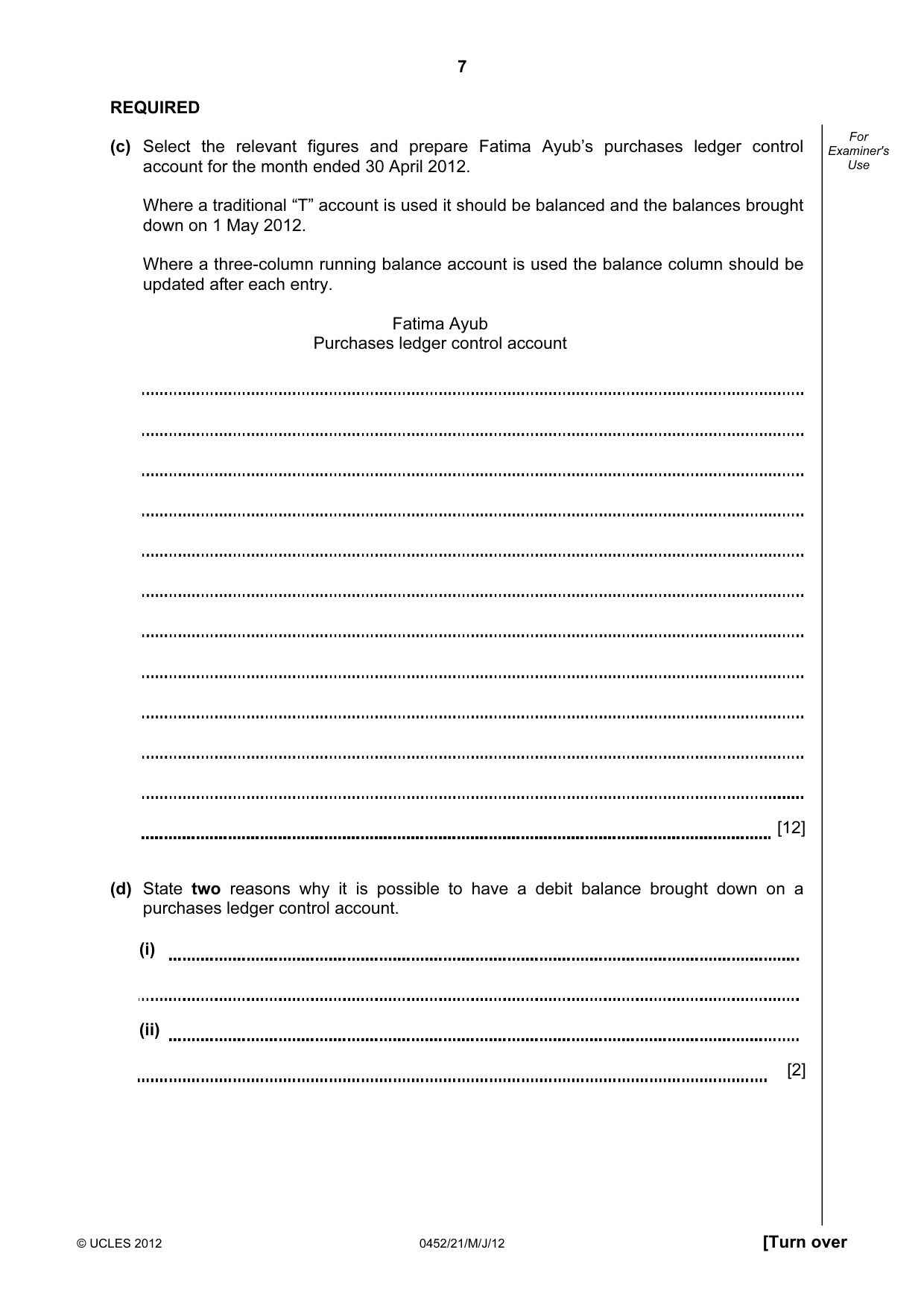
7 © UCLES 2012 0452/21/M/J/12 [Turn over For Examiner's Use REQUIRED (c) Select the relevant figures and prepare Fatima Ayub’s purchases ledger control account for the month ended 30 April 2012. Where a traditional “T” account is used it should be balanced and the balances brought down on 1 May 2012. Where a three-column running balance account is used the balance column should be updated after each entry. Fatima Ayub Purchases ledger control account [12] (d) State two reasons why it is possible to have a debit balance brought down on a purchases ledger control account. (i) (ii) [2]
Question paper, page 8
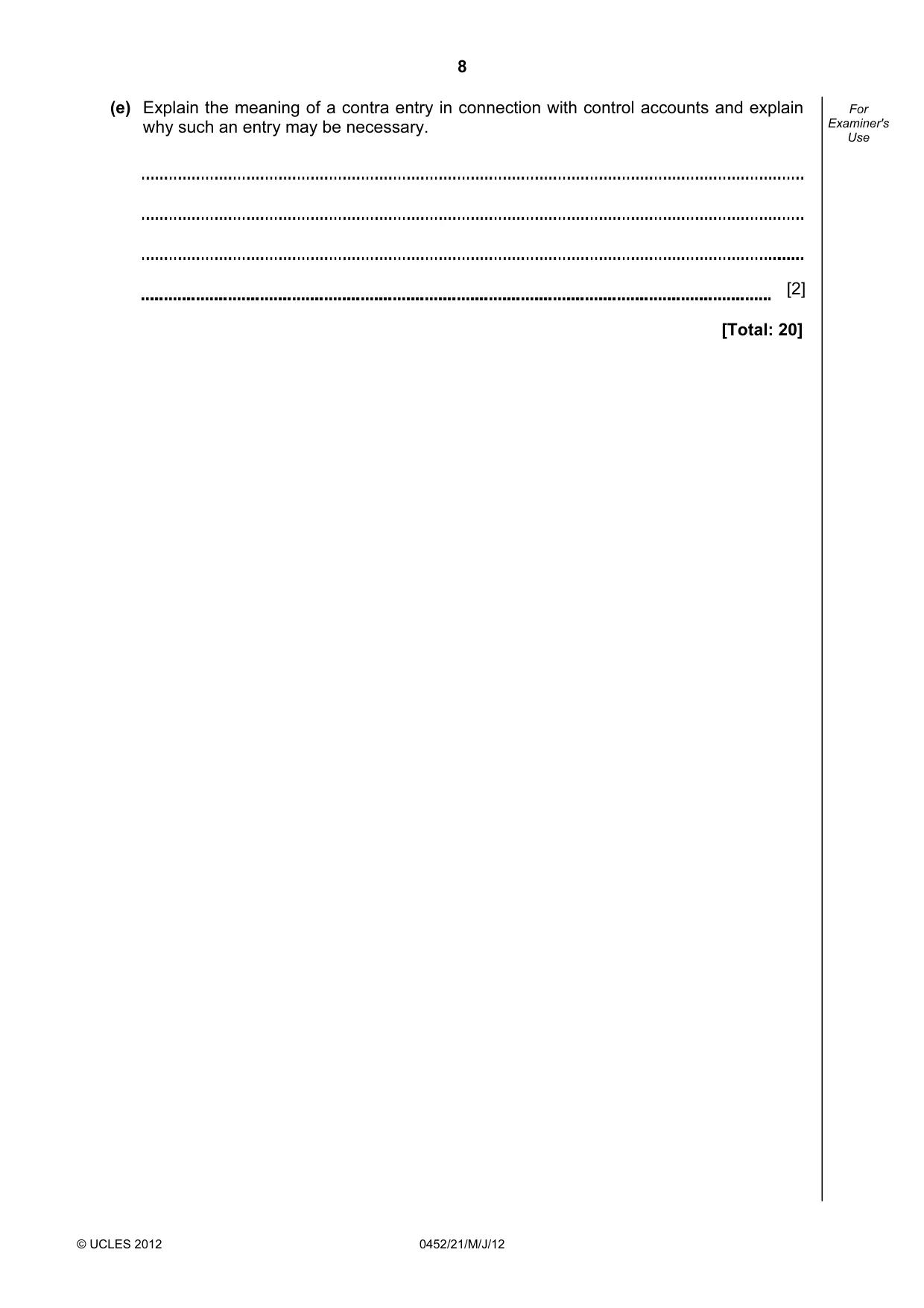
8 © UCLES 2012 0452/21/M/J/12 For Examiner's Use (e) Explain the meaning of a contra entry in connection with control accounts and explain why such an entry may be necessary. [2] [Total: 20]
Question paper, page 9
9 © UCLES 2012 0452/21/M/J/12 [Turn over Question 3 is on the next page
Question paper, page 10
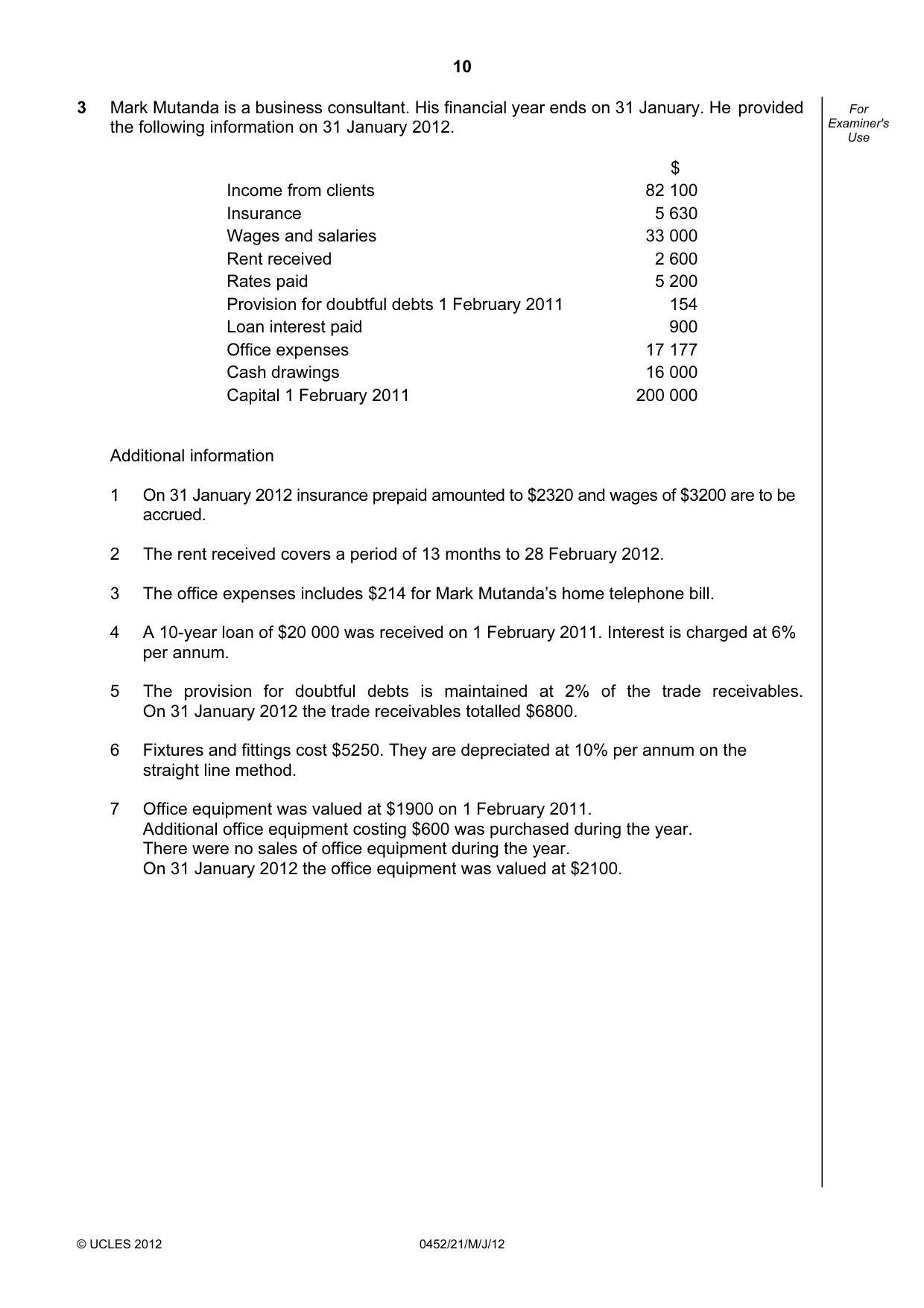
10 © UCLES 2012 0452/21/M/J/12 For Examiner's Use 3 Mark Mutanda is a business consultant. His financial year ends on 31 January. He provided the following information on 31 January 2012. $ Income from clients 82 100 Insurance 5 630 Wages and salaries 33 000 Rent received 2 600 Rates paid 5 200 Provision for doubtful debts 1 February 2011 154 Loan interest paid 900 Office expenses 17 177 Cash drawings 16 000 Capital 1 February 2011 200 000 Additional information 1 On 31 January 2012 insurance prepaid amounted to $2320 and wages of $3200 are to be accrued. 2 The rent received covers a period of 13 months to 28 February 2012. 3 The office expenses includes $214 for Mark Mutanda’s home telephone bill. 4 A 10-year loan of $20 000 was received on 1 February 2011. Interest is charged at 6% per annum. 5 The provision for doubtful debts is maintained at 2% of the trade receivables. On 31 January 2012 the trade receivables totalled $6800. 6 Fixtures and fittings cost $5250. They are depreciated at 10% per annum on the straight line method. 7 Office equipment was valued at $1900 on 1 February 2011. Additional office equipment costing $600 was purchased during the year. There were no sales of office equipment during the year. On 31 January 2012 the office equipment was valued at $2100.
Question paper, page 11
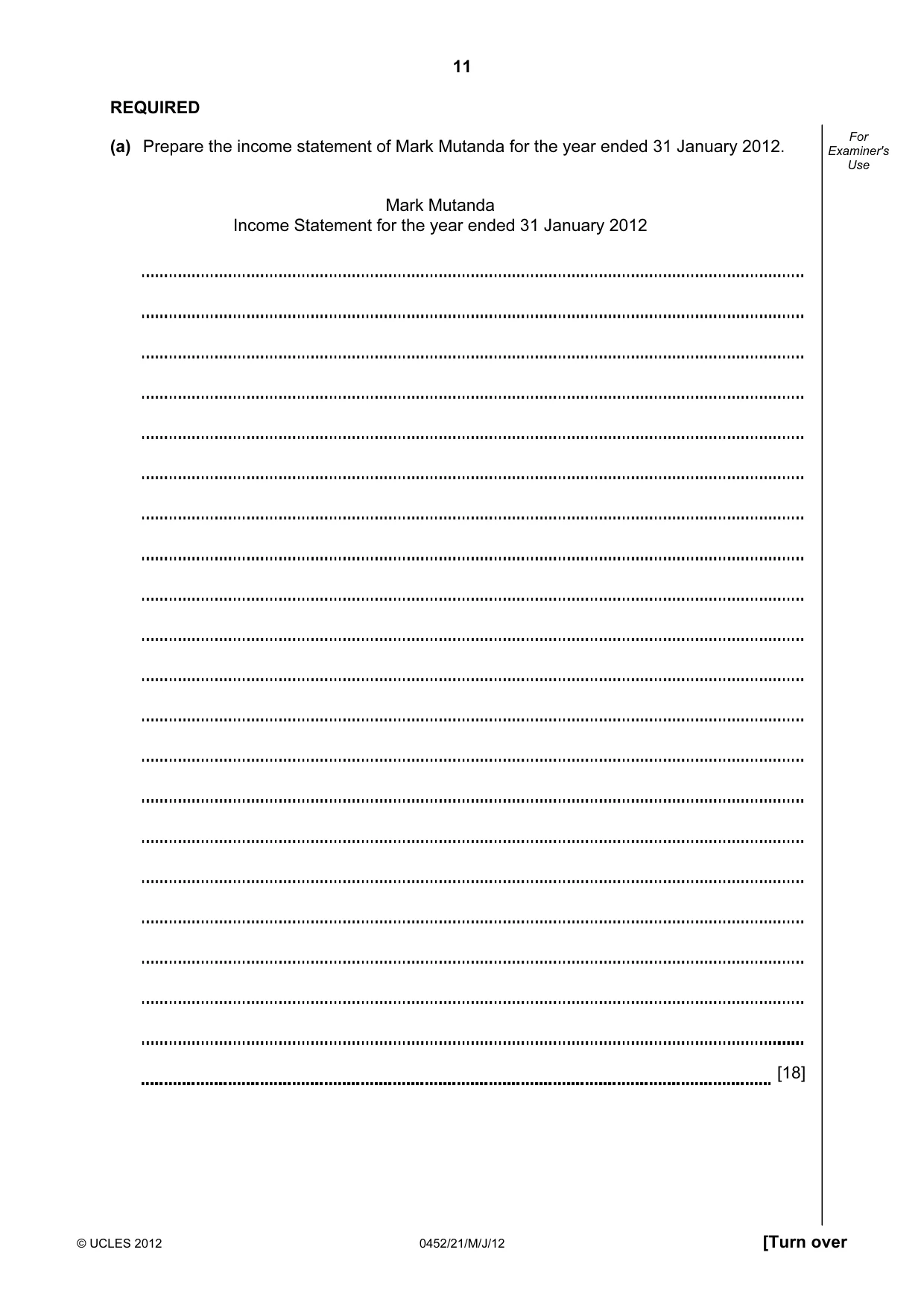
11 © UCLES 2012 0452/21/M/J/12 [Turn over For Examiner's Use REQUIRED (a) Prepare the income statement of Mark Mutanda for the year ended 31 January 2012. Mark Mutanda Income Statement for the year ended 31 January 2012 [18]
Question paper, page 12
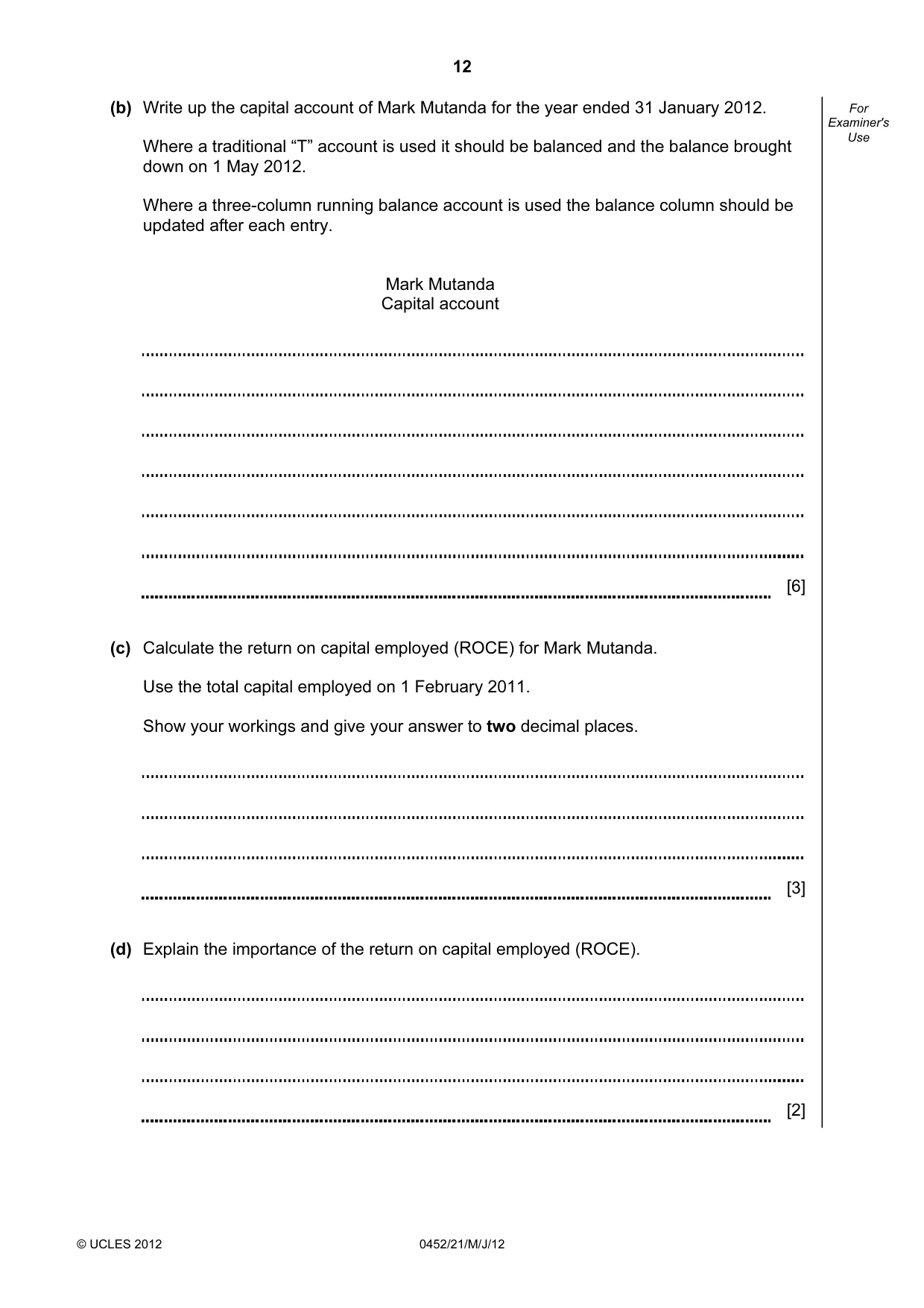
12 © UCLES 2012 0452/21/M/J/12 For Examiner's Use (b) Write up the capital account of Mark Mutanda for the year ended 31 January 2012. Where a traditional “T” account is used it should be balanced and the balance brought down on 1 May 2012. Where a three-column running balance account is used the balance column should be updated after each entry. Mark Mutanda Capital account [6] (c) Calculate the return on capital employed (ROCE) for Mark Mutanda. Use the total capital employed on 1 February 2011. Show your workings and give your answer to two decimal places. [3] (d) Explain the importance of the return on capital employed (ROCE). [2]
Question paper, page 13
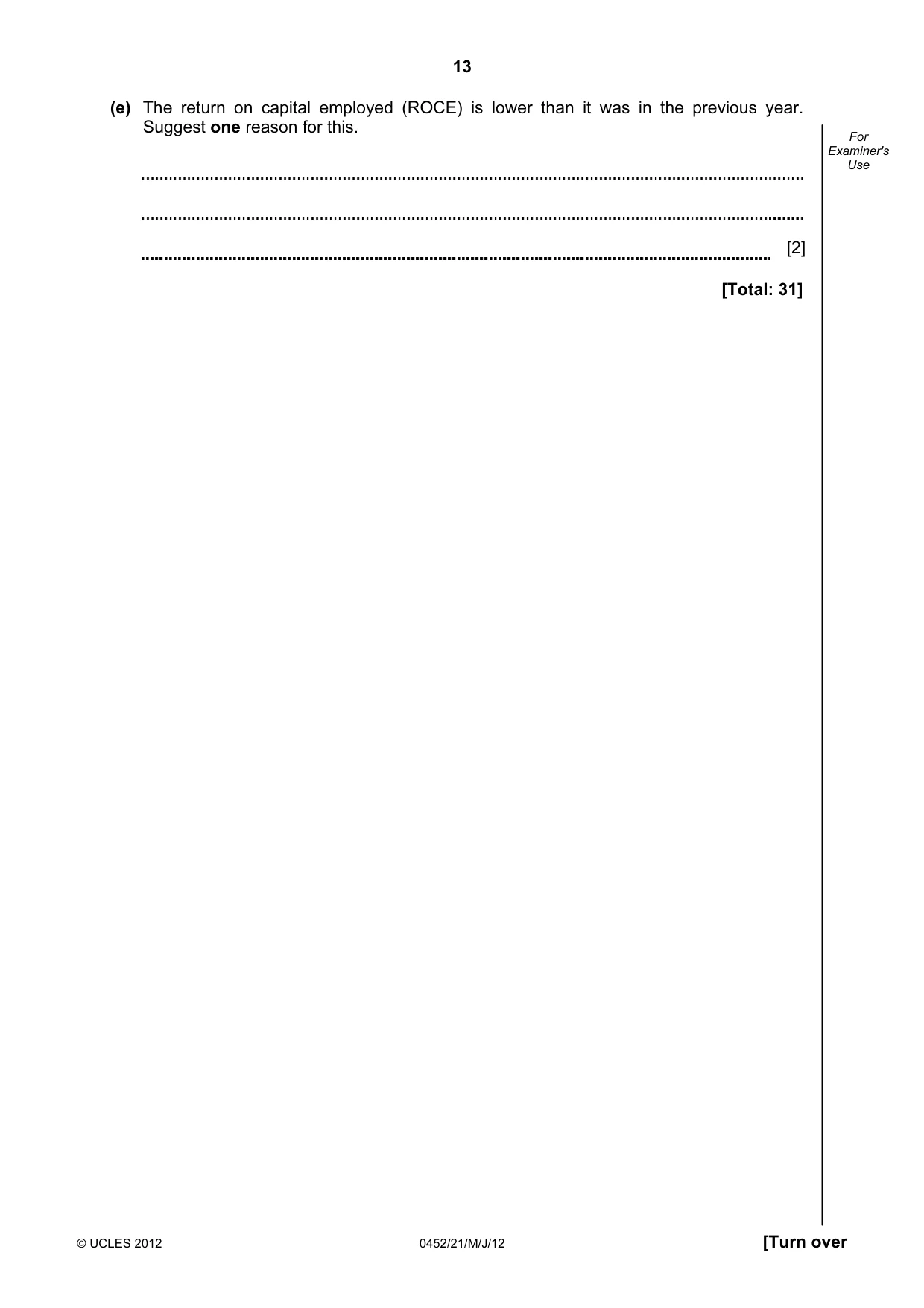
13 © UCLES 2012 0452/21/M/J/12 [Turn over For Examiner's Use (e) The return on capital employed (ROCE) is lower than it was in the previous year. Suggest one reason for this. [2] [Total: 31]
Question paper, page 14
14 © UCLES 2012 0452/21/M/J/12 Question 4 is on the next page
Question paper, page 15
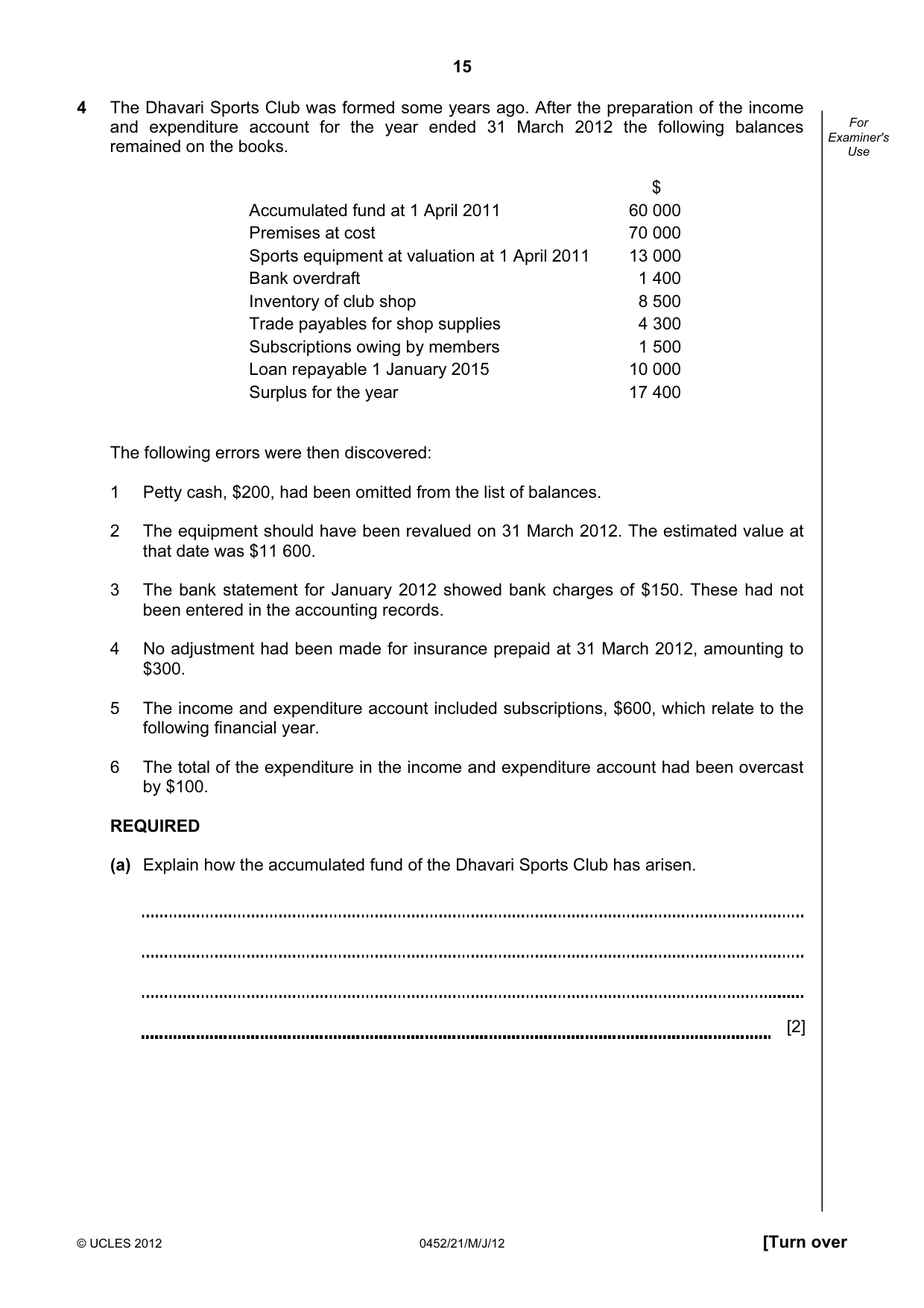
15 © UCLES 2012 0452/21/M/J/12 [Turn over For Examiner's Use 4 The Dhavari Sports Club was formed some years ago. After the preparation of the income and expenditure account for the year ended 31 March 2012 the following balances remained on the books. $ Accumulated fund at 1 April 2011 60 000 Premises at cost 70 000 Sports equipment at valuation at 1 April 2011 13 000 Bank overdraft 1 400 Inventory of club shop 8 500 Trade payables for shop supplies 4 300 Subscriptions owing by members 1 500 Loan repayable 1 January 2015 10 000 Surplus for the year 17 400 The following errors were then discovered: 1 Petty cash, $200, had been omitted from the list of balances. 2 The equipment should have been revalued on 31 March 2012. The estimated value at that date was $11 600. 3 The bank statement for January 2012 showed bank charges of $150. These had not been entered in the accounting records. 4 No adjustment had been made for insurance prepaid at 31 March 2012, amounting to $300. 5 The income and expenditure account included subscriptions, $600, which relate to the following financial year. 6 The total of the expenditure in the income and expenditure account had been overcast by $100. REQUIRED (a) Explain how the accumulated fund of the Dhavari Sports Club has arisen. [2]
Question paper, page 16
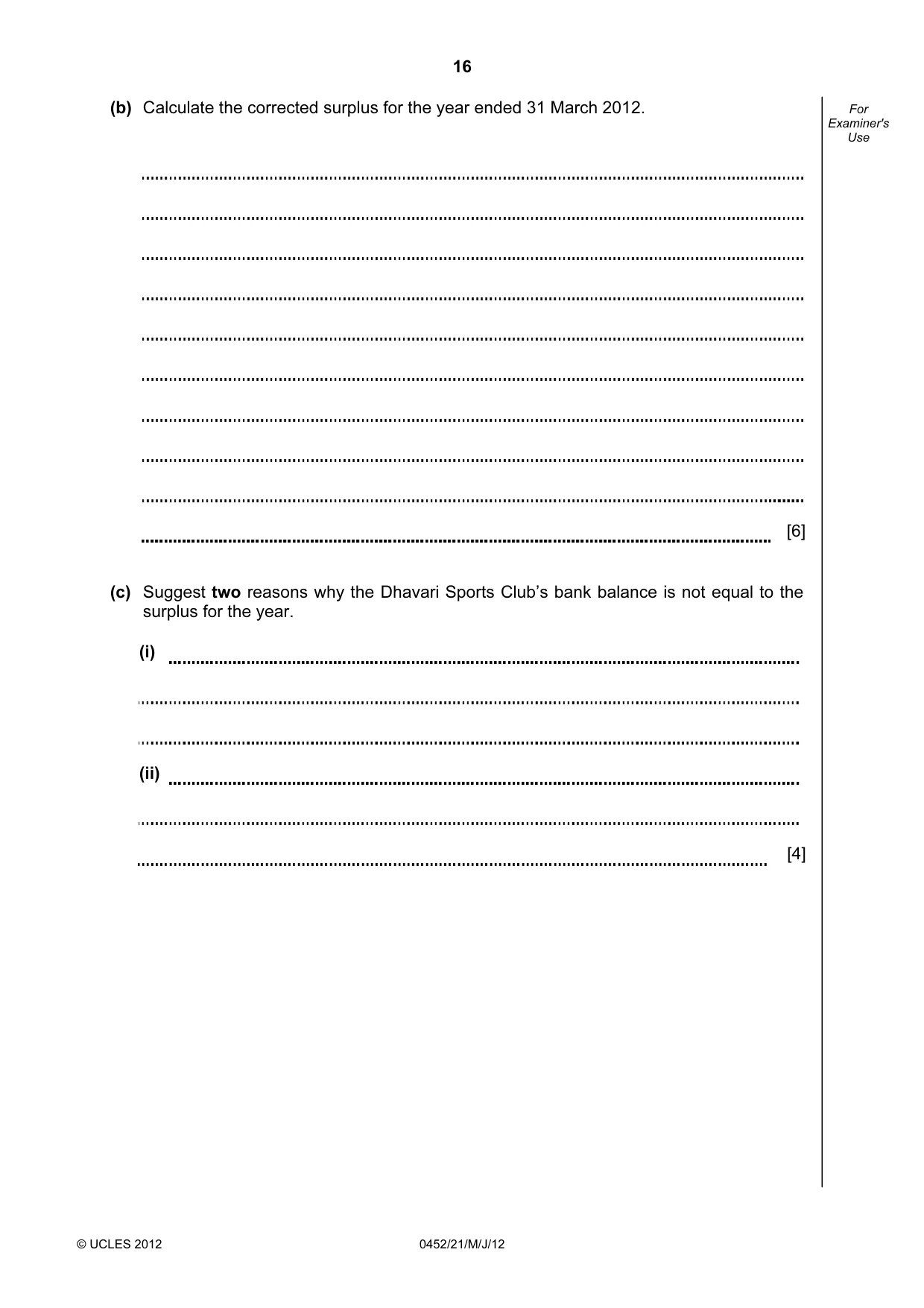
16 © UCLES 2012 0452/21/M/J/12 For Examiner's Use (b) Calculate the corrected surplus for the year ended 31 March 2012. [6] (c) Suggest two reasons why the Dhavari Sports Club’s bank balance is not equal to the surplus for the year. (i) (ii) [4]
Question paper, page 17
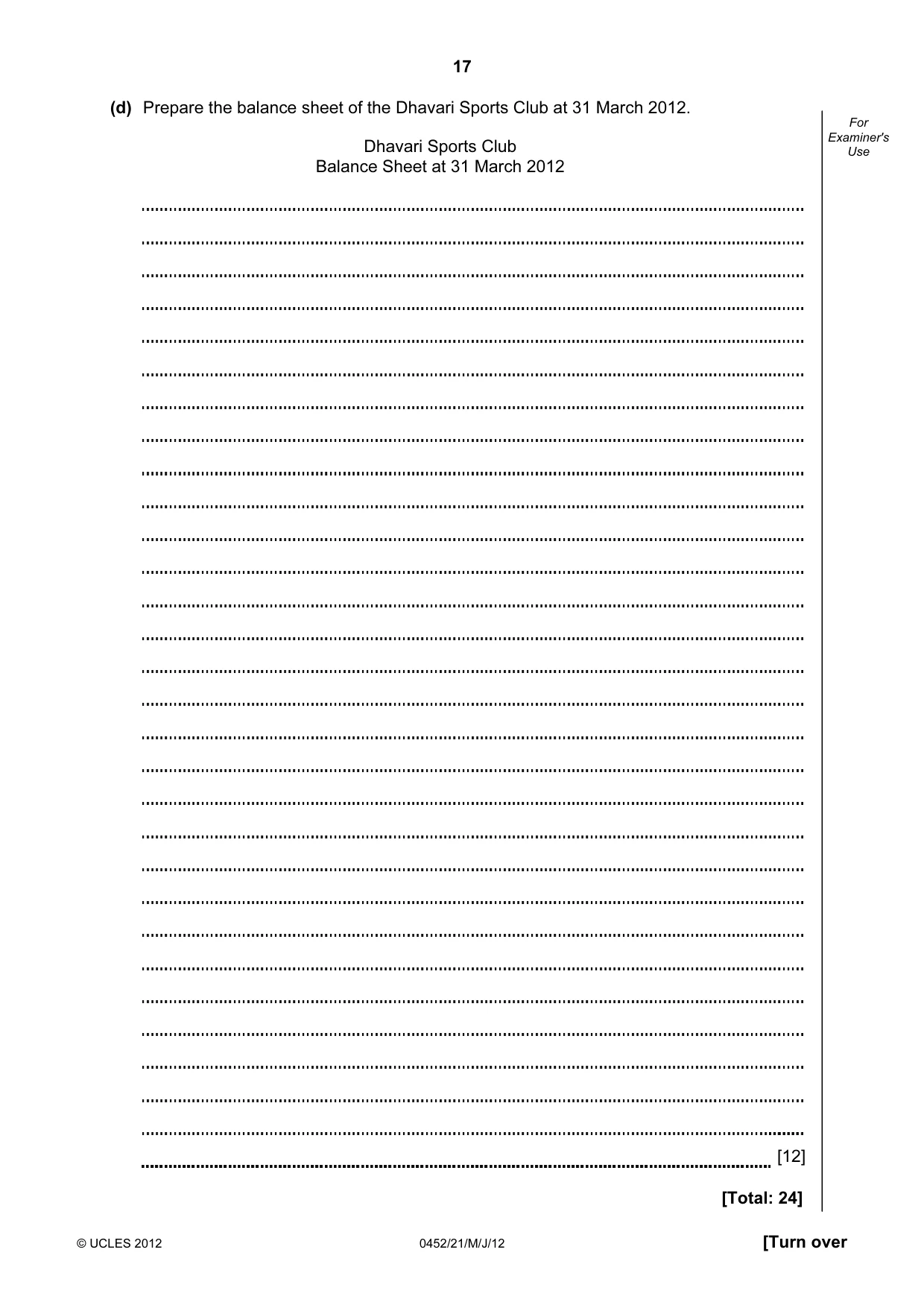
17 © UCLES 2012 0452/21/M/J/12 [Turn over For Examiner's Use (d) Prepare the balance sheet of the Dhavari Sports Club at 31 March 2012. Dhavari Sports Club Balance Sheet at 31 March 2012 [12] [Total: 24]
Question paper, page 18
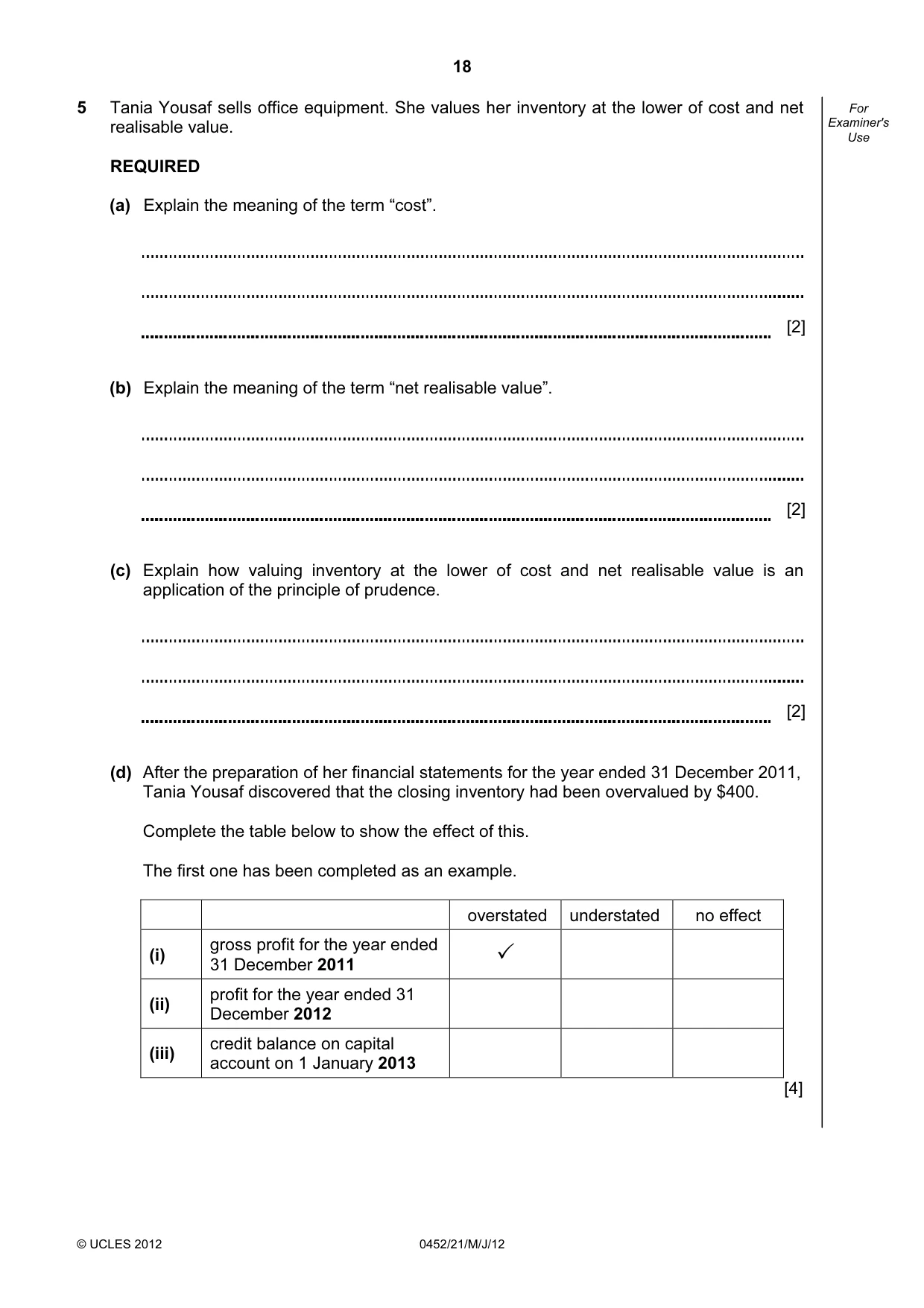
18 © UCLES 2012 0452/21/M/J/12 For Examiner's Use 5 Tania Yousaf sells office equipment. She values her inventory at the lower of cost and net realisable value. REQUIRED (a) Explain the meaning of the term “cost”. [2] (b) Explain the meaning of the term “net realisable value”. [2] (c) Explain how valuing inventory at the lower of cost and net realisable value is an application of the principle of prudence. [2] (d) After the preparation of her financial statements for the year ended 31 December 2011, Tania Yousaf discovered that the closing inventory had been overvalued by $400. Complete the table below to show the effect of this. The first one has been completed as an example. overstated understated no effect (i) gross profit for the year ended 31 December 2011 ✓ (ii) profit for the year ended 31 December 2012 (iii) credit balance on capital account on 1 January 2013 [4]
Question paper, page 19
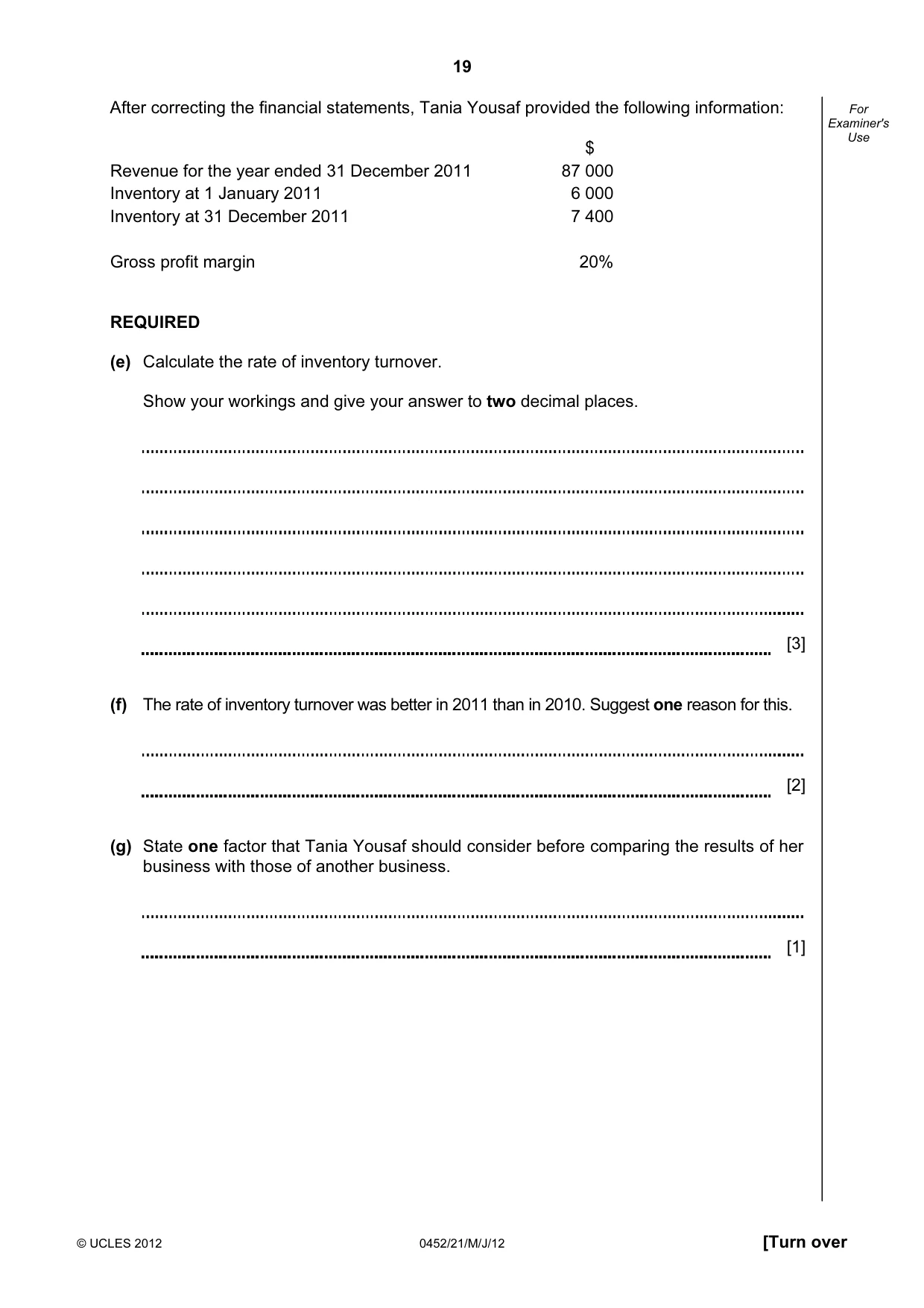
19 © UCLES 2012 0452/21/M/J/12 [Turn over For Examiner's Use After correcting the financial statements, Tania Yousaf provided the following information: $ Revenue for the year ended 31 December 2011 87 000 Inventory at 1 January 2011 6 000 Inventory at 31 December 2011 7 400 Gross profit margin 20% REQUIRED (e) Calculate the rate of inventory turnover. Show your workings and give your answer to two decimal places. [3] (f) The rate of inventory turnover was better in 2011 than in 2010. Suggest one reason for this. [2] (g) State one factor that Tania Yousaf should consider before comparing the results of her business with those of another business. [1]
Question paper, page 20
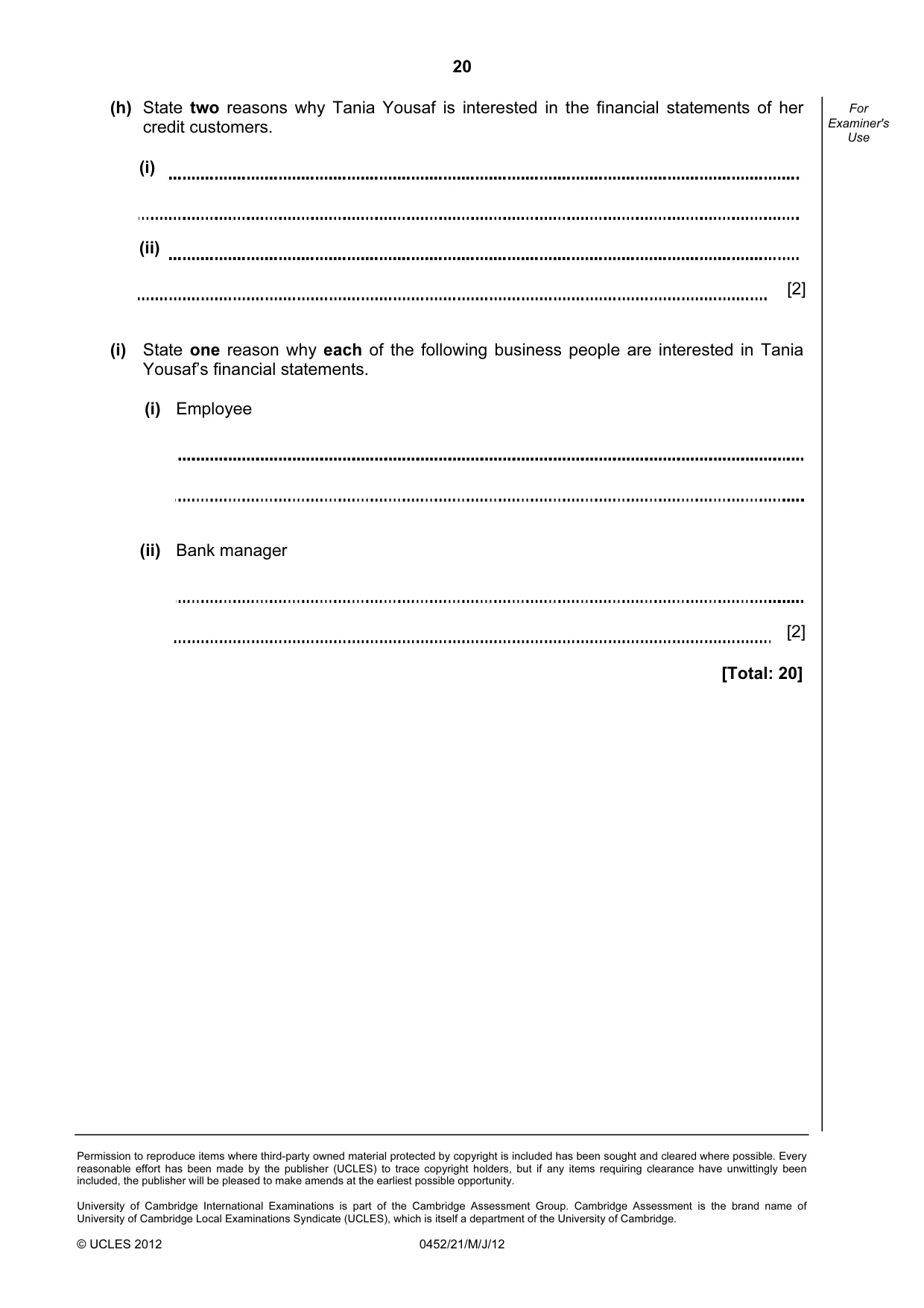
20 Permission to reproduce items where third-party owned material protected by copyright is included has been sought and cleared where possible. Every reasonable effort has been made by the publisher (UCLES) to trace copyright holders, but if any items requiring clearance have unwittingly been included, the publisher will be pleased to make amends at the earliest possible opportunity. University of Cambridge International Examinations is part of the Cambridge Assessment Group. Cambridge Assessment is the brand name of University of Cambridge Local Examinations Syndicate (UCLES), which is itself a department of the University of Cambridge. © UCLES 2012 0452/21/M/J/12 For Examiner's Use (h) State two reasons why Tania Yousaf is interested in the financial statements of her credit customers. (i) (ii) [2] (i) State one reason why each of the following business people are interested in Tania Yousaf’s financial statements. (i) Employee (ii) Bank manager [2] [Total: 20]
Mark scheme, page 1
UNIVERSITY OF CAMBRIDGE INTERNATIONAL EXAMINATIONS International General Certificate of Secondary Education MARK SCHEME for the May/June 2012 question paper for the guidance of teachers 0452 ACCOUNTING 0452/21 Paper 2, maximum raw mark 120 This mark scheme is published as an aid to teachers and candidates, to indicate the requirements of the examination. It shows the basis on which Examiners were instructed to award marks. It does not indicate the details of the discussions that took place at an Examiners’ meeting before marking began, which would have considered the acceptability of alternative answers. Mark schemes must be read in conjunction with the question papers and the report on the examination. • Cambridge will not enter into discussions or correspondence in connection with these mark schemes. Cambridge is publishing the mark schemes for the May/June 2012 question papers for most IGCSE, GCE Advanced Level and Advanced Subsidiary Level syllabuses and some Ordinary Level syllabuses.
Mark scheme, page 2
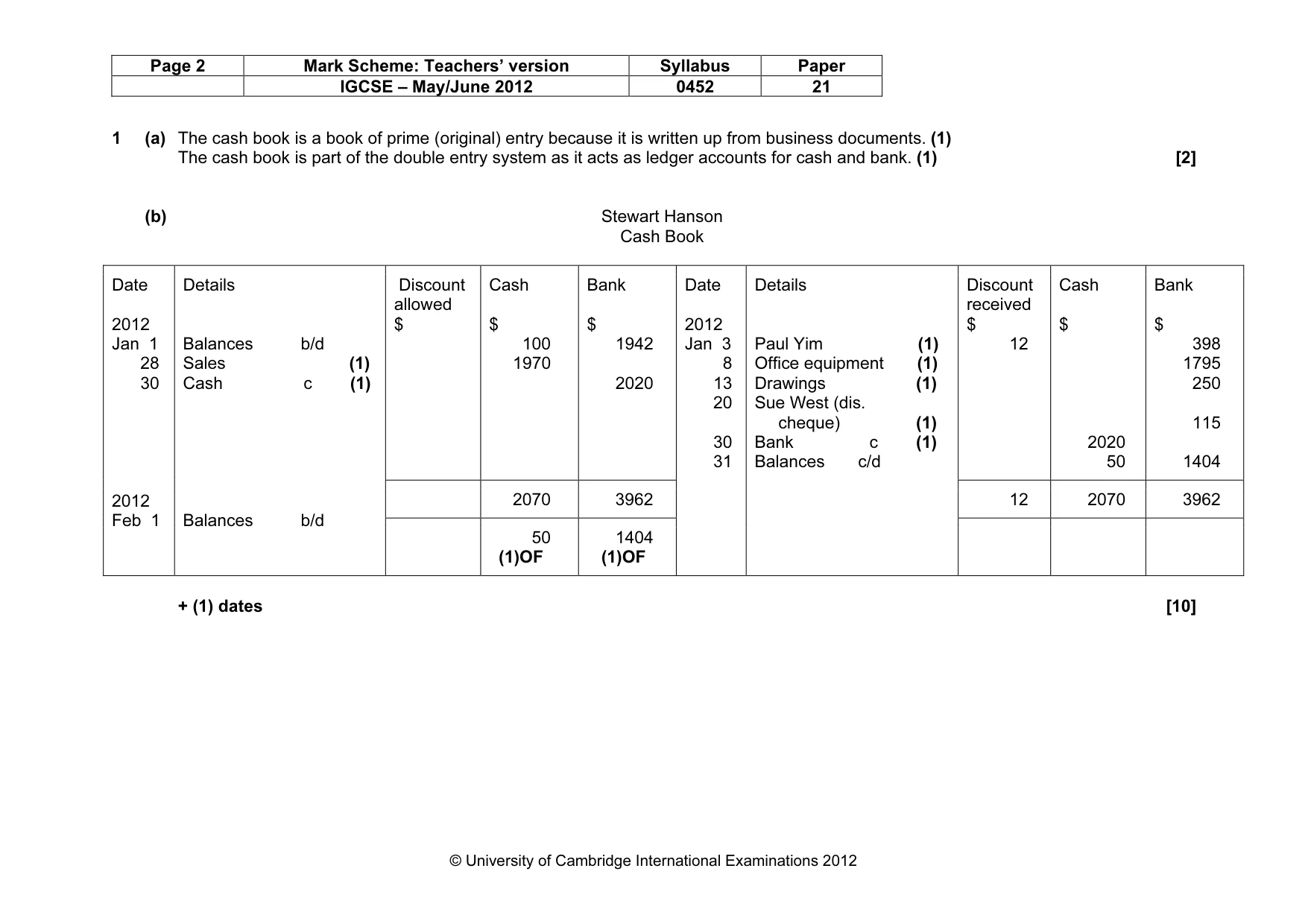
Page 2 Mark Scheme: Teachers’ version Syllabus Paper IGCSE – May/June 2012 0452 21 © University of Cambridge International Examinations 2012 1 (a) The cash book is a book of prime (original) entry because it is written up from business documents. (1) The cash book is part of the double entry system as it acts as ledger accounts for cash and bank. (1) [2] (b) Stewart Hanson Cash Book Discount allowed $ Cash $ 100 1970 Bank $ 1942 2020 Discount received $ 12 Cash $ 2020 50 Bank $ 398 1795 250 115 1404 2070 3962 12 2070 3962 Date 2012 Jan 1 28 30 2012 Feb 1 Details Balances b/d Sales (1) Cash c (1) Balances b/d 50 (1)OF 1404 (1)OF Date 2012 Jan 3 8 13 20 30 31 Details Paul Yim (1) Office equipment (1) Drawings (1) Sue West (dis. cheque) (1) Bank c (1) Balances c/d + (1) dates [10]
Mark scheme, page 3
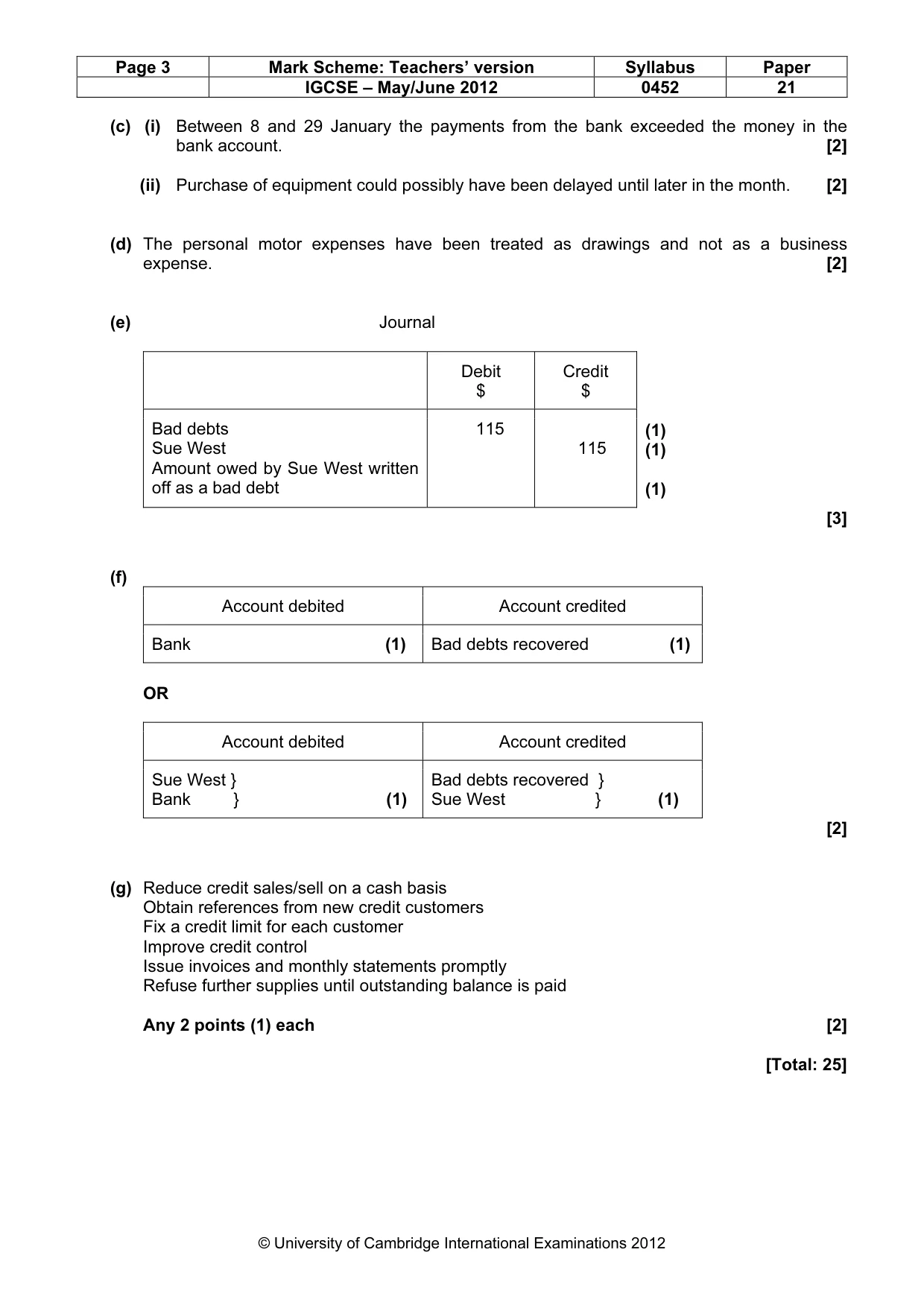
Page 3 Mark Scheme: Teachers’ version Syllabus Paper IGCSE – May/June 2012 0452 21 © University of Cambridge International Examinations 2012 (c) (i) Between 8 and 29 January the payments from the bank exceeded the money in the bank account. [2] (ii) Purchase of equipment could possibly have been delayed until later in the month. [2] (d) The personal motor expenses have been treated as drawings and not as a business expense. [2] (e) Journal Debit $ Credit $ Bad debts Sue West Amount owed by Sue West written off as a bad debt 115 115 (1) (1) (1) [3] (f) Account debited Account credited Bank (1) Bad debts recovered (1) OR Account debited Account credited Sue West } Bank } (1) Bad debts recovered } Sue West } (1) [2] (g) Reduce credit sales/sell on a cash basis Obtain references from new credit customers Fix a credit limit for each customer Improve credit control Issue invoices and monthly statements promptly Refuse further supplies until outstanding balance is paid Any 2 points (1) each [2] [Total: 25]
Mark scheme, page 4
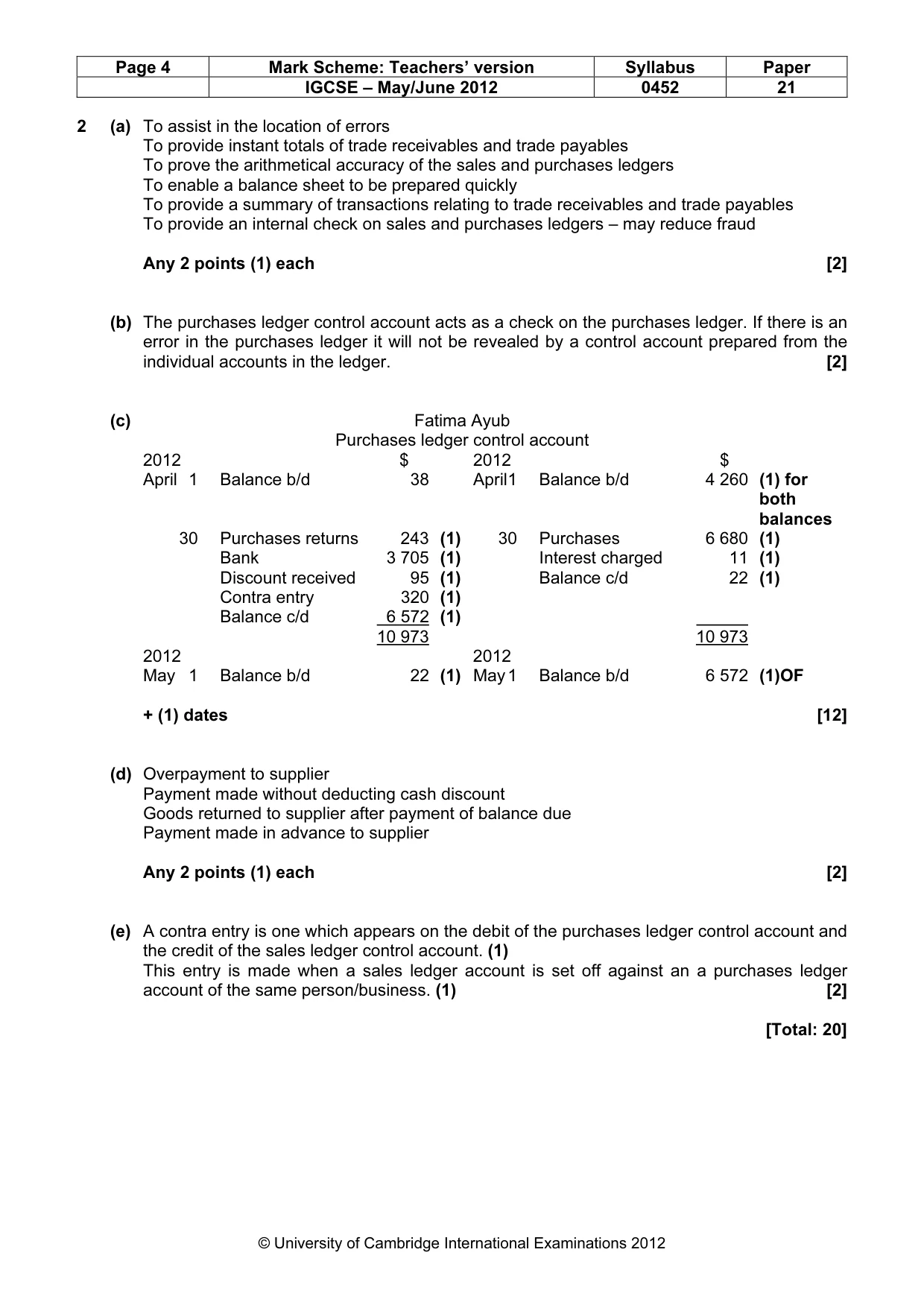
Page 4 Mark Scheme: Teachers’ version Syllabus Paper IGCSE – May/June 2012 0452 21 © University of Cambridge International Examinations 2012 2 (a) To assist in the location of errors To provide instant totals of trade receivables and trade payables To prove the arithmetical accuracy of the sales and purchases ledgers To enable a balance sheet to be prepared quickly To provide a summary of transactions relating to trade receivables and trade payables To provide an internal check on sales and purchases ledgers – may reduce fraud Any 2 points (1) each [2] (b) The purchases ledger control account acts as a check on the purchases ledger. If there is an error in the purchases ledger it will not be revealed by a control account prepared from the individual accounts in the ledger. [2] (c) Fatima Ayub Purchases ledger control account 2012 $ 2012 $ April 1 Balance b/d 38 April 1 Balance b/d 4 260 (1) for both balances 30 Purchases returns 243 (1) 30 Purchases 6 680 (1) Bank 3 705 (1) Interest charged 11 (1) Discount received 95 (1) Balance c/d 22 (1) Contra entry 320 (1) Balance c/d 6 572 (1) 10 973 10 973 2012 2012 May 1 Balance b/d 22 (1) May 1 Balance b/d 6 572 (1)OF + (1) dates [12] (d) Overpayment to supplier Payment made without deducting cash discount Goods returned to supplier after payment of balance due Payment made in advance to supplier Any 2 points (1) each [2] (e) A contra entry is one which appears on the debit of the purchases ledger control account and the credit of the sales ledger control account. (1) This entry is made when a sales ledger account is set off against an a purchases ledger account of the same person/business. (1) [2] [Total: 20]
Mark scheme, page 5
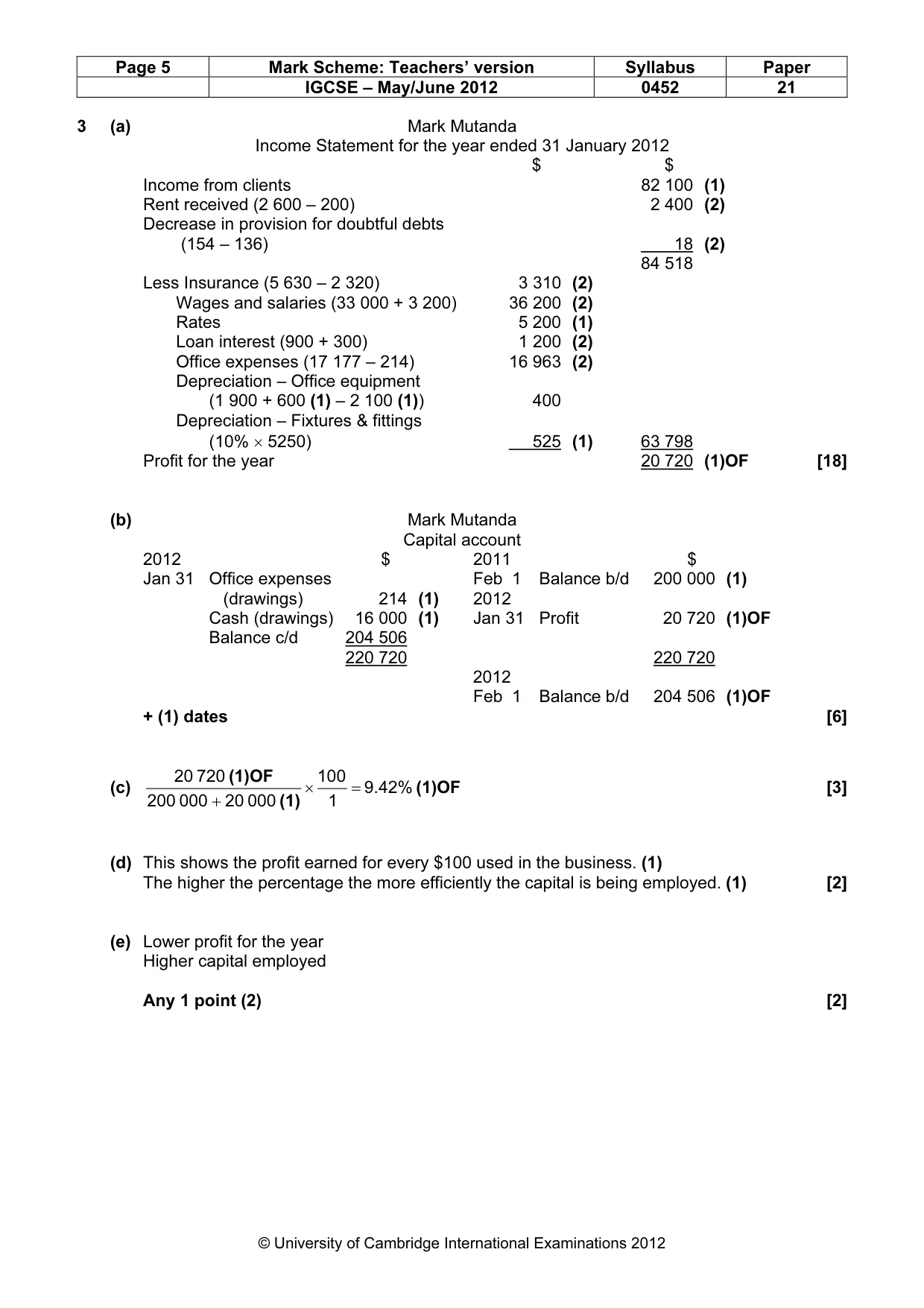
Page 5 Mark Scheme: Teachers’ version Syllabus Paper IGCSE – May/June 2012 0452 21 © University of Cambridge International Examinations 2012 3 (a) Mark Mutanda Income Statement for the year ended 31 January 2012 $ $ Income from clients 82 100 (1) Rent received (2 600 – 200) 2 400 (2) Decrease in provision for doubtful debts (154 – 136) 18 (2) 84 518 Less Insurance (5 630 – 2 320) 3 310 (2) Wages and salaries (33 000 + 3 200) 36 200 (2) Rates 5 200 (1) Loan interest (900 + 300) 1 200 (2) Office expenses (17 177 – 214) 16 963 (2) Depreciation – Office equipment (1 900 + 600 (1) – 2 100 (1)) 400 Depreciation – Fixtures & fittings (10% × 5250) 525 (1) 63 798 Profit for the year 20 720 (1)OF [18] (b) Mark Mutanda Capital account 2012 $ 2011 $ Jan 31 Office expenses Feb 1 Balance b/d 200 000 (1) (drawings) 214 (1) 2012 Cash (drawings) 16 000 (1) Jan 31 Profit 20 720 (1)OF Balance c/d 204 506 220 720 220 720 2012 Feb 1 Balance b/d 204 506 (1)OF + (1) dates [6] (c) (1)OF (1) (1)OF 9.42% 1 100 000 20 000 200 720 20 = × + [3] (d) This shows the profit earned for every $100 used in the business. (1) The higher the percentage the more efficiently the capital is being employed. (1) [2] (e) Lower profit for the year Higher capital employed Any 1 point (2) [2]
Mark scheme, page 6
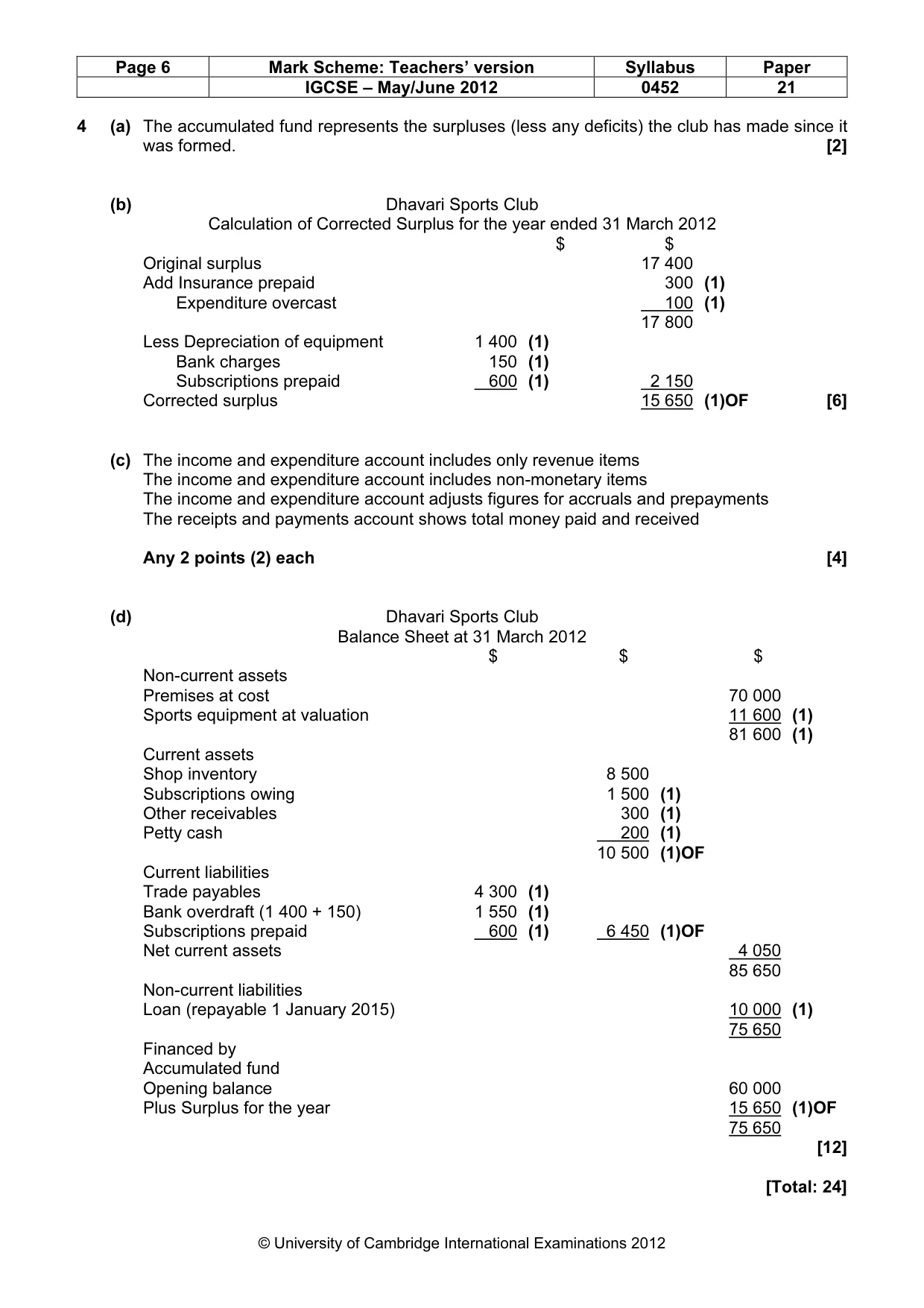
Page 6 Mark Scheme: Teachers’ version Syllabus Paper IGCSE – May/June 2012 0452 21 © University of Cambridge International Examinations 2012 4 (a) The accumulated fund represents the surpluses (less any deficits) the club has made since it was formed. [2] (b) Dhavari Sports Club Calculation of Corrected Surplus for the year ended 31 March 2012 $ $ Original surplus 17 400 Add Insurance prepaid 300 (1) Expenditure overcast 100 (1) 17 800 Less Depreciation of equipment 1 400 (1) Bank charges 150 (1) Subscriptions prepaid 600 (1) 2 150 Corrected surplus 15 650 (1)OF [6] (c) The income and expenditure account includes only revenue items The income and expenditure account includes non-monetary items The income and expenditure account adjusts figures for accruals and prepayments The receipts and payments account shows total money paid and received Any 2 points (2) each [4] (d) Dhavari Sports Club Balance Sheet at 31 March 2012 $ $ $ Non-current assets Premises at cost 70 000 Sports equipment at valuation 11 600 (1) 81 600 (1) Current assets Shop inventory 8 500 Subscriptions owing 1 500 (1) Other receivables 300 (1) Petty cash 200 (1) 10 500 (1)OF Current liabilities Trade payables 4 300 (1) Bank overdraft (1 400 + 150) 1 550 (1) Subscriptions prepaid 600 (1) 6 450 (1)OF Net current assets 4 050 85 650 Non-current liabilities Loan (repayable 1 January 2015) 10 000 (1) 75 650 Financed by Accumulated fund Opening balance 60 000 Plus Surplus for the year 15 650 (1)OF 75 650 [12] [Total: 24]
Mark scheme, page 7
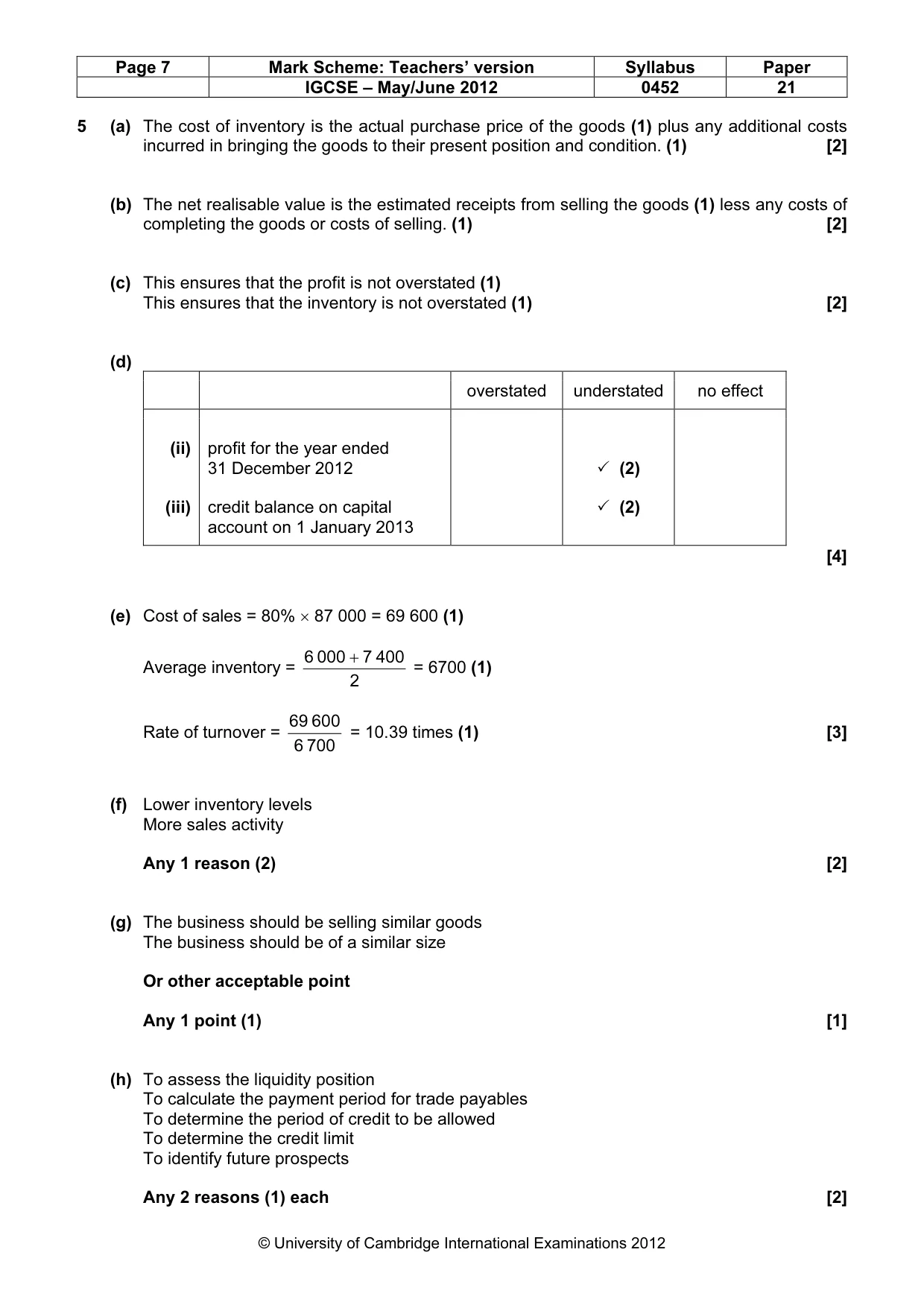
Page 7 Mark Scheme: Teachers’ version Syllabus Paper IGCSE – May/June 2012 0452 21 © University of Cambridge International Examinations 2012 5 (a) The cost of inventory is the actual purchase price of the goods (1) plus any additional costs incurred in bringing the goods to their present position and condition. (1) [2] (b) The net realisable value is the estimated receipts from selling the goods (1) less any costs of completing the goods or costs of selling. (1) [2] (c) This ensures that the profit is not overstated (1) This ensures that the inventory is not overstated (1) [2] (d) overstated understated no effect (ii) (iii) profit for the year ended 31 December 2012 credit balance on capital account on 1 January 2013 ✓ (2) ✓ (2) [4] (e) Cost of sales = 80% × 87 000 = 69 600 (1) Average inventory = 2 400 7 000 6 + = 6700 (1) Rate of turnover = 700 6 600 69 = 10.39 times (1) [3] (f) Lower inventory levels More sales activity Any 1 reason (2) [2] (g) The business should be selling similar goods The business should be of a similar size Or other acceptable point Any 1 point (1) [1] (h) To assess the liquidity position To calculate the payment period for trade payables To determine the period of credit to be allowed To determine the credit limit To identify future prospects Any 2 reasons (1) each [2]
Mark scheme, page 8
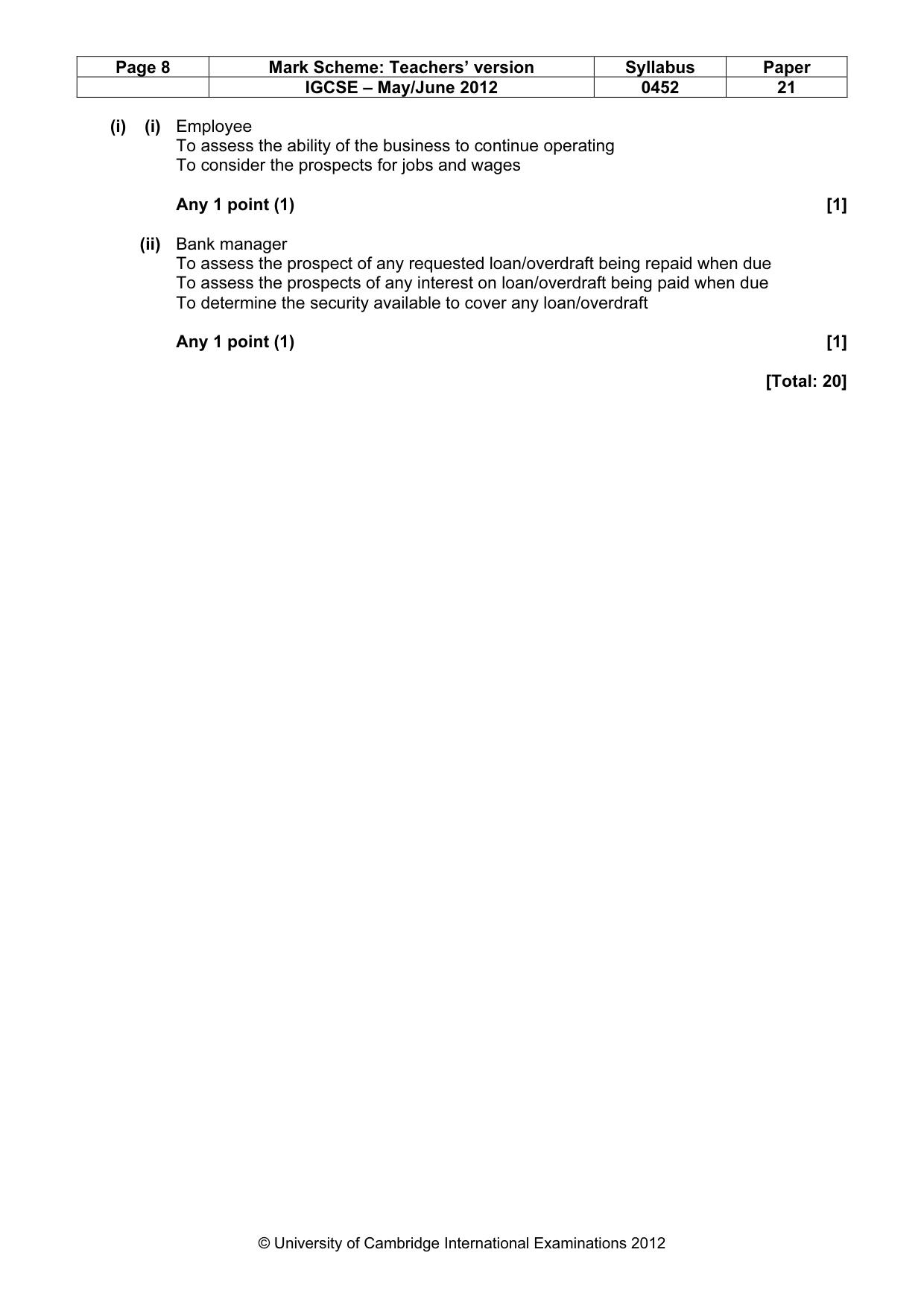
Page 8 Mark Scheme: Teachers’ version Syllabus Paper IGCSE – May/June 2012 0452 21 © University of Cambridge International Examinations 2012 (i) (i) Employee To assess the ability of the business to continue operating To consider the prospects for jobs and wages Any 1 point (1) [1] (ii) Bank manager To assess the prospect of any requested loan/overdraft being repaid when due To assess the prospects of any interest on loan/overdraft being paid when due To determine the security available to cover any loan/overdraft Any 1 point (1) [1] [Total: 20]
What you needed in this session
Cambridge’s own grade thresholds for 2012 May/June, Paper 2 · Variant 1. A higher threshold means an easier paper — the bar moves with how the cohort did.