Cambridge IGCSE Accounting 0452 — 2010 May/June Paper 2 · Variant 1
0452/21/M/J/10 · 120 marks · ≈135 min
The question paper and its mark scheme, free to read here and free to download. This is Cambridge’s own paper, exactly as it was sat.
Question paper20 pages

Mark scheme8 pages
Answers below. Sit the paper first if you are practising.
Paper as text
Question paper, page 1
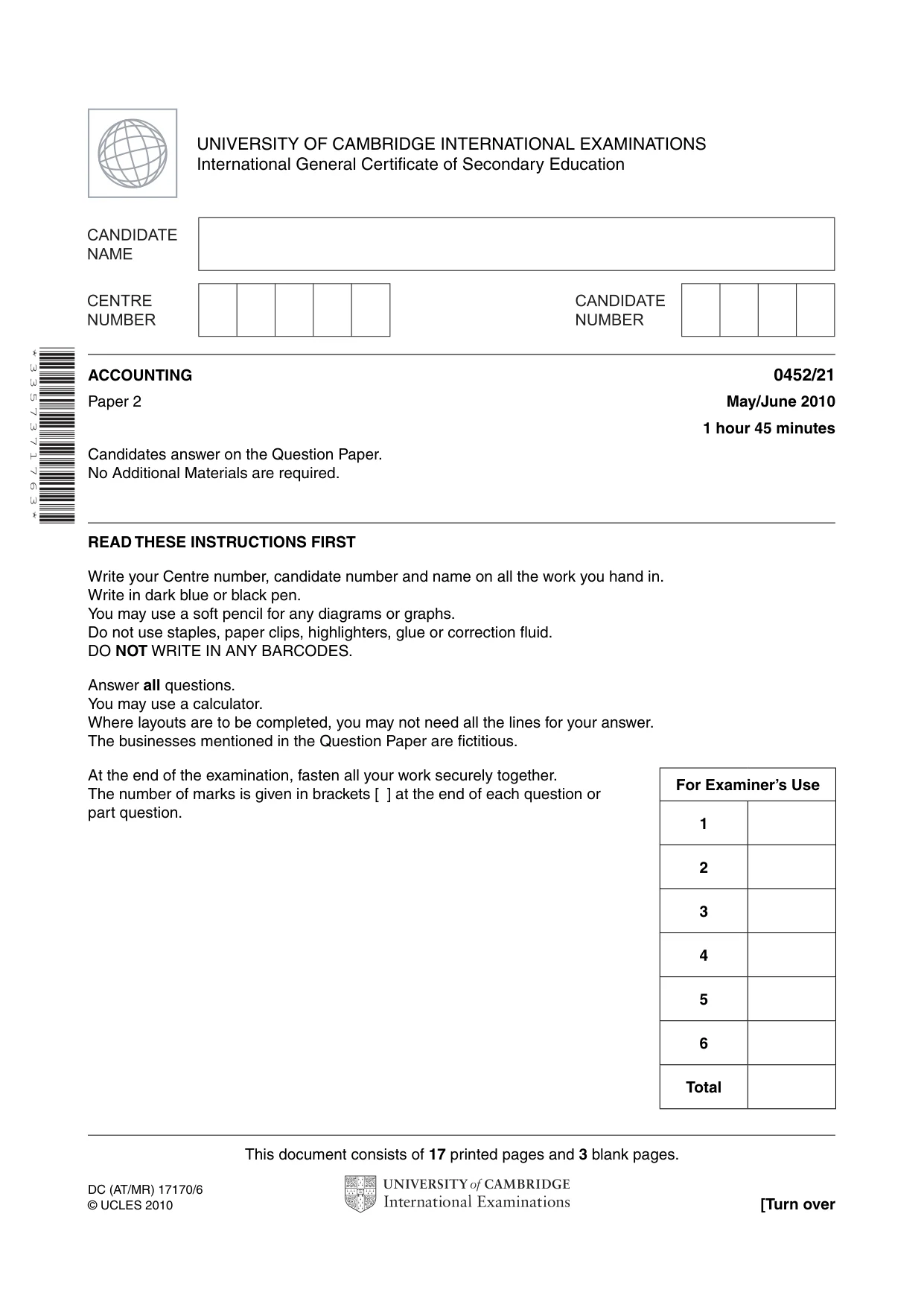
This document consists of 17 printed pages and 3 blank pages. DC (AT/MR) 17170/6 © UCLES 2010 [Turn over UNIVERSITY OF CAMBRIDGE INTERNATIONAL EXAMINATIONS International General Certificate of Secondary Education * 3 3 5 7 3 7 1 7 6 3 * ACCOUNTING 0452/21 Paper 2 May/June 2010 1 hour 45 minutes Candidates answer on the Question Paper. No Additional Materials are required. READ THESE INSTRUCTIONS FIRST Write your Centre number, candidate number and name on all the work you hand in. Write in dark blue or black pen. You may use a soft pencil for any diagrams or graphs. Do not use staples, paper clips, highlighters, glue or correction fluid. DO NOT WRITE IN ANY BARCODES. Answer all questions. You may use a calculator. Where layouts are to be completed, you may not need all the lines for your answer. The businesses mentioned in the Question Paper are fictitious. At the end of the examination, fasten all your work securely together. The number of marks is given in brackets [ ] at the end of each question or part question. For Examiner’s Use 1 2 3 4 5 6 Total
Question paper, page 2
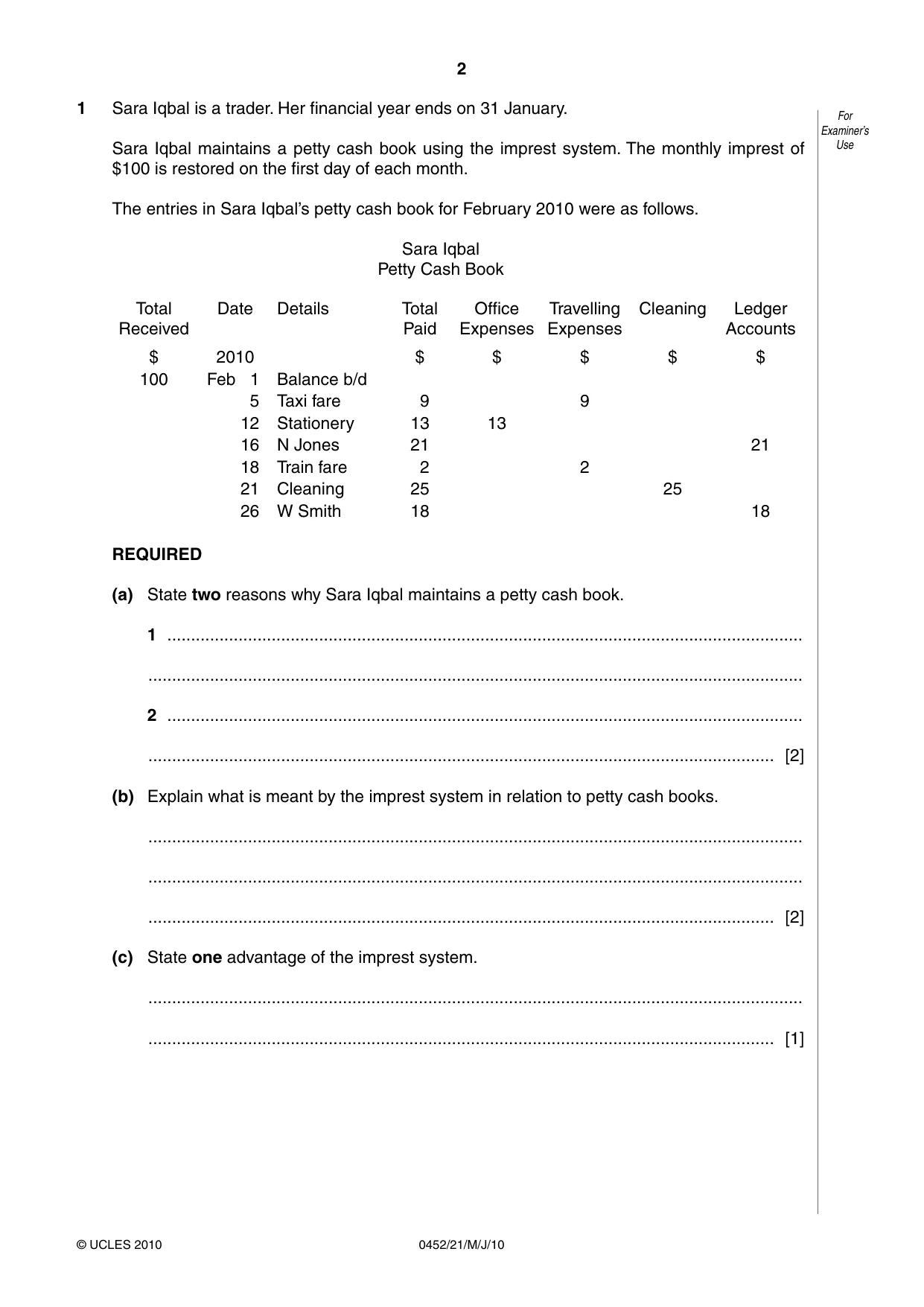
2 0452/21/M/J/10 © UCLES 2010 For Examiner’s Use 1 Sara Iqbal is a trader. Her financial year ends on 31 January. Sara Iqbal maintains a petty cash book using the imprest system. The monthly imprest of $100 is restored on the first day of each month. The entries in Sara Iqbal’s petty cash book for February 2010 were as follows. Sara Iqbal Petty Cash Book Total Received Date Details Total Paid Office Expenses Travelling Expenses Cleaning Ledger Accounts $ 2010 $ $ $ $ $ 100 Feb 1 Balance b/d 5 Taxi fare 9 9 12 Stationery 13 13 16 N Jones 21 21 18 Train fare 2 2 21 Cleaning 25 25 26 W Smith 18 18 REQUIRED (a) State two reasons why Sara Iqbal maintains a petty cash book. 1 … … 2 … … [2] (b) Explain what is meant by the imprest system in relation to petty cash books. … … … [2] (c) State one advantage of the imprest system. … … [1]
Question paper, page 3
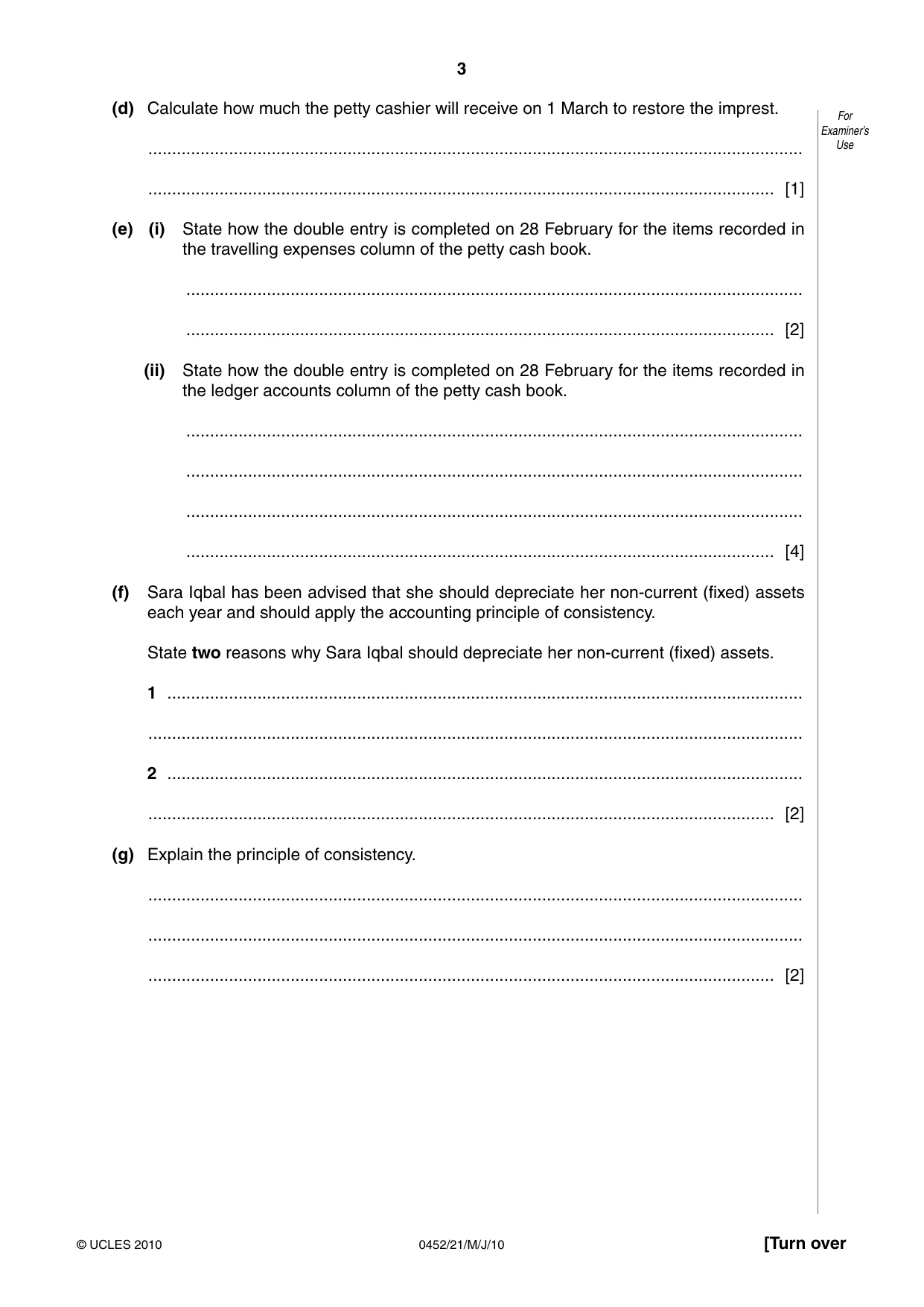
3 0452/21/M/J/10 © UCLES 2010 [Turn over For Examiner’s Use (d) Calculate how much the petty cashier will receive on 1 March to restore the imprest. … … [1] (e) (i) State how the double entry is completed on 28 February for the items recorded in the travelling expenses column of the petty cash book. … … [2] (ii) State how the double entry is completed on 28 February for the items recorded in the ledger accounts column of the petty cash book. … … … … [4] (f) Sara Iqbal has been advised that she should depreciate her non-current (fixed) assets each year and should apply the accounting principle of consistency. State two reasons why Sara Iqbal should depreciate her non-current (fixed) assets. 1 … … 2 … … [2] (g) Explain the principle of consistency. … … … [2]
Question paper, page 4
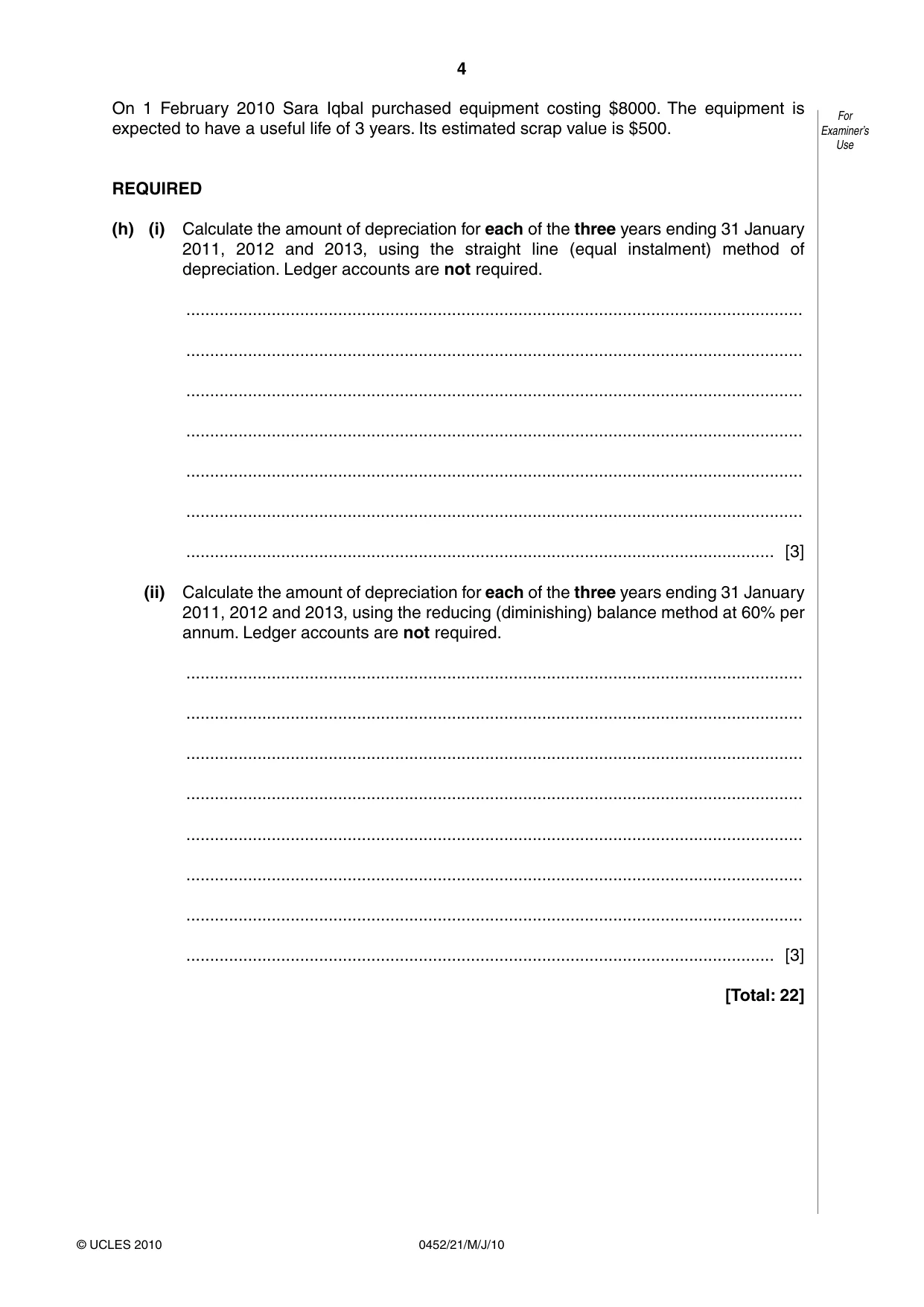
4 0452/21/M/J/10 © UCLES 2010 For Examiner’s Use On 1 February 2010 Sara Iqbal purchased equipment costing $8000. The equipment is expected to have a useful life of 3 years. Its estimated scrap value is $500. REQUIRED (h) (i) Calculate the amount of depreciation for each of the three years ending 31 January 2011, 2012 and 2013, using the straight line (equal instalment) method of depreciation. Ledger accounts are not required. … … … … … … … [3] (ii) Calculate the amount of depreciation for each of the three years ending 31 January 2011, 2012 and 2013, using the reducing (diminishing) balance method at 60% per annum. Ledger accounts are not required. … … … … … … … … [3] [Total: 22]
Question paper, page 5
5 0452/21/M/J/10 © UCLES 2010 [Turn over BLANK PAGE Question 2 is on the next page.
Question paper, page 6
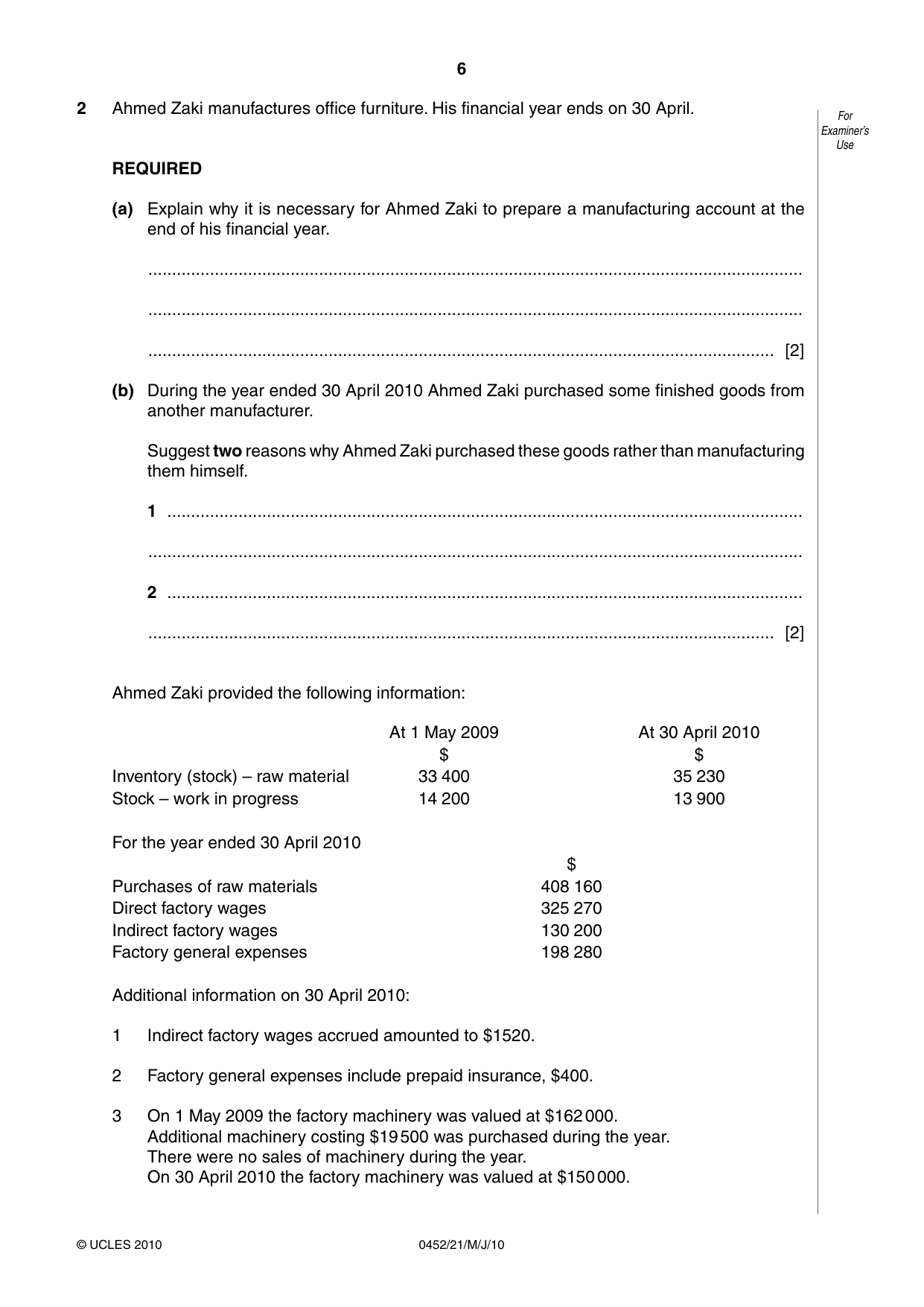
6 0452/21/M/J/10 © UCLES 2010 For Examiner’s Use 2 Ahmed Zaki manufactures office furniture. His financial year ends on 30 April. REQUIRED (a) Explain why it is necessary for Ahmed Zaki to prepare a manufacturing account at the end of his financial year. … … … [2] (b) During the year ended 30 April 2010 Ahmed Zaki purchased some finished goods from another manufacturer. Suggest two reasons why Ahmed Zaki purchased these goods rather than manufacturing them himself. 1 … … 2 … … [2] Ahmed Zaki provided the following information: At 1 May 2009 At 30 April 2010 $ $ Inventory (stock) – raw material 33 400 35 230 Stock – work in progress 14 200 13 900 For the year ended 30 April 2010 $ Purchases of raw materials 408 160 Direct factory wages 325 270 Indirect factory wages 130 200 Factory general expenses 198 280 Additional information on 30 April 2010: 1 Indirect factory wages accrued amounted to $1520. 2 Factory general expenses include prepaid insurance, $400. 3 On 1 May 2009 the factory machinery was valued at $162 000. Additional machinery costing $19 500 was purchased during the year. There were no sales of machinery during the year. On 30 April 2010 the factory machinery was valued at $150 000.
Question paper, page 7
7 0452/21/M/J/10 © UCLES 2010 [Turn over For Examiner’s Use REQUIRED (c) Prepare the manufacturing account of Ahmed Zaki for the year ended 30 April 2010. Ahmed Zaki Manufacturing Account for the year ended 30 April 2010 … … … … … … … … … … … … … … … … … … … … [13] [Total: 17]
Question paper, page 8
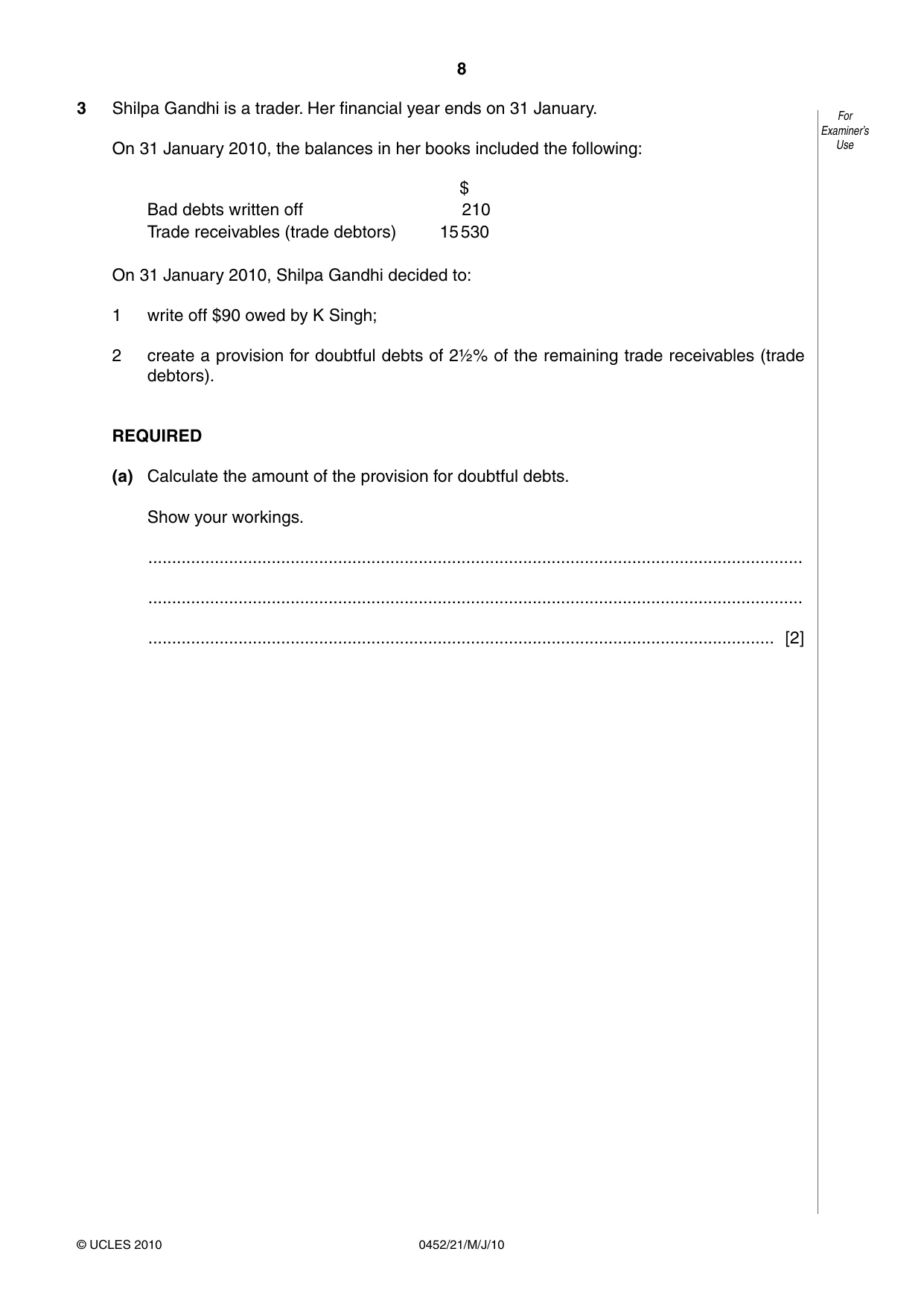
8 0452/21/M/J/10 © UCLES 2010 For Examiner’s Use 3 Shilpa Gandhi is a trader. Her financial year ends on 31 January. On 31 January 2010, the balances in her books included the following: $ Bad debts written off 210 Trade receivables (trade debtors) 15 530 On 31 January 2010, Shilpa Gandhi decided to: 1 write off $90 owed by K Singh; 2 create a provision for doubtful debts of 2½% of the remaining trade receivables (trade debtors). REQUIRED (a) Calculate the amount of the provision for doubtful debts. Show your workings. … … … [2]
Question paper, page 9
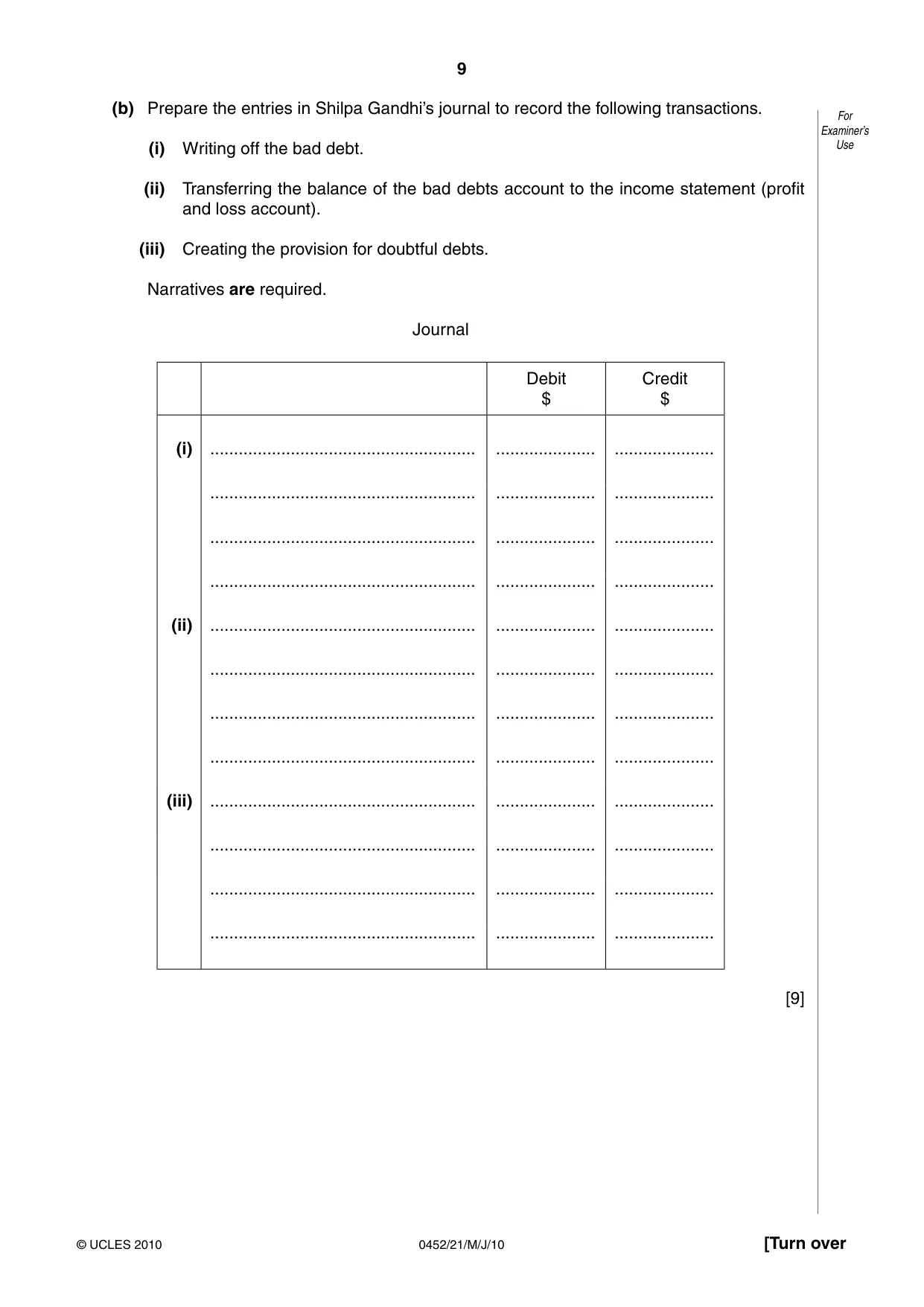
9 0452/21/M/J/10 © UCLES 2010 [Turn over For Examiner’s Use (b) Prepare the entries in Shilpa Gandhi’s journal to record the following transactions. (i) Writing off the bad debt. (ii) Transferring the balance of the bad debts account to the income statement (profit and loss account). (iii) Creating the provision for doubtful debts. Narratives are required. Journal Debit $ Credit $ (i) … … … … … … … … … … … … (ii) … … … … … … … … … … … … (iii) … … … … … … … … … … … … [9]
Question paper, page 10
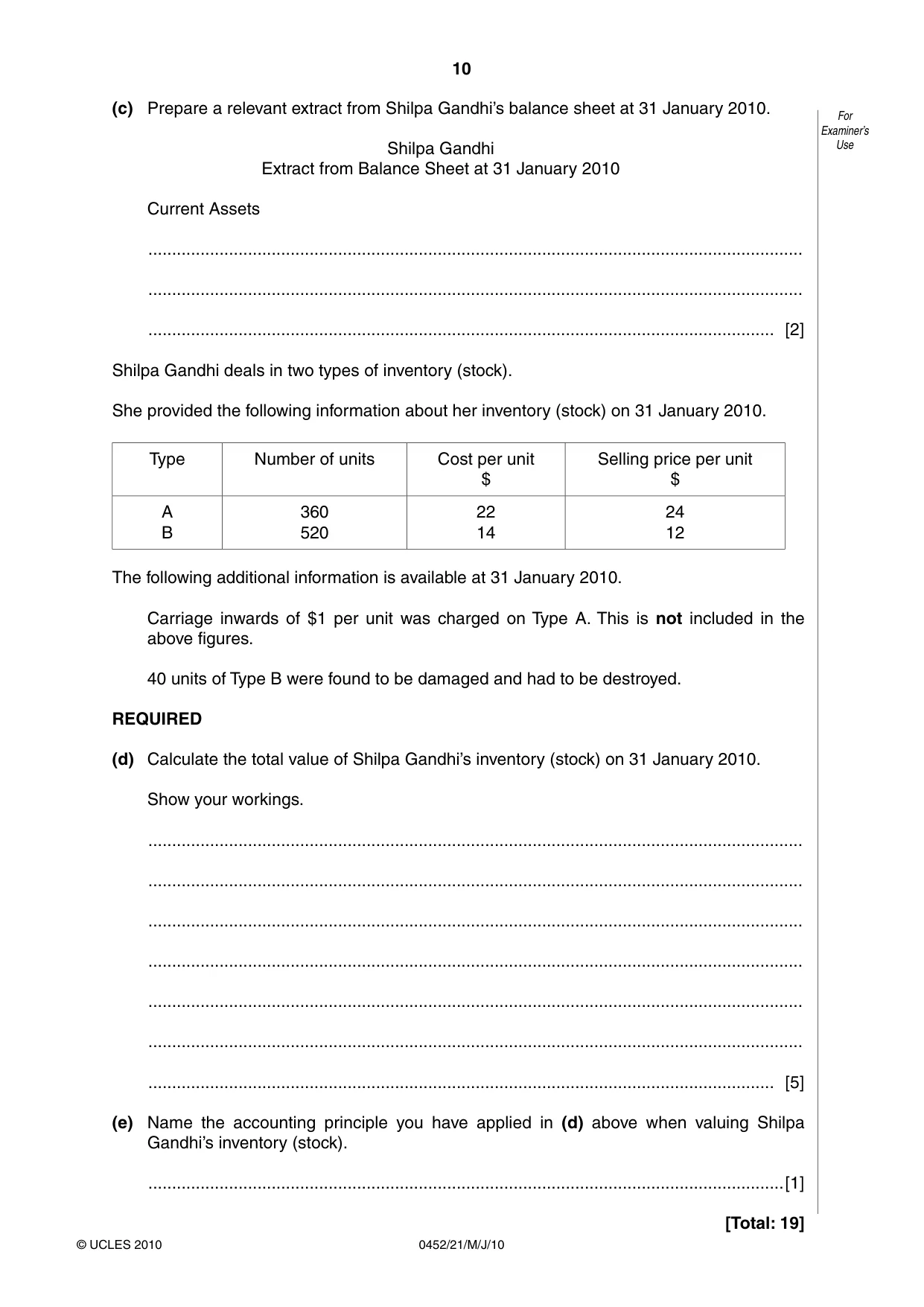
10 0452/21/M/J/10 © UCLES 2010 For Examiner’s Use (c) Prepare a relevant extract from Shilpa Gandhi’s balance sheet at 31 January 2010. Shilpa Gandhi Extract from Balance Sheet at 31 January 2010 Current Assets … … … [2] Shilpa Gandhi deals in two types of inventory (stock). She provided the following information about her inventory (stock) on 31 January 2010. Type Number of units Cost per unit $ Selling price per unit $ A B 360 520 22 14 24 12 The following additional information is available at 31 January 2010. Carriage inwards of $1 per unit was charged on Type A. This is not included in the above figures. 40 units of Type B were found to be damaged and had to be destroyed. REQUIRED (d) Calculate the total value of Shilpa Gandhi’s inventory (stock) on 31 January 2010. Show your workings. … … … … … … … [5] (e) Name the accounting principle you have applied in (d) above when valuing Shilpa Gandhi’s inventory (stock). …[1] [Total: 19]
Question paper, page 11
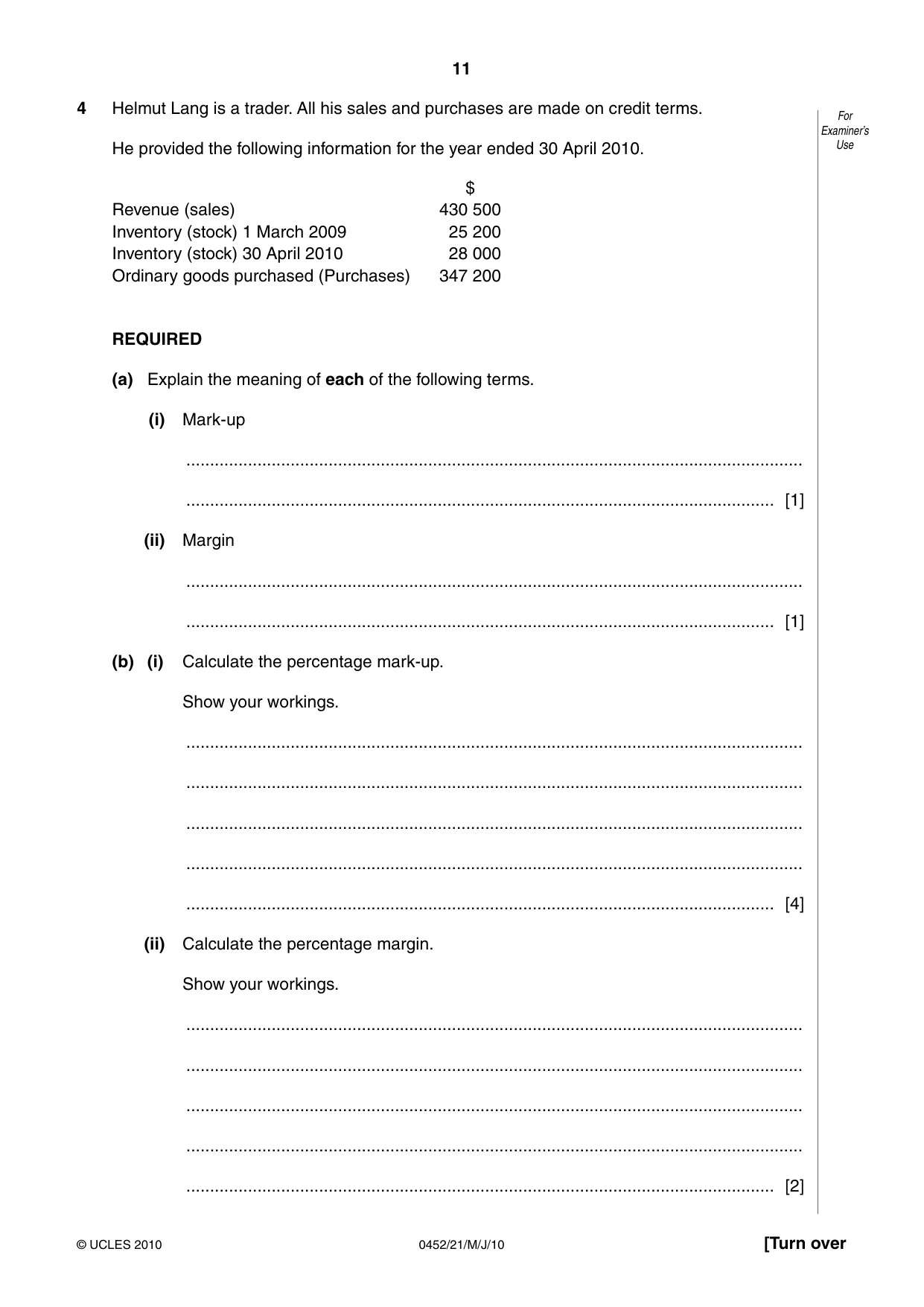
11 0452/21/M/J/10 © UCLES 2010 [Turn over For Examiner’s Use 4 Helmut Lang is a trader. All his sales and purchases are made on credit terms. He provided the following information for the year ended 30 April 2010. $ Revenue (sales) 430 500 Inventory (stock) 1 March 2009 25 200 Inventory (stock) 30 April 2010 28 000 Ordinary goods purchased (Purchases) 347 200 REQUIRED (a) Explain the meaning of each of the following terms. (i) Mark-up … … [1] (ii) Margin … … [1] (b) (i) Calculate the percentage mark-up. Show your workings. … … … … … [4] (ii) Calculate the percentage margin. Show your workings. … … … … … [2]
Question paper, page 12
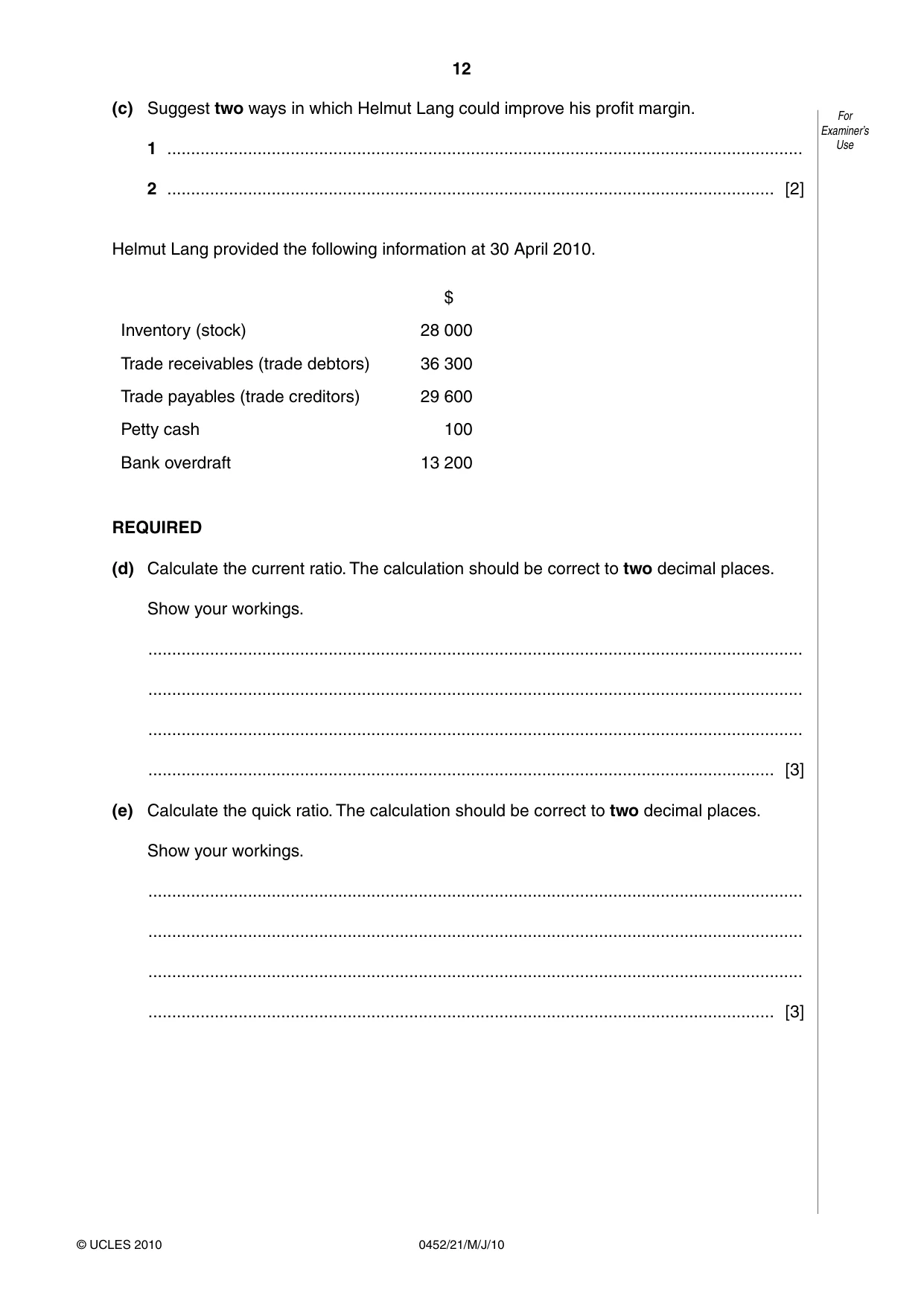
12 0452/21/M/J/10 © UCLES 2010 For Examiner’s Use (c) Suggest two ways in which Helmut Lang could improve his profit margin. 1 … 2 … [2] Helmut Lang provided the following information at 30 April 2010. $ Inventory (stock) 28 000 Trade receivables (trade debtors) 36 300 Trade payables (trade creditors) 29 600 Petty cash 100 Bank overdraft 13 200 REQUIRED (d) Calculate the current ratio. The calculation should be correct to two decimal places. Show your workings. … … … … [3] (e) Calculate the quick ratio. The calculation should be correct to two decimal places. Show your workings. … … … … [3]
Question paper, page 13
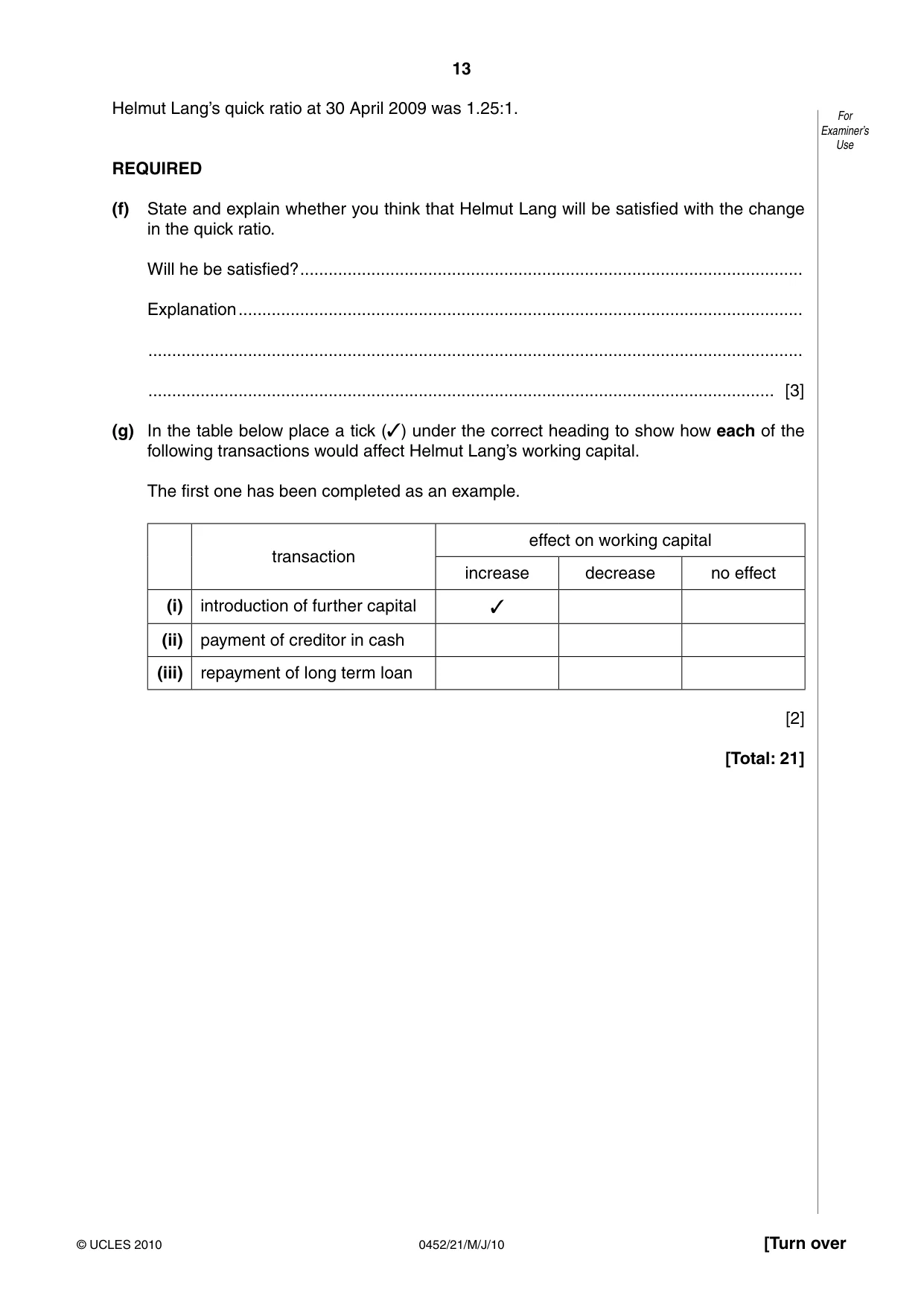
13 0452/21/M/J/10 © UCLES 2010 [Turn over For Examiner’s Use Helmut Lang’s quick ratio at 30 April 2009 was 1.25:1. REQUIRED (f) State and explain whether you think that Helmut Lang will be satisfied with the change in the quick ratio. Will he be satisfied? … Explanation … … … [3] (g) In the table below place a tick (✓) under the correct heading to show how each of the following transactions would affect Helmut Lang’s working capital. The first one has been completed as an example. transaction effect on working capital increase decrease no effect (i) introduction of further capital ✓ (ii) payment of creditor in cash (iii) repayment of long term loan [2] [Total: 21]
Question paper, page 14
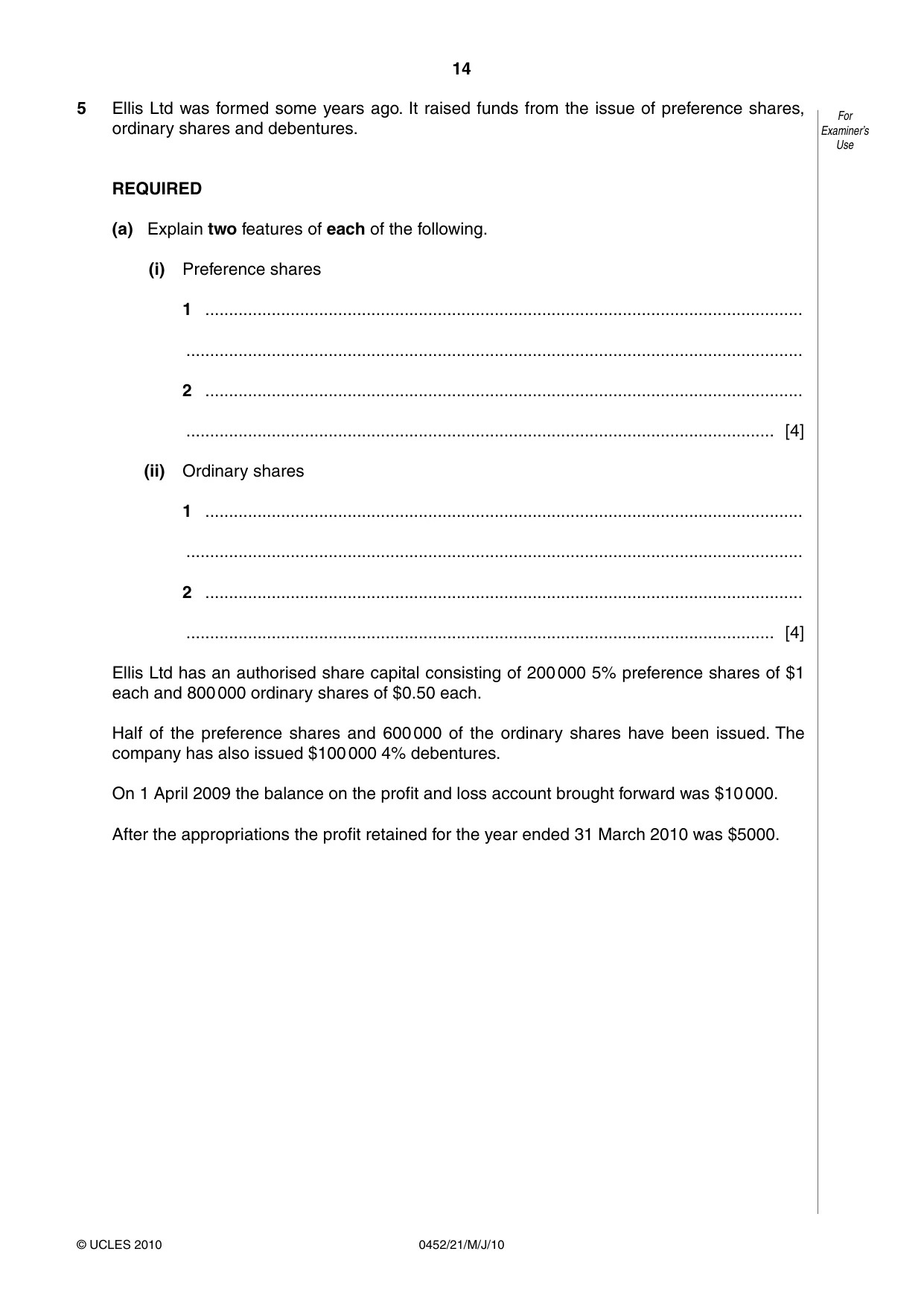
14 0452/21/M/J/10 © UCLES 2010 For Examiner’s Use 5 Ellis Ltd was formed some years ago. It raised funds from the issue of preference shares, ordinary shares and debentures. REQUIRED (a) Explain two features of each of the following. (i) Preference shares 1 … … 2 … … [4] (ii) Ordinary shares 1 … … 2 … … [4] Ellis Ltd has an authorised share capital consisting of 200 000 5% preference shares of $1 each and 800 000 ordinary shares of $0.50 each. Half of the preference shares and 600 000 of the ordinary shares have been issued. The company has also issued $100 000 4% debentures. On 1 April 2009 the balance on the profit and loss account brought forward was $10 000. After the appropriations the profit retained for the year ended 31 March 2010 was $5000.
Question paper, page 15
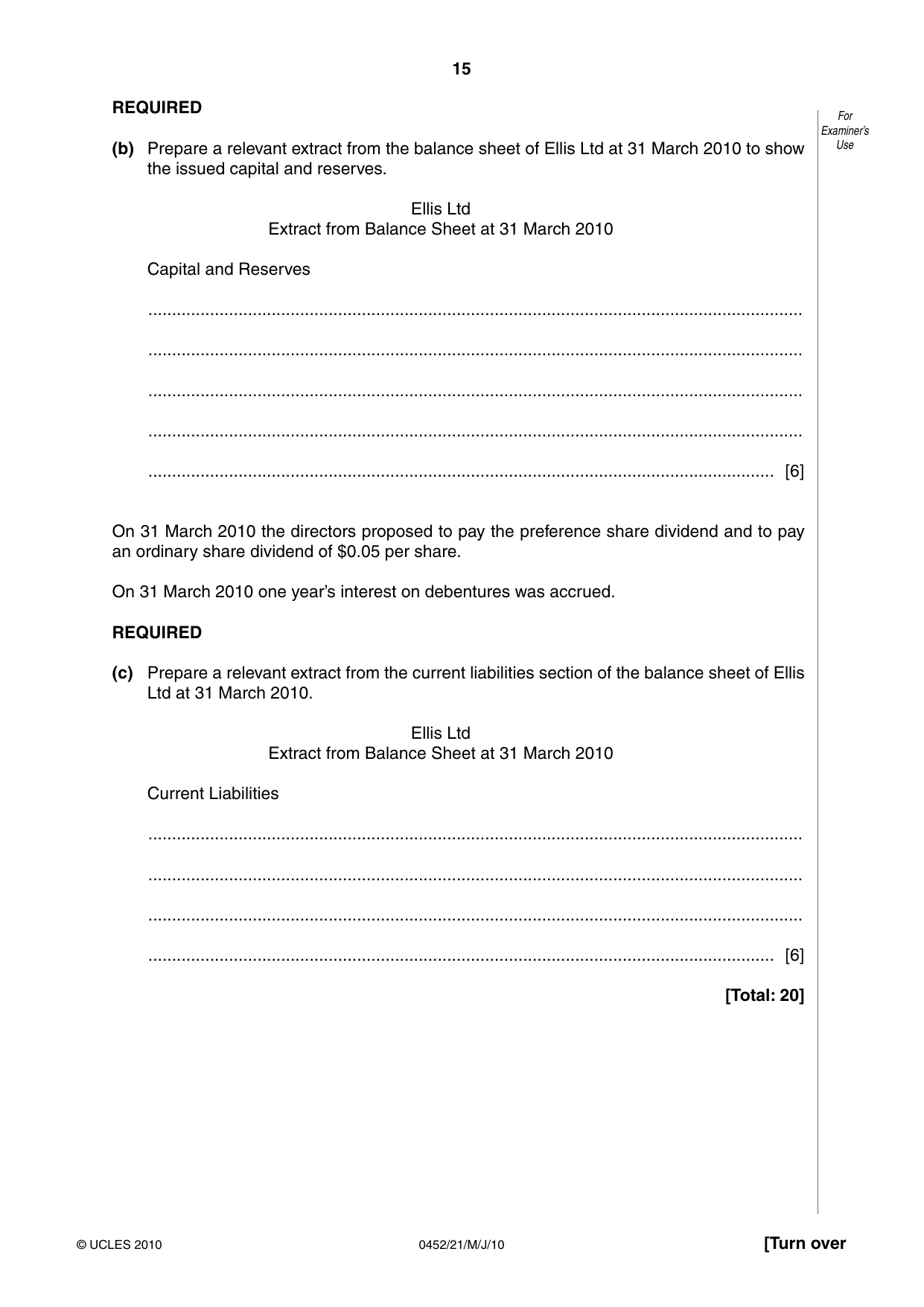
15 0452/21/M/J/10 © UCLES 2010 [Turn over For Examiner’s Use REQUIRED (b) Prepare a relevant extract from the balance sheet of Ellis Ltd at 31 March 2010 to show the issued capital and reserves. Ellis Ltd Extract from Balance Sheet at 31 March 2010 Capital and Reserves … … … … … [6] On 31 March 2010 the directors proposed to pay the preference share dividend and to pay an ordinary share dividend of $0.05 per share. On 31 March 2010 one year’s interest on debentures was accrued. REQUIRED (c) Prepare a relevant extract from the current liabilities section of the balance sheet of Ellis Ltd at 31 March 2010. Ellis Ltd Extract from Balance Sheet at 31 March 2010 Current Liabilities … … … … [6] [Total: 20]
Question paper, page 16
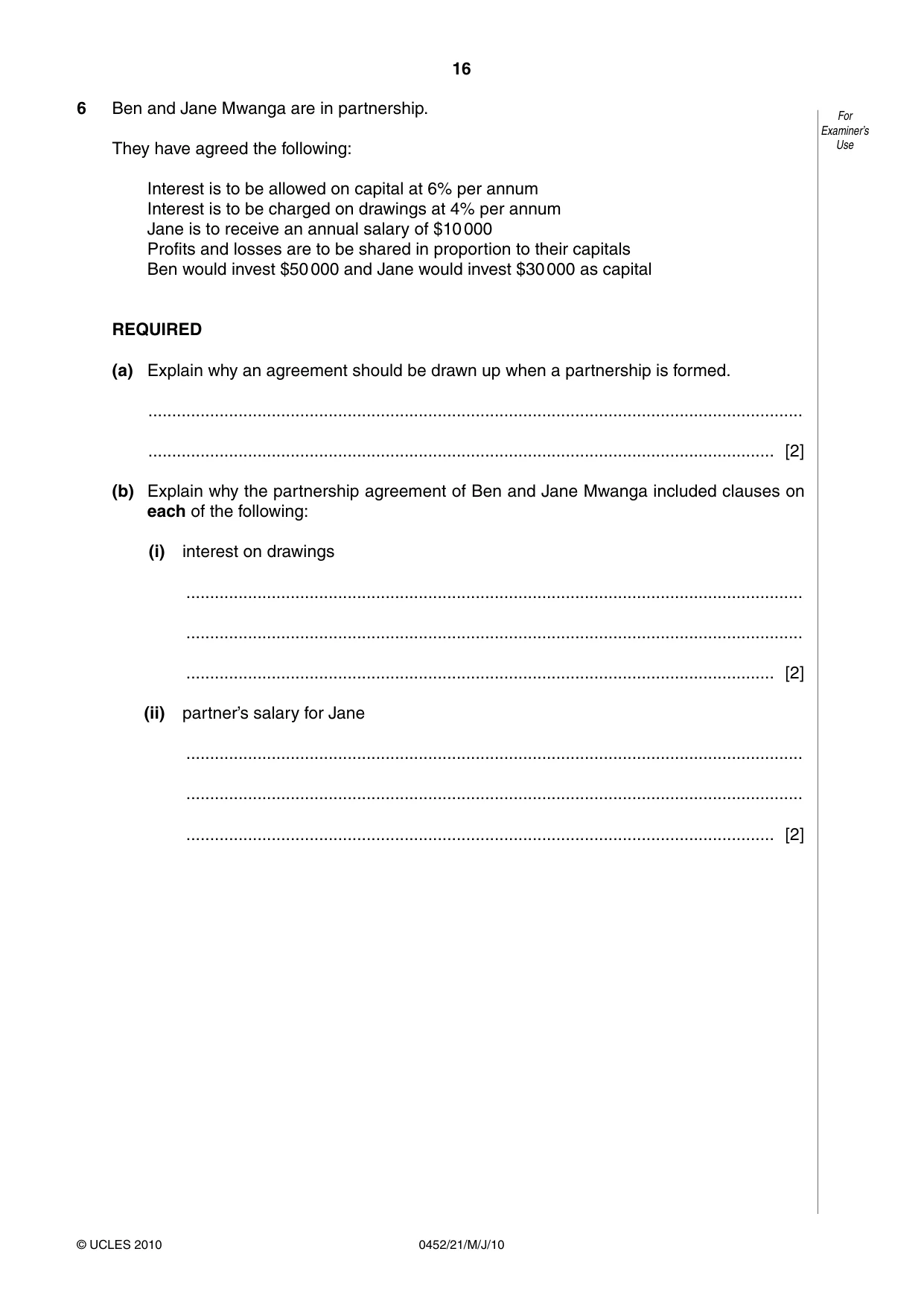
16 0452/21/M/J/10 © UCLES 2010 For Examiner’s Use 6 Ben and Jane Mwanga are in partnership. They have agreed the following: Interest is to be allowed on capital at 6% per annum Interest is to be charged on drawings at 4% per annum Jane is to receive an annual salary of $10 000 Profits and losses are to be shared in proportion to their capitals Ben would invest $50 000 and Jane would invest $30 000 as capital REQUIRED (a) Explain why an agreement should be drawn up when a partnership is formed. … … [2] (b) Explain why the partnership agreement of Ben and Jane Mwanga included clauses on each of the following: (i) interest on drawings … … … [2] (ii) partner’s salary for Jane … … … [2]
Question paper, page 17
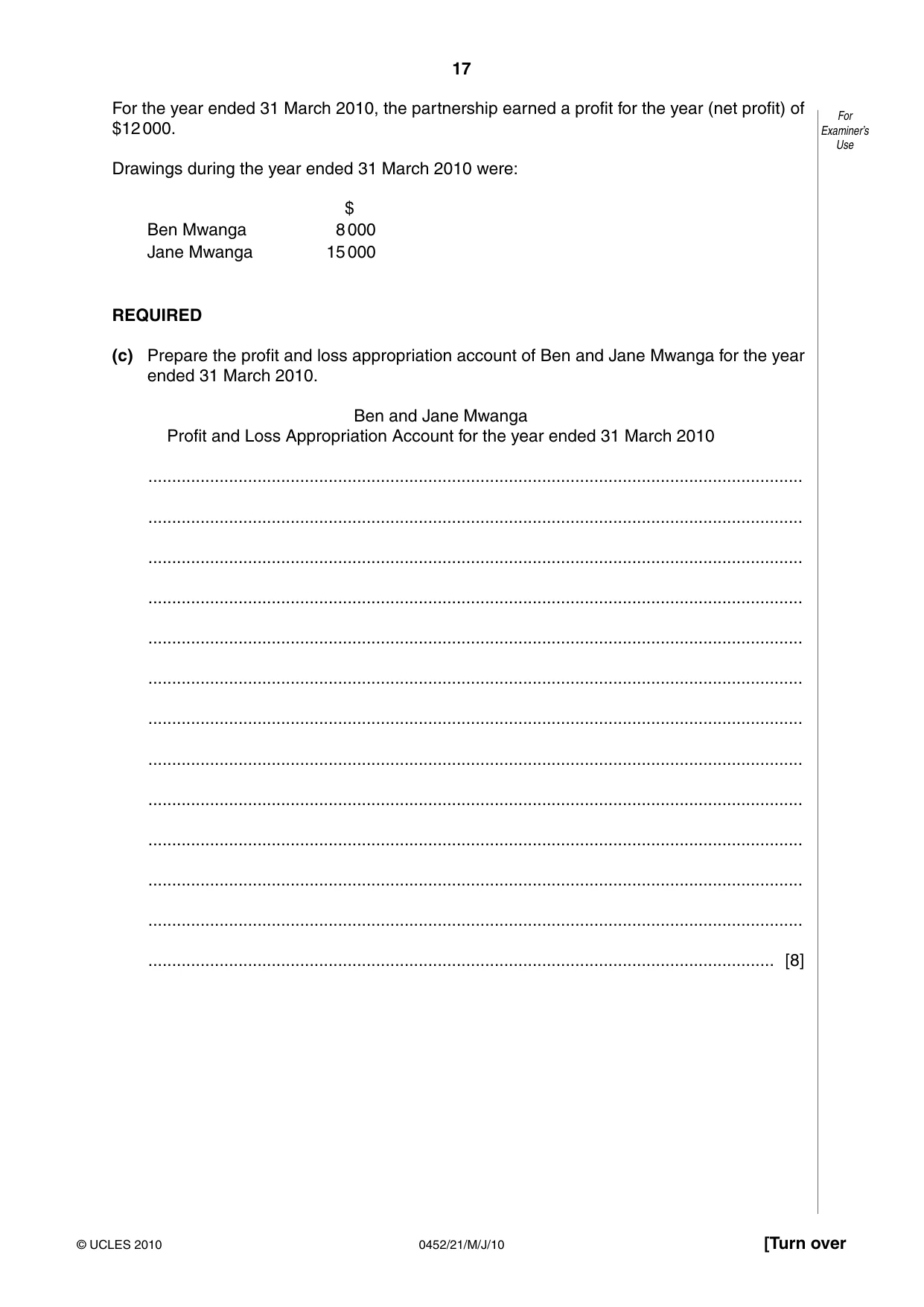
17 0452/21/M/J/10 © UCLES 2010 [Turn over For Examiner’s Use For the year ended 31 March 2010, the partnership earned a profit for the year (net profit) of $12 000. Drawings during the year ended 31 March 2010 were: $ Ben Mwanga 8 000 Jane Mwanga 15 000 REQUIRED (c) Prepare the profit and loss appropriation account of Ben and Jane Mwanga for the year ended 31 March 2010. Ben and Jane Mwanga Profit and Loss Appropriation Account for the year ended 31 March 2010 … … … … … … … … … … … … … [8]
Question paper, page 18
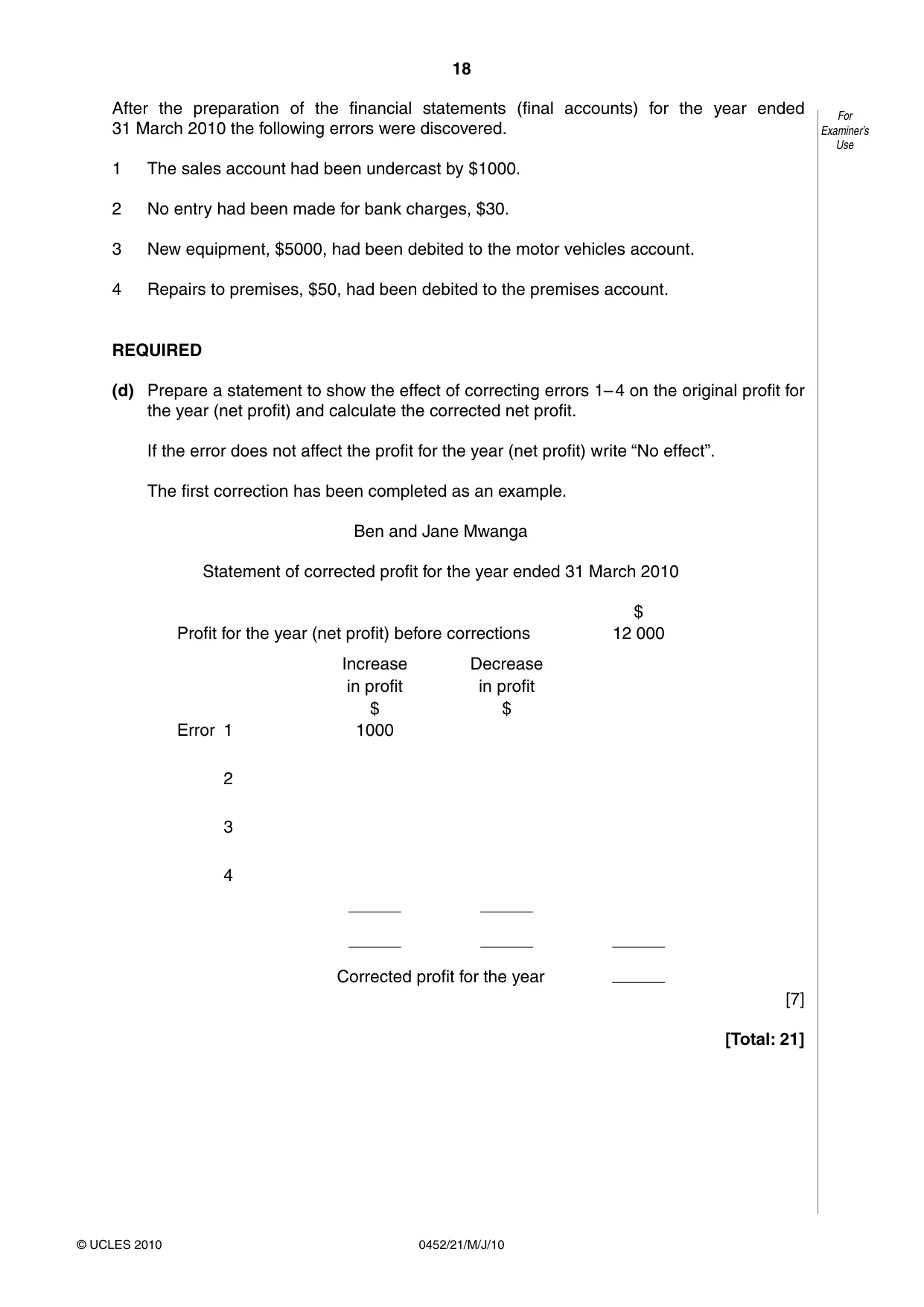
18 0452/21/M/J/10 © UCLES 2010 For Examiner’s Use After the preparation of the financial statements (final accounts) for the year ended 31 March 2010 the following errors were discovered. 1 The sales account had been undercast by $1000. 2 No entry had been made for bank charges, $30. 3 New equipment, $5000, had been debited to the motor vehicles account. 4 Repairs to premises, $50, had been debited to the premises account. REQUIRED (d) Prepare a statement to show the effect of correcting errors 1– 4 on the original profit for the year (net profit) and calculate the corrected net profit. If the error does not affect the profit for the year (net profit) write “No effect”. The first correction has been completed as an example. Ben and Jane Mwanga Statement of corrected profit for the year ended 31 March 2010 $ Profit for the year (net profit) before corrections 12 000 Increase Decrease in profit in profit $ $ Error 1 1000 2 3 4 Corrected profit for the year [7] [Total: 21]
Question paper, page 19
19 0452/21/M/J/10 © UCLES 2010 BLANK PAGE
Question paper, page 20
20 0452/21/M/J/10 © UCLES 2010 Permission to reproduce items where third-party owned material protected by copyright is included has been sought and cleared where possible. Every reasonable effort has been made by the publisher (UCLES) to trace copyright holders, but if any items requiring clearance have unwittingly been included, the publisher will be pleased to make amends at the earliest possible opportunity. University of Cambridge International Examinations is part of the Cambridge Assessment Group. Cambridge Assessment is the brand name of University of Cambridge Local Examinations Syndicate (UCLES), which is itself a department of the University of Cambridge. BLANK PAGE
Mark scheme, page 1
UNIVERSITY OF CAMBRIDGE INTERNATIONAL EXAMINATIONS International General Certificate of Secondary Education MARK SCHEME for the May/June 2010 question paper for the guidance of teachers 0452 ACCOUNTING 0452/21 Paper 21, maximum raw mark 120 This mark scheme is published as an aid to teachers and candidates, to indicate the requirements of the examination. It shows the basis on which Examiners were instructed to award marks. It does not indicate the details of the discussions that took place at an Examiners’ meeting before marking began, which would have considered the acceptability of alternative answers. Mark schemes must be read in conjunction with the question papers and the report on the examination. • CIE will not enter into discussions or correspondence in connection with these mark schemes. CIE is publishing the mark schemes for the May/June 2010 question papers for most IGCSE, GCE Advanced Level and Advanced Subsidiary Level syllabuses and some Ordinary Level syllabuses.
Mark scheme, page 2
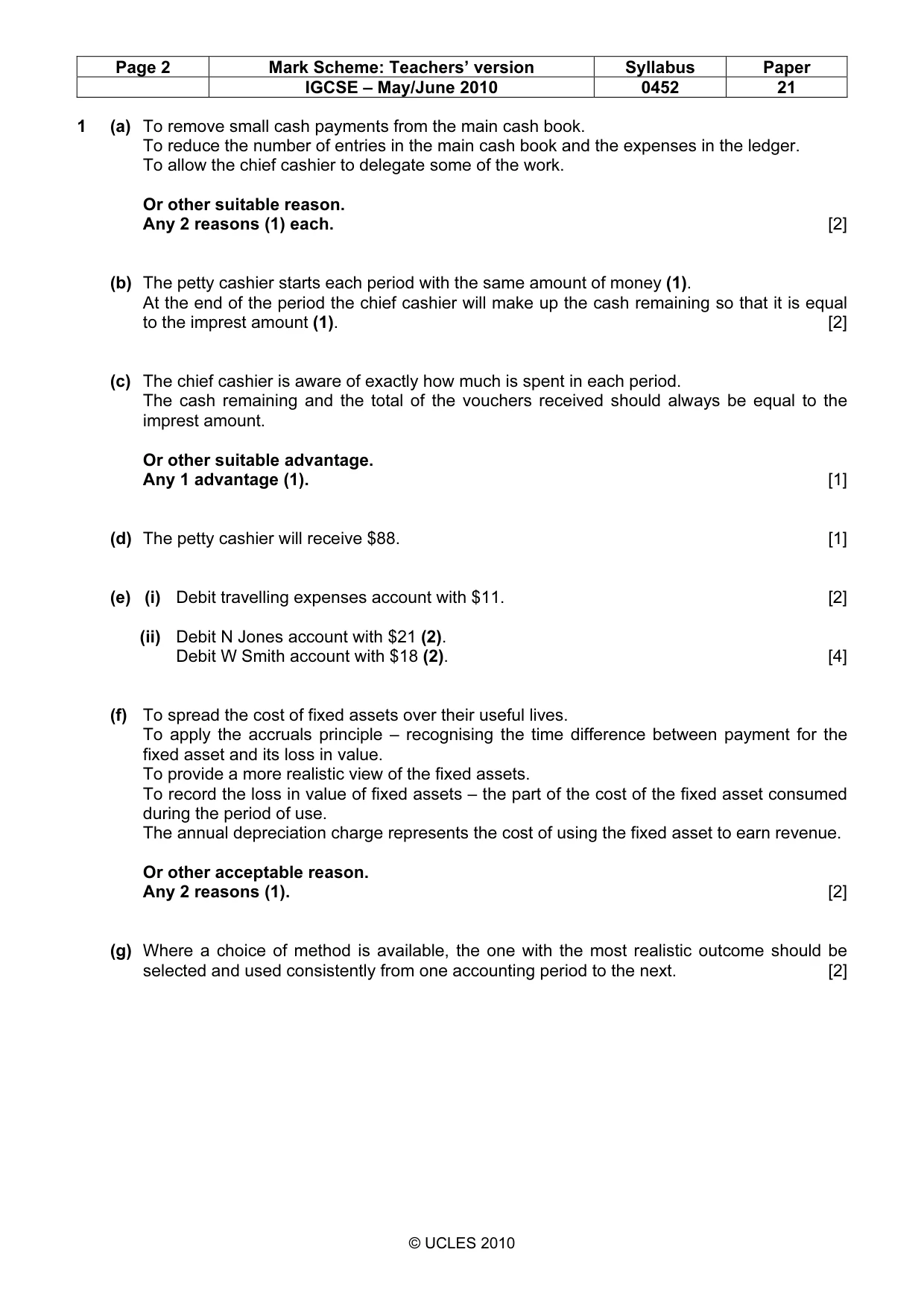
Page 2 Mark Scheme: Teachers’ version Syllabus Paper IGCSE – May/June 2010 0452 21 © UCLES 2010 1 (a) To remove small cash payments from the main cash book. To reduce the number of entries in the main cash book and the expenses in the ledger. To allow the chief cashier to delegate some of the work. Or other suitable reason. Any 2 reasons (1) each. [2] (b) The petty cashier starts each period with the same amount of money (1). At the end of the period the chief cashier will make up the cash remaining so that it is equal to the imprest amount (1). [2] (c) The chief cashier is aware of exactly how much is spent in each period. The cash remaining and the total of the vouchers received should always be equal to the imprest amount. Or other suitable advantage. Any 1 advantage (1). [1] (d) The petty cashier will receive $88. [1] (e) (i) Debit travelling expenses account with $11. [2] (ii) Debit N Jones account with $21 (2). Debit W Smith account with $18 (2). [4] (f) To spread the cost of fixed assets over their useful lives. To apply the accruals principle – recognising the time difference between payment for the fixed asset and its loss in value. To provide a more realistic view of the fixed assets. To record the loss in value of fixed assets – the part of the cost of the fixed asset consumed during the period of use. The annual depreciation charge represents the cost of using the fixed asset to earn revenue. Or other acceptable reason. Any 2 reasons (1). [2] (g) Where a choice of method is available, the one with the most realistic outcome should be selected and used consistently from one accounting period to the next. [2]
Mark scheme, page 3
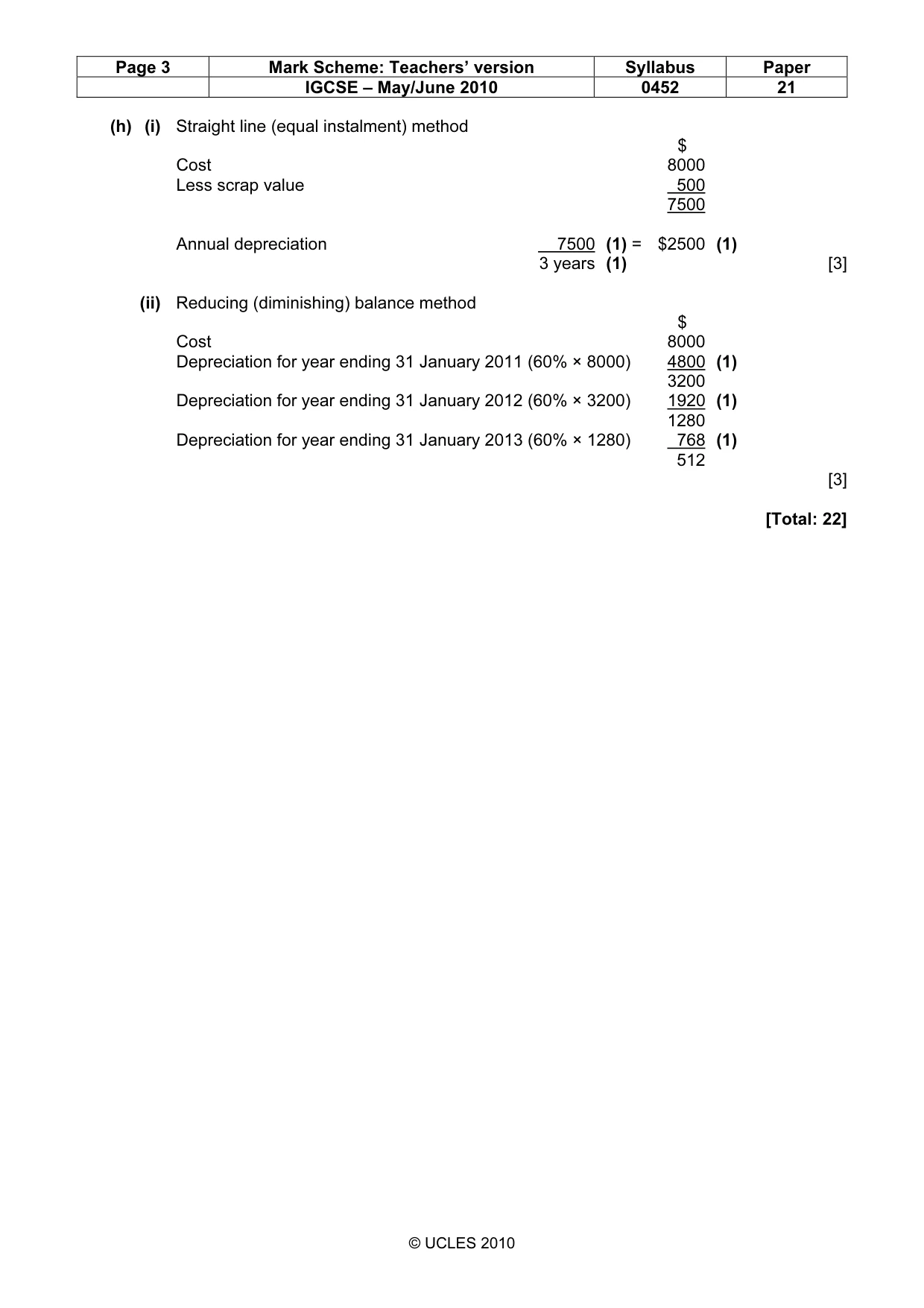
Page 3 Mark Scheme: Teachers’ version Syllabus Paper IGCSE – May/June 2010 0452 21 © UCLES 2010 (h) (i) Straight line (equal instalment) method $ Cost 8000 Less scrap value 500 7500 Annual depreciation 7500 (1) = $2500 (1) 3 years (1) [3] (ii) Reducing (diminishing) balance method $ Cost 8000 Depreciation for year ending 31 January 2011 (60% × 8000) 4800 (1) 3200 Depreciation for year ending 31 January 2012 (60% × 3200) 1920 (1) 1280 Depreciation for year ending 31 January 2013 (60% × 1280) 768 (1) 512 [3] [Total: 22]
Mark scheme, page 4
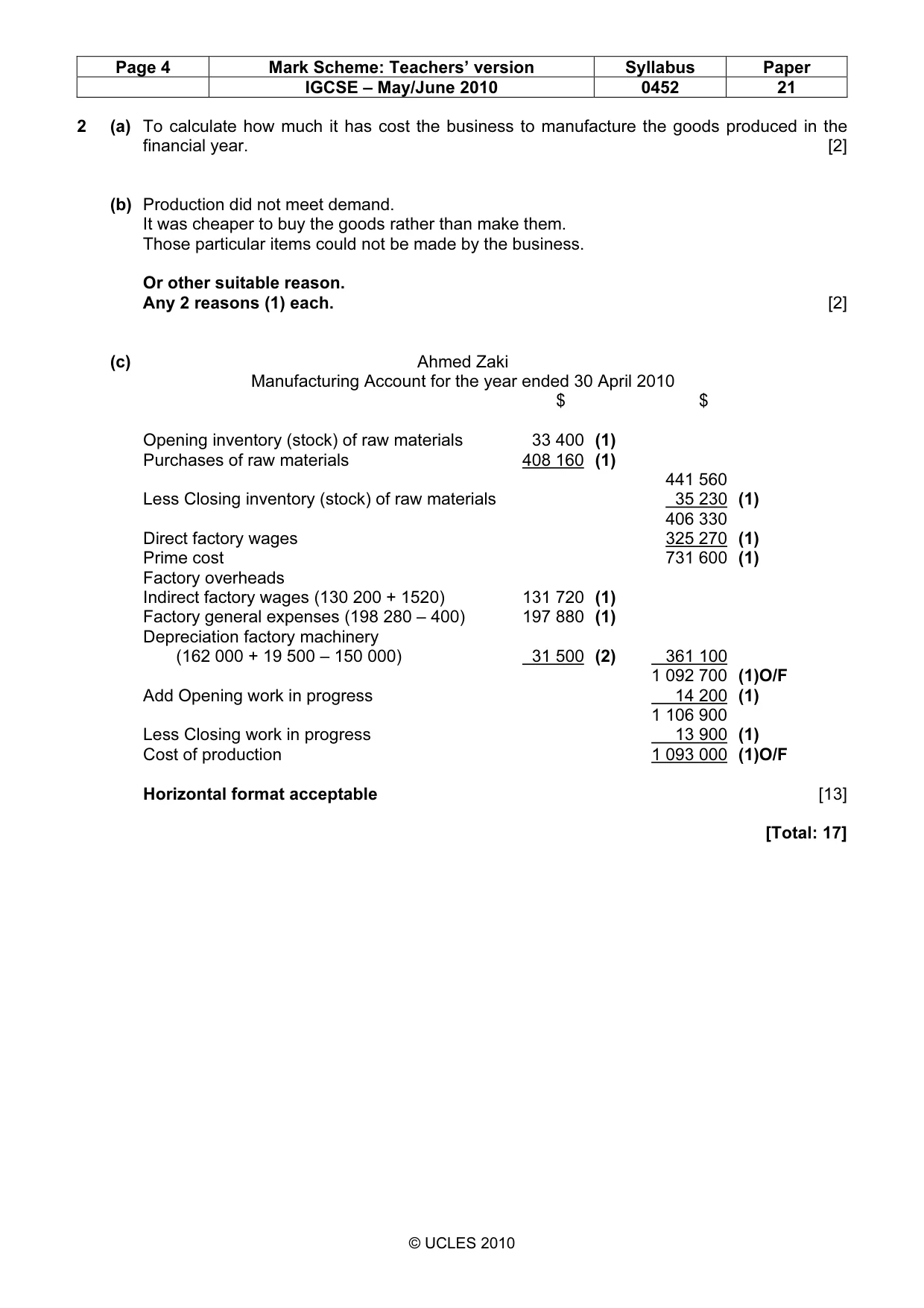
Page 4 Mark Scheme: Teachers’ version Syllabus Paper IGCSE – May/June 2010 0452 21 © UCLES 2010 2 (a) To calculate how much it has cost the business to manufacture the goods produced in the financial year. [2] (b) Production did not meet demand. It was cheaper to buy the goods rather than make them. Those particular items could not be made by the business. Or other suitable reason. Any 2 reasons (1) each. [2] (c) Ahmed Zaki Manufacturing Account for the year ended 30 April 2010 $ $ Opening inventory (stock) of raw materials 33 400 (1) Purchases of raw materials 408 160 (1) 441 560 Less Closing inventory (stock) of raw materials 35 230 (1) 406 330 Direct factory wages 325 270 (1) Prime cost 731 600 (1) Factory overheads Indirect factory wages (130 200 + 1520) 131 720 (1) Factory general expenses (198 280 – 400) 197 880 (1) Depreciation factory machinery (162 000 + 19 500 – 150 000) 31 500 (2) 361 100 1 092 700 (1)O/F Add Opening work in progress 14 200 (1) 1 106 900 Less Closing work in progress 13 900 (1) Cost of production 1 093 000 (1)O/F Horizontal format acceptable [13] [Total: 17]
Mark scheme, page 5
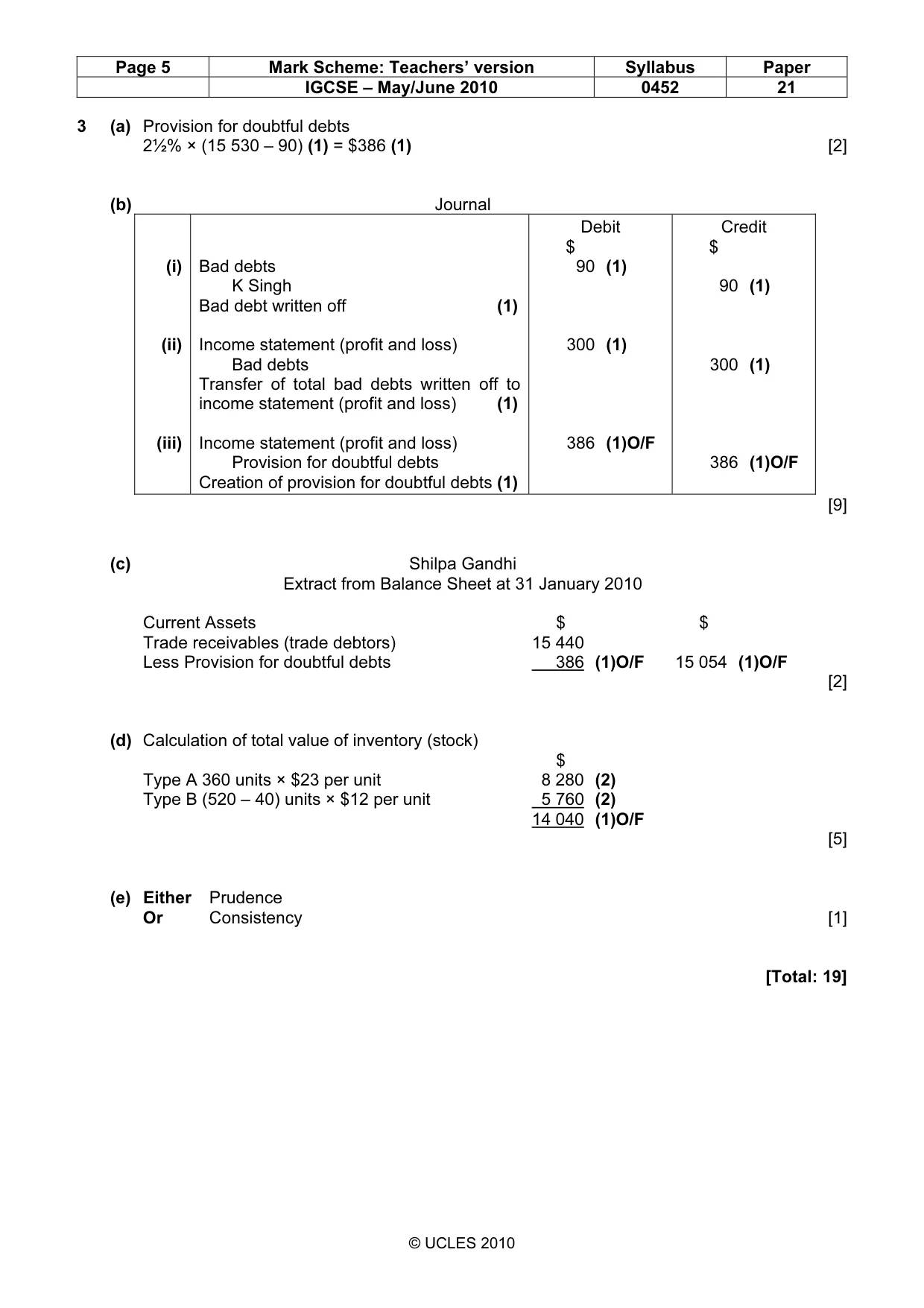
Page 5 Mark Scheme: Teachers’ version Syllabus Paper IGCSE – May/June 2010 0452 21 © UCLES 2010 3 (a) Provision for doubtful debts 2½% × (15 530 – 90) (1) = $386 (1) [2] (b) Journal (i) (ii) (iii) Bad debts K Singh Bad debt written off (1) Income statement (profit and loss) Bad debts Transfer of total bad debts written off to income statement (profit and loss) (1) Income statement (profit and loss) Provision for doubtful debts Creation of provision for doubtful debts (1) Debit $ 90 (1) 300 (1) 386 (1)O/F Credit $ 90 (1) 300 (1) 386 (1)O/F [9] (c) Shilpa Gandhi Extract from Balance Sheet at 31 January 2010 Current Assets $ $ Trade receivables (trade debtors) 15 440 Less Provision for doubtful debts 386 (1)O/F 15 054 (1)O/F [2] (d) Calculation of total value of inventory (stock) $ Type A 360 units × $23 per unit 8 280 (2) Type B (520 – 40) units × $12 per unit 5 760 (2) 14 040 (1)O/F [5] (e) Either Prudence Or Consistency [1] [Total: 19]
Mark scheme, page 6
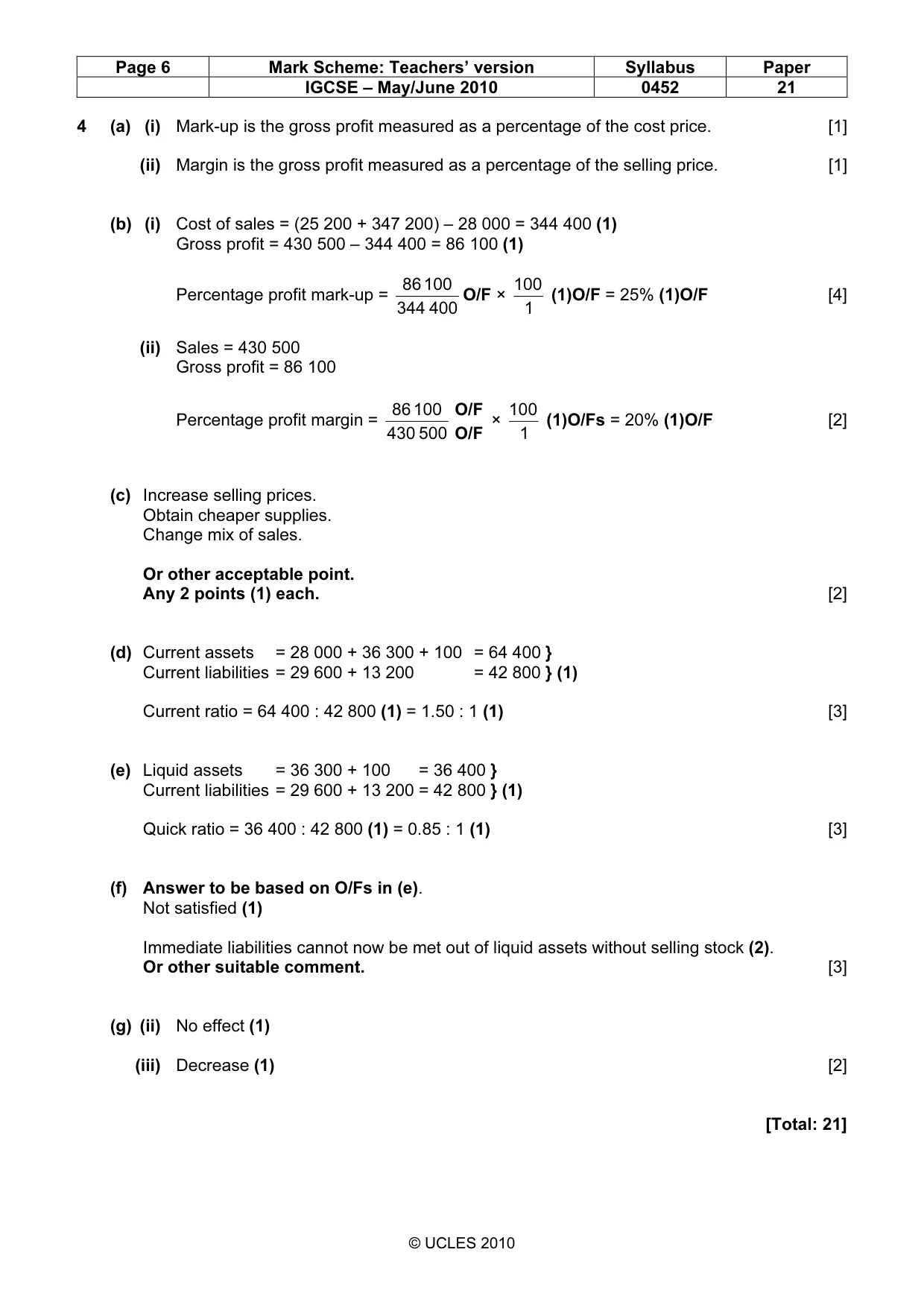
Page 6 Mark Scheme: Teachers’ version Syllabus Paper IGCSE – May/June 2010 0452 21 © UCLES 2010 4 (a) (i) Mark-up is the gross profit measured as a percentage of the cost price. [1] (ii) Margin is the gross profit measured as a percentage of the selling price. [1] (b) (i) Cost of sales = (25 200 + 347 200) – 28 000 = 344 400 (1) Gross profit = 430 500 – 344 400 = 86 100 (1) Percentage profit mark-up = 400 344 100 86 O/F × 1 100 (1)O/F = 25% (1)O/F [4] (ii) Sales = 430 500 Gross profit = 86 100 Percentage profit margin = 500 430 100 86 O/F O/F × 1 100 (1)O/Fs = 20% (1)O/F [2] (c) Increase selling prices. Obtain cheaper supplies. Change mix of sales. Or other acceptable point. Any 2 points (1) each. [2] (d) Current assets = 28 000 + 36 300 + 100 = 64 400 } Current liabilities = 29 600 + 13 200 = 42 800 } (1) Current ratio = 64 400 : 42 800 (1) = 1.50 : 1 (1) [3] (e) Liquid assets = 36 300 + 100 = 36 400 } Current liabilities = 29 600 + 13 200 = 42 800 } (1) Quick ratio = 36 400 : 42 800 (1) = 0.85 : 1 (1) [3] (f) Answer to be based on O/Fs in (e). Not satisfied (1) Immediate liabilities cannot now be met out of liquid assets without selling stock (2). Or other suitable comment. [3] (g) (ii) No effect (1) (iii) Decrease (1) [2] [Total: 21]
Mark scheme, page 7
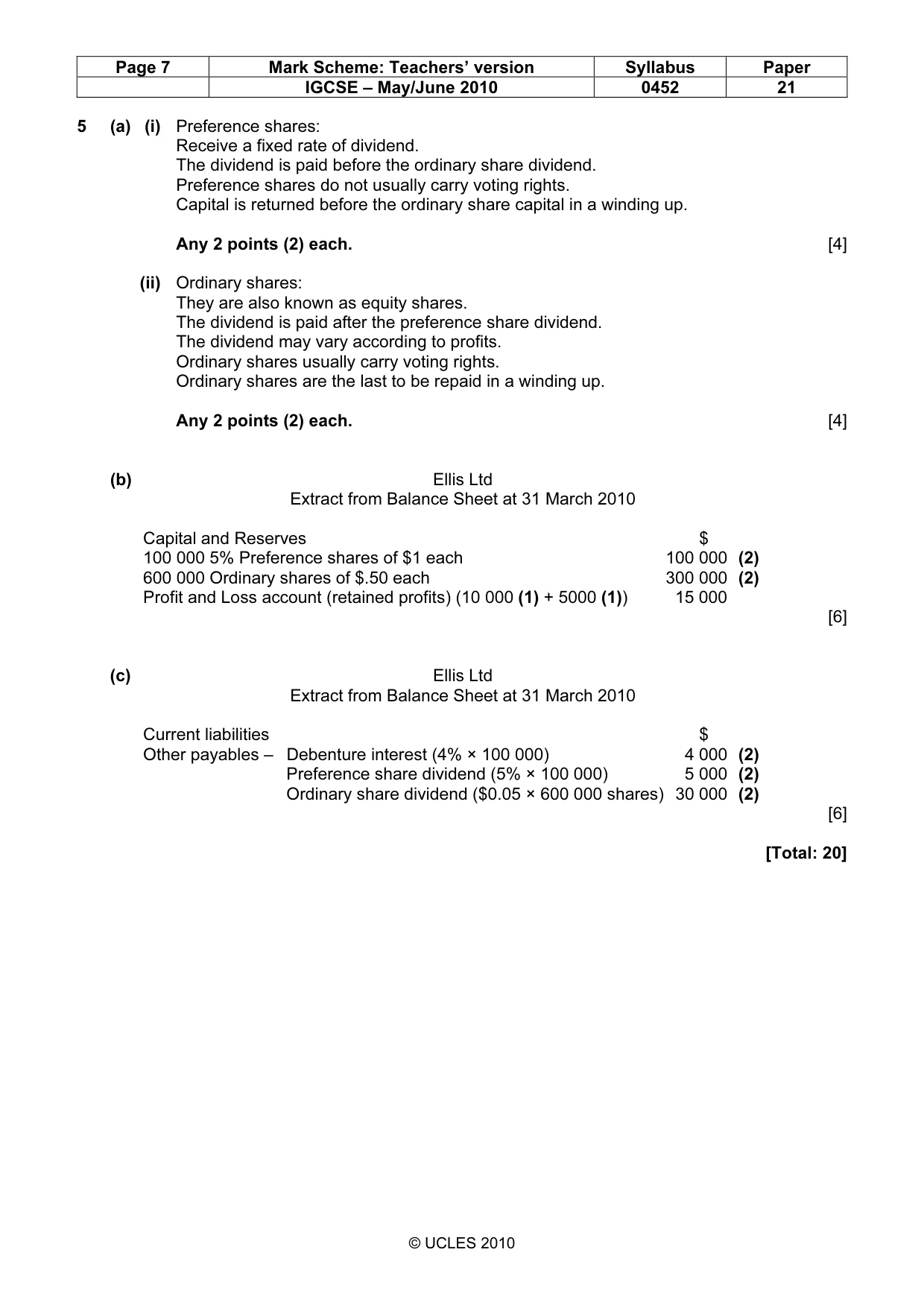
Page 7 Mark Scheme: Teachers’ version Syllabus Paper IGCSE – May/June 2010 0452 21 © UCLES 2010 5 (a) (i) Preference shares: Receive a fixed rate of dividend. The dividend is paid before the ordinary share dividend. Preference shares do not usually carry voting rights. Capital is returned before the ordinary share capital in a winding up. Any 2 points (2) each. [4] (ii) Ordinary shares: They are also known as equity shares. The dividend is paid after the preference share dividend. The dividend may vary according to profits. Ordinary shares usually carry voting rights. Ordinary shares are the last to be repaid in a winding up. Any 2 points (2) each. [4] (b) Ellis Ltd Extract from Balance Sheet at 31 March 2010 Capital and Reserves $ 100 000 5% Preference shares of $1 each 100 000 (2) 600 000 Ordinary shares of $.50 each 300 000 (2) Profit and Loss account (retained profits) (10 000 (1) + 5000 (1)) 15 000 [6] (c) Ellis Ltd Extract from Balance Sheet at 31 March 2010 Current liabilities $ Other payables – Debenture interest (4% × 100 000) 4 000 (2) Preference share dividend (5% × 100 000) 5 000 (2) Ordinary share dividend ($0.05 × 600 000 shares) 30 000 (2) [6] [Total: 20]
Mark scheme, page 8
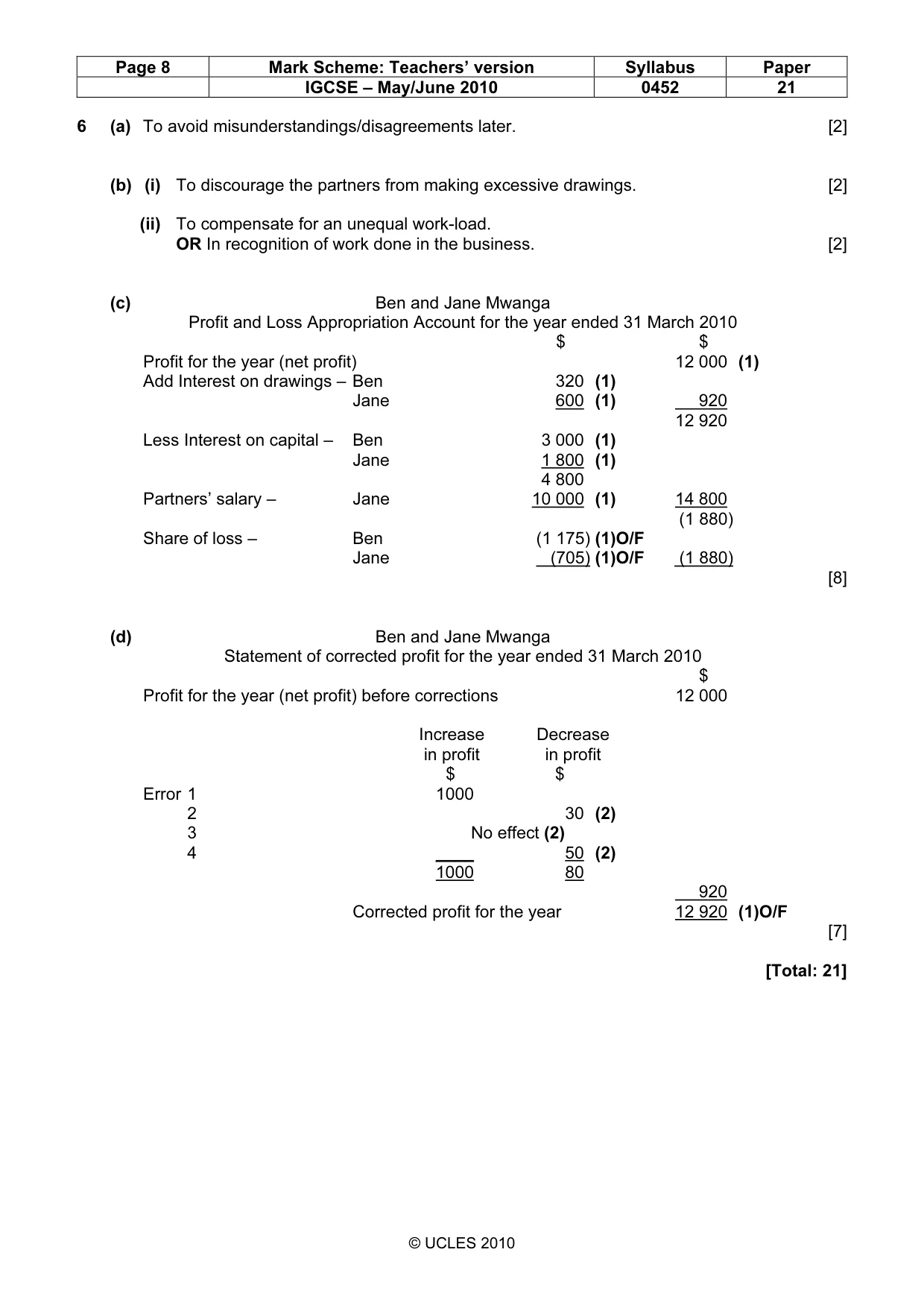
Page 8 Mark Scheme: Teachers’ version Syllabus Paper IGCSE – May/June 2010 0452 21 © UCLES 2010 6 (a) To avoid misunderstandings/disagreements later. [2] (b) (i) To discourage the partners from making excessive drawings. [2] (ii) To compensate for an unequal work-load. OR In recognition of work done in the business. [2] (c) Ben and Jane Mwanga Profit and Loss Appropriation Account for the year ended 31 March 2010 $ $ Profit for the year (net profit) 12 000 (1) Add Interest on drawings – Ben 320 (1) Jane 600 (1) 920 12 920 Less Interest on capital – Ben 3 000 (1) Jane 1 800 (1) 4 800 Partners’ salary – Jane 10 000 (1) 14 800 (1 880) Share of loss – Ben (1 175) (1)O/F Jane (705) (1)O/F (1 880) [8] (d) Ben and Jane Mwanga Statement of corrected profit for the year ended 31 March 2010 $ Profit for the year (net profit) before corrections 12 000 Increase Decrease in profit in profit $ $ Error 1 1000 2 30 (2) 3 No effect (2) 4 ____ 50 (2) 1000 80 920 Corrected profit for the year 12 920 (1)O/F [7] [Total: 21]
What you needed in this session
Cambridge’s own grade thresholds for 2010 May/June, Paper 2 · Variant 1. A higher threshold means an easier paper — the bar moves with how the cohort did.