Cambridge IGCSE Accounting 0452 — 2007 Oct/Nov Paper 2 · Variant 1
0452/21/O/N/07 · 90 marks · ≈101 min
The question paper and its mark scheme, free to read here and free to download. This is Cambridge’s own paper, exactly as it was sat.
Question paper12 pages
Mark scheme6 pages
Answers below. Sit the paper first if you are practising.
Paper as text
Question paper, page 1
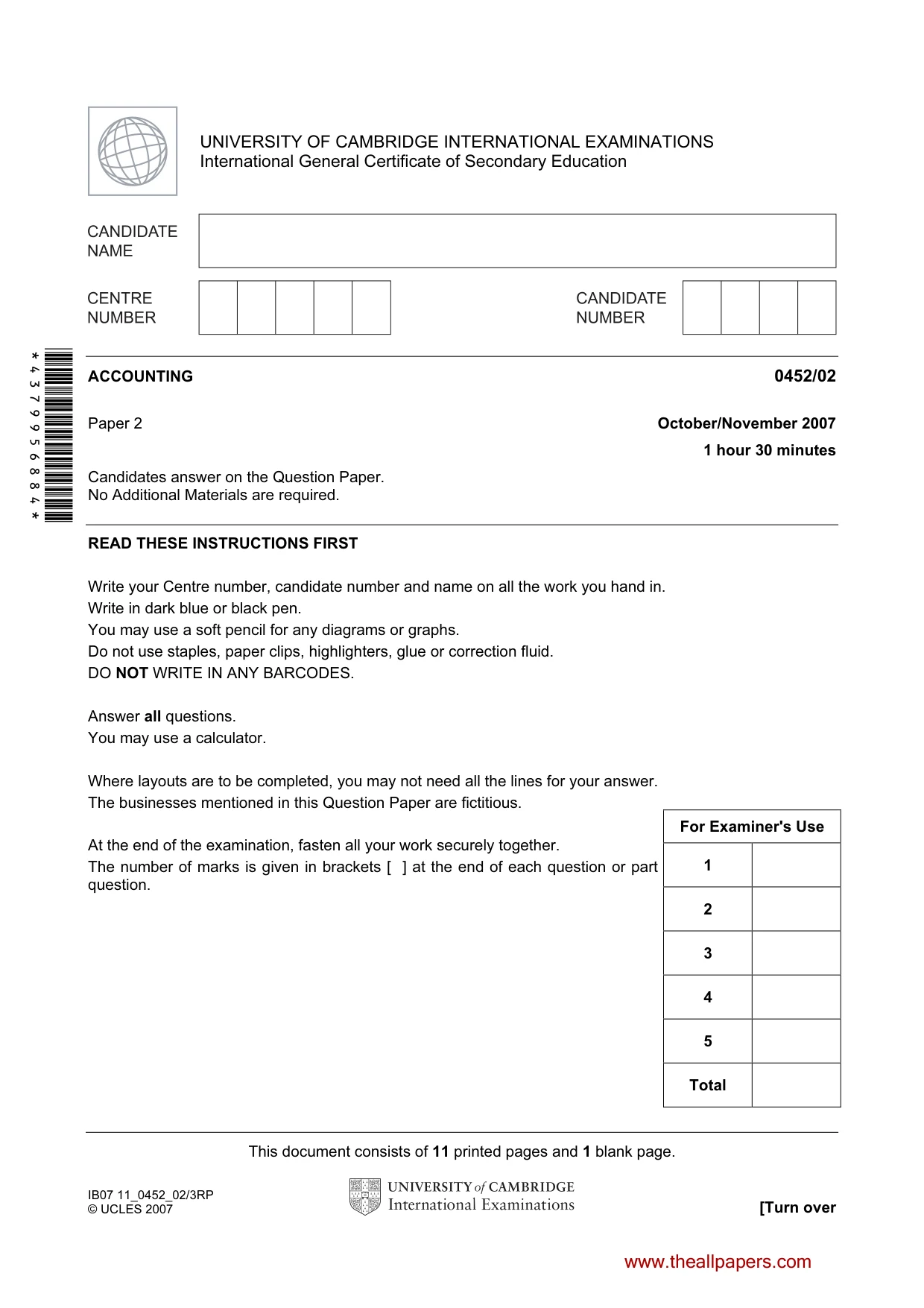
This document consists of 11 printed pages and 1 blank page. IB07 11_0452_02/3RP © UCLES 2007 [Turn over *4379956884* For Examiner's Use 1 2 3 4 5 Total UNIVERSITY OF CAMBRIDGE INTERNATIONAL EXAMINATIONS International General Certificate of Secondary Education ACCOUNTING 0452/02 Paper 2 October/November 2007 1 hour 30 minutes Candidates answer on the Question Paper. No Additional Materials are required. READ THESE INSTRUCTIONS FIRST Write your Centre number, candidate number and name on all the work you hand in. Write in dark blue or black pen. You may use a soft pencil for any diagrams or graphs. Do not use staples, paper clips, highlighters, glue or correction fluid. DO NOT WRITE IN ANY BARCODES. Answer all questions. You may use a calculator. Where layouts are to be completed, you may not need all the lines for your answer. The businesses mentioned in this Question Paper are fictitious. At the end of the examination, fasten all your work securely together. The number of marks is given in brackets [ ] at the end of each question or part question. www.theallpapers.com
Question paper, page 2
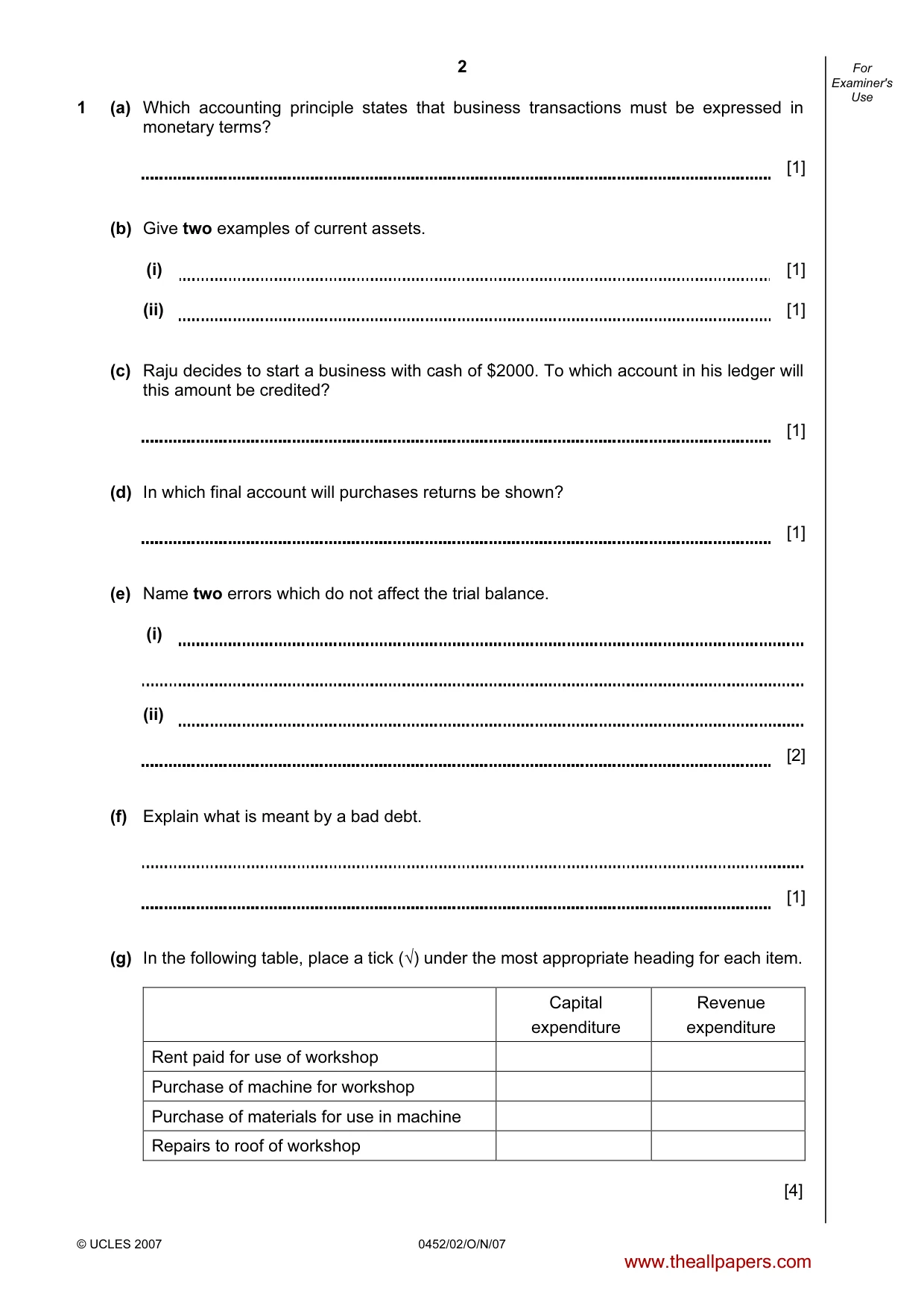
2 © UCLES 2007 0452/02/O/N/07 For Examiner's Use 1 (a) Which accounting principle states that business transactions must be expressed in monetary terms? [1] (b) Give two examples of current assets. (i) [1] (ii) [1] (c) Raju decides to start a business with cash of $2000. To which account in his ledger will this amount be credited? [1] (d) In which final account will purchases returns be shown? [1] (e) Name two errors which do not affect the trial balance. (i) (ii) [2] (f) Explain what is meant by a bad debt. [1] (g) In the following table, place a tick (√) under the most appropriate heading for each item. Capital expenditure Revenue expenditure Rent paid for use of workshop Purchase of machine for workshop Purchase of materials for use in machine Repairs to roof of workshop [4] www.theallpapers.com
Question paper, page 3
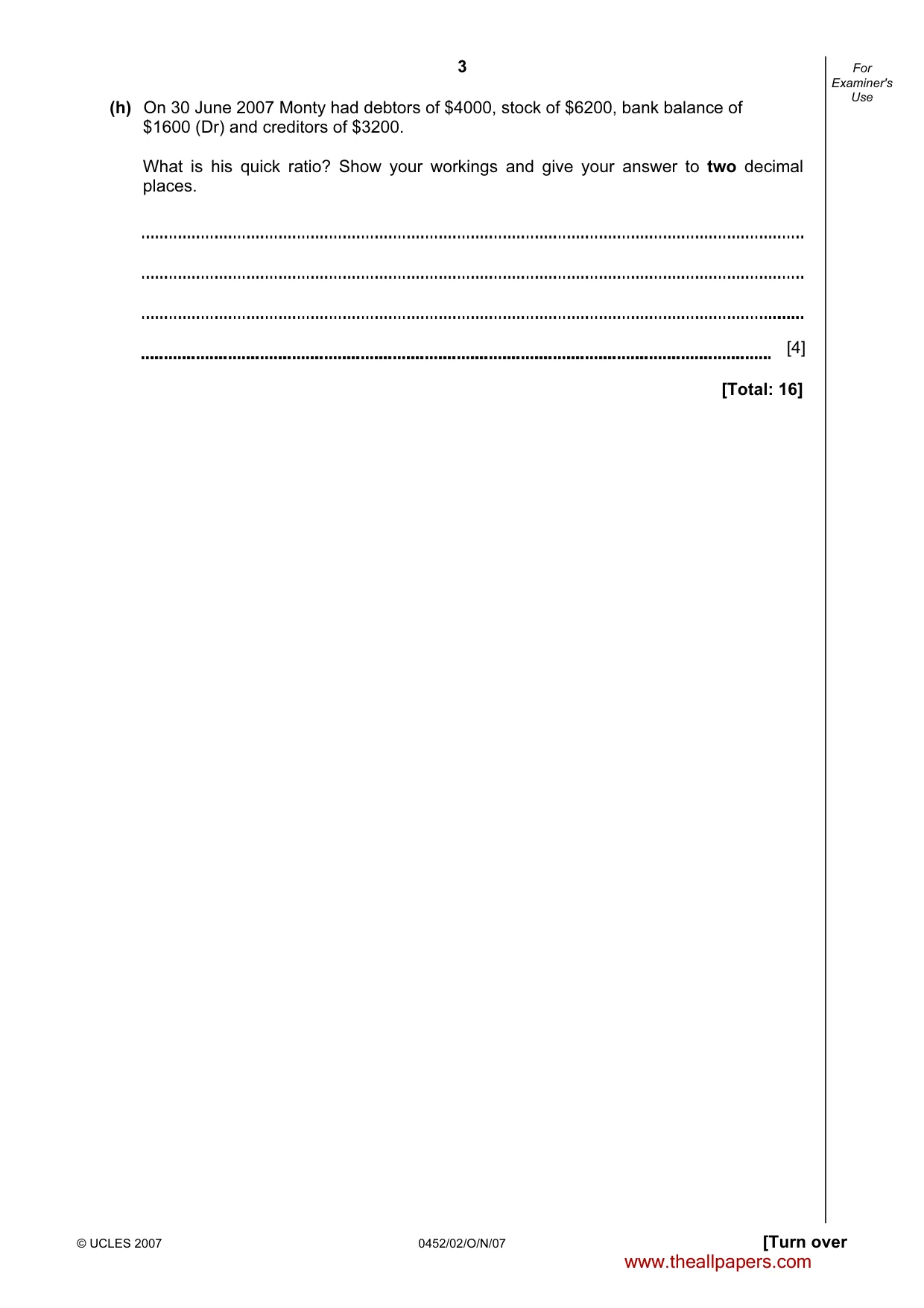
3 © UCLES 2007 0452/02/O/N/07 [Turn over For Examiner's Use (h) On 30 June 2007 Monty had debtors of $4000, stock of $6200, bank balance of $1600 (Dr) and creditors of $3200. What is his quick ratio? Show your workings and give your answer to two decimal places. [4] [Total: 16] www.theallpapers.com
Question paper, page 4
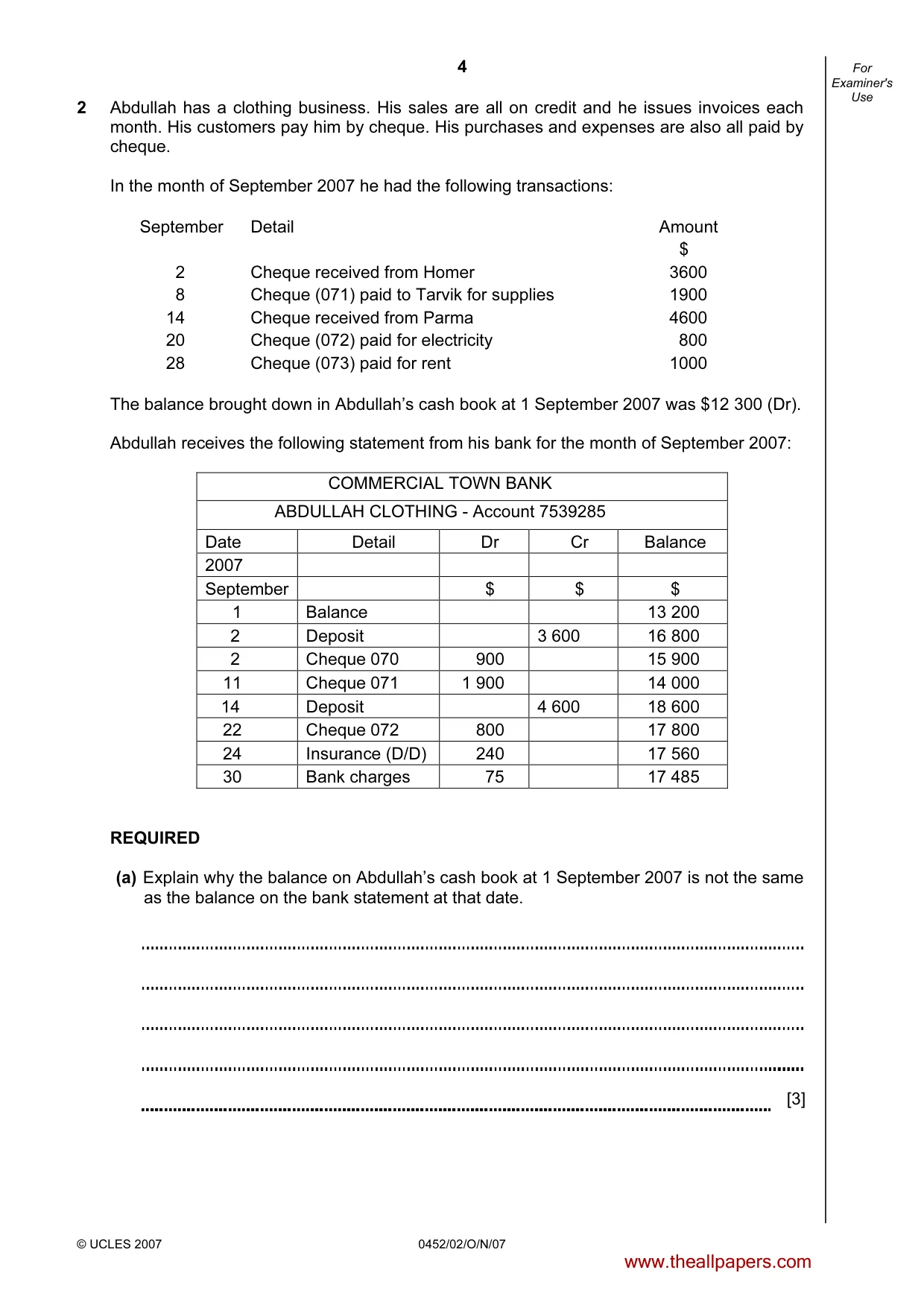
4 © UCLES 2007 0452/02/O/N/07 For Examiner's Use 2 Abdullah has a clothing business. His sales are all on credit and he issues invoices each month. His customers pay him by cheque. His purchases and expenses are also all paid by cheque. In the month of September 2007 he had the following transactions: September Detail Amount $ 2 Cheque received from Homer 3600 8 Cheque (071) paid to Tarvik for supplies 1900 14 Cheque received from Parma 4600 20 Cheque (072) paid for electricity 800 28 Cheque (073) paid for rent 1000 The balance brought down in Abdullah’s cash book at 1 September 2007 was $12 300 (Dr). Abdullah receives the following statement from his bank for the month of September 2007: COMMERCIAL TOWN BANK ABDULLAH CLOTHING - Account 7539285 Date Detail Dr Cr Balance 2007 September $ $ $ 1 Balance 13 200 2 Deposit 3 600 16 800 2 Cheque 070 900 15 900 11 Cheque 071 1 900 14 000 14 Deposit 4 600 18 600 22 Cheque 072 800 17 800 24 Insurance (D/D) 240 17 560 30 Bank charges 75 17 485 REQUIRED (a) Explain why the balance on Abdullah’s cash book at 1 September 2007 is not the same as the balance on the bank statement at that date. [3] www.theallpapers.com
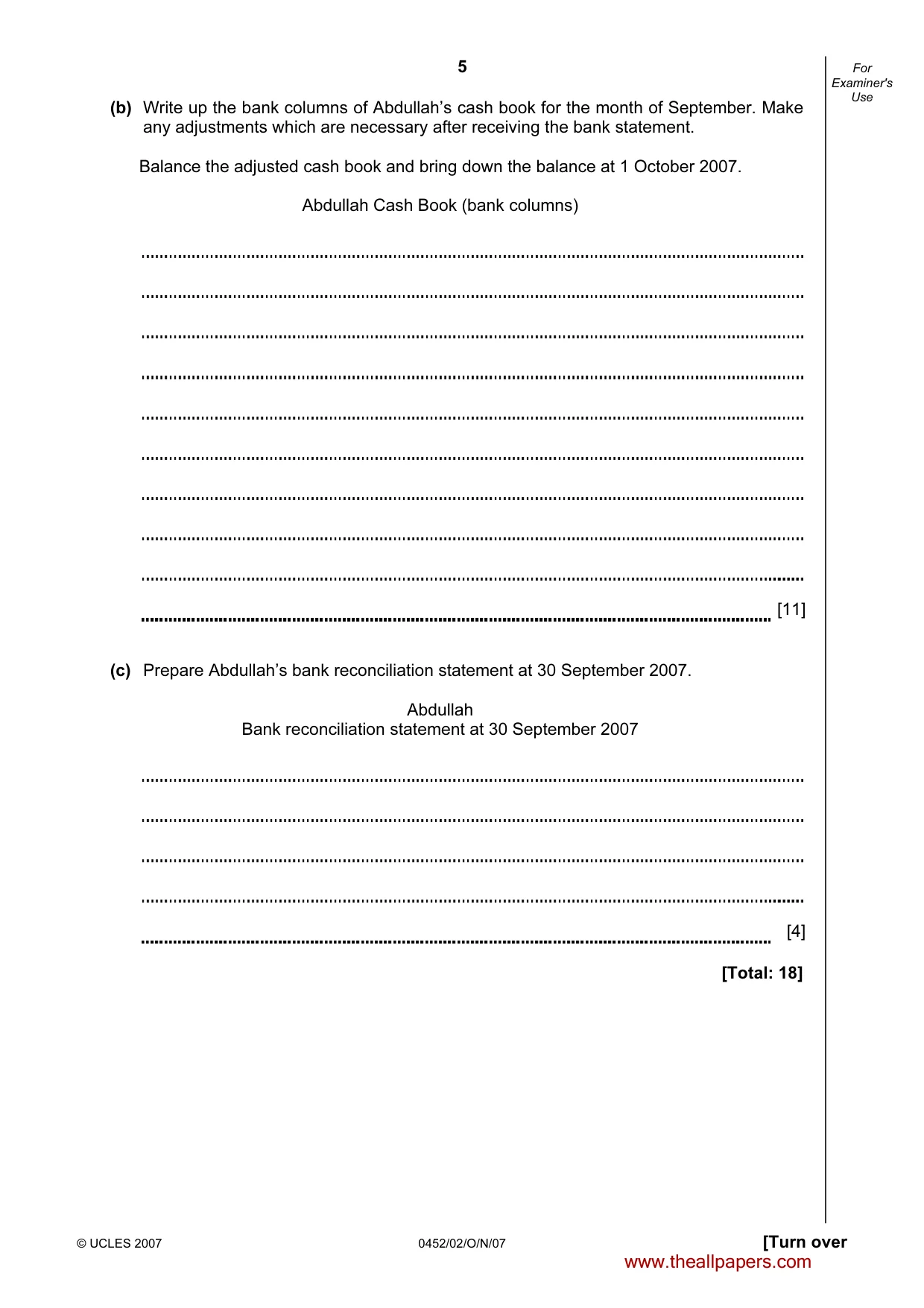
Question paper, page 5
5 © UCLES 2007 0452/02/O/N/07 [Turn over For Examiner's Use (b) Write up the bank columns of Abdullah’s cash book for the month of September. Make any adjustments which are necessary after receiving the bank statement. Balance the adjusted cash book and bring down the balance at 1 October 2007. Abdullah Cash Book (bank columns) [11] (c) Prepare Abdullah’s bank reconciliation statement at 30 September 2007. Abdullah Bank reconciliation statement at 30 September 2007 [4] [Total: 18] www.theallpapers.com
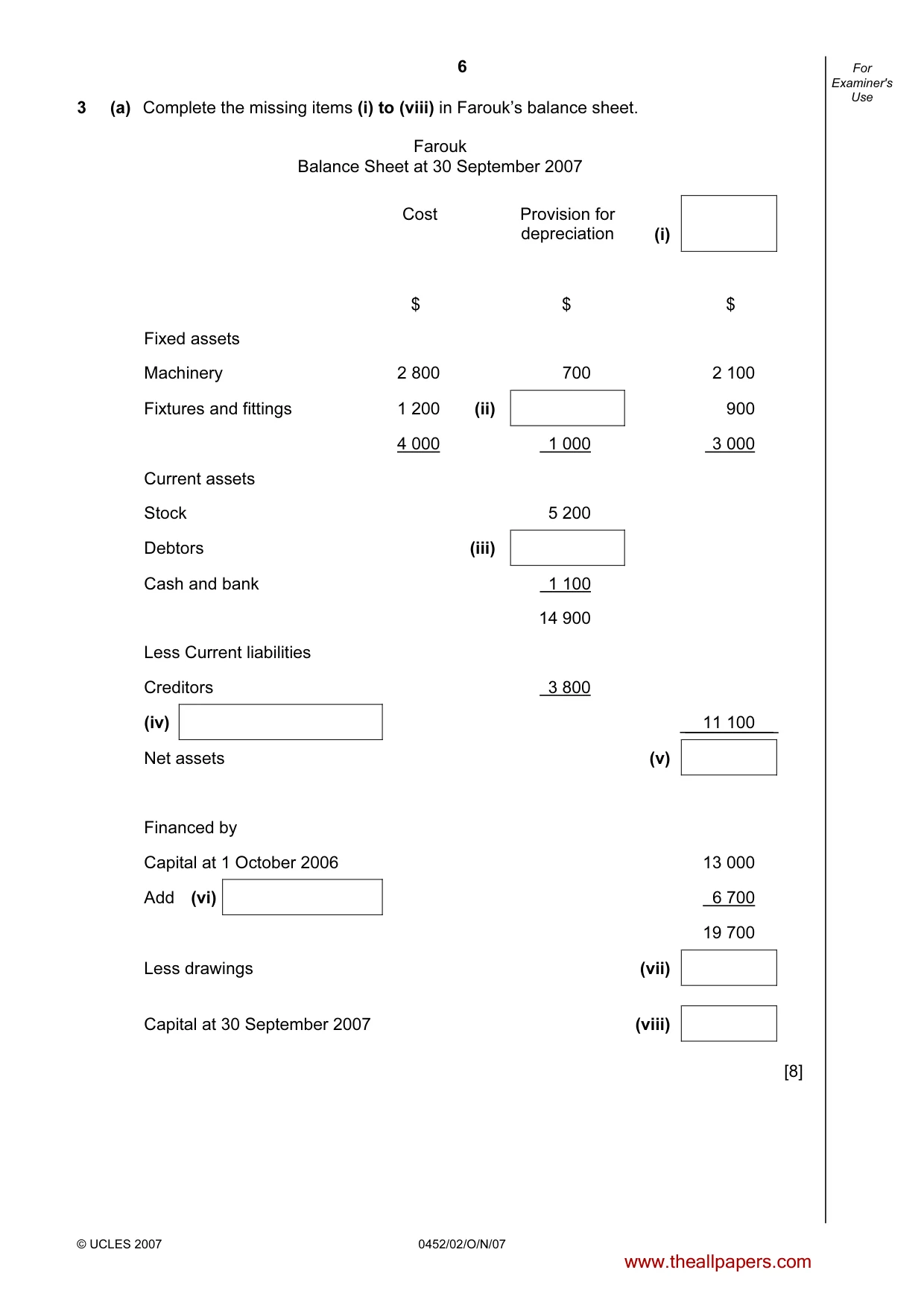
Question paper, page 6
6 © UCLES 2007 0452/02/O/N/07 For Examiner's Use 3 (a) Complete the missing items (i) to (viii) in Farouk’s balance sheet. Farouk Balance Sheet at 30 September 2007 Cost Provision for depreciation (i) $ $ $ Fixed assets Machinery 2 800 700 2 100 Fixtures and fittings 1 200 (ii) 900 4 000 1 000 3 000 Current assets Stock 5 200 Debtors (iii) Cash and bank 1 100 14 900 Less Current liabilities Creditors 3 800 (iv) 11 100 Net assets (v) Financed by Capital at 1 October 2006 13 000 Add (vi) 6 700 19 700 Less drawings (vii) Capital at 30 September 2007 (viii) [8] www.theallpapers.com
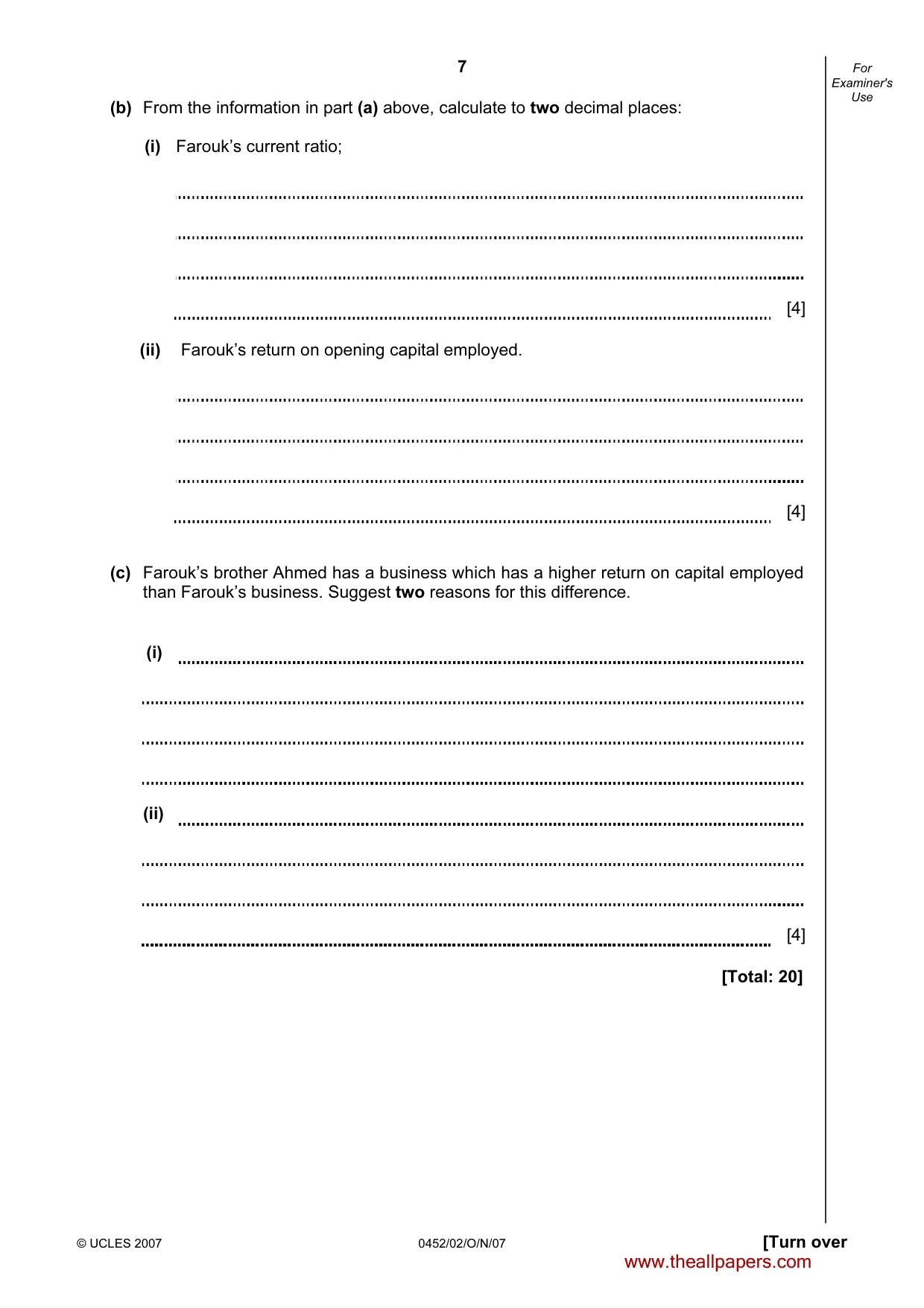
Question paper, page 7
7 © UCLES 2007 0452/02/O/N/07 [Turn over For Examiner's Use (b) From the information in part (a) above, calculate to two decimal places: (i) Farouk’s current ratio; [4] (ii) Farouk’s return on opening capital employed. [4] (c) Farouk’s brother Ahmed has a business which has a higher return on capital employed than Farouk’s business. Suggest two reasons for this difference. (i) (ii) [4] [Total: 20] www.theallpapers.com
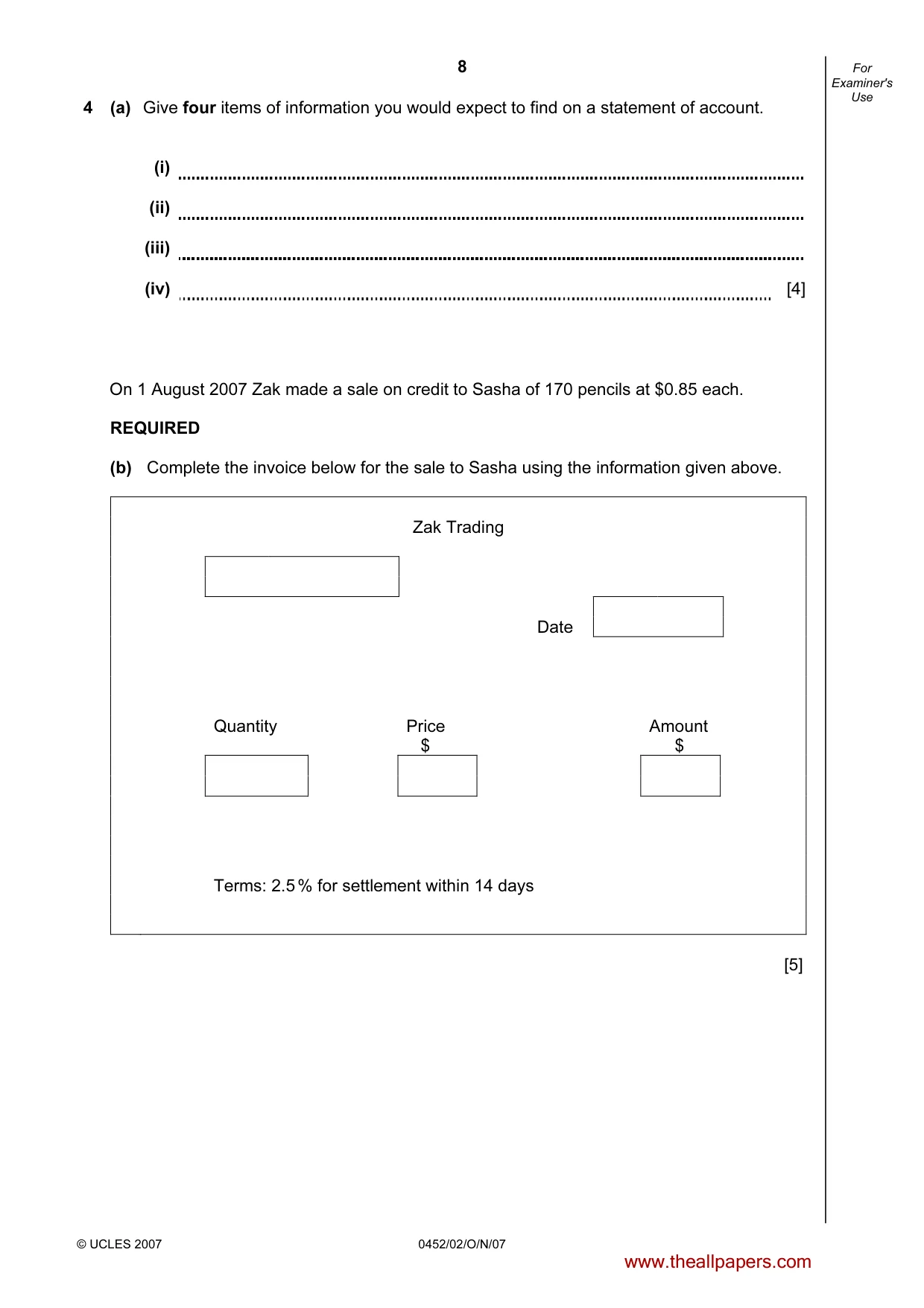
Question paper, page 8
8 © UCLES 2007 0452/02/O/N/07 For Examiner's Use 4 (a) Give four items of information you would expect to find on a statement of account. (i) (ii) (iii) (iv) [4] On 1 August 2007 Zak made a sale on credit to Sasha of 170 pencils at $0.85 each. REQUIRED (b) Complete the invoice below for the sale to Sasha using the information given above. Zak Trading Date Quantity Price $ Amount $ Terms: 2.5 % for settlement within 14 days [5] www.theallpapers.com
Question paper, page 9
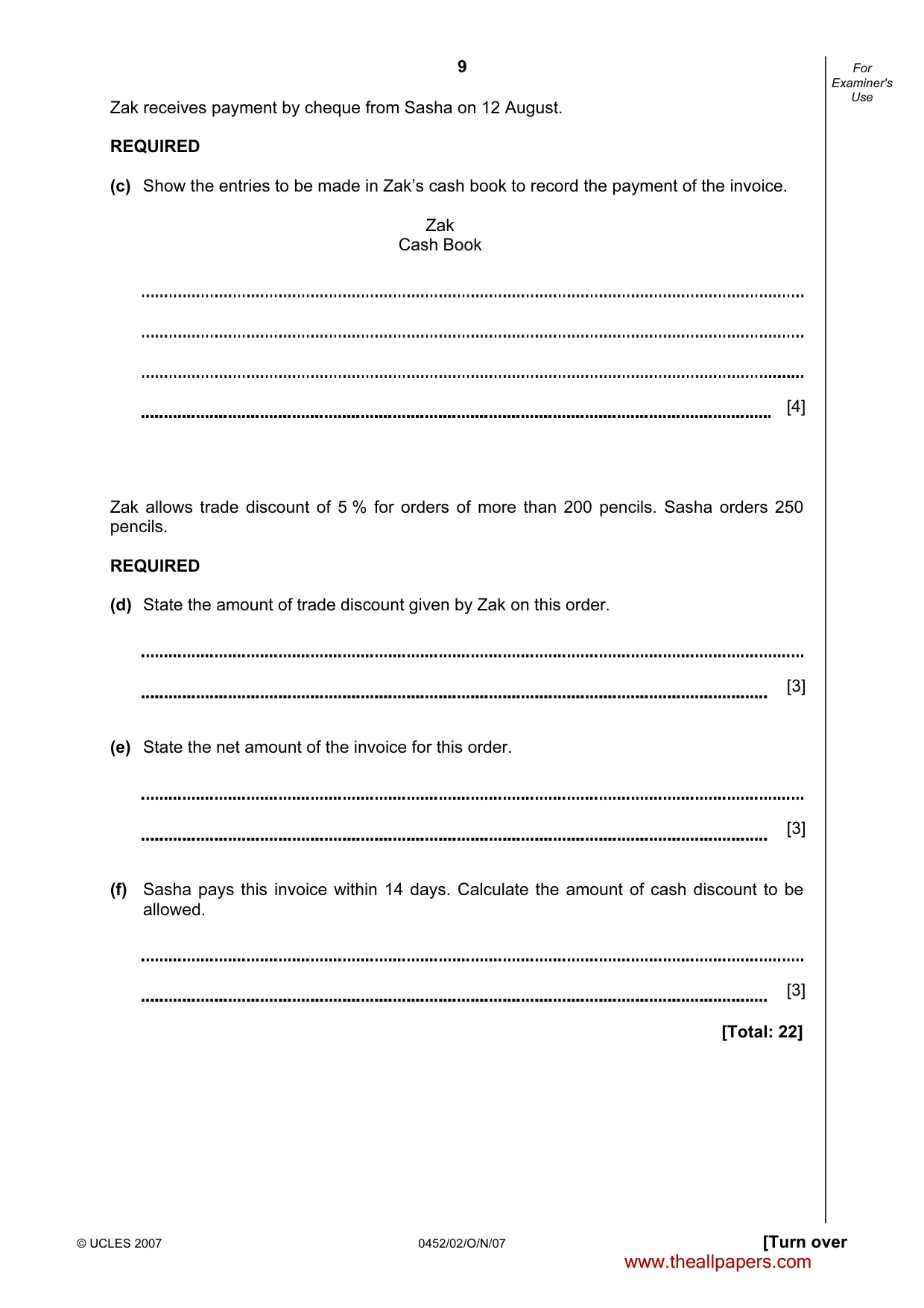
9 © UCLES 2007 0452/02/O/N/07 [Turn over For Examiner's Use Zak receives payment by cheque from Sasha on 12 August. REQUIRED (c) Show the entries to be made in Zak’s cash book to record the payment of the invoice. Zak Cash Book [4] Zak allows trade discount of 5 % for orders of more than 200 pencils. Sasha orders 250 pencils. REQUIRED (d) State the amount of trade discount given by Zak on this order. [3] (e) State the net amount of the invoice for this order. [3] (f) Sasha pays this invoice within 14 days. Calculate the amount of cash discount to be allowed. [3] [Total: 22] www.theallpapers.com
Question paper, page 10
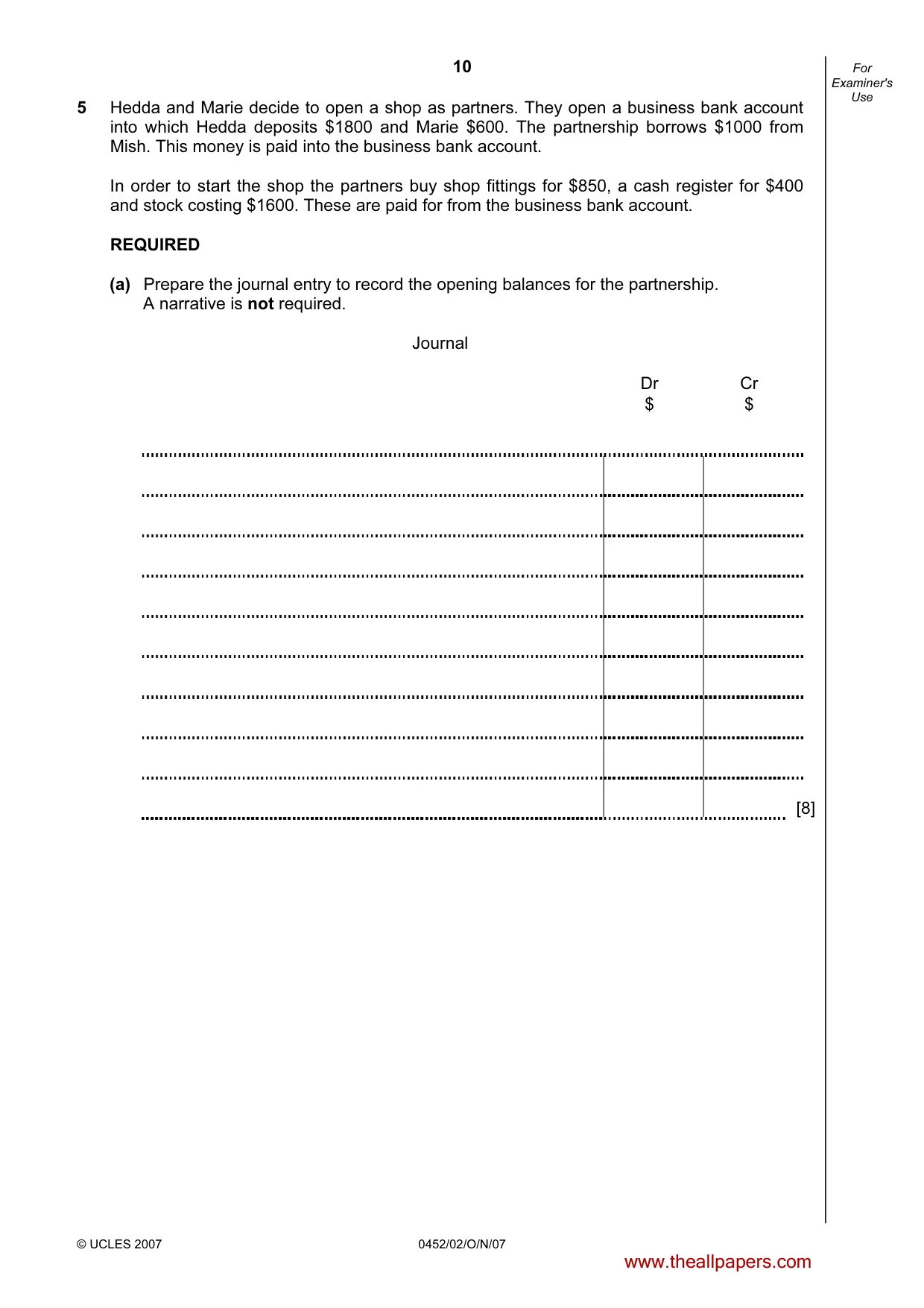
10 © UCLES 2007 0452/02/O/N/07 For Examiner's Use 5 Hedda and Marie decide to open a shop as partners. They open a business bank account into which Hedda deposits $1800 and Marie $600. The partnership borrows $1000 from Mish. This money is paid into the business bank account. In order to start the shop the partners buy shop fittings for $850, a cash register for $400 and stock costing $1600. These are paid for from the business bank account. REQUIRED (a) Prepare the journal entry to record the opening balances for the partnership. A narrative is not required. Journal Dr Cr $ $ [8] www.theallpapers.com
Question paper, page 11
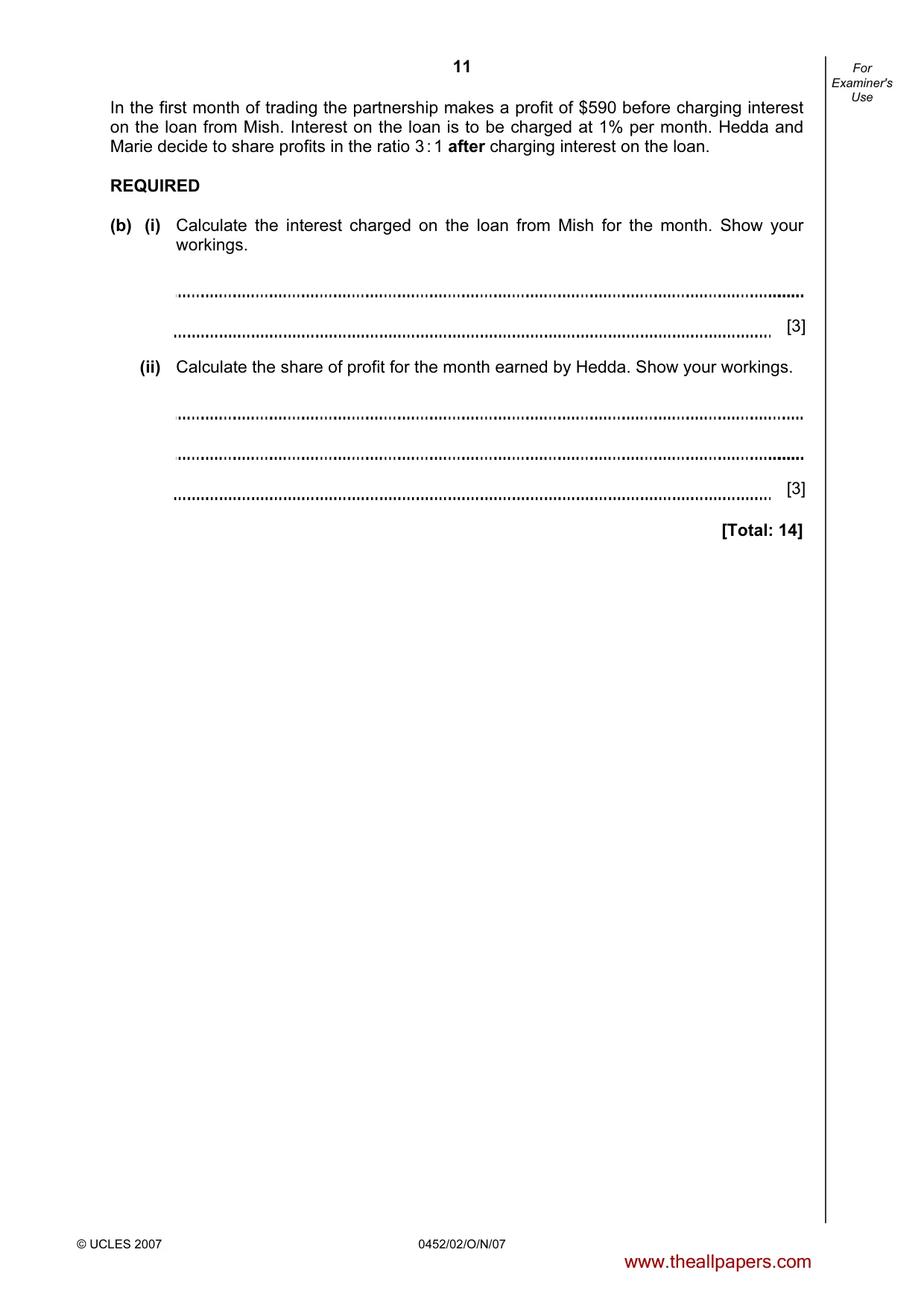
11 © UCLES 2007 0452/02/O/N/07 For Examiner's Use In the first month of trading the partnership makes a profit of $590 before charging interest on the loan from Mish. Interest on the loan is to be charged at 1% per month. Hedda and Marie decide to share profits in the ratio 3 : 1 after charging interest on the loan. REQUIRED (b) (i) Calculate the interest charged on the loan from Mish for the month. Show your workings. [3] (ii) Calculate the share of profit for the month earned by Hedda. Show your workings. [3] [Total: 14] www.theallpapers.com
Question paper, page 12
12 BLANK PAGE Permission to reproduce items where third-party owned material protected by copyright is included has been sought and cleared where possible. Every reasonable effort has been made by the publisher (UCLES) to trace copyright holders, but if any items requiring clearance have unwittingly been included, the publisher will be pleased to make amends at the earliest possible opportunity. University of Cambridge International Examinations is part of the Cambridge Assessment Group. Cambridge Assessment is the brand name of University of Cambridge Local Examinations Syndicate (UCLES), which is itself a department of the University of Cambridge. 0452/02/O/N/07 www.theallpapers.com
Mark scheme, page 1
UNIVERSITY OF CAMBRIDGE INTERNATIONAL EXAMINATIONS International General Certificate of Secondary Education MARK SCHEME for the October/November 2007 question paper 0452 ACCOUNTING 0452/02 Paper 2, maximum raw mark 90 This mark scheme is published as an aid to teachers and candidates, to indicate the requirements of the examination. It shows the basis on which Examiners were instructed to award marks. It does not indicate the details of the discussions that took place at an Examiners’ meeting before marking began. All Examiners are instructed that alternative correct answers and unexpected approaches in candidates’ scripts must be given marks that fairly reflect the relevant knowledge and skills demonstrated. Mark schemes must be read in conjunction with the question papers and the report on the examination. • CIE will not enter into discussions or correspondence in connection with these mark schemes. CIE is publishing the mark schemes for the October/November 2007 question papers for most IGCSE, GCE Advanced Level and Advanced Subsidiary Level syllabuses and some Ordinary Level syllabuses. www.theallpapers.com
Mark scheme, page 2
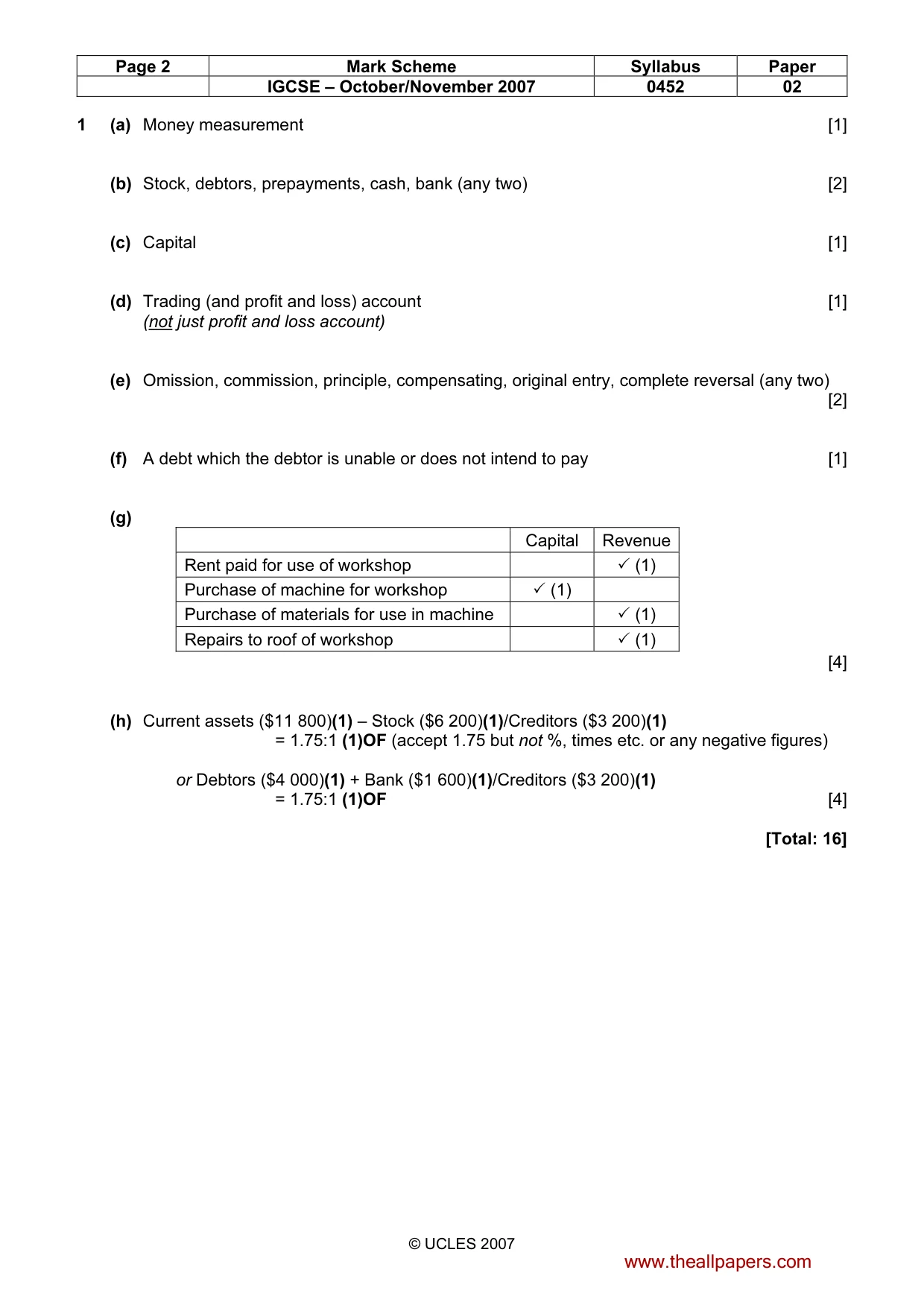
Page 2 Mark Scheme Syllabus Paper IGCSE – October/November 2007 0452 02 © UCLES 2007 1 (a) Money measurement [1] (b) Stock, debtors, prepayments, cash, bank (any two) [2] (c) Capital [1] (d) Trading (and profit and loss) account [1] (not just profit and loss account) (e) Omission, commission, principle, compensating, original entry, complete reversal (any two) [2] (f) A debt which the debtor is unable or does not intend to pay [1] (g) Capital Revenue Rent paid for use of workshop ✓ (1) Purchase of machine for workshop ✓ (1) Purchase of materials for use in machine ✓ (1) Repairs to roof of workshop ✓ (1) [4] (h) Current assets ($11 800)(1) – Stock ($6 200)(1)/Creditors ($3 200)(1) = 1.75:1 (1)OF (accept 1.75 but not %, times etc. or any negative figures) or Debtors ($4 000)(1) + Bank ($1 600)(1)/Creditors ($3 200)(1) = 1.75:1 (1)OF [4] [Total: 16] www.theallpapers.com
Mark scheme, page 3
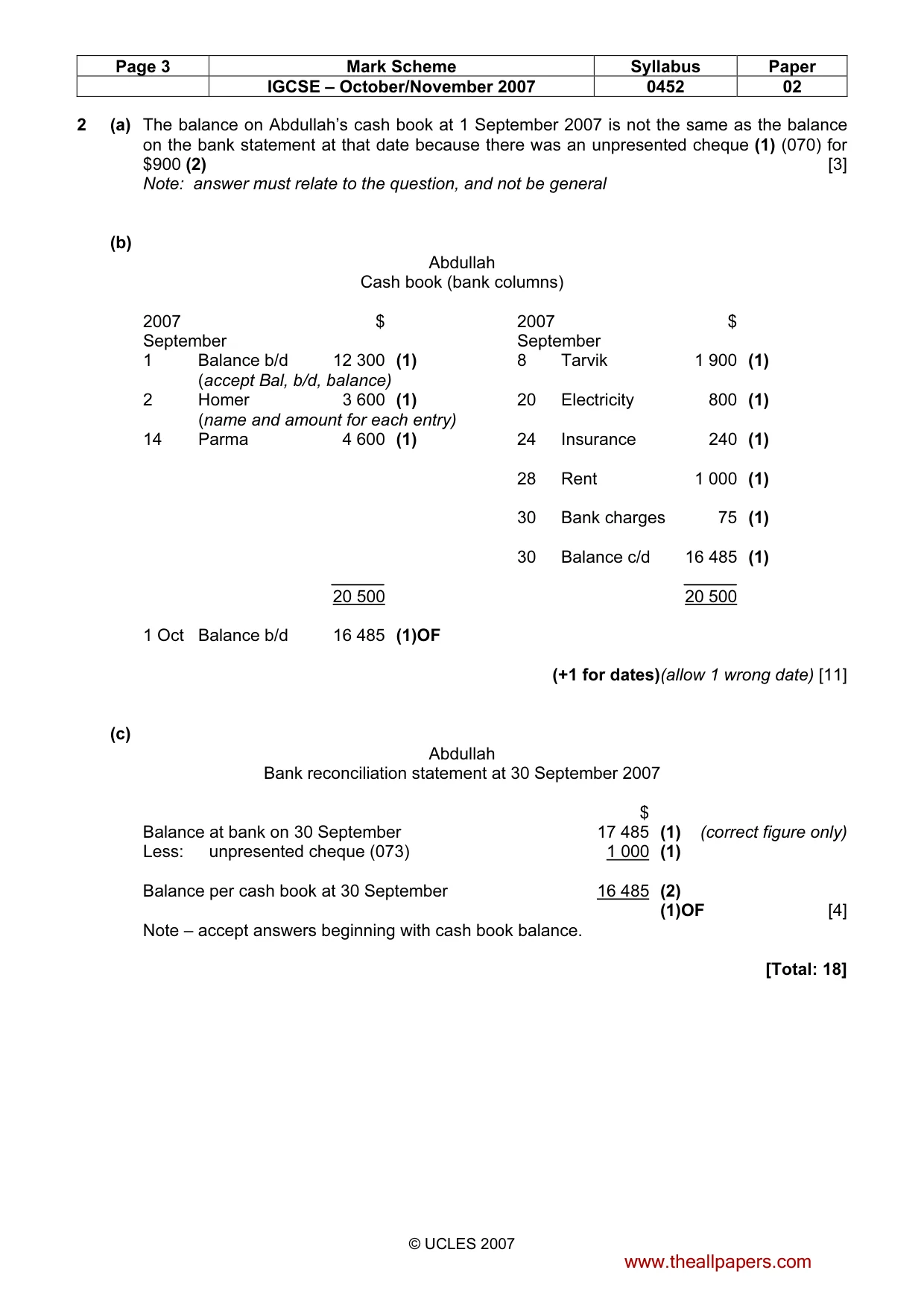
Page 3 Mark Scheme Syllabus Paper IGCSE – October/November 2007 0452 02 © UCLES 2007 2 (a) The balance on Abdullah’s cash book at 1 September 2007 is not the same as the balance on the bank statement at that date because there was an unpresented cheque (1) (070) for $900 (2) [3] Note: answer must relate to the question, and not be general (b) Abdullah Cash book (bank columns) 2007 $ 2007 $ September September 1 Balance b/d 12 300 (1) 8 Tarvik 1 900 (1) (accept Bal, b/d, balance) 2 Homer 3 600 (1) 20 Electricity 800 (1) (name and amount for each entry) 14 Parma 4 600 (1) 24 Insurance 240 (1) 28 Rent 1 000 (1) 30 Bank charges 75 (1) 30 Balance c/d 16 485 (1) 20 500 20 500 1 Oct Balance b/d 16 485 (1)OF (+1 for dates)(allow 1 wrong date) [11] (c) Abdullah Bank reconciliation statement at 30 September 2007 $ Balance at bank on 30 September 17 485 (1) (correct figure only) Less: unpresented cheque (073) 1 000 (1) Balance per cash book at 30 September 16 485 (2) (1)OF [4] Note – accept answers beginning with cash book balance. [Total: 18] www.theallpapers.com
Mark scheme, page 4
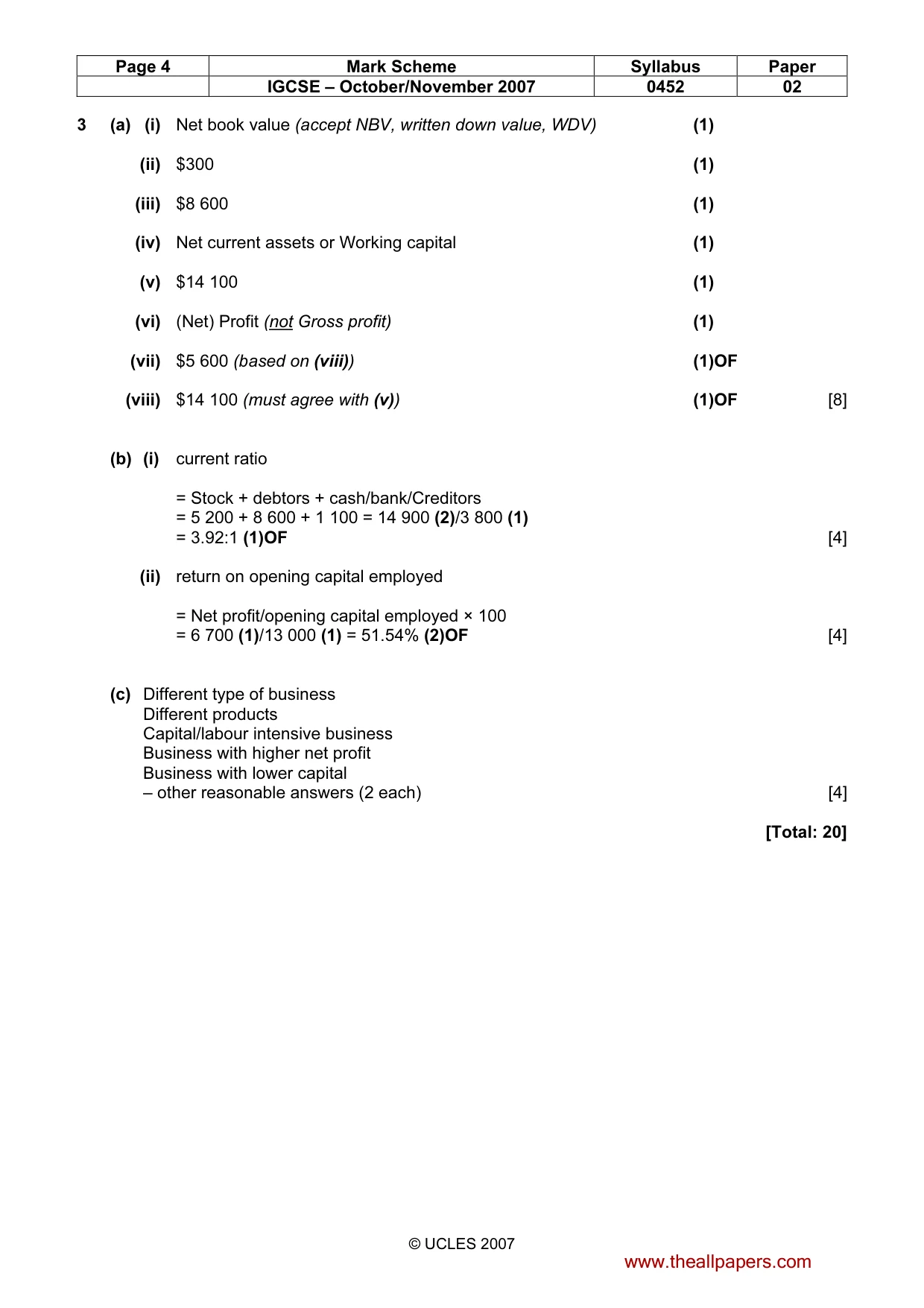
Page 4 Mark Scheme Syllabus Paper IGCSE – October/November 2007 0452 02 © UCLES 2007 3 (a) (i) Net book value (accept NBV, written down value, WDV) (1) (ii) $300 (1) (iii) $8 600 (1) (iv) Net current assets or Working capital (1) (v) $14 100 (1) (vi) (Net) Profit (not Gross profit) (1) (vii) $5 600 (based on (viii)) (1)OF (viii) $14 100 (must agree with (v)) (1)OF [8] (b) (i) current ratio = Stock + debtors + cash/bank/Creditors = 5 200 + 8 600 + 1 100 = 14 900 (2)/3 800 (1) = 3.92:1 (1)OF [4] (ii) return on opening capital employed = Net profit/opening capital employed × 100 = 6 700 (1)/13 000 (1) = 51.54% (2)OF [4] (c) Different type of business Different products Capital/labour intensive business Business with higher net profit Business with lower capital – other reasonable answers (2 each) [4] [Total: 20] www.theallpapers.com
Mark scheme, page 5
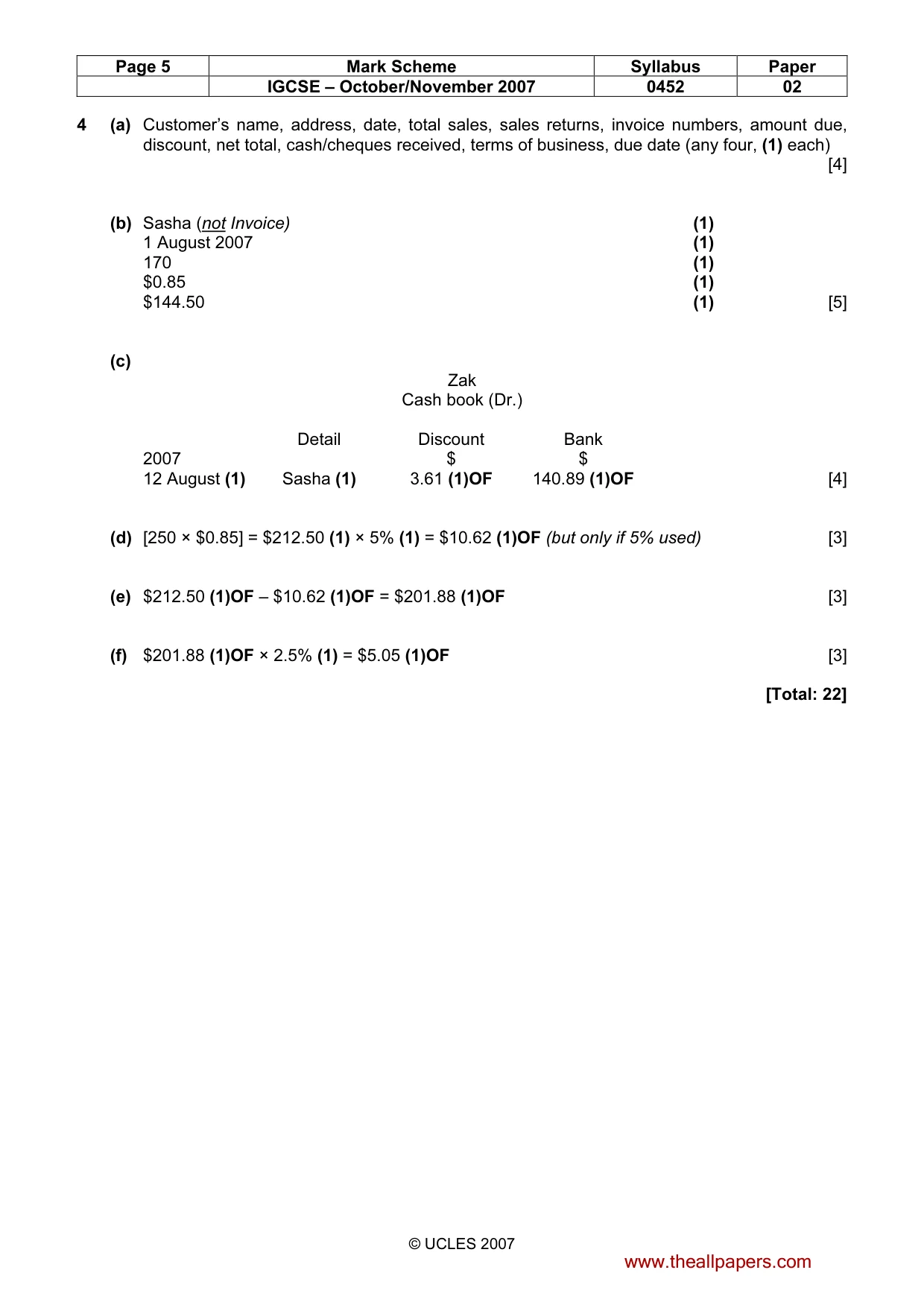
Page 5 Mark Scheme Syllabus Paper IGCSE – October/November 2007 0452 02 © UCLES 2007 4 (a) Customer’s name, address, date, total sales, sales returns, invoice numbers, amount due, discount, net total, cash/cheques received, terms of business, due date (any four, (1) each) [4] (b) Sasha (not Invoice) (1) 1 August 2007 (1) 170 (1) $0.85 (1) $144.50 (1) [5] (c) Zak Cash book (Dr.) Detail Discount Bank 2007 $ $ 12 August (1) Sasha (1) 3.61 (1)OF 140.89 (1)OF [4] (d) [250 × $0.85] = $212.50 (1) × 5% (1) = $10.62 (1)OF (but only if 5% used) [3] (e) $212.50 (1)OF – $10.62 (1)OF = $201.88 (1)OF [3] (f) $201.88 (1)OF × 2.5% (1) = $5.05 (1)OF [3] [Total: 22] www.theallpapers.com
Mark scheme, page 6
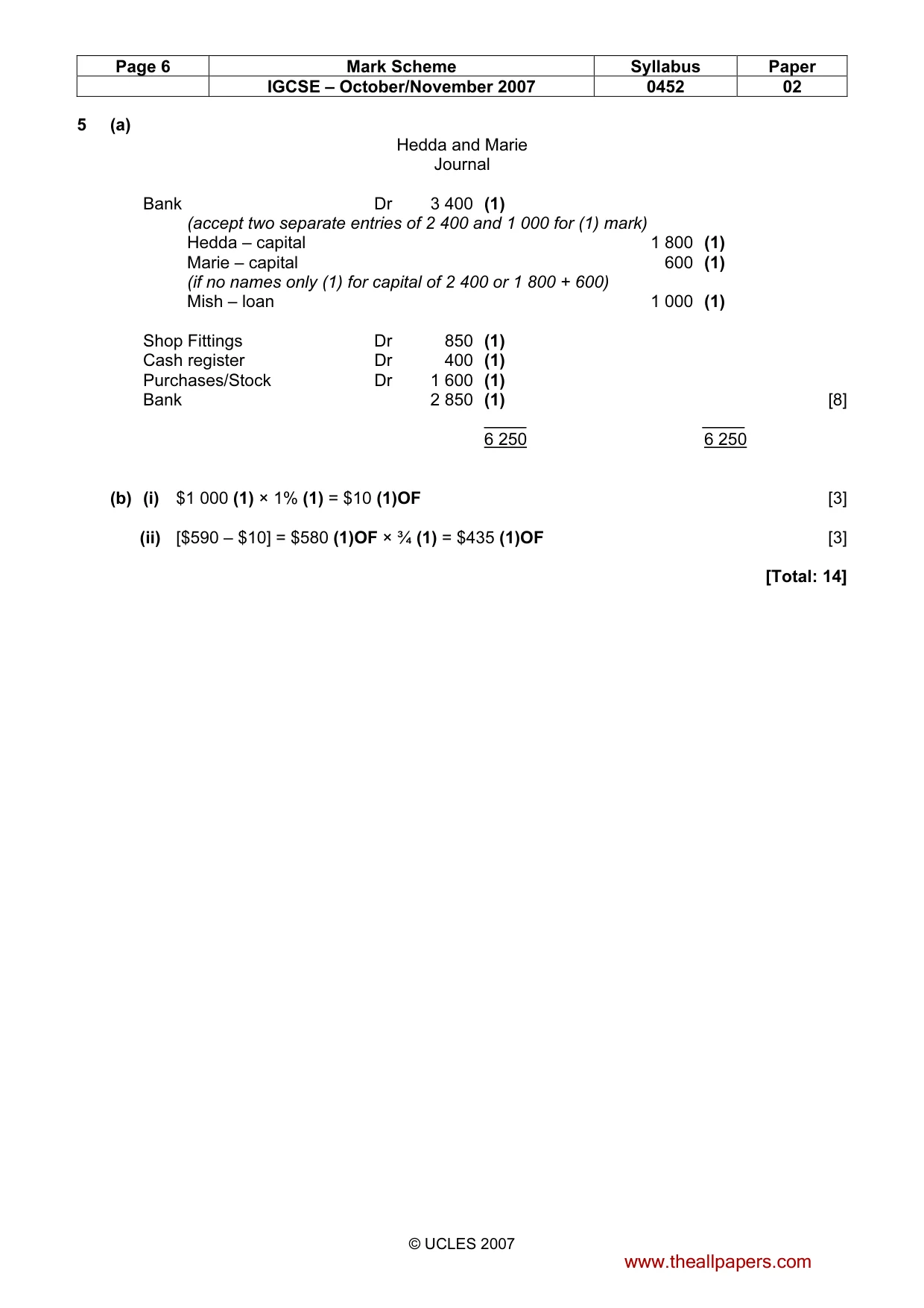
Page 6 Mark Scheme Syllabus Paper IGCSE – October/November 2007 0452 02 © UCLES 2007 5 (a) Hedda and Marie Journal Bank Dr 3 400 (1) (accept two separate entries of 2 400 and 1 000 for (1) mark) Hedda – capital 1 800 (1) Marie – capital 600 (1) (if no names only (1) for capital of 2 400 or 1 800 + 600) Mish – loan 1 000 (1) Shop Fittings Dr 850 (1) Cash register Dr 400 (1) Purchases/Stock Dr 1 600 (1) Bank 2 850 (1) [8] 6 250 6 250 (b) (i) $1 000 (1) × 1% (1) = $10 (1)OF [3] (ii) [$590 – $10] = $580 (1)OF × ¾ (1) = $435 (1)OF [3] [Total: 14] www.theallpapers.com
What you needed in this session
Cambridge’s own grade thresholds for 2007 Oct/Nov, Paper 2 · Variant 1. A higher threshold means an easier paper — the bar moves with how the cohort did.