Cambridge IGCSE Accounting 0452 — 2002 May/June Paper 2 · Variant 1
0452/21/M/J/02
The question paper and its mark scheme, free to read here and free to download. This is Cambridge’s own paper, exactly as it was sat.
Question paper12 pages
Mark scheme7 pages
Answers below. Sit the paper first if you are practising.
Paper as text
Question paper, page 1
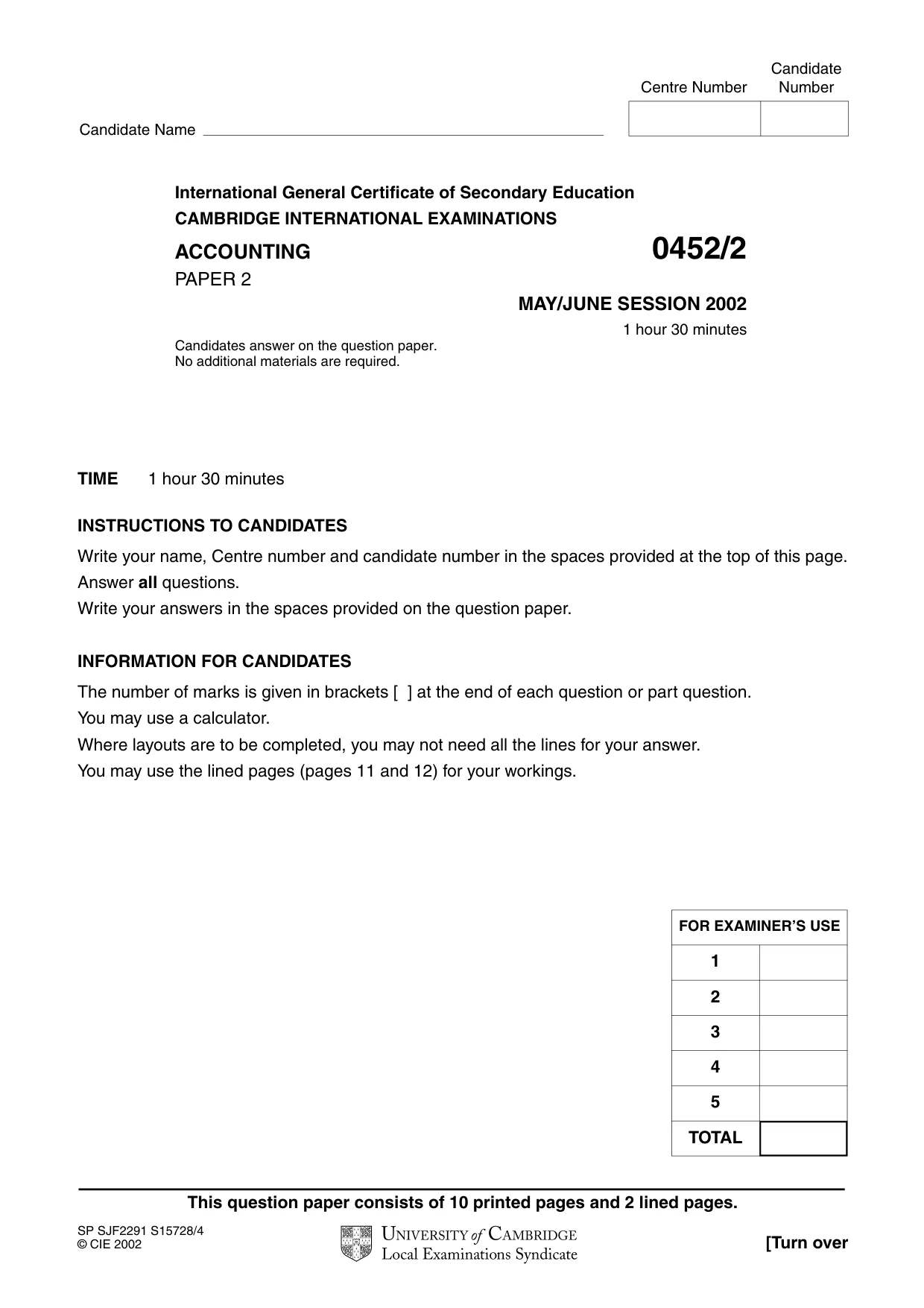
This question paper consists of 10 printed pages and 2 lined pages. SP SJF2291 S15728/4 © CIE 2002 [Turn over International General Certificate of Secondary Education CAMBRIDGE INTERNATIONAL EXAMINATIONS ACCOUNTING 0452/2 PAPER 2 MAY/JUNE SESSION 2002 1 hour 30 minutes Candidates answer on the question paper. No additional materials are required. TIME 1 hour 30 minutes INSTRUCTIONS TO CANDIDATES Write your name, Centre number and candidate number in the spaces provided at the top of this page. Answer all questions. Write your answers in the spaces provided on the question paper. INFORMATION FOR CANDIDATES The number of marks is given in brackets [ ] at the end of each question or part question. You may use a calculator. Where layouts are to be completed, you may not need all the lines for your answer. You may use the lined pages (pages 11 and 12) for your workings. Candidate Centre Number Number Candidate Name FOR EXAMINER’S USE 1 2 3 4 5 TOTAL
Question paper, page 2
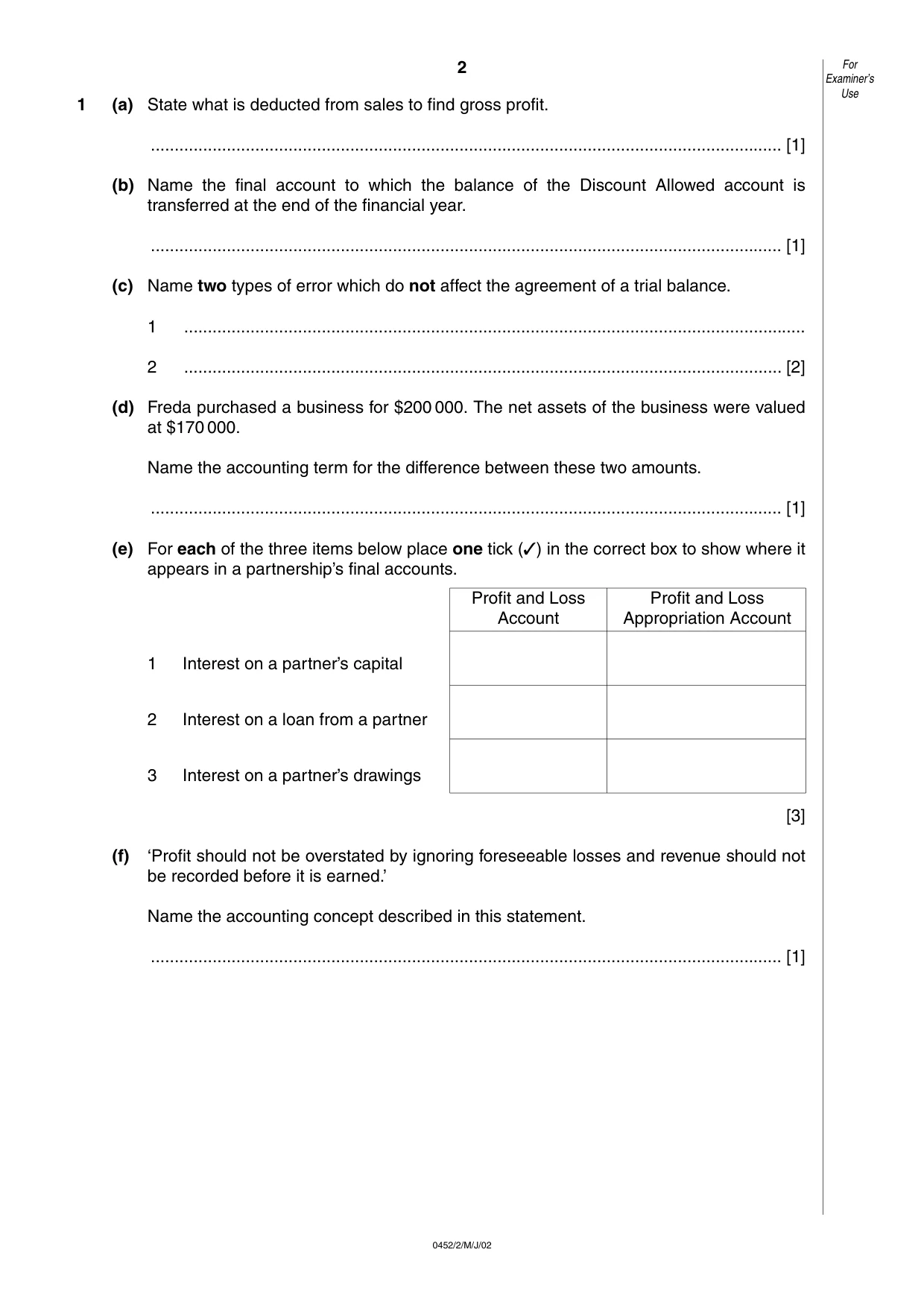
2 0452/2/M/J/02 1 (a) State what is deducted from sales to find gross profit. … [1] (b) Name the final account to which the balance of the Discount Allowed account is transferred at the end of the financial year. … [1] (c) Name two types of error which do not affect the agreement of a trial balance. 1 … 2 … [2] (d) Freda purchased a business for $200 000. The net assets of the business were valued at $170 000. Name the accounting term for the difference between these two amounts. … [1] (e) For each of the three items below place one tick (✓) in the correct box to show where it appears in a partnership’s final accounts. 1 Interest on a partner’s capital 2 Interest on a loan from a partner 3 Interest on a partner’s drawings [3] (f) ‘Profit should not be overstated by ignoring foreseeable losses and revenue should not be recorded before it is earned.’ Name the accounting concept described in this statement. … [1] For Examiner’s Use Profit and Loss Account Profit and Loss Appropriation Account
Question paper, page 3
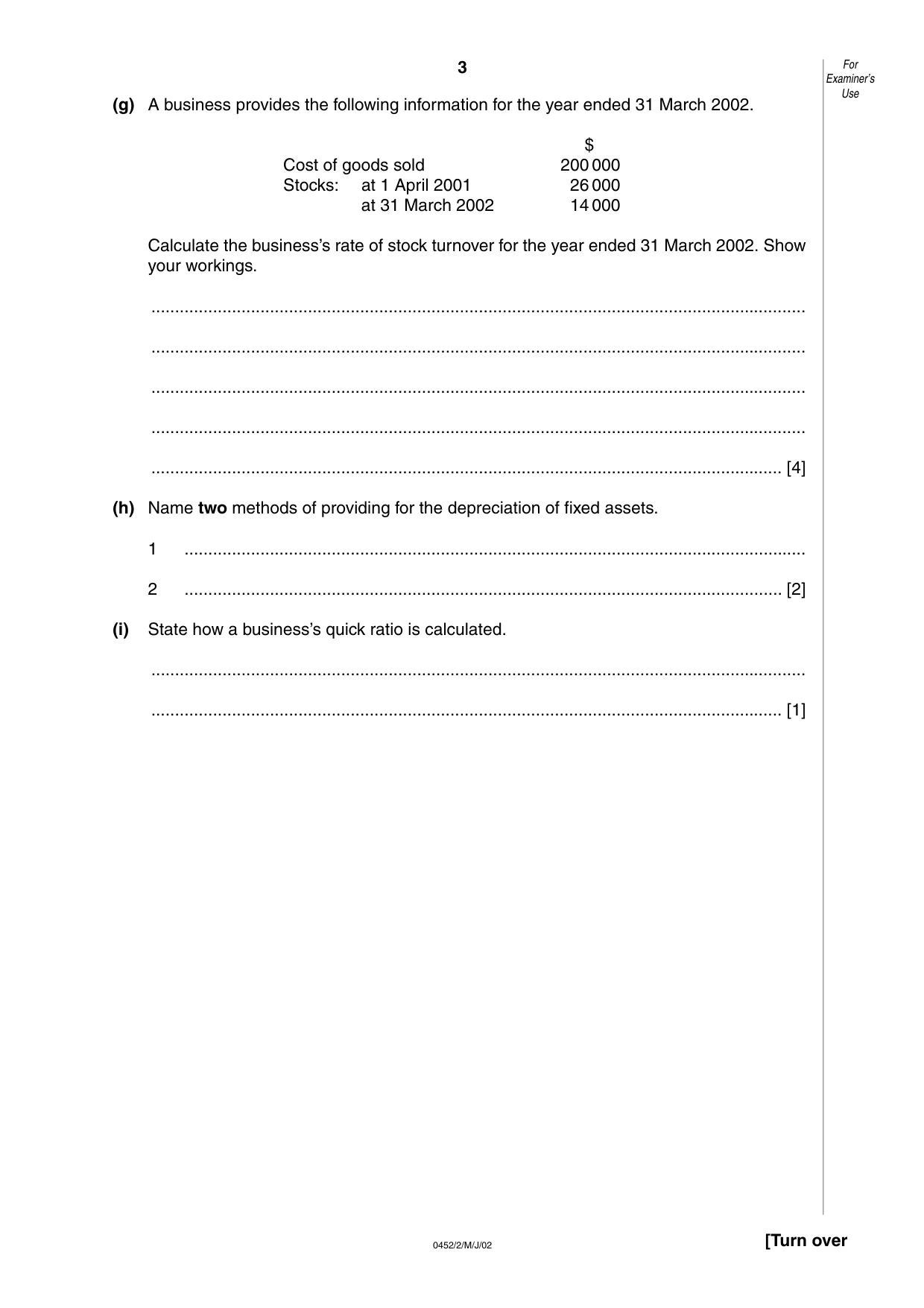
3 0452/2/M/J/02 [Turn over (g) A business provides the following information for the year ended 31 March 2002. $ Cost of goods sold 200 000 Stocks: at 1 April 2001 26 000 at 31 March 2002 14 000 Calculate the business’s rate of stock turnover for the year ended 31 March 2002. Show your workings. … … … … … [4] (h) Name two methods of providing for the depreciation of fixed assets. 1 … 2 … [2] (i) State how a business’s quick ratio is calculated. … … [1] For Examiner’s Use
Question paper, page 4
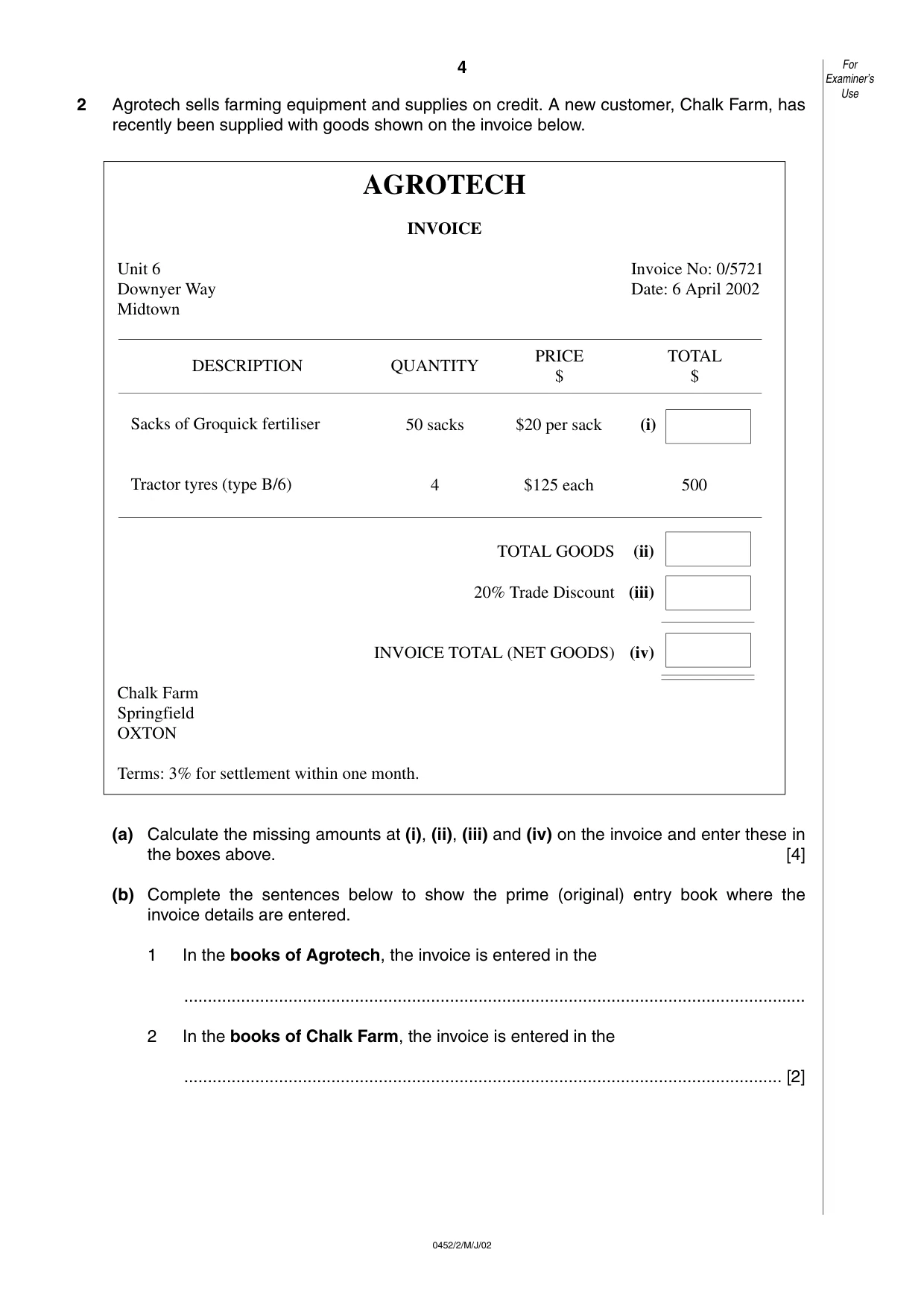
4 0452/2/M/J/02 2 Agrotech sells farming equipment and supplies on credit. A new customer, Chalk Farm, has recently been supplied with goods shown on the invoice below. (a) Calculate the missing amounts at (i), (ii), (iii) and (iv) on the invoice and enter these in the boxes above. [4] (b) Complete the sentences below to show the prime (original) entry book where the invoice details are entered. 1 In the books of Agrotech, the invoice is entered in the … 2 In the books of Chalk Farm, the invoice is entered in the … [2] For Examiner’s Use AGROTECH INVOICE Unit 6 Invoice No: 0/5721 Downyer Way Date: 6 April 2002 Midtown TOTAL GOODS (ii) 20% Trade Discount (iii) INVOICE TOTAL (NET GOODS) (iv) Chalk Farm Springfield OXTON Terms: 3% for settlement within one month. DESCRIPTION Sacks of Groquick fertiliser Tractor tyres (type B/6) QUANTITY 50 sacks 4 PRICE $ $20 per sack $125 each TOTAL $ (i) 500
Question paper, page 5
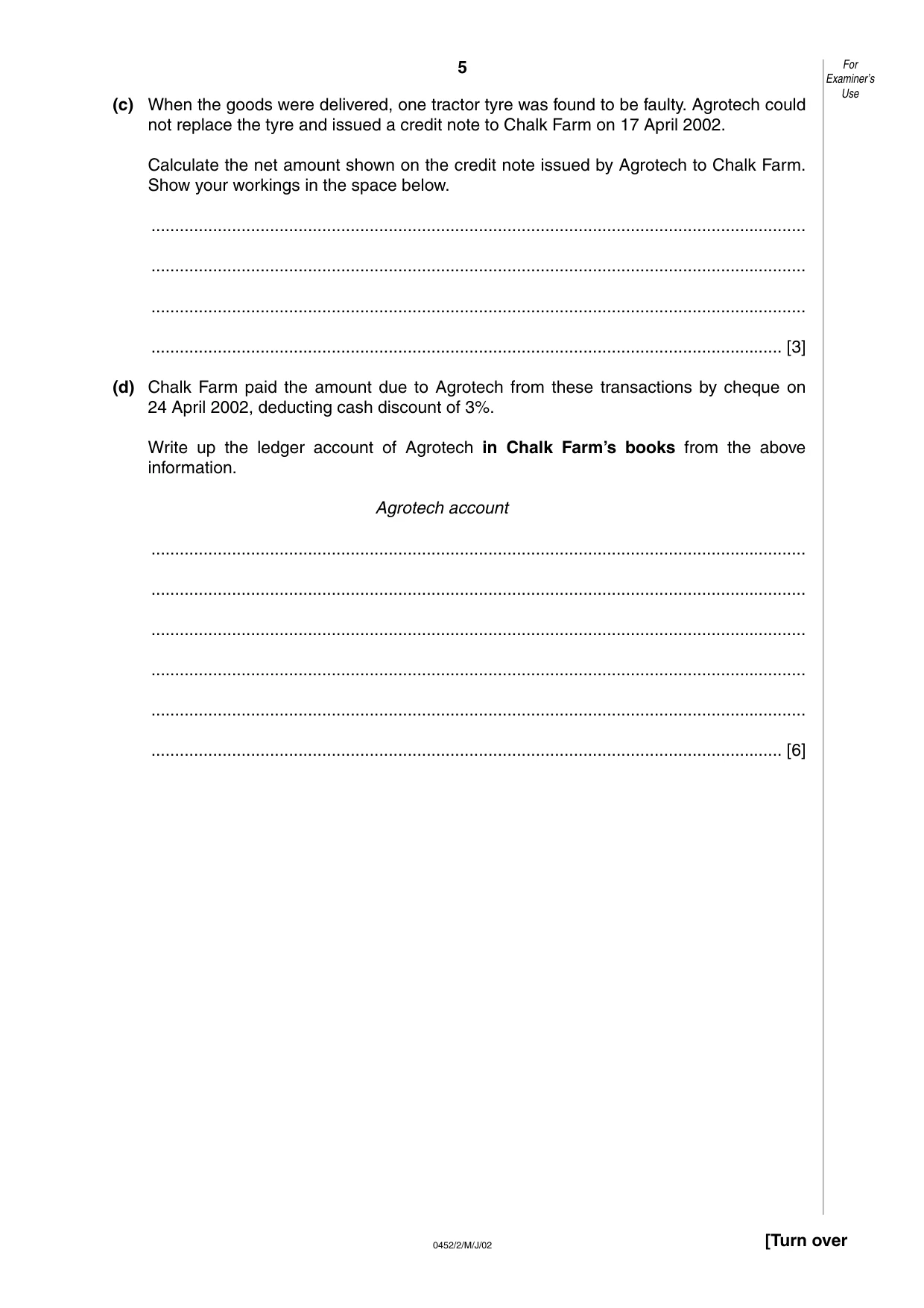
5 0452/2/M/J/02 [Turn over (c) When the goods were delivered, one tractor tyre was found to be faulty. Agrotech could not replace the tyre and issued a credit note to Chalk Farm on 17 April 2002. Calculate the net amount shown on the credit note issued by Agrotech to Chalk Farm. Show your workings in the space below. … … … … [3] (d) Chalk Farm paid the amount due to Agrotech from these transactions by cheque on 24 April 2002, deducting cash discount of 3%. Write up the ledger account of Agrotech in Chalk Farm’s books from the above information. Agrotech account … … … … … … [6] For Examiner’s Use
Question paper, page 6
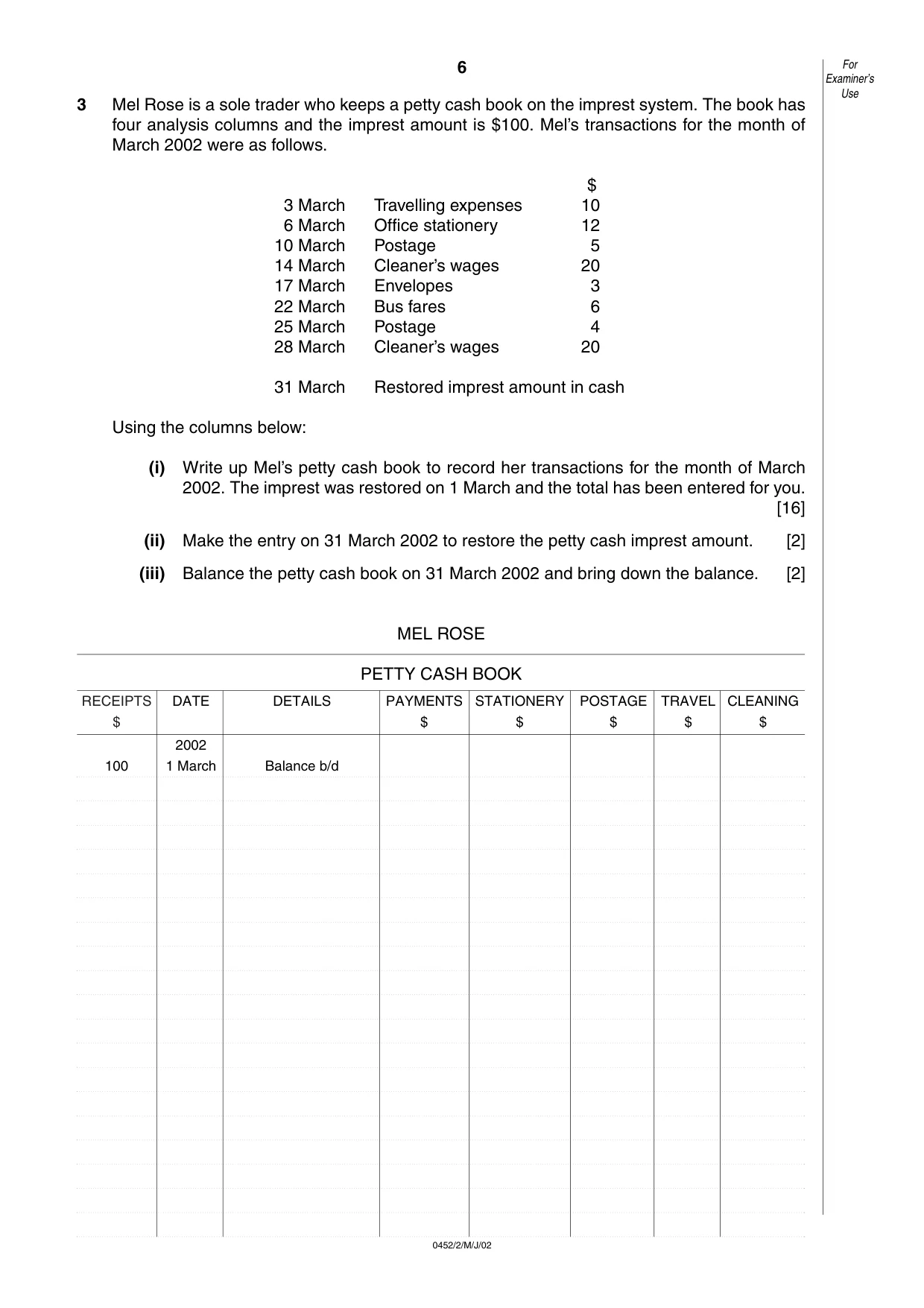
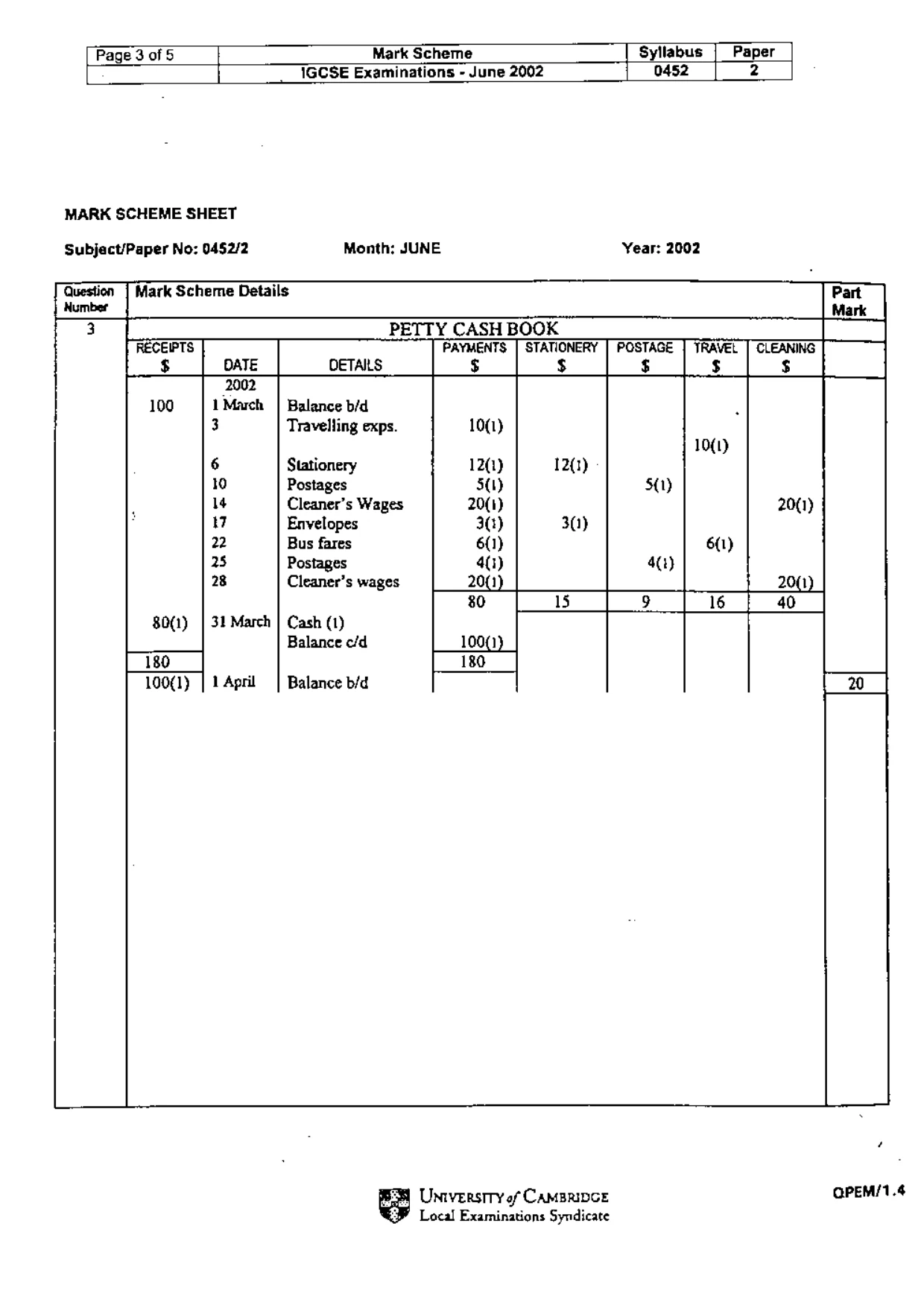
RECEIPTS $ 6 0452/2/M/J/02 3 Mel Rose is a sole trader who keeps a petty cash book on the imprest system. The book has four analysis columns and the imprest amount is $100. Mel’s transactions for the month of March 2002 were as follows. $ 3 March Travelling expenses 10 6 March Office stationery 12 10 March Postage 5 14 March Cleaner’s wages 20 17 March Envelopes 3 22 March Bus fares 6 25 March Postage 4 28 March Cleaner’s wages 20 31 March Restored imprest amount in cash Using the columns below: (i) Write up Mel’s petty cash book to record her transactions for the month of March 2002. The imprest was restored on 1 March and the total has been entered for you. [16] (ii) Make the entry on 31 March 2002 to restore the petty cash imprest amount. [2] (iii) Balance the petty cash book on 31 March 2002 and bring down the balance. [2] MEL ROSE PETTY CASH BOOK For Examiner’s Use 100 DATE 2002 1 March DETAILS Balance b/d PAYMENTS $ STATIONERY $ POSTAGE $ TRAVEL $ CLEANING $
Question paper, page 7
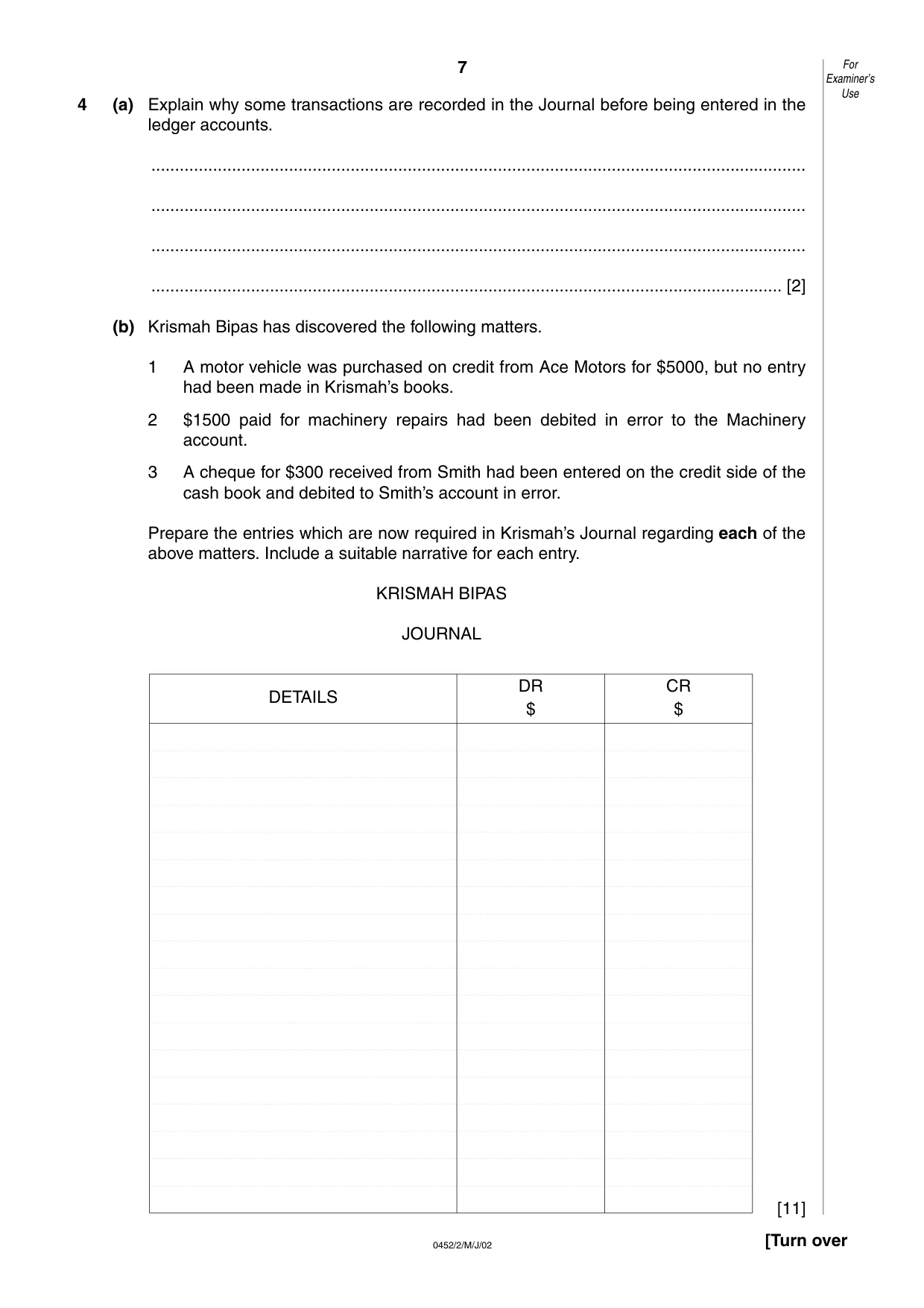
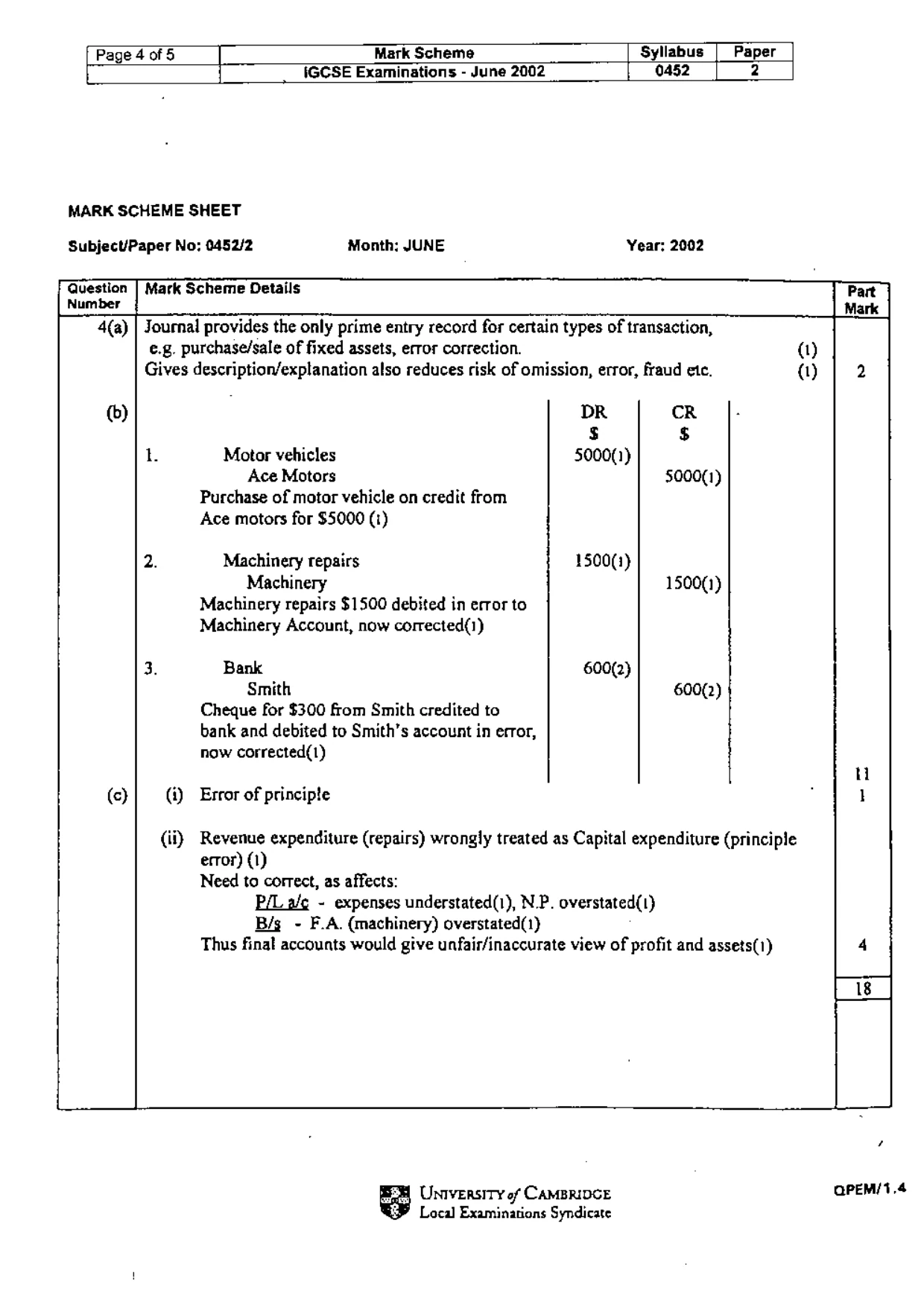
7 0452/2/M/J/02 [Turn over 4 (a) Explain why some transactions are recorded in the Journal before being entered in the ledger accounts. … … … … [2] (b) Krismah Bipas has discovered the following matters. 1 A motor vehicle was purchased on credit from Ace Motors for $5000, but no entry had been made in Krismah’s books. 2 $1500 paid for machinery repairs had been debited in error to the Machinery account. 3 A cheque for $300 received from Smith had been entered on the credit side of the cash book and debited to Smith’s account in error. Prepare the entries which are now required in Krismah’s Journal regarding each of the above matters. Include a suitable narrative for each entry. KRISMAH BIPAS JOURNAL [11] For Examiner’s Use DETAILS DR $ CR $
Question paper, page 8
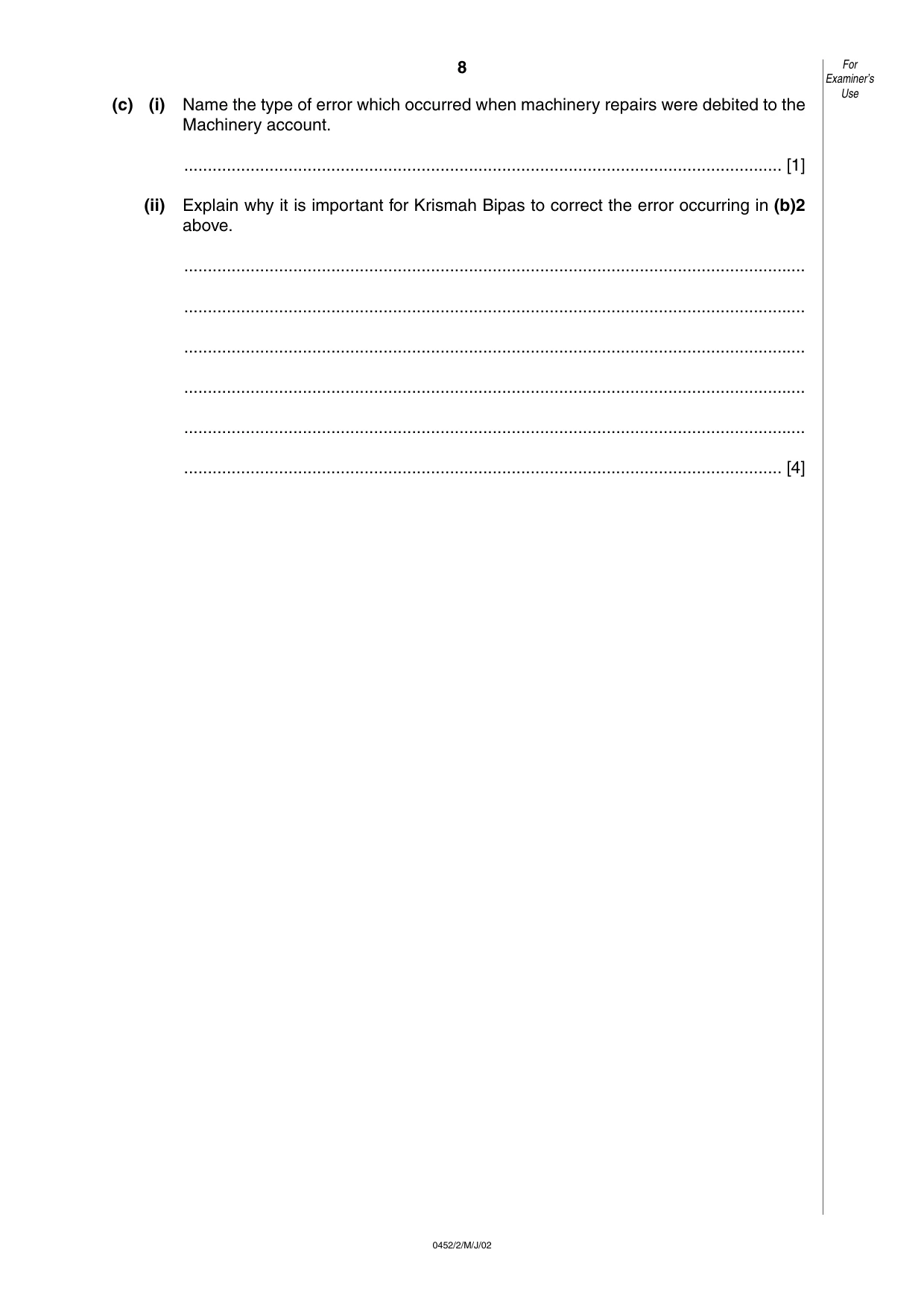
8 0452/2/M/J/02 (c) (i) Name the type of error which occurred when machinery repairs were debited to the Machinery account. … [1] (ii) Explain why it is important for Krismah Bipas to correct the error occurring in (b)2 above. … … … … … … [4] For Examiner’s Use
Question paper, page 9
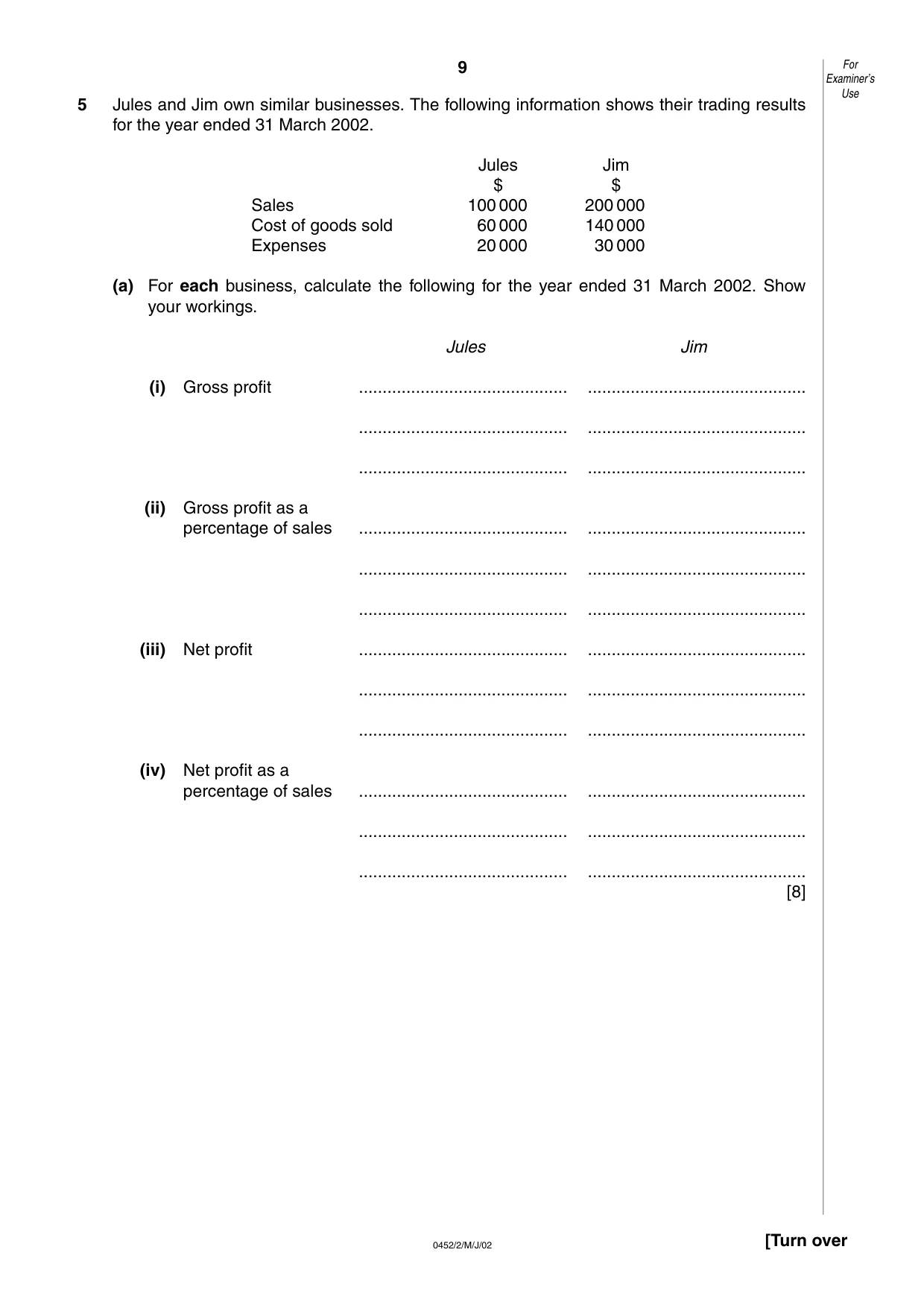
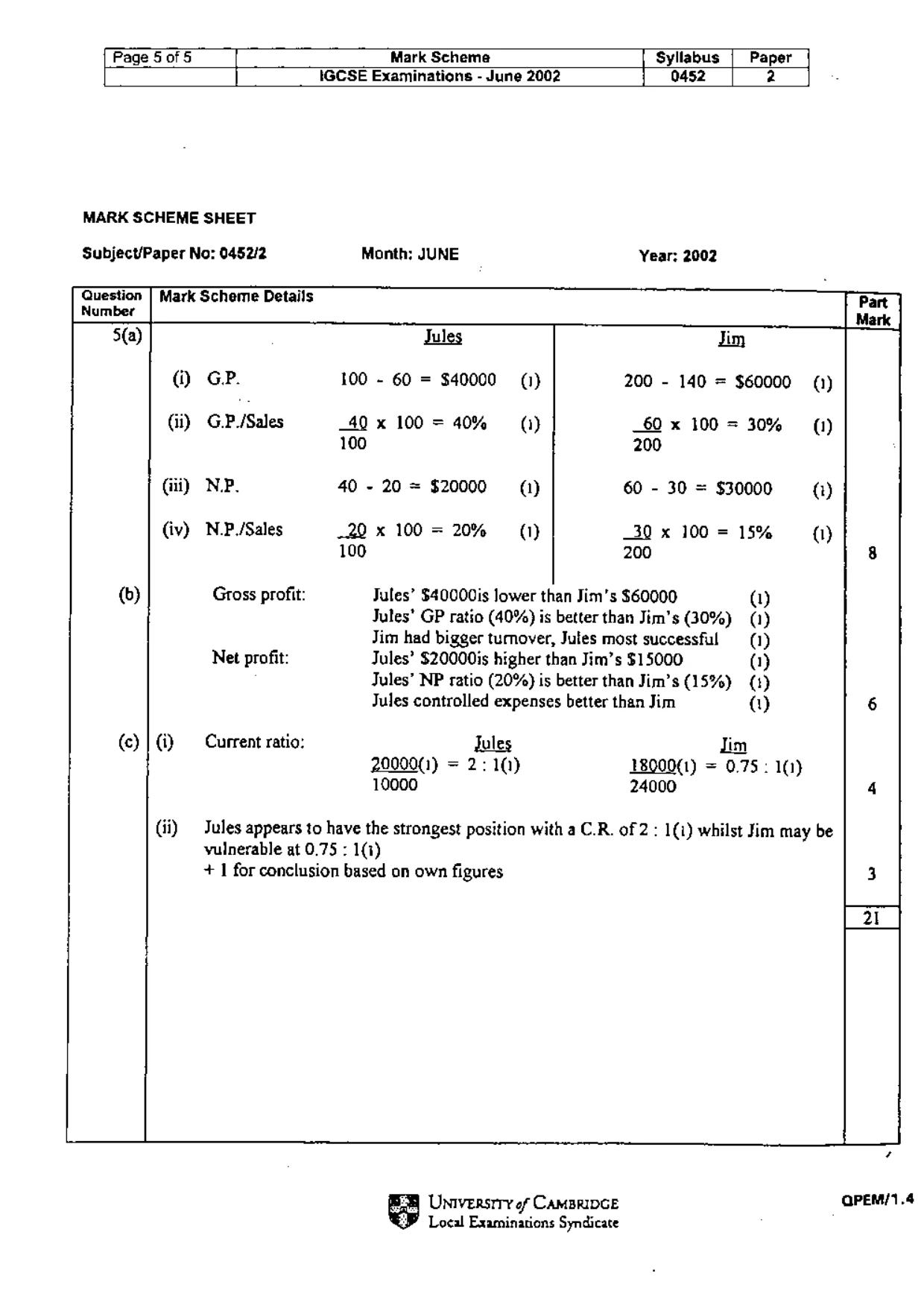
9 0452/2/M/J/02 [Turn over 5 Jules and Jim own similar businesses. The following information shows their trading results for the year ended 31 March 2002. Jules Jim $ $ Sales 100 000 200 000 Cost of goods sold 60 000 140 000 Expenses 20 000 30 000 (a) For each business, calculate the following for the year ended 31 March 2002. Show your workings. Jules Jim (i) Gross profit … … … … … … (ii) Gross profit as a percentage of sales … … … … … … (iii) Net profit … … … … … … (iv) Net profit as a percentage of sales … … … … … … [8] For Examiner’s Use
Question paper, page 10
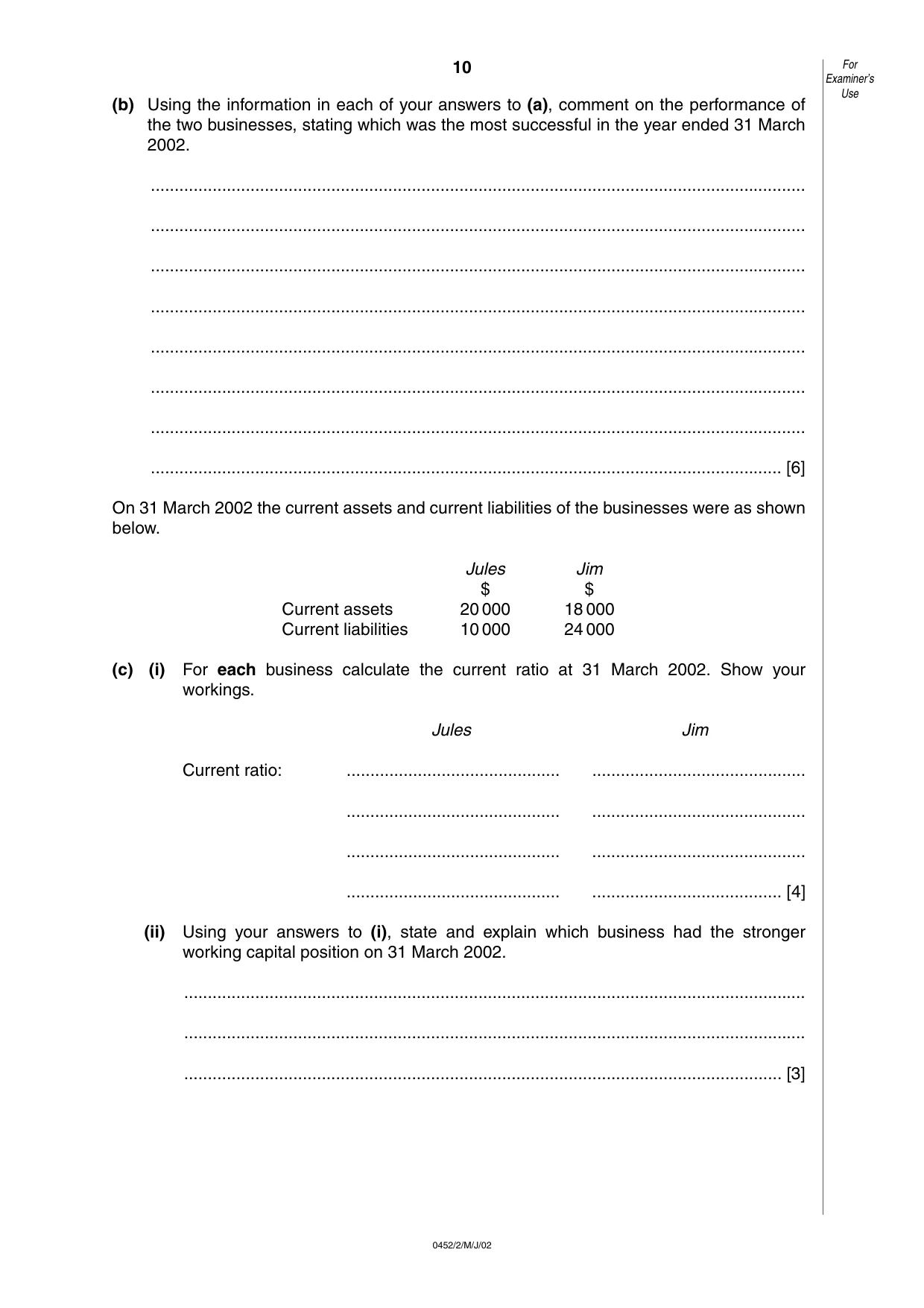
10 0452/2/M/J/02 (b) Using the information in each of your answers to (a), comment on the performance of the two businesses, stating which was the most successful in the year ended 31 March 2002. … … … … … … … … [6] On 31 March 2002 the current assets and current liabilities of the businesses were as shown below. Jules Jim $ $ Current assets 20 000 18 000 Current liabilities 10 000 24 000 (c) (i) For each business calculate the current ratio at 31 March 2002. Show your workings. Jules Jim Current ratio: … … … … … … … … [4] (ii) Using your answers to (i), state and explain which business had the stronger working capital position on 31 March 2002. … … … [3] For Examiner’s Use
Question paper, page 11
11 0452/2/M/J/02 You may use this page for workings … … … … … … … … … … … … … … … … … … … … … … … … … … … For Examiner’s Use
Question paper, page 12
12 0452/2/M/J/02 You may use this page for workings … … … … … … … … … … … … … … … … … … … … … … … … … … … For Examiner’s Use
Mark scheme, page 1
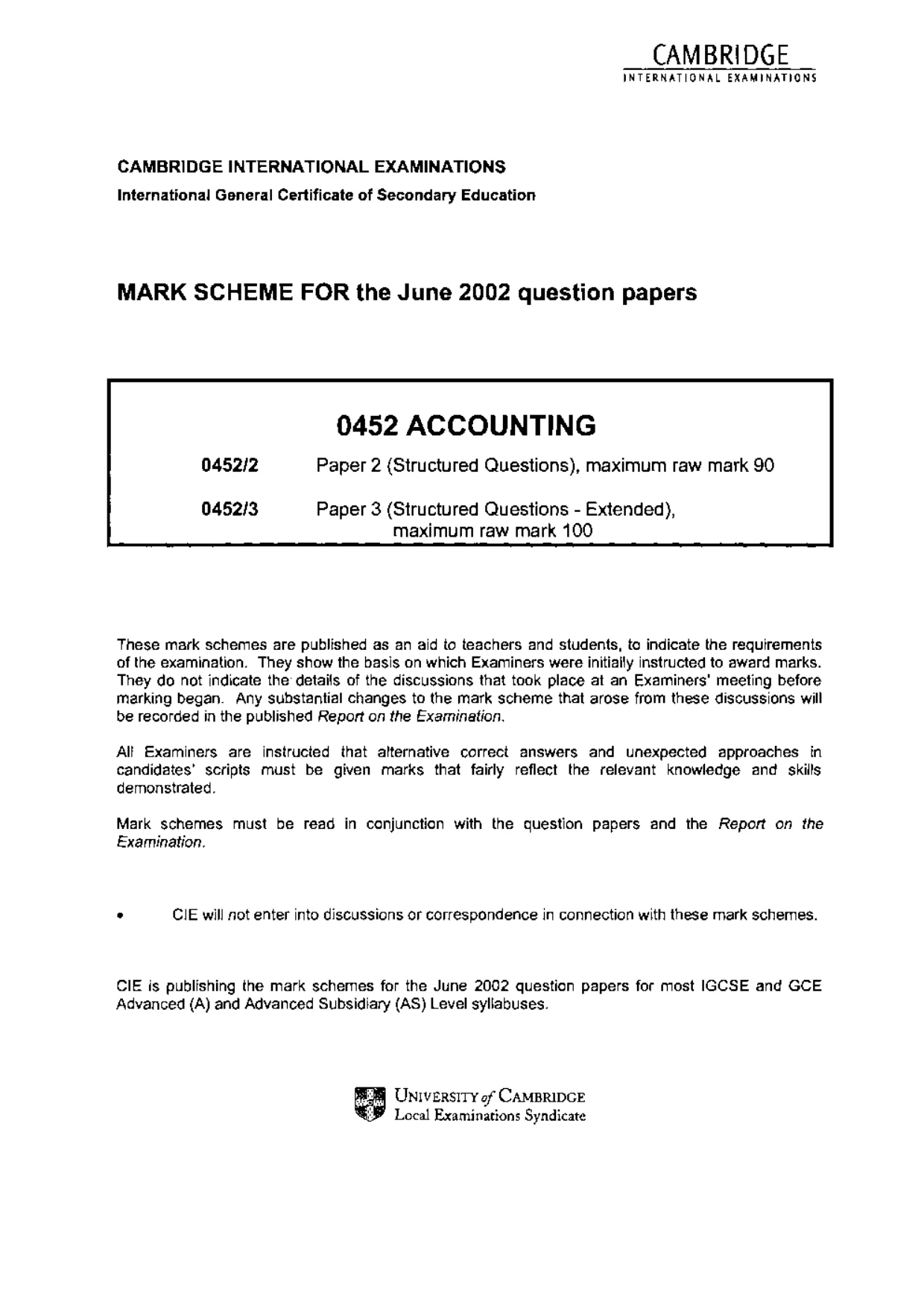
CAMBRIDGE INTERNATIONAL EXAMDNATIONS CAMBRIDGE INTERNATIONAL EXAMINATIONS. International General Certificate of Secondary Education MARK SCHEME FOR the June 2002 question papers 0452 ACCOUNTING 0452/2 Paper 2 (Structured Questions), maximum raw mark 90 0452/3 Paper 3 (Structured Questions - Extended), maximum raw mark 100 These mark schemes are published as an aid to teachers and students, to indicate the requirements of the examination. They show the basis on which Examiners were initially instructed to award marks. They do not indicate the details of the discussions that took place at an Examiners’ meeting before marking began. Any substantial changes to the mark scheme that arose from these discussions will be recorded in the published Report on the Examination. Alt Examiners are instructed that alternative correct answers and unexpected approaches in candidates’ scripts must be given marks that fairly reflect the relevant knowledge and skills demonstrated. Mark schemes must be read in conjunction with the question papers and the Report on the Examination. . CIE will not enter into discussions or correspondence in connection with these mark schemes. CIE is publishing the mark schemes for the June 2002 question papers for most IGCSE and GCE Advanced (A) and Advanced Subsidiary (AS) Level syllabuses. UNIVERSITY of CAMBRIDGE £3" Local Examinations Syndicate
Mark scheme, page 2
CAMBRIDGE INTERNATIONAL EXAMINATIONS JUNE 2002 INTERNATIONAL GCSE MARK SCHEME SYLLABUS/COMPONENT : 0452/2 ACCOUNTING A University of CAMBRIDGE S39 Local Examinations Syndicate
Mark scheme, page 3
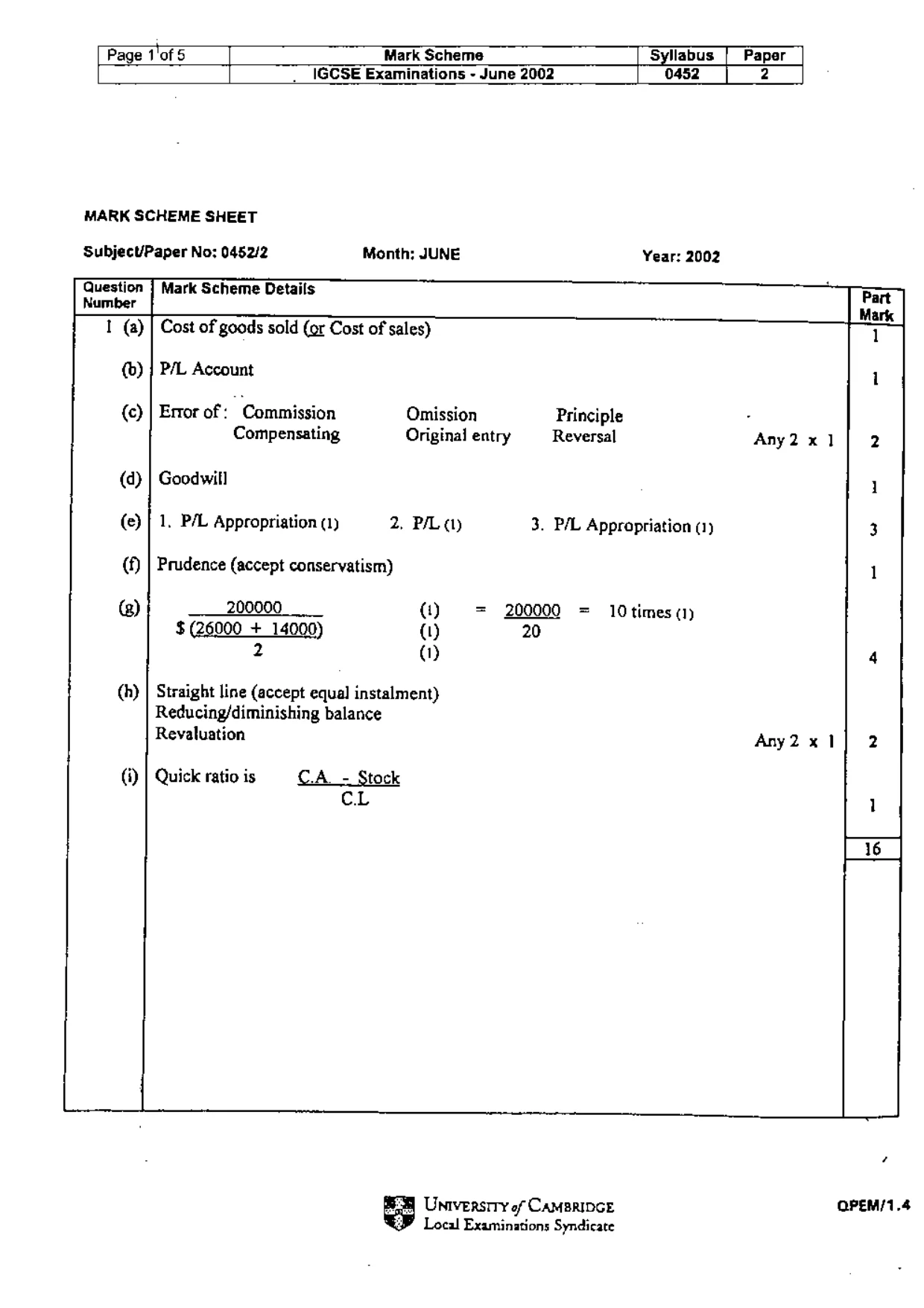
Page 1'of 5 [ Mark Scheme | Syllabus | Paper | __IGCSE Examinations - June 2002 0452, | 2 MARK SCHEME SHEET Subject/Paper No: 0452/2 Month: JUNE Year: 2002 Question | Mark Scheme Details Number 1 (a) | Cost of goods sold (or Cost of sales) P/L Account Enor of: Commission Omission Principle . Compensating, Original entry Reversal Any2 x ] Goodwill 1, P/L Appropriation (1) 2, P/L CL) 3. P/L Appropriation (1) Prudence (accept conservatism) 200000 (1) = 10times (1) $ (26000 + 14000) 0) 2 (1) Straight line (accept equal instalment) Reducing/diminishing balance Revaluation Quick ratio is A. - Stock CL B Universrry of CAMBRIDGE QPEM/1.4 Local Examinations Syndicate
Mark scheme, page 4
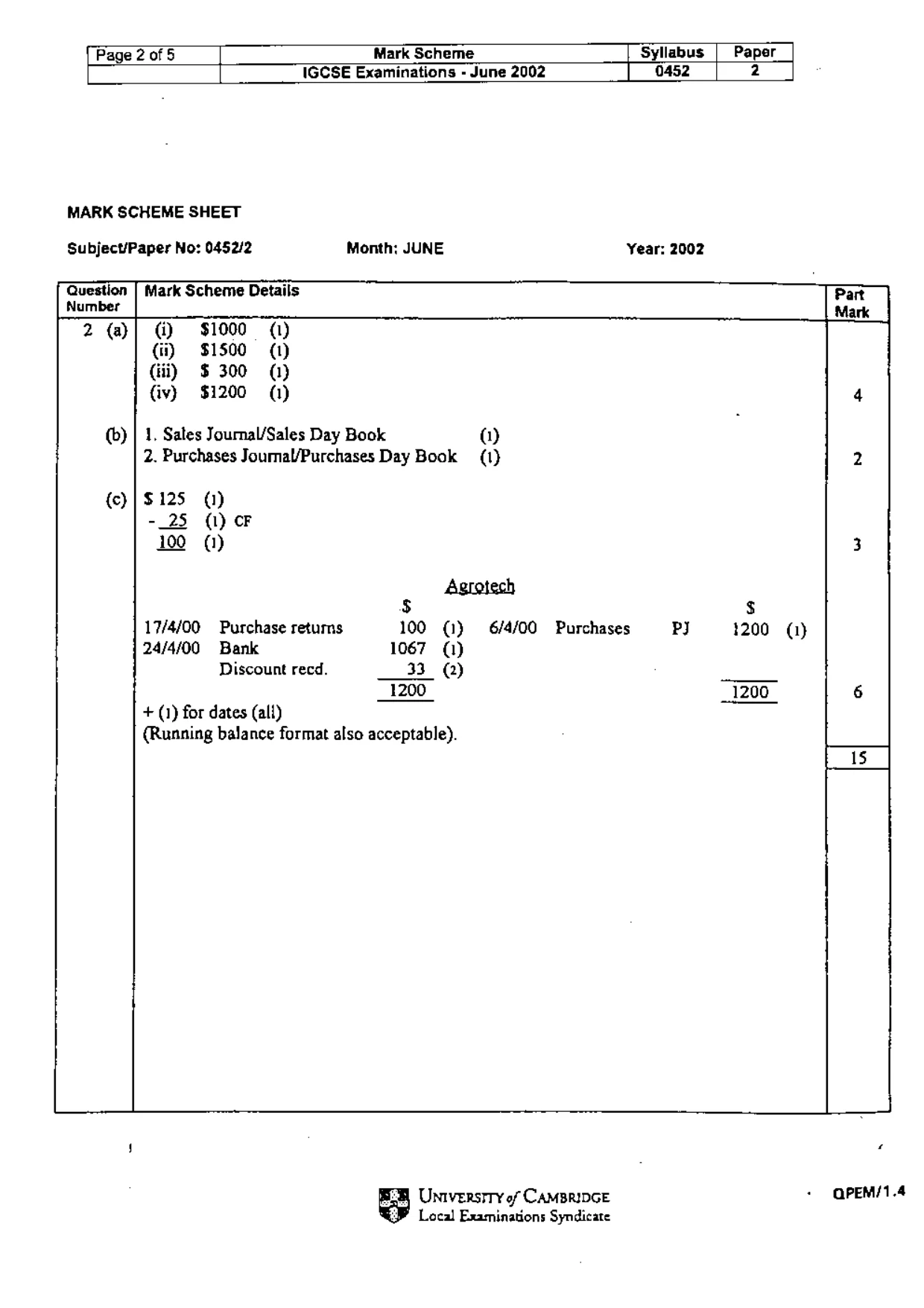
Page 2 of § | Mark Scheme Syllabus | Paper | IGCSE Examinations - June 2002 0452 2 MARK SCHEME SHEET Subject/Paper No: 0452/2 Month; JUNE Year: 2002 Mark Scheme Details @ $1000 (1) (i) $1500) Gi) $300 ) (iv) $1200 (1) 1, Sales Journal/Sales Day Book Q) 2. Purchases Journal/Purchases Day Book (1) $125 4) -_25 (1) CF 4100 (1) $ 17/4/00 Purchase returns 100 (1) 6/4/00 Purchases PJ 24/4/00 Bank 1067 (1) Discount recd. 33. Q) 1200 + (1) for dates (all) (Running balance format also acceptable). UNIVERSITY of CAMBRIDGE QPEM/1.4 SP Local Examinations Syndicate
Mark scheme, page 5
[ Page 3 of 5 Mark Scheme Syllabus Paper 1GCSE Examinations - June 2002 0452 2 MARK SCHEME SHEET Subjact/Paper No: 0452/2 Month: JUNE Question | Mark Scheme Details Number PETTY CASH BOOK Year: 2002 PAYMENTS | STATIONERY OETAILS POSTAGE | TRAVEL ia 2002 1 March Balance b/d Travelling exps. Stationery Postages Cleaner’s Wages Envelopes Bus fares Postages Cleaner’s wages Cash (1) Balance c/d Balance b/d 10(1) 20(1) 6(1) et PBS UNiverstry of CAMBRIDGE EF Local Examinations Syndicate QPEM/1.4
Mark scheme, page 6
Page 4 of 5 Mark Scheme Syllabus | Paper IGCSE Examinations - June 2002 0452 | 2 MARK SCHEME SHEET Subject/Paper No; 0452/2 Month: JUNE Year: 2002 Question | Mark Scheme Details Number Journal provides the only prime entry record for certain types of transaction, e.g. purchase/sale of fixed assets, error correction. Gives description/explanation also reduces risk of omission, error, fraud etc. DR CR $ $ 1. Motor vehicles 5000(1) Ace Motors 5000(1) Purchase of motor vehicle on credit from Ace motors for $5000 (1) 2. Machinery repairs 1500(1} Machinery 1500(1) Machinery repairs $1500 debited in error to Machinery Account, now corrected(1) 3. Bank 600(2) Smith 600(2) Cheque for $300 from Smith credited to bank and debited to Smith’s account in error, now corrected(1) (i) Error of principte (ii) Revenue expenditure (repairs) wrongly treated as Capital expenditure (principle error) (1) Need to correct, as affects: P/L ave - expenses understated(1), N.P. overstated(1) B/g - F.A. (machinery) overstated(1) Thus final accounts would give unfair/inaccurate view of profit and assets(1) 4 UnIversiTy of CAMBRIDGE QPEM/1.4 LP Local Examinations Syndicate
Mark scheme, page 7
Page 5 of 5 Mark Scheme Syllabus | Paper IGCSE Examinations - June 2002 0452 2 MARK SCHEME SHEET Subject/Paper No: 0452/2 Month: JUNE Year: 2002 =e S{a) Jules iim (i) GP. 100 - 60 = $40000 (1) 200 - 140 = $60000 1) (i) G.P/Sales 40 x 100 = 40% (1) 100 _60 x 100 = 30% (1) 200 Gii) NP. 40 - 20 = $20000 Q) 60 - 30 = $30000 (iv) N.P/Sales 29 x 100 = 20% = =(1} 100 Q) Q) 30 x 100 = 15% 200 Gross profit: Jules’ $40000is lower than Jim's $60000 Q) Jules’ GP ratio (40%) is better than Jim’s (30%) (1) Jim had bigger turnover, Jules most successful (1) Net profit: Jules’ $20000is higher than Jim’s $15000 q) Jules’ NP ratio (20%) is better than Jim’s (15%) (1) Jules controlled expenses better than Jim q) Current ratio: Jules lim 20000(1) = 2: 11) 18000(1) = 0.75: 101) 10000 24000 Jules appears to have the strongest position with a C.R. of 2 : 1(i) whilst Jim may be vulnerable at 0.75 : 1{i) + 1 for conclusion based on own figures PES Universrry of CAMBRIDGE QPEeM/1.4 EW Local Examinations Syndicate