Cambridge A Level Travel and Tourism 9395 — 2020 May/June Paper 3 · Variant 2
9395/32/M/J/20
The question paper and its mark scheme, free to read here and free to download. This is Cambridge’s own paper, exactly as it was sat.
Question paper12 pages







Mark scheme9 pages
Answers below. Sit the paper first if you are practising.
Paper as text
Question paper, page 1
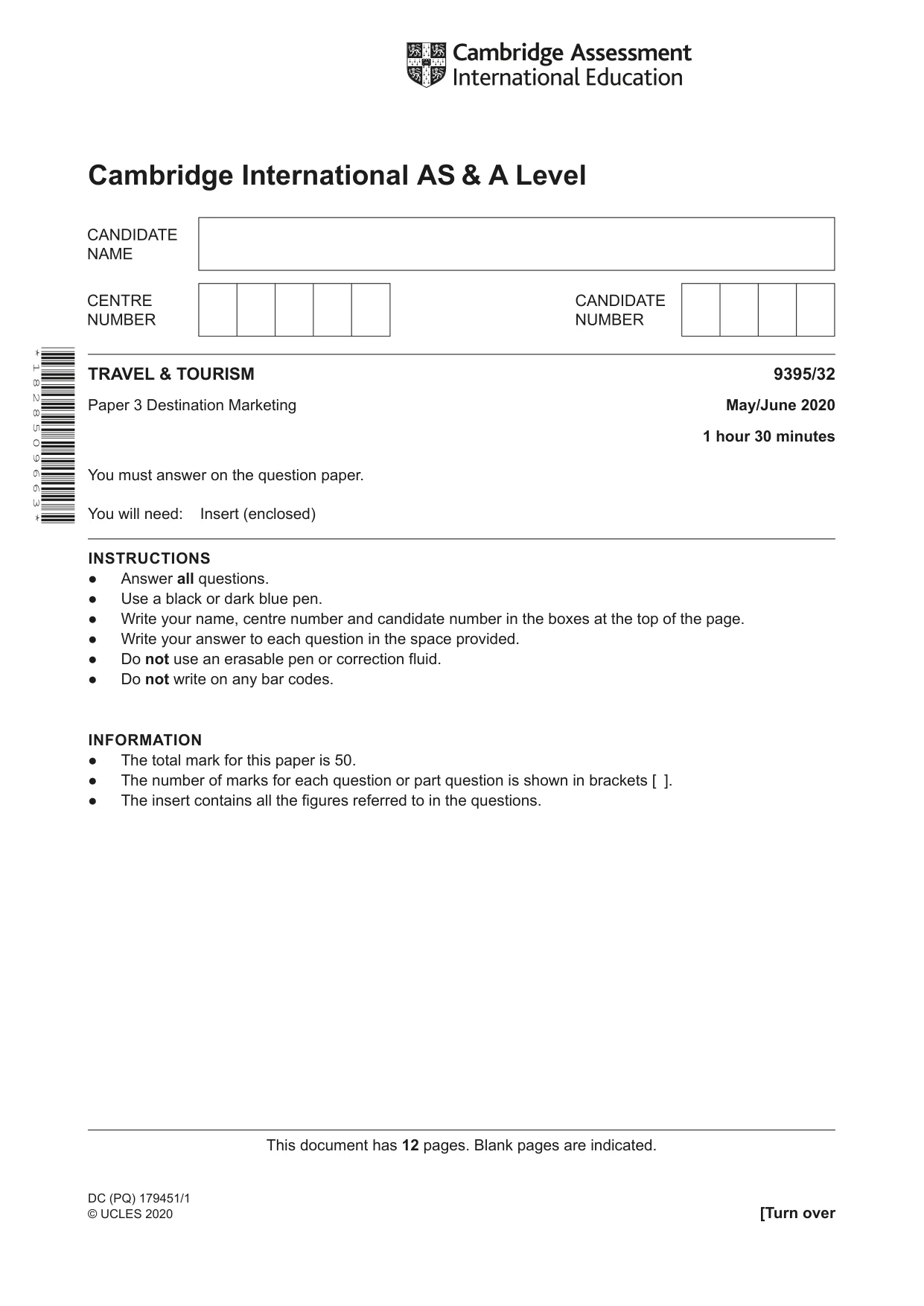
This document has 12 pages. Blank pages are indicated. Cambridge International AS & A Level * 1 8 2 8 5 0 9 6 6 3 * DC (PQ) 179451/1 © UCLES 2020 [Turn over TRAVEL & TOURISM 9395/32 Paper 3 Destination Marketing May/June 2020 1 hour 30 minutes You must answer on the question paper. You will need: Insert (enclosed) INSTRUCTIONS ● Answer all questions. ● Use a black or dark blue pen. ● Write your name, centre number and candidate number in the boxes at the top of the page. ● Write your answer to each question in the space provided. ● Do not use an erasable pen or correction fluid. ● Do not write on any bar codes. INFORMATION ● The total mark for this paper is 50. ● The number of marks for each question or part question is shown in brackets [ ]. ● The insert contains all the figures referred to in the questions.
Question paper, page 2
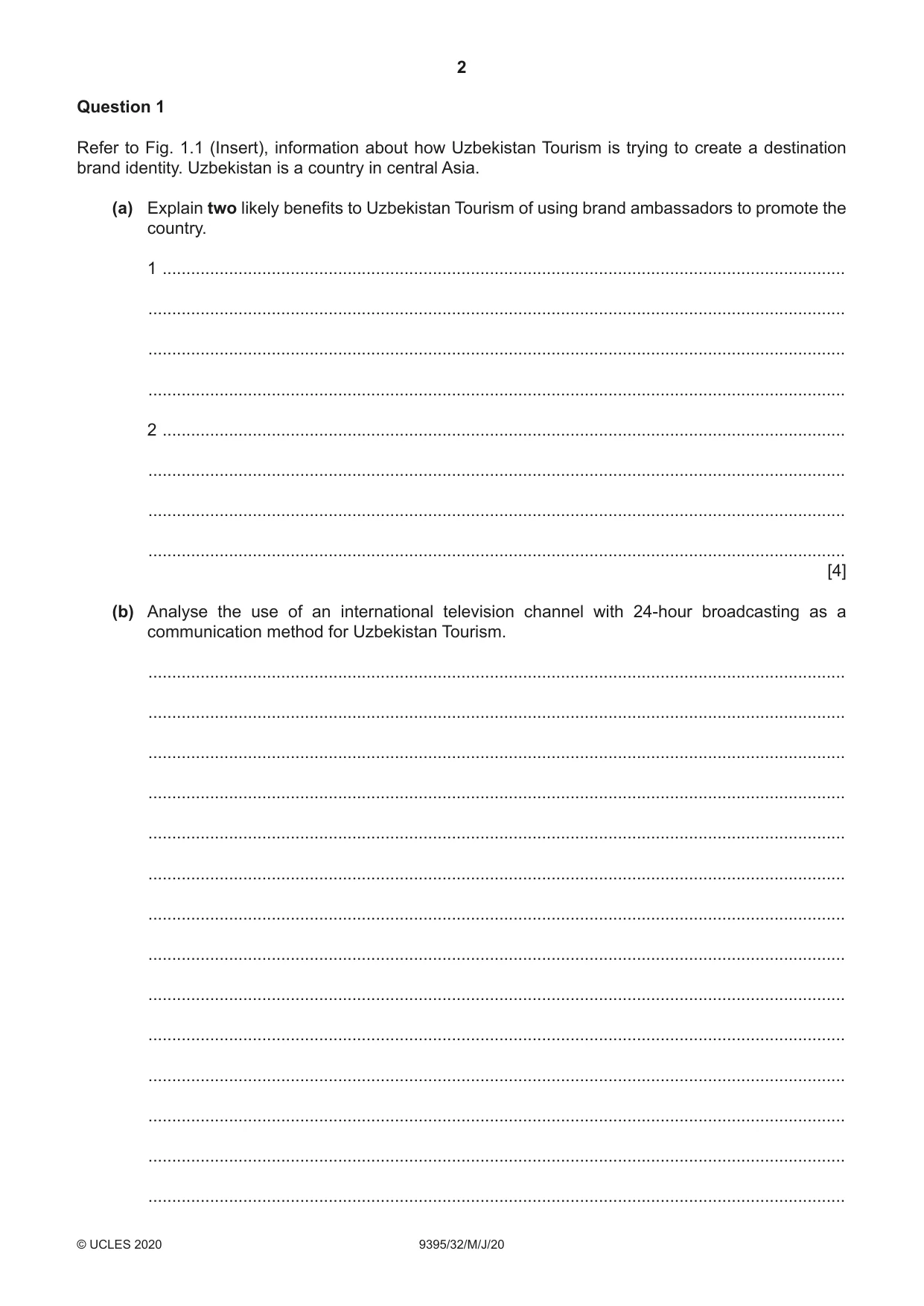
2 9395/32/M/J/20 © UCLES 2020 Question 1 Refer to Fig. 1.1 (Insert), information about how Uzbekistan Tourism is trying to create a destination brand identity. Uzbekistan is a country in central Asia. (a) Explain two likely benefits to Uzbekistan Tourism of using brand ambassadors to promote the country. 1 … … … … 2 … … … … [4] (b) Analyse the use of an international television channel with 24-hour broadcasting as a communication method for Uzbekistan Tourism. … … … … … … … … … … … … … …
Question paper, page 3
3 9395/32/M/J/20 © UCLES 2020 [Turn over … … … … … … … … … … … … … … … … … … … … … … … … … … … … [9]
Question paper, page 4
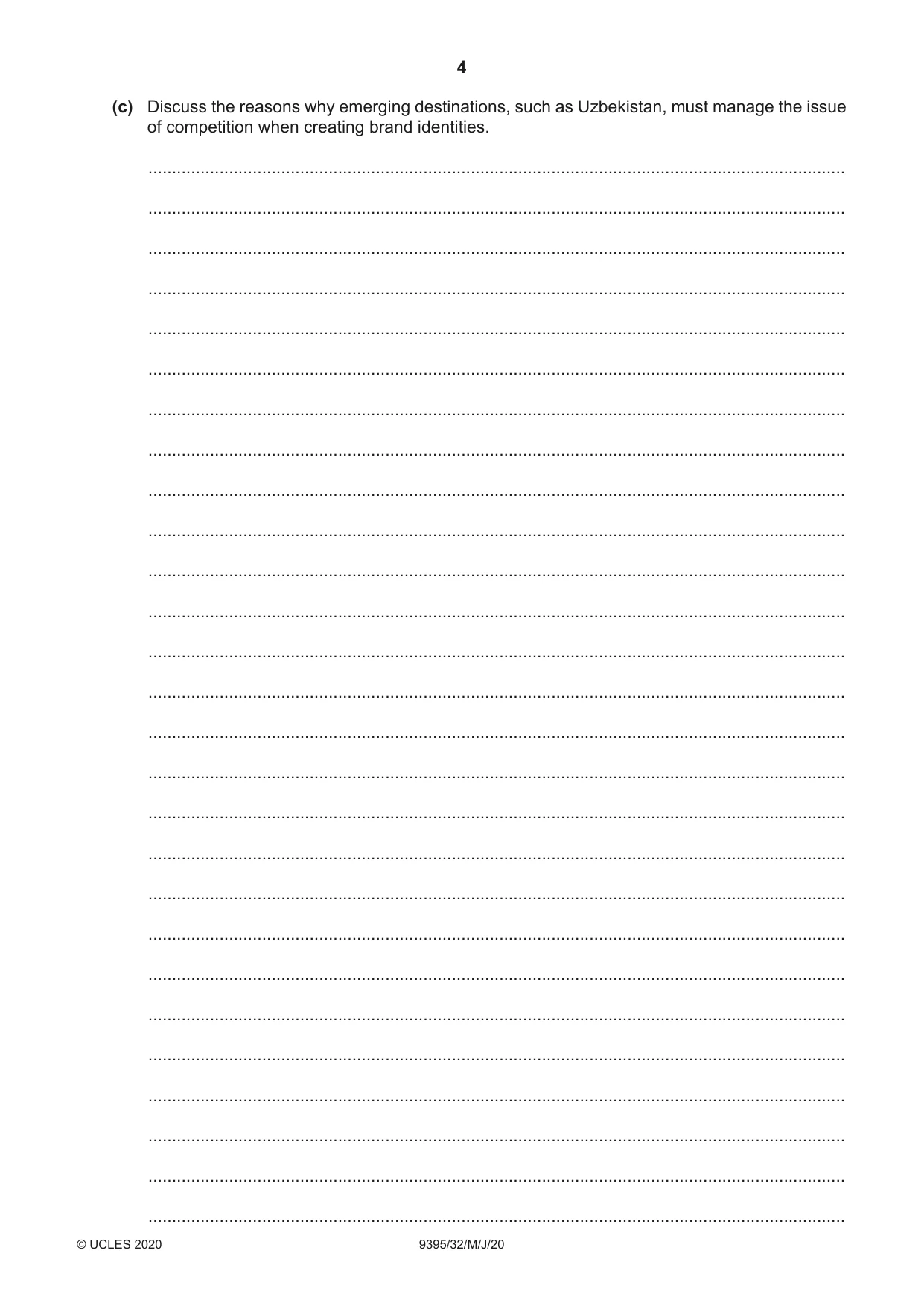
4 9395/32/M/J/20 © UCLES 2020 (c) Discuss the reasons why emerging destinations, such as Uzbekistan, must manage the issue of competition when creating brand identities. … … … … … … … … … … … … … … … … … … … … … … … … … … …
Question paper, page 5
5 9395/32/M/J/20 © UCLES 2020 [Turn over … … … … … … … … … … … … … … … … … … … … … … … … … … … [12] [Total: 25]
Question paper, page 6
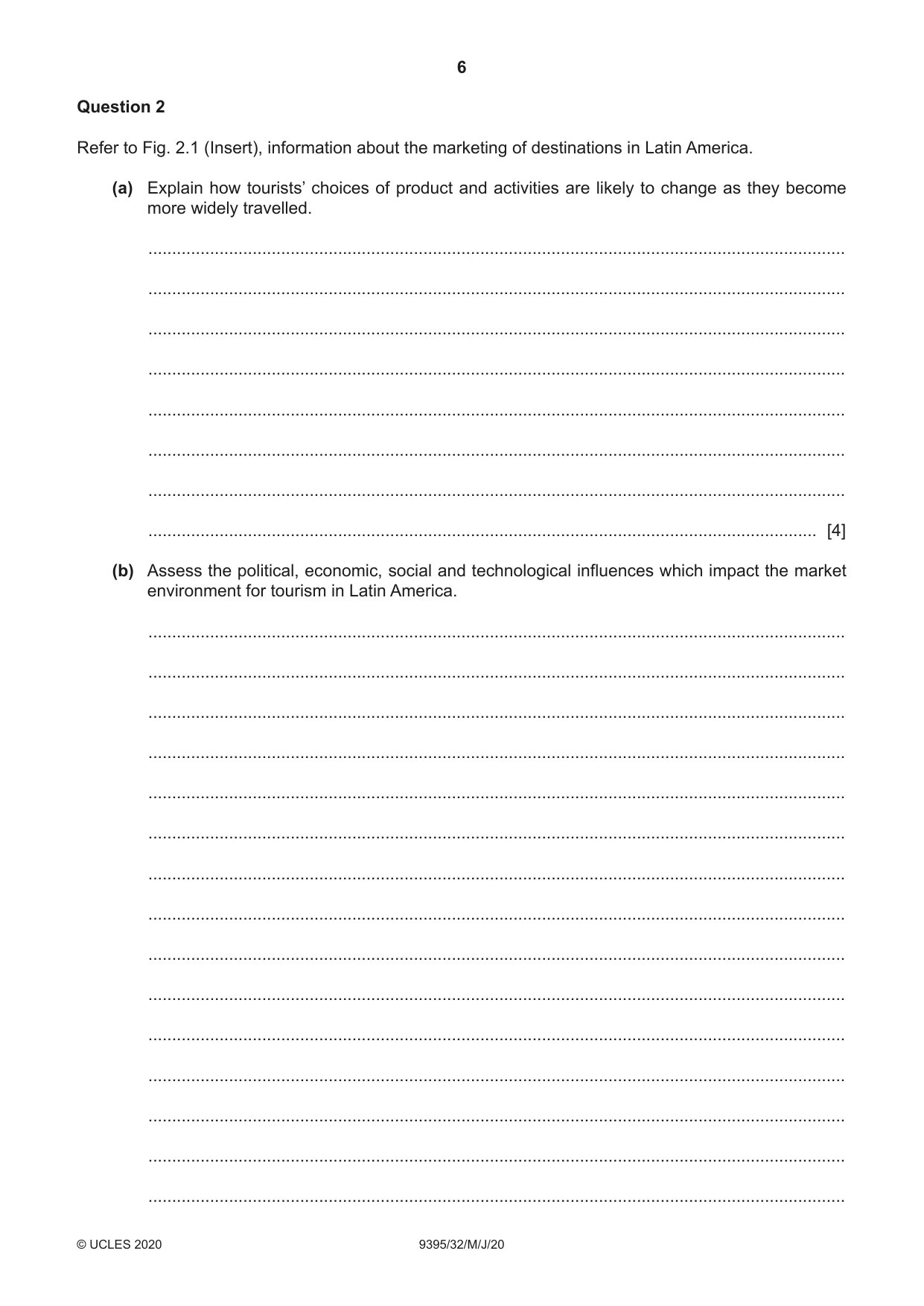
6 9395/32/M/J/20 © UCLES 2020 Question 2 Refer to Fig. 2.1 (Insert), information about the marketing of destinations in Latin America. (a) Explain how tourists’ choices of product and activities are likely to change as they become more widely travelled. … … … … … … … … [4] (b) Assess the political, economic, social and technological influences which impact the market environment for tourism in Latin America. … … … … … … … … … … … … … … …
Question paper, page 7
7 9395/32/M/J/20 © UCLES 2020 [Turn over … … … … … … … … … … … … … … … … … … … … … … … … … … … … [9]
Question paper, page 8
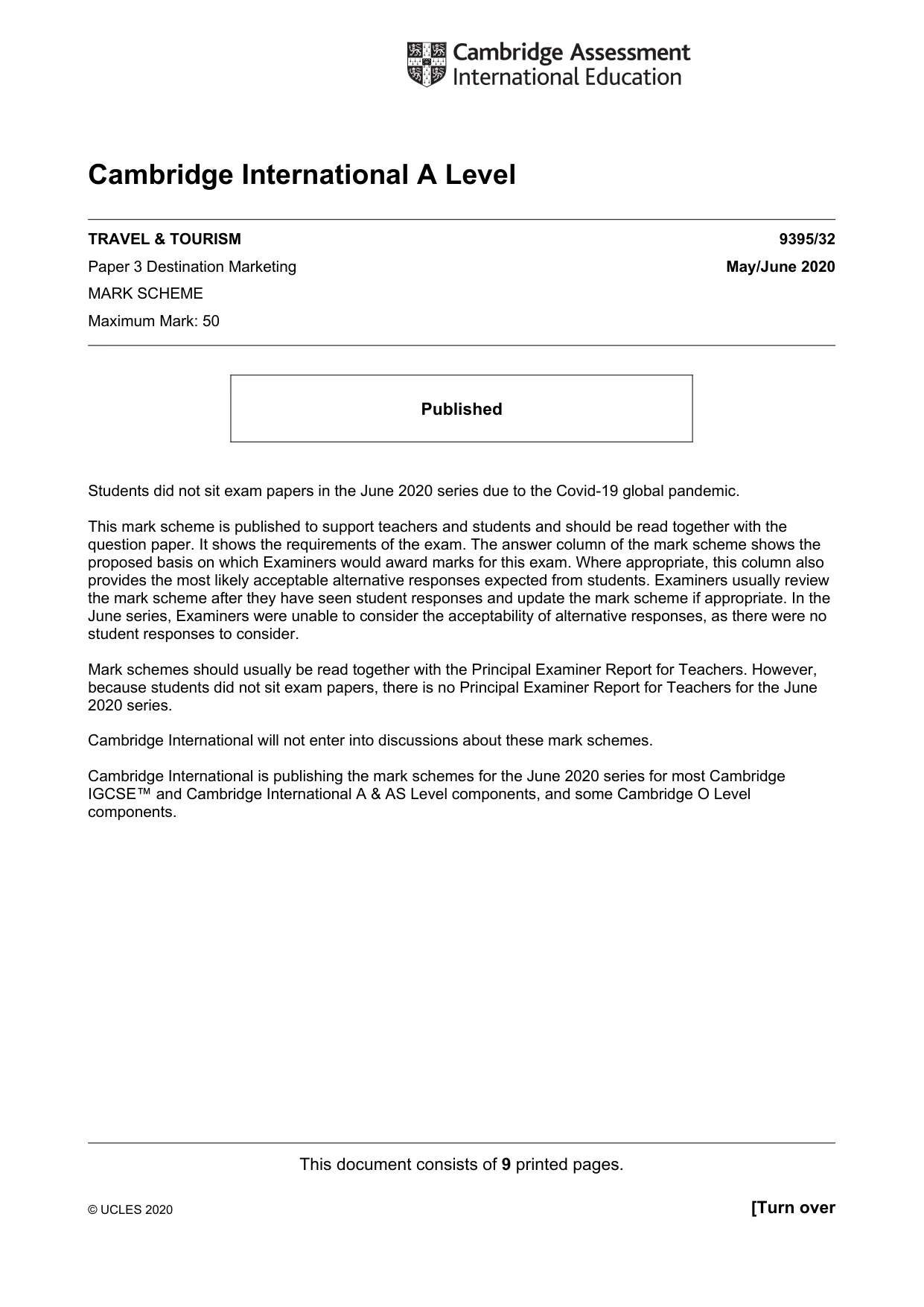
8 9395/32/M/J/20 © UCLES 2020 (c) Evaluate the advantages and disadvantages of using social media as a primary marketing method in Latin America. … … … … … … … … … … … … … … … … … … … … … … … … … … …
Question paper, page 9
9 9395/32/M/J/20 © UCLES 2020 … … … … … … … … … … … … … … … … … … … … … … … … … … … [12] [Total: 25]
Question paper, page 10
10 9395/32/M/J/20 © UCLES 2020 BLANK PAGE
Question paper, page 11
11 9395/32/M/J/20 © UCLES 2020 BLANK PAGE
Question paper, page 12
12 9395/32/M/J/20 © UCLES 2020 Permission to reproduce items where third-party owned material protected by copyright is included has been sought and cleared where possible. Every reasonable effort has been made by the publisher (UCLES) to trace copyright holders, but if any items requiring clearance have unwittingly been included, the publisher will be pleased to make amends at the earliest possible opportunity. To avoid the issue of disclosure of answer-related information to candidates, all copyright acknowledgements are reproduced online in the Cambridge Assessment International Education Copyright Acknowledgements Booklet. This is produced for each series of examinations and is freely available to download at www.cambridgeinternational.org after the live examination series. Cambridge Assessment International Education is part of the Cambridge Assessment Group. Cambridge Assessment is the brand name of the University of Cambridge Local Examinations Syndicate (UCLES), which itself is a department of the University of Cambridge. BLANK PAGE
Mark scheme, page 1
This document consists of 9 printed pages. © UCLES 2020 [Turn over Cambridge International A Level TRAVEL & TOURISM 9395/32 Paper 3 Destination Marketing May/June 2020 MARK SCHEME Maximum Mark: 50 Published Students did not sit exam papers in the June 2020 series due to the Covid-19 global pandemic. This mark scheme is published to support teachers and students and should be read together with the question paper. It shows the requirements of the exam. The answer column of the mark scheme shows the proposed basis on which Examiners would award marks for this exam. Where appropriate, this column also provides the most likely acceptable alternative responses expected from students. Examiners usually review the mark scheme after they have seen student responses and update the mark scheme if appropriate. In the June series, Examiners were unable to consider the acceptability of alternative responses, as there were no student responses to consider. Mark schemes should usually be read together with the Principal Examiner Report for Teachers. However, because students did not sit exam papers, there is no Principal Examiner Report for Teachers for the June 2020 series. Cambridge International will not enter into discussions about these mark schemes. Cambridge International is publishing the mark schemes for the June 2020 series for most Cambridge IGCSE™ and Cambridge International A & AS Level components, and some Cambridge O Level components.
Mark scheme, page 2
9395/32 Cambridge International A Level – Mark Scheme PUBLISHED May/June 2020 © UCLES 2020 Page 2 of 9 Generic Marking Principles These general marking principles must be applied by all examiners when marking candidate answers. They should be applied alongside the specific content of the mark scheme or generic level descriptors for a question. Each question paper and mark scheme will also comply with these marking principles. GENERIC MARKING PRINCIPLE 1: Marks must be awarded in line with: • the specific content of the mark scheme or the generic level descriptors for the question • the specific skills defined in the mark scheme or in the generic level descriptors for the question • the standard of response required by a candidate as exemplified by the standardisation scripts. GENERIC MARKING PRINCIPLE 2: Marks awarded are always whole marks (not half marks, or other fractions). GENERIC MARKING PRINCIPLE 3: Marks must be awarded positively: • marks are awarded for correct/valid answers, as defined in the mark scheme. However, credit is given for valid answers which go beyond the scope of the syllabus and mark scheme, referring to your Team Leader as appropriate • marks are awarded when candidates clearly demonstrate what they know and can do • marks are not deducted for errors • marks are not deducted for omissions • answers should only be judged on the quality of spelling, punctuation and grammar when these features are specifically assessed by the question as indicated by the mark scheme. The meaning, however, should be unambiguous. GENERIC MARKING PRINCIPLE 4: Rules must be applied consistently e.g. in situations where candidates have not followed instructions or in the application of generic level descriptors. GENERIC MARKING PRINCIPLE 5: Marks should be awarded using the full range of marks defined in the mark scheme for the question (however; the use of the full mark range may be limited according to the quality of the candidate responses seen). GENERIC MARKING PRINCIPLE 6: Marks awarded are based solely on the requirements as defined in the mark scheme. Marks should not be awarded with grade thresholds or grade descriptors in mind.
Mark scheme, page 3
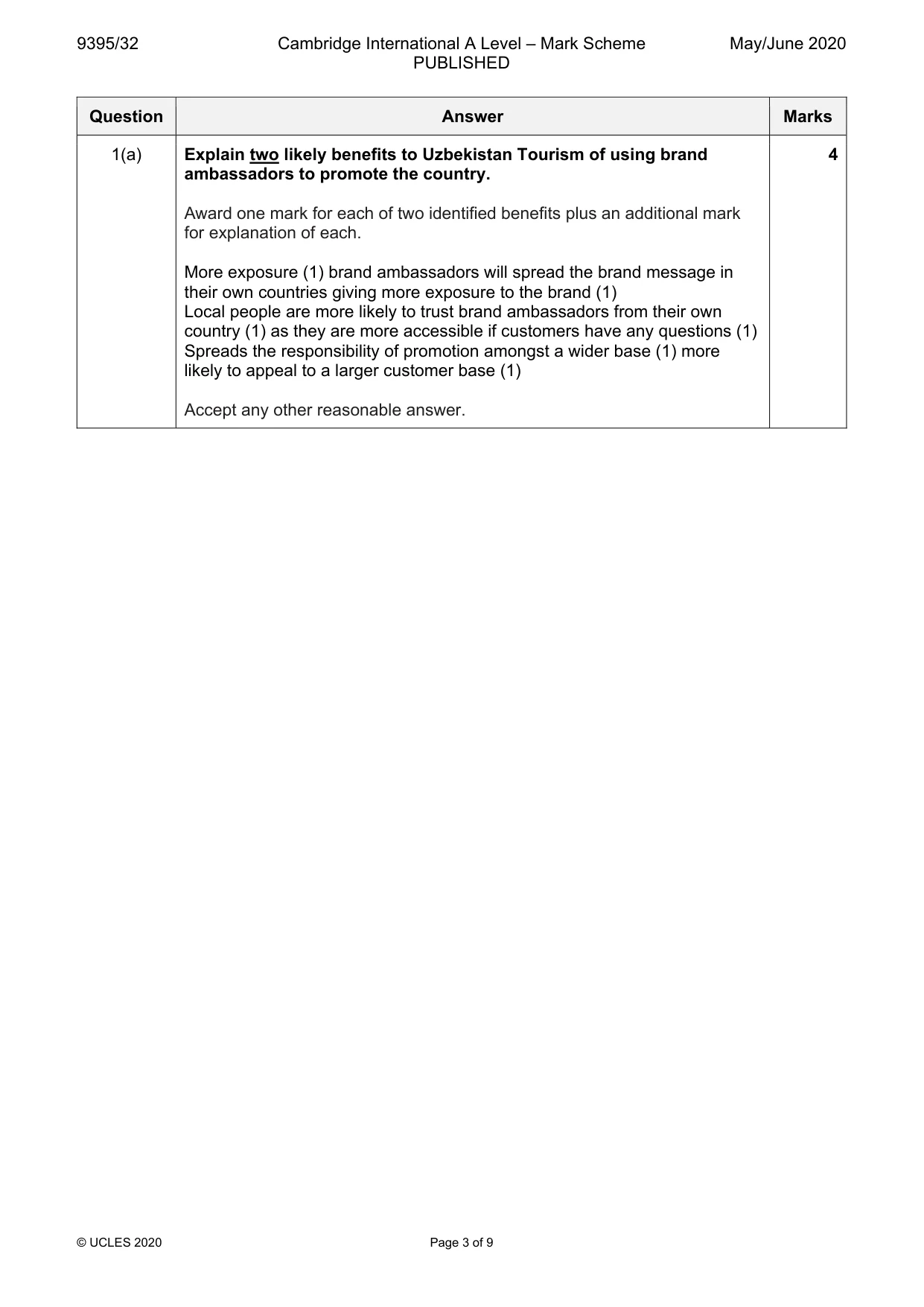
9395/32 Cambridge International A Level – Mark Scheme PUBLISHED May/June 2020 © UCLES 2020 Page 3 of 9 Question Answer Marks 1(a) Explain two likely benefits to Uzbekistan Tourism of using brand ambassadors to promote the country. Award one mark for each of two identified benefits plus an additional mark for explanation of each. More exposure (1) brand ambassadors will spread the brand message in their own countries giving more exposure to the brand (1) Local people are more likely to trust brand ambassadors from their own country (1) as they are more accessible if customers have any questions (1) Spreads the responsibility of promotion amongst a wider base (1) more likely to appeal to a larger customer base (1) Accept any other reasonable answer. 4
Mark scheme, page 4
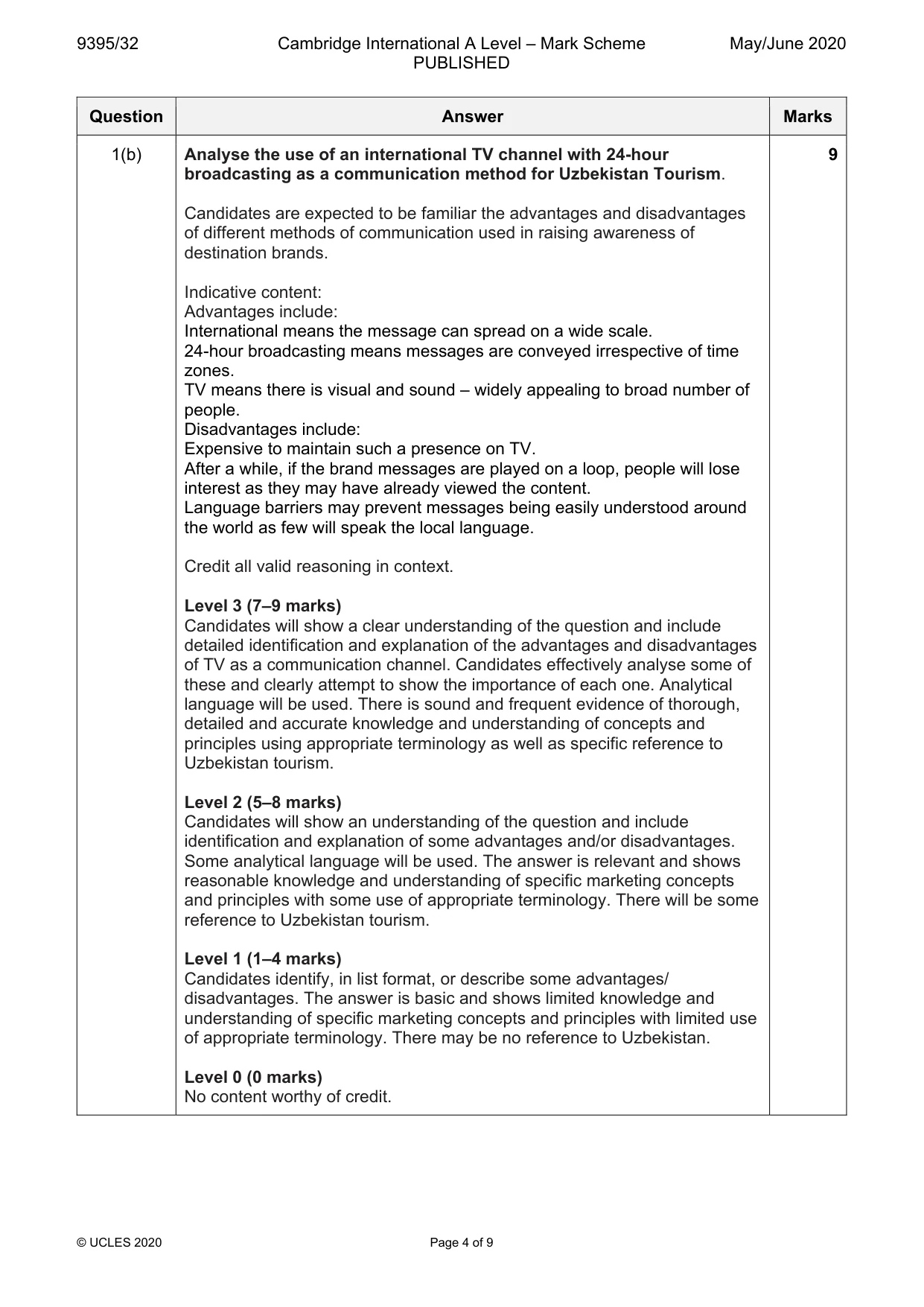
9395/32 Cambridge International A Level – Mark Scheme PUBLISHED May/June 2020 © UCLES 2020 Page 4 of 9 Question Answer Marks 1(b) Analyse the use of an international TV channel with 24-hour broadcasting as a communication method for Uzbekistan Tourism. Candidates are expected to be familiar the advantages and disadvantages of different methods of communication used in raising awareness of destination brands. Indicative content: Advantages include: International means the message can spread on a wide scale. 24-hour broadcasting means messages are conveyed irrespective of time zones. TV means there is visual and sound – widely appealing to broad number of people. Disadvantages include: Expensive to maintain such a presence on TV. After a while, if the brand messages are played on a loop, people will lose interest as they may have already viewed the content. Language barriers may prevent messages being easily understood around the world as few will speak the local language. Credit all valid reasoning in context. Level 3 (7–9 marks) Candidates will show a clear understanding of the question and include detailed identification and explanation of the advantages and disadvantages of TV as a communication channel. Candidates effectively analyse some of these and clearly attempt to show the importance of each one. Analytical language will be used. There is sound and frequent evidence of thorough, detailed and accurate knowledge and understanding of concepts and principles using appropriate terminology as well as specific reference to Uzbekistan tourism. Level 2 (5–8 marks) Candidates will show an understanding of the question and include identification and explanation of some advantages and/or disadvantages. Some analytical language will be used. The answer is relevant and shows reasonable knowledge and understanding of specific marketing concepts and principles with some use of appropriate terminology. There will be some reference to Uzbekistan tourism. Level 1 (1–4 marks) Candidates identify, in list format, or describe some advantages/ disadvantages. The answer is basic and shows limited knowledge and understanding of specific marketing concepts and principles with limited use of appropriate terminology. There may be no reference to Uzbekistan. Level 0 (0 marks) No content worthy of credit. 9
Mark scheme, page 5
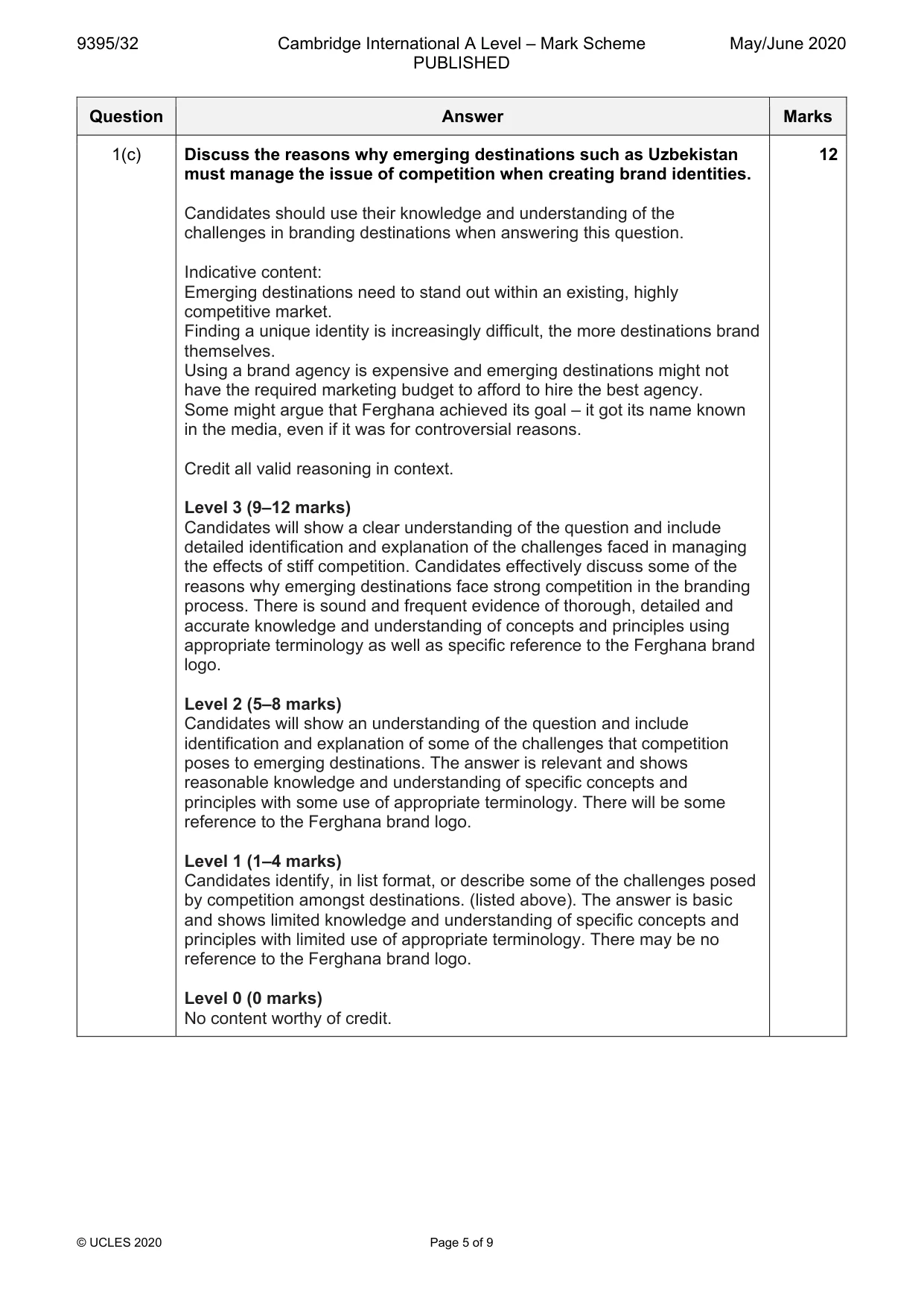
9395/32 Cambridge International A Level – Mark Scheme PUBLISHED May/June 2020 © UCLES 2020 Page 5 of 9 Question Answer Marks 1(c) Discuss the reasons why emerging destinations such as Uzbekistan must manage the issue of competition when creating brand identities. Candidates should use their knowledge and understanding of the challenges in branding destinations when answering this question. Indicative content: Emerging destinations need to stand out within an existing, highly competitive market. Finding a unique identity is increasingly difficult, the more destinations brand themselves. Using a brand agency is expensive and emerging destinations might not have the required marketing budget to afford to hire the best agency. Some might argue that Ferghana achieved its goal – it got its name known in the media, even if it was for controversial reasons. Credit all valid reasoning in context. Level 3 (9–12 marks) Candidates will show a clear understanding of the question and include detailed identification and explanation of the challenges faced in managing the effects of stiff competition. Candidates effectively discuss some of the reasons why emerging destinations face strong competition in the branding process. There is sound and frequent evidence of thorough, detailed and accurate knowledge and understanding of concepts and principles using appropriate terminology as well as specific reference to the Ferghana brand logo. Level 2 (5–8 marks) Candidates will show an understanding of the question and include identification and explanation of some of the challenges that competition poses to emerging destinations. The answer is relevant and shows reasonable knowledge and understanding of specific concepts and principles with some use of appropriate terminology. There will be some reference to the Ferghana brand logo. Level 1 (1–4 marks) Candidates identify, in list format, or describe some of the challenges posed by competition amongst destinations. (listed above). The answer is basic and shows limited knowledge and understanding of specific concepts and principles with limited use of appropriate terminology. There may be no reference to the Ferghana brand logo. Level 0 (0 marks) No content worthy of credit. 12
Mark scheme, page 6
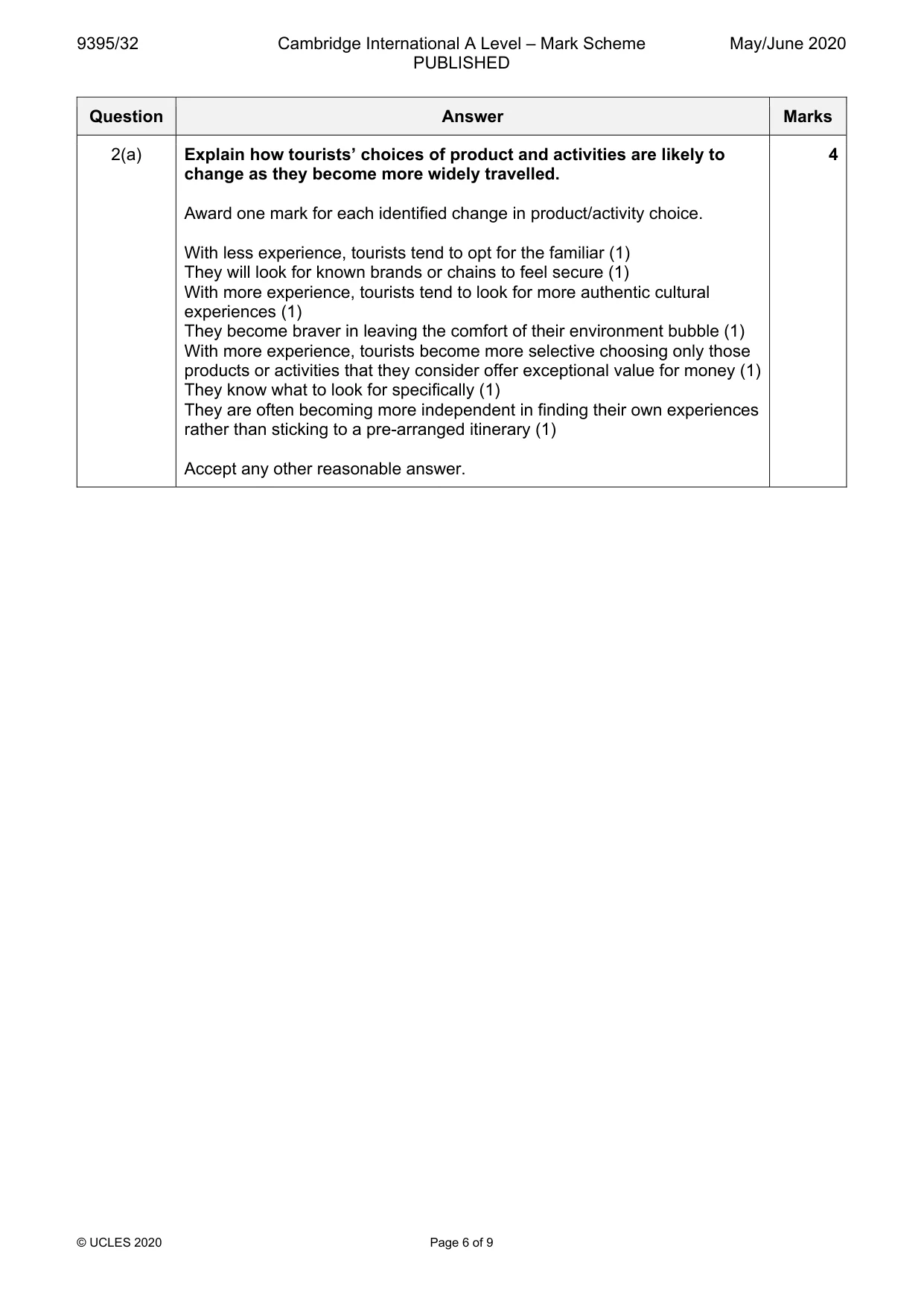
9395/32 Cambridge International A Level – Mark Scheme PUBLISHED May/June 2020 © UCLES 2020 Page 6 of 9 Question Answer Marks 2(a) Explain how tourists’ choices of product and activities are likely to change as they become more widely travelled. Award one mark for each identified change in product/activity choice. With less experience, tourists tend to opt for the familiar (1) They will look for known brands or chains to feel secure (1) With more experience, tourists tend to look for more authentic cultural experiences (1) They become braver in leaving the comfort of their environment bubble (1) With more experience, tourists become more selective choosing only those products or activities that they consider offer exceptional value for money (1) They know what to look for specifically (1) They are often becoming more independent in finding their own experiences rather than sticking to a pre-arranged itinerary (1) Accept any other reasonable answer. 4
Mark scheme, page 7
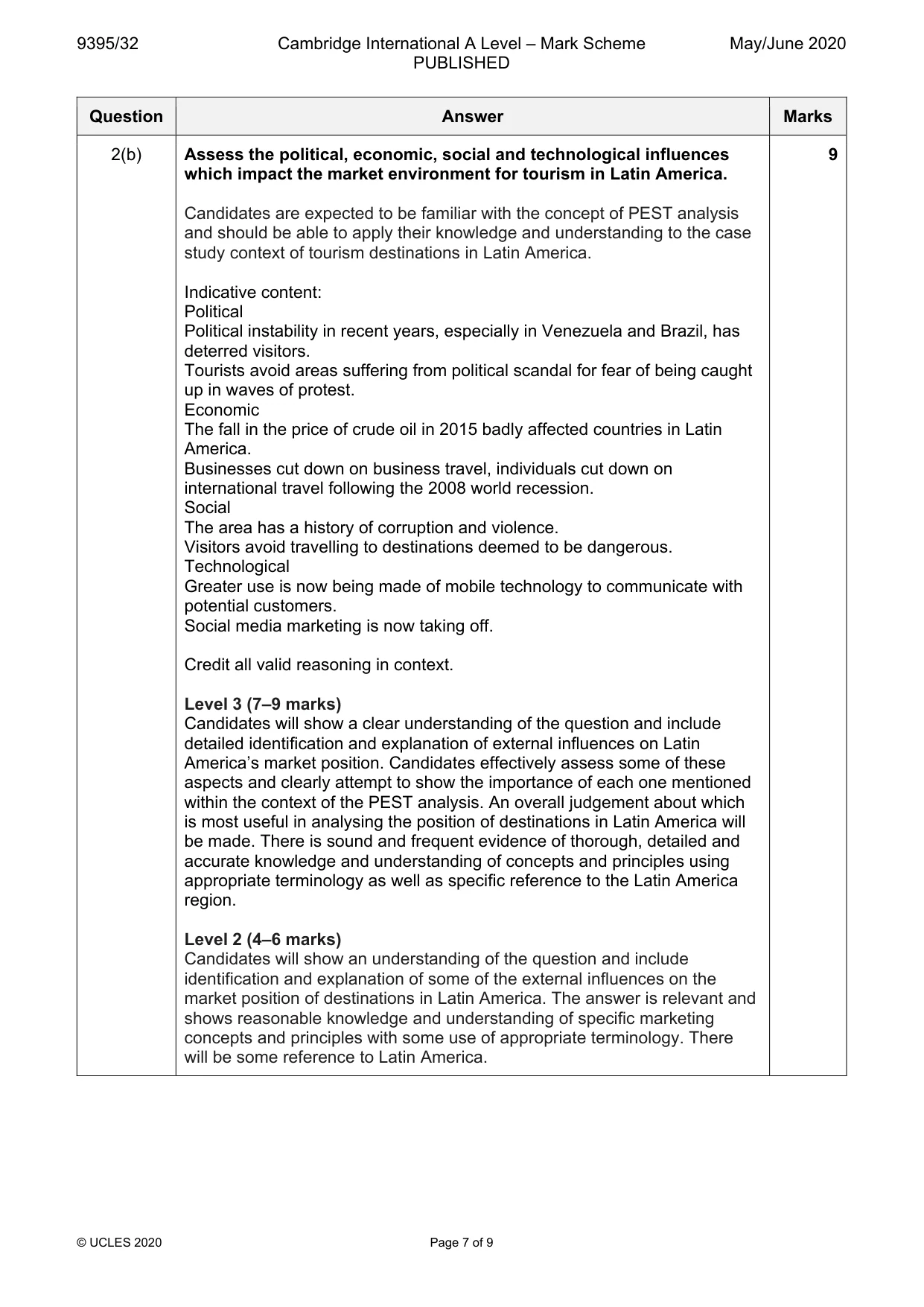
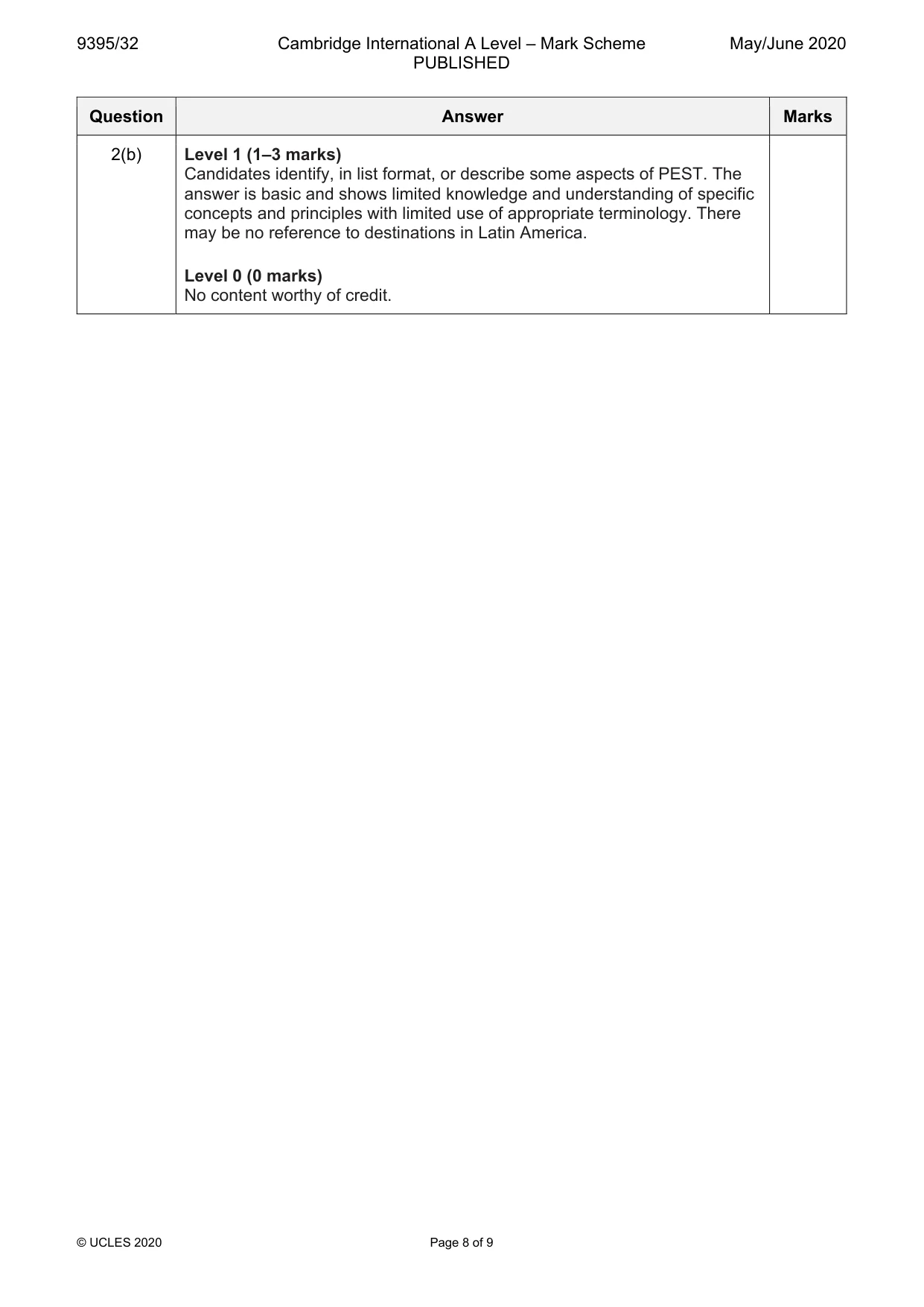
9395/32 Cambridge International A Level – Mark Scheme PUBLISHED May/June 2020 © UCLES 2020 Page 7 of 9 Question Answer Marks 2(b) Assess the political, economic, social and technological influences which impact the market environment for tourism in Latin America. Candidates are expected to be familiar with the concept of PEST analysis and should be able to apply their knowledge and understanding to the case study context of tourism destinations in Latin America. Indicative content: Political Political instability in recent years, especially in Venezuela and Brazil, has deterred visitors. Tourists avoid areas suffering from political scandal for fear of being caught up in waves of protest. Economic The fall in the price of crude oil in 2015 badly affected countries in Latin America. Businesses cut down on business travel, individuals cut down on international travel following the 2008 world recession. Social The area has a history of corruption and violence. Visitors avoid travelling to destinations deemed to be dangerous. Technological Greater use is now being made of mobile technology to communicate with potential customers. Social media marketing is now taking off. Credit all valid reasoning in context. Level 3 (7–9 marks) Candidates will show a clear understanding of the question and include detailed identification and explanation of external influences on Latin America’s market position. Candidates effectively assess some of these aspects and clearly attempt to show the importance of each one mentioned within the context of the PEST analysis. An overall judgement about which is most useful in analysing the position of destinations in Latin America will be made. There is sound and frequent evidence of thorough, detailed and accurate knowledge and understanding of concepts and principles using appropriate terminology as well as specific reference to the Latin America region. Level 2 (4–6 marks) Candidates will show an understanding of the question and include identification and explanation of some of the external influences on the market position of destinations in Latin America. The answer is relevant and shows reasonable knowledge and understanding of specific marketing concepts and principles with some use of appropriate terminology. There will be some reference to Latin America. 9
Mark scheme, page 8
9395/32 Cambridge International A Level – Mark Scheme PUBLISHED May/June 2020 © UCLES 2020 Page 8 of 9 Question Answer Marks 2(b) Level 1 (1–3 marks) Candidates identify, in list format, or describe some aspects of PEST. The answer is basic and shows limited knowledge and understanding of specific concepts and principles with limited use of appropriate terminology. There may be no reference to destinations in Latin America. Level 0 (0 marks) No content worthy of credit.
Mark scheme, page 9
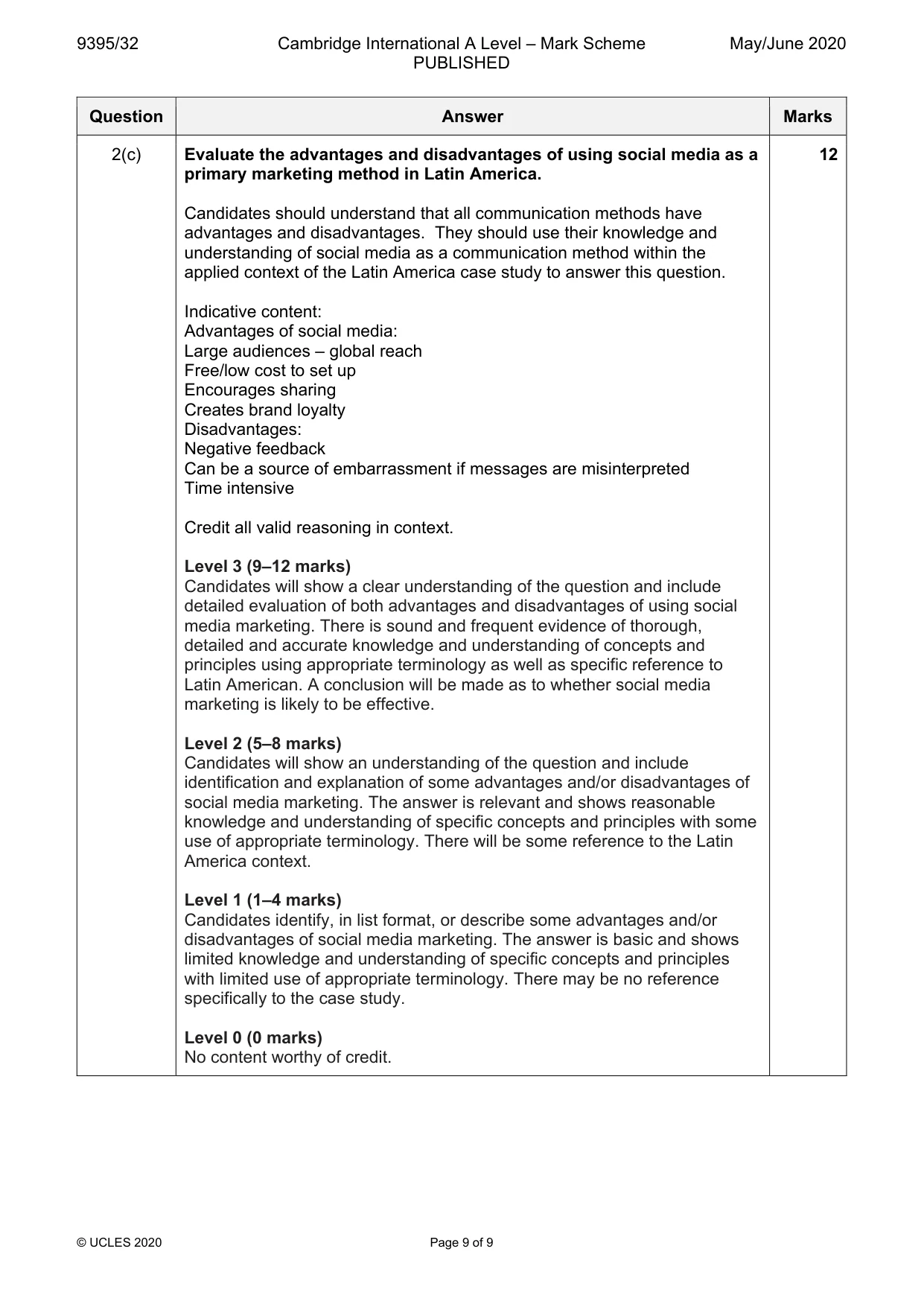
9395/32 Cambridge International A Level – Mark Scheme PUBLISHED May/June 2020 © UCLES 2020 Page 9 of 9 Question Answer Marks 2(c) Evaluate the advantages and disadvantages of using social media as a primary marketing method in Latin America. Candidates should understand that all communication methods have advantages and disadvantages. They should use their knowledge and understanding of social media as a communication method within the applied context of the Latin America case study to answer this question. Indicative content: Advantages of social media: Large audiences – global reach Free/low cost to set up Encourages sharing Creates brand loyalty Disadvantages: Negative feedback Can be a source of embarrassment if messages are misinterpreted Time intensive Credit all valid reasoning in context. Level 3 (9–12 marks) Candidates will show a clear understanding of the question and include detailed evaluation of both advantages and disadvantages of using social media marketing. There is sound and frequent evidence of thorough, detailed and accurate knowledge and understanding of concepts and principles using appropriate terminology as well as specific reference to Latin American. A conclusion will be made as to whether social media marketing is likely to be effective. Level 2 (5–8 marks) Candidates will show an understanding of the question and include identification and explanation of some advantages and/or disadvantages of social media marketing. The answer is relevant and shows reasonable knowledge and understanding of specific concepts and principles with some use of appropriate terminology. There will be some reference to the Latin America context. Level 1 (1–4 marks) Candidates identify, in list format, or describe some advantages and/or disadvantages of social media marketing. The answer is basic and shows limited knowledge and understanding of specific concepts and principles with limited use of appropriate terminology. There may be no reference specifically to the case study. Level 0 (0 marks) No content worthy of credit. 12