Cambridge A Level Travel and Tourism 9395 — 2020 May/June Paper 3 · Variant 1
9395/31/M/J/20
The question paper and its mark scheme, free to read here and free to download. This is Cambridge’s own paper, exactly as it was sat.
Question paper12 pages







Mark scheme8 pages
Answers below. Sit the paper first if you are practising.
Paper as text
Question paper, page 1
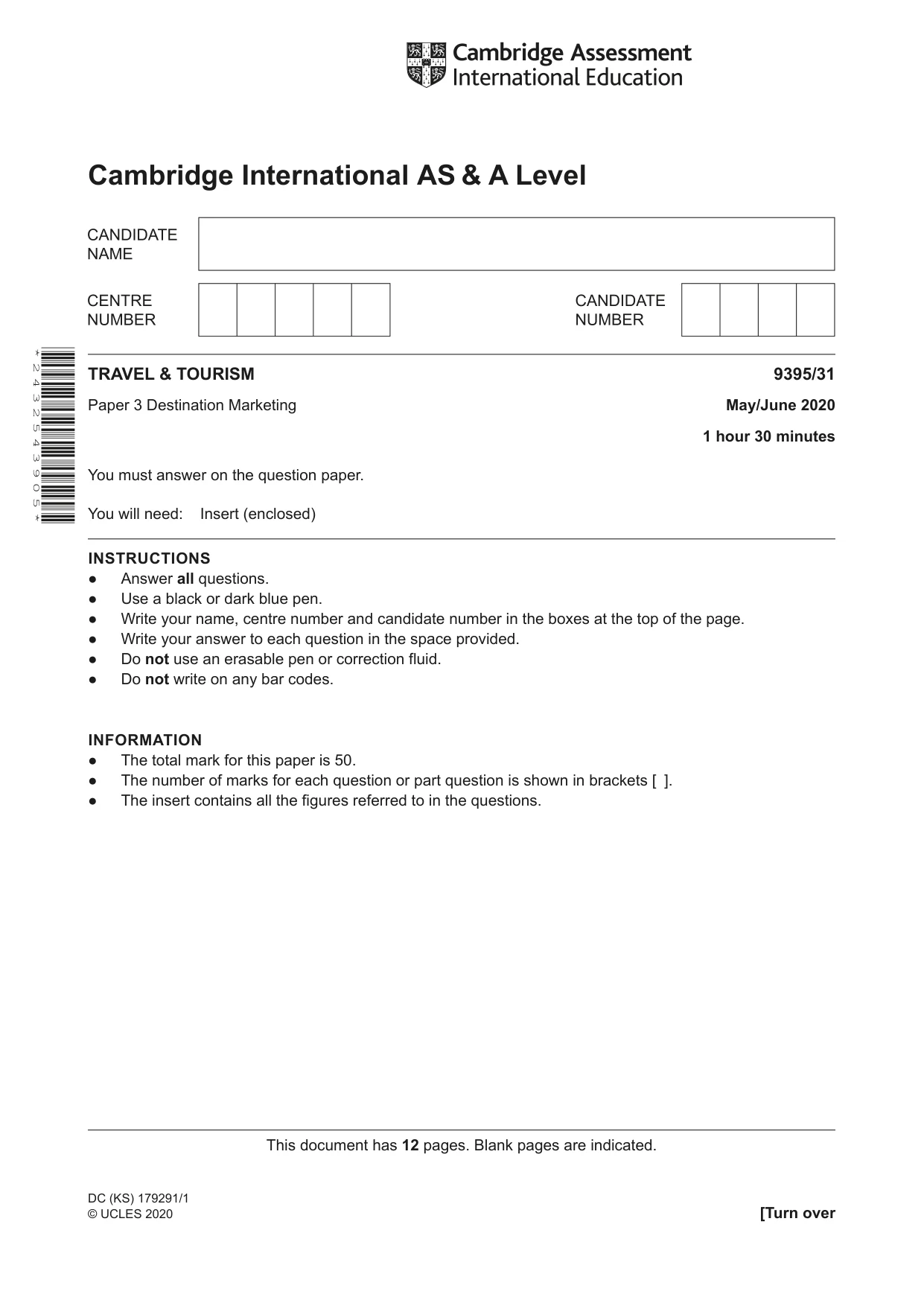
Cambridge International AS & A Level DC (KS) 179291/1 © UCLES 2020 [Turn over This document has 12 pages. Blank pages are indicated. * 2 4 3 2 5 4 3 9 0 5 * TRAVEL & TOURISM 9395/31 Paper 3 Destination Marketing May/June 2020 1 hour 30 minutes You must answer on the question paper. You will need: Insert (enclosed) INSTRUCTIONS ● Answer all questions. ● Use a black or dark blue pen. ● Write your name, centre number and candidate number in the boxes at the top of the page. ● Write your answer to each question in the space provided. ● Do not use an erasable pen or correction fluid. ● Do not write on any bar codes. INFORMATION ● The total mark for this paper is 50. ● The number of marks for each question or part question is shown in brackets [ ]. ● The insert contains all the figures referred to in the questions.
Question paper, page 2
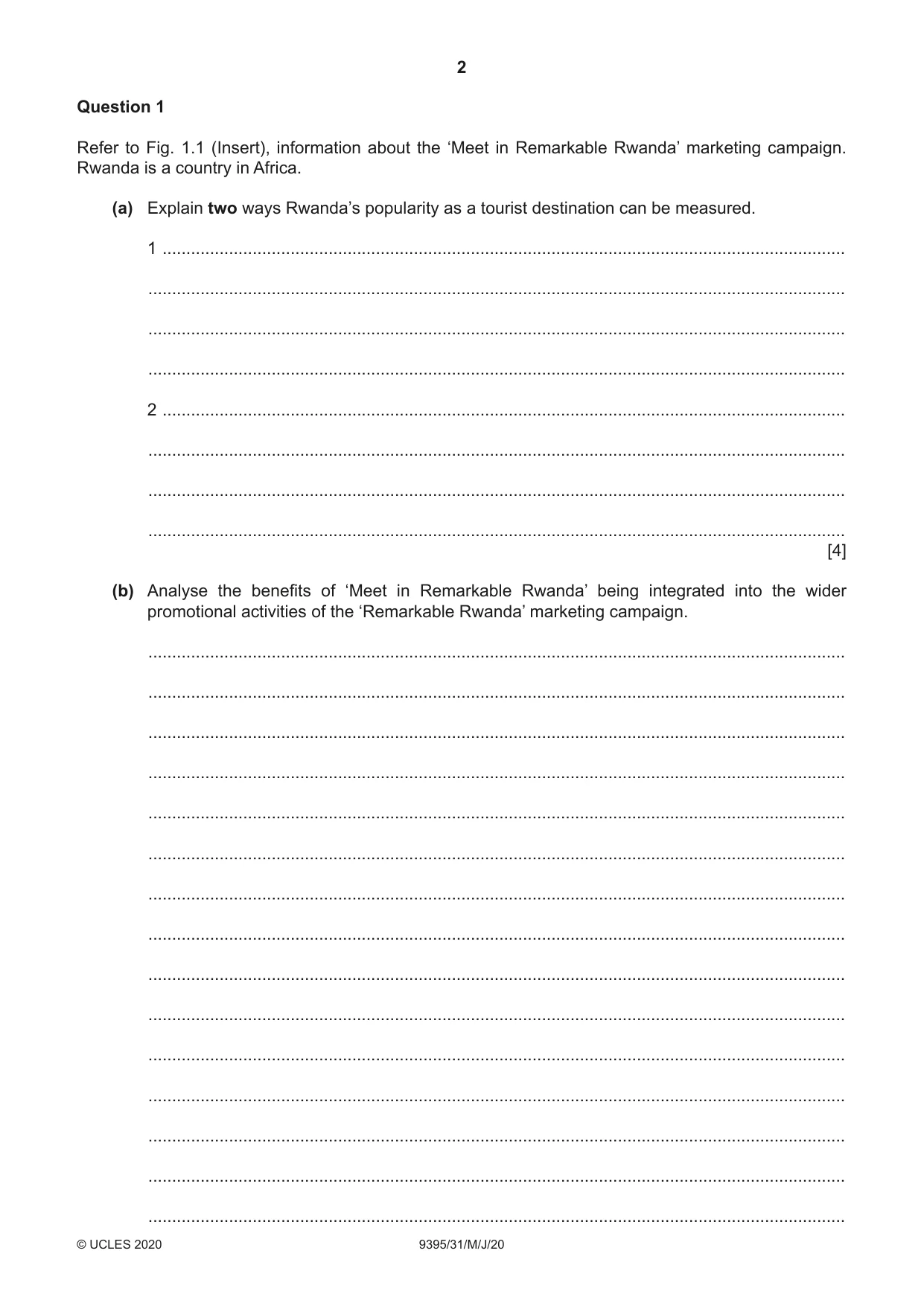
2 9395/31/M/J/20 © UCLES 2020 Question 1 Refer to Fig. 1.1 (Insert), information about the ‘Meet in Remarkable Rwanda’ marketing campaign. Rwanda is a country in Africa. (a) Explain two ways Rwanda’s popularity as a tourist destination can be measured. 1 … … … … 2 … … … … [4] (b) Analyse the benefits of ‘Meet in Remarkable Rwanda’ being integrated into the wider promotional activities of the ‘Remarkable Rwanda’ marketing campaign. … … … … … … … … … … … … … … …
Question paper, page 3
3 9395/31/M/J/20 © UCLES 2020 [Turn over … … … … … … … … … … … … … … … … … … … … … … … … … … … … [9]
Question paper, page 4
4 9395/31/M/J/20 © UCLES 2020 (c) Evaluate the claim that ‘Meet in Remarkable Rwanda’ is a market penetration strategy. … … … … … … … … … … … … … … … … … … … … … … … … … … …
Question paper, page 5
5 9395/31/M/J/20 © UCLES 2020 [Turn over … … … … … … … … … … … … … … … … … … … … … … … … … … … [12] [Total: 25]
Question paper, page 6
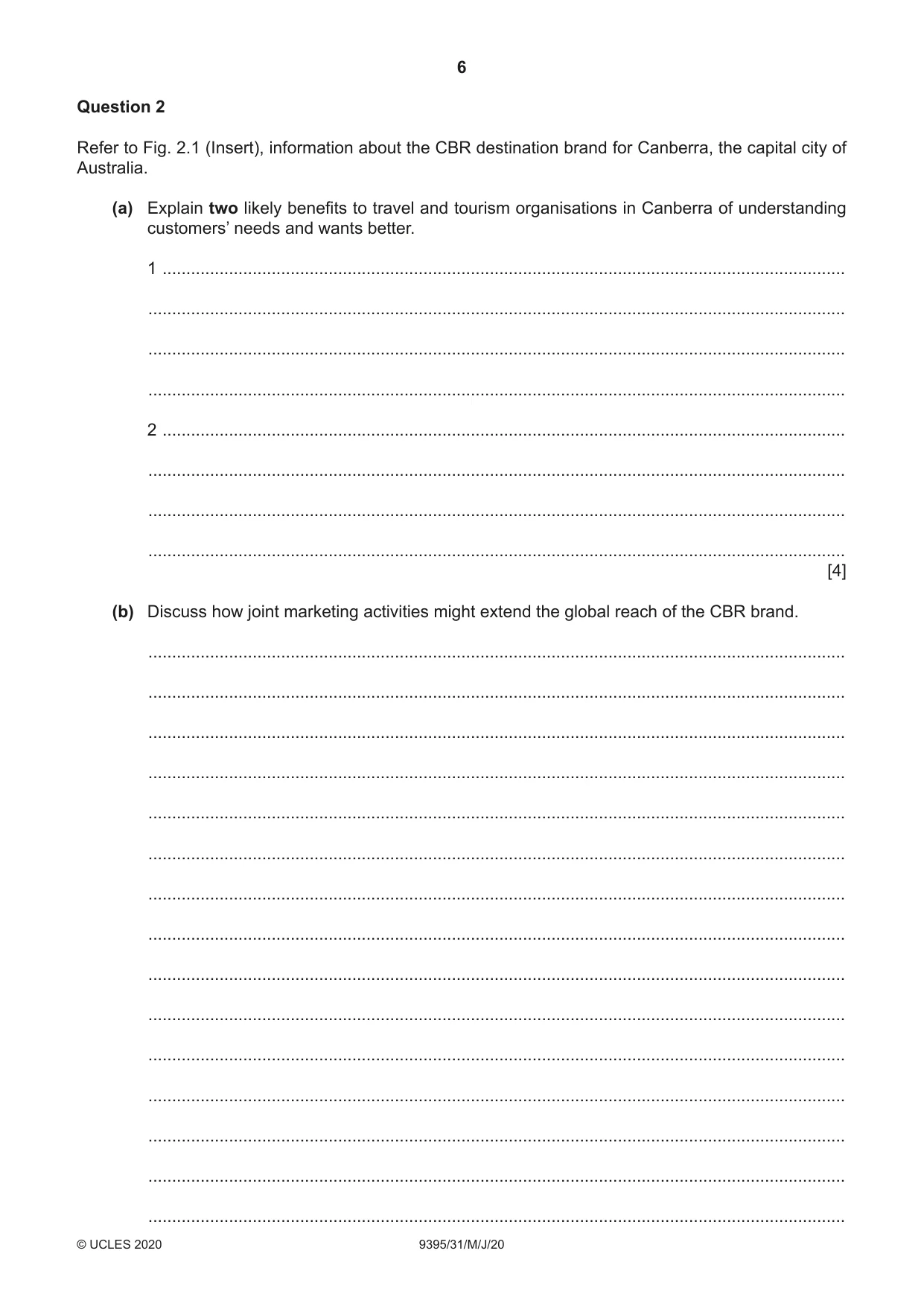
6 9395/31/M/J/20 © UCLES 2020 Question 2 Refer to Fig. 2.1 (Insert), information about the CBR destination brand for Canberra, the capital city of Australia. (a) Explain two likely benefits to travel and tourism organisations in Canberra of understanding customers’ needs and wants better. 1 … … … … 2 … … … … [4] (b) Discuss how joint marketing activities might extend the global reach of the CBR brand. … … … … … … … … … … … … … … …
Question paper, page 7
7 9395/31/M/J/20 © UCLES 2020 [Turn over … … … … … … … … … … … … … … … … … … … … … … … … … … … … [9]
Question paper, page 8
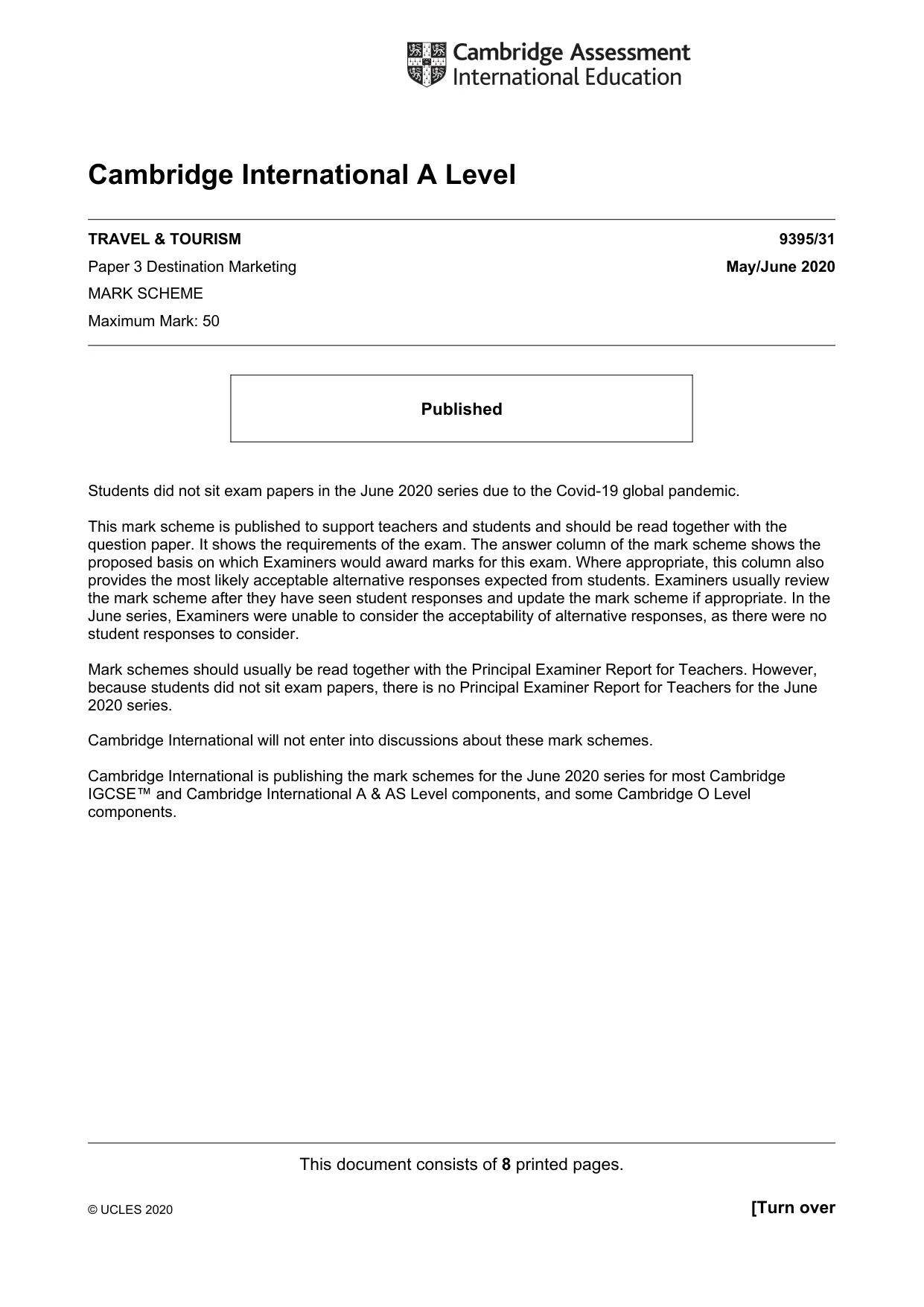
8 9395/31/M/J/20 © UCLES 2020 (c) Evaluate the effectiveness of the ‘Confident. Bold. Ready.’ tagline in conveying a credible brand message for Canberra. … … … … … … … … … … … … … … … … … … … … … … … … … … …
Question paper, page 9
9 9395/31/M/J/20 © UCLES 2020 … … … … … … … … … … … … … … … … … … … … … … … … … … … [12] [Total: 25]
Question paper, page 10
10 9395/31/M/J/20 © UCLES 2020 BLANK PAGE
Question paper, page 11
11 9395/31/M/J/20 © UCLES 2020 BLANK PAGE
Question paper, page 12
12 9395/31/M/J/20 © UCLES 2020 Permission to reproduce items where third-party owned material protected by copyright is included has been sought and cleared where possible. Every reasonable effort has been made by the publisher (UCLES) to trace copyright holders, but if any items requiring clearance have unwittingly been included, the publisher will be pleased to make amends at the earliest possible opportunity. To avoid the issue of disclosure of answer-related information to candidates, all copyright acknowledgements are reproduced online in the Cambridge Assessment International Education Copyright Acknowledgements Booklet. This is produced for each series of examinations and is freely available to download at www.cambridgeinternational.org after the live examination series. Cambridge Assessment International Education is part of the Cambridge Assessment Group. Cambridge Assessment is the brand name of the University of Cambridge Local Examinations Syndicate (UCLES), which itself is a department of the University of Cambridge. BLANK PAGE
Mark scheme, page 1
This document consists of 8 printed pages. © UCLES 2020 [Turn over Cambridge International A Level TRAVEL & TOURISM 9395/31 Paper 3 Destination Marketing May/June 2020 MARK SCHEME Maximum Mark: 50 Published Students did not sit exam papers in the June 2020 series due to the Covid-19 global pandemic. This mark scheme is published to support teachers and students and should be read together with the question paper. It shows the requirements of the exam. The answer column of the mark scheme shows the proposed basis on which Examiners would award marks for this exam. Where appropriate, this column also provides the most likely acceptable alternative responses expected from students. Examiners usually review the mark scheme after they have seen student responses and update the mark scheme if appropriate. In the June series, Examiners were unable to consider the acceptability of alternative responses, as there were no student responses to consider. Mark schemes should usually be read together with the Principal Examiner Report for Teachers. However, because students did not sit exam papers, there is no Principal Examiner Report for Teachers for the June 2020 series. Cambridge International will not enter into discussions about these mark schemes. Cambridge International is publishing the mark schemes for the June 2020 series for most Cambridge IGCSE™ and Cambridge International A & AS Level components, and some Cambridge O Level components.
Mark scheme, page 2
9395/31 Cambridge International A Level – Mark Scheme PUBLISHED May/June 2020 © UCLES 2020 Page 2 of 8 Generic Marking Principles These general marking principles must be applied by all examiners when marking candidate answers. They should be applied alongside the specific content of the mark scheme or generic level descriptors for a question. Each question paper and mark scheme will also comply with these marking principles. GENERIC MARKING PRINCIPLE 1: Marks must be awarded in line with: • the specific content of the mark scheme or the generic level descriptors for the question • the specific skills defined in the mark scheme or in the generic level descriptors for the question • the standard of response required by a candidate as exemplified by the standardisation scripts. GENERIC MARKING PRINCIPLE 2: Marks awarded are always whole marks (not half marks, or other fractions). GENERIC MARKING PRINCIPLE 3: Marks must be awarded positively: • marks are awarded for correct/valid answers, as defined in the mark scheme. However, credit is given for valid answers which go beyond the scope of the syllabus and mark scheme, referring to your Team Leader as appropriate • marks are awarded when candidates clearly demonstrate what they know and can do • marks are not deducted for errors • marks are not deducted for omissions • answers should only be judged on the quality of spelling, punctuation and grammar when these features are specifically assessed by the question as indicated by the mark scheme. The meaning, however, should be unambiguous. GENERIC MARKING PRINCIPLE 4: Rules must be applied consistently e.g. in situations where candidates have not followed instructions or in the application of generic level descriptors. GENERIC MARKING PRINCIPLE 5: Marks should be awarded using the full range of marks defined in the mark scheme for the question (however; the use of the full mark range may be limited according to the quality of the candidate responses seen). GENERIC MARKING PRINCIPLE 6: Marks awarded are based solely on the requirements as defined in the mark scheme. Marks should not be awarded with grade thresholds or grade descriptors in mind.
Mark scheme, page 3
9395/31 Cambridge International A Level – Mark Scheme PUBLISHED May/June 2020 © UCLES 2020 Page 3 of 8 Note: The two abbreviations in the case studies have the same letters but in different order. Give BoD if candidates use the wrong abbreviation in any of their answers. (We would never normally penalise for this in any case) Question Answer Marks 1(a) Explain two ways Rwanda’s popularity as a tourist destination can be measured. Award one mark for each of two identifications plus an additional mark for explanation of each. ICCA rankings (1) checking its position as a conference destination in Africa and globally (1) Attendance figures at trade fairs (1) to see how many travel trade partners visit the stand (1) Feedback from travel trade partners or customers (1) gauge whether reaction to the destination is predominantly positive (1) Market research (1) carrying out a survey of existing or potential customers (1) Accept any other reasonable answer. 4
Mark scheme, page 4
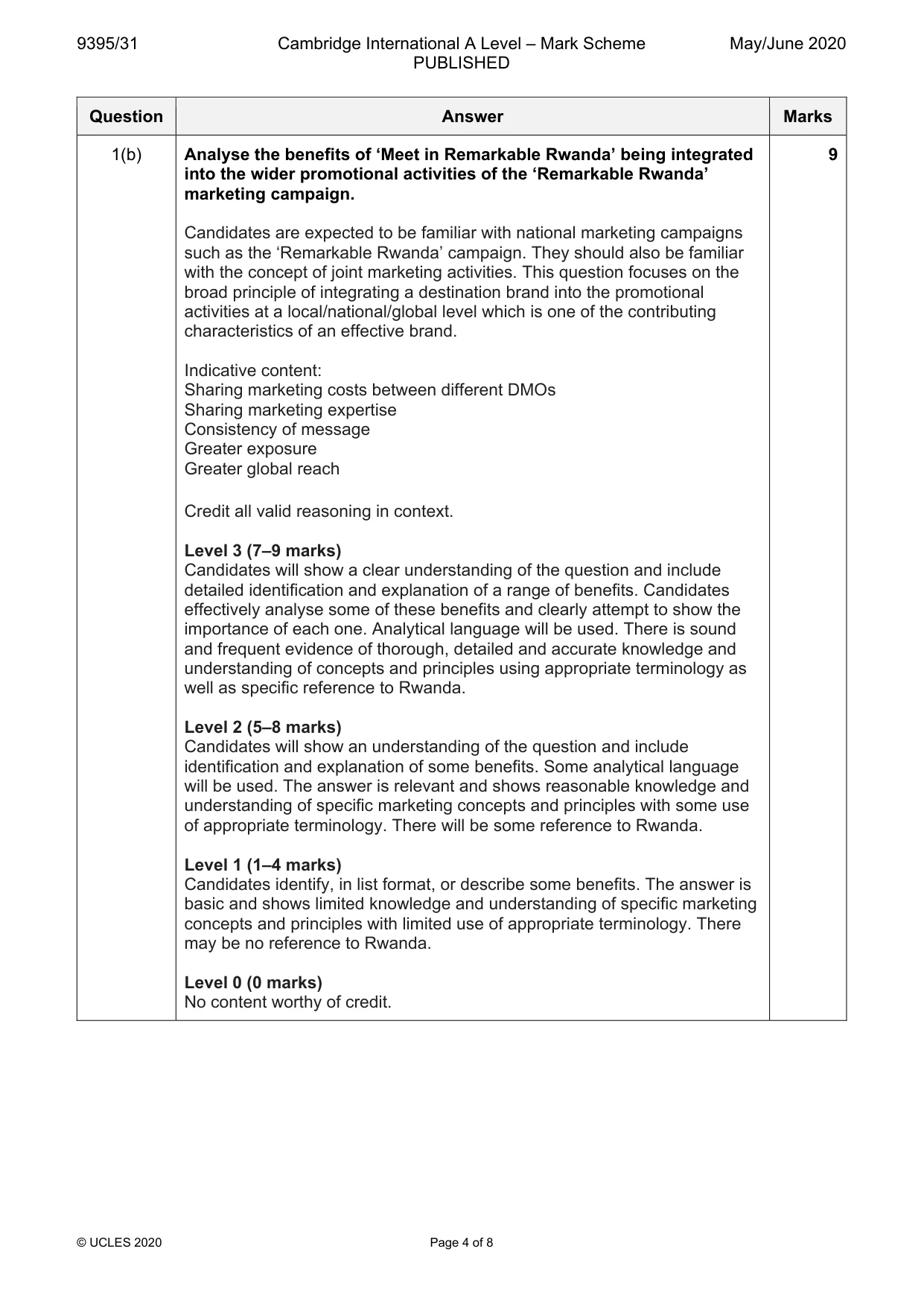
9395/31 Cambridge International A Level – Mark Scheme PUBLISHED May/June 2020 © UCLES 2020 Page 4 of 8 Question Answer Marks 1(b) Analyse the benefits of ‘Meet in Remarkable Rwanda’ being integrated into the wider promotional activities of the ‘Remarkable Rwanda’ marketing campaign. Candidates are expected to be familiar with national marketing campaigns such as the ‘Remarkable Rwanda’ campaign. They should also be familiar with the concept of joint marketing activities. This question focuses on the broad principle of integrating a destination brand into the promotional activities at a local/national/global level which is one of the contributing characteristics of an effective brand. Indicative content: Sharing marketing costs between different DMOs Sharing marketing expertise Consistency of message Greater exposure Greater global reach Credit all valid reasoning in context. Level 3 (7–9 marks) Candidates will show a clear understanding of the question and include detailed identification and explanation of a range of benefits. Candidates effectively analyse some of these benefits and clearly attempt to show the importance of each one. Analytical language will be used. There is sound and frequent evidence of thorough, detailed and accurate knowledge and understanding of concepts and principles using appropriate terminology as well as specific reference to Rwanda. Level 2 (5–8 marks) Candidates will show an understanding of the question and include identification and explanation of some benefits. Some analytical language will be used. The answer is relevant and shows reasonable knowledge and understanding of specific marketing concepts and principles with some use of appropriate terminology. There will be some reference to Rwanda. Level 1 (1–4 marks) Candidates identify, in list format, or describe some benefits. The answer is basic and shows limited knowledge and understanding of specific marketing concepts and principles with limited use of appropriate terminology. There may be no reference to Rwanda. Level 0 (0 marks) No content worthy of credit. 9
Mark scheme, page 5
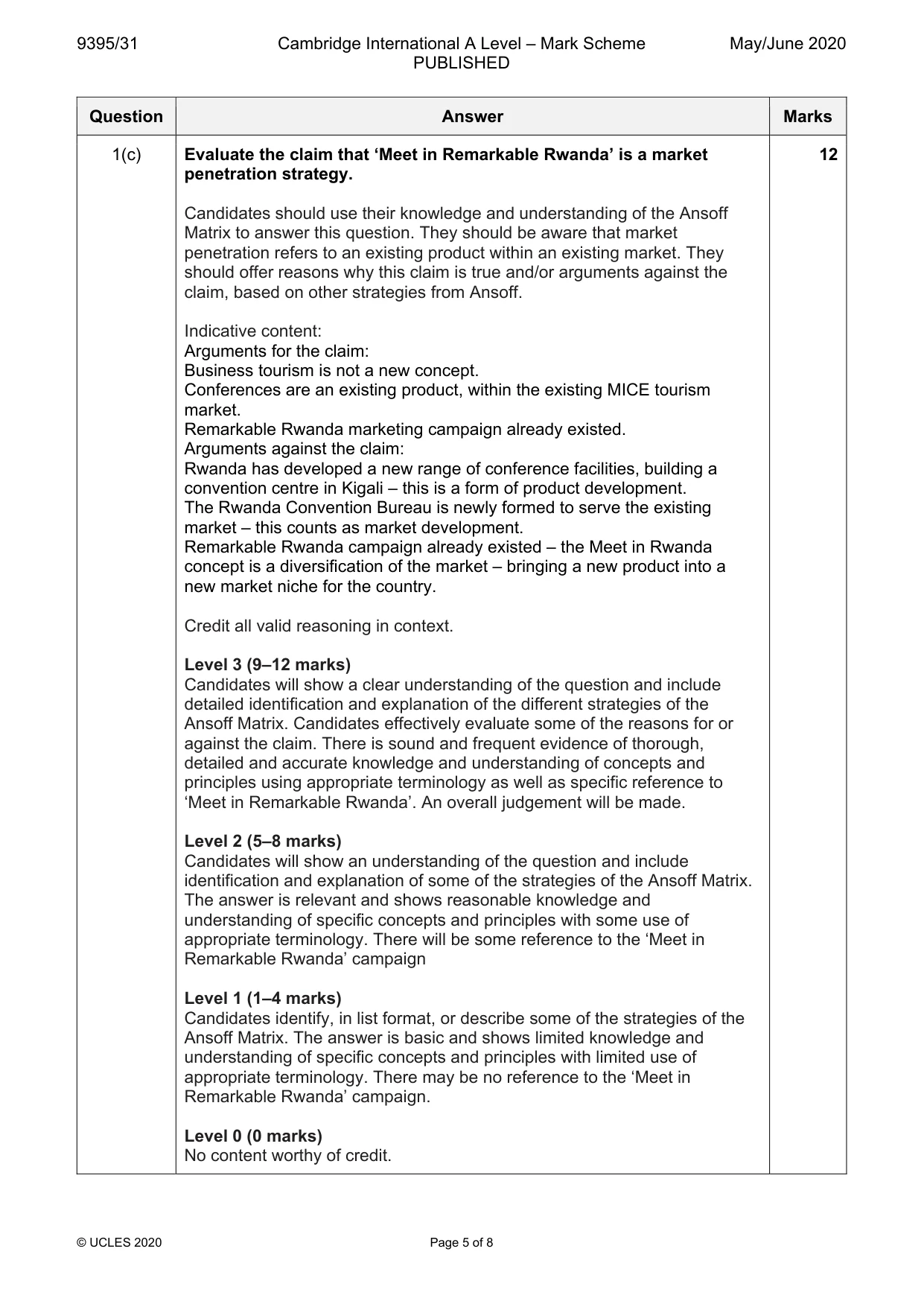
9395/31 Cambridge International A Level – Mark Scheme PUBLISHED May/June 2020 © UCLES 2020 Page 5 of 8 Question Answer Marks 1(c) Evaluate the claim that ‘Meet in Remarkable Rwanda’ is a market penetration strategy. Candidates should use their knowledge and understanding of the Ansoff Matrix to answer this question. They should be aware that market penetration refers to an existing product within an existing market. They should offer reasons why this claim is true and/or arguments against the claim, based on other strategies from Ansoff. Indicative content: Arguments for the claim: Business tourism is not a new concept. Conferences are an existing product, within the existing MICE tourism market. Remarkable Rwanda marketing campaign already existed. Arguments against the claim: Rwanda has developed a new range of conference facilities, building a convention centre in Kigali – this is a form of product development. The Rwanda Convention Bureau is newly formed to serve the existing market – this counts as market development. Remarkable Rwanda campaign already existed – the Meet in Rwanda concept is a diversification of the market – bringing a new product into a new market niche for the country. Credit all valid reasoning in context. Level 3 (9–12 marks) Candidates will show a clear understanding of the question and include detailed identification and explanation of the different strategies of the Ansoff Matrix. Candidates effectively evaluate some of the reasons for or against the claim. There is sound and frequent evidence of thorough, detailed and accurate knowledge and understanding of concepts and principles using appropriate terminology as well as specific reference to ‘Meet in Remarkable Rwanda’. An overall judgement will be made. Level 2 (5–8 marks) Candidates will show an understanding of the question and include identification and explanation of some of the strategies of the Ansoff Matrix. The answer is relevant and shows reasonable knowledge and understanding of specific concepts and principles with some use of appropriate terminology. There will be some reference to the ‘Meet in Remarkable Rwanda’ campaign Level 1 (1–4 marks) Candidates identify, in list format, or describe some of the strategies of the Ansoff Matrix. The answer is basic and shows limited knowledge and understanding of specific concepts and principles with limited use of appropriate terminology. There may be no reference to the ‘Meet in Remarkable Rwanda’ campaign. Level 0 (0 marks) No content worthy of credit. 12
Mark scheme, page 6
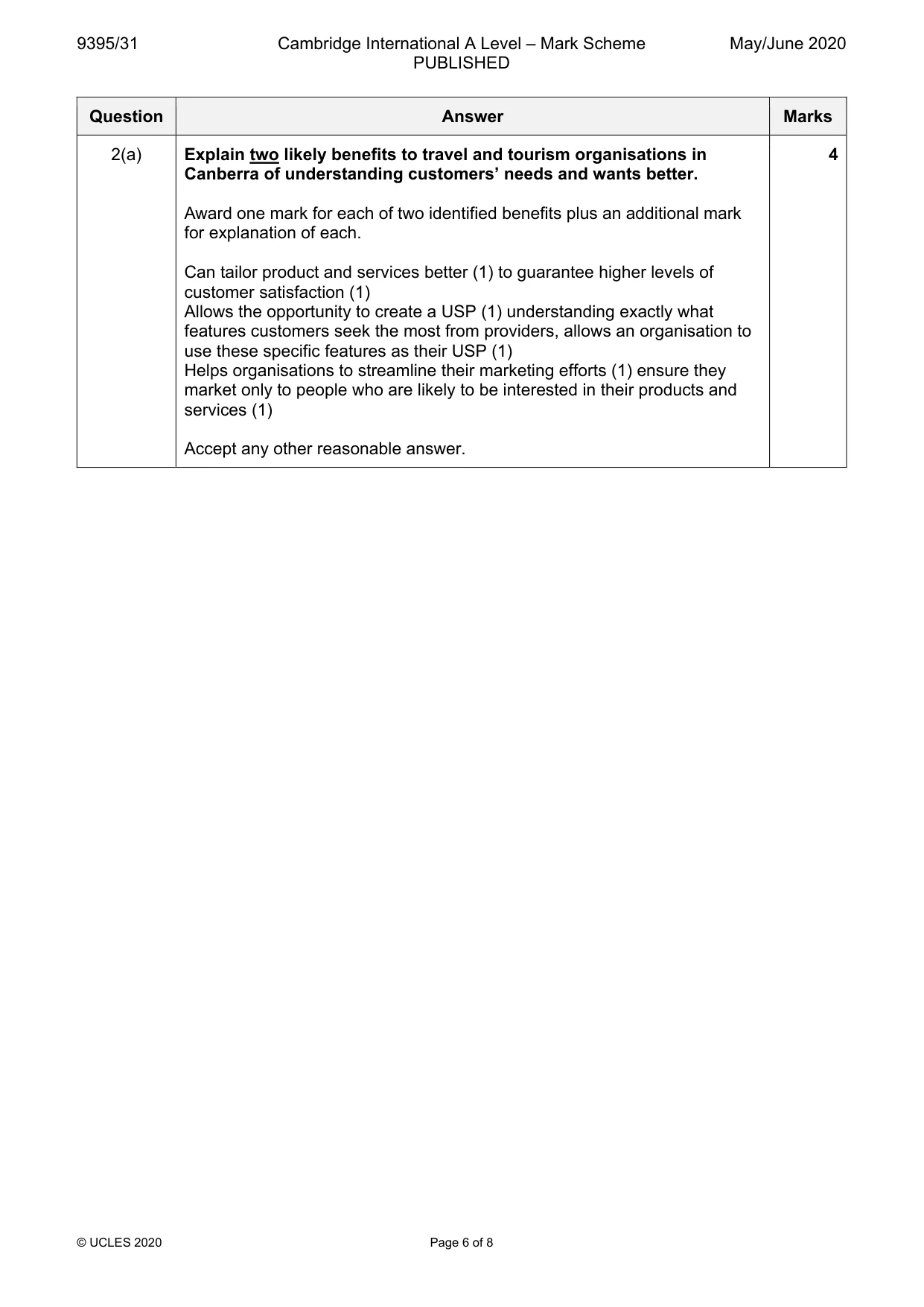
9395/31 Cambridge International A Level – Mark Scheme PUBLISHED May/June 2020 © UCLES 2020 Page 6 of 8 Question Answer Marks 2(a) Explain two likely benefits to travel and tourism organisations in Canberra of understanding customers’ needs and wants better. Award one mark for each of two identified benefits plus an additional mark for explanation of each. Can tailor product and services better (1) to guarantee higher levels of customer satisfaction (1) Allows the opportunity to create a USP (1) understanding exactly what features customers seek the most from providers, allows an organisation to use these specific features as their USP (1) Helps organisations to streamline their marketing efforts (1) ensure they market only to people who are likely to be interested in their products and services (1) Accept any other reasonable answer. 4
Mark scheme, page 7
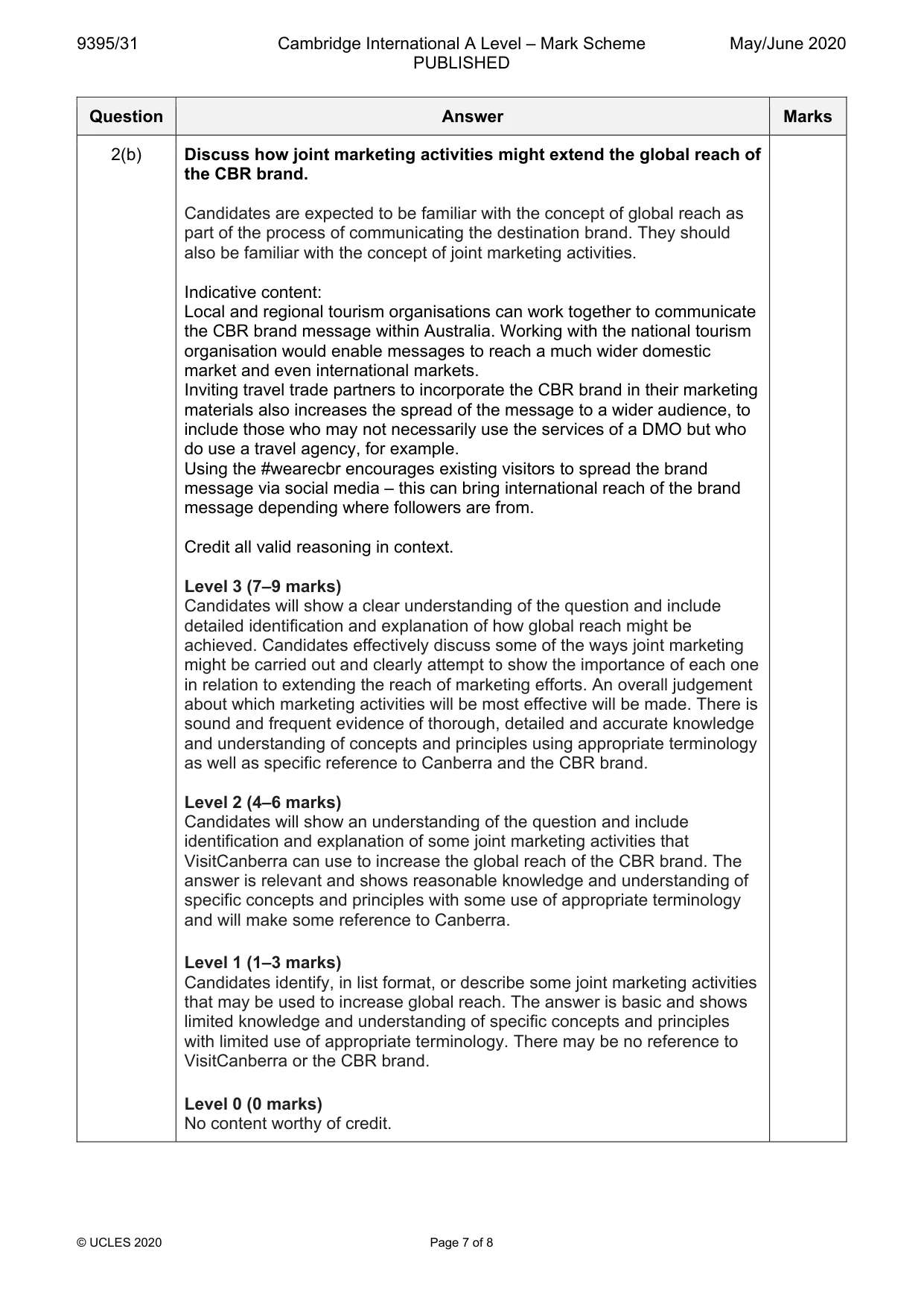
9395/31 Cambridge International A Level – Mark Scheme PUBLISHED May/June 2020 © UCLES 2020 Page 7 of 8 Question Answer Marks 2(b) Discuss how joint marketing activities might extend the global reach of the CBR brand. Candidates are expected to be familiar with the concept of global reach as part of the process of communicating the destination brand. They should also be familiar with the concept of joint marketing activities. Indicative content: Local and regional tourism organisations can work together to communicate the CBR brand message within Australia. Working with the national tourism organisation would enable messages to reach a much wider domestic market and even international markets. Inviting travel trade partners to incorporate the CBR brand in their marketing materials also increases the spread of the message to a wider audience, to include those who may not necessarily use the services of a DMO but who do use a travel agency, for example. Using the #wearecbr encourages existing visitors to spread the brand message via social media – this can bring international reach of the brand message depending where followers are from. Credit all valid reasoning in context. Level 3 (7–9 marks) Candidates will show a clear understanding of the question and include detailed identification and explanation of how global reach might be achieved. Candidates effectively discuss some of the ways joint marketing might be carried out and clearly attempt to show the importance of each one in relation to extending the reach of marketing efforts. An overall judgement about which marketing activities will be most effective will be made. There is sound and frequent evidence of thorough, detailed and accurate knowledge and understanding of concepts and principles using appropriate terminology as well as specific reference to Canberra and the CBR brand. Level 2 (4–6 marks) Candidates will show an understanding of the question and include identification and explanation of some joint marketing activities that VisitCanberra can use to increase the global reach of the CBR brand. The answer is relevant and shows reasonable knowledge and understanding of specific concepts and principles with some use of appropriate terminology and will make some reference to Canberra. Level 1 (1–3 marks) Candidates identify, in list format, or describe some joint marketing activities that may be used to increase global reach. The answer is basic and shows limited knowledge and understanding of specific concepts and principles with limited use of appropriate terminology. There may be no reference to VisitCanberra or the CBR brand. Level 0 (0 marks) No content worthy of credit.
Mark scheme, page 8
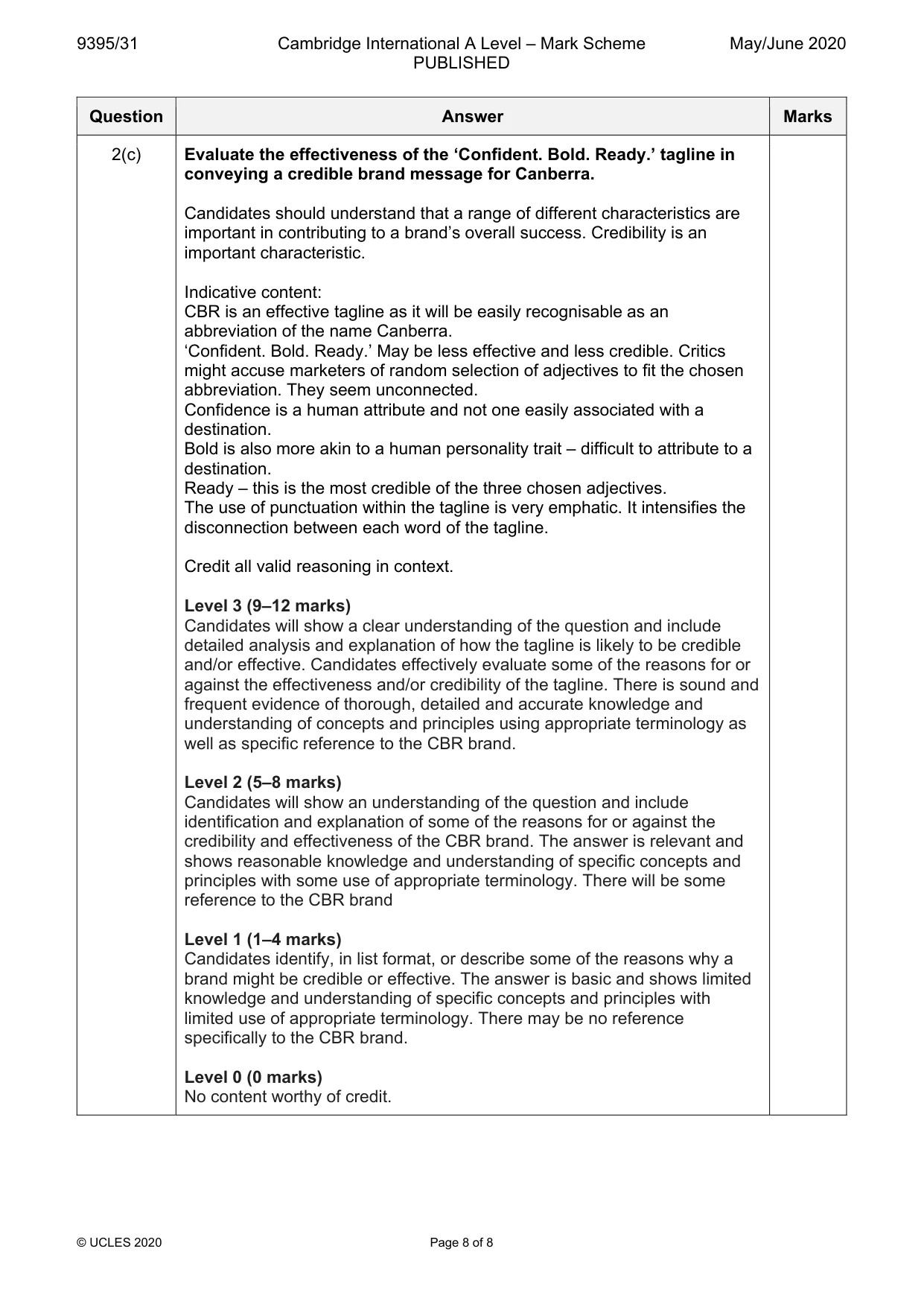
9395/31 Cambridge International A Level – Mark Scheme PUBLISHED May/June 2020 © UCLES 2020 Page 8 of 8 Question Answer Marks 2(c) Evaluate the effectiveness of the ‘Confident. Bold. Ready.’ tagline in conveying a credible brand message for Canberra. Candidates should understand that a range of different characteristics are important in contributing to a brand’s overall success. Credibility is an important characteristic. Indicative content: CBR is an effective tagline as it will be easily recognisable as an abbreviation of the name Canberra. ‘Confident. Bold. Ready.’ May be less effective and less credible. Critics might accuse marketers of random selection of adjectives to fit the chosen abbreviation. They seem unconnected. Confidence is a human attribute and not one easily associated with a destination. Bold is also more akin to a human personality trait – difficult to attribute to a destination. Ready – this is the most credible of the three chosen adjectives. The use of punctuation within the tagline is very emphatic. It intensifies the disconnection between each word of the tagline. Credit all valid reasoning in context. Level 3 (9–12 marks) Candidates will show a clear understanding of the question and include detailed analysis and explanation of how the tagline is likely to be credible and/or effective. Candidates effectively evaluate some of the reasons for or against the effectiveness and/or credibility of the tagline. There is sound and frequent evidence of thorough, detailed and accurate knowledge and understanding of concepts and principles using appropriate terminology as well as specific reference to the CBR brand. Level 2 (5–8 marks) Candidates will show an understanding of the question and include identification and explanation of some of the reasons for or against the credibility and effectiveness of the CBR brand. The answer is relevant and shows reasonable knowledge and understanding of specific concepts and principles with some use of appropriate terminology. There will be some reference to the CBR brand Level 1 (1–4 marks) Candidates identify, in list format, or describe some of the reasons why a brand might be credible or effective. The answer is basic and shows limited knowledge and understanding of specific concepts and principles with limited use of appropriate terminology. There may be no reference specifically to the CBR brand. Level 0 (0 marks) No content worthy of credit.