Cambridge A Level Travel and Tourism 9395 — 2024 May/June Paper 3 · Variant 1
9395/31/M/J/24 · 50 marks · 90 min
The question paper and its mark scheme, free to read here and free to download. This is Cambridge’s own paper, exactly as it was sat.
Question paper12 pages







Mark scheme16 pages
Answers below. Sit the paper first if you are practising.
Paper as text
Question paper, page 1
This document has 12 pages. Any blank pages are indicated. [Turn over Cambridge International AS & A Level * 6 3 7 0 5 3 9 5 5 4 * DC (DE) 333434/1 © UCLES 2024 TRAVEL & TOURISM 9395/31 Paper 3 Destination Marketing May/June 2024 1 hour 30 minutes You must answer on the question paper. You will need: Insert (enclosed) INSTRUCTIONS ● Answer all questions. ● Use a black or dark blue pen. ● Write your name, centre number and candidate number in the boxes at the top of the page. ● Write your answer to each question in the space provided. ● Do not use an erasable pen or correction fluid. ● Do not write on any bar codes. INFORMATION ● The total mark for this paper is 50. ● The number of marks for each question or part question is shown in brackets [ ]. ● The insert contains all the figures referred to in the questions.
Question paper, page 2
2 9395/31/M/J/24 © UCLES 2024 1 Refer to Fig. 1.1 (Insert), information about the Vanilla Islands marketing group. (a) Explain two ways the six islands in the Vanilla Islands marketing group work together. 1 … … … … 2 … … … … [4] (b) Discuss how the Vanilla Islands marketing group might use visitor profiling. … … … … … … … … … … … … … … … … …
Question paper, page 3
3 9395/31/M/J/24 © UCLES 2024 [Turn over … … … … … … … … … … … … … … … … … … … … … … … … … … … … [9]
Question paper, page 4
4 9395/31/M/J/24 © UCLES 2024 (c) Evaluate how the Vanilla Islands marketing group can ensure its brand matches the destinations’ attributes. … … … … … … … … … … … … … … … … … … … … … … … … … … …
Question paper, page 5
5 9395/31/M/J/24 © UCLES 2024 [Turn over … … … … … … … … … … … … … … … … … … … … … … … … … … … [12] [Total: 25]
Question paper, page 6
6 9395/31/M/J/24 © UCLES 2024 2 Refer to Fig. 2.1 (Insert), information about the ‘İstanbul is the new cool’ marketing campaign. (a) Explain two ways that GoTürkiye has created a brand identity for İstanbul. 1 … … … … 2 … … … … [4] (b) Discuss the disadvantages of using qualitative research to define the tourism market for a destination. … … … … … … … … … … … … … … … …
Question paper, page 7
7 9395/31/M/J/24 © UCLES 2024 [Turn over … … … … … … … … … … … … … … … … … … … … … … … … … … … … [9]
Question paper, page 8
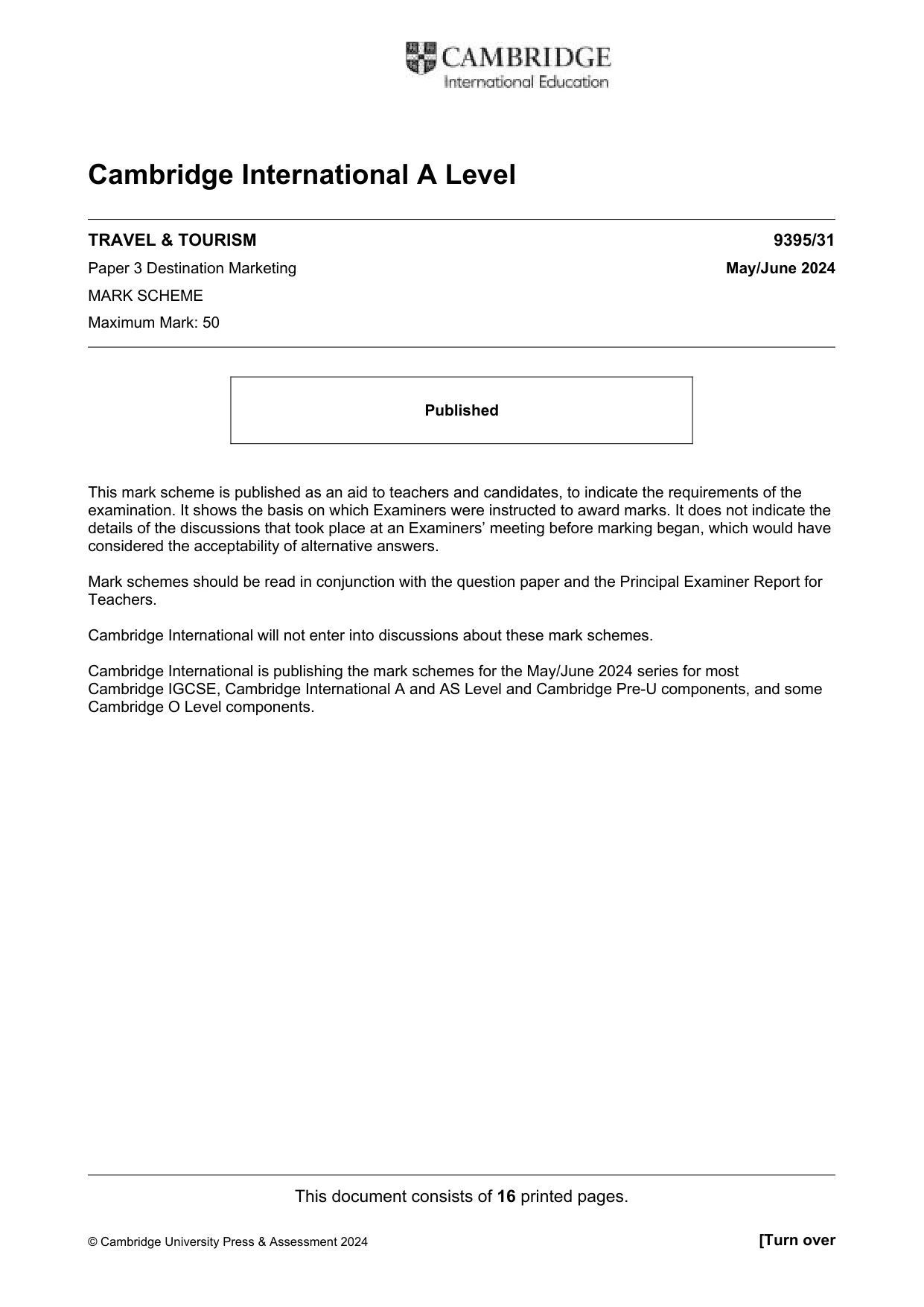
8 9395/31/M/J/24 © UCLES 2024 (c) Evaluate why setting objectives would be a key stage in planning the launch of a new destination brand. … … … … … … … … … … … … … … … … … … … … … … … … … … …
Question paper, page 9
9 9395/31/M/J/24 © UCLES 2024 … … … … … … … … … … … … … … … … … … … … … … … … … … … [12] [Total: 25]
Question paper, page 10
10 9395/31/M/J/24 © UCLES 2024 BLANK PAGE
Question paper, page 11
11 9395/31/M/J/24 © UCLES 2024 BLANK PAGE
Question paper, page 12
12 9395/31/M/J/24 © UCLES 2024 The boundaries and names shown, the designations used and the presentation of material on any maps contained in this question paper/insert do not imply official endorsement or acceptance by Cambridge Assessment International Education concerning the legal status of any country, territory, or area or any of its authorities, or of the delimitation of its frontiers or boundaries. Permission to reproduce items where third-party owned material protected by copyright is included has been sought and cleared where possible. Every reasonable effort has been made by the publisher (UCLES) to trace copyright holders, but if any items requiring clearance have unwittingly been included, the publisher will be pleased to make amends at the earliest possible opportunity. To avoid the issue of disclosure of answer-related information to candidates, all copyright acknowledgements are reproduced online in the Cambridge Assessment International Education Copyright Acknowledgements Booklet. This is produced for each series of examinations and is freely available to download at www.cambridgeinternational.org after the live examination series. Cambridge Assessment International Education is part of Cambridge Assessment. Cambridge Assessment is the brand name of the University of Cambridge Local Examinations Syndicate (UCLES), which is a department of the University of Cambridge. BLANK PAGE
Mark scheme, page 1
This document consists of 16 printed pages. © Cambridge University Press & Assessment 2024 [Turn over Cambridge International A Level TRAVEL & TOURISM 9395/31 Paper 3 Destination Marketing May/June 2024 MARK SCHEME Maximum Mark: 50 Published This mark scheme is published as an aid to teachers and candidates, to indicate the requirements of the examination. It shows the basis on which Examiners were instructed to award marks. It does not indicate the details of the discussions that took place at an Examiners’ meeting before marking began, which would have considered the acceptability of alternative answers. Mark schemes should be read in conjunction with the question paper and the Principal Examiner Report for Teachers. Cambridge International will not enter into discussions about these mark schemes. Cambridge International is publishing the mark schemes for the May/June 2024 series for most Cambridge IGCSE, Cambridge International A and AS Level and Cambridge Pre-U components, and some Cambridge O Level components.
Mark scheme, page 2
9395/31 Cambridge International A Level – Mark Scheme PUBLISHED May/June 2024 © Cambridge University Press & Assessment 2024 Page 2 of 16 Generic Marking Principles These general marking principles must be applied by all examiners when marking candidate answers. They should be applied alongside the specific content of the mark scheme or generic level descriptions for a question. Each question paper and mark scheme will also comply with these marking principles. GENERIC MARKING PRINCIPLE 1: Marks must be awarded in line with: the specific content of the mark scheme or the generic level descriptors for the question the specific skills defined in the mark scheme or in the generic level descriptors for the question the standard of response required by a candidate as exemplified by the standardisation scripts. GENERIC MARKING PRINCIPLE 2: Marks awarded are always whole marks (not half marks, or other fractions). GENERIC MARKING PRINCIPLE 3: Marks must be awarded positively: marks are awarded for correct/valid answers, as defined in the mark scheme. However, credit is given for valid answers which go beyond the scope of the syllabus and mark scheme, referring to your Team Leader as appropriate marks are awarded when candidates clearly demonstrate what they know and can do marks are not deducted for errors marks are not deducted for omissions answers should only be judged on the quality of spelling, punctuation and grammar when these features are specifically assessed by the question as indicated by the mark scheme. The meaning, however, should be unambiguous. GENERIC MARKING PRINCIPLE 4: Rules must be applied consistently, e.g. in situations where candidates have not followed instructions or in the application of generic level descriptors. GENERIC MARKING PRINCIPLE 5: Marks should be awarded using the full range of marks defined in the mark scheme for the question (however; the use of the full mark range may be limited according to the quality of the candidate responses seen). GENERIC MARKING PRINCIPLE 6: Marks awarded are based solely on the requirements as defined in the mark scheme. Marks should not be awarded with grade thresholds or grade descriptors in mind.
Mark scheme, page 3
9395/31 Cambridge International A Level – Mark Scheme PUBLISHED May/June 2024 © Cambridge University Press & Assessment 2024 Page 3 of 16 Social Science-Specific Marking Principles (for point-based marking) 1 Components using point-based marking: Point marking is often used to reward knowledge, understanding and application of skills. We give credit where the candidate’s answer shows relevant knowledge, understanding and application of skills in answering the question. We do not give credit where the answer shows confusion. From this it follows that we: a DO credit answers which are worded differently from the mark scheme if they clearly convey the same meaning (unless the mark scheme requires a specific term) b DO credit alternative answers/examples which are not written in the mark scheme if they are correct c DO credit answers where candidates give more than one correct answer in one prompt/numbered/scaffolded space where extended writing is required rather than list-type answers. For example, questions that require n reasons (e.g. State two reasons …) d DO NOT credit answers simply for using a ‘key term’ unless that is all that is required. (Check for evidence it is understood and not used wrongly.) e DO NOT credit answers which are obviously self-contradicting or trying to cover all possibilities f DO NOT give further credit for what is effectively repetition of a correct point already credited unless the language itself is being tested. This applies equally to ‘mirror statements’ (i.e. polluted/not polluted). g DO NOT require spellings to be correct, unless this is part of the test. However spellings of syllabus terms must allow for clear and unambiguous separation from other syllabus terms with which they may be confused (e.g. Corrasion/Corrosion). 2 Presentation of mark scheme: Slashes (/) or the word ‘or’ separate alternative ways of making the same point Semi colons (;) bullet points (•) or figures in brackets (1) separate different points Content in the answer column in brackets is for examiner information/context to clarify the marking but is not required to earn the mark (except Accounting syllabuses where they indicate negative numbers). 3 Calculation questions: The mark scheme will show the steps in the most likely correct method(s), the mark for each step, the correct answer(s) and the mark for each answer If working/explanation is considered essential for full credit, this will be indicated in the question paper and in the mark scheme. In all other instances, the correct answer to a calculation should be given full credit, even if no supporting working is shown Where the candidate uses a valid method which is not covered by the mark scheme, award equivalent marks for reaching equivalent stages Where an answer makes use of a candidate’s own incorrect figure from previous working, the ‘own figure rule’ applies: full marks will be given if a correct and complete method is used. Further guidance will be included in the mark scheme where necessary and any exceptions to this general principle will be noted.
Mark scheme, page 4
9395/31 Cambridge International A Level – Mark Scheme PUBLISHED May/June 2024 © Cambridge University Press & Assessment 2024 Page 4 of 16 4 Annotation: For point marking, ticks can be used to indicate correct answers and crosses can be used to indicate wrong answers. There is no direct relationship between ticks and marks. Ticks have no defined meaning for levels of response marking For levels of response marking, the level awarded should be annotated on the script Other annotations will be used by examiners as agreed during standardisation, and the meaning will be understood by all examiners who marked that paper.
Mark scheme, page 5
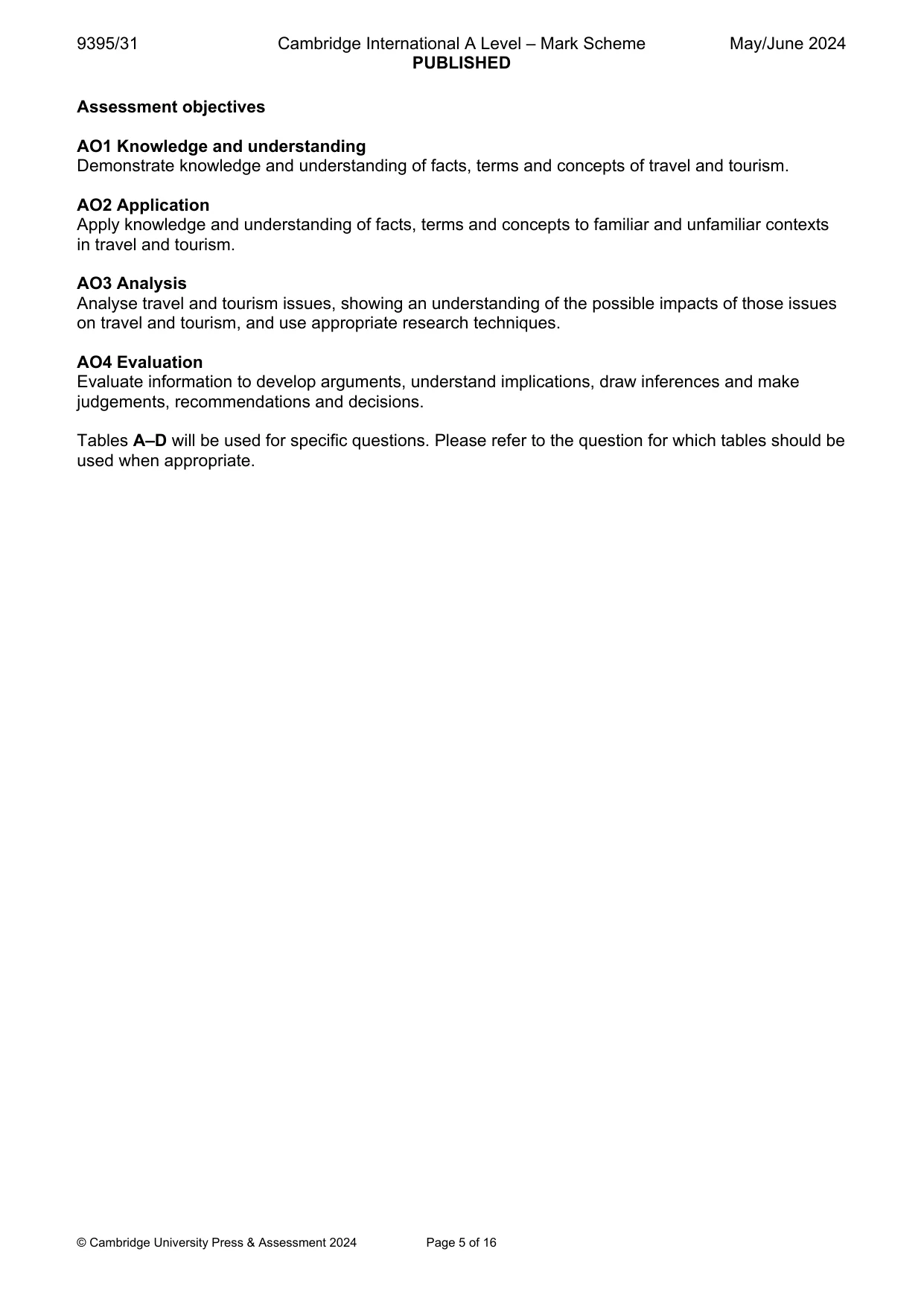
9395/31 Cambridge International A Level – Mark Scheme PUBLISHED May/June 2024 © Cambridge University Press & Assessment 2024 Page 5 of 16 Assessment objectives AO1 Knowledge and understanding Demonstrate knowledge and understanding of facts, terms and concepts of travel and tourism. AO2 Application Apply knowledge and understanding of facts, terms and concepts to familiar and unfamiliar contexts in travel and tourism. AO3 Analysis Analyse travel and tourism issues, showing an understanding of the possible impacts of those issues on travel and tourism, and use appropriate research techniques. AO4 Evaluation Evaluate information to develop arguments, understand implications, draw inferences and make judgements, recommendations and decisions. Tables A–D will be used for specific questions. Please refer to the question for which tables should be used when appropriate.
Mark scheme, page 6
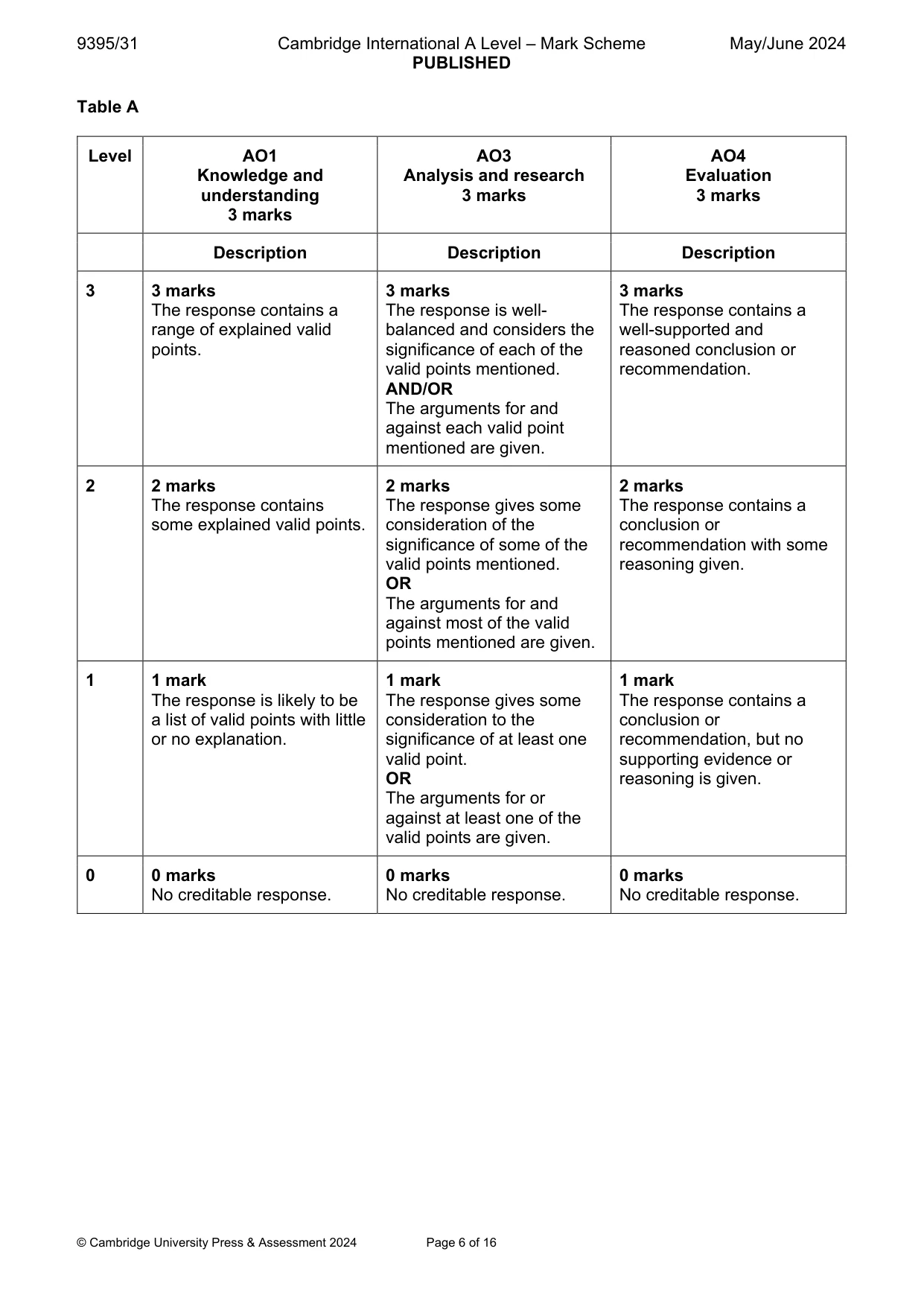
9395/31 Cambridge International A Level – Mark Scheme PUBLISHED May/June 2024 © Cambridge University Press & Assessment 2024 Page 6 of 16 Table A Level AO1 Knowledge and understanding 3 marks AO3 Analysis and research 3 marks AO4 Evaluation 3 marks Description Description Description 3 3 marks The response contains a range of explained valid points. 3 marks The response is well- balanced and considers the significance of each of the valid points mentioned. AND/OR The arguments for and against each valid point mentioned are given. 3 marks The response contains a well-supported and reasoned conclusion or recommendation. 2 2 marks The response contains some explained valid points. 2 marks The response gives some consideration of the significance of some of the valid points mentioned. OR The arguments for and against most of the valid points mentioned are given. 2 marks The response contains a conclusion or recommendation with some reasoning given. 1 1 mark The response is likely to be a list of valid points with little or no explanation. 1 mark The response gives some consideration to the significance of at least one valid point. OR The arguments for or against at least one of the valid points are given. 1 mark The response contains a conclusion or recommendation, but no supporting evidence or reasoning is given. 0 0 marks No creditable response. 0 marks No creditable response. 0 marks No creditable response.
Mark scheme, page 7
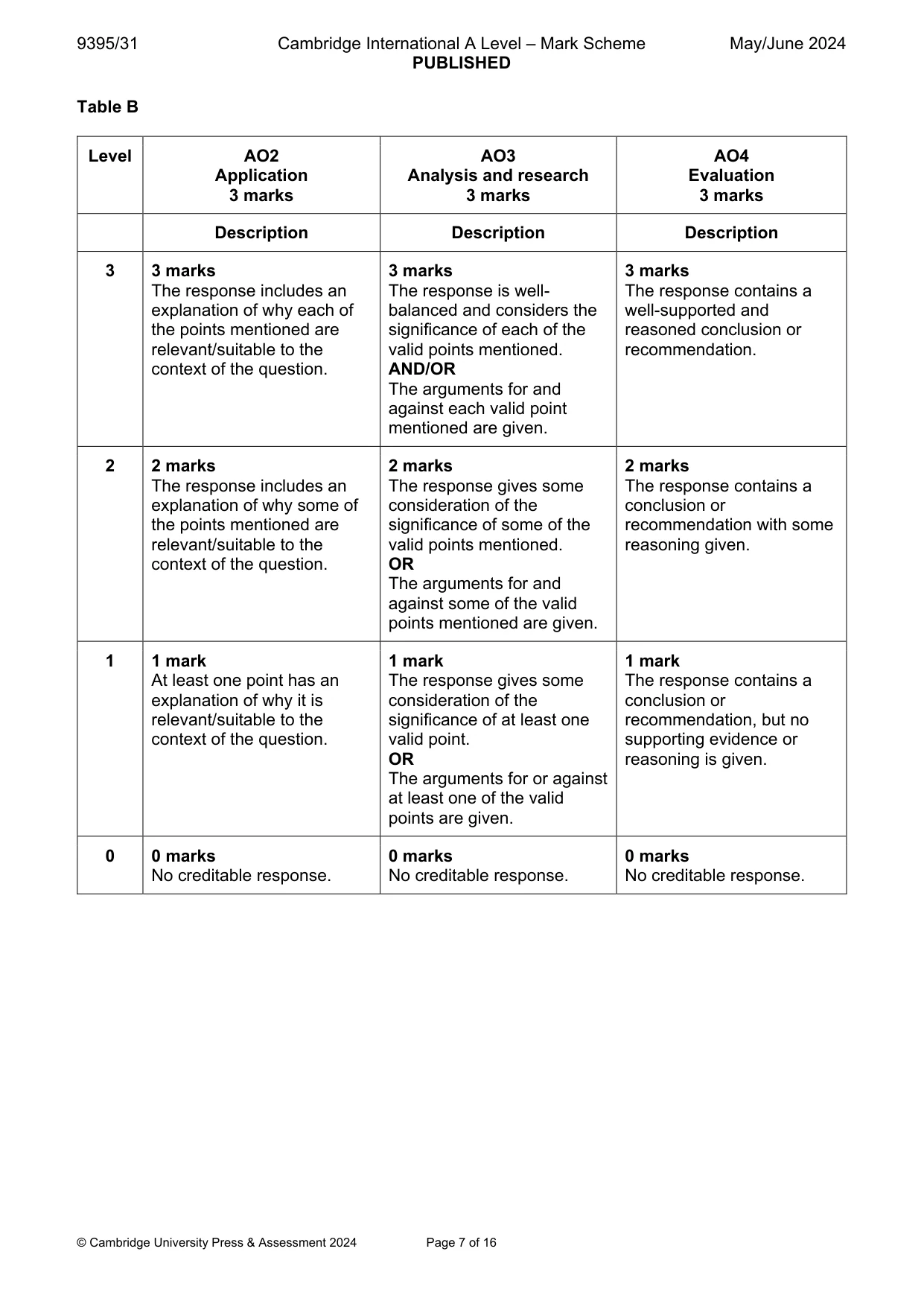
9395/31 Cambridge International A Level – Mark Scheme PUBLISHED May/June 2024 © Cambridge University Press & Assessment 2024 Page 7 of 16 Table B Level AO2 Application 3 marks AO3 Analysis and research 3 marks AO4 Evaluation 3 marks Description Description Description 3 3 marks The response includes an explanation of why each of the points mentioned are relevant/suitable to the context of the question. 3 marks The response is well- balanced and considers the significance of each of the valid points mentioned. AND/OR The arguments for and against each valid point mentioned are given. 3 marks The response contains a well-supported and reasoned conclusion or recommendation. 2 2 marks The response includes an explanation of why some of the points mentioned are relevant/suitable to the context of the question. 2 marks The response gives some consideration of the significance of some of the valid points mentioned. OR The arguments for and against some of the valid points mentioned are given. 2 marks The response contains a conclusion or recommendation with some reasoning given. 1 1 mark At least one point has an explanation of why it is relevant/suitable to the context of the question. 1 mark The response gives some consideration of the significance of at least one valid point. OR The arguments for or against at least one of the valid points are given. 1 mark The response contains a conclusion or recommendation, but no supporting evidence or reasoning is given. 0 0 marks No creditable response. 0 marks No creditable response. 0 marks No creditable response.
Mark scheme, page 8
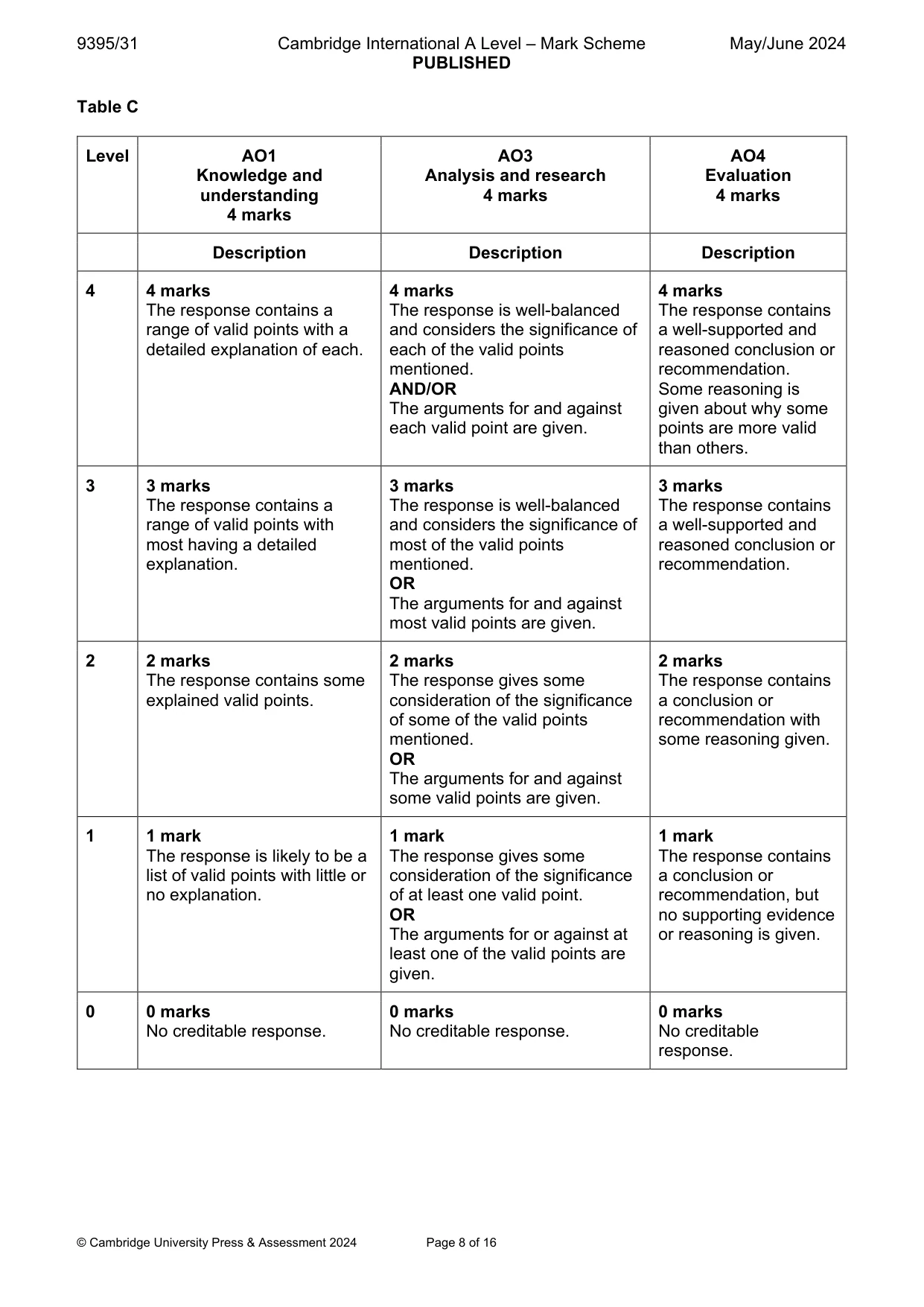
9395/31 Cambridge International A Level – Mark Scheme PUBLISHED May/June 2024 © Cambridge University Press & Assessment 2024 Page 8 of 16 Table C Level AO1 Knowledge and understanding 4 marks AO3 Analysis and research 4 marks AO4 Evaluation 4 marks Description Description Description 4 4 marks The response contains a range of valid points with a detailed explanation of each. 4 marks The response is well-balanced and considers the significance of each of the valid points mentioned. AND/OR The arguments for and against each valid point are given. 4 marks The response contains a well-supported and reasoned conclusion or recommendation. Some reasoning is given about why some points are more valid than others. 3 3 marks The response contains a range of valid points with most having a detailed explanation. 3 marks The response is well-balanced and considers the significance of most of the valid points mentioned. OR The arguments for and against most valid points are given. 3 marks The response contains a well-supported and reasoned conclusion or recommendation. 2 2 marks The response contains some explained valid points. 2 marks The response gives some consideration of the significance of some of the valid points mentioned. OR The arguments for and against some valid points are given. 2 marks The response contains a conclusion or recommendation with some reasoning given. 1 1 mark The response is likely to be a list of valid points with little or no explanation. 1 mark The response gives some consideration of the significance of at least one valid point. OR The arguments for or against at least one of the valid points are given. 1 mark The response contains a conclusion or recommendation, but no supporting evidence or reasoning is given. 0 0 marks No creditable response. 0 marks No creditable response. 0 marks No creditable response.
Mark scheme, page 9
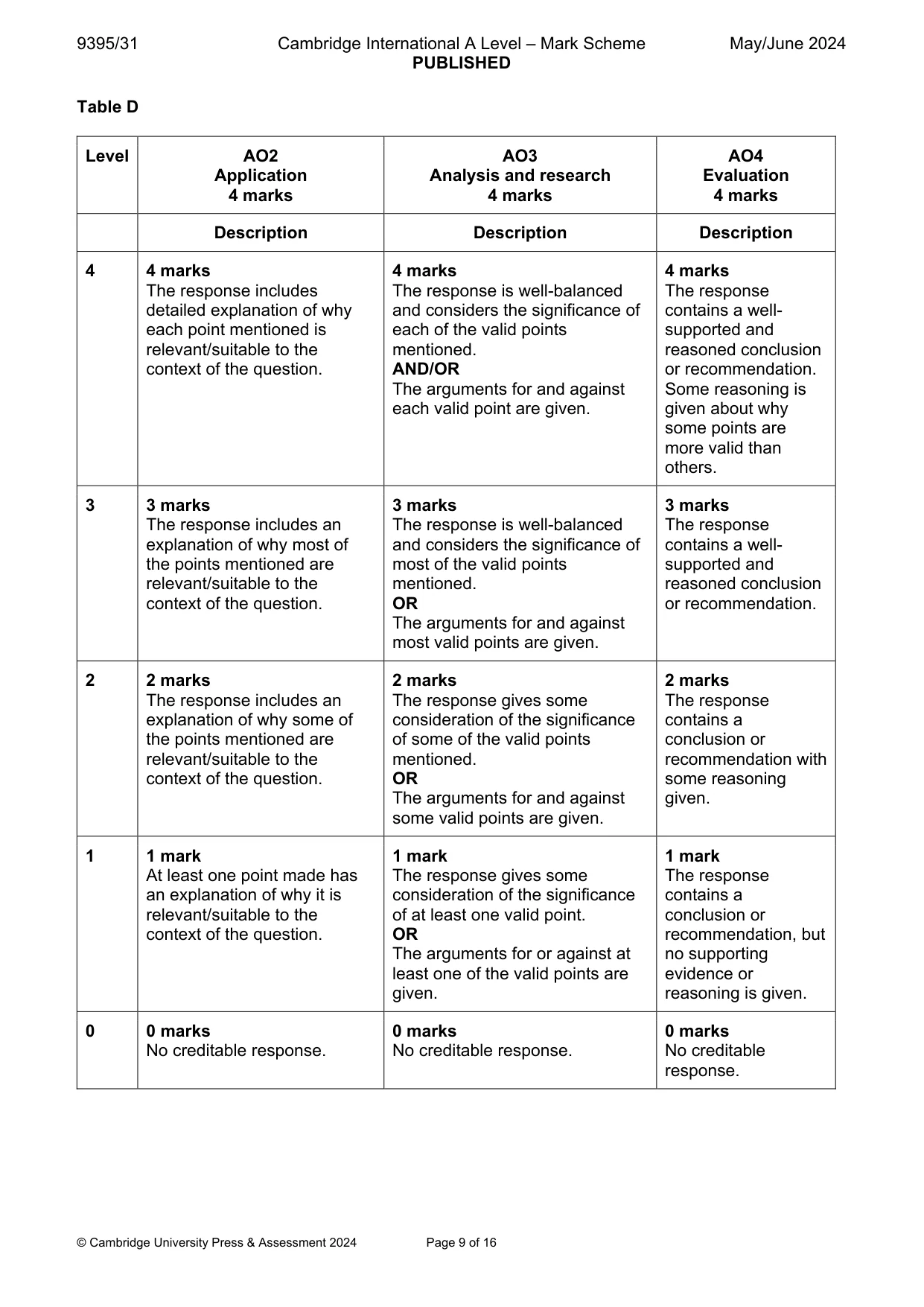
9395/31 Cambridge International A Level – Mark Scheme PUBLISHED May/June 2024 © Cambridge University Press & Assessment 2024 Page 9 of 16 Table D Level AO2 Application 4 marks AO3 Analysis and research 4 marks AO4 Evaluation 4 marks Description Description Description 4 4 marks The response includes detailed explanation of why each point mentioned is relevant/suitable to the context of the question. 4 marks The response is well-balanced and considers the significance of each of the valid points mentioned. AND/OR The arguments for and against each valid point are given. 4 marks The response contains a well- supported and reasoned conclusion or recommendation. Some reasoning is given about why some points are more valid than others. 3 3 marks The response includes an explanation of why most of the points mentioned are relevant/suitable to the context of the question. 3 marks The response is well-balanced and considers the significance of most of the valid points mentioned. OR The arguments for and against most valid points are given. 3 marks The response contains a well- supported and reasoned conclusion or recommendation. 2 2 marks The response includes an explanation of why some of the points mentioned are relevant/suitable to the context of the question. 2 marks The response gives some consideration of the significance of some of the valid points mentioned. OR The arguments for and against some valid points are given. 2 marks The response contains a conclusion or recommendation with some reasoning given. 1 1 mark At least one point made has an explanation of why it is relevant/suitable to the context of the question. 1 mark The response gives some consideration of the significance of at least one valid point. OR The arguments for or against at least one of the valid points are given. 1 mark The response contains a conclusion or recommendation, but no supporting evidence or reasoning is given. 0 0 marks No creditable response. 0 marks No creditable response. 0 marks No creditable response.
Mark scheme, page 10
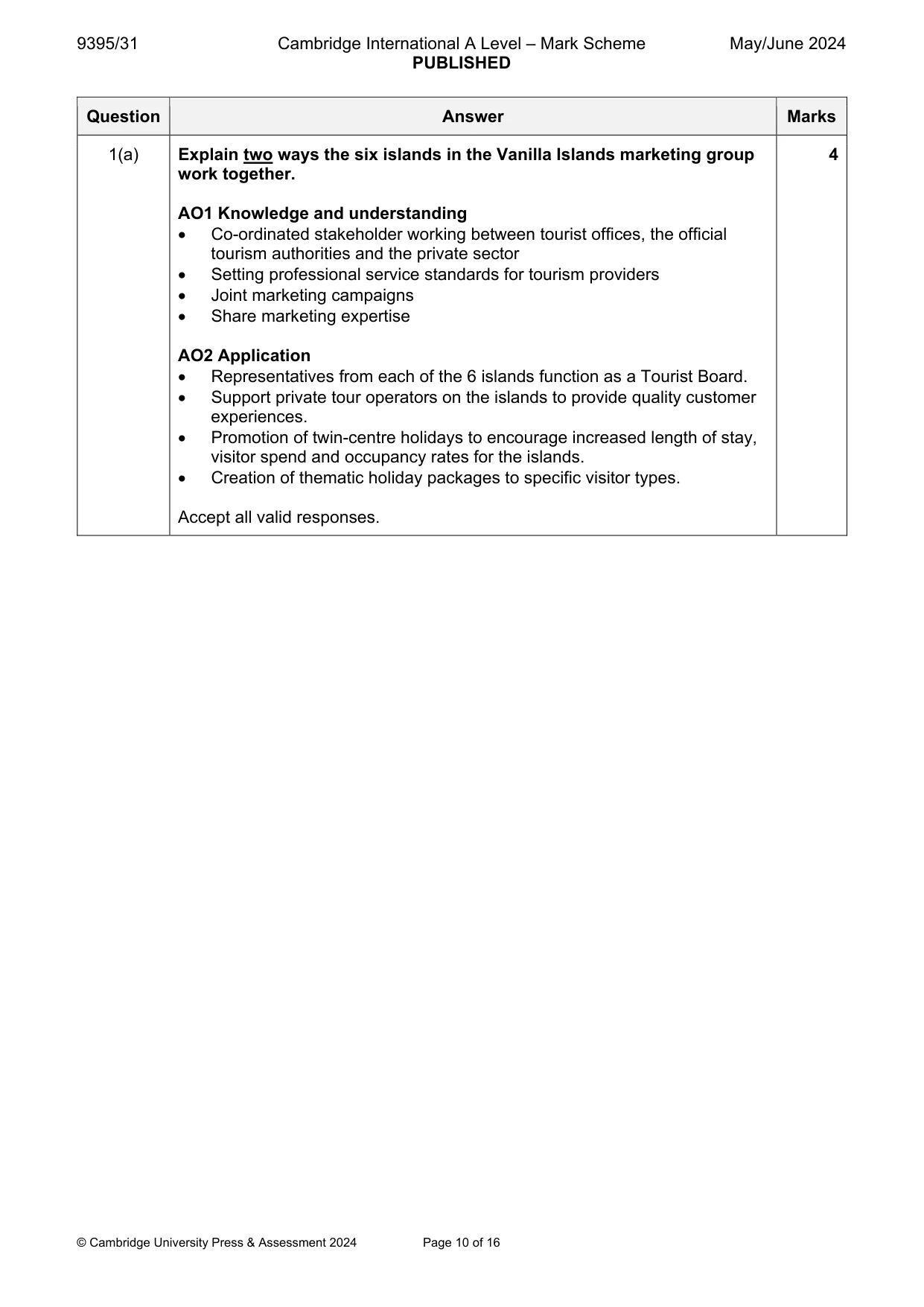
9395/31 Cambridge International A Level – Mark Scheme PUBLISHED May/June 2024 © Cambridge University Press & Assessment 2024 Page 10 of 16 Question Answer Marks 1(a) Explain two ways the six islands in the Vanilla Islands marketing group work together. AO1 Knowledge and understanding Co-ordinated stakeholder working between tourist offices, the official tourism authorities and the private sector Setting professional service standards for tourism providers Joint marketing campaigns Share marketing expertise AO2 Application Representatives from each of the 6 islands function as a Tourist Board. Support private tour operators on the islands to provide quality customer experiences. Promotion of twin-centre holidays to encourage increased length of stay, visitor spend and occupancy rates for the islands. Creation of thematic holiday packages to specific visitor types. Accept all valid responses. 4
Mark scheme, page 11
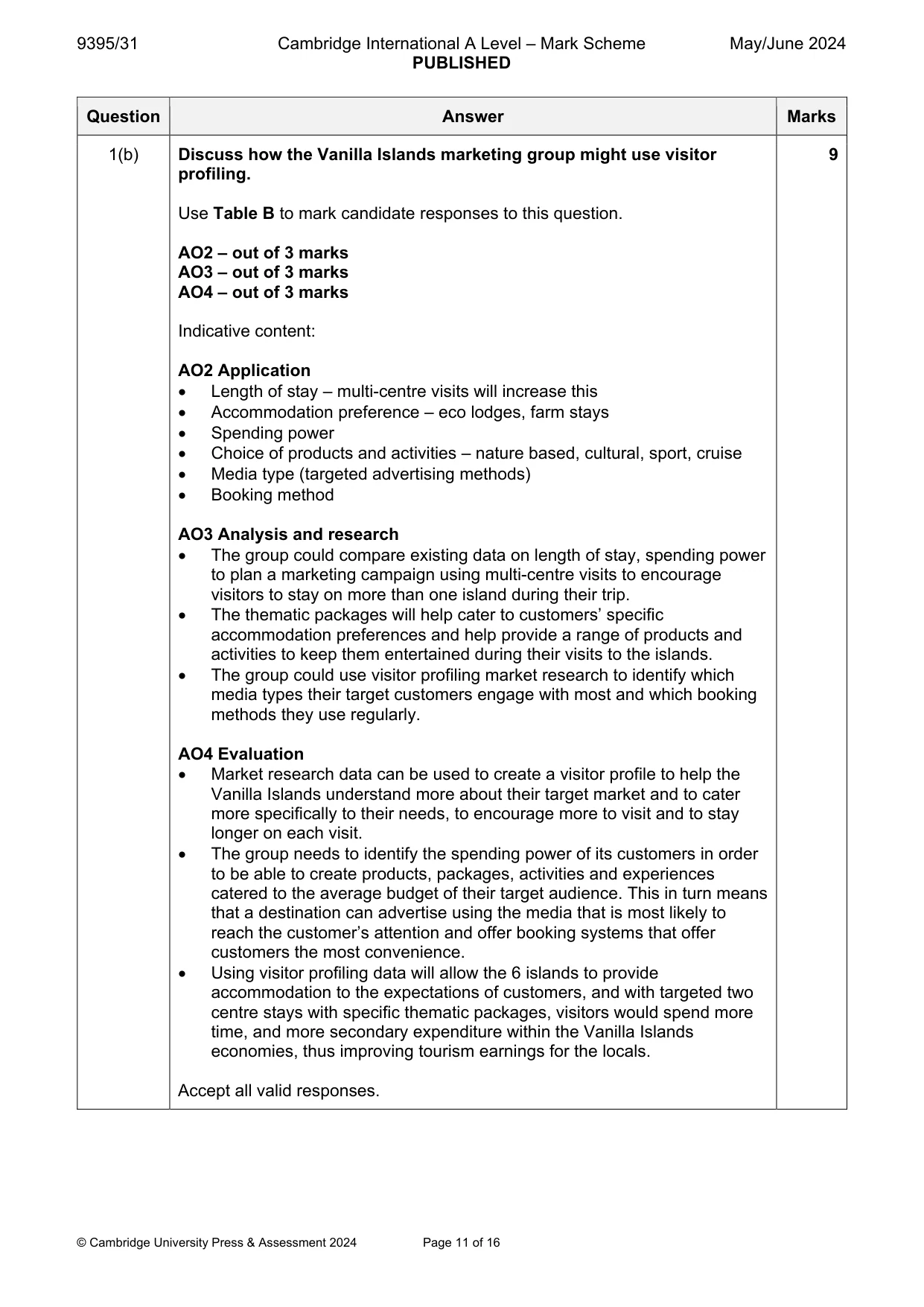
9395/31 Cambridge International A Level – Mark Scheme PUBLISHED May/June 2024 © Cambridge University Press & Assessment 2024 Page 11 of 16 Question Answer Marks 1(b) Discuss how the Vanilla Islands marketing group might use visitor profiling. Use Table B to mark candidate responses to this question. AO2 – out of 3 marks AO3 – out of 3 marks AO4 – out of 3 marks Indicative content: AO2 Application Length of stay – multi-centre visits will increase this Accommodation preference – eco lodges, farm stays Spending power Choice of products and activities – nature based, cultural, sport, cruise Media type (targeted advertising methods) Booking method AO3 Analysis and research The group could compare existing data on length of stay, spending power to plan a marketing campaign using multi-centre visits to encourage visitors to stay on more than one island during their trip. The thematic packages will help cater to customers’ specific accommodation preferences and help provide a range of products and activities to keep them entertained during their visits to the islands. The group could use visitor profiling market research to identify which media types their target customers engage with most and which booking methods they use regularly. AO4 Evaluation Market research data can be used to create a visitor profile to help the Vanilla Islands understand more about their target market and to cater more specifically to their needs, to encourage more to visit and to stay longer on each visit. The group needs to identify the spending power of its customers in order to be able to create products, packages, activities and experiences catered to the average budget of their target audience. This in turn means that a destination can advertise using the media that is most likely to reach the customer’s attention and offer booking systems that offer customers the most convenience. Using visitor profiling data will allow the 6 islands to provide accommodation to the expectations of customers, and with targeted two centre stays with specific thematic packages, visitors would spend more time, and more secondary expenditure within the Vanilla Islands economies, thus improving tourism earnings for the locals. Accept all valid responses. 9
Mark scheme, page 12
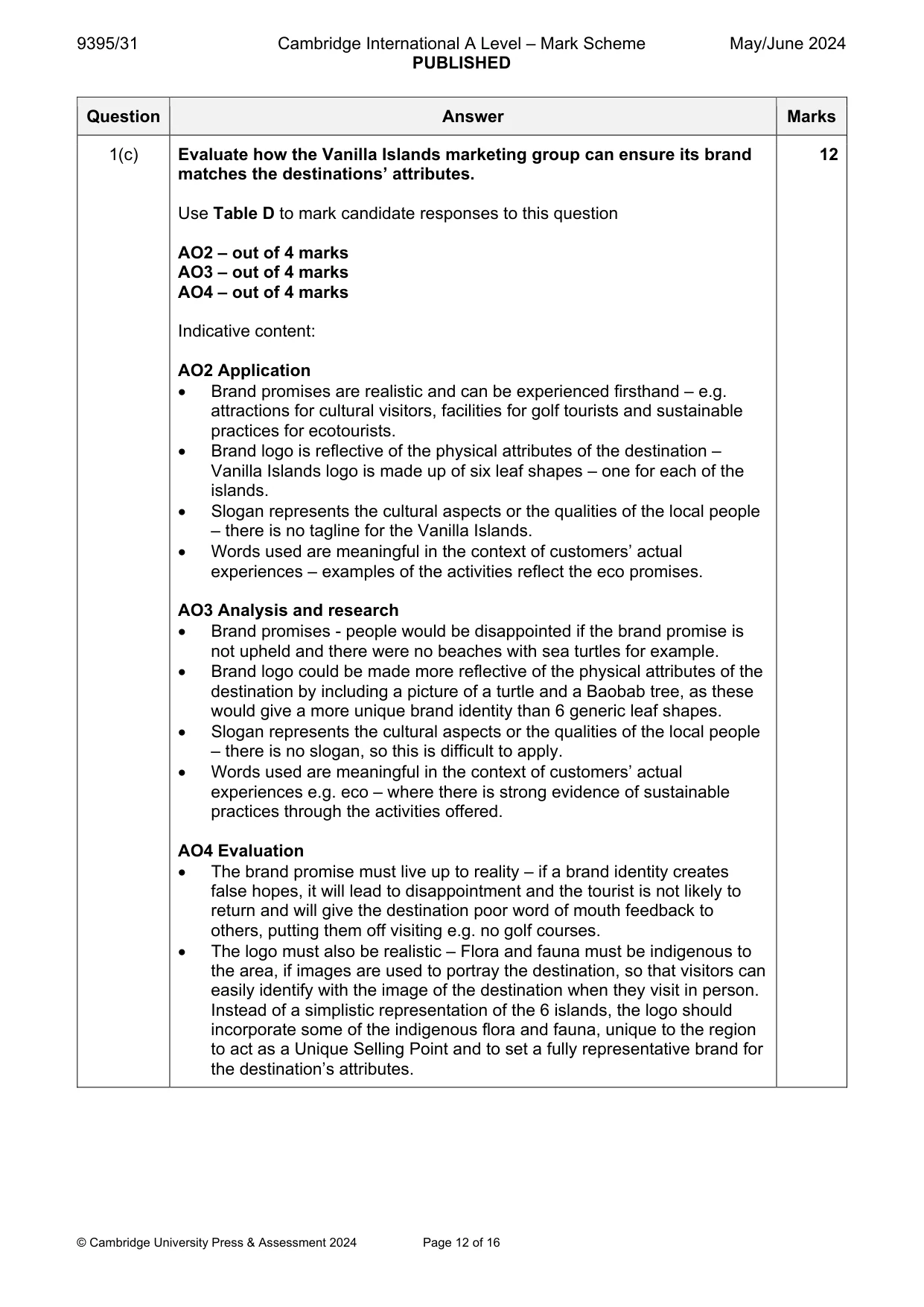
9395/31 Cambridge International A Level – Mark Scheme PUBLISHED May/June 2024 © Cambridge University Press & Assessment 2024 Page 12 of 16 Question Answer Marks 1(c) Evaluate how the Vanilla Islands marketing group can ensure its brand matches the destinations’ attributes. Use Table D to mark candidate responses to this question AO2 – out of 4 marks AO3 – out of 4 marks AO4 – out of 4 marks Indicative content: AO2 Application Brand promises are realistic and can be experienced firsthand – e.g. attractions for cultural visitors, facilities for golf tourists and sustainable practices for ecotourists. Brand logo is reflective of the physical attributes of the destination – Vanilla Islands logo is made up of six leaf shapes – one for each of the islands. Slogan represents the cultural aspects or the qualities of the local people – there is no tagline for the Vanilla Islands. Words used are meaningful in the context of customers’ actual experiences – examples of the activities reflect the eco promises. AO3 Analysis and research Brand promises - people would be disappointed if the brand promise is not upheld and there were no beaches with sea turtles for example. Brand logo could be made more reflective of the physical attributes of the destination by including a picture of a turtle and a Baobab tree, as these would give a more unique brand identity than 6 generic leaf shapes. Slogan represents the cultural aspects or the qualities of the local people – there is no slogan, so this is difficult to apply. Words used are meaningful in the context of customers’ actual experiences e.g. eco – where there is strong evidence of sustainable practices through the activities offered. AO4 Evaluation The brand promise must live up to reality – if a brand identity creates false hopes, it will lead to disappointment and the tourist is not likely to return and will give the destination poor word of mouth feedback to others, putting them off visiting e.g. no golf courses. The logo must also be realistic – Flora and fauna must be indigenous to the area, if images are used to portray the destination, so that visitors can easily identify with the image of the destination when they visit in person. Instead of a simplistic representation of the 6 islands, the logo should incorporate some of the indigenous flora and fauna, unique to the region to act as a Unique Selling Point and to set a fully representative brand for the destination’s attributes. 12
Mark scheme, page 13
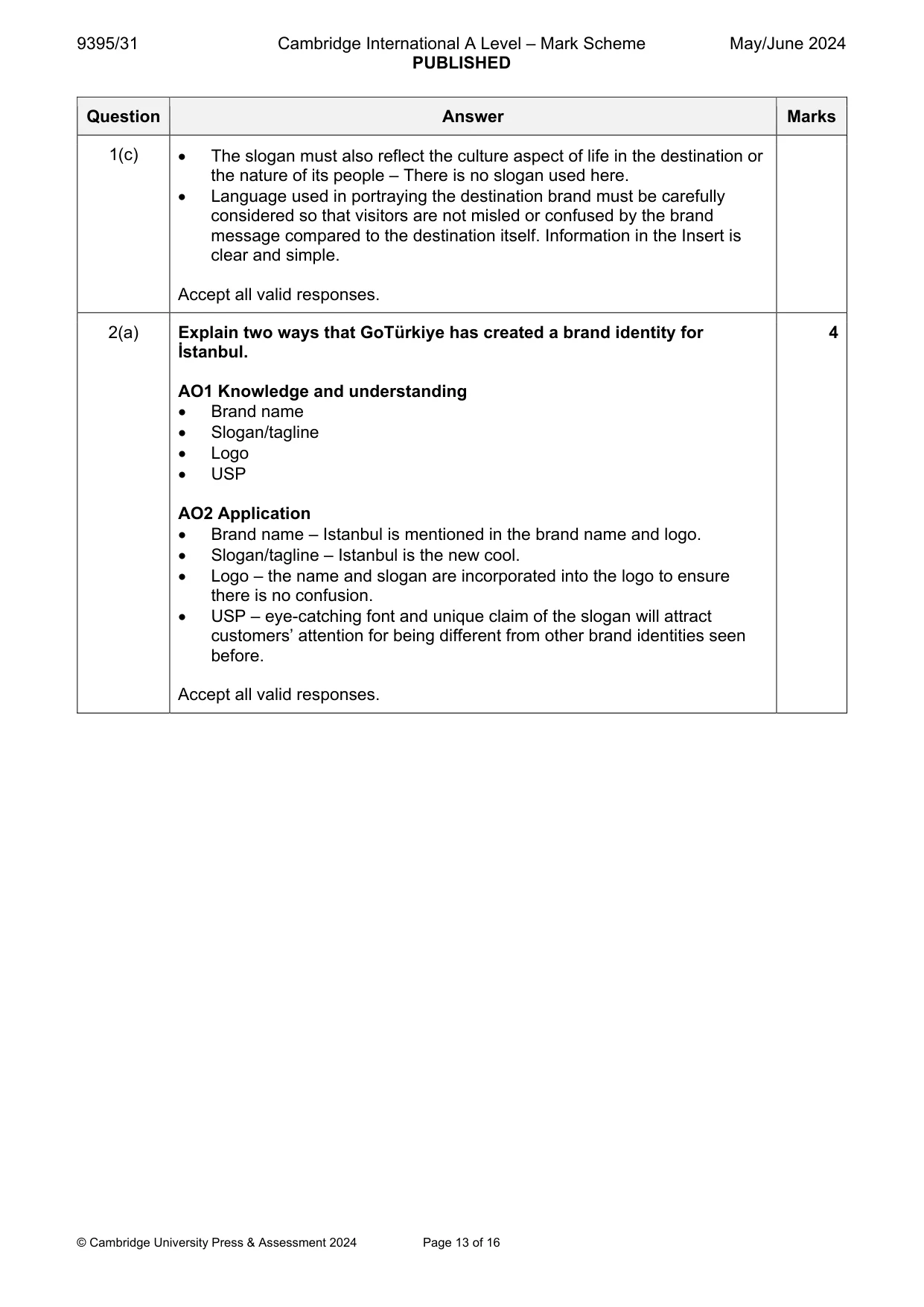
9395/31 Cambridge International A Level – Mark Scheme PUBLISHED May/June 2024 © Cambridge University Press & Assessment 2024 Page 13 of 16 Question Answer Marks 1(c) The slogan must also reflect the culture aspect of life in the destination or the nature of its people – There is no slogan used here. Language used in portraying the destination brand must be carefully considered so that visitors are not misled or confused by the brand message compared to the destination itself. Information in the Insert is clear and simple. Accept all valid responses. 2(a) Explain two ways that GoTürkiye has created a brand identity for İstanbul. AO1 Knowledge and understanding Brand name Slogan/tagline Logo USP AO2 Application Brand name – Istanbul is mentioned in the brand name and logo. Slogan/tagline – Istanbul is the new cool. Logo – the name and slogan are incorporated into the logo to ensure there is no confusion. USP – eye-catching font and unique claim of the slogan will attract customers’ attention for being different from other brand identities seen before. Accept all valid responses. 4
Mark scheme, page 14
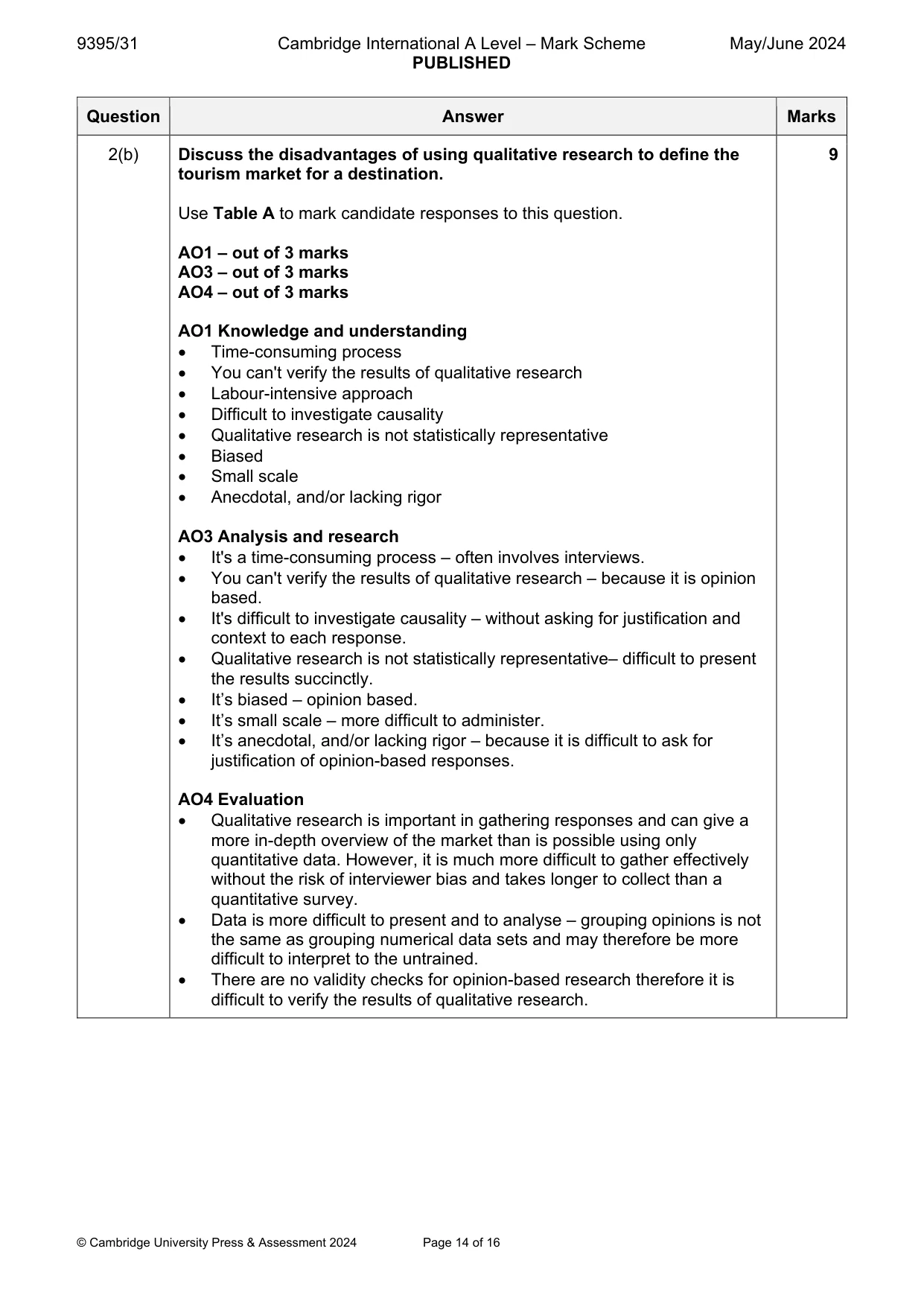
9395/31 Cambridge International A Level – Mark Scheme PUBLISHED May/June 2024 © Cambridge University Press & Assessment 2024 Page 14 of 16 Question Answer Marks 2(b) Discuss the disadvantages of using qualitative research to define the tourism market for a destination. Use Table A to mark candidate responses to this question. AO1 – out of 3 marks AO3 – out of 3 marks AO4 – out of 3 marks AO1 Knowledge and understanding Time-consuming process You can't verify the results of qualitative research Labour-intensive approach Difficult to investigate causality Qualitative research is not statistically representative Biased Small scale Anecdotal, and/or lacking rigor AO3 Analysis and research It's a time-consuming process – often involves interviews. You can't verify the results of qualitative research – because it is opinion based. It's difficult to investigate causality – without asking for justification and context to each response. Qualitative research is not statistically representative– difficult to present the results succinctly. It’s biased – opinion based. It’s small scale – more difficult to administer. It’s anecdotal, and/or lacking rigor – because it is difficult to ask for justification of opinion-based responses. AO4 Evaluation Qualitative research is important in gathering responses and can give a more in-depth overview of the market than is possible using only quantitative data. However, it is much more difficult to gather effectively without the risk of interviewer bias and takes longer to collect than a quantitative survey. Data is more difficult to present and to analyse – grouping opinions is not the same as grouping numerical data sets and may therefore be more difficult to interpret to the untrained. There are no validity checks for opinion-based research therefore it is difficult to verify the results of qualitative research. 9
Mark scheme, page 15
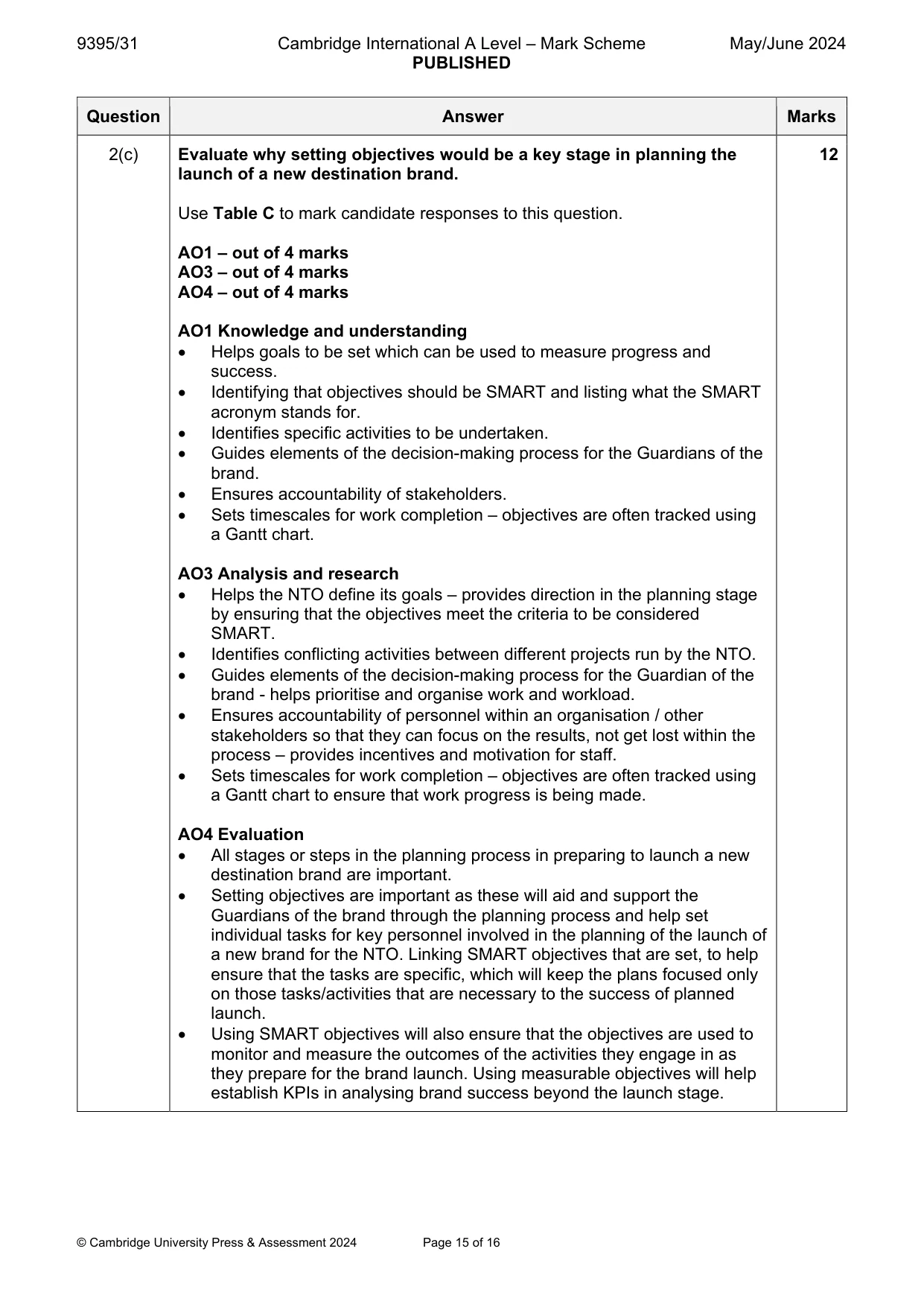
9395/31 Cambridge International A Level – Mark Scheme PUBLISHED May/June 2024 © Cambridge University Press & Assessment 2024 Page 15 of 16 Question Answer Marks 2(c) Evaluate why setting objectives would be a key stage in planning the launch of a new destination brand. Use Table C to mark candidate responses to this question. AO1 – out of 4 marks AO3 – out of 4 marks AO4 – out of 4 marks AO1 Knowledge and understanding Helps goals to be set which can be used to measure progress and success. Identifying that objectives should be SMART and listing what the SMART acronym stands for. Identifies specific activities to be undertaken. Guides elements of the decision-making process for the Guardians of the brand. Ensures accountability of stakeholders. Sets timescales for work completion – objectives are often tracked using a Gantt chart. AO3 Analysis and research Helps the NTO define its goals – provides direction in the planning stage by ensuring that the objectives meet the criteria to be considered SMART. Identifies conflicting activities between different projects run by the NTO. Guides elements of the decision-making process for the Guardian of the brand - helps prioritise and organise work and workload. Ensures accountability of personnel within an organisation / other stakeholders so that they can focus on the results, not get lost within the process – provides incentives and motivation for staff. Sets timescales for work completion – objectives are often tracked using a Gantt chart to ensure that work progress is being made. AO4 Evaluation All stages or steps in the planning process in preparing to launch a new destination brand are important. Setting objectives are important as these will aid and support the Guardians of the brand through the planning process and help set individual tasks for key personnel involved in the planning of the launch of a new brand for the NTO. Linking SMART objectives that are set, to help ensure that the tasks are specific, which will keep the plans focused only on those tasks/activities that are necessary to the success of planned launch. Using SMART objectives will also ensure that the objectives are used to monitor and measure the outcomes of the activities they engage in as they prepare for the brand launch. Using measurable objectives will help establish KPIs in analysing brand success beyond the launch stage. 12
Mark scheme, page 16
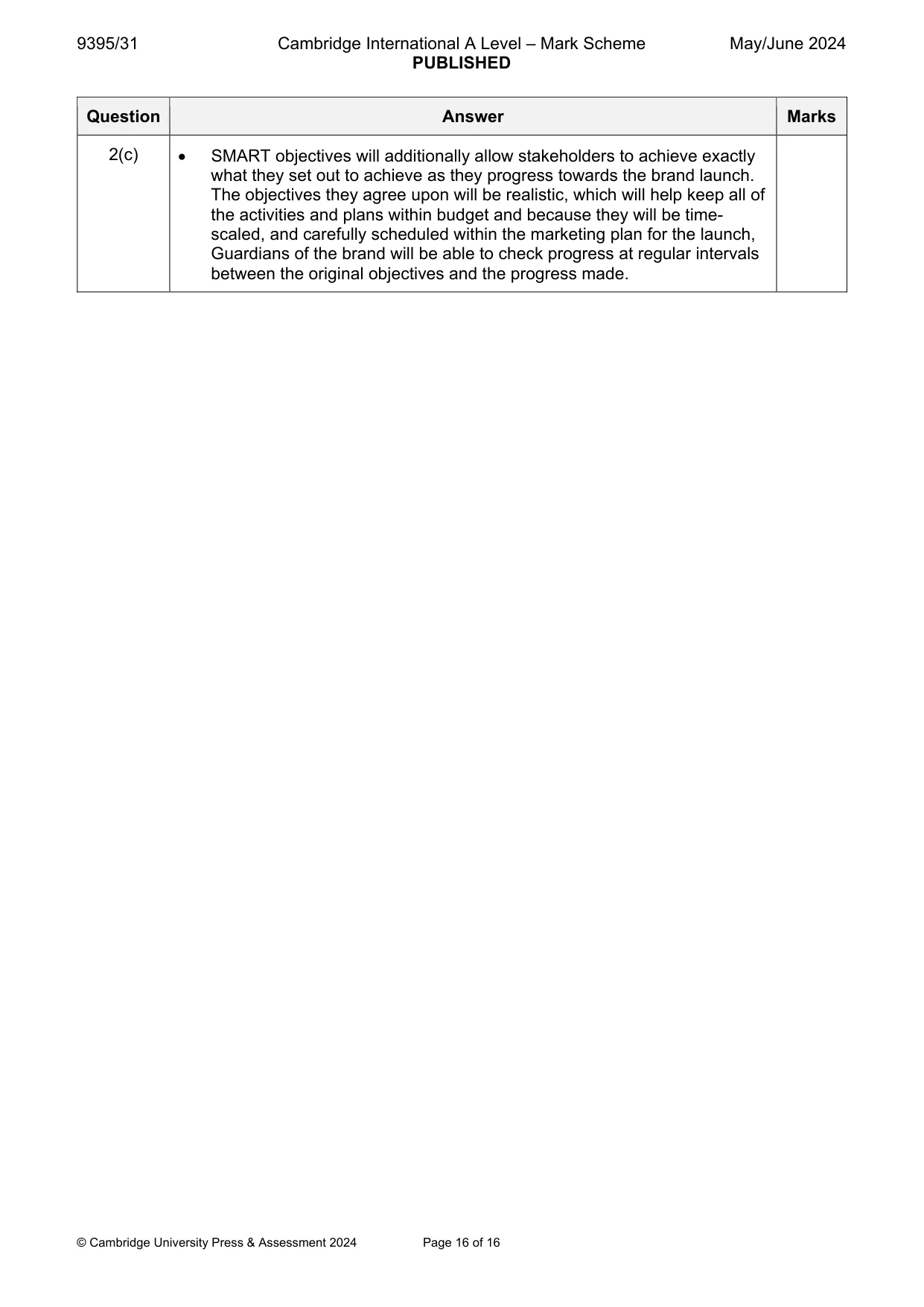
9395/31 Cambridge International A Level – Mark Scheme PUBLISHED May/June 2024 © Cambridge University Press & Assessment 2024 Page 16 of 16 Question Answer Marks 2(c) SMART objectives will additionally allow stakeholders to achieve exactly what they set out to achieve as they progress towards the brand launch. The objectives they agree upon will be realistic, which will help keep all of the activities and plans within budget and because they will be time- scaled, and carefully scheduled within the marketing plan for the launch, Guardians of the brand will be able to check progress at regular intervals between the original objectives and the progress made.
What you needed in this session
Cambridge’s own grade thresholds for 2024 May/June, Paper 3 · Variant 1. A higher threshold means an easier paper — the bar moves with how the cohort did.