Cambridge A Level Travel and Tourism 9395 — 2023 May/June Paper 3 · Variant 1
9395/31/M/J/23 · 50 marks · ≈56 min
The question paper and its mark scheme, free to read here and free to download. This is Cambridge’s own paper, exactly as it was sat.
Question paper12 pages







Mark scheme11 pages
Answers below. Sit the paper first if you are practising.
Paper as text
Question paper, page 1
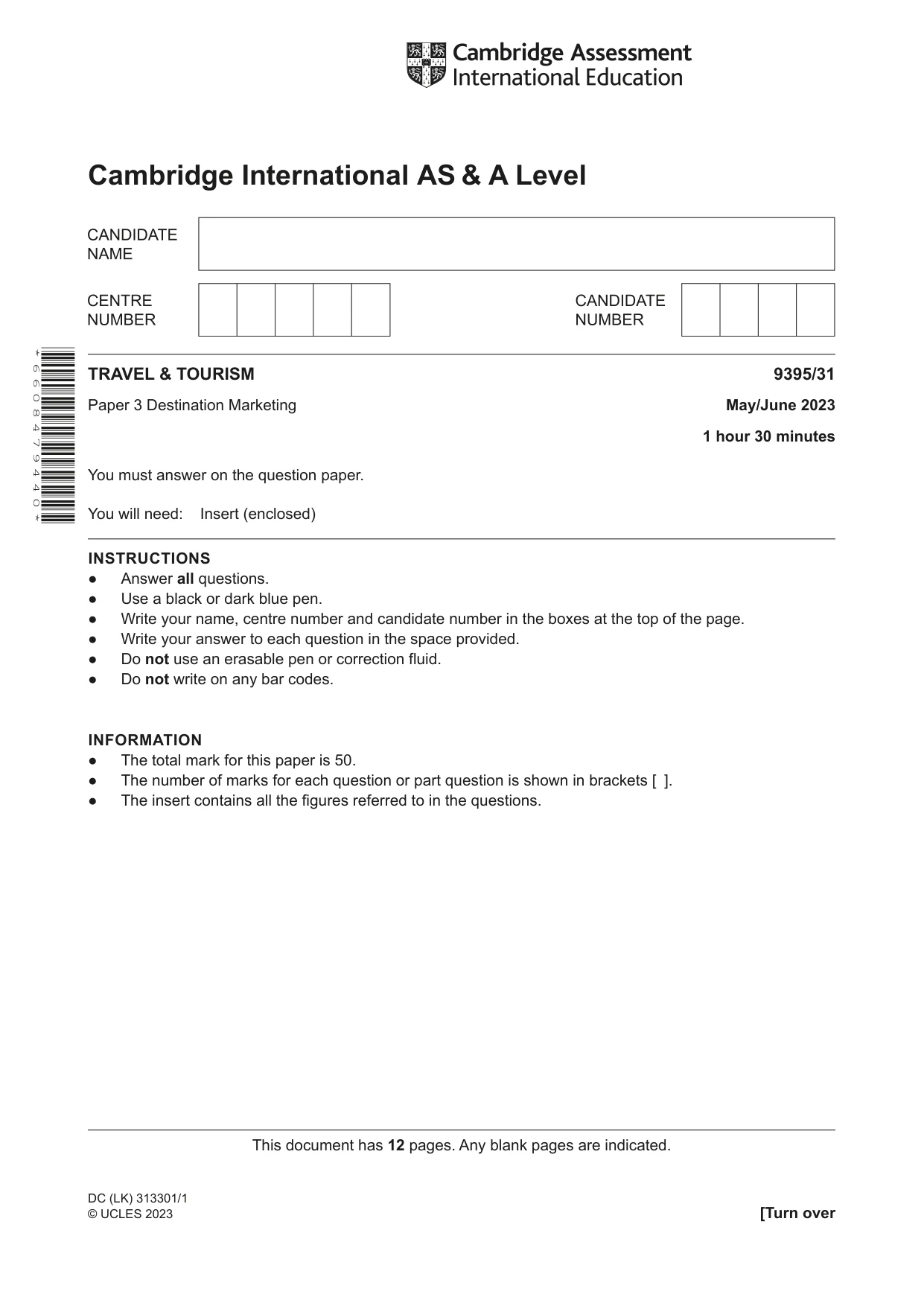
This document has 12 pages. Any blank pages are indicated. [Turn over Cambridge International AS & A Level * 6 6 0 8 4 7 9 4 4 0 * TRAVEL & TOURISM 9395/31 Paper 3 Destination Marketing May/June 2023 1 hour 30 minutes You must answer on the question paper. You will need: Insert (enclosed) INSTRUCTIONS ● Answer all questions. ● Use a black or dark blue pen. ● Write your name, centre number and candidate number in the boxes at the top of the page. ● Write your answer to each question in the space provided. ● Do not use an erasable pen or correction fluid. ● Do not write on any bar codes. INFORMATION ● The total mark for this paper is 50. ● The number of marks for each question or part question is shown in brackets [ ]. ● The insert contains all the figures referred to in the questions. DC (LK) 313301/1 © UCLES 2023
Question paper, page 2
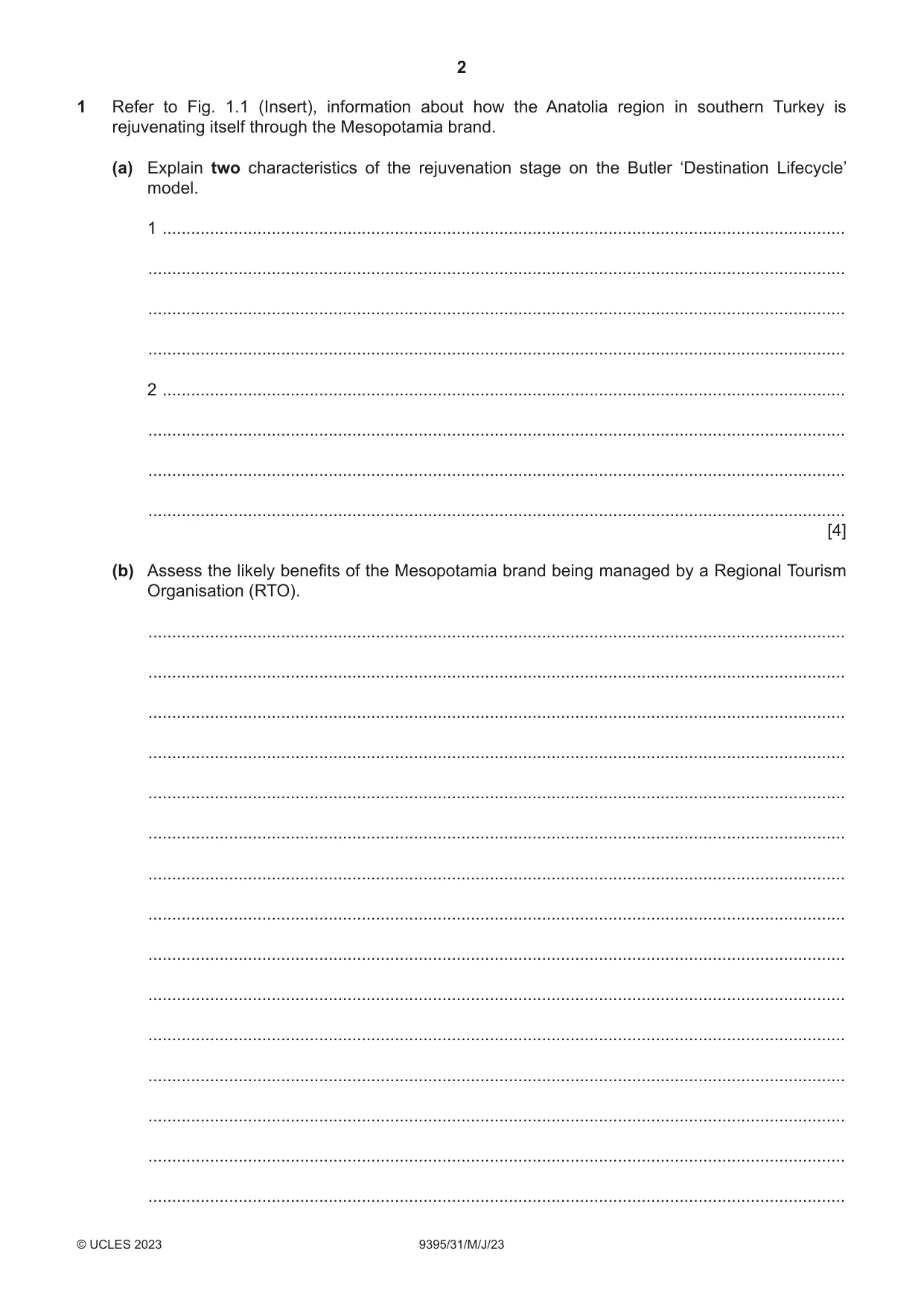
2 9395/31/M/J/23 © UCLES 2023 1 Refer to Fig. 1.1 (Insert), information about how the Anatolia region in southern Turkey is rejuvenating itself through the Mesopotamia brand. (a) Explain two characteristics of the rejuvenation stage on the Butler ‘Destination Lifecycle’ model. 1 … … … … 2 … … … … [4] (b) Assess the likely benefits of the Mesopotamia brand being managed by a Regional Tourism Organisation (RTO). … … … … … … … … … … … … … … …
Question paper, page 3
3 9395/31/M/J/23 © UCLES 2023 [Turn over … … … … … … … … … … … … … … … … … … … … … … … … … … … … [9]
Question paper, page 4
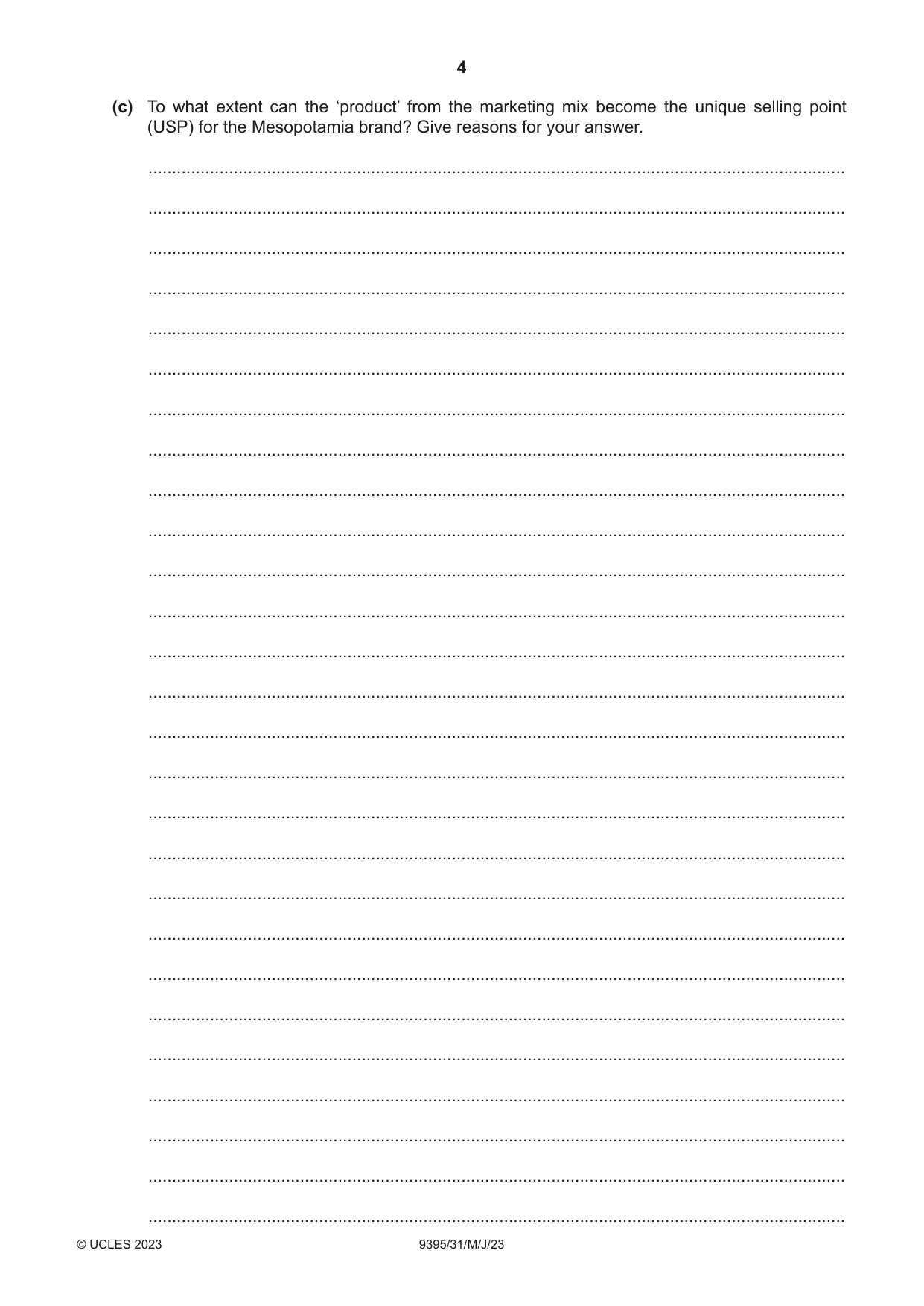
4 9395/31/M/J/23 © UCLES 2023 (c) To what extent can the ‘product’ from the marketing mix become the unique selling point (USP) for the Mesopotamia brand? Give reasons for your answer. … … … … … … … … … … … … … … … … … … … … … … … … … … …
Question paper, page 5
5 9395/31/M/J/23 © UCLES 2023 [Turn over … … … … … … … … … … … … … … … … … … … … … … … … … … … [12] [Total: 25]
Question paper, page 6
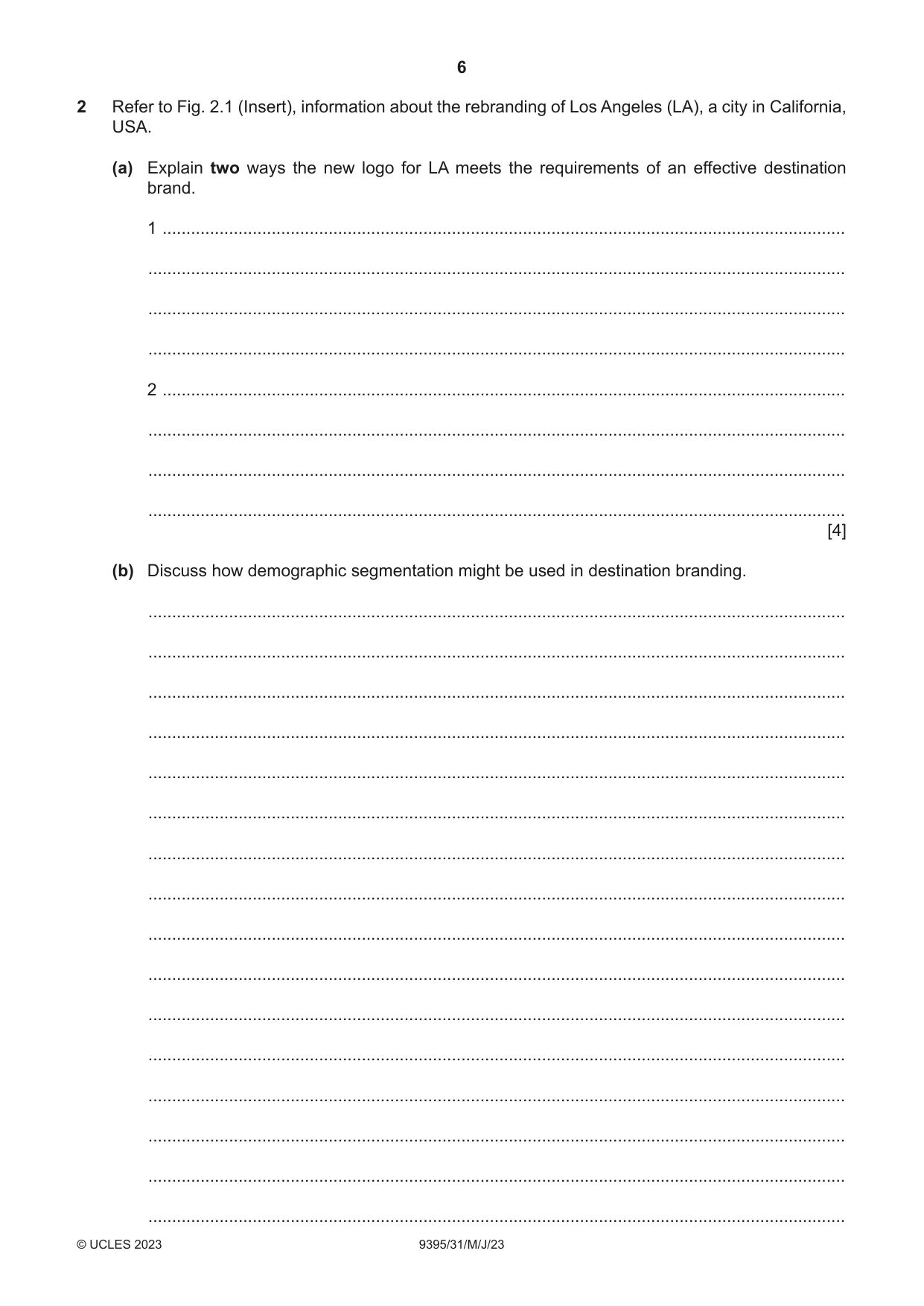
6 9395/31/M/J/23 © UCLES 2023 2 Refer to Fig. 2.1 (Insert), information about the rebranding of Los Angeles (LA), a city in California, USA. (a) Explain two ways the new logo for LA meets the requirements of an effective destination brand. 1 … … … … 2 … … … … [4] (b) Discuss how demographic segmentation might be used in destination branding. … … … … … … … … … … … … … … … …
Question paper, page 7
7 9395/31/M/J/23 © UCLES 2023 [Turn over … … … … … … … … … … … … … … … … … … … … … … … … … … … … [9]
Question paper, page 8
8 9395/31/M/J/23 © UCLES 2023 (c) Evaluate the most effective communication methods to raise awareness of a new destination brand. … … … … … … … … … … … … … … … … … … … … … … … … … … …
Question paper, page 9
9 9395/31/M/J/23 © UCLES 2023 … … … … … … … … … … … … … … … … … … … … … … … … … … … [12] [Total: 25]
Question paper, page 10
10 9395/31/M/J/23 © UCLES 2023 BLANK PAGE
Question paper, page 11
11 9395/31/M/J/23 © UCLES 2023 BLANK PAGE
Question paper, page 12
12 9395/31/M/J/23 © UCLES 2023 The boundaries and names shown, the designations used and the presentation of material on any maps contained in this question paper/insert do not imply official endorsement or acceptance by Cambridge Assessment International Education concerning the legal status of any country, territory, or area or any of its authorities, or of the delimitation of its frontiers or boundaries. Permission to reproduce items where third-party owned material protected by copyright is included has been sought and cleared where possible. Every reasonable effort has been made by the publisher (UCLES) to trace copyright holders, but if any items requiring clearance have unwittingly been included, the publisher will be pleased to make amends at the earliest possible opportunity. To avoid the issue of disclosure of answer-related information to candidates, all copyright acknowledgements are reproduced online in the Cambridge Assessment International Education Copyright Acknowledgements Booklet. This is produced for each series of examinations and is freely available to download at www.cambridgeinternational.org after the live examination series. Cambridge Assessment International Education is part of Cambridge Assessment. Cambridge Assessment is the brand name of the University of Cambridge Local Examinations Syndicate (UCLES), which is a department of the University of Cambridge. BLANK PAGE
Mark scheme, page 1
This document consists of 11 printed pages. © UCLES 2023 [Turn over Cambridge International A Level TRAVEL & TOURISM 9395/31 Paper 3 Destination Marketing May/June 2023 MARK SCHEME Maximum Mark: 50 Published This mark scheme is published as an aid to teachers and candidates, to indicate the requirements of the examination. It shows the basis on which Examiners were instructed to award marks. It does not indicate the details of the discussions that took place at an Examiners’ meeting before marking began, which would have considered the acceptability of alternative answers. Mark schemes should be read in conjunction with the question paper and the Principal Examiner Report for Teachers. Cambridge International will not enter into discussions about these mark schemes. Cambridge International is publishing the mark schemes for the May/June 2023 series for most Cambridge IGCSE, Cambridge International A and AS Level and Cambridge Pre-U components, and some Cambridge O Level components.
Mark scheme, page 2
9395/31 Cambridge International A Level – Mark Scheme PUBLISHED May/June 2023 © UCLES 2023 Page 2 of 11 Generic Marking Principles These general marking principles must be applied by all examiners when marking candidate answers. They should be applied alongside the specific content of the mark scheme or generic level descriptors for a question. Each question paper and mark scheme will also comply with these marking principles. GENERIC MARKING PRINCIPLE 1: Marks must be awarded in line with: the specific content of the mark scheme or the generic level descriptors for the question the specific skills defined in the mark scheme or in the generic level descriptors for the question the standard of response required by a candidate as exemplified by the standardisation scripts. GENERIC MARKING PRINCIPLE 2: Marks awarded are always whole marks (not half marks, or other fractions). GENERIC MARKING PRINCIPLE 3: Marks must be awarded positively: marks are awarded for correct/valid answers, as defined in the mark scheme. However, credit is given for valid answers which go beyond the scope of the syllabus and mark scheme, referring to your Team Leader as appropriate marks are awarded when candidates clearly demonstrate what they know and can do marks are not deducted for errors marks are not deducted for omissions answers should only be judged on the quality of spelling, punctuation and grammar when these features are specifically assessed by the question as indicated by the mark scheme. The meaning, however, should be unambiguous. GENERIC MARKING PRINCIPLE 4: Rules must be applied consistently, e.g. in situations where candidates have not followed instructions or in the application of generic level descriptors. GENERIC MARKING PRINCIPLE 5: Marks should be awarded using the full range of marks defined in the mark scheme for the question (however; the use of the full mark range may be limited according to the quality of the candidate responses seen). GENERIC MARKING PRINCIPLE 6: Marks awarded are based solely on the requirements as defined in the mark scheme. Marks should not be awarded with grade thresholds or grade descriptors in mind.
Mark scheme, page 3
9395/31 Cambridge International A Level – Mark Scheme PUBLISHED May/June 2023 © UCLES 2023 Page 3 of 11 Social Science-Specific Marking Principles (for point-based marking) 1 Components using point-based marking: Point marking is often used to reward knowledge, understanding and application of skills. We give credit where the candidate’s answer shows relevant knowledge, understanding and application of skills in answering the question. We do not give credit where the answer shows confusion. From this it follows that we: a DO credit answers which are worded differently from the mark scheme if they clearly convey the same meaning (unless the mark scheme requires a specific term) b DO credit alternative answers/examples which are not written in the mark scheme if they are correct c DO credit answers where candidates give more than one correct answer in one prompt/numbered/scaffolded space where extended writing is required rather than list-type answers. For example, questions that require n reasons (e.g. State two reasons …). d DO NOT credit answers simply for using a ‘key term’ unless that is all that is required. (Check for evidence it is understood and not used wrongly.) e DO NOT credit answers which are obviously self-contradicting or trying to cover all possibilities f DO NOT give further credit for what is effectively repetition of a correct point already credited unless the language itself is being tested. This applies equally to ‘mirror statements’ (i.e. polluted/not polluted). g DO NOT require spellings to be correct, unless this is part of the test. However spellings of syllabus terms must allow for clear and unambiguous separation from other syllabus terms with which they may be confused (e.g. Corrasion/Corrosion) 2 Presentation of mark scheme: Slashes (/) or the word ‘or’ separate alternative ways of making the same point. Semi colons (;) bullet points (•) or figures in brackets (1) separate different points. Content in the answer column in brackets is for examiner information/context to clarify the marking but is not required to earn the mark (except Accounting syllabuses where they indicate negative numbers). 3 Calculation questions: The mark scheme will show the steps in the most likely correct method(s), the mark for each step, the correct answer(s) and the mark for each answer If working/explanation is considered essential for full credit, this will be indicated in the question paper and in the mark scheme. In all other instances, the correct answer to a calculation should be given full credit, even if no supporting working is shown. Where the candidate uses a valid method which is not covered by the mark scheme, award equivalent marks for reaching equivalent stages. Where an answer makes use of a candidate’s own incorrect figure from previous working, the ‘own figure rule’ applies: full marks will be given if a correct and complete method is used. Further guidance will be included in the mark scheme where necessary and any exceptions to this general principle will be noted.
Mark scheme, page 4
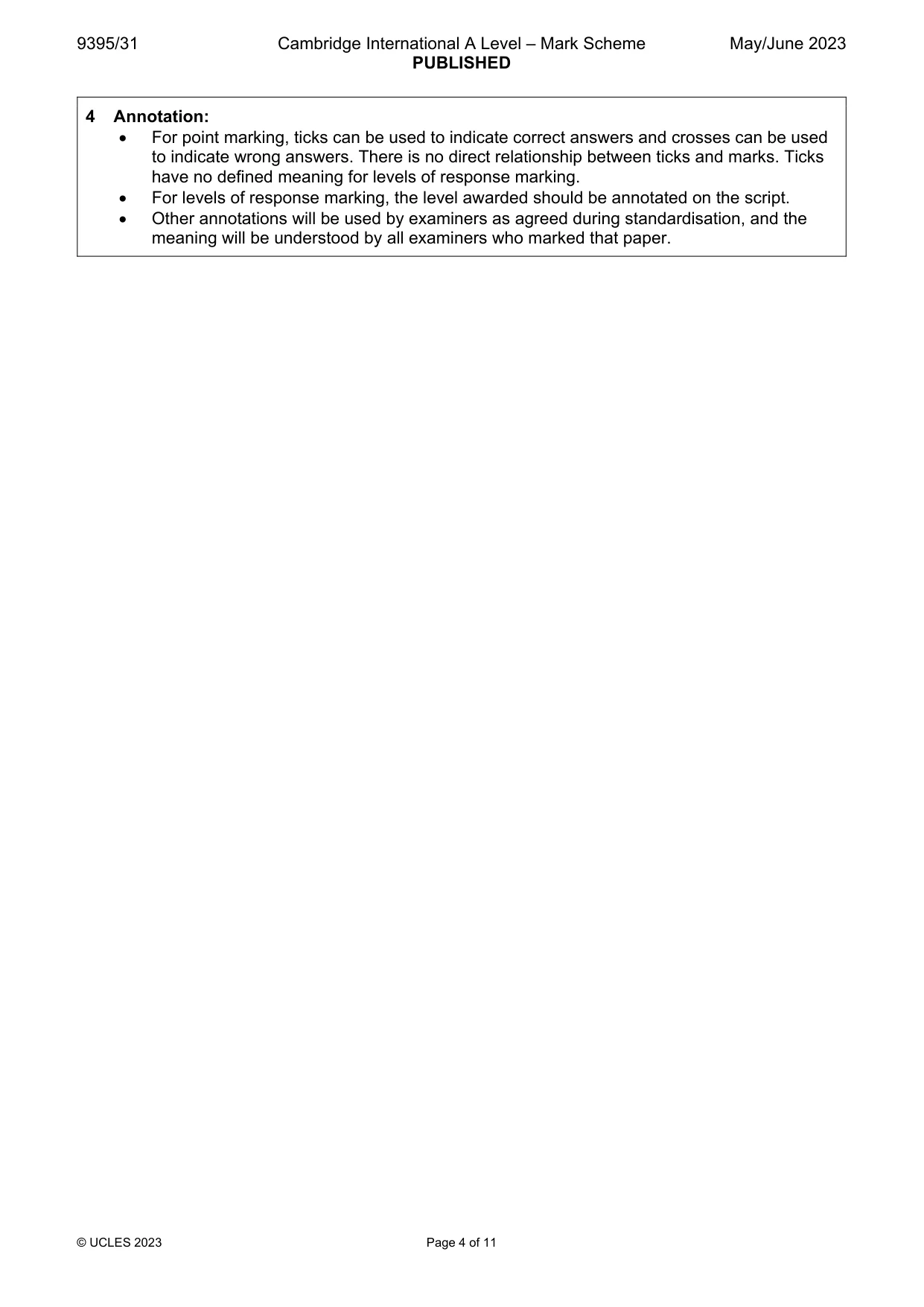
9395/31 Cambridge International A Level – Mark Scheme PUBLISHED May/June 2023 © UCLES 2023 Page 4 of 11 4 Annotation: For point marking, ticks can be used to indicate correct answers and crosses can be used to indicate wrong answers. There is no direct relationship between ticks and marks. Ticks have no defined meaning for levels of response marking. For levels of response marking, the level awarded should be annotated on the script. Other annotations will be used by examiners as agreed during standardisation, and the meaning will be understood by all examiners who marked that paper.
Mark scheme, page 5
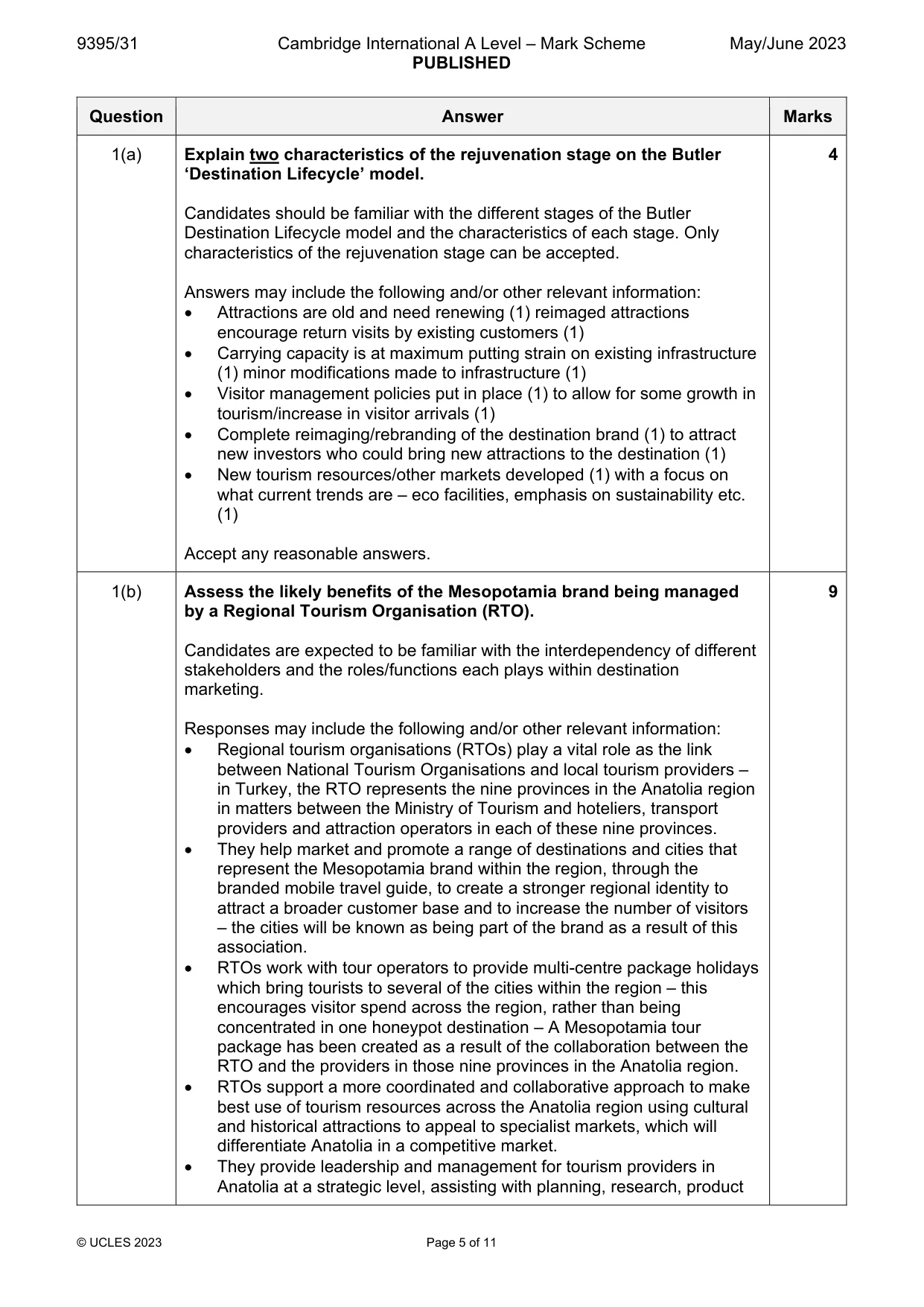
9395/31 Cambridge International A Level – Mark Scheme PUBLISHED May/June 2023 © UCLES 2023 Page 5 of 11 Question Answer Marks 1(a) Explain two characteristics of the rejuvenation stage on the Butler ‘Destination Lifecycle’ model. Candidates should be familiar with the different stages of the Butler Destination Lifecycle model and the characteristics of each stage. Only characteristics of the rejuvenation stage can be accepted. Answers may include the following and/or other relevant information: Attractions are old and need renewing (1) reimaged attractions encourage return visits by existing customers (1) Carrying capacity is at maximum putting strain on existing infrastructure (1) minor modifications made to infrastructure (1) Visitor management policies put in place (1) to allow for some growth in tourism/increase in visitor arrivals (1) Complete reimaging/rebranding of the destination brand (1) to attract new investors who could bring new attractions to the destination (1) New tourism resources/other markets developed (1) with a focus on what current trends are – eco facilities, emphasis on sustainability etc. (1) Accept any reasonable answers. 4 1(b) Assess the likely benefits of the Mesopotamia brand being managed by a Regional Tourism Organisation (RTO). Candidates are expected to be familiar with the interdependency of different stakeholders and the roles/functions each plays within destination marketing. Responses may include the following and/or other relevant information: Regional tourism organisations (RTOs) play a vital role as the link between National Tourism Organisations and local tourism providers – in Turkey, the RTO represents the nine provinces in the Anatolia region in matters between the Ministry of Tourism and hoteliers, transport providers and attraction operators in each of these nine provinces. They help market and promote a range of destinations and cities that represent the Mesopotamia brand within the region, through the branded mobile travel guide, to create a stronger regional identity to attract a broader customer base and to increase the number of visitors – the cities will be known as being part of the brand as a result of this association. RTOs work with tour operators to provide multi-centre package holidays which bring tourists to several of the cities within the region – this encourages visitor spend across the region, rather than being concentrated in one honeypot destination – A Mesopotamia tour package has been created as a result of the collaboration between the RTO and the providers in those nine provinces in the Anatolia region. RTOs support a more coordinated and collaborative approach to make best use of tourism resources across the Anatolia region using cultural and historical attractions to appeal to specialist markets, which will differentiate Anatolia in a competitive market. They provide leadership and management for tourism providers in Anatolia at a strategic level, assisting with planning, research, product 9
Mark scheme, page 6
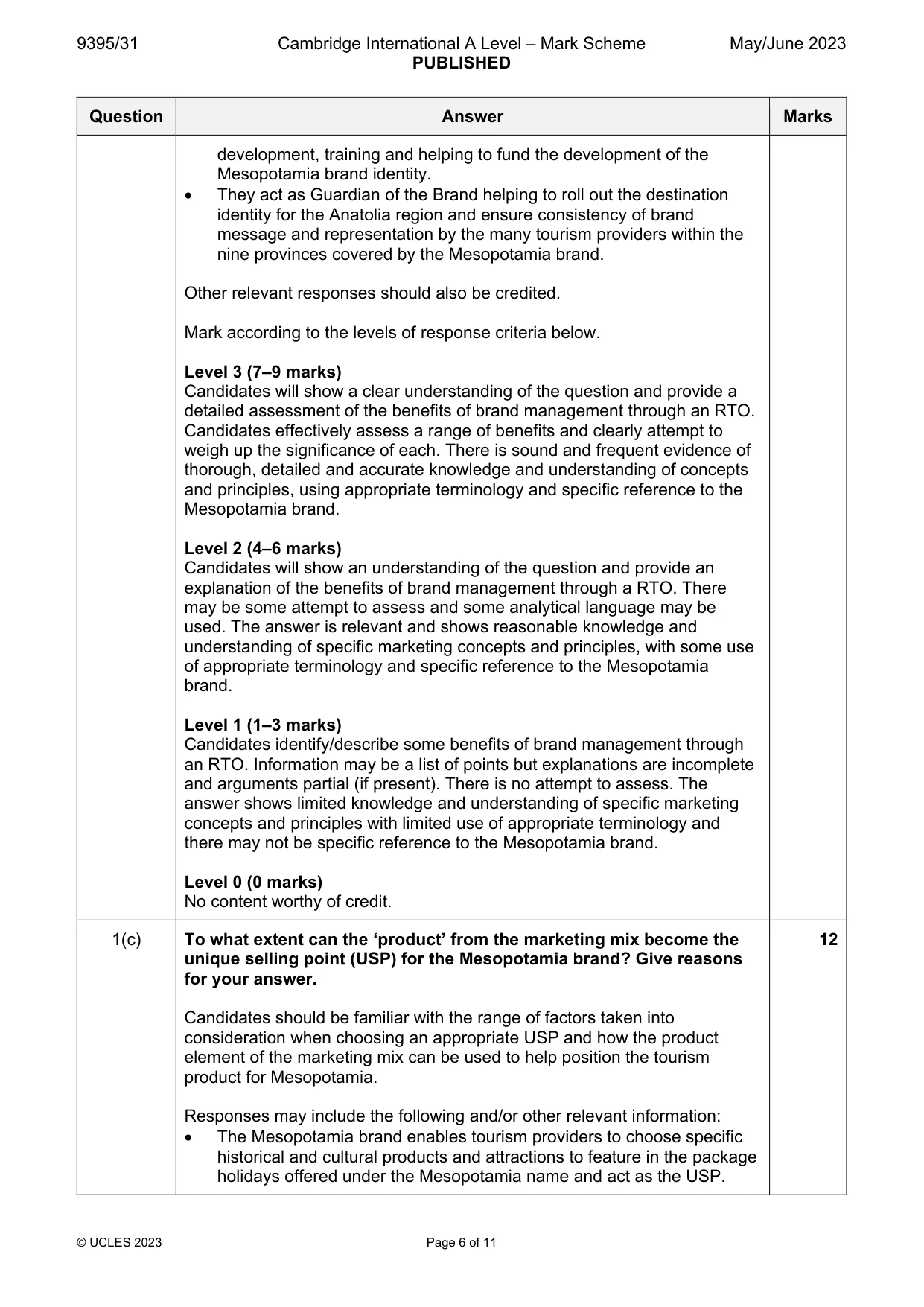
9395/31 Cambridge International A Level – Mark Scheme PUBLISHED May/June 2023 © UCLES 2023 Page 6 of 11 Question Answer Marks development, training and helping to fund the development of the Mesopotamia brand identity. They act as Guardian of the Brand helping to roll out the destination identity for the Anatolia region and ensure consistency of brand message and representation by the many tourism providers within the nine provinces covered by the Mesopotamia brand. Other relevant responses should also be credited. Mark according to the levels of response criteria below. Level 3 (7–9 marks) Candidates will show a clear understanding of the question and provide a detailed assessment of the benefits of brand management through an RTO. Candidates effectively assess a range of benefits and clearly attempt to weigh up the significance of each. There is sound and frequent evidence of thorough, detailed and accurate knowledge and understanding of concepts and principles, using appropriate terminology and specific reference to the Mesopotamia brand. Level 2 (4–6 marks) Candidates will show an understanding of the question and provide an explanation of the benefits of brand management through a RTO. There may be some attempt to assess and some analytical language may be used. The answer is relevant and shows reasonable knowledge and understanding of specific marketing concepts and principles, with some use of appropriate terminology and specific reference to the Mesopotamia brand. Level 1 (1–3 marks) Candidates identify/describe some benefits of brand management through an RTO. Information may be a list of points but explanations are incomplete and arguments partial (if present). There is no attempt to assess. The answer shows limited knowledge and understanding of specific marketing concepts and principles with limited use of appropriate terminology and there may not be specific reference to the Mesopotamia brand. Level 0 (0 marks) No content worthy of credit. 1(c) To what extent can the ‘product’ from the marketing mix become the unique selling point (USP) for the Mesopotamia brand? Give reasons for your answer. Candidates should be familiar with the range of factors taken into consideration when choosing an appropriate USP and how the product element of the marketing mix can be used to help position the tourism product for Mesopotamia. Responses may include the following and/or other relevant information: The Mesopotamia brand enables tourism providers to choose specific historical and cultural products and attractions to feature in the package holidays offered under the Mesopotamia name and act as the USP. 12
Mark scheme, page 7
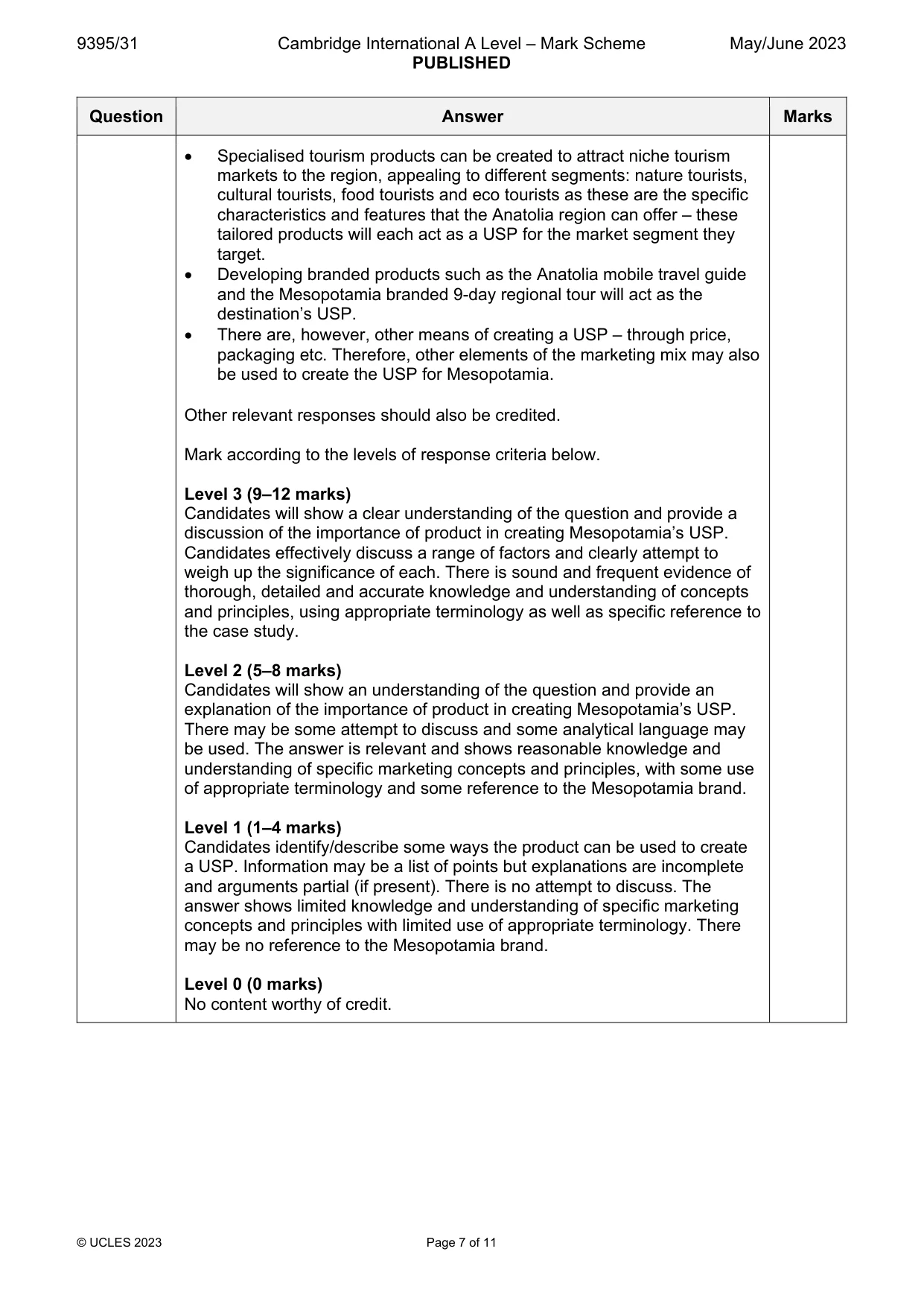
9395/31 Cambridge International A Level – Mark Scheme PUBLISHED May/June 2023 © UCLES 2023 Page 7 of 11 Question Answer Marks Specialised tourism products can be created to attract niche tourism markets to the region, appealing to different segments: nature tourists, cultural tourists, food tourists and eco tourists as these are the specific characteristics and features that the Anatolia region can offer – these tailored products will each act as a USP for the market segment they target. Developing branded products such as the Anatolia mobile travel guide and the Mesopotamia branded 9-day regional tour will act as the destination’s USP. There are, however, other means of creating a USP – through price, packaging etc. Therefore, other elements of the marketing mix may also be used to create the USP for Mesopotamia. Other relevant responses should also be credited. Mark according to the levels of response criteria below. Level 3 (9–12 marks) Candidates will show a clear understanding of the question and provide a discussion of the importance of product in creating Mesopotamia’s USP. Candidates effectively discuss a range of factors and clearly attempt to weigh up the significance of each. There is sound and frequent evidence of thorough, detailed and accurate knowledge and understanding of concepts and principles, using appropriate terminology as well as specific reference to the case study. Level 2 (5–8 marks) Candidates will show an understanding of the question and provide an explanation of the importance of product in creating Mesopotamia’s USP. There may be some attempt to discuss and some analytical language may be used. The answer is relevant and shows reasonable knowledge and understanding of specific marketing concepts and principles, with some use of appropriate terminology and some reference to the Mesopotamia brand. Level 1 (1–4 marks) Candidates identify/describe some ways the product can be used to create a USP. Information may be a list of points but explanations are incomplete and arguments partial (if present). There is no attempt to discuss. The answer shows limited knowledge and understanding of specific marketing concepts and principles with limited use of appropriate terminology. There may be no reference to the Mesopotamia brand. Level 0 (0 marks) No content worthy of credit.
Mark scheme, page 8
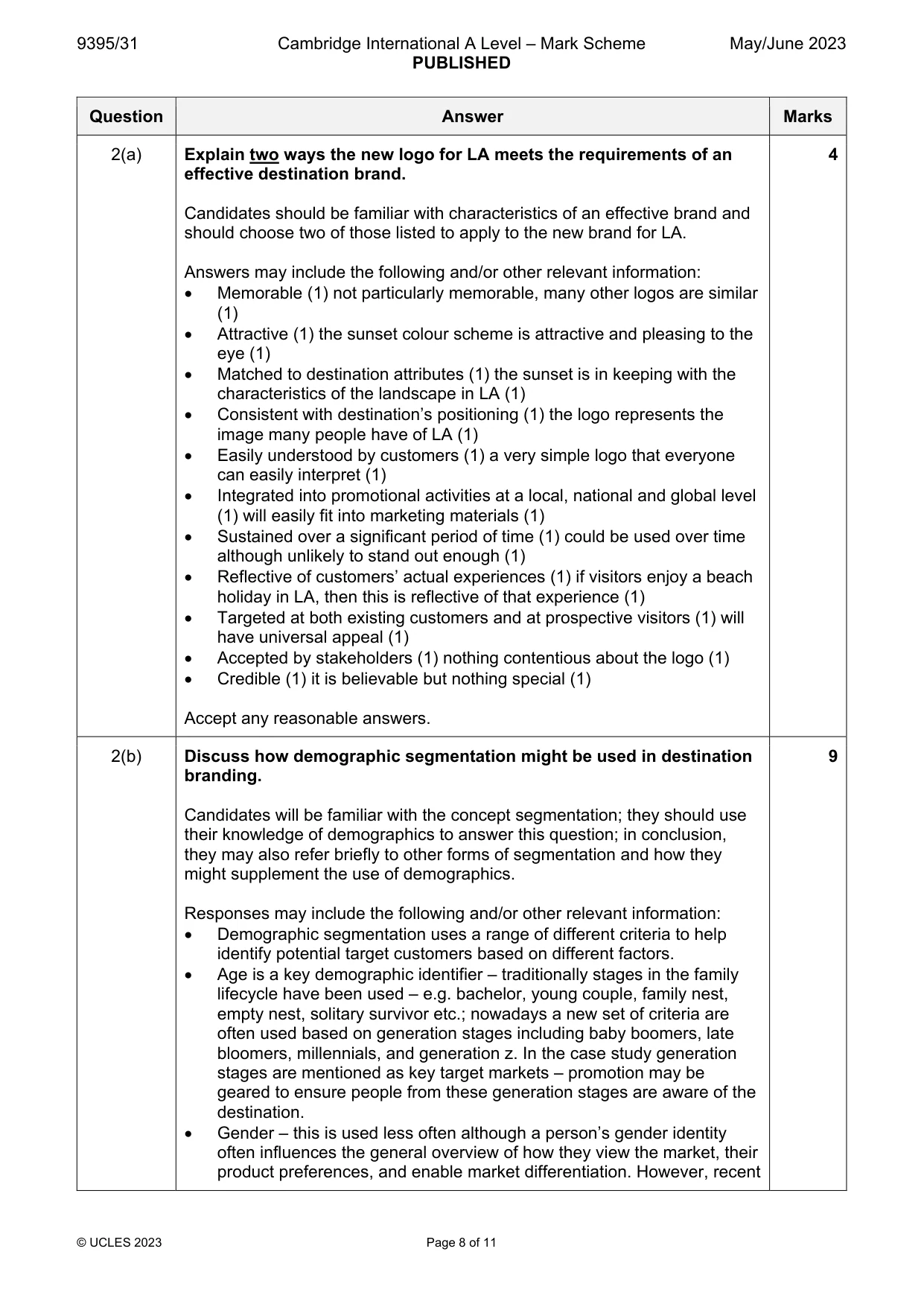
9395/31 Cambridge International A Level – Mark Scheme PUBLISHED May/June 2023 © UCLES 2023 Page 8 of 11 Question Answer Marks 2(a) Explain two ways the new logo for LA meets the requirements of an effective destination brand. Candidates should be familiar with characteristics of an effective brand and should choose two of those listed to apply to the new brand for LA. Answers may include the following and/or other relevant information: Memorable (1) not particularly memorable, many other logos are similar (1) Attractive (1) the sunset colour scheme is attractive and pleasing to the eye (1) Matched to destination attributes (1) the sunset is in keeping with the characteristics of the landscape in LA (1) Consistent with destination’s positioning (1) the logo represents the image many people have of LA (1) Easily understood by customers (1) a very simple logo that everyone can easily interpret (1) Integrated into promotional activities at a local, national and global level (1) will easily fit into marketing materials (1) Sustained over a significant period of time (1) could be used over time although unlikely to stand out enough (1) Reflective of customers’ actual experiences (1) if visitors enjoy a beach holiday in LA, then this is reflective of that experience (1) Targeted at both existing customers and at prospective visitors (1) will have universal appeal (1) Accepted by stakeholders (1) nothing contentious about the logo (1) Credible (1) it is believable but nothing special (1) Accept any reasonable answers. 4 2(b) Discuss how demographic segmentation might be used in destination branding. Candidates will be familiar with the concept segmentation; they should use their knowledge of demographics to answer this question; in conclusion, they may also refer briefly to other forms of segmentation and how they might supplement the use of demographics. Responses may include the following and/or other relevant information: Demographic segmentation uses a range of different criteria to help identify potential target customers based on different factors. Age is a key demographic identifier – traditionally stages in the family lifecycle have been used – e.g. bachelor, young couple, family nest, empty nest, solitary survivor etc.; nowadays a new set of criteria are often used based on generation stages including baby boomers, late bloomers, millennials, and generation z. In the case study generation stages are mentioned as key target markets – promotion may be geared to ensure people from these generation stages are aware of the destination. Gender – this is used less often although a person’s gender identity often influences the general overview of how they view the market, their product preferences, and enable market differentiation. However, recent 9
Mark scheme, page 9
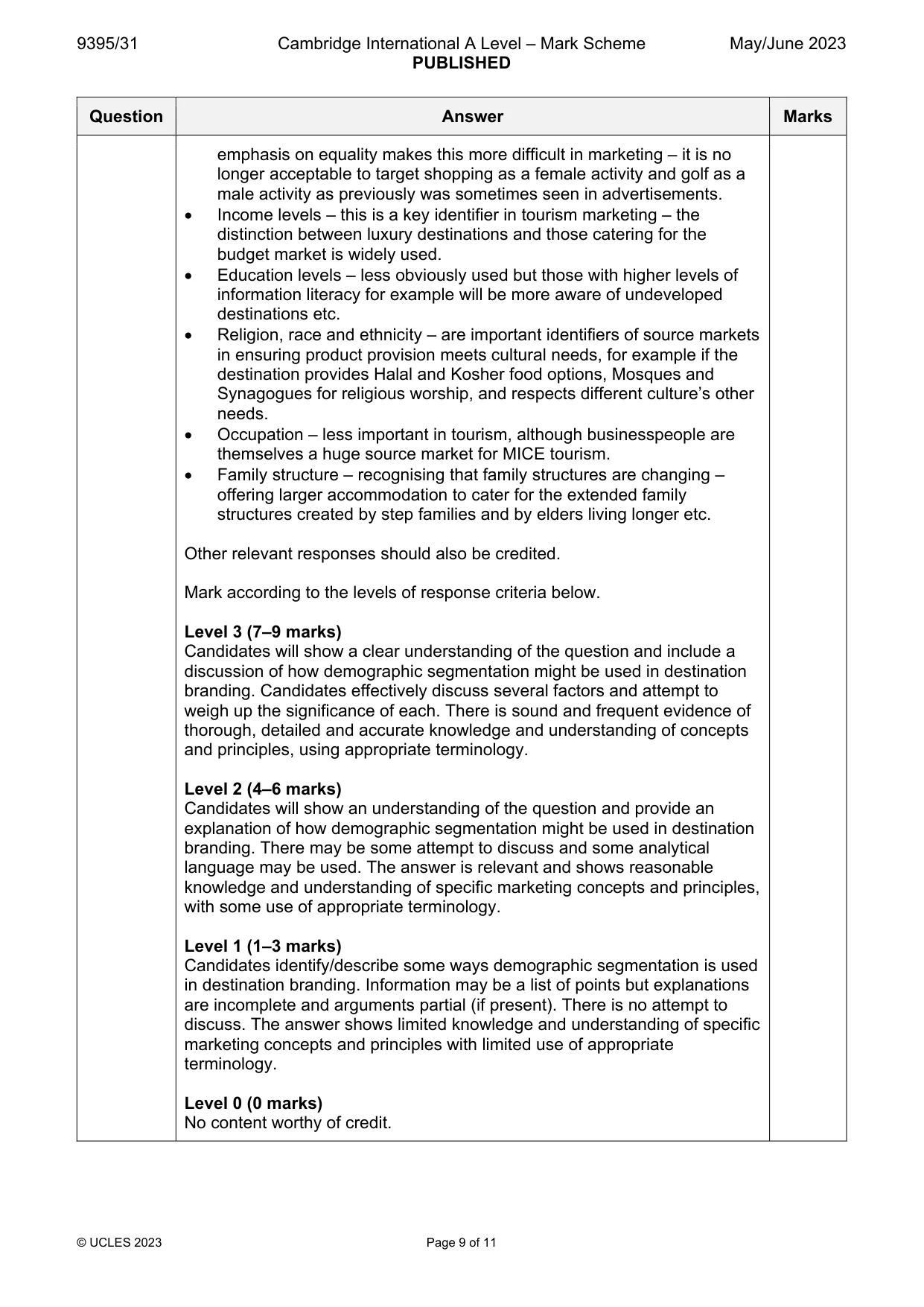
9395/31 Cambridge International A Level – Mark Scheme PUBLISHED May/June 2023 © UCLES 2023 Page 9 of 11 Question Answer Marks emphasis on equality makes this more difficult in marketing – it is no longer acceptable to target shopping as a female activity and golf as a male activity as previously was sometimes seen in advertisements. Income levels – this is a key identifier in tourism marketing – the distinction between luxury destinations and those catering for the budget market is widely used. Education levels – less obviously used but those with higher levels of information literacy for example will be more aware of undeveloped destinations etc. Religion, race and ethnicity – are important identifiers of source markets in ensuring product provision meets cultural needs, for example if the destination provides Halal and Kosher food options, Mosques and Synagogues for religious worship, and respects different culture’s other needs. Occupation – less important in tourism, although businesspeople are themselves a huge source market for MICE tourism. Family structure – recognising that family structures are changing – offering larger accommodation to cater for the extended family structures created by step families and by elders living longer etc. Other relevant responses should also be credited. Mark according to the levels of response criteria below. Level 3 (7–9 marks) Candidates will show a clear understanding of the question and include a discussion of how demographic segmentation might be used in destination branding. Candidates effectively discuss several factors and attempt to weigh up the significance of each. There is sound and frequent evidence of thorough, detailed and accurate knowledge and understanding of concepts and principles, using appropriate terminology. Level 2 (4–6 marks) Candidates will show an understanding of the question and provide an explanation of how demographic segmentation might be used in destination branding. There may be some attempt to discuss and some analytical language may be used. The answer is relevant and shows reasonable knowledge and understanding of specific marketing concepts and principles, with some use of appropriate terminology. Level 1 (1–3 marks) Candidates identify/describe some ways demographic segmentation is used in destination branding. Information may be a list of points but explanations are incomplete and arguments partial (if present). There is no attempt to discuss. The answer shows limited knowledge and understanding of specific marketing concepts and principles with limited use of appropriate terminology. Level 0 (0 marks) No content worthy of credit.
Mark scheme, page 10
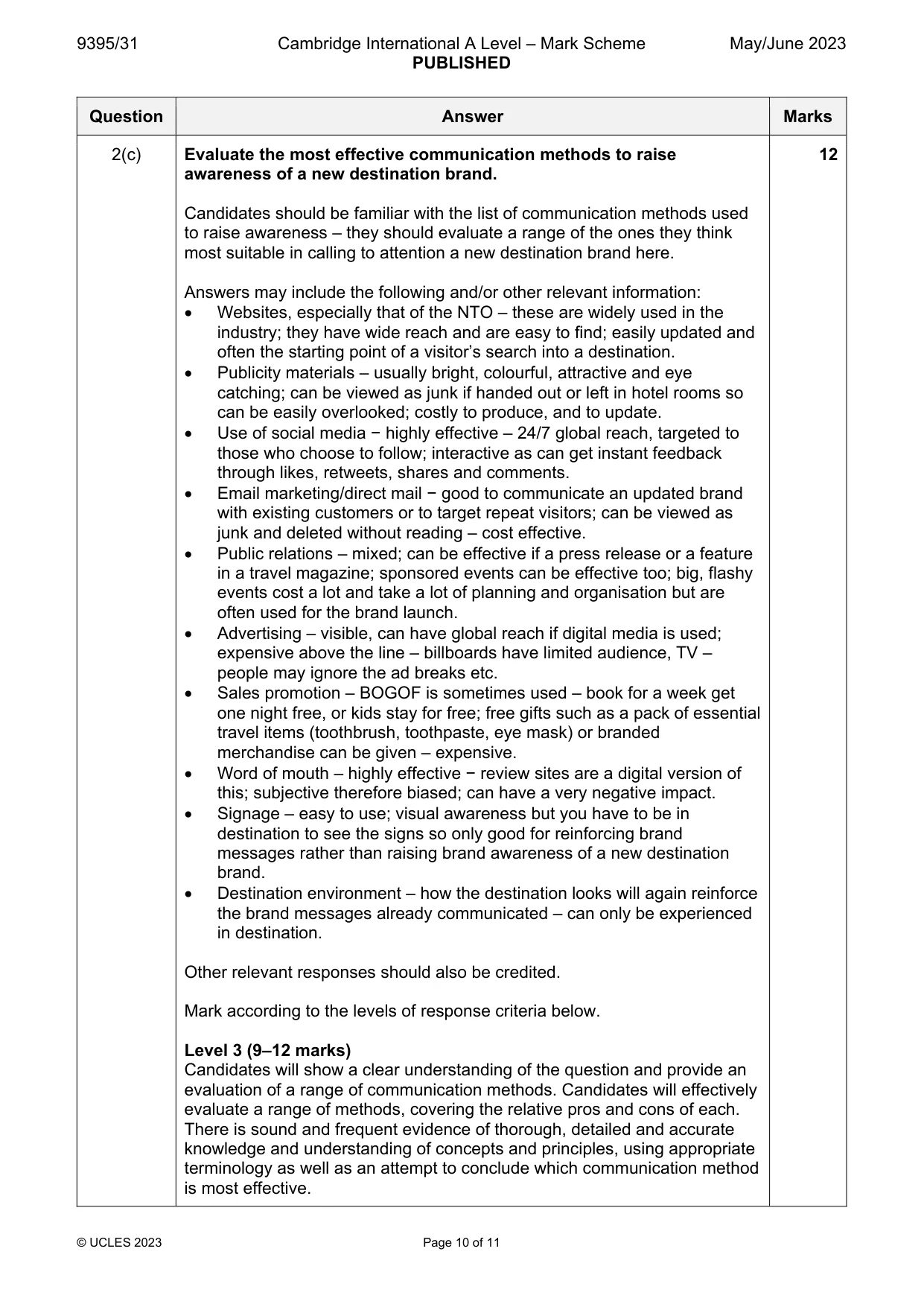
9395/31 Cambridge International A Level – Mark Scheme PUBLISHED May/June 2023 © UCLES 2023 Page 10 of 11 Question Answer Marks 2(c) Evaluate the most effective communication methods to raise awareness of a new destination brand. Candidates should be familiar with the list of communication methods used to raise awareness – they should evaluate a range of the ones they think most suitable in calling to attention a new destination brand here. Answers may include the following and/or other relevant information: Websites, especially that of the NTO – these are widely used in the industry; they have wide reach and are easy to find; easily updated and often the starting point of a visitor’s search into a destination. Publicity materials – usually bright, colourful, attractive and eye catching; can be viewed as junk if handed out or left in hotel rooms so can be easily overlooked; costly to produce, and to update. Use of social media − highly effective – 24/7 global reach, targeted to those who choose to follow; interactive as can get instant feedback through likes, retweets, shares and comments. Email marketing/direct mail − good to communicate an updated brand with existing customers or to target repeat visitors; can be viewed as junk and deleted without reading – cost effective. Public relations – mixed; can be effective if a press release or a feature in a travel magazine; sponsored events can be effective too; big, flashy events cost a lot and take a lot of planning and organisation but are often used for the brand launch. Advertising – visible, can have global reach if digital media is used; expensive above the line – billboards have limited audience, TV – people may ignore the ad breaks etc. Sales promotion – BOGOF is sometimes used – book for a week get one night free, or kids stay for free; free gifts such as a pack of essential travel items (toothbrush, toothpaste, eye mask) or branded merchandise can be given – expensive. Word of mouth – highly effective − review sites are a digital version of this; subjective therefore biased; can have a very negative impact. Signage – easy to use; visual awareness but you have to be in destination to see the signs so only good for reinforcing brand messages rather than raising brand awareness of a new destination brand. Destination environment – how the destination looks will again reinforce the brand messages already communicated – can only be experienced in destination. Other relevant responses should also be credited. Mark according to the levels of response criteria below. Level 3 (9–12 marks) Candidates will show a clear understanding of the question and provide an evaluation of a range of communication methods. Candidates will effectively evaluate a range of methods, covering the relative pros and cons of each. There is sound and frequent evidence of thorough, detailed and accurate knowledge and understanding of concepts and principles, using appropriate terminology as well as an attempt to conclude which communication method is most effective. 12
Mark scheme, page 11
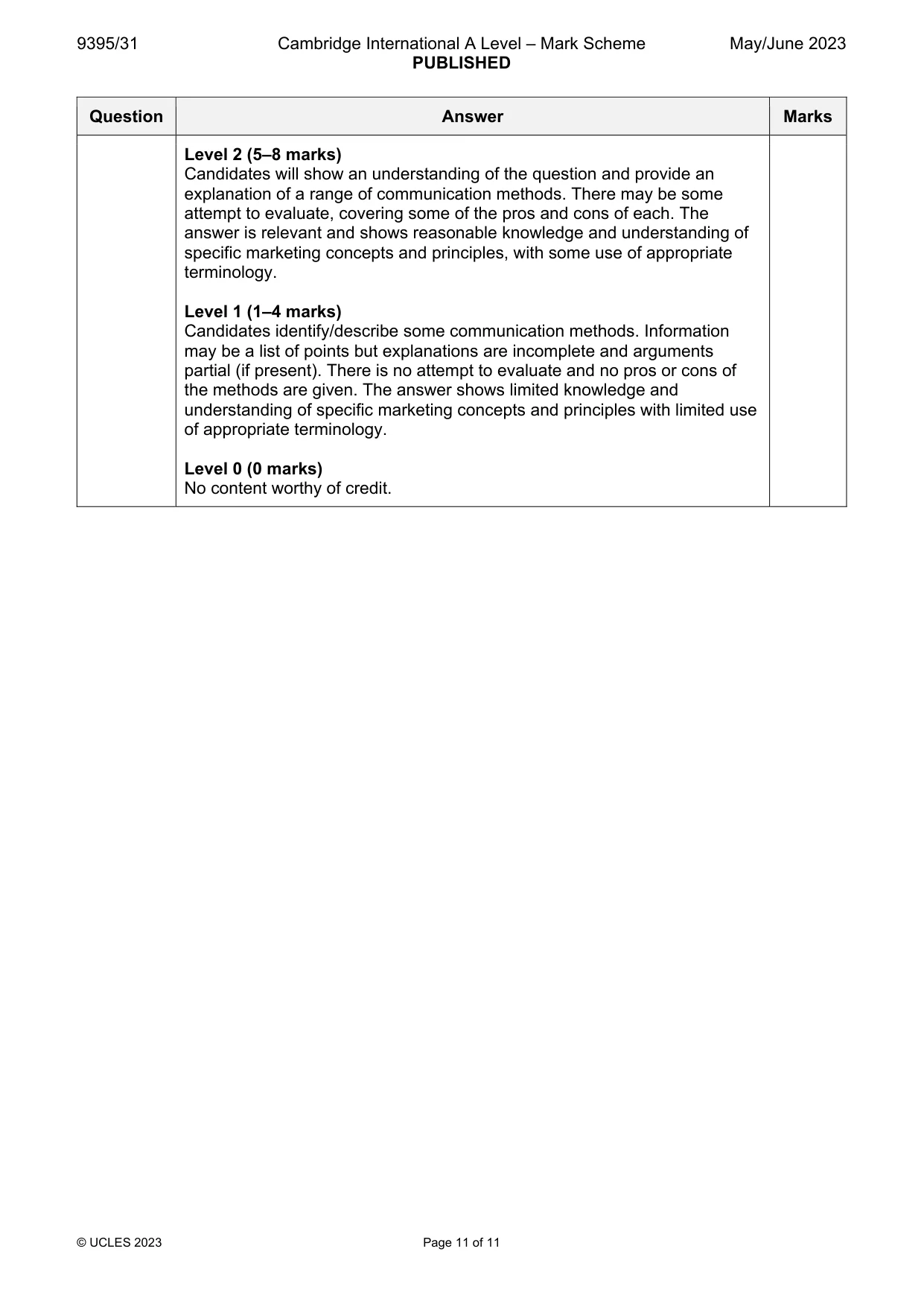
9395/31 Cambridge International A Level – Mark Scheme PUBLISHED May/June 2023 © UCLES 2023 Page 11 of 11 Question Answer Marks Level 2 (5–8 marks) Candidates will show an understanding of the question and provide an explanation of a range of communication methods. There may be some attempt to evaluate, covering some of the pros and cons of each. The answer is relevant and shows reasonable knowledge and understanding of specific marketing concepts and principles, with some use of appropriate terminology. Level 1 (1–4 marks) Candidates identify/describe some communication methods. Information may be a list of points but explanations are incomplete and arguments partial (if present). There is no attempt to evaluate and no pros or cons of the methods are given. The answer shows limited knowledge and understanding of specific marketing concepts and principles with limited use of appropriate terminology. Level 0 (0 marks) No content worthy of credit.
What you needed in this session
Cambridge’s own grade thresholds for 2023 May/June, Paper 3 · Variant 1. A higher threshold means an easier paper — the bar moves with how the cohort did.