Cambridge A Level Travel and Tourism 9395 — 2020 May/June Paper 1 · Variant 2
9395/12/M/J/20
The question paper and its mark scheme, free to read here and free to download. This is Cambridge’s own paper, exactly as it was sat.
Question paper16 pages



Mark scheme10 pages
Answers below. Sit the paper first if you are practising.
Paper as text
Question paper, page 1
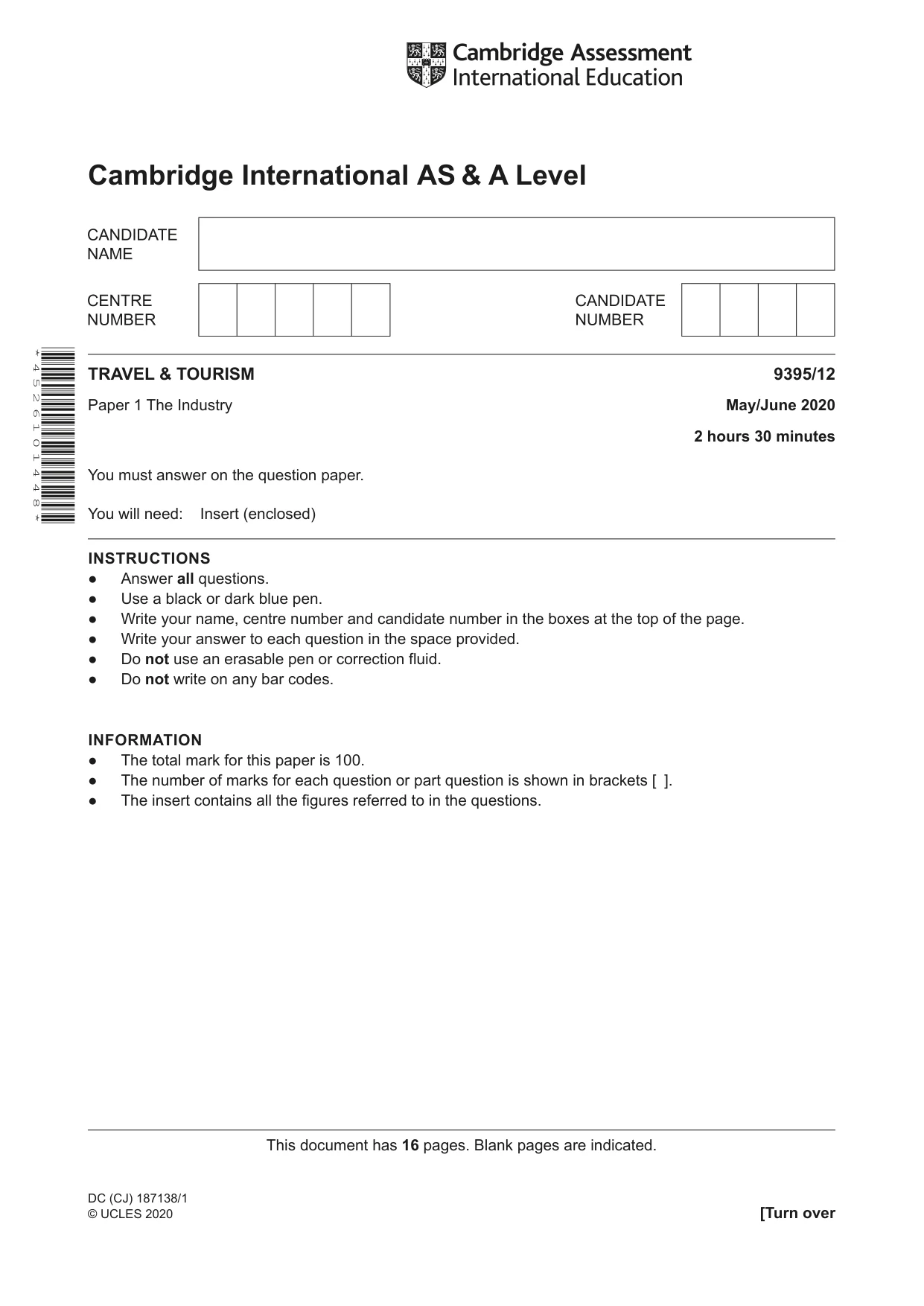
Cambridge International AS & A Level This document has 16 pages. Blank pages are indicated. TRAVEL & TOURISM 9395/12 Paper 1 The Industry May/June 2020 2 hours 30 minutes You must answer on the question paper. You will need: Insert (enclosed) INSTRUCTIONS ● Answer all questions. ● Use a black or dark blue pen. ● Write your name, centre number and candidate number in the boxes at the top of the page. ● Write your answer to each question in the space provided. ● Do not use an erasable pen or correction fluid. ● Do not write on any bar codes. INFORMATION ● The total mark for this paper is 100. ● The number of marks for each question or part question is shown in brackets [ ]. ● The insert contains all the figures referred to in the questions. * 4 5 2 6 1 0 1 4 4 8 * DC (CJ) 187138/1 © UCLES 2020 [Turn over
Question paper, page 2
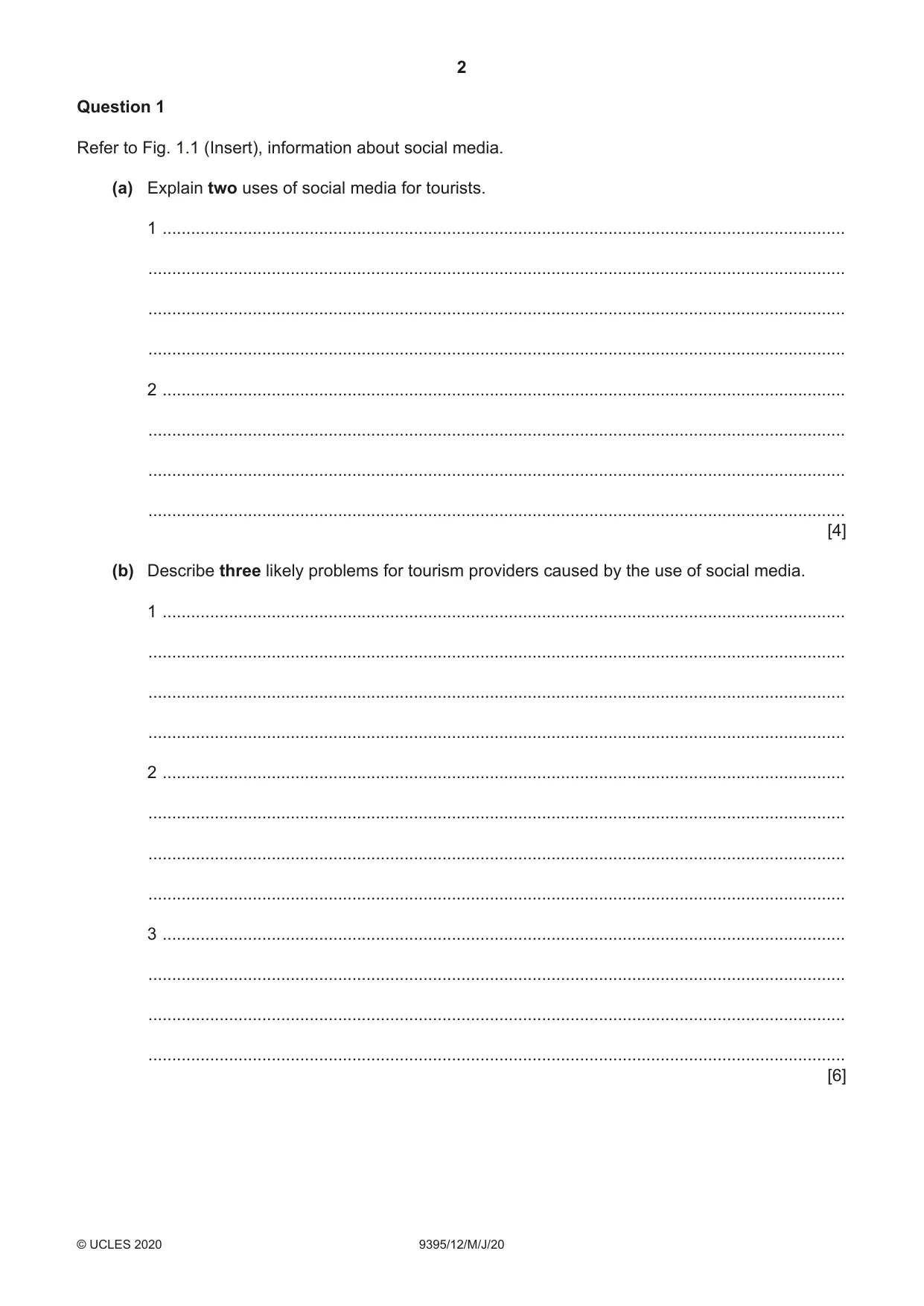
2 9395/12/M/J/20 © UCLES 2020 Question 1 Refer to Fig. 1.1 (Insert), information about social media. (a) Explain two uses of social media for tourists. 1 … … … … 2 … … … … [4] (b) Describe three likely problems for tourism providers caused by the use of social media. 1 … … … … 2 … … … … 3 … … … … [6]
Question paper, page 3
3 9395/12/M/J/20 © UCLES 2020 [Turn over (c) Many tourism authority websites contain virtual tours. Explain two advantages for destinations of virtual tours. 1 … … … … … … 2 … … … … … … [6]
Question paper, page 4
4 9395/12/M/J/20 © UCLES 2020 (d) Assess the role of mobile technology in the travel and tourism industry. … … … … … … … … … … … … … … … … … … [9] [Total: 25]
Question paper, page 5
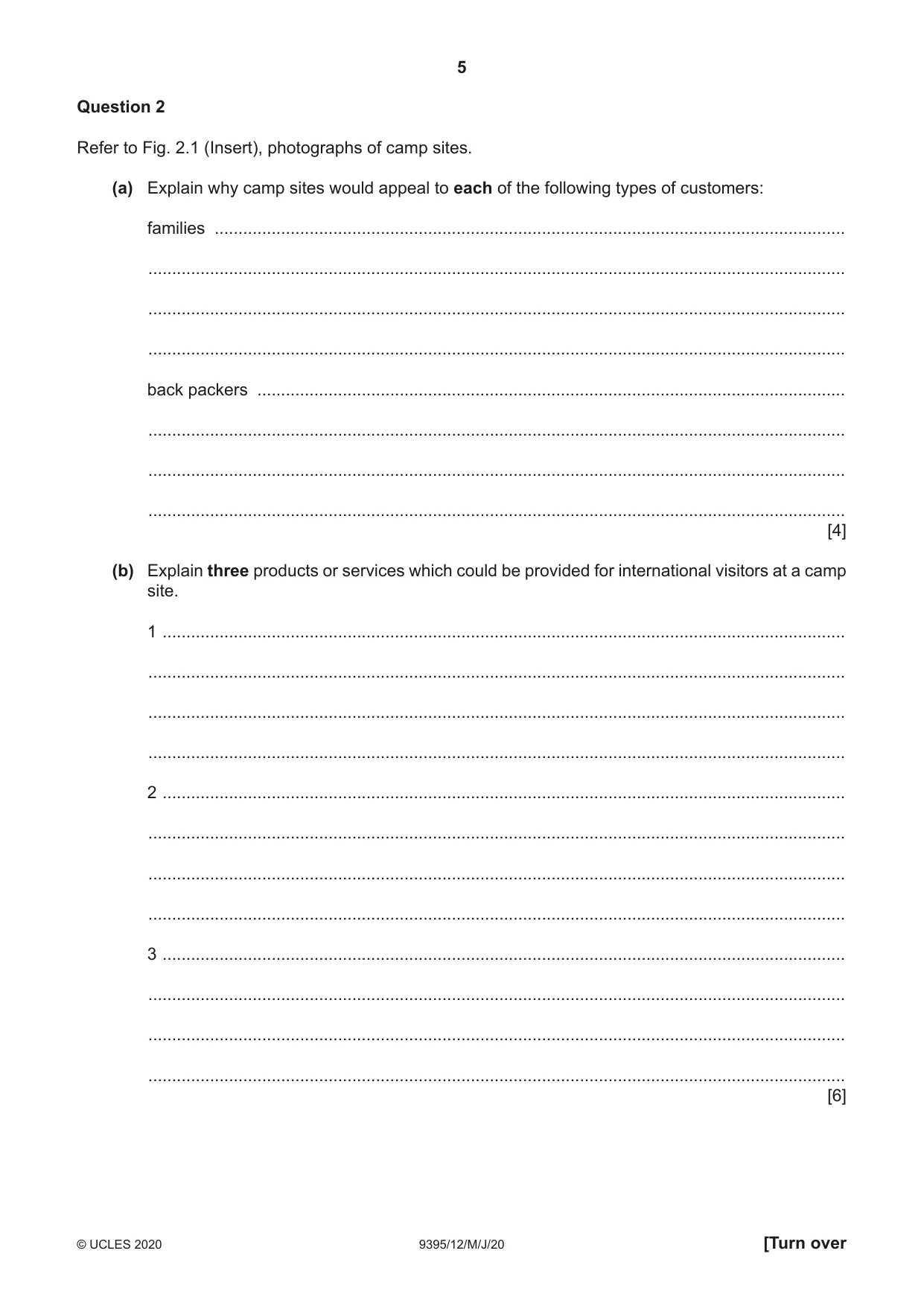
5 9395/12/M/J/20 © UCLES 2020 [Turn over Question 2 Refer to Fig. 2.1 (Insert), photographs of camp sites. (a) Explain why camp sites would appeal to each of the following types of customers: families … … … … back packers … … … … [4] (b) Explain three products or services which could be provided for international visitors at a camp site. 1 … … … … 2 … … … … 3 … … … … [6]
Question paper, page 6
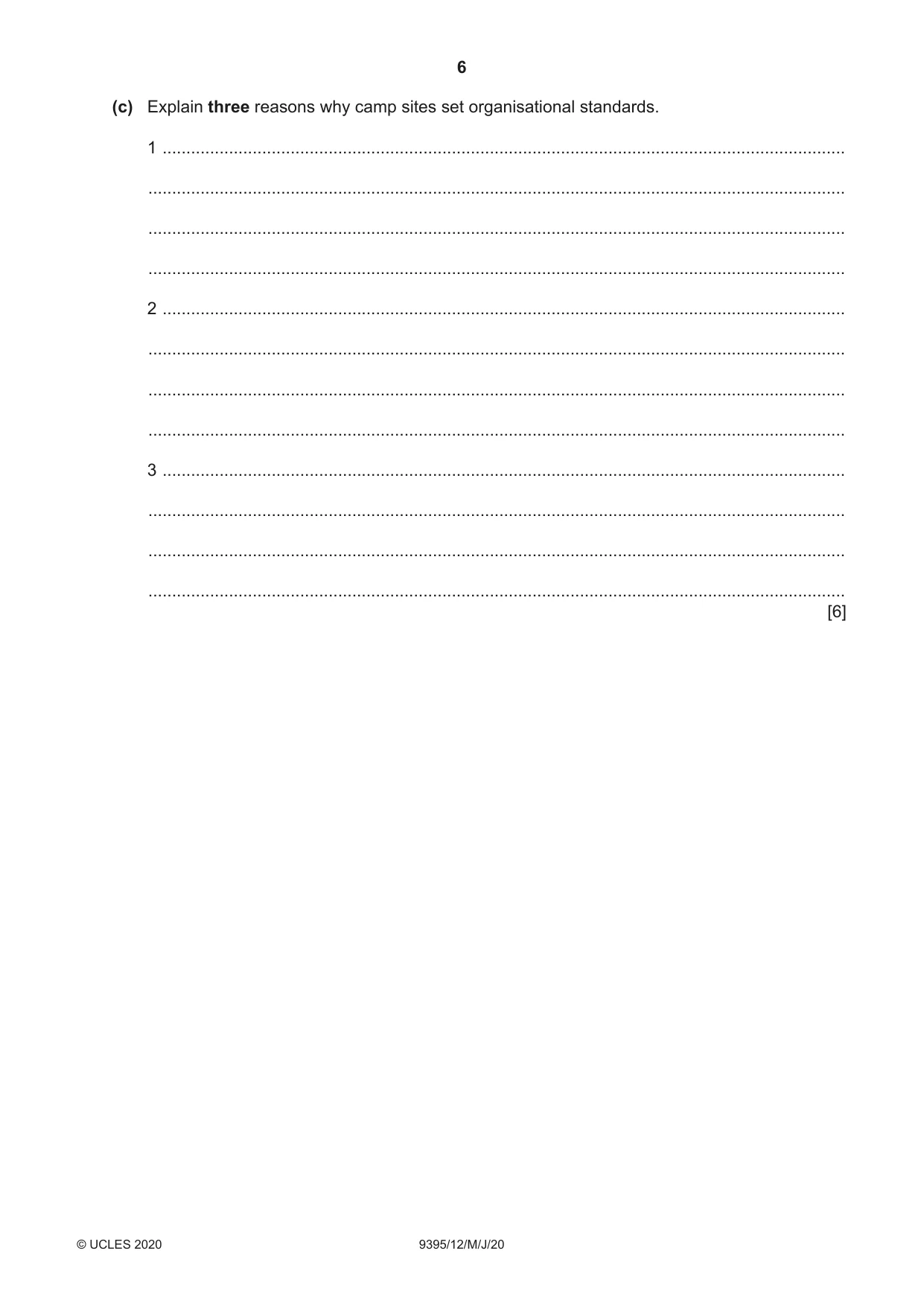
6 9395/12/M/J/20 © UCLES 2020 (c) Explain three reasons why camp sites set organisational standards. 1 … … … … 2 … … … … 3 … … … … [6]
Question paper, page 7
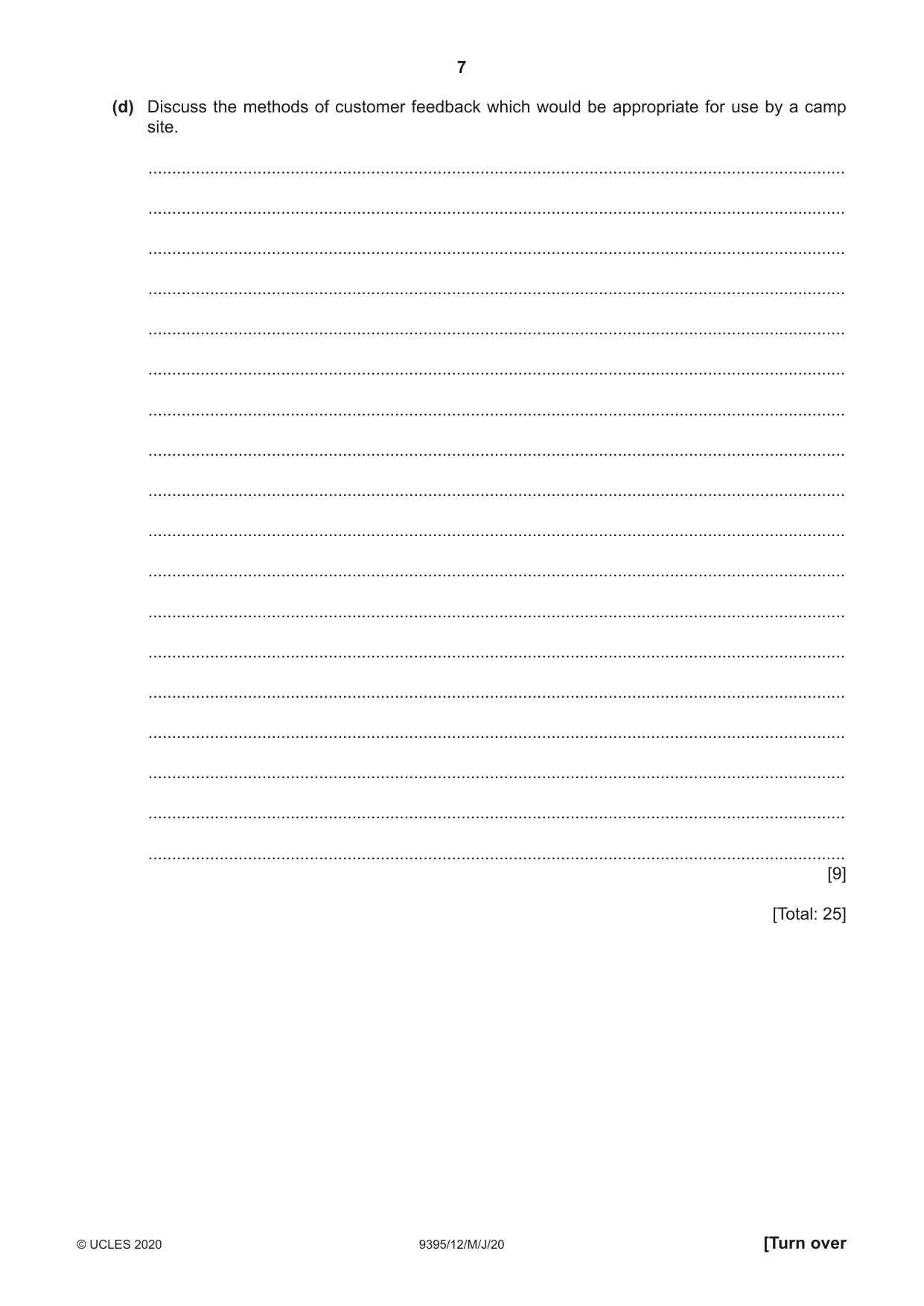
7 9395/12/M/J/20 © UCLES 2020 [Turn over (d) Discuss the methods of customer feedback which would be appropriate for use by a camp site. … … … … … … … … … … … … … … … … … … [9] [Total: 25]
Question paper, page 8
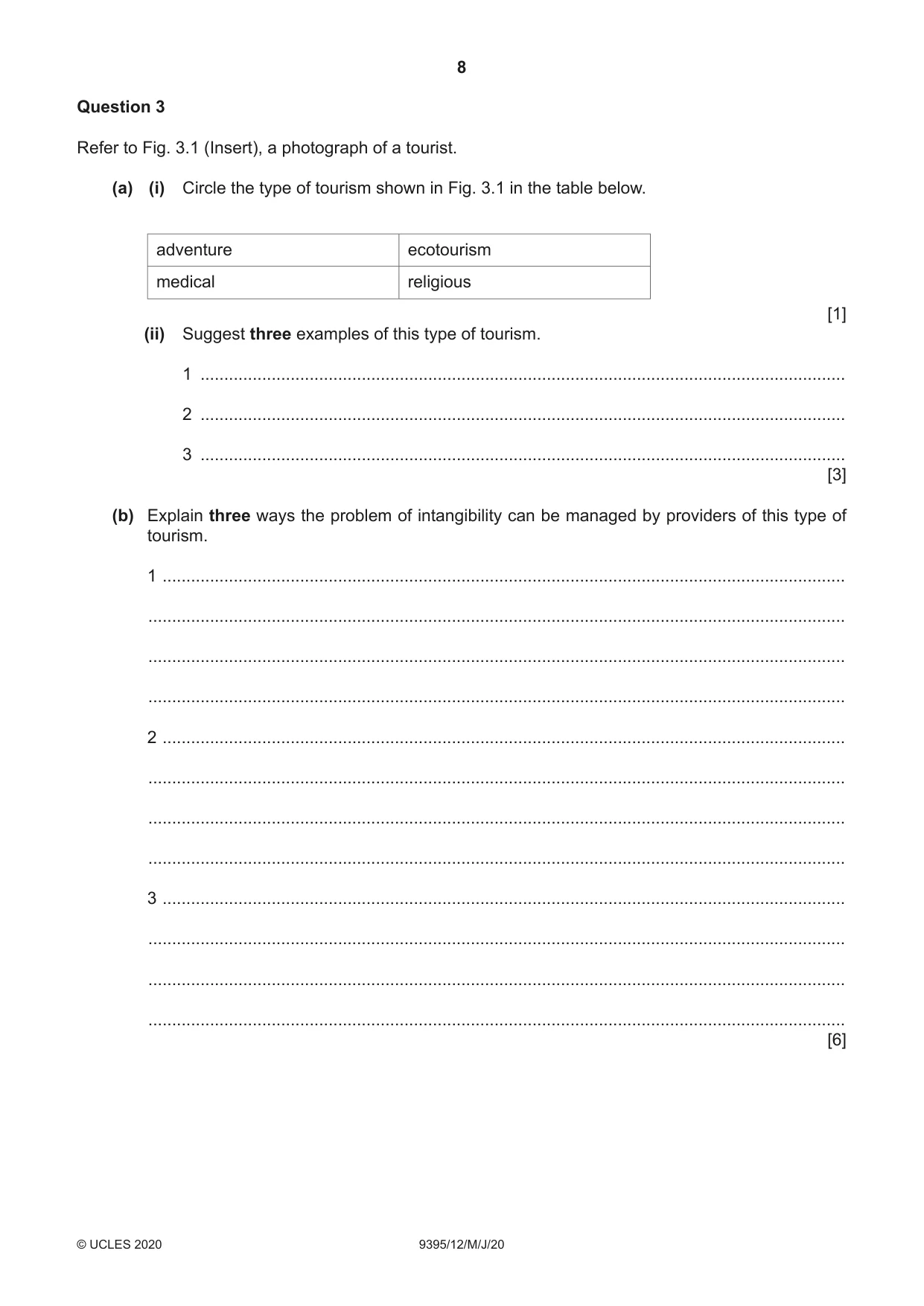
8 9395/12/M/J/20 © UCLES 2020 Question 3 Refer to Fig. 3.1 (Insert), a photograph of a tourist. (a) (i) Circle the type of tourism shown in Fig. 3.1 in the table below. adventure ecotourism medical religious [1] (ii) Suggest three examples of this type of tourism. 1 … 2 … 3 … [3] (b) Explain three ways the problem of intangibility can be managed by providers of this type of tourism. 1 … … … … 2 … … … … 3 … … … … [6]
Question paper, page 9
9 9395/12/M/J/20 © UCLES 2020 [Turn over (c) Explain three ways that the type of tourism shown in Fig. 3.1 can encourage infrastructure development and improvement. 1 … … … … 2 … … … … 3 … … … … [6]
Question paper, page 10
10 9395/12/M/J/20 © UCLES 2020 (d) Discuss the social factors which have encouraged the growth of the type of tourism shown in Fig. 3.1. … … … … … … … … … … … … … … … … … … [9] [Total: 25]
Question paper, page 11
11 9395/12/M/J/20 © UCLES 2020 [Turn over Question 4 Refer to Fig. 4.1 (Insert), information about tourism in the Maldives. (a) Explain two reasons why tourism is important to the Maldives. 1 … … … … 2 … … … … [4] (b) Explain three ways the Maldives could differentiate their tourism product to appeal to different market segments. 1 … … … … 2 … … … … 3 … … … … [6]
Question paper, page 12
12 9395/12/M/J/20 © UCLES 2020 (c) Explain three ways the Maldives could conserve their natural environment. 1 … … … … 2 … … … … 3 … … … … [6]
Question paper, page 13
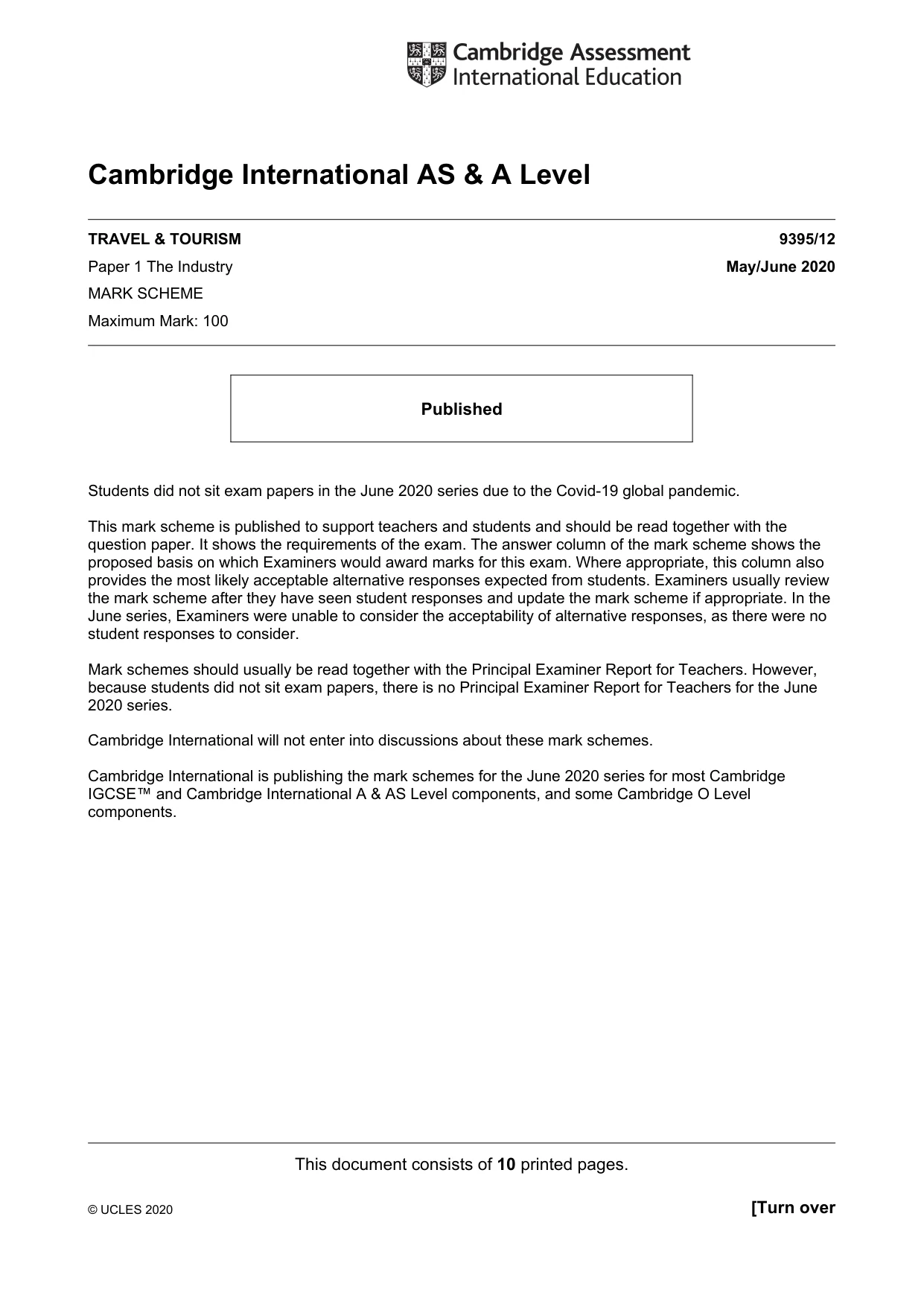
13 9395/12/M/J/20 © UCLES 2020 (d) Discuss why tourists choose to visit destinations in LEDCs. … … … … … … … … … … … … … … … … … … [9] [Total: 25]
Question paper, page 14
14 9395/12/M/J/20 © UCLES 2020 BLANK PAGE
Question paper, page 15
15 9395/12/M/J/20 © UCLES 2020 BLANK PAGE
Question paper, page 16
16 9395/12/M/J/20 © UCLES 2020 Permission to reproduce items where third-party owned material protected by copyright is included has been sought and cleared where possible. Every reasonable effort has been made by the publisher (UCLES) to trace copyright holders, but if any items requiring clearance have unwittingly been included, the publisher will be pleased to make amends at the earliest possible opportunity. To avoid the issue of disclosure of answer-related information to candidates, all copyright acknowledgements are reproduced online in the Cambridge Assessment International Education Copyright Acknowledgements Booklet. This is produced for each series of examinations and is freely available to download at www.cambridgeinternational.org after the live examination series. Cambridge Assessment International Education is part of the Cambridge Assessment Group. Cambridge Assessment is the brand name of the University of Cambridge Local Examinations Syndicate (UCLES), which itself is a department of the University of Cambridge. BLANK PAGE
Mark scheme, page 1
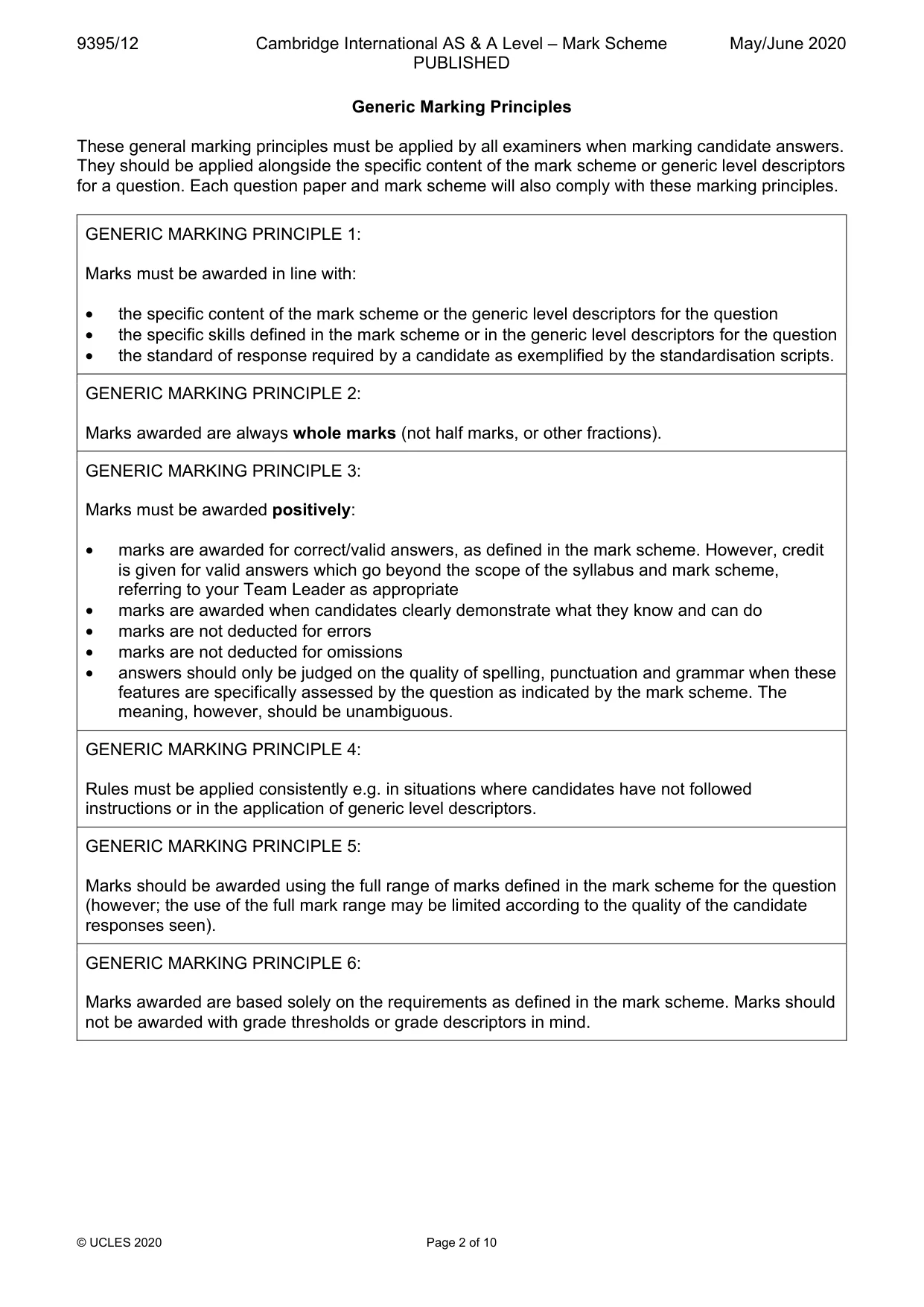
This document consists of 10 printed pages. © UCLES 2020 [Turn over Cambridge International AS & A Level TRAVEL & TOURISM 9395/12 Paper 1 The Industry May/June 2020 MARK SCHEME Maximum Mark: 100 Published Students did not sit exam papers in the June 2020 series due to the Covid-19 global pandemic. This mark scheme is published to support teachers and students and should be read together with the question paper. It shows the requirements of the exam. The answer column of the mark scheme shows the proposed basis on which Examiners would award marks for this exam. Where appropriate, this column also provides the most likely acceptable alternative responses expected from students. Examiners usually review the mark scheme after they have seen student responses and update the mark scheme if appropriate. In the June series, Examiners were unable to consider the acceptability of alternative responses, as there were no student responses to consider. Mark schemes should usually be read together with the Principal Examiner Report for Teachers. However, because students did not sit exam papers, there is no Principal Examiner Report for Teachers for the June 2020 series. Cambridge International will not enter into discussions about these mark schemes. Cambridge International is publishing the mark schemes for the June 2020 series for most Cambridge IGCSE™ and Cambridge International A & AS Level components, and some Cambridge O Level components.
Mark scheme, page 2
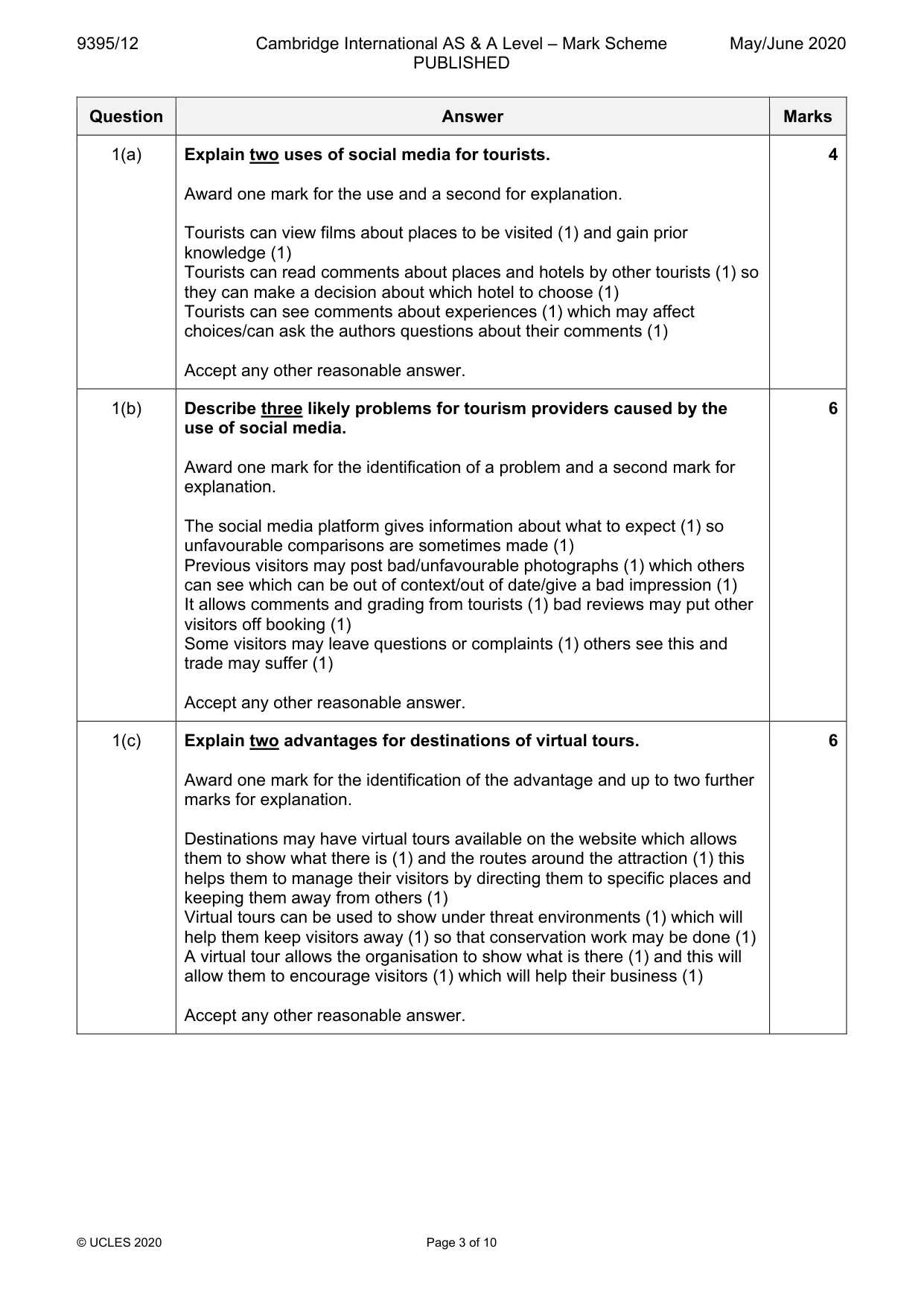
9395/12 Cambridge International AS & A Level – Mark Scheme PUBLISHED May/June 2020 © UCLES 2020 Page 2 of 10 Generic Marking Principles These general marking principles must be applied by all examiners when marking candidate answers. They should be applied alongside the specific content of the mark scheme or generic level descriptors for a question. Each question paper and mark scheme will also comply with these marking principles. GENERIC MARKING PRINCIPLE 1: Marks must be awarded in line with: • the specific content of the mark scheme or the generic level descriptors for the question • the specific skills defined in the mark scheme or in the generic level descriptors for the question • the standard of response required by a candidate as exemplified by the standardisation scripts. GENERIC MARKING PRINCIPLE 2: Marks awarded are always whole marks (not half marks, or other fractions). GENERIC MARKING PRINCIPLE 3: Marks must be awarded positively: • marks are awarded for correct/valid answers, as defined in the mark scheme. However, credit is given for valid answers which go beyond the scope of the syllabus and mark scheme, referring to your Team Leader as appropriate • marks are awarded when candidates clearly demonstrate what they know and can do • marks are not deducted for errors • marks are not deducted for omissions • answers should only be judged on the quality of spelling, punctuation and grammar when these features are specifically assessed by the question as indicated by the mark scheme. The meaning, however, should be unambiguous. GENERIC MARKING PRINCIPLE 4: Rules must be applied consistently e.g. in situations where candidates have not followed instructions or in the application of generic level descriptors. GENERIC MARKING PRINCIPLE 5: Marks should be awarded using the full range of marks defined in the mark scheme for the question (however; the use of the full mark range may be limited according to the quality of the candidate responses seen). GENERIC MARKING PRINCIPLE 6: Marks awarded are based solely on the requirements as defined in the mark scheme. Marks should not be awarded with grade thresholds or grade descriptors in mind.
Mark scheme, page 3
9395/12 Cambridge International AS & A Level – Mark Scheme PUBLISHED May/June 2020 © UCLES 2020 Page 3 of 10 Question Answer Marks 1(a) Explain two uses of social media for tourists. Award one mark for the use and a second for explanation. Tourists can view films about places to be visited (1) and gain prior knowledge (1) Tourists can read comments about places and hotels by other tourists (1) so they can make a decision about which hotel to choose (1) Tourists can see comments about experiences (1) which may affect choices/can ask the authors questions about their comments (1) Accept any other reasonable answer. 4 1(b) Describe three likely problems for tourism providers caused by the use of social media. Award one mark for the identification of a problem and a second mark for explanation. The social media platform gives information about what to expect (1) so unfavourable comparisons are sometimes made (1) Previous visitors may post bad/unfavourable photographs (1) which others can see which can be out of context/out of date/give a bad impression (1) It allows comments and grading from tourists (1) bad reviews may put other visitors off booking (1) Some visitors may leave questions or complaints (1) others see this and trade may suffer (1) Accept any other reasonable answer. 6 1(c) Explain two advantages for destinations of virtual tours. Award one mark for the identification of the advantage and up to two further marks for explanation. Destinations may have virtual tours available on the website which allows them to show what there is (1) and the routes around the attraction (1) this helps them to manage their visitors by directing them to specific places and keeping them away from others (1) Virtual tours can be used to show under threat environments (1) which will help them keep visitors away (1) so that conservation work may be done (1) A virtual tour allows the organisation to show what is there (1) and this will allow them to encourage visitors (1) which will help their business (1) Accept any other reasonable answer. 6
Mark scheme, page 4
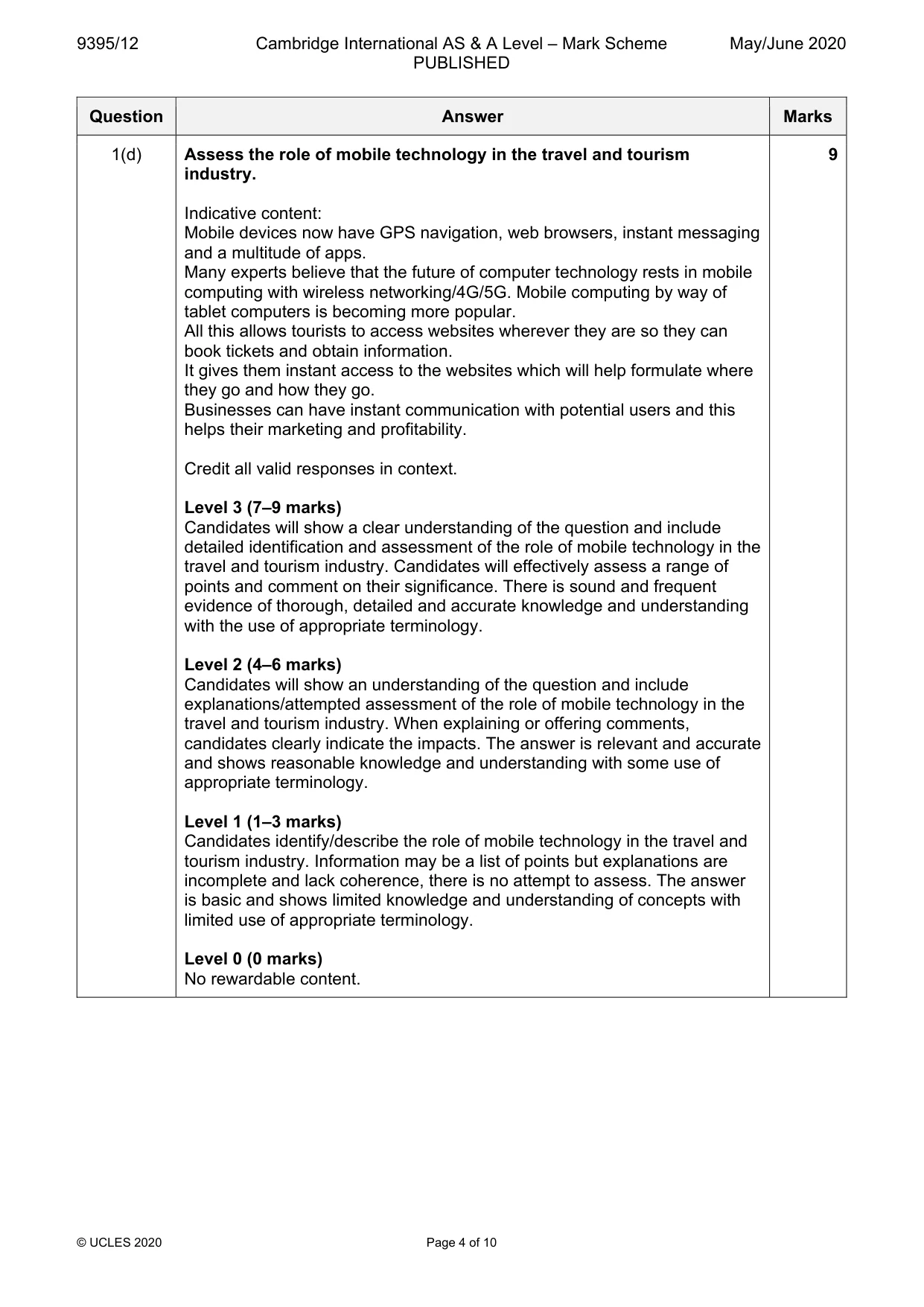
9395/12 Cambridge International AS & A Level – Mark Scheme PUBLISHED May/June 2020 © UCLES 2020 Page 4 of 10 Question Answer Marks 1(d) Assess the role of mobile technology in the travel and tourism industry. Indicative content: Mobile devices now have GPS navigation, web browsers, instant messaging and a multitude of apps. Many experts believe that the future of computer technology rests in mobile computing with wireless networking/4G/5G. Mobile computing by way of tablet computers is becoming more popular. All this allows tourists to access websites wherever they are so they can book tickets and obtain information. It gives them instant access to the websites which will help formulate where they go and how they go. Businesses can have instant communication with potential users and this helps their marketing and profitability. Credit all valid responses in context. Level 3 (7–9 marks) Candidates will show a clear understanding of the question and include detailed identification and assessment of the role of mobile technology in the travel and tourism industry. Candidates will effectively assess a range of points and comment on their significance. There is sound and frequent evidence of thorough, detailed and accurate knowledge and understanding with the use of appropriate terminology. Level 2 (4–6 marks) Candidates will show an understanding of the question and include explanations/attempted assessment of the role of mobile technology in the travel and tourism industry. When explaining or offering comments, candidates clearly indicate the impacts. The answer is relevant and accurate and shows reasonable knowledge and understanding with some use of appropriate terminology. Level 1 (1–3 marks) Candidates identify/describe the role of mobile technology in the travel and tourism industry. Information may be a list of points but explanations are incomplete and lack coherence, there is no attempt to assess. The answer is basic and shows limited knowledge and understanding of concepts with limited use of appropriate terminology. Level 0 (0 marks) No rewardable content. 9
Mark scheme, page 5
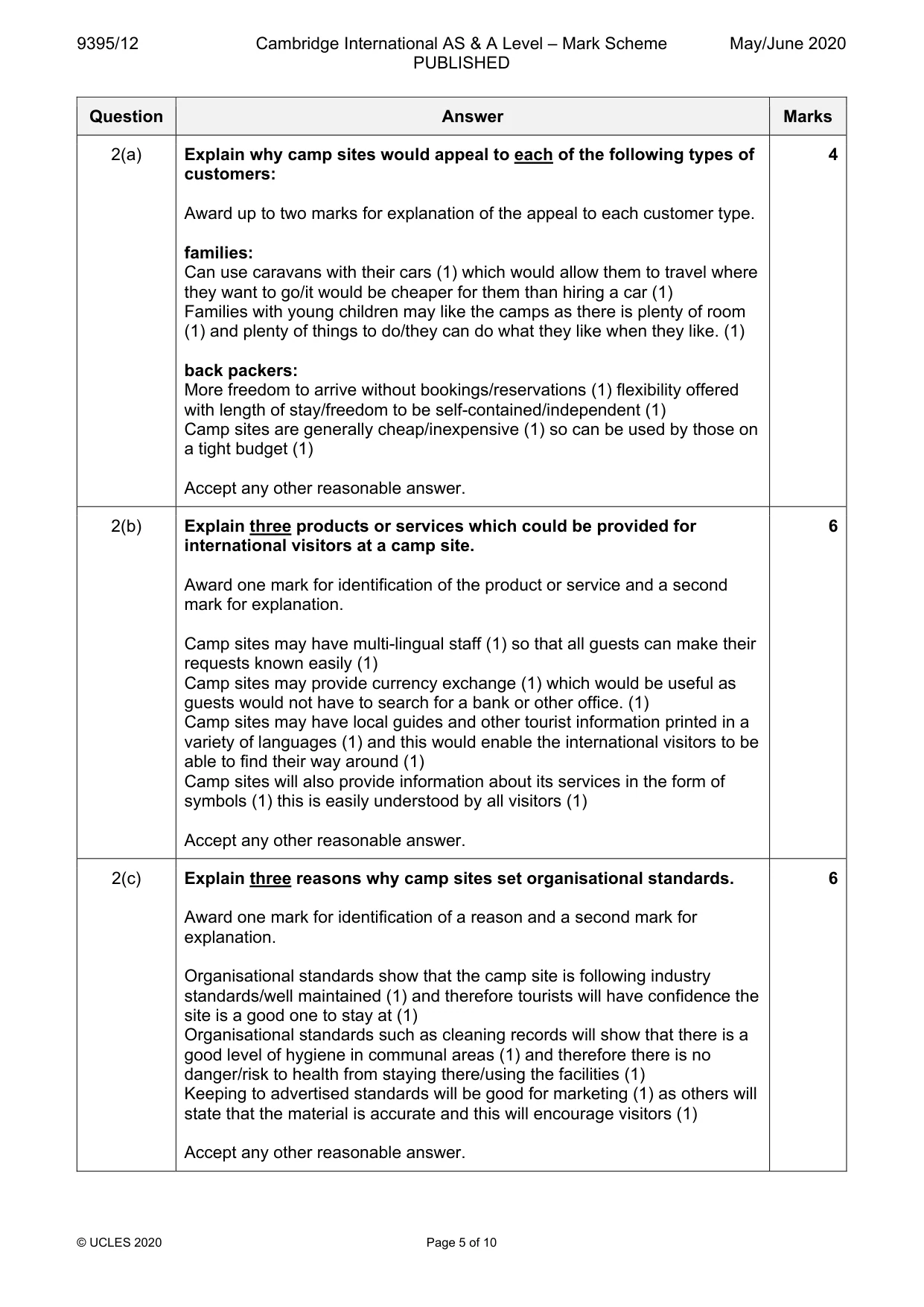
9395/12 Cambridge International AS & A Level – Mark Scheme PUBLISHED May/June 2020 © UCLES 2020 Page 5 of 10 Question Answer Marks 2(a) Explain why camp sites would appeal to each of the following types of customers: Award up to two marks for explanation of the appeal to each customer type. families: Can use caravans with their cars (1) which would allow them to travel where they want to go/it would be cheaper for them than hiring a car (1) Families with young children may like the camps as there is plenty of room (1) and plenty of things to do/they can do what they like when they like. (1) back packers: More freedom to arrive without bookings/reservations (1) flexibility offered with length of stay/freedom to be self-contained/independent (1) Camp sites are generally cheap/inexpensive (1) so can be used by those on a tight budget (1) Accept any other reasonable answer. 4 2(b) Explain three products or services which could be provided for international visitors at a camp site. Award one mark for identification of the product or service and a second mark for explanation. Camp sites may have multi-lingual staff (1) so that all guests can make their requests known easily (1) Camp sites may provide currency exchange (1) which would be useful as guests would not have to search for a bank or other office. (1) Camp sites may have local guides and other tourist information printed in a variety of languages (1) and this would enable the international visitors to be able to find their way around (1) Camp sites will also provide information about its services in the form of symbols (1) this is easily understood by all visitors (1) Accept any other reasonable answer. 6 2(c) Explain three reasons why camp sites set organisational standards. Award one mark for identification of a reason and a second mark for explanation. Organisational standards show that the camp site is following industry standards/well maintained (1) and therefore tourists will have confidence the site is a good one to stay at (1) Organisational standards such as cleaning records will show that there is a good level of hygiene in communal areas (1) and therefore there is no danger/risk to health from staying there/using the facilities (1) Keeping to advertised standards will be good for marketing (1) as others will state that the material is accurate and this will encourage visitors (1) Accept any other reasonable answer. 6
Mark scheme, page 6
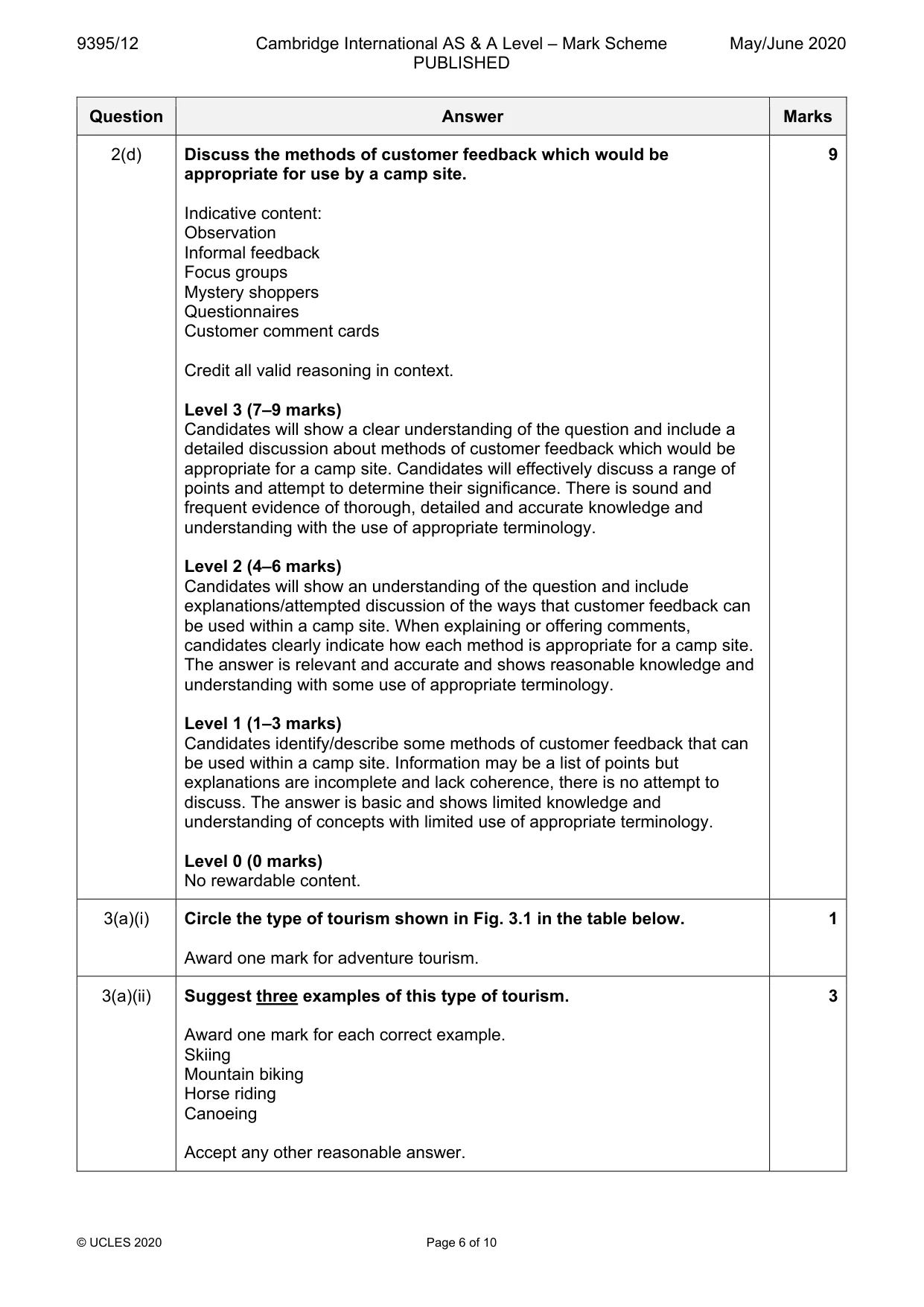
9395/12 Cambridge International AS & A Level – Mark Scheme PUBLISHED May/June 2020 © UCLES 2020 Page 6 of 10 Question Answer Marks 2(d) Discuss the methods of customer feedback which would be appropriate for use by a camp site. Indicative content: Observation Informal feedback Focus groups Mystery shoppers Questionnaires Customer comment cards Credit all valid reasoning in context. Level 3 (7–9 marks) Candidates will show a clear understanding of the question and include a detailed discussion about methods of customer feedback which would be appropriate for a camp site. Candidates will effectively discuss a range of points and attempt to determine their significance. There is sound and frequent evidence of thorough, detailed and accurate knowledge and understanding with the use of appropriate terminology. Level 2 (4–6 marks) Candidates will show an understanding of the question and include explanations/attempted discussion of the ways that customer feedback can be used within a camp site. When explaining or offering comments, candidates clearly indicate how each method is appropriate for a camp site. The answer is relevant and accurate and shows reasonable knowledge and understanding with some use of appropriate terminology. Level 1 (1–3 marks) Candidates identify/describe some methods of customer feedback that can be used within a camp site. Information may be a list of points but explanations are incomplete and lack coherence, there is no attempt to discuss. The answer is basic and shows limited knowledge and understanding of concepts with limited use of appropriate terminology. Level 0 (0 marks) No rewardable content. 9 3(a)(i) Circle the type of tourism shown in Fig. 3.1 in the table below. Award one mark for adventure tourism. 1 3(a)(ii) Suggest three examples of this type of tourism. Award one mark for each correct example. Skiing Mountain biking Horse riding Canoeing Accept any other reasonable answer. 3
Mark scheme, page 7
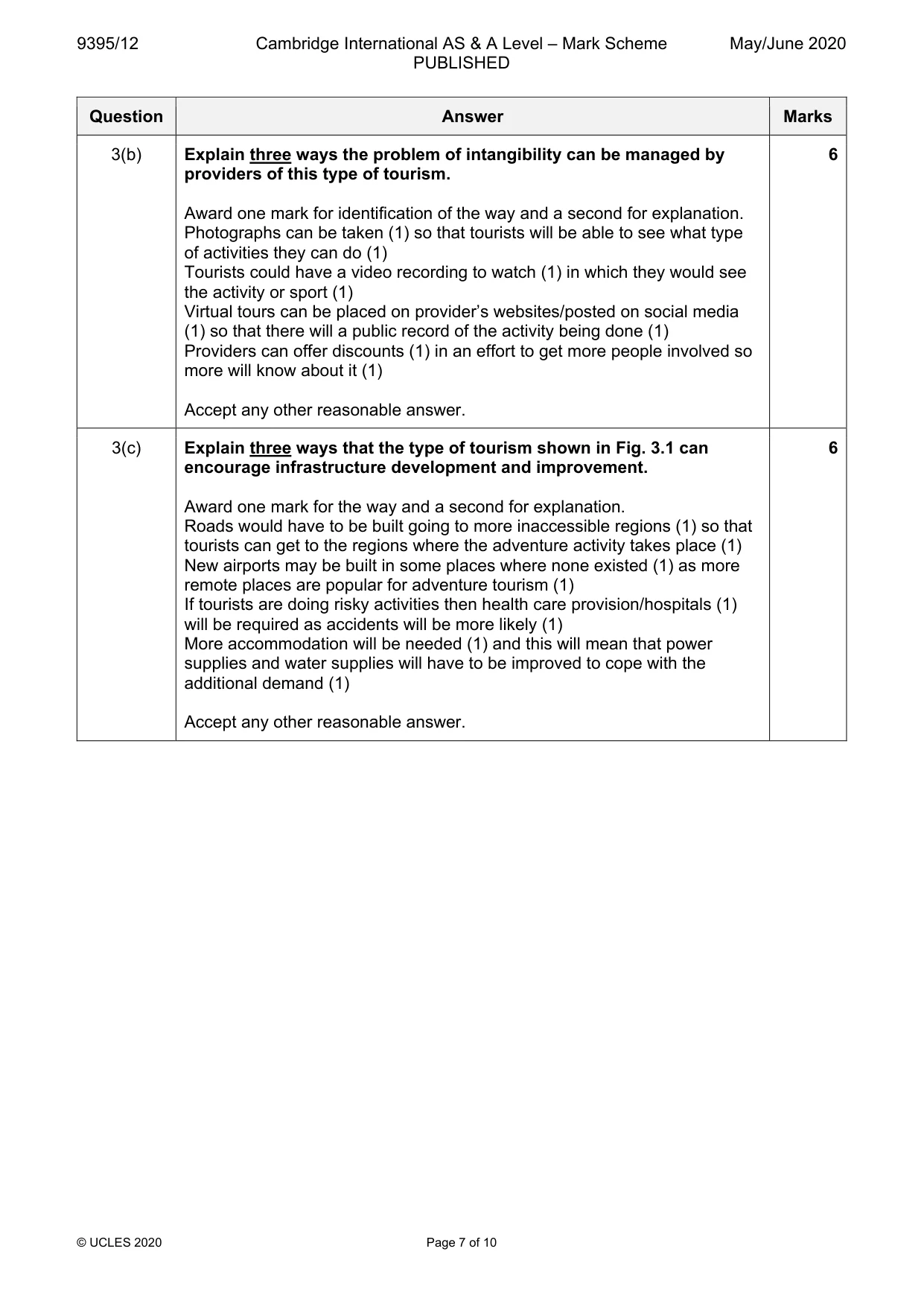
9395/12 Cambridge International AS & A Level – Mark Scheme PUBLISHED May/June 2020 © UCLES 2020 Page 7 of 10 Question Answer Marks 3(b) Explain three ways the problem of intangibility can be managed by providers of this type of tourism. Award one mark for identification of the way and a second for explanation. Photographs can be taken (1) so that tourists will be able to see what type of activities they can do (1) Tourists could have a video recording to watch (1) in which they would see the activity or sport (1) Virtual tours can be placed on provider’s websites/posted on social media (1) so that there will a public record of the activity being done (1) Providers can offer discounts (1) in an effort to get more people involved so more will know about it (1) Accept any other reasonable answer. 6 3(c) Explain three ways that the type of tourism shown in Fig. 3.1 can encourage infrastructure development and improvement. Award one mark for the way and a second for explanation. Roads would have to be built going to more inaccessible regions (1) so that tourists can get to the regions where the adventure activity takes place (1) New airports may be built in some places where none existed (1) as more remote places are popular for adventure tourism (1) If tourists are doing risky activities then health care provision/hospitals (1) will be required as accidents will be more likely (1) More accommodation will be needed (1) and this will mean that power supplies and water supplies will have to be improved to cope with the additional demand (1) Accept any other reasonable answer. 6
Mark scheme, page 8
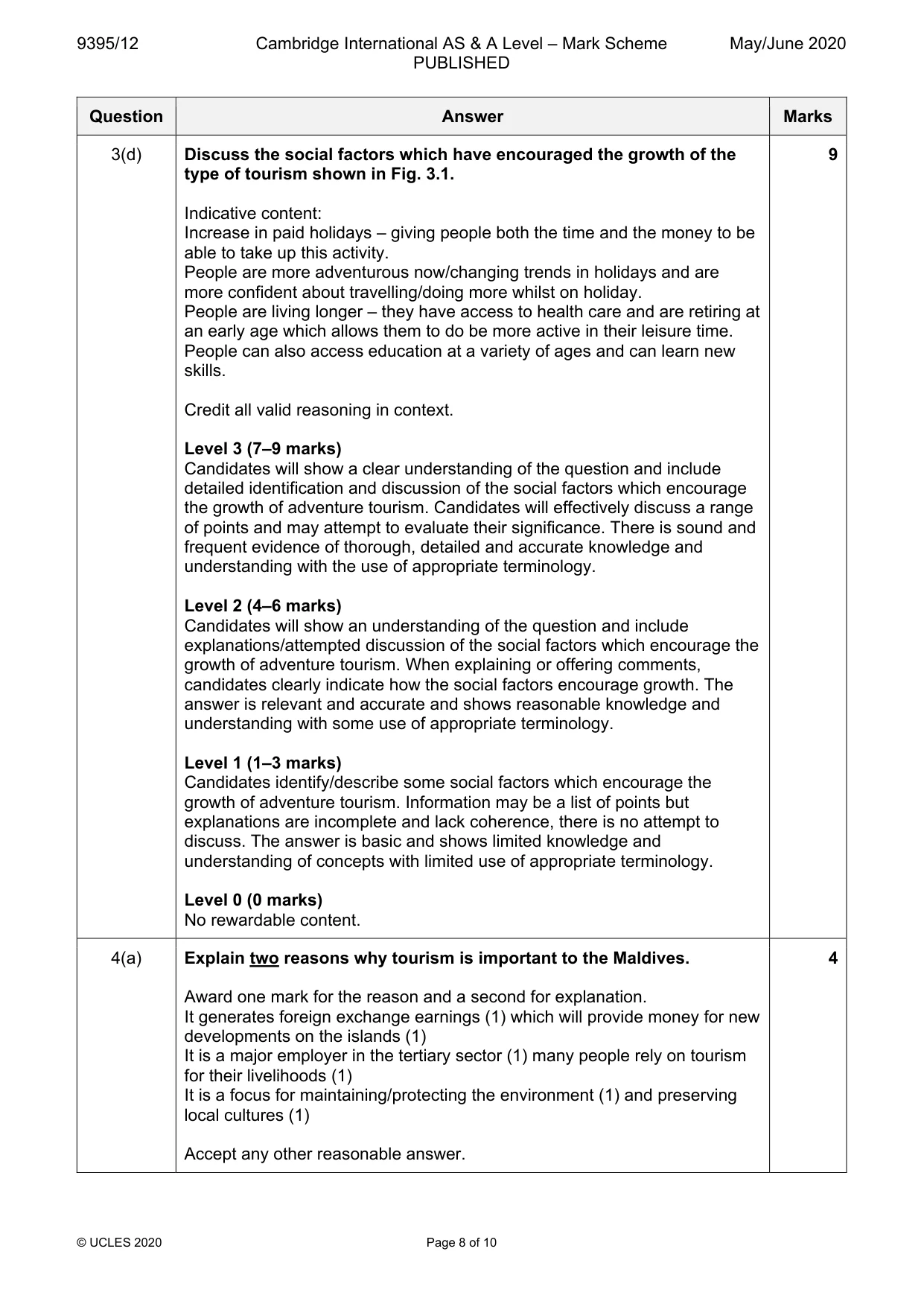
9395/12 Cambridge International AS & A Level – Mark Scheme PUBLISHED May/June 2020 © UCLES 2020 Page 8 of 10 Question Answer Marks 3(d) Discuss the social factors which have encouraged the growth of the type of tourism shown in Fig. 3.1. Indicative content: Increase in paid holidays – giving people both the time and the money to be able to take up this activity. People are more adventurous now/changing trends in holidays and are more confident about travelling/doing more whilst on holiday. People are living longer – they have access to health care and are retiring at an early age which allows them to do be more active in their leisure time. People can also access education at a variety of ages and can learn new skills. Credit all valid reasoning in context. Level 3 (7–9 marks) Candidates will show a clear understanding of the question and include detailed identification and discussion of the social factors which encourage the growth of adventure tourism. Candidates will effectively discuss a range of points and may attempt to evaluate their significance. There is sound and frequent evidence of thorough, detailed and accurate knowledge and understanding with the use of appropriate terminology. Level 2 (4–6 marks) Candidates will show an understanding of the question and include explanations/attempted discussion of the social factors which encourage the growth of adventure tourism. When explaining or offering comments, candidates clearly indicate how the social factors encourage growth. The answer is relevant and accurate and shows reasonable knowledge and understanding with some use of appropriate terminology. Level 1 (1–3 marks) Candidates identify/describe some social factors which encourage the growth of adventure tourism. Information may be a list of points but explanations are incomplete and lack coherence, there is no attempt to discuss. The answer is basic and shows limited knowledge and understanding of concepts with limited use of appropriate terminology. Level 0 (0 marks) No rewardable content. 9 4(a) Explain two reasons why tourism is important to the Maldives. Award one mark for the reason and a second for explanation. It generates foreign exchange earnings (1) which will provide money for new developments on the islands (1) It is a major employer in the tertiary sector (1) many people rely on tourism for their livelihoods (1) It is a focus for maintaining/protecting the environment (1) and preserving local cultures (1) Accept any other reasonable answer. 4
Mark scheme, page 9
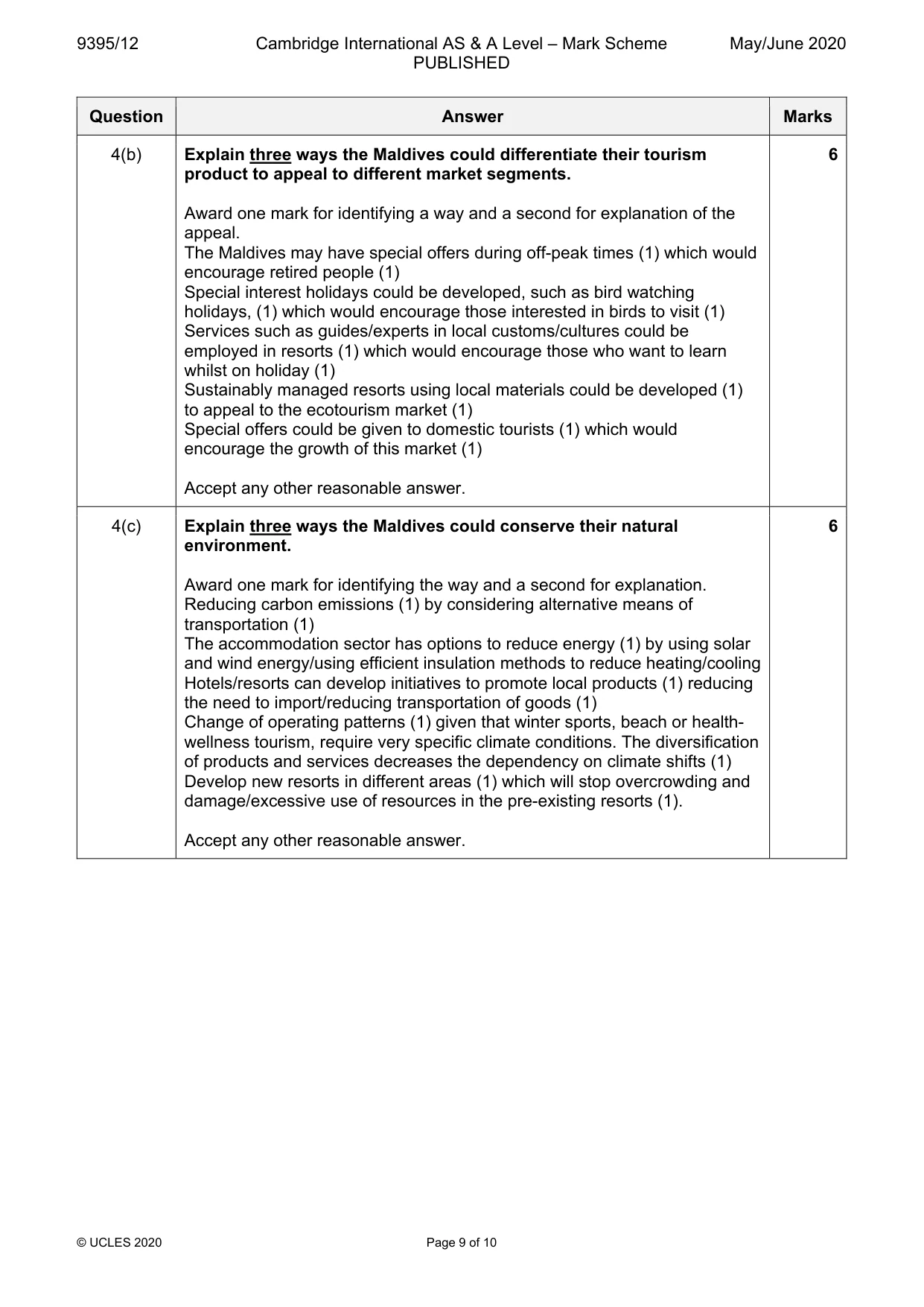
9395/12 Cambridge International AS & A Level – Mark Scheme PUBLISHED May/June 2020 © UCLES 2020 Page 9 of 10 Question Answer Marks 4(b) Explain three ways the Maldives could differentiate their tourism product to appeal to different market segments. Award one mark for identifying a way and a second for explanation of the appeal. The Maldives may have special offers during off-peak times (1) which would encourage retired people (1) Special interest holidays could be developed, such as bird watching holidays, (1) which would encourage those interested in birds to visit (1) Services such as guides/experts in local customs/cultures could be employed in resorts (1) which would encourage those who want to learn whilst on holiday (1) Sustainably managed resorts using local materials could be developed (1) to appeal to the ecotourism market (1) Special offers could be given to domestic tourists (1) which would encourage the growth of this market (1) Accept any other reasonable answer. 6 4(c) Explain three ways the Maldives could conserve their natural environment. Award one mark for identifying the way and a second for explanation. Reducing carbon emissions (1) by considering alternative means of transportation (1) The accommodation sector has options to reduce energy (1) by using solar and wind energy/using efficient insulation methods to reduce heating/cooling Hotels/resorts can develop initiatives to promote local products (1) reducing the need to import/reducing transportation of goods (1) Change of operating patterns (1) given that winter sports, beach or health- wellness tourism, require very specific climate conditions. The diversification of products and services decreases the dependency on climate shifts (1) Develop new resorts in different areas (1) which will stop overcrowding and damage/excessive use of resources in the pre-existing resorts (1). Accept any other reasonable answer. 6
Mark scheme, page 10
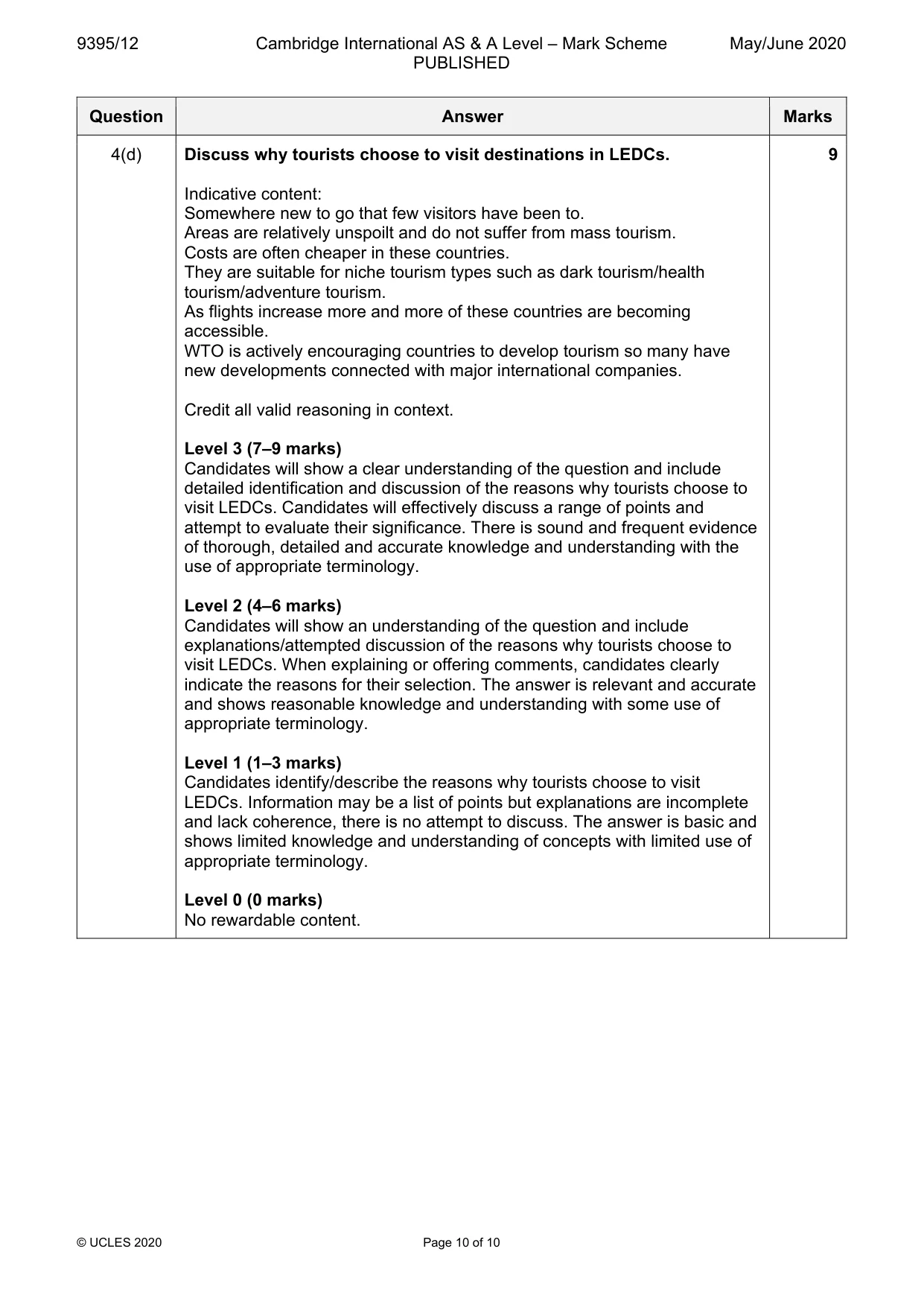
9395/12 Cambridge International AS & A Level – Mark Scheme PUBLISHED May/June 2020 © UCLES 2020 Page 10 of 10 Question Answer Marks 4(d) Discuss why tourists choose to visit destinations in LEDCs. Indicative content: Somewhere new to go that few visitors have been to. Areas are relatively unspoilt and do not suffer from mass tourism. Costs are often cheaper in these countries. They are suitable for niche tourism types such as dark tourism/health tourism/adventure tourism. As flights increase more and more of these countries are becoming accessible. WTO is actively encouraging countries to develop tourism so many have new developments connected with major international companies. Credit all valid reasoning in context. Level 3 (7–9 marks) Candidates will show a clear understanding of the question and include detailed identification and discussion of the reasons why tourists choose to visit LEDCs. Candidates will effectively discuss a range of points and attempt to evaluate their significance. There is sound and frequent evidence of thorough, detailed and accurate knowledge and understanding with the use of appropriate terminology. Level 2 (4–6 marks) Candidates will show an understanding of the question and include explanations/attempted discussion of the reasons why tourists choose to visit LEDCs. When explaining or offering comments, candidates clearly indicate the reasons for their selection. The answer is relevant and accurate and shows reasonable knowledge and understanding with some use of appropriate terminology. Level 1 (1–3 marks) Candidates identify/describe the reasons why tourists choose to visit LEDCs. Information may be a list of points but explanations are incomplete and lack coherence, there is no attempt to discuss. The answer is basic and shows limited knowledge and understanding of concepts with limited use of appropriate terminology. Level 0 (0 marks) No rewardable content. 9