Cambridge A Level Travel and Tourism 9395 — 2020 May/June Paper 1 · Variant 3
9395/13/M/J/20
The question paper and its mark scheme, free to read here and free to download. This is Cambridge’s own paper, exactly as it was sat.
Question paper16 pages



Mark scheme10 pages
Answers below. Sit the paper first if you are practising.
Paper as text
Question paper, page 1
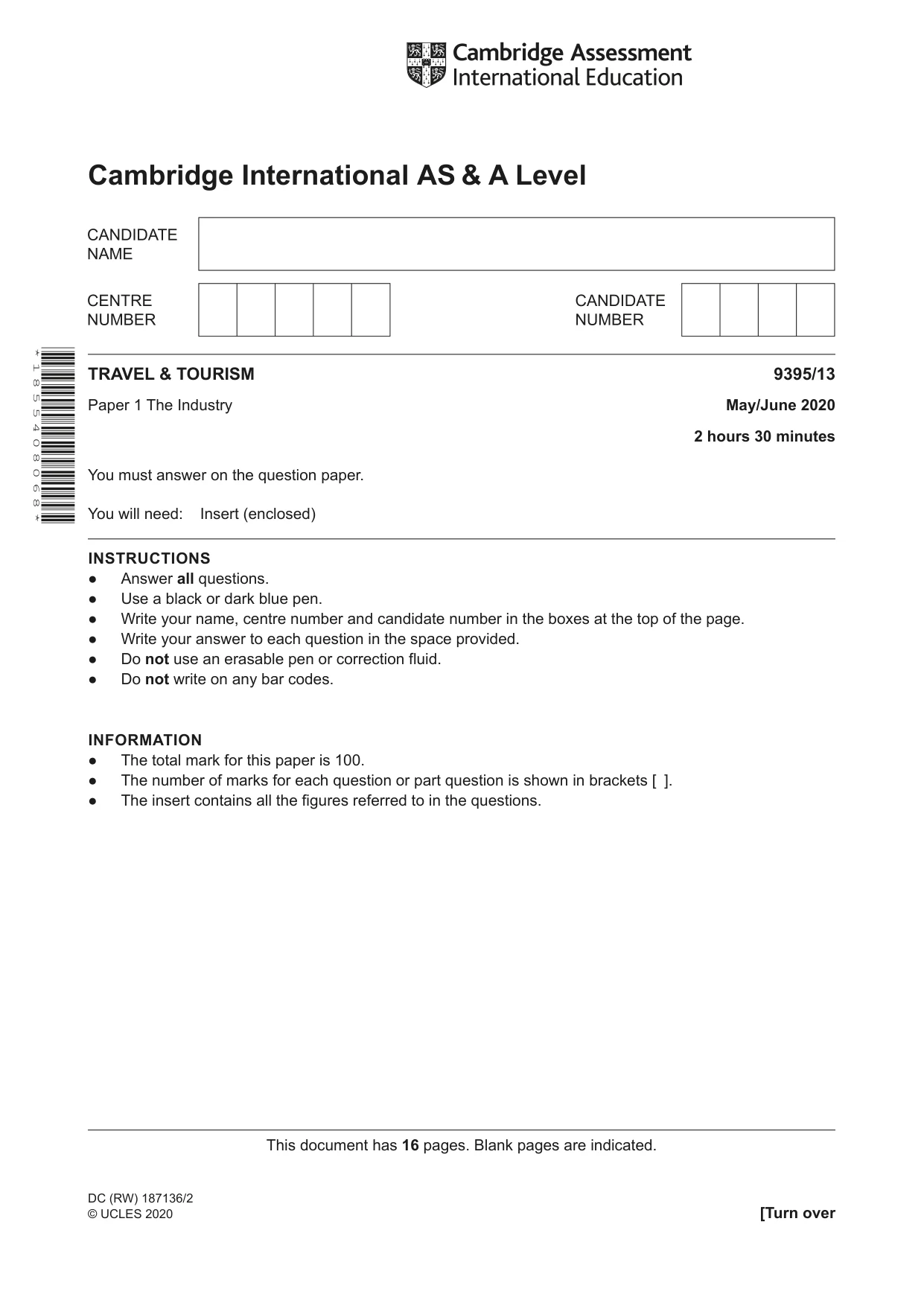
This document has 16 pages. Blank pages are indicated. DC (RW) 187136/2 © UCLES 2020 [Turn over * 1 8 5 5 4 0 8 0 6 8 * Cambridge International AS & A Level TRAVEL & TOURISM 9395/13 Paper 1 The Industry May/June 2020 2 hours 30 minutes You must answer on the question paper. You will need: Insert (enclosed) INSTRUCTIONS ● Answer all questions. ● Use a black or dark blue pen. ● Write your name, centre number and candidate number in the boxes at the top of the page. ● Write your answer to each question in the space provided. ● Do not use an erasable pen or correction fluid. ● Do not write on any bar codes. INFORMATION ● The total mark for this paper is 100. ● The number of marks for each question or part question is shown in brackets [ ]. ● The insert contains all the figures referred to in the questions.
Question paper, page 2
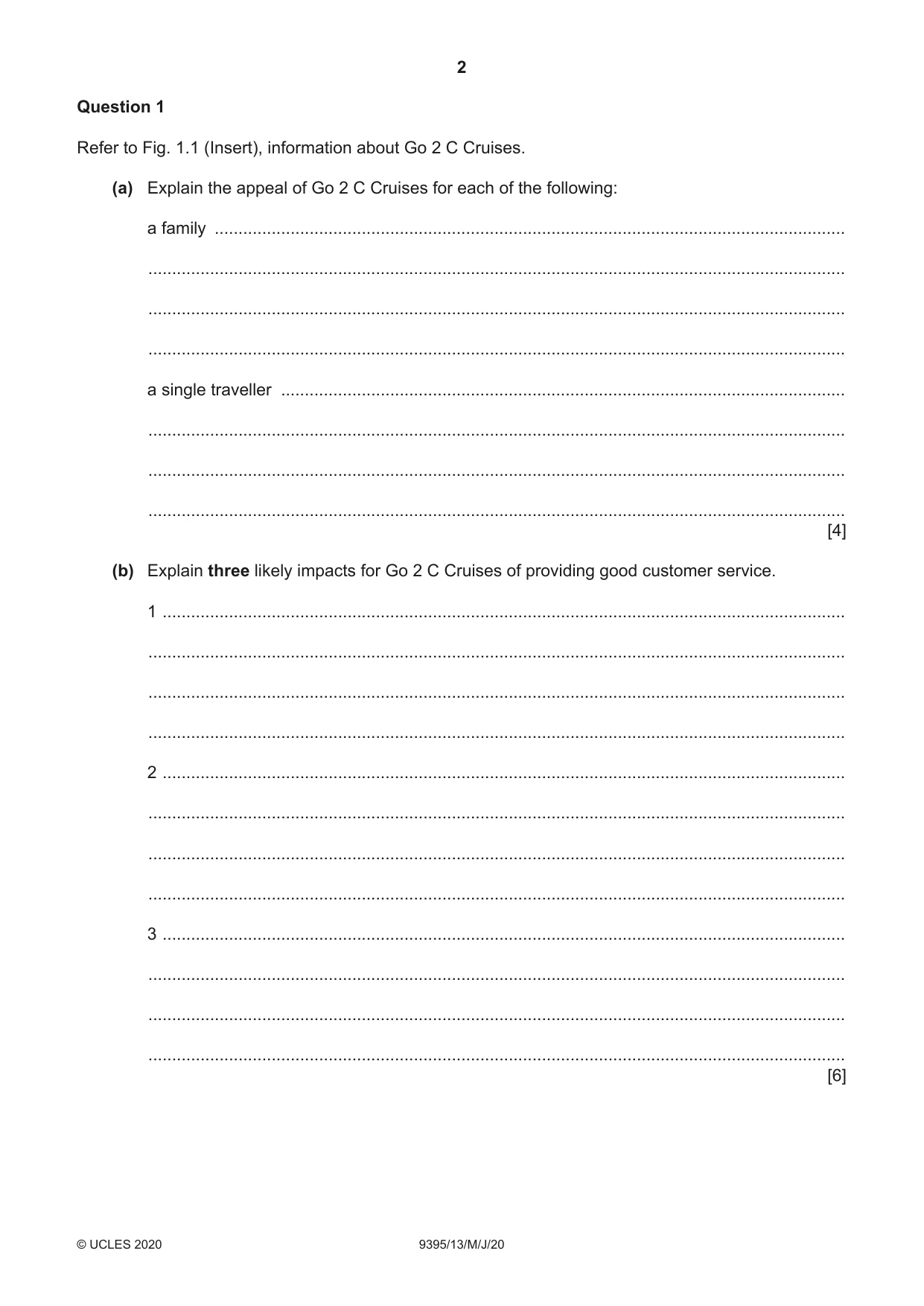
2 9395/13/M/J/20 © UCLES 2020 Question 1 Refer to Fig. 1.1 (Insert), information about Go 2 C Cruises. (a) Explain the appeal of Go 2 C Cruises for each of the following: a family … … … … a single traveller … … … … [4] (b) Explain three likely impacts for Go 2 C Cruises of providing good customer service. 1 … … … … 2 … … … … 3 … … … … [6]
Question paper, page 3
3 9395/13/M/J/20 © UCLES 2020 [Turn over (c) Explain three ways Go 2 C Cruises could maintain the safety and security of their external customers. 1 … … … … 2 … … … … 3 … … … … [6]
Question paper, page 4
4 9395/13/M/J/20 © UCLES 2020 (d) Discuss whether a mystery shopper is an appropriate method of assessing customer service on a cruise. … … … … … … … … … … … … … … … … … … [9] [Total: 25]
Question paper, page 5
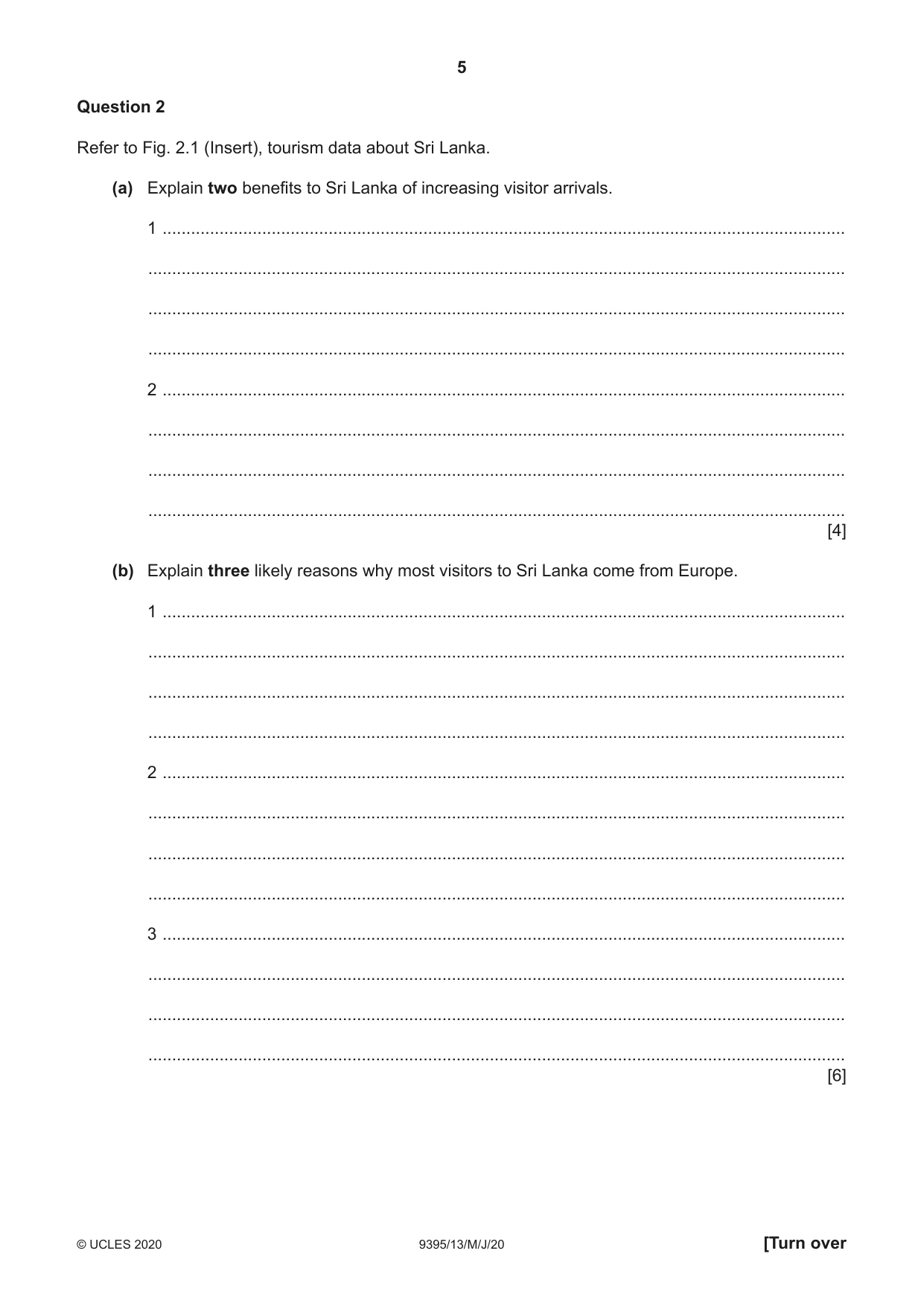
5 9395/13/M/J/20 © UCLES 2020 [Turn over Question 2 Refer to Fig. 2.1 (Insert), tourism data about Sri Lanka. (a) Explain two benefits to Sri Lanka of increasing visitor arrivals. 1 … … … … 2 … … … … [4] (b) Explain three likely reasons why most visitors to Sri Lanka come from Europe. 1 … … … … 2 … … … … 3 … … … … [6]
Question paper, page 6
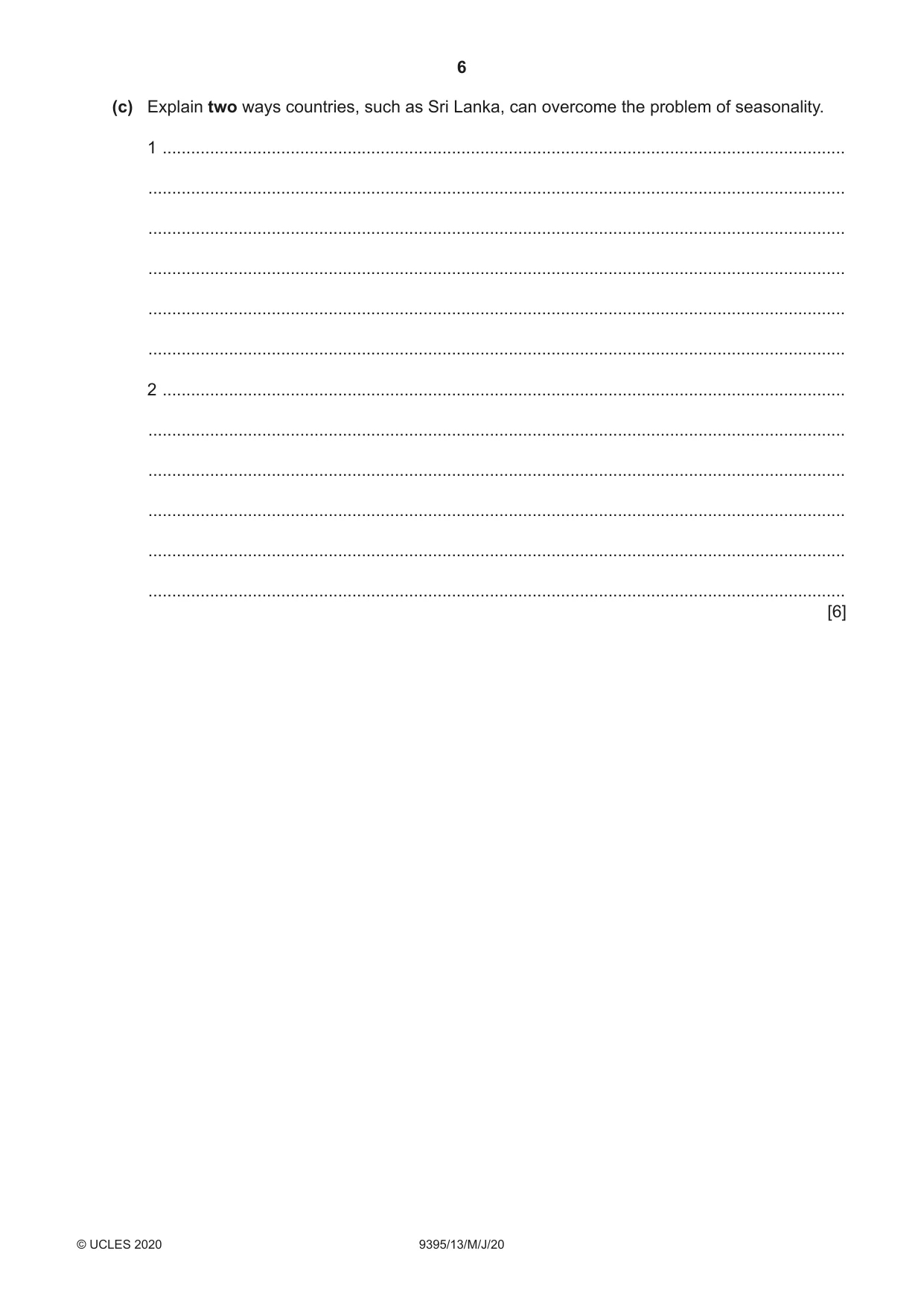
6 9395/13/M/J/20 © UCLES 2020 (c) Explain two ways countries, such as Sri Lanka, can overcome the problem of seasonality. 1 … … … … … … 2 … … … … … … [6]
Question paper, page 7
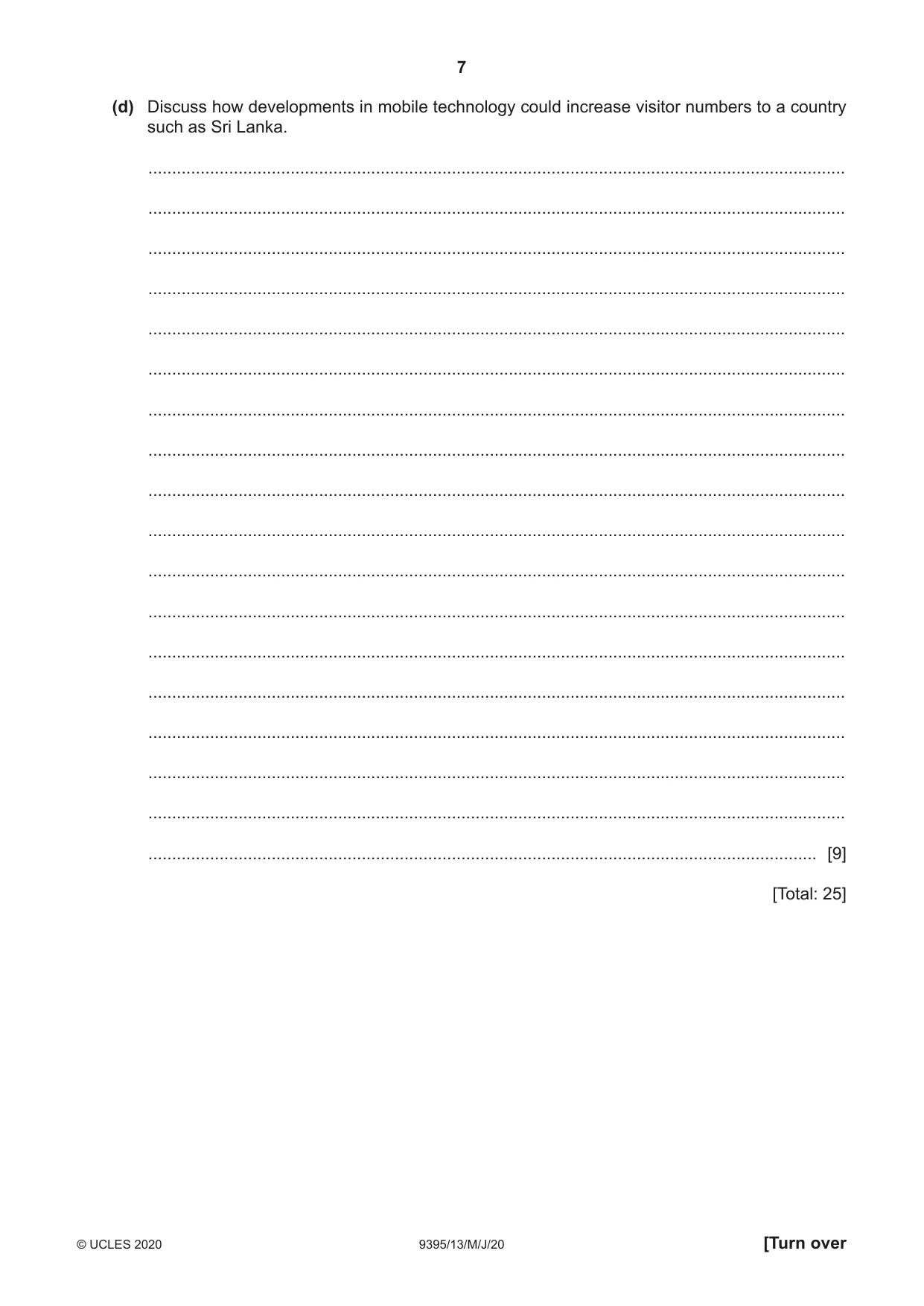
7 9395/13/M/J/20 © UCLES 2020 [Turn over (d) Discuss how developments in mobile technology could increase visitor numbers to a country such as Sri Lanka. … … … … … … … … … … … … … … … … … … [9] [Total: 25]
Question paper, page 8
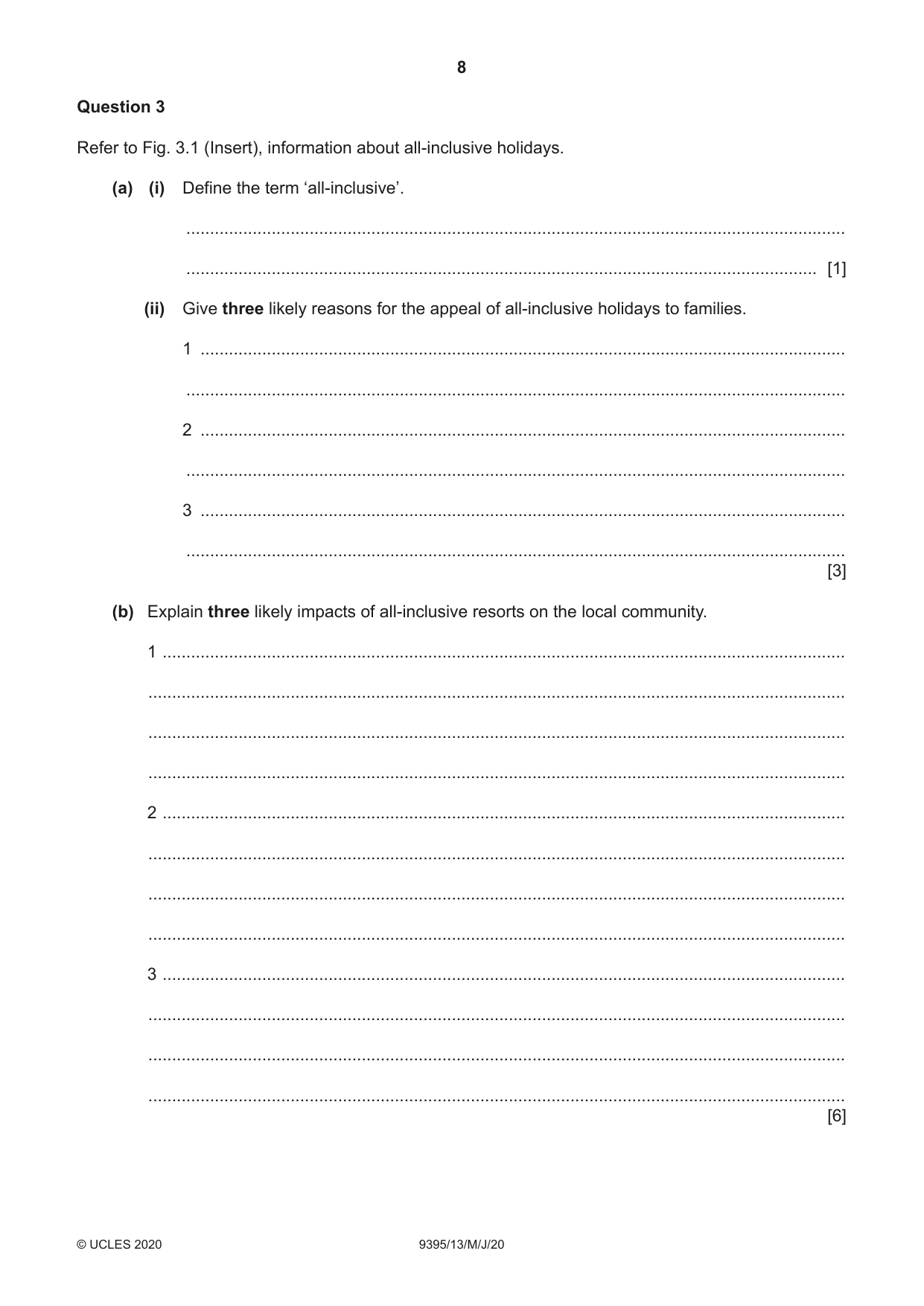
8 9395/13/M/J/20 © UCLES 2020 Question 3 Refer to Fig. 3.1 (Insert), information about all‑inclusive holidays. (a) (i) Define the term ‘all‑inclusive’. … … [1] (ii) Give three likely reasons for the appeal of all‑inclusive holidays to families. 1 … … 2 … … 3 … … [3] (b) Explain three likely impacts of all‑inclusive resorts on the local community. 1 … … … … 2 … … … … 3 … … … … [6]
Question paper, page 9
9 9395/13/M/J/20 © UCLES 2020 [Turn over (c) Explain two ways all‑inclusive holidays can be sustainable. 1 … … … … … … 2 … … … … … … [6]
Question paper, page 10
10 9395/13/M/J/20 © UCLES 2020 (d) Discuss how all‑inclusive resorts can meet the needs of their internal customers. … … … … … … … … … … … … … … … … … … [9] [Total: 25]
Question paper, page 11
11 9395/13/M/J/20 © UCLES 2020 [Turn over Question 4 (a) (i) Define the term ‘intangible’. … … [1] (ii) Give three examples of intangible travel and tourism products. 1 … 2 … 3 … [3] (b) Explain three ways the problem of intangibility may be managed by a visitor attraction. 1 … … … … 2 … … … … 3 … … … … [6]
Question paper, page 12
12 9395/13/M/J/20 © UCLES 2020 (c) Explain three ways a visitor attraction can support international visitors. 1 … … … … 2 … … … … 3 … … … … [6]
Question paper, page 13
13 9395/13/M/J/20 © UCLES 2020 (d) Assess the value of social media to a visitor attraction. … … … … … … … … … … … … … … … … … … [9] [Total: 25]
Question paper, page 14
14 9395/13/M/J/20 © UCLES 2020 BLANK PAGE
Question paper, page 15
15 9395/13/M/J/20 © UCLES 2020 BLANK PAGE
Question paper, page 16
16 9395/13/M/J/20 © UCLES 2020 Permission to reproduce items where third‑party owned material protected by copyright is included has been sought and cleared where possible. Every reasonable effort has been made by the publisher (UCLES) to trace copyright holders, but if any items requiring clearance have unwittingly been included, the publisher will be pleased to make amends at the earliest possible opportunity. To avoid the issue of disclosure of answer‑related information to candidates, all copyright acknowledgements are reproduced online in the Cambridge Assessment International Education Copyright Acknowledgements Booklet. This is produced for each series of examinations and is freely available to download at www.cambridgeinternational.org after the live examination series. Cambridge Assessment International Education is part of the Cambridge Assessment Group. Cambridge Assessment is the brand name of the University of Cambridge Local Examinations Syndicate (UCLES), which itself is a department of the University of Cambridge. BLANK PAGE
Mark scheme, page 1
This document consists of 10 printed pages. © UCLES 2020 [Turn over Cambridge International AS & A Level TRAVEL & TOURISM 9395/13 Paper 1 The Industry May/June 2020 MARK SCHEME Maximum Mark: 100 Published Students did not sit exam papers in the June 2020 series due to the Covid-19 global pandemic. This mark scheme is published to support teachers and students and should be read together with the question paper. It shows the requirements of the exam. The answer column of the mark scheme shows the proposed basis on which Examiners would award marks for this exam. Where appropriate, this column also provides the most likely acceptable alternative responses expected from students. Examiners usually review the mark scheme after they have seen student responses and update the mark scheme if appropriate. In the June series, Examiners were unable to consider the acceptability of alternative responses, as there were no student responses to consider. Mark schemes should usually be read together with the Principal Examiner Report for Teachers. However, because students did not sit exam papers, there is no Principal Examiner Report for Teachers for the June 2020 series. Cambridge International will not enter into discussions about these mark schemes. Cambridge International is publishing the mark schemes for the June 2020 series for most Cambridge IGCSE™ and Cambridge International A & AS Level components, and some Cambridge O Level components.
Mark scheme, page 2
9395/13 Cambridge International AS & A Level – Mark Scheme PUBLISHED May/June 2020 © UCLES 2020 Page 2 of 10 Generic Marking Principles These general marking principles must be applied by all examiners when marking candidate answers. They should be applied alongside the specific content of the mark scheme or generic level descriptors for a question. Each question paper and mark scheme will also comply with these marking principles. GENERIC MARKING PRINCIPLE 1: Marks must be awarded in line with: • the specific content of the mark scheme or the generic level descriptors for the question • the specific skills defined in the mark scheme or in the generic level descriptors for the question • the standard of response required by a candidate as exemplified by the standardisation scripts. GENERIC MARKING PRINCIPLE 2: Marks awarded are always whole marks (not half marks, or other fractions). GENERIC MARKING PRINCIPLE 3: Marks must be awarded positively: • marks are awarded for correct/valid answers, as defined in the mark scheme. However, credit is given for valid answers which go beyond the scope of the syllabus and mark scheme, referring to your Team Leader as appropriate • marks are awarded when candidates clearly demonstrate what they know and can do • marks are not deducted for errors • marks are not deducted for omissions • answers should only be judged on the quality of spelling, punctuation and grammar when these features are specifically assessed by the question as indicated by the mark scheme. The meaning, however, should be unambiguous. GENERIC MARKING PRINCIPLE 4: Rules must be applied consistently e.g. in situations where candidates have not followed instructions or in the application of generic level descriptors. GENERIC MARKING PRINCIPLE 5: Marks should be awarded using the full range of marks defined in the mark scheme for the question (however; the use of the full mark range may be limited according to the quality of the candidate responses seen). GENERIC MARKING PRINCIPLE 6: Marks awarded are based solely on the requirements as defined in the mark scheme. Marks should not be awarded with grade thresholds or grade descriptors in mind.
Mark scheme, page 3
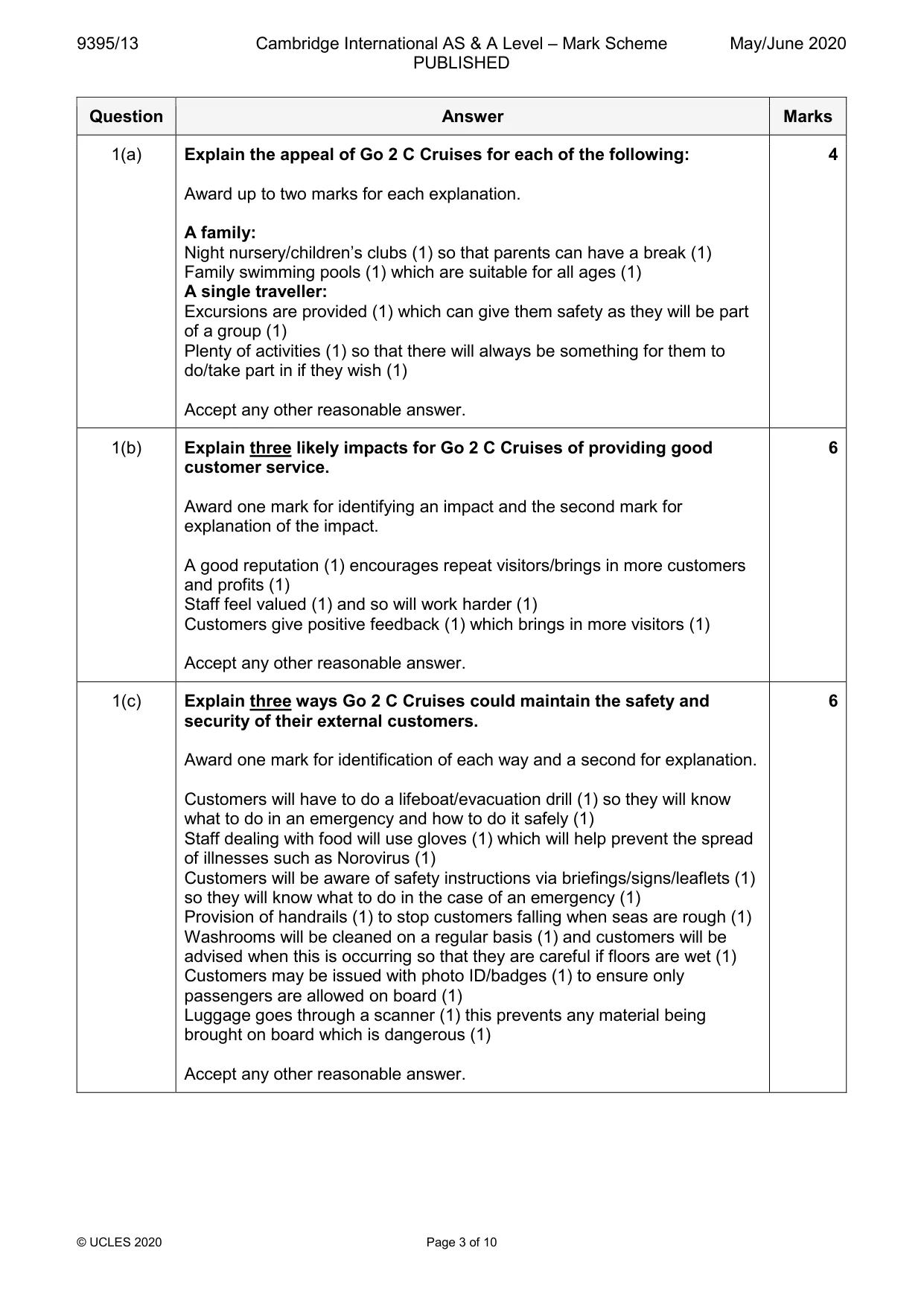
9395/13 Cambridge International AS & A Level – Mark Scheme PUBLISHED May/June 2020 © UCLES 2020 Page 3 of 10 Question Answer Marks 1(a) Explain the appeal of Go 2 C Cruises for each of the following: Award up to two marks for each explanation. A family: Night nursery/children’s clubs (1) so that parents can have a break (1) Family swimming pools (1) which are suitable for all ages (1) A single traveller: Excursions are provided (1) which can give them safety as they will be part of a group (1) Plenty of activities (1) so that there will always be something for them to do/take part in if they wish (1) Accept any other reasonable answer. 4 1(b) Explain three likely impacts for Go 2 C Cruises of providing good customer service. Award one mark for identifying an impact and the second mark for explanation of the impact. A good reputation (1) encourages repeat visitors/brings in more customers and profits (1) Staff feel valued (1) and so will work harder (1) Customers give positive feedback (1) which brings in more visitors (1) Accept any other reasonable answer. 6 1(c) Explain three ways Go 2 C Cruises could maintain the safety and security of their external customers. Award one mark for identification of each way and a second for explanation. Customers will have to do a lifeboat/evacuation drill (1) so they will know what to do in an emergency and how to do it safely (1) Staff dealing with food will use gloves (1) which will help prevent the spread of illnesses such as Norovirus (1) Customers will be aware of safety instructions via briefings/signs/leaflets (1) so they will know what to do in the case of an emergency (1) Provision of handrails (1) to stop customers falling when seas are rough (1) Washrooms will be cleaned on a regular basis (1) and customers will be advised when this is occurring so that they are careful if floors are wet (1) Customers may be issued with photo ID/badges (1) to ensure only passengers are allowed on board (1) Luggage goes through a scanner (1) this prevents any material being brought on board which is dangerous (1) Accept any other reasonable answer. 6
Mark scheme, page 4
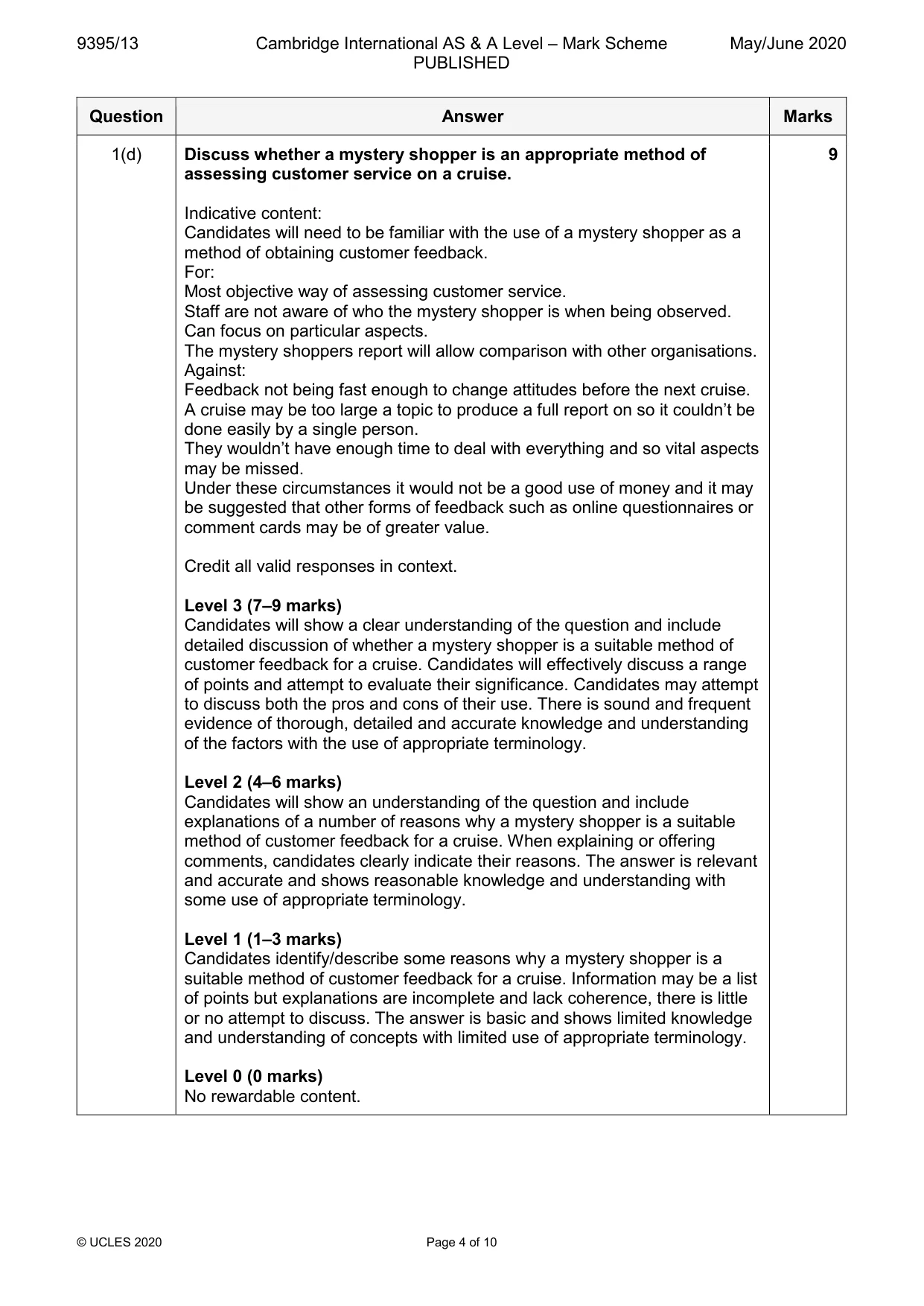
9395/13 Cambridge International AS & A Level – Mark Scheme PUBLISHED May/June 2020 © UCLES 2020 Page 4 of 10 Question Answer Marks 1(d) Discuss whether a mystery shopper is an appropriate method of assessing customer service on a cruise. Indicative content: Candidates will need to be familiar with the use of a mystery shopper as a method of obtaining customer feedback. For: Most objective way of assessing customer service. Staff are not aware of who the mystery shopper is when being observed. Can focus on particular aspects. The mystery shoppers report will allow comparison with other organisations. Against: Feedback not being fast enough to change attitudes before the next cruise. A cruise may be too large a topic to produce a full report on so it couldn’t be done easily by a single person. They wouldn’t have enough time to deal with everything and so vital aspects may be missed. Under these circumstances it would not be a good use of money and it may be suggested that other forms of feedback such as online questionnaires or comment cards may be of greater value. Credit all valid responses in context. Level 3 (7–9 marks) Candidates will show a clear understanding of the question and include detailed discussion of whether a mystery shopper is a suitable method of customer feedback for a cruise. Candidates will effectively discuss a range of points and attempt to evaluate their significance. Candidates may attempt to discuss both the pros and cons of their use. There is sound and frequent evidence of thorough, detailed and accurate knowledge and understanding of the factors with the use of appropriate terminology. Level 2 (4–6 marks) Candidates will show an understanding of the question and include explanations of a number of reasons why a mystery shopper is a suitable method of customer feedback for a cruise. When explaining or offering comments, candidates clearly indicate their reasons. The answer is relevant and accurate and shows reasonable knowledge and understanding with some use of appropriate terminology. Level 1 (1–3 marks) Candidates identify/describe some reasons why a mystery shopper is a suitable method of customer feedback for a cruise. Information may be a list of points but explanations are incomplete and lack coherence, there is little or no attempt to discuss. The answer is basic and shows limited knowledge and understanding of concepts with limited use of appropriate terminology. Level 0 (0 marks) No rewardable content. 9
Mark scheme, page 5
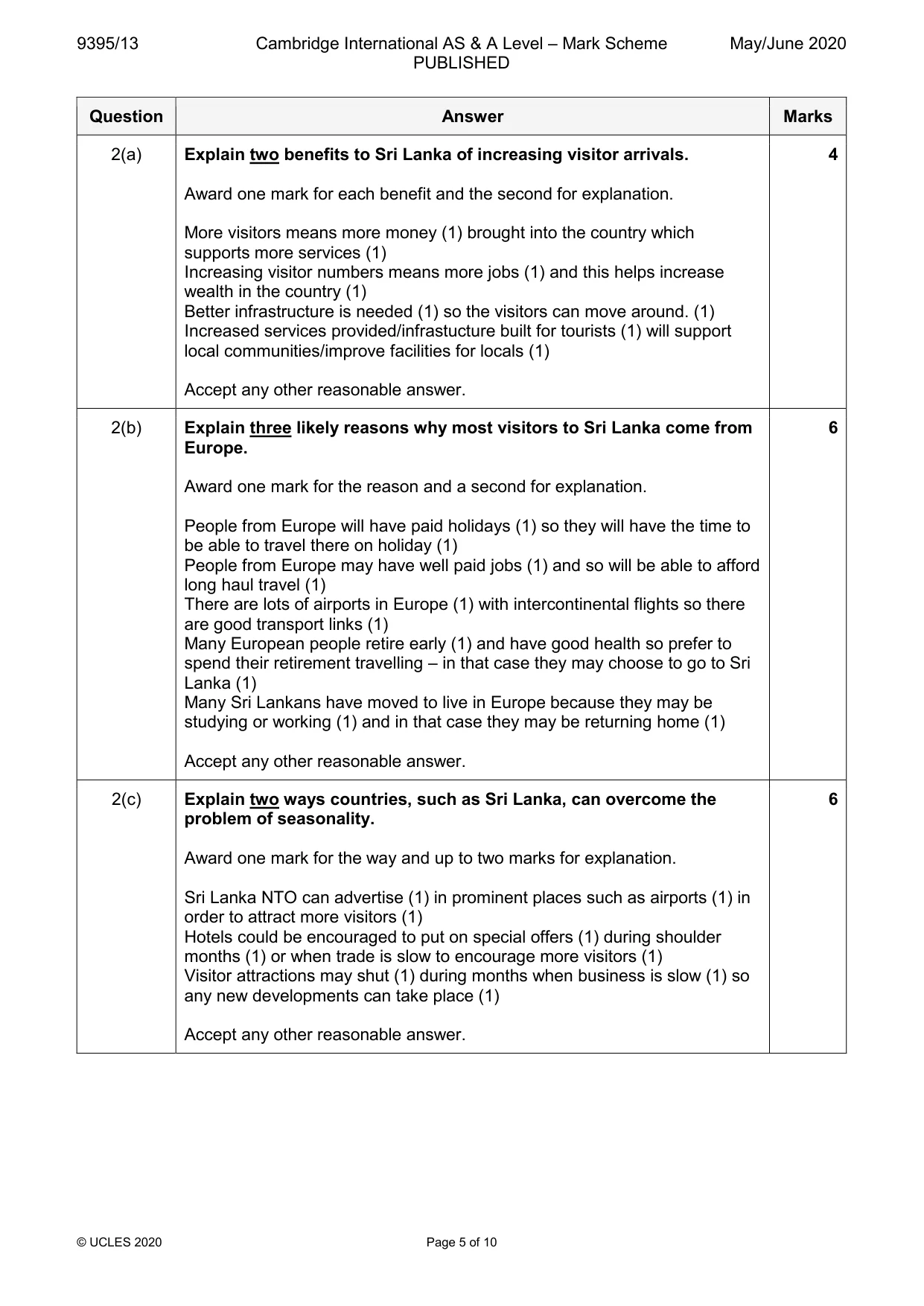
9395/13 Cambridge International AS & A Level – Mark Scheme PUBLISHED May/June 2020 © UCLES 2020 Page 5 of 10 Question Answer Marks 2(a) Explain two benefits to Sri Lanka of increasing visitor arrivals. Award one mark for each benefit and the second for explanation. More visitors means more money (1) brought into the country which supports more services (1) Increasing visitor numbers means more jobs (1) and this helps increase wealth in the country (1) Better infrastructure is needed (1) so the visitors can move around. (1) Increased services provided/infrastucture built for tourists (1) will support local communities/improve facilities for locals (1) Accept any other reasonable answer. 4 2(b) Explain three likely reasons why most visitors to Sri Lanka come from Europe. Award one mark for the reason and a second for explanation. People from Europe will have paid holidays (1) so they will have the time to be able to travel there on holiday (1) People from Europe may have well paid jobs (1) and so will be able to afford long haul travel (1) There are lots of airports in Europe (1) with intercontinental flights so there are good transport links (1) Many European people retire early (1) and have good health so prefer to spend their retirement travelling – in that case they may choose to go to Sri Lanka (1) Many Sri Lankans have moved to live in Europe because they may be studying or working (1) and in that case they may be returning home (1) Accept any other reasonable answer. 6 2(c) Explain two ways countries, such as Sri Lanka, can overcome the problem of seasonality. Award one mark for the way and up to two marks for explanation. Sri Lanka NTO can advertise (1) in prominent places such as airports (1) in order to attract more visitors (1) Hotels could be encouraged to put on special offers (1) during shoulder months (1) or when trade is slow to encourage more visitors (1) Visitor attractions may shut (1) during months when business is slow (1) so any new developments can take place (1) Accept any other reasonable answer. 6
Mark scheme, page 6
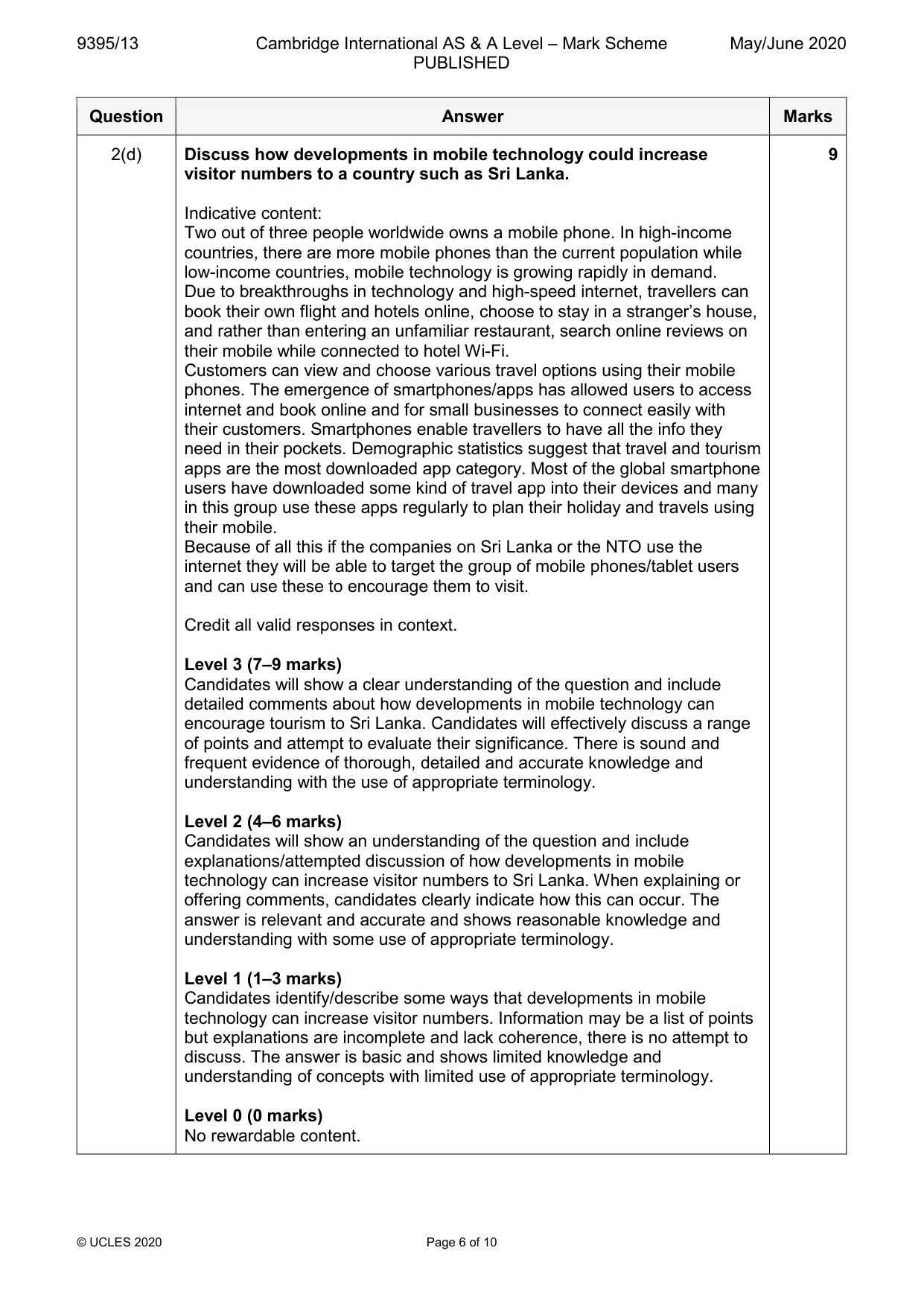
9395/13 Cambridge International AS & A Level – Mark Scheme PUBLISHED May/June 2020 © UCLES 2020 Page 6 of 10 Question Answer Marks 2(d) Discuss how developments in mobile technology could increase visitor numbers to a country such as Sri Lanka. Indicative content: Two out of three people worldwide owns a mobile phone. In high-income countries, there are more mobile phones than the current population while low-income countries, mobile technology is growing rapidly in demand. Due to breakthroughs in technology and high-speed internet, travellers can book their own flight and hotels online, choose to stay in a stranger’s house, and rather than entering an unfamiliar restaurant, search online reviews on their mobile while connected to hotel Wi-Fi. Customers can view and choose various travel options using their mobile phones. The emergence of smartphones/apps has allowed users to access internet and book online and for small businesses to connect easily with their customers. Smartphones enable travellers to have all the info they need in their pockets. Demographic statistics suggest that travel and tourism apps are the most downloaded app category. Most of the global smartphone users have downloaded some kind of travel app into their devices and many in this group use these apps regularly to plan their holiday and travels using their mobile. Because of all this if the companies on Sri Lanka or the NTO use the internet they will be able to target the group of mobile phones/tablet users and can use these to encourage them to visit. Credit all valid responses in context. Level 3 (7–9 marks) Candidates will show a clear understanding of the question and include detailed comments about how developments in mobile technology can encourage tourism to Sri Lanka. Candidates will effectively discuss a range of points and attempt to evaluate their significance. There is sound and frequent evidence of thorough, detailed and accurate knowledge and understanding with the use of appropriate terminology. Level 2 (4–6 marks) Candidates will show an understanding of the question and include explanations/attempted discussion of how developments in mobile technology can increase visitor numbers to Sri Lanka. When explaining or offering comments, candidates clearly indicate how this can occur. The answer is relevant and accurate and shows reasonable knowledge and understanding with some use of appropriate terminology. Level 1 (1–3 marks) Candidates identify/describe some ways that developments in mobile technology can increase visitor numbers. Information may be a list of points but explanations are incomplete and lack coherence, there is no attempt to discuss. The answer is basic and shows limited knowledge and understanding of concepts with limited use of appropriate terminology. Level 0 (0 marks) No rewardable content. 9
Mark scheme, page 7
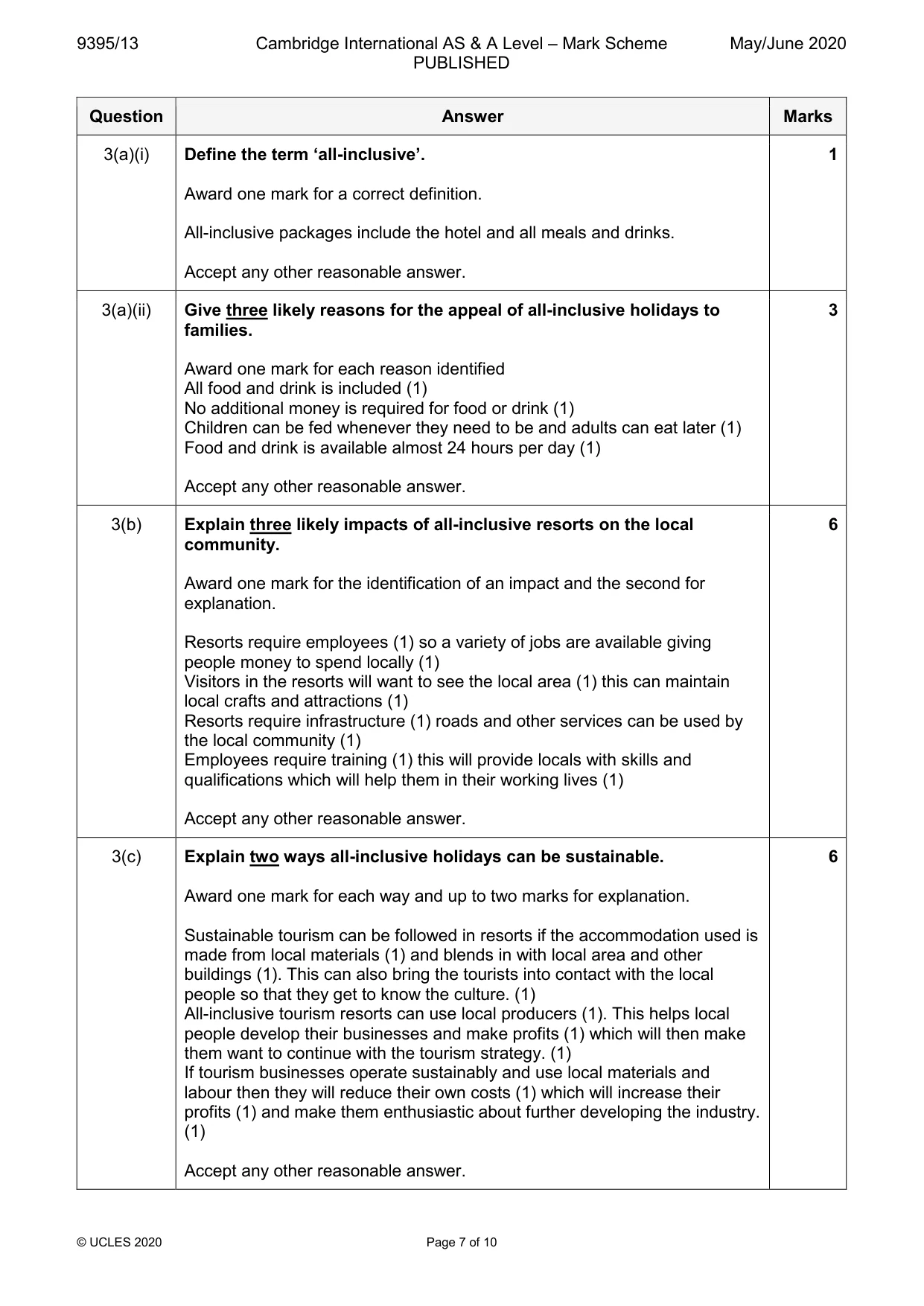
9395/13 Cambridge International AS & A Level – Mark Scheme PUBLISHED May/June 2020 © UCLES 2020 Page 7 of 10 Question Answer Marks 3(a)(i) Define the term ‘all-inclusive’. Award one mark for a correct definition. All-inclusive packages include the hotel and all meals and drinks. Accept any other reasonable answer. 1 3(a)(ii) Give three likely reasons for the appeal of all-inclusive holidays to families. Award one mark for each reason identified All food and drink is included (1) No additional money is required for food or drink (1) Children can be fed whenever they need to be and adults can eat later (1) Food and drink is available almost 24 hours per day (1) Accept any other reasonable answer. 3 3(b) Explain three likely impacts of all-inclusive resorts on the local community. Award one mark for the identification of an impact and the second for explanation. Resorts require employees (1) so a variety of jobs are available giving people money to spend locally (1) Visitors in the resorts will want to see the local area (1) this can maintain local crafts and attractions (1) Resorts require infrastructure (1) roads and other services can be used by the local community (1) Employees require training (1) this will provide locals with skills and qualifications which will help them in their working lives (1) Accept any other reasonable answer. 6 3(c) Explain two ways all-inclusive holidays can be sustainable. Award one mark for each way and up to two marks for explanation. Sustainable tourism can be followed in resorts if the accommodation used is made from local materials (1) and blends in with local area and other buildings (1). This can also bring the tourists into contact with the local people so that they get to know the culture. (1) All-inclusive tourism resorts can use local producers (1). This helps local people develop their businesses and make profits (1) which will then make them want to continue with the tourism strategy. (1) If tourism businesses operate sustainably and use local materials and labour then they will reduce their own costs (1) which will increase their profits (1) and make them enthusiastic about further developing the industry. (1) Accept any other reasonable answer. 6
Mark scheme, page 8
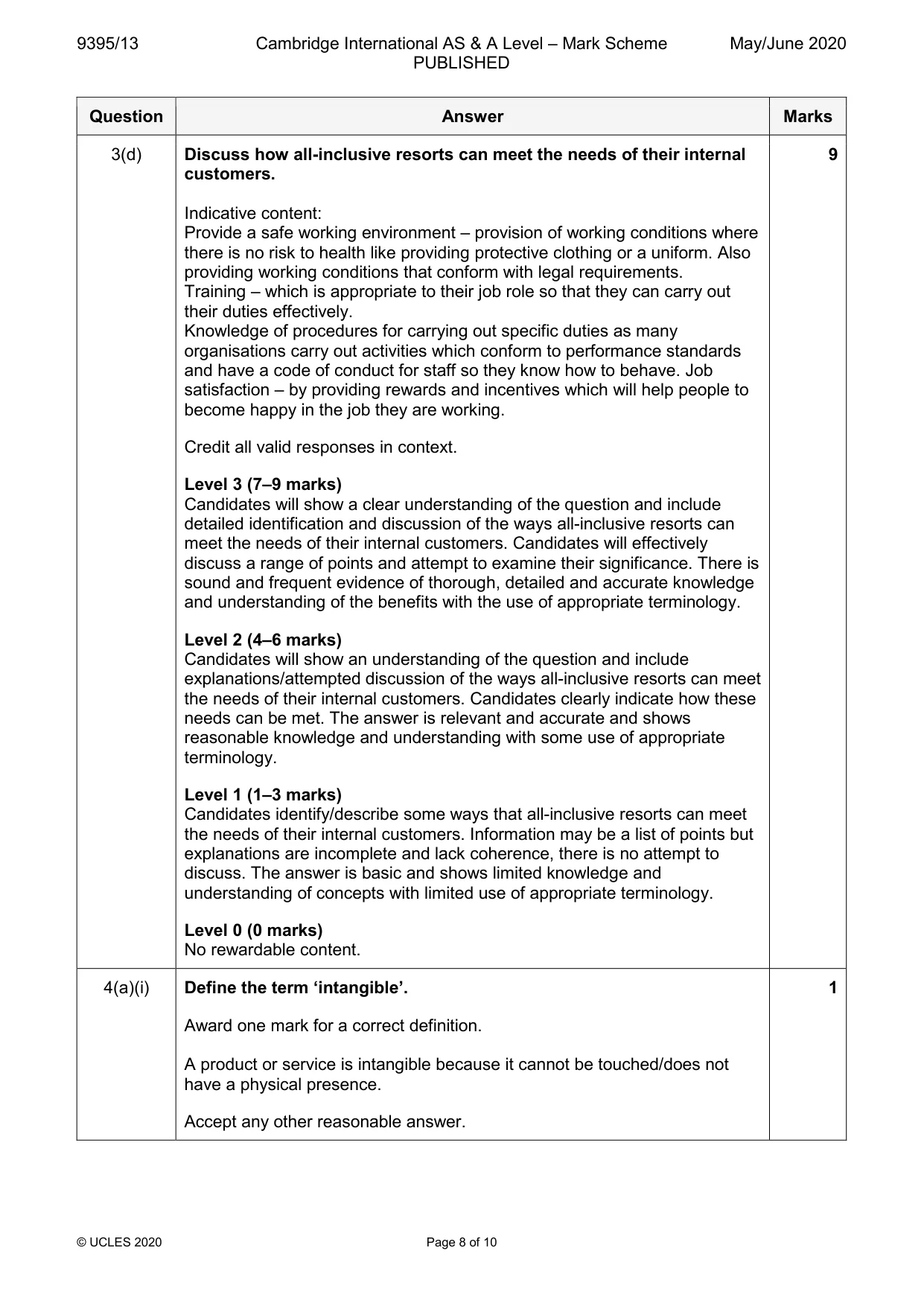
9395/13 Cambridge International AS & A Level – Mark Scheme PUBLISHED May/June 2020 © UCLES 2020 Page 8 of 10 Question Answer Marks 3(d) Discuss how all-inclusive resorts can meet the needs of their internal customers. Indicative content: Provide a safe working environment – provision of working conditions where there is no risk to health like providing protective clothing or a uniform. Also providing working conditions that conform with legal requirements. Training – which is appropriate to their job role so that they can carry out their duties effectively. Knowledge of procedures for carrying out specific duties as many organisations carry out activities which conform to performance standards and have a code of conduct for staff so they know how to behave. Job satisfaction – by providing rewards and incentives which will help people to become happy in the job they are working. Credit all valid responses in context. Level 3 (7–9 marks) Candidates will show a clear understanding of the question and include detailed identification and discussion of the ways all-inclusive resorts can meet the needs of their internal customers. Candidates will effectively discuss a range of points and attempt to examine their significance. There is sound and frequent evidence of thorough, detailed and accurate knowledge and understanding of the benefits with the use of appropriate terminology. Level 2 (4–6 marks) Candidates will show an understanding of the question and include explanations/attempted discussion of the ways all-inclusive resorts can meet the needs of their internal customers. Candidates clearly indicate how these needs can be met. The answer is relevant and accurate and shows reasonable knowledge and understanding with some use of appropriate terminology. Level 1 (1–3 marks) Candidates identify/describe some ways that all-inclusive resorts can meet the needs of their internal customers. Information may be a list of points but explanations are incomplete and lack coherence, there is no attempt to discuss. The answer is basic and shows limited knowledge and understanding of concepts with limited use of appropriate terminology. Level 0 (0 marks) No rewardable content. 9 4(a)(i) Define the term ‘intangible’. Award one mark for a correct definition. A product or service is intangible because it cannot be touched/does not have a physical presence. Accept any other reasonable answer. 1
Mark scheme, page 9
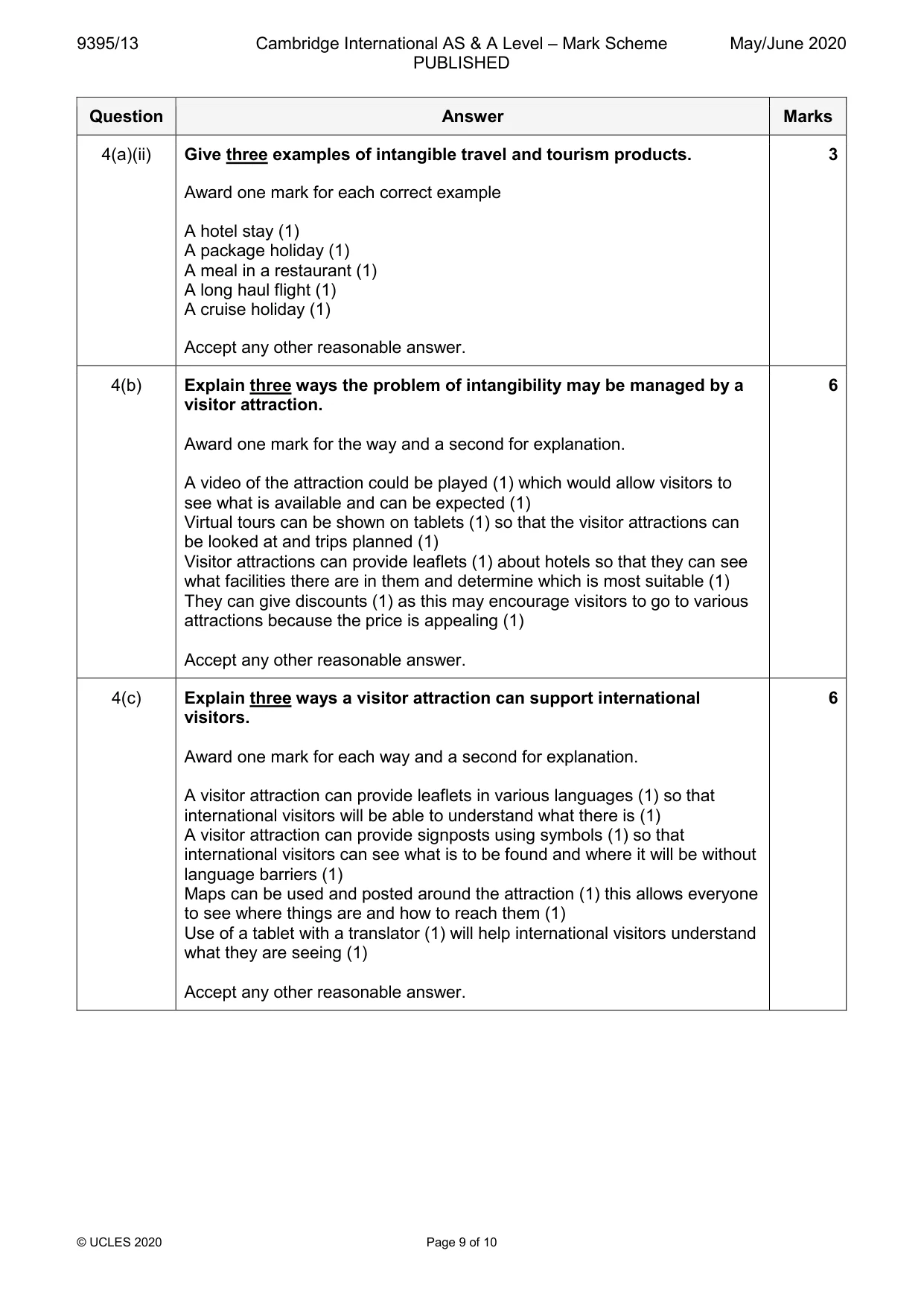
9395/13 Cambridge International AS & A Level – Mark Scheme PUBLISHED May/June 2020 © UCLES 2020 Page 9 of 10 Question Answer Marks 4(a)(ii) Give three examples of intangible travel and tourism products. Award one mark for each correct example A hotel stay (1) A package holiday (1) A meal in a restaurant (1) A long haul flight (1) A cruise holiday (1) Accept any other reasonable answer. 3 4(b) Explain three ways the problem of intangibility may be managed by a visitor attraction. Award one mark for the way and a second for explanation. A video of the attraction could be played (1) which would allow visitors to see what is available and can be expected (1) Virtual tours can be shown on tablets (1) so that the visitor attractions can be looked at and trips planned (1) Visitor attractions can provide leaflets (1) about hotels so that they can see what facilities there are in them and determine which is most suitable (1) They can give discounts (1) as this may encourage visitors to go to various attractions because the price is appealing (1) Accept any other reasonable answer. 6 4(c) Explain three ways a visitor attraction can support international visitors. Award one mark for each way and a second for explanation. A visitor attraction can provide leaflets in various languages (1) so that international visitors will be able to understand what there is (1) A visitor attraction can provide signposts using symbols (1) so that international visitors can see what is to be found and where it will be without language barriers (1) Maps can be used and posted around the attraction (1) this allows everyone to see where things are and how to reach them (1) Use of a tablet with a translator (1) will help international visitors understand what they are seeing (1) Accept any other reasonable answer. 6
Mark scheme, page 10
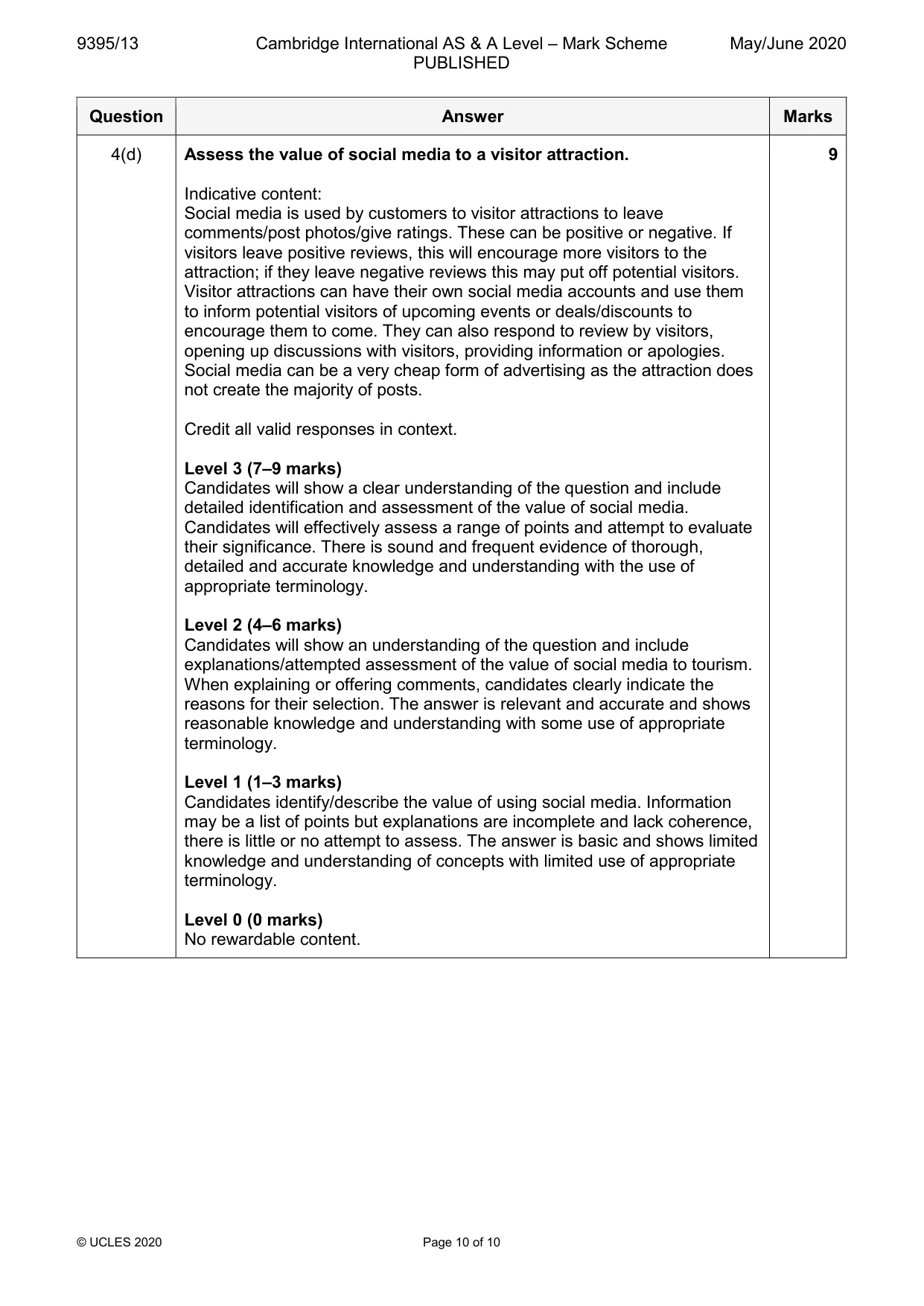
9395/13 Cambridge International AS & A Level – Mark Scheme PUBLISHED May/June 2020 © UCLES 2020 Page 10 of 10 Question Answer Marks 4(d) Assess the value of social media to a visitor attraction. Indicative content: Social media is used by customers to visitor attractions to leave comments/post photos/give ratings. These can be positive or negative. If visitors leave positive reviews, this will encourage more visitors to the attraction; if they leave negative reviews this may put off potential visitors. Visitor attractions can have their own social media accounts and use them to inform potential visitors of upcoming events or deals/discounts to encourage them to come. They can also respond to review by visitors, opening up discussions with visitors, providing information or apologies. Social media can be a very cheap form of advertising as the attraction does not create the majority of posts. Credit all valid responses in context. Level 3 (7–9 marks) Candidates will show a clear understanding of the question and include detailed identification and assessment of the value of social media. Candidates will effectively assess a range of points and attempt to evaluate their significance. There is sound and frequent evidence of thorough, detailed and accurate knowledge and understanding with the use of appropriate terminology. Level 2 (4–6 marks) Candidates will show an understanding of the question and include explanations/attempted assessment of the value of social media to tourism. When explaining or offering comments, candidates clearly indicate the reasons for their selection. The answer is relevant and accurate and shows reasonable knowledge and understanding with some use of appropriate terminology. Level 1 (1–3 marks) Candidates identify/describe the value of using social media. Information may be a list of points but explanations are incomplete and lack coherence, there is little or no attempt to assess. The answer is basic and shows limited knowledge and understanding of concepts with limited use of appropriate terminology. Level 0 (0 marks) No rewardable content. 9