Cambridge A Level Travel and Tourism 9395 — 2020 May/June Paper 1 · Variant 1
9395/11/M/J/20
The question paper and its mark scheme, free to read here and free to download. This is Cambridge’s own paper, exactly as it was sat.
Question paper16 pages




Mark scheme10 pages
Answers below. Sit the paper first if you are practising.
Paper as text
Question paper, page 1
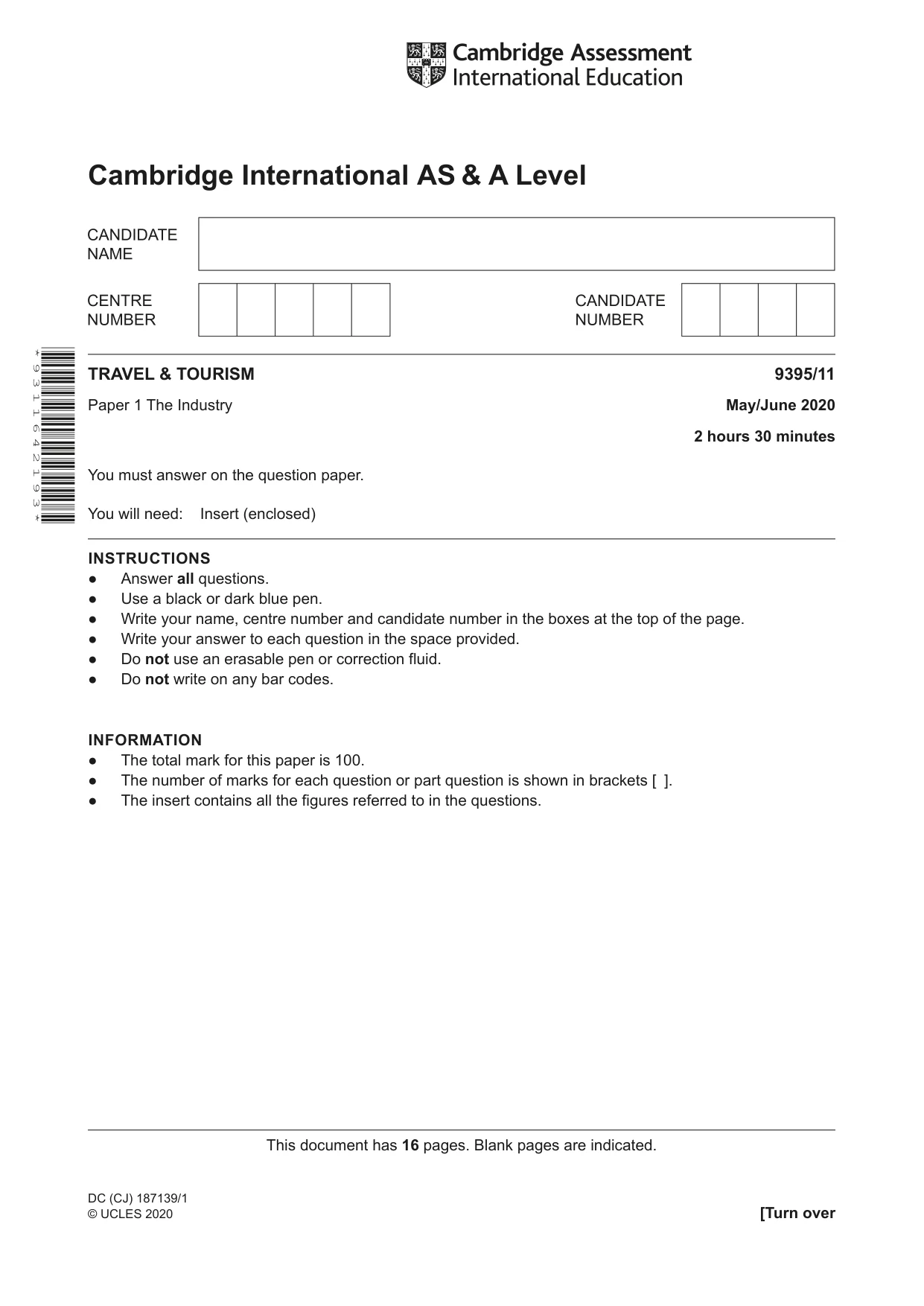
Cambridge International AS & A Level This document has 16 pages. Blank pages are indicated. TRAVEL & TOURISM 9395/11 Paper 1 The Industry May/June 2020 2 hours 30 minutes You must answer on the question paper. You will need: Insert (enclosed) INSTRUCTIONS ● Answer all questions. ● Use a black or dark blue pen. ● Write your name, centre number and candidate number in the boxes at the top of the page. ● Write your answer to each question in the space provided. ● Do not use an erasable pen or correction fluid. ● Do not write on any bar codes. INFORMATION ● The total mark for this paper is 100. ● The number of marks for each question or part question is shown in brackets [ ]. ● The insert contains all the figures referred to in the questions. * 9 3 1 1 6 4 2 1 9 3 * DC (CJ) 187139/1 © UCLES 2020 [Turn over
Question paper, page 2
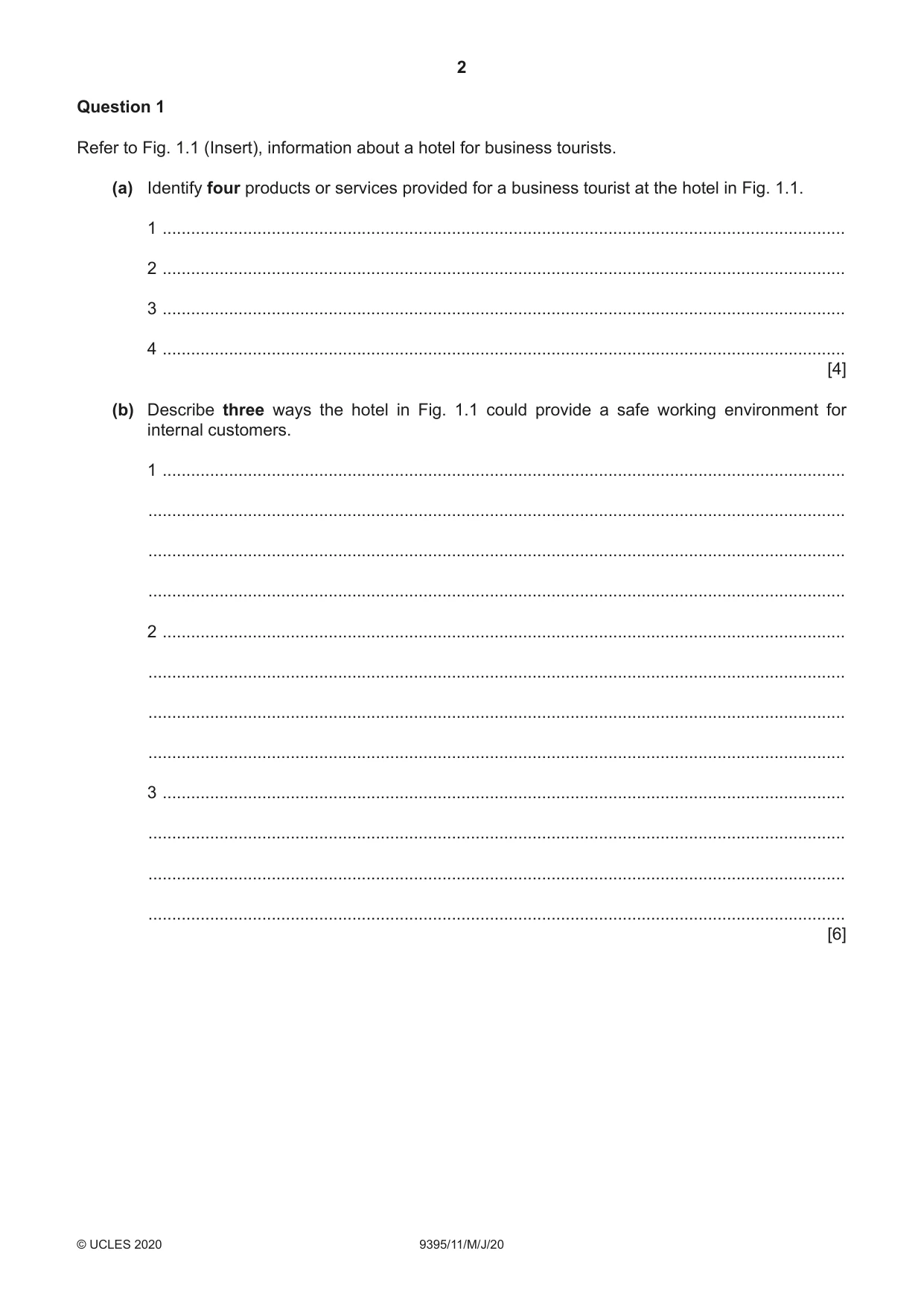
2 9395/11/M/J/20 © UCLES 2020 Question 1 Refer to Fig. 1.1 (Insert), information about a hotel for business tourists. (a) Identify four products or services provided for a business tourist at the hotel in Fig. 1.1. 1 … 2 … 3 … 4 … [4] (b) Describe three ways the hotel in Fig. 1.1 could provide a safe working environment for internal customers. 1 … … … … 2 … … … … 3 … … … … [6]
Question paper, page 3
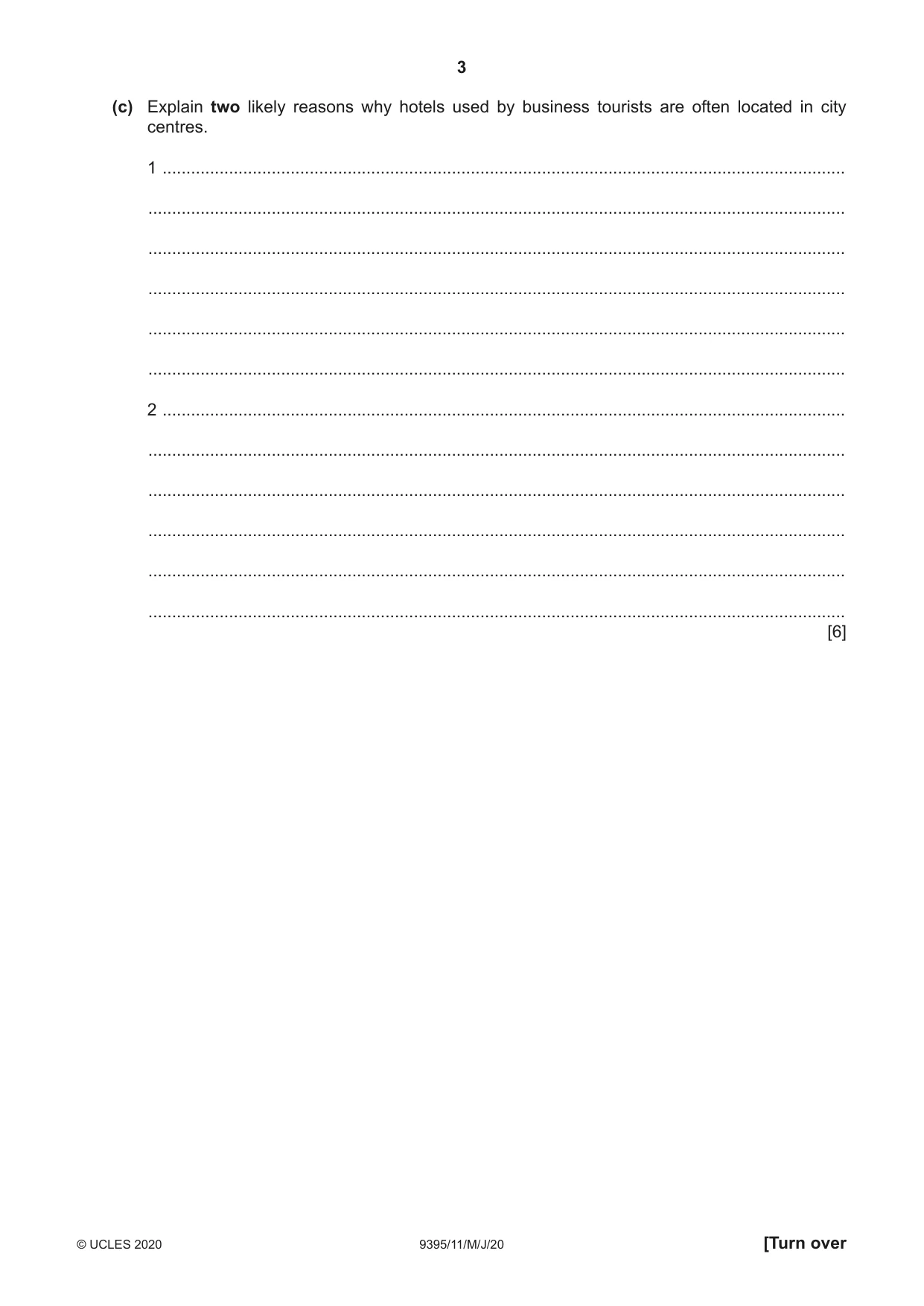
3 9395/11/M/J/20 © UCLES 2020 [Turn over (c) Explain two likely reasons why hotels used by business tourists are often located in city centres. 1 … … … … … … 2 … … … … … … [6]
Question paper, page 4
4 9395/11/M/J/20 © UCLES 2020 (d) Discuss the ways that a leisure hotel can be adapted for the business market. … … … … … … … … … … … … … … … … … … [9] [Total: 25]
Question paper, page 5
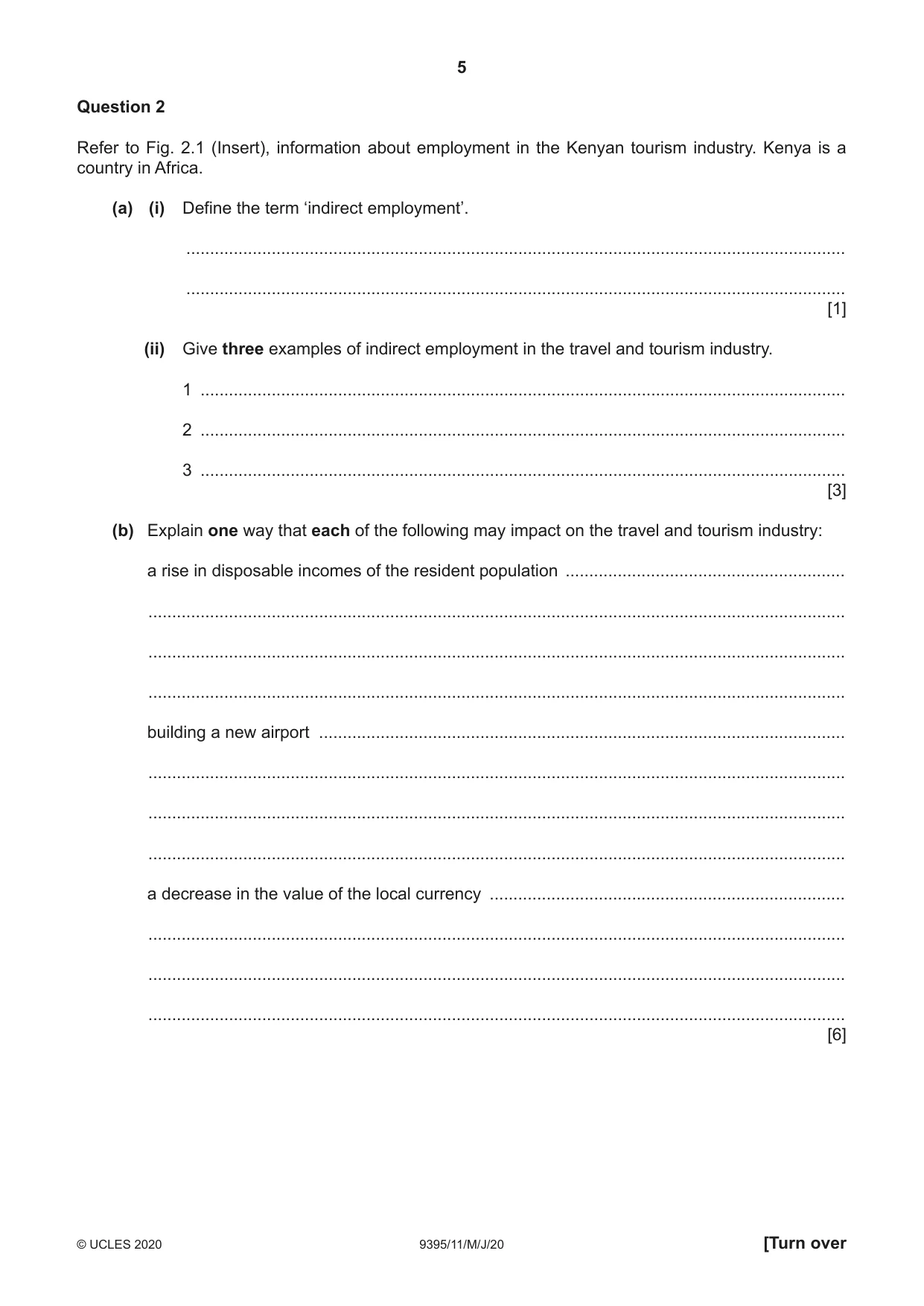
5 9395/11/M/J/20 © UCLES 2020 [Turn over Question 2 Refer to Fig. 2.1 (Insert), information about employment in the Kenyan tourism industry. Kenya is a country in Africa. (a) (i) Define the term ‘indirect employment’. … … [1] (ii) Give three examples of indirect employment in the travel and tourism industry. 1 … 2 … 3 … [3] (b) Explain one way that each of the following may impact on the travel and tourism industry: a rise in disposable incomes of the resident population … … … … building a new airport … … … … a decrease in the value of the local currency … … … … [6]
Question paper, page 6
6 9395/11/M/J/20 © UCLES 2020 (c) Explain two negative impacts of increasing employment in the travel and tourism industry for a country. 1 … … … … … … 2 … … … … … … [6]
Question paper, page 7
7 9395/11/M/J/20 © UCLES 2020 [Turn over (d) Discuss the role that local tourism organisations play in the development of the travel and tourism industry. … … … … … … … … … … … … … … … … … … [9] [Total: 25]
Question paper, page 8
8 9395/11/M/J/20 © UCLES 2020 Question 3 (a) Explain two developments in transport which may increase visitor numbers to a tourist destination. 1 … … … … 2 … … … … [4] (b) Explain three ancillary products or services a train company could offer to attract passengers. 1 … … … … 2 … … … … 3 … … … … [6]
Question paper, page 9
9 9395/11/M/J/20 © UCLES 2020 [Turn over (c) Explain two advantages to a tourist of using a high speed train service to travel within a country. 1 … … … … … … 2 … … … … … … [6]
Question paper, page 10
10 9395/11/M/J/20 © UCLES 2020 (d) Assess the ways a train company could obtain customer feedback. … … … … … … … … … … … … … … … … … … [9] [Total: 25]
Question paper, page 11
11 9395/11/M/J/20 © UCLES 2020 [Turn over Question 4 (a) Refer to Fig. 4.1 (Insert), information about specialised holidays. (i) Define the term ‘specialised holiday’. … … [1] (ii) Identify the type of specialised holidays described in Fig. 4.1. … … [1] (iii) Identify two services included in the holidays advertised in Fig. 4.1. 1 … … 2 … … [2] (b) Explain three likely reasons for the growth of specialised holidays. 1 … … … … 2 … … … … 3 … … … … [6]
Question paper, page 12
12 9395/11/M/J/20 © UCLES 2020 (c) Explain two advantages for the customer of going on a specialised package holiday. 1 … … … … … … 2 … … … … … … [6]
Question paper, page 13
13 9395/11/M/J/20 © UCLES 2020 (d) Discuss how developments in technology have assisted the growth of specialised tourism. … … … … … … … … … … … … … … … … … … [9] [Total: 25]
Question paper, page 14
14 9395/11/M/J/20 © UCLES 2020 BLANK PAGE
Question paper, page 15
15 9395/11/M/J/20 © UCLES 2020 BLANK PAGE
Question paper, page 16
16 9395/11/M/J/20 © UCLES 2020 Permission to reproduce items where third-party owned material protected by copyright is included has been sought and cleared where possible. Every reasonable effort has been made by the publisher (UCLES) to trace copyright holders, but if any items requiring clearance have unwittingly been included, the publisher will be pleased to make amends at the earliest possible opportunity. To avoid the issue of disclosure of answer-related information to candidates, all copyright acknowledgements are reproduced online in the Cambridge Assessment International Education Copyright Acknowledgements Booklet. This is produced for each series of examinations and is freely available to download at www.cambridgeinternational.org after the live examination series. Cambridge Assessment International Education is part of the Cambridge Assessment Group. Cambridge Assessment is the brand name of the University of Cambridge Local Examinations Syndicate (UCLES), which itself is a department of the University of Cambridge. BLANK PAGE
Mark scheme, page 1
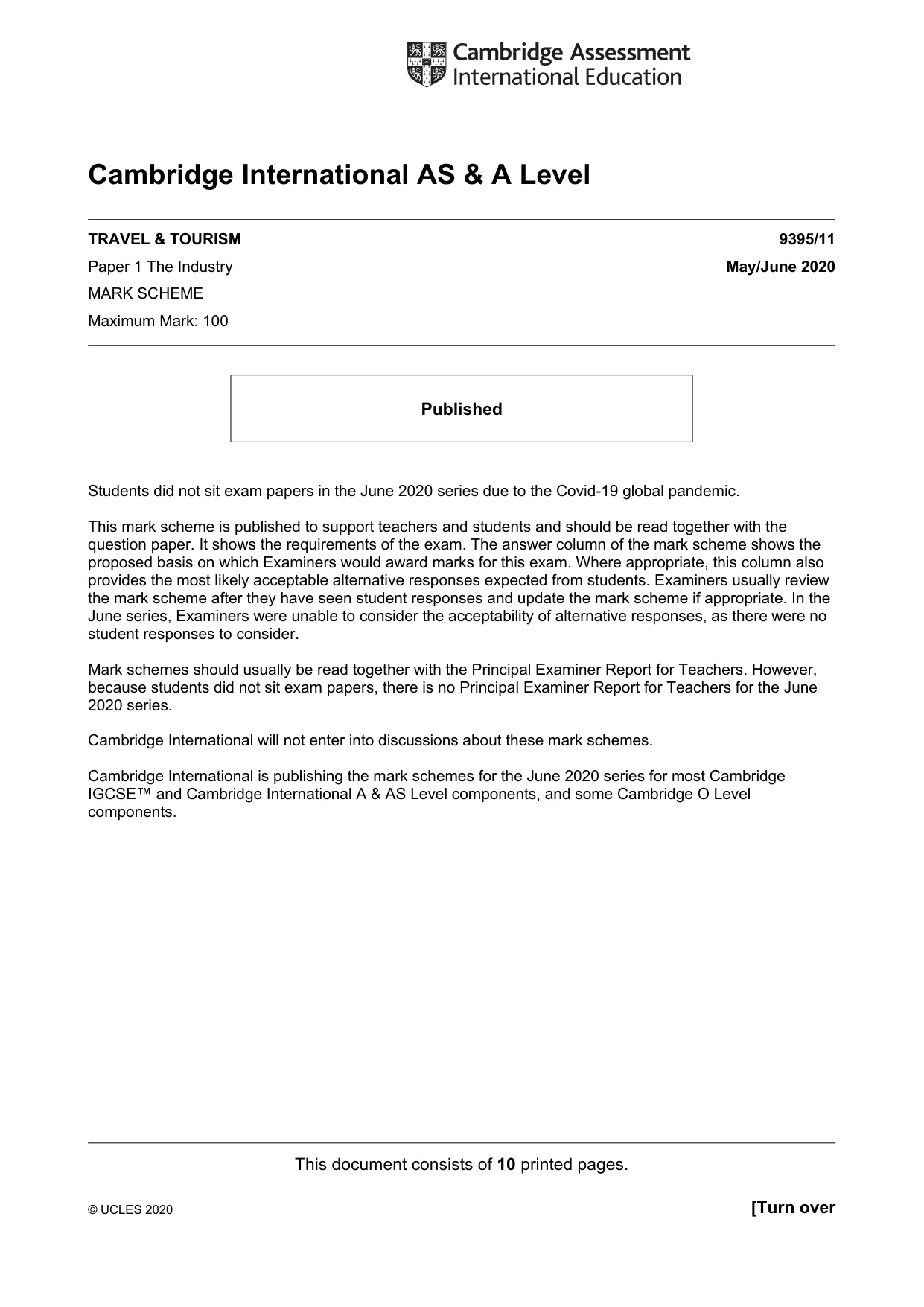
This document consists of 10 printed pages. © UCLES 2020 [Turn over Cambridge International AS & A Level TRAVEL & TOURISM 9395/11 Paper 1 The Industry May/June 2020 MARK SCHEME Maximum Mark: 100 Published Students did not sit exam papers in the June 2020 series due to the Covid-19 global pandemic. This mark scheme is published to support teachers and students and should be read together with the question paper. It shows the requirements of the exam. The answer column of the mark scheme shows the proposed basis on which Examiners would award marks for this exam. Where appropriate, this column also provides the most likely acceptable alternative responses expected from students. Examiners usually review the mark scheme after they have seen student responses and update the mark scheme if appropriate. In the June series, Examiners were unable to consider the acceptability of alternative responses, as there were no student responses to consider. Mark schemes should usually be read together with the Principal Examiner Report for Teachers. However, because students did not sit exam papers, there is no Principal Examiner Report for Teachers for the June 2020 series. Cambridge International will not enter into discussions about these mark schemes. Cambridge International is publishing the mark schemes for the June 2020 series for most Cambridge IGCSE™ and Cambridge International A & AS Level components, and some Cambridge O Level components.
Mark scheme, page 2
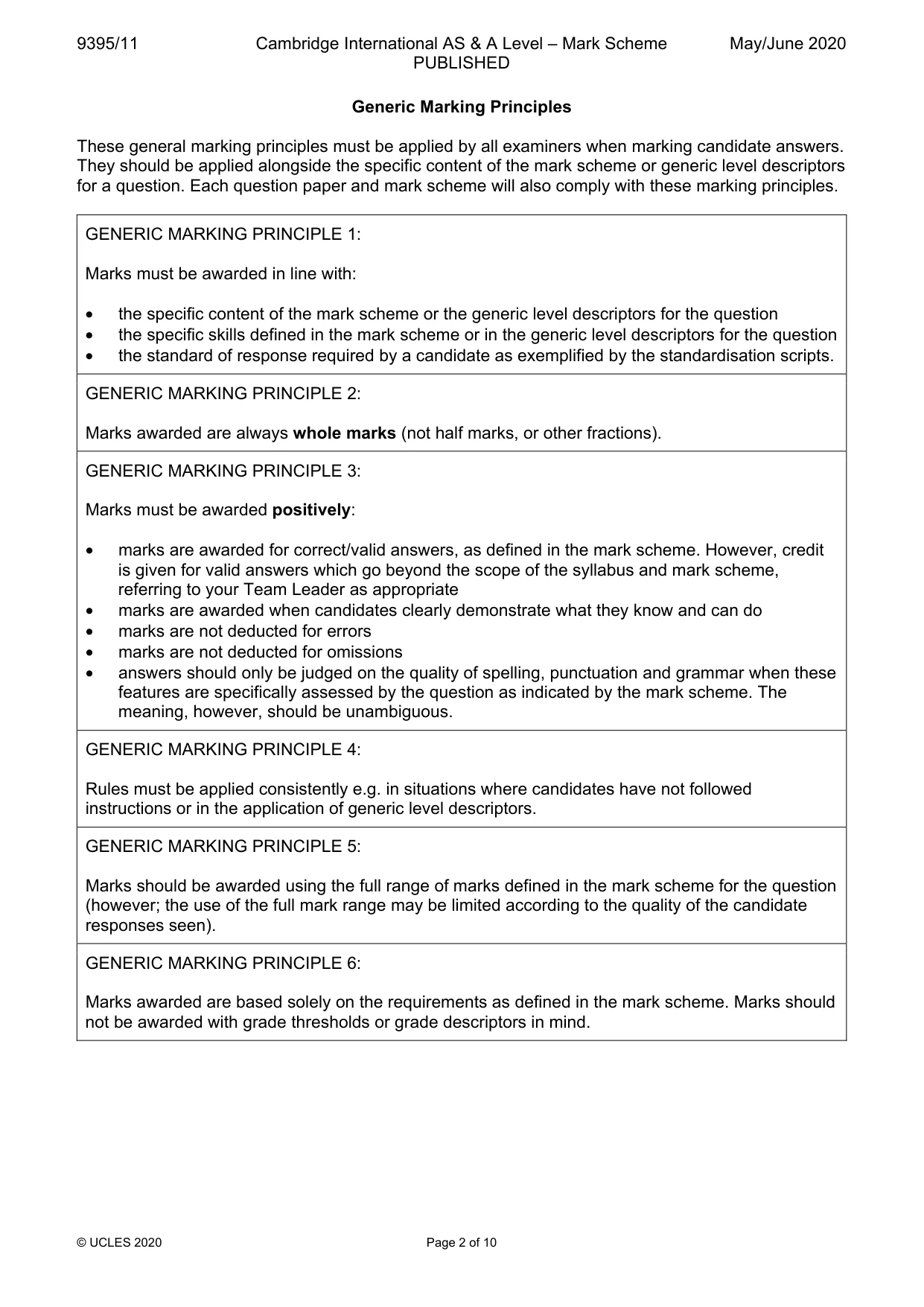
9395/11 Cambridge International AS & A Level – Mark Scheme PUBLISHED May/June 2020 © UCLES 2020 Page 2 of 10 Generic Marking Principles These general marking principles must be applied by all examiners when marking candidate answers. They should be applied alongside the specific content of the mark scheme or generic level descriptors for a question. Each question paper and mark scheme will also comply with these marking principles. GENERIC MARKING PRINCIPLE 1: Marks must be awarded in line with: • the specific content of the mark scheme or the generic level descriptors for the question • the specific skills defined in the mark scheme or in the generic level descriptors for the question • the standard of response required by a candidate as exemplified by the standardisation scripts. GENERIC MARKING PRINCIPLE 2: Marks awarded are always whole marks (not half marks, or other fractions). GENERIC MARKING PRINCIPLE 3: Marks must be awarded positively: • marks are awarded for correct/valid answers, as defined in the mark scheme. However, credit is given for valid answers which go beyond the scope of the syllabus and mark scheme, referring to your Team Leader as appropriate • marks are awarded when candidates clearly demonstrate what they know and can do • marks are not deducted for errors • marks are not deducted for omissions • answers should only be judged on the quality of spelling, punctuation and grammar when these features are specifically assessed by the question as indicated by the mark scheme. The meaning, however, should be unambiguous. GENERIC MARKING PRINCIPLE 4: Rules must be applied consistently e.g. in situations where candidates have not followed instructions or in the application of generic level descriptors. GENERIC MARKING PRINCIPLE 5: Marks should be awarded using the full range of marks defined in the mark scheme for the question (however; the use of the full mark range may be limited according to the quality of the candidate responses seen). GENERIC MARKING PRINCIPLE 6: Marks awarded are based solely on the requirements as defined in the mark scheme. Marks should not be awarded with grade thresholds or grade descriptors in mind.
Mark scheme, page 3
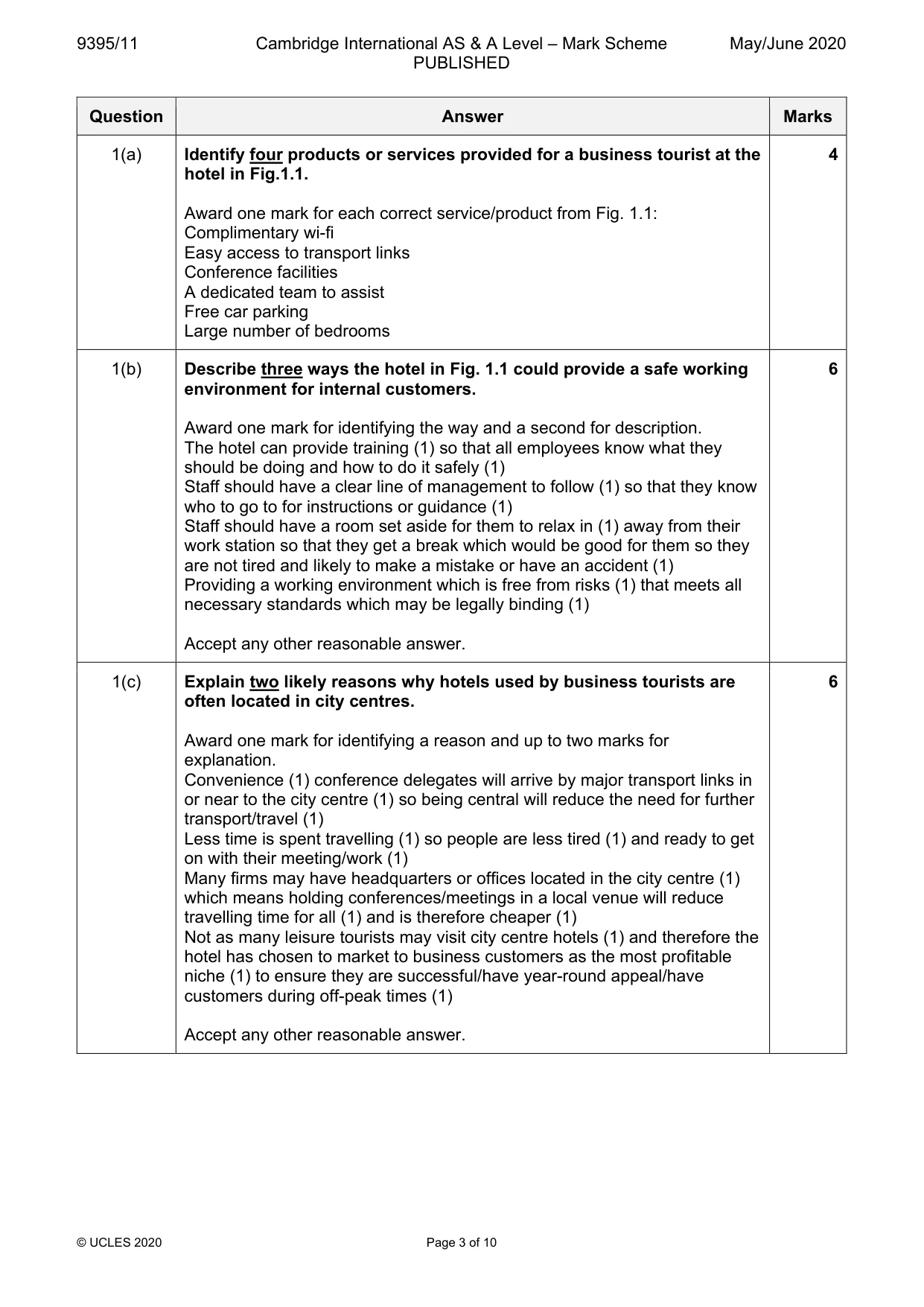
9395/11 Cambridge International AS & A Level – Mark Scheme PUBLISHED May/June 2020 © UCLES 2020 Page 3 of 10 Question Answer Marks 1(a) Identify four products or services provided for a business tourist at the hotel in Fig.1.1. Award one mark for each correct service/product from Fig. 1.1: Complimentary wi-fi Easy access to transport links Conference facilities A dedicated team to assist Free car parking Large number of bedrooms 4 1(b) Describe three ways the hotel in Fig. 1.1 could provide a safe working environment for internal customers. Award one mark for identifying the way and a second for description. The hotel can provide training (1) so that all employees know what they should be doing and how to do it safely (1) Staff should have a clear line of management to follow (1) so that they know who to go to for instructions or guidance (1) Staff should have a room set aside for them to relax in (1) away from their work station so that they get a break which would be good for them so they are not tired and likely to make a mistake or have an accident (1) Providing a working environment which is free from risks (1) that meets all necessary standards which may be legally binding (1) Accept any other reasonable answer. 6 1(c) Explain two likely reasons why hotels used by business tourists are often located in city centres. Award one mark for identifying a reason and up to two marks for explanation. Convenience (1) conference delegates will arrive by major transport links in or near to the city centre (1) so being central will reduce the need for further transport/travel (1) Less time is spent travelling (1) so people are less tired (1) and ready to get on with their meeting/work (1) Many firms may have headquarters or offices located in the city centre (1) which means holding conferences/meetings in a local venue will reduce travelling time for all (1) and is therefore cheaper (1) Not as many leisure tourists may visit city centre hotels (1) and therefore the hotel has chosen to market to business customers as the most profitable niche (1) to ensure they are successful/have year-round appeal/have customers during off-peak times (1) Accept any other reasonable answer. 6
Mark scheme, page 4
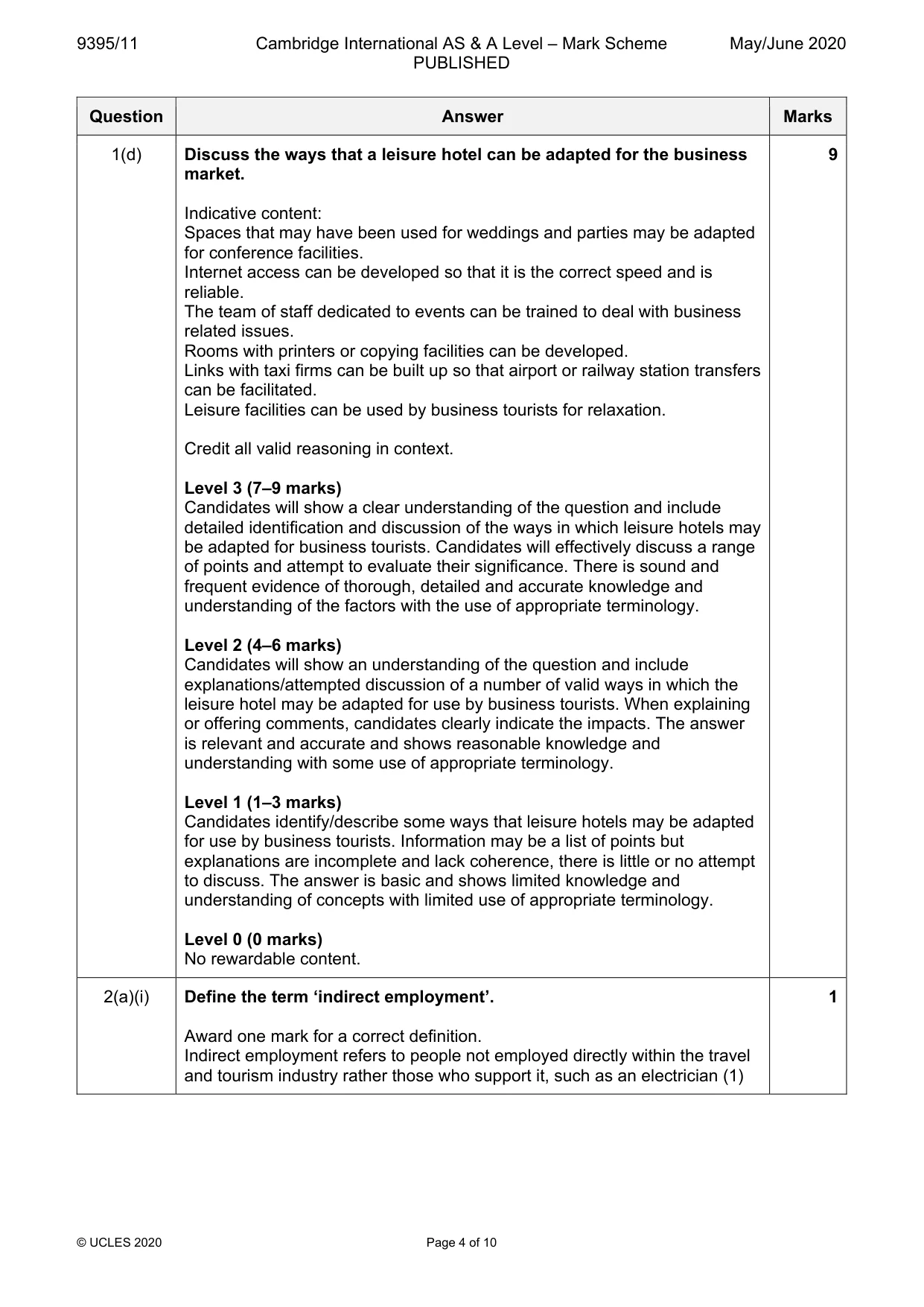
9395/11 Cambridge International AS & A Level – Mark Scheme PUBLISHED May/June 2020 © UCLES 2020 Page 4 of 10 Question Answer Marks 1(d) Discuss the ways that a leisure hotel can be adapted for the business market. Indicative content: Spaces that may have been used for weddings and parties may be adapted for conference facilities. Internet access can be developed so that it is the correct speed and is reliable. The team of staff dedicated to events can be trained to deal with business related issues. Rooms with printers or copying facilities can be developed. Links with taxi firms can be built up so that airport or railway station transfers can be facilitated. Leisure facilities can be used by business tourists for relaxation. Credit all valid reasoning in context. Level 3 (7–9 marks) Candidates will show a clear understanding of the question and include detailed identification and discussion of the ways in which leisure hotels may be adapted for business tourists. Candidates will effectively discuss a range of points and attempt to evaluate their significance. There is sound and frequent evidence of thorough, detailed and accurate knowledge and understanding of the factors with the use of appropriate terminology. Level 2 (4–6 marks) Candidates will show an understanding of the question and include explanations/attempted discussion of a number of valid ways in which the leisure hotel may be adapted for use by business tourists. When explaining or offering comments, candidates clearly indicate the impacts. The answer is relevant and accurate and shows reasonable knowledge and understanding with some use of appropriate terminology. Level 1 (1–3 marks) Candidates identify/describe some ways that leisure hotels may be adapted for use by business tourists. Information may be a list of points but explanations are incomplete and lack coherence, there is little or no attempt to discuss. The answer is basic and shows limited knowledge and understanding of concepts with limited use of appropriate terminology. Level 0 (0 marks) No rewardable content. 9 2(a)(i) Define the term ‘indirect employment’. Award one mark for a correct definition. Indirect employment refers to people not employed directly within the travel and tourism industry rather those who support it, such as an electrician (1) 1
Mark scheme, page 5
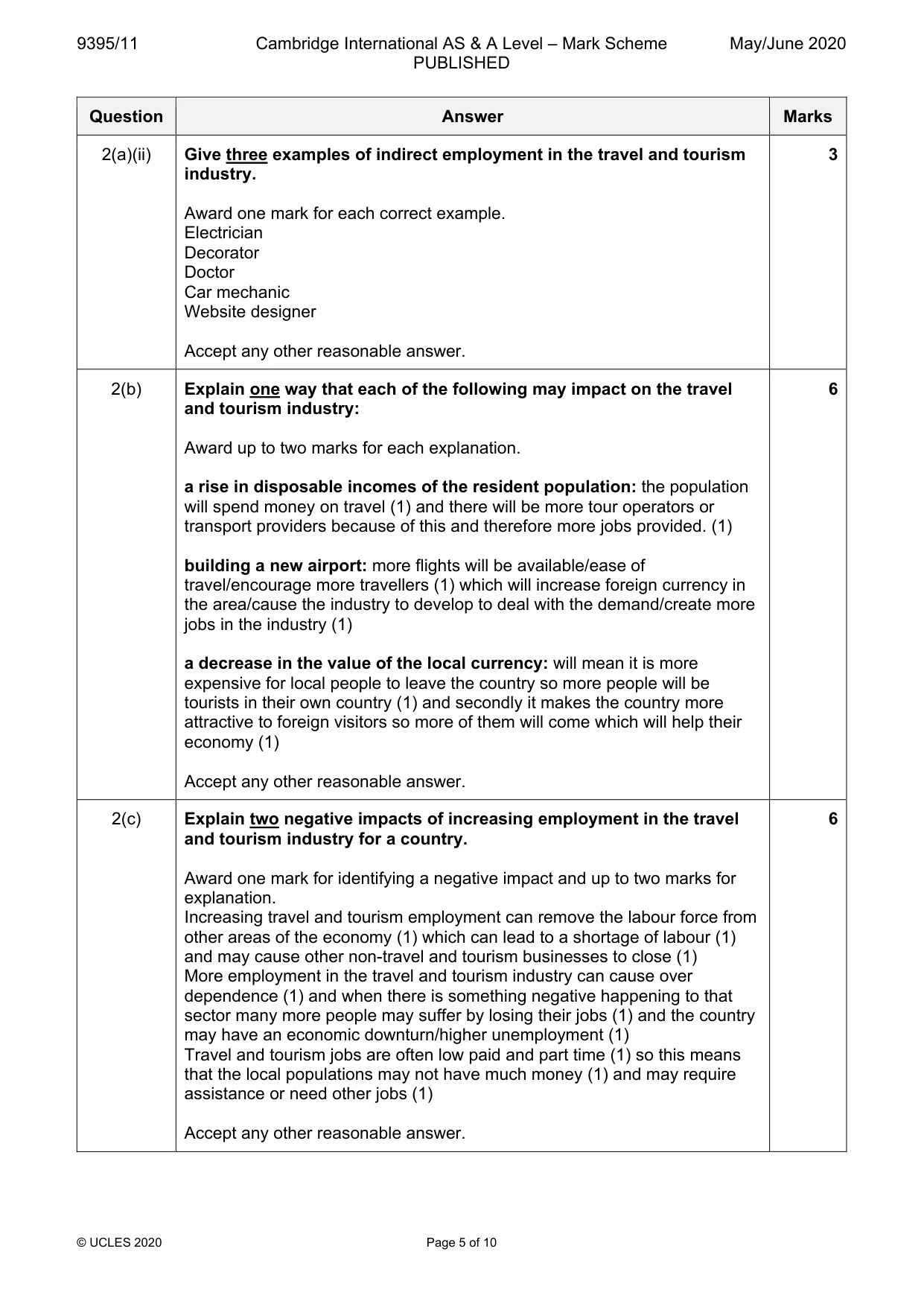
9395/11 Cambridge International AS & A Level – Mark Scheme PUBLISHED May/June 2020 © UCLES 2020 Page 5 of 10 Question Answer Marks 2(a)(ii) Give three examples of indirect employment in the travel and tourism industry. Award one mark for each correct example. Electrician Decorator Doctor Car mechanic Website designer Accept any other reasonable answer. 3 2(b) Explain one way that each of the following may impact on the travel and tourism industry: Award up to two marks for each explanation. a rise in disposable incomes of the resident population: the population will spend money on travel (1) and there will be more tour operators or transport providers because of this and therefore more jobs provided. (1) building a new airport: more flights will be available/ease of travel/encourage more travellers (1) which will increase foreign currency in the area/cause the industry to develop to deal with the demand/create more jobs in the industry (1) a decrease in the value of the local currency: will mean it is more expensive for local people to leave the country so more people will be tourists in their own country (1) and secondly it makes the country more attractive to foreign visitors so more of them will come which will help their economy (1) Accept any other reasonable answer. 6 2(c) Explain two negative impacts of increasing employment in the travel and tourism industry for a country. Award one mark for identifying a negative impact and up to two marks for explanation. Increasing travel and tourism employment can remove the labour force from other areas of the economy (1) which can lead to a shortage of labour (1) and may cause other non-travel and tourism businesses to close (1) More employment in the travel and tourism industry can cause over dependence (1) and when there is something negative happening to that sector many more people may suffer by losing their jobs (1) and the country may have an economic downturn/higher unemployment (1) Travel and tourism jobs are often low paid and part time (1) so this means that the local populations may not have much money (1) and may require assistance or need other jobs (1) Accept any other reasonable answer. 6
Mark scheme, page 6
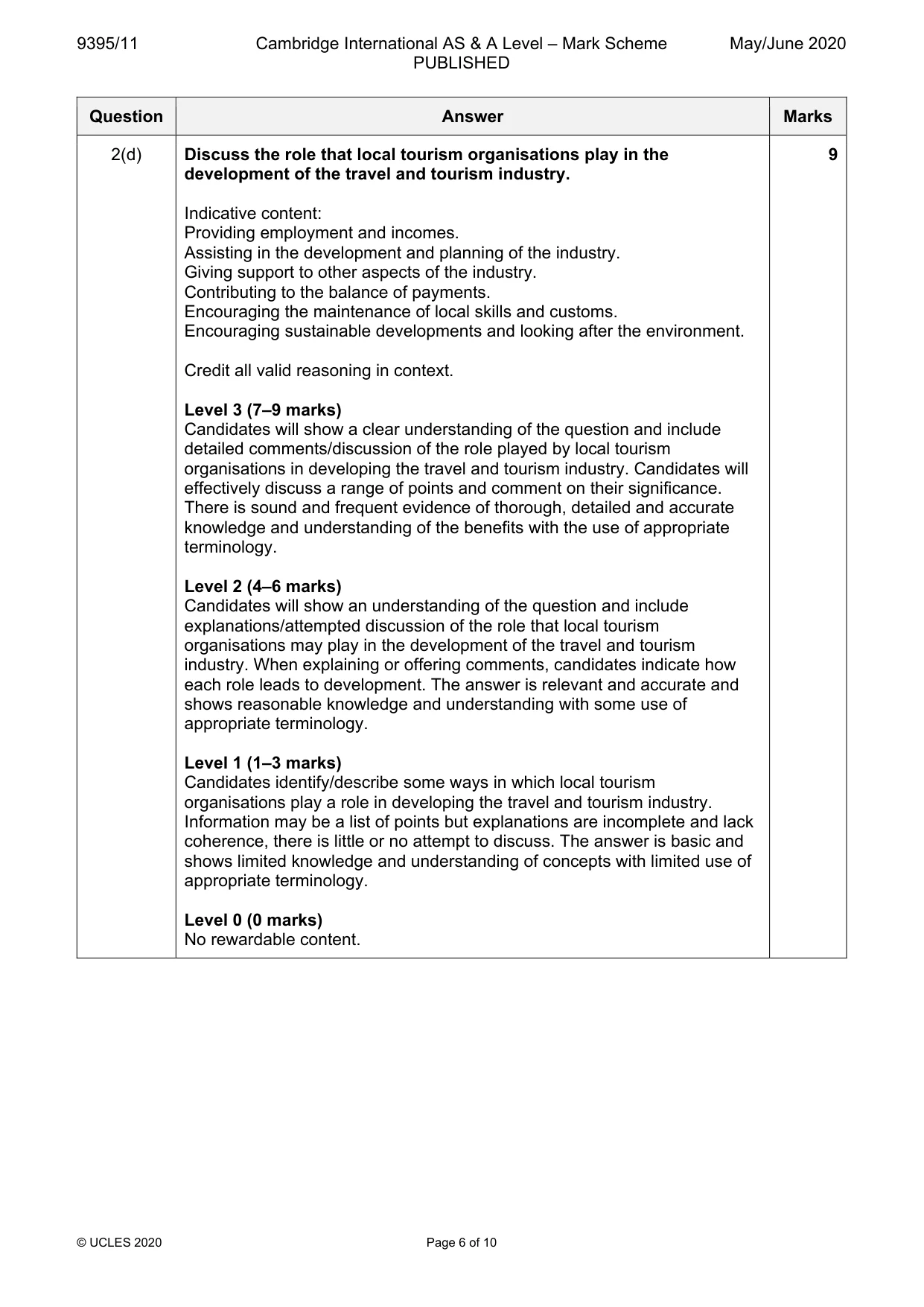
9395/11 Cambridge International AS & A Level – Mark Scheme PUBLISHED May/June 2020 © UCLES 2020 Page 6 of 10 Question Answer Marks 2(d) Discuss the role that local tourism organisations play in the development of the travel and tourism industry. Indicative content: Providing employment and incomes. Assisting in the development and planning of the industry. Giving support to other aspects of the industry. Contributing to the balance of payments. Encouraging the maintenance of local skills and customs. Encouraging sustainable developments and looking after the environment. Credit all valid reasoning in context. Level 3 (7–9 marks) Candidates will show a clear understanding of the question and include detailed comments/discussion of the role played by local tourism organisations in developing the travel and tourism industry. Candidates will effectively discuss a range of points and comment on their significance. There is sound and frequent evidence of thorough, detailed and accurate knowledge and understanding of the benefits with the use of appropriate terminology. Level 2 (4–6 marks) Candidates will show an understanding of the question and include explanations/attempted discussion of the role that local tourism organisations may play in the development of the travel and tourism industry. When explaining or offering comments, candidates indicate how each role leads to development. The answer is relevant and accurate and shows reasonable knowledge and understanding with some use of appropriate terminology. Level 1 (1–3 marks) Candidates identify/describe some ways in which local tourism organisations play a role in developing the travel and tourism industry. Information may be a list of points but explanations are incomplete and lack coherence, there is little or no attempt to discuss. The answer is basic and shows limited knowledge and understanding of concepts with limited use of appropriate terminology. Level 0 (0 marks) No rewardable content. 9
Mark scheme, page 7
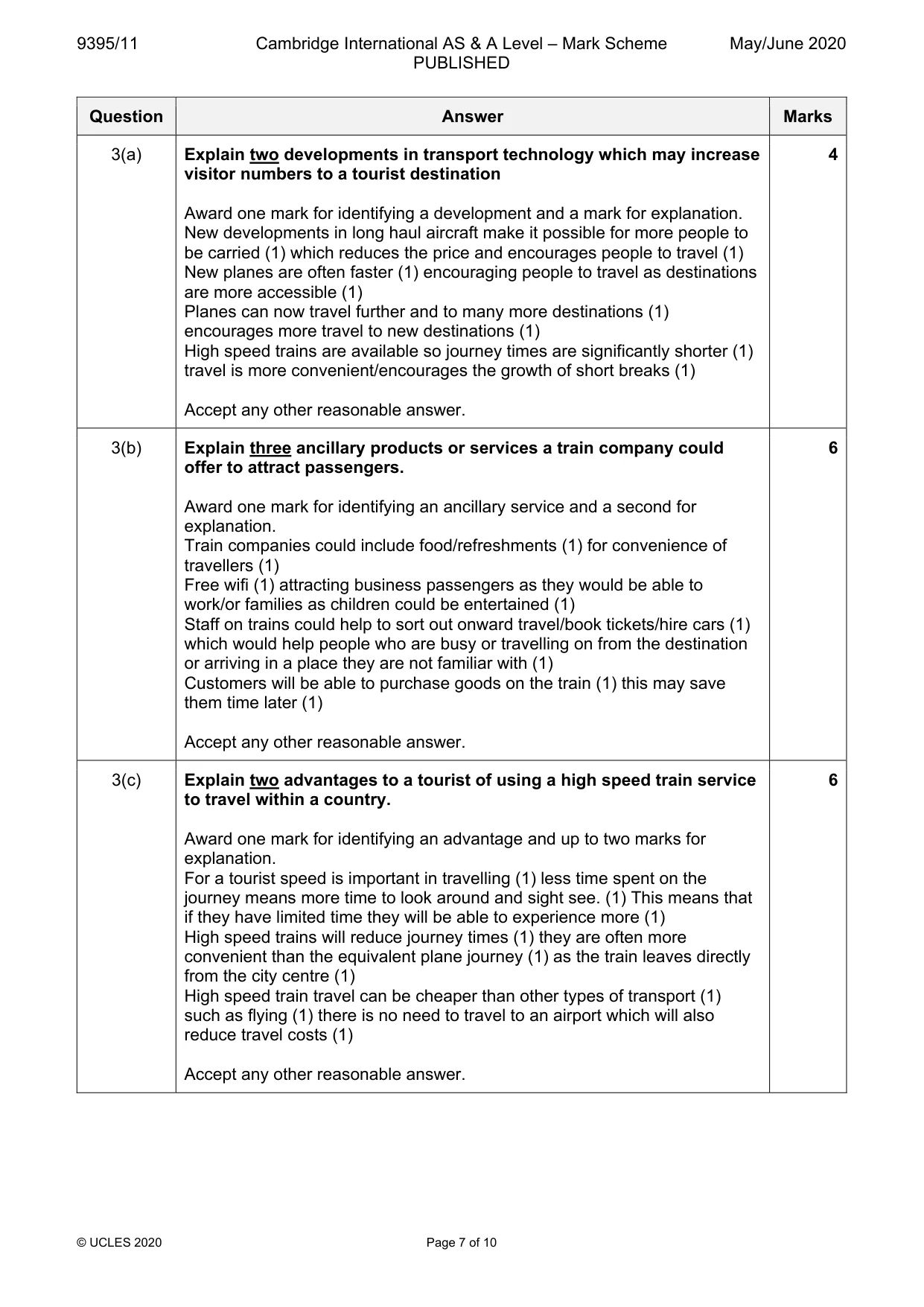
9395/11 Cambridge International AS & A Level – Mark Scheme PUBLISHED May/June 2020 © UCLES 2020 Page 7 of 10 Question Answer Marks 3(a) Explain two developments in transport technology which may increase visitor numbers to a tourist destination Award one mark for identifying a development and a mark for explanation. New developments in long haul aircraft make it possible for more people to be carried (1) which reduces the price and encourages people to travel (1) New planes are often faster (1) encouraging people to travel as destinations are more accessible (1) Planes can now travel further and to many more destinations (1) encourages more travel to new destinations (1) High speed trains are available so journey times are significantly shorter (1) travel is more convenient/encourages the growth of short breaks (1) Accept any other reasonable answer. 4 3(b) Explain three ancillary products or services a train company could offer to attract passengers. Award one mark for identifying an ancillary service and a second for explanation. Train companies could include food/refreshments (1) for convenience of travellers (1) Free wifi (1) attracting business passengers as they would be able to work/or families as children could be entertained (1) Staff on trains could help to sort out onward travel/book tickets/hire cars (1) which would help people who are busy or travelling on from the destination or arriving in a place they are not familiar with (1) Customers will be able to purchase goods on the train (1) this may save them time later (1) Accept any other reasonable answer. 6 3(c) Explain two advantages to a tourist of using a high speed train service to travel within a country. Award one mark for identifying an advantage and up to two marks for explanation. For a tourist speed is important in travelling (1) less time spent on the journey means more time to look around and sight see. (1) This means that if they have limited time they will be able to experience more (1) High speed trains will reduce journey times (1) they are often more convenient than the equivalent plane journey (1) as the train leaves directly from the city centre (1) High speed train travel can be cheaper than other types of transport (1) such as flying (1) there is no need to travel to an airport which will also reduce travel costs (1) Accept any other reasonable answer. 6
Mark scheme, page 8
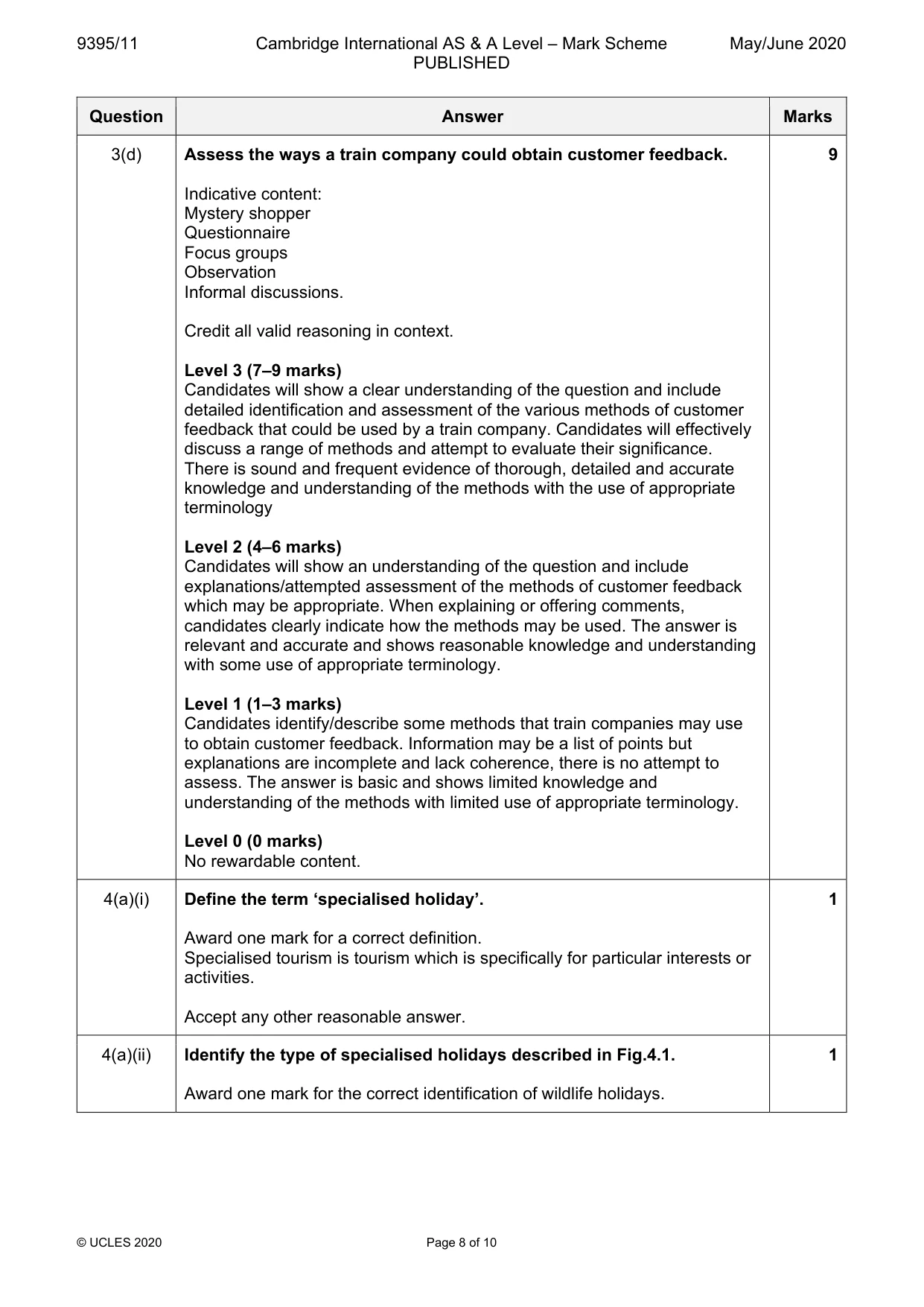
9395/11 Cambridge International AS & A Level – Mark Scheme PUBLISHED May/June 2020 © UCLES 2020 Page 8 of 10 Question Answer Marks 3(d) Assess the ways a train company could obtain customer feedback. Indicative content: Mystery shopper Questionnaire Focus groups Observation Informal discussions. Credit all valid reasoning in context. Level 3 (7–9 marks) Candidates will show a clear understanding of the question and include detailed identification and assessment of the various methods of customer feedback that could be used by a train company. Candidates will effectively discuss a range of methods and attempt to evaluate their significance. There is sound and frequent evidence of thorough, detailed and accurate knowledge and understanding of the methods with the use of appropriate terminology Level 2 (4–6 marks) Candidates will show an understanding of the question and include explanations/attempted assessment of the methods of customer feedback which may be appropriate. When explaining or offering comments, candidates clearly indicate how the methods may be used. The answer is relevant and accurate and shows reasonable knowledge and understanding with some use of appropriate terminology. Level 1 (1–3 marks) Candidates identify/describe some methods that train companies may use to obtain customer feedback. Information may be a list of points but explanations are incomplete and lack coherence, there is no attempt to assess. The answer is basic and shows limited knowledge and understanding of the methods with limited use of appropriate terminology. Level 0 (0 marks) No rewardable content. 9 4(a)(i) Define the term ‘specialised holiday’. Award one mark for a correct definition. Specialised tourism is tourism which is specifically for particular interests or activities. Accept any other reasonable answer. 1 4(a)(ii) Identify the type of specialised holidays described in Fig.4.1. Award one mark for the correct identification of wildlife holidays. 1
Mark scheme, page 9
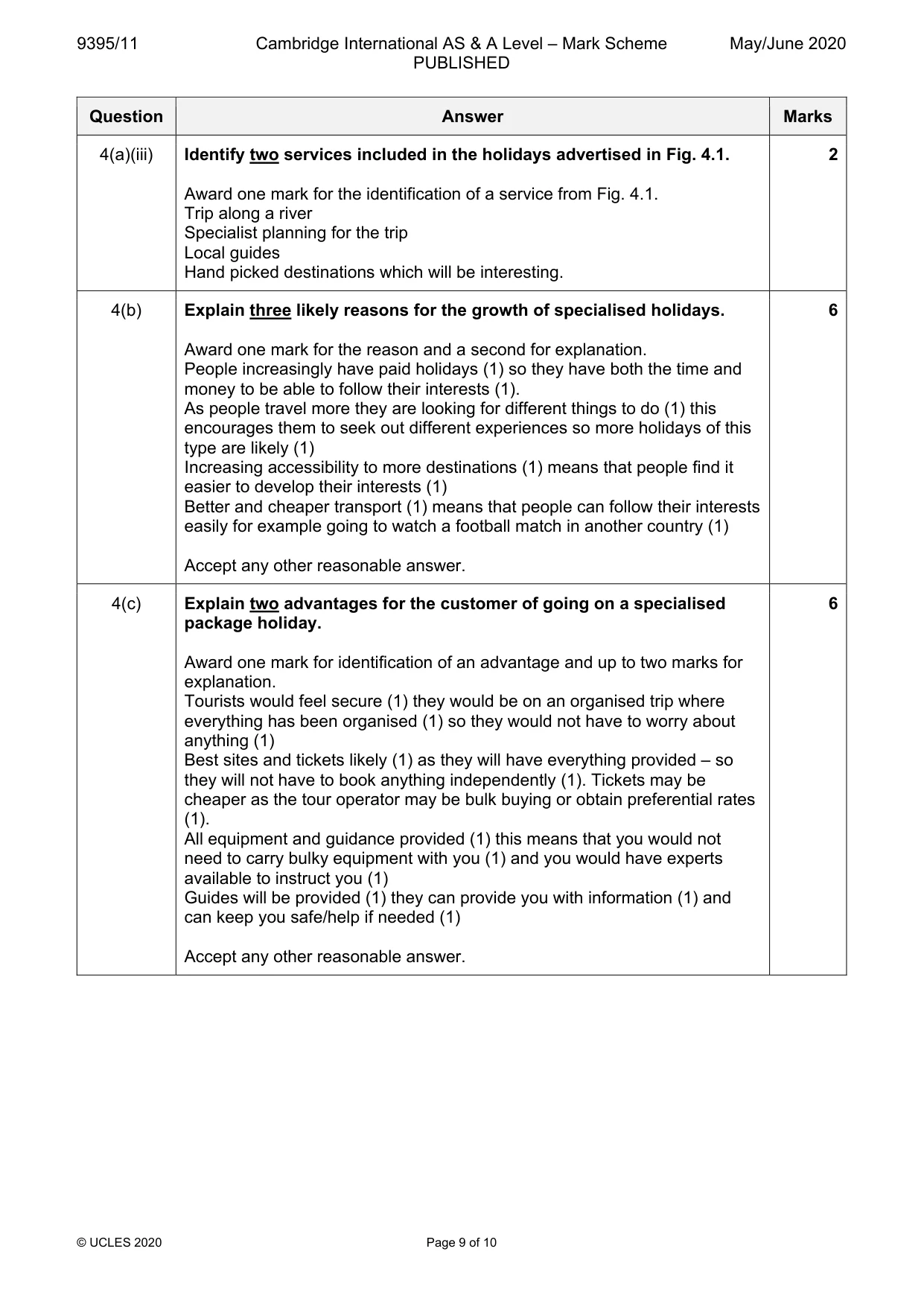
9395/11 Cambridge International AS & A Level – Mark Scheme PUBLISHED May/June 2020 © UCLES 2020 Page 9 of 10 Question Answer Marks 4(a)(iii) Identify two services included in the holidays advertised in Fig. 4.1. Award one mark for the identification of a service from Fig. 4.1. Trip along a river Specialist planning for the trip Local guides Hand picked destinations which will be interesting. 2 4(b) Explain three likely reasons for the growth of specialised holidays. Award one mark for the reason and a second for explanation. People increasingly have paid holidays (1) so they have both the time and money to be able to follow their interests (1). As people travel more they are looking for different things to do (1) this encourages them to seek out different experiences so more holidays of this type are likely (1) Increasing accessibility to more destinations (1) means that people find it easier to develop their interests (1) Better and cheaper transport (1) means that people can follow their interests easily for example going to watch a football match in another country (1) Accept any other reasonable answer. 6 4(c) Explain two advantages for the customer of going on a specialised package holiday. Award one mark for identification of an advantage and up to two marks for explanation. Tourists would feel secure (1) they would be on an organised trip where everything has been organised (1) so they would not have to worry about anything (1) Best sites and tickets likely (1) as they will have everything provided – so they will not have to book anything independently (1). Tickets may be cheaper as the tour operator may be bulk buying or obtain preferential rates (1). All equipment and guidance provided (1) this means that you would not need to carry bulky equipment with you (1) and you would have experts available to instruct you (1) Guides will be provided (1) they can provide you with information (1) and can keep you safe/help if needed (1) Accept any other reasonable answer. 6
Mark scheme, page 10
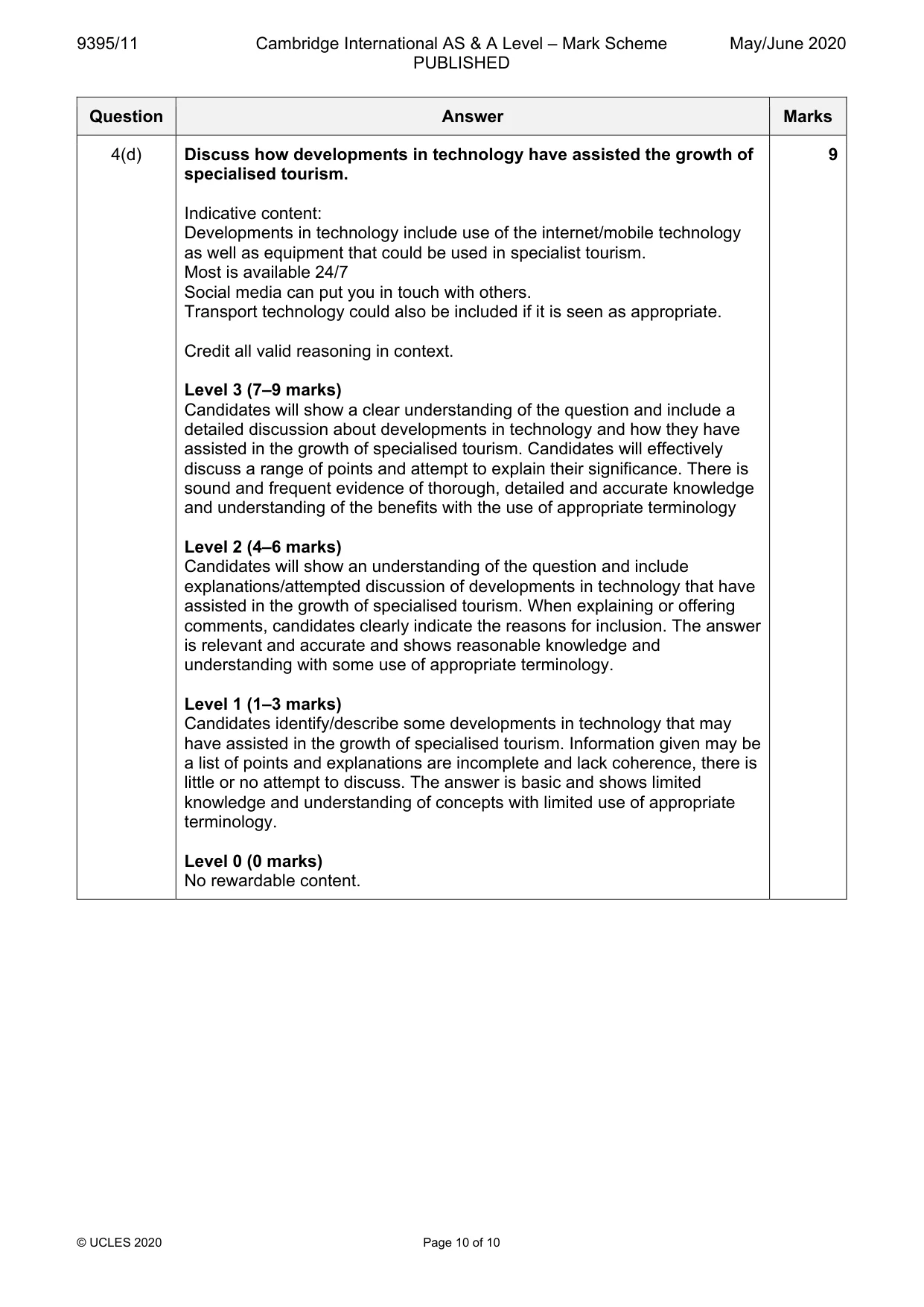
9395/11 Cambridge International AS & A Level – Mark Scheme PUBLISHED May/June 2020 © UCLES 2020 Page 10 of 10 Question Answer Marks 4(d) Discuss how developments in technology have assisted the growth of specialised tourism. Indicative content: Developments in technology include use of the internet/mobile technology as well as equipment that could be used in specialist tourism. Most is available 24/7 Social media can put you in touch with others. Transport technology could also be included if it is seen as appropriate. Credit all valid reasoning in context. Level 3 (7–9 marks) Candidates will show a clear understanding of the question and include a detailed discussion about developments in technology and how they have assisted in the growth of specialised tourism. Candidates will effectively discuss a range of points and attempt to explain their significance. There is sound and frequent evidence of thorough, detailed and accurate knowledge and understanding of the benefits with the use of appropriate terminology Level 2 (4–6 marks) Candidates will show an understanding of the question and include explanations/attempted discussion of developments in technology that have assisted in the growth of specialised tourism. When explaining or offering comments, candidates clearly indicate the reasons for inclusion. The answer is relevant and accurate and shows reasonable knowledge and understanding with some use of appropriate terminology. Level 1 (1–3 marks) Candidates identify/describe some developments in technology that may have assisted in the growth of specialised tourism. Information given may be a list of points and explanations are incomplete and lack coherence, there is little or no attempt to discuss. The answer is basic and shows limited knowledge and understanding of concepts with limited use of appropriate terminology. Level 0 (0 marks) No rewardable content. 9