Cambridge A Level Travel and Tourism 9395 — 2023 Oct/Nov Paper 1 · Variant 2
9395/12/O/N/23 · 100 marks · ≈113 min
The question paper and its mark scheme, free to read here and free to download. This is Cambridge’s own paper, exactly as it was sat.
Question paper16 pages



Mark scheme19 pages
Answers below. Sit the paper first if you are practising.

Paper as text
Question paper, page 1
This document has 16 pages. Any blank pages are indicated. [Turn over Cambridge International AS & A Level TRAVEL & TOURISM 9395/12 Paper 1 The Industry October/November 2023 2 hours 30 minutes You must answer on the question paper. You will need: Insert (enclosed) INSTRUCTIONS ● Answer all questions. ● Use a black or dark blue pen. ● Write your name, centre number and candidate number in the boxes at the top of the page. ● Write your answer to each question in the space provided. ● Do not use an erasable pen or correction fluid. ● Do not write on any bar codes. INFORMATION ● The total mark for this paper is 100. ● The number of marks for each question or part question is shown in brackets [ ]. ● The insert contains all the figures referred to in the questions. DC (RW) 312387/2 © UCLES 2023 * 8 2 8 7 4 2 3 0 2 5 *
Question paper, page 2
2 9395/12/O/N/23 © UCLES 2023 1 Refer to Fig. 1.1 (Insert), a photograph of adventure tourism. (a) (i) Define the term ‘adventure tourism’. … … [1] (ii) State three water-based adventure tourism activities. 1 … 2 … 3 … [3] (b) Describe three characteristics of the area shown in Fig. 1.1 that would appeal to leisure tourists. 1 … … … … 2 … … … … 3 … … … … [6]
Question paper, page 3
3 9395/12/O/N/23 © UCLES 2023 [Turn over (c) Explain two social factors which have encouraged the development of adventure tourism. 1 … … … … … … 2 … … … … … … [6]
Question paper, page 4
4 9395/12/O/N/23 © UCLES 2023 (d) Discuss how adventure tourism may be managed responsibly. … … … … … … … … … … … … … … … … … … [9] [Total: 25]
Question paper, page 5
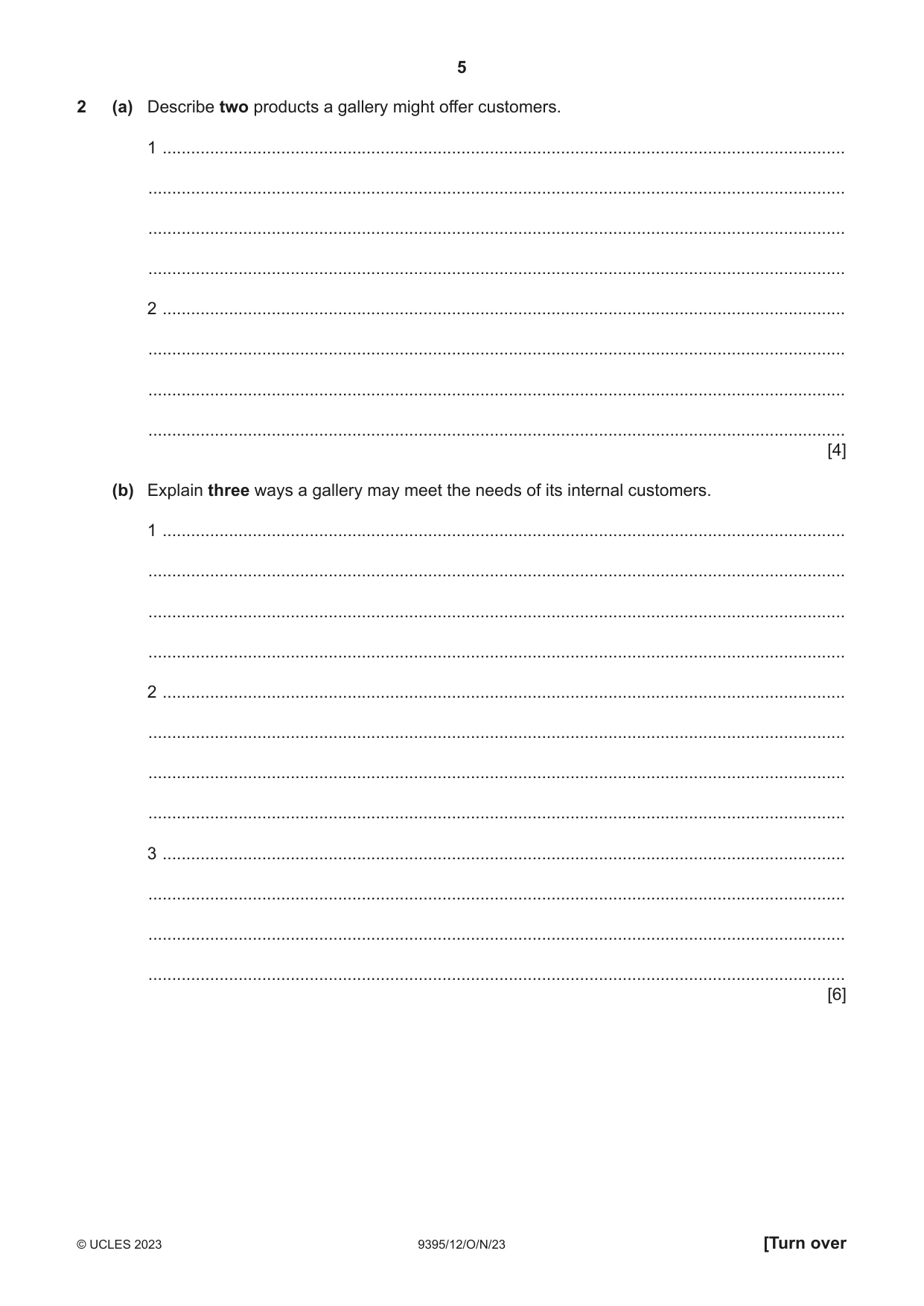
5 9395/12/O/N/23 © UCLES 2023 [Turn over 2 (a) Describe two products a gallery might offer customers. 1 … … … … 2 … … … … [4] (b) Explain three ways a gallery may meet the needs of its internal customers. 1 … … … … 2 … … … … 3 … … … … [6]
Question paper, page 6
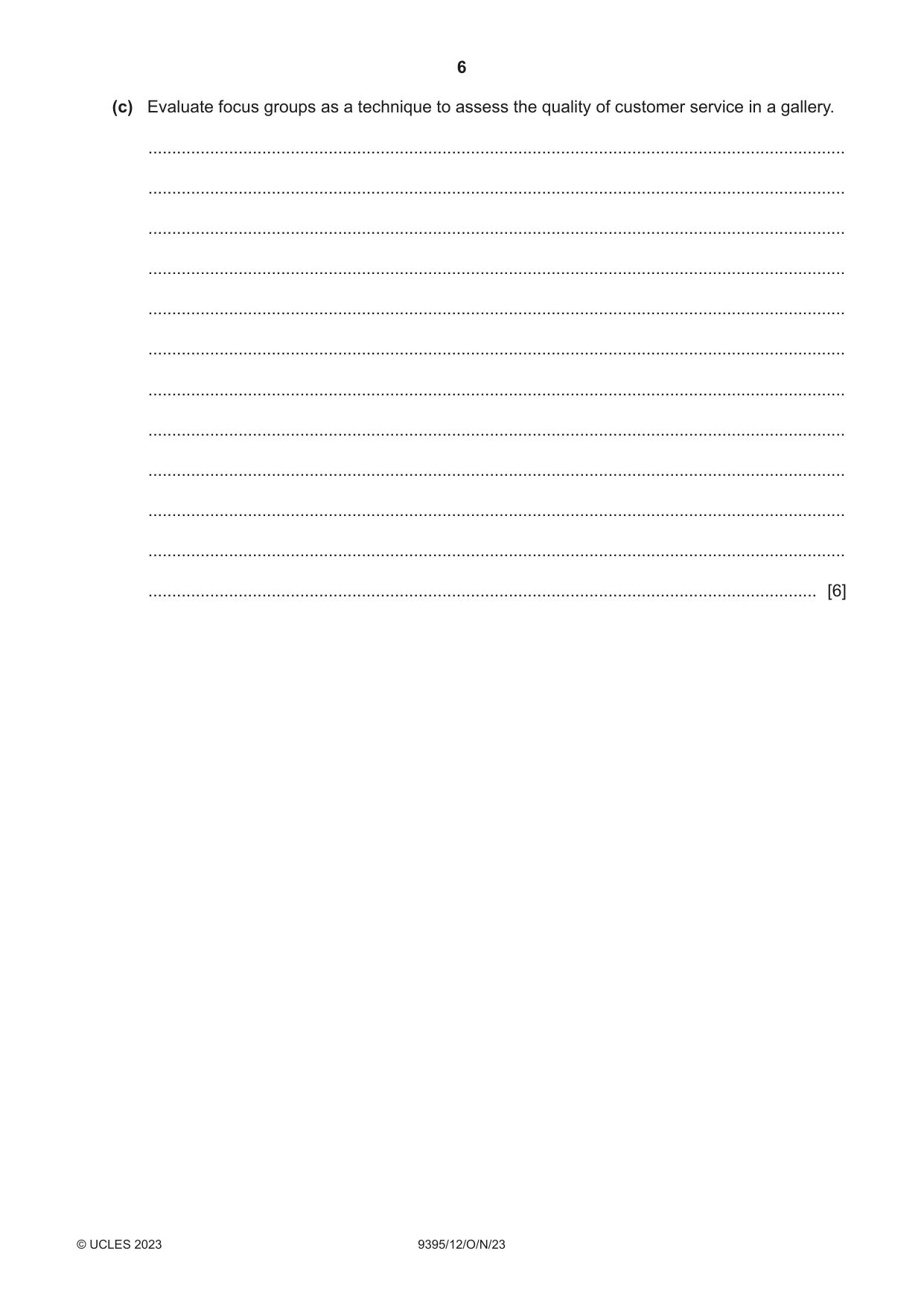
6 9395/12/O/N/23 © UCLES 2023 (c) Evaluate focus groups as a technique to assess the quality of customer service in a gallery. … … … … … … … … … … … … [6]
Question paper, page 7
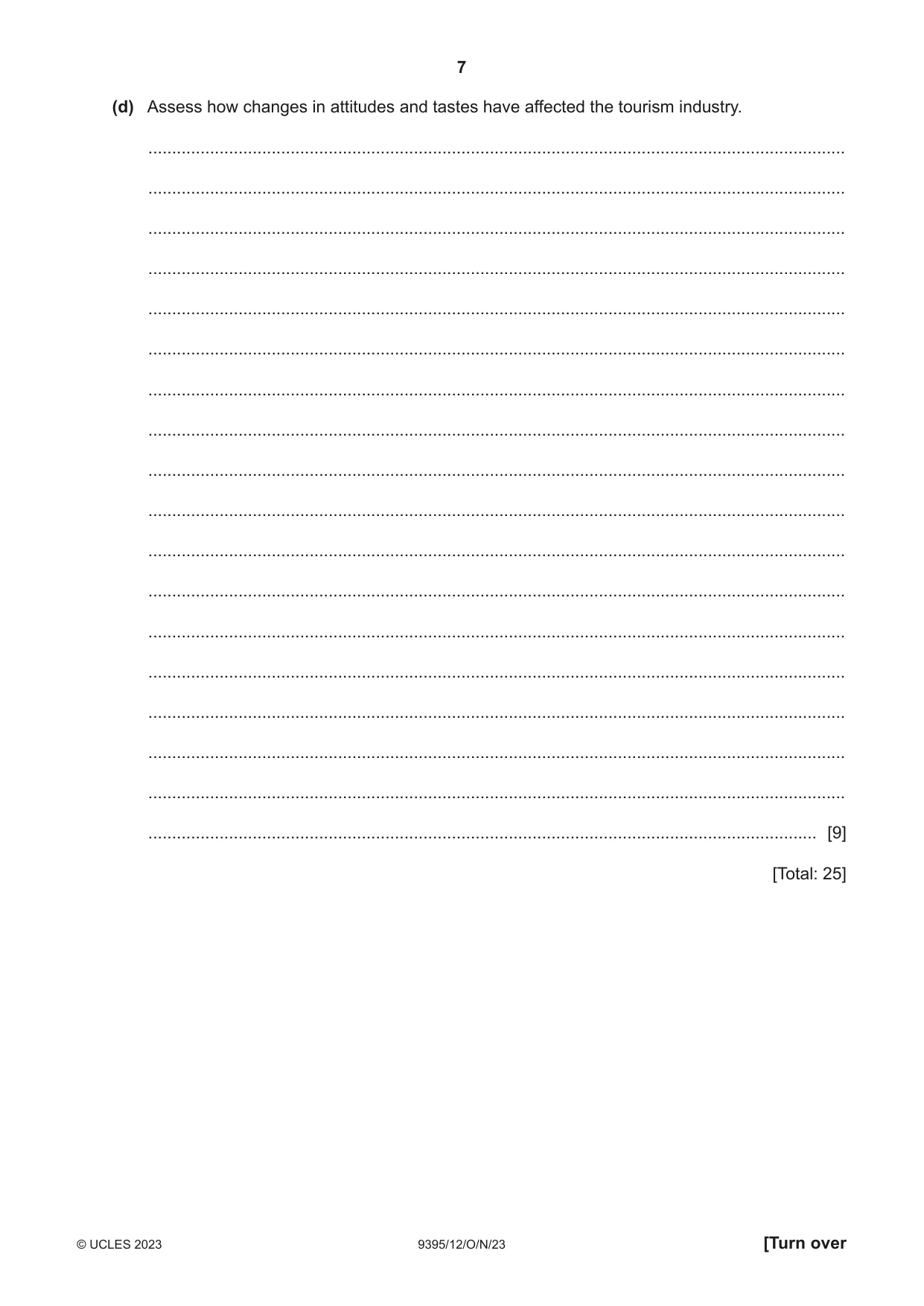
7 9395/12/O/N/23 © UCLES 2023 [Turn over (d) Assess how changes in attitudes and tastes have affected the tourism industry. … … … … … … … … … … … … … … … … … … [9] [Total: 25]
Question paper, page 8
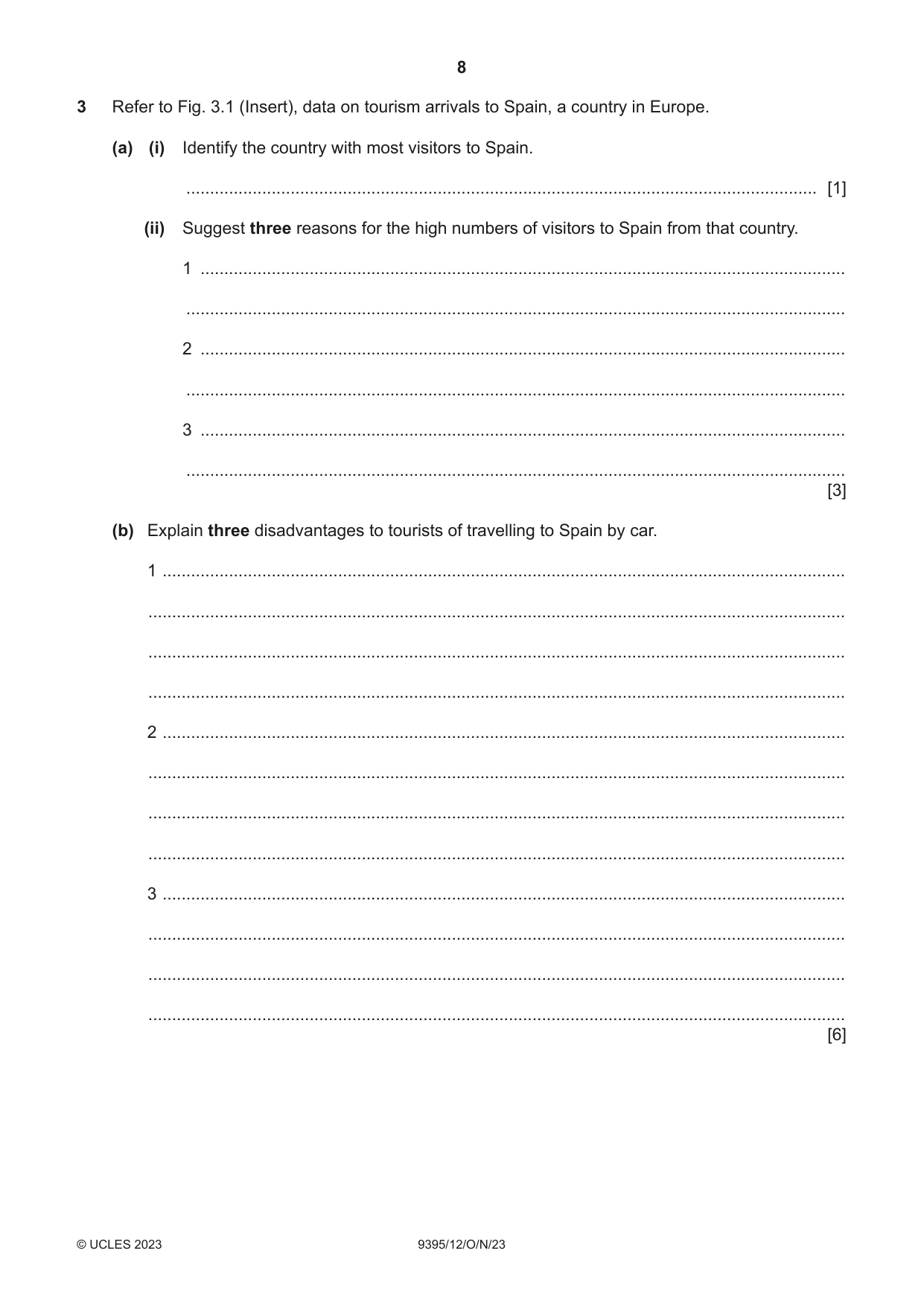
8 9395/12/O/N/23 © UCLES 2023 3 Refer to Fig. 3.1 (Insert), data on tourism arrivals to Spain, a country in Europe. (a) (i) Identify the country with most visitors to Spain. … [1] (ii) Suggest three reasons for the high numbers of visitors to Spain from that country. 1 … … 2 … … 3 … … [3] (b) Explain three disadvantages to tourists of travelling to Spain by car. 1 … … … … 2 … … … … 3 … … … … [6]
Question paper, page 9
9 9395/12/O/N/23 © UCLES 2023 [Turn over (c) Analyse how changes in currency exchange rates may impact a destination. … … … … … … … … … … … … [6]
Question paper, page 10
10 9395/12/O/N/23 © UCLES 2023 (d) Discuss the importance of transport providers improving the transport they offer. … … … … … … … … … … … … … … … … … … [9] [Total: 25]
Question paper, page 11
11 9395/12/O/N/23 © UCLES 2023 [Turn over 4 (a) (i) Define the term ‘VFR tourism’. … … [1] (ii) State three benefits to destinations of VFR tourism. 1 … … 2 … … 3 … … [3] (b) Describe three characteristics of urban destinations that appeal to business tourists. 1 … … … … 2 … … … … 3 … … … … [6]
Question paper, page 12
12 9395/12/O/N/23 © UCLES 2023 (c) Explain three ways the issue of seasonality may be overcome. 1 … … … … 2 … … … … 3 … … … … [6]
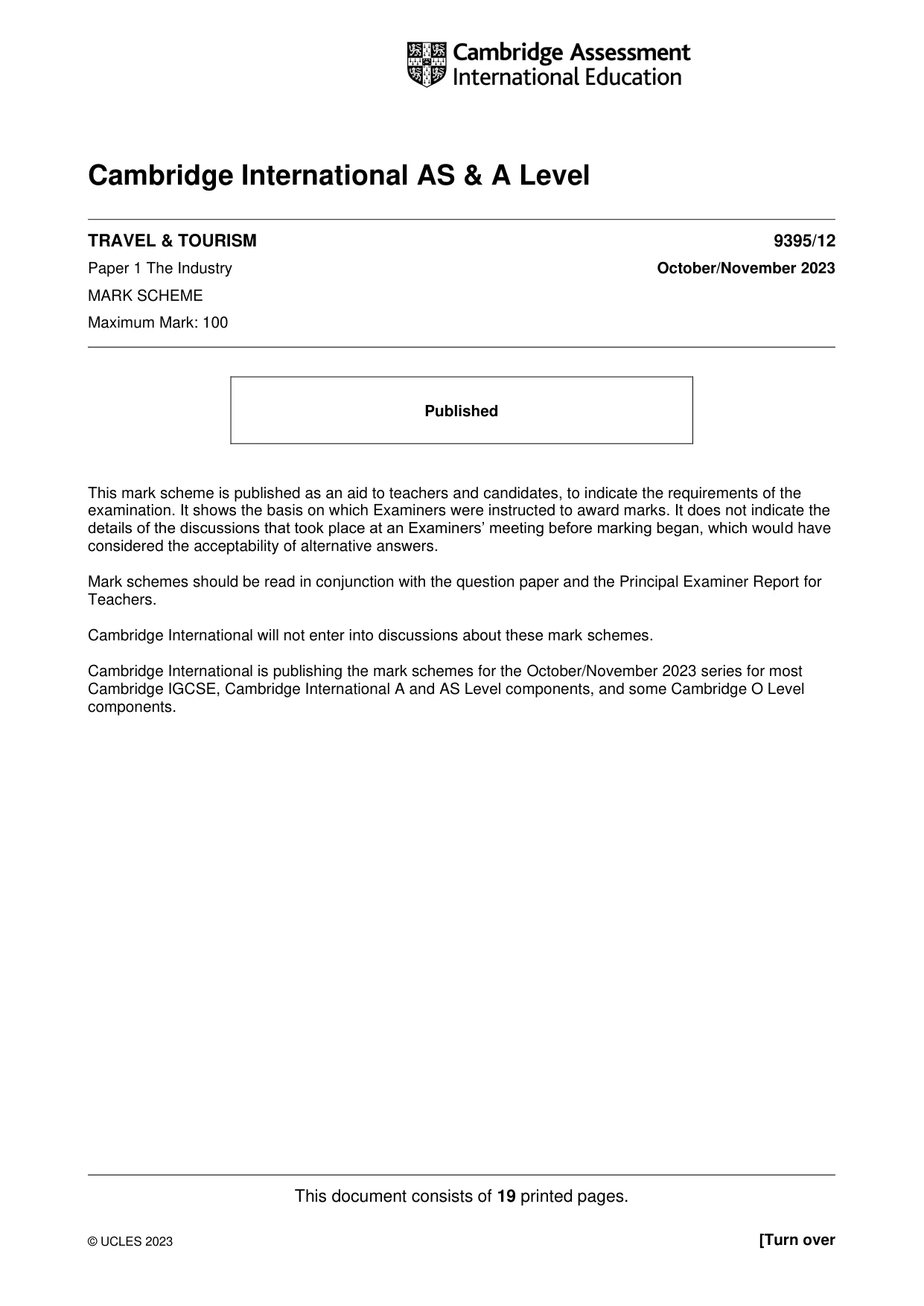
Question paper, page 13
13 9395/12/O/N/23 © UCLES 2023 (d) Discuss the impacts of mobile technology on travel and tourism organisations. … … … … … … … … … … … … … … … … … … [9] [Total: 25]
Question paper, page 14
14 9395/12/O/N/23 © UCLES 2023 BLANK PAGE
Question paper, page 15
15 9395/12/O/N/23 © UCLES 2023 BLANK PAGE
Question paper, page 16
16 9395/12/O/N/23 © UCLES 2023 The boundaries and names shown, the designations used and the presentation of material on any maps contained in this question paper/insert do not imply official endorsement or acceptance by Cambridge Assessment International Education concerning the legal status of any country, territory, or area or any of its authorities, or of the delimitation of its frontiers or boundaries. Permission to reproduce items where third-party owned material protected by copyright is included has been sought and cleared where possible. Every reasonable effort has been made by the publisher (UCLES) to trace copyright holders, but if any items requiring clearance have unwittingly been included, the publisher will be pleased to make amends at the earliest possible opportunity. To avoid the issue of disclosure of answer-related information to candidates, all copyright acknowledgements are reproduced online in the Cambridge Assessment International Education Copyright Acknowledgements Booklet. This is produced for each series of examinations and is freely available to download at www.cambridgeinternational.org after the live examination series. Cambridge Assessment International Education is part of Cambridge Assessment. Cambridge Assessment is the brand name of the University of Cambridge Local Examinations Syndicate (UCLES), which is a department of the University of Cambridge. BLANK PAGE
Mark scheme, page 1
This document consists of 19 printed pages. © UCLES 2023 [Turn over Cambridge International AS & A Level TRAVEL & TOURISM 9395/12 Paper 1 The Industry October/November 2023 MARK SCHEME Maximum Mark: 100 Published This mark scheme is published as an aid to teachers and candidates, to indicate the requirements of the examination. It shows the basis on which Examiners were instructed to award marks. It does not indicate the details of the discussions that took place at an Examiners’ meeting before marking began, which would have considered the acceptability of alternative answers. Mark schemes should be read in conjunction with the question paper and the Principal Examiner Report for Teachers. Cambridge International will not enter into discussions about these mark schemes. Cambridge International is publishing the mark schemes for the October/November 2023 series for most Cambridge IGCSE, Cambridge International A and AS Level components, and some Cambridge O Level components.
Mark scheme, page 2
9395/12 Cambridge International AS & A Level – Mark Scheme PUBLISHED October/November 2023 © UCLES 2023 Page 2 of 19 Generic Marking Principles These general marking principles must be applied by all examiners when marking candidate answers. They should be applied alongside the specific content of the mark scheme or generic level descriptors for a question. Each question paper and mark scheme will also comply with these marking principles. GENERIC MARKING PRINCIPLE 1: Marks must be awarded in line with: • the specific content of the mark scheme or the generic level descriptors for the question • the specific skills defined in the mark scheme or in the generic level descriptors for the question • the standard of response required by a candidate as exemplified by the standardisation scripts. GENERIC MARKING PRINCIPLE 2: Marks awarded are always whole marks (not half marks, or other fractions). GENERIC MARKING PRINCIPLE 3: Marks must be awarded positively: • marks are awarded for correct/valid answers, as defined in the mark scheme. However, credit is given for valid answers which go beyond the scope of the syllabus and mark scheme, referring to your Team Leader as appropriate • marks are awarded when candidates clearly demonstrate what they know and can do • marks are not deducted for errors • marks are not deducted for omissions • answers should only be judged on the quality of spelling, punctuation and grammar when these features are specifically assessed by the question as indicated by the mark scheme. The meaning, however, should be unambiguous. GENERIC MARKING PRINCIPLE 4: Rules must be applied consistently, e.g. in situations where candidates have not followed instructions or in the application of generic level descriptors. GENERIC MARKING PRINCIPLE 5: Marks should be awarded using the full range of marks defined in the mark scheme for the question (however; the use of the full mark range may be limited according to the quality of the candidate responses seen). GENERIC MARKING PRINCIPLE 6: Marks awarded are based solely on the requirements as defined in the mark scheme. Marks should not be awarded with grade thresholds or grade descriptors in mind.
Mark scheme, page 3
9395/12 Cambridge International AS & A Level – Mark Scheme PUBLISHED October/November 2023 © UCLES 2023 Page 3 of 19 Social Science-Specific Marking Principles (for point-based marking) 1 Components using point-based marking: • Point marking is often used to reward knowledge, understanding and application of skills. We give credit where the candidate’s answer shows relevant knowledge, understanding and application of skills in answering the question. We do not give credit where the answer shows confusion. From this it follows that we: a DO credit answers which are worded differently from the mark scheme if they clearly convey the same meaning (unless the mark scheme requires a specific term) b DO credit alternative answers/examples which are not written in the mark scheme if they are correct c DO credit answers where candidates give more than one correct answer in one prompt/numbered/scaffolded space where extended writing is required rather than list-type answers. For example, questions that require n reasons (e.g. State two reasons …). d DO NOT credit answers simply for using a ‘key term’ unless that is all that is required. (Check for evidence it is understood and not used wrongly.) e DO NOT credit answers which are obviously self-contradicting or trying to cover all possibilities f DO NOT give further credit for what is effectively repetition of a correct point already credited unless the language itself is being tested. This applies equally to ‘mirror statements’ (i.e. polluted/not polluted). g DO NOT require spellings to be correct, unless this is part of the test. However spellings of syllabus terms must allow for clear and unambiguous separation from other syllabus terms with which they may be confused (e.g. Corrasion/Corrosion) 2 Presentation of mark scheme: • Slashes (/) or the word ‘or’ separate alternative ways of making the same point. • Semi colons (;) bullet points (•) or figures in brackets (1) separate different points. • Content in the answer column in brackets is for examiner information/context to clarify the marking but is not required to earn the mark (except Accounting syllabuses where they indicate negative numbers). 3 Calculation questions: • The mark scheme will show the steps in the most likely correct method(s), the mark for each step, the correct answer(s) and the mark for each answer • If working/explanation is considered essential for full credit, this will be indicated in the question paper and in the mark scheme. In all other instances, the correct answer to a calculation should be given full credit, even if no supporting working is shown. • Where the candidate uses a valid method which is not covered by the mark scheme, award equivalent marks for reaching equivalent stages. • Where an answer makes use of a candidate’s own incorrect figure from previous working, the ‘own figure rule’ applies: full marks will be given if a correct and complete method is used. Further guidance will be included in the mark scheme where necessary and any exceptions to this general principle will be noted.
Mark scheme, page 4
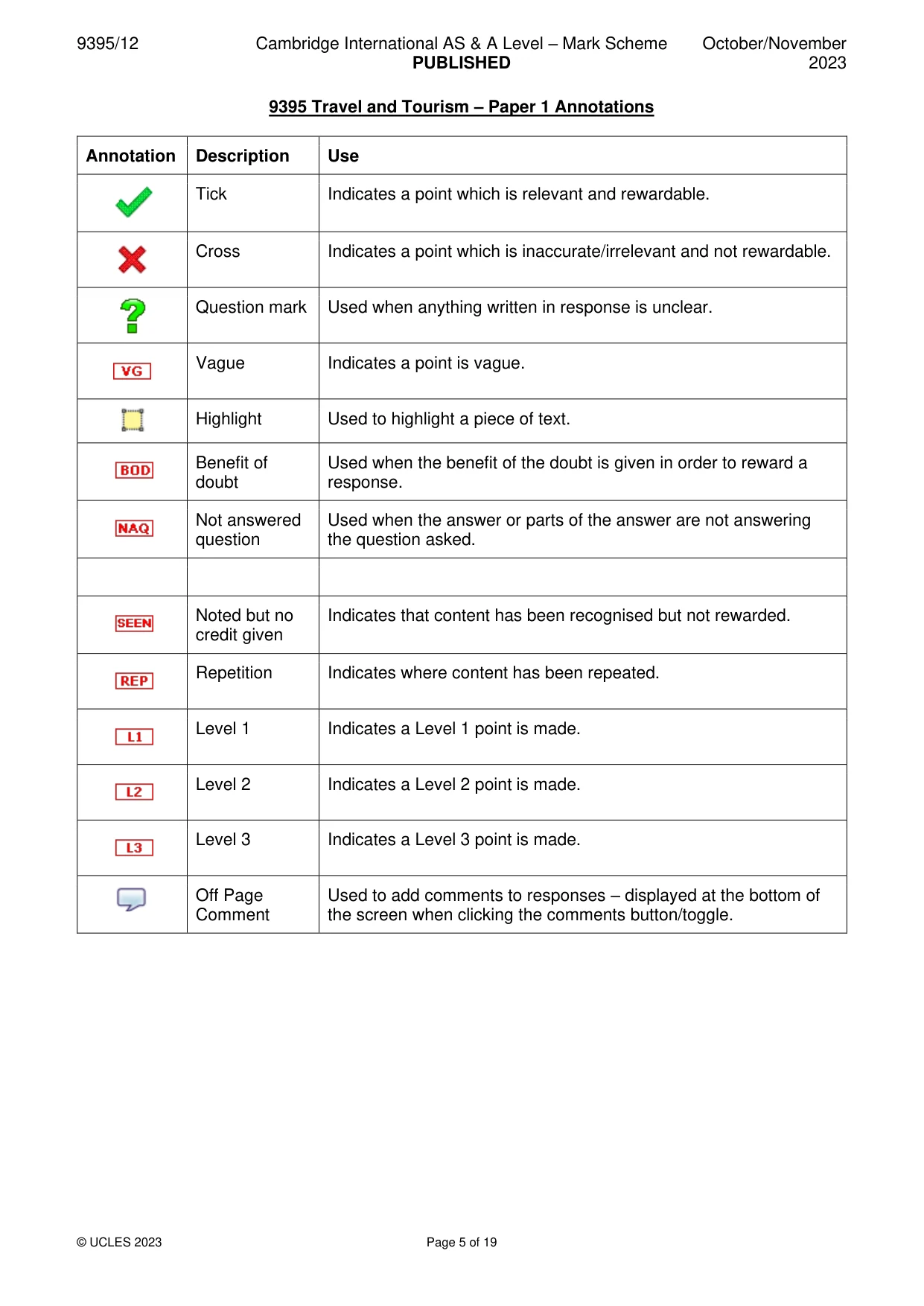
9395/12 Cambridge International AS & A Level – Mark Scheme PUBLISHED October/November 2023 © UCLES 2023 Page 4 of 19 4 Annotation: • For point marking, ticks can be used to indicate correct answers and crosses can be used to indicate wrong answers. There is no direct relationship between ticks and marks. Ticks have no defined meaning for levels of response marking. • For levels of response marking, the level awarded should be annotated on the script. • Other annotations will be used by examiners as agreed during standardisation, and the meaning will be understood by all examiners who marked that paper.
Mark scheme, page 5
9395/12 Cambridge International AS & A Level – Mark Scheme PUBLISHED October/November 2023 © UCLES 2023 Page 5 of 19 9395 Travel and Tourism – Paper 1 Annotations Annotation Description Use Tick Indicates a point which is relevant and rewardable. Cross Indicates a point which is inaccurate/irrelevant and not rewardable. Question mark Used when anything written in response is unclear. Vague Indicates a point is vague. Highlight Used to highlight a piece of text. Benefit of doubt Used when the benefit of the doubt is given in order to reward a response. Not answered question Used when the answer or parts of the answer are not answering the question asked. Noted but no credit given Indicates that content has been recognised but not rewarded. Repetition Indicates where content has been repeated. Level 1 Indicates a Level 1 point is made. Level 2 Indicates a Level 2 point is made. Level 3 Indicates a Level 3 point is made. Off Page Comment Used to add comments to responses – displayed at the bottom of the screen when clicking the comments button/toggle.
Mark scheme, page 6
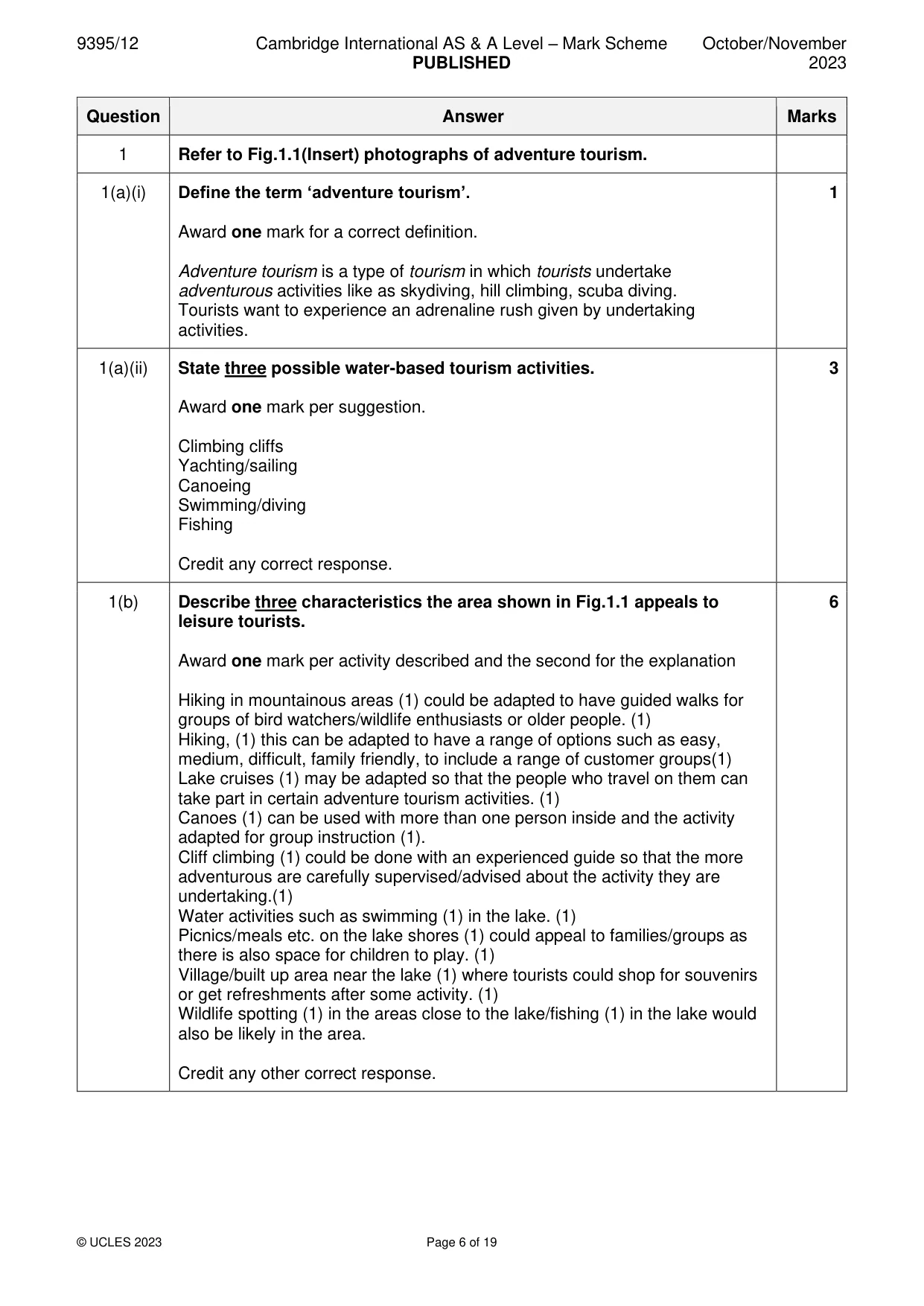
9395/12 Cambridge International AS & A Level – Mark Scheme PUBLISHED October/November 2023 © UCLES 2023 Page 6 of 19 Question Answer Marks 1 Refer to Fig.1.1(Insert) photographs of adventure tourism. 1(a)(i) Define the term ‘adventure tourism’. Award one mark for a correct definition. Adventure tourism is a type of tourism in which tourists undertake adventurous activities like as skydiving, hill climbing, scuba diving. Tourists want to experience an adrenaline rush given by undertaking activities. 1 1(a)(ii) State three possible water-based tourism activities. Award one mark per suggestion. Climbing cliffs Yachting/sailing Canoeing Swimming/diving Fishing Credit any correct response. 3 1(b) Describe three characteristics the area shown in Fig.1.1 appeals to leisure tourists. Award one mark per activity described and the second for the explanation Hiking in mountainous areas (1) could be adapted to have guided walks for groups of bird watchers/wildlife enthusiasts or older people. (1) Hiking, (1) this can be adapted to have a range of options such as easy, medium, difficult, family friendly, to include a range of customer groups(1) Lake cruises (1) may be adapted so that the people who travel on them can take part in certain adventure tourism activities. (1) Canoes (1) can be used with more than one person inside and the activity adapted for group instruction (1). Cliff climbing (1) could be done with an experienced guide so that the more adventurous are carefully supervised/advised about the activity they are undertaking.(1) Water activities such as swimming (1) in the lake. (1) Picnics/meals etc. on the lake shores (1) could appeal to families/groups as there is also space for children to play. (1) Village/built up area near the lake (1) where tourists could shop for souvenirs or get refreshments after some activity. (1) Wildlife spotting (1) in the areas close to the lake/fishing (1) in the lake would also be likely in the area. Credit any other correct response. 6
Mark scheme, page 7
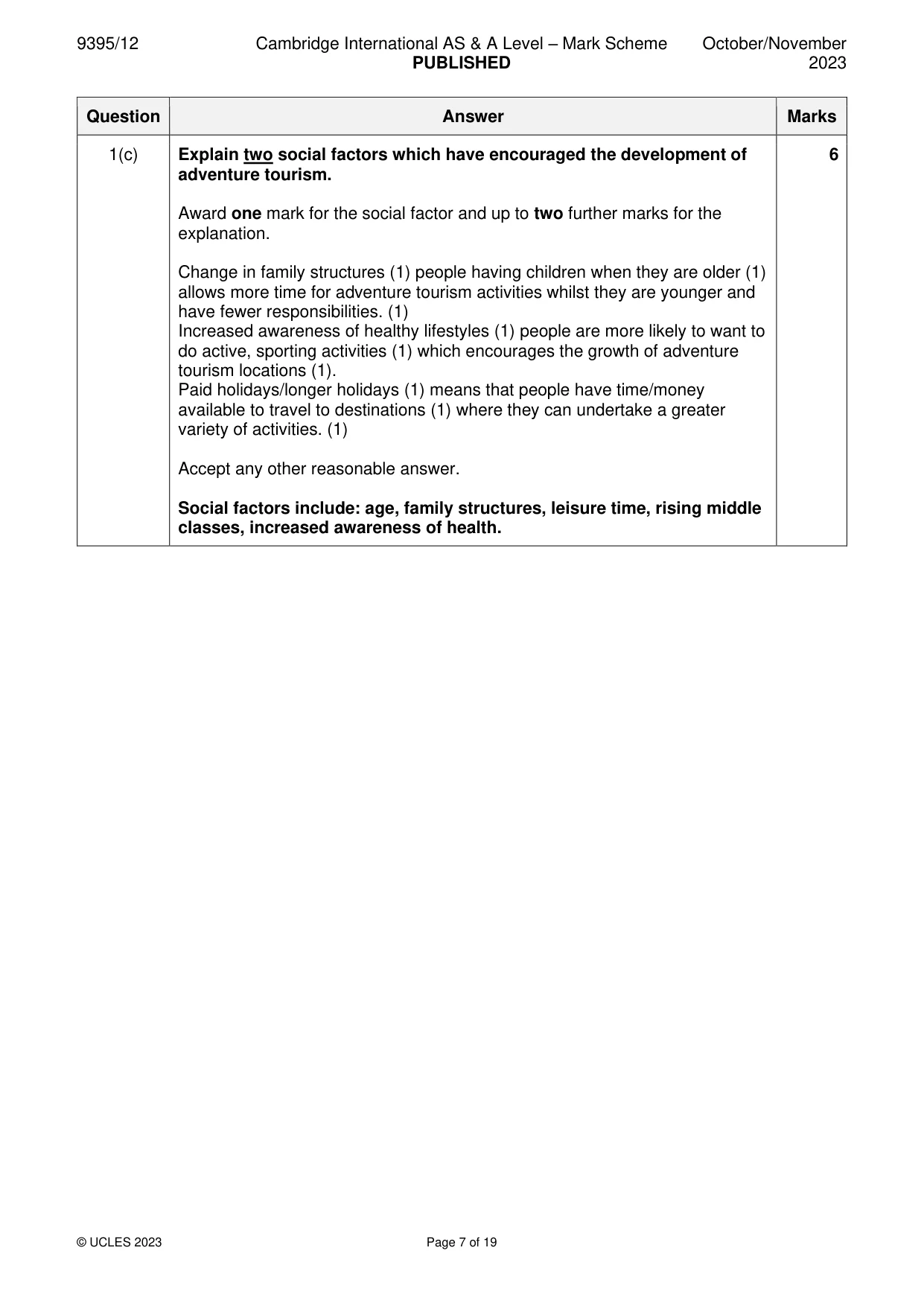
9395/12 Cambridge International AS & A Level – Mark Scheme PUBLISHED October/November 2023 © UCLES 2023 Page 7 of 19 Question Answer Marks 1(c) Explain two social factors which have encouraged the development of adventure tourism. Award one mark for the social factor and up to two further marks for the explanation. Change in family structures (1) people having children when they are older (1) allows more time for adventure tourism activities whilst they are younger and have fewer responsibilities. (1) Increased awareness of healthy lifestyles (1) people are more likely to want to do active, sporting activities (1) which encourages the growth of adventure tourism locations (1). Paid holidays/longer holidays (1) means that people have time/money available to travel to destinations (1) where they can undertake a greater variety of activities. (1) Accept any other reasonable answer. Social factors include: age, family structures, leisure time, rising middle classes, increased awareness of health. 6
Mark scheme, page 8
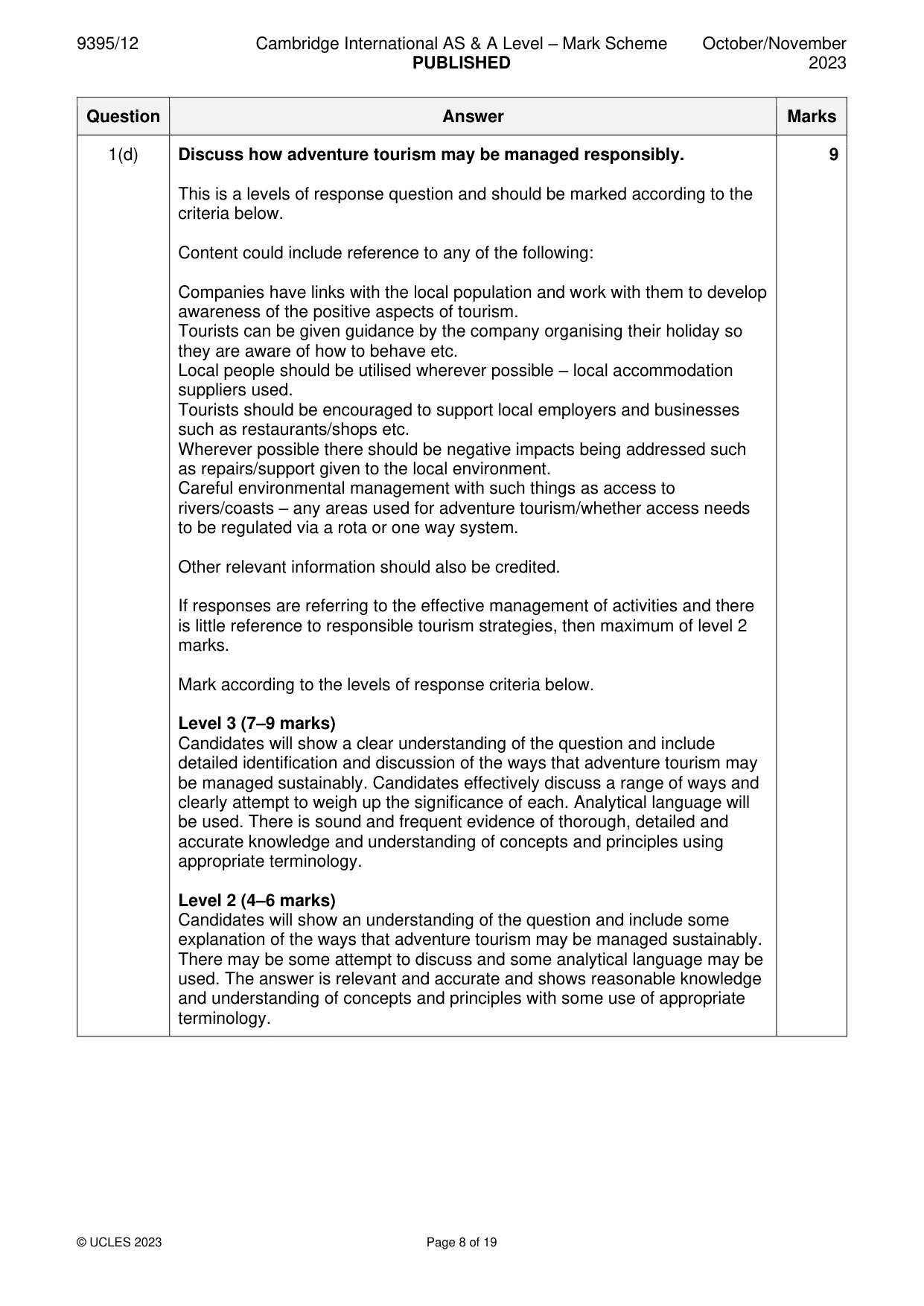
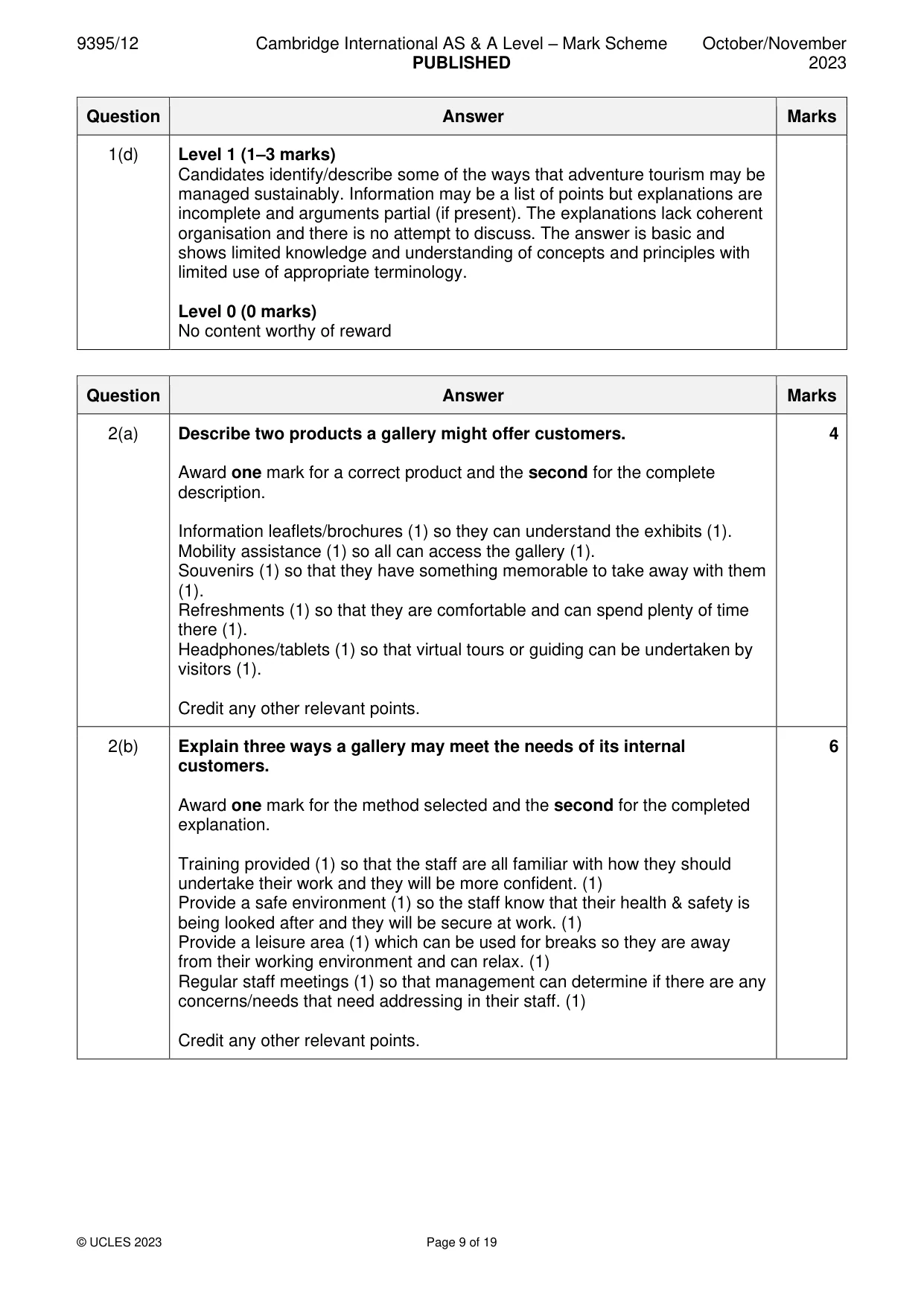
9395/12 Cambridge International AS & A Level – Mark Scheme PUBLISHED October/November 2023 © UCLES 2023 Page 8 of 19 Question Answer Marks 1(d) Discuss how adventure tourism may be managed responsibly. This is a levels of response question and should be marked according to the criteria below. Content could include reference to any of the following: Companies have links with the local population and work with them to develop awareness of the positive aspects of tourism. Tourists can be given guidance by the company organising their holiday so they are aware of how to behave etc. Local people should be utilised wherever possible – local accommodation suppliers used. Tourists should be encouraged to support local employers and businesses such as restaurants/shops etc. Wherever possible there should be negative impacts being addressed such as repairs/support given to the local environment. Careful environmental management with such things as access to rivers/coasts – any areas used for adventure tourism/whether access needs to be regulated via a rota or one way system. Other relevant information should also be credited. If responses are referring to the effective management of activities and there is little reference to responsible tourism strategies, then maximum of level 2 marks. Mark according to the levels of response criteria below. Level 3 (7–9 marks) Candidates will show a clear understanding of the question and include detailed identification and discussion of the ways that adventure tourism may be managed sustainably. Candidates effectively discuss a range of ways and clearly attempt to weigh up the significance of each. Analytical language will be used. There is sound and frequent evidence of thorough, detailed and accurate knowledge and understanding of concepts and principles using appropriate terminology. Level 2 (4–6 marks) Candidates will show an understanding of the question and include some explanation of the ways that adventure tourism may be managed sustainably. There may be some attempt to discuss and some analytical language may be used. The answer is relevant and accurate and shows reasonable knowledge and understanding of concepts and principles with some use of appropriate terminology. 9
Mark scheme, page 9
9395/12 Cambridge International AS & A Level – Mark Scheme PUBLISHED October/November 2023 © UCLES 2023 Page 9 of 19 Question Answer Marks 1(d) Level 1 (1–3 marks) Candidates identify/describe some of the ways that adventure tourism may be managed sustainably. Information may be a list of points but explanations are incomplete and arguments partial (if present). The explanations lack coherent organisation and there is no attempt to discuss. The answer is basic and shows limited knowledge and understanding of concepts and principles with limited use of appropriate terminology. Level 0 (0 marks) No content worthy of reward Question Answer Marks 2(a) Describe two products a gallery might offer customers. Award one mark for a correct product and the second for the complete description. Information leaflets/brochures (1) so they can understand the exhibits (1). Mobility assistance (1) so all can access the gallery (1). Souvenirs (1) so that they have something memorable to take away with them (1). Refreshments (1) so that they are comfortable and can spend plenty of time there (1). Headphones/tablets (1) so that virtual tours or guiding can be undertaken by visitors (1). Credit any other relevant points. 4 2(b) Explain three ways a gallery may meet the needs of its internal customers. Award one mark for the method selected and the second for the completed explanation. Training provided (1) so that the staff are all familiar with how they should undertake their work and they will be more confident. (1) Provide a safe environment (1) so the staff know that their health & safety is being looked after and they will be secure at work. (1) Provide a leisure area (1) which can be used for breaks so they are away from their working environment and can relax. (1) Regular staff meetings (1) so that management can determine if there are any concerns/needs that need addressing in their staff. (1) Credit any other relevant points. 6
Mark scheme, page 10
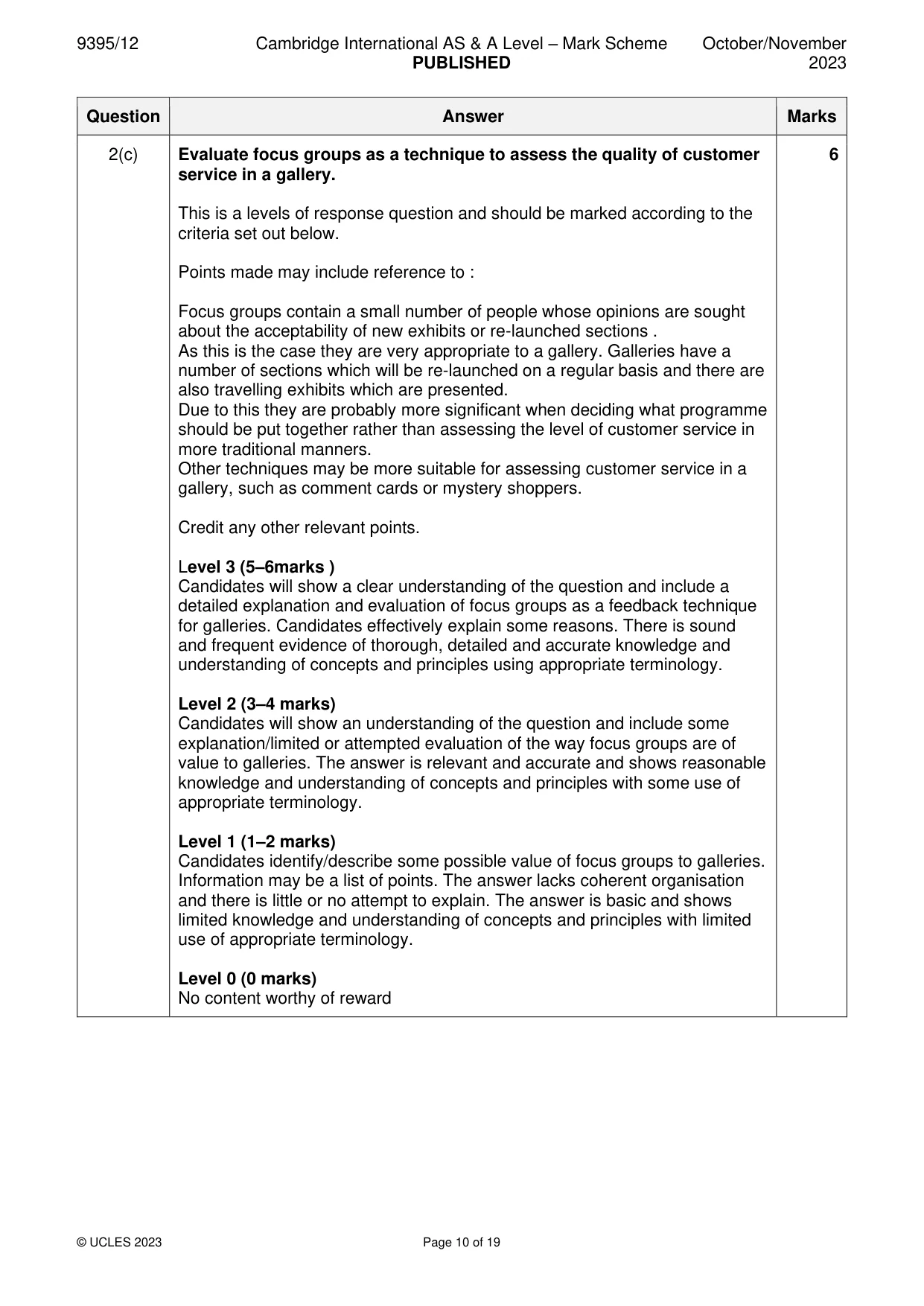
9395/12 Cambridge International AS & A Level – Mark Scheme PUBLISHED October/November 2023 © UCLES 2023 Page 10 of 19 Question Answer Marks 2(c) Evaluate focus groups as a technique to assess the quality of customer service in a gallery. This is a levels of response question and should be marked according to the criteria set out below. Points made may include reference to : Focus groups contain a small number of people whose opinions are sought about the acceptability of new exhibits or re-launched sections . As this is the case they are very appropriate to a gallery. Galleries have a number of sections which will be re-launched on a regular basis and there are also travelling exhibits which are presented. Due to this they are probably more significant when deciding what programme should be put together rather than assessing the level of customer service in more traditional manners. Other techniques may be more suitable for assessing customer service in a gallery, such as comment cards or mystery shoppers. Credit any other relevant points. Level 3 (5–6marks ) Candidates will show a clear understanding of the question and include a detailed explanation and evaluation of focus groups as a feedback technique for galleries. Candidates effectively explain some reasons. There is sound and frequent evidence of thorough, detailed and accurate knowledge and understanding of concepts and principles using appropriate terminology. Level 2 (3–4 marks) Candidates will show an understanding of the question and include some explanation/limited or attempted evaluation of the way focus groups are of value to galleries. The answer is relevant and accurate and shows reasonable knowledge and understanding of concepts and principles with some use of appropriate terminology. Level 1 (1–2 marks) Candidates identify/describe some possible value of focus groups to galleries. Information may be a list of points. The answer lacks coherent organisation and there is little or no attempt to explain. The answer is basic and shows limited knowledge and understanding of concepts and principles with limited use of appropriate terminology. Level 0 (0 marks) No content worthy of reward 6
Mark scheme, page 11
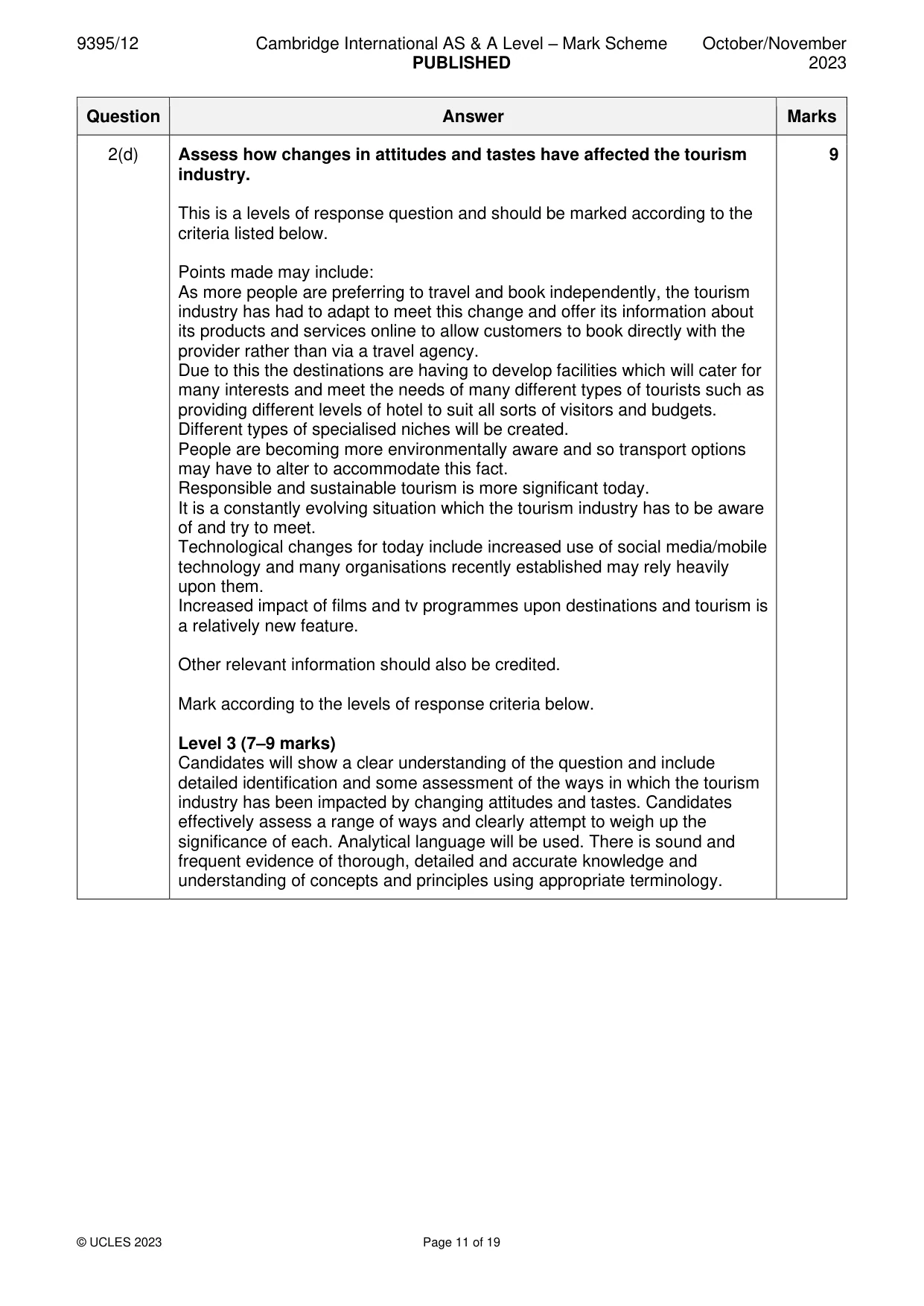
9395/12 Cambridge International AS & A Level – Mark Scheme PUBLISHED October/November 2023 © UCLES 2023 Page 11 of 19 Question Answer Marks 2(d) Assess how changes in attitudes and tastes have affected the tourism industry. This is a levels of response question and should be marked according to the criteria listed below. Points made may include: As more people are preferring to travel and book independently, the tourism industry has had to adapt to meet this change and offer its information about its products and services online to allow customers to book directly with the provider rather than via a travel agency. Due to this the destinations are having to develop facilities which will cater for many interests and meet the needs of many different types of tourists such as providing different levels of hotel to suit all sorts of visitors and budgets. Different types of specialised niches will be created. People are becoming more environmentally aware and so transport options may have to alter to accommodate this fact. Responsible and sustainable tourism is more significant today. It is a constantly evolving situation which the tourism industry has to be aware of and try to meet. Technological changes for today include increased use of social media/mobile technology and many organisations recently established may rely heavily upon them. Increased impact of films and tv programmes upon destinations and tourism is a relatively new feature. Other relevant information should also be credited. Mark according to the levels of response criteria below. Level 3 (7–9 marks) Candidates will show a clear understanding of the question and include detailed identification and some assessment of the ways in which the tourism industry has been impacted by changing attitudes and tastes. Candidates effectively assess a range of ways and clearly attempt to weigh up the significance of each. Analytical language will be used. There is sound and frequent evidence of thorough, detailed and accurate knowledge and understanding of concepts and principles using appropriate terminology. 9
Mark scheme, page 12
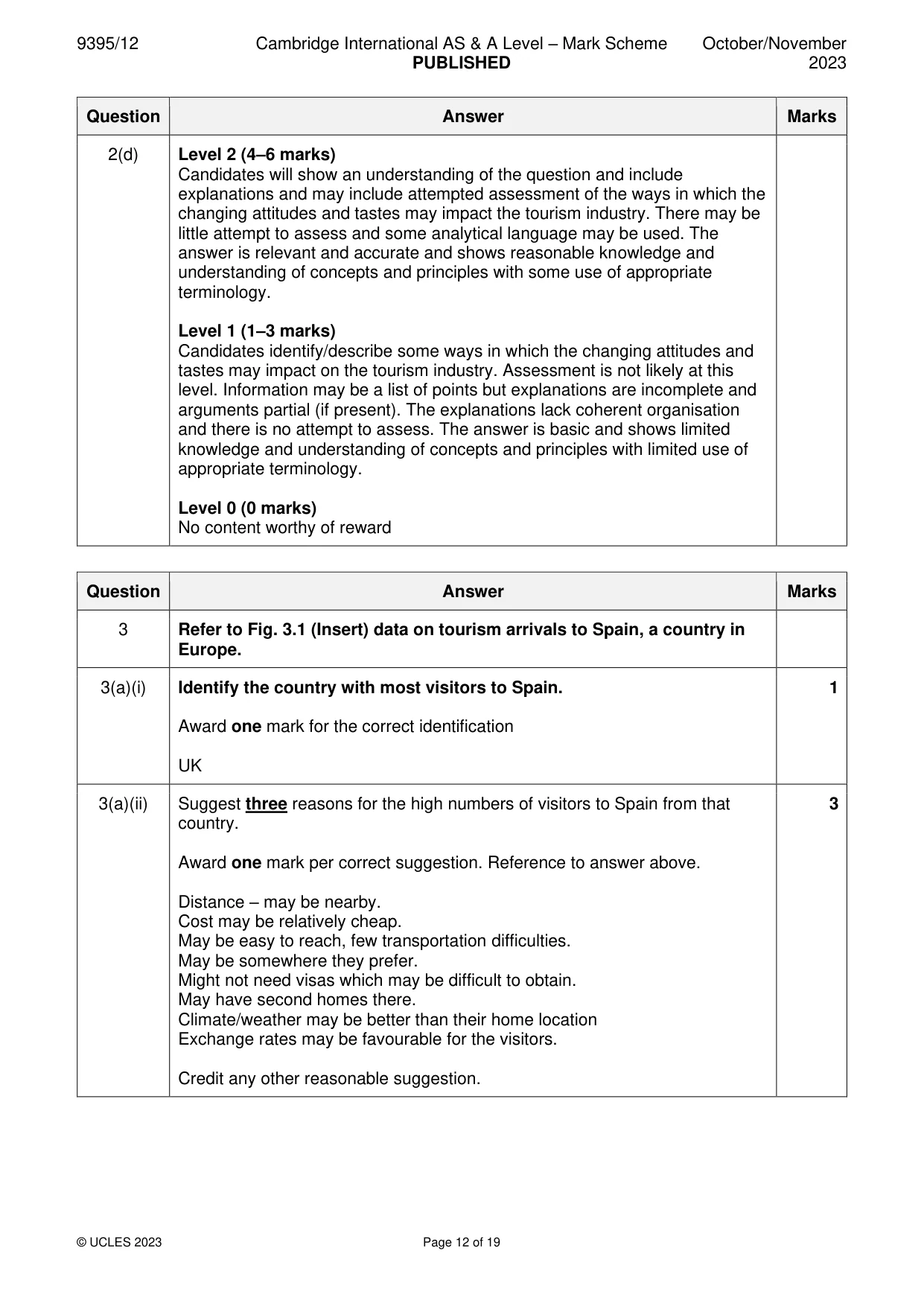
9395/12 Cambridge International AS & A Level – Mark Scheme PUBLISHED October/November 2023 © UCLES 2023 Page 12 of 19 Question Answer Marks 2(d) Level 2 (4–6 marks) Candidates will show an understanding of the question and include explanations and may include attempted assessment of the ways in which the changing attitudes and tastes may impact the tourism industry. There may be little attempt to assess and some analytical language may be used. The answer is relevant and accurate and shows reasonable knowledge and understanding of concepts and principles with some use of appropriate terminology. Level 1 (1–3 marks) Candidates identify/describe some ways in which the changing attitudes and tastes may impact on the tourism industry. Assessment is not likely at this level. Information may be a list of points but explanations are incomplete and arguments partial (if present). The explanations lack coherent organisation and there is no attempt to assess. The answer is basic and shows limited knowledge and understanding of concepts and principles with limited use of appropriate terminology. Level 0 (0 marks) No content worthy of reward Question Answer Marks 3 Refer to Fig. 3.1 (Insert) data on tourism arrivals to Spain, a country in Europe. 3(a)(i) Identify the country with most visitors to Spain. Award one mark for the correct identification UK 1 3(a)(ii) Suggest three reasons for the high numbers of visitors to Spain from that country. Award one mark per correct suggestion. Reference to answer above. Distance – may be nearby. Cost may be relatively cheap. May be easy to reach, few transportation difficulties. May be somewhere they prefer. Might not need visas which may be difficult to obtain. May have second homes there. Climate/weather may be better than their home location Exchange rates may be favourable for the visitors. Credit any other reasonable suggestion. 3
Mark scheme, page 13
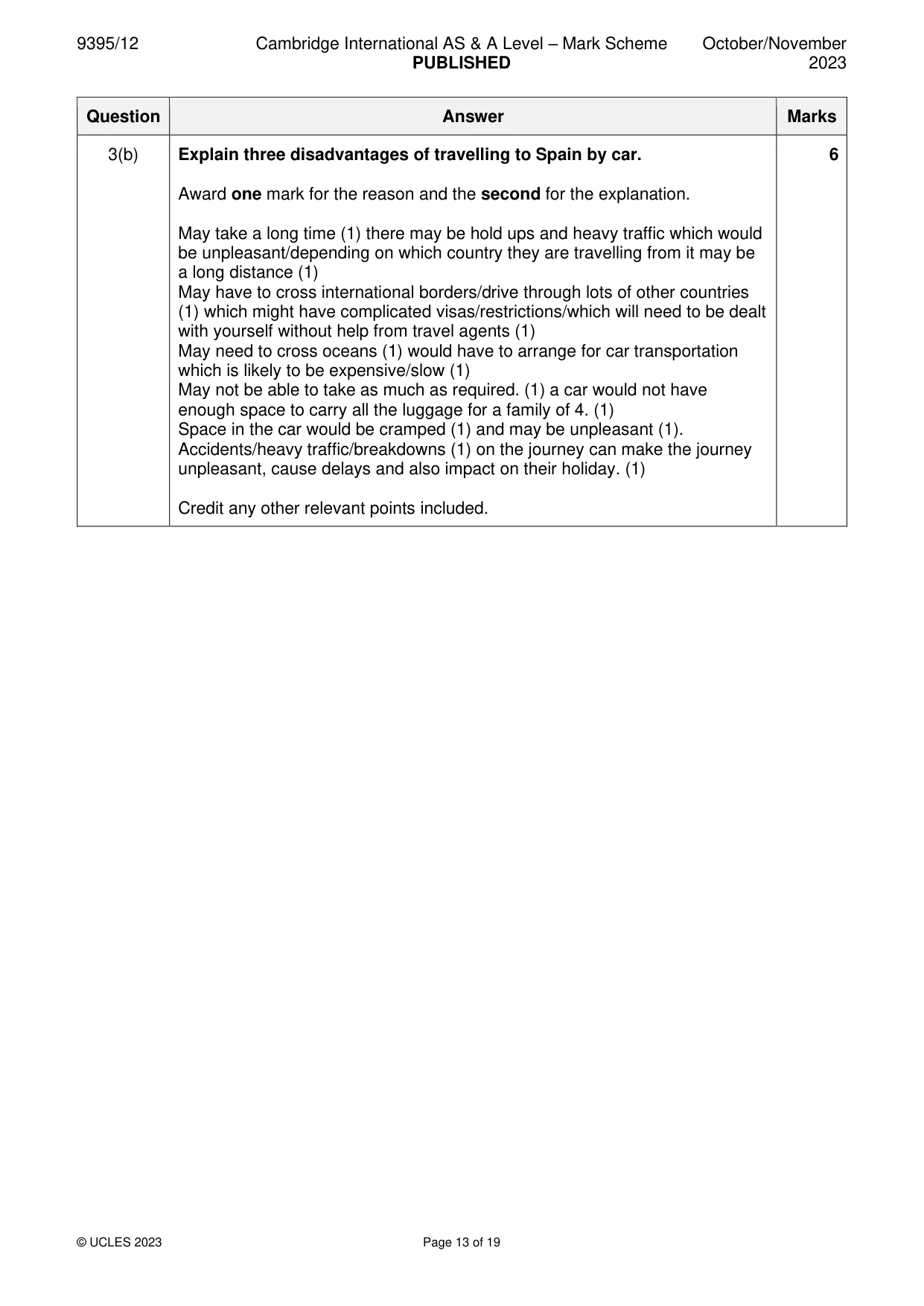
9395/12 Cambridge International AS & A Level – Mark Scheme PUBLISHED October/November 2023 © UCLES 2023 Page 13 of 19 Question Answer Marks 3(b) Explain three disadvantages of travelling to Spain by car. Award one mark for the reason and the second for the explanation. May take a long time (1) there may be hold ups and heavy traffic which would be unpleasant/depending on which country they are travelling from it may be a long distance (1) May have to cross international borders/drive through lots of other countries (1) which might have complicated visas/restrictions/which will need to be dealt with yourself without help from travel agents (1) May need to cross oceans (1) would have to arrange for car transportation which is likely to be expensive/slow (1) May not be able to take as much as required. (1) a car would not have enough space to carry all the luggage for a family of 4. (1) Space in the car would be cramped (1) and may be unpleasant (1). Accidents/heavy traffic/breakdowns (1) on the journey can make the journey unpleasant, cause delays and also impact on their holiday. (1) Credit any other relevant points included. 6
Mark scheme, page 14
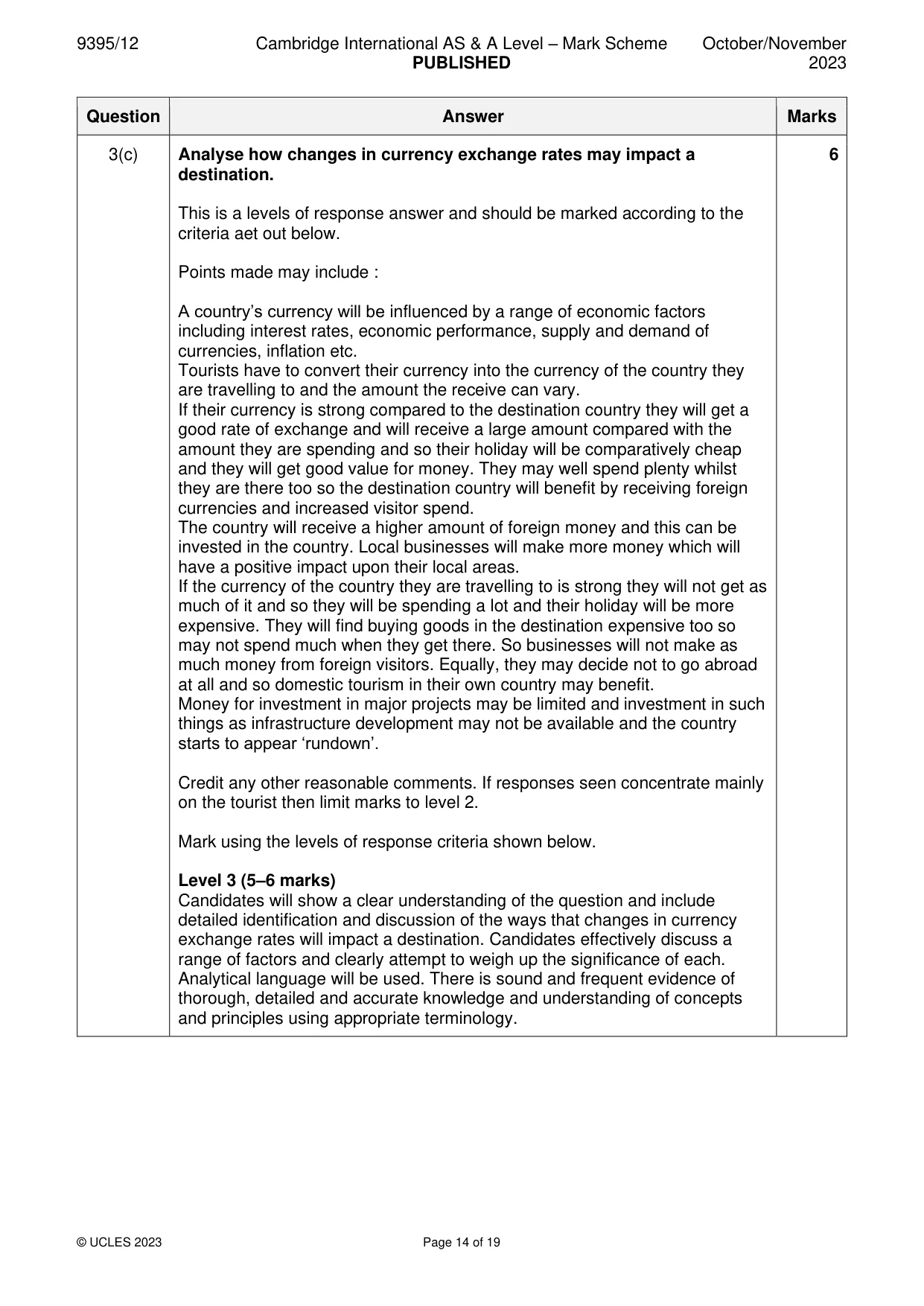
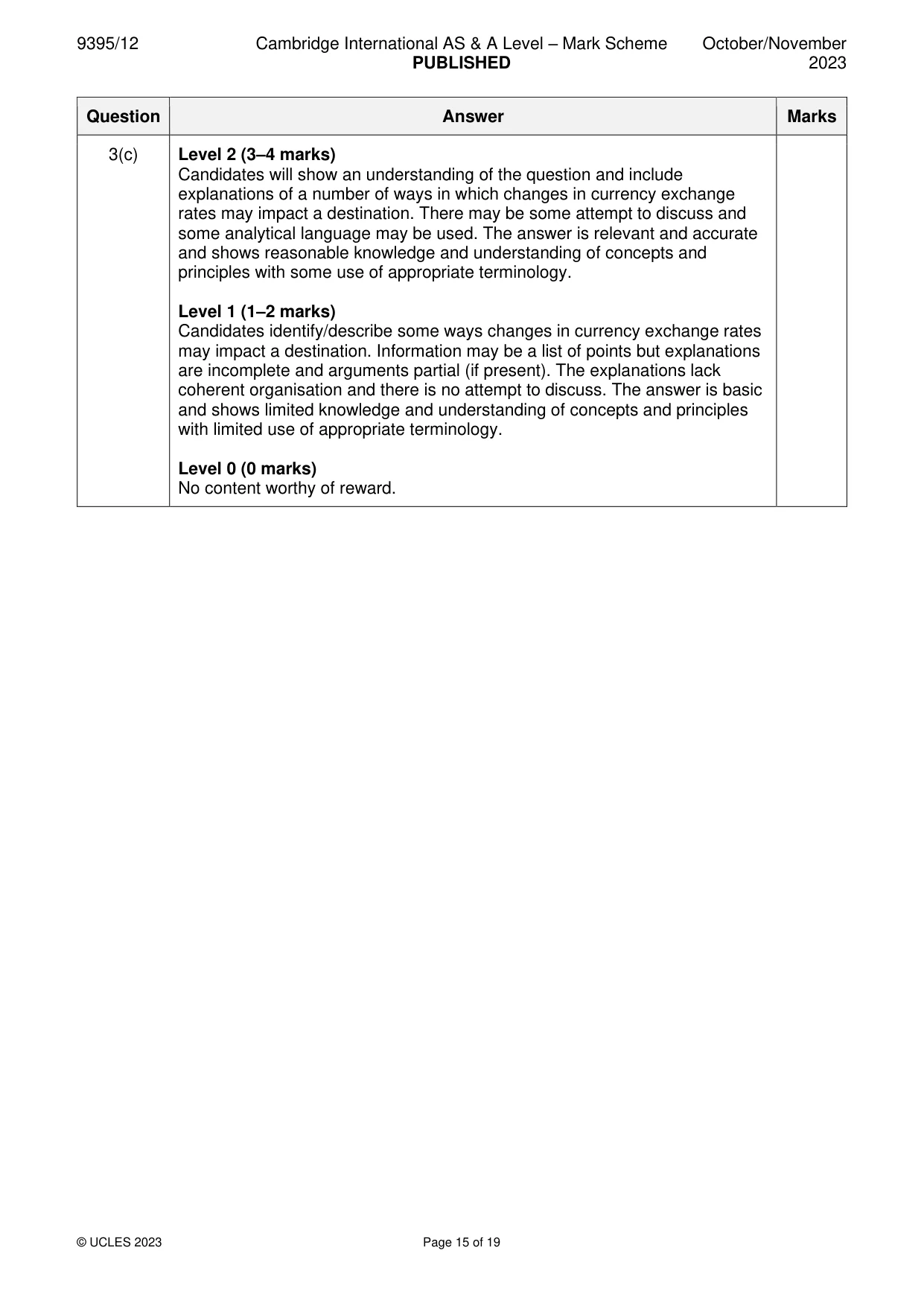
9395/12 Cambridge International AS & A Level – Mark Scheme PUBLISHED October/November 2023 © UCLES 2023 Page 14 of 19 Question Answer Marks 3(c) Analyse how changes in currency exchange rates may impact a destination. This is a levels of response answer and should be marked according to the criteria aet out below. Points made may include : A country’s currency will be influenced by a range of economic factors including interest rates, economic performance, supply and demand of currencies, inflation etc. Tourists have to convert their currency into the currency of the country they are travelling to and the amount the receive can vary. If their currency is strong compared to the destination country they will get a good rate of exchange and will receive a large amount compared with the amount they are spending and so their holiday will be comparatively cheap and they will get good value for money. They may well spend plenty whilst they are there too so the destination country will benefit by receiving foreign currencies and increased visitor spend. The country will receive a higher amount of foreign money and this can be invested in the country. Local businesses will make more money which will have a positive impact upon their local areas. If the currency of the country they are travelling to is strong they will not get as much of it and so they will be spending a lot and their holiday will be more expensive. They will find buying goods in the destination expensive too so may not spend much when they get there. So businesses will not make as much money from foreign visitors. Equally, they may decide not to go abroad at all and so domestic tourism in their own country may benefit. Money for investment in major projects may be limited and investment in such things as infrastructure development may not be available and the country starts to appear ‘rundown’. Credit any other reasonable comments. If responses seen concentrate mainly on the tourist then limit marks to level 2. Mark using the levels of response criteria shown below. Level 3 (5–6 marks) Candidates will show a clear understanding of the question and include detailed identification and discussion of the ways that changes in currency exchange rates will impact a destination. Candidates effectively discuss a range of factors and clearly attempt to weigh up the significance of each. Analytical language will be used. There is sound and frequent evidence of thorough, detailed and accurate knowledge and understanding of concepts and principles using appropriate terminology. 6
Mark scheme, page 15
9395/12 Cambridge International AS & A Level – Mark Scheme PUBLISHED October/November 2023 © UCLES 2023 Page 15 of 19 Question Answer Marks 3(c) Level 2 (3–4 marks) Candidates will show an understanding of the question and include explanations of a number of ways in which changes in currency exchange rates may impact a destination. There may be some attempt to discuss and some analytical language may be used. The answer is relevant and accurate and shows reasonable knowledge and understanding of concepts and principles with some use of appropriate terminology. Level 1 (1–2 marks) Candidates identify/describe some ways changes in currency exchange rates may impact a destination. Information may be a list of points but explanations are incomplete and arguments partial (if present). The explanations lack coherent organisation and there is no attempt to discuss. The answer is basic and shows limited knowledge and understanding of concepts and principles with limited use of appropriate terminology. Level 0 (0 marks) No content worthy of reward.
Mark scheme, page 16
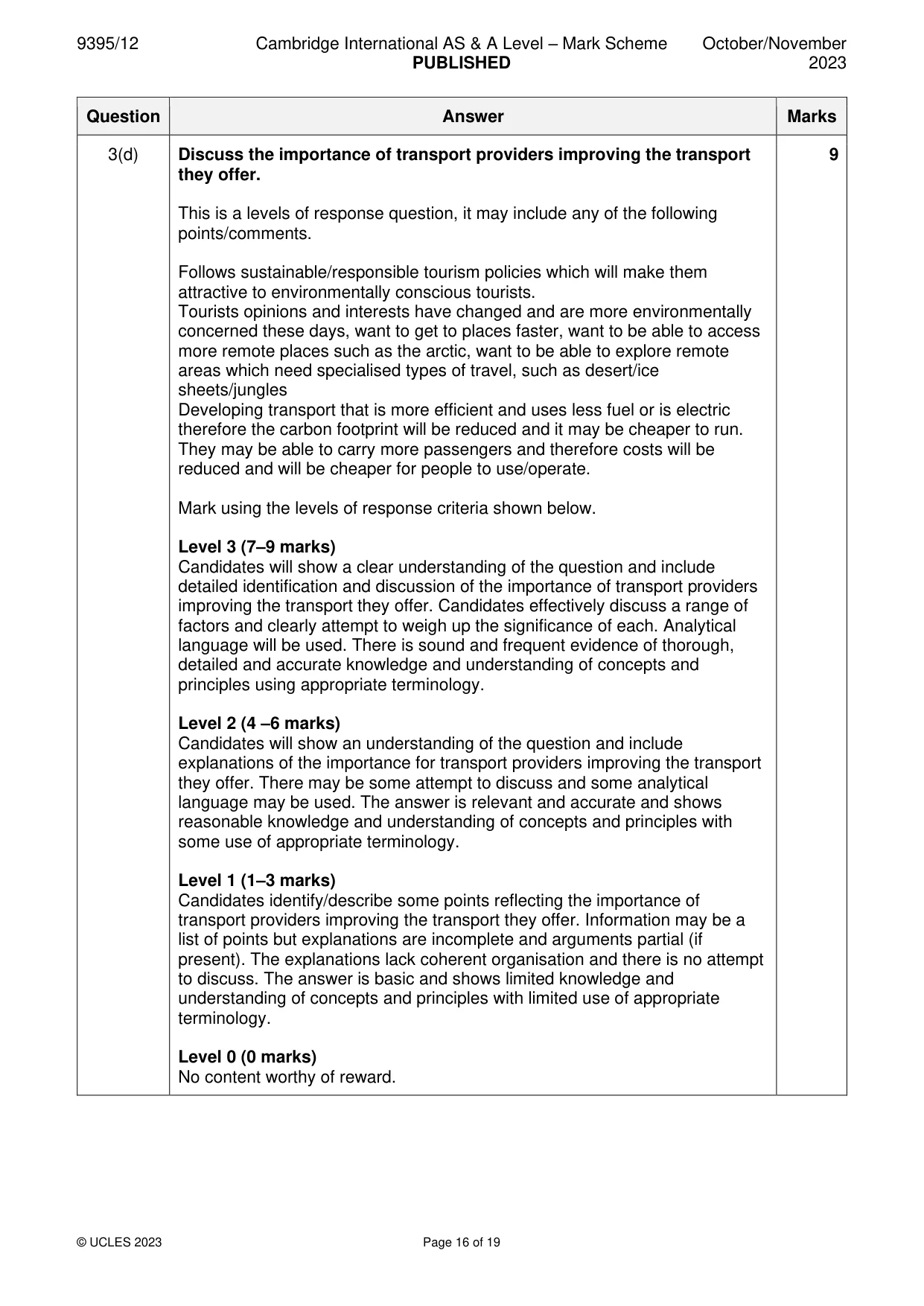
9395/12 Cambridge International AS & A Level – Mark Scheme PUBLISHED October/November 2023 © UCLES 2023 Page 16 of 19 Question Answer Marks 3(d) Discuss the importance of transport providers improving the transport they offer. This is a levels of response question, it may include any of the following points/comments. Follows sustainable/responsible tourism policies which will make them attractive to environmentally conscious tourists. Tourists opinions and interests have changed and are more environmentally concerned these days, want to get to places faster, want to be able to access more remote places such as the arctic, want to be able to explore remote areas which need specialised types of travel, such as desert/ice sheets/jungles Developing transport that is more efficient and uses less fuel or is electric therefore the carbon footprint will be reduced and it may be cheaper to run. They may be able to carry more passengers and therefore costs will be reduced and will be cheaper for people to use/operate. Mark using the levels of response criteria shown below. Level 3 (7–9 marks) Candidates will show a clear understanding of the question and include detailed identification and discussion of the importance of transport providers improving the transport they offer. Candidates effectively discuss a range of factors and clearly attempt to weigh up the significance of each. Analytical language will be used. There is sound and frequent evidence of thorough, detailed and accurate knowledge and understanding of concepts and principles using appropriate terminology. Level 2 (4 –6 marks) Candidates will show an understanding of the question and include explanations of the importance for transport providers improving the transport they offer. There may be some attempt to discuss and some analytical language may be used. The answer is relevant and accurate and shows reasonable knowledge and understanding of concepts and principles with some use of appropriate terminology. Level 1 (1–3 marks) Candidates identify/describe some points reflecting the importance of transport providers improving the transport they offer. Information may be a list of points but explanations are incomplete and arguments partial (if present). The explanations lack coherent organisation and there is no attempt to discuss. The answer is basic and shows limited knowledge and understanding of concepts and principles with limited use of appropriate terminology. Level 0 (0 marks) No content worthy of reward. 9
Mark scheme, page 17
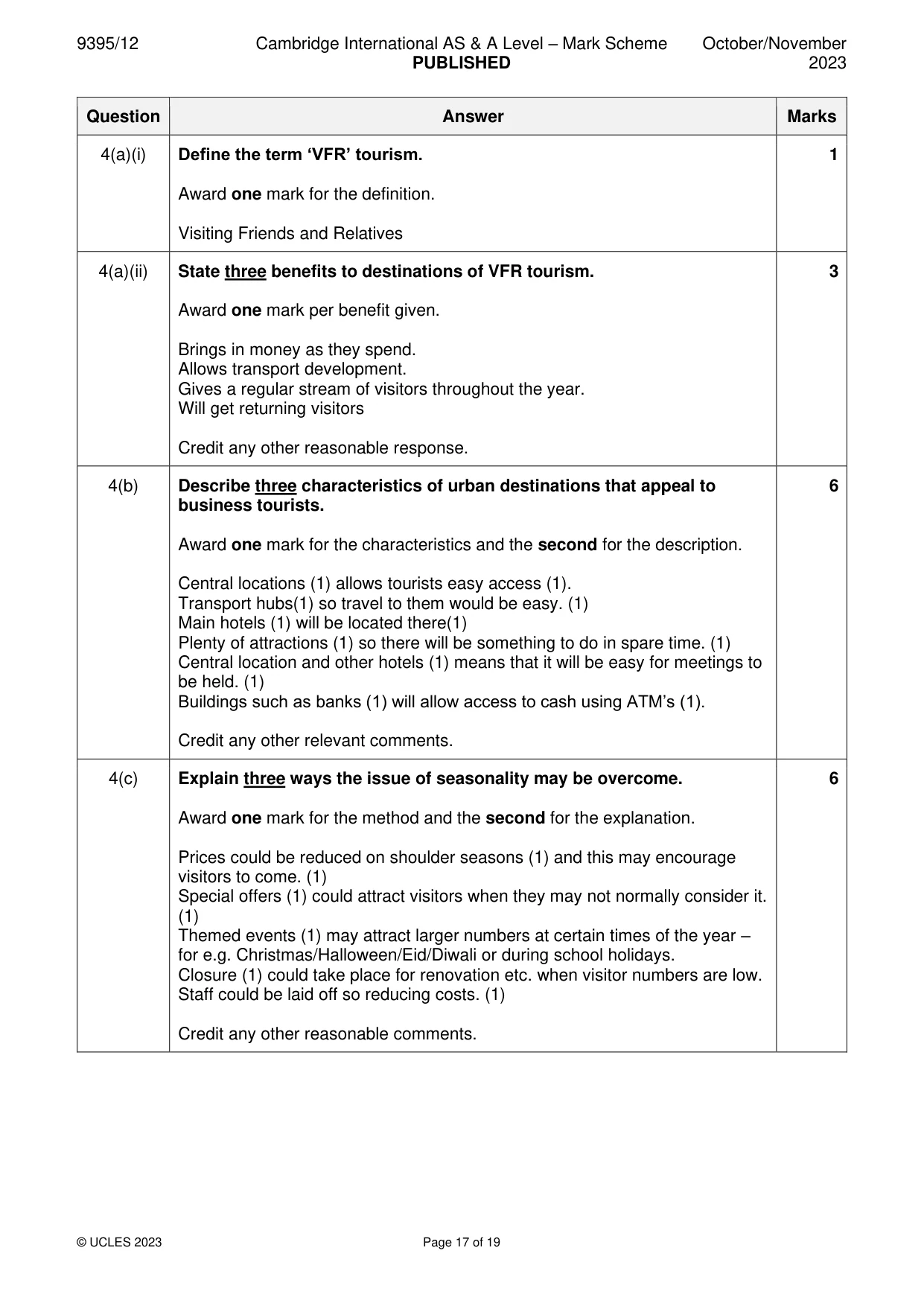
9395/12 Cambridge International AS & A Level – Mark Scheme PUBLISHED October/November 2023 © UCLES 2023 Page 17 of 19 Question Answer Marks 4(a)(i) Define the term ‘VFR’ tourism. Award one mark for the definition. Visiting Friends and Relatives 1 4(a)(ii) State three benefits to destinations of VFR tourism. Award one mark per benefit given. Brings in money as they spend. Allows transport development. Gives a regular stream of visitors throughout the year. Will get returning visitors Credit any other reasonable response. 3 4(b) Describe three characteristics of urban destinations that appeal to business tourists. Award one mark for the characteristics and the second for the description. Central locations (1) allows tourists easy access (1). Transport hubs(1) so travel to them would be easy. (1) Main hotels (1) will be located there(1) Plenty of attractions (1) so there will be something to do in spare time. (1) Central location and other hotels (1) means that it will be easy for meetings to be held. (1) Buildings such as banks (1) will allow access to cash using ATM’s (1). Credit any other relevant comments. 6 4(c) Explain three ways the issue of seasonality may be overcome. Award one mark for the method and the second for the explanation. Prices could be reduced on shoulder seasons (1) and this may encourage visitors to come. (1) Special offers (1) could attract visitors when they may not normally consider it. (1) Themed events (1) may attract larger numbers at certain times of the year – for e.g. Christmas/Halloween/Eid/Diwali or during school holidays. Closure (1) could take place for renovation etc. when visitor numbers are low. Staff could be laid off so reducing costs. (1) Credit any other reasonable comments. 6
Mark scheme, page 18
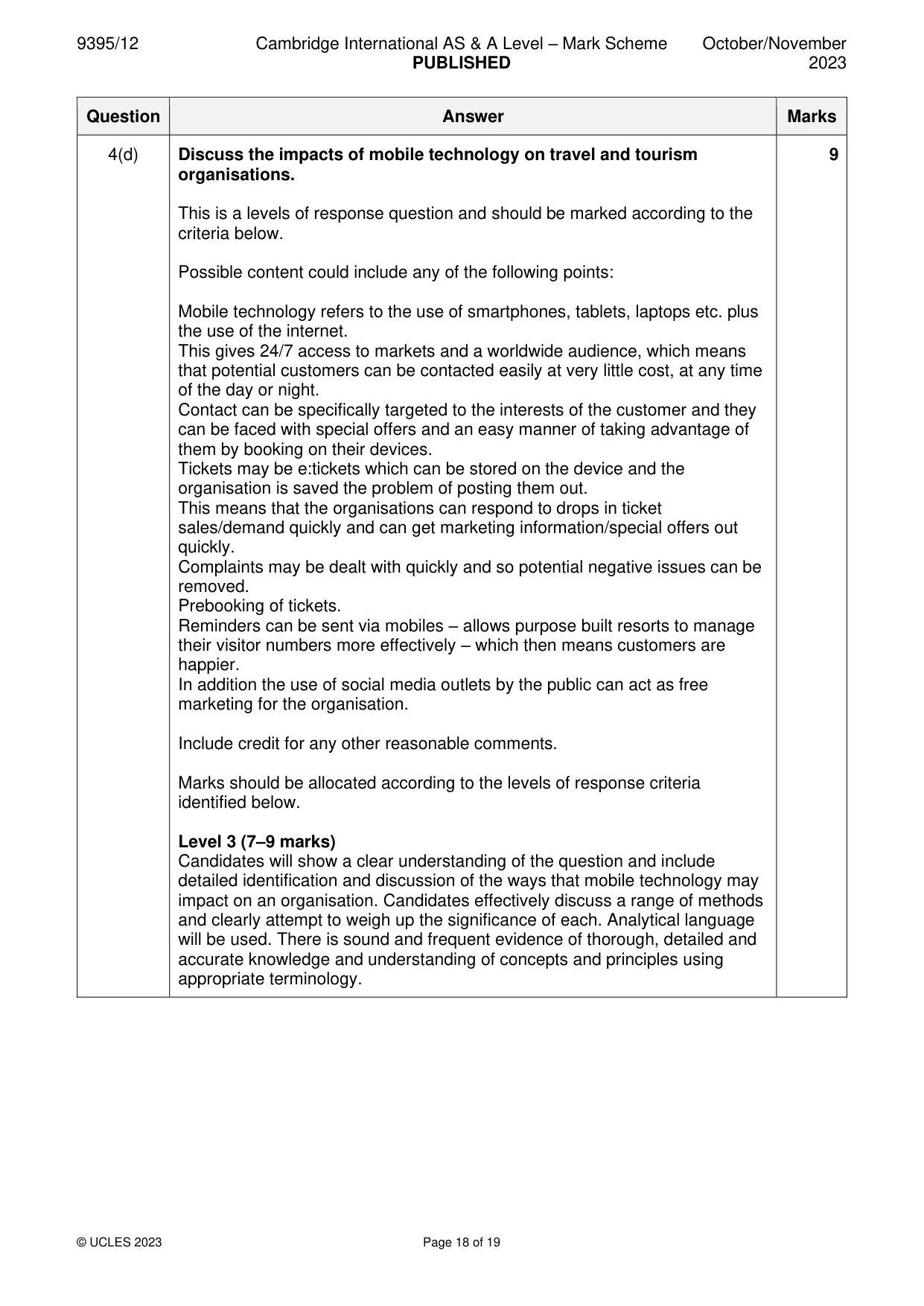
9395/12 Cambridge International AS & A Level – Mark Scheme PUBLISHED October/November 2023 © UCLES 2023 Page 18 of 19 Question Answer Marks 4(d) Discuss the impacts of mobile technology on travel and tourism organisations. This is a levels of response question and should be marked according to the criteria below. Possible content could include any of the following points: Mobile technology refers to the use of smartphones, tablets, laptops etc. plus the use of the internet. This gives 24/7 access to markets and a worldwide audience, which means that potential customers can be contacted easily at very little cost, at any time of the day or night. Contact can be specifically targeted to the interests of the customer and they can be faced with special offers and an easy manner of taking advantage of them by booking on their devices. Tickets may be e:tickets which can be stored on the device and the organisation is saved the problem of posting them out. This means that the organisations can respond to drops in ticket sales/demand quickly and can get marketing information/special offers out quickly. Complaints may be dealt with quickly and so potential negative issues can be removed. Prebooking of tickets. Reminders can be sent via mobiles – allows purpose built resorts to manage their visitor numbers more effectively – which then means customers are happier. In addition the use of social media outlets by the public can act as free marketing for the organisation. Include credit for any other reasonable comments. Marks should be allocated according to the levels of response criteria identified below. Level 3 (7–9 marks) Candidates will show a clear understanding of the question and include detailed identification and discussion of the ways that mobile technology may impact on an organisation. Candidates effectively discuss a range of methods and clearly attempt to weigh up the significance of each. Analytical language will be used. There is sound and frequent evidence of thorough, detailed and accurate knowledge and understanding of concepts and principles using appropriate terminology. 9
Mark scheme, page 19
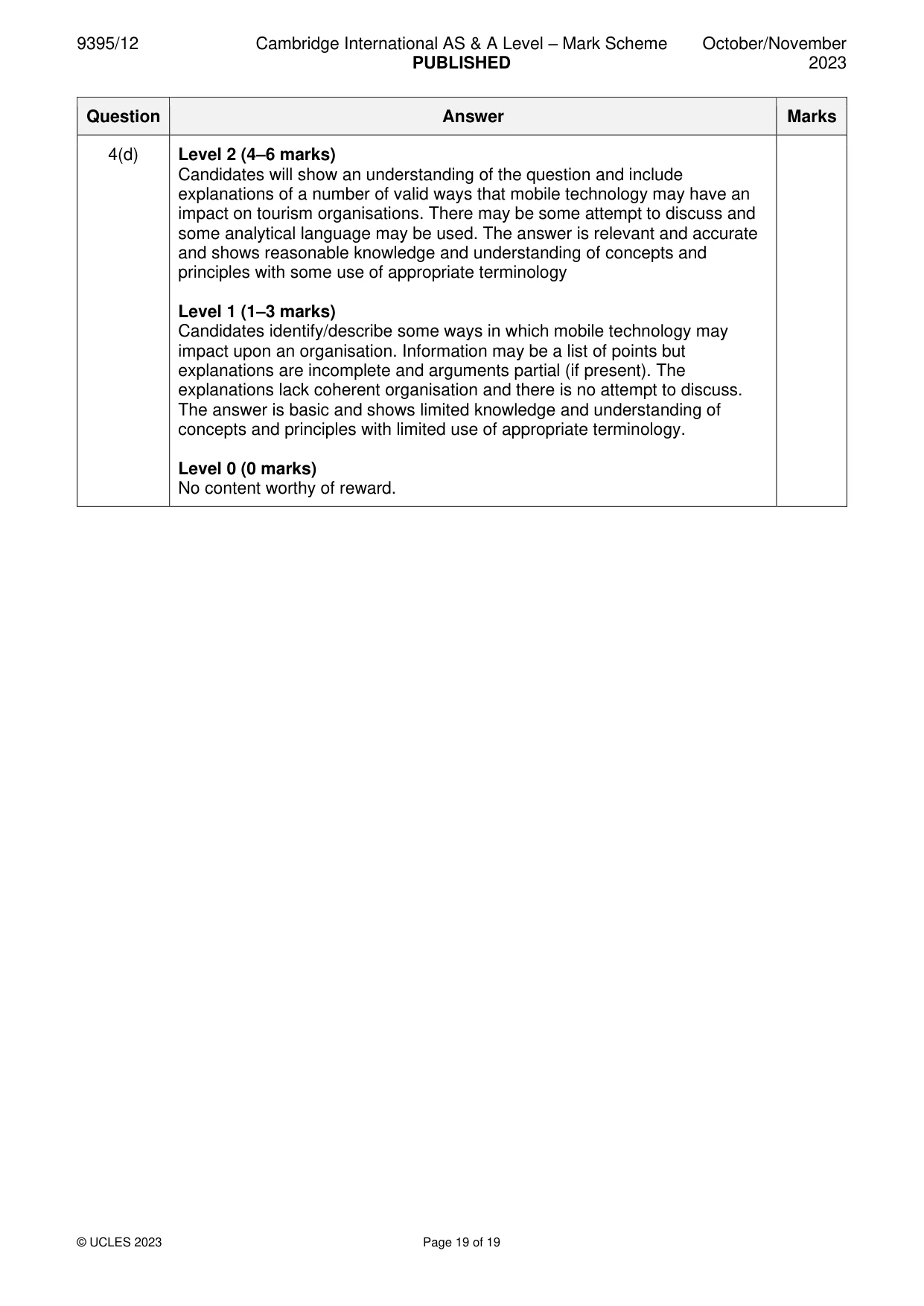
9395/12 Cambridge International AS & A Level – Mark Scheme PUBLISHED October/November 2023 © UCLES 2023 Page 19 of 19 Question Answer Marks 4(d) Level 2 (4–6 marks) Candidates will show an understanding of the question and include explanations of a number of valid ways that mobile technology may have an impact on tourism organisations. There may be some attempt to discuss and some analytical language may be used. The answer is relevant and accurate and shows reasonable knowledge and understanding of concepts and principles with some use of appropriate terminology Level 1 (1–3 marks) Candidates identify/describe some ways in which mobile technology may impact upon an organisation. Information may be a list of points but explanations are incomplete and arguments partial (if present). The explanations lack coherent organisation and there is no attempt to discuss. The answer is basic and shows limited knowledge and understanding of concepts and principles with limited use of appropriate terminology. Level 0 (0 marks) No content worthy of reward.
What you needed in this session
Cambridge’s own grade thresholds for 2023 Oct/Nov, Paper 1 · Variant 2. A higher threshold means an easier paper — the bar moves with how the cohort did.