Cambridge A Level Travel and Tourism 9395 — 2024 May/June Paper 1 · Variant 1
9395/11/M/J/24 · 75 marks · 120 min
The question paper and its mark scheme, free to read here and free to download. This is Cambridge’s own paper, exactly as it was sat.
Question paper12 pages


Mark scheme17 pages
Answers below. Sit the paper first if you are practising.
Paper as text
Question paper, page 1
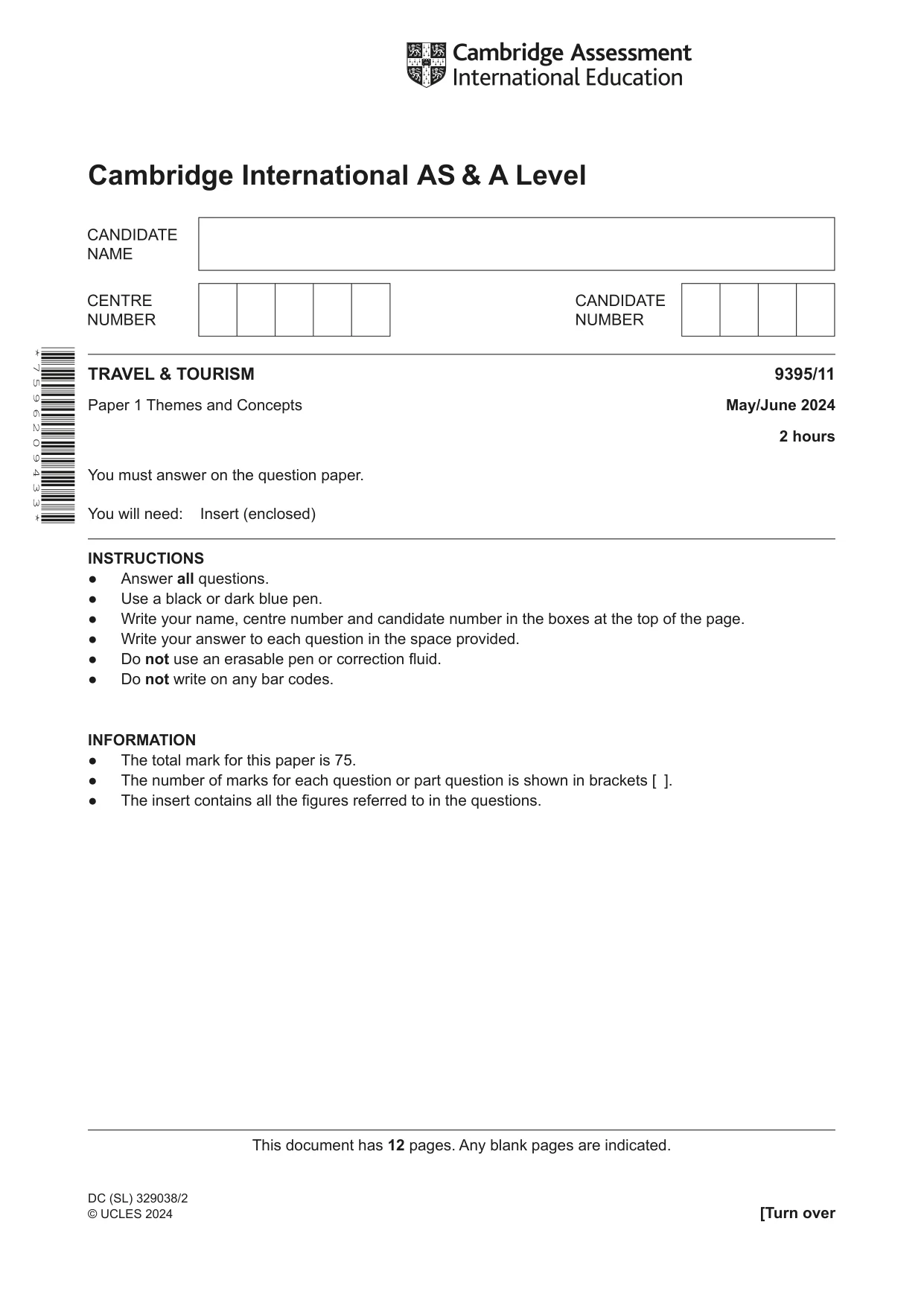
This document has 12 pages. Any blank pages are indicated. [Turn over Cambridge International AS & A Level * 7 5 9 6 2 0 9 4 3 3 * TRAVEL & TOURISM 9395/11 Paper 1 Themes and Concepts May/June 2024 2 hours You must answer on the question paper. You will need: Insert (enclosed) INSTRUCTIONS ● Answer all questions. ● Use a black or dark blue pen. ● Write your name, centre number and candidate number in the boxes at the top of the page. ● Write your answer to each question in the space provided. ● Do not use an erasable pen or correction fluid. ● Do not write on any bar codes. INFORMATION ● The total mark for this paper is 75. ● The number of marks for each question or part question is shown in brackets [ ]. ● The insert contains all the figures referred to in the questions. DC (SL) 329038/2 © UCLES 2024
Question paper, page 2
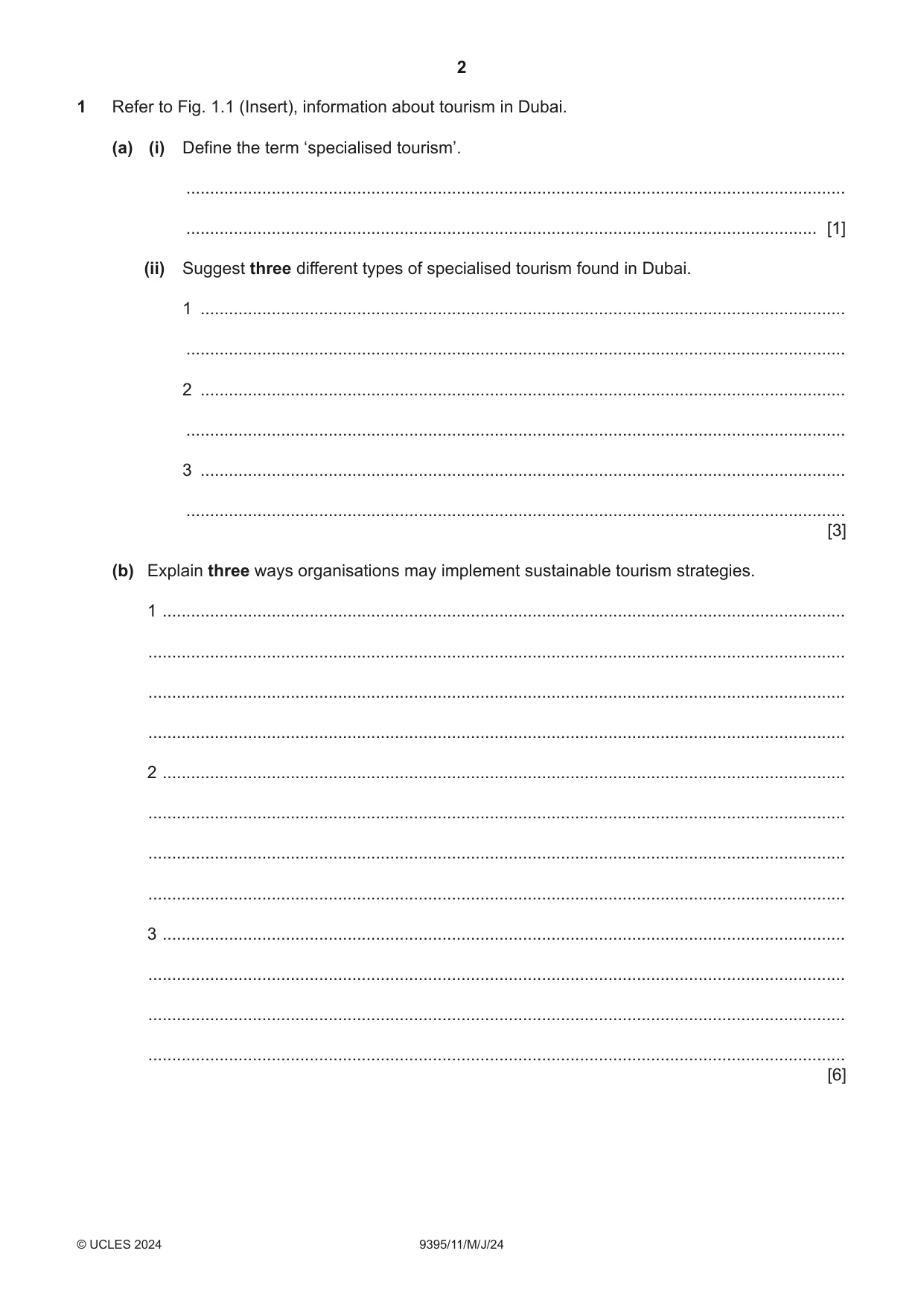
2 9395/11/M/J/24 © UCLES 2024 1 Refer to Fig. 1.1 (Insert), information about tourism in Dubai. (a) (i) Define the term ‘specialised tourism’. … … [1] (ii) Suggest three different types of specialised tourism found in Dubai. 1 … … 2 … … 3 … … [3] (b) Explain three ways organisations may implement sustainable tourism strategies. 1 … … … … 2 … … … … 3 … … … … [6]
Question paper, page 3
3 9395/11/M/J/24 © UCLES 2024 [Turn over (c) Discuss how destinations may assist visitors with language and cultural differences. … … … … … … … … … … … … [6]
Question paper, page 4
4 9395/11/M/J/24 © UCLES 2024 (d) Discuss how positive attitudes to sustainable tourism may be encouraged in local people and authorities. … … … … … … … … … … … … … … … … … … [9] [Total: 25]
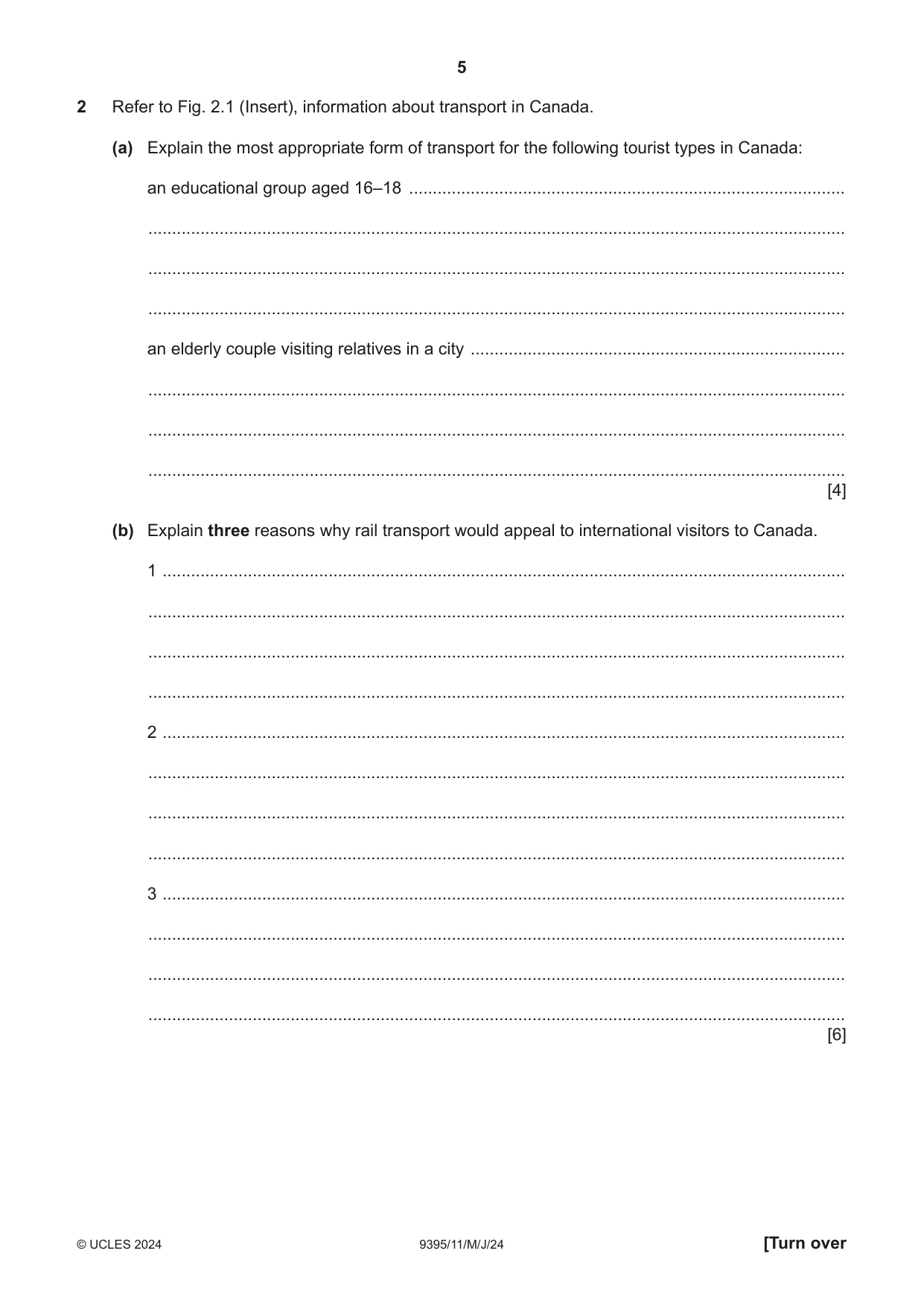
Question paper, page 5
5 9395/11/M/J/24 © UCLES 2024 [Turn over 2 Refer to Fig. 2.1 (Insert), information about transport in Canada. (a) Explain the most appropriate form of transport for the following tourist types in Canada: an educational group aged 16–18 … … … … an elderly couple visiting relatives in a city … … … … [4] (b) Explain three reasons why rail transport would appeal to international visitors to Canada. 1 … … … … 2 … … … … 3 … … … … [6]
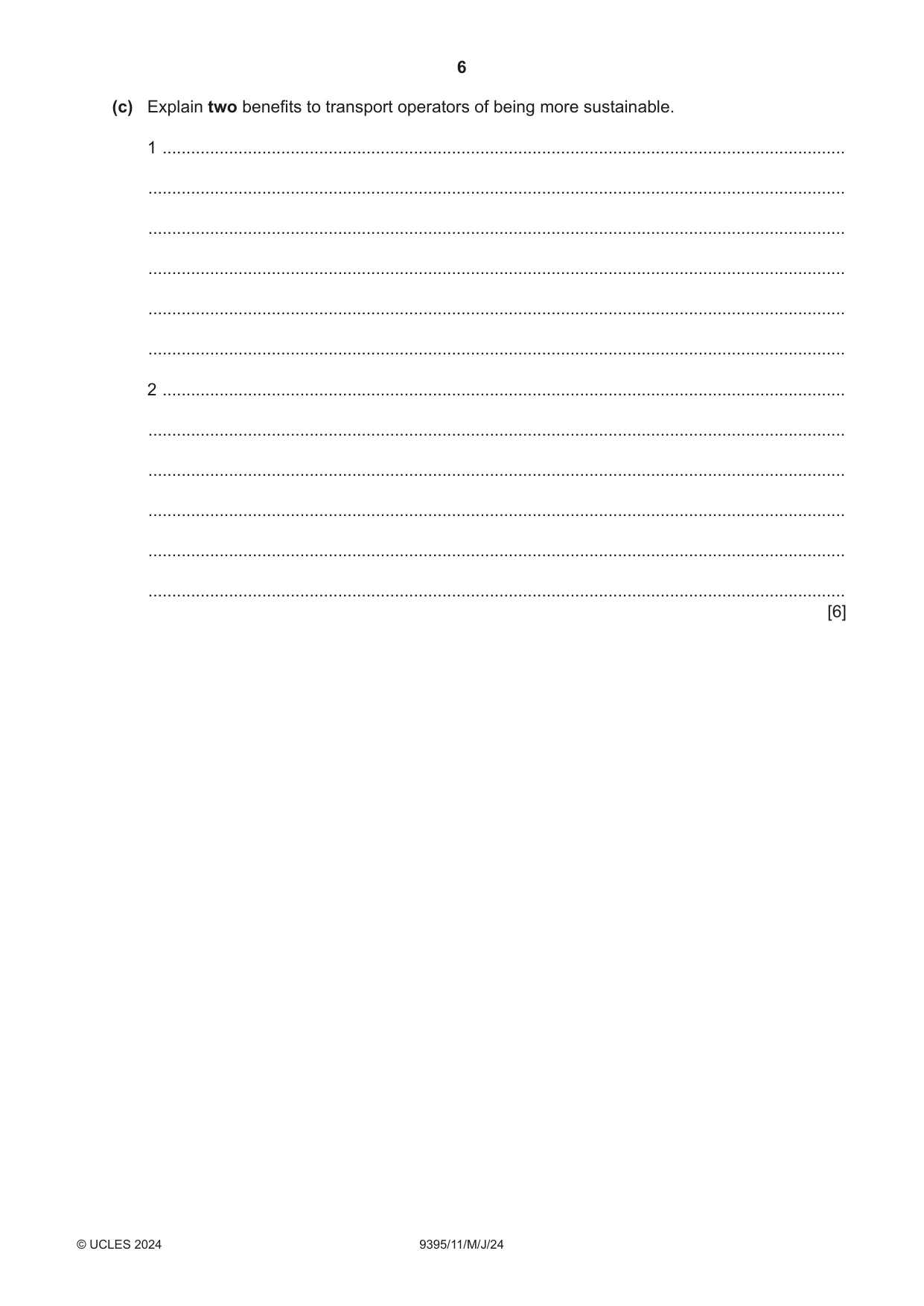
Question paper, page 6
6 9395/11/M/J/24 © UCLES 2024 (c) Explain two benefits to transport operators of being more sustainable. 1 … … … … … … 2 … … … … … … [6]
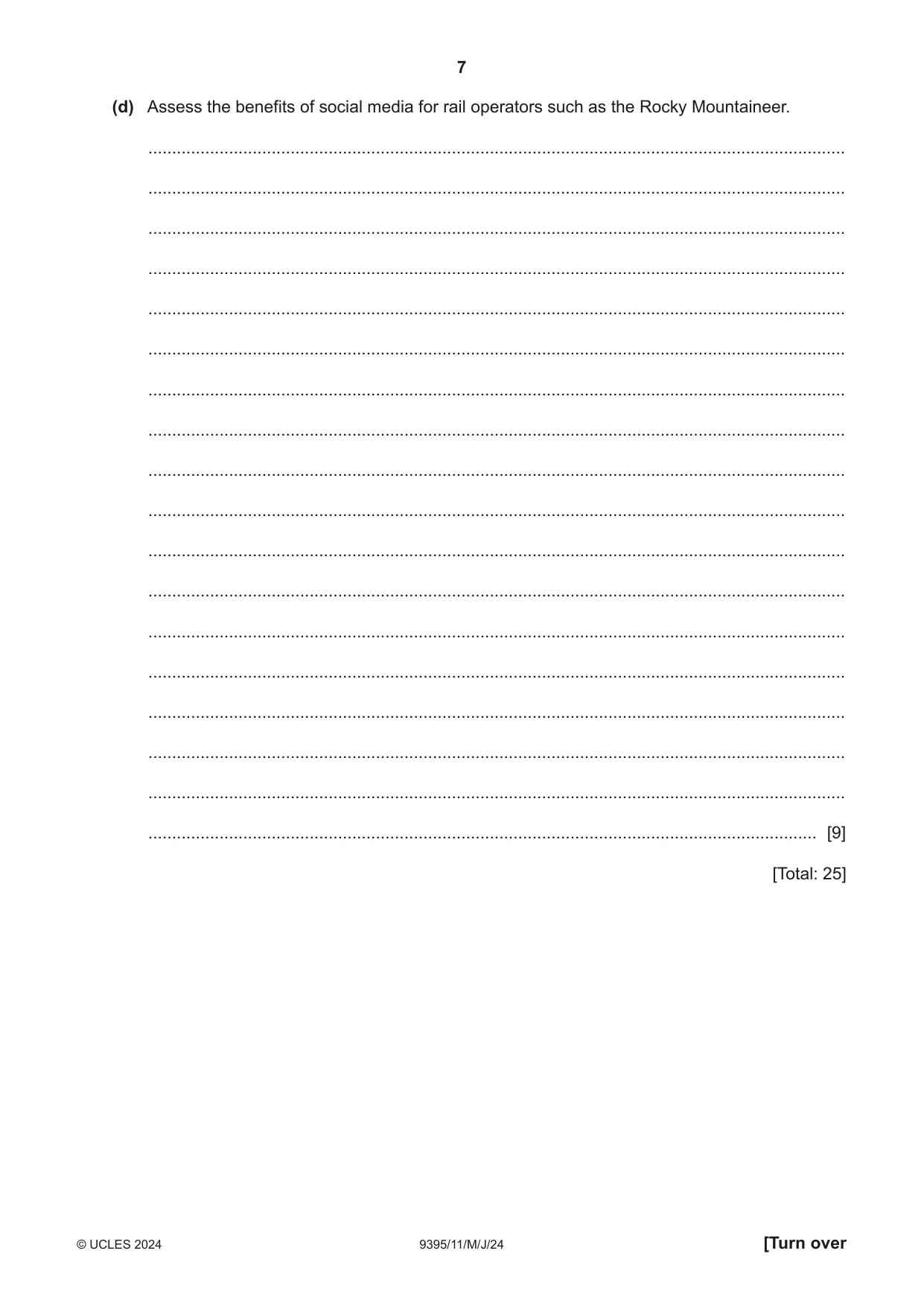
Question paper, page 7
7 9395/11/M/J/24 © UCLES 2024 [Turn over (d) Assess the benefits of social media for rail operators such as the Rocky Mountaineer. … … … … … … … … … … … … … … … … … … [9] [Total: 25]
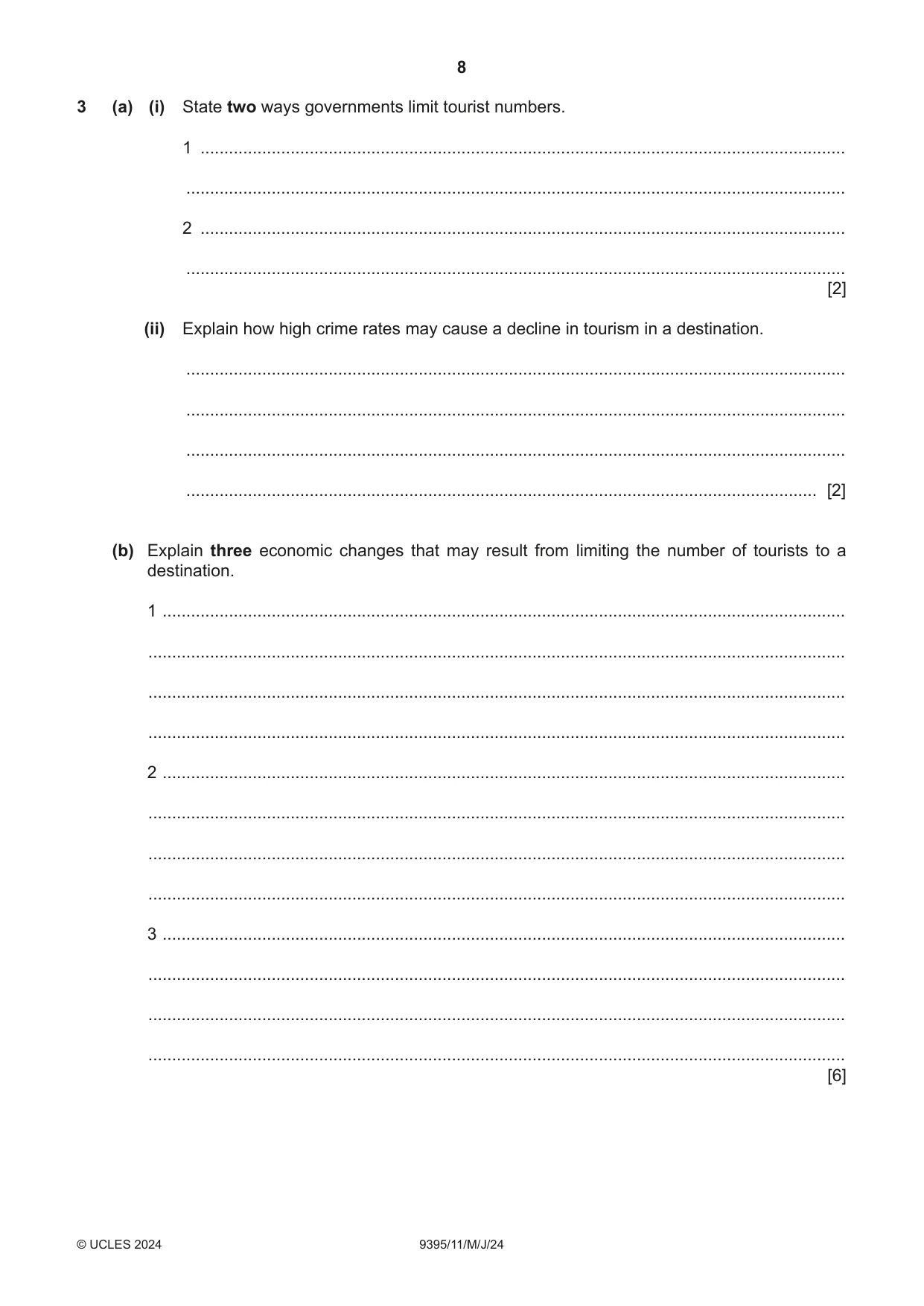
Question paper, page 8
8 9395/11/M/J/24 © UCLES 2024 3 (a) (i) State two ways governments limit tourist numbers. 1 … … 2 … … [2] (ii) Explain how high crime rates may cause a decline in tourism in a destination. … … … … [2] (b) Explain three economic changes that may result from limiting the number of tourists to a destination. 1 … … … … 2 … … … … 3 … … … … [6]
Question paper, page 9
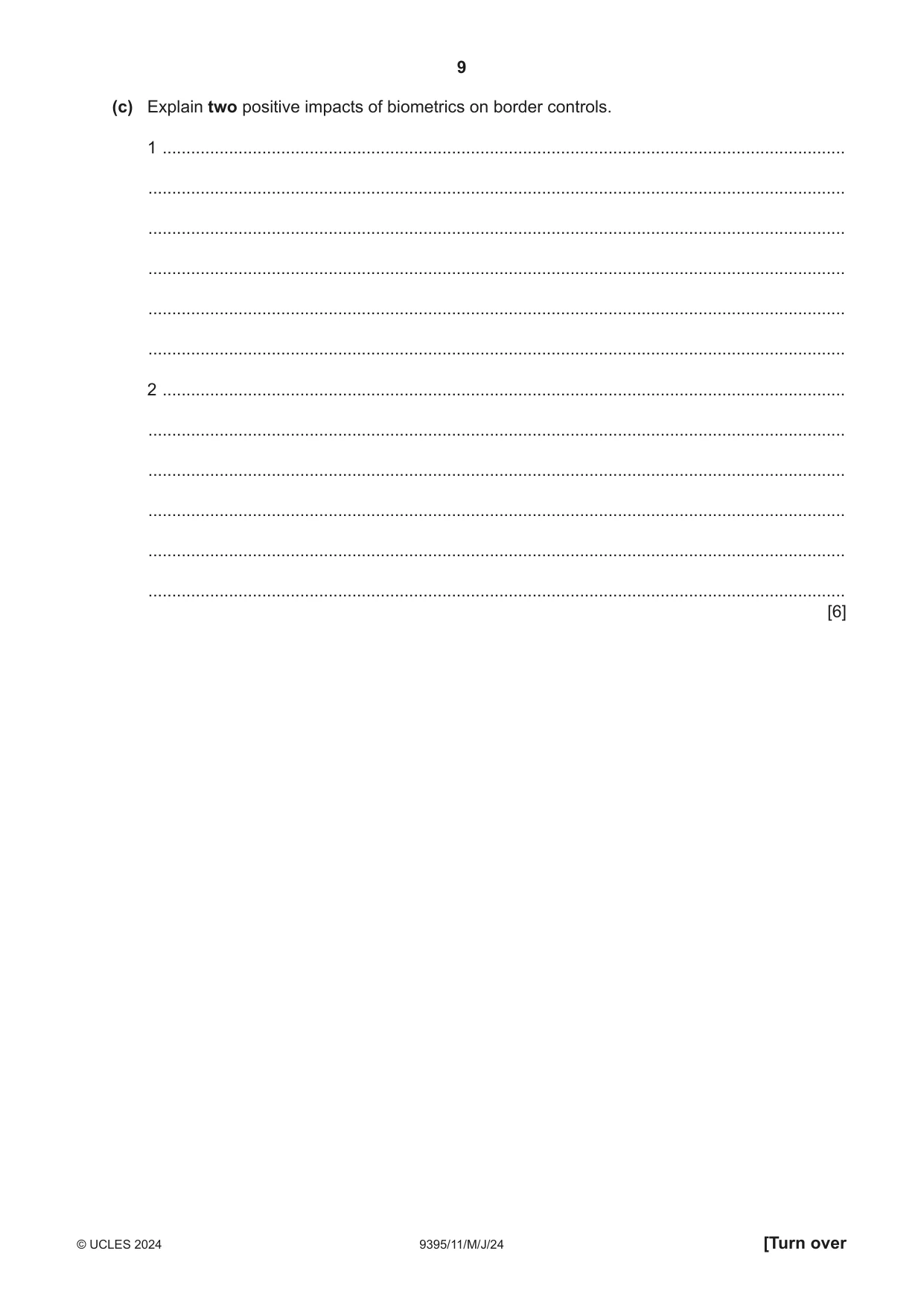
9 9395/11/M/J/24 © UCLES 2024 [Turn over (c) Explain two positive impacts of biometrics on border controls. 1 … … … … … … 2 … … … … … … [6]
Question paper, page 10
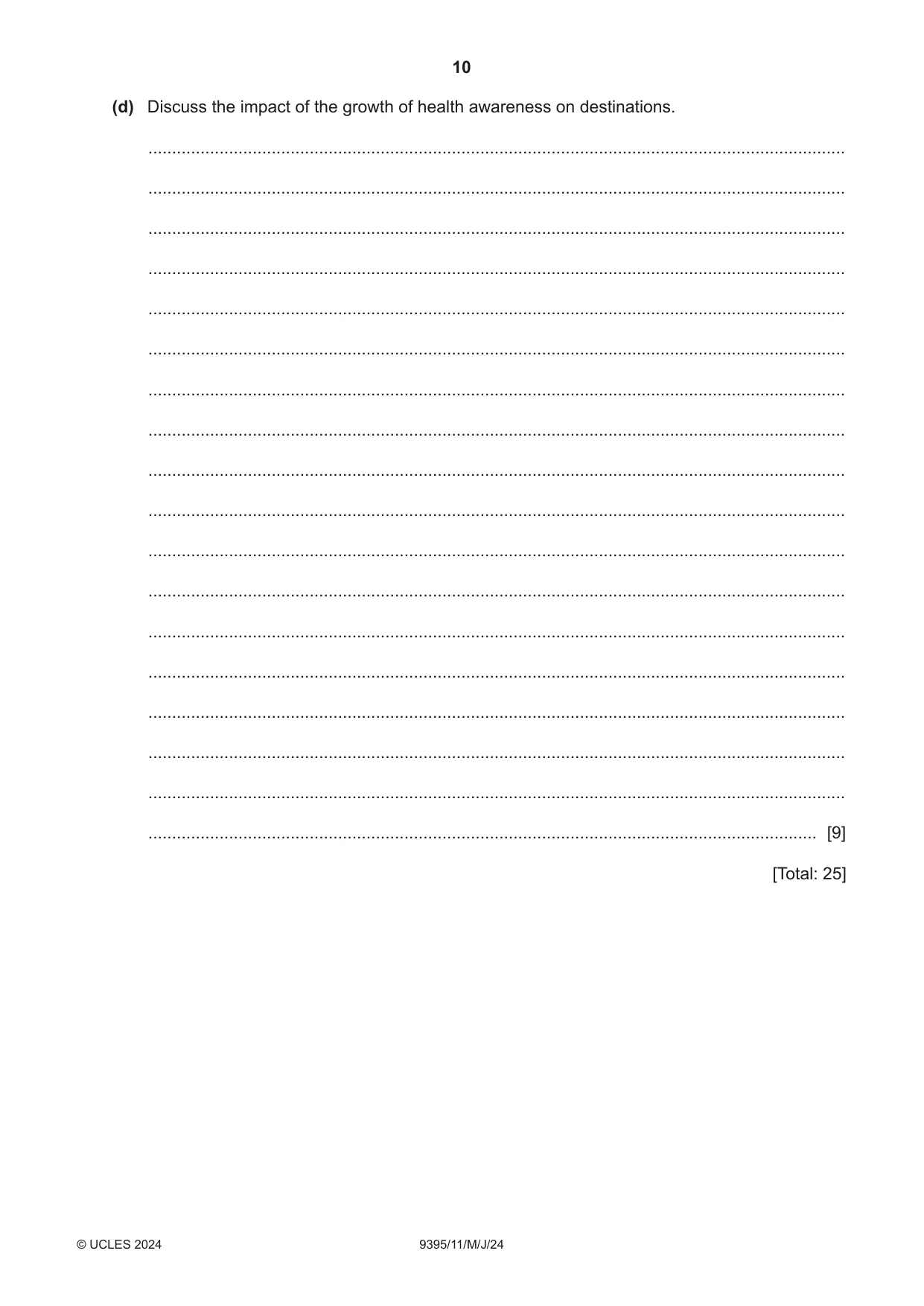
10 9395/11/M/J/24 © UCLES 2024 (d) Discuss the impact of the growth of health awareness on destinations. … … … … … … … … … … … … … … … … … … [9] [Total: 25]
Question paper, page 11
11 9395/11/M/J/24 © UCLES 2024 BLANK PAGE
Question paper, page 12
12 9395/11/M/J/24 © UCLES 2024 The boundaries and names shown, the designations used and the presentation of material on any maps contained in this question paper/insert do not imply official endorsement or acceptance by Cambridge Assessment International Education concerning the legal status of any country, territory, or area or any of its authorities, or of the delimitation of its frontiers or boundaries. Permission to reproduce items where third-party owned material protected by copyright is included has been sought and cleared where possible. Every reasonable effort has been made by the publisher (UCLES) to trace copyright holders, but if any items requiring clearance have unwittingly been included, the publisher will be pleased to make amends at the earliest possible opportunity. To avoid the issue of disclosure of answer-related information to candidates, all copyright acknowledgements are reproduced online in the Cambridge Assessment International Education Copyright Acknowledgements Booklet. This is produced for each series of examinations and is freely available to download at www.cambridgeinternational.org after the live examination series. Cambridge Assessment International Education is part of Cambridge Assessment. Cambridge Assessment is the brand name of the University of Cambridge Local Examinations Syndicate (UCLES), which is a department of the University of Cambridge. BLANK PAGE
Mark scheme, page 1
This document consists of 17 printed pages. © Cambridge University Press & Assessment 2024 [Turn over Cambridge International AS & A Level TRAVEL & TOURISM 9395/11 Paper 1 Themes and Concepts May/June 2024 MARK SCHEME Maximum Mark: 100 Published This mark scheme is published as an aid to teachers and candidates, to indicate the requirements of the examination. It shows the basis on which Examiners were instructed to award marks. It does not indicate the details of the discussions that took place at an Examiners’ meeting before marking began, which would have considered the acceptability of alternative answers. Mark schemes should be read in conjunction with the question paper and the Principal Examiner Report for Teachers. Cambridge International will not enter into discussions about these mark schemes. Cambridge International is publishing the mark schemes for the May/June 2024 series for most Cambridge IGCSE, Cambridge International A and AS Level and Cambridge Pre-U components, and some Cambridge O Level components.
Mark scheme, page 2
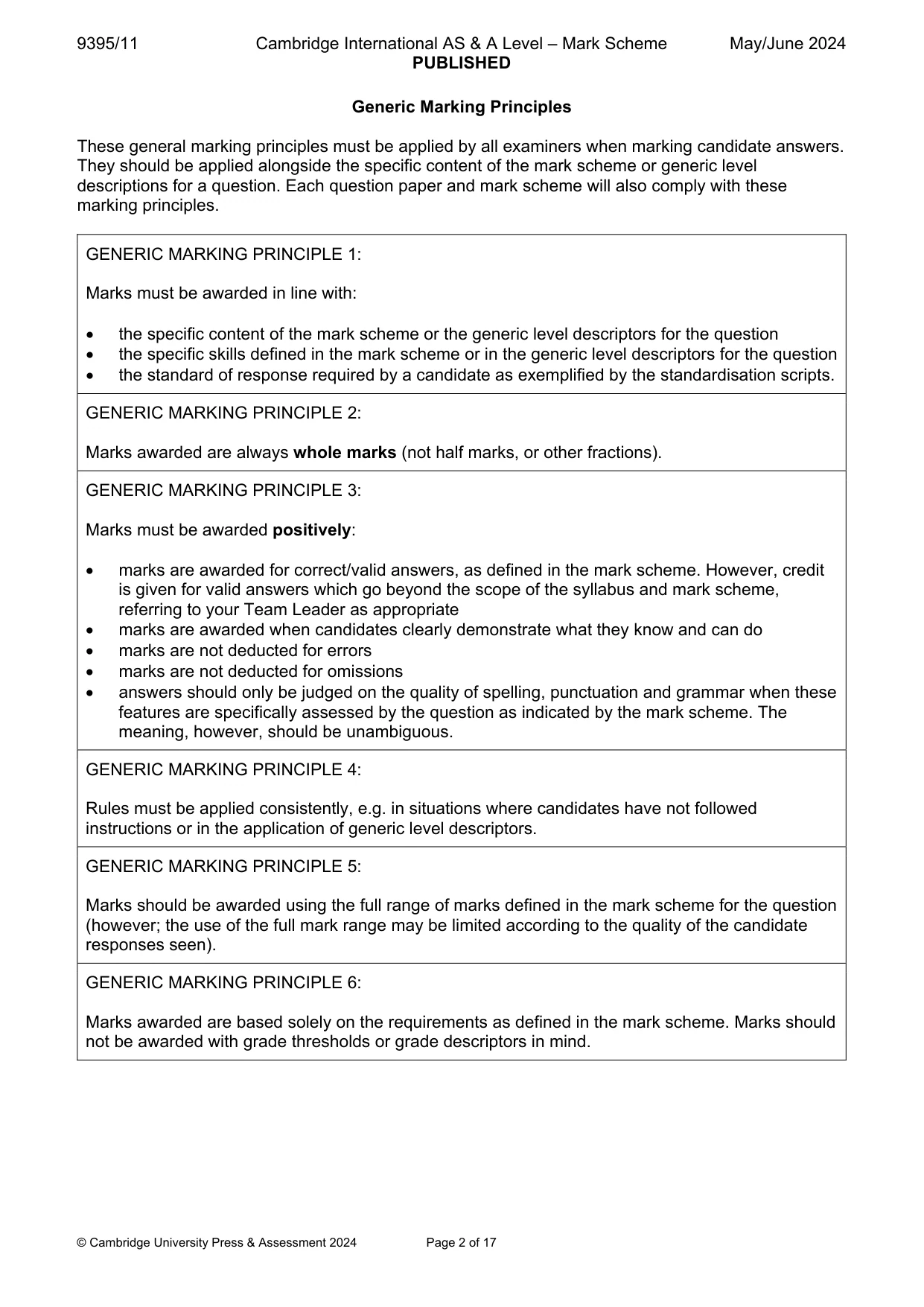
9395/11 Cambridge International AS & A Level – Mark Scheme PUBLISHED May/June 2024 © Cambridge University Press & Assessment 2024 Page 2 of 17 Generic Marking Principles These general marking principles must be applied by all examiners when marking candidate answers. They should be applied alongside the specific content of the mark scheme or generic level descriptions for a question. Each question paper and mark scheme will also comply with these marking principles. GENERIC MARKING PRINCIPLE 1: Marks must be awarded in line with: the specific content of the mark scheme or the generic level descriptors for the question the specific skills defined in the mark scheme or in the generic level descriptors for the question the standard of response required by a candidate as exemplified by the standardisation scripts. GENERIC MARKING PRINCIPLE 2: Marks awarded are always whole marks (not half marks, or other fractions). GENERIC MARKING PRINCIPLE 3: Marks must be awarded positively: marks are awarded for correct/valid answers, as defined in the mark scheme. However, credit is given for valid answers which go beyond the scope of the syllabus and mark scheme, referring to your Team Leader as appropriate marks are awarded when candidates clearly demonstrate what they know and can do marks are not deducted for errors marks are not deducted for omissions answers should only be judged on the quality of spelling, punctuation and grammar when these features are specifically assessed by the question as indicated by the mark scheme. The meaning, however, should be unambiguous. GENERIC MARKING PRINCIPLE 4: Rules must be applied consistently, e.g. in situations where candidates have not followed instructions or in the application of generic level descriptors. GENERIC MARKING PRINCIPLE 5: Marks should be awarded using the full range of marks defined in the mark scheme for the question (however; the use of the full mark range may be limited according to the quality of the candidate responses seen). GENERIC MARKING PRINCIPLE 6: Marks awarded are based solely on the requirements as defined in the mark scheme. Marks should not be awarded with grade thresholds or grade descriptors in mind.
Mark scheme, page 3
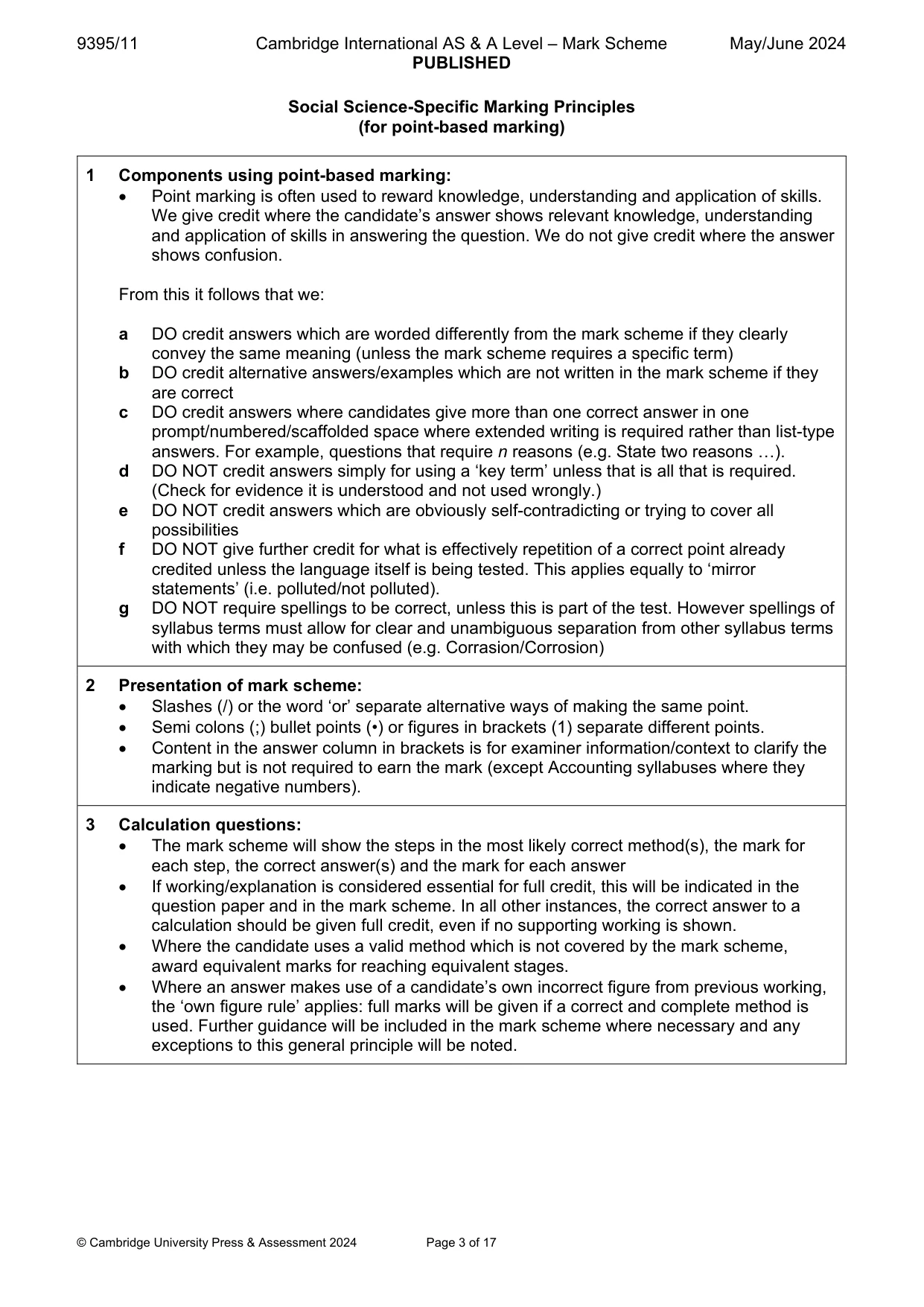
9395/11 Cambridge International AS & A Level – Mark Scheme PUBLISHED May/June 2024 © Cambridge University Press & Assessment 2024 Page 3 of 17 Social Science-Specific Marking Principles (for point-based marking) 1 Components using point-based marking: Point marking is often used to reward knowledge, understanding and application of skills. We give credit where the candidate’s answer shows relevant knowledge, understanding and application of skills in answering the question. We do not give credit where the answer shows confusion. From this it follows that we: a DO credit answers which are worded differently from the mark scheme if they clearly convey the same meaning (unless the mark scheme requires a specific term) b DO credit alternative answers/examples which are not written in the mark scheme if they are correct c DO credit answers where candidates give more than one correct answer in one prompt/numbered/scaffolded space where extended writing is required rather than list-type answers. For example, questions that require n reasons (e.g. State two reasons …). d DO NOT credit answers simply for using a ‘key term’ unless that is all that is required. (Check for evidence it is understood and not used wrongly.) e DO NOT credit answers which are obviously self-contradicting or trying to cover all possibilities f DO NOT give further credit for what is effectively repetition of a correct point already credited unless the language itself is being tested. This applies equally to ‘mirror statements’ (i.e. polluted/not polluted). g DO NOT require spellings to be correct, unless this is part of the test. However spellings of syllabus terms must allow for clear and unambiguous separation from other syllabus terms with which they may be confused (e.g. Corrasion/Corrosion) 2 Presentation of mark scheme: Slashes (/) or the word ‘or’ separate alternative ways of making the same point. Semi colons (;) bullet points (•) or figures in brackets (1) separate different points. Content in the answer column in brackets is for examiner information/context to clarify the marking but is not required to earn the mark (except Accounting syllabuses where they indicate negative numbers). 3 Calculation questions: The mark scheme will show the steps in the most likely correct method(s), the mark for each step, the correct answer(s) and the mark for each answer If working/explanation is considered essential for full credit, this will be indicated in the question paper and in the mark scheme. In all other instances, the correct answer to a calculation should be given full credit, even if no supporting working is shown. Where the candidate uses a valid method which is not covered by the mark scheme, award equivalent marks for reaching equivalent stages. Where an answer makes use of a candidate’s own incorrect figure from previous working, the ‘own figure rule’ applies: full marks will be given if a correct and complete method is used. Further guidance will be included in the mark scheme where necessary and any exceptions to this general principle will be noted.
Mark scheme, page 4
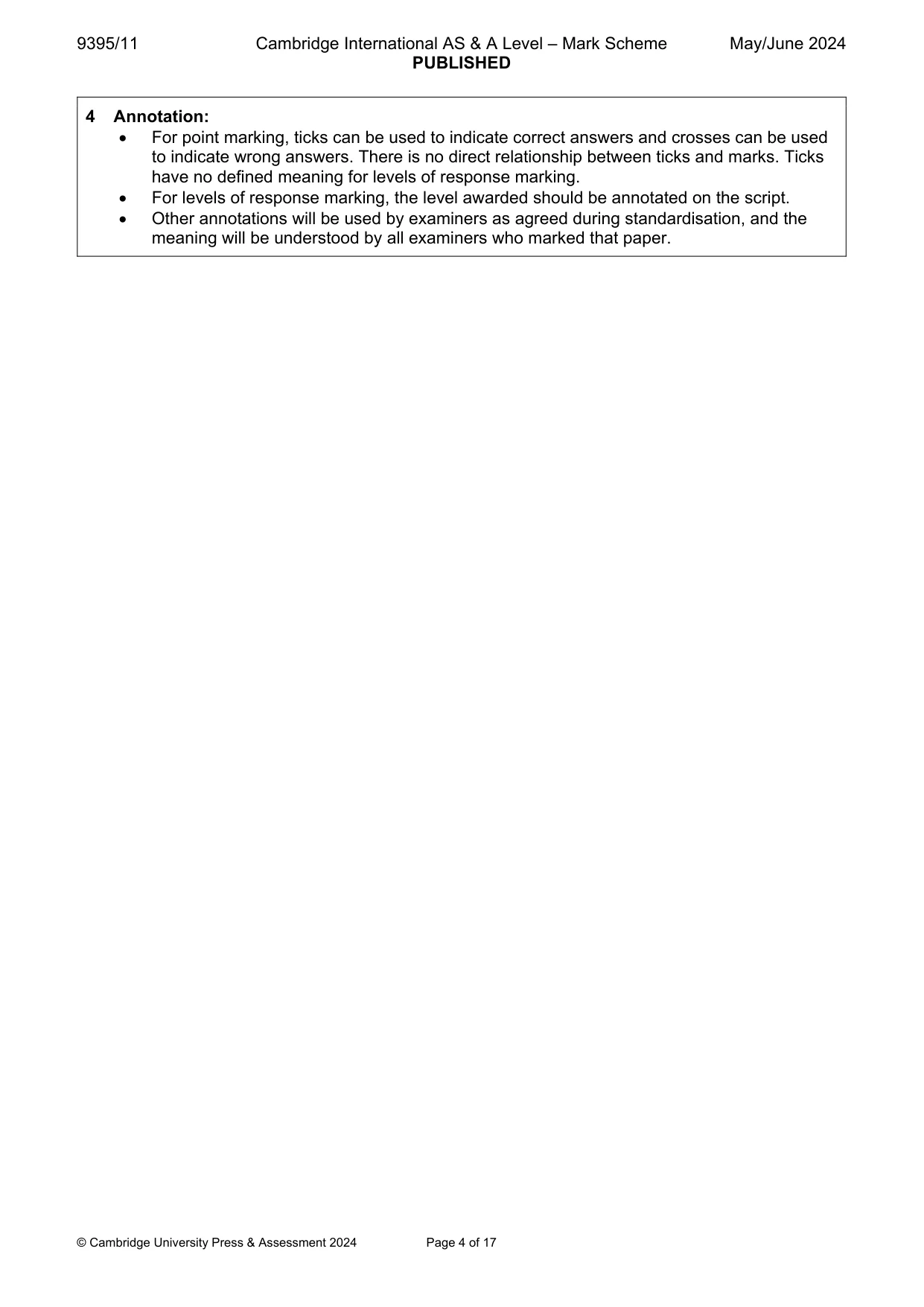
9395/11 Cambridge International AS & A Level – Mark Scheme PUBLISHED May/June 2024 © Cambridge University Press & Assessment 2024 Page 4 of 17 4 Annotation: For point marking, ticks can be used to indicate correct answers and crosses can be used to indicate wrong answers. There is no direct relationship between ticks and marks. Ticks have no defined meaning for levels of response marking. For levels of response marking, the level awarded should be annotated on the script. Other annotations will be used by examiners as agreed during standardisation, and the meaning will be understood by all examiners who marked that paper.
Mark scheme, page 5
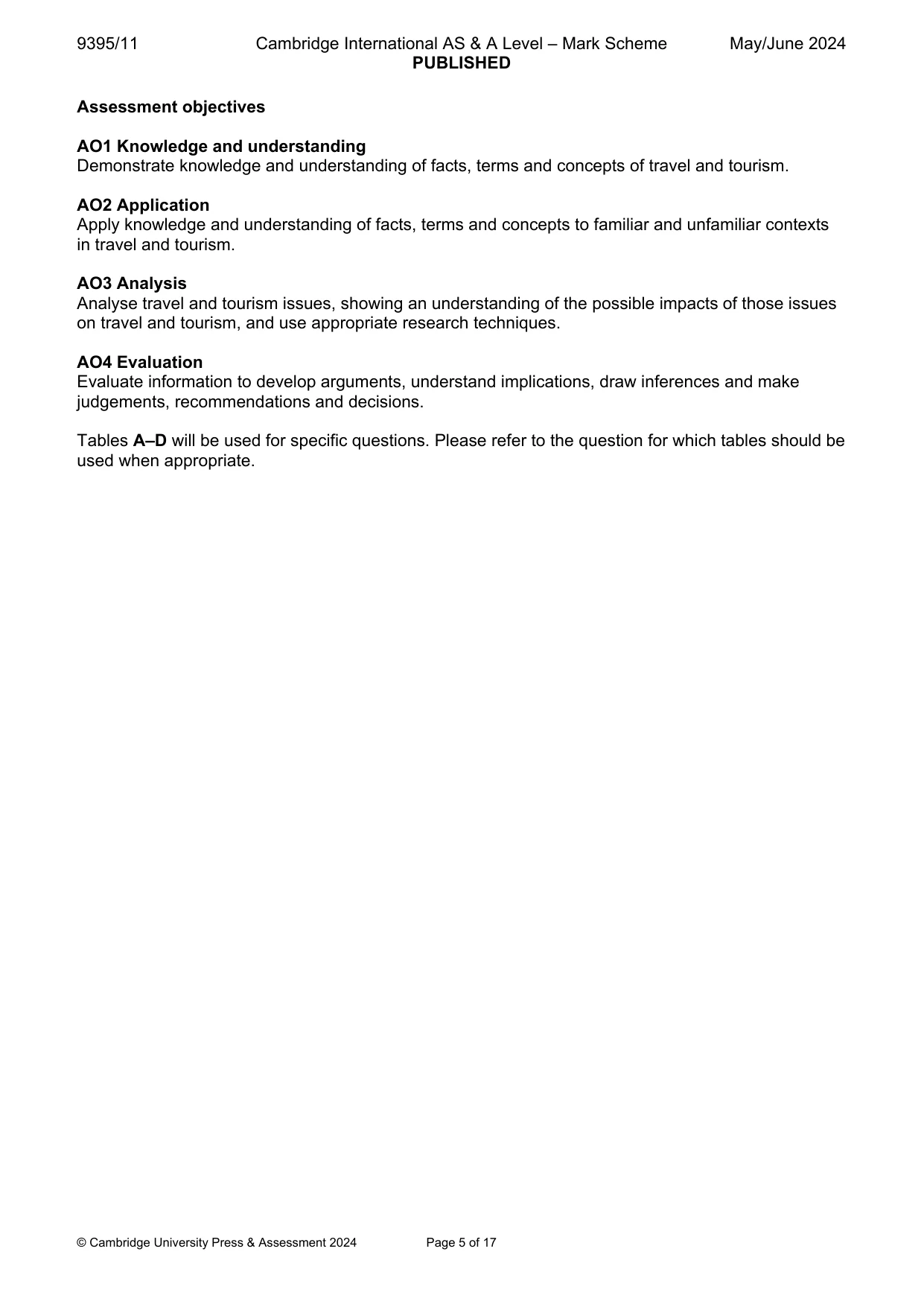
9395/11 Cambridge International AS & A Level – Mark Scheme PUBLISHED May/June 2024 © Cambridge University Press & Assessment 2024 Page 5 of 17 Assessment objectives AO1 Knowledge and understanding Demonstrate knowledge and understanding of facts, terms and concepts of travel and tourism. AO2 Application Apply knowledge and understanding of facts, terms and concepts to familiar and unfamiliar contexts in travel and tourism. AO3 Analysis Analyse travel and tourism issues, showing an understanding of the possible impacts of those issues on travel and tourism, and use appropriate research techniques. AO4 Evaluation Evaluate information to develop arguments, understand implications, draw inferences and make judgements, recommendations and decisions. Tables A–D will be used for specific questions. Please refer to the question for which tables should be used when appropriate.
Mark scheme, page 6
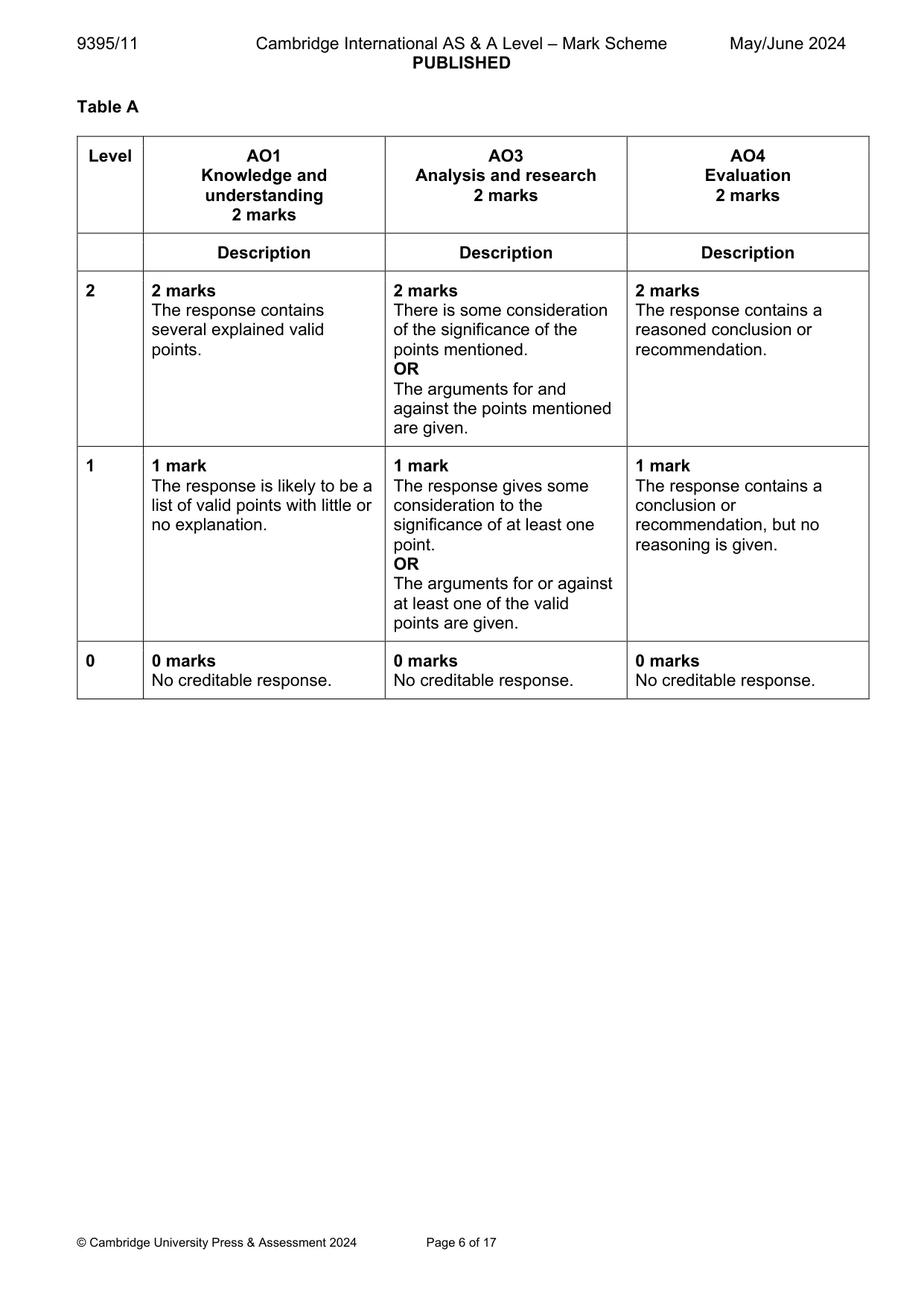
9395/11 Cambridge International AS & A Level – Mark Scheme PUBLISHED May/June 2024 © Cambridge University Press & Assessment 2024 Page 6 of 17 Table A Level AO1 Knowledge and understanding 2 marks AO3 Analysis and research 2 marks AO4 Evaluation 2 marks Description Description Description 2 2 marks The response contains several explained valid points. 2 marks There is some consideration of the significance of the points mentioned. OR The arguments for and against the points mentioned are given. 2 marks The response contains a reasoned conclusion or recommendation. 1 1 mark The response is likely to be a list of valid points with little or no explanation. 1 mark The response gives some consideration to the significance of at least one point. OR The arguments for or against at least one of the valid points are given. 1 mark The response contains a conclusion or recommendation, but no reasoning is given. 0 0 marks No creditable response. 0 marks No creditable response. 0 marks No creditable response.
Mark scheme, page 7
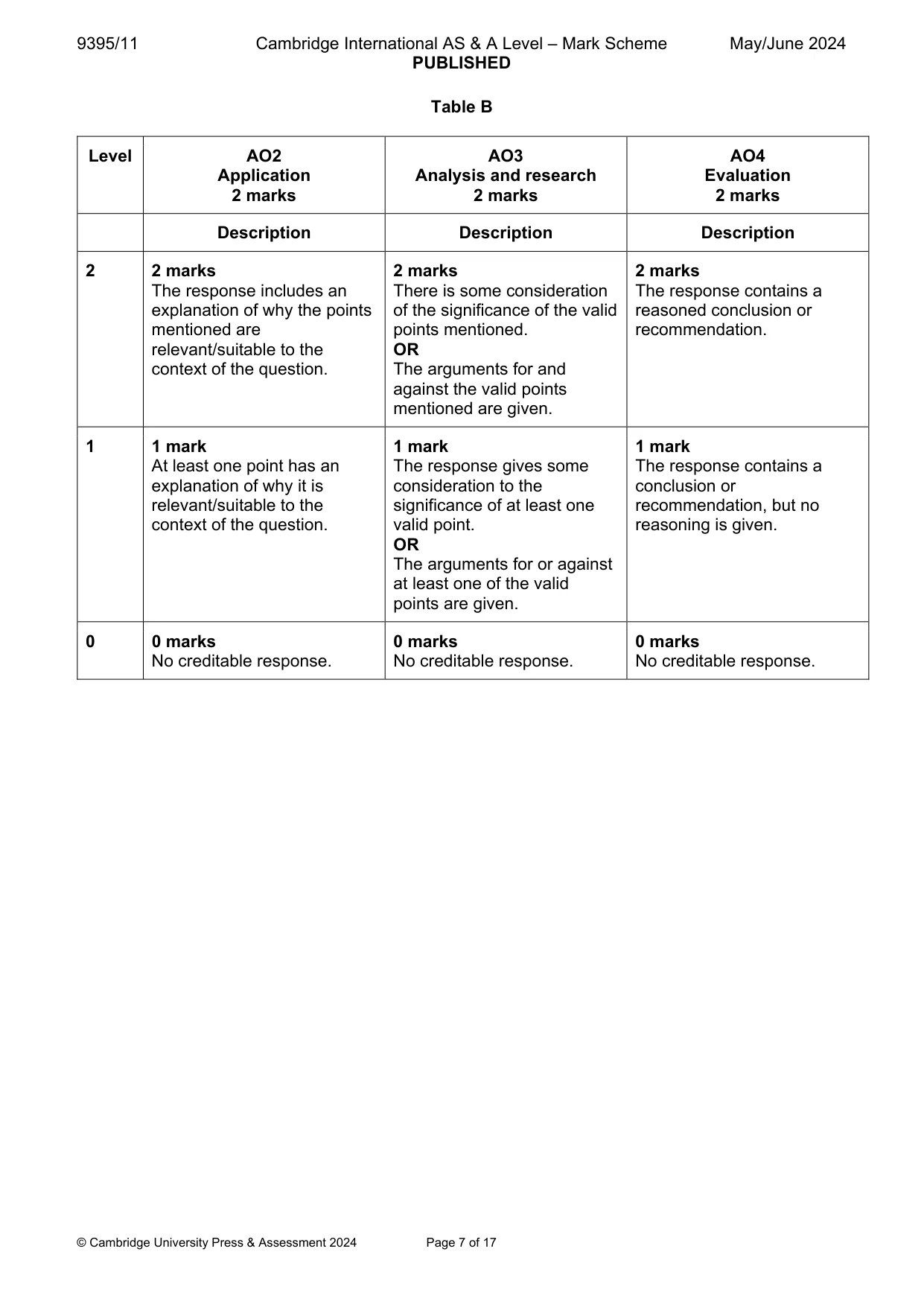
9395/11 Cambridge International AS & A Level – Mark Scheme PUBLISHED May/June 2024 © Cambridge University Press & Assessment 2024 Page 7 of 17 Table B Level AO2 Application 2 marks AO3 Analysis and research 2 marks AO4 Evaluation 2 marks Description Description Description 2 2 marks The response includes an explanation of why the points mentioned are relevant/suitable to the context of the question. 2 marks There is some consideration of the significance of the valid points mentioned. OR The arguments for and against the valid points mentioned are given. 2 marks The response contains a reasoned conclusion or recommendation. 1 1 mark At least one point has an explanation of why it is relevant/suitable to the context of the question. 1 mark The response gives some consideration to the significance of at least one valid point. OR The arguments for or against at least one of the valid points are given. 1 mark The response contains a conclusion or recommendation, but no reasoning is given. 0 0 marks No creditable response. 0 marks No creditable response. 0 marks No creditable response.
Mark scheme, page 8
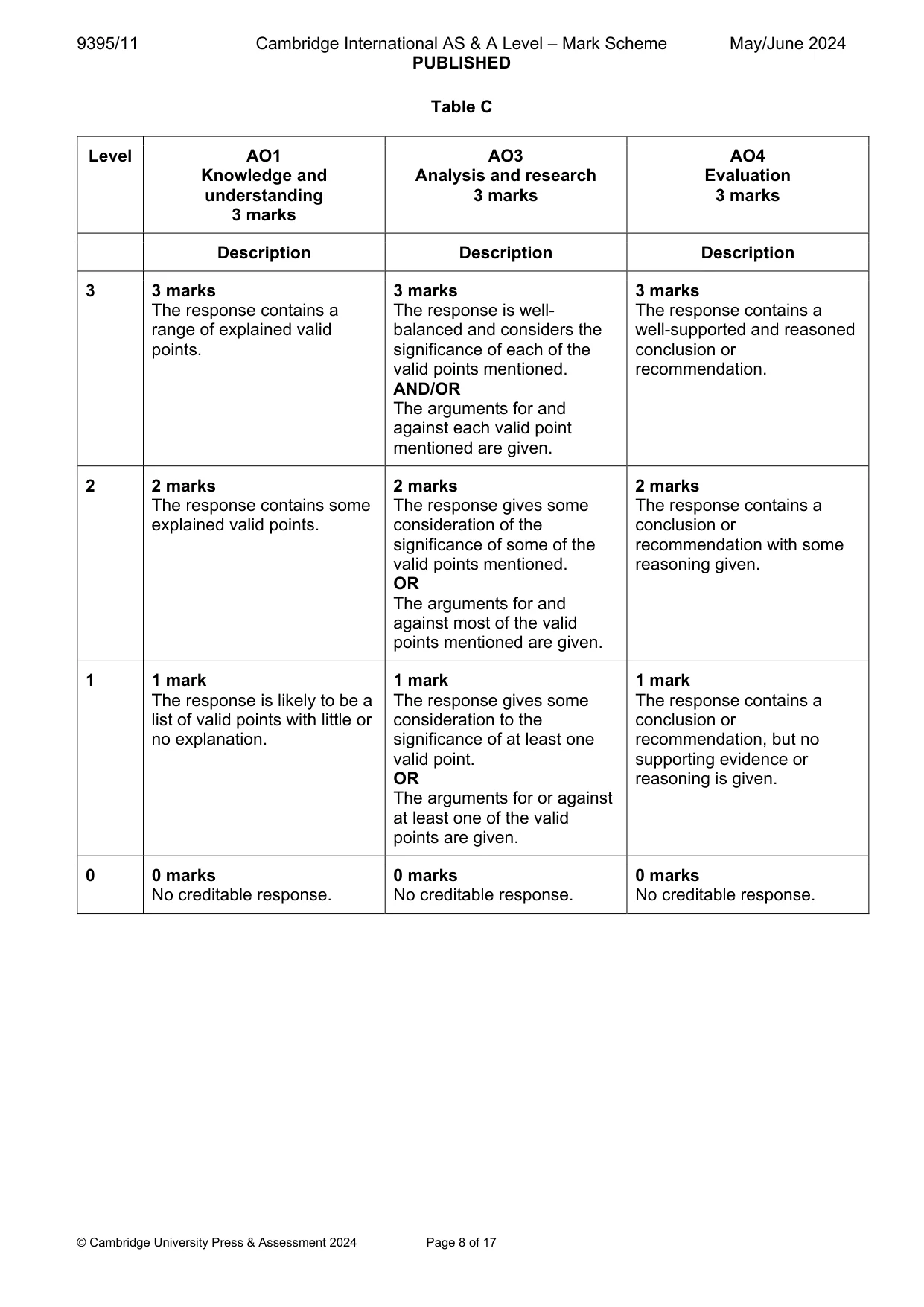
9395/11 Cambridge International AS & A Level – Mark Scheme PUBLISHED May/June 2024 © Cambridge University Press & Assessment 2024 Page 8 of 17 Table C Level AO1 Knowledge and understanding 3 marks AO3 Analysis and research 3 marks AO4 Evaluation 3 marks Description Description Description 3 3 marks The response contains a range of explained valid points. 3 marks The response is well- balanced and considers the significance of each of the valid points mentioned. AND/OR The arguments for and against each valid point mentioned are given. 3 marks The response contains a well-supported and reasoned conclusion or recommendation. 2 2 marks The response contains some explained valid points. 2 marks The response gives some consideration of the significance of some of the valid points mentioned. OR The arguments for and against most of the valid points mentioned are given. 2 marks The response contains a conclusion or recommendation with some reasoning given. 1 1 mark The response is likely to be a list of valid points with little or no explanation. 1 mark The response gives some consideration to the significance of at least one valid point. OR The arguments for or against at least one of the valid points are given. 1 mark The response contains a conclusion or recommendation, but no supporting evidence or reasoning is given. 0 0 marks No creditable response. 0 marks No creditable response. 0 marks No creditable response.
Mark scheme, page 9
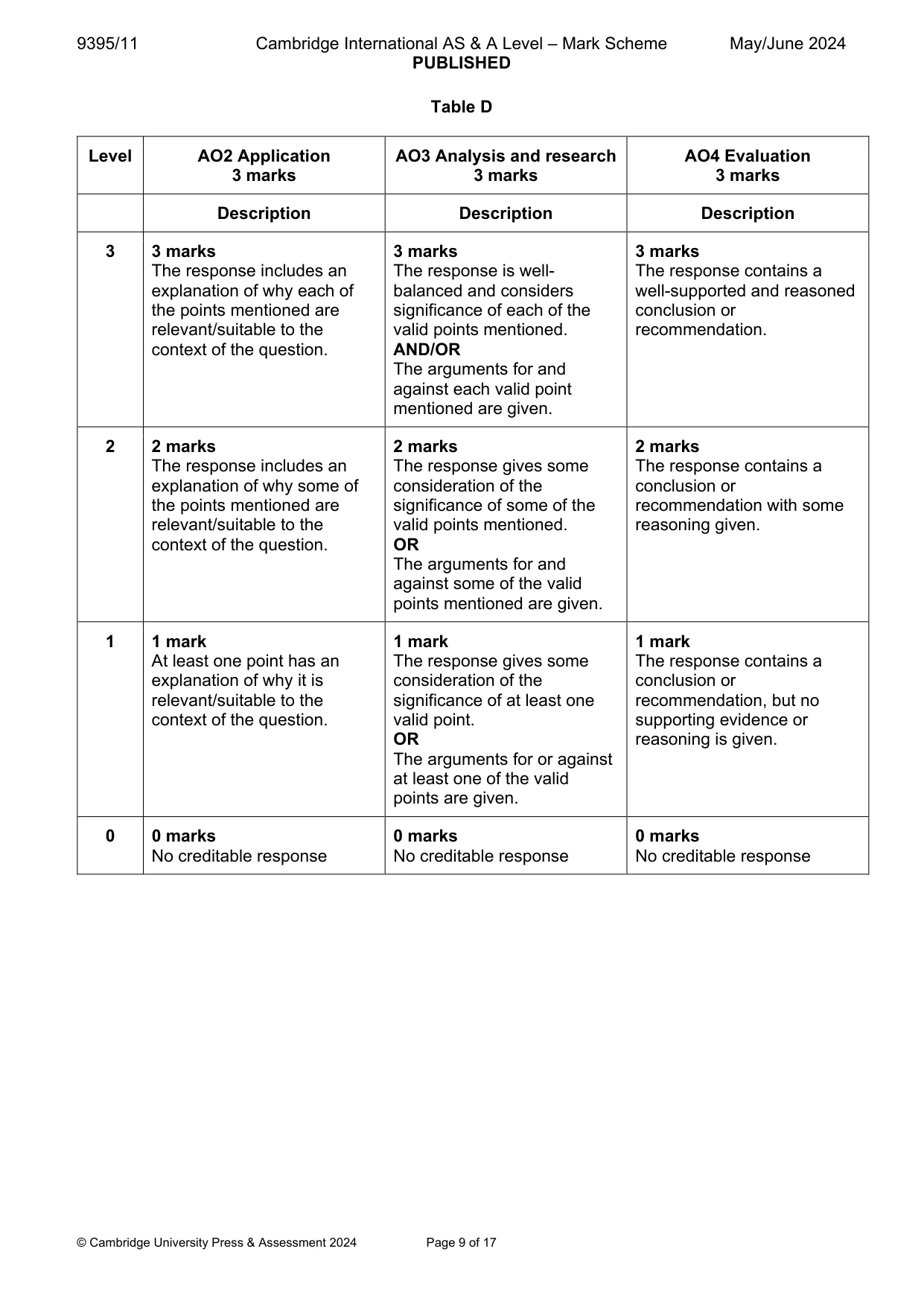
9395/11 Cambridge International AS & A Level – Mark Scheme PUBLISHED May/June 2024 © Cambridge University Press & Assessment 2024 Page 9 of 17 Table D Level AO2 Application 3 marks AO3 Analysis and research 3 marks AO4 Evaluation 3 marks Description Description Description 3 3 marks The response includes an explanation of why each of the points mentioned are relevant/suitable to the context of the question. 3 marks The response is well- balanced and considers significance of each of the valid points mentioned. AND/OR The arguments for and against each valid point mentioned are given. 3 marks The response contains a well-supported and reasoned conclusion or recommendation. 2 2 marks The response includes an explanation of why some of the points mentioned are relevant/suitable to the context of the question. 2 marks The response gives some consideration of the significance of some of the valid points mentioned. OR The arguments for and against some of the valid points mentioned are given. 2 marks The response contains a conclusion or recommendation with some reasoning given. 1 1 mark At least one point has an explanation of why it is relevant/suitable to the context of the question. 1 mark The response gives some consideration of the significance of at least one valid point. OR The arguments for or against at least one of the valid points are given. 1 mark The response contains a conclusion or recommendation, but no supporting evidence or reasoning is given. 0 0 marks No creditable response 0 marks No creditable response 0 marks No creditable response
Mark scheme, page 10
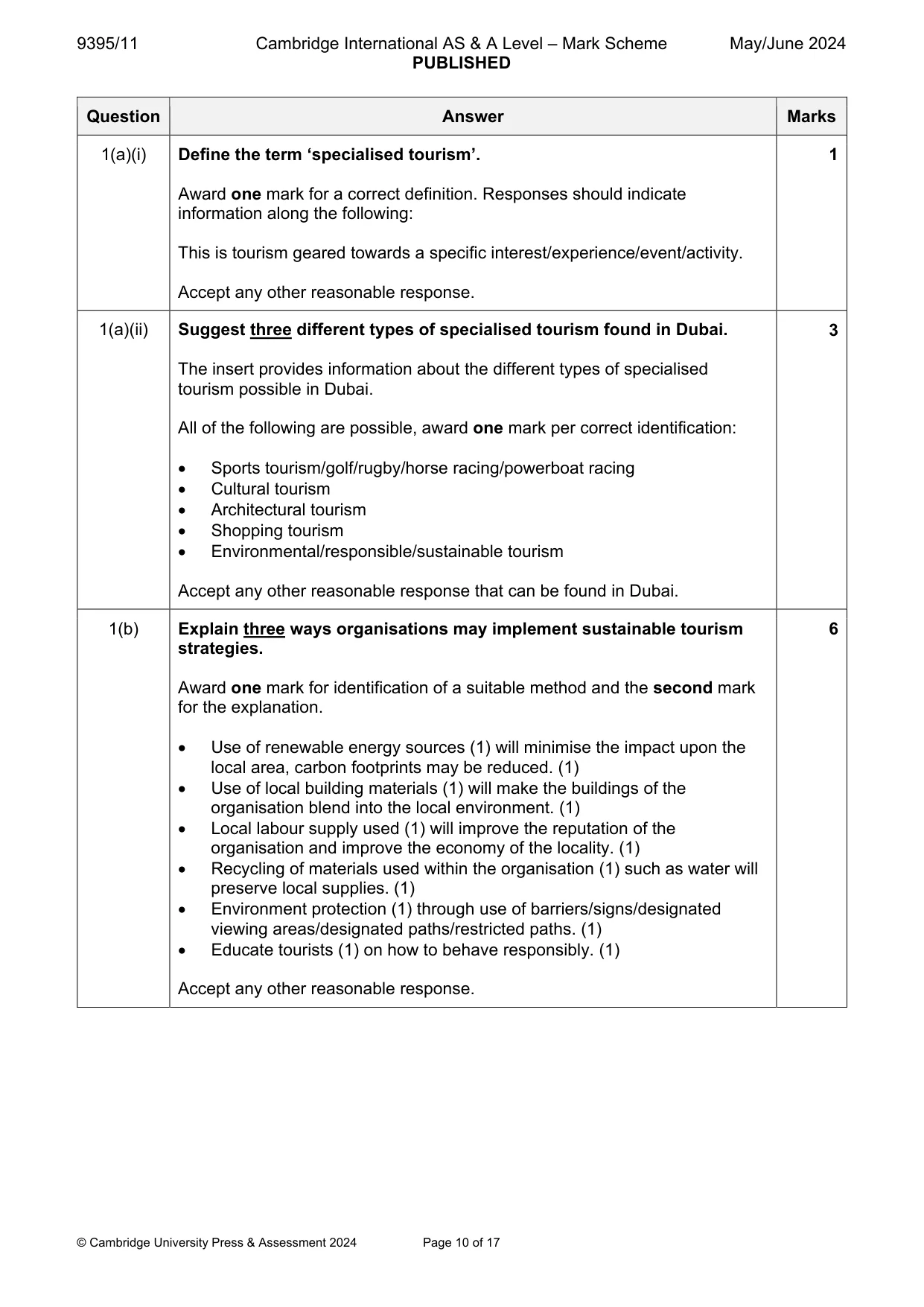
9395/11 Cambridge International AS & A Level – Mark Scheme PUBLISHED May/June 2024 © Cambridge University Press & Assessment 2024 Page 10 of 17 Question Answer Marks 1(a)(i) Define the term ‘specialised tourism’. Award one mark for a correct definition. Responses should indicate information along the following: This is tourism geared towards a specific interest/experience/event/activity. Accept any other reasonable response. 1 1(a)(ii) Suggest three different types of specialised tourism found in Dubai. The insert provides information about the different types of specialised tourism possible in Dubai. All of the following are possible, award one mark per correct identification: Sports tourism/golf/rugby/horse racing/powerboat racing Cultural tourism Architectural tourism Shopping tourism Environmental/responsible/sustainable tourism Accept any other reasonable response that can be found in Dubai. 3 1(b) Explain three ways organisations may implement sustainable tourism strategies. Award one mark for identification of a suitable method and the second mark for the explanation. Use of renewable energy sources (1) will minimise the impact upon the local area, carbon footprints may be reduced. (1) Use of local building materials (1) will make the buildings of the organisation blend into the local environment. (1) Local labour supply used (1) will improve the reputation of the organisation and improve the economy of the locality. (1) Recycling of materials used within the organisation (1) such as water will preserve local supplies. (1) Environment protection (1) through use of barriers/signs/designated viewing areas/designated paths/restricted paths. (1) Educate tourists (1) on how to behave responsibly. (1) Accept any other reasonable response. 6
Mark scheme, page 11
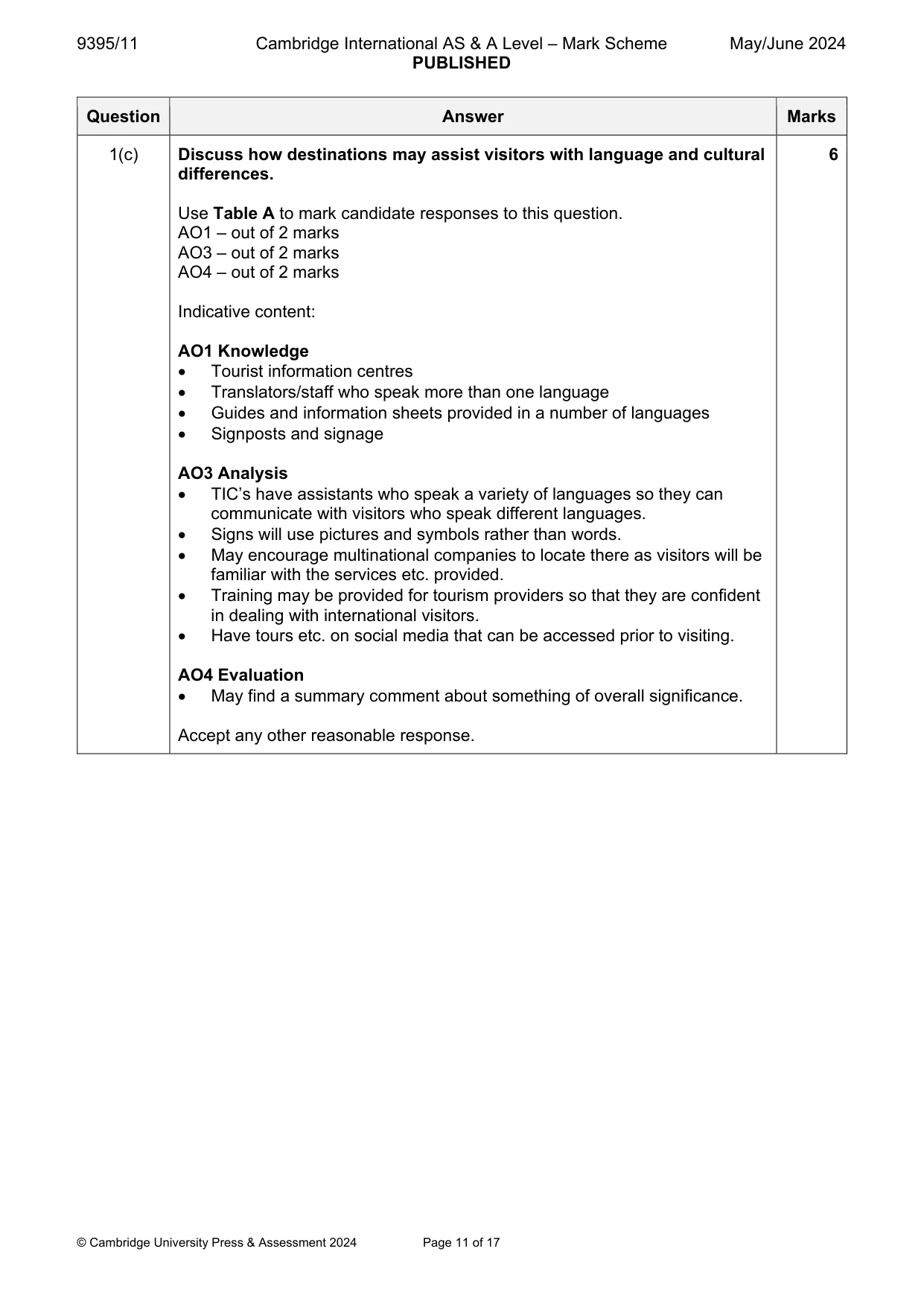
9395/11 Cambridge International AS & A Level – Mark Scheme PUBLISHED May/June 2024 © Cambridge University Press & Assessment 2024 Page 11 of 17 Question Answer Marks 1(c) Discuss how destinations may assist visitors with language and cultural differences. Use Table A to mark candidate responses to this question. AO1 – out of 2 marks AO3 – out of 2 marks AO4 – out of 2 marks Indicative content: AO1 Knowledge Tourist information centres Translators/staff who speak more than one language Guides and information sheets provided in a number of languages Signposts and signage AO3 Analysis TIC’s have assistants who speak a variety of languages so they can communicate with visitors who speak different languages. Signs will use pictures and symbols rather than words. May encourage multinational companies to locate there as visitors will be familiar with the services etc. provided. Training may be provided for tourism providers so that they are confident in dealing with international visitors. Have tours etc. on social media that can be accessed prior to visiting. AO4 Evaluation May find a summary comment about something of overall significance. Accept any other reasonable response. 6
Mark scheme, page 12
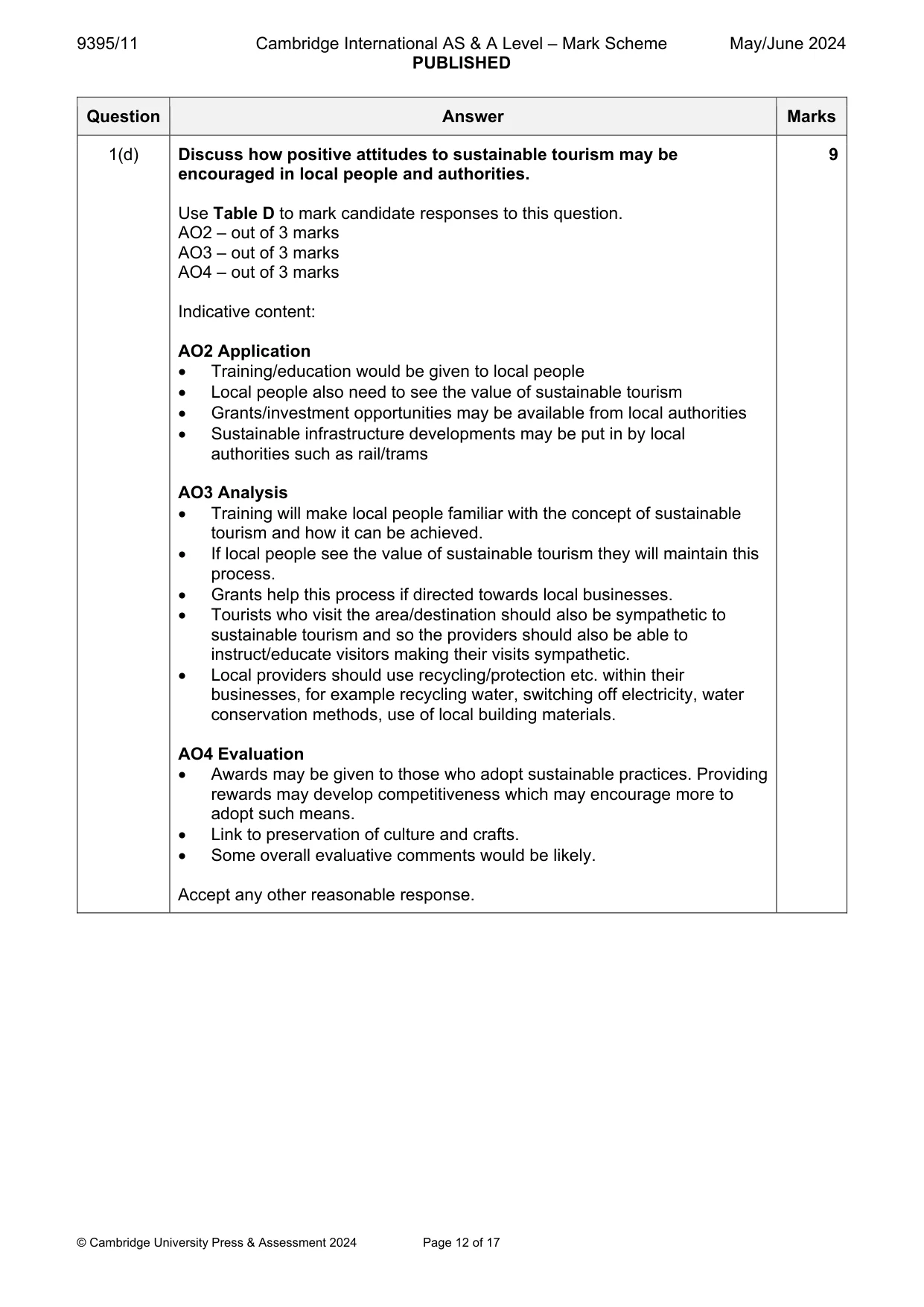
9395/11 Cambridge International AS & A Level – Mark Scheme PUBLISHED May/June 2024 © Cambridge University Press & Assessment 2024 Page 12 of 17 Question Answer Marks 1(d) Discuss how positive attitudes to sustainable tourism may be encouraged in local people and authorities. Use Table D to mark candidate responses to this question. AO2 – out of 3 marks AO3 – out of 3 marks AO4 – out of 3 marks Indicative content: AO2 Application Training/education would be given to local people Local people also need to see the value of sustainable tourism Grants/investment opportunities may be available from local authorities Sustainable infrastructure developments may be put in by local authorities such as rail/trams AO3 Analysis Training will make local people familiar with the concept of sustainable tourism and how it can be achieved. If local people see the value of sustainable tourism they will maintain this process. Grants help this process if directed towards local businesses. Tourists who visit the area/destination should also be sympathetic to sustainable tourism and so the providers should also be able to instruct/educate visitors making their visits sympathetic. Local providers should use recycling/protection etc. within their businesses, for example recycling water, switching off electricity, water conservation methods, use of local building materials. AO4 Evaluation Awards may be given to those who adopt sustainable practices. Providing rewards may develop competitiveness which may encourage more to adopt such means. Link to preservation of culture and crafts. Some overall evaluative comments would be likely. Accept any other reasonable response. 9
Mark scheme, page 13
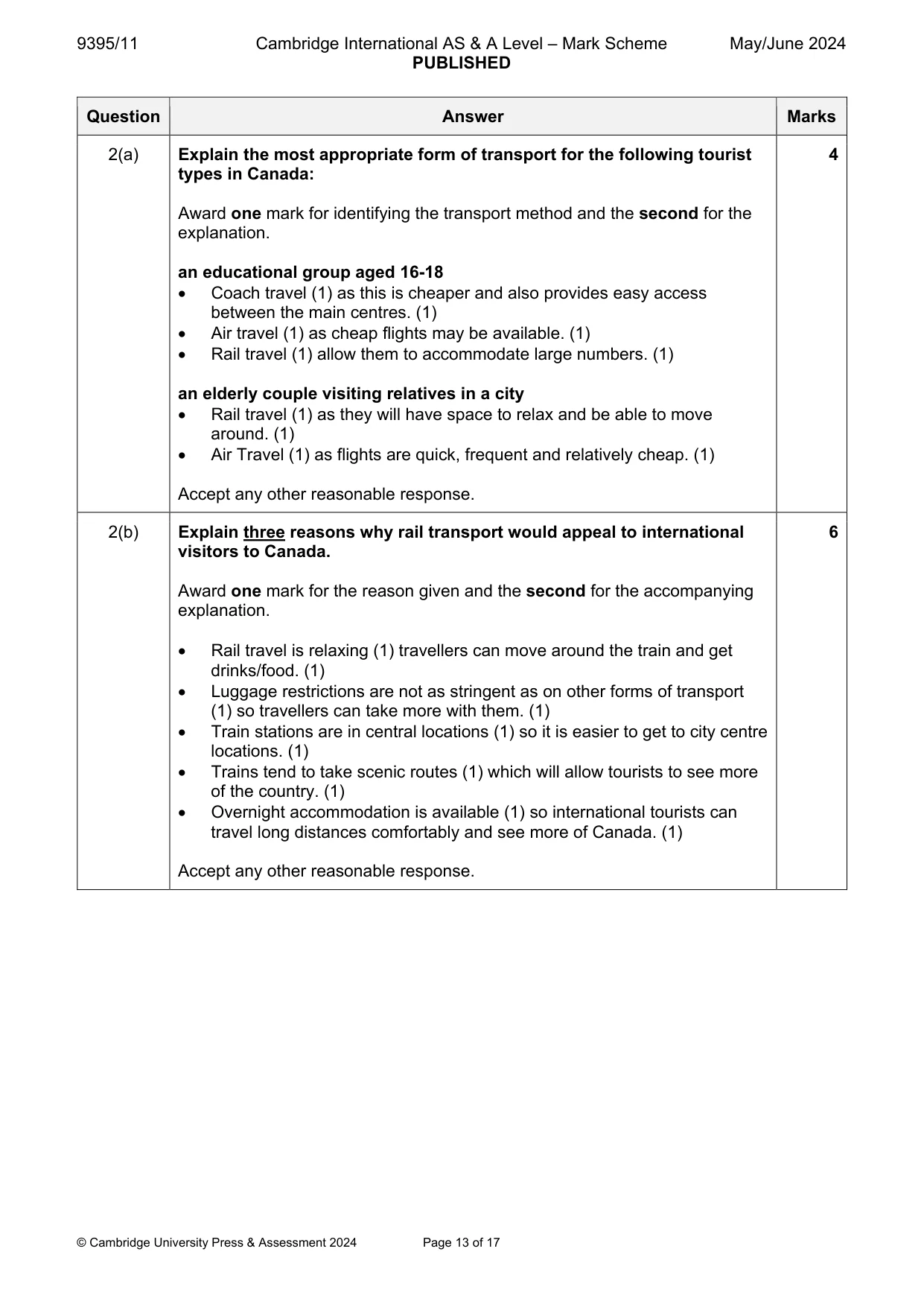
9395/11 Cambridge International AS & A Level – Mark Scheme PUBLISHED May/June 2024 © Cambridge University Press & Assessment 2024 Page 13 of 17 Question Answer Marks 2(a) Explain the most appropriate form of transport for the following tourist types in Canada: Award one mark for identifying the transport method and the second for the explanation. an educational group aged 16-18 Coach travel (1) as this is cheaper and also provides easy access between the main centres. (1) Air travel (1) as cheap flights may be available. (1) Rail travel (1) allow them to accommodate large numbers. (1) an elderly couple visiting relatives in a city Rail travel (1) as they will have space to relax and be able to move around. (1) Air Travel (1) as flights are quick, frequent and relatively cheap. (1) Accept any other reasonable response. 4 2(b) Explain three reasons why rail transport would appeal to international visitors to Canada. Award one mark for the reason given and the second for the accompanying explanation. Rail travel is relaxing (1) travellers can move around the train and get drinks/food. (1) Luggage restrictions are not as stringent as on other forms of transport (1) so travellers can take more with them. (1) Train stations are in central locations (1) so it is easier to get to city centre locations. (1) Trains tend to take scenic routes (1) which will allow tourists to see more of the country. (1) Overnight accommodation is available (1) so international tourists can travel long distances comfortably and see more of Canada. (1) Accept any other reasonable response. 6
Mark scheme, page 14
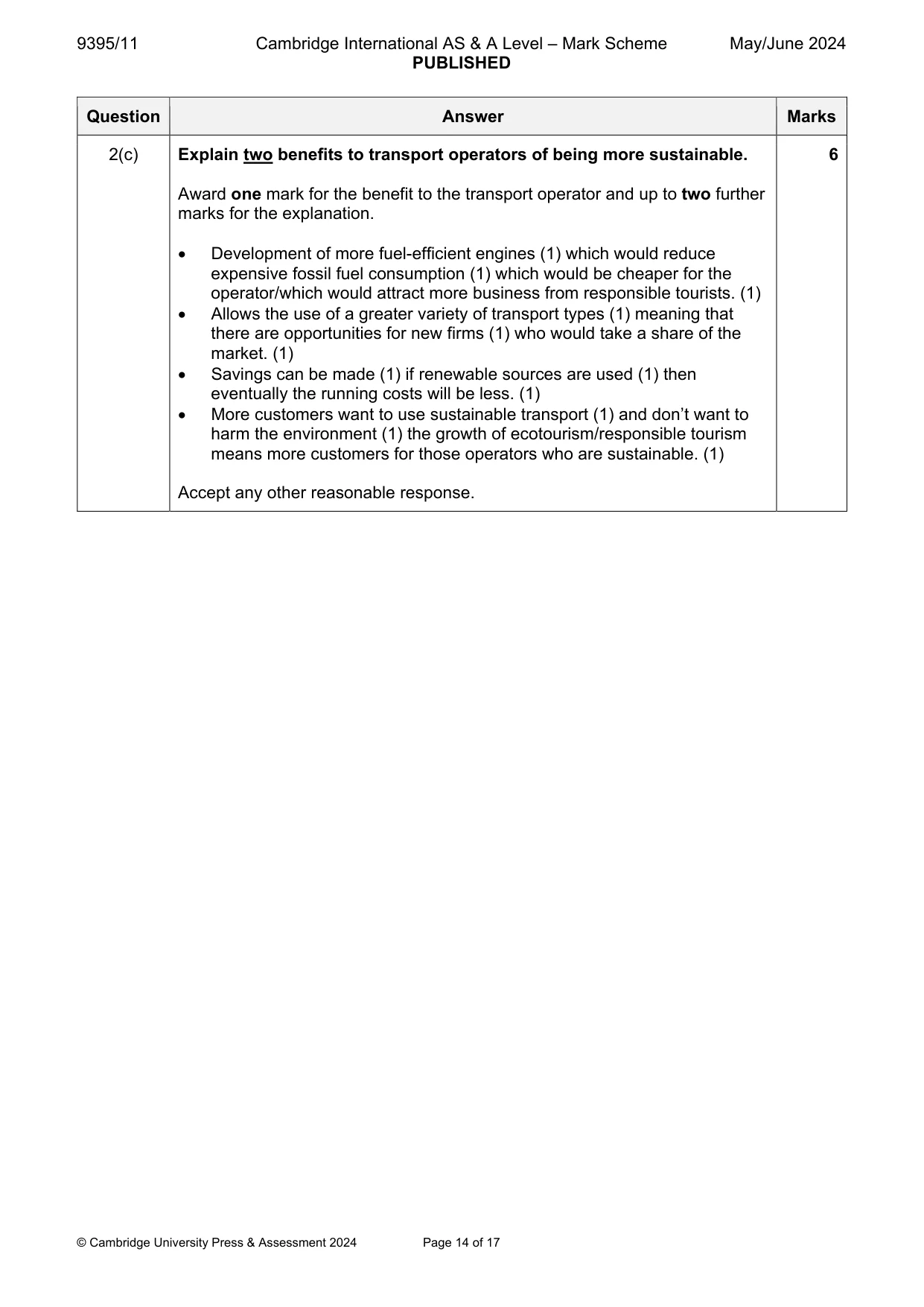
9395/11 Cambridge International AS & A Level – Mark Scheme PUBLISHED May/June 2024 © Cambridge University Press & Assessment 2024 Page 14 of 17 Question Answer Marks 2(c) Explain two benefits to transport operators of being more sustainable. Award one mark for the benefit to the transport operator and up to two further marks for the explanation. Development of more fuel-efficient engines (1) which would reduce expensive fossil fuel consumption (1) which would be cheaper for the operator/which would attract more business from responsible tourists. (1) Allows the use of a greater variety of transport types (1) meaning that there are opportunities for new firms (1) who would take a share of the market. (1) Savings can be made (1) if renewable sources are used (1) then eventually the running costs will be less. (1) More customers want to use sustainable transport (1) and don’t want to harm the environment (1) the growth of ecotourism/responsible tourism means more customers for those operators who are sustainable. (1) Accept any other reasonable response. 6
Mark scheme, page 15
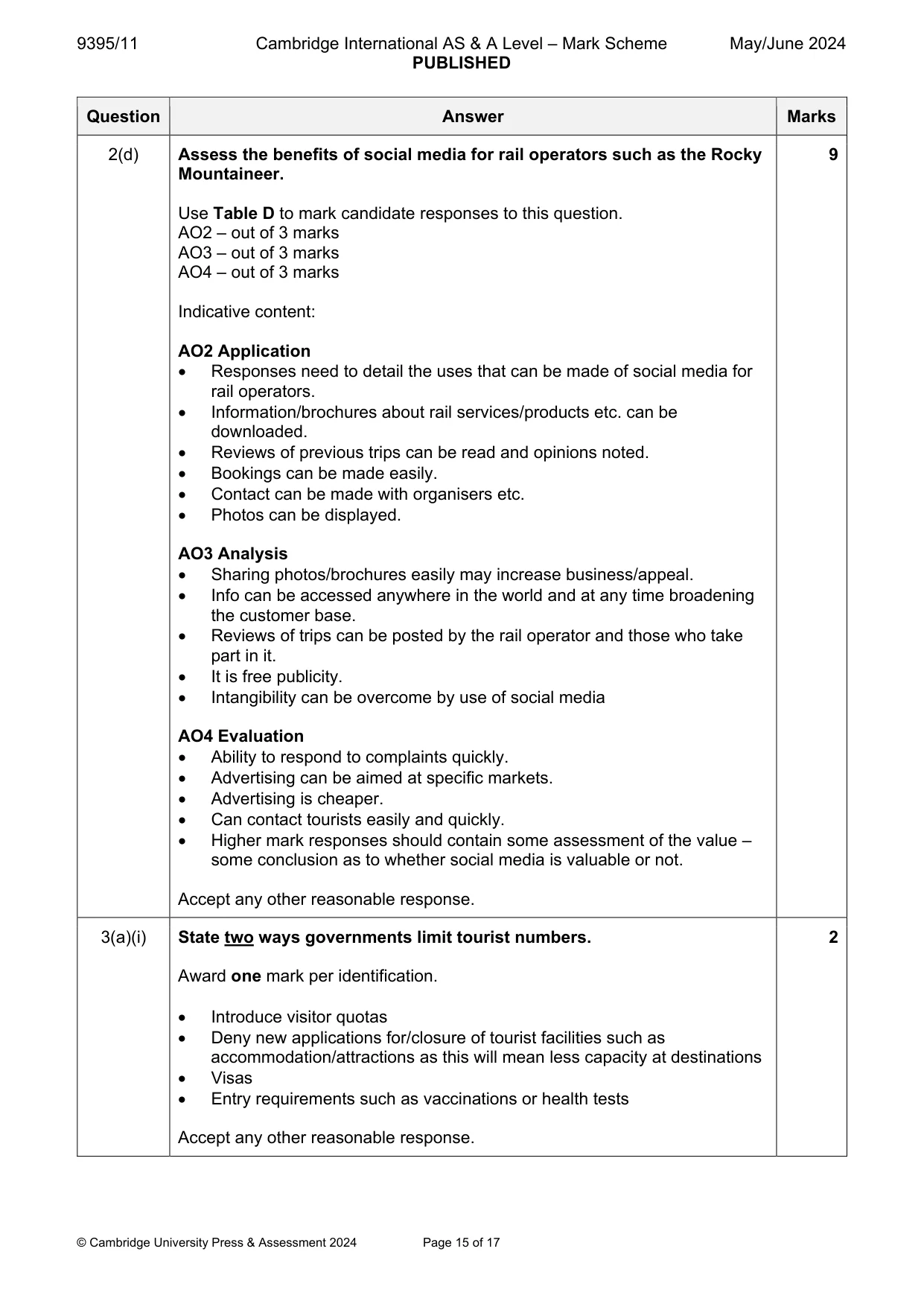
9395/11 Cambridge International AS & A Level – Mark Scheme PUBLISHED May/June 2024 © Cambridge University Press & Assessment 2024 Page 15 of 17 Question Answer Marks 2(d) Assess the benefits of social media for rail operators such as the Rocky Mountaineer. Use Table D to mark candidate responses to this question. AO2 – out of 3 marks AO3 – out of 3 marks AO4 – out of 3 marks Indicative content: AO2 Application Responses need to detail the uses that can be made of social media for rail operators. Information/brochures about rail services/products etc. can be downloaded. Reviews of previous trips can be read and opinions noted. Bookings can be made easily. Contact can be made with organisers etc. Photos can be displayed. AO3 Analysis Sharing photos/brochures easily may increase business/appeal. Info can be accessed anywhere in the world and at any time broadening the customer base. Reviews of trips can be posted by the rail operator and those who take part in it. It is free publicity. Intangibility can be overcome by use of social media AO4 Evaluation Ability to respond to complaints quickly. Advertising can be aimed at specific markets. Advertising is cheaper. Can contact tourists easily and quickly. Higher mark responses should contain some assessment of the value – some conclusion as to whether social media is valuable or not. Accept any other reasonable response. 9 3(a)(i) State two ways governments limit tourist numbers. Award one mark per identification. Introduce visitor quotas Deny new applications for/closure of tourist facilities such as accommodation/attractions as this will mean less capacity at destinations Visas Entry requirements such as vaccinations or health tests Accept any other reasonable response. 2
Mark scheme, page 16
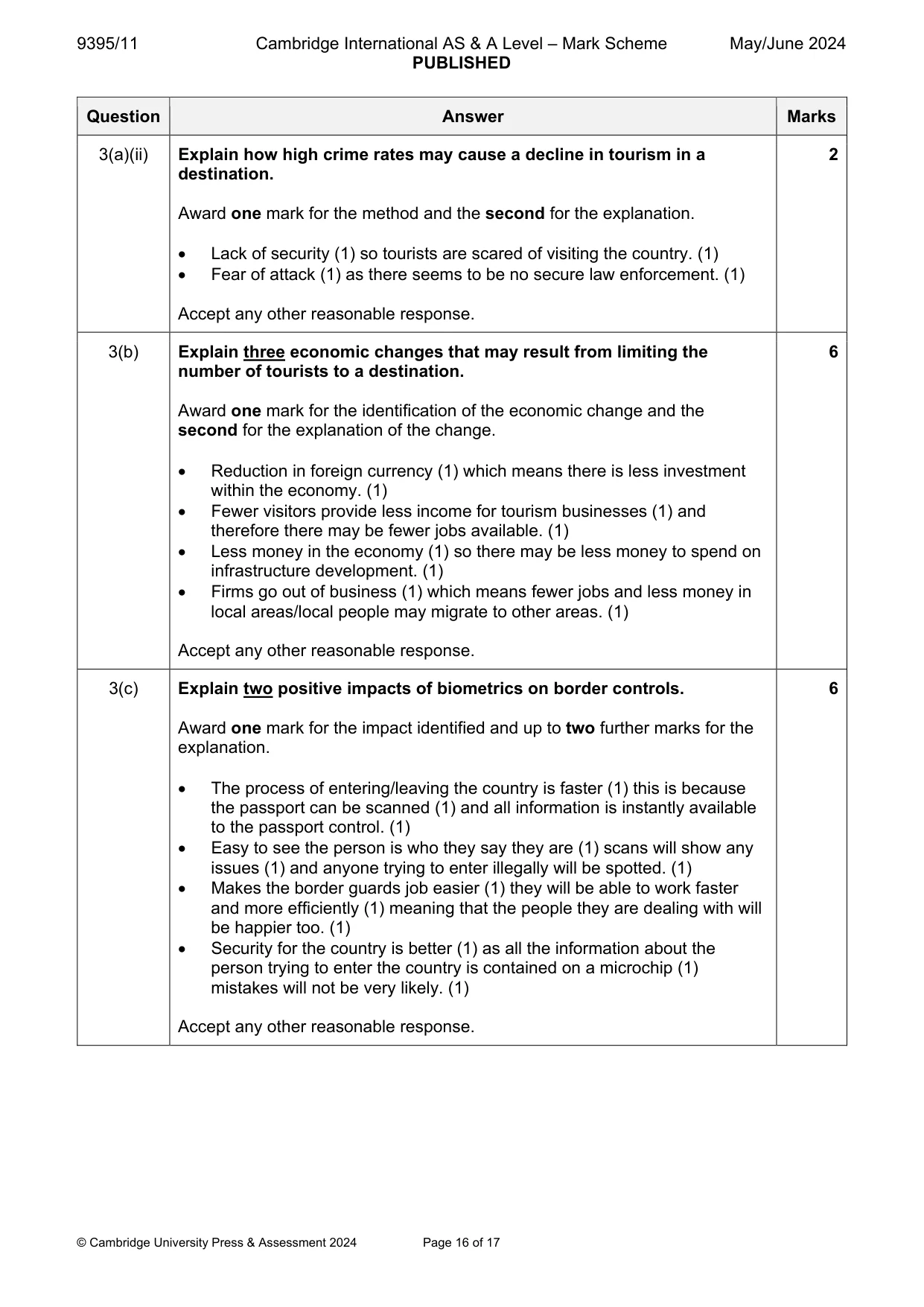
9395/11 Cambridge International AS & A Level – Mark Scheme PUBLISHED May/June 2024 © Cambridge University Press & Assessment 2024 Page 16 of 17 Question Answer Marks 3(a)(ii) Explain how high crime rates may cause a decline in tourism in a destination. Award one mark for the method and the second for the explanation. Lack of security (1) so tourists are scared of visiting the country. (1) Fear of attack (1) as there seems to be no secure law enforcement. (1) Accept any other reasonable response. 2 3(b) Explain three economic changes that may result from limiting the number of tourists to a destination. Award one mark for the identification of the economic change and the second for the explanation of the change. Reduction in foreign currency (1) which means there is less investment within the economy. (1) Fewer visitors provide less income for tourism businesses (1) and therefore there may be fewer jobs available. (1) Less money in the economy (1) so there may be less money to spend on infrastructure development. (1) Firms go out of business (1) which means fewer jobs and less money in local areas/local people may migrate to other areas. (1) Accept any other reasonable response. 6 3(c) Explain two positive impacts of biometrics on border controls. Award one mark for the impact identified and up to two further marks for the explanation. The process of entering/leaving the country is faster (1) this is because the passport can be scanned (1) and all information is instantly available to the passport control. (1) Easy to see the person is who they say they are (1) scans will show any issues (1) and anyone trying to enter illegally will be spotted. (1) Makes the border guards job easier (1) they will be able to work faster and more efficiently (1) meaning that the people they are dealing with will be happier too. (1) Security for the country is better (1) as all the information about the person trying to enter the country is contained on a microchip (1) mistakes will not be very likely. (1) Accept any other reasonable response. 6
Mark scheme, page 17
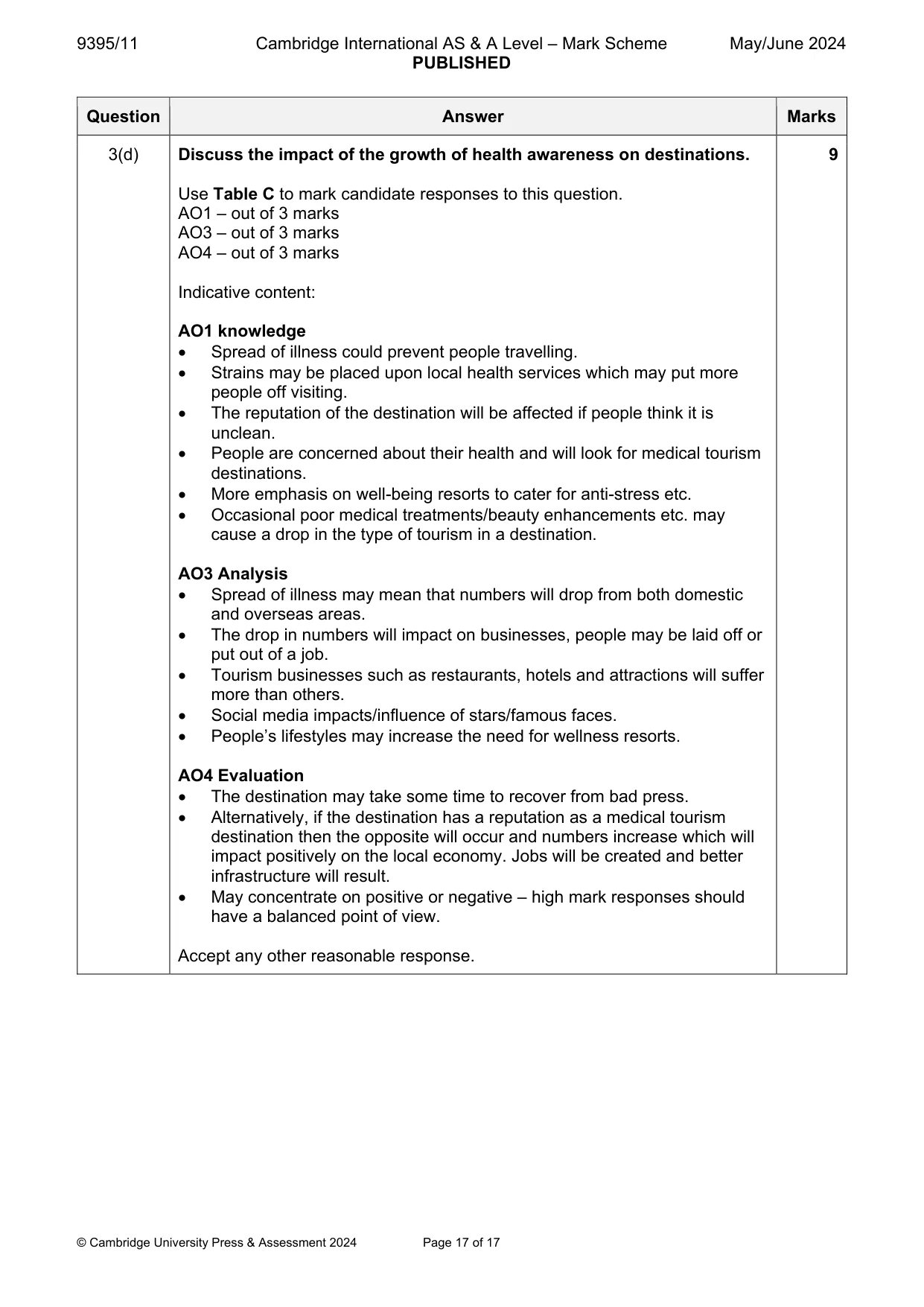
9395/11 Cambridge International AS & A Level – Mark Scheme PUBLISHED May/June 2024 © Cambridge University Press & Assessment 2024 Page 17 of 17 Question Answer Marks 3(d) Discuss the impact of the growth of health awareness on destinations. Use Table C to mark candidate responses to this question. AO1 – out of 3 marks AO3 – out of 3 marks AO4 – out of 3 marks Indicative content: AO1 knowledge Spread of illness could prevent people travelling. Strains may be placed upon local health services which may put more people off visiting. The reputation of the destination will be affected if people think it is unclean. People are concerned about their health and will look for medical tourism destinations. More emphasis on well-being resorts to cater for anti-stress etc. Occasional poor medical treatments/beauty enhancements etc. may cause a drop in the type of tourism in a destination. AO3 Analysis Spread of illness may mean that numbers will drop from both domestic and overseas areas. The drop in numbers will impact on businesses, people may be laid off or put out of a job. Tourism businesses such as restaurants, hotels and attractions will suffer more than others. Social media impacts/influence of stars/famous faces. People’s lifestyles may increase the need for wellness resorts. AO4 Evaluation The destination may take some time to recover from bad press. Alternatively, if the destination has a reputation as a medical tourism destination then the opposite will occur and numbers increase which will impact positively on the local economy. Jobs will be created and better infrastructure will result. May concentrate on positive or negative – high mark responses should have a balanced point of view. Accept any other reasonable response. 9
What you needed in this session
Cambridge’s own grade thresholds for 2024 May/June, Paper 1 · Variant 1. A higher threshold means an easier paper — the bar moves with how the cohort did.