Cambridge A Level Travel and Tourism 9395 — 2019 May/June Paper 1 · Variant 2
9395/12/M/J/19 · 100 marks · ≈113 min
The question paper and its mark scheme, free to read here and free to download. This is Cambridge’s own paper, exactly as it was sat.
Question paper16 pages



Mark scheme11 pages
Answers below. Sit the paper first if you are practising.
Paper as text
Question paper, page 1
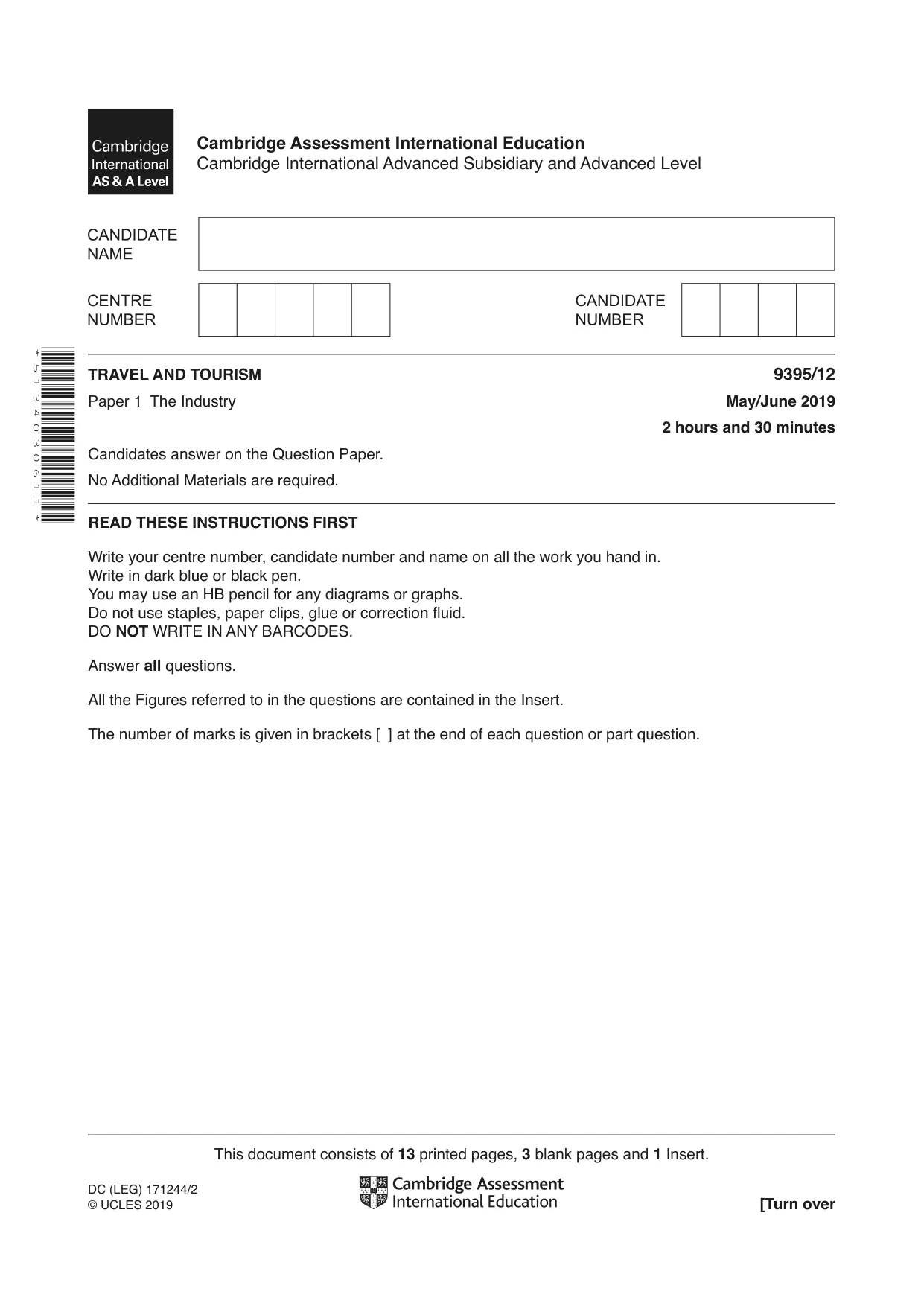
This document consists of 13 printed pages, 3 blank pages and 1 Insert. DC (LEG) 171244/2 © UCLES 2019 [Turn over * 5 1 3 4 0 3 0 6 1 1 * TRAVEL AND TOURISM 9395/12 Paper 1 The Industry May/June 2019 2 hours and 30 minutes Candidates answer on the Question Paper. No Additional Materials are required. READ THESE INSTRUCTIONS FIRST Write your centre number, candidate number and name on all the work you hand in. Write in dark blue or black pen. You may use an HB pencil for any diagrams or graphs. Do not use staples, paper clips, glue or correction fluid. DO NOT WRITE IN ANY BARCODES. Answer all questions. All the Figures referred to in the questions are contained in the Insert. The number of marks is given in brackets [ ] at the end of each question or part question. Cambridge Assessment International Education Cambridge International Advanced Subsidiary and Advanced Level
Question paper, page 2
2 9395/12/M/J/19 © UCLES 2019 1 (a) Define each of the following terms and give an example of each: independent tourism … … example … domestic tourism … … example … [4] (b) Explain three ways a travel agency can meet the needs of families. 1 … … … … 2 … … … … 3 … … … … [6]
Question paper, page 3
3 9395/12/M/J/19 © UCLES 2019 [Turn over (c) Explain two reasons why working as part of an effective team is important for employees of a travel agency. 1 … … … … … … 2 … … … … … … [6]
Question paper, page 4
4 9395/12/M/J/19 © UCLES 2019 (d) Assess the impact that online reservations have had on traditional travel agencies. … … … … … … … … … … … … … … … … … … [9] [Total: 25]
Question paper, page 5
5 9395/12/M/J/19 © UCLES 2019 [Turn over 2 Refer to Fig. 2.1 (Insert), photographs of tropical islands. (a) Identify four characteristics of the tropical islands shown in Fig. 2.1 that would appeal to tourists. 1 … … 2 … … 3 … … 4 … … [4] (b) Explain three ways natural disasters could cause problems for the tourist industry on the tropical islands shown in Fig. 2.1. 1 … … … … 2 … … … … 3 … … … … [6]
Question paper, page 6
6 9395/12/M/J/19 © UCLES 2019 (c) Explain two ways island destinations might meet the demands for budget and luxury products. 1 … … … … … … 2 … … … … … … [6]
Question paper, page 7
7 9395/12/M/J/19 © UCLES 2019 [Turn over (d) Discuss how increased accessibility to island destinations has encouraged the development of tourism on islands such as those shown in Fig. 2.1. … … … … … … … … … … … … … … … … … … [9] [Total: 25]
Question paper, page 8
8 9395/12/M/J/19 © UCLES 2019 3 Refer to Fig. 3.1 (Insert), photographs of street food vendors. (a) Suggest four possible risks for the street vendors shown in Fig. 3.1. 1 … … 2 … … 3 … … 4 … … [4] (b) Explain three likely impacts of good customer service for a food outlet. 1 … … … … 2 … … … … 3 … … … … [6]
Question paper, page 9
9 9395/12/M/J/19 © UCLES 2019 [Turn over (c) Explain three ways food outlets get customer feedback. 1 … … … … 2 … … … … 3 … … … … [6]
Question paper, page 10
10 9395/12/M/J/19 © UCLES 2019 (d) Evaluate the effectiveness of the street vendors shown in Fig. 3.1 in meeting customer demands. … … … … … … … … … … … … … … … … … … [9] [Total: 25]
Question paper, page 11
11 9395/12/M/J/19 © UCLES 2019 [Turn over 4 Refer to Fig. 4.1 (Insert), information about tourism in Antarctica. (a) (i) Describe the trend in total visitor numbers to Antarctica. … … … … [2] (ii) Suggest why there is a difference between the number of visitors who land in Antarctica and those who do not. … … … … [2] (b) Explain three environmental reasons why large ships no longer visit Antarctica. 1 … … … … 2 … … … … 3 … … … … [6]
Question paper, page 12
12 9395/12/M/J/19 © UCLES 2019 (c) Explain two reasons why ecotourists may wish to visit Antarctica. 1 … … … … … … 2 … … … … … … [6]
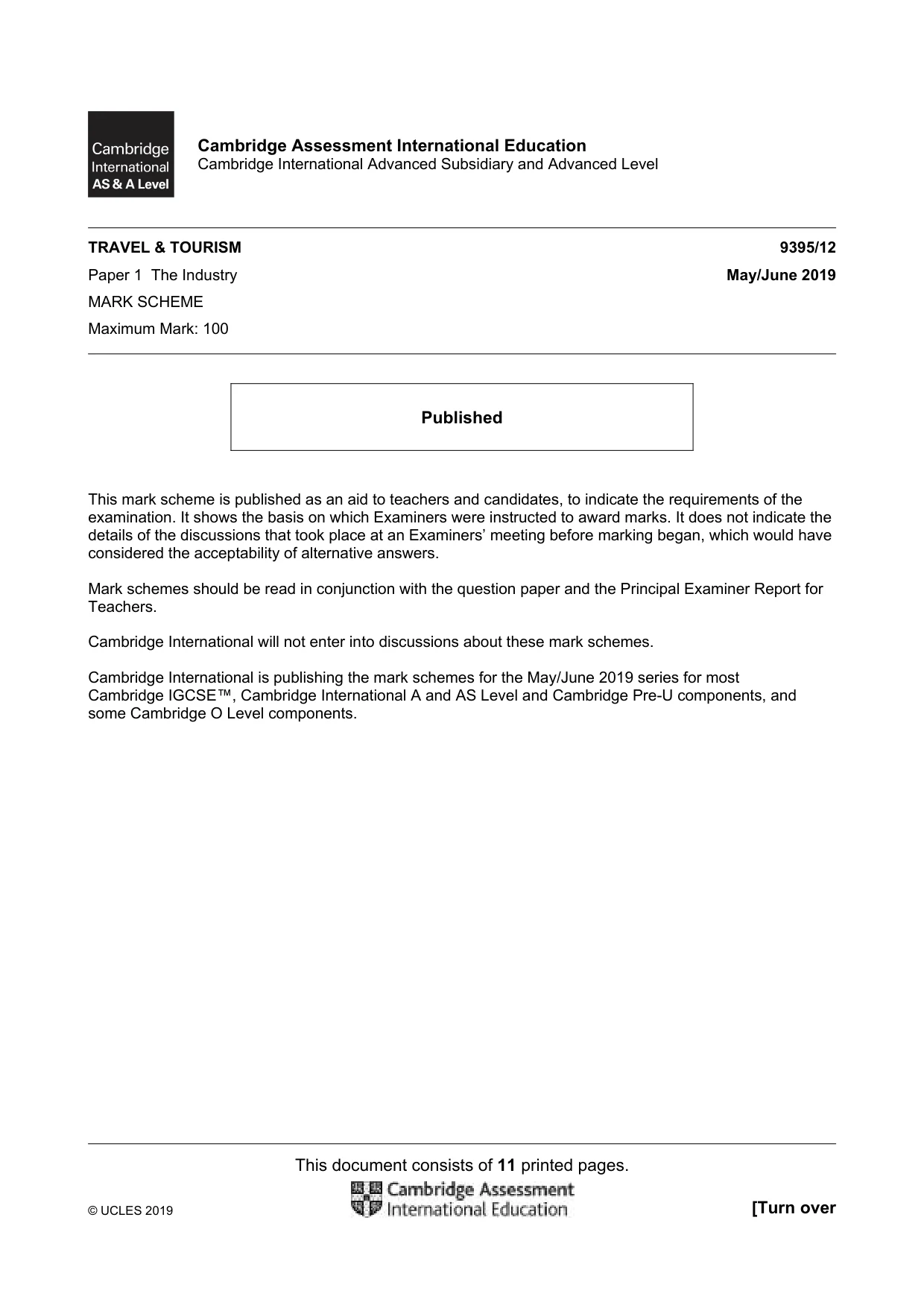
Question paper, page 13
13 9395/12/M/J/19 © UCLES 2019 (d) Analyse the influence associations, such as the International Association of Antarctic Tour Operators (IAATO), have on tourism. … … … … … … … … … … … … … … … … … … [9] [Total: 25]
Question paper, page 14
14 9395/12/M/J/19 © UCLES 2019 BLANK PAGE
Question paper, page 15
15 9395/12/M/J/19 © UCLES 2019 BLANK PAGE
Question paper, page 16
16 9395/12/M/J/19 © UCLES 2019 Permission to reproduce items where third-party owned material protected by copyright is included has been sought and cleared where possible. Every reasonable effort has been made by the publisher (UCLES) to trace copyright holders, but if any items requiring clearance have unwittingly been included, the publisher will be pleased to make amends at the earliest possible opportunity. To avoid the issue of disclosure of answer-related information to candidates, all copyright acknowledgements are reproduced online in the Cambridge Assessment International Education Copyright Acknowledgements Booklet. This is produced for each series of examinations and is freely available to download at www.cambridgeinternational.org after the live examination series. Cambridge Assessment International Education is part of the Cambridge Assessment Group. Cambridge Assessment is the brand name of the University of Cambridge Local Examinations Syndicate (UCLES), which itself is a department of the University of Cambridge. BLANK PAGE
Mark scheme, page 1
This document consists of 11 printed pages. © UCLES 2019 [Turn over Cambridge Assessment International Education Cambridge International Advanced Subsidiary and Advanced Level TRAVEL & TOURISM 9395/12 Paper 1 The Industry May/June 2019 MARK SCHEME Maximum Mark: 100 Published This mark scheme is published as an aid to teachers and candidates, to indicate the requirements of the examination. It shows the basis on which Examiners were instructed to award marks. It does not indicate the details of the discussions that took place at an Examiners’ meeting before marking began, which would have considered the acceptability of alternative answers. Mark schemes should be read in conjunction with the question paper and the Principal Examiner Report for Teachers. Cambridge International will not enter into discussions about these mark schemes. Cambridge International is publishing the mark schemes for the May/June 2019 series for most Cambridge IGCSE™, Cambridge International A and AS Level and Cambridge Pre-U components, and some Cambridge O Level components.
Mark scheme, page 2
9395/12 Cambridge International AS/A Level – Mark Scheme PUBLISHED May/June 2019 © UCLES 2019 Page 2 of 11 Generic Marking Principles These general marking principles must be applied by all examiners when marking candidate answers. They should be applied alongside the specific content of the mark scheme or generic level descriptors for a question. Each question paper and mark scheme will also comply with these marking principles. GENERIC MARKING PRINCIPLE 1: Marks must be awarded in line with: • the specific content of the mark scheme or the generic level descriptors for the question • the specific skills defined in the mark scheme or in the generic level descriptors for the question • the standard of response required by a candidate as exemplified by the standardisation scripts. GENERIC MARKING PRINCIPLE 2: Marks awarded are always whole marks (not half marks, or other fractions). GENERIC MARKING PRINCIPLE 3: Marks must be awarded positively: • marks are awarded for correct/valid answers, as defined in the mark scheme. However, credit is given for valid answers which go beyond the scope of the syllabus and mark scheme, referring to your Team Leader as appropriate • marks are awarded when candidates clearly demonstrate what they know and can do • marks are not deducted for errors • marks are not deducted for omissions • answers should only be judged on the quality of spelling, punctuation and grammar when these features are specifically assessed by the question as indicated by the mark scheme. The meaning, however, should be unambiguous. GENERIC MARKING PRINCIPLE 4: Rules must be applied consistently e.g. in situations where candidates have not followed instructions or in the application of generic level descriptors. GENERIC MARKING PRINCIPLE 5: Marks should be awarded using the full range of marks defined in the mark scheme for the question (however; the use of the full mark range may be limited according to the quality of the candidate responses seen). GENERIC MARKING PRINCIPLE 6: Marks awarded are based solely on the requirements as defined in the mark scheme. Marks should not be awarded with grade thresholds or grade descriptors in mind.
Mark scheme, page 3
9395/12 Cambridge International AS/A Level – Mark Scheme PUBLISHED May/June 2019 © UCLES 2019 Page 3 of 11 Question Answer Marks 1(a) Define each of the following terms and give an example of each. Award one mark for the definition and the second mark for the example. Independent tourism • Occurs when tourists book their own travel and accommodation packages without any reference to travel agencies (1) for example booking a flight and hotel for a city break via internet sites.(1) • Tourists book own hotel and attraction tickets before they travel as they will not have a representative to help them. (1) Booking directly with the hotel and attraction (1) Domestic tourism • Refers to travel in the home country (1) this is people who are visiting places within the country and are not travelling abroad. (1) • Visitors who are travelling in their own country (1) such as ‘staycations’ (1) Accept any other reasonable answer. 4 1(b) Explain three ways a travel agency can meet the needs of families. Award one mark for the identification and the second mark for the explanation. • Travel agencies can search through a large number of tour operators quickly (1) and they will have expert knowledge of good destinations (1). • Travel agencies can provide discounts for families (1) and therefore the holiday will be cheaper (1). • Travel agency staff can advise on the best destinations (1) and will be able to sort out good accommodation for families (1). • It will be quicker to go to the travel agents (1) as they will be able to do everything for family and you will be able to book insurance and excursion tickets or car hire with them (1). Accept any other reasonable answer. 6 1(c) Explain two reasons why working as part of an effective team is important for employees of a travel agency. Award one mark for the reason and up to two marks for the explanation. • Team work is important as it shows how efficient the agency can be (1) and more customers will come (1) this may result in bonuses for the staff (1). • Efficient teams will bring in business (1) this will give the agency a competitive edge (1) and will help ensure its survival (1). • Efficient team members provide good customer service (1) and this will ensure repeat business (1) and happy customers will spread news about the agency and its customer base will grow (1). Accept any other reasonable answer. 6
Mark scheme, page 4
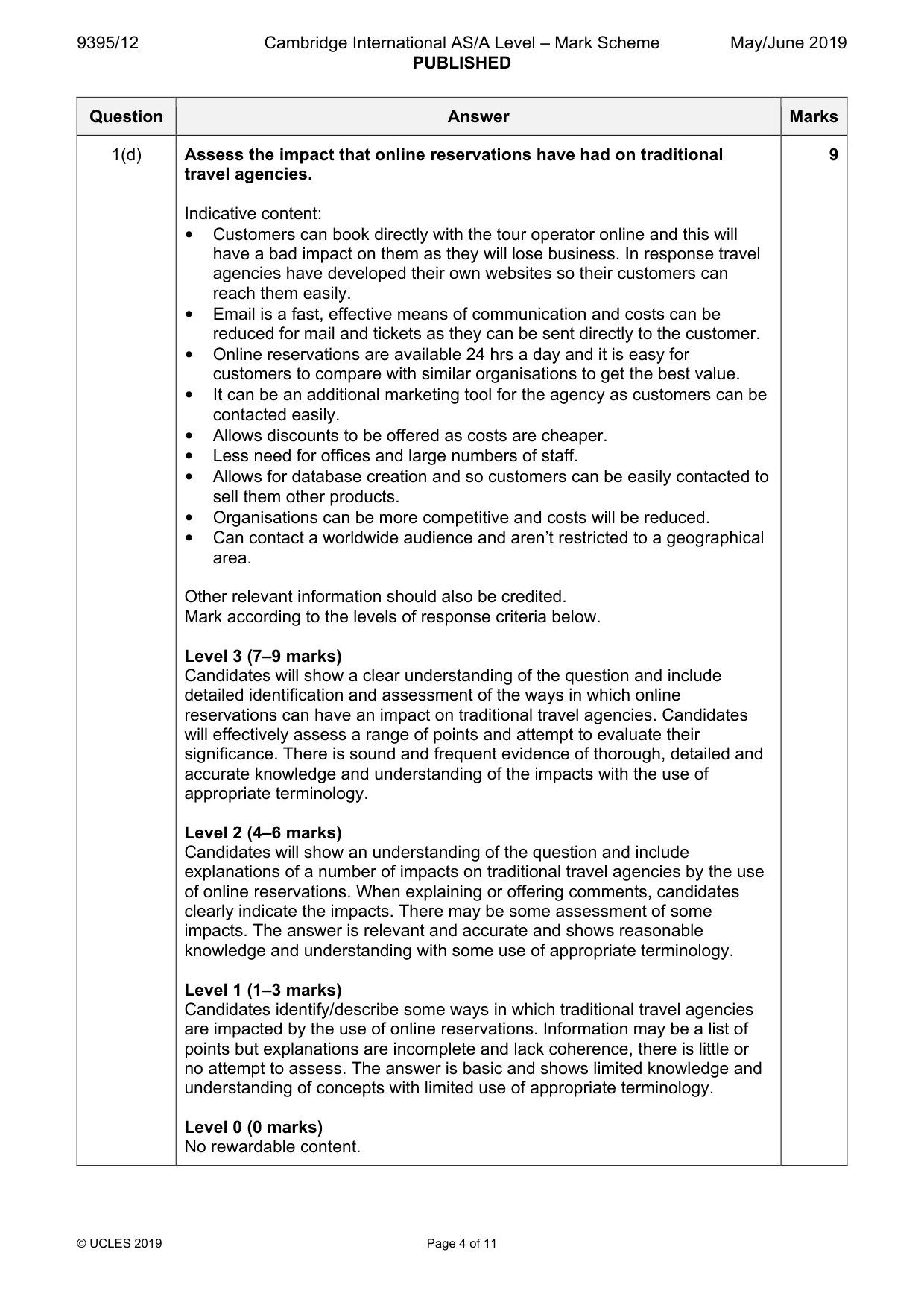
9395/12 Cambridge International AS/A Level – Mark Scheme PUBLISHED May/June 2019 © UCLES 2019 Page 4 of 11 Question Answer Marks 1(d) Assess the impact that online reservations have had on traditional travel agencies. Indicative content: • Customers can book directly with the tour operator online and this will have a bad impact on them as they will lose business. In response travel agencies have developed their own websites so their customers can reach them easily. • Email is a fast, effective means of communication and costs can be reduced for mail and tickets as they can be sent directly to the customer. • Online reservations are available 24 hrs a day and it is easy for customers to compare with similar organisations to get the best value. • It can be an additional marketing tool for the agency as customers can be contacted easily. • Allows discounts to be offered as costs are cheaper. • Less need for offices and large numbers of staff. • Allows for database creation and so customers can be easily contacted to sell them other products. • Organisations can be more competitive and costs will be reduced. • Can contact a worldwide audience and aren’t restricted to a geographical area. Other relevant information should also be credited. Mark according to the levels of response criteria below. Level 3 (7–9 marks) Candidates will show a clear understanding of the question and include detailed identification and assessment of the ways in which online reservations can have an impact on traditional travel agencies. Candidates will effectively assess a range of points and attempt to evaluate their significance. There is sound and frequent evidence of thorough, detailed and accurate knowledge and understanding of the impacts with the use of appropriate terminology. Level 2 (4–6 marks) Candidates will show an understanding of the question and include explanations of a number of impacts on traditional travel agencies by the use of online reservations. When explaining or offering comments, candidates clearly indicate the impacts. There may be some assessment of some impacts. The answer is relevant and accurate and shows reasonable knowledge and understanding with some use of appropriate terminology. Level 1 (1–3 marks) Candidates identify/describe some ways in which traditional travel agencies are impacted by the use of online reservations. Information may be a list of points but explanations are incomplete and lack coherence, there is little or no attempt to assess. The answer is basic and shows limited knowledge and understanding of concepts with limited use of appropriate terminology. Level 0 (0 marks) No rewardable content. 9
Mark scheme, page 5
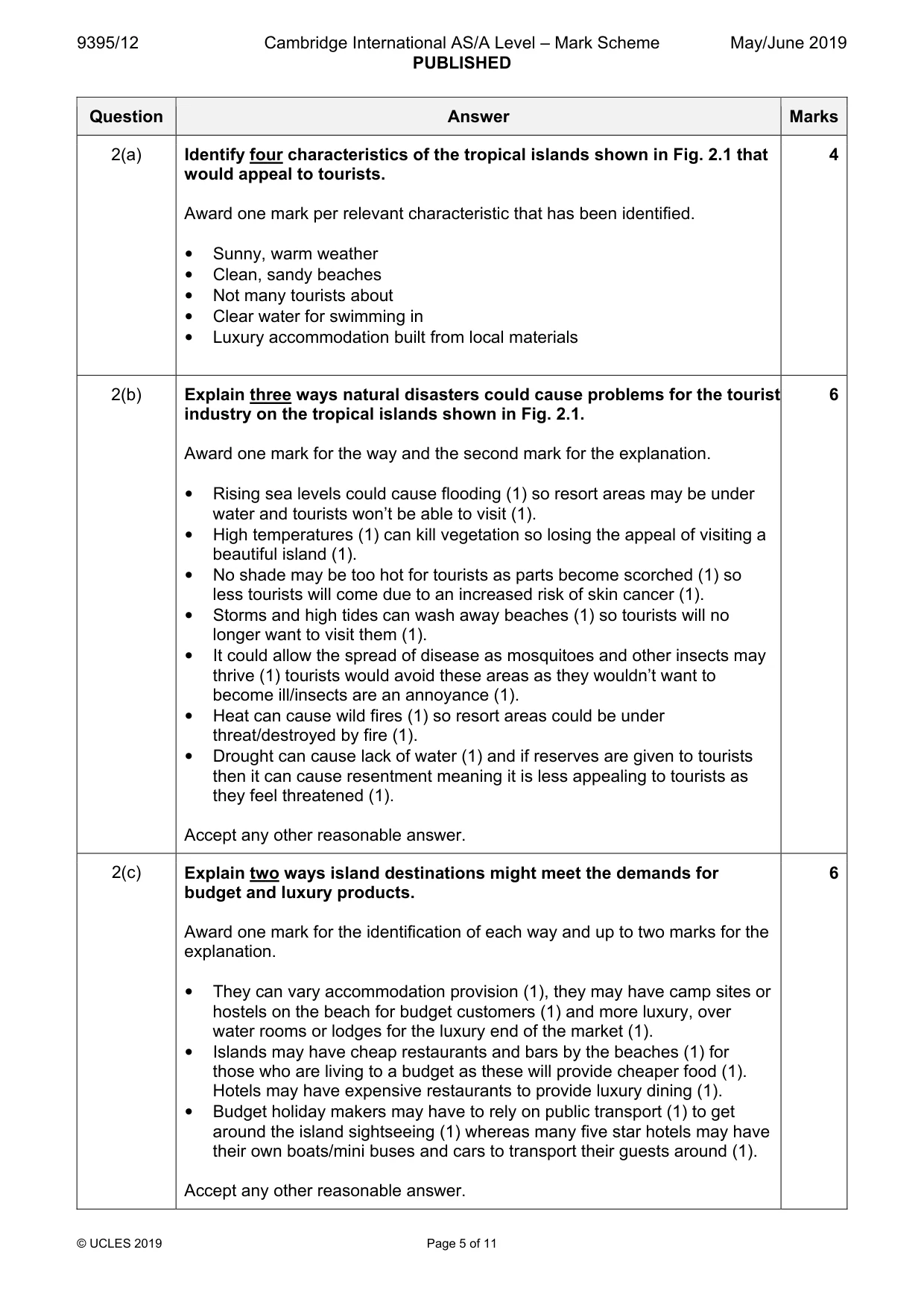
9395/12 Cambridge International AS/A Level – Mark Scheme PUBLISHED May/June 2019 © UCLES 2019 Page 5 of 11 Question Answer Marks 2(a) Identify four characteristics of the tropical islands shown in Fig. 2.1 that would appeal to tourists. Award one mark per relevant characteristic that has been identified. • Sunny, warm weather • Clean, sandy beaches • Not many tourists about • Clear water for swimming in • Luxury accommodation built from local materials 4 2(b) Explain three ways natural disasters could cause problems for the tourist industry on the tropical islands shown in Fig. 2.1. Award one mark for the way and the second mark for the explanation. • Rising sea levels could cause flooding (1) so resort areas may be under water and tourists won’t be able to visit (1). • High temperatures (1) can kill vegetation so losing the appeal of visiting a beautiful island (1). • No shade may be too hot for tourists as parts become scorched (1) so less tourists will come due to an increased risk of skin cancer (1). • Storms and high tides can wash away beaches (1) so tourists will no longer want to visit them (1). • It could allow the spread of disease as mosquitoes and other insects may thrive (1) tourists would avoid these areas as they wouldn’t want to become ill/insects are an annoyance (1). • Heat can cause wild fires (1) so resort areas could be under threat/destroyed by fire (1). • Drought can cause lack of water (1) and if reserves are given to tourists then it can cause resentment meaning it is less appealing to tourists as they feel threatened (1). Accept any other reasonable answer. 6 2(c) Explain two ways island destinations might meet the demands for budget and luxury products. Award one mark for the identification of each way and up to two marks for the explanation. • They can vary accommodation provision (1), they may have camp sites or hostels on the beach for budget customers (1) and more luxury, over water rooms or lodges for the luxury end of the market (1). • Islands may have cheap restaurants and bars by the beaches (1) for those who are living to a budget as these will provide cheaper food (1). Hotels may have expensive restaurants to provide luxury dining (1). • Budget holiday makers may have to rely on public transport (1) to get around the island sightseeing (1) whereas many five star hotels may have their own boats/mini buses and cars to transport their guests around (1). Accept any other reasonable answer. 6
Mark scheme, page 6
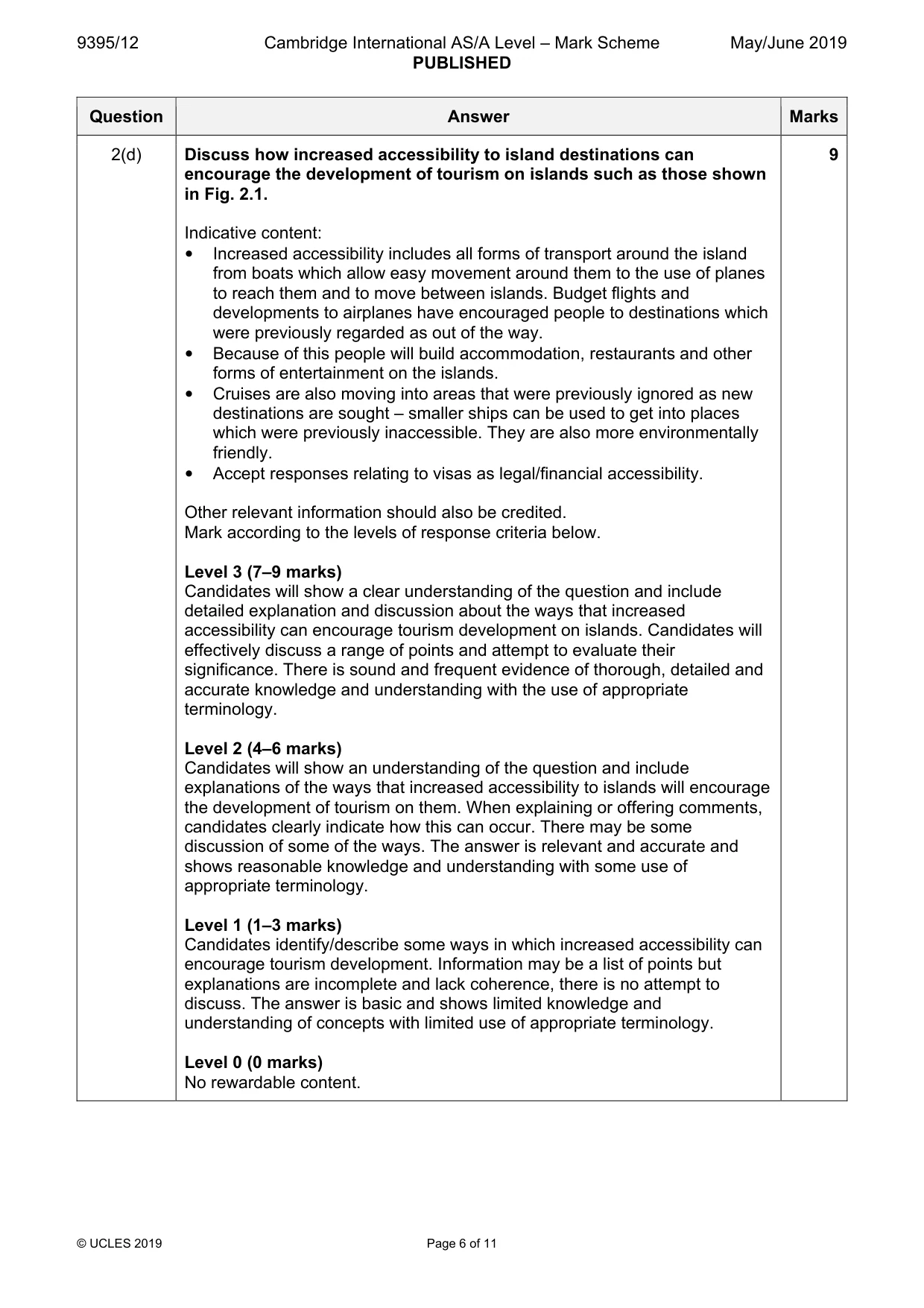
9395/12 Cambridge International AS/A Level – Mark Scheme PUBLISHED May/June 2019 © UCLES 2019 Page 6 of 11 Question Answer Marks 2(d) Discuss how increased accessibility to island destinations can encourage the development of tourism on islands such as those shown in Fig. 2.1. Indicative content: • Increased accessibility includes all forms of transport around the island from boats which allow easy movement around them to the use of planes to reach them and to move between islands. Budget flights and developments to airplanes have encouraged people to destinations which were previously regarded as out of the way. • Because of this people will build accommodation, restaurants and other forms of entertainment on the islands. • Cruises are also moving into areas that were previously ignored as new destinations are sought – smaller ships can be used to get into places which were previously inaccessible. They are also more environmentally friendly. • Accept responses relating to visas as legal/financial accessibility. Other relevant information should also be credited. Mark according to the levels of response criteria below. Level 3 (7–9 marks) Candidates will show a clear understanding of the question and include detailed explanation and discussion about the ways that increased accessibility can encourage tourism development on islands. Candidates will effectively discuss a range of points and attempt to evaluate their significance. There is sound and frequent evidence of thorough, detailed and accurate knowledge and understanding with the use of appropriate terminology. Level 2 (4–6 marks) Candidates will show an understanding of the question and include explanations of the ways that increased accessibility to islands will encourage the development of tourism on them. When explaining or offering comments, candidates clearly indicate how this can occur. There may be some discussion of some of the ways. The answer is relevant and accurate and shows reasonable knowledge and understanding with some use of appropriate terminology. Level 1 (1–3 marks) Candidates identify/describe some ways in which increased accessibility can encourage tourism development. Information may be a list of points but explanations are incomplete and lack coherence, there is no attempt to discuss. The answer is basic and shows limited knowledge and understanding of concepts with limited use of appropriate terminology. Level 0 (0 marks) No rewardable content. 9
Mark scheme, page 7
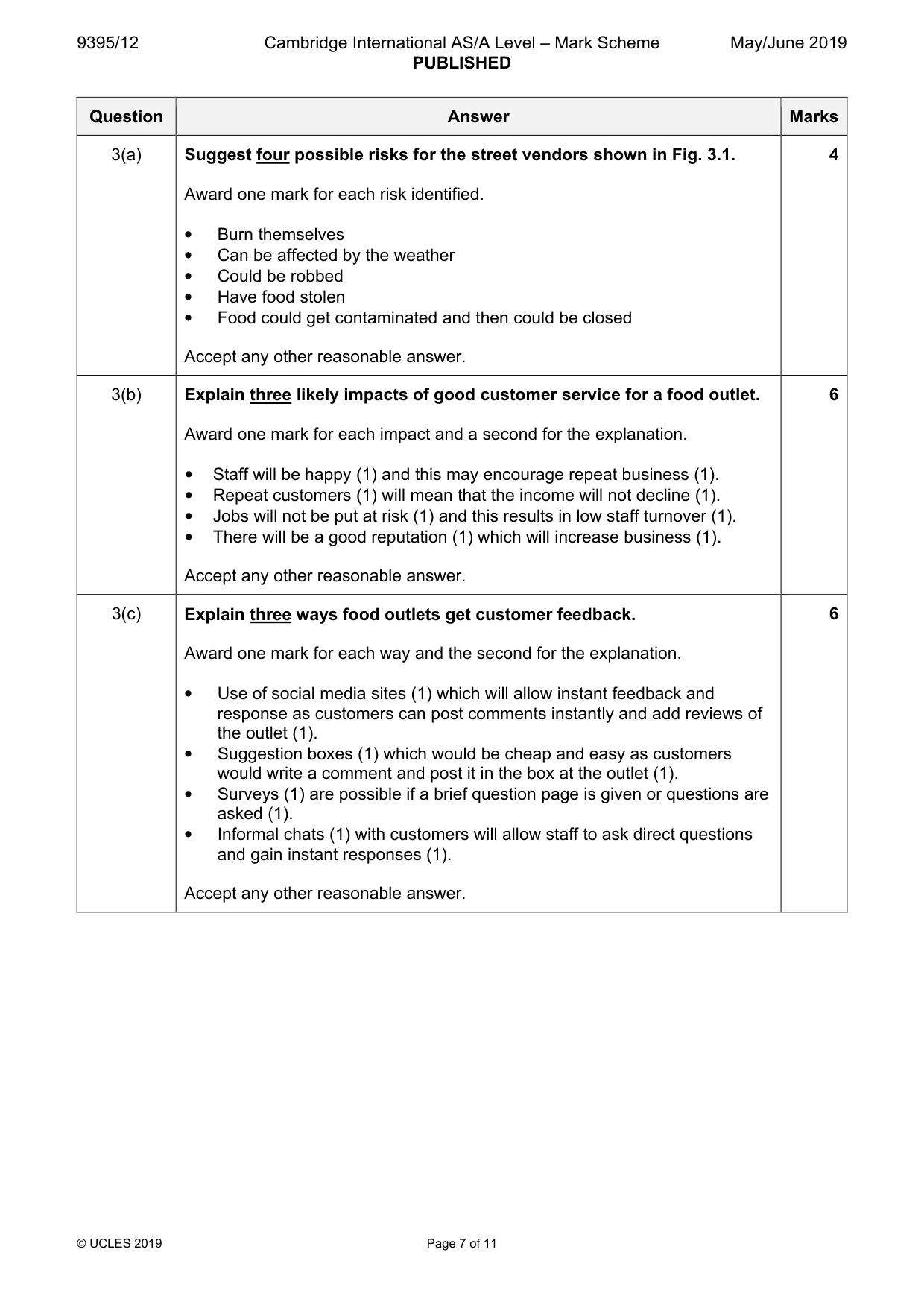
9395/12 Cambridge International AS/A Level – Mark Scheme PUBLISHED May/June 2019 © UCLES 2019 Page 7 of 11 Question Answer Marks 3(a) Suggest four possible risks for the street vendors shown in Fig. 3.1. Award one mark for each risk identified. • Burn themselves • Can be affected by the weather • Could be robbed • Have food stolen • Food could get contaminated and then could be closed Accept any other reasonable answer. 4 3(b) Explain three likely impacts of good customer service for a food outlet. Award one mark for each impact and a second for the explanation. • Staff will be happy (1) and this may encourage repeat business (1). • Repeat customers (1) will mean that the income will not decline (1). • Jobs will not be put at risk (1) and this results in low staff turnover (1). • There will be a good reputation (1) which will increase business (1). Accept any other reasonable answer. 6 3(c) Explain three ways food outlets get customer feedback. Award one mark for each way and the second for the explanation. • Use of social media sites (1) which will allow instant feedback and response as customers can post comments instantly and add reviews of the outlet (1). • Suggestion boxes (1) which would be cheap and easy as customers would write a comment and post it in the box at the outlet (1). • Surveys (1) are possible if a brief question page is given or questions are asked (1). • Informal chats (1) with customers will allow staff to ask direct questions and gain instant responses (1). Accept any other reasonable answer. 6
Mark scheme, page 8
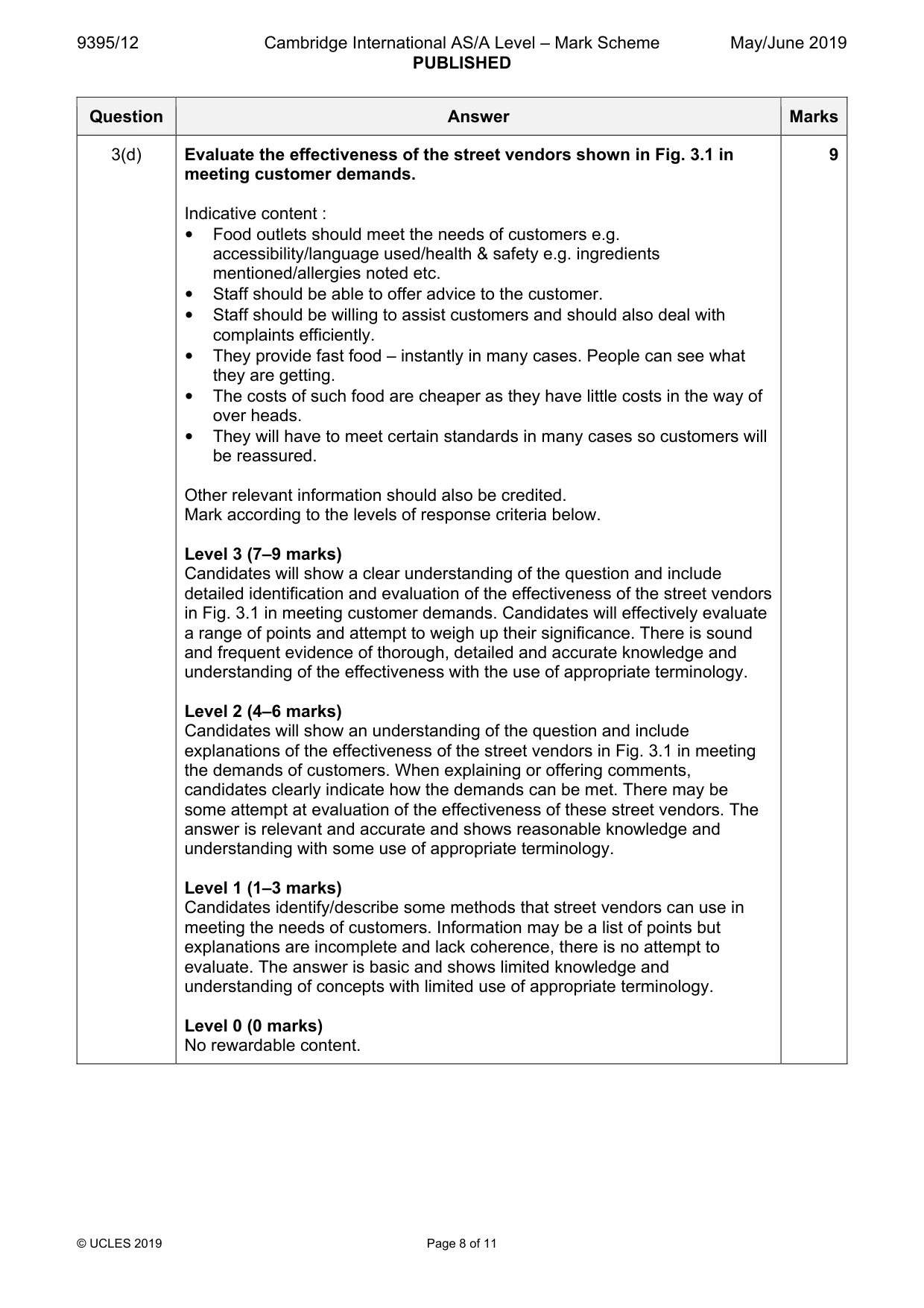
9395/12 Cambridge International AS/A Level – Mark Scheme PUBLISHED May/June 2019 © UCLES 2019 Page 8 of 11 Question Answer Marks 3(d) Evaluate the effectiveness of the street vendors shown in Fig. 3.1 in meeting customer demands. Indicative content : • Food outlets should meet the needs of customers e.g. accessibility/language used/health & safety e.g. ingredients mentioned/allergies noted etc. • Staff should be able to offer advice to the customer. • Staff should be willing to assist customers and should also deal with complaints efficiently. • They provide fast food – instantly in many cases. People can see what they are getting. • The costs of such food are cheaper as they have little costs in the way of over heads. • They will have to meet certain standards in many cases so customers will be reassured. Other relevant information should also be credited. Mark according to the levels of response criteria below. Level 3 (7–9 marks) Candidates will show a clear understanding of the question and include detailed identification and evaluation of the effectiveness of the street vendors in Fig. 3.1 in meeting customer demands. Candidates will effectively evaluate a range of points and attempt to weigh up their significance. There is sound and frequent evidence of thorough, detailed and accurate knowledge and understanding of the effectiveness with the use of appropriate terminology. Level 2 (4–6 marks) Candidates will show an understanding of the question and include explanations of the effectiveness of the street vendors in Fig. 3.1 in meeting the demands of customers. When explaining or offering comments, candidates clearly indicate how the demands can be met. There may be some attempt at evaluation of the effectiveness of these street vendors. The answer is relevant and accurate and shows reasonable knowledge and understanding with some use of appropriate terminology. Level 1 (1–3 marks) Candidates identify/describe some methods that street vendors can use in meeting the needs of customers. Information may be a list of points but explanations are incomplete and lack coherence, there is no attempt to evaluate. The answer is basic and shows limited knowledge and understanding of concepts with limited use of appropriate terminology. Level 0 (0 marks) No rewardable content. 9
Mark scheme, page 9
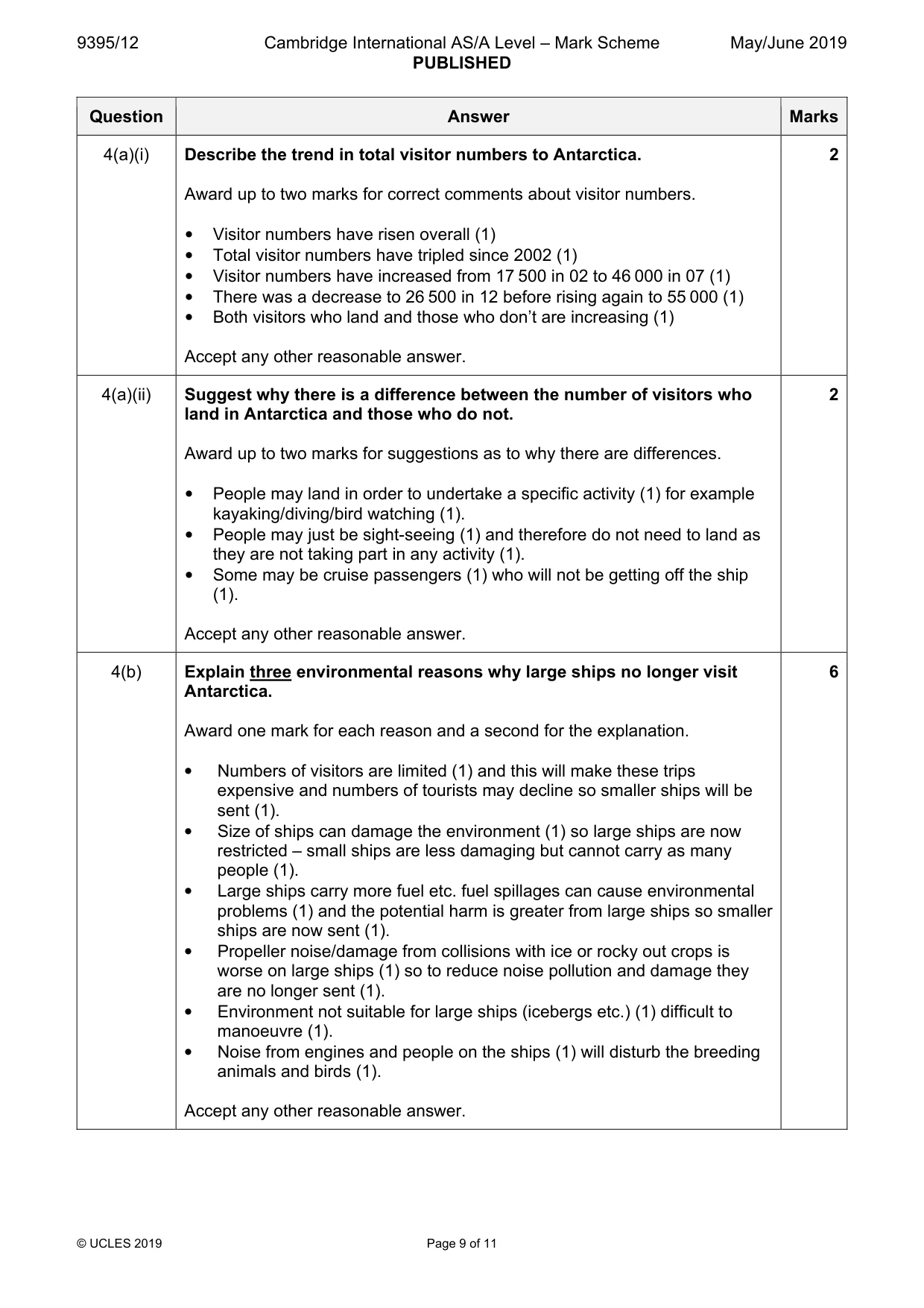
9395/12 Cambridge International AS/A Level – Mark Scheme PUBLISHED May/June 2019 © UCLES 2019 Page 9 of 11 Question Answer Marks 4(a)(i) Describe the trend in total visitor numbers to Antarctica. Award up to two marks for correct comments about visitor numbers. • Visitor numbers have risen overall (1) • Total visitor numbers have tripled since 2002 (1) • Visitor numbers have increased from 17 500 in 02 to 46 000 in 07 (1) • There was a decrease to 26 500 in 12 before rising again to 55 000 (1) • Both visitors who land and those who don’t are increasing (1) Accept any other reasonable answer. 2 4(a)(ii) Suggest why there is a difference between the number of visitors who land in Antarctica and those who do not. Award up to two marks for suggestions as to why there are differences. • People may land in order to undertake a specific activity (1) for example kayaking/diving/bird watching (1). • People may just be sight-seeing (1) and therefore do not need to land as they are not taking part in any activity (1). • Some may be cruise passengers (1) who will not be getting off the ship (1). Accept any other reasonable answer. 2 4(b) Explain three environmental reasons why large ships no longer visit Antarctica. Award one mark for each reason and a second for the explanation. • Numbers of visitors are limited (1) and this will make these trips expensive and numbers of tourists may decline so smaller ships will be sent (1). • Size of ships can damage the environment (1) so large ships are now restricted – small ships are less damaging but cannot carry as many people (1). • Large ships carry more fuel etc. fuel spillages can cause environmental problems (1) and the potential harm is greater from large ships so smaller ships are now sent (1). • Propeller noise/damage from collisions with ice or rocky out crops is worse on large ships (1) so to reduce noise pollution and damage they are no longer sent (1). • Environment not suitable for large ships (icebergs etc.) (1) difficult to manoeuvre (1). • Noise from engines and people on the ships (1) will disturb the breeding animals and birds (1). Accept any other reasonable answer. 6
Mark scheme, page 10
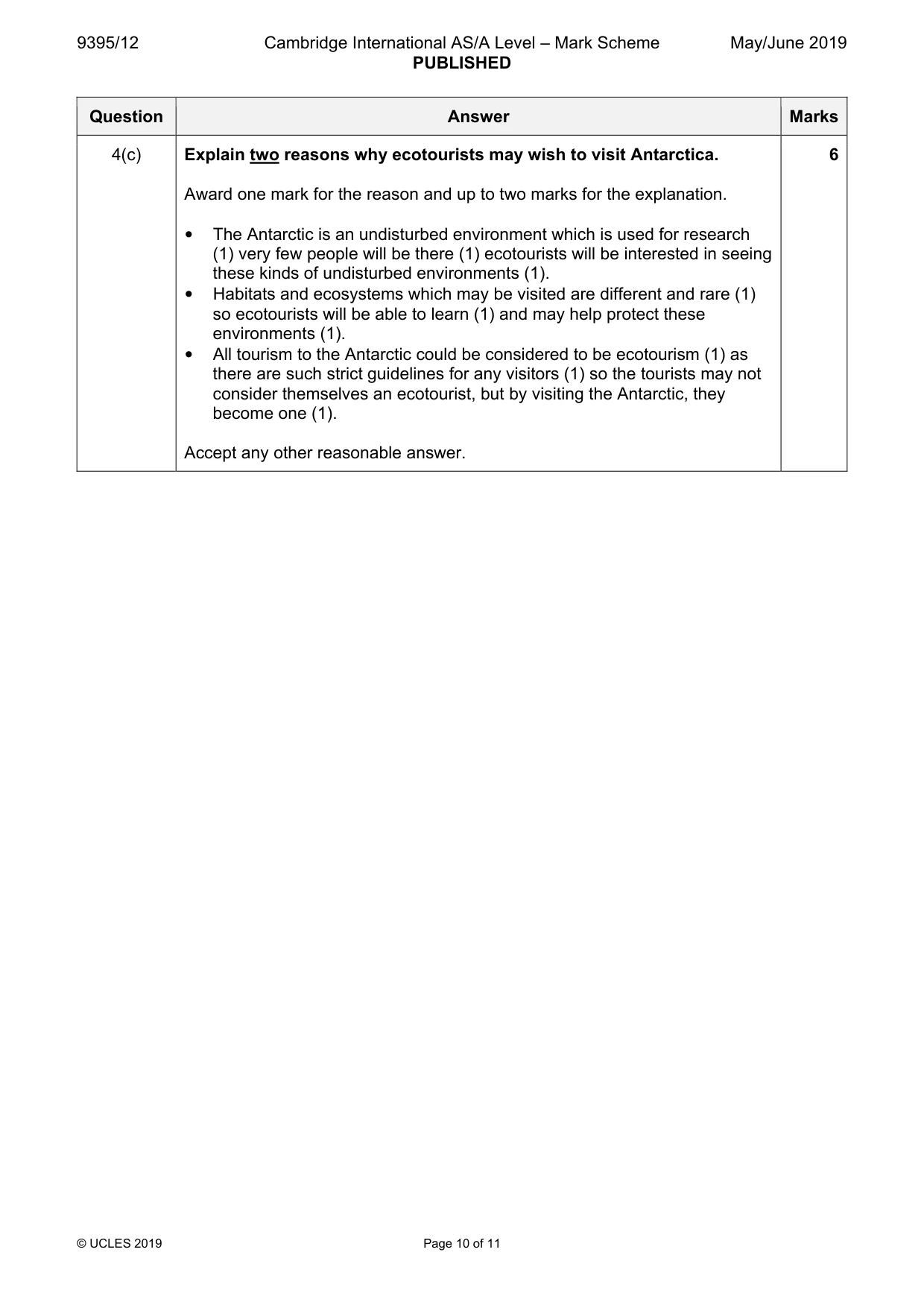
9395/12 Cambridge International AS/A Level – Mark Scheme PUBLISHED May/June 2019 © UCLES 2019 Page 10 of 11 Question Answer Marks 4(c) Explain two reasons why ecotourists may wish to visit Antarctica. Award one mark for the reason and up to two marks for the explanation. • The Antarctic is an undisturbed environment which is used for research (1) very few people will be there (1) ecotourists will be interested in seeing these kinds of undisturbed environments (1). • Habitats and ecosystems which may be visited are different and rare (1) so ecotourists will be able to learn (1) and may help protect these environments (1). • All tourism to the Antarctic could be considered to be ecotourism (1) as there are such strict guidelines for any visitors (1) so the tourists may not consider themselves an ecotourist, but by visiting the Antarctic, they become one (1). Accept any other reasonable answer. 6
Mark scheme, page 11
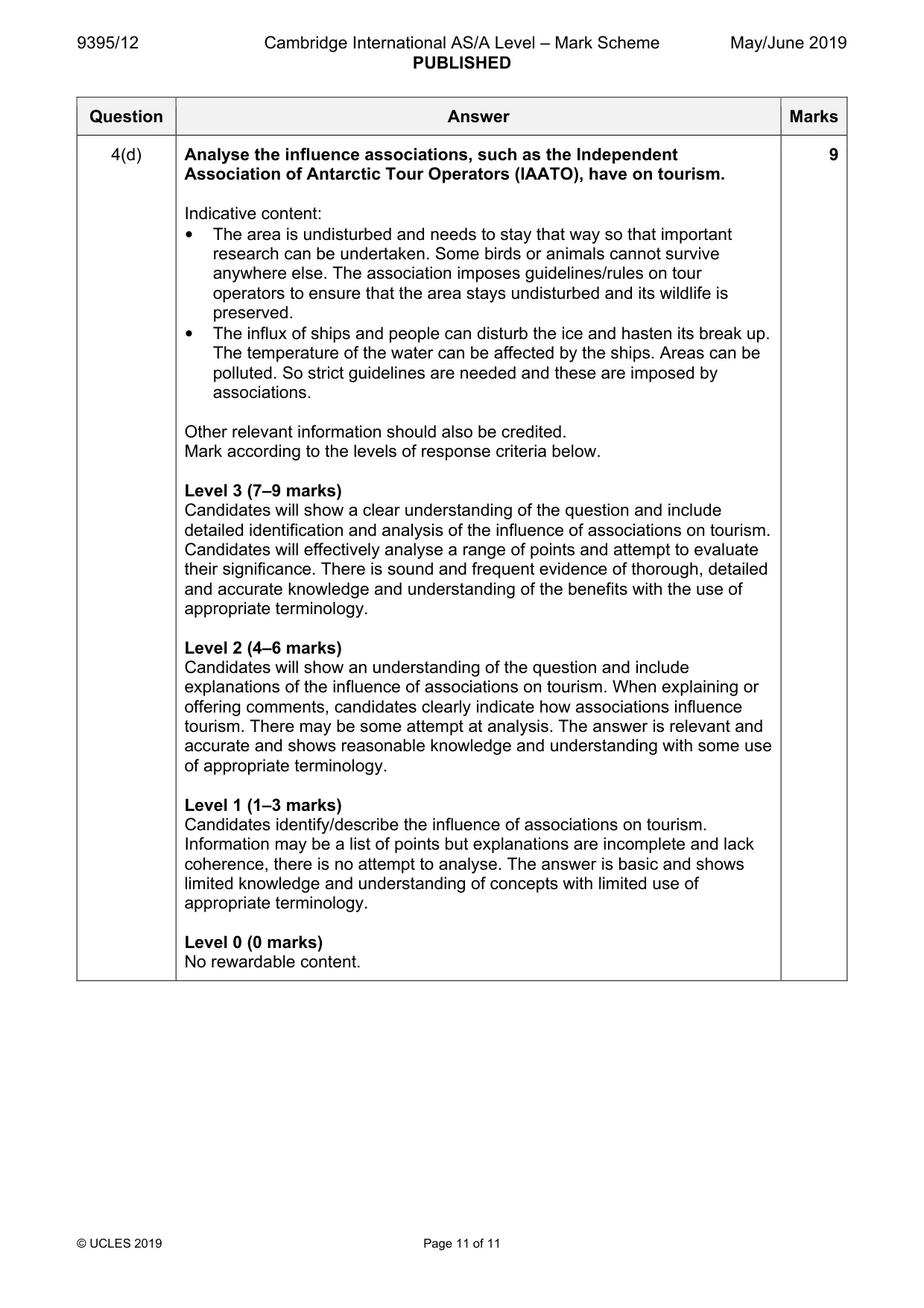
9395/12 Cambridge International AS/A Level – Mark Scheme PUBLISHED May/June 2019 © UCLES 2019 Page 11 of 11 Question Answer Marks 4(d) Analyse the influence associations, such as the Independent Association of Antarctic Tour Operators (IAATO), have on tourism. Indicative content: • The area is undisturbed and needs to stay that way so that important research can be undertaken. Some birds or animals cannot survive anywhere else. The association imposes guidelines/rules on tour operators to ensure that the area stays undisturbed and its wildlife is preserved. • The influx of ships and people can disturb the ice and hasten its break up. The temperature of the water can be affected by the ships. Areas can be polluted. So strict guidelines are needed and these are imposed by associations. Other relevant information should also be credited. Mark according to the levels of response criteria below. Level 3 (7–9 marks) Candidates will show a clear understanding of the question and include detailed identification and analysis of the influence of associations on tourism. Candidates will effectively analyse a range of points and attempt to evaluate their significance. There is sound and frequent evidence of thorough, detailed and accurate knowledge and understanding of the benefits with the use of appropriate terminology. Level 2 (4–6 marks) Candidates will show an understanding of the question and include explanations of the influence of associations on tourism. When explaining or offering comments, candidates clearly indicate how associations influence tourism. There may be some attempt at analysis. The answer is relevant and accurate and shows reasonable knowledge and understanding with some use of appropriate terminology. Level 1 (1–3 marks) Candidates identify/describe the influence of associations on tourism. Information may be a list of points but explanations are incomplete and lack coherence, there is no attempt to analyse. The answer is basic and shows limited knowledge and understanding of concepts with limited use of appropriate terminology. Level 0 (0 marks) No rewardable content. 9
What you needed in this session
Cambridge’s own grade thresholds for 2019 May/June, Paper 1 · Variant 2. A higher threshold means an easier paper — the bar moves with how the cohort did.