Cambridge A Level Travel and Tourism 9395 — 2019 May/June Paper 1 · Variant 3
9395/13/M/J/19 · 100 marks · ≈113 min
The question paper and its mark scheme, free to read here and free to download. This is Cambridge’s own paper, exactly as it was sat.
Question paper16 pages



Mark scheme13 pages
Answers below. Sit the paper first if you are practising.
Paper as text
Question paper, page 1
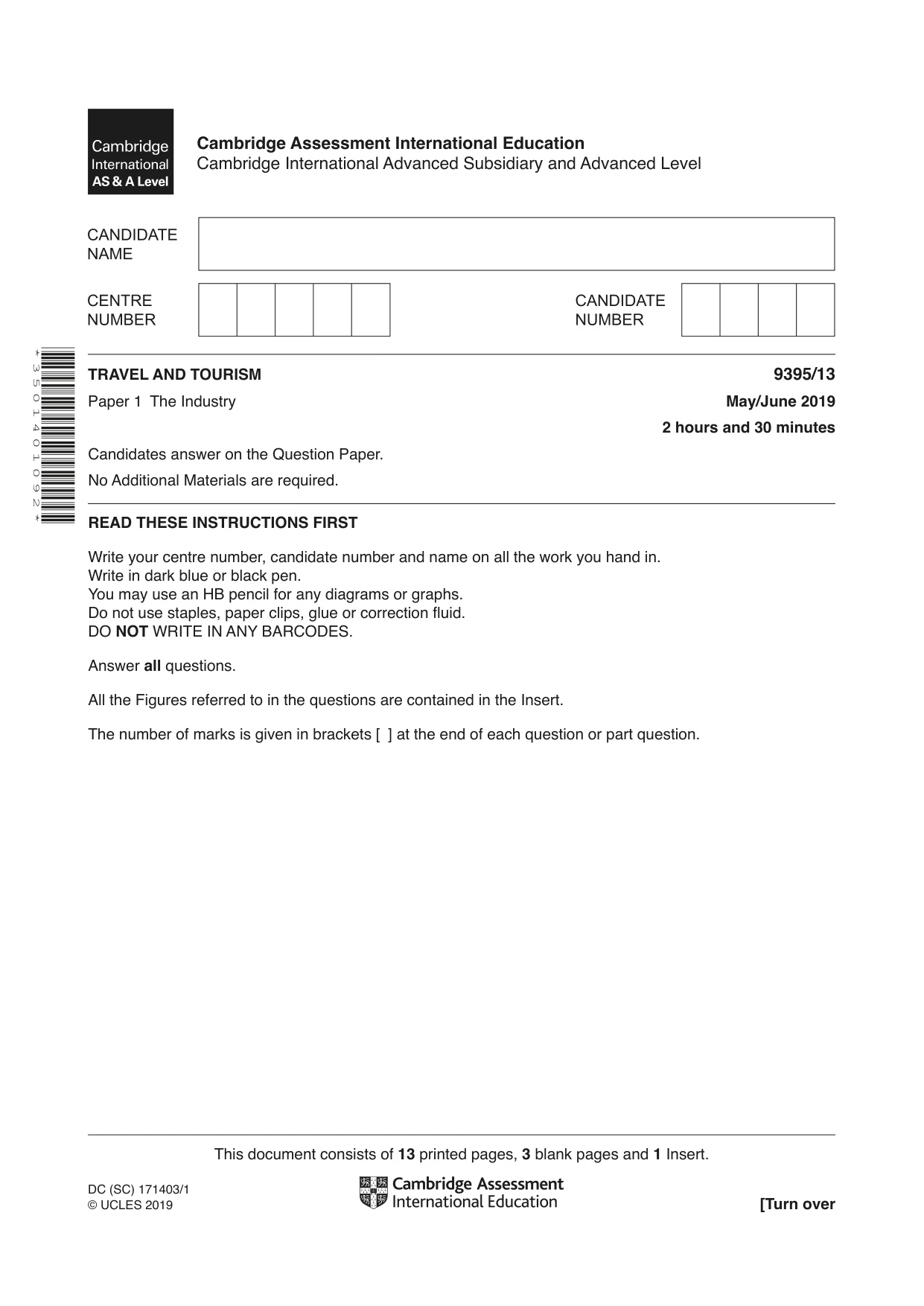
This document consists of 13 printed pages, 3 blank pages and 1 Insert. DC (SC) 171403/1 © UCLES 2019 [Turn over * 3 5 0 1 4 0 1 0 9 2 * TRAVEL AND TOURISM 9395/13 Paper 1 The Industry May/June 2019 2 hours and 30 minutes Candidates answer on the Question Paper. No Additional Materials are required. READ THESE INSTRUCTIONS FIRST Write your centre number, candidate number and name on all the work you hand in. Write in dark blue or black pen. You may use an HB pencil for any diagrams or graphs. Do not use staples, paper clips, glue or correction fluid. DO NOT WRITE IN ANY BARCODES. Answer all questions. All the Figures referred to in the questions are contained in the Insert. The number of marks is given in brackets [ ] at the end of each question or part question. Cambridge Assessment International Education Cambridge International Advanced Subsidiary and Advanced Level
Question paper, page 2
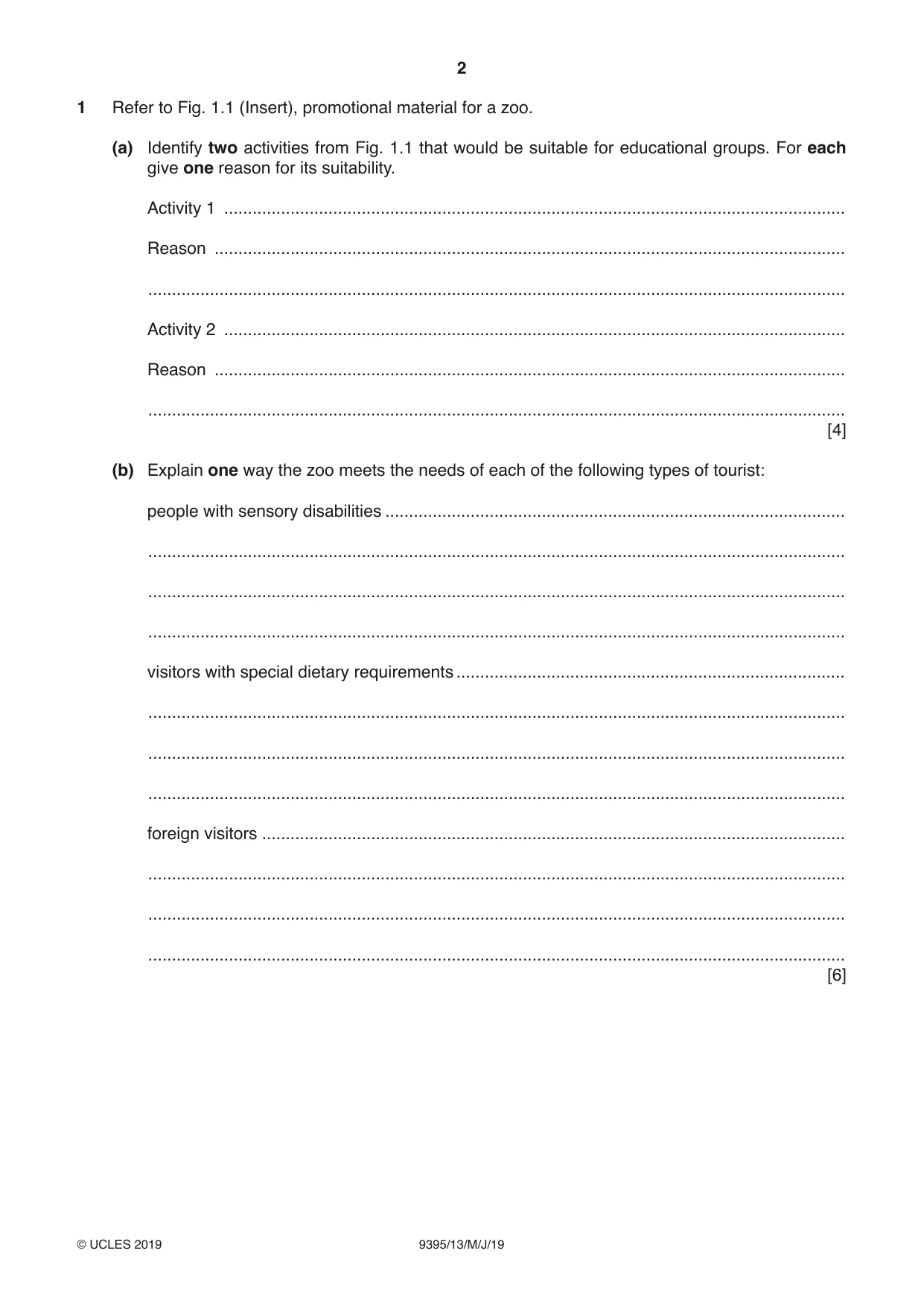
2 9395/13/M/J/19 © UCLES 2019 1 Refer to Fig. 1.1 (Insert), promotional material for a zoo. (a) Identify two activities from Fig. 1.1 that would be suitable for educational groups. For each give one reason for its suitability. Activity 1 … Reason … … Activity 2 … Reason … … [4] (b) Explain one way the zoo meets the needs of each of the following types of tourist: people with sensory disabilities … … … … visitors with special dietary requirements … … … … foreign visitors … … … … [6]
Question paper, page 3
3 9395/13/M/J/19 © UCLES 2019 [Turn over (c) Explain three likely customer service standards for employees at a zoo. 1 … … … … 2 … … … … 3 … … … … [6]
Question paper, page 4
4 9395/13/M/J/19 © UCLES 2019 (d) Assess the benefits to employees of developing the skills necessary for their job. … … … … … … … … … … … … … … … … … … [9] [Total: 25]
Question paper, page 5
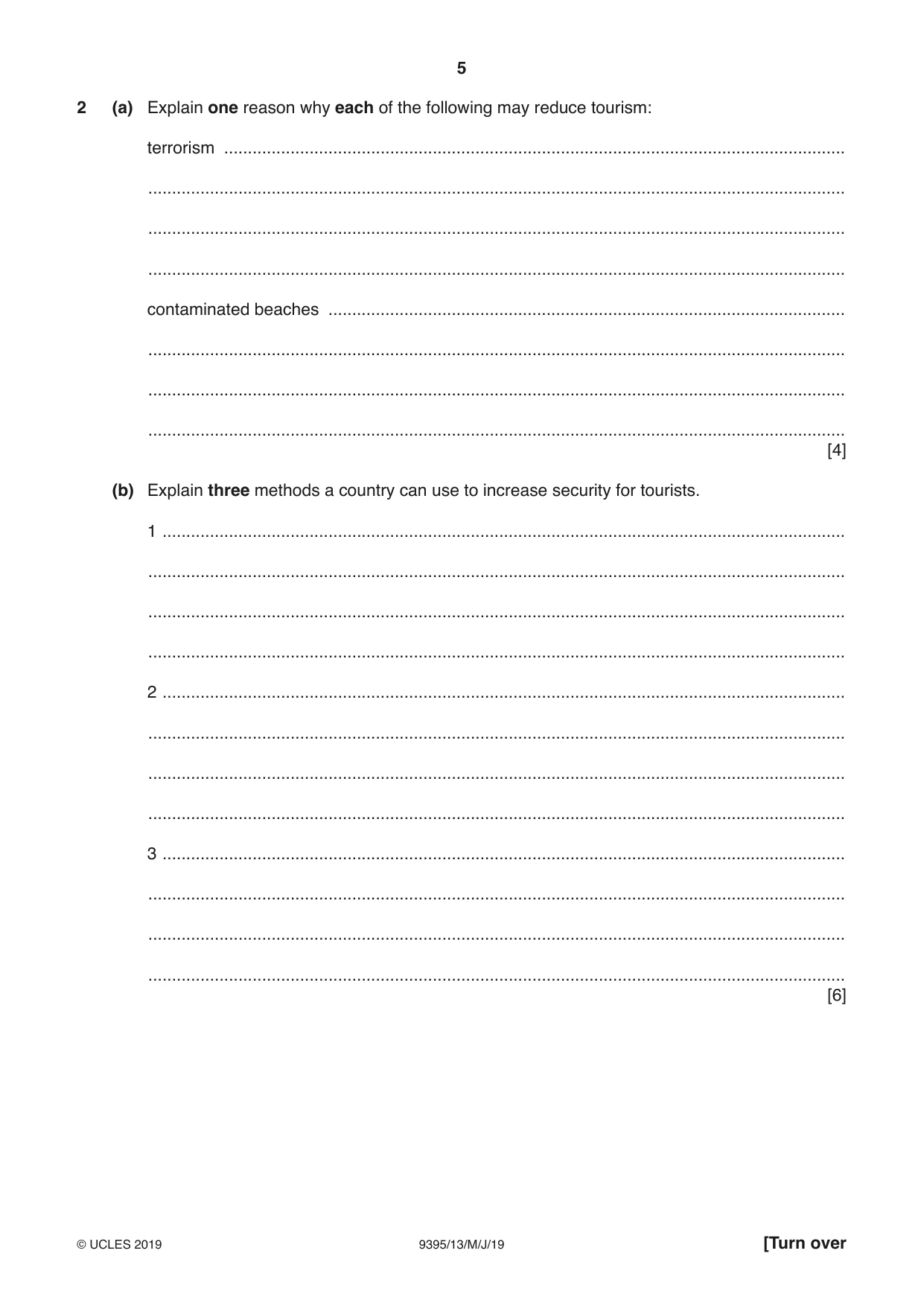
5 9395/13/M/J/19 © UCLES 2019 [Turn over 2 (a) Explain one reason why each of the following may reduce tourism: terrorism … … … … contaminated beaches … … … … [4] (b) Explain three methods a country can use to increase security for tourists. 1 … … … … 2 … … … … 3 … … … … [6]
Question paper, page 6
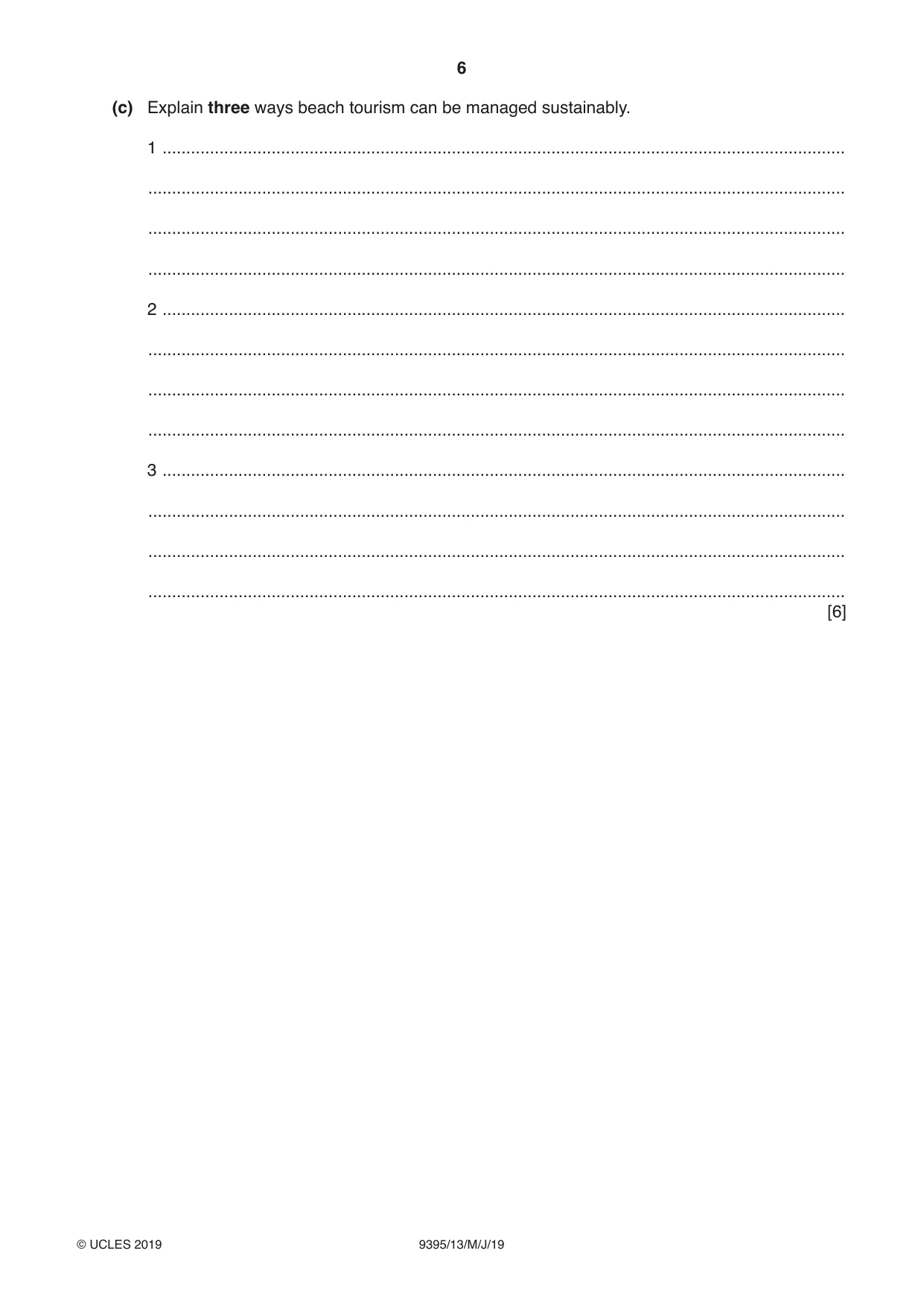
6 9395/13/M/J/19 © UCLES 2019 (c) Explain three ways beach tourism can be managed sustainably. 1 … … … … 2 … … … … 3 … … … … [6]
Question paper, page 7
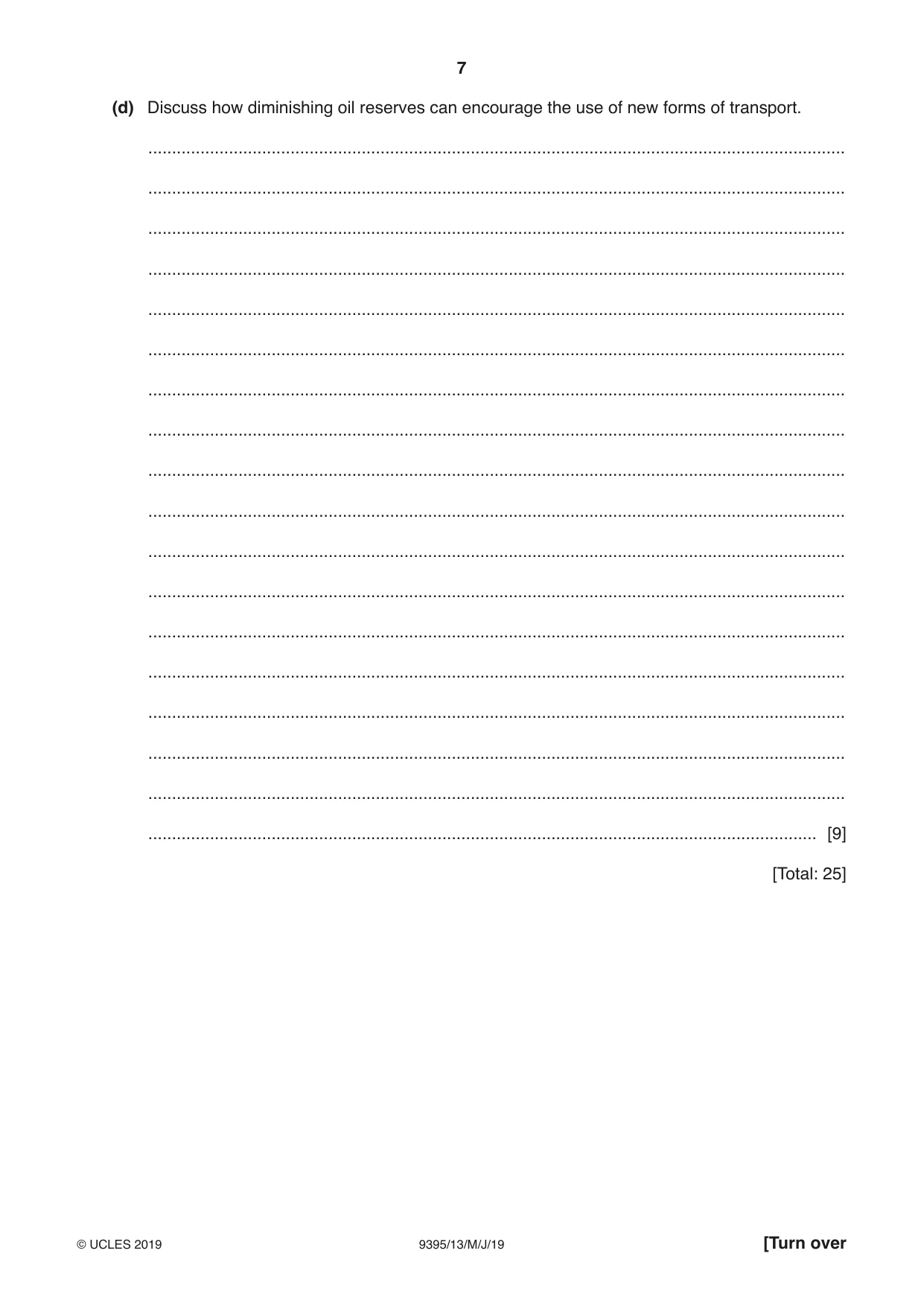
7 9395/13/M/J/19 © UCLES 2019 [Turn over (d) Discuss how diminishing oil reserves can encourage the use of new forms of transport. … … … … … … … … … … … … … … … … … … [9] [Total: 25]
Question paper, page 8
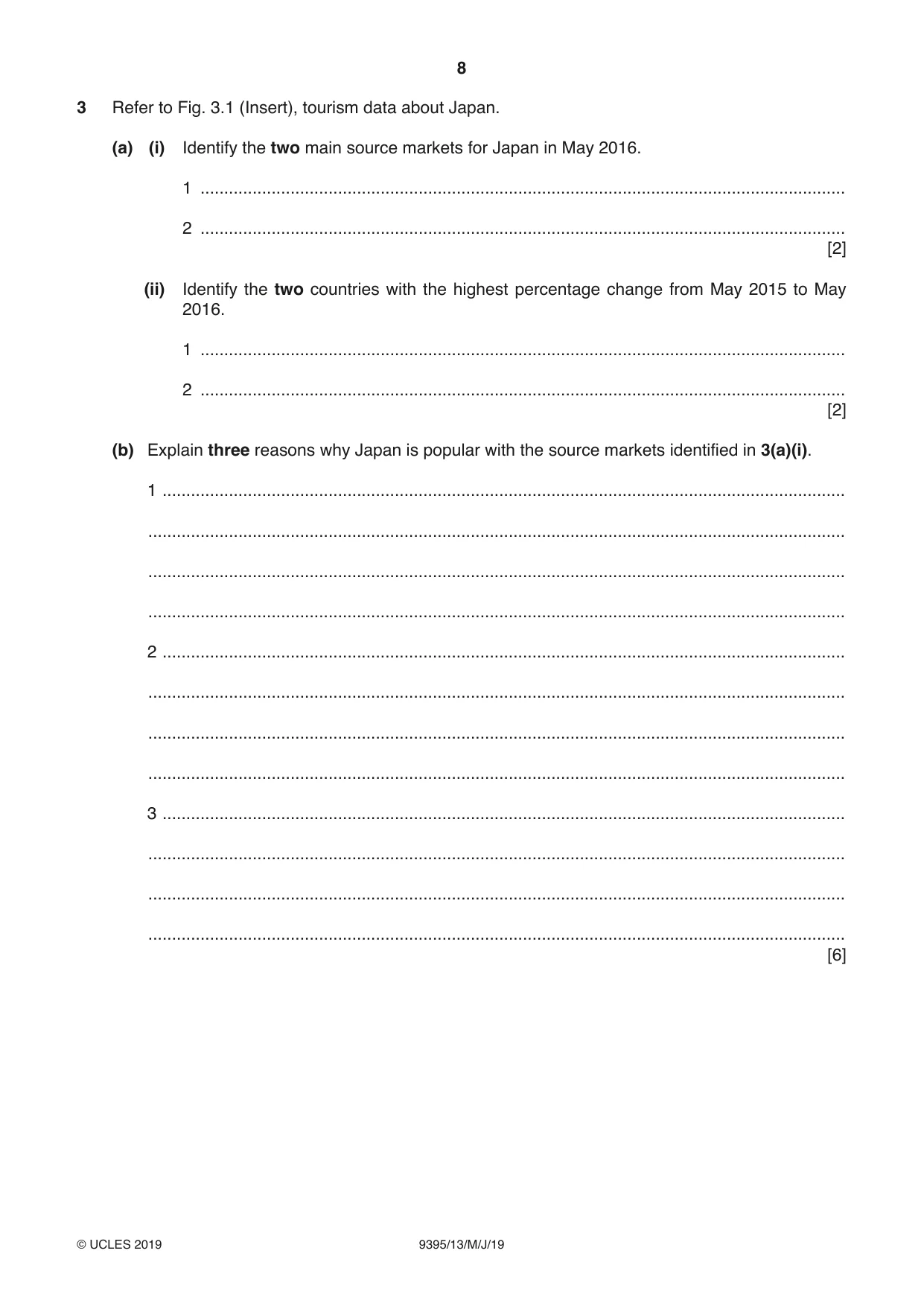
8 9395/13/M/J/19 © UCLES 2019 3 Refer to Fig. 3.1 (Insert), tourism data about Japan. (a) (i) Identify the two main source markets for Japan in May 2016. 1 … 2 … [2] (ii) Identify the two countries with the highest percentage change from May 2015 to May 2016. 1 … 2 … [2] (b) Explain three reasons why Japan is popular with the source markets identified in 3(a)(i). 1 … … … … 2 … … … … 3 … … … … [6]
Question paper, page 9
9 9395/13/M/J/19 © UCLES 2019 [Turn over (c) In many countries there are fewer families with children. Explain how this impacts on tourism. … … … … … … … … … … … … [6]
Question paper, page 10
10 9395/13/M/J/19 © UCLES 2019 (d) Assess the benefits to tour operators of increasing the number of specialised packages to countries such as Japan. … … … … … … … … … … … … … … … … … … [9] [Total: 25]
Question paper, page 11
11 9395/13/M/J/19 © UCLES 2019 [Turn over 4 (a) Suggest four ancillary services offered by a coach tour company. 1 … 2 … 3 … 4 … [4] (b) Explain three ways coach travel may be more important than rail travel for a domestic tourist. 1 … … … … 2 … … … … 3 … … … … [6]
Question paper, page 12
12 9395/13/M/J/19 © UCLES 2019 (c) Explain three benefits to a coach tour company of working in partnership with other commercial organisations. 1 … … … … 2 … … … … 3 … … … … [6]
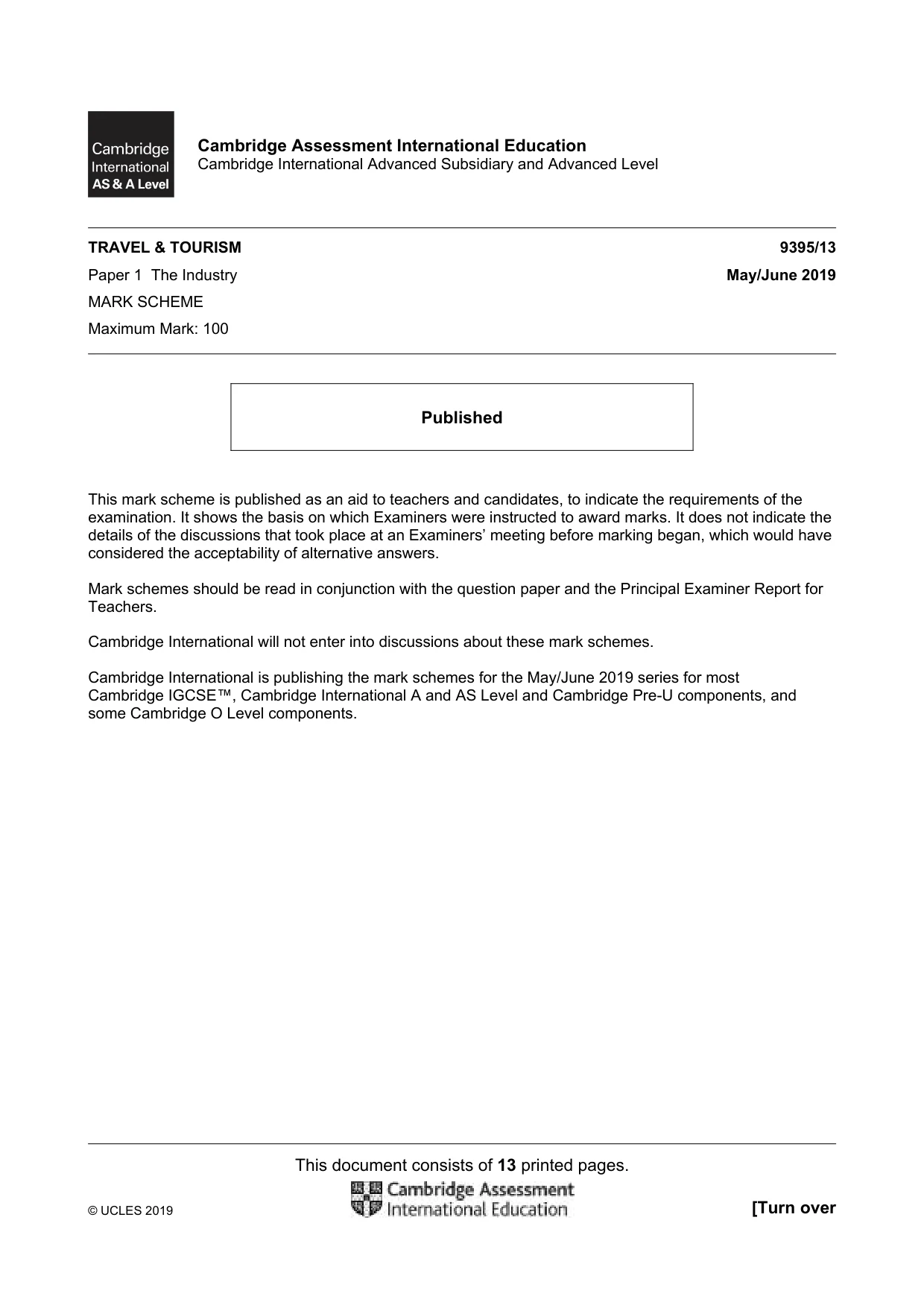
Question paper, page 13
13 9395/13/M/J/19 © UCLES 2019 (d) Assess the benefits to tourists of having a holiday representative on a coach tour. … … … … … … … … … … … … … … … … … … [9] [Total: 25]
Question paper, page 14
14 9395/13/M/J/19 © UCLES 2019 BLANK PAGE
Question paper, page 15
15 9395/13/M/J/19 © UCLES 2019 BLANK PAGE
Question paper, page 16
16 9395/13/M/J/19 © UCLES 2019 Permission to reproduce items where third-party owned material protected by copyright is included has been sought and cleared where possible. Every reasonable effort has been made by the publisher (UCLES) to trace copyright holders, but if any items requiring clearance have unwittingly been included, the publisher will be pleased to make amends at the earliest possible opportunity. To avoid the issue of disclosure of answer-related information to candidates, all copyright acknowledgements are reproduced online in the Cambridge Assessment International Education Copyright Acknowledgements Booklet. This is produced for each series of examinations and is freely available to download at www.cambridgeinternational.org after the live examination series. Cambridge Assessment International Education is part of the Cambridge Assessment Group. Cambridge Assessment is the brand name of the University of Cambridge Local Examinations Syndicate (UCLES), which itself is a department of the University of Cambridge. BLANK PAGE
Mark scheme, page 1
This document consists of 13 printed pages. © UCLES 2019 [Turn over Cambridge Assessment International Education Cambridge International Advanced Subsidiary and Advanced Level TRAVEL & TOURISM 9395/13 Paper 1 The Industry May/June 2019 MARK SCHEME Maximum Mark: 100 Published This mark scheme is published as an aid to teachers and candidates, to indicate the requirements of the examination. It shows the basis on which Examiners were instructed to award marks. It does not indicate the details of the discussions that took place at an Examiners’ meeting before marking began, which would have considered the acceptability of alternative answers. Mark schemes should be read in conjunction with the question paper and the Principal Examiner Report for Teachers. Cambridge International will not enter into discussions about these mark schemes. Cambridge International is publishing the mark schemes for the May/June 2019 series for most Cambridge IGCSE™, Cambridge International A and AS Level and Cambridge Pre-U components, and some Cambridge O Level components.
Mark scheme, page 2
9395/13 Cambridge International AS/A Level – Mark Scheme PUBLISHED May/June 2019 © UCLES 2019 Page 2 of 13 Generic Marking Principles These general marking principles must be applied by all examiners when marking candidate answers. They should be applied alongside the specific content of the mark scheme or generic level descriptors for a question. Each question paper and mark scheme will also comply with these marking principles. GENERIC MARKING PRINCIPLE 1: Marks must be awarded in line with: • the specific content of the mark scheme or the generic level descriptors for the question • the specific skills defined in the mark scheme or in the generic level descriptors for the question • the standard of response required by a candidate as exemplified by the standardisation scripts. GENERIC MARKING PRINCIPLE 2: Marks awarded are always whole marks (not half marks, or other fractions). GENERIC MARKING PRINCIPLE 3: Marks must be awarded positively: • marks are awarded for correct/valid answers, as defined in the mark scheme. However, credit is given for valid answers which go beyond the scope of the syllabus and mark scheme, referring to your Team Leader as appropriate • marks are awarded when candidates clearly demonstrate what they know and can do • marks are not deducted for errors • marks are not deducted for omissions • answers should only be judged on the quality of spelling, punctuation and grammar when these features are specifically assessed by the question as indicated by the mark scheme. The meaning, however, should be unambiguous. GENERIC MARKING PRINCIPLE 4: Rules must be applied consistently e.g. in situations where candidates have not followed instructions or in the application of generic level descriptors. GENERIC MARKING PRINCIPLE 5: Marks should be awarded using the full range of marks defined in the mark scheme for the question (however; the use of the full mark range may be limited according to the quality of the candidate responses seen). GENERIC MARKING PRINCIPLE 6: Marks awarded are based solely on the requirements as defined in the mark scheme. Marks should not be awarded with grade thresholds or grade descriptors in mind.
Mark scheme, page 3
9395/13 Cambridge International AS/A Level – Mark Scheme PUBLISHED May/June 2019 © UCLES 2019 Page 3 of 13 Question Answer Marks 1(a) Identify two activities from Fig. 1.1 suitable for educational groups. For each give one reason for its suitability. Award one mark for each activity and a second for its suitability for educational groups. • Classrooms available (1) for study and for talks (1) • Carefully designed worksheets (1) made for educational groups so that they can learn about the zoo (1) • Guides available (1) so visotrs will learn from their trip and can have questions answered (1) • Tours provided (1) so visitors can be informed about the animals (1) • Feeding the animals (1) so visitors may get to hold/touch/learn about the animals (1) Activities must come from Fig. 1.1. 4 1(b) Explain one way the zoo meets the needs of the following visitor types: Award one mark for the identification of a way and the second for the explanation of how this meets the visitor’s needs. people with sensory disabilities: • Braille notices (1) helps those who are visually impaired (1). • signposts and maps around the zoo (1) will help those who may have audio difficulties (1). • audio tours(1) will help those with sight problems (1). visitors with special dietary requirements: • Restaurant copes with all dietary requirements e.g. vegetarian (1). therefore everyone should be able to find something suitable to eat (1). • Children’s meals are available (1) so foods that they would eat are available (1). • Restaurants provide kosher and halal options (1) to cater for those with religious belief that do not allow them to eat certain things (1). foreign visitors: • Leaflets are available in various languages (1) so that foreign visitors will understand (1). • Signs/signposts will be around the zoo (1) so foreign visitors will be able to see where all things are and find their way around (1). • Maps are available in different languages (1) so foreign visitors can find their way around the zoo (1). • There are also lots of food options (1) for visitors who want to eat food they are familiar with (1). Accept any other reasonable answer. 6
Mark scheme, page 4
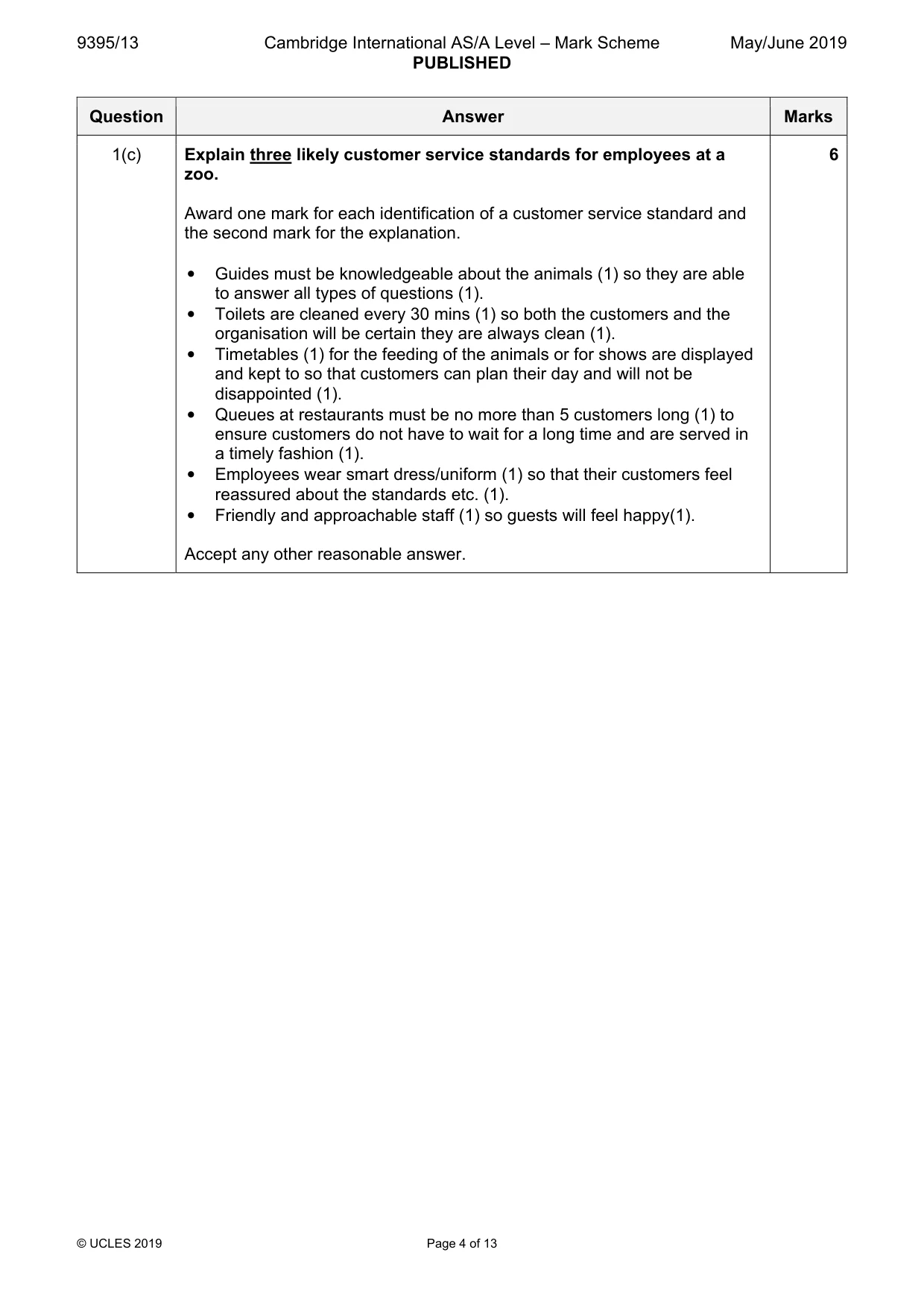
9395/13 Cambridge International AS/A Level – Mark Scheme PUBLISHED May/June 2019 © UCLES 2019 Page 4 of 13 Question Answer Marks 1(c) Explain three likely customer service standards for employees at a zoo. Award one mark for each identification of a customer service standard and the second mark for the explanation. • Guides must be knowledgeable about the animals (1) so they are able to answer all types of questions (1). • Toilets are cleaned every 30 mins (1) so both the customers and the organisation will be certain they are always clean (1). • Timetables (1) for the feeding of the animals or for shows are displayed and kept to so that customers can plan their day and will not be disappointed (1). • Queues at restaurants must be no more than 5 customers long (1) to ensure customers do not have to wait for a long time and are served in a timely fashion (1). • Employees wear smart dress/uniform (1) so that their customers feel reassured about the standards etc. (1). • Friendly and approachable staff (1) so guests will feel happy(1). Accept any other reasonable answer. 6
Mark scheme, page 5
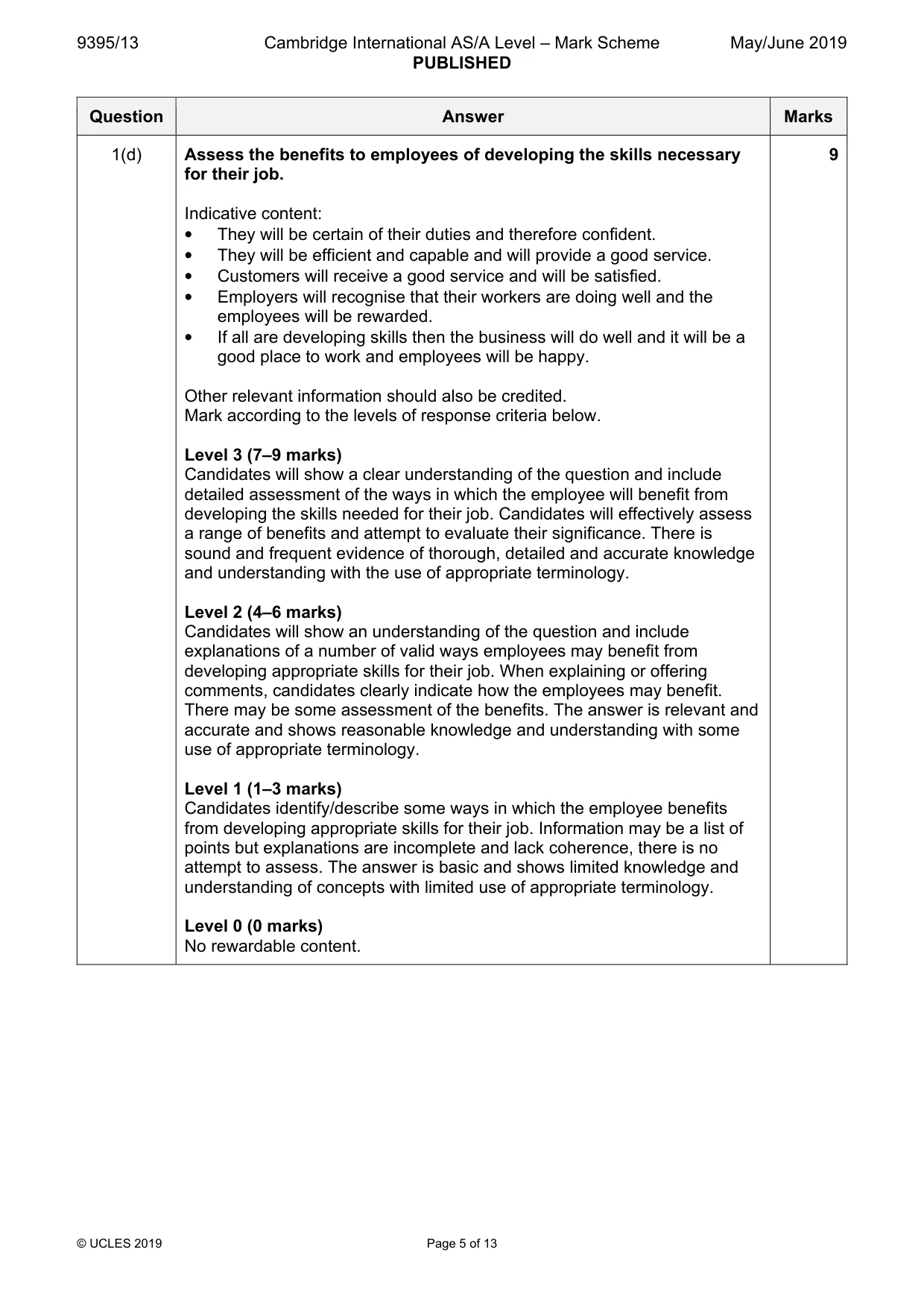
9395/13 Cambridge International AS/A Level – Mark Scheme PUBLISHED May/June 2019 © UCLES 2019 Page 5 of 13 Question Answer Marks 1(d) Assess the benefits to employees of developing the skills necessary for their job. Indicative content: • They will be certain of their duties and therefore confident. • They will be efficient and capable and will provide a good service. • Customers will receive a good service and will be satisfied. • Employers will recognise that their workers are doing well and the employees will be rewarded. • If all are developing skills then the business will do well and it will be a good place to work and employees will be happy. Other relevant information should also be credited. Mark according to the levels of response criteria below. Level 3 (7–9 marks) Candidates will show a clear understanding of the question and include detailed assessment of the ways in which the employee will benefit from developing the skills needed for their job. Candidates will effectively assess a range of benefits and attempt to evaluate their significance. There is sound and frequent evidence of thorough, detailed and accurate knowledge and understanding with the use of appropriate terminology. Level 2 (4–6 marks) Candidates will show an understanding of the question and include explanations of a number of valid ways employees may benefit from developing appropriate skills for their job. When explaining or offering comments, candidates clearly indicate how the employees may benefit. There may be some assessment of the benefits. The answer is relevant and accurate and shows reasonable knowledge and understanding with some use of appropriate terminology. Level 1 (1–3 marks) Candidates identify/describe some ways in which the employee benefits from developing appropriate skills for their job. Information may be a list of points but explanations are incomplete and lack coherence, there is no attempt to assess. The answer is basic and shows limited knowledge and understanding of concepts with limited use of appropriate terminology. Level 0 (0 marks) No rewardable content. 9
Mark scheme, page 6
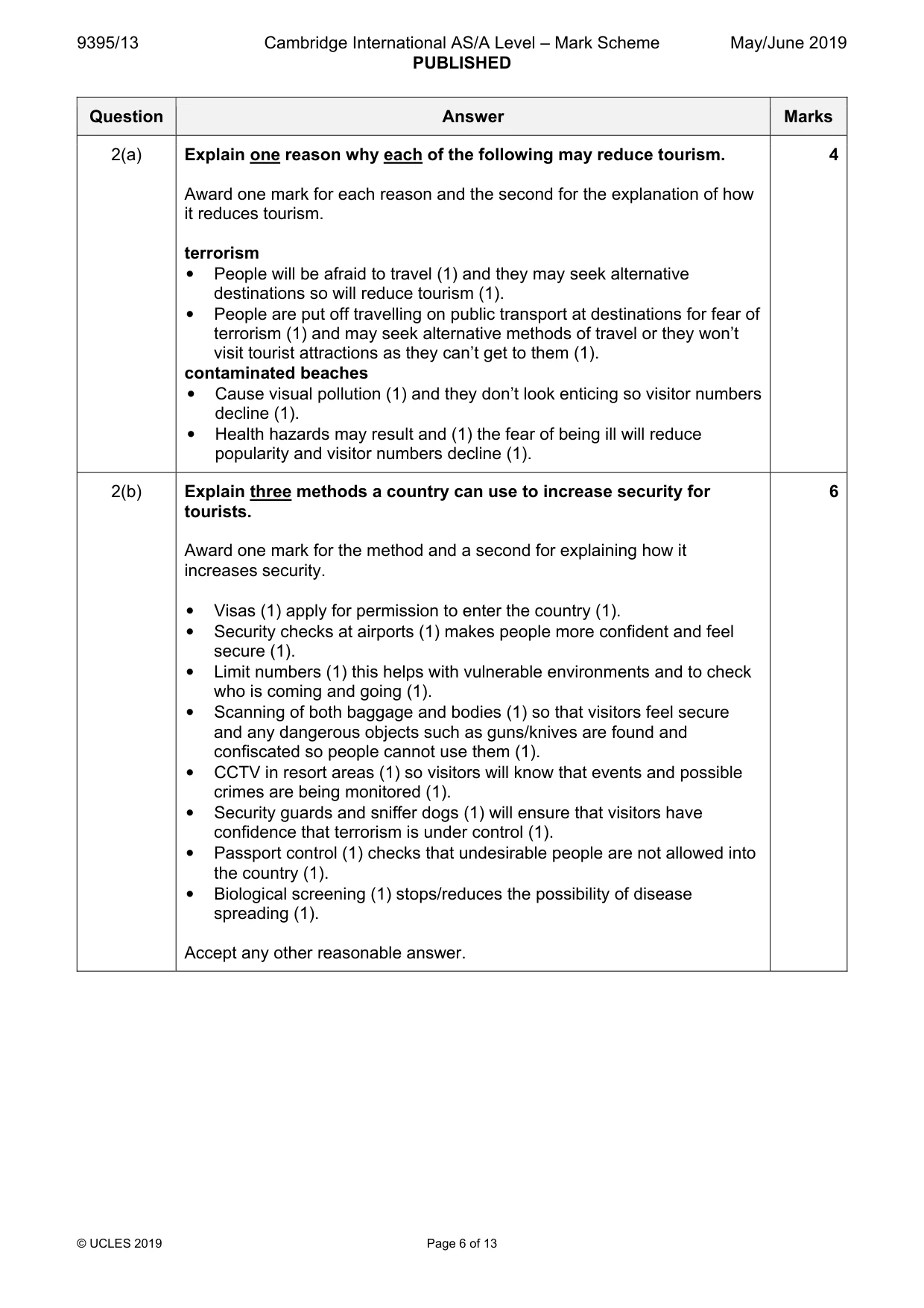
9395/13 Cambridge International AS/A Level – Mark Scheme PUBLISHED May/June 2019 © UCLES 2019 Page 6 of 13 Question Answer Marks 2(a) Explain one reason why each of the following may reduce tourism. Award one mark for each reason and the second for the explanation of how it reduces tourism. terrorism • People will be afraid to travel (1) and they may seek alternative destinations so will reduce tourism (1). • People are put off travelling on public transport at destinations for fear of terrorism (1) and may seek alternative methods of travel or they won’t visit tourist attractions as they can’t get to them (1). contaminated beaches • Cause visual pollution (1) and they don’t look enticing so visitor numbers decline (1). • Health hazards may result and (1) the fear of being ill will reduce popularity and visitor numbers decline (1). 4 2(b) Explain three methods a country can use to increase security for tourists. Award one mark for the method and a second for explaining how it increases security. • Visas (1) apply for permission to enter the country (1). • Security checks at airports (1) makes people more confident and feel secure (1). • Limit numbers (1) this helps with vulnerable environments and to check who is coming and going (1). • Scanning of both baggage and bodies (1) so that visitors feel secure and any dangerous objects such as guns/knives are found and confiscated so people cannot use them (1). • CCTV in resort areas (1) so visitors will know that events and possible crimes are being monitored (1). • Security guards and sniffer dogs (1) will ensure that visitors have confidence that terrorism is under control (1). • Passport control (1) checks that undesirable people are not allowed into the country (1). • Biological screening (1) stops/reduces the possibility of disease spreading (1). Accept any other reasonable answer. 6
Mark scheme, page 7
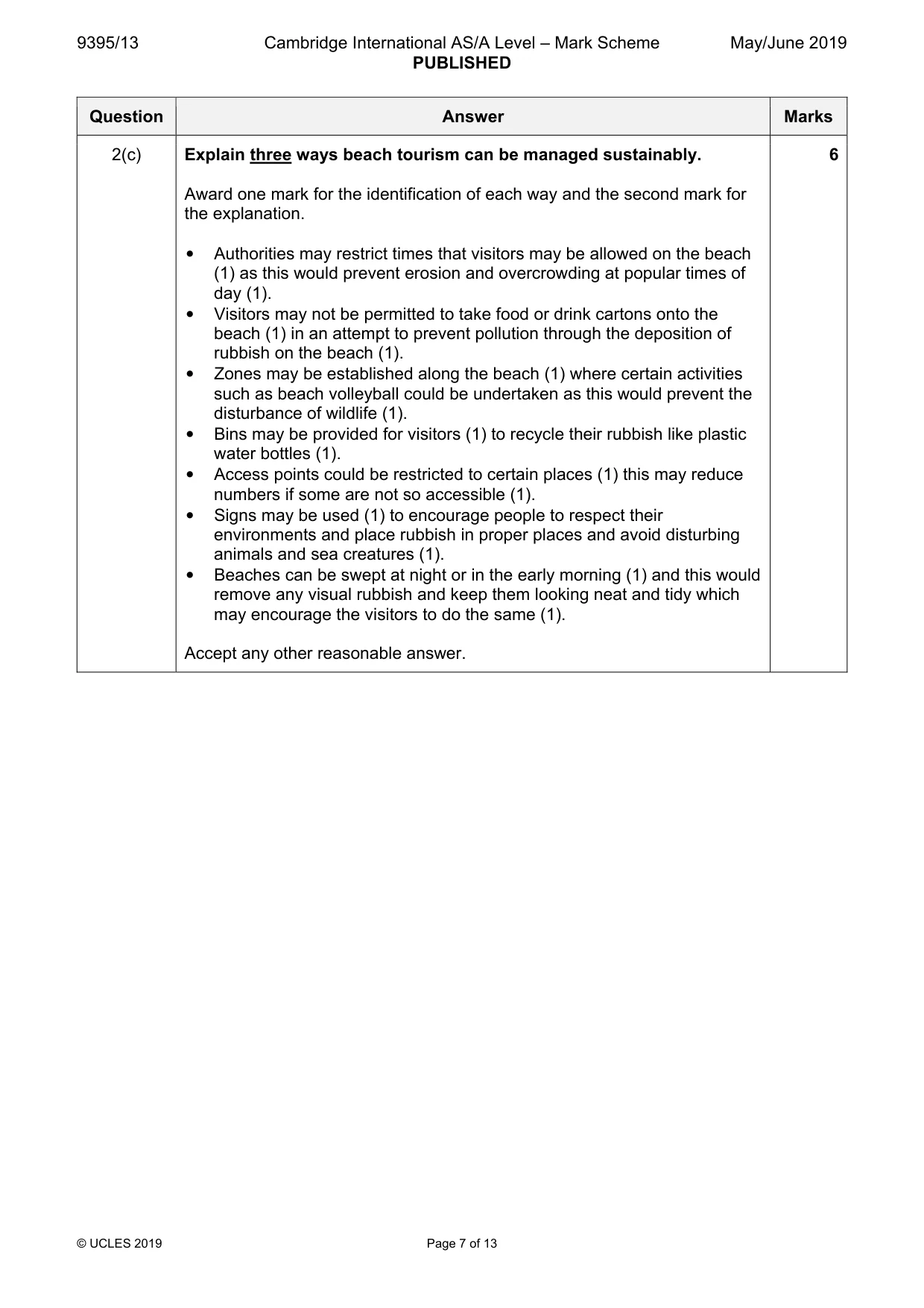
9395/13 Cambridge International AS/A Level – Mark Scheme PUBLISHED May/June 2019 © UCLES 2019 Page 7 of 13 Question Answer Marks 2(c) Explain three ways beach tourism can be managed sustainably. Award one mark for the identification of each way and the second mark for the explanation. • Authorities may restrict times that visitors may be allowed on the beach (1) as this would prevent erosion and overcrowding at popular times of day (1). • Visitors may not be permitted to take food or drink cartons onto the beach (1) in an attempt to prevent pollution through the deposition of rubbish on the beach (1). • Zones may be established along the beach (1) where certain activities such as beach volleyball could be undertaken as this would prevent the disturbance of wildlife (1). • Bins may be provided for visitors (1) to recycle their rubbish like plastic water bottles (1). • Access points could be restricted to certain places (1) this may reduce numbers if some are not so accessible (1). • Signs may be used (1) to encourage people to respect their environments and place rubbish in proper places and avoid disturbing animals and sea creatures (1). • Beaches can be swept at night or in the early morning (1) and this would remove any visual rubbish and keep them looking neat and tidy which may encourage the visitors to do the same (1). Accept any other reasonable answer. 6
Mark scheme, page 8
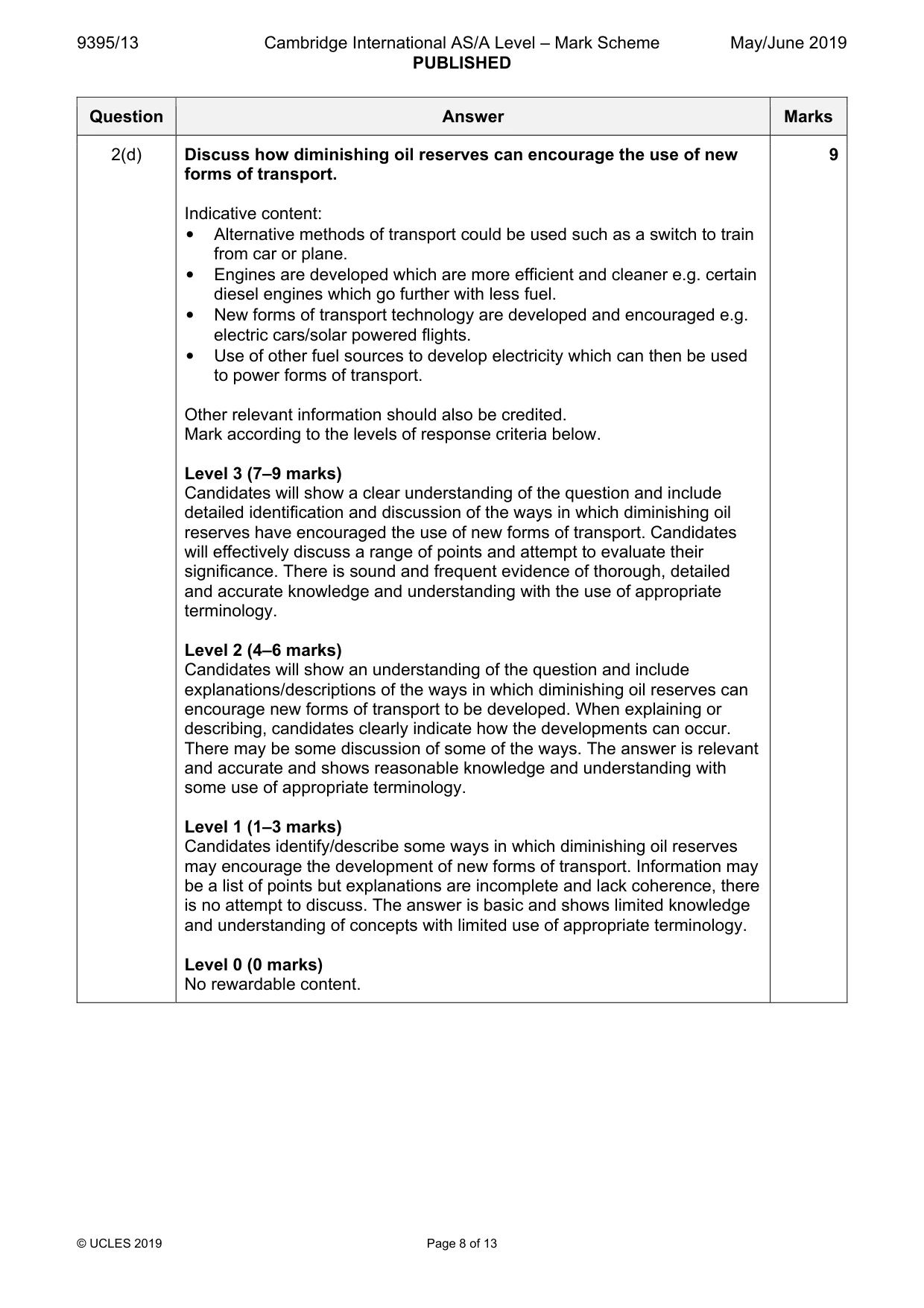
9395/13 Cambridge International AS/A Level – Mark Scheme PUBLISHED May/June 2019 © UCLES 2019 Page 8 of 13 Question Answer Marks 2(d) Discuss how diminishing oil reserves can encourage the use of new forms of transport. Indicative content: • Alternative methods of transport could be used such as a switch to train from car or plane. • Engines are developed which are more efficient and cleaner e.g. certain diesel engines which go further with less fuel. • New forms of transport technology are developed and encouraged e.g. electric cars/solar powered flights. • Use of other fuel sources to develop electricity which can then be used to power forms of transport. Other relevant information should also be credited. Mark according to the levels of response criteria below. Level 3 (7–9 marks) Candidates will show a clear understanding of the question and include detailed identification and discussion of the ways in which diminishing oil reserves have encouraged the use of new forms of transport. Candidates will effectively discuss a range of points and attempt to evaluate their significance. There is sound and frequent evidence of thorough, detailed and accurate knowledge and understanding with the use of appropriate terminology. Level 2 (4–6 marks) Candidates will show an understanding of the question and include explanations/descriptions of the ways in which diminishing oil reserves can encourage new forms of transport to be developed. When explaining or describing, candidates clearly indicate how the developments can occur. There may be some discussion of some of the ways. The answer is relevant and accurate and shows reasonable knowledge and understanding with some use of appropriate terminology. Level 1 (1–3 marks) Candidates identify/describe some ways in which diminishing oil reserves may encourage the development of new forms of transport. Information may be a list of points but explanations are incomplete and lack coherence, there is no attempt to discuss. The answer is basic and shows limited knowledge and understanding of concepts with limited use of appropriate terminology. Level 0 (0 marks) No rewardable content. 9
Mark scheme, page 9
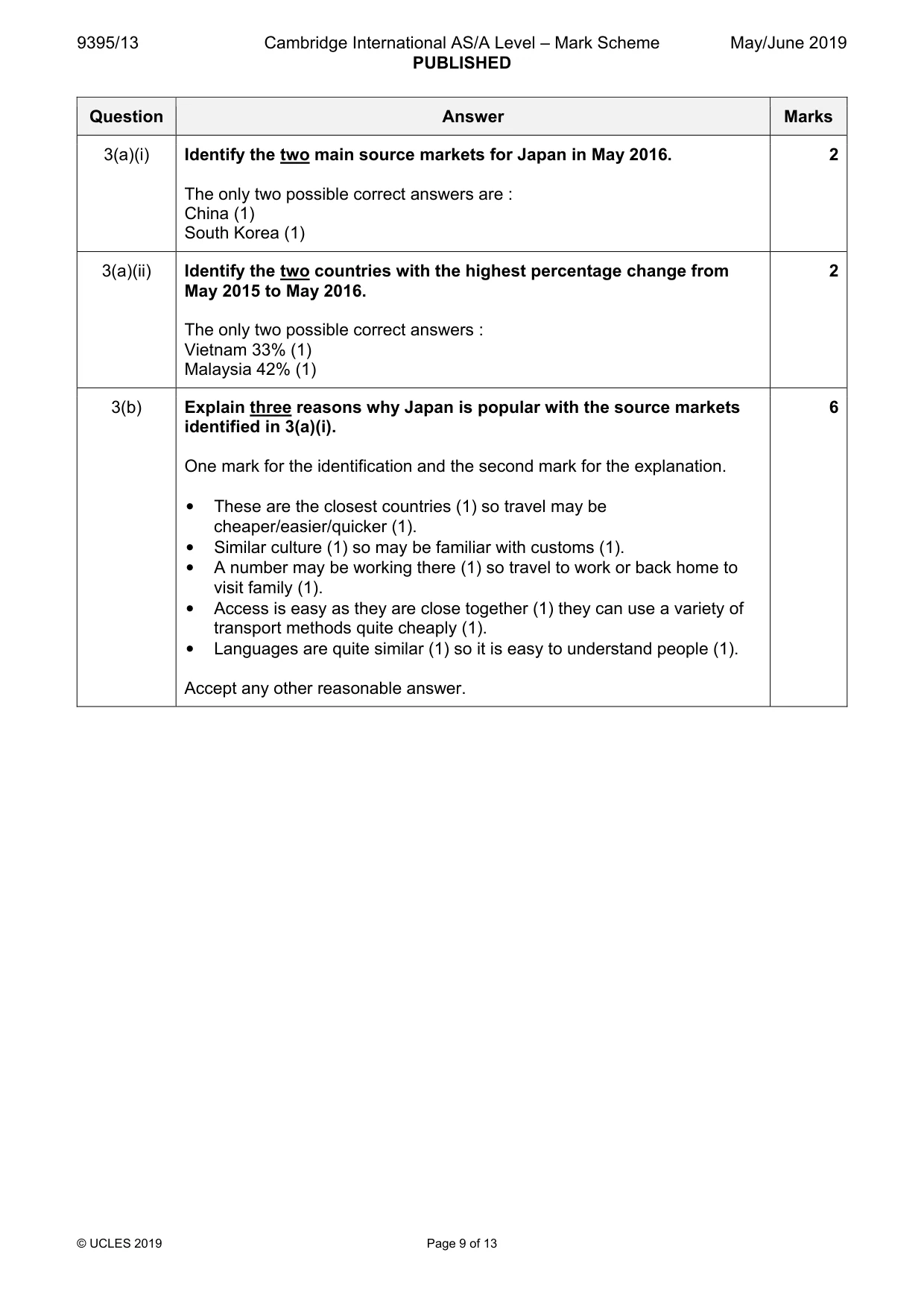
9395/13 Cambridge International AS/A Level – Mark Scheme PUBLISHED May/June 2019 © UCLES 2019 Page 9 of 13 Question Answer Marks 3(a)(i) Identify the two main source markets for Japan in May 2016. The only two possible correct answers are : China (1) South Korea (1) 2 3(a)(ii) Identify the two countries with the highest percentage change from May 2015 to May 2016. The only two possible correct answers : Vietnam 33% (1) Malaysia 42% (1) 2 3(b) Explain three reasons why Japan is popular with the source markets identified in 3(a)(i). One mark for the identification and the second mark for the explanation. • These are the closest countries (1) so travel may be cheaper/easier/quicker (1). • Similar culture (1) so may be familiar with customs (1). • A number may be working there (1) so travel to work or back home to visit family (1). • Access is easy as they are close together (1) they can use a variety of transport methods quite cheaply (1). • Languages are quite similar (1) so it is easy to understand people (1). Accept any other reasonable answer. 6
Mark scheme, page 10
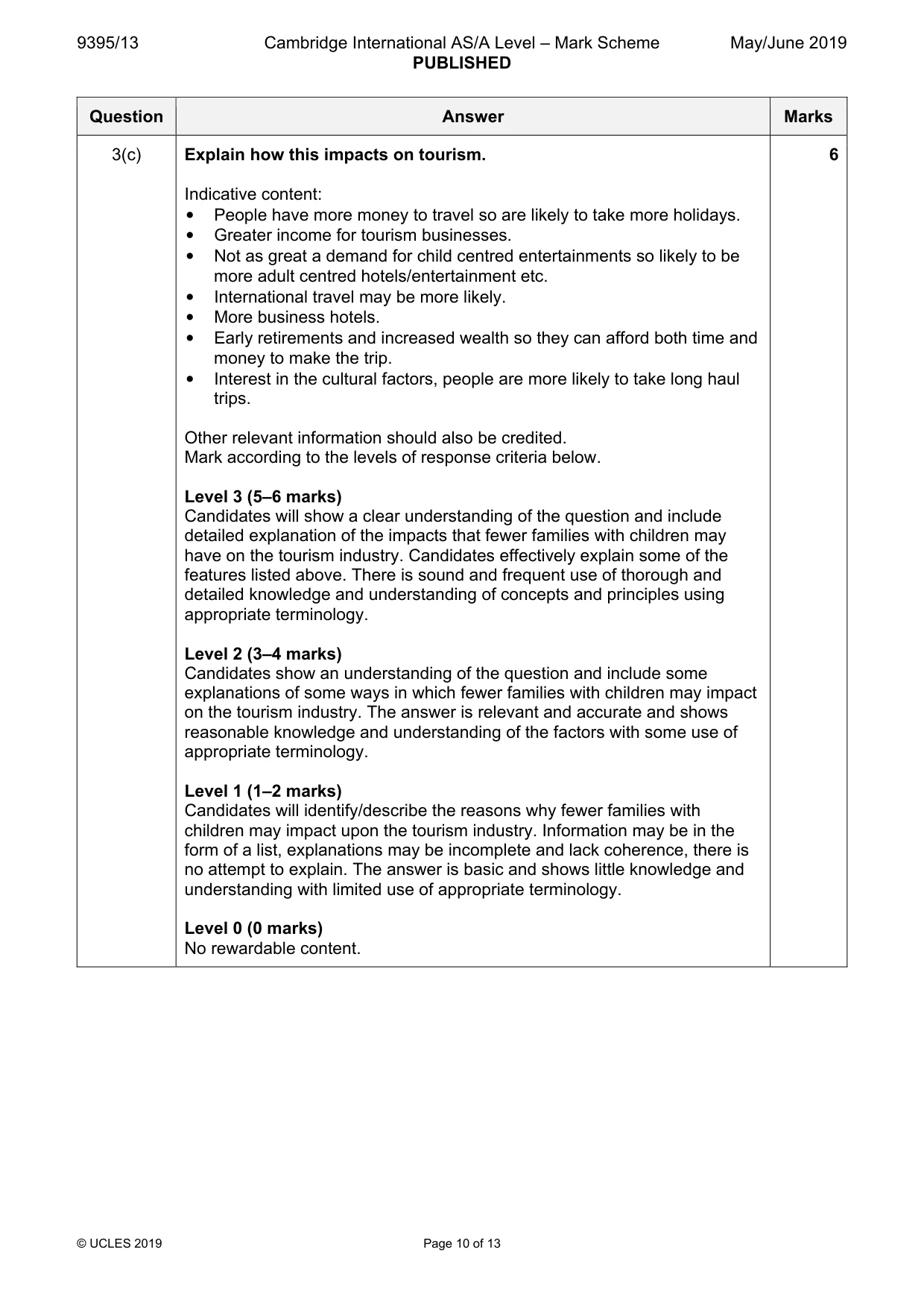
9395/13 Cambridge International AS/A Level – Mark Scheme PUBLISHED May/June 2019 © UCLES 2019 Page 10 of 13 Question Answer Marks 3(c) Explain how this impacts on tourism. Indicative content: • People have more money to travel so are likely to take more holidays. • Greater income for tourism businesses. • Not as great a demand for child centred entertainments so likely to be more adult centred hotels/entertainment etc. • International travel may be more likely. • More business hotels. • Early retirements and increased wealth so they can afford both time and money to make the trip. • Interest in the cultural factors, people are more likely to take long haul trips. Other relevant information should also be credited. Mark according to the levels of response criteria below. Level 3 (5–6 marks) Candidates will show a clear understanding of the question and include detailed explanation of the impacts that fewer families with children may have on the tourism industry. Candidates effectively explain some of the features listed above. There is sound and frequent use of thorough and detailed knowledge and understanding of concepts and principles using appropriate terminology. Level 2 (3–4 marks) Candidates show an understanding of the question and include some explanations of some ways in which fewer families with children may impact on the tourism industry. The answer is relevant and accurate and shows reasonable knowledge and understanding of the factors with some use of appropriate terminology. Level 1 (1–2 marks) Candidates will identify/describe the reasons why fewer families with children may impact upon the tourism industry. Information may be in the form of a list, explanations may be incomplete and lack coherence, there is no attempt to explain. The answer is basic and shows little knowledge and understanding with limited use of appropriate terminology. Level 0 (0 marks) No rewardable content. 6
Mark scheme, page 11
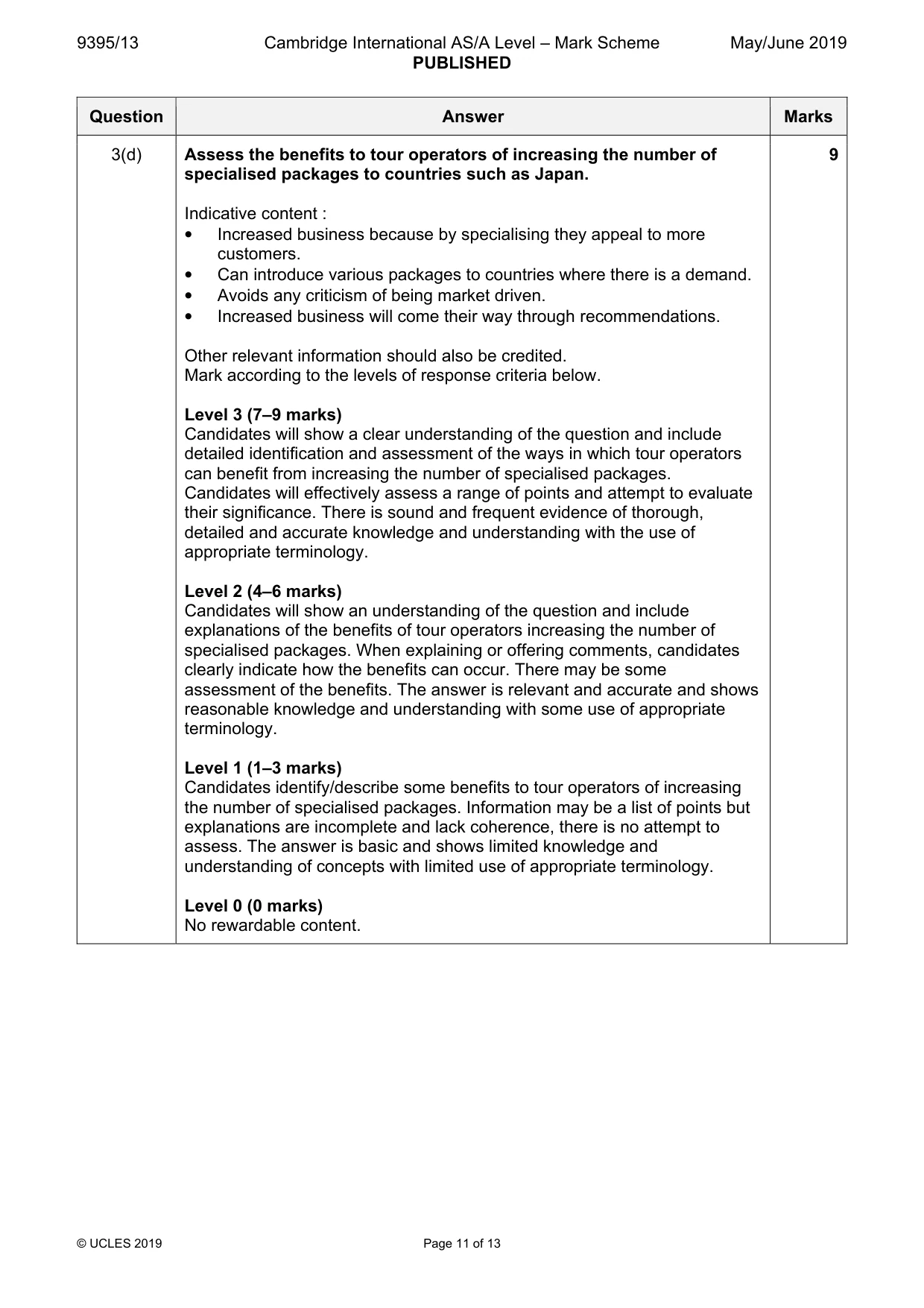
9395/13 Cambridge International AS/A Level – Mark Scheme PUBLISHED May/June 2019 © UCLES 2019 Page 11 of 13 Question Answer Marks 3(d) Assess the benefits to tour operators of increasing the number of specialised packages to countries such as Japan. Indicative content : • Increased business because by specialising they appeal to more customers. • Can introduce various packages to countries where there is a demand. • Avoids any criticism of being market driven. • Increased business will come their way through recommendations. Other relevant information should also be credited. Mark according to the levels of response criteria below. Level 3 (7–9 marks) Candidates will show a clear understanding of the question and include detailed identification and assessment of the ways in which tour operators can benefit from increasing the number of specialised packages. Candidates will effectively assess a range of points and attempt to evaluate their significance. There is sound and frequent evidence of thorough, detailed and accurate knowledge and understanding with the use of appropriate terminology. Level 2 (4–6 marks) Candidates will show an understanding of the question and include explanations of the benefits of tour operators increasing the number of specialised packages. When explaining or offering comments, candidates clearly indicate how the benefits can occur. There may be some assessment of the benefits. The answer is relevant and accurate and shows reasonable knowledge and understanding with some use of appropriate terminology. Level 1 (1–3 marks) Candidates identify/describe some benefits to tour operators of increasing the number of specialised packages. Information may be a list of points but explanations are incomplete and lack coherence, there is no attempt to assess. The answer is basic and shows limited knowledge and understanding of concepts with limited use of appropriate terminology. Level 0 (0 marks) No rewardable content. 9
Mark scheme, page 12
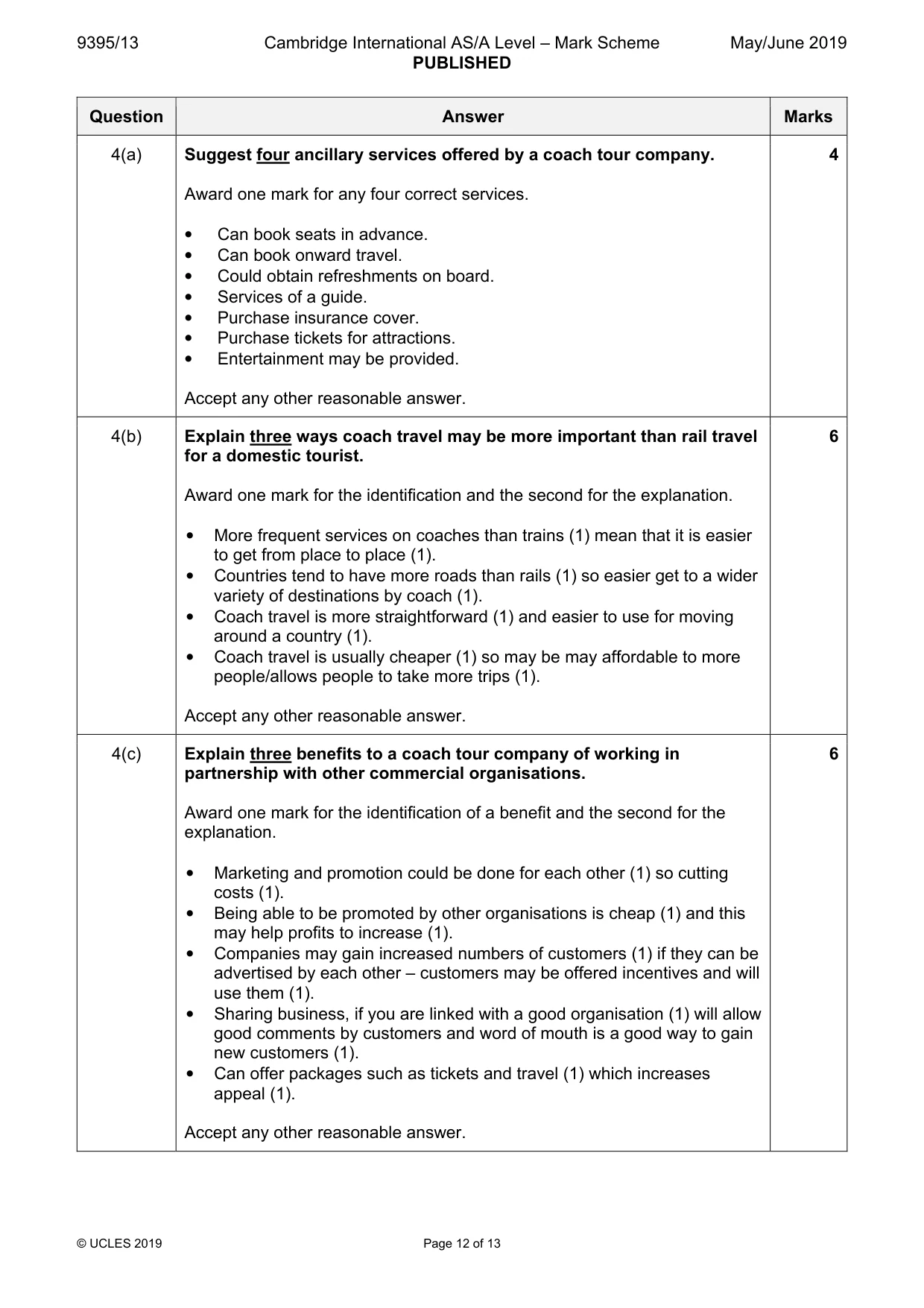
9395/13 Cambridge International AS/A Level – Mark Scheme PUBLISHED May/June 2019 © UCLES 2019 Page 12 of 13 Question Answer Marks 4(a) Suggest four ancillary services offered by a coach tour company. Award one mark for any four correct services. • Can book seats in advance. • Can book onward travel. • Could obtain refreshments on board. • Services of a guide. • Purchase insurance cover. • Purchase tickets for attractions. • Entertainment may be provided. Accept any other reasonable answer. 4 4(b) Explain three ways coach travel may be more important than rail travel for a domestic tourist. Award one mark for the identification and the second for the explanation. • More frequent services on coaches than trains (1) mean that it is easier to get from place to place (1). • Countries tend to have more roads than rails (1) so easier get to a wider variety of destinations by coach (1). • Coach travel is more straightforward (1) and easier to use for moving around a country (1). • Coach travel is usually cheaper (1) so may be may affordable to more people/allows people to take more trips (1). Accept any other reasonable answer. 6 4(c) Explain three benefits to a coach tour company of working in partnership with other commercial organisations. Award one mark for the identification of a benefit and the second for the explanation. • Marketing and promotion could be done for each other (1) so cutting costs (1). • Being able to be promoted by other organisations is cheap (1) and this may help profits to increase (1). • Companies may gain increased numbers of customers (1) if they can be advertised by each other – customers may be offered incentives and will use them (1). • Sharing business, if you are linked with a good organisation (1) will allow good comments by customers and word of mouth is a good way to gain new customers (1). • Can offer packages such as tickets and travel (1) which increases appeal (1). Accept any other reasonable answer. 6
Mark scheme, page 13
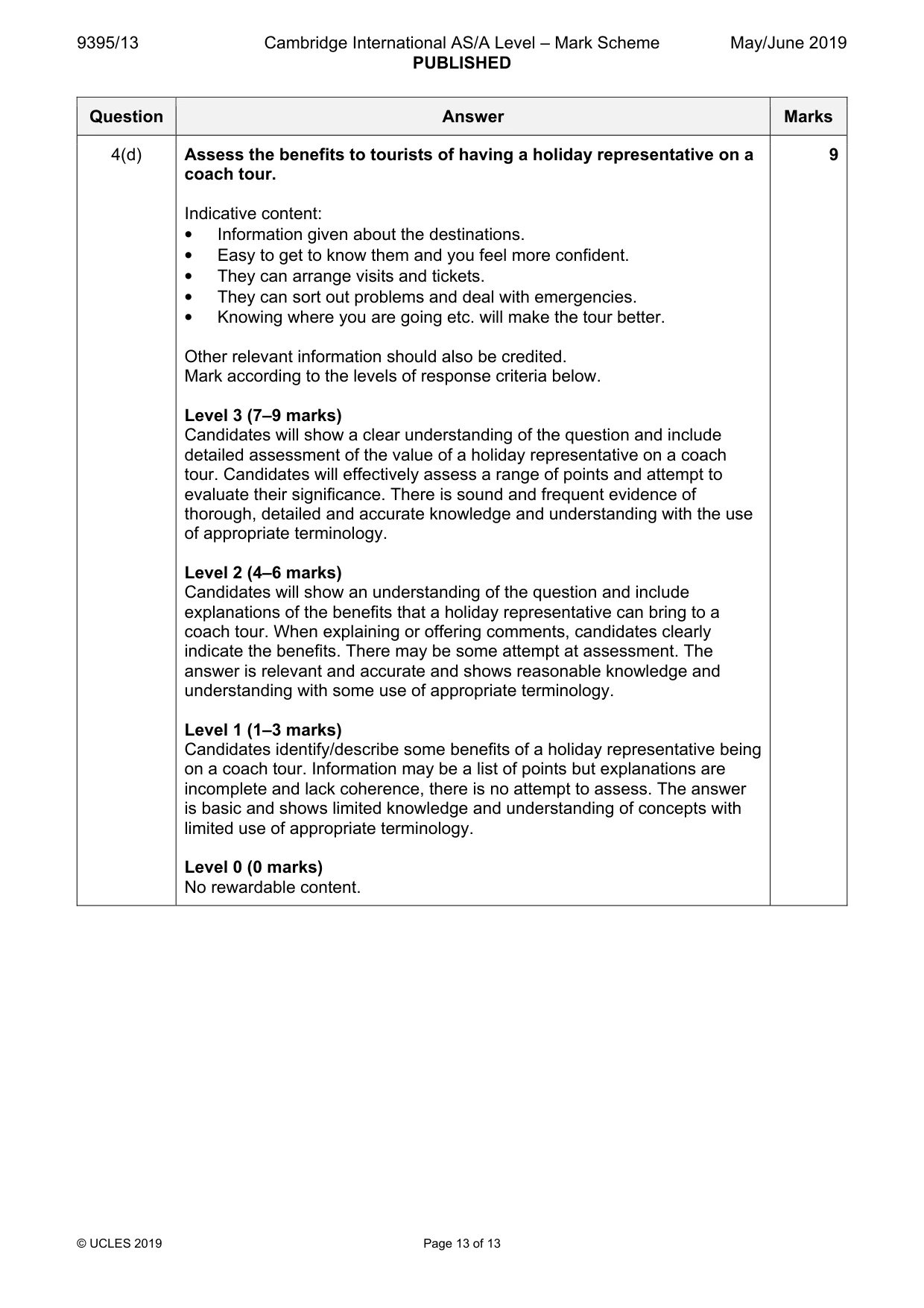
9395/13 Cambridge International AS/A Level – Mark Scheme PUBLISHED May/June 2019 © UCLES 2019 Page 13 of 13 Question Answer Marks 4(d) Assess the benefits to tourists of having a holiday representative on a coach tour. Indicative content: • Information given about the destinations. • Easy to get to know them and you feel more confident. • They can arrange visits and tickets. • They can sort out problems and deal with emergencies. • Knowing where you are going etc. will make the tour better. Other relevant information should also be credited. Mark according to the levels of response criteria below. Level 3 (7–9 marks) Candidates will show a clear understanding of the question and include detailed assessment of the value of a holiday representative on a coach tour. Candidates will effectively assess a range of points and attempt to evaluate their significance. There is sound and frequent evidence of thorough, detailed and accurate knowledge and understanding with the use of appropriate terminology. Level 2 (4–6 marks) Candidates will show an understanding of the question and include explanations of the benefits that a holiday representative can bring to a coach tour. When explaining or offering comments, candidates clearly indicate the benefits. There may be some attempt at assessment. The answer is relevant and accurate and shows reasonable knowledge and understanding with some use of appropriate terminology. Level 1 (1–3 marks) Candidates identify/describe some benefits of a holiday representative being on a coach tour. Information may be a list of points but explanations are incomplete and lack coherence, there is no attempt to assess. The answer is basic and shows limited knowledge and understanding of concepts with limited use of appropriate terminology. Level 0 (0 marks) No rewardable content. 9
What you needed in this session
Cambridge’s own grade thresholds for 2019 May/June, Paper 1 · Variant 3. A higher threshold means an easier paper — the bar moves with how the cohort did.