Cambridge A Level Travel and Tourism 9395 — 2019 May/June Paper 1 · Variant 1
9395/11/M/J/19 · 100 marks · ≈113 min
The question paper and its mark scheme, free to read here and free to download. This is Cambridge’s own paper, exactly as it was sat.
Question paper16 pages



Mark scheme12 pages
Answers below. Sit the paper first if you are practising.
Paper as text
Question paper, page 1
This document consists of 13 printed pages, 3 blank pages and 1 Insert. DC (LK) 171243/1 © UCLES 2019 [Turn over * 1 8 2 9 6 5 7 7 5 5 * TRAVEL AND TOURISM 9395/11 Paper 1 The Industry May/June 2019 2 hours and 30 minutes Candidates answer on the Question Paper. No Additional Materials are required. READ THESE INSTRUCTIONS FIRST Write your centre number, candidate number and name on all the work you hand in. Write in dark blue or black pen. You may use an HB pencil for any diagrams or graphs. Do not use staples, paper clips, glue or correction fluid. DO NOT WRITE IN ANY BARCODES. Answer all questions. All the Figures referred to in the questions are contained in the Insert. The number of marks is given in brackets [ ] at the end of each question or part question. Cambridge Assessment International Education Cambridge International Advanced Subsidiary and Advanced Level
Question paper, page 2
2 9395/11/M/J/19 © UCLES 2019 1 (a) Tour operators make money by selling package holidays. (i) Explain what is meant by the term ‘package holiday’. … … … … [2] (ii) State two methods tour operators may use to promote their products. 1 … … 2 … … [2] (b) Explain three ways tour operators use new technology to sell their products. 1 … … … … 2 … … … … 3 … … … … [6]
Question paper, page 3
3 9395/11/M/J/19 © UCLES 2019 [Turn over (c) Explain two ways a tour operator can make money in addition to selling package holidays. 1 … … … … … … 2 … … … … … … [6]
Question paper, page 4
4 9395/11/M/J/19 © UCLES 2019 (d) Discuss the methods a tour operator could use to resolve customers’ problems and complaints. … … … … … … … … … … … … … … … … … … [9] [Total: 25]
Question paper, page 5
5 9395/11/M/J/19 © UCLES 2019 [Turn over 2 (a) Explain two reasons why families may prefer to use self-catering accommodation. 1 … … … … 2 … … … … [4] (b) Explain three ways accommodation providers may adapt to a change in the attitudes and tastes of tourists. 1 … … … … 2 … … … … 3 … … … … [6]
Question paper, page 6
6 9395/11/M/J/19 © UCLES 2019 (c) Explain two ways a restaurant may deal with the issue of seasonality. 1 … … … … … … 2 … … … … … … [6]
Question paper, page 7
7 9395/11/M/J/19 © UCLES 2019 [Turn over (d) Discuss the appeal of an international hotel chain to business customers. … … … … … … … … … … … … … … … … … … [9] [Total: 25]
Question paper, page 8
8 9395/11/M/J/19 © UCLES 2019 3 Refer to Fig. 3.1 (Insert), a photograph of a town next to a lake. (a) Many tourists may visit places because of a range of leisure activities. Explain two reasons for the appeal of the destination shown in Fig. 3.1. 1 … … … … 2 … … … … [4] (b) Explain three ways the climate of a destination may impact visitor numbers. 1 … … … … 2 … … … … 3 … … … … [6]
Question paper, page 9
9 9395/11/M/J/19 © UCLES 2019 [Turn over (c) Explain two ways a destination management company (DMC) may help a tourist destination. 1 … … … … … … 2 … … … … … … [6]
Question paper, page 10
10 9395/11/M/J/19 © UCLES 2019 (d) Discuss how changing economic factors may affect tourism destinations, such as the one shown in Fig. 3.1. … … … … … … … … … … … … … … … … … … [9] [Total: 25]
Question paper, page 11
11 9395/11/M/J/19 © UCLES 2019 [Turn over 4 Refer to Fig. 4.1 (Insert), information about tourism in Mexico. (a) (i) Identify two beach destinations in Mexico. 1 … 2 … [2] (ii) Describe the appeal to tourists of the shop shown in Fig. 4.1. … … … … [2] (b) Explain three ways that a high crime rate, such as that in Mexico, may impact tourism. 1 … … … … 2 … … … … 3 … … … … [6]
Question paper, page 12
12 9395/11/M/J/19 © UCLES 2019 (c) Explain the possible reasons for the USA being the largest tourist generating area for Mexico in 2017. … … … … … … … … … … … … [6]
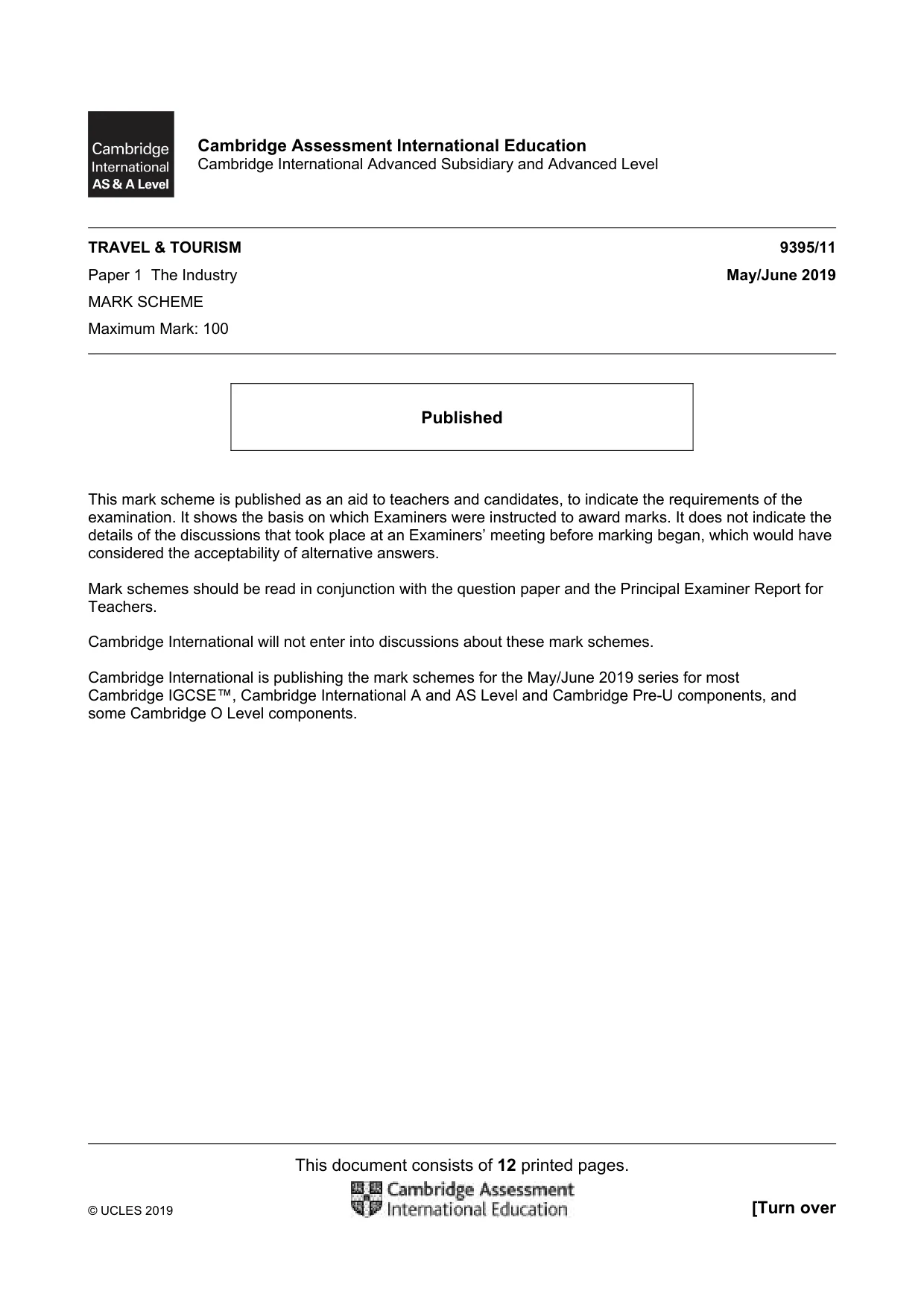
Question paper, page 13
13 9395/11/M/J/19 © UCLES 2019 (d) Discuss the importance for tourism in Mexico of preserving the Aztec cultural heritage. … … … … … … … … … … … … … … … … … … [9] [Total: 25]
Question paper, page 14
14 9395/11/M/J/19 © UCLES 2019 BLANK PAGE
Question paper, page 15
15 9395/11/M/J/19 © UCLES 2019 BLANK PAGE
Question paper, page 16
16 9395/11/M/J/19 © UCLES 2019 Permission to reproduce items where third-party owned material protected by copyright is included has been sought and cleared where possible. Every reasonable effort has been made by the publisher (UCLES) to trace copyright holders, but if any items requiring clearance have unwittingly been included, the publisher will be pleased to make amends at the earliest possible opportunity. To avoid the issue of disclosure of answer-related information to candidates, all copyright acknowledgements are reproduced online in the Cambridge Assessment International Education Copyright Acknowledgements Booklet. This is produced for each series of examinations and is freely available to download at www.cambridgeinternational.org after the live examination series. Cambridge Assessment International Education is part of the Cambridge Assessment Group. Cambridge Assessment is the brand name of the University of Cambridge Local Examinations Syndicate (UCLES), which itself is a department of the University of Cambridge. BLANK PAGE
Mark scheme, page 1
This document consists of 12 printed pages. © UCLES 2019 [Turn over Cambridge Assessment International Education Cambridge International Advanced Subsidiary and Advanced Level TRAVEL & TOURISM 9395/11 Paper 1 The Industry May/June 2019 MARK SCHEME Maximum Mark: 100 Published This mark scheme is published as an aid to teachers and candidates, to indicate the requirements of the examination. It shows the basis on which Examiners were instructed to award marks. It does not indicate the details of the discussions that took place at an Examiners’ meeting before marking began, which would have considered the acceptability of alternative answers. Mark schemes should be read in conjunction with the question paper and the Principal Examiner Report for Teachers. Cambridge International will not enter into discussions about these mark schemes. Cambridge International is publishing the mark schemes for the May/June 2019 series for most Cambridge IGCSE™, Cambridge International A and AS Level and Cambridge Pre-U components, and some Cambridge O Level components.
Mark scheme, page 2
9395/11 Cambridge International AS/A Level – Mark Scheme PUBLISHED May/June 2019 © UCLES 2019 Page 2 of 12 Generic Marking Principles These general marking principles must be applied by all examiners when marking candidate answers. They should be applied alongside the specific content of the mark scheme or generic level descriptors for a question. Each question paper and mark scheme will also comply with these marking principles. GENERIC MARKING PRINCIPLE 1: Marks must be awarded in line with: • the specific content of the mark scheme or the generic level descriptors for the question • the specific skills defined in the mark scheme or in the generic level descriptors for the question • the standard of response required by a candidate as exemplified by the standardisation scripts. GENERIC MARKING PRINCIPLE 2: Marks awarded are always whole marks (not half marks, or other fractions). GENERIC MARKING PRINCIPLE 3: Marks must be awarded positively: • marks are awarded for correct/valid answers, as defined in the mark scheme. However, credit is given for valid answers which go beyond the scope of the syllabus and mark scheme, referring to your Team Leader as appropriate • marks are awarded when candidates clearly demonstrate what they know and can do • marks are not deducted for errors • marks are not deducted for omissions • answers should only be judged on the quality of spelling, punctuation and grammar when these features are specifically assessed by the question as indicated by the mark scheme. The meaning, however, should be unambiguous. GENERIC MARKING PRINCIPLE 4: Rules must be applied consistently e.g. in situations where candidates have not followed instructions or in the application of generic level descriptors. GENERIC MARKING PRINCIPLE 5: Marks should be awarded using the full range of marks defined in the mark scheme for the question (however; the use of the full mark range may be limited according to the quality of the candidate responses seen). GENERIC MARKING PRINCIPLE 6: Marks awarded are based solely on the requirements as defined in the mark scheme. Marks should not be awarded with grade thresholds or grade descriptors in mind.
Mark scheme, page 3
9395/11 Cambridge International AS/A Level – Mark Scheme PUBLISHED May/June 2019 © UCLES 2019 Page 3 of 12 Question Answer Marks 1(a)(i) Explain what is meant by the term ‘package holiday’. Award up to two marks for the definition. The sale of at least two components of the holiday to the traveller (1) such as transport and accommodation (1). 2 1(a)(ii) State two methods tour operators may use to promote their products. Award one mark for each correct method up to two marks. • Websites (1) • Social media reports such as TripAdvisor (1) • Trade fairs (1) • Adverts on TV or using other media(1) • Direct contact through mail shots (1) • Travel agencies (1) • brochures (1) Accept any other reasonable answer. 2 1(b) Explain three ways tour operators use new technology to sell their products. Award one mark for each correct way and a second mark for explanation. • Tour operators can use social media sites to promote their products (1), this gives access to large numbers of potential buyers (1). • Tour operators can send text messages to customers and can keep in contact with their customers in this way (1), this means they can promote new products directly to the customers (1). • The internet allows the selling/purchase of products on a 24/7 basis (1). this means that buyers do not have meet ‘opening hours’ (go at certain times) or have to visit a shop which is more convenient. (1) • Tablets and phones can be used due to the widespread availability of broadband (1) so this allows websites to be continually updated (1). Accept any other reasonable answer. 6
Mark scheme, page 4
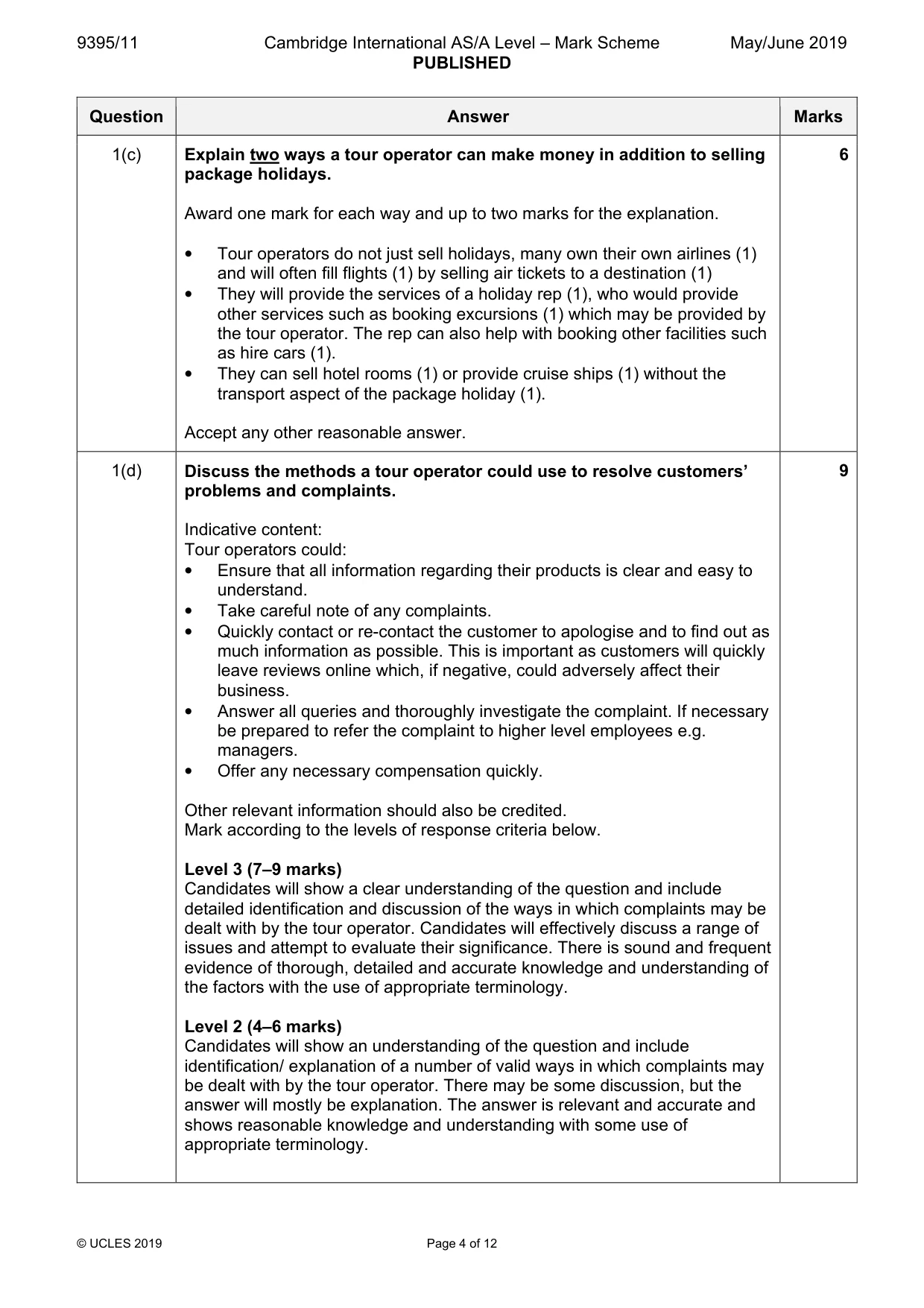
9395/11 Cambridge International AS/A Level – Mark Scheme PUBLISHED May/June 2019 © UCLES 2019 Page 4 of 12 Question Answer Marks 1(c) Explain two ways a tour operator can make money in addition to selling package holidays. Award one mark for each way and up to two marks for the explanation. • Tour operators do not just sell holidays, many own their own airlines (1) and will often fill flights (1) by selling air tickets to a destination (1) • They will provide the services of a holiday rep (1), who would provide other services such as booking excursions (1) which may be provided by the tour operator. The rep can also help with booking other facilities such as hire cars (1). • They can sell hotel rooms (1) or provide cruise ships (1) without the transport aspect of the package holiday (1). Accept any other reasonable answer. 6 1(d) Discuss the methods a tour operator could use to resolve customers’ problems and complaints. Indicative content: Tour operators could: • Ensure that all information regarding their products is clear and easy to understand. • Take careful note of any complaints. • Quickly contact or re-contact the customer to apologise and to find out as much information as possible. This is important as customers will quickly leave reviews online which, if negative, could adversely affect their business. • Answer all queries and thoroughly investigate the complaint. If necessary be prepared to refer the complaint to higher level employees e.g. managers. • Offer any necessary compensation quickly. Other relevant information should also be credited. Mark according to the levels of response criteria below. Level 3 (7–9 marks) Candidates will show a clear understanding of the question and include detailed identification and discussion of the ways in which complaints may be dealt with by the tour operator. Candidates will effectively discuss a range of issues and attempt to evaluate their significance. There is sound and frequent evidence of thorough, detailed and accurate knowledge and understanding of the factors with the use of appropriate terminology. Level 2 (4–6 marks) Candidates will show an understanding of the question and include identification/ explanation of a number of valid ways in which complaints may be dealt with by the tour operator. There may be some discussion, but the answer will mostly be explanation. The answer is relevant and accurate and shows reasonable knowledge and understanding with some use of appropriate terminology. 9
Mark scheme, page 5
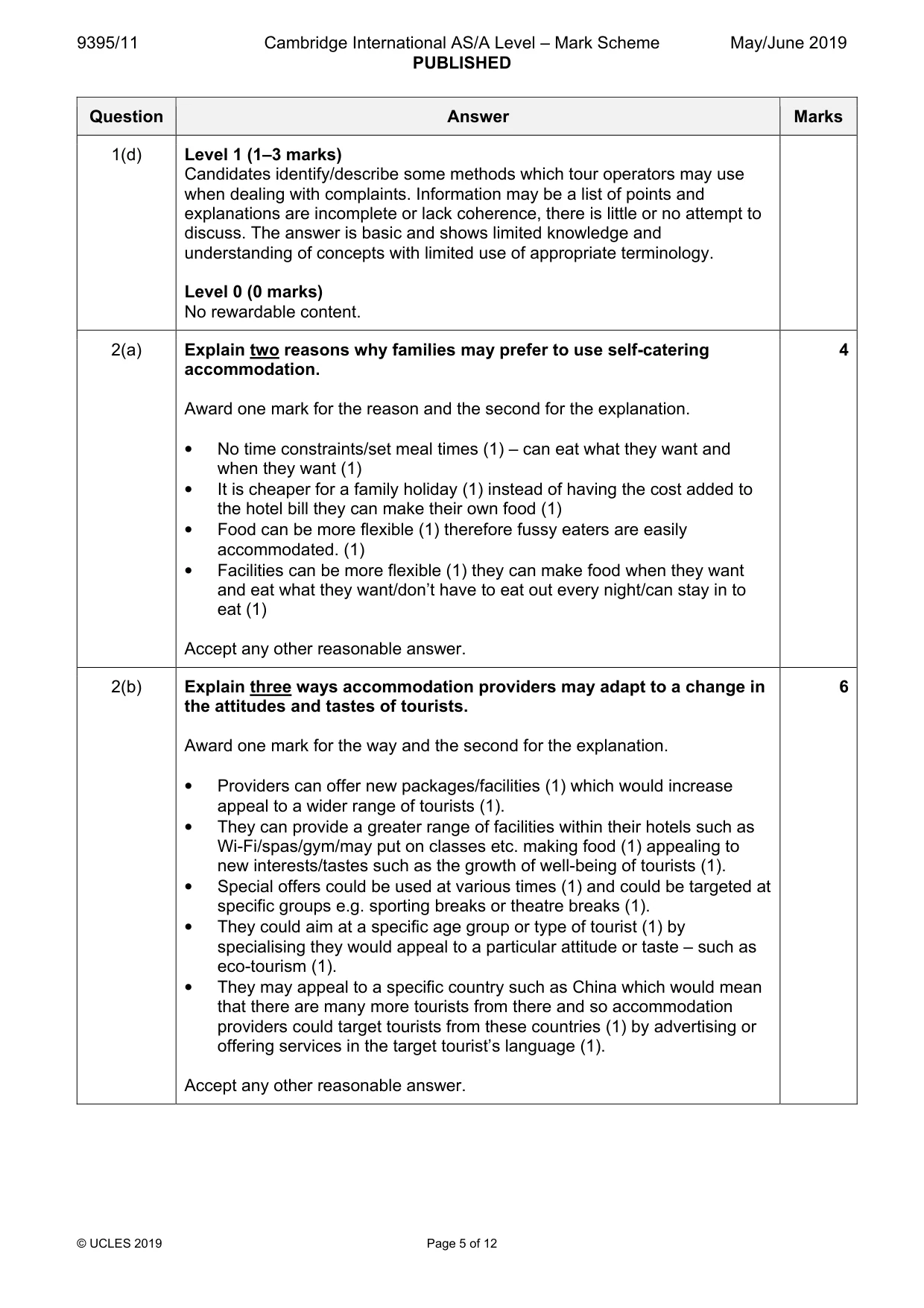
9395/11 Cambridge International AS/A Level – Mark Scheme PUBLISHED May/June 2019 © UCLES 2019 Page 5 of 12 Question Answer Marks 1(d) Level 1 (1–3 marks) Candidates identify/describe some methods which tour operators may use when dealing with complaints. Information may be a list of points and explanations are incomplete or lack coherence, there is little or no attempt to discuss. The answer is basic and shows limited knowledge and understanding of concepts with limited use of appropriate terminology. Level 0 (0 marks) No rewardable content. 2(a) Explain two reasons why families may prefer to use self-catering accommodation. Award one mark for the reason and the second for the explanation. • No time constraints/set meal times (1) – can eat what they want and when they want (1) • It is cheaper for a family holiday (1) instead of having the cost added to the hotel bill they can make their own food (1) • Food can be more flexible (1) therefore fussy eaters are easily accommodated. (1) • Facilities can be more flexible (1) they can make food when they want and eat what they want/don’t have to eat out every night/can stay in to eat (1) Accept any other reasonable answer. 4 2(b) Explain three ways accommodation providers may adapt to a change in the attitudes and tastes of tourists. Award one mark for the way and the second for the explanation. • Providers can offer new packages/facilities (1) which would increase appeal to a wider range of tourists (1). • They can provide a greater range of facilities within their hotels such as Wi-Fi/spas/gym/may put on classes etc. making food (1) appealing to new interests/tastes such as the growth of well-being of tourists (1). • Special offers could be used at various times (1) and could be targeted at specific groups e.g. sporting breaks or theatre breaks (1). • They could aim at a specific age group or type of tourist (1) by specialising they would appeal to a particular attitude or taste – such as eco-tourism (1). • They may appeal to a specific country such as China which would mean that there are many more tourists from there and so accommodation providers could target tourists from these countries (1) by advertising or offering services in the target tourist’s language (1). Accept any other reasonable answer. 6
Mark scheme, page 6
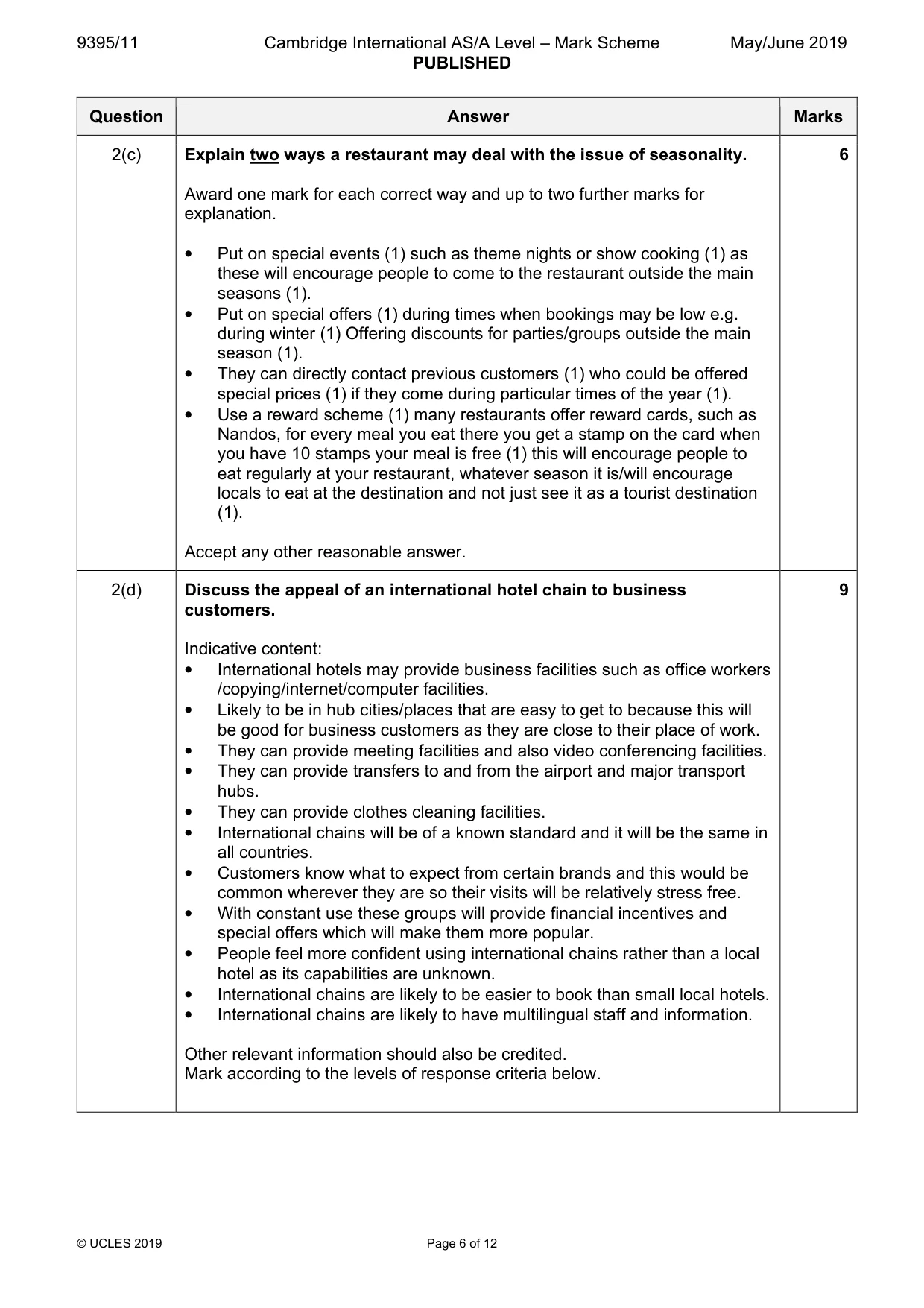
9395/11 Cambridge International AS/A Level – Mark Scheme PUBLISHED May/June 2019 © UCLES 2019 Page 6 of 12 Question Answer Marks 2(c) Explain two ways a restaurant may deal with the issue of seasonality. Award one mark for each correct way and up to two further marks for explanation. • Put on special events (1) such as theme nights or show cooking (1) as these will encourage people to come to the restaurant outside the main seasons (1). • Put on special offers (1) during times when bookings may be low e.g. during winter (1) Offering discounts for parties/groups outside the main season (1). • They can directly contact previous customers (1) who could be offered special prices (1) if they come during particular times of the year (1). • Use a reward scheme (1) many restaurants offer reward cards, such as Nandos, for every meal you eat there you get a stamp on the card when you have 10 stamps your meal is free (1) this will encourage people to eat regularly at your restaurant, whatever season it is/will encourage locals to eat at the destination and not just see it as a tourist destination (1). Accept any other reasonable answer. 6 2(d) Discuss the appeal of an international hotel chain to business customers. Indicative content: • International hotels may provide business facilities such as office workers /copying/internet/computer facilities. • Likely to be in hub cities/places that are easy to get to because this will be good for business customers as they are close to their place of work. • They can provide meeting facilities and also video conferencing facilities. • They can provide transfers to and from the airport and major transport hubs. • They can provide clothes cleaning facilities. • International chains will be of a known standard and it will be the same in all countries. • Customers know what to expect from certain brands and this would be common wherever they are so their visits will be relatively stress free. • With constant use these groups will provide financial incentives and special offers which will make them more popular. • People feel more confident using international chains rather than a local hotel as its capabilities are unknown. • International chains are likely to be easier to book than small local hotels. • International chains are likely to have multilingual staff and information. Other relevant information should also be credited. Mark according to the levels of response criteria below. 9
Mark scheme, page 7
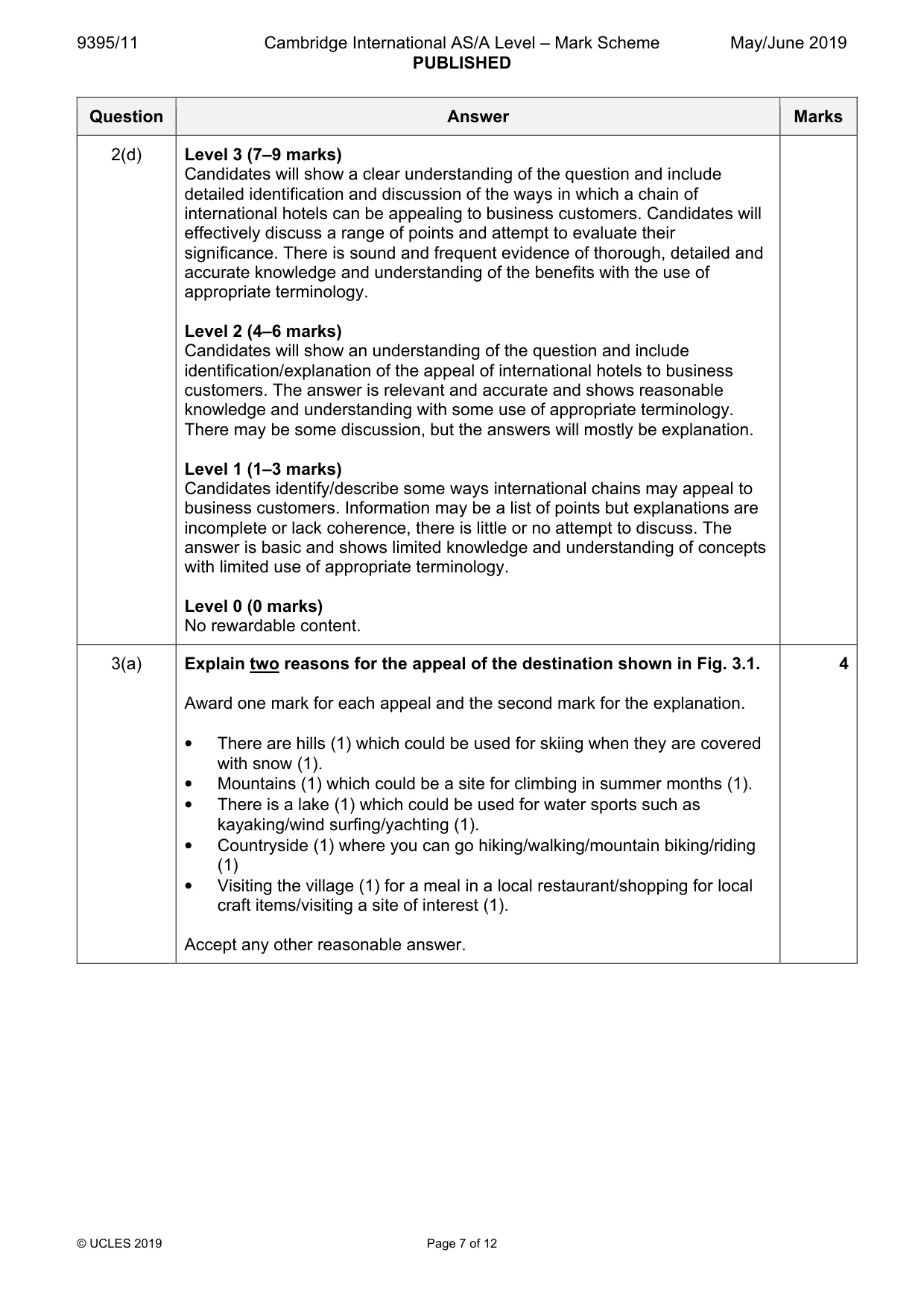
9395/11 Cambridge International AS/A Level – Mark Scheme PUBLISHED May/June 2019 © UCLES 2019 Page 7 of 12 Question Answer Marks 2(d) Level 3 (7–9 marks) Candidates will show a clear understanding of the question and include detailed identification and discussion of the ways in which a chain of international hotels can be appealing to business customers. Candidates will effectively discuss a range of points and attempt to evaluate their significance. There is sound and frequent evidence of thorough, detailed and accurate knowledge and understanding of the benefits with the use of appropriate terminology. Level 2 (4–6 marks) Candidates will show an understanding of the question and include identification/explanation of the appeal of international hotels to business customers. The answer is relevant and accurate and shows reasonable knowledge and understanding with some use of appropriate terminology. There may be some discussion, but the answers will mostly be explanation. Level 1 (1–3 marks) Candidates identify/describe some ways international chains may appeal to business customers. Information may be a list of points but explanations are incomplete or lack coherence, there is little or no attempt to discuss. The answer is basic and shows limited knowledge and understanding of concepts with limited use of appropriate terminology. Level 0 (0 marks) No rewardable content. 3(a) Explain two reasons for the appeal of the destination shown in Fig. 3.1. Award one mark for each appeal and the second mark for the explanation. • There are hills (1) which could be used for skiing when they are covered with snow (1). • Mountains (1) which could be a site for climbing in summer months (1). • There is a lake (1) which could be used for water sports such as kayaking/wind surfing/yachting (1). • Countryside (1) where you can go hiking/walking/mountain biking/riding (1) • Visiting the village (1) for a meal in a local restaurant/shopping for local craft items/visiting a site of interest (1). Accept any other reasonable answer. 4
Mark scheme, page 8
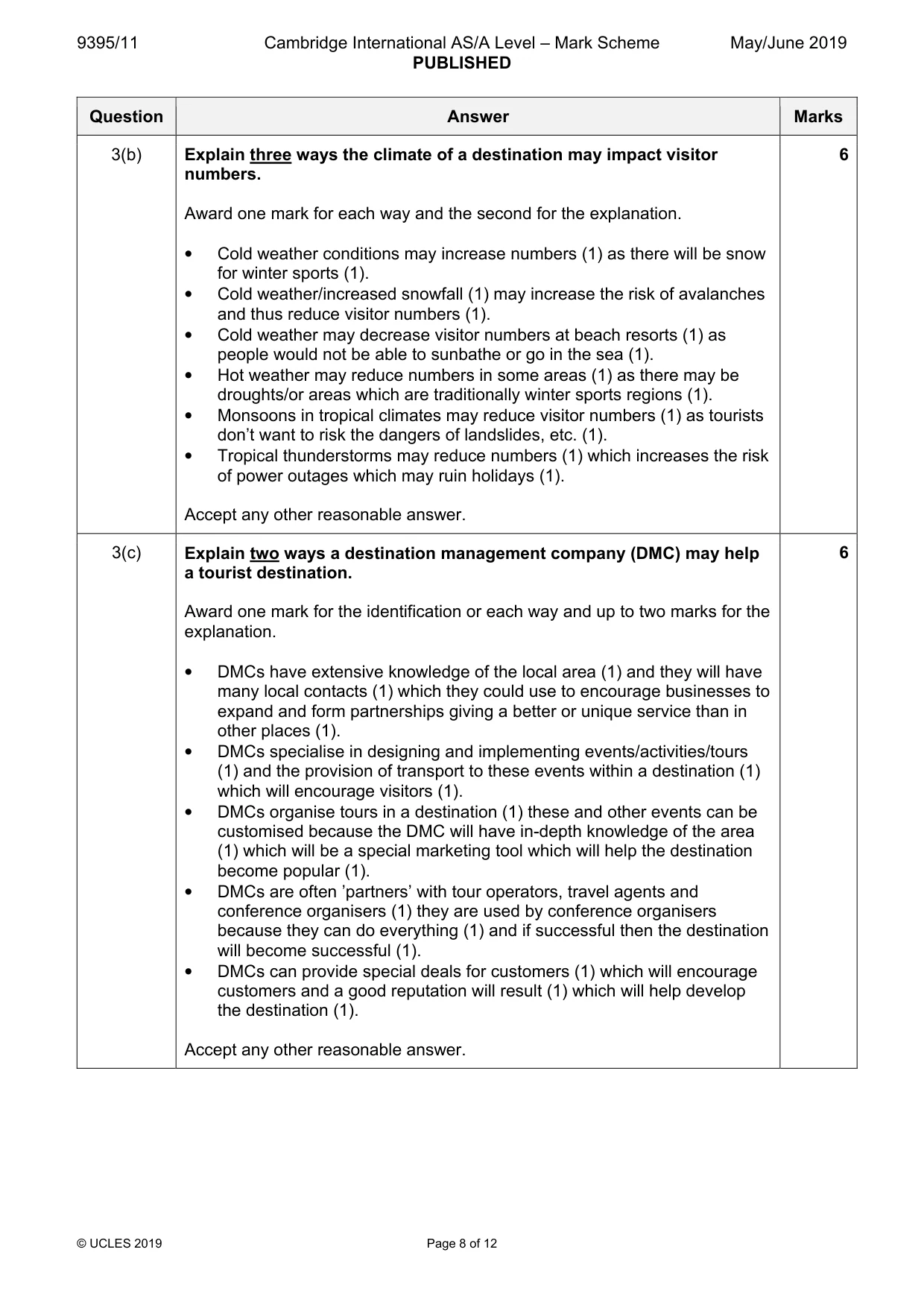
9395/11 Cambridge International AS/A Level – Mark Scheme PUBLISHED May/June 2019 © UCLES 2019 Page 8 of 12 Question Answer Marks 3(b) Explain three ways the climate of a destination may impact visitor numbers. Award one mark for each way and the second for the explanation. • Cold weather conditions may increase numbers (1) as there will be snow for winter sports (1). • Cold weather/increased snowfall (1) may increase the risk of avalanches and thus reduce visitor numbers (1). • Cold weather may decrease visitor numbers at beach resorts (1) as people would not be able to sunbathe or go in the sea (1). • Hot weather may reduce numbers in some areas (1) as there may be droughts/or areas which are traditionally winter sports regions (1). • Monsoons in tropical climates may reduce visitor numbers (1) as tourists don’t want to risk the dangers of landslides, etc. (1). • Tropical thunderstorms may reduce numbers (1) which increases the risk of power outages which may ruin holidays (1). Accept any other reasonable answer. 6 3(c) Explain two ways a destination management company (DMC) may help a tourist destination. Award one mark for the identification or each way and up to two marks for the explanation. • DMCs have extensive knowledge of the local area (1) and they will have many local contacts (1) which they could use to encourage businesses to expand and form partnerships giving a better or unique service than in other places (1). • DMCs specialise in designing and implementing events/activities/tours (1) and the provision of transport to these events within a destination (1) which will encourage visitors (1). • DMCs organise tours in a destination (1) these and other events can be customised because the DMC will have in-depth knowledge of the area (1) which will be a special marketing tool which will help the destination become popular (1). • DMCs are often ’partners’ with tour operators, travel agents and conference organisers (1) they are used by conference organisers because they can do everything (1) and if successful then the destination will become successful (1). • DMCs can provide special deals for customers (1) which will encourage customers and a good reputation will result (1) which will help develop the destination (1). Accept any other reasonable answer. 6
Mark scheme, page 9
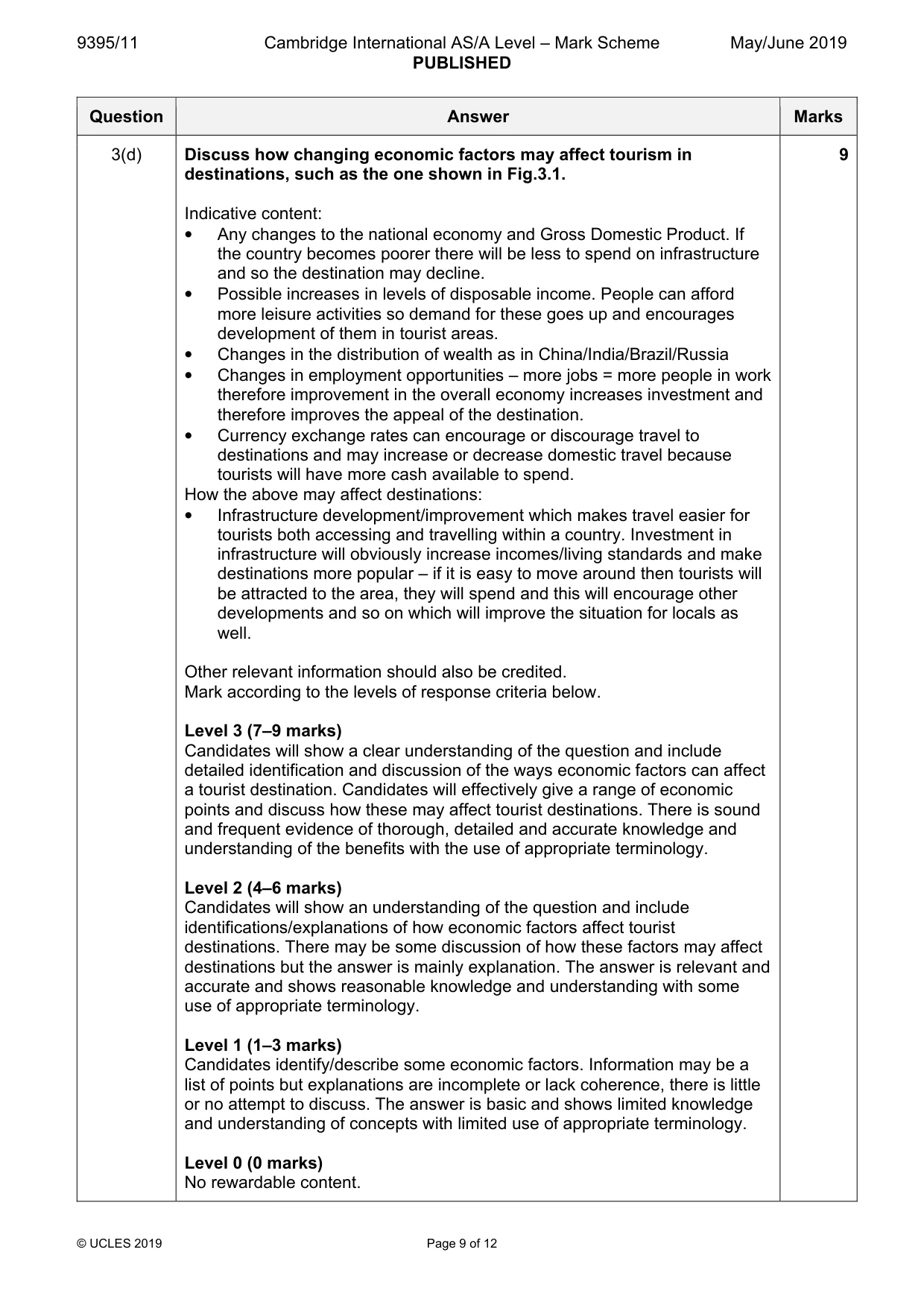
9395/11 Cambridge International AS/A Level – Mark Scheme PUBLISHED May/June 2019 © UCLES 2019 Page 9 of 12 Question Answer Marks 3(d) Discuss how changing economic factors may affect tourism in destinations, such as the one shown in Fig.3.1. Indicative content: • Any changes to the national economy and Gross Domestic Product. If the country becomes poorer there will be less to spend on infrastructure and so the destination may decline. • Possible increases in levels of disposable income. People can afford more leisure activities so demand for these goes up and encourages development of them in tourist areas. • Changes in the distribution of wealth as in China/India/Brazil/Russia • Changes in employment opportunities – more jobs = more people in work therefore improvement in the overall economy increases investment and therefore improves the appeal of the destination. • Currency exchange rates can encourage or discourage travel to destinations and may increase or decrease domestic travel because tourists will have more cash available to spend. How the above may affect destinations: • Infrastructure development/improvement which makes travel easier for tourists both accessing and travelling within a country. Investment in infrastructure will obviously increase incomes/living standards and make destinations more popular – if it is easy to move around then tourists will be attracted to the area, they will spend and this will encourage other developments and so on which will improve the situation for locals as well. Other relevant information should also be credited. Mark according to the levels of response criteria below. Level 3 (7–9 marks) Candidates will show a clear understanding of the question and include detailed identification and discussion of the ways economic factors can affect a tourist destination. Candidates will effectively give a range of economic points and discuss how these may affect tourist destinations. There is sound and frequent evidence of thorough, detailed and accurate knowledge and understanding of the benefits with the use of appropriate terminology. Level 2 (4–6 marks) Candidates will show an understanding of the question and include identifications/explanations of how economic factors affect tourist destinations. There may be some discussion of how these factors may affect destinations but the answer is mainly explanation. The answer is relevant and accurate and shows reasonable knowledge and understanding with some use of appropriate terminology. Level 1 (1–3 marks) Candidates identify/describe some economic factors. Information may be a list of points but explanations are incomplete or lack coherence, there is little or no attempt to discuss. The answer is basic and shows limited knowledge and understanding of concepts with limited use of appropriate terminology. Level 0 (0 marks) No rewardable content. 9
Mark scheme, page 10
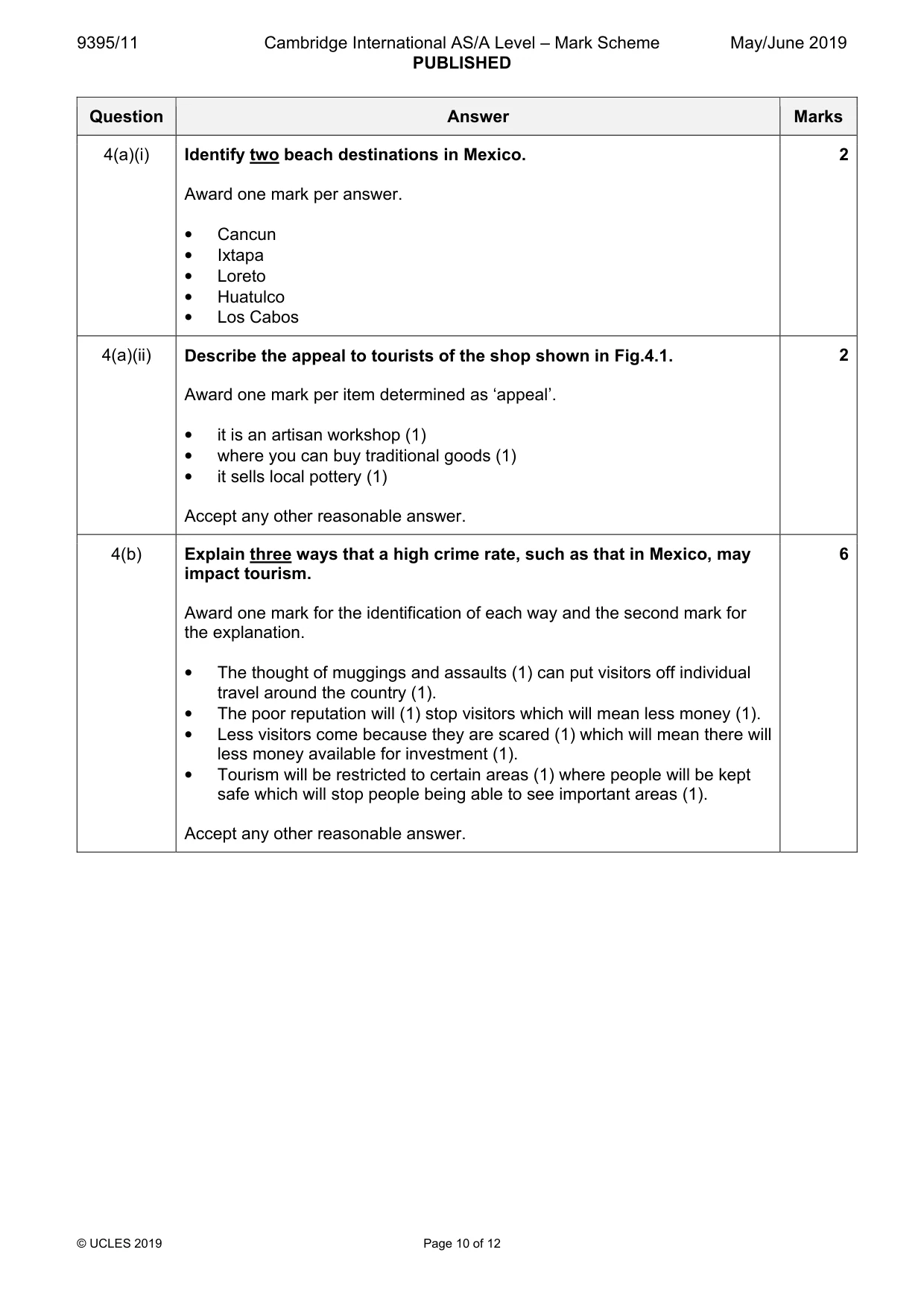
9395/11 Cambridge International AS/A Level – Mark Scheme PUBLISHED May/June 2019 © UCLES 2019 Page 10 of 12 Question Answer Marks 4(a)(i) Identify two beach destinations in Mexico. Award one mark per answer. • Cancun • Ixtapa • Loreto • Huatulco • Los Cabos 2 4(a)(ii) Describe the appeal to tourists of the shop shown in Fig.4.1. Award one mark per item determined as ‘appeal’. • it is an artisan workshop (1) • where you can buy traditional goods (1) • it sells local pottery (1) Accept any other reasonable answer. 2 4(b) Explain three ways that a high crime rate, such as that in Mexico, may impact tourism. Award one mark for the identification of each way and the second mark for the explanation. • The thought of muggings and assaults (1) can put visitors off individual travel around the country (1). • The poor reputation will (1) stop visitors which will mean less money (1). • Less visitors come because they are scared (1) which will mean there will less money available for investment (1). • Tourism will be restricted to certain areas (1) where people will be kept safe which will stop people being able to see important areas (1). Accept any other reasonable answer. 6
Mark scheme, page 11
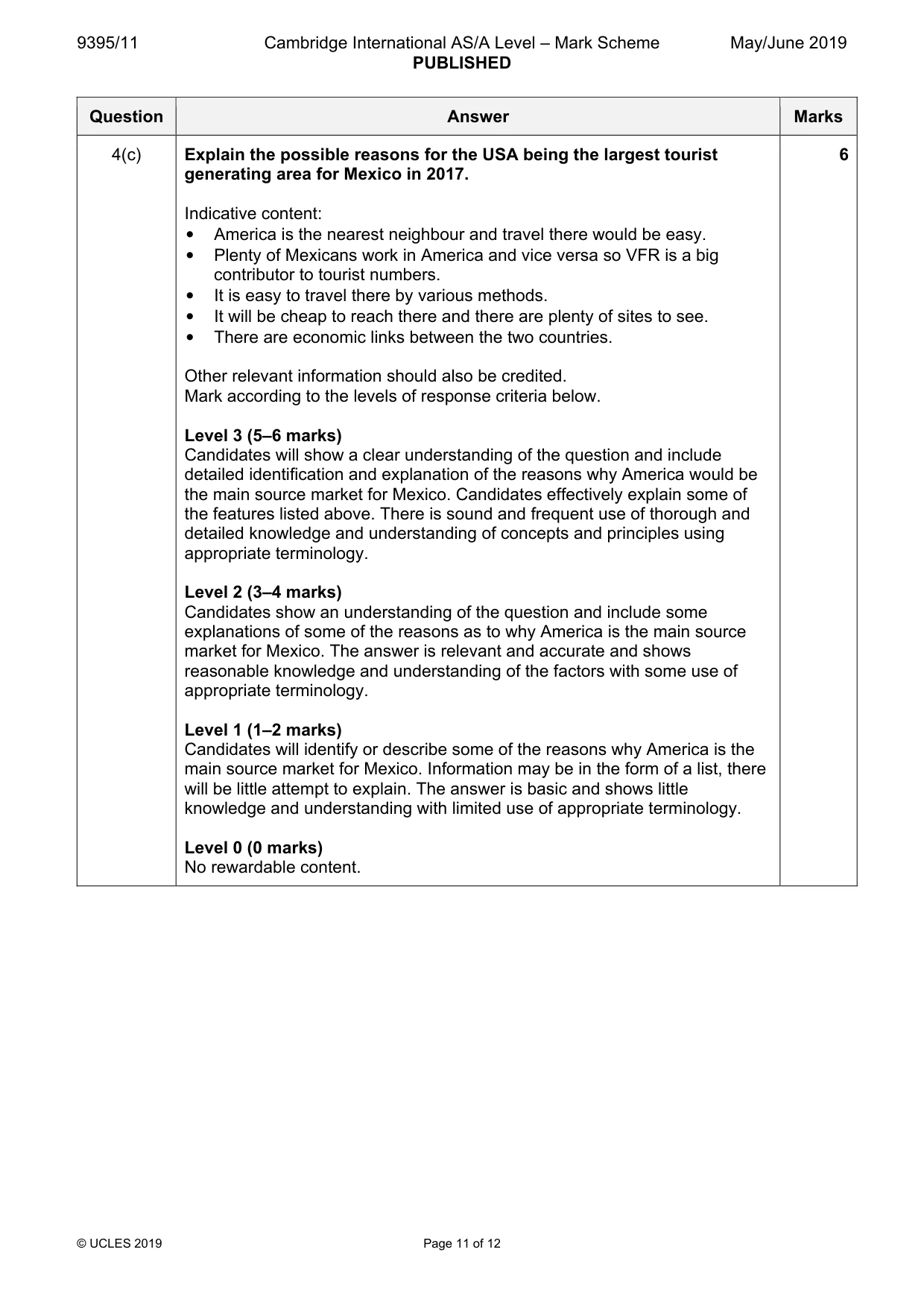
9395/11 Cambridge International AS/A Level – Mark Scheme PUBLISHED May/June 2019 © UCLES 2019 Page 11 of 12 Question Answer Marks 4(c) Explain the possible reasons for the USA being the largest tourist generating area for Mexico in 2017. Indicative content: • America is the nearest neighbour and travel there would be easy. • Plenty of Mexicans work in America and vice versa so VFR is a big contributor to tourist numbers. • It is easy to travel there by various methods. • It will be cheap to reach there and there are plenty of sites to see. • There are economic links between the two countries. Other relevant information should also be credited. Mark according to the levels of response criteria below. Level 3 (5–6 marks) Candidates will show a clear understanding of the question and include detailed identification and explanation of the reasons why America would be the main source market for Mexico. Candidates effectively explain some of the features listed above. There is sound and frequent use of thorough and detailed knowledge and understanding of concepts and principles using appropriate terminology. Level 2 (3–4 marks) Candidates show an understanding of the question and include some explanations of some of the reasons as to why America is the main source market for Mexico. The answer is relevant and accurate and shows reasonable knowledge and understanding of the factors with some use of appropriate terminology. Level 1 (1–2 marks) Candidates will identify or describe some of the reasons why America is the main source market for Mexico. Information may be in the form of a list, there will be little attempt to explain. The answer is basic and shows little knowledge and understanding with limited use of appropriate terminology. Level 0 (0 marks) No rewardable content. 6
Mark scheme, page 12
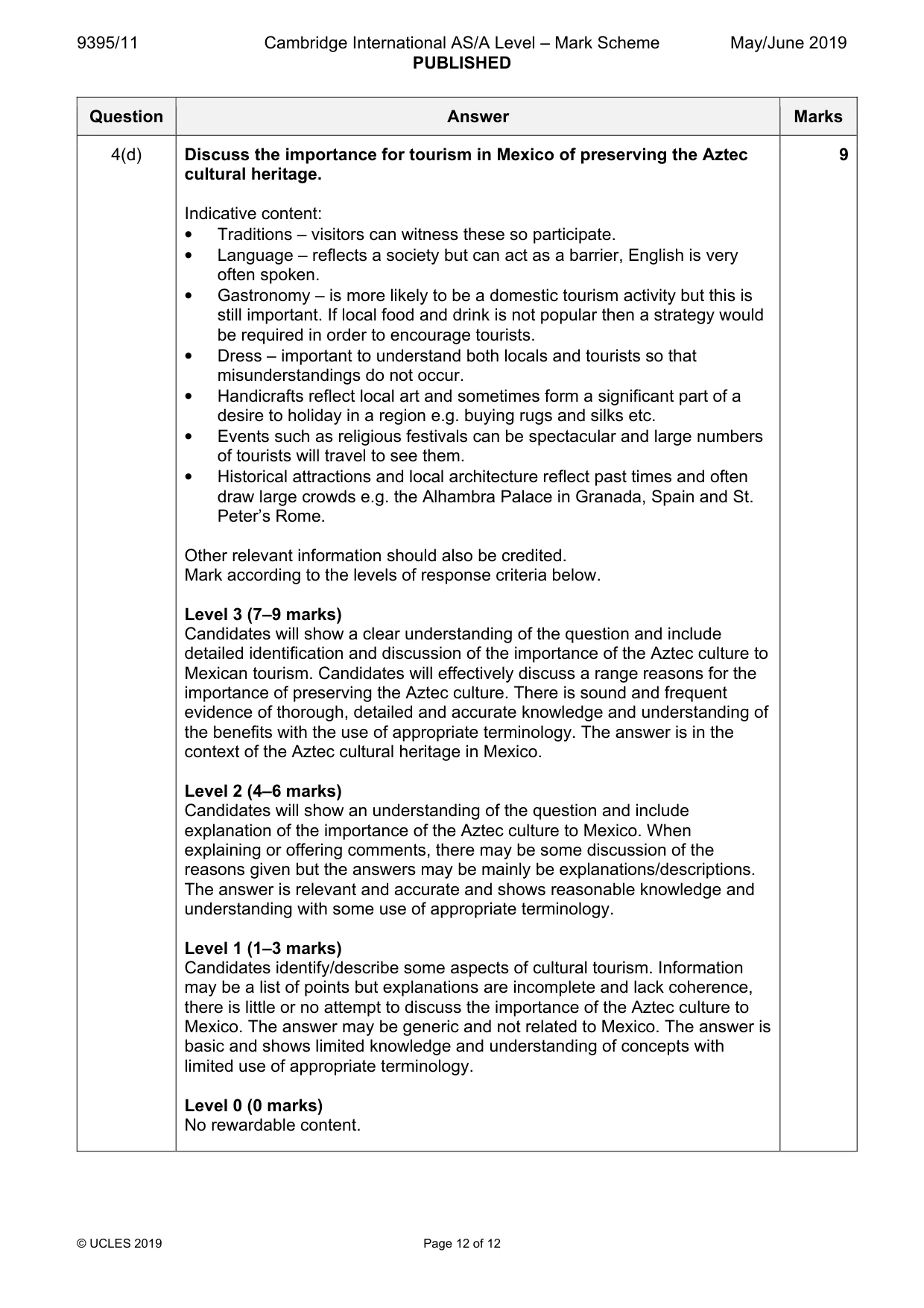
9395/11 Cambridge International AS/A Level – Mark Scheme PUBLISHED May/June 2019 © UCLES 2019 Page 12 of 12 Question Answer Marks 4(d) Discuss the importance for tourism in Mexico of preserving the Aztec cultural heritage. Indicative content: • Traditions – visitors can witness these so participate. • Language – reflects a society but can act as a barrier, English is very often spoken. • Gastronomy – is more likely to be a domestic tourism activity but this is still important. If local food and drink is not popular then a strategy would be required in order to encourage tourists. • Dress – important to understand both locals and tourists so that misunderstandings do not occur. • Handicrafts reflect local art and sometimes form a significant part of a desire to holiday in a region e.g. buying rugs and silks etc. • Events such as religious festivals can be spectacular and large numbers of tourists will travel to see them. • Historical attractions and local architecture reflect past times and often draw large crowds e.g. the Alhambra Palace in Granada, Spain and St. Peter’s Rome. Other relevant information should also be credited. Mark according to the levels of response criteria below. Level 3 (7–9 marks) Candidates will show a clear understanding of the question and include detailed identification and discussion of the importance of the Aztec culture to Mexican tourism. Candidates will effectively discuss a range reasons for the importance of preserving the Aztec culture. There is sound and frequent evidence of thorough, detailed and accurate knowledge and understanding of the benefits with the use of appropriate terminology. The answer is in the context of the Aztec cultural heritage in Mexico. Level 2 (4–6 marks) Candidates will show an understanding of the question and include explanation of the importance of the Aztec culture to Mexico. When explaining or offering comments, there may be some discussion of the reasons given but the answers may be mainly be explanations/descriptions. The answer is relevant and accurate and shows reasonable knowledge and understanding with some use of appropriate terminology. Level 1 (1–3 marks) Candidates identify/describe some aspects of cultural tourism. Information may be a list of points but explanations are incomplete and lack coherence, there is little or no attempt to discuss the importance of the Aztec culture to Mexico. The answer may be generic and not related to Mexico. The answer is basic and shows limited knowledge and understanding of concepts with limited use of appropriate terminology. Level 0 (0 marks) No rewardable content. 9
What you needed in this session
Cambridge’s own grade thresholds for 2019 May/June, Paper 1 · Variant 1. A higher threshold means an easier paper — the bar moves with how the cohort did.