Cambridge A Level Travel and Tourism 9395 — 2018 May/June Paper 1 · Variant 2
9395/12/M/J/18 · 100 marks · ≈113 min
The question paper and its mark scheme, free to read here and free to download. This is Cambridge’s own paper, exactly as it was sat.
Question paper16 pages



Mark scheme14 pages
Answers below. Sit the paper first if you are practising.
Paper as text
Question paper, page 1
* 0 1 6 7 2 9 9 1 3 4 * This document consists of 13 printed pages, 3 blank pages and 1 Insert. DC (LK) 153991/2 © UCLES 2018 [Turn over Cambridge International Examinations Cambridge International Advanced Subsidiary and Advanced Level TRAVEL AND TOURISM 9395/12 Paper 1 The Industry May/June 2018 2 hours and 30 minutes Candidates answer on the Question Paper. No Additional Materials are required. READ THESE INSTRUCTIONS FIRST Write your Centre number, candidate number and name on all the work you hand in. Write in dark blue or black pen. You may use an HB pencil for any diagrams or graphs. Do not use staples, paper clips, glue or correction fluid. DO NOT WRITE IN ANY BARCODES. Answer all questions. All the Figures referred to in the questions are contained in the Insert. The number of marks is given in brackets [ ] at the end of each question or part question.
Question paper, page 2
2 9395/12/M/J/18 © UCLES 2018 Question 1 Refer to Fig. 1 (Insert), a photograph of a theme park. (a) Describe the likely appeal of theme parks to the following customer types: families … … … … business customers … … … … [4] (b) Explain why staff at a theme park need: health and safety training … … … … … … knowledge of procedures and routines … … … … … … [6]
Question paper, page 3
3 9395/12/M/J/18 © UCLES 2018 [Turn over (c) Analyse the impacts of good customer service on travel and tourism organisations. … … … … … … … … … … … …[6]
Question paper, page 4
4 9395/12/M/J/18 © UCLES 2018 (d) Evaluate the techniques available to assess the quality of customer service in travel and tourism. … … … … … … … … … … … … … … … … … …[9] [Total: 25]
Question paper, page 5
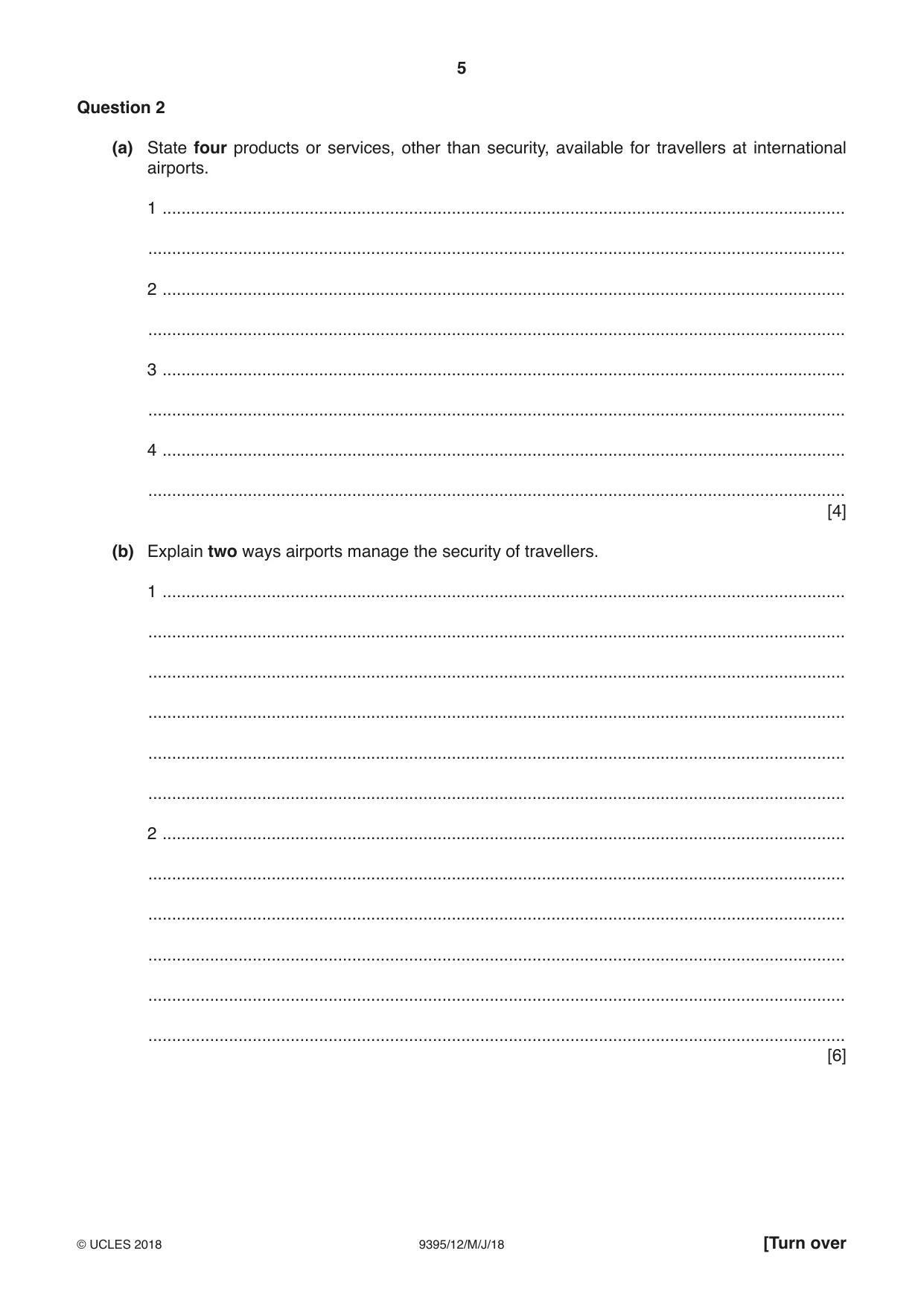
5 9395/12/M/J/18 © UCLES 2018 [Turn over Question 2 (a) State four products or services, other than security, available for travellers at international airports. 1 … … 2 … … 3 … … 4 … … [4] (b) Explain two ways airports manage the security of travellers. 1 … … … … … … 2 … … … … … … [6]
Question paper, page 6
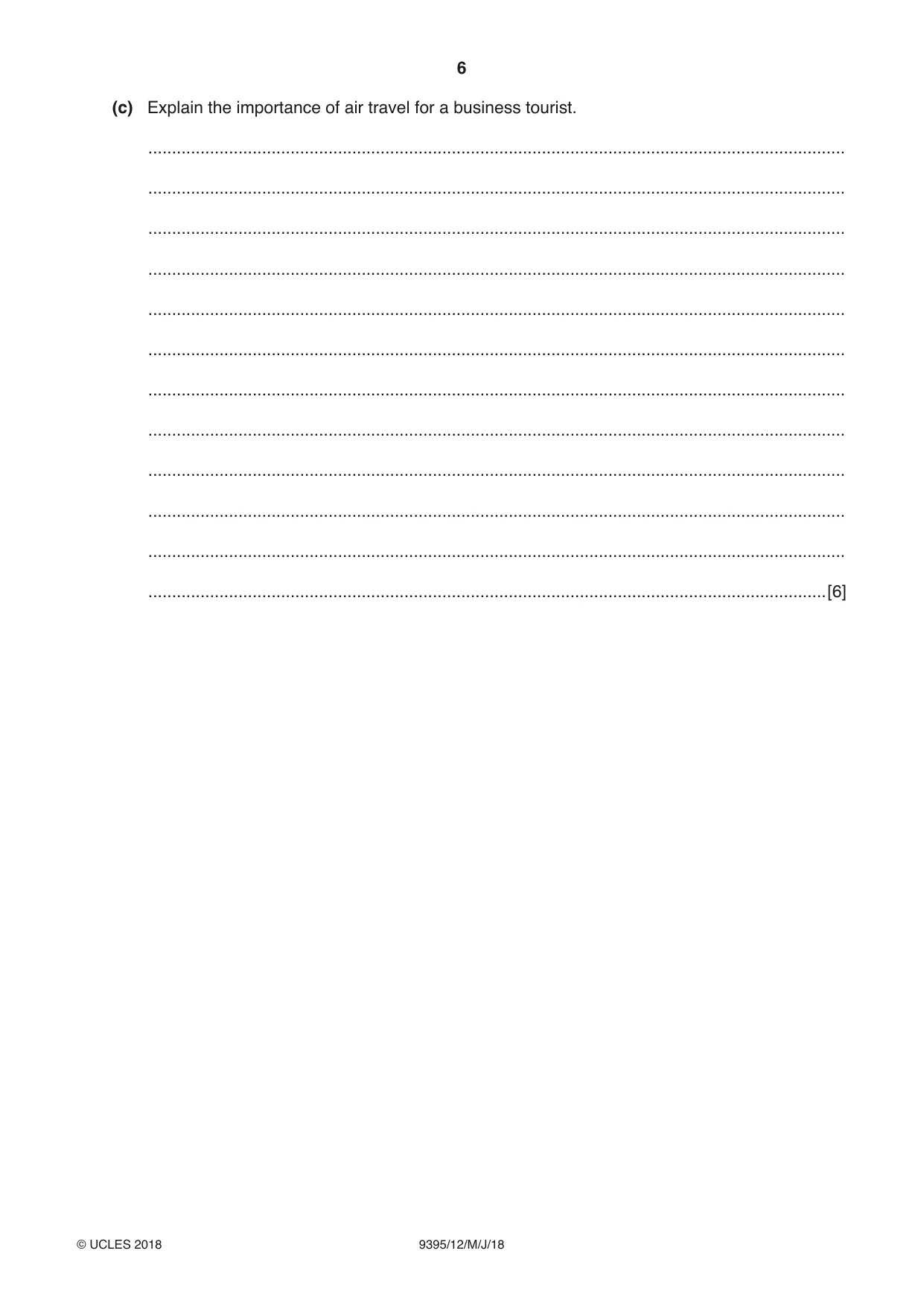
6 9395/12/M/J/18 © UCLES 2018 (c) Explain the importance of air travel for a business tourist. … … … … … … … … … … … …[6]
Question paper, page 7
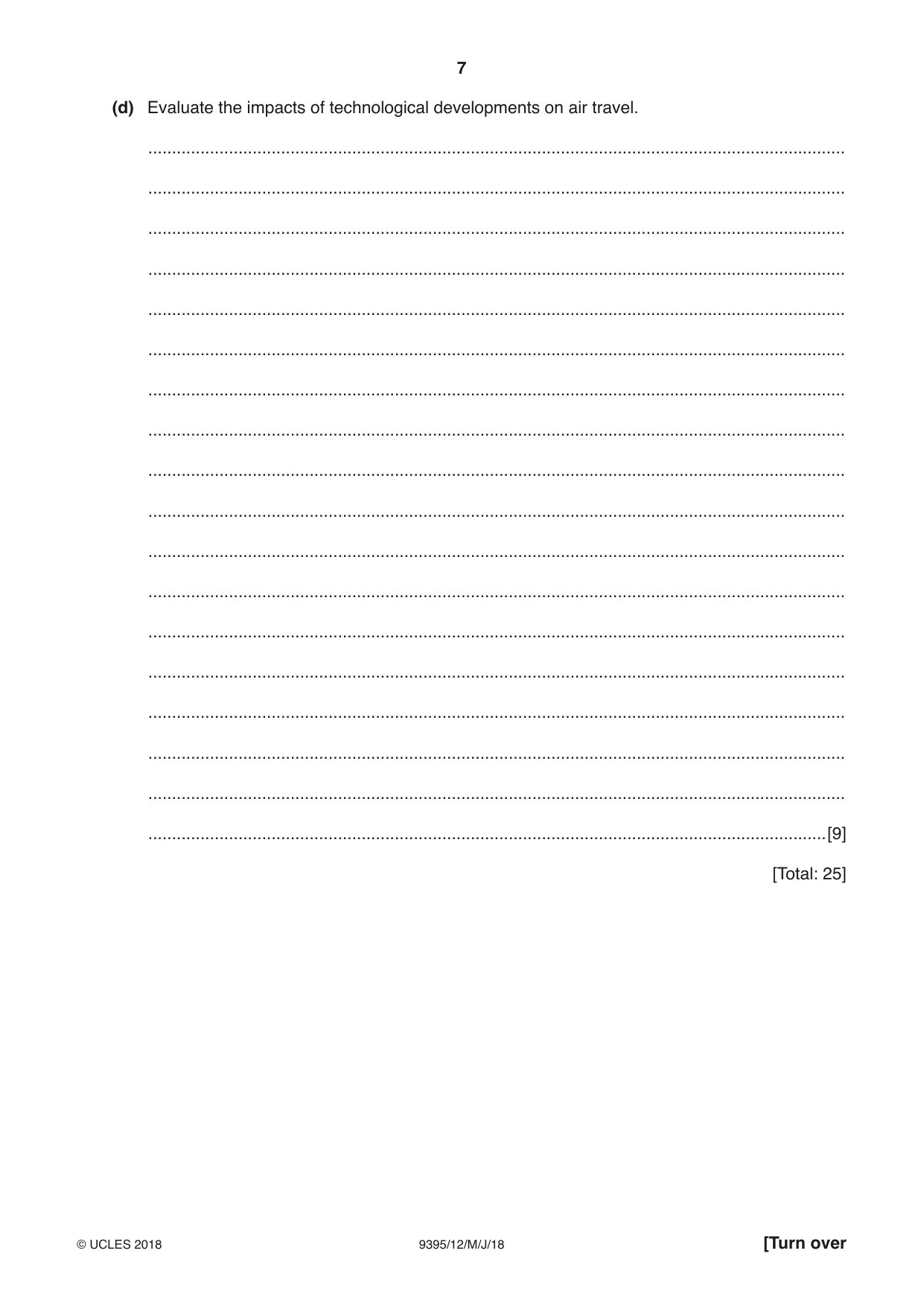
7 9395/12/M/J/18 © UCLES 2018 [Turn over (d) Evaluate the impacts of technological developments on air travel. … … … … … … … … … … … … … … … … … …[9] [Total: 25]
Question paper, page 8
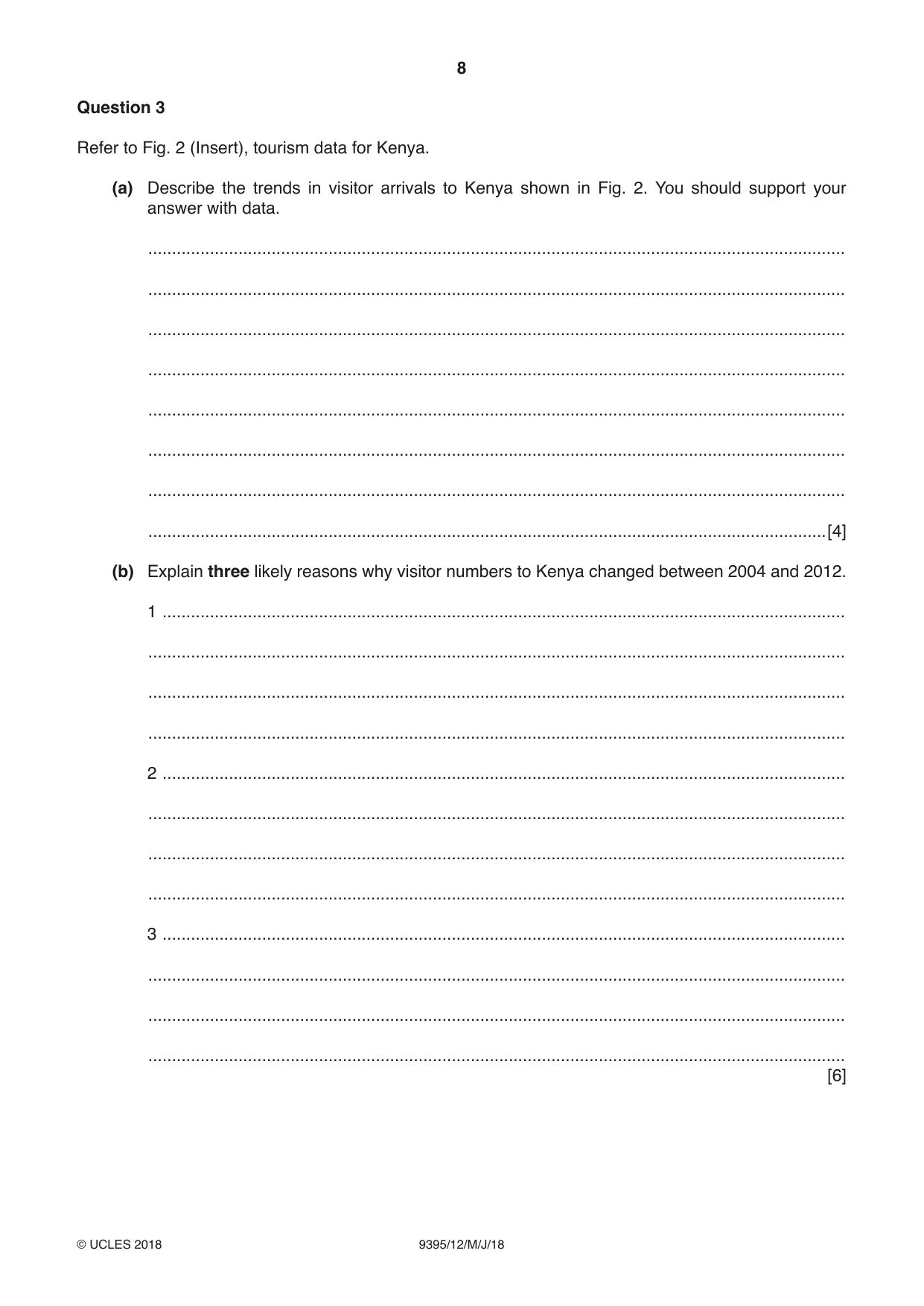
8 9395/12/M/J/18 © UCLES 2018 Question 3 Refer to Fig. 2 (Insert), tourism data for Kenya. (a) Describe the trends in visitor arrivals to Kenya shown in Fig. 2. You should support your answer with data. … … … … … … … …[4] (b) Explain three likely reasons why visitor numbers to Kenya changed between 2004 and 2012. 1 … … … … 2 … … … … 3 … … … … [6]
Question paper, page 9
9 9395/12/M/J/18 © UCLES 2018 [Turn over (c) Explain two likely reasons why most visitors to Kenya are leisure tourists on a package holiday organised by inbound tour operators. 1 … … … … … … 2 … … … … … … [6]
Question paper, page 10
10 9395/12/M/J/18 © UCLES 2018 (d) Discuss the benefits of air and sea transport to international travellers. … … … … … … … … … … … … … … … … … …[9] [Total: 25]
Question paper, page 11
11 9395/12/M/J/18 © UCLES 2018 [Turn over Question 4 (a) Tourism products are often described as being perishable. (i) Define the term ‘perishable’. … … … …[2] (ii) Give two examples of perishable travel and tourism products. 1 … 2 … [2] (b) Explain two ways the problem of perishability may be managed by travel and tourism organisations. 1 … … … … … … 2 … … … … … … [6]
Question paper, page 12
12 9395/12/M/J/18 © UCLES 2018 (c) Compare sustainable and responsible tourism. Give examples to support your answer. … … … … … … … … … … … …[6]
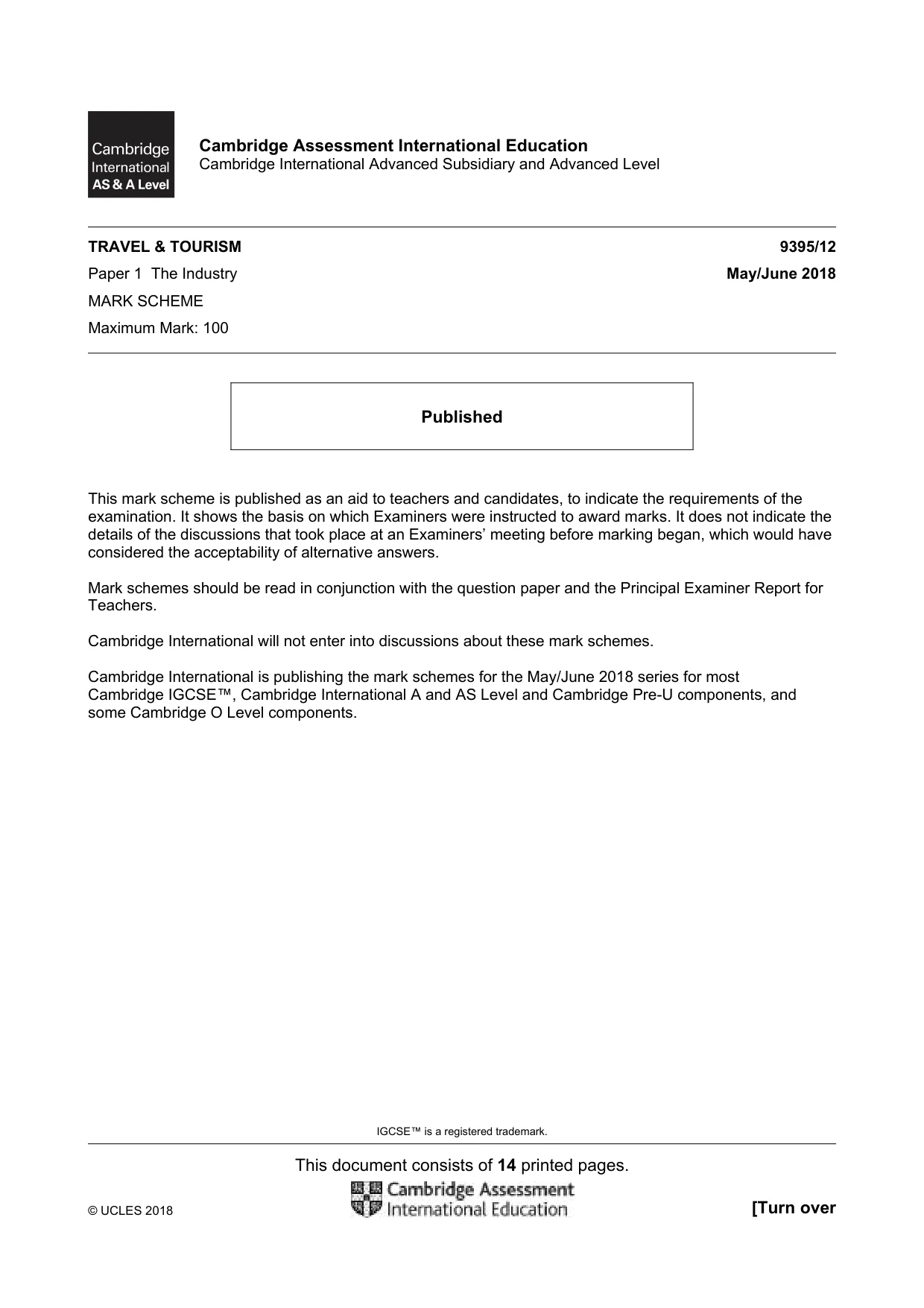
Question paper, page 13
13 9395/12/M/J/18 © UCLES 2018 (d) Assess how UNWTO contributes to the sustainable development of tourism. … … … … … … … … … … … … … … … … … …[9] [Total: 25]
Question paper, page 14
14 9395/12/M/J/18 © UCLES 2018 BLANK PAGE
Question paper, page 15
15 9395/12/M/J/18 © UCLES 2018 BLANK PAGE
Question paper, page 16
16 9395/12/M/J/18 © UCLES 2018 Permission to reproduce items where third-party owned material protected by copyright is included has been sought and cleared where possible. Every reasonable effort has been made by the publisher (UCLES) to trace copyright holders, but if any items requiring clearance have unwittingly been included, the publisher will be pleased to make amends at the earliest possible opportunity. To avoid the issue of disclosure of answer-related information to candidates, all copyright acknowledgements are reproduced online in the Cambridge International Examinations Copyright Acknowledgements Booklet. This is produced for each series of examinations and is freely available to download at www.cie.org.uk after the live examination series. Cambridge International Examinations is part of the Cambridge Assessment Group. Cambridge Assessment is the brand name of University of Cambridge Local Examinations Syndicate (UCLES), which is itself a department of the University of Cambridge. BLANK PAGE
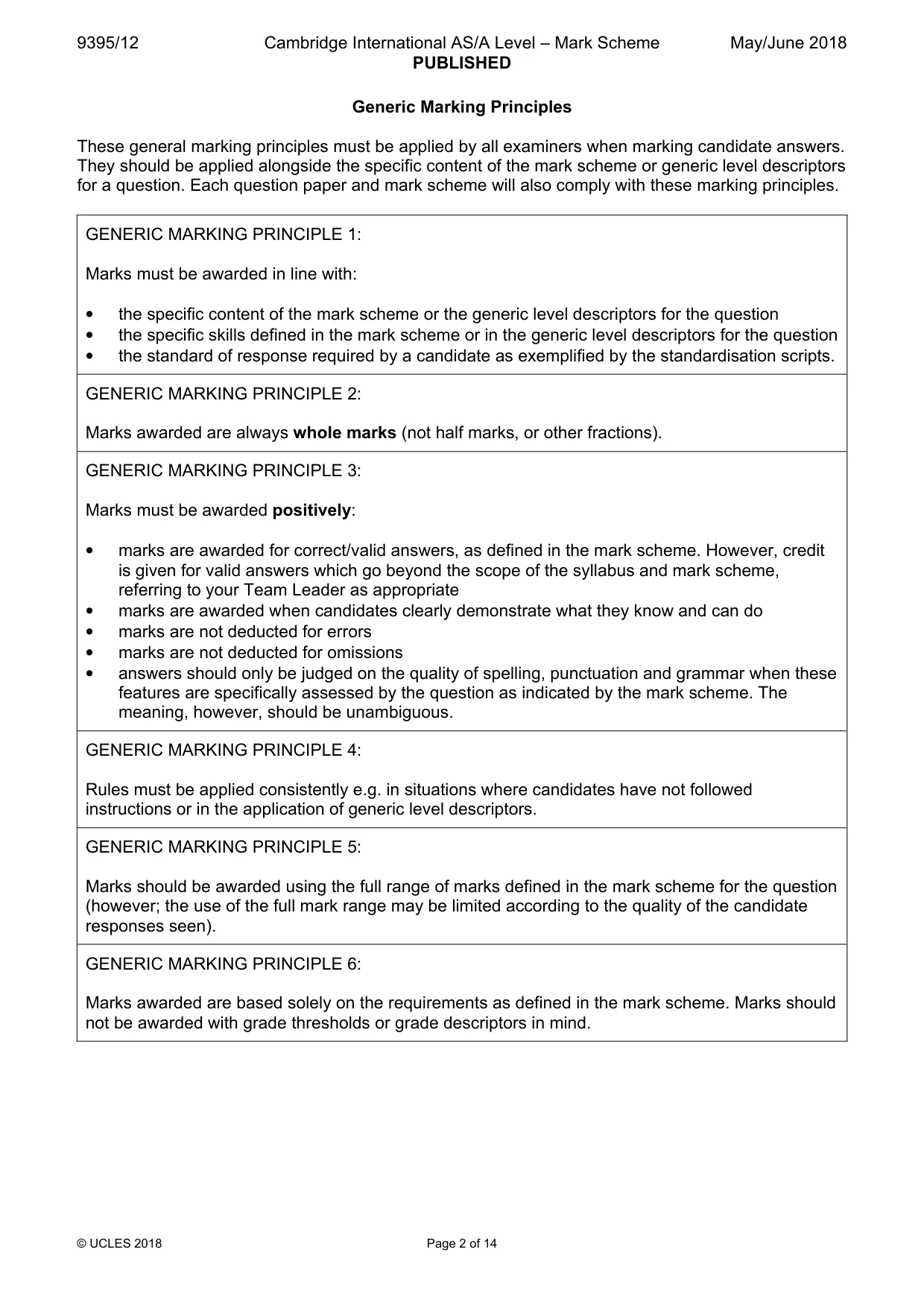
Mark scheme, page 1
IGCSE™ is a registered trademark. This document consists of 14 printed pages. © UCLES 2018 [Turn over Cambridge Assessment International Education Cambridge International Advanced Subsidiary and Advanced Level TRAVEL & TOURISM 9395/12 Paper 1 The Industry May/June 2018 MARK SCHEME Maximum Mark: 100 Published This mark scheme is published as an aid to teachers and candidates, to indicate the requirements of the examination. It shows the basis on which Examiners were instructed to award marks. It does not indicate the details of the discussions that took place at an Examiners’ meeting before marking began, which would have considered the acceptability of alternative answers. Mark schemes should be read in conjunction with the question paper and the Principal Examiner Report for Teachers. Cambridge International will not enter into discussions about these mark schemes. Cambridge International is publishing the mark schemes for the May/June 2018 series for most Cambridge IGCSE™, Cambridge International A and AS Level and Cambridge Pre-U components, and some Cambridge O Level components.
Mark scheme, page 2
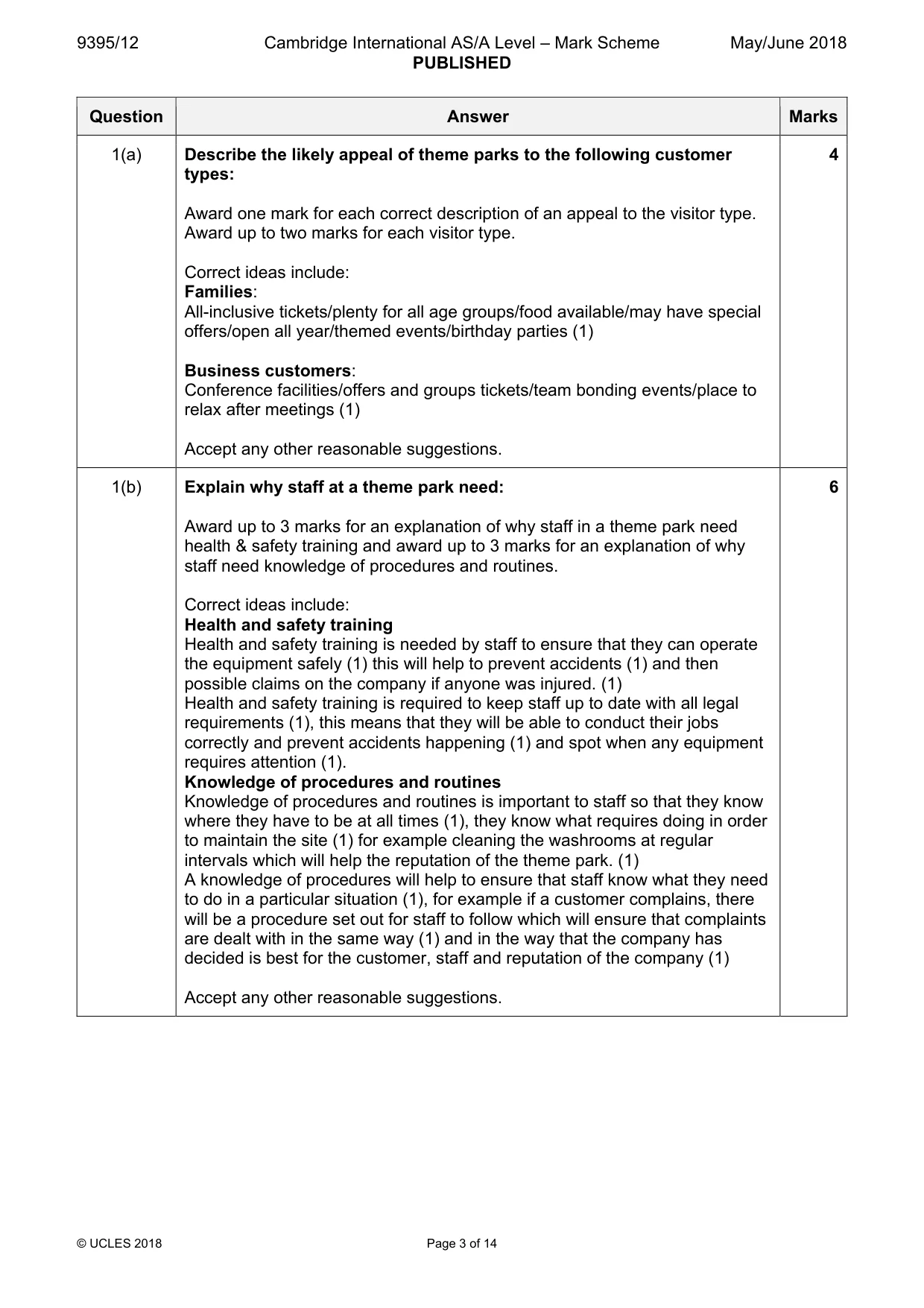
9395/12 Cambridge International AS/A Level – Mark Scheme PUBLISHED May/June 2018 © UCLES 2018 Page 2 of 14 Generic Marking Principles These general marking principles must be applied by all examiners when marking candidate answers. They should be applied alongside the specific content of the mark scheme or generic level descriptors for a question. Each question paper and mark scheme will also comply with these marking principles. GENERIC MARKING PRINCIPLE 1: Marks must be awarded in line with: • the specific content of the mark scheme or the generic level descriptors for the question • the specific skills defined in the mark scheme or in the generic level descriptors for the question • the standard of response required by a candidate as exemplified by the standardisation scripts. GENERIC MARKING PRINCIPLE 2: Marks awarded are always whole marks (not half marks, or other fractions). GENERIC MARKING PRINCIPLE 3: Marks must be awarded positively: • marks are awarded for correct/valid answers, as defined in the mark scheme. However, credit is given for valid answers which go beyond the scope of the syllabus and mark scheme, referring to your Team Leader as appropriate • marks are awarded when candidates clearly demonstrate what they know and can do • marks are not deducted for errors • marks are not deducted for omissions • answers should only be judged on the quality of spelling, punctuation and grammar when these features are specifically assessed by the question as indicated by the mark scheme. The meaning, however, should be unambiguous. GENERIC MARKING PRINCIPLE 4: Rules must be applied consistently e.g. in situations where candidates have not followed instructions or in the application of generic level descriptors. GENERIC MARKING PRINCIPLE 5: Marks should be awarded using the full range of marks defined in the mark scheme for the question (however; the use of the full mark range may be limited according to the quality of the candidate responses seen). GENERIC MARKING PRINCIPLE 6: Marks awarded are based solely on the requirements as defined in the mark scheme. Marks should not be awarded with grade thresholds or grade descriptors in mind.
Mark scheme, page 3
9395/12 Cambridge International AS/A Level – Mark Scheme PUBLISHED May/June 2018 © UCLES 2018 Page 3 of 14 Question Answer Marks 1(a) Describe the likely appeal of theme parks to the following customer types: Award one mark for each correct description of an appeal to the visitor type. Award up to two marks for each visitor type. Correct ideas include: Families: All-inclusive tickets/plenty for all age groups/food available/may have special offers/open all year/themed events/birthday parties (1) Business customers: Conference facilities/offers and groups tickets/team bonding events/place to relax after meetings (1) Accept any other reasonable suggestions. 4 1(b) Explain why staff at a theme park need: Award up to 3 marks for an explanation of why staff in a theme park need health & safety training and award up to 3 marks for an explanation of why staff need knowledge of procedures and routines. Correct ideas include: Health and safety training Health and safety training is needed by staff to ensure that they can operate the equipment safely (1) this will help to prevent accidents (1) and then possible claims on the company if anyone was injured. (1) Health and safety training is required to keep staff up to date with all legal requirements (1), this means that they will be able to conduct their jobs correctly and prevent accidents happening (1) and spot when any equipment requires attention (1). Knowledge of procedures and routines Knowledge of procedures and routines is important to staff so that they know where they have to be at all times (1), they know what requires doing in order to maintain the site (1) for example cleaning the washrooms at regular intervals which will help the reputation of the theme park. (1) A knowledge of procedures will help to ensure that staff know what they need to do in a particular situation (1), for example if a customer complains, there will be a procedure set out for staff to follow which will ensure that complaints are dealt with in the same way (1) and in the way that the company has decided is best for the customer, staff and reputation of the company (1) Accept any other reasonable suggestions. 6
Mark scheme, page 4
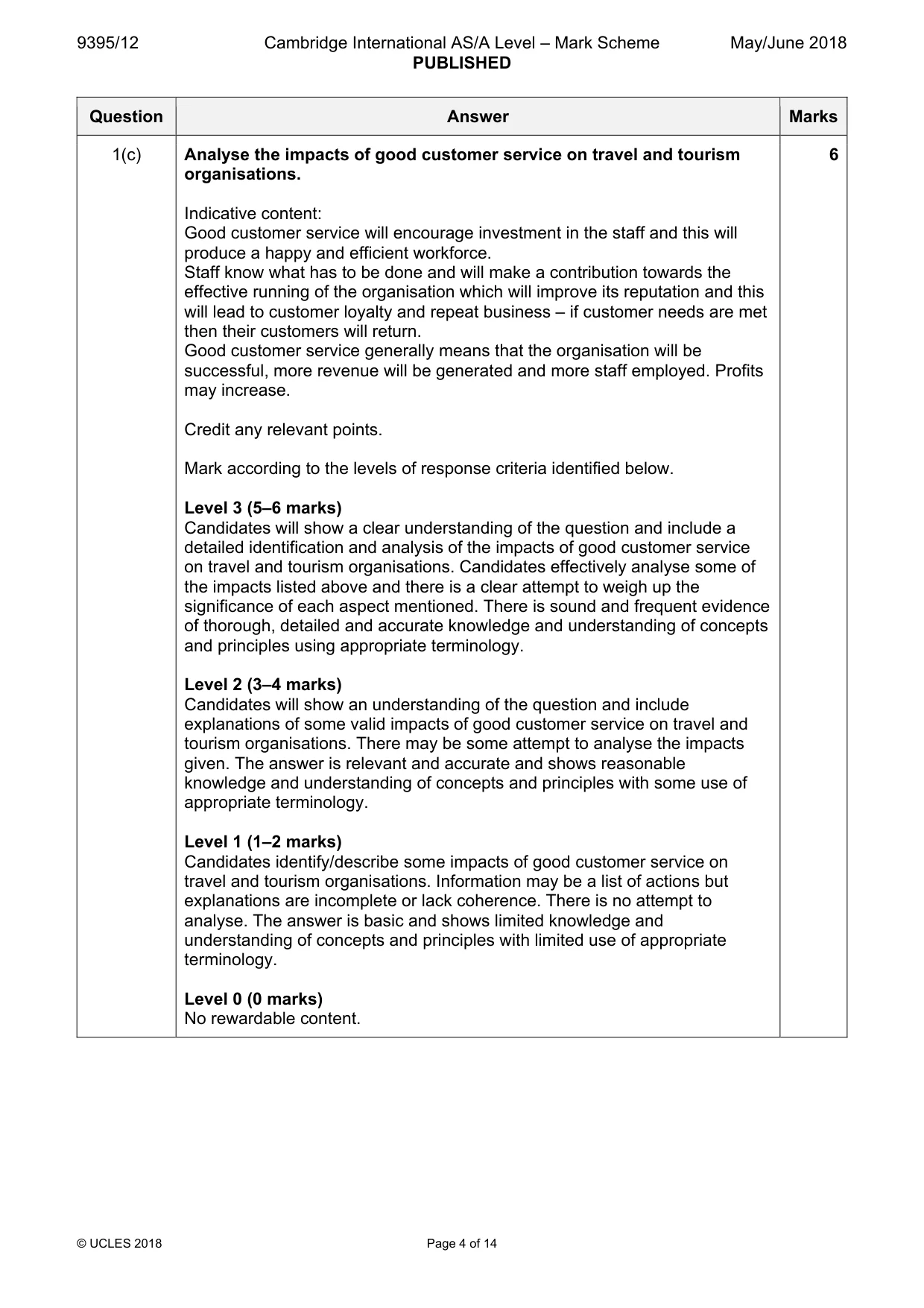
9395/12 Cambridge International AS/A Level – Mark Scheme PUBLISHED May/June 2018 © UCLES 2018 Page 4 of 14 Question Answer Marks 1(c) Analyse the impacts of good customer service on travel and tourism organisations. Indicative content: Good customer service will encourage investment in the staff and this will produce a happy and efficient workforce. Staff know what has to be done and will make a contribution towards the effective running of the organisation which will improve its reputation and this will lead to customer loyalty and repeat business – if customer needs are met then their customers will return. Good customer service generally means that the organisation will be successful, more revenue will be generated and more staff employed. Profits may increase. Credit any relevant points. Mark according to the levels of response criteria identified below. Level 3 (5–6 marks) Candidates will show a clear understanding of the question and include a detailed identification and analysis of the impacts of good customer service on travel and tourism organisations. Candidates effectively analyse some of the impacts listed above and there is a clear attempt to weigh up the significance of each aspect mentioned. There is sound and frequent evidence of thorough, detailed and accurate knowledge and understanding of concepts and principles using appropriate terminology. Level 2 (3–4 marks) Candidates will show an understanding of the question and include explanations of some valid impacts of good customer service on travel and tourism organisations. There may be some attempt to analyse the impacts given. The answer is relevant and accurate and shows reasonable knowledge and understanding of concepts and principles with some use of appropriate terminology. Level 1 (1–2 marks) Candidates identify/describe some impacts of good customer service on travel and tourism organisations. Information may be a list of actions but explanations are incomplete or lack coherence. There is no attempt to analyse. The answer is basic and shows limited knowledge and understanding of concepts and principles with limited use of appropriate terminology. Level 0 (0 marks) No rewardable content. 6
Mark scheme, page 5
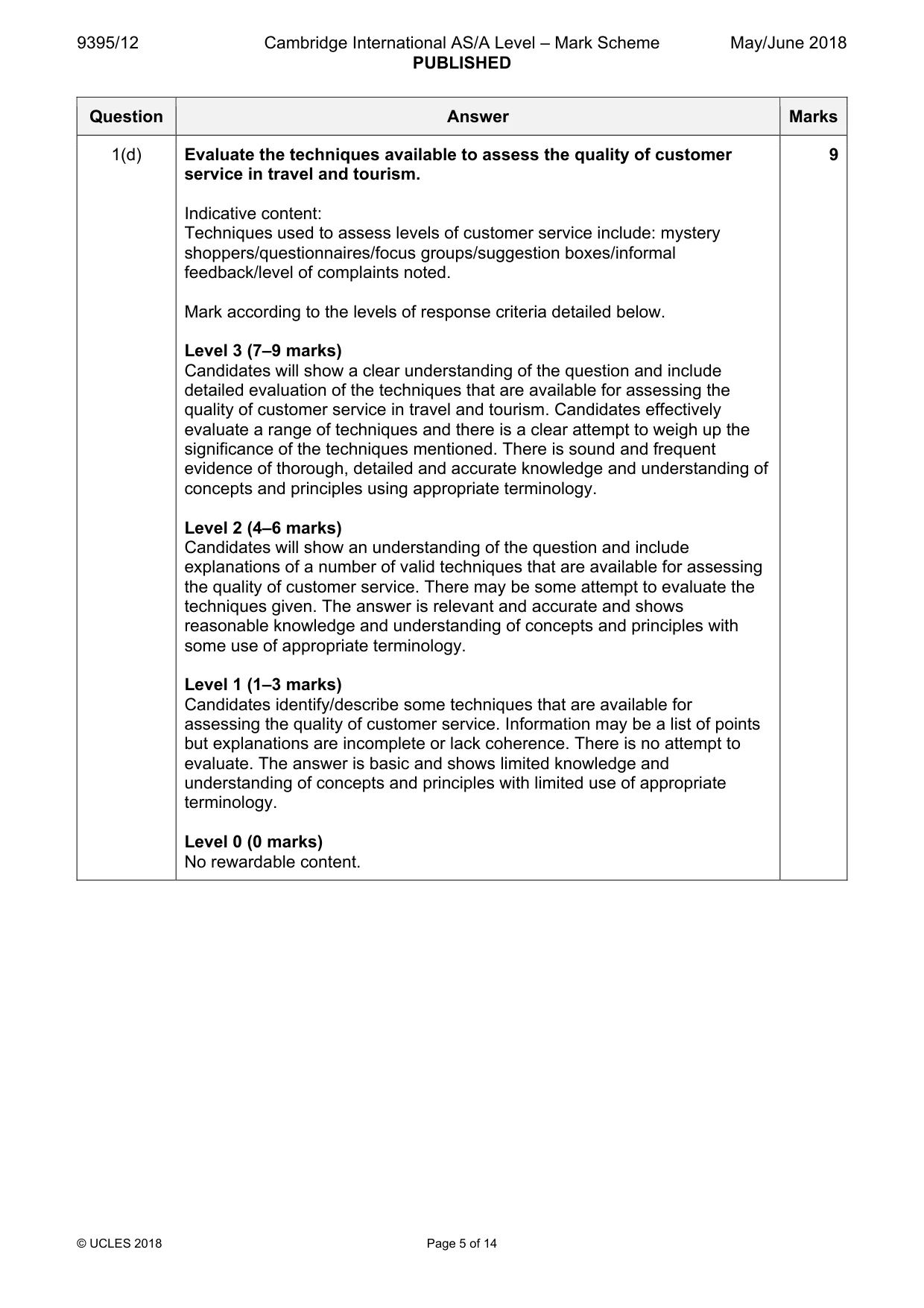
9395/12 Cambridge International AS/A Level – Mark Scheme PUBLISHED May/June 2018 © UCLES 2018 Page 5 of 14 Question Answer Marks 1(d) Evaluate the techniques available to assess the quality of customer service in travel and tourism. Indicative content: Techniques used to assess levels of customer service include: mystery shoppers/questionnaires/focus groups/suggestion boxes/informal feedback/level of complaints noted. Mark according to the levels of response criteria detailed below. Level 3 (7–9 marks) Candidates will show a clear understanding of the question and include detailed evaluation of the techniques that are available for assessing the quality of customer service in travel and tourism. Candidates effectively evaluate a range of techniques and there is a clear attempt to weigh up the significance of the techniques mentioned. There is sound and frequent evidence of thorough, detailed and accurate knowledge and understanding of concepts and principles using appropriate terminology. Level 2 (4–6 marks) Candidates will show an understanding of the question and include explanations of a number of valid techniques that are available for assessing the quality of customer service. There may be some attempt to evaluate the techniques given. The answer is relevant and accurate and shows reasonable knowledge and understanding of concepts and principles with some use of appropriate terminology. Level 1 (1–3 marks) Candidates identify/describe some techniques that are available for assessing the quality of customer service. Information may be a list of points but explanations are incomplete or lack coherence. There is no attempt to evaluate. The answer is basic and shows limited knowledge and understanding of concepts and principles with limited use of appropriate terminology. Level 0 (0 marks) No rewardable content. 9
Mark scheme, page 6
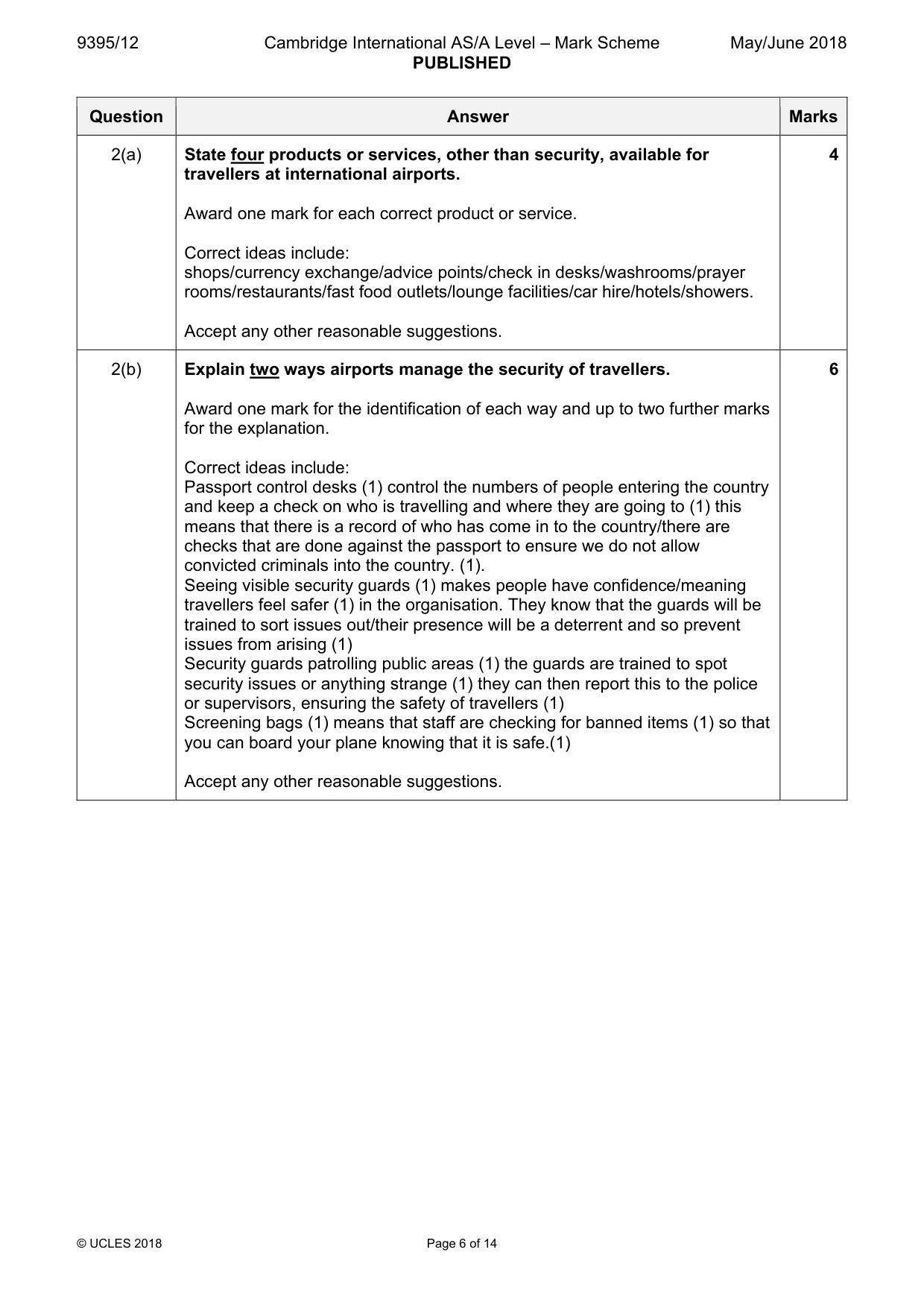
9395/12 Cambridge International AS/A Level – Mark Scheme PUBLISHED May/June 2018 © UCLES 2018 Page 6 of 14 Question Answer Marks 2(a) State four products or services, other than security, available for travellers at international airports. Award one mark for each correct product or service. Correct ideas include: shops/currency exchange/advice points/check in desks/washrooms/prayer rooms/restaurants/fast food outlets/lounge facilities/car hire/hotels/showers. Accept any other reasonable suggestions. 4 2(b) Explain two ways airports manage the security of travellers. Award one mark for the identification of each way and up to two further marks for the explanation. Correct ideas include: Passport control desks (1) control the numbers of people entering the country and keep a check on who is travelling and where they are going to (1) this means that there is a record of who has come in to the country/there are checks that are done against the passport to ensure we do not allow convicted criminals into the country. (1). Seeing visible security guards (1) makes people have confidence/meaning travellers feel safer (1) in the organisation. They know that the guards will be trained to sort issues out/their presence will be a deterrent and so prevent issues from arising (1) Security guards patrolling public areas (1) the guards are trained to spot security issues or anything strange (1) they can then report this to the police or supervisors, ensuring the safety of travellers (1) Screening bags (1) means that staff are checking for banned items (1) so that you can board your plane knowing that it is safe.(1) Accept any other reasonable suggestions. 6
Mark scheme, page 7
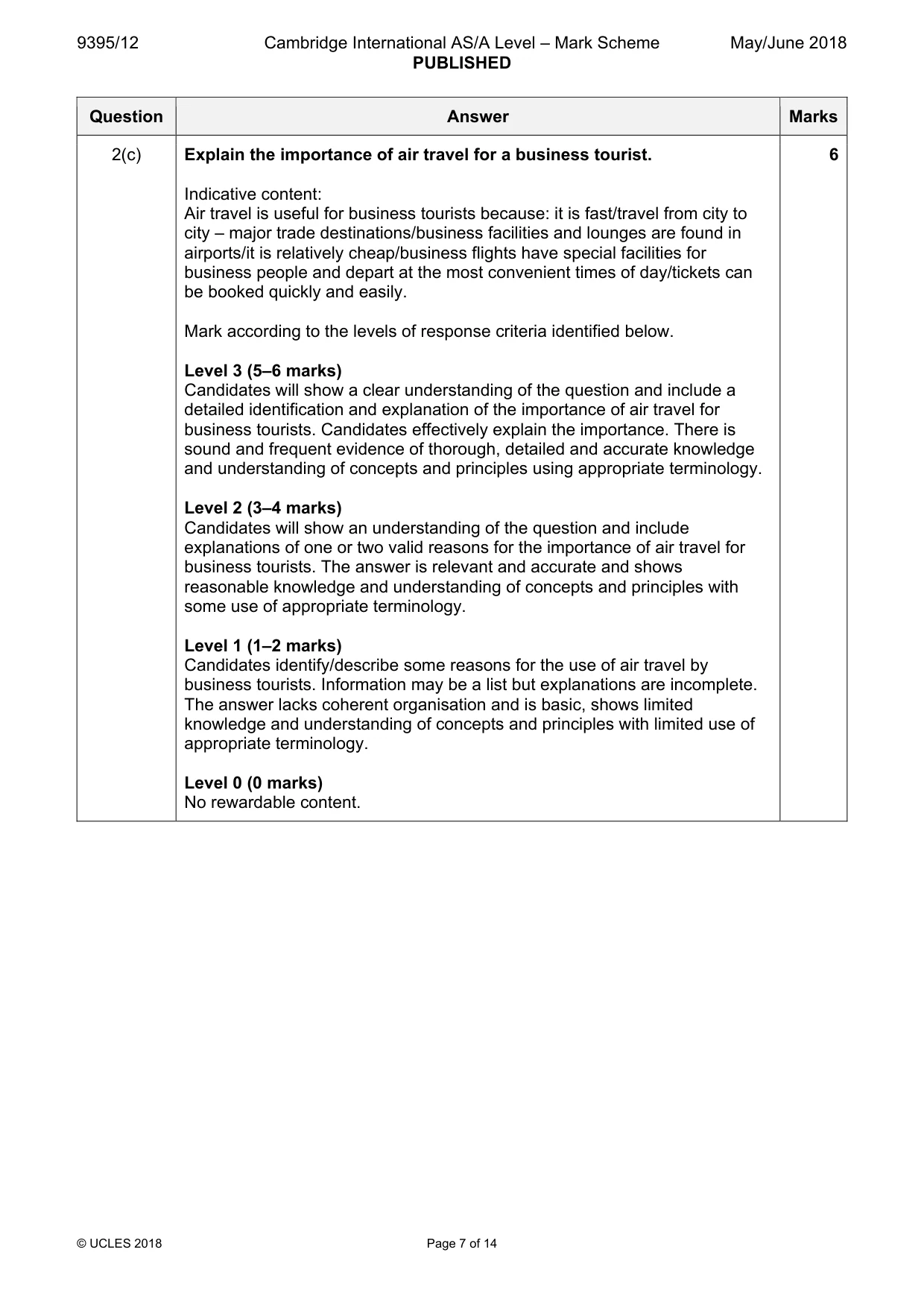
9395/12 Cambridge International AS/A Level – Mark Scheme PUBLISHED May/June 2018 © UCLES 2018 Page 7 of 14 Question Answer Marks 2(c) Explain the importance of air travel for a business tourist. Indicative content: Air travel is useful for business tourists because: it is fast/travel from city to city – major trade destinations/business facilities and lounges are found in airports/it is relatively cheap/business flights have special facilities for business people and depart at the most convenient times of day/tickets can be booked quickly and easily. Mark according to the levels of response criteria identified below. Level 3 (5–6 marks) Candidates will show a clear understanding of the question and include a detailed identification and explanation of the importance of air travel for business tourists. Candidates effectively explain the importance. There is sound and frequent evidence of thorough, detailed and accurate knowledge and understanding of concepts and principles using appropriate terminology. Level 2 (3–4 marks) Candidates will show an understanding of the question and include explanations of one or two valid reasons for the importance of air travel for business tourists. The answer is relevant and accurate and shows reasonable knowledge and understanding of concepts and principles with some use of appropriate terminology. Level 1 (1–2 marks) Candidates identify/describe some reasons for the use of air travel by business tourists. Information may be a list but explanations are incomplete. The answer lacks coherent organisation and is basic, shows limited knowledge and understanding of concepts and principles with limited use of appropriate terminology. Level 0 (0 marks) No rewardable content. 6
Mark scheme, page 8
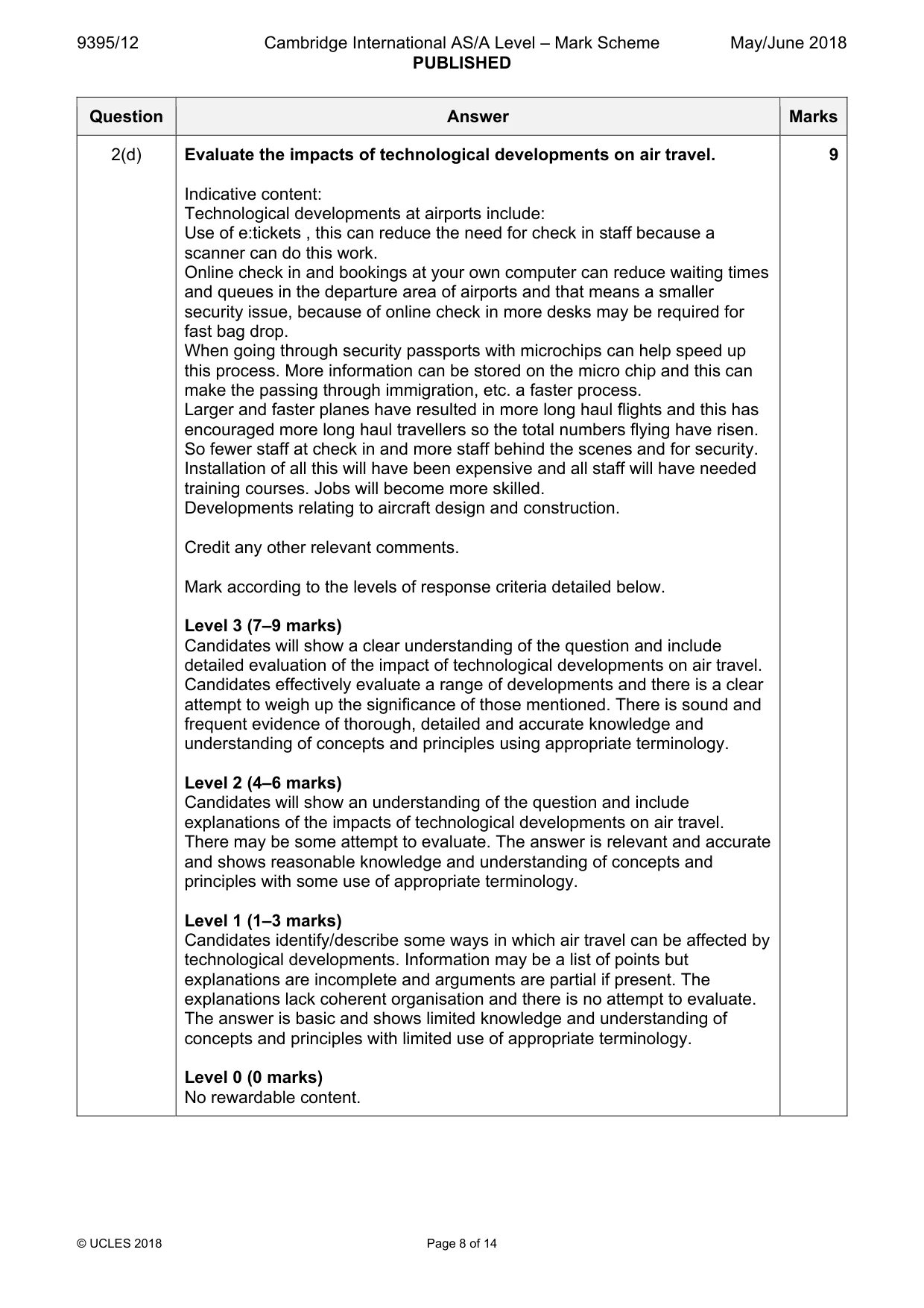
9395/12 Cambridge International AS/A Level – Mark Scheme PUBLISHED May/June 2018 © UCLES 2018 Page 8 of 14 Question Answer Marks 2(d) Evaluate the impacts of technological developments on air travel. Indicative content: Technological developments at airports include: Use of e:tickets , this can reduce the need for check in staff because a scanner can do this work. Online check in and bookings at your own computer can reduce waiting times and queues in the departure area of airports and that means a smaller security issue, because of online check in more desks may be required for fast bag drop. When going through security passports with microchips can help speed up this process. More information can be stored on the micro chip and this can make the passing through immigration, etc. a faster process. Larger and faster planes have resulted in more long haul flights and this has encouraged more long haul travellers so the total numbers flying have risen. So fewer staff at check in and more staff behind the scenes and for security. Installation of all this will have been expensive and all staff will have needed training courses. Jobs will become more skilled. Developments relating to aircraft design and construction. Credit any other relevant comments. Mark according to the levels of response criteria detailed below. Level 3 (7–9 marks) Candidates will show a clear understanding of the question and include detailed evaluation of the impact of technological developments on air travel. Candidates effectively evaluate a range of developments and there is a clear attempt to weigh up the significance of those mentioned. There is sound and frequent evidence of thorough, detailed and accurate knowledge and understanding of concepts and principles using appropriate terminology. Level 2 (4–6 marks) Candidates will show an understanding of the question and include explanations of the impacts of technological developments on air travel. There may be some attempt to evaluate. The answer is relevant and accurate and shows reasonable knowledge and understanding of concepts and principles with some use of appropriate terminology. Level 1 (1–3 marks) Candidates identify/describe some ways in which air travel can be affected by technological developments. Information may be a list of points but explanations are incomplete and arguments are partial if present. The explanations lack coherent organisation and there is no attempt to evaluate. The answer is basic and shows limited knowledge and understanding of concepts and principles with limited use of appropriate terminology. Level 0 (0 marks) No rewardable content. 9
Mark scheme, page 9
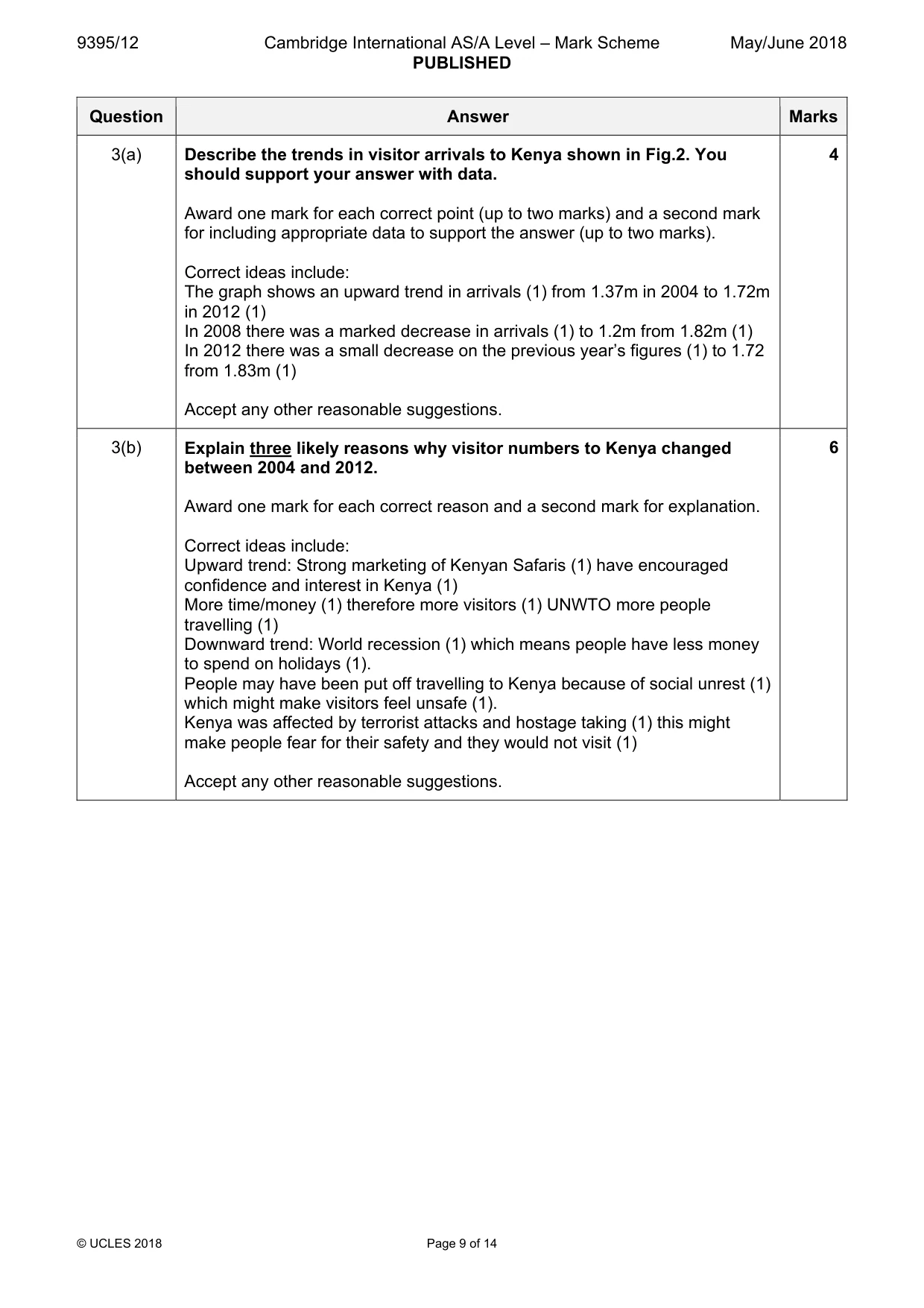
9395/12 Cambridge International AS/A Level – Mark Scheme PUBLISHED May/June 2018 © UCLES 2018 Page 9 of 14 Question Answer Marks 3(a) Describe the trends in visitor arrivals to Kenya shown in Fig.2. You should support your answer with data. Award one mark for each correct point (up to two marks) and a second mark for including appropriate data to support the answer (up to two marks). Correct ideas include: The graph shows an upward trend in arrivals (1) from 1.37m in 2004 to 1.72m in 2012 (1) In 2008 there was a marked decrease in arrivals (1) to 1.2m from 1.82m (1) In 2012 there was a small decrease on the previous year’s figures (1) to 1.72 from 1.83m (1) Accept any other reasonable suggestions. 4 3(b) Explain three likely reasons why visitor numbers to Kenya changed between 2004 and 2012. Award one mark for each correct reason and a second mark for explanation. Correct ideas include: Upward trend: Strong marketing of Kenyan Safaris (1) have encouraged confidence and interest in Kenya (1) More time/money (1) therefore more visitors (1) UNWTO more people travelling (1) Downward trend: World recession (1) which means people have less money to spend on holidays (1). People may have been put off travelling to Kenya because of social unrest (1) which might make visitors feel unsafe (1). Kenya was affected by terrorist attacks and hostage taking (1) this might make people fear for their safety and they would not visit (1) Accept any other reasonable suggestions. 6
Mark scheme, page 10
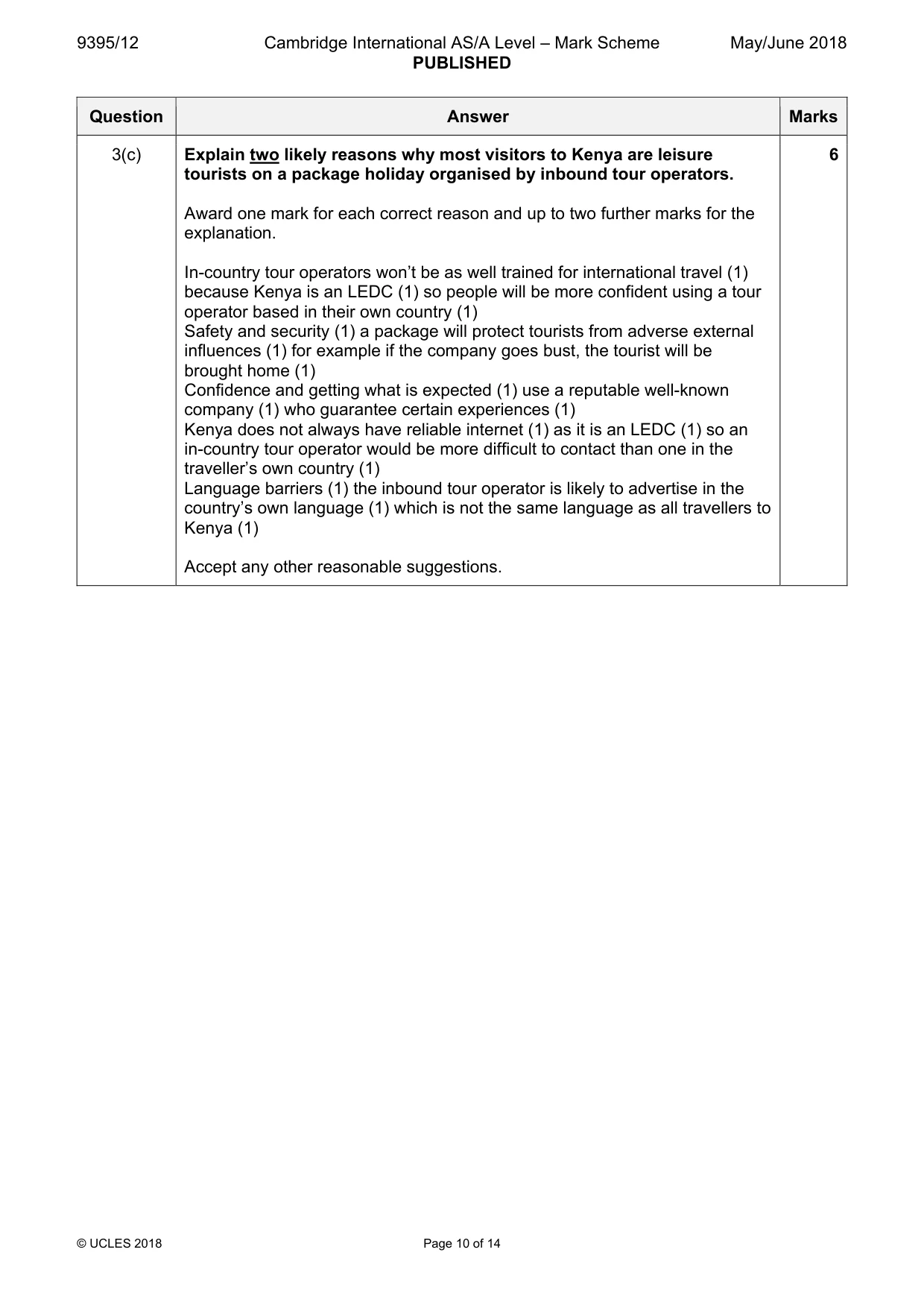
9395/12 Cambridge International AS/A Level – Mark Scheme PUBLISHED May/June 2018 © UCLES 2018 Page 10 of 14 Question Answer Marks 3(c) Explain two likely reasons why most visitors to Kenya are leisure tourists on a package holiday organised by inbound tour operators. Award one mark for each correct reason and up to two further marks for the explanation. In-country tour operators won’t be as well trained for international travel (1) because Kenya is an LEDC (1) so people will be more confident using a tour operator based in their own country (1) Safety and security (1) a package will protect tourists from adverse external influences (1) for example if the company goes bust, the tourist will be brought home (1) Confidence and getting what is expected (1) use a reputable well-known company (1) who guarantee certain experiences (1) Kenya does not always have reliable internet (1) as it is an LEDC (1) so an in-country tour operator would be more difficult to contact than one in the traveller’s own country (1) Language barriers (1) the inbound tour operator is likely to advertise in the country’s own language (1) which is not the same language as all travellers to Kenya (1) Accept any other reasonable suggestions. 6
Mark scheme, page 11
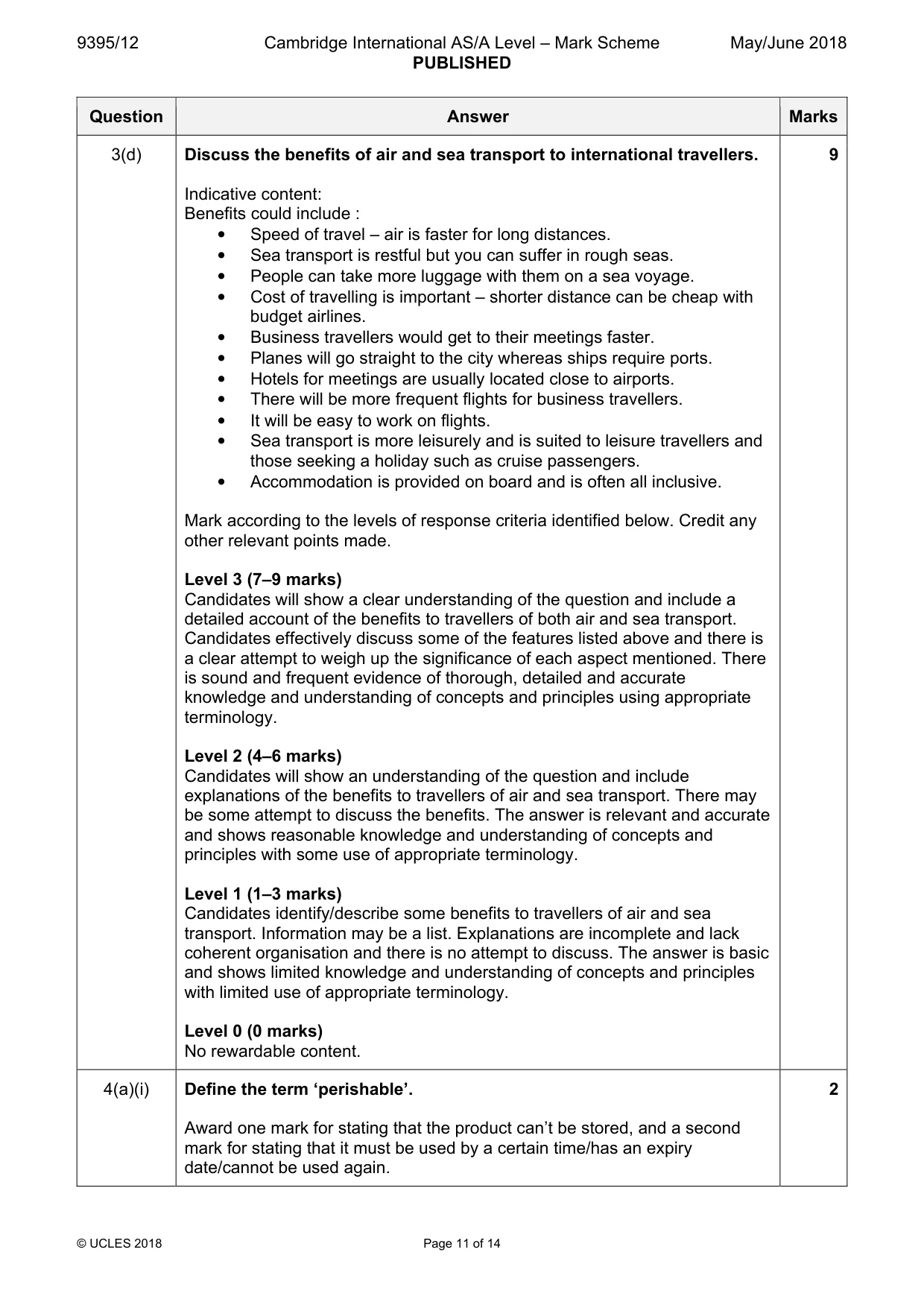
9395/12 Cambridge International AS/A Level – Mark Scheme PUBLISHED May/June 2018 © UCLES 2018 Page 11 of 14 Question Answer Marks 3(d) Discuss the benefits of air and sea transport to international travellers. Indicative content: Benefits could include : • Speed of travel – air is faster for long distances. • Sea transport is restful but you can suffer in rough seas. • People can take more luggage with them on a sea voyage. • Cost of travelling is important – shorter distance can be cheap with budget airlines. • Business travellers would get to their meetings faster. • Planes will go straight to the city whereas ships require ports. • Hotels for meetings are usually located close to airports. • There will be more frequent flights for business travellers. • It will be easy to work on flights. • Sea transport is more leisurely and is suited to leisure travellers and those seeking a holiday such as cruise passengers. • Accommodation is provided on board and is often all inclusive. Mark according to the levels of response criteria identified below. Credit any other relevant points made. Level 3 (7–9 marks) Candidates will show a clear understanding of the question and include a detailed account of the benefits to travellers of both air and sea transport. Candidates effectively discuss some of the features listed above and there is a clear attempt to weigh up the significance of each aspect mentioned. There is sound and frequent evidence of thorough, detailed and accurate knowledge and understanding of concepts and principles using appropriate terminology. Level 2 (4–6 marks) Candidates will show an understanding of the question and include explanations of the benefits to travellers of air and sea transport. There may be some attempt to discuss the benefits. The answer is relevant and accurate and shows reasonable knowledge and understanding of concepts and principles with some use of appropriate terminology. Level 1 (1–3 marks) Candidates identify/describe some benefits to travellers of air and sea transport. Information may be a list. Explanations are incomplete and lack coherent organisation and there is no attempt to discuss. The answer is basic and shows limited knowledge and understanding of concepts and principles with limited use of appropriate terminology. Level 0 (0 marks) No rewardable content. 9 4(a)(i) Define the term ‘perishable’. Award one mark for stating that the product can’t be stored, and a second mark for stating that it must be used by a certain time/has an expiry date/cannot be used again. 2
Mark scheme, page 12
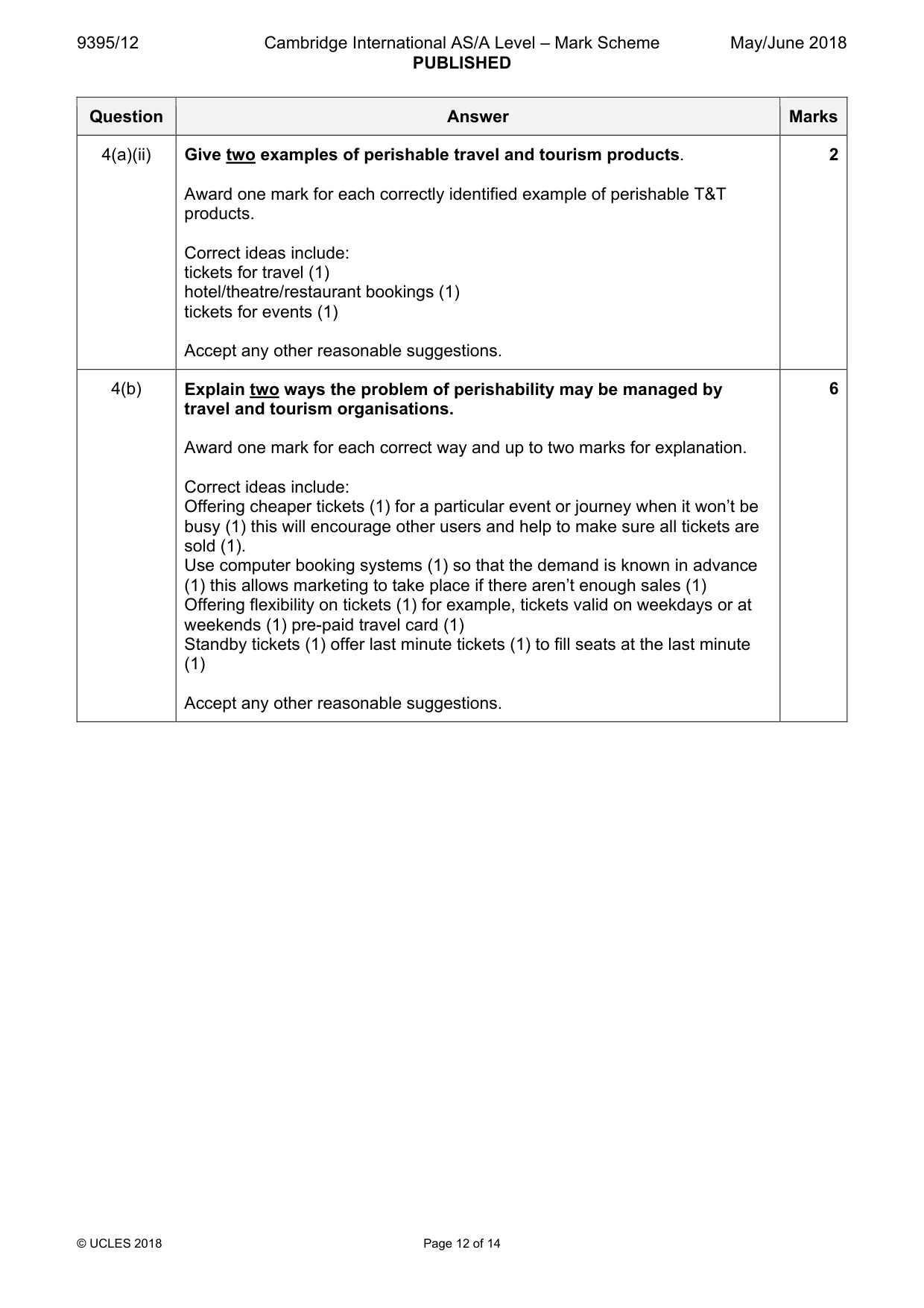
9395/12 Cambridge International AS/A Level – Mark Scheme PUBLISHED May/June 2018 © UCLES 2018 Page 12 of 14 Question Answer Marks 4(a)(ii) Give two examples of perishable travel and tourism products. Award one mark for each correctly identified example of perishable T&T products. Correct ideas include: tickets for travel (1) hotel/theatre/restaurant bookings (1) tickets for events (1) Accept any other reasonable suggestions. 2 4(b) Explain two ways the problem of perishability may be managed by travel and tourism organisations. Award one mark for each correct way and up to two marks for explanation. Correct ideas include: Offering cheaper tickets (1) for a particular event or journey when it won’t be busy (1) this will encourage other users and help to make sure all tickets are sold (1). Use computer booking systems (1) so that the demand is known in advance (1) this allows marketing to take place if there aren’t enough sales (1) Offering flexibility on tickets (1) for example, tickets valid on weekdays or at weekends (1) pre-paid travel card (1) Standby tickets (1) offer last minute tickets (1) to fill seats at the last minute (1) Accept any other reasonable suggestions. 6
Mark scheme, page 13
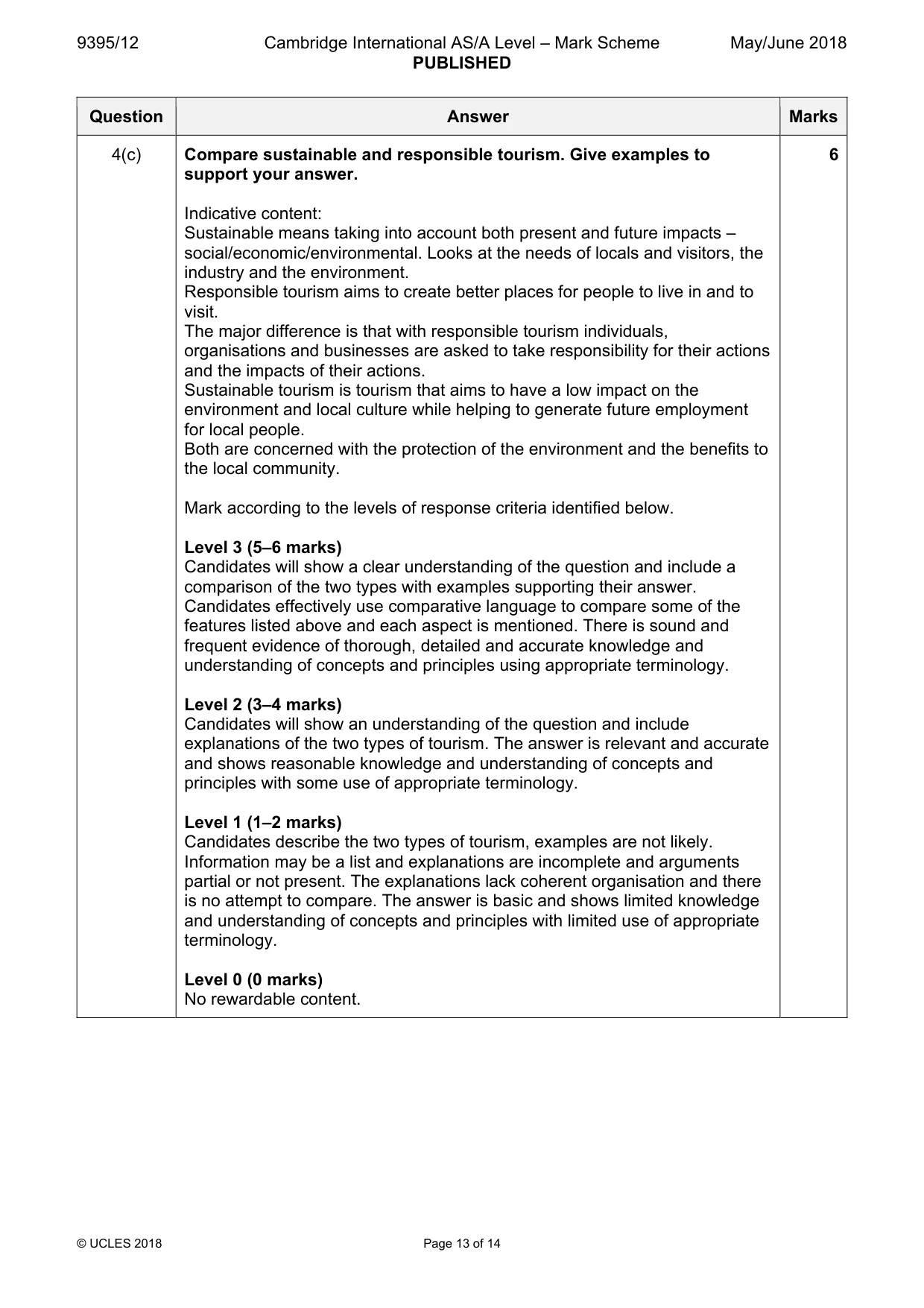
9395/12 Cambridge International AS/A Level – Mark Scheme PUBLISHED May/June 2018 © UCLES 2018 Page 13 of 14 Question Answer Marks 4(c) Compare sustainable and responsible tourism. Give examples to support your answer. Indicative content: Sustainable means taking into account both present and future impacts – social/economic/environmental. Looks at the needs of locals and visitors, the industry and the environment. Responsible tourism aims to create better places for people to live in and to visit. The major difference is that with responsible tourism individuals, organisations and businesses are asked to take responsibility for their actions and the impacts of their actions. Sustainable tourism is tourism that aims to have a low impact on the environment and local culture while helping to generate future employment for local people. Both are concerned with the protection of the environment and the benefits to the local community. Mark according to the levels of response criteria identified below. Level 3 (5–6 marks) Candidates will show a clear understanding of the question and include a comparison of the two types with examples supporting their answer. Candidates effectively use comparative language to compare some of the features listed above and each aspect is mentioned. There is sound and frequent evidence of thorough, detailed and accurate knowledge and understanding of concepts and principles using appropriate terminology. Level 2 (3–4 marks) Candidates will show an understanding of the question and include explanations of the two types of tourism. The answer is relevant and accurate and shows reasonable knowledge and understanding of concepts and principles with some use of appropriate terminology. Level 1 (1–2 marks) Candidates describe the two types of tourism, examples are not likely. Information may be a list and explanations are incomplete and arguments partial or not present. The explanations lack coherent organisation and there is no attempt to compare. The answer is basic and shows limited knowledge and understanding of concepts and principles with limited use of appropriate terminology. Level 0 (0 marks) No rewardable content. 6
Mark scheme, page 14
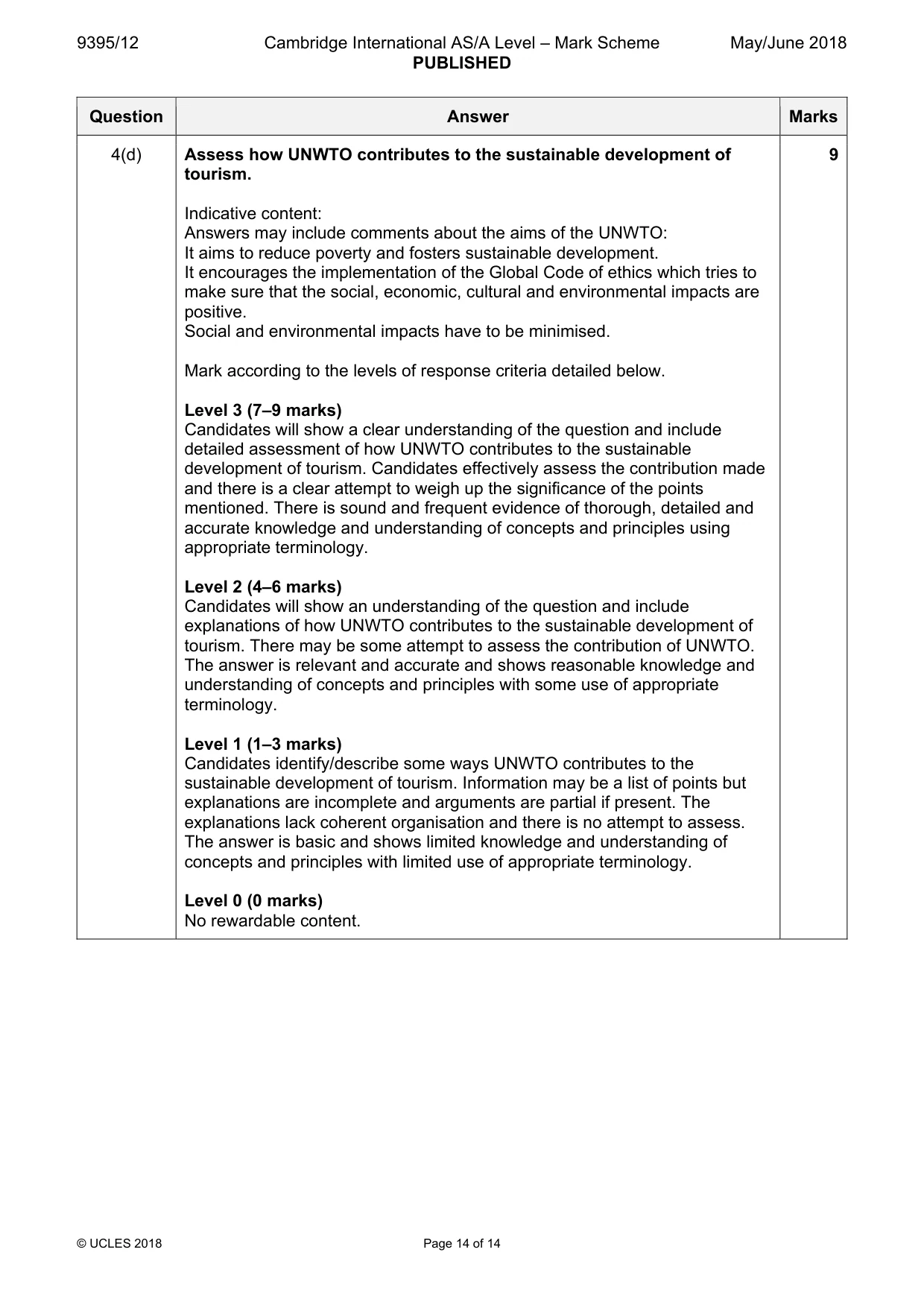
9395/12 Cambridge International AS/A Level – Mark Scheme PUBLISHED May/June 2018 © UCLES 2018 Page 14 of 14 Question Answer Marks 4(d) Assess how UNWTO contributes to the sustainable development of tourism. Indicative content: Answers may include comments about the aims of the UNWTO: It aims to reduce poverty and fosters sustainable development. It encourages the implementation of the Global Code of ethics which tries to make sure that the social, economic, cultural and environmental impacts are positive. Social and environmental impacts have to be minimised. Mark according to the levels of response criteria detailed below. Level 3 (7–9 marks) Candidates will show a clear understanding of the question and include detailed assessment of how UNWTO contributes to the sustainable development of tourism. Candidates effectively assess the contribution made and there is a clear attempt to weigh up the significance of the points mentioned. There is sound and frequent evidence of thorough, detailed and accurate knowledge and understanding of concepts and principles using appropriate terminology. Level 2 (4–6 marks) Candidates will show an understanding of the question and include explanations of how UNWTO contributes to the sustainable development of tourism. There may be some attempt to assess the contribution of UNWTO. The answer is relevant and accurate and shows reasonable knowledge and understanding of concepts and principles with some use of appropriate terminology. Level 1 (1–3 marks) Candidates identify/describe some ways UNWTO contributes to the sustainable development of tourism. Information may be a list of points but explanations are incomplete and arguments are partial if present. The explanations lack coherent organisation and there is no attempt to assess. The answer is basic and shows limited knowledge and understanding of concepts and principles with limited use of appropriate terminology. Level 0 (0 marks) No rewardable content. 9
What you needed in this session
Cambridge’s own grade thresholds for 2018 May/June, Paper 1 · Variant 2. A higher threshold means an easier paper — the bar moves with how the cohort did.