Cambridge A Level Travel and Tourism 9395 — 2018 May/June Paper 1 · Variant 1
9395/11/M/J/18 · 100 marks · ≈113 min
The question paper and its mark scheme, free to read here and free to download. This is Cambridge’s own paper, exactly as it was sat.
Question paper16 pages





Mark scheme14 pages
Answers below. Sit the paper first if you are practising.
Paper as text
Question paper, page 1
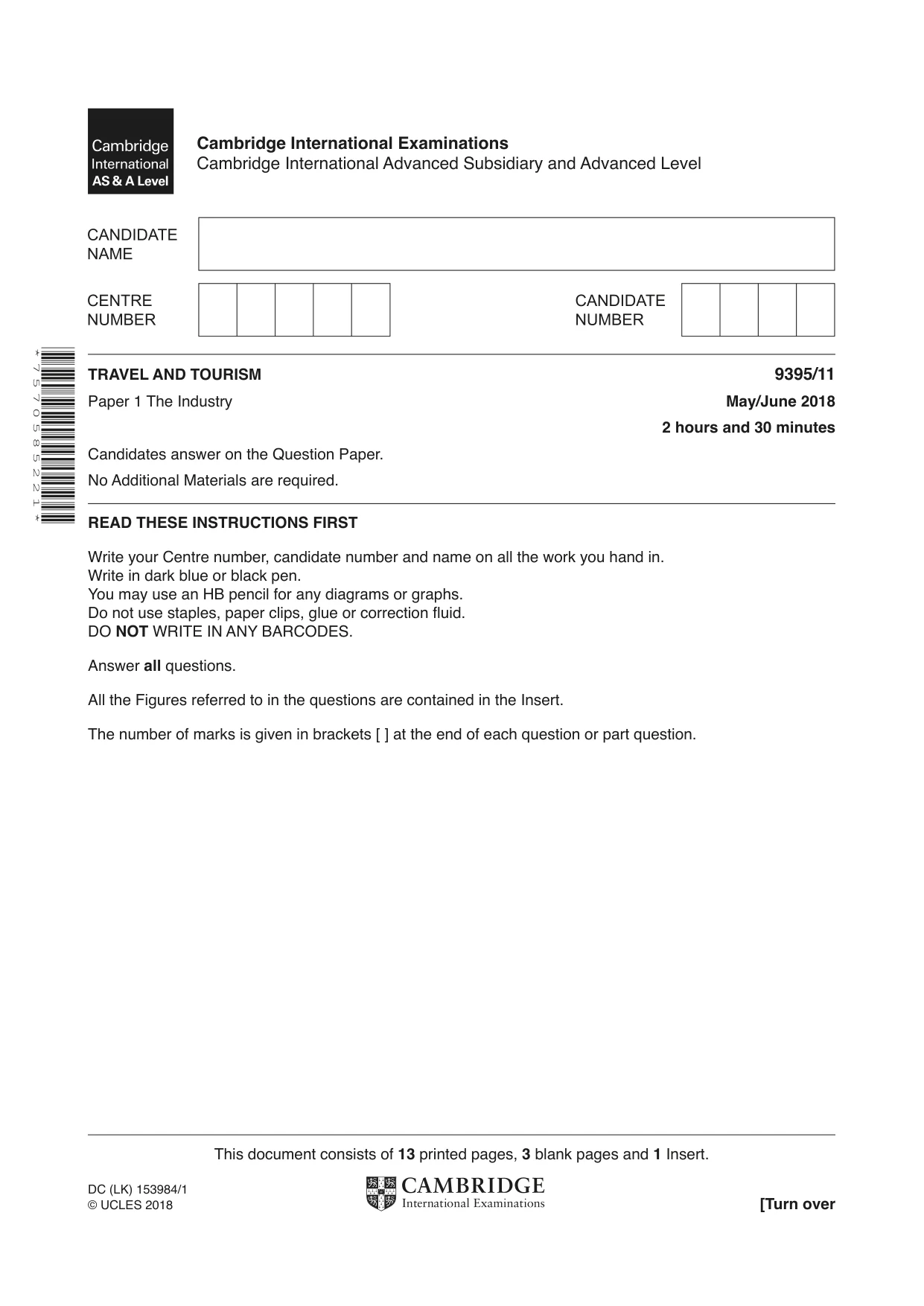
* 7 5 7 0 5 8 5 2 2 1 * This document consists of 13 printed pages, 3 blank pages and 1 Insert. DC (LK) 153984/1 © UCLES 2018 [Turn over Cambridge International Examinations Cambridge International Advanced Subsidiary and Advanced Level TRAVEL AND TOURISM 9395/11 Paper 1 The Industry May/June 2018 2 hours and 30 minutes Candidates answer on the Question Paper. No Additional Materials are required. READ THESE INSTRUCTIONS FIRST Write your Centre number, candidate number and name on all the work you hand in. Write in dark blue or black pen. You may use an HB pencil for any diagrams or graphs. Do not use staples, paper clips, glue or correction fluid. DO NOT WRITE IN ANY BARCODES. Answer all questions. All the Figures referred to in the questions are contained in the Insert. The number of marks is given in brackets [ ] at the end of each question or part question.
Question paper, page 2
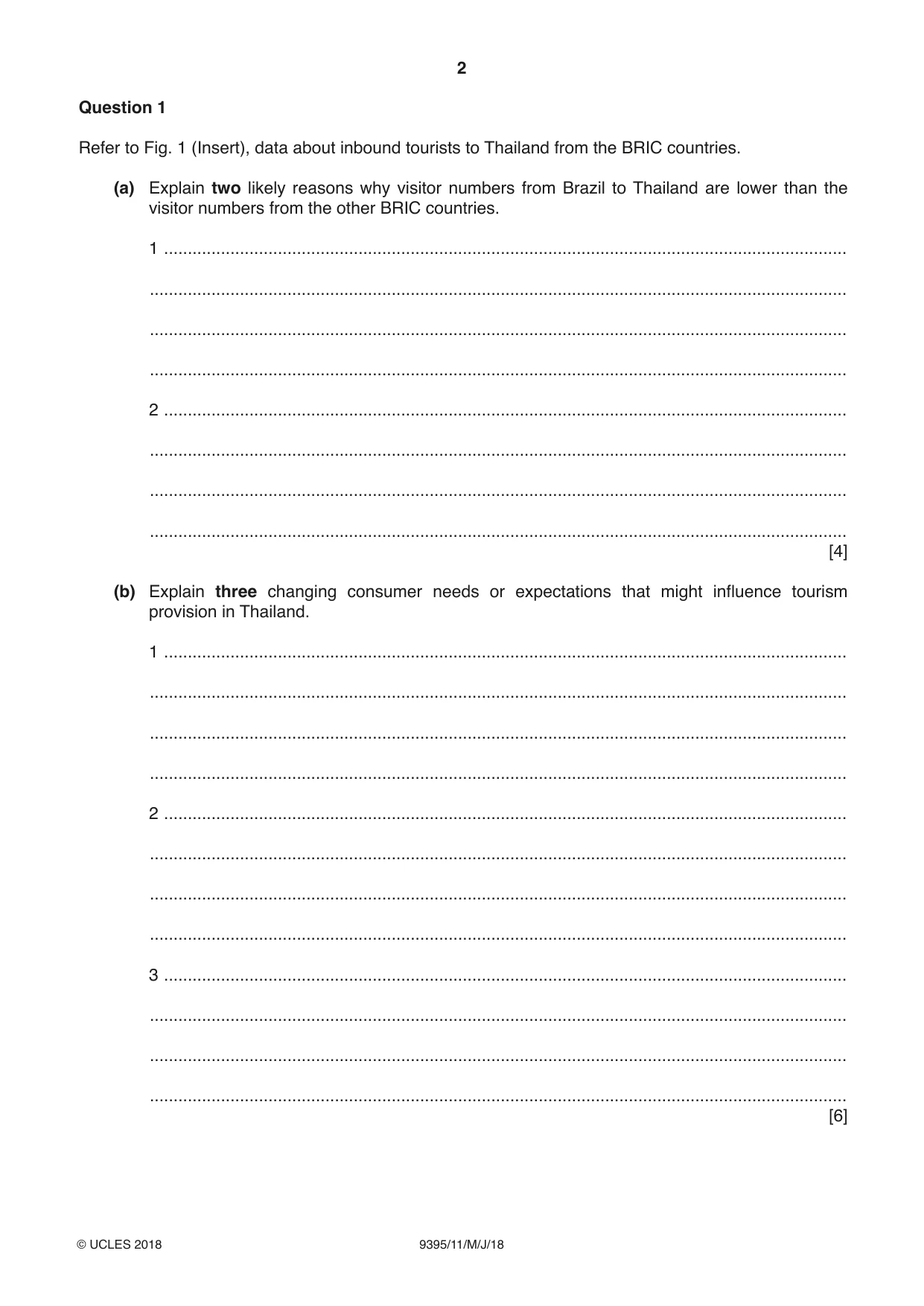
2 9395/11/M/J/18 © UCLES 2018 Question 1 Refer to Fig. 1 (Insert), data about inbound tourists to Thailand from the BRIC countries. (a) Explain two likely reasons why visitor numbers from Brazil to Thailand are lower than the visitor numbers from the other BRIC countries. 1 … … … … 2 … … … … [4] (b) Explain three changing consumer needs or expectations that might influence tourism provision in Thailand. 1 … … … … 2 … … … … 3 … … … … [6]
Question paper, page 3
3 9395/11/M/J/18 © UCLES 2018 [Turn over (c) Explain two technological factors that might affect tourist numbers from the BRIC countries to Thailand. … … … … … … … … … … … …[6]
Question paper, page 4
4 9395/11/M/J/18 © UCLES 2018 (d) Discuss the political factors which may affect visitor numbers to a country. … … … … … … … … … … … … … … … … … …[9] [Total: 25]
Question paper, page 5
5 9395/11/M/J/18 © UCLES 2018 [Turn over Question 2 Refer to Fig. 2 (Insert), photographs showing sports tourism activities. (a) Identify the four activities shown in Fig. 2. 1 … 2 … 3 … 4 … [4] (b) Explain three social factors that may encourage people to take part in sports tourism. 1 … … … … 2 … … … … 3 … … … … [6]
Question paper, page 6
6 9395/11/M/J/18 © UCLES 2018 (c) Explain how ecological factors may affect the decision to offer sporting activities such as those shown in Fig. 2. … … … … … … … … … … … …[6]
Question paper, page 7
7 9395/11/M/J/18 © UCLES 2018 [Turn over (d) Discuss the benefits of commercial and non-commercial organisations working together to organise major sporting events. … … … … … … … … … … … … … … … … … …[9] [Total: 25]
Question paper, page 8
8 9395/11/M/J/18 © UCLES 2018 Question 3 (a) Compare the features of a scheduled and a chartered airline. … … … … … … … …[4] (b) Explain three ways the needs of foreign visitors at an international airport can be met. 1 … … … … 2 … … … … 3 … … … … [6]
Question paper, page 9
9 9395/11/M/J/18 © UCLES 2018 [Turn over (c) Explain how a mystery shopper could be used to assess the delivery of customer service at an international airport. … … … … … … … … … … … …[6]
Question paper, page 10
10 9395/11/M/J/18 © UCLES 2018 (d) Evaluate the likely impacts of poor customer service for a travel and tourism organisation. … … … … … … … … … … … … … … … … … …[9] [Total: 25]
Question paper, page 11
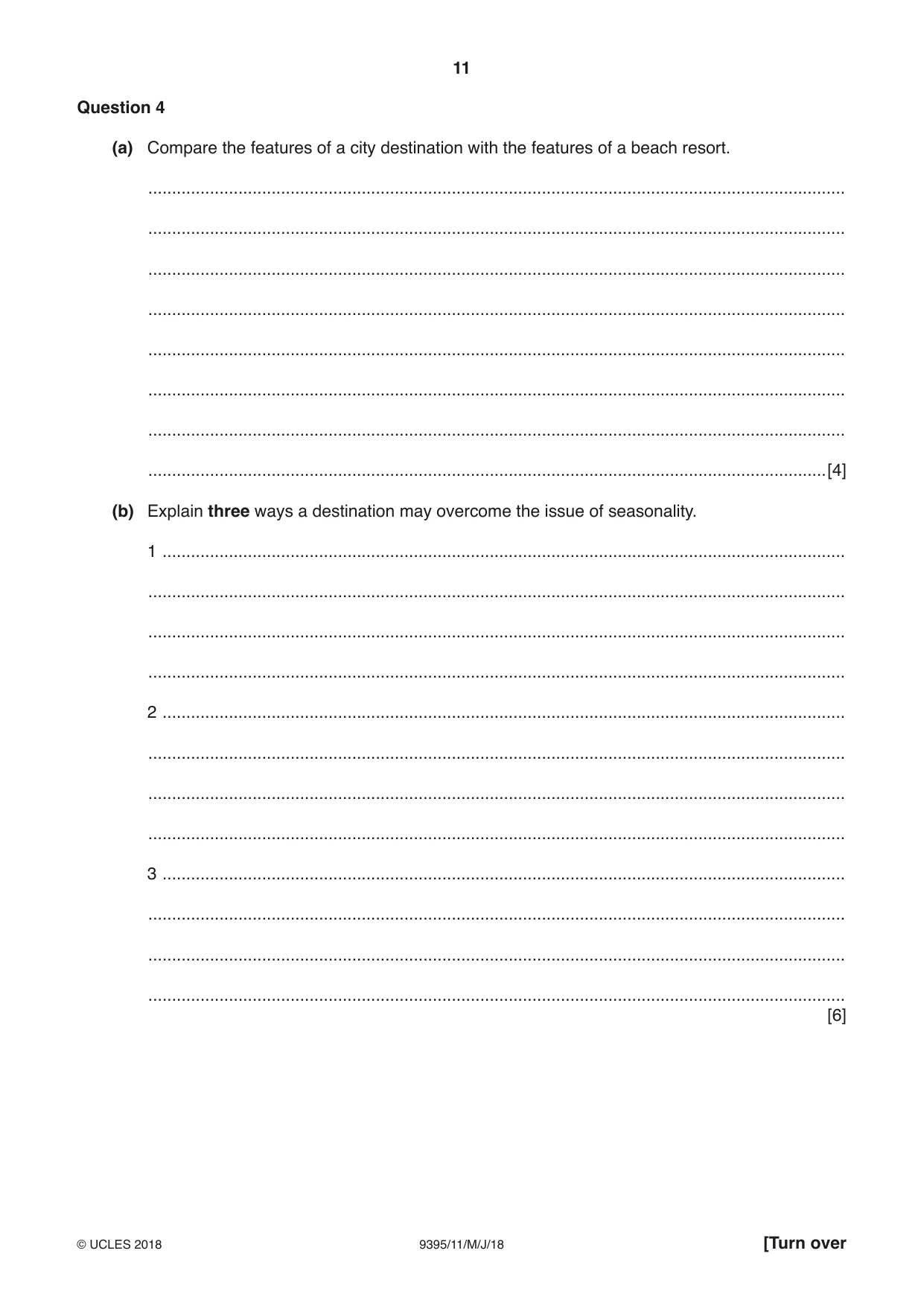
11 9395/11/M/J/18 © UCLES 2018 [Turn over Question 4 (a) Compare the features of a city destination with the features of a beach resort. … … … … … … … …[4] (b) Explain three ways a destination may overcome the issue of seasonality. 1 … … … … 2 … … … … 3 … … … … [6]
Question paper, page 12
12 9395/11/M/J/18 © UCLES 2018 (c) Tourist Information Centres (TICs) can be found in most destinations. Assess the benefits to tourists of having a TIC in a destination. … … … … … … … … … … … …[6]
Question paper, page 13
13 9395/11/M/J/18 © UCLES 2018 (d) Discuss why destinations offer a range of different types of accommodation. … … … … … … … … … … … … … … … … … …[9] [Total: 25]
Question paper, page 14
14 9395/11/M/J/18 © UCLES 2018 BLANK PAGE
Question paper, page 15
15 9395/11/M/J/18 © UCLES 2018 BLANK PAGE
Question paper, page 16
16 9395/11/M/J/18 © UCLES 2018 Permission to reproduce items where third-party owned material protected by copyright is included has been sought and cleared where possible. Every reasonable effort has been made by the publisher (UCLES) to trace copyright holders, but if any items requiring clearance have unwittingly been included, the publisher will be pleased to make amends at the earliest possible opportunity. To avoid the issue of disclosure of answer-related information to candidates, all copyright acknowledgements are reproduced online in the Cambridge International Examinations Copyright Acknowledgements Booklet. This is produced for each series of examinations and is freely available to download at www.cie.org.uk after the live examination series. Cambridge International Examinations is part of the Cambridge Assessment Group. Cambridge Assessment is the brand name of University of Cambridge Local Examinations Syndicate (UCLES), which is itself a department of the University of Cambridge. BLANK PAGE
Mark scheme, page 1
IGCSE™ is a registered trademark. This document consists of 14 printed pages. © UCLES 2018 [Turn over Cambridge Assessment International Education Cambridge International Advanced Subsidiary and Advanced Level TRAVEL & TOURISM 9395/11 Paper 1 The Industry May/June 2018 MARK SCHEME Maximum Mark: 100 Published This mark scheme is published as an aid to teachers and candidates, to indicate the requirements of the examination. It shows the basis on which Examiners were instructed to award marks. It does not indicate the details of the discussions that took place at an Examiners’ meeting before marking began, which would have considered the acceptability of alternative answers. Mark schemes should be read in conjunction with the question paper and the Principal Examiner Report for Teachers. Cambridge International will not enter into discussions about these mark schemes. Cambridge International is publishing the mark schemes for the May/June 2018 series for most Cambridge IGCSE™, Cambridge International A and AS Level and Cambridge Pre-U components, and some Cambridge O Level components.
Mark scheme, page 2
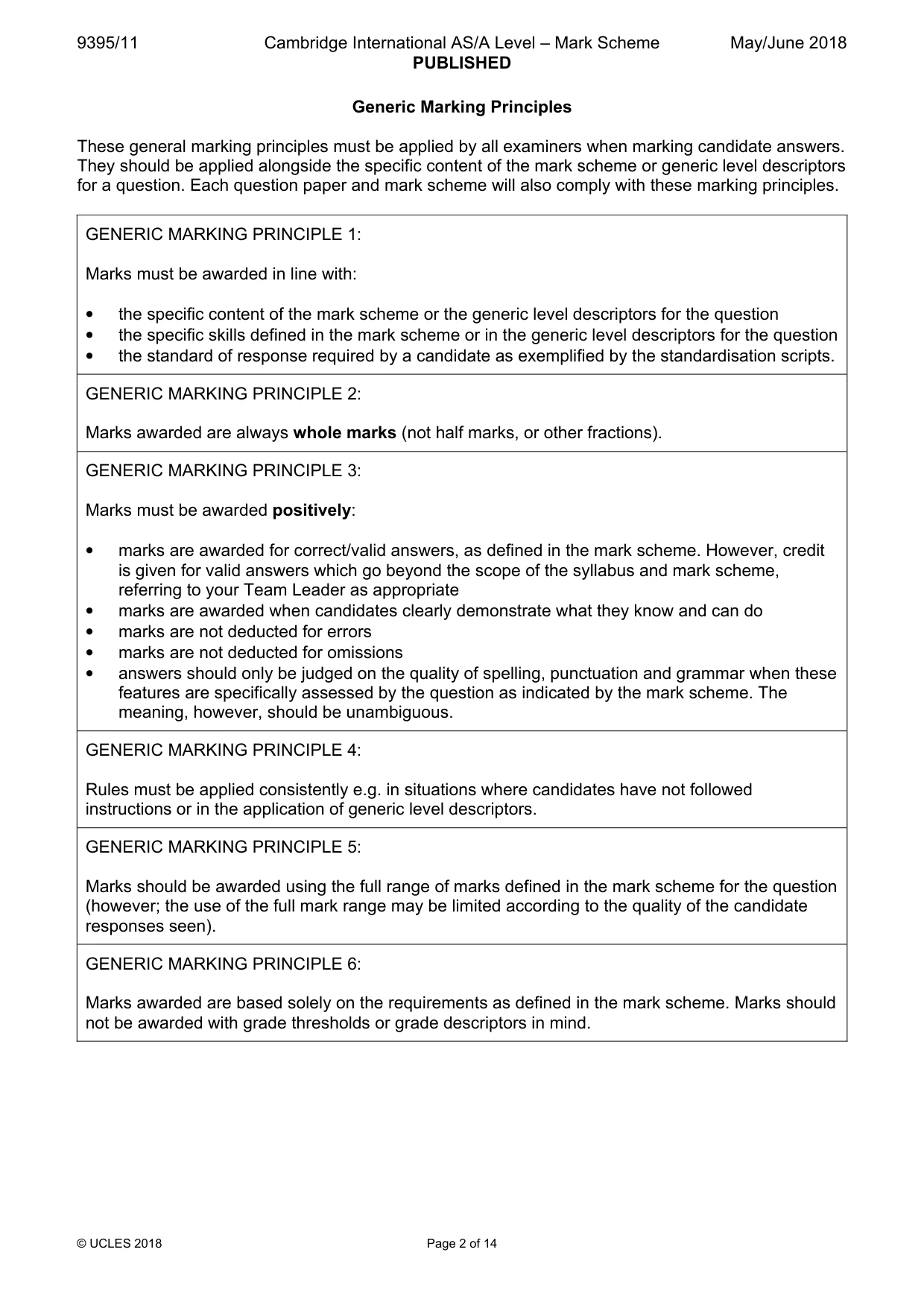
9395/11 Cambridge International AS/A Level – Mark Scheme PUBLISHED May/June 2018 © UCLES 2018 Page 2 of 14 Generic Marking Principles These general marking principles must be applied by all examiners when marking candidate answers. They should be applied alongside the specific content of the mark scheme or generic level descriptors for a question. Each question paper and mark scheme will also comply with these marking principles. GENERIC MARKING PRINCIPLE 1: Marks must be awarded in line with: • the specific content of the mark scheme or the generic level descriptors for the question • the specific skills defined in the mark scheme or in the generic level descriptors for the question • the standard of response required by a candidate as exemplified by the standardisation scripts. GENERIC MARKING PRINCIPLE 2: Marks awarded are always whole marks (not half marks, or other fractions). GENERIC MARKING PRINCIPLE 3: Marks must be awarded positively: • marks are awarded for correct/valid answers, as defined in the mark scheme. However, credit is given for valid answers which go beyond the scope of the syllabus and mark scheme, referring to your Team Leader as appropriate • marks are awarded when candidates clearly demonstrate what they know and can do • marks are not deducted for errors • marks are not deducted for omissions • answers should only be judged on the quality of spelling, punctuation and grammar when these features are specifically assessed by the question as indicated by the mark scheme. The meaning, however, should be unambiguous. GENERIC MARKING PRINCIPLE 4: Rules must be applied consistently e.g. in situations where candidates have not followed instructions or in the application of generic level descriptors. GENERIC MARKING PRINCIPLE 5: Marks should be awarded using the full range of marks defined in the mark scheme for the question (however; the use of the full mark range may be limited according to the quality of the candidate responses seen). GENERIC MARKING PRINCIPLE 6: Marks awarded are based solely on the requirements as defined in the mark scheme. Marks should not be awarded with grade thresholds or grade descriptors in mind.
Mark scheme, page 3
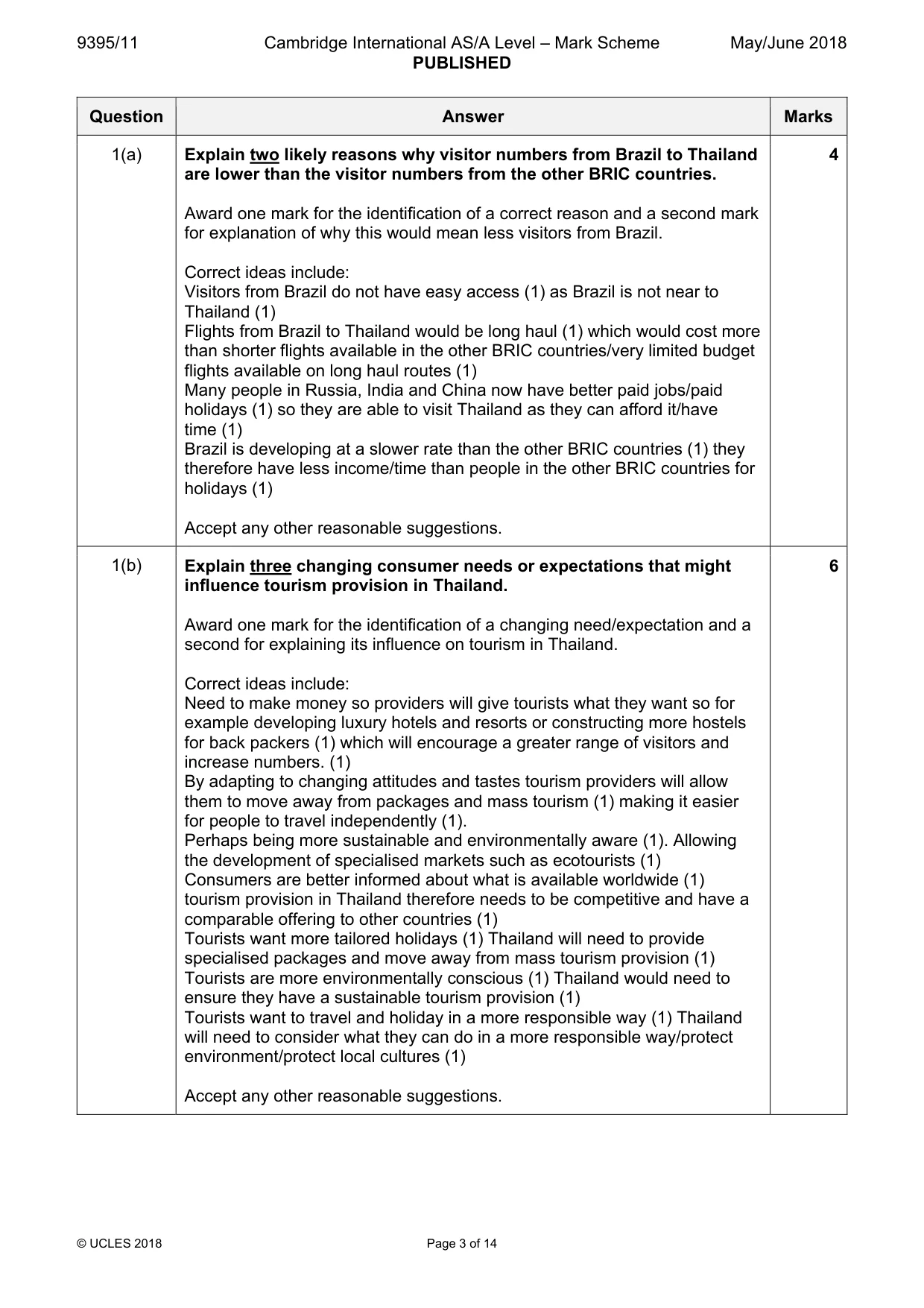
9395/11 Cambridge International AS/A Level – Mark Scheme PUBLISHED May/June 2018 © UCLES 2018 Page 3 of 14 Question Answer Marks 1(a) Explain two likely reasons why visitor numbers from Brazil to Thailand are lower than the visitor numbers from the other BRIC countries. Award one mark for the identification of a correct reason and a second mark for explanation of why this would mean less visitors from Brazil. Correct ideas include: Visitors from Brazil do not have easy access (1) as Brazil is not near to Thailand (1) Flights from Brazil to Thailand would be long haul (1) which would cost more than shorter flights available in the other BRIC countries/very limited budget flights available on long haul routes (1) Many people in Russia, India and China now have better paid jobs/paid holidays (1) so they are able to visit Thailand as they can afford it/have time (1) Brazil is developing at a slower rate than the other BRIC countries (1) they therefore have less income/time than people in the other BRIC countries for holidays (1) Accept any other reasonable suggestions. 4 1(b) Explain three changing consumer needs or expectations that might influence tourism provision in Thailand. Award one mark for the identification of a changing need/expectation and a second for explaining its influence on tourism in Thailand. Correct ideas include: Need to make money so providers will give tourists what they want so for example developing luxury hotels and resorts or constructing more hostels for back packers (1) which will encourage a greater range of visitors and increase numbers. (1) By adapting to changing attitudes and tastes tourism providers will allow them to move away from packages and mass tourism (1) making it easier for people to travel independently (1). Perhaps being more sustainable and environmentally aware (1). Allowing the development of specialised markets such as ecotourists (1) Consumers are better informed about what is available worldwide (1) tourism provision in Thailand therefore needs to be competitive and have a comparable offering to other countries (1) Tourists want more tailored holidays (1) Thailand will need to provide specialised packages and move away from mass tourism provision (1) Tourists are more environmentally conscious (1) Thailand would need to ensure they have a sustainable tourism provision (1) Tourists want to travel and holiday in a more responsible way (1) Thailand will need to consider what they can do in a more responsible way/protect environment/protect local cultures (1) Accept any other reasonable suggestions. 6
Mark scheme, page 4
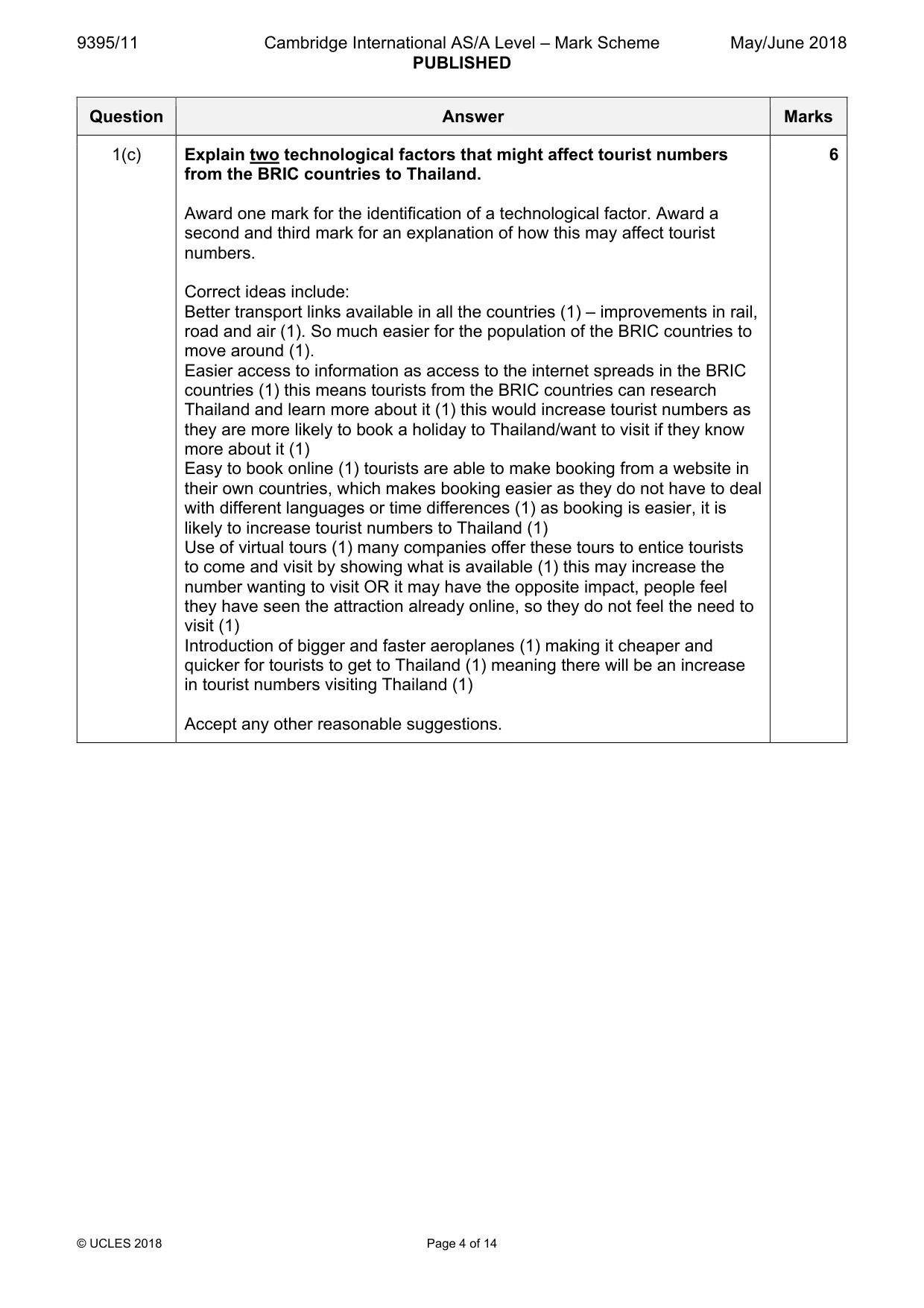
9395/11 Cambridge International AS/A Level – Mark Scheme PUBLISHED May/June 2018 © UCLES 2018 Page 4 of 14 Question Answer Marks 1(c) Explain two technological factors that might affect tourist numbers from the BRIC countries to Thailand. Award one mark for the identification of a technological factor. Award a second and third mark for an explanation of how this may affect tourist numbers. Correct ideas include: Better transport links available in all the countries (1) – improvements in rail, road and air (1). So much easier for the population of the BRIC countries to move around (1). Easier access to information as access to the internet spreads in the BRIC countries (1) this means tourists from the BRIC countries can research Thailand and learn more about it (1) this would increase tourist numbers as they are more likely to book a holiday to Thailand/want to visit if they know more about it (1) Easy to book online (1) tourists are able to make booking from a website in their own countries, which makes booking easier as they do not have to deal with different languages or time differences (1) as booking is easier, it is likely to increase tourist numbers to Thailand (1) Use of virtual tours (1) many companies offer these tours to entice tourists to come and visit by showing what is available (1) this may increase the number wanting to visit OR it may have the opposite impact, people feel they have seen the attraction already online, so they do not feel the need to visit (1) Introduction of bigger and faster aeroplanes (1) making it cheaper and quicker for tourists to get to Thailand (1) meaning there will be an increase in tourist numbers visiting Thailand (1) Accept any other reasonable suggestions. 6
Mark scheme, page 5
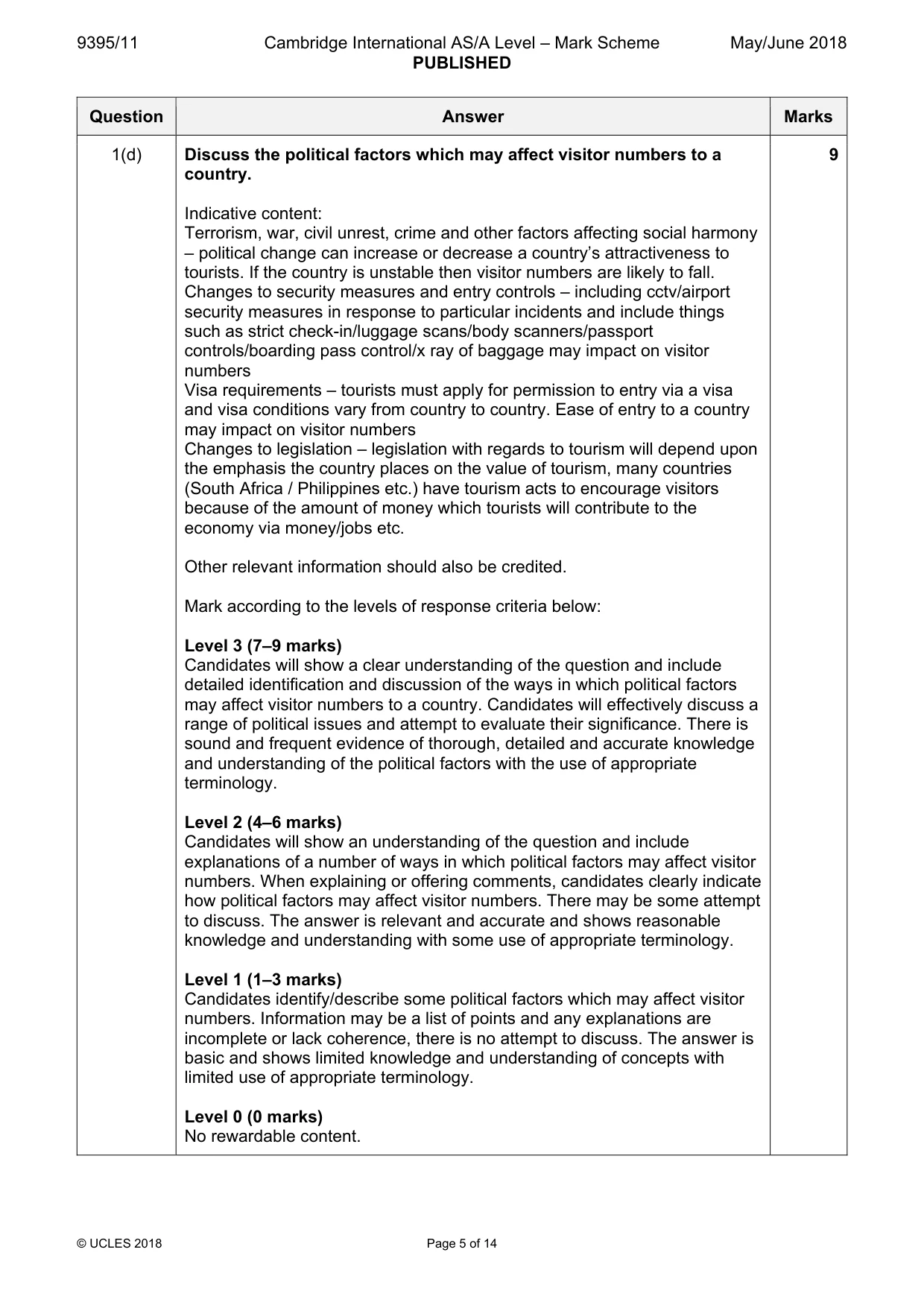
9395/11 Cambridge International AS/A Level – Mark Scheme PUBLISHED May/June 2018 © UCLES 2018 Page 5 of 14 Question Answer Marks 1(d) Discuss the political factors which may affect visitor numbers to a country. Indicative content: Terrorism, war, civil unrest, crime and other factors affecting social harmony – political change can increase or decrease a country’s attractiveness to tourists. If the country is unstable then visitor numbers are likely to fall. Changes to security measures and entry controls – including cctv/airport security measures in response to particular incidents and include things such as strict check-in/luggage scans/body scanners/passport controls/boarding pass control/x ray of baggage may impact on visitor numbers Visa requirements – tourists must apply for permission to entry via a visa and visa conditions vary from country to country. Ease of entry to a country may impact on visitor numbers Changes to legislation – legislation with regards to tourism will depend upon the emphasis the country places on the value of tourism, many countries (South Africa / Philippines etc.) have tourism acts to encourage visitors because of the amount of money which tourists will contribute to the economy via money/jobs etc. Other relevant information should also be credited. Mark according to the levels of response criteria below: Level 3 (7–9 marks) Candidates will show a clear understanding of the question and include detailed identification and discussion of the ways in which political factors may affect visitor numbers to a country. Candidates will effectively discuss a range of political issues and attempt to evaluate their significance. There is sound and frequent evidence of thorough, detailed and accurate knowledge and understanding of the political factors with the use of appropriate terminology. Level 2 (4–6 marks) Candidates will show an understanding of the question and include explanations of a number of ways in which political factors may affect visitor numbers. When explaining or offering comments, candidates clearly indicate how political factors may affect visitor numbers. There may be some attempt to discuss. The answer is relevant and accurate and shows reasonable knowledge and understanding with some use of appropriate terminology. Level 1 (1–3 marks) Candidates identify/describe some political factors which may affect visitor numbers. Information may be a list of points and any explanations are incomplete or lack coherence, there is no attempt to discuss. The answer is basic and shows limited knowledge and understanding of concepts with limited use of appropriate terminology. Level 0 (0 marks) No rewardable content. 9
Mark scheme, page 6
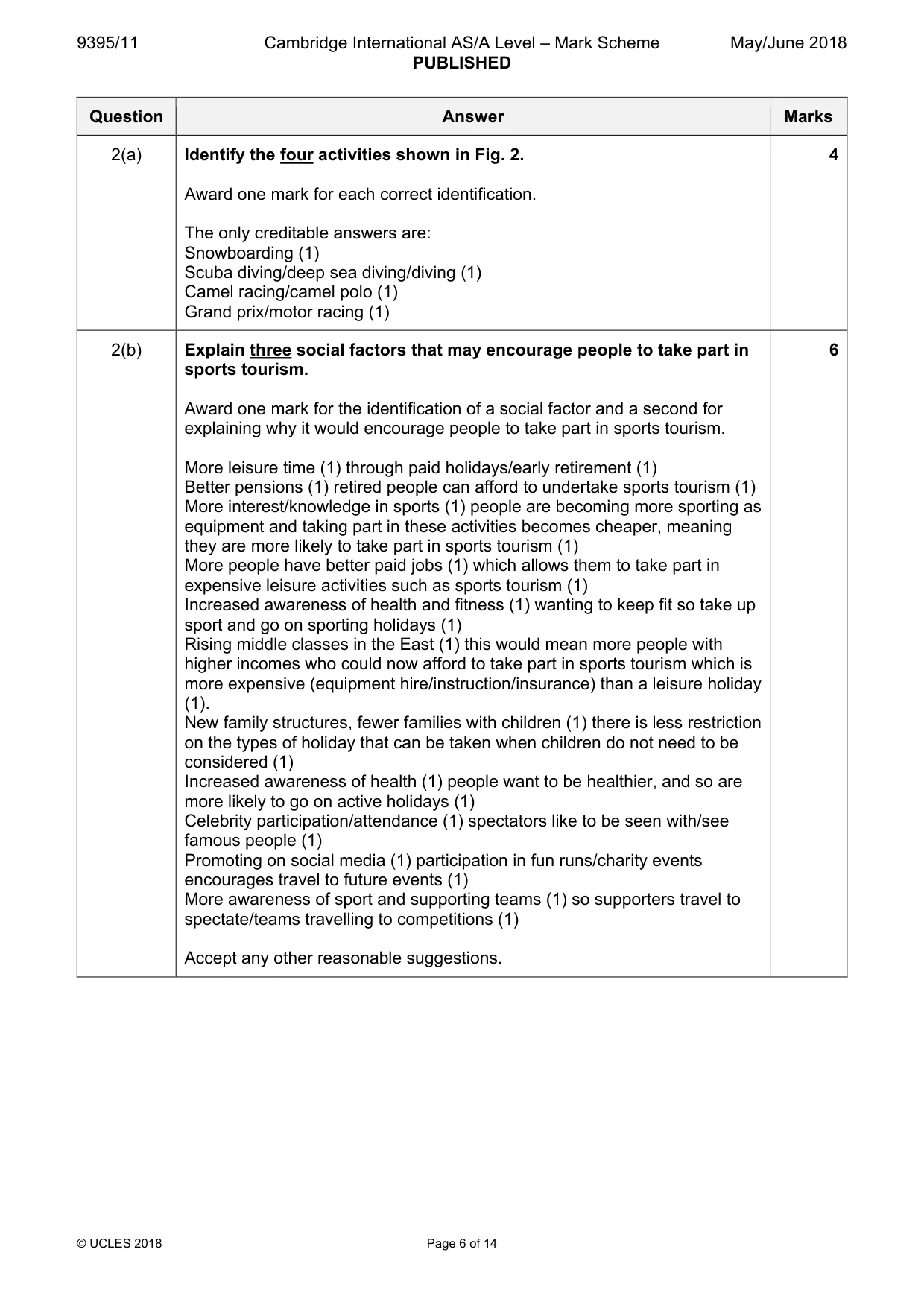
9395/11 Cambridge International AS/A Level – Mark Scheme PUBLISHED May/June 2018 © UCLES 2018 Page 6 of 14 Question Answer Marks 2(a) Identify the four activities shown in Fig. 2. Award one mark for each correct identification. The only creditable answers are: Snowboarding (1) Scuba diving/deep sea diving/diving (1) Camel racing/camel polo (1) Grand prix/motor racing (1) 4 2(b) Explain three social factors that may encourage people to take part in sports tourism. Award one mark for the identification of a social factor and a second for explaining why it would encourage people to take part in sports tourism. More leisure time (1) through paid holidays/early retirement (1) Better pensions (1) retired people can afford to undertake sports tourism (1) More interest/knowledge in sports (1) people are becoming more sporting as equipment and taking part in these activities becomes cheaper, meaning they are more likely to take part in sports tourism (1) More people have better paid jobs (1) which allows them to take part in expensive leisure activities such as sports tourism (1) Increased awareness of health and fitness (1) wanting to keep fit so take up sport and go on sporting holidays (1) Rising middle classes in the East (1) this would mean more people with higher incomes who could now afford to take part in sports tourism which is more expensive (equipment hire/instruction/insurance) than a leisure holiday (1). New family structures, fewer families with children (1) there is less restriction on the types of holiday that can be taken when children do not need to be considered (1) Increased awareness of health (1) people want to be healthier, and so are more likely to go on active holidays (1) Celebrity participation/attendance (1) spectators like to be seen with/see famous people (1) Promoting on social media (1) participation in fun runs/charity events encourages travel to future events (1) More awareness of sport and supporting teams (1) so supporters travel to spectate/teams travelling to competitions (1) Accept any other reasonable suggestions. 6
Mark scheme, page 7
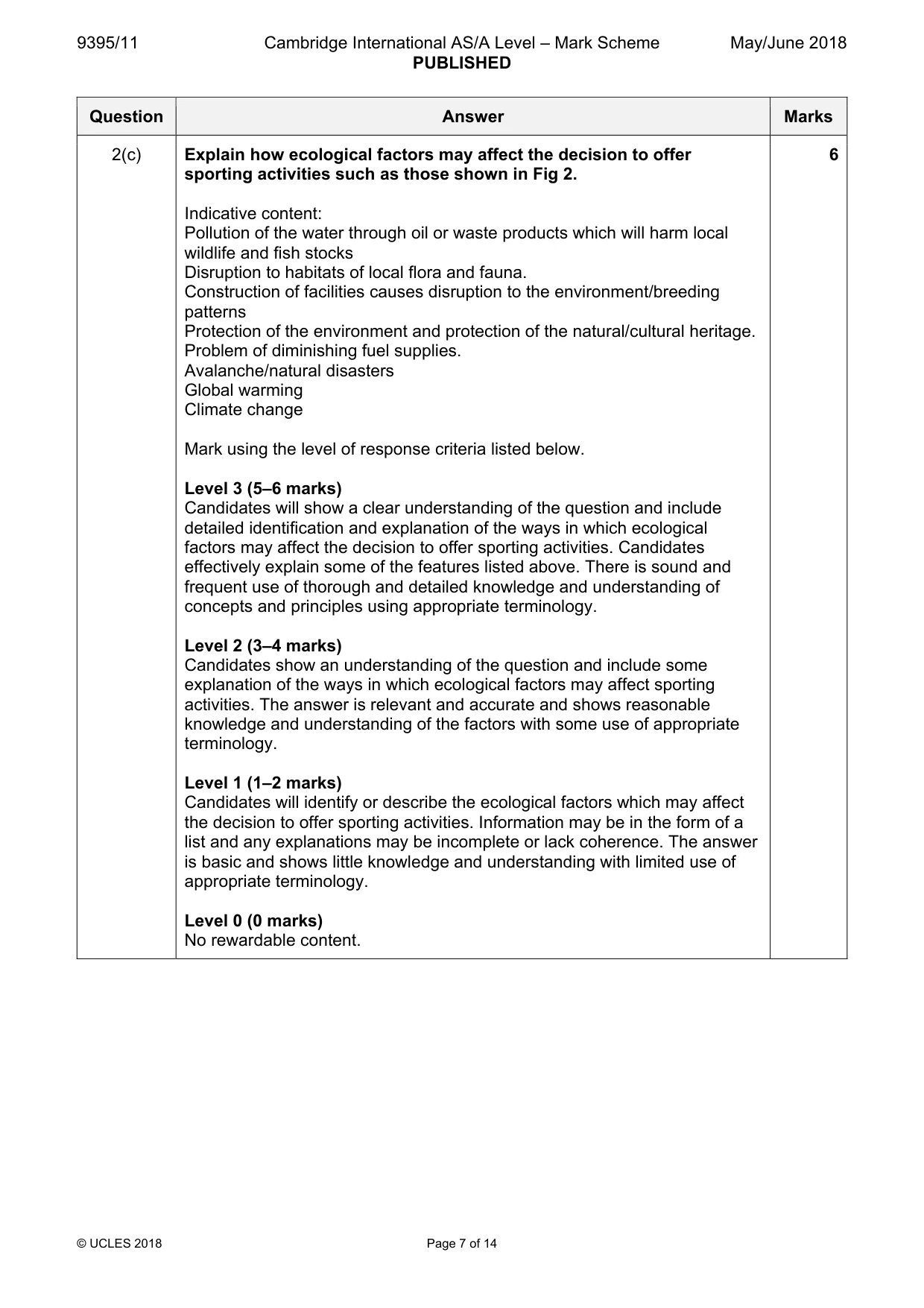
9395/11 Cambridge International AS/A Level – Mark Scheme PUBLISHED May/June 2018 © UCLES 2018 Page 7 of 14 Question Answer Marks 2(c) Explain how ecological factors may affect the decision to offer sporting activities such as those shown in Fig 2. Indicative content: Pollution of the water through oil or waste products which will harm local wildlife and fish stocks Disruption to habitats of local flora and fauna. Construction of facilities causes disruption to the environment/breeding patterns Protection of the environment and protection of the natural/cultural heritage. Problem of diminishing fuel supplies. Avalanche/natural disasters Global warming Climate change Mark using the level of response criteria listed below. Level 3 (5–6 marks) Candidates will show a clear understanding of the question and include detailed identification and explanation of the ways in which ecological factors may affect the decision to offer sporting activities. Candidates effectively explain some of the features listed above. There is sound and frequent use of thorough and detailed knowledge and understanding of concepts and principles using appropriate terminology. Level 2 (3–4 marks) Candidates show an understanding of the question and include some explanation of the ways in which ecological factors may affect sporting activities. The answer is relevant and accurate and shows reasonable knowledge and understanding of the factors with some use of appropriate terminology. Level 1 (1–2 marks) Candidates will identify or describe the ecological factors which may affect the decision to offer sporting activities. Information may be in the form of a list and any explanations may be incomplete or lack coherence. The answer is basic and shows little knowledge and understanding with limited use of appropriate terminology. Level 0 (0 marks) No rewardable content. 6
Mark scheme, page 8
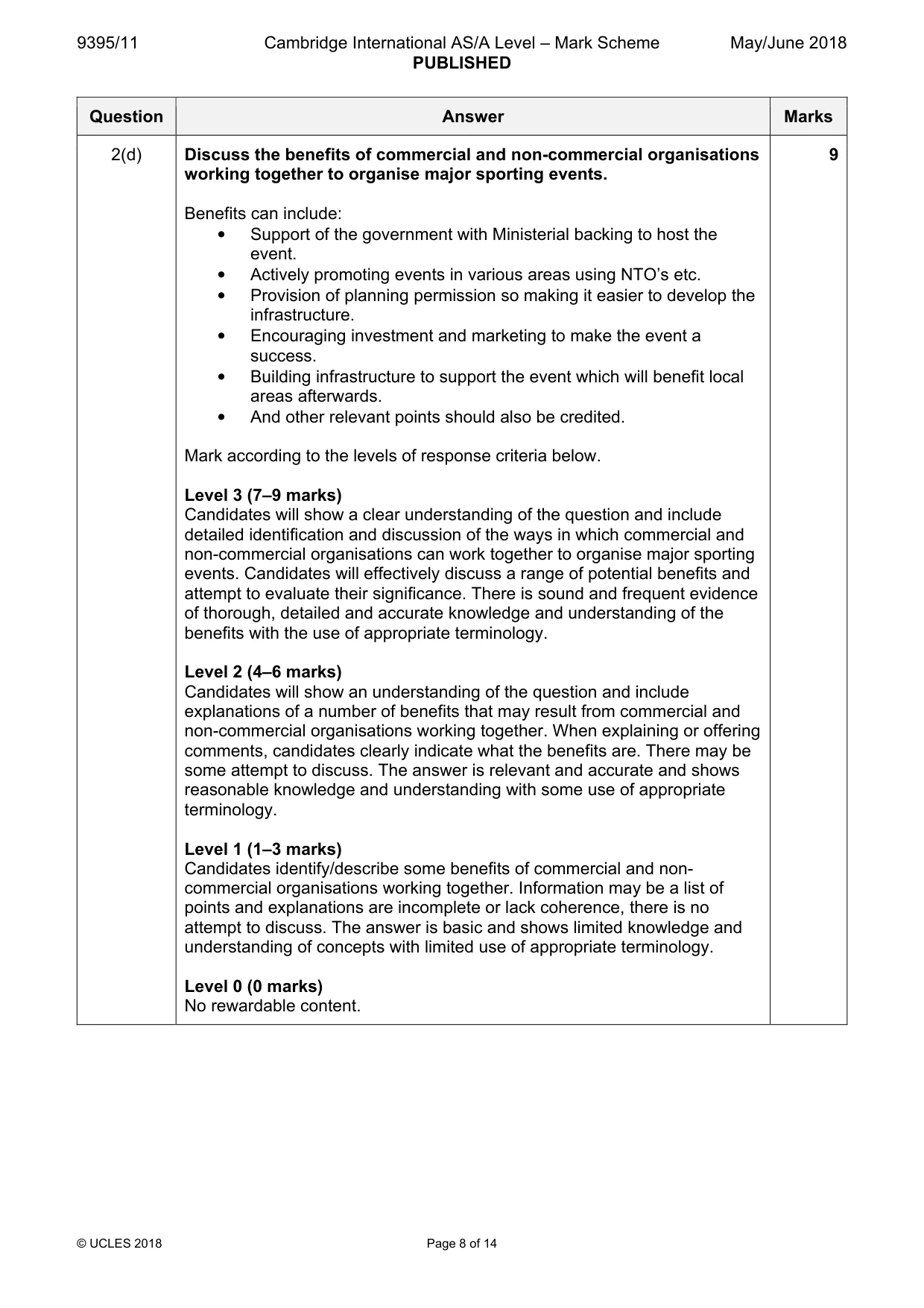
9395/11 Cambridge International AS/A Level – Mark Scheme PUBLISHED May/June 2018 © UCLES 2018 Page 8 of 14 Question Answer Marks 2(d) Discuss the benefits of commercial and non-commercial organisations working together to organise major sporting events. Benefits can include: • Support of the government with Ministerial backing to host the event. • Actively promoting events in various areas using NTO’s etc. • Provision of planning permission so making it easier to develop the infrastructure. • Encouraging investment and marketing to make the event a success. • Building infrastructure to support the event which will benefit local areas afterwards. • And other relevant points should also be credited. Mark according to the levels of response criteria below. Level 3 (7–9 marks) Candidates will show a clear understanding of the question and include detailed identification and discussion of the ways in which commercial and non-commercial organisations can work together to organise major sporting events. Candidates will effectively discuss a range of potential benefits and attempt to evaluate their significance. There is sound and frequent evidence of thorough, detailed and accurate knowledge and understanding of the benefits with the use of appropriate terminology. Level 2 (4–6 marks) Candidates will show an understanding of the question and include explanations of a number of benefits that may result from commercial and non-commercial organisations working together. When explaining or offering comments, candidates clearly indicate what the benefits are. There may be some attempt to discuss. The answer is relevant and accurate and shows reasonable knowledge and understanding with some use of appropriate terminology. Level 1 (1–3 marks) Candidates identify/describe some benefits of commercial and non- commercial organisations working together. Information may be a list of points and explanations are incomplete or lack coherence, there is no attempt to discuss. The answer is basic and shows limited knowledge and understanding of concepts with limited use of appropriate terminology. Level 0 (0 marks) No rewardable content. 9
Mark scheme, page 9
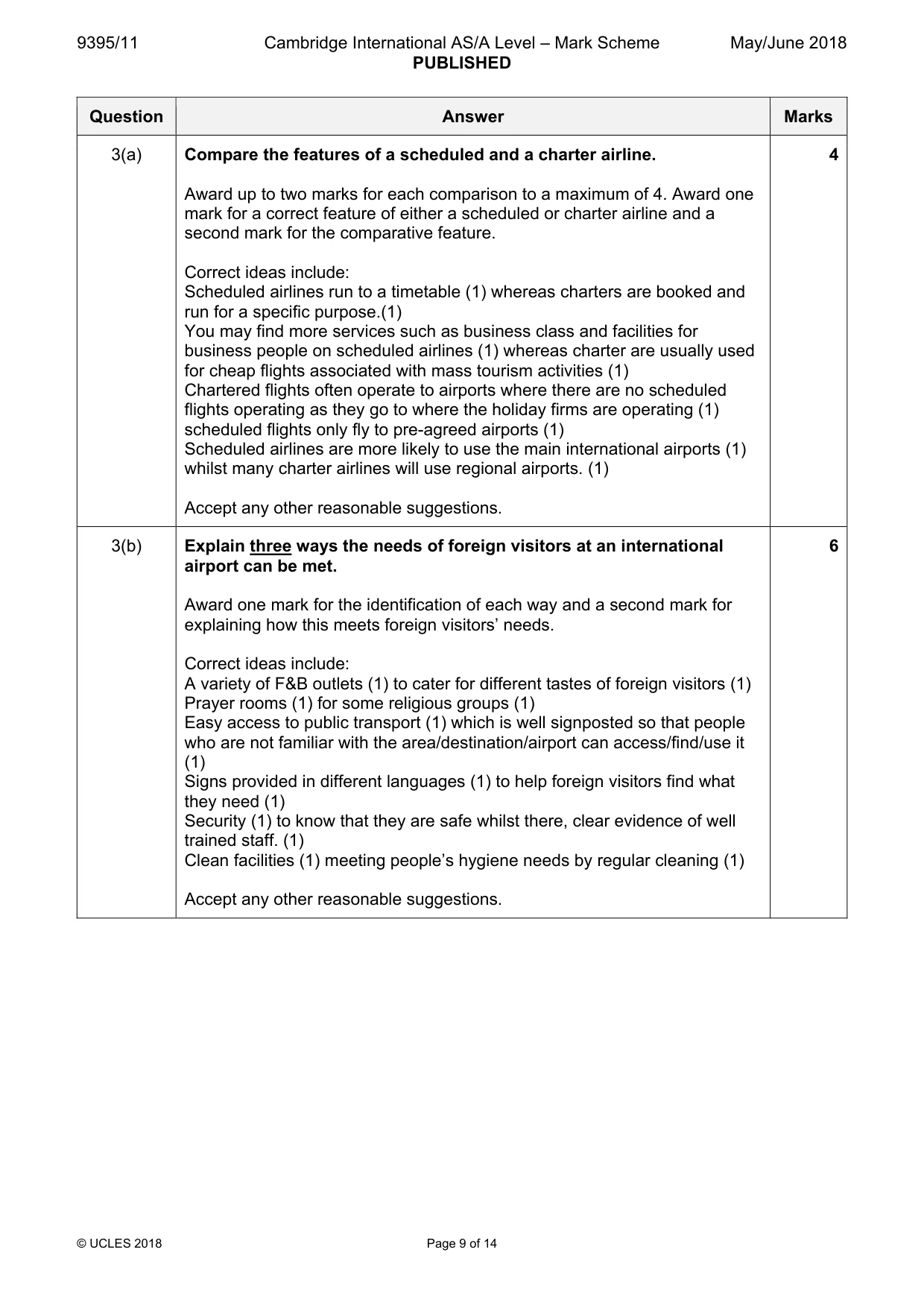
9395/11 Cambridge International AS/A Level – Mark Scheme PUBLISHED May/June 2018 © UCLES 2018 Page 9 of 14 Question Answer Marks 3(a) Compare the features of a scheduled and a charter airline. Award up to two marks for each comparison to a maximum of 4. Award one mark for a correct feature of either a scheduled or charter airline and a second mark for the comparative feature. Correct ideas include: Scheduled airlines run to a timetable (1) whereas charters are booked and run for a specific purpose.(1) You may find more services such as business class and facilities for business people on scheduled airlines (1) whereas charter are usually used for cheap flights associated with mass tourism activities (1) Chartered flights often operate to airports where there are no scheduled flights operating as they go to where the holiday firms are operating (1) scheduled flights only fly to pre-agreed airports (1) Scheduled airlines are more likely to use the main international airports (1) whilst many charter airlines will use regional airports. (1) Accept any other reasonable suggestions. 4 3(b) Explain three ways the needs of foreign visitors at an international airport can be met. Award one mark for the identification of each way and a second mark for explaining how this meets foreign visitors’ needs. Correct ideas include: A variety of F&B outlets (1) to cater for different tastes of foreign visitors (1) Prayer rooms (1) for some religious groups (1) Easy access to public transport (1) which is well signposted so that people who are not familiar with the area/destination/airport can access/find/use it (1) Signs provided in different languages (1) to help foreign visitors find what they need (1) Security (1) to know that they are safe whilst there, clear evidence of well trained staff. (1) Clean facilities (1) meeting people’s hygiene needs by regular cleaning (1) Accept any other reasonable suggestions. 6
Mark scheme, page 10
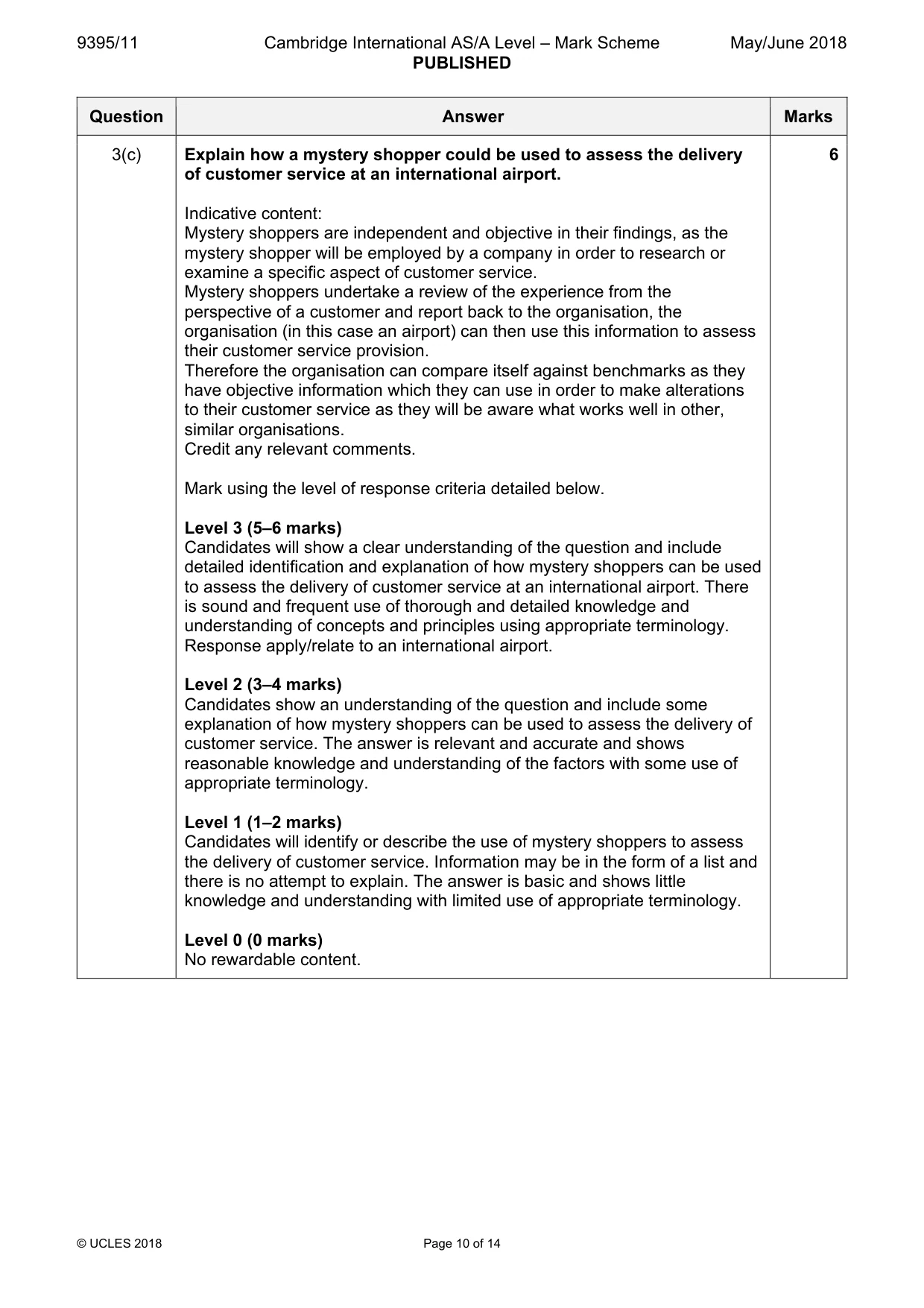
9395/11 Cambridge International AS/A Level – Mark Scheme PUBLISHED May/June 2018 © UCLES 2018 Page 10 of 14 Question Answer Marks 3(c) Explain how a mystery shopper could be used to assess the delivery of customer service at an international airport. Indicative content: Mystery shoppers are independent and objective in their findings, as the mystery shopper will be employed by a company in order to research or examine a specific aspect of customer service. Mystery shoppers undertake a review of the experience from the perspective of a customer and report back to the organisation, the organisation (in this case an airport) can then use this information to assess their customer service provision. Therefore the organisation can compare itself against benchmarks as they have objective information which they can use in order to make alterations to their customer service as they will be aware what works well in other, similar organisations. Credit any relevant comments. Mark using the level of response criteria detailed below. Level 3 (5–6 marks) Candidates will show a clear understanding of the question and include detailed identification and explanation of how mystery shoppers can be used to assess the delivery of customer service at an international airport. There is sound and frequent use of thorough and detailed knowledge and understanding of concepts and principles using appropriate terminology. Response apply/relate to an international airport. Level 2 (3–4 marks) Candidates show an understanding of the question and include some explanation of how mystery shoppers can be used to assess the delivery of customer service. The answer is relevant and accurate and shows reasonable knowledge and understanding of the factors with some use of appropriate terminology. Level 1 (1–2 marks) Candidates will identify or describe the use of mystery shoppers to assess the delivery of customer service. Information may be in the form of a list and there is no attempt to explain. The answer is basic and shows little knowledge and understanding with limited use of appropriate terminology. Level 0 (0 marks) No rewardable content. 6
Mark scheme, page 11
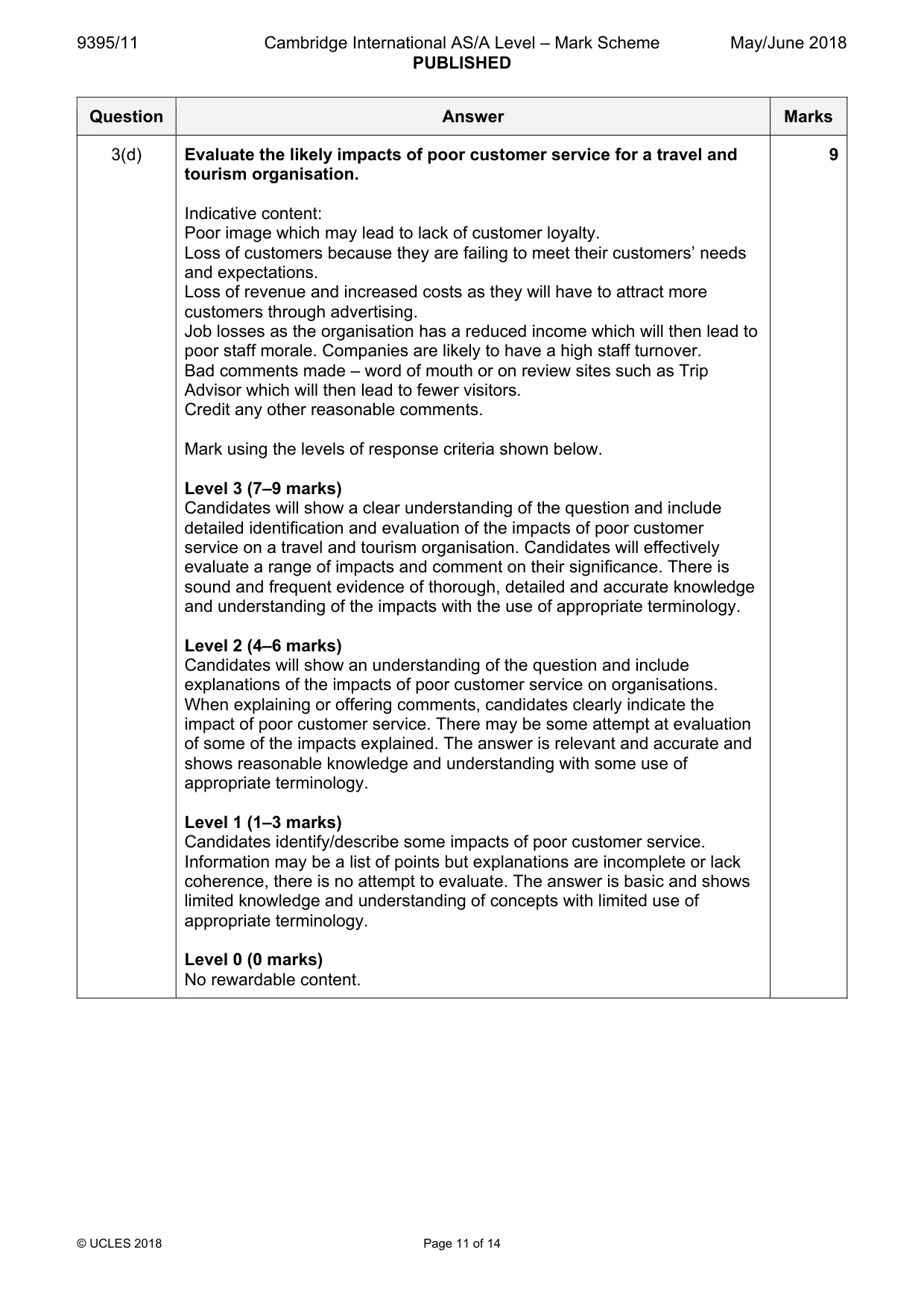
9395/11 Cambridge International AS/A Level – Mark Scheme PUBLISHED May/June 2018 © UCLES 2018 Page 11 of 14 Question Answer Marks 3(d) Evaluate the likely impacts of poor customer service for a travel and tourism organisation. Indicative content: Poor image which may lead to lack of customer loyalty. Loss of customers because they are failing to meet their customers’ needs and expectations. Loss of revenue and increased costs as they will have to attract more customers through advertising. Job losses as the organisation has a reduced income which will then lead to poor staff morale. Companies are likely to have a high staff turnover. Bad comments made – word of mouth or on review sites such as Trip Advisor which will then lead to fewer visitors. Credit any other reasonable comments. Mark using the levels of response criteria shown below. Level 3 (7–9 marks) Candidates will show a clear understanding of the question and include detailed identification and evaluation of the impacts of poor customer service on a travel and tourism organisation. Candidates will effectively evaluate a range of impacts and comment on their significance. There is sound and frequent evidence of thorough, detailed and accurate knowledge and understanding of the impacts with the use of appropriate terminology. Level 2 (4–6 marks) Candidates will show an understanding of the question and include explanations of the impacts of poor customer service on organisations. When explaining or offering comments, candidates clearly indicate the impact of poor customer service. There may be some attempt at evaluation of some of the impacts explained. The answer is relevant and accurate and shows reasonable knowledge and understanding with some use of appropriate terminology. Level 1 (1–3 marks) Candidates identify/describe some impacts of poor customer service. Information may be a list of points but explanations are incomplete or lack coherence, there is no attempt to evaluate. The answer is basic and shows limited knowledge and understanding of concepts with limited use of appropriate terminology. Level 0 (0 marks) No rewardable content. 9
Mark scheme, page 12
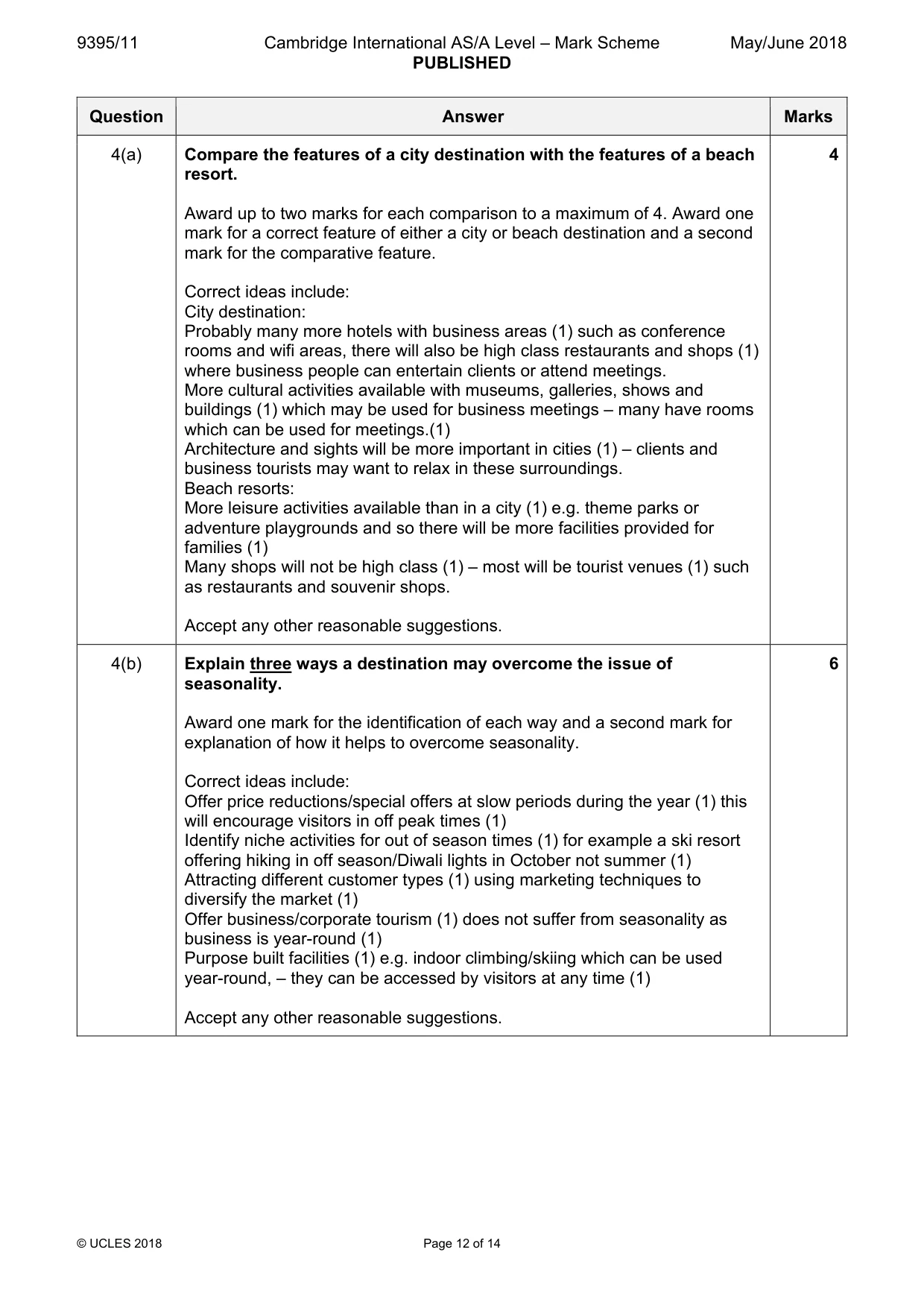
9395/11 Cambridge International AS/A Level – Mark Scheme PUBLISHED May/June 2018 © UCLES 2018 Page 12 of 14 Question Answer Marks 4(a) Compare the features of a city destination with the features of a beach resort. Award up to two marks for each comparison to a maximum of 4. Award one mark for a correct feature of either a city or beach destination and a second mark for the comparative feature. Correct ideas include: City destination: Probably many more hotels with business areas (1) such as conference rooms and wifi areas, there will also be high class restaurants and shops (1) where business people can entertain clients or attend meetings. More cultural activities available with museums, galleries, shows and buildings (1) which may be used for business meetings – many have rooms which can be used for meetings.(1) Architecture and sights will be more important in cities (1) – clients and business tourists may want to relax in these surroundings. Beach resorts: More leisure activities available than in a city (1) e.g. theme parks or adventure playgrounds and so there will be more facilities provided for families (1) Many shops will not be high class (1) – most will be tourist venues (1) such as restaurants and souvenir shops. Accept any other reasonable suggestions. 4 4(b) Explain three ways a destination may overcome the issue of seasonality. Award one mark for the identification of each way and a second mark for explanation of how it helps to overcome seasonality. Correct ideas include: Offer price reductions/special offers at slow periods during the year (1) this will encourage visitors in off peak times (1) Identify niche activities for out of season times (1) for example a ski resort offering hiking in off season/Diwali lights in October not summer (1) Attracting different customer types (1) using marketing techniques to diversify the market (1) Offer business/corporate tourism (1) does not suffer from seasonality as business is year-round (1) Purpose built facilities (1) e.g. indoor climbing/skiing which can be used year-round, – they can be accessed by visitors at any time (1) Accept any other reasonable suggestions. 6
Mark scheme, page 13
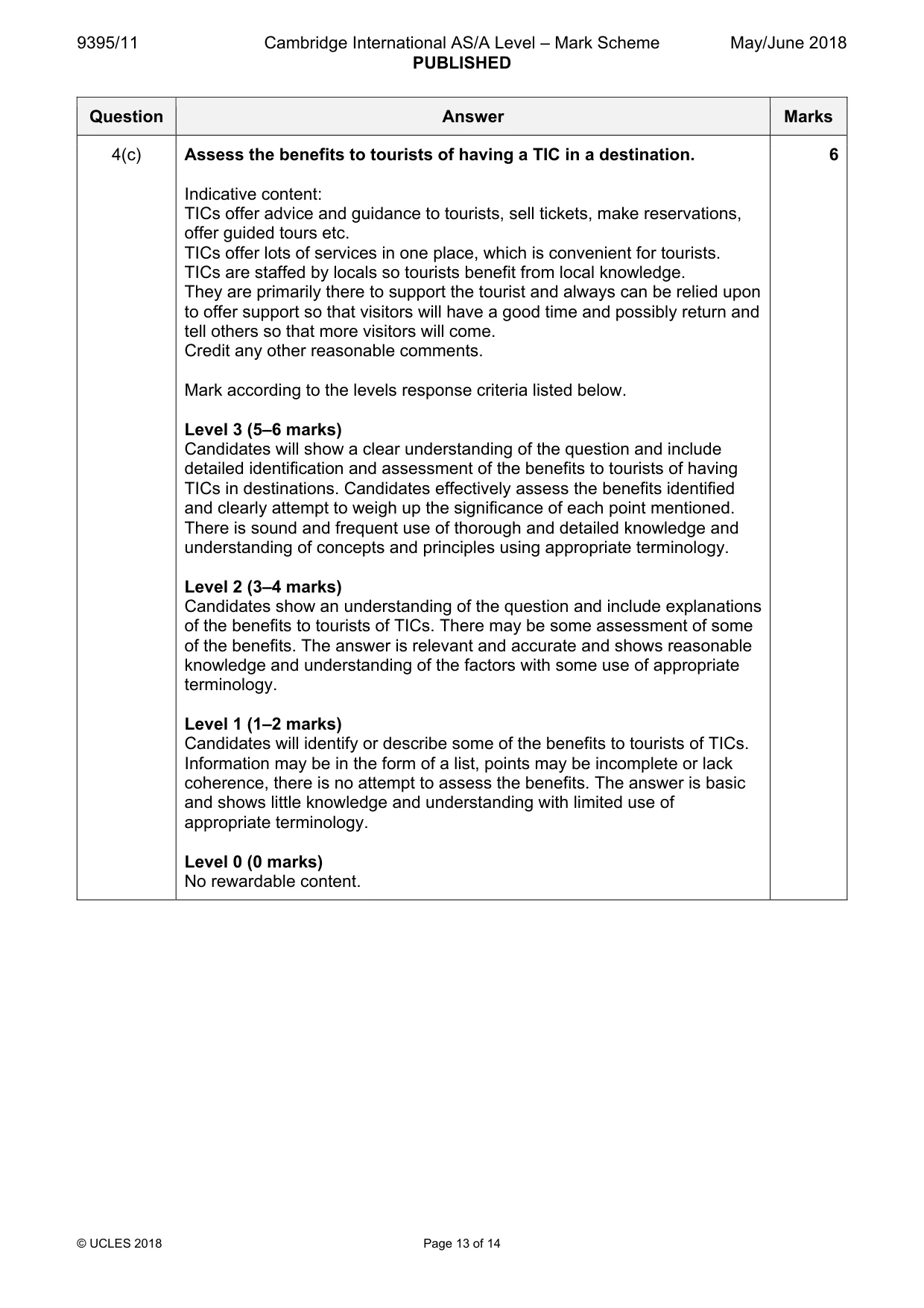
9395/11 Cambridge International AS/A Level – Mark Scheme PUBLISHED May/June 2018 © UCLES 2018 Page 13 of 14 Question Answer Marks 4(c) Assess the benefits to tourists of having a TIC in a destination. Indicative content: TICs offer advice and guidance to tourists, sell tickets, make reservations, offer guided tours etc. TICs offer lots of services in one place, which is convenient for tourists. TICs are staffed by locals so tourists benefit from local knowledge. They are primarily there to support the tourist and always can be relied upon to offer support so that visitors will have a good time and possibly return and tell others so that more visitors will come. Credit any other reasonable comments. Mark according to the levels response criteria listed below. Level 3 (5–6 marks) Candidates will show a clear understanding of the question and include detailed identification and assessment of the benefits to tourists of having TICs in destinations. Candidates effectively assess the benefits identified and clearly attempt to weigh up the significance of each point mentioned. There is sound and frequent use of thorough and detailed knowledge and understanding of concepts and principles using appropriate terminology. Level 2 (3–4 marks) Candidates show an understanding of the question and include explanations of the benefits to tourists of TICs. There may be some assessment of some of the benefits. The answer is relevant and accurate and shows reasonable knowledge and understanding of the factors with some use of appropriate terminology. Level 1 (1–2 marks) Candidates will identify or describe some of the benefits to tourists of TICs. Information may be in the form of a list, points may be incomplete or lack coherence, there is no attempt to assess the benefits. The answer is basic and shows little knowledge and understanding with limited use of appropriate terminology. Level 0 (0 marks) No rewardable content. 6
Mark scheme, page 14
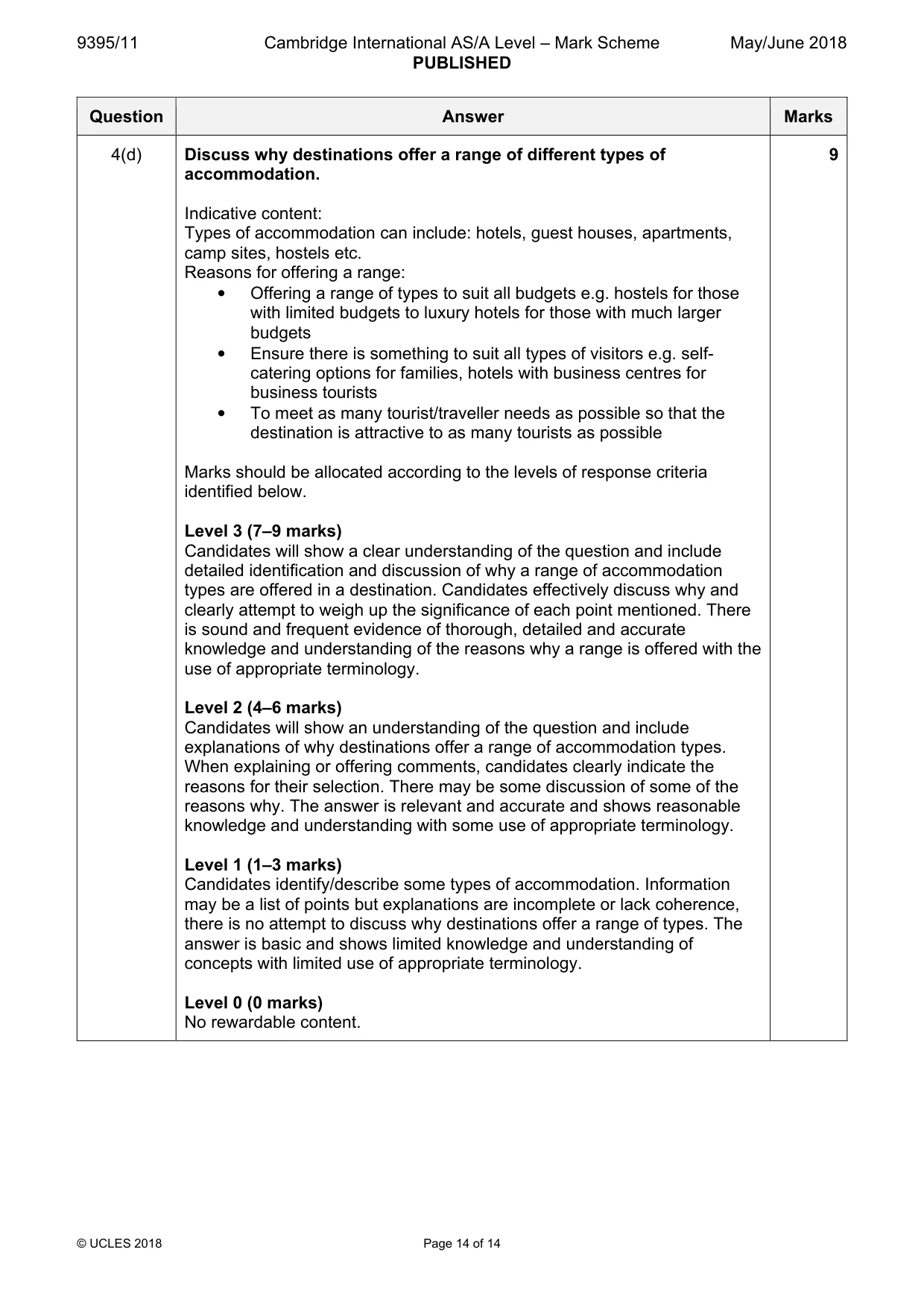
9395/11 Cambridge International AS/A Level – Mark Scheme PUBLISHED May/June 2018 © UCLES 2018 Page 14 of 14 Question Answer Marks 4(d) Discuss why destinations offer a range of different types of accommodation. Indicative content: Types of accommodation can include: hotels, guest houses, apartments, camp sites, hostels etc. Reasons for offering a range: • Offering a range of types to suit all budgets e.g. hostels for those with limited budgets to luxury hotels for those with much larger budgets • Ensure there is something to suit all types of visitors e.g. self- catering options for families, hotels with business centres for business tourists • To meet as many tourist/traveller needs as possible so that the destination is attractive to as many tourists as possible Marks should be allocated according to the levels of response criteria identified below. Level 3 (7–9 marks) Candidates will show a clear understanding of the question and include detailed identification and discussion of why a range of accommodation types are offered in a destination. Candidates effectively discuss why and clearly attempt to weigh up the significance of each point mentioned. There is sound and frequent evidence of thorough, detailed and accurate knowledge and understanding of the reasons why a range is offered with the use of appropriate terminology. Level 2 (4–6 marks) Candidates will show an understanding of the question and include explanations of why destinations offer a range of accommodation types. When explaining or offering comments, candidates clearly indicate the reasons for their selection. There may be some discussion of some of the reasons why. The answer is relevant and accurate and shows reasonable knowledge and understanding with some use of appropriate terminology. Level 1 (1–3 marks) Candidates identify/describe some types of accommodation. Information may be a list of points but explanations are incomplete or lack coherence, there is no attempt to discuss why destinations offer a range of types. The answer is basic and shows limited knowledge and understanding of concepts with limited use of appropriate terminology. Level 0 (0 marks) No rewardable content. 9
What you needed in this session
Cambridge’s own grade thresholds for 2018 May/June, Paper 1 · Variant 1. A higher threshold means an easier paper — the bar moves with how the cohort did.