Cambridge A Level Travel and Tourism 9395 — 2018 May/June Paper 1 · Variant 3
9395/13/M/J/18 · 100 marks · ≈113 min
The question paper and its mark scheme, free to read here and free to download. This is Cambridge’s own paper, exactly as it was sat.
Question paper16 pages




Mark scheme14 pages
Answers below. Sit the paper first if you are practising.
Paper as text
Question paper, page 1
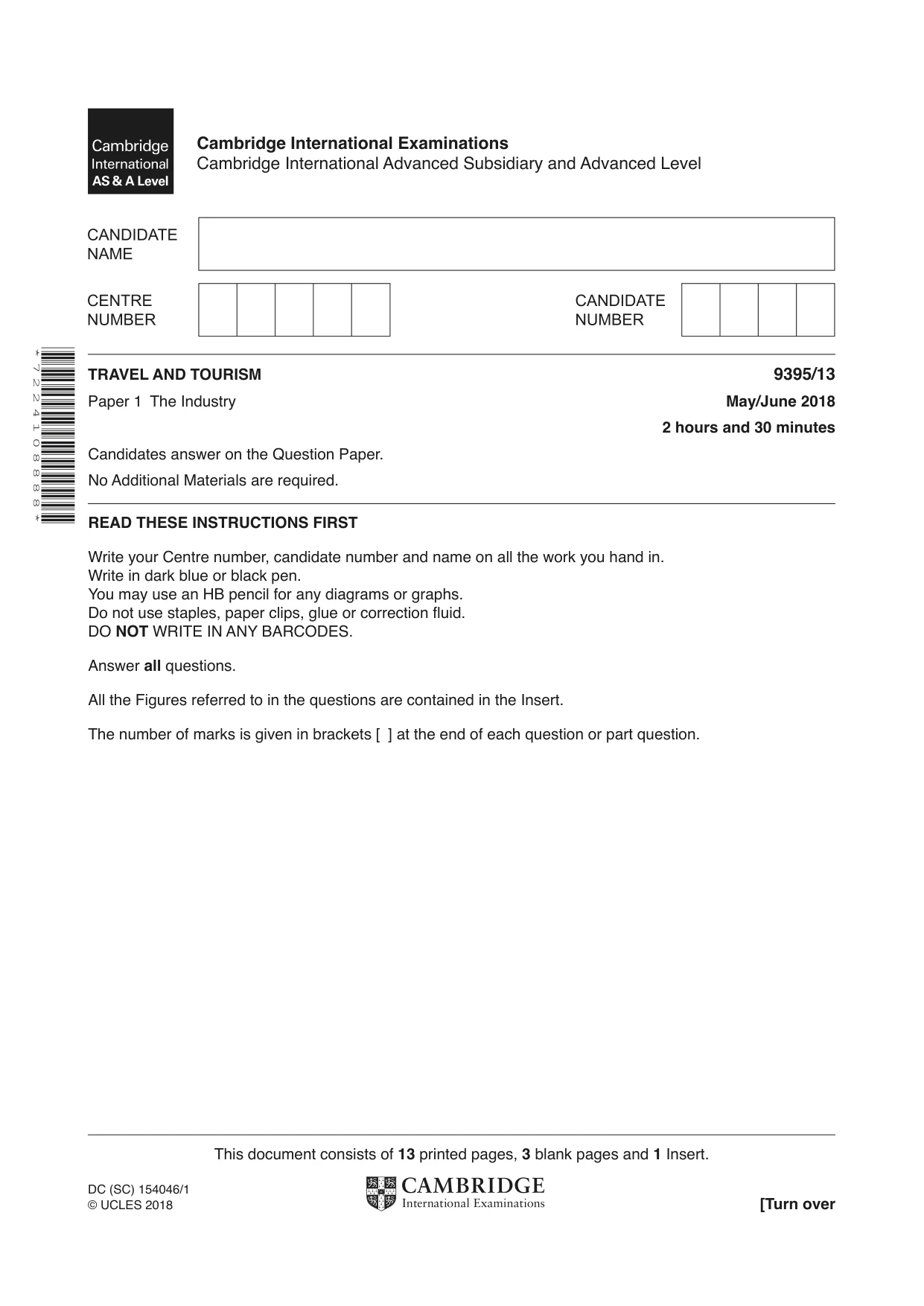
* 7 2 2 4 1 0 8 8 8 8 * This document consists of 13 printed pages, 3 blank pages and 1 Insert. DC (SC) 154046/1 © UCLES 2018 [Turn over Cambridge International Examinations Cambridge International Advanced Subsidiary and Advanced Level TRAVEL AND TOURISM 9395/13 Paper 1 The Industry May/June 2018 2 hours and 30 minutes Candidates answer on the Question Paper. No Additional Materials are required. READ THESE INSTRUCTIONS FIRST Write your Centre number, candidate number and name on all the work you hand in. Write in dark blue or black pen. You may use an HB pencil for any diagrams or graphs. Do not use staples, paper clips, glue or correction fluid. DO NOT WRITE IN ANY BARCODES. Answer all questions. All the Figures referred to in the questions are contained in the Insert. The number of marks is given in brackets [ ] at the end of each question or part question.
Question paper, page 2
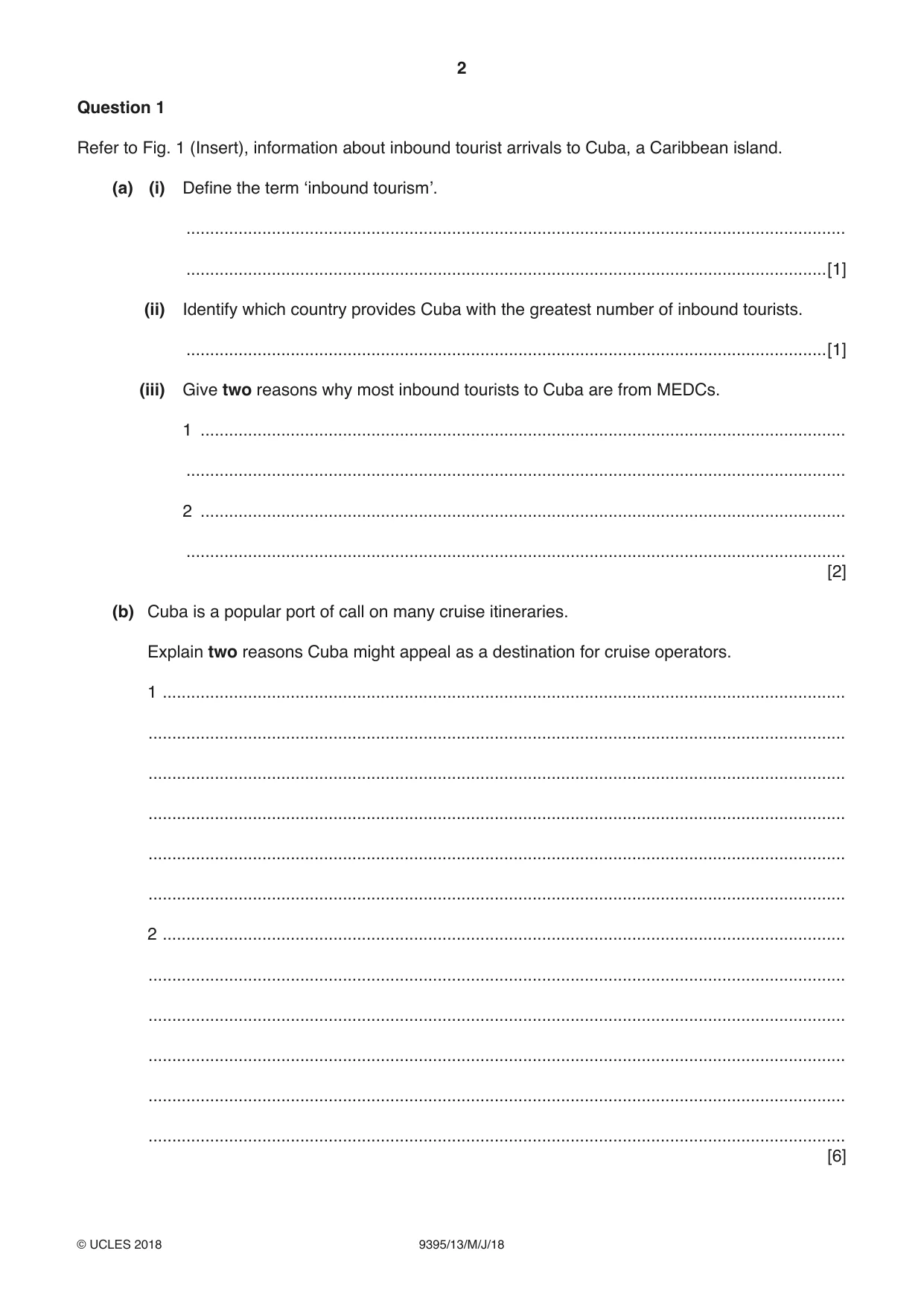
2 9395/13/M/J/18 © UCLES 2018 Question 1 Refer to Fig. 1 (Insert), information about inbound tourist arrivals to Cuba, a Caribbean island. (a) (i) Define the term ‘inbound tourism’. … …[1] (ii) Identify which country provides Cuba with the greatest number of inbound tourists. …[1] (iii) Give two reasons why most inbound tourists to Cuba are from MEDCs. 1 … … 2 … … [2] (b) Cuba is a popular port of call on many cruise itineraries. Explain two reasons Cuba might appeal as a destination for cruise operators. 1 … … … … … … 2 … … … … … … [6]
Question paper, page 3
3 9395/13/M/J/18 © UCLES 2018 [Turn over (c) Explain two benefits of LEDCs, such as Cuba, developing a tourism industry. 1 … … … … … … 2 … … … … … … [6]
Question paper, page 4
4 9395/13/M/J/18 © UCLES 2018 (d) Cuba requires most international tourists to obtain a visa before entering the country. Discuss the impact of visa regulations on visitor numbers to a destination. … … … … … … … … … … … … … … … … … …[9] [Total: 25]
Question paper, page 5
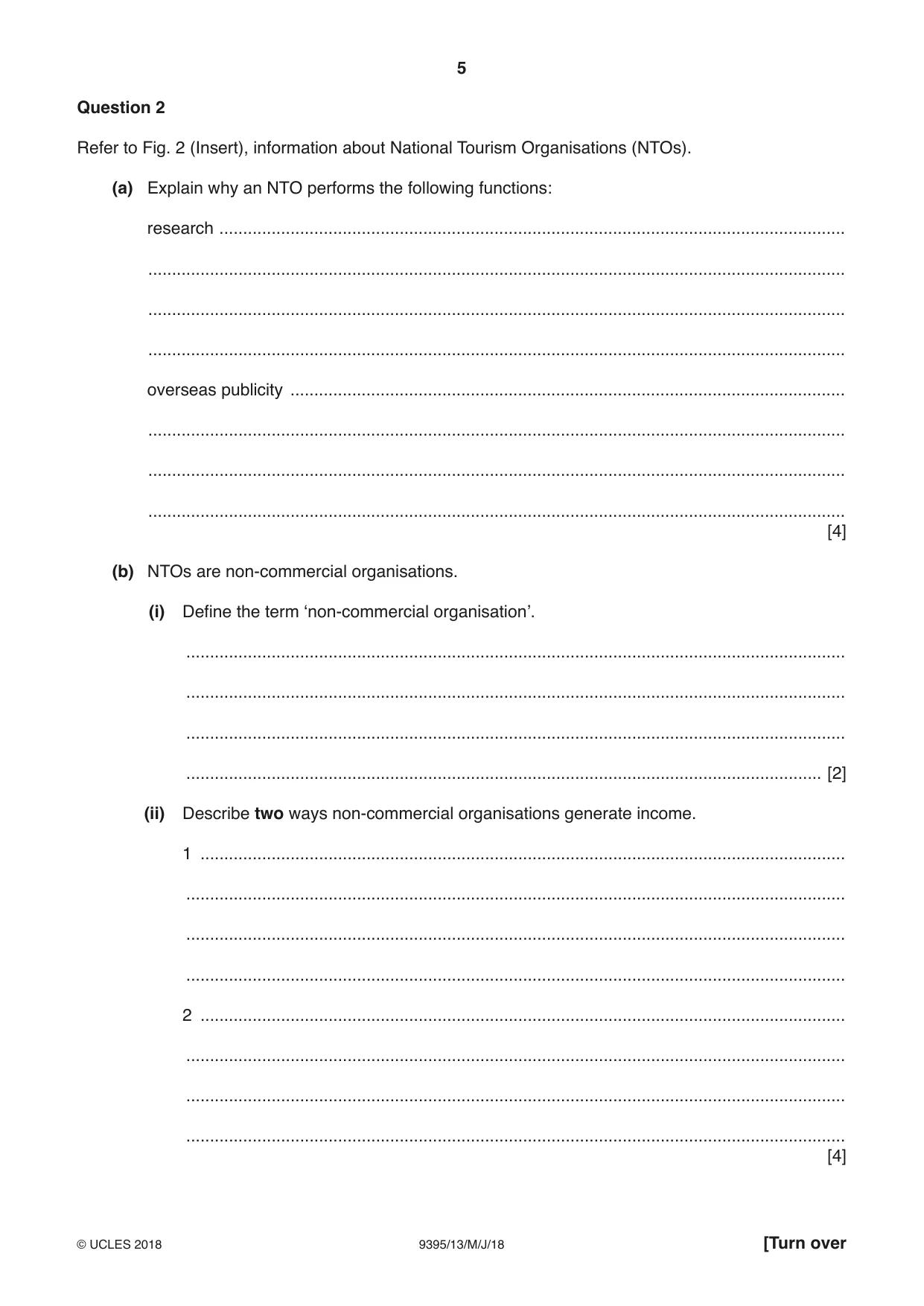
5 9395/13/M/J/18 © UCLES 2018 [Turn over Question 2 Refer to Fig. 2 (Insert), information about National Tourism Organisations (NTOs). (a) Explain why an NTO performs the following functions: research … … … … overseas publicity … … … … [4] (b) NTOs are non-commercial organisations. (i) Define the term ‘non-commercial organisation’. … … … … [2] (ii) Describe two ways non-commercial organisations generate income. 1 … … … … 2 … … … … [4]
Question paper, page 6
6 9395/13/M/J/18 © UCLES 2018 (c) Explain three ways that NTOs contribute to the quality of the customer experience within a destination. 1 … … … … 2 … … … … 3 … … … … [6]
Question paper, page 7
7 9395/13/M/J/18 © UCLES 2018 [Turn over (d) Discuss how an NTO might use social media. … … … … … … … … … … … … … … … … … …[9] [Total: 25]
Question paper, page 8
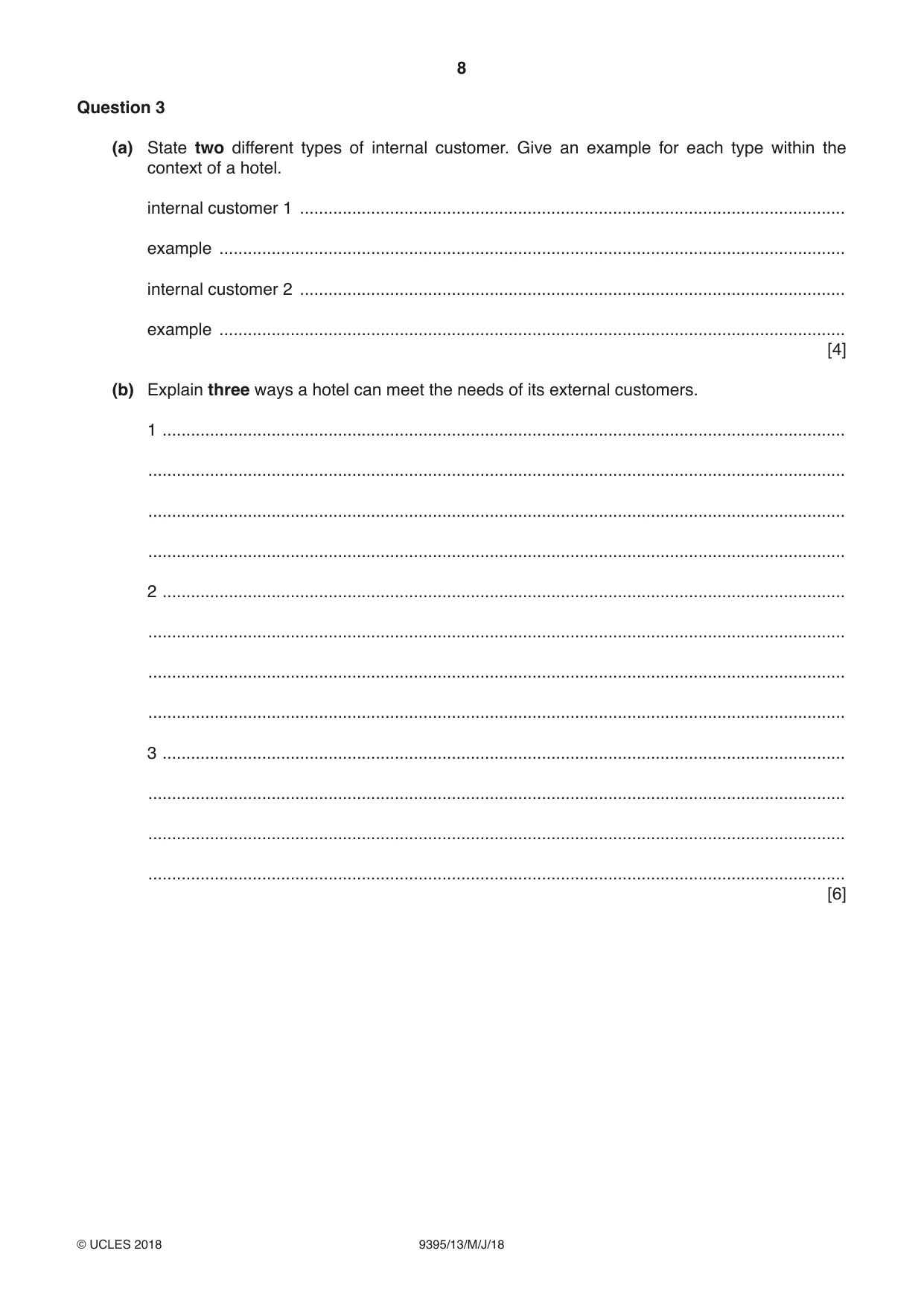
8 9395/13/M/J/18 © UCLES 2018 Question 3 (a) State two different types of internal customer. Give an example for each type within the context of a hotel. internal customer 1 … example … internal customer 2 … example … [4] (b) Explain three ways a hotel can meet the needs of its external customers. 1 … … … … 2 … … … … 3 … … … … [6]
Question paper, page 9
9 9395/13/M/J/18 © UCLES 2018 [Turn over (c) Discuss the importance of customer loyalty to a hotel. … … … … … … … … … … … …[6]
Question paper, page 10
10 9395/13/M/J/18 © UCLES 2018 (d) Discuss how a hotel can evaluate its customer service. … … … … … … … … … … … … … … … … … …[9] [Total: 25]
Question paper, page 11
11 9395/13/M/J/18 © UCLES 2018 [Turn over Question 4 Refer to Fig. 3 (Insert), a photograph of a rural location. (a) Give two examples of adventure tourism activities which could take place in the location shown in Fig. 3. For each one give a reason why this location is suitable for the activity. activity … reason … … activity … reason … … [4] (b) Describe three ways the cost/quality ratio of adventure tourism products can be adapted to appeal to a wider target market. 1 … … … … 2 … … … … 3 … … … … [6]
Question paper, page 12
12 9395/13/M/J/18 © UCLES 2018 (c) Explain three social factors that might encourage the development of adventure tourism. 1 … … … … 2 … … … … 3 … … … … [6]
Question paper, page 13
13 9395/13/M/J/18 © UCLES 2018 (d) Assess how adventure tourism could be developed sustainably. … … … … … … … … … … … … … … … … … …[9] [Total: 25]
Question paper, page 14
14 9395/13/M/J/18 © UCLES 2018 BLANK PAGE
Question paper, page 15
15 9395/13/M/J/18 © UCLES 2018 BLANK PAGE
Question paper, page 16
16 9395/13/M/J/18 © UCLES 2018 Permission to reproduce items where third-party owned material protected by copyright is included has been sought and cleared where possible. Every reasonable effort has been made by the publisher (UCLES) to trace copyright holders, but if any items requiring clearance have unwittingly been included, the publisher will be pleased to make amends at the earliest possible opportunity. To avoid the issue of disclosure of answer-related information to candidates, all copyright acknowledgements are reproduced online in the Cambridge International Examinations Copyright Acknowledgements Booklet. This is produced for each series of examinations and is freely available to download at www.cie.org.uk after the live examination series. Cambridge International Examinations is part of the Cambridge Assessment Group. Cambridge Assessment is the brand name of University of Cambridge Local Examinations Syndicate (UCLES), which is itself a department of the University of Cambridge. BLANK PAGE
Mark scheme, page 1
IGCSE™ is a registered trademark. This document consists of 14 printed pages. © UCLES 2018 [Turn over Cambridge Assessment International Education Cambridge International Advanced Subsidiary and Advanced Level TRAVEL & TOURISM 9395/13 Paper 1 The Industry May/June 2018 MARK SCHEME Maximum Mark: 100 Published This mark scheme is published as an aid to teachers and candidates, to indicate the requirements of the examination. It shows the basis on which Examiners were instructed to award marks. It does not indicate the details of the discussions that took place at an Examiners’ meeting before marking began, which would have considered the acceptability of alternative answers. Mark schemes should be read in conjunction with the question paper and the Principal Examiner Report for Teachers. Cambridge International will not enter into discussions about these mark schemes. Cambridge International is publishing the mark schemes for the May/June 2018 series for most Cambridge IGCSE™, Cambridge International A and AS Level and Cambridge Pre-U components, and some Cambridge O Level components.
Mark scheme, page 2
9395/13 Cambridge International AS/A Level – Mark Scheme PUBLISHED May/June 2018 © UCLES 2018 Page 2 of 14 Generic Marking Principles These general marking principles must be applied by all examiners when marking candidate answers. They should be applied alongside the specific content of the mark scheme or generic level descriptors for a question. Each question paper and mark scheme will also comply with these marking principles. GENERIC MARKING PRINCIPLE 1: Marks must be awarded in line with: • the specific content of the mark scheme or the generic level descriptors for the question • the specific skills defined in the mark scheme or in the generic level descriptors for the question • the standard of response required by a candidate as exemplified by the standardisation scripts. GENERIC MARKING PRINCIPLE 2: Marks awarded are always whole marks (not half marks, or other fractions). GENERIC MARKING PRINCIPLE 3: Marks must be awarded positively: • marks are awarded for correct/valid answers, as defined in the mark scheme. However, credit is given for valid answers which go beyond the scope of the syllabus and mark scheme, referring to your Team Leader as appropriate • marks are awarded when candidates clearly demonstrate what they know and can do • marks are not deducted for errors • marks are not deducted for omissions • answers should only be judged on the quality of spelling, punctuation and grammar when these features are specifically assessed by the question as indicated by the mark scheme. The meaning, however, should be unambiguous. GENERIC MARKING PRINCIPLE 4: Rules must be applied consistently e.g. in situations where candidates have not followed instructions or in the application of generic level descriptors. GENERIC MARKING PRINCIPLE 5: Marks should be awarded using the full range of marks defined in the mark scheme for the question (however; the use of the full mark range may be limited according to the quality of the candidate responses seen). GENERIC MARKING PRINCIPLE 6: Marks awarded are based solely on the requirements as defined in the mark scheme. Marks should not be awarded with grade thresholds or grade descriptors in mind.
Mark scheme, page 3
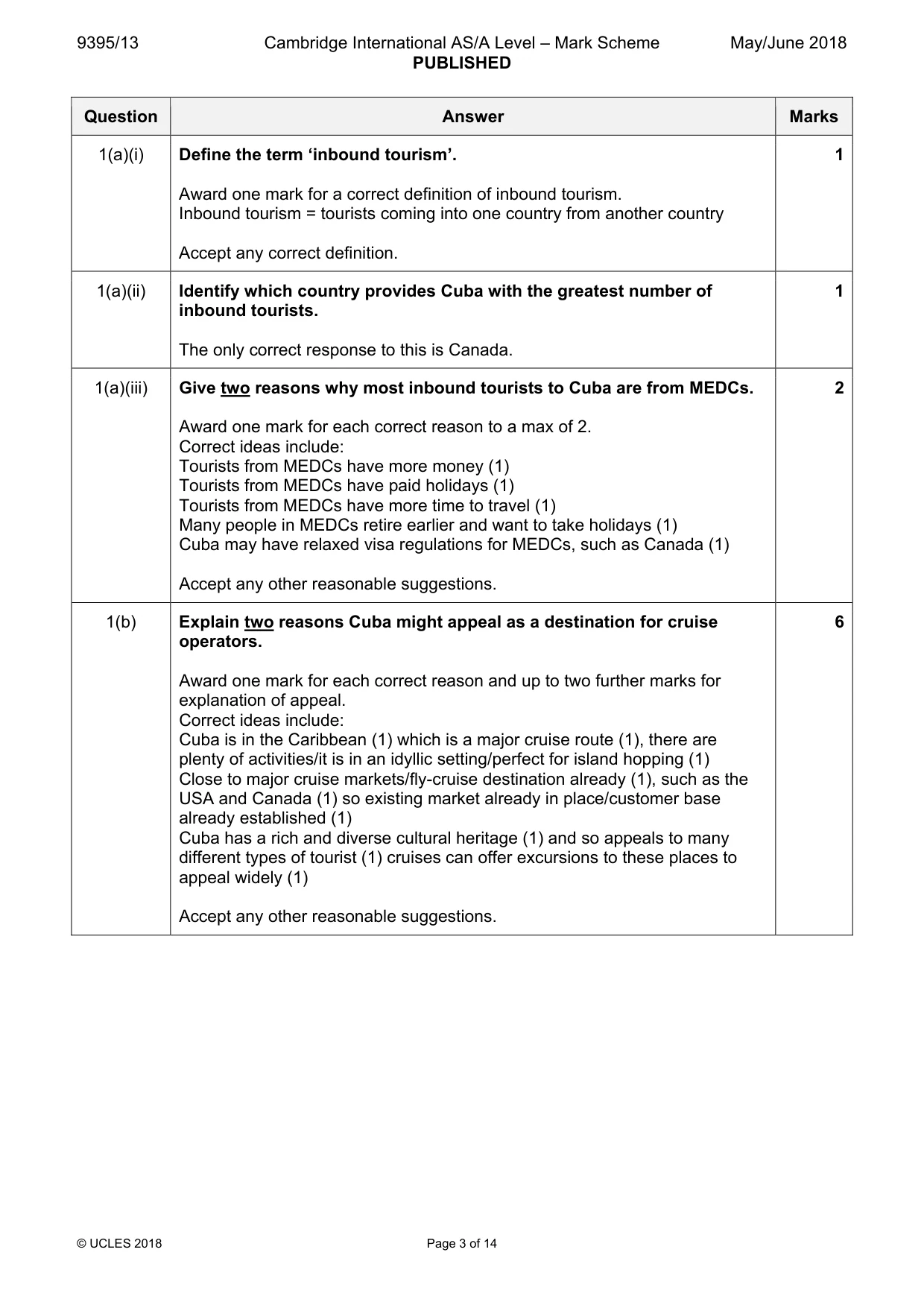
9395/13 Cambridge International AS/A Level – Mark Scheme PUBLISHED May/June 2018 © UCLES 2018 Page 3 of 14 Question Answer Marks 1(a)(i) Define the term ‘inbound tourism’. Award one mark for a correct definition of inbound tourism. Inbound tourism = tourists coming into one country from another country Accept any correct definition. 1 1(a)(ii) Identify which country provides Cuba with the greatest number of inbound tourists. The only correct response to this is Canada. 1 1(a)(iii) Give two reasons why most inbound tourists to Cuba are from MEDCs. Award one mark for each correct reason to a max of 2. Correct ideas include: Tourists from MEDCs have more money (1) Tourists from MEDCs have paid holidays (1) Tourists from MEDCs have more time to travel (1) Many people in MEDCs retire earlier and want to take holidays (1) Cuba may have relaxed visa regulations for MEDCs, such as Canada (1) Accept any other reasonable suggestions. 2 1(b) Explain two reasons Cuba might appeal as a destination for cruise operators. Award one mark for each correct reason and up to two further marks for explanation of appeal. Correct ideas include: Cuba is in the Caribbean (1) which is a major cruise route (1), there are plenty of activities/it is in an idyllic setting/perfect for island hopping (1) Close to major cruise markets/fly-cruise destination already (1), such as the USA and Canada (1) so existing market already in place/customer base already established (1) Cuba has a rich and diverse cultural heritage (1) and so appeals to many different types of tourist (1) cruises can offer excursions to these places to appeal widely (1) Accept any other reasonable suggestions. 6
Mark scheme, page 4
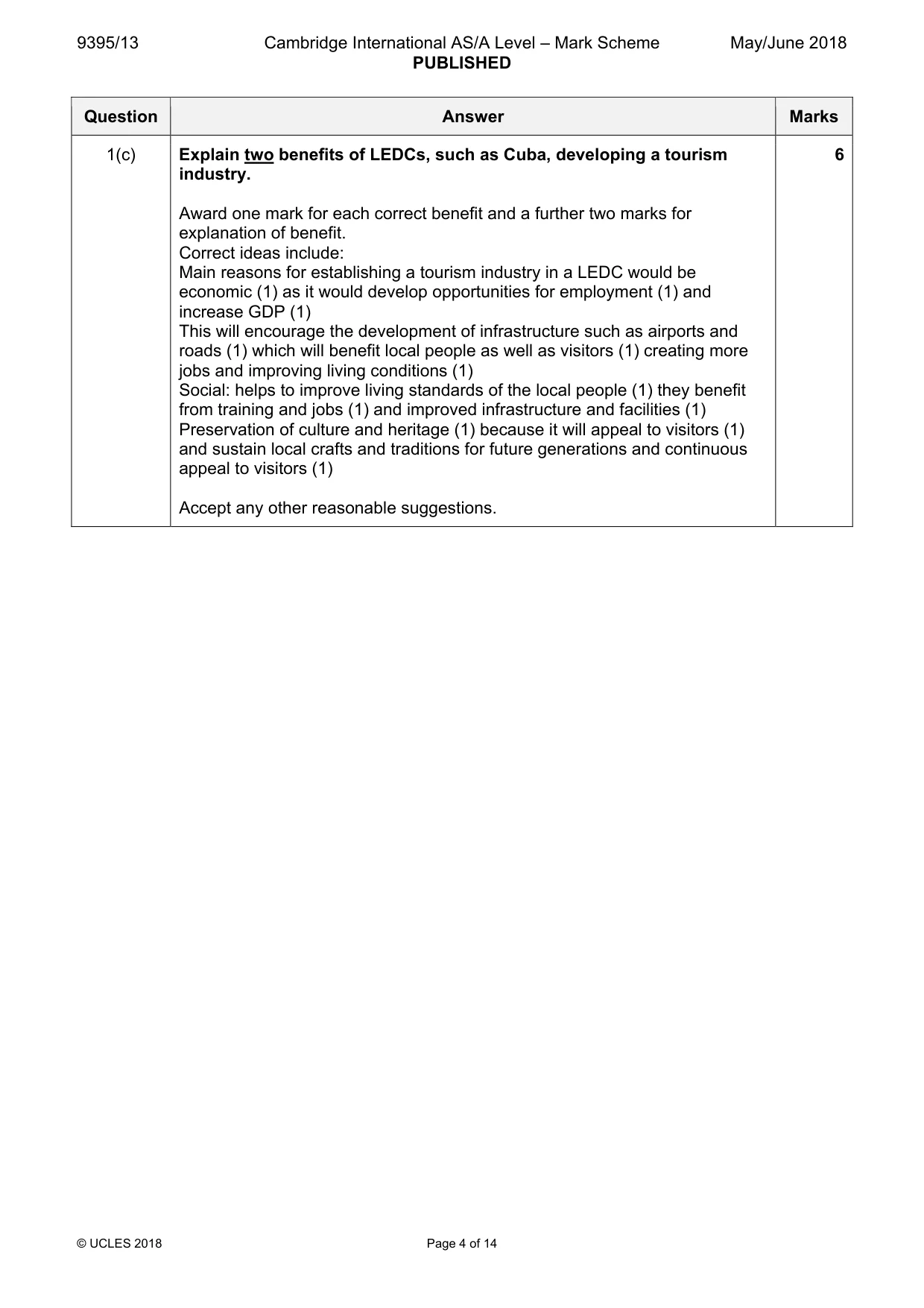
9395/13 Cambridge International AS/A Level – Mark Scheme PUBLISHED May/June 2018 © UCLES 2018 Page 4 of 14 Question Answer Marks 1(c) Explain two benefits of LEDCs, such as Cuba, developing a tourism industry. Award one mark for each correct benefit and a further two marks for explanation of benefit. Correct ideas include: Main reasons for establishing a tourism industry in a LEDC would be economic (1) as it would develop opportunities for employment (1) and increase GDP (1) This will encourage the development of infrastructure such as airports and roads (1) which will benefit local people as well as visitors (1) creating more jobs and improving living conditions (1) Social: helps to improve living standards of the local people (1) they benefit from training and jobs (1) and improved infrastructure and facilities (1) Preservation of culture and heritage (1) because it will appeal to visitors (1) and sustain local crafts and traditions for future generations and continuous appeal to visitors (1) Accept any other reasonable suggestions. 6
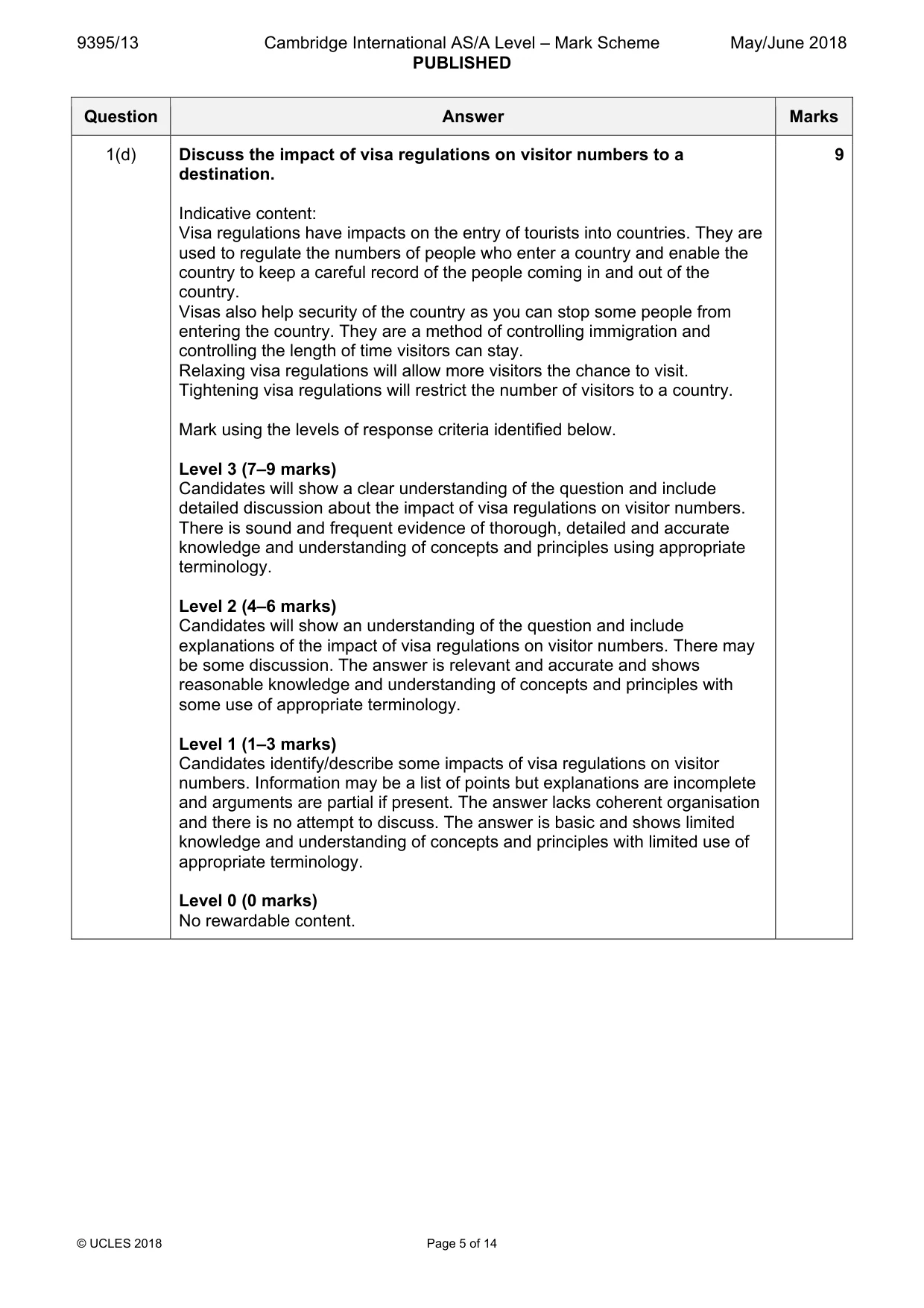
Mark scheme, page 5
9395/13 Cambridge International AS/A Level – Mark Scheme PUBLISHED May/June 2018 © UCLES 2018 Page 5 of 14 Question Answer Marks 1(d) Discuss the impact of visa regulations on visitor numbers to a destination. Indicative content: Visa regulations have impacts on the entry of tourists into countries. They are used to regulate the numbers of people who enter a country and enable the country to keep a careful record of the people coming in and out of the country. Visas also help security of the country as you can stop some people from entering the country. They are a method of controlling immigration and controlling the length of time visitors can stay. Relaxing visa regulations will allow more visitors the chance to visit. Tightening visa regulations will restrict the number of visitors to a country. Mark using the levels of response criteria identified below. Level 3 (7–9 marks) Candidates will show a clear understanding of the question and include detailed discussion about the impact of visa regulations on visitor numbers. There is sound and frequent evidence of thorough, detailed and accurate knowledge and understanding of concepts and principles using appropriate terminology. Level 2 (4–6 marks) Candidates will show an understanding of the question and include explanations of the impact of visa regulations on visitor numbers. There may be some discussion. The answer is relevant and accurate and shows reasonable knowledge and understanding of concepts and principles with some use of appropriate terminology. Level 1 (1–3 marks) Candidates identify/describe some impacts of visa regulations on visitor numbers. Information may be a list of points but explanations are incomplete and arguments are partial if present. The answer lacks coherent organisation and there is no attempt to discuss. The answer is basic and shows limited knowledge and understanding of concepts and principles with limited use of appropriate terminology. Level 0 (0 marks) No rewardable content. 9
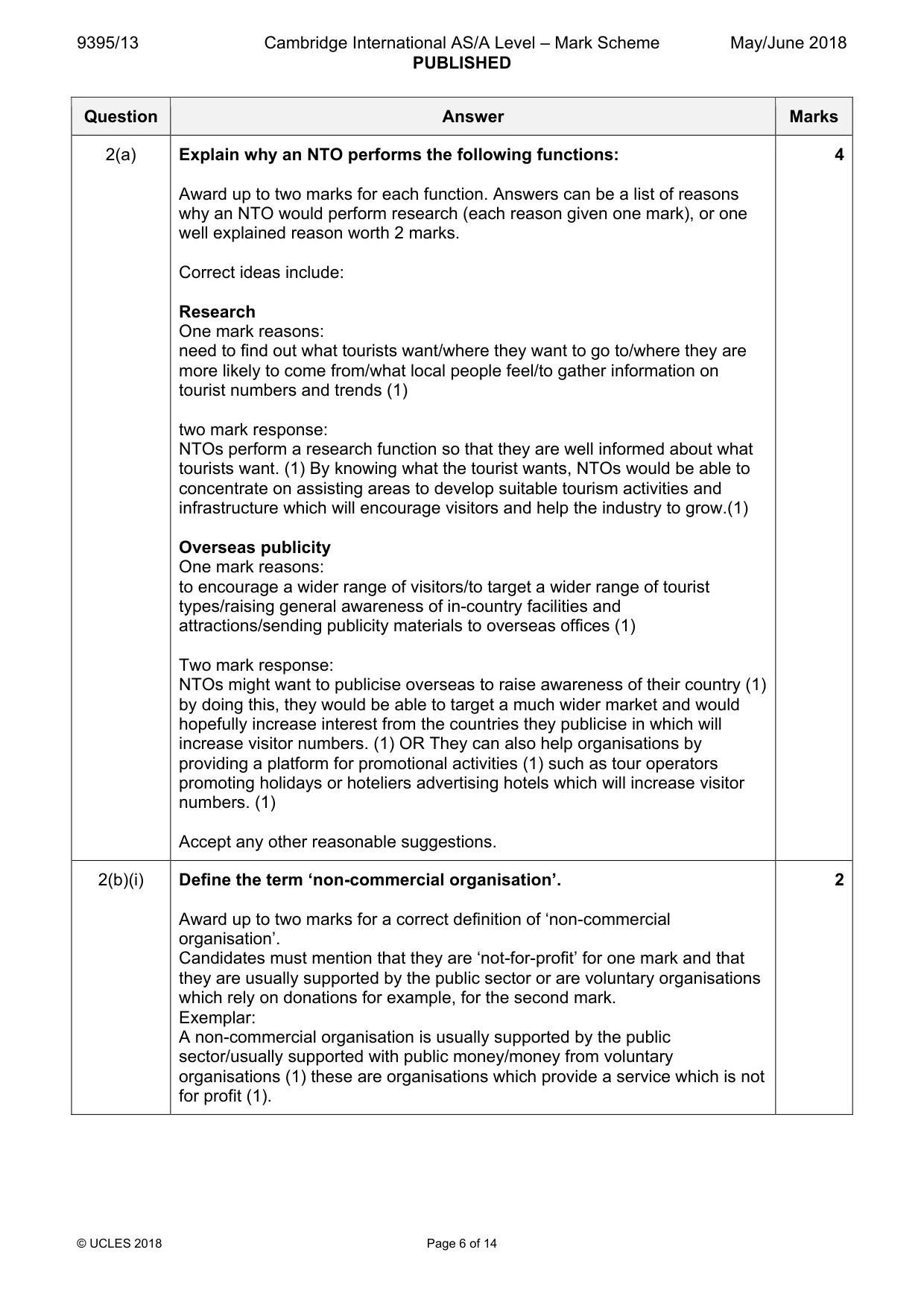
Mark scheme, page 6
9395/13 Cambridge International AS/A Level – Mark Scheme PUBLISHED May/June 2018 © UCLES 2018 Page 6 of 14 Question Answer Marks 2(a) Explain why an NTO performs the following functions: Award up to two marks for each function. Answers can be a list of reasons why an NTO would perform research (each reason given one mark), or one well explained reason worth 2 marks. Correct ideas include: Research One mark reasons: need to find out what tourists want/where they want to go to/where they are more likely to come from/what local people feel/to gather information on tourist numbers and trends (1) two mark response: NTOs perform a research function so that they are well informed about what tourists want. (1) By knowing what the tourist wants, NTOs would be able to concentrate on assisting areas to develop suitable tourism activities and infrastructure which will encourage visitors and help the industry to grow.(1) Overseas publicity One mark reasons: to encourage a wider range of visitors/to target a wider range of tourist types/raising general awareness of in-country facilities and attractions/sending publicity materials to overseas offices (1) Two mark response: NTOs might want to publicise overseas to raise awareness of their country (1) by doing this, they would be able to target a much wider market and would hopefully increase interest from the countries they publicise in which will increase visitor numbers. (1) OR They can also help organisations by providing a platform for promotional activities (1) such as tour operators promoting holidays or hoteliers advertising hotels which will increase visitor numbers. (1) Accept any other reasonable suggestions. 4 2(b)(i) Define the term ‘non-commercial organisation’. Award up to two marks for a correct definition of ‘non-commercial organisation’. Candidates must mention that they are ‘not-for-profit’ for one mark and that they are usually supported by the public sector or are voluntary organisations which rely on donations for example, for the second mark. Exemplar: A non-commercial organisation is usually supported by the public sector/usually supported with public money/money from voluntary organisations (1) these are organisations which provide a service which is not for profit (1). 2
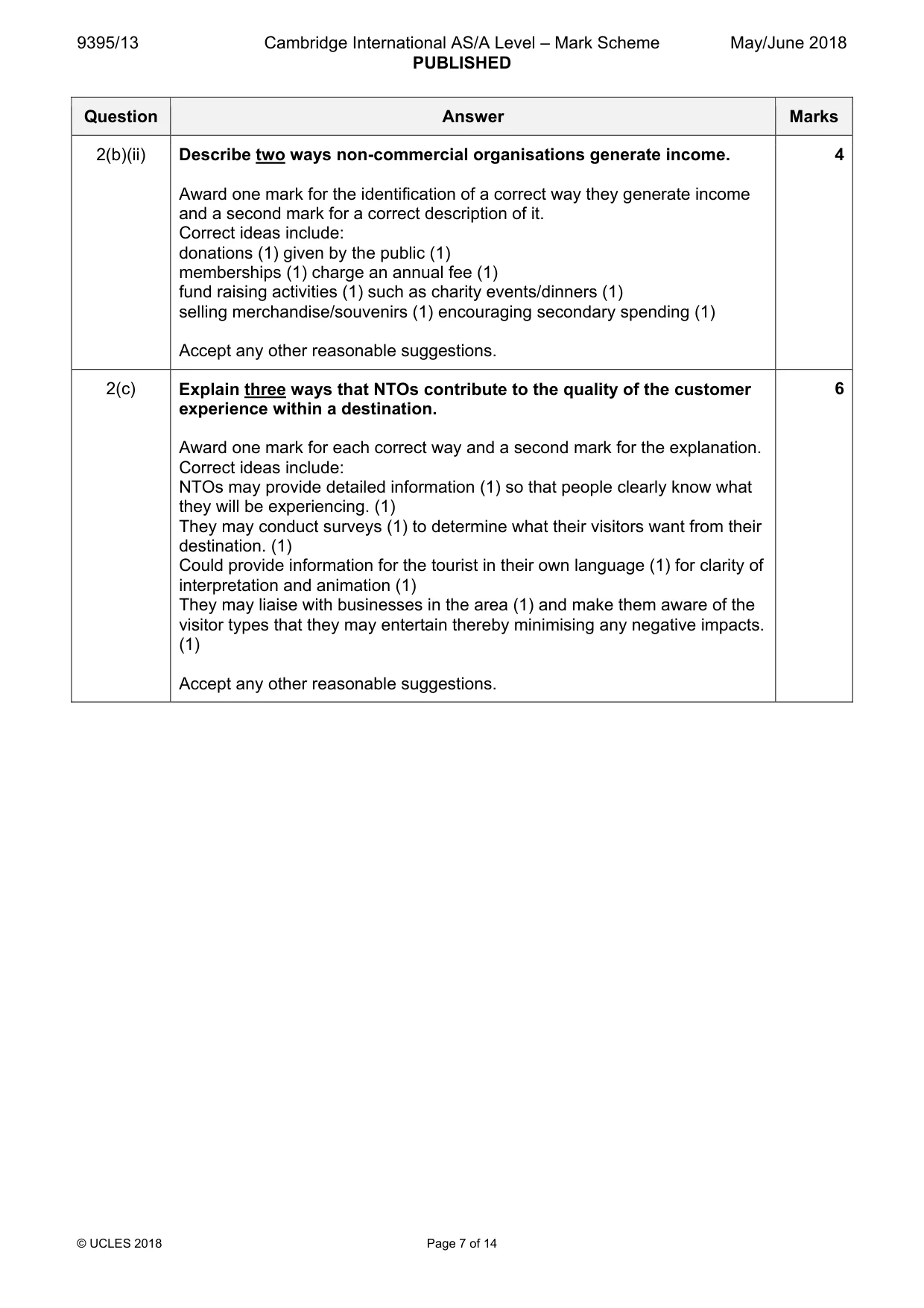
Mark scheme, page 7
9395/13 Cambridge International AS/A Level – Mark Scheme PUBLISHED May/June 2018 © UCLES 2018 Page 7 of 14 Question Answer Marks 2(b)(ii) Describe two ways non-commercial organisations generate income. Award one mark for the identification of a correct way they generate income and a second mark for a correct description of it. Correct ideas include: donations (1) given by the public (1) memberships (1) charge an annual fee (1) fund raising activities (1) such as charity events/dinners (1) selling merchandise/souvenirs (1) encouraging secondary spending (1) Accept any other reasonable suggestions. 4 2(c) Explain three ways that NTOs contribute to the quality of the customer experience within a destination. Award one mark for each correct way and a second mark for the explanation. Correct ideas include: NTOs may provide detailed information (1) so that people clearly know what they will be experiencing. (1) They may conduct surveys (1) to determine what their visitors want from their destination. (1) Could provide information for the tourist in their own language (1) for clarity of interpretation and animation (1) They may liaise with businesses in the area (1) and make them aware of the visitor types that they may entertain thereby minimising any negative impacts. (1) Accept any other reasonable suggestions. 6
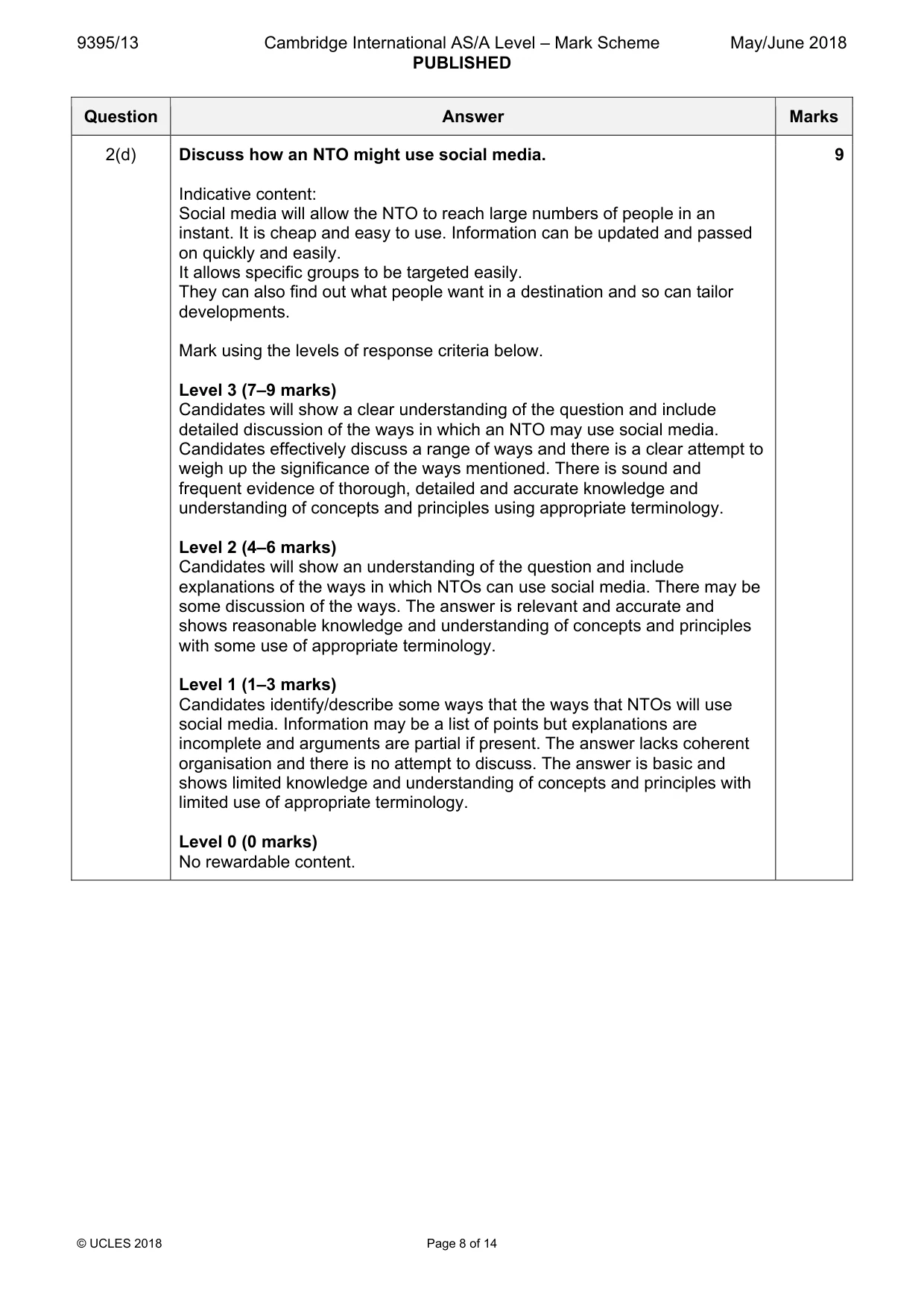
Mark scheme, page 8
9395/13 Cambridge International AS/A Level – Mark Scheme PUBLISHED May/June 2018 © UCLES 2018 Page 8 of 14 Question Answer Marks 2(d) Discuss how an NTO might use social media. Indicative content: Social media will allow the NTO to reach large numbers of people in an instant. It is cheap and easy to use. Information can be updated and passed on quickly and easily. It allows specific groups to be targeted easily. They can also find out what people want in a destination and so can tailor developments. Mark using the levels of response criteria below. Level 3 (7–9 marks) Candidates will show a clear understanding of the question and include detailed discussion of the ways in which an NTO may use social media. Candidates effectively discuss a range of ways and there is a clear attempt to weigh up the significance of the ways mentioned. There is sound and frequent evidence of thorough, detailed and accurate knowledge and understanding of concepts and principles using appropriate terminology. Level 2 (4–6 marks) Candidates will show an understanding of the question and include explanations of the ways in which NTOs can use social media. There may be some discussion of the ways. The answer is relevant and accurate and shows reasonable knowledge and understanding of concepts and principles with some use of appropriate terminology. Level 1 (1–3 marks) Candidates identify/describe some ways that the ways that NTOs will use social media. Information may be a list of points but explanations are incomplete and arguments are partial if present. The answer lacks coherent organisation and there is no attempt to discuss. The answer is basic and shows limited knowledge and understanding of concepts and principles with limited use of appropriate terminology. Level 0 (0 marks) No rewardable content. 9
Mark scheme, page 9
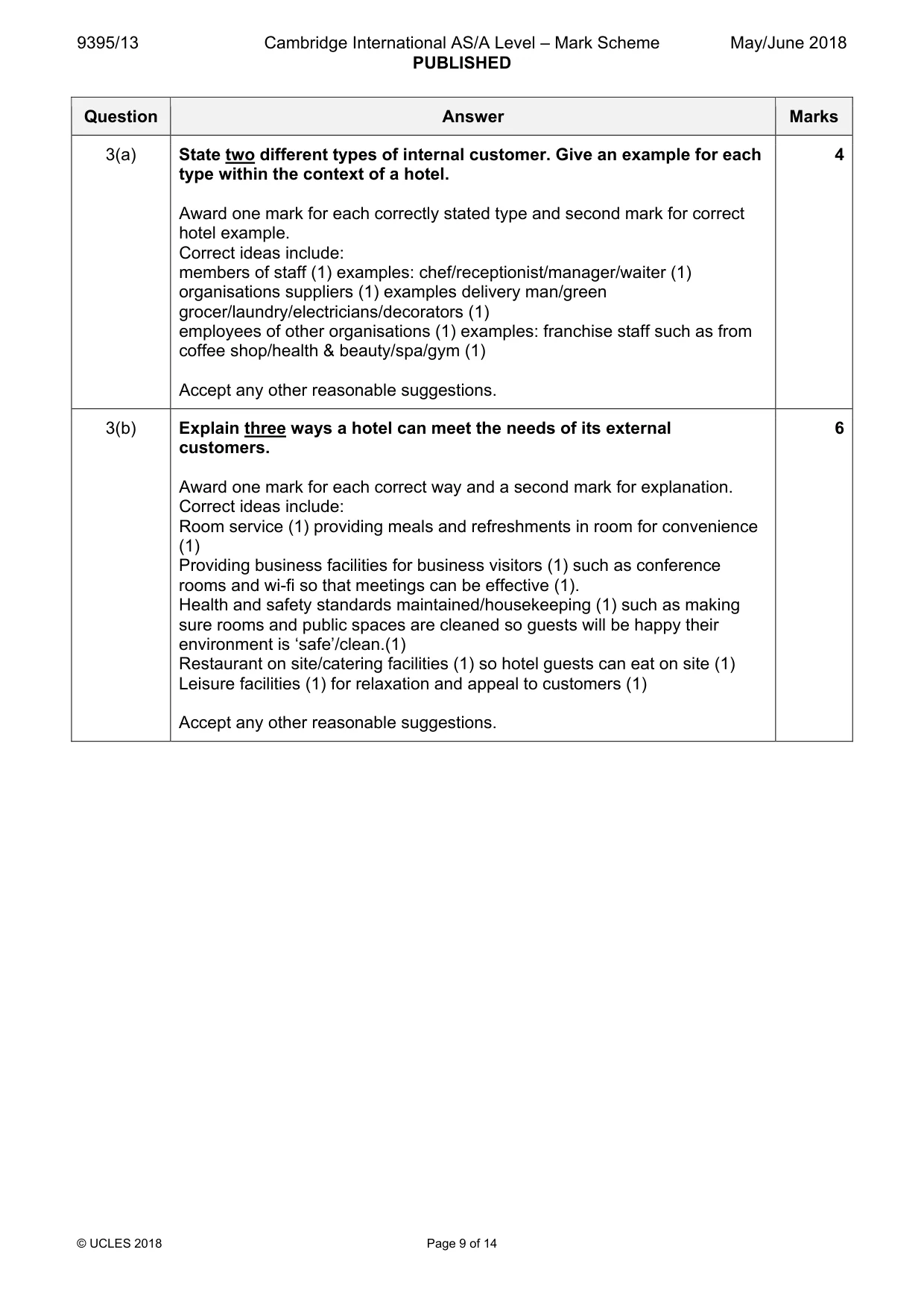
9395/13 Cambridge International AS/A Level – Mark Scheme PUBLISHED May/June 2018 © UCLES 2018 Page 9 of 14 Question Answer Marks 3(a) State two different types of internal customer. Give an example for each type within the context of a hotel. Award one mark for each correctly stated type and second mark for correct hotel example. Correct ideas include: members of staff (1) examples: chef/receptionist/manager/waiter (1) organisations suppliers (1) examples delivery man/green grocer/laundry/electricians/decorators (1) employees of other organisations (1) examples: franchise staff such as from coffee shop/health & beauty/spa/gym (1) Accept any other reasonable suggestions. 4 3(b) Explain three ways a hotel can meet the needs of its external customers. Award one mark for each correct way and a second mark for explanation. Correct ideas include: Room service (1) providing meals and refreshments in room for convenience (1) Providing business facilities for business visitors (1) such as conference rooms and wi-fi so that meetings can be effective (1). Health and safety standards maintained/housekeeping (1) such as making sure rooms and public spaces are cleaned so guests will be happy their environment is ‘safe’/clean.(1) Restaurant on site/catering facilities (1) so hotel guests can eat on site (1) Leisure facilities (1) for relaxation and appeal to customers (1) Accept any other reasonable suggestions. 6
Mark scheme, page 10
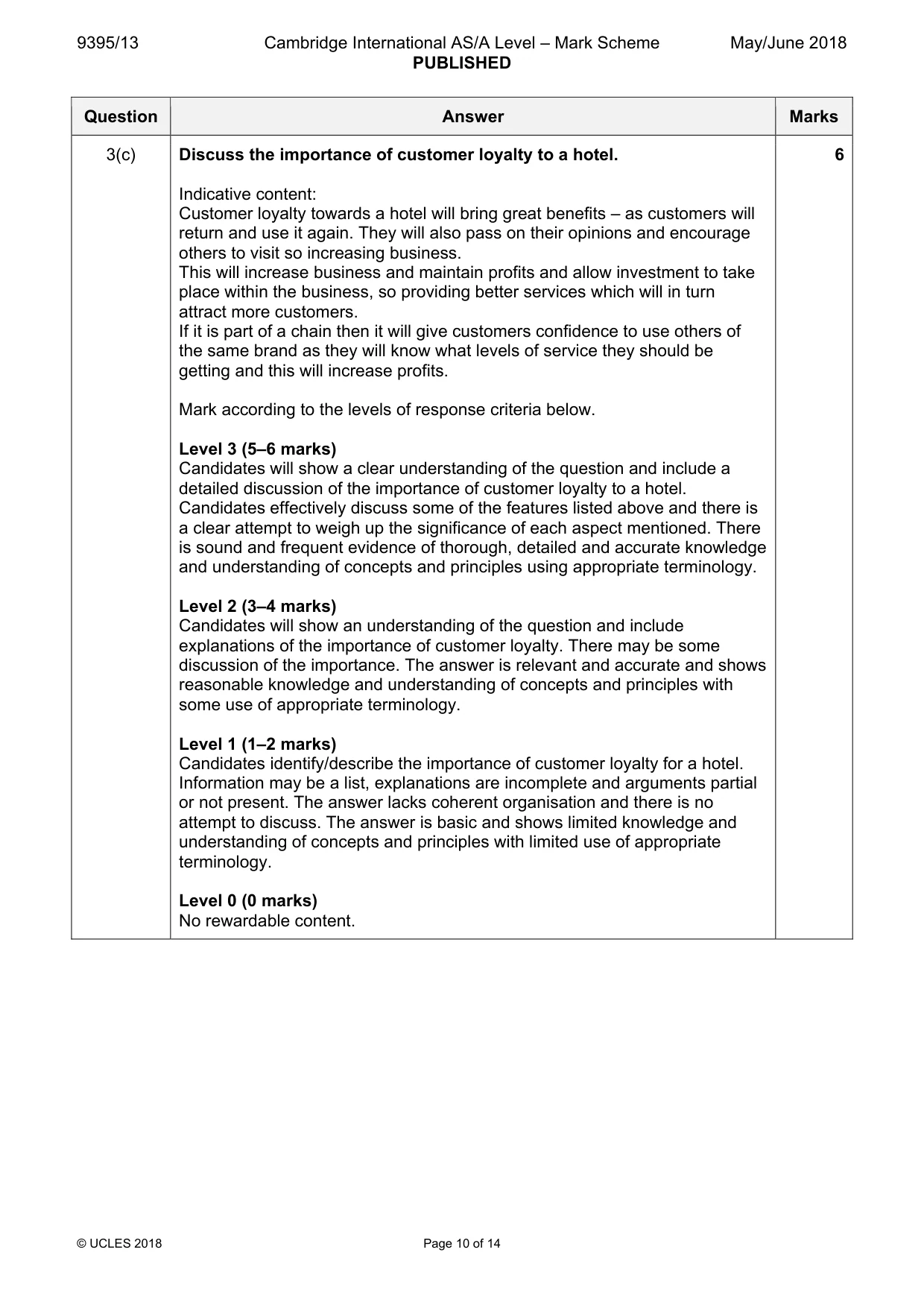
9395/13 Cambridge International AS/A Level – Mark Scheme PUBLISHED May/June 2018 © UCLES 2018 Page 10 of 14 Question Answer Marks 3(c) Discuss the importance of customer loyalty to a hotel. Indicative content: Customer loyalty towards a hotel will bring great benefits – as customers will return and use it again. They will also pass on their opinions and encourage others to visit so increasing business. This will increase business and maintain profits and allow investment to take place within the business, so providing better services which will in turn attract more customers. If it is part of a chain then it will give customers confidence to use others of the same brand as they will know what levels of service they should be getting and this will increase profits. Mark according to the levels of response criteria below. Level 3 (5–6 marks) Candidates will show a clear understanding of the question and include a detailed discussion of the importance of customer loyalty to a hotel. Candidates effectively discuss some of the features listed above and there is a clear attempt to weigh up the significance of each aspect mentioned. There is sound and frequent evidence of thorough, detailed and accurate knowledge and understanding of concepts and principles using appropriate terminology. Level 2 (3–4 marks) Candidates will show an understanding of the question and include explanations of the importance of customer loyalty. There may be some discussion of the importance. The answer is relevant and accurate and shows reasonable knowledge and understanding of concepts and principles with some use of appropriate terminology. Level 1 (1–2 marks) Candidates identify/describe the importance of customer loyalty for a hotel. Information may be a list, explanations are incomplete and arguments partial or not present. The answer lacks coherent organisation and there is no attempt to discuss. The answer is basic and shows limited knowledge and understanding of concepts and principles with limited use of appropriate terminology. Level 0 (0 marks) No rewardable content. 6
Mark scheme, page 11
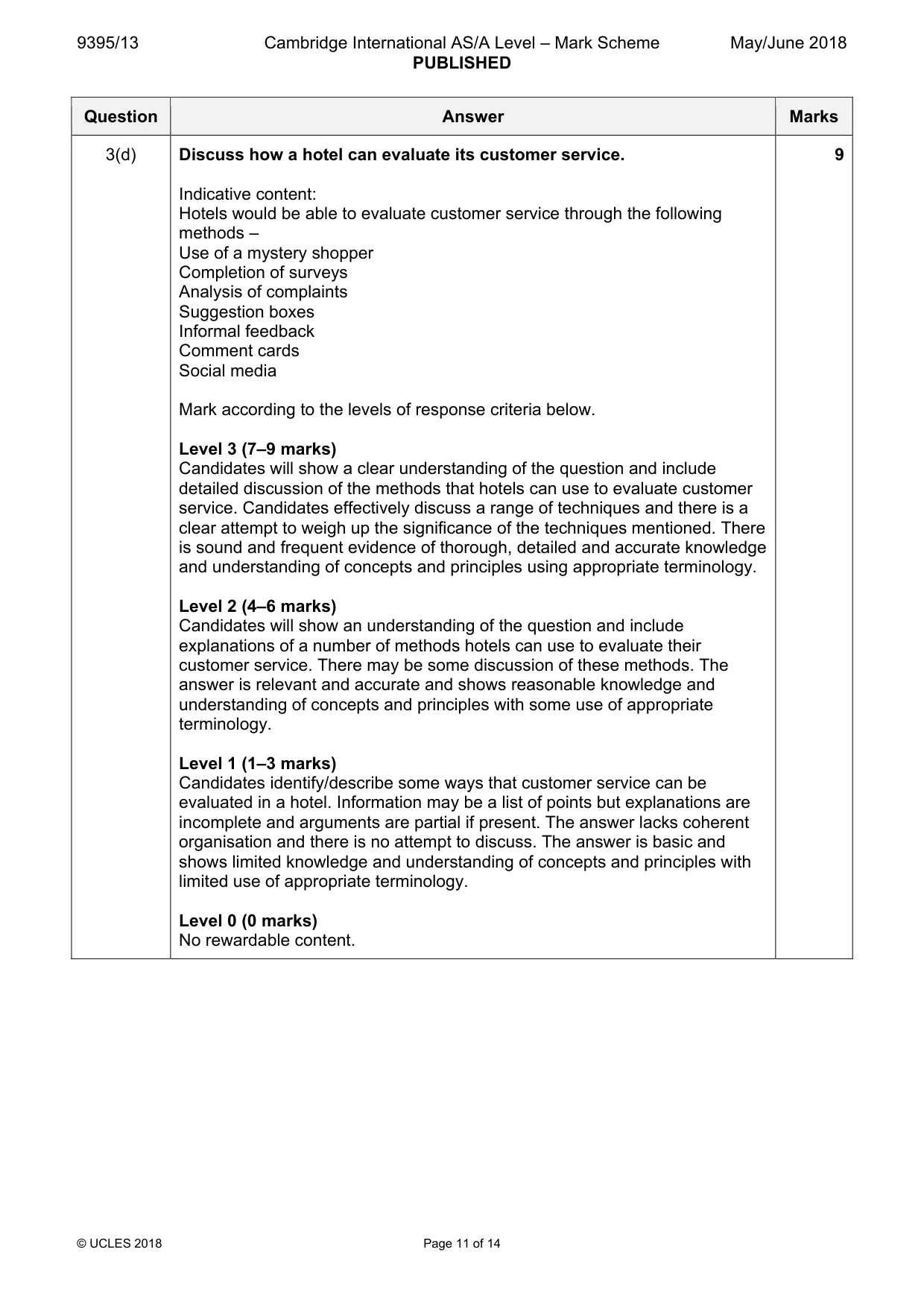
9395/13 Cambridge International AS/A Level – Mark Scheme PUBLISHED May/June 2018 © UCLES 2018 Page 11 of 14 Question Answer Marks 3(d) Discuss how a hotel can evaluate its customer service. Indicative content: Hotels would be able to evaluate customer service through the following methods – Use of a mystery shopper Completion of surveys Analysis of complaints Suggestion boxes Informal feedback Comment cards Social media Mark according to the levels of response criteria below. Level 3 (7–9 marks) Candidates will show a clear understanding of the question and include detailed discussion of the methods that hotels can use to evaluate customer service. Candidates effectively discuss a range of techniques and there is a clear attempt to weigh up the significance of the techniques mentioned. There is sound and frequent evidence of thorough, detailed and accurate knowledge and understanding of concepts and principles using appropriate terminology. Level 2 (4–6 marks) Candidates will show an understanding of the question and include explanations of a number of methods hotels can use to evaluate their customer service. There may be some discussion of these methods. The answer is relevant and accurate and shows reasonable knowledge and understanding of concepts and principles with some use of appropriate terminology. Level 1 (1–3 marks) Candidates identify/describe some ways that customer service can be evaluated in a hotel. Information may be a list of points but explanations are incomplete and arguments are partial if present. The answer lacks coherent organisation and there is no attempt to discuss. The answer is basic and shows limited knowledge and understanding of concepts and principles with limited use of appropriate terminology. Level 0 (0 marks) No rewardable content. 9
Mark scheme, page 12
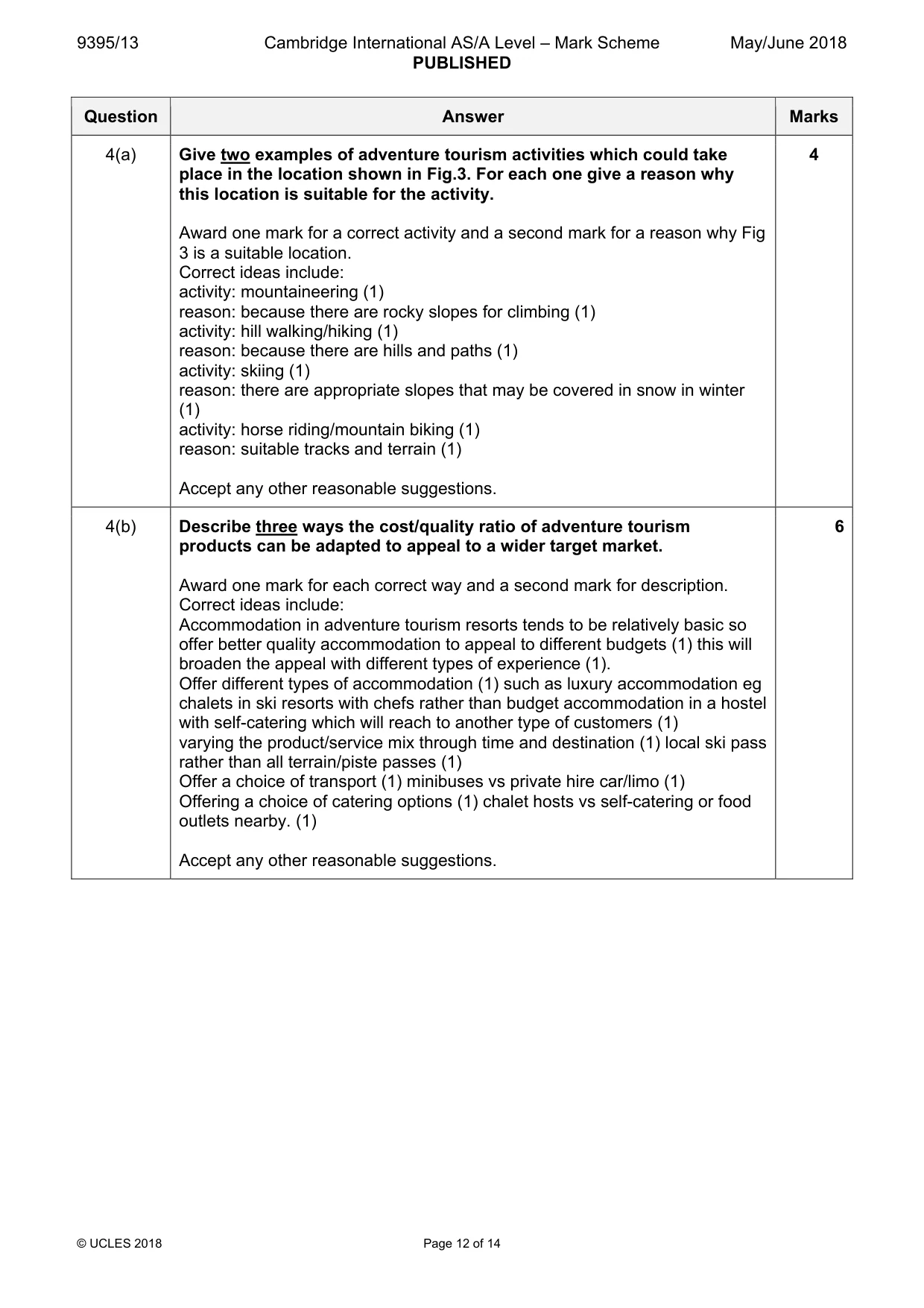
9395/13 Cambridge International AS/A Level – Mark Scheme PUBLISHED May/June 2018 © UCLES 2018 Page 12 of 14 Question Answer Marks 4(a) Give two examples of adventure tourism activities which could take place in the location shown in Fig.3. For each one give a reason why this location is suitable for the activity. Award one mark for a correct activity and a second mark for a reason why Fig 3 is a suitable location. Correct ideas include: activity: mountaineering (1) reason: because there are rocky slopes for climbing (1) activity: hill walking/hiking (1) reason: because there are hills and paths (1) activity: skiing (1) reason: there are appropriate slopes that may be covered in snow in winter (1) activity: horse riding/mountain biking (1) reason: suitable tracks and terrain (1) Accept any other reasonable suggestions. 4 4(b) Describe three ways the cost/quality ratio of adventure tourism products can be adapted to appeal to a wider target market. Award one mark for each correct way and a second mark for description. Correct ideas include: Accommodation in adventure tourism resorts tends to be relatively basic so offer better quality accommodation to appeal to different budgets (1) this will broaden the appeal with different types of experience (1). Offer different types of accommodation (1) such as luxury accommodation eg chalets in ski resorts with chefs rather than budget accommodation in a hostel with self-catering which will reach to another type of customers (1) varying the product/service mix through time and destination (1) local ski pass rather than all terrain/piste passes (1) Offer a choice of transport (1) minibuses vs private hire car/limo (1) Offering a choice of catering options (1) chalet hosts vs self-catering or food outlets nearby. (1) Accept any other reasonable suggestions. 6
Mark scheme, page 13
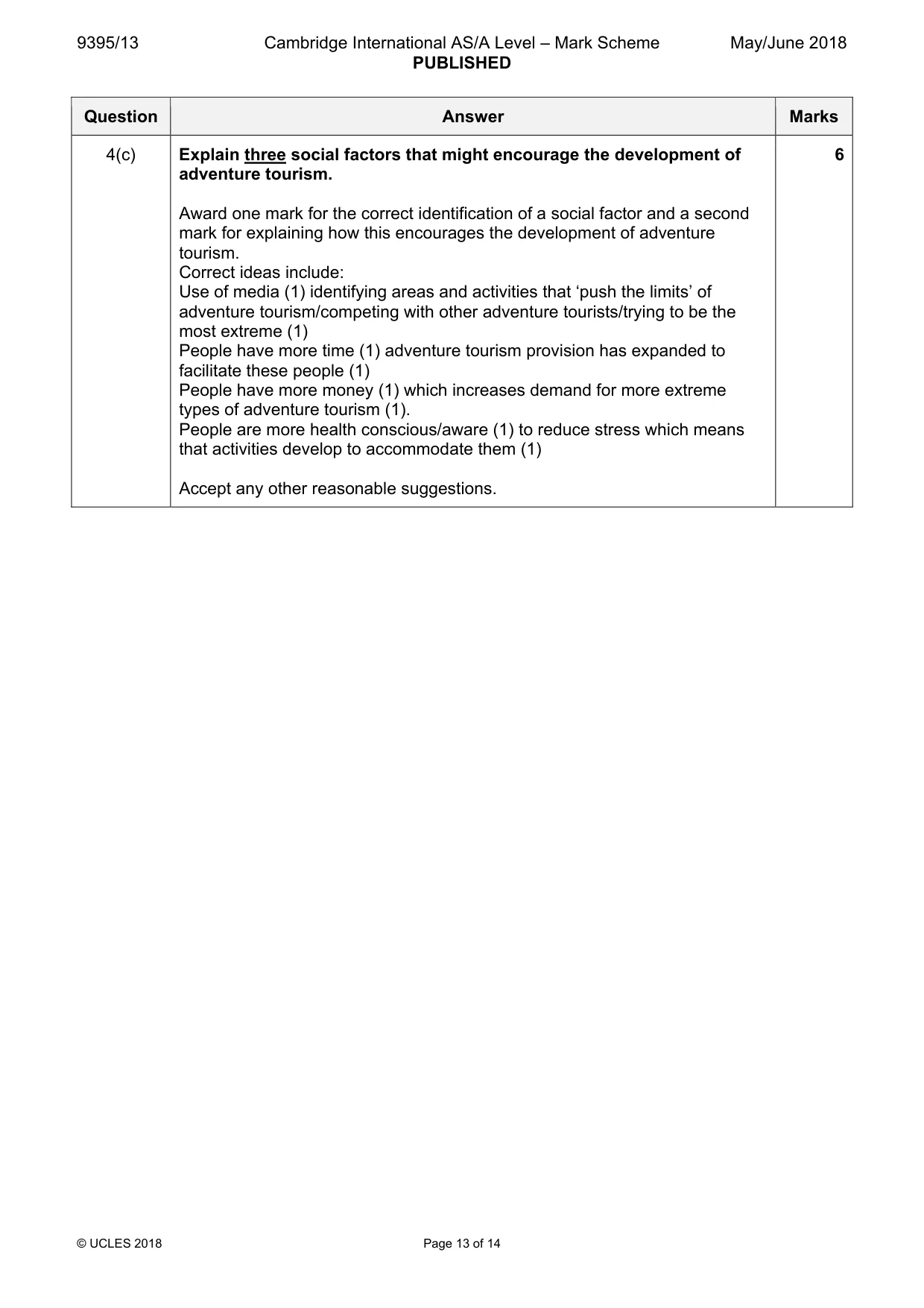
9395/13 Cambridge International AS/A Level – Mark Scheme PUBLISHED May/June 2018 © UCLES 2018 Page 13 of 14 Question Answer Marks 4(c) Explain three social factors that might encourage the development of adventure tourism. Award one mark for the correct identification of a social factor and a second mark for explaining how this encourages the development of adventure tourism. Correct ideas include: Use of media (1) identifying areas and activities that ‘push the limits’ of adventure tourism/competing with other adventure tourists/trying to be the most extreme (1) People have more time (1) adventure tourism provision has expanded to facilitate these people (1) People have more money (1) which increases demand for more extreme types of adventure tourism (1). People are more health conscious/aware (1) to reduce stress which means that activities develop to accommodate them (1) Accept any other reasonable suggestions. 6
Mark scheme, page 14
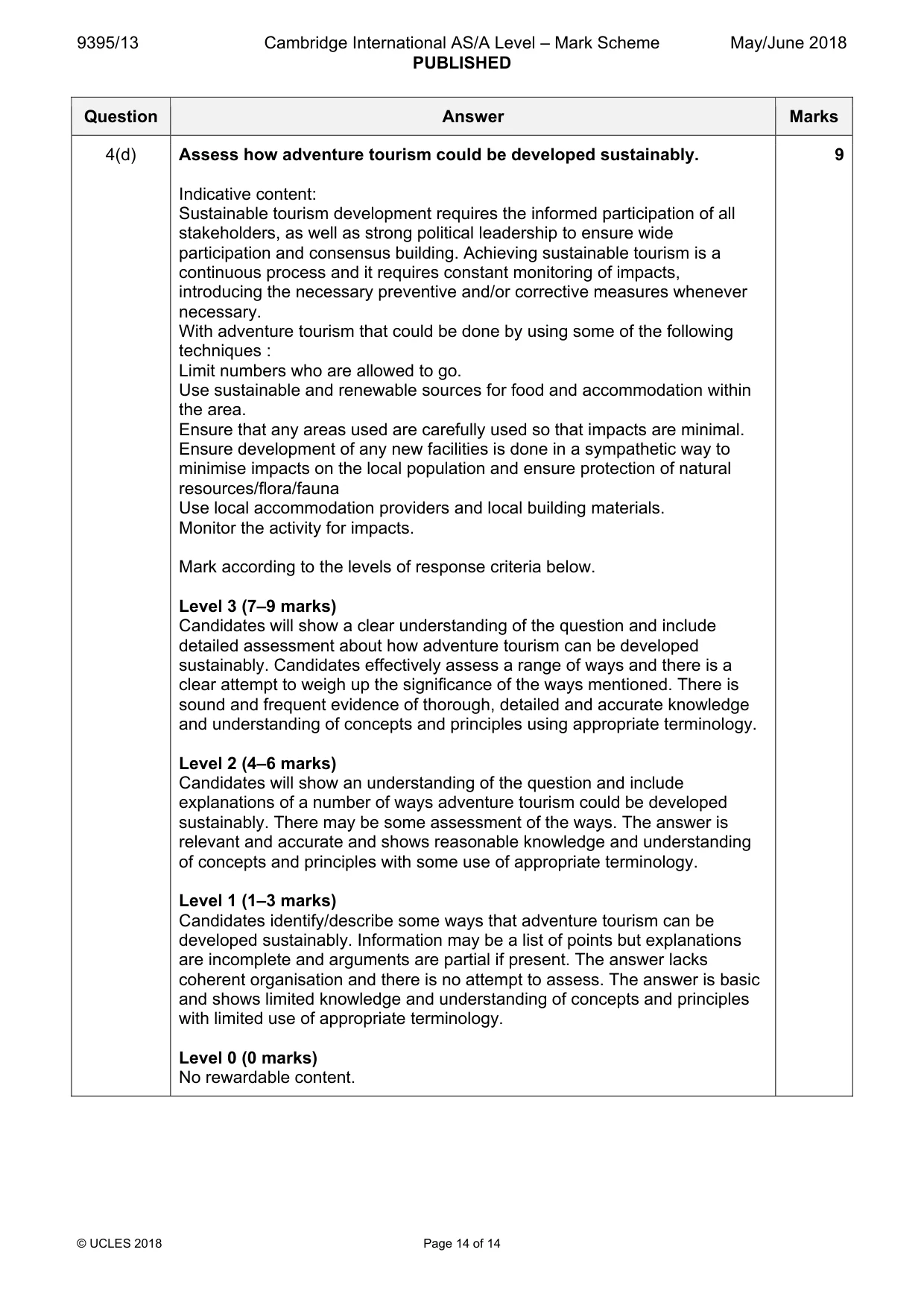
9395/13 Cambridge International AS/A Level – Mark Scheme PUBLISHED May/June 2018 © UCLES 2018 Page 14 of 14 Question Answer Marks 4(d) Assess how adventure tourism could be developed sustainably. Indicative content: Sustainable tourism development requires the informed participation of all stakeholders, as well as strong political leadership to ensure wide participation and consensus building. Achieving sustainable tourism is a continuous process and it requires constant monitoring of impacts, introducing the necessary preventive and/or corrective measures whenever necessary. With adventure tourism that could be done by using some of the following techniques : Limit numbers who are allowed to go. Use sustainable and renewable sources for food and accommodation within the area. Ensure that any areas used are carefully used so that impacts are minimal. Ensure development of any new facilities is done in a sympathetic way to minimise impacts on the local population and ensure protection of natural resources/flora/fauna Use local accommodation providers and local building materials. Monitor the activity for impacts. Mark according to the levels of response criteria below. Level 3 (7–9 marks) Candidates will show a clear understanding of the question and include detailed assessment about how adventure tourism can be developed sustainably. Candidates effectively assess a range of ways and there is a clear attempt to weigh up the significance of the ways mentioned. There is sound and frequent evidence of thorough, detailed and accurate knowledge and understanding of concepts and principles using appropriate terminology. Level 2 (4–6 marks) Candidates will show an understanding of the question and include explanations of a number of ways adventure tourism could be developed sustainably. There may be some assessment of the ways. The answer is relevant and accurate and shows reasonable knowledge and understanding of concepts and principles with some use of appropriate terminology. Level 1 (1–3 marks) Candidates identify/describe some ways that adventure tourism can be developed sustainably. Information may be a list of points but explanations are incomplete and arguments are partial if present. The answer lacks coherent organisation and there is no attempt to assess. The answer is basic and shows limited knowledge and understanding of concepts and principles with limited use of appropriate terminology. Level 0 (0 marks) No rewardable content. 9
What you needed in this session
Cambridge’s own grade thresholds for 2018 May/June, Paper 1 · Variant 3. A higher threshold means an easier paper — the bar moves with how the cohort did.